Phil Gramm : Don’t Worry, Be Happy


But it’s actually Wall Street where they’re whining. Or, shall we say, panicking?
By William Greider / July 14, 2008

Phil Gramm, the senator-banker who until recently advised John McCain’s campaign, did get it right about a “nation of whiners,” but he misidentified the faint-hearted. It’s not the people or even the politicians. It is Wall Street–the financial titans and big-money bankers, the most important investors and worldwide creditors who are scared witless by events. These folks are in full-flight panic and screaming for mercy from Washington, Their cries were answered by the massive federal bailout of Fannie Mae and Freddy Mac, the endangered mortgage companies.

When the monied interests whined, they made themselves heard by dumping the stocks of these two quasi-public private corporations, threatening to collapse the two financial firms like the investor “run” that wiped out Bear Stearns in March. The real distress of the banks and brokerages and major investors is that they cannot unload the rotten mortgage securities packaged by Fannie Mae and banks sold worldwide. Wall Street’s preferred solution: dump the bad paper on the rest of us, the unwitting American taxpayers.

The Bush crowd, always so reluctant to support federal aid for mere people, stepped up to the challenge and did as it was told. Treasury Secretary Paulson (ex-Goldman Sachs) and his sidekick, Federal Reserve Chairman Ben Bernanke, announced their bailout plan on Sunday to prevent another disastrous selloff on Monday when markets opened. Like the first-stage rescue of Wall Street’s largest investment firms in March, this bold stroke was said to benefit all of us. The whole kingdom of American high finance would tumble down if government failed to act or made the financial guys pay for their own reckless delusions. Instead, dump the losses on the people.

Democrats who imagine they may find some partisan advantage in these events are deeply mistaken. The Democratic party was co-author of the disaster we are experiencing and its leaders fell in line swiftly. House banking chair, Rep. Barney Frank, announced he could have the bailout bill on President Bush’s desk next week. No need to confuse citizens by dwelling on the details. Save Wall Street first. Maybe lowbrow citizens won’t notice it’s their money.

We are witnessing a momentous event–the great deflation of Wall Street–and it is far from over. The crash of IndyMac is just the beginning. More banks will fail, so will many more debtors. The crisis has the potential to transform American politics because, first it destroys a generation of ideological bromides about free markets, and, second, because it makes visible the ugly power realities of our deformed democracy. Democrats and Republicans are bipartisan in this crisis because they have colluded all along over thirty years in creating the unregulated financial system and mammoth mega-banks that produced the phony valuations and deceitful assurances. The federal government protects the most powerful interests from the consequences of their plundering. It prescribes “market justice” for everyone else.

Of course, the federal government has to step up to the crisis, but the crucial question is how government can respond in the broad public interest. Bernanke knows the history of the last great deflation in the 1930s–better known as the Great Depression–and so he is determined to intervene swiftly, as the Federal Reserve failed to do in that earlier crisis. By pumping generous loans and liquidity into the system, the Fed chairman hopes to calm the market fears and reverse the panic. So far, he has failed. I think he will continue to fail because he has not gone far enough.

If Washington wants real results, it has to abandon the wishful posture that is simply helping the private firms get over their fright. The government must instead act decisively to take charge in more convincing ways. That means acknowledging to the general public the depth of the national crisis and the need for more dramatic interventions.

Instead of propping up Fannie Mae or others, the threatened firm should be formally nationalized as a nonprofit federal agency performing valuable services for the housing market. That is the real consequence anyway if the taxpayers have to buy up $300 billion in stock.

The private shareholders “are walking dead men, muerto,” Institutional Risk Analytics, a private banking monitor, observed. Make them eat their losses, the sooner the better. The real national concern should be focused on the major creditors who lend to Fannie Mae and other US agencies as well as private financial firms. They include China, Japan and other foreign central banks. Foreign investors hold about 21 percent of the long-term debt paper issued by US government agencies–$376 billion in China, $229 billion in Japan.

It is not in our national interest to burn these nations with heavy losses. On the contrary, we need to sustain their good regard because they can help us recover by bailing out the US economy with more lending. If these foreign creditors turn away and stop their lending now, the US economy is toast and won’t soon recover.

Americans should forget about whining; it’s too late for that. People need to get angry–really, really angry–and take it out on both parties. What the country needs right now is a few more politicians in Washington with the guts to stand up and tell us the hard truth about out situation. It will be painful to hear. They will be denounced as “whiners.” But truth might be our only way out.

Source. / The Nation

Thanks to David Hamilton / The Rag Blog

Posted in RagBlog | Tagged , , , | Leave a comment

Jim Hightower on Pot

Sharing his thoughts on pot, that is…
July 14, 2008

Watch the Marijuana Policy Project’s Profiles in Marijuana Reform interview with author and national radio commentator, Jim Hightower in the video above. This is a project of MPP.tv.

Here’s more from the Marijuana Policy Project:

Marijuana: Myths vs. Reality

Myth: There is no scientific evidence proving marijuana’s therapeutic qualities.

Reality: In a White House-commissioned 1999 report, the National Academy of Sciences’ Institute of Medicine declared that “nausea, appetite loss, pain, and anxiety are all afflictions of wasting and all can be mitigated by marijuana.”

Myth: Marijuana’s potential health benefits are insignificant compared to the damage caused by smoking the drug.

Reality: Marijuana need not be administered by smoking: It can be taken in food, tea, or through a smokeless vaporizer. Furthermore, a 2006 study by a leading pulmonologist, Dr. Donald Tashkin, found that even regular and heavy smoking of marijuana does not lead to lung cancer.

Myth: Allowing the medical use of marijuana will send the wrong message to children and lead to more youths using the drug.

Reality: In the 10 medical marijuana states that have before-and-after data, studies have unanimously shown that not only has youth use of marijuana not gone up overall, it actually has declined since medical marijuana became legal.

Myth: Marijuana is a gateway drug to harder substances, and therefore medical marijuana use will lead to dangerous drug use.

Reality: In science, the distinction between cause and correlation is a crucial one. A White House-commissioned study by the Institute of Medicine found that marijuana “does not appear to be a gateway drug to the extent that it is the cause or even that it is the most significant predictor of serious drug abuse; that is, care must be taken not to attribute cause to association.” Moreover, claims about marijuana being a gateway make no sense in the context of medical marijuana: Patients often use marijuana instead of highly addictive prescription medicines like morphine and Oxycontin. Medical marijuana is a safe alternative for patients whose other options are not as reliable or effective.

Myth: Supporting medical marijuana is politically risky.

Reality: Across the country and with increasing frequency, public opinion polls show that support for medical marijuana is popular and steadily rising — and cuts across demographic and party lines. A 2004 AARP poll showed that 72% of seniors support medical marijuana, and a 2005 Gallup poll found that 78% of Americans support “making marijuana legally available for doctors to prescribe in order to reduce pain and suffering.” Compassion and relief from suffering are nonpartisan issues that all legislators can — and should — support.

Myth: Marijuana’s potential health benefits are insignificant compared to the damage caused by smoking the drug.

Reality: Marijuana need not be administered by smoking: It can be taken in food, tea, or through a smokeless vaporizer. Furthermore, a 2006 study by a leading pulmonologist, Dr. Donald Tashkin, found that even regular and heavy smoking of marijuana does not lead to lung cancer.

Myth: Allowing the medical use of marijuana will send the wrong message to children and lead to more youths using the drug.

Reality: In the 10 medical marijuana states that have before-and-after data, studies have unanimously shown that not only has youth use of marijuana not gone up overall, it actually has declined since medical marijuana became legal.

Myth: Marijuana is a gateway drug to harder substances, and therefore medical marijuana use will lead to dangerous drug use.

Reality: In science, the distinction between cause and correlation is a crucial one. A White House-commissioned study by the Institute of Medicine found that marijuana “does not appear to be a gateway drug to the extent that it is the cause or even that it is the most significant predictor of serious drug abuse; that is, care must be taken not to attribute cause to association.” Moreover, claims about marijuana being a gateway make no sense in the context of medical marijuana: Patients often use marijuana instead of highly addictive prescription medicines like morphine and Oxycontin. Medical marijuana is a safe alternative for patients whose other options are not as reliable or effective.

Myth: Supporting medical marijuana is politically risky.

Reality: Across the country and with increasing frequency, public opinion polls show that support for medical marijuana is popular and steadily rising — and cuts across demographic and party lines. A 2004 AARP poll showed that 72% of seniors support medical marijuana, and a 2005 Gallup poll found that 78% of Americans support “making marijuana legally available for doctors to prescribe in order to reduce pain and suffering.” Compassion and relief from suffering are nonpartisan issues that all legislators can — and should — support.

Myth: Marijuana’s potential health benefits are insignificant compared to the damage caused by smoking the drug.

Reality: Marijuana need not be administered by smoking: It can be taken in food, tea, or through a smokeless vaporizer. Furthermore, a 2006 study by a leading pulmonologist, Dr. Donald Tashkin, found that even regular and heavy smoking of marijuana does not lead to lung cancer.

Myth: Allowing the medical use of marijuana will send the wrong message to children and lead to more youths using the drug.

Reality: In the 10 medical marijuana states that have before-and-after data, studies have unanimously shown that not only has youth use of marijuana not gone up overall, it actually has declined since medical marijuana became legal.

Myth: Marijuana is a gateway drug to harder substances, and therefore medical marijuana use will lead to dangerous drug use.

Reality: In science, the distinction between cause and correlation is a crucial one. A White House-commissioned study by the Institute of Medicine found that marijuana “does not appear to be a gateway drug to the extent that it is the cause or even that it is the most significant predictor of serious drug abuse; that is, care must be taken not to attribute cause to association.” Moreover, claims about marijuana being a gateway make no sense in the context of medical marijuana: Patients often use marijuana instead of highly addictive prescription medicines like morphine and Oxycontin. Medical marijuana is a safe alternative for patients whose other options are not as reliable or effective.

Myth: Supporting medical marijuana is politically risky.

Reality: Across the country and with increasing frequency, public opinion polls show that support for medical marijuana is popular and steadily rising — and cuts across demographic and party lines. A 2004 AARP poll showed that 72% of seniors support medical marijuana, and a 2005 Gallup poll found that 78% of Americans support “making marijuana legally available for doctors to prescribe in order to reduce pain and suffering.” Compassion and relief from suffering are nonpartisan issues that all legislators can — and should — support.

Source. / AlterNet

Thanks to David Hamilton / The Rag Blog

Posted in RagBlog | Tagged , , , , , | 1 Comment

A Special Report : Colombia’s Bloody Civil War


A Rag Blog exclusive report…
War and poverty in today´s Colombia

July 15, 2008

The following analysis was presented by a Conscientious Objectors´ group, and edited and translated by The Rag Blog’s Val Liveoak. The presenter´s name is withheld to protect him. Val Liveoak was on the staff of The Rag in Austin from 1972-1975. She works with Friends Peace Teams on peacebuidling in Colombia. Val has worked on projects in Colombia since 2000, and lives in San Antonio.

Colombia is a rich country, with abundant natural resources and occupying a strategic geopolitical position on the South American Continent. Its biodiversity is remarkable: 10 per cent of all the earth’s flora and fauna are found in Colombia, and 22.4 per cent of the planet’s fresh water. This abundance of water alone makes it attractive to transnational and national businesses that need water to produce their products. Colombia has a very youthful population–of the total 43 million inhabitants, 46.5 per cent are younger than 19 years old.

Additionally Colombia has great mineral wealth. Its largest product is coal — 1,183 metric tons have been mined, about one sixth of the known reserves. Gold is also a major product. The companies which exploit these resources, along with petroleum, nickel, uranium, magnesium, zinc, copper and many others, are mainly US or Canadian owned.

In gold production, for example, Gulf Crown, a Canadian company, takes around 80 per cent of the income generated by its mines. Workers, using 18th century technology and little safety equipment, enter dangerous mineshafts, dig with pickaxes and then carry out ore which they treat with an acid despite having no protective equipment. Then they then transport it by mule-back to the mine’s office and are paid under two cents per gram for partially refined gold, while gold sells on the world market for up to $2.50/gram.

“Despite Colombia’s natural wealth of mineral and biologic resources and our geopolitical importance, or to be exact, because of these interests, it is ironic that Colombia is also a place with great poverty and human suffering.”

For more that 50 years, Colombia has suffered one of the most prolonged and bloody civil wars of the century. The past four administrations in Colombia have tried to diminish or even deny that a war is happening, but there have been over 2,500 military actions annually and deaths of over 3,000 combatants, so it is undeniable that there is a real war in process. (International standards consider an annual total of 1,000 casualties as defining a war.) In the June 6, 2008 issue of El Tiempo, a national newspaper, a survey showed that around 20 per cent of Colombians do not believe there is a war going on, and the other 80 per cent believe there is.

The human consequences of this ongoing war are innumerable. It would not be feasible to try to document in this article all of the effects on Colombians during nearly four generations of war. But we will outline a few of the effects.

Most noteworthy as having affected nearly 10 per cent of the Colombian population is internal forced displacement. Colombia has the second largest population of internally-displaced people (IDPs) in the world, over 3,500,000 according to the UN High Commission on Refugees. And even this figure is considered low, due to IDPs’ fear of reporting their displacement because the report might put themselves or their families at further risk of violence. Both paramilitary and guerrilla groups cause displacement, although paramilitaries are responsible for the majority of displacements.

In addition to the people who have suffered displacement, thousands have been assassinated, kidnapped or have disappeared. To cite one statistic, from 1993 to the first quarter of 2006, the Self Defense forces of Colombia (known in Spanish as the AUC), only one of a number of paramilitary groups, have perpetuated 1,517 massacres of a total of 8,386 victims. According to the Association of Families of the Disappeared, more than 7,000 people have been disappeared since 1977, and we know that the actual total might be much higher because not all disappearances are reported because of the fear of further violence. During the process of demobilization, begun in January, 2007, former paramilitary members´ confessions have led to the discovery of around 800 common graves with 2-18 cadavers each.

In Colombia, according to the Fiscal General (a Cabinet position similar to Attorney General), there were “…more victims of paramilitaries than there were in Chile during the military dictatorship of Agosto Pinochet and in Argentina under Rafael Videla together.” Paramilitary groups are blamed for the majority of disappearances. (Note: Paramilitary groups began appearing in Colombia around the mid 1970s, when Colombian officers began receiving counterinsurgency training at the US School of the Americas — now known as the Western Hemisphere Institute of Security and Cooperation. They were taught to form groups that could do things the Army was forbidden to do by law. Additionally, large landowners and other business owners began around that time to hire armed groups to “protect their interests” including displacing small farmers from desirable land, and suppressing unions, journalists and judges.)

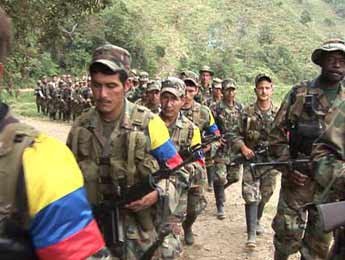
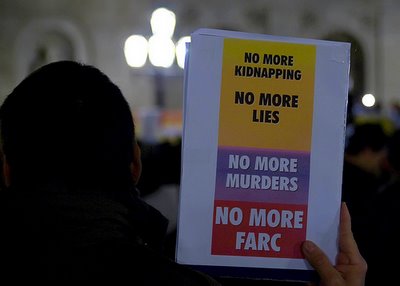
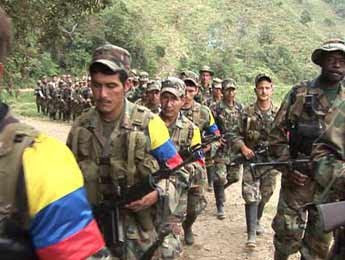
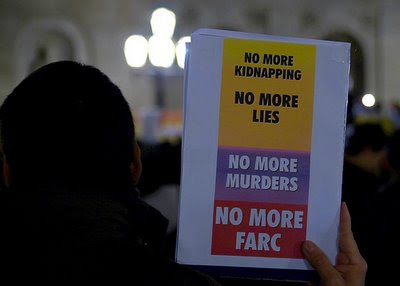
Kidnapping is common in Colombia, with over 21,000 known victims in the last 12 years, 3,167 of whom remain in captivity. Massive protests of kidnapping, and public demand for the liberation of the victims have received worldwide publicity. During this month, there have been very few days when the media did not mention a victim of kidnapping, or his/her release. The guerrilla groups, the FARC and the ELN, use the ransoms to help finance their programs. (Additionally these groups also blockade and rob travelers on highways—a tactic known as “miraculous fishing,” and are involved in the drug trade.) Other groups also kidnap people for ransom, but kidnapping by guerrilla groups is most loudly denounced.

The psychosocial implications of the impact of constant and innumerable deaths, disappearances, tortures, kidnappings, threats of violence, displacements and aggressions against the civilian population throughout the length and breadth of the country, in addition to the grave implications of entire generations marked by violence are compounded by the economic effects of the war economy that has created the terrible phenomenon of impoverishment throughout the Colombian population.

Currently, according to CEPALC (The Peoples’ Communication Center of Latin American), 63 per cent of Colombians live in poverty on less than $2 a day and of that group, 32 per cent live in absolute poverty on less than $1 daily. At the same time 1.8 per cent of the richest Colombians control approximately 68 per cent of the wealth and capital of the country. (Compare to the US where the richest one per cent controls about 55% of the national wealth.) 6,000 of the largest landowners control 50 million hectares of land while 3 million small farmers (campesinos, literally, “country people”) share around 7 million hectares, an area which is constantly being reduced by the difficulties of agricultural production, violence and the threats of armed groups.

At the same time the current administration is spending record breaking amounts on the war, deepening the critical problems of the country and creating a dangerous economic dynamic around “national security,” which in addition to being onerous is also ineffective at fulfilling the government’s own goals.

Increases in military spending directly correspond to the increases in the rates of poverty among the population. A recent year’s defense budget of over $9.7 billion makes Colombia the country with the third highest military budget (by percentage of GNP) in the world, at 6.3 per cent. (The US, even with the Iraq and Afghanistan wars, spends around 4.04 per cent of GNP.)

This increase in military spending is obviously one cause of decreases in spending for health, education, housing, pensions, public services, infrastructure, sports and other vital elements for development. As a comparison, consider that there are five Colombian soldiers for every 1,000 civilians but only one doctor for every 3,800 persons. (“And that doctor is limited to serving only paying patients, so most of us use herbal medicines and other home remedies to keep well. This may be like the US medical system.”) If we take into account that not only members of the armed forces are involved in efforts to ensure “national security,” we also note that of 556,000 public employees, 460,000 are working in the area of defense, security or as police. By the account of the Colombian Defense Department, each soldier costs $7,900 each year (up from $3,500 in 1999) while the Ministry of Education says that each student in public school is budgeted to receive a little less than $900/year.

The US government is supporting this onerous war machine, too, with $320 million as a part of the Patriot Plan (the successor to the first and second phases of Plan Colombia that gave the Colombian government $580 million over the last ten years of both Democratic and Republican administrations.) Additionally, the US has provided over $150 million in technological and logistical assistance and in military equipment (“mostly obsolete”). There are large amounts of military supplies being stored in depots, far more than the Army can currently use.

Why then, cannot the 415,000 members of the Colombian Armed Forces (aided by an estimated 21,000-30,000 paramilitary members) defeat the guerrilla groups FARC (15,000 members) and the ELN (7,500 members)? Paraphrasing Noam Chomsky, “Winning a war is not good business.” Recent events also seem to indicate that the US is nudging the Uribe government into a proxy war with Venezuela. (See below.)

What are (some) Colombians afraid of?

Colombian friends have spoken often of the desire to end the “culture of violence” they experience daily. Although in the capital, Bogotá, life seems pretty normal to most people who do not have contact with the hordes of displaced people who have fled to the slum neighborhoods around the city, there are many reminders of the ongoing war, not to mention the other effects outlined in the article above.

In Colombia, all men between the ages of 18 and 50 (!) are obliged to serve in the military. Most expect to serve around the ages of 18-20, when those who have access to higher education complete their bachillerato, a degree similar to an AB from a junior college in the US. Young men studying for this degree or in seminary, heads of households, handicapped, and some others are legally entitled to deferment, if not exemption from military service, although conscientious objection for religious or moral reasons is not recognized. The Colombian Mennonite Church has led efforts to achieve recognition of CO’s for many years.

One event that affected the group of Conscientious Objectors was a massive roundup of young men for military service in February of this year. While some young men volunteer for military service (daily during the evening news there is a Colombian version of the “Be all you can be” advertisement), most are forcibly recruited — swept up by the authorities outside movie theaters or in parks, on their way to work, or even outside schools. On February 12, 2008, over 30,000 young men were taken, in the largest dragnet in the history of the country. Some, like a CO we spoke to, had received draft notices to report to a center. When he and some 3,000 others arrived they were processed and immediately sent to an Army camp. He had the assistance of the CO group, and was able, after 12 hours of protesting, to be let go with a citation to return in a few months. Others were not so fortunate, and the CO groups are still fighting in the courts for the release of youths entitled to legal exemptions as well as COs.

But those are not the only concerns the COs expressed. They have heard that these new recruits — some of whom should never have been taken — have been sent after brief training to the border areas with Venezuela and Ecuador where many troops are being massed. Although relations with Ecuador have improved after Colombia´s raid on guerrilla camps across the border in March, saber-rattling on both sides of the Colombian-Venezuelan border continues. News stories of Venezuela´s efforts to increase its military might, including its display of newly acquired missiles, are added to the coverage of President Chavez´ defiant statements opposing US military aid to Colombia. “I think there’s a propaganda campaign preparing us to wage a proxy war against Venezuela,” said one CO, “and the troop buildup on the borders seems to point to a possible war as well, not to mention the stockpiling of military equipment.”

While much of the US peace movement’s attention is (rightly) focused on the Middle East, we should remember that US interests are strong in Latin America and that Colombia is the third largest recipient of US military aid. On Sunday (June 8) President Chavez called for an end of the guerrilla war in Colombia and a unilateral release of all the kidnapped hostages. “You in the FARC should know that the war has become the excuse for the Empire to threaten us all. The day there is peace in Colombia, there will no longer be any excuse for a US Empire.” It seems he is also concerned about a possible proxy war.

The Rag Blog

Posted in Rag Bloggers | Tagged , , , , | Leave a comment

FILM : Hollywood’s Response to War


How Vietnam Gave us Dude, Where’s My Car
By Michael Bronski

One of the most amazing cultural responses to the war against Iraq has been the plethora of documentary and feature films produced by independent companies and even Hollywood studios. From In the Valley of Elah, Grace is Gone, and Stop-Loss to Redacted, Taxi to the Dark Side, and Standard Operating Procedure, this ongoing nightmare of a war is being discussed, analyzed, and attacked by filmmakers within a wide array of disciplines and political backgrounds

In the 1960 and 1970s the response to the Vietnam War was totally different. Sure there were some films that addressed it—Brian de Palma’s early independent Greetings (1968) and Emile de Antonio’s documentary In the Year of the Pig (1968), as well as a few other movies. Vietnam was obviously the inspiration for Robert Altman’s M*A*S*H (1970), and metaphorically for a few other films, but it was much later—a full decade—that we began getting mainstream films that dealt with the war in various ways: Deer Hunter (1978), Coming Home (1978), Apocalypse Now (1979). Years after that more films were made and released: Platoon (1986), Full Metal Jacket (1987), Hamburger Hill (1987), Good Morning, Vietnam (1987), and Born on the 4th of July (1989).

The more I thought about the quirks of popular culture and film culture, it seemed to me that Hollywood did have a very visceral response to the senseless slaughter of young Americans in Vietnam (though it didn’t really care to think about the millions of Vietnamese deaths or casualties). Beginning in 1978 with the release of Halloween and a slew of other slasher films, Hollywood was responding to the senseless slaughter of young American lives in its own peculiar way. Friday the 13th came out in 1980, A Nightmare on Elm Street in 1984. These quickly evolved into ongoing series that betrayed a national preoccupation with the deaths of young people. Along with these, a host of other films—Prom Night (1980), Terror Train (1980), My Bloody Valentine (1981), Happy Birthday to Me (1981), Slumber Party Massacre (1982)—drew huge audiences (and little critical approval) as the genre hit some nerve with viewers throughout the country.

Certainly the few Vietnam films that were released in the late 1980s could not be the only response to the national tragedy and crisis. But then it occurred to me that while Hollywood always liked a good war—although, apparently not in this case—what really moved it was the U.S. losing the war in Vietnam. This loss was a tremendous blow to the idea of American manhood. Clearly, this manhood had to be psychically restored in mass consumer culture. And made to order came butch, strong men who let nothing stand in their way of success.

First there was Rocky (1976) in which Sly Stallone turned the boxing ring into a war. As the series caught on to his real meaning he was pitted against Russian thugs to make sure that we won the Cold War. Arnold S. did Rocky one better as an indescribable cyborg in Terminator (1984). He continued with Commando in 1985, Raw Deal in 1986, and Running Man and Predator in 1987. All of these had post-Vietnam and Cold War contexts and guess what—Arnold won everything. At the end of this cycle came Bruce Willis in Die Hard (1988).

The subtext of these films was the reassertion of a masculinity so extreme, so powerful, so conclusive that it was super-human. Massive and casual death was the narrative of these films—and the disposibility of other bodies was the drive. They all did that with a grave disregard for morality or honesty.

After so much straining and huffing and puffing these unholy three petered out and the genre passed into film history (the actors, unfortunately, did not). America was tired, apparently, of proving that it could have won in Vietnam and moved on to what seemed to be a completely antithetical genre: the stoner buddy movie. These films are an outright rejection of the Stallone/ Schwarzenegger/Willis mythos. They featured teenaged boys; they did not promote violence, but a charmingly pot-riddled sense of make love, not war. They were wedded to a view that was both naively innocent and anti-rational. They insisted on being as non-traditionally masculine as possible. America’s romance with the brute had been replaced with a new love affair: the clever, innocent, but haplessly wrecked teen boy. It was an improvement.

Bill & Ted’s Excellent Adventure in 1989 gave way to Bill & Ted’s Bogus Journey in 1991, and then Dazed and Confused in 1993. The one salient theme was the refusal to take anything seriously. In what seemed to be a rebuke to the death-obsessed antics of the unholy three, these guys didn’t even take death seriously. As slight and silly as it was, it was preferable to killing machines.

The next evolution in these films—and we see it in 1994’s Dumb and Dumber (1994) and Kevin Smith’s characters Jay and Silent Bob in Dogma (1999) and Jay and Silent Bob Strike Back (2001)—is the queer subtexts of these films that keeps emerging. While the guys in Dumb and Dumber (not really stoners, but acting in the same way) were heterosexual, they were too dumb to know how to act heterosexual. And Jay, of Jay and Silent Bob, is a complete semi-closet case. This rejection of masculinity included, to a large degree, also getting rid of not only the trappings of heterosexuality, but heterosexuality itself at some points.

By the time we get to Dude Where’s My Car in 2000, the guys are straight—they remember they have girlfriends when they are able to, often they are just too wasted to think about it—but they have no problem acting like they are a couple. It’s true that in Harold and Kumar Go to White Castle (2004)—a demented son of Dude, Where’s My Car—they are more actively interested in women, but they are still fleeing any sort of traditional masculinity. Their refusal to think about the realities of world politics in any conscious way makes these films profoundly apolitical.

It may be too much to expect stoner films to deal with political realities—they exist precisely to deal with them by ignoring them—but the fact is that, unlike the 1960s and 1970s when films avoided the harsh, ugly realities of war, we are blessed today with films that deal with most aspects of our current political crisis.

And we have some fun stoner comedies as well that aptly and neatly critique the very notions of masculinity that have brought us into, and continue, this mess.

[Michael Bronski is the author of numerous articles and books including Pulp Friction: Uncovering the Gold- en Age of Gay Male Pulps. He has been a visiting professor in Women’s and Gender Studies and Jewish Studies at Dartmouth College since 1999.]

Source. / ZMag / Posted July 1, 2008

The Rag Blog

Posted in RagBlog | Tagged , , , , , , | 1 Comment

South African Human Rights Activists Shocked By Palestinian Refugee Camp

Palestinian mourners carry the body of Al-Aqsa Martyrs Brigades militant Hani Al-Kabi who was killed in an Israeli army raid in the Balata refugee camp, during his funeral in the West Bank town of Nablus, Friday, April 18, 2008. Photo by Nasser Ishtayeh / AP

Twilight Zone: ‘Worse than apartheid’
By Gideon Levy / July 15, 2008

I thought they would feel right at home in the alleys of Balata refugee camp, the Casbah and the Hawara checkpoint. But they said there is no comparison: for them the Israeli occupation regime is worse than anything they knew under apartheid. This week, 21 human rights activists from South Africa visited Israel. Among them were members of Nelson Mandela’s African National Congress; at least one of them took part in the armed struggle and at least two were jailed. There were two South African Supreme Court judges, a former deputy minister, members of Parliament, attorneys, writers and journalists. Blacks and whites, about half of them Jews who today are in conflict with attitudes of the conservative Jewish community in their country. Some of them have been here before; for others it was their first visit.

For five days they paid an unconventional visit to Israel – without Sderot, the IDF and the Foreign Ministry (but with Yad Vashem, the Holocaust Memorial and a meeting with Supreme Court President Justice Dorit Beinisch. They spent most of their time in the occupied areas, where hardly any official guests go – places that are also shunned by most Israelis.

On Monday they visited Nablus, the most imprisoned city in the West Bank. From Hawara to the Casbah, from the Casbah to Balata, from Joseph’s Tomb to the monastery of Jacob’s Well. They traveled from Jerusalem to Nablus via Highway 60, observing the imprisoned villages that have no access to the main road, and seeing the “roads for the natives,” which pass under the main road. They saw and said nothing. There were no separate roads under apartheid. They went through the Hawara checkpoint mutely: they never had such barriers.

Jody Kollapen, who was head of Lawyers for Human Rights in the apartheid regime, watches silently. He sees the “carousel” into which masses of people are jammed on their way to work, visit family or go to the hospital. Israeli peace activist Neta Golan, who lived for several years in the besieged city, explains that only 1 percent of the inhabitants are allowed to leave the city by car, and they are suspected of being collaborators with Israel. Nozizwe Madlala-Routledge, a former deputy minister of defense and of health and a current member of Parliament, a revered figure in her country, notices a sick person being taken through on a stretcher and is shocked. “To deprive people of humane medical care? You know, people die because of that,” she says in a muted voice.

The tour guides – Palestinian activists – explain that Nablus is closed off by six checkpoints. Until 2005, one of them was open. “The checkpoints are supposedly for security purposes, but anyone who wants to perpetrate an attack can pay NIS 10 for a taxi and travel by bypass roads, or walk through the hills.

The real purpose is to make life hard for the inhabitants. The civilian population suffers,” says Said Abu Hijla, a lecturer at Al-Najah University in the city.

In the bus I get acquainted with my two neighbors: Andrew Feinstein, a son of Holocaust survivors who is married to a Muslim woman from Bangladesh and served six years as an MP for the ANC; and Nathan Gefen, who has a male Muslim partner and was a member of the right-wing Betar movement in his youth. Gefen is active on the Committee against AIDS in his AIDS-ravaged country.

“Look left and right,” the guide says through a loudspeaker, “on the top of every hill, on Gerizim and Ebal, is an Israeli army outpost that is watching us.” Here are bullet holes in the wall of a school, there is Joseph’s Tomb, guarded by a group of armed Palestinian policemen. Here there was a checkpoint, and this is where a woman passerby was shot to death two years ago. The government building that used to be here was bombed and destroyed by F-16 warplanes. A thousand residents of Nablus were killed in the second intifada, 90 of them in Operation Defensive Shield – more than in Jenin. Two weeks ago, on the day the Gaza Strip truce came into effect, Israel carried out its last two assassinations here for the time being. Last night the soldiers entered again and arrested people.

It has been a long time since tourists visited here. There is something new: the numberless memorial posters that were pasted to the walls to commemorate the fallen have been replaced by marble monuments and metal plaques in every corner of the Casbah.

“Don’t throw paper into the toilet bowl, because we have a water shortage,” the guests are told in the offices of the Casbah Popular Committee, located high in a spectacular old stone building. The former deputy minister takes a seat at the head of the table. Behind her are portraits of Yasser Arafat, Abu Jihad and Marwan Barghouti – the jailed Tanzim leader. Representatives of the Casbah residents describe the ordeals they face. Ninety percent of the children in the ancient neighborhood suffer from anemia and malnutrition, the economic situation is dire, the nightly incursions are continuing, and some of the inhabitants are not allowed to leave the city at all. We go out for a tour on the trail of devastation wrought by the IDF over the years.

Edwin Cameron, a judge on the Supreme Court of Appeal, tells his hosts: “We came here lacking in knowledge and are thirsty to know. We are shocked by what we have seen until now. It is very clear to us that the situation here is intolerable.” A poster pasted on an outside wall has a photograph of a man who spent 34 years in an Israeli prison. Mandela was incarcerated seven years less than that. One of the Jewish members of the delegation is prepared to say, though not for attribution, that the comparison with apartheid is very relevant and that the Israelis are even more efficient in implementing the separation-of-races regime than the South Africans were. If he were to say this publicly, he would be attacked by the members of the Jewish community, he says.

Under a fig tree in the center of the Casbah one of the Palestinian activists explains: “The Israeli soldiers are cowards. That is why they created routes of movement with bulldozers. In doing so they killed three generations of one family, the Shubi family, with the bulldozers.” Here is the stone monument to the family – grandfather, two aunts, mother and two children. The words “We will never forget, we will never forgive” are engraved on the stone.

No less beautiful than the famed Paris cemetery of Pere-Lachaise, the central cemetery of Nablus rests in the shadow of a large grove of pine trees. Among the hundreds of headstones, those of the intifada victims stand out. Here is the fresh grave of a boy who was killed a few weeks ago at the Hawara checkpoint. The South Africans walk quietly between the graves, pausing at the grave of the mother of our guide, Abu Hijla. She was shot 15 times. “We promise you we will not surrender,” her children wrote on the headstone of the woman who was known as “mother of the poor.”

Lunch is in a hotel in the city, and Madlala-Routledge speaks. “It is hard for me to describe what I am feeling. What I see here is worse than what we experienced. But I am encouraged to find that there are courageous people here. We want to support you in your struggle, by every possible means. There are quite a few Jews in our delegation, and we are very proud that they are the ones who brought us here. They are demonstrating their commitment to support you. In our country we were able to unite all the forces behind one struggle, and there were courageous whites, including Jews, who joined the struggle. I hope we will see more Israeli Jews joining your struggle.”

She was deputy defense minister from 1999 to 2004; in 1987 she served time in prison. Later, I asked her in what ways the situation here is worse than apartheid. “The absolute control of people’s lives, the lack of freedom of movement, the army presence everywhere, the total separation and the extensive destruction we saw.”

Madlala-Routledge thinks that the struggle against the occupation is not succeeding here because of U.S. support for Israel – not the case with apartheid, which international sanctions helped destroy. Here, the racist ideology is also reinforced by religion, which was not the case in South Africa. “Talk about the ‘promised land’ and the ‘chosen people’ adds a religious dimension to racism which we did not have.”

Equally harsh are the remarks of the editor-in-chief of the Sunday Times of South Africa, Mondli Makhanya, 38. “When you observe from afar you know that things are bad, but you do not know how bad. Nothing can prepare you for the evil we have seen here. In a certain sense, it is worse, worse, worse than everything we endured. The level of the apartheid, the racism and the brutality are worse than the worst period of apartheid.

“The apartheid regime viewed the blacks as inferior; I do not think the Israelis see the Palestinians as human beings at all. How can a human brain engineer this total separation, the separate roads, the checkpoints? What we went through was terrible, terrible, terrible – and yet there is no comparison. Here it is more terrible. We also knew that it would end one day; here there is no end in sight. The end of the tunnel is blacker than black.

“Under apartheid, whites and blacks met in certain places. The Israelis and the Palestinians do not meet any longer at all. The separation is total. It seems to me that the Israelis would like the Palestinians to disappear. There was never anything like that in our case. The whites did not want the blacks to disappear. I saw the settlers in Silwan [in East Jerusalem] – people who want to expel other people from their place.”

Afterward we walk silently through the alleys of Balata, the largest refugee camp in the West Bank, a place that was designated 60 years ago to be a temporary haven for 5,000 refugees and is now inhabited by 26,000. In the dark alleys, which are about the width of a thin person, an oppressive silence prevailed. Everyone was immersed in his thoughts, and only the voice of the muezzin broke the stillness.

Source. / Haaretz.com

Thanks to Larry Piltz / The Rag Blog

Posted in RagBlog | Tagged , , , , , , , , | 1 Comment

Karl Rove : FOX in the Hen House?

Here is a succinct statement of what’s wrong with The System, as we used to call it. Karl Rove is an election analyst for Fox News.

“Fox News host Chris Wallace also came to Rove’s defense, asking rhetorically, ‘Why it is that if Congress and the White House are having a fight about executive power, that that should in any way constrain an independent news organization’s decision as to who is it going to have on its payroll?'”

Aren’t such close ties between government and private industry a hallmark of fascism?

Bill Meacham / The Rag Blog / July 15, 2008

Karl Rove denies political ties taint Fox News role
By Steve Gorman / July 15, 2008

LOS ANGELES – Former White House aide Karl Rove denied on Monday that his close ties with Republican politics and John McCain’s presidential campaign undermine his credibility as an election analyst for the Fox News Channel.

Appearing at a gathering of television critics in Beverly Hills, Rove and network executive John Moody brushed aside suggestions that Rove’s continued involvement in the presidential race, informal or not, might pose a conflict in his capacity as a Fox News contributor.

Rove, the chief strategist for U.S. President George W. Bush’s 2000 and 2004 election victories and former deputy chief of staff in his administration, left the White House last August and joined the Fox News team in February 2008.

“I do talk to people in politics all across the country, some of whom are very active in the campaign (but) I play no official role, or ongoing role,” he said in answer to a question about whether he works for the McCain operation in any way.

“I do get phone calls,” he added. “I’m having dinner later this week with a great friend of mine who just happens to be the Republican state chairman of a battleground state. He’s going to be in Washington, and it’s not just the quality of steak I’m going to fix him that’s caused him to stop by the house and pick my brain. So that’s just a reality.”

Asked whether Rove was on “the honor system” regarding his contacts with top McCain campaign operatives such as Steve Schmidt, Moody replied: “He’s always on the honor system. All of our employees are.”

“We get most of our information about the McCain campaign from our correspondents,” Moody added. “I don’t think Karl would cross an ethical line like that.”

Rove also dismissed the notion that his refusal to answer congressional subpoenas to testify in a probe of the Bush administration’s firing of federal prosecutors amounted to too much political baggage for a network news analyst to carry.

“It is not between me and Congress,” he said. “This is between the White House and Congress. This is long-standing battle over the principle of executive privilege and the ability of the president to receive advice from senior advisors and for senior advisors not to be at the beck and call of Congress to testify.”

He also said that like fellow Fox News analyst Howard Wolfson, a former top strategist and communications director for Senator Hillary Clinton’s presidential campaign, his job was to help viewers “better understand” the political process based on his experience.

Fox News host Chris Wallace also came to Rove’s defense, asking rhetorically, “Why it is that if Congress and the White House are having a fight about executive power, that that should in any way constrain an independent news organization’s decision as to who is it going to have on its payroll?”

Source. / Reuters / Yahoo! News

The Rag Blog

Posted in RagBlog | Tagged , , , , , , , , | Leave a comment

Could Alabama Gov. Siegelman Bring Down the House of Cards?

Former Alabama govenor Don Siegelman accompanied by his wife Lorie reports to the Federal building in downtown Tuscaloosa in 2004.

Gov. Siegelman at Netroots Nation: Bush’s Undoing?
By Sam Seder / July 14, 2008

As more and more corruption and law breaking at the highest reaches of our Government reveal themselves, will the scandal surrounding the use of the Department of Justice as an electoral tool be the one that finally holds the Bush administration to account? If so, there is one man who’s story may seal the unraveling of this criminal regime.

Former political prisoner and former Governor of Alabama Don Siegelman will be making a court sanctioned trip out of Alabama to join me at Netroots Nation to discuss his case and what it can tell us about the unprecedented corruption that exists in our nation’s chief law enforcement agency, the Department of Justice.

By now many are familiar with the case of Don Siegelman.. A very popular former Democratic Alabama Governor seen as an electoral threat to unseat Republican Bob Riley. Faced with the most popular Democrat in generations, Congressional testimony reveals that Republican operatives in Alabama and Karl Rove’s dirty tricks shop in the White House used the prosecution powers of the DOJ’s United States Attorneys to send Don Siegelman to jail on trumped up charges.

The dogged reporting by on-line journalists like Talking Points Memo, Larisa Alexandrovna and Scott Horton, Congressional hearings and a sixty minutes interview forced an appellate Court to reexamine the Siegelman case. Within days Siegelman was released from prison pending his appeal and the court found “that his appeal raises substantial questions of law or fact…”. Reagan’s Attorney General Richard Thornburgh and 54 former US Attorneys of all political stripes from across the country smell a rat. Not surprisingly, that rat smells a lot like Karl Rove, the Fox news commentator and former White House dirty trickster.

For over a year and a half now we have known of the US Attorney firings scandal that has forced the resignations of countless DOJ officials. The Siegelman case is the other side of the coin of the corruption of the Department of Justice under the Bush administration. Those US attorney firings took place because those US Attorney’s would not play ball with a DOJ hell bent on using it’s powers to provide Republicans an advantage at the ballot box. Some refer to this scandal as the politicization of the Department of Justice, but the Siegelman case and other such prosecutions over the past six years go well beyond a mere infraction of the Hatch act. These cases are indicative of an agenda that has literally torn at the fabric of a nation built upon the rule of law and justice for all. This is a corruption of the very foundations of how the United States of America is supposed function as a democracy. When the chief law enforcement agency has become crooked, who do you call?

Fox commentator Karl Rove, through his attorney, has claimed that simply because he once worked at the White House he need not comply with a Congressional subpoena to testify as to his involvement with this prosecution. Karl Rove may not be traveling to Washington anytime soon, but Don Siegelman will be traveling to Austin Friday at Netroots Nation to give us some insight as to just how far we have fallen as a a nation.

If you have any questions you’d like me to ask of the former Governor, feel free to head over here and offer them up.

[Catch it live. This conversation with Sam Seder and Gov. Siegelman will be streaming live exclusively at AirAmerica on Friday, July 18th 10:30 AM – 11:45 AM.]

Source. / The Huffington Post

Also go to Free Don Siegelman.

The Rag Blog

Posted in RagBlog | Tagged , , , , , | 1 Comment

Clear-Cut Logging: Not Such a Good Thing

The aerial photo of the bare slope and slide areas in the Stillman Creek drainage raised concerns at Weyerhaeuser, enough so that corporate officials did their own flyover, scouting landslides there and elsewhere in the Northwest. Photo: Steve Ringman, Seattle Times

Logging and landslides: What went wrong?
By Hal Bernton and Justin Mayo / July 13, 2008

BOISTFORT VALLEY, Lewis County — When Weyerhaeuser began clear-cutting the Douglas firs on the slopes surrounding Little Mill Creek, local water officials were on edge.

Some of these lands had slid decades ago, after an earlier round of logging. They worried new slides could dump sediments into the mountain stream and overwhelm a treatment plant.

Those fears came true last December when a monster storm barreled in from the Pacific, drenching the mountains around the Chehalis River basin and touching off hundreds of landslides. Little Mill Creek, filled with mud and debris, turned dark like chocolate syrup.

More than three months passed before nearly 3,000 valley residents could drink from their taps again.

“I have never seen anything like this before, and I hope I never do again,” said Fred Hamilton, who works for the Boistfort Valley Water Corp.

State forestry rules empower the Department of Natural Resources (DNR) to restrict logging on unstable slopes when landslides could put public resources or public safety at risk.

But in Little Mill Creek and elsewhere in the Upper Chehalis basin, a Seattle Times investigation found that Weyerhaeuser frequently clear-cut on unstable slopes, with scant oversight from the state geologists who are supposed to help watchdog the timber industry.

The December storm triggered more than 730 landslides in the Upper Chehalis basin, according to a state aerial survey. Those slides dumped mud and debris into swollen rivers, helping fuel the floods that slammed houses, barns and farm fields downstream.

A disproportionate number of those landslides started on slopes that had been clear-cut.

The Seattle Times, using information from state aerial surveys, examined 87 of the steepest sites that had been clear-cut. Nearly half of them suffered landslides during the storm. Those sites represented less than 8 percent of the total acreage — both logged and forested — in the Upper Chehalis and its tributary drainages. But the sites produced about 30 percent — 219 — of the landslides.

Among the other findings:

• Weyerhaeuser routinely downgraded slide risks on those sites in logging applications submitted to the state. In watershed plans financed by Weyerhaeuser and approved by the state in 1994, more than half the acreage in the sites was rated at moderate- or high-hazard potential for landslides. But in a second round of site reviews before logging, Weyerhaeuser geologists concluded that most acreage had little or no potential for landslides.

• State forestry officials often noted “unstable slopes” or “unstable soils” in checklists that accompanied their harvest approvals. But there is no record in the files of any field visits by state geologists to scrutinize the logging plans in the 42 sites that later had landslides. Forty of those sites were logged by Weyerhaeuser, two by other companies.

David Montgomery, a University of Washington geomorphology professor who reviewed The Seattle Times’ findings, believes Weyerhaeuser underestimated the risks of clear-cutting.

He notes that several logged areas included features specifically defined in state rules as potentially unstable.

Logging these areas removes trees that help intercept the rain and bind the soil. Decades of studies, which have been used to help shape state forest-practice rules, show logging such slopes can increase the number and size of slides.

Montgomery wrote some of those studies. His blunt assessments of the connection between logging and landslides have sometimes rankled state and industry officials.

“If the policy is not to increase landsliding, then they have no business cutting on some of these slopes,” Montgomery said. “There is not a mechanistic model on this planet that would predict cutting down those trees would do anything other than reduce stability. The only question is how much.”

Catastrophic flooding

The December 2007 flood walloped Lewis County, causing more than $57 million in property damage to homes, farms and businesses. A Seattle Times photo of landslides on a clear-cut mountainside helped ignite a public debate about whether logging practices had worsened the flood’s effects.

Weyerhaeuser and the state Forest Practices Board, which sets state logging rules, are both funding studies to look at the relationship between logging and landslides in the December storm.

In interviews, Weyerhaeuser officials place most of the blame for last year’s landslides on the extraordinary amount of rainfall. Over the decades, they say, the company has made improvements in its forestry practices — some of which were credited in a 2000 report commissioned by the state with helping reduce erosion and landslide risks in the Upper Chehalis. And in some areas, they believe their logging may have made little — or no — difference in the number of landslides.

The Chehalis River’s peak flood flow was more than double the previous record tracked by gauges in place since 1939. Some areas got especially soaked: The Stillman Creek drainage, for example, got 8 inches of rain in 10 hours.

Within the Chehalis River basin, the company said, there were also numerous slides in forested areas, and the company noted such slides may be underreported because they are hard to spot in aerial surveys. By contrast, Weyerhaeuser clear-cuts in other drainages that received less rain had few landslides.

“This storm was so intense that we had no basis for making judgments about what is likely to be stable or unstable. So that is kind of what we are struggling with here,” said Bob Bilby, Weyerhaeuser’s chief environmental scientist.

“At the same time, we are not trying to absolve us of any guilt. … We are mounting a fairly large project to take a look at the procedures we use to deal with unstable slopes.”

The DNR also is reviewing its oversight, according to Lenny Young, manager of the agency’s Forest Practices Division.

In 2001, new rules more strictly defined the kinds of unstable slopes where logging could be limited. In areas that already had watershed plans, such as the Chehalis basin, timber companies were exempted from the new rules, according to Young.

That exemption, which has been in place as Weyerhaeuser clear-cut in the basin, will be re-examined by the Forest Practices Board, said Young. Still, state Lands Commissioner Doug Sutherland, who heads DNR, defends his agency’s enforcement record.

“Do we have enough oversight?” Sutherland said. “With the folks available, with the data available. With the technology available. My answer would be yes, we do. Can we improve it? Definitely.”

Read the rest of it here. / The Seattle Times

For extended coverage, click here.

The Rag Blog

Posted in RagBlog | Tagged , , | 2 Comments

The Court Decision Disappointed Even the Victors


Decisions Shut Door on Bush Clean-Air Steps
By Felicity Barringer / July 12, 2008

Any major steps by the Bush administration to control air pollution or reduce emissions of heat-trapping gases came to a dead end on Friday, the combined result of a federal court ruling and a decision by the head of the Environmental Protection Agency.

In the morning, a federal appeals court struck down the cornerstone of the administration’s strategy to control industrial air pollution by agreeing with arguments by the utility industry that the E.P.A. had exceeded its authority when it established the Clean Air Interstate Rule in 2005. The court, the United States Court of Appeals for the District of Columbia Circuit, said the rule, which set new requirements for major pollutants, had “fatal flaws.”

A few hours later, the E.P.A. chief rejected any obligation to regulate heat-trapping gases like carbon dioxide under existing law, saying that to do so would involve an “unprecedented expansion” of the agency’s authority that would have “a profound effect on virtually every sector of the economy,” touching “every household in the land.”

Taken together, the developments make it clear that any significant new effort to fight air pollution will fall to the next president.

The comments by the E.P.A. administrator, Stephen L. Johnson, reinforced a message that the administration had been sending for months: that it does not intend to impose mandatory controls on the emissions that cause climate change. John Walke, a lawyer with the Natural Resources Defense Council, a leading environmental group, said, “As a result of today, July 11, the Bush administration has failed to achieve a single ounce in reductions of smog, soot, mercury or global warming pollution from power plants.”

Mr. Johnson said he was “extremely disappointed” in the court decision “because it’s overturning one of the most significant and health-protective rules in our nation’s history.”

But on climate change, he said laws like the Clean Air Act were “ill-suited” to the complexities of regulating greenhouse gases.

Mr. Johnson’s comments appeared as a preface to a report by the E.P.A. staff sketching out how the emission of heat-trapping gases, particularly by vehicles, might be handled under the Clean Air Act. The report was intended to address a Supreme Court directive that the agency decide whether such gases threaten people’s health or welfare. But it also reflects the deep disapproval of controls on such gases by the White House and agencies like the Transportation, Agriculture and Commerce Departments.

In effect, Mr. Johnson was simultaneously publishing the policy analysis of his scientific and legal experts and repudiating its conclusions.

The Clean Air Interstate Rule, which covered states in the eastern half of the country, set new requirements for controls on major pollutants emitted by industry, particularly the electric utilities. At its most stringent, it would have required, beginning in 2015, 70 percent reductions in sulfur dioxide and 60 percent reductions in nitrogen oxide from 2003 levels.

At the time the interstate pollution rule was adopted, the E.P.A. estimated that, when fully in effect after 2015, it would cut by 13,000 annually the number of premature deaths from breathing polluted air.

The court ruling, combined with a court decision this year striking down an E.P.A. rule controlling mercury emissions from power plants, means that virtually all controls on the electric utility industry by the Bush administration have no force.

“The implications are huge,” said Lisa Heinzerling, a professor at Georgetown University Law Center. “This is the administration’s major air pollution initiative.”

The restrictions were designed, Ms. Heinzerling said, to deal comprehensively with a variety of air pollution issues, including the interstate transport of pollutants and the states’ obligations to enforce standards to protect the public health.

But with the court’s decision, she said, all of the administration’s efforts, aside from those involving vehicles, “are gone.”

“Anything they’ve done that has any relation to pollution control has been invalidated,” she said.

The court decision disappointed even the victors.

Jim Owen of the Edison Electric Institute said, “In our industry, one of the things we crave is certainty, and this goes in the other direction.”

Brent W. Dorsey, the director of corporate environmental programs at Entergy, the large energy producer, added, “With this thing thrown out, we’ve basically thrown the baby out with the bathwater.”

Entergy, one of the companies that brought the case to court, emphasized on Friday that it did not want the whole rule thrown out and that it had challenged only the part that allocated permits for emissions of pollutants around the industry. The company said an 11th-hour change by the E.P.A. had put too much of the cleanup burden on areas using oil and gas for power generation, as Entergy does, and not enough on utilities that burn coal.

Thomas Williams, a spokesman for Duke Energy, which had sued the E.P.A., contesting how the rule allocated the pollution allowances among industries, said in an e-mail message, “It was not the intent of Duke Energy’s participation in this litigation to overturn E.P.A.’s Clean Air Interstate Rule.”

Mr. Williams pointed out that North Carolina, where Duke has several power plants, enacted a law in 2002 that set limits on sulfur dioxide and nitrogen oxide that were even tougher than those in the now-defunct federal rule.

Bill Becker, executive director of the National Association of Clean Air Agencies, said on Friday that few states, aside from North Carolina, had laws that would fill the void created by the court ruling.

“Right now we find ourselves in the twilight zone,” Mr. Dorsey, of Entergy, said. “How do you proceed now? Do we continue to buy emissions allowances? Do we work on putting scrubbers on, or what?”

Entergy backs a legislative remedy proposed by Senator Thomas R. Carper, Democrat of Delaware, that would set long-term limits on pollutants.

While industry and environmental lobbyists both expressed concerns about the impact of the court ruling, they divided along more customary lines on Friday’s second decision, the declaration by Mr. Johnson of the E.P.A. that existing federal laws were “ill-suited” to the regulation of heat-trapping gases.

The Association of International Automobile Manufacturers released a statement saying, in part, “We share concerns that the Clean Air Act, which underwent its last major amendment 18 years ago, does not include all of the tools and criteria needed to address the global issue of climate change, including requirements to balance the economic effects and impacts on U.S. manufacturing jobs along with the environmental considerations.”

Mr. Johnson alluded to the difficulty of applying the Clean Air Act, designed for conventional pollutants like sulfur dioxide and nitrogen oxide, to greenhouse gases.

Because interagency consensus could not be reached on a road map for such regulation, Mr. Johnson said, he was simultaneously publishing his staff’s work and the comments of its critics, which had a definite tinge of hostility toward the E.P.A. regulators.

For instance, the chairman of the Council on Environmental Quality, James Connaughton, wrote that the E.P.A.’s staff “myopically focuses on the Clean Air Act and ignores or understates major intended and unintended consequences that would flow from misapplying decades-old regulatory tools.”

The final E.P.A. document, known as an advance notice of proposed rule making, did not contain a staff analysis about the economic benefits of regulation that had been in an earlier draft. That May 30 draft, which circulated widely in Washington, set the benefits of regulation at up to $2 trillion. The final version, based on the revised assumption that gasoline would cost about $2.20 per gallon in the foreseeable future, estimated the economic benefit at no more than about $830 billion.

Source. / The New York Times

Thanks to Betsy Gaines / The Rag Blog

Posted in RagBlog | Tagged , , | Leave a comment

Bill Moyers: "Communitainment" and Other Media Wonders


Is the Fourth Estate a Fifth Column? Corporate media colludes with democracy’s demise
By Bill Moyers / July 14, 2008

I heard this story a long time ago, growing up in Choctaw County in Oklahoma before my family moved to Texas. A tribal elder was telling his grandson about the battle the old man was waging within himself. He said, “It is between two wolves, my son. One is an evil wolf: anger, envy, sorrow, greed, self-pity, guilt, resentment, lies, false pride, superiority and ego. The other is the good wolf: joy, peace, love, hope, serenity, humility, empathy, generosity, truth, compassion and faith.”

The boy took this in for a few minutes and then asked his grandfather, “Which wolf won?”

The old Cherokee replied simply, “The one I feed.”

Democracy is that way. The wolf that wins is the one we feed. And in our society, media provides the fodder.

Our media institutions, deeply embedded in the power structures of society, are not providing the information that we need to make our democracy work. To put it another way, corporate media consolidation is a corrosive social force. It robs people of their voice in public affairs and pollutes the political culture. And it turns the debates about profound issues into a shouting match of polarized views promulgated by partisan apologists who trivialize democracy while refusing to speak the truth about how our country is being plundered.

Our dominant media are ultimately accountable only to corporate boards whose mission is not life, liberty and the pursuit of happiness for the whole body of our republic, but the aggrandizement of corporate executives and shareholders.

These organizations’ self-styled mandate is not to hold public and private power accountable, but to aggregate their interlocking interests. Their reward is not to help fulfill the social compact embodied in the notion of “We, the people,” but to manufacture news and information as profitable consumer commodities.

Democracy without honest information creates the illusion of popular consent at the same time that it enhances the power of the state and the privileged interests that the state protects. And nothing characterizes corporate media today more than its disdain toward the fragile nature of modern life and its indifference toward the complex social debate required of a free and self-governing people.

Let’s look at what is happening with the Internet. This spring the cable giant Comcast tried to pack a Federal Communications Commission (FCC) hearing on network neutrality by hiring strangers off the street to ensure that advocates of net neutrality would not be able to get a seat in the hearing room.

SaveTheInternet.com — a bipartisan coalition — and its supporters helped expose the ruse. Soon after, there was a new hearing, this time without the gerrymandering seating by opponents of an open Internet.

Now Rep. Ed Markey (D-Mass.) has introduced a bill to advance network neutrality, and it has become an issue in the presidential campaign.

We must be vigilant. The fate of the cyber-commons — the future of the mobile Web and the benefits of the Internet as open architecture — is up for grabs. And the only antidote to the power of organized money in Washington is the power of organized people at the net roots.

When Verizon tried to censor NARAL’s (National Abortion Rights Action League) use of text messaging last year, it was quick action by Save the Internet that led the company to reverse its position. Those efforts also led to an FCC proceeding on this issue.

Wherever the Internet flows — on PCs, cell phones, mobile devices and, very soon, new digital television sets — we must ensure that it remains an open and nondiscriminatory medium of expression.

By 2011, the market analysts tell us, the Internet will surpass newspapers in advertising revenues. With MySpace and Dow Jones controlled by News Corporation’s Rupert Murdoch, Microsoft determined to acquire Yahoo!, and with advertisers already telling some bloggers, “Your content is unacceptable,” we could potentially lose what’s now considered an unstoppable long tail of content offering abundant, new, credible and sustainable sources of news and information.

So, what will happen to news in the future, as the already tattered boundaries between journalism and advertising is dispensed with entirely and as content programming, commerce and online communities are rolled into one profitably attractive package?

Last year, the investment firm of Piper Jaffray predicted that much of the business model for new media would be just that kind of hybrid. They called it “communitainment.” (Oh, George Orwell, where are you now that we need you?)

Across the media landscape, the health of our democracy is imperiled. Buffeted by gale force winds of technological, political and demographic forces, without a truly free and independent press, this 250-year-old experiment in self-government will not make it. As journalism goes, so goes democracy.

Mergers and buyouts change both old and new media. They bring a frenzied focus on cost-cutting, while fattening the pockets of the new owners and their investors. The result: journalism is degraded through the layoffs and buyouts of legions of reporters and editors.

Advertising Age reports that U.S. media employment has fallen to a 15-year low. The Los Angeles Times alone has experienced a withering series of resignations by editors who refused to turn a red pencil into an editorial scalpel.

The new owner of the Tribune Company, real estate mogul Sam Zell, recently toured his new property Los Angeles Times, telling employees in the newsroom that the challenge is this: How do we get somebody 126 years old to get it up? “Well,” said Zell, “I’m your Viagra.”

He told his journalists that he didn’t have an editorial agenda or a perspective about newspapers’ roles as civic institutions. “I’m a businessman,” he said. “All what matters in the end is the bottom line.”

Zell then told Wall Street analysts that to save money he intends to eliminate 500 pages of news a week across all of the Tribune Company’s 12 papers. That can mean eliminating some 82 editorial pages every week just from the Los Angeles Times. What will he use to replace reporters and editors? He says to the Wall Street analysts, “I’ll use maps, graphics, lists, rankings and stats.” Sounds as if Zell has confused Viagra with Lunesta.

Former Baltimore Sun journalist and creator of HBO’s The Wire, David Simon, chronicled the effect that crosscutting and consolidation has had in media businesses and on the communities where those businesses have made so much money. He wrote in a Washington Post op-ed, “I did not encounter a sustained period in which anyone endeavored to spend what it would actually cost to make the Baltimore Sun the most essential and deep-thinking and well-written account of life in central Maryland. The people you needed to gather for that kind of storytelling were ushered out the door, buyout after buyout.”

Or as journalist Eric Alterman recently wrote in the New Yorker: “It is impossible not to wonder what will become of not just news but democracy itself, in a world in which we can no longer depend on newspapers to invest their unmatched resources and professional pride in helping the rest of us to learn, however imperfectly, what we need to know.”

For example, we needed to know the truth about Iraq. The truth could have spared that country from rack and ruin, saved thousands of American lives and hundreds of thousands of Iraqi lives, and freed hundreds of billions of dollars for investment in the American economy and infrastructure.

But as reporters at Knight Ridder — one of the few organizations that systematically and independently set out to challenge the claims of the administration — told us at the time, and as my colleagues and I reported in our PBS documentary Buying the War, and as Scott McClellan has now confessed, and as the Senate Intelligence Committee confirmed in June, the Bush administration deceived Americans into supporting an unprovoked war on another country. And it did so using erroneous and misleading intelligence — and with the complicity of the dominant media. It has led to a conflict that, instead of being over quickly and bloodlessly as predicted, continues to this day into its sixth year.

We now know that a neoconservative is an arsonist who sets a house on fire and six years later boasts that no one can put it out. You couldn’t find a more revealing measure of the state of the dominant media today than the continuing ubiquitous presence on the air and in print of the very pundits and experts, self-selected message multipliers of a disastrous foreign policy, who got it all wrong in the first place. It just goes to show, when the bar is low enough, you can never be too wrong.

The dominant media remains in denial about their role in passing on the government’s unverified claims as facts. That’s the great danger. It’s not simply that they dominate the story we tell ourselves publicly every day. It’s that they don’t allow other alternative competing narratives to emerge, against which the people could measure the veracity of all the claims.

Now the dominant media is saying, “Well, we did ask. We did do our job by asking tough questions during the run-up to the war.”

But I’ve been through the transcripts. And I’ll tell you, you will find very few tough questions. And if you come across them, you will discover that they were asked of the wrong people.

John Walcott, Washington bureau chief for McClatchy, formerly Knight Ridder, recently said of his colleagues in the dominant media, “They asked a lot of questions, but they asked even the right questions of the wrong people.” They were asked of the sources who had cooked the intelligence books in the first place or who had memorized the White House talking points and were prepared to answer every tough question with a soft evasion or an easy lie, swallowed by a gullible questioner.

Following the March 2003 invasion, Vice President Dick Cheney dropped into a media dinner to thank the guests for their all-the-war-all-the-time coverage of the contrived and manufactured war.

Sadly, in many respects, the Fourth Estate has become the fifth column of democracy, colluding with the powers that be in a culture of deception that subverts the thing most necessary to freedom, and that is the truth.

But we’re not alone and we know what we need to say. So let us all go tell it on the mountains and in the cities. From our websites and laptops, the street corners and coffeehouses, the delis and diners, the factory floors and the bookstores. On campus, at the mall, the synagogue, sanctuary and mosque, let’s tell it where we can, when we can and while we still can.

Democracy only works when ordinary people claim it as their own.

[This article was adapted from Bill Moyers’ keynote address at the National Conference for Media Reform Conference in Minneapolis on June 7. You can read and respond to the full speech at www.pbs.org/moyers.]

Source / Information Clearing House

Also see Bill Moyers : A Texan’s Take on the Journalist’s Job The Rag Blog / May 4, 2008

The Rag Blog

Posted in RagBlog | Tagged , , | Leave a comment

Warning to Obama: Avoid the ‘Great Game’

Afghan fighters.

Stop one war by starting two more?
By Tom Hayden / July 14, 2008

Barack Obama restated his Iraq phased withdrawal play in response to public questioning today but committed himself to expanding the wars in Afghanistan and Pakistan.

Any proposal to transfer American troops from Iraq to Afghanistan and Pakistan is sure to cause debate and questions among peace activists and rank-and-file Democrats. The proposal potentially represents a wider quagmire for the US government and military.

On Iraq, Obama said nothing especially new in his July 14 New York Times’ op-ed piece, but it was a forceful restatement of his commitment to combat troop withdrawals after his recent statements suggesting that he would “refine” his views when he consults military commanders on the ground.

Obama neglected to address how many American “residual forces” he would leave behind in Iraq to fight al-Qaeda and “protect American service members,” though he made additional US trainers conditional on the Iraqis making “political progress.” It was a proposal that seemed to promise a phased diminishing of the American military presence, not a complete withdrawal.

Many independent analysts question leaving some 50,000 American troops as advisers, trainers and counter-terrorism units in Iraq after the withdrawal of 140,000 by 2010. Those forces will be protecting a sectarian political regime that is linked to death squads, militias and a detention system now holding 50,000 Iraqis in violation of human rights standards.

It is quite possible that Obama’s regional diplomacy, including hard-bargaining with Iran, could facilitate a decent interval for American troop withdrawals and a more stabilized Iraq, as suggested by former CIA director John Deutch. [interview with Deutch, in Ending the War in Iraq, 2007]

Obama smartly exploited the recent call by Iraqi prime minister Nuri al-Malaki for a US withdrawal deadline, although al-Maliki’s time line was twice as long as Obama’s. In this face-saving scenario, the Pentagon would follow “the Philippine option” in which the client government formally requested that the US close its bases. This option was advocated openly by the Marines’ commander in Iraq in 2004. [NYT, Nov. 29, 2006]. The US only withdrew obsolete naval forces from the Philippines, however; today the US spends hundreds of millions on a secret war against Islamic forces in the southern Philippines. Obama might do the same.

These public policy ambiguities are not simply Obama’s problem, but are caused by a mainstream media which stubbornly refuses to ask any questions about those “residual forces.” For example, how will “residual forces,” tied to the regime the Americans put in power, be more successful on the battlefield than the departing 170,000 combat troops?

But Obama’s proposals for Afghanistan and Pakistan are far more problematic. They can described in everyday language as either out of the frying pan and into the fire, or attacking needles by burning down haystacks.

The Pentagon paradigm is to defeat al-Qaeda militarily while refusing to address, and thereby worsening, the dire conditions that gave rise to the Taliban and al-Qaeda operatives in the first place. Ahmed Rashid’s new Descent into Chaos [Viking, 2008] provides a horrific portrait of Afghanistan in careful prose based on reputable sources:

* It is estimated by RAND that $100 per capita is the minimum required to stabilize a country evolving out of war. Bosnia received $679 per capita, Kosovo $526, while Afghanistan received $57 per capita in the key years, 2001-2003;

* When the US installed the Hamid Karzai government, Afghanistan ranked 172nd out of 178 nations on the United Nation’s Human Development Index, having the highest rate of infant mortality in the world, a life expectancy rate of 44-45 years, and the youngest population of any country; in 2005 95 percent of Kabul’s residents were living without electrical power.

* Seven hundred civilians were killed in the first five months of 2008 alone, according to the United Nations.

Despite some gains in media and currency reform, plus a modest increase in children in school, this was the path of least reconstruction.

And despite images of Afghan democracy that made loya jirga tribal gatherings appear to be the birth of participatory democracy, a warlord state was entrenched by the CIA.

There are some 36,000 US troops stretched across Afghanistan, another 17,500 under NATO command, and 18,000 in counterinsurgency and training roles [NYT, July 14]. They are so aggressively combat-oriented that the Afghan government itself continually objects to the rate of civilian casualties. It costs the Pentagon $2 billion per month to support 30,000 American troops. According to Rashid, “Afghanistan is not going to be able to pay for its own army for many years to come — perhaps never.”

As of 2006, Afghanistan’s economy still rested on producing 90 percent of the world’s opium, an eerie narco-state parallel with the US counterinsurgency in Colombia from where most of America’s supply of cocaine originates.

Afghanistan is an unstable police state. By 2005, the Afghan Independent Human Rights Commission cited 800 cases of detainee abuse at some thirty U.S. firebases. “The CIA operates its own secret detention centers, which were off limits to the US military.” Ghost prisoners, known as Persons Under Control [PUCs] are held permanently without any public records of their existence. Warlords operate their own prisons with “unprecedented abuse, torture, and death of Taliban prisoners.” And as the US lowered the number of prisoners at Guantanamo, it increased the numbers held at Bagram, near Kabul. As of January, 2008, there were 630 incarcerated at Bagram, “including some who had been there for five years and whom the ICRC had still not been given access to.” After weeks of hunger strikes about detention conditions, the Taliban recently orchestrated a jailbreak of hundreds of Afghanis from the Kandahar prison, an inside job.

As in Iraq, the US contracted for police training in Afghanistan with DynCorp International; between 2003 and 2005, the US spent $860 million to train 40,000 Afghan police, “but the results were totally useless” according to Rashid. Even Richard Holbrooke described the DynCorp training program as “an appalling joke…a complete shambles.”

When the Taliban government was overthrown, the US installed a Westernized Pashtun, Hamid Karzai, a former lobbyist for Unocal, who had been out of the country during the jihad against the Soviet Union. But the Pashtun tribes themselves were violently displaced from power for the first time in 300 years. They remain by far the largest Afghan minority at 42 percent of the population, heavily concentrated in Kandahar and the southern provinces and across the federally-administered tribal areas in western Pakistan. These are the areas that the Pentagon, the New York Times, and Barack Obama [like John Kerry before him] designate as the central battlefront of the war on terrorism.

The question is not simply a moral one, but whether the expanding war in Afghanistan and Pakistan, fueled by troop transfers from Iraq, is winnable, and in what sense?

Transferring 10,000 American troops from Iraq to Afghanistan, which Obama proposes, is symbolic, a potential downpayment on the treadmill of further escalation. [In his statement, Obama supports “at least” two additional brigades for Afghanistan]. The future of the Pentagon’s “rear” in Iraq will be questionable if 15 combat brigades are withdrawn under Obama’s plan, while the Pentagon’s new “front” line cannot be secured with two brigades sent to southern and eastern Afghanistan. At best these might be holding actions until the next administration makes a decision about its ultimate strategy. Obama may be proposing an escalation simply in order not to lose, a pattern well-documented in Daniel Ellsberg’s history of the Vietnam War.

But the US escalation policy already is deepening rapidly, with bipartisan support [or silence, so far]. In keeping with counterinsurgency strategies going back to America’s long wars against native tribes, the Pentagon has fostered the ascension of a new Pakistani general, Ashfaq Parvez Kayani, whose background includes training at Fort Benning and Fort Leavenworth. An unnamed US military official praises Kayani “for embracing new counterinsurgency training and tactics that could be more effective in countering militants in the country’s tribal areas. [NYT, Jan. 7. 2008] Over $400 million is being spent to recruit a “frontier corps” of to “turn local tribes against militants” [NYT, Mar. 4, 2008] CIA and Special Forces operatives already have invaded Pakistan to set up a secret base from which to hunt Osama bin Laden “before Mr. Bush leaves office” as well as fighting al Qaeda and the Taliban on the ground and from pilotless Predator drones. [NYT, Feb. 22, 2008].

All this constitutes yet another preventive war by the United States, this one in violation of Pakistan’s sovereignty and against the stated policies of the newly-elected Pakistani government, not to mention the overwhelming sentiment among Pakistan’s people. On the Afghan front, the Taliban will be able to retreat in the face of greater US firepower, or attack like Lilliputians from multiple sides if the US concentrates its forces around the Pakistan border. Further violence and tides of anti-American sentiment could sweep across the region into Pakistan with unpredictable results.

Michael Scheuer, the former CIA official once charged with tracking down Osama bin Laden, suggests that the American delusion is that “by establishing a minority-dominated semisecular, pro-Indian government [in Kabul], we would neither threaten the identity nor raise the ire of the Pashtun tribes nor endanger Pakistan’s national security.” Scheuer wrote this year that “for the United States, the war in Afghanistan has been lost. By failing to recognize that the only achievable US mission in Afghanistan was to destroy the Taliban and al-Qaeda and their leaders and get out, Washington is now faced with fighting a protracted and growing insurgency. The only upside of this coming defeat is that it is a debacle of our own making. We are not being defeated by our enemies; we are in the midst of defeating ourselves.” [Marching Toward Hell, 2008]

The beginning of an alternative may require unfreezing American diplomacy towards Iran and considering a “grand bargain” instead. Teheran is the single power, according to CIA director Deutch, who could destabilize the US withdrawal from Iraq. It happens that they were America’s ally against Afghanistan not so long ago. The Iranians have lost thousands of police and soldiers themselves in a border war against Afghan drug lords. According to William Polk, “ironically, the only effective deterrent to the trade is Iran.” [Violent Politics, 2008] In exchange for security guarantees against a US-directed regime change, Iran may be willing to discuss cooperation with the “Great Satan” to stabilize its borders with Iraq and Afghanistan. Improbable? That depends on whether one thinks the alternative is unthinkable.

Only a short time ago, historically, the US was supporting the jihadists in the same tribal areas as they ventured to destroy the Soviet occupation. In the same years, the US was hosting the Taliban for talks on a possible oil pipeline across Afghanistan. Since twists and turns seem to be the only pattern in divide-and-conquer strategies, it is possible that Obama thinks being tough towards Afghanistan and Pakistan is a defensive cover for withdrawing from Iraq, and he later will follow up with unspecified diplomacy after he takes office. But history shows that creeping escalations create a momentum and constituency of their own. Obama might get lucky, lower the level of the visible wars, and embrace a diplomatic offensive. But North and South Waziristan could be his Bay of Pigs.

In summary, to borrow a popular phrase of the season, ending one war [Iraq] to start two more [in Afghanistan and Pakistan] seems to be a dumb idea.

[Tom Hayden is the author of Ending the War in Iraq (2007), The Voices of the Chicago Eight (2008), and Writing for a Democratic Society, the Tom Hayden Reader (2008).]

Source. / Huffington Post / Progressives for Obama

The Rag Blog

Posted in RagBlog | Tagged , , , , | Leave a comment

Cultural Clash in Rural Texas

Adriel Arocha’s parents consider his waist-length hair “sacred” and contend it reflects Native American religious beliefs. Photo by Eric Kayne / Houston Chronicle.

Long hair doesn’t cut it, school says…

Native American beliefs up against rural district’s dress code
By Eric Hanson / July 15, 2008

A small rural school district in Fort Bend County and a determined mother are tangled in a dispute over hair.

Michelle Betenbaugh says her 5-year-old son, Adriel Arocha, wears his hair long because of religious beliefs tied to his Native American heritage.

But the leaders of the Needville school district have strict rules about long hair on boys and don’t see any reason to make an exception in his case.

The dispute illustrates a problem American schools have faced for decades: how to balance individual student rights against rules designed to maintain order and discipline in the classroom.

The case also shows that some rural Texas school districts often have stricter grooming codes that reflect the traditional or old-fashioned values of small-town America when compared to those in big-city school districts such as Houston’s.

According to a legal expert, courts have repeatedly backed school districts in numerous lawsuits. But the same courts have granted students and parents some rights when it comes to hairstyles tied to religion.

“Every sort of legal challenge that could spring into the creative mind of a lawyer has been brought,” said Joy Baskin, an attorney for the Texas Association of School Boards. “Time after time, courts have said that it is not unreasonable to regulate dress and grooming.”

Baskin said legal rulings regarding challenges to hair codes on religious grounds let school districts grant exceptions.

Appeal to school board

Betenbaugh’s fight started in May when she told Needville school officials she planned to move to Needville from her Meadows Place home over the summer and enroll her son in kindergarten.

She told officials that Adriel had waist-length hair and she wanted to keep it that way. She said her husband is of Apache heritage and the tribe’s religious practices call for men to wear their hair long.

“His dad is of Native American descent, so we have chosen to raise him with certain beliefs in place, one of them being that his hair is sacred and we don’t cut it,” she said.

But Needville administrators said the boy’s hair would have to be cut.

Betenbaugh said she plans to appeal the decision to the school board Wednesday, and if the board rules against her she will fight in court.

Betenbaugh will be taking on the Needville Independent School District, a system of 2,596 students surrounded by farm and ranch country. The town is tight-knit, and many of the children at the Needville schools are third- and fourth-generation students.

Superintendent Curtis Rhodes, a Needville High graduate himself, said he talked to Betenbaugh about the dispute and decided no exception should be granted to the rule.

“What is their religious belief that defies cutting hair and following our policies?” Rhodes said. “They have not produced any information except they are Native American Indians.”

Rhodes said if the family can provide more specifics, the district would reconsider the case.

Needville’s dress and grooming code, which does not allow hair past the collar or eyes, is similar to other rural districts’ in the Houston region.

In the Devers school district in Liberty County, boys cannot wear hair below the collar.

“I would consider it pretty much a rural community with the basic tenets and beliefs that go with that,” said superintendent Larry Wadzek.

Wadzek said controversies over hair rarely come up and the district has never had to go to court over it.

Houston school district spokesman Norm Uhl said the district has no hair code and that individual school administrators set dress policies.

Baskin said school districts have had more success enforcing dress codes because courts have ruled that clothing can be disruptive, which creates distractions in the classroom.

No plans to move

A federal appeals court has said schools can also set rules about hair but that accommodations can be made for religious reasons.

“Religion is probably one of the few or only areas where students are going to be afforded a greater protection,” Baskin said.

Baskin said the reason rules regarding dress and grooming are imposed is that educators believe the classroom environment is more orderly with those guidelines in place.

“The students have better attendance, have better disciplinary behavior, and it has alleviated tension among students who might be distracted by dress,” she said.

Baskin said Texas has a religious freedom law that basically says a governmental unit can’t pass a rule that infringes on a person’s good-faith exercise of religion unless an exemption would cause an undue hardship for the governmental unit.

Baskin said many Native American tribes include hair length as a religious belief and if the case is litigated, a court will have to consider a number of factors. “Where does the religious tenet come from? Is it an organized religion or a personal set of beliefs?” she said.

Meanwhile, Betenbaugh said she is ready to fight the Needville rule and has not considered moving to another school district with a less stringent hair code.

“It would just teach our son that it is easier to roll over and do what you’re told and not stand up for your rights,” she said.

Copyright 2008 Houston Chronicle

Source. / Houston Chronicle

The Rag Blog

Posted in RagBlog | Tagged , , , , | 1 Comment