Drawn and Quartered

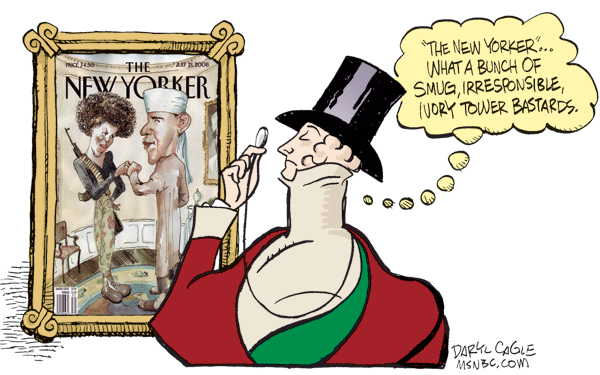
Daryl Cagle / MSNBC.com.

The Rag Blog / Posted July 15, 2008

Posted in RagBlog | Tagged , , , , | Leave a comment

Outsourcing the Iraq War


Mercenary recruiters turn to Latin America
By Eric Stoner

In October, Erik Prince, the 39-year-old CEO of Blackwater Worldwide, a leading private security company operating in Iraq, went into damage-control mode. Blackwater employees in Baghdad’s Nisour Square had killed 17 Iraqi civilians the previous month, causing an uproar and the suspension of official diplomatic convoys throughout the country for four days. Making the rounds with the media and testifying before Congress, Prince repeatedly said that his employees are not mercenaries, as critics contend. Citing the definition of a mercenary as “a professional soldier working for a foreign government,” Prince told the House Oversight Committee that in contrast, Blackwater’s employees are “Americans working for America, protecting Americans.”

This statement would come as a surprise—and a slap in the face—to the thousands of Latin Americans and others from outside the United States whom the company has hired to fill its contracts in Iraq since the war began. Greystone Limited, a Blackwater affiliate set up in 2004 in the tax haven of Barbados, has recruited Iraq security guards from countries throughout Latin America, including Chile, Colombia, Ecuador, Peru, El Salvador, Honduras, and Panama, as journalist Jeremy Scahill has reported.

But Blackwater is far from the only such company hiring “third-country nationals,” or employees who are not from the United States or Iraq. In the interest of improving profit margins, private military firms in Iraq are increasingly turning to the developing world for armed guards. Peter Singer, a leading expert on the private security industry at the Brookings Institution, has estimated that there are citizens from 30 countries employed as security contractors in Iraq. While ex-soldiers from the Balkans, Fiji, Nepal, the Philippines, South Africa, and Uganda are all common in Iraq, Latin America has proven to be a particularly fertile recruiting ground for these companies.

Latin America, says Adam Isacson, director of programs at the Center for International Policy, is a predictable site for U.S. mercenary companies to recruit personnel. In “what other region of the world are you going to find reasonably westernized people with military experience, in some cases with combat experience, who will work for low wages, who speak a language that a lot of our own military personnel speak,” he asks, noting that the U.S. Army is about a quarter Latino and that Latin America accounts for about 40% of U.S. military training programs worldwide. “It’s their natural ground to find people with military experience for whom $1,000 a month is a lot of money.”

One of the first people to recognize the role that Latin America could play in the booming new mercenary industry was José Miguel Pizarro Ovalle, a former arms broker. Indeed, it was Pizarro who “opened the door” for these firms to recruit in the region, as José Luis Gómez del Prado, head of the United Nations Working Group on the Use of Mercenaries, told Mother Jones magazine. A dual citizen of Chile and the United States, Pizarro served in the militaries of both countries and to this day defends the Pinochet dictatorship. After leaving the Marines as a translator for the U.S. Southern Command in 1999, Pizarro decided to cash in on his unique connections and began facilitating arms deals between Latin American militaries and U.S. manufacturers. Shortly after the United States invaded Iraq, he set his eyes on a new lucrative business opportunity: the provision of Chileans to mercenary companies.

In October 2003, Pizarro traveled to Blackwater’s headquarters in Moyock, North Carolina, to pitch the idea. Prince was receptive during their meeting and gave him the go-ahead. Pizarro returned immediately to Chile and placed a discreet ad in El Mercurio, the Santiago daily, looking for former military officers for “work abroad.” More than 1,000 applicants quickly responded, and by February 2004, Blackwater’s first batch of Chilean commandos, 77 of them, was on its way to Iraq. Offering the unusually high salary of about $3,000 per month, Blackwater began hiring a steady stream of Pizarro’s men for the “static protection” of State Department and Coalition Provisional Authority buildings. The Chileans were still a relative bargain, considering that former U.S. or British special forces can be paid as much as $1,000 per day in Iraq, according to The New York Times.

Pizarro soon branched out and began providing Chileans to Triple Canopy, another large private military company in Iraq, offering salaries of only $1,000 per month. This paltry sum—though an enormous amount for many Latin Americans—has since become the going rate for recruits throughout the region. All told, Pizarro says he contracted 756 Chileans for the two companies, and possibly others, while he was in business, Scahill reported. The actual number of Chileans in Iraq is undoubtedly higher, since mercenary firms also operate there clandestinely. Chilean senator Alejandro Navarro, an outspoken critic of the private war industry, has estimated that about 2,200 Chileans have been to Iraq and that 1,000 remain there, according to the Buenos Aires–based newspaper Página 12 and Chile’s Santiago Times.

The money may have been good for Pizarro, but controversy was never far behind. In order to skirt Chilean law, which prohibits “the act of providing or offering the services of private armed guards, in any form or designation, by any natural or artificial person,” Pizarro hired Chileans for Blackwater through Neskowin, a firm he set up in Uruguay, while using a different company called Global Guards, registered in Panama, for his business with Triple Canopy. And since paramilitary activity is also banned in Chile, the limited training that recruits received often took place either in Amman, Jordan, or in Iraq, once the Chileans arrived, as the UN Working Group found.

Reports surfaced shortly after this paramilitary pipeline between Chile and Iraq began flowing that Pizarro was posting flyers on military bases and using e-mail to lure active-duty military personnel to the private sector. One Chilean contractor who went to Iraq through one of Pizarro’s companies told the UN Working Group that 17 of his fellow active-duty soldiers “had requested leave to be recruited.”

Given the recent history of repressive regimes throughout the region, it is likely that many Latin Americans working for private military firms in Iraq have been responsible for human rights abuses in their home countries. For instance, Louis E. V. Nevaer reported in 2004: “Newspapers in Chile have estimated that approximately 37 Chileans in Iraq are seasoned veterans of the Pinochet era.” Some argue that this is merely a result of poor vetting, while others do not see it as an accident. As Tito Tricot, a former political prisoner who was tortured under the dictatorship in Chile, told Scahill, the Chileans working for these firms in Iraq “are valued for their expertise in kidnapping, torturing, and killing defenseless civilians.”

“What should be a national shame,” Tricot added, “turns into a market asset due to the privatization of the Iraq war.” In the end, Pizarro was fined and sentenced to 61 days in jail for his recruitment activity, a punishment that is not likely to dissuade many from following in his shoes. Nonetheless, he has appealed the sentence and is currently walking free. Meanwhile, Triple Canopy, which according to State Department figures relies far more on foreign hiring than Blackwater, filled its contract to protect the U.S. Embassy and other sites in Baghdad’s Green Zone by hiring recruits almost exclusively from Latin America (especially El Salvador, Nicaragua, Colombia, Chile, Peru, and Honduras), as Foreign Policy magazine noted. In 2005, a local subsidiary of Chicago-based Your Solutions began recruiting for the company in Honduras.

The company trained its recruits—including a group of Chileans who entered the country with tourist visas—at the former military base in Lepaterique. Located just outside Tegucigalpa, the base is a notorious legacy of the Contra war, having been used by Washington in the 1980s to train Nicaraguan counter-insurgents, as well as Honduras’s infamous Battalion 316 death squad. Echoing this gruesome past, one Triple Canopy trainee explained that he and his fellow recruits were instructed “to be heartless when it was up to us to kill someone, even if it was a child,” Agence France-Presse reported. After only several months in operation, the Honduran government fined Your Solutions and kicked the company out of the country for violating the law, which prohibits the training of foreign soldiers on its soil. Nevertheless, before the ax fell, Triple Canopy trained and sent at least 189 Hondurans and 105 Chileans to Iraq, according to the UN Working Group.

In the spring of 2003, public opinion in Latin America was vehemently, and overwhelmingly, opposed to the U.S. invasion of Iraq. Despite significant pressure from the Bush administration, only a handful of countries in the region joined the so-called Coalition of the Willing, contributing a combined total of slightly more than 1,000 soldiers to the U.S.-led war effort. While Latin America government officials’ recalcitrance on the war may have dealt a diplomatic blow to the United States, it did not stop thousands of poor ex-soldiers and former police officers throughout the region from performing essentially military functions in Iraq—under a corporate logo rather than their country’s flag.

The unprecedented privatization of the war in Iraq has given rise to a private military industry that was all but nonexistent 20 years ago. In the 1991 Gulf War, for example, there was one contractor for every 60 soldiers on the ground. While the exact number of private personnel in Iraq today is likely higher than official estimates, at least 180,000 private contractors are working there, according to recent government figures cited in the Los Angeles Times. As Scahill noted in congressional testimony, this makes the U.S. military—with roughly 160,000 troops in the country—the “junior partner in the coalition that’s occupying Iraq.”

Not only are far more contractors operating in war zones than in the past, but they are now responsible for many tasks that used to be carried out exclusively by the military. One of the most controversial roles being outsourced is armed protection for convoys, government facilities and diplomats. According to the Private Security Company Association of Iraq there are more than 180 such companies in operation that now employ 70,000 armed private security contractors in the country, and that number is only growing.

Established in 2005 to monitor this new industry, the UN Working Group on the Use of Mercenaries has warned that these so-called “security guards” are “in fact private soldiers militarily armed,” and that the companies that employ them in Iraq constitute “new expressions of mercenarism in the twenty-first century.”

One of those mercenaries was Mario Urquía, a 30-year veteran of the special forces in Honduras. Hired by Triple Canopy, Urquía guarded the U.S. Embassy in Iraq for a year and claims the company promised him U.S. citizenship once he completed his contract. Not only did that prove false, but he also says that he was never paid. “Not a single penny,” he told the Salt Lake Tribune. Urquía filed a complaint against Your Solutions with the Honduran authorities, as have at least 16 others, but his case is not being pursued because he is not currently in the country. After receiving death threats for sharing his story with the Honduran press and exposing those involved in Your Solutions’ operations there, Urquía was forced to flee the country.

Another Honduran guard badly injured his foot while in Iraq. Despite signing a contract that states the employer is responsible for providing medical and hospital insurance, he was not declared unfit for work and forced to man his lookout tower on crutches. Stories like these are not unique for those in the region who have worked for private security companies. According to the UN Working Group, the Hondurans who went to Iraq with Triple Canopy reported “irregularities in contracts, harsh working conditions with excessive working hours, wages partially paid or unpaid, ill-treatment and isolation, and lack of basic necessities such as medical treatment and sanitation.”

In a recent statement, Triple Canopy said it no longer recruits from either Honduras or Chile, but “continues to hire security personnel from Latin America to work in Iraq because they are diligent workers, reliable, professional and in some instances specifically requested by our U.S. government customers.” Since 2005, when the company was booted out of Honduras, most its recruits have come from Peru. In February 2007, one of Triple Canopy’s subcontractors indicated that the company had 1,130 Peruvians working in Iraq at the time. The stories of exploitation that they bring home, however, vary little from those of Hondurans and others. One group of five guards, for example, has filed a complaint against the company for sending them to work in Baghdad’s Red Zone, despite being hired to protect the Green Zone. Another guard says that for six days he was held in custody and isolation in degrading conditions after telling his supervisors that he planned on returning home.

Peruvian contractors, much like those from other countries, have little legal recourse when something goes wrong. Their contracts stipulate that they voluntarily accept every risk “known and unknown,” and exonerate Triple Canopy from any liability even if the contractor is harmed by the company itself. Often signing their contracts in a rush on the way to the airport, the Peruvians are also likely unaware that any claims against the company must be filed in a court in Virginia, where Triple Canopy is headquartered. In fact, in some countries security contractors have said that they were given a contract to sign only once they were on the plane, at which point they realized that their salary would be much less than promised.

While private security outfits have run into trouble in some countries, many others continue with business as usual. “Not only has this phenomenon not stopped,” says Amada Benavides de Pérez, a member of the UN Working Group, but recruitment in Latin America actually “has been increasing.” To address this problem, Benavides proposes a two-pronged strategy: strengthening laws at both the national and international level, and passing a regional treaty, similar to the 1977 convention against mercenaries that exists for Africa.

In the end, however, it comes down to supply and demand. Without reversing the radical privatization agenda that has taken hold in Washington, the U.S. war machine will inevitably continue to rely on private forces. Indeed, it is in the interest of pro-war U.S. policy makers to outsource the human costs of war for as long as possible.

[Eric Stoner is a freelance journalist whose work has appeared in The Nation and Yahoo News. He recently served as a researcher on the revised, updated version of Jeremy Scahill’s Blackwater: The Rise of the World’s Most Powerful Mercenary Army (Nation Books, 2008). This article was published by the North American Congress on Latin America.]

Source. / NACLA / Posted July 1, 2008

The Rag Blog

Posted in RagBlog | Tagged , , , , | Leave a comment

ART : The Writing’s On the Wall

Charlie Halsey, co-founder of Alphabeta, stands in the graffiti store’s art space. Photo by Margot Adler / NPR.

Brooklyn Store Celebrates The Art Of Graffiti
by Margot Adler / July 14, 2008

Graffiti has always had a double edge. Often reviled as a symbol of lawlessness and the deterioration of neighborhoods, it can also be a form of cultural and artistic awakening. There’s even evidence of graffiti in ancient Ephesus in Greece and in ancient Rome.

“Who knows why people write on the wall, or where that instinct comes from,” says Charlie Halsey, one of the founders of Alphabeta, a new Brooklyn-based community art space and event space that also sells graffiti art materials. “As far as I know, people have been writing graffiti since the dawn of mankind.”

Alphabeta has only been open for three weeks — it’s so new that it doesn’t have a phone number or a Web site — but one New York City official is already sounding the alarm.

The store is a single room on Greenpoint Avenue in Brooklyn. It features a larger outdoor space where murals can be painted on high walls and painted over and over again. Inside, there are racks of T-shirts, spray-painted hats and boxes of deadstock sneakers that were popular with graffiti and hip-hop artists in the 1980s and 90s.

There are also locked metal cages to hold the aerosol cans that come in a wealth of colors, some imported from Europe. Halsey says the cages have to be locked as part of the fire code, because “any combustible materials have to be locked in metal cages.”

New York City Councilman Peter Vallone Jr. has made the eradication of graffiti a personal mission. Vallone says it’s naive to believe the store will “cater to legal graffiti art, because there is just not enough of that to turn a profit.” Vallone believes that only a small fraction of graffiti art is legitimate.

“Eighty-five percent of graffiti is just tags,” says Vallone. “Another 10 percent is gang communication.”

Councilman Vallone came of age in the 1970s, when graffiti was associated with New York’s rising crime rate and the deterioration of neighborhoods. But recently, the Tate Modern Museum in London had graffiti artists paint the building.

Andrew Michael Ford, the director of the Ad Hoc Art Gallery in Brooklyn, says he knows street art has come of age when there are art shows like the one at the Tate:

“It sent a wave around the world that it’s legitimate, relevant and people need to pay attention to it,” says Ford, who adds that he believes graffiti art and other forms of street art will be appearing in more museums in the future.

The people who run Alphabeta want to ensure that the store is a success by riding that wave. Its founders hope that it will be as much an art space and event space as it is a store. To this end, Alphabeta has hosted five parties in its first three weeks of existence.

At a recent event, sponsored by the international graffiti art magazine Overspray, eight Austrian artists from the Inoperable Gallery in Vienna were doing “live” painting on three walls of the store’s outdoor space. When asked what he was doing, an artist who goes by the name of Franke, said that what he does is only for fun, “and pure joy.”

“The real graffiti artists,” says Franke, “are in dictatorships, where writing on a wall is a courageous act. What I do is child’s play. But a real graffiti artist risks a lot to make people think.”

Source. / All Things Considered / NPR

The Rag Blog

Posted in RagBlog | Tagged , | Leave a comment

World Hunger : Do the Math


A Shortage of Democracy, Not Food
By Frances Moore Lappé

Forty years ago, squirreled away in the basement “Ag” library at U.C. Berkeley, I wanted answers to one question: Why were 960 million people going hungry?

At the time, newspaper headlines and experts from academia to the United Nations had their straightforward answer: Human numbers had hit the Earth’s limits. But using my dad’s slide rule, I put two and two together: Our “modern” farm economy was actively creating scarcity from abundance, in part by feeding a third of the world’s grain to livestock.

I could hardly believe it. Could this Ph.D-less twenty-something be right and the experts wrong? Stuffing my self-doubt, I composed a one-page handout. I assumed that if people just understood that hunger was needless, of course they’d get busy changing the economic rules creating it. The handout became Diet for a Small Planet.

I was right that hunger would worsen unless we dug to its roots. I was wrong, though, about what would happen next.

Four decades on, the World Food Program predicts the number of hungry people in the world will rise this year to what it was at that first Berkeley “a-ha!” moment.

Over these decades, the forces generating hunger from plenty have intensified. Food production has kept ahead of population growth, but now not only do we feed a third of grain and most of soy to livestock, but we’ve turned more than a third of the global fish catch into feed as well. Of course, I couldn’t have guessed we’d also be “feeding” crops to cars via ethanol.

I’d hoped readers of Diet for a Small Planet would see this waste built into the post-World War II food system as only the surface layer explaining hunger. Beneath lies the deeper cause: the scarcity not of food but of democracy. Because no human being chooses hunger, hunger is proof that a person has been denied a voice in meeting survival needs. And, since a say in one’s future is the very essence of democracy, the existence of hunger belies democracy.

And what is killing democracy, while generating hunger? It is a belief system.

The belief is two-fold: first, that an effective market works only by one rule, highest return to shareholder—that is, highest return to existing wealth; and second, that government is anathema to a market’s effectiveness. From this stance, control over resources inexorably tightens to the point that it warps public decision-making to benefit narrow, private ends. We end up with a frightening oxymoron: “privately held government.”

And from it flows what I call “faith-based economics” because it is detached from real-world evidence. History demonstrates that only a government accountable to citizens can keep a market competitive and open so that all citizens are able to access it.

Today’s headlines, though, repeat the myth that weather and the inexorable increase in demand, especially among the new “middle classes” in India and China, explain the crisis—along with the unforeseen consequences of enlisting cropland in ethanol production. Wrong. Our worsening democracy deficit has continued to set the world up for disaster, undermining production and access to food worldwide.

Let us count the ways.

Unaccountable international agencies, including the World Bank and the International Monetary Fund, made loans on the condition that recipient countries reduce public support for local producers and food buyers. So African governments cut help to small farmers, and India said only the poorest of the poor could access its public “fair-price” shops that sell below-market-price grain.

Meanwhile, large agricultural interests in the North secured subsidies—almost half a billion dollars a day—making their grain so cheap its sales undercut markets for poor farmers in the South, ultimately driving many from the land.

And it gets worse. Trade agreements—most notably the 1994 North American Free Trade Agreement—ended tariffs that protected local farmers. In Mexico, for example, more than a million farmers went under in the decade following the agreement.

Then, in recent years, speculators have turned futures trading—set up to protect farmers and wholesalers from extreme weather-caused price swings—into their private bonanza, pushing up the short-term price of food.

Finally, while analysts talk as if the uptick in demand for wasteful grain-fed meat is inevitable, it isn’t. Democracy deficits in India and China have generated massive inequalities, heightening demand for costly grain-fed meat. With more equitable advancement that empowered rural dwellers, demand for meat could likely be met by small farms using the long-held, ecological, and cost-effective practice of feeding waste, like corn stalks and rice husks, to livestock.

The democracy crisis produces predictable and avoidable tragedy. But forty years later, what keeps me getting up in the morning is how much more we now know about sustainable growing and eating. We can turn today’s tragedy into a breakthrough for common sense and real democracy as we:

•Get money out of—and citizens’ voices into—governance.

•Shift public support to family farmers using sustainable agroecology. A 2007 University of Michigan study concluded that moving globally to sustainable, organic farming methods could increase food output by about 57 percent. A four-year study to evaluate the impact of such practices—involving almost thirteen million farmers and more than ninety million acres in fifty-seven countries—showed on average a 79 percent production increase.

•Grow the number of family farmers. One of the world’s largest democratic social movements, Brazil’s Landless Workers Movement, has succeeded in transferring almost twenty million acres to almost a third of a million rural landless families, creating thousands of new farmers and enterprises and greatly reducing hunger.

We can end hunger.

Forever.

We know how.

It depends, however, on citizens building confidence in their power to create democracies truly accountable to us.

[Frances Moore Lappé is the author of sixteen books, most recently “Getting a Grip: Clarity, Creativity and Courage in a World Gone Mad,” winner of the Gold “Best of Small Press” Nautilus Award 2008. Her website is www.smallplanet.org. This article appears in the July, 2008, issue of The Progressive.]

Source. / The Progressive

The Rag Blog

Posted in RagBlog | Tagged , , , , | Leave a comment

Pat Tillman : Administration Forgot to Remember

Cpl. Pat Tillman.

House Oversight investigation of Tillman and Jessica Lynch
By Kate Klonick / July 14, 2008

The House Oversight Committee released its proposed report (pdf) on the investigation this afternoon, on the death of Corporal Patrick Tillman and the capture of Private Jessica Lynch.

Unfortunately the report says that the Committee was unable to resolve “the key issue of what senior officials knew” because of the “universal” memory loss suffered by Tillman’s chain of command upon testifying before Congress:

Despite receiving information from all the top military leaders in Corporal Tillman chain of command — including Secretary Rumsfeld, General Myers, and General Abizaid — the Committee could not determine if any of the officials had communicated with President Bush or White House officials about fratricide in Corporal Tillman’s case. The lack of recollection also prevented the Committee from understanding how information about Corporal Tillman was handled within the Defense Department and how the Defense Department and the White House shared information on this matter.

As we’ve previously reported, the White House was very interested in the initial reports of Tillman’s death. In fact, the report details that White House exchanging almost 200 e-mails relating to Pat Tillman on April 23, 2004, during the first reports of Tillman’s death. But once the death was suspected to be caused by friendly fire, there was no further discussion of Tillman at the White House, according to the report.

So what did all of the silence convey to Oversight?

If the testimony the Committee received is accurate and if the documents submitted are complete, then the intense interest that initially characterized the White House’s and Defense Department’s reaction to Corporal Tillman’s death was followed by a stunning lack of curiosity about emerging reports of fratricide and an incomprehensible carelessness and incompetence in handling this sensitive information.

Source. / TPM Muckraker

The Rag Blog

Posted in RagBlog | Tagged , , | Leave a comment

Oaxaca : Indigenous People Saying ‘NO’ to Migration

The FIOB is a political organization of indigenous communities and migrants, with chapters in Mexico and the U.S. It advocates for the rights of migrants, and for the right not to migrate — for economic development which would enable people to stay home. Indigenous Triqui women prepare meat and their traditional large tortillas. Photo by David Bacon.

The Right to Stay Home
By David Bacon / July 14, 2008

JUXTLAHUACA, Oaxaca, Mexico — For almost half a century, migration has been the main fact of social life in hundreds of indigenous towns spread through the hills of Oaxaca, one of Mexico’s poorest states. That’s made the conditions and rights of migrants central concerns for communities like Santiago de Juxtlahuaca.

Today, the right to travel to seek work is a matter of survival. But this June, in Juxtlahuaca, in the heart of Oaxaca’s Mixteca region, dozens of farmers left their fields, and women weavers their looms, to talk about another right: the right to stay home.

In the town’s community center, two hundred Mixtec, Zapotec and Triqui farmers, and a handful of their relatives working in the US, made impassioned speeches asserting this right at the triannual assembly of the Indigenous Front of Binational Organizations (FIOB). Hot debates ended in numerous votes. The voices of mothers and fathers arguing over the future of their children echoed from the cinder block walls of the cavernous hall.

In Spanish, Mixteco and Triqui, people repeated one phrase over and over: the derecho de no migrar – the right to not migrate. Asserting this right challenges not just inequality and exploitation facing migrants, but the very reasons people have to migrate to begin with. Indigenous communities are pointing to the need for social change.

About 500,000 indigenous people from Oaxaca live in the US, 300,000 in California alone, according to Rufino Dominguez, one of FIOB’s founders. These men and women come from communities whose economies are totally dependent on migration. The ability to send a son or daughter across the border to the north, to work and send back money, makes the difference between eating chicken or eating salt and tortillas. Migration means not having to manhandle a wooden plow behind an ox, cutting furrows in dry soil for a corn crop that can’t be sold for what it cost to plant it. It means dollars arrive in the mail when kids need shoes to go to school or when a grandparent needs a doctor.

In Oaxaca, the category of extreme poverty encompasses 75 percent of its 3.4 million residents, according to EDUCA, an education and development organization. For more than two decades, under pressure from the World Bank and US loan conditions, the Mexican government has cut spending intended to raise rural incomes. Prices have risen dramatically since price controls and subsidies were eliminated for necessities like gasoline, electricity, bus fares, tortillas and milk.

Raquel Cruz Manzano, principal of the Formal Primary School in San Pablo Macuiltianguis, a town in the indigenous Zapotec region, says only 900,000 Oaxacans receive organized health care, and the illiteracy rate is 21.8 percent. “The educational level in Oaxaca is 5.8 years,” Cruz notes, “against a national average of 7.3 years. The average monthly wage for non-governmental employees is less than 2,000 pesos [about $200] per family [per month], the lowest in the nation. Around 75,000 children have to work in order to survive or to help their families.”

“But there are no jobs here, and NAFTA [the North American Free Trade Agreement] made the price of corn so low that it’s not economically possible to plant a crop anymore,” Dominguez asserts. “We come to the US to work because we can’t get a price for our product at home. There’s no alternative.”

Without large-scale political change, most local communities won’t have the resources for productive projects and economic development that could provide a decent living. Towns like Juxtlahuaca don’t even have wastewater treatment. Rural communities rely on the same rivers for drinking water that are also used to carry away sewage. “A typical teacher earns about 2,200 pesos every two weeks [about $220],” says Jaime Medina, a reporter for Oaxaca’s daily Noticias. “From that they have to purchase chalk, pencils, and other school supplies for the children.”

Because of its indigenous membership, FIOB campaigns for the rights of migrants in the US who come from those communities. It calls for immigration amnesty and legalization for undocumented migrants. FIOB has also condemned the proposals for guest-worker programs. Migrants need the right to work, but “these workers don’t have labor rights or benefits,” Dominguez charges. “It’s like slavery.”

At the same time, “we need development that makes migration a choice rather than a necessity – the right to not migrate,” explains Gaspar Rivera-Salgado, a professor at UCLA. “Both rights are part of the same solution. We have to change the debate from one in which immigration is presented as a problem to a debate over rights. The real problem is exploitation.” But the right to stay home, to not migrate, has to mean more than the right to be poor, the right to go hungry and homeless. Choosing whether to stay home or leave only has meaning if each choice can provide a meaningful future.

In Juxtlahuaca, Rivera-Salgado was elected FIOB’s new binational coordinator. His father and mother still live on a ranch half an hour up a dirt road from the main highway, in the tiny town of Santa Cruz Rancho Viejo. There, his father Sidronio planted 300 avocado trees a few years ago, in the hope that someday their fruit would take the place of the corn and beans that were once his staple crop. He’s fortunate – his relatives have water, and a pipe from their spring has kept most of his trees, and those hopes, alive. Fernando, Gaspar’s brother, has started growing mushrooms in a FIOB-sponsored project, and even put up a greenhouse for tomatoes. Those projects, they hope, will produce enough money that Fernando won’t have to go back to Seattle, where he worked for seven years.

This family, perhaps, has come close to achieving the derecho de no migrar. For the millions of farmers throughout the indigenous countryside, not migrating means doing something like it. But finding the necessary resources, even for a small number of families and communities, presents FIOB with its biggest challenge. This was the source of the debate at its Juxtlahuaca assembly.

Rivera-Salgado says, “we will find the answer to migration in our communities of origin. To make the right to not migrate concrete, we need to organize the forces in our communities, and combine them with the resources and experiences we’ve accumulated in 16 years of cross-border organizing.” Fernando, the greenhouse builder and mushroom farmer, agrees that FIOB has the ability to organize people. “But now we have to take the next step,” he urges, “and make concrete changes in peoples’ lives.”

Organizing FIOB’s support base in Oaxaca means more than just making speeches, however. As Fernando Rivera-Salgado points out, communities want projects that help raise their income. Over the years, FIOB has organized women weavers in Juxtlahuaca, helping them sell their textiles and garments through its chapters in California. It set up a union for rural taxis, both to help farming families get from Juxtlahuaca to the tiny towns in the surrounding hills, and to provide jobs for drivers. Artisan co-ops make traditional products, helped by a co-operative loan fund.

The government does have some money for loans to start similar projects, but it usually goes to officials who often just pocket it, supporters of the Institutional Revolutionary Party, which has ruled Oaxaca since it was formed in the 1940s. One objective debated at the FIOB assembly was organizing community pressure to win some of these resources. But any government subsidy is viewed with suspicion by activists who know the strings tied to it.

Another concern is the effect of the funding on communities themselves. “Part of our political culture is the use of regalos, or government favors, to buy votes,” Rivera-Salgado explains. “People want regalos, and think an organization is strong because of what it can give. But now people are demanding these results from FIOB, so do we help them or not? And if we do, how can we change the way people think? It’s critical that our members see organization as the answer to problems, not a gift from the government or a political party. FIOB members need political education.”

Political abstention isn’t an option, however, warns Juan Romualdo Gutierrez Cortez. “We aren’t the only organization in Oaxaca – there are 600 others. If we don’t do it, they will.” But for the 16 years of its existence, FIOB has been a crucial part of the political opposition to Oaxaca’s PRI government. Gutierrez, a schoolteacher in Tecomaxtlahuaca, was FIOB’s Oaxaca coordinator until he stepped down at the Juxtlahuaca assembly. He is also a leader of Oaxaca’s teachers union, Section 22 of the National Education Workers Union, and of the Popular Association of the People of Oaxaca (APPO).

In June of 2006, a strike by Section 22 led to a months-long uprising, led by APPO, which sought to remove the state’s governor, Ulises Ruiz, and make a basic change in development and economic policy. The uprising was crushed by federal armed intervention, and dozens of activists were arrested. According to Leoncio Vasquez, an FIOB activist in Fresno, “the lack of human rights itself is a factor contributing to migration from Oaxaca and Mexico, since it closes off our ability to call for any change.” This spring, teachers again occupied the central plaza, or zocalo, of the state capital, protesting the same conditions that sparked the uprising two years ago.

Gutierrez himself was not jailed during the uprising, although the state issued an order for his detention. But he’s been arrested before. In the late 1990s, he was elected to the Oaxaca Chamber of Deputies, in an alliance between FIOB and Mexico’s left-wing Democratic Revolutionary Party (PRD). Following his term in office, Gutierrez was imprisoned by Ruiz’s predecessor, Jose Murat, until a binational campaign won his release. His crime, and that of many others filling Oaxaca’s jails, was insisting on a new path of economic development that would raise rural living standards, and make migration just an option, rather than an indispensable means of survival.

Despite the fact that APPO wasn’t successful in getting rid of Ruiz and the PRI, Rivera-Salgado believes that “in Mexico we’re very close to getting power in our communities on a local and state level.” He points to Gutierrez’s election as state deputy, and later as mayor of his hometown San Miguel Tlacotepec. Other municipal presidents, allied with FIOB, have also won office, and activists are beginning to plan a FIOB campaign to elect a Federal deputy.

FIOB delegates agreed the organization would continue its alliance with the PRD. Nevertheless, that alliance is controversial, partly because of the party’s internal disarray. “We know the PRD is caught up in an internal crisis, and there’s no real alternative vision on the left,” Rivera-Salgado says. “But there are no other choices if we want to participate in electoral politics, so we’re trying to put forward positive proposals. We’re asking people in the PRD to stop fighting over positions, and instead use the resources of the party to organize the community. We can’t change things by ourselves. First, we have to reorganize our own base. But then we have to find strategic allies.

“Migration is part of globalization,” he emphasizes, “an aspect of state policies that expel people. Creating an alternative to that requires political power. There’s no way to avoid that.”

Source. / truthout

The Rag Blog

Posted in RagBlog | Tagged , , , , , | Leave a comment

Denver : Under the Big Top


Progressives have a big tent at the Dem Convention
By Steven Rosenfeld / July 14, 2008

A tent for 800 journalists, bloggers and activists will be set up at Denver’s Democratic Convention site.

Few activities are more filled with political insiders than national political party conventions. But this August in Denver, a coalition of progressive groups hopes to broaden the coverage and conversation surrounding the Democratic Convention by hosting 800 bloggers, nonprofit leaders and independent journalists.

ProgressNow.org, the largest online community in Colorado; the Alliance for a Sustainable Colorado; and Daily Kos will put up a big tent next to the Pepsi Center, where writers, bloggers and activists can cover the convention and showcase a progressive agenda.

“There are two things we want to accomplish,” said Bobby Clark, ProgressNow deputy director. “The first is to give access to people who are often left out, who don’t have a seat at the table. This is not just bloggers, but independent media and nonprofit leaders. It’s about access.”

“We also want to broaden the conversation during the convention,” he said. “We will be hit over the head by the mainstream media with political process stories. Lost in that coverage will be the fact that 48 million Americans don’t have health insurance and issues like that. So we want to generate content that can get out that week.”

An estimated 15,000 members of the media are expected to go to Denver, with approximately 5,000 receiving credentials to attend the official proceedings. Only 125 bloggers will be credentialed.

The solution is called “the big tent,” a 9,000-square-foot, two-story, fully wired platform for alternative coverage and a stage for newsmakers that will be a counterpoint to the usual convention activities such as the adoption of the party platform; nomination of both a vice presidential and presidential candidate; speeches and rallying of campaign workers by party leaders; and a not-insignificant amount of elbow-rubbing by political insiders.

“There is a bigger conversation we want to have,” Clark said. “The political process is one way to accomplish change. But that is not the only way to do it. A blogger spending 20 hours a week above their day job doing work that is not in the press is another way. Another is solutions from the country’s progressive leaders.”

The air-conditioned tent will accommodate 800 people, Clark said. It will be on a lot next to the Alliance Center, a green building that is home to a range of nonprofits such as Common Cause, the Sierra Club, Center for Native Ecosystems and others. It is walking distance from the convention site. Sponsors also include Digg.com, Google.com and YouTube.com.

Many bloggers and independent journalists have complained that the convention press credential process (like the GOP, the Democratic Party stopped accepting applications this past April 15) excluded them and suppressed voices that were not from mainstream media organizations. Clark said the big tent idea, which is new to national political conventions, created a solution that the party supports.

“There has been some dialogue on the blogs,” he said, referring to frustration with official credentials. “One reason we wanted to do this was we anticipated that not as many bloggers would be accommodated. The convention committee is happy that we are doing this. They wanted there to be more bloggers who are coming. There is so much pressure on everyone. We also have way more requests than we can accommodate.”

The big tent site is outside the convention’s security perimeter, which has been the focus of other recent reports concerning how the city’s police will allow protests and other First Amendment activities. In Denver, local police have reportedly allocated $5 million to buy new weapons for convention security. While law enforcement has voiced concerns about possible terrorism, activists who are planning anti-war and immigrant rights demonstrations in Denver are wary of police intentions.

In Denver, like in cities that have hosted previous national political conventions, there have been confirmed reports of spying by police on activists and organizations who want to express their views while the nation is focusing on the presidential nominee. One disturbing twist this year is reports that local police will be equipped with weapons designed for use in the war in Iraq.

Police will not comment; however, news organizations have reported that police may be buying exotic equipment such as pepper-ball rifles to control unruly crowds and guns that fire a rubbery mass that keeps people and vehicles from moving. Congress has appropriated $100 million to assist with security at the Democratic and Republican conventions.

Clark said he did not know what law enforcement officials’ plans were.

“I hope that everyone is able to exercise their free speech rights,” he said, referring to anti-war, immigrant rights and other groups that reportedly were planning demonstrations in Denver.

[Steven Rosenfeld is a senior fellow at Alternet.org and co-author of What Happened in Ohio: A Documentary Record of Theft and Fraud in the 2004 Election, with Bob Fitrakis and Harvey Wasserman (The New Press, 2006).]

Source. / AlterNet

The Rag Blog

Posted in RagBlog | Tagged , , , , , | Leave a comment

There’s A Man Going ‘Round Taking Names


ACLU: Million on terrorist watch list
by Michael Grabell / July 14, 2008

There won’t be any balloons dropping from the ceiling to mark this milestone. And if there are any bells and whistles, it will only be from the metal detector.

The American Civil Liberties Union held a news conference this morning to commemorate what it says is the addition of the millionth name to the nation’s terrorist watch list. The number is a calculation based on a 2007 Justice Department inspector general report, which said the database had 700,000 records and was growing by an average of 20,000 a month.

Since then, the ACLU has dutifully kept a tally on its Web site. The event and the counter are mostly symbolic — a theatrical way for the ACLU to call attention to “bloated watch lists” that have caused traveling trouble for Nelson Mandela, Sen. Ted Kennedy, federal air marshals and lots of people named Robert Johnson.

“Members of Congress, nuns, war heroes and other ‘suspicious characters,’ with names like Robert Johnson and Gary Smith, have become trapped in the Kafkaesque clutches of this list, with little hope of escape,” Caroline Fredrickson, director of the ACLU Washington Legislative Office, said in a statement.

But are there really a million people on the terrorist watch list?

“No,” says Chad Kolton, spokesman for the FBI’s Terrorist Screening Center, which manages the list.

There are only 400,000 on it, and 95 percent are not U.S. “persons.” (Persons = citizens plus others with a legal right to be in the U.S.)

The “million” number refers to records. The difference is a result of listing several different aliases or spellings for a suspected terrorist.

“That is not the same as 1 million names or 1 million individuals,” Mr. Kolton said. “It’s a little bit frustrating because I feel like they are getting away with muddying up the terms.”

The ACLU’s focus on the number clouds the success of the program, he added. Screening and law enforcement agencies encountered the actual people on the watch list (not false matches) more than 53,000 times from December 2003 to May 2007, according to a Government Accountability Office report last fall.

“The watch list has enhanced the U.S. government’s counterterrorism efforts by (1) helping frontline screening agencies obtain information to determine the level of threat a person poses and the appropriate action to take, if any, and (2) providing the opportunity to collect and share information on known or appropriately suspected terrorists with law enforcement agencies and the intelligence community,” the auditors wrote.

The addition of 20,000 names a month is a sign of increased military and intelligence efforts in the Middle East and Southeast Asia in the past few years, Mr. Kolton said. He noted that with 6.7 billion people in the world, “the small fraction of a fraction that are involved in terrorist activities still yield very large numbers.”

Still, 400,000 names. That’s one terrorist for every 16,775 people in the world.

That large net ensnares many innocent travelers, leading to an erosion of civil liberties, the ACLU argues. People flagged by the watch list have reported having to go through extra screening or having to answer numerous questions to prove they are who they say they are. Others have been prevented from getting on planes.

Akif Rahman, a computer consultant who spoke at the press conference, said he has been repeatedly detained at airports and border crossings when trying to re-enter the country, according to a copy of his comments provided by the ACLU.

Once, after visiting relatives in Canada, “I was detained for more than five hours – extensively questioned, physically manhandled by a federal officer and shackled to a chair,” he said. “I was afraid, angry and humiliated. I simply could not believe this – I was born a U.S. citizen, simply re-entering my own country.”

The FBI and the Transportation Security Administration, which handles security at airport checkpoints, say they recognize passengers’ frustration and are doing what they can to stem false hits.

Frequently-stopped passengers who want to clear up the confusion about their identity can log on to a Department of Homeland Security Web site, where they can provide more information about themselves.

In addition, after three false matches, the Terrorist Screening Center checks the record in the watch list to see if the information is correct, if there’s any new information and if the person needs to be on the list at all, Mr. Kolton said.

Source. / ProPublica

Go here to see ACLU Watch List terrorist counter.

The Rag Blog

Posted in RagBlog | Tagged , , , , , | Leave a comment

The Great New Yorker Obama Fist-Bump Cover Controversy of 2008

I think the idea that the Obamas are branded as unpatriotic [let alone as terrorists] in certain sectors is preposterous. It seemed to me that depicting the concept would show it as the fear-mongering ridiculousness that it is.

Cover artist Barry Blitt, The New Yorker

A Fist-Bump for the New Yorker
By John McQuaid / July 14, 2008

I’m a little late to the party, but here is an absurd decorousness in the denunciations — from the Obama and McCain campaigns and across the liberal blogosphere — of the current New Yorker cover.

The top-line objection is to accuse the New Yorker of poor taste. In the limited context of campaign discourse this is true. But magazines and other journalistic enterprises would be crazy to buy into the notion that abitrary etiquette of American campaigns (which encourages candidates to lie baldly, and surrogates to spin and smarm and swift-boat, while prohibiting frank talk to a host of issues from race to religion to terror itself), should govern their decisions.

Underneath that are liberals’ more practical fears about the cover’s impact on Obama’s campaign. This line of thinking goes: Obama is so new and different, his image so unformed in the public mind, and U.S. opinion still so anxious on the matter of terrorism, with Democrats perceived as weak — that the Obama campaign, and we as a nation, just can’t handle images like this, because they might be interpreted the wrong way.

Really? No one worries that TNY’s readership will take it literally. Fox will show it and chortle, but hey — it will likely only confuse conservative viewers inclined to think of Obama as a Muslim terrorist dupe. Why are the liberal elites advertising Obama’s subversion, mocking it? The image itself is an absurd jumble of terrorist iconography — Black Power, al Qaeda, flag burning, etc.

Seven years after 9/11, after an onslaught of bad-faith political manipulation over terror, and with the threat of al Qaeda now quite debatable, Americans can certainly handle a little jokey imagery about terrorism and politics. Free expression is a bulwark of American liberalism, part of what makes it what it makes it superior to political philosophies that rigidly enforce what words can be uttered and images can be shown. When liberals start policing the “poor taste” of cartoons so that some people don’t get the “wrong idea,” it only reinforces the notion that all the fearmongering was effective, and perhaps right — and also shows how weak and tenuous Democrats fear their position on terrorism remains.

Source. / The Huffington Post

A WorldNetDaily.com poll asked the website’s readers to “[s]ound off on the New Yorker’s cover with turban-wearing Obama, gun toting wife,” but while the New Yorker said in a press release that the cover “satirizes the use of scare tactics and misinformation in the Presidential election to derail Barack Obama’s campaign,” for a majority of respondents to WND’s poll, the cover apparently provided support for their false perceptions of Obama’s religion and patriotism: A majority of respondents selected the option stating that “[t]he image isn’t too far from the dangerous truth about the Obama family.”

Media Matters / July 14, 2008

Other New Yorker covers by Barry Blitt:

Why The New Yorker’s Obama Cover is a Lousy Cartoon
By Daryl Cagle / July 14, 2008

Cable news channels and bloggers are buzzing about The New Yorker magazine cover featuring Barack Obama dressed in Muslim garb and Michelle Obama with an afro and machine gun, doing a “terrorist fist bump” in the Oval Office, while an American flag burns in the fireplace. The cartoon by Barry Blitt drew immediate condemnation from the Obama and McCain camps.

In an interview on the Huffington Post Web site, New Yorker Editor David Remnick argues, “Obviously I wouldn’t have run a cover just to get attention — I ran the cover because I thought it had something to say. What I think it does is hold up a mirror to the prejudice and dark imaginings about … both Obamas’ … it combines a number of images that have been propagated, not by everyone on the right but by some, about Obama’s supposed ‘lack of patriotism’ or his being ‘soft on terrorism’ or the idiotic notion that somehow Michelle Obama is the second coming of the Weathermen or most violent Black Panthers. That somehow all this is going to come to the Oval Office.

“The idea that we would publish a cover saying these things literally, I think, is just not in the vocabulary of what
we do and who we are… We’ve run many many satirical political covers. Ask the Bush administration how many.”

Cartoonist Barry Blitt defends the cover by saying, “It seemed to me that depicting the concept would show it as the fear-mongering ridiculousness that it is.” So the cover cartoon is simply an exaggeration of the allegations against the Obamas.

There are rules to political cartoons that allow cartoonists to draw in an elegant, simple, shorthand that readers understand. Exaggeration is a well worn tool of political cartoonists; we use it all the time. I’ve drawn President Bush as the King of England, to exaggerate his autocratic tendencies. I’ve drawn the president as a dog, peeing all over the globe to mark his territory. I exaggerate every day, and I don’t expect my readers to take my exaggerations seriously — but when I draw an absurdly exaggerated political cartoon, I’m looking for some truth to exaggerate to make my point. A typical stand-up comedian will tell jokes about things the audience already knows or agrees with, “it’s funny because it’s true,” or true as the comedian sees it. It is the same for cartoonists — our readers know that we’re exaggerating to make a point we believe in.

Source / The Cagle Post

Thanks to Harry Edwards / The Rag Blog

Also see Obama slams New Yorker portrayal / Politico

And Yikes, controversial New Yorker cover… by Rachel Sklar / The Huffington Post

And Was the New Yorker Cover Gutsy? The New Republic

And The Bad Frame: Why Are the New Yorker, Salon and Other Liberal Media Doing the Right’s Dirty Work? truthout

And Media Response to ‘Terrorist Obama’ New Yorker Covers / Editor and Publisher

And check out this interview with New Yorker publisher David Remnick / The Huffington Post

The Rag Blog

Posted in RagBlog | Tagged , , , , , , , , , , , | Leave a comment

HEALTH CARE : Do Cholesterol Drugs Do Any Good?

Graphic courtesy of Pharma Marketing.

Statins: Looking at the stats
By Duncan Echelson
/ The Rag Blog / July 14, 2008

Statin pharmaceuticals are marketed ferociously on TV ads and by many MD’s. The statins are major money makers for the pharmaceutical companies. For relatively small groups of specific types of patients the real research shows some benefit but for most of the patients taking statins it is based on conjecture, not research.

Not only is there no proven benefit for many of the people taking
statins, there are some rather significant side effects such as severe
muscle pain, memory loss and sexual dysfunction.

There are more than 18 million Americans taking statins and worldwide sales totaled more than 33 billion dollars in 2007.

The history of statins and cholesterol theory make a very interesting
case study of the pharmaceutical and medical industries and is well
worth studying, in order to learn how we can avoid being manipulated
for power and profit.

Just as interesting is learning how medical science can be led into
taking positions that are based on political maneuvering and sloppy
data analysis rather than science.

You might be one of the 18 million people taking statins and if not, I
am sure that you know people who are (friends, siblings, parents). If
so, then please read the series of pieces so you can ask questions,
find answers and make decisions as to whether taking statins is really
a benefit or if it is a danger waste of your health dollars and
efforts.

For step one, in our investigation, I offer you a very well written and referenced article from the Jan. 17, 2008 issue of Business Week magazine. Please note this is only step one of a series of articles and documents to help us understand. The source of this article is surprising but I guarantee you will find it very interesting.

Duncan Echelson is a licensed Acupuncturist/Herbalist who can be found at Oak Hill Oriental Medicine in Austin. His focus is helping people become healthier. He particularly enjoys teaching people simple ways to maintain and improve their health.

He has great respect for those physicians who truly live by the Hippocratic oath and for those researchers who are dedicated to understanding their study subjects without fear or favor.

In addition, he knows of many cases where the judicious use of pharmaceuticals and medical procedures have been very important for treating disease and trauma.

It is the misuse of pharmaceuticals, medical techniques, and research studies that he finds deeply offensive and drives him to keep up with news and analysis of these fields.

He welcomes comments, favorable or critical. Leads to stories in medicine and pharmaceutical are also welcome.

You can reach him at duncanechelson@gmail.com.

Do Cholesterol Drugs Do Any Good?

Research suggests that, except among high-risk heart patients, the benefits of statins such as Lipitor are overstated
By John Carey

Martin Winn’s cholesterol level was inching up. Cycling up hills, he felt chest pain that might have been angina. So he and his doctor decided he should be on a cholesterol-lowering medication called a statin. He was in good company. Such drugs are the best-selling medicines in history, used by more than 13 million Americans and an additional 12 million patients around the world, producing $27.8 billion in sales in 2006. Half of that went to Pfizer (PFE) for its leading statin, Lipitor. Statins certainly performed as they should for Winn, dropping his cholesterol level by 20%. “I assumed I’d get a longer life,” says the retired machinist in Vancouver, B.C., now 71. But here the story takes a twist. Winn’s doctor, James M. Wright, is no ordinary family physician. A professor at the University of British Columbia, he is also director of the government-funded Therapeutics Initiative, whose purpose is to pore over the data on particular drugs and figure out how well they work. Just as Winn started on his treatment, Wright’s team was analyzing evidence from years of trials with statins and not liking what it found.

Yes, Wright saw, the drugs can be life-saving in patients who already have suffered heart attacks, somewhat reducing the chances of a recurrence that could lead to an early death. But Wright had a surprise when he looked at the data for the majority of patients, like Winn, who don’t have heart disease. He found no benefit in people over the age of 65, no matter how much their cholesterol declines, and no benefit in women of any age. He did see a small reduction in the number of heart attacks for middle-aged men taking statins in clinical trials. But even for these men, there was no overall reduction in total deaths or illnesses requiring hospitalization—despite big reductions in “bad” cholesterol. “Most people are taking something with no chance of benefit and a risk of harm,” says Wright. Based on the evidence, and the fact that Winn didn’t actually have angina, Wright changed his mind about treating him with statins—and Winn, too, was persuaded. “Because there’s no apparent benefit,” he says, “I don’t take them anymore.”

Wait a minute. Americans are bombarded with the message from doctors, companies, and the media that high levels of bad cholesterol are the ticket to an early grave and must be brought down. Statins, the message continues, are the most potent weapons in that struggle. The drugs are thought to be so essential that, according to the official government guidelines from the National Cholesterol Education Program (NCEP), 40 million Americans should be taking them. Some researchers have even suggested—half-jokingly—that the medications should be put in the water supply, like fluoride for teeth. Statins are sold by Merck (MRK) (Mevacor and Zocor), AstraZeneca (AZN) (Crestor), and Bristol-Myers Squibb (BMY) (Pravachol) in addition to Pfizer. And it’s almost impossible to avoid reminders from the industry that the drugs are vital. A current TV and newspaper campaign by Pfizer, for instance, stars artificial heart inventor and Lipitor user Dr. Robert Jarvik. The printed ad proclaims that “Lipitor reduces the risk of heart attack by 36%…in patients with multiple risk factors for heart disease.”

So how can anyone question the benefits of such a drug?

For one thing, many researchers harbor doubts about the need to drive down cholesterol levels in the first place. Those doubts were strengthened on Jan. 14, when Merck and Schering-Plough (SGP) revealed results of a trial in which one popular cholesterol-lowering drug, a statin, was fortified by another, Zetia, which operates by a different mechanism. The combination did succeed in forcing down patients’ cholesterol further than with just the statin alone. But even with two years of treatment, the further reductions brought no health benefit.

Doing the Math

The second crucial point is hiding in plain sight in Pfizer’s own Lipitor newspaper ad. The dramatic 36% figure has an asterisk. Read the smaller type. It says: “That means in a large clinical study, 3% of patients taking a sugar pill or placebo had a heart attack compared to 2% of patients taking Lipitor.”

Now do some simple math. The numbers in that sentence mean that for every 100 people in the trial, which lasted 3 1/3 years, three people on placebos and two people on Lipitor had heart attacks. The difference credited to the drug? One fewer heart attack per 100 people. So to spare one person a heart attack, 100 people had to take Lipitor for more than three years. The other 99 got no measurable benefit. Or to put it in terms of a little-known but useful statistic, the number needed to treat (or NNT) for one person to benefit is 100.

Compare that with, say, today’s standard antibiotic therapy to eradicate ulcer-causing H. pylori stomach bacteria. The NNT is 1.1. Give the drugs to 11 people, and 10 will be cured.

A low NNT is the sort of effective response many patients expect from the drugs they take. When Wright and others explain to patients without prior heart disease that only 1 in 100 is likely to benefit from taking statins for years, most are astonished. Many, like Winn, choose to opt out.

Plus, there are reasons to believe the overall benefit for many patients is even less than what the NNT score of 100 suggests. That NNT was determined in an industry-sponsored trial using carefully selected patients with multiple risk factors, which include high blood pressure or smoking. In contrast, the only large clinical trial funded by the government, rather than companies, found no statistically significant benefit at all. And because clinical trials themselves suffer from potential biases, results claiming small benefits are always uncertain, says Dr. Nortin M. Hadler, professor of medicine at the University of North Carolina at Chapel Hill and a longtime drug industry critic. “Anything over an NNT of 50 is worse than a lottery ticket; there may be no winners,” he argues. Several recent scientific papers peg the NNT for statins at 250 and up for lower-risk patients, even if they take it for five years or more. “What if you put 250 people in a room and told them they would each pay $1,000 a year for a drug they would have to take every day, that many would get diarrhea and muscle pain, and that 249 would have no benefit? And that they could do just as well by exercising? How many would take that?” asks drug industry critic Dr. Jerome R. Hoffman, professor of clinical medicine at the University of California at Los Angeles.

Drug companies and other statin proponents readily concede that the number needed to treat is high. “As you calculated, the NNT does come out to about 100 for this study,” said Pfizer representatives in a written response to questions. But statin promoters have several counterarguments. First, they insist that a high NNT doesn’t always mean a drug shouldn’t be widely used. After all, if millions of people are taking statins, even the small benefit represented by an NNT over 100 would mean thousands of heart attacks are prevented.

That’s a legitimate point, and it raises a tough question about health policy. How much should we spend on preventative steps, such as the use of statins or screening for prostate cancer, that end up benefiting only a small percentage of people? “It’s all about whether we think the population is what matters, in which case we should all be on statins, or the individual, in which case we should not be,” says Dr. Peter Trewby, consultant physician at Darlington Memorial Hospital in Britain. “What is of great value to the population can be of little benefit to the individual.” Think about buying a raffle ticket for a community charity. It’s for a good cause, but you are unlikely to win the prize.

Statin proponents also argue that when NNTs are calculated after the drugs have been taken for just three or five years, they’re misleadingly high. Pfizer says that even though only one heart attack was prevented per 100 people in its trial, “it may be a possibility that several or even all [100] benefit” by reducing their risk of a future heart attack. And the benefit grows when the drugs are taken for more years, backers believe. “It does not make sense to take a statin for five years,” says Dr. Scott M. Grundy, chair of the NCEP committee that called for more aggressive statin treatment and director of the Center for Human Nutrition at the University of Texas Southwestern Medical Center at Dallas. “When you take a cholesterol-lowering drug, it is a huge commitment,” he says. “You take it for life.” Grundy figures the chances of having a heart attack over the course of a lifetime are about 30% to 50% (higher for men than women). Statins, he argues, reduce that risk by about 30%. As a result, taking the drugs for 30 years or more would bring 9 to 15 fewer heart attacks for every 100 people. So only 7 to 11 people would have to take the drugs for life for one to benefit.

Critics reply that this rosier picture requires several leaps of faith. A 30% reduction in heart attacks “is the best-case scenario and not found in many of the studies,” says Wright. What’s more, statins have been in use now for 20 years, and there’s little evidence yet that the NNT decreases the longer people take the drug. Most important, the statin trials of people without existing heart disease showed no reduction in deaths or serious health events, despite the small drop in heart attacks. “We should tell patients that the reduced cardiovascular risk will be replaced by other serious illnesses,” says Dr. John Abramson, clinical instructor at Harvard Medical School and author of Overdosed America.

Read the rest of this article here. / Business Week

The Rag Blog

Posted in Rag Bloggers | Tagged , , , , | 1 Comment

He Took Office Despite Our Derision


Hail to the Member (thank God for November)

There once was a man from Connecticut
who ran for the office of President
Though he said he’s from Texas,
just like some Mex’s,
he’s really a permanent resident.

He won by Supreme Court decision,
and caused a huge public division.
With an arrogant stride
his Dick at his side,
he took office despite our derision.

Now it is time that he leave us.
Eight years he has tried to deceive us.
He’s left us in debt,
and mothers have wept.
He really is quite a big penis.

Shane O’Neal / The Rag Blog

Posted in Rag Bloggers | Tagged , | Leave a comment

LITERATURE : Road Fatigue


The Beat Generation in the rearview mirror
By A.G. Mojtabai / July 11, 2008

Even from a distance, it was easy to guess that the clerk with the bowed head at BookPeople was reading behind the counter. Face to face, she was eager to share the title: Poetry As Insurgent Art by Lawrence Ferlinghetti. Had I seen the Ransom exhibit on the Beats? she asked. Wasn’t it “awesome?”

A chorus of “awesome … simply awesome” greeted me from the visitors book at the entrance to the Ransom exhibit, but also a scattering of distinctly dissonant notes (on behalf of the Beats’ abandoned wives and children), along with a murmur of bemused bewilderment: “Yes … But is it Art?” and “Funny

My own feeling turned out to be a mix of all of the above, although proportioned differently and differently named. People of my generation use “awesome” sparingly, if at all, the word reserved to signify epic magnitudes or profoundest depths—not what we find here. Such an inflation of message and response strikes me as typical of the Beat phenomenon, though.

“On the Road with the Beats” has been on exhibit at the Harry Ransom Humanities Research Center at the University of Texas in Austin since February and will continue to August 3. The scroll manuscript of Jack Kerouac’s On the Road, on loan from March until June 1, will have departed by the time of this printing. The occasion for the exhibit is the recently celebrated 50th anniversary of the publication of On the Road.

“A generation in motion” is the exhibit’s organizing theme. According to the brochure:

“Pilgrims in search of a destination, [the Beats] crisscrossed the globe, from New York to San Francisco, Los Angeles to Mexico City, Tangier to Paris, Calcutta to London. … Motion, improvisation, and process are driving concepts … Experimental jazz and bebop prompted writers to stretch prose and the poetic line to rhythmic extremes. … The painters known as the New York School inspired influential collaborative projects.”

Originally a junkie term, “Beat” meant many things: desperate, wasted, down-and-out (beaten-down)—to which Kerouac added “beatific,” which he defined as being subject to bursts of “ragged and ecstatic joy.” To most people, mention of the Beats conjures up the small founding group of friends: Jack Kerouac, William Burroughs, Neal Cassady (better known as the fictional Dean Moriarty in On the Road), and Allen Ginsberg.

Much on the model of Ezra Pound’s relationship with the early modernist writers, Ginsberg served as editor, literary agent, and promoter for his friends. Ginsberg’s letters provide a guiding thread through their lives and the exhibit. The far fewer letters of Cassady are no less valuable. As love-focus and muse for both Kerouac and Ginsberg, Cassady was a pivotal figure in the movement. His letters were the inspiration for what Kerouac called “bop prosody”—his signature extemporaneous style.

Nowhere is the Beats’ self-mythologizing more blatant than in their depictions of Cassady. For Kerouac, his friend’s energies were beyond the natural, his countless transgressions proof of his superabundant life, “everything about him larger than life,” Kerouac wrote in one of his journals, published in Road Novels 1957-1960. Through Kerouac’s eyes, Cassady became saint, angel, archangel, “the holy con-man with the shining mind. … the Holy Goof.” When Cassady stole a tankful of gas they needed to move on, it was a theft “that saved us, a divine theft … Prometheus at least,” according to Kerouac’s journal entry. And, as Kerouac confessed, he always “shambled after [Cassady] as I’ve been doing all my life after people who interest me, because the only people for me are the mad ones, the ones who are mad to live, mad to talk, mad to be saved, desirous of everything at the same time.”

Ginsberg added to this aggrandizement: “I have finally taught Neal,” Ginsberg wrote, “that he can do anything he wants, become mayor of Denver, marry a millionaire or become the greatest poet since Rimbaud. But he keeps rushing out to see the midget auto races.”

Cassady, however, was not unanimously liked or trusted by the other Beats. Having graduated from reform school into the streets, he was a consummate con-man, hustler, druggie, drunk, car thief (but only for joy rides and “kicks”), petty thief, and a sometimes-violent, indefatigable sexual adventurer with both men and women. Abandoned by his alcoholic father as a youngster, he had a sad start in life. On the Road repeatedly reminds the reader that the narrative is an account of the search for Neal’s lost father—a would-be archetypal quest for “the father we never found.” In point of fact, it does not seem that they searched very hard. Perhaps the father did not want to be fou

I visited the Ransom exhibit in April. Upon entering, I was immediately confronted with Kerouac’s famous scroll manuscript of On the Road lying in state. It was an attention-grabber—“This is the longest book I have ever seen,” in the words of an awed fifth-grader—and a visually arresting artifact in an exhibit that skillfully blends textual, visual, and aural elements. Sepia-toned and crumbling, venerable in its decrepitude and in the care expended on its preservation, it reminded more than one visitor of one of those ancient Dead Sea Scrolls.

A continuous stream of paper nearly 120 feet in length (the first 48 feet are unfurled in the Ransom display), the scroll was formed by taping pieces of tracing paper together. The idea was to facilitate continuous motion on the part of the writer. Typed at white heat speed during three weeks in 1951, the scroll offered Kerouac (stoked on massive doses of caffeine) a way to get the story out with maximum speed and without overmuch reflection. The tail end of the scroll manuscript was allegedly eaten by a friend’s dog, but it is possible that the scroll lacked an ending at the time. There was a long trek yet to come: The book as we know it took more than 10 years, counting Kerouac’s note-taking before hitting upon the scroll method, and six years of revision afterward as he struggled to get it published.

The scroll is a nonfictional account of five road trips taken by Kerouac with Cassady from 1947 to 1951. Real names are used. In the finally published novel, names are changed, sexual exploits are toned down, and some self-conscious flourishes are added.

“First thought, best thought” was Kerouac’s credo in creating the scroll. To which the answer must be: Well, sometimes …

And sometimes not. I have trudged through the scroll, word after word, in a recently published book transcription. Although writing nonstop must have been a liberating breakthrough for the author, it presented a rather different experience for this reader. All five books, five journeys, are jammed together into a seemingly interminable single paragraph. Far from suggesting an open road or flowing river, the scroll creates a clotted, even static, feeling—a sense of congealed motion. Free of later embellishment for literary effect, some passages in the raw scroll version are stronger than in the final book version, though.


The most interesting artifact in the exhibit, to my mind, is a cheap, lined, spiral-bound notebook, one of Kerouac’s travel journals from 1949. It had been sold for $1,000 to a rare book dealer by the Beat poet Gregory Corso, who needed the money for heroin. The notebook can be leafed through in digital facsimile. What caught my eye were the intense reading lists, and a prayer for good times and bad, composed by Kerouac (a cradle Catholic) upon learning that his first book, The Town and the City, had been accepted for publication. The last page is filled with lists of crops for a farm Kerouac hoped to start up with Cassady, thinking it would provide a source of steady income and a healthful way of life.

On the whole, the exhibit struck me as long on literary developments arising from the Beat movement and wide in its exploration of outreach to other arts, but short on backstory. The Beats did not spring unaided from the ear of Zeus. True enough, as the Ransom’s narrative has it, the Beat movement was reactive to the repressive conformism and complacency of Cold War America. But it was also, and as truly, a continuation of long-standing American tradition. In the case of On the Road, arguably the iconic document of the Beat movement, the continuities are glaring. The open road, and before that the open frontier, had long been part of the American romance. The expansive thrust into unknown territory, adventure, the camaraderie of the open road, were—and are—cherished features of our nation’s traditional vision of itself.

The ancestors of On the Road are legion: Walt Whitman wrote the enabling charter. Twain sent Huck and Jim on a raft down a watery road. Melville had Ishmael and Queequeg light out for the open sea. Emerson counseled self-reliance; Thoreau, marching to a different drummer. And there is the long tradition of the picaresque in world literature.

From Beat to Beatnik to Hippie to Punk. Although the Beats are often conflated with the later hippies and thought of as political, they tended to be apolitical in the ’40s and ’50s. (During the ’60s, the activism of Ginsberg and others made for a somewhat different story.) Far from engaging the world, and despite all their world travel, the Beats remained largely clueless—not simply incurious and insensitive, but insensible: blind to the variety and complexity of lives other than their own. In an instant judgment that was really a prejudgment, Kerouac saw, and admired, Mexicans as “Fellahin … the essential strain of the basic primitive,” brown toilers in the brown earth, “pure and ancient” earth figures, with “slanted eyes and soft ways.”

Even Mexico City was “one vast Bohemian camp. … This was the great and final wild uninhibited Fellahin-childlike city that we knew we would find at the end of the road.”

In a missive to Cassady in 1957, Kerouac wrote of the locals in Tangier: “They are all hi, all wild, hep, cool, great kids, they talk like spitting from inside the throat Arabic arguments.”

This is sheer projection, of course, sweeping generalization that all but obliterates the individuals standing before him, professed admiration bordering on contempt.

A similar incomprehension is found in the Beats’ treatment of women. Women are perks of the road, ripe for the picking, thrilling for the moment, but afterward all too often bitter or clinging. Marriages are contracted, children conceived, and the boys in the club are off to their next great adventure. Escape from the complexities and responsibilities of the adult world, as much as anything else, seems to be the animating force of On the Road. Here are a few of many tip-offs: “Bitterness, recrimination, advice, morality, sadness, it was all behind him…” “Goodbye, goodbye. We roared off…” “Nothing behind, everything ahead…” To which Cassady characteristically added: “Wow! Damn! Whoopee! … Less go, lessgo!”

At one point, even Burroughs was moved to write Ginsberg and explain why he had advised Kerouac against leaving on another jaunt with Cassady. His letter is cited in Jack Kerouac’s American Journey:

“Obviously the ‘purpose’ of the trip is carefully selected to symbolize the basic fact of purposelessness. … To cross the continent for the purpose of transporting Jack to Frisco where he intends to remain for 3 days before starting back to N.Y. [is] a voyage which for sheer compulsive pointlessness compares favorably with the mass migrations of the Mayans … [a] voyage into pure, abstract, meaningless motion …”

Kerouac had a dream, and it surfaced from time to time, of having a home and a stable marriage. “I want to marry a girl,” he wrote, “so I can rest my soul with her till we both get old. This can’t go on all the time … all the franticness and jumping around.” Instead, his marriages quickly dissolved, and he returned repeatedly to his mother’s house (which he disguised as his “aunt’s” house in his fiction). This was the only home he would ever know. He died in 1968 at age 47 from complications of alcoholism. By the late ’60s, the original friends had drifted apart, and Kerouac had dissociated himself from many of his followers.

The social norms that had so constricted the Beats had already begun to change in the ’50s in the aftermath of the Kinsey Reports. The novel Peyton Place was published and reviewed at pretty much the same time as On the Road. The doors to the counterculture had been opened.

The Beats were the heralds of change, though, and loud about it, refusing to lead Thoreau’s “lives of quiet desperation” or, in Kerouac’s words, to “go mad in recognized sanity.”

A Ransom visitor signed “Lady Mariposa” wrote this tribute to Kerouac: “Because of you I can be… Besos, mi Jack.” Today, in large measure because of the Beats, homoerotic love dares to speak its name. Along with all the writers who come after them, I am indebted to the Beats for their invigoration of the arts, for shattering the molds and enlarging the realm of what can be printed, sung, painted, and said. There has been a progression since then, however. Think of gangsta rap, of Bret Easton Ellis and the “brat-pack” writers of the late ’80s and the ’90s; think of Andres Serrano’s crucifix submerged in urine. “Transgression,” sometimes billed as the obligation of a true artist in the contemporary world, has become so widespread and predictable that it seems almost tame—trendy transgressive, if you will.

There is a muted undercurrent running through Kerouac’s writing. It is discernible in the travel notebook of 1949, where he recorded his plans for buying a farm and growing “sturdy” as well as “seasonal” crops, and in his recurrent daydream of finding the right girl, settling down, and resting his soul. It becomes impossible to ignore in the coda to On the Road, a passage so poignant and lyrical that it seems more sung than said:

So in America when the sun goes down and I sit on the old broken-down river pier watching the long, long skies over New Jersey and sense all that raw land that rolls in one unbelievable huge bulge over to the West Coast, and all that road going, all the people dreaming in the immensity of it … the evening star must be drooping and shedding her sparkler dims on the prairie, which is just before the coming of complete night that blesses the earth, darkens all rivers, cups the peaks, and folds the final shore in, and nobody, nobody knows what’s going to happen besides the forlorn rags of growing old, I think of Dean Moriarty, I even think of old Dean Moriarty, the father we never found, I think of Dean Moriarty.

Blesses … darkens … cups … and folds in. The prose slows down. After all that frantic rushing around, all that road going, the completion of Kerouac’s journey comes at a broken-down pier in Hoboken, near where he first set out, where he offers up this hymn to night, friendship, remembrance, and rest.

A.G. Mojtabai is the author of nine books, including the new All That Road Going. She lives in Amarillo.

Source. / The Texas Observer

The Rag Blog

Posted in RagBlog | Tagged , , , , , , , , , | Leave a comment