JibJab : Time For Some Campaigning 2008

The Rag Blog / Posted July 16, 2008

Posted in RagBlog | Tagged , , , , , | 1 Comment

That Has the Ring of Truth to It

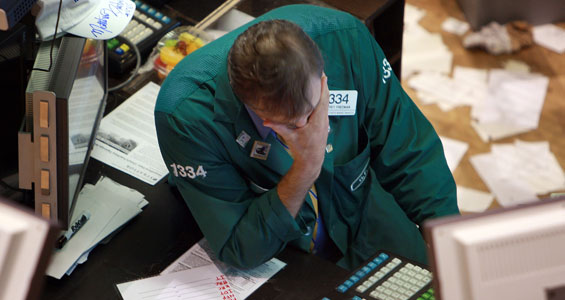
The US economy has been on the verge of recession as it combats a massive national debt, a housing crisis and the declining strength of the dollar [GALLO/GETTY]

Dumping (and dumping on) the Dollar
By Dale C.
/ The Rag Blog / July 16, 2008

Ever wondered what the GOOD side of the weakening dollar is? Or where the trigger might likely come from that could turn the slide into a full-scale global dollar-dumping panic? Or what the good aspects of the change might be if dollars lost their role as the currency most nations hold as their reserves (“savings”)? Or why the Cheneybush burns loudly with faux indignation at an Iranian nuclear weaponization program that US intelligence sources have said doesn’t exist? This article — from a Vienna-based analyst (and apparent Mid-East native) posting on Al Jazeera a few days ago — provides a unique and informative perspective on those and related questions. The comments it got from readers on the Al Jazeera site are at least as interesting as the article, and well worth a look.

Analysis: Blame the dollar
By Massoud Hedeshi, international development expert, in Vienna

The US economic power horse is running out of ideas and cash as it jostles with a massive national debt, housing and financial crises, rising inflation, and a depreciating currency.

This has all contributed to a growing tendency to live off credit amassed through petrodollars and foreign loans, leaving repayment for future generations.

Today, in much of America, communities and suburbs are dealing with a drastic increase in foreclosures and short sales. This has not been helped by the fact that gas is selling at over $1 a litre ($4 a gallon).

Standard monetary tools such as lowering or increasing interest rates can no longer provide quick fixes to the situation for both economic and political reasons.

Raising interest rates would compound the mortgage crisis while lowering it would drive the value of the US dollar abroad even lower.

But exercising control over the money supply could also damage the US economy: increasing the supply would lower the dollar’s value even more, while decreasing supply would exacerbate the loans crisis.

In any case, control over the money supply would be anathema to US economic policy given the country’s ‘addiction’ to deficit financing and run-away consumerism in recent decades.

So the US Federal Reserve is left virtually helpless.

It has, however, tried to help Wall Street by becoming a temporary lender and allow many investment firms the opportunity to avoid bankruptcy. Such an action by the Fed has not happened since the stock market fiascos in the 1930s.

The US government, however, can apply one clear fix to the situation – cut back overspending on a massive scale.

But this option too is off the table in an election year where ‘victory’ is being promised in endless wars on ‘terrorism’.

And it is the recent wars in Afghanistan and Iraq that have contributed the lion’s share to sapping America’s resources.

Plunge of the dollar

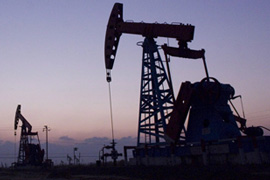
Increased energy demands from developing nations fuelled a rise in oil prices [EPA]
As America struggles to avoid recession, the world economic order appears to be heading for a drastic overhaul.

Despite a trend by some economists and politicians to blame the current food and energy commodity price hikes on Opec or overpopulation, there is a clear picture emerging of deep structural problems in the world economy.

Increased energy demands from developing nations fuelled a rise in oil prices [EPA]

In particular, the main currency used for global trade in commodities, the US dollar, has been in steady decline not just against the Euro, but also against most other convertible currencies.

According to the US Federal Reserve, the dollar has dropped by around 65 per cent against the Euro, 31 per cent against the British Sterling, 45 per cent against the Canadian Dollar, and by 59 per cent against the Australian Dollar over the eight-year period since June 2000.

While the causes for this slide are debatable (and largely attributed to poor fundamentals in the US economy), the global impact of such a major drop in the value of the dollar is undeniable for two important reasons.

First, most global commodities traders utilise – and favour – the greenback over other currencies, despite a severe decline in its purchasing power.

Secondly, most countries – mainly in east Asia and among the major oil and gas exporters of the Arab Middle East – use the dollar as their reserve currency.

But they are paying the price. Despite their booming economies and elevated public spending, they are experiencing depreciating terms of trade and rising inflation.

More importantly, they have seen the value of their strategic currency reserves drop with the dollar’s waning global strength.

Rising prosperity

The situation is ironically exacerbated by a significant rise in prosperity and consequently in the volume of global trade in recent years.

According to a 2007 Handbook of Statistics published by the United Nations Conference on Trade and Development (Unctad), global merchandise export and import volumes have grown at over 10 per cent a year over the 45-year period 1960-2005 in US dollar terms and based on current prices.

After the economic shocks of 1998 (caused by the Asian financial crisis of the time) and 2001 (following the terrorist attacks on 9/11), export and import growth rates for world merchandise accelerated to almost 17 per cent a year between 2003 and 2006.

Such a huge rise in demand for commodities would inevitably result in inflationary pressure on prices, particularly when the currency used for transactions – the dollar – is consistently losing its underlying value.

Global revolution

Furthermore, there has been significant and robust growth in the economies of developing countries in the past half century.

Developing country export growth outpaced the global average rate by 1 per cent in the 1960-2005 period, and outpaced the developed world by 1.2 per cent over the same period, according to Unctad.

And the differential between developing (including India, China, UAE) and developed nations (such as Japan, US, France, Germany, UK) has increased with time: 1.4 per cent for 1970-2005; 1.4 per cent for 1980-2005; 3.6 per cent for 1990-2005; and 4.8 per cent for the period 2000-2005.

The fall of the Soviet Union and its satellites is also adding to growing market demands and the push for prosperity

Former Warsaw Pact countries, which are now known as ‘economies in transition’, have in recent years outpaced developing countries’ export growth rates by close to 6 per cent over 2000-2005, according to UNCTAD.

This has changed the economic dynamic of north-south and east-west dialogue. Some 50 years ago, 80 per cent of the world’s population lived in low-income countries. Today, that proportion has been turned on its head with four billion – around 65 per cent – living in middle and high-income countries.

What we now have in effect is a quiet global revolution beginning to bear fruit following a 50-year period shift in economic foci and decolonisation.

The impact of decolonisation is not to be underestimated. Those ‘peripheral’ areas of the world – such as India and China – exploited for centuries by a self-serving ‘metropolis’ have developed a self-consciousness emanating from a technological, economic and political revolution.

Dumping the dollar

The growth of global economies – some of which had not been international players until recently – creates a proportional need for energy and food resources and consequently the crises we face today.

As the crises that emanate from growing prosperity develop, they fuel a hunger for increased commodity production, a reduction in waste, and an urgent need to locate alternative energy sources.

However, there is also a need to take immediate measures to protect the growth in global prosperity.

World leaders, particularly among major oil and gas producers and those in East Asia and elsewhere with large foreign currency reserves, are coming under pressure to ditch one of the greatest causes of global inflation today -the fast-declining US dollar.

Though many have been resistant to this idea, sooner or later economic realities will overcome political interests that negate its rationale.

Iran has spearheaded this idea with its own Oil Bourse that trades mainly in Euros and Yen, and by converting its reserves to other currencies.

While Iran is already reaping the benefits of these moves, it however lacks the financial muscle to make a real dent in world trade trends.

The country that is most likely to realise this idea with both impact and impunity – and has some outstanding scores to settle with the US – is Russia.

Mother Russia?

Will Russia use its military and economic muscle to dump the dollar? [AFP]
Why would Russia continue to amass a rapidly deteriorating currency in its reserves at a time when its own economy is stronger than most others? Why indeed would any country want to continue trading in a currency that harms its terms of trade?

Will Russia use its military and economic muscle to dump the dollar? [AFP]

The slightest hint of a move by Russia to ditch the dollar substantially would fuel speculation by a number of unstoppably powerful agents: national central banks, currency speculators and those same global corporations that emanated from the West.

They would not betray their profit motive if greater profitability is achieved through trading in other currencies. Even the consistently timid Arab oil exporters would join the fray once a trend is started.

Ironically, the inevitable dumping of the US Dollar is not such good news for the EU in the long run, as the continuing rise of the Euro is detrimental for the continent’s exports, and will weaken European manufacturing almost as rapidly as the Euro’s rise.

Furthermore, reliance on the services sector is no solution either, as rising global prices coupled with the rise of the Euro reduce demand for luxuries-oriented European goods and services – such as designer goods and tourism – even harder.

For these reasons, it is prudent to concentrate on the use of other currencies too.

A positive outcome

We are witnessing the birth pangs of a new, more equal world economic order with the particularly notable rise of Asia (but not just Asia) and with Russia as its most likely midwife.

Despite short-term difficulties ahead, there are good reasons for optimism since greater economic equality leads to a greater rule of law, dialogue, respect and cooperation among nations.

To borrow a classic liberal axiom: greater economic equality leads to greater democracy and the rule of law. This holds as much among more equal nations as it does for individuals ‘competing freely’ in a market.

By extension, we can also add that greater economic equality among nations would lead to greater international dialogue, respect and cooperation in the conduct of international relations.

This should also more successfully reduce the support base for extremism and fundamentalism in the West and the East.

Massoud Hedeshi is an international development consultant.

Source, with comments / al Jazeera English

The Rag Blog

Posted in RagBlog | Tagged , , | 1 Comment

World Court Urges US to Stay Five Executions

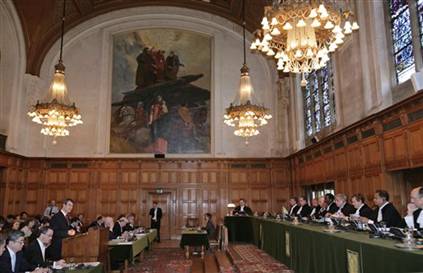
World Court judges on June 19 heard arguments in the case involving Mexican citizens on death row in the United States. Photo by Peter Dejong / AP.

Mexico had appealed to U.N. body on behalf of citizens on Texas death row.
July 16, 2008

THE HAGUE, Netherlands – The U.N.’s highest court on Wednesday ordered the United States to stay the executions of five Mexicans on Texas death row pending review of their cases.

Mexico had appealed to the World Court to block the executions. At hastily convened hearings last month, Mexico argued that the United States is defying a 2004 International Court of Justice order to review the cases of 51 Mexicans sentenced to death by state courts.

That order was based on the Hague-based court’s finding that the condemned prisoners had been denied the right to help from their consulate following their arrest.

Wednesday’s ruling comes less than three weeks before the first of the death row inmates, Jose Medellin, was scheduled for execution by lethal injection in Texas for taking part in the gang rape and murder of two teenage girls 15 years ago.

At last month’s hearings, Mexico’s chief advocate Juan Manuel Gomez-Robledo told the court the cases had not been systematically reviewed, and the U.S. was “in breach of its international obligations.”

“Extraordinary Lengths”

John Bellinger III, the U.S. legal adviser, said then that the federal government had gone to “extraordinary lengths” to carry out the World Court’s directive and to intercede with the state courts.

Earlier, President Bush issued a directive to the state courts to abide by the decision and also asked Texas specifically to review Medellin’s case ahead of his planned Aug. 5 execution.

Those steps were “highly unusual,” Bellinger said. “It almost never happens that the federal government enters an appearance in state court proceedings.”

However, Texas refused, and in March the U.S. Supreme Court ruled by a 6-3 vote that Bush lacked the authority to compel state courts to comply with the judgment from The Hague.

Secretary of State Condoleezza Rice and Attorney General Michael Mukasey have jointly written to Texas Gov. Rick Perry, urging him to review Medellin’s case, Bellinger said.

Informally known as the World Court, the tribunal is the U.N.’s judicial arm for resolving disputes among nations. Its decisions are binding and final, but it has no enforcement powers.

Source. / AP / truthout

The Rag Blog

Posted in RagBlog | Tagged , , , , , | Leave a comment

Bob Dylan to Jakob : Be a Wallflower?

Jakob Dylan.

First convention protester: Bob Dylan?
By Tom Webb / July 15, 2008

Has singer Bob Dylan staged the first protest of the 2008 Republican National Convention by persuading his son Jakob Dylan not to perform here in September?

That’s the talk in the Twin Cities, although neither Dylan was available to comment Monday.

This much is known: The Minnesota Agri-Growth Council was negotiating with Jakob Dylan and his band, the Wallflowers, to perform for 5,000 invited guests at a nonpartisan industry bash called AgNite on Sept. 2, the second night of the Republican convention.

Representatives had agreed on a performance fee, although no contracts had been signed, said Daryn McBeth, executive director of the agribusiness trade group. Then, the deal fell through.

“The lead singer of the band, his dad is Bob Dylan, and I’m told he (Bob) weighed in and encouraged them not to do it because of the political nature of what’s going on in town that week,” McBeth said.

McBeth tried to relay the nonpartisan nature of AgNite, noting it was a celebration of America’s food industry. GOP conventioneers are definitely welcome, he said, but Democrats and independents are, too. No matter.

“The deal was dead at that point,” McBeth said. “I don’t know how Bob got wind of it, or if his son and the band communicated it to him. But (the gig died after) the concern about politics, and maybe Bob Dylan’s feeling about the state of Minnesota and his son’s band playing in his home area.”

Still, the AgNite show will go on. The gala has booked the group Styx, which will perform at the historic Milwaukee Road depot in Minneapolis.

The bash is being produced by event showman Paul Ridgeway and promises a glitzy multimedia celebration of the ag story for delegates, journalists, visiting VIPs and others. There will be no speeches.

Styx has sold some 17.5 million records, according to the Recording Industry Association of America, and is most famous for such late ’70s and ’80s hits as “Come Sail Away” and “The Best of Times.”

The Styx. production and booking firm, Freestyle Productions, had no comment on the Dylan matter. But the company’s Chris Tahti did note that AgNite is shaping up as “a fantastic event, it should be the afterparty of the convention that night. It should be the place to be.”

Calls and e-mails to the Dylans’ record company and their publicists were not returned. Jakob Dylan is scheduled to appear tonight on “The Tonight Show with Jay Leno” to promote his new solo album, “Seeing Things.”

Born Robert Zimmerman in Duluth, the elder Dylan grew up in Hibbing and attended the University of Minnesota before striking out for New York and immortality. Though noted for his songs of protest, he has largely avoided taking an active role in partisan politics — although last month he spoke admiringly of Democratic presidential candidate Sen. Barack Obama.

That hasn’t stopped partisans from trying to tap the Dylan legend. During the 2004 Republican National Convention in New York, U.S. Sen. Norm Coleman introduced Minnesota’s delegate vote saying, “Minnesota native Bob Dylan said, ‘Times they are a-changin’.’ They are changing in Minnesota, with our great young Republican governor Tim Pawlenty, half of our Washington delegation being Republican ….”
Unlike in years past, even big-name entertainers, including both Dylans, now rent their services to perform at private parties and corporate events.

In 2007, the Los Angeles Times wrote about the practice, quoting the manager of several top acts, who said that for most bands now, “There are two questions: ‘How much does it pay?’ and ‘Where does it fit on my cringe meter’?”

McBeth, with the AgriGrowth group, said early negotiations with the Wallflowers seemed encouraging.

“I think it was a fit with where they were touring,” McBeth said. “And evidently, the venue and nature of our event was fine. And then, I’m told, Bob Dylan got them to think otherwise.”

[Tom Webb is a political writer for The St. Paul Pioneer Press. His work can be found at http://www.twincities.com. Politico and the Pioneer Press are sharing content for the 2008 election cycle and during the Republican National Convention.]

Source. / Politico

The Rag Blog

Posted in RagBlog | Tagged , , , , | 1 Comment

Texas Chainsaw Massacre : Austin Tree-Huggers Get Their Due!

The Rag Blog generally doesn’t publish news of a local Austin nature, but in this case: it was a great tree; it’s about time cedar-chopping developers got some comeuppance AND the whistleblowing good guy was our own Jim Retherford.

Developer indicted in South Austin tree cutting
By Steven Kreytak / July 16, 2008

An Austin developer has been indicted by a Travis County grand jury on a charge of criminal mischief, accused of illegally cutting down a large cedar tree in South Austin last year.

Hunter Wheeler, 36, faces up to two years in prison on the charge. When reached Wednesday he declined to comment, saying he was not aware of the case. He has previously denied cutting down the tree.

Assistant District Attorney Claire Dawson-Brown said Wheeler is accused of ordering a work crew to cut down a 22-inch-wide tree that was in City of Austin-owned right-of-way. It was near a home Wheeler was building on Daniel Drive, just south of Barton Springs Road in the Bouldin Creek neighborhood.

Dawson-Brown said the indictment is a rare one surrounding the cutting of a tree, a violation that often is handled with civil fines.

Neighbors of the felled tree, which sat next to a sidewalk, told the American-Statesman last year that they suspected Wheeler ordered the cutting because the tree blocked a view of downtown from the spec home he was building.

After one neighbor found the tree in the roadway while walking his dog on July 21, 2007, a Saturday morning, neighbor Jim Retherford called police, Retherford said last year.

Retherford said the tree crew told them that Wheeler had ordered the tree cut down. The crew later said that a woman in a house across the street from the house Wheeler was building wanted the tree down.

Wheeler, whose company Hunter Wheeler Homes specializes in building and remodeling large homes around Austin, said last year that he gave the neighbor information on a tree crew after the neighbor said she wanted the tree removed.

Gail Armstrong, who lives on Daniel Drive, said he is glad that the tree cutting is being taken seriously.

“It’s sort of a pretty strong move to step across the street from your property and cut a tree down,” he said. “As tree happy as Austin is, I don’t see how it’s particularly out of line that he be held accountable.”

Source. / Austin American-Statesman

The Rag Blog

Posted in Rag Bloggers | Tagged , , , , | Leave a comment

Economy : Nearing a Tipping Point


Those Greenspan bubbles a’bursting…
By Roger Baker / The Rag Blog / July 16, 2008

It looks like the US economy has gotten itself into a ‘liquidity trap’; the blowback from Greenspan’s bubbles and banking deregulation.

If we try to avoid a deepening depression, the fed would normally try to inject enough liquidity by lowering interest rates to reflate the economy and stimulate spending, according to classic Keynesian principles. The income tax rebates were supposed to do the same thing, but were too little too late. But once the psychology of cutting back on the non-essential spending sector of the economy gets started, it tends to be reduce business profits for a large part of the total GNP and to become a self-reinforcing recession, depression, whatever.

Since the financial panic is centered in the finance industry, “Helicopter Ben” is trying to avoid bank runs by bailing out the big guys, including Freddie Mac and Fannie Mae. The unregulated hedge funds who have borrowed from the giant investment banks like JP Morgan have to get bailed out too as part of the same process.

But all the new dollars and taxpayer IOUs that Ben Bernanke uses to bail out the banks and their wealthy investors has to go somewhere. This liquidity would be stupid to go into parts of the consumer economy that are doing poorly, so it will go into the parts of the economy that have a solid spending base like food and oil and commodities. So the bailout dollars get recycled into bidding against the Chinese for a limited world supply of oil and all the fruits thereof, which naturally increases their price, which shows up as the inflation we see now.

But we are nearing a tipping point where T-note holders worldwide see how stupid it is to hold dollars that are losing value, due to inflation not paying as much as their T-note value, and so dump massive amounts of dollar liquidity into the international economy to buy Euros, gold, etc. So the dollar plunges and the cost of oil in dollars leaps upwards, raising the cost of nearly all necessary commodities. If you think inflation is bad now wait until the whole world dumps their dollars.

Its a new version of the stagflation of the oil crisis of the early 1970s and 1980s. Then economic shock therapy by Paul Volker plus Arab oil led to recovery, but this time things look a lot more serious because the economy is so highly-leveraged so that a lot of banking debt on the books is worthless and also because there is no more cheap oil to hold down commodity prices that depend on an oil-addictive economy designed to benefit financial interests with the short range investment focus that flourished under Greenspan’s watch

U.S. economy: Consumer prices up 5% to 17-year high
By Shobhana Chandra and Timothy R. Homa / July 16, 2008

U.S. consumer prices surged 5 percent in the past year, the biggest jump since 1991, just as households struggled with falling home values and the credit crunch.

Spiraling expenses for food and fuel spurred the increase in June, the Labor Department said today in Washington. The cost of living rose 1.1 percent from May, more than forecast and the second-largest rise since 1982. Separate figures showed industrial production rose more than estimated because of the end of a strike at American Axle & Manufacturing Holdings Inc. and increased electricity output.

Price gains accelerated last month even after stripping out energy and food, underscoring the challenge for Federal Reserve Chairman Ben S. Bernanke as he attempts to steer the economy through the slowdown and credit crisis. Treasuries fell.

“This is a problem for the economy; it’s even worse for the Fed,” said Joel Naroff, president of Naroff Economic Advisors Inc. in Holland, Pennsylvania.

“Inflation numbers are high enough that under different circumstances the Fed would be hiking rates.”

Excluding food and energy, so-called core costs climbed 0.3 percent in June from the previous month and 2.4 percent from a year before.

Yields Jump

Benchmark 10-year note yields rose to 3.93 percent at 4:20 p.m. in New York, from 3.82 percent late yesterday. The Standard & Poor’s 500 Stock Index advanced 2.5 percent to close at 1,245.36, after earnings from Wells Fargo & Co. topped analysts’ estimates.

Consumer prices were forecast to rise 0.7 percent, according to the median estimate of 79 economists in a Bloomberg News survey. Projections ranged from gains of 0.2 percent to 1.1 percent. Costs excluding food and energy were forecast to rise 0.2 percent, the survey showed.

Bernanke told lawmakers in semiannual testimony on the economy yesterday and today that inflation risks have “intensified.” At the same time, he dropped his June assessment that risks to the economic expansion had diminished, indicating policy makers aren’t ready to raise interest rates to contain expenses.

“We don’t think they’re going to raise rates now — until June next year now is our forecast — until basically the economy starts to get some footing,” Beth Ann Bovino, senior economist at Standard & Poor’s in New York, said in an interview with Bloomberg Radio. “Right now the beast is what’s going to happen with the economy.”

Exceeding Forecasts

Prices were forecast to climb 4.5 percent in June from a year earlier, according to the survey median.

A separate report today said confidence among U.S. homebuilders dropped to 16 this month, a record low. Readings for current sales, expected sales and buyer traffic in the National Association of Homebuilders/Wells Fargo sentiment index also were at all-time lows.

“The magnitude of the housing bubble was unprecedented, and the corrective process promises to be a long and painful one,” Joshua Shapiro, chief U.S. economist at Maria Fiorini Ramirez Inc. in New York, said in a note to clients.

The Fed said today that production at factories, mines and utilities increased 0.5 percent last month after dropping 0.2 percent in May. Capacity utilization, which measures the proportion of plants in use, rose to 79.9 percent from 79.6 percent.

Strike’s Resolution

The resolution of a three-month strike by General Motors Corp.’s largest axle supplier, American Axle, probably helped lift auto output. Excluding autos, factory output fell 0.1 percent for a second month.

Wholesale costs rose 1.8 percent in June, the most in seven months, the Labor Department reported yesterday. From a year ago, prices climbed 9.2 percent, the biggest surge since 1981.

Companies, unable to fully recover ballooning raw-material costs by raising prices, have cut staff and reduced equipment purchases as profits shrink.

Kimberly-Clark Corp., the maker of Huggies diapers and Scott paper towels, said earnings for this year will trail its previous forecast as expenses rise more than twice as fast as predicted,

“Inflation has outpaced our ability to offset higher costs in the near term through price increases, cost reductions and other measures,” Thomas Falk, the Dallas-based company’s chief executive officer, said this week in a statement.

Price Increase

Procter & Gamble Co., the maker of Tide detergent and Head & Shoulders shampoo, last week said it’ll raise prices as much as 16 percent due to higher costs for plastic, energy and paper. The increases start in September and are the Cincinnati-based company’s steepest in at least 18 months.

Energy expenses jumped 6.6 percent, the biggest gain since November. Gasoline soared 10.1 percent and fuel oil jumped 10.4 percent.

The cost of fuel will continue stoking price pressures. Crude oil futures reached a record $147.27 a barrel on July 11 and have risen almost 90 percent in the past year. Regular gasoline, which topped $4 a gallon for the first time in June, kept rising this month, AAA figures show.

The consumer price index is Labor’s broadest gauge of costs. Almost 60 percent of the CPI covers prices consumers pay for services ranging from medical visits to airline fares and movie tickets.

Food Expenses

Food prices, which account for about a fifth of the CPI, increased 0.8 percent, driven by the biggest gain in the cost of vegetables in almost four years.

The report showed that food and fuel weren’t the only items on the rise. Costs for airline fares jumped 4.5 percent, the most since 2001.

Rents which, make up almost 40 percent of the core CPI, also accelerated. A category designed to track rental prices rose 0.3 percent after a 0.1 percent gain in May.

Today’s figures also showed wages decreased 0.9 percent in June after adjusting for inflation, the biggest drop since September 2005, and were down 2.4 percent over the last 12 months. The decline in buying power is one reason economists forecast consumer spending will slow.

Americans trimmed purchases of automobiles, furniture and restaurant meals last month as the cost of gasoline soared, a Commerce Department report showed yesterday.
Retail sales rose 0.1 percent, less than forecast, a sign the boost from the tax rebate checks is already fading.

Source. / Bloomberg

The Rag Blog

Posted in RagBlog | Tagged , , , , , | Leave a comment

Rabbi Arthur Waskow to Barack Obama : "Justice, Justice Shall You Pursue"

Rabbi Arthur Waskow.

Rabbi Arthur Waskow asked us to publish this open letter to Barack Obama. He has also posted it to the On Faith blog on the Newsweek/Washington Post website.

Rabbi Waskow has been one of the creators and leaders of Jewish renewal since writing the original Freedom Seder in 1969. Rabbi Waskow is director of The Shalom Center; author of Down-to-Earth Judaism and a dozen other books on Jewish thought and practice, as well as books on US public policy. Newsweek named Rabbi Arthur Waskow one of America’s 50 most influential rabbis.

Open Letter to Senator Obama:
The Middle East, Islam, Ends, & Means

By Rabbi Arthur Waskow

Dear friends, I am writing this out of personal experience and my own individual ethical concern, not on behalf of any organization or campaign. It comes with Martin Buber’s teaching ringing in my brain: that he had no idea what it meant to say that “the ends justify the means,” but that for sure the means we actually use will become the ends that we actually achieve.

Or as ancient Torah teaches, “Justice, justice shall you pursue.” Why “justice” twice? To teach that just ends can only be achieved through just means.

A lesson for all who work to change society.

Shalom, salaam, peace — Arthur

Dear Senator Obama,

I met you at your talk with Philadelphia Jewish leaders in April. It was I who as you entered the room handed you a copy of the original Freedom Seder, which I wrote in 1969, and which bound together the freedom struggles of Blacks and Jews. And during Q & A, it was I who asked you how as President you would deal with the peace-obstructing settlement policy of this and many previous Israeli governments.

I asked that question because one of the advance speakers for your meeting, Congressman Roth of New Jersey, had just asserted that you believe the failure of the peace process has been solely the result of the absence of a Palestinian partner for peace.

“Solely the fault of the Palestinians?” I thought. “Surely he doesn’t believe that!” So I rose to say that hundreds of rabbis and hundreds of thousands of American Jews see Israeli settlement policy as obstacles to peace, and asked what as President you would do about it.

Your answer cited the vigorous debate on these questions in Israel — more vigorous than here; the recognition by most Israelis that for peace to unfold, there will have to be a shift in settlement policy; and your sense that most Israelis know that internal debate would be so wrenching that they want to know there is a partner for that decision before going through the debate.

Though you avoided saying what you would do, I was satisfied with your answer — then.

I was especially ready to be satisfied because I knew that earlier, when you met with Jewish leaders in Cleveland, you had gone even further, saying:

“I sat down with the head of Israeli security forces and his view of the Palestinians was incredibly nuanced because he’s dealing with these people every day. He was willing to say sometimes we make mistakes and if we are just pressing down on these folks constantly without giving them some prospects for hope, that’s not good for our security situation.”

It would be profoundly important to have a President who understands that! Yet more recently, in your speech to AIPAC, there was no such language. And you slid so far into simply repeating official shibboleths like “Jerusalem undivided” that you had to correct yourself the next day.

No one knows better than I that many of the “official” Jewish organizations would go ballistic to hear a presidential candidate bring such ideas to the fore in, say, a major speech about making peace across the whole region that Abraham, Hagar, and Sarah walked.

And no one knows better than I that millions of American Jews , Christians, and Muslims want exactly that kind of honest talk and vigorous diplomacy. They would support any President who insisted on exactly the kind of broad pursuit of peace you have sometimes affirmed, and the changes in not only Palestinian, Syrian, and Iranian but also Israeli and American behavior it requires.

I know some people who carry a strange mixture of cynicism and wish-fulfillment in their heads — who think you can, will, and should say anything to calm folks like the AIPAC membership and thereby get elected, and later will work hard for a real peace. I know people who think that you can, will, and should pretend you never met Palestinians and heard their suffering, never got to understand their understanding of their history as you have so eloquently explained that you have heard and understood the Jewish story — all in order that once you are in office, you can bring your “true” knowledge into policy.

But I don’t think it works that way. Not only would that kind of campaign be an ethical failure and a personal self-betrayal, abandoning the honest, nuanced, politics of change that you claimed to represent — but I think it won’t work politically.

First of all, that kind of campaign will greatly weaken your appeal to the passionate supporters you have had — just like your betrayal of your own understanding that the FISA bill violates the Fourth Amendment’s prohibition of searches without warrants. Already, the drop-off of small contributions to your campaign suggests that these people are dismayed. And they are the core of your strength, as you yourself have repeatedly said.

Secondly, it will weaken your ability if you are elected President to take the steps necessary for peace. For it would weaken and delegitimate the millions of American Jews, Muslims, and Christians who seek precisely a policy of peace for Israel alongside a peaceful Palestine, and peace between Iran and the United States. Who would thank God — literally! — for a President who would seek to meet the crucial needs of all these peoples while refusing to humiliate or subjugate any of them. There will be many people and organizations ready to attack any President who takes such positions. There need to be people and organizations motivated and mobilized to support them.

To strengthen such a faith-based coalition, you will also have to make clear — by where you speak as well as what you say — that of course American Muslims are as much a part of American society as any other religious group. So your unwillingness to speak in any mosque — presumably for fear that might reinforce the wicked rumors that you are really a Muslim — simply strengthens the mind-set that thinks to demonize you on the false grounds that you are a Muslim, and any Muslim must be anti-American.

I remember being moved when in your speech to the 2004 Democratic National Convention, you said, “If there’s an Arab-American family being rounded up without benefit of an attorney or due process, that threatens my civil liberties.” That line had no political pay-off in numbers of voters. It was a principled statement, fearlessly swimming against the tide of public opinion. And — against all “realistic” calculation — it won vigorous applause from those assembled number-centered politicians!

You owe it to Americans of all faiths, to Jews around the world, to the Arab and Muslim billions – – to treat all these people as part of the world community that must work together to heal our planet from war and eco-disaster.

Just as in Philadelphia you expressed compassion for white working-class anger without surrendering to right-wing policies that ignore Black poverty and despair — so you can express compassion for Jewish fears without surrendering to oppressive right-wing Israeli policy. And in the same new approach to change, you can include Muslims in the body politic and express compassion for some Muslims’ anger and fear, without affirming violence and terrorism.

You will need to address these questions honestly if you are not to be caught against your will in years of war and terror that would destroy an Administration you might lead as it did the last one, will damage America at least as deeply as our deafness to others’ narratives has damaged us this past seven years.

Just as the racial chasm has haunted and daunted American democracy two centuries and more, the growing chasm between “the West” and “Islam” will haunt and daunt every effort to make peace and heal our planet, if we and you do not address it in all its depth and difficulty.

So just as you spoke in Philadelphia with nuance and compassion about race, I implore you to speak as clearly with nuance and compassion about these questions.

With blessings of shalom, salaam, peace —

Rabbi Arthur Waskow

[The Shalom Center voices a new prophetic agenda in Jewish, multireligious, and American life. To receive the weekly on-line Shalom Report, click
here.]

The Rag Blog / Posted July 16, 2008

Posted in RagBlog | Tagged , , , , , , , , | 2 Comments

Silver Lining Dept : The Upside of $4 Gas


Five Reasons to Love $4 Gas
July 16, 2008

Sure, it’s ruining the global economy and making everyone miserable, but there’s an underappreciated upside to the high price of oil.

1. The mass transit boom

What’s happening: From 2000 to 2005, fewer than 5 percent of Americans used mass transit for their commutes, compared with about 50 percent in Japan and Europe. But that may be changing. More U.S. commuters than ever are taking buses, subways, or light rail to work instead of driving their cars. Americans took nearly 85 million more trips in the first three months of 2008 than they did in the same period in 2007, a recent American Public Transportation Association study found. Ridership in 2007 was the highest in 50 years.

Why it’s happening: It’s not rocket science. For many, a roundtrip bus or metro fare is easier to stomach than gas prices that in some places have climbed to $4.79 per gallon. Three quarters of Americans now believe more money should be spent on developing and improving mass transit systems, and cities are responding. Expansion and renovation projects are in the works for southern California, New York, Philadelphia, Seattle, and Washington, DC. Europe, meanwhile, is taking transit to the next level: Paris, which has been updating its light rail network, is installing energy-efficient trains on several Métro lines, while London plans to increase its system’s overall capacity by 50 percent by 2022.

2. Lower obesity rates

What’s happening: Rising gas prices and smaller belt sizes go together, according to Charles Courtemanche of Washington University in St. Louis. His research found that, for every dollar increase in the average real price of gas, overweight and obesity levels in the United States would decline by 16 percent after seven years. His study also attributes the outward expansion of American waistlines between 1979 and 2004 in part to falling prices. Similar research published in the European Journal of Public Health found that European countries with higher gasoline prices tend to have lower rates of obesity.

Why it’s happening: One word: exercise. Bike shops across the United States are reporting record sales, and Britain is even promoting a national “Bike Week” to encourage commuters to ride, not drive, to the office. Not only is two-wheeling a cheaper way to travel, it’s also healthier. Courtemanche’s results show that “the average person walks or bicycles an average of 0.5 times more per week if the price of gas rises by $1.” Another factor he identifies is that cost-conscious Americans are choosing to eat at restaurants less frequently. Indeed, a virtuous cycle could be at work: A study published in The Engineering Economist found that Americans today use nearly a billion additional gallons of gasoline each year, compared with 1960, solely because they weigh more.

3. Fewer accidents

What’s happening: This past Memorial Day, normally a time when American drivers swarm the country’s interstates and police expect large numbers of accidents, many states reported that traffic deaths were the lowest in years. For instance, North Carolina saw just five traffic fatalities over Memorial Day weekend, down from 19 in 2007. Ohio experienced its lowest number of accidents in 38 years, and other states reported similar declines.

Why it’s happening: Americans are driving at historic lows, according to a May U.S. Department of Transportation (DOT) report, and less driving means fewer accidents. And they may be driving slower and more cautiously, too. Ian Parry, a senior fellow at Resources for the Future, an energy think tank, says that while the effect would be modest, some people “will realize they can drive less aggressively” and conserve gas mileage. According to fueleconomy.gov, a U.S. government Web site, “each 5 mph you drive over 60 mph is like paying an additional $0.20 per gallon.”

4. Shorter commutes

What’s happening: Worry about rising gas prices has encouraged workers to move closer to their jobs to cut costs and find alternate ways of traveling to work. And for many of those that still drive, less-packed roads are actually producing shorter commutes. While the change is by no means uniform, in some of the most congested areas of southern California, the average commute time has reportedly fallen by 5 or 6 minutes. That could make for a sunnier Los Angeles: a 2006 paper in Science found that people with shorter commute times tend to be happier.

Why it’s happening: Confirming the predictions of experts such as Harvard economist Gregory Mankiw, the DOT estimates that since November 2006, cumulative vehicle miles traveled have dropped by 17.3 billion miles. And with fewer cars on the road, as Mankiw forecast in 2006, those still able to afford driving are finding more lanes clear. In Europe, however, the effect has so far been the opposite, as striking truck drivers in Britain, Spain, and France have slowed or shut down entire highways to protest diesel prices.

5. The alternative fuels craze

What’s happening: More of the world’s fuel is coming from renewable energy sources instead of Middle East oil drums. Global production of biofuels — generally ethanol derived from corn, but also plant oils that produce biodiesel — roughly tripled from 2000 to 2007. Critics of biofuels point to studies indicating that the increasing diversion of cereal crops for biofuel production is driving up food prices around the world. Supporters counter that the answer isn’t to give up on alternatives to gasoline, but to develop “next-generation” biofuels (think: switchgrass and algae) that don’t interfere with the food supply. And without biofuels, “the [oil] prices today that we are experiencing could be much higher,” says Fatih Birol of the International Energy Agency.

Why it’s happening: Everyone responds to incentives. The U.S. Congress has set a national goal of 36 billion gallons of biofuel production by 2022, and generous subsidies are accordingly in place to make that happen. In Europe, public policy has also led the way. The European Union wants biofuels to constitute 10 percent of the fuel mix by 2020, a target that has come under scrutiny as food prices have risen sharply in recent months.

[Reproduced with permission from Foreign Policy www.foreignpolicy.com. Copyright 2008, Carnegie Endowment for International Peace.]

Source. / AlterNet

Thanks to David Hamilton / The Rag Blog

Posted in RagBlog | Tagged , | Leave a comment

POETRY : Haiku Sadness


his blood on the sand

shall never again party,

yet paints the town red

Shane O’Neal
The Rag Blog / July 15, 2008

The Rag Blog

Posted in Rag Bloggers | Tagged , | Leave a comment

Exclusively Using the Wind for Power

Missouri’s turbines will provide electric service for at least 20 years, the expected lifetime of the wind-to-power devices. Photo: Steve Morse, MU Cooperative Media Group

First US Town Powered Solely by Wind
By Andrea Thompson / July 15, 2008

Rock Port, Missouri has an unusual crop: wind turbines.

The four turbines that supply electricity to the small town of 1,300 residents make it the first community in the United States to operate solely on wind power.

“That’s something to be very proud of, especially in a rural area like this — that we’re doing our part for the environment,” said Jim Crawford, a natural resource engineer at the University of Missouri Extension in Columbia.

A map published by the U.S. Department of Energy indicates that northwest Missouri has the state’s highest concentrations of wind resources and contains a number of locations that are potentially suitable for utility-scale wind development. The four turbines that power Rock Port are part of a larger set of 75 turbines across three counties that are used to harvest the power of wind.

“We’re farming the wind, which is something that we have up here,” Crawford said. “The payback on a per-acre basis is generally quite good when compared to a lot of other crops, and it’s as simple as getting a cup of coffee and watching the blades spin.”

And the turbines have another benefit besides produces clean energy: MU Extension specialists said that the Missouri wind farms will bring in more than $1.1 million annually in county real estate taxes, to be paid by Wind Capital Group, a wind energy developer based in St. Louis.

“This is a unique situation because in rural areas it is quite uncommon to have this increase in taxation revenues,” said Jerry Baker, and MU Extension community development specialist.

Landowners can also benefit by leasing part of their property for wind turbines.

The turbines will also provide savings to rural electric companies and will provide electric service for at least 20 years, the anticipated lifetime of the turbines.

“Anybody who is currently using Rock Port utilities can expect no increase in rates for the next 15 to 20 years,” Crawford said.

Baker added that the turbines could also attract tourists to the area.

(c) 1999-2007 Imaginova Corp.

Source / America On Line

The Rag Blog

Posted in RagBlog | Tagged , | Leave a comment

A Bit of Justice Concerning BushCo Secrecy


White House Loses Appeal to Keep Visitor Logs Secret
by Jason Leopold / July 15, 2008

The White House lost an appeal to keep secret visitor logs containing the identities of evangelical Christian leaders who visited the White House and Vice President Dick Cheney’s home, according to an opinion issued Friday by a federal appeals court.

The U.S. Court of Appeals for the D.C. Circuit rejected the Bush administration’s claims that Secret Service visitor logs are the property of President George W. Bush and are not subject to Freedom of Information Act (FOIA) requests. The White House assumed control of the visitor logs when watchdog groups and the media sought access to the files.

The panel of three appeals court judges essentially upheld a December decision by a U.S. District Court judge who said the visitor logs were public documents subject to the FOIA. They sent the case back to District Court Judge Royce Lamberth for consideration

“At that point, the court may agree with the agency, allowing it to withhold the requested records, in which case the government would have no cause to appeal,” says the appeals court’s opinion.

The government watchdog group Citizens for Responsibility and Ethics in Washington (CREW) sued the Department of Homeland Security in 2006 for access to the records after the Secret Service — on orders from Cheney — refused to process CREW’s FOIA request. The Secret Service was formerly operated by the Treasury Department. It became part of the Homeland Security Department in March 2003.

The Bush administration had argued in its appeal that a Supreme Court ruling issued in 2004 “warning that courts should hesitate before requiring the President or Vice President to “bear the burden” of “asserting specific claims of privilege and making . . . particular objections.”

“In this case, we disagree,” states the 14-page opinion written by Clinton appointee David Tatel. “We find unpersuasive the government’s argument that this case implicates the same separation-of-powers concerns present in” a lawsuit filed against the vice president for access to documents related to the identities of corporate executives and lobbyists who advised Cheney on energy policy.

In the lawsuit filed against Cheney “two nonprofit organizations, Judicial Watch and the Sierra Club, filed civil suits, not FOIA requests, directly against various government officials — including Vice President Cheney himself — alleging that the National Energy Policy Development Group (NEPDG) was subject to the Federal Advisory Committee Act’s disclosure requirements.

“The district court had allowed discovery to proceed against the Vice President in order to establish exactly who attended NEPDG meetings, and the Vice President sought a writ of mandamus from this court to vacate the discovery orders. After emphasizing the need for the district court to “narrow discovery to ensure that plaintiffs obtain no more than they need to prove their case,” we rejected the Vice President’s request for mandamus, explaining that he could object to individual discovery requests on executive privilege grounds if need be. The Supreme Court reversed, explaining, “Separation-of-powers considerations should inform a court of appeals’ evaluation of a mandamus petition involving the President or the Vice President.”

In the case of the Secret Service visitor logs, “the government argues that requiring the Secret Service to review FOIA requests for its visitor logs is tantamount to the discovery request at issue in” the lawsuit against Cheney related to his energy task force, the appeals court opinion says.

The energy task force lawsuit “is distinguishable from this case on several grounds. To begin with, the discovery request . . . was directed at the Vice President himself. Indeed, the Court explained that “[w]ere the Vice President not a party in the case, the argument that the Court of Appeals should have entertained an action . . . might present different considerations. The Court also observed, “[t]his is not a routine discovery dispute. The discovery requests are directed to the Vice President and other senior Government officials who served on the NEPDG to give advice and make recommendations to the President.”

CREW is seeking “documents not from the President or Vice President, but rather from the Secret Service, a FOIA agency well accustomed to dealing with such requests,” the appeals court opinion states. “According to the Secret Service’s FOIA officer, “the individuals who performed the searches . . . conduct FOIA searches as part of their regular responsibilities.”

In its 2006 FOIA filing, CREW identified nine evangelical Christian leaders, such as James Dobson of Focus on the Family, Family Research Council president Tony Perkins, Gary Bauer and Moral Majority co-founder Jerry Falwell, who visited the White House and Cheney’s residence since 2001, who are alleged to have had a major impact on some aspects of the Bush administration’s domestic and foreign policy decisions.

“We are pleased that the D.C. Circuit is requiring the government to provide these Secret Service records that the White House has been trying to hide from the public,” said Anne Weismann, chief counsel for CREW. “The American people are entitled to know who has been influencing the White House.”

Last December, the White House sent out Christmas cards signed by President Bush and his wife Laura that contained a Biblical passage from the Old Testament:

“You alone are the LORD. You made the heavens, even the highest heavens, and all their starry host, the earth and all that is on it, the seas and all that is in them. You give life to everything, and the multitudes of heaven worship you.”

The inclusion of the Biblical passage caught the attention of longtime broadcaster Barbara Walters, who was a recipient of the presidential Christmas card.

Walters said she doesn’t recall receiving “religious” holiday cards from past presidents and she wondered how non-Christians would receive such an overtly religious greeting.

“Usually in the past when I have received a Christmas card, it’s been ‘Happy Holidays’ and so on,” said Walters. “Don’t you think it’s a little interesting that the president of all the people is sending out a religious Christmas card? Does this also go to agnostics, and atheists, and Muslims?”

The Biblical passage inside the Christmas card did not amount to a constitutional violation because it was paid for by the Republican National Committee, but Weinstein said it’s intolerable, nonetheless, because military officials believe they have the approval of the White House to allow fundamentalist Christian organizations and their leaders to proselytize in the military.

The appeals court said it lacked jurisdiction to resolve the Bush administration’s appeal because the U.S. District Court’s December 2007 ruling did not require the White House to produce the visitor logs, rather the court simply required that the Secret Service process CREW’s FOIA filing.

Moreover, the appeals court rejected the White House’s argument that requiring the government to process the request and invoke exemptions would place a constitutionally impermissible burden on the president or vice president. The court determined that CREW’s request is “narrowly drawn” and that requiring the administration to rely on the FOIA’s exemptions to protect claims of executive privilege “is a routine occurrence, not a uniquely intrusive burden.”

As a result of the court’s ruling, the Secret Service must process CREW’s FOIA request seeking copies of the visitor logs.

But the Bush administration is expected to assert other legal arguments, the White House indicated Friday, in an attempt to block access to the visitor logs and perhaps delay release of the materials until President Bush leaves office.

The appeals court judges added that, “it is entirely possible that the government will never have to turn over a single document.

Source / Dissident Voice

The Rag Blog

Posted in RagBlog | Tagged , , , , | Leave a comment

Drawn and Quartered


The Rag Blog / Posted July 15, 2008

Posted in RagBlog | Tagged , , , , , , | Leave a comment