SPORT : Sailing the Choked Waters

Chinese fishmen remove green algae from the sea on July 4, 2008 in Qingdao, Shandong, China. More than 1,000 boats and 5,000 fishmen have been mobilized to clean up green algae which has invaded the Olympic sailing venue. Photo by Guang Niu / Getty Images.

Olympic Sailors Facing Polluted Seas
By D’Arcy Doran / July 7, 2008

World class sailors are rarely afraid of water but the bright green algae that adorns the surface of their Beijing Olympics venue has left many boaters fearing for their health.

The grass-like growths that have choked parts of the sailing course at Qingdao has thrown an unwelcome spotlight on China’s environmental record and forced an ongoing cleanup by more than 10,000 people. Boats, bulldozers and the military have been deployed to remove the eyesore.

But for many Olympic sailors it’s what they can’t see in the water that is their greatest concern. After several test events in Qingdao, sailors realize they have an added opponent at this Olympics — pollution.

“You don’t really want to go sailing around in pollution and I’ve never sailed in a place that’s more polluted than this,” said Australian coach Euan McNicol, a former skiff world champion.

Almost every team has stories of members falling ill, or cuts and scrapes getting infected after contact with the Qingdao water.

The most shocking story is that of Australian sailor Elise Rechichi, who swallowed water when she slipped on a boat ramp during a test event here in 2006. It took her 10 months to recover from severe gastric trauma that had her in and out of hospital.

“It’s made us all reasonably wary of what’s going on,” McNicol said, adding Rechichi was not currently training in Qingdao, but she will be back in August.

With the Olympics only a month away, athletes cannot risk falling sick and are taking few chances.

“Everybody is being very careful about the pollution, making sure they don’t drink the water, trying not to have too much contact with the water, and not swallowing it,” Swiss coach Nicolas Novara said.

On Saturday, officials briefly claimed victory over the algae saying the course had been cleared.

But Qu Chun, the 2008 Olympic sailing competition manager said the bloom has not been totally wiped out, estimating that 2-5 percent of the course was still affected, down from nearly a third a week earlier.

Officials have said the algae is the result of a hot spell after heavy rain, but environmentalists said such blooms are largely due to sewage and agricultural pollutant run-off.

Israeli windsurfer Maayan Davidovich believes the cleanup work could be paying off. In her latest two week training stint in Qingdao she managed to avoid falling into the water.

“It’s not clean, but two years ago it was much worse, you would see bags and things floating in. Now you’re not seeing bags,” she said.

Canadian coach Dave Hughes said the water quality has improved a lot, but there are still spots where sailors track through what smell like sewage.

“You have two schools of people: those who complain about it — because it really is a terrible venue in terms of sailing, it’s horrendous — or those who just say it is what it is and you approach it as best you can,” Hughes said.

Qu, the competition manager, who competed for China 20 years ago and managed his country’s sailing team during the 2000 Olympics in Sydney, disputes that Qingdao is more polluted than other courses around the world.

“The water’s not poison and it won’t harm the athletes,” he said.

He said the stomach problems experienced by athletes following previous races in Qingdao could be caused by a variety of factors, such as not being used to Chinese food.

The government has invested heavily to clean up Qingdao’s water, he said, with new facilities moving sewage away from the coast and into the deep sea.

“Now you can see the bottom of the marina, before I couldn’t see it,” Qu said.

Source. / AFP / Discovery News

The Rag Blog

Posted in RagBlog | Tagged , , , , | Leave a comment

Willie Nelson and Wynton Marsalis – Two Men With The Blues

Thanks to Harry Edwards / The Rag Blog / Posted July 7, 2008

Posted in RagBlog | Tagged , , , , , , | 1 Comment

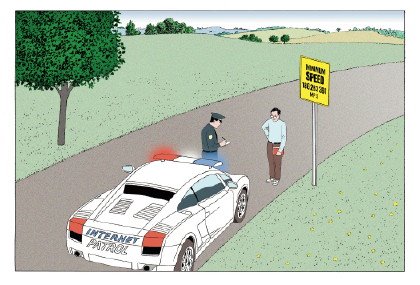
Is Google Making Us Stupid?

Illustration by Guy Billout / The Atlantic Monthy.

What the Internet is doing to our brains
by Nicholas Carr

[Nicholas Carr’s most recent book, The Big Switch: Rewiring the World, From Edison to Google, was published earlier this year. “Is Google Making Us Stupid?” appears in the July/August issue of The Atlantic Monthly.]

“Dave, stop. Stop, will you? Stop, Dave. Will you stop, Dave?” So the supercomputer HAL pleads with the implacable astronaut Dave Bowman in a famous and weirdly poignant scene toward the end of Stanley Kubrick’s 2001: A Space Odyssey. Bowman, having nearly been sent to a deep-space death by the malfunctioning machine, is calmly, coldly disconnecting the memory circuits that control its artificial brain. “Dave, my mind is going,” HAL says, forlornly. “I can feel it. I can feel it.”

I can feel it, too. Over the past few years I’ve had an uncomfortable sense that someone, or something, has been tinkering with my brain, remapping the neural circuitry, reprogramming the memory. My mind isn’t going—so far as I can tell—but it’s changing. I’m not thinking the way I used to think. I can feel it most strongly when I’m reading. Immersing myself in a book or a lengthy article used to be easy. My mind would get caught up in the narrative or the turns of the argument, and I’d spend hours strolling through long stretches of prose. That’s rarely the case anymore. Now my concentration often starts to drift after two or three pages. I get fidgety, lose the thread, begin looking for something else to do. I feel as if I’m always dragging my wayward brain back to the text. The deep reading that used to come naturally has become a struggle.

I think I know what’s going on. For more than a decade now, I’ve been spending a lot of time online, searching and surfing and sometimes adding to the great databases of the Internet. The Web has been a godsend to me as a writer. Research that once required days in the stacks or periodical rooms of libraries can now be done in minutes. A few Google searches, some quick clicks on hyperlinks, and I’ve got the telltale fact or pithy quote I was after. Even when I’m not working, I’m as likely as not to be foraging in the Web’s info-thickets—reading and writing e-mails, scanning headlines and blog posts, watching videos and listening to podcasts, or just tripping from link to link to link. (Unlike footnotes, to which they’re sometimes likened, hyperlinks don’t merely point to related works; they propel you toward them.)

For me, as for others, the Net is becoming a universal medium, the conduit for most of the information that flows through my eyes and ears and into my mind. The advantages of having immediate access to such an incredibly rich store of information are many, and they’ve been widely described and duly applauded. “The perfect recall of silicon memory,” Wired’s Clive Thompson has written, “can be an enormous boon to thinking.” But that boon comes at a price. As the media theorist Marshall McLuhan pointed out in the 1960s, media are not just passive channels of information. They supply the stuff of thought, but they also shape the process of thought. And what the Net seems to be doing is chipping away my capacity for concentration and contemplation. My mind now expects to take in information the way the Net distributes it: in a swiftly moving stream of particles. Once I was a scuba diver in the sea of words. Now I zip along the surface like a guy on a Jet Ski.

I’m not the only one. When I mention my troubles with reading to friends and acquaintances—literary types, most of them—many say they’re having similar experiences. The more they use the Web, the more they have to fight to stay focused on long pieces of writing. Some of the bloggers I follow have also begun mentioning the phenomenon. Scott Karp, who writes a blog about online media, recently confessed that he has stopped reading books altogether. “I was a lit major in college, and used to be [a] voracious book reader,” he wrote. “What happened?” He speculates on the answer: “What if I do all my reading on the web not so much because the way I read has changed, i.e. I’m just seeking convenience, but because the way I THINK has changed?”

Bruce Friedman, who blogs regularly about the use of computers in medicine, also has described how the Internet has altered his mental habits. “I now have almost totally lost the ability to read and absorb a longish article on the web or in print,” he wrote earlier this year. A pathologist who has long been on the faculty of the University of Michigan Medical School, Friedman elaborated on his comment in a telephone conversation with me. His thinking, he said, has taken on a “staccato” quality, reflecting the way he quickly scans short passages of text from many sources online. “I can’t read War and Peace anymore,” he admitted. “I’ve lost the ability to do that. Even a blog post of more than three or four paragraphs is too much to absorb. I skim it.”

Anecdotes alone don’t prove much. And we still await the long-term neurological and psychological experiments that will provide a definitive picture of how Internet use affects cognition. But a recently published study of online research habits, conducted by scholars from University College London, suggests that we may well be in the midst of a sea change in the way we read and think. As part of the five-year research program, the scholars examined computer logs documenting the behavior of visitors to two popular research sites, one operated by the British Library and one by a U.K. educational consortium, that provide access to journal articles, e-books, and other sources of written information. They found that people using the sites exhibited “a form of skimming activity,” hopping from one source to another and rarely returning to any source they’d already visited. They typically read no more than one or two pages of an article or book before they would “bounce” out to another site. Sometimes they’d save a long article, but there’s no evidence that they ever went back and actually read it. The authors of the study report:

It is clear that users are not reading online in the traditional sense; indeed there are signs that new forms of “reading” are emerging as users “power browse” horizontally through titles, contents pages and abstracts going for quick wins. It almost seems that they go online to avoid reading in the traditional sense.

Thanks to the ubiquity of text on the Internet, not to mention the popularity of text-messaging on cell phones, we may well be reading more today than we did in the 1970s or 1980s, when television was our medium of choice. But it’s a different kind of reading, and behind it lies a different kind of thinking—perhaps even a new sense of the self. “We are not only what we read,” says Maryanne Wolf, a developmental psychologist at Tufts University and the author of Proust and the Squid: The Story and Science of the Reading Brain. “We are how we read.” Wolf worries that the style of reading promoted by the Net, a style that puts “efficiency” and “immediacy” above all else, may be weakening our capacity for the kind of deep reading that emerged when an earlier technology, the printing press, made long and complex works of prose commonplace. When we read online, she says, we tend to become “mere decoders of information.” Our ability to interpret text, to make the rich mental connections that form when we read deeply and without distraction, remains largely disengaged.

Reading, explains Wolf, is not an instinctive skill for human beings. It’s not etched into our genes the way speech is. We have to teach our minds how to translate the symbolic characters we see into the language we understand. And the media or other technologies we use in learning and practicing the craft of reading play an important part in shaping the neural circuits inside our brains. Experiments demonstrate that readers of ideograms, such as the Chinese, develop a mental circuitry for reading that is very different from the circuitry found in those of us whose written language employs an alphabet. The variations extend across many regions of the brain, including those that govern such essential cognitive functions as memory and the interpretation of visual and auditory stimuli. We can expect as well that the circuits woven by our use of the Net will be different from those woven by our reading of books and other printed works.

Sometime in 1882, Friedrich Nietzsche bought a typewriter—a Malling-Hansen Writing Ball, to be precise. His vision was failing, and keeping his eyes focused on a page had become exhausting and painful, often bringing on crushing headaches. He had been forced to curtail his writing, and he feared that he would soon have to give it up. The typewriter rescued him, at least for a time. Once he had mastered touch-typing, he was able to write with his eyes closed, using only the tips of his fingers. Words could once again flow from his mind to the page.

But the machine had a subtler effect on his work. One of Nietzsche’s friends, a composer, noticed a change in the style of his writing. His already terse prose had become even tighter, more telegraphic. “Perhaps you will through this instrument even take to a new idiom,” the friend wrote in a letter, noting that, in his own work, his “‘thoughts’ in music and language often depend on the quality of pen and paper.”

“You are right,” Nietzsche replied, “our writing equipment takes part in the forming of our thoughts.” Under the sway of the machine, writes the German media scholar Friedrich A. Kittler, Nietzsche’s prose “changed from arguments to aphorisms, from thoughts to puns, from rhetoric to telegram style.”

The human brain is almost infinitely malleable. People used to think that our mental meshwork, the dense connections formed among the 100 billion or so neurons inside our skulls, was largely fixed by the time we reached adulthood. But brain researchers have discovered that that’s not the case. James Olds, a professor of neuroscience who directs the Krasnow Institute for Advanced Study at George Mason University, says that even the adult mind “is very plastic.” Nerve cells routinely break old connections and form new ones. “The brain,” according to Olds, “has the ability to reprogram itself on the fly, altering the way it functions.”

As we use what the sociologist Daniel Bell has called our “intellectual technologies”—the tools that extend our mental rather than our physical capacities—we inevitably begin to take on the qualities of those technologies. The mechanical clock, which came into common use in the 14th century, provides a compelling example. In Technics and Civilization, the historian and cultural critic Lewis Mumford described how the clock “disassociated time from human events and helped create the belief in an independent world of mathematically measurable sequences.” The “abstract framework of divided time” became “the point of reference for both action and thought.”

The clock’s methodical ticking helped bring into being the scientific mind and the scientific man. But it also took something away. As the late MIT computer scientist Joseph Weizenbaum observed in his 1976 book, Computer Power and Human Reason: From Judgment to Calculation, the conception of the world that emerged from the widespread use of timekeeping instruments “remains an impoverished version of the older one, for it rests on a rejection of those direct experiences that formed the basis for, and indeed constituted, the old reality.” In deciding when to eat, to work, to sleep, to rise, we stopped listening to our senses and started obeying the clock.

The process of adapting to new intellectual technologies is reflected in the changing metaphors we use to explain ourselves to ourselves. When the mechanical clock arrived, people began thinking of their brains as operating “like clockwork.” Today, in the age of software, we have come to think of them as operating “like computers.” But the changes, neuroscience tells us, go much deeper than metaphor. Thanks to our brain’s plasticity, the adaptation occurs also at a biological level.

The Internet promises to have particularly far-reaching effects on cognition. In a paper published in 1936, the British mathematician Alan Turing proved that a digital computer, which at the time existed only as a theoretical machine, could be programmed to perform the function of any other information-processing device. And that’s what we’re seeing today. The Internet, an immeasurably powerful computing system, is subsuming most of our other intellectual technologies. It’s becoming our map and our clock, our printing press and our typewriter, our calculator and our telephone, and our radio and TV.

When the Net absorbs a medium, that medium is re-created in the Net’s image. It injects the medium’s content with hyperlinks, blinking ads, and other digital gewgaws, and it surrounds the content with the content of all the other media it has absorbed. A new e-mail message, for instance, may announce its arrival as we’re glancing over the latest headlines at a newspaper’s site. The result is to scatter our attention and diffuse our concentration.

The Net’s influence doesn’t end at the edges of a computer screen, either. As people’s minds become attuned to the crazy quilt of Internet media, traditional media have to adapt to the audience’s new expectations. Television programs add text crawls and pop-up ads, and magazines and newspapers shorten their articles, introduce capsule summaries, and crowd their pages with easy-to-browse info-snippets. When, in March of this year, TheNew York Times decided to devote the second and third pages of every edition to article abstracts, its design director, Tom Bodkin, explained that the “shortcuts” would give harried readers a quick “taste” of the day’s news, sparing them the “less efficient” method of actually turning the pages and reading the articles. Old media have little choice but to play by the new-media rules.

Never has a communications system played so many roles in our lives—or exerted such broad influence over our thoughts—as the Internet does today. Yet, for all that’s been written about the Net, there’s been little consideration of how, exactly, it’s reprogramming us. The Net’s intellectual ethic remains obscure.

About the same time that Nietzsche started using his typewriter, an earnest young man named Frederick Winslow Taylor carried a stopwatch into the Midvale Steel plant in Philadelphia and began a historic series of experiments aimed at improving the efficiency of the plant’s machinists. With the approval of Midvale’s owners, he recruited a group of factory hands, set them to work on various metalworking machines, and recorded and timed their every movement as well as the operations of the machines. By breaking down every job into a sequence of small, discrete steps and then testing different ways of performing each one, Taylor created a set of precise instructions—an “algorithm,” we might say today—for how each worker should work. Midvale’s employees grumbled about the strict new regime, claiming that it turned them into little more than automatons, but the factory’s productivity soared.

More than a hundred years after the invention of the steam engine, the Industrial Revolution had at last found its philosophy and its philosopher. Taylor’s tight industrial choreography—his “system,” as he liked to call it—was embraced by manufacturers throughout the country and, in time, around the world. Seeking maximum speed, maximum efficiency, and maximum output, factory owners used time-and-motion studies to organize their work and configure the jobs of their workers. The goal, as Taylor defined it in his celebrated 1911 treatise, The Principles of Scientific Management, was to identify and adopt, for every job, the “one best method” of work and thereby to effect “the gradual substitution of science for rule of thumb throughout the mechanic arts.” Once his system was applied to all acts of manual labor, Taylor assured his followers, it would bring about a restructuring not only of industry but of society, creating a utopia of perfect efficiency. “In the past the man has been first,” he declared; “in the future the system must be first.”

Taylor’s system is still very much with us; it remains the ethic of industrial manufacturing. And now, thanks to the growing power that computer engineers and software coders wield over our intellectual lives, Taylor’s ethic is beginning to govern the realm of the mind as well. The Internet is a machine designed for the efficient and automated collection, transmission, and manipulation of information, and its legions of programmers are intent on finding the “one best method”—the perfect algorithm—to carry out every mental movement of what we’ve come to describe as “knowledge work.”

Google’s headquarters, in Mountain View, California—the Googleplex—is the Internet’s high church, and the religion practiced inside its walls is Taylorism. Google, says its chief executive, Eric Schmidt, is “a company that’s founded around the science of measurement,” and it is striving to “systematize everything” it does. Drawing on the terabytes of behavioral data it collects through its search engine and other sites, it carries out thousands of experiments a day, according to the Harvard Business Review, and it uses the results to refine the algorithms that increasingly control how people find information and extract meaning from it. What Taylor did for the work of the hand, Google is doing for the work of the mind.

The company has declared that its mission is “to organize the world’s information and make it universally accessible and useful.” It seeks to develop “the perfect search engine,” which it defines as something that “understands exactly what you mean and gives you back exactly what you want.” In Google’s view, information is a kind of commodity, a utilitarian resource that can be mined and processed with industrial efficiency. The more pieces of information we can “access” and the faster we can extract their gist, the more productive we become as thinkers.

Where does it end? Sergey Brin and Larry Page, the gifted young men who founded Google while pursuing doctoral degrees in computer science at Stanford, speak frequently of their desire to turn their search engine into an artificial intelligence, a HAL-like machine that might be connected directly to our brains. “The ultimate search engine is something as smart as people—or smarter,” Page said in a speech a few years back. “For us, working on search is a way to work on artificial intelligence.” In a 2004 interview with Newsweek, Brin said, “Certainly if you had all the world’s information directly attached to your brain, or an artificial brain that was smarter than your brain, you’d be better off.” Last year, Page told a convention of scientists that Google is “really trying to build artificial intelligence and to do it on a large scale.”

Such an ambition is a natural one, even an admirable one, for a pair of math whizzes with vast quantities of cash at their disposal and a small army of computer scientists in their employ. A fundamentally scientific enterprise, Google is motivated by a desire to use technology, in Eric Schmidt’s words, “to solve problems that have never been solved before,” and artificial intelligence is the hardest problem out there. Why wouldn’t Brin and Page want to be the ones to crack it?

Still, their easy assumption that we’d all “be better off” if our brains were supplemented, or even replaced, by an artificial intelligence is unsettling. It suggests a belief that intelligence is the output of a mechanical process, a series of discrete steps that can be isolated, measured, and optimized. In Google’s world, the world we enter when we go online, there’s little place for the fuzziness of contemplation. Ambiguity is not an opening for insight but a bug to be fixed. The human brain is just an outdated computer that needs a faster processor and a bigger hard drive.

The idea that our minds should operate as high-speed data-processing machines is not only built into the workings of the Internet, it is the network’s reigning business model as well. The faster we surf across the Web—the more links we click and pages we view—the more opportunities Google and other companies gain to collect information about us and to feed us advertisements. Most of the proprietors of the commercial Internet have a financial stake in collecting the crumbs of data we leave behind as we flit from link to link—the more crumbs, the better. The last thing these companies want is to encourage leisurely reading or slow, concentrated thought. It’s in their economic interest to drive us to distraction.

Maybe I’m just a worrywart. Just as there’s a tendency to glorify technological progress, there’s a countertendency to expect the worst of every new tool or machine. In Plato’s Phaedrus, Socrates bemoaned the development of writing. He feared that, as people came to rely on the written word as a substitute for the knowledge they used to carry inside their heads, they would, in the words of one of the dialogue’s characters, “cease to exercise their memory and become forgetful.” And because they would be able to “receive a quantity of information without proper instruction,” they would “be thought very knowledgeable when they are for the most part quite ignorant.” They would be “filled with the conceit of wisdom instead of real wisdom.” Socrates wasn’t wrong—the new technology did often have the effects he feared—but he was shortsighted. He couldn’t foresee the many ways that writing and reading would serve to spread information, spur fresh ideas, and expand human knowledge (if not wisdom).

The arrival of Gutenberg’s printing press, in the 15th century, set off another round of teeth gnashing. The Italian humanist Hieronimo Squarciafico worried that the easy availability of books would lead to intellectual laziness, making men “less studious” and weakening their minds. Others argued that cheaply printed books and broadsheets would undermine religious authority, demean the work of scholars and scribes, and spread sedition and debauchery. As New York University professor Clay Shirky notes, “Most of the arguments made against the printing press were correct, even prescient.” But, again, the doomsayers were unable to imagine the myriad blessings that the printed word would deliver.

So, yes, you should be skeptical of my skepticism. Perhaps those who dismiss critics of the Internet as Luddites or nostalgists will be proved correct, and from our hyperactive, data-stoked minds will spring a golden age of intellectual discovery and universal wisdom. Then again, the Net isn’t the alphabet, and although it may replace the printing press, it produces something altogether different. The kind of deep reading that a sequence of printed pages promotes is valuable not just for the knowledge we acquire from the author’s words but for the intellectual vibrations those words set off within our own minds. In the quiet spaces opened up by the sustained, undistracted reading of a book, or by any other act of contemplation, for that matter, we make our own associations, draw our own inferences and analogies, foster our own ideas. Deep reading, as Maryanne Wolf argues, is indistinguishable from deep thinking.

If we lose those quiet spaces, or fill them up with “content,” we will sacrifice something important not only in our selves but in our culture. In a recent essay, the playwright Richard Foreman eloquently described what’s at stake:

I come from a tradition of Western culture, in which the ideal (my ideal) was the complex, dense and “cathedral-like” structure of the highly educated and articulate personality—a man or woman who carried inside themselves a personally constructed and unique version of the entire heritage of the West. [But now] I see within us all (myself included) the replacement of complex inner density with a new kind of self—evolving under the pressure of information overload and the technology of the “instantly available.”

As we are drained of our “inner repertory of dense cultural inheritance,” Foreman concluded, we risk turning into “‘pancake people’—spread wide and thin as we connect with that vast network of information accessed by the mere touch of a button.”

I’m haunted by that scene in 2001. What makes it so poignant, and so weird, is the computer’s emotional response to the disassembly of its mind: its despair as one circuit after another goes dark, its childlike pleading with the astronaut—“I can feel it. I can feel it. I’m afraid”—and its final reversion to what can only be called a state of innocence. HAL’s outpouring of feeling contrasts with the emotionlessness that characterizes the human figures in the film, who go about their business with an almost robotic efficiency. Their thoughts and actions feel scripted, as if they’re following the steps of an algorithm. In the world of 2001, people have become so machinelike that the most human character turns out to be a machine. That’s the essence of Kubrick’s dark prophecy: as we come to rely on computers to mediate our understanding of the world, it is our own intelligence that flattens into artificial intelligence.

Source. / The Atlantic

Thanks to Mercedes Lynn de Uriarte / The Rag Blog

Posted in RagBlog | 2 Comments

Don’t Ignore Those Strange, Dissonant Words


Lies, kidnapping and a mysterious laptop
By Johann Hari / July 7, 2008

You have been told that the Venezuelan President supports the Farc thugs

Sometimes you hear a stray sentence on the news that makes you realise you have been lied to. Deliberately lied to; systematically lied to; lied to for a purpose. If you listened closely over the past few days, you could have heard one such sentence passing in the night-time of news.

As Ingrid Betancourt emerged after six-and-a-half years – sunken and shrivelled but radiant with courage – one of the first people she thanked was Hugo Chavez. What? If you follow the news coverage, you have been told that the Venezuelan President supports the Farc thugs who have been holding her hostage. He paid them $300m to keep killing and to buy uranium for a dirty bomb, in a rare break from dismantling democracy at home and dealing drugs. So how can this moment of dissonance be explained?

Yes: you have been lied to – about one of the most exciting and original experiments in economic redistribution and direct democracy anywhere on earth. And the reason is crude: crude oil. The ability of democracy and freedom to spread to poor countries may depend on whether we can unscramble these propaganda fictions.

Venezuela sits on one of the biggest pools of oil left anywhere. If you find yourself in this position, the rich governments of the world – the US and EU – ask one thing of you: pump the petrol and the profits our way, using our corporations. If you do that, we will whisk you up the Mall in a golden carriage, no matter what. The “King” of Saudi Arabia oversees a torturing tyranny where half the population – women – are placed under house arrest, and jihadis are pumped out by the dozen to attack us. It doesn’t matter. He gives us the oil, so we hold his hand and whisper sweet crude-nothings in his ear.

It has always been the same with Venezuela – until now. Back in 1908, the US government set up its ideal Venezuelan regime: a dictator who handed the oil over fast and so freely that he didn’t even bother to keep receipts, never mind ask for a cut. But in 1998 the Venezuelan people finally said “enough”. They elected Hugo Chavez. The President followed their democratic demands: he increased the share of oil profits taken by the state from a pitiful one per cent to 33 per cent. He used the money to build hospitals and schools and subsidised supermarkets in the tin-and-mud shanty towns where he grew up, and where most of his countrymen still live.

I can take you to any random barrio in the high hills that ring Caracas and show you the results. You will meet women like Francisca Moreno, a gap-toothed 76-year-old granny I found sitting in a tin shack, at the end of a long path across the mud made out of broken wooden planks. From her doorway she looked down on the shining white marble of Caracas’s rich district. “I went blind 15 years ago because of cataracts,” she explained, and in the old Venezuela people like her didn’t see doctors. “I am poor,” she said, “so that was that.” But she voted for Chavez. A free clinic appeared two years later in her barrio, and she was taken soon after for an operation that restored her sight. “Once I was blind, but now I see!” she said, laughing.

In 2003, two distinguished Wall Street consulting firms conducted the most detailed study so far of economic change under Chavez. They found that the poorest half of the country have seen their incomes soar by 130 per cent after inflation. Today, there are 19,571 primary care doctors – an increase by a factor of 10. When Chavez came to power, just 35 per cent of Venezuelans told Latinobarometro, the Gallup of Latin America, they were happy with how their democracy worked. Today it is 59 per cent, the second-highest in the hemisphere.

For the rich world’s governments – and especially for the oil companies, who pay for their political campaigns – this throws up a serious problem. We are addicted to oil. We need it. We crave it. And we want it on our terms. The last time I saw Chavez, he told me he would like to sell oil differently in the future: while poor countries should get it for $10 a barrel, rich countries should pay much more – perhaps towards $200. And he has said that if the rich countries keep intimidating the rest he will shift to selling to China instead. Start the sweating. But Western governments cannot simply say: “We want the oil, our corporations need the profits, so let’s smash the elected leaders standing in our way.” They know ordinary Americans and Europeans would gag.

So they had to invent lies. They come in waves, each one swelling as the last crashes into incredulity. First they announced Chavez was a dictator. This ignored that he came to power in a totally free and open election, the Venezuelan press remains uncensored and in total opposition to him, and he has just accepted losing a referendum to extend his term and will stand down in 2013.

When that tactic failed, the oil industry and the politicians they lubricate shifted strategy. They announced that Chavez was a supporter of Terrorism (it definitely has a capital T). The Farc is a Colombian guerrilla group that started in the 1960s as a peasant defence network, but soon the pigs began to look like farmers and they became a foul, kidnapping mafia. Where is the evidence Chavez funded them?

On 1 March, the Colombian government invaded Ecuador and blew up a Farc training camp. A few hours later, it announced it had found a pristine laptop in the rubble, and had already rummaged through the 39.5 million pages of Microsoft Word documents it contained to find cast-iron “proof” that Chavez was backing the Farc. Ingrid’s sister, Astrid Betancourt, says it is plainly fake. The camp had been totally burned to pieces and the computers had clearly, she says, been “in the hands of the Colombian government for a very long time”. Far from fuelling the guerrillas, Chavez has repeatedly pleaded with the Farc to disarm. He managed to negotiate the release of two high-profile hostages – hence Betancourt’s swift thanks. He said: “The time of guns has passed. Guerilla warfare is history.”

So what now? Now they claim he is a drug dealer, he funds Hezbollah, he is insane. Sometimes they even stumble on some of the real non-fiction reasons to criticise Chavez and use them as propaganda tools. (See our Open House blog later today for a discussion of this). As the world’s oil supplies dry up, the desire to control Venezuela’s pools will only increase. The US government is already funding separatist movements in Zulia province, along the border with Colombia, where Venezuela’s largest oilfields lie. They hope they can break away this whiter-skinned, anti-Chavez province and then drink deep of the petrol there.

Until we break our addiction to oil, our governments will always try to snatch petro-profits away from women like Francisca Moreno. And we – oil addicts all – will be tempted to ignore the strange, dissonant sentences we sometimes hear on the news and lie, blissed-out, in the lies.

©independent.co.uk

Source / The Independent

The Rag Blog

Posted in RagBlog | Tagged , , | Leave a comment

Sex Crimes in the White House

Fernando Botero / Abu Ghraib 57, 2005. Image © Fernando Botero, courtesy Marlborough Gallery, New York.

Abu Ghraib and the Sexualization of Torture
By Naomi Wolf / July 7, 2008

Naomi Wolf is a best-selling author and essayist.

NEW YORK – Sex crime has a telltale signature, even when those directing the outrages are some of the most powerful men and women in the United States. How extraordinary, then, to learn that one of the perpetrators of these crimes, Condoleezza Rice, has just led the debate in a special session of the United Nations Security Council on the use of sexual violence as a weapon of war.

I had a sense of déjà vu when I saw the photos that emerged in 2004 from Abu Ghraib prison. Even as the Bush administration was spinning the notion that the torture of prisoners was the work of “a few bad apples” low in the military hierarchy, I knew that we were seeing evidence of a systemic policy set at the top. It’s not that I am a genius. It’s simply that, having worked at a rape crisis center and been trained in the basics of sex crime, I have learned that all sex predators go about things in certain recognizable ways.

We now know that the torture of prisoners was the result of a policy set in the White House by former Secretary of Defense Donald Rumsfeld, Vice President Dick Cheney, and Rice — who actually chaired the torture meetings. The Pentagon has also acknowledged that it had authorized sexualized abuse of detainees as part of interrogation practices to be performed by female operatives. And documents obtained by the American Civil Liberties Union have Rumsfeld, in his own words, checking in on the sexualized humiliation of prisoners.

The sexualization of torture from the top basically turned Abu Ghraib and Guantánamo Bay into an organized sex-crime ring in which the trafficked sex slaves were US-held prisoners. Looking at the classic S and M nature of some of this torture, it is hard not to speculate that someone setting policy was aroused by all of this. And Phillipe Sands’ impeccably documented Torture Team: Rumsfeld’s Memo and the Betrayal of American Values, now proves that sex crime was authorized and, at least one source reports, eroticized: Diane Beaver, the Staff Judge Advocate at Guantanamo who signed off on many torture techniques, told Sands about brainstorming sessions that included the use of “sexual tension,” which was “culturally taboo, disrespectful, humiliating and potentially unexpected.”

“These brainstorming meetings at Guantanamo produced animated discussion,” writes Sands. “‘Who has the glassy eyes?” Beaver asked herself as she surveyed the men around the room, thirty or more of them. She was invariably the only woman in the room, keeping control of the boys. The younger men would get excited, agitated, even: “You could almost see their dicks getting hard as they got new ideas” [reported Beaver]. A wan smile crossed Beaver’s face: “And I said to myself, you know what, I don’t have a dick to get hard, I can stay detached.”‘ [Sands, p 63]

The nonsexual torture that was committed ranged from beatings and suffocation, electrodes attached to sensitive areas, and forced sleep deprivation, to prisoners being hung by the wrists from the ceiling and placed in solitary confinement until psychosis was induced. These abuses violate both US and international law. Three former military attorneys, recognizing this blunt truth, refused to participate in the “military tribunals” — rather, “show trials” — aimed at condemning men whose confessions were elicited through torture.

Though we can now debate what the penalty for waterboarding should be, America as a nation, maintaining an odd silence, still cannot seem to discuss the sex crimes involved.

Why? It’s not as if the sex crimes that US leaders either authorized or tolerated are not staring Americans in the face: the images of male prisoners with their heads hooded with women’s underwear; the documented reports of female US soldiers deployed to smear menstrual blood on the faces of male prisoners, and of military interrogators or contractors forcing prisoners to simulate sex with each other, to penetrate themselves with objects, or to submit to being penetrated by objects. Indeed, the Military Commissions Act of 2006 was written deliberately with loopholes that gave immunity to perpetrators of many kinds of sexual humiliation and abuse.

There is also the testimony by female soldiers such as Lynndie England about compelling male prisoners to masturbate, as well as an FBI memo objecting to a policy of “highly aggressive interrogation techniques.” The memo cites a female interrogator rubbing lotion on a shackled detainee and whispering in his ear — during Ramadan when sexual contact with a strange woman would be most offensive — then suddenly bending back his thumbs until he grimaced in pain, and violently grabbing his genitals. Sexual abuse in US-operated prisons got worse and worse over time, ultimately including, according to doctors who examined detainees, anal sodomy.

All this may sound bizarre if you are a normal person, but it is standard operating procedure for sex offenders. Those who work in the field know that once sex abusers control a powerless victim, they will invariably push the boundaries with ever more extreme behavior. Abusers start by undressing their victims, but once that line has been breached, you are likely to hear from the victim about oral and anal penetration, greater and greater pain and fear being inflicted, and more and more carelessness about exposing the crimes as the perpetrator’s inhibitions fall away.

The perpetrator is also likely to engage in ever-escalating rationalizations, often arguing that the offenses serve a greater good. Finally, the victim is blamed for the abuse: in the case of the detainees, if they would only “behave,” and confess, they wouldn’t bring all this on themselves.

Silence, and even collusion, is also typical of sex crimes within a family. Americans are behaving like a dysfunctional family by shielding sex criminals in their midst through silence.

Just as sex criminals — and the leaders who directed the use of rape and sexual abuse as a military strategy — were tried and sentenced after the wars in Bosnia and Sierra Leone, so Americans must hold accountable those who committed, or authorized, sex crimes in US-operated prisons. Throughout the world, this perverse and graphic criminality has added fuel to anxiety about US cultural and military power. These acts need to be called by their true names — war crimes and sex crimes — and people in America need to demand justice for the perpetrators and their victims. As in a family, only when people start to speak out and tell the truth about rape and sexual assault can the healing begin.

Source. / The Huffington Post

The Rag Blog

Posted in RagBlog | Tagged , , , , , , | 1 Comment

Bush Tours America To Survey Damage Caused By His Disastrous Presidency

Source. / Onion News Network

Thanks to Carl Davidson / The Rag Blog / Posted July 7, 2008

Posted in RagBlog | Tagged , , , | Leave a comment

MEDIA : Reading The Onion Seriously


Combining irreverent humor and acerbic critique, a handful of new media outlets — including The Onion — are transforming American politics and culture, writes Theodoe Hamm, in his new book The New Blue Media.
By Theodore Hamm

After 9/11, The Onion stopped its presses for one week. The hiatus allowed the paper to show its respect for the gravity of what had happened in lower Manhattan. But it also enabled its staff to come up with the paper’s quite poignant reaction to the terrorist strikes. It was announced by a large banner headline that read, “Holy Fucking Shit — Attack on America.” The statement perfectly captured the confusion and fear of the moment. The paper’s lead story, “U.S. Vows to Defeat Whoever It Is We’re at War With,” accurately recorded the Bush administration’s immediate and enduring response to 9/11. To “America’s enemy, be it Osama bin Laden, Saddam Hussein, the Taliban, a multinational coalition of terrorist organizations, any of a rogue’s gallery of violent Islamic fringe groups, or an entirely different, non-Islamic aggressor we’ve never even heard of,” Bush vowed, “be warned.” A pair of news briefs in that same issue reported, “American Life Turns into Bad Jerry Bruckheimer Movie” and “Hijackers Find Themselves in Hell” instead of the “Paradise” they had expected.

As its new home city (the paper moved its headquarters from Madison to New York City months earlier) and the nation tried to make sense of the attacks, The Onion’s 9/11 issue uniquely encompassed a wide range of popular sentiments. “We really were just trying to capture the sadness and anger everyone was feeling, and somehow it came out as humor,” Robert Siegel, then The Onion’s editor-in-chief, recalled a year later.

The End of Satire?

Ironically, perhaps, the most powerful statement The Onion made in that landmark issue was not about terrorism or the likelihood of the Bush administration’s overreaction to it, but instead about the future of irony itself. That week in Time, Roger Rosenblatt’s column carried the ominous title “The Age of Irony Comes to an End,” with an equally foreboding subheading of “No Longer Will We Fail to Take Things Seriously.” As Ground Zero smoldered, Rosenblatt searched for both blame and a sign of hope. He wrote, “For some 30 years — roughly as long as the Twin Towers were upright — the good folks in charge of America’s intellectual life have insisted that nothing was to be believed in or taken seriously.” It was irony, Rosenblatt suggested, that somehow had blinded us to the rising threat of Islamic fundamentalism.

Such an overwrought notion was blown apart by a range of critics, comic and otherwise. For its part, an Onion news brief announced, “Report: Gen X Irony, Cynicism May Be Permanently Obsolete.” In the item, a Gen X-er states, “Remember the day after the attack, when all the senators were singing ‘God Bless America,’ arm-in-arm?’ asked Dave Holt, 29.’Normally, I’d make some sarcastic wisecrack about something like that. But this time, I was deeply moved.’ Added Holt: ‘This earnestness can’t last forever. Can it?'”

Both the news brief and the entire 9/11 issue vividly illustrated The Onion’s answer to Holt’s question, as did its lead story in the next issue, “Shattered Nation Longs to Care About Stupid Bullshit Again.” Looking back one year later, Siegel explained to Alternet’s Daniel Kurtzman that irony would survive well into the twenty-first century. “Many things about America changed, but you can’t kill humor….Obviously people are going to laugh and people will still be sarcastic and snide and ironic and winking and insincere. That’s a good thing. That’s a sign of the return to normalcy.”

‘Gulf War II: The Vengeance’

Unfortunately, for the Bush administration “normalcy” soon meant outright deception, scare tactics, and bullying in the service of its primary goal of invading Iraq. The Onion, as usual, saw right through the jingo. In March 2002, when talk of taking down Saddam was in the air but nearly six months away from becoming an official plan, one of the paper’s headlines read, “Military Promises ‘Huge Numbers’ for Gulf War II: The Vengeance.” The lead photo for the article showed Donald Rumsfeld giving a typical chesty gesture at a press conference in front of a Photoshopped movie poster of Gulf War II: The Vengeance, starring W. and Saddam. The other photo in the piece was even more prophetic, as it featured W. in full military gear, carrying an automatic weapon and hunting down rebel forces. The image smacked more of Rambo than the Top Gun–style “Mission Accomplished” scene that W. eventually chose, but the prediction was accurate enough.

According to the article, the PR blitz for Gulf War II also included a pact with Topps for a series of trading cards; “a first-look deal with CNN, guaranteeing the network full access to the front lines, as well as first crack at interviewing the men and women behind the scenes”; and a “two-cry deal” with Dan Rather. Late that summer, then–White House chief of staff Andrew Card famously stated that the administration was waiting until after Labor Day to unveil its full plan for Iraq because “you don’t introduce a new product in August.” Six months prior, The Onion had already sketched out the marketing plan for that dangerous “new product.”

As the White House made its sales pitch for war, the lead article in The Onion’s issue in the second week after Labor Day — dated September 11, 2002 — declared, “Bush Won’t Stop Asking Cheney If We Can Invade Yet.” In this case, the story worked a father-versus-impatient-son storyline, and so focused less on details of the Iraq question than on Cheney’s control over W. At one point, however, the piece did report that “Cheney sat Bush down and explained at length the political ramifications of proceeding with a first strike without creating the appearance of approval from Congress and the American people.” It continued by quoting Cheney’s advice to Bush: “If we just wait a little longer, Saddam is bound to commit some act of aggression or we’ll find some juicy al Qaeda ties or something, and then we can make it look like the whole country’s behind it.”

Here again the satire was right on target. Over the next month, in order to help force Congress into granting the administration the authority to go to war — a vote that would haunt many leading Democrats through both 2004 and 2008 — both Cheney and Bush stressed Saddam’s alleged ties to al Qaeda. Such outright distortions helped propel the Republicans’ success in the upcoming midterms as well as in 2004, and their game plan almost seemed lifted directly from the pages of a satirical publication. While serious liberal news organizations such as the New York Times helped disseminate the White House’s specious rationale for war, The Onion’s lampoons turned out to be far more accurate. The Bush gang, the paper said, was hell-bent on invading Iraq, and it would deploy any means necessary in order to do so.

Throughout the fall campaign, The Onion continued to see right through Bush’s bluster. For example, the paper’s lead story in early October announced that “Bush Seeks U.N. Support for ‘U.S. Does Whatever It Wants Plan.'” “As a shining beacon of freedom and democracy, America has inspired the world,” Bush told the UN General Assembly. “In this spirit, I call upon the world’s nations to support my proposal to give America unrestricted carte blanche to remove whatever leaders, plunder whatever resources, and impose whatever policies it deems necessary or expedient.” Such aggressive unilateralism underpinned the rationale W. here gave the UN for overthrowing Saddam: “The time has come for this man to step down, because we want him to.” Meanwhile, the question “What should we do about Saddam’s WMD?” domi-nated mainstream media discussion. Based on a false premise, the question itself dictated the answer. It was a sophisticated level of deception, and given Saddam’s reputation, it was easy fodder for cable news chatter.

But for its part, The Onion generally steered clear of that question, and instead frequently pointed out how the war enabled Bush to shift the nation’s attention from other problems. In “Bush on Economy: ‘Saddam Must Be Overthrown,'” for example, the war solved problems ranging from a weak manufacturing sector to the ongoing corporate scandals, which at the time involved WorldCom and Enron. Similarly, W.’s answer to the problem of North Korea was, of course, to invade Iraq; later, he tried to help sell his tax cuts by offering another $300 on top of his initial tax rebate, provided that the United States went to war. Brushing aside the WMD issue, The Onion consistently put forth a satirical but convincing case that the United States was going to war simply because the Bush administration wanted it.

When the war finally began in March 2003, the paper continued to mock both the Bush administration’s theatrics and its claims to an easy victory. One memorable lead story again foretold Bush’s “Mission Accomplished” moment with remarkable accuracy. Beside a photo of W. leading an invading squad of soldiers through desert combat, the paper’s top story explained how “Bush Bravely Leads 3rd Infantry into Battle.” In that same issue, a news brief reported,”Dead Iraqi Would Have Loved Democracy,” which in just six words refuted most arguments for the war. With notable foresight, the lead in the following week’s top story then stated,”Following a 12th consecutive day of fighting, a puzzled and frustrated President Bush confided to military advisors Monday that he ‘really figured the war would be over by now.'”

In that story, and in many others, Bush came across as juvenile and incompetent, a front man for Cheney, Rumsfeld, Wolfowitz, and the other neo-cons. In the fall of 2002, Beltway media mainstay Bob Woodward had, in Bush at War, legitimized the notion that W. really was in charge of his administration’s war plans; four years and two books later,Woodward’s analysis mirrored that found in The Onion.

The Onion Stays the Course

As the overthrow of Saddam became the occupation of Iraq, the paper stayed on the attack. It fired back at Bush shortly after he gave his spurious speech aboard the USS Abraham Lincoln declaring victory; here was the Hollywood moment that the paper had sagely predicted, with Bush effectively combining two Tom Cruise films (Top Gun and Mission: Impossible).

But in The Onion’s account, instead of stating that the mission was over, the sign behind Bush read “screw you, vets,”and the story detailed a ribbon-cutting ceremony at which Bush cut veterans benefits. The piece also featured what was by The Onion standards an unusually earnest photo, of a homeless African American vet dejectedly panhandling. Such sentimentality was short-lived, however, as the next week’s lead story returned to form: “Gen. Tommy Franks Quits Army to Pursue Solo Bombing Projects.” “The years I’ve spent with the Army have been amazing, and we did some fantastic bombing,” Franks stated. “But at this point, I feel like I’ve taken it as far as I can. It’s time for me to move on and see what I can destroy on my own.”

Amid the chaotic aftermath of the invasion, many media observers, as well as Democratic Party officials, began to turn against the Bush administration, attacking its incompetent handling of the occupation. The Onion, however, continued its relentless assault on both the design and the execution of the war.

© 2008 by Theodore Hamm.

This piece was adapted from Theodore Hamm’s The New Blue Media: How Michael Moore, MoveOn.org, Jon Stewart and Company Are Transforming Progressive Politics (The New Press). Published with the permission of The New Press and available now at good book stores everywhere.

Theodore Hamm is the founding editor of the Brooklyn Rail and an associate professor of urban studies at Metropolitan College of New York. He has written for the Los Angeles Times, The Nation, and Truthdig, among other publications.

Source. / In These Times / Posted June 26, 2008

The New Blue Media at Amazon.com.

The Rag Blog

Posted in RagBlog | Tagged , , , , | Leave a comment

Surge Amnesia : The Media’s Newest Affliction

Patriot Alert / The White House

They’re swallowing this nonsense whole
By Arianna Huffington / July 7, 2008

John McCain, aided and abetted by his loving protectors in the media, is running a victory lap on Iraq. To hear them tell it, the surge has “worked” — indeed, it has been a huge success — and this, like a last second Hail Mary pass, has vindicated the entire disastrous Iraq misadventure.

Buoyed by a reduction in violence in Iraq, war supporters are crawling out from the shadows and beating their chests.

“I am proud of the decision of this administration to overthrow Saddam Hussein,” Condi Rice told Judy Woodruff last week. This echoed the comments of her boss, who crowed at a GOP awards dinner at the end of June: “The decision to remove Saddam Hussein was the right decision at the time, and it is the right decision today.” Bush even felt emboldened to dust off blast from the past and claim: “Democracy is taking root where a tyrant once ruled.”

And the media — and even a number of Democrats — are swallowing this triumphalist nonsense whole, and washing it down with a pitcher of revisionist Kool-Aid. The result: a collective case of political amnesia. Everyone seems more than happy to forget what the president’s own stated goal for the surge was: to create “the breathing space [the Iraqi government] needs to make progress in other critical areas.”

But here we are, 18 months later, and McCain and the GOP are being allowed to change the goal. And, surprise, surprise, the retroactive goal they’ve chosen is remarkably similar to the current situation in Iraq: violence is down while the “progress in other critical areas” is sorely lagging.

So, even though Bush originally claimed that “a successful strategy for Iraq goes beyond military operations,” the surge is now being judged exclusively on the success of “military operations.” And since that’s what the surge is all about, the surge is working. And since the surge is working, maybe we need to rethink this whole idea of ending the war, right?

Using Bush-McCain logic, since the surge has succeeded in reducing violence, there is no need for us to leave. Indeed, we can stay forever.

But here’s the thing: while McCain and the Republicans may have been able to win the PR war among the American media, there is still that nagging problem of the lack of reconciliation among the warring factions in Iraq.

Last month’s GAO report offered chapter and verse on all the ways the Iraqis have failed to reach the benchmarks that were the actual goals of the surge (see HuffPoster Mitchell Bard’s comprehensive breakdown of the report).

And a ceremony held in Baghdad this weekend spoke volumes about the actual state of affairs in Iraq. The event, organized by an expert in conflict resolution, was held to announce the signing of a non-binding agreement reached by representatives from a wide range of Iraq’s sectarian and ethnic factions, and hammered out during a series of secret meetings in Helsinki over the last year.

Although Iraq’s Minister of Reconciliation said the agreement “has the potential to bring Iraqi political parties together in common cause in a way no endeavor has,” coverage of the event leaves a distinctly different impression.

According to the New York Times, there were complaints that representatives of the Maliki government “seemed more intent on declaring the talks a success than in continuing to discuss significant disagreements.” “When we came here,” said a secular Sunni politician quoted in the Times,” Maliki refused to talk about anything, just to have a meeting and a celebration.”

“They can hug each other, and kiss each other, but they still don’t agree,” Joost Hiltermann of the International Crisis Group told the Boston Globe.

“You still have a dominant Shiite power structure that doesn’t want to cede any power,” said Kenneth Katzman, a Middle East specialist at the Congressional Research Service. “Then you have Sunnis who are committed to overturn their humiliations. The fundamental dynamics have not changed.”

The Globe suggested the most important aspect of the agreement was the fact that it was “announced at the Al Rashid Hotel in Baghdad, marking the first time that participants in the effort have felt safe enough to gather inside their own country,” then pointed out that the level of security required to attend the ceremony — “including walls around segregated neighborhoods and eight checkpoints to enter the Green Zone” — serves as “a grim reminder of how far Iraq has to go.”

No surprise then that, according to the Times, experts think real reconciliation in Iraq could take decades.

And this is the good news out of Iraq.

As we continue on the long, hard slog until Election Day, John McCain and his supporters are going to claim again and again that the surge has worked. And it looks like the media are going to let that patently false assertion go unchecked. Which is pretty much how the war got started in the first place. So it is up to Obama, the Democrats, and all of us, to insist on holding the advocates of the surge to its original goal.

And while we are at it, we should also hold them to the original justification for the war itself.

Despite the revisionist re-writes, we didn’t go to war because we were committed to demonstrating that America could unleash violence in Iraq and then, five years later, curb it through the use of reinforcements. We went to war because we were told Iraq posed a grave and imminent threat to our national security and, secondarily, as a means of fomenting democracy throughout the Middle East.

Of course, the “imminent threat” turned out to be non-existent, and our presence in Iraq has strengthened the hand of every bad actor in the region: al Qaeda is safe and adding recruits, Hamas has come to power in Palestine, Hezbollah has reasserted itself in Lebanon, and Iran has become the strongest player in Iraq. Meanwhile, the reduction in casualties in Iraq is starting to be offset by increased casualties in Afghanistan — once again showing the fatal ignorance of stealing from Peter to stop-loss Paul and keep him in Iraq.

So, tell me again: how is the surge working?

Source. / The Huffington Post

The Rag Blog

Posted in RagBlog | Tagged , , , | Leave a comment

Drawn and Quartered

Manny Aenlle Francisco / The Manila Times / Manila, The Philippines

The Rag Blog / Posted July 7, 2008

Posted in RagBlog | Tagged , , , , | Leave a comment

New War Brewing?

Before the election, the Bush regime will very likely attack Iran.

Despite the official justifications, the primary motivation will be to derail an impending Obama victory. The attack creates a trap for Obama. If he opposes it, he will be painted as a pacifist wimp unfit to be commander-in-chief. If he goes along, he loses much of his antiwar base. Obama must get out front with vocal opposition so as to preemptively forestall this attack. One way to do that would be to threaten Bush with impeachment if he attacks without further consultation with Congress.

However, Congress is even now being asked to approve a naval blockade of Iran, which is in itself an act of war.

Meanwhile, all antiwar activists must be making contingency plans so that any attack is met with massive nationwide civil disobedience.

Ideally, the threat of such a response would be a factor in preventing its happening.

David Hamilton / The Rag Blog / July 7, 2008

U.S., Israel take dangerous steps
By Eric Margolis / July 6, 2008

GENEVA — The U.S., Israel and Iran are playing a very dangerous game of chicken that soon could result in a new Mideast war.

U.S. intelligence has concluded that Iran is not working on nuclear weapons. But the Bush administration and Israel, recently joined by France, are issuing increasingly loud threats of military action to frighten Iran into halting its nuclear enrichment program.

Iran insists its nuclear program is entirely for civilian use. Tehran is alternating between conciliatory statements and threats to retaliate against any attack by inflicting economic chaos on the global economy. Europe fears the economic damage a war against Iran would bring far more than Iran’s nuclear program.

Senior Israeli officials are openly threatening to attack Iran’s nuclear installations before President George W. Bush’s term expires. Early, this month Israel staged a large, U.S.-approved exercise using F-15s and F-16s to rehearse an attack over 900 miles – precisely the distance to Iran’s nuclear facilities.

The highly regarded American journalist Seymour Hersh just confirmed that the U.S. Congress authorized a $400-million plan to overthrow Iran’s government and incite ethnic unrest. This column reported a year ago that U.S. and British special forces were operating in Iran, preparing for a massive air campaign. Israel’s destruction of an alleged Syrian reactor last fall was a warning to Iran.

This week a Pentagon official claimed an Israeli attack on Iran was coming before year end.

Other Pentagon and CIA sources say a U.S. attack on Iran is imminent, with or without Israel. The Bush administration is even considering using small tactical nuclear weapons against deeply buried Iranian targets.

Senior American officers Admiral William Fallon and Air Force Chief Michael Mosley recently were fired for opposing war against Iran. According to Israel’s media, President Bush even told Israel’s Prime Minister Ehud Olmert that he could not trust America’s intelligence community and preferred to rely on Israeli intelligence.

Air Blitz

Intensifying activity is evident at U.S. bases in Europe and the Gulf, aimed at preparing a massive air blitz that may include repeated attacks on 3,100 targets in Iran. Other sources say Iranian Revolutionary Guard installations will be barraged by cruise missiles.

In Washington, Congress, under intense pressure from the Israel lobby, is about to adopt a resolution calling for a naval blockade of Iran, an overt act of war.

Pro-Israel groups have been airing TV commercials claiming Iran is attacking American troops in Iraq and threatens the U.S.

The Bush administration’s last desperate act, its Gotterdammerung, could be war with Iran. UN weapons inspectors concur with U.S. intelligence that there is no proof Iran is working on nuclear arms, but the neocon war party in Washington is determined to loosen a final Parthian shaft by striking Iran.

Israel asserts the right to maintain its Mideast nuclear monopoly by destroying all fissile-producing reactors in the region. Iran vows to retaliate against Israel with its inaccurate Shahab missiles, shut the Strait of Hormuz and mine the Gulf, producing worldwide financial panic, severe fuel shortages, and $400-$500 per barrel oil. Iran likely will attack U.S. forces in Afghanistan, Iraq and Kuwait, and strike Saudi and Kuwaiti oil facilities. Canadians in Afghanistan could also become targets.

Grave Damage

The embattled Bush administration’s bunker mentality is leading to war that will gravely damage long-term U.S. Mideast interests. A single Iranian missile hit on Israel’s reactor would do more damage to the Jewish state than all its previous wars. Besides, Israel cannot destroy Iran’s nuclear infrastructure. A U.S. or Israeli attack on Iran will guarantee Tehran decides to build nuclear weapons.

Israel and Iran have turned their regional rivalry into a confrontation that threatens all.

Iran’s supreme leader, Ali Khamenei, not its bombastic President Mahmoud Ahmadinejad, controls that nation’s military and insists Iran will not produce nuclear weapons. Israel claims it faces a second holocaust. Iran says Israel’s nuclear forces threaten its existence.

The dogs of war are being unleashed.

Source. / Toronto Sun

I’m never one to belittle the danger of war, especially with the current crew in the White House.

But I’m still for taking all these dire warnings with a grain of salt, as largely a war of nerves and misinformation, which, however, is also dangerous in it’s own right.

I could be wrong, but let’s hope I’m not. Let’s oppose the danger of wider war without assuming it’s a done deal.

Why? Because while it’s fairly easy to bomb Iran, I’ve yet to hear anything even approaching reasoned analysis, from any military or security experts (not NeoCon pundits), as to what one does on the day after an attack, and the day after that, and so on.

Even with the problems of theocracy, Iran is a tough adversary with a large number of very important allies across the globe, not to mention 300 million Shia among 1.2 Muslims globally, and a Shia-dominated government in Iraq.

I think that’s why we hear reports of various Pentagon, State and CIA people nixing these ploys behind the scenes.

Goodness knows, I’d rather not have to rely on THEM, so let’s organize and empower ourselves, but without the Apocalypse, which sometimes has the opposite effect, of making people feel helpless and passive.

Carl Davidson / The Rag Blog

Progressives for Obama.

The Rag Blog

Posted in RagBlog | Tagged , , , , | Leave a comment

Oops! Christian Site’s Homophobia Leads to Big Faux Pas


Calls Olympian Tyson Gay ‘Homosexual’

The American Family Association obviously didn’t foresee the problems that might arise with its strict policy to always replace the word “gay” with “homosexual” on the Web site of its Christian news outlet, OneNewsNow. The group’s automated system for changing the forbidden word wound up publishing a story about a world-class sprinter named “Tyson Homosexual” who qualified this week for the Beijing Olympics.

Tyson Gay won the men’s 100 meters final in June at the U.S. Olympic Track and Field Trials. The problem: Tyson’s real last name is Gay. Therefore, OneNewsNow’s reliable software changed the Associated Press story about Tyson Gay’s amazing Olympic qualifying trial to read this way:

“Tyson Homosexual was a blur in blue, sprinting 100 meters faster than anyone ever has. His time of 9.68 seconds at the U.S. Olympic trials Sunday doesn’t count as a world record, because it was run with the help of a too-strong tailwind. Here’s what does matter: Homosexual qualified for his first Summer Games team and served notice he’s certainly someone to watch in Beijing. “It means a lot to me,” the 25-year-old Homosexual said. “I’m glad my body could do it, because now I know I have it in me.”

Source. / Fox Sports / July 3, 2008

And from the Slueth:

Contacted by the Sleuth for comment on the software mishap, American Family Association spokeswoman Cindy Roberts in Tupelo, Miss., told us, “I think it was just a fluke.”

Fred Jackson, news director of OneNewsNow, tells the Sleuth his organization has now fixed the software glitch. “We took the filter out for that word,” he said, without uttering the “G” word.

“We don’t object to the word ‘gay,'” Jackson explained, except “when it refers to people who practice a homosexual lifestyle.” And the “G” word, he says, has “been co-opted by a particular group of people.” (People who are g-a-y.)

The OneNewsNow story about Gay, which was spotted by blogger Ed Brayton at scienceblogs.com, as well as by gay blogs, including PageOneQ, even included these nice details about Mr. Homosexual’s qualifying sprint:

Wearing a royal blue uniform with red and white diagonal stripes across the front, along with matching shoes, all in a tribute to 1936 Olympic star Jesse Owens, Homosexual dominated the competition. He started well and pulled out to a comfortable lead by the 40-meter mark. This time, he kept pumping those legs all the way through the finish line, extending his lead. In Saturday’s opening heat, Homosexual pulled way up, way too soon, and nearly was caught by the field, before accelerating again and lunging in for fourth place.

Source. / Mary Ann Akers / washingtonpost.com / July 1, 2008

Other items we’d like to see on the offending web site:

Enola Homosexual Drops A-Bomb on Japan!
Typhoon Homosexual Causes Devastation
Priest and writer Jean Pierre Homosexual Is Descendant of Lord John Peter Homosexual
Memorial Day Service Commemorates Hobart R. Homosexual (1894-1983), American general, and George Homosexual(1917-1994), Naval Aviator in World War II

Travel section: Visit These Happy Locales!

Homosexual Mountain, Virginia
Homosexual Spring, Tennessee
Homosexual Farms, Virginia
Homosexual Creek, Alabama
Homosexual, Georgia, Michigan and West Virginia
Homosexualville, South Dakota
Homosexual Hollow, Texas
AND Homosexual Head, Massachusetts!

Posted by What Big Implications You Have! / the sleuth / washingtonpost.com

Thanks to Jeff Jones / The Rag Blog

Posted in RagBlog | Tagged , , , , , , , | 2 Comments

The Earth: Love It or Lose It, Part V

Two Potential Components of Microgeneration
By Paul Spencer / The Rag Blog / July 7, 2008

Microgeneration may or may not present much of a solution for our increasing energy deficit; but it’s still fun, and it’s not counter-productive as a hobby, as long as we continue to do our personal duty of energy-use reduction and political agitation for renewable-energy generation. Within the category of microgeneration, there are a number of interesting inventions and ideas; but some of them make claims that are – well – unsubstantiated, if not physically impossible. For instance, some ‘rooftop’ wind turbine designers claim that a device that looks like an over-sized passive roof vent will supply a household’s energy needs. Ain’t gonna happen.

So – into that breach I leap. Last year I collected the pieces of an interesting puzzle – an experiment actually. Y’all might be interested in the results, when they become available. I should have some initial data this coming Winter. Ingredients (puzzle pieces): forty 6-volt, 180 amp-hour batteries; one 2.5 kilowatt, true-sine-wave, grid-tie inverter; 0.6 kw capability photovoltaic modules; five 4-feet by 12-feet, black rubber, solar-water-heating “pads”; two 275 gallon (U.S.) plastic water tanks; two ½ horsepower electric pumps; one water-to-air heat pump (5-ton capacity).

Here is an example of the water tank.


Here is the water-to-air heat pump (compressor/input-exchange end).


Here is one of the pads.


Here’s the theory, summarized: Water-to-air heat pumps use the well-known refrigeration cycle of expansion/compression [of a gas] to concentrate heat in one region of the machine and to remove heat from another region. For those who don’t know about the so-called geothermal heat pump system, it is typically based on pipes set about 1.7 meters deep in the ground, where soil temperature stays fairly stable at close to 10 degrees C in the temperate zones of the world. In Winter the refrigeration cycle is designed such that the heat pump pulls out some of the heat inherent in 10 degree water, sending, say, 5 degree water back into the pipes in the ground. The length of the piping system is calculated to permit the water to equilibrate at the ground temperature before returning to the heat pump. In Summer the system is valved such that the system reverses direction in terms of heat flow – the heated water goes out to the pipes in the ground. The piping systems are typically quite long, but the extent of the trenching can be reduced by digging wider trenches and looping the pipe as it is laid.

Another less-used system (that is also becoming more common) is to use black rubber pads with small channels fabricated into the length of the pads, manifolded into pipes running width-wise at either end of the pads, to capture solar-based heat in water flowing through these channels. In the U.S. swimming pools are sometimes warmed in the Spring and Fall by this method. Occasionally, these pads are used in conjunction with storage tanks to provide warm/hot water for ‘hydronic’ heating of floors – water-carrying tubes laid in thick mortar beds under tiles, for instance.

The idea/experiment here is to combine the heating via the black pads with a water-to-air heat pump. One ½ hp pump will drive the water from the storage tanks through the pads on the roof and back into the tanks. A second pump will take water from the tanks to the heat pump, when a house-interior thermostat demands hot (or cold) air.

Now we get to the particular arrangement.

Here are 5 of the pads deployed and plumbed on my roof.


Here is the plumbing within the garage (directly under the pads).


Next are a couple of close-ups of the plumbing by which you can see the basic arrangement. First, the outlets of the two tanks are in parallel and connected to a pump (in-between the tanks) that pushes water from the bottom of the tanks up to the lower-side connections of the pads on the roof.

The pipe from the pump ‘tees’ to the water-to-air heat pump inlet. (From the heat pump outlet there is a pipe that goes to the return inlets in the caps on top of the tanks. These are loose-fitting to allow air pressure to stay equalized during pumping – and for ease of removal, if the caps need to be unscrewed for some kind of tank maintenance work.)


Returning water from the pads (hopefully, somewhat heated) is collected by a second pipe connected to the top ends of the pads. This bottom-to-top circulation keeps the water in the pads in contact with the pad’s tubes for best heat transfer. This collection pipe comes through the roof above the mid-point between the two tanks and ‘tees’ to two pipes lined up with the tanks’ caps (also ‘teed’ to the outlet pipe from the heat pump). The southern tank line (left side of picture) also is ‘teed’ with a return pipe from the water-pump-to-roof pipe, which is valved. This allows the water to be fully drained from the pads on the roof when the pump is not being operated. Without it, water would remain in the pads and the pipe to the pads, and, when outside temperatures go below freezing, the pipe and pads would be damaged by freezing water. In case it’s not clear, the valve is closed when the pump is operating; open when the pump is switched off.


As you can see there are several manual valves in the system. Initially, valves will be set by me for various periods of data collection. Eventually, the idea would be to put in servo- or electro-controlled valves that would be controlled by a computer set up to analyze water temperature, ambient outside temperature, and in-house temperature via sensors. The controls could be timed, too. It might be reasonable to have a daylight-sensing input, as well, since that should be the salient factor for heating, plus the salient counter-factor for cooling.

As I stated in my earlier diary my roof is a south-facing roof in the Columbia River Gorge, 65 kilometers east of Portland, OR. This geographical location is poor for solar insolation, and we have fairly strong winds that might cause loss of heat in the pads just from moving-air contact. Also, the roof is a 12:2, which means that it makes an angle of about 10 degrees to the horizontal. At my latitude the optimal roof angle would be more like 45 to 50 degrees to the horizontal as a compromise for the angle of the Sun in the sky from mid-Autumn to mid-Spring. Not the best situation for solar heating.

I have the forty 6-volt batteries in two rows, which will be arrayed in four parallel-circuit groups, which will then be hooked up in series, so that I’ll have a 24-volt system to match my inverter. The picture of the batteries shows them just after I had built the shelves and placed the batteries; they are now covered, but not connected. The inverter is mounted, but, obviously, not connected either.

Two pictures


The inverter can make switching decisions such as: 1) if no exterior power (e.g., downed transmission lines), route from batteries to house demand; 2) if house demand is less than solar-based input, charge batteries; 3) if 2) and if batteries are charged, send to the exterior power grid (turn meter backwards).

I have 0.6 kw capacity of photovoltaics to install, but these should go up by mid-Autumn. At that point I’ll decide whether to buy more and whether to mount them on a structure that will, at least, allow me to vary the angle to the southern horizon.

That’s the update on the solar heating project. Here’s a diary in The European Tribune by ‘Marco’ on microgeneration, which said:

“There are an estimated 100,000 microgeneration units already installed in Britain.

“Nearly 90,000 of these are solar water heaters, with limited numbers of biomass boilers, photovoltaic panels, heat pumps, fuel cells, and small-scale hydroelectric and windpower schemes…

“But, with the right incentives, nearly one in five buildings in Britain would effectively become mini power stations, feeding electricity into the grid, or generating enough to be largely self-sufficient. Some of the greatest gains would be in combined heat and power units which are suitable for large blocks of flats, estates and businesses.


“In Britain, as in the United States, zoning laws and regulations are obstacles that are blocking greater investment of microgeneration of power, especially with wind turbines. Britons, including Prime Minister Gordon Brown, ‘have all had applications to erect wind turbines on their roofs turned down by planning officers.'”

Sorry, but this just makes sense. Small, propellor-type turbines have a high rotational speed, which makes them a potential disaster for birds and bats, at least. Beyond that, there are critical issues of manufacture (balancing, for instance), installation, maintenance, and monitoring (for fatigue failure among other conditions).

As one reader commented:

“Microgeneration should not include windpower at this time in urban areas. Virtually no urban areas of the world have enough of a wind resource to sustain the development of such an industry. Even windy San Francisco can’t sustain residential scale wind turbines except right on the coast, or the highest elevations. Better that neighborhoods be allowed to invest in commercial developments where the winds are strong.”

Another reader raised a particularly good point:

“However, there is also the question of …

… sweat equity. In a system where large numbers of people cannot reliably expect to sell as much labor as they are willing to offer to the market, microturbines of the kind that have half the generator mechanism expoxied into the turbine might have a cash cost that is appealing for some, even if the full economic cost including the notional cost of labor would make it appear uneconomic.

“When it is reducing total demand from the grid, it is replacing electricity sold at retail … if net metering is in effect, this is topped up during surplus generation periods by selling surplus power onto the grid.”

So – the second part of this diary – how about VAWT (Vertical Axis Wind Turbines) as a kind of hobby with low cost, low risk, and modest payback? I know the efficiency arguments concerning vertical-axis vs. propellor-style turbines, and they are likely correct, but take a look at this just for fun:


I suppose that it’s not self-explanatory, even in graphic form, but this device closes the vanes on the half of the cycle where the wind is driving the ‘wall’ and opens the vanes on the half of the cycle when the wind is opposing rotation. Does it actually perform as described? This is a picture from 1982 of my homemade model mounted in the back of my ’62 IH pickup truck. (I only drove used ‘cornbinders’ from county surplus sales from the late-’60s to the early ’80s. Larry Caroline introduced me to them.) I drove it down the road, and the ‘mill’ performed exactly as described. It started turning at about 5 mph, vanes started lifting and closing at about 7 mph, and it was spinning at a rather frightening rate when I hit 15 mph (and the vanes were still opening and closing, clacking away – no, it wasn’t my cornbinder’s valves). I didn’t dare go any faster than that, because I could also see that my lashing job wasn’t going to keep the device in my truck, if I didn’t slow down.

OK – this was an unbalanced model made out of pieces of stuff that I found in my garage, and the wood vanes made a fair racket. Now it’s time for me to make a more usable (and bigger) model out of materials that will endure and operate quietly. This time I won’t go for junkyard chic. In fact I will use materials that will test the cost factor for this design.

I predict that the cost for this type of device will be low, even with caging to prevent contact with anything larger than a dragonfly. As to conversion efficiency, I visualize a fairly reasonable torque that might be converted to high-speed rotation of an alternator via a simple belt drive – all right on the ground, where it’s relatively easy to support, to maintain, to replace, to whatever. Low wind-speeds due to ground interface? Probably, but the device should at least be responsive to changes in wind direction, however frequent and unpredictable. Y’all know the arguments, but this observation might be the clincher for going forward. This device can be made out of the “stuff in my garage”; it’s not a difficult job at all. If it turns out to be inexpensive to boot, what’s to lose?

What have y’all got for show-and-tell?

Go here for Paul Spencer’s all the entires so far “The Earth: Love It or Lose It” series on The Rag Blog.

The Rag Blog

Posted in Rag Bloggers | Tagged , , , | Leave a comment