BOOKS : Howard Zinn Goes Graphic


A People’s History of American Empire
By John Pietaro

By Howard Zinn, Mike Konopacki, and Paul Buhle (with additional scripting by Dave Wagner); Metropolitan Books/Henry Holt & Co; 2008; 288 pp.

See Video Below

A People’s History of American Empire brings the visionary writings of Howard Zinn to life. While Zinn has, in the past few decades, been accepted as the dean of left historians, co-author Paul Buhle has been making his own contributions to history, writing, or editing over 30 books that tell the tale of workers, artists, the blacklist, and resistance to it. Recently, Buhle has presented his people’s histories in book-length comic format. Successes with graphic histories of the IWW, SDS, and Emma Goldman led to a desire to do the same with A People’s History of the United States. Buhle took chunks of Zinn’s writings from it and added pieces of his life story, all of which became part of A People’s History of American Empire.

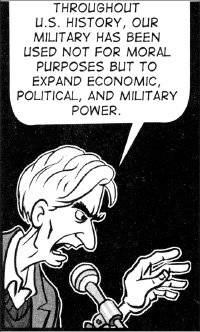
Editor Buhle developed this project with Zinn, labor cartoonist Mike Konopacki, and writer/unionist Dave Wagner. The book’s drawings, photos, and historic prints meld into a strong collaborative effort. The results are jarring. With all of the flair of a classic film, we are transported to a lecture hall bedecked with anti-war banners. The reader becomes witness to a Zinn speech which artfully explains the rise of the United States as an empire. Zinn stands at center stage. His humanity is as apparent as the urgency in his message, as his podium’s top reveals papers, a watch, a bottle of water. We observe from all angles including a birds-eye view.

Zinn’s voice looms large as the story of Wounded Knee unfolds. This 1890 tragedy where Native American families were slaughtered by U.S. Cavalry is illustrated in gory reality—particularly the grainy photograph of a slain chief lying frozen in the snow.

Like its predecessor, this People’s History should be a staple for teachers. The Monroe Doctrine, which sought to “protect American interests,” sounds eerily familiar, though enacted in the 1850s. Quotes from politicians and military leaders throw egg on the face of those who would hide behind a flag pin. “Third World” nations as U.S. pawns, humiliated and silenced native leadership—it’s an old story. The World Wars, Hiroshima, the Cold War, Civil Rights battles, Vietnam, Nixon, the hostage crisis, Reagan, Iran-Contra, Iraq, and George W. Bush as Nero all stink of the greed that created them. At strategic points, we are enlightened with “Zinnformation” frames where parallels are drawn between historic events and today’s injustices. While walking through history, brandish this tool to also reach across generations.

Source. / ZMag / Posted July 1, 2008

A People’s History of American Empire by Howard Zinn

Find A People’s History of American Empire at Amazon.com.

The Rag Blog

Posted in RagBlog | Tagged , , , , | Leave a comment

The Biggest NAFTA Problem : the Assumed Commonality of Interests


The New Geography of Trade: North America Doesn’t Exist
By Laura Carlsen / July 8, 2008

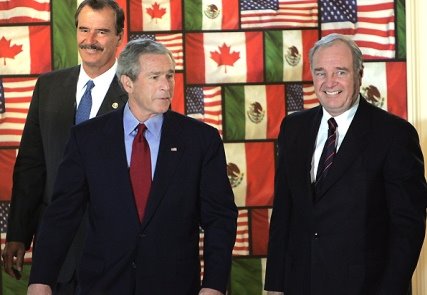
About every six months or so, the media provide a fleeting show of North American unity. Whether on the shores of the Mexican Caribbean, the forests of Quebec, or the hurricane-torn streets of New Orleans, the script is pretty much the same. It includes a lot of back-slapping and almost no public information.

These encounters—the trilateral summits—would be imminently forgettable if not for what happens behind the photo ops.

Business leaders and government officials from the United States, Canada, and Mexico have been meeting to expand on the 1994 North American Free Trade Agreement since the trinational summit in Waco, Texas in March of 2005. Ostensibly, the premise is that this great continent of three nations must bond to create a safe, free, and prosperous haven in a threatening world.

The only problem is, North America—at least as portrayed in the summits—doesn’t exist.

Flunking Geography

There is a North American land mass—a fact confirmed by any one of the 515 million people who at this moment are compelled by gravity to stand, sit or lie upon it. But nobody can even agree on its borders.

To the North, the mass breaks up into a vast expanse of ice, impossible to draw on a map as its boundaries recede due to global warming. This is creating consternation and confusion—and not just among polar bears. For the first time since modern science began recording, the fabled Northwest Passage that connects Asia and Europe via North America is free of ice, causing an international dispute over who controls it.

The confusion is even worse regarding the southern edge of our shared continent.

Children in the United States are taught that the North American continent begins in the North—which is always the “top,” passes through a gray area called “Canada,” to reach a vibrant, multi-colored zone divided into 50 states that most good students can name. It then begins its decline, gradually petering out below the Rio Grande. If the kids were to ask their parents where the southern limit is, they too would probably just shrug.

Mexican school children, however, will answer immediately that there really is no North America. They are taught that North and South America are a single continent—”America,” without the “s.” That’s why if you say you’re “American,” they will reply, “But what country are you from?”

Turning to the experts, most geographers have decided that North America extends down through Panama. (To make matters worse, Panama used to be part of South America when it belonged to Colombia, but that’s another story). That means that North America encompasses 23 sovereign nations and 16 colonies, or “dependencies” as they are referred to in this not-so-post-colonial era.

So why this brief geography lesson? Because the ongoing geographical debate offers important insights into what’s wrong with the North American Free Trade Agreement and the son-of-NAFTA—the Security and Prosperity Partnership (SPP).

The problems of defining the region begin with geography, but they get way worse when politics, economics, and culture are thrown in.

Commercial Bloc-heads

The “North American Free Trade Agreement” is actually a compound misnomer. The “North America” in NAFTA is an invention of a particular point in history and a particular set of economic and geopolitical motivations.

“Trade” under the agreement has been liberalized but is far from “free.” Politically powerful sectors in the United States maintain protections, whether openly in the form of tariffs or covertly as phytosanitary barriers or subsidies. All countries maintain some barriers for strategic sectors and products—often a reasonable practice, especially in the case of developing countries like Mexico.

Finally, the “agreement” did involve the Congress and civil society organizations at the moment of approval in the United States, but in the negotiating stages and certainly in Mexico, civil society was shut out of the process. NAFTA’s extension into the SPP was even more non-consensual since it did not involve congressional approval or signed agreements. In Mexico, NAFTA isn’t legally an agreement but rather a treaty, giving it a higher juridical stature than in the United States.

But the biggest problem here is the assumed commonality of interests. The most touted rationale for NAFTA is that the United States, Canada, and Mexico must join to form a trade bloc to compete in the global market with other trade blocs. This assumes that the three nations are on the same team. The Security and Prosperity Agreement even formed a “North American Competitiveness Council” made up of Walmart, Chevron, Ford, Suncor, Scotiabank, Mexicana, and other major corporations to represent the team interests.

But when we look at the play on the field, there is very little teamwork involved. In multilateral forums each country plays by its own game plan. In the World Trade Organization, Mexico forms part of the Group of 20 to protest U.S. and Canadian agricultural subsidies. Canada and the United States have faced off on numerous trade conflicts among themselves, many of them—like the softwood lumber case—the subject of drawn-out and bitter negotiations. Mexico has also had disputes with its supposed team mates, including the tuna-dolphin dispute, the entry of Mexican trucks into the United States under the agreed-to terms of NAFTA, and the tomato wars between northern Mexico and Florida.

If the bloc fails to act as a bloc of nations on the international level, its lack of cohesiveness is even more obvious from the point of view of its major corporations. Globalization opens up a world where everyone is out for themselves in search of cost-cutting production, cheaper resources, and closer markets. Corporations based in the United States, Canada, or Mexico have no loyalty whatsoever to building North America as a competitive bloc. An executive of a Hewlett-Packard subsidiary described how the company decided to move operations from the Mexican border to Indonesia. It was a no-brainer, he said, the labor was cheaper and it was closer to the expanding Chinese market. Like a game of Chinese checkers, the company now seeks to leap production from Indonesia directly into China as its next strategic move. NAFTA partner Mexico is left with nothing but unemployment.

Even the most regionally integrated industries, like the auto industries, measure their success not in terms of integration but by how successfully they can break down the production process into ever-cheaper components. This allows them to offshore labor intensive phases to Mexico where labor is cheap, while maintaining sales and research, management, and research and development in the United States. If anything changes in that formula, the whole concept of regional integration would be thrown out the window in search of a different global strategy. Recent negotiations to reduce wages in Mexican auto plants of Ford and General Motors based on the threat to move production to China are good examples of the logic.

Although corporate strategies are global not regional, corporations do have a reason to push the NAFTA-SPP agenda. Corporations that have operations in the three nations have an interest in developing mechanisms to lower all costs and barriers. In this sense they seek to create not a trade bloc to compete against their operations in other countries, but a pilot project for territorial reorganization along the lines of a corporate wish list. In this conception, “North America” is not a block of countries defined by a common geography and purpose, so much as a territory delineated for the optimal use of capital.

This realization explodes the first myth of “regional integration” under NAFTA. Far from a homogeneous process of integration, it promotes a curious blend of integration and fragmentation of territory. Mexico, for example, has been split in two. The North, where irrigation, climate, and topography provide advantages in agriculture and industrialization is more advanced, is tightly integrated into the U.S. economy. U.S. companies selling in U.S. markets now control much of production and Mexican export companies are concentrated in this region.

Southern Mexico remains outside this scheme and always will. Even the World Bank has recognized this in a study called “Why NAFTA did not reach the South.” The response is the Plan Puebla-Panama, with a focus on public-sector loans for major infrastructure development, resource extraction, and energy grids. Since the region is too indigenous, too remote, and too rebellious for productive investment, the southern states of Mexico have been shunted off to join Central America as a facilitator region to provide natural resources and serve as a conduit for the North-South movement of goods. The local populations are considered largely extraneous.

Security for Who?

The issue of security is where the myth of a unified North America is most starkly revealed. Security didn’t figure into the original NAFTA agenda, although it was implied that greater economic integration would result in harmonization of foreign policy agendas. Sept. 11 and the Bush National Security Doctrine created a strong U.S. security agenda while at the same time creating tensions with the NAFTA partners.

Canadian business sought to avoid another border closure like the one following the World Trade Center attacks and was willing to concede on other issues to assure uninterrupted trade. The government was forced to accept U.S. Homeland Security measures such as a “no-fly” list that bars “suspect individuals,” including dissidents, from air travel between the two nations.

The Mexican people, as in all of Latin America, reacted to U.S. unilateralism and the invasion of Iraq with a rise in anti-American sentiment and suspicion. But both National Action Party (PAN) presidents Vicente Fox and Felipe Calderon shared much of the Bush agenda and have entered into commitments under the SPP on security issues.

The security plan put forth in the SPP is an extension of the agenda of a nation that is the world’s pre-eminent military power, a major target for international terrorist attacks, a proponent of unilateral action and pre-emptive strikes, and an advocate of military over diplomatic responses and U.S. hegemony the guarantee of global governance.

Mexico is a nation that is not a target of international terrorism, has had a foreign policy of neutrality, and whose primary security threat has historically been—the United States. Nonetheless, Mexico has had to accept the failure of the binational immigration reform agenda and cooperate in aspects of the U.S. Homeland Security agenda and other counter-terrorism programs. The latest and most radical project to come out of the SPP security agenda is Plan Mexico, or the Merida Initiative—a regional security plan developed in the context of the SPP that bundles counter-narcotics, counter-terrorism, and border security measures into a new national security program for Mexico led by Washington.

The concept that Canada, the United States, and Mexico should forge a single security agenda as a non-existent continent is absurd and dangerous. Yet this is exactly what the SPP does. It is an agreement built on a convenient myth, a partnership that really consists of two countries subordinated to a superpower that agree to this subordination due to economic dependencies and the interests of corporations that cross borders seeking to maximize profits.

The New Geography

When the North American Free Trade Agreement was conceived, it was not a trinational—much less continental—affair. The negotiations focused on pasting together three separate agreements: the U.S.-Canada Free Trade Agreement—already in effect since 1989, a new U.S.-Mexico agreement and, to a lesser degree, a series of Canada-Mexico rules.

Few people realize that the resulting NAFTA reflects these differences. Critical goods for the United States, such as oil and corn, are traded under completely separate rules with Canada and with Mexico in the context of NAFTA depending on the relative bargaining power.

What has happened in the 14 years since NAFTA has fractured the continent even more. Led by the transnational corporations for whom it was designed, in practical terms NAFTA today covers an expanse of territory that runs roughly from Mexico City in the south, to mid-Canada. Through a growing network of consolidated production chains, trade links, and infrastructure development, this region—with the exception of poverty zones of little interest for capital expansion—has undergone rapid processes of concentration and integration.

Under the “vision” of North America forged under NAFTA and its follow-up, the Security and Prosperity Partnership, the three governments have attempted to convince their people that their fate lies along a common path—a path defined by geography, cemented by shared values, and marked by the assumption that just one road leads to the fulfillment of everyone’s goals. But it has become increasingly clear that instead of being a pact between three nations, NAFTA constitutes a roadmap for U.S. regional hegemony.

Not So Fast …

Right wing organizations like the John Birch Society that have been up in arms over the supposed creation of a North American Union and the construction of NAFTA superhighways, may find comfort in the thesis that North America doesn’t—and shouldn’t—exist. But just because I argue that each nation must define and defend its public good, doesn’t mean I agree that there is a neo-Aztec conspiracy to take over the United States. The greatest threat to every country in the region is the attempt of the Bush administration to impose its failed trade and security agenda at home and abroad, and the supranational powers of transnational corporations.

Should We All Go Home Now?

The question remaining is: if North America doesn’t exist, why should Canadians, U.S. citizens, and Mexicans work together to shape the NAFTA and SPP processes?

The trinational networks that have formed to monitor and question both NAFTA and the SPP play a critical role. Although each nation has its own priorities and demands, the networks serve to share information and compare notes on how regional integration affects citizens’ interests.

Grassroots organizations from the three countries face common challenges and common threats. The indisputably high levels of trade, investment, immigration, and cultural exchange that exist between our countries mean that we live daily lives that overlap across borders. Maybe it isn’t a region or a trading bloc in the terms conceived of under the SPP and the differences between us are many and a source of strength. But we are neighbors—as nations, as communities, and as families.

These organizations, meeting in binational or trinational conferences and to protest at official summits, explode the myth of regional homogeneity while at the same time making common cause. They expose the lie that there is only one path forward by developing alternatives in policy and practice. Precisely on the basis of their different political contexts and geographical, ethnic, and economic diversity, they have the potential to build a crossborder movement for social justice to counteract plans for regional integration designed and implemented exclusively in the upper echelons of business and government.

Fourteen years after implementation of the North American Free Trade Agreement, a majority of the population in all three countries believes the agreement has had a net negative effect on their nation and it turns out that the North American Free Trade Agreement is a misnomer in every one of its terms—it wasn’t an agreement, it isn’t free trade, and North America doesn’t exist. So now what?

First, stop extending it. The SPP must be thoroughly reviewed and revamped. Most likely this review will lead to construction of different forums for trinational coordination that separate the trade/investment and security areas, balance out the preponderant influence of the United States government, and open up proceedings and representation to the public.

Second, stop copying it. Although NAFTA is the only trade agreement to extend into an SPP, the Free Trade Agreement model enshrined there has become a template for other agreements and, in the case of the United States, pressures to impose security plans tend to follow close behind. The Merida Initiative contains resources for Central American countries to integrate the CAFTA region into the regional security plan.

Finally, analyze and evaluate the SPP—the forces behind it, the decisions it makes that affect us, and the directions it plans for the future. Citizens have the right and the obligation to know about and participate in mapping the future, and when they do it’s likely to look far different from the future mapped for us by corporate and government leaders behind the closed doors of the Security and Prosperity Partnership.

[Laura Carlsen (lcarlsen(a)ciponline.org) is director of the Americas Policy Program in Mexico City. This piece was part of a talk at the Lessons from NAFTA Conference. Check out the Americas Mexico blog at http://www.americasmexico.blogspot.com/.]

Source / Counterpunch

The Rag Blog

Posted in RagBlog | Tagged , , | Leave a comment

The Neverending Story : Bush’s Assault on Our Civil Liberties


The New Snoops: Terrorism Liaison Officers
By Matthew Rothschild

The full scale of Bush’s assault on our civil liberties may not be known until years after he’s left office.

At the moment, all we can do is get glimpses here or there of what’s going on.

And the latest one to come to my attention is the dispatching of police officers, firefighters, paramedics, and utility workers as so-called “terrorism liaison officers,” according to a report by Bruce Finley in the Denver Post.

They are entrusted with hunting for “suspicious activity,” and then they report their findings, which end up in secret government databases.

What constitutes “suspicious activity,” of course, is in the eye of the beholder. But a draft Justice Department memo on the subject says that such things as “taking photos of no apparent aesthetic value” or “making notes” could constitute suspicious activity, Finley wrote.

The states where this is going on include: Arizona, California, Colorado, Florida, Illinois, Tennessee, Wisconsin, and Washington, D.C.

Dozens more are planning to do so, Finley reports.

Colorado alone has 181 Terrorism Liaison Officers, and some of them are from the private sector, such as Xcel Energy.

Mark Silverstein of the Colorado ACLU told Amy Goodman of Democracy Now that this reminds him of the old TIPS program, which “caused so much controversy that Congress eventually shut it down. But it is reemerging in other forms.” Silverstein warns that there will be thousands and thousands of “completely innocent people going about completely innocent and legal activities” who are going to end up in a government database.

On the web, I found a description for a Terrorism Liaison Officer Position in the East Bay.

Reporting to the Alameda and Contra Costa Counties and the city of Oakland, these officers “would in effect function as ad hoc members” of the East Bay Terrorism Early Warning Group, which consists of local police officers and firefighters.

The “suggested duties” of these Terrorism Liaison Officers include: “source person for internal or external inquiry,” and “collecting, reporting retrieving and sharing of materials related to terrorism. Such materials might include . . . books journals, periodicals, and videotapes.”

Terrorism Liaison Officers would be situated not only in agencies dealing with the harbor, the airports, and the railroads, but also “University/Campus.”

And the private sector would be involved, too. “The program would eventually be expanded to include Health Care personnel and representatives from private, critical infrastructure entities, with communication systems specifically tailored to their needs.”

In this regard, Terrorism Liaison Officers resemble InfraGard members. (See “The FBI Deputizes Business”.) This FBI-private sector liaison group now consists of more than 26,000 members, who have their own secure channels of communication and are shielded, as much as possible, from scrutiny.

Terrorism Liaison Officers connect up with so-called “Fusion Centers”: intelligence sharing among public safety agencies as well as the private sector. The Department of Justice has come up with “Fusion Center Guidelines” that discuss the role of private sector participants.

“The private sector can offer fusion centers a variety of resources,” it says, including “suspicious incidents and activity information.”

It also recommends shielding the private sector. “To aid in sharing this sensitive information, a Non-Disclosure Agreement may be used. The NDA provides private sector entities an additional layer of security, ensuring the security of private sector proprietary information and trade secrets,” the document states.

As if that’s not enough, the Justice Department document recommends that “fusion centers and their leadership encourage appropriate policymakers to legislate the protection of private sector data provided to fusion centers.”

Source. / The Progressive / Posted July 2, 2008

The Rag Blog

Posted in RagBlog | Tagged , , , , | 1 Comment

Drawn and Quartered

Simanca Osmani, Brazil

The Rag Blog / Posted July 8, 2008

Posted in RagBlog | Tagged , , , | 1 Comment

Summit That’s Hard to Swallow

Hungry? CLICK on menu to enlarge.

World leaders enjoy 18-course banquet as they discuss how to solve global food crisis
By James Chapman / July 8, 2008

Just two days ago, Gordon Brown was urging us all to stop wasting food and combat rising prices and a global shortage of provisions.

But yesterday the Prime Minister and other world leaders sat down to an 18-course gastronomic extravaganza at a G8 summit in Japan, which is focusing on the food crisis.

The dinner, and a six-course lunch, at the summit of leading industrialised nations on the island of Hokkaido, included delicacies such as caviar, milkfed lamb, sea urchin and tuna, with champagne and wines flown in from Europe and the U.S.

But the extravagance of the menus drew disapproval from critics who thought it hypocritical to produce such a lavish meal when world food supplies are under threat.

G8 leaders discussing the world food crisis in Japan raise their glasses ahead of an 18-course dinner.

On Sunday, Mr Brown called for prudence and thrift in our kitchens, after a Government report concluded that 4.1million tonnes of food was being wasted by householders.

He suggested we could save up to £8 a week by making our shopping go further. It was vital to reduce ‘unnecessary demand’ for food, he said.

Last night’s dinner menu was created by Katsuhiro Nakamura, the first Japanese chef to win a Michelin star. It was themed: Hokkaido, blessings of the earth and the sea.

But Dominic Nutt, of the charity Save the Children, did not approve.

‘It is deeply hypocritical that they should be lavishing course after course on world leaders when there is a food crisis and millions cannot afford a decent meal,’ he said.

‘If the G8 wants to betray the hopes of a generation of children, it is going the right way about it. The food crisis is an emergency and the G8 must treat it as that.’

In 2005, at the G8 summit in Gleneagles, Scotland, world leaders promised to increase global aid by £25billion a year by 2010 and raise aid to Africa, the world’s poorest continent, by £12.5billion. But the bloc of rich nations is only 14 per cent of the way towards hitting its target.

Britain is meeting its commitments in full, but other countries are understood to be dragging their feet – and there are fears the figures on global aid could be watered down.

French President Nicolas Sarkozy and Italian leader Silvio Berlusconi, who face pressure to cut spending at home, are understood to be leading the charge to weaken the Gleneagles proposal.

Tory international development spokesman Andrew Mitchell said: ‘The G8 have made a bad start to their summit, with excessive cost and lavish consumption.

‘Surely it is not unreasonable for each leader to give a guarantee that they will stand by their solemn pledges of three years ago at Gleneagles to help the world’s poor.

‘All of us are watching, waiting and listening.’

The G8 Summit is addressing world food shortages

A World Bank study released last week estimated that up to 105million more people, including 30million in Africa, could drop below the poverty line because of rising food prices.

Yesterday the European Union agreed to channel £800million in unused European farm subsidies to African farmers, as part of its response to the global food crisis.

‘The EU really can give a boost to agriculture in developing countries,’ Jose Manuel Barroso, president of the European Commission, told the meeting.

The money will be used to buy seed and fertiliser and fund agriculture projects in Africa.

The meal was served at the Windsor Hotel, on the shores of Lake Toya, where the presidential suite costs £7,000 a night.

Japan has spent a record sum of money and deployed about 20,000 police to seal off the remote lakeside town of Toyako for the three-day talks.

Source. / The Huffington Post

The Rag Blog

Posted in RagBlog | Tagged , , , , | 3 Comments

Keep Your State Out of My Church…


Obama, Keep Your Hands Off My Faith-Based Initiative
by Jim Moss / July 6, 2008

[Jim Moss is a Presbyterian minister from York, South Carolina. He publishes a blog and a quarterly newsletter called “Discipline for Justice,” which focuses on ways North Americans can live lives that promote peace and economic justice.]

Last week, Obama spoke out in favor of expanding Bush’s faith-based initiative program, part of a predictable and consistent move to the center.

“I’m not saying that faith-based groups are an alternative to government or secular non-profits. I’m not saying that they’re somehow better at lifting people up. What I’m saying is that we all have to work together — Christian and Jew, Hindu and Muslim; believer and non-believer alike — to meet the challenges of the 21st Century.”

Naturally, the secular left is not happy about this development. But neither are many on the spiritual left. Speaking as a progressive, as an ordained minister in the Presbyterian Church (USA), and as someone who has successfully organized a church-based food pantry, I have a message for Obama and any other politician who is making the sacred task of outreach ministry a tool of political pandering:

Get your hands off my faith-based initiative! We don’t want any of your government money getting in the way of our work.

It’s a bad idea for a number of reasons:

1) Over-Regulation. The government never just gives you money. There are always rules and regulations, mountains of paperwork, and any number of hoops to jump through – sometimes they make sense, sometimes they don’t. This extra work always seems to stand in the way of doing the real work at hand.

2) The Fickle Nature of Politics. Government funding can get turned on and off like a faucet, depending on the political climate . Entire agencies can get the ax simply because a new administration comes in with different priorities. Charities need to depend on consistent money sources that are not politicized.

3) Strings Attached. There really is no such thing as a free lunch. Government funding equals a government agenda, and the political issues of the day will certainly affect where the funding goes. Instead of the meeting the greatest needs of the people, the money will tend to go where it makes the elected officials look best.

4) Separation of Church and State. This is one area where I agree with atheists. Looking back through history, it’s clear that when government and religion are in cahoots, bad things tend to happen. They need to be a check on one another’s power, and the line between them needs to stay crystal clear. This program blurs that line.

5) A Higher Calling. Feeding the poor, tending the lame, caring for the widow and the orphan. These are some of the most sacred tasks for Christians and for other religions. Using government money to do these tasks is not acceptable. Individuals are called to give of their time and money because giving is a central part of what we believe. It is part of building a community that takes care of one another. Being funded with government money raised through taxation cheapens this noble task. The government certainly has its role in meeting the needs of the people, but this does not come through doing for the faithful what they should be doing themselves.

So thanks, Barack, but no thanks. Our charities are not another pawn in the chess game of this election.

Source. / The Seminal

Also see Obama’s Faith-Based Folly / The Progressive

The Rag Blog

Posted in RagBlog | Tagged , , , | Leave a comment

Robert Pardun : In Support of Barack

Robert Pardun, back in the day.

And the words that are used for to get the ship confused will not be understood as they are spoken…
And like Pharaoh’s tribe they’ll be drowned in the tide and like Goliath they’ll be conquered.

Money doesn’t talk it swears. Propaganda all is phony

Bob Dylan

Why we need Barack Obama now
By Robert Pardun / The Rag Blog / July 8, 2008

[Robert Pardun — an activist in Austin in the sixties and a contributor to the underground paper, The Rag — was a national officer of Students for a Democratic Society (SDS). He is the author of Prairie Radical : A Journey Through the Sixties. Robert now lives in the mountains near Santa Cruz, California.]

This is to express my solidarity with those of us out there working for the election of Barack Obama. I have seen many election cycles come and go and in general what we learned during the sixties is still true today—those with money use government for their own private ends. The Bush Administration has been the most blatant I can remember in taking from the poor and giving to the rich. One has only to look at the war in Afghanistan and Iraq to see this. With the money spent to occupy and then militarily control those two countries we could have rebuilt every school, every bridge, and every road in the United States. In addition we could have universal health care for everyone and funded research in alternative energy sources. In the movie “The Graduate” Dustin Hoffman is told that the wave of the future was in plastics. Today it is in batteries.

About ten years ago I read about a survey of attitudes of the American people concerning work, war, family and the like. The conclusion was that there is within America a sizable contingent of people who maintain the attitudes of the counterculture of the 1960s and 70s. These people make up a substantial part of Obama’s support and many are actively involved in his campaign. These are people who send in the checks for fifteen or twenty dollars and who sit behind card tables at the local grocery store encouraging people to vote. They are us and a new generation that learned from us.

During the sixties we wondered why defacto slavery still existed in parts of the South even though the Civil War had been fought a hundred years before. Culture changes slowly as new ideas become commonly accepted. Obama represents the ideals of the sixties even though he wasn’t there, and the younger generations like Obama because he represents a different way of looking at the world.

Is Obama a revolutionary? Hardly! If he was you would never have heard of him. Besides we are not in a revolutionary period. But he does stand for a more open government and that is important. We have a much better chance of getting the draconian drug laws changed with Obama. The drug war is known to have been a campaign gimmick of Nixon targeted at the black liberation movement and the anti-war movement. We should concentrate on repealing those laws. We used to say that we needed to work to stop the seventh war from now. Well we’ve already passed that point but with a President who is willing to think about alternatives we stand a chance of stopping the automatic reflex of attacking what we don’t like first and talking about it later. In addition we must change the way the government treats the people it “puts in harm’s way.” The treatment of veterans is absolutely scandalous and must be changed.

This election is the third in my lifetime in which I thought the democratic candidate might actually make a difference. After wondering why anyone would say that he smoked marijuana but didn’t inhale I voted for Clinton. With Obama we stand a change of actually changing things for the benefit of the people. Instead of taking the people’s money and using it to benefit the military-industrial complex we could actually use it to better the condition of the people who work hard to keep body and soul together.

The Rag Blog

Posted in Rag Bloggers | Tagged , , , , , , , , | 4 Comments

Christian Right Uses Slavery Image to Attack Obama on Abortion!

Image of slavery in Christian Defense Coalition’s literature.

Conservative Christian Group Invokes Slavery In Opposing Obama
By Jake Topper / July 8, 2008

The Christian Defense Coalition held their anti-Obama press conference today — “An Appeal to Catholics Regarding the 2008 Presidential Election” — complete with the “I want you to pay for abortions” Obama-as-Uncle-Sam picture (see below)… as well as some other interesting material.

Such as: this image of slavery (above), invoked in the CDC’s literature to argue that there is nothing wrong with Catholics being “single issue” voters on abortion.

Argues the CDC: “if that issue involves a fundamental right, such as the right to life for a certain group of human beings, and there is only one morally legitimate position on that issue…no faithful Catholic would vote for a candidate who, although ‘personally opposed to slavery,’ supported ‘a white man’s right to choose’ to own slaves.”

Click HERE to see the context of the slavery mention as well as the other controversial materials. (Note: we did blur out one image of an aborted fetus.)

Obama’s Abortion Kerfuffle

Sen. Barack Obama, D-Illinois, and his views on abortion have been confounding some observers these days.

And perhaps that’s in no small way the reason why the controversial Christian Defense Coalition is launching a new campaign focused on painting Obama as “The Abortion President.”

Check out THIS IMAGE of Obama as Uncle Sam: “I Want YOU To Pay for Abortions,” courtesy of CBN’s Brody File.

Rev. Patrick J. Mahoney, director of the Christian Defense Coalition, says Obama would have “the most extremist policies on abortion of any President in history. Senator Obama’s views on abortion are so radical that he even wants American citizens to pay for them. This would include Catholics, Evangelicals and all people of faith. He would also expand abortion rights through his passionate support of The Freedom of Choice Act.”

This ad becomes relevant within the context of Obama’s attempts to win over evangelical voters — some of whose votes may be up for grabs given Obama’s comfort discussing his Christian faith and their distrust of Sen. John McCain, R-Ariz. — Obama’s support for abortion rights will assuredly be a sticking point.

Obama’s desire to win these voters may be why, in a recent interview with Relevant magazine, (“Covering God, Life, and Progressive Culture”) Obama seemed to be moving rightward on the issue — rhetorically, at least — saying:

“I have repeatedly said that I think it’s entirely appropriate for states to restrict or even prohibit late-term abortions as long as there is a strict, well-defined exception for the health of the mother. Now, I don’t think that ‘mental distress’ qualifies as the health of the mother. I think it has to be a serious physical issue that arises in pregnancy, where there are real, significant problems to the mother carrying that child to term. Otherwise, as long as there is such a medical exception in place, I think we can prohibit late-term abortions.”

The language Obama used in that response seemed to remove “mental distress” as an allowable exception justifying a post-22 week abortion.

To some observers, that would seem to go against the Supreme Court decision Doe v. Bolton — handed down the same day as the more famous (or infamous) Roe v Wade decision legalizing abortion, though the Court said the decisions were to be “read together.”

Doe holds that the health exception permitting abortion after viability should be based on a “medical judgment…exercised in the light of all factors — physical, emotional, psychological, familial, and the woman’s age — relevant to the wellbeing of the patient,” as ABC News’ Supreme Court reporter Jan Crawford Greenburg noted over the weekend.

So was Obama suggesting to Relevant that he disagrees with Doe?

That would seem to contradict Obama’s support for the “Freedom of Choice Act,” which codifies in law a mental health exception for post-viability abortions, legislation that Obama has publicly supported.

The Obama campaign says no, that’s not what he was saying, and spokesfolk explained that the senator’s use of “mental distress” in the Relevant interview was not a reference to “mental illness.”

On Saturday, after a reporter noted to Obama that he had said that mental distress shouldn’t be a reason for late-term abortion, Obama clarified, “historically I have been a strong believer in a women’s right to choose with her doctor, her pastor and her family…I have consistently been saying that you have to have a health exception on many significant restrictions or bans on abortions including late-term abortions. In the past there has been some fear on the part of people who, not only people who are anti-abortion, but people who may be in the middle, that that means that if a woman just doesn’t feel good then that is an exception. That’s never been the case.”

Obama continued: “I don’t think that is how it has been interpreted. My only point is that in an area like partial-birth abortion having a mental, having a health exception can be defined rigorously. It can be defined through physical health, It can be defined by serious clinical mental-health diseases. It is not just a matter of feeling blue. I don’t think that’s how pro-choice folks have interpreted it. I don’t think that’s how the courts have interpreted it and I think that’s important to emphasize and understand.”

But if Obama is saying that “mental distress” is already not a legal exception for abortion bans, then what was the point of what he told Relevant? He maintains he wasn’t discussing any view that runs contrary to current abortion law, so it would seem he was just discussing a personal view — that a woman, 8 1/2 months pregnant, shouldn’t be able to get an abortion just because she’s feeling blue.

Some abortion opponents suggest that Obama was merely trying to muddy the waters and sound more centrist on the issue — as if his mind were open to some abortion bans, when in fact he was merely stating current law wrapped in some triangulating language.

J.P.T. / July 7, 2008

Source. / Political Punch / ABC News

The Rag Blog

Posted in RagBlog | Tagged , , , , , | Leave a comment

Malicki Bombshell on U.S.-Iraq Treaty

Prime Minister Nouri al-Maliki of Iraq.

Wants limited accord, linked to withdrawal timetable
By Robert Dreyfuss / July 8, 2008

The long-running showdown over the proposed US-Iraq treaty, aimed at legitimizing the American occupation of Iraq, is coming to a head, and it doesn’t look good for the United States.

Prime Minister Nouri al-Maliki tossed a bombshell Monday. In a news conference about the still-secret US-Iraqi talks, which began in March, Maliki for the first time said that the chances of securing the pact are just about nil, and instead he said Iraq will seek a limited, ad hoc renewal of the US authority to remain in Iraq, rather than a broad-based accord.

More important, Maliki and his top security adviser, Mouwaffak al-Rubaie added that Iraq intends to link even a limited accord to a timetable for the withdrawal of US forces. Reports the Sydney Morning Herald:

Iraqi Prime Minister Nuri al-Maliki raised the prospect of setting a timetable for the withdrawal of US troops as part of negotiations over a new security agreement with Washington.

It was the first time the US-backed Shi’ite-led government has floated the idea of a timetable for the removal of American forces from Iraq. The Bush administration has always opposed such a move, saying it would benefit militant groups.

Rubaie strengthened his position today: “There should not be any permanent bases in Iraq unless these bases are under Iraqi control. … We would not accept any memorandum of understanding with (the US) side that has no obvious and specific dates for the foreign troops’ withdrawal from Iraq.”

Here’s the quote from Maliki:

“The current trend is to reach an agreement on a memorandum of understanding either for the departure of the forces or a memorandum of understanding to put a timetable on their withdrawal.”

Don’t think for a minute that Maliki, or his Shiite allies, want the US forces to leave. But they are under a lot of pressure. First of all, they are under pressure from Iran, whose regime remains the chief ally of the ruling alliance of Shiites, including Maliki’s Dawa party and the powerful Islamic Supreme Council of Iraq (ISCI), led by Abdel Aziz al-Hakim. Iran’s goal is to neutralize Iraq as a possible threat to Iran, and Iran’s leaders are pressuring Maliki and Hakim to loosen their reliance on the United States. Interestingly, Maliki reportedly told President Bush personally, in a video teleconference on Friday, that the United States cannot use Iraqi territory to attack Iran, and he added that “fomenting tension in the region and pushing for military action against Tehran could wreak havoc on the entire region, including Iraq.”

Maliki is also under pressure from a broad coalition of Iraqi nationalists, from angry, disenfranchised Sunnis to Muqtada al-Sadr’s movement.

But Maliki’s statement is a big deal. At a minimum, it presents an enormous problem for Bush and John McCain, who are arguing for an indefinite US stay in Iraq til “victory,” and who oppose a timetable. True, Maliki seems to be linking his timetable to Iraqi military success, which is not too different from the Bush-McCain formula. But inside Iraq, the pressure is building day by day for a US withdrawal, and Maliki is by no means in control of the process. The fact that both Iran and Sunni nationalists, who are on a collision course, agree that US forces need to leave Iraq, only means that pro- and anti-Iranian factions will settle their differences (either by peaceful diplomacy or by violence) once the United States is gone.

Another factor is that Maliki, who is visiting the United Arab Emirates, is working hard to gain the support of the Sunni-led Arab regimes for his shaky coalition. The UAE and Jordan have both announced that they will be sending ambassadors to Baghdad, and King Abdullah of Jordan will himself make a visit to Baghdad soon, the first by an Arab head of state since the US invasion.

Despite US bungling, it seems increasingly likely that Iran and Saudi Arabia are working behind the scenes to negotiate a Shiite-Sunni accord in Iraq, but both Tehran and Riyadh will want it conditioned on a US withdrawal.

Source. / The Nation

The Rag Blog

Posted in RagBlog | Tagged , , | 1 Comment

Oaxaca’s Government Land Grab

Members of the Oaxaca People’s Popular Assembly (APPO) take part in a demonstration against Oaxaca’s governor Ulises Ruiz in Oaxaca on Nov. 5, 2006. At least a dozen people have been killed in the area since the protest movement began. Photo by Alfredo Estrella / AFP / Getty Images.

In villages across Oaxaca, where land has been owned communally for centuries, paramilitary groups are doing their bloody part to change the scene.
By Theresa Kleinhaus and Maya Schenwar / July 8, 2008

OAXACA and CHICAGO – On April 30, in the small village of Santo Domingo Ixcatlan, in Oaxaca, Mexico, a group of armed men from the paramilitary group the “White Guards” pulled over the car of carpenter Gustavo Castaneda Hernandez, a villager and vocal opponent of the sale of Santo Domingo’s communal land. The group, led by Freddy Eucario Morales Arias, the ex-mayor of Santo Domingo, rapidly blocked off the entrance and exit to the road with pickup trucks. The men began beating Hernandez, still trapped in his vehicle. They then set the car on fire. Hernandez was burned alive.

Meanwhile, two other villagers, Inocencio Medina Bernabe and Melesio Martinez Robles – a leader in the defense of communal land – rushed onto the scene, ostensibly in an attempt to aid Hernandez. The armed group killed both men, then dismembered Robles from the waist down and dragged his body through the street. The attackers lingered on the scene, drinking alcohol and listening to music for approximately six hours, witnesses said.

At 2:30 a.m., the State Preventative Police arrived on the scene, detained no one, and permitted all the armed men to return to their vehicles and drive away. The police had close affiliations with Arias. Under the former mayor’s guidance, from 2005 to 2007, the village had converted the local community center for children into a new headquarters for the State Preventative Police. Arias remains closely associated with the group.

Since the assassination, several more residents of Santo Domingo have been threatened. The community frequently hears gunshots at night and the paramilitaries – civilian groups armed and ordered by the government – have announced to the people that there will be further executions.

“Never in my 51 years have I seen anything like this,” a long-time Santo Domingo resident told Truthout. “Our community was always a peaceful one until Freddy Eucario Morales Arias came to power.”

However, this story of a village struck by government-entangled violence based on land disputes is, tragically, increasingly common in Oaxaca.

Only 29 percent of land in Oaxaca is privately owned – the rest is controlled by some form of collective system. In places like Santo Domingo, all agrarian issues are decided by those who work the communal land. Many government figures would like that reality to change, according to Suzy Shepard-Durini of the Council on Hemispheric Affairs.

“It would be in the interest of the government for communal land to be sold because the government can heavily tax any land that is not communal,” Shepard-Durini told Truthout. “Officials can also profit off the land by charging the people who live there fees for use of that land. If the natives don’t have legal ownership of the land, it is easy to exploit them or threaten them with relocation.”

Although it is unclear what specific economic interest the government holds in Santo Domingo’s land, the ongoing state-supported violence indicates that the government stands to profit from a sale, according to Maurilio Santiago Reyes, of the Center for Human Rights and Advice for Indigenous People.

Therefore, when land ownership conflicts emerge between villages or between individuals, self-serving government intervention often exacerbates the situation.

“This type of conflict is not uncommon in Oaxaca,” Santiago Reyes told Truthout. “One part of the community wants to sell and another does not; the government gets involved and makes matters worse.”

The turmoil in Santo Domingo originated from a conflict between the village and its neighboring town, Chalcotongo de Hidalgo, over a piece of communal land. The federal government offered to buy off participants in Santo Domingo’s communal land organization, “bienes comunales,” but most community members refused to abandon their way of life for a sum of money.

“We prefer to conserve our land,” one villager told Truthout. “We prefer to use this land agriculturally. If we sell, maybe a factory comes, they have the capital and we do the work. But if we conserve the land, we own the land, and we also work it.”

Several judicial orders have declared the land to be the property of Santo Domingo Ixcatlan.

In the state of Oaxaca alone, there are 656 similar documented agrarian conflicts. Of those cases, 53 are considered to be “hot spots,” or at great risk of developing into armed conflict.

During his tenure as mayor, Arias took over a portion of the land that is in conflict and began storing weapons there. Only Arias’ armed paramilitary followers were allowed inside that area. Arias then sought to sell the land in conflict to Chalcatongo. The current mayor of Chalcatongo, Guadalupe Susan Ruiz, is the cousin of Ulises Ruiz Ortiz, the governor of Oaxaca, with whom Arias also maintains ties, according to a piece written by his wife, published in La Jornada, a leading Mexican newspaper.

The government’s discontent over land ownership coincides with a rise in paramilitary violence, particularly in heavily indigenous areas.

According to a June 28 op-ed piece in La Jornada, federal military extension groups are now “openly occupying indigenous communities.”

“[Paramilitaries] act as a large fan of practices and processes of criminalizing social protest, with the purpose of containing the discontent of indigenous farming people,” the editorial states.

Paramilitaries routinely exploit regional land conflicts. The recent history of the land conflict between Santo Domingo and Chalcatongo has not been violent. In fact, citizens of Chalcatongo offered sympathy and economic support to the people of Santo Domingo Ixcatlan after the assassinations. Community leaders of Santo Domingo emphasize that the homicides were committed by state-sponsored paramilitaries in order to further political goals and that the paramilitaries are merely using the history of land conflict between the two towns as a cover for the politically motivated violence.

The Santo Domingo tragedies follow the usual course of much Mexican paramilitary intervention: Arias trained his followers in a state-sponsored military program, approved by the Oaxaca state government. When the Santo Domingo-Chalcotongo land dispute arose, Arias kicked into gear, planning to reward his paramilitary followers’ activism-suppressing efforts with 40 percent of the contested land and sell the other 60 percent to Chalcotongo, according to a Santo Domingo resident.

“Those paramilitaries want to push out anyone who does not want to sell the land to Chalcatongo so they can receive the government money,” he said.

The power – and routine use – of paramilitaries has risen in recent years, especially since Ruiz Ortiz became governor.

Ruiz Ortiz was widely criticized for his militarized response to striking teachers in Oaxaca City in 2006. Several people were killed and hundreds were arbitrarily detained. Since that time, the Popular Assembly of Oaxacan Peoples, a large social movement comprised of many civil society groups and governed by traditional indigenous leadership systems, has continued to call for Ruiz Ortiz’s resignation.

Santiago Reyes told Truthout that although the paramilitaries existed before the current governor’s rise to power, their influence has never been as blatant as during Ruiz Ortiz’s term.

Back in Santo Domingo, Arias is moving through a series of legal proceedings. Yet the town’s residents doubt much retribution will be served, especially since Arias maintains connections to Oaxaca’s governor.

Several weeks ago, police investigating the April assassinations were expelled from the community by the paramilitaries, leaving no police in town. Residents feared a nighttime massacre, ill-assured by the presence of the State Preventive Police – the same force that dismissed the assassinations at the scene of the crime. These days, Oaxacans find it difficult to trust any group linked to the state government to carry out peacekeeping duties.

“The Oaxaca state authorities have repeatedly used excessive force, sometimes lethal, to disperse protests against the controversial state governor,” states a late June report issued by Amnesty International. The report also correlates with Santo Domingo’s residents’ doubts that Arias will be fairly prosecuted, stating, “Those responsible have not been brought to justice.”

Meanwhile, last week, a group of paramilitary families who live on Santo Domingo’s disputed land came down the mountain and fired guns in the town square. All of those opposed to Morales Arias and his paramilitaries gathered in one house for safety.

So far, the Mexican federal government has not met with the people of Santo Domingo or taken any security measures on their behalf. Governor Ruiz Ortiz recently did meet with residents, and denied any connection to Arias, despite the statements of Arias, villagers, Reyes and Arias’ wife. Ruiz Ortiz also claimed that the conflict was merely one between two municipalities, and not a political struggle involving the state government or paramilitaries.

Mexican federal officials have not returned Truthout’s requests for comment.

State government representatives assert that they are working steadily to resolve Oaxaca’s agrarian conflicts.

“The government of Ulises Ruiz will never underestimate the importance of this subject,” said Encar Manuel Zamora Dominguez, a state official in charge of “agrarian reconciliation,” at a July 1 press conference.

Villagers across Oaxaca view such statements as doublespeak, pointing to the paramilitary-stoked and government-funded violence that persists in Santo Domingo and beyond.

[Theresa Kleinhaus is a peace activist and law student in Chicago, Illinois. She is working for the summer in Tlaxiaco, Oaxaca. Maya Schenwar is an editor and reporter for Truthout.]

Source. / truthout

The Rag Blog

Posted in RagBlog | Tagged , , , , | Leave a comment

Waxman Wants to De-Rove the White House

U.S. Rep. Henry Waxman (D-Calif.)takes on politicization of White House.

Taking aim at the next Karl Rove
By Alexander Bolton / July 7, 2008

Rep. Henry Waxman (D-Calif.), who has primary jurisdiction over the executive branch, is considering legislation to eliminate Karl Rove-type advisers in future administrations.

The chairman of the House Oversight and Government Reform Committee hints broadly that such a bill could ban the use of federal funds to finance such a politically partisan office.

“Why should we be using taxpayer dollars to have a person solely in charge of politics in the White House?” Waxman said in an interview. “Can you imagine the reaction if each member of Congress had a campaign person paid for with taxpayer dollars?”

Waxman, one of President Bush’s most dogged opponents, will decide in September whether to press ahead this year or wait until next in hope of having a Democratic president sign such a bill.

Waxman says the White House operates under looser political ethics rules than does Congress, where chiefs of staff and other high-ranking officials are prohibited from using government phones, computers and facilities for political purposes.

Rove focused on President Bush’s reelection while working on a West Wing salary during the first four years of the Bush administration.

As Bush’s senior adviser, Rove headed the Office of Political Affairs, which interacts with the party’s political committees, and the Office of Public Liaison, which works with outside groups such as business, religious and advocacy organizations that want to communicate with the president.

Rove’s political activity at the White House sparked fierce disputes with congressional Democrats.

They accused Rove of making the White House too political, pointing to reports that Rove told political appointees throughout the administration to stage official announcements and federal grants in ways that would help Republican candidates.

Waxman’s committee found that senior White House aides sent tens of thousands of political communications through government e-mail accounts. This led to a public fight over copies of the messages, many of which were erased because Bush advisers stopped using an e-mail archiving system dating from the Clinton administration.

Bush spokesman Scott Stanzel defended the White House political office.

“This administration, like [former] President [Bill] Clinton did in his time in office, determined it was appropriate for the head of the party to have a specific office to interface with political committees,” he said. “Any future president will have to make those determinations for himself.”

Waxman wants legislation to strengthen electronic record-keeping in future administrations. He has introduced an electronic records bill along with legislation that would require presidential libraries to disclose donor information. He introduced a sweeping executive branch reform bill in 2007 that would implement some ethics rules similar to those Congress adopted for itself after Democrats won the House and Senate.

But Waxman has yet to unveil his proposal for eliminating the White House Office of Political Affairs.

The idea is likely to provoke controversy and even scorn in a town where politics in the White House is considered akin to drinking in a sports bar.

“The notion of taking politics out of governing is silly,” said Rich Galen, a GOP strategist, in reference to Waxman. “I understand what he’s getting at, but Rove would have had the influence he had no matter what his title was and what his duties were.”

Galen and other operatives interviewed said that future White Houses would find ways to get around restrictions on political activity, such as by outsourcing political strategy to the Republican National Committee or letting aides handle it unofficially.

Recognizing the complexity of the issue, Waxman wants to interview political aides from the Bush and Clinton administrations before crafting his proposal.

“We are going to bring in people from the Bush administration and the Clinton administration and talk it through,” he said. “We want to get people’s thoughts on it.”

It’s unclear how Sen. Barack Obama (Ill.), the expected Democratic presidential nominee, would view Waxman’s proposal. His aides did not respond to a request for comment.

Richard Norton Smith, a presidential historian at George Mason University, said that the Bush administration is the culmination of the growing politicization of the White House over the last few decades.

“I think this is something that’s been growing for the last 40 years,” said Smith, who said the trend began with former President John F. Kennedy, whom he described as very “image-conscious.”

“You really have to go back to Truman and Eisenhower to find presidents who didn’t spend a lot of time worrying about their political images,” said Smith.

Smith said he doubted eliminating the White House political office would make the future presidencies any less political. Nevertheless, he acknowledged the problem of excessive politicking in the West Wing.

Smith said banning future Roves is “attacking a symptom.”

“The disease is the inability to distinguish between campaigning and governance and the extent the two have become fused,” he said.

Lawmakers and their aides must abide by stricter rules dividing government business and political activity than senior administration officials.

Republican senators and representatives, for example, hold conference meetings at party committee headquarters whenever they plan to discuss fundraising and other political topics.

Congressional aides must also use personal or campaign-issued cell phones and BlackBerrys to send political communications.

Executive-branch officials are governed by the Hatch Act, which details what activities are accepted and which are barred. Most officials may assist in voter-registration drives but may not engage in political activity while on duty or in a government office.

But those restrictions do not apply to the president and the vice president and their senior aides.

“The higher you go in the administration, the more complicated it becomes … to enforce the Hatch Act, because of exemptions,” said Jim Mitchell, spokesman for the U.S. Office of Special Counsel, which enforces the act.

Source. / The Hill

The Rag Blog

Posted in RagBlog | Tagged , , , , | Leave a comment

Mexican Comic and Stamps Draw Charges of Racism

Houston: Customers ask Wal-Mart stores to remove Memín Pinguín comic
By Leslie Casimir / July 8, 2008

See “Stamps Racist, Civil Rights Leaders Say,” at end of this article.

Beloved by Mexicans for his dim wits, street smarts and playful disposition, long-running comic book character Memín Pinguín — a little black boy whose face resembles a monkey — is at it again.

His zany adventures chronicled in a hugely popular book series for decades are up for sale at your neighborhood Wal-Mart store in the Libros en Español section, right next to the store’s cadre of African-American books.

The latest issue: Memín para presidente.

By Shawnedria McGinty’s American standards, the image was shocking. The African-American woman who was shopping at the store on South Post Oak over the weekend immediately asked a store manager to remove the books from the shelves. A manager told her he would comply.

“I said, wait a minute: Is this a monkey or a little black boy?” said McGinty, 34, of Meyerland. “I was so upset. This is 2008.”

But as of Monday afternoon, the books were still on the shelves at many Houston stores, prompting community activist Quanell X to demand that Wal-Mart apologize for selling the racially charged books.

“Even Hispanics of conscious minds sense this is racist and that to sell this is totally unacceptable,” said Quanell X, who spoke in front of the Wal-Mart on South Post Oak and demanded officials issue an apology. “It is a disgrace — it’s an insult to all African-Americans.”

Quanell X, who was contacted by McGinty, requested a meeting with regional Wal-Mart officials.

A Wal-Mart spokesman said the books were removed late Monday at the Meyerland location, but would not say if the comic books would be pulled at other Houston locations. A Houston Chronicle reporter bought three Memín comic books for $7.44 each at another Wal-Mart on Dunvale.

“We will be evaluating the best course of action,” said Phillip Keene, a company spokesman.

Memín is no stranger to controversy. In 2005, the Mexican postal service released a series of new stamps commemorating the comic book character, who debuted in the 1940s. The stamps sold out quickly, but the debate endured and swirled between the U.S. White House and the Mexican White House.

To some in America, Memín’s stereotypical image of exaggerated lips and ape-like characteristics represents a racist period in the nation’s history when black-face characters were popular.

The stamps were deemed offensive by President Bush and a number of American leaders, including civil rights icon Jesse Jackson. Former Mexican President Vicente Fox said he didn’t understand what all the fuss was about and insisted that Memín’s image was not racist, but a beloved character embraced by all Mexicans.

“When you read the stories, he’s always the hero — he saves the day,” said Raul Ramos, professor of Mexican-American history at the University of Houston, who added that the racial dynamics in Mexico — where stereotypical “Sambo” characters do not exist — are far more complex than in the U.S. “He’s kind of the Charlie Chaplin figure, the rascal who is able to overcome the difficult situations. So he’s a very populist character in that way.”

Omar G., 45, who was shopping at the Meyerland Wal-Mart with his four American-born children, said he did not want his children to read it.

“I grew up reading the comic book as a kid in Mexico, but for here, it is offensive for some people,” said Omar, who did not want his last name published. “To see it here in Wal-Mart, I am surprised.”

Copyright 2008 Houston Chronicle

Source. / Houston Chronicle

The Mexican government issued a series of five stamps depicting a black cartoon character known as Memin Pinguin. Photo by Dario Lopez-mills / AP

Mexican Stamps Racist, Civil Rights Leaders Say
Images Feature Popular Cartoon Character
By Darryl Fears / June 30, 2008

The Mexican government issued a series of stamps yesterday depicting a dark-skinned Jim Crow-era cartoon character with greatly exaggerated eyes and lips, infuriating black and Hispanic civil rights leaders for the second time in weeks.

Mexican postal officials said the five-stamp series features Memin Pinguin, a character from a comic book created in the 1940s, because he is beloved in Mexico. A spokesman for the Mexican Embassy described the depiction as a cultural image that has no meaning and is not intended to offend.

The Mexican government issued a series of five stamps depicting a black cartoon character known as Memin Pinguin. (By Dario Lopez-mills — Associated Press)

“Just as Speedy Gonzalez has never been interpreted in a racial manner by the people in Mexico,” embassy spokesman Rafael Laveaga said. “. . . He is a cartoon character. I am certain that this commemorative postage stamp is not intended to be interpreted on a racial basis in Mexico or anywhere else.”

But the leaders of the NAACP, the Rainbow/PUSH Coalition, the National Council of La Raza and the National Urban League denounced the image in strong terms, calling it the worst kind of black stereotype. The curator of a Michigan museum that collects Jim Crow memorabilia said the Memin Pinguin caricature is a classic “pickaninny” — a black child, oafish and with apelike features.

“It is offensive,” said the Rev. Jesse L. Jackson of the Rainbow/PUSH Coalition, who like other leaders called on Mexican President Vicente Fox to apologize and stop circulation of the stamps. Jackson vowed to lead a demonstration at Mexican consulates if Fox does not do so.

It was the second time in seven weeks that Jackson called on Fox to apologize for a racial offense. In May, Fox apologized for saying that Mexican migrants in the United States work jobs that “even blacks don’t want,” a comment he said was taken out of context.

Marc H. Morial, executive director of the National Urban League, joined Jackson in calling on President Bush and Secretary of State Condoleezza Rice to denounce the stamps. “It’s outrageous, it’s offensive, and it really raises the question of whether President Fox’s apology was sincere and meaningful,” Morial said.

Janet Murguia, president of the National Council of La Raza, said it is “impossible to overstate how appalled and offended I am, not only by the stamp but by the reaction of the Mexican postal service.” She added: “Hispanic Americans and all other Americans will and should be equally outraged.”

David Pilgrim, curator of the Jim Crow Museum of Racist Memorabilia at Ferris State University in Big Rapids, Mich., said images such as that of Memin Pinguin are prolific in Mexico, Latin America and Japan. “I’m disappointed but not shocked,” he said. “This is consistent with what we in the United States would refer to as a pickaninny image. It’s disappointing when you find a government putting its stamp on racism.”

Source. / Washington Post

Memin Pinguin:
The Structural Violence of an Image

The Rag Blog

Posted in RagBlog | Tagged , , , , , | 1 Comment