Gender Bias in the Media

Sexism Sells — But We’re Not Buying It

The Women’s Media Center, along with its partners at Media Matters, launched on May 20 “Sexism Sells, But We’re Not Buying It,” a new video and online petition campaign illustrating the pervasive nature of sexism in the media’s coverage.

According to the Women’s Media Center,

“While Hillary Clinton’s campaign cast a spotlight on the issue of sexism, this isn’t a partisan issue: it’s about making sure that women’s voices are present and powerful in our national dialogue. If you haven’t already, please… watch the video. You can also read a statement. about the video from WMC president Carol Jenkins. Then sign on… to join our petition campaign.

Let’s send a message to the media:

Sexism Sells, But We’re Not Buying It!”

Source. / Women’s Media Center

Thanks to Frances Morey / The Rag Blog

Posted in RagBlog | Tagged , , , , , , , | Leave a comment

What’s In a Name?

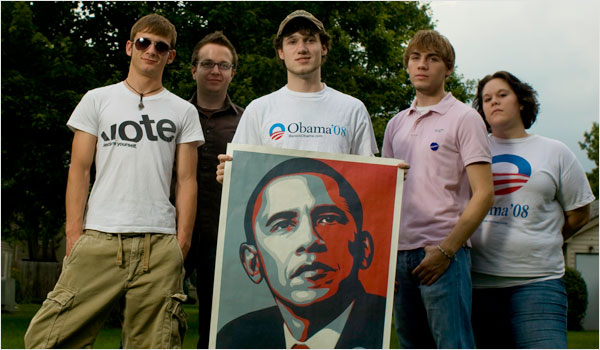
Obama volunteers from Columbus, Ohio, who have adopted the middle name Hussein include J. T. Marcum, left, Aaron Barclay, Alex Enderle, Norm Shoemaker and Chelsey McCune. They use the name on the Internet and in greeting one another. Photo by Kirk Irwin / The New York Times.

Obama Supporters Take His Name as Their Own
By Jodi Kantor / June 29, 2008

Emily Nordling has never met a Muslim, at least not to her knowledge. But this spring, Ms. Nordling, a 19-year-old student from Fort Thomas, Ky., gave herself a new middle name on Facebook.com, mimicking her boyfriend and shocking her father.

“Emily Hussein Nordling,” her entry now reads.

With her decision, she joined a growing band of supporters of Senator Barack Obama, the presumptive Democratic presidential nominee, who are expressing solidarity with him by informally adopting his middle name.

The result is a group of unlikely-sounding Husseins: Jewish and Catholic, Hispanic and Asian and Italian-American, from Jaime Hussein Alvarez of Washington, D.C., to Kelly Hussein Crowley of Norman, Okla., to Sarah Beth Hussein Frumkin of Chicago.

Jeff Strabone of Brooklyn now signs credit card receipts with his newly assumed middle name, while Dan O’Maley of Washington, D.C., jiggered his e-mail account so his name would appear as “D. Hussein O’Maley.” Alex Enderle made the switch online along with several other Obama volunteers from Columbus, Ohio, and now friends greet him that way in person, too.

Mr. Obama is a Christian, not a Muslim. Hussein is a family name inherited from a Kenyan father he barely knew, who was born a Muslim and died an atheist. But the name has become a political liability. Some critics on cable television talk shows dwell on it, while others, on blogs or in e-mail messages, use it to falsely assert that Mr. Obama is a Muslim or, more fantastically, a terrorist.

“I am sick of Republicans pronouncing Barack Obama’s name like it was some sort of cuss word,” Mr. Strabone wrote in a manifesto titled “We Are All Hussein” that he posted on his own blog and on dailykos.com.

So like the residents of Billings, Mont., who reacted to a series of anti-Semitic incidents in 1993 with a townwide display of menorahs in their front windows, these supporters are brandishing the name themselves.

“My name is such a vanilla, white-girl American name,” said Ashley Holmes of Indianapolis, who changed her name online “to show how little meaning ‘Hussein’ really has.”

The movement is hardly a mass one, and it has taken place mostly online, the digital equivalent of wearing a button with a clever, attention-getting message. A search revealed hundreds of participants across the country, along with a YouTube video and bumper stickers promoting the idea. Legally changing names is too much hassle, participants say, so they use “Hussein” on Facebook and in blog posts and comments on sites like nytimes.com, dailykos.com and mybarackobama.com, the campaign’s networking site.

New Husseins began to crop up online as far back as last fall. But more joined up in February after a conservative radio host, Bill Cunningham, used Mr. Obama’s middle name three times and disparaged him while introducing Senator John McCain, the presumptive Republican nominee, at a campaign rally. (Mr. McCain repudiated Mr. Cunningham’s comments).

The practice has been proliferating ever since. In interviews, several Obama supporters said they dreamed up the idea on their own, with no input from the campaign and little knowledge that others shared their thought.

Some said they were inspired by movies, including “Spartacus,” the 1960 epic about a Roman slave whose peers protect him by calling out “I am Spartacus!” to Roman soldiers, and “In and Out,” a 1997 comedy about a gay high school teacher whose students protest his firing by proclaiming that they are all gay as well.

“It’s one of those things that just takes off, because everybody got it right away,” said Stephanie Miller, a left-leaning comedian who blurted out the idea one day during a broadcast of her syndicated radio talk show and repeated it on CNN.

Ms. Miller and her fellow new Husseins are embracing the traditionally Muslim name even as the Obama campaign shies away from Muslim associations. Campaign workers ushered two women in head scarves out of a camera’s range at a rally this month in Detroit. (The campaign has apologized.) Aides canceled a December appearance on behalf of Mr. Obama by Representative Keith Ellison, a Minnesota Democrat and the first Muslim congressman.

Mr. Obama may be more enthusiastic, judging from his response at a Chicago fund-raiser two weeks ago. When he saw that Richard Fizdale, a longtime contributor, wore “Hussein” on his name tag, Mr. Obama broke into a huge grin, Mr. Fizdale said.

“The theory was, we’re all Hussein,” Mr. Obama said to the crowd later, explaining Mr. Fizdale’s gesture.

Some Obama supporters say they were moved to action because of what their own friends, neighbors and relatives were saying about their candidate. Mark Elrod, a political science professor at Harding University in Searcy, Ark., is organizing students and friends to declare their Husseinhood on Facebook on Aug. 4, Mr. Obama’s birthday.

Ms. Nordling changed her name after volunteering for Mr. Obama before the Kentucky primary.

“People would not listen to what you were saying on the phone or on their doorstep because they thought he was Muslim,” she said.

Ms. Nordling’s uncle liked the idea so much that he joined the same Facebook group that she had. But when her father saw her new online moniker, he was incredulous.

“He actually thought I was going to convert to Islam,” Ms. Nordling said.

Source. / New York Times

Thanks to Carl Davidson / The Rag Blog

Posted in RagBlog | Tagged , , , , , | Leave a comment

Quote of the Day – the American Dream

“The reason they call it the American Dream is because you have to be asleep to believe it.”

George Carlin, 1937 – 2008.

Posted in RagBlog | Tagged , | Leave a comment

Only Exceptional People Resist Atrocity


Welcome Home, Soldier: Now Shut Up
By Paul Rockwell

There are two kinds of courage in war – physical courage and moral courage. Physical courage is very common on the battlefield. Men and women on both sides risk their lives, place their own bodies in harm’s way. Moral courage, however, is quite rare. According to Chris Hedges, the brilliant New York Times war correspondent who survived wars in Latin America, Africa, the Middle East and the Balkans, “I rarely saw moral courage. Moral courage is harder. It requires the bearer to walk away from the warm embrace of comradeship and denounce the myth of war as a fraud, to name it as an enterprise of death and immorality, to condemn himself, and those around him, as killers. It requires the bearer to become an outcast. There are times when taking a moral stance, perhaps the highest form of patriotism, means facing down the community, even the nation.”

More and more U.S. soldiers and Marines, at great cost to their own careers and reputations, are speaking publicly about U.S. atrocities in Iraq, even about the cowardice of their own commanders, who send youth into atrocity-producing situations only to hide from the consequences of their own orders. In 2007, two brilliant war memoirs – ROAD FROM AR RAMADI by Staff Sergeant Camilo Mejia, and THE SUTRAS OF ABU GHRAIB by Army Reservist Aidan Delgado – appeared in print. In March 2008, at the Winter Soldier investigation just outside Washington D.C., hard-core U.S. Iraqi veterans, some shaking at the podium, some in tears, unburdened their souls. Jon Michael Turner described the horrific incident in which, on April 28, 2008, he shot an Iraqi boy in front of his father. His commanding officer congratulated him for “the kill.” To a stunned audience, Turner presented a photo of the boy’s skull, and said: “I am sorry for the hate and destruction I have inflicted on innocent people.”

The Winter Soldier investigation was followed by the publication of COLLATERAL DAMAGE: AMERICA’S WAR AGAINST IRAQI CIVILIANS, by Chris Hedges and Laila Al-Arian. Based on hundreds of hours of taped interviews with Iraqi combat veterans, this pioneering work on the catastrophe in Iraq includes the largest number of eyewitness accounts from U.S. military personnel on record.

The Courage to Resist

We cannot understand the psychological and moral significance of military resistance unless we recognize the social forces that stifle conscience and human individuality in military life. Gwen Dyer, historian of war, writes that ordinarily, “Men will kill under compulsion. Men will do almost anything if they know it is expected of them and they are under strong social pressure to comply.” “Only exceptional people resist atrocity,” writes psychiatrist Robert Lifton.

How much easier it is to surrender to the will of superiors, to merge into the anonymity of the group. It takes uncommon courage to resist military powers of intimidation, peer pressure, and the atmosphere of racism and hate that drives all imperial wars.

Silencing the Witnesses to War

War crimes are collective in nature. Especially in wars based on fraud, soldiers are expected to lie – to their country, to their community, even to themselves. The silencing process begins on the battlefield in the presence of officers, power-holders who seek to nullify the perceptions and personal experience of troops under their command.

In his war memoir, Aidan Delgado describes attempts of his commanders to suppress the truth about Abu Ghraib. First his captain says the Army has nothing to hide, Abu Ghraib is just a rumor. But then the captain continues: “We don’t need to air our dirty laundry in public. If you have photos that you’re not supposed to have, get rid of them. Don’t talk about this to anyone, don’t write about it to anyone back home.” In the U.S. military, the truth is seditious.
Two years ago, Marine Sergeant Jimmy Massey published his riveting autobiography (written with Natasha Saulnier) in France and Spain. How the Marine Corps – through indoctrination and intimidation – transforms a homeboy from the Smoky Mountains of North Carolina into a professional killer who murders “innocent people for his government” is the subject of Massey’s unsettling, impassioned, Jar-head raunchy, and ultimately uplifting memoir, COWBOYS FROM HELL. (No U.S. publisher has picked up the book. A Marine who speaks truth to power is not without honor save in his own country.) In Chapter 18, Jimmy describes a seemingly minor encounter with his captain. Here Massey gives us a look into the process of human denial in its early phase.

Massey has just participated in a checkpoint massacre of civilians. His sense of decency, his sanity, is still in tact. Like any normal human being, he is distraught. The carnage of the war, the imbalance of power between the biggest war machine in history and a suffering people devoid of tanks and air power – the sheer injustice of it all – begins to take its toll on Massey’s conscience.

In the wake of the horrific events of the day, his captain is cool. He walks up to Massey and asks; “Are you doing all right, Staff Sergeant?” Massey responds: “No, sir. I am not doing O.K. Today was a bad day. We killed a lot of innocent civilians.”

Fully of aware of the civilian carnage, his captain asserts: “No, today was a good day.”

Relatives wailing, cars destroyed, blood all over the ground, Marines celebrating, civilians dead, and “it was good day”!

The Massey incident goes beyond the mendacity of military life. It concerns the control, the dehumanization of the psyches of our troops.

As one Vietnam veteran put it years ago: “They kept fucking with my mind.”

In 1994 Jonathan Shay, staff psychiatrist in the Department of Veterans Affairs, published a pioneering work on post traumatic stress – Achilles in Vietnam: Combat Trauma and the Undoing of Character. According to Shay, who recorded volumes of testimony from Vietnam veterans, commanders routinely try to efface the perceptions and the normal feelings of compassion among American troops. Military necessity, including the ever-present need for political propaganda, determines what is perceived, and how it is perceived, in war.

It was an extremely common experience in Vietnam, Shay writes, to be told by military superiors dealing with crime and trauma: “You didn’t experience it, it never happened, and you don’t know what you know.” And it was fairly common for traumatized soldiers to say to reporters: “It didn’t happen. And besides, they had it coming.” Shay recorded the testimony of one veteran who, in great anger, describes the pressures to alter his perceptions of collective murder.

“Daylight came, and we found out we killed a lot of fishermen and kids…You said to the team, ‘Don’t worry about it. Everything’s fucking fine.’ Because that’s what we were getting from upstairs. The fucking colonel says, ‘Don’t worry about it. We’ll take care of it. We got body count.’ They’d be handing out fucking medals for killing civilians. So in your mind you’re saying, ‘Ah, fuck it, they’re just gooks.’ I was sick over it, after this happened. I actually puked my guts out…But see, it’s all explained to you by captains and colonels and majors. ‘Fuck it, they was suspects anyways. You guys did a great job. Erase it. It’s yesterday’s fucking news.’”

Willful Ignorance at Home

The collective process of denial on the battlefield eventually extends to the homeland. Returning soldiers, to be sure, are often honored, but only so long as they remain silent about the realities, the pathos, the absurd evils of war. Willful public ignorance is a source of pain for veterans.

Ernest Hemingway’s brilliant short story, Soldier’s Home, published in 1925 after World War I, gives us insight into the reluctance of civilians to address the psychic needs of soldiers back from war.

The simply told story is about a young man named Krebs who returns to his home in Oklahoma. At first Krebs does not want to talk about the war. But soon he feels the need to speak – to his family, his neighbors and friends. But as Hemingway tells us, “Nobody wanted to hear about it.” His town did not want to learn about atrocities, and “Krebs found that to be listened to at all he had to lie.”

There’s the rub. His ability to assimilate into civilian life depended on his willingness to fabricate stories about the war. Soldiers are not only expected to lie on behalf of the military during the course of war, they are also expected to participate in homecoming rituals that preserve the civilian fantasy of war’s nobility.

In Hemingway’s story, the pressure to lie is so powerful, Krebs begins to manufacture stories about his experiences in battle – just to get along, just be able to lead a normal life.

Repression, however, is a major cause of mental illness and loneliness. Krebs morale deteriorates. He sleeps late in bed. He loses interest in work. He withdraws into himself.

That’s all Hemingway tells us. It’s a quietly told story, all the more powerful for its understatement.

There is a connection between Hemingway’s war-informed fiction and real life. As Shay notes, there is a tension between a soldier’s need to communalize shame and grief and the unwillingness of civilians to listen to troops whom they sent into battle. One Vietnam veteran told the following story:

“I had just come back from Vietnam and my first wife’s parents gave a dinner for me and my parents and her brothers and their wives. And after dinner we were all sitting in the living room and her father said: ‘So, tell us what it was like.’ And I started to tell them, and I told them. And do you know that within five minutes the room was empty. They were all gone, except my wife. After that I didn’t tell anybody what I had seen in Vietnam.”

Welcome home, soldier. Now shut up.

Notwithstanding clichés and pieties about support for troops, those who promote war are often the least likely to share the burdens and memories of war when soldiers return. When Ron Kovic, who was paralyzed from the chest down during the war in Vietnam, steered his wheelchair down the aisle of the Republican National Convention in 1972, the delegates spat on him and cheered for Nixon – “Four more years.”

W.D. Erhart, Vietnam veteran and author of Passing Time, never forgot the horrific episodes of his tour in Vietnam. In his first autobiography, he tells a friend about his speech at a Rotary Club. “I even put on a coat and tie and went to the Rotary Club. The Rotary Club, for chrissake. I laid it all out for ‘em. I told ‘em about search and destroy missions, harassment and interdiction fire, winning hearts and minds, all that stuff…Was I ever sharp that day.

“Now listen. You won’t believe this. I got done and nobody said a word. No applause. Nothing. Then this skinny old fart shaped like a cold chisel gets up and says he’s a retired colonel, and he thinks we should keep on pounding those little yellow bastards until they do what we say or we kill ‘em all, and he tells me I can’t be a real veteran because a real veteran wouldn’t go around badmouthing the good old U.S. of A., and the whole place erupts in thunderous applause.”

Welcome home, soldier. Now shut up.

Today Georgia Stillwell is a mother of a 21-year-old Iraqi war veteran. Her son is now homeless, unemployed, and despondent. Early one morning he drove his car over an embankment. She says that her son is a mere physical shell of himself. “My son’s spirit and soul must still be wandering the streets of Iraq.” It is not simply what happened in Iraq, but how veterans are treated at home when they seek to unburden their souls, that reinforces post-traumatic stress. On the night he drove the car off the road, he was crying, talking about the war. “His friends tell me he talks about the war. They describe it as ‘crazy talk.’ He wants the blood of the Iraqis he killed off his hands.”

“Each generation,” writes Chris Hedges, “discovers its own disillusionment, often at a terrible price. And the war in Iraq has begun to produce legions of the lost and the damned.” For our morally courageous veterans – for all of us, really, who seek forgiveness – only the truth can heal.

BlackCommentator.com Guest Commentator, Paul Rockwell, is a writer living in the Bay Area. He is also a columnist for In Motion Magazine. Click here to reach Mr. Rockwell.

Source / Black Commentator

The Rag Blog

Posted in RagBlog | Tagged , , , | Leave a comment

Sex Slavery Crackdown in Houston

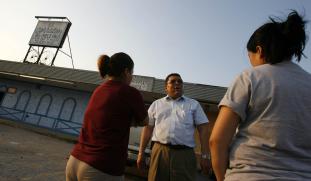
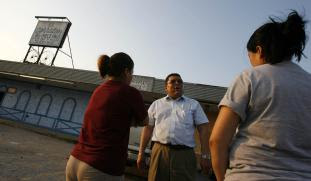
Jose Benitez, a Houston labor organizer, talks with two women who were victims of sex trafficking outside El Corralon del Chele Paco, a Houston bar targeted in the past for such trafficking. Photo by Sharon Steinmann / Houston Chronicle.

120 women rescued from grim conditions
By Lise Olsen / June 29, 2008

The farewell party was in full swing at midnight when police came for Maximino “El Chimino” Mondragon, his accomplices and his victims — scantily dressed women and girls he forced to sell beers and sexual favors under the flashing lights of a revolving crystalline disco ball inside his strip mall bar off Hempstead Highway.

Mondragon was celebrating his retirement at El Potrero de Chimino bar, also known as the Wagon Wheel. He had a one-way ticket back to his native El Salvador and blueprints in the bar for a brand-new hotel back home.

Then uninvited guests arrived.

Pickups packed the parking lots at five related bars and restaurants in northwest Houston, as more than 100 officers from federal, state and local agencies rushed in the night of Nov. 13, 2005.

Interviews with the arresting agents and documents recently obtained by the Houston Chronicle provide the first detailed account on how one of the nation’s largest sex trafficking rings was dismantled in Houston — considered both a center of operations and transit point for international sex and labor traffickers.

Task force members — including Immigration and Customs Enforcement, the FBI, the Harris County Sheriff’s Office and the Texas Alcoholic Beverage Commission — had expected to find 50 or 60 women. Eventually, they rescued about 120 victims.

In interviews, victims told agents they had been forced to work six or seven nights a week and to allow men to buy them overpriced drinks in exchange for their company or for sexual favors.

The main targets were the lead cantina owner, Mondragon; head smuggler, Walter Corea; as well as their relatives and wives. Corea was sentenced in May to 15 years; Mondragon’s sentencing, the last, is set for Sept. 22. Faced with reams of evidence, seven have pleaded guilty.

To the members of the then-nearly new Human Trafficking Rescue Alliance, the mass arrests and rescues represented a significant enforcement victory.

The size of the Mondragon ring, as well as others dismantled elsewhere, convinced law enforcement authorities that the problem of forced labor in the U.S. is likely much larger than anyone anticipated and continues to proliferate in Houston.

For years, the ring preyed on women and girls from Honduras, El Salvador, Nicaragua and Guatemala, illegally bringing them to Houston with false promises of legitimate work and then forcing them to work in cantinas to pay off smuggling fees from $8,000 to $15,000 — as well as all living expenses, according to court records and interviews with investigators.

The FBI named the case for them: “Bar Belles.”

Mondragon had run businesses in Houston for at least a decade, according to records and interviews with police and a labor activist who helped rescue cantina workers.

In his bars, agents from the TABC found detailed ledgers and notebooks showing how victims had been billed for everything they ate and drank, for their rent, for their clothes, for their transport to the U.S. and for shipping money back home.

‘Thought he was the devil’

To control them, Mondragon kept “intelligence” on each one — the names of their mothers, brothers and children and locations of their homes and schools. Records show victims said he threatened to kill relatives or burn down family homes if they did not cooperate.

“They were scared to death of him. … They thought he was the devil,” said Sgt. Michael Barnett of the Texas Alcoholic Beverage Commission’s enforcement division in Houston.

In that strictly monitored world, male traffickers and their female “handlers” controlled victims’ clothing, their bodies, their money and nearly their every move, according to interviews and court records.

“I had to do everything that they said — they had a camera outside my apartment that recorded everything,” one victim told the Chronicle.

Another former bar belle, working when the raid began at Mondragon’s party, fled through a back door, only to be illuminated by a helicopter spotlight and grabbed by a federal agent. She felt terrified yet relieved to have escaped.

“I said, ‘Thank you God!’ “

Over the years, Mondragon ran at least three seemingly normal looking bars and restaurants in northwest Houston. Mondragon and two of his brothers, both convicted as co-conspirators, lived legally in the U.S. Mondragon and his brother Oscar were both legal permanent residents. Their half brother, Victor Omar Lopez, was a naturalized U.S. citizen.

But Mondragon worked closely with lead smuggler Corea, a convicted felon and illegal immigrant who conspired to bring women to Houston from Central America and then used them as slaves.

Both Corea and Mondragon were self-made Salvadoran ricos, rich guys, who owned hotels and restaurants back home in San Miguel, the nation’s third-largest city, federal investigators said.

Corea used his Salvadoran businesses as recruiting sites for victims, agents and victims said. He also oversaw an unusually large network of smugglers and safe houses in Honduras, Guatemala and Mexico, according to an interview with Tom Annello, an ICE unit chief and smuggling expert whose work was key to the case.

Patrons often saw Mondragon dance with the girls he kept as virtual prisoners in his clubs, according to Jose Benitez, a Houston labor organizer who tried to help the women after he met them and realized that they were being abused.

Beatings, forced abortions and prostitution took place behind closed doors or in adjacent buildings, houses and apartments, court records show. Aborted fetuses were buried or thrown down a drainage hole into the city sewer system, women told police.

Victims got little money

Several of the ring’s cantinas had long been under suspicion by agents from the FBI and the TABC. TABC investigators repeatedly had investigated the businesses for allegations of prostitution, underage drinking and phony ownership, records show. TABC and other investigators believed the group used presta nombres — borrowed names from others — to run their places and to hide their assets or launder money.

In one undercover operation, agents used a snitch to buy two female victims that they wanted to rescue. They paid $11,000, according to a police report. Victor Omar Lopez, Mondragon’s half-brother who is now in federal prison, even offered a guarantee: He promised that if the girls escaped, he would have one of his associates hunt them down — or give them new girls.

Unbeknownst to the other agencies, ICE had simultaneously been investigating the smuggling ring run by Corea.

“Once we determined we were investigating the same targets, we proceeded working a joint investigation,” Annello said. After that, it took about a year to collect the evidence needed for mass arrests.

The operation was set for early 2006.

Then on Nov. 12, 2005, the lead ICE agent learned that Mondragon and his brother Oscar had obtained one-way tickets to San Salvador, a police report shows. The raid had to happen within hours or the targets would be gone. She called Assistant U.S. Attorney Ruben Perez and other task force agents, most of whom were off duty or out of town.

That weekend, they got the necessary arrest and search warrants for the raids on three cantinas, two restaurants and two houses.

On Sunday near midnight, the traffickers were taken down. Corea, a convicted felon and illegal immigrant, was thrown down to the floor, handcuffed and taken away, a witness said. Watching was his 19-year-old son — a U.S. citizen — who was later convicted for his part in the smuggling operation.

A special ICE tactical team went in after Mondragon. His brothers, sister-in-law and girlfriend were arrested, too.

Inside their bars, agents found more than $29,000 in cash and 98 women, some as young as 16, who had been forced to repeatedly sell their time — and allow men to touch them inside the bar — for about $15 per drink, records show.

Some victims were forced to consume as many as 20 so-called “pony beers” a night to fulfill the traffickers’ quotas, according to case documents and interviews. Traffickers also sold a few women for prostitution that took place at nearby houses and apartments, court documents said. The women got almost none of the money.

Later, agents found an additional 20 victims.

Rounded up with them was the ring’s abortionist, Lorenza Nunez-Reyes, known as “La Comadre.” One of her “patients” had dressed and taken photos of a nearly fully developed 5-month-old fetus apparently delivered dead during one of her illicit operations. Nunez-Reyes eventually pleaded to lesser charges and was deported to Honduras.

Corea’s son has been released on probation.

The rest of the ring members, however, got jail time.

The night’s results, as well as arrests of other exploitive employers and pimps before and since, catapulted members of the Human Trafficking Rescue Alliance — formed in August 2004 — into minor celebrities.

In a few hours, competitive agents working together for the first time as an experimental anti-human trafficking task force took down a powerful multinational ring that labored to dominate its victims and leave a scant paper trail.

Propelled by federal grants and pushed by President Bush, other task forces have sprung up in 29 places nationwide.

Still trying to recover

Houston’s task force is considered a national leader, in large part because of the partnerships forged between victim advocates and investigators.

“What’s unique … is the bridge we have built,” said Edward F. Gallagher, the senior assistant U.S. attorney in Houston who serves as task force coordinator.

Today, most of the women rescued in the Mondragon case apparently still live in Houston, though only a few dozen appear to have obtained special visas that were created for victims under new federal anti-trafficking laws.

Three interviewed for this story said they feel safer but still struggle to recover. None remains eligible for federal assistance initially available to trafficking victims. Some depend on support from boyfriends or husbands; others eke out a living cleaning houses or doing other odd jobs.

“We don’t know even where to go,” one said.

Copyright 2008 Houston Chronicle

Source. / Houston Chronicle

The Rag Blog

Posted in RagBlog | Tagged , , , , , | 1 Comment

Frank Rich : Scaring Up the Vote

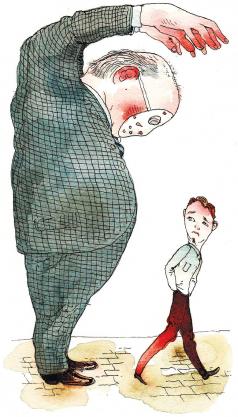
Illustration by Barry Blitt / The New York Times.

If Terrorists Rock the Vote in 2008
By Frank Rich / June 29, 2008

Don’t fault Charles Black, the John McCain adviser, for publicly stating his honest belief that a domestic terrorist attack would be ‘a big advantage’ for their campaign and that Benazir Bhutto’s assassination had ‘helped’ Mr. McCain win the New Hampshire primary. His real sin is that he didn’t come completely clean on his strategic thinking.

In private, he is surely gaming this out further, George Carlin-style. What would be the optimum timing, from the campaign’s perspective, for this terrorist attack – before or after the convention? Would the attack be most useful if it took place in a red state, blue state or swing state? How much would it ‘help’ if the next assassinated foreign leader had a higher name recognition in American households than Benazir Bhutto?

Unlike Hillary Clinton’s rumination about the Bobby Kennedy assassination or Barack Obama’s soliloquy about voters clinging to guns and faith, Mr. Black’s remarks were not an improvisational mishap. He gave his quotes on the record to Fortune magazine. He did so without thinking twice because he was merely saying what much of Washington believes. Terrorism is the one major issue where Mr. McCain soundly vanquishes his Democratic opponent in the polls. Since 2002, it’s been a Beltway axiom akin to E=mc2 that Bomb in American City=G.O.P. Landslide.

That equation was the creation of Karl Rove. Among the only durable legacies of the Bush presidency are the twin fears that Mr. Rove relentlessly pushed on his client’s behalf: fear of terrorism and fear of gays. But these pillars are disintegrating too. They’re propped up mainly by political operatives like Mr. Black and their journalistic camp followers – the last Washington insiders who are still in Mr. Rove’s sway and are still refighting the last political war.

That the old Rove mojo still commands any respect is rather amazing given how blindsided he was by 2006. Two weeks before that year’s midterms, he condescendingly lectured an NPR interviewer about how he devoured ’68 polls a week’ – not a mere 67, mind you – and predicted unequivocally that Election Day would yield ‘a Republican Senate and a Republican House.’ These nights you can still find Mr. Rove hawking his numbers as he peddles similar G.O.P. happy talk to credulous bloviators at Fox News.

But let’s put ourselves in Mr. Black’s shoes and try out the Rove playbook at home – though not in front of the children – by thinking the unthinkable. If a terrorist bomb did detonate in an American city before Election Day, would that automatically be to the Republican ticket’s benefit?

Not necessarily. Some might instead ask why the Bush White House didn’t replace Michael Chertoff as secretary of homeland security after a House report condemned his bungling of Katrina. The man didn’t know what was happening in the New Orleans Convention Center even when it was broadcast on national television.

Next, voters might take a hard look at the antiterrorism warriors of the McCain campaign (and of a potential McCain administration). This is the band of advisers and surrogates that surfaced to attack Mr. Obama two weeks ago for being ‘naïve’ and ‘delusional’ and guilty of a ‘Sept. 10th mind-set’ after he had the gall to agree with the Supreme Court decision on Gitmo detainees. The McCain team’s track record is hardly sterling. It might make America more vulnerable to terrorist attack, not less, were it in power.

Take – please! – the McCain foreign policy adviser, Randy Scheunemann. He was the executive director of the so-called Committee for the Liberation of Iraq, formed in 2002 (with Mr. McCain on board) to gin up the war that diverted American resources from fighting those who attacked us on 9/11 to invading a nation that did not. Thanks to that strategic blunder, a 2008 Qaeda attack could well originate from Pakistan or Afghanistan, where Osama bin Laden’s progeny, liberated by our liberation of Iraq, have been regrouping ever since. On Friday the Pentagon declared that the Taliban has once more ‘coalesced into a resilient insurgency.’ Attacks in eastern Afghanistan are up 40 percent from this time last year, according to the American commander of NATO forces in the region.

Another dubious McCain terror expert is the former C.I.A. director James Woolsey. He (like Charles Black) was a cheerleader for Ahmad Chalabi, the exiled Iraqi leader who helped promote phony Iraqi W.M.D. intelligence in 2002 and who is persona non grata to American officials in Iraq today because of his ties to Iran. Mr. Woolsey, who accuses Mr. Obama of harboring ‘extremely dangerous’ views on terrorism, has demonstrated his own expertise by supporting crackpot theories linking Iraq to the 1995 Oklahoma City bombing and 1993 World Trade Center bombing. On 9/11 and 9/12 he circulated on the three major networks to float the idea that Saddam rather than bin Laden might have ordered the attacks.

Then there is the McCain camp’s star fearmonger, Rudy Giuliani, who has lately taken to railing about Mr. Obama’s supposed failure to learn the lessons of the first twin towers bombing. The lesson America’s Mayor took away from that 1993 attack was to insist that New York City’s emergency command center be located in the World Trade Center. No less an authority than John Lehman, a 9/11 commission member who also serves on the McCain team, has mocked New York’s pre-9/11 emergency plans as ‘not worthy of the Boy Scouts.’

If there’s another 9/11, it’s hard to argue that this gang could have prevented it. At least Mr. Obama, however limited his experience, has called for America to act on actionable terrorist intelligence in Pakistan if Pervez Musharraf won’t. Mr. McCain angrily disagreed with that idea. The relatively passive Pakistan policy he offers instead could well come back to haunt him if a new 9/11 is launched from the Pakistan-Afghanistan border.

Should there be no new terrorist attack, the McCain camp’s efforts to play the old Rove 9/11 fear card may quickly become as laughable as the Giuliani presidential campaign. These days Americans are more frightened of losing their jobs, homes and savings.

But you can’t blame the McCain campaign for clinging to terrorism as a political crutch. The other Rove fear card is even more tattered. In the wake of Larry Craig and Mark Foley, it’s a double-edged sword for the G.O.P. to trot out gay blades cavorting in pride parades in homosexual-panic ads.

Some on the right still hold out hope otherwise. After the California Supreme Court’s decision on same-sex marriage, The Weekly Standard suggested that a brewing backlash could put that state’s ‘electoral votes in play.’ But few others believe so, including the state’s Republican governor, Arnold Schwarzenegger, who has vowed to enforce the law and opposes a ballot initiative to overturn it. Even Bill O’Reilly recently chastised a family-values advocate for mounting politically ineffectual arguments against same-sex marriage.

Mr. McCain is trying to swing both ways. While he no longer refers to the aging old-guard cranks of the religious right as ‘agents of intolerance,’ his actions, starting with his tardy disowning of the endorsement he sought from the intolerant Rev. John Hagee, sometimes speak as loudly as his past words.

The Ohio operative behind that state’s 2004 anti-same-sex marriage campaign was so alienated by Mr. McCain’s emissaries this year that he told The Los Angeles Times, ‘He doesn’t want to associate with us, and we don’t want to associate with him.’ Mr. McCain instead associated himself with Ellen DeGeneres. He visited her talk show to extend his good wishes for her forthcoming California nuptials while seeming almost chagrined to admit his opposition to same-sex marriage, a stand he shares with Mr. Obama. Since then, Mr. McCain has met with the gay Log Cabin Republicans.

He and Mr. Obama also share the antipathy of James Dobson, the Focus on the Family fulminator so avidly courted by the Bush White House. Perhaps best remembered for linking the cartoon character SquareBob SpongePants to a ‘pro-homosexual video,’ Mr. Dobson last week used the word ‘fruitcake’ in a rant against Mr. Obama. He has been nearly as dyspeptic, if not quite as ‘fruit’-fixated, about Mr. McCain.

Mr. Dobson’s embarrassing lashing out is the last gasp of an era. His dying breed of family-values scold is giving way to a new and independent generation of evangelical leaders (and voters) who don’t march to the partisan beat of Mr. Rove or his one-time ally, the disgraced Ralph Reed. Perhaps in belated recognition of this reality, Mr. Rove has been busy lately developing a new fear card for 2008 – fear of the Obamas.

Its racial undertones are naked enough. Earlier this year, Mr. Rove wrote that Mr. Obama was ‘often lazy,’ and that his ‘trash talking’ during a debate was ‘an unattractive carry-over from his days playing pickup basketball at Harvard.’ Last week Mr. Rove caricatured him as the elitist ‘guy at the country club with the beautiful date.’ Provocative as it is to inject Mr. Obama into a setting historically associated with white Republicans, the invocation of that ‘beautiful date’ is even more so. Where’s his beautiful wife? Mr. Rove’s suggestion that Mr. Obama might be a sexual freelancer, as an astute post at the Web site Talking Points Memo noted, could conjure up for a certain audience the image of ‘a white woman on his arm.’

But here, too, Mr. Rove reeks of the past. Should Mr. Black and Mr. McCain follow this ugly lead, I bet it will help them even less than the assassination of Benazir Bhutto.

Source. / New York Times / truthout

The Rag Blog

Posted in RagBlog | Tagged , , , , , , , , , | Leave a comment

For Your Information


Open Records and the Texas Public Information Act.
By nhudson35 / June 28, 2008

The following post on public information in Texas — what it is and how to get it — was published in the Burnt Orange Report. It is chock-full of useful stuff.

I got to sit in on a great meeting several months ago with Attorney Joe Larsen, a Freedom of Information Act of Texas Board Member who has worked on open records cases. Mr. Larsen gave us some and useful information on the Texas Public Information Act. For more information on Open Records Requests, I recommend going to the Freedom of Information Foundation of Texas website here.

Here are some rough notes from the meeting. I am not a lawyer, and this is not legal advice.

What is public information?

Public information is information created, assembled, or maintained by or on behalf of a governmental body, or in transaction of governmental business. Public information may be kept on behalf of a governmental body, and it may extend to the hand of a vendor who maintains a governmental body’s records. A governmental body may delegate responsibility of recordkeeping to an outside body.

You can request public information in any format, but a governmental body does not have to create new information for you.
In a previous age, notes were not public information. Today, most notes created, assembled, or maintained by or on behalf of a governmental body, or in transaction of governmental business, are considered public information.

Emails from a governmental body are generally considered public information, but the Texas Attorney General’s opinions have not kept up with technology. The Attorney General has ruled that emails dealing with personal activities are not public information.

Governor Perry’s office has taken advantage of the Attorney General’s ruling, and open government advocates are upset about it. Perry’s office has a procedure where his and his staffer’s emails are destroyed after seven days. The seven-day period is arbitrary, and it is much shorter than the one to three year period required by law for paper correspondence. Dallas Morning News reported earlier this month:

Since this issue arose last year, the governor’s office has maintained that staffers may delete e-mail from in boxes, but messages dealing with government business is printed and filed.

But government transparency advocates worry that some information may slip through the cracks.

“There’s simply no way that all the e-mails are being printed and filed,” Mr. Larsen said. “In addition to your daily work activity, you have to make sure you’re printing out your emails so that it doesn’t get deleted.”

Rick Perry’s contention that he is printing emails to conform to FOIA requirements seems to be a crock of you-know-what. Public information retention requirements shouldn’t change because the information is kept in different mediums. A policy of deleting emails every seven days will inevitably destroy public information.

Retention requirements depend, instead, upon subject matter. State Libraries, which are charged with retention, have different retention policies for different subject matters. State Libraries have never had a policy that requires them to purge their shelves or electronic files after seven days.

What is a governmental body?

Governmental bodies are specifically defined in theTexas Public Information Act.

Some important notes:

Governmental bodies include DAs, school districts, and any entity supported all or in part by public funds.

The Judiciary is not included.

Case files are subject to common law access and first amendment right access, and you can access case files using Rule 12 of the Texas Rules of Judicial Administration’s

The fact that you receive public funds does not necessarily mean you are subject to public information act. If, however, the Austin Chamber of Commerce gets a grant for their operations, that’s not a quid pro quo. It’s a general grant, and because many chambers of commerce take such grants, they have been found to be governmental bodies.

As a general rule, if a group has a contract with a governmental body, you should assess the relationship and argue that the information the body has should be made public.

Once a governmental body always a governmental body?
No. A group or organization with multiple divisions may have some aspects of their operations subject to FOIA requests, while other operations are not.

Who can request information?

Anyone. And the governmental body may not ask what it is for. You have a right to access the information, and you can be an agent of undisclosed principle.

How do you make a request?

You must put it in writing. Above and beyond that, not much is necessary. Generally, all you must do is mail it to the governmental body. If, however, you make it via email or fax, you should make that request directly to the public information officer. Most entities have a designated public information officer, and you can usually find his or her contact information at the governmental body’s website. It is a good idea to call the public information officer of the governmental body to make sure you’re communicating with the right person.

How do you write it?

Ask specifically for what you’re looking for. Make requests as narrow as you can, consistent with what you’re looking for. This costs less, and is easier to brief for the Attorney General. Be as eloquent and polite as possible. Sidebar snooty comments are not appropriate. Deal professionally with governmental bodies even if they don’t deal professionally with you.

The process

Once a governmental body receives a public information act request, it has ten days to request an Attorney General ruling. In order to withhold the information from the requesting body, the governmental body must show that the requested information falls within an area exception.

A governmental body does not have ten days to turn over the information you’ve requested. The governmental body is required by law to get the information to you promptly. Promptly means as quickly as reasonably possible, and in many cases it may be on the very same day.

If the Governmental Body Claims the requested information falls within a FOIA area of exception

If the governmental body requests a ruling from the Attorney General, they write him a letter. The governmental body must copy the requester when requesting and Attorney General ruling. As soon as possible, submit comments to the Attorney General’s office rebutting the governmental body’s claim that the information falls within an area of exception.

Ask for a copy of a 15 day brief from the Attorney General’s office, and submit comments rebutting the governmental body’s argument for excepting the information you’ve requested.

The Attorney General has 45 working days to issue his ruling, and his office rarely issues a ruling before 45 days. The earlier you get your comments to the Attorney General’s office, the better.

The Attorney General can rule in two ways. He can rule that the information falls within the area of exception, or that it does not. If the Attorney General’s office rules in the requester’s favor, the governmental body has two choices. It can turn over the information, or if the governmental body disagrees with the decision, it can sue the Attorney General.

More on the process

Take the high road. Don’t try anything sneaky.

Put everything in writing.

Develop a relationship with the public information officer you are dealing with.
If you don’t get a response from the Governmental Body, after reasonable attempts to contact them, get in touch with the Attorney General’s office. Style a letter formally as a complaint to the Attorney General, and carbon copy or send a copy of the letter to the governmental body.

There is not a deadline for the cost estimate. If they send you the documents, you don’t owe them a penny.

If they do not request and AG opinion within 10 days, the information is considered public.

A city will sometimes ask for an Attorney General ruling for a discreet part of a request. In instances like that, it may be easier to break down a request into separate requests.

Cost issues
If you have a dispute about the cost estimate, get in touch with the cost administrator at the Attorney General’s office.

Exceptions

Superpublic information
We can’t talk about exceptions without talking about “superpublic” information, which can be found in Chapter 552.022 of government code. Superpublic information is information that must be released, unless confidential by other law: Superpublic information includes budget information, information on vouchers, agency rules, and final reports (with the exception of law enforcement addressed below).

If the governmental body makes a third party settlement, confidentially, the amount of money in the settlement is superpublic information. Items on the list are superpublic, unless confidential by law. The difference between “confidential by law” and the other forms or confidentiality is that confidentiality by law is legally and mandatorily confidential. “Confidential by law” encompasses all confidential laws in Vernon’s Texas Civil Statutes. Examples of information that is confidential by law arein medical records and information a judge rules should be confidential. Information that is confidential by law can never be superpublic. Information submitted in open court cannot be considered confidential under the open records act, and confidentiality statutes must be interpreted narrowly.

Autopsy reports
Autopsy reports were, forever, expressly public. The Attorney General issued a ruling that Autopsy reports included Autopsy photographs. Some schmucks posted the photographs on the web, and an amendment was made to the criminal code of procedure intended to prohibit release of autopsy report photographs unless the individual was in police custody.

The Attorney General issued a ruling that effectively changed the law. Now, in almost all homicides, you cannot get autopsies. You can get the autopsy photographs for individuals in custody, but not the reports.

Law enforcement
You are entitled to basic information about law enforcement. This right has its origins in caselaw. In a Houston chronicle case in the 1970s, the law was revised to says basic information about an arrested person, a crime, and an officer must be released upon request

If you request and incident report from a law enforcement agency, you may be given a synopsis of an incident report. You are entitled to detailed information even if it isn’t on the front page of the incident report.

Personnel records exception. The Public information act does not reach anything that isn’t already covered by common law and constitutional privacy. Will get 95% of personnel files. You can get evaluations and an officer’s salary history.

If you wish to find out about an officer’s case, it must result in deferred adjudication or a conviction before it is public information. Investigations can go on ad infinitum.

The Attorney General is subject to the act. To the extent the Attorney General rules against law enforcement, he rules against himself.

Court Records
Not subject to public information. You need significant cause to seal or close off court records.

Source. / Burnt Orange Report

The Rag Blog

Posted in RagBlog | Tagged , , , , | Leave a comment

If you want to watch today’s vintage video, then just…

…Raise Your Hand

Janis Joplin and Tom Jones 1970

Somehow Tom Jones and Joplin together just gives me the willies but the backup dancers are worth the video. Besides, I think Tom is going to break a hip trying to keep up with her…

sgraham / Hippie Sounds.com.

The Rag Blog

Posted in RagBlog | Tagged , , , , , | Leave a comment

Alternative Media : Reporting From The Ground Up

INSP member paper Hecho en Buenos Aires, Argentina.

Grassroots journalism worldwide:
The power of the street paper

By Silja J.A. Talvi / June 28, 2008

This is how international grassroots journalism, by and for the people, can really look and feel. As for what it can accomplish? The proof is in the pudding, something I got a good taste of last week in Glasgow, Scotland, participating in the 13th annual conference of the International Network of Street Papers (INSP).

In our corporate-dominated media marketplace, an upstart, not-for-profit journalistic enterprise like the INSP is a rare breed indeed. The organization has been around since 1994, initially as the result of a collaborative effort on the part of five, Western European homeless (or “street”) papers. A fiery, opinionated bloke named John Bird founded one of those street papers, The Big Issue, in London. Many of Bird’s life experiences were marked by extreme poverty, as well as horrific experiences of abuse in orphanages, jails and prisons. Now a 62-year-old, Bird still serves as editor-in-chief, having lost neither his survivor’s edge nor his sense of outrage at the ease what he considers disempowering “handouts” to the poor.

The Big Issue has since gone on to become a household name in the United Kingdom—in fact, the paper’s incarnation in Scotland is now that nation’s best-selling weekly news and entertainment magazine. But the INSP hasn’t changed its tune where their central passion is concerned: constant dedication to self-sustaining, skill-building, advocacy journalism for the poor, disenfranchised, and homeless.
Although the INSP’s affiliate publications reach an estimated 32 million readers every year, the organization certainly can’t pretend to have the clout or circulation of, say, AOL-Time Warner or Rupert Murdoch’s fittingly named News Corporation. But those aren’t the arenas in which the INSP is trying to compete. Through their diverse network of more than 90 “street papers” (ranging from down-to-the-basics, black-and-white newspapers to photograph-chocked, full-color magazines), INSP’s member affiliates (with assistance from the integral Street News Service) are busy covering news, cultural and political terrain in 38 countries.

Class structure, poverty, housing, homelessness, the drug war, incarceration, infectious diseases, gang life, racial/ethnic/religious discrimination, police brutality, sex trafficking and prostitution are among frequently covered subjects. With all that in mind, the INSP has to know quite a bit about staying flexible, open-minded, and what it means to be mindful of cultural differences in reporting/reading styles. Yet, there’s no compromise to be made when it comes to the INSP’s mission to inform, enlighten, sustain, and uplift the very people who write for, sell and read their publications.

I went to Glasgow as a volunteer instructor on investigative journalism techniques (especially the more delicate or “controversial” approaches involved in gaining trust with highly marginalized populations), in addition to serving in the capacity as a judge for the INSP’s first-ever journalism awards’ ceremony. (Other editors came from the top rungs of Reuters, Inter Press Service, and Al Jazeera English.) Out of more than 125 entries, a handful of INSP winners were chosen in six categories, ranging from best investigative feature to best cover design.

The location chosen for ceremony, the grand halls of the Kelvingrove Art Gallery, could have easily formed the backdrop for a high-profile film festival. Some of those media-friendly trappings were there already: glasses of bubbly, elegant attire, tearful acceptance speeches, even the blare of musical interludes between awards. The attire, however, was as much traditional Scottish kilt as Ethiopian ceremonial tunic (and everything in between), while those tearful acceptance speeches weren’t about thanking God and the caterer for “making it happen.” Instead, they took the form of painful accounts relating to the imminent or early demise of beloved street paper vendors, whether due to infectious disease, mental illness, late-stage cancer or police murder. These awards were about celebrating success, yes, but they were just as much about addressing the everyday lives of the people writing stories and selling papers from Argentina to Zambia.

“Many of our delegates, partners and guests told me that the 13th Annual Conference of the INSP in Glasgow was the ‘best yet,’ as INSP Executive Director Lisa Maclean enthused after the gala. “There could be many reasons for this: the growing number of delegates (this was the largest INSP conference to date, with 96 delegates from 32 countries); the increased diversity of participants; or the growing representation from the Global South. But I also think that it was clear that the INSP team had listened to our members, providing particularly thoughtful forums for lively and interactive debate, with experts drawn from both the internal membership and external bodies. People really had the opportunity to exchange ideas and gain new ideas and inspiration to improve their local street paper projects.”

I came in to this year’s conference as an eager participant, with no previous experience with the INSP, and left an inspired reader and witness to what I consider to be one of the most moving developments in journalism in the last century. Having gained insight into what’s already been accomplished in the last 15 years, with nowhere near enough fanfare, I can only look forward to spreading the good word about the work ahead.

This is what independent, international grassroots journalism looks like. It isn’t just possible—it’s already happening, and it’s exciting, enduring and, dare I say, revolutionary for all parties concerned.

[Silja J.A. Talvi is an Advisory Board member of Seattle’s twice-monthly investigative street newspaper, Real Change, established in 1994. Real Change is a member of the INSP, and a core content provider for the Street News Service. She is a senior editor at In These Times, an investigative journalist and essayist with credits in dozens of newspapers and magazines nationwide.]

Source. / In These Times

The Austin Advocate is a member of the International Network of Street Papers (INSP).

The Rag Blog

Posted in RagBlog | Tagged , , , | Leave a comment

Draw!

Dario Castillejos / Imparcial de Oaxaca, Oaxaca, Mexico.

The Rag Blog / posted June 28, 2008

Posted in RagBlog | Tagged , , , , , | Leave a comment

Dems Just Love That "Big Bad John"

Ride ’em Corn Dog : Already a Classic

Cornyn video is campaign gold mine;
Race in virtual dead heat

By John Moritz / June 27, 2008

AUSTIN — The sight of U.S. Sen. John Cornyn wearing cowboy threads while an ol’ boy with a Lone Star twang sings his praise was designed to fire up his party’s base.

There was only one hitch in Cornyn’s get-along: The wrong party got fired up.

Turns out the video bio of Cornyn shown at the state GOP convention this month was panned as corn pone by more pundits, bloggers and other smart-mouthed know-it-alls than could fit in the Fort Worth Stockyards.

And it’s the Democrats who are making sure that anyone with a laptop has a chance to see and hear the campaign clip they call “Big Bad John,” complete with a takeoff on Jimmy Dean’s classic song with the same name.

The Democratic Senatorial Campaign Committee posted the video on its Web site and suggested it shows that the urbane and courtly Cornyn is, well, all hat and no cattle.

Here’s a sample of the lyrics: “He rose to the top, in just one term. Kept Texas in power, made lesser states squirm. Big John.”

“We figure it helps our cause more than his,” the Democrats say on their Web site.

The posting came on the heels of Comedy Central’s The Daily Show spoofing the spot, with host Jon Stewart suggesting that Cornyn’s outfit might have come from a store for oversize kids.

Some left-leaning Web sites have called the video Cornyn’s “Michael Dukakis in the tank” moment, recalling the blistering reviews drawn by the 1988 Democratic presidential nominee when he wore a helmet and stood up while riding in a military armored vehicle.

The then-Massachusetts governor ended up looking more silly than soldierly.

Cornyn, a former Texas Supreme Court justice and state attorney general, is in what one poll shows to be a tight race with Democratic state Rep. Rick Noriega of Houston.

A poll of 1,000 likely voters by the nonpartisan Texas Lyceum, a statewide leadership group and think tank, showed Cornyn leading Noriega 38 percent to 36 percent.

The remaining 26 percent of respondents were undecided.

The margin of error was plus or minus 3.1 percentage points.

Daron Shaw, a pollster at the University of Texas at Austin, said he made an extra effort to ensure that the random sample was reflective of the state’s demographics.

Other polls have shown Cornyn with wider leads.

The same poll showed Republican presidential hopeful John McCain to be running ahead of Democrat Barack Obama in Texas by 43 percent to 38 percent.

If the senator was worried that the video’s reviews would make his campaign more difficult, he wasn’t letting on.

“I think it’s hilarious,” he said with a laugh during a conference call with reporters Thursday.

“This was a good-natured introduction we did at the Houston convention a couple of weeks ago.”

When the video was shown at the convention, Cornyn told delegates: “My staff convinced me that it would be a good idea. Maybe I need a new staff.”

Source. / Star-Telegram

Also see Ride ’em, Corn Dog! / The Rag Blog / June 17, 2008

Thanks to Harry Edwards / The Rag Blog

Posted in RagBlog | Tagged , , , , , , , | 2 Comments

I Ran

“Drachen 6” / Irena Vezin.

I Ran

I was so scared, and there was no one to stand up beside me –
I was so weak, and I searched, but there was no place to hide me –
I was so lost, and I knew that I’d made the wrong turning –
Was I less than a man?
I didn’t know, so I Ran.

I Ran – through the darkness, and I never saw you –
I Ran – through the bombs, without hearing your song –
I Ran – through the smoke of my own soul burning –
I Ran straight through to Hell –
When I got there, I fell.

I was so cold, and there was no one to say I still mattered –
I was so sad, and all my bright colors were tattered –
I was so broke, and there was no job where I could be earning –
Was I less than a man?
I didn’t know, so I Ran.

I Ran – though all my friends tried to restrain me –
I Ran – there were funds set aside to retrain me –
I Ran – but I was way too upset to be learning –
I Ran flat out of time –
Can you spare me a dime?

Now it’s so late, and I don’t see I’ve got many choices –
And it’s so hard, to make sense of all of the voices –
If you love me, you’ll know what this song is concerning –
Am I less than a man?
I don’t know, so I Ran!

© 6/28/08 mgwizard

Mariann Wizard
June 28, 2008

The Rag Blog

Posted in Rag Bloggers | Tagged , , , | 6 Comments