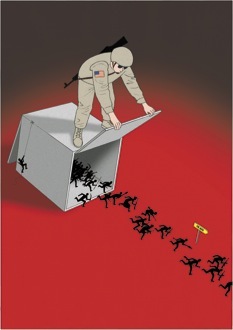
A poem of peace


Making Peace

A voice from the dark called out,
“The poets must give us
imagination of peace, to oust the intense, familiar
imagination of disaster. Peace, not only
the absence of war.”

But peace, like a poem,
is not there ahead of itself,
can’t be imagined before it is made,
can’t be known except
in the words of its making,
grammar of justice,
syntax of mutual aid.

A feeling towards it,
dimly sensing a rhythm, is all we have
until we begin to utter its metaphors,
learning them as we speak.

A line of peace might appear
if we restructured the sentence our lives are making,
revoked its reaffirmation of profit and power,
questioned our needs, allowed
long pauses. . . .

A cadence of peace might balance its weight
on that different fulcrum; peace, a presence,
an energy field more intense than war,
might pulse then,
stanza by stanza into the world,
each act of living
one of its words, each word
a vibration of light–facets
of the forming crystal.

Denise Levertov

Thanks to Duncan Echelson / The Rag Blog
Posted July 1, 2008

Posted in RagBlog | Tagged , | Leave a comment

Two For The Road : Heading For The Exit Lane

By 2012 there should be roughly 10 million fewer vehicles on the road in America…

We stand at a turning point for US transport.

Real gasoline prices have already surpassed the peak levels that followed the second OPEC oil shocks, and even when adjusted for potential fuel efficiency improvements, have increased to the point where they will dramatically change driving behaviour in America.

The some 57 million Americans who own a car and have direct access to public transportation will start to act more and more like Europeans, who have long paid much higher gasoline prices. By 2012, average miles driven will have shrunk by more than 15%. SUV and other light truck sales, which until 2006 accounted for almost 60% of total motor vehicles, will plummet to less than half that level, reversing the last fifteen years growth in market share.

More fundamentally, the freeways are about to get less congested. Not only will the number of vehicle registrations in the United States not grow over the next four years, but by 2012 there should be roughly 10 million fewer vehicles on the road in America than thereare today.

Jeff Rubin and Benjamin Tal / CIBC World Markets / Toronto

Heading for the Exit Lane
by Jeff Rubin / June 26, 2008

Recent announcements from OPEC and China won’t be sufficient to hold oil prices in check. The additional 200,000 barrels per day pledged from Saudi Arabia is apittance compared to the four million barrels per day that depletion will hive off world production this year. What little increase in production Saudi is capable of will probably all be gobbled up by that country’s own voracious appetite for energy. Nor is the $145 per tonne cut (48 cents per gallon) in Chinese fuel subsidies likely to dent demand much.

Most North Americans would gladly line up at the pumps for China’s now $3.25 a gallon gas, particularly those of us who live north of the border.

With half of the world’s population never having to pay world oil prices, it shouldn’t come as a great surprise that $130 per barrel crude prices have yet to quash world demand. And the only supply response to date has been yet another round of cost overruns and lengthy project delays running the gamut from Canadian oil sands to deepwater Gulf of Mexico wells.

With the basic laws of supply and demand are compelled to once again raise our target prices for oil. We are lifting our target for West Texas Intermediate by $20 per barrel to an average price of $150 next year and by $50 per barrel to an average price of $200 per barrel by 2010. Under prevailing refinery margins, that should translate into a near-$7 per gallon pump price within two years, a 70% increase from today’s already record levels.

Higher oil prices spell stagflation for the US economy next year, and we have marked down our GDP growth forecast to barely over 1% for 2009 (pages 9-11). The biggest impacts will be in transport and none greater than the adjustments on the road.

After all, America is the quintessential land of the car.

As gasoline prices climb inexorably, American driving habits are going to have to undergo a massive change, mimicking the driving habits long adopted by Europeans who have faced much higher gas prices. Average miles driven will likely fall by as much as 15%, while the market share of light trucks, SUVs and vans will be literally halved, reversing the trend of the last fifteen years. But the most fundamental, and unprecedented change will be in the number of vehicles on the road.

Over the next four years, we are likely to witness the greatest mass exodus of vehicles off America’s highways in history. By 2012, there should be some 10 million fewer are today—a decline that dwarfs all previous adjustments including those during the two OPEC oil shocks (see pages 4-8). Many of those in the exit lane will be low income Americans from households earning less than $25,000 per year.

Incredibly, over 10 million of those American households own more than one car.

Soon they won’t own any.

Source. / CIBC World Markets / Toronto

Thanks to Roger Baker / The Rag Blog

Posted in RagBlog | Tagged , , , | Leave a comment

Two For the Road : Killing Off the Small Town

A road going to Leeton, Missouri, population 619. Photo by jelene’s photostream.

High Gas Prices Threaten to Drain
Small Towns’ Populations

By Donald Bradley / June 28, 2008

LEETON, Missouri – In this small town south of Warrensburg, directions usually begin with, “From Casey’s, you go …”

That would be Casey’s General Store, the only gas station in town. It’s where folks fill up while talking about goings-on, politics, weather and who’s got the best-looking tomatoes.

These days, they’re also cussing and shaking their heads about the price of that gasoline. People are doing that everywhere, but in small towns such as Leeton, population 619, it’s even more of a gut punch because nearly every working adult commutes to jobs elsewhere.

These days, there had better be a really good job on the other end of that trip.

Don Campbell’s daily commute to Kansas City – about 100 miles each way – costs him roughly $866 a month at $3.90 per gallon. But he’s a union iron worker and says he can make the math work.

Most of his neighbors can’t. For them and thousands of other small-town residents across the country who drive long distances to jobs that pay little more than minimum wage, the high cost of gas is making that daily commute cost-prohibitive.

So much so that economists predict that over the next few years, the country could see a migration that would greatly reduce the population of Small Town America – resulting in a painful shift away from lifestyle, family roots, traditions and school ties.

“This town’s the only place I know,” said Louie Rector, who drives 35 miles to his job at a window factory from his home in tiny Dixon, Mo., about 20 miles west of Rolla.

“I grew up here … raised my kids here. I got my family and friends all here. I don’t want to pack up and leave. But it’s getting to the point where a fella can’t afford to drive to work, and that don’t seem right to me.”

A Common Fate

Towns such as Dixon and Leeton are everywhere in America. Many don’t have much beyond a post office, a grocery and maybe a school. Economists use Wymore, Neb., as an example in that 68 percent of working adults in town commute to jobs elsewhere, most to Beatrice, Neb.

The expected exodus from small towns, said Don Macke, a widely considered authority on rural economics and head of the Center for Rural Entrepreneurship in Lincoln, Neb., will be far more profound than the gradual erosion that has been going on since World War II. That decline was due to the country’s shift away from an agrarian economy and a choice for convenience: People wanted to be closer to jobs, shopping and entertainment.

The new flight, Macke thinks, will be more out of necessity.

Most commuters from small towns are high school graduates. They are driving 50 miles or more to work as school cooks, hospital aides, office workers, dental assistants and unskilled factory workers.

“The reality is that those jobs don’t pay all that well,” said Macke, who is also a visiting scholar with the Rural Policy Research Institute at the University of Missouri. “They’re spending up to $500 a month on gas. A third to half is already technically working poor.

“And as gas goes higher, they will get poorer and these towns will soon struggle to hold on to these people.”

David McGranahan, a senior economist with the Economic Research Service of the U.S. Department of Agriculture, added that the decline would not be entirely longtime residents moving away.

“Young people who leave these towns to go off to college or the military may decide not to go back – as many have always done in years past,” McGranahan said. “Also, fewer people will leave the city to move to small towns in search of a quiet life.”

But nobody is writing off small towns. Who knows what type of vehicle will come along next? There’s carpooling. Computer technology increasingly allows people to work from home. And some communities are working on ways to provide jobs in town.

“I have a lot of faith in ingenuity and the entrepreneurial spirit,” Macke said.

That rescue better happen fast, said Leeton Mayor Larry Mudd. He has lived all his 62 years there and used to commute to Kansas City to work as a school administrator – back when gas was cheap.

He hears the talk around town and he expects to see people, particularly young families, move away.

“People are mad as hell, but they don’t know who to blame,” Mudd said. “I know we got people here who are buying gas instead of paying bills.

“What a lot of towns are going to end up with is a bunch of empty buildings and empty houses.”

Open Space, Cheap Gas

Since the advent of the automobile in the early 20th century, the American rural landscape has been one of spacious land and cheap fuel.

It was commonplace for people to drive long distances for jobs. In isolated areas, such as western Kansas, the drive could be 100 miles or more. Those commuters may have complained about the time in the car, but seldom about the price of gas.

Throughout that period, too, many towns had a factory, and mom-and-pop stores lined main streets.

That has all changed.

Factories in many towns closed years ago as small companies folded or manufacturers sent jobs overseas. Mom-and-pop stores gave way to Wal-Marts in bigger towns. When those changes occurred, jobs and shopping required trips out of town.

And now, gas prices are at all-time highs.

Brian Dabson, co-director of the Truman School of Public Affairs at the University of Missouri, said the new financial reality has changed the parameters of “rural poor.”

The term used to apply mainly to pockets of poverty in Appalachia, the Mississippi Delta, Indian reservations, and the Texas-Mexico border area.

“Now, it’s everywhere – Missouri, Kansas, Nebraska,” Dabson said. “The price of gas has redefined a ‘sustainable wage.'”

There is little public transportation in these rural areas. And there is less pubic assistance today. Farmers make more money from corn because of its use to make ethanol, but towns aren’t sharing in any windfall because the cost of farming has gone up, too, and there are fewer farmers.

No question that gas prices will chase some people closer to urban areas, Dabson predicted.

“There is no hiding place from global pressure,” he said.

So why isn’t the same thing happening in Europe, where gas prices are even higher?

Because trains connect almost every town there, Macke said. And yes, some people in urban and suburban areas in this country drive 30 miles to work, too, but they tend to be more affluent.

It is in rural America where lives are being turned upside down.

“This country had not planned on a big jump in fuel costs,” Macke said.

“No Jobs Here”

Well I was born in a small town,
and I can breathe in a small town.
Gonna die in this small town,
and that’s probably where they’ll bury me.

John Mellencamp, “Small Town,” 1985

The classic song was seemingly written for guys like Rector of Dixon. He never figured he would ever leave his hometown on the edge of the Mark Twain National Forest.

According to Dixon’s marshal, Clifty Yoakum, most every working adult leaves town each morning for jobs in other places, such as Rolla or Jefferson City.

“They have to – no jobs here,” Yoakum said.

For 29 years, Rector has driven to the Quaker Window factory in Freeburg, 35 miles to the north. The factory is unusual in that it has more employees than that town has people.

“We got about 450 workers and they come from all over, probably six or seven counties,” said owner Mike Knoll. “We pay $8 to $10 an hour – better than minimum wage – but I know my people are really feeling the gas crunch.”

He recently ordered a switch to four 10-hour days to save his employees a day’s drive.

“That’s one day we don’t have to pay $20 for gas,” said Rector’s daughter, Tracy, who also works at Quaker.

“Everybody is feeling what’s going on. They’re cutting back at the grocery store, not going out to eat. But even with that, when you get your check there’s nothing left. Gas goes much higher – people are going to stop going to work.”

Her father may leave Dixon and move closer to Freeburg, but Tracy Rector isn’t yet ready to commit to such a drastic move from her hometown.

“But I’m like most people – I don’t know what to do.”

Back in Leeton, school Superintendent William Nicely knows he could see a drop in enrollment if families leave. It’s a highly accredited school and this year graduated 19 seniors.

But he knows why it would happen because he commutes the other way.

“I live in Sedalia and drive here every day – I know what families are going through,” Nicely said.

Resident Jerry King doesn’t have to worry about it. He’s retired. He used to work at a tire shop in Sedalia.

“I wouldn’t want to be making that trip these days, not with gas where it is,” King said. “Heck, I don’t even want to drive to Windsor for groceries.”

Mudd, the mayor, worries that younger residents will start thinking the same way.

“When people move away, towns lose their tax base,” Mudd said. “Then you can’t fix streets … you can’t do much of anything. That makes even more people leave.

“Pretty soon, won’t be much left in these old towns.”

Source. / Kansas City Star / truthout

The Rag Blog

Posted in RagBlog | Tagged , , , , | 1 Comment

Sy Hersh : Preparing the Battlefield

Drawing courtesy of The New Yorker

The Bush Administration steps up
its secret moves against Iran.
by Seymour M. Hersh

This blockbuster article by Seymour Hersh about U.S. covert operations in Iran appears in the July 7 and 14 issue of The New Yorker. Hirsch, who won the Pulitzer Prize for breaking the story of the My Lai Massacre in 1970 is the most important American independent journalist since I.F. Stone.

On June 29 we published a Reuters report on this article.

Thorne Dreyer / The Rag Blog / June 31, 2008

Late last year, Congress agreed to a request from President Bush to fund a major escalation of covert operations against Iran, according to current and former military, intelligence, and congressional sources. These operations, for which the President sought up to four hundred million dollars, were described in a Presidential Finding signed by Bush, and are designed to destabilize the country’s religious leadership. The covert activities involve support of the minority Ahwazi Arab and Baluchi groups and other dissident organizations. They also include gathering intelligence about Iran’s suspected nuclear-weapons program.

Clandestine operations against Iran are not new. United States Special Operations Forces have been conducting cross-border operations from southern Iraq, with Presidential authorization, since last year. These have included seizing members of Al Quds, the commando arm of the Iranian Revolutionary Guard, and taking them to Iraq for interrogation, and the pursuit of “high-value targets” in the President’s war on terror, who may be captured or killed. But the scale and the scope of the operations in Iran, which involve the Central Intelligence Agency and the Joint Special Operations Command (JSOC), have now been significantly expanded, according to the current and former officials. Many of these activities are not specified in the new Finding, and some congressional leaders have had serious questions about their nature.

Under federal law, a Presidential Finding, which is highly classified, must be issued when a covert intelligence operation gets under way and, at a minimum, must be made known to Democratic and Republican leaders in the House and the Senate and to the ranking members of their respective intelligence committees—the so-called Gang of Eight. Money for the operation can then be reprogrammed from previous appropriations, as needed, by the relevant congressional committees, which also can be briefed.

“The Finding was focussed on undermining Iran’s nuclear ambitions and trying to undermine the government through regime change,” a person familiar with its contents said, and involved “working with opposition groups and passing money.” The Finding provided for a whole new range of activities in southern Iran and in the areas, in the east, where Baluchi political opposition is strong, he said.

Although some legislators were troubled by aspects of the Finding, and “there was a significant amount of high-level discussion” about it, according to the source familiar with it, the funding for the escalation was approved. In other words, some members of the Democratic leadership—Congress has been under Democratic control since the 2006 elections—were willing, in secret, to go along with the Administration in expanding covert activities directed at Iran, while the Party’s presumptive candidate for President, Barack Obama, has said that he favors direct talks and diplomacy.

The request for funding came in the same period in which the Administration was coming to terms with a National Intelligence Estimate, released in December, that concluded that Iran had halted its work on nuclear weapons in 2003. The Administration downplayed the significance of the N.I.E., and, while saying that it was committed to diplomacy, continued to emphasize that urgent action was essential to counter the Iranian nuclear threat. President Bush questioned the N.I.E.’s conclusions, and senior national-security officials, including Secretary of Defense Robert Gates and Secretary of State Condoleezza Rice, made similar statements. (So did Senator John McCain, the presumptive Republican Presidential nominee.) Meanwhile, the Administration also revived charges that the Iranian leadership has been involved in the killing of American soldiers in Iraq: both directly, by dispatching commando units into Iraq, and indirectly, by supplying materials used for roadside bombs and other lethal goods. (There have been questions about the accuracy of the claims; the Times, among others, has reported that “significant uncertainties remain about the extent of that involvement.”)

Military and civilian leaders in the Pentagon share the White House’s concern about Iran’s nuclear ambitions, but there is disagreement about whether a military strike is the right solution. Some Pentagon officials believe, as they have let Congress and the media know, that bombing Iran is not a viable response to the nuclear-proliferation issue, and that more diplomacy is necessary.

A Democratic senator told me that, late last year, in an off-the-record lunch meeting, Secretary of Defense Gates met with the Democratic caucus in the Senate. (Such meetings are held regularly.) Gates warned of the consequences if the Bush Administration staged a preëmptive strike on Iran, saying, as the senator recalled, “We’ll create generations of jihadists, and our grandchildren will be battling our enemies here in America.” Gates’s comments stunned the Democrats at the lunch, and another senator asked whether Gates was speaking for Bush and Vice-President Dick Cheney. Gates’s answer, the senator told me, was “Let’s just say that I’m here speaking for myself.” (A spokesman for Gates confirmed that he discussed the consequences of a strike at the meeting, but would not address what he said, other than to dispute the senator’s characterization.)

The Joint Chiefs of Staff, whose chairman is Admiral Mike Mullen, were “pushing back very hard” against White House pressure to undertake a military strike against Iran, the person familiar with the Finding told me. Similarly, a Pentagon consultant who is involved in the war on terror said that “at least ten senior flag and general officers, including combatant commanders”—the four-star officers who direct military operations around the world—“have weighed in on that issue.”

The most outspoken of those officers is Admiral William Fallon, who until recently was the head of U.S. Central Command, and thus in charge of American forces in Iraq and Afghanistan. In March, Fallon resigned under pressure, after giving a series of interviews stating his reservations about an armed attack on Iran. For example, late last year he told the Financial Times that the “real objective” of U.S. policy was to change the Iranians’ behavior, and that “attacking them as a means to get to that spot strikes me as being not the first choice.”

Admiral Fallon acknowledged, when I spoke to him in June, that he had heard that there were people in the White House who were upset by his public statements. “Too many people believe you have to be either for or against the Iranians,” he told me. “Let’s get serious. Eighty million people live there, and everyone’s an individual. The idea that they’re only one way or another is nonsense.”

When it came to the Iraq war, Fallon said, “Did I bitch about some of the things that were being proposed? You bet. Some of them were very stupid.”

The Democratic leadership’s agreement to commit hundreds of millions of dollars for more secret operations in Iran was remarkable, given the general concerns of officials like Gates, Fallon, and many others. “The oversight process has not kept pace—it’s been coöpted” by the Administration, the person familiar with the contents of the Finding said. “The process is broken, and this is dangerous stuff we’re authorizing.”

Senior Democrats in Congress told me that they had concerns about the possibility that their understanding of what the new operations entail differs from the White House’s. One issue has to do with a reference in the Finding, the person familiar with it recalled, to potential defensive lethal action by U.S. operatives in Iran. (In early May, the journalist Andrew Cockburn published elements of the Finding in Counterpunch, a newsletter and online magazine.)

The language was inserted into the Finding at the urging of the C.I.A., a former senior intelligence official said. The covert operations set forth in the Finding essentially run parallel to those of a secret military task force, now operating in Iran, that is under the control of JSOC. Under the Bush Administration’s interpretation of the law, clandestine military activities, unlike covert C.I.A. operations, do not need to be depicted in a Finding, because the President has a constitutional right to command combat forces in the field without congressional interference. But the borders between operations are not always clear: in Iran, C.I.A. agents and regional assets have the language skills and the local knowledge to make contacts for the JSOC operatives, and have been working with them to direct personnel, matériel, and money into Iran from an obscure base in western Afghanistan. As a result, Congress has been given only a partial view of how the money it authorized may be used. One of JSOC’s task-force missions, the pursuit of “high-value targets,” was not directly addressed in the Finding. There is a growing realization among some legislators that the Bush Administration, in recent years, has conflated what is an intelligence operation and what is a military one in order to avoid fully informing Congress about what it is doing.

Read all of this article here. / The New Yorker

Thanks to Sarito Neiman / The Rag Blog

Posted in RagBlog | Tagged , , , , , , , | Leave a comment

Kim Phuc : Then and Now

Kim Phuc now lives in Toronto with her husband and two children. Her organization, Kim Foundation International, aids children who are war victims. Photo courtesy of the Canadian Broadcasting Corp.

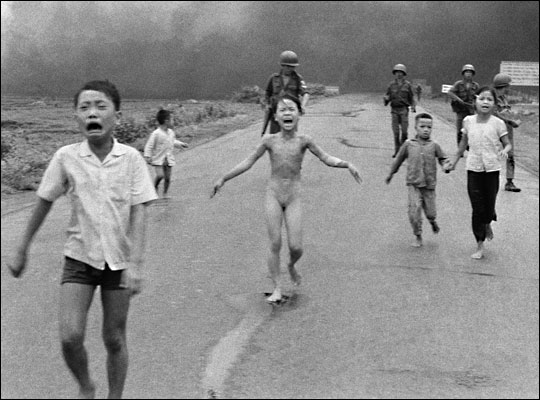
In one of the most famous images of the Vietnam War, South Vietnamese forces follow terrified children, including 9-year-old Kim Phuc (center) as they run down Road No. 1 near Trang Bang after an aerial napalm attack on suspected Viet Cong hiding places, June 8, 1972. President Richard Nixon once doubted the authenticity of the photo, which earned a Pulitzer Prize for photographer Nick Ut.

The Long Road To Forgiveness
by Kim Phuc / June 30, 2008

On June 8, 1972, I ran out from Cao Dai temple in my village, Trang Bang, South Vietnam; I saw an airplane getting lower and then four bombs falling down. I saw fire everywhere around me. Then I saw the fire over my body, especially on my left arm. My clothes had been burned off by fire.

I was 9 years old but I still remember my thoughts at that moment: I would be ugly and people would treat me in a different way. My picture was taken in that moment on Road No. 1 from Saigon to Phnom Penh. After a soldier gave me some drink and poured water over my body, I lost my consciousness.

Several days after, I realized that I was in the hospital, where I spent 14 months and had 17 operations.

It was a very difficult time for me when I went home from the hospital. Our house was destroyed; we lost everything and we just survived day by day.

Although I suffered from pain, itching and headaches all the time, the long hospital stay made me dream to become a doctor. But my studies were cut short by the local government. They wanted me as a symbol of the state. I could not go to school anymore.

The anger inside me was like a hatred as high as a mountain. I hated my life. I hated all people who were normal because I was not normal. I really wanted to die many times.

I spent my daytime in the library to read a lot of religious books to find a purpose for my life. One of the books that I read was the Holy Bible.

In Christmas 1982, I accepted Jesus Christ as my personal savior. It was an amazing turning point in my life. God helped me to learn to forgive — the most difficult of all lessons. It didn’t happen in a day and it wasn’t easy. But I finally got it.

Forgiveness made me free from hatred. I still have many scars on my body and severe pain most days but my heart is cleansed.

Napalm is very powerful but faith, forgiveness and love are much more powerful. We would not have war at all if everyone could learn how to live with true love, hope and forgiveness.

If that little girl in the picture can do it, ask yourself: Can you?

[This essay was produced by Anne Penman for the Canadian Broadcasting Corp. NPR’s This I Believe is independently produced by Jay Allison and Dan Gediman with John Gregory and Viki Merrick.]

Source. / All Things Considered / NPR

Thanks to Duncan Echelson / The Rag Blog

Posted in RagBlog | Tagged , , , , | Leave a comment

Just Trying to Understand What This Means

Posted in RagBlog | Tagged | Leave a comment

Corn Dog’s Coat — and Big Bad Jew

The video above from the Daily Show includes excerpts from John (Corn Dog) Cornyn’s video, “Big Bad John,” — already a thing of legend — previously posted and discussed on The Rag Blog.

But the best part is a faux spot for Cornyn’s alleged opponent, a tea-sipping Semite. (He’s a big city boy from an Ivy League school… / He’s running for Senate / He’s an elitist Jew… Big Bad Jew.)

Thorne Dreyer / The Rag Blog

Cornyn’s Coat Calamity

Sen. John Cornyn, R-TX, is hot under the collar because Sen. Chuck Schumer, D-NY, mocked a coat he wore in his latest TV ad. Not fair, said Cornyn: that was a traditional Tamaulipeca jacket, and Schumer’s a racist for saying anything and he needs to apologize to the entire Hispanic community (including, we can only presume, Rep. Rick Noriega, D-Houston, who is running to kick Cornyn out of Senate). So, nothing to do with the fact that he got completely destroyed by Jon Stewart on The Daily Show this week?

For anyone humming along, the song in Cornyn’s ad spoofs Jimmy Dean’s mining disaster classic ‘Big Bad John’. What may make music historians ponder is the way that Cornyn’s press people have turned a song about a “quiet and shy” blue-collar worker into self-aggrandizing bluff and bluster ego fluff about how a professional pol “Fought heathens and hellions” and “Kept Texas in power, made lesser states squirm.”

Funny, there’s quite a few Texans squirming at Cornyn’s cornball cowboy antics. Not least the strained rhyming of “more” and “foe”. For the full cringe-worthy experience, try the original Cornyn version.

Richard Whittaker / June 27, 2008

Source. / Chronic / Austin Chronicle online

See the full “Big John” video on The Rag Blog.

And go to Ride ’em, Corn Dog! / The Rag Blog / June 17, 2008

The Rag Blog

Posted in RagBlog | Tagged , , , , , | 1 Comment

Jim Hightower : Surprise! It’s About the Oil


Bush’s Iraq Oil Grab
By Jim Hightower / June 30, 2008

Out of the question. Don’t be silly. Never was a factor.

Such are the absolutes that George W, Cheney, Rummy and other Bushites have employed whenever anyone has suggested that their real reason for invading and occupying Iraq was a crude item spelled o-i-l. But now that Bush & Company’s oil-soaked regime has only a few months to go, a new honesty and an urgency is creeping out about their true intentions.

First came the news that the Iraqi government will give no-bid contracts to Exxon Mobil, Shell, BP, and a handful of other Western oil giants, allowing them to enter the rich oil fields of Iraq. They are to develop the productive capacity of the fields, which will give them a favored position for winning lucrative longterm licenses to privatize Iraq’s massive oil reserves. It’s a process that shuts out China, Russia… and even oil ventures that would be Iraqi-owned. This is Big Oil‘s fantasy come true.

But wait, the Iraqi people themselves hate the very idea of Western control of their oil wealth. How are the oil barons going to get away with this invasion of Iraq’s sovereignty? Enter honest revelation number two.

For years Bush himself has been vociferously denying that his regime wants to build permanent U.S. military bases in Iraq – bases with thousands of ground troops. But – hello – there is now a rush by the White House to cut a far-reaching deal with the Iraqi government to station U.S. soldiers on dozens of military bases there indefinitely. As part of the deal, Bush is insisting that our soldiers be immune from Iraqi law, be free to fight battles without Iraqi permission, and be allowed to detain anyone in Iraq who might threaten our “interests.”

Bush has called Iraq a war for “freedom.” And now we see it – he’s using our soldiers to free Big Oil to grab all it can. What a disgrace.

“Iraq Oil Rush,” The New York Times, June 22, 2008.

“Iraq oil contracts confirm earlier suspicions,” Wisconsin State Journal, June 22, 2008.

“The battle for bases,” Wisconsin State Journal, June 22, 2008.

“Deals With Iraq Are Set To Bring Oil Giants Back,” The New York Times, June 19, 2008

Source. / JimHightower.com

The Rag Blog

Posted in RagBlog | Tagged , , , , , , | Leave a comment

Arctic Ice: Going, Going…

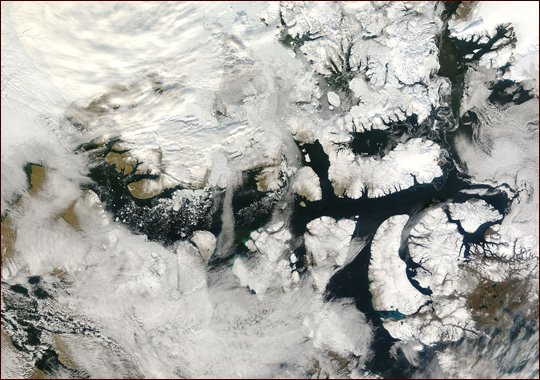
This satellite image shows a portion of Canada’s Northwest Passage largely free of ice, as seen by NASA’s Terra satellite on Sept. 15, 2007. Arctic ice has shrunk to the lowest level on record, raising the possibility that the North Pole will soon experience the first ice-free summer in recorded history. Photo by NASA / AP.

North Pole Meltdown?
By Seth Borenstein / June 30, 2008

There’s a 50-50 chance that the North Pole will be ice-free this summer, which would be a first in recorded history, a leading ice scientist says.

The weather and ocean conditions in the next couple of weeks will determine how much of the sea ice will melt, and early signs are not good, said Mark Serreze. He’s a senior researcher at the National Snow and Ice Data Center and the University of Colorado in Boulder, Colo.

The chances for a total meltdown at the pole are higher than ever because the layer of ice coating the sea is thinner than ever, he said.

“A large area at the North Pole and surrounding the North Pole is first-year ice,” Serreze said. “That’s the stuff that tends to melt out in the summer because it’s thin.”

Preliminary February and March data from a NASA satellite shows that the circle of ice surrounding the North Pole is “considerably thinner” than scientists have seen during the five years the satellite has been taking pictures, NASA ice scientist Jay Zwally said Friday. He thinks there is slightly less than a 50-50 chance the North Pole will be ice-free.

Last year was a record year for ice melt all over the Arctic and the ice band surrounding the North Pole is even thinner now.

There is nothing scientifically significant about the North Pole, Serreze said. But there is a cultural and symbolic importance. It’s home to Santa Claus, after all. Last August, the Northwest Passage was open to navigation for the first time in memory.

A more conservative ice scientist, Cecilia Bitz at the University of Washington, put the odds of a North Pole without ice closer to 1 in 4. Even that is far worse than climate models had predicted, which was 1 in 70 sometime in the next decade, she said.

But both she and Serreze agree it’s just a matter of time.

But both she and Serreze agree it’s just a matter of time.

“I would guess within the next 10 year it would happen at least once,” Bitz said.

Already, figures from the National Snow and Ice Data Center show sea ice in the Arctic as a whole at about the same level now as it was at its low point last year in late June and early July.

The explanation is a warming climate and a weather phenomenon, scientists said.

For the last couple of decades, there has been a steady melt of Arctic sea ice — which covers only the ocean and which thins during summer and refreezes in winter. In recent years, it has gradually become thinner because more of it has been melting as the Earth’s temperature rises.

Then, this past winter, there was a natural weather shift called the Arctic Oscillation, sort of a cold weather cousin to El Nino. That oscillation caused a change in winds and ocean that accelerated a normal flushing of sea ice in the Arctic. That pushed the older thicker sea ice that had been over the North Pole south toward Greenland and eventually out of the Arctic, Serreze said. That left just a thin one-year layer of ice that previously covered part of Siberia.

Source. / AP / Discovery News

The Rag Blog

Posted in RagBlog | Tagged , , | Leave a comment

History : How the Republicans Perfected Their Propaganda System

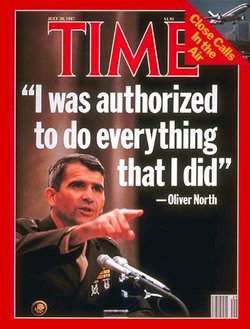
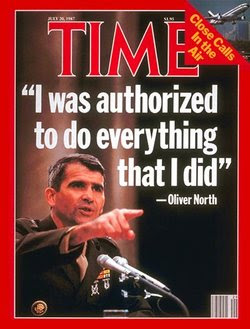
Lieutenant Colonel Oliver North at Iran-Contra hearings, 1987.

Iran-Contra’s ‘Lost Chapter’
By Robert Parry / June 30, 2008

As historians ponder George W. Bush’s disastrous presidency, they may wonder how Republicans perfected a propaganda system that could fool tens of millions of Americans, intimidate Democrats, and transform the vaunted Washington press corps from watchdogs to lapdogs.

To understand this extraordinary development, historians might want to look back at the 1980s and examine the Iran-Contra scandal’s “lost chapter,” a narrative describing how Ronald Reagan’s administration brought CIA tactics to bear domestically to reshape the way Americans perceived the world.

That chapter – which we are publishing here for the first time – was “lost” because Republicans on the congressional Iran-Contra investigation waged a rear-guard fight that traded elimination of the chapter’s key findings for the votes of three moderate GOP senators, giving the final report a patina of bipartisanship.

Under that compromise, a few segments of the draft chapter were inserted in the final report’s Executive Summary and in another section on White House private fundraising, but the chapter’s conclusions and its detailed account of how the “perception management” operation worked ended up on the editing room floor.

The American people thus were spared the chapter’s troubling finding: that the Reagan administration had built a domestic covert propaganda apparatus managed by a CIA propaganda and disinformation specialist working out of the National Security Council.

“One of the CIA’s most senior covert action operators was sent to the NSC in 1983 by CIA Director [William] Casey where he participated in the creation of an inter-agency public diplomacy mechanism that included the use of seasoned intelligence specialists,” the chapter’s conclusion stated.

“This public/private network set out to accomplish what a covert CIA operation in a foreign country might attempt – to sway the media, the Congress, and American public opinion in the direction of the Reagan administration’s policies.”

However, with the chapter’s key findings deleted, the right-wing domestic propaganda operation not only survived the Iran-Contra fallout but thrived.

So did some of the administration’s collaborators, such as South Korean theocrat Sun Myung Moon and Australian press mogul Rupert Murdoch, two far-right media barons who poured billions of dollars into pro-Republican news outlets that continue to influence Washington’s political debates to this day.

Before every presidential election, Moon’s Washington Times plants derogatory – and often false – stories about Democratic contenders, discrediting them and damaging their chances of winning the White House.

For instance, in 1988, the Times published a bogus account suggesting that the Democratic nominee Michael Dukakis had undergone psychiatric treatment. In 2000, Moon’s newspaper pushed the theme that Al Gore suffered from clinical delusions. [For details, see Robert Parry’s Secrecy & Privilege.]

As for Murdoch, his giant News Corp. expanded into American cable TV with the founding of Fox News in 1996. Since then, the right-wing network has proved highly effective in promoting attack lines against Democrats or anyone else who challenges the Republican power structure.

As President George W. Bush herded the nation toward war with Iraq in 2002-03, Fox News acted like his sheep dogs making sure public opinion didn’t stray too far off. The “Fox effect” was so powerful that it convinced other networks to load up with pro-war military analysts and to silence voices that questioned the invasion. [See Neck Deep.]

Seeds of Propaganda

The seeds of this private/public collaboration can be found in the 84-page draft Iran-Contra chapter, entitled “Launching the Private Network.” [There appear to have been several versions of this “lost chapter.” This one I found in congressional files.]

The chapter traces the origins of the propaganda network to President Reagan’s “National Security Decision Directive 77” in January 1983 as his administration sought to promote its foreign policy, especially its desire to oust Nicaragua’s leftist Sandinista government.

In a Jan. 13, 1983, memo, then-National Security Advisor William Clark foresaw the need for non-governmental money to advance this cause. “We will develop a scenario for obtaining private funding,” Clark wrote.

As administration officials began reaching out to wealthy supporters, lines against domestic propaganda soon were crossed as the operation took aim at not only at foreign audiences but at U.S. public opinion, the press and congressional Democrats who opposed funding Nicaraguan rebels, known as contras.

At the time, the contras were earning a gruesome reputation as human rights violators and terrorists. To change this negative perception of the contras, the Reagan administration created a full-blown, clandestine propaganda operation.

“An elaborate system of inter-agency committees was eventually formed and charged with the task of working closely with private groups and individuals involved in fundraising, lobbying campaigns and propagandistic activities aimed at influencing public opinion and governmental action,” the draft chapter said.

Heading this operation was a veteran CIA officer named Walter Raymond Jr., who was recruited by another CIA officer, Donald Gregg, before Gregg shifted from his job as chief of the NSC’s Intelligence Directorate to become national security adviser to then-Vice President George H.W. Bush.

[The draft chapter doesn’t use Raymond’s name in its opening pages, apparently because some of the information came from classified depositions. However, Raymond’s name is used later in the chapter and the earlier citations match Raymond’s role.]

According to the draft report, the CIA officer recruited for the NSC job had served as Director of the Covert Action Staff at the CIA from 1978 to 1982 and was a “specialist in propaganda and disinformation.”

“The CIA official [Raymond] discussed the transfer with [CIA Director William] Casey and NSC Advisor William Clark that he be assigned to the NSC as Gregg’s successor [in June 1982] and received approval for his involvement in setting up the public diplomacy program along with his intelligence responsibilities,” the chapter said.

“In the early part of 1983, documents obtained by the Select [Iran-Contra] Committees indicate that the Director of the Intelligence Staff of the NSC [Raymond] successfully recommended the establishment of an inter-governmental network to promote and manage a public diplomacy plan designed to create support for Reagan Administration policies at home and abroad.”

Raymond “helped to set up an elaborate system of inter-agency committees,” the draft chapter said, adding:

“In the Spring of 1983, the network began to turn its attention toward beefing up the Administration’s capacity to promote American support for the Democratic Resistance in Nicaragua [the contras] and the fledgling democracy in El Salvador.

“This effort resulted in the creation of the Office of Public Diplomacy for Latin America and the Caribbean in the Department of State (S/LPD), headed by Otto Reich,” a right-wing Cuban exile from Miami.

Though Secretary of State George Shultz wanted the office under his control, President Reagan insisted that Reich “report directly to the NSC,” where Raymond oversaw the operations as a special assistant to the President and the NSC’s director of international communications, the chapter said.

“At least for several months after he assumed this position, Raymond also worked on intelligence matters at the NSC, including drafting a Presidential Finding for Covert Action in Nicaragua in mid-September” 1983, the chapter said.

In other words, although Raymond was shifted to the NSC staff in part to evade prohibitions on the CIA influencing U.S. public opinion, his intelligence and propaganda duties overlapped for a time as he was retiring from the spy agency.

Key Player

Despite Raymond’s formal separation from the CIA, he acted toward the U.S. public much like a CIA officer would in directing a propaganda operation in a hostile foreign country. He was the go-to guy to keep the operation on track.

“Reich relied heavily on Raymond to secure personnel transfers from other government agencies to beef up the limited resources made available to S/LPD by the Department of State,” the chapter said.

“Personnel made available to the new office included intelligence specialists from the U.S. Air Force and the U.S. Army. On one occasion, five intelligence experts from the Army’s 4th Psychological Operations Group at Fort Bragg, North Carolina, were assigned to work with Reich’s fast-growing operation. …

“White House documents also indicate that CIA Director Casey had more than a passing interest in the Central American public diplomacy campaign.”

The chapter cited an Aug. 9, 1983, memo written by Raymond describing Casey’s participation in a meeting with public relations specialists to brainstorm how “to sell a ‘new product’ – Central America – by generating interest across-the-spectrum.”

In an Aug. 29, 1983, memo, Raymond recounted a call from Casey pushing his P.R. ideas. Alarmed at a CIA director participating so brazenly in domestic propaganda, Raymond wrote that “I philosophized a bit with Bill Casey (in an effort to get him out of the loop)” but with little success.

The chapter added: “Casey’s involvement in the public diplomacy effort apparently continued throughout the period under investigation by the Committees,” including a 1985 role in pressuring Congress to renew contra aid and a 1986 hand in further shielding S/LPD from the oversight of Secretary Shultz.

A Raymond-authored memo to Casey in August 1986 described the shift of S/LPD – then run by neoconservative theorist Bob Kagan who had replaced Reich – to the control of the Bureau of Inter-American Affairs, which was headed by Assistant Secretary of State Elliott Abrams, another prominent neoconservative.

Another important figure in the pro-contra propaganda was NSC staffer Oliver North, who spent a great deal of his time on the Nicaraguan public diplomacy operation even though he is better known for arranging secret arms shipments to the contras and to Iran’s radical Islamic government, leading to the Iran-Contra scandal.

The draft chapter cited a March 10, 1985, memo from North describing his assistance to CIA Director Casey in timing disclosures of pro-contra news “aimed at securing Congressional approval for renewed support to the Nicaraguan Resistance Forces.”

North’s Operatives

The Iran-Contra “lost” chapter depicts a sometimes Byzantine network of contract and private operatives who handled details of the domestic propaganda while concealing the hand of the White House and the CIA.

“Richard R. Miller, former head of public affairs at AID, and Francis D. Gomez, former public affairs specialist at the State Department and USIA, were hired by S/LPD through sole-source, no-bid contracts to carry out a variety of activities on behalf of the Reagan administration policies in Central America,” the chapter said.

“Supported by the State Department and White House, Miller and Gomez became the outside managers of [North operative] Spitz Channel’s fundraising and lobbying activities.

“They also served as the managers of Central American political figures, defectors, Nicaraguan opposition leaders and Sandinista atrocity victims who were made available to the press, the Congress and private groups, to tell the story of the Contra cause.”

Miller and Gomez facilitated transfers of money to Swiss and offshore banks at North’s direction, as they “became the key link between the State Department and the Reagan White House with the private groups and individuals engaged in a myriad of endeavors aimed at influencing the Congress, the media and public opinion,” the chapter said.

In its conclusion, the draft chapter read:

“The State Department was used to run a prohibited, domestic, covert propaganda operation. Established despite resistance from the Secretary of State, and reporting directly to the NSC, the [S/LPD] attempted to mask many of its activities from the Congress and the American people.”

However, the American people never got to read a detailed explanation of this finding nor see the evidence. In October 1987, as the congressional Iran-Contra committees wrote their final report, Republicans protested the inclusion of this explosive information.

Though the Democrats held the majority, the GOP had leverage because Rep. Lee Hamilton, D-Indiana, the House chairman, wanted some bipartisanship in the final report, especially since senior Republicans, including Rep. Dick Cheney, R-Wyoming, were preparing a strongly worded minority report.

Hamilton and the Democrats hoped that three moderate Republicans – William Cohen of Maine, Warren Rudman of New Hampshire and Paul Trible of Virginia – would break ranks and sign the majority report. However, the Republicans objected to the draft chapter about Ronald Reagan’s covert propaganda campaign.

As part of a compromise, some elements of the draft chapter were included in the Executive Summary but without much detail and shorn of the tough conclusions. Nevertheless, Cohen protested even that.

“I question the inordinate attention devoted in the Executive Summary to the Office of Public Diplomacy and its activities in support of the Administration’s polices,” Cohen wrote in his additional views. “The prominence given to it in the Executive Summary is far more generous than just.”

Long-Term Consequences

However, the failure of the Iran-Contra report to fully explain the danger of CIA-style propaganda intruding into the U.S. political process would have profound future consequences. Indeed, the evidence suggests that today’s powerful right-wing media gained momentum as part of the Casey-Raymond operations of the early 1980s.

According to one Raymond-authored memo dated Aug. 9, 1983, then-U.S. Information Agency director Charles Wick “via Murdock [sic] may be able to draw down added funds” to support pro-Reagan initiatives.

Raymond’s reference to Rupert Murdoch possibly drawing down “added funds” suggests that the right-wing media mogul was already part of the covert propaganda operation.

In line with its clandestine nature, Raymond also suggested routing the “funding via Freedom House or some other structure that has credibility in the political center.”

Unification Church founder Sun Myung Moon, publisher of the Washington Times, also showed up in the Iran-Contra operations, using his newspaper to raise contra funds and assigning his CAUSA political group to organize support for the contras.

In the two decades since the Iran-Contra scandal, both Murdoch and Moon have continued to pour billions of dollars into media outlets that have influenced the course of U.S. history, often through the planting of propaganda and disinformation much like a CIA covert action might do in a hostile foreign country.

Further, to soften up the Washington press corps, Reich’s S/LPD targeted U.S. journalists who reported information that undermined the pro-contra propaganda. Reich sent his teams out to lobby news executives to remove or punish out-of-step reporters – with a disturbing degree of success. [For more, see Parry’s Lost History.]

Some U.S. officials implicated in the Iran-Contra propaganda operations are still around, bringing the lessons of the 1980s into the new century.

For instance, Elliott Abrams. Though convicted of misleading Congress in the Iran-Contra Affair and later pardoned by President George H.W. Bush – Abrams is now deputy adviser to George W. Bush’s NSC, where he directs U.S.-Middle East policy.

Bob Kagan remains another prominent neocon theorist in Washington, writing op-eds for the Washington Post. Oliver North was given a news show on Fox.

Otto Reich now is advising Republican presidential candidate John McCain on Latin American affairs. Lee Hamilton is a senior national security adviser to Democratic candidate Barack Obama.

Enduring Skills

Beyond these individuals, the manipulative techniques that were refined in the 1980s – especially the skill of exaggerating foreign threats – have proved durable, bringing large segments of the American population into line behind the Iraq War in 2002-03.

Only now – with more than 4,100 U.S. soldiers and hundreds of thousands of Iraqis dead – are many of these Americans realizing that were manipulated by clever propaganda, that their perceptions had been managed.

For instance, the New York Times recently pried loose some 8,000 pages of Pentagon documents revealing how the Bush administration had manipulated the public debate on the Iraq War by planting friendly retired military officers on TV news shows.

Retired Green Beret Robert S. Bevelacqua, a former analyst on Murdoch’s Fox News, said the Pentagon treated the retired military officers as puppets: “It was them saying, ‘we need to stick our hands up your back and move your mouth for you.’” [NYT, April 20, 2008, or see Consortiumnews.com’s “US News Media’s Latest Disgrace.”]

Bush’s former White House press secretary Scott McClellan described similar use of propaganda tactics to justify the Iraq War in his book, What Happened: Inside the Bush White House and Washington’s Culture of Deception.

From his insider vantage point, McClellan cited the White House’s “carefully orchestrated campaign to shape and manipulate sources of public approval” – and he called the Washington press corps “complicit enablers.”

None of this would have been so surprising – indeed Americans might have been forewarned and forearmed – if Lee Hamilton and other Democrats on the Iran-Contra committees had held firm and published the scandal’s “lost chapter” two decades ago.

[Robert Parry broke many of the Iran-Contra stories in the 1980s for the Associated Press and Newsweek. His latest book, Neck Deep: The Disastrous Presidency of George W. Bush, was written with two of his sons, Sam and Nat, and can be ordered at neckdeepbook.com. His two previous books, Secrecy & Privilege: The Rise of the Bush Dynasty from Watergate to Iraq and Lost History: Contras, Cocaine, the Press & ‘Project Truth’ are also available there. Or go to Amazon.com.]

Source. / consortiumnews

Thanks to Jim Baldauf / The Rag Blog

Posted in RagBlog | Tagged , , , , , , , , | Leave a comment

AT&T Whistleblower on Congress and FISA

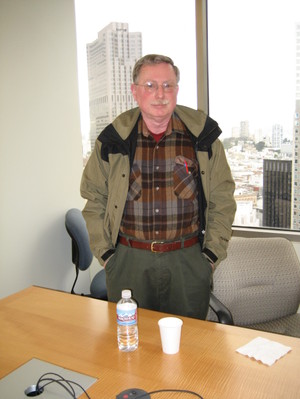
Mark Klein in the offices of his lawyers in San Francisco. Photo by Ryan Singel / Wired.com.

Says Spy Bill Creates ‘Infrastructure
for a Police State’

By Ryan Singel / June 27, 2008

Mark Klein, the retired AT&T engineer who stepped forward with the technical documents at the heart of the anti-wiretapping case against AT&T, is furious at the Senate’s vote on Wednesday night to hold a vote on a bill intended to put an end to that lawsuit and more than 30 others.

[Wednesday]’s vote by Congress effectively gives retroactive immunity to the telecom companies and endorses an all-powerful president. It’s a Congressional coup against the Constitution.

The Democratic leadership is touting the deal as a “compromise,” but in fact they have endorsed the infamous Nuremberg defense: “Just following orders.” The judge can only check their paperwork. This cynical deal is a Democratic exercise in deceit and cowardice.

Klein saw a network monitoring room being built in AT&T’s internet switching center that only NSA-approved techs had access to. He squirreled away documents and then presented them to the press and the Electronic Frontier Foundation after news of the government’s warrantless wiretapping program broke.

Wired.com independently acquired a copy of the documents (.pdf) — which were under court seal — and published the wiring documents in May 2006 so that they could be evaluated.

The lawsuit that resulted from his documents is now waiting on the 9th U.S. Appeals Court to rule on whether it can proceed despite the government saying the whole matter is a state secret. A lower court judge ruled that it could, because the government admitted the program existed and that the courts could handle evidence safely and in secret.

But the appeals court ruling will likely never see the light of day, since the Senate is set to vote on July 8 on the FISA Amendments Act of 2008, which also largely legalizes Bush’s warrantless wiretapping program by expanding how the government can wiretap from inside the United States without getting individualized court orders.

Klein continues:

Congress has made the FISA law a dead letter–such a law is useless if the president can break it with impunity. Thus the Democrats have surreptitiously repudiated the main reform of the post-Watergate era and adopted Nixon’s line: “When the president does it that means that it is not illegal.” This is the judicial logic of a dictatorship.

The surveillance system now approved by Congress provides the physical apparatus for the government to collect and store a huge database on virtually the entire population, available for data mining whenever the government wants to target its political opponents at any given moment—all in the hands of an unrestrained executive power. It is the infrastructure for a police state.

Neither the House nor the Senate has had Klein testify, nor have telecom executives testified in open session about their participation.

The bill forces the district court judge handling the consolidated cases against telecoms to dismiss the suits if the Attorney General certifies that a government official sent a written request to a phone or internet provider, saying that the President approved the program and his lawyers deemed it legal. Judge Vaughn Walker of the California Northern District can ask to see the paperwork, but would not be given leeway to decide if the program was legal.

Source. / Wired.com

Thanks to Dennis Thompson / The Rag Blog

Posted in RagBlog | Tagged , , , , | Leave a comment

New Yorker Report : Covert Operations Against Iran

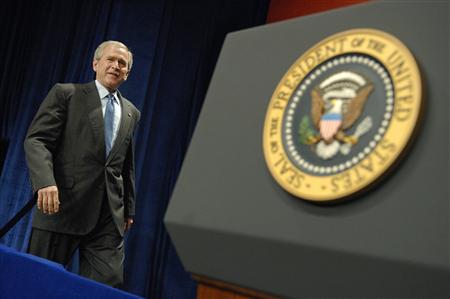
President Bush shown arriving at the Office of Faith-Based and Community Initiatives National Conference in Washington, June 26, 2008. U.S. congressional leaders agreed late last year to President George W. Bush’s funding request for a major escalation of covert operations against Iran. Photo by Jonathan Ernst / Reuters.

Aimed at nukes, regime change
June 29, 2008

WASHINGTON — U.S. congressional leaders agreed late last year to President George W. Bush’s funding request for a major escalation of covert operations against Iran aimed at destabilizing its leadership, according to a report in The New Yorker magazine published online on Sunday.

The article by reporter Seymour Hersh, from the magazine’s July 7 and 14 issue, centers on a highly classified Presidential Finding signed by Bush which by U.S. law must be made known to Democratic and Republican House and Senate leaders and ranking members of the intelligence committees.

“The Finding was focused on undermining Iran’s nuclear ambitions and trying to undermine the government through regime change,” the article cited a person familiar with its contents as saying, and involved “working with opposition groups and passing money.”

Hersh has written previously about possible administration plans to go to war to stop Tehran from obtaining nuclear weapons, including an April 2006 article in the New Yorker that suggested regime change in Iran, whether by diplomatic or military means, was Bush’s ultimate goal.

Funding for the covert escalation, for which Bush requested up to $400 million, was approved by congressional leaders, according to the article, citing current and former military, intelligence and congressional sources.

Clandestine operations against Iran are not new. U.S. Special Operations Forces have been conducting crossborder operations from southern Iraq since last year, the article said.

These have included seizing members of Al Quds, the commando arm of the Iranian Revolutionary Guard, and taking them to Iraq for interrogation, and the pursuit of “high-value targets” in Bush’s war on terrorism, who may be captured or killed, according to the article.

The U.S. ambassador in Iraq, Ryan Crocker, told CNN’s “Late Edition” he had not read the article, but denied the allegations of cross-border operations.

“I’ll tell you flatly that U.S. forces are not operating across the Iraqi border into Iran, in the south or anywhere else,” he said in an interview from Baghdad on Sunday.

The scale and the scope of the operations in Iran, which include the Central Intelligence Agency, have now been significantly expanded, the New Yorker article said, citing current and former officials.

Many of these activities are not specified in the new finding, and some congressional leaders have had serious questions about their nature, it said.

Among groups inside Iran benefiting from U.S. support is the Jundallah, also known as the Iranian People’s Resistance Movement, according to former CIA officer Robert Baer. Council on Foreign Relations analyst Vali Nasr described it to Hersh as a vicious organization suspected of links to al Qaeda.

The article said U.S. support for the dissident groups could prompt a violent crackdown by Iran, which could give the Bush administration a reason to intervene.

None of the Democratic leaders in Congress would comment on the finding, the article said. The White House, which has repeatedly denied preparing for military action against Iran, and the CIA also declined comment.

The United States is leading international efforts to rein in Iran’s suspected effort to develop nuclear weapons, although Washington concedes Iran has the right to develop nuclear power for civilian uses.

[Additional reporting by Paul Eckert in Washington; writing by Chris Michaud; editing by Eric Beech and David Wiessler.]

Source. / Reuters

The Rag Blog

Posted in RagBlog | Tagged , , , , , | Leave a comment