
Thorne Webb Dreyer, Editor

RECENT POSTS
Posted in RagBlog
Leave a comment
Lamar W. Hankins : Slipping Creationism into Texas Textbooks
 |
| Political cartoon by Kirk Anderson. Image from The Skeptical Teacher. |
How Texas’ Board of Education
will slip creationism into textbooks
Since a majority of the reviewers of the science texts are ‘creationists’ or proponents of ‘intelligent design,’ there can be little doubt that science education in Texas is under attack and our children will suffer…
By Lamar W. Hankins | The Rag Blog | August 7, 2013
SAN MARCOS, Texas — Thanks to the Texas Freedom Network (TFN), those who care about science in education have learned how the religious right will slip creationism into Texas’s textbooks over the next year. The Texas State Board of Education (SBOE) has appointed six creationists to review science textbooks, along with five others whose views on creationism are not known.
The TFN promotes religious freedom and individual liberties against the agenda of the religious right. It is “a non-partisan, grassroots organization of more than 60,000 religious and community leaders” from throughout Texas.
Creationism, often referred to as “intelligent design” in its newer incarnation, is promoted by those who do not accept the scientific consensus that evolution explains the origin of life on the earth.
In 1962, when I began college at a small Methodist-related university, my biology teacher, while offering no apologies for teaching evolution as fact, also suggested that there was no inconsistency between belief in God and evolution. Belief in God is based on faith, the claims for which cannot be tested or verified. Evolution is based on science; that is, it is testable. Its predictions can be verified.
Evolutionary geneticist Jerry Coyne explains that science makes “observations about the real world that either support [a scientific theory] or disprove it.” Further, “a good theory makes predictions about what we should find if we look more closely at nature. And if those predictions are met, it gives us more confidence that the theory is true.”
The difference between evolution theory and “intelligent design theory” or “creationism,” as it was originally called, is that evolution is subject to testing and falsification. These faith-based theories are not. No one can test the belief that God created the earth and all of its inhabitants in six days 10,000 years ago. What we know is that the available empirical evidence establishes that organisms have existed on earth for 3.5 billion years.
Simply put, “intelligent design” cannot be tested by any scientific method. It is a belief that claims a supernatural entity designed complex organisms, such as human beings — an inherently religious view that falls outside the sphere of science.
In 2005, the most extensive case involving “intelligent design” was concluded with a court finding that “intelligent design” is not science, but another name for “creationism.” The case, Kitzmiller v. Dover, was brought by parents in Dover, Pennsylvania, who objected to a decision by their school board to promote the teaching of intelligent design in their children’s public school science classes.
The federal district court held that two different legal analyses of the facts, both used previously by the Supreme Court in judging such matters, led to the same conclusion — teaching “intelligent design” (ID) in public schools violates the Establishment Clause of the First Amendment:
In making this determination, we have addressed the seminal question of whether ID is science. We have concluded that it is not, and moreover that ID cannot uncouple itself from its creationist, and thus religious, antecedent… As stated, our conclusion today is that it is unconstitutional to teach ID as an alternative to evolution in a public school science classroom…
The breathtaking inanity of the Board’s decision [to adopt the ID Policy] is evident when considered against the factual backdrop which has now been fully revealed through this trial. The students, parents, and teachers of the Dover Area School District deserved better than to be dragged into this legal maelstrom, with its resulting utter waste of monetary and personal resources.
Now the SBOE is heading in that same direction in Texas — a direction it has been moving for decades in spite of the best efforts of educators, scientists, and the mainstream religious community. Textbooks to be used in Texas schools will be adopted in November. Since a majority of the reviewers of the science texts are “creationists” or proponents of “intelligent design,” there can be little doubt that science education in Texas is under attack and our children will suffer intellectually, and perhaps professionally, as a result of the religious beliefs of these reviewers.
To understand the importance of what is taking place now in Texas, one needs to know the process of textbook adoption. The TFN explains that “publishers are making changes to their textbooks based on objections they hear from the review panelists. And that’s happening essentially behind closed doors because the public isn’t able to monitor discussions among the review panelists themselves or between panelists and publishers.”
Because Texas is one of the major purchasers of textbooks nationally, students in most other states are affected by what happens in Texas. As TFN has noted, the public won’t learn about publishers’ changes to science textbooks until sometime in September. The process is so circumscribed that the names of the reviewers are not announced in advance and will not be made public until the changes are announced.
The Texas Freedom Network recently revealed the names and described the backgrounds of these six reviewers on the biology textbook review team. Following are edited excerpts of the TFN comments about each creationist reviewer:
- Raymond Bohlin is Vice President of Vision Outreach for Probe Ministries in Plano and a research fellow for the Seattle-based Discovery Institute. The Discovery Institute promotes “intelligent design” over evolution. Founded in 1973, Probe works “to present the Gospel to communities, nationally and internationally, by providing life-long opportunities to integrate faith and learning through balanced, biblically based scholarship.” Bohlin has a doctorate in molecular and cell biology from the University of Texas at Dallas, making him a star performer for anti-evolution groups. He has edited an anti-evolution book. Probe and the Creation Science Hall of Fame (which has honored Bohlin for his creationist views by naming him a “Darwin Skeptic”) promote a fundamentalist, literal interpretation of the Bible’s creation story.
- Walter Bradley is a retired Baylor University professor of engineering who coauthored a book, The Mystery of Life’s Origins in 1984, that essentially launched the “intelligent design” movement. Bradley, founding fellow of the Discovery Institute’s Center for the Renewal of Science and Culture, is also listed as a “Darwin Skeptic” on the Creation Science Hall of Fame website.
- Daniel Romo is a chemistry professor at Texas A&M University and is listed as a “Darwin Skeptic” on the Creation Science Hall of Fame website.
- Ide Trotter is a longtime standard-bearer for the creationist movement in Texas, both as a source of funding and as a spokesperson for the absurdly named creationist group Texans for Better Science Education. Trotter, listed as a “Darwin Skeptic” on the Creation Science Hall of Fame website, is a veteran of the evolution wars at the SBOE. He testified before the board during the 2003 biology textbook adoption and again in 2009 during the science curriculum adoption. In both instances, Trotter advocated including scientifically discredited “weaknesses” of evolution theory in Texas science classrooms. Trotter, who has a doctorate in chemical engineering, runs his own investment management company and served as dean of business and professor of finance at Dallas Baptist University. He claims that major scientific discoveries over last century have actually made evolutionary science harder to defend.
- Richard White, a systems engineer in Austin, testified at an SBOE hearing on the proposed science curriculum standards on March 25, 2009. At the time, he advocated the inclusion of phony “weaknesses” of evolution in Texas science standards. White went on in his testimony to insist, illogically, that teaching the mainstream scientific consensus concerning evolution without also presenting its alleged “weaknesses” amounted to forcing religious dogma on students, even though evolution has nothing to do with religion and, thus, nothing to do with religious dogma.
- David Zeiger is a seventh-grade teacher at a Christian private school in North Texas. He holds a biochemistry degree from the University of Texas at Dallas. In 2009 he and his wife, Heather, opposed removing from the state’s science curriculum standards the requirement that students learn about the so-called “weaknesses” of evolution. Creationists have used that requirement to insist that publishers include discredited arguments challenging evolution, such as supposed “gaps” in the fossil record.
The first public hearing on the textbooks will be held by the SBOE at its September 17-20 meeting in Austin. The TFN suggests that “if you want students to learn real science in their science classrooms — not discredited creationist arguments that will leave them unprepared for college and the jobs of the 21st century — then join thousands of Texans who have signed our Stand Up for Science petition here. The Texas Freedom Network will keep you informed about the textbook adoption this year and what you can do to stop anti-science fanatics from undermining the education of Texas kids.”
Sadly, petitioning is currently the only recourse available against the takeover of the Texas SBOE by religious fundamentalists. Electing people to the SBOE whose primary concern is education, rather than pushing their religious dogma, has not worked out well the last few election cycles for those who oppose the view that religious faith should guide everything that is taught in the public schools.
[Lamar W. Hankins, a former San Marcos, Texas, city attorney, is also a columnist for the San Marcos Mercury. This article © Freethought San Marcos, Lamar W. Hankins. Read more articles by Lamar W. Hankins on The Rag Blog.]
Harry Targ : Academic Freedom and the Mitch Daniels/Howard Zinn Kerfuffle
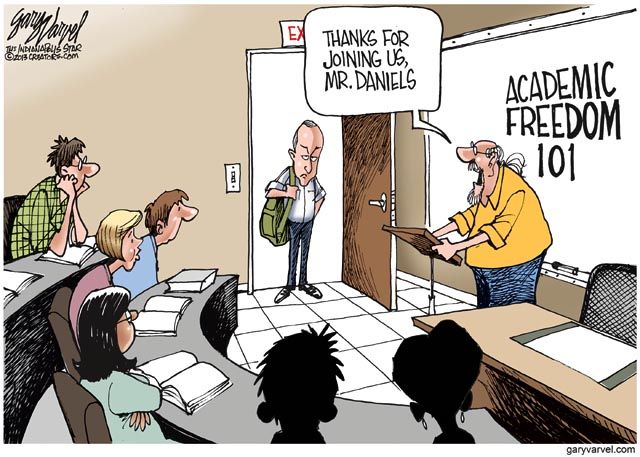 |
| Political cartoon by Gary Varvel / Indianapolis Star |
Academic freedom under fire:
The Mitch Daniels/Howard Zinn kerfuffle
If education at any level is to be shaped by the principle of academic freedom it must encourage student exposure to varieties of theories, perspectives, and points of view.
By Harry Targ | The Rag Blog | August 7, 2013
WEST LAFAYETTE, Indiana — On July 17, 2013, an Associated Press story was published in several newspapers quoting from 2010 e-mails Governor Mitch Daniels of Indiana, now the president of Purdue University, wrote to “top state educational officials.” The e-mails encouraged the suppression of popular historian Howard Zinn’s book, A People’s History of the United States in Indiana public education, including university level teacher training courses.
Upon the death of popular historian Howard Zinn, Daniels e-mailed that “this terrible anti-American academic has finally passed away.”
When challenged on the seeming threats to academic freedom, Daniels claimed that his directives “only” referred to K through 12 instruction despite the fact that his e-mails made it clear he opposed instruction that used Zinn’s writings as tools for in-service training for teachers.
Ninety Purdue University faculty (including this author) signed a letter to President Daniels objecting to his implied threat to academic freedom. In addition to defending the university as a place for debate among competing ideas, the faculty objected to the negative characterization of Zinn’s scholarship as an historian.
They also objected to Daniels’ claim that although he was not interested in censoring scholarship and teaching at the university, when he was governor he had the responsibility to oversee school curricula from kindergarten through high school.
Faculty pointed out that restricting what was being taught to teachers pursuing advanced credits and restricting the right of teachers to use Zinn’s work in pre-college curricula violated academic freedom. Many Purdue faculty believed that extreme statements damning the substance of Zinn’s work cast a pall on the university and made serious reflection on American history in elementary and high schools more difficult for young people and their teachers.
It is important to note that the Daniels e-mails, and their threat to free discussion and debate in educational institutions in Indiana, reflect the deep struggles being waged in the American political system. Rush Limbaugh once remarked on his radio show to the effect that “we” have captured most institutions in the society with the exception of the university.
Since politics is usually about the contestation of ideas and the development of ideas comes from an understanding of the past and its connection to the present and the future, schools and universities can aptly be seen as “contested terrain.” That is teachers and students learn about their world through reading, writing, debating, and advocating policies, ideas, and values in educational settings.
Consequently, if one sector of society wishes to gain and maintain political and economic power they might see particular value in controlling the ideas that are disseminated in educational institutions. During the dark days of the Cold War professors who had the “wrong” ideas were fired. Professional associations in many disciplines rewarded scholars who worked within accepted perspectives on history, or political science, or literature, or sociology and denied recognition to others.
The preferred ideas trickled down to primary and secondary education. In most instances, professors and teachers who suffered as a result of their teaching were merely presenting competing views so that their students would have more informed reasons for deciding on their own what interpretations of subject matter made the most sense.
American history was a prime example of how controversial teaching would become. Most historians after World War II wrote and taught about the American experience emphasizing that elites made history, men made history more than women, social movements were absent from historical change, history moved in the direction of consensus rather than conflict, and the United States always played a positive role in world history. European occupation of North America, the elimination of Native Peoples, building a powerful economy on the backs of a slave system, and a U.S. pattern of involvement in foreign wars were all ignored or slighted.
Howard Zinn, a creator and product of the intellectual turmoil of the 60s presented us with a new paradigm for examining U.S. history, indeed all history. His classic text, A People’s History of the United States, which has been read by millions, compellingly presented a view of history that highlighted the roles of indigenous people, workers, women, people of color, people of various ethnicities, and all others who were not situated at the apex of economic, political, or educational institutions.
He taught us that we needed to be engaged in the struggles that shaped people’s lives to learn what needs to be changed, how their conditions got to be what they were, and how scholar/activists might help to change the world.
Perhaps most importantly, Zinn demonstrated that participants in people’s struggles were part of a “people’s chain,” that is the long history of movements and campaigns throughout history that have sought to bring about change. As he wrote in his autobiography, You Can’t Be Neutral on a Moving Train: A Personal History of Our Times:
What we choose to emphasize in this complex history will determine our lives. If we see only the worst, it destroys our capacity to do something. If we remember those times and places — and there are so many — where people have behaved magnificently, this gives us the energy to act, and at least the possibility of sending this spinning top of a world in a different direction.
And if we do act, in however small a way, we don’t have to wait for some grand utopian future. The future is an infinite succession of presents, and to live now as we think human beings should live, in defiance of all that is bad around us, is itself a marvelous victory.
In the 1970s the American Legislative Exchange Council (ALEC) was formed by wealthy conservatives and corporations such as Koch Industries, ExxonMobil, and AT&T which invested millions of dollars to organize lobby groups, support selected politicians in all 50 states, create “think tanks,” and in other ways strategize about how to transform American society to increase the wealth and power of the few.
ALEC lobbyists and scholars developed programs and legislation around labor, healthcare, women’s issues, the environment, and education that were designed to reverse the progressive development of government and policy that social movements had long advocated.
Speakers at ALEC events have included Governors Rick Perry, Scott Walker, Jan Brewer, John Kasich, and Mitch Daniels. ALEC legislative programs include lobbying for charter schools, challenging teachers unions, revisiting school curricula to include materials that deny climate change, and more effectively celebrate the successes of the Bill of Rights in U.S. history.
The conservative Bradley Foundation, has awarded $400 million over the last decade to organizations supporting school vouchers, right-to-work laws, traditional marriage laws, and global warming deniers. Two of the four recipients of the organization’s 2013 award for support of “American democratic capitalism” were Roger Ailes, CEO of Fox News, and Purdue President Mitch Daniels.
Associations which lobby for restricting academic freedom in higher education include David Horowitz’s Freedom Center and the National Association of Scholars, funded by the conservative Sarah Scaife, Bradley, and Olin Foundations among others. NAS seeks to bring together scholars whose work opposes multiculturalism, affirmative action, concerns about climate change, and the “liberal” bias in academia.
NAS current president Peter Wood contributed a blog article in the Chronicle on Higher Education on July 18, 2013, entitled “Why Mitch Daniels Was Right About Howard Zinn.” Wood wrote that “a governor worth his educational salt should be calling out faculty members who cannot or will not distinguish scholarship from propaganda, or who prefer to substitute simplistic storytelling for the complexities of history.”
Howard Zinn’s A Peoples History of the United States is a history of how social movements of workers, women, people of color, native peoples, and others often left out of conventional accounts have made and can make history. This is a part of history that political and economic elites, influential organizations such as ALEC, the Bradley Foundation, and education-oriented groups like NAS do not want included in course curricula; in middle school, high school, or the university.
If education at any level is to be shaped by the principle of academic freedom it must encourage student exposure to varieties of theories, perspectives, and points of view. It is in an environment of discussion and debate that rigorous and critical thought emerges. Efforts to expunge certain scholars such as Howard Zinn from educational curricula contradict the spirit of free and rigorous thought.
A version of this essay appeared in the Fort Wayne Journal Gazette, August 5, 2013.
[Harry Targ is a professor of political science at Purdue University and is a member of the National Executive Committee of the Committees of Correspondence for Democracy and Socialism. He lives in West Lafayette, Indiana, and blogs at Diary of a Heartland Radical. Read more of Harry Targ’s articles on The Rag Blog.]
BOOKS / Ron Jacobs : Incarceration Complex: ‘Beyond Walls and Cages’

Incarceration complex:
The desire to imprison
Walls and Cages provides example after example of how central the business of incarceration is to the U.S. power elites in the twenty-first century.
By Ron Jacobs | The Rag Blog | August 7, 2013
[Beyond Walls and Cages: Prisons, Border, and Global Crisis, edited by Jenna M. Loyd, Matt Mitchelson, and Andrew Burridge (2012: University of Georgia Press); Hardcover; 344 pp; $50.20. Paperback; 168 pp; $22.46.]
Every day, the role of incarceration in the business of our nation becomes more noticeable. In California, 30 thousand prisoners are conducting a hunger strike demanding (among other things) an end to long-term solitary confinement and group punishment, and for better food and medical care.
In Vermont and other states, there is an ongoing campaign against private prisons and the shipping of Vermont prisoners to other states. Immigrants across the land are being thrown into detention facilities just because they are immigrants, often without papers.
The desire to imprison overrides almost any other function of law enforcement in most localities, while the number of laws requiring imprisonment is constantly increased with no regard for the damage such laws inflict.
It can be reasonably argued that this drive towards incarceration is occurring due to the incredible amounts of profits this dynamic creates for a few well-connected corporations. It can also be reasonably argued that the fact that most of the prisoners and detainees are people of color is directly related to a history of enslavement and control of that population in the United States.
A new book, Beyond Walls and Cages: Prisons, Border, and Global Crisis, utilizes both of these arguments as the basis for its examination of the role the prison-industrial complex plays in the modern U.S. corporate state, while also looking at movements working to change the system.
A collection of essays, articles and reflections by prison abolition activists, immigrant rights workers, and former detainees, Beyond Walls and Cages uses the concept of prison abolition as its foundation. By doing so, it rips away the idea that prisons can be reformed. After all, a reformed prison is still a prison. Their existence represents the perceived need by the power elites to control the poor and disenfranchised.
Nowhere is this more true in today’s world than in Washington’s current policies regarding immigrants. The only reason these people are detained is that they are immigrants. Most have committed no crime. Even among those who have been convicted, the majority of the convictions are for what most citizens consider minor offenses. Of this latter group, most have been naturalized and are only detained because of changes in immigration laws that were designed with no other purpose but to detain them.
It is worthwhile to ask, is the detention of those only because of their immigration status really much different than the detention of Japanese Americans during World War Two only because of their family’s ethnicity? Most Americans now consider the latter policy to have been wrong. How long will it take for its current manifestation to also be considered as such?
When it comes to the current immigration policy of “catch and return,” it is clear that the motivation behind the policy is twofold: to punish and to make money from that punishment. As the essays in this book make repeatedly clear, this is what motivates the entire system of imprisonment and virtually every element associated with that system.
As this book also makes clear, this is a bipartisan effort. Like with Washington’s policy on imperial war, there is little dissent among mainstream politicians and authorities over the necessity for war and incarceration, only over how best to prosecute them.
Walls and Cages provides example after example of how central the business of incarceration is to the U.S. power elites in the twenty-first century. From the denial of voting rights to the criminalization of migration; from the focus of law enforcement and prosecution on poor and mostly non-white communities to the media representation of immigrants and others as innately criminal.
This is a radical book that strips away any pretense that prisons and policies designed to place as many people as possible in them can be humane. The writers issue a clear and thoughtful call to reconsider the entire concept of prisons on which U.S. society and its institutions have based their approach to dealing with the poor, non-white, and others with little power.
[Rag Blog contributor Ron Jacobs is the author of The Way The Wind Blew: A History of the Weather Underground. He recently released a collection of essays and musings titled Tripping Through the American Night. His novels, The Co-Conspirator’s Tale, and Short Order Frame Up will be republished by Fomite in April 2013 along with the third novel in the series All the Sinners Saints. Ron Jacobs can be reached at ronj1955@gmail.com. Find more articles by Ron Jacobs on The Rag Blog.]
Michael James : ‘El Triumph’ in Tamaulipas, Mexico, 1962
 |
| Check Point, Tamaulipas, Mexico, June 16, 1962. Photo by Michael James from his forthcoming book, Michael Gaylord James‘ Pictures from the Long Haul. |
Pictures from the Long Haul:
El Triumph in Mexico,
Check Point, Tamaulipas, 1962
I’m working hard to keep the Triumph on the road through the flat, arid, brown, dry and desolate terrain. Its new, different, and I’m digging it, taking it all in.
By Michael James | The Rag Blog | August 6, 2013
[In this series, Michael James is sharing images from his rich past, accompanied by reflections about — and inspired by — those images. This photo will be included in his forthcoming book, Michael Gaylord James’ Pictures from the Long Haul.]
Heading off to college I thought I might be a social worker, even a minister. I was attracted to the offbeat and rebellious, and felt an affinity for black people and other non-whites in general. I felt compassion for the handicapped and those I perceived to be underdogs.
My team was the “bums,” the Brooklyn Dodgers, and my hero was Jackie Robinson. At the Saugatuck Congregational Church during the offering, I put money in the foreign mission side of the donation envelope, not the domestic. And along the way I rapidly learned of class and racial divisions in the US of A.
Sociology Prof Don Roos clued me in to the notion that social, economic, and political forces shaped individuals and society, and I went for sociology and anthropology over the more popular major, psychology, that focused on the individual. Favoring the group over the individual, and the social forces dominant in shaping the individual, was my simplistic bent.
Like many of my generation I was attracted to the writings of C. Wright Mills, particularly The Power Elite (1956). And I was keen on the notion of participant observer or participant observation and things I heard the “Chicago school of sociologists” espoused.
Life was full in the winter and spring of 1962, lots going on both on campus and the outer world. I was inspired by the new Peace Corps, and became involved with cultural activities and the International Relations Club. I attended the required convocations, but wouldn’t sign in, telling Dean Hoogesteger that I showed up because I wanted to, not because I was required to do so.
I remember seeing the theologian Reinhold Niebuhr and the anthropologist Loren Eiseley, who wrote the wonderful book, The Immense Journey.
The Garrick Players put on a rendition of Jean Anouilh’s The Lark and recruited me, a football player, to play the executioner. I stood on stage bare-chested, holding a weapon, my head covered by the executioner’s masque. My little acting stint in that play meant that I couldn’t attend the February 16, 1962, anti-nuclear march in Washington put on by the Committee for a SANE nuclear policy and the young Students for a Democratic Society.
I drove friends to Hyde Park where they gathered around a fountain at the U of C preparing to board buses to DC. There I met one stoned Elvin Bishop, later of the Butterfield Blues Band, among the people gathered for the sendoff.
A friend early on at Lake Forest College was Carole Travis. Her dad was a renowned Communist, “Fightin’” Bob Travis, who led the UAW’s Flint sit-down strikes. Through Carole, Gloria Peterson, and others, I was introduced to people and events at the University of Chicago where my Dad had gone to school. Included were Skip Richheimer, Danny Lyon, and Norland Hagen, all motorcycle riding students with the nickname the “Blessed Virgin Mother Motorcycle Club.” They rode Triumphs and a Norton, the favored British bikes, not Harleys.
At the U of C folk festival I sat on the steps to the stage, tears and emotions welling to the surface as the young Mavis Staples of the Staples Singers belted out gospel tunes. There too from the back of Mandel Hall I saw the great American Socialist Norman Thomas and the writer Michael Harrington.
Harrington’s book, The Other America, opened my eyes, uncovering the extent of poverty in the U.S. That book, that hit stores in March of 1962, rocked the minds of not only students who were becoming activists, but had a big effect on the Kennedys, Lyndon Johnson, and the government.
Later, in 1964, as a graduate student at Berkeley involved in the Free Speech Movement and then Students for a Democratic Society, I had a memorable discussion with Harrington at a party while drinking freely from a gallon jug of cheap red Pirate wine.
The biggest deal for me that spring was bringing a big yellow 650 cc Triumph Thunderbird motorcycle into my life. I found The Triumph at Sunset Cycle Sales in the old religious and still nuclear town of Zion, Illinois, on the great Lake Michigan at the border of Illinois and Wisconsin.
Not long after getting the Triumph I was riding with my college sweetheart Lucia Crossman from town toward the college’s South Campus. It was pouring rain and the Triumph went out from under us, the three of us sliding as if on ice, the machine in the lead, followed by Lucia then me, we two humans looking clearly into each others’ eyes in a state of amazement, all in slow motion.
My performance in Old Pinky Williams’ Spanish class was dismal. I needed more “foreign language” credit for graduation. I was reading Robert Redfield and his theories on the growth of cities and the creation of the peasantry based on “field work” from Mexico. The plan developed: I would ride my machine to Mexico City College and take Spanish language and anthropology courses. It would be a far-out summer.
On Wednesday, June 13, I took my last exam, packed, and attached my stuff to the bike: saddlebags plus two aluminum boxes and a black attaché case fastened to the luggage rack. Lucia’s parents picked her up and I followed them three hours south to Morton outside Peoria. After dinner Lucia and I had a nighttime ride in the country and made out in a cornfield before I entered a restless anticipatory sleep.
In the morning I moved on. Outside of East St. Louis I met a guy on a new Honda motorcycle and asked “are these fast?” He said, “Let’s go!” The Honda wiped the Triumph. So much for the perceived inferiority in those days of the “Jap bikes.”
“Man from Lincoln land” was what the black man said, waving at me as I pulled away very early in the morning from a dingy motel on the side of a busy road on the edge of Little Rock, Arkansas. Sleep was restless, fleeting, and passing, trucks rumbling through the night beside the room where I slept. The long day’s ride took me through Texarkana, and the hills and piney woods of East Texas. I hit big-time traffic and alternating combinations of showers and sun riding through Houston on a new highway.
They say that if you had a Triumph you needed four hands, two to ride and two to pick up the parts. My Triumph was leaking oil. I made it to Victoria, Texas, by sunset and headed to a motorcycle shop. Nobody home. They were out at the airport testing their dragster.
I got a motel room across from a diner on the main drag, linked up with the cycle shop guys who fixed me up with missing screws for the crank case, and engaged in devouring a giant sizzling steak served on a big hot metal platter. C & W spun from the jukebox. I finished my pie, gulped down my milk, cleared the tab, crossed the wide Texas highway 77, and slept oh-so-soundly.
At daybreak I rode through the King Ranch, checking the speedometer, doing fundamental math, figuring time and miles. I felt lonesome — and very alone. A bus emerged in the distance; as it neared I read its marquee: “BB King.” Wow! The blues man! My mood lifted. I felt so good, my excitement on the rise, heading to the border, looking forward to what was to come.
Here comes Brownsville; there went Brownsville. I’m on the other side of the little trickle of the Rio Grande aka Rio Bravo and am immediately dealing with Mexican border guards. I’ve got to be 21 to cross this line. I’m 20, and I’m giving him a rap, telling him I’m going to school in Mexico City.
I knew the age requirement. I thought I was ready and had typed a letter from my dad with my deft portrayal of his signature. This little work of forgery that I pulled from my trusty attaché case didn’t carry much weight with this particular border dude.
I also knew about la mordida, the bite, the little bribe. For a few bucks I was free to move on, after a little frenzy of handing out small change to a cluster of beggars, handicapped kids, and Chiclets gum vendors.
Quickly — but only momentarily — I was lost in Matamoros on skinny dirt streets lined with adobe buildings, looking for the Pan American Highway, a road I figured someday I might ride all the way to Tierra del Fuego. Then I’m riding through Tamaulipas heading south with a strong wind blowing off the Gulf.
I’m working hard to keep the Triumph on the road through the flat, arid, brown, dry and desolate terrain. Its new, different, and I’m digging it, taking it all in. A Brahma cow, a horse, a burro, an old guy in sombrero and serape, and people on the side of the road. I’m waving as I fly by. People wave back. I like that.
I see people getting on an old bus, a team of oxen, roadrunners and other birds. There are tiny settlements with fewer then 10 little huts made of sticks, and larger settlements of adobe huts. A guy is riding a burro, bouncing along, trot-trot-trot, his legs nearly touching the ground. There are old cars and trucks, beautiful to me, a product of the ’50s hot rod and custom culture.
We’re in el mundo de kilometros; I’m doing division, translating miles into kilometers and kilometers into miles, long before I knew that a 5k run equaled 3.1 miles. I am eating up those kilometros.
Uh-oh, a roadblock and Federales coming out of a stick shed to check my papers. No problema aqui. I hang out, do my best to communicate and take some shots: a man in uniform, two kids, a young woman hanging on the back of a pickup truck beside a 1954 Chevy wagon under a sunshade made of sticks and straw, next to a refreshment stand with a Coca Cola logo on the side.
It is hot. I shoot the picture of El Triumph, south of the border in Mexico, enjoying the rippling, fizzing, and refreshing iced soda. Then, I get on the bike, wave goodbye, and hit the road.
[Michael James is a former SDS national officer, the founder of Rising Up Angry, co-founder of Chicago’s Heartland Café (1976 and still going), and co-host of the Saturday morning (9-10 a.m. CDT) Live from the Heartland radio show, here and on YouTube. He is reachable by one and all at michael@heartlandcafe.com. Find more articles by Michael James on The Rag Blog.]
Posted in Rag Bloggers
Tagged Memoir, Mexico, Michael James, Motorcycle Trip, nostalgia, Pictures from the Long Haul, Sixties, Travel
2 Comments
Alan Waldman : ‘Inspector Lynley Mysteries’ Feature Aristocratic Police Detective

Waldman’s film and TV
treasures you may have missed:
Nathaniel Parker and Sharon Small are excellent as the mismatched-but-successful crime-fighting pair.
By Alan Waldman | The Rag Blog | August 6, 2013
[In his weekly column, Alan Waldman reviews some of his favorite films and TV series that readers may have missed, including TV dramas, mysteries, and comedies from Canada, England, Ireland, and Scotland. Most are available on DVD and/or Netflix, and some episodes are on YouTube.]
The Inspector Lynley Mysteries feature tall, handsome, suave Nathaniel Parker as Scotland Yard Detective Inspector Tommy Lindley, who is also the eighth Earl of Asherton, assisted by brusque working-class Sergeant Barbara Havers (Sharon Small). This odd couple solved a lot of crimes in 23 episodes broadcast from 2002 to 2008. Several are based on some of the popular 18 English mystery novels from American author Elizabeth George. You can watch one here.
In 2007, Small was nominated for the “Best Actress” Satellite Award. More than 89.5% of viewers polled at imdb.com gave the series thumbs-up. The San Francisco Chronicle called Lynley and Havers an “incomparable Scotland Yard team.”
Guest casts included many fine British character actors, including Bill Nighy (who won major awards for State of Play, Love Actually and eight other films), Jenny Agutter (won a BAFTA for Equus), Henry Cavil (Man of Steel), Jemma Redgrave (Bramwell), Richard Armitage (two award noms for MI-5 ), Honeysuckle Weeks (nom for Foyle’s War), Indira Varma (Kama Sutra) and Idris Elba (five awards and 21 noms for works including Luther and The Wire).
Lynley is the rare detective who exposes the secrets of the upper classes. The series deals with baffling crimes and his marriage, separation, and the murder of his wife.
Elizabeth George explains why there is no romance between Lynley and Havers:
The dynamic between them is not one of sexual attraction. Lynley is from a posh background with a posh voice, educated at Oxford, with a title and money. Havers is from a poor background, and she’s had to fight for everything she’s got. Needless to say, they have huge preconceptions about each other. What I’m interested in is how they start to discover their common ground through police work.
In the novels, Lynley is blond and Havers is plain, dumpy and too-casually dressed. Not so in the TV series.
The series aired in the U.S. on PBS’s “Masterpiece Mystery” series. In France it aired as Meurtres à l’anglaise and in Hungary as Linley felügyelő nyomoz. Netflix and DVD have 22 Inspector Lynley episodes, Netflix Instant streaming has one, and all are on YouTube.
[Oregon writer and Houston native Alan Waldman holds a B.A. in theater arts from Brandeis University and has worked as an editor at The Hollywood Reporter and Honolulu magazine. Read more of Alan Waldman’s articles on The Rag Blog.]
Source /
HISTORY / Bob Feldman : A People’s History of Egypt, Part 5, 1879-1890
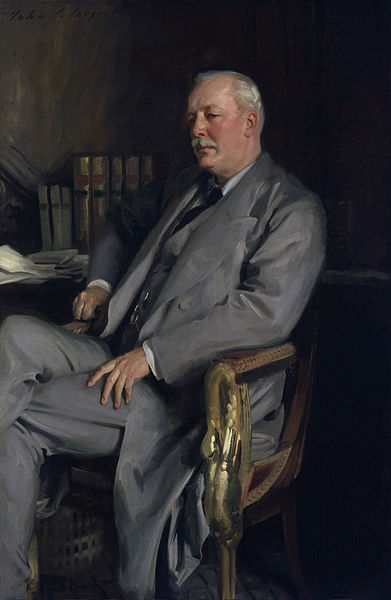 |
| Sir Evelyn Baring, later Lord Cromer, coined the term “Veiled Protectorate.” Painting by John Singer Sargent / National Portrait Gallery, London / Wikimedia Commons. |
A people’s history:
The movement to democratize Egypt
Part 5: 1879-1890 period — Britain rules Egypt under ‘Veiled Protectorate.’
By Bob Feldman | The Rag Blog | August 6, 2013
[With all the dramatic activity in Egypt, Bob Feldman’s Rag Blog “people’s history” series, “The Movement to Democratize Egypt,” could not be more timely. Also see Feldman’s “hidden history” of Texas series on The Rag Blog.]
As Selma Botman noted in Egypt from Independence to Revolution, 1919-1952, by 1876 “in essence France and Britain began to control Egypt’s economy,” although Egypt continued to be officially part of Turkey’s Ottoman Empire.
So, not surprisingly, in September 1881, an Egyptian “military officer and Egyptian patriot, Ahmed Urabi, led an anti-government, anti-foreign revolt, directing his protest against both the Turkish pashas, who controlled most civil, military, and social posts…and the Europeans,” according to the same book. And a combined UK and French naval force of gunboats then arrived near Alexandria, Egypt on May 19, 1882, and anchored offshore.
In response, “inflamed popular resentment…exploded in Alexandria on June 11 [1882] in anti-European riots that killed over 2,000 Egyptians and 50 Europeans,” according to Jason Thompson’s History of Egypt. The French government’s naval force then sailed away from Alexandria. But the UK gunboats remained anchored offshore and shelled Alexandria and its residents on July 11, 1882; and, in August 1882, UK troops invaded the Suez Canal Zone and began the UK government’s military occupation of Egypt.
Ahmed Urabi’s troops were defeated on September 13, 1882, by the UK troops, Urabi was exiled to Ceylon/Sri Lanka by the UK government, and the son of Khedive Ismail, Khedive Tewfik (whom the UK government had pressured the Turkish sultan to name in 1879 as Egypt’s local ruler) was allowed to officially govern Egypt until 1892 as a UK puppet, until he was succeeded as the formal Egyptian ruler by Abbas Hilmy II.
But, in actuality, according to The Rough Guide To Egypt, “from 1883 to 1907, Egypt was controlled by the British Consul General, Sir Evelyn Baring, later Lord Cromer, who coined the term `Veiled Protectorate’ to describe the relationship between the two countries.”
A History of Egypt described in the following way how UK imperialism and Lord Cromer operated their “Veiled Protectorate” in Egypt after it was occupied militarily by UK troops in 1882:
Cromer’s official position in Egypt was…British consul general, yet he wielded power that many kings and sultans might have envied. His authority rested on no formal basis. Legally, Egypt was still a province in the Ottoman Empire… The khedive still governed nominally through his ministers, who exercised control over their ministries. In fact, the khedive could be controlled; he knew he owed his throne to the British, and alongside each of the government ministers was a British “adviser” whose advice carried the force of command.
Cromer referred to the arrangement as the “dummy-Minister-plus-English-adviser” system of government… Ministers soon learned that they would lose their posts if they paid no heed to their advisers. The long-serving prime minister during Cromer’s rule, Mustafa Fahmi, was noted for his subservience to the British. Cromer’s position was further strengthened by the presence of a British military garrison nearly 10,000 strong, while the Royal Navy could appear at Alexandria or Suez at any time, and the police forces in the cities were under European command…
The British record in education was atrocious in Egypt… He imposed tuition fees… The British never spent more than 3 percent of the budget on education. They ignored demands for a national university, fearing it would become a center of nationalism…
As Egypt from Independence to Revolution, 1919-1952 observed, the UK “occupied Egypt for both financial and strategic reasons, gaining a decisive voice in all areas of Egyptian life” and the UK imperialist “occupation” of Egypt “lasted until 1956 in various forms.”
[Bob Feldman is an East Coast-based writer-activist and a former member of the Columbia SDS Steering Committee of the late 1960s. Read more articles by Bob Feldman on The Rag Blog.]
Beverly Baker Moore : May Day Memories, or Consciousness-Raising Through Vegetables
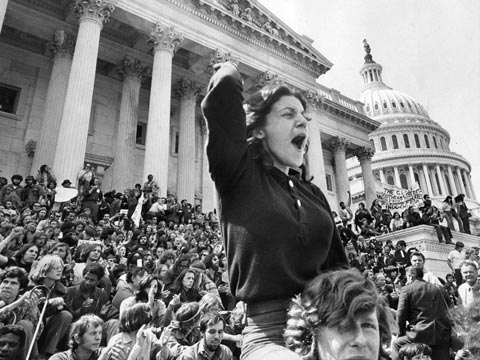 |
| Rally during May Day demonstrations, Washington, D.C., 1971. Image from Waging Nonviolence. |
May Day memories, or
Consciousness-raising through vegetables
The cop riding shotgun stayed behind the wheel while his out-of-control buddy leapt out screaming. He was all blown up, beet-red in the face and (literally) spitting mad.
By Beverly Baker Moore | The Rag Blog | August 1, 2013
Not counting the people who’ve died too young since 1971, there should be at least one good story out there from each of the 7,000 or so people who went to Washington on May Day that year. This is one.
Our four-person Sattva staff cell was one part of the larger Austin Armadillo contingent that year. Turned out disrupting DC traffic was the main, but not the only, thing we did. There were a couple of Washington evenings spent in heart-to-hearts with plaintive bureaucrats. There was a wild incident with cops and irate neighbors. And on the way home we adopted a Japanese hitchhiker.
Ahem. Before I came to the movement I spent some time trying to change the system from within. I gave that up for good in 1970 after working as a field rep for the poverty program’s Austin office. There were some real good people there and they had me out in rural communities where I would sit down with local folks and hear about the projects they believed would help them. My job was to capture their visions on federal forms and submit them for approval. The bureaucracy was a drag but taking the money back to the people was great.
Alas, Nixon got elected in ‘68. He closed the Austin office and cut the national program way back. Some staffers relocated to Dallas to do what they could within the more restrictive guidelines. Some tried other government jobs in the better karma agencies like AID, VISTA, or the Peace Corps. Some, like me, stayed in Austin and got involved in other kinds of community effort.
The first people in Austin’s underground community I fell in with were staff writers and cartoonists for the the Texas Ranger humor magazine. Through them I met a larger local group of “creative anarchists” big into street theatre. One of the most creative of these particular anarchists was Curtis Carnes and he had a plan for a community restaurant. One night he told us all about his vision for Sattva and asked if we’d join him. A week later, Jay, Jane and I were sharing a house with him and spending our mornings chopping vegetables.
The Sattva concept was simple. Good tasting, healthy, affordable meals. Anything not sold was given away. We were given space first in the Jewish, then the Methodist, student centers. The food was vegetarian. Macrobiotic was always on the menu for those who believed in it but we believed in spices! We served soups, beans, rice, casseroles, salads, and desserts to 600 people a day. We used no processed foods…ever.
As commune members we were paid minimal amounts of money for subsistence and a share of the food. In return we chopped hundreds of pounds of vegetables and fruit five mornings a week but not by ourselves. Friends came by to help. When your recipe starts with “25 pounds of potatoes, 10 pounds of onions…” and has to be ready by noon more hands are a blessing.
In what became a distinctive morning routine, a loose affiliation of friends from the community wielded butcher knives and talked politics beside us. Together we diced and mixed and stirred and poured for hours so people could have a three- or four-course meal that day for about a dollar.
Anyone who had trouble with the dollar was welcome to show up at the end of the meal and help us clean up in return for eating as much as they could hold for free. Seriously unique and celebratory after-work kitchen events arose as those folks worked and played and cleaned. For these celebrations we got to be the audience.
In Spring 1971 Sattva was coming to the end of a successful first year. We talked it over and decided to celebrate by going to Washington with our friends.
Meanwhile, my former boss at the poverty program office had become national head of VISTA and lived in a fine Georgetown house provided by that agency. He and his wife invited us to stay with them on one condition: their friends and co-workers in Washington wanted to sit and talk with us. So we swapped conversation for lodging.
The discussions were deep and heartfelt but, in the end, positions remained unchanged. The bureaucrats were kindly souls who cared about the same things we did and really wished they could join us but, but, but…
Eventually they decided to show their solidarity by taking vacation days during the demonstration so as not to actually contribute to the government during the time we were there. After that, I suppose, they opted to return to work to wait for the country to evolve into a meritocracy. We, of course, opted to hit the streets.
After earning our lodging, we bedded down on sleeping bags amid the family washer, dryer, and ping pong table that night, then set out for our selected destination the next morning. During our walk we witnessed firsthand the steady progression from Georgetown’s brick streets and sculpted shrubbery to the more distressed real estate that makes up most of the neighborhoods in DC. We passed blocks and blocks where mostly African-American folks gathered on porches and street corners, calling out greetings and encouragement.
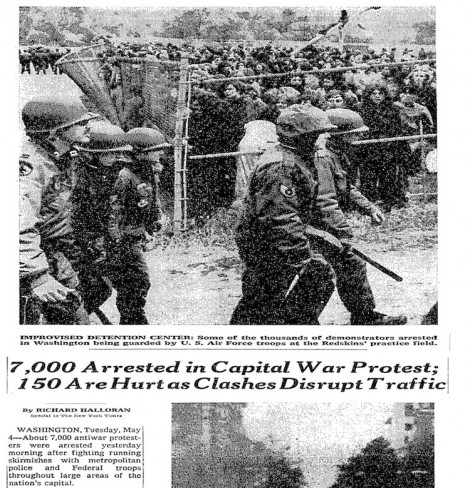 |
| New York Times coverage of 1971 May Day actions. Image from The Exiled. |
We felt good about the street action that first day. We had huge numbers and did what we came to do…the streets were a mess around the traffic circles. I remember some angry-faced motorists but just as many, it seemed, looked faintly pleased. By afternoon we had escaped the cops and were crossing back through the African-American neighborhood from that morning, when two cops ran their patrol car up onto the sidewalk, nearly taking out the fire hydrant right next to us.
The cop riding shotgun stayed behind the wheel while his out-of-control buddy leapt out screaming. He was all blown up, beet-red in the face and (literally) spitting mad. Apparently, he’d not had a good morning.
He screamed at us. Caught by surprise, we just stared at first. Then he lunged at me. He grabbed my coat collar and jerked me off my feet. Scared the crap out of me at first.
We were in front of the picture windows of a corner café as the cop threw open the back door of the patrol car and tossed me in. We were prepared to be arrested so we didn’t argue with him for long. Instead, a young pregnant Black woman pushing a baby stroller on the block inserted herself into the confrontation.
She stepped up to the cop told him we were doing nothing, just walking down the street. He responded by jabbing her in the stomach with his club. That’s when the young Black men started coming out of the café, hot at the cop for threatening the woman. People on doorsteps across the street got up and began yelling too.
Back in the patrol car, the cop in the driver’s seat gave up and got out, obviously pissed at his partner for getting him into all of that trouble. I was inside the patrol car watching the surreal scene. My friends had backed off and I could no longer see the cops for all the angry neighbors.
That’s when I found the patrol car doors were not locked. It occurred to me that staying in an unlocked police car waiting to be taken away by two cops who didn’t look like they would live through the day was idiocy. I mean, they hadn’t even checked my ID. I flung open the car door on the street side, leapt out, and ran to the folks beckoning me from their stoops on the far side.
I made it across the street unnoticed by anyone else (even my friends, as it turned out). A beautiful white-haired Black man motioned me onto his porch and through his front door. Inside a grinning old woman waved me through their house and out their back door. I sprinted across two small yards and into another shotgun house as more people showed me the way through. I cleared several blocks this way and have this tale to tell about it all.
Back in the Georgetown living room that night the TV news showed the arrival of a couple of our leaders. We heard them say that on day two the demonstrations would be concentrated on fewer areas, then they announced which ones.
We disagreed with the strategy and the Sattva staff decided to spend the next day helping first aid workers and rescuing arrested people (some 1,400 of them) from RFK stadium. (Helpful hint for next time: LOTS of people will say their name is Karl Marx — some 144 on that first day alone.)
The wild-eyed cop who attacked me was a preview of what people encountered that second day. It was so bad the national news media blazed headlines calling it a “Police Riot.” If we stirred up that much trouble we must have done something right.
A couple of days later we were on IH-35 in downtown Waco, almost home. Stranded on the median was a young Japanese hitchhiker. He was so thrilled we stopped to pick him up he wouldn’t quit bowing and we all nearly got blown away by semis before we got him into the car.
Back on the road he told us he was a Japanese graduate student on the last leg of an around the world adventure. He’d saved America for last, he said, before he returned to Tokyo to finish his degree and go into the family business.
He had been involved in Japanese student movements and was excited to hook up with us. He about cried when we served him the home-made Miso soup. He left us a couple of weeks later in the middle of another anti-war demonstration, freaked out about the Texas Rangers who showed up and ringed the park where we’d gathered for that one.
Before he left he explained that Japanese police did not carry weapons so he had no trouble joining street events there. He was scared to death by the well-armed Rangers, though. He said we were very, very brave and that he worried about us because we were protesting in the face of such violent authorities in such a violent country. He wished us good luck in Japanese.
[Beverly Baker Moore is an Austin-based writer, teacher, and activist.]
Posted in RagBlog
Tagged Anti-War Demonstration, Austin History, Beverly Baker Moore, Communes, May Day Demonstrations, Peace Movement, Sattva, Sixties
2 Comments
Robert Jensen : Peace Talks Are New Chapter in an Old Book
 |
| Peace talks: the players. Image from AP Graphics Bank. |
Peace talks:
A new chapter in an old book
Discussions about the issue, whether among citizens or by officials at the negotiating table, must begin with an acknowledgement of the power wielded by Israel, backed by the United States.
By Robert Jensen | The Rag Blog | August 1, 2013
New negotiations between Israelis and Palestinians may begin next week, with much talk of a “new chapter” in the seemingly intractable conflict. A new chapter, perhaps, but who is writing the book?
Any public discussion about the “peace process” is tense, in part because there is no widely shared understanding of the history and politics of — even an appropriate terminology for — the conflict. That’s as true in the United States as in Palestine and Israel.
I never gave much thought to the question until I was 30 years old, in the late 1980s. Before that, I had a typical view of the conflict for an apolitical American: It was confusing, and everyone involved seemed a bit crazy.
With no understanding of the history of the region and no framework for analyzing U.S. policy in the Middle East, it was all a muddle, and so I ignored it. That’s one of the privileges of being in the comfortable classes in the United States — you can remain comfortably ignorant.
But as a frustrated journalist with a newfound freedom to examine the politics of news media in graduate school, I began studying law and human rights, in the domestic and international arenas. I also started digging into the issues I had been avoiding. In the case of Palestine/Israel, I began reading about the roots of the conflict, how the United States was involved, and how U.S. journalists were presenting the issues.
I came to this inquiry with no firm allegiance to either side. As a white U.S. citizen from a centrist Protestant background but with no religious commitments, I felt no cultural or spiritual connection to either national group. I don’t speak Hebrew or Arabic, and I had never traveled to the Middle East. I had no personal relationships that predisposed me to favor one group over the other.
Like any human, I was not free of bias, of course. As a relatively unreflective white man rooted in a predominantly Christian culture, I was raised with some level of anti-Semitism and anti-Arab racism, for example, and no doubt that affected my perceptions. But based solely on my personal profile, I didn’t have a dog in that fight, or so I thought.
After a couple of years of studying the issues, I realized that the categories of “pro-Israeli” and “pro-Palestinian” didn’t fit me. When people asked me where I stood on the issue, I would say that I supported international law and the Universal Declaration of Human Rights. As a U.S. citizen, I asserted that my primary obligation was to evaluate the legality and morality of my own country’s involvement in the conflict and the region.
The more I learned about all those things, the more I became opposed to my government’s policy on this issue, in the Middle East, and around the world. The more I learned, the more I realized I lived in the imperial power of the day, and it became clear to me that imperial policies are designed to enrich the few while ignoring the needs of the many, at home and abroad.
I became a critic of U.S. policy based on careful study that included, but was not limited to, mainstream sources. I could no longer accept the conventional story and the policies that flowed from that story.
Today, the situation in Palestine and Israel is as grim as ever. Decades of Israeli expansion and the Palestinian leadership’s failure to build a vibrant movement to challenge that expansion (or, perhaps, to let such a movement emerge on its own) have narrowed the prospects for a just peace. And in the background lurks the United States, still the major impediment to progress as long as it offers Israel nearly unconditional support for the occupation.
More than ever, the case for international law and human rights needs to be made clearly, but the conditions for that dialogue deteriorate. Despite recent efforts by U.S. Secretary of State John Kerry, there seems little basis for optimism, short or long term. As U.S. officials scramble to save an empire in decline, with its whole Middle East policy in disarray, it’s difficult to imagine a breakthrough.
I have no great insights into how to solve the conflict or deepen the dialogue. But as I think about the conflict, I’m drawn back to my roots in feminist intellectual and political life for some basic observations.
My return to graduate school has led me to inquire about many aspects of the world over the past two decades, but the first of those inquiries was into gender, with a focus on men’s violence against women. That led me to radical feminist theory, which has helped me understand not only the question of gender but offered a framework for understanding hierarchy.
Feminism taught me how to think not only about gender but also about power, and a central lesson of feminism that applies here is the problem of assuming false equivalency in analyzing conflict.
Take a classic example of a husband who physically assaults his wife. The problem is rooted in patriarchy, a system that gives men control over women in a hierarchy that is naturalized and normalized: Men rule, women submit. The man’s violence in this case is used to ensure the submission, but the physical violence typically is only one method of control; such relationships often include emotional abuse and sexual violence.
Within that dynamic, the woman may engage in all kinds of dysfunctional behavior herself, and she may strike out violently against the man at times. But feminist analyses of male power and men’s violence have made two things clear.
First, any specific incident can’t be understood outside the larger context, not only of that relationship but of the power dynamics of the culture. So, if we were drawn into a chaotic incident in the couple’s home, we might be tempted to assess the situation on the basis of what had just happened, but focusing only on the immediate occurrence would leave us ill-equipped to understand it. We need to know the couple’s history and understand the patriarchal context in which that history plays out.
Second, if we wanted to help resolve the conflict, it would be folly to assume that the man and woman were equally responsible and that a productive dialogue could go forward on that basis. Any claim that the man and woman should sit down as equals and talk would favor the man; without an acknowledgement of his greater power and a history of using that power to dominate, any “dialogue” would be a farce.
While some men react to any call for such conversation with force, other men pursue a more sophisticated strategy that continues the dialogue so long as his fundamental power, in the relationship or in society, is not challenged. Some men pursue both strategies, depending on the moment. Real dialogue is possible only when the discrepancy in power is addressed.
If there is to be progress toward a just and peaceful solution in Palestine/Israel, those two lessons are crucial. We must recognize the larger political context in which the conflict is set and not assume there’s a level playing field for dialogue.
That means acknowledging that since the end of World War II, the United States has pursued a policy of domination — through diplomacy and force — in the Middle East, and that for more than four decades a central component of that policy has been U.S. support for Israel’s expansionist policies in exchange for Israeli support of the U.S. project in the region (though not without disagreements and tension between the two countries).
It also means that discussions about the issue, whether among citizens or by officials at the negotiating table, must begin with an acknowledgement of the power wielded by Israel, backed by the United States.
For more than 20 years I have tried to recognize the many ways in which I live with unearned privilege and tried to support the struggles of marginalized and oppressed people to justice. That has led me to support the basic aims of Palestinian nationalism, even if I do not always support specific strategies or tactics of various Palestinian groups.
I also have criticized Israeli policy in public, in writing, and on film. But as a citizen of the United States, I have tried always to bring discussions on my home turf back to the responsibility of citizens to hold their own government accountable.
That is my dog in the fight. I live in a nation in which there is a tremendous gap between leaders’ rhetoric of freedom and justice, and the reality of imperial policies that perpetuate injustice. To close that gap, our public discussions must take account of the context and be honest about power. Nowhere is that more crucial that the intellectual and political engagements on the Palestine/Israel conflict.
[Robert Jensen is a professor in the School of Journalism at the University of Texas at Austin and board member of the Third Coast Activist Resource Center in Austin. His latest books are Arguing for Our Lives: A User’s Guide to Constructive Dialogue and We Are All Apocalyptic Now: On the Responsibilities of Teaching, Preaching, Reporting, Writing, and Speaking Out. His writing is published extensively in mainstream and alternative media. Robert Jensen can be reached at rjensen@austin.utexas.edu. Read more articles by Robert Jensen on The Rag Blog.]
Posted in Rag Bloggers
Tagged Feminism, Israel, John Kerry, Middle East, Palestinian Occupation, Patriarchy, Robert Jensen, U.S. Imperialism
2 Comments
Lamar W. Hankins : Alcoholics Anonymous, Nonbelievers, and the Constitution
 |
| Alcoholics Anonymous “praying hands” medallion. Image from Alternatives in Treatment. |
Alcoholics Anonymous, nonbelievers,
and the Constitution
AA proponents argue that the ‘higher power’ found in its steps can be whatever one wants it to be. Yet plainly religious practices go on at AA meetings, such as prayer, scripture-quoting, and the crediting of a supernatural ‘higher power.’
By Lamar W. Hankins | The Rag Blog | August 1, 2013
Every day, courts throughout the country require people placed on probation for alcohol-related offenses to attend 12-step treatment programs. Often, Alcoholics Anonymous (AA) is specifically named as the program they must attend, and a probationer may be required to attend one AA meeting each day for 30 days or more.
This raises two important questions: 1) Is AA a religion-based program? 2) If so, does it violate the First Amendment rights of probationers to require attendance at AA meetings?
Since 1996, at least 12 federal district and appellate courts have found that AA is religion-based. Thus, mandatory attendance at AA meetings as a condition of probation (or parole) violates the Establishment Clause of the First Amendment.
Of course, if there is a secular program that serves the same purpose as AA, attendance at that program can be made mandatory because no Establishment Clause problem affects secular programs. But no other alcohol recovery program of which I am aware provides as many meetings as does AA. With over 100,000 meetings worldwide and nearly 2 million members, all other programs are dwarfed by AA.
I do not oppose AA. Many of my friends, relatives, acquaintances, and clients benefit from AA. But I have also known people who find AA meetings that emphasize religion or religious practices unacceptable, preventing them from benefiting from the program.
Not all AA meetings are the same, though it is probably fair to say that most AA groups include religion in their meetings. Some people who reject religion are able occasionally to find a group that has a more secular approach that is not offensive to their core beliefs.
But every one of the 12 federal courts and one state court that I have found that has ruled for the record on this issue has held that AA is religious-based and that offenders cannot be constitutionally compelled to attend AA meetings.
There is irony in this situation. AA is widely acknowledged as founded by Bill Wilson (Bill W. in AA parlance) and Bob Smith, but others joined them in creating what is arguably the most successful self-help program to help alcoholics overcome (or at least manage) their problems with alcohol.
Bill W. wrote the first version of the 12 Steps that at least 10 people began using in 1938 to get and stay sober. But two members of the group, Jim Burwell and Hank Parkhurst, objected to the emphasis on faith, religion, and religious practice they encountered when they began to attend meetings.
Wilson reported in “The Twelve Steps and Twelve Traditions” that Burwell said in their first encounter, “I can’t stand this God stuff! It’s a lot of malarkey for weak folks. The group doesn’t need it and I won’t have it. To hell with it.”
Burwell could not accept the idea of Christian redemption that most of the group was preaching. When Burwell started to drink again a few months later, the members of the group turned against him and refused to help him again. After Burwell regained his sobriety and would not stop attending the meetings, the group once again accepted him in spite of his anti-religion attitude.
Wilson initially refused to change any of the ideas he had enunciated in “The 12 Steps,” which he wrote on a scratch pad in pencil in May 1938. But Burwell and Parkhurst would not go along with the use of the word God in the original draft. They represented 20% of the original group and Wilson did not want to lose them, so he relented.
As Susan Cheever, a columnist for The Fix recently explained:
Finally a compromise was reached, and four key changes in the document were agreed to. In Step Two, “a Power greater than ourselves” replaced “God.” In Steps Three and Eleven, the single word “God” was qualified by the addition of “as we understood Him.” “On our knees” was cut from Step Seven. And the sentence “Here are the steps we took which are suggested as a Program of Recovery” was added to introduce all the Steps; they were being offered as “suggestions” rather than imposed as “rules.”
It was Jimmy Burwell’s uncompromising stance against religion that initially forced Alcoholics Anonymous into the tolerant, open and welcoming group that has helped more than two million believers, agnostics and atheists. It was Burwell and Parkhurst who bridled at Bill’s original “God”-centered Step Three and pestered the group into the all inclusive revision, “God as we understood Him.” And it was Burwell whose “bad behavior” was the foundation of the Third Tradition in which the only requirement listed for AA membership is a desire to stop drinking.
After at least 100 men were participating in AA, Wilson began dictating what became known as “The Big Book,” which was edited and revised by all who were then participating in the program. Burwell later became the unofficial archivist for AA, though his secular views never changed. Burwell retained his sobriety until his death at age 76 in 1974.
In 1941, Jack Alexander wrote an article about AA for the Saturday Evening Post, which established the program as what Cheever calls “a serious and effective option for alcoholic treatment.” Cheever summed up Wilson’s attitude toward Burwell and Parkhurst:
In “Alcoholics Anonymous Comes of Age,” Bill Wilson paid tribute to Burwell, Parkhurst and the changes they forced in AA’s principles: “This was the great contribution of our atheists and agnostics. They had widened our gateway so that all who suffer might pass through, regardless of their belief or lack of belief.”
Any AA group that is intolerant of atheists, agnostics, and religious nonbelievers fails to appreciate the history of AA and has too narrow a view of what makes AA successful. From my observations over the years, I have concluded that it is the assistance that members provide to one another that makes AA work. Each member helps others stay sober and, in turn, is helped.
The best AA programs provide a form of cognitive behavior therapy in which participants look at themselves honestly and openly, identifying the feelings, thoughts, and behaviors that cause them problems. With the help of one another, members find ways to avoid their dysfunctional feelings, thoughts, and behaviors.
Psychologists and psychotherapists might suggest journaling, role-playing, relaxation techniques, and mental distractions as coping strategies. In the best AA programs, members practice these or similar strategies, including having someone available day or night to provide support.
The “Serenity Prayer” that is a part of AA (“God, grant me the serenity to accept the things I cannot change, courage to change the things I can, and wisdom to know the difference”) recognizes what writer and psychology educator Kendra Cherry says is the purpose of cognitive therapy: “The goal of cognitive behavior therapy is to teach patients that while they cannot control every aspect of the world around them, they can take control of how they interpret and deal with things in their environment.”
AA would appeal more to atheists, agnostics, and other nonbelievers if AA would make a conscious effort to be more inclusive. When that doesn’t happen, secular alternatives in some communities can serve the non-religious population, but their meetings are not as available to most people as are AA’s meetings.
Among secular alternatives to AA are Life Ring, which has one meeting in Texas, in Austin; Secular Organizations for Sobriety (SOS) has meetings in about 30 towns and cities in Texas, including Austin and Lockhart in Central Texas; Smart Recovery has no meetings in Texas; Women for Sobriety has an office in Pennsylvania, but no meeting information on its website; Rational Recovery has one meeting location in California and one in Iowa.
In contrast, even in most small towns, one can find several AA meetings to attend every week.
Many AA proponents argue that the “higher power” found in its steps can be whatever one wants it to be. Yet plainly religious practices go on at AA meetings, such as prayer, scripture-quoting, and the crediting of a supernatural “higher power” for what is obviously a result of intensive support by the AA community.
I’m glad AA exists for those who need, want, and benefit from it. But we need other alternatives for those whose beliefs don’t harmonize with AA practices.
[Lamar W. Hankins, a former San Marcos, Texas, city attorney, is also a columnist for the San Marcos Mercury. This article © Freethought San Marcos, Lamar W. Hankins. Read more articles by Lamar W. Hankins on The Rag Blog.]
EXTRA : Rag Blog Editor Dreyer Does it in Public this Friday!
 |
| Poster art by James Retherford / The Rag Blog. The banner, designed by famed comix artist Gilbert Shelton, is from the original Rag, Austin’s legendary underground newspaper published from 1966-1977. |
Rag Blog editor Thorne Dreyer
just keeps getting older!
just keeps getting older!
“Growing old is mandatory; growing up is optional.” — Chili Davis, hitting coach, Oakland Athletics
From the Rag Blog Society Desk / July 31, 2013
AUSTIN, Texas — In Austin? Or can you get here fast?
Rag Blog editor/Rag Radio host Thorne Dreyer is having another birthday, and he’s doing it in public!
Please join us for Dreyer’s 68th birthday party this Friday, August 2, 6-9 p.m., at Maria’s Taco Xpress, 2529 South Lamar Blvd, Austin, Texas. Maria’s has a full bar and Tex-Mex menu, and Leeann Atherton performs on the patio at 7. (Find the party on Facebook.)
(Dreyer’s birthday is really August 1st, but cut the old guy some slack: he gets confused!)
No gifts, but a small donation to the New Journalism Project — the Texas 501(c)3 nonprofit that publishes The Rag Blog — would be welcome. If you can’t come, here’s the link to donate.
Baseball’s Chili Davis famously said: “Growing old is mandatory; growing up is optional.”
Don’t grow up! Come party with us Friday.
Posted in RagBlog
Tagged Dreyer Birthday, New Journalism Project, Rag Radio, The Rag Blog, Thorne Dreyer
3 Comments
RAG RADIO / Thorne Dreyer : Prof Jay D. Jurie & Texas NAACP Pres Gary Bledsoe on Trayvon Martin
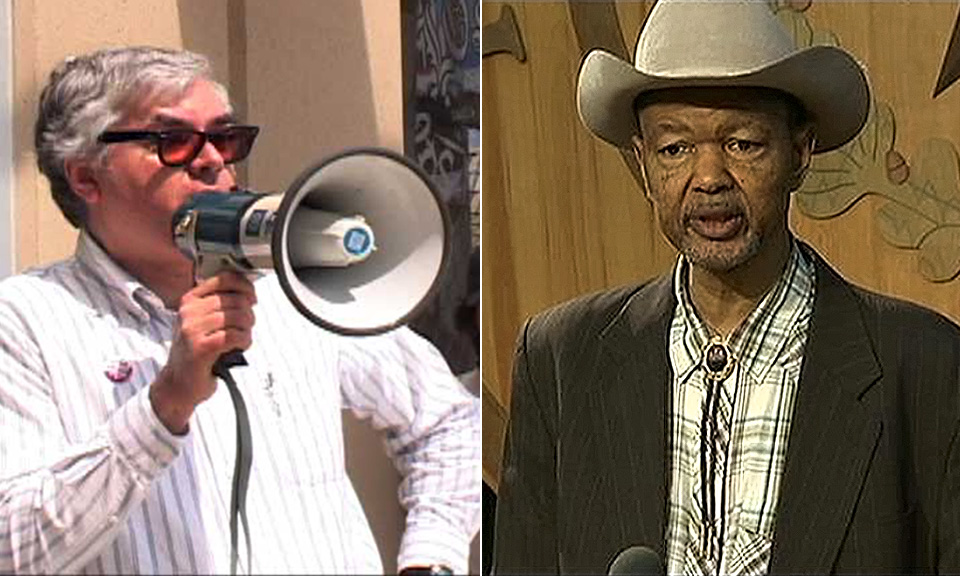 |
| Central Florida Prof. Jay D. Jurie, left, and Gary Bledsoe, president, Texas NAACP. |
Rag Radio podcast:
The Rag Blog‘s Jay D. Jurie and
Austin attorney Gary Bledsoe
on the legacy of Trayvon Martin
They discuss the trial, racial profiling, the ‘stand your ground’ laws and gun violence in America, the movement that has grown up in response to the Zimmerman verdict, and President Obama’s call for a ‘conversation’ about race in America.
By Rag Radio | The Rag Blog | July 31, 2013
Jay D. Jurie, who teaches at the University of Central Florida in Sanford, and Austin attorney Gary Bledsoe, president of the Texas NAACP, discuss issues related to the killing of Trayvon Martin and the trial of George Zimmerman on Rag Radio, Friday, July 26, 2013.
Rag Radio is a syndicated radio program produced at the studios of KOOP 91.7-FM, a cooperatively-run all-volunteer community radio station in Austin, Texas.
Listen to or download this episode of Rag Radio here:
On the show, Jurie and Bledsoe discuss the killing of Trayvon Martin and the trial of George Zimmerman with host Thorne Dreyer. They also address related issues including racial profiling, the “stand your ground” laws and gun violence in America, the movement that has grown up in response to the Zimmerman verdict, and President Obama’s call for a “conversation” about race in America.
 |
| The NAACP’s Gary Bledsoe in the studios of KOOP-FM, Austin, Texas, Friday, July 26, 2013. Photo by Roger Baker / The Rag Blog. |
Jurie, who lives and teaches in Sanford, Florida, site of the killing and the trial, talks about the nature of the community and the history of racism in the area, and Bledsoe also discusses the role played by the NAACP in Florida, Texas, and nationally.
Jay D. Jurie, Ph.D. is an associate professor of public administration and urban and regional planning at the University of Central Florida. Jay, a regular contributor to The Rag Blog, is a veteran of SDS at the University of Colorado at Boulder. He has long advocated public policies that promote social and environmental justice and economic democracy.
His Rag Blog article, “Trayvon Martin’s Fatal Shortcut,” has been chosen to appear in a special edition of ProudFlesh: New Afrikan Journal of Culture, Politics and Consciousness. His more recent article, “‘Approved Killing’ in Florida,” addresses parallels between the Trayvon Martin killing and the murder of Emmett Till in Money, Mississippi, in 1955.
 |
| Jay Jurie, third row, at race relations meeting in Sanford, Florida, Oct. 2, 2012 |
Gary Bledsoe is president of the Texas NAACP, a position he has held since 1991. An Austin attorney who specializes in public interest, employment, and civil rights law, Bledsoe has been a member of the National Board of the NAACP since 2003, and currently chairs the organization’s National Criminal Justice Committee.
Bledsoe earned a Doctorate of Jurisprudence from the University of Texas School of Law, where he was class president in 1976. Gary Bledsoe has received “lawyer of the year” awards from the Texas Attorney General, the Travis County Bar Association, the Austin and national NAACP, and the Austin Area Urban League.
 Rag Radio is hosted and produced by Rag Blog editor and long-time alternative journalist Thorne Dreyer, a pioneer of the Sixties underground press movement.
The show has aired since September 2009 on KOOP 91.7-FM, an all-volunteer cooperatively-run community radio station in Austin, Texas. Rag Radio is broadcast live every Friday from 2-3 p.m. (CDT) on KOOP and is rebroadcast on Sundays at 10 a.m. (EDT) on WFTE, 90.3-FM in Mt. Cobb, PA, and 105.7-FM in Scranton, PA.
The show is streamed live on the web by both stations and, after broadcast, all Rag Radio shows are posted as podcasts at the Internet Archive.
Rag Radio is produced in association with The Rag Blog, a progressive Internet newsmagazine, and the New Journalism Project, a Texas 501(c)(3) nonprofit corporation. Tracey Schulz is the show’s engineer and co-producer.
Rag Radio can be contacted at ragradio@koop.org.
Coming up on Rag Radio:
THIS FRIDAY, August 2, 2013: Linda Litowsky and Stefan Wray of ChannelAustin on the historic significance of public access television.
Friday, August 9, 2013: We continue our discussion with sociologist, author, and New Left pioneer Todd Gitlin.
Posted in RagBlog
Tagged Criminal Justice, Gary Bledsoe, George Zimmerman, Gun Violence, Interview, Jay D. Jurie, NAACP, Podcast, Racism, Rag Radio, Sanford FL, Stand Your Ground, Thorne Dreyer, Trayvon Martin
Leave a comment




