IDEAS / Bill Meacham : Ways of Knowing

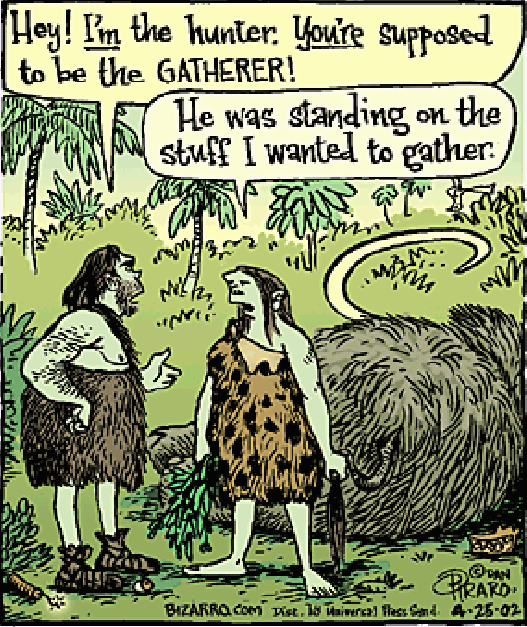
Cartoon by Piraro. Image from Sandwalk.

Ways of Knowing

The whole thing is about life perpetuating itself, about what we will do, how we will act, in different situations.

By Bill Meacham | The Rag Blog | June 27, 2012

Each age has a metaphor for how humans work. In the 17th century it was mechanical: the heart was a pump, the lungs were bellows, the muscles and bones were like pulleys and levers. In the 21st century the metaphor is electronic computing: the brain is a computer, and our minds are composed of mental modules, much like software modules, each of which does a job and interacts with others to get things done.

There is some truth to these metaphors. The heart really does pump liquid, and the lungs really do draw in and expel air. Similarly, brain research has discovered portions of the brain that are active when we discriminate colors and shapes or think about a mathematical problem or respond to moral problems.

The convergence of brain research, information theory, cognitive science, and behavioral psychology provides insights into how our minds work. In particular, cognitive science explains how thought and emotion work in terms of information and computation, and evolutionary biology explains the complex design of living things as the product of evolutionary selection. Evolutionary psychology combines the two.

Evolutionary Psychology

Evolutionary psychology takes the mind to be an organ, a bit like the kidney or the stomach, and provides a theory of how our minds evolved to have the functions that they do.(1) It does not so much discover facts about human nature as provide a framework within which to understand facts found experimentally by other branches of psychology. It also suggests experimentally-verifiable hypotheses about how the mind works. Many such hypotheses have been corroborated, thus lending credence to the concepts.(2)

Evolutionary psychology explains how the various mental modules evolved in response to challenges humans encountered in the environment of evolutionary adaptedness (EEA), the environment in which our ancestors lived for hundreds of thousands of years.(3) Between the invention of writing, agriculture, and cities to the present (early twenty-first century A.D.) humans lived about 500 generations.

The time before that, the Pleistocene epoch, when proto-humans evolved into the humans we know today, was about 80,000 generations, 160 times as long. Although human culture has advanced significantly in the past 500 generations, it is built on mental capacities that are evolutionarily designed for a much different environment.

This ancestral environment varied physically, but much of it was probably open savannah, with rolling hills and occasional forest. People all over the world are drawn to images of that type of landscape regardless of the environment they actually live in.(4)

More important was the social environment: small bands of humans numbering from 20 up to a maximum of about 150 in which each person had to cooperate with the others to provide sustenance and survival, but also had to compete with others to acquire food, status and sexual mates. These early bands of humans were probably much like the hunter-gatherers found today in the remote forests of the Amazon or the jungles of Africa or Indonesia.

Today such bands have been pushed to the margins of habitable lands by the advance of industrial society, but in the past our ancestors lived, no doubt, in much richer and more lush surroundings. Their lifestyle has been called “a camping trip that lasts a lifetime.”(5)

The mental abilities we find today in humans all over the world evolved to solve adaptive problems faced by our hunter-gatherer ancestors. Those mental abilities, oriented toward action in the world, are both cognitive and emotional.

Cognition

The central premise of evolutionary psychology is that the human mind is a system of mental modules — “organs of computation”(6) — that enabled our ancestors to survive and reproduce in the EEA. Leda Cosmides and John Tooby, pioneers in the field, point out that the single resource most limiting to reproduction is not food or safety or access to mates, but information, the information required for making behavioral choices that lead to survival and reproduction.(7) The mind as we know it today is the result of a long series of cognitive successes, successes in acquiring and processing information.

The mind, embodied in the circuitry of the brain and nervous system, is not a single organ but is composed of many faculties that solve different adaptive problems. An adaptive problem is a cluster of conditions that recurred over evolutionary time and that constituted either an opportunity for or an obstacle to reproduction.(8)

For example, the arrival of a potential mate — which happened countless times over 80,000 generations — is an opportunity for reproduction. How the mind recognizes and responds to a person of the opposite sex is a function of algorithms embedded in the mind as a result of how successfully our ancestors responded to similar situations.

In order to recognize a person of the opposite sex, of course, you must first perceive that person. On a level closer to physical as opposed to social reality, how human visual perception works is in part a function of mental algorithms evolved to respond to the properties of reflected light. (Another part is the structure of the eye itself.)

Examples of obstacles to reproduction are such things as the speed of a prey animal and the actions of a sexual rival. In these cases and many others the way the human mind processes information is a result of how our ancestors solved such adaptive problems and survived to pass on their abilities to their offspring.

We can view the current state of the mind as the result of a very long process of testing randomly-generated alternative designs for coping with the physical and social environment — each of which embodied different assumptions about the nature of the world — and retaining those that succeeded most effectively; that is, those that reflected most closely the actual structure of the ancestral world.

Cognition in this sense is not necessarily or even primarily a conscious process, one available to introspective attention. Conscious, voluntary and deliberative thinking — called “cold cognition” by Cosmides and Tooby,(9) the kind of thinking we do when we work out a math problem, for instance — is only one kind. Much more prevalent is the information processing that takes place unreflectively in everyday life, in perceptual judgments, in forming immediate responses to situations, and guiding our activities.

When a child gauges the intensity of his or her parents’ annoyance or approval, the child is not going through a conscious thought process. Instead the child is using an algorithm or computer-like program that is built in to the mind, a capability or faculty that is already available for use.

The mind is not a blank slate, written upon by experience. It is a collection of modules capable of solving specific problems. When a problem for which it is suited arises, the relevant modules are activated and guide our responses, immediately and intuitively.

On this model, the mind is a set of capabilities for problem-solving and for guiding behavior. The capabilities are a result of the evolution of the human race, but the specific content of how the problems are solved or how the behavior is manifested depends on the circumstances of your life.

For instance, all humans have the capacity for language, but which language or languages you speak depends on the culture and community in which you are raised. Similarly, all humans have the capacity for moral intuition regarding how one should behave in a social context, but the specific set of moral rules you find compelling depends on the society in which you live.

Emotion

Cosmides and Tooby call the mind “multimodular,” composed of “domain-specific expert systems.” The human mind is “a diverse collection of inference systems, including specializations for reasoning about objects, physical causality, number, language, the biological world, the beliefs and motivations of other individuals, and social interactions…”(10) These inference systems get coordinated through emotion.

Domain-specific expert systems such as those for regulation of sleep or detection of predators need a context in which to operate. If it is dark and you are tired, you should sleep; but if a predator is nearby you should stay alert in case you need to flee or fight. (By “should” I mean merely that these are the typical activating conditions for the expert systems.)

What causes an individual organism to activate alertness when danger might be nearby at night? The answer is emotion, in this example the emotion of fear. Cosmides and Tooby assert that emotions are actually a type of cognition, cognitions writ large as it were. They are high-level programs that orchestrate the activation of many subordinate programs:

Each emotion entrains various other adaptive programs — deactivating some, activating others, and adjusting the modifiable parameters of still others — so that the whole system operates in a particularly harmonious and efficacious way when the individual is confronting certain kinds of triggering conditions or situations.(11)

Psychologist Steven Pinker says it more succinctly:

The emotions are mechanisms that set the brain’s highest-level goals. Once triggered by a propitious moment, an emotion triggers the cascade of subgoals and sub-subgoals that we call thinking and acting.(12)

That’s not what we usually think of when we think of emotion. We usually think of a felt quality such as fear or anger or elation. Evolutionary psychology says these are indeed aspects of emotion, but not their defining characteristic. What defines an emotion — in fact, what defines any evolved capacity — is its function. And the function of emotion is to coordinate multiple subsystems such that an organism reacts appropriately to a stimulus, where “appropriately” means in a way that caused its ancestors to survive in the presence of similar stimuli. It is instructive to look at Cosmides and Tooby’s specific examples of emotion:

cooperation, sexual attraction, jealousy, aggression, parental love, friendship, romantic love, the aesthetics of landscape preferences, coalitional aggression, incest avoidance, disgust, predator avoidance, kinship and family relations, grief, playfulness, fascination, guilt, depression, feeling triumphant, disgust, sexual jealousy, fear of predators, rage, grief, happiness, joy, sadness, excitement, anxiety, playfulness, homesickness, anger, hunger, being worried, loneliness, predatoriness (an emotion pertaining to hunting), gratitude, fear, boredom, approval, disapproval, shame(13)

Not all of these are what common usage calls emotion. Some of them — fear, anger, joy, guilt and the like — certainly are, in the sense of being felt qualities or states. Others, such as coalitional aggression and predator avoidance, seem like strategies rather than emotions.

Many, such as fear of predators, being worried about something, and sexual attraction, are primarily ways of being oriented to an external object or person, to something or someone other than oneself. Others, such as guilt, shame, and pride, are oriented to ourselves as we imagine others feel about us. All of them have in common that they coordinate a large number of separate cognitive subsystems. Cosmides and Tooby provide an extensive list:

perception; attention; inference; learning; memory; goal choice; motivational priorities; categorization and conceptual frameworks; physiological reactions (such as heart rate, endocrine function, immune function, gamete release); reflexes; behavioral decision rules; motor systems; communication processes; energy level and effort allocation; affective coloration of events and stimuli; recalibration of probability estimates, situation assessments, values, and regulatory variables (e.g., self-esteem, estimations of relative formidability, relative value of alternative goal states, efficacy discount rate); and so on.(14)

Every emotion has four aspects:(15)

  • Physiology — what happens in our bodies when we are feeling or are under the influence of the emotion.
  • Behavioral inclination — what the emotion disposes us to do.
  • Cognitive appraisal — what the emotion tells us about what it is directed towards.
  • Feeling state — how the emotion feels to us.

An emotion is not reducible to any one of these four; it includes them all. Pinker says “[N]o sharp line divides thinking from feeling, nor does thinking inevitably precede feeling or vice versa…”(16)

Of these four, the most fundamental is behavioral inclination. The whole thing is about life perpetuating itself, about what we will do, how we will act, in different situations.

Implications 

Several things are interesting philosophically about this view of cognition and emotions:

  • Despite a long history of thinking of ourselves as the “rational animal,” much of our cognition is not rational, in the sense of being thought through as we might think through a proof in geometry. Only a small part of our thinking is cold cognition. Most of it is hot cognition: quick, intuitive flashes of judgment.
  • These intuitive flashes of judgment are also emotional. The emotional component impels us to action.
  • We can feel or be under the influence of an emotion without knowing it.
  • Emotions (in the sense of feeling state) have a cognitive component. All emotion has some element of judgment or interpretation. Emotions are ways we know ourselves and our world.
  • All emotions have an intentional structure.(17) They are oriented toward something; they have an object. The broader emotions, which we call moods, are oriented toward the world in general; specific emotions such as fear are focused on specific real or imagined things or events. Some of the specific emotions — fear and disgust, for example — are about the physical world. Others, such as trust, sympathy, gratitude, guilt, anger, and humor, pertain to the social and moral worlds.(18)
  • Every emotion has implications for action and has an effect on our readiness for or actual undertaking of an activity or a course of action.

These assertions about emotion can be verified by phenomenological analysis. Existential philosopher Robert Solomon, coming at the issue from an entirely different perspective, says that “emotions [are] our own judgments” and “the very source of our interests and our purposes.”(19) You can, if you like, corroborate this by examination of your own experience.

In sum: There is a lot going on in our lives to which we mostly don’t pay attention, and we are far less rational than we like to think.

(To be continued…)

[Bill Meacham is an independent scholar in philosophy. A former staffer at Austin’s 60s underground paper, The Rag, Bill received his Ph.D. in philosophy from the University of Texas at Austin. Meacham spent many years working as a computer programmer, systems analyst, and project manager. He posts at Philosophy for Real Life, where this article also appears. Read more articles by Bill Meacham on The Rag Blog.]

Notes

(1) Pinker, How the Mind Works, p. 23.
(2) There are numerous examples of experimental verification. See, for example, Griskevicius et. al., “Blatant Benevolence and Conspicuous Consumption: When Romantic Motives Elicit Costly Signals.” Trivers, in “The Evolution of Reciprocal Altruism,” cites many instances of experimental evidence for hypotheses arising from evolutionary psychological theory. See Pinker, How the Mind Works, p. 505, for elegant anthropological verification of hypotheses regarding reciprocal altruism.
(3) The EEA is not a single place but a statistical composite of the properties of the ancestral environment that exerted selective effects on human ancestors. Tooby and Cosmides, “The Past Explains the Present”, p. 386.
(4) Dutton, The Art Instinct, pp. 14, 19 – 22.
(5) Orians and Heerwagen, “Evolved Responses to Landscapes,” p 556.
(6) Pinker, How the Mind Works, p. 21. See also Cosmides and Tooby, “Evolutionary Psychology and the Emotions”, p. 98.
(7) Cosmides and Tooby, “Evolutionary Psychology and the Emotions”, p. 99.
(8) Ibid., p. 96.
(9) Ibid., p. 98.
(10) Ibid., p. 99.
(11) Ibid., p. 92.
(12) Pinker, How the Mind Works, p. 373.
(13) Cosmides and Tooby, “Evolutionary Psychology and the Emotions”, throughout. (14) Ibid., p. 93.
(15) Idem.
(16) Pinker, How the Mind Works, p. 373.
(17) By “intentional” I do not mean the ordinary usage of planning to make something happen. “Intentionality” is a technical term meaning the “ofness” or “aboutness” inherent in experience. Being conscious always entails being conscious of something; you are never just conscious without an object. The term comes from a Latin phrase, intendere arcum in, which means to aim a bow and arrow at (something). This image of aiming or directedness is central in most philosophical discussions of consciousness.
(18) Pinker, “So How Does the Mind Work?”, p. 4.
(19) Solomon, The Passions, p. xvii.

References

Cosmides, Leda, and Tooby, John. “Evolutionary Psychology and the Emotions” in Handbook of Emotions, 2nd Edition, pp. 91-115, ed. Lewis, Michael and Haviland-Jones, Jeannette M. New York: Guilford Press, 2000. Available as an on-line publication, URL = http://www.psych.ucsb.edu/research/cep/publist.htm as of 26 May 2009.
Dutton, Denis. The Art Instinct: Beauty, Pleasure and Human Evolution. New York: Bloomsbury Press, 2009.
Griskevicius, Vladas, et. al. “Blatant Benevolence and Conspicuous Consumption: When Romantic Motives Elicit Costly Signals.” Journal of Personality and Social Psychology, 2007, Vol. 93, No. 1, pp. 85-102.
Orians, Gordon H., and Heerwagen, Judith H. “Evolved Responses to Landscapes.” In Barkow, Cosmides and Tooby, The Adapted Mind, pp. 555 – 579.
Pinker, Steven. How the Mind Works. New York: W. W. Norton & Company, 1997.
Pinker, Steven. “So How Does the Mind Work?” Mind and Language, 20(1), 1-24. Available as an on-line publication, URL = http://pinker.wjh.harvard.edu/articles/ as of 23 June 2009.
Solomon, Robert. The Passions: Emotions and the Meaning of Life. Indianapolis: Hackett Publishing Company, 1993.
Tooby, John, and Cosmides, Leda. “The Past Explains the Present: Emotional Adaptations and the Structure of Ancestral Environments.” In Ethology and Sociobiology, 11, 375-424. New York: Elsevier Science Publishing Co., 1990. Available as an on-line publication, URL = http://www.psych.ucsb.edu/research/cep/publist.htm as of 26 May 2009.
Trivers, Robert L. “The Evolution of Reciprocal Altruism.” The Quarterly Review of Biology, Vol 46, No. 1 (March 1971), pp. 35-57. Available as an on-line publication, http://education.ucsb.edu/janeconoley/ed197/documents/triversTheevolutionofreciprocalaltruism.pdf URL = as of 3 November 2009.

The Rag Blog

Posted in Rag Bloggers | Tagged , , , , , , , | Leave a comment

Travis Waldron : Texas Republican Platform: Whoa Doggies!

Texas Republicans. Image from Republican Liberty Caucus.

The five craziest policies in
Texas Republicans’ 2012 platform

The Texas GOP supports ‘repeal of the Sixteenth Amendment,’ which instituted a national income tax, and instead favors a wildly regressive national sales tax that would hit low- and middle-income Americans hardest.

By Travis Waldron / ThinkProgress / June 27, 2012

The Republican Party of Texas released its 2012 platform this month, outlining its policies on taxation, education, and a host of other issues related to the economy.

Texas Republicans, according to the platform, support eliminating the minimum wage and the prevailing wage, doing away with the Department of Education and Department of Energy, and “reducing taxpayer funding to all levels of education” — but those aren’t even the most damaging positions.

Here’s a look at the five most outrageous beliefs Texas Republicans hold:

  1. The party opposes almost all forms of taxation:
  2. The Texas GOP supports “repeal of the Sixteenth Amendment,” which instituted a national income tax, and instead favors a wildly regressive national sales tax that would hit low- and middle-income Americans hardest. It also favors making the Bush tax cuts permanent and repealing the capital gains tax and the estate tax, the latter of which it claims is “immoral and should be abolished forever.” On the state level, it supports abolishing property and business taxes, and property taxes on inventory, and opposes efforts to institute a state income tax, an Internet sales tax, professional licensing fees, and taxes on real estate transactions. Instead, it supports “shifting the tax burden to a consumption-based tax.”

  3. It supports returning to the gold standard: “We support the return to the time tested precious metal standard for the U.S. dollar,” the platform states, echoing Rep. Ron Paul (R), the state’s eccentric congressman and presidential candidate. While returning to “sound money,” as the platform calls it, is popular among far right-wing conservatives, it is “not feasible for practical and policy reasons,” according to Federal Reserve Chairman Ben Bernanke. Most economists agree that the gold standard never worked and that returning to it now would have disastrous consequences for the American economy.
  4. It supports privatizing Social Security: Given that Texas Gov. Rick Perry (R) called Social Security a “Ponzi scheme” during his ill-fated presidential campaign, it may be no surprise that the Texas GOP opposes one of the nation’s most successful federal programs. “We support an immediate and orderly transition to a system of private pensions based on the concept of individual retirement accounts, and gradually phasing out the Social Security tax,” the platform says, ignoring that had such a plan been enacted prior to the Great Recession, it would have cost an October 2008 retiree tens of thousands of dollars (and that was before the market bottomed out in 2009). Millions of Americans lost everything in private accounts during the recession, and Social Security was all they had left.
  5. It opposes multicultural education and “critical thinking”: “We believe the current teaching of a multicultural curriculum is divisive,” the platform says, adding that it supports teaching “common American identity and loyalty instead of political correctness that nurtures alienation among racial and ethnic groups.” In Arizona, where Republicans banned multicultural programs, students in those programs actually out-performed their peers. Texas Republicans also believe “controversial theories” such as evolution and climate change — which aren’t controversial at all — “should be taught as challengeable scientific theories subject to change as new data is produced.” There’s more: the GOP also opposes the teaching of “critical thinking skills” because they “focus on behavior modification and have the purpose of challenging the student’s fixed beliefs and undermining parental authority.”
  6. It supports corporal punishment in schools: “Corporal punishment is effective and legal in Texas,” the platform states, adding that teachers and school boards should be given “more authority to deal with disciplinary problems.” Actual research, however, shows that corporal punishment is bad for children and their education. Research shows that corporal punishment is “associated with an increase in delinquency, antisocial behavior, and aggression in children,” according to the American Psychoanalytic Association, which “strongly condemns” the use of such punishment. The American Academy of Pediatrics recommends that parents and schools use other forms of punishment because “corporal punishment is of limited effectiveness and has potentially deleterious side effects.”

Texas Republicans also have radical policies on LGBT issues, voting rights, and health issues like sex education, and Jessica Luther has a  run-down (in T weets) of the entire platform’s extreme positions. Misty Clifton, at Shakesville, did an epic breakdown of the Texas GOP’s 2012 Platform

[Travis Waldron is a reporter/blogger for ThinkProgress.org at the Center for American Progress Action Fund. Travis grew up in Louisville, Kentucky, and holds a BA in journalism and political science from the University of Kentucky. This article was first published at ThinkProgress.]

The Rag Blog

Posted in RagBlog | Tagged , , , , | Leave a comment

BOOKS / Ron Jacobs : ‘The People’s Pension’ and the War Against Social Security


‘The People’s Pension’:
The war against social security

The opponents of this program are not interested in saving money, a fairer distribution of benefits, or helping the elderly. They are serving an ideological agenda of social Darwinism.

By Ron Jacobs | The Rag Blog | June 26, 2012

[The People’s Pension: The Struggle to Defend Social Security Since Reagan by Eric Laursen (2012: AK Press); Paperback; 750 pp.; $27.]

It seems like every few months alarms are sounded warning U.S. workers that Social Security is going bankrupt. Oftentimes, the follow-up to these alarms includes a warning that the only way to save the system is to turn all or part of the funds involved over to Wall Street investment houses like Goldman Sachs.

Usually the alarms are sounded by right-wing politicians from the Republican Party. In recent years however, this cacophony of lies has been assisted by more and more Democrats.

According to Eric Laursen, in his new book titled The People’s Pension: The Struggle to Defend Social Security Since Reagan, the desire to end what is Washington’s most successful government program has been underway since Social Security’s inception. It has only intensified in recent decades. As the title suggests, that intensification sharpened in 1981, the year Ronald Reagan became president.

As anyone with an understanding of neoliberal capitalism and the role played by investment houses in this stage of capitalism knows, that year coincides more or less with an increased interest in Social Security funds by those houses. Why? Because their required growth requires more funds to invest and there are billions of dollars in funds sitting in the Social Security reserves.

Laursen provides the reader with a brief history of the philosophy behind Social Security. Harkening to the writings of 19th century anarchists and leftists, he describes part of the impetus behind Social Security as coming from the ideas of mutual aid; where every citizen is cared for. More specifically, he traces the institution of the social security system to the Townsend clubs begun in the 1930s by Dr. Francis Townsend of California.

It was Townsend’s idea that old people should be guaranteed an income based on their work and funded by taxes. His reasoning was simple, if senior citizens had an income, they could remain consumers, thereby helping stimulate the economy. Millions joined these clubs, exerting political pressure that led to the Social Security Act of 1937. Naturally, this act was fervently opposed by many corporate executives and the wealthy as being socialist and un-American.

Most of today’s opponents are not so blunt in their assessment. However, their proposals to privatize the system suggests that they too oppose a government program that does not benefit their corporate benefactors. Instead, they would rather turn it over to the Goldman Sachs of the world. This desire is certainly related to the substantial campaign donations they receive from Goldman Sachs and their cohorts.

One expects right wing politicians opposed to any government expenditures not related to benefiting private industry and the Pentagon to oppose Social Security. It is the Democratic opponents who deserve our real attention. Laursen’s history is also a history of the gradual shrinking of support among Democrats and other so-called liberals.

The People’s Pension puts the beginning of the current assault on Social Security in the lap of the Reagan administration. Laursen makes it very clear that the opponents of this program are not interested in saving money, a fairer distribution of benefits, or helping the elderly. They are serving an ideological agenda of social Darwinism.

Furthermore, every attack on Social Security is nothing more or less than an attempt by the corporate world and its right-wing supporters to end it once and for all. Laursen further points out that the arguments used by Social Security’s opponents never address the economic consequences of ending the program; they only draw up flimsy prognostications of disaster should the program continue.

Privatization would  be nothing more than one more method for corporate America to take public monies and privatize the profits while insuring the continued socialization of the risks and loss. As Laursen points out, this is exactly what is done by the defense industry and any scheme to privatize Social Security would do the same thing.

A fact that is not very well known outside of certain circles is that the model for privatization promoted by the so-called supply side economists was developed in the fascist Chile of Augusto Pinochet. Championed by many Republicans and their banker/corporate sponsors, this model is ultimately more expensive than keeping things as they are and its greatest benefits would be to the banking industry.

Furthermore, this and other privatization schemes assume an ever-growing capitalist economy — a phenomenon less certain than it was before the crash of 2008. Despite this, politicians continue to include Social Security in their gunsights. Whether it’s Alan Simpson calling Social Security a “Milk Cow with 310 Million Tits,” or so-called Blue Dog Democrats suggesting that benefits be changed, the assault on the program never goes away.

Eric Laursen has written a comprehensive and exhaustive history of the Social Security program in the United States. The People’s Pension is an honest, detailed, and even eye-opening discussion of the program’s origins and continuing efforts to provide elderly and disabled Americans with a livable income.

Equally important, it is a discussion of the attempts to alter and ultimately destroy the program by forces whose only interest seems to be profit and the elimination of any government institution that guarantees every citizen worker an income in their old age.

[Rag Blog contributor Ron Jacobs is the author of The Way The Wind Blew: A History of the Weather Underground. He recently released a collection of essays and musings titled Tripping Through the American Night. His latest novel, The Co-Conspirator’s Tale, is published by Fomite. His first novel, Short Order Frame Up, is published by Mainstay Press. Ron Jacobs can be reached at ronj1955@gmail.com. Find more articles by Ron Jacobs on The Rag Blog.]

The Rag Blog

Posted in Rag Bloggers | Tagged , , , , , , | Leave a comment

Harry Targ : Mitch Daniels, Educator!

All decked out: Indiana Gov. Mitch Daniels models his new Purdue leather jacket after being named the school’s next president in West Lafayette, Indiana., Thursday, June 21, 2012. Photo by Michael Conroy / AP.

Purdue names Mitch Daniels president:
The crisis in higher education continues

Daniels has no administrative experience in higher education except appointing the Trustees who in secret carried out a presidential search that led to his appointment.

By Harry Targ | The Rag Blog | June 26, 2012

Big banks, multinational corporations, political parties, and upcoming elections dominate our public discourse as they should. But there is a danger that the fabric of social institutions is being transformed before our eyes but yet beyond our consciousness. Such is the case of the radical changes occurring in education, from kindergarten through college.

Calls for free, open, accessible, and transparent education have been a tradition almost as long as the rhetorical commitment to democracy itself. In fact most people believe that education, democracy, and the economy are inextricably connected. However, the education/democracy connection has been weakening ever since the 1960s.

After World War II, the GI Bill began providing educational opportunities for returning veterans. They were to become the trained work force and expanding consumers for a booming economy. However, the expansion of higher education was coupled with a campaign to purge dangerous and subversive professors and curricula from the university. Access to higher education spread while the range of ideas studied narrowed.

In the 1960s, student activists, now enrolled in thousands of small and large colleges and universities, rebelled against the narrowing focus of knowledge. The university as the site for training to advance capitalism and technical skills, what Clark Kerr, former president of the University of California, called “the multiversity,” was challenged; for a time successfully. Academic programs that did not fit traditional classical studies or new scientific/technical fields were allowed to flower and grow.

The so-called Reagan revolution brought a shift in economic policy downsizing the growth in the welfare state, government spending for social safety nets, and support for public institutions such as education. In addition, the new ideology preached privatization, shifting public sector spending for the provision of services to the marketplace.

By the 1990s, both political parties endorsed public policies that decreased support for the many to further economic rewards for the few. Tax breaks for the rich, cuts in welfare protections, declining support for public education, public libraries, transportation, and housing continued the shift in wealth from the working class to the economic ruling class.

Right-wing radio host Rush Limbaugh once remarked that the economic and political transformation of U.S. society was near complete. The only institution which the right-wing did not control was the university. By the 1990s powerful groups began to remake the university too.

Since the dawn of the new century higher education budgets have been slashed. College tuitions are skyrocketing, class size is increasing, and many of the programs designed to develop new ways of thinking about the world (particularly in the social sciences and humanities) are being cut.

State universities originally created to educate small farmers and workers in order to advance their economic status have become low-cost research arms of huge corporations such as Eli Lilly in pharmaceuticals and Monsanto in the agricultural sector (both are huge worldwide corporations). In the 21st century universities have not shrunk. More and more top heavy administrations and human relations departments control the main activities that used to be determined by faculty.

The process of selecting university presidents reflects the qualitative changes occurring in higher education. At the University of Virginia, President Teresa Sullivan was ousted recently in a secret coup engineered by the “Board of Visitors,” a 17-person body that controls major policy decisions at that university.

Of the 17, only four members had any higher education experience, but the body in total contributed over $800,000 to candidates for state office; $680,000 to Republicans and $150,000 to Democrats. The governor appoints this body. And in the case of ousted President Sullivan, it objected to her consultation with deans and faculty before making decisions about shifting budgets. Unusual in this day and age, 2,000 students and faculty recently rallied on campus to demand her reinstatement.

In Indiana the Purdue University Board of Trustees (10 of 12 selected by sitting Governor Mitch Daniels) announced that it was appointing Daniels to be Purdue University’s twelfth president. Daniels will be completing his second term as governor and will take office as Purdue’s president in January, 2013.

Daniels has been a visible politician over the last decade in several arenas. These include a stint as President Bush’s Budget Director from 2001 to 2004 when taxes were lowered, two wars were launched, and the seeds were planted for the current economic crisis. Daniels was elected Indiana’s governor in 2004. In his first day in office he eliminated the prior governor’s order that allowed public sector workers to unionize.

Subsequently, he led Hoosier right-wing politicians in supporting charter schools with public money, cutting education spending at all levels by $150 million (including a $30 million cut in higher education), sold off some of Indiana’s highway system to European investors, shifted family services to an ill-equipped private corporation, and cut funding for reproductive health services. He worked to pass a so-called Right-to-Work bill after telling union supporters that he would never do that.

In addition, Daniels served as an executive at Eli Lilly, and CEO at the conservative think tank, the Hudson Institute, and was affiliated with an online university, Western Governors University, that could potentially compete with state colleges and universities. Most important Daniels has no administrative experience in higher education except appointing the Board of Trustees members who in secret carried out a presidential search that led to his appointment.

The political corruption and dubious merit of the selection of Daniels as Purdue president are obvious. What is less obvious is that this appointment like the appointment of many other university presidents and the firing of Virginia President Theresa Sullivan, is part of the shift in higher education from a model of the university as a site for research and teaching about ideas and as an institution that serves the needs of the society at large to a corporate model.

The GI Bill educated a whole generation of veterans to lift themselves and society. The expansion of the meaning of the university as a result of student protest and the civil rights movements of the 1960s brought new ideas to a larger number of young people.

Educator Henry Giroux put it well: “Knowledge has become capital to invest in the market but has little to do with the power of self-definition, civic commitments, or ethical responsibilities… and with questions of justice.”

In the end, this is the most troubling aspect of the transformation of the modern university which the appointment of presidents like Governor Daniels signifies.

[Harry Targ is a professor of political science at Purdue University who lives in West Lafayette, Indiana. He blogs at Diary of a Heartland Radical — and that’s also the name of his new book which can be found at Lulu.com. Read more of Harry Targ’s articles on The Rag Blog.]

The Rag Blog

Posted in Rag Bloggers | Tagged , , , , , , | 1 Comment

David Hamilton : In France, Socialists Rule!

Supporters of French Socialist Party react after the announcement of the results of the first round of the French parliamentary elections. Photo by Fred Dufour / AFP / Getty Images.

French election wrap:
Socialists rule!

Internationally, the main significance of the Socialist victory is that it changed the terms of the debate about the EU debt crisis.

By David P. Hamilton | The Rag Blog | June 21, 2012

The Socialist Party of France is on a roll. It has reached a historic pinnacle of unprecedented strength. In May, their candidate, Francois Hollande, won the presidency against the right-wing incumbent, the first victory by a leftist in recent European presidential elections and the first presidential victory by a Socialist in France since Francois Mitterrand in 1988.

Last year, the Socialists achieved a majority in the traditionally conservative French Senate for the first time ever. They also dominate a majority of the 27 French regional councils. And now they have won a resounding victory in the National Assembly as well.

The Socialist Party now dominates French politics at every level without compromising coalition partners. Past Socialist-led governments have always been part of coalitions that included either a strong Communist Party or center-right elements. Now they rule alone and they have also largely overcome their own internal divisions. They stand united and independent, able to put their program in place without serious interference.

Their victory in the 577-seat National Assembly was particularly sweet for the Socialists. In the last Parliament, they were heavily outnumbered by Nicolas Sarkozy’s center-right UMP (Union pour un Mouvement Populaire), 317-204. In the election just concluded those totals virtually reversed. In the new National Assembly, the Socialists and two small affiliated parties will have nearly 320 seats and the UMP will have 218. Roughly 20% of the seats changed hands and the Socialists won a large majority of those.

The Socialist victory was largely expected, but press reports have failed to adequately emphasize its sweeping nature. A shift in party composition on this scale in the U.S. Congress is inconceivable. U.S. congressional districts have been designed so that they are almost all safe-Democrat or safe-Republican. Only 20-30 seats in the U.S. Congress are regularly competitive. That a change on this scale was possible demonstrates the more dynamic nature of French democracy compared with the stagnant and highly corrupted remnant extant in the U.S.

Like the French presidential election, the legislative elections are conducted in two rounds, but the runoffs are conducted differently. It is relatively easy for parties to run candidates in the first round. There were over 6,000 candidates running for those 577 seats. Any candidate that received more than 12.5% of the vote in the first round got to run in the second round. This often means three or more candidates make the runoff. The one with the most votes wins the second round.

There has been a long-standing agreement between the Socialist Party and the UMP to keep the National Front (FN) out of the National Assembly. This was originally based on the overt anti-Semitism of the FN’s founder and leader, Jean-Marie Le Pen. Growing out of its World War II occupation experience including the loss of one-third of their Jewish population, anti-Semitism is illegal in France.

So in cases where the Socialists and UMP were in a three-way runoff with a candidate from the FN, the one with less support would drop out, effectively denying the FN the possibility of a plurality victory. Although the FN regularly gets 14-18% in presidential elections, they have been shut out of the National Assembly by this means since the mid-1980’s.

This time, the FN won two seats in localities where the UMP candidates dropped out in favor of the FN in defiance of their party’s long- standing dictum. However, the FN leader and presidential candidate, Marine Le Pen, Jean-Marie’s more presentable daughter, winner of almost 19% of the national vote in the first round of the presidential election in late April, lost her race for a National Assembly seat to a Socialist in what was considered a relative FN stronghold.

This division on the right between the UMP and the FN is hard for Americans to understand. In the recent presidential election, the UMP’s Sarkozy and the FN’s Le Pen sounded much alike in their anti-immigrant stands. The original issue of anti-Semitism dividing the French right has diminished as Marine Le Pen has slipped into the racist closet by softening her father’s rhetoric and the UMP under Sarkozy has rivaled the FN in anti-immigrant rhetoric.

The division on the right is now sustained on issues Americans know little about, particularly membership in the EU, where the FN is ardently nationalist and opposes France’s participation. The FN wants to dump the euro and go back to the franc, opposing any EU imposition on French sovereignty. In contrast, the UMP strongly supports the EU and the euro.

There were election deals on the left too. The Socialists agreed to not run in certain constituencies in order to allow the Green Party to run unobstructed against the right. In return, they expect to have Green Party support on many issues. As a result of this agreement, the Green Party representation in the National Assembly went from 4 seats to 17, although the Green presidential candidate only received 2.3% of the vote in April.

Where they agree, which comprises a large spectrum of issues, Green support bumps the Socialist majority well above 330. In addition, there are the 10 seats held by Left-Unity. Add them up and the combined Left will have roughly 60% of the seats in the French National Assembly.

Diversity made strong gains. 37% of the winning Socialist candidates were women, leading to a record 155 women holding seats in the Assembly, up from 107 in the last Assembly elected in 2007. Nine members of “ethnic minority” groups were also elected, up from one, still a significant under-representation.

Joining the ranks of Socialist lawmakers are Razzy Hammadi, born of an Algerian father and a Tunisian mother and former president of the Socialists’ youth movement, as well as Malek Boutih, of Algerian origin and former director of the SOS Racisme rights group.

There were some very notable defeats in the National Assembly election. The 2007 Socialist Party candidate for president, Segolene Royal, was defeated by a “dissident” Socialist. The victor was a dissident because he was an established local Socialist leader in a district where the national party tried to “parachute” a favored candidate, Royal, into a safe seat. The locals rallied round him by 63%.

The leader of Left-Unity, Jean-Luc Melenchon tried to run in the same district as FN leader Marine Le Pen. They both lost to the Socialist candidate, he in the first round, she in the second. Centrist presidential candidate Francois Bayrou lost a seat he had held since 1988, again to a Socialist.

What does this Socialist dominance mean? Primarily, it means there is very little obstacle to the enactment of Hollande’s “60 pledges.” These revolve around reviving the economy with government spending, higher taxes on the wealthy, and the growth of public employment. The tax measures include higher marginal tax rates at the top, financial transaction taxes, ending tax havens for the rich, taxing investment income at the same rate as wages, and capping executive compensation. It also includes setting up a publicly controlled credit rating agency and making banks separate their retail banking from their investment banking, a law in line with the now defunct Glass-Steagall Act in the U.S.

Other measures on the Socialist agenda include approval of gay marriage and adoption, recognition of the Palestinian state, reduction of French reliance on nuclear energy, and bringing home all French troops in Afghanistan two years early. Given the Socialist hegemony, it is hard to see how Hollande can escape enacting all of these measures expeditiously.

Internationally, the main significance of the Socialist victory is that it changed the terms of the debate about the EU debt crisis. Prior to Hollande’s election, austerity was the unrivaled approach of EU leaders in confronting the debt crisis. In the wake of the Socialist victory in France, aided by support from Obama and the growth of the Greek Left, stimulus has reentered the discussion. This is analogous to the change OWS made by introducing inequality into the U.S. political discussion.

Signals seen so far concerning the direction of the Socialist government are inconclusive. On the one hand, Hollande named 17 women to his 34-member cabinet, but with few exceptions they don’t lead the most important ministries. Overall, the cabinet is labeled as moderate within the Socialist Party spectrum.

An encouraging signal was Hollande’s insistence at the G-8 summit on pulling French troops out of Afghanistan this year. On the other hand, he has joined the chorus for greater intervention in Syria, albeit preferably somebody else’s. To his credit, he presented the argument for growth to the “austerians” and has changed the nature of the debate, but so far it’s largely just talk.

Most important, the French Socialists have a unique opportunity to reestablish the socialist brand in Europe. They doubtless hope to do as well as their Latin American counterparts in Argentina and Brazil. If France is able to create a successful new development model under Socialist leadership, Merkel, Cameron and other right wing EU leaders will face reinvigorated challenges from their left as a result.

[David P. Hamilton, a graduate of the University of Texas at Austin in history and government was an activist in Sixties Austin and a contributor to the original Rag. David writes about France and politics (and French politics) for The Rag Blog. Read more articles by David P. Hamilton on The Rag BlogThe Rag Blog

The Rag Blog

Posted in Rag Bloggers | Tagged , , , , , , | 3 Comments

INTERVIEW / Jonah Raskin : Mariann Wizard’s Odyssey

Above, Mariann Wizard at Threadgills, Austin, Texas, 2012. Photo by Gloria Badilla-Hill. Inset below: Mariann with former cable television commissioners, Jack Hopper and Tommy Wyatt, at ribbon-cutting ceremony to launch Austin’s public access TV. Mariann was the chair of the Commission. Photo by Stuart Heady.

A Rag Blog Interview:
Mariann Wizard’s Odyssey

“I love my country, but not always my Nation. I am a child of Mother Earth and loyal to her alone.“ — Mariann Wizard

By Jonah Raskin | The Rag Blog | June 22, 2012

Wizards really do work wonders and Mariann Garner Wizard — an icon of Austin’s radical movements and countercultural institutions — is no exception.

The feisty co-author of two popular books — the legendary underground comic, The Adventures of Oat Willie, and a classic study about the Sixties-era G. I. movement, Turning The Guns Around — Wizard was also a contributor to No Apologies: Texas Radicals Celebrate the ’60s, and to Paul Buhle’s Students for a Democratic Society: A Graphic History.

She has worked her wizardry all over Texas for most of her life, and especially in Austin ever since she moved from Fort Worth to attend UT.  These days she works that wizardry, more often than not, on the Internet — as a professional science writer specializing in natural therapies, and as a contributing editor to The Rag Blog.

A writer for The Rag and later for The Daily Worker, she joined SDS in the 1960s, and later belonged to the Communist Party of the United States. Her activist life didn’t leave much room for studying and she left UT before she earned a degree. On July 23, 1967, her husband, George Vizard, was shot and killed in Austin, and, though 45 years have passed since then, she has never forgotten the murder that day or her own youthful self.

By the time that she went back to college, and graduated from Juarez-Lincoln University with a B. A. in communications, Texas wasn’t the same and the United States wasn’t, either. The War in Vietnam had ended, legal segregation was a thing of the past, and American women had liberated themselves from the narrow roles that had confined them in the 1950s. Wizard herself had been transformed by the waves of rebellion and resistance that broke all around her.

For her whole life, she has rarely if ever accepted any of the preordained roles that others might have tried to impose on her. Even as a child, she had a free, independent spirit. In the last half century, she has been the author of her own ongoing Odyssey, delivered her own irreverent lines, written and performed her own brand of satirical poetry, helped to give birth to Austin’s public access TV station, and served as a mainstay in a community that has sustained her for decades.

Loyal to friends and to family, she’s as much a part of Texas traditions as Molly Ivins, Ann Richards, and Marilyn Buck, a friend of 45 years until her death two years ago, in August 2010.

I met Wizard for the first time eight months ago, spent several days with her in Austin, where she introduced me to her son, Matthew, and her former partner, Michael Kleinman, one of the prime movers and shakers behind Seattle’s annual Hempfest.

We ate Mexican food, listened to homegrown music, and gazed at the stars at night. I think we may have had a margarita or two. Mostly we talked from early morning to late at night about Austin, burritos, cannabis, UT, the weather, the Yippies, and more. We’ve gone on talking ever since then. This is our first public conversation.

Mariann Wizard (left) with Marilyn Buck at Dublin FCI in 1996. Inset below, from top: Mariann Vizard in 1968; with husband George selling The Rag on the Drag in 1966; the artist as a young woman; Oat Willie comic; Mariann reads her poetry.

Jonah Raskin: Wizard sounds like an unusual last name. Where does it come from?

Mariann Wizard: After my first husband, George Vizard, died and after my divorce from my second husband, Larry Waterhouse, I adopted the nickname “Wizard” that Alice Embree had given me. I made it my legal last name. I probably took the name in part because of “Mr. Wizard” who was featured on a science program for kids on TV when I was growing up.

Your husband, George Vizard, was shot and killed on July 23,1967. That’s 45 years ago. How does that event touch you today?

On a very real level, I will be “the widow Vizard” until the day I die. I was 20 years old, and although I’ve given it the good old college try on several occasions, there has never been another man who made me feel so totally secure, or so immensely proud that of all the girls in Texas, he picked me to be his wife. He was really somethin’ else! I would not be the person I am today had I not known him.

You were born in Fort Worth. What was it like growing up there after World War II?

It was a great town in part because as a little white girl I didn’t get segregation. The city had and still has a great library system, parks, art and history museums, public transit, and a feeling of unlimited opportunity. We also had something called “winter” with snow days, snowmen, winter coats, and winter wardrobes.

Were you a child of the Cold War?

The whole red terror was a part of my childhood. In high school, they gave us cardboard discs to write our names and pin them on our shirts in case of nuclear attack. That was the beginning of the end of my confidence in authorities.

When do you think you woke up and began to see what was happening in America?

When I saw black kids on TV fire-hosed in Alabama for doing what I did every Saturday: sip a soda at Woolworth’s. I thought it could be fixed if people would simply remember what they taught us in Sunday school about Jesus loving all the little children. I didn’t look deeper into the workings of our society until on TV I saw the bombing of Vietnam and the Vietnamese and made a connection between the war there and racial injustice at home. Thank goodness for TV!

Why did you join Students for a Democratic Society?

A very brilliant, now deceased Austin anarchist organizer, and Navy veteran known as Bob Speck — whose real name was Bob Baker — got me to staple booklets for a Vietnam teach-in when he found me drinking coffee in the Chuck Wagon, the UT Student Union hangout for beatniks, bikers, international and Negro students, civil rights workers, and assorted weirdos. A week or so later, I went to an SDS meeting and was blown away.

And why was that?

I’d been in girls’ organizations all through high school and knew that girls and women could decide things as well as boys and men. I had also been in mixed-gender groups where girls sat back and let the boys do the talking and pontificating. At the SDS meeting, two beautiful women — both of them hooked up with cute, smart, influential guys — stood up, spoke up, and got their points across. Even their men folk were pleased. That was Alice Embree and Judy Schieffer, who had been a civil rights worker in Mississippi, weighed about 80 pounds dripping wet, and was fearless.

Did you think that SDS would go on and on, forever?

As I came to know SDS people and “to participate” with them, I had the sense that our relationships would last forever, based not on some casual propinquity, money, or the bonds of high school, but because we believed in things worth struggling to achieve, struggling without cease, and perhaps without even a glimpse of the promised land. We had to learn to be kind to each other, to accept each other as we were, to love for real, and to keep the faith. Bob Dylan was a big help. I reckon he still is.

Do you think Texas is more violent than any other place in the States?

Hell no!… Do you want to step outside and ask that question again, Mr. Raskin? We aren’t a violent people. We’re just emotional. I support the Second Amendment to the U.S. Constitution. I have a Goddess-given right to self-defense by any means necessary.

When you think about Texas, do you consider it a part of the United States, or is it its own separate country?

Greater Tejas — say, the 1718 boundaries, when Mission San Antonio de Bexar was founded — is a vital geopolitical part of Mesoamerica, ripped from Madre Mexico by Yankees. The hideous border fence is an insult to Nature as well as Humanity. Imagine the influence of Mexico today if Texas had remained part of its Republic! Viva Zapata! Viva Juarez! Y Viva la Reconcuesta de Paz that we now witness in our changing demographics! If you can’t beat ’em, outbreed ’em. The most popular name for baby boys in 2011 in Texas, and several other current U.S. states, was Jose.

To many Americans in, say, New York or Berkeley, the idea that Texas has a counterculture and a radical movement seems implausible.

It’s not just Texas that leftists on the effete coasts don’t see, hear, or respect! They don’t know what’s going in Oklahoma, Kansas, Missouri, or Arkansas, either! That’s why SDS had to have a “Prairie Power” movement. Texas is the Heartland, but all y’all bi-coasters just fly over it or motor through it looking for hicks.

How has feminism unfolded in Texas in ways that would surprise East Coast and West Coast feminists?

Hmmmm… Roller Derby, maybe? With the Internet, Grrrrl Power is everywhere.

How do you define yourself politically these days?

I don’t have a party; sometimes I think of myself as an unaffiliated working-class libertarian Marxist-Leninist, but I am more than that, too. I write satiric and outraged poetry, howling to the best of my ability at the moon of our discontent, trying to keep some sense of language alive wherein words have meaning beyond the convenience of the moment.

I hope that the generation coming into their prime now will embrace new paradigms of social and economic intercourse, redefine happiness as something that cannot be bought at a store, learn it’s okay to live on beans and bread, and put into practice a lot of what my generation dreamed.

You’ve been involved in the movement to decriminalize and legalize cannabis. What ideas do you have now to further the cause?

The legalization movement has allowed itself to be stigmatized as a kind of Cheeto-munching-couch-potato-smart-ass-white-boy-jerk. The public face of the movement is all too often exactly that. NORML’s new Women’s Alliance is a welcome development and one that we’ve been advocating for years. Grown-ups smoke cannabis, too. Until users start supporting professional, well-planned public interest campaigns, we can all go on reveling in our image as “rebels.”

You’ve been through several incarnations, if you can call them that, as a radical. Is there a cause or a movement that you belonged to and feel proudest about it?

I have always been an advocate and practitioner of the First Amendment. I’m a Free Speech and a Free-to-Assemble loyalist to the bottom of my soul. To speak and associate freely with people of like- and unlike minds is the essence of freedom. I’m a proud supporter of the American Civil Liberties Union and the Texas Civil Liberties Union, and have a long and proud roster of free speech causes, publications, and occasions.

What are some of your Austin activities?

I spent a good 14 years involved on a daily basis as a volunteer with public access television in Austin, and at the state-of-the-art television studio that I and a small group of people demanded be built in East Austin. When visitors ask me for a tour of “my town” it’s the first place I show them. Every day people at the studio learn to deconstruct the mass media and construct their own media. Public access is free speech television!

What about your involvement with the Communist Party, U.S.A.?

I joined in 1966 in part because it was then illegal under Texas law to do so. I was not then and never was a secret member, but a proud and open one. The CPUSA taught me critical thinking to go with my own critical feelings.

When you’re away from Texas what do you miss most about it?

My family, the big sky, the back roads, Mexican comida y cultura, and my own pad.

When you leave Texas what is it that you most want to get away from?

Nothing. I am going toward something special when I leave, not running away!

If you look at the whole state, in what part of it can one see the most glaring inequalities in terms of wealth and poverty?

I think it’s pretty well spread out, though the Valley is the poorest. Houston, Dallas, and Austin have enclaves for the super-rich juxtaposed with hairy areas where people live hand-to-mouth. Rural areas and small towns also show deterioration in the quality of life, but at the same time new construction is bringing in new populations.

Texas went from LBJ to George Bush; was that a big step backward or just a change of names and party designations?

Damn, don’t blame Texas! A lot of other states supported George I! And a lot of others supported LBJ, too! Texas liberals — many of them very sweet people — have a propensity for shooting themselves in the foot perhaps more than any other group. If there’s a way to lose, they’ll find it.

Even in Austin you’re aware of the border aren’t you?

Every town with a significant Hispanic population is a target for la Migra. We absolutely see it here. Austin was a sanctuary city, although the feds took that away from us. Many immigrants come to Austin because there are resources here. Barbara Hines, part of the Austin Rag community, is an internationally-known advocate for immigrant rights and we’re all really proud of her! Casa Marianella is a local group that helps people who are fleeing political and social persecution.

Austin is a cultural oasis, and an anomaly isn’t it. I guess that’s why you live there.

Well, it was, but not so much now, I don’t think. There are lots of towns where people are cooking Asian-Latin fusion food, where people talk with soft Caribbean accents, and where you can hear reggae. Of course, cannabis is everywhere, and sometimes more available in Boonietown, Texas, than here in the big bad city. And that has made all the difference culturally!

What about cowboy culture?

We still have unregenerate rednecks, and that’s their right and their freedom as much as yours or mine. I have conservative religious people in my family and we get along okay — though we can sure disagree — because we’re family first and commissars of political correctness much further down the line. I lived in a rural north central Texas county for seven years, between 1997-2004, and really enjoyed most everything about it.

You’ve known some famous Texas radicals including Marilyn Buck and Lee Otis Johnson, both of whom spent big time in prison. What do you remember most about them?

Buck was my friend for 44 years and I only now understand what a privilege that was and what an extraordinary person she was. I miss her very much. I longed for her freedom and hoped until the very end that we would meet again in this life; I wasn’t allowed to visit her for the last 14 years of her life. However, I feel her spirit very strongly moving in the world now. She’s a revolutionary icon for me with the same power as Che and George Jackson, forever young and beautiful, an inspiration to more people than we will ever know.

And Johnson?

I knew Lee Otis only briefly before his long tragic incarceration and only briefly after his release. Before, he was gallant, charming, bold, and beautiful, an articulate student leader at a repressive black campus where the Uncle Toms of tomorrow were taught. Instead of shooting him, they busted him for passing a joint at a party and gave him 45 years in prison on a first offense. I was one of those who advocated for his release for many years. A local movement law firm secured his freedom and there was a huge, heartfelt party for him.

What happened after his release?

Years of imprisonment, torture, and isolation messed him up, and it wasn’t long before he pulled the welcome mat right out from under himself. Today, we would understand, I hope, that he suffered from PTSD and had other serious medical issues. He got himself back in order, with the help of his family, before he passed away, but the prison system broke him, and we didn’t know how to help him get it together again.

You have ties with prisoners and ex-prisoners, don’t you?

These days I’m really happy to have Robert King as a friend, a former prisoner in Louisiana’s Angola State Prison and one of the “Angola 3.” He’s the only one so far to be released. King is an asset to our progressive community; a wise man who spent 29 years in solitary confinement, he doesn’t hate anyone, and continues to battle the system in a principled, disciplined way.

Are you the un-Texas Texan and the un-American American?

I love my country, but not always my Nation. I am a child of Mother Earth and loyal to her alone. Borders are drawn by men on maps, but they don’t exist in nature. Nation-states are social formations that have arisen as civilization has (presumably) advanced, built on specific types of economic interactions.

But when you walk the paths of Tikal, or other ancient Mayan cities, or think about the civilizations that have risen and fallen in the Near East, it seems clear that borders are impermanent. Different economic patterns bring different sorts of social interaction, and no doubt will again, as the world turns. Maybe our descendants will be nomads, hunter-gatherers, or live in the kinds of space colonies that Ray Bradbury imagined in his science fiction.

Find articles and poems by Mariann Wizard on The Rag Blog.

[Jonah Raskin, a regular contributor to The Rag Blog, is the author of Marijuanaland: Dispatches from an American War, and Rock ‘n’ Roll Women: Portraits of a Generation. Read more articles by Jonah Raskin on The Rag Blog.]

The Rag Blog

Posted in Rag Bloggers | Tagged , , , , , , , , , | 5 Comments

Betsy Leondar-Wright : Class and the Political Moment

Protester in Olympia, WA, February 16, 2010. Image from the Washington State Wire.

Five well-known leftists, five strong opinions:
What’s needed at this political moment?

I was struck by how openly they disagreed [and] by how passionate all five of them are about creating a more just society.

By Betsy Leondar-Wright | The Rag Blog | June 21, 2012

Betsy Leondar-Wright and Gail Leondar-Wright will be Thorne Dreyer‘s guests on Rag Radio, Friday, June 22, from 2-3 p.m. (CDT) on KOOP 91.7-FM in Austin and streamed live on the web. Betsy and Gail will discuss their marriage, the gay marriage and LGBT movements in America, and the larger issues of class and progressive social change. The show will be rebroadcast on WFTE-FM in Scranton and Mt. Cobb, PA, Sunday, June 10, at 10 a.m. (EDT). After broadcast, all Rag Radio interviews are posted as podcasts at the Internet Archive.

[The following article by Betsy Leondar-Wright was first published on June 12 at ClassismExposed, a blog published by Class Action, a nonprofit organization that was set up to provide a framework “for people of all backgrounds to identify and address issues of class and classism.” The Working-Class Studies conference was organized by the Center for Study of Working Class Life at Stony Brook University in New York.]

At the Working-Class Studies conference on Friday, June 8, I heard an amazing dialogue Friday, June 8, about class, race, and movement-building by five progressive journalists and activist scholars: Juan Gonzalez of Democracy Now!, Frances Fox Piven, Bill Fletcher Jr. of Blackcommentator.com , and former New York Times columnist Bob Herbert of Demos, with conference organizer Michael Zweig, author of The Working Class Majority moderating.

I was struck by how openly they disagreed with each other in front of us 200 listeners, by how passionate all five of them are about creating a more just society, and by what vast depth of experience they brought to the panel. Here are some highlights:

Juan Gonzalez: We have to start saying “working class” again. When politicians say “the middle class,” their purpose is to exclude poor and immigrant labor from the American people. The key responsibility of progressives is to reject this concept of the middle class.

Frances Fox Piven: The Citizens United Supreme Court decision (allowing corporate personhood and unlimited secret spending on elections) raises the problem of propaganda in the U.S. We’ve always had corporate and elite propaganda, but now the problem is much worse. The complexity of the financial crisis makes populist organizing difficult. The Citizens United decision is responsible for the defeat of the Wisconsin recall vote (to remove anti-union Governor Scott Walker); we are watching the downfall of representative democracy. A disruptive movement is needed.

Bill Fletcher: Just as in the movie When Worlds Collide, in which only a few people can escape a collision of planets, the capitalist class senses an impending disaster — and the disaster is all of us! They learned from Obama’s election and the Wisconsin recall (47% is a lot of people) that they can no longer rule through electoral politics, and they are debating among themselves what other means they should turn to. That’s the implication of the Citizens United ruling. The chickens are coming home to roost on unions’ failure to educate their own members.

Bob Herbert: The U.S. is in much worse shape than the media reveal. My next book is called The Wounded Colossus. 100 million people are poor or near poor, one-third of the U.S. population. Even the solidly middle class are in deep trouble, heading towards poverty, with the cost of college, homes under water, debt, health care costs, and no job security. We already were not a functioning democracy before Citizens United. President Obama won’t even say the word “poor,” only “the middle class.” There’s no way to replace 14 million lost jobs.

Frances Fox Piven: To revive working-class movements, don’t start with existing unions.

Juan Gonzalez: Latin America has broken free of the U.S. and gone in a different direction; so have parts of the Arab world, charting their own course. U.S. capitalists are desperate and are turning to re-conquering Europe by taking away its social progress. Immigrants are the most progressive portion of the U.S. working class. Think about the Republic Windows and Doors occupation!

Bill Fletcher: Economically precarious white people must come to see that Mitt Romney is not their champion. How can that happen? The difficulty in building working-class solidarity is race. Saying “middle class” symbolizes escape from the bottom, from poverty. It’s not about tactics; first we have to re-shape the concept of unions by re-defining class.

Bob Herbert: There’s no coherent message, no definition of “working-class.” The one unifying issue is employment. If you don’t address race you’re lost from the jump. If people aren’t educated about divide and conquer tactics, about how their interests coincide, about the common interests of all who work, we won’t be able to fight back against divide-and-conquer.

Michael Zweig: If we buy into the idea that “most Americans are middle-class, except for the poor and the rich,” we’re buying into a racialized concept, because “middle-class” is presumed white and “poor” is presumed black. It’s wrong: two-thirds of the poor are white, and three-quarters of African Americans are not poor. In New Orleans, John Edwards stood in the Ninth Ward [a mostly black neighborhood] to announce his “Two Americas” campaign, but there are more poor whites than blacks in Louisiana. When you allow that to stand, then poor whites say, “What about me?”

Bob Herbert: That’s an intellectual argument that won’t persuade white racists. Some whites don’t want to be associated with poor blacks. Just talk about jobs for all.

Frances Fox Piven: Bob says the two unifying issues are jobs and avoiding divide-and-conquer — but jobs have long been the Right’s issue; stressing them will lead to President Romney. We over-rely on jobs, but we do care about what kind of jobs, paying how much, producing what, how ecologically. Pay more attention to race. When the Tea Party members yell “Take it back!,” they mean take it back from people of color. We have to have a dialogue on race to get solidarity across race.

Bob Herbert: It’s not going to happen. Racism is too entrenched. The evil-doers are too well-funded. Blacks will get more by fighting for themselves, like in the 1950s and ‘60s. We have a black president who won’t even say the word “black”! Cross-race solidarity won’t happen.

Bill Fletcher: A militant African American movement is not inconsistent with working-class solidarity. When blacks are passive, racism and division increases. When blacks are active, they chip away at racism. A majoritarian block won’t include all whites, but will include some. To deconstruct the racial myth held by so many whites, we need a strong left, not wishful thinking about a “kumbaya moment,” but really dealing with the class divide.

Bob Herbert: They are still two separate issues: a militant black-initiated movement for racial justice and a working-class movement. If you focus on race, whites will bolt; they won’t enter.

Audience member: There were several historical moments when many whites stood up for black rights, in the 1930s, the 1960s.


Bob Herbert: I vehemently disagree. Most whites voted against Barack Obama. Look at the voting rights attacks now, and the police doing stop-and-frisk in New York City.

Juan Gonzalez: The persistence of racism is amazing. It used to be that the U.S.was segregated in two homogeneous worlds, white and black. Today’s young people are different, even young whites; they live mixed-race lives. But the ruling circles need those divisions. We fail to understand the critical role of the mass media, the absence of working-class perspectives in the media. What newspaper is waging a campaign against inequality? We need independent media. Democracy Now! is a phenomenal success, but it’s just one show.

The discussion after the panel was heated, with lots of arguing about racism, unions, and movement-building strategy.

I noticed that the most pessimistic panelist, Bob Herbert, was also the one with the least activist experience; the most hopeful panelists were those who have been social change practitioners as well as political observers.

For myself, my reaction was to agree with Bill Fletcher and Frances Fox Piven that the solutions won’t be found just in electoral politics and existing unions; change will come primarily from movement-building and strategic campaigns of (nonviolent) disruptive direct action.

[Betsy Leondar-Wright is the Project Director of Class Action. She is the author of Class Matters: Cross-Class Alliance Building for Middle-Class Activists and the co-author of The Color of Wealth: The Story Behind the U.S. Racial Wealth Divide. She holds a PhD in Sociology from Boston College.]

The Rag Blog

Posted in Rag Bloggers | Tagged , , , , | Leave a comment

RAG RADIO / Thorne Dreyer : Mark Blumenthal on Herbal and Alternative Medicine

American Botanical Council director Mark Blumenthal in the studios of KOOP-FM in Austin, Texas, Friday, June 15, 2012. Photo by Thorne Dreyer / The Rag Blog. Inset photo below by Tracey Schulz / Rag Radio.

Rag Radio:
Botanical Council’s Mark Blumenthal
discusses herbal and alternative medicine

By Rag Radio | The Rag Blog | June 21, 2012

Mark Blumenthal, the founder and executive director of the American Botanical Council (ABC), an “independent herbal think tank,” discussed herbal and alternative medicine with Thorne Dreyer on Rag Radio, Friday, June 15, 2012, on KOOP-FM, Austin’s cooperatively-run all-volunteer community radio station.

You can listen to the show here:


Rag Radio is also streamed live to a worldwide Internet audience and is rebroadcast Sunday mornings on WFTE-FM in Scranton and Mt. Cobb, PA.

On the show, Dreyer and Blumenthal discuss issues involving research, regulation, marketing, and responsible use of medicinal plants and other alternatives to conventional Western medicine.

Mark Blumenthal heads the American Botanical Council, an independent, nonprofit organization “dedicated to disseminating accurate, reliable, and responsible information on herbs and medicinal plants,” and is the editor and publisher of HerbalGram, an international, peer-reviewed quarterly journal.

Mark has played a major role in “opening the doors” between alternative and conventional medicine in this country and his group has worked to create an interface between the interests of consumers, the herbal industry, and the scientific and research communities.

Mark Blumenthal has been a leader in efforts for more rational regulations of herbal and natural product manufacturing, and education on alternative and traditional medicines. He has written that “herbs represent the collective heritage of our planet. The use of plants and plant parts for medicine and food is part of what we’ve inherited from our ancesters.”

Blumenthal was an Adjunct Associate Professor of Medicinal Chemistry at the University of Texas at Austin, co-founded the Herb Research Foundation (HRF), was president of the Herb Trade Association, and was a founding board member of the American Herbal Products Association (AHPA). He has appeared on numerous radio and television shows and has written reviews and book chapters for many major publications.

Rag Radio, which has aired since September 2009 on KOOP 91.7-FM in Austin, features hour-long in-depth interviews and discussion about issues of progressive politics, culture, and history.

Hosted and produced by Rag Blog editor and long-time alternative journalist Thorne Dreyer, a pioneer of the Sixties underground press movement, Rag Radio is broadcast every Friday from 2-3 p.m. (CST) on KOOP, 91.7-fM in Austin, and is rebroadcast on Sundays at 10 a.m. (EST) on WFTE, 90.3-FM in Mt. Cobb, PA, and 105.7-FM in Scranton, PA. The show is streamed live on the web by both stations and, after broadcast, all Rag Radio shows are posted as podcasts at the Internet Archive.

Rag Radio is produced in the KOOP studios, in association with The Rag Blog, a progressive internet newsmagazine, and the New Journalism Project, a Texas 501(c)(3) nonprofit corporation. Tracey Schulz is the show’s engineer and co-producer.

Rag Radio can be contacted at ragradio@koop.org.

Coming up on Rag Radio:

June 22, 2012: Gay marriage and social change in America with Gail Leondar-Wright and Betsy Leondar-Wright.
June 29, 2012: Peruvian Sociologist Cristina Herencia on issues confronting indigenous peoples in global times.

The Rag Blog

Posted in Rag Bloggers | Tagged , , , , , , | 1 Comment

James McEnteer : Julian Assange, Come on Over

Stencil of Julian Assange from Bold Legume.

Insane Asylum?
From Center Stage to Middle Earth

Is Julian Assange crazy to want to go to Ecuador, of all the obscure places on this globe?

By James McEnteer / The Rag Blog / June 20, 2012

QUITO, Ecuador — After the UK waived the right of Julian Assange to resist extradition to Sweden, Assange took refuge in the Ecuadorean Embassy in London. He is seeking political asylum in Ecuador to avoid prosecution in Sweden and possible deportation to the United States for exposing state secrets via Wikileaks.

Western media are second-guessing Assange’s choice. Is he crazy to want to go to Ecuador, of all the obscure places on this globe? UK and U.S. officials are already putting pressure on the government of Ecuador to hand Assange over for prosecution for violating the terms of his bail. That pressure will no doubt intensify.

Assange interviewed Ecuadorean President Rafael Correa last month on his syndicated talk program with world leaders. The two men appeared cordial. After Wikileaks exposed U.S. accusations of Ecuadorean police corruption and presidential malfeasance, Ecuador expelled U.S. Ambassador Heather Hodges from the country in 2011.

The United States and Ecuador have been on touchy terms since Correa’s presidency began in 2007. Correa refused to renew the U.S. air base in Manta, on Ecuador’s Pacific coast, choosing instead to open an oil refinery there in partnership with Venezuela’s Hugo Chavez. Correa said at the time that he would be glad to let the U.S. maintain its base in Ecuador if Ecuador were allowed to open a military base in Florida. Rafael Correa is not likely to be easily intimidated.

Critics of Assange’s decision to seek asylum in Ecuador cite Rafael Correa’s crackdown on oppositional media. From the start of Correa’s term in office, media have attacked him politically and personally. He has responded with law suits, prosecutions of individuals and confiscations of media outlets, accusing his critics of colluding with the largest banks against the interests of the majority.

Correa’s censure of local media has brought him international criticism from organizations such as the Committee to Protect Journalists and the Inter American Press Association. Under intense international pressure he pardoned several high-profile journalists who had been fined and sentenced to prison. To oppose a free press would seem a vile act. But opposing a Murdoch-like press, itself a vile species, is much less so. Quoth A.J. Liebling: “Freedom of the press belongs to those who own one,” aka the 1 percent.

Critics who believe Correa’s press crackdown should give Assange pause fail to realize that both men abhor media corruption, especially the complicity of mass media with governmental and financial interests and pressures.

Changes in the new Ecuadorean constitution, written since Correa took office, have empowered the environmental movement on several fronts, on land and at sea. Assange will find Ecuador one of the greenest governments on earth. And with his popularity at a continued unprecedented high, Correa is highly likely to maintain the country’s presidency in the upcoming 2013 elections. So there would be no likely radical change of policy in the foreseeable future.

Though it’s a small country, Ecuador is ethnically and environmentally diverse, with lovely tropical coast, high volcanic Andes, and Amazon rainforest. Indigenous peoples and Afro-Ecuadorians enrich the culture. Increasing numbers of U.S. retirees are choosing to move here. So while Ecuador may seem like a “last resort” for Julian Assange, he will actually have a number of resorts — and climates — from which to choose.

Mr. Assange will also find more than adequate high-speed Internet connections available, at least in the urban areas. It’s not exactly a hardship post. And at least some of us who have chosen to live in Ecuador would be proud to have Julian Assange as a neighbor. There’s a perfectly comfortable two-bedroom apartment downstairs from us that’s currently available.

Julian, come on over!

[James McEnteer is the author of Shooting the Truth: the Rise of American Political Documentaries (Praeger 2006). He lives in Quito, Ecuador. Read more of James McEnteer’s articles on The Rag Blog.]

The Rag Blog

Posted in Rag Bloggers | Tagged , , , , | 3 Comments

Travis Waldron : Adidas and the ‘Shackle Shoe’


What was Adidas thinking
with its Shackle Shoes?

It’s hard to imagine a shoe company coming up with a worse idea than this.

By Travis Waldron / ThinkProgress / June 20, 2012

Adidas is notorious for pushing the envelope in sports fashion, most recently for outfitting men’s college basketball team in hideous neon uniforms for the NCAA Tournament.

The company’s newest product, however, reaches a whole new level of provocation, and it’s hard to imagine a shoe company coming up with a worse idea than this:

That’s the new Adidas JS Roundhouse Mid, a basketball shoe that was set to debut in August and was aimed at those who have “a sneaker game so hot you lock your kicks to your ankles.” The shoe’s rather unsubtle use of shackles has, understandably, drawn criticism for symbolizing slavery and prison chains.

Adidas said the shoe represented “nothing more than the designer Jeremy Scott’s outrageous and unique take on fashion and has nothing to do with slavery.” Scott, the company noted, is known for “quirky, lighthearted” designs.

Adidas pulled the shoe out of production late last night, and I’m of the belief that it wouldn’t intentionally approve a design that symbolized slavery. But that is the problem: apparently, no one in any stage of the process stopped long enough to think that a product set to be marketed largely to African-Americans that included shackles and chains might have negative racial overtones in a country where slavery existed for more than two centuries.

It would be tough to mistake Mickey Mouse or panda bears — features of past Scott designs — as anything but “quirky” or “lighthearted.” To many Americans, though, this design’s dependence on shackles and chains isn’t quirky, lighthearted, outrageous, or unique — it’s offensive. Amazingly, it took a massive public outcry for Adidas to realize that.

[Travis Waldron is a reporter/blogger for ThinkProgress.org at the Center for American Progress Action Fund. Travis grew up in Louisville, Kentucky, and holds a BA in journalism and political science from the University of Kentucky. This article was first published at ThinkProgress.]

The Rag Blog

Posted in RagBlog | Tagged , , , , | Leave a comment

BOOKS / Jonah Raskin : Medea Benjamin on ‘Killing by Remote Control’


Killing by Remote Control:
Medea Benjamin’s ‘Drone Warfare

By Jonah Raskin | The Rag Blog | June 20, 2012

“The drones were terrifying… the buzz of a distant propeller was a constant reminder of imminent death.” — Journalist David Rohde

[Drone Warfare: Killing By Remote Control by Medea Benjamin. Foreword by Barbara Ehrenreich (2012: OR Books); Paperback; ISBN 978-1-935929-81-2; 262 pp.; $16. E-book ISBN 978-1-935928-82-9.]

President Obama makes jokes about them; Pakistanis — and others around the world — live in fear of them. They’re fast and efficient and they save the lives of Americans troops — their advocates insist. Drones — unmanned aerial vehicles (UAVs) — are here now bigger and bolder than ever before, spying on more people than ever before and killing more people than ever before by remote control and at the behest, more often than not, of the Central Intelligence Agency (CIA).

Medea Benjamin — the author of the new book, Drone Warfare, and the cofounder of CODEPINK and Global Exchange — isn’t buying any of the buzz about the UAV’s. She thinks they’re illegal and immoral and ought to be banned except for peaceful purposes — like fighting forest fires.

Drone Warfare is a useful guidebook for organizers and activists, whether they want to educate themselves and others, or join the global movement that is calling for an immediate end to killing by remote control, and an end to the unending reign of terror that has been imposed from above on innocent civilians — men, women and children– ever since 9/11. Imperfect drones have also killed Americans soldiers in Asia.

As in all previous wars, the drone war has led to “doublethink,” as George Orwell called it. Senior White House counterterrorism adviser, John Brennan, noted in April 2012 that “Unfortunately in war, there are casualties, including among the civilian population,” and that “sometimes you have to take life to saves lives.”

About a hundred years ago, General William Tecumseh Sherman said “war is hell” and led Union troops on a rampage through Georgia, burning, looting, and killing. He was no less deadly on the ground that the drones are in the air, but he seems to have been more honest than the White House and its advisers are today.

Benjamin has talked to the pro-drone technocrats and to the representatives from anti-drone organizations such as the American Civil Liberties Union, as well as to lawyers and their clients who have been arrested and gone on trial for demonstrating against UAVs.

She’s read the articles and the editorials about them, too, and she writes clearly and concisely about real people caught up in the machinations of war and with vivid quotations from them, some as recently as February 2012, which means that this book is as up-to-date on the subject as a book can be.

Some of the most powerful comments are by Americans who have experienced drone warfare while in Afghanistan. Perhaps the most electrifying is by David Rohde, a journalist who shared a Pulitzer Prize for his coverage of the wars in Afghanistan and Pakistan, and who was kidnapped by the Taliban. Like everyone else on the ground, he lived under the threat of death by remote control.

After his escape and return to the United States, he wrote an article entitled “The Drone War” in which he said that, “The drones were terrifying.” He added that “the buzz of a distant propeller was a constant reminder of imminent death,” and that “drones fire missiles that travel faster than the speed of sound.” The victims, he explained, never even hear the missiles that kill them.

Indeed, the main point of the drones seems to be to terrify human beings en masse in whole regions and across nations, whether Afghanistan, Pakistan, or Yemen. Granted, drones have killed thousands of people, including American citizens, such as Anwar al-Awlaki in Yemen in 2011. The body count is not insignificant and at times the killing of a single individual may be critical to a military campaign.

But the psychological impact is the hideous big bonus of the drones, much as the threat of nuclear annihilation was a big hideous bonus of nuclear warfare. For the moment, the use of the drone as a psychological weapon by the United States government seems to have tipped the balance of power in favor of American military forces and American spy agencies, though debates about the efficacy of the drones can be followed on the Internet and TV.

The drone is much in demand and highly praised, with thousands of them named the Predator and the Reaper coming off assembly lines and with no end in sight. Indeed, U.S. taxpayers are shelling out more than $3 billion a year for them, and even if they can’t see what they’re doing, they’re hurting American citizens financially.

Benjamin breaks the “sordid” drone saga down into its component parts, looking at its economic, legal, moral, and political aspects. She also puts all the pieces together and shows how drone warfare has led to spirited opposition from citizens in Asia, in Europe, and in the United States. She even works up sympathy for the drone operators who are, after all, no more than lowly workers in the immense, hierarchal hive of military activity.

“For up to twelve hours a day, they stare at 10 overhead television screens, monitoring a constant stream of images being relayed to them from the battlefield while communicating on headsets with drone pilots at other bases and instant messaging with commanders on the ground,” Benjamin writes.

Reading her description of a day in the life of a drone operator makes it obvious that the highly touted drones are greatly imperfect and hardly efficient or inexpensive killing machines. Right now, though, they’re making millions for the super-duper, high-tech weapons industry.

Outlawing drones seems to be not only a worthwhile goal but also achievable. It wasn’t that long ago that governments tested atom bombs and that airplanes loaded with cancer-causing DDT sprayed millions of acres of American farmlands, forests, and suburban backyards, too. The world woke up to the deadly reality of atomic bomb testing and DDT-spraying and put an end to them.

Benjamin offers useful suggestions for readers who want to put drones out of business. At the back of the book, she provides a list of organizations that can help activists and organizers from New York to Nevada. If you want to get started you could go to “Robot Wars” which can be found here.

[Jonah Raskin is a regular contributor to The Rag Blog and the author of Marijuanaland: Dispatches from an American War, For the Hell of It: The Life and Times of Abbie Hoffman, and The Radical Jack London: Writings on War and Revolution. Read more articles by Jonah Raskin on The Rag Blog.]

Also see “Drones Don’t Talk Back” by Danny Schechter / The Rag Blog / May 2, 2012

The Rag Blog

Posted in Rag Bloggers | Tagged , , , , , , | 1 Comment

Lamar W. Hankins : Suppressing Democracy 101

Graphic from Other Means.

Today’s Republicans find
new ways to suppress democracy

By Lamar W. Hankins | The Rag Blog | June 19, 2012

Registering the poor to vote ‘is like handing out burglary tools to criminals.’ — Conservative columnist Matthew Vadum

It was a moving moment when Rep. John Lewis (D-GA) learned that his great-great-grandfather, Tobias Carter, a slave until 1865, had registered to vote for the first time in 1867. Ninety-eight years later, the civil rights activist and ally of Martin Luther King, Jr., had celebrated the passage of the Voting Rights Act after a long struggle, not knowing that nearly 100 years earlier one of his ancestors had been allowed to register and vote without opposition or intimidation.

But in less than 10 years from that act of freedom, African-Americans throughout the South had largely lost the ability to vote because of Jim Crow laws and acts of intimidation and violence, including murder, inflicted on them by white supremacists.

John Lewis was a guest recently on Henry Louis Gates, Jr.‘s PBS program Finding Your Roots. Gates delves into the personal history of his guests, usually public personalities, to find how their forebears came to this country, who their ancestors were, what happened to them, and what their DNA shows about their origins.

It took a few moments for the information Gates gave John Lewis to sink in. Then, Lewis seemed to recognize the irony that nearly 100 years after his great-great-grandfather registered to vote, the nation would have to reinstate that right for African-Americans. Lewis tried to hold back his tears, but he could not.

In the last three decades of the 1800s, until the Voting Rights Act of 1965, it was mostly Democrats in the South who suppressed voting by minorities. That began to change during the presidency of Franklin Roosevelt as Democrats over a period of 25 years became more and more identified with the movement for civil rights for all Americans, and became a minority party throughout the South.

Republicans in the North worked to suppress voting, too — mostly to prevent immigrants, blue-collar workers, and the poor from voting — with tricky procedural rules, such as requiring voters to cancel their registration after moving before being allowed to re-register, or commanding some voters to have authenticated naturalization papers with them at the polls.

Now, throughout the country it is the Republican party that systematically devises ways, old and new, to reduce registration and suppress voting by people they deem unlikely to support Republican causes: minorities, elderly people, and college students. The virtual Tea Party takeover of the Republican Party during the past two years has provided a new impetus for Republican voter suppression.

I remember learning about voter suppression first in 1971, during the nomination hearings into the appointment of William Rehnquist to the U. S. Supreme Court. In the 1964 elections, Rehnquist served as a Republican poll watcher whose job was to delay every minority voter that he could based on the supposition that they would vote Democratic.

Reporter Dennis Roddy described Rehnquist’s actions:

He knew the law and applied it with the precision of a swordsman. He sat at the table at the Bethune School, a polling place brimming with black citizens, and quizzed voters ad nauseam about where they were from, how long they’d lived there — every question in the book. A passage of the Constitution was read and people who spoke broken English were ordered to interpret it to prove they had the language skills to vote.

Rehnquist succeeded in holding up a line four abreast and a block long before Democratic poll watchers arrived at the polling station in Phoenix. The voter suppression was so well organized that it had a name — “Operation Eagle Eye.”

While the suppression effort was legal at the time, it was nothing but bullying of the less well-educated by the elite. The voter suppression efforts of Rehnquist were described by several people, including Lito Pena, who went on to serve for 30 years in the Arizona Legislature, and by a person who later became a deputy U. S. Attorney, as well as several others. But Rehnquist’s efforts were minor compared to what has been happening recently.

The mostly Republican modern voter suppression efforts include requiring photo identification in order to register, reducing the time allowed for early voting, ending same-day registration where that has been available (in Texas, voter registration ends 30 days before the election), creating greater difficulties for eligible ex-felons who have paid for their crimes, requiring proof-of-citizenship documents in order to register, and discouraging voter registration drives through new regulations that penalize authorized registrars who can’t immediately file registration forms.

The imaginary “arc of justice” that many orators like to talk about has seemed to be moving toward greater inclusion when the whole of American history is considered. Women achieved the right to vote only during my mother’s lifetime, poll taxes were eliminated, literacy tests were overturned, English-language proficiency tests were abolished, and property ownership was invalidated as a requirement for voting.

But none of these notable expansions of the voting franchise have been absolute. There have been periods of progress followed by retrenchment. Thankfully, we have had mostly progress for women and, since 1965, for minorities and the poor, at least until recently.

Both major political parties have been guilty of voter suppression at various times in our history. What is unusual in recent history is that nearly all voter suppression is tied to the Republican Party and has been aimed at systematically disenfranchising people who are believed to favor the other major party. When this is done by passing laws, the justification given is that the laws are needed to prevent voter fraud — an unsupportable canard.

A favorite new voter law is to require state-issued photo IDs. Twenty states either have photo-ID law requirements for voter registration or are considering them. Low-income people and students have disproportionately fewer state-issued photo IDs. Students may have IDs issued by their colleges, but these are not acceptable under some of the new photo-ID registration laws. Many low-income people do not have checking accounts and don’t drive, so their need for photo IDs are limited.

They live in a cash-only economy. Requiring them to obtain a state-issued ID just to be allowed to register to vote is a step most of us don’t have to worry about, but they do.

In five states that have new photo-ID laws, including Texas, 3.2 million people of voting age don’t have state-issued photo IDs according to a report from the Brennan Center for Justice at the NYU Law School. Nationwide, 21 million Americans do not have state-issued photo IDs. Among African-Americans, 25% do not have state-issued photo IDs, as compared to only 11% of all Americans.

Obtaining photo IDs is not simple or cheap for many people. They need to get to the office that issues the IDs and then produce a variety of documents, such as a birth certificate, passport, marriage license, court record, or similar documents. If they don’t have such documents readily available, they will have to obtain them, which takes time — often several weeks.

All of these documents cost money — anywhere from $10 to $200 — not insignificant amounts for someone living on a limited income — such as $600 a month. In addition, the photo ID will cost from $10 to $30 in those states that require them for voter registration. This requirement sounds a lot like the notorious poll tax used to keep poor African-Americans from voting before 1965.

The nonpartisan League of Women Voters used to conduct voter registration drives, but new laws and regulations in Texas and Florida have made all such efforts difficult and risky. The laws impose tight schedules to turn in new registrations and significant fines if deadlines (such as within 48 hours of gathering voter registration information) are not met.

In the past year, same-day registration has been attacked by Republicans in two states, five states have reduced the length of early voting, executive orders in two states have revoked the right of ex-felons to vote, and three states have reduced the hours that state photo-ID offices are open or have closed some of the offices, making it more difficult to obtain the photo ID. In Texas, 34 counties do not have an office that issues photo IDs. Four of these counties have Hispanic populations over 75%.

If you think that changes to voting laws is just a happenstance, consider that in 2009 the American Legislative Exchange Council (ALEC) issued a model Voter ID law that prohibited certain forms of identification, such as student IDs. This model law has been acknowledged by Tea Party organizations and legislators (mostly Republican) as the source of their inspiration to make voter registration and voting more difficult.

ALEC was supported in 2009 by Wal-mart, the Koch brothers, Coca-Cola, Richard Mellon Scaife, the John M. Olin Foundation, Kraft, AT&T, GlaxoSmithKline, Johnson & Johnson, Exxon, Altria (formerly Phillip Morris tobacco), Kraft food, Pfizer, Reynolds American, State Farm Insurance, Wendy’s, Amazon.com, Pepsi, United Parcel Service, the U.S. Chamber of Commerce, and many other corporations and corporate associations, some of which have recently stopped their funding to protect their brands from public retribution. (For more information about ALEC and its funding sources go to SourceWatch.com.)

But Republicans don’t rely only on changing the laws to suppress voting. Florida’s Republican governor has ordered a purge of voter registration lists, much like what happened before the 2000 election that was contested all the way to the Supreme Court. In some places, voters are misled by mailings and circulars about when elections take place. In others, information distributed about voting locations is falsified.

In some minority communities, prospective voters have been intimidated by warnings that false voting will be prosecuted. And then there is the wide-spread use of systematic voter challenges by Tea Partiers in Wisconsin in 2010. Such efforts to disenfranchise voters, embarrass them, and intimidate them should be criminal, but the claim that changing laws is justified because of widespread voter fraud is merely false.

In a 2007 report on voter fraud, the Brennan Center concluded: “The type of individual voter fraud supposedly targeted by recent legislative efforts — especially efforts to require certain forms of voter ID — simply does not exist.” For five years during the George W. Bush presidency, the Justice Department conducted a “war on voter fraud,” which resulted in 86 convictions out of more than 196,000,000 votes cast.

This result was not unexpected. It is absurd to believe that there is a systematic effort by large numbers of people to cast a vote as another person. Such projects would be an enormous waste of time, yield few results, be easy to detect, and are adequately controlled by existing criminal laws with harsh penalties.

It is difficult to believe that the Republican effort at disenfranchisement results from anything other than ideology. Leading Republican supporters have acknowledged their disdain for all Americans to be allowed to vote.

Conservative columnist Matthew Vadum believes that registering the poor to vote “is like handing out burglary tools to criminals.” Heritage Foundation co-founder Paul Weyrich is even more blunt: “I don’t want everybody to vote.” And in the 2008 presidential election, 3 million Americans who tried to vote could not do so because of voter registration requirements. Vadum and Weyrich must be pleased.

Both major political parties have been guilty in the past of rejecting democratic values in order to give their party’s candidates an advantage. Now the right to vote is under attack mainly by Republicans who reject democratic values. They want to discard the right that John Lewis has fought for all of his life and that Lyndon B. Johnson called “the basic right, without which all others are meaningless.”

[Lamar W. Hankins, a former San Marcos, Texas, city attorney, is also a columnist for the San Marcos Mercury. This article © Freethought San Marcos, Lamar W. Hankins. Read more articles by Lamar W. Hankins on The Rag Blog.]

The Rag Blog

Posted in Rag Bloggers | Tagged , , , , , , | 4 Comments