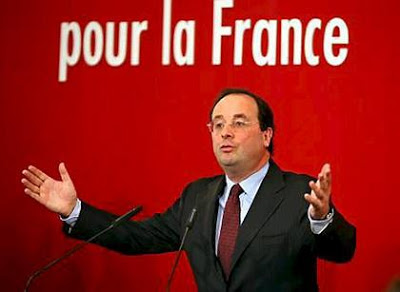
The French presidential election and Francois Hollande.

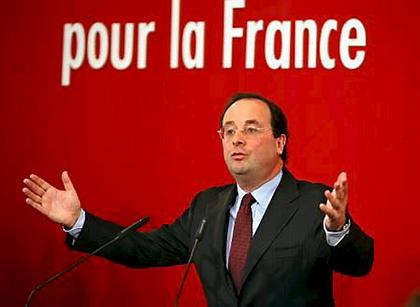
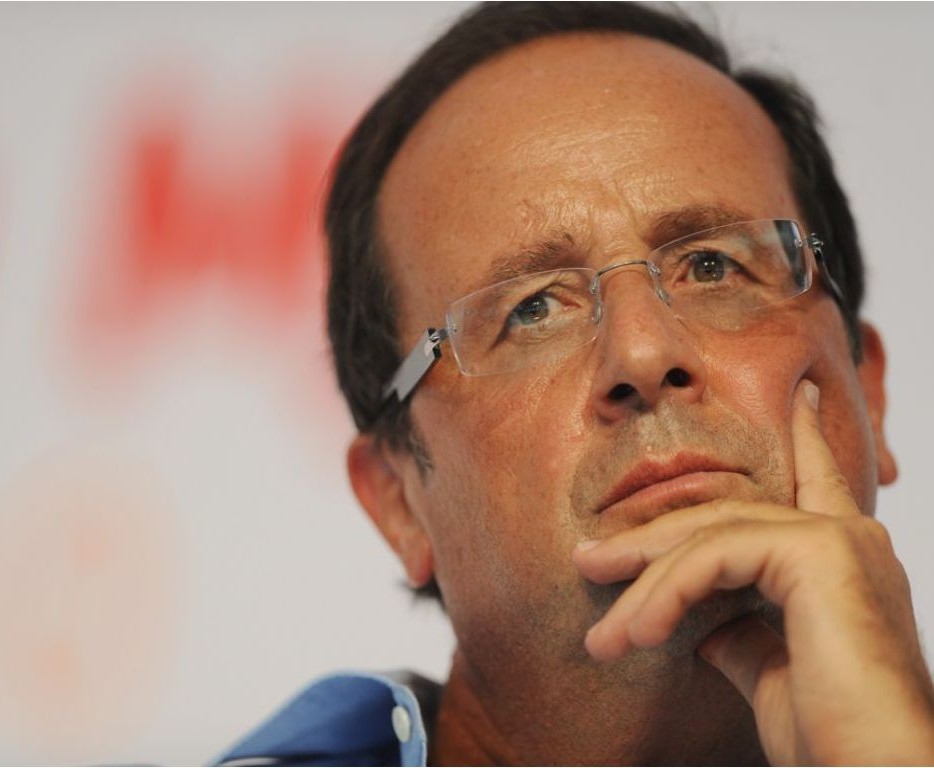
Voting in this year’s French presidential election begins on April 22nd and will provide an important opportunity for the left. In the first round, there will be candidates representing ten political parties, half of them leftist, including the Socialist, Left Unity, Green, New Anti-capitalist and Worker’s Struggle parties. This is fewer than in 2007 when there were twelve parties and in 2002 when there were sixteen. If no one wins a clear majority in the first round, an event that has never come close to happening previously, the two leading candidates advance to a run off on May 6th. The French electoral system. There are major differences between the US and French procedures for electing a president. In stark contrast to the US, corporate financing of political campaigns in France is strictly illegal. Individual contributions are limited to about $6,000 and must be thoroughly documented if over 150 euros ($200). This is not to say that political corruption does not exist. Envelopes full of cash are doubtless passed under the table. Sarkozy is currently being investigated, accused of accepting millions during his 2007 campaign from Colonel Gaddafi of Libya and Liliane Bettencourt, heiress to the L’Oreal cosmetics fortune and the richest woman in France. High level officials have been prosecuted for political corruption, including recent ex-president Jacques Chirac who was found guilty, but given a suspended sentence. Sarkozy will very likely be prosecuted when he leaves office and looses his immunity. In the US, thanks to the Supreme Court’s “Citizens United” decision, such political bribery is considered free speech. In France there is an official campaign period of about one month. During this period all candidates are given free and equal media time, 43 minutes each divided into eighteen segments of 90 seconds to 3 ½ minutes during which they may state their case. They are not allowed to solicit funds or disparage their opponents. No other mass media political advertising, such as inundates the US, is permissible. Campaigns thus cost a very small fraction of what they cost in the US. The amount that campaigns can spend is also strictly limited, to only about twenty million euros ($28 million) for each of the two candidates that reach the run off. That’s about as much as Mitt Romney spent in the Florida Republican primary. The US presidential election of 2012 is predicted to cost the campaigns $3-4 billion, several hundred times more than the French campaign. And the French government reimburses about half of all campaign costs. The voting is nationwide, not filtered through some intermediary devise such as the Electoral College that distorts the outcome and negates to meaninglessness nearly half the votes cast. The voting always takes place on a Sunday to maximize the turnout, whereas in the US elections are intentionally held on a workday so as to minimize worker participation. As a result, while the turnout in the most recent French presidential election in 2007 was considered low at 84%, the 70% who voted in the US presidential election in 2008 was considered high. Ballots in France are on paper and counted by hand. As a result of these features of its electoral system and its significantly greater income equality, France’s is a far more democratic country than the US. The French electorate is independent, traditionally polarized and not centrist. The current most centrist candidate, Francois Bayrou, is running a distant fifth and fading into irrelevance. The most graphic recent example of French polarization was the 2005 vote on the constitution of the European Union which failed by a wide margin despite being strongly favored by all French political parties except the far left and far right. Many, such as Karl Rove, think there is really no center in US politics either, but this phenomenon is particularly evident in France and has been for centuries, during which they have on several occasions killed each other mercilously. The horse race. It is certain that no one will have a majority in the first round and the run off will be between the incumbent president, Nicolas Sarkozy representing the UMP (Union pour un Mouvemente Populaire) and Francois Hollande representing the Socialist Party. Third place now up for grabs. Early in the race, the far right wing National Front candidate, Marine Le Pen, was solidly in third but trailing the top two candidates by more than 10%. She has since been overtaken by the charismatic and fast rising leftist leader, Jean-Luc Mélenchon, representing Left Unity, a coalition to the left of the Socialists, including the Communist Party and other leftist groups. Mélenchon has made the biggest move of any candidate in the race, moving from an initial 5% to 15% in the most recent polls, while Le Pen dropped from about 15% to 12%. Polls show Mélenchon rising fastest, with Sarkozy rising more slowly, Hollande and Le Pen dropping. Hollande is losing votes to Mélenchon. Le Pen is losing votes to Sarkozy. Regardless of these trends, the polls have consistently shown for months that Hollande and Sarkozy will both easily make the run off and Hollande will win that by a wide margin. Despite Sarkozy’s recent gains, every poll for months has shown him losing badly in the second round to Hollande, even if he is able to win the first round. No poll has shown Hollande’s lead at less than 6% in the run off, outside the margin of error. Sarkozy’s defeat will make him only the second French president to not be reelected since the founding of the Fifth Republic in 1958. The crucial polls show Sarkozy only getting a minority of the vote of the far-right National Front candidate, Le Pen, in the second round while Mélenchon’s voters overwhelmingly switch to Hollande. Sarkozy is running to the right in an effort to enhance his standing among Le Pen voters for the second round. But polls continue to show that many Le Pen supporters are unwilling to switch to Sarkozy and many of her ex-leftist supporters (the French analogy to the blue-collar Reagan Democrat) will switch to Hollande. The simple explanation of Sarkozy’s failure is that the majority of the French electorate does not like the man personally and disapproves of his policies. It is hard to say which is more important. His anti-immigrant measures, austerity advocacy and militarism in Libya do not represent the political thinking of the majority of the French, where 43% of respondents to a recent poll agreed with the proposition that “capitalism is fundamentally flawed”. Given that Sarkozy’s father was an immigrant, his anti-immigrant positions seem exemplary of a particularly repellant form of political opportunism.

But in image conscious France, his personality and stature may be his biggest liabilities. He’s hyper-active, aggressive, ostentatious and short. Take away Sarkozy’s platform shoes and De Gaulle would have been nearly a foot taller. Napoleon could get away with short, but not Sarkozy. He’s just not the distinguished presidential figure most French want to represent them to the world. Sarkozy is also widely thought to be corrupt, as was his mentor, ex-president Chirac, who now hates him too.

The recent shootings in Toulouse turned the campaign temporarily to the issue of security, considered a strong suit for Sarkozy, but it didn’t help his standing noticeably in subsequent polls. He has flailed fruitlessly trying to find an issue that would resurrect him as his approval ratings sank into the 20’s. Meanwhile French unemployment has crept up to 10% and economic growth has stalled despite Sarkozy’s promises of prosperity. With only two weeks to go, Sarkozy’s approval ratings have climbed to 40%, but 58% disapprove of him and 57% approve of Hollande. Those numbers have been remarkably static and spell Sarkozy’s political doom. Before the first round, expect Sarkozy to become ever more desperate in his attempts to attract Islamophobic support from the right. He has recently denied entry into France of Muslim clerics he labels as “extremists”, has ordered the arrest and deportation of several individuals accused of being Muslim terrorist sympathizers and said that people who log on to jihadist web sites should be arrested. Sarkozy is running a campaign that ignores the center while trying to build and energize a right wing base. That strategy only works in a low turn out setting, not with 80% or better participation. What a Hollande victory means. What is the meaning of Hollande being the next president of France? Many Americans will probably say not much, since they don’t consider France itself important. That view is ill informed and often masks envy. France is the world’s ninth largest economy, but along with Germany, it is the nucleus of the European Union, the world’s largest economy. France is also one of five permanent members of the UN Security Council with a veto and an independent nuclear power. It is and has been for centuries a political and cultural model for others. By having hosted four since the original in 1789, Paris is the cradle of democratic revolutions that have inspired millions around the globe. Today France has arguably the most sophisticated social welfare system in the world. It is perpetually the world’s # 1 tourist destination despite the alleged grumpiness of its citizens. Its cuisine is a UNESCO World Heritage cultural phenomenon and it produces the world’s most sought after wines by a very wide margin. Its art is universally revered. It is probably the world’s most commonly used advertising motif to symbolize chic and fashionable. In essence, France matters a lot more than even its size and wealth might indicate. The last time a Socialist was newly elected president of France, it was 1981 and Francois Mitterrand was coming into office in coalition with the Communists and with a long list of nationalizations and other aggressive socialist initiatives. Francois Hollande will have relatively little of that. He’s running as a moderate and that is what the French leftist intelligencia consider him. However, were he running as a Democrat in the US, Labour Party in the UK or Social Democrat in Germany, his platform would be considered quite leftist indeed. It goes without saying that he promises very significant differences from Sarkozy. These include France’s position on the European debt crisis, its willingness to cooperate with US militarism and a range of French domestic issues, particularly in regards to the tax structure. The take off point to determine what Francois Hollande offers comes from a campaign document containing his “60 pledges”. These include: 1. The renegotiation of EU financial arrangements designed to confront the “debt crisis” by including more emphasis on growth relative to austerity. 2. Re-hiring 60,000 teachers. 3. Subsidizing 150,000 jobs for youth. 4. Increasing in the number of public sector jobs. 5. Raising the current top marginal income tax rate from 41% to 45% and creating a new bracket that taxes income over a million euros a year at 75%. 6. Cutting the minimum age to receive a pension back from 62 years to 60 and a full pension from 67 back to 65. 7. Capping executive compensation. 8. Ending tax havens and cutting out 29 billion euros in tax breaks for the wealthy. 9. Instituting a financial transactions tax. 10. Taxing investment income at the same rate as wages and salaries. 11. Creating a public European credit-rating agency. 12. Forcing banks to separate their retail banking from their investment operations. 13. Using revenues from the new taxes on the rich to cut the budget deficit to 3% in 2013 and to balance the budget by the end of his first term. 14. Legalizing gay marriage and adoptions. 15. Achieving international recognition for the Palestinian state. 16. Cutting France’s current high use of nuclear energy by replacing it with sustainable nonpolluting energy. 17. Bringing home all French troops from Afghanistan early – by the end of 2012. 18. Cutting the salary of the French president by 30%. For an American presidential candidate, this platform would be radical beyond our wildest dreams. Of course, much of it may be dismissed as campaign rhetoric and there is little doubt that eventually many on the left will be disappointed in Hollande. But much of his program could be accomplished without greater public sector expenditures and his new taxes on the wealthy are popular.

Much depends on whether the Socialist Party and its left allies are able to win enough seats in the National Assembly elections to be held in June in order to avoid divided government. Sarkozy’s UMP now holds 317 of the 577 seats. This gives Hollande two months after winning the presidency to exploit his momentum in order to help the Socialist Party in the National Assembly elections. A clear Socialist Party majority is unlikely. Although recent regional elections have been trending left, the Socialists would need to win 85 additional seats to gain a majority. A left coalition majority, however, is more within reach. There are currently 25 members to the left of the Socialists in the National Assembly. That number would need to grow along with the Socialists. Such a left coalition will be necessary in order for Hollande to be able to name a Socialist as prime minister and form a unified government with control of both the executive and legislature. That coalition would necessarily include parties to the left of the Socialists, the forces now being mobilized by the candidacy of Jean-Luc Mélenchon of Left Unity. Having them as coalition partners pushes Hollande’s positions further to the left. The most obvious and important change a Hollande presidency might bring would be in negotiations within the EU concerning its “debt crisis”. There is currently a consensus among the right wing led governments of Germany, France, Italy, Spain and the UK that cuts in government spending and austerity measures imposed on social services are the sole acceptable means of government debt reduction. As a leftist, Hollande crashes that party with a different perspective that supports greater government expenditures, government sponsored growth and higher taxes on capital and the rich. How that debate will evolve is the most important issue in Europe. Within the EU, will Hollande demand a new approach that gives greater emphasis to government sponsored growth or will he settle for rhetorical flourishes? In foreign policy insofar as it relates to affairs outside Europe, Hollande is certain to take France in a new direction. With the disintegration of Libya into warring tribes, the decimation of women’s rights there in the wake of the Sarkozy led invasion and the great unpopularity of French involvement with NATO in Afghanistan, one can be confident that French cooperation with US/NATO military adventures will be much harder to achieve with Hollande. This attitude has already been reflected in an adamant statement given by the man said to be Hollande’s future Minister of Defense, that France pulling its 3,600 soldiers out of Afghanistan this year was non-negotiable. Hollande is also complaining about the French role in the NATO command structure and has floated a concept of “European defense” with reduced reliance on the US. In addition, his support for Palestinian statehood is a reversal of French policy that will run head-on into US opposition in the UN Security Council. Expect increasing French opposition to Israeli Likud government actions, given the widespread hostility toward Likud and Zionism among the staunchly secular and pro-Palestinian French left. Domestically, Hollande will primarily be concerned with raising taxes on capital in order to continue funding some of the world’s best social services. Hollande has explicitly said that “my biggest enemy is finance capital” and “I don’t like the rich”. His support for a cap on executive compensation, a financial transactions tax, taxing capital gains like wages and higher marginal tax brackets at the top signals a radically different approach to solving government debt issues from that advocated by Sarkozy and currently favored by Europe’s conservative leaders. He will also put greater emphasis on the integration of immigrants into French society in contrast to Sarkozy’s penchant for instigating Islamophobia and Roma roundups. And Hollande’s promised enactment of gay marriage and adoption would be a huge victory for gay rights worldwide. If Hollande is successful as France’s next president, he will be offering Europe and the rest of the world a social democratic model that will have great appeal. Such a model would stand in sharp contrast to that provided by the US. Hence, the French presidential election may have more important global implications than the one in the US in November, which will again offer two candidates in relatively closer agreement on basic policy issues than the candidates in France, a phenomenon to be expected given the heavy corporate influence on both major US political parties.

Type rest of the post here

Source /

The Rag Blog

Posted in RagBlog | Leave a comment

Here We Go Again in The Battle for The “Soul” of Occupy
Fear of Co-optation Leads to Self-Destructive Polemics

By Danny Schechter

Perhaps my problem is that I live in too many worlds at the same time, while many political eras live in me.

That may be why I responded so negatively to a recent polemic wrapped up in a poetic communique from AdBusters, the culture jammers in Canada, who do so much good work (and often so creatively) battling the consumption virus promoted by big corporations many of us have grown to despise.

I respect their magazine and marvel at the impact they have had in helping to stir Occupy Wall Street into existence. They clearly feel a sense of ownership in the movement and act not just as the midwife that promoted the occupy idea, but as the guardians of their version of the movement’s essence, as if they own the copyright and have to defend it aggressively in the court of public opinion.

Their Source latest communiqué, directed to “ jammers, occupiers and Springtime dreamers,” is offered up almost like a new commandment from the mountaintop of political purity, warning one and all “that a new enemy is in their midst that is … threatening to neutralize our insurgency with an insidious campaign of donor money and co-optation.”

Batten down the hatches! Defend the ramparts! Fly the flag!

They then call for a “fight to the finish” to defend the “soul of Occupy” that they claim is menaced by a “THEY” that is out to get us like some boogie man that acts like a virus and can’t be resisted.. Will “Black Block”militants become their enforcers?

Who is the THEY? Nefarious bankers on Wall Street? The CIA and Blackwater type mercenaries? Karl Rove and the Koch Brothers?

No, their new enemy is pictured not an external threat representing the status but an internal one they have no use for..

Read on: “First they silenced our uprising with a media blackout… then they smashed our encampments with midnight paramilitary raids… “ And now? They are planning to destroy all that that we built.

Suddenly the brutal police raids on Occupy and the initial media indifference are conflated with alleged operatives of the Obama campaign on a stealth mission of co-optation.

There’s no real evidence cited, but that’s not the point of this appeal to fear and unity Political paranoia is always driven by what COULD happen, not, necessarily, what is happening,

The political theory behind all this is that Occupy is not just the vanguard of the revolution but the revolution itself, and is in danger of being stifled by reformers who fear its imminent success in toppling capitalism. How realistic is that?

This worst case scenario is projected as a coordinated and calculated strategy by groups they put down in terms reminiscent of the way the Chinese cultural revolution demonized and stigmatized millions of people as counter revolutionaries that tore the Chinese Revolution apart using strident ideology to silence a “class enemy.”

Were there class enemies? Sure, there always are, but thousands of innocent people were accused and abused by ultra leftists on a mission from Mao.

Today’s self-appointed and unelected commissars of new consciousness say they see a new set of counter-revolutionaries out to snuff Occupy/

They ask:

“Will you allow Occupy to become a project of the old left, the same cabal of old world thinkers who have blunted the possibility of revolution for decades? Will you allow MoveOn, The Nation and Ben & Jerry to put the brakes on our Spring Offensive and turn our struggle into a “99% Spring” reelection campaign for President Obama?

Is this really what is happening or is it more like a conspiratorial fabrication? Is this type of insulting language really appropriate for a movement that claims to be democratic and inclusive?

MoveOn and Van Jones have denied they are trying to control the movement, refuse to speak in its name, and couldn’t steal its thunder if they wanted to. The Nation is just one magazine of many that has been sympathetic to Ocupy, but also supporta the more structured but very democratic resistance in Wisconsin that Ad Busters ignores.

Ben & Jerry are individuals, former business partners, who want to help by raising money for Occupy after consulting with many activists on how they could be helpful. They seem sincere to me.

Why is all this so threatening? Why the fearful and purist denunciation? Can’t they respect people who unlike Occupy’s core activist don’t make decisions at General Assemblies.?

Occupy has in the past sought coalitions with labor unions and black community groups that often have more traditional leadership structures. They haven’t tried to dictate politically correct processes that allies and supporters must accept. Why this intolerance now?

By the way, I have been pouring my heart out in books, blogs and films and opinion pieces on about the failures of the Obama Administration in combating the financial crimes that enabled the depression we are coping with. My latest exposes O&B’s campaign’s pandering on terrorism and threatening Iran.

Move On would not help me promote my work, neither has the Nation, really, or, for that matter, Ben & Jerry, whose work I admired more before they sold their company to a mainstream corporation (although they have been engaged in admirable campaigns challenging military spending for years.)

That doesn’t make them all sell-outs. Even if in the eyes of some, they are the “enemy” because they aren’t “horizontal” enough, or anti-capitalist enough, or anarchistic enough and may act more like reformers than Ad Buster-approved revolutionaries.

On Friday, NYU hosted a tribute to the 50th anniversary of the Port Huron Statement, the founding document of SDS that sparked activism in the 1960’s. Former SDS leader Tom Hayden was on hand to tell his some stories about that era.

He noted that the central idea of Port Huron, “participatory democracy,” also appears in Occupy’s first declaration, suggesting continuity with the so-called “old thinkers” that
AdBusters gratuitously derides.

He also recounted how liberals with whom SDS were aligned at first demanded that their movement become more outspokenly anti-communist, even as the movement rejected the cold war.

When SDS wouldn’t go along with this arrogant old left thinking, (funded in part by the CIA), there was an internal “trial” and interrogation that led to SDS’ defunding and ouster from its offices.

According to Hayden, it was a scene right out of Kafka, not unlike the tone of this recent communiqué.

SDS stood true to its principles and politics and refused to work with the people who tried to control them.

The result: they grew more influential. They successfully resisted co-optation and fought for racial justice and against the war in Vietnam. They supported organizing on campuses and in communities. They challenged the Democratic Party, which later also fragmented over the war with Richard Nixon the ultimate beneficiary of all the discord.

SDS couldn’t find a way of bridging its own ideological divides and the movement broke into warring factions that led to an organizational implosion. There also was plenty of paranoia and repression with the government covertly pitting one group against the other, using the FBI. racism and phony patriotism.

There is plenty of blame to go around. Is There may be parallels here with this call to “save the soul” of Occupy?

Can we learn from this destructive history of acrimony and sectarianism or are we doomed to repeat it?

News Dissector Danny Schechter wrote Occupy: Dissecting Occupy Wall Street (Cosimo Books) based on his coverage for his NewsDissector.net blog, Al Jazeera.com and other outlets and also directed a TV film on the organization of Zuccotti Park. Earliet, he was an activist in the civil rights, anti-war and anti-apartheid movements. Comments to dissector@mediachannel.org


Type rest of the post here

Source /

The Rag Blog

Posted in RagBlog | Leave a comment

Danny Schechter : Adbusters’ ‘Battle for the Soul of Occupy’

Graphic from AdBusters.

Here we go again:
Battle for the ‘soul’ of Occupy

AdBusters‘ latest communiqué is offered up almost like a new commandment from the mountaintop of political purity.

By Danny Schechter | The Rag Blog | April 17, 2012

Perhaps my problem is that I live in too many worlds at the same time, while many political eras live in me.

That may be why I responded so negatively to a recent polemic wrapped up in a poetic communique from AdBusters, the culture jammers in Canada, who do so much good work (and often so creatively) battling the consumption virus promoted by big corporations many of us have grown to despise.

I respect their magazine and marvel at the impact they have had in helping to stir Occupy Wall Street into existence. They clearly feel a sense of ownership in the movement and act not just as the midwife that promoted the occupy idea, but as the guardians of their version of the movement’s essence, as if they own the copyright and have to defend it aggressively in the court of public opinion.

Their latest communiqué, directed to “jammers, occupiers and Springtime dreamers,” is offered up almost like a new commandment from the mountaintop of political purity, warning one and all “that a new enemy is in their midst that is… threatening to neutralize our insurgency with an insidious campaign of donor money and co-optation.”

Batten down the hatches! Defend the ramparts! Fly the flag!

They then call for a “fight to the finish” to defend the “soul of Occupy” that they claim is menaced by a “THEY” that is out to get us like some boogie man that acts like a virus and can’t be resisted. Will “Black Block” militants become their enforcers?

Who is the THEY? Nefarious bankers on Wall Street? The CIA and Blackwater-type mercenaries? Karl Rove and the Koch Brothers?

No, their new enemy is pictured not as an external threat representing the status but an internal one they have no use for.

Read on: “First they silenced our uprising with a media blackout… then they smashed our encampments with midnight paramilitary raids… “ And now? They are planning to destroy all that that we built.

Suddenly the brutal police raids on Occupy and the initial media indifference are conflated with alleged operatives of the Obama campaign on a stealth mission of cooptation.

There’s no real evidence cited, but that’s not the point of this appeal to fear and unity. Political paranoia is always driven by what COULD happen, not, necessarily, what is happening,

The political theory behind all this is that Occupy is not just the vanguard of the revolution but the revolution itself, and is in danger of being stifled by reformers who fear its imminent success in toppling capitalism. How realistic is that?

This worst case scenario is projected as a coordinated and calculated strategy by groups they put down in terms reminiscent of the way the Chinese cultural revolution demonized and stigmatized millions of people as counterrevolutionaries that tore the Chinese Revolution apart using strident ideology to silence a “class enemy.”

Were there class enemies? Sure, there always are, but thousands of innocent people were accused and abused by ultra leftists on a mission from Mao.

Today’s self-appointed and unelected commissars of new consciousness say they see a new set of counter-revolutionaries out to snuff Occupy/

They ask:

Will you allow Occupy to become a project of the old left, the same cabal of old world thinkers who have blunted the possibility of revolution for decades? Will you allow MoveOn, The Nation and Ben & Jerry to put the brakes on our Spring Offensive and turn our struggle into a “99% Spring” reelection campaign for President Obama?

Is this really what is happening or is it more like a conspiratorial fabrication? Is this type of insulting language really appropriate for a movement that claims to be democratic and inclusive?

MoveOn and Van Jones have denied they are trying to control the movement, refuse to speak in its name, and couldn’t steal its thunder if they wanted to. The Nation is just one magazine of many that has been sympathetic to Occupy, but also supports the more structured but very democratic resistance in Wisconsin that Ad Busters ignores.

Ben & Jerry are individuals, former business partners, who want to help by raising money for Occupy after consulting with many activists on how they could be helpful. They seem sincere to me.

Why is all this so threatening? Why the fearful and purist denunciation? Can’t they respect people who — unlike Occupy’s core activists — don’t make decisions at General Assemblies.?

Occupy has in the past sought coalitions with labor unions and black community groups that often have more traditional leadership structures. They haven’t tried to dictate politically correct processes that allies and supporters must accept. Why this intolerance now?

By the way, I have been pouring my heart out in books, blogs, films, and opinion pieces about the failures of the Obama Administration in combating the financial crimes that enabled the depression we are coping with. My latest exposes the campaign’s pandering on terrorism and threatening Iran.

MoveOn would not help me promote my work, and neither has The Nation, really, or, for that matter, Ben & Jerry, whose work I admired more before they sold their company to a mainstream corporation (although they have been engaged in admirable campaigns challenging military spending for years).

That doesn’t make them all sellouts. Even if in the eyes of some they are the “enemy” because they aren’t “horizontal” enough, or anti-capitalist enough, or anarchistic enough, and may act more like reformers than Ad Buster-approved revolutionaries.

On Friday, NYU hosted a tribute to the 50th anniversary of the Port Huron Statement, the founding document of SDS that sparked activism in the 1960’s. Former SDS leader Tom Hayden was on hand to tell some stories about that era.

He noted that the central idea of Port Huron, “participatory democracy,” also appears in Occupy’s first declaration, suggesting continuity with the so-called “old thinkers” that AdBusters gratuitously derides.

He also recounted how liberals with whom SDS were aligned at first demanded that their movement become more outspokenly anti-communist, even as the movement rejected the cold war.

When SDS wouldn’t go along with this arrogant old left thinking, (funded in part by the CIA), there was an internal “trial” and interrogation that led to SDS’ defunding and ouster from its offices.

According to Hayden, it was a scene right out of Kafka, not unlike the tone of this recent communiqué.

SDS stood true to its principles and politics and refused to work with the people who tried to control them.

The result: they grew more influential. They successfully resisted cooptation and fought for racial justice and against the war in Vietnam. They supported organizing on campuses and in communities. They challenged the Democratic Party, which later also fragmented over the war with Richard Nixon the ultimate beneficiary of all the discord.

SDS couldn’t find a way of bridging its own ideological divides and the movement broke into warring factions that led to an organizational implosion. There also was plenty of paranoia and repression with the government covertly pitting one group against the other, using the FBI, racism, and phony patriotism.

There is plenty of blame to go around. And there may be parallels here with this call to “save the soul” of Occupy.

Can we learn from this destructive history of acrimony and sectarianism or are we doomed to repeat it?

[News Dissector Danny Schechter wrote Occupy: Dissecting Occupy Wall Street (Cosimo Books) based on his coverage for his Newsdissector.net, Al Jazeera.com, and other outlets including The Rag Blog, and also directed a TV film on the organization of Zuccotti Park. Earlier, he was an activist in the civil rights, anti-war and anti-apartheid movements. Email Danny at dissector@mediachannel.org. Read more articles by Danny Schechter on The Rag Blog.]

The Rag Blog

Posted in Rag Bloggers | Tagged , , , , , , , , , | Leave a comment

Marilyn Katz : Israel Needs a New Narrative

Israeli soldiers guard Palestinians protesting the relocation of an Israeli road gate in Beit Iksa in the occupied West Bank, on March 22, 2012. Photo by Ahmad Gharabli / AFP / Getty Images.

Israel needs a new narrative

Casting Jews as permanent victims is both outdated and counterproductive to the country’s well-being.

By Marilyn Katz | The Rag Blog | April 17, 2012

Fulfilling the promise of a Jewish state and safeguarding the country requires not only negotiations with Palestinian leaders. It also requires a new narrative to replace Israel’s permanent victim/perpetual outcast story.

The first time I visited Israel I was shocked by many things. Most disturbing was the narrative of Masada– the story of Jews in the 1st century A.D. who holed up on a mountain top while battling Rome’s Tenth Legion and committed what was essentially mass suicide rather than surrender or compromise their religion. I attended Jewish Day School until the age of eight, and Sunday school until the age of 18, but somehow hadn’t encountered this story before.

In late March, while attending a wonderful three-day J Street conference (titled “Making History”), I heard similar narratives — some just as disturbing. In particular, Deputy Ambassador of Israel Barukh Binah used his time as a guest speaker to not only attack J Street and Zionist writer and journalist Peter Beinart — whose new book is The Crisis of Zionism — but to provide a worldview closely resembling the Masada story.

In Binah’s tale (obviously the official line of the Netanyahu government) Jews have gained little since the 1930s. We remain a beleaguered group, with an uncontested and sole right to the land on which the state (ever expanding as it is) is placed, beset on every side by those who would exterminate us, and where only strict and blind adherence to the official line of the state deem one worthy of being called a friend of Israel.

In fact, those who disagree with Israel’s strategy and tactics are considered just as worthy of attack as the states and governments that Israeli officials describe as existential threats.

Despite the fact that Israel is now a well-armed (nuclear) sovereign state, both narratives lock Israel and Jews into permanent victim status — a lens that could lead to a self-fulfilling prophecy.

There are two ways Israel might be eliminated. One is by the actions of external forces; unlikely, given the consequences for any nation that would try to obliterate the country. The other is by the actions of its own leadership.

To its inhabitants and to Jews around the world, Israel has always been more than a piece of land. Rather, as dreamed of by Zionists, sought as a refuge in 1945 by the survivors of the Shoah, and as embedded in its Declaration of Independence in 1948, Israel was to be a Jewish and democratic state — a homeland for all Jews guaranteeing that those who were not Jewish could also find equal treatment and opportunity there.

Today, that state is in danger. The occupation of the West Bank and the Gaza Strip that followed the 1967 Arab-Israeli War, combined with intrusive, less-than-legal settlements, have made non-Jewish Arabs a significant minority (one-third the population in Jerusalem, 20 percent of those living inside Israel’s original borders, and 50 percent of the population in Israel’s expanded footprint).

The only thing that keeps the assembled territory “Jewish” today is the fact that Arab citizens in the West Bank and Gaza Strip are denied citizenship — unable to buy land inside Israel, denied passports, and unable to vote in national elections.

In other words, Israel is violating its commitment to democracy to maintain its Jewish character. Given existing territorial claims, should the state wish to live up to its pledge and commitment to democracy for all within its borders, Israel would no longer be a Jewish state. Israel’s status quo — leading to either a nondemocratic state of a non-Jewish state — is unsustainable.

The occupation not only flies in the face of the country’s democratic ideals, it serves to prop up demagogues in other places in the Middle East and increasingly subverts Israeli civil society — from hostile legislation aimed at NGOs critical of state policy, to the growth of a roster of “enemies” that includes people and organizations in various countries, to the unholy alliance with ultra-orthodox Jews who are hardly outdone in their attempts to restrict women’s rights by mullahs in neighboring nations.

Only ending the occupation and endorsing the establishment of a Palestinian state can assure the fulfillment of the promise of a Jewish state and lessen the hostility and danger to Israel, both from Palestinians and despots who use current Israeli policy and actions to prop up their own regimes.

This solution, however, requires not only negotiations with Palestinian leaders. It also requires a new narrative to replace Israel’s permanent victim/perpetual outcast story.

What might that be? I would choose the narrative taught to me long ago by teachers who had been the first inhabitants of the young state of Israel. Their narrative was that a strong band of pioneers, powered by intellect, compassion, and the Jewish mandate “to always choose life,” left the ghettos of Europe behind and built a powerful state in the desert, making land and a new society flourish.

From this point of strength, and acknowledging Israel’s current military and economic power, this narrative would affirm that Israel has the self-confidence to recognize and honor the legitimate claims of others — knowing from 5,000 years of history that without justice, there can be no lasting peace.

[An anti-war and civil rights organizer during the Vietnam War, Marilyn Katz helped organize security during the August 1968 protests at the Democratic National Convention. Katz has founded and led groups like the Chicago Women’s Union, Reproductive Rights National Network, and Chicago Women Organized for Reproductive Choice in the 1960s and 1970s, and Chicagoans Against War in Iraq in 2002. The founder and president of Chicago-based MK Communications, Katz can be contacted at mkatz@mkcpr.com. This article was also published at In These Times.]

The Rag Blog

Posted in Rag Bloggers | Tagged , , , , , , | Leave a comment

Harry Targ : Diplomatic Rejection at Cartagena Summit Reflects U.S. Decline

Is U.S. image fading? President Obama on giant screen at Americas Summit in Cartagena, April 14, 2012. Photo by John Vizcaino / Reuters.

Occupy Latin America:
Changing relations in the hemisphere

Latin America’s rejection of U.S. diplomatic dominance at the Cartagena, Colombia, summit signifies the decline of U.S. power in the region.

By Harry Targ | The Rag Blog | April 17, 2012

The 2012 Summit of the Americas ended Sunday, April 15, without a closing statement as is traditional. In fact, it ended with acrimony.

Countries with political regimes as varied as Colombia, Brazil, and Bolivia condemned the refusal of the United States to formally recognize Cuba, thus allowing that country to attend. Rafael Correa, president of Ecuador, did not even attend the summit to protest Cuba’s exclusion. By the end of the meeting, Evo Morales, Bolivian President, made it clear that no future summits would occur if Cuba were not included.

Along with political conflict between the United States and Canada and the rest of the Hemisphere countries over Cuba, most rejected the decades-long violent and destructive “war on drugs” launched by the United States in the twentieth century to maintain a rationale for a pervasive military presence in the region.

Also, President Cristina Fernandez of Argentina left the meeting early to protest the lack of U.S. support for her country’s claims on the Malvinas Islands.

The Summit of the Americas was launched in 1994 by President Clinton to advance Hemisphere diplomacy beyond the traditional regional organization, the Organization of American States. Clinton and George Bush used the summits to lobby for a Hemisphere-wide free trade agreement, a North America Free Trade Agreement, writ large.

In 2003, the former Brazilian President, Luiz Inacion Lula da Silva, demanded that the United States end farm subsidies for U.S. products before Brazil would consider a trade agreement. Subsequently Brazil joined forces with Russia, India, and China (the BRICs) to challenge the hegemony of the United States, Western Europe, and Japan in the global economy.

While visible global political/military contests in the twenty-first century centered in the Middle East and the Persian Gulf, significant changes have been occurring in Latin America. A continent pillaged by Spain, Britain, France, Portugal, and the Netherlands for hundreds of years has been doggedly moving towards political autonomy and economic independence.

Colonialism came to an end with the Spanish/Cuban/American war in 1898. In its place, the United States established neocolonial control over the politics and economics of virtually every country in the Hemisphere. At first, from 1898 until 1933, the U.S. maintained control through repeated military interventions (over 30 in 35 years with long marine military occupations of Haiti, Cuba, and Nicaragua).

From the 1930s until the 1980s, U.S. control was maintained by putting in place and supporting military dictatorships in such countries as Argentina, Brazil, and Chile. During the time Reagan, Bush senior and Clinton were in office, control was enhanced by so-called “neoliberal” economic policies. These demanded of countries, increasingly tied to international banks by crippling debt, the creation of open markets, foreign economic penetration, and reduced domestic spending for its own citizens.

During the years of dictatorship and neoliberalism, the primary example of resistance to U.S. economic imperialism and militarism was Cuba. For that reason, the United States put in place a policy of diplomatic isolation, an economic blockade, and a 50-year campaign to subvert and overthrow the revolutionary government.

As the 2012 election season approaches, presidential candidate Barack Obama, apparently felt he could not buck the declining but still influential counterrevolutionary Cuban Americans of South Florida, despite what Latin America thinks.

Latin America’s rejection of U.S. diplomatic dominance at the Cartagena, Colombia, summit signifies the decline of U.S. power in the region. The power of the newly formed Bolivarian Alliance for the Peoples of Our America (ALBA), an organization promoting economic and political cooperation in the region constitutes one kind of challenge to the United States. Another is the trade regime, Common Southern Market or Mercosur, which has a membership of Argentina, Brazil, Paraguay, Uruguay (with membership of Venezuela in process, and associate membership status for Bolivia, Chile, Colombia, Ecuador, and Peru.

More important, economic populist (some say 21st century socialist) regimes are in power now in Venezuela, Bolivia, Ecuador, and, of course, Cuba. In addition center/left regimes rule in Argentina, Brazil, Nicaragua, El Salvador, and Peru.

Hal Weitzman documents in Latin Lessons: How South America Stopped Listening to the United States and Started Prospering (Wiley, 2012) Latin America’s growing relationships with China and to a lesser extent Europe. He identifies a troubling contradiction in the U.S. regional relationship:

The longer-term trend is clear: while Latin America becomes an increasingly more important trade partner for the United States with every passing year, the United States is becoming less and less important to Latin America.

And finally, in advance of electoral shifts to the Left in the region, mass organizations all around the Hemisphere have emerged based on class, gender, and race. Also indigenous people struggling to keep their land in the face of expropriation by multinational corporations have risen up, even against what they regard as oppressive policies of populist regimes.

The World Social Forum, launched as a dialogue among the poor and oppressed in Porte Alegre, Brazil, in 2001, was a forerunner of the Occupy movements of our own day.

In short, the rejection of United States policies at the summit signifies the fundamental transformation of U.S/Latin American relations. The winds of change are becoming gusts.

[Harry Targ is a professor of political science at Purdue University who lives in West Lafayette, Indiana. He blogs at Diary of a Heartland Radical — and that’s also the name of his new book which can be found at Lulu.com. Read more of Harry Targ’s articles on The Rag Blog.]

The Rag Blog

Posted in Rag Bloggers | Tagged , , , , , , , , | Leave a comment

Lamar W. Hankins : ‘Truth, Lies and Afghanistan’

Lt. Colonel Daniel Davis. Image from Eideard.

‘Truth, Lies and Afghanistan’:
Lt. Colonel Davis reveals futility
and folly of our war in Afghanistan

By Lamar W. Hankins | The Rag Blog | April 16, 2012

How quickly Americans lose interest in war when so few families are affected by its consequences. The wars in both Iraq and Afghanistan have done little more than acquaint much of the public with the geography of the Middle East.

Now, a rare truth-teller who works at the Pentagon has filed an extensive report, one year in the making, telling the military brass, the Congress, and the President just how dishonest the Pentagon and its civilian leadership have been about the war in Afghanistan.

Lt. Colonel Daniel Davis has risked his career — in just two and a half years he will be eligible to retire — to tell our government and the American people the truth about the futility and folly of continuing to risk the lives of our men and women in uniform serving in Afghanistan. He reports his concerns, as well, that continuing the war will kill countless innocents. This is a country that has known virtually perpetual war for more than 40 years, and been the locus of periodic war since the days of Alexander the Great nearly two and a half millennia ago.

This war has lasted for over 10 years, yet many Americans seem to have lost focus about what took us there. We were trying to capture or kill Osama bin Laden and his al Queda supporters who were then living in Afghanistan. But they all left shortly after the bombing started, and we committed more than 100,000 troops to the deadly affair.

After that, the mission morphed into occupation and regime change, then to the promotion of democracy, followed by training Afghans to control their own country with military power through counterinsurgency.

The Afghanistan War began after the terrorism of September 11, 2001, with congressional approval, opposed only by one congressional official, Rep. Barbara Lee (D-CA).

The faulty foundation of this American debacle has been explained by law professor Marjorie Cohn (Thomas Jefferson School of Law), a specialist in international law:

[T]he U.N. Charter provides that all member states must settle their international disputes by peaceful means, and no nation can use military force except in self-defense or when authorized by the Security Council. After the 9/11 attacks, the council passed two resolutions, neither of which authorized the use of military force in Afghanistan.

Resolutions 1368 and 1373 condemned the Sept. 11 attacks and ordered the freezing of assets (of those who commit terrorist acts); the criminalizing of terrorist activity; the prevention of the commission of and support for terrorist attacks; and the taking of necessary steps to prevent the commission of terrorist activity, including the sharing of information. In addition, it urged ratification and enforcement of the international conventions against terrorism.

Professor Cohn explains further that

the invasion of Afghanistan was not legitimate self-defense under article 51 of the United Nations charter (to which we subscribe) because the attacks on Sept. 11 were criminal attacks, not “armed attacks” by another country. Afghanistan did not attack the United States. In fact, 15 of the 19 hijackers came from Saudi Arabia.

Had there been an imminent threat of an armed attack on the United States after September 11, President Bush would not have waited three weeks before initiating his bombing campaign against Afghanistan.

Professor Cohn cites a classic principle of self-defense found in international law and affirmed by the Nuremberg Tribunal and the UN General Assembly: the necessity for self-defense must be “instant, overwhelming, leaving no choice of means, and no moment for deliberation.”

This principle was not in play in our attack on Afghanistan.

In the fall of 2001, President Bush explained his reason for attacking Afghanistan: the Afghan rulers, the Taliban, were harboring Osama bin Laden and training terrorists. Most Americans seem to have forgotten that the Taliban offered to negotiate with the United States, but Bush did not want to reveal the specifics about why he thought Osama bin Laden and al Queda were responsible for the attacks, an assumption that few have quarreled with.

He preferred to attack rather than talk, even for a few days. And Afghan citizens and American and allied fighters have paid the price with their lives ever since — about 40,000 civilian deaths; nearly 3,000 military coalition deaths.

American taxpayers are on the hook for over half a trillion dollars (and counting) that has been borrowed to carry out the changing missions of the Afghan war. Together, the wars in Afghanistan and Iraq are approaching $1.5 trillion on the American credit card. So much for fiscal responsibility!

Now, in the midst of all this fiscal and human carnage, Lt. Colonel Davis spent a year during 2010 and 2011 on special assignment from the Pentagon to assess the war, especially to find out what our troops on the ground need and get that assistance to them. This assignment came after he had completed four tours of duty since 9/11 — two in Iraq and two in Afghanistan.

What he reported demonstrates the deceit inherent in governments gone mad with war as the solution to international problems. Davis had hoped to find evidence to support the assessments made by our military leaders in Afghanistan, but his report — “Truth, Lies and Afghanistan” — arrived at this conclusion:

Senior ranking U.S. military leaders have so distorted the truth when communicating with the U.S. Congress and American people in regard to conditions on the ground in Afghanistan that the truth has become unrecognizable.

His report was produced in two versions. The main difference is that the classified version is starker in its details than the unclassified one, but they tell the same story.

Davis traveled over 9,000 miles in Afghanistan during 12 months to complete his assignment. He spoke to American military personnel at every level. He went on mounted patrols, dismounted patrols, and coalition patrols in every part of the country where the current counter-insurgency is occurring.

He explained in an interview on Democracy Now! how a counter-insurgency has to be managed if it is to succeed:

[I]f you’re going to go into one and to try to win it, there are several things that have to happen, and all of them have to happen to one degree or another. Number one is that the host nation government has to be at least minimally capable, within cultural norms. The local security forces have to be minimally capable to be able to handle the security environment that exists, whatever that happens to be.

The people of the country have to be supportive of the host nation military forces and government. And the enemy forces, the insurgent force, has to be at least knocked down enough to where they can eventually be handled by the local forces alone. All of those things have to happen to one degree or another. And as I’ll argue, virtually none of them are the case in Afghanistan.

To drive his point home about the inadequacy of the Afghan security forces, he found everywhere he went that Afghan forces would engage the enemy only if attacked directly by them, but would not go outside their compounds or checkpoints to chase them, attack them, or harass them.

The insurgents have virtual free rein in Afghanistan anywhere coalition troops are not working or Afghan security forces are not stationed. And what American troops are doing he calls tactical activity — “We went on patrols, we went on attack missions, etc., but never enough to actually turn the tide militarily. And we now see graphically that’s exactly what didn’t happen.”

Lt. Colonel Davis’s assessment of our Afghan war is blunt:

[W]hen you’re given a mission that cannot — cannot — succeed militarily, then what is the purpose of the mission? I mean, why are we even doing this, if the United States is not benefited? … But we have to be incredibly careful about giving those soldiers and those leaders missions to ask them to put people’s lives at risk, to risk their own lives, when the United States is not going to be benefited militarily or any other way. That’s a problem.

When asked why he is willing to risk his military career to speak the truth as he discovered it in Afghanistan, Davis explains:

[T]here are thousands of Americans [fighting in Afghanistan] who are alive, full of body, full of hope, full of dreams, want to accomplish many things, have families, etc., who, known but to God, are marked for either death or wounding or having their limbs blown off or their genitals blown off in between now and this so-called end of fighting season 2013.

And if you can’t tell me that they’re going to gain some benefit for my country, I just morally cannot keep quiet. … I mean, the Army is built on what’s called the Army Seven Values, and it’s so important that we constantly reinforce those — you know, honor, integrity, moral courage, you know, those kinds of things that need to animate everything that you do.

And one of the things we’re taught is that, you know, if you see something that’s wrong, you’ve got to have the moral courage to do something about it. And in my view, this fell right into that category. So, you know, loyalty is one of those values, and I believe that I — my loyalty to the soldiers in the service who are still alive and who are still not wounded, but… will lose their lives or will lose their limbs or… suffer casualties and wounds in between now and then, I just owed it to them to do whatever I could to try to bring light to this, so that we can avoid that, if at all possible.

Author Chris Hedges has written about a “myth of candor” that envelopes all wars:

There is no more candor in Iraq or Afghanistan than there was in Vietnam, but in the age of live satellite feeds the military has perfected the appearance of candor. What we are fed is the myth of war. For the myth of war, the myth of glory and honor sells newspapers and boosts ratings, real war reporting does not.

Lt. Colonel Davis has exploded that myth of candor, and given us truth. No American can now say that he or she didn’t know.

This column is dedicated to the memory of my friend, the late Margret Hofmann, who as a teenager survived the horror of the allied bombing of Dresden before immigrating to the U.S. and becoming a life-long opponent of war. She died this past February.

[Lamar W. Hankins, a former San Marcos, Texas, city attorney, is also a columnist for the San Marcos Mercury. This article © Freethought San Marcos, Lamar W. Hankins. Read more articles by Lamar W. Hankins on The Rag Blog.]

The Rag Blog

Posted in Rag Bloggers | Tagged , , , , , , | Leave a comment

According to Jim Hightower, “even the smallest dog can lift its leg on the tallest building.” Jim — who is perhaps our most celebrated contemporary champion of the common folk — believes we are in a “populist moment” in the United States. As Thorne Dreyer’s guest on Rag Radio, he discussed his philosophy and his generally positive take on the state of progressive activism in the country. Includes highlights from the interview, a player for listening to the podcast, and Jeff Zavala’s video of the show.

Posted in RagBlog | Leave a comment

Thorne Webb Dreyer and Sarito Carol Neiman : Bon Voyage, Doctor Keister

Dr. Stephen R. Keister, 1921-2012.

Dr. Stephen R. Keister, 1921-2012:
Bon Voyage, Doctor Keister

By Thorne Webb Dreyer and Sarito Carol Neiman / The Rag Blog / April 12, 2012

It seems the cancer always wins! Tomorrow I go to the Manchester Presbyterian Lodge for final care by Great Lakes Hospice. I am beginning to hear the splash of Old Charon’s oars in the waters of the Styx. It ain’t all that bad with the memories of all of you fine folks to take along.”Steve Keister, in a message to his friends and his colleagues at The Rag Blog, February 2, 2012

Dr. Stephen R. Keister left us late Friday night, April 6, 2012, after a long-running bout with prostate cancer. He died in hospice care in his longtime home, Erie, Pennsylvania, at the age of 90.

The cancer may have won but we seriously doubt that Old Charon, the ferryman of Greek mythology (who carried souls of the newly deceased into the world of the dead) succeeded in transporting Steve all the way to Hades.

Steve, ever the philosopher and the reformer, probably recruited the wizened old seaman to his own cause of universal health care and they’re out there now, organizing for a single-payer system in the Afterlife.

Steve Keister, who turned 90 last October, was a retired physician who practiced internal medicine in Erie, PA, from 1950 until 1991, specializing in rheumatology; he was the region’s first practicing rheumatologist.

He attended Duke University where he became interested in the writings and philosophy of Moses ben Miamon, Voltaire, and Sir William Osler. He obtained his M.D. from the University of Maryland and did his postgraduate training at the Mercy Hospital in Pittsburgh and Hamot Medical Center in Erie.

His medical honors were many and after retirement he remained active in scholarship and volunteer work. And Steve found a second passion late in life, dedicating himself to progressive social change, and especially to the cause of universal health care, working with Physicians for a National Health Plan and other activist groups, and writing about health care reform for The Rag Blog.

According to his daughter, Cindy Hepfer, “Steve has always been a voracious reader, continued to play tennis until his 60s when he took up golf instead, and enjoyed having friends in in the evening for drinks and conversation.”

And, “after retirement,” Cindy said, “Steve continued his family’s tradition of trying to preserve the tenets of the nation’s Founding Fathers by active membership in People for the American Way, Americans United for the Separation of Church and State, and Amnesty International.”

In a eulogy, Steve’s friend Don Swift said that Keister was not only a “gentleman scholar,” but that he was also “a mensch, a person of integrity and honor,” and that he was “all about trying to heal a broken world.”

Fellow Pennsylvania activist and writer Carl Davidson said, “We knew him well here in Western Pennsylvania, especially as an unwavering voice for Medicare for All, and then some. He supported PDA’s [Progressive Democrats of America’s] efforts here, but his own views were with the socialist left. Raise a fist and a red rose for him this May Day. He will be missed.”

About her father’s involvement with The Rag Blog, Cindy Hepfer said, “You have certainly given him a mission in these latter years of his life! I thank you for giving Dad a creative outlet and a way to share his goodness and intelligence with others.”

Keister’s heavily-researched opinion pieces published by The Rag Blog were rich with personal reference and backed up with facts, figures, and links. They were erudite, yet peppered with wonderful colloquialisms reminiscent of an earlier era, and always filled with quotes and observations from great thinkers, scientists, and philosophers ranging from Rabelais, Pliny the Younger, and Confucius, to Aldous Huxley, Sir William Osler, John Ruskin, and Will Rogers.

And, if you read a column by Dr. Stephen R. Keister, you never had any doubt about where the author stood on the subject.

Though always full of hope personally, Steve became increasingly disillusioned with the medical system in this country and the growing dominance of the pharmaceutical and health insurance companies.

In his writing, he often reflected on the lessons of a lifetime in medicine.

“I entered the practice of medicine in 1950, an idealist, believing in the lesson of the Good Samaritan,” he wrote. “I believed that all persons should be provided with medical care…”

But, “Somewhere in the 1980s medical care, with great planning and premeditation, was usurped by the health insurance cartel in collusion with the pharmaceutical industry. Medicine was changed from a proud profession to a business, and the physician degraded to a ‘health care provider.'”

In his final column for The Rag Blog, entitled “I Cry for My Country,” Dr. Keister wrote:

Having passed the age of 90 I wish that my final days could be days of happiness and good wishes for those about me; however, it appears that fate has ordained otherwise. It would be a great course of satisfaction to see an enlightened, progressive United States as a homeland for my grandchildren. Instead we find a nation that is descending into quasi-feudalism and subservience of the many to the few.

At the time Steve submitted his final column, we at The Rag Blog were aware of his worsening physical condition. We included the following introduction to his piece:

Our dear friend, Dr. Stephen R. Keister, turned 90 on Sunday, October 9. For the last three years Steve has written — with a unique and singular voice — dozens of columns about the sad state of our health care system. And in that time he has become the heart and soul of The Rag Blog. He claims this is his last column, but we promise not to hold him to that commitment! We hope he will continue to share his wisdom with us for many months to come.

But we knew it wasn’t likely.


Steve Keister approached death much as he handled life, with vigor, intellectual curiosity, and an open mind. According to his daughter, “He was analyzing the dying process for as long as he could and communicating his thoughts to those around him.”

“He had observed repeatedly to several of us that he was not afraid… and that he always liked to sleep.” Cindy said. “I told him how brave I thought he was and that he shouldn’t be afraid to reach out for the sleep that he wasn’t afraid of.”

We communicated with Steve during his final weeks and he shared his feelings and observations about the process of dying.

Saying goodbye

“Death is someone you see very clearly with eyes in the center of your heart: eyes that see not by reacting to light, but by reacting to a kind of a chill from within the marrow of your own life.” — Thomas Merton

“The greatest challenge of the day is: how to bring about a revolution of the heart, a revolution which has to start with each one of us?” — Dorothea Day

How do you say goodbye to a friend? We mean really goodbye — not “so long, see you later.” Saying goodbye, really, is an opportunity one doesn’t have often or early in life.

When we are young and a friend dies it is usually sudden, unexpected. One day the person is here, the next day that person is gone. And even when we know that death is coming, our culture as a whole does not tend to support the ceremony of saying our goodbyes while that person is still alive. Instead we are supported to remain in denial — “you can beat this thing, I know you can!”

We are encouraged in so many ways, subtle and not so subtle, to save our goodbyes for when it’s too late for the person who’s leaving to hear them. And by the time we are old enough to see (if we dare to look) the glimmer of our own departure on the horizon, we have no practice in saying goodbye, either as one who is leaving or as one who will remain.

Stephen Keister was a friend. His contributions to The Rag Blog over the past three years have been rooted in a rich lifetime of experience as a physician and proud “secular humanist” and, as such, his insights have been invaluable as we have collectively wrestled with all the implications of the crisis in health care that has plagued the United States now for decades.

His passion for his subject was not abstract or ideological; it was his very life. In his first Rag Blog column, published on Nov. 17, 2008, Dr. Keister was clear where he stood on the question of healthcare reform:

To take the burden off future generations this country must get in step with Western Europe in quality and extent of health care for all. According to the Commonwealth Fund our health care rates 26th in the world and as of Nov. 13 [2008] … U.S. patients, compared to seven other countries, suffer the highest number of medical errors. 44% of chronically ill patients did not get recommended care, fill a prescription, or see a doctor when sick because of costs. 41% of U.S. patients spent more than $1000 in the past year on out of pocket costs, compared to 4% in Britain or 8% in the Netherlands.

We must make sure our elected representatives are not taking baksheesh from the pharmaceutical and insurance industries and support single payer, universal health care devoid of insurance company participation. The nation and your family depend on you not sitting idly on your butt. Call, E-mail, demonstrate!

We lost that battle, obviously. But the war is not yet over, as the sad compromise that became “Obamacare” now finds itself in the Supreme Court. Steve Keister did not live to see the outcome of the current scuffle. But it’s clear, no matter what the outcome, there is still no cause for sitting idly by.


When we heard that it was time to say goodbye to our friend Stephen Keister, we wanted to find a way to honor the occasion. Not to respond with denial, nor to save all our tributes till after he was gone.

So we did what anybody might do if they just found out that a wise and beautiful friend was about to leave for good. We sent him a list of questions, hoping it would offer the opportunity to share what is happening with him now. True to form, he responded both as a scientist and as a humanitarian, the rare combination that has made it such an honor and privilege to publish him over the years.

Here is his response, in his own words. In a sense, this is Steve Keister’s final column. We would like to thank writer and educator — and Steve’s close friend — Don Swift, for facilitating our final communication with Steve Keister.

Recently I’ve received a request from Thorne Dreyer and his many friends at The Rag Blog, to give him some insight into the situation in which I am involved — that is, terminal cancer of the prostate, under the care of the good people at the local hospice organization.

Initially, I think we’d better discuss what hospice exactly covers. In my last article in The Rag Blog, entitled “I Cry for My Country,” I refer to several instances of hospices run purely for the financial benefit of the folks in charge. In other words, once again we are faced with the terrible American attitude of money above all else. Therefore, I would suggest that anybody who is interested in legitimate hospice care get a copy of the pamphlet entitled, “When Death Is Near: A Caregiver’s Guide.”

Hospice in the United States is a reasonably new organization, and the hospice in Erie was one of those founded on the basis of charitable giving. Some 25 years ago, Dr. David Dunn, a very capable general surgeon who had spent time in Great Britain during the war, became interested in the hospice movement and spent several months studying the technique as utilized in the U.K. Subsequently he came back to the United States and established a purely volunteer movement, which was soon overburdened, and ultimately taken over by his son, Dr. Geoffrey Dunn at the Great Lakes Hospice, where it remains today.

I became involved in this personally, having been diagnosed with carcinoma of the prostate some 12 years ago. This was treated initially by irradiation and subsequently hormone therapy. Approximately mid-2011, bone scans showed spread of the cancer to the various bones of my body. I tended to ignore this, which was possibly a mistake on my part, because of several factors. At the age of 90 I was enjoying the company of both the Edinboro University retired faculty group, and an 89-year-old lady, who was the best of companions, on the 8th floor of my building.

The question arises, why did I resort to hospice care?

I was not fully aware of the signs of the deteriorating effects of metastatic cancer. I was aware of the fact that we develop painful areas in the bones, but I completely ignored the systemic symptoms of the disease, which are: 1) increased fatigue; one will sleep up to 18 hours a night; 2) complete loss of appetite; one desires nothing, even a glass of milk, for a meal; 3) desire for solitude and lack of interest in things of everyday origin.

These taken together mean something to an alert physician and, happily, Dr. Jeffrey Dunn of hospice stopped by one evening to discuss books, and I discussed my symptoms with him. He said, “Gee, Steve, you’re a candidate for hospice care — your cancer is spreading.” So the next day I was a hospice patient, and have never regretted it to this day.

Hospice nationally will provide 90 days of care under Medicare. They do not provide inpatient care in a convalescent or nursing home, but otherwise, medicine, equipment, medical care, etc., is provided by the program. I currently am in the Presbyterian Lodge in Erie, and everything is going according to program. I realize I have not long to live, but realize too that I have much to be thankful for throughout my 90 years.

I am also asked how I have rationalized the facing of death, and the question mentions that Socrates, the Zen masters, Jesus, Buddha have all offered alternatives. However, I have somehow avoided these alternatives and looked at this as a purely biological process. We are born in pain, we live largely in pain, and hopefully we can avoid dying in pain.

I’ve been assured by several of the hospice workers that the easiest people to care for are those that are the “secular humanists” who approach each stage of life as a natural event and do not interfere or complicate matters with various philosophical pictures.

While is it true that good hospice care professionals, if possible, provide a role of helping family and friends come to terms with the impending loss of a loved one, some of us are beyond that stage. At the age of 90 we have few living relatives and depend entirely on friends. Happily, I have been blessed with many, many friends in my recent lifetime — perhaps more so than earlier in my life.

The final question in the submitted list is very interesting and very apropos to the present time. It is: If you could make a new Hippocratic Oath for the 21st century to be given to every student graduating from medical school, what would it be?

This I have given much thought, and do not feel intellectually qualified to answer this at the present time. But I do feel that certain factors should enter into the situation. I do think the philosophy of Dorothea Day and Thomas Merton should play a big part, and within their thinking, we who allegedly feel we are Christians should remember the Sermon on the Mount and the Beatitudes.

In addition to that, from the ethical standpoint we should remember the teachings of two physicians of the last century: Sir William Osler and Dr. W.W.G Maclaclhan of Pittsburgh, both of whom treated people of prominence, the well-known, but at the same time never turned their backs on the poor, the underprivileged or the disabled.

I once again wish to thank my friends in Austin, Texas, my friends in my retired professors’ group in Edinboro University, my children, including my daughter Cindy and son-in-law Will (both librarians), and my grandson Jonathan and his wife Alice (both modern musicians with a technique I do not understand but in which apparently they are doing great work). And finally, my dear friend on the eighth floor at 1324 South Shore Drive.

Peace. Peace to all. Thank you.

More of Stephen Keister’s last words can be found in his last columns for the Rag Blog. His final column ended with a challenge for us all to carry on the work of birthing a better world:

I cry for my country, and while asleep I hear in my dreams the mass gatherings of my youth singing, “Arise ye prisoners of starvation, arise thee wretched of the earth, for justice thunders condemnation, a better world’s in birth.”

Bon voyage, Doctor Keister. You will be missed.

[Thorne Dreyer edits The Rag Blog, hosts Rag Radio, and is a director of the New Journalism Project. He lives in Austin. Sarito Carol Neiman is a freelance editor, author, and actress who lives in Junction, Texas. Together they edited Austin’s Sixties underground newspaper, The Rag.]

Find articles by Dr. Stephen R. Keister on The Rag Blog.

Images courtesy of Cindy Hepfer.

The Rag Blog

Posted in Rag Bloggers | Tagged , , , , , , , , | 2 Comments

Tom Miller : Moving West, Writing East

Welcoming Arizona rattlesnake: “Cowboys amble” — and, well, “snakes slither.”

Moving West, writing East:
The life of a writer in the Southwest
of the 1960s and ’70s

By Tom Miller | The Rag Blog | April 12, 2012

I moved west to escape the East. I stayed west to inform the East.

This took place in the late 1960s, when the anti-war movement and its cultural twin were both flowering. There’s that window of opportunity we all have in our early 20s when there’s nothing — love, family, job, mortgage, school — to batten us down.

“Arizona,” someone suggested with a nod and a wink. “Arizona.” I knew nothing about the youngest of the lower 48, except that Barry Goldwater and marijuana both came from there, and I thought that any place where those two elements are both at play is worth investigating. I jumped through that window of opportunity and landed in Tucson.

A squat two-bedroom adobe in a working-class neighborhood full of similar houses rented for $150 monthly. A friend and I took the place. My bedroom window looked out on a couple of lonely saguaro, and every morning, I awoke to a Western B-movie set.

An active anti-war movement was in place, and I found a freelancer oasis — a fertile town with no one else writing for the underground press or sea-level magazines such as Crawdaddy!, Fusion or 2-year old Rolling Stone. I could take part in affairs that mattered and write about Southwestern mythology at the same time.

For Crawdaddy! I wrote about the real Rosa’s Cantina in El Paso and the copper-smelter workers who sipped away their afternoons at its bar. For Fusion, about the acid cowboys of northern New Mexico. And the bi-weekly Rolling Stone? They put me on retainer, sending me $50 an issue simply to be on call and give them first dibs on story ideas. I arranged for a hipster country band to play for imprisoned draft resisters at a minimum-security federal prison, then wrote it up for the Stone. Like that.

The people, the issues, the land, the air, the music and, yes, the language. All these ingredients constructed my new West. I grabbed a picket sign to march for farm workers in front of Safeway. I joined another demonstration against a university’s Mormon beliefs of racial inequality. (That was at a college basketball game. Boy, were we popular.)

Late one night, I ran with a secretive group called the Eco-Raiders and wrote up their efforts to combat urban sprawl. The war against Vietnam was a constant reminder of global issues, while the desert Southwest taught me the fragility and permanence of the land.

I had not just moved to the American West. I had moved to a region with an odd-angled line running through it — the international boundary. The north of Sonora and Chihuahua had much in common with New Mexico and “dry-faced Arizona,” as Jack Kerouac called it. Mexico, too, became part of my faculty, and I, one of its pupils.

I spent time in Bisbee, Silver City, Cananea, Walsenburg (Colorado, but who’s counting), El Paso-Juárez, Morenci, Cd. Chihuahua, Douglas-Agua Prieta — many of these towns with huge mining and smelting operations. They were more than just colorful destinations on the map.

I cannot explain why I am attracted to mining camps and their stories. Traveling through the towns where copper, zinc, and coal rise to the surface and get processed, I’ve found a genuine kinship with miners and their families. Certainly it cannot be envy: I have no desire to descend hundreds of feet underground and extract ore or calibrate explosives in a shaft, nor do I want to drive mammoth yellow equipment pitched on tires three times the size of a pickup truck. It cannot be common background, either — the mining communities and I have no shared past.

Still, time and again, I have been invited into miners’ homes and felt privileged to listen to family histories and collective memories, to hear cherished songs explained and to read unpublished letters. It’s been an honor — one-sided, as far as I can determine — and I’ve benefited by it enormously.

Back in the late 1970s, the 2,000-mile U.S.-Mexico border was a warm and inviting place (and still is, to a certain extent, though no one believes me anymore). I traveled that Third Country sandwiched between two large powers, listening to fronterizos and writing down my impressions. Only one other writer was traveling the frontier at the time, a fellow from The New York Times who invited me to contribute to his newspaper. And so I wrote about the American West for people back East — very part-time, nothing more than a stringer, but in a region full of life and rough edges.

They asked me to report conventional stories such as court cases, regional angles on national trends, and curious university research, but what assignment editors valued most was stories pitched from the field — all the more so, I discovered, if they evoked the Old West with dirt roads, dusty boots, and barbed wire.

Their notion of the Southwest was matched by my compulsive attempts to fulfill it, and soon, in deference to my editors, I put a sign over my typewriter: REMEMBER: COWBOYS AMBLE, BUSINESSMEN STRIDE, MARIACHIS STROLL.

One day, I learned about a Yaqui judge who helped a Jewish retirees’ club unearth the old Hebrew graveyard at Tombstone’s Boothill Graveyard. The rededication ceremony was to take place later that week. This Old West story linked Jews, cowboys and Indians — a threefer! I breathlessly called the National Desk. Instead of the usual follow-up questions, I was immediately green-lighted with an open-ended word count and a photographer.

Interpreting the Southwest for the East, I tried to give an accurate picture, though my credibility only went so far. To file a story, we’d type or handwrite our copy, then read it over long distance to the recording room in the bowels of the old Times building on West 43rd Street. A battery of transcribers would monitor our calls as we dictated our stories into their machines.

We e-nun-ci-a-ted each word, especially names, which we’d spell out, and always spoke dis-tinc-t-ly, even giving punctuation commands. The transcribers would call back if they had any questions, period, paragraph.

In one story from the frontier’s smallest border town, Antelope Wells, N.M. (population: 2), I wrote about the annual cattle crossing that attracted cowboys, livestock brokers, Department of Agriculture inspectors, ranchers and customs officials from both countries.

On my way to file from the nearest pay phone five miles away, I colored the story, describing the strong chuckwagon coffee served to gathering vaqueros at daybreak by “a few Mexican cooks.” The next day, I was chagrined to read in the Times that the event attracted “a few Mexican crooks.”

I liked interpreting the West for the East, and in chit-chat with an editor one warm day, he asked about the racket in the background. “Oh, that’s the swamp cooler,” I replied, as matter-of-factly as if I had said it was my dog barking. “The what?” I explained that a swamp cooler worked on the principle of a cool damp towel tossed over the metal grill of an electric fan. This led to a major conference among editors, all of whom were intrigued with this exotic contraption — should they assign a piece on the poor man’s air conditioner? (They did, but not until much later, and then to another contributor.)

One story I wrote included the word campesinos. A copy editor called back, insisting that I blend a translation into the article. I blanketed my exasperation and asked if he would agree that campesino is one of those foreign words that has been absorbed into contemporary English. The line went silent for a moment. “I’ll tell you what,” he finally said. “I’ll learn Spanish if they’ll learn Yiddish.”

Touché.

One morning, the phone rang at 7 o’clock, usually a warning that someone on the East Coast didn’t understand time zones. It was an editor at Esquire who, after describing a story he wanted pursued in Texas, asked if I would, and I believe these were his exact words, “mosey on over to Houston.” I informed him that if we both started moseying at the same time, he’d likely mosey into Houston before me.

The rhythm of the Southwest, its natural continuity and occasional brute force — I suppose that’s what keeps me here. I tried to move away. Twice: once to the San Francisco Bay area, and another time to Austin, Texas. Neither venture lasted more than six months. Both times, I maintained my post office box in Tucson. I knew.

Thornton Wilder lived in Southern Arizona at various stages of his life, once in Tucson in the mid-1930s, just weeks after Our Town had opened on Broadway. One early summer day, he was asked how he liked his temporary home. “I like it very much,” he answered, then tempered his reply. “There are three disadvantages, two of which would be curable. I miss a great library to browse in. I miss great music. And I came at the wrong time of year.”

The library problem and lack of great music have both been cured, but not Wilder’s third disadvantage. In more than four decades of living here, from my first arrival one August, I’ve never grown accustomed to the unrelenting heat of the summer, never liked it, and annually grumble that this summer will be the last one I spend here.

The sun bores a hole through your skull until it singes the synapses in your brain and renders you powerless and stupid. Like Thornton Wilder, I came at the wrong time of the year.

The rest of the year, I need the desert. Not all the time, please, but inhaling a good whiff of it now and then keeps the lungs satisfied and reminds me that I’m not too far from the dread unknown. I need the border for its anarchic sense of reality. I need Bisbee, population 6,800, for the stumbling satisfaction it conveys. I’d like a good river and more green, but then it wouldn’t be the desert Southwest.

[Tom Miller’s 10 books include Trading With the Enemy: A Yankee Travels Through Castro’s Cuba, and The Panama Hat Trail. He has previously written for The Rag Blog about Phil Ochs, Don Quixote, and Jerry Rubin. Read more articles by Tom Miller on The Rag Blog.]

The Rag Blog
Posted in Rag Bloggers | Tagged , , , , , | 3 Comments

RAG RADIO / Thorne Webb Dreyer : Jim Hightower and the ‘Populist Moment’

Jim Hightower photo by Alan Pogue

Jim Hightower in the KOOP studios in Austin, Friday, April 6, 2012. Photo by Alan Pogue / The Rag Blog.

Rag Radio: Jim Hightower and the ‘populist moment’

By Thorne Webb Dreyer | The Rag Blog | April 11, 2012

Jim Hightower will headline a “Spring Song Fiesta” at Scholz Beer Garten in Austin on Sunday, April 15, from 1-9 p.m. Hightower will speak at 7, following a live KOOP-sponsored debate among Austin mayoral candidates starting at 6. Bands will include the Therapy Sisters, Paper Moon Shiners, Bill Oliver, Son y No Son, Barbara K, Floyd Domino, and Ted Roddy and the Hit Kickers. It all benefits community radio KOOP-FM.

According to Jim Hightower, “even the smallest dog can lift its leg on the tallest building.”

Progressive Texas populist author, commentator, and orator Hightower — perhaps our country’s most celebrated champion of the common folk — was our guest on Rag Radio, Friday, April 6, on Austin’s community radio station, KOOP 91.7-FM, and streamed live on the Internet.

You can listen to the show here:


We discussed populism as a political movement — and what Jim Hightower sees as a “populist moment” existing in this country today.

“Populism is about confronting money and power in our society and realizing that too few people control too much money,” Hightower told the Rag Radio audience. “The few are doing extremely well, but they seem to think that they can separate their well-being from the good fortunes of the many.”

Hightower, who served two terms as Texas Agriculture Commissioner, is a New York Times bestselling author. His weekly newsletter, the Hightower Lowdown, goes out to 135,000 subscribers, he writes a weekly newspaper column for Creators Syndicate, and his radio commentaries air on stations around the country, including Austin’s KOOP.

A former editor of the Texas Observer, Hightower has been involved in progressive politics for decades and has established himself as one of the country’s most influential consumer advocates, especially focusing on corporate power in the food economy.

Jim Hightower’s latest book is Swim Against the Current: Even a Dead Fish Can Go With the Flow.

Rag Radio, hosted by longtime alternative journalist Thorne Dreyer, editor of The Rag Blog and a pioneer of the Sixties underground press, features hour-long in-depth interviews and discussion about progressive politics, history, and culture.

The show is broadcast on Austin’s KOOP 91.7-FM, a cooperatively-run community radio station, on Fridays, 2-3 p.m. (CST) and is rebroadcast on WFTE-FM in Mt. Cobb and Scranton, PA, on Sundays at 10 a.m. (EST). It also has a widespread internet audience and podcasts of all shows can be downloaded at the Internet Archive.

Populist moment

Jim Hightower said on Rag Radio that he thinks “we have a strong populist moment, a strong populist possibility, to make fundamental change.”

He says that the Wall Street bailout “was the initial spark for the Tea Party movement,” but that it got captured by former Texas Congressman and Koch-funded Washington lobbyist Dick Armey, and was turned into a “right-wing hugging organization.”

But Hightower believes that the Occupy movement could connect with the Tea Party rank and file, and “turn into something real, something that does try to decentralize power down to the grassroots level for ordinary working people.”

He sees lots of things going on in the country that make him hopeful.

He believes that all the Republican anti-union activity has reinvigorated the labor movement. AFL-CIO head Richard Trumka “declared that he was going to make [Wisconsin Gov.] Scott Walker the ‘organizer of the year.’” All the anti-union rhetoric “has given them their own sense of history back, and their own spirit back, and the recognition that the public is with them.”

Hightower spoke before 150,000 people in 20-degree weather last February in Madison, at a rally opposing the Wisconsin anti-union legislation. There were people “just as far as you could see.”

“It was just a beautiful, spirited moment.”

And he sees more positive signs.

People are working on a grassroots level for a “bevy of new and good candidates running for office all across the country” — like Elizabeth Warren in Massachusetts, Tammy Baldwin in Wisconsin, Norman Solomon in Northern California, and Eric Griego in Albuquerque — and to overturn Citizens United (“the grotesque absurdity that a corporation is a person”).

“As we say here,” Hightower reminds us, “a corporation is not a person until Texas executes one.”

Jim Hightower supports a constitutional amendment to overturn the Supreme Court’s Citizens United ruling.

“We don’t have to convince people that Citizens United’s unleashing unlimited amounts of secret corporate money into our elections is a bad idea.”

“If we get that to a vote, we win.”

“There’s a movement, and the Occupy people are involved in this, to confront every candidate for every office in the country, at their public forums… at their political rallies… or just go to their office, and say, ‘Do you think a corporation is a person? We want you on record.”

From left, Rag Radio host Thorne Dreyer, Jeff Zavala and Grace Alfar of ZGrafix, and guest Jim Hightower during Rag Radio broadcast, Friday, April 6, 2012, at KOOP-FM in Austin. Photo by Alan Pogue / The Rag Blog.

Coops and food economy

Hightower also believes that the fast-growing coop movement “is extraordinary in this country [and] there’s very little coverage of it.”

“[It gives us] models that we can go to… and say, here’s another way to organize it. It doesn’t have to be the CEO getting $50 million a year and workers having their wages knocked down and their health care and other benefits taken away.”

Another — and related — area of encouraging activity, Hightower said, is in the food economy. “We’ve had a revolution in food in America… It came from farmers saying, there’s gotta be a better way than all these pesticides… and making bad food and poisoning our animals and genetically manipulating our animals.”

And the consumers are saying, “We don’t like industrialized, conglomeratized, globalized, capitalized food. We want real food.”

“And the two found each other.”

“It began with ex-hippies selling bad tomatoes out of broken-down VW buses in the 70’s.” But then came the food coops and the farmers’ markets. “We helped to establish more than 100 of them [in Texas], just by putting the tools in the hands of local people.”

“It’s a tremendous movement,” he says. In Austin, “we have a dozen farms… linking up with chefs and linking up directly with restaurants and directly with government institutions to buy food.”

Privatization and the commons

An issue that Jim Hightower is especially concerned about is the alarming spread of privatization and the resulting impact on the public sector, on the commons.

He has recently written in his Hightower Lowdown about the move to privatize the post office, about the “corporate foreign legion” that “has taken over America’s intelligence and military functions,” and about the closing of state parks around the country. (“By axing parks, politicos are stealing the people’s property,” he wrote.)

“It’s dangerous. It’s dangerous for our democracy, it’s dangerous for our health, it’s dangerous for our economy,” he said on Rag Radio. “Because it allows a few profit-seeking organizations to take charge.”

They’re saying that the post office is “wasteful, they’re broke, they’re bankrupt… and that they can’t compete with the internet and Fedex, etc… Well, as we say out in Lubbock, that’s bovine excrement. The post office last year had… an operating profit of 700 million dollars.”

“This is about the common good… The post office is in every community in America… They deliver by pack mule. They deliver by planes, they deliver by boats.”

“They get the job done.”

“And it is the most popular federal agency in all of government. People feel an attachment to their post office… because it is a community center.”

Hightower says that the move to privatize parks is happening all over the country.

“The workaday people… don’t fly to Aspen when they need a weekend. They don’t summer in France. They go to their parks.”

“These parks are jewels. And yet, we’re abandoning them. [Gov. Rick] Perry and the legislature just whacked the hell out of them” in Texas. The state parks director has been forced to make public appeals for support of the park system. “We’re out there with a tin cup on the side of the street saying, anybody got a nickel for a state park?”

“It’s a complete abdication of long-term responsibility to the people of this state and future generations.”

And now, Hightower says, privatization has moved, with almost no public notice or discussion by lawmakers, into the military and into the military intelligence agencies.

He says he was “stunned” when he researched the issue for the Hightower Lowdown. “I had no idea it was this big, this extensive.”

“We have roughly 80,000 troops in Afghanistan. And now we’ve got 113,00 contractors… And they’re not there just to do administrative chores. They’re doing war planning, they are targeting the enemy, they are killing.”

Hightower says we are giving up “the government’s most sensitive activities to corporations” whose “loyalty is not to the United States of America. It is to the bottom line, to the profit of the shareholders.”

Texas and the populist movement

Jim Hightower reminded Rag Radio listeners that the populist movement actually started in Texas — in Lampasas — “with four farmers sitting around a kitchen table over there in 1868, saying, this is killing us — [with] the railroad monopolies, and the bankers putting the squeeze on them.”

“They had to find some other way.”

“So they established what became the Farmers Alliance.” It failed at first but eventually, it “spread through Texas, all up through the Plains states, went through the South, went all the way to New York State, all the way out to California.”

“They created cooperatives, the financing mechanisms so farmers could get capital without being gouged by the banks, and then a holding mechanism for their crops, storage facilities, so that they could be in charge. And then a market mechanism.”

“And all of it was cooperatively-run.”

“And it was also a cultural movement,” Hightower added. “Because rural people were illiterate. They didn’t know how to write. They hadn’t read history. So they had educational courses, they had cultural programs, they created choirs, and concerts, and they had parades, and fun.

“Everybody could join it. And ‘everybody’ included African-Americns. Back in that day, in the 1870s.”

“It was a huge people’s movement.”

“In fact, Thorne, the original Texas constitution outlawed banks… They hated ‘em. Because we were settled by debtors, people fleeing out of Tennessee and Alabama and Mississippi.”

We concluded by asking Jim Hightower if he plans to ever run for office again.

His firm “No” came with a satisfied smile. He’s having too much fun just being Jim Hightower.

Rag Radio is produced in the KOOP studios, in association with The Rag Blog, a progressive internet newsmagazine, and the New Journalism Project, a Texas 501(c)(3) nonprofit corporation.

Tracey Schulz is the show’s engineer and co-producer.

After broadcast, all episodes are posted as podcasts and can be downloaded at the Internet Archive.

[Thorne Dreyer, a pioneering Sixties underground journalist, edits The Rag Blog, hosts Rag Radio, and is a director of the New Journalism Project. He can be contacted at editor@theragblog.com. Read more articles by and about Thorne Dreyer on The Rag Blog.]

Coming up on Rag Radio:

THIS FRIDAY, April 13, 2012: Sustainability activist Bill Neiman of Native American Seeds.
April 20, 2012: David P. Hamilton on the upcoming French elections, and Philip Russell on the coming elections in Mexico.

VIDEO: Jim Hightower on Rag Radio

Video of Thorne Dreyer’s Rag Radio interview with Jim Hightower, produced by Jeff Zavala of ZGrafix.org. The video can also be seen on Jeff’s Blip TV channel.

The Rag Blog

Posted in Rag Bloggers | Tagged , , , , , , , , , , | Leave a comment

Steve Russell : Traveling by Water

Mar Caribe: Traveling by water. Photo by Jefry Lagrange Reyes / Wikimedia Commons.

Traveling by water

“We pray in English so we understand each other; we pray in Indian so God understands us.” — Lakota elder

By Steve Russell | The Rag Blog | April 11, 2012

“Coffee more… you want?” A young man, brown but of indeterminate nationality, is walking by with a carafe. My mind replies “Si, por favor,” but I quickly realize I have not identified his accent and his features do not look American Indian (as most Latin Americans do), so I mentally retreat to “Yes, please.”

I have yet to find an American working on this ship or, as a friend of mine maintains, a “USian.” Her position that Canada and all of Latin America are “American” is geographically unassailable but linguistically confusing. Whatever you call them, every individual I’ve seen so far is not, in the immortal words of the New Jersey bard, “born in the USA.”

The skipper is a Dane. The other folks important enough to have mugshots in the ship’s guide are from the UK, Canada, Austria, Croatia, and Ireland. Our waiter is Mexican and the barmaid is from Grenada. One of the dining options every day is Indian food… from India, that is.

I take my coffee out on the deck and sit down to drink it. There’s nothing but ocean as far as my eyes see, but I’m proud of myself for beginning to think in Spanish since I know the nearest land is the Yucatan. Of course, being happy at thinking in Spanish makes me ashamed of having surrendered the battle to think in Cherokee.

The only time I even come close to thinking in Cherokee is in ceremony, when English feels like a square peg for a round hole. I am reminded of a multi-tribal meeting where a Lakota elder who followed a Shoshone who had followed a Cherokee said, “We pray in English so we understand each other; we pray in Indian so God understands us.”

I’ll never forget that witticism, and “Indian” as a language makes pretty much the same sense as “Indian” as a race. The memory brings back my mellow mood.

Being at sea is oddly relaxing. Oddly, because of the obvious peril. If the boat breaks, are we going to swim home? My bemusement at non-swimmers who take cruises departs with that thought.

Speaking of peril, I was once inside a scale model of Columbus’ flagship, the Santa Maria. I remember thinking of the distance those genocidal goldseekers traveled in that little thing… with horses, yet! Leaving guns, germs and steel aside, our ancestors were not conquered by men without courage. Those Spaniards had to be tough SOBs to even make it here. SOBs, thieves, murderers — of course, but also tough.

Surrounded by ocean to all horizons, it’s easy to visualize how men think they can dump waste into it forever but still take fish out of it forever. It’s an understandable mistake. I find it harder to forgive what I saw in the reconstructed ruin of Ft. Laramie, Wyoming: a multi-hole outhouse jutting over the river. Upstream, cold and clear trout water. Downstream, a sewer. How could the colonists have thought that was right?

Of course, I’m biased. Our elders admonish us as boys not to urinate in the river. I can’t say we all obeyed, but I can in my own elder years drink in the metaphor, pun intended, as harsh reality. In fact, we humans have overfished the oceans and we have trashed them to a degree hard for those of us born landlocked to contemplate. Perhaps our mistakes are more significant than we are.

The peaceful feeling from the sea is also a feeling of insignificance. The absence of land or birds or other ships makes it easy to wrap my mind around the plain facts that the Milky Way Galaxy is not the center of the universe, the star we call Sol is not the center of the Milky Way, the planet we call Mother Earth is not the center of the solar system, North America is not the center of the earth, Oklahoma is not the center of North America, and Cherokee County is not the center of Oklahoma.

The Pope wanted to lock Galileo up for these kinds of thoughts, a pope like the one who sent those Spaniards to steal and kill and rape. Yet we indigenous peoples, who are thought to be the most primitive people on earth because we were last into the Iron Age, take that insight with our mother’s milk! We understand we are not the center of everything that matters.

How can I presume that the ocean will tolerate humankind’s mistakes and so we will always have fish to eat? Or that the whole planet will learn English for my convenience? Next time, I shall answer the man in Spanish.

[Steve Russell, Cherokee Nation of Oklahoma, lives in Sun City, Texas, near Austin. He is a Texas trial court judge by assignment and associate professor emeritus of criminal justice at Indiana University-Bloomington. Steve was an activist in Austin in the sixties and seventies, and wrote for Austin’s underground paper, The Rag. Steve, who belongs to the Cherokee Nation of Oklahoma, is also a columnist for Indian Country Today. He can be reached at swrussel@indiana.edu. Read more articles by Steve Russell on The Rag Blog.]

The Rag Blog

Posted in Rag Bloggers | Tagged , , , , , , | Leave a comment

MUSIC / Ron Jacobs : A ‘New Kind of Lonely’


Bohemian hoedown:
A New Kind of Lonely

I See Hawks In LA create music that might best be described as a twenty-first century manifestation of that high lonesome sound first introduced to the world by Bill Monroe.

By Ron Jacobs | The Rag Blog | April 11, 2012

Imagine yourself in a small cabin in the mountains north of Santa Cruz, California. There’s a small fire burning in the stone fireplace just warm enough to burn away the Pacific fog creeping through the space underneath the door. People are gathered in the main room. Some are tuning their instruments, others are twisting up a reefer or two, and still others are pouring pints of home brew. Everybody gets settled and the picking begins.

That cabin, that scene, is where the latest disc from the California band I See Hawks In LA takes me. This CD, titled New Kind of Lonely, is their fifth release (sixth if you include their “hits” collection) and, in a departure from their other work, is performed solely with acoustic instruments. Foregoing their electric guitars and pedal steel, I See Hawks In LA have turned in a solid piece of work that simultaneously enhances and expands their singularly exquisite sound.

Not quite country, not quite rock, I See Hawks In LA create music that might best be described as a twenty-first century manifestation of that high lonesome sound first introduced to the world by Bill Monroe and other bluegrass pioneers.

This CD, given the fact of its entirely acoustic performances, emphasizes that link to the lonely hollers of Southern Appalachia that one hears in songs like “Blue Moon of Kentucky,” “Uncle Pen,” or “I’ll Fly Away.”

The difference lies in the song’s topics. Instead of Kentucky, Jesus, or moonshine, New Kind of Lonely includes songs about painter Mary Sky Austin, the Grateful Dead, and weed. Unlike previous releases, the songs here tend toward more personal situations; personal situations that represent a life outside the mainstream.

The opening song is titled “Bohemian Highway,” and the listener then travels this highway while being entertained with tales from the outlands of California’s bohemia. It is a bohemia birthed in the hippie/freak culture of the 1960s and 1970s and still celebrated in song, literature and some folks’ daily lives.

Like the best fiction emerging from this metaphysical realm (Vineland by Pynchon, Already Dead: A California Gothic by Denis Johnson), there are also warnings of the dangers one might find in a culture that accepts drug use and drifting as aspects of its essence.

Certain vocalists are instantly recognizable. One of those singers is the aforementioned Bill Monroe. Others include Jerry Garcia, Bob Dylan, Neil Young, Mahalia Jackson, Bonnie Raitt, and Leonard Cohen, to name just a few. The vocals of I See Hawks In LA’s Rob Waller fall into this category. The smoothness of his delivery (unlike Dylan or Young, whose singing is anything but smooth) does not muffle its sweetness or singularity. There are songs of joy and songs of warning. Songs about wandering and songs about getting hitched.

The key to I See Hawks’ is their playing. This acoustic masterpiece features plenty of incredibly adept, pleasing, even achingly beautiful guitar playing. There are not enough superlatives to describe it. Indeed, it could stand on its own if the vocals did not exist. When one adds the fiddle playing of Gabe Witcher (Punch Brothers), the sound becomes sublime.

In the past, I have tried to summon musicians that I See Hawks In LA reminds me of. While not an easy task because of their genuinely unique sound, Gram Parsons, New Riders of the Purple Sage, and The Byrds have come into mind.

This release has reminded me of another. Back in the 1970s there was a group that hailed from Kentucky and Arizona called Goose Creek Symphony (they returned in the 1990s and still perform). Their sound was a combination of rock music, clogging, horns, fiddle music, and just plain awesome picking. Every once in a while their music became something as celebratory as a group of old timers celebrating their latest batch of likker.

You feel so good; you just have to kick up something.

[Rag Blog contributor Ron Jacobs is the author of The Way The Wind Blew: A History of the Weather Underground. He recently released a collection of essays and musings titled Tripping Through the American Night. His latest novel, The Co-Conspirator’s Tale, is published by Fomite. His first novel, Short Order Frame Up, is published by Mainstay Press. Ron Jacobs can be reached at ronj1955@gmail.com. Find more articles by Ron Jacobs on The Rag Blog.]

The Rag Blog

Posted in Rag Bloggers | Tagged , , , , | Leave a comment