

Previous installments are archived at
http://www.joshbrownnyc.com/ldw.htm
Previous installments are archived at
http://www.joshbrownnyc.com/ldw.htm
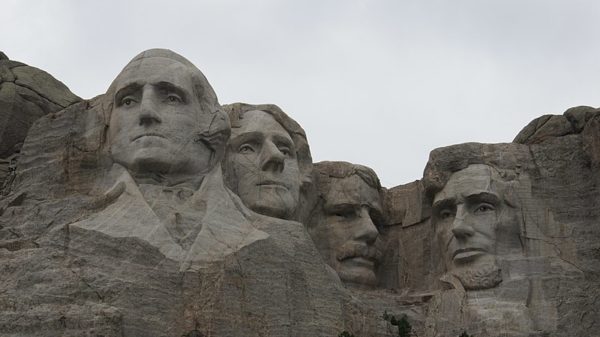
Founding Fathers at Mt. Rushmore. Creative Commons image.
AUSTIN — Perhaps it is obvious, but it bears repeating. The Founding Fathers were men. They envisioned a democracy run by “free, white men.” The first U.S. Census in 1790 spells it out by revealing how the categories were delineated and not delineated:
The original blueprint was this: 21% of the 3.9 million inhabitants could participate in democracy by voting. As we head for the polls, we must remember that democracy in the U.S. has always been defined by the struggle to expand (or suppress) participation in that democracy.
Continue reading

[Up Against the Wall: The Case for Opening the Mexican-American Border by Peter Laufer, PhD; Foreword by Vicente Fox (Anthem; $38)]
Build a wall and human beings will want to go under it, around it, over it, and aim to dismantle it. That’s one of the conclusions that journalist and teacher Peter Laufer has reached after a lifetime of observing what might be called “wall lives.” Another observation is this: make a law and human beings will violate it, be punished by it, and seek to reform it and abolish it.
The wall between the USA and Mexico is one of the biggest boondoggles in contemporary America, with corruption extending all the way from mega construction companies in the West to the White House, and involving Donald Trump, Stephen Bannon, and others. In August 2020, the former White House chief of staff was charged with fraud in fundraising for the border wall.
Continue reading

Former Texas poet lauretate Carmen Tafolla.
SONOMA COUNTY, California — “Texas can be California,” author Laura Moser said during a 90-minute Zoom Webinar hosted by Writers Against Trump, a new, fast-growing organization which was founded on August 3, 2020, and that already has 1,700 members in the U.S. and beyond.
Moser wasn’t thinking of California fires and California earthquakes when she made her memorable remark on August 19, 2020. She was thinking of the fact that California is a so-called “red state” and that in recent elections its citizens have voted for Democratic Party candidates like Hillary Clinton.
At the end of the session, Writers Against Trump co-founder Carolyn Forché said, “We can take Texas.” The six guests on the Zoom Webinar — Carmen Tafolla, David Modigliani, Daniel Peña, Marcel McClinton, Robin Davidson, plus Moser — are Texans. They echoed Forché’s sentiments, albeit with their own words and in their own ways.
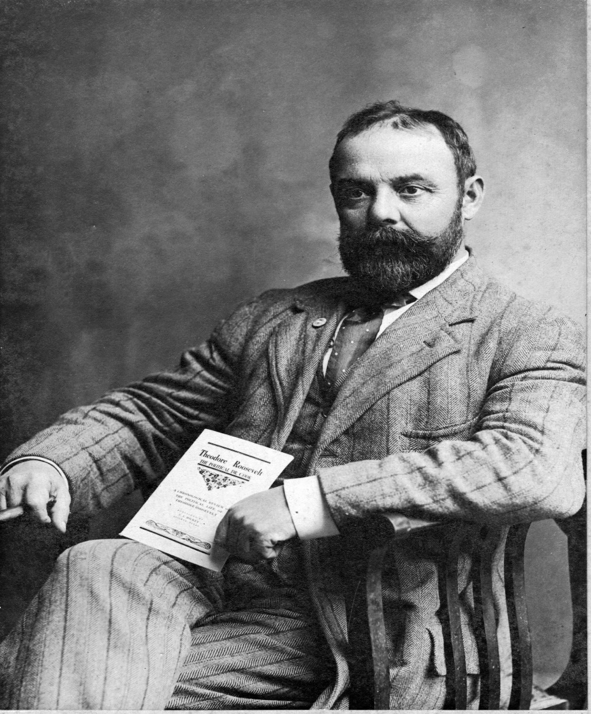
Texas Socialist firebrand Thomas Aloysius Hickey. From the Hickey Papers.
The political atmosphere in Texas after World War I was markedly different. The several years of patriotic fervor that had stemmed from U. S. involvement in the European war had created a very uncomfortable climate for those who had chosen to oppose the American intervention.
Before the World War, the Socialist Party of Texas had grown to a political force which had elected dozens of local office holders in the state as it championed the cause of tenant farmers and industrial workers, but its opposition to the War had resulted in its leaders being jailed, its newspapers being shut down, and its members subject to physical and political attacks.
Thomas A. Hickey, the Texas socialist firebrand who himself had been detained without a warrant in the early months of the War and who had seen his newspaper, The Rebel, the first in the nation to be shut down by the federal Espionage Act in 1917, was determined to revitalize the Socialist movement in Texas, but his efforts to reestablish a couple of new newspapers simply fizzled. The Socialist Party of Texas itself had almost evaporated; its state secretary had been among the arrested, its state chair had resigned, many of its speakers and organizers were imprisoned, and, faced with ongoing government pressure, the bulk of the membership had simply faded away. At its convention in Dallas in October 1919, the Socialist Party of Texas declared itself officially dead.
Continue reading
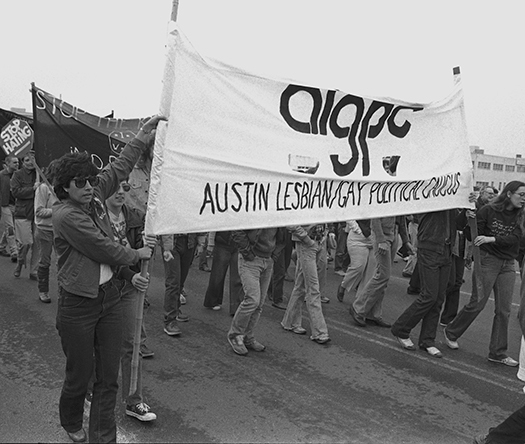
Austin Lesian/Gay Political Caucus at July 1983 march against the KKK.
Photo by Alan Pogue / The Rag Blog.
This article was first posted at La Voz de Esperanza and was cross-posted to The Rag Blog by the author.
AUSTIN — A body — as strong as it can be — is supremely delicate. The skin covering the skull splits easily; a police baton swung at the right angle, with the right force, parts the flesh precisely.
In February of 1983, the KKK decided to take back Texas. They held one event per month including a cross burning on land adjacent to a Black family. They rallied against Black History Month at the state capitol; the historical society displays photos of its construction by Black “prisoners” that docents consider a must-see for thousands of children on field trips. The capitol crowns Congress Avenue which also happened to be the gentry’s preferred location for holding a lynching back in the day.
Continue reading

Buds close to harvest time at the MassGrow facility.
ATHOL, Massachusetts — “It’s legal now! Finally!”
That’s what people in many parts of the United States, as well as Canada and other nations, are saying, myself included.
To celebrate the legalization of marijuana in my state, Massachusetts, I recently used my journalist’s credentials to obtain guided tours of two facilities related to this rapidly expanding and multi-million dollar industry. Both are located just a few miles from my home. One is MassGrow, a large cultivation enterprise, and the other is Silver Therapeutics, a small retail store, properly called a dispensary.
Continue reading
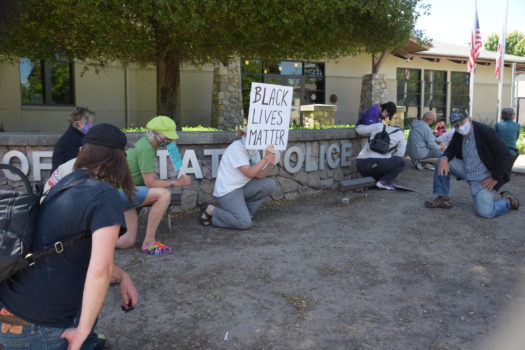
The author, on the far right, takes a knee outside the police station in the town of Cotati, California, where he lives, earlier this year. Photo by Karen Preuss.
Watching the TV news from Kenosha has given me the opportunity to look back at my own life as a kind of antifa activist in the late 1960s.
On December 9, 1969, a month or so before my 28th birthday, I went into the streets of Manhattan with other members of ”the Mad Dogs,” a small group of New York radicals, to protest the murders, five days earlier, of Fred Hampton and Mark Clark, two Black Panthers who were shot and killed during a predawn raid at their Chicago apartment that was carried out by a tactical unit of the Cook County State’s Attorney’s Office in conjunction with the Chicago Police Department and the FBI.
Continue reading
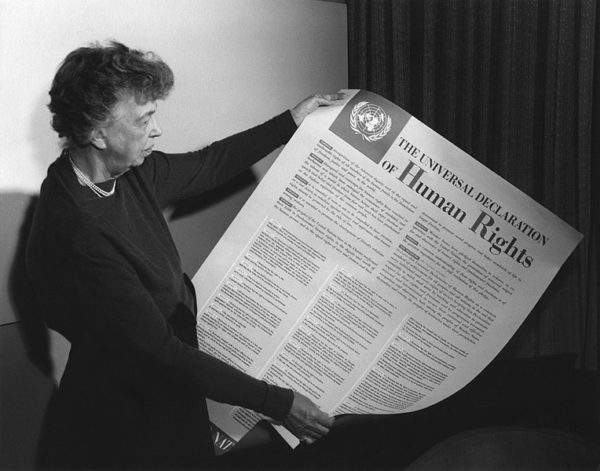
Eleanor Roosevelt holding poster of the Universal Declaration of Human Rights (in English), Lake Success, New York. November 1949. Image from FDR Presidential Library & Museum / Wikimedia Commons.
WEST LAFAYETTE, Indiana — The massive atrocities of World War II led nations to commit themselves permanently to the protection of basic rights for all human beings. Eleanor Roosevelt, the widow of the wartime president, Franklin Roosevelt, worked diligently with leaders from around the world to develop a document, to articulate a set of principles, which would bind humankind to never carry out acts of mass murder again. In addition, the document also committed nations to work to end most forms of pain and suffering.
Over 70 years ago, on December 10, 1948, delegates from the United Nations General Assembly signed the document which they called “The Universal Declaration of Human Rights.” It consisted of a preamble proclaiming that all signatories recognize “the inherent dignity” and “equal and inalienable rights of all members of the human family” as the “foundation of freedom, justice, and peace in the world.” The preamble declared the commitment of the signatories to the creation of a world “…in which human beings shall enjoy freedom of speech and belief and freedom from fear and want…”
Continue reading
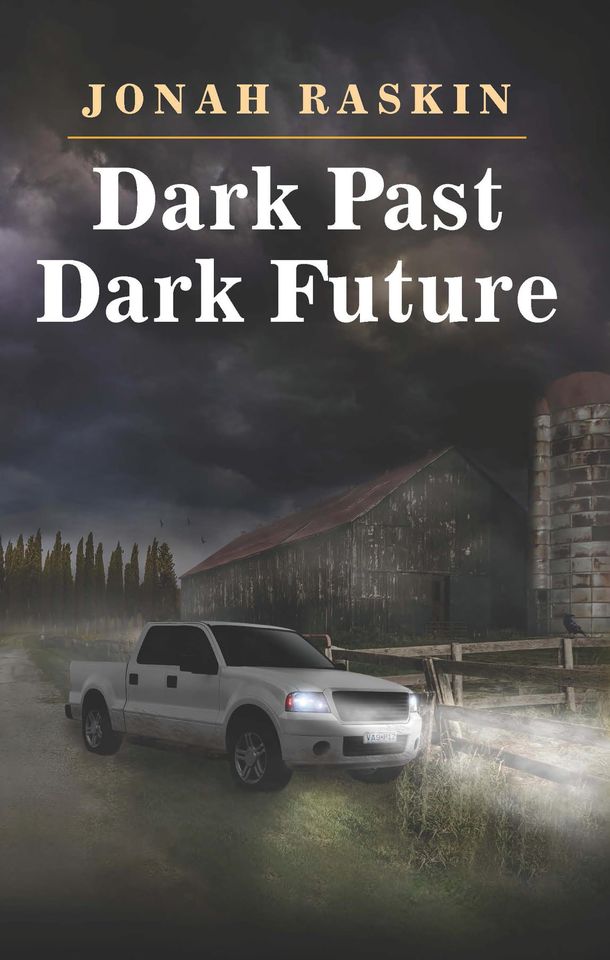
In Jonah Raskin’s new murder mystery Dark Past, Dark Future (2020, McCaa Books) Detective Tioga Vignetta returns bringing to a culmination the trilogy that began with Dark Land, Dark Mirror (2017, McCaa Books).
Raskin, prolific author of numerous works, brings not only his passion for film noir and the works of such authors as Dashiell Hammett and other luminaries of the darkness, but his down and dirty knowledge of the Sonoma Valley. It serves as a springboard for this worthy fictionalized “Valley,” as he brings Tioga into her latest web of danger which is filled with a cast of characters as mysterious and duplicitous as one might hope for and expect — in a world of drugs, ego and, disturbingly, the grim specter of sexual violence.
Raskin shows that when it comes to the past, there’s always more where that came from. Tioga’s multiple cases around the Valley — in the life of a work-a-day ace detective at times violent and banal — bring past and present together in an unexpected mix that tears the veneer of civility off the grandeur of the region and plummets the reader into the seedy underbelly of “Valley” life and the various characters that inhabit its, often, sunlit shadows.
Continue reading
Thorne Webb Dreyer, Editor





