Sarito Carol Neiman : Shredding the Envelope

Difficult beginnings! Image from 28DaysLater.

Shredding the envelope:
Difficult beginnings

Ruminations on news, taboos, and space beyond time.

By Sarito Carol Neiman / The Rag Blog / July 28, 2011

Author, editor, and actress Sarito Carol Neiman — founding “Funnella” of underground newspaper The Rag in 1966 Austin — will discuss “Politics and Spirituality” with Thorne Dreyer on Rag Radio, Friday, July 29, 2011, 2-3 p.m. (CDT) on Austin’s community radio station, KOOP-91.7 FM, and streamed live on the internet.

Five years ago, almost to the day, I decided to create a blog. I called it “Shredding the Envelope,” for reasons partly explained below. Then all kinds of life intervened, and I got too busy trying to keep the boat from being swamped by the waves to have anything to say, never mind the spaciousness required to say it.

Now the boat seems to have washed up on this rather nice beach, with big blue skies full of puffy white clouds… and a gracious acceptance by The Rag Blog of my offer to re-start Shredding the Envelope as a regular column in its pages. Full disclosure: I have repurposed a piece from the original as a way of starting here. (For reasons that will also become clear below!) The original was subtitled “Ruminations on news, taboos, and space beyond time.” That still works for me.

I kept thinking, Gosh, how do I start this. Because the nature of my particular paralysis — not just around starting a column, but around any other thing I haven’t already done at least once — is the Desire to Get It Right the First Time.

Which of course arises out of all sorts of internalized judgments, educational mishaps, inherent character flaws, ego disguised as humbleness, and an unhealthy obsession with unearthing the most elusive nuances of my own motivations (not to mention the motivations of others, but for some reason those always seem much easier to see than my own).

Combined with astrological accidents and the fact my kindergarten teacher told me “nice girls don’t shout.” You get the drift.

Now, psychobabble aside, there are two kinds of writers, I’ve noticed — and by writers I mean people who actually write for public consumption rather than in diaries, or gossipy emails to family and friends: (1) those who have trouble starting, and (2) those who have trouble wrapping it up.

I’m the first type, obviously.

Those who have trouble with the middle, by the way, aren’t really writers. To be a real writer, you have to give up control at some point. Having trouble with the middle is a symptom of being a control freak, and it’s nearly impossible to be a writer unless you can push the pause button on your inner control freak. Then, of course, you can always press “play” again when it’s time to tidy things up.

Whew! Now I’ve got that out of the way, I can start.

Why “Shredding the Envelope”?

Because you can push for a lifetime, but you’ll still be trapped inside the confines of an envelope. And that very envelope is what’s got us all trapped — individually and collectively — in the messes we’re in. The envelope is made of our most cherished ideas and assumptions, the inherited truths of our upbringing. It’s the place where culture and counterculture clash, and words are used more to define opposites than to acknowledge complementaries.

Envelopes are designed as a background for labels, expected to have destinations, categories, a limited specificity of content. The only mystery that exists in an envelope is from the outside of it, before it gets opened. And these days, most of that mystery has disappeared. When’s the last time you got an envelope in the mail that didn’t tell you quite plainly, even when it was trying to be tricky about it, exactly what was inside?

If you’re into bodybuilding, you can keep pushing the envelope. If you want to fly free of labels and categories and inherited content, you gotta shred it.

Besides, I’ve always had an affection for the shredder from the first time I used one. What better way to dispose of a bunch of boring and mostly burdensome paper than to transform it into stuff that suggests a tickertape parade or a piñata, and can even be used to protect delicate and fragile things from breaking… like Christmas ornaments. You can have whatever feelings and opinions you like about Christmas, from Scrooge-ish to Fundamentalish, but don’t tell me your favorite bit isn’t the ornaments and lights.

I started to wonder who invented the first paper shredder, and found this:

1908 • An American, A.A. Low, is credited with inventing the first paper shredder — his ‘Waste Paper Receptacle’ — which was issued a patent in 1908. Utilizing a feeder and a roller with blades, paper could be reduced by use of either a hand crank or an electric motor. This, however, is neither the beginning nor end of the story of the shredder. It is also thought that an earlier version of the paper shredder was invented by an Austrian military officer in 1898, who used a foot-powered machine to destroy ballistics designs. A.A. Low never went as far as bringing his 1908 patent to manufacture, and so the first commercially produced paper shredder was produced in 1936 by a German, Adolf Ehinger, whose inspiration came from a kitchen pasta maker.


By the way, this history of the paper shredder comes from a charming and informative Time Line of Waste — created by the English. All the American entries on the subject that appeared in the first couple pages of Google results were essentially “infomercials” for paper-shredder vendors.

A couple of entries below the invention of the paper shredder is a link to “Wartime efficiency drives,” which features a very cool gallery of American WWII posters. They will perhaps remind you to wonder if “keep on shopping” was really the most creative push of the wartime patriotism envelope that the Bushniks could have come up with. And they might even help you understand why the “greatest generation” can be so curmudgeonly about the state of affairs we’ve come to over the past six decades or so.

[Sarito Carol Neiman (then just “Carol”) was a founding editor of The Rag (along with now-Rag Blog editor Thorne Dreyer) in 1966 Austin, and later edited New Left Notes, the national newspaper of Students for a Democratic Society (SDS). With then-husband Greg Calvert, Neiman co-authored one of the seminal books of the New Left era, A Disrupted History: The New Left and the New Capitalism and later compiled and edited the contemporary Buddhist mystic Osho’s posthumous Authobiography of a Spiritually Incorrect Mystic. Neiman also studied acting at HB (Hagen-Berghof) Studio in New York City where she appeared in several stage productions and in the movie Moonshine which premiered at the Sundance Film Festival in 2006. Neiman currently lives in Junction, Texas. Read more articles by Sarito Carol Neiman on The Rag Blog]


The Rag Blog

Posted in Rag Bloggers | Tagged | 1 Comment

Robert Jensen : Will Potter and ‘Green is the New Red’

Image from TreeHugger.

Green is the New Red:
An interview with Will Potter

By Robert Jensen / The Rag Blog / July 27, 2011

For centuries, the arbitrary use of power by the state against dissidents has been a key threat to freedom. More recently, the concentrated wealth of corporations has emerged as a major impediment to democracy. When those two centers of power decide to come after people, not only do the individuals suffer, but freedom and democracy take a beating.

In his debut book, Green Is the New Red: An Insider’s Account of a Social Movement Under Siege, independent journalist Will Potter details one such assault on freedom and democracy, the targeting of environmental and animal-rights activists.

In recent decades, corporations whose profits depend on degrading the ecosphere started to worry that those activists posed a real threat to their operations. Politicians and law-enforcement agencies responded with laws and tactics targeting not only the illegal actions of some of those groups but also the constitutionally protected speech and association of a wider range of groups. The fear-and-smear campaigns take their toll on the activists.

In a book that alternates between reporting and reflection, Potter not only details the strategy and tactics of corporations and the state, but also gives readers a feel for the human costs for the activists. In an interview, I asked Potter to explain the threat posed by these campaigns.

(Full disclosure: Potter was a student in two of my classes at the University of Texas at Austin. Since his graduation, I have followed his work and now think of him as a colleague rather than a former student.)

Robert Jensen: Let’s start with what you don’t mean by the title, Green is the New Red. You say in the book that you aren’t suggesting the environmental/animal-rights movements are directly analogous to the left/radical/socialist/communist movements that were targeted in the Red Scares of the 20th century in the United States. If the scope of those Red movements was wider and the repression faced much more severe, what is the title intended to communicate?

Will Potter: Although I make clear that what’s going on now is not the same or worse than the Red Scare (nor is it the same or worse than what Arab and Muslim people have experienced since September 11), these current events need to be understood in a historical context. Coordinated campaigns to target and repress dissident voices have taken place throughout U.S. history, and foremost among them is the Red Scare.

For most Americans, of all political stripes, that term is synonymous with using fear to push a political agenda — it is a dark era of U.S. history where lives were ruined, and freedoms chilled, in the name of national security. Beyond those big-picture similarities, though, there are eerie parallels between the Red Scare and this Green Scare, in terms of the specific tactics used by corporations and politicians to instill fear and silence dissent.

Whatever the size or current influence of these radical environmental movements, you write that they are challenging core notions of what it means to be a human being. Based on your experience as an activist and your reporting, how do you assess these movements?

These movements, like all social justice movements, have diverse components. Although it has become fashionable to “go green,” the true nature of the environmental and animal rights movements goes much deeper than promoting hybrid cars and energy-saving light bulbs. They are about more than promoting a quick-fix or advocating environmentalism through consumerism.

These movements are challenging deeply held religious and cultural beliefs that the interests of human beings are always paramount, and that we have the right to use the earth and other species in whatever ways we see fit, costs be damned. These movements recognize that behaving as if human beings are the only species on the planet is destructive, but their critique is more than an appeal to self-interest. It is about critically examining our relationship with the natural world, and all other species on the planet, and questioning what it means to be a human being.

Do you think that is the reason those movements are being targeted, because people in power in government and corporations understand how fundamental that challenge is, and want to suppress it?

Absolutely. In fact, that’s how the threat is often described by these individuals themselves in Congressional hearings, internal corporate documents, FBI memos, Homeland Security reports, and in the media. At first I dismissed much of this as political theater — exaggerating the threat in order to justify the crackdown. For instance, it was hard not to laugh when the CEO of Yum Foods (KFC’s parent company) testified before Congress that PETA represents the threat of a “vegetarian world.” He called them “corporate terrorists.”

But this culture war rhetoric stops being funny when you see how it plays out in real life. PETA, along with other mainstream groups like the Humane Society of the United States, have been attacked as “terrorists” by corporations and politicians, and investigated by the FBI. The only way we can explain that groups like the Humane Society are being investigated as terrorists alongside the Animal Liberation Front is that all of it — the aboveground and the underground, the mainstream and the radical — represents a cultural threat.

Environmental street art by Peter Gibson. Image from Inhabitat.

Let’s go back to your reference to the specific tactics used, by both government and corporations, in this campaign. What are some of the most common tactics, and what is the strategy behind them?

The comparison of today’s political climate to the Red Scare was particularly useful in identifying and classifying the tactics used in this campaign. The tactics, then and now, can be grouped into three main areas: legal, legislative, and a third I would call extra-legal, or scare-mongering.

The courts have been used to push the limits of what constitutes “terrorism,” and to hit activists with disproportionate penalties and prison sentences. In this realm the word terrorist is used early, and used often, to skew public opinion against defendants before they ever set foot in a courtroom. At some point these legal tactics have limitations, though, and so corporations and politicians have lobbied for new laws that go even further.

Federal laws like the Animal Enterprise Terrorism Act, coupled with state-level legislation, are being used to single out activists based on their political beliefs. The intention with these legislative efforts is not only to enact new laws, but to use Congressional hearings and political theater to shift cultural perceptions of these movements.

The final element is perhaps the most dangerous of them all. During the Red Scare, court cases and legislation sent people to prison, but scare-mongering tactics (PR campaigns, press conferences, ads, reckless use of language to demonize people) leveraged the weight of fear and incarcerated many more.

The strategy behind these tactics is fragmentation. In discussing this, I think it’s helpful to visualize social movements as having a “horizontal” and “vertical” component. The intention is to separate these movements horizontally, and create rifts between them and the broader left. Animal rights activists and environmentalists are therefore depicted as ideological extremists who, if they have their way, will stop you from eating meat and driving cars and having pets.

There are of course already tensions between these movements and the more traditional left, but campaigns by corporations and politicians intend to exacerbate them. If these movements are not seen as part of a broader social justice struggle, it is easier for other leftist and progressive groups to turn their backs on their repression.

Similarly, there is a campaign to fragment these movements vertically. Aboveground lawful groups are told that they must condemn underground groups, and if they do not they will also be treated as terrorists. This two-prong strategy — breaking these movements away from other social movements, and breaking the aboveground away from the underground — isolates those who are being targeted and intensifies the repression.

Whatever one thinks of the specific analyses or tactics of groups such as the Earth Liberation Front, the accelerating pace of ecological collapse suggests their call to consciousness about the larger living world is more important than ever. After your investigation into the Green Scare, what is your assessment of the likelihood the culture will listen?

As the scale of the ecological crisis we are facing becomes more apparent, and as the backlash against social movements that are challenging our self-destructive culture intensifies, it is difficult to not feel dark, to feel helpless. I certainly feel that way quite often — not just because of the content of my own work, but from the near-blackout in the mainstream press.

Unfortunately, I do not see any of this changing anytime soon. As the ecological crisis accelerates, the accompanying crackdown by corporations and people in power will intensify as well. The people who have the most to lose will cling desperately to that culture as it is threatened, and this includes not just CEOs but much of the overwhelmingly privileged United States and so-called First World.

After all of that, this will probably sound quite odd, but in the face of this I would argue that there are reasons to be inspired. Through my work, and in particular through book and media tours, I have been fortunate to meet people all over the country from diverse backgrounds. What has been striking to me is that, even if people are unfamiliar with the Green Scare or the targeting of political activists, they are rarely surprised.

People may not know the specifics, but they know that corporations have more power than people. They know the scope of ecological destruction is increasing. They know we have no choice but to change but that people in power will not change willingly. I’m not convinced that the question at hand is whether or not the culture will listen, because I think that so many people already feel this. I think the question is: Will we find the courage to be heard?

[Robert Jensen is a journalism professor at the University of Texas at Austin, where he teaches courses in media law, ethics, and politics — and a board member of the Third Coast Activist Resource Center in Austin. His books include All My Bones Shake: Seeking a Progressive Path to the Prophetic Voice, and Getting Off: Pornography and the End of Masculinity. His writing is published extensively in mainstream and alternative media. Robert Jensen can be reached at rjensen@uts.cc.utexas.edu. Read more articles by Robert Jensen on The Rag Blog.]

Listen to Thorne Dreyer’s July 8, 2011 interview with Robert Jensen on Rag Radio, and watch Jeff Zavala’s video of the interview.

The Rag Blog

Posted in Rag Bloggers | Tagged , , , , , , , | 1 Comment

Bash and Blowout : Please Join Us Friday in Austin!

THIS FRIDAY!

Poster by James Retherford / Hot Digital Dog Design / The Rag Blog.

CLICK ON IMAGE TO ENLARGE

For those of you in Austin:
Please join us this Friday!

Thorne Dreyer Birthday* Bash and Rag Blog Blowout
Friday, July 29, 6-9 p.m.
Maria’s Taco Xpress
2529 S. Lamar, Austin, Texas
Everyone welcome!
[Please check out our Facebook event page…]

If you’re in Austin on July 29th, please join us at Maria’s for Rag Blog editor and Rag Radio host Thorne Dreyer’s (66th) Birthday Bash and Rag Blog Blowout.

It’s guaranteed to be a fun party and an opportunity for our friends, fans, and followers to get to know each other.

The party, open to all, is at Maria’s Taco Xpress, 2529 S. Lamar Blvd., in Austin, Texas, Friday, July 29, 2011, from 6-9 p.m. Maria’s full bar and menu will be available and Flounders Without Eyes will play on the patio at 7.

(Dreyer’s real birthday is August 1st — but who’s paying attention?)

There is no admission — and please don’t bring presents (Dreyer would just break them) — but a small tax-deductible donation to The Rag Blog would be greatly appreciated. We depend upon the support of our readers and friends — and if you can’t be at the party, please click here, or on the “DONATE” button on the sidebar — and send us a donation through PayPal or by check.

The Rag Blog is a progressive internet newsmagazine produced by activist journalists committed to social change. We are published by the New Journalism Project, a Texas 501(c)(3) nonprofit corporation. Our mailing address is PO Box 16442, Austin, TX 78761-6442.

Rag Radio, broadcast from 2-3 p.m. every Friday on KOOP 91-7 FM in Austin — and streamed live to the world — is produced at the KOOP studios in association with the New Journalism Project and The Rag Blog. Hosted by Thorne Dreyer, it features hour-long in-depth interviews and discussion about issues of progressive politics, culture, and history. To listen to podcasts of earlier shows on Rag Radio, please go to the Internet Archives.

(And, now Rag Radio also airs every Sunday at 10 a.m. on WFTE, 90.3-FM in Mt. Cobb, PA and 105.7-FM in Scranton, PA.)

The Rag Blog

Posted in RagBlog | Tagged , , , , | 1 Comment

Dr. Stephen R. Keister : Sick of Being Spoon-Fed the News

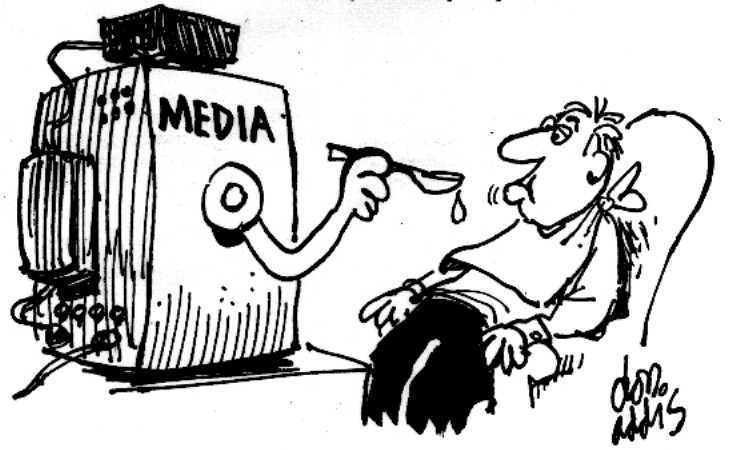
Cartoon by Don Addis / Quick Take.

Spoon-feeding the news:

Where’s our independent press?

By Dr. Stephen R. Keister / The Rag Blog / July 27, 2011

In his novel Sidetracked, Henning Mankkel quotes a retired journalist:

There are two kinds of reporters. The first kind digs in the ground for the truth. He stands down in the hole shoveling out dirt. But up on top there’s another man, shoveling the dirt back in. There’s always a duel going on between these two. The fourth estate’s eternal test of strength for dominance. Some journalists want to expose and reveal things, others run errands for those in power and help conceal what’s really happening.

We here make note of the prior dismissal of Keith Olbermann and the recent firing of Cenk Uygur from our only “liberal” television outlet, MSNBC.

When I consider the lack of valid, intelligent information currently available to the American public it would seem that the dirt is being replaced in the hole much more rapidly than the honest, dedicated journalist can dig it out.

I thank my lucky stars for The Nation, The Progressive, and our own Rag Blog and similar credible online news sources.

I am reminded of the remarks made by John Swinton one night in 1880. Swinton, the former chief of staff of The New York Times, continued to write an occasional column but had abandoned full-time editorial work to become active in the labor movement. At a press banquet someone who understood neither the press nor Swinton offered a toast to the independent press. As quoted in Labor’s Untold Story by Richard O. Morais, Swinton, outraged, replied:

There is no such thing, at this date of the world’s history, in America, as an independent press. You know it and I know it.

There is not one of you who dares to write your honest opinions, and if you did, you know beforehand that it would never appear in print. I am paid weekly for keeping my honest opinion out of the papers that I am connected with. Others of you are paid similar salaries for similar things, and any of you who would be so foolish as to write honest opinions would be out on the streets looking for another job. If I allowed my honest opinions to appear in one issue of my paper, before 24 hours my occupation would be gone.

The business of the journalist is to destroy the truth, to lie outright, to pervert, to vilify, to fawn at the feet of mammon, and to sell his country and his race for his daily bread. You know it and I know it, and what folly is this toasting an independent press?

We are the tools and the vassals of rich men behind the scenes. We are the jumping jacks, they pull the strings and we dance. Our talents, our possibilities and our lives are all the property of other men. We are intellectual prostitutes.

Some of us have fought a dedicated fight for serious health care reform in the United States, but I note in various polls that this issue has been relegated to approximately fifth place in the public’s interest. Of prime concern, some 80% of the public is interested in the lack of employment and, in my opinion, rightfully so. However, our chief executive and the dolts in Congress (save for a few compassionate thinking souls) are involved in theatrics that accomplish nothing for our citizens or for the welfare of the country at large.

The press, meanwhile, is consumed with the dubious presidential commission on debt reduction, the suggestions of the “Gang of Six” (three conservative Republicans, two blue-dog Democrats and Sen. Durbin), as well as numerous interviews with totally out of touch “Tea Bag” freshman congressmen — and various Wall Street characters who are presented to the public as “economists.”

The mainstream media largely ignores the efforts in several states to fix elections through such means as requiring photo identification cards and widespread redistricting (read: gerrymandering). Little note is made of the growing layoffs of municipal employees, and the fact that many of the 20% unemployed are losing their unemployment insurance and health care benefits.

There has been minimal attention paid to the punitive anti-abortion legislation being passed in many states, returning us, unhappily — and irrevocably, I’m afraid — to the era of “back-alley” abortion which I witnessed in my days as a resident physician — when I watched young women die a horrible death of gas gangrene sepsis.

We hear that “entitlement” programs are the cause of the national deficit, a claim that ignores the entire history of Social Security and Medicare as traditional off-budget items, to be paid for out of a specific “lockbox” fund, paid for by every worker’s employment tax which he/she paid for with a lifetime of labor.

No mention is made of the fact that successive presidents have raided that fund, set aside for entitlement programs, to pay for ongoing, unending wars, and for creating a large surplus of needless military hardware, and who have replaced the “lockbox” funds with government bonds, hence making the social programs part of the general budget.

And we find in the mainstream news media little or no detailed analysis of the cause of our military adventurism and its cost to the average American. We are conned with cries of “terrorism” and made to feel unpatriotic (and thus not to be counted among the “exceptional” American people) if we question the Washington establishment.

I would wager that nine out of 10 Americans are unaware that we have over 700 foreign military bases, many with 18-hole golf courses. Do we know who acquired the oil resources of Iraq after the large scale fighting ceased, and are we aware of the rich mineral and gem resources being exploited in Afghanistan, as has recently been reported in great detail in Fortune Magazine (“J.P. Morgan’s hunt for Afghan gold“)?

Has the mainstream media reported on the implications of the defunding of Medicaid as is being pursued by the Republican House of Representatives? Not only do we diminish the health care of our poor, underemployed, and unemployed, but we will also lose the prime support for nursing home care. If we follow the dictates of these imbeciles in Washington, Cleveland and Detroit will, in the not too distant future, look like Calcutta in the 1920s.

There is hope in other lands (read Ezra Klein’s article in The American Prospect, entitled “The Health of Nations“). Unhappily our elected representatives have other interests and their self-survival to consider. To hell with the American people; they bend their knees to the great corporations.

Life has it’s stresses as I — with my malignancy — approach the age of 90; however, never in my lifetime have I seen our nation run by such a group of inept, uneducated, grasping, cruel legislators — excepting Bernie Sanders, Sherrod Brown, Al Franken, Barbara Boxer, and many of the members of the Progressive Caucus of The House of Representatives. And never have I seen the public-at-large so lacking in notable leaders.

Where are the likes of John L. Lewis, Norman Thomas, Phillip Murray, Henry Wallace, and men and women of courage who will lead the sheep away from the precipice.

I cannot help but visualize the passive German masses of 1932 as I look about our nation today. I see multitudes who will respond in automatic obedience to an authority figure, not as individuals in search of liberty and justice. I fear Hannah Arendt had it correct when she coined the phrase the “banality of evil.”

Finally, on a more cheerful note, happy birthday to Rag Blog editor Thorne Dreyer, who turns 66 on August 1st. You still embody that great generation which spawned SDS, the underground press, the thinkers and concerned citizens of your era.

[Dr. Stephen R. Keister lives in Erie, Pennsylvania. He is a retired physician who is active in health care reform and is a regular contributor to The Rag Blog. Read more articles by Dr. Stephen R. Keister on The Rag Blog]

The Rag Blog

Posted in Rag Bloggers | Tagged , , , , | 1 Comment

Difficult Beginnings

By Sarito Carol Neiman / The Rag Blog / July 27, 2011

I kept thinking, Gosh, how do I start this. Because the nature of my particular paralysis — not just around starting a column, but around any other thing I haven’t already done at least once — is the Desire to Get It Right the First Time.

Which of course arises out of all sorts of internalized judgments, educational mishaps, inherent character flaws, ego disguised as humbleness, and an unhealthy obsession with unearthing the most elusive nuances of my own motivations (not to mention the motivations of others, but for some reason those always seem much easier to see than my own).

Combined with astrological accidents and the fact my kindergarten teacher told me “nice girls don’t shout.” You get the drift.

Now, psychobabble aside, there are two kinds of writers, I’ve noticed — and by writers I mean people who actually write for public consumption rather than in diaries, or gossipy emails to family and friends: (1) those who have trouble starting, and (2) those who have trouble wrapping it up.

I’m the first type, obviously.

Those who have trouble with the middle, by the way, aren’t really writers. To be a real writer, you have to give up control at some point. Having trouble with the middle is a symptom of being a control freak, and it’s nearly impossible to be a writer unless you can push the pause button on your inner control freak. Then, of course, you can always press “play” again when it’s time to tidy things up.

Whew! Now I’ve got that out of the way, I can start.

Why “Shredding the Envelope”?

Because you can push for a lifetime, but you’ll still be trapped inside the confines of an envelope. And that very envelope is what’s got us all trapped — individually and collectively — in the messes we’re in. The envelope is made of our most cherished ideas and assumptions, the inherited truths of our upbringing. It’s the place where culture and counterculture clash, and words are used more to define opposites than to acknowledge complementaries.

Envelopes are designed as a background for labels, expected to have destinations, categories, a limited specificity of content. The only mystery that exists in an envelope is from the outside of it, before it gets opened. And these days, most of that mystery has disappeared. When’s the last time you got an envelope in the mail that didn’t tell you quite plainly, even when it was trying to be tricky about it, exactly what was inside?

If you’re into bodybuilding, you can keep pushing the envelope. If you want to fly free of labels and categories and inherited content, you gotta shred it.

Besides, I’ve always had an affection for the shredder from the first time I used one. What better way to dispose of a bunch of boring and mostly burdensome paper than to transform it into stuff that suggests a tickertape parade or a piñata, and can even be used to protect delicate and fragile things from breaking… like Christmas ornaments. You can have whatever feelings and opinions you like about Christmas, from Scrooge-ish to Fundamentalish, but don’t tell me your favorite bit isn’t the ornaments and lights.

I started to wonder who invented the first paper shredder, and found this:

1908 • An American, A.A. Low, is credited with inventing the first paper shredder — his ‘Waste Paper Receptacle’ — which was issued a patent in 1908. Utilizing a feeder and a roller with blades, paper could be reduced by use of either a hand crank or an electric motor. This, however, is neither the beginning nor end of the story of the shredder. It is also thought that an earlier version of the paper shredder was invented by an Austrian military officer in 1898, who used a foot-powered machine to destroy ballistics designs. A.A. Low never went as far as bringing his 1908 patent to manufacture, and so the first commercially produced paper shredder was produced in 1936 by a German, Adolf Ehinger, whose inspiration came from a kitchen pasta maker.


By the way, this history of the paper shredder comes from a charming and informative Time Line of Waste — created by the English. All the American entries on the subject that appeared in the first couple pages of Google results were essentially “infomercials” for paper-shredder vendors.

A couple of entries below the invention of the paper shredder is a link to “Wartime efficiency drives,” which features a very cool gallery of American WWII posters. They will perhaps remind you to wonder if “keep on shopping” was really the most creative push of the wartime patriotism envelope that the Bushniks could have come up with. And they might even help you understand why the “greatest generation” can be so curmudgeonly about the state of affairs we’ve come to over the past six decades or so.

Source /

The Rag Blog

Posted in RagBlog | Leave a comment

Type your summary here

Type rest of the post here

Source /

The Rag Blog

Posted in RagBlog | Leave a comment

Type your summary here

Type rest of the post here

Source /

The Rag Blog

Posted in RagBlog | Leave a comment

Steve Max : The Snare and Deception of ‘Family Economics’

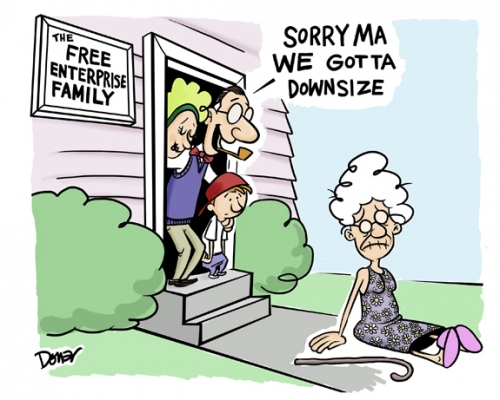
Political cartoon from Progressive America Rising.

Obama hits the trap running:
The snare and deception
of ‘family economics’

The trap that Obama and many Congressional Democrats constantly fall into is to act and talk as if Republicans are normal and that this is a rational situation.

By Steve Max / Progressive America Rising / July 26, 2011

Would anyone not have thought President Truman insane had he gone before the nation in 1945 and said, “I have had experience running a small business, and based on what I learned selling neckties I have decided to drop the atomic bomb on Japan.”(1)

Yet, when House Majority Leader John Boehner proposes to drop the bomb on the American economy based on his experience selling plastics with the Nucite Sales corporation of Cincinnati, no one thinks it at all odd, least of all President Obama.

In last night’s response to Obama’s televised address to the nation, Boehner referred at least twice to his own small business experience as the source of his knowledge that government, like small business, must live within its means.

The trap that Obama and many Congressional Democrats constantly fall into is to act and talk as if Republicans are normal and that this is a rational situation. Obama consistently tells the public what a fine fellow Boehner is, how they share the same goals of deficit reduction, how they agree that the nation must live within its means, and how the only differences are over the way to achieve their common goals. The sad thing is that for Obama this likely goes beyond being nice, he probably believes it.

Democrats need to start speaking the truth. The economy of nation states is nothing like a small business (or any size business) and the federal budget is not remotely like your family budget, another oft-spoken Republican falsehood. People who ignorantly think such things, the President should say, are not fit to be the nation’s decision-makers because it is too dangerous.

In addition, it is an outright lie that cutting government spending will create jobs. It is a lie that taxing the rich is bad for business. It is a lie that raising the debt ceiling discourages investment. Republicans never believed any of this when they were in power. They are lying now and they know it.

The idea that the federal budget is not like your family budget is particularly difficult to grasp because it is counterintuitive. Back when cars were first invented, many people turned their stables into garages. This contributed to the popular notion that if your car wasn’t working properly, a few days of rest in the garage would help it. People couldn’t quite grasp that while the car and the horse served similar functions and might even occupy the same building, they operated on totally different principles.

The federal government is not a family or a business, it is the administrative committee of the entire nation. While it must indeed live within its means, as the Republicans say and the President concurs, the potential means is the entire social surplus. That is the value of everything produced in America minus the portion that people live on, the portion spent on business expenses, the portion needed to maintain the infrastructure, and the portion needed for future investment.

What is left over is the social surplus. How the social surplus is divided between private profits, public services, and governmental administrative costs is entirely a political matter. Actually, the amount of the social surplus isn’t calculated by anyone, perhaps because that would raise too many questions about who owns it, but it exists, it is huge and it is the means within which we must live. And, as noted, whether it goes to Medicare or to the richest 400 families is a political problem, not an economic one.

When Boehner and the Republicans insist that government must live within its means like any family or business, what they are really saying is not that we have reached the objective limit of the social surplus (2), but rather that they will decide what the means are, and the rest of us will live within them.

Measures such as the money supply, the federal budget, and the debt ceiling are arbitrary political constructs that are not based on actual economic limits. In 2010 when the Federal Reserve thought it necessary to stimulate the economy, it basically printed $600 billion. The money wasn’t in the budget and it wasn’t borrowed, it was just created, showing how flexible the situation really is. (3)

The federal budget is a good example of this. There is certainly a deficit, but the amount is a function of how the bookkeeping is done. Surely, having run a small business, Rep. Boehner knows that businesses and almost all state governments have capital budgets for buying structures and equipment. When a business buys a computer, a machine or a warehouse, it is not considered to have lost money. Rather it has exchanged one asset (cash) for another of equal value (a truck.) After the transaction, its net worth on the books is the same as before.

Not so with the federal budget, which treats buying a computer as if it were the same as giving a corn subsidy to agribusiness. Never mind that the corn subsidy is just money gone, but the government now owns the computer which should be considered an asset. If federal bookkeeping methods were the same as in Boehner’s business, the deficit would be far, far less.

The point is that many of the financial measures that we tend to consider as reflections of objective laws of nature (you must live within your means) are really our own inventions as a society, and we have great, though not unlimited, latitude in which to change them. What they are actually reflections of is the balance of class forces within the political structure and they are designed to set the framework in which the owners of wealth can become even richer.

The fact is that, if the Republican goals in the debt ceiling debate were actually based on true economic principles and that debt really causes unemployment, then we would all be on their side and telling them not to compromise with Obama. Instead of saying that he shares their goals, the President needs to explain how they are simply wrong. Otherwise he will continue to muddle in the consensus trap.

(1) The actual reasons were equally as dubious, but that is another story for another time. Meanwhile see The Decision to Use the Atomic Bomb by Gar Alperovitz. http://www.amazon.com/Decision-Use-Atomic-Bomb/dp/067976285X
(2) For example, that we are eating more radishes than can be grown.
(3) http://www.bloomberg.com/news/2010-11-03/federal-reserve-to-buy-additional-600-billion-of-securities-to-aid-growth.html

[Steve Max, who was a major figure in early SDS, is a member of the Democratic Socialists of America and Three Parks Independent Democrats. He works as an organizing trainer at the Midwest Academy in Chicago. This article was published and distributed by Progressive America Rising.]


The Rag Blog

Posted in RagBlog | Tagged , , , , | 1 Comment

By Dr. Stephen R. Keister / The Rag Blog / July 26, 2011

In his novel Sidetracked, Henning Mankkel quotes a retired journalist:

There are two kinds of reporters. The first kind digs in the ground for the truth. He stands down in the hole shoveling out dirt. But up on top there’s another man, shoveling the dirt back in. There’s always a duel going on between these two. The fourth estate’s eternal test of strength for dominance. Some journalists want to expose and reveal things, others run errands for those in power and help conceal what’s really happening.

We here make note of the prior dismissal of Keith Olbermann and the recent firing of Cenk Uygur from our only “liberal” television outlet, MSNBC.

When I consider the lack of valid, intelligent information currently available to the American public it would seem that the dirt is being replaced in the hole much more rapidly than the honest, dedicated journalist can dig it out.

I thank my lucky stars for The Nation, The Progressive, and our own Rag Blog and similar credible online news sources.

I am reminded of the remarks made by John Swinton one night in 1880. Swinton, the former chief of staff of The New York Times, continued to write an occasional column but had abandoned full-time editorial work to become active in the labor movement. At a press banquet someone who understood neither the press nor Swinton offered a toast to the independent press. As quoted in Labor’s Untold Story by Richard O. Morais, Swinton, outraged, replied:

There is no such thing, at this date of the world’s history, in America, as an independent press. You know it and I know it.

There is not one of you who dares to write your honest opinions, and if you did, you know beforehand that it would never appear in print. I am paid weekly for keeping my honest opinion out of the papers that I am connected with. Others of you are paid similar salaries for similar things, and any of you who would be so foolish as to write honest opinions would be out on the streets looking for another job. If I allowed my honest opinions to appear in one issue of my paper, before 24 hours my occupation would be gone.

The business of the journalist is to destroy the truth, to lie outright, to pervert, to vilify, to fawn at the feet of mammon, and to sell his country and his race for his daily bread. You know it and I know it, and what folly is this toasting an independent press?

We are the tools and the vassals of rich men behind the scenes. We are the jumping jacks, they pull the strings and we dance. Our talents, our possibilities and our lives are all the property of other men. We are intellectual prostitutes.

Some of us have fought a dedicated fight for serious health care reform in the United States, but I note in various polls that this issue has been relegated to approximately fifth place in the public’s interest. Of prime concern, some 80%, the public is interested in the lack of employment and, in my opinion, rightfully so. However, our chief executive and the dolts in Congress (save for a few compassionate thinking souls) are involved in theatrics that accomplish nothing for our citizens or for the welfare of the country at large.

The press, meanwhile, is consumed with the dubious presidential commission on debt reduction, the suggestions of “the Gang of Six” (three conservative Republicans, two blue-dog Democrats and Sen. Durbin), as well as numerous interviews with totally out of touch “Tea Bag” freshman congressmen — and various Wall Street characters who are presented to the public as “economists.”

The mainstream media largely ignores the efforts in several states to fix elections through such means as requiring photo identification cards and widespread redistricting (read: gerrymandering). Little note is made of the growing layoffs of municipal employees, and the fact that many of the 20% unemployed are losing their unemployment insurance and health care benefits.

There has been minimal attention paid to the punitive anti-abortion legislation being passed in many states, returning us, unhappily — and irrevocably, I’m afraid — to the era of “back-alley” abortion which I witnessed in my days as a resident physician, when I watched young women die a horrible death of gas gangrene sepsis.

We hear that “entitlement” programs are the cause of the national deficit, a claim that ignores the entire history of Social Security and Medicare as traditional off-budget items, to be paid for out of a specific “lockbox” fund, paid for by every worker’s employment tax which he/she paid for with a lifetime of labor.

No mention is made of the fact that successive presidents have raided that fund, set aside for entitlement programs, to pay for ongoing, unending wars, and for creating a large surplus of needless military hardware, and who have replaced the “lockbox” funds with government bonds, hence making the social programs part of the general budget.

And we find in the mainstream news media little or no detailed analysis of the cause of our military adventurism and its cost to the average American. We are conned with cries of “terrorism” and made to feel unpatriotic (and thus not to be counted among the “exceptional” American people) if we question the Washington establishment.

I would wager that nine out of 10 Americans are unaware that we have over 700 foreign military bases, many with 18-hole golf courses. Do we know who acquired the oil resources of Iraq after the large scale fighting ceased, and are we aware of the rich mineral and gem resources being exploited in Afghanistan, as has recently been reported in great detail in Fortune Magazine (“J.P. Morgan’s hunt for Afghan gold“)?

Has the mainstream media reported on the implications of the defunding of Medicaid as is being pursued by the Republican House of Representatives? Not only do we diminish the health care of our poor, underemployed, and unemployed, but we will also lose the prime support to the public at large for nursing home care. If we follow the dictates of these imbeciles in Washington, Cleveland and Detroit will, in the not too distant future, look like Calcutta in the 1920s.

There is hope in other lands (read Ezra Klein’s article in The American Prospect, entitled “The Health of Nations.” Unhappily our elected representatives have other interests and their self survival to consider. To hell with the American people; they bend their knees to the great corporations.

Life has it’s stresses as I — with my malignancy — approach the age of 90; however, never in my lifetime have I seen our nation run by such a group of inept, uneducated, grasping, cruel legislators — excepting Bernie Sanders, Sherrod Brown, Al Franken, Barbara Boxer, and many of the members of the Progressive Caucus of The House of Representatives. And never have I seen the public-at-large so lacking in notable leaders.

Where are the likes of John L. Lewis, Norman Thomas, Phillip Murray, Henry Wallace, and men and women of courage who will lead the sheep away from the precipice.

I cannot help but visualize the passive German masses of 1932 as I look about our nation today. I see multitudes who will respond in automatic obedience to an authority figure, not as individuals in search of liberty and justice. I fear Hannah Arendt had it correct when she coined the phrase the “banality of evil.”

Finally, on a more cheerful note, happy birthday to Rag Blog editor Thorne Dreyer, who turns 66 on August 1st. You still embody that great generation which spawned the SDS, the underground press, the thinkers and concerned citizens of your era.

[Dr. Stephen R. Keister lives in Erie, Pennsylvania. He is a retired physician who is active in health care reform and is a regular contributor to The Rag Blog. Read more articles by Dr. Stephen R. Keister on The Rag Blog]

The Rag Blog

Posted in RagBlog | Leave a comment

BOOKS / Thomas McKelvey Cleaver : Goodbye to the Joys of Browsing

Browsing: A dying art? Image from Herald Sun.

The dying art of browsing?
Saying goodbye to Borders

By Thomas McKelvey Cleaver / The Rag Blog / July 26, 2011

SAN FERNANDO VALLEY, California — It was too bad to find out that Borders bookstores are closing. Granted, in the past year the Borders here has been a shadow of its former self, and it never was all that good if you compared it to the old Barnes and Noble stores that departed a few years back. But it was a bookstore that was local, and you could browse.

There is now no bookstore that even resembles that store here in the San Fernando Valley. There’s a mystery bookstore all the way across the valley in Burbank, but when I called them they didn’t have any Alan Furst novels and didn’t even know who he was (a really cool Graham Greene sort of novelist who does fantastic World War II spy novels that are so historically accurate and so dramatically good they’re a time machine to take you back to then).

But no more general interest stores, where you can go where your interest of the moment takes you.

I think bookstore and library browsing — going looking for one thing, pulling out another book at random, and being interested enough to get it — has probably been one of the most important things in my life, especially in terms of life-changing events.

I remember being age 10, at the Eugene Field Library in Denver, and being tired of what passed for “young adult” books, so I stepped around the corner and discovered Ray Bradbury and Isaac Asimov in the science fiction section. I read everything that was there.

Then I would go downtown to the main branch and browse there (what absolute fun: take the bus at 9 a.m. and spend the day in the stacks — except when I’d go across the street to the Jewish delicatessen where I discovered the joys of corned beef sandwiches and pickles — then come back home with my arms full of books).

I never knew what I was going to get until I found it there on the shelves. And thus began my self-education — in spite of the public miseducation system.

Discovering Ray Bradbury? Image from Almightydad.

Thirty five years after that life-changing event, I met Asimov and Bradbury as an equal (well, an equal member of the Science Fiction Writers Association [SFWA]; I’d never categorize myself as their equal as a writer). I even told them how I first met them. Asimov gave me his fourth Foundation novel and inscribed it, “To Tom, our minds met long ago.”

Just the other month, in our local Borders, I was looking through the military history section, and ran across a book with an interesting title, a book I hadn’t even known would be there and wasn’t looking for. I pulled it out, paged through it, read the introduction, thought it was interesting, and bought it.

Two weeks later I was friends with the author, who introduced me to his agent and publisher, and now my writing career has taken another big turn and I am writing a book I have thought of writing for maybe 20 years — to be published later this year.

Nowadays, assuming a kid can even find a public library that’s open, the librarians won’t let 10-year-olds into “age inappropriate sections.”

I’m sorry, but what passes for “progress” these days mostly isn’t.

[Thomas McKelvey Cleaver is an accidental native Texan, a journalist, and a produced screenwriter. He has written successful horror movies and articles about Second World War aviation, was a major fundraiser for Obama in 2008, and has been an activist on anti-war, political reform, and environmental issues for almost 50 years. Read more articles by Thomas Cleaver on The Rag Blog.]

The Rag Blog

Posted in Rag Bloggers | Tagged , , , | 1 Comment

SPORT / Dave Zirin : NFL Players are Bruised, Battered Victors

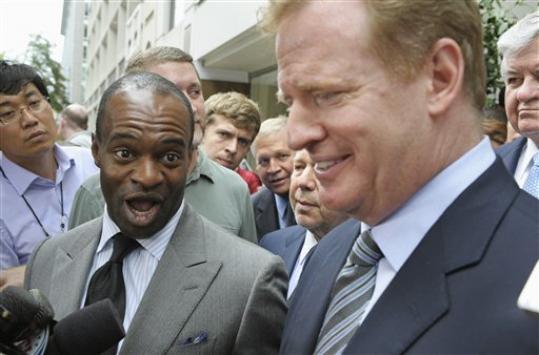
NFLPA Executive Director DeMaurice Smith, left, and NFL football Commissioner Roger Goodell share a laugh July 25, 2011, as 4 1/2-month lockout ends. Photo by Cliff Owen / AP.

Against all odds:
NFL Players Association emerges from
lockout as bruised, battered victor

By Dave Zirin / The Rag Blog / July 26, 2011

A sports media consensus on the end of the NFL lockout has already emerged. Like six-year-old kids getting trophies after soccer practice, everyone’s a winner. As Don Banks at Sports Illustrated assessed, thrilled that the golden goose will lay eggs another day, “Neither side got everything they wanted, but good negotiations are like that. Now that this CBA fight is almost over, and labor peace seems finally at hand, both the players and the owners have the right to claim success.”

These parroted assessments, by focusing on the final score, miss the true, overarching story of the longest work stoppage in NFL history: at the opening kickoff, the sides weren’t close to evenly matched. I think that what the NFLPA has done is the equivalent of the Bad News Bears squeaking out a victory against the 1927 New York Yankees. It’s The Haiti Kid taking down King Kong Bundy. It’s workers, in an age of austerity, beating back the bosses and showing that solidarity is the only way to win.

When the lockout began, NFL’s owners had, in their judgment, and frankly mine as well, every possible advantage. They had a promise from their television partners of $4 billion in “lockout insurance” even if the games didn’t air. They had a workforce with a career shelf-life of 3-4 years, understandably skittish about missing a single paycheck. And most critically, they had what they thought was overwhelming public opinion.

After all, in past labor disputes fans sided against those who “get paid to play a game.” Owners wanted more money and longer seasons and approached negotiations with an arrogance that would shame a Murdoch spawn.

I remember talking to NFLPA Executive Director DeMaurice Smith at the start of this process, and hearing his optimism in the face of these odds, as he spoke of the bravery of workers in Wisconsin and the people of Egypt who he said were inspiring him to fight the good fight. He mentioned the books he was reading like the classic civil rights history Parting the Waters: America in the King Years by Taylor Branch. I remember smiling politely at De Smith and thinking, “This guy is going to get creamed.”

I was very wrong. I didn’t count on Judge David Doty, a Reagan appointee, putting an injunction on that $4 billion lockout slush fund, taking away the owner’s financial upper hand. I didn’t count on the way that health and safety issues would bond the players together, making defections among the 1,900 players nonexistent.

I didn’t count on the way many fans, upset at the lockout and well-educated on the aftereffects of the brutality of the sport, would side with the players. And last, I didn’t count on the way that reservoirs of bitterness felt by NFL players and the union would bind them together against NFL Commissioner Roger Goodell and an ownership group that had just lied to them once too often.

They stuck it out and now the end results of the Collective Bargaining Agreement look quite good for players. We are looking at a 10-year CBA in which minimum salaries will go up 10% a year for the life of the agreement. Players get a slightly lower % of revenues (about 46% down from 50%), but they will receive 55% of future national media revenue, which, will mushroom in the years ahead. Teams also will now have to spend at least 90% of the salary cap on actual salaries. In other words, there won’t just be a salary cap there will be a salary floor.

In return, rookies will need to sign four-year contracts that are scaled at a lower rate. The net affect of all of this is that veteran salaries will go up, perhaps quite dramatically, and, if players can stay healthy beyond that fourth year, they will be very well compensated.

But there’s the rub. If the average career is only 3.4 years, how can players be ensured to stay healthy enough to get the big payday? Here is where I think the NFLPA made the most headway. Not only did they beat back the owner’s dream of an 18-game season, they also negotiated a much less arduous off-season regimen.

The off-season program will now be five weeks shorter. There will be more days off. Full-contact practices are going to be greatly curtailed. This matters because it will limit not just the wear and tear on players bodies, but also concussions and other brain injuries which are far more likely to happen in repetitive drills than in games.

Also, when careers finally do end, players can now be a part of the NFL’s health plan for life. This is a mammoth deal for players who previously were kicked off of all plans five years after retirement. Getting private insurance after playing in the NFL is a nightmare, as your body is a spiderweb of preexisting conditions. Retirees also will now receive up to a $1 billion increase in benefits, with $620 million going to increasing pensions for those who retired before 1993.

Yes, owners received a bigger piece of the pie, and yes they received their rookie pay scale. Yes, I agree with Brian Frederick, director of the Sports Fans Coalition, who commented that it’s a problem that “Fans were forced to sit on the sidelines during these negotiations, despite the massive public subsidies and antitrust exemptions we grant the league.”

This is especially true given the fact that, as SFC reported, “Thirty-one of the 32 NFL stadiums have received direct public subsidies. Ten of those have been publicly financed and at least 19 are 75% publicly financed.”

But in the end, this deal — against all odds — is a victory for players, their families, their health, and their long-term financial solvency. It’s also an example for workers across the country. There is power in labor and there is power in solidarity.

[Dave Zirin is the author of Bad Sports: How Owners are Ruining the Games we Love (Scribner) and just made the new documentary Not Just a Game. Receive his column every week by emailing dave@edgeofsports.com. Contact him at edgeofsports@gmail.com. This article was also posted at The Nation blogs. Read more articles by Dave Zirin on The Rag Blog.]

The Rag Blog

Posted in Rag Bloggers | Tagged , , , , , | Leave a comment

Billy Wharton : Our National ‘Promissory Note’

National Debt Clock in midtown Manhattan, July 13, 2011. Photo by Brendan McDermid / Reuters.

The national debt:
A tribute to militarism and the rich

By Billy Wharton / The Rag Blog / July 25, 2011

During his much heralded 1963 “I Have a Dream” speech, Dr. Martin Luther King Jr. used the metaphor of a promissory note to describe the civil rights that had long been promised in theory, but denied in practice.

Today, America faces a promissory note of larger proportions — one that is much less of a metaphor. Democrats and Republicans are currently negotiating whether to allow the U.S. federal government to raise the debt ceiling beyond its current level of more than $14 trillion. Raising the ceiling is just one part of the talks. In the process, the two parties are drawing ever closer to a consensus on sharp reductions to federally funded Medicaid, Medicare, and Social Security programs.

The media has portrayed these negotiations as a sort of contentious quarrel between two political parties with vastly different ideas about the debt and the future of the economy. Such a distortion employs two falsehoods aimed at confusing the American public. The first is that the debt is the responsibility of the “American people.” Taken at face value, it seems that each person in the country is somehow personally responsible for the $14 trillion dollar budget deficit. This is clearly rubbish.

We should remember that nearly 50% of the federal budget, last year some $1.3 trillion, was spent on the military. Some of this was spent on maintaining the current bloated armed forces, but this figure has been vastly accelerated by the recent invasions of Afghanistan, Iraq, and the drone war in Pakistan.

These military adventures have been wildly unpopular with the American public and were rammed through thanks in large part to a series of carefully calculated lies concocted by the regime of George W. Bush and continued by Barack Obama. Much in the same way that people should not be held responsible for debts run up by dictatorial regimes, the American people should not be made to feel “personally responsible” for debts run up by their rulers against their will. Debts that served to enrich weapon makers and project American corporate hegemony over foreign markets.

The second major falsehood is that the deficit is produced by overly generous “entitlement” programs like Social Security, Medicaid, and Medicare. In fact, these programs are quite meager when compared to the welfare state enjoyed in many parts of Europe.

The “big three” public support programs grew out of upsurges in the labor and civil rights movements. They represent key gains for the poor and working class and, as such, should be vigorously defended. These successful programs should be viewed as blueprints for the expansion of human rights in America not, as the media would have people think, obstacles to a more “balanced” economy.

The deficit is more correctly understood as the direct result of tax policies designed and agreed upon by both Democrats and Republicans. This is where the squabble portrayed in the media falls apart. Simply put, since the mid to late 1970s, successive Democratic and Republican regimes have massively reduced the tax burden on the wealthiest Americans, thereby clearing the ground for the current crisis.

Some simple statistics can illustrate the change enacted by the two parties. When Jimmy Carter was elected president in 1976 the highest income bracket in the U.S. was taxed at a rate of 70%. Today the highest tax bracket stands at 35% and a myriad of loopholes drive that rate even lower. And corporate America is an even bigger offender when it comes to paying taxes, as many corporations this year, including General Electric, paid nothing in taxes. Is it any wonder then that the Federal Government now holds a $14 trillion debt?

The national debt is the clearest representation of the militarism and pro-rich taxation strategies that are rotting our country away. In no way, shape or form are the American people themselves — the poor and working class people who have been throttled by the rich for decades — responsible for this debt. Lay it at the feet of those who greedily consumed it — the war-making elite.

Undoubtedly, the debt ceiling will be lifted and, given the limited political options available at this moment, it should be lifted. Not lifting it would risk a national default that would unleash mass suffering on a scale unseen in this country and would give a free hand to the extreme union-busters and privatizers. This is simply not an option.

However, simultaneously, the American people should say with one loud voice that we will not be made to suffer for the debts accumulated by the elites. There are no acceptable cuts to the Medicaid, Medicare, and Social Security programs, regardless of whether the Congressional Democrats, Republicans, or President Barack Obama come peddling them.

Each must be resisted and each is evidence that the government is a tool of the rich and corporations. The simple solution to the deficit crisis, the only way to resolve this debate over the long term, is to make the rich pay.

A democratic socialist government, one that has interests of the poor and working class in mind, would certainly enact an immediate special tax that targets the richest 5% of the population and the top 500 corporations to wipe out the $14 trillion in debt. This would be a first step toward creating a just taxation system — that would take back trillions in wealth ciphoned off by the rich.

So, we might join in with the words of Dr. King, “we refuse to believe that the bank of justice is bankrupt.” It is high time that we open this bank of justice for business in America. We hold the keys.

[Billy Wharton is a writer, activist and the editor of the Socialist WebZine. His articles have appeared in the Washington Post, The Indypendent (NYC), Spectrezine, and the Monthly Review Zine. He can be reached at whartonbilly@gmail.com. This article was originally posted to the Bronx County Independent Examiner.]

The Rag Blog

Posted in Rag Bloggers | Tagged , , , , , | Leave a comment