Bill Meacham : Considering the Philosophy of Ayn Rand

Russian-born philosopher/novelist Ayn Rand.

A compelling but flawed philosophy:
Considering Ayn Rand

By Bill Meacham / The Rag Blog / August 3, 2011

Ayn Rand advocates a promising methodology for ethical thinking, but has a deeply flawed vision of human nature, so her enterprise doesn’t quite pan out.(1) That’s too bad, because the methodology — to base ethical values on what is objectively and verifiably true about the world — is a good one, better than basing them on moral intuition or uncritically-accepted social norms or someone’s authority.

Moral intuition seems compelling, but different people have different intuitions, so how do you decide among them? Social norms seem as evident as sunlight, but different societies have different norms, so again how do you decide among them? The same goes for authority: how do you decide which authority is worth obeying, particularly if you suspect (often with good reason) that they are really trying to get you to behave for their benefit, not yours?

The answer goes all the way back to the Classical Greeks. We all want a fulfilling life, and we find out what that is by examining who and what we are. Knowing that, we have very good clues to two things: what we are good for or good at, and what is good for us. When we are doing what we are good at and getting what is good for us, then we are functioning well. And the internal experience of functioning well is fulfillment, a fulfilling life, in short: happiness. Aristotle sums it up:

[A clearer account of happiness] might perhaps be given, if we could first ascertain the function of man. For just as for a flute-player, a sculptor, or an artist, and, in general, for all things that have a function or activity, the good and the “well” is thought to reside in the function, so would it seem to be for man, if he has a function.(2)

What is good for us as human beings is to do well the uniquely human function.

And what is that? Rand follows Aristotle closely here. She says the essential function of the human being is to be rational. Unlike plants, which do not move and only react automatically to stimuli, and animals, which move around and act instinctively, humans think and reason.

Common to all three is the urge to survive and thrive. How humans do that is by the use of reason: “For man, the basic means of survival is reason.”(3) And “that which is proper to the life of a rational being [i.e. the exercise of reason] is the good [for that being]…”(4) So the ethical imperative for human beings is to exercise reason, to be rational.

So far, so good. We can quibble about whether the distinctions between plants, animals and humans are really so hard and fast, but as a first approximation the account is sound. But what shall we reason about? Certainly prudential calculation of risks and benefits in the economic sphere is a big part of it, as is scientific discovery and applied engineering to produce the means of sustenance.

By reasoning we figure out how to acquire what we need in order to survive. In large part that entails being productive, actively working to grow and manufacture the goods we require. For Rand, the ideal person is the one who thinks accurately and acts productively. She rails against thugs and dictators who steal from others without doing the work to produce what is stolen. (No doubt that is a big part of her appeal, because we have all been victims or fear being victims, or both.)

And all of this reasoning is to one end: our own survival and welfare. The goal is to “hold one’s own life as one’s ultimate value, and one’s own happiness as one’s highest purpose…”(5) She combatively calls this “the virtue of selfishness,” although a better characterization would be the virtue of rational self-interest. Thinking rationally about our own welfare is, according to this view, what humans do best and hence what we should do in order to survive, thrive and be fulfilled.

I have no argument with that, and in fact have discussed it before in my blog. What I find problematic is how this plays out in the social sphere. Her ideal is a society of rational actors, each out to satisfy his or her own interests, who trade goods and services with each other to maximize their wealth.

Each of us, in this view, is a homo economicus who seeks to obtain the highest possible well-being for himself or herself given available information about opportunities and constraints. Consequently, for Rand, the ideal human relationship is trade for mutual benefit, entered into freely and without coercion. She says so quite unambiguously:

The principle of trade is the only rational ethical principle for all human relationships, personal and social, private and public, spiritual and material.(6)

Well, that works fine for economic relationships, but does it make sense for personal relationships? I know someone who bases friendship on this principle. He openly looks for how others can be of use to him, and in turn he is willing to be used by them. Many people find this distasteful. Few entrust their deepest feelings and concerns to him.

Imagine a group in which loyalty is a must for survival. This is not implausible, because for hundreds of thousands of years that was exactly the case for all humans. Today as an extreme example we might think of a platoon of soldiers in battle, but to some degree it applies to any in-group.

In order to survive as a member of such a group you need the cooperation and help of others, and in order to secure such cooperation and help you need to be seen as cooperative and helpful yourself. Others need to recognize that you are loyal and reliable. And the best way to be perceived as loyal and reliable is actually to be loyal and reliable.

It is precisely not to act as Rand would have you act, coldly calculating whether to continue to be loyal. Instead you need to act in the interests of the group unhesitatingly, to act swiftly and automatically on your intuition that loyalty is obligatory and disloyalty is so hideous as to be almost unthinkable.

Those whom the group suspects of being purely self-interested are less likely to become trusted members of the group than those whose loyalty is immediate and unquestioned. As group membership is crucial for survival, by her own criteria Rand’s recommendation is anti-life.

What I am talking about here is a moral emotion, an emotion that has been ingrained in us through hundreds of thousands of years of human evolution as beings who are ultra-social, obligatorily gregarious. We need each other, constantly and thoroughly. Rand sneers at morality based on instinct, intuition or feeling, but the instinct for affiliation is what has enabled humans to survive.

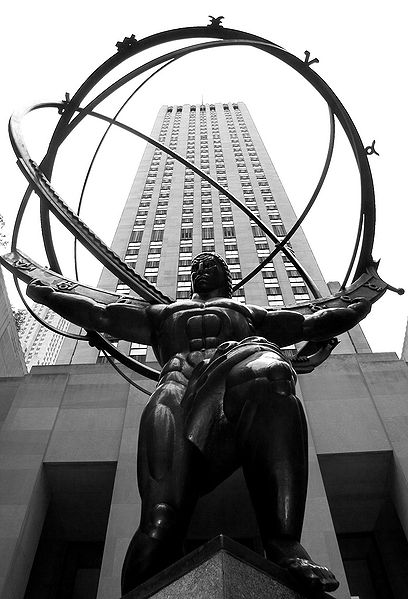
Atlas shrugging: New York City sculpture by Lee Lawrie.

Human societies are support systems within which individual weakness does not automatically spell death. Mutual dependence is key to our success. The moral emotion of loyalty is crucial for our survival. And so are others, such as willingness to devote resources to group welfare, cooperation, honesty, and many more.

We have two kinds of rationality, but Rand recognizes only one. We can think carefully and attentively, reasoning step by step from premises to conclusions. And we can react in the blink of an eye, assessing probabilities and choosing what to do without conscious thought. More often than not it is the latter that we employ.

Our minds do most of their work by automatic pattern matching. We do not pay attention, for instance, to how our visual systems translate excitation of receptor cells on the back of the eyes to recognition of objects and people; instead we just recognize things. Similarly, most of our social cognition occurs rapidly and automatically. We very quickly appraise people we meet as attractive or not, friendly or threatening, male or female, higher or lower in status than we are, etc.

Moral intuitions are a form of social cognition. Human beings come equipped with an intuitive ethics, an innate preparedness to feel flashes of approval or disapproval toward certain patterns of events involving other human beings.

But this is what Rand decries, instead praising a rationality that entails “a full mental focus in all issues, in all choices, in all of one’s waking hours,” a process of thought that is “precise,” “scrupulous, ” and “ruthlessly strict.”(7) Someone who actually acted that way would not last very long at all.

Rand overlooks two things: the role of what cognitive scientists call “hot cognition,” which I have been describing, and the essentially social nature of human reality. Nowhere in her essay is the word “compassion” to be found. Nowhere does she speak of empathy. She does mention love. She calls it a “spiritual payment given in exchange for the personal, selfish pleasure which one man derives from the virtues of another man’s character.”(8) Love as payment? If men are from Mars and women are from Venus, Rand appears to be from Jupiter.

Despite the inadequacies of Rand’s theory of human nature, however, there is something to be learned from her theory of ethics. As humans we do have the ability to reflect on ourselves and our situation, to exercise second-order mentation. We have the opportunity to judge whether the moral intuitions provided to us by our evolutionary heritage actually make sense in the present.

The feeling of loyalty to the group, crucial to the survival of small bands of hunters and gatherers, may not make sense when directed to sports teams or, less harmlessly, to governments that oppress portions of their populace and wage wars for the enrichment of the elites. We may not be able to fully divest ourselves of such feelings, but we can intervene when they arise and decide whether and in what manner to act on them.

And, more realistically, we can intervene ahead of time. We can cultivate habits of character that enable us to act in the heat of the moment as we have chosen in times of cool reflection.

Consider someone, perhaps a follower of Ayn Rand, who realizes that his excessively calculating attitude toward others is self-defeating. To overcome this deficiency he could deliberately cultivate habits of emotional openness, generosity and helpfulness. He could look for opportunities to speak the truth about what he is feeling, to be helpful to others, to give freely instead of hoarding.

At first, acting in these ways would feel uncomfortable and alien, but with time they would become second nature. And people would respond to him in kind.

And that is the real power of Ayn Rand’s ethics. Applied to a more accurate view of human nature, it encourages us, not to cogitate excessively over each situation, but to decide what kind of person we want to be. In true Aristotelian fashion it encourages us to cultivate virtues that enable us to live fulfilling lives in the company of others.

Notes

(1) I base this assessment on Rand’s essay “The Objectivist Ethics,” which seems to sum up her essential argument nicely and is certainly a quicker read than her monumental works of fiction.
(2) Aristotle, Nichomachean Ethics, I.7 1097b 22-29.
(3) Rand, pp. 22-23.
(4) Ibid., p. 25.
(5) Ibid., p. 32.
(6) Ibid., p. 34. Italics in the original.
(7) Ibid., p. 28.
(8) Ibid., p. 35.

References

Aristotle. Nichomachean Ethics, tr. W.D. Ross. In McKeon, Richard, ed., Introduction to Aristotle. New York: Random House Modern Library, 1947. Also available as an on-line publication, URL = http://classics.mit.edu//Aristotle/nicomachaen.html as of 17 April 2011.

Rand, Ayn. “The Objectivist Ethics,” in The Virtue of Selfishness, pp. 13-39. New York: Signet Books, 1964. Also available as an on-line publication, URL = http://www.aynrand.org/site/PageServer?pagename=ari_ayn_rand_the_objectivist_ethics as of 3 July 2011.

Wikipedia. “Homo economicus.” On-line publication, URL = http://en.wikipedia.org/wiki/Homo_economicus as of 16 July 2011.

[Bill Meacham is an independent scholar in philosophy. A former staffer at Austin’s 60’s underground paper, The Rag, Bill received his Ph.D. in philosophy from the University of Texas at Austin. Meacham spent many years working as a computer programmer, systems analyst, and project manager. He posts at BillMeacham.com, where this article first appeared.]

The Rag Blog

Posted in Rag Bloggers | Tagged , , , , | 2 Comments

Harry Targ : The Two-Headed Neoliberal Monster

Image from Stupid Comics.

An American dilemma, 2011:
The two-headed neoliberal monster

It became clear to the financiers that government regulations, social safety nets, and public institutions of all kinds had become impediments to the free flow of money capital.

By Harry Targ / The Rag Blog / August 3, 2011

Common threads run throughout America’s history from the revolution to 2011. Class and race are particularly enduring features of the life of the nation. Perhaps we need to examine our history and contemporary plight using class analysis and the fundamental interconnections of class and race to better understand why American society is in crisis today and what can be done about it.

First, it is undeniable that America is a class society. The dominant class owns the factories, the businesses, the entertainment and information industries, and the financial institutions that control investment, trade, debt, and speculation. As the capitalist economy has changed, the ruling class has changed also. But in each historical period the ruling class has acted on the basis of its interests and ideology. Since the 1970s, the economic ruling class, while diverse, has been dominated by finance capital.

Second, it is important to remember that concentrated economic wealth is usually complemented by centralized political power. In our own day, for example, Wall Street financial interests dominate the political process. In the increasingly desperate pursuit of increased rates of profit since the 1970s, financiers have been pressuring political elites to institutionalize policies that cut government programs, deregulate the economy, reduce workers rights, and shift societal wealth from the poor and working people to the wealthy. The deal being brokered to “solve the deficit ceiling” problem is the most current of examples.

Third, set against the economic ruling class in every age is a broad array of sectors of the working class, some employed, some not, who have little wealth and power. During exceptional periods they rise up angry, challenge myths about what the economy needs, and demand policies to further the shift of wealth from the few to the many. Since the 1980s, with brief exceptional periods, wealth and income has shifted more to the few.

This model of an economic ruling class and a vast working class is largely an accurate framework for understanding American history, from the revolution of 1776 to the deficit crisis of 2011. But the model needs to be refined based upon the particular interests, organizations, economic activities, and ideologies of the two basic classes, the ruling class and the working class.

For example, even within the two classes there are “fractions” or segments that do not share precisely the interests of other fractions within the class. For example, since the 1970s, more and more wealth has been invested in finance and less and less in manufacturing and agriculture, the traditional backbones of a capitalist economy.

It became clear to the financiers that government regulations, social safety nets, and public institutions of all kinds had become impediments to the free flow of money capital. Thus we saw the dawn of the Reagan “revolution,” which consisted of policies designed to replace the New Deal policies of mixed government and the private sector that favored manufacturing and workers in industry.

Over the last 30 years, the United States economy, and more or less all of the wealthy capitalist economies, have shifted their priorities to making money via financial speculation. Government has helped by adopting free market, market fundamentalist, and what people around the world call neoliberal economic policies. Introduced selectively during the presidency of Jimmy Carter and promoted full blown in the Reagan era, United States economic policy has been driven by the downsizing of government (except the military) and deregulation.

Today, most Democrats and Republicans are fighting over how to cut government spending and which people-oriented programs to eliminate. They are not fighting about whether to cut government, but rather in what ways it should be cut. In sum, if we label political actors, the neoliberal monster has two heads, Democrats and Republicans.

The current context is made even more complicated by the so-called Tea Party. The Tea Party was created by a small fraction of the wealthy economic class and sectors of the monopoly controlled media. Its membership consists of a vast array of disenchanted, alienated increasingly marginalized business and professional elites who claim to be motivated by the need to challenge intrusive government. While it has its roots in fractions of the economic ruling class it has used its resources to appeal to a base of supporters from the working class.

Many Tea Party activists have used the historic and institutionalized racism in the United States as a tool to expand their support. Tea Party enthusiasts have made it clear that their real motivation is to destabilize and destroy the United States government which happens to be led by the first African-American president.

Senator Mitch McConnell, in a desperate attempt to co-opt this political fraction, spoke frankly when he declared that the number one priority of the Republican Party is to insure that Barack Obama is a one-term president. This simple and frank declaration parallels the constant racist stereotypes of Obama that find their way into mainstream media and are staples of Fox News, and the reactionary radio chorus. And to generalize, the Tea Party and much of the Republican Party express their racism against Islamic and Latino targets as well.

Furthermore, the racist ideology that is just below the surface of political discourse has escalated as the gaps in wealth and income between whites and people of color have expanded over the last 30 years. In fact, the assault on government programs, and the vast majority of workers, has been at the same time an assault on African Americans, Latinos, and all other so-called minorities, who by 2050 will be the new majority of Americans.

In short, the deficit struggle may be seen as a conflict between two fractions of the economic elite, represented by most of their Democratic and Republican allies, over the shape of the neoliberal policies to be adopted as public policy AND the Tea Party political fraction, from the ruling and working class, who are driven as much by racism as by any idea of doing what is best for the economy.

The ideology of racism used by some of those who promote the neoliberal agenda is paralleled by the real maldistribution of wealth and income that has been exacerbated in recent years and will be a centerpiece of any deficit reduction deal in the future.

But as Marx said, all history is the history of class struggle. The working class, varied as it has been over time, continues to resist the efforts of the wealthy and powerful to appropriate more and more of society’s resources. In fact, what may be called the Progressive Majority is a coalition of workers, women, people of color, environmentalists, health care activists, and others who will refuse to accept neoliberal and Tea Party policies. For them the struggle is not over. It is just beginning.

In some ways, the impending deficit deal that leaders of the two political parties are consummating clarifies the task the progressive majority faces. The American Dilemma of 2011 requires mobilizing on two interconnected fronts.

First, progressives must adopt a campaign to increase government support for the vast majority of Americans and to do so by taxing the rich. In other words, progressives must say “no” to neo-liberalism. Second, progressives must incorporate a 21st century anti-racism platform in their economic program. Demographically, people of color will constitute a majority of the voting age population by 2050, a disquieting realization for Tea Party supporters and their neoliberal representatives who want to return to an era of Jim Crow economically and politically.

A useful guide for this progressive agenda is The People’s Budget proposed recently by the Congressional Progressive Caucus which calls for a massive jobs program, the construction of a fairer and more equitable tax system, real health care reform, tax reforms to safeguard the social security trust fund, and dramatic cuts to military spending. The People’s Budget clearly would address issues of government spending by shifting to policies of fairness that benefit the vast majority of the country’s population.

So the task of the progressive majority is clear whatever final form the deficit compromise takes. Joe Hill is still right: “Don’t Mourn, Organize!”

[Harry Targ is a professor of political science at Purdue University who lives in West Lafayette, Indiana. He blogs at Diary of a Heartland Radical — and that’s also the name of his new book which can be found at Lulu.com. Read more of Harry Targ’s articles on The Rag Blog.]

The Rag Blog

Posted in Rag Bloggers | Tagged , , , , , , , , | 1 Comment

Larry Ray : Tattered Leadership and Toxic Tea

Graphic by Larry Ray / The Rag Blog.

A virus has been unleashed:
Tattered leadership and toxic tea

By Larry Ray / The Rag Blog / August 2, 2011

A fetid brew of public ignorance and indifference flavored with abject partisan stubbornness forms the growth medium in America’s political petri dish. A virulent voter virus feeds upon it, spreading a plague of indecision, impotence, presidential pusillanimity, and contemptible congressional charade.

The voter virus was created by pseudo patriotism and the excesses of a previous decade of lax government whose singular priority was to reward the already wealthy.

Sober regulation of our banking and real estate industries was blithely and irresponsibly sidestepped for more than a decade. Then in late 2008 Wall Street’s wild, reckless ride came to a crashing halt. Finally the virus was loosed, infecting the American economy and reducing it to a rattling house of tumbling cards, all jokers.

Since 2009, more time has been spent by our elected leaders in assigning political blame than in launching a vigorous joint effort to cure and strengthen our economically bedridden nation. Confused Americans have not questioned flawed and false narratives from a brash, opportunistic, and well funded conservative chorus.

Repeated GOP mantras shamelessly blame the new black Democratic president for the entire mess, for all the nation’s out of control spending. But these duplicitous accusers never acknowledge the inherited debt racked up and left by their party.

This absurdity was parlayed into political propaganda gold by tax free groups, notably the “American Legislative Exchange Council” formed in 1973 by conservative activists. Finally, their time had come after the bruising they took in the 2008 Democratic election sweep. Millions of dollars from the ultraconservative billionaire Koch brothers slid into these “councils” as fast as they could qualify for nonprofit status.

The word “debt” is understood by everyone, and when the GOP heralded “an out of control national debt that must be stopped at all costs,” the warning was accepted as readily as an FDA ordered ground turkey alert after a multi-state Salmonella outbreak.

Raising the U.S. debt ceiling, was routinely done eight times under the Bush administration and countless other times all the way back to 1917 with no serious opposition whatsoever. But now “debt ceiling” was suddenly spotlighted and used as the hostage in a mad extortion plot.

Freshmen congressmen wearing tea bags as blinders had signed pledges to “change government in Washington” and their zealous naivete and self righteousness quickly clogged the old boy congressional sewer pipe leaving rookie Speaker of the House John Boehner unable to control his GOP vote.

The new conservative clog, after first finding their offices, quickly found the C-Span TV cameras and began immediately to promise their admiring ideologues back home that they would let America go into default unless a sweeping but ill-defined debt reduction bill was passed and signed by the president.

Most of these freshmen had no idea of how or why the debt ceiling has operated since 1917 or what the ruinous consequences of default would be. And they wore their ignorance as a badge of courage.

But back in November, 2010, Senate Minority Leader Mitch McConnell made the GOP goals and strategy crystal clear, setting the stage for the debt ceiling drama to come some seven months later. McConnell loftily proclaimed on national TV that if President Barack Obama wouldn’t go along with his key GOP goals, “the only way to do all these things is to put someone in the White House who won’t veto any of these things.”

After 27 years in the isolated, nurturing environment of the U.S. Senate, McConnell, who is worth an estimated $35 million dollars, has become the dour poster boy for America’s out of touch professional politicians. There are no poor people in elected office up in Washington.

Blinded by wealth and power, McConnell angrily told the nation that his forces would make the president bend to their will or they would have him removed… chilling echos from the 15th Century and the pronouncements from the House of Medici. And from that point forward with a new House majority all GOP votes were NO, hobbling the president and actively designed to make his life as difficult as possible.

Now, like the ending to a cookie-cutter Hollywood movie, Speaker John Boehner finally unclogged the congressional sewer main, and repacked the House sausage machine producing a 269-161 vote approving a budget agreement, thus certainly ending the threat of a U.S. Treasury debt default, and setting the stage for a heroic rally on the U.S. and foreign stock markets.

Boehner sent the winning sausage recipe on to the Senate where it was approved and sent to President Obama for signature, leaving a full twelve hours before the Treasury Department would have gone into default for the first time in the nation’s history.

Both chambers on The Hill think they have swallowed bitter pills but it wasn’t strong enough medicine to wipe out the voter virus. As America’s woes worsen, the voter virus will thrive on increasing universal voter disgust with the endlessly sorry and unacceptable performance of their House and Senate leaders.

The voter virus is predicted to attack the CDC (Completely Dysfunctional Congress) and erupt into a nationwide epidemic on November 6th, 2012. Mark your calenders.

[Retired journalist Larry Ray is a Texas native and former Austin television news anchor who now lives in Gulfport, Mississippi. He also posts at The iHandbill. Read more articles by Larry Ray on The Rag Blog.]

The Rag Blog

Posted in Rag Bloggers | Tagged , , , , , , | 2 Comments

John Nichols : The Debt Deal and Democratic Conscience

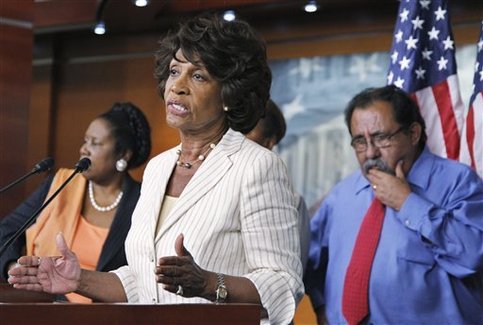
Members of Congressional Progressive Caucus express disapproval of debt ceiling deal Monday on Capitol Hill. From left, Rep. Sheila Jackson Lee, D-Texas, Rep. Maxine Waters, D-Calif. (speaking), and Rep. Raul Grijalva, D-Ariz. Photo from the AP.

The debt deal:
Dems split on issue of conscience

By John Nichols / The Nation / August 2, 2011

“I will have no part of a deal that cuts Social Security, Medicare, and Medicaid to appease the farthest reaches of the right wing of the Republican Party.” — Rep. Raul Grijalva, D-Ariz.

WASHINGTON, D.C. — House Minority Leader Nancy Pelosi reportedly told members of the House Democratic Caucus to vote their “individual consciences” when they were asked to approve the debt-celing deal cobbled together by the Obama White House and congressional Republicans.

Consciences divided evenly, with 95 Democrats opposed to the compromise agreement while 95 supported it in a Monday evening vote that saw the measure pass primarily on the basis of Republican backing — despite the fact that this was a deal promoted aggressively by a Democratic White House.

The final tally was 269 in favor, 161 opposed [1].

Republicans generally backed the deal, with 174 voting “yes” while 66 voted “no.”

Democrats were far more closely divided, with widespread opposition to what Congressional Progressive Caucus co-chair Keith Ellison, D-Minnesota, described as a violation of “core Democratic ideals.”

While Pelosi cast her own vote in favor of the agreement, she did not “whip” her fellow Democrats to back the deal during a marathon caucus meeting Monday. The former speaker outlined the consequences of a default by the federal government if an agreement to raise the debt ceiling is not reached.

But North Carolina Congressman G.K. Butterfield, who attended the caucus session said Pelosi avoided pressuring House Democrats to fall in line with the Democrats in the White House. “She told us to leave it to our individual consciences,” Butterfield told reporters.

With the House vote done, the Senate will be vote Tuesday on the deal, which proposes radical cuts in federal programs — cuts that some fear will ultimately threaten Medicare and other Democratic “legacy” programs — in return for raising the nation’s debt ceiling.

The Senate is likely to back the deal that was cut between the Obama White House and Republican leaders; Senate majority leader Harry Reid, D-Nevada, is already on board, as are key Republicans.

The general sense from the start was that the real test would come in the House, where Republican leaders had to scramble to keep Tea Party conservatives on board, and the White House faced a revolt by progressives.

Even as Pelosi and House Minority Whip Steny Hoyer indicated personal support for the measure, a striking number of Democrats spoke out in opposition to Obama’s position before the hastily-scheduled Monday evening vote.

Congressman Pete DeFazio, an Oregon Democrat who frequently breaks with the White House when he feels the president is not doing enough to address unemployment, went to the House floor Monday to declare that this is a “no jobs” deal.

Ohio Congressman Marcy Kaptur was opposed. Veteran New York Congressmen Jerry Nadler and Eliot Engle indicated early on that they are firmly opposed, as did former House Ways and Means Committee chair Charles Rangel, D-New York. Illinois Congressman Jesse Jackson Jr. was another “no.”

California Congresswoman Maxine Waters announced her “no” vote with a declaration that the deal was “one of the worst pieces of public policy” she had ever seen.

The progressive opposition to the deal grew, as grassroots groups stepped up their lobbying against the package. Progressive Change Campaign Committee [2] co-founder Adam Green said:

This deal will kill our economy and is an attack on middle-class families. It asks nothing of the rich, will reduce middle-class jobs, and lines up Social Security, Medicare, and Medicaid for cuts. Today, we’re putting in thousands of calls to Congress urging Democrats to keep their promise and oppose this awful bill. The 14th Amendment is unambiguous, and President Obama should invoke it to pay our nation’s debt. Then Democrats should focus on jobs — not cuts — in order to grow our economy.

Progressive Democrats of America launched a national “No Deal!” push. “The corporatists in Congress recognize that the United States cannot go into default for the first time in its 235-year history,” said PDA director Tim Carpenter.

Yet, they are claiming that we can only increase the debt ceiling by cutting vital social programs designed to protect working class and poor people across this country. Don’t drink the Kool-Aid! [3] We can block this “deal” and demand a clean debt ceiling increase.

At least 20 members of National People’s Action, a group that seeks to hold banks and financial institutions to account for the damage their speculation has done to the U.S. economy, were arrested when they disrupted debate in the Capitol. Decrying the debt-ceiling agreement as “a raw deal,” the NPA members chanted: “Hey, Boehner, get a clue, it’s about revenue!”

Congressional Progressive Caucus and Congressional Black Caucus members expressed the most serious skepticism regarding the measure.

That skepticism was rooted in a sense that this was a bad deal for both the economy and a Democratic Party that has historically positioned itself as the defender of working families.

Harry Truman used to say: “Given the choice between a Republican and someone who acts like a Republican, people will vote for the real Republican all the time.”

If the 33rd president was right, then Barack Obama did himself and his party a world of hurt by cutting the deal with the GOP leadership.

Faced with the threat that Tea Party-pressured Republicans in the House really would steer the United States toward default, and in so doing steer the U.S. economy over the cliff, Obama had to do something. But instead of bold action — borrowing a page from Ronald Reagan to demand a straight up-or-down vote on raising the debt ceiling; borrowing a page from Franklin Roosevelt to pledge to use the authority afforded him by the Constitution to defend the full faith and credit of the United States — the president engaged in inside-the-Beltway bargaining of the most dysfunctional sort.

In cutting a deal with Congressional Republicans [4] that places Democratic legacy programs — Social Security, Medicare and Medicaid — at risk while cutting essential programs for working families and the poor, Obama has positioned himself and his administration to the right of where mainstream Republicans such as Howard Baker, Bob Dole, and George H.W. Bush used to stand in fights with the fringe elements of their party.

Now, the fringe is in charge of the GOP. And Obama is agreeing to policies that are designed to satisfy Republicans that Britain’s banking minister describes as “right-wing nutters [5].’”

Obama and Democratic Congressional leaders claimed they have done everything in their power to avert deep cuts in Social Security, Medicare, and Medicaid. And it is true that they have given the Republicans (and their paymasters) less than House Budget Committee chair Paul Ryan was demanding with a budget proposal that turned Medicare into a voucher program and began the process of privatizing Social Security.

But a compromise with total destruction can still do a lot of damage.

The president’s bow to the political extremism — and the economic irrationality [6] — of a tiny circle of “right-wing nutters” in Congress and their dwindling Tea Party “base” will, according to reports based on briefings by White House and GOP aides,

…raise the debt limit by about $2.7 trillion and reduce the deficit by the same amount in two steps. It would cut about $1 trillion in spending up front and set up a select bicameral committee to put together a future deficit-reduction package worth $1.7 trillion to $1.8 trillion. Failure of Congress to pass the future deficit-reduction package would automatically trigger cuts to defense spending and Medicare.

An aide familiar with the deal told The Hill newspaper that the Medicare cut would not affect beneficiaries. “Instead,” the aide indicated, “healthcare providers and insurance companies would see lower payments.”

But that’s still a squeezing of Medicare in order to meet the demands of Congressional Republicans who have spent the past six months trying to put the program on the chopping block.

Congressional Black Caucus chairman Emanuel Cleaver, D-Missouri, responded to initial reports regarding the deal by describing it as “a sugar-coated Satan sandwich [7].”

Congressional Progressive Caucus [8] co-chair Raul Grijalva said Obama and his negotiators bent too far to the extremists. Like many progressives, Grijalva favored the straight up-or-down vote on debt ceiling. “Had that vote failed,” he argued, “the president should have exercised his Fourteenth Amendment responsibilities and ended this manufactured crisis.”

Grijalva joined members of the Congressional Progressive Caucus and the Congressional Black Caucus at a Monday press conference, where they called on Obama to sidestep Congress and raise the debt limit by invoking the Fourteenth Amendment [9].

Obama rejected this option.

Instead of taking a tough stance, the president blinked in the face of Republican recalcitrance. And in so doing Obama agreed to what the Progressive Caucus co-chair described as “a cure as bad as the disease.”

“This deal trades people’s livelihoods for the votes of a few unappeasable right-wing radicals, and I will not support it,” Grijalva declared Sunday afternoon. [10]

Progressives have been organizing for months to oppose any scheme that cuts Medicare, Medicaid, or Social Security, and it now seems clear that even these bedrock pillars of the American success story are on the chopping block. Even if this deal were not as bad as it is, this would be enough for me to fight against its passage.

Grijalva expressed immediate opposition to the deal. And he was not alone.

Congresswoman Donna Edwards, D-Maryland, slammed the deal. [11]

“Nada from million/billionaires; corp tax loopholes aplenty; only sacrifice from the poor/middle class? Shared sacrifice, balance? Really?” she complained, via Twitter, on Sunday.

Congresswoman Barbara Lee, D-California, complained that she was “not sure how Social Security and Medicare” will be preserved by the bargain the president has cut with the Republicans. “We have to make sure that within this deal… Medicare and Medicaid and Social Security and the most vulnerable are protected,” she said, while withholding an endorsement of the measure. “I worry about these triggers [for more cuts],” Lee concluded.

Grijalva objected, in particular, to the lack of shared sacrifice in the deal.

“This deal does not even attempt to strike a balance between more cuts for the working people of America and a fairer contribution from millionaires and corporations. The very wealthy will continue to receive taxpayer handouts, and corporations will keep their expensive federal giveaways. Meanwhile, millions of families unfairly lose more in this deal than they have already lost. I will not be a part of it,” the Arizona congressman explained.

Republicans have succeeded in imposing their vision of a country without real economic hope. Their message has no public appeal, and Democrats have had every opportunity to stand firm in the face of their irrational demands. Progressives have been rallying support for the successful government programs that have meant health and economic security to generations of our people.

Today we, and everyone we have worked to speak for and fight for, were thrown under the bus. We have made our bottom line clear for months: a final deal must strike a balance between cuts and revenue, and must not put all the burden on the working people of this country. This deal fails those tests and many more.

But Grijalva’s gripe was not merely a moral or economic one.

It was political, as well.

“The Democratic Party, no less than the Republican Party, is at a very serious crossroads at this moment. For decades Democrats have stood for a capable, meaningful government—a government that works for the people, not just the powerful, and that represents everyone fairly and equally. This deal weakens the Democratic Party as badly as it weakens the country,” explained Grijalva.

“We have given much and received nothing in return. The lesson today is that Republicans can hold their breath long enough to get what they want. While I believe the country will not reward them for this in the long run, the damage has already been done.”

The question that remains is: How much damage? How much damage to vulnerable Americans? How much damage to the global reputation of the United States as a functional state? How much damage to a U.S. economy that is threatened by rising unemployment? How much damage to the image of the Democratic Party as a defender of working families?

This deal cannot be defended as a sound or necessary response to a manufactured debt-ceiling debate and the mess that House Speaker John Boehner, R-Ohio, has made of it.

That is why the co-chair of the Congressional Progressive Caucus said: “I will not support the emerging debt deal.”

“I will have no part of a deal that cuts Social Security, Medicare, and Medicaid to appease the farthest reaches of the right wing of the Republican Party,” argued Grijalva. “It is unconscionable to put these programs on the chopping block and ignore the voices and beliefs of the millions of Americans who trust us to lead while continuing to give handouts to the ultra wealthy and the largest corporations. There is no human decency in that.”

Links:
[1] http://www.politico.com/news/stories/0811/60443.html
[2] http://www.boldprogressives.org
[3] http://www.pdamerica.org/
[4] http://thehill.com/homenews/senate/174595-reid-signs-off-on-bipartisan-debt-deal
[5] http://www.thenation.com/../../../../../../blog/162258/right-wing-nutters-threaten-global-economy-imf-warns-disastrous-consequences
[6] http://thehill.com/blogs/blog-briefing-room/news/174571-compromise-deal-could-include-broad-spending-cuts-as-a-trigger
[7] http://www.rollcall.com/issues/57_17/Debt-Deal-Emerging-With-Rightward-Tilt-207893-1.html
[8] http://cpc.grijalva.house.gov/
[9] http://thehill.com/homenews/house/174601-house-liberals-urge-14th-amendment-fix-in-lieu-of-bipartisan-debt-deal
[10] http://grijalva.house.gov /index.cfm?sectionid=13&sectiontree=5,13&itemid=1063
[11] http://thehill.com/homenews/house/174599-pelosi-dem-leaders-withholding-judgment
[12]
http://itunes.apple.com/us/app/nationnow/id399704758?mt=8

[John Nichols writes about politics for The Nation magazine as its Washington correspondent. He is a contributing writer for The Progressive and In These Times and the associate editor of the Capital Times, the daily newspaper in Madison, Wisconsin. This article was first published at The Nation and was distributed by Progressive America Rising.]

The Rag Blog

Posted in RagBlog | Tagged , , , , | 2 Comments

David Van Os : Surrender and Sellout

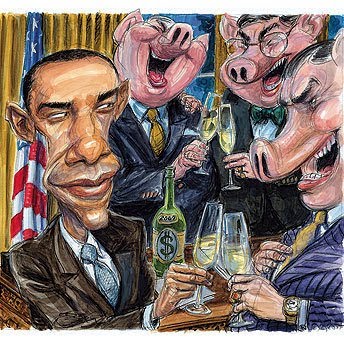
Political cartoon from OpEd News.

I rest my case:
Surrender and sellout

By David Van Os / The Rag Blog / August 2, 2011

According to all reliable news reports, John Boehner assured House Republicans that the budget deal does not endanger any Republican priorities and that the president gave up his previous demand for increased taxes on the wealthy.

In other words, the president capitulated. In other words, the wealthy that are hoarding the money get a free pass to keep freeloading on the rest of us. In other words, the poor, the working, and the middle classes are asked to make all the sacrifices to avoid national default.

In other words, the president pulled the rug out from under Democrats who were looking forward to attacking Republicans for wanting to cut Medicare in the 2012 elections.

To this president and his congressional allies, making a deal, any deal, is more important than any principle.

The desperate desire to achieve agreement even if it means giving up every fundamental principle means confrontation avoidance as an end in itself regardless of what is given up. It means agreements that lack moral content. It means there are no convictions worth drawing a line in the dirt over.

From now on, no demand that president Obama ever makes will be worth its own sound waves. The whole world knows that if his adversaries stand firm, he will give in, no matter what he may have said about any principles. He has become a lame duck before the end of his first term.

Some will say, “What could he have done?” He could have stuck to his guns to the very last minute. Then if the Republicans still would not compromise, he could have done what Big Dawg Bill Clinton suggested: raise the debt ceiling by presidential order. He would have been on solid Constitutional ground, since the 14th Amendment mandates the United States government to honor its debts.

In other words, he could have shown some guts and fulfilled his duty to uphold the Constitution no matter what heat the Republicans would generate. But there is the rub. He can’t take the heat.

[David Van Os is a populist Texas democrat and a civil rights attorney in San Antonio. He is a former candidate for Attorney General of Texas and for the Texas Supreme Court. To receive his Notes of a Texas Patriot — circulated whenever he gets the urge (and published on The Rag Blog whenever we get the urge) — contact him at david@texas-patriot.com.]

The Rag Blog

Posted in Rag Bloggers | Tagged , , , , | Leave a comment

Carl Davidson : ‘Business Guy’ Romney Feeds us Baloney

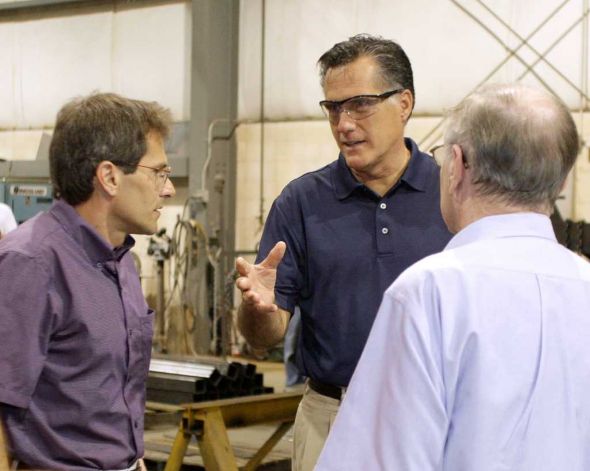
Former Massachusetts Gov. Mitt Romney speaks with Screen Machine Industries owner Doug Cohen, left, July 27, 2011, in Pataskala, Ohio. Photo by Jay LaPrete / AP.

Now let me get this straight:
‘Business guy’ Mitt Romney

feeds us a bunch of baloney

By Carl Davidson / The Rag Blog / July 30, 2011

Some things just drive you nuts.

Take Mitt Romney.Wednesday the GOP’s presidential wannabe toured Screen Machine, a factory in Pataskala, Ohio, just outside Columbus. The plant makes heavy construction equipment, rock crushers to be exact.

Romney and the owners, Doug and Steve Cohen, held a typical photo op. Mitt took the occasion to blast both Obama and “government” as “bad for business.”

Really? What did Mitt have in mind? A wimpy stimulus package? A failure to build more infrastructure? In that case, he might have a point.

But no, the real problems are environmental regulation, labor safety codes, and health care. In other words, with more pollution and more unsafe conditions at work, and less health care to deal with the consequences, business could surge ahead.

There’s not any truth to that claim, but that’s not the worst of it.

First, there’s the irony that Obama’s health care plan is basically a national version of Romney’s Massachusetts Plan. If we could scrap both and replace them with “Medicare for All,” yes, it would be better for both workers and business — save for the health insurance firms.

But the real clincher is the story of Screen Machines, where Mitt, the tough-minded, pragmatic business guy candidate, was delivering his words of economic wisdom. Here’s the Washington Post on the topic:

Yet it’s been the government — and Obama’s policies in particular — that has helped propel Screen Machine’s growth at its sprawling new headquarters here, even during the recession. The company, which builds heavy-duty crushing and screening machines used in construction, mining and recycling, received four stimulus awards totaling $218,607. It is also benefiting from a 10-year deal with local and state governments to not pay taxes on its property, equipment or inventory, according to public records.”

We need to make a minimum requirement of all elected officials that they at least have the ability to blush when feeding us a lot of nonsense. Of course, that might wipe out most of Congress, and a few in the White House, too. But then we’d have some open slots for politicians who count voters rather than dollars.

[Carl Davidson is a national co-chair of the Committees of Correspondence for Democracy and Socialism, a national board member of Solidarity Economy Network, and a local Beaver County, PA member of Steelworkers Associates. In the 1960s, he was a national leader of SDS and a writer and editor for the Guardian newsweekly. He is also the co-author, with Jerry Harris, of CyberRadicalism: A New Left for a Global Age. He serves as webmaster for SolidarityEconomy.net and Beaver County Blue, where this article was first published. Read more articles by Carl Davidson on The Rag Blog.]

The Rag Blog

Posted in Rag Bloggers | Tagged , , | Leave a comment

Professor Jensen interviews Will Potter, author of “>Green is the New Red: An Insider’s Account of a Social Movement Under Siege.” Jensen and Potter tell us how corporations, politicians, and law enforcement increasingly see environmental activism as a threat (especially to profits that depend on degrading the ecosphere) and have responded with repressive laws and tactics reminiscent of the Red Scare that targeted leftists in the 20th century.

Posted in RagBlog | Leave a comment

Molly Ivins called the Texas Department of Transportation (TxDOT) the “Pentagon of Texas.” The Texas road lobby has unrivaled power, and in this state roads are seen as a form of “publicly funded entitlement” — “welfare to subsidize suburban sprawl development.” But, with road traffic having leveled due to peak oil and an increasingly tough economy, things have changed — though the politicos remain in denial.

Posted in RagBlog | Leave a comment

Ed Felien : Breivik’s Norwegian ‘Putsch’ Has Historical Echoes

Political cartoon by Paolo Lombardi / toonpool.

The parallels are ominous:
Terror in Norway

There are organizations that support the ideas of McVeigh and Breivik, and there is a culture that supports murder and violence as legitimate means to realize those ends.

By Ed Felien / The Rag Blog / July 28, 2011

On Friday, July 25, Anders Breivik, a right-wing Christian fundamentalist who hated Muslims, set off a bomb in downtown Oslo destroying a building that contained the office of Jens Stoltenberg, the Labor Party prime minister, killing eight people.

He then took a 20 minute ferry to an island where the Labor Party held a summer camp for young people. Wearing a police sweater, he told some of the young people that he wanted to talk to them about the bombing and then opened fire and shot them at point blank range. He killed 68 before the police arrived and he surrendered.

Until recently, Breivik was an active member of the Progress Party. With 41 seats it is the second largest party in Parliament after the Labor Party. The party tripled its support in 1987 when the leader at that time, Carl Hagen, told his supporters, “The asylum seekers are on their way to take over our fatherland,” and read from a letter supposedly from a Muslim, which said, “This country will be Muslim! We give birth to more children than you, and several true-believing Muslims arrive in Norway every year, men in productive age. One day the infidel cross in the flag shall also go away!”

The so-called Mustafa letter was proven in court to be a fraud, but it had its desired effect in galvanizing anti-immigrant sentiment.

The 2009 national election was quite dramatic. It looked for a while that the Labor Party would lose after ruling Norway for over 60 years, but the Progress Party got into arguments with its coalition partners and looked confused, and voters lost confidence in its capacity to govern. In the end the Labor Party was able to put together a coalition of socialists and progressives that formed a government.

This defeat was a heavy blow to Breivik, and in his manifesto he denounced members of this party as “politically correct career politicians” who were not prepared to “take risks and work for idealistic goals.”

The model for Breivik must have been Hitler’s Beer Hall Putsch in 1923. With a gang of about 600 thugs in SA uniforms, Hitler was able to take over a right-wing meeting of about 2,000 people in a beer hall in Munich. Using the threat of violence to hold his audience (he had a machine gun trained on the door) Hitler won over the audience with his extemporaneous speech about how Germany had been betrayed by the liberal Weimar government, by the Treaty of Versailles and by the international Jewish conspiracy.

They marched on the Bavarian Defense Ministry and were stopped by about a hundred state police officers. A gunfight began and four police officers and 16 Nazis were killed.

Hitler was arrested, tried, and sentenced to five years and given a small fine. He served eight months in a comfortable cell where he received visitors and wrote Mein Kampf. Breivik took no chances and wrote his Mein Kampf, the 1516 page manifesto “2083: A European Declaration of Independence,” before he acted.

The putsch and trial gave Hitler what he needed — a platform from which to address the German nation. On Jan. 30, 1933, President Hindenburg appointed Adolf Hitler chancellor of Germany. Less than a month later the Reichstag was set on fire.

Most scholars now agree that Hitler’s group talked a Dutch communist into setting the fire so Hitler and Goring could use that as an excuse to murder communists and socialists. Almost the first three-quarters of Mein Kampf is about how the communists and socialists had betrayed Germany and how they must be punished severely. Only the last quarter of the book talks about Jews.

From 1933 to 1938 the Nazis rounded up leftists and either murdered them outright or sent them to concentration camps. Only after Kristallnacht on Nov. 9, 1938, did the Nazis begin to round up the Jews.

Breivik writes about the Islamification of Europe, but he targets first the left. He deliberately set out to murder the next generation of leaders of the Labor Party, and what took truckloads of Nazi stormtroopers months to accomplish, Breivik did in 90 minutes.

Can it happen here?

It already did, and it was much worse.

Timothy McVeigh blew up the federal building in Oklahoma City on April 19, 1995, and killed 168 people. He claimed the bombing was in retaliation for the federal government raid on the Waco religious commune that ended in the deaths of 55 adults and 21 children. McVeigh went to gun shows and was certain the government wanted to take away his right to bear arms. His conservative views on morality and taxes would strongly resonate with Breivik and the Norwegian Progress Party.

He wrote a letter to a local newspaper in 1992:

Taxes are a joke. Regardless of what a political candidate “promises,” they will increase. More taxes are always the answer to government mismanagement. They mess up. We suffer. Taxes are reaching cataclysmic levels, with no slowdown in sight. […] Is a Civil War Imminent? Do we have to shed blood to reform the current system? I hope it doesn’t come to that. But it might.

The book he considered his bible was The Turner Diaries by William Luther Pierce, the former leader of the white nationalist organization National Alliance. The book calls for a violent revolution by the far right that eventually leads to the extermination of all Jews and non-whites.

Are McVeigh and Breivik madmen acting alone, or are they part of a movement?

Do their basic ideas have currency in mass organizations?

Consider what Alan Keyes says at his Declaration Alliance group:

Realization must come that we are locked in a clash of momentous import, between America’s future course being set as socialist big government on the one hand, or restrained smaller government on the other.

Consider the racial hatred embedded in the mass e-mailing from MinutemanHQ.com:

Enough is enough! The line has to be drawn! The invasion of America has to end! Justice has to be done for all the good, honest, Americans who have been killed, raped, kidnapped, stolen from, and abused by criminal illegal immigrants! American sovereign territory must be DEFENDED and HELD SECURE!! THE HOUR IS LATE, MAKE THEM HEAR US — it is the right thing to do!

Consider a MoveOn picnic disrupted by Tea Party thugs. One woman reported:

So, about 20 little old ladies, like me, gathered in a public park in Oregon to have a picnic and a meeting.

They were then run off by a group of Tea Party activists, led by the local head of Americans for Prosperity. They retreated to a private dwelling, but the teabaggers followed them there, and had to be stopped from trespassing on private property. The police conveniently contacted the group two hours later to find out if the cops were still needed.

And these stupid tea baggers, instead of understanding that you cannot “free America” and “stop socialism” by denying people the right to gather in a public park, proudly posted the video on YouTube like they’d done a great thing.

There are organizations that support the ideas of McVeigh and Breivik, and there is a culture that supports murder and violence as legitimate means to realize those ends. The violence in movies, on television, and in popular song is pervasive and addictive. The adrenalin thrill of video games is simulation training for actual combat.

Breivik wrote in his journal in February 2010 that he “just bought Modern Warfare 2, the game.” He says it’s “probably the best military simulator out there. You can more or less completely simulate actual operations.”

But more than anything else, the wars against Iraq, Afghanistan, Pakistan, Yemen, and Somalia fuel the violence and the xenophobia. We are at war with the Muslim world, no matter how much our government denies it. And this war allows us to hate and fear Muslims and Arabs, and this makes it easier to hate and fear Mexicans because they may want to steal our jobs. We want the government to do something about it, and when they don’t solve the problem right away, they’re weak at best and traitors at worst.

These are the conditions that went before the Beer Hall Putsch, before Mussolini’s March on Rome, before Franco’s march on Madrid. Our wars abroad can easily lead to wars at home:

It seems ironic and hypocritical that an act viciously condemned in Oklahoma City is now a ‘”justified” response to a problem in a foreign land. Then again, the history of United States policy over the last century, when examined fully, tends to exemplify hypocrisy.

When considering the use of weapons of mass destruction against Iraq as a means to an end, it would be wise to reflect on the words of the late U.S. Supreme Court Justice Louis Brandeis. His words are as true in the context of Olmstead as they are when they stand alone: “Our government is the potent, the omnipresent teacher. For good or for ill, it teaches the whole people by its example.”

— Timothy McVeigh

[Ed Felien is publisher and editor of Southside Pride, a South Minneapolis monthly.]

The Rag Blog

Posted in Rag Bloggers | Tagged , , , , , , , | 3 Comments

Roger Baker : The Texas Road Lobby Meets Peak Oil

Photo by Rupert Ganzer / Flickr.

Coming soon:
Peak oil, peak driving, peak cars

Part IV: The Texas road lobby meets peak oil

By Roger Baker / The Rag Blog / July 28, 2011

[This is the fourth and final part of a series by Roger Baker on transportation, centering on the issue of peak oil and its ramifications.]

The ‘Pentagon of Texas’

Molly Ivins once called TxDOT (Texas Department of Transportation) the “Pentagon of Texas.” The political clout of TxDOT and the Texas road lobby operating on the state level is still unrivaled.

Inside Texas, TxDOT has held a politically powerful position for many decades, with the help of its traditional political allies like the Texas Good Roads Transportation Association, which was the political base for businesses and civic clubs that might benefit from local application of road money, and the Associated General Contractors, essentially an alliance of private road contracting companies, rather analogous to the defense industry. The contractors gained their institutional power decades ago, when TxDOT stopped building very many roads on its own.

From its earliest days, the Texas Highway Commission, as it was known before it became TxDOT, has been a highly political institution ready to pass out favors to its political allies in the form of road contracts. This snip is taken from an especially scholarly study devoted to the early politics of TxDOT.

It’s more than likely that the conditions of these highways can be seen as a direct legacy of years of county authority and political struggle for control of the department. After all, since its founding in 1917 the Texas Highway Department has, as often as not, been forced to make decisions based on political considerations. Issues such as traffic density and the proportional allocation of funds were often secondary to the job of protecting revenue or just getting roads built.

In Texas, roads gradually became seen as a traditional form of publicly funded entitlement; a kind of welfare to subsidize suburban sprawl development in a heavily urbanized and rapidly growing state.

The way politics works in Texas, there is a traditional alternative to political bribes. Instead, the special interests channel money to Texas politicians through campaign contributions. Quite in line with this approach, the biggest road contractors in Texas contributed over $1 million to Texas Gov. Rick Perry during his first term in office. Later they gave more millions to other Texas politicians.

Since the state solicited its first bids for a leg of the TTC project in 2003, private companies that have landed lucrative TTC contracts have contributed $3.4 million to Texas candidates and political committees — a significant increase in their political activity. TTC contractors also have spent up to $6.1 million on Texas lobbyists since the state solicited their respective bids. While the TTC contains windfalls for some contractors, lobbyists and elected officials, the benefits to Texas motorists and taxpayers are much less clear.

A few years ago, when the late Ric Williamson chaired the Texas Transportation Commission, it became apparent that fuel tax revenues could not possibly keep up with TxDOT’s accustomed pace of road building. Working with Gov. Rick Perry, Williamson ordered TxDOT to try to shift all its new construction to “public-private partnership” toll roads to leverage TxDOT’s limited public funds.

In order to sell private investors on toll road bonds, it is obviously helpful to try to maintain that road demand will keep increasing for decades until the bonds are finally paid off (some toll road bonds, like some issued for US 290 E, pay junk bond rates, but are uninsured against default). The policy is to try to use private toll road bond funding and also federal loans to supplement TxDOT’s traditional but stagnant gas tax revenue, in order to bridge the revenue gap and keep building roads.

As is the case with Indiana Gov. Mitch Daniels, Texas governor Rick Perry is a highway booster. “The highways of Texas are built and paved in part by paths of gold leading to the Texas Governor’s Mansion,” political reporter R.G. Ratcliffe wrote in the Aug. 30, 2002, edition of the Houston Chronicle, in “Highway plans bring money to politicians.”

The political clout of the Texas road lobby still exceeds that of the various competing social needs such as education. TxDOT’s long range road planning policy still stubbornly reflects the same outlook, which involves working hard to perpetuate the notion of ever-expanding growth in future road demand.

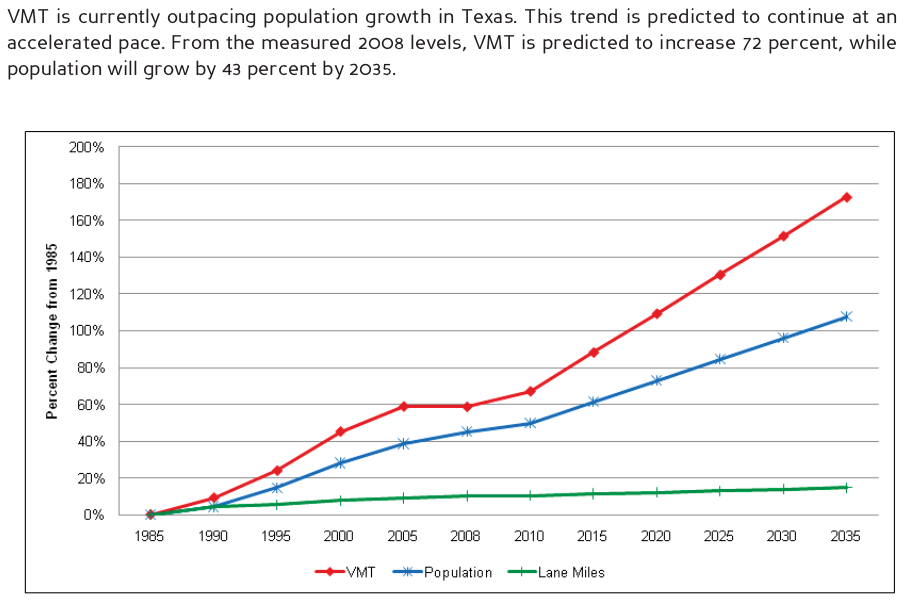
However, as the federal data clearly shows, Texas travel is currently falling short of TxDOT’s vehicle travel growth projections, due to a combination of higher fuel prices, a poor economy, an aging population, congestion fatigue, and changing driving behavior, also seen nationally.

The Texas road lobby today

The latest incarnation of the Texas road lobby is arguably Transportation Advocates of Texas (TAoT). A sort of who’s who of current Texas road politics, clearly organized by special interest money. Scroll down to the bottom to see a long list of those interests currently involved in promoting roads — largely banking, construction, engineering, road contracting, and land development interests.

Those familiar with Austin’s federally sanctioned Metropolitan Planning Organization, CAMPO, will see the last two CAMPO directors, Mike Aulick and Joe Cantalupo, listed among members of the road lobby’s supporters.

This snip from an internal document of this same group, TAoT, recently circulated to its supporters, clearly shows that their primary political goal is to get more road money, despite the relatively falling gas tax revenue:

The Great Outstanding Issue: Texas has yet to identify a stable source of additional revenue that can meet the transportation needs of a rapidly expanding population. Fuel efficiency and hybrid vehicles reduce gas tax revenue — and the state fuel tax hasn’t changed in 20 years. Whether it is through taxes, fees, tolls or other sources of revenue, further delays in providing additional financing will inevitably result in more traffic congestion.

By one estimate we under-fund roads by $8 billion a year. The problem will only get worse. Congestion will get worse. Economic losses will get worse. Rural connectivity will get worse. Road conditions and road safety will get worse. And the cost associated with doing nothing means one day the price tag will be worse.

Only roads are mentioned; TxDOT and the road lobby don’t do much transit, except by TxDOT passing federal transit funds down to the local level. Even while admitting that the road funding situation is getting worse with no relief in sight, the focus remains strongly on building roads, as spelled out in this editorial by two top TAoT road lobbyists.

But we are not without solutions. The gas tax hasn’t been increased in 20 years — and its buying power has significantly diminished due to inflation. Vehicle registration fees could be raised and dedicated to high-priority projects. Allowing local officials to access a portion of the gas tax or other sources of revenue would also provide relief. And we can support ending the diversion of highway dollars to spending on other priorities.


The Texas road lobby selects data that
always predicts increasing road travel demand

The Texas road lobby seeks to keep building roads which benefit not only the road contractors, but also the powerful Texas suburban land developers who thrive by planning ever-expanding rings of suburban sprawl around the major metropolitan areas of Texas, a pattern typical of other sunbelt states.

By 2005, about 86% of the Texas population was living in its urbanized areas with only 14% living in the rural areas. Suburban sprawl development has long been made profitable by buying and developing land in the suburban fringe areas. These areas often escape city taxes, but require the help of publicly funded highways to help stimulate development.

This road-assisted urban development formula worked for decades, but it is based on unsustainable trends. Anyone can now see from the federal data that the total travel demand on Texas roads has been flat since about 2007. Here are the yearly VMT numbers for total travel in Texas in millions of miles on state’s roads as measured by the Federal Highway Administration. See for example the 2007 link.

2004 — 231,008
2005 — 235,170
2006 — 238,256
2007 — 243,443
2008 — 235,382
2009 — 230,411

Unfortunately, this useful yearly data series for Texas road travel stopped in 2009. However, using this series we can compare the five most recent Februarys of Texas driving; here again, we can see that the Texas VMT road travel data have continued to stagnate or decrease, on through the most recently reported data:

Feb. 2007 — 17,893
Feb. 2008 — 18,831
Feb. 2009 — 18,953
Feb. 2010 — 18,490
Feb. 2011 — 17,635

Given the nature of road politics in Texas, it comes as no surprise that TxDOT’s long range plan released in May 2010 anticipates a travel demand growth of about 2.44% a year, for decades into the future, as a basis for TxDOT planning. As TxDOT says, “The new Statewide Long-Range Transportation Plan 2035 (SLRTP) will serve as the state’s 24-year “blueprint” for the planning process.

TxDOT’s “Statewide Long-Range Transportation Plan 2035,” released in mid-2010, tries to ignore the current flatness in travel demand as something exceptional and abnormal. It assumes that vehicle miles traveled will somehow recover and then continue to rise steadily as a straight line for decades to come, much as it did before 2005.

The TxDOT long range planners are unable to explain the sharp falloff in traffic volume seen to begin about 2005 — with Texas road travel peaking in 2007 — and now continuing through the most recent data in 2011, or about six years now.

Since the Texas travel data is collected and published by the Federal Highway Administration, the continuing stagnation or decline in vehicle miles traveled on Texas roads is hard for TxDOT to deny. This well-documented reality has caused TxDOT to insert the strange flattened VMT section in the middle of their otherwise ever-ascending long range travel demand chart.
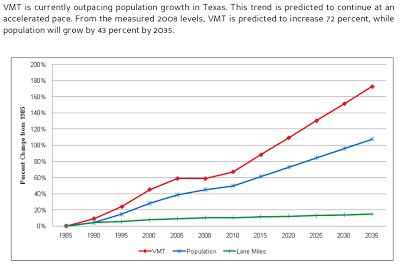
The reality is also that car registrations in Texas peaked in 2005 and then flattened and decreased slightly until 2009, where the most recent FHWA data ends. This data is given in thousands of car (light vehicle) registrations in Texas, 2004-2009, here seen peaking in 2005:

2004 — 8,620
2005 — 8,793
2006 — 8,689
2007 — 8,680
2008 — 8,711
2009 — 8,711

The Texas Road Lobby’s think tank,
the Texas Transportation Institute (TTI)

The Texas road lobby has its own nationally prominent think tank, the Texas Transportation Institute (TTI) based at Texas A&M. TTI functions more or less as an academic wing of the road lobby, implicitly denying peak oil, while focusing primarily on expanding road capacity as the best way to preserve mobility and serve future transportation needs. The TTI outlook on urban traffic congestion and congestion relief — through building more roads for ever more vehicles — is widely disseminated through the media as their main approach to transportation planning policy.

Over the past year, TTI experts answered tough questions on a variety of state and national transportation issues. Over 2,500 newspaper articles, broadcast television spots and professional journals — with a potential reach of over 725 million readers and viewers nationwide — mentioned the Institute or its experts.

For the Texas road lobby to contemplate that the total amount of driving inside the USA may never again exceed the peak reached in 2007, either in Texas or nationally, is considered a heresy.

As the charts show, the TTI and TxDOT claim to be able to predict the future numbers of drivers, and the future road demand, thus implying the need to keep expanding road capacity for decades into the future. (Note: car ownership peaked worldwide in 2004.)

The TTI works hard to help us ignore the fact that people are actually driving less, in large part because of higher fuel costs combined with a decreasing family budget. Other factors include an increasing level of rush hour congestion seen in most large U.S. cities as a normal consequence of their growing population.

At the same time, TTI concludes that Texans will always be willing and able to keep driving more, as they have in the past, by means of a transition to more fuel efficient or electric vehicles. This would of course justify the continued building of ever more new roads by the private road contractors.

Since fuel tax revenue has been stagnant compared to the rate of inflation, TxDOT’s gas tax revenue has effectively been decreasing. From the standpoint of road lobby politics, the political path of least resistance is for the road lobby to try to claim that demand for new road capacity will always keep growing as fast as it has in the past.

The road lobby also has an interest in trying to maintain that the increasing fuel efficiency of vehicles is more important than changing driving behavior, thus causing fuel taxes to continue falling short of the funding needed to meet the projected increase in road demand.

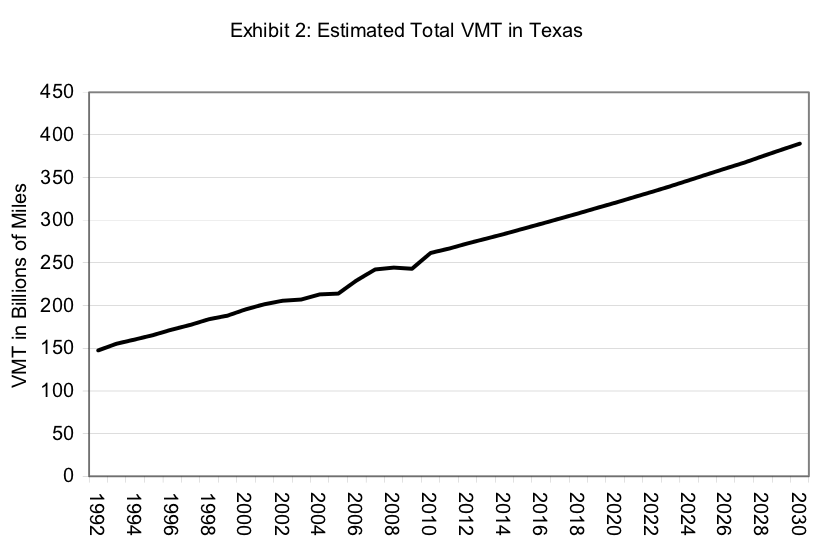
In May 2010 Dr David Ellis of TTI appeared before a joint meeting of two top transportation-related committees of the Texas Senate to explain why Texas travel volume will always keep rising, much as it did before 2005. And to argue that future road demand will continue to increase rapidly for decades to come, which implies the need for ever more roads.

Note the similarity between Dr. Ellis’s chart and TxDOT’s VMT charts released about the same time, except in the case of Dr. Ellis’s chart, driving demand is projected to increase even more steadily over time.
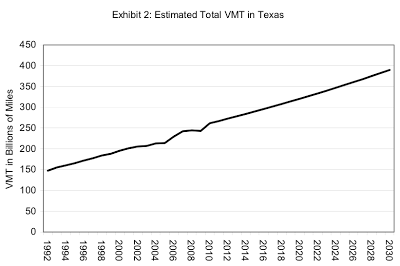

Dr. Ellis’s argument is that while Texas may have seen slight decreases in driving before, that these are exceptional and momentary blips, after which the old historic, and presumably normal, increases in vehicles on the road will resume, blind to the rising price of fuel.

The steady increase in driving seen during the decades of cheap oil before 2005 should thus be accepted as the normal situation, and as a proper guide to future spending on roads in Texas (see Exhibit 2 of his report).

Part of Dr. Ellis’s conclusion is based on the theory that vehicle fuel efficiency is increasing much faster than probably is the case. While it is true that the U.S. has been using a lot less petroleum since 2007, this is probably in large part due to the fact that the public driving is less.
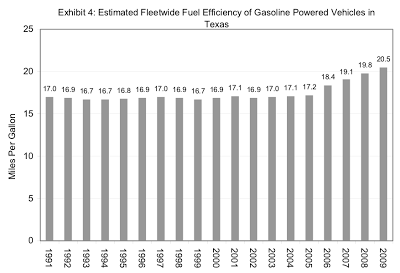

The reality is that while average vehicle fuel efficiency is really increasing, it is only happening very slowly. It takes about 10 years for fuel efficiency to increase by 5%, or .5% per year, largely held back by a slow vehicle replacement rate, as Stuart Staniford shows in this chart.

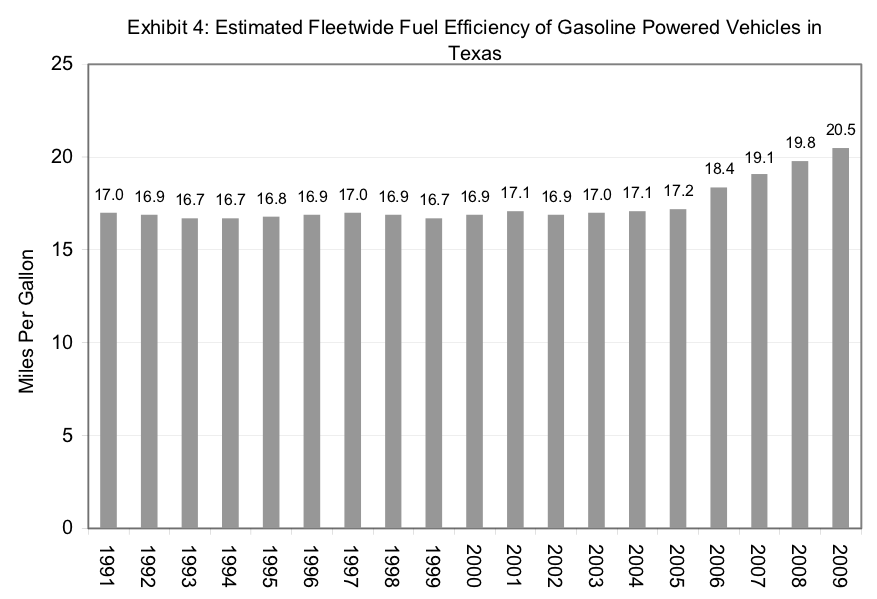
In sharp contrast to this probable rate of vehicle efficiency increase, Dr. Ellis estimates in his chart that vehicle fuel efficiency in Texas has somehow increased from 17.2 MPG in 2005 to 20.5 MPG in 2009 (see Exhibit 4 of his report). This would be a whopping 19% vehicle fuel efficiency increase in just over four years. This is nearly 5% a year, or almost 10 times the much more plausible rate of .5% a year seen above.

Exaggerating the probable increase in fuel efficiency helps the road lobby ignore the current and ongoing stagnation in vehicle miles of travel since the 2007 peak, both in Texas and the USA. The theory seems to be that any time now we will dump our old cars and go out and buy new electric cars, which the road lobby will tax per mile with road user fees. Meanwhile, we are expected to keep driving more and more, just as we did in past decades of cheap oil.


Texas roads are already deteriorating on a large scale

With the Texas road lobby in effective political control of state funding, most of the available road money has been going into building new roads. As they say, there are no ribbon-cutting ceremonies for maintaining existing roads, which in Texas have been deteriorating. As this piece points out, Texas road upkeep is getting lot more expensive, so repairs are falling behind to the point that most Texas roads are in now less than good condition.

Texas’ road conditions

As of 2008, a full 65% of Texas’ state-owned major roads had fallen out of good condition, meaning they will now be increasingly expensive to repair and maintain. Only 34% of Texas’ roads were in good condition, the state in which repairs are least expensive. The condition of 1% of Texas’ state roads was not reported.

Texas’ highway spending priorities

Between 2004 and 2008, Texas spent 62% of its highway capital expenditures on road expansion – $4.1 billion each year on average — but only 11% on repair and maintenance of existing roads — $692 million. That 62% of spending on expansion added 2,962 lane-miles to the Texas road network.

Texas would need to spend $4.5 billion annually for the next 20 years to get the current backlog of poor-condition major roads into a state of good repair and maintain all state-owned roads in good condition. Shifting more funds toward repair would go a long way toward addressing the state’s maintenance needs.

Cartoon from Korea Times.

The Texas road lobby’s funding solution:
the Mileage-Based User Fee (MBUF)

Given the TTI’s faith in the need to build more roads to accommodate an ever-increasing level of road demand, combined with an increasing inability of the fuel tax to meet the funding gap, it is easy to conclude that a lot more road funding revenue will be needed.

Anything to avoid seriously dealing with the basic need to shift transportation policy toward more energy-efficient compact urban development sometimes called smart growth, together with a new focus on public transportation.

The road lobby’s basic conclusion is that Texas now needs to move toward some kind of vehicle mileage tax or fee, and raise a lot more money per vehicle mile driven. However any kind of new tax or fee that extracts more total money from already financially stressed drivers is going to be widely unpopular. Since the word “tax” is already quite unpopular in Texas, other terms are being used such — as a “Mileage-Based User Fee.” Alternative terms being used are “road user charges” or “network tolls.”

A new tax or fee on miles driven is seen as one of the few possible ways to raise enough new money to keep the road-building game going. However this method of funding expanded road capacity ignores the effect that rising fuel prices are having by already reducing total per capita driving. It is becoming a matter of what the driver market will bear, given that driving is now in decline both nationally and in Texas due to the rising cost of fuel on top of a stagnant economy. But TTI sees little alternative.

TTI Leads Mileage-Based User Fee Conference, June 20, 2011

Some 115 federal, state and local government representatives, transportation system users, private-sector representatives, and transportation researchers attended the Symposium on Mileage-Based User Fees (MBUF) in Colorado, June 13-14. That represents a 60 percent increase over last year’s attendance.

MBUFs, also known as vehicle miles traveled (VMT) fees, would raise funds based on how many miles a motorist drives. Revenue generated would replace or supplement the inadequate fuel tax, which comes from each gallon of gas sold at the fuel pump.

“Although the idea of a road-user fee to replace or supplement the fuel tax has been discussed and researched at varying degrees for about a decade now, interest is really growing at the state and national levels,” says symposium co-chair Ginger Goodin, of the Texas Transportation Institute (TTI). Goodin is currently serving as principal investigator for a USDOT study on road-user fee collection technologies and is TTI’s resident expert on the topic.

The Texas Transportation Commission (TTC), at its Dec. 15, 2010 meeting, took a look at a variety of road user fees in a presentation given by TTI.

The Texas Transportation Institute reviewed its draft report, “Is Texas Ready For Mileage Fees?” which asserted that fuel consumption will continue to decrease and make a gas tax an unsustainable revenue generation method in the upcoming decade.

This fact — combined with increasingly fuel-efficient and alternative-fuel vehicles and the $315 billion in funding needs for Texas transportation identified by the Texas 2030 Committee — demonstrates the inadequacy of the fuel tax as a viable long-term funding mechanism for maintaining and expanding highways in the Lone Star State,

the report read.

The Legislature required Transportation Commissioners to take a look at the viability of a Vehicle Miles-Traveled (VMT) tax, which would rely on either on-board devices or remote-tracking systems to measure the number of miles each registered vehicle travels, and then tax vehicle owners accordingly. No formal action was taken.

As a part of their background preparation for the TTC, TTI had set up a number of focus groups with average citizens to try to anticipate public reaction to road user fees. As the reader may easily imagine, new road user fees proved to be quite unpopular — “negative reaction to mileage fees heard raised were pretty consistent across the focus groups”

Even though different focus groups in different areas all had these concerns (privacy, cost, and enforcement), in some groups privacy was more prevalent and in other groups it was cost.

Where is the Texas road funding deficit headed from here?

Given the current political climate and budget constraints, the chances of the Texas road lobby actually implementing the proposed mileage taxes or fees seems highly unlikely. This is simply because the amount of new revenue thought to be necessary would require the imposition of much higher user or driver fees than are now being collected through the current Texas gas tax. This totals about 40 cents a gallon, — about half state and half federal.

However, the federal portion of this funding is in trouble since the feds have long been spending beyond their means. It appears that federal road funding must now shrink dramatically.

The Highway Trust Fund, based as it is on gas tax revenues, is the main revenue source for state and local transportation funding, special programs, and MPO planning funds. The gas taxes bring in about $35 billion annually, explained Beaudry, but the feds have been spending about $27 billion more than that, drawing upon revenues from other sources.

The crux of the Congressional debate swirls around “House Rule 21,” which says they can’t spend more than they bring in (in gas taxes), which means cutting more than a third of the transportation bill. There is disagreement over three options — raise the gas tax, dramatically cut spending or find new revenue sources.

In essence, a new and less costly approach to maintaining urban mobility than road-building-as-usual is needed pretty soon. The economics of driving is likely to play out this way: we will probably see much higher oil prices by next year, with $4.50 a gallon gasoline now anticipated.

Goldman-Sachs, Morgan Stanley, and Barron’s issued reports last week forecasting that oil prices will be much higher next year because of a stagnant supply situation. Goldman is saying the Saudis do not have nearly as much reserve capacity as Riyadh and the IEA claim and forecast oil at $140 a barrel next year. Barron’s is talking about oil reaching $150 next spring with spikes to $160 and $170 a barrel. Gasoline will be in the vicinity of $4.50 a gallon.

Just try to imagine the political challenge of the road lobby trying to impose miles driven fees on top of these fuel prices! But even this situation will probably not be enough to break through the current public denial relating to the unsustainability of driving as we have in the past.

To really break through our denial it may take $10 a gallon gasoline, as prominent peak oil policy analyst Tom Whipple has recently speculated:

Even weeks of 100 degree temperatures or even $4, $5, or $6 gasoline is unlikely to shift many prejudices in the short term. It is going to take a more severe shock — say food shortages or $10 plus gasoline — to shake the notion that a return to life as we knew it is still possible.

[Roger Baker is a long time transportation-oriented environmental activist, an amateur energy-oriented economist, an amateur scientist and science writer, and a founding member of and an advisor to the Association for the Study of Peak Oil-USA. He is active in the Green Party and the ACLU, and is a director of the Save Our Springs Association and the Save Barton Creek Association in Austin. Mostly he enjoys being an irreverent policy wonk and writing irreverent wonkish articles for The Rag Blog. Read more articles by Roger Baker on The Rag Blog.]

The Rag Blog

Posted in Rag Bloggers | Tagged , , , , , , | 3 Comments

Roger Baker : The Texas Road Lobby Meets Peak Oil


image from New Traffic Builder

Coming soon:
Peak oil, peak driving, peak cars

Part IV: The Texas road lobby meets peak oil.

By Roger Baker / The Rag Blog / July 28, 2011

[This is the fourth and final part of a series by Roger Baker on transportation, centering on the issue of peak oil and its ramifications.]

The ‘Pentagon of Texas’

Molly Ivins once called TxDOT (Texas Department of Transportation) “the Pentagon of Texas.” The political clout of TxDOT and the Texas road lobby operating on the state level is still unrivaled.

Inside Texas, TxDOT has held a politically powerful position for many decades, with the help of its traditional political allies like the Texas Good Roads Transportation Association, which was the political base for businesses and civic clubs that might benefit from local application of road money, and the Associated General Contractors, essentially an alliance of private road contracting companies, rather analogous to the defense industry. The contractors gained their institutional power decades ago, when TxDOT stopped building very many roads on its own.

From its earliest days, the Texas Highway Commission, as it was known before it became TxDOT, has been a highly political institution ready to pass out favors to its political allies in the form of road contracts. This snip is taken from an especially scholarly study devoted to the early politics of TxDOT.

It’s more than likely that the conditions of these highways can be seen as a direct legacy of years of county authority and political struggle for control of the department. After all, since its founding in 1917 the Texas Highway Department has, as often as not, been forced to make decisions based on political considerations. Issues such as traffic density and the proportional allocation of funds were often secondary to the job of protecting revenue or just getting roads built.

In Texas, roads gradually became seen as a traditional form of publicly funded entitlement; a kind of welfare to subsidize suburban sprawl development in a heavily urbanized and rapidly growing state.

The way politics works in Texas, there is a traditional alternative to political bribes. Instead, the special interests channel money to Texas politicians through campaign contributions. Quite in line with this approach, the biggest road contractors in Texas contributed over $1 million to Texas Gov. Rick Perry during his first term in office. Later they gave more millions to other Texas politicians.

Since the state solicited its first bids for a leg of the TTC project in 2003, private companies that have landed lucrative TTC contracts have contributed $3.4 million to Texas candidates and political committees — a significant increase in their political activity. TTC contractors also have spent up to $6.1 million on Texas lobbyists since the state solicited their respective bids. While the TTC contains windfalls for some contractors, lobbyists and elected officials, the benefits to Texas motorists and taxpayers are much less clear.

A few years ago, when the late Ric Williamson chaired the Texas Transportation Commission, it became apparent that fuel tax revenues could not possibly keep up with TxDOT’s accustomed pace of road building. Working with Gov. Rick Perry, Williamson ordered TxDOT to try to shift all its new construction to “public-private partnership” toll roads to leverage TxDOT’s limited public funds.

In order to sell private investors on toll road bonds, it is obviously helpful to try to maintain that road demand will keep increasing for decades until the bonds are finally paid off (some toll road bonds, like some issued for US 290 E, pay junk bond rates, but are uninsured against default). The policy is to try to use private toll road bond funding and also federal loans to supplement TxDOT’s traditional but stagnant gas tax revenue, in order to bridge the revenue gap and keep building roads.

As is the case with Indiana Gov. Mitch Daniels, Texas governor Rick Perry is a highway booster. “The highways of Texas are built and paved in part by paths of gold leading to the Texas Governor’s Mansion,” political reporter R.G. Ratcliffe wrote in the Aug. 30, 2002, edition of the Houston Chronicle, in “Highway plans bring money to politicians.”

The political clout of the Texas road lobby still exceeds that of the various competing social needs such as education. TxDOT’s long range road planning policy still stubbornly reflects the same outlook, which involves working hard to perpetuate the notion of ever-expanding growth in future road demand.

However, as the federal data clearly shows, Texas travel is currently falling short of TxDOT’s vehicle travel growth projections, due to a combination of higher fuel prices, a poor economy, an aging population, congestion fatigue, and changing driving behavior, also seen nationally.

The Texas road lobby today

The latest incarnation of the Texas road lobby is arguably Transportation Advocates of Texas (TAoT). A sort of who’s who of current Texas road politics, clearly organized by special interest money. Scroll down to the bottom to see a long list of those interests currently involved in promoting roads — largely banking, construction, engineering, road contracting, and land development interests.

Those familiar with Austin’s federally sanctioned Metropolitan Planning Organization, CAMPO, will see the last two CAMPO directors, Mike Aulick and Joe Cantalupo, listed among members of the road lobby’s supporters.

This snip from an internal document of this same group, TAoT, recently circulated to its supporters, clearly shows that their primary political goal is to get more road money, despite the relatively falling gas tax revenue:

The Great Outstanding Issue: Texas has yet to identify a stable source of additional revenue that can meet the transportation needs of a rapidly expanding population. Fuel efficiency and hybrid vehicles reduce gas tax revenue — and the state fuel tax hasn’t changed in 20 years. Whether it is through taxes, fees, tolls or other sources of revenue, further delays in providing additional financing will inevitably result in more traffic congestion.

By one estimate we under-fund roads by $8 billion a year. The problem will only get worse. Congestion will get worse. Economic losses will get worse. Rural connectivity will get worse. Road conditions and road safety will get worse. And the cost associated with doing nothing means one day the price tag will be worse.

Only roads are mentioned; TxDOT and the road lobby don’t do much transit, except by TxDOT passing federal transit funds down to the local level. Even while admitting that the road funding situation is getting worse with no relief in sight, the focus remains strongly on building roads, as spelled out in this editorial by two top TAoT road lobbyists.

But we are not without solutions. The gas tax hasn’t been increased in 20 years — and its buying power has significantly diminished due to inflation. Vehicle registration fees could be raised and dedicated to high-priority projects. Allowing local officials to access a portion of the gas tax or other sources of revenue would also provide relief. And we can support ending the diversion of highway dollars to spending on other priorities.

The Texas road lobby selects data that
always predicts increasing road travel demand

The Texas road lobby seeks to keep building roads which benefit not only the road contractors, but also the powerful Texas suburban land developers who thrive by planning ever-expanding rings of suburban sprawl around the major metropolitan areas of Texas, a pattern typical of other sunbelt states.

By 2005, about 86% of the Texas population was living in its urbanized areas with only 14% living in the rural areas. Suburban sprawl development has long been made profitable by buying and developing land in the suburban fringe areas. These areas often escape city taxes, but require the help of publicly funded highways to help stimulate development.

This road-assisted urban development formula worked for decades, but it is based on unsustainable trends. Anyone can now see from the federal data that the total travel demand on Texas roads has been flat since about 2007. Here are the yearly VMT numbers for total travel in Texas in millions of miles on state’s roads as measured by the Federal Highway Administration. See for example the 2007 link.

2004 — 231,008
2005 — 235,170
2006 — 238,256
2007 — 243,443
2008 — 235,382
2009 — 230,411

Unfortunately, this useful yearly data series for Texas road travel stopped in 2009. However, using this series we can compare the five most recent Februarys of Texas driving; here again, we can see that the Texas VMT road travel data have continued to stagnate or decrease, on through the most recently reported data:

Feb. 2007 — 17,893
Feb. 2008 — 18,831
Feb. 2009 — 18,953
Feb. 2010 — 18,490
Feb. 2011 — 17,635

Given the nature of road politics in Texas, it comes as no surprise that TxDOT’s long range plan released in May 2010 anticipates a travel demand growth of about 2.44% a year, for decades into the future, as a basis for TxDOT planning. As TxDOT says, “The new Statewide Long-Range Transportation Plan 2035 (SLRTP) will serve as the state’s 24-year “blueprint” for the planning process.

TxDOT’s “Statewide Long-Range Transportation Plan 2035,” released in mid-2010, tries to ignore the current flatness in travel demand as something exceptional and abnormal. It assumes that vehicle miles traveled will somehow recover and then continue to rise steadily as a straight line for decades to come, much as it did before 2005.

The TxDOT long range planners are unable to explain the sharp falloff in traffic volume seen to begin about 2005 — with Texas road travel peaking in 2007 — and now continuing through the most recent data in 2011, or about six years now.

Since the Texas travel data is collected and published by the Federal Highway Administration, the continuing stagnation or decline in vehicle miles traveled on Texas roads is hard for TxDOT to deny. This well-documented reality has caused TxDOT to insert the strange flattened VMT section in the middle of their otherwise ever-ascending long range travel demand chart.

The reality is also that car registrations in Texas peaked in 2005 and then flattened and decreased slightly until 2009, where the most recent FHWA data ends. This data is given in thousands of car (light vehicle) registrations in Texas, 2004-2009, here seen peaking in 2005:

2004 — 8,620
2005 — 8,793
2006 — 8,689
2007 — 8,680
2008 — 8,711
2009 — 8,711

The Texas Road Lobby’s think tank,
the Texas Transportation Institute (TTI)

The Texas road lobby has its own nationally prominent think tank, the Texas Transportation Institute (TTI) based at Texas A&M. TTI functions more or less as an academic wing of the road lobby, implicitly denying peak oil, while focusing primarily on expanding road capacity as the best way to preserve mobility and serve future transportation needs. The TTI outlook on urban traffic congestion and congestion relief — through building more roads for ever more vehicles — is widely disseminated through the media as their main approach to transportation planning policy.

Over the past year, TTI experts answered tough questions on a variety of state and national transportation issues. Over 2,500 newspaper articles, broadcast television spots and professional journals — with a potential reach of over 725 million readers and viewers nationwide — mentioned the Institute or its experts.

For the Texas road lobby to contemplate that the total amount of driving inside the USA may never again exceed the peak reached in 2007, either in Texas or nationally, is considered a heresy.

As the charts show, the TTI and TxDOT claim to be able to predict the future numbers of drivers, and the future road demand, thus implying the need to keep expanding road capacity for decades into the future. (Note: car ownership peaked worldwide in 2004.)

The TTI works hard to help us ignore the fact that people are actually driving less, in large part because of higher fuel costs combined with a decreasing family budget. Other factors include an increasing level of rush hour congestion seen in most large U.S. cities as a normal consequence of their growing population.

At the same time, TTI concludes that Texans will always be willing and able to keep driving more, as they have in the past, by means of a transition to more fuel efficient or electric vehicles. This would of course justify the continued building of ever more new roads by the private road contractors.

Since fuel tax revenue has been stagnant compared to the rate of inflation, TxDOT’s gas tax revenue has effectively been decreasing. From the standpoint of road lobby politics, the political path of least resistance is for the road lobby to try to claim that demand for new road capacity will always keep growing as fast as it has in the past.

The road lobby also has an interest in trying to maintain that the increasing fuel efficiency of vehicles is more important than changing driving behavior, thus causing fuel taxes to continue falling short of the funding needed to meet the projected increase in road demand.

In May 2010 Dr David Ellis of TTI appeared before a joint meeting of two top transportation-related committees of the Texas Senate to explain why Texas travel volume will always keep rising, much as it did before 2005. And to argue that future road demand will continue to increase rapidly for decades to come, which implies the need for ever more roads.

Note the similarity between Dr. Ellis’s chart and TxDOT’s VMT charts released about the same time, except in the case of Dr. Ellis’s chart, driving demand is projected to increase even more steadily over time.


Dr. Ellis’s argument is that while Texas may have seen slight decreases in driving before, that these are exceptional and momentary blips, after which the old historic, and presumably normal, increases in vehicles on the road will resume, blind to the rising price of fuel.

The steady increase in driving seen during the decades of cheap oil before 2005 should thus be accepted as the normal situation, and as a proper guide to future spending on roads in Texas (see Exhibit 2 of his report).

Part of Dr. Ellis’s conclusion is based on the theory that vehicle fuel efficiency is increasing much faster than probably is the case. While it is true that the U.S. has been using a lot less petroleum since 2007, this is probably in large part due to the fact that the public driving is less.


The reality is that while average vehicle fuel efficiency is really increasing, it is only happening very slowly. It takes about 10 years for fuel efficiency to increase by 5%, or .5% per year, largely held back by a slow vehicle replacement rate, as Stuart Staniford shows in this chart.

In sharp contrast to this probable rate of vehicle efficiency increase, Dr. Ellis estimates in his chart that vehicle fuel efficiency in Texas has somehow increased from 17.2 MPG in 2005 to 20.5 MPG in 2009 (see Exhibit 4 of his report). This would be a whopping 19% vehicle fuel efficiency increase in just over four years. This is nearly 5% a year, or almost 10 times the much more plausible rate of .5% a year seen above.

Exaggerating the probable increase in fuel efficiency helps the road lobby ignore the current and ongoing stagnation in vehicle miles of travel since the 2007 peak, both in Texas and the USA. The theory seems to be that any time now we will dump our old cars and go out and buy new electric cars, which the road lobby will tax per mile with road user fees. Meanwhile, we are expected to keep driving more and more, just as we did in past decades of cheap oil.

Texas roads are already deteriorating on a large scale

With the Texas road lobby in effective political control of state funding, most of the available road money has been going into building new roads. As they say, there are no ribbon-cutting ceremonies for maintaining existing roads, which in Texas have been deteriorating. As this piece points out, Texas road upkeep is getting lot more expensive, so repairs are falling behind to the point that most Texas roads are in now less than good condition.

Texas’ road conditions

As of 2008, a full 65% of Texas’ state-owned major roads had fallen out of good condition, meaning they will now be increasingly expensive to repair and maintain. Only 34% of Texas’ roads were in good condition, the state in which repairs are least expensive. The condition of 1% of Texas’ state roads was not reported.

Texas’ highway spending priorities

Between 2004 and 2008, Texas spent 62% of its highway capital expenditures on road expansion – $4.1 billion each year on average — but only 11% on repair and maintenance of existing roads — $692 million. That 62% of spending on expansion added 2,962 lane-miles to the Texas road network.

Texas would need to spend $4.5 billion annually for the next 20 years to get the current backlog of poor-condition major roads into a state of good repair and maintain all state-owned roads in good condition. Shifting more funds toward repair would go a long way toward addressing the state’s maintenance needs.

The Texas road lobby’s funding solution:
the Mileage-Based User Fee (MBUF)

Given the TTI’s faith in the need to build more roads to accommodate an ever-increasing level of road demand, combined with an increasing inability of the fuel tax to meet the funding gap, it is easy to conclude that a lot more road funding revenue will be needed.

Anything to avoid seriously dealing with the basic need to shift transportation policy toward more energy-efficient compact urban development sometimes called smart growth, together with a new focus on public transportation.

The road lobby’s basic conclusion is that Texas now needs to move toward some kind of vehicle mileage tax or fee, and raise a lot more money per vehicle mile driven. However any kind of new tax or fee that extracts more total money from already financially stressed drivers is going to be widely unpopular. Since the word “tax” is already quite unpopular in Texas, other terms are being used such — as a “Mileage-Based User Fee.” Alternative terms being used are “road user charges” or “network tolls.”

A new tax or fee on miles driven is seen as one of the few possible ways to raise enough new money to keep the road-building game going. However this method of funding expanded road capacity ignores the effect that rising fuel prices are having by already reducing total per capita driving. It is becoming a matter of what the driver market will bear, given that driving is now in decline both nationally and in Texas due to the rising cost of fuel on top of a stagnant economy. But TTI sees little alternative.

TTI Leads Mileage-Based User Fee
Conference, June 20, 2011

Some 115 federal, state and local government representatives, transportation system users, private-sector representatives, and transportation researchers attended the Symposium on Mileage-Based User Fees (MBUF) in Colorado, June 13-14. That represents a 60 percent increase over last year’s attendance.

MBUFs, also known as vehicle miles traveled (VMT) fees, would raise funds based on how many miles a motorist drives. Revenue generated would replace or supplement the inadequate fuel tax, which comes from each gallon of gas sold at the fuel pump.

“Although the idea of a road-user fee to replace or supplement the fuel tax has been discussed and researched at varying degrees for about a decade now, interest is really growing at the state and national levels,” says symposium co-chair Ginger Goodin, of the Texas Transportation Institute (TTI). Goodin is currently serving as principal investigator for a USDOT study on road-user fee collection technologies and is TTI’s resident expert on the topic.

The Texas Transportation Commission (TTC), at its Dec. 15, 2010 meeting, took a look at a variety of road user fees in a presentation given by TTI.

The Texas Transportation Institute reviewed its draft report, “Is Texas Ready For Mileage Fees?” which asserted that fuel consumption will continue to decrease and make a gas tax an unsustainable revenue generation method in the upcoming decade.

This fact — combined with increasingly fuel-efficient and alternative-fuel vehicles and the $315 billion in funding needs for Texas transportation identified by the Texas 2030 Committee — demonstrates the inadequacy of the fuel tax as a viable long-term funding mechanism for maintaining and expanding highways in the Lone Star State,

the report read.

The Legislature required Transportation Commissioners to take a look at the viability of a Vehicle Miles-Traveled (VMT) tax, which would rely on either on-board devices or remote-tracking systems to measure the number of miles each registered vehicle travels, and then tax vehicle owners accordingly. No formal action was taken.

As a part of their background preparation for the TTC, TTI had set up a number of focus groups with average citizens to try to anticipate public reaction to road user fees. As the reader may easily imagine, new road user fees proved to be quite unpopular — “negative reaction to mileage fees heard raised were pretty consistent across the focus groups”

Even though different focus groups in different areas all had these concerns (privacy, cost, and enforcement), in some groups privacy was more prevalent and in other groups it was cost.

Where is the Texas road funding deficit headed from here?

Given the current political climate and budget constraints, the chances of the Texas road lobby actually implementing the proposed mileage taxes or fees seems highly unlikely. This is simply because the amount of new revenue thought to be necessary would require the imposition of much higher user or driver fees than are now being collected through the current Texas gas tax. This totals about 40 cents a gallon, — about half state and half federal.

However, the federal portion of this funding is in trouble since the feds have long been spending beyond their means. It appears that federal road funding must now shrink dramatically.

The Highway Trust Fund, based as it is on gas tax revenues, is the main revenue source for state and local transportation funding, special programs, and MPO planning funds. The gas taxes bring in about $35 billion annually, explained Beaudry, but the feds have been spending about $27 billion more than that, drawing upon revenues from other sources.

The crux of the Congressional debate swirls around “House Rule 21,” which says they can’t spend more than they bring in (in gas taxes), which means cutting more than a third of the transportation bill. There is disagreement over three options — raise the gas tax, dramatically cut spending or find new revenue sources.

In essence, a new and less costly approach to maintaining urban mobility than road-building-as-usual is needed pretty soon. The economics of driving is likely to play out this way: we will probably see much higher oil prices by next year, with $4.50 a gallon gasoline now anticipated.

Goldman-Sachs, Morgan Stanley, and Barron’s issued reports last week forecasting that oil prices will be much higher next year because of a stagnant supply situation. Goldman is saying the Saudis do not have nearly as much reserve capacity as Riyadh and the IEA claim and forecast oil at $140 a barrel next year. Barron’s is talking about oil reaching $150 next spring with spikes to $160 and $170 a barrel. Gasoline will be in the vicinity of $4.50 a gallon.

Just try to imagine the political challenge of the road lobby trying to impose miles driven fees on top of these fuel prices! But even this situation will probably not be enough to break through the current public denial relating to the unsustainability of driving as we have in the past.

To really break through our denial it may take $10 a gallon gasoline, as prominent peak oil policy analyst Tom Whipple has recently speculated:

Even weeks of 100 degree temperatures or even $4, $5, or $6 gasoline is unlikely to shift many prejudices in the short term. It is going to take a more severe shock — say food shortages or $10 plus gasoline — to shake the notion that a return to life as we knew it is still possible.

[Roger Baker is a long time transportation-oriented environmental activist, an amateur energy-oriented economist, an amateur scientist and science writer, and a founding member of and an advisor to the Association for the Study of Peak Oil-USA. He is active in the Green Party and the ACLU, and is a director of the Save Our Springs Association and the Save Barton Creek Association in Austin. Mostly he enjoys being an irreverent policy wonk and writing irreverent wonkish articles for The Rag Blog. Read more articles by Roger Baker on The Rag Blog.]

Source

The Rag Blog

Posted in RagBlog | Leave a comment

Ed Felien : Is the Terror in Norway an Isolated Act?

Political cartoon by Paolo Lombardi / toonpool.

The parallels are ominous:
Terror in Norway

There are organizations that support the ideas of McVeigh and Breivik, and there is a culture that supports murder and violence as legitimate means to realize those ends.

By Ed Felien / The Rag Blog / July 28, 2011

On Friday, July 25, Anders Breivik, a right-wing Christian fundamentalist who hated Muslims, set off a bomb in downtown Oslo destroying a building that contained the office of Jens Stoltenberg, the Labor Party prime minister, killing eight people.

He then took a 20 minute ferry to an island where the Labor Party held a summer camp for young people. Wearing a police sweater, he told some of the young people that he wanted to talk to them about the bombing and then opened fire and shot them at point blank range. He killed 68 before the police arrived and he surrendered.

Until recently, Breivik was an active member of the Progress Party. With 41 seats it is the second largest party in Parliament after the Labor Party. The party tripled its support in 1987 when the leader at that time, Carl Hagen, told his supporters, “The asylum seekers are on their way to take over our fatherland,” and read from a letter supposedly from a Muslim, which said, “This country will be Muslim! We give birth to more children than you, and several true-believing Muslims arrive in Norway every year, men in productive age. One day the infidel cross in the flag shall also go away!”

The so-called Mustafa letter was proven in court to be a fraud, but it had its desired effect in galvanizing anti-immigrant sentiment.

The 2009 national election was quite dramatic. It looked for a while that the Labor Party would lose after ruling Norway for over 60 years, but the Progress Party got into arguments with its coalition partners and looked confused, and voters lost confidence in their capacity to govern. In the end the Labor Party was able to put together a coalition of socialists and progressives that formed a government.

This defeat was a heavy blow to Breivik, and in his manifesto he denounced members of this party as “politically correct career politicians” who were not prepared to “take risks and work for idealistic goals.”

The model for Breivik must have been Hitler’s Beer Hall Putsch in 1923. With a gang of about 600 thugs in SA uniforms, Hitler was able to take over a right-wing meeting of about 2,000 people in a beer hall in Munich. Using the threat of violence to hold his audience (he had a machine gun trained on the door) Hitler won over the audience with his extemporaneous speech about how Germany had been betrayed by the liberal Weimar government, by the Treaty of Versailles and by the international Jewish conspiracy.

They marched on the Bavarian Defense Ministry and were stopped by about a hundred state police officers. A gunfight began and four police officers and 16 Nazis were killed.

Hitler was arrested, tried, and sentenced to five years and given a small fine. He served eight months in a comfortable cell where he received visitors and wrote Mein Kampf. Breivik took no chances and wrote his Mein Kampf, the 1516 page manifesto “2083: A European Declaration of Independence,” before he acted.

The putsch and trial gave Hitler what he needed — a platform on which to address the German nation. On Jan. 30, 1933, President Hindenburg appointed Adolf Hitler chancellor of Germany. Less than a month later the Reichstag was set on fire.

Most scholars now agree that Hitler’s group talked a Dutch communist into setting the fire so Hitler and Goring could use that as an excuse to murder communists and socialists. Almost the first three-quarters of Mein Kampf is about how the communists and socialists had betrayed Germany and how they must be punished severely. Only the last quarter of the book talks about Jews.

From 1933 to 1938 the Nazis rounded up leftists and either murdered them outright or sent them to concentration camps. Only after Kristallnacht on Nov. 9, 1938, did the Nazis begin to round up the Jews.

Breivik writes about the Islamification of Europe, but he targets first the left. He deliberately set out to murder the next generation of leaders of the Labor Party, and what took truckloads of Nazi stormtroopers months to accomplish, Breivik did in 90 minutes.

Can it happen here?

It already did, and it was much worse.

Timothy McVeigh blew up the federal building in Oklahoma City on April 19, 1995, and killed 168 people. He claimed the bombing was in retaliation for the federal government raid on the Waco religious commune that ended in the deaths of 55 adults and 21 children. McVeigh went to gun shows and was certain the government wanted to take away his right to bear arms. His conservative views on morality and taxes would strongly resonate with Breivik and the Norwegian Progress Party.

He wrote a letter to a local newspaper in 1992:

Taxes are a joke. Regardless of what a political candidate “promises,” they will increase. More taxes are always the answer to government mismanagement. They mess up. We suffer. Taxes are reaching cataclysmic levels, with no slowdown in sight. […] Is a Civil War Imminent? Do we have to shed blood to reform the current system? I hope it doesn’t come to that. But it might.

The book he considered his bible was The Turner Diaries by William Luther Pierce, the former leader of the white nationalist organization National Alliance. The book calls for a violent revolution by the far right that eventually leads to the extermination of all Jews and non-whites.

Are McVeigh and Breivik madmen acting alone, or are they part of a movement?

Do their basic ideas have currency in mass organizations?

Consider what Alan Keyes in “Declaration Alliance” says:

Realization must come that we are locked in a clash of momentous import, between America’s future course being set as socialist big government on the one hand, or restrained smaller government on the other.”

Consider the racial hatred embedded in the mass e-mailing from MinutemanHQ.com:

Enough is enough! The line has to be drawn! The invasion of America has to end! Justice has to be done for all the good, honest, Americans who have been killed, raped, kidnapped, stolen from, and abused by criminal illegal immigrants! American sovereign territory must be DEFENDED and HELD SECURE!! THE HOUR IS LATE, MAKE THEM HEAR US — it is the right thing to do!

Consider a MoveOn picnic disrupted by Tea Party thugs. One woman reported:

So, about 20 little old ladies, like me, gathered in a public park in Oregon to have a picnic and a meeting.

They were then run off by a group of Tea Party activists, led by the local head of Americans for Prosperity. They retreated to a private dwelling, but the teabaggers followed them there, and had to be stopped from trespassing on private property. The police conveniently contacted the group two hours later to find out if the cops were still needed.

And these stupid tea baggers, instead of understanding that you cannot “free America” and “stop socialism” by denying people the right to gather in a public park, proudly posted the video on YouTube like they’d done a great thing.

There are organizations that support the ideas of McVeigh and Breivik, and there is a culture that supports murder and violence as legitimate means to realize those ends. The violence in movies, on television, and in popular song is pervasive and addictive. The adrenalin thrill of video games is simulation training for actual combat.

Breivik wrote in his journal in February 2010 that he “just bought Modern Warfare 2, the game.” He says it’s “probably the best military simulator out there. You can more or less completely simulate actual operations.”

But more than anything else, the wars against Iraq, Afghanistan, Pakistan, Yemen, and Somalia fuel the violence and the xenophobia. We are at war with the Muslim world, no matter how much our government denies it. And this war allows us to hate and fear Muslims and Arabs, and this makes it easier to hate and fear Mexicans because they may want to steal our jobs. We want the government to do something about it, and when they don’t solve the problem right away, they’re weak at best and traitors at worst.

These are the conditions that went before the Beer Hall Putsch, before Mussolini’s March on Rome, before Franco’s march on Madrid. Our wars abroad can easily lead to wars at home:

It seems ironic and hypocritical that an act viciously condemned in Oklahoma City is now a ‘justified’ response to a problem in a foreign land. Then again, the history of United States policy over the last century, when examined fully, tends to exemplify hypocrisy.

“When considering the use of weapons of mass destruction against Iraq as a means to an end, it would be wise to reflect on the words of the late U.S. Supreme Court Justice Louis Brandeis. His words are as true in the context of Olmstead as they are when they stand alone: ‘Our government is the potent, the omnipresent teacher. For good or for ill, it teaches the whole people by its example.’

— Timothy McVeigh

[Ed Felien is publisher and editor of Southside Pride, a South Minneapolis monthly.]

The Rag Blog

Posted in Rag Bloggers | Tagged , , , , , , , | Leave a comment