Leah Wilson : Imperialist Uses of WikiLeaks

WikiLeaks cables were used by corporate media to defame the government of Salvadoran President Mauricio Funes. Photo from ESAhora.

Wikileaks, El Salvador, and imperialist interests

How corporate media turned a diplomatic crisis into a political advantage for the U.S.

By Leah Wilson / The Rag Blog / December 14, 2010

SAN SALVADOR — Since the “Cablegate” leaks were first announced, I have been championing Wikileaks and Julian Assange as at the forefront of the struggle for government transparency. I considered the release of these cables a major blow to the Empire, exposing the unsavory practices of U.S. foreign policy and its arrogant, hegemonic worldview.

The cables I was reading were mostly just providing proof that the U.S. was consciously doing what we already knew it was doing: legitimizing the Honduran coup despite being fully aware it was an illegal coup d’état, trying to isolate Venezuela and Cuba, pressuring foreign governments to not investigate war crimes in Iraq and Afghanistan, spying on heads of state and foreign functionaries, etc.

And then the first cables that mention El Salvador were published by the Spanish online news source ElPais.com. I was in a San Salvador pizzeria Tuesday night when the TV that had only been background noise up until that point grabbed my attention: “Breaking News: Wikileaks cables call President Funes’ government schizophrenic.”

At the end of November Salvadoran newspapers began reporting that 1,119 of the more than 250,000 cables leaked as part of Cablegate mentioned El Salvador. My friends and I were waiting for the first ones to be published so we could see plain and simple what dirty deeds the U.S. Embassy had been up to in El Salvador.

On Tuesday night, we got our wish, but we should have known to be careful what we wish for. What I saw on the TV news and read in the newspapers was not about the dirty deeds of the U.S. Embassy, but rather outright defamation of the government of President Mauricio Funes and the leftist party that brought him to power, the Farabundo Martí National Liberation Front (FMLN).

The first five cables that were released by ElPais.com, which apparently also has in its hands the other 1,114 cables mentioning El Salvador, are basically political updates sent to the U.S. by Robert Blau, who was the Charge d’Affaires at the U.S. Embassy in San Salvador at the time. In September 2010 President Obama named the new U.S. Ambassador Mari Carmen Aponte and Blau became the Deputy Chief of Mission, continuing as one of the Ambassador’s close advisors.

His memos contain a barrage of false accusations and distortions about the FMLN and its leaders as well as exaggerated declarations about conflict and tensions between President Funes and the FMLN members that are part of his cabinet. To read more analysis about the actual content of the San Salvador cables and their impact, I suggest you read the communiqué put together by the Committee in Solidarity with the People of El Salvador (CISPES).

Overall, the release of the documents has done nothing more than give more ammunition to the Salvadoran right wing in its ongoing attempt to discredit and undermine the Funes administration and the FMLN. As I said to a friend after reading the initial coverage, “Imperialism sure is astute. It managed to transform a major diplomatic crisis into a political advantage.”

Argentine Marxist Néstor Kohan explains in his book Approaches to Marxism that capitalism is incredibly adaptable. It is constantly entering into crises but these crises in themselves never mark the death of capitalism, it simply adapts and bounces back even more voraciously. The same can be said for U.S. imperialism, currently capitalism’s main tool for global expansion.

[While this falls outside the scope of this article, I would like to point out that Kohan isn’t a fatalist but goes on to explain that organized, mass resistance with an alternative proposal (socialism) is the only thing capable of taking capitalism down.]

Imperialism proved adaptable and the major corporate media sources of the world found a way to avert focus from all the information in the cables that incriminates the U.S. — both the Obama administration and past administrations — and channel public attention towards the information that makes the U.S.’s declared and undeclared “enemies” look bad.

To understand how they did this, I will point you to five words that I learned on my first day as a Communications major: “The medium is the message.” What Marshall McLuhan meant when he wrote this phrase that would begin advertising, public relations, and journalism textbooks for decades to come, is that the form in which one presents an idea has more impact than the idea itself. This brings us to how Wikileaks decided to present the more than 250,000 diplomatic leaked cables from around the world.

Wikileaks selected four major international corporate news agencies as the filter for the leaked cables: France’s Le Monde, Spain’s El País, Germany’s Der Spiegel, and Britain’s The Guardian. The Guardian then shared cables with The New York Times, bringing the total number of news agencies to five.

Wikileaks chose not to publish everything on their website so that all the information is transparently available and journalists of all types — independent, establishment, right leaning, left leaning, etc. — could then drudge through it, analyze it, and determine what should be reported on.

Instead, five major newspapers are deciding which cables they want us to see and also formulating the first analysis the public receives about what the content of the chosen cables means, perpetuating corporate media’s domination of information.

Let’s return to the San Salvador cables as an example. El País journalist Maite Rico, who wrote the article about the first five released cables, is well known for using her journalistic platform to undermine the Latin American Left. When she’s not omitting information to make Venezuelan President Hugo Chavez look bad, she’s busy fabricating information about the death of Raúl Reyes, a leader of Colombia’s Revolutionary Armed Forces (FARC).

Her false reporting on the Colombian military attack on a FARC encampment in which Reyes was killed was later used to sully the names of leftist leaders throughout Latin America as guilty by association with the FARC. She also published a book called Marcos: the great imposter that does nothing more than defame the leader of the Mexican Zapatista movement.

The examples of her hostility towards Latin America’s leftist leaders go on and on. And this is the person apparently deciding which leaked U.S. Embassy cables about El Salvador we get to see. No wonder the first five released cables contain opinions of the U.S. Embassy that could potentially damage President Funes and the FMLN’s credibility.

I would like to see the cables sent by the U.S. Embassy during the 2004 Salvadoran presidential campaign, when overt intervention by the Ambassador and the U.S. State Department helped turn a close race between the FMLN’s Shafick Handal and the far-right Nationalist Republican Alliance (ARENA) candidate Tony Saca into a decisive victory for the latter. But I have to wait until El País decides they are worthy of reporting.

I would also like to see the cables sent in 2007, when Salvadoran police trained at the U.S.-run International Law Enforcement Academy (ILEA) violently attacked a peaceful protest against water privatization.

And, of course, it would be informative to read the cables sent during the Salvadoran armed conflict, when the U.S. was “advising” and equipping the repressive Salvadoran military as it carried out civilian massacres. I guess I’ll have to wait for those too. I’m not holding my breath.

As long as Wikileaks is letting mainstream corporate media sources decide which cables we get to see and what we should glean from them, those sources are going to publish information in the interest of maintaining the thing that has served their pocketbooks so well up until now — the status quo.

As David de Ugarte wrote in his editorial for Sociedad de Las indias Electrónicas, “From a state of panic to Wikileaks and why Assange doesn’t make us freer,” “At this moment Assange and WikiLeaks occupy a central role in representing the confluence of interests of media corporations and States. It is true that both groups of power briefly enter in friction… but it is precisely because they converge, not because they diverge.”

It is no surprise that five corporate news agencies would serve imperialist interests. So, why would Assange entrust only them with information that has the potential to undermine those interests? I don’t know. We can all speculate on the answer to that question. I just know that it’s the duty of those of us who support alternative media as a method to emancipate ourselves from corporate control of information to speak up and also examine the cables and analysis coming out with a critical eye.

[Austin native Leah Wilson is a solidarity activist and collaborator with the Committee in Solidarity with the People of El Salvador (CISPES). She lives in El Salvador.]

The Rag Blog

Posted in Rag Bloggers | Tagged , , , , , , , , | 2 Comments

Dave Lindorff : The Strange Case of Interpol’s Red Alert

A supporter of Wikileaks founder Julian Assange holds up a placard outside the City of Westminster Magistrates Court in London. Photo from The Hindu / AP.

UPDATE: A British judge granted bail to WikiLeaks founder Julian Assange on Tuesday, saying he must abide by strict bail conditions as he fights extradition to Sweden in a sex-crimes investigation…

Supporters outside City of Westminster Magistrates’ Court erupted in cheers when they heard news of the judge’s ruling. — AP / NPR / December 14, 2010

Something is rotten:
The strange case of Interpol’s Red Alert
on Julian Assange

By Dave Lindorff / December 13, 2010

The other Interpol Red Alert sought by Swedish prosecutors this year was for Jan Christer Wallenkurtz, a 58-year-old Swedish national wanted on multiple charges of alleged sex crimes and sex crimes against children.

Far be it from me to minimize the issue of rape, but to borrow from the Bard, in the case of the “rape” case being alleged against WikiLeaks founder Julian Assange (technically, Swedish prosecutors say it’s not rape, it’s “sex by surprise”), currently being held in a British jail without bail pending an extradition request from Stockholm: “Something is rotten in Sweden.”

As I wrote earlier, the alleged sexual crimes that Assange is currently being sought for by a Swedish prosecutor are:

1. Allegedly failing to halt an act of consensual sexual intercourse when his sex partner and host, Anna Ardin, claims she somehow became aware that the condom he was using had “split” and,

2. Having consensual sex with a second woman a few days later without informing her that he had just been with Ardin, and then, a day later, allegedly refusing to return a phone call on his cell phone, when she tried to call him to ask him to take an STD test.

(Assange says he had turned off and was not using his phone for fear he was being traced through it, not that refusing to take a call from a woman one recently slept with should be considered criminal. Cold or even cruel, maybe, but not justification for a rape charge!)

In most countries, including the U.S. and UK, these would not pass the test to be considered a crime, much less qualify as a category of “rape,” but Swedish authorities, who in all of this year have only submitted one other request to Interpol for assistance in capturing a sex crimes suspect, asked the international police agency to issue a so-called Red Alert for Assange, who was subsquently asked by police in the UK, where he was staying, to turn himself in or face arrest.

(The other Interpol Red Alert sought by Swedish prosecutors this year was for Jan Christer Wallenkurtz, a 58-year-old Swedish national wanted on multiple charges of alleged sex crimes and sex crimes against children.)

You have to ask, given that Sweden has the highest per-capital number of reported rape cases in Europe, how it can be that only these two suspects — Wallenkurtz and Assange — are brought to Interpol.

You also have to wonder how it is that Assange — charged only with consensual sex “offenses” — is denied bail by a British court magistrate, despite having several people at his arraignment hearing, including a well-known British filmmaker, ready to post whatever bail might be required to assure his return to court for an extradition hearing, while even people charged with aggressive rape are apparently routinely released on bail in both the UK and Sweden.

Here’s an interesting letter that ran in The Guardian in England, authored by Katrin Axelsson, of the British organization Women Against Rape:

Many women in both Sweden and Britain will wonder at the unusual zeal with which Julian Assange is being pursued for rape allegations. Women in Sweden don’t fare better than we do in Britain when it comes to rape. Though Sweden has the highest per capita number of reported rapes in Europe and these have quadrupled in the last 20 years, conviction rates have decreased.

On 23 April 2010 Carina Hägg and Nalin Pekgul (respectively MP and chairwoman of Social Democratic Women in Sweden) wrote in the Göteborgs-Posten that “up to 90% of all reported rapes never get to court. In 2006 six people were convicted of rape though almost 4,000 people were reported.” They endorsed Amnesty International’s call for an independent inquiry to examine the rape cases that had been closed and the quality of the original investigations.


Assange, who it seems has no criminal convictions, was refused bail in England despite sureties of more than £120,000. Yet bail following rape allegations is routine. For two years we have been supporting a woman who suffered rape and domestic violence from a man previously convicted after attempting to murder an ex-partner and her children — he was granted bail while police investigated.


There is a long tradition of the use of rape and sexual assault for political agendas that have nothing to do with women’s safety. In the south of the U.S., the lynching of black men was often justified on grounds that they had raped or even looked at a white woman. Women don’t take kindly to our demand for safety being misused, while rape continues to be neglected at best or protected at worst.

The long arm of the U.S. in this case is hard to miss here.

Especially in view of one of the latest WikiLeaks State Department cables to be disclosed in The New York Times, which in an article on Thursday laid out how the U.S. had strong-armed even the powerful German government into blocking German prosecutors from indicting and requesting the extradition to Germany of 13 CIA agents involved in the illegal kidnapping and renditioning to Bagram prison in Afghanistan of Khaled el-Masri, a German citizen wrongly thought by the CIA to be a terrorist.

El-Masri was kidnapped by these agents in 2003, stripped, bound, placed in an adult diaper with a plug in his rectum, and flown by the CIA to Bagram, where he was repeatedly tortured, sodomized, injected with mind-altering drugs, and held for months, before being simply dropped off by the CIA on an Albanian roadside, after it was determined by the U.S. that a “mistake” had been made.

The U.S. did not want its rendition program and its policy of officially-sanctioned torture disclosed and so it pressed German authorities to drop all prosecution of the agency kidnappers, threatening “the implications for relations with the U.S.” (El-Masri has been barred from suing the U.S. government for damages.)

It strains credulity to believe that the same U.S. government that put such pressure on Germany, a NATO ally, is not behind Swedish prosecutors’ sudden intense interest in this preposterous case of consensual sex and a broken condom — particularly as the initial prosecutor in the case dropped it after learning that the two women, far from being upset following their nights with Assange, had in one case thrown a party for him following the alleged incident, and in the other, left him in her bed while she went out to buy him breakfast.

(Both women reportedly sent twitters to friends bragging about their conquests, messages they later tried to have expunged from the Twitter system).

It also strains credulity to believe that the denial of bail to this particular suspect by a British court — particularly given that he is not charged with any violent act, and has no criminal record — is not the result of behind-the-scenes U.S. pressure.

Indeed, it appears that the U.S. is busy trumping up more serious charges against Assange, with his lawyers saying they are anticipating that the U.S. Justice Department (already reportedly in discussions with Swedish authorities about getting their hands on Assange), is planning soon to charge him under the 1917 Espionage statute, the same law that the Nixon Justice Department tried to use unsuccessfully against Daniel Ellsberg in the Pentagon Papers case. That could explain why efforts are being made to try to keep Assange held in a cell.

It could also explain why Assange is challenging the Swedish extradition request.

Opposition to the Afghan and Irag Wars is intense in the UK and is supported by the overwhelming majority of British citizens, which makes Assange something of a hero in Britain for his WikiLeaks exposes of the ongoing crimes by U.S. and UK forces in those conflicts. British government acquiescence to an extradition order from the U.S. on espionage charges would likely lead to massive opposition by British citizens.

Sweden, on the other hand, which is not a member of NATO, but which has some 500 troops participating in the “NATO” war in Afghanistan, does not face the same kind of popular opposition to its role, and Assange may fear that Sweden, a very small country, could be pressured much more easily to hand Assange over to U.S. authorities, with little resulting fuss from the Swedish public.

Back in the U.S., there has been no move by news organizations to come to Assange’s defense. In fact, the corporate media reaction to this whole issue has been the opposite. For the most part, the Swedish charges, and his arrest in Britain on the basis of the Interpol Red Alert, are reported as being about “rape,” without any explanation of the actual “violations,” which would not even rise to the level of a crime in the U.S.

Meanwhile, most editorial pages are condemning the violation of diplomatic secrecy, not the government’s efforts to shut down a source of important news about government ineptness, malfeasance, and deceit.

Yet if it turns out, as I’m confident it will, that the U.S. government has been the driving force behind both the arrest and imprisonment of Assange, and his extradition to Sweden, and if it turns out, as appears increasingly likely, that the U.S. government has also been behind simultaneous decisions by Visa, MasterCard, Paypal, and several Swiss banks to refuse to handle donations to WikiLeaks, as well as by Amazon, which withdrew Wikileak’s access to its cloud data storage system, and a DNS registry which de-registered WikiLeak’s URL, publishers and broadcasters, and journalists themselves, should be up in arms defending him.

As I wrote earlier, this kind of attack on a news source for purely political reasons is a threat to the First Amendment as profound as the Nixonian attack on Daniel Ellsberg, and the attempt to block The New York Times from publishing his purloined documents about the origins of the Vietnam War.

Andreas Fink, CEO of DataCell ehf, the Swiss company that has been accepting donations on behalf of Wikileaks via Visa, had this to say about the Dec. 8 decision by Visa to cease processing Wikileaks donations:

The suspension of payments towards Wikileaks is a violation of the agreements with their customers. Visa users have explicitly expressed their will to send their donations to Wikileaks and Visa is not fulfilling this wish. It will probably hurt their brand much much more to block payments towards Wikileaks than to have them occur.

Visa customers are contacting us in masses to confirm that they really donate and they are not happy about Visa rejecting them. It is obvious that Visa is under political pressure to close us down. We strongly believe a world class company such as Visa should not get involved by politics and just simply do their business where they are good at. Transferring money.

They have no problem transferring money for other businesses such as gambling sites, pornography services and the like so why a donation to a Website which is holding up for human rights should be morally any worse than that is outside of my understanding.

Contributions can still be made to Wikileaks and to Assange’s defense by wire transfer and by check and ordinary mail. To find out how to contribute, go here.

By the way, if there is anyone out there working for Visa, MasterCard, Paypal, or any banking organization, or in a government office, who can provide me with evidence that the U.S. has been behind the decision of any of those organizations to freeze out WikiLeaks and destroy it financially, I will guarantee your anonymity at all costs. Please contact me or send me documentation.

[Dave Lindorff is a regular columnist for Counterpunch and has also written for such diverse and seemingly mutually exclusive publications as BusinessWeek, The Nation, Extra!, Treasury & Risk, and Rolling Stone. This article first appeared in This Can’t Be Happening and was distributed by Truthout.]

Also see:

The Rag Blog

Posted in RagBlog | Tagged , , , , , , , , | 1 Comment

CONSERVATIVE HEARTLAND TOWN APPRECIATES JOBS PROGRAM

By Harry Targ / The Rag Blog / December 13, 2010

At the east end of town, at the foot of the hill
Stands a chimney so tall that says “Aragon Mill.”
But there’s no smoke at all coming out of the stack.
The mill has shut down and it ain’t a-coming back.

Well, I’m too old to work, and I’m too young to die.
Tell me, where shall we go, My old gal and I?
There’s no children at all in the narrow empty street.
The mill has closed down; it’s so quiet I can’t sleep.

Yes, the mill has shut down; it’s the only life I know
Tell me, where will I go, Tell me, where will I go?
And the only tune I hear, is the sound of the wind
As it blows through the town,
Weave and spin, weave and spin.

— Si Kahn, “Aragon Mill”

President Obamacomes to town

On a cold and sunny Tuesday morning Air Force One flew into the Grissom Air Base just north of Kokomo, Indiana, carrying President Barack Obama and Vice President Joe Biden. Just two days before Thanksgiving the presidential team had programmed a trip to highlight job stimulus successes in this declining factory town in North Central Indiana. Democratic leaders, outgoing Senator Bayh, and Congressman Joe Donnelly were part of a delegation to welcome the visitors.

According to press reports, bigger welcomes than from politicians were noted among Kokomo UAW workers and children from local elementary schools. Kokomo is one of Indiana’s small manufacturing towns dominated by the auto industry (along with Anderson, and Indianapolis).

Kokomo, with a population of only 46,000, houses 10 parts plants operated by General Motors, Chrysler, and Delphi. As recently as 1990 Indiana was ranked tenth in union density, largely due to auto and steel plants around the state. Kokomo’s UAW Local 685 played a pivotal role in the campaign to pressure Indiana Congressmen to vote “no” on NAFTA in 1994.

Because of declining manufacturing and the crisis in the auto industry, unemployment in Howard County (where Kokomo is located) topped out at 20.4 per cent in June, 2009. With the federal program to save the auto industry and various stimulus packages to save local jobs, including Kokomo fire stations, unemployment has been cut to 12.7 per cent. Jerry Price, president of UAW local 685 representing three Chrysler transmission plants pointed out that “The bailout has meant the survival of Kokomo.”

The White House reported that a Recovery Act grant of $89 million helped open a plant to make parts for hybrid vehicles. Also Chrysler invested $300 million in transmission plant renovation leading to the retention of 1,000 jobs. In addition, government funds stimulated the opening of 12 new businesses in the city’s downtown, including Sweet Poppins, a popcorn shop.

Tashia Johnson-St. Clair, the shop’s owner, said the downtown area used to be like a ghost town. After the government funds stimulated new businesses downtown, she said: “It’s absolutely beautiful. It looks like a scene off a TV show.”

The Kokomo Tribune noted in muted terms the general appreciation of Kokomo residents for the government’s job saving and creation programs:

The workers, many of whom undoubtedly voted to end the president’s Democratic House majority two weeks ago, applauded the speech, particularly when both Obama and Biden referenced the news that the American automakers are gaining market share for the first time in 24 years.

Critics of the Obama/Biden visit

Not every Hoosier politician or activist appreciated the presidential visit or the policies it was trumpeting. Governor Mitch Daniels was too busy to attend the Kokomo celebration. Indiana state party chairman Murray Clark said that members of the presidential team “are here today to cherry pick a single success story: at worst, it further proves how out of touch this administration is with an electorate that sent a clear message on Nov. 2.”

Local Tea Party activists condemned Obama’s stimulus policies arguing that businesses should be allowed to fail, rather than “throwing money” at them. (Labor activists have concluded that Kokomo would have been destroyed as a city without the emergency assistance.)

Perhaps the most telling commentary appeared in an editorial in the Lafayette Journal and Courier on Monday, November 29, 2010. It denied that Kokomo’s economic rejuvenation should be seen as an indicator of a more general economic recovery. The editorial reminded readers that Kokomo still had almost 12 per cent unemployment and the state and nation close to 10 per cent unemployment.

The Journal and Courier argued that the accolades and pep talks provided by Obama and Biden were misguided. What the president should have done was to “discuss how he planned to work with a Republican-controlled House of Representatives to reach compromises for job creations… Tuesday’s visit was a missed opportunity for Obama to celebrate Chrysler’s investment in Kokomo while reassuring workers across the country how he planned to create jobs working with a split Congress.”

The Kokomo dilemma

As the song says, “The mill has shut down: it’s the only life I know.” Under capitalism production and reproduction of life requires work — wage labor — for most people. Jobs are central to life. But in an era of financialization and economic crisis jobs are declining, workers are pitted against each other worldwide to work for less, and with declining incomes demand for products declines. Towns and cities are destroyed by lack of investment. The industrial base of the Midwest has been in decline for years. Whole regions of countries have experienced economic devastation. And employed workers everywhere live in fear for their economic security.

Government stimulus packages don’t resolve the growing contradictions between the shift toward jobless economies, declining wages, and reduced demand for goods and services. But they do provide relief for those who suffer. Kokomo, Indiana, is a success story. It needs to be replicated all around the country. And tales of successes need to be heralded from coast to coast.

The political dilemma, however, is reflected in the newspaper editorial cited above. Critics of government efforts to create and maintain jobs, such as reflected in this editorial, rather than encouraging greater efficiencies and improvements in government programs, demand the Obama administration “reach compromises” with political opponents who have made it clear they will never work with the administration.

The dilemma the Kokomo story poses for progressives is how to force the administration and its allies in Congress to fight for job creation programs in the face of an opposition that is inalterably opposed to these goals.

Type rest of the post here

Source /

The Rag Blog

Posted in RagBlog | Leave a comment

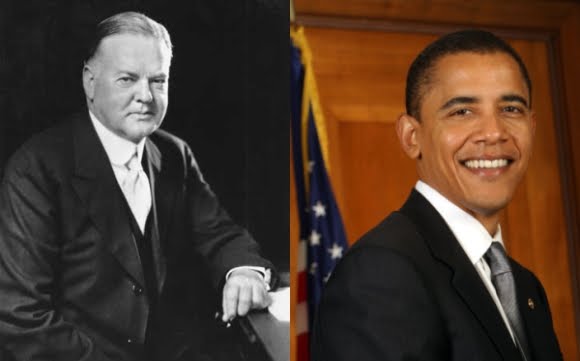
Dick J. Reavis : Are Hoover and Obama Peas in a Pod?

Herbert Hoover and Barack Obama: Peas in a pod? Image from Decline of the Empire.

The more things change…
The Obama tax compromise

By Dick J. Reavis / The Rag Blog / December 13, 2010

The story below is from the January 3, 1931 issue of the Southern Worker, a newspaper published by the Communist Party USA in Birmingham and Chattanooga, 1930-37.


Tax refund to rich exceeds Hoover relief

WASHINGTON, D.C. — In the midst of mass starvation Andy Mellon’s treasury department of the federal government refunded $126,838,333 in taxes to the wealthy bosses of the country during the last year.

Hoover’s lies

This sum is more than the paltry $116,000,000 appropriated by Congress for fake unemployment relief after so much bickering and Hoover’s talk about runs on the treasury. While millions of workers and farmers are starving, the government not only does all in its power to prevent any increase in taxation of the rich but actually returns them millions of dollars while talking of a treasury shortage.

At the same time figures released by the government show that in 1928 income tax returns revealed that there were 511 people in the country who had a yearly income of over $1,000,000, an increase of 221 over the previous year. These exploiters made their millions out of the workers and farmers who are now starving to death.

Plenty of cash

The United States Steel Corporation, which runs the Tennessee Coal and Iron Company in and around Birmingham, and has been laying off men by the thousands and cutting wages, received $15, 265, 343 in refunded taxes for the year. And Andy Mellon is one of the steel corporation men, and the money is turned over in cold cash.

In the face of those cold figures which show on which side of the line property lies, Hoover and Congress talk of the paltry sums appropriated for so-called relief as something the workers should be thankful for to the end of all time. This is nothing but plain robbery of the masses by a handful of people, the greatest criminals the world has ever known. These farts should give more energy to the unemployed workers in their fight for unemployment insurance and relief in cash which, as is seen, lies in plenty in the pockets of the bosses.

[Dick J. Reavis is an Associate Professor of English at North Carolina State University who is indexing the Southern Worker. He can be reached at dickjreavis@yahoo.com.]

The Rag Blog

Posted in Rag Bloggers | Tagged , , , | 2 Comments

Marc Estrin : Music Hath Charms…


Music hath charms to
soothe the stinking breath

By Marc Estrin / The Rag Blog / December 13, 2010

A recent revelation: rehearsing the Mendelssohn Violin Concerto, I was in the cello section mentally drooling over the carpet of harmonies we were laying down under the solo violin during the gorgeous slow movement. Not much to concentrate on other then how very beautiful this moment was.

As I breathed in the slow movement of the Mendelssohn, I realized that this music, this moment, and others like it, were SPECIFIC antidotes to the poison spewing from the mouths of politicians. I realized too, that without my frequent hits from the music inhaler I would probably be dead, or at least reduced to zombiedom. My life’s balance was suspended between the poison of politics and the healing of music, which interaction created a space for my writing.

I had long been aware of “the healing power of music” inasmuch as it was the arena of “music therapy” and the tool of music therapists. But I had never been so acutely aware of its specific purgative and remedial effect.

Coming up soon are Beethoven’s two birthdays, December 16 and December 17. As one of the characters in my novel, Insect Dreams, says: “Extraordinary people do extraordinary things.” (Not to be coy, there are two different documents with two different birth dates. I celebrate both.) And this week, too, Donna and I begin rehearsals for a New Year’s Day performance of Beethoven’s Ninth Symphony, which will hopefully become a tradition here in Burlington, Vermont. In any case, Beethoven is often on my mind.

It’s somewhat predictable, then, that the combination of Beethoven, music, and healing would find its way into my writing. I want to share with you this week a particularly ridiculous scene based on a particularly amazing piece of music — a movement of the A minor String Quartet which Aldous Huxley called “proof of the existence of God.” The movement was labeled by Beethoven “Heiliger Dankgesang eines Gesenenen an die Gottheit, in der lydischen Tonart”–a “Holy Song of Thanks from a Convalescent to the Godhead, in the Lydian Mode.”

Beethoven was known to have serious stomach problems which bothered him increasingly as he aged. I put this all together and came up with the following note in my recent novel, The Annotated Nose.

The hero, Alexei Pigov, has become the Glenn Gould of the accordion. He is befriended by a fellow lab tech, William Hundwasser, who exploits and markets his strangeness, creating from him the public figure of a medieval plague doctor come to heal The Contemporary Plague. Here he is in Hundwasser’s lab, experimenting with Beethoven on Hundwasser, and Herman, the tarantula:

44. Studying tarantellas and subtly applying them was my first experience of being a healer. Hundwasser kept several in a terrarium in his lab as a conversation starter for the “pretty young things in their white lab coats” he enjoyed cultivating. I began with one named Herman.

Herman was a dancin’ fool. He (?) would jump out of hiding — or hibernating, or estivating, or whatever tarantulas do for sleep — at the first peep of the accordion, and would then stand thoughtfully, taking the music into his ganglia. Then he would begin to sway, and after a minute to dance, and to dance appropriately to whatever I was playing, almost in rhythm, but definitely fast for allegros and slowly for adagios. When I stopped, he stopped — and waited. He could outwait me. When I left, I would just leave him there, waiting.

I figured if an insect person could react this way, with so few nerve cells, human persons must be able to process such signals with far more complex consequences than simply dancing.

As you probably know, Beethoven suffered from chronic abdominal problems and severe intestinal inflammation. Fortunately Hundwasser suffered similar symptoms. An experiment was staring me right in the face. The famous Heilige Dankgesang in the A minor quartet, the “Holy Song Of Thanks From A Convalescent To The Godhead,” was written after recovering from a serious bout with abdominal pain. Surely the tones, the great ideas of that movement, beyond being “proof of the existence of God” (Huxley), the successive integrations of disparate elements, must have something to do with disease, and with (Beethoven’s) stomach disease in particular. It was worth a try.

I made an accordion arrangement of the three adagio sections, and played them daily to Hundwasser during lunch break. We used the animal room for privacy. He just sat and listened. I suppose the rats listened too, but I had no parameters to measure the effects on them.

Hundwasser, however, had lots of parameters. Or, like the hedgehog, one big parameter: the number of Rolaids he popped each day. It took a week or so before R began to drop. From an average of 20 to an average of 12. On weekends, no music, R rose again. Come weekdays, it began to fall by Tuesday. In a sustained three week experiment, no days off, R fell to 3, then climbed to 12 again with a week off. We were on to something.

Neither of us had the time for a full and lasting cure, but after we stopped the experiment, he bought a record of the Budapest playing it, and has used that routinely to calm his symptoms. Saves him money on Rolaids, and he can listen while washing the dishes during the rare moments that he washes the dishes.

Flush with success, I looked more closely into the tarantella situation, the Antidotum Tarantulae. I would need to study the phenomenon first hand.

But there aren’t a lot of tarantula bites in Manhattan. There aren’t many tarantas [women bitten by tarantulas] to whom I could offer treatment — especially if it were just an experiment by a newbie. What to do?

Herman to the rescue! I could get him to bite me, and then, in the heroic tradition of the great doctors and medical researchers, I could try to cure myself. I admit such research is small potatoes compared to the guy who shoved a catheter into an arm vein and guided it up into his heart, or the guys from Walter Reed’s team who invited malaria mosquitoes to bite them, so they could test drugs, or even the guy who gave himself ulcers so he could prove it was bacteria that caused them. Small potatoes unless I died. But I know that though tarantula bites were toxic, they were not often fatal.

And of course, we have to remember Dr. Curt Conners, aka, the Lizard in Spiderman Comics, who lost his arm in a war, and experimented with reptilian DNA to try and grow it back, a great example of be careful what you wish for: the therapy caused him to mutate into a creature half-human and half-reptile. He became a villain, too, and even uglier than I am. I wondered if I might turn into a tarantula person — from the saliva — but it wasn’t very likely.

I knew this self-experimentation would be looked down upon at the Berg Institute for Experimental Physiology, Surgery and Pathology, even though experimental physiology, surgery and pathology was exactly what I was doing. So it was 1 A.M. when I let myself into Hundwasser’s lab, took Honey [his accordion] out of her case, and aroused Herman with the traditional slow, lamenting introduction to Borodin’s Polovetsian Dance #2, “The Wild Dance of the Men.”

Out he came on cue, staring at me through the Adagio, and when the fast part started, gave a shiver, and went into nothing short of a frenzy, leaping high off the terrarium floor, doing 90º, 180º, 270º, and 360º spins in the air, landing on his feet, rolling over on his back, and dragging himself miraculously by hyper–extended forelegs reaching up, over and behind his head, engaging the sand. It was so amazing, I almost forgot what I had come for. He must have been a Polovetsian spider, or at least have Polovetsian blood, perhaps from the Russian steppes.

When the both of us stopped to get our breaths, I thrust my left arm into the terrarium, and, though normally a pacifist, he leaped at it, and sunk his fangs in midway between wrist and elbow. Good Herman! I had to pull him off. Within a minute and a half, I was, as they say, possessed by the spider.

Though being somewhat atypical myself, I was that night afflicted with all the typical tarantula bite symptoms: feelings of prostration, anguish, psychomotor agitation, clouding of my sensory apparatus, difficulty standing, stomach cramps, nausea, paresthesia, muscular pains, extraordinary itching, and best and worst of all, vastly heightened sexual desire. I took a cab home; the cabbie thought I was way-drunk.

Lying in my bed, I felt wounded and weary, and aware of the deep tediousness of all things. Still, after a short sleep, I was able to drag Honey out of her case, and begin a medley of tarantellas I had learned.

Somewhere toward the end of the 1490s, the great Neopolitan scholar Alessandro d’Alessandro described the treatment of stricken tarantas by the local folk musicians: “they play different dances according to the nature of the poison, in such a way that with the victims entranced by the harmony and fascinated by what they hear, the poison either dissolves inside the body and dissipates, or else is slowly eliminated through the veins.” And with (wouldn’t you know it?) one of the Neopolitan tarantellas, I could feel just that effect, a veritable exorcism, a return to life, possibly to love. By the next day I was weak, but feeling basically normal via my iatromusical practice.

Plague doctoring is not so much different, though I suffer less, and my patients suffer more.

[Marc Estrin is a writer, activist, and cellist, living in Burlington, Vermont. His novels, Insect Dreams, The Half Life of Gregor Samsa, The Education of Arnold Hitler, Golem Song, and The Lamentations of Julius Marantz have won critical acclaim. His memoir, Rehearsing With Gods: Photographs and Essays on the Bread & Puppet Theater (with Ron Simon, photographer) won a 2004 theater book of the year award. He is currently working on a novel about the dead Tchaikovsky.]

The Rag Blog

Posted in Rag Bloggers | Tagged , , , | Leave a comment

Clay Bennett : ‘I Feel So Violated’

Political cartoon by Clay Bennett / Chatanooga Times Free Press / Truthout.

CLICK ON IMAGE TO ENLARGE

The Rag Blog

Posted in RagBlog | Tagged , | 1 Comment

In his revealing essay, Bruce Melton tells us that there is a serious disconnection between climate science and the public’s knowledge of climate change — a “fundamental blindness” he calls it. The information being discovered by the scientists is staggering — the evidence in the academic literature is overwhelming — but the means to mine this information out of the academic jargon and deliver it to the people is lacking. Bruce says we are now facing what scientists call “dangerous” or “catastrophic” climate change that “threatens our very existence on this planet.”

Posted in RagBlog | Leave a comment

MUSIC HATH CHARMS TO SOOTHE THE STINKING BREATH

A recent revelation: rehearsing the Mendelssohn Violin Concerto, I was in the cello section mentally drooling over the carpet of harmonies we were laying down under the solo violin during the gorgeous slow movement. Not much to concentrate on other then how very beautiful this moment was.

As I breathed in the slow movement of the Mendelssohn, I realized that this music, this moment, and others like it, were SPECIFIC antidotes to the poison spewing from the mouths of politicians. I realized too, that without my frequent hits from the music inhaler I would probably be dead, or at least reduced to zombiedom. My life’s balance was suspended between the poison of politics and the healing of music, which interaction created a space for my writing.

I had long been aware of “the healing power of music” inasmuch as it was the arena of “music therapy” and the tool of music therapists. But I had never been so acutely aware of its specific purgative and remedial effect.

Coming up soon are Beethoven’s two birthdays, December 16 and December 17. As one of the characters in my novel, Insect Dreams, says: “Extraordinary people do extraordinary things.” (Not to be coy, there are two different documents with two different birth dates. I celebrate both.) And this week, too, Donna and I begin rehearsals for a New Year’s Day performance of Beethoven’s Ninth Symphony, which will hopefully become a tradition here in Burlington. In any case, Beethoven is often on my mind.

It’s somewhat predictable, then, that the combination of Beethoven, music, and healing would find its way into my writing. I want to share with you this week a particularly ridiculous scene based on a particularly amazing piece of music–a movement of the A minor String Quartet which Aldous Huxley called “proof of the existence of God”. The movement was labeled by Beethoven “Heiliger Dankgesang eines Gesenenen an die Gottheit, in der lydischen Tonart”–a “Holy Song of Thanks from a Convalescent to the Godhead, in the Lydian Mode”.

Beethoven was known to have serious stomach problems which bothered him increasingly as he aged. I put this all together and came up with the following note in my recent novel, The Annotated Nose.

The hero, Alexei Pigov, has become the Glenn Gould of the accordion. He is befriended by a fellow lab tech, William Hundwasser, who exploits and markets his strangeness, creating from him the public figure of a medieval plague doctor come to heal The Contemporary Plague. Here he is in Hundwasser’s lab, experimenting with Beethoven on Hundwasser, and Herman, the tarantula:

44. Studying tarantellas and subtly applying them was my first experience of being a healer. Hundwasser kept several in a terrarium in his lab as a conversation starter for the “pretty young things in their white lab coats” he enjoyed cultivating. I began with one named Herman.

Herman was a dancin’ fool. He (?) would jump out of hiding — or hibernating, or estivating, or whatever tarantulas do for sleep — at the first peep of the accordion, and would then stand thoughtfully, taking the music into his ganglia. Then he would begin to sway, and after a minute to dance, and to dance appropriately to whatever I was playing, almost in rhythm, but definitely fast for allegros and slowly for adagios. When I stopped, he stopped — and waited. He could outwait me. When I left, I would just leave him there, waiting.

I figured if an insect person could react this way, with so few nerve cells, human persons must be able process such signals with far more complex consequences than simply dancing.

As you probably know, Beethoven suffered from chronic abdominal problems and severe intestinal inflammation. Fortunately Hundwasser suffered similar symptoms. An experiment was staring me right in the face. The famous Heilige Dankgesang in the A minor quartet, the “Holy Song Of Thanks From A Convalescent To The Godhead“, was written after recovering from a serious bout with abdominal pain. Surely the tones, the great ideas of that movement, beyond being “proof of the existence of God” (Huxley), the successive integrations of disparate elements, must have something to do with disease, and with (Beethoven’s) stomach disease in particular. It was worth a try.

I made an accordion arrangement of the three adagio sections, and played them daily to Hundwasser during lunch break. We used the animal room for privacy. He just sat and listened. I suppose the rats listened too, but I had no parameters to measure the effects on them.

Hundwasser, however, had lots of parameters. Or, like the hedgehog, one big parameter: the number of Rolaids he popped each day. It took a week or so before R began to drop. From an average of 20 to an average of 12. On weekends, no music, R rose again. Come weekdays, it began to fall by Tuesday. In a sustained three week experiment, no days off, R fell to 3, then climbed to 12 again with a week off. We were on to something.

Neither of us had the time for a full and lasting cure, but after we stopped the experiment, he bought a record of the Budapest playing it, and has used that routinely to calm his symptoms. Saves him money on Rolaids, and he can listen while washing the dishes during the rare moments that he washes the dishes.

Flush with success, I looked more closely into the tarantella situation, the Antidotum Tarantulae. I would need to study the phenomenon first hand.
But there aren’t a lot of tarantula bites in Manhattan. There aren’t many tarantas [women bitten by tarantulas] to whom I could offer treatment — especially if it were just an experiment by a newbie. What to do?

Herman to the rescue! I could get him to bite me, and then, in the heroic tradition of the great doctors and medical researchers, I could try to cure myself. I admit such research is small potatoes compared to the guy who shoved a catheter into an arm vein and guided it up into his heart, or the guys from Walter Reed’s team who invited malaria mosquitoes to bite them, so they could test drugs, or even the guy who gave himself ulcers so he could prove it was bacteria that caused them. Small potatoes unless I died. But I know that though tarantula bites were toxic, they were not often fatal.

And of course, we have to remember Dr. Curt Conners, aka, the Lizard in Spiderman Comics, who lost his arm in a war, and experimented with reptilian DNA to try and grow it back, a great example of be careful what you wish for: the therapy caused him to mutate into a creature half-human and half-reptile. He became a villain, too, and even uglier than I am. I wondered if I might turn into a tarantula person — from the saliva — but it wasn’t very likely.

I knew this self-experimentation would be looked down upon at the Berg Institute for Experimental Physiology, Surgery and Pathology, even though experimental physiology, surgery and pathology was exactly what I was doing. So it was 1 A.M. when I let myself into Hundwasser’s lab, took Honey [his accordion] out of her case, and aroused Herman with the traditional slow, lamenting introduction to Borodin’s Polovetsian Dance #2, “The Wild Dance of the Men”. Out he came on cue, staring at me through the Adagio, and when the fast part started, gave a shiver, and went into nothing short of a frenzy, leaping high off the terrarium floor, doing 90º, 180º, 270º, and 360º spins in the air, landing on his feet, rolling over on his back, and dragging himself miraculously by hyper–extended forelegs reaching up, over and behind his head, engaging the sand. It was so amazing, I almost forgot what I had come for. He must have been a Polovetsian spider, or at least have Polovetsian blood, perhaps from the Russian steppes.

When the both of us stopped to get our breaths, I thrust my left arm into the terrarium, and, though normally a pacifist, he leaped at it, and sunk his fangs in midway between wrist and elbow. Good Herman! I had to pull him off. Within a minute and a half, I was, as they say, possessed by the spider.

Though being somewhat atypical myself, I was that night afflicted with all the typical tarantula bite symptoms: feelings of prostration, anguish, psychomotor agitation, clouding of my sensory apparatus, difficulty standing, stomach cramps, nausea, paresthesia, muscular pains, extraordinary itching, and best and worst of all, vastly heightened sexual desire. I took a cab home; the cabbie thought I was way-drunk.

Lying in my bed, I felt wounded and weary, and aware of the deep tediousness of all things. Still, after a short sleep, I was able to drag Honey out of her case, and begin a medly of tarantellas I had learned.

Somewhere toward the end of the 1490s, the great Neopolitan scholar Alessandro d’Alessandro described the treatment of stricken tarantas by the local folk musicians: “they play different dances according to the nature of the poison, in such a way that with the vicitms entranced by the harmony and fascinated by what they hear, the poison either dissolves inside the body and dissipates, or else is slowly eliminated through the veins.” And with (wouldn’t you know it?) one of the Neopolitan tarantellas, I could feel just that effect, a veritable exorcism, a return to life, possibly to love. By the next day I was weak, but feeling basically normal via my iatromusical practice.

Plague doctoring is not so much different, though I suffer less, and my patients suffer more.


Type rest of the post here

Source /

The Rag Blog

Posted in RagBlog | Leave a comment

Alex Knight : Class and the English Language

William the Conqueror, first Norman king of England, as depicted on the famous Bayeux Tapestry. His royal descendants would speak French until Henry V, 350 years later.

Blast from the past:
Class division in the English language

By Alex Knight / The Rag Blog / December 9, 2010

Would you rather receive a hearty welcome or a cordial reception?

Notice the imagery and feelings evoked by the two phrases. The first has a Germanic origin, the second, French. The English language is split along class lines — a reflection of the Norman invasion of England, almost 1,000 years ago. German-derived English words carry with them a working class connotation, and French-derived words come off sounding aristocratic and slightly repulsive.

Even though cordial literally means “of the heart” in French (cor is Latin for heart), the picture that comes to my mind is a royal douchebag entering a hall of power amidst classical music and overdressed patrons and nobility.

The image I get from hearty welcome is the extreme opposite: a single peasant reaching out to hug me and get me into their little hovel, out of the weather. Class is deeply embedded within our language, each word having its own unique history.

Wikipedia teaches many fun facts. The English language derives mainly from:

1. Old German — the Angles and Saxons (from Saxony) conquered Britain in the 5th century, mixing with Scandinavians and developing Old English.
2. Old French — the Normans (from Normandy) conquered England in 1066.

After the Norman invasion, England was dominated by a small French aristocracy, ruling over a much larger German working class. For more than three centuries, the rulers of England spoke French, while the common person spoke a Germanic language (Old English).

The two cultural groups began to intermarry after the Black Death of the 1340s wiped out half of the population, and over time the languages slowly merged, greatly simplifying the grammar of English, but also leaving a huge combined vocabulary.

The really interesting thing is that a lot of words in English carry a class connotation, based on whether they derive from French or from German. Words that mean basically the same thing will have either a formal, fancy, academic, upper-class connotation, or a casual, down-to-earth, gut-level, working-class feeling depending on the origin of the word.

Check out this list of synonyms!

German-derived… French-derived
begin… commence
talk/speak… discuss/converse
ask… inquire/demand
teach… educate
think/wonder… consider/ponder
understand… comprehend
truth… verity
answer… reply
before… prior
come… arrive
meet/find… encounter
leave… depart
wal… barrier
make/build… construct
break… destroy
small/little… petite
feeling… sentiment
good… beneficial/pleasant
hop… aspire
lucky… fortunate
help… assist
mistake… error
forgive… pardon
buy… purchase
have/own… possess
yearly… annual
careful/wise… prudent
child/youth… juvenile/adolescent
earth… soil
cold… frigid
wild… savage
belly/gut… abdomen
drink… beverage
hungry… famished
eat… dine

Notice that the Germanic words are usually shorter, more concrete and direct, while the French words are more elaborate, more abstract and indirect. What kind of person do you imagine speaking the words in the left column vs. the right column?

It’s interesting to me that nature and children are described by the French-derived English words as somehow negative or hostile, as with savage and juvenile. To me this reflects the hatred on the part of the wealthy and powerful for that which is untamed and free.

The medical-industrial complex also uses almost exclusively Latin and French-derived words, to sound more technical. This has the effect of making the body seem lifeless and mechanical, as with abdomen.

Plus, meat words are almost all French-derived, which reflects that while the Anglo-Saxon working class was responsible for hunting/shepherding the animals, it was only the Norman nobility who could actually afford to eat meat.

German-derived… French-derived
cow… beef
pig… pork/ham
deer… venison
sheep… mutton
calf… veal

Chicken and fish are the exceptions here, most likely because these meats were less expensive and more available for peasants and workers.

Finally, most of our government/state words are all French: court, judge, jury, indict, appeal, traitor, prison, military, representative, parliament, Congress, president, and marriage.

I notice that when I use the French-derived words, I experience a slight feeling of discomfort, as if I’m trying to impress people with my big words. This is precisely how academia functions, which is why if you attend a university or graduate school, you will be inundated with French and Latin-derived vocabulary, to distinguish you from the uneducated masses with their street language.

Might all of this explain why American conceptions of the French are as snooty, pompous, pretentious, easily-hate-able snobs? In occupied England, THEY WERE!

And for anyone interested in working class revolution, the best way not to talk down to people: stick with the more common Germanic words instead of bureaucratese.

Towards freedom! (not mere liberty)

(George Orwell wrote an awesome essay called Politics of the English Language, where he breaks down how abstract, complex language is a tool for those who seek to confuse the populace, and he outlines how to make use of concrete, plain English to actually reach people. A highly recommended essay for anyone who wants to write.)

[Alex Knight is an organizer, teacher, and writer in Philadelphia. He maintains the website endofcapitalism.com and is writing a book called The End of Capitalism. He can be reached at activistalex@gmail.com.]

The Rag Blog

Posted in Rag Bloggers | Tagged , , | 7 Comments

According to results from a standardized international test, U.S. students just aren’t making the grade. The results in reading, science, and math showed students from China far in the lead, with U.S. students placing 17th, 23rd, and 31st in the respective subjects. In other parts of the world education is taken more seriously, and with funds for education being cut here, and the growing power of the far right and the injection of religion and propaganda into the educational system, we have a recipe for even more failure.

Posted in RagBlog | Leave a comment

Harvey Wasserman : $7 Billion Nuke Attack

Graphic from Southern Energy Network

Radioactive boondoggle:
$7 billion new nuke attack

By Harvey Wasserman / The Rag Blog / December 9, 2010

Journalist and environmental activist Harvey Wasserman will be Thorne Dreyer’s guest on Rag Radio, Friday, Dec. 10, 2010, 2-3 p.m. (CST), on KOOP 91.7 FM in Austin. To stream Rag Radio live on the internet, go here. To listen to this interview after it is broadcast — and to other shows on the Rag Radio archives — go here.

The White House and nuclear power industry are on the brink of grabbing $7 billion in new taxpayer-funded loan guarantees for new reactors. But they can be stopped.

Taxpayer and environmental groups are asking citizens to call their Senators urging deletion of the guarantees.

The guarantees have been stuck into the Continuing Resolution just passed by the House to fund the government. It now goes to the Senate, where calls should be directed to delete this budget-busting radioactive boondoggle.

Nuke lobbyists have spent more than $640 million in the past decade to fund a “nuclear renaissance” from the federal trough. Earlier this year the Obama Administration and the industry’s congressional minions were set to add as much as $36 billion to a Department of Energy loan guarantee program to build new reactors. Citizen opposition has been instrumental in slashing that number.

Because they are uneconomical and cannot compete with natural gas and renewables, private funding for new reactor projects has been virtually nonexistent. The General Accounting Office and Congressional Budget Office have predicted at least a 50% financial failure rate for such loans.

Some $18.5 billion in funds for reactor construction loan guarantees were set aside by the Bush Administration. Obama gave out $8.33 billion of it earlier this year to the Southern Company’s two-reactor project at Vogtle, Georgia, where ratepayers are being forced to fund the plant as it’s being built. More than $10 billion of the original federal money remains undistributed.

At an industry summit in Washington December 7-8, Energy Secretary Stephen Chu anointed atomic energy as a “clean” energy source that could be included in future official mandates and guidelines for energy production.

When running for president, Obama courted green activists by warning that “before an expansion of nuclear power is considered, key issues must be addressed including: security of nuclear fuel and waste, waste storage and proliferation.”

Radioactive leaks and shaky operations endemic to the 104 licensed U.S. reactors have deepened grassroots opposition to new ones. Financial commentaries in the Wall Street Journal and elsewhere have made it clear that the proposed new projects can’t compete with gas and renewables. Massive delays and cost overruns at reactor projects in Finland and France have helped kill private sector interest in the technology as a whole.

But Sen. Lamar Alexander (R-TN) is calling for 100 new reactors, requiring a capital liability of a trillion dollars or more, which he wants the taxpayer to guarantee. Other industry representatives in Congress and the Administration have supported similar plans.

All this comes despite the industry’s inability to attract comprehensive private investment capital, or to provide umbrella liability insurance for major disaster by terror and error that could ultimately cost thousands of lives and trillions of dollars.

The industry still has no answer for its waste problem. It has yet to finalize a standard design acceptable to regulators. In terms of job creation in the energy sector, reactor investments are among the very worst.

Thus this new nuclear push is vehemently opposed by the core of the environmental movement, and by budget hawks angry about supremely risky new liabilities being piled on to a gargantuan national debt.

Amidst a national furor over leaks and taxes, the battle over these loan guarantees may ultimately have the most lasting impact. Thus immediate calls to the Senate may have a huge long-term impact on the fate of the Earth.

[Harvey Wasserman edits www.NukeFree.org . His SOLARTOPIA! Our Green-Powered Earth is at www.solartopia.org, along with Pete Seeger’s “Song for Solartopia.”]

The Rag Blog

Posted in Rag Bloggers | Tagged , , , | Leave a comment

David McReynolds was 12 when Japanese aircraft began an attack on the U.S. naval base at Pearl Harbor and he recounts how he felt and how his family reacted to the attacks and to the ensuing war. “I know that on Monday, when I went to Junior High School,” he reports, “I felt special pride as I saluted the flag. Any questions I might have about flags and patriotism would be many years ahead.”

Posted in RagBlog | Leave a comment