Marc Estrin : Unhallowed

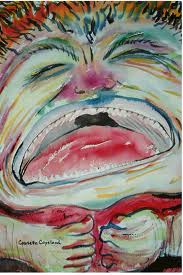
“See No Evil.” Painting by Morwenna Morrison.

UNHALLOWED

By Marc Estrin / The Rag Blog / October 30, 2010

Halloween is my least favorite holiday, the one that has strayed furthest from its original intentions, and has been most overwhelmed by candy-capitalism. The worst part about it, from my point of view, is that it now involves treats with no tricks. I am on full general strike against it.

It’s not so much that I want to see infantile maliciousness attack the community but that I am a great fan of the word “or.” “Trick or treat”? — the homeowner has a choice, and should he choose the former, the onus is then on the tricker to come up with punishments that fit the crime. What tricker is prepared for that these days? Our corporate criminal element cultivates both treat and trick. Should not our children practice running the world?

It’s not only the loss of imagination that I mourn, but even worse, a loss of the sense of Evil as a power to be meditated upon and respected. I left a career — or rather was invited out — as a minister because my congregations were unenthusiastic about exploring the evil around us. A personal critique of my denomination can be summed up in one sentence: they want Easter without Good Friday, transfiguration without death. “The world out there is bad enough — we don’t need to go through it here on Sundays.”

In short, they had no theology of evil. Which these days, we need more than ever.

The great seasonal gift of this past week has been the Wikileaks release of 400,000 internal documents related to our military behavior in Iraq. It was both trick and treat, an apotheosis of Halloween behavior. And of course, in a culture which refuses to acknowledge its own evil, our government’s initial response has been to shoot the messenger, with the mainstream media predictably complicit.

While media worldwide — mainstream and otherwise — focused on the contents of the communications — prisoners abused, raped and murdered; the civilian death toll covered up; the shooting of men trying to surrender (“you can’t surrender to a helicopter”); the abuses of our private security firms; the hundreds of civilians killed at checkpoints — the U.S. media focused almost entirely on whether Julian Assange had the right to release such documents, whether he is a sexual offender or not, and what punishment for him is appropriate.

This refocusing is perhaps predictable in our celebrity culture: everything comes down to the actions of particular, lime-lighted people, and the underlying currents are ignored. Julian Assange and Wikileaks are not the abscesses that need to be opened in order to heal. Their targets are. We should thank them for reviving the true spirit of Halloween.

[Marc Estrin is a writer and activist, living in Burlington, Vermont. His novels, Insect Dreams, The Half Life of Gregor Samsa, The Education of Arnold Hitler, Golem Song, and The Lamentations of Julius Marantz have won critical acclaim. His memoir, Rehearsing With Gods: Photographs and Essays on the Bread & Puppet Theater (with Ron Simon, photographer) won a 2004 theater book of the year award. He is currently working on a novel about the dead Tchaikovsky.]

The Rag Blog

Posted in Rag Bloggers | Tagged , , , | Leave a comment

David P. Hamilton :
‘Citizens United’ and the corruption of American politics

The playing field has never been level, but the advantages now enjoyed by the capitalist class in the electoral system have reached a qualitatively new high.

citizens united cartoon

Political cartoon by Adam Zyglis / The Buffalo News / Daryl Cagle.

By David P. Hamilton | The Rag Blog | October 28, 2010

This article by The Rag Blog‘s David P. Hamilton is an extremely timely and relevant assessment of the state of politics in this country following the Supreme Court’s game-changing decision opening the floodgates to even greater corporate dominance of the electoral system — and after the many failures of the Obama administration in bringing about meaningful progressive change. We hope it will stimulate discussion in the progressive community.

However, to the extent that David is suggesting the left should boycott the electoral system, we strongly disagree — especially at this point in history — and that should not be taken to be The Rag Blog’s editorial position. We believe that — lacking a coherent strategy on the left that offers a clear and well-articulated alternative course of action to participation in electoral politics — it would be a self-defeating choice.

We believe, in fact, that everything possible must be done to stop the mushrooming anti-intellectual neo-nativist far-right surge, and strongly urge all of our readers to vote this Tuesday, November 2.

But our participation in electoral politics should be done with our eyes open and without unrealistic expectations. And we must always remember that voting is not enough. That our primary responsibility as progressives is to organize and educate outside the political system if we are ever to bring about meaningful basic social change.

— Thorne Dreyer / The Rag Blog

The primary political story of this year’s midterm election flows from the Supreme Court’s recent “Citizens United vs Federal Election Commission” decision. This 5-4 decision held that corporate funding of independent political broadcasts in candidate elections cannot be limited under the First Amendment.

The already apparent result has been that millions of corporate dollars are flowing into the campaigns nationwide attacking Democrats. Sheila Krumholz of the Center for Responsive Politics predicts “$3.7 billion will be spent on this midterm election,” up 30% from the last midterm election. Spending on political ads has increased 75% compared to the 2008 presidential election year.

This flood of ungoverned cash is only just beginning.

This flood of ungoverned cash is only just beginning. Increasingly, these contributions are being made anonymously with impunity. Karl Rove now controls a campaign fund 10 times larger than that of the Republican National Committee, 95% of it from three militantly right-wing billionaires. The Chamber of Commerce, with 300,000 members, has raised a huge political fund and spent $28 million, largely from just 45 members, $7 million from “Swiftboat” Bob Perry of Houston.

Money coming from outside the country is also involved, but that fact is marginal to the larger issue. Amounts being spent by these political action committees to defeat Democrats are unprecedented. More than ever, elections are a commodity for sale and the price is being driven up so that only the very rich can afford them.

The consensus prediction of the outcome of the upcoming midterm elections is the widespread defeat of Democrats, losing control of the House and possibly the Senate too. This result will be determined primarily by the sad state of the economy and the failure of Obama’s leadership.

However, as a result of Citizens United the process has fundamentally changed. The playing field has never been level, but the advantages now enjoyed by the capitalist class in the electoral system have reached a qualitatively new high. The primary advantage of the right has been unleashed. Under the new rules governing political campaign financing, the capital class hegemony over the upper strata of U.S. government has been institutionalized.

Leftists have always argued that there is a U.S. capitalist ruling class with its power based in its control of the major corporations and that capitalist class money corrupts elections. Because of the lack of public funding and the high costs associated with running for office, big private sector money has long been necessary to be a serious player.

However, in the past there were legal limitations on corporate contributions that allowed non-corporate elements to compete, albeit at a financial disadvantage, usually losing to the better financed candidates. The restrictions that remain are quickly becoming irrelevant and no new ones can be reasonably expected from a government increasingly beholden to corporate capitalist interests.

NPR recently reported that one Republican-supporting political action fund, among many, was spending over $100,000 for negative advertising at just one small market newspaper in one closely contested congressional race. That’s the new norm. Millions in these funds are currently being spent to defeat progressives like Alan Grayson of Florida. The possibility of public funding of elections coming from politicians in the service of big capitalist interests is slight indeed.

The capitalist ruling class has globalized. They are no longer the U.S. ruling class so much as the largest national sector of an increasingly integrated international ruling class. Capital knows no borders. You can buy any publicly held stock in the world in dozens of stock markets worldwide 24/7. The heretofore essential countervailing sector, labor, has no chance to exert close to an equivalent influence while operating in a national context.

What has changed is the depth and reach of capitalist ruling class control. Like their wealth, their power has grown exponentially; they have increased their range of operation and become internationally integrated in recent years. In the U.S., their control has now become enshrined in the basic law of the land.

In this stagnant democracy where, outside of presidential elections, large majorities don’t participate, the Republicans have correctly adopted the Rovian strategy emphasizing base mobilization rather than appealing to the largely mythical center. Thus, their motivating ideology has become more radically rightist. Disguising their racism as concern for immigration, crime, busing, private education, etc, is their specialty.

As a silver lining to this dark cloud, it is logical to assume that more people will see the validity of the assertion that democracy in America has been corrupted by corporate money. The socialist left should grow in the context of imperial decline and political polarization. Never has serious reform looked more improbable and never have the culprits looked so conspicuous.

If elections have become a fraud perpetrated upon the public, is participation in them unprincipled in that it lends credence to this fraud? Should we encourage people to vote for liberal Democrats or Greens or anyone when we know the game is rigged? Must we accept competition on an unlevel playing field on our opponent’s home turf with them providing the referees?

Is authentic democracy impossible under the current system?

Or should we instead be encouraging the refusal to participate in corrupt elections? Is authentic democracy impossible under the current system? Should a primary goal of the left in the future be to delegitimize this corrupt electoral system? Is that impossible if you participate?

This hypothesis concerning the reach and power of capitalist class control has been substantiated by Obama. Given a unique opportunity to lead toward real change, he has instead proven himself to be just another politician who protects the interests of the capitalist class first and foremost.

During the 2008 presidential campaign while standing in front of an Austin audience, he repeatedly called himself a “progressive.” That was pure pandering. Instead, his administration has expanded American militarism with more money and more U.S. troops fighting in more countries than ever; has produced a health care “reform” that in no fundamental way reforms health care, that mandates you buy a faulty product in the private sector, and that was written largely by health industry lobbyists; and has passed financial “reform” written by lobbyists for the financial sector and their past executives now working within the Obama administration after first forking over hundreds of billions of your tax dollars to “stimulate” them instead of us.

Obama’s administration has failed to curb corporate compensation; has failed to close Guantanamo and has expanded CIA assassination programs that include the targeting of American citizens (later defending the practice in court as a “state secret”); has raided the homes and offices of antiwar leaders and confiscated their records; has failed to help millions faced with foreclosure after promising to do so and has announced it will appeal any court ban on future foreclosures while continuing to bail out investment banks who leveraged up the housing bubble.

The administration has shown itself unwilling to pressure Israel to make peace with the Palestinians; has done next to nothing to end the Drug War; has allowed environmental disaster in the Gulf through incompetence and a failure of regulatory oversight and then quickly lifted the ban on deep water drilling, etc, ad nauseum.

Now the Obama Justice Department has successfully appealed the federal judge’s ruling that “Don’t Ask, Don’t Tell” is unconstitutional. Before a national audience this ex-professor of constitutional law achieved his nadir of veracity by arguing that protecting gays from continued oppression by the military was best accomplished by a legislative branch that had only recently refused to do so and where his majority is about to shrink if not disappear.

This was soon followed by news that Obama’s “Justice” Department will defend Bush’s attorney general, John Ashcroft, against legitimate charges that after 9/11 he ordered Muslim Americans to be held without charges, denied them access to lawyers, and had them carried off to secret prisons and tortured.

Obama’s record is only progressive in comparison to reactionary Republicans and its lack of progressivism is the principal reason for the “enthusiasm gap.” Next week, the Republicans will get no more votes nationwide than they got when they were soundly defeated in 2008. However, the Democrats will receive many fewer than 2008. Most of those who have abandoned Barack Obama are to his left. Meanwhile, most Democrats continue to pursue the outmoded strategy of appealing to moderates.

Of course, merely not voting is an insufficient response. Denouncing the process would be not only truthful but very likely a productive strategic innovation for the left in the future — to picket polling places, to urge people to deface ballots, to publicly destroy registration cards like Vietnam-era draft cards and to proselytize around the analysis that the electoral system and the politicians it produces are inherently corrupt.

Fundamental reforms that reverse Citizens United, ban corporate money from political campaigns altogether, and establish publicly-funded elections are reasonable and popular but unachievable goals in the present political context and, hence, revolutionary. This irreconcilable conflict of fundamental interests will promote political instability that will increase as this corruption becomes more glaring, entrenched and widespread.

[David P. Hamilton has been a political activist in Austin since the late 1960s when he worked with SDS and wrote for The Rag, Austin’s underground newspaper.]

The Rag Blog

Posted in Rag Bloggers | Tagged , , , , , , , , | 3 Comments

Bruce Melton : Climate Science’s New Paradigm

It’s the cars! Traffic in Houston. Image from City-Data.com.

It’s cars, not coal:
The new paradigm of climate science

By Bruce Melton / The Rag Blog / October 28, 2010

The science has changed again. This time, things are really upside down. How are we supposed to know which target to shoot?

We live, we learn. Science goes on, especially climate science. There is an extreme need for more knowledge about our climate. This has been obvious to the climate scientists for years. The titles in the scholarly journals show just how rapidly climate knowledge is being discovered.

The amount of effort being put into the challenge is possibly greater than any learning event that has ever happened, including things like the Manhattan Project and the Apollo Project. The credibility of the science grows constantly as is shown by a recent paper evaluating over 1300 climate scientists.

The evaluation found that 97 to 98 percent of climate scientists studied, that supported man-made global warming science, were published more than twice as often in the scholarly journals than were the two to three percent of climate scientists who did not support man made climate change science (1).

In 2009, somewhere close to ten thousand times more climate discoveries were made than were made in 1990 (2). Too many of these discoveries showed that earth’s climate was changing faster and with greater impacts than our climate scientists had previously realized.

Lord Nicholas Stern, World Bank Chief Economist (2000-2003) and Head of the Government Economic Service for the United Kingdom during the Blair Administration, wrote (in 2006) what is undeniably the most complete description of the global economic impacts of climate change. This incredible 700-page evaluation was ferociously shouted down by the non-climate science community.

In 2008, just two years later, Lord Stern published an update to his 2006 report. He said that the severity of his previous findings was vindicated by the 2007 Intergovernmental Panel on Climate Change (IPCC) Assessment. He also said “We underestimated the risks… we underestimated the damage associated with temperature increases… and we underestimated the probabilities of temperature increases.”

In June 2008, Stern said that because climate change is happening faster than predicted, the cost to reduce carbon below dangerous levels would be even higher. Instead of the one percent of global gross domestic product (GDP) per year assumed in 2006, it is now about 2% of GDP.” (3)

In just a couple of years, because of new discoveries in climate science, the cost of mitigation has doubled. Are we doing the right things? Can we afford to be doing something that is not as efficient as possible? Do we have time yet to make mistakes? The answers may not be as obvious as we think.

A paper in the February 23, 2010 edition of the Proceedings of the National Academy of Sciences of the United States of America, written by a team of seven scientists led by NASA’s Dr. Nadine Unger, has taken a new view of global warming pollutants that greatly alters our current world of climate change science.

There is really nothing new in this paper though. What has happened is that these scientists have gained a better understanding of the big picture of the climate impacts of air pollution.

The approach of the team was to define the net change to our climate from any given economic activity, considering both the warming and the cooling caused by air pollutants emitted from that specific sector. You see, some pollutants, like the smoke and gases from a volcanic eruption, or coal fired power plants, or tropical forest biomass burning, can cool our atmosphere as well as cause it to warm.

CLICK ON IMAGE TO ENLARGE

We know a lot about greenhouse gases today. This knowledge has been accumulating for more than a century. But greenhouse gases make up only a portion of the pollutants emitted by any given economic sector. Many of the rest of the pollutants (air pollutants) are what are called aerosols.

What is an aerosol? Aerosols are defined as very tiny particles that can basically float (electro-static attraction) in the air. They are very similar to the stuff that comes out of a spray can.

Paint is an aerosol, as is the sticky liquid that makes hairspray work. Deodorant, air freshener, insecticides, anything that can be sprayed out of a tiny nozzle at high pressure can be made into an aerosol. Dust and smoke are common natural aerosols.

Aerosol particles are so small that they do not easily fall to the ground from the force of gravity. Smoke is an aerosol, as is salt spray from the ocean, and much of what we know as smog.

Aerosols can be both ‘light” and “dark.” Dark aerosols are like greenhouse gases. They absorb sunlight and turn it into heat. Smoke is composed of both light and dark aerosols. Light aerosols however, reflect sunlight harmlessly back into space like ice and snow, resulting in a cooling effect.

Black carbon and sulfate aerosols are the two biggies that come from everything that burns including coal and the wood fires used for cooking in developing nations. Black carbon is a warming aerosol. Sulfates are cooling aerosols. There are many other aerosols that occur naturally and that are generated from mankind’s economic activities and they include nitrogen oxides and volatile organic carbons, as well as organic molecules from algae in the oceans and from trees and other plants on land.

Dr. Unger’s team’s paper takes all of these warming and cooling effects, adds them up for individual economic sectors, and then ranks them from bad to worse. It also does something else novel. Because different atmospheric pollutants remain in our skies for different lengths of time, the researchers looked at things in the short term (2020) and long term (2100).

Fundamental tenets

I’ll get to this in a minute, but there are a couple of other basic fundamental tenets of climate science that have changed that need a little discussion first.

As we learn, our knowledge changes. We have been learning oodles about the different greenhouse gases in our skies, man-made and natural, for over a century. We also have a lot of knowledge about the way other things in our atmosphere, such as aerosols, dust, and smoke warm or cool our planet.

One of the big new climate science discoveries is that the life of carbon dioxide in our atmosphere has changed. Our previous understanding of how long CO2 lasted once emitted was about 100 to 200 years. This is an understanding that has developed over generations as we have learned how the different things react with CO2, how they are absorbed by the oceans or respired by vegetation on land, or how they are trapped in the soil or ocean sediments.

Now we are finding that all of these things change as our planet itself changes with the warming. On a warmer planet, our oceans absorb less carbon dioxide (4).

Our forests have changed too. They now absorb less carbon dioxide because they are becoming less healthy as their environments warm beyond their evolutionary niches. NASA and numerous other researchers have shown that the carbon dioxide fertilization effect has already worn off as our forests succumb to stress from the warming. This has been documented across most of the world’s forests north of the tropics (5).

As our planet becomes warmer, these changes will become larger. Other things that the scientists have seen happening already will start to play an even larger role in the way our climate changes. Drier soils from ongoing drought cannot hold as much carbon dioxide from decayed organic material. Extensive peat lands across the world are also drying and have already changed into large sources of greenhouse gases (6). Melting permafrost releases greenhouse gases, under sea frozen methane is venting, ocean primary productivity is falling, and the list goes on.

When the big picture is completely digested, or as completely digested as our knowledge base can get it today, the 21st century understanding of the life of CO2 in our sky, based on research from Dr. David Archer at the University of Chicago is as follows: CO2 lasts for 300 years except for 25% that last forever (7). This is very different from our previous understanding of the life of CO2 being 100 to 200 years.

Our knowledge about methane has changed too. When the big picture is recognized, methane has far more impact on our atmosphere than we once thought. Methane reacts differently with different things in the atmosphere at different times. These different reactions tell us the strength of the warming that then occurs. For example, methane decomposes after a dozen or so years, but the decomposition byproducts are CO2 and ozone, both greenhouse gases.

Other substances that are a part of the methane cycle are much more far reaching and include water vapor, volatile organic compounds, sulfur compounds, carbon monoxide, etc.

In the past however, our view was much more basic. We simply compared the warming caused by methane directly to the warming caused by carbon dioxide.

CLICK ON IMAGE TO ENLARGE

Today, we know that the warming from methane, like the lifetime of carbon dioxide, has changed relative to our knowledge of the 20th century. The IPCC Fourth Assessment report listed methane as having a global warming potential (GWP) of 25. That is, methane is a greenhouse gas that is 25 times more powerful than carbon dioxide.

This is basic 20th century knowledge. Even though the IPCC report was published in 2007, most of the knowledge in the report dated two to five years (or more) prior to 2007. Science takes a lot of time to happen.

So our new knowledge then, about the GWP for methane, as published by Dr. Drew Shindell at Columbia University, considering all of the known reactions and interactions of methane with other atmospheric factors, is that methane is now 34 times more powerful than CO2. This is more than a third more powerful that we understood just a few years ago (8).

So it has become obvious to the climate scientists, well at least the atmospheric chemists, that what is really happening in our skies is much different from what we thought.

Now, back to aerosols. We have learned a lot about aerosols in the 21st century. Aerosols generally cool our atmosphere instead of warming it like greenhouse gases and it turns out that aerosols play a big role in what is going on in our sky.

So our team of scientists following Dr, Unger considers how different economic sectors impact our climate based on the net impact from both warming and cooling pollutants created by those economic sectors.

These clever scientists have taken all of this information and put it in this nice little confusing piece of climate science art titled Impacts of Different Economic Sectors on Climate. The colored bars show the impacts from warming and cooling of different gases and aerosols. Cooling is on the left, warming on the right.

CLICK ON IMAGE TO ENLARGE

Focus on the top image labeled 2020 where the economic sectors are considered in the short term. “On-road” (which is transportation) ranks highest with a score of 199 watts of warming. This is in great conflict with what we know as the worst offender of greenhouse gas emitters. “Power,” better known as dirty coal, has a warming of 79 watts.

(Watts of warming is in watts per square meter relative to pre-industrial times. This is the same comparison that the IPCC makes.)

Transportation the bigger culprit

So transportation warms the planet two and a half times more than coal, in time frames that matter to us humans.

How can this be? The greenhouse gas emissions of dirty coal are certainly the worst of the bunch. This is a well-established fact and is validated by the number one ranking position of “Power” in the long term graphic labeled 2100.

However, in the short term it is the cooling impacts of aerosols that make On-road (transportation) the worst offender.

The reason for this new counter intuitive development is that in the past, in considering the climate impacts from a particular economic sector, we have only considered the impacts of warming from greenhouse gases. The cooling that we realized from the aerosols just was not added into the equation.

Could this be a “Duh!” moment for scientists? Well, er, yes and no. Of course there are many researchers out there that have been studying this issue, but the general state of the science does not consider both warming and cooling when looking at individual economic sectors.

We have only recently learned enough about aerosols to really sink our teeth into them when it comes to actually comprehending the big picture, so the climate scientists get a break this time. We are always learning.

Dr. Unger and her team have concluded that our society needs to change its priorities for climate change mitigation. We need to pay more attention to transportation, and maybe not so much to coal.

What, you say?! It’s not that we should stop our efforts at mitigating for the greenhouse gases emitted by coal, certainly not. But because of the issues with climate change in the short term, policies need to change. Unger’s paper states:

The combined direct and indirect effects of aerosols exert a net cooling that may have masked about 50% of the global warming by greenhouse gases (9,10)

Current, as well as historic, air pollution control strategies have focused on aerosols because they are bad for human health. This is why we in the western world no longer have such tremendous problems with smog — we have learned to control our aerosol emissions to an extent.

But developing nations are struggling with traditional air pollution control strategies. This is but one of the big reasons why aerosols are hiding a tremendous amount of warming and that our policies towards the climate crisis need to change.

Tipping points

We also understand that tipping points are game changers in our climate challenge. This concept of climate tipping points is the keystone of this new knowledge: Why does the short-term matter more than the long term? If we pass a tipping point, our challenge to keep our climate within the evolutionary limits where our civilization has evolved will suddenly become much more complicated. Climate scientists use the term irreversible for a reason.

These tipping points or thresholds can be compared to the process of accidentally tipping a canoe. Everything is fine until the tipping point is crossed, then something radically different happens, especially if one does not know how to swim.

Tipping points are everywhere: water freezing to ice, rain beginning to fall, flu epidemics, the increase in popularity of the Hula-Hoop phenomena, traffic jams, mercury poisoning, species extinction, fainting, a stampede, a dam failure, the fall of the Berlin Wall, hurricane formation, fruit rotting, fish kills, a thermostat, the collapse of the Saharan grasslands, microphone feedback…

The Arctic sea ice threshold has almost certainly already been crossed. The health of our world’s coral reefs has likely crossed a tipping point. Caribou populations, permafrost, and forest health of the Rocky Mountains are all on the candidate list as likely to have already crossed thresholds.

In the last 100,000 years, we have experienced approximately 23 tipping points as our climate flip-flopped through abrupt climate changes. These changes general happened in tens of years or maybe a hundred years or a little more, but sometimes they occurred in less than a decade and possibly even as little as a couple of years.

The temperature, at least in Greenland, changed 10 to 20 degrees during these events and five to seven degrees across the planet. These abrupt climate changes basically mark the difference between the depths of the ice ages and temperatures nearly as warm as they are today.

And just for the record, the snowball earth and the Venus syndrome are both the results of climate tipping points. We have experienced snowball earth several times on this planet.

Most climate tipping points are reversible however. This is the good news. The bad news is that time frames involve thousands, tens of thousands, and hundreds of thousands of years.

The Venus Syndrome however, where our atmosphere and our oceans evaporate into space because of runaway warming, is an irreversible tipping point, to say the least.

A quote from another of Unger’s papers, this one from June 2010 in Environmental Science and Technology, titled Short-lived non-CO2 pollutants and climate policy, puts tipping points into an uncommonly used frame of reference for an academic publication:

Concerns about anthropogenic forcing of the climate system beyond an irreversible tipping point coupled to the important role that the non-CO2 effects play in global climate change, urgently call for the development of new metrics that would appropriately quantify the non-CO2 effects relative to CO2.

So, most scientists understand that we are close to climate thresholds if we have not already initiated them (Arctic sea ice). The “urgent” viewpoint of Dr. Unger is certainly not an uncommon sentiment among climate scientists.

We know that the Greenland and Antarctic ice sheets have tipping points, that methane clathrates have melt thresholds, that our oceans have a threshold for CO2 absorption called the saturation point, that marine organisms have a point where ocean acidity increases can kill because of carbon dioxide absorption.

We know that rainforests have thresholds beyond which they collapse, and that temperate forests, as I speak even, have passed a threshold where a native pine beetle pandemic has killed 70 million acres in the North American Rockies and the climate scientists and forest professionals see no reason why this epidemic will not continue across the North American continent.

So, once again, why are we concerned with the short term? Reason number two: because the long term is about slow things happening.

It is not only likely, but very likely that in the next 90 to 100 years we are going to learn how to deal with atmospheric carbon dioxide in a relatively efficient way. This will make it “easy” to get that extra carbon dioxide out of our atmosphere. This is a “slow thing” relative to a climate tipping point.

But if we cross a threshold (thresholds) in the meantime, the task will become immeasurably harder because we will have lost functionality in one or more earth systems. The earth scientists call these systems “ecosystem services.”

For example: Ocean primary productivity is really important to our planet. Ocean primary productivity consists of all of those single and multi-celled ocean organisms that have tiny calcium carbonate shells that sequester carbon dioxide and that create oxygen as a byproduct just like trees.

If we cross an ocean acidity threshold where we vastly deplete the primary productivity of our oceans (which has decreased 40% in the last 50 years across eight out of 10 oceans (11) we will not only lose the ability of this planet to sequester somewhere around half of the CO2 in our skies, but we will also lose the ability to create half the oxygen that is created on this planet.

This example of “ecosystem services” that our planet provides is one we can no longer take for granted. Our innocent pollution of our atmosphere with greenhouse gases has put life here in jeopardy unless we take responsibility for our actions. Understanding the new knowledge about climate change impacts of different economic sectors and using this knowledge to the greatest extent feasible is paramount.

So now we have this new knowledge. The extra smoke and sulfates, those bright aerosols, and the different reactions that they have in our skies, and even the ways that clouds respond to these aerosols, make the net short-term warming from coal about two and a half times less than the emissions from transportation. Gas and diesel are simply much cleaner than coal, so they are responsible for more warming. They produce less smoke and sulfates which, in total, cools our planet less.

The smoke and aerosols from burning dirty coal counter-balance the warming from the carbon dioxide in what could be the greatest policy blunder of the climate change challenge. What we have previously understood as the “most important climate change economic sector” — power generation from dirty coal — in time frames that matter, is actually nowhere near as important as transportation.

What then, is the meaning of this new knowledge? It means we have to change the way we think about mitigating for climate change. We have to reprioritize our strategies to maximize our efforts in the short run.

This is not a “personal” reprioritization; this policy paradigm is fundamental at the highest level. It is international in scope. It impacts everything that we know about mitigating for climate change.

We can’t stop trying to reduce greenhouse gases; they still accumulate over time and compound the warming. But the long-term is not our priority concern. We have tipping points that must be considered. Dirty coal is not the most important climate change challenge any longer.

We have to focus on the most efficient means of limiting global warming to minimize the risks from tipping points. Just to be clear, we cannot simply ignore carbon dioxide from coal. But the game is now more complicated. The highest priority strategies need to involve the global economic sectors responsible for the most warming in the short term. This new prioritization needs to be addressed with the greatest amount of resources.

Even more important may be the risks posed by reducing aerosol pollutants through the reduction of energy produced from coal. What are the ramifications? How much of the hidden warming will be revealed? What will be the effects on tipping points? And how will the developing nations of the world change the big picture as they address the health impacts of smoke and other aerosols?

We do not know all of the answers yet; we are still learning. We do know that some serious work must be done on the direction of the policies that we are pursuing in this great atmospheric chemistry experiment that we call climate change.

And always remember, we have found ourselves in this situation innocently; there is no need for blame or guilt, unless we fail to act responsibly on the knowledge that we have learned, and the knowledge that we continue to learn.

[When Bruce Melton, P.E., isn’t practicing civil engineering, he’s studying climate change and writing about it. Melton was one of eight Austinites named in the “Heroes of Climate Change” article published in The Good Life magazine in July 2007. To read more of his work on climate change, visit his website, Melton Engineering Services Austin.]

References:

(1) Anderegg, et. al., Expert Credibility in climate change, PNAS April 2010.

(2) A Google Scholar search for “climate change” in the title for the year 2009 returned 70,100 hits. The same search for 1990 returned 7,900 hits. Google Scholar is similar to Google except the data base is not the World Wide Web, but all of the scholarly journals where scientific publications are published. There is some bias in this query methodology. A good number of new journals have been created to accommodate the crush of science coming from our climate scientists. This creates some opportunity for the same discoveries being published in multiple journals. But this opportunity existed in 1990 as well, so the real impact is unknown without an in-dept evaluation. It is just as likely, without that in-depth evaluation, that today there are fewer scientists publishing their discoveries in multiple journals. There is also a possible bias in the query term. There are certainly more papers about climate science being written than have the words “climate change” in their title. Again, without an in-depth evaluation, it is unknown how this search definition impacts the results. The real issue however, is the rate that the number of hits have increased in the last 20 years. Looking at the numbers from each year, the yearly discoveries are increasing rapidly, meaning that we are still ascending the learning curve. This means that we still do not know more than we do know. If we had already passed the midpoint of the learning curve (learning curves assume a bell shape), the yearly number of hits for new scientific discoveries that include the words “climate change” in their titles, would be decreasing.

See this article in the magazine Science for a discussion relevant reference (1) Anderegg 2010, and relevant to scholarly searches using the Google Scholar Database.

(3) Stern, The Economics of Climate Change, American Economic Review: Papers and Proceedings, 2008.

(4) Ocean acidification – another undesired side effect of fossil fuel-burning, European Science Foundation

(5) NASA Earth Observatory: Forest on the Threshold
a. http://earthobservatory.nasa.gov/Study/BorealThreshold/boreal_threshold.html
b. Goetz, et. al., Satellite-observed photosynthetic trends across boreal North America associated with climate and fire disturbance. PNAS, 2005.
c. Angert, et. al., Drier summers cancel out the CO2 uptake enhancement induced by warmer springs. PNAS, 2005.

(6) Van der Werf, et.a l., CO2 emissions from forest loss, Nature Geoscience, November 2009.

(7) Archer, Fate of fossil fuel CO2 in geologic time, Journal of Geophysical Research, volume 110, 2005.

(8) Shindell, et. al. October 30, 2009, Improved Attribution of Climate Change Forcing to Emissions, Science.

(9) Koch D, et al. (2009) Distinguishing aerosol impacts on climate over the past century. J Climate.

(10) Ramanathan V, Feng Y (2009) Air pollution, greenhouse gases and climate change: Global and regional perspectives. Atmos Environ.

(11) Unger, Short-lived non-CO2 pollutants and climate policy, Environmental Science and Technology, June 2010.
a. http://pubs.acs.org/doi/pdf/10.1021/es1012214\

(12) Unger, et. al., Attribution of climate forcing to economic sectors, PNAS, December 2009.
a. http://www.pnas.org/content/107/8/3382.full.pdf

(13) Boyce et. al., Global Phytoplankton decline over the past century, Nature, July 2010.

The Rag Blog

Posted in Rag Bloggers | Tagged , , , | 5 Comments

Bill Fletcher : ‘Enthusiasm Gap’ and the Threat from the Far Right


Enthusiasm and voting:
The Far Right, and the immediate challenge

This is not the boy who cried wolf… There is an energized, right-wing army waiting to turn back the clock.

By Bill Fletcher Jr. / The Rag Blog / October 28, 2010

There has been a lot of discussion about the apparent enthusiasm gap between Democratic voters and Republican voters. While it is beyond question that the Obama administration has accomplished significant reforms in its first two years, the manner in which these have been accomplished, combined with the fact that they were generally not deep enough, has led many liberal and progressive voters to despair.

So, what should we think as we quickly approach November 2nd? First, there were too many magical expectations of both the Obama administration and most Democrats in Congress. Many of us forgot that while they represented a break with the corrupt Bush era, they were not coming into D.C. with a red flag, a pink flag or a purple flag. They came to stabilize the system in a period of crisis.

President Obama chose to surround himself with advisers who either did not want to appear to believe or in fact did not believe that dramatic structural reforms were necessary in order to address the depth of the economic and environmental crises we face. They also believed, for reasons that mystify me, that they could work out a compromise with so-called moderate Republicans.

The deeper problem, and one pointed out by many people, is that the Obama administration did not encourage the continued mobilization of its base to blunt the predictable assaults from the political right. As a result, many people sat home waiting to be called upon to mobilize. Instead, we received emails or phone calls asking us to make financial contributions, or perhaps to send a note regarding an issue, but we were not called upon to hit the streets.

Unfortunately, the main problem rests neither with the Obama administration nor the Democrats in Congress. It rests with the failure of the social forces that elected them to keep the pressure on. Too many of us expected results without continuous demand.

Ok, so now that we have gotten this out of our system, we have to face the immediate challenge. I am not going to list the positive things that have been produced by the Obama administration. I am also not going to list the bad calls or stands with which I disagree. I am focusing on those on the right attempting to move in, and frankly they are an unsettling bunch.

You see, my enthusiasm for voting rests on the fact that I am not interested in people who worship ignorance, intolerance, war, and the strengthening of a plutocracy increasing their grip on power and pulling this country any further to the right than it currently is. In other words, the challenge for progressives is two-fold: one, to beat back the irrationalist right; and, two, to move against the right-wing of the Democratic Party and to push for real change.

Liberals and progressives get called out every election cycle to defend the Democratic Party against the barbarians at the gates. We often do that and then turn away in disgust. Rarely do we either take on the right-wing in the Democratic Party or build up social forces that are energized about keeping elected leaders accountable. We keep talking the talk, but we do not follow through with the walk. When we get angry we talk about creating a third party, but we don’t move a strategy to put the heat under the Democratic Party.

Well, we are now facing a moment of truth. This is not the boy who cried wolf. In addition to the Democratic Congress as a whole being under assault from the Republicans, there are some liberal and progressive Democratic elected officials who are under siege, and about whom we should be concerned. There is an energized, right-wing army waiting to turn back the clock. So progressives should be enthused right now; enthused to defend our friends, but also to defeat our enemies.

But we should also be motivated to put into practice a different set of politics. We have got to get off the defensive and promote a different sort of vision, an inspiring, progressive vision. That may mean that we part company with some elected leaders who call themselves Democrats, but the time has come when we cannot afford to simply push the button because we see a donkey. Frankly, I am tired of being kicked in the ass.

[Bill Fletcher, Jr. is a Senior Scholar with the Institute for Policy Studies, the immediate past president of TransAfrica Forum and the co-author of Solidarity Divided: The Crisis in Organized Labor and A New Path Toward Social Justice. He can be reached at papaq54@hotmail.com. This article was also published at Progressive America Rising.]

Thanks to Carl Davidson / The Rag Blog

Posted in Rag Bloggers | Tagged , , , , , | 2 Comments

BOOKS / Doug Ireland : Iconic Artist Grant Wood Was Man of Many Closets


A man of many closets:
New biography of Grant Wood
opens all the doors

By Doug Ireland / The Rag Blog / October 27, 2010

[Grant Wood: A Life by R. Tripp Evans (Knopf, 2010); Hardcover, 401 pp, $37.50.]

Grant Wood’s “American Gothic” is the most recognizable American painting.

Of all the paintings in the world, only the Mona Lisa has been more parodied. As Tripp Evans notes in his groundbreaking new biography of the artist, when it was first exhibited in Chicago in 1930, it made an instant global celebrity out of Wood: “Never in the history of American art had a single work captured such immediate and international recognition; by the end of 1930, the painting had been reproduced in newspapers around the globe… Never before, either, had a painting generated such widespread curiosity about its artist.”

“American Gothic” was considered by most critics of that day as something of a national self-portrait, and it made Wood the icon of a new native American, regionalist art. The New Yorker wrote at the time, “As a symbol Wood stands for the corn-fed Middle West against the anemic East, starving aesthetically upon warmed-over entrees dished up by Spanish chefs in Paris kitchens. He stands for an independent American art against the colonialism and cosmopolitanism of New York.”

Wood, who was born in the small town of Anamosa, Iowa, in 1898 and spent nearly all his life painting in the Hawkeye State, depicting its countryside and inhabitants, was said to stand for the flinty, manly virtues of heartland America. The New York Times proclaimed that Wood, who styled himself a “farmer-painter,” had earned his “toga virilis” for, as Evans summarizes it, “ending Americans’ perilous fascination with impressionism.”

Wood himself encouraged this anti-intellectual, quintessentially American, and rigorously heterosexual version of his persona and the origins of his art. He famously declared in a newspaper interview, “All the really good ideas I’ve ever had came to me while I was milking a cow,” adding, “You don’t get panicky about some ‘-ism’ or other while you have Bossy by the business end. Your thoughts are realistic and direct.”

The public image Wood constructed of himself even extended to the way he dressed. As one prominent critic eulogized him on his death in 1942, “In past years artists adopted smocks for their own… the working attire of French peasants. Grant Wood wore the work clothes of his own country when he painted, overalls such as a farmer or mechanic would choose.”

But all of this was an elaborate charade. As Evans, an openly gay art history professor at Wheaton College in Illinois, reveals in this meticulously researched biography, Wood had made a careful study of impressionism during four extended trips to Europe and had been a student for two years at the prestigious Académie Julian in Paris, where he steeped himself in the impressionist and post-impressionist masters.

Although he spent his earliest years on the family farm, he spent most of his boyhood time hidden away in a dark basement, his refuge where he could draw and paint, sequestered from the disapproval of his distant and authoritarian father, who considered such artistic proclivities “sissified.”

His father died when he was quite young, and he then moved to the bustling metropolis of Cedar Rapids with his mother and sister, with whom he lived there for most of the rest of his life until, as part of his camouflage, he contracted a loveless, unconsummated, unhappy, and brief marriage.

Far from being inspired by milking cows — an activity he only engaged in occasionally in his young boyhood — Wood told his wife that he felt “disgusted and dirty” by the act. She would recount, “He told me how embarrassed he was at the time because he was sure that no matter how much he bathed, he must carry with him the smell of the manure which permeated his clothes from working around livestock.”

And as a young man Wood wouldn’t have been caught dead in overalls — he was, in fact, something of a dandy, as photographs in this copiously illustrated volume from Wood’s “bohemian,” European period clearly show. His earliest vocations activities were not in farming but as a jewelry designer, interior decorator, and in theatrical production. One friend described the shy Wood’s voice as sounding “like the fragrance of violets made audible.”

Grant Wood’s classic “American Gothic” (1930) and his painting of a nude male. Photos courtesy Knopf / Gay City News.

Wood’s previous biographers have turned a blind eye to the demonstrable fact that he was a deeply closeted homosexual. Evans documents the always-chubby Wood’s infatuations (many of them apparently unrequited and sublimated into parental role-playing) with an unending series of slim, dark-haired young men who were his students, protégés, and secretaries. As the bartender in a famous Cedar Rapids watering hole Wood favored put it, “Wood was only gay when he was drunk.”

Evans has even unearthed numerous oblique but unmistakable references to Wood’s sexual orientation in the Iowa newspapers of the 1920s. As he writes, “Given the later insistence upon Wood’s sturdy masculinity and embodiment of Midwestern morality, it is surprising to note the frequency and candor of these early references to his homosexuality.”

To take just one example, Wood’s friend MacKinlay Kantor (who won later fame as a Pulitzer Prize-winning novelist and screenwriter) wrote in his gossip column for the Des Moines Tribune-Capital, emphasizing Wood’s bachelorhood: “Pink of face and plump of figure, he was most nearly in character one night when he appeared at a costume party dressed as an angel — wings, pink flannel nightie, pink toes, and even a halo, supported by a stick thrusting up his back.”

Not only did Kantor link Wood’s costume to common stereotypes of the “fairy,” but after comparing Wood to Snow White, who lay imprisoned in a glass coffin awaiting her prince’s kiss, Kantor wrote: “The front door of his apartment is made of glass, but it’s a coffin lid. OOOOOOoooooh!” Kantor then exhorted the “boys” among his readers to “look [Wood] over.” The meaning of all this is quite evident, unless one doesn’t want to see.

The fact that things like this had appeared in print drove Wood even further into his closet in the late 1920s, leading him to adopt the overalls and “farmer-painter” pose to bolster its locked door. It was also at this time that he turned away from his early painting style, indisputably marked by his study of impressionists, to the gothic realism that, as Evans demonstrates, bore the imprint of the Dutch and German masters he had absorbed while studying in Germany.

Evans is brilliant in documenting how gender assignments were made to various artistic styles, and how impressionism was considered a “feminine” art form. Moreover, the new school of regionalist, “authentic” American art of “U.S. scene” painting, of which Wood became a symbol in the 1930s after the stunning success of “American Gothic” — and which was launched as a media fetish with a 1934 Time magazine cover story written on orders of its conservative nationalist publisher Henry Luce — was impregnated with an explicitly xenophobic, anti-modernist, and extremely homophobic ideology.

Thus, Wood’s famous comrade-in-arms in this movement, the painter Thomas Hart Benton, wrote a 1935 essay entitled “Farewell to New York,” which Evans rightly describes as a “homophobic diatribe.” In it, Benton roared that the city had “lost its masculinity” since the start of the Depression, because it had been polluted by

the concentrated flow of aesthetic-minded homosexuals into the various fields of artistic practice… far be it from me to raise any hands in moral horror over the ways and tastes of individuals. If young gentlemen, or old ones either, wish to wear women’s underwear and cultivate extraordinary manners it is all right with me. But it is not all right with the art which they affect and cultivate. It is not all right when, by ingratiation or subtle connivance, precious fairies get into positions of power and judge, buy, and exhibit American pictures on a base of nervous whim and under the sway of those overdelicate refinements of taste characteristic of their kind.

To cover himself, Wood endorsed Benton’s queer-bashing declaration.

The movement’s most ardent advocate among art critics — one might even call him its ideologue — Thomas Craven, in his 1934 book Modern Art: The Men, the Movement, the Meaning, had earlier blown the same trumpet. “The artist is losing his masculinity,” Craven growled.

The tendency of the Parisian system is to disestablish sexual characteristics, to merge the two sexes in an androgynous third, containing all that is offensive in both. Once [male artists] contract la vérole Montparnasse — the pox of the Quarter — they become jaded and perverse… They found magazines in which their insecurity is attested by the continual insulting of America, hymns to homosexuality and miscegenation… It is this sort of life that captures American youth and emasculates American art.

Not only was homosexuality illegal and known homosexuals jailed or condemned to horrific “treatments” by psychiatric ghouls in mental hospitals, but the very art movement that had made Wood a central figure was unrelenting in its condemnation of same-sex orientation. Wood’s exposure would have threatened not only his reputation but his income as well.

It was in this context that in 1935 he contracted a marriage with a former actress, Sarah Moxon, to the great surprise of his friends and family. But he soon alienated Sara by falling in love with her handsome, 20-something son from a previous marriage, installing this rather louche and exploitative if decorative young chap in their home, and lavishing money and attention on him, even considering adopting him at one point.

At the same time, Wood also kept a secretary, Paul Rinard, another in the series of slightly-built, dark-haired young men with whom the painter surrounded himself, and with whom he was also in love — albeit unrequited. All these boys under one roof eventually were too much for Sara, and the brief marriage ended in acrimony.

There were several points in Wood’s life at which exposure of his homosexuality seemed imminent. In the late 1920s, he was blackmailed by a young man over their relations. And though he piled layers of protective cover on his public image, Wood was stifling in his closet, and from time to time this was reflected in his painting.

In 1937, he produced for sale by mail a lithograph, “Sultry Night,” that showed a handsome, full frontal nude man beside an outdoor bathtub pouring a bucket of water in a slow cascade over his head. Declaring the work to be an example of pornography, the censors at the U.S. Postal Service barred its publisher from distributing it or featuring the image in its catalogues (although not banning the many female nudes the publisher carried).

Wood was forced to publicly defend the “innocence” of the work as a recalled scene from his boyhood, something Evans demonstrates was more than unlikely.

Evans’ book is much more than a biography — it is also a lesson in looking and seeing. Evans is blessed with a felicitous gift of description that makes his dissections and deconstructions of Wood’s art not only enlightening but also enjoyable. And as an openly gay man, Evans is not blind to the multitude of clues in Wood’s paintings that signal the artist’s queer sensibility and even homoerotic sentiments that most previous critics have ignored.

Even those not steeped in the arcana of art criticism will find Evans’ descriptions of what the paintings mean an engrossing read, all the more so because these works are included among the book’s many illustrations. Readers may judge for themselves whether or not his interpretations are on track — as I think they are.

Wood’s reputation fell with the rise of abstract art in the post-World War II period, but a revival of interest in him began in 1983 with an exhibition that, as Evans notes, “coincided nicely with the dawn of the Reagan era. In Wood’s sunny, presumably uncomplicated imagery, conservative art critics could have found no more perfect illustration of President Reagan’s relentless optimism and call to ‘traditional American values.’”

But in Grant Wood: A Life, Evans reveals the dark ironies in Wood’s portrayals of heartland America and its culture that he traces back to Wood’s love of H. L. Mencken, whose contempt for that backwater culture and its “booboisie” he shared. It is evident in Wood’s work for those who wish to see it, and Evans is a reliable guide.

In the book’s epilogue, Evans pays tribute to Paul Rinard, Wood’s last secretary, who entered politics after serving in the navy in World War II. Rinard became a powerful backroom policy broker, first with Iowa’s liberal governor Harold Hughes in the 1960s, then joining the staff of Senator John Culver, who at Rinard’s funeral in 2000 called him “the intellectual godfather of Iowa’s progressive agenda for half a century.”

From the 1970s on, Rinard was “a defender of gay and lesbian civil rights — a courageous stance that struck even Culver’s younger staffers as radical… It would be difficult to explain Rinard’s commitment to this issue,” writes Evans, “especially during a period when its advocates were so scarce, without taking into account his profound loyalty to Wood. The artist might have led a far happier life, Rinard believed, had he been able to live in a more authentic way — safeguarded from the fear of losing his job, his reputation, or both, for being exposed as a homosexual.”

Gay activist friends of mine from Iowa who knew and greatly appreciated Rinard tell me that Evans paean to him is not misplaced.

Tripp Evans’ book is not only sure to change the way the art world looks at Grant Wood and his work, it is also a valuable contribution to this country’s cultural history, and one that shows the insidious homophobia that has often shaped that history. This is a splendid, beautifully written book.

[Doug Ireland is a longtime radical political journalist and media critic and an openly gay man. His work has appeared in many U.S. and French publications, including the New York Post (back in its liberal days), the Village Voice, New York magazine, The Nation, Bakchich, the Parisian daily Liberation, the LA Weekly, and Gay City News, the largest lesbian and gay weekly in New York City, where this article also appears.]

The Rag Blog

Posted in Rag Bloggers | Tagged , , , , | Leave a comment

Jim Turpin : Military Suicides, PTSD at All-Time High

Under the Hood Café near Ft. Hood in Killeen Texas is a place where active duty GIs and veterans of Iraq and Afghanistan can discuss the debilitating effects of war. Photo from Under the Hood / Flickr.

Texas’ Fort Hood sets the pace:
PTSD and suicides in the military
are at an all-time high

By Jim Turpin / The Rag Blog / October 27, 2010

KILLEEN, Texas — Even with the spin from the current administration that the “war is over” in Iraq, it is well known that 50,000 combat-ready troops remain in the country. Add to that a recent deployment of 2,000 troops from the 3rd Armored Cavalry Regiment from Fort Hood in Texas. At present almost 100,000 troops remain in Afghanistan.

With the total number of U.S. military personnel cycling through both Afghanistan and Iraq at almost 1.8 million, and with the RAND corporation estimating that 18% have PTSD (which is deemed low by some experts), this would put the returning numbers with PTSD at 324,000.

A recent article in The New York Times confirms what the organizers of the Killeen-based GI coffeehouse Under the Hood Café have been battling at Fort Hood for the last year and a half: suicides are at the highest point since 2008, with 14 confirmed suicides since the beginning of 2010. In one recent weekend, there were three suicides and one murder-suicide at Fort Hood.

With the population at Fort Hood ranging from 46,000 to 50,000 soldiers at any given time, the rate of suicide is four times the national average, based on Center for Disease Control and Prevention estimates of 11.5 suicides per 100,000 people.

The repeated deployment of military personnel who suffer from both physical and psychological wounds has led to these all-time high suicide rates. A recent article in the American Journal of Public Health studied 2,500 New Jersey National Guardsmen and determined “deployed soldiers were more than three times as likely as soldiers with no previous deployments to screen positive for post traumatic stress disorder.”

Despite these staggering statistics, the Fort Hood command continues to find ways to deny soldiers their right to receive necessary mental health services. Several soldiers have come forward recently with reports of harassment, undue punishment, and interference when seeking these necessary services.

A number of examples include:

  • The imprisonment of SPC. Eric Jasinski in March 2010. Jasinski, who was suffering from PTSD, refused redeployment to Iraq based on this condition. It was feared that Jasinski’s confinement could interfere with his ability to receive his prescribed medications. Eric’s attorney James Branum stated, “He was seeing a psychiatrist for his condition and prescribed Zoloft for depression and Trazadone to get to sleep, and they handed him his gun and told him to go back to Iraq.”
  • The deployment of 50 soldiers from Ft. Hood with physical (knee, back, and shoulder issues due to bomb blasts) and psychological (PTSD/TBI) issues in June 2010 to the National Training Center at Ft. Irwin, California. Combat training for those soldiers with verified PTSD and other anxiety disorders runs counterintuitive to generally accepted psychiatric practices.
  • Recent reports from soldiers at Ft. Hood suffering from PTSD and substance abuse who are being given extra work loads or are being kept from dealing with additional personal crises at home. Issues they are confronted with include being given medication only (instead of counseling) or being ignored by the chain of command when they request assistance.

Veteran deaths also surge after discharge from the military and are often the result of vehicle accidents, motorcycle crashes, drug overdoses, or other causes. An article this month in The New York Times discusses the huge number of veteran deaths attributed to destructive, risky, and lethal behaviors:

“The data show that veterans of Iraq and Afghanistan were two and a half times as likely to commit suicide as Californians of the same age with no military service. They were twice as likely to die in a vehicle accident and five and a half times as likely to die in a motorcycle accident. These numbers are truly alarming and should wake up the whole country,” said United States Representative Bob Filner, Democrat of San Diego, who is the chairman of the House Veterans’ Affairs Committee.

“They show a failure of our policy.”

The Under the Hood Café and Outreach Center, the GI coffeehouse located near Ft. Hood, Texas, the largest military base in the U.S., offers GIs a free speech zone. It provides a non-military environment that allows active duty GIs and veterans of Iraq and Afghanistan to discuss the debilitating effects of war. Under the Hood offers free referrals for medical and psychological services and legal assistance for those soldiers who are resisting redeployment to war zones.

To benefit its ongoing efforts in support of GIs, veterans, and military families, Under the Hood is having a “Hoodstock Flashback” concert (see graphic below) on Sunday, November 14, from 6-11 p.m. at Jovita’s in Austin. Admission is $10 at the door and includes such artists as Barbara K, Karen Abrahams, Will T. Massey, and Richard Bowden.

[Jim Turpin is a native Austinite and member of CodePink Austin. He also volunteers for the GI coffeehouse Under the Hood Café at Ft. Hood in Killeen, Texas.]

CLICK ON IMAGE TO ENLARGE

The Rag Blog

Posted in Rag Bloggers | Tagged , , , , , , , | Leave a comment

BOOKS / Sidney Brammer : Remembering Joe Watson

Shelf at Austin’s 12th Street Books, home to the late Joe Watson’s personal book collection.

‘Not all of me will die’:
Remembering Joe Watson

The survival of small, independent bookshops owes much to the thinking, reading public who buy and cherish books, as well as the peculiar entrepreneurship of some very literary, visionary individuals who collect and sell them.

By Sidney Brammer / The Rag Blog / October 27, 2010

AUSTIN — Sometimes I find myself missing my old hometown even though I still live here.

My jaundiced opinion of Austin is that it used to be better, i.e. smaller, quieter, and with much smarter people walking along its much shadier streets. The weather even seemed cooler and wetter when I was a kid in the ‘50s, because my fondest, frequent recollection is of being taken to bookstores on rainy days.

The particular bookstore that stands out in my memory is The Brick Row Book Shop, a loft on the musty second floor above Faulkner’s Drugs at the corner of Guadalupe and 24th Streets. The Brick Row was an antiquarian bookshop; it traded in used or rare books and prints to the sophisticated intellects who peopled Austin’s pre-“literary outlaw” past.

The Brick Row was immortalized in the novel The Gay Place (second book of the trilogy, if you’re interested in literary sleuthing), and it was the first place I ever heard classical music and Fats Waller (played on an old phonograph in the proprietor’s office). It is also where I learned how to browse — a non-linear, imaginative, instinctive, and highly intelligent human activity that bears no resemblance at all to surfing the Web.

The occasion of this elliptical remembrance of things past was a friend calling to tell me some very sad news: Joe Watson had passed away. In case you missed it, a tiny photo of a strikingly handsome young Navy flyboy in aviator sunglasses appeared on a recent obituary page of our major daily; Joe Watson was one of Gen. Claire Chennault’s Flying Tigers who “flew the Hump” over the China-Rangoon-Burma theater of WWII.

When Joe returned from that war, he landed in San Francisco Bay (where his ashes are now scattered), and he settled there for a time with wife Trudi. Joe and Trudi became serious book collectors, joining that region’s rich underground of collectors, small presses, independent booksellers, literary journal editors and authors.

Joe also taught school for many years, and in the 1980s, the Watsons retired to Austin where they added their sociable, erudite charm to our bookish subculture.

Joe loved to talk books and his impressive personal book collection now resides at Luke Bilberry’s 12th Street Books. Most people are unaware that Joe was, also, a secret business partner in Paul Foreman’s much-missed Brazos Book Shop, one of the finest and dustiest browsing parlors that ever existed (and another great place to take kids on rainy days).

One other fact about Joe Watson that is even less well known (and which I feel compelled to reveal, as my personal memorial to Joe) is that sometime in the early ‘70s, Joe purchased an old footlocker from Franklin Gilliam, the proprietor of The Brick Row Book Shop; the footlocker was full of personal papers that had once belonged to a minor regional novelist by the name of Billy Lee Brammer.

You see, people who love books enough to collect them eventually all come to know each other. In 1971, Franklin Gilliam moved The Brick Row from Austin to the Bay area and he inevitably encountered Joe Watson. Gilliam was a happy-Buddha egghead from Cuero, Texas who wore horn-rimmed glasses and spoke with a wonderfully astute and condescending drawl on just about any subject, author, or book one could find in his crowded floor-to-ceiling stacks.

His Austin customers included university students, earnest young lecturers, elbow-patched classics professors, beatniks, artists, activists, journalists, politicians — even old Harry Ransom depended on Gilliam’s finds. When a down-and-out Bill Brammer was hanging out in Bolinas and hit up his old Austin friend and favorite bookseller for a loan, Gilliam insisted on Brammer collateralizing the loan with his footlocker, knowing full well that Brammer would never pay him back.

Gilliam, in his Buddha-like wisdom, also knew that someday, somehow, the contents of that footlocker would be important to somebody. So he sold it to Joe and Trudi Watson because he knew they were the kind of collectors who would never exploit the contents by separating and selling each piece individually — and what a treasure trove it was!

The footlocker was filled with correspondence between Brammer and other authors (such as Warren Miller, David Halberstam, Larry L. King, Elizabeth Janeway, and Merle Miller), letters between Brammer and his editors and agent during his brief period of notoriety as an acclaimed new author (long before his decline), the original galley proofs of The Gay Place, and manuscript pages for Fustian Days, Brammer’s unfinished sequel to his novel — items that had long been assumed lost.

Brammer had left very few personal papers in his disorderly wake when he died of a drug overdose in 1978. Thus, if not for Joe Watson and his Texana-loving Trudi, there would not be a well-preserved and intact Billy Lee Brammer archive now housed at the Southwestern Writers Collection at Texas State University.

For every Brick Row Book Shop that fades from our memories, other home-grown enterprises step in to carry the torch — shops like Brazos Books, Grok Books (which evolved into BookPeople), Deep Eddy Books, 12th Street Books, and, of course, good old Half Price Books that has managed to weather several economic downturns and location moves.

The survival of small, independent bookshops owes much to the thinking, reading public who buy and cherish books, as well as the peculiar entrepreneurship of some very literary, visionary individuals who collect and sell them. So this is a small tribute to one of those visionaries: Joe A. Watson. It’s also a tribute to those almost forgotten book lovers, booksellers, and book collectors who handed me my first books as a young person, some with inscriptions that I still treasure to this day, because good books are kept and are valuable to us in a way that a Kindle will never be.

They help us remember those “book people” who have made Austin an intellectual oasis within a know-nothing state — an intelligent and humanistic strain that is much more integral to our safe haven for thought than 75,000 ACL-Fest [Austin City Limits music festival] boogiers will ever be.

So if you don’t want to be forgotten, then don’t forget… Franklin Gilliam, Charles Anthony Newnham, Elmo and Jenny Hegman, John Henry Faulk, Mary Sherrill, John Patrick Sullivan, Jean and Russell Lee, Willis W. Pratt, Robert Christian Eckhardt, Cecile Ragland Fischer, Marjorie Hershey, Sam and Virginia Whitten, Helen Handley, Maury Maverick, Jr., Phyllis Cartwright, et ceteraet cetera

Non omnis moriar.” — Horace, The Odes

[Sidney Brammer is an award-winning screenwriter, playwright, director, and film/video and theater artist who teaches screenwriting and playwrighting at Austin Community College. Her father was Texas novelist Billy Lee Brammer, author of The Gay Place. This article was first posted to The Austin Chronicle‘s books blog, Under the Covers.]

Sidney Brammer will be Thorne Dreyer‘s guest on Rag Radio on KOOP 91.7 FM in Austin, Friday, November 12, 2-3 p.m. (CST). To stream Rag Radio live, go here. To listen to this show after the broadcast, or to listen to earlier shows on Rag Radio, go here.

The Rag Blog

Posted in Rag Bloggers | Tagged , , , , | 5 Comments

Bob Fitrakis and Harvey Wasserman : Rove Served for Election Theft

Danse Macabre: MC Karl Rove, choreographer of election theft. Photo from AP.

Facing the nation:
Karl Rove deposed for election fraud

By Bob Fitrakis and Harvey Wasserman / The Rag Blog / October 26, 2010

Election woes got you down?

Imagine the look of contempt on Karl Rove’s face this past Sunday as he swaggered toward his star turn on CBS’s Face the Nation only to be served with our subpoena sanctioned by the Secretary of the State of Ohio.

The federal subpoena orders Rove to testify in deposition. Our attorney, Cliff Arnebeck, intends to ask Mr. Rove about his role in the theft of the 2004 election, and to discuss his orchestration of tens of millions of corporate/billionaire dollars in the one coming up on November 2, 2010.

As co-counsel and plaintiff in the on-going King-Lincoln-Bronzeville federal lawsuit, we have fought for six years to win justice and full disclosure in an election that Rove stole for George W. Bush.

In the course of this civil rights federal suit, we have seen the illegal destruction of hundreds of thousands of paper and electronic ballots that were supposedly protected by federal law.

We have seen 56 of 88 Ohio counties destroy most of their poll records, making a full recount of the 2004 vote an impossibility. Some of this destruction, for which no one has been prosecuted, was done in defiance of federal law and a federal court order.

We have also seen the very mysterious and disturbing death of Michael Connell, Rove’s former chief computer guru. Rove used Connell to establish the electronic tools and architectural framework through which the vote count manipulations that shifted the election from John Kerry to Bush were accomplished.

An experienced professional pilot, Connell died improbably in a fiery crash at his home airport in Canton in December 2008. Connell had been deposed the day before the November 2008 election. Attorney Arnebeck was in the process of preparing for another round of questioning when Connell’s life was ended.

Our subpoena is aimed at letting Rove explain all he did to give himself, Bush, and Dick Cheney another term in the White House.

But there is much more. With the U.S. Supreme Court’s infamous Citizens United decision, the floodgates have opened to an unprecedented wave of cash coming from corporations and billionaire donors such as the Koch Brothers. By many accounts at least $150 million in corporate/billionaire lucre is being laundered through Rove’s American Crossroads.

Under Rove’s orchestration, this money is being used to wipe Democrats out of Congress and to take control of the apportionment process at the state level throughout the country.

“Rove is the de facto head of a coordinated Republican national campaign in which Tom Donahue of the Chamber of Commerce is a senior partner, while the Republican National Committee has been relegated to junior partner status,” says Arnebeck.

“Rove has filled the airwaves with high-priced attack ads funded by the mega-corporations and billionaires that stand to benefit most from another assault on the public trust and treasury.

“He and the Koch Brothers have also funneled large bundles of cash to a Tea Party astroturf organization meant to give the Republican campaign a grassroots veneer.

“From the fiasco of Florida 2000 through the theft of Ohio 2004 to the present, there has been no significant federal reform of the electoral process or curtailment of the use of easily manipulated electronic voting machines,” adds Arnebeck. “With the added tsunami of cash from Citizens United, Rove’s role as the principal perpetrator of a racketeering conspiracy, as defined by the Ohio Corrupt Practices Act, has been vastly enhanced.”

“Our lawsuit stemming from the widespread ‘irregularities’ that defined the 2004 election has never been settled,” concludes Arnebeck. “With the approval of the out-going Secretary of State, Jennifer Brunner, we have served Mr. Rove with a legally binding requirement that he answer a few questions.”

Stay tuned.

[Bob Fitrakis and Harvey Wasserman are co-counsel and plaintiff in the King-Lincoln-Bronzeville federal lawsuit, and have co-authored four books on election protection at www.freepress.org, where donations to this lawsuit can be made via the CICJ election protection at the online store, where the Fitrakis Files also appear. Harvey Wasserman’s History of the United States is at www.harveywasserman.com.]

The Rag Blog

Posted in Rag Bloggers | Tagged , , , , , , , | 3 Comments

David Bacon : California’s Perfect Storm

Students and teachers march in Oakland, California,
to protest the termination of adult education programs. Photo by David Bacon.

Fighting to save public education:
California’s perfect storm

Across California, new alliances of teachers, students, state workers, communities of color, and working-class communities in general took on the challenge.

By David Bacon / The Rag Blog / October 25, 2010

SAN FRANCISCO, California — The United States today faces an economic crisis worse than any since the Great Depression of the 1930s. Nowhere is it sharper than in the nation’s schools. It’s no wonder that last year saw strikes, student walkouts, and uprisings in states across the country, aimed at priorities that put banks and stockbrokers ahead of children.

California was no exception. In fact, other states looked on in horror simply at the size of its budget deficit — at one point more than $34 billion. The quality of the public schools plummeted as class sizes ballooned and resources disappeared in blizzards of pink slips. Fee increases drove tens of thousands from community colleges and university campuses.

But California wasn’t just a victim. Last year it saw a perfect storm of protest in virtually every part of its education system. K-12 teachers built coalitions with parents and students to fight for their jobs and their schools. Students poured out of community colleges and traveled to huge demonstrations at the capitol. Building occupations and strikes rocked the University of California (UC) and the California State University (CSU) campuses.

Together, they challenged the way the cost of the state’s economic crisis is being shifted onto education, with a particularly bitter impact on communities of color. Activists questioned everything from the structural barriers to raising new taxes to the skewed budget priorities favoring prisons over schools.

Rise and fall of the Master Plan

When the current recession hit, California had already fallen from one of the country’s leaders in per-pupil education funding in the 1950’s to 49th among the 50 states in the last decade. That fall was more than just a decline in dollars. It was the end of a commitment to its young people that started in 1960, when a wave of populist enthusiasm put liberals in control of the California Legislature and governor’s mansion.

Together, they issued a Master Plan for Higher Education that promised every student access to some degree of post-secondary schooling. Community colleges were free, omnipresent, and accepted everyone. UCs had no tuition and charged only nominal “fees” for university services. Strikes led by Third World students and civil rights demonstrations opened the doors wider to people of color and youth of working-class families generally. The state’s reputation as an economic and technological powerhouse owed much to the students who passed through the system in the decades that followed.

By last year, that era wasn’t even a memory for students who have grown up in an age of shrinking expectations. Yet on paper, at least, the promise remained. In urging students and teachers on UC campuses to fight instead of giving up, noted radical sociologist Mike Davis called it an epic challenge. “Equity and justice are endangered at every level of the Master Plan for Education,” he argued.

Davis called on his fellow faculty members to look out of their office windows. “Obscene wealth still sprawls across the coastal hills, but flatland inner cities and blue-collar interior valleys face the death of the California dream. Their children — let’s not beat around the bush — are being pushed out of higher education. Their future is being cut off at its knees.”

Strike! he urged them. “A strike,” he said, “by matching actions to words, is the highest form of teach-in. The 24th [the date last September for the first walkout] is the beginning of learning how to shout in unison.”

Strike!

Davis’ letter came just as the perfect storm began to build. Lightning struck first at the universities, scenes of the sharpest confrontations in California last year. California’s university system includes 10 UC and 23 CSU campuses. Organizing started even before students were back in their fall classes.

“I was involved in previous campaigns against budget cuts when they were more modest,” recalls Ricardo Gomez, a UC Berkeley student leader. “We knew the state’s $34 billion budget shortfall would be used to slash money for education, and that the regents would put a big fee increase on the table. This time around we resolved to do something different, to move out of the channels of student government.”

Students and university workers created a joint strike committee that from the beginning sought to build an alliance with faculty on every campus. “The structure on each campus was open to everyone,” Gomez says. “From the first day of classes, people who’d never been involved before were turned on. . . We wanted a mass organization to plan demonstrations. At the same time we formed committees to set up websites, make posters and flyers, and put together the marches.”

In late August, the strike committee set a date for the first demonstrations — the walkout planned for Sept. 24.

One reason for what became an unprecedented level of faculty involvement was the move away from tenured positions to the widespread employment of contingent instructors, with much lower pay and little security. UC has about 19,400 faculty members, but only about 9,000 today have tenure.

Highlighting the impact at UC Santa Cruz was the dismissal of Susanne Jonas and Guillermo Delgado, instructors in Latin American and Latino Studies with more than two decades of seniority each, and the end of the celebrated Community Studies program. Lecturers were the first faculty victims of the cuts on every campus.

Gov. Arnold Schwarzenegger and UC administrators ensured the involvement of another constituency with their war on campus unions. Blue-collar UC members of the American Federation of State, County, and Municipal Employees (AFSCME) had just won a good contract after years of fighting. They saw their gains evaporate in furloughs and layoffs. The University Professional and Technical Employees (UPTE) still didn’t have a contract, and voted to strike Sept. 24.

Stoking the anger further, a series of media exposés documented high salary increases for top UC executives. At the Sept. 15-17 regents meeting, some received increases of up to 30 percent (up to $52,000 per year) on salaries in the $200,000 to $400,000 range.

UC Santa Cruz Feminist Studies professor Bettina Aptheker called the Sept. 24 strike “the largest unified action, perhaps, in the history of the UCs. It is first and foremost in defense of public education, and then in support of shared governance, in which faculty and students, but especially faculty, are allowed to actually influence policy and decisions. Third, it is in support of all union demands for negotiations and contracts.”

Nevertheless, UC President Mark Yudof proposed a 32 percent fee increase spread over the following two years. That proposal virtually guaranteed that the November regents meeting, scheduled to vote on it, would be greeted by further walkouts. As the regents met, students occupied buildings in Los Angeles, Berkeley, Santa Cruz, and Davis. Demonstrations shook the other five campuses.

Yudof dismissed the protests in a snide commentary in The New York Times. Schwarzenegger did too. “They’re all screaming,” he said. “Everyone has to tighten their belts.” But on the campuses, the chancellors were forced to react. First they punished the students who occupied buildings. A second building occupation in Berkeley in December led to the arrests of 65 students. By then, occupations had spread into the state university system as well, over similar tuition increases and budget cuts. In both Berkeley and San Francisco, police stormed the occupied buildings rather than negotiate the exit of students, as they’d done previously.

Yet some cutbacks were reversed. Library hours that had been cut in Berkeley and Santa Cruz, for instance, were restored. In Los Angeles, protests won the chancellor’s support for more aid to undocumented students. And under the pressure of strikes and protests, UPTE finally won a contract.

Crisis hides restructuring plans

Schwarzenegger and the regents were using the state’s budget crisis to move forward a much broader agenda — a shift in the way education in California is funded, what the money is used for, and who can afford higher education.

“The 32 percent fee increase not only undermines the access of students to the system, especially students of color from working families, but it’s also part of the privatization program,” explains Liz Hall, director of the UC Student Association and a UC Berkeley alumna. “Unlike the money from the state, which is restricted in the way the university can use it, the money from fees can be used any way the administration wants.”

She points out that a proposal to build a UC supercomputer by Yudof’s predecessor, Robert Dynes, failed because the Legislature wouldn’t fund it. “With fee money, UC administrators can launch whatever research and pet projects they like, and grant high salaries to their cronies. The growth of those unrestricted funds is one reason we have an executive pay scandal every few years. The regents run UC like a for-profit corporation.”

(In California higher ed, “fees” actually means tuition. The 1960 Master Plan outlawed tuition for higher education. A critical aspect of the disintegration of the plan has been raising “student fees,” originally meant to cover minor expenses, to amounts that can only be seen as billing for tuition.)

Shifting the funding of California’s higher education system from the state, through taxes, onto students themselves, isn’t just a program for the UC system. The state’s community college system is many times larger and the impact even more severe.

For the first time, student fee increases are now used to directly fund community colleges, which are experiencing the same trend toward tuition increases. Cesar Cota, a student at Los Angeles City College, was the first in his family to attend college. “Now it’s hard to achieve my dream,” he says, “because the state put higher fees on us, and cut services and classes.”

Monica Mejia, a single mom, wants to get out of the low-wage trap. “Without community college,” she says, “I’ll end up getting paid minimum wage. I can’t afford the fee hikes. I can barely make ends meet now.”

According to Marty Hittelman, president of the California Federation of Teachers (CFT) and a former community college instructor, the system turned away more than 250,000 students in 2009-10 alone. “Where can they go?” he asks.

UC? CSU? The workforce? California has a 12.6 percent unemployment rate, one of the nation’s highest. The state universities dropped 40,000 students this year. UC fees have gone up 215 percent since 2000, and CSU fees 280 percent. Community college fees, once nonexistent, rose 30 percent just last year.

Hundreds of thousands of students enrolled in California community colleges are unable to get the classes they need and thousands of temporary faculty are without classes to teach. So, as in the universities, the student returns for paying higher fees are increased class size and fewer available classes.

Those cuts have an extra impact on students of color. The Los Angeles Community College District educates almost three times as many Latino students and nearly four times as many African American students as all of the UC campuses combined.

Rallies, protests, and sit-ins

Police confront students during the occupation of Wheeler Hall on the UC Berkeley campus. Photo by David Bacon.

In protest, students, teachers, parents, union members, and community activists staged rallies at the end of November throughout California (as well as in other parts of the United States). There were large rallies in Los Angeles, San Francisco, and Oakland.

At CSU Fullerton, students took control of the humanities building, saying they were “putting ourselves in direct solidarity with the ‘occupations’ that have been occurring the world over from universities to factories to foreclosed homes; from Asia to Europe to Africa to Central and South America and, now, here in the United States.”

The Fullerton students chose the humanities building to protest the corporatization scheme envisioned by the campus strategic planner, Michael Parker, who called humanities “socially irrelevant” and favored courses useful for preparing student for corporate employment. Humanities, the students said, has become “politically dangerous to the established economic order… We are not surprised because we are dangerous.”

“The L.A. rally was spectacular,” enthuses Jim Miller, who teaches at San Diego City College. “The church holds a thousand, and there were hundreds more trying to get in.” He counted 565 people who came from San Diego to the Los Angeles event, including three buses of students from San Diego City College.

The protests continued into the spring. More than 8,000 students from Los Angeles and other community college districts rallied at the state capitol in Sacramento on March 22. State university campuses also sent hundreds of marchers.

‘We can’t fit on the rug anymore’

The most dramatic demonstrations were at the university level, but the crux of California’s education crisis lies in the K-12 public school system, especially in poor urban communities, and neighborhoods of immigrants and people of color. Some 22,000 pink slips were given out to public school teachers across the state in the 2009-10 academic year.

“In Watsonville they’re overcrowding classes,” charges Manny Ballesteros, a youth organizer. “They’re building more prisons in California than schools, and there are more blacks and Mexicans inside those prisons. For young people like me, instead of being able to get a job, and achieving our goals, that tells you, ‘You’re not going to make it.'”

Watsonville now only has seven school nurses for 19,000 students, and has cut school psychologists and counselors, music, and art. “Sports have become pay to play,” says Jenn Laskin, a humanities and English teacher at Watsonville’s Renaissance Continuation High School. “That means students who are talented and don’t have the money lose the opportunity. That cuts off yet another pathway to college.”

The state’s limit of 20 students for K-3 classes was modified in the Legislature’s recent budget deals, so next year K-2 classes will have 28 students. “We’re loading to the max. Kindergarten classes are super crowded, and one student told me, ‘We can’t even fit on the rug anymore.’

“Combined with the emphasis on test scores, it all affects children’s ability to learn,” she laments. “We have 2nd-grade students who don’t even know how to use scissors, because they’ve been taught to the test. They can bubble in letters and numbers, but they can’t cut a circle in a piece of paper.”

In Los Angeles, one of the world’s largest school districts, more than 6,300 teachers were originally set to lose their jobs before the beginning of the fall 2010 term. After unsuccessful attempts to get the Los Angeles Unified School District administration to reduce the number, teachers mounted a wave of successively more militant demonstrations.

Los Angeles Superior Court Judge James Chalfant ruled that a planned one-day strike was illegal because it would “endanger student health and safety,” and threatened educators with $1,000 fines and the loss of their teaching credential if they struck. So hundreds of teachers picketed their own schools before classes started, and parents and students walked with them.

One mother, Maria Gutierrez, said the one-day strike was a good idea. “What does it matter if children lose one day of class? If we lose our teachers, they’re going to lose a lot more.” And while the district claimed poverty was forcing layoffs, it found the money to hire more than 3,000 substitute teachers to take classes in case the teachers stuck.

At the beginning of May, thousands of teachers filled the street in front of the district’s offices, and 40 were arrested for blocking it in an act of civil disobedience.

Like so many other schools districts across the country, Los Angeles has used the crisis to escalate its plans to turn public schools over to charter groups. By the end of May, a total of 20 existing schools and 27 new campuses had been put up for bid. So teachers and communities organized around that, too. After months of planning and packed meetings, many of those bids went to groups led by teachers.

Education or incarceration?

With headlines focused on Los Angeles and the Bay Area, it’s easy to forget that California is an agricultural state. But it may be in poor agricultural communities, especially those in the San Joaquin Valley, where the state’s twisted priorities are the clearest. In the middle of a budget crisis, what will the state fund — schools or prisons?

Unemployment in California’s rural counties is often twice as high as on the coast. The economic crisis in small valley towns like Delano and McFarland was a fact of life long before California’s current budget woes.

In Delano, historic home of Cesar Chavez’s United Farm Workers, 30 percent of the residents live below the poverty line. Desperate for employment, many were sold the idea that prisons would provide a source of jobs beyond low-wage farm labor. As a result, the area has become home to giant institutions whose budgets dwarf those of local school districts. Valley teenagers today see those prisons in their future, whether as guards or inmates, rather than college.

Every day in Delano 3,176 people go to work in the Kern Valley State Prison and North Kern State Prison. Almost as many of the town’s families now depend on prison jobs as those supported by year-round field labor. Thousands of former farmworkers now guard other Latinos and blacks — inmates just as poor, but mostly from the urban centers of Los Angeles or San Jose rather than the rural communities of the Central Valley. The two prisons have a combined annual budget of $294 million. By comparison, the town’s 2010 general fund was a tenth of that, and the budget of its public schools a twentieth.

Following the March 4 Day to Save Education, a group of teachers and home care workers began a march from Bakersfield to Sacramento to mobilize opposition to the cuts. One marcher, retired teacher Gavin Riley, describes the social cost as he saw it walking through the valley:

We’ve seen boarded-up homes everywhere. Coming into Fresno we walked through a skid row area where people were living in cardboard and wood shacks underneath a freeway, sleeping on the sidewalks. We’ve seen farms where the land is fallow and the trees have been allowed to die.

About the only thing we’ve seen great growth in is prisons… I look at that and say, what a waste, not only of land but also of people. I can’t help but think that California, a state that’s now down near the bottom in what it spends on education, is far and away the biggest spender on prisons. It doesn’t take a brain surgeon to connect the dots.

Long-term strategies

K-12 teachers, students, home care workers, and community activists on a 260-mile, 48-day march from Bakersfield to Sacramento to protest cuts to education and social services. Photo by David Bacon.

The Central Valley march arrived in Sacramento on April 21, when more than 7,000 CFT and AFSCME members marched down to the capitol building to confront the Legislature and Schwarzenegger in a huge rally. They focused on one of the main demands that emerged in the sit-ins and demonstrations throughout the school year — a change in the way the state budget is adopted.

The state has a requirement that two-thirds of the Legislature approve any budget. Even more important, any tax increase takes a two-thirds vote as well. So even though Democrats have had a majority for years in both chambers, a solid Republican block can keep the state in a total economic crisis every year until Democrats agree to slash spending.

Teachers’ unions, students, other labor organizations, and community groups got an initiative (Proposition 25) onto the November ballot that would remove the two-thirds requirement, so that budgets and tax increases can be adopted by simple majority.

The state also needs new sources of revenue. Assemblyman Alberto Torrico authored a bill to charge oil companies a royalty for the petroleum they pull from under California’s soil. California is the only oil-producing state that doesn’t charge the oil giants for what they take.

As the school year drew to a close, students and teachers won some partial victories. Assembly Speaker John Perez introduced the California Jobs Budget, an alternative budget proposal that would reinstate much of the education money cut over the last year. He also promised to roll back the UC and CSU student fee increases by 50 percent.

Meanwhile, Gov. Schwarzenegger’s revised budget reinstated Cal Grants program funding, although it cut money for the poorest recipients of state aid at the same time. (By press time in September, the state legislature had still not passed a budget for the current fiscal year.)

“I don’t feel good that we saved Cal Grants at the expense of single mothers and children,” says Claudia Magaña, a student leader at UC Santa Cruz. “It’s great to know that students had some power this year, but not that we won at the expense of the neediest people. We have to look at who has power in this system and how to get it.”

Coming out of the year’s actions, Magaña voices the conclusion of many student leaders and teachers — that education activists need a strategy for the long haul. “We need [a strategy] to win long-term reinvestment in the system,” says Liz Hall.

We need a power analysis that will help us to build our movement. Preserving the public nature of education will take large-scale changes. This was a year of crisis for us, spurred by fee increases and furloughs. Now our bigger problem is how to get mobilization and commitment for much larger goals. To begin with, we have to get our students to turn out in November.

But giving more power to Democrats, and a better system for arriving at a budget deal, won’t automatically reverse the state’s priorities. Democrats vote for prisons, too.

Jim Miller says the demonstrations, and especially the Central Valley march, show that “we can fight for an economy and a government that work for everybody. We’re not saying save education by throwing old people out of their home care, by getting rid of health care for poor kids, by closing down state parks, or privatizing prisons. This is about the future of the state of California.”

Without unity, he says, “we’ll see a scarcity model, where people say take someone else’s piece of the pie, not mine. That’s a race to the bottom.”

Perhaps fighting itself was the year’s biggest achievement. Across California, new alliances of teachers, students, state workers, communities of color, and working-class communities in general took on the challenge. Their strategic ideas ranged from student strikes and walkouts to alliances between communities and unions, a sophisticated agenda of legislative solutions, and mass mobilizations in rallies and marches.

Although there was a broad variety of activity, a common thread highlighted the special impact education cuts have on communities of color and working-class families. A social movement is growing across the country to defend public education. California’s perfect storm was at its leading edge, and contributed a new repertoire of strategy and tactics for building it.

San Diego students protest racist attacks

At UC San Diego, the storm took on a particular character due to a series of racist events on campus. The string of incidents began in February, Black History Month, when white fraternity students organized a “ghetto-themed” party called a “Compton Cookout.” It was followed by a campus television show that mocked Black History Month. A few days later, a student hung a noose in the UCSD school library. Anti-hate rallies were organized at other campuses in response, and students sat in at Yudof’s Sacramento office.

As students geared up for March 4, a KKK-style hood was found with a hand-drawn circle and cross on the statue of Dr. Seuss outside the UCSD library. At a rally organized at UCLA in protest, student Corey Matthews asked: “What kind of campus promotes an environment that allows people to think it’s acceptable to target people for their ethnicity, gender, or sexuality? It’s something about the tone of the environment that allows this.”

A month later, UCSD administrators took action against Ricardo Dominguez, an art professor who developed a project to help migrants crossing the desert between Mexico and the United States use their cell phones to orient themselves, and find help in an emergency. Hundreds of migrants die in the U.S. desert each year because they cannot locate water or find shelter from the heat.

Conservative Republican Congressman Brian Bilbray objected to university administrators, who placed Dominguez’s tenure under review.

According to Graceland West, a San Diego student leader: “We need more resources for immigrants and people of color on this campus. Instead, a professor with a long history of support for us is being punished for taking a pro-immigrant position. When we have cuts to enrollment and student services, and a lack of financial aid, students of color are the hardest hit. Many now see UCSD as a racist campus. At the same time, higher fees hit high school students thinking about coming here. All this basically deters students of color from applying.”

— David Bacon

This article was first published in the Fall, 2010 issue of Rethinking Public Schools.

[David Bacon is a writer and photojournalist based in Oakland and Berkeley, California. He is an associate editor at Pacific News Service, and writes for Truthout, The Nation, The American Prospect, The Progressive, and the San Francisco Chronicle, among other publications. His documentary photography has been exhibited widely. His latest book is Illegal People: How Globalization Creates Migration and Criminalizes Immigrants.]

Listen to Thorne Dreyer‘s September 7 interview with David Bacon on Rag Radio on KOOP 91.7 FM in Austin, here. To listen to other shows on Rag Radio, go here.

Also see:

The Rag Blog

Posted in Rag Bloggers | Tagged , , , , , | 3 Comments

Marc Estrin : Happy Birthday, World


HAPPY BIRTHDAY, WORLD

By Marc Estrin / The Rag Blog / October 25, 2010

“I’m depressed.”

A most common comment. Depressed about what? The answers are various: our dangerous, deaf, moronic leadership, the ongoing wars, religious strife, public and private corruption, joblessness, lack of child care, housing, perverse spending priorities, the entire fate of the earth. So I thought I might bring some cheer this month by calling for a birthday celebration, a BIG birthday celebration — the October 23rd anniversary of the birth of… EXISTENCE.

That’s right. On October 23rd, 4004 BC, at 4 p.m., Eastern Standard Time, or midnight in the Garden of Eden, God created the heavens and the earth. And the earth was without form and void.

Such was the conclusion of James Ussher (1581-1656), Archbishop of Armagh, Primate of All Ireland, and Vice-Chancellor of Trinity College in Dublin, after profound and exhaustive study of scriptural genealogies and Middle Eastern and Mediterranean histories. His conclusion was incorporated into an authorized version of the Bible printed in 1701, and thus came to be regarded with almost as much unquestioning reverence as the Bible itself.

Six thousand and six years old! That’s a lot of years. And after all that time, what have we come to? The Decline of the West.

Way back in 1919, Oswald Spengler saw it all, the grand pattern, the “inward form of History,” repeating through all recorded time, and in every major culture, including ours.

“For everything organic the notions of birth, death, youth, age, lifetime are fundamentals…”

He saw all cultures come into springlike being, youthful and vigorous, flower in their summery, unique ways, and then autumnally decay. Their winters were frozen into rigid, petrified forms, and these forms he called “civilization.”

Our Western culture had been born around the tenth century, flowered in the Gothic and the Renaissance, became “civilized” in the eighteenth century, and in the nineteenth century, with the industrial revolution, had begun the process of spiritual decline.

The upcoming death of Western Culture was as certain as that of any other living organism. History was Destiny, unfolded through the cycle of human cultures, all of which shared a common rhythm and pattern. We cannot choose our destiny, we cannot alter it. We have no choice but to make the best of our historical situation.

Stark. Dramatic. No wonder it attracted so much attention. In this wintertime essay, he drove his metaphor hard. When the freezing point of a culture is reached, like water, it expands and can shatter its container. Though spiritually exhausted, it gathers the technical and material capacity for outward reach, desperately grabbing at life. And so begins what he called an Age of Caesarism.

He predicted the coming of totalitarian states, not by looking at the social movements around him, but by taking the longest possible view. He predicted a coming age of imperialist wars in which nations would complete their spiritual death, and finally fall to pieces, yes, like Rome, but also like every other culture, finally succumbing to the invasion of new forces, alien, hostile to the old, full of springlike, spontaneous creativity and religious devotion.

In the inevitable final battle between civilized engineers and God-inspired barbarians, the engineers would go down clutching pens and pencils. Artists would also succumb: this was not a time for soul. Art would be frustrated by society’s rejection, or corrupted by its licentiousness and power — a spiritual vocation gone astray. The Zeitgeist is inevitable, a time of perverted men in a hopelessly perverted age, liars calling liars liars.

Spengler spoke of the endless repetition of the “already-accepted,” of standardized art, of petrified formulas which would ignore and deny history. “Events,” he said, would become “the private affairs of the oligarchs and their assassins,” and would arise from administration, not society. He foresaw professional armies operating with an entirely different morality than civilian society. In 1917, he noted, “In a few years, we have learned virtually to ignore things which before the war would have petrified the world.”

Oh well, happy 6006, anyway!

[Marc Estrin is a writer and activist, living in Burlington, Vermont. His novels, Insect Dreams, The Half Life of Gregor Samsa, The Education of Arnold Hitler, Golem Song, and The Lamentations of Julius Marantz have won critical acclaim. His memoir, Rehearsing With Gods: Photographs and Essays on the Bread & Puppet Theater (with Ron Simon, photographer) won a 2004 theater book of the year award. He is currently working on a novel about the dead Tchaikovsky.]

The Rag Blog

Posted in Rag Bloggers | Tagged , , , , | Leave a comment

VERSE / Eric Gordon : The One-Leaflet Theory of Revolution

Graphic from Ben Cumming / Flickr.

The One-Leaflet Theory of Revolution

O God, O Muse, O Creative Spirit,
O shades of Revolution from generations gone,
I chasten my heart and bend my knee to implore you,
Send down,
to one so tired of working and waiting,
to one who winces with twinges of guilt
over a sinful night of dinner and music,
Send to this exhausted brain
that text of heavenly perfection,
that unearthly combination of letters and words,
that transcendent, pellucid, sonorous
expression of the people’s will
at this excruciating moment
that sublime manifesto of deliverance,
that noble pronouncement,
in a language all sentient beings may mystically apprehend,
Send down that one resplendent leaflet
leaping with imagination and potent with inventive genius

That will dilate the veins of indignation,
pump the blood faster through the heart,
lift cataracts from eyes,
and restore the halt and lame
to a full sprint toward the sun
to mold our class solidarity
into a fiery arm of victory
as glorious orchestras fill the air
with harmony no soul has ever heard
and the rhythm of masses marching as one.

And Muse or Spirit or God, please
do not forget to forward your flyer
in exactly that font and graphic design
your divine calculation determines
will awe and astound and amaze the population
into utter, confident conviction
that this, this one page of word and image,
be the prophetic answer to all our age-old prayers,
the long-sought comfort for all oppressed people,
the soothing balm to every hurt and wound,
the bugler’s final taps for numberless capital crimes.

And let it usher in a shining epoch of blissful peace
and art to please, delight, inspire,
that grants the joy of giving all we are able,
that blesses us with all we need.

O God or whoever, will this you bestow?

I’m listening.
Ready.
I’m sitting at my monitor prepared to transcribe.

Patient.
Patient!

Actually, I think I’m getting a little restless now.
I’m not hearing you.

‘Scuse me. Gotta get the phone.
Can I go out precinct walking today?!
Well, I was expecting a very important call.
It could come at any time.

But I can’t wait forever.
Yeah, I can go.
When and where do you need me?

Eric Gordon
October 17, 2010

Thanks to Mariann G. Wizard / The Rag Blog / Posted October 25, 2010

Posted in Rag Bloggers | Tagged , , , | 2 Comments

Danny Schechter : The ‘Fraudclosure’ Backstory

Illustration by Matt Mahurin / The Washington Independent.

U.S. workers in need of rescue:
Report from the epicenter of ‘fraudclosures’

It’s dark as a dungeon way down in the mine…

By Danny Schechter / The Rag Blog / October 25, 2010

WEST PALM BEACH, Florida — In all of the economic issues we are dealing with, there is always a “back story, a deeper context” that is usually missing,“disappeared” like those Allende supporters in Chile in the l970’s who wanted to empower workers, not just rescue them, when they get buried in a deep hole.

Most deeper issues go uncovered. Luis Campos, Director of the School of Anthropology at Chile’s Universidad Academia de Humanismo Cristiano, points out, “more buried than the miners themselves, the demands and the rights of the indigenous population continue to be flouted and unrecognized in our country.”

Many unsafe mines worldwide are still at risk from China to Zambia.

Who woulda thunk — certainly not the 1300 “journalists” on the scene — that this mine disaster had its origins in the era when Richard Nixon and Henry Kissinger helped snuff out an emerging popular democracy in the name of protecting what West Palm Beach-based writer and former economic “hit man,” John Perkins, calls the corporatocracy?

Historian Juan Cole poses these questions:

Are copper and gold mine owners stronger in relation to workers and have they escaped government regulation because the U.S. engineered a coup in 1973 to destroy the Chilean Left?

Was the San Estaban mining company’s ability to marginalize the union and to disregard input from the workers rooted in American-imposed corporate privilege? In other words, was the trapping of these workers in the first place Richard Nixon and Henry Kissinger’s fault?

The deep hole in that Chile mine was caused in part by a gold rush there — triggered, in turn by, a global financial crisis MADE IN THE USA. It had its counterparts in the U.S., and not just among those 29 miners who perished in the big main mine in West Virginia, last April, a disaster that was supposed to lead to new safety rules that the Republicans have been insidiously blocking.

There is another hole we need to focus on. Millions of us are trapped in our own mines, “underwater” in homes that have lost value with bills we cannot afford, trapped in unemployment, in jobs that are gone and not coming back. Poverty is up and the noxious Newt Gingrich wants to end the food stamps that so many now depend on.

There is no rescue in sight, and the human plight of most of the millions affected takes part outside of media sight.

The gaggle of reporters that covered the mine rescue as a human-interest story — not a political issue — missed the backstory there, just as they miss our own here.

Far fewer reporters are covering this crisis.

Here in Florida, one epicenter of the housing catastrophe, homeowners were shell-shocked by the latest fraudclosure crime wave. Denise Richardson writes in the Sun Sentinel,

Last I knew, knowingly signing documents fraudulently and using them in a court of law is frowned on, right? It’s criminal, isn’t it? Or is it only criminal if you are a homeowner and not a bank? Seems we’ve gone to great lengths to create and then accept a double standard here.

Perhaps these financial crimes — yes, that’s what they are, crimes — continue to happen because we never addressed the real problems to begin with. You can’t fix a problem you don’t acknowledge. Does anyone believe that was done to help protect the rights of homeowners? Let’s call it what it is: fraud.

An attorney in Deerfield Beach, Florida, representing 3,000 foreclosure victims, has taken hundreds of depositions from bank employees who admit they knew nothing about the details of the evictions they signed off on. Many are now being put down as “Burger King Kids,” yet they know more about real whoppers than this lot knows about real estate. RealtyTrac reports that foreclosure and REO homes accounted for 24 percent of all residential sales during the second quarter? That is huge!

Here in relatively affluent Palm Beach County, homeowners are number one in the state for the average number of loans in foreclosure that are delinquent. It has the fourth highest number of foreclosures, 45,829, with an average delinquency of 623 days. You will recall that Bernie Madoff once turned Palm Beach into a hunting ground for his ponzi scheme.

This situation is worse than we realize, and not just for the people most directly affected. No one knows how much the banks will lose in the class action suits, fines, and legal actions to come. Some think it could be tens of billions, suggesting another bailout may be in the offing, probably by the Federal Reserve Bank.

Paul Krugman questions whether the banks had the right to seize many of these homes, arguing, “The mortgage mess is making nonsense of claims that we have effective contract enforcement — in fact, the question is whether our economy is governed by any kind of rule of law.”

Buried in the Business section, on page B-8 of The New York Times, way down in an article saying the banks may be on the hook for billions, was this very revealing paragraph speaking to a problem that I have been raising for years, making clear the fraud problem is not just with foreclosures.

Inside the investment houses, several traders said nerves were frazzled further by worries that banks could face much bigger mortgage related losses, not from foreclosures, but because of questions about how the money was lent in the first place. If it turns out that mortgages were bundled together and sold improperly, more holders could sue the banks and force them to buy back tens of billions in mortgage-backed securities.

Frazzled nerves so far seem the worst punishment the banksters have tasted. They have just decided to reward themselves with a new round of raises and bonuses worth $144 billion with few criticisms. The Government has meanwhile just “settled” for $73 million with Countrywide, the leading predatory lender. That means that a prosecution of its top executives, the poster boys for mortgage criminality, will be dropped. Notes the website Housing Doom:

Even having to pay $77.5 million, Mozilo still nets $61.5 million, just between November 2006 and October 2007. Maybe “crime doesn’t pay,” but one of the lessons of the housing bust is that fraud does.

What should be done? Webster Tarpley speaks for many in calling for a national moratorium on foreclosures, a course of action rejected by the White House.

The current chaos in home foreclosures is once again the direct responsibility of the zombie bankers themselves, who have neglected all traditional legal and accounting standards concerning the necessary paper trails in their frenzied desire to securitize mortgage loans and make them into toxic derivatives in the form of asset-backed securities and mortgage backed securities. The zombie bankers, already the recipients of $24 trillion of public largess in the form of the various bailouts, have turned out to be incompetent even in the technical aspects of their own thieving racket.

But the chaos in the bankers’ filing systems is nothing compared to the chaos created by the millions of foreclosures they have engineered, based on adjustable-rate mortgages and similar misleading contracts which never should have been legal in the first place. For some time, it has been evident that the defense of the American middle class requires a blanket, orderly, federal freeze (or moratorium) on all foreclosures on primary residences, similar to the New Deal protections offered to family farms by the landmark Frazier-Lemke Act of 1935-1949 during the previous depression.

Ellen Brown, author of Web of Debt, goes further in Yes Magazine, asking if it is “Time to Break Up the Too-Big-to-Fail Banks?”

Popular financial analysts, crippling bank losses from foreclosure flaws appear to be imminent and unavoidable. The defects prompting the “RoboSigning Scandal” are not mere technicalities but are inherent to the securitization process. They cannot be cured. This deep-seated fraud is already explicitly outlined in publicly available lawsuits

There is, however, no need to panic, no need for TARP II, and no need for legislation to further conceal the fraud and push the inevitable failure of the too-big-to-fail banks into the future.

The faux populists of the Tea Party right have been silent on the issue. Glenn Beck dropped all populist pretensions by calling on followers to give money to the Chamber of Commerce so they can better pursue a corporate agenda. One Republican here assured me that Barney Frank caused the whole financial crisis and that he will be tossed out of office in the midterm election. (He didn’t just blame him — he hates him!) At the same time, one right wing website did publish a detailed denunciation of housing fraud.

As depressing as the lack of any real ongoing mass-based populist movement of the left or the right is another reality that The Washington Post finally spills even as millions of Americans buy into the illusion that new politicians can save us while angry voters here in Florida prepare to vote the Tea Party into office.

Let us tell you an Ugly Truth about the economy, a truth that no one in power or who aspires to power wants to share with you, at least until after the midterm elections are over. It’s this: There is nothing that the U.S. government or the Federal Reserve or tax cutters can do to make our economic pain vanish overnight.

So what will it be? More money for the banks to bring them under control, more illegal foreclosures, or some type of justice for homeowners? Will this crisis lead us to demand action to break up these financial behemoths or will we just sit by and watch a new crisis sweep us deeper into our own mines of despair?

[“News Dissector” Danny Schechter is a journalist, author, Emmy award winning television producer, and independent filmmaker who also writes, blogs, and speaks about media issues. Schechter directed Plunder: The Crime of Our Time, and a companion book, The Crime of Our Time: Why Wall Street Is Not Too Big to Jail. Contact him at dissector@mediachannel.org.]

Listen to Thorne Dreyer‘s Sept. 28 interview with journalist and filmmaker Danny Schechter on Rag Radio here. To find all shows on the Rag Radio archives, go here.

The Rag Blog

Posted in Rag Bloggers | Tagged , , , , , | Leave a comment