Greg Moses : Saad Nabeel, the Sophomore Who Isn’t

Saad Nabeel: An education interrupted.

The sophomore who isn’t:
How Saad Nabeel’s freshman year got ICE’d

By Greg Moses / The Rag Blog / September 29, 2010

See Saad Nabeel video, Below.

[See Greg Moses’ earlier articles about Saad Nabeel on The Rag Blog here.]

As the 2009 graduates of Liberty High School in Frisco, Texas begin their sophomore year of college under new stresses of time and study, they do not forget that their classmate Saad Nabeel never got to finish the first semester of his freshman year. And Nabeel’s immigration advocate Ralph Isenberg says the young man’s abrupt deportation last year was so unfair and illegal that he should be immediately restored to his college career in the USA.

Thanks to Nabeel’s energetic internet campaign seeking return to his American homeland, the young man’s deportation has been covered by reporters in Texas, Germany, and India. His open letter to President Barack Obama was recently published at The Huffington Post.

Pinak Joshi is one of Nabeel’s best friends and was able to take calls during some of the cruelest days of detention last year. Joshi is a sophomore in molecular biology at the University of Wisconsin-Madison, where he is already doing independent experimentation on prostate cancer.

“Although I’m proud of all that I do, it is a very strenuous weight to hold at the age of 19,” says Joshi via email. “What happened to Saad showed me that this is a privileged kind of stress. Being a sophomore in college has changed how I look at the world. Thanks to my research experience and coursework, I’m more thorough with my responsibilities and I’m able to think about complex problems analytically.”

“Saad is missing out on all that,” says Joshi. “He’s missing out on the ridiculous volume of math problems he would get as an engineer. He’s missing the laughs, the good times, and the beauty that is in the struggle of leading a scholarly life. He’s missing out on making new friends and building a network that could help him in the future. Most of all, he has been denied the opportunity to pursue his dreams.”

At the College Station campus of Texas A&M University, another close friend of Nabeel, sophomore engineering student Chris Anderson, finds himself already caught up in three-day bouts of homework and tests.

“Being a sophomore in college is more than just a title of what age I am,” says Anderson, “it means that I was able to make it through a whole year on my own. Being able to manage a tough engineering curriculum while still having time to do other activities has helped teach me how to prioritize and manage my time better. If I hadn’t had these skills coming into my sophomore year then I would be behind and struggling in my classes.”

“When Saad’s first semester of his Freshman year of college was disrupted he lost not only his grades which he spent so much time and effort to keep up, but he also lost the whole Freshman experience and the ability to prove himself as an independent person,” says Anderson. “College is about more than just getting a degree, it’s about learning to grow as a person and getting that life experience, but because our government decided to deport him and interrupt his education he is missing a year of his life that he will never get back.”

In Bangladesh, Nabeel struggles with living conditions quite different from the college apartments that he enjoyed last year while attending the University of Texas at Arlington on full scholarship for engineering.

“It is very hot and humid here,” says Nabeel in a draft script that he is preparing for an update to his YouTube page. “The temperature is constantly above 100 degrees outside. The apartment I live in has no air conditioning. To make matters worse, the electricity stays off for upwards of nine hours a day. Then there is the pollution. The air can make you sick here and some days I can barely get out of bed. I have also suffered several bouts of food poisoning. I hope you can better understand why I am so anxious to get home. Bangladesh is not home but rather a nightmare that I hope soon ends.”

To get his American dream back on track, Nabeel has been working with Dallas businessman and immigration advocate Ralph Isenberg. After a recent review of Nabeel’s case, Isenberg is arguing that U.S. immigration authorities contradicted themselves when they first separated Nabeel from his mother and then failed to treat him as an unaccompanied minor.

On Isenberg’s reading, immigration law defines minors as younger than 21. Therefore, when Nabeel at age 18 was separated from his mother, immigration authorities should have transferred him to Health and Human Services (HHS), where he would have been entitled to education and legal representation, both denied to him under supervision of Immigration and Customs Enforcement (ICE).

“Saad’s detention was unlawful and ICE knew it,” says Isenberg via telephone. “Immigration law defines a minor as 21 years old or less. And there are two types of minors, accompanied and unaccompanied. Saad coming to America at age three was clearly an accompanied minor the whole time.”

ICE authorities in New York separated Nabeel from his mother on the day before Thanksgiving, 2009. ICE then detained the 18-year-old in an adult facility and refused the young man’s requests to communicate with his parents who were both under ICE detention. ICE could have allowed communication between the young man and his parents. They could have transferred the younger Nabeel to detention with his father in Haskell, Texas. Or they could have released the 18-year-old to the care of his uncle in New York.

At no point during their 15-year immigration saga in America were the Nabeel family “illegal,” explains the younger Nabeel in his upcoming YouTube video. They arrived with visas in 1994 and were very close to finalizing Green Cards in 2009. It was not the application of immigration law that forced the family to Bangladesh in 2010, but the misapplication of law by authorities who misused their powers.

“There is no gray area in the law,” explains Isenberg. “Unaccompanied minors must be handed over to HHS. ICE knew it, but refused to do that. They took a minor and put him into an adult detention facility without protections of law that minors are entitled to. There are halfway houses for unaccompanied minors. HHS has definitive responsibilities to provide education and social services. Saad was denied all that.

“When Saad asked for help he was called a security risk. ICE not only could have but should have paroled Saad to his uncle,” says Isenberg. “I dare say had that happened he would have never been deported. ICE broke the law by ignoring Saad’s request for political asylum while detained. They broke the law, put him in jail, threw away the key, put him on the plane, and there was no due process whatsoever.”

Saad Nabeel and Taylor Swift, in better times.

On a sweltering day in late August Nabeel received an email with a link to the just-released Taylor Swift video. When he clicked on the link he was informed that the video was not available for viewing in the Bangladesh region.

“It sucks,” he emailed, “because I had tickets to her concert twice but couldn’t go because my parents said, ‘we don’t know if immigration will extend our time that long.’” The family was living lawfully and obediently according to the directions that ICE had communicated. What else could keep the young Nabeel from twice buying his Taylor Swift tickets in advance?

Of course, eight hours after the first email a second one arrived from the computer saavy Nabeel. In all caps it read “just watched it, greatest music video ever!” How do you get to be more of an American kid than that?

[Greg Moses is editor of the Texas Civil Rights Review and author of Revolution of Conscience: Martin Luther King, Jr. and the Philosophy of Nonviolence. He can be reached at gmosesx@gmail.com.]

Also see:

The Rag Blog

Posted in Rag Bloggers | Tagged , , , , | Leave a comment

James McEnteer : Feeling Trapped?

Traffic jam in China. Photo from MSN.

Feeling trapped?
Miner problems, major paralysis

We may not be hung up in a Chilean copper mine or a Chinese traffic jam, but we’re stuck just the same in our own intractable dilemmas…

By James McEnteer / The Rag Blog / September 28, 2010

Today is sunny and warm where I happen to be, with a light breeze, perfect for riding bikes with the dogs, enjoying a cool swim and eating lunch outside under the trees.

But for 33 Chilean miners trapped more than 2,000 feet below the earth’s surface since August 5, it’s been 50-odd days since they’ve seen sunlight or taken a breath of fresh air. Alive and uninjured, they can now communicate with their families and get food. But they are trapped.

Rescuers say it may be Christmas — three more months — before they can drill a hole wide enough to pull the men one by one up to the surface. Three simultaneous drilling operations are under way, attempting to rescue the miners sooner. Some of them appear emotional on camera, irritable and rebellious. When their request for wine was refused, the miners complained. Some are reportedly riding mining machinery “recklessly” in the tunnels. It’s hard to blame them.

Not long after falling rock trapped the miners in Chile, motorists heading into Beijing on a major highway from Inner Mongolia became snarled in a monster traffic jam that lasted 10 days and stretched 60 miles. Truckers hauling coal from Mongolia crowd the G110 Highway because it has no coal checkpoints. So they don’t need to bribe inspectors to ignore their illegal loads.

A few accidents and breakdowns helped create the longest traffic jam ever (so far). The trapped truckers had to pay roadside entrepreneurs nasty marked-up prices for their survival staples of noodles, cigarettes, and amphetamines, a capitalist coup. Anyone who has ever spent a motionless hour in commuter traffic can only sympathize with the horror of a 10-day stall.

Before you shake your head and say, too bad for them, at least it’s not us… Wait. We may not be hung up in a Chilean copper mine or a Chinese traffic jam, but we’re stuck just the same in our own intractable dilemmas, like Iraq and Afghanistan.

President Obama claims the 50,000 U.S. soldiers still on the ground in Iraq are “non-combat” troops. But that only proves we’re still stuck with public officials who will say anything, true or not, despite the rhetoric of “hope” and “change.” Mission accomplished again? Same mission, equally accomplished.

Every occupation of Afghanistan has failed, but the U.S. feels exempt from history. Exceptional. We’ve been there nine years already with no end in sight. Since we lack any defined goals, we have no idea what “victory” in Afghanistan might look like. So year after year we kill more Afghan civilians and sacrifice more American soldiers for… what, exactly?

We are stuck with a militaristic foreign policy. We pursue global military dominance as our tattered social safety nets fail to relieve the desperate conditions millions of our citizens must now endure. We are stuck with an unworkable capitalist model.

But the tiny percentage of the ultra-wealthy who control our media and our government like it this way. They’re doing better despite the widespread suffering. To consider another economic system is Unimaginable! Un-American! Our dysfunctional “freedom from government” is tops in the world. No?

Nobody — rich or poor — wants to pay taxes for public services that are deteriorating and disappearing. Our roads are bad. Our schools are worse. Our libraries and police departments are underfunded. Occasional acts of billionaire noblesse oblige — Zuckerberg donates to Newark! Gates pledges billions against AIDS! — make headlines and substitute for sustainable public policy planning. California spends more for prisons than for education. That’s criminal.

The State of Virginia recently executed a retarded woman, though hundreds of studies show the death penalty does not deter capital crime. On the contrary, state-sanctioned murder only adds to the climate of violence in our country. But God help anyone (except He won’t!) who dares challenge the right of citizens to carry concealed assault weapons in church.

No mass rebellion is likely. We are too wired up to act. Oldies watch the CBS Evening News. Kids are plugged into Play Station. Everyone in between is attached to their Blackberries, iPhones, and myriad digital doodads. Recent research shows that unless you unhook from your techno-fix sometimes you cannot process the information you’re receiving. We are too addicted to our gizmos to understand or evaluate what we know.

Even adults like to believe there must be some responsible person somewhere who can clear up traffic jams, rescue lost miners or attend in a rational way to the disappearing American middle class. But as our shrill, primitive political rhetoric demonstrates, nobody wants to be the grownup in America. Public officials and political players prefer to point fingers and call each other names than to grapple with problems in an honest, pragmatic way.

That’s much easier of course, though utterly unhelpful. Coming unglued will not help us get unstuck. If our species goes the way of the dinosaurs it will be because we failed to grow up. Christine O’Donnell may be right about evolution after all.

None of our problems is inevitable. But we show no sign of gearing up to liberate ourselves from any of them. Instead we double down, hoping to grab what we can before the whole show folds, which all but guarantees that fold it will.

Our fate resembles that of the trapped Chilean miners, forced to endure a long, excruciating survey of their potential demise. Is this our grave we see before us? Except no one is coming to save us. It’s up to us.

So if you feel moved to pray for those trapped miners, you might also spare a few words for the rest of us.

[James McEnteer is the author of two books about Texas, including Deep in the Heart: the Texas Tendency in American Politics (Praeger 2004). Formerly of Austin, he now lives in South Africa.]

The Rag Blog

Posted in Rag Bloggers | Tagged , , , , | 2 Comments

Carl Davidson : Mondragon Diaries III: Visions of the Future

Otalora: This old blockhouse fortress now houses a worker-owned credit union. Image from Udalatx / Flickr.

Mondragon Diaries, Day Three
Visions of the future, ties to the past:
Tools for shaping organization for tomorrow

By Carl Davidson / The Rag Blog / September 27, 2010

[This is the third of a five-part series by Carl Davidson about the Mondragon Cooperative Corporation, a 50-year-old network of nearly 120 factories and agencies, involving nearly 100,000 workers — centered in the the Basque Country but now spanning the globe. Go here for the series so far.]

BASQUE COUNTRY, Spain — This morning our bus again takes us far up the winding mountain road to the 15th Century blockhouse fortress now transformed into a conference center. I’ve since found out it’s called Otalora, after an old noble family that owned the whole area reaching back 600 years. In those days, in was an armed way station on a trade route between the center of Spain and the sea, and the Otalora family extracted heavy taxes on the traffic going both ways.

This led to wars among the noble families over these spoils, and at one point the tall armed tower on one end of the building was destroyed by a rival. In the years that followed, to bring a degree of stability, all the armed towers on other castles in the area
were also lopped off . This imagery brought smiles to the faces of the women in our group, who caught the symbolic significance immediately, even if the men took a moment or two to catch up with the laughter.

In any case, Otalora is now owned by Caja Laboral, the worker-owned credit union of the Mondragon Cooperative Corporation, which operates on the scale of a major bank with outlets across the country, in addition to serving as a source of finance to all the MCC coops, that dominate its governing council. The other voice on the council is a bloc of representatives from the Caja Laboral staff workers themselves. A few farmers use the land for dairy cows and sheep, but otherwise, the whole area looks like a well-tended national park.

After the Otalora story, our more serious topic this morning is the wider range of the cooperative movement, both in the Basque Country and Spain. Mikel introduces Lorea Soldevilla, a young worker-owner from KONFEKOOP, the Basque Cooperative Confederation. MCC is part of this, but it turns out that there are many more cooperatives in the region that are not from MCC. From the group’s acronym, I also learn that the Basque language does not use the letter “C.”

There are currently 755 cooperatives in the Basque Country, she explains, and only 80 of them are the worker-owned MCC coops. There are a total of 537,000 members of all the coops, but only 54,919 are worker members, and 37,860 of these are the MCC worker-owners.

Where did these other nearly 500,000 come from? Lorea brings up a spreadsheet on a screen to show us that there are all kinds of cooperatives and members. Eroski, the supermarket chain, for instance, has consumer members as well as worker members, and there are other consumer coops. There are also producer coops, such a dairy farms where the farm owners are members, but not necessarily the farm workers. There are also marketing coops, transport coops of independent truckers, cooperative schools, food coops, and housing coops.

At the center of KONFEKOOP‘s work as a confederation is the concept of “inter-cooperation,” the idea that coops should help each other. “Inter-Coop,” as it’s called, has several organized components. ELKAR-LAN helps people with the legal and organizational consulting needed to form new coops. ELKAR-IKERTIGIA is a volunteer policy and research center. PromoKoop helps find new markets and helps coops enter new markets. OLINARRI helps to link coops to the wider social economy.

But there is another vital function as well. MCC is nonpartisan; it’s not tied to any political party, and the same is true of many of the others. Still, they need to influence and work with the Basque and Spanish governments, especially on matters of law and regulations that can help or hinder them.

Konfekoop enables them to do this, both as a lobbying arm and by directly having its people serve on government bodies and study groups. It’s a way of working with favorable politicians of all parties without directly being members of any of them. The Basque government, for its part, is largely favorable to MCC and the other coops, since they have helped to bring a higher-than-average degree of prosperity to the region.

We all gave Lorea a round of applause for expanding our horizons. It was now time for our caffeine break, and we all headed downstairs to a room in the old castle that was now a coffee bar. There were three workers getting us expressos and cafe con leches, so I asked, ‘Are you guys worker-owners of this fancy Caja Cabral enterprise too? I asked. “Of course,” was the answer, as if it was the most natural thing in the world.


As we returned for the next round, I heard a few groans about the title: “The Corporate Management Model.” Some gritted their teeth for a technical lecture; a few said, “can’t they find a better word than ‘corporate’?” “Give it a chance,” I replied. “’Corporation’ doesn’t always translate with the same meaning we put on it.”

Mikel introduced Jose Luis Lafuente, whose title, accordingly, was “Director of Corporate Management Model.” Jose started off by explaining that their model was developed over decades, going back to Father Arizmendi’s Ten Principles, but in a 1990’s update, was also deeply rooted in the TQM outlook, or Total Quality Management. Again a few eyes were rolled, because a version of TQM was used against U.S trade unions back in those days, and a few around the table remembered it.

But as Jose continued expanding on MCC’s approach, which put the core values of worker ownership and democracy at the center of an ever-widening set of values and organizational principles, the mood in the room began to change. He then took each component, and in a wonderful set of inter-linked graphic images, he unfolded a number of powerful tools that could be adapted to any progressive organization to build its strength, grow its size, and achieve its goals.

He posted “people in cooperation” as the first starting circle, then went on to connect that concept to the necessity of participatory organization, wage solidarity, social transformation, and many others. By the time he was done, everyone was wide-eyed. “So what do you think?” he asked. “I love it,” I blurted out. “But I’m going to adapt it to building my socialist and other political organizations.”

He laughed, but in the front of my mind was the conclusion that I had a powerful, modernized framework to update and supplement Lenin’s “What Is To Be Done” and a number of other classics on organization.

It was time for lunch, and all the tables were buzzing with excitement over the presentation. Jose sat across from me, but he immediately asked about other matters. “We made an agreement with the U.S. Steelworkers about a year ago to form some worker coops in the U.S. How’s it going?”

“From what I know,” I replied, “they want to proceed with caution, finding a few profitable firms to buy up and then transform into coops. Plus a lot of their members had bad experiences in the past with Employee Stock Ownership Plans or ESOPs, and they have an educational task to show how the MCC model is not at all the same as ESOPs.

He countered that it was often easier to form a worker coop as a new startup, but he understood my points. He went on to speak highly of GAMESA, the Spanish wind turbine outfit that had opened up three new plants in Pennsylvania in cooperation with the USW. GAMESA got along fairly well with MCC, even though it wasn’t a coop, but simply a high-road green capitalist firm.

After lunch, we boarded our bus and headed back down the mountainside to the town of Assarte-Mondragon. We were next visiting IKERLAN, one of MCC’s 13 Research and Development cooperatives. It was the first and the largest, and had a number of research lines. It included 209 full-time research scientists as worker-owners, and another 54 trainees.

“Effective Innovation at the service of our company clients” was how Maria, our presenter, summed up their mission. She went on to describe energy saving power stations, micro-needles for bio-tech medicine, new computer components for smart electrical grids, touch screen control panels for home automation, and so on. “Less energy, with lighter materials at lower costs” is a common thread, she added.

Again I was impressed by seeing the advanced productive forces, created by high design, that would be critical to solving problems like the climate change crisis. One of our team, however, asked an interesting question: “Does serving your clients mean working on nuclear weapons or other military instruments?” No, she said firmly, we turn these down. “Is that written down somewhere?” She wasn’t sure, but added that with their values, “We would simply not think of doing things like that.”

The comment served as a transition to the last part of our day, a 40-minute bus ride even higher into the mountains. We were headed to a Franciscan monastery with a new secular institution, BAKETIK, the Basque Peace Center of Aranzazu, far above the small town of Onati.

Basque Country denizens. Image from Epicurean Ways.

The ride itself was a joy, with forest broken up by high mountain meadows with dairy cattle and, once you got higher, the sheep the Basques are known for raising. The cathedral at the top was a powerful piece of modern architecture, one you had to walk down through cut stone to enter.

The peace center itself had taken on a tough task. There were hundreds of undocumented refugee children, mainly from bloody civil conflicts in Africa, who had wound up on the streets of Spain, homeless. Many were brought here, and paired with volunteer “big brothers” and “big sisters” to help them regain trust and their own physical and mental health. It took patience, but it served the children well.

On the way back we stopped for an hour in Onati, known for good chocolate stores. It was true, as I picked up a large bar of truffle-flavored 80% cacao dark for only two Euros. But as I strolled through the town square at evening, I noticed something of far greater value. The town’s working-class families were sitting in the town square, drinking beer and coffee, engaged in conversation. Children had the run of the streets, playing games and riding bikes — and there wasn’t a bevy of police cars to be seen. It was a place of community and solidarity, where people still enjoyed the simple company of one another and the smaller pleasures of life.

[Carl Davidson is a national co-chair of the Committees of Correspondence for Democracy and Socialism, a national board member of Solidarity Economy Network, and a local Beaver County, PA member of Steelworkers Associates. His website is Keep on Keepin’ On, where this series also appears. Davidson is also available to speak on the topic. Contact him at carld717@gmail.com. For more info on these tours, go here.]

Also see:

The Rag Blog

Posted in Rag Bloggers | Tagged , , , , , , , | 1 Comment

FILM / Danny Schechter : Stone’s ‘Wall Street’ Sequel Goes Soft

Journalist, author, Emmy winning television producer, and independent filmmaker Danny Schechter will be Thorne Dreyer‘s guest on Rag Radio on KOOP 91.7 FM in Austin, Tuesday, September 28, 2-3 p.m. (CST). To stream Rag Radio live, go here. To listen to this show after the broadcast, or to listen to earlier shows on Rag Radio, go here.

‘Wall Street: Money Never Sleeps’
Oliver Stone’s sequel misses the mark

By Danny Schechter / The Rag Blog / September 27, 2010

Lack of focus on corruption mars Stone’s new Wall Street movie. It’s heavy on atmosphere, light on anger.

The lead headline in The New York Times is “Extensive Fraud Appears to Mar Afghan Election.” The line below is “A Blow to Credibility,” as if anyone who follows Afghanistan, a country known for blatant and notorious corruption, would be at all surprised by this latest “blow.” This “blow” followed an earlier “blow” a few weeks back with the disclosure of the crash of the Kabul Bank with $300 billion still unaccounted for.

In America, another fraud: CNN reported the next morning that the pathetic blonde beauty-celebrity Lindsay Lohan put up $300,000 to get out of jail. That’s the kind of story American media considers worthy of constant “Breaking News” attention.

When will we see the headlines like “Extensive Fraud Appears to Mar Economic Recovery” or “Extensive Fraud Led to Financial Collapse”?

I ask this question, sort of knowing the answer, after two recent back-to-back film experiences.

Last Thursday I spoke at a packed screening of my film Plunder: The Crime of our Time that indicts financial crimes and corruption behind the financial crisis. The audience seemed overwhelmingly positive except for one Wall Streeter in the house who insisted that while there may have been “ethical lapses,” no crimes were committed, an expression of a conventional wisdom that most of the media has reinforced without investigating any evidence.

At a reception after the film in Suburban Long Island’s Cinema Arts Center, several people told me that one impact the crisis has had on them is sleeplessness because of anxiety over whether they can pay their bills and avoid joblessness and foreclosure.

Ironically, film director Oliver Stone also had sleep on his mind, as “Money Never Sleeps” is the subtitle of his remake of the movie Wall Street. To my surprise, the theater was not packed for a film distributed ironically by the money of mad mogul Rupert Murdoch’s 20th Century Fox company.

After watching the movie, I realized why the right-wing Rupert Murdoch could be comfortable enough releasing the latest from the nominally left-wing Oliver Stone.

The movie built an “explainer” around a love story that in the end was as much about child-parent conflicts and pretentious philosophizing as the background of the collapse of Wall Street — which is treated, ultimately, from a “we are all to blame” viewpoint. In many ways the movie celebrates the brash culture of greed and excess of our era while we watch Michael Douglas’ portrayal of Gordon Gekko, known in earlier times for the slogan “Greed Is Good.”

Now, greed is everywhere, and there ain’t much we can do about it.

Oh Oliver, really.

Personally, I saw many of the stories I reported in my film turn up in his — with even the same lines — leading me to unprovable suspicions after having given my film personally to Stone with a request for his help months earlier.

How naive of me. We are in different leagues, clearly, and maybe on different sides.

In an interview on CNN, Stone seemed to argue that free speech is more of an issue than the insolvency of the banks. He became totally obsessed with the rumors that brought down Bear Stearns, an issue I explore in depth. Stone told CNN:

What I found out, what shocked me back in 2009, was that Goldman Sachs and those type of banks were really going long and short at the same time and were actually selling out on their clients. I thought that was shocking information to me, as well as the power of rumor, which, amazing. We show the power of that and how it can destroy a company…

I’m not so sure that’s good for the system, although it’s more transparent. But it does lead to circles of viciousness and rumor and hype and a stock, as you know, drops. I mean, look at what happened a few months ago, right? The market just crashed. So what’s going to happen?

It does scare me, and I think it’s the nature of the modern world, I suppose.

The following comment was on the website Ml-implode.com, where the intervew was excerpted:

There you go, “rumor,” mentioned as a causative factor 4 or 5 times; insolvency/leverage? Zero. Those poor, poor Wall Street banks — they’re victims, you know.

The movie dances on all sides of the issues, actually featuring an on camera cameo by Stone, of course and, Grayon Carter, editor of Vanity Fair, who I quote in my film and book, The Crime of our Time, because he labeled the crisis “the greatest non-violent crime in history” Stone feigns to that view but ultimately rejects it.

Hedge Fund investor Jim Chanos, who I also quote, and who has called for the prosecution of wrongdoers, was even an advisor. It seems like he was wanted for his insight more on the atmospherics of the scene, not his demand for more perp walks.

Wall Street 2 features a father-son subtext as the young banker played by Shia LaBeouf watches as his mentor — at a firm made to resemble Bear Stearns or Lehman Brothers — commits suicide after the company is brought down by rumors and dirty tricks. In the end he marries and has a son with Gekko’s daughter who, natch, runs a left wing website.

The kid is named Louie after the banker who died. Undisclosed is that Stone’s dad who worked on Wall Street was also a Lou. Clearly this movie was as much about the personal psychodrama of Stone’s life as many of his earlier films were about the ghosts of Vietnam. His movies about Nixon and W also featured father-son conflicts. The banker who died by jumping into the subway, Frank Langella, recently played Nixon in the movie about David Frost’s interview.

More disturbing was the film’s failure to call for any action. It starts with Gekko getting out of jail and getting back in the industry. So jail, in the end means nothing.

Many Wall Streeters interviewed about the film seemed confused about its message and meandering plot points. Most (including myself) liked the luscious cinematography of New York that even profiled Bernie Madoff’s former office, as well as David Byrne’s great music. Said former banker Nomi Prins who is in Plunder, “ I liked it until halfway through, and then it was a hodge-podge bunch of events.”

The pro-free market Daily Bell wrote:

Always, Oliver Stone seems a propagandist and apologist… One so successful and perspicacious as Oliver Stone must know generally where the truth lies. Would it be any news to him that the United States is over-extended from a monetary and military standpoint? Or that Fed money printing was the proximate cause of the economic crash. It should not be too hard to figure this out. The Internet is full of such analyses.

Critic Roger Ebert liked the film but added, “I wish it had been angrier. I wish it had been outraged. Maybe Stone’s instincts are correct, and American audiences aren’t ready for that. They haven’t had enough of Greed.”

Did those “instincts” lead to the pandering, or was it just the logic of the market or Murdoch’s neutering its critical edge with an insistence to “just tell us a story, Oliver, if you want this to be big.”

In my experience, audiences I met were furious about what’s happened to them and the country. Late last week Paul Volker warned that the financial system is still broken. Others fear another crash is only just a matter of time. This reality is not evident on Oliver Stone’s radar screen.

After my screening, a man named Milton told me he is active in the Democratic Party, but that the Dems will not really act against Wall Street. “They don’t have the guts,” he said. Can the same be said about Oliver Stone, who loves the Hugo Chavez’s of the world South Of The Border, but echoes CNBC here at home?

[“News Dissector” Danny Schechter is a journalist, author, Emmy award winning television producer, and independent filmmaker who also writes, blogs, and speaks about media issues. Schechter directed Plunder: The Crime of Our Time, and a companion book, The Crime of Our Time: Why Wall Street Is Not Too Big to Jail. Contact him at dissector@mediachannel.org.]

The Rag Blog

Posted in Rag Bloggers | Tagged , , , , , , | 1 Comment

Harvey Wasserman : ‘Pebble Bed’ Nuke Bites the Dust

The “Pebble Bed” design. Graphic from Anthonares.

No go for ‘Pebble Bed’ nukes:
South Africa ditches much-hyped technology

By Harvey Wasserman / The Rag Blog / September 27, 2010

As the “reactor renaissance” desperately demands new billions from a lame duck Congress, one of its shining stars has dropped dead. Other much-hyped “new generation” plans may soon die with it.

For years “expert” reactor backers have touted the “Pebble Bed” design as an “inherently safe” alternative to traditional domed light water models. Now its South African developers say they’re done pouring money into it.

The Pebble Bed’s big idea was to create a critical mass of uranium particles coated with silicon carbide and encased in graphite. These intensely radioactive “pebbles” would seethe in a passive container, cooled by helium. Without the need for a containment dome, the super-heated mass would produce both heat and electricity. Touted as needing no back-up emergency systems to prevent a major disaster, the plan was to mass-produce these “smaller, simpler” reactors for use throughout the industrial world.

Pebble Bed technology originated in Germany. But it was adopted and developed by the government of South Africa. For some it was a source of pride that a “developing” nation had become a significant player in the so-called nuclear renaissance.

But the South African government has now cut off funding for the project. Public Enterprises Minister Barbara Hogan has told the National Assembly that “sobering realities” included the lack of a working demonstration model, the lack of customers, the lack of a major investment partner, and the impending demand for $4.2 billion in new investment capital. As deadlines consistently slipped, Westinghouse withdrew from the project in May.

South African officials say the U.S. and China are still working on the technology. But economic realities make any tangible future Pebble Bed as a major source of new energy largely imaginary. Critics also worry that without a containment dome, the pebble beds would be vulnerable to small groups of terrorists with simple shell-lobbing mortars. And that critical metal components would not perform as needed under the intense stresses of heat and radiation.

The death of the Pebble Bed has considerable significance. For nearly two decades reactor backers have counted it in the imaginary fleet of new generation reactors coming to save us. Its alleged bright future would make it just one of the many new nuclear technologies that would render solar and wind energy unnecessary.

This anti-green arsenal has also included fast breeder reactors, which would magically create new fuel from used fuel. Canada’s heavy water CanDu. Thorium reactors, which would burn a radioactive element other than uranium. Fusion reactors, which would mimic the gargantuan power of the sun. The AP 1000, new from Westinghouse. The European (or Evolutionary) Power Reactor, new from France’s Areva. And a whole fleet of “Fourth Generation” designs which are unproven and often wildly impractical.

Like older proposed projects such as nuclear-powered aircraft, homes built of uranium, and nuclear-tipped anti-ballistic missiles, all have run afoul of reality. None offer a realistic solution to the problems of waste or terrorism, not to mention cost, heat emissions, and greenhouse gas production in all but the fission/fusion portion of the process. The first big breeder, Fermi I, nearly exploded in Monroe, Michigan, in 1966, threatening to irradiate the entire Great Lakes region. Today’s models are extremely dangerous, dirty, and have been widely rejected outside France and Japan, where they barely operate.

Canada has been unable to find buyers for its CanDu design, and has put its own Atomic Energy of Canada, Ltd., up for sale. Thorium reactors are unproven, with no prototypes. Fusion reactors are periodically hyped and always “20 years away.” The AP1000 and EPR face major regulatory, safety and financial hurdles.

Meanwhile a “Fourth Generation” of proposed reactors is theoretical and all over the map. As Michael Mariotte of the Nuclear Information & Resource Service puts it: “The Pebble Bed has failed for the same reason all the other new reactor designs ultimately will fail: they are too expensive compared to the competition. Renewables and energy efficiency are cheap and getting cheaper; nuclear is expensive and getting more so.”

Sensing an unending march of hotly hyped but feeble headed new design failures, the U.S. industry is now pushing hard to get its aging fleet — originally designed to operate 30 to 40 years — licensed to run for 60 to 80 years. But not one of 104 U.S. reactors has a containment dome designed to withstand a serious jet crash. Reactor builders now say they’ll put stronger domes on the new models, but prefer not to discuss cost or logistical realities.

The Pebble Bed’s backers could not find private investors, and the South African government finally got tired of footing the bill. If/when that happens here — and the sooner the better — the Solartopian technologies of true green power and efficiency will finally get their day.

Then the “too cheap to meter” six-decade Peaceful Atom fantasy, with its fast breeding corps of failed new designs, can take its final rest in the very dead pebble bed.

[Harvey Wasserman’s Solartopia! Our Green-Powered Earth is at www.solartopia.org along with Pete Seeger’s “Song for Solartopia!” He edits the NukeFree.org website and is senior editor of www.FreePress.org.]

The Rag Blog

Posted in Rag Bloggers | Tagged , , , , | Leave a comment

Hugh O’Shaughnessy: Former Guerrilla Rousseff Set to Lead Brazil

Dilma Rousseff: Brazil’s next president? Photo from Menas Associates.

Brazil’s Dilma Rousseff:
Former guerrilla in line to be
world’s most powerful woman

By Hugh O’Shaughnessy / September 16, 2010

See ‘Female representation: A woman’s place… is in the government,’ Below.

The world’s most powerful woman will start coming into her own next weekend. Stocky and forceful at 63, this former leader of the resistance to a Western-backed military dictatorship (which tortured her) is preparing to take her place as President of Brazil.

As head of state, president Dilma Rousseff would outrank Angela Merkel, Germany’s Chancellor, and Hillary Clinton, the U.S. Secretary of State: her enormous country of 200 million people is reveling in its new oil wealth. Brazil’s growth rate, rivaling China’s, is one that Europe and Washington can only envy.

Her widely predicted victory in next Sunday’s presidential poll will be greeted with delight by millions. It marks the final demolition of the “national security state,” an arrangement that conservative governments in the U.S. and Europe once regarded as their best artifice for limiting democracy and reform. It maintained a rotten status quo that kept a vast majority in poverty in Latin America while favoring their rich friends.

Ms. Rousseff, the daughter of a Bulgarian immigrant to Brazil and his schoolteacher wife, has benefited from being, in effect, the prime minister of the immensely popular President Luiz Inacio Lula da Silva, the former union leader. But, with a record of determination and success (which includes appearing to have conquered lymphatic cancer), this wife, mother, and grandmother will be her own woman.

The polls say she has built up an unassailable lead — of more than 50 percent compared with less than 30 percent — over her nearest rival, an uninspiring man of the center called Jose Serra. Few doubt that she will be installed in the Alvorada presidential palace in Brasilia in January.

Like President Jose Mujica of Uruguay, Brazil’s neighbor, Ms Rousseff is unashamed of a past as an urban guerrilla which included battling the generals and spending time in jail as a political prisoner.

As a little girl growing up in the provincial city of Belo Horizonte, she says she dreamed successively of becoming a ballerina, a firefighter, and a trapeze artist. The nuns at her school took her class to the city’s poor area to show them the vast gaps between the middle-class minority and the vast majority of the poor. She remembers that when a young beggar with sad eyes came to her family’s door she tore a currency note in half to share with him, not knowing that half a banknote had no value.

Her father, Pedro, died when she was 14, but by then he had introduced her to the novels of Zola and Dostoevsky. After that, she and her siblings had to work hard with their mother to make ends meet. By 16 she was in POLOP (Workers’ Politics), a group outside the traditional Brazilian Communist Party that sought to bring socialism to those who knew little about it.

The generals seized power in 1964 and decreed a reign of terror to defend what they called “national security.” She joined secretive radical groups that saw nothing wrong with taking up arms against an illegitimate military regime. Besides cosseting the rich and crushing trade unions and the underclass, the generals censored the press, forbidding editors from leaving gaps in newspapers to show where news had been suppressed.

Dilma Rousseff in 1970 police mugshot. Photo from Reuters / The Independent, U.K.

Ms. Rousseff ended up in the clandestine VAR-Palmares (Palmares Armed Revolutionary Vanguard). In the 1960’s and 1970’s, members of such organizations seized foreign diplomats for ransom: a U.S. ambassador was swapped for a dozen political prisoners; a German ambassador was exchanged for 40 militants; a Swiss envoy swapped for 70. They also shot foreign torture experts sent to train the generals’ death squads.

Though she says she never used weapons, she was eventually rounded up and tortured by the secret police in Brazil’s equivalent to Abu Ghraib, the Tiradentes prison in Sao Paulo. She was given a 25-month sentence for “subversion” and freed after three years. Today she openly confesses to having “wanted to change the world.”

In 1973 she moved to the prosperous southern state of Rio Grande do Sul, where her second husband, Carlos Araujo, a lawyer, was finishing a four-year term as a political prisoner (her first marriage with a young left-winger, Claudio Galeno, had not survived the strains of two people being on the run in different cities). She went back to university, started working for the state government in 1975, and had a daughter, Paula.

In 1986, she was named finance chief of Porto Alegre, the state capital, where her political talents began to blossom. Yet the 1990s were bitter-sweet years for her. In 1993 she was named secretary of energy for the state, and pulled off the coup of vastly increasing power production, ensuring the state was spared the power cuts that plagued the rest of the country.

She had 1,000km of new electric power lines, new dams and thermal power stations built while persuading citizens to switch off the lights whenever they could. Her political star started shining brightly. But in 1994, after 24 years together, she separated from Mr Araujo, though apparently on good terms. At the same time she was torn between academic life and politics, but her attempt to gain a doctorate in social sciences failed in 1998.

In 2000 she threw her lot in with Lula and his Partido dos Trabalhadores, or Workers’ Party which set its sights successfully on combining economic growth with an attack on poverty. The two immediately hit it off and she became his first energy minister in 2003. Two years later he made her his chief of staff and has since backed her as his successor.

She has been by his side as Brazil has found vast new offshore oil deposits, aiding a leader whom many in the European and U.S. media were denouncing a decade ago as a extreme left-wing wrecker to pull 24 million Brazilians out of poverty. Lula stood by her in April last year as she was diagnosed with lymphatic cancer, a condition that was declared under control a year ago. Recent reports of financial irregularities among her staff do not seem to have damaged her popularity.

Ms Rousseff is likely to invite President Mujica of Uruguay to her inauguration in the New Year. President Evo Morales of Bolivia, President Hugo Chavez of Venezuela, and President Fernando Lugo of Paraguay — other successful South American leaders who have, like her, weathered merciless campaigns of denigration in the Western media — are also sure to be there. It will be a celebration of political decency — and feminism.

Female representation:
A woman’s place… is in the government

In recent years, female political representation has undergone significant growth, with dramatic changes occurring in unexpected corners of the globe. In some countries women are dominating cabinets and even parliamentary chambers. By comparison, the UK falls far behind, with only 22 per cent of seats in the Commons currently held by women.

Bolivia: In the Bolivian cabinet, 10 men are now matched by 10 women. In 2009, women won 25 per cent of seats in the lower chamber, and 47 per cent in the upper chamber.

Costa Rica: In 2010, women won 39 per cent of seats in the lower chamber.

Argentina: In 2009, women won 39 per cent of seats in the lower chamber and 47 per cent in the upper chamber.

Cuba: In 2009, women won 41 per cent of seats in the lower chamber.

Rwanda: In 2009, women won 56 per cent of seats in the lower chamber and 35 per cent in the upper chamber.

Mozambique: In 2009, women won 39 per cent of seats in the lower chamber.

Angola: In 2009, women won 38 per cent of seats in the lower chamber.

Switzerland: Has a female-dominated cabinet for the first time. In 2007, women won 29 per cent of seats in the lower chamber.

Germany: In 2009, the cabinet had six women and 10 men. That year, women won 33 per cent of lower chamber seats.

Spain: Nine women compared with eight men in cabinet. In 2008, women won 37 per cent of seats in the lower chamber.

Norway: Equal numbers of men and women in the cabinet. Women won 40 per cent of seats in the lower chamber.

Denmark: Nine women and 10 men in cabinet. In 2007, women won 23 per cent of seats in the lower chamber.

Netherlands: Three women and nine men in cabinet. In 2010, women won 41 per cent of seats in the lower chamber.

© 2010 Independent/UK

Source / The Independent, U.K. / CommonDreams

Thanks to David Holmes Morris / The Rag Blog

Posted in RagBlog | Tagged , , , , , , , | Leave a comment

Val Liveoak : Conscience in Colombia

Cartoon from galeriegothik.

Alejo just says ‘No’:
Conscientious objection in Colombia

By Val Liveoak / The Rag Blog / September 26, 2010

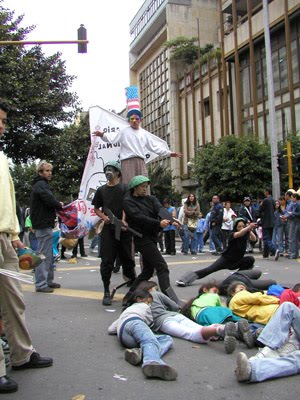
BOGOTA, Colombia — I had lunch this week with Alejo, I can say his name without worrying that he’ll be moved up higher on a target list because he, and the group he works with, the Conscientious Objectors Collective, are already so out there, I doubt anything could add to their profile.

(One public act a few years ago was to follow a military parade with brooms, and “sweep up the trash the Army left” while handing out antiwar pamphlets. In Bogota! Remember, there’s a war on in Colombia.)

Alejo is around 25 and he’s been with the Collective for at least eight years. He’s finished his work for a university degree, but because he has not served in the military, nor gone through a process that would allow him to buy an official exemption (as he says, “This would also give the government more money to continue the war”), he has not received his degree.

Street action by Concientous Objectors Collective in Bogota. Image from website of Concientious Objectors Collective.

The COs’ Collective is a group of young men and women in Colombia who work to promote a nonviolent lifestyle. Not only do they oppose the obligatory military service required of all young Colombian men, but also the other sorts of violence that young people get involved with: gangs, guerrilla and paramilitary groups, drug traffickers, and so forth.

They currently are working in high schools in seven cities to help young people understand the option to be a CO, and have just won their first Supreme Court decision supporting the rights of CO’s.

They have organized networks in other cities, too, and now have ID cards from War Resister’s International (WRI) identifying them as CO’s, so that when the military stops a bus, and checks all the young men for their draft cards (libreta in Spanish), with the intention to take all youths who have not served to the base for immediate induction, they are left alone, mostly, because, “They know it’s not worth it to take one of us in, because we have a network that will respond immediately, and the publicity is very bad for them.”

Small victories, perhaps, but important ones. I know there are young people (and not so young ones, too) in the U.S. who are looking for ways to carve out lives not beholden to the military-industrial complex. I’d love to hear their stories.

[Texan Val Liveoak is a nonviolent activist, currently living in El Salvador and San Antonio. She coordinates Peacebuilding en las Americas, the Latin American Initiative of Friends Peace Teams that also has programs in the African Great Lakes region and in Indonesia.]

Cartoon from Galiza Indymedia.

The Rag Blog

Posted in Rag Bloggers | Tagged , , , , | Leave a comment

Ted McLaughlin : Equal Rights? Don’t Ask, Don’t Think

Ignorance is bliss. Image from Rosemblumtv.

Equal rights in America:
The legacy of the Fourteenth Amendment

A misguided and wrong-headed Dred Scott-type decision by the Supreme Court could set [gay rights] back by many years…

By Ted McLaughlin / The Rag Blog / September 26, 2010

The fight for equal treatment for all Americans by their government has been a long and hard-fought battle, and it still has not been won. Although our Founding Fathers loved to talk about democracy and equal rights, the country they created did not initially give equal rights to all of its citizens. In fact, the only people who could vote in the newly-created nation were white male property-owners.

Fortunately they gave us not only a dream of equality, but also a Constitution that could be interpreted and amended to further the cause of granting equality to all citizens. After the Civil War, the Constitution was amended for the fourteenth time. That Fourteenth Amendment not only guaranteed that former slaves were to be guaranteed the full rights of an American citizen, but has also been used by the Supreme Court since that time to guarantee the rights of many others.

Thanks to the Fourteenth Amendment and Supreme Court decisions regarding it, most Americans now accept that things like race, ethnicity, sex, and age should not bar any citizen from equal protection and equal rights in America (although some battles are still being fought to fully realize these rights). The newest battle for equal rights is now being fought over sexual preference. There are many in this country, especially religious fundamentalists, who still believe that gays and lesbians should not share the same rights as other Americans.

I know that most of these people use their religion as an excuse to deny rights to other Americans, but I tend to think that there are just some that need to have another group of people to look down on — maybe to boost their own feelings of inadequacy. After all, religion was also used to deny equality to minorities and women. Those “religious beliefs” have fortunately been largely overcome, and now the battle is being fought over extending full equal rights to American homosexuals.

Currently the battle is being waged on two fronts — equality in the military and equal marriage rights. Recently the right-wingers in the United States Senate (mostly Republicans) refused to allow a Defense Appropriation bill to come up for a vote by invoking cloture (ending unlimited debate). T

hey did this because the bill included a provision that would end the “don’t ask, don’t tell” policy (DADT) of the United States military. DADT is a military policy that dictates the expulsion of gays/lesbians who don’t hide their sexual preference from their fellow soldiers and the military command structure.

Homosexuals have always served proudly and bravely in the military of the United States. To force them to hide their sexual preference and live a lie is a basic denial of their equal rights as citizens of this country. It also denies this country the service of many qualified and valued military professionals simply to satisfy the bigotry of some Americans — people who would not be affected in the least manner by granting homosexuals the right to serve their country (the same right all others, including non-citizens, are granted).

But I think the DADT policy will soon be a thing of the past. We may have to wait until the election is over, since many right-wingers and “blue dogs” are currently playing to their base of social conservatives, but it will end. A clear majority of people in America are opposed to DADT and its days are numbered.

The much harder fight is over granting gays/lesbians the right to marriage (with all its legal and social ramifications). Several states have granted this right but many others have not, and of those who haven’t many are refusing to grant the constitutional “full faith and credit” recognition to legal marriages conducted in states that allow homosexual marriage. This is a question that will soon be decided by the United States Supreme Court.

Library of Congress / Wikimedia Commons.

Sadly, it seems that some right-wing Supreme Court justices are already positioning themselves to deny equal rights to homosexuals — sort of a latter-day Dred Scott decision. One justice, Antonin Scalia, recently declared that the Fourteenth Amendment does not cover or grant equal rights to women. He said the amendment was only meant to grant equal rights to former slaves when passed in the late 1800s, and therefore should be limited to that purpose.

Scalia went on to say that he was in favor of equal rights for women, but it should be done through state or federal law and not because these rights are covered by the Fourteenth Amendment. Unfortunately, he is not the only justice that feels this way (in spite of many Supreme Court decisions to the contrary). The past decisions and writings of Justices Thomas, Alito, and Roberts show that they also would be open to a similar interpretation of the Fourteenth Amendment.

Now I don’t think any of these justices, including Scalia, are actively trying to deny equal rights to women (although a decision that the Fourteenth Amendment referred only to former slaves could be used that way in the future). What they are really trying to do is justify a decision that the Fourteenth Amendment does not grant equal rights to those discriminated against because of their sexual preference. If they can deny women’s coverage by the Fourteenth Amendment, that makes it easy to deny coverage to homosexuals.

I am an optimist. I believe that full equal rights will someday be granted to all American citizens — including homosexuals (and bisexuals and trans-gendered individuals). It is simply the right thing to do. But a misguided and wrong-headed Dred Scott-type decision by the Supreme Court could set this back by many years (and even open up opportunities for legal discrimination against other groups).

It is conceivable that the court is just one vote away from severely restricting the scope of the Fourteenth Amendment. At this point all we can do is cross our fingers and hope that wisdom prevails on the court. The alternative would be a huge step backwards for America.

Why is the concept of equality for all so hard to understand for many Americans?

[Rag Blog contributor Ted McLaughlin also posts at jobsanger.]

The Rag Blog

Posted in Rag Bloggers | Tagged , , , , , , | 1 Comment

Conscientious Objection in Colombia

By Val Liveoak

I had lunch this week with Alejo, I can say his name without worrying that he’ll be moved up higher on a target list because he, and the group he works with, the Conscientious Objectors’ Collective, are already sooooo out there, I doubt anything could add to their profile. (One public act a few years ago was to follow a military parade with brooms, and “sweep up the trash the Army left” while handing out antiwar pamphlets. In Bogota! Remember, there’s a war on in Colombia.)

Alejo is around 25 and he’s been with the Collective for at least 8 years. He’s finished a university degree but because he has not served in the military, nor gone through a process that would allow him to buy an official exemption–as he says, “This would also give the government more money to continue the war,”–so he has not received his degree.

The COs’ Collective is a group of young men and women in Colombia who work to promote a nonviolent lifestyle–not only do they oppose the obligatory military service required of all young Colombian men, but also the other sorts of violence that young people get involved with: gangs, guerrilla and paramilitary groups, drug traffickers, and so forth. They currently are working in High Schools in 7 cities to help young people understand the option to be a CO, and have just won their first Supreme Court decision supporting the rights of COs. They have organized networks in other cities, too, and now have ID cards from War Resister’s International (WRI) identifying them as COs, so that when the military stops a bus, and checks all the young men for their draft cards (libreta in Spanish), with the intention to take all youths who have not served to the base for immediate induction, they are left alone, mostly, because, “They know it’s not worth it to take one of us in, because we have a network that will respond immediately, and the publicity is very bad for them.”

Small victories, perhaps, but important ones. I know there are young people (and not so young ones, too) in the US who are looking for ways to carve out lives not beholden to the military-industrial complex. I’d love to hear their stories.

Type rest of the post here

Source /

The Rag Blog

Posted in RagBlog | Leave a comment

OPPOSING EQUAL RIGHTS IN AMERICA

By Ted McLaughlin / The Rag Blog / September 25, 2010

The fight for equal treatment for all Americans by their government has been a long and hard-fought battle, and it still has not been won. Although our Founding Fathers loved to talk about democracy and equal rights, the country they created did not initially give equal rights to all of its citizens. In fact, the only people who could vote in the newly-created nation were white male property-owners.

Fortunately they gave us not only a dream of equality, but also a Constitution that could be interpreted and amended to further the cause of granting equality to all citizens. After the Civil War, the Constitution was amended for the fourteenth time. That Fourteenth Amendment not only guaranteed that former slaves were to be guaranteed the full rights of an American citizen, but has also been used by the Supreme Court since that time to guarantee the rights of many others.

Thanks to the Fourteenth Amendment and Supreme Court decisions regarding it, most Americans now accept that things like race, ethnicity, sex and age should not bar any citizen from equal protection and equal rights in America (although some battles are still being fought to fully realize these rights). The newest battleground for equal rights is now being fought over sexual preference. There are many in this country, especially religious fundamentalists, who still believe that gays and lesbians should not share the same rights as other Americans.

I know that most of these people use their religion as an excuse to deny rights to other Americans, but I tend to think that there are just some that need to have another group of people to look down on and fell that they are better than — maybe to boost their own feelings of inadequacy. After all, religion was also used to deny equality to minorities and women. Those “religious beliefs” have fortunately been largely overcome, and now the battle is being fought over extending full equal rights to American homosexuals.

Currently the battle is being waged on two fronts — equality in the military and equal marriage rights. Just yesterday, the right-wingers in the United States Senate (mostly Republicans) refused to allow a Defense Appropriation bill to come up for a vote by invoking cloture (ending unlimited debate). They did this because the bill included a provision that would end the “don’t ask, don’t tell” policy (DADT) of the United States military. DADT is a military policy that dictates the expulsion of gays/lesbians who don’t hide their sexual preference from their fellow soldiers and the military command structure.

Homosexuals have always served proudly and bravely in the military of the United States. To force them to hide their sexual preference and live a lie is a basic denial of their equal rights as a citizen of this country. It also denies this country the service of many qualified and valued military professionals simply to satisfy the bigotry of some Americans — people who would not be affected in the least manner by granting homosexuals the right to serve their country (the same right all others, including non-citizens, are granted).

But I think the DADT policy will soon be a thing of the past. We may have to wait until the election is over, since many right-wingers and “blue dogs” are currently playing to their base of social conservatives, but it will end. A clear majority of people in America are opposed to DADT and its days are numbered.

The much harder fight is over granting gays/lesbians the right to marriage (with all its legal and social ramifications). Several states have granted this right but many others have not, and of those who haven’t many are refusing to grant the constitutional “full faith and credit” recognition to legal marriages conducted in states that allow homosexual marriage. This is a question that will soon be decided by the United States Supreme Court.

Sadly, it seems that some right-wing Supreme Court justices are already positioning themselves to deny equal rights to homosexuals — sort of a latter-day Dred Scott decision. One justice, Antonin Scalia, recently declared that the Fourteenth Amendment did not cover or grant equal rights to women. He said the amendment was only meant to grant equal rights to former slaves when passed in the late 1800s, and therefore should be limited to that purpose.

Scalia went on to say that he was in favor of equal rights for women, but it should be done through state or federal law and not because these rights are covered by the Fourteenth Amendment. Unfortunately, he is not the only justice that feels this way (in spite of many Supreme Court decisions to the contrary). The past decisions and writings of Justices Thomas, Alito and Roberts show that they also would be open to a similar interpretation of the Fourteenth Amendment.

Now I don’t think any of these justices, including Scalia, are actively trying to deny equal rights to women (although a decision that the Fourteenth Amendment referred only to former slaves could be used that way in the future). What they are really trying to do is justify a decision that the Fourteenth Amendment does not grant equal rights to those discriminated against because of their sexual preference. If they can deny women’s coverage by the Fourteenth Amendment, that makes it easy to deny coverage to homosexuals.

I am an optimist. I believe that full equal rights will someday be granted to all American citizens — including homosexuals (and bi-sexuals and trans-gendered individuals). It is simply the right thing to do. But a misguided and wrong-headed Dred Scott-type decision by the Supreme Court could set this back by many years (and even open up opportunities for legal discrimination against other groups).

It is conceivable that the court is just one vote away from severely restricting the scope of the Fourteenth Amendment. At this point all we can do is cross our fingers and hope that wisdom prevails on the court. The alternative would be a huge step backwards for America.

Why is the concept of equality for all so hard to understand for many Americans?

Type rest of the post here

Source /

The Rag Blog

Posted in RagBlog | Leave a comment

Roger Baker, The Rag Blog’s resident economist and peak oil expert speculates that we may be facing a similar global peak in world food production. He analyses global food production trends, which are moving in the wrong direction — and points out that food prices have been increasing, on average, by more than 10 percent per year. He discusses the causes for the rise in food prices, and throws in peak oil as a wild card. He projects that, even if we could assume ample supplies of liquid fuel, a food price crisis could return by 2014, especially when you factor in major food market speculation as happened in 2007.

Posted in RagBlog | Leave a comment

Ross continues his remarkable reporting from Mexico City (“El Monstruo”) with the revelation that the next Mexican Revolution may already be upon us. “Don’t look now,” he says, “but the long-awaited resurgence of the Mexican Revolution has already begun.” There have been some indications of legitimate guerrilla activity, but for the most part the rebellion is nonideological and lacks class orientation. It’s the narco-insurrection that has led to the mobilization of 140,000 of Mexican Army troops and large detachments of Naval Marines — as the government fears the possibility of a “symbiosis” of drug gangs and armed political guerrillas.

Posted in RagBlog | Leave a comment