RTÉ News : Iceland to Be Free Press Haven?

No more of this? Image from Susan Loone’s Blog.

Iceland set to become free haven
For journalists and whistleblowers

By RTÉ News / August 24, 2010

After Iceland’s near-economic collapse laid bare deep-seated corruption, the country aims to become a safe haven for journalists and whistleblowers from around the globe by creating the world’s most far-reaching freedom of information legislation.

The project is being developed with the help of WikiLeaks founder Julian Assange.

It flies in the face of a growing tendency of governments trying to stifle a barrage of secret and sometimes embarrassing information made readily available by the internet.

On 16 June a unanimous parliament voted in favour of the Icelandic Modern Media Initiative, a resolution aimed at protecting investigative journalists and their sources.

“We took all the best laws from around the world and pulled them together, just like tax havens do, in order to create freedom of information and expression, a transparency haven,” Birgitta Jonsdottir, the member of parliament behind the initiative, said.

Describing herself as an “anarchist,” the 43-year-old said she had decided to get into politics to seize the opportunities to change the system in Iceland following its dramatic financial collapse at the end of 2008.

Ms Jonsdottir was shocked to witness the attempts at censorship in her country, which had long been held up as a model democracy.

In the most resounding example, a court injunction in August 2009 forced Icelandic public broadcaster RUV to back down at the last minute from transmitting a report on one of the country’s three largest banks that all collapsed less than a year earlier, pushing Iceland to the verge of bankruptcy.

Instead of its report on the Kaupthing bank’s loanbook, RUV broadcast images from whistleblower site WikiLeaks, which had published the incriminating documents, in an attempt to draw attention to the limits being put on freedom of expression in Iceland.

“Freedom of information and freedom of speech are the pillars of democracy. Now, if you don’t have that, you don’t really have a democracy,” said Ms Jonsdottir, wearing “Free Tibet” and “WikiLeaks” pins on her jacket.

Icelandic parliament deputy Birgitta Jonsdottir. Photo from AFP.

Blaming the threat of terrorism, “all countries are facing new sets of laws which are making it more difficult in particular for investigative journalists and book writers,” she said.

The aspiring “island of transparency” aims to strengthen source protection, encourage whistleblowers to leak information and help counter so-called “libel tourism,” which consists in dragging journalists before foreign courts in countries with laws that best suit the prosecution.

The idea is to imitate and combine the existing most far-reaching laws in countries renowned for their freedom of expression, like the U.S., Sweden, and Belgium.

“I don’t think that there is anything radical in (IMMI). The radicalism around it is to pull these laws together,” Jonsdottir said.

“We have seen that really (such protections) are necessary,” said WikiLeaks founder Assange, whose name became known after his site last month published nearly 77,000 classified U.S. military documents on the war in Afghanistan.

“That’s our experience in the developing world and in most developed countries: that the press is being routinely censored by abusive legal actions,” he said recently in a video posted on YouTube.

Mr Assange, who spends much of his time in Iceland and other countries where the legislation is more in his favour, created WikiLeaks’ first global scoop in Reykjavik earlier this year.

Locked up for weeks at a time in a house in the Icelandic capital, he and a handful of other WikiLeaks supporters managed to decrypt and post online a military video showing a U.S. military Apache helicopter strike in Baghdad in 2007 that killed two Reuters employees and a number of other people.

WikiLeaks along with a number of non-governmental organisations and international celebrities like European member of parliament Eva Joly have contributed to developing IMMI.

Journalists in Iceland and abroad have applauded the initiative.

“By offering tight protection to the sources, it will be a lot safer to report on abuses in the government or in the corporate community,” said WikiLeaks insider and Icelandic freelance reporter Kristinn Hrafnsson.

“When you know you can pass on information safely, you’re more prone to do it,” he said.

But the resolution will also have implications beyond Iceland’s borders.

“In countries where they are oppressed such as China and Sri Lanka, journalists risk their lives,” Ms Jonsdottir said.

“We can’t help them with that, but at least we can ensure that their stories won’t be removed” from the internet, by posting them on servers located in Iceland where the censors cannot get at them, she said.

According to Ms Jonsdottir, it will take about a year and a half — the estimated time required to change at least 13 existing laws — before IMMI will go into effect.

© 2010 RTÉ

[This article was originally published on August 19, 2010 by RTÉ News>, a division of Raidió Teilifís Éireann (RTÉ), an Irish national public service radio and television broadcast service. It was distributed by CommonDreams.]

Source / CommonDreams

The Rag Blog

Posted in Rag Bloggers | Tagged , , | Leave a comment

Thomas Good : Hatred and Healing at Ground Zero

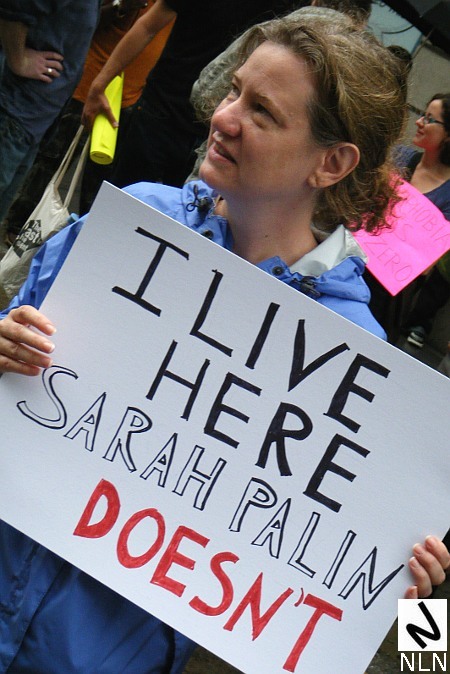
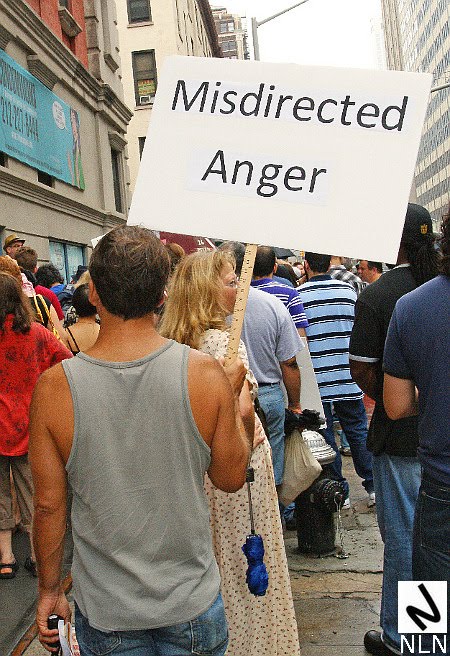
Photo by Bud Korotzer / NLN.

The objectification of Other:
Hatred and healing at Ground Zero

By Thomas Good / The Rag Blog / August 23, 2010

See photo gallery, Below.

NEW YORK — Sunday was another rainy day in New York City, as two sides of the Ground Zero mosque issue squared off in dueling protests — two sides who are responding to a catastrophe with two mutually exclusive answers: hatred and healing.

Lost

If volume validated an argument then the motorcycle contingent bound for Sunday’s anti-mosque protest would win, hands down. With loud pipes and shrill voices, the bikers from out of town who thundered down Broadway en route to the demonstration — apparently going the wrong direction — would have the final word in any debate whose outcome is measured only in decibels.

But it isn’t that simple. And just as the issues surrounding the proposed building of a mosque-slash-community center in the general area of Ground Zero aren’t so simple — it’s too simplistic to write off all of the bikers as stereotypic toughs, incapable of compassion or human emotion

Some of them lost relatives in the September 11, 2001 attack on the Trade Center.

A short time after the loud cavalcade drove past this reporter, several of their number, now dismounted, emerged on a street corner looking confused, vulnerable, and maybe even a little embarrassed. It was hard to deny their humanity. We’ve all been lost before — alone, wandering unfamiliar territory.

Us vs. them

To those who see the world from the vantage point of an “us versus them” perspective — there is no middle ground, no room for freedom of religion, no Constitution to defend, no reason to wince at racist epithets hurled at the Other side. To those who embrace an ideology based on interpreting 9/11 as a clash of two cultures, as an apocalyptic harbinger of a holy war — one protester’s angry outburst sums up the world view: “Islam is not a religion, it’s a cult.”

This was the statement one New Yorker hurled at another on Sunday.

And as if this statement was not sufficient to choke off discussion, to demonize and objectify an entire faith, the anti-mosque protester continued: “If you had a Qur’an here, I’d piss on it.”

The Others

The objectification of Other as evil incarnate, the demonization of billions of believers, is not a rational construct but it is one that has currency, perhaps because choosing hatred over healing, choosing to adopt bumper sticker slogans over calm dialogue is less threatening, less intimidating than attempting to grasp elusive nuances. There is no doubt that it is easier to hate than to love, to assimilate rather than to accommodate, to shout rather than to listen. This is the sad trajectory of terrorism itself.

The man who uttered that sad statement, who argued that Islam is not a religion, was eventually quieted by a white-shirted NYPD senior officer. The target of the protester’s venom — who had responded angrily — walked off to join the Other demonstration of the day: the group of civil rights activists, peace protesters, and interfaith clerics who support the Muslims looking to build the Cordoba House mosque and community center on 51 Park Place.

From NYC to Oklahoma — and back again

At the anti-Islamophobia rally, Alan Stolzer of the Military Project asked me a question.

“Has anyone built a church near the Oklahoma City bomb site?”

His rhetorical question was pointed: Timothy McVeigh was a blond and blue Christian. A home grown killer. The analogy was not ideal. McVeigh did not profess to kill in the name of his religion. But in our history other Americans have killed in the name of their faith, some acting in concert with other true believers. And yet in these cases, it was the killers who were judged, not the professed faith, not the religion in its entirety. It could not be otherwise. And yet it’s different for Muslims in America.

Beyond binaries

Somewhere in between the 9/11 ideologues — the Islamophobes and racists who look to burning books as a solution — and the Muslim community left holding a fractured First Amendment are the families of 9/11. Their grief is not ideological in nature but their numbers, their “hearts and minds,” are the perceived prize for those who would market rabid xenophobia disguised as patriotism.

The Sarah Palins and other rank opportunists, none of whom have ever lived in New York, some of whom can’t spell xenophobia — even if they can see it from their back yard — are eager to profit from appeals to hatred and racism. But for those who lost loved ones, healing will have to be accomplished without hate. However this is done, whatever path is chosen, healing involves overcoming hate, not embracing it.

As the rain fell on the protesters who challenge the binary world view, those who want to heal and move beyond Islamophobia and the scourge of racism, as the mainstream media swarmed to get their soundbites from the “pro-mosque protesters” — a man in a priest’s collar quietly held up a sign. It read: “Build and Learn Together.”

[Thomas Good is editor of Next Left Notes, where this article also appears.]

Photo by Thomas Good / NLN.

Photo by Thomas Good / NLN.

Photo by Thomas Good / NLN.

Photo by Bud Korotzer / NLN.

Photo by Bud Korotzer / NLN.

The Rag Blog

Posted in Rag Bloggers | Tagged , , , , , , | 2 Comments

Barbara Hines is a famed immigration attorney and a clinical law professor at the University of Texas at Austin. She is co-director of the immigration clinic at the UT School of Law. A two-time Fulbright scholar, Hines has practiced immigration law since 1975, and has been involved in landmark litigation defending the constitutional and statutory rights of immigrants. She and her clinic received international attention in recent years for their work in drawing attention to the T. Don Hutto family detention center in Taylor, Texas, leading to a successful ACLU lawsuit that greatly improved conditions at the facility.

In 2000, Texas Lawyer Magazine named Barbara one of 100 Texas “Legal Legends” of the 20th century. This year the National Immigration Project of the National Lawyers Guild named her the 2010 recipient of its Carol Weiss King Award for excellence in the pursuit of social justice through organizing, litigating, and teaching.

In the early Seventies, Barbara Hines was active in the women’s movement and the movement against the War in Vietnam. She was also a contributor to Austin’s underground newspaper, The Rag.

Posted in RagBlog | Leave a comment

Alice Embree : Protesters Block Fort Hood Troop Deployment

Participants in the blockade action at Fort Hood, Texas, on August 23, 2010. Left to right: Iraq Veterans Bobby Whittenberg-James and Crystal Colon, Jeff Grant, Military Spouse Cynthia Thomas and Afghanistan Veteran Matthis Chiroux. Photo from Fort Hood Disobeys.

Protesters at Fort Hood in Killeen
Block buses deploying troops to Iraq

By Alice Embree / The Rag Blog / August 23, 2010

KILLEEN, Texas — Under darkness at about 4 a.m. this morning, buses carrying the 3rd Armored Cavalry Regiment (3rd ACR) to planes were stopped by a group of five protesters that included two Iraq veterans, one Afghanistan veteran, and one military spouse whose husband had been deployed to Iraq three times.

The Fort Hood Disobeys group clambered down from a highway overpass where supporters held banners and signs. Holding banners that said, “Occupation is a Crime” and “Please Don’t Make the Same Mistake We Did. RESIST NOW,” the protesters spread across Clarke Road. Police with automatic weapons and dogs beat them out of the roadway. They were not arrested.

Deployments are usually scheduled for the afternoon with family members present as soldiers board the buses. Whether this deployment left in the dead of night because of planned protests is unknown, but averting media attention was undoubtedly part of the Army calculus.

As the corporate media heralds the “end of combat missions,” the truth about the troops deploying to Iraq has not made mainstream news. Two more deployments of the 3rd ACR, a combat regiment, are scheduled this week. The total 3rd ACR troop deployment to Iraq from Fort Hood will be about 3,000. These will be added to the 50,000 troops remaining.

“Operation New Dawn” is the new brand for the U.S. occupation in Iraq. As combat deployments continue, it rings as hollow as George Bush’s proclamation of “Mission Accomplished.”

Two more upcoming events are aimed at peeling back the mass deception surrounding the “end of combat operations.”

Dahlia Wasfi, an Iraqi-American doctor, will speak next Sunday in Austin about the U.S. Policy in Iraq: A Humanitarian Disaster. The event is co-sponsored by Texas Labor Against the War and CodePink Austin and will take place at the Texas State Employees Union meeting hall, 5 p.m., Sunday, August 29, 1700 South First, Austin.

The following morning, there will be a press conference at Under the Hood GI Cafe in Killeen that will highlight many facets of the Iraq debacle, including the impact on soldiers, military families, Iraqis, and funding to meet domestic needs. Dahlia Wasfi will speak at this press conference and will be joined by Rep. Lon Burnam from Fort Worth, Texas. Representatives from several groups including Iraq Veterans Against the War, Veterans for Peace, CodePink, and Texas Labor Against the War will be present. The press conference will take place at 10 a.m., Monday, August 30, Under the Hood, 17 South College, Killeen, Texas.

[Alice Embree is a long-time Austin activist and organizer, a former staff member of The Rag in Austin and RAT in New York, and a veteran of SDS and the women’s liberation movement. She is a regular contributor to The Rag Blog and is treasurer of the New Journalism Project.]

Following are personal statements from four of the participants in the action:

Bobby Whittenberg-James:

I am a Marine veteran of the war against the people of Iraq, a Purple Heart recipient, and a third generation military service member. I joined the Marines in June of 2003, believing the lies about weapons of mass destruction and an imminent threat to our safety. I have since come to learn that these wars and occupations do not keep the people of the United States or the Middle East safe, but instead serve the interests of politicians, capitalists, and corporations: the ruling elite.

These unjust wars and occupations rob the people of Iraq, Afghanistan, Pakistan, and Yemen of their dignity and their right to self-determination and serve to make the people of both the Middle East and the United States less safe. They also serve to further destabilize a region that has suffered under the boot-heel of western colonialism for over a century. The U.S. Empire also supports both financially and militarily the brutal apartheid regime that occupies Palestine. All of this is done in our name with our money, and I am here to say “Not in my name!”

The recent information leaks about the U.S. Empire’s wars lay bare their war crimes and crimes against humanity. We must face the truth, even if it makes us uncomfortable or shows us something about ourselves that we don’t want to see. When we find the truth, we must respond accordingly. I will not be complicit in the killing of people. Since I do not believe that the government or the capitalists will end these wars, I will vote with my body.

Bobby Whittenberg-James
Disobedient

Crystal Colon:

I was a sergeant in the Army for five years, stationed at Fort Hood the entire time, save two deployments to Iraq totaling 26 months. I was a Signal Support Systems Noncommissioned Officer, coordinating communications for various commands. I was honorably discharged in Jan., 2010, and have been organizing in the veterans peace movement ever since.

I first began to question the war in Iraq during my first deployment in ’05-’06. After my friend Robbie was killed, I was very deeply affected. I started questioning why we were in Iraq. It felt like he had died for nothing. After returning from Iraq, I planned to leave the military. I was stop-lossed and forced to return to Iraq for 15 months, in total held beyond the length of my enlistment more than 450 days. Since leaving the military, I have been active with the veterans peace movement, speaking out about my experiences and supporting troops who refuse to fight.

I am doing this today because I can’t allow this war in which I have fought to continue. I can’t allow other soldiers to make the same mistake I did, deploying in support of a war crime. As a veteran of Iraq, how could I not do this today? For the people I helped occupy, for the friends I lost and stilI have over there, for the soldiers on those buses. How could I not do this today? I should have disobeyed. I should have never boarded those buses to Iraq. I wish someone had tried to stop me.

Crystal Colon
Disobedient

Matthis Chiroux:

I am a former Army sergeant and war resister. I was press-ganged into the Army by the Alabama Juvenile “Justice” System in 2002. While in the military, I occupied the nations of Japan and Germany for more than four years, with shorter tours in the Philippines and Afghanistan. I was a Public Affairs noncommissioned officer specializing in strategic communications. In reality, I was a propaganda artist. I was discharged honorably to the Individual Ready Reserve in 2007.

While I have always been against the war in Iraq, I began resisting it actively in 2008, after I received mobilization orders for a year-long deployment to Iraq. I refused those orders in Congress in May of 2008, calling my orders illegal and unconstitutional. I believed appealing to Congress would end the war. When 13 Members signed a letter of support for my decision and sent it to Bush, I thought we had won a victory for peace. This was more than two years ago. The president has changed, and the wars and destruction drag on.

Today, I am blocking the deployment of the 3rd Armored Cavalry Regiment with my fellow vets and military family members because the wars will continue to victimize our communities until we halt this bloody machine from within. I am putting my body on the line in solidarity with the people of the Middle East, whose bodies have been shot, burned, tortured, raped, and violated by our men and women in and out of uniform. I cannot willfully allow Americans in uniform to put their lives and the lives of Iraqis in jeopardy for a crime. We are here because we have a responsibility to ourselves as veterans and as humans of the world. I will not rest until my people, ALL PEOPLE, are free.

In Struggle and Solidarity,

Matthis Chiroux
Disobedient

Cynthia Thomas:

I have been an Army wife for 18 years. My husband has been deployed three times since the wars began. During his second deployment, he was severely wounded and medevaced to Walter Reed Army Hospital on life support. Even though he had posttraumatic stress disorder and traumatic brain injury,and suffered three fractures in his back, three fractures on his pelvis, and countless other injuries, the Army deployed him a third time. This was devastating to our two daughters, our step-son and to me.

Three months after my husband deployed for the third time, our stepson called to inform me he was joining the Marines. That was the exact moment I realized that our children would be fighting these endless wars. I decided that I needed to start resisting.

The reason I am doing this today is because for the past three years that I have been speaking out and advocating for Soldiers, things have only gotten worse. I have heard countless stories from vets and activevduty soldiers that give people nightmares. I have heard stories from family members that would shock people awake if they would just listen! Our military community is being destroyed!

If these wars are destroying our soldiers and military families with 12 to 15-month, often repeat deployments, how do you think the Iraqi and Afghan people doing? They have been living these wars 24/7, 365 days a year for nearly a decade! My youngest daughter is an Operation Iraqi Freedom baby. She was less than one-year-old when her father left to invade Iraq. I look at her, and I see an Iraqi or Afghan child having to live in constant fear with no end in sight! I am doing this for our community, for my girls, for my husband and our Marine. I am doing this for the Iraqi and Afghan People. Enough is enough. If soldiers really want to go fight, they’ll have to go through me.

Cynthia Thomas
Disobedient

The Rag Blog

Posted in Rag Bloggers | Tagged , , , , , , , | 5 Comments

Harry Targ : Religion, Politics, and War

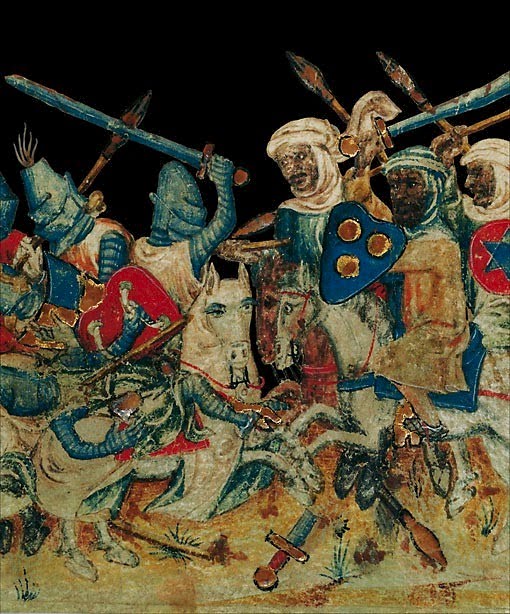
Christians fight Muslims in illustration from medieval manuscript. Image from syllabus, Southern Illinois University Edwardsville.

Sanctioned by a wrathful God:
Religion, politics, and war

By Harry Targ / The Rag Blog / September 22, 2010

Childhood remembrances

When I was a kid I had to go to Hebrew school to prepare for my Bar Mitzvah. I confess I would have preferred being in the school yard playing baseball to studying Hebrew. One of my few remembrances from days of religious study, aside from my resentment about time away from the ball field, was reading the stories of the tribes of Israel conquering or killing political/religious enemies. Acts of violence and hate seemed to me to be sanctioned by a wrathful God, my God.

Down the street from where we lived were St. Timothy’s Church and school. The building was an imposing broad red-brick structure. There was no contact between the children who went to school there and those of us who attended public school a few blocks away.

Ideology and the place of the United States in the world

When I grew up, began to study international relations, became an activist against the war in Vietnam, and started teaching foreign policy, I saw the power of ideology in mobilizing whole peoples to hate others. War, while a byproduct of economic interest, was facilitated by ideologies of hate; by creating “the other,” who were less than human and believed in the wrong God.

Millions died in the Crusades, the Inquisition in Spain, the taking of the lands of the Western Hemisphere and Africa, the occupations of China, Indonesia, Indochina, and the Middle East. Most of those deaths were justified by obedience to the Christian God.

In 1996 I was asked to give a talk at a church on “Is United States Foreign Policy Moral or Not?” I went to Ruth Sivard’s compilation of data on wars over the centuries, World Military and Social Expenditures, 1996. I counted up the war deaths of peoples in wars in which the United States was a direct participant, such as Korea and Vietnam, or in which the United States was indirectly involved such as Guatemala, Afghanistan, Angola, and Nicaragua. The number of those who died in those wars between 1945 and 1995 in which the United States had a role totaled 10 million.

Of course, participation in most of these wars and covert operations was justified by a mix of secular and sacred terms: democracy, markets, and God. President Reagan had reiterated the religious zealotry articulated by virtually every politician, banker, or theologian who called for U.S. militarism. The United States was “the city on the hill,” the “beacon of hope” for the world.

Lloyd Gardner in his recent book, The Long Road to Baghdad, A History of U.S. Foreign Policy From the 1970s to the Present, argues that there is a vision of global perfectibility behind United States foreign policy from its rise to great power status at the dawn of the twentieth century, to Woodrow Wilson’s vision of making the world safe for democracy, to Harry Truman’s announcement of our great struggle against communism in 1947, to John Kennedy’s “new frontier” and Lyndon Johnson’s war in Vietnam, to the Reagan Doctrine, and George W. Bush’s proclamation that nations are either with us or the enemy.

Underlying all this is the proposition, as Bob Dylan suggested, that “God is on our side.” Gardner writes that “Bush equates American foreign policy here with God’s will… God is on the side of justice; America has chosen the side of justice as its goal; therefore, God will bless American policy. Obstacles to this mission were only to be expected from forces on the wrong side of history.”

The campaign against Islam in the United States

Now politicians are demanding that the constitutional right of sectors of the Islamic community in New York to build a community center be denied because they offend the sensibilities of the Christians and Jews living in the city, indeed in the entire nation. They ignore the history of their coreligionists who have misused people’s faith to justify conquest and mass slaughter. They deny the fact that the presence of their religious institutions in other lands or located throughout communities in the United States create fear and anger among those of different faiths or no faith.

Perhaps most scurrilous of all is the way that the public mind is being manipulated and used for purposes of political gain at a time when joblessness, environmental devastation, and hatred spread across the land.

The little boy studying the Old Testament 60 years ago was uncomfortable about aspects of his religion that he could only partially understand. The great American writer, Mark Twain much earlier described the irony of religious fanaticism as he reported on a massacre of Muslim rebels fighting U.S. military occupiers at the dawn of the twentieth century in the Philippines:

Contrast these things with the great statistics which have arrived from that Moro crater! There, with six hundred engaged on each side, we lost fifteen men killed outright, and we had thirty-two wounded. . . The enemy numbered six hundred-including women and children-and we abolished them utterly, leaving not even a baby alive to cry for its dead mother. This is incomparably the greatest victory that was ever achieved by the Christian soldiers of the United States.

[Harry Tarq is a professor in American Studies who lives in West Lafayette, Indiana. He blogs at Diary of a Heartland Radical.]

The Rag Blog

Posted in Rag Bloggers | Tagged , , , , , | 1 Comment

Tom Hayden : Will Iraq ‘Invite’ Us to Stay?

Image from Progressive America Rising.

U.S. combat ends in Iraq
But will Iraq ‘invite’ us to stay?

By Tom Hayden / The Rag Blog / August 21, 2010

See ‘The myth that the combat troops are leaving Iraq’ by Col. Andrew Berdy, Below.

While the Obama administration struggles to keep its pledge to end the Iraq war, a behind-the-scenes plan is developing in which the Baghdad regime “invites” the American military to stay.

Managing the withdrawal of combat troops was a significant achievement for Obama. But while media attention focused this week on the last American combat brigade rolling out of Iraq, US diplomat Ryan Crocker was predicting that if the Iraqis “come to us later on this year requesting that we jointly relook at the post-2011 period, it is going to be in our strategic interest to be responsive.” [NYT, Aug. 19]

That means troops and bases, keeping a U.S. strategic outpost in the Middle East. Otherwise, according to some Pentagon sources, the Iraq war will have been in vain.

To prevent backsliding on the agreement to withdraw all troops and bases by the end of 2011, peace advocates and Congress will have to revisit and reinforce those agreements using hearings and budgetary powers.

To review the history: in late 2008, a secret negotiation resulted in what the Iraqis called “the withdrawal agreement” and the Americans the “status of forces agreement.” The bilateral pact was never debated or approved by the U.S. Congress. By its adoption, the Iraqis could claim a victory for sovereignty while the U.S. could declare a diplomatic end to an unpopular war.

In reality, the Iraq war never ended. U.S. casualties plummeted because fewer Iraqis wanted to shoot Americans who were leaving. Iraqi casualties declined from the feverish high of 2006-7, but continue to be several hundred per month.

Al Qaeda of Mesopotamia, which did not exist when the war began, has survived. The forces of Moktada al-Sadr, who waged two uprisings against the U.S., are a powerful factor in Iraqi politics and on the ground. The Kurdish crisis is unsolved. Overall, Iran has prevailed strategically and politically.

And the Baghdad regime originally installed by the Americans seems hopeless deadlocked, inefficient, and on the edge of imploding. The only Western winners are the oil companies headed by British Petroleum, now contracting for the Basra oil fields.

The State Department is expanding a militarized “civilian” intervention to fill the gap as Pentagon troops depart. Thousands of military contractors will conduct Iraqi police training, protect Iraq’s airspace, and possibly conduct continued counterterrorism operations. State Department operatives will be protected in mine-resistant, ambush-protected vehicles [MRAPS], armored vehicles, helicopters and its own planes.

The immediate future is uncertain. U.S. soldiers currently being sent to Iraq are told their mission is “to shut it down.” But the real story is being hidden by the Obama administration’s insistence that its promise to end the war is being kept. The notion of a continued military presence, according to the Times, “has been all but banished from public discussion.” According to one official, “the administration does not want to touch this question right now.”

A war that started with dreams of bringing democracy to the Middle East is ending by keeping plans for more troops hidden from American voters during an election year. Sound familiar?

[Tom Hayden is a former California state senator and leader of Sixties peace, justice, and environmental movements. He currently teaches at Pitzer College in Los Angeles. His books include The Port Huron Statement, Street Wars and The Zapatista Reader. He is a contributor to Progressive America Rising, where this article also appears.]

The myth that the combat
Troops are leaving Iraq

By Col. Andrew Berdy, U.S. Army (ret.)

Can you explain to me how, or why, the myth of “all combat troops out of Iraq” is allowed to be perpetuated by the press, much less our senior military leadership? Yes, the mission has changed. But units like my son’s Stryker Brigade (not the one that just left!) are, and always will be, combat infantry units.

This is fiction pure and simple. I just don’t get how the nation has swallowed this and why members of the media are not reporting facts the way they are rather than the political PR message the Administration wants portrayed. Does anyone not think that the likelihood of continued combat operations is a reality? When casualties are taken by these “non-combat forces” will those casualties be characterized as “non-combat” as well?

Does the public not understand that the secondary mission of our remaining forces is to be prepared to conduct combat operations either to defend themselves or to support Iraqi forces if requested? And when these train and assist “non-combat” units have to engage in, dare I say, combat operations, what will the Administration say then?

I can tell you, as a former brigade commander responsible for securing and helping to rebuild Port-au-Prince, Haiti, while we went in prepared for battle, and quickly transitioned to peacekeeping/nation building, there was never a moment that my infantry brigade was not prepared to conduct combat operations (which did occur late in the deployment) and there was never a moment when we were anything but a combat force.

I suspect if you ask those troopers on the ground now they would agree with me and take incredible umbrage with what is being trumpeted on TV and in the press.

Source / The Best Defense / Foreign Policy

Thanks to Carl Davidson and Steve Russell / The Rag Blog

Posted in Rag Bloggers | Tagged , , , | 9 Comments

MUNICH FOR THE DEMOCRATS

By Thomas McKelvey Cleaver / The Rag Blog / August 21, 2010

In 1938, Hitler and the Nazis were flexing their power in Germany and doing a very good job of scaring the rest of Europe, still scarred by the First World War. By the late summer of 1938, Hitler had successfully bluffed his way into returning the Rhineland to German control in 1936, with an army so weak they were under orders to retreat if the French showed any resistance — which they didn’t. In the spring of 1938 he had annexed Austria, with no international outcry.

Despite the fact that in August 1938 the German Wehrmacht — the army, navy and air force — was in no condition to actually engage in combat with Britain or France, a fact that was so obvious to the German military leadership that they seriously entertained the idea of a military coup against Hitler if he looked like he was really going to go to war over Czechoslovakia, Hitler managed to bluff the Western allies again.

Knowing that the French were in no condition — politically, militarily or economically — to wage war, British Prime Minister Neville Chamberlain flew to Munich to confer with “Herr Hitler” and returned waving a piece of paper and proclaiming “peace in our time.”

Hitler rewarded Chamberlain’s cooperation by upping his demands, with the result that Chamberlain and French Premier Daladier went back to Munich and gave Hitler title to the Czech Sudetenland, even going so far as to browbeat Czech President Eduard Benes — in the presence of the Nazis — into allowing them to sell out Czechoslovakia in the name of “peace.”

Their reward for this appeasement of a fascist dictator and his movement came a year later: the Second World War, with over 40 million deaths worldwide by August 15, 1945.

Over the years since, many American governments have explained away many stupid, even idiotic decisions in international military affairs as “preventing another Munich.” This despite the fact that the facts of each of these situations were never close to those of “Munich.”

2010 is different.

The Democratic Party, after a historic victory in 2008, has been confronted by a belligerent American Right that has pursued a policy of absolute opposition, despite their lack of power, and despite the fact that the Republicans were seen in 2008 as the party that had created the crisis.

Despite the willingness of the Democrats to “reason together” on a bipartisan basis with their opponents — the functional equivalent of the European appeasement of Hitler in the Rhineland and Austria — they have been rebuffed every time and for their efforts they have been portrayed in the (Republican-controlled) media as “ineffective.” Today, the party that destroyed the economy in 2008 and wrecked the country internationally with their ridiculous wars, is poised to regain control — all as a result of bluffs that were not called when they could have been.

And now, in August 2010, we find ourselves in the same position Chamberlain found himself in 72 years ago this month: a fascist movement that has made itself “strong” in the eyes of the public now makes demands that should not be acquiesced to by the Democrats any more than Hitler’s demands should have been acquiesced to by Chamberlain.

And yet, these demands are being acquiesced to. The demand of the Right is that America cease being America, in terms of our commitment to constitutional civil liberties enshrined in the Bill of Rights for 221 years. The Right has created a “nontroversy” (i.e, a battle over something that does not actually exist) into a campaign of fearmongering that might just put them over the top in November. I refer of course to the fight over the (non-existent) “Ground Zero Mosque.”

President Obama declares the proponents of the Islamic Cultural Center That Is Not A Mosque At Ground Zero to build the center as an activity protected by the First Amendment guarantee of religious freedom, and then steps back, saying he will not comment on the “rightness” of the project.

The result? According to the Pew Center poll in Americans and Religion, twice as many Americans now believe the President is a “secret Muslim” as believed this patent right wing lie a year ago.

Senate Majority Leader Harry Reid, caught up in a tight race with an out-and-out right wing looney-tune, responds to the looney-tune’s demand that he “state his position” on the nontroversy by agreeing with the Right that it is “inappropriate” for the Islamic Cultural Center That Is Not A Mosque At Ground Zero to be located where it is planned.

The result is that the Right exhilarates in using Reid’s statement to show opposition to the President’s “radical position.”

Governor Howard Dean — a man I used to respect until this past Wednesday — enters the fray unasked and agrees with Senator Reid, on the basis that 61% of Americans are opposed to having the Islamic Cultural Center That Is Not A Mosque At Ground Zero be not located at Ground Zer, and it is “good politics.”

Let us remember that this is the man who — when 85% of Americans were willing to believe the lies of George W. Bush when it came to the Imperial Wehrmacht‘s Invasion of Poland back in 2002 — stood up and said that was wrong, and built a credible presidential campaign from that principled and honest stand.

Do any of these drooling morons really think that agreeing with the Right that the Islamic Cultural Center That Is Not A Mosque At Ground Zero should not be built at Ground Zero is going to give them any sort of political strength? Do they really think that appeasing these scum will give them the short-term political gain they are so desperate to win this November, when the rubes can go vote for the “real” opponents of the Islamic Cultural Center That Is Not A Mosque At Ground Zero that should not be built at Ground Zero??

Eighty-three percent of my fellow Americans had their political heads up their metaphorical asses in March 2003, and today, seven and a half years later — after destroying Natalie Mains and the Dixie Chicks and (among other unnoticed acts) doing their best to destroy me with their semi-literate e-mails and their campaigns to have me removed from the internet sites I participate at for non-political subjects (on grounds of my “lack of patriotism”), as well as harassing any number of other Americans intelligent enough to see moron stupidity for what it was – most of the people who were such true patriotic believers then now breathe a sigh of relief that the final American combat unit has left Iraq this week. So much for believing the majority of Americans know anything when they are being whipped up by fear mongers and professional propagandists.

61 percent of Americans now believe that the Islamic Cultural Center That Is Not A Mosque At Ground Zero should not be built at Ground Zero, because they are being systematically lied to by professional propagandists who have no central core beliefs or principled connection to the truth, but are willing to destroy the country if, in the process, they can be returned to power.

Like H.L. Mencken said in 1924, at the height of another ginned-up nontroversy, the Scopes Monkey Trial: “Nobody ever went broke underestimating the intelligence of the American people.” The Republican Party has survived on this truth since before they were Republicans, back when they were the Know-Nothing Party who created hysteria across the country that we were threatened with destruction by allowing the sub-human Irish to come here during the Potato Famine. They did it again, with the Poles, the Italians, the Chinese, and anyone else they could call “the other” in their appeal to fear and ignorance.

I have a personal connection in my opposition to this kind of moron stupidity.

Back in 1918, the American people were ginned-up to support our entry into the First World War – a war the majority had voted against entering when they re-elected that narrow-minded ignorant racist bigot Woodrow Wilson (a man who deserves none of the veneration he is accorded by Democrats) in 1916 on the slogan “He kept us out of war.” To generate support for saving Wall Street’s war loans to the British and the French, the Government created a campaign against “Germans” that is much like the present campaign against “Islam.”

That spring, my then 5-year old father saw his little Dachshund “Kaiser” kicked by a neighbor for being “German.” He had to rename his beloved pet “Teddy” (for “Teddy Roosevelt”) and keep the dog inside for a year to prevent its “patriotic” murder. It was an event he remembered all his life.

At about the same time, in Alamosa, Colorado, my grandfather Harry Wiest had his barn burned down by his “patriot” neighbors, for the crime of having a German name. His 3 year old daughter – my mother – was terrified by the events of that night and never forgot them. For the ten years they continued to live there, she always wondered which parent of which of her friends had tried to kill her.

The irony was that the Wiest family had come to America in 1849 with a Prussian price on their heads for the “crime” of my great-great-great-grandfather Peter Wiest being a member of the Congress of Frankfurt in the Revolution of 1848, when those who really were the “good Germans” tried to overthrow Prussianism and establish democracy in Germany.

And they weren’t the only ones – nearly all the German-Americans in 1918 were either immigrants or their children who had come to get away from the Kaiser Willie the Idiot and the Prussian morons. But they were tarred with the “Prussian” brush the same way that Muslim Americans who came here to get away from the oppressive ignorance found in most Muslim-run countries are tarred with the brush of Osama Bin Laden.

That the American leaders who are supposed to be “the good guys” are trying to appease the unappeasables of the Right this way fills me with complete disgust.

An old friend of mine said the other day that “The symbol of the Democratic Party should not be a vertebrate.”

He’s right.

And what really truly pisses me off completely is the fact that this appeasement is only going to result in the victory of the conscienceless fascist scum in November.

Finally, there really is a “Munich moment” for American leaders to respond to, and they are failing the test.

And these are the people we have to support if we don’t want November 2, 2010, to be the American January 20, 1933. Goddamnit!

Type rest of the post here

Source /

The Rag Blog

Posted in RagBlog | Leave a comment

Mariann G. Wizard : Dallas Activists Honor Marilyn Buck

Poster of Marilyn Buck on wall in San Francisco. Photo from Interchange.

Black August tribute:
Marilyn Buck honored by
New generation of Dallas activists

By Mariann G. Wizard / The Rag Blog / August 21, 2010

See ‘Black August’ by Marilyn Buck, Below.

DALLAS — On Monday, August 9, 2010, I had the honor of speaking at what I believe was the first of many memorials honoring Marilyn Buck.

Marilyn, the long-time political prisoner, acclaimed poet, former Austin activist, and my friend who passed away on August 3rd, a victim of uterine cancer, 19 days after being paroled from federal prison, was aware of my planned speech before her death, and told friends that she wanted to hear a tape of it. I joked with attendees at “Free ‘Em All!” — the first public event in this year’s Black August celebration in Dallas — that she must have wanted to check up on what I’d say about her!

In truth, Marilyn would have been more interested in what’s going on in Dallas these days, and in who attended this meeting, than in my rather scattered remarks. Not knowing what to expect when I accepted the invitation to speak, even before Marilyn’s July 15 release, I found myself in the midst of a young, vibrant, committed community of eager activists.

The event, sponsored by the People’s Lunch Counter (PLC), Malcolm X Grassroots Movement, Dallas Brown Berets, and Prisoners of Conscience Committee, took place in an upstairs meeting room at the Pan-African Connection (PAC), an incense-fragrant art gallery, bookstore, and fount of community wisdom on seedy East Jefferson Boulevard, presided over by Akwete and Bandele Tyehimba.

When we arrived at about 6 p.m. and started getting ready — putting programs in the comfortable seats, setting up a book table in the hall –- someone started playing a DVD about rapper Tupac Shakur; I would like to see this whole thing! Assata Shakur, freed from prison by Marilyn Buck and others, was Tupac’s aunt.

About 50 folks were present for an informative and entertaining program. (Latecomers, stuck in traffic or delayed by stifling heat, came in well after the 6:30 start time.) My hostess, Satori Ananda, a non-stop mother of three and poet-activist, opened with a brief welcome and summary of the agenda, then read Marilyn’s poem, Black August.

Comrade Erick made a brief presentation on the history of Black August, established after Black Panther Party leader, theorist, and author George Jackson was slain in California’s Soledad prison on August 21, 1971.

I hadn’t realized it had been so long ago — almost 40 years — but this short presentation brought the events back to me, and were even familiar to many in the youthful audience. Many freedom fighters, it turns out, have died or faced some great trial in the month of August; yet there are events to be celebrated as well.

Black August is an occasion to learn about such fighters, and remember their lives. In Dallas, four presentations are taking place, as well as a month-long PLC program of political education, physical exercise, and, for some participants, fasting or dietary cleansing.

The final event will feature two members of the Africa family, whose story, along with that of their organization, MOVE, is crucial to understanding the story of acclaimed journalist Mumia Abu-Jamal, who sits today on death row in Pennsylvania.

Cassandra Guerra, Mariann Wizard, and Charles Goodson celebrate life of Marilyn Buck in Dallas. Photo by Satori Ananda.

Cassandra Guerra, a second-generation Brown Beret activist, spoke about some current political struggles in Dallas, informing those present of upcoming meetings and actions. The knowledge and assurance of all these young speakers and leaders was impressive.

An “edutainment” portion was presented by the Black Chamber Movement, two young hip-hop poets, Sam-U-Ill and Pihon, who each performed totally off-the-hook poems covering history, current events, and future developments with ease. I could have sworn that these young men were both Dallas born and reared, and was amazed to learn that both are actually African African-Americans!

I was next, with a 40-minute speech that was, I fear, all over the place; I rewrote it three times as events unfolded with Marilyn’s release and passing, while I was also reporting these events here on The Rag Blog and at NOKOA The Observer.

It’s hard to summarize the life of a person you’ve known for 44 years in 40 minutes. It’s hard to detail anyone’s political and personal journey, and relevance for today, in 40 minutes. I tried to do it all, digressing from my carefully-scripted remarks more than once. I read from my poetry, her poetry, and her little-known essay on the practice of meditation that appeared in Tricycle, a Buddhist publication, in 2004, one of the most self-revealing of Buck’s works.

I talked about the definition of “political prisoner,” with heavy reliance on former political prisoner Robert King’s opinions, discussing Marilyn on several levels of the phrase. She was first a political prisoner as is everyone living in this society, second a political prisoner because her crimes were politically motivated, third because she was given “special treatment” by political authorities, and finally because, as a prisoner, she continued to choose political activism over passive resignation.

I ended by talking about the defective health care system found in every county jail, and state or federal prison in the world, except for those that may be staffed by well-funded saints. This was an issue close to Marilyn’s heart long before she experienced the first symptoms of the cancer that would claim her, and one many of her supporters will continue to champion. Marilyn’s highly committed legal counsel and extensive network of supporters may have insured better care for her than many prisoners experience, but her concern was always with the powerless.

Past my planned endpoint, I think I won my listeners’ hearts for myself as well as Marilyn with a spontaneously voiced theory about the crucial role of rock’n’roll in revolutionary unity, and a quote from Port Arthur rappers Underground Kings, first asking, “Do y’all listen to UGK?” This is pronounced, for those of you who don’t know (now you know), “oo-gee-kay,” and for some reason the fact that I know this brought down the house. The quote? Not fatalistic, but merely factual, words to live well by: “One day you’re here, and then you’re gone.”

After some lively Q&A, the program resumed with gardening information from Eka, a beautiful dark-brown woman with curlicue locks; I learned later she is a teacher, and would say, from my brief exposure, that she must be a very good one! PLC is working on sustainable organic gardens, to be maintained and shared in by community residents. The Dallas City Council, in response to an evident public desire for more healthy, less expensive produce, is considering new regulations, permits, and fees for community gardens! Attendees were urged to express themselves at an upcoming Council meeting.

Seidah, with colorful locks topping her turban, spoke briefly towards the end of the meeting, reminding everyone of upcoming events, thanking me for coming, and expressing her desire to know even more about Marilyn Buck. She mentioned other political prisoners who need our support.

Finally, Tori, a smiling, cherubic woman, led a beautiful call-and-response memorial, pouring libations to the spirits of the ancestors, of whom Marilyn Buck is now one, to the spirits of freedom fighters everywhere, and to the spirits of the children of the future who will carry on our work. Participants were given small votive candles to light at home.

Later, Satori and her family took me to eat at the Café Brasil, where we were joined by some of those who had attended the meeting and others whose work had caused them to miss it; all were eager to hear more about Marilyn’s life. I moved around our three tables to try to visit with everyone.

Personable Charles Goodson had lots of thoughtful questions. Satori’s daughter and her friend, sitting at the merchandise table in the PAC hallway, hadn’t been able to hear my speech, so I asked if they would like to have the written version; the 16-year-olds responded with actual enthusiasm. Poet Abstrakt and I hit it off right away; this is someone still growing, already with a story to tell!

I was really impressed with the intergenerational acceptance and ease within this group. Satori’s youngest son is already a leader and an avid reader, and not even a pre-teen yet! This is what comes of treating children like thinking, responsible creatures!

The experience left me even more convinced that Marilyn Buck’s real work among us is only now starting, as hundreds of friends and admirers around the world, and those who are hearing about her for the first time, reach out to each other to share memories and discuss her evolution as an activist and human being. A number of creative projects may be in the offing, including, if we are lucky, a collection of Buck’s previously unpublished poems.

Although she clearly wasn’t perfect, Marilyn remained true to her principles and gave herself wholeheartedly to representing them through her poetry, her friendships, her endless networking, and her personal struggles, as well as her overtly political statements. As a result, her presence was clearly felt at this Dallas gathering.

One, Two, Three, Many Marilyn Bucks!

[Mariann Wizard, a Sixties radical activist and contributor to The Rag, Austin’s underground newspaper from the 60s and 70s, is a poet, a professional science writer specializing in natural health therapies, and a regular contributor to The Rag Blog.]

Marilyn Buck in 1971. Photo by Jeff Blankfort.

Black August

Would you hang on a cliff’s edge
sword-sharp, slashing fingers
while jackboot screws stomp heels
on peeled-flesh bones
and laugh
      “let go! die, damn you, die!”
could you hang on 20 years, 30 years?

20 years, 30 years and more
brave Black brothers buried
in US koncentration kamps
they hang on
Black light shining in torture chambers
      Ruchell, Yogi, Sundiata, Sekou,
      Warren, Chip, Seth, Herman, Jalil,
and more and more they resist:    Black August

Nat Turner insurrection chief executed:    Black August
Jonathan, George dead in battle’s light:    Black August
Fred Hampton, Black Panthers, African Brotherhood murdered:    Black August
Kuwasi Balagoon, Nuh Abdul Quyyam captured warriors dead:    Black August
Harriet Tubman, Sojourner Truth, Ella Baker, Ida B. Wells
Queen Mother Moore – their last breaths drawn fighting death:    Black August

Black August: watchword
for Black liberation for human liberation
sword to sever the shackles

light to lead children of every nation to safety
Black August remembrance
resist the amerikkan nightmare for life

Marilyn Buck, 2000

The Rag Blog

Posted in Rag Bloggers | Tagged , , , , | 1 Comment

Paul Krassner : Ruben Salazar and the ‘Kiss of Death’

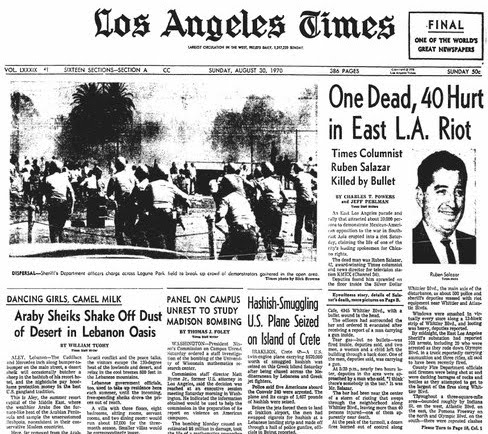
August 30, 1970 Los Angeles Times headlines death of journalist Ruben Salazar.

Back in the news:
Revisiting the 1970 killing of
Crusading journalist Ruben Salazar

By Paul Krassner / The Rag Blog / August 21, 2010

Salazar had been working on an exposé… which would reveal secret alliances among the CIA, the Army, the FBI, California’s attorney general, and local police authorities.

Ruben Salazar, an award-winning Los Angeles Times columnist and KMEX-TV news director, was killed by a Sheriff’s deputy under highly suspicious circumstances in 1970, and his case is in the news again. According to an article in yesterday’s Los Angeles Times, a confidential report sent this week to the Los Angeles Board of Supervisors has called for the Los Angeles County Sheriff’s Department to release records of Salazar’s slaying.

Robert J. Lopez wrote in the August 26, 1995 Los Angeles Times:

The newsman’s forceful columns and television coverage had sharply criticized police actions in Los Angeles’ Mexican American neighborhoods. Salazar had called [a] lunch meeting at an Olvera Street restaurant to put it “on the record” that he believed police might do something to discredit his reporting.

Two days later, on the eve of covering a major anti-Vietnam War rally, Salazar cleared his normally messy desk at KMEX and took his treasured hate mail off the wall. His former boss, Danny Villanueva, clearly remembers the response when he told Salazar he would see him later:

“Yeah, if I make it back,” Salazar said.

The next day he was dead. On Aug. 29, 1970, while covering the National Chicano Moratorium against the Vietnam War, the 42-year-old Salazar was killed instantly by a sheriff’s tear gas projectile while he sat in an East Los Angeles bar…


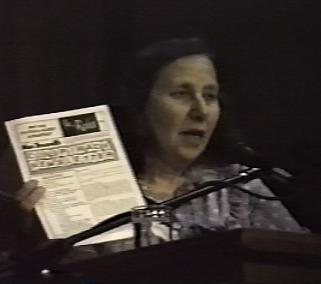
Mae Brussell flashes a copy of The Realist during 1987 lecture at UC Santa Cruz.

The LA Times has been publishing articles about the files on Ruben Salazar’s death being kept secret. Here’s an excerpt from my autobiography (Confessions of a Raving, Unconfined Nut: Misadventures in the Counterculture):

No wonder Mae Brussell was so excited. The attempted burglary of Democratic headquarters at the Watergate Hotel in Washington, D.C., in June 1972 had suddenly brought her eight and a half years of dedicated conspiracy research to an astounding climax. She recognized names, methodology, patterns of cover-up. She could trace linear connections leading inevitably from the assassination of JFK to the Watergate break-in, and all the killings in between.

There was, for example, the murder of Ruben Salazar, a Los Angeles Times reporter, at the first Chicano-sponsored antiwar protest. Salazar had been working on an exposé of law enforcement, which would reveal secret alliances among the CIA, the Army, the FBI, California’s attorney general, and local police authorities.

L.A. District Attorney Robert Meyer received a phone call from L. Patrick Gray — who had recently become acting head of the FBI after J. Edgar Hoover’s death — telling him to stop the investigation. Meyer did quit, saying it was like the “kiss of death” to work with these people. Mae called Meyer, asking if he would help with her research. She wanted to find out why the Justice Department in Washington was stopping a D.A. in Los Angeles from investigating the killing of a reporter.

A month later, Meyer was found dead in a parking lot in Pasadena. And now L. Patrick Gray was involved in an even bigger cover-up.

A year before the Watergate break-in, E. Howard Hunt, who had worked for the CIA for twenty-one years, proposed a “bag job” — a surreptitious entry — into the office of Dr. Lewis Fielding, a Beverly Hills psychiatrist who had refused to cooperate with FBI agents investigating one of his patients, Daniel Ellsberg, leaker of the Pentagon Papers. It was the function of the White House “plumbers” to plug such leaks.

The burglars, led by G. Gordon Liddy, scattered pills around the office to make it look like a junkie had been responsible. The police assured Dr. Fielding that the break-in was made in search of drugs, even though he found Ellsberg’s records removed from their folder. An innocent black man, Elmer Davis, was arrested, convicted, and sent to prison, while Liddy remained silent.

Mae Brussell corresponded with Davis, and after he finished serving Liddy’s time behind bars, he ended up living with Mae. It was a romance made in Conspiracy Heaven.

[Paul Krassner, for decades one of the country’s foremost social critics, edited The Realist, America’s premier journal of cutting edge social and political satire. He was also a founder of the Yippies.]

The Rag Blog

Posted in Rag Bloggers | Tagged , , , , , , , | Leave a comment

Larry Ray : Amazon: Don’t Call Us, We’ll Call You

Graphic, with a tad of Photoshop by Larry Ray, from Mobile Reference.

Amazon: Don’t call us, we’ll call you
(Or: Dude, my shoe’s got a square toe)

By Larry Ray / The Rag Blog / August20, 2010

OK, I should never have ordered a pair of shoes over the internet. But Amazon.com has always had good stuff, good prices, and fast delivery. I’ve ordered lots of stuff from them over the years. A brand new iMac, top of the line bread baking machine, shelves of books and other stuff that has always arrived in great shape at a notable savings. But I had never had reason to ask questions or talk about an order with a customer service agent.

That’s good, because Amazon’s idea of customer service doesn’t mean dialing a 1-800 number and talking to someone. Their approach to customer service is just like ordering merchandise on Amazon. You are expected to click your way through a series of drop down windows with fixed choices till you narrow down a specific item that requires customer service, and then you click some more for options on how you contact customer service. A toll free customer service number is not an option and was not handily located on their web site. Playing “Where’s Waldo” to find a phone number is not customer service.

I really wanted to talk to someone at Amazon about the pair of Rockport ProWalker shoes that arrived with the front sole and curved toe of the right shoe looking not at all like the left one. Someone in Bangladesh running the toe rounding grinder clearly dozed off, grinding most of the toe area off the right shoe even leaving a flat spot on what was supposed to be an ample, evenly curved toe. Not to worry, it was boxed up and sent right off… to me.

Worse yet, the quality of the shoes was more like what one might see in a Big Lots or Dollar Store closeout, not anything like the Rockport shoes I have worn for years. So, at this point you really want to talk to someone when things get this messed up. And you would think someone there would want to learn about shoddy merchandise going out under the company name.

If you find the word help in tiny blue lettering in all the stuff at the upper right of the page and then click around enough you eventually get to their customer service page.

The first option is to contact Amazon by email (“Usually answered within 12 hours”) the other option is “PHONE” and clicking that does not lead you to a phone number, rather you must enter your area code and telephone number and Amazon will call you back. And you can only email or be called back after clicking through a series of drop-down menus and selecting from a list of reasons why you need customer service… there is no drop-down option to simply “Talk to a human being.”

After facing this inflexible wall of non-applicable options, for the hell of it I just typed “Amazon.com 1-800 number” into a search engine and got 4,540,000 returns.

Amazon has never published its toll-free customer service number it seems. And this has infuriated hundreds of thousands of Amazon customers. Checking the search results, the story of Amazon’s inflexibility has been reported for years by major news media like NPR, The New York Times, U.S. News & World Report, and countless news blogs and web sites.

One personal blog called amazoncustomerservice.blogspot.com publishes not only all of Amazon’s toll free numbers, but all the other Amazon business and departmental numbers and addresses in the USA and in the UK. This site also provides the hard, if not impossible to find direct toll free numbers to Yahoo, PayPal, E-Bay, and Netflix.

I dialed Amazon’s toll free U.S. number, (800) 201-7575, and after a bit of a pause for clicking and connecting and the routine recording declaring, “This call may be recorded for quality purposes,” I got Maria in Manila. Very sweet girl, happy to have her job in the call center there. Her pronounced accent was lilting and understandable. She knew nothing at all about Amazon’s quality control or about mismatched shoes, but did find the return policy and procedures on her printed flow sheet which she read to me.

I had already printed out the Amazon return UPS label and returned the shoes. But Maria was so nice, even though she clearly knew nothing about Amazon’s quality control operation, I simply thanked her for her help with return policy rules and confirmed that my credit card had been credited with a refund.

I returned to the Amazon page and in the search bar under “All Departments” at the top of the page, I typed in “customer service number” and promptly got three returns. The first was a book in Kindle Edition from which I took the graphic at the top of this article, “Secret Toll-Free Customer Service Phone Numbers and Shortcuts to an Operator for Nearly 600 Businesses and US Government Agencies ” Clicking this $3.99 bargain opens up information about the book’s content, and lo! scrolling down we read:

Did you notice that it is hard to find customer service phone numbers on many web sites? Well, businesses hide their customer service phone numbers. They want you to fill out lengthy online forms. BEAT THEM WITH THIS SECRET YELLOW PAGES BOOK. It collects nearly 600 Hard-to-Find Toll-Free Customer Service Phone Numbers together. Better yet, we tell you how to skip automated prompts and talk directly to a human operator.”

And there, on Amazon’s own web site, this book offers as an example of what is in their treasure trove of information… and who did they choose for their example? Yep, you guessed it:

Example for Amazon.com toll-free phone numbers

Amazon.com (Cust. service): 1-800-201-7575; to reach an operator, do not dial or say anything.

Amazon.com (Seller support): 1-877-251-0696; to reach an operator, do not dial or say anything.

Amazon.com (Rebate status): 1-866-348-2492; to reach an operator, press 0.

Amazon Visa: 1-888-247-4080; to reach an operator, dial 00 at each prompt.

None of this would concern my college student granddaughter. I, however, am old enough to remember real customer service from the electric power company, the telephone company, catalog order departments, and many others. You dialed a number, talked with someone and found out what you needed to know.

At Amazon, AT&T, the cable TV company, and other places where I spend money, they are not interested in talking… they don’t need to anymore. As soon as people willingly started to spend several dollars for a cup of coffee, who needed customer service any longer?

[Retired journalist Larry Ray is a Texas native and former Austin television news anchor. He also posts at The iHandbill.]

The Rag Blog

Posted in Rag Bloggers | Tagged , , , | 2 Comments

Imam Ibrahim Kazerooni and Rob Prince : The Looming Specter of a Strike on Iran

U.S. Air Force F-15E Strike Eagle aircraft in Afghanistan.

Looming specter:
Strike on Iran an increasing possiblity

By Imam Ibrahim Kazerooni and Rob Prince / The Rag Blog / August 19, 2010

Reading the signs

Signs — coming from a number of different sources — suggest that some kind of major U.S.-Israeli military offensive against Iran could be in the offing between now and the November mid-term elections. Among them:

  • A background of one of the largest regional military buildups in modern time, the creation of military and “floating bases,” and the intensive arming through arms sales and grants of U.S. regional allies with sophisticated modern weapons and delivery systems. This was perhaps the only “new” element in what former U.S. Secretary of State Condoleezza Rice referred to as the creation of “a new Middle East.”
  • New warnings of possible U.S./Israeli military action coming from the Friends Committee on National Legislation, the National Iranian American Council, Time’s columnist Joe Klein (“An Attack On Iran Is Back On The Table” — July 15) — among others.
  • A bizarre July 31 piece in the Washington Post by Ray Tayeyh and Steven Simon arguing that the United States should only attack Iran’s nuclear facilities and then “signal” the Iranians that the bombing would stop and that the goal was not to overthrow the regime. This is part of a larger and mostly hidden debate within the administration over how extensive the bombing should be.
  • Articles by neo-conservative columnists Reuel Marc Gerecht and William Kristol calling for a military strike.
  • Admiral Mike Mullen’s August 2 admission that the United States “has plans” to attack Iran to prevent that country from producing nuclear weapons
  • An August 4 open letter from former intelligence officers to President Obama warning that Israel could be planning to attack Iran and draw the United States into the conflict
  • The Obama Administration’s stalling to issue the new National Intelligence Estimate on Iran. It will be secret and its conclusions will either be leaked or released in summary. Sources inside the intelligence community insist that it will support the 2007 NIE that concluded that Iran no longer has a weapons program. The White House has delayed the process seeking harder language to justify a range of options against Iran, including a military strike, but the analysts are reported to be resisting.
  • Last but not least, the introduction of H.R. 1553 into the House of Representatives which provides explicit support for military strikes against Iran, stating that Congress supports Israel’s use of “all means necessary” against Iran “including the use of force.”

House Resolution 1553:
A green light to attack Iran?

Of these, the introduction of HR 1553, currently making its way through House committees with more than 40 sponsors, expressing full support for an Israeli attack on Iran, has opened the gate to push the U.S. into military action.

It has long been the goal of Netanyahu’s government and the neo-conservative members of the Bush government who are still influential in the Obama Administration to support an attack by Israel so that the United States can be drawn into direct, full-scale war with Iran. This has been Israel’s Iran strategy. Israel needs to know that the United States will finish the war that Israel wants to start.

Although this kind of saber-rattling is not new, it has reached a new pitch, suggesting that military action against Iran could be in the works. There is some evidence that the United States drew up plans to attack Iran as early as 1995. In 2007, it appeared that the Bush Administration was close to proceeding with a major attack when the National Intelligence Estimate was made public, contending that Iran did not have a nuclear weapons program.

In one of the few times in his presidency, Bush overruled his vice president, Dick Cheney (who favored proceeding with military action all the same) to stop the military plans. Admiral Mullen was sent to Israel to “deliver the message” of no war clearly and unambiguously. The Israelis were reported to have been furious about the change in plans. One of the most disturbing elements of the current escalation of tension is Barack Obama’s failure to do precisely the same thing: reign in Netanyahu.

The Israelis in particular and their more zealous supporters in the USA (AIPAC, neo-cons) have worked for three years, virtually tirelessly, to rebuild support for a military strike. Their efforts appear to have succeeded, at least in part. And other groups, like J-Street, while not supporting a military strike, have supported the sanctions against Iran and generally bought into the myth that Iran is an “existential threat” to Israel, rather than the other way round.

American-made Israeli F 15 fighter jets on the ready.

Arguments against a U.S.-Israeli attack

In an email a few days ago, a friend put the case against a U.S.-Israeli attack against Iran succinctly:

I’m sure the U.S. and Israel would love to hit Iran. Even with the saber-rattling, it’s hard to believe they’ll do it because:

  1. Iran can hit the U.S. hard in both Iraq and Afghanistan where the U.S. has more than it can handle now; most of the top Pentagon brass knows this and Gates, Admiral Mullen, etc. have said that it would be nuts to hit Iran;
  2. It would provoke really harsh opposition by China, Russia, Brazil, Turkey and numerous countries that the U.S. needs for more important things;
  3. Iran can probably stop shipping in the Red Sea, etc.

I think that if they could do it, they would have already done it. It would be suicidal but suicide is often a psychotic response and there are definitely psychotics in Israel and DC pushing for it.

All these are reasonable arguments and we hope they carry the day. Perhaps they will. But each of them can be challenged in some ways. the United States these past years — and certainly Israel for an even longer time — have a tendency to deal with the crises they have created by escalation. With a few exceptions, Israel has most of its existence “resolved its problems with its neighbors” by the use of force. It is deeply ingrained in the national psyche to resort to military, rather than diplomatic means to implement policy.

And while we agree with Andrew Bacevich’s call for the Obama Administration to end the U.S. policy of permanent war, close the foreign bases, and bring home the troops, it does not appear that we’re anywhere near that. To the contrary.

How has the United States dealt with the crisis in Iraq, which is far from resolved? It invaded, or re-invaded Afghanistan, and might do it again, despite the rational — and they are rational — arguments my friend presented. Besides, recall that before the 2003 U.S. invasion of Iraq, there were also many rational voices arguing that that particular invasion would not take place, but it did. The U.S seems intent on maximizing its military position in the region as quickly as possible. That was the essence of the Bush-Cheney policy.

Unfortunately, despite his Nobel Peace Prize — poorly deserved — Barack Obama’s Middle East foreign policy is hardly different… despite the softer rhetoric. A fine speech in Cairo does not a foreign policy make.

But to respond directly to our friend: As mentioned above, Admiral Mullen in recent weeks has changed his tune; it is more strident and suggests that military action is possible. On the most recent UN sanctions, the United States was largely able to neutralize both China and Russia, although those nations still managed to somewhat water down the resolution.

Regardless, their opposition to a military strike seems less firm than it has been in the past. And while Turkey has opened up a certain breech with Israel, their military coordination and cooperation through NATO remains quite strong and NATO, it appears, is “on board” for a strike.

Add to that the way that the U.S. seems to consistently underestimate Iran’s ability to strike back militarily. Of course we’re not military analysts, but to compare Iran today with Iraq in 2003, after it had suffered defeat in the first Gulf War and then 12 years of crippling sanctions is way off the mark. Iran is a much stronger country militarily than Iraq was then and while we don’t underestimate the ability of the United States and its allies to wreak horrific damage on Iran, Iran has had a long time to prepare for such eventualities.

In addition the Iranians, through the Revolutionary Guard (which represents about half of its military strength, the other half being the conventional Iranian military), have the most ideologically oriented military in the world. And we would argue that an Iranian response could be devastating where it hurts — the Saudi oil fields, Persian Gulf oil shipping, and the possibility of considerable destabilization of the U.S. position in Iraq and Afghanistan. And, we assume, it could do harm to Israel.

Finally, keep in mind that the United States and Israel are not the only military powers in the region capable of preemptive military strikes. Who knows, if the Iranians feel completely cornered and have come to conclude that there is no way to avoid an attack, perhaps they will, from a military point of view, take the initiative themselves as their way of dealing with what they perceive as the inevitable battle. We’re not saying this is their policy, just that such a response is not entirely out of the realm of possibility.

Photograph of David Wormser

David Wormser has advocated attack for regime change. Photo from Telegraph, U.K.

New dangerous elements

There are a few other elements that make the current moment especially dangerous:

  • For all the talk of U.S.-Israeli strains, the NATO-U.S.-Israel military structure in the Middle East is fully integrated. In Israel the thinking about striking Iran is, “If not now, when?” Momentum is building for a strike.
  • There appears to be support for such a strike from key U.S. Arab allies, in particular Saudi Arabia and Egypt. Recently Egypt let 10 U.S. warships and one Israeli warship through the Suez Canal headed towards the Persian Gulf. There have also been reports that the Saudis would permit Israel use of its airspace to attack Iran. The fact that the Saudis have issued public denials does not necessarily mean that it won’t happen. It is also possible that the Kurdish regions of Iraq, Azerbaijan, or Georgia could be used by the Israelis to facilitate an attack.
  • The Netanyahu government believes, according to some sources, that with the U.S. midterm elections approaching, the U.S. will not be able to reign in Israeli military actions (wherever they might occur) and that furthermore, at this time, Israel is more likely to drag the United States into fighting — which they very much want and hope to do.
  • Meanwhile public opinion in the United States has shifted from a position against to one in favor of a military strike against Iran. Only a few years ago one third of Americans polled supported military action against Iran, but now that figure is close to 57% — probably a response to the Iranian crackdown on its democratic movement last summer, as well as AIPAC and the neocon’s unrelenting pressure.
  • Before the 2003 U.S.-led invasion of Iraq there were worldwide demonstrations; today there is hardly a whimper from the peace movement or major public figures either here or abroad. True, in 2003 the plans were for a full scale ground invasion and while now, the discussion — at least the public discussion — is limited to air strikes. However, more and more it has been admitted that these airstrikes would not be limited to Iranian nuclear facilities but would probably be aimed at striking a devastating and crippling blow against the whole country, its infrastructure and political command system.

`Getting’ Iran

Although on paper, Israelis and their lobbyists base their argument for war on a fanciful scenario of Iran doling out nuclear weapons to Islamic extremists all over the Middle East, their more likely objective is to destroy Iran’s Islamic regime (regime change) in a paroxysm of U.S. military violence. David Wurmser, formerly a close advisor to Benjamin Netanyahu and Middle East advisor to Dick Cheney, revealed that he had advocated a U.S. war on Iran, not to set back the nuclear program but to achieve regime change.

The idea of waging a U.S. war of destruction against Iran is obvious lunacy, which is why military leaders have strongly resisted it in both the Bush and Obama Administrations. Even though Israel, not Iran, has increasingly been regarded around the world as a rogue state after the Gaza incursion and the commando killings of unarmed civilians on board the Mavi Marmara, its grip on the U.S. Congress appears as strong as ever.

AIPAC has once again flexed its muscle, making it clear with the introduction of this resolution, that it can push Congress to bend Obama into submission on the Iran issue. It appears that Democrats in Congress, are mentally in a different galaxy than they were under Bush, and are, in large measure, willing to go along, making clear that the U.S. Iran policy has bipartisan support. It is a mistake thus, to place all the blame for this reckless policy on the Republicans.

Attacking Iran should be understood as part of a broader U.S. long term strategy of using its network of military bases worldwide as a way of maintaining its declining hegemony. “Neutralizing” Iran is something of a medium term goal, with the long range goal being the capability of preempting a Chinese challenge, even if it is decades a way.

Netanyahu must be rubbing his hands with glee about the prospects for pressuring Obama to join an Israeli war of aggression against Iran. It was Netanyahu, after all, who declared in 2001, “I know what America is. America is a thing you can move very easily, move it in the right direction. They won’t get in the way.”

[Ibrahim Kazerooni is an Imam with Colorado’s Muslim community. Rob Prince is a full-time lecturer in International Studies at the University of Denver and publisher of the Colorado Progressive Jewish News blog at robertjprince.wordpress.com.]

Thanks to Jay D. Jurie / The Rag Blog

Posted in Rag Bloggers | Tagged , , , , , | 11 Comments

Dick J. Reavis : The Conspiracy in the Attic

Above, Dick Reavis now. Photo from San Antonio Current. Below, Dick Reavis then, in 1966 demonstration by Sexual Freedom League on University of Texas campus. Montage image scanned from The Daily Texan.

The conspiracy in an Austin attic:
My first rad-confab

I had never seen marijuana and though I knew that it was prohibited, it didn’t occur to me that my new friends were seated in a circle to pass a joint around.

By Dick J. Reavis / The Rag Blog / August 19, 2010

[The Rag Blog has a lively online discussion group composed of friends and contributors. Many are veterans of the Sixties New Left and underground press and lately have been been sharing war stories of the early days. We intend to pass some of them your way. Journalist, author, and educator Dick J. Reavis admitted to the following.]

I joined Students for a Democratic Society by signing a card at a sidewalk recruiting booth outside Gregory Gymnasium at the University of Texas in Austin during fall semester registration, 1965. I was new to the campus and had never heard of SDS.

Perhaps because I told the students at the booth that I had spent the summer as a civil rights worker in Alabama, one of them invited me to what he or she may have called a meeting — but turned out to be a party. It was set for a Saturday evening, and I went by on my way to work.

My job was essentially that of a domestic servant. I was a photographer for Jack’s Party Pictures, a business on the Drag which sold pictures of Greek parties and dances. The night of the SDS gathering was my first day on the job.

The rad-confab was held at a two-story clapboard house near the corner of 17th St. and West Ave., where several SDS members lived. I presented myself, though a door to a kitchen, about 6:30 p.m. A young woman pointed me to a set of stairs that led — to an attic! But it didn’t bother me that, as things seemed, SDS might be a conspiratorial group.

A few feet from the top of the stairway I found six to 10 people seated on crates or boxes in a circle. With his back facing a dormer window sat the apparent chairman or guest of honor, Al Shahi, a fleshy, dark-skinned Iranian student who, I later learned, was sometimes the titular president of SDS.

One of the attendees explained that Shahi had received an order to vacate the country or face deportation. But the mood was that of a farewell party, not of plot to foil the immigration service.
It only took a glance for me to conclude that maybe I was in the wrong place.

The word “hippie” did not then exist, or hadn’t reached Austin, but my new-found peers were developing the style. The males had hair longer than customary and may have been mustachioed or bearded as well. I was clean-shaven, burr-headed and probably wearing tan slacks and a white dress shirt, the de facto uniform for Jack’s.

If sartorially I was clean-cut, philosophically I was disheveled, the opposite of my new friends. That summer in Alabama had upended my picture of life, and on that evening, I wasn’t sure if I was still a Baptist, or even believed in God, but I was ready to burn the country to the ground. Respectable white folks were either enemies or hypocrites and we who were young and Southern, I had come to feel, had to oust them and overturn the whole way of things.

Before many minutes had passed in that attic, I felt tormented by what I saw and heard. Why were people sitting in a circle, anyway? Why were they chit-chatting? When would the meeting begin, who would announce its agenda?

It seemed that I had been invited into a conspiracy whose purpose was merely to waste time. I had never seen marijuana and though I knew that it was prohibited, it didn’t occur to me that my new friends were seated in a circle to pass a joint around. I didn’t even know what a “joint” was.

Finally, if memory serves me right, some brave soul produced a penny matchbox of pot, then rolled, lit, and passed a joint.

Before it came to me, I begged off and went down the stairs, figuring that my fellow radicals would take me for a cop, though I was confident that their suspicions would pass. Within minutes I was at my first photo shoot, at a fraternity house only blocks away. The frats were just beginning to congregate; only two or three couples were on hand. A guy who acted as if he had authority sidled up me and said, “Why don’t you come back at a white man’s hour?”

I looked at him pretty hard for a second. I knew that I couldn’t strike him and would probably lose a fight if I did, and I didn’t think I could object to his terminology, because, essentially, I was working for him.

“Okay,” I said, and walked to my car.

A “white man’s hour” for work, had I tried to hire the frats to work for me, was probably equivalent to never, I figured. So I didn’t return.

Monday when I reported for a new assignment, owner Jack gave me a piece of his mind. “They told me that you promised to come back but you didn’t,” he said.

I nodded and made no excuses, knowing that, as a newbie, I wouldn’t be fired.

Thinking back on that day, I suppose that I owe the SDS celebrants an apology for crimping or stalling their festivities. But the way I also figure it, those frats owe me an hour or two of wages. I’d have shot pictures at their party, as I did at dozens of subsequent fetes that semester, had their representative not convinced me that he wasn’t worth serving.

[Dick J. Reavis, who became active in SDS and contributed to The Rag in Sixties Austin, is a professor in the English Department at North Carolina State University. His latest book is Catching Out: The Secret World of Day Laborers. He can be reached at dickjreavis@yahoo.com

The Rag Blog

Posted in Rag Bloggers | Tagged , , , , , , | Leave a comment