Memo from the Blackland Prairie : Obama and the Texas Family Farm

Blackland Prairie. Image from Texas Parks and Wildlife.

Subsistence farming and big agribusiness:
Obama stops the massive subsidies

By Jane Leatherman Van Praag / The Rag Blog / March 18, 2010

I live on and manage our family farm just south of Bartlett, Texas, in the extreme northeast of Williamson County. Since the late 60s when my father was too old to farm the land, we contracted on a “share-basis,” as did many other aging farmers in our locale, with another nearby farmer to keep our soil in cultivation.

This was a great idea for several reasons: it permitted people whose entire lives had been tied to the earth to remain on their property, which they loved, rather than have to sell and move away for the duration of their elder years; it also kept the land truly productive, which is also important to farmers whose pride and responsibility has always been to help feed the world.

This happy transaction becomes magnified when we consider that this area is part of the vast, though diminishing (due to development from urban encroachment) Blackland Prairie, some of the most fertile soils on the planet. Appropriately cornucopia-shaped, the Blackland Prairie starts near the Texas Coast then wends its narrow way up into a small stretch of Canada. The only other place somewhat like it is Ukraine on the other side of the globe.

Meanwhile, this idea also benefited our near-neighbors who continued the actual farming operation. They could afford to take advantage of advancing technology; few realize that a modern tractor sells for between a quarter- and a half-million bucks, with the necessary implements costing about the same. Their children trained at Texas A&M.

What I am saying is that, since the 40s, independent subsistence farming has been a thing of the past; the necessary education and equipment to farm is very expensive. Those of us with relatively small acreages would not have been able to keep up, so we would have been driven out of the marketplace, even had age not been a factor.

Soil conservation was a big issue on the Plains during the Depression. Programs began to help farmers save their land, which in turn would save people in the cities because otherwise they would have nothing to eat. These programs were so successful that our surpluses saved humans everywhere after World War II and since.

These programs included financial compensation to farmers for cooperating in supplying what the market would demand. Down here, for one instance, we leave the tulip growing to the Netherlands and upper Michigan. Here, our row crops are devoted to grains, and depending upon what is planted we can produce more than one harvest each year.

This is the way agribusiness should be. So far, so good, right?

However, whenever we collectively set up an opportunity, “opportunists” soon get a whiff of potential easy money. Thus did agribusiness become identified with Monsanto, Con-Agra, and the like. Big corporations, which have had their way for far too long, driving small-time farm operations like ours out of business wherever they can, buying us out at lowest dollar, in order to increase their holdings. They are the ones who receive massive subsidies, all the while giving us small-time farmers a bad rep.

While I remain very impatient with the Obama Administration on other domestic issues, such as health care, unemployment, and immigration, to name a few, I am — as are all of us small-time farmers — grateful that early on in his first year, Obama stopped those massive subsidies. Before, investors of each Big Agribusiness would receive dollars in the hundreds of thousands and often millions, I would receive between $300-$600, again, depending upon yield.

Earlier this month, I received, from USDA through the Williamson County Farm Services Agency, my customary letter. only this time the content was satisfyingly different, and I quote from it in part:

7 CFR 1400.500 and Handbook 4-PL Paragraph 186 establish the following Adjusted Gross Income (AGO) limitations:

If the average adjusted gross nonfarm income exceeds $500,000 then the applicant is ineligible for Direct and Counter-Cyclical Program (DCP); Average Crop Revenue Election (ACRE) Program; Supplemental Revenue Assistance Program (SURE); Emergency Assistance for Livestock, Honeybees, and Farm-Raised Fish (ELAP); Tree Assistance Program (TAP); Non-Insured Crop Disaster Assistance Program (NAP); Livestock Forage Disaster Program (LFP); Livestock Indemnity Program (LIP); Marketing Loan Gains; Loan Deficiency Payments; Conservation Reserve Program (CRP); Environmental Quality Incentive Program (EQIP) and all other conservation program benefits.

This letter is to advise that you are eligible for the above mentioned program benefits subject to the Average Adjusted Gross Income (AGI) limitations. This determination is based upon your certification of average adjusted gross income (see enclosed copy of form CCC-926) and procedure outlined in Handbook 4-PL Paragraph 186.

I assure you that my non-farm income, adjusted gross or not, falls well below $500,000. Is $500,000 still too generous? Well, since so many factors have to be considered, we’ll have to wait and see. But at least, hot damn, it’s a great new start.

The Rag Blog

Posted in Rag Bloggers | Tagged , , , | 3 Comments

Rabbi Arthur Waskow : The U.S. Must Stop Israel’s Drunk Driving

Image from Peace World Journal.

Don’t let your friends drive drunk:
U.S. must do more than wring its hands

By Rabbi Arthur Waskow / The Rag Blog / March 18, 2010

“Cursed be he who moves back his neighbor’s territory-marker. And all the people shall say, ‘Amen!’ “ (Deut 27: 17)

Thomas Friedman, columnist for the New York Times and a stodgy middle-of-the-roader, says that the Israeli government has become a drunk driver, addicted to swallowing up more and more territory at the cost of any decent peace with Palestine.

The Torah did not know about “drunken drivers.” But it did know that some people might thirst to swallow up their neighbors’ land and houses: “Cursed be he who moves back his neighbor’s territory-marker. And all the people shall say, ‘Amen!’ ” (Deut 27: 17)

And of course it knew the most profound alternative to that kind of greed: “When a stranger lives with you in your land, you shall not wrong him… He shall be to you as one of your citizens. You shall love him as yourself, for you were strangers in the Land of Narrows. I YHWH, the Breath of Life, am your God.” (Lev. 19:27)

Until now, U.S. governments have firmly opposed only those Palestinians who have been addicted to violence, but not an Israeli government addicted to land-grabs and to wronging their neighbors.

It seems that the Obama administration may at last be ready to confront the drunk drivers in the Israeli government as well as the violence-addicts among some Palestinian leaders. May be.

What we — the American people — do is crucial. The White House will back down if it sees little public support. It might stay firm if it hears public acclaim.

Friends, it is said, don’t let their friends drive drunk. Will you back up a decision by the White House to stop drunk driving by our friends?

If you will, The Shalom Center has prepared a model letter to senators, urging them to support firm action for peace. You can add your own words and sign it by clicking here.

The basic issue is simple:

  1. For Israel to have peace and security, there must be a viable, free, and secure Palestine alongside Israel, along with a peace treaty between all Arab states and Israel.
  2. For that to happen, the Israeli occupation of the West Bank and East Jerusalem and the blockade of Gaza from receiving civilian goods must end.
  3. There cannot and will not be a real Palestinian state unless East Jerusalem is its capital — for economic, cultural, and political reasons. In such a peace settlement, West Jerusalem can and will be recognized as the capital of Israel, but the annexation of East Jerusalem must end if there is to be peace. The Israeli government must end all efforts to demolish Palestinian homes in East Jerusalem, to force Palestinians to move out, and to settle Israeli Jews there.

Now back to the drunk driver. So far all the U.S. government has done is wring its hands about the deadly results of the drunk driving. What could the U.S. do?

If you have been paying about three billion dollars a year for your friend’s gasoline AND his alcohol and you decide that his drunk driving is endangering your own life and the lives of many many people who live in your city, maybe you just cancel the credit card you gave him, and let him start going to Alcoholics Anonymous meetings until he gets his head screwed on right.

Now what does it mean to cut off the credit card for gasoline and alcohol, while making sure nobody takes advantage of your friend while he’s going through rehab?

In 2002 and again in 2007, the Arab League proposed a regional peace treaty that would give Israel peace and security with all Arab states, in exchange for the Israeli recognition of a new Palestine on approximately the 1967 boundaries. The Arab League proposal included unclear references to the rights of Palestinian refugees, but also made clear that the package could be negotiated. The Israeli government, with the approval of the Bush Administration, ignored the proposal. Now the Obama Administration seems (see above) to be moving toward supporting it.

Only the U.S. government has the power and influence to work with the Arab League and its proposal for a regional peace treaty; with the Palestinian leadership, including those elements of Hamas that have said that if the Palestinian people vote for a two-state solution, they will accept it; and above all with the government of Israel, whose military policy depends on U.S. military aid.

That aid amounts to at least three billion dollars a year. Imagine the U.S. saying that it will put its aid in escrow, dollar for dollar for the cost of the Israeli occupation of the West Bank, Gaza, and East Jerusalem. The U.S. announces that the money will be made available only to pay the costs of resettling the 400,000 Israelis who are now living in Palestinian land beyond the 1967 borders, and will be paid in one-fifth sums when (a) the blockade of civilian goods from entering Gaza is restricted to preventing only actual weapons from being imported into Gaza; and (b) chunks of 100,000 settlers at a time have left the West Bank and returned to Israel proper.

Meanwhile, the U.S. should be offering aid to a nascent Palestine on condition that leaders from at least some of Hamas and Fatah join in a government of national unity, take vigorous steps to prevent attacks on Israel, and agree to take part in a regional peace conference with the goal of achieving peace with Israel within approximately the 1967 boundaries.

This is a policy to protect and affirm the real Israel, while ending its government’s addiction to wronging its neighbors.

Can we build public support in the U.S. for this policy?

As I have written before, I think that depends on whether local and national coalitions can be built of Jews, Christians, and Muslims to that purpose.

And please consider the possibility of inviting rabbis, ministers, priests, and imams where you live to meet quietly to discuss what they can and cannot agree to do for peace, either together or individually, publicly or privately. Their conversation might be eased if they read together some writing from the Abrahamic communities (e.g. The Tent of Abraham from Beacon) and used it as a framework for conversation.

Ask them to listen to each other first as they say what their sense of God’s will and desire is for the Middle East and for American efforts to help achieve peace there. Of course this requires care for each others’ hopes and compassion for each others’ pain. So after each person speaks, hold silence for a full minute to share the Breath of Life. If these conversations help people move forward, try to arrange meetings with your Congressperson or Senator.

Blessings that you be able to take some firm and gentle steps toward making peace for the families of Abraham, Hagar, & Sarah.

Shalom, salaam, peace,

Arthur

[Rabbi Arthur Waskow, director, The Shalom Center; co-author, The Tent of Abraham; author of Godwrestling: Round 2, Down-to-Earth Judaism, and a dozen other books on Jewish thought and practice, as well as books on U.S. public policy. The Shalom Center voices a new prophetic agenda in Jewish, multireligious, and American life. To receive the weekly on-line Shalom Report, click here.]

The Rag Blog

Posted in Rag Bloggers | Tagged , , , , | 3 Comments

2010 Census : $400 Billion Handout With 10 Questions

And our hands have 10 fingers.


2010 Census:
That’s $40 billion per question…

By Larry Ray / The Rag Blog / March 18, 2010

The 2010 Census form came in the mail Tuesday morning, March 16th. I made a cup of coffee, sat down and opened it up, anxious to see what information they were seeking this time around. I remember earlier forms over the years, one of which even asked how many bathroom toilets were in the house. There are always questions about income, marital status, type of employment, education level, and many other varied questions.

Well, there was none of that this time. No siree! There are only 10 questions. That has to be why they dreamed up their 2010 Census logo with all the fingers. One question for each finger unless you have been in an industrial accident.

But you don’t know that there are just 10 questions when you start off because there are several pages even with a fold out. So off I went, pencil at the ready to answer dozens of probing questions to help profile America with data that will be used for the next decade.

At the very beginning we are instructed to “Count all people, including babies who live and sleep here most of the time.”

Well, of course babies are people. Little people, but people. Even unborn babies are people as defined by the raucous religious right anti abortion folks… but that might mess up the count.

Pressing on, question one asks, existentially and mystically:

1. How many were living or staying in this house, apartment or mobile home on April 1, 2010?

Using a crystal ball, peering into the future, since April 1st is more than two weeks away, I put my number in the “Person 1” box, assuming that no gypsies or long lost relatives would be “staying,” and moved on to question two. This is the first U.S. Census to require clairvoyance. The more vernacular “staying” replaces “reside,” a word which some might not easily understand.

2. Were there any additional people staying here April 1, 2010 that you did not include in Question 1?

Trick question? There are five boxes that make sure you know that children, such as newborn babies or foster children, relatives, cousins, in-laws, non relatives such as roommates, live-in baby sitters or people staying here temporarily “are people.” I checked in the fifth box, “No additional people,” which is what I told them in question one. Question three gets more specific.

3. Is this house, apartment or mobile home…

Four boxes allow you to mark, “…Owned with a mortgage, Owned free and clear, Rented, or Occupied without payment or rent?” What a mother lode of precise information this gem of a question will provide with joblessness, foreclosures, and evictions having displaced and scattered “persons” across America.

They need another box for those living in tents and large cardboard boxes. Maybe because so many Americans have been displaced by the Wall Street crash that is why the questions use “staying” as in “we are staying at the Salvation Army shelter.”

Question four wants my telephone number, “Where we may call you if we don’t understand an answer.” Only three questions in to the census, all of which are answered by putting an “X” in one of several possible boxes and they are worried about not understanding an answer. I wish there was a box to check if I didn’t understand why civil service employees and bureaucratic census form designers are never fired for being incredibly incompetent and terminally dense.

Now we start to get into the real meat of this penetrating look into the makeup of our nation… Question five! It wants my name… and middle initial!

Racing ahead, question six want’s to know “Person 1’s sex.” Fortunately, they have provided the regular two boxes.

Question seven wants “Person 1’s age, and what is Person 1’s date of birth.” I fill in my age and DOB. Certainly this will get going in a minute, I’m sure. At this point, I do not realize I am only three questions away from being finished and press on to question eight.

8. Is Person 1 of Hispanic, Latino or Spanish origin?

The first box has, in bold type: “NO, not of Hispanic, Latino, or Spanish origin.” I check that one, being descended from starving Irish potato famine immigrants. Four more boxes allow one to clearly define their specific Hispanic, Latino or Spanish origins by country or geographic location. Then, question nine:

9. What is Person 1’s race? Mark X one of more boxes

Box one is one word: “White.” Then twelve more boxes allow one to mix and match your parentage by checking appropriate boxes including one box that says, “Black, African American or Negro” which I guess is seeking political correctness, but there was no “White, anglo, or Caucasian” just “White.” Again, maybe Caucasian is too tough a word for lots of white folks to read today?

You may write in the name of American Indian or Alaska Native “enrolled or tribe” followed by a rainbow of a dozen more possibilities from Asia, the Philippines, “Guamanian or Chamorro” on and on… and then, a final special box for: “Some other race.”

I had to look up that one. A 2006 article reported that, “After the 2000 Census, the “Some other race” category was the third largest race group in the United States, according to Charles Louis Kincannon, current director of the Census Bureau. However, 97 percent of those who identified as “Some other race” were Hispanic.” It appears that even back on 2006 they couldn’t remove that meaningless race category “in time for the 2010 Census.”

Question ten at the bottom of page one asks a final penetrating, existential question:

10. Does Person 1 sometimes live or stay somewhere else?

Confounded by that one I turn the page to look over the rest of the “what level of education and how many commodes” questions. At the top of the next page, it says “Person 2.” and asks the same 10 questions I just completed. This is repeated in column after column for up to a total of 12 people “living or staying” in my house, apartment or mobile home. This comprises the remaining four pages in the fold-out form. Twelve people in a trailer? No wonder they mail these things out instead of hand counting.

Beneath the final questions for “Person 12,” a bold type line says “Thank you for completing your official 2010 Census form.” At this point I realized there were only 10 questions.

That was it. Baffled and sure that I had gotten some sort of short form, I went to the official U.S. Government 2010 Census web site which proudly proclaims, “One of the shortest forms in history – 10 Questions in 10 Minutes.”

Then, to urge us to fill in those 10 questions in 10 minutes, they continue, “Each question helps to determine how more than $400 billion will be allocated to communities across the country.”

They are serious. The dumbed-down, lowest common denominator cop out approach that has plunged the American educational system into a black hole has been used to create the 2010 Census form.

Click, read it and weep: 2010 Census Site.

[Retired journalist Larry Ray is a Texas native and former Austin television news anchor. He also posts at The iHandbill.]

The Rag Blog

Posted in Rag Bloggers | Tagged , | 3 Comments

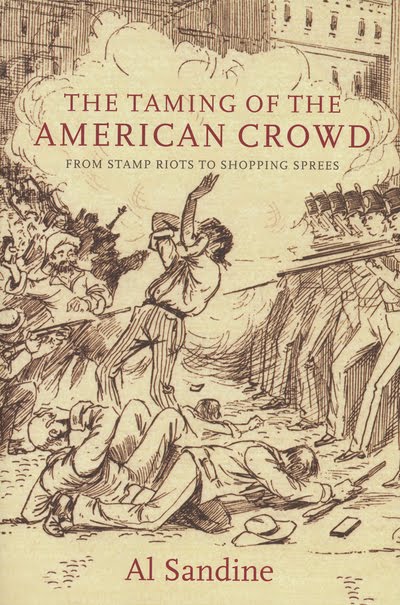
BOOKS / Jonah Raskin : Al Sandine’s ‘Taming of the American Crowd’


The Cyber Crowd:
Reinventing the Crowd for the Age of Cyberspace

By Jonah Raskin / The Rag Blog / March 18, 2010

[The Taming of the American Crowd: From Stamp Riots to Shopping Sprees, By Al Sandine. (Monthly Review Press, November 1, 2009); $18.95; 240 pp.]

Near the end of his thought-provoking, timely book about the role of the crowd in history, Al Sandine writes that, “the disembodied realm of cyberspace is the very antithesis of a culture of crowds.” I hear what he’s saying. I think I know what he means.

But is his statement true? Have we as a culture actually come full circle? Have our contemporary aggregates of human beings truly turned into the opposite of those electrifying crowds that dominated the 19th-century and that the German philosopher Friedrich Nietzsche called “the century of the crowd.”

I have known large and small, angry and reverential crowds over the course of my lifetime, and many of the crowds I have known Sandine describes vividly in The Taming of the American Crowd. The crowd is, of course, mercurial and fickle. It takes its coloration from the culture and the society around it. It can be revolutionary or racist, and it can lynch just as well as it can adulate.

For centuries, large groups of human beings who gathered in the streets, who demonstrated, and who marched on buildings like the Bastille in Paris, and the Winter Palace in St. Petersburg, were defined as “the mob.” And the mob was regarded for the most part by journalists, historians, czars and kings as hateful, irrational, and self-destructive.

One of the earliest and one of the most insightful books about the insanity of crowds is still Charles MacKay’s 1841 study, Extraordinary Popular Delusions and the Madness of Crowds. Most of the studies of the crowd in the 19th century were written from the point of view of the aristocrats and the bourgeoisie. They weren’t on the side of the downtrodden and the outcast.

Then, along came Karl Marx and Frederick Engels who recognized the vital role of human beings acting together to change history through peasant rebellions, and working class strikes and riots. In the 1960s, a group of historians, many of them English, such as E. P. Thompson, Eric Hobsbawm, and George Rude, followed in Marx’s footsteps, wrote “history from the bottom up,” and turned the mob inside out.

To Thompson, Hobsbawm, and Rude — who wrote two transformative works, The Crowd in History and The Crowd in the French Revolution — crowds were politically conscious groups of individuals united by common experiences and common goals. They were savvy not stupid, mindful not mad. To the new, leftwing historians, crowds were the heroes of modern times, and their work inspired the students and the activists of the 1960s.

Indeed, the civil rights demonstrators and protesters, and the and anti-war crowds of the 1960s seemed to be a continuation of the popular insurrections of the 19th and the early 20th centuries, when workers sat-in to demand the right to organize in unions. In the 1920s and the 1930s, the two most effective and creative magazines of the bohemian and the radical left were entitled The Masses and The New Masses. To belong to the masses was something to be proud of.

Then, something dramatic happened: the masses lost their appeal and their teeth. Sandine tells the story of the “taming of the crowd” in crystal clear prose that has real punch. He roams all over the United States and Europe; he goes back to ancient Roman times, too, and draws parallels between the era of the emperors in Rome and the popularly elected officials in our own day and age.

He shows how mass society diluted the power of the masses, and how the mass media alienated and fragmented the citizenry. Add malls to TV, mix in the advertising industry and public relations, and the result is a consumerist society in which rebellion is turned into a strategy to market good and services. This book provides valuable social and cultural criticism.

Sandine is both more optimistic and more pessimistic than I am. I am not yet ready to say as he does that, “the disembodied realm of cyberspace is the very antithesis of a culture of crowds.”

Cyberspace can be a place to educate, mobilize, and build a sense of community. It can be a stepping-stone toward physical proximity in the same time and place for the purpose of protest and rebellion. So, in that sense I am hopeful about the possibilities for cyberspace, which like all spaces in our society can be contested space, and space that we ought not to surrender without a struggle.

But I am also less sanguine than Sandine when he describes the progress that has been made since the 19th century. “In the United States today, there are no buyers for the kind of crowds that once served powerful interests,” he writes. “No one rents a crowd to drown out the speech of an opponent… No one furnishes liquor, food, and pyrotechnics to partisan parades, as politicians did in nineteenth-century.”

I suggest that Glenn Beck, Karl Rove, and the tea-baggers of today are as insidious as any demagogues of the past, and that crowds today are bought, sold, and manipulated. The roar of Fox is used to drown out opponents. Fireworks and spectacles divert the attention of voters from genuine social problems.

Near the end of his book, Sandine points out that about 2,000,000 people attended Obama’s inauguration and that “there was not a single arrest.” He notes that the crowd was characterized by “docility.” I would have said that it was characterized by respect, and that many if not most of the people who attended were proud of the fact that America, which had long been a racist society and still is in many ways, had overcome its racism and elected an African American as president. The racist mob had turned into a crowd proud of its transcendence of bigotry.

What seems to be true of crowds is their unpredictability. They are alive, volatile, and protean. I can still feel the sense of exhilaration of being in the streets of Washington D.C. during the War in Vietnam, along with one million other Americans to demand that American troops come home and that the bombing stop. That was a time. It was a terrible time, and it was a wonderful time too, when to be in the thick of a crowd was to be truly alive and a part of history in the making.

As the British historian Eric Hobsbawm noted a year ago in the Spring of 2009, the present global crisis demands that, “Whatever ideological logo we adopt, the shift from free market to public action needs to be bigger than politicians grasp.”

We will have to reinvent the crowd. We will have to reinvent it for the age of cyberspace. We already are.

[Jonah Raskin was the Minister of Education of the Youth International Party. He teaches media law at Sonoma State University.]

The Rag Blog

Posted in Rag Bloggers | Tagged , , , , , | Leave a comment

American Health Care : A Plague on the Sick and Infirm

Image from The Seattle Times.

Reform coming to a vote:
The Black Death and health care in America

By Dr. Stephen R. Keister / The Rag Blog / March 17, 2010

In October of 1347 a ship docked in Messina, Sicily, after picking up cargo at the Black Sea port of Sarai. Many of the crew were found dead and most of those alive were near death.

The Black Death had arrived in Europe and was subsequently to spread throughout the continent, killing thousands.

We in the United States may be facing a similar crisis when we look at the estimated 45,000 deaths a year due to a lack of health insurance — and the great likelihood that these deaths will increase exponentially in years to come, as our health care system continues to fail and poverty increases.

Complicit in the impending tragedy are the Republican Party and such Democratic religious zealots as Rep. Bart Stupak, who has been doing his best to kill any health care legislation if restrictions on the legal medical procedure of abortion are not included.

Joining in this assault on the health and well being of the American people is the representative from my local Congressional district, who takes his reactionary stance despite this area having the highest poverty rate in the Commonwealth of Pennsylvania.

The matter of caring for our sick, our disabled, and our elderly should not be confused with a centuries-long debate about the viability of a fetus. This controversy, which dates back to the 4th Century CE, has no relevance to the care of the impaired and destitute.

In 380 CE the Apostolic Constitutions allowed abortion if it was done early enough in pregnancy. On the other hand St. Hippolytus, St. Basil the Great, St. Ambrose, and St. John Crysotom taught that life begins at conception, while St. Augustine and St. Thomas Aquinas felt that life in utero only begins with “animation” of a fetus, i.e. the time of “quickening.”

The discussion was terminated by Pope Leo XIII in 1886 when he as ultimate arbitrator prohibited all procedures that directly killed the fetus, even if done to save a woman’s life. Of course the papacy has frequently erred, condemning and excommunicating Galileo and Copernicus for example. Errors occur when we deal with theological abstractions rather than scientifically verifiable truths.

I am sure that those folks who feel that the earth is flat and was created 6,000 years ago, that the sun revolves around the earth, that the species did not evolve, and that climate change is a myth, will take exception. So be it; however, we are still facing the problem of creating a health care system in the United States that can compare with those in the rest of the Western world. Where are we with that debate?

For a non-parliamentarian the Kafkaesque maneuvering within the House and Senate can become totally incomprehensible. As our readers know, I am a strict believer in a single payer/universal system as proposed by Physicians for a National Health Plan. I also feel that the Senate bill is a terrible bit of legislation. I am a great admirer of Rep. Dennis Kucinich, and agree with his decision this week to vote for the legislation, if with great reluctance.

I, too, feel that I am forced into supporting the legislation, provided the final version finally puts the health insurance industry under anti-trust legislation, controls insurance costs and the rights of the insured, and provides the right of the individual states to enact their own health care plans, including single payer.

Ezra Klein quoted Sen. Bernie Sanders in The Washington Post: “Quite frankly we don’t have the votes for single payer. That is not much of a surprise, but right now we have language in the bill that says that states that want to go forward with single payer can do that.”

He is talking about the Waiver for State innovation, which allows states to go their own way if they have a plan that will achieve the goals of the bill at a lower cost. The health care bill will create a basic, near-universal system across the country. If individual states think they can do better, they’re welcome to try. And if they succeed, you can imagine those reforms spreading quickly to other states, too.

Happily there is proposed legislation in Pennsylvania designed to institute a single payer system, thus providing universal coverage and reducing costs for individuals, employers, and municipalities. At the same time it will provide malpractice relief for physicians, allow the physician to act as his/her own agent, and offer a long lacking sense of security for Pennsylvania residents. Our governor indicates he will sign it if passed, unlike the Republican governors in California and Connecticut who vetoed single payer bills.

As we enter the home stretch in the Washington debate I found a March 7 New York Times editorial to be very relevant. It provides a useful overview, especially addressing what might lie in store for us if passage fails.

The Springfield News Leader carried an interview with Andy Dalton about his recent trip to Canada where he visited several families and discussed the health care system. Their reactions were unanimously positive. One lady said, “I just don’t get it! Why wouldn’t you want health care for all of your citizens?”

He had a conversation with a primary care physician who had practiced in the United States and now practices in Canada and is affiliated with a large hospital. She feels the standard of care for patients is much higher in Canada than in the U.S. And her income is better in Canada as well.

Mr, Dalton asked about waiting time for specialist referrals and was informed that it might take 3-4 months for elective surgery, but that necessary or emergency treatment involved no delay. All her patients were extremely satisfied with their single payer system. Mr. Dalton adds that he personally is under a government sponsored system here in the United States, called Medicare, and that it works for him.

Pulitzer Prize winning author Geraldine Brooks was diagnosed with cancer while in Australia. Writing in the Daily Beast, she says that being diagnosed within Australia’s “socialized medicine system” saved her life.

I have discussed in prior Rag Blog postings the problems created by the Medicare Advantage programs. Philip Rucker further addresses this issue in an article entitled “The Hidden Costs of Medicare Advantage” in The Washington Post.

Meanwhile, returning to my analogy at the beginning of the article, the following comes from Boswell’s The Life of Samuel Johnson. During a subsequent smaller outbreak of the Black Death a Frenchman visiting in London warned the authorities that they must remove the rats from the city since they were the source the plague. The wise folks in control, realizing that the Frenchman was totally insane, banished him from the city — since he certainly should have been aware that the plague was carried by the “vapors.” After all, everyone had known this since the time of Galen.

This brings to mind the uninvited guest appearing on the pulpit in Mark Twain’s “The War Prayer,” and the reaction of the congregation. People do believe what they choose to believe, facts being irrelevant.

[Dr. Stephen R. Keister, a regular contributor to The Rag Blog, lives in Erie, PA. He is a retired physician who is active in health care reform.]

The Rag Blog

Posted in Rag Bloggers | Tagged , , , , | 1 Comment

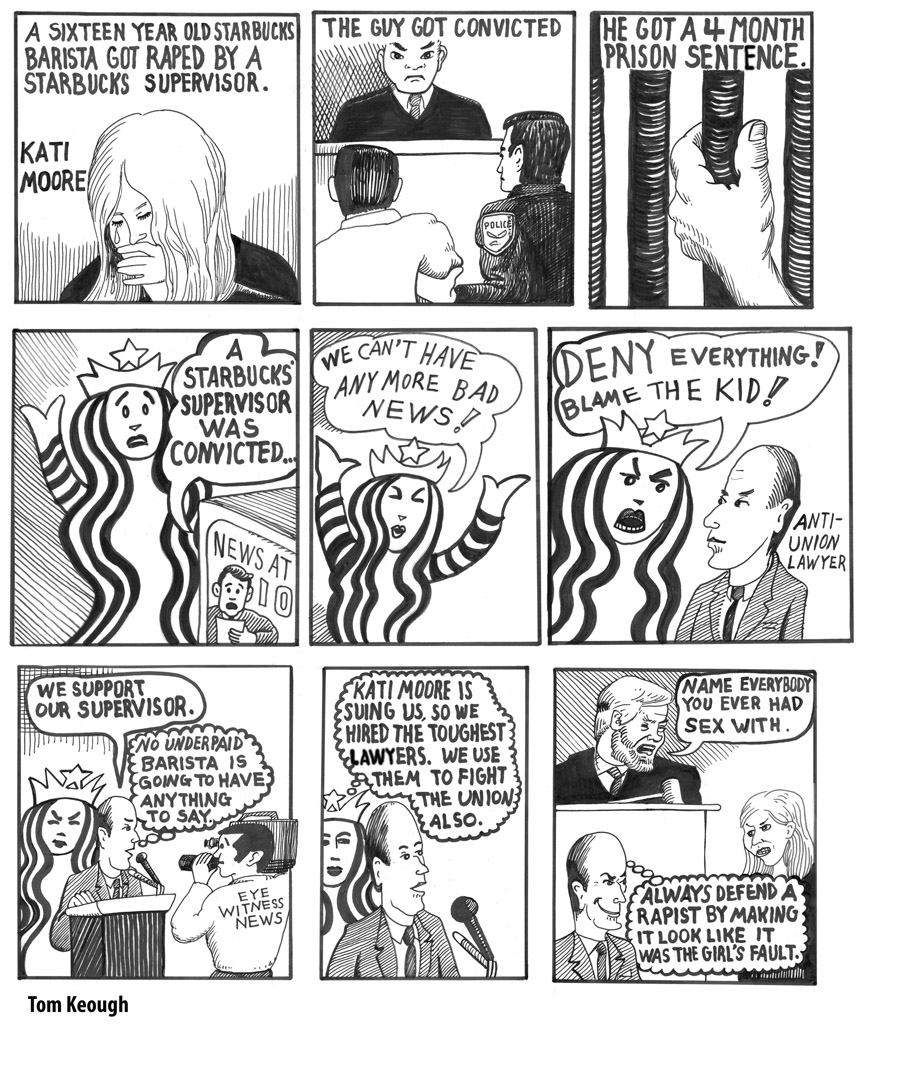
Tom Keough : The Unionization of Starbucks and the Rape of Kati Moore

CLICK ON IMAGE TO ENLARGE.

California teen girl sues Starbucks over sexual abuse

Seattle-based Starbucks is feeling the heat over an ex-worker’s accusations of sex abuse on the job. And an ABC News investigation has uncovered evidence that it’s part of a nationwide trend of young women being taken advantage of by older managers.

Beyond its strong coffee and steamed milk, Starbucks presents itself as a trusted corporate citizen. “It’s not the bricks and mortar that make Starbucks, it’s the human relations of our people and the experience,” says Starbucks CEO Howard Schultz.

That family feeling is one of the reasons Katie Moore [in other sources her name is spelled “Kati”] says she applied to work at Starbucks when she turned 16… But within months, she says, her job as a barista at a Starbucks store in an Orange County, Calif., shopping center turned into something quite different…

In the case of Katie Moore at Starbucks, the supervisor, Tim Horton, pleaded guilty to having sex with a minor and spent four months in prison. But Katie Moore’s mother says Starbucks and places with high school employees need to do more. “You know, they have a responsibility to these teenagers,” says Joanna Moore…

Moore is now suing Starbucks, alleging [the] 24-year old supervisor essentially turned her into his sex toy, in a court case that has turned ugly as she claims Starbucks did little to protect her from him, and Starbucks claims it’s her own fault…

seattle pi / January 24, 2010

Organizing the baristas:
The IWW and the Starbucks Workers Union

By Tom Keough / The Rag Blog / March 16, 2010

I do cartoons for the Starbucks workers who are trying to unionize and get better working conditions. The Kati Moore rape case exemplifies the company’s total lack of care for an employee and automatic support for anything a manager does.

When I first heard that the majority at a New York City Starbucks announced that they wanted a union contract I was amazed. When I was growing up, almost everyone I knew had either worked at McDonalds at some time or had family working there. My father had tried organizing McDonalds workers in Connecticut when he worked there. The biggest problem seemed to be that no union wanted fast food workers.

I’ll never forget seeing the mothers of two of my friends, almost in tears, talking about how unfair it was that the men at Pratt and Whitney or Colts could have unions, but not them. McDonalds work is hot, greasy, hard, fast, exhausting work.

So I try to help the Starbucks Workers Union, which was organized by the IWW (Industrial Workers of the World) in the U.S. and Canada. There is a union organizing campaign well under way in Chile and efforts have started in Europe. In New Zealand all the fast food chain restaurants are owned by one man and the employees are all union.

The Starbucks workers face a number of unique problems. The company has a nationwide policy of no full time employment for non-management workers. This way they avoid having to pay benefits. Their U.S. employees also have no set schedules. A lawyer for Starbucks once said that this is to prevent part-time staffers from getting second jobs. If you work there you won’t know the next week’s schedule until two or three days before the week starts.

Starbucks boasts that they offer health insurance for their employees but they make it almost impossible to get or to keep. To have the option of buying this insurance you need to work an average of 20 hours per week for the three-month quarter. The employees have no say in how many hours they work. Some weeks they may work 45 hours and the next week only seven. So the health insurance is really only a public relations stunt to impress customers.

In the shops where the baristas have announced their desire to unionize, Starbucks has refused to recognize the union. BUT in those shops, improvements have suddenly occurred. The first shop to go union soon became the first Starbucks to give all employees a December holiday cash bonus. In other locations safety and other improvements were made. In the U.S. the union has taken the company to court and won every time, despite the company’s highly paid lawyers.

  • Go here to learn more about the IWW Starbucks Workers Union.
  • Go here to read the Starbucks Union’s Statement of Solidarity with barista Kati Moore who was sexually assaulted by her supervisor.

Cartoons by Tom Keough / The Rag Blog.

The Rag Blog

Posted in Rag Bloggers | Tagged , , , , , , | 10 Comments

Have a Heart : How to Expand the Organ Harvest

3D anaglyph of the human heart. Image from 3D-image.net.

Israel’s new approach:
Donor cards and organ transplants

By Ted McLaughlin / The Rag Blog / March 16, 2010

For years now, doctors have been able to save lives and prolong lives by performing organ transplants. Hearts, livers, kidneys, lungs, etc. can be taken from those who’ve died and preserved long enough to replace defective organs in a person who needs a new organ to survive. This is a big step forward for medicine.

There is only one problem. The only source for these replacement organs is people who have authorized their organs to be harvested before they died, and this has created a serious shortage of available organs. There are waiting lists for every kind of organ transplant. It is hoped that someday medical science will be able to grow new organs (possibly from stem cells), but that is still a long way from happening.

In most Western nations, about 30% of the population have authorized the harvesting of their organs after death. This is not a bad percentage, but still leaves long lists of people who are waiting for organs. Some of them even die while waiting for an appropriate organ.

Medical professionals have been searching for a way to boost the quantity of available organs, and up until now there have only been two solutions — neither of which is free from ethical problems. And an unethical solution may well be worse than no solution at all.

First, is the buying and/or selling of organs. This distasteful method is not approved in any civilized country. This is because of a couple of thorny questions. Should the rich get preference in receiving available organs because they can outbid those poorer than they are? Should the poor be pressured into giving their organs (or those of their loved ones) because of their poverty? Any moral and ethical person would quickly answer no to both questions.

The second solution is for doctors to assume they have permission to harvest organs unless the donor had specifically left written instructions denying them that privilege. This also presents an ethical dilemma. Just because a person has not left a written denial does not mean he/she gave his/her permission.

It is not uncommon in modern society for someone to delay doing something he or she really intended to do until it was too late. Just look at the many people who die without leaving a will. You cannot assume that all of them meant not to leave a will. In fact, I’ll bet that many of them simply procrastinated too long and died unexpectedly. Making assumptions about what a person wanted is like walking through an ethical minefield — it could blow up on you at any time.

Israel is in an even worse position than most Western countries. That is because only about 10% of Israelis have authorized the harvesting of their organs after they die. This has made their waiting lists much longer than those of other developed countries, making it far more likely that a patient would die while waiting for a suitable organ.

Israel was in bad need of a way to boost organ donations, and because they are a very religious nation, neither of the two ethically-suspect solutions would be appropriate for them to use. What were they to do? Simply urging the public to sign donor cards had only gotten them to 10%, and further government pleas were unlikely to significantly improve upon that.

The Israeli government has devised a new solution that’s never been tried before — it’s simple, ingenious, and devoid of the ethical problems attached to other solutions. They have passed a law that gives priority for organ transplants to those who signed donor cards before they became ill. These people would be put ahead of those who had not signed donor cards if they needed a transplant.

They have not yet implemented the new law, and it might not work for some reason unknown now, but I think it’s a good idea. Why shouldn’t those willing to give be the first to get? And it’s fair to everyone — black or white, rich or poor, male or female, young or old, religious or atheist. Anyone can (and should) sign a donor card. I believe this simple law will significantly increase the number of donors and save many lives.

There are those who say this would not be a big advantage, because soon the list of those waiting who had signed donor cards would be very long. I don’t buy this argument. Even if the list is long, we must remember there will be a lot more available organs. Therefore those waiting will not have to wait as long as they do now to get their transplant. I believe the law will provide a good chance to save a lot of lives that are now being lost.

The United States, Canada, and Europe should watch closely to see what happens when Israel implements the new law. If it significantly increases the number of donors and the number of lives saved, then it should be implemented in other developed nations.

Someday in the future, we might not have the need for human donors of organs. Maybe science will find a way to create new organs by harvesting them from the dead. But until then, the goal should be to save lives. I believe Israel’s new law will do that.

[Rag Blog contributor Ted McLaughlin also posts at jobsanger.]

The Rag Blog

Posted in Rag Bloggers | Tagged , , , | 14 Comments

We talk with the folks who made the film and run the venue — with live performance from Shake Russell, one of the artists who helped to make it famous

For the Sake of the Song:

We talk with the folks who made the film and run the venue — with live performance from Shake Russell, one of the artists who helped to make it famous


For The Sake Of The Song: The Story of Anderson Fair is the compelling saga of one of Texas’ and America’s unsung cultural treasures. This film explores the significant role Houston’s Anderson Fair has played in preserving an American musical tradition and how a devoted family of artists, volunteers, and patrons transformed a politically subversive little coffee house and restaurant into a unique American music institution.

Today, Anderson Fair is one of the oldest folk and acoustic music venues in continuous operation in the United States. What began as a little neighborhood restaurant where local musicians played for tips and free-thinkers gathered to “talk about things that might get them arrested somewhere else” quickly evolved into a songwriting sanctuary, cultivating a multitude of local and regional artists and attracting performers from all over the world.

Filmmakers Bruce Bryant and Jim Barham weave together a musical and visual tapestry of five generations of artists, volunteers, and patrons who have lived the story and graced the stage of this hallowed hall. In addition to intimate interviews with a who’s who of Americana and Texas music, the film also features new and never before seen archival footage of performances by Vince Bell, Guy Clark, Slaid Cleaves, Ramblin’ Jack Elliott, Steven Fromholz, Nanci Griffith, Carolyn Hester, Robert Earl Keen, Lyle Lovett, Eric Taylor, Dave Van Ronk, Townes Van Zandt, and Lucinda Williams.

Posted in RagBlog | Leave a comment

By Ted McLaughlin / The Rag Blog / March 15, 2010

For years now, doctors have been able to save lives and prolong lives by performing organ transplants. Hearts, livers, kidneys, lungs, etc. can be taken from those who’ve died and preserved long enough to replace defective organs in a person who needs a new organ to survive. This is a big step forward for medicine.

There is only one problem. The only source for these replacement organs is people who have authorized their organs to be harvested before they died, and this has created a serious shortage of available organs. There are waiting lists for every kind of organ transplant. It is hoped that someday medical science will be able to grow new organs (possibly from stem cells), but that is still a long way from happening.

In most Western nations, about 30% of the population have authorized the harvesting of their organs after death. This is not a bad percentage, but still leaves long lists of people who are waiting for organs. Some of them even die while waiting for an appropriate organ.

Medical professionals have been searching for a way to boost the quantity of available organs, and up until now there have only been two solutions — neither of which is free from ethical problems. And an unethical solution may well be worse than no solution at all.

First, is the buying and/or selling of organs. This distasteful method is not approved in any civilized country. This is because of a couple of thorny questions. Should the rich get preference in receiving available organs because they can outbid those poorer than they are? Should the poor be pressured into giving their organs (or those of their loved ones) because of their poverty? Any moral and ethical person would quickly answer no to both questions.

The second solution is for doctors to assume they have permission to harvest organs unless the donor had specifically left written instructions denying them that privilege. This also presents an ethical dilemma. Just because a person has not left a written denial does not mean he/she gave his/her permission.

It is not uncommon in modern society for someone to delay doing something he or she really intended to do until it was too late. Just look at the many people who die without leaving a will. You cannot assume that all of them meant not to leave a will. In fact, I’ll bet that many of them simply procrastinated too long and died unexpectedly. Making assumptions about what a person wanted is like walking through an ethical minefield — it could blow up on you at any time.

Israel is in an even worse position than most Western countries. That is because only about 10% of Israelis have authorized the harvesting of their organs after they die. This has made their waiting lists much longer than those of other developed countries, making it far more likely that a patient would die while waiting for a suitable organ.

Israel was in bad need of a way to boost organ donations, and because they are a very religious nation, neither of the two ethically-suspect solutions would be appropriate for them to use. What were they to do? Simply urging the public to sign donor cards had only gotten them to 10%, and further government pleas were unlikely to significantly improve upon that.

The Israeli government has devised a new solution that’s never been tried before — it’s simple, ingenious, and devoid of the ethical problems attached to other solutions. They have passed a law that gives priority for organ transplants to those who signed donor cards before they became ill. These people would be put ahead of those who had not signed donor cards if they needed a transplant.

They have not yet implemented the new law, and it might not work for some reason unknown now, but I think it’s a good idea. Why shouldn’t those willing to give be the first to get? And it’s fair to everyone — black or white, rich or poor, male or female, young or old, religious or atheist. Anyone can (and should) sign a donor card. I believe this simple law will significantly increase the number of donors and save many lives.

There are those who say this would not be a big advantage, because soon the list of those waiting who had signed donor cards would be very long. I don’t buy this argument. Even if the list is long, we must remember there will be a lot more available organs. Therefore those waiting will not have to wait as long as they do now to get their transplant. I believe the law will provide a good chance to save a lot of lives that are now being lost.

The United States, Canada, and Europe should watch closely to see what happens when Israel implements the new law. If it significantly increases the number of donors and the number of lives saved, then it should be implemented in other developed nations.

Someday in the future, we might not have the need for human donors of organs. Maybe science will find a way to create new organs by harvesting them from the dead. But until then, the goal should be to save lives. I believe Israel’s new law will do that.

[Rag Blog contributor Ted McLaughlin also posts at jobsanger.]

The Rag Blog

Posted in RagBlog | Leave a comment

Women’s Health : Heard About the H-Word Lately?

“Beautiful Inside” by Angela Elkins. The digitally-enhanced images were taken from a video of a laparoscopy, recorded during exploratory surgery performed on the artist. Angela, who was hysterectomized at the age of 24, says of the photoshopped images, “Everyone seems to be repulsed by the sight of our insides, our blood, what fills our skin. So I took these images and made them beautiful.” The images include views of her ovaries and uterus prior to the hysterectomy.

This work is part of an exhibit of Elkins’ works entitled U-tear-us Out, at Watkins College of Art and Design in Nashville. The exhibit addresses the issue of women and hysterectomies through sculpture and digital images. The works can be seen here, on the HERS Foundation website.

Hysterectomies and women’s health:
Heard about the H-word recently?

By Barbara Peyton / The Rag Blog / March 15, 2010

If you haven’t heard about the H-word recently, you soon will.

I’m talking about hysterectomy and female castration (removal of the ovaries) which takes place in 73 percent of all hysterectomies.

I might have been one of the thousands of women given a needless hysterectomy each year had I not received counseling 10 years ago from the HERS Foundation, the only independent, international organization dedicated to the issue of hysterectomy.

After all, eight Houston gynecologists had tried to convince me that because my fibroids were so large I would need a hysterectomy. Yet, I was not bleeding excessively and felt just fine. I just could not understand why I needed to go to the hospital for major surgery.

Not one of the doctors I visited for second, third, fourth… opinions had told me I had any other alternative. Fortunately, the internet led me to the HERS Foundation, to its incredible resources and its wonderful leader Nora Coffey who personally counseled me.

She later referred me to a compassionate board certified OB-GYN who read my images and pretty much told me that if I got off HRT and gave it some time, my fibroids might shrink all by themselves. I thought I’d give that a try and a decade later, am happy to report I’m doing fine.

On Saturday, April 23, Congresswoman Carolyn B. Maloney (D-NY) will deliver the keynote address at the HERS Foundation’s 28th Hysterectomy Conference in New York.

Maloney’s book Rumors of Our Progress Have Been Greatly Exaggerated, details the ongoing struggle women encounter on a number of fronts, including equal pay, politics, and health care.

Maloney is one of several prominent speakers who will discuss the impact of hysterectomies on women’s lives. Others will focus on alternatives to hysterectomy for common symptoms and conditions, including ovarian cysts, fibroids, endometriosis, hyperplasia, prolapse, HPV, pelvic pain, and obstetric hemorrhage. Another speaker will talk about legislation regarding informed consent. And, still others will address legal issues including establishing damages and medical malpractice.

I encourage men and women to become better acquainted with the advocacy work of the HERS Foundation and if possible to attend their conference. At the very least, you must read their FACT sheet which will blow you away with the devastating consequences of hysterectomies.

And, if you are someone who has been told you need one, you will be happy to learn that 98 percent of women HERS has referred to board-certified gynecologists after being told they needed hysterectomies, have discovered that, in fact, they did not need one. Time well spent.

  • To learn more about the 28th HERS Hysterectomy Conference, go here.
  • For facts about hysterectomy alternatives and aftereffects, go here.

The Rag Blog

Posted in Rag Bloggers | Tagged , , , | 2 Comments

I do cartoons for the Starbucks workers who are trying to unionize and get better working conditions. This rape case shows the total lack of care for an employee and automatic defense of anything a manager does. I think more people need to hear about the struggles of average people and the way our corporate masters use all kinds of extremely expensive methods to get their way.

When I first heard that the majority at a NYC Starbucks announced that they wanted a union contract I was amazed. When I was growing up, almost everyone I knew had either worked at McDonalds at some time or had family working there. My father had tried organizing McDonalds workers in Connecticut when he worked there. The biggest problem seemed to be that no union wanted fast food workers. I’ll never forget seeing the mothers of two of my friends, almost in tears, talking about how unfair it was that the men at Pratt and Whitney, or Colts could have unions but not them. McDonalds work is hot, greasy, hard, fast exhausting work.

So I try to help the Starbucks Workers Union, which is an IWW union in the US. and Canada. There is a union organizing campaign well under way in Chile and efforts have started in Europe. In New Zealand all the fast food chain restaurants are owned by one man and the employees are all union.

The Starbuck’s workers face severa unique problems. The company has a nationwide policy of no full time employment for non-management workers. This way they avoid having to pay benefits. Their U.S. employees also have no set schedules. A lawyer for Starbucks once said that this is to prevent the part-time staff from getting another job. If you work there you won’t know the next wee’s schedule until two or three days before the week starts.

Starbucks boasts that they offer health insurance for their employees but they make it almost impossible to get or to keep. To have the option of buying this insurance you need to work an average of 20 hours per week for the three-month quarter. The employees have no say in how many hours they work. Some weeks they may work 45 hours and the next week only seven. So the health insurance is really only a public relations stunt to impress customers.

In the shops where the baristas have announced their desire to unionize, Starbucks has refused to recognize the union. BUT in those shops, improvements have suddenly occurred. The first shop to go union soon became the first Starbucks to give all employees a December holiday cash bonus. In other locations safety and other improvements were made. In the U.S. the union has taken the company to court and won every time so far. The company spends large amounts of money on their lawyers in these cases.


Type rest of the post here

Source /

Source

The Rag Blog

Posted in RagBlog | Leave a comment

Marc Estrin : Happy Birthday, Albert Einstein

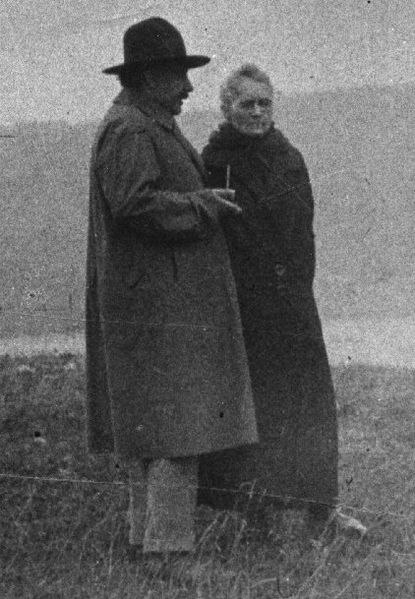
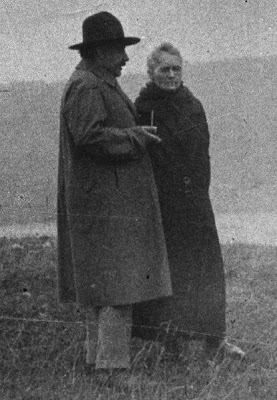
Albert Einstein and Marie Curie.

HAPPY BIRTHDAY, ALBERT

(Albert Einstein was born on March 14th, 1879.)

Blanchot : “La réponse est le malheur de la question.” (The answer is the misfortune of the question.)

ALBERT EINSTEIN SAID

Sometimes I ask myself how it came about that I happened to be the one to discover the theory of relativity. The reason is, I think, that the normal adult never stops to think about space and time. Whatever thinking he or she did about these things will already have been done as a small child. It, on the other hand, was so slow to develop that I only began thinking about space and time when I was already grown up. Naturally I then went more deeply into the problem than an ordinary child.

THE ANSWER IS THE MISFORTUNE OF THE QUESTION

There exists a remarkable photograph of Einstein and Marie Curie standing together on a naked, blasted heath, both dressed in black — he in a cape, she in a hooded cloak. They look like allegorical figures from an early Bergman film — set eternally there for us to ponder their meaning, their relationship to one another, their relationship to us.

I’d been carrying that mysterious image around for a long time when I came upon a poem by Adrienne Rich which explained it to me:

Today I was reading about Marie Curie

She must have known she suffered from radiation sickness
her body bombarded for years by the element
she had purified.
It seems she denied to the end
the source of the cataracts on her eyes
the cracked and suppurating skin of her
finger ends
till she could no longer hold a test tube or a
pencil

She died a famous woman denying her wounds
denying her wounds came from the same source
as her power.

Einstein, too, suffered from radiation sickness. Einstein, too, denied. Two kinds of radiation sickness, actually. Sickness over his unintended contribution — in theory and in practice — to the deaths of so many and the poisoning of the planet. And sickness about from-radiation-born physics, a disease within the whole swing of science which left him behind, an oddball, a hermit, a naysaying party pooper, a pathetic, has-been, once-important old man.

His wounds came from the same source as his power. The power to imagine an entirely other view of the world, of the universe, the view of someone who rides on a light beam. The power of the light-beam-rider to see the light also enabled him to envision a world without war, a world beyond nations, beyond power, greed and corruption. One can’t see these visions without being seriously wounded. One can’t be wounded without denying.

“God does not play at dice,” he said. Events in the world must have a cause, in spite of what the quantum mechanics were saying. At its deepest level the universe must be orderly, not random. If he could only find this statement which would describe it. “Forget it,” said the mechanics.

He wouldn’t forget it. His eyes were glued on the universe and the possibility of penetrating to the ultimate core where all secrets would be resolved and understood as the emanation of a single law. This law, the unified field theory, would be for him the name of God. He could never name the Name. His wounds came from the same source as his power. He could never name the Name

ALBERT EINSTEIN SAID

Everyone who is seriously involved in the pursuit of science becomes convinced that a spirit is manifested in the laws of the Universe — a spirit vastly superior to that of humanity, and one in the face of which we, with our modest powers, must feel humble. In this way the pursuit of science leads to a religious feeling of a special sort, which is quite different from the religiosity of someone more naïve.

THE ANSWER IS THE MISFORTUNE OF THE QUESTION

MOSES AND ARON

He could never name the name of God. It is a remarkable coincidence that just at the time Einstein was leaving the physics community, beginning his retreat into the desert of his solitary vision quest, another German seeker was articulating something very similar. Let’s switch our eyes over to the power and wounds of Arnold Schoenberg, the great revolutionary who broke open a millennium of Western tradition to lead music into uncharted territory. Between 1923 in 1928 he worked on his largest, most ambitious and shattering work, his opera, Moses and Aron. This piece is a radical and comprehensive act of the imagination, an attempted human song in the face of the unspeakable immensity of God.

At the opening of the first act, Moses hears the wordless voice of God, and understands that it is einziger, ewiger, everywhere, invisible and inconceivable. Standing in relation to such a God, he cannot sing, he is almost dumb, he can express himself only in a halting, halfway manner, using a vocal technique of Schoenberg’s called Sprechstimme — half singing, half speaking, limited, frustrated, fallen. The voice from the burning Bush instructs him to prophesy the name of the eternal God. But he resists. He is too simple, he cannot speak, he cannot express the infinite.

No prob. Aron, his brother, sizes up the situation, and is ready for the job. He has a beautiful tenor voice, sight-sings well, and although describing the infinite God is a difficult task, he’ll give it a shot. Granted, it may be only an approximation, but it’s close enough for church work, and besides, the people need an image to hang onto, or they just won’t buy the whole business.

The opera concerns the conflict between Moses and Aron over trying to enclose the boundless in a finite image. Like Einstein.

ALBERT EINSTEIN SAID

I do not believe in a personal God. If something is in me which can be called religious, it is the unbounded admiration for the structure of the world so far as science can reveal it. My religiosity consists in a humble admiration of the infinitely superior spirit that reveals itself in the little that we, with our weak and transitory understanding, can comprehend of reality.

THE ANSWER IS THE MISFORTUNE OF THE QUESTION

THE RETREAT FROM THE WORD

A nine-year-old asked me the other day “What did Einstein do?” I found it hard to describe. If he had invented the steam engine or discovered penicillin, or the charge on the electron, I could’ve explained more easily. But just try telling a child what Einstein did — it ain’t easy. And that is in large part because what he did is not in English. It’s not in German either. As his futile search dragged on, it was conducted more and more in the language of mathematical symbols, unrepresented by the tongue.

This was new, but not, perhaps, inappropriate. New because until relatively recently, our Judeo-Christian culture bore witness to the belief that all truth and realness — with the exception of a small, clear margin at the very top — could be housed inside the walls of spoken language. Until the 17th century, the predominant bias and content of the natural sciences were descriptive. But with the invention of analytic geometry and the theory of algebraic functions, with the development of calculus, mathematics transcended being an instrument to characterize certain aspects of nature, and became its own independent language, one of progressive untranslated ability. Mathematical forms and meanings have receded from spoken language at an ever accelerating pace. For no dictionaries to relate the vocabulary and grammar of contemporary higher mathematics to ordinary speech. One cannot even paraphrase.

This was the world in which Einstein ended. No more railroad cars and flashing lights of special relativity. Gone were the elevators of general relativity. Just pages and pages of reiterative tensor equations. The small, queer margin at the top. No song; beyond speech; never expressible even in its own terms. Einstein. Moses. The Unspeakable, Unreachable Absolute Idea of God.

ALBERT EINSTEIN SAID

The religious feeling engendered by experiencing the logical comprehensibility of profound interrelations is a somewhat different sort from the feeling that one usually calls religious. It is more a feeling of awe at this scheme that is manifested in the material universe. It does not lead us to fashion a godlike being in our own image — a personage who makes demands of us and to take some interest in us as individuals. There is in this neither will nor goal, but only sheer being.

THE ANSWER IS THE MISFORTUNE OF THE QUESTION

THE TRIAL OF ALBERT EINSTEIN

PROSECUTOR
Is it not true that your discoveries of mass and energy equivalence led directly to the production of atomic weapons?

EINSTEIN
(Shakes his head vehemently)

PROSECUTOR
Is it not true that you wrote a series of letters to President Roosevelt recommending that the United States develop an atomic bomb?

EINSTEIN
(Thinks, then shakes his head decisively)

GEORGE GAMOW
When Einstein accepted a consulting ship with the Bureau of Ordinance he said he would be unable to travel to Washington regularly, and that someone from the Division of High Explosives would have to come up to meet him at Princeton. I was selected to carry out the job. And so, on every other Friday, I took a morning train to Princeton, carrying a briefcase packed with secret Navy projects. Einstein would meet me in his study at home, and we would go through all the proposals one by one. He approved practically all of them, saying, “Oh, yes, very interesting, very, very ingenious,” and the next day the admiral in charge was quite happy with Einstein’s comments.

EINSTEIN (screams out)
I have never worked in the field of applied science, let alone for the military! I condemn the military mentality of our time just as you do! I have been a pacifist all my life, and I regard Gandhi as the only truly great political figure of our time!
(Pause, quietly…)
I just served as a mailbox. They brought me a letter and all I had to do was sign…

AUDIENCE APPLAUSE FOR FAMOUS SPEAKER EINSTEIN

EINSTEIN
Our time is distinguished by wonderful achievements in the fields of scientific understanding and technical application. But let us not forget that knowledge and skills alone cannot lead humanity to a happy and dignified life. What humanity owes to Buddha, Moses and Jesus ranks for me higher than all the achievements of the inquiring and constructive mind. What these blessed men have given us we must guard and try to keep alive with all our strength if humanity is not to lose its dignity, the security of its existence, and the joy in living.

APPLAUSE

EINSTEIN
The unleashed power of the atom has changed everything save our ways of thinking, and thus we drift toward unparalleled catastrophe. A new way of thinking is essential if humanity is to survive and move toward higher levels.

HUGE APPLAUSE

EINSTEIN
The big political doings of our time are so disheartening that one feels quite alone. It is as if people had lost the passion for justice and dignity and no longer treasured what better generations have won by extraordinary sacrifice. The foundation of all human value is morality. To have recognized this clearly in primitive times is the unique greatness of our Moses. In contrast, look at the people today…

POLITE APPLAUSE

EINSTEIN
(Yelling)
It is easier to change the nature of plutonium than people’s evil spirit!
(He looks at the clappers, who do not respond)
People grow cold faster than the planet they inhabit.
(He looks for God)
Mine eyes fail with looking upward.
(Pause)
Three great powers rule the world: stupidity, fear and greed.

SILENCE
THE ANSWER IS THE MISFORTUNE OF THE QUESTION

ALBERT EINSTEIN SAID

People like you and me, though mortal like everyone else, do not grow old no matter how long we live. What I mean is that we never cease to stand like curious children before the great Mystery into which we are born.

THE JEWISH QUEST FOR THE ABSOLUTE

Aron puts forth a comprehensible image so that Israel may live and not fall into despair. Moses loves an idea, an absolute vision, relentless in its purity. He would make of Israel the hollow, tormented vessel of an inconceivable presence.

Here, in George Steiner’s imagination (in The Portage to San Cristóbal of A.H.), is Hitler’s self-defense after he was captured as an old man in the Brazilian jungle:

“There had to be a solution, a FINAL solution. For what is the Jew if he is not a long cancer of unrest? Gentlemen I beg your attention. Was there ever a crueler invention, a contrivance more calculated to harrow human existence, than that of a non-impotent, all seeing, yet invisible, impalpable, inconceivable God?… the Jew emptied the world by setting his God apart. No image. No concrete embodiment. No imagining even. A blank emptier than the desert. Yet with a terrible nearness. Spying on our every misdeed, searching out the heart of our heart for motive… the Jew mocks those who have pictures of their God. HIS God is purer than any other. And because His inconceivable, unimaginable presence and develops us, we must obey every jot and tittle of the Law. We must bottle up our rages in desires, chastise the flesh and walk bent in the rain. You call me a tyrant, and enslaver. What tyranny, what enslavement has been more oppressive, has branded the skin and soul of man more deeply than the sick fantasies of the Jew? You are not God killers, but GOD makers. And that is infinitely worse. The Jew invented conscience and left humanity guilty serfs.

“But that was only the first piece of blackmail. There was worse to come. The white-faced Nazarene. Gentleman, I find it difficult to contain myself. But the facts speak for themselves. What did that epileptic rabbi ask of us? That we renounce the world, that we leave mother and father behind, that we offer the other cheek when slapped, that we render good for evil, that we love our neighbor as ourselves, no, far better, for self-love is an evil thing to be overcome. Oh grand castration! Note the cunning of it. Demand of human beings more than they can give, demand that they give up their stained, selfish humanity in the name of a higher ideal, and you will make of them cripples, hypocrites, mendicants for salvation. The Nazarene said that his kingdom, his purities were not of this world. Lies, honeyed lies. It was here on earth that he founded his slave-church. It was men and women, creatures of flesh, he abandoned to the blackmail of hell, of eternal punishment. What were our camps compared to THAT? What can be crueler than the Jew’s addiction to the ideal?

“First the invisible but all seeing, the unattainable but all demanding God of Sinai. Second the terrible sweetness of Christ. Had the Jew not done enough to sicken man? No, gentlemen, there is a third act to our story.

“‘Sacrifice yourself for the good of your fellow man. Relinquish your possessions so that there may be equality for all. So that justice may be achieved on earth. So that history may be fulfilled and society be purged of all imperfection.’ Do you recognize that sermon, gentlemen? Rabbi Marx. Was there ever a greater promise? ‘The classless society, to each according to his needs, brotherhood for all humanity, the earth made a garden again, a rational Eden.’ In the name of which promise tyranny, torture, war, extermination were a necessity, a historical necessity! It is no accident that Marx and his minions were Jews, that the congregations of Bolshevism — Trotsky, Rosa Luxembourg, the whole fanatic, murderous pack — were of Israel. Look at them: prophets, martyrs, smashers of images drunk with the terror of the absolute. It was only a step, gentleman, a small inevitable step, from Sinai to Nazareth, from Nazareth to the covenant of Marxism. The Jew had grown impatient. Let the kingdom of justice come here and now, next Monday morning. Let us have a secular messiah instead. But with a long beard and his bowels full of vengeance.

“You are not humanity’s conscience, Jew. You are only its bad conscience. And we shall vomit you so we may live and have peace.”

The Nazis set a price of 50,000 marks on Albert Einstein’s head.

ALBERT EINSTEIN SAID

You believe in a God who plays dice, and I in complete law and order in a world which objectively exists, and which I, in a wildly speculative way, am trying to capture. I hope that someone will discover a more realistic way, or rather a more tangible basis than it has been my lot to find.

THE ANSWER IS THE MISFORTUNE OF THE QUESTION

The physicists walked away from Einstein to follow Schrodinger’s cat. The old man was left alone on his deathbed, pad and pencil in hand.

ALBERT EINSTEIN SAID

God does not play at dice.

THE ANSWER IS THE MISFORTUNE OF THE QUESTION

[Marc Estrin is a writer and activist, living in Burlington, Vermont. His novels, Insect Dreams, The Half Life of Gregor Samsa, The Education of Arnold Hitler, Golem Song, and The Lamentations of Julius Marantz have won critical acclaim. His memoir, Rehearsing With Gods: Photographs and Essays on the Bread & Puppet Theater (with Ron Simon, photographer) won a 2004 theater book of the year award. He is currently working on a novel about the dead Tchaikovsky.]

The Rag Blog

Posted in Rag Bloggers | Tagged , , , , , | 2 Comments