All White Hoops : The New Public Racism

Image from The Portland Mercury.

Racists coming out of the closet:
Whites only basketball league

‘Would you want to go to the game and worry about a player flipping you off or attacking you in the stands or grabbing their crotch?’ — Don “Moose” Lewis, All-American Basketball Alliance

By Ted McLaughlin / The Rag Blog / January 21, 2010

When Barack Obama was elected president of the United States, there were many people (including myself) who thought it might herald a new era of better race relations in this country. Maybe it will, but it has also had another effect. It has caused many racists to crawl out from under their rocks and once again make their slimy presence known.

In the last few years it had become socially unacceptable to be openly racist. The racists were still there (although fewer in number) but they kept it to themselves and the few like-minded friends they had. Even racist organizations like the KKK were having trouble attracting new members.

But President Obama’s election changed that. Perhaps fearing their racist beliefs were not just out of vogue but disappearing altogether, the racists have once again become public and very vocal. And they have found a comfortable home in the Republican Party and other anti-Democratic and anti-government groups (such as the teabaggers). These groups allow them to thinly disguise their racism as a form of rabid patriotism (which it is not).

Almost every week we see more examples of this newly public brand of obvious racism. Of course they all deny that they are being racist. To hear them tell it, they are just trying to protect some vital aspect of American society and culture, and race has nothing to do with it. But their racism is so clearly the driving force behind their actions that their denial of it just seems stupid and inane.

Consider this perfect example of the new public racism. There is a group now that wants to create a new professional basketball league. And one of the major rules of the new league is that all of the players must be “natural born citizens with both parents of the caucasian race” (white). Of course, the people trying to create this new league say it has nothing to do with race and they are not racists.

The league will be called the All-American Basketball Alliance (AABA) and they say they will start play next June with teams in 12 cities. The league commissioner, Don “Moose” Lewis, says he is not racist, but just wants to get away from “street ball” and get back to “fundamental basketball”. He went on to say:

There’s nothing hatred about what we’re doing. I don’t hate anyone of color. But people of white, American-born citizens are in the minority now. Here’s a league for white players to play fundamental basketball, which they like… Would you want to go to the game and worry about a player flipping you off or attacking you in the stands or grabbing their crotch? That’s the culture today, and in a free country we should have the right to move ourselves in a better direction.

I am amazed at this man’s stupidity. He as much as says that all the bad behavior in the NBA is by African-Americans and white boys would not act like that, and doesn’t even realize that his statement itself is racist? Any rational thinker knows that neither bad nor good behavior is linked to race (which is in itself a spurious concept invented to advance colonialism and greed).

The league is based in Atlanta and is targeting cities in the Southeast to fill the 12 slots for franchises. However, they are already having trouble in one of the targeted cities — Augusta, Georgia. The city is making it clear they want no part of the new league.

Augusta Mayor Deke Copenhaver says, “As a sports enthusiast, I have always supported bringing more sporting activities to Augusta. However, in this instance I could not support in good conscience bringing in a team that did not fit with the spirit of inclusiveness that I, along with many others, have worked so hard to foster in our city.”

Augusta State University athletic director Clint Bryant was even more blunt, saying, “It’s so absurd it’s funny, but it gives you an idea of the sickness of our society. It shows you what lengths people will go to just to be mean-spirited.” Mr. Bryant is absolutely right. This sort of thing is sick and mean-spirited.

Now I don’t think this new league has a chance of succeeding. Even if it does get established, it will quickly fold because most people will not support this kind of overt racism — even in the South. The South still has its problems, but it has come a long way since the bad old days of Jim Crow.

But personally, I’m damn sick and tired of the new public racism that is rearing its ugly head in this country. Because of our country’s free speech rights, these racist creeps have the right to speak their evil minds. But we also have the same right, and we have a responsibility to come down hard on this racist sickness. Racism doesn’t just hurt individuals, it hurts our country as a whole.

It is time for decent people of all ethnicities and colors to rise up and let the racists know we just won’t stand for it. It’s both the decent and patriotic thing to do.

[Rag Blog contributor Ted McLaughlin also posts at jobsanger.]

The Rag Blog

Posted in Rag Bloggers | Tagged , , , , | 13 Comments

VERSE / Larry Piltz : A Poem of Judicial Atrocity

Corporate zombie. Photo by Ian MacLellan / MacLellan Images.

The Sniff Test
[A poem of judicial atrocity]

The corporate zombie creature
raises a misshapen nostril
out of the feudal muck,
smells air sweet enough to foul
and emerges uncontrite,
lunging onto stolid ground
the mud beneath it splattering,
on a day to be remembered
as belonging to the living dead;
the monstrous titan behemoth
is extinct no more,
its natural enemies,
the living, the free, you, me,
assigned to take its place exiled
in the stifling underground.

December 2000.
January 2010.
A locust cycle.
A plague of robes.
Fascio-Judicial Robespierres,
contorted Terror from within.
A heroic ninety-page dissent
enables a shrewd new
underground railroad
of organized outrage
and wholly natural
resistance in kind.
Justice in kind.
A corporeal response
from a body politic
with 2020 vision.
The gloves are off.

Larry Piltz / The Rag Blog

Indian Cove
Austin, Texas
January 21, 2010

The Rag Blog

Posted in Rag Bloggers | Tagged , , , , , , , | Leave a comment

Supremes Make it Official : Corporations Rule!


High court ruling on campaign finance:
The corporation as supreme being

By Glenn W. Smith / The Rag Blog / January 21, 2010

If you had any doubt about the corruption that has infected the very bloodstream of American politics, look at today’s ruling from the U.S. Supreme Court. The Court said corporations can spend unlimited amounts to influence the outcome of elections.

I’m gonna repeat my sad joke: we are approaching the time when there will be “corporate creationists” so convinced of the divine status of the corporate life-form that they will deny vehemently that corporations evolved from human beings. Americans, we are the new monkeys.

At the root of the Court’s attack on popular democracy — and it is an attack, and it will promote if not guarantee rule by unaccountable corporate oligarchy — is the Court’s infamous 1976 Buckley v. Valeo decision that said money equals speech. Left unaddressed in today’s decision — and others — is the absurdity of this formula. When money equals speech, outfits with more money have more speech. And that destroys the very principle of free speech.

Ask yourself this question. If you had to persuade your community about political opinion X, but corporations opposed your view, would you stand a chance knowing that their “political speech” was worth much more than your political speech? The answer is obvious. Mere people have been thrown on the scrap heap. The U.S. Supreme Court is lifting corporations to the top of the evolutionary ladder.

Teabaggers, do you get it now? You are outraged by your powerlessness. Can you now see the real source of that powerlessness? It is not government. Government has been turned into the handmaiden of the corporate oligarchs.

I’m compelled to repeat something else: I’m a fan of entrepreneurship and responsible capitalism. But it’s not the so-called heavy hand of government that is the enemy. It’s the corporate monopolists.

I also share the view of the sanctity of the individual in a democracy. While many anachronistically worry about creeping socialism, it is the unrestrained power of unaccountable global corporatists that threatens individual rights with extinction.

The Supreme Court’s decision should be a wake-up call to America. The corruption has gone far enough. Democracy hangs in the balance. This is not hyperbole. This is a day that will live in infamy.

[Austin’s Glenn W. Smith, according to Daily Kos founder Markos Moulitsas, is a “legendary political consultant and all-around good guy.” His excellent blog on politics and culture is DogCanyon, where this article also appears.]

The Rag Blog

Posted in Rag Bloggers | Tagged , , , , , , , | 7 Comments

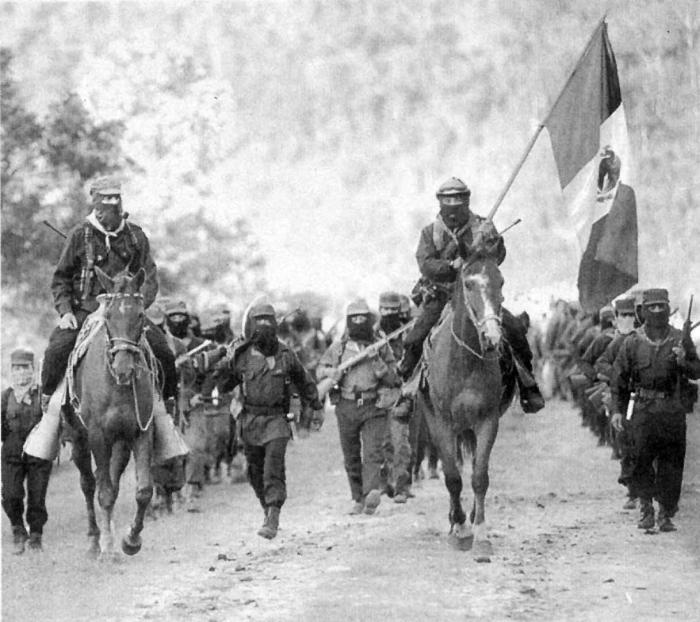
Mexico’s ‘Year of Revolution’ : Zapatista Silence is Deafening

Zapatistas. Art from radicalgraphics.org.

Silence in Chiapas:
Zapatista rebels ‘on vacation’

Is a new uprising on their agenda or does the Zapatista Army of National Liberation just want to be left alone?

By John Ross / The Rag Blog / January 21, 2010

MEXICO CITY — The pitch-black night suddenly came alive with darting shadows. The slap slap of rubber boots against slick pavement echoed throughout the hushed neighbors on the periphery of town. Sleepy chuchos stirred in the patios, stretched and bayed, their howls catching from block to block, barrio to barrio.

Across the narrow Puente Blanco, down the rutted Centenario Diagonal, up General Utrilla from the market district, dark columns jogged in military cadence. With their faces canceled behind ski-masks and kerchiefs and their collective breath hanging in the still mountain air like vapors from a cruel past many Mexicans have disremembered, the “sin rostros” advanced on the center of the city of San Cristobal de las Casa, the jewel box colonial city that crowns the Mayan highlands of Chiapas, Mexico’s southernmost state.

So it began, the Zapatista rebellion, January 1, 1994, in the first hour of that beacon of globalization, the North American Free Trade Agreement.

Sixteen years later, past midnight on January 1, 2010, a year in which many sense that the 100th anniversary of the Mexican Revolution will be celebrated with new uprisings, there were no darting shadows or dark columns of Zapatistas marching on the center of San Cristobal and the howling of the dogs, rather than alerting the city to the arrival of the Indian rebels only marked the passing of a desultory drunk tottering home to sleep off the excesses of New Year’s eve.

Each year since that first New Year’s, the Zapatista Army of National Liberation (EZLN) has commemorated its brief takeover of San Cristobal and six other municipal seats in southeastern Chiapas with militant speeches and fiestas thrumming with the herky jerky rhythms of the rebels’ favorite cumbias, sometimes at the “Caracol” or public center in La Realidad on the edge of the Lacandon rainforest but more often at Oventic in Los Altos of Chiapas, 45 minutes as the crow climbs from San Cristobal.

But as 2010 tolled in, a hand-lettered sign posted to the gate of the highland Caracol advised visitors that Oventic would be closed to visitors until January 2nd. At the Ejido Morelia in the lowlands, a note tacked to the Caracol fence proclaimed that the rebels were “on vacation.” Three other CaracolesLa Garrucha, La Realidad, and Robert Barrios (in the north of the state) — were similarly locked down tight for the first time since that first January 1, a clue that no new revolutions are brewing, at least here in the Zapatista zone, as Mexico ushers in the centennial of its landmark revolution.

Punctuated by long silences, the Zapatistas‘ resonance has plummeted precipitously in the first decade of the new millennium. The Indians’ struggle lost a great deal of relevance after much of the urban left abandoned the Zapatista cause when the Mayan rebels’ quixotic spokesperson Subcomandante Marcos lashed out at the left candidate Andres Manuel Lopez Obrador in the fraud-marred 2006 presidential elections and refused to support the millions who marched to rectify the results. The EZLN has never been able to recapture the initiative.

Since then, the Zapatistas have retreated to their villages and Caracoles, quietly defending their hard-won autonomy and only occasionally seeking to stir support in the outside world.

As an adjunct to their yearly in-house marking of the occupation of San Cristobal and the promulgation of the first Declaration of the Lacandon Jungle back in 1994, the EZLN and its supporters in the “Other Campaign” — originally formulated in 2006 to thwart the electoral left — have held Christmas week seminars to which European intellectuals are invited to present papers praising autonomy and the rebels’ fierce resistance to globalization.

Last year’s “Fiesta of Digna Rabia” (“Dignity & Rage”) focused on the Mexican government’s criminalization of social protest and the defense of Zapatista conquests. In 2008, the conclave was dedicated to the struggle of Zapatista women. The word fests were invariably followed by visits to the Caracoles and much cumbia dancing.

The 2010 edition unfolded at the University of the Earth, an alternative learning place on the fringes of San Cristobal. No Zapatistas were in attendance. Among the invitees were international “anti-systemics” such as Cristine Kummer, an East Indian writer on the demons of globalization who has long lived in Tunisia. On her first visit to Chiapas to sample in person the social movement that she describes as “the most important of our time,” Kummer was disappointed to find Zapatista communities closed down to visitors.

Although the mandatory French intellectual Jerome Basent was on hand (the symposium is dedicated to the memory of Andres Aubrey, a French anthropologist beloved by the Zapatistas), headliners like Shock Doctrine guru Naomi Klein who was on hand last year, and French-English memoirist John Berger, who attended in 2007, were nowhere to be seen (Berger did send along a chapter of a new book denouncing the world as a prison.)

But the featured no-show was the near-mythical Subcomandante Marcos who has not been seen or heard from since he took the microphone to lambaste Lopez Obrador at last year’s Digna Rabia fiesta. In fact, the Sup has been missing in action for a full year now and the endless stream of communiqués that he so assiduously cranked out in the first years the EZLN was on public display has dried up.

Despite the sort of conflictive year for Mexico that Marcos used to relish commenting upon, the Subcomandante did not issue a single public word in 2009. When the economy collapsed, driving Mexico into its steepest downturn since 1995 (for which then-president Ernesto Zedillo blamed the Zapatistas), the Sup remained speechless.

As the left Party of the Democratic Revolution (PRD) he so detests was riven asunder by internal conflicts and his nemesis Lopez Obrador relegated to roaming the outback of Oaxaca, the one-time Zapatista mouthpiece held his tongue. When Mexican president Felipe Calderon shut down the Luz y Fuerza power company and moved to privatize it, putting 42,000 members of the Mexican Electricity Workers Union in the street, no note of solidarity was forthcoming — despite the electricistas‘ installation of power lines that brought light to Zapatista communities in the jungle.

This December, Marcos’s mother (if he really is Rafael Sebastian Guillen Vicente) dropped dead at the Mexico City airport. No memorial announcements were published in Mexico City newspapers as is funerary tradition here. Now as the 100th anniversary of the Mexican revolution looms, Sup Marcos, who once postulated a new constitutional convention in 2010, remains stonily mum.

Zapatista image from radicalgraphics.org.

Actually, the Zapatista leader’s reticence is not unique. In 1995, after Zedillo vetoed the San Andres Accords on Indian Rights that guaranteed limited autonomy to Mexico’s 20,000,000 indigenous peoples, an enraged Marcos went silent for 18 months. After the accords were gutted by the Mexican Congress in 2001, the Zapatista spokesperson clammed up for nearly three years, finally breaking his vow of silence to proclaim the opening of the Caracoles in 2004. But this time around, Marcos’s absence feels like it is forever.

Whether Marcos, who is really only his mask, has abandoned his persona or retired from revolution or is lounging at a café on the left bank of Paris — or worse — his disappearance from the public arena is the subject of much perplexed speculation.

Although EZLN communities in the highlands and the jungle are still quarreling with their neighbors over land the rebels took back from Chiapas ranchers in 1994, the EZLN is no longer under siege from the Mexican military which now limits itself to perfunctory patrols in their territories. Nonetheless, the enemy may be more insidious.

Whereas Chiapas was once governed by tyrants like Roberto Albores who delighted in violently dismantling autonomous communities, the present governor, Juan Sabines, who was elected on the PRD ticket, is always inviting the Zapatistas to dialogue and promulgates flawed Indian Right laws. To burnish his image of benevolence, Sabines liberally spreads around large sums of cash to the very venial Chiapas media.

The largesse has even found its way into unlikely pockets: La Jornada, Mexico’s only left daily and a vocal champion of the Zapatista cause for the past 16 years, is now allotted generous subsidies for running Sabines government publicity and publishing gacetillas, press bulletins that are published as if they were news stories. The fresh cash is a welcome source of revenue for La Jornada in a recession year when Mexican newspapers are being hammered, the management explains.

The Chiapas governor is a nephew of Mexico’s most popular romantic poet, Jaime Sabines, and the son of a former governor — unlike his father, also Juan, who is deemed responsible for the slaughter of dozens of indigenas at Golonchan in 1979, Junior has no Indian blood on his hands — yet.

Juan Sabines aligned himself with the PRD after his own party, the once-and-future ruling PRI, rejected his candidacy. Since his narrow victory in the 2006 election, the governor has veered to the right, meeting frequently with Mexican President Felipe Calderon of the conservative PAN and has broken all ties with Lopez Obrador who once hailed his victory as a triumph for the electoral left.

Last November, as rumors generated by Sabines’ media machine swirled that the Zapatistas would rise on the 20th of the month, the 99th anniversary of the Mexican Revolution, the Chiapas state congress under the baton of the Governor installed a commission to “dialogue” with the Zapatistas. The Chiapas “prensa vendida” (and La Jornada) reported that the rebels had approached Sabines seeking legal recognition in order to finance social projects.

News of this supposed deal provoked serious discombobulation among Zapatista supporters. Gloria Munoz, a columnist for La Jornada (“Los de Abajo“) who spent many years living in rebel communities, received worried e-mails from the German solidarity movement demanding an explanation of the reported Zapatista sell-out to the “mal gobierno” (bad government.) Munoz and Magdalena Gomez, once an advisor to the EZLN during negotiations of the San Andres Accords and also a Jornada contributor, rejected the story as a Sabines’ hoax — the Zapatistas‘ most remarkable achievement has been their autonomy and Zapatista autonomy was not for sale, they wrote.

Indeed, the EZLN soon set the record straight. Although the Juntas de Buen Gobierno (JBGs) that administrate Zapatista autonomies and are based at the five Caracoles had not been very garrulous in 2009, all five juntas under the pen of the Oventic comrades issued an energetic denial of Sabines’ “lies” which they termed “a counterinsurgency plot to confound public opinion…we have never asked for crumbs from the mal gobierno.” After 16 years of lucha (struggle) for their autonomy, the Zapatistas would never sell out.

The Zapatista Army of National Liberation is still technically at war with the Mexican government although few shots have been fired in years. The rebels’ refusal to deal with the State was sealed in 2001 after Congress — with the vote of the PRD — deep-sixed an Indian Rights law drawn from the San Andres Accords. The accords, which were signed off in February 1996 by Zedillo’s representatives and would have guaranteed autonomy over everything from land use to the way Indian communities select their authorities by “uses and customs,” were brokered by a congressional Pacification and Reconciliation Commission, the COCOPA, that has long since fallen into irrelevance.

Now, in a PRD ploy to revive a dead horse, the current COCOPA president Jose Narro Cespides flew into San Cristobal for the 16th anniversary of the rebellion issuing conciliatory statements to the rebels and taking out newspaper ads pleading with the Juntas de Buen Gobierno to receive him in the Caracoles. The EZLN, which has long regarded the COCOPA as an emissary of the mal gobierno, were not moved. Like Luis H. Alvarez, the 90 year-old government peace commissioner who spent six years cruising the jungle and the highlands without ever actually talking to a Zapatista, Narro Cespides returned to Mexico City unrequited.

Does the rebels’ silence mask a surprise for 2010? Is a new uprising on their agenda or does the Zapatista Army of National Liberation just want to be left alone? Zapatologists such as this writer have always been notoriously off the mark in trying to predict what the compas will do next. Stay tuned.

[John Ross will be trekking Obamalandia with his latest cult classic El Monstruo — Dread and Redemption in Mexico City (“a gritty, pulsating read” — New York Post) from February 4-May 1. Send suggestions of possible venues (particularly CHICAGO and U.S. South) to johnross@igc.org.]

The Rag Blog

Posted in Rag Bloggers | Tagged , , , , , | 1 Comment

Gregg Barrios : Angela Davis Is a Living Civil Rights Legend


Hasta la victoria!
The long arms of Angela Davis

By Gregg Barrios / The Rag Blog / January 20, 2010

“Revolution is a serious thing, the most serious thing about a revolutionary’s life. When one commits oneself to the struggle, it must be for a lifetime.” — Angela Davis

I first heard about Angela Davis in 1969.

Fresh out of college, I had been active in the student movement (SDS), the underground press (The Rag), and in el movimiento Chicano. The civil-rights movement had shifted from nonviolence to more radical and militant protest to combat the establishment’s ploy to criminalize and demonize this new activism.

It was therefore no surprise to read in the New York Times an editorial about how regents of the University of California at the bidding of Governor Ronald Reagan planned to dismiss Angela Yvonne Davis, an assistant professor of philosophy “with a background of black militancy and membership in the Communist Party.”

The 25-year-old Davis was fired and Reagan reportedly celebrated with a bottle of champagne and vowed that she would never teach in the state again. A judge soon ordered her reinstated until her one-year contract expired.

Davis was actively involved in the Soledad Brothers Defense Committee and had developed a relationship with Black Panther George Jackson, who had been indicted for murder of a white prison guard without witnesses or evidence. In August 1970, Davis became a fugitive from justice after police claimed that a gun registered in her name had been used by Panthers to force the release of the Soledad Brothers. The blotched abduction ended in the killing of a judge and several Panthers.

Fearing for her life, Davis went underground. President Nixon labeled her “a terrorist.” J. Edgar Hoover added her name to the FBI’s Ten Most Wanted list on kidnapping and murder charges. The whole world was watching. Students mobilized an international Free Angela Davis campaign. She became a cause célèbre and perhaps the first black woman activist of the movement. Once captured, she spent 18 months in prison awaiting trial. During this time, George Jackson was killed in what the California Department of Corrections claimed was an attempted prison break, though this version was seriously disputed.

Davis’s image, with her proud stance as a black woman with a righteous Afro, became a symbol of resistance worldwide. In Cuba, her image on posters (Libertad por Angela Davis) became as numerous as those of Che. John and Yoko penned a song, “Angela,” the Rolling Stones wrote “Sweet Black Angel,” and Bob Dylan wrote about George Jackson’s death. Black entertainers came to her defense, too. Aretha Franklin offered to post Davis’s bail. “I have the money,” she said. “I got it from black people, and I want to use it in ways that will help our people.” Sammy Davis Jr. took up collections at black and Jewish events for Angela’s defense.

In 1972, an all-white jury acquitted Davis of all charges. She briefly moved to Cuba where she was welcomed and still remains a revolutionary hero, but she soon returned to the U.S. and wrote her best-selling autobiography.

I met Davis in 1977 during a trip to California to raise awareness about the gas cut-off in Crystal City, where the town was protesting the policies of the Lo-Vaca Gathering Company. Davis invited me to speak at the Communist Party convention. She held a press conference, where she said: “Our brothers and sisters in Crystal City are fighting on the front lines of the struggle against the stronghold of the utility monopolies. They deserve our solidarity and support.” The event reaped an outpouring of support, from solar panels to wood-burning stoves.

Davis campaigned on the Communist Party ticket in 1980 and 1984 as its vice-presidential candidate. She later left the party and returned to teaching at the University of California, Santa Cruz. As an academic, she has published books on black and feminist theory, race and class, on culture and politics, and legendary women blues singers. She remains a recognized leader in the movement for economic, racial, and gender equality and spearheads an organization that calls for the abolishment of the prison-industrial complex.

“It’s almost as if the prison in both concept and institution serves as a place to deposit what is undesirable,” she was quoted as saying in the British press. “So inside those prisons we deposit those people who are assumed to be the undesirables in our society, lock them away, and not worry about it.”

Davis, who will mark her 66th birthday next week, isn’t a stranger to controversy, nor is she timid when it comes to addressing issues and concerns that we face as a society.

On the topic of race: “What’s more important than the racial identification of a person is how that person thinks about race.”

On the economic situation: “There is hope in the way we can see this as a moment beyond capitalism or alternatives to capitalism or a reordering of society.”

On her Afro: “It is both humiliating and humbling to discover that a single generation after the events that constructed me as a public personality, I am remembered as a hairdo.”

On President Obama: “I don’t want to represent Obama as a messiah because he isn’t. During his campaign he never sought to invoke engagements with race other than those that already existed.”

On public education: “Let’s start anew building a school system that truly attends to children’s needs, their potential and their passion. In the process, I think we will create a new social terrain where punishment as a problem will begin to recede further into the past as the future takes on the shape of our dreams of peace and justice.”

Davis’s appearances in Texas offer a rare opportunity to listen and engage in discussion with this living legend of the civil-rights movement.

Bienvenida Compañera Angela!

[San Antonio poet, playwright, and journalist Gregg Barrios wrote for The Rag in Sixties Austin. This article was also published in the San Antonio Current.]

  • Go here for the YouTube video of “Angela” by John and Yoko Ono / Plastic Ono Band (embedding is disabled).

Angela Davis is delivering the MLK Jr. Commemorative Lecture at Laurie Auditorium, Trinity University in San Antonio, Wednesday, Jan. 20, at 7 p.m. She is also speaking in the McCombs Ballroom at Southwestern University in Georgetown, Texas, on Thursday, Jan. 21, at 5:30 p.m. Both events are free.

The Rag Blog

Posted in Rag Bloggers | Tagged , , , , , , , , , , | 1 Comment

Our Weimar Democrats : Why They are Such Losers

Barack Obama and the Dems: Back to square one. Photo by Chris Usher / EPA.

Servility and incompetence:
The ‘Dead Center’ Democrats

Having taken office on the sales pitch of “Hope,” the Democrats can be counted on only for timidity and incompetence.

By Harvey Wasserman / The Rag Blog / January 20, 2010

Massachusetts again reminds us why the Democrats are such losers.

They are terminal schizophrenics, driven mad by the corporate dominance of American politics. They cannot govern and make significant change at the same time because the system is geared to make this impossible.

Somehow, this core problem must be fixed, or we are lost as a nation, and probably as a species.

The currently prescribed role of the Dems is to be the “Party of the People.” But they can’t attain or retain office without cash flow from the very corporations that are the people’s worst enemy.

They are thus politically bipolar. They can never offer meaningful cures for any of America’s real problems because they must always return to the trough of the corporations that cause the bulk of them.

Because the modern global corporation has human rights (as defined by the 14th Amendment) but no human responsibilities, it is history’s most powerful institution. It is above the law, shielded from debt, not accountable for damage to the public, to the people who work for them, or to the planet.

The Democratic Party is itself a corporation. Its principle business is to retain political office and to DEFER public attacks on the corporations that provide much of its cash flow.

The Democratic shtick is to market the PROMISE of change while making sure it doesn’t happen.

Barack Obama took this to a high art while selling himself for the presidential nomination. Once he secured it, he abandoned any commitment to real change and moved to the corporate right.

His defining step was escalating the war in Afghanistan. More than half the federal budget goes to the military. All GOP/Tea Bagger talk of cutting deficits is nonsense. The right always wants more cash flow to their favorite corporations, the ones tied to war.

Thus when General du jour Stanley McChrystal used the corporate media to read the riot act about not impeding martial money, Obama snapped to attention and re-invaded Vietnam.

Not even a carefully — desperately! — planted Nobel Prize could deter his headlong leap into the Afghan abyss.

Not since Franklin Roosevelt has the public handed a greater mandate — DEMAND — for systemic change than to Barack Obama. Eight years of George W. Bush was the ultimate invitation.

But Obama has rejected the opportunities as fast as they’ve come. The litany from the Great Banker Bailout to the No Single Payer Non-Debate is too painful to repeat.

With such servility comes astonishing incompetence. Anyone from Massachusetts (I am a Boston-born native of Red Sox Nation) knows that the Fenway-averse Martha Coakley lost Ted Kennedy’s seat the moment she misidentified Bosox pitcher Curt Schilling as a “Yankees Fan.” Either Karl Rove created her for laughs or some ranking Democrat had big money on her losing that seat.

Now the punditocracy will ceaselessly shry about Obama’s need to “move to the middle.” Of course, not a single American who opposed Obama in 2008 will be persuaded to vote for him in 2012 because he has moved to the right.

“Dead Center” defines this administration.

Like Bill Clinton, Jimmy Carter and Lyndon Johnson before him, Barack Obama has been astonishingly effective in one thing — alienating those who most avidly supported him. His number one enemy has been the base that put him in the White House.

Some liberals point confidently to disarray among the Republicans as a saving grace. This desperate delusion requires we forget Germany’s Weimar regime, which made the same fatal mistake in the lead-up to World War II. Never underestimate the “outsiders” in a nation where millions are desperate.

There are no easy answers for this. In a corporate age, even the questions are hard to discern amidst the corporate fog of war and failure, So far, only dogged, unrelenting issue-by-issue campaigning has been proven effective.

Having take office on the sales pitch of “Hope,” the Democrats can be counted on only for timidity and incompetence.

The grassroots can do better. As always, that’s where our true hope resides.

[Harvey Wasserman’s History of the United States and Solartopia! Our Green-Powered Earth, are at www.harveywasserman.com.]

The Rag Blog

Posted in Rag Bloggers | Tagged , , , , , , | 1 Comment

Brown and Palin : Photogenic Pols a Panacea for ‘Independent’ Anger?

Scott Brown and Sarah Louise Palin: All smiles and skin. Composite graphic by Larry Ray / The Rag Blog. Photos from Cosmopolitan and Vogue Magazine.

Good looks and empty minds:
The new political trend?

By Larry Ray / The Rag Blog / January 20, 2010

Nice looks and shallow platitudes seem to be a winning combination for attracting disaffected voters with short memories and little understanding of complex concepts. That group of so-called “undecided” voters claiming no political party preference seems not to decide because deciding might take too much serious thinking. Easier to stick with what they don’t know.

That at least seems to have been the case in the narrow election of an unknown but nice looking Massachusetts state senator to fill the remaining three years of the U.S. Senate seat vacated by the death of Ted Kennedy. Good looks, white teeth, political generalizations, and national magazine spreads showing lots of skin are easier to like than a serious visage and plain old nose to the grindstone ability. Brown and Palin’s political convictions certainly seem to be only skin deep .

Brown’s Democratic opponent, Massachusetts Attorney General, Martha Coakley is a very private, straight laced legal scholar and public servant. It was lots easier for independents to see her cold, and stand-offish manner as dumb and klutzy than it was to have taken time to review her impressive qualifications and to look beneath her exterior.

She recently brought home $60 million when Goldman Sachs agreed to pay up after she took them to task for promoting unfair home loans in her state. This past December Coakley handily defeated three opponents in the Democratic primary with 47 percent of the vote.

But her lackluster campaign and a couple of foot-in-mouth, seemingly insensitive comments was all the opening it took for Republican spin doctors to pounce and go after independent voters. The Brown campaign reported raising $5 million including a so called “money bomb” of $1.3 Million from some 16,000 donors in the last days leading up to the election. And Brown’s campaigning provided the required outrageous Tea Party prattle for the disaffected and deluded. Brown earlier suggested in a TV interview that Obama was born out of wedlock so the birther nuts were already on board.

But the strongest indication I see that Brown’s 52% to 47% win over Coakley was mainly from disaffected independents came from an email exchange with my very conservative Republican cousin late last night, literally seconds after the win was confirmed.

He wrote to needle me. His first email:

Oh my Lord, look at the long faces on CNN !!!!!!! Everything but black arm bands on the reporters ! ha ha, its the message Larry, the message, they already have health care in Mass. they still voted her out!

My reply:

Brown didn’t win … the Dem. candidate lost because of personality . . . a real charmer. The Repugs helped shake up lots of $ for Brown. (And Brown didn’t even have on an armband when he posed in a nude centerfold cuz.)

Second email:

oh ok, wait, wait, wait, I will take it all back, lets have the election again, my God, they ruined it all on FOX that IDIOT Sara is doing a commentary, pleeease give me a break … grrrrrrrrrrr we do agree on that one cuz, she has nothing to offer, except on SNL maybe ? Not even sure about that … they got the gal with the crooked mouth talking to Sara Palin on FOX. Lord help us all !

Before I could reply . . .

Third email:

I just threw up all over the floor, turned the TV Off.

Never thought I would ever hear this from my well-off Fox watching conservative cousin with whom I have parried politically for years. And I wonder if his fed-up reaction could in any way be a signal? Will other intelligent Republicans who dislike Obama more than they really dislike Democrats might finally call a halt to what a handful of hard core Kamikaze Republicans have been doing not only to their party but to this country?

They now have that one spoiling vote in the senate. Never mind that he is a shallow and embarrassing neophyte… there are lots of those on both sides of the aisle, but his election kills the Democratic working majority in the Senate.

Brown in the buff years ago in a Cosmo centerfold is no real embarrassment in these times, unless photos of him walking nude in the Adirondacks surface. But the GOP does have a long list of other real party embarrassments.

Topping the chart is their out of control solo black man whom they put in charge of their Republican National Committee and whom they are afraid to fire because of his self-serving outrages. Their embarrassing former GOP Vice Presidential candidate now is able to make an ass out of herself regularly with her own FOX cable TV appearances as a commentator.

When Mr. Brown comes to Washington he will add to the dismal Republican political gene pool, at least for three more years. And the GOP is stuck with Sarah Louise — and the difference between her and a Pit Bull is not her lipstick, it is that a pit bull is taken seriously when it attacks.

[Retired journalist Larry Ray is a Texas native and former Austin television news anchor. He also posts at The iHandbill.]

The Rag Blog

Posted in Rag Bloggers | Tagged , , , , , | 1 Comment

U.S. Global Intervention : ‘This Madness Must Cease’

Cartoon by Polyp.

‘This madness must cease’
How our foreign policy impacts the world

By Harry Targ / The Rag Blog / January 20, 2010

At a critical juncture in the escalation of the Vietnam War, Dr. Martin Luther King Jr. spoke at the Riverside Church on April 4, 1967, describing the fundamental connections between war overseas and poverty at home:

Somehow this madness must cease. We must stop now. I speak for those whose land is being laid waste, whose homes are being destroyed, whose culture is being subverted. I speak for the poor of America who are paying the double price of smashed hopes at home and death and corruption in Vietnam. I speak as a citizen of the world, for the world as it stands aghast at the path we have taken.

It is useful to reflect on the historic motivation for United States foreign policy, what Dr. King called “this madness,” yesterday and today. And, in the spirit of Dr. King, it is incumbent upon us to continue to reflect also on its impacts on people abroad and at home.

Such reflections should encompass venues such as Iraq and Afghanistan where the contemporary impacts are the result of war and countries such as Haiti where the structure of economic and political relations have been as devastating to the people as military occupation (though marines occupied Haiti from 1917 to 1934).

First, according to historians such as William Appleman Williams, the United States has pursued dominant influence in the world ever since the 1890s. After conquering the North American continent and all but exterminating its inhabitants, U.S. policy has been shaped by the pursuit of markets, investment opportunities, cheap labor, and vital natural resources.

With the expansion of industrial capitalism, securing access to cheap oil became particularly important. Oil figured prominently in agreements with the ruling oligarchy in Saudi Arabia during World War 11, the 1953 overthrow of Mohammed Mossadegh in Iran, the severing of relations with a radical Iraqi regime in 1958, and the wars against Iraq in 1991 and 2003.

Historian Loren Baritz has argued that U.S. policymakers have defined these economically driven global and interventionist policies in moral terms. For example, President Truman spoke of the threat of totalitarian communism to the free world in his famous Truman Doctrine speech of March 12, 1947.

However, one week earlier, in a less familiar speech at Baylor University, he asserted that economics and foreign policy were inextricably connected and that the United States was committed to creating a global market economy in the post-war world.

Thirty-five years later President Reagan repeatedly referred to the Soviet Communist system as an historical aberration and at the same time borrowed from our Puritan ancestors, declaring that the United States was a “city on a hill.” We were destined by God to transform the world. President Clinton also mixed economics and morality repeatedly reiterating his commitment to create “market democracies” around the world.

The impacts of this century-long search for what Williams called, “the Open Door,” the drive to economically penetrate the globe, has meant pain, suffering, and waste for peoples everywhere including the United States. The U.S. sent marines to invade Central America and the Caribbean 25 times between 1900 and 1933.

During the 50 years since World War II the U.S. threatened to use force or sent troops on at least 40 occasions, spent $3 trillion on the military, participated in wars between 1945 and 1995 in which 10 million people died, and lost at least 100,000 of its own soldiers killed in action with 10 times that number becoming casualties.

It was in this historical context that President Bush responded to the terrorist attack on 9/11 by launching a new global crusade, replacing communism with a “war on terrorism.” He justified “preemptory” attacks on any country or people we would define as a possible threat to U.S. national security.

The Pentagon defined an “arc of instability” running from the northern parts of South America through North Africa, the Middle East, the Persian Gulf, and East Asia. They said the United States had to develop small, mobile military bases all across the globe (Chalmers Johnson estimates some 700 bases exist in 60 countries) with new technologies that would make the U.S. fighting force more capable of quickly intervening in self-defined trouble spots.

Successful operations in Afghanistan and Iraq would solidify the presence, power, and control of strategic resources and institutionalize this strategy of “the last remaining superpower.”

Clinton Administration policies toward Iraq differed in tactics but not in substance from his successor. Clinton sought to increase the U.S. presence in the Gulf by starving the Iraqi regime of Saddam Hussein. Economic sanctions led to a 60 percent decline in the GDP of the country and the economic embargo cost the lives of about one million Iraqis, mostly children under the age of five.

However, supporters of the lobby group Project for the New American Century (PNAC), including Dick Cheney, Paul Wolfowitz, Donald Rumsfeld, Scooter Libby, and other Bush policymakers, demanded that Clinton do more. As soon as 9/11 happened, these neo-conservatives convinced President Bush to attack Iraq even though the latter had nothing to do with 9/11 and everyone knew that Iraq, after a decade of U.S. and British bombing, economic sanctions, and rigorous inspections, had no weapons of mass destruction.

The war on Afghanistan began in October 2001 and the war in Iraq in March 2003. The impacts have been devastating to these war torn countries.

What can be done about this “madness?” Despite President Obama’s recent decision to escalate the U.S. war in Afghanistan progressives must continue to demand that the United States deescalate and withdraw all U.S. troops from there and Iraq. U.S. military bases all across the globe must be shut down. This process should be done in conjunction with negotiations with relevant nations and peoples to transform international relations.

Americans must pressure their leaders to embrace foreign and domestic policies that promote peace and justice. At the time of his assassination Dr. King was organizing a Poor People’s Campaign, a mass movement to end war, racism, and economic misery. That project still needs to be completed.

[Harry Tarq is a professor in American Studies who lives in West Lafayette, Indiana. He blogs at Diary of a Heartland Radical, where this article also appears.]

The Rag Blog

Posted in Rag Bloggers | Tagged , , , , , | 1 Comment

Rabbi Arthur Waskow : Jobs Now or President Palin?

President Sarah Palin. Photo by Jeff Schultz / Kris Kros / The Washington Independent.

Pick One:

  • A sharp turn towards progressive populism
  • The election of Sarah Palin

What our country needs now is a huge job-creation program made possible by great investment of federal money in meeting public needs.

By Rabbi Arthur Waskow / The Rag Blog / January 20, 2010

On November 23 and 24, 2009, The Shalom Center sent out two alternative future histories of American politics and policy: one ending in the election of Sarah Palin as President in 2012, the other in the reelection of Barack Obama.

In the wake of the Massachusetts election, we are well on the way to Alternative 1 — the election of Sarah Palin and the triumph of a right-wing populism rooted in rage at lost jobs, boosted bankers, and all who shaped that result.

Sarah Palin’s victory, in our scenario, resulted from the Obama Administration continuing on the path it had taken from even before January 20, when it committed itself to two policies aimed at Domination, not Community:

At home, it named the leading bank robbers of the Great Recession to key posts defining an Obama economics committed to saving banks, not homes and jobs.

Abroad, it committed itself to send more Americans to die trying to dominate Afghanistan by smashing the Pashtun passion for local tribal self-government that had defeated every invader from Alexander the Great to the Soviet Empire.

Domination at home, domination abroad. Both unethical, both impractical. Bound to fail.

The second scenario, Obama’s reelection, resulted from his taking a sharp turn early in 2010 toward a progressive-populist policy focused on full employment at home and grass-roots economic and social development , especially working with grass-roots women’s groups, abroad.

The American people and the world deeply desire a turn away from top-down domineering policies — a turn toward grass-roots community-building. Even the world-wide success of the film Avatar is an example of that hunger.

Even in the outpouring of support for stricken Haiti, we witnessed the crystalline moment of Domination triumphing over Community when the U.S. military refused to let a fully-equipped, easily portable field hospital and experienced field physicians from Medecins sans Frontieres, Doctors Without Borders, land in Port-au-Prince.

The deep public hunger for Community will turn to a sour taste in the public mouth, is already turning sour, when those who give brilliant speeches about Community take brutal action that favors Domination.

To read the two scenarios,

  • click here for “President Palin Inaugurated, Alternate Future History 1,”
  • and click here for “President Obama Reelected, Alternate Future History 2.”

Please read them — and please realize that reading is not enough, healing the world is not a spectator sport. You can act to change this country’s and this government’s direction.

Crucial at this point is public outcry for change. So we urge you to

  1. forward this Shalom Letter to your friends, and
  2. write your local metropolitan daily, your neighborhood or community weekly, your congregational listserve or bulletin, your business or union newsletter, with a clear and simple message:

What our country needs now is a huge job-creation program made possible by great investment of federal money in meeting public needs. If such a program faces a filibuster in the Senate, then tens of thousands of us need to insist that the Senate bust the filibuster.

But before we can do that, we must reawaken on our terms, not the President’s, the demand for grass-roots community.

To send a letter to the editor of a paper near you, click here.

You will find a text that you can modify with your own words, and use to send a Letter to the Editor and many other public forums as well.

Please start now to change the public possibilities.

With blessings of shalom, salaam, shantih, peace!

— Arthur

[Rabbi Arthur Waskow, director, The Shalom Center; co-author, The Tent of Abraham; author of Godwrestling — Round 2, Down-to-Earth Judaism, and a dozen other books on Jewish thought and practice, as well as books on U.S. public policy. The Shalom Center voices a new prophetic agenda in Jewish, multireligious, and American life.]

The Rag Blog

Posted in Rag Bloggers | Tagged , , , , , , , , | 1 Comment

Jordan Flaherty : New Orleans’ Heart is in Haiti

New Orleans creole cottages: a gift from Haiti. Painting by B.Sasik.

New Orleans and our Haitian roots

We share a common history, and we will work for a shared future of justice and liberation.

By Jordan Flaherty / The Rag Blog / January 19, 2010

NEW ORLEANS — New Orleans and Haiti are connected by geography, history, architecture, and family, and news of mass devastation and loss of life in the island nation has hit hard in the Crescent City. Almost every hurricane that has hit our city first brought devastation on our neighbors in Haiti. We are linked not just by a shared experience of storms, but also by first-hand understanding of the ways in which oppression based on race, class and gender interacts with these disasters.

Many New Orleanians have roots in Haiti, and their revolution lent inspiration to our city. The 500 enslaved people from the parishes outside New Orleans that participated in the 1811 Rebellion to End Slavery (the largest armed uprising against slavery in the U..S) were directly inspired by the Haitian revolution. Even much of our housing design — such as the Creole cottage and shotgun house — came here via Haiti.

As historian Carl A. Brasseaux has noted, “During a six-month period in 1809, approximately 10,000 refugees from Saint-Domingue (present-day Haiti) arrived at New Orleans, doubling the Crescent City’s population…The vast majority of these refugees established themselves permanently in the Crescent City. [They] had a profound impact upon New Orleans’ development. Refugees established the state’s first newspaper and introduced opera into the Crescent City. They also appear to have played a role in the development of Creole cuisine and the perpetuation of voodoo practices in the New Orleans area.”

After Katrina, Haitian American writer Edwidge Danticat said New Orleans looked more like Haiti than the U.S. “It’s hard for those of us who are from places like Freetown or Port-au-Prince not to wonder why the so-called developed world needs so desperately to distance itself from us, especially at a time when an unimaginable tragedy shows exactly how much alike we are,” Danticat said. “We do share a planet that is gradually being warmed by mismanagement, unbalanced exploration, and dismal environmental policies that might one day render us all, First World and Third World residents alike, helpless to more disasters like Hurricane Katrina.”

In the days after Katrina, there was no rescue plan for the thousands of people trapped in Orleans Parish Prison, most of whom had not been convicted of any crime, the majority held for nonviolent offenses that ranged from drug violations to traffic tickets. In Port Au Prince, nearly 4,500 Haitians held in a prison built for 800 had the walls fall around them. Many died while others managed to escape. And the corporate media used the fact that these prisoners had freed themselves as an excuse to sow fear against the earthquake victims.

Now, just as after Katrina, the media is eager to demonize and criminalize the victims as “looters.” Pat Robertson has even added a new twist to this old libel, accusing the people of Haiti of literally making a deal with Satan.

New Orleans’ education, health care, and criminal justice systems were already in crisis before Katrina. In Haiti, two hundred years of crippling debt imposed by France, the U.S., and other colonial powers drained the country’s financial resources. Military occupation and presidential coups coordinated and funded by the U.S. have devastated the nation’s government infrastructure.

Haitian poet and human rights lawyer Ezili Dantò has written, “Haiti’s poverty began with a U.S./Euro trade embargo after its independence, continued with the Independence Debt to France and ecclesiastical and financial colonialism. Moreover, in more recent times, the uses of U.S. foreign aid, as administered through USAID in Haiti, basically serves to fuel conflicts and covertly promote U.S. corporate interests to the detriment of democracy and Haitian health, liberty, sovereignty, social justice and political freedoms. USAID projects have been at the frontlines of orchestrating undemocratic behavior, bringing underdevelopment, coup d’état, impunity of the Haitian Oligarchy, indefinite incarceration of dissenters, and destroying Haiti’s food sovereignty, essentially promoting famine.”

Author Naomi Klein reported that within 24 hours of the earthquake, the influential right-wing think tank the Heritage Foundation was already seeking to use the disaster as an attempt at further privatization of the country’s economy. The Heritage Foundation released similar recommendations in the days after Katrina, calling for “solutions” such as school vouchers.

Our Katrina experience has taught us to be suspicious of Red Cross and other large and bureaucratic aid agencies that function without any means of community accountability. In New Orleans, we’ve seen literally tens of billions of dollars in aid pledged in the years since Katrina, but only a small fraction of that has made it to those most in need.

A recent letter signed by six human rights organizations brings these concerns to the discussion of Haiti relief. “There is no doubt that Haiti’s hungry, thirsty, injured, and sick urgently need all the assistance the international community can provide, but it is critical that the underlying goal of improving human rights drives the distribution of every dollar of aid given to Haiti,” said Loune Viaud, Director of Strategic Planning and Operations at Zanmi Lasante, one of the drafters of the letter. “The only way to avoid escalation of this crisis is for international aid to take a long-term view and strive to rebuild a stronger Haiti — one that includes a government that can ensure the basic human rights of all Haitians and a nation that is empowered to demand those rights.”

INCITE Women Of Color Against Violence and other feminist organizations brought attention to the way that disaster in gendered, noting that women were especially victimized by Katrina and it’s aftermath. An organization called the Gender and Disaster Network released six principles for engendered relief and reconstruction, stating, “Gender analysis is not optional or divisive but imperative to direct aid and plan for full and equitable recovery. Nothing in disaster work is ‘gender neutral.’” INCITE activists forwarded a list of Women-run organizations in Haiti, encouraging activists to support relief that focuses on those hardest hit by this disaster.

The final lesson from New Orleans is this: Haiti will still be in crisis long after all of the news cameras have left. As concerned family and friends of Haiti, New Orleanians have pledged to stay involved and not forget about the continuing needs of rebuilding and recovery. We share a common history, and we will work for a shared future of justice and liberation.

[Jordan Flaherty is a journalist, an editor of Left Turn Magazine, and a staffer with the Louisiana Justice Institute. He was the first writer to bring the story of the Jena Six to a national audience and audiences around the world have seen the television reports he’s produced for Al-Jazeera, TeleSur, GritTV, and Democracy Now. Haymarket Press will release his new book, FLOODLINES: Stories of Community and Resistance from Katrina to the Jena Six, in 2010. He can be reached at neworleans@leftturn.org. This article was also posted to The Huffington Post.]

The Rag Blog

Posted in Rag Bloggers | Tagged , , , , , | 1 Comment

Stayin’ Alive : Managing Osteoarthritis with Complementary and Alternative Medicine

“Skeleton Woman.” Prisma color pencil, watercolor, applique by Lucy Madeline

Stayin’ Alive:
Hanging out in the joints with osteoarthritis

By Mariann G. Wizard / The Rag Blog / January 19, 2010

[Stayin’ Alive is a new periodic column on Complementary and Alternative Medicine by Rag Blogger Mariann G. Wizard, a professional science writer with a wide-ranging knowledge of natural health therapies. Readers may suggest topics for future columns, within the restrictions suggested below, in the Comments section of The Rag Blog.]

Osteoarthritis (OA) is a collective name for several degenerative processes in the body’s moveable joints, most often the hips, knees, feet, shoulders, or hands/wrists/fingers. OA incidence rises with age, and after about 50, affects more women than men. It causes chronic, often intense pain, reduces flexibility and strength in affected joints, and can discourage healthy exercise.

OA has several causes, including some that are hereditary, and it takes a multi-faceted approach to prevent or slow its progress. As usual, “use it or lose it”; healthy weight-bearing exercise is the best weapon against OA! Other sensible health practices are also beneficial, e.g., lower weight helps knee, foot, and hip OA; take a load off!

Rheumatoid arthritis (RA) is a different condition, and I’m not taking it on today — maybe in a future column!

Conventional Western or modern medicine isn’t very successful with chronic illnesses, and dissatisfaction with this lack of success helps fuel use of complementary and alternative medicine (CAM). Conventional OA care includes over-the-counter (OTC) and prescription (Rx) pain relievers, e.g., non-steroidal anti-inflammatory drugs (NSAIDs). OTC NSAIDs (e.g., aspirin, ibuprofen, naproxen sodium) relieve pain but can have serious side effects. Rx NSAIDs, such as Celebrex®, can have even worse effects; similar drugs have been withdrawn due to their dangers.

There is also a vast array of Rx pain relievers about which I know very little, except what friends with severe OA and/or RA tell me. Please do not make any changes in your Rx medications, or begin using any herbal medicines (HMs), without discussing fully with your treating physician! I’ll have more to say about this later, and what, maybe, some natural therapies can offer even those who really struggle with OA.

One formerly-CAM treatment, injection of hyaluronic acid into affected joints to improve lubrication, is now widely used by mainstream physicians, though with scant evidence it helps.

Hip and knee OA, if they are too debilitating, are treated conventionally with joint replacement surgery — much more sophisticated than it was in its early years! — and everyone I know personally who’s had this surgery has been pleased with the results. My Mom had both knees replaced after being diagnosed with cancer; it greatly improved her remaining five years. However, all surgery has risks. Also, today’s replacements have an expected lifetime of only 15-20 years, so it makes sense to postpone replacement as long as possible, and not have to do it again later!

I have OA, starting in a broken toe in 1970 (“my weather toe”) and spreading to knees (too much rock’n’roll), wrists and hands (too much keyboard) over time. I used OTC pain relievers for years, but became concerned because of potential stomach and/or liver damage from sustained use.

I then used an Rx pain reliever, with near-disastrous results. Since then, I’ve been exploring CAM’s OA options personally, as well as continuing to read and report on the science behind them. I want to use OA here to show the breadth of CAM treatments for one very common condition, and some of their strengths and weaknesses, as an overall introduction to CAM.

If you’ve read my column before, you may recall my definition of CAM, but here it is again:

CAM is all health practices developed over the course of human history, everywhere in the world, before the discovery of microbes, and many developed since then outside of “Western” medical practice.

Prevention and treatment: Dietary supplements

Dietary supplements (DSs) can help maintain healthy levels of vitamins, minerals, amino acids, and other compounds in the body. I’ll write more about nutrition, the modern food supply, and DSs in the future. For right now, it’s enough to know that I consider HMs as very specialized DSs, and will talk about them separately. Unless otherwise noted, DSs, taken as recommended, shouldn’t interfere with Rx or OTC medications or other conventional therapies. Over time, they may reduce the need for pain relievers, or slow the progress of disease.

Glucosamine and chondroitin, together and separately, have the most evidence for preserving and perhaps increasing cartilage in joints, the “padding” that keeps bone from rubbing on bone. Cartilage is invisible in X-rays, but OA is diagnosed by the decrease in inter-joint (articular) space as cartilage is lost to wear and tear, and to aging.

Inter-joint space in my knees increased when, after arthroscopic surgery for a torn cartilage in one of them in 1997, I began using both glucosamine and chondroitin, and has held steady ever since. I have much less pain, less often, and more flexibility in my knees than I did before starting them, and no serious problems with other joints. Both compounds have good safety records.

Glucosamine is essential for joint lubrication. It is found in all living things. Chondroitin is a related compound. Neither occurs in the usual human diet. Supplements are made from shellfish exoskeletons, and should be avoided by anyone with shellfish allergies. It takes several months to begin to notice the benefit, and you have to keep taking the supplements; for me, it’s worth it!

S-adenosylmethionine (SAM-e), a natural compound produced by all organisms, decreases with age. SAM-e helps maintain joint health. It’s also used for mood support and healthy liver activity. Methylsulfonylmethane (MSM) works with SAM-e and glucosamine for healthy cartilage. MSM is found in meats, fruits, and vegetables, but we metabolize it less efficiently with age, making supplementation desirable.

Essential fatty acid (EFA) intake is vital for joint lubrication and much more. Omega-3 and omega-6 EFAs (found, e.g., in hempseed oil, flaxseed oil, algae, and fish oil) must be obtained from diet, the body can’t produce them. Chances are excellent you don’t eat enough EFAs. Supplementation can be recommended for almost anyone, it has so many benefits. It may cause temporary bowel looseness, but overall, improves regularity.

Osteoporosis contributes to OA through bone loss in joints. While elderly women are especially at risk, men and young women are not exempt. Bone health is complex, but everyone needs calcium and vitamin D to maintain strong bones. Supplements for menopausal women often have other bone-nourishing components, such as plant estrogen isoflavones from soy, red clover, kudzu, or other legumes.

Phytoestrogen use by women with elevated risk of estrogen-sensitive cancer is controversial, and probably best avoided. Also, phytoestrogens may interact with Rx medicines; I simply don’t know enough about all the synthetic drugs out there to feel comfortable saying phytoestrogen use is OK for everyone! I will say that bone-conserving pharmaceutical products marketed in recent years have some of the scariest potential side effects of any drugs advertised on teevee; far better to keep your bones strong; again with good basic nutrition, weight-bearing exercise, and, if needed, DSs.

BTW, the preferred form of calcium these days seems to be calcium citrate, absorbable in the human digestive tract. Apparently, the ground-up oyster shell tablets I sucked down for years don’t do much good; that calcium isn’t in a form our bodies can use!

Treatment: Pain relief

Many CAM treatments for pain have strong evidence of benefit. Massage; aromatherapy; warm-to-hot therapeutic compresses, baths or showers; yoga; and meditation all may be used to good effect. Pepper salves are effective “counter-irritants”; that is, they produce such an intense burning sensation that joint pain becomes irrelevant! (This isn’t as awful as it sounds; OA pain may worsen in cold weather, and is often felt as a cold ache and stiffness, with pain on movement. Heat can feel wonderful, relaxing muscles and boosting blood circulation.)

OTC “heat” products use the same principle, as does the traditional Chinese salve Tiger Balm®. However, effectiveness of counter-irritants is generally short-term. One friend who has severe arthritis used a “TENS” device successfully — delivering rapid, minute electrical shocks to himself — for a while. Acupuncture also helped him temporarily, but it, too, is more suited, in my opinion, to relief of acute pain rather than chronic.

For those who prefer HMs, cat’s claw has thousands of years of human use for OA in South America, but has been little studied. It is not an NSAID; its means of action is not understood. I have personally used cat’s claw — with the DSs mentioned above! — for my OA, and find it to be one of the faster-acting herbs. If I miss taking it for a few days, my right thumb reminds me; after a few days of resuming use, I no longer notice my OA. It seems to be very safe, with no side effects except, perhaps, some bowel looseness; it goes away.

Cat’s claw isn’t very expensive; however, there are concerns about sustainability due to increasing demand. The root bark is used; not a very sustainable harvesting method. I wonder if it would grow in Texas? Cat’s claw hasn’t been studied in conjunction with Rx or OTC pain medications, and again, I would hesitate to recommend an HM to anyone using such products. I started using cat’s claw after a severe allergic reaction to a prescribed NSAID left me unable to use any NSAID, even aspirin; this was about the same time the above-mentioned thumb first began flaring with OA pain.

In general, if an HM is effective, it has the possibility of interacting with other medicines. If you think herbs are “safe” because they are “natural”; please, get a clue! Many perfectly “natural” substances can kill you deader than a dodo! Over 90% of existing synthetic pharmaceutical drugs are based on individual, “active” plant molecules from HMs.

Another HM pain remedy now legal for residents of 14 states, but not yet under the Lone Star, is Cannabis sativa, sweet Mary Jane. In British and U.S. studies of intractable chronic nerve pain — pain unrelieved except by massive doses of morphine — and multiple sclerosis (MS), ganja allowed patients to separate themselves mentally from their pain for a while.

Senseless continued prohibition of this valuable HM will soon be challenged by the pharmaceutical companies’ desire to cash in on the “pot of gold.” Bayer Health, for example, has an investigational new drug (IND) permit in the U.S. for Sativex®, a whole-cannabis extract in a mucosal spray, from British GW Pharmaceuticals. Sativex is already approved in England and Canada for MS.

An IND is a first step in approval for U.S. Rx drugs. If a whole-herb extract is permitted nationally, patients outside medical marijuana states will have a powerful argument for their use of the actual whole herb. Marijuana hasn’t been clinically studied in OA, but is widely used for symptomatic relief.

Now, to be perfectly clear, I’m talking about ingesting marijuana! I’ve heard of using cannabis topically, in hot water compresses, but hey, what a waste! Tetrahydrocannabinol (THC), the main active ingredient in marijuana, isn’t soluble in water, but in fats and oils. So, there’s no evident way a hot water weed compress would bring any more relief than that obtainable less expensively from a wet towel. I expect somebody will tell me they’ve used the spent vegetable matter from making “electric butter” as a pain compress with fabulous results; maybe so, but did they also eat the brownies?

If you have surgery — for any reason, not only joint replacement — stop using all HMs and DSs (except any you and your doctors agree on) two or three weeks in advance. Some can interfere with blood clotting, effects of anesthesia, and/or post-surgical pain meds.

Other measures

OA is one of the most widespread chronic diseases in the world, and I’ve only scratched the surface of CAMs available. Purely dietary measures, such as eating only anti-inflammatory foods, can be very useful. For example, if you’re an adult, stop drinking animal milk! Cheese, yogurt, kefir, etc., are all better for you.

There are many anti-inflammatory HMs with laboratory evidence, CAM usage, and not enough human clinical trials. Trace elements? People with higher intake of dietary boron seldom have arthritis. Shark cartilage, as a DS, is being tested for its effects by the U.S. National Institutes of Health (NIH), one of only a small number of DSs the NIH found had enough preliminary clinical evidence to qualify for government-funded study. Hundreds of Chinese, Indian, and African traditional OA CAMs are used with apparent success, especially by patients from corresponding backgrounds.

Some widely-promoted OA “cures” have been pretty well discredited, among them dimethyl sulfoxide (DMSO), a commercial solvent that penetrates the skin readily and is used as a carrier vehicle for a few human and veterinary medicines. Unfortunately, claims of arthritis relief from DMSO may have been due to the undisclosed inclusion of other pain relievers; also, animal studies found that DMSO use damages the eye lens.

DMSO cannot, however, be described as either a conventional or CAM therapy; it was a scam, pure and simple, because arthritis is a pain, and conventional medicine offers only limited “management” options and no cure. DMSO had no record of thousands of years of human use; no documentation by any reliable source; was not a plant-derived molecule. But many thousands of people tried it because they felt they had nothing to lose.

If you’re too young and healthy to have OA, you’re not too young to prevent it! Healthy weight, basic dietary intake, weight-bearing exercise, and mindfulness are your first lines of defense. Mindfulness includes, for example, being careful about surfaces for running, dancing, and other high-impact activities (firm but resilient is best), making sure you have good arch and ankle support in your shoes, and generally giving your joints a little support so they can support you later in life. Abused joints are weak points OA is likely to attack.

Walking can help prevent hip and knee OA, and benefit OA sufferers as well. I use musical weighted Chinese exercise balls to keep my hands and fingers limber. Whatever you do, keep moving!

Next time: Choosing a health care provider.

Previously: Stayin’ Alive: Towards a conscious self-health-care continuum.

The Rag Blog

Posted in Rag Bloggers | Tagged , , , | 11 Comments

Haiti : Why Voodoo Won’t Do

Above, the National Palace in Puerto Principe. Photo from EPA / Zumapress.com. Below, destroyed housing in Port-au-Prince. Photo by Logan Abassi / Getty Images.

Why Voodoo won’t do:
Haiti and the superstructure of failure

By Sid Eschenbach / The Rag Blog / January 18, 2010

One of the most unfortunate but seemingly inevitable footnotes to virtually any global tragedy is the rapid appearance of analysts laying the blame at the feet of the United States.

After 9/11, it was common to see articles arguing that the reason certain portions of the Muslim community hate us is because we’ve been mistreating them for years. Now, since the earthquake in Haiti, it’s equally common to read essays whose conclusion is that Haiti’s failure is the inevitable outcome of American misbehavior and abuse over the past centuries.

While it makes an emotionally appealing argument and there are always historical facts that seem to show causality through a trail of crimes that lead straight to Washington, an understanding of culture and its role in human societies tells a tale far different, far more complicated… and much closer to the truth.

There’s a popular folk saying that “success has a thousand fathers while failure is an orphan.” Both as individuals and groups, when we are successful we tend to claim credit, yet when we fail we tend to blame others. We all acknowledge in our hearts the fallacy of this behavior, so why is it so hard to do so on a societal level?

Unlike many successful societies, Haiti did not suffer atomic blasts on its cities (Japan) nor lie in complete ruins and devastation just decades ago (England, Germany, France, Italy); it did not suffer apartheid (South Africa), mass murder (Russia, China, Armenia, Cambodia), or devastating religious wars (Ireland, India, Pakistan). Indeed, by the standards of horrendous historical deeds and misdeeds, Haiti cannot be said to have suffered a particularly difficult history.

By this comparison, I don’t mean to make light of the historical truths of Haiti’s history, not absolve other nations or individuals of their misdeeds. However, to consider their case fairly and understand the problem before us, it must be acknowledged that by global standards, Haiti cannot really claim any particularly grievous or unique trauma other than its very birth… and therein lays the problem; it is congenital. Haiti’s problems are not the result of the way they were treated by others, but by the way they treated themselves.

Haiti is very simply and tragically the nation/state version of William Golding’s masterpiece of cultural analysis, The Lord of the Flies. The planet didn’t need a tragedy to prove his thesis, but here we have it. It is a real life portrayal of his fictional island, demonstrating to any with the courage to look and the eyes to see that what determines a society’s success or failure are its own cultural values.

Like Golding’s unschooled, undisciplined children on their island, the future failure of the Haitian nation was writ large at its birth. Thereafter, given the realities of human nature and their own utter lack of cultural values that would sustain and protect them, they were virtually doomed to fail.

Culture is widely misunderstood as simply describing “the way we are” or “the things we do.” However, culture has a purpose and a job, and that is to organize a group of humans in such a way that the chances of survival and success of that group is enhanced. In short, cultural values are the superstructure of success or failure.

At the time of their rebellion and liberation, the Haitian people, like Golding’s characters, quite simply had no system that could guide them to success, as through no fault of their own they were a broken people. Therefore, the birth of the Haitian nation could not have been more inauspicious; a desperate, culturally misbegotten people who among them knew only one thing; that freedom was better than slavery. In the end, while that knowledge brought them freedom, it was not nearly enough to bring them out of the grip of voodoo values and into the modern world.

This historical and congenital crime and its natural result is not their fault, but it is the cause of their failure. Therefore, their failure is just as surely not the fault of their neighbors the Dominicans, or of the regional powers with whom they interacted over the centuries.

Just as we all as individuals have been occasionally treated abusively or taken advantage of, in the end our success or failure is up to us, and a mature assessment shows that blaming others is not only counterproductive but well off the mark. As go individuals, so go groups and nations.

While Haiti certainly could have been treated better, their treatment is not the cause of their failure: it was a demonstrably failed society long before this most recent disaster. In short, if the issue of Haitian cultural disfunctionality is not understood and addressed, then the immense job of rebuilding Haiti moves from the very difficult to the patently impossible, and blaming others for their failure is quite simply not going to advance the mending of the cultural values that cause Haiti’s historic and ongoing failure.

The Rag Blog

Posted in Rag Bloggers | Tagged , , , , | 38 Comments