Engelhardt: For America, War Is Peace

Graphic: Source.

Is America Hooked on War?
By Tom Engelhardt / September 17, 2009

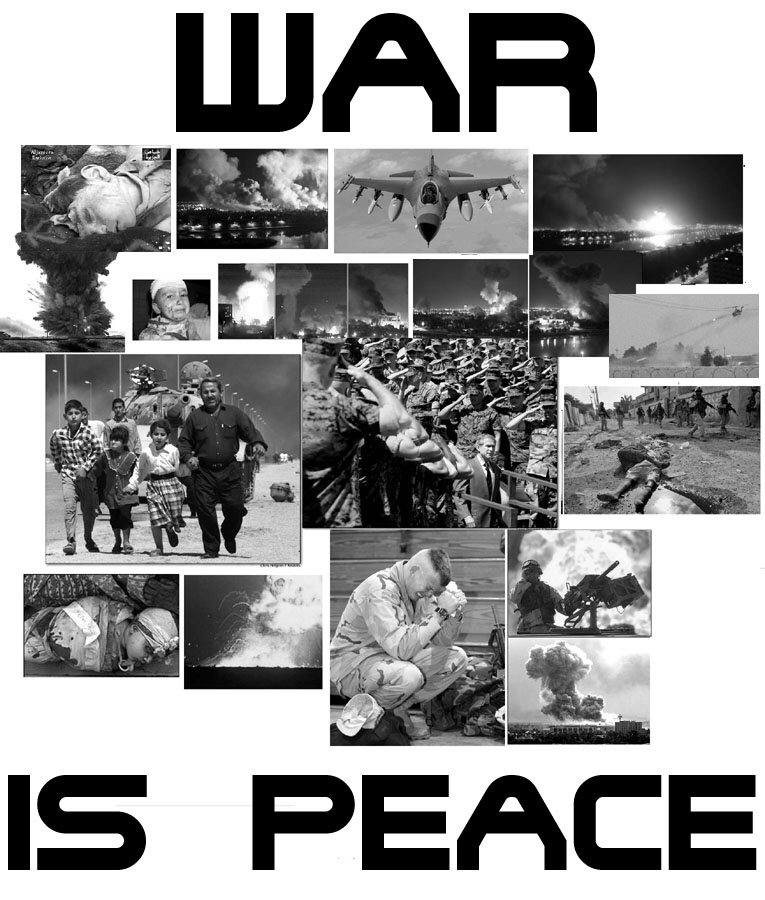
“War is peace” was one of the memorable slogans on the facade of the Ministry of Truth, Minitrue in “Newspeak,” the language invented by George Orwell in 1948 for his dystopian novel 1984. Some 60 years later, a quarter-century after Orwell’s imagined future bit the dust, the phrase is, in a number of ways, eerily applicable to the United States.

Last week, for instance, a New York Times front-page story by Eric Schmitt and David Sanger was headlined “Obama Is Facing Doubts in Party on Afghanistan, Troop Buildup at Issue.” It offered a modern version of journalistic Newspeak.

“Doubts,” of course, imply dissent, and in fact just the week before there had been a major break in Washington’s ranks, though not among Democrats. The conservative columnist George Will wrote a piece offering blunt advice to the Obama administration, summed up in its headline: “Time to Get Out of Afghanistan.” In our age of political and audience fragmentation and polarization, think of this as the Afghan version of Vietnam’s Cronkite moment.

The Times report on those Democratic doubts, on the other hand, represented a more typical Washington moment. Ignored, for instance, was Wisconsin Senator Russ Feingold’s end-of-August call for the president to develop an Afghan withdrawal timetable. The focus of the piece was instead an upcoming speech by Michigan Senator Carl Levin, chairman of the Armed Services Committee. He was, Schmitt and Sanger reported, planning to push back against well-placed leaks (in the Times, among other places) indicating that war commander General Stanley McChrystal was urging the president to commit 15,000 to 45,000 more American troops to the Afghan War.

Here, according to the two reporters, was the gist of Levin’s message about what everyone agrees is a “deteriorating” U.S. position: “[H]e was against sending more American combat troops to Afghanistan until the United States speeded up the training and equipping of more Afghan security forces.”

Think of this as the line in the sand within the Democratic Party, and be assured that the debates within the halls of power over McChrystal’s troop requests and Levin’s proposal are likely to be fierce this fall. Thought about for a moment, however, both positions can be summed up with the same word: More.

The essence of this “debate” comes down to: More of them versus more of us (and keep in mind that more of them — an expanded training program for the Afghan National Army — actually means more of “us” in the form of extra trainers and advisors). In other words, however contentious the disputes in Washington, however dismally the public now views the war, however much the president’s war coalition might threaten to crack open, the only choices will be between more and more.

No alternatives are likely to get a real hearing. Few alternative policy proposals even exist because alternatives that don’t fit with “more” have ceased to be part of Washington’s war culture. No serious thought, effort, or investment goes into them. Clearly referring to Will’s column, one of the unnamed “senior officials” who swarm through our major newspapers made the administration’s position clear, saying sardonically, according to the Washington Post, “I don’t anticipate that the briefing books for the [administration] principals on these debates over the next weeks and months will be filled with submissions from opinion columnists… I do anticipate they will be filled with vigorous discussion… of how successful we’ve been to date.”

State of War

Because the United States does not look like a militarized country, it’s hard for Americans to grasp that Washington is a war capital, that the United States is a war state, that it garrisons much of the planet, and that the norm for us is to be at war somewhere at any moment. Similarly, we’ve become used to the idea that, when various forms of force (or threats of force) don’t work, our response, as in Afghanistan, is to recalibrate and apply some alternate version of the same under a new or rebranded name — the hot one now being “counterinsurgency” or COIN — in a marginally different manner. When it comes to war, as well as preparations for war, more is now generally the order of the day.

This wasn’t always the case. The early Republic that the most hawkish conservatives love to cite was a land whose leaders looked with suspicion on the very idea of a standing army. They would have viewed our hundreds of global garrisons, our vast network of spies, agents, Special Forces teams, surveillance operatives, interrogators, rent-a-guns, and mercenary corporations, as well as our staggering Pentagon budget and the constant future-war gaming and planning that accompanies it, with genuine horror.

The question is: What kind of country do we actually live in when the so-called U.S. Intelligence Community (IC) lists 16 intelligence services ranging from Air Force Intelligence, the Central Intelligence Agency, and the Defense Intelligence Agency to the National Reconnaissance Office and the National Security Agency? What could “intelligence” mean once spread over 16 sizeable, bureaucratic, often competing outfits with a cumulative 2009 budget estimated at more than $55 billion (a startling percentage of which is controlled by the Pentagon)? What exactly is so intelligent about all that? And why does no one think it even mildly strange or in any way out of the ordinary?

What does it mean when the most military-obsessed administration in our history, which, year after year, submitted ever more bloated Pentagon budgets to Congress, is succeeded by one headed by a president who ran, at least partially, on an antiwar platform, and who has now submitted an even larger Pentagon budget? What does this tell you about Washington and about the viability of non-militarized alternatives to the path George W. Bush took? What does it mean when the new administration, surveying nearly eight years and two wars’ worth of disasters, decides to expand the U.S. Armed Forces rather than shrink the U.S. global mission?

What kind of a world do we inhabit when, with an official unemployment rate of 9.7% and an underemployment rate of 16.8%, the American taxpayer is financing the building of a three-story, exceedingly permanent-looking $17 million troop barracks at Bagram Air Base in Afghanistan? This, in turn, is part of a taxpayer-funded $220 million upgrade of the base that includes new “water treatment plants, headquarters buildings, fuel farms, and power generating plants.” And what about the U.S. air base built at Balad, north of Baghdad, that now has 15 bus routes, two fire stations, two water treatment plants, two sewage treatment plants, two power plants, a water bottling plant, and the requisite set of fast-food outlets, PXes, and so on, as well as air traffic levels sometimes compared to those at Chicago’s O’Hare International?

What kind of American world are we living in when a plan to withdraw most U.S. troops from Iraq involves the removal of more than 1.5 million pieces of equipment? Or in which the possibility of withdrawal leads the Pentagon to issue nearly billion-dollar contracts (new ones!) to increase the number of private security contractors in that country?

What do you make of a world in which the U.S. has robot assassins in the skies over its war zones, 24/7, and the “pilots” who control them from thousands of miles away are ready on a moment’s notice to launch missiles — “Hellfire” missiles at that — into Pashtun peasant villages in the wild, mountainous borderlands of Pakistan and Afghanistan? What does it mean when American pilots can be at war “in” Afghanistan, 9 to 5, by remote control, while their bodies remain at a base outside Las Vegas and then can head home past a sign that warns them to drive carefully because this is “the most dangerous part of your day”?

What does it mean when, for our security and future safety, the Pentagon funds the wildest ideas imaginable for developing high-tech weapons systems, many of which sound as if they came straight out of the pages of sci-fi novels? Take, for example, Boeing’s advanced coordinated system of hand-held drones, robots, sensors, and other battlefield surveillance equipment slated for seven Army brigades within the next two years at a cost of $2 billion and for the full Army by 2025; or the Next Generation Bomber, an advanced “platform” slated for 2018; or a truly futuristic bomber, “a suborbital semi-spacecraft able to move at hypersonic speed along the edge of the atmosphere,” for 2035? What does it mean about our world when those people in our government peering deepest into a blue-skies future are planning ways to send armed “platforms” up into those skies and kill more than a quarter century from now?

And do you ever wonder about this: If such weaponry is being endlessly developed for our safety and security, and that of our children and grandchildren, why is it that one of our most successful businesses involves the sale of the same weaponry to other countries? Few Americans are comfortable thinking about this, which may explain why global-arms-trade pieces don’t tend to make it onto the front pages of our newspapers. Recently, the Times Pentagon correspondent Thom Shanker, for instance, wrote a piece on the subject which appeared inside the paper on a quiet Labor Day. “Despite Slump, U.S. Role as Top Arms Supplier Grows” was the headline. Perhaps Shanker, too, felt uncomfortable with his subject, because he included the following generic description: “In the highly competitive global arms market, nations vie for both profit and political influence through weapons sales, in particular to developing nations…” The figures he cited from a new congressional study of that “highly competitive” market told a different story: The U.S., with $37.8 billion in arms sales (up $12.4 billion from 2007), controlled 68.4% of the global arms market in 2008. Highly competitively speaking, Italy came “a distant second” with $3.7 billion. In sales to “developing nations,” the U.S. inked $29.6 billion in weapons agreements or 70.1% of the market. Russia was a vanishingly distant second at $3.3 billion or 7.8% of the market. In other words, with 70% of the market, the U.S. actually has what, in any other field, would qualify as a monopoly position — in this case, in things that go boom in the night. With the American car industry in a ditch, it seems that this (along with Hollywood films that go boom in the night) is what we now do best, as befits a war, if not warrior, state. Is that an American accomplishment you’re comfortable with?

On the day I’m writing this piece, “Names of the Dead,” a feature which appears almost daily in my hometown newspaper, records the death of an Army private from DeKalb, Illinois, in Afghanistan. Among the spare facts offered: he was 20 years old, which means he was probably born not long before the First Gulf War was launched in 1990 by President George H.W. Bush. If you include that war, which never really ended — low-level U.S. military actions against Saddam Hussein’s regime continued until the invasion of 2003 — as well as U.S. actions in the former Yugoslavia and Somalia, not to speak of the steady warfare underway since November 2001, in his short life, there was hardly a moment in which the U.S. wasn’t engaged in military operations somewhere on the planet (invariably thousands of miles from home). If that private left a one-year-old baby behind in the States, and you believe the statements of various military officials, that child could pass her tenth birthday before the war in which her father died comes to an end. Given the record of these last years, and the present military talk about being better prepared for “the next war,” she could reach 2025, the age when she, too, might join the military without ever spending a warless day. Is that the future you had in mind?

Consider this: War is now the American way, even if peace is what most Americans experience while their proxies fight in distant lands. Any serious alternative to war, which means our “security,” is increasingly inconceivable. In Orwellian terms then, war is indeed peace in the United States and peace, war.

American Newspeak

Newspeak, as Orwell imagined it, was an ever more constricted form of English that would, sooner or later, make “all other modes of thought impossible. It was intended,” he wrote in an appendix to his novel, “that when Newspeak had been adopted once and for all and Oldspeak forgotten, a heretical thought… should be literally unthinkable.”

When it comes to war (and peace), we live in a world of American Newspeak in which alternatives to a state of war are not only ever more unacceptable, but ever harder to imagine. If war is now our permanent situation, in good Orwellian fashion it has also been sundered from a set of words that once accompanied it.

It lacks, for instance, “victory.” After all, when was the last time the U.S. actually won a war (unless you include our “victories” over small countries incapable of defending themselves like the tiny Caribbean Island of Grenada in 1983 or powerless Panama in 1989)? The smashing “victory” over Saddam Hussein in the First Gulf War only led to a stop-and-start conflict now almost two decades old that has proved a catastrophe. Keep heading backward through the Vietnam and Korean Wars and the last time the U.S. military was truly victorious was in 1945.

But achieving victory no longer seems to matter. War American-style is now conceptually unending, as are preparations for it. When George W. Bush proclaimed a Global War on Terror (aka World War IV), conceived as a “generational struggle” like the Cold War, he caught a certain American reality. In a sense, the ongoing war system can’t absorb victory. Any such endpoint might indeed prove to be a kind of defeat.

No longer has war anything to do with the taking of territory either, or even with direct conquest. War is increasingly a state of being, not a process with a beginning, an end, and an actual geography.

Similarly drained of its traditional meaning has been the word “security” — though it has moved from a state of being (secure) to an eternal, immensely profitable process whose endpoint is unachievable. If we ever decided we were either secure enough, or more willing to live without the unreachable idea of total security, the American way of war and the national security state would lose much of their meaning. In other words, in our world, security is insecurity.

As for “peace,” war’s companion and theoretical opposite, though still used in official speeches, it, too, has been emptied of meaning and all but discredited. Appropriately enough, diplomacy, that part of government which classically would have been associated with peace, or at least with the pursuit of the goals of war by other means, has been dwarfed by, subordinated to, or even subsumed by the Pentagon. In recent years, the U.S. military with its vast funds has taken over, or encroached upon, a range of activities that once would have been left to an underfunded State Department, especially humanitarian aid operations, foreign aid, and what’s now called nation-building. (On this subject, check out Stephen Glain’s recent essay, “The American Leviathan” in the Nation magazine.)

Diplomacy itself has been militarized and, like our country, is now hidden behind massive fortifications, and has been placed under Lord-of-the-Flies-style guard. The State Department’s embassies are now bunkers and military-style headquarters for the prosecution of war policies; its officials, when enough of them can be found, are now sent out into the provinces in war zones to do “civilian” things.

And peace itself? Simply put, there’s no money in it. Of the nearly trillion dollars the U.S. invests in war and war-related activities, nothing goes to peace. No money, no effort, no thought. The very idea that there might be peaceful alternatives to endless war is so discredited that it’s left to utopians, bleeding hearts, and feathered doves. As in Orwell’s Newspeak, while “peace” remains with us, it’s largely been shorn of its possibilities. No longer the opposite of war, it’s just a rhetorical flourish embedded, like one of our reporters, in Warspeak.

What a world might be like in which we began not just to withdraw our troops from one war to fight another, but to seriously scale down the American global mission, close those hundreds of bases — recently, there were almost 300 of them, macro to micro, in Iraq alone — and bring our military home is beyond imagining. To discuss such obviously absurd possibilities makes you an apostate to America’s true religion and addiction, which is force. However much it might seem that most of us are peaceably watching our TV sets or computer screens or iPhones, we Americans are also — always — marching as to war. We may not all bother to attend the church of our new religion, but we all tithe. We all partake. In this sense, we live peaceably in a state of war.

[Tom Engelhardt, co-founder of the American Empire Project, runs the Nation Institute’s TomDispatch.com. He is the author of The End of Victory Culture, a history of the Cold War and beyond, as well as of a novel, The Last Days of Publishing. He also edited The World According to TomDispatch: America in the New Age of Empire (Verso, 2008), an alternative history of the mad Bush years.]

Copyright 2009 Tom Engelhardt

Source / Tom Dispatch

The Rag Blog

Posted in RagBlog | Tagged , , , | Leave a comment

Climate Change Legislation : Too Hot to Handle?

Congress and climate change: enough to blow your stack.

Obama, Congress and climate change legislation

Most environmental groups and leaders supported the House effort… but were quite critical of the Obama Administration’s many concessions to greenhouse gas-producing industries that are responsible for the increase in global warming.

By Jack A. Smith / The Rag Blog / September 19, 2009

The Democrats may have possession of the White House and a substantial majority in Congress but — similar to their health care proposals — they are encountering considerable difficulties producing climate and energy legislation, another major goal of the Obama Administration.

The main problem is the adamant rejection by congressional Republicans of all major White House initiatives except for expanding the Afghan war, about which their enthusiasm is boundless. Even the few Republican Senators who last year expressed support for legislation to reverse global warming — such as Sen. John McCain, the GOP presidential candidate — seem to have drifted away.

Secondarily, right wing Democrats in Congress continue to successfully adulterate already moderate administration goals. Even after major concessions were made to coal mining, forestry, agricultural, electric utility and other business interests, some Democratic representatives ended up siding with the Republicans. The House Democrats enjoy a 256-178 majority, but the climate change bill — the American Clean Energy and Security Act — was passed June 29 by a close vote of 219-212. Four more Blue Dog defections and it would have lost.

In addition, while most environmental groups back the legislation despite justifiable reservations, a few groups — such as Friends of the Earth, Greenpeace, and Rainforest Acton Network — are sharply critical of the cap and trade provisions of the Democratic measure, while some progressives are balking at the huge giveaways to big business.

At the same time, a broad coalition of 63 organizations has been formed to fight for congressional passage of the administration’s environmental agenda. Known as Clean Energy Works, it is composed of environmental, labor, religious, social, political and community groups. Opposition to global warming will get a big boost Oct. 24, the International Day of Climate Action, when demonstrations will take place in the U.S. and over 100 other countries.

Commenting on the House bill, New York Times reporter John M. Broder termed it “the most ambitious energy and climate-change legislation ever introduced in Congress,” but pointed out that it was “fat with compromises, carve-outs, concessions and out-and-out gifts intended to win the votes of wavering lawmakers and the support of powerful industries.

“The deal making continued right up until the final minutes, with the bill’s co-author Rep. Henry A. Waxman, Democrat of California, doling out billions of dollars in promises on the House floor to secure the final votes needed for passage. The bill was freighted with hundreds of pages of special-interest favors, even as environmentalists lamented that its greenhouse-gas reduction targets had been whittled down….

“The biggest concessions went to utilities, which wanted assurances that they could continue to operate and build coal-burning power plants without shouldering new costs. The utilities received not only tens of billions of dollars worth of free pollution permits, but also billions for work on technology to capture carbon-dioxide emissions from coal combustion to help meet future pollution targets.”

A version of this bill is now before Senate committees. The Democrats prevail 60-40, but they evidently are further diluting the legislation in hopes of winning over their own conservative Blue Dogs, such as Sens. Mary Landrieu of Louisiana and Ben Nelson of Nebraska, among others.

Democratic Sens. Barbara Boxer of California and John Kerry of Massachusetts were to have introduced legislation they co-authored in early September, but it’s been put off a few weeks. It may take months to reach the Senate floor for a vote, thus missing an early December deadline for passage before the international global warming summit conference in Sweden.

Most environmental groups and leaders supported the House effort, which is also known as the Waxman-Markey bill, but were quite critical of the Obama Administration’s many concessions to greenhouse gas-producing industries that are responsible for the increase in global warming.

Typical was a comment by Angela Ledford, U.S. Climate Action Network: “We cannot blow this moment. But we shouldn’t think for a second our job is done once the bill is passed.” Said Joseph Romm of the Center for American Progress: “Waxman-Markey is the only game in town. Let’s work hard to improve it, but killing it would be an act of environmental suicide.”

Greenpeace USA’s Carroll Muffett said her organization opposed Waxman-Markey because it “sets emission reduction targets far lower than science demands, then undermines even those targets with massive offsets. The giveaways and preferences in the bill will actually spur a new generation of nuclear and coal-fired power plants to the detriment of real energy solutions.”

Michael Brune of Rainforest Action Network said, “Scientists state that an atmospheric concentration of 350 parts per million of CO2 is the upper limit for a stable climate; this bill aims for 450.” The 350 goal is the objective of the Oct. 24 climate change demonstrations.

Friends of the Earth, a network of grassroots groups in 77 countries, published a major report Sept. 10 critical of the cap and trade practice of carbon offsetting — a central feature of the House bill. The report explains how offsets work and concludes that they are a flawed approach to combating global warming.

Offsetting, says the environmental group, “allows U.S. polluters to send money overseas in exchange for promised — and often pretend — pollution reductions elsewhere.” Offsets are a centerpiece of the House legislation, and are expected to appear in the Senate proposal.

“It is suicide to base our future on offsets,” according Michael Despines, one of the authors of the report. “Offsets provide the illusion of taking action to stop global warming when in fact they often allow emissions to rise. People need to realize how dangerous offsets can be — they provide a false sense of security because they often do not deliver as promised.”

The offsets in the House bill, “could allow the United States to keep increasing emissions of heat-trapping gases until 2029, even though scientists say we need to reduce emissions now,” said Karen Orenstein, a climate finance campaigner at Friends of the Earth.

The 28-page report titled “A Dangerous Distraction” recommends that the U.S. establish ambitious climate pollution reduction targets that do not rely on offsets; urges policy makers to reject any plans for new or expanded offset schemes, and finally recommends that the U.S. support alternative financial mechanisms that will promote sustainable development in poor countries.

The formation of Clean Energy Works, the coalition supporting passage of the Obama Administration’s climate and energy legislation, was announced Sept. 8. Its objective is to get a law this year, but that may be unrealistic, particularly since the White House is putting most of its resources into obtaining approval for health care legislation. The coalition has sent organizers to 28 states — mostly in the South, West and Midwest — to drum up support for congressional passage of the environmental bills. The group will also advertise on radio, the Internet and TV.

According to David Di Martino, coalition communications director:

“Millions of Americans want more clean energy jobs, less pollution, and greater national security. We send a billion dollars a day overseas to pay for our oil. It’s time to invest that money here — in secure, renewable energy sources that are made in America, provide jobs for Americans and work for America…. Public support for clean energy legislation is overwhelming. Unfortunately, an army of special interests are doing everything they can to block comprehensive energy reform. This campaign will mobilize the voices of those millions of Americans who want to put us back in control of our economy, our security, and the future of our planet.”

Among the organizations joining the coalition are American Federation of State, County and Municipal Employees; American Federation of Teachers; ACORN; Audubon; Catholics United; Center for American Progress Action Fund; Environmental Defense Fund; Faithful America; Laborers’ International Union; League of Conservation Voters; League of Rural Voters; NAACP; National Security Network; National Wildlife Federation; Natural Resources Defense Council; Service Employees International Union; Sierra Club; Sierra Student Coalition; Wilderness Society; Union of Concerned Scientists; United Steel Workers; Utility Workers Union of America; Veterans and Military Families for Progress; Veterans Green Jobs; and World Wildlife Fund.

Please go to:

[Jack A. Smith was editor of the Guardian — for decades the nation’s preeminent leftist newsweekly — that closed shop in 1992. Smith now edits the Hudson Valley Activist Newsletter, where this article also appears.]

The Rag Blog

Posted in Rag Bloggers | Tagged , , , , , , , | 2 Comments

The Shoe: ‘Out of Loyalty to Every Drop of Innocent Blood That Has Been Shed’


Why I threw the shoe

I am no hero. I just acted as an Iraqi who witnessed the pain and bloodshed of too many innocents

By Muntazer al-Zaidi / September 17, 2009

I am free. But my country is still a prisoner of war. There has been a lot of talk about the action and about the person who took it, and about the hero and the heroic act, and the symbol and the symbolic act. But, simply, I answer: what compelled me to act is the injustice that befell my people, and how the occupation wanted to humiliate my homeland by putting it under its boot.

Over recent years, more than a million martyrs have fallen by the bullets of the occupation and Iraq is now filled with more than five million orphans, a million widows and hundreds of thousands of maimed. Many millions are homeless inside and outside the country.

We used to be a nation in which the Arab would share with the Turkman and the Kurd and the Assyrian and the Sabean and the Yazid his daily bread. And the Shia would pray with the Sunni in one line. And the Muslim would celebrate with the Christian the birthday of Christ. This despite the fact that we shared hunger under sanctions for more than a decade.

Our patience and our solidarity did not make us forget the oppression. But the invasion divided brother from brother, neighbour from neighbour. It turned our homes into funeral tents.

I am not a hero. But I have a point of view. I have a stance. It humiliated me to see my country humiliated; and to see my Baghdad burned, my people killed. Thousands of tragic pictures remained in my head, pushing me towards the path of confrontation. The scandal of Abu Ghraib. The massacres of Falluja, Najaf, Haditha, Sadr City, Basra, Diyala, Mosul, Tal Afar, and every inch of our wounded land. I travelled through my burning land and saw with my own eyes the pain of the victims, and heard with my own ears the screams of the orphans and the bereaved. And a feeling of shame haunted me like an ugly name because I was powerless.

As soon as I finished my professional duties in reporting the daily tragedies, while I washed away the remains of the debris of the ruined Iraqi houses, or the blood that stained my clothes, I would clench my teeth and make a pledge to our victims, a pledge of vengeance.

The opportunity came, and I took it.

I took it out of loyalty to every drop of innocent blood that has been shed through the occupation or because of it, every scream of a bereaved mother, every moan of an orphan, the sorrow of a rape victim, the teardrop of an orphan.

I say to those who reproach me: do you know how many broken homes that shoe which I threw had entered? How many times it had trodden over the blood of innocent victims? Maybe that shoe was the appropriate response when all values were violated.

When I threw the shoe in the face of the criminal, George Bush, I wanted to express my rejection of his lies, his occupation of my country, my rejection of his killing my people. My rejection of his plundering the wealth of my country, and destroying its infrastructure. And casting out its sons into a diaspora.

If I have wronged journalism without intention, because of the professional embarrassment I caused the establishment, I apologise. All that I meant to do was express with a living conscience the feelings of a citizen who sees his homeland desecrated every day. The professionalism mourned by some under the auspices of the occupation should not have a voice louder than the voice of patriotism. And if patriotism needs to speak out, then professionalism should be allied with it.

I didn’t do this so my name would enter history or for material gains. All I wanted was to defend my country.

[Muntazer al-Zaidi is an Iraqi reporter who was freed this week after serving nine months in prison for throwing his shoe at former US president George Bush at a press conference. This edited statement was translated by McClatchy Newspapers correspondent Sahar Issa www.mcclatchydc.com.]

Source / The Guardian, U.K.

The Rag Blog

Posted in RagBlog | Tagged , , , , | 11 Comments

Many Ways Industrial Agriculture Is Making Us Sick

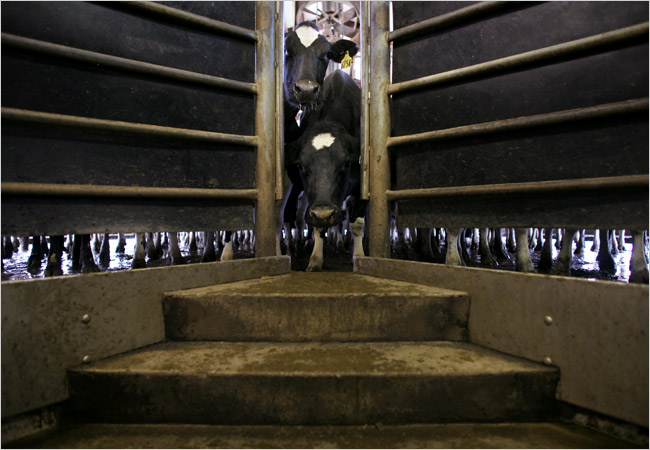
Runoff of waste from farm animals is said to be a source of pollutants in drinking water. Photo: Damon Winter/The New York Times.

Health Ills Abound as Farm Runoff Fouls Wells
By Charles Duhigg / September 17, 2009

MORRISON, Wis. — All it took was an early thaw for the drinking water here to become unsafe.

There are 41,000 dairy cows in Brown County, which includes Morrison, and they produce more than 260 million gallons of manure each year, much of which is spread on nearby grain fields. Other farmers receive fees to cover their land with slaughterhouse waste and treated sewage.

In measured amounts, that waste acts as fertilizer. But if the amounts are excessive, bacteria and chemicals can flow into the ground and contaminate residents’ tap water.

In Morrison, more than 100 wells were polluted by agricultural runoff within a few months, according to local officials. As parasites and bacteria seeped into drinking water, residents suffered from chronic diarrhea, stomach illnesses and severe ear infections.

“Sometimes it smells like a barn coming out of the faucet,” said Lisa Barnard, who lives a few towns over, and just 15 miles from the city of Green Bay.

Tests of her water showed it contained E. coli, coliform bacteria and other contaminants found in manure. Last year, her 5-year-old son developed ear infections that eventually required an operation. Her doctor told her they were most likely caused by bathing in polluted water, she said.

Yet runoff from all but the largest farms is essentially unregulated by many of the federal laws intended to prevent pollution and protect drinking water sources. The Clean Water Act of 1972 largely regulates only chemicals or contaminants that move through pipes or ditches, which means it does not typically apply to waste that is sprayed on a field and seeps into groundwater.

As a result, many of the agricultural pollutants that contaminate drinking water sources are often subject only to state or county regulations. And those laws have failed to protect some residents living nearby.

To address this problem, the federal Environmental Protection Agency has created special rules for the biggest farms, like those with at least 700 cows.

But thousands of large animal feedlots that should be regulated by those rules are effectively ignored because farmers never file paperwork, E.P.A. officials say.

And regulations passed during the administration of President George W. Bush allow many of those farms to self-certify that they will not pollute, and thereby largely escape regulation.

In a statement, the E.P.A. wrote that officials were working closely with the Agriculture Department and other federal agencies to reduce pollution and bring large farms into compliance.

Agricultural runoff is the single largest source of water pollution in the nation’s rivers and streams, according to the E.P.A. An estimated 19.5 million Americans fall ill each year from waterborne parasites, viruses or bacteria, including those stemming from human and animal waste, according to a study published last year in the scientific journal Reviews of Environmental Contamination and Toxicology.

The problem is not limited to Wisconsin. In California, up to 15 percent of wells in agricultural areas exceed a federal contaminant threshold, according to studies. Major waterways like the Chesapeake Bay have been seriously damaged by agricultural pollution, according to government reports.

In Arkansas and Maryland, residents have accused chicken farm owners of polluting drinking water. In 2005, Oklahoma’s attorney general sued 13 poultry companies, claiming they had damaged one of the state’s most important watersheds.

It is often difficult to definitively link a specific instance of disease to one particular cause, like water pollution. Even when tests show that drinking water is polluted, it can be hard to pinpoint the source of the contamination.

Despite such caveats, regulators in Brown County say they believe that manure has contaminated tap water, making residents ill.

“One cow produces as much waste as 18 people,” said Bill Hafs, a county official who has lobbied the state Legislature for stricter waste rules.

“There just isn’t enough land to absorb that much manure, but we don’t have laws to force people to stop,” he added.

In Brown County, part of one of the nation’s largest milk-producing regions, agriculture brings in $3 billion a year. But the dairies collectively also create as much as a million gallons of waste each day. Many cows are fed a high-protein diet, which creates a more liquid manure that is easier to spray on fields.

In 2006, an unusually early thaw in Brown County melted frozen fields, including some that were covered in manure. Within days, according to a county study, more than 100 wells were contaminated with coliform bacteria, E. coli, or nitrates — byproducts of manure or other fertilizers.

“Land application requirements in place at that time were not sufficiently designed or monitored to prevent the pollution of wells,” one official wrote.

Some residents did not realize that their water was contaminated until their neighbors fell ill, which prompted them to test their own water.

“We were terrified,” said Aleisha Petri, whose water was polluted for months, until her husband dumped enough bleach in the well to kill the contaminants. Neighbors spent thousands of dollars digging new wells.

At a town hall meeting, angry homeowners yelled at dairy owners, some of whom are perceived as among the most wealthy and powerful people in town.

One resident said that he had seen cow organs dumped on a neighboring field, and his dog had dug up animal carcasses and bones.

“More than 30 percent of the wells in one town alone violated basic health standards,” said Mr. Hafs, the Brown County regulator responsible for land and water conservation, in an interview. “It’s obvious we’ve got a problem.”
Skip to next paragraph
Toxic Waters
260 Million Gallons

Articles in this series are examining the worsening pollution in American waters, and regulators’ response.
All Articles in the Series » Video Trailer for Next Installment
Find Water Polluters
Near You

Search data on more than 200,000 facilities around the nation permitted to discharge pollutants.
Clean Water Act Violations: The Enforcement Record

The New York Times surveyed violations of the Clean Water Act in every state, and the response by state regulators.
Multimedia
Farm Waste in WisconsinSlide Show
Farm Waste in Wisconsin
Readers’ Comments

Readers shared their thoughts on this article.

* Read All Comments (235) »

But dairy owners said it was unfair to blame them for the county’s water problems. They noted that state regulators, in their reports, were unable to definitively establish the source of the 2006 contamination.

One of those farmers, Dan Natzke, owns Wayside Dairy, one of the largest farms around here. Just a few decades ago, it had just 60 cows. Today, its 1,400 animals live in enormous barns and are milked by suction pumps.

In June, Mr. Natzke explained to visiting kindergarteners that his cows produced 1.5 million gallons of manure a month. The dairy owns 1,000 acres and rents another 1,800 acres to dispose of that waste and grow crops to feed the cows.

“Where does the poop go?” one boy asked. “And what happens to the cow when it gets old?”

“The waste helps grow food,” Mr. Natzke replied. “And that’s what the cow becomes, too.”

His farm abides by dozens of state laws, Mr. Natzke said.

“All of our waste management is reviewed by our agronomist and by the state’s regulators,” he added. “We follow all the rules.”

But records show that his farm was fined $56,000 last October for spreading excessive waste. Mr. Natzke declined to comment.

Many environmental advocates argue that agricultural pollution will be reduced only through stronger federal laws. Lisa P. Jackson, the E.P.A. administrator, has recently ordered an increase in enforcement of the Clean Water Act. Tom Vilsack, the agriculture secretary, has said that clean water is a priority, and President Obama promised in campaign speeches to regulate water pollution from livestock.

But Congress has not created many new rules on the topic and, as a result, officials say their powers remain limited.

Part of the problem, according to data collected from the E.P.A. and every state, is that environmental agencies are already overtaxed. And it is unclear how to design effective laws, say regulators, including Ms. Jackson, who was confirmed to head the E.P.A. in January.

To fix the problem of agricultural runoff, “I don’t think there’s a solution in my head yet that I could say, right now, write this piece of legislation, this will get it done,” Ms. Jackson said in an interview.

She added that “the challenge now is for E.P.A. and Congress to develop solutions that represent the next step in protecting our nation’s waters and people’s health.”

A potential solution, regulators say, is to find new uses for manure. In Wisconsin, Gov. Jim Doyle has financed projects to use farm waste to generate electricity.

But environmentalists and some lawmakers say real change will occur only when Congress passes laws giving the E.P.A. broad powers to regulate farms. Tougher statutes should permit drastic steps — like shutting down farms or blocking expansion — when watersheds become threatened, they argue.

However, a powerful farm lobby has blocked previous environmental efforts on Capital Hill. Even when state legislatures have acted, they have often encountered unexpected difficulties.

After Brown County’s wells became polluted, for instance, Wisconsin created new rules prohibiting farmers in many areas from spraying manure during winter, and creating additional requirements for large dairies.

But agriculture is among the state’s most powerful industries. After intense lobbying, the farmers’ association won a provision requiring the state often to finance up to 70 percent of the cost of following the new regulations. Unless regulators pay, some farmers do not have to comply.

In a statement, Adam Collins, a spokesman for the Wisconsin Department of Natural Resources, said farmers can only apply waste to fields “according to a nutrient management plan, which, among other things, requires that manure runoff be minimized.”

When there is evidence that a farm has “contaminated a water source, we can and do take enforcement action,” he wrote.

“Wisconsin has a long history of continuously working to improve water quality and a strong reputation nationally for our clean water efforts,” he added. “Approximately 800,000 private drinking water wells serve rural Wisconsin residents. The vast majority of wells provide safe drinking water.”

But anger in some towns remains. At the elementary school a few miles from Mr. Natzke’s dairy, there are signs above drinking fountains warning that the water may be dangerous for infants.

“I go to church with the Natzkes,” said Joel Reetz, who spent $16,000 digging a deeper well after he learned his water was polluted. “Our kid goes to school with their kids. It puts us in a terrible position, because everyone knows each other.

“But what’s happening to this town isn’t right,” he said.

Source / New York Times

The Rag Blog

Posted in RagBlog | Tagged , , , | 1 Comment

Charlie Loving: The View

Click to Enlarge

Cartoon by Max Stamp & Charlie Loving / The Rag Blog

Posted in Rag Bloggers | Tagged , | 2 Comments

World Hunger Spiralling Out of Control Because of Capitalist Profit System

Copyright: WFP/Rein Skullerud.

UN reports 1 billion of the world’s people going hungry
By Jerry White / September 18, 2009

For the first time in history, more than one billion people, or nearly one in every 6 inhabitants of the planet, are going hungry this year, according to a new report from the United Nations’ World Food Program (WFP). Chronic poverty, still high food prices and the impact of the world economic crisis have led to a sharp increase in the number of hungry people, now larger than the combined populations of the United States, Canada and the European Union.

The total number of hungry people has shot up by nearly 200 million over the last decade. After a small decline between 2007 and 2008, world hunger rose sharply as the impact of the economic crisis hit, rising from 915 million in 2008 to an estimated 1.02 billion this year. [See graph]

While disasters, such as floods or droughts, cause temporary food shortages, these emergencies accounted for only 8 percent of the world’s hungry population, the WFP said. Nor is the problem caused by a shortage of food production, which at current levels is sufficient to feed the world’s population.

The source of the catastrophe is the capitalist profit system and, in particular, the continued oppression of the poorest countries in sub-Saharan Africa and Asia. Sixty-five percent of the world’s hungry people live in just six countries: India, China, the Democratic Republic of Congo, Bangladesh, Indonesia, Pakistan and Ethiopia.

The various IMF-dictated “development” programs imposed on these countries have chiefly benefited the banks in London, New York and Tokyo—which have sucked out hundreds of billions in interest payments—as well as the native ruling elites. Falling commodity prices for raw materials have also reduced revenues, while speculation on food has also driven up costs.

According to an article on the WFP report on Livescience.com, aid programs had made certain inroads in fighting hunger at the end of the 20th century. However, rising food prices have all but negated those efforts, causing the number of hungry to rise again everywhere except in Latin America and the Caribbean. The rising cost of food caused the number of hungry to jump by 75 million in 2007 and 40 million in 2008.

“The double whammy of the financial crisis and the still record high food prices around the world is delivering a devastating blow to the world’s most vulnerable,” WFP Executive Director Josette Sheeran told a London press conference Wednesday. “They have been squeezed so much that many have lost what few assets they owned, further exposing them to hunger. Now, it only takes a drought or storm to provoke a disaster.”

The present crisis also underscores the criminal misallocation of financial resources by governments around the world. Sheeren noted that the $3 billion the agency needed to cover its budget shortfall and continue providing food to 108 million people around the world was less than 0.01 percent—or one-hundredth of one percent—the amount spent by world governments on the bailout of the banks and other financial institutions.

While hunger has reached record levels, she said, food aid has fallen to a 20-year low. The WFP said it would have to drastically cut food aid by October because it had only raised less than half of its $6.7 billion budget.

In Kenya, where drought and high food prices have pushed nearly 4 million people into hunger, the WFP said it was preparing to reduce rations.

In Guatemala, its program to provide food supplements to 100,000 children and 50,000 pregnant and lactating women was “hanging by a thread.” Almost half of the children in the Central American country are chronically malnourished—the sixth highest level in the world—and the government has recently declared a “State of National Calamity” due to a shortage of food to feed hungry rural communities.

The WFP reported these stark statistics:

• An estimated 146 million children in developing countries are underweight
• Every six seconds a child dies because of hunger and related causes
• More than 60 percent of chronically hungry people are women

A host of irreversible physical ailments can be caused by undernourishment—the insufficient intake of calories to meet minimum physiological needs—and malnutrition—the lack of sufficient levels of proteins, vitamins and other nutrients.

The most common form of malnutrition is iron deficiency, Livescience.com noted, which affects billions worldwide and can impede brain development. Vitamin A deficiency affects 140 million preschool children in 118 countries and is the leading cause of child blindness. It also kills one million infants a year, according to UNICEF.

Iodine deficiency affects 780 million people worldwide. Babies born to iodine deficient mothers can have mental impairments, the web site noted. Zinc deficiency results in the deaths of about 800,000 children each year and weakens the immune system of young children.

The desperation facing millions produced tragedy Monday when a stampede of people seeking free food in the southern Pakistan port city of Karachi left up to 20 impoverished women and children dead. Officials said they were crushed in a stairwell and alley, as hundreds lined up to get free flour from charity workers.

Police and other witnesses told the Agence France-Presse (AFP) that a private security guard in charge of making sure the women stayed in line charged them with a baton when they became impatient with the long wait. An injured woman, Salma Qadir, 40, said the women wanted to get their rations quickly but were beaten by the guard. “The women got scared and tried to turn back, which scared others and resulted in a stampede,” she told the AFP.

The narrow streets of the market area were reportedly teeming with hundreds of poor people seeking scarce wheat and sugar. Poverty levels in the city of 14 million people have been on the rise along with food prices, which government officials blame on hoarding by mills and large wholesalers. The BBC reported that Pakistan’s government had recently ordered a crackdown against such hoarding, “[b]ut this failed to materialize thus far due to the lobby’s massive influence in Pakistan’s parliament.”

According to the World Food Program, 85 percent of the South Asian country’s 173 million people live on less than US$2 a day. Hunger in the country has been exacerbated by world financial breakdown, skyrocketing food prices and the US-backed war in Pakistan’s North West Frontier Province and tribal areas, which has driven millions from their homes. Currently the WFP is trying to provide daily food rations to 100,000 displaced people in the war-torn area.

Copyright © 1998-2009 World Socialist Web Site

Source / World Socialist Web Site

Thanks to Deva Wood / The Rag Blog

Posted in RagBlog | Tagged , , | 2 Comments

Conspiracy Nation : Barack Obama and the Right-Wing Demagogues

Illustration by Gino Barzizza / The Indypendent.

Conspiracy Nation:

Right-wing demagogues reach out to a supposedly beleagured white middle class, telling them they are being squeezed by parasitic traitors from above and below.

By Chip Berlet / September 18, 2009

Even before Barack Obama was sworn in as the 44th president of the United States, the internet was seething with lurid conspiracy theories exposing his alleged subversion and treachery.

Among the many false claims: Obama was a secret Muslim; he was not a native U.S. citizen and his election as president should be overturned; he was a tool of the New World Order in a plot to merge the government of the United States into a North American union with Mexico and Canada.

Within hours of Obama’s inauguration, claims circulated that Obama was not really president because Supreme Court Chief Justice John Roberts scrambled the words as he administered the oath of office. A few days after the inauguration came a warning that Obama planned to impose martial law and collect all guns.

Many of these false claims recall those floated by right-wing conspiracy theorists in the armed citizens’ militia movement during the Clinton administration — allegations that percolated up through the media and were utilized by Republican political operatives to hobble the legislative agenda of the Democratic Party.

The conspiracy theory attacks on Clinton bogged down the entire government. Legislation became stuck in congressional committees, appointments to federal posts dwindled and positions remained unfilled, almost paralyzing some agencies and seriously hampering the federal courts.

A similar scenario is already hobbling the work of the Obama administration. The histrionics at congressional town hall meetings and conservative rallies is not simply craziness — it is part of an effective right-wing campaign based on scare tactics that have resonated throughout U.S. history among a white middle class fearful of alien ideas, people of color and immigrants.

Unable to block the appointment of Sonia Sotomayor to the U.S. Supreme Court, the right-wing media demagogues, corporate political operatives, Christian right theocrats, and economic libertarians have targeted healthcare reform and succeeded in sidetracking the public option and single-payer proposals.

A talented environmental adviser to the Obama administration, Van Jones, was hounded into resigning Sept. 5 by a McCarthyite campaign of red-baiting and hyperbole. Support for major labor law reform has been eroding.

With a wink and a nod, right-wing apparatchiks are networking with the apocalyptic Christian right and resurgent armed militias — a volatile mix of movements awash in conspiracy theories. Scratch the surface and you find people peddling bogus conspiracy theories about liberal secular humanists, collectivist labor bosses, Muslim terrorists, Jewish cabals, homosexual child molesters and murderous abortionists.

This right-wing campaign is about scapegoating bogus targets by using conspiracy theories to distract attention from insurance companies who are the real culprits behind escalating healthcare costs.

Examples of right-wing conspiracy theories include the false claim that healthcare reform will include government bureaucrat “Death Panels” pulling the plug on grandma. Another is the claim that Obama is appointing unconstitutional project “Czars” More fraudulent conspiracy theories are being generated every week.

The core narrative of many popular conspiracy theories is that “the people” are held down by a conspiracy of wealthy secret elites manipulating a vast legion of corrupt politicians, mendacious journalists, propagandizing schoolteachers, nefarious bankers and hidden subversive cadres.

This is not an expression of a healthy political skepticism about state power or legitimate calls for reform or radical challenges to government or corporate abuses. This is an irrational anxiety that pictures the world as governed by powerful long-standing covert conspiracies of evildoers who control politics, the economy, and all of history. Scholars call this worldview “conspiracism.”

The term conspiracism, according to historian Frank P. Mintz, denotes a “belief in the primacy of conspiracies in the unfolding of history.” Mintz explains:

“Conspiracism serves the needs of diverse political and social groups in America and elsewhere. It identifies elites, blames them for economic and social catastrophes, and assumes that things will be better once popular action can remove them from positions of power. As such, conspiracy theories do not typify a particular epoch or ideology.”

When conspiracism becomes a mass phenomenon, persons seeking to protect the nation from the alleged conspiracy create counter movements to halt the subversion. Historians dub them countersubversives.

The resulting right-wing populist conspiracy theories point upward toward “parasitic elites” seen as promoting collectivist and socialist schemes leading to tyranny. At the same time, the counter-subversives point downward toward the “undeserving poor” who are seen as lazy and sinful and being riled up by subversive community organizers. Sound familiar?

Right-wing demagogues reach out to this supposedly beleaguered white middle class of “producers” and encourage them to see themselves as being inexorably squeezed by parasitic traitors above and below. The rage is directed upwards against a caricature of the conspiratorial “faceless bureaucrats,” “banksters” and “plutocrats” rather than challenging an unfair economic system run on behalf of the wealthy and corporate interests. The attacks and oppression generated by this populist white rage, however, is painfully felt by people lower on the socio-economic ladder, and historically this has been people of color, immigrants and other marginalized groups.

It is this overarching counter-subversive conspiracy theory that has mobilized so many people; and the clueless Democrats have been caught unaware by the tactics of right-wing populism used successfully for the last 100 years and chronicled by dozens of authors.

The techniques for mobilizing countersubversive right-wing populists include “tools of fear”: dualism, demonization, scapegoating, and apocalyptic aggression.

When these are blended with conspiracy theories about elite and lazy parasites, the combination is toxic to democracy.

Dualism

Dualism is simply the tendency to see the world in a binary model in which the forces of absolute good are struggling against the forces of absolute evil. This can be cast in religious or secular story lines or “narratives.”

Scapegoating

Scapegoating involves wrongly stereotyping a person or group of people as sharing negative traits and blaming them for societal problems, while the primary source of the problem (if it is real) is overlooked or absolved of blame. Scapegoating can become a mass phenomenon when a social or political movement does the stereotyping. It is easier to scapegoat a group if it is first demonized.

Teabaggers depicted progressive Austin Cong. Lloyd Doggett with devil’s horns.

Demonization

Demonization is a process through which people target individuals or groups as the embodiment of evil, turning individuals in scapegoated groups into an undifferentiated, faceless force threatening the idealized community. The sequence moves from denigration to dehumanization to demonization, and each step generates an increasing level of hatred of the objectified and scapegoated “Other.”

One way to demonize a target group is to claim that the scapegoated group is plotting against the public good. This often involves demagogic appeals.

Conspiracism

Conspiracism frames demonized enemies “as part of a vast insidious plot against the common good, while it valorizes the scapegoater as a hero for sounding the alarm.” Conspiracist thinking can move easily from the margins to the mainstream, as has happened repeatedly in the United States. Several scholars have argued that historic and contemporary conspiracism, especially the apocalyptic form, is a more widely shared worldview in the United States than in most other industrialized countries.

Conspiracism gains a mass following in times of social, cultural, economic, or political stress. The issues of immigration, demands for racial or gender equality, gay rights, power struggles between nations, wars — all can be viewed through a conspiracist lens.

Historian Richard Hofstadter established the leading analytical framework in the 1960s for studying conspiracism in public settings in his essay, “The Paranoid Style in American Politics.” He identified “the central preconception” of the paranoid style as a belief in the “existence of a vast, insidious, preternaturally effective international conspiratorial network designed to perpetrate acts of the most fiendish character.”

According to Hofstadter, this was common in certain figures in the political right, and was accompanied with a “sense that his political passions are unselfish and patriotic” which “goes far to intensify his feeling of righteousness and his moral indignation.”

According to Michael Barkun, professor of political science at Syracuse University, conspiracism attracts people because conspiracy theorists “claim to explain what others can’t. They appear to make sense out of a world that is otherwise confusing.” There is an appealing simplicity in dividing the world sharply into good and bad and tracing “all evil back to a single source, the conspirators and their agents.”

Cover Obama’s back, but kick his butt

Today, when you hear the right-wing demagogues whipping up the anti-Obama frenzy, you now know they are speaking a coded language that traces back to Social Darwinist defenses of “Free Market” capitalism and to xenophobic white supremacy. The voices of Beck, Limbaugh, Hannity, O’Reilly, Coulter, Dobbs and their allies are singing a new melody using old right-wing populist lyrics. The damage they can do is great even if most of these movements eventually collapse.

The centrist Democratic spinmeisters surrounding Obama have no idea how to organize a grassroots defense of healthcare reform. That’s pathetic.

These are the three R’s of civil society: Rebut, Rebuke, Re-Affirm: Rebut false and misleading statements and beliefs without name-calling; rebuke those national figures spreading misinformation; and re-affirm strong and clear arguments to defend goals and proposed programs.

That’s exactly what President Obama did on in his nationally televised address Sept. 9.

While keeping our eyes on the prize of universal, quality healthcare, we must also prevent right-wing populism as a social movement from spinning out of control. Since Obama’s inauguration, there have been nine murders tied to white supremacist ideology laced with conspiracy theories. It is already happening here.

Since centrist Democrats are selling us out, it is time for labor and community organizers to turn up the heat. We should defend Obama against the vicious and racist attacks from the reactionary political right, but we can have Obama’s back while we are kicking his butt.

Vigorous social movements pull political movements and politicians in their direction — not the other way around. We need to raise some hell in the streets and in the suites.

Right Wing Populism

Populist movements frequently adopt conspiracy theories of power, regardless of their ideological position on the political spectrum.

In her book Populism, Margaret Canovan defined four types of political populism. Populist democracy is championed by progressives from the LaFollettes of Wisconsin to Jesse Jackson.

However, the other three types — politicians’ populism, reactionary populism and populist dictatorship — are antidemocratic forms of right-wing populism. These were characterized in various combinations in the 1990s by Ross Perot, Pat Robertson, Pat Buchanan and David Duke — four straight white Christian men trying to ride the same horse.

Two versions of right-wing populism are current in both the United States and Europe: one centered around “get the government off my back” economic libertarianism, coupled with a rejection of mainstream political parties, which is more attractive to the upper-middle class and small entrepreneurs. The other is based on xenophobia and ethnocentric nationalism, which is more attractive to the lower middle class and wage workers. These two groupings unite behind candidates that attack the current regime since both constituencies identify an intrusive government as the cause of their grievances.

[Chip Berlet, senior analyst at Political Research Associates, is the author of the recent study Toxic to Democracy, and is co-author with Matthew N. Lyons of Right-Wing Populism in America: Too Close for Comfort.]

Former House Majority Leader Dick Armey of Texas leads FreedomWorks. Photo by Roger L. Wollenberg / UPI.

The movement behind the mob

By Elizabeth Henderson / September 18, 2009

Former U.S. House Majority Leader Dick Armey chairs FreedomWorks, while Matt Kibbe, who worked for the late Lee Atwater (of Willie Horton ads notoriety), is president and CEO. When accused of encouraging “astroturf” activists to disrupt healthcare town halls, Kibbe responded, “Vocal participating was celebrated when the left would do it. When conservatives do it we’re denounced as thuggish.”

Head of the Coalition to Protect Patients’ Rights, Palmisano has wielded his title as former president of the American Medical Association, the main doctors’ lobby, to oppose a public option.

Phillips started on the astroturf scene in 1997 when he joined former Christian Coalition director Ralph Reed at Century Strategies, a PR and consulting firm. Phillips was named president of Americans for Prosperity in 2006, which describes itself as “one of the premier grassroots citizen lobbyist organizations in the country.”

Scott, the former CEO of Columbia/HCA Healthcare, has shelled out $5 million of his own money to support Conservatives for Patients’ Rights, which he chairs. Also a significant donor to the GOP, Scott was head of Columbia/ HCA when it engaged in criminal practices, including bilking Medicare, leading it to be slapped with a record $1.7 billion in civil and criminal penalties.

Americans for Prosperity (AFP) was involved in the Tea Party protests in April and July and started Patients First, an anti-healthcare reform group. Other recent AFP campaigns include the Cost of Hot Air Tour — complete with a 70-foot-tall hot-air balloon — warning of the negative economic impact of “global warming alarmism,” and NoStimulus. com, an online petition signed by more than 450,000 “concerned citizens” protesting Obama’s stimulus bill. From 2003 to 2006, AFP received $1,181,000 from conservative foundations, including $1 million from the Koch Family Foundation.

Described by The New York Times as “lobbying… vocally against the proposed public option,” the Coalition to Protect Patient’s Rights (CPPR) states, “the government should not be involved in the private, personal discussion between a doctor and patient.” While it is unclear who pays CPPR’s bills, the Republican lobbying firm DCI Group coordinates its PR.

Founded in March 2009 to oppose Obama’s healthcare plan, Conservatives for Patients’ Rights (CPR) has launched a $20 million media campaign calling for reform that values competition between healthcare carriers, lets patients control their own coverage and rewards those who make healthy lifestyle choices. To get its message out, Conservatives for Patients’ Rights turned to CRC Public Relations (formerly Creative Response Concepts), of Swift Boat fame. When CPR is not making ads about the horrors of “rationed” care in Canada and Britain, it is sending out “town hall alert” emails and schedules of meetings. In one mobilization on July 24, CPR sent a list of more than 100 congressional town halls to the Tea Party Patriots Health Care Reform Committee listserve, about a week before the anti-healthcare demonstrations exploded.

According to Think Progress, DCI Group “has specialized in manufacturing ‘grassroots’ support — using telemarketers, PR events, and letter writing campaigns — to achieve policy results for narrow corporate interests.” DCI clients include the Health Benefits Coalition, a trade association of HMOs that wanted to “thwart congressional action on the patients’ bill of rights,” according to The American Prospect. DCI has also worked for Philip Morris and R.J. Reynolds, creating fake smokers’ rights groups to fight smoking bans. DCI has also worked for Burma’s military junta, Exxon-Mobil, the Swift Boat Veterans for Truth and anti-global warming campaigns.

FreedomWorks helped orchestrate this year’s tax day “Tea Parties” by doing everything from contacting conservative activists to training them on media messaging. In 2008, FreedomWorks created Angryrenter.com, which claimed to represent “renters and responsible homeowners” opposed to the “Obama Housing Bailout.” A successor to Dick Armey’s Citizens for a Sound Economy, FreedomWorks was set up to be a GOP version of MoveOn.org. Billionaire Steve Forbes is on the board of directors and funders include the Koch family, ExxonMobil, and the Scaife, Bradley and Olin foundations.

Source / The Indypendent

Thanks to Carl Davidson / The Rag Blog

Posted in RagBlog | Tagged , , , , , , , , | 5 Comments

Charles Dean Hood : Fairness Irrelevant in Texas?

Charles Dean Hood: No new trial. Photo by Brian Birzer.

Prosecutor and judge were having affair…
New trial denied to death row defendant

By Ted McLaughlin / The Rag Blog / September 18, 2009

Yesterday, the Texas Court of Criminal Appeals denied a new trial for a death row defendant. In doing so, they have strengthened the perception that fairness is not important in Texas death penalty trials, and neither is the competence of defense attorneys. If a defendant happens to get an unfair judge and a defense attorney not competent enough to see that, that’s just tough. You go to death row to wait on a needle in the arm.

In 1990, Charles Dean Hood was arrested and tried for the murder of Tracie Lynn Wallace and Ronald Williamson. His fingerprints were found in the home and he was driving Williamson’s car when he was arrested out-of-state. That sounds like pretty good evidence, until you realize that Hood was living with the couple. It would be strange if his fingerprints had not been in the home, and it’s within the realm of possibility that he really did have Williamson’s permission to drive the car (as he claimed).

Is Hood innocent? I don’t have any idea. He may well be guilty, but there is definite doubt as to whether he got a fair trial in Collin county. That’s because the prosecutor who prosecuted the case and the judge who heard the case were in the middle of a rather torrid love affair at the time (they saw each other from 1987 through 1993). This gives at least the strong perception that the judge may have been biased and unable to be absolutely fair to the defendant.

That’s not just my opinion. When news of the affair became public knowledge last year, 30 former prosecutors and federal and state judges signed a letter to Governor Perry stating that the sexual relationship “would have had a significant impact on the ability of the judicial system to accord Mr. Hood a fair and impartial trial.”

The Appeals Court didn’t agree. They said the point was moot since Hood’s trial and appeal attorneys knew of the affair and didn’t bring it up at trial or in early appeals. The court says that meant the defense attorneys thought the affair did not affect the judge’s fairness.

I have to disagree. It may just mean those attorneys were incompetent. They should have asked for a new judge, and if it was denied, they should have appealed the decision much earlier. But an attorney’s incompetent action or lack of action does not mean a defendant had a fair and impartial trial. In fact, it probably means just the opposite.

This might not be so bad, but the defendant was sentenced to death. In death penalty cases, the state of Texas cannot afford the perception that the defendant may not have had a fair trial. The Court of Appeals should have granted a new trial so there would be no doubts about the trial’s fairness.

I don’t believe Hood received a fair trial. Thirty former prosecutors and judges don’t believe it either, and I expect the perception is much more wide-spread than that. That’s a bad thing for the perception of justice in the Lone Star State.

The Texas Court of Criminal Appeals screwed up. I just hope the U.S. Supreme Court will fix it.

The Rag Blog

Posted in Rag Bloggers | Tagged , , | 9 Comments

Health Care Reform, Racism and Memories of Nuremberg

Jimmy Carter says racism is at core of Obama opposition. Photo by David Mercado /Reuters.

One would hope, now that President Carter has cleared the air, that Obama will set aside his effort to please those who cannot be pleased, and concentrate his energies on fulfilling his promises to the American people…

By Dr. Stephen R. Keister / The Rag Blog / September 18, 2009

The statement by President Jimmy Carter on September 14 regarding the latent, and frequently overt, racial hostility to President Obama by the present day purveyors of eugenics, came as a breath of fresh air.

Perhaps we can now face the real issues at hand and dispense with the absurdities of pretense. Perhaps we can now look to the many problems inherent in our society without playing games and evading reality.

I, as many others, watched in dismay the demonstrations of Saturday the 13th in our nation’s capital. I shuddered as I saw a simulation of events in Nuremberg, Germany on September 4, 1934 — as thousands of the unthinking (and proud of it) and uninformed paid tribute to the purveyors of bigotry and misinformation disguised as patriotism and nationalism.

The mobilization of these robots by FreedomWorks, Tea Party Patriots, and ResistNet makes one think of the sponsors and organizers of the 1934 rally, which was also predicated upon a subtle stoking of fear — fear of the Slavs, the Jews and the intellectual liberals. In my subconscious I heard the words of Pastor Martin Niemoller:

“In Germany, they first came for the Communists, And I didn’t speak up because I wasn’t a Communist; And then they came for the trade unionists, And I didn’t speak up because I wasn’t a trade unionist; And then they came for the Jews, And I didn’t speak up because I wasn’t a Jew; and then….they came for me….And by that time there was no one left to speak up.”

Perhaps in my dotage I tend to be a bit overly dramatic; however, in the Summer 2009 Woodrow Wilson Quarterly there is a reproduction of a poster showing masses of the German unemployed with the caption: “Unsere letzte Hoffnung:Hitler.” The graphic accompanies an article reviewing the voting patterns in Germany after the country began sliding into depression in 1927.

The GNP of the Weimar Republic contracted by a quarter; unemployment soared and incomes fell dramatically. Support for the Nazi Party, less than 3% of eligible voters in 1924, rose to 31% in July 1932, 27% in November 1932, and 39% in March 1933. How did the people vote? The unemployed turned primarily to the Communist Party, which catered to them with a program calling for community property. The working poor, including independent artisans, domestic workers, and family members of the working poor, disproportionately supported the Nazis.

These groups responded positively to Hitler’s denunciation of big government, and promises of intensive development of Germany’s own economic resources and support of private property, and plans for expropriation of land from Jewish real estate owners and resettlement of the landless in eastern Germany.

I must note here that we in the United States have no real Communist Party and the Socialists are a miniscule percentage of the population; however, the right wing is well organized behind leaders like Glenn Beck and Rush Limbaugh, with unlimited financing from the major corporations, especially health care, pharmaceuticals, banking, oil and communications. The unthinking and the fearful seek and will follow a leader who plays to their emotions and prejudices.

In the meanwhile the Senate Finance Committee is releasing its report, the product of many months of work, that essentially reinforces the dominance of the health insurance cartel, with no guarantee of health care for the American public. The report hides behind the cost of universal care. If indeed cost is a legitimate factor, perhaps we should take a close look at what the United States is spending on ongoing fruitless foreign wars and on the futile and absurd war on drugs.

Perhaps we should consider the overhead involved in maintaining over 100 golf courses at various military installations throughout the world, provided not only for our own officer class but for the thousands of paid mercenaries, at hundreds of dollars per day, who augment our armed forces. Perhaps we should look at the numerous tax breaks for the extremely wealthy while the working many assume the real burden.

If we truly desire to provide first class universal health care to the American people, Congress should review the plan put forth by Physicians for a National Health Program, which would reduce national health care expenditures by 30-40%, provide care through a public, non-profit insurance company, with non-political government oversight, and give everyone the choice of physician, hospital and pharmacy, dental and mental health care — free of the current rationing of care by the insurance industry, and the price fixing of prescription drugs by the pharmaceutical industry.

As a second choice, of course, there’s President Obama’s government option plan, about which he equivocates depending upon his audience: in short, Medicare for All. Beware, however, of “triggers” attached to the “public option,” for — as pointed out by both David Sirota and Robert Reich — such legislation is a pure and simple copout. Of course the matter of “insurance cooperatives” is merely handing health care back to the insurance industry with the bonus of mandated health care for all.

And then there’s Speaker Pelosi, backing off on the public option after Steve Elemendorf, a lobbyist for United Health Insurance, announces a fundraiser in her honor. This was exposed by David Sirota in AlterNet, on September 11.

One matter about which the public has an extreme misconception is “non-profit” corporations. The average person thinks of a charitable institution. Nothing could be farther from the truth. Non-profit corporations, such as the various Blue Cross/Blue Shields, are tax-free companies which do not show a profit on their books, but instead show “surpluses.” They are money-making companies, without stockholders, which can pay tremendous salaries to the managers, and con the public further, by taking money which should be used for health care but that instead shows up as lavish contributions in the programs of symphony orchestras, etc.

I noted several days ago an announcement of increases in premiums for 2010, by the local BC/BS providers. Their varied regular plans are going to be increased by 20-25% and the Medicare Supplements by 10-12%. Some 4-5 years ago I recall noting in the local paper that this organization was carrying a surplus of one billion dollars. One wonders why, after the President’s speech to Congress, the insurance industry stock suddenly rose. United Health up 17 cents; WellPoint up 19 cents; Aetna up 59 cents; Humana up $1.12. Is there more that we are uninformed about in addition to President Obama’s covert agreement with the pharmaceutical industry?

Let us put aside the perfidy of the politicians for a moment and look at the providers of health care, i.e. the physicians. Once again, I discount any positions taken by the AMA , which does not represent physicians but is merely an arm of the pharmaceutical and insurance industries lobbyists. The New England Journal of Medicine, the ethical and intellectual center for American medical publications, reports on a poll of 2,130 doctors that showed that 55%, regardless of their specialty, would favor expanding Medicare so that it covered people aged 55 and older.

When given a three way choice among private plans that use tax credits or subsidies to help the poor buy private insurance, a new public health insurance plan such as Medicare; or a mix of the two; 63% supported a mix, 27 % said they only wanted private options, and 10% said they exclusively wanted public options.

In discussions I have had with practicing physicians, I’ve seen extreme resentment against private insurers dictating their treatment, or limiting their treatment or diagnostic options. In no other nation of the industrialized world will you find an insurance company dictating diagnostic procedures or treatment. In no other country do we find a for-profit private insurance cartel rationing and delaying treatment.

The Republicans, reflecting their hostility to trial lawyers, paint malpractice costs as a major factor in the cost of health care, when indeed it accounts for less than 1%. Mal-practice insurance costs are indeed a problem; however, there are three facets.

  1. We have the only legal system in the Western world with the “contingency system” of payment. This certainly should be a issue for debate within the profession, and the physicians’ system of pay for service also deserves review.
  2. The physicians’ problem is of their own making. When I started practice in 1950 an older doctor sat down with me and told me that the best way to avoid malpractice was to give the patient plenty of time, communicate, answer questions, return phone calls and try and show a personal interest. His advice served me well for 40 years. Now I find that the patient is rushed through a physician’s office appointment, frequently attended to only by a physician’s assistant, and leaves with unanswered questions — and doctors often do not even return phone calls. This generates anger and an angry patient is much more apt to sue. It is time for some introspection.
  3. When the malpractice insurance companies’ investments decline on the stock market, they increase fees to the physician to maintain their profits.

Finally, the President hasn’t been addressing our depleting supply of primary care physicians. He has referred to nurse practitioners and physician’s assistants, but I have heard no mention of the need to increase our numbers of primary care providers, i.e. family doctors, internists and pediatric specialists.

The American College of Physicians has been very vocal regarding this problem. The ACP — and I — have suggested government subsidies for qualified candidates to go to medical school, or my proposal for a medical academy akin to West Point. Until these questions are addressed we will be unable to match the greater physician population of the European nations.

There is another underlying problem of which I have just become aware — thanks to a report by the Association of Medical Colleges — of decreasing interest among young people, starting back in 1980, in wanting to go to medical school. And 1980 was about the time that medicine ceased to be a profession and doctors became hired “providers” for the insurance industry.

Over the last 20 years, when young folks have asked my advice about pursuing a career in medicine, I have given them a resounding “No,” and have suggested that they look into a life’s work that will provide them a modicum of intellectual independence rather than becoming subservient to the corporations. I am sure other retired physicians are doing the same.

One would hope, now that President Carter has cleared the air, that Obama will set aside his effort to please those who cannot be pleased, and concentrate his energies on fulfilling his promises to the American people — Medicare for All, passing the Employee Free Choice Act, and finally setting aside the foreign policies of President Bush.

Obama promised withdrawal from Iraq and the Afghanistan war has become a travesty that few thinking Americans can comprehend. Professor Andrew J. Bacevich discusses this in Source an article in The Commonweal entitled, “The War We Can’t Win, Afghanistan and the Limits of American Power.” Professor Bacevich had an outstanding military career and is now professor of history and international relations at Boston University. This article once again raises the question of who in fact establishes United States foreign policy — the Defense Department or the State Department.

[Dr. Stephen R. Keister lives in Erie, PA. He is a retired physician who is active in health care reform.]

The Rag Blog

Posted in Rag Bloggers | Tagged , , , , | 2 Comments

The Tea Party Parade: Shouting at Phantoms

Mark Williams speaking during a Tea Party Express rally at the Cape Buffalo Grille in Dallas, Texas, on Sept, 4, before heading to Washington, D.C. Photo: Matt Nager.

Working Class Zero
By Timothy Egan / September 16, 2009

The first nine years of the new century have yet to find a defining label, something as catchy as Tom Wolfe’s “Me Decade” of the 1970s or the “Silent Generation” of 1950s men in gray flannel suits. Bookmarked by the horror of 9/11 and the history of a black president, the aughts certainly don’t lack for drama.

But last week, lost in the commotion over the brat’s cry of Joe Wilson and the shotgun blast of rage in the Washington protest, something definitive was released just as this decade nears its curtain call.

For average Americans, the last 10 years were a lost decade. At the end of President George W. Bush’s eight years in office, American households had less money and less economic security, and fewer of them were covered by health care than 10 years earlier, the Census Bureau reported in its annual survey.

The poverty rate in 2008 rose to 13.2 percent, the highest in 11 years, while median household income fell to $50,303. Ten years earlier, adjusted for inflation, it was $51,295.

Of course this reflects the ravages of a horrid recession. But the decline started before the collapse in the housing and financial sectors — and it was calculated, in the eyes of some.

Harvard economist Lawrence Katz called it “a plutocratic boom.” If anything comes close to defining the era, that would be my nomination. President Bush cut $1.3 trillion in taxes — and the biggest beneficiaries by far were the top 1 percent of earners. At the same time, Wall Street was inflated by the helium of a regulation-free economy that eventually gave us Bernie Madoff and banks begging for bailouts.

Now consider the people who showed up in a state of generalized rage in Washington over the weekend. They have no leaders, save a self-described rodeo clown — Glenn Beck of Fox News — and some well-funded Astroturf outfits from the permanent lobbying class inside the Beltway. They are loosely organized under a Tea Party movement, but these people are closer to British Tories than 18th century patriots with a love of equality.

And they have the wrong target.

Mark Williams, a Sacramento talk radio host, was speaking to CNN on behalf of the demonstrators — many of whom carried signs comparing Obama to a witch doctor, an undocumented worker or a Nazi — when he played the blue collar card.

Who is Williams? A garden variety demagogue who calls Obama “an Indonesian Muslim turned welfare thug” and the Democratic party “a domestic enemy” of America. He also refers to the president as “racist in chief.” That says all you need to know about leaders of the Tea Party movement.

Williams repeatedly invoked the “working stiffs” who feel left out. Working people are always the last to get aboard the gravy train, and the first to be used in campaigns that will not advance their cause. And with these demonstrators, and the hucksters trying to distract them from real issues, history repeats itself.

Where was the Tea Party movement when the tax burden was shifted from the high end to the middle? Where were the patriots when Wall Street, backed in Congress by Senator Phil Gramm of Texas, rewrote securities laws so that the wonder boys of Lehman and A.I.G. could reduce home mortgages to poker chips at a trillion-dollar table?

Where were the angry “stiffs” when the banking industry rolled the 2005 Congress into rewriting bankruptcy law, making it easier to keep people in permanent credit card hock?

Where were they when President Bush started the bailouts, with $700 billion that had to be paid on a few days’ notice — with no debate — to save global capitalism?

They were nowhere, because they were clueless, just as most journalists were.

But now, at a time when a new president wants to reform health care to fix the largest single cause of middle-class economic collapse, he’s called a Nazi by these self-described friends of the working stiff.

“A working class hero is something to be,” John Lennon, that product of ragged Liverpool, sang just after leaving the Beatles. “Keep you doped with religion and sex and T.V.”

As someone who had a union card in my wallet before I owned a Mastercard, I don’t share Lennon’s dark view of blue collar workers. But as long as they can be distracted by people who say all government is bad, while turning a blind eye to manipulation at corporate levels, they’re doomed to shouting at phantoms.

One more detail caught my eye in these new economic reports on the lost decade. People in their prime earning years — age 45 to 54 — took the biggest hit in the last years of the Bush Administration, their median income falling by $5,000. And the region that suffered most — the South.

Older southern whites — that’s who got hit hardest by the freewheeling decade now fading. They should be angry. But they’re five years too late.

Source / New York Times

The Rag Blog

Posted in RagBlog | Tagged , , , | 4 Comments

Trifagura : Corporate Outlaw Dumps Toxic Waste on Ivory Coast

The Probo Koala ship, chartered by Trafigura, docked at the port of Tallinn. Photo from AFP.

Takes human toll in West African nation…
Commodities trader dumps banned substance

By Ted McLaughlin / The Rag Blog / September 17, 2009

This story shows just how little some corporations care about the lives and health of innocent people, as long as they can make lots of money. Trafigura is an international commodities trading company , and they should be ashamed of the horror they unleashed on the people of Ivory Coast just so they could make a lot of money.

In 2006, they made a deal to buy some Mexican coker naptha (a very dirty form of gasoline) extremely cheap. The reason it was so cheap is because it could not be cleaned at the Mexican refinery, and to clean it properly and safely would be very expensive. But the company had no intention to spend the money to do the job properly.

Instead, once the coker naptha was loaded on their tanker, they poured tons of caustic soda and a catalyst into it — a process known as caustic washing. The process works and is cheap, but produces a very toxic waste by-product. It is so toxic that the process is banned nearly all over the world (including the United States).

They tried to off-load the toxic waste in Netherlands, but they were stopped. So they took the toxic waste to Ivory Coast. There they hired a local to dispose of it (who had no facilities to handle the waste), and it was dumped into places around the country. The toxic waste killed at least 16 people and caused a range of health problems for at least another 31,000.

What makes this story so bad is the fact that Trafigura employees (all the way up to the president of the company) knew what they were doing and how dangerous it was. This has been proven by company e-mails obtained by the BBC. The company officials simply didn’t care who they injured as long as they wound up making lots of money.

Don’t think Trafigura is alone in this kind of behavior. There are lots of large companies who would be willing to do things just as bad or worse, if they thought they could get away with it and make a ton of money. The bottom line is the only thing that matters.

And yet, we still let the corporate interests run this country. During the Bush administration, they even wrote their own laws (and I’m not at all sure Obama is doing much better). If we don’t change this, we’re setting ourselves up for a bad future.

[Rag Blog contributor Ted McLaughlin also posts at jobsanger, an excellent Texas political blog.]

Also see:

The Rag Blog

Posted in Rag Bloggers | Tagged , , | 2 Comments

Honduran Resistance : Strong, Nonviolent and Persistent

Supporters of Honduras’ ousted president Manuel Zelaya walk during a rally at Suyapa neighborhood in Tegucigalpa, September 9, 2009. Photo by Edgard Garrido / Reuters.

How do we respond?
Honduran resistance remains strong

If it succeeds, especially if it continues its use of nonviolent tactics, it will be a model for long awaited changes in the hemisphere. If the coup leaders succeed… military coups, governmental instability, poverty, and death could spread to other countries in the hemisphere.

By Val Liveoak / The Rag Blog / September 16, 2009

I spent a week in Honduras with the Francisco Morazán Mission for Democracy, Active Nonviolence and Peace in Honduras, a project of the Centro Amigos por la Paz, in San José Costa Rica.

We visited with a large number of organizations and individuals who are active in the resistance to the government which ousted the elected president in a military coup — the first in forty years. This movement has staged street protests in Tegucigalpa and San Pedro Sula, Honduras’ largest cities, daily for almost seventy days (as of this writing).

Except for some rock throwing at demonstrations, and the painting of resistance slogans on walls (a mild form of property damage), the movement has been quite nonviolent. The response of the police and Army has been quite violent, however, with marchers being beaten, tear-gassed, shot with live ammunition, and detainees being tortured, raped, denied food and water, and beaten. Many people told us of receiving death threats by telephone and in person, and several said armed men were stationed outside their families’ homes.

Specific groups have different goals, but many believe, as one leader shared with us, “If we lose now, Honduras will not change for a hundred years.” Another said, “If the coup leaders succeed, my family and I, and all the thousands of protesters, will be forced to flee or will be dead within a year.”

We visited the U.S. Embassy, where we met with the head of the Political Section and the officer in charge of Human Rights. They assured us that the Embassy has a policy of no contact with the government in power, and that the U.S. military on the Palmerola Air Base were not communicating with or aiding the Honduran military. They reiterated their position that the U.S. will not recognize any winner in the Nov. 29th elections if the current government holds them as scheduled.

There was a rumor that ousted President Manuel Zelaya would return to the country on Sept 15th, Independence Day. On the 13th, exiled members of his cabinet were reported to have returned to the airport in Tegucigalpa with the aid of U.S. personnel. Even if the previous government is restored, however, the opposition wants elections postponed at least 6-8 months so that realistic campaigns can be waged. They also would like to see issues of constitutional change discussed, if not voted upon, in new elections.

There is much to discuss. Honduras is the third poorest nation in Latin America, and is ruled by the oligarchy that sponsored the military coup. Media has been strongly censored since the President was ousted, and the desperate struggle for a living wage, safe working conditions, health care, indigenous rights, women’s rights, basic education, and public services have rallied disparate groups into a strong coalition of resistance. They have mobilized big crowds of protestors, excited young people seeking a future, developed alternative media, and created ties of solidarity with groups all over the world.

Our delegation from Costa Rica received strong approval for the statement, “The main reason Costa Rica hasn’t had any coups for 50-plus years is that we abolished the Army.” The resistance movement is strategizing more than just the return of the legal government — it is moving toward what one leader told us is a life or death opportunity to bring Honduras into the 21st century.

If it succeeds, especially if it continues its use of nonviolent tactics, it will be a model for long awaited changes in the hemisphere. If the coup leaders succeed, many Latin Americans and analysts in the U.S. and Europe fear that military coups, governmental instability, poverty, and death could spread to other countries in the hemisphere.

I fear that it may not stop there, however. I believe that the U.S. has practiced the tactics of low-intensity warfare in Latin America for the last half century through the infamous School of the Americas’ training of military officers, economic tactics such as NAFTA, CAFTA, etc., and numerous acts of war, often against unarmed civilian populations. These tactics are now being felt in the U.S. itself under the Patriot Act and other so-called anti-terrorist measures. Support of the Honduran resistance is vital not only to Honduras’ future, but also to that of the U.S.

As a nonviolent activist for over 35 years, it’s exciting to me that the resistance movement has so far been nonviolent, if only by default. I believe that many members of the movement are nonviolent because they do not think they have nearly enough power and weapons to mount an armed opposition. But others, I believe, are truly interested in continuing nonviolent struggle, and learning more about it. They are inventing new tactics and reviving older ones. They are reaching out for solidarity and support from all over the world.

Friends Peace Teams has been invited to help by offering Alternatives to Violence Project (AVP) workshops in Honduras. I hope that we can rise to this challenge posed by the people of Honduras, calling upon the network of AVP facilitators in Latin America that we have helped to develop. Financial and moral support is critical to this effort.

A series of workshops leading to the development of trained Honduran facilitators would cost less than $10,000, and could be completed within two months. We have received invitations to do a workshop from one group in February, and other groups have expressed interest. With adequate funding from new sources, we could respond more quickly and with greater outreach.

Please send your donations, earmarked, “PLA — Honduras,” to Friends Peace Teams, at 1001 Park Ave., St. Louis MO 63104 USA. FPT is a federal tax-exempt 501(c)(3) organization.

[Texan Val Liveoak is a nonviolent activist, currently living in El Salvador and San Antonio. She coordinates Peacebuilding en las Americas, the Latin American Initiative of Friends Peace Teams that also has programs in the African Great Lakes region and in Indonesia.]

The Rag Blog

Posted in Rag Bloggers | Tagged , , , | Leave a comment