Alberto Gonzales, the Tragic Opera

Alberto Gonzales, the Opera, Hits Stage
September 4, 2009

A graduate music student has taken the political theater of Washington, D.C., one step further this summer.

She’s turned it into opera.

Former Attorney General Alberto Gonzales’ congressional grilling in April 2007 over fired federal prosecutors may have seemed like a dry political proceeding to most people. But where some critics heard little more than a constant chorus of “I don’t recall” — a sentence Gonzales uttered 71 times — Melissa Dunphy heard music.

Starting Friday night, Philadelphia residents can hear Gonzales’ testimony sung as the libretto of the ‘Gonzales Cantata.’ The entire hearing is re-enacted, but with the players’ genders switched. As a statement against male-dominated Washington, Dunphy has women in the men’s roles, and a man singing the part of House Speaker Nancy Pelosi. The production is part of Philadelphia’s Live Arts Festival & Philly Fringe, a 16-day celebration of the arts.

“This is a humanist drama, not a partisan statement,” Dunphy said in a press release. “We see Gonzales’ mistakes, but we also feel some real pathos for a man who has dug himself into a terrible hole.”

Source / America On Line

The Rag Blog

Posted in RagBlog | Tagged , , | 4 Comments

Paul Robeson : Sixty Years After Peekskill

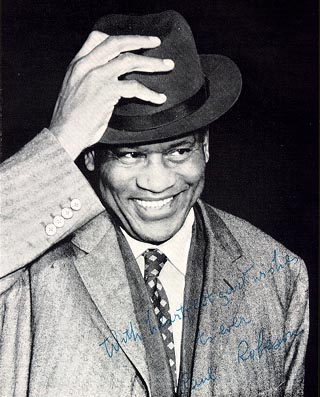
Paul Robeson. Photo from Rutgers Special Collections and University Archives.

Remembering Paul Robeson:
Sixty years after the Peekskill Riots

By Harry Targ / The Rag Blog / September 4, 2009

On September 4, 1949, an angry crowd surrounded the 20,000 friends of Paul Robeson who had come to hear him in an open-air concert at Peekskill, New York. After the event right-wing, anti-communist inspired mobs attacked supporters who were leaving the event. These attacks included smashing the windows of Pete Seeger’s automobile with several family members inside. Sixty years later we remember the great progressive Paul Robeson, his struggles for justice, and his refusal to bow to the politics of reaction.

The Young Robeson

One of the giants of the twentieth century, a citizen of the world, an actor/singer and activist for justice, Paul Robeson has been virtually erased from popular consciousness, a victim of the vicious anti-communist hysteria of the 1940s and 1950s.

Paul Robeson, an African-American, was born to Maria Louis Bustill and William Drew Robeson in Princeton, New Jersey in 1898, 33 years after the close of the civil war and two years after the United States Supreme Court declared in Plessy vs. Ferguson that separate institutions for Black and white people were constitutional. New Jersey, while not segregated to the extent of the deep South, was hostile to the rights of Black people.

Robeson was born into a family with a long-standing commitment to struggle for justice. His mother’s ancestors participated in the underground railroad, bringing escaped slaves from the South to the North. Her family included ministers, teachers, and artisans in the Northern free Black community. His father was a slave who escaped to the north and joined the Union army. As a minister educated at Lincoln University, Robeson’s father defended the rights of Black people in the New Jersey communities where he worked.

Many years later when he was politically active, Robeson would refer to the experiences of his people struggling against slavery and oppression to be free. He likened the struggles of his ancestors to the Black people of his day, and also to factory workers seeking labor rights, and peoples all round the world who were struggling to overthrow European colonial empires.

The young Robeson studied hard, was coached in elocution by his demanding father and performed so well in school that he was admitted to Rutgers University in 1915, only the third Black ever to enter that institution. Robeson graduated in 1919 as valedictorian, champion debater, and two-time All-American first-team football selection.

Robeson attended law school at Columbia University from 1919-1923 but decided against a law career because of the racism he faced at a preeminent New York law firm.

While he attended law school, Robeson began appearing in plays and found his way to the influential Provincetown Players of Greenwich Village. Robeson’s artistic career was successfully launched by his performances in two of Eugene O’Neill’s most important and controversial plays, “All God’s Chillun Got Wings” and “Emperor Jones.” From there his reputation and visibility spread.

By the late 1920s, he appeared in “Porgy,” “Stevedore” and “Showboat,” where he sang “Old Man River,” a song that would have deep political significance for him later on. On tour in Europe in the late 1920s and starring in a London production of “Othello,” in 1930, Robeson had become a star of worldwide proportions. During the 1930s, he would appear in eleven films, mostly British productions, further solidifying his global reputation as an actor.

As his reputation was soaring in the theatre of the 1920s, Robeson came to the realization that the rich musical heritage of his people, then called Negro Spirituals, needed to be celebrated and performed. He thus launched a singing career that would be his most enduring contribution to U.S. culture and, at the same time, would serve as a vehicle for him to participate in the struggle of Black people to achieve their freedom from racism and Jim Crow segregation. Over the next thirty years, he would learn at least a dozen languages and would celebrate the musical traditions of peoples from Africa, Asia, the Middle East, Europe, and Latin America, as well as the United States.

The Politicization of Paul Robeson

By the mid-1930s, Robeson’s outlook concerning the world around him and how the artist must relate to that world had changed significantly. Always aware of racism and segregation, Robeson began to see the oppression of his people as similar and related to the world of anti-Semitism, colonialism, worker exploitation, and attacks on the first socialist state, the Soviet Union.

Leaving a London theatre after a performance of Showboat in 1928, Robeson encountered a massive march of Welsh miners who had come all the way from Wales to demand better wages and working conditions. Robeson spoke to their group and joined their struggle. The mutual love and respect Robeson and the Welsh miners developed for each other would last for the rest of his life.

But it was the escalating Spanish Civil war, fascist armies fighting to overthrow a democratically elected government, that led Robeson to declare his commitment to political struggle on behalf of the dispossessed. In a speech given before the National Joint Committee for Spanish Relief at Royal Albert Hall on June 24, 1937 he proclaimed: “I have longed to see my talent contributing in an unmistakably clear manner to the cause of humanity. Every artist, every scientist, must decide NOW where he stands. He has no alternative.” The artist he said “must elect to fight for freedom or slavery.”

Robeson spoke out for workers, walked their picket lines, and sang to gatherings of trade unionists in auto, steel, shipping, meat packing, electrical, and mining industries who were demanding the right to form unions during the massive organizing drives of the Congress of Industrial Organizations (CIO). He sang of that great IWW labor singer/ organizer, “Joe Hill.” And he sang songs championing racial justice.

Red Scares

After World War II, Robeson met with President Truman and demanded that he take a stand against segregation and support anti-lynching legislation in the South. He already had spoken out against the exclusion of Blacks from major league baseball. Opposing the Cold War and Truman’s refusal to stand against segregation in the South, Robeson joined the campaign of third party candidate Henry Wallace, of the Progressive Party of America, who was running for president in 1948.

Robeson had often visited the Soviet Union, befriended the great Soviet film maker Eisenstein and had spoken with admiration about what appeared to be the lack of racism there. After World War II and as the Cold War was heating up, the U.S. government and right wing groups launched a campaign to stifle the voice of Paul Robeson because of his sympathies for the Soviet Union and his strong advocacy for racial justice in the United States.

He was called to testify before the House Committee on Un-American Activities. Thugs vandalized and beat attendees at the summer Robeson concert in Peekskill, New York. Government agents pressured concert impresarios to stop sponsoring Robeson concerts. And when his public access to audiences declined in the 1950s, even Black churches were pressured to cancel Robeson visits.

The centerpiece of the effort to muzzle Robeson was the decision of the State Department to revoke his passport in 1950. He was forbidden to leave the United States even though he still was a beloved worldwide figure. His passport was not reinstated until 1958 when the Supreme Court ruled that the State Department did not have the right to confiscate the passports of citizens..

Despite his not being able to travel, working people around the world continued to support Robeson. Canadian trade unionists from 1952 through 1955 organized four Robeson concerts at the border between the state of Washington and Canada. Robeson performed from the U.S. side and Canadian workers listened to his music from their side. Robeson welcomed the Canadian workers at the 1952 concert singing his signature song, “Old Man River,” from Showboat. He sang the lyrics he had revised from the original version in the 1928 musical — from stereotyping of Black people as docile to Black people as fighters for their freedom. Robeson began to insert the newer progressive lyrics in the 1930s when his own political consciousness had begun to change and for the rest of his life he saw the new lyrics as emblematic of his own political transformation.

In 1957, Welsh miners organized a chorus in a London studio and sang to Robeson listening in New York using the then new long distance telephone lines. They always remembered his support for their struggle and they wanted to demonstrate to him and the world their opposition to the efforts of the United States to stifle the voice of Paul Robeson.

After Robeson’s passport was reissued he resumed worldwide travel in the late 1950s. He fell ill in 1961, returned to the United States and for the most part retired from public life.

Robeson believed that peoples everywhere shared common musical forms and common struggles: workers, peoples of color, colonized peoples, women. He celebrated their differences but insisted on their human oneness. Perhaps we need to rediscover that vision again today. He died in 1976 but his spirited call for human solidarity is just as precious today as it was in his lifetime. And, as at Peekskill, those who support human solidarity must be prepared to “hold the line” against reaction.

‘Hold The Line’

Let me tell you the story of a line that was held,
And many brave men and women whose courage we know well,
How we held the line at Peekskill on that long September day!
We will hold the line forever till the people have their way.

Hold the line!Hold the line!
As we held the line at Peekskill
We will hold it everywhere.
Hold the line!Hold the line!
We will hold the line forever
Till there’s freedom ev’rywhere.

Words by Lee Hays; Music by Pete Seeger (1949)

[Harry Tarq a professor in American Studies who lives in West Lafayette, Indiana. He blogs at Diary of a Heartland Radical, where this article also appears.]

The Rag Blog

Posted in Rag Bloggers | Tagged , , , , , , | 3 Comments

Net Neutrality : Next Target of Astroturf Groups?

“WWIII Propaganda Posters: Support Net Neutrality” by Brian Moore / Flickr.

Will ‘Astroturf’ groups block Net Neutrality reform?

It’s no secret the five biggest telecom companies want Net Neutrality to disappear. All just happen to be members of a ‘pro-consumer’ group.

By Megan Tady / September 3, 2009

Chris, McGreal, a reporter for Britain’s Guardian newspaper, took to the road last month to report on how Americans living along Route 66 — made famous in John Steinbeck’s fictional Grapes of Wrath journey — are faring during the recession.

You might think McGreal quickly encountered “real Americans” protesting President Obama’s “socialist” healthcare agenda by hurling insults at town hall meetings. Cable news channels are full of these images, which together portray the United States as a giant angry grassroots rally against reform-minded policies.

Odd, then, that McGreal reports this:

The outbursts against President Obama’s healthcare plans filling television screens, with opponents calling him a Nazi and accusing him of planning death committees to do in old people, are to a large degree manufactured by the same people who use similar tactics to oppose abortion.

McGreal has it right: There is no genuine mass uprising against healthcare reform or climate change legislation. But the industry groups and corporations who benefit from the status quo—and thus have the most at stake in these debates—want us to think otherwise. And they’ve developed a slick way of manufacturing dissent: creating fake grassroots — ”astroturf” — organizations to do their bidding in our name.

Jim Hightower describes astroturf organizations as “the corporate version of grassroots…well-orchestrated PR efforts that put real folks out front, but are instigated, organized and funded by corporate interests and right-wing front groups.”

Astroturf groups like Americans for Prosperity and FreedomWorks rent themselves out to combat policies that hurt major corporations, from ExxonMobile to AT&T. They were behind April’s Tea Bag rallies, which protested tax increases, and flew hot air balloons as part of a campaign to discredit climate change.

Now corporations — AT&T, Verizon, Comcast, Time Warner Cable, and Qwest — are paying astroturf groups to derail one of the most important public policy initiatives of our time: Net Neutrality. The cable and telecom lobby is spending hundreds of millions of dollars trying to become the Web’s new gatekeepers.

What is Net Neutrality?

Astroturf groups have set their sights on blocking the passage of a valuable new bill called the Internet Freedom Preservation Act. The bill, introduced into the House in early August, would protect the Internet from telecommunications and cable companies who want to control access to online content—and thereby make more money.

The principle that protects the Internet freedom we now enjoy is Net Neutrality, which leaves us free to visit any website and create and share anything we can imagine. This “open” platform allows us to bypass the old corporate gatekeepers to create our own entertainment, and organize for social change without fearing that an Internet service provider like Comcast or AT&T will block our messages because they disagree with our politics.

Net Neutrality as a baseline rule for the Internet was stripped away by a 2005 U.S. Supreme Court ruling (PDF link) that effectively allowed phone and cable companies to discriminate against websites, applications or services that they didn’t like.

We must restore this guiding principle to protect and ensure a free-flowing Web for all. The new legislation would mandate that all ISPs adhere to Net Neutrality and refrain from controlling, blocking or slowing down online content.

Rolling out the astroturf

So who exactly is shilling for industry? Let’s connect the dots.

It’s no secret the five biggest cable and telecommunications companies want Net Neutrality to disappear. All five just happen to be members of the “pro-consumer” (read: astroturf) group NetCompetition.org, which is trying to make this nasty problem go away for them. Scott Cleland, who heads the operation, has made it his job to bash Net Neutrality, even likening it to socialism: “Just like the Soviet socialists, the net neutrality movement blatantly misrepresents the facts.”

And when FreedomWorks isn’t throwing a tea party, they’re throwing a tantrum about Net Neutrality. Take it from Dick Armey, the former House majority leader who leads the group: “The proponents of Net Neutrality have some very nice sound bites and flowery talking points that would lead you to believe that it’s about keeping the Internet free,” he writes. “I assure you nothing could be further from the truth.”

Who has paid FreedomWorks bills? AT&T.

Meanwhile, the American Consumer Institute — doesn’t that sound innocuous — is questioning the new Net Neutrality bill for consumers. Stephen Pociask, a telecom consultant and former chief economist for Bell Atlantic, is behind the site.

In 2006, when a similar Net Neutrality bill was introduced, this group actively worked to get lawmakers to vote against it.

Speak out or cede control

What’s the difference between a real grassroots organization and a fake one? Astroturf groups are paid shills who don’t openly disclose their funding sources, pretend they’re taking a stance in the public’s interest and manufacture events to make them appear to be backed by a public majority.

For too long, special interest money has polluted the waters of public discourse in America. And unfortunately, our entrenched corporate media system is all too willing to repeat astroturf messages, thereby legitimizing them and stifling genuine debate.

The open Internet lets us speak for ourselves—unlike nearly all other media platforms. If we speak out in support of the Internet Freedom Preservation Act and drown out the din of astroturf groups and industry lobbyists, it will remain that way.

[Megan Tady is a campaign coordinator and writer for Free Press, the national, nonprofit media reform organization, and a former National Political Reporter for InTheseTimes.com.]

Source / In These Times

Also see Unmasking Astroturf: Smear Campaigns Threaten Health Care and Net Neutrality by Timothy Karr / Free Press / AlterNet / August 21, 2009

And Astroturf Groups Try to Enlist Conservatives to Oppose Net Neutrality by Philip Dampier / Save the Internet / August 5, 2009

The Rag Blog

Posted in RagBlog | Tagged , , , , , , | 3 Comments

BonTaj Roulet : Bonnie Raitt and Taj Mahal Tour for the Environment


Tour taps blues to raise green:
BonTaj Roulet blazes new ground

The mix of contributions from promoters/venues and ticketing agencies with matching funds from artists and concertgoers, distributed by popular vote, is a new recipe for concert tour fundraising…

By Harvey Wasserman / The Rag Blog / September 3, 2009

In a tough economy, with music lovers thinking twice before going to see their favorite acts, the 34-date BonTaj Roulet Tour by Bonnie Raitt and Taj Mahal is blazing new green ground in raising money for charities. So far it’s collected over $100,000 for environmental and other causes. It could add that much again before the final show on September 25 at Rancho Mirage, California.

The tour features a unique pairing that cuts across rock and blues barriers… and a whole lot more. With strong reviews and healthy ticket sales on an otherwise rough summer for the music business, the tour is also laying the groundwork for a new mix in the magic art of using commercial concerts to raise funds for green and other causes.

According to Kathy Kane, Bonnie Raitt’s manager, “the artists are giving, the concert goers are giving AND the ticketing agencies are giving, along with some key venues and promoters.” Among the collaborators are Ticketmaster, Live Nation Ticketing, and Musictoday. “Not every venue and promoter is contributing,” says Kane, “but many are trying, and every venue and promoter has worked with us to make this happen.”

A 25-cent contribution added to the price of each ticket is matched with a 25-cent contribution from the artists. The funds are distributed to causes in proportion to votes tallied through the BonTaj Roulet tour website. Visitors to the website can choose between “safe & sustainable energy,” “environmental protection,” “social justice & human rights” and “blues/music education.” “The funds will be given to nonprofit organizations across the country,” says Kane. “If safe and sustainable energy received 23% of the votes then groups working on safe and sustainable energy will receive 23% of the funds being granted.”

The mix of contributions from promoters/venues and ticketing agencies with matching funds from artists and concertgoers, distributed by popular vote, is a new recipe for concert tour fundraising, says Kane. Many of the dates also feature VIP Charity Action Fund gatherings where donors get special seats and meet with the artists after the show. “Perhaps what makes this unique is the collaborative effort coming from different entities involved in putting on a concert. This way, everyone is contributing to raise funds out of their resources, not just the artist or the fans,”says Kane.

Of the 34 dates on the tour, 31 venues participated in the fundraising effort, she adds, with two choosing to support other causes of their own.

Tour-based fundraising has been a staple of the concert business for decades. Raitt helped organize one of the biggest with Musicians United for Safe Energy (MUSE), which filled Madison Square Garden for five “No Nukes” concerts in 1979. Along with others, she has had a special seating/meet and greet component to her shows for many years. The Guacamole Fund, the facilitator of the VIP Action Fund Charity Packages, has helped stage upwards of a thousand fundraising concerts for green energy organizations over the past 35 years.

Artists such as Dave Mathews are also finding new ways to contribute green to green. As part of a “So Much to Save” Campaign, Mathews is offering a code to download his band’s music in exchange for a variety of actions designed to help save the planet. Mathews is a board member of FarmAid, which has worked for more than a decade to save family farms. His fellow board members include Willie Nelson, John Mellancamp and Neil Young.

Under a gorgeous Indianapolis sky on August 25, Taj opened with a raucous, hard-driving signature R&B set. After a short break, Bonnie delivered virtuoso versions of favorites ranging from “Love Sneakin’ Up on You” to “Angel from Montgomery,” “Thing Called Love” and “I Can’t Make You Love Me.” Taj then joined her for “Satisfied,” “Done Changed My Way of Livin'” and the bawdy “Wah she Go Do” (infamous for the line “a woman must have an outside man”). After the sun set over the city’s White River Park, the two headliners sat back and improvised, front porch style. Raitt said there were “about 40 songs” they could have done. Judging from the enthusiastic response, one got the feeling the crowd would have stayed for all of them.

The Grand Rapids Press called the show there “as close to a perfect ending for a summer concert series as it gets.” As in Indianapolis, the Cape Cod Times reported “standing ovations on nearly every song,” with “a fun mix of genres, incorporating everything from country to reggae, jazz, rock and, of course, the blues.”

The additional news is that those blues for the multitudes meant a stack of green for the greens.

[Rag Blog contributor Harvey Wasserman was a co-organizer of the MUSE Concerts, and, with Bonnie Raitt, Jackson Browne and Graham Nash, of the nukefree.org website. He is managing editor of The Free Press, where this article also appears.]

The Rag Blog

Posted in Rag Bloggers | Tagged , , , , , , | Leave a comment

Chomsky: Global Crises and Dealing with Them


Crisis and Hope: Theirs and Ours
By Noam Chomsky / September 2009

Perhaps I may begin with a few words about the title. There is too much nuance and variety to make such sharp distinctions as theirs-and-ours, them-and-us. And neither I nor anyone can presume to speak for “us.” But I will pretend it is possible.

There is also a problem with the term “crisis.” Which one? There are numerous very severe crises, interwoven in ways that preclude any clear separation. But again I will pretend otherwise, for simplicity.

One way to enter this morass is offered by the June 11 issue of the New York Review of Books. The front-cover headline reads “How to Deal With the Crisis”; the issue features a symposium of specialists on how to do so. It is very much worth reading, but with attention to the definite article. For the West the phrase “the crisis” has a clear enough meaning: the financial crisis that hit the rich countries with great impact, and is therefore of supreme importance. But even for the rich and privileged that is by no means the only crisis, nor even the most severe. And others see the world quite differently. For example, in the October 26, 2008 edition of the Bangladeshi newspaper The New Nation, we read:

It’s very telling that trillions have already been spent to patch up leading world financial institutions, while out of the comparatively small sum of $12.3 billion pledged in Rome earlier this year, to offset the food crisis, only $1 billion has been delivered. The hope that at least extreme poverty can be eradicated by the end of 2015, as stipulated in the UN’s Millennium Development Goals, seems as unrealistic as ever, not due to lack of resources but a lack of true concern for the world’s poor.

The article goes on to predict that World Food Day in October 2009 “will bring . . . devastating news about the plight of the world’s poor . . . which is likely to remain that: mere ‘news’ that requires little action, if any at all.” Western leaders seem determined to fulfill these grim predictions. On June 11 the Financial Times reported, “the United Nations’ World Food Programme is cutting food aid rations and shutting down some operations as donor countries that face a fiscal crunch at home slash contributions to its funding.” Victims include Ethiopia, Rwanda, Uganda, and others. The sharp budget cut comes as the toll of hunger passes a billion—with over one hundred million added in the past six months—while food prices rise, and remittances decline as a result of the economic crisis in the West.

As The New Nation anticipated, the “devastating news” released by the World Food Programme barely even reached the level of “mere ‘news.’” In The New York Times, the WFP report of the reduction in the meager Western efforts to deal with this growing “human catastrophe” merited 150 words on page ten under “World Briefing.” That is not in the least unusual. The United Nations also released an estimate that desertification is endangering the lives of up to a billion people, while announcing World Desertification Day. Its goal, according to the Nigerian newspaper THISDAY, is “to combat desertification and drought worldwide by promoting public awareness and the implementation of conventions dealing with desertification in member countries.” The effort to raise public awareness passed without mention in the national U.S. press. Such neglect is all too common.

It may be instructive to recall that when they landed in what today is Bangladesh, the British invaders were stunned by its wealth and splendor. It was soon on its way to becoming the very symbol of misery, and not by an act of God.

As the fate of Bangladesh illustrates, the terrible food crisis is not just a result of “lack of true concern” in the centers of wealth and power. In large part it results from very definite concerns of global managers: for their own welfare. It is always well to keep in mind Adam Smith’s astute observation about policy formation in England. He recognized that the “principal architects” of policy—in his day the “merchants and manufacturers”—made sure that their own interests had “been most peculiarly attended to” however “grievous” the effect on others, including the people of England and, far more so, those who were subjected to “the savage injustice of the Europeans,” particularly in conquered India, Smith’s own prime concern in the domains of European conquest.

Smith was referring specifically to the mercantilist system, but his observation generalizes, and as such, stands as one of the few solid and enduring principles of both international relations and domestic affairs. It should not, however, be over-generalized. There are interesting cases where state interests, including long-term strategic and economic interests, overwhelm the parochial concerns of the concentrations of economic power that largely shape state policy. Iran and Cuba are instructive cases, but I will have to put these topics aside here.

The food crisis erupted first and most dramatically in Haiti in early 2008. Like Bangladesh, Haiti today is a symbol of misery and despair. And, like Bangladesh, when European explorers arrived, the island was remarkably rich in resources, with a large and flourishing population. It later became the source of much of France’s wealth. I will not run through the sordid history, but the current food crisis can be traced directly to 1915, Woodrow Wilson’s invasion: murderous, brutal, and destructive. Among Wilson’s many crimes was dissolving the Haitian Parliament at gunpoint because it refused to pass “progressive legislation” that would have allowed U.S. businesses to take over Haitian lands. Wilson’s Marines then ran a free election, in which the legislation was passed by 99.9 percent of the 5 percent of the public permitted to vote. All of this comes down through history as “Wilsonian idealism.”

Later, the United States Agency for International Development (USAID) instituted programs to turn Haiti into the “Taiwan of the Caribbean,” by adhering to the sacred principle of comparative advantage: Haiti must import food and other commodities from the United States, while working people, mostly women, toil under miserable conditions in U.S.-owned assembly plants. Haiti’s first free election, in 1990, threatened these economically rational programs. The poor majority entered the political arena for the first time and elected their own candidate, a populist priest, Jean-Bertrand Aristide. Washington adopted the standard operating procedures for such a case, moving at once to undermine the regime. A few months later came the anticipated military coup, and the resulting junta instituted a reign of terror, which was backed by Bush senior and even more fully by Clinton, despite pretenses. By 1994 Clinton decided that the population was sufficiently intimidated and sent U.S. forces to restore the elected president, but on the strict condition that he accept a harsh neoliberal regime. In particular, there must be no protection for the economy. Haitian rice farmers are efficient, but cannot compete with U.S. agribusiness that relies on huge government subsidies, thanks largely to Reagan, anointed High Priest of free trade with little regard to his record of extreme protectionism and state intervention in the economy.

Bailing out banks is not uppermost in the minds of the billion people now facing starvation.

There is nothing surprising about what followed: a 1995 USAID report observed that the “export-driven trade and investment policy”—that Washington mandated—will “relentlessly squeeze the domestic rice farmer.” Neoliberal policies dismantled what was left of economic sovereignty and drove the country into chaos, accelerated by Bush junior’s blocking of international aid on cynical grounds. In February 2004 the two traditional torturers of Haiti, France and the United States, backed a military coup and spirited President Aristide off to Africa. Haiti had, by then, lost the capacity to feed itself, leaving it highly vulnerable to food price fluctuation, the immediate cause of the 2008 food crisis.

The story is fairly similar in much of the world. In a narrow sense, it may be true enough that the food crisis results from Western lack of concern: a pittance could overcome its worst immediate effects. But more fundamentally it results from dedication to the basic principles of business-run state policy, the Adam Smith generalization. These are all matters that we too easily evade—along with the fact that bailing out banks is not uppermost in the minds of the billion people now facing starvation, not forgetting the tens of millions enduring hunger in the richest country in the world.

Also sidelined is a possible way to make a significant dent in the financial and food crises. It is suggested by the recent publication of the authoritative annual report on military spending by SIPRI, the Swedish peace research institute. The scale of military spending is phenomenal, regularly increasing. The United States is responsible for almost as much as the rest of the world combined, seven times as much as its nearest rival, China. There is no need to waste time commenting.

• • •

The distribution of concerns illustrates another crisis, a cultural crisis: the tendency to focus on short-term parochial gains, a core element of our socioeconomic institutions and their ideological support system. One illustration is the array of perverse incentives devised for corporate managers to enrich themselves, however grievous the impact on others—for example, the “too big to fail” insurance policies provided by the unwitting public.

There are also deeper problems inherent in market inefficiencies. One of these, now belatedly recognized to be among the roots of the financial crisis, is the under-pricing of systemic risk: if you and I make a transaction, we factor in the cost to us, but not to others. The financial industry, that means Goldman Sachs, if managed properly, will calculate the potential cost to itself if a loan goes bad, but not the impact on the financial system, which can be severe. This inherent deficiency of markets is well known. Ten years ago, at the height of the euphoria about efficient markets, two prominent economists, John Eatwell and Lance Taylor, wrote Global Finance at Risk, an important book in which they spelled out the consequences of these market inefficiencies and outlined means to deal with them. Their proposals conflicted sharply with the deregulatory rage that was then consuming the Clinton administration, under the leadership of those whom Obama has now called upon to put band-aids on the disaster they helped to create.

In substantial measure, the food crisis plaguing much of the South and the financial crisis of the North have a common source: the shift toward neoliberalism since the 1970s, which brought to an end the Bretton Woods system instituted by the United States and United Kingdom after World War II. The architects of Bretton Woods, John Maynard Keynes and Harry Dexter White, anticipated that its core principles—including capital controls and regulated currencies—would lead to rapid and relatively balanced economic growth and would also free governments to institute the social democratic programs that had very strong public support. Mostly, they were vindicated on both counts. Many economists call the years that followed, until the 1970s, the “golden age of capitalism.”

The “golden age” saw not only unprecedented and relatively egalitarian growth, but also the introduction of welfare-state measures. As Keynes and White were aware, free capital movement and speculation inhibit those options. To quote from the professional literature, free flow of capital creates a “virtual senate” of lenders and investors who carry out a “moment-by-moment referendum” on government policies, and if they find them irrational—that is, designed to help people, not profits—they vote against them by capital flight, attacks on currency, and other means. Democratic governments therefore have a “dual constituency”: the population, and the virtual senate, who typically prevail.

In his standard history of the financial system, Barry Eichengreen writes that, in earlier years, the costs imposed by market inefficiencies and failures could be imposed on the public, but that became difficult when governments were “politicized” by “universal male suffrage and the rise of trade unionism and parliamentary labor parties” and later by the radicalization of the general public during the Great Depression and the anti-fascist war. Accordingly, in the Bretton Woods system, “limits on capital mobility substituted for limits on democracy as a source of insulation from market pressures.” There is a corollary: dismantling of the Bretton Woods restrictions on capital during the neoliberal period restores a powerful weapon against democracy.

The neoliberal rollback of democracy—often called “democracy promotion”—has enabled other means of control and marginalization of the public. One illustration is the management of electoral extravaganzas in the United States by the public relations industry, peaking with Obama, who won the industry’s award for “marketer of the year for 2008.” Industry executives exulted in the business press that Obama was the highest achievement yet of those who “helped pioneer the packaging of candidates as consumer brands 30 years ago,” when they designed the Reagan campaign. The Financial Times paraphrased one marketing executive suggesting that the Obama triumph should “have more influence on boardrooms than any president since Ronald Reagan, [who] redefined what it was to be a CEO.” Reagan taught, “you had to give [your organization] a vision,” leading to the “reign of the imperial CEO” in the 1980s and 1990s. The synergy of running corporations and controlling politics, including the marketing of candidates as commodities, offers great prospects for the future management of democracy.

Where neoliberal rules have been observed since the ’70s, economic performance has generally deteriorated and social democratic programs have weakened.

For working people, small farmers, and the poor, at home and abroad, all of this spells regular disaster. One of the reasons for the radical difference in development between Latin America and East Asia in the last half century is that Latin America did not control capital flight, which often approached the level of its crushing debt and has regularly been wielded as a weapon against the threat of democracy and social reform. In contrast, during South Korea’s remarkable growth period, capital flight was not only banned, but could bring the death penalty.

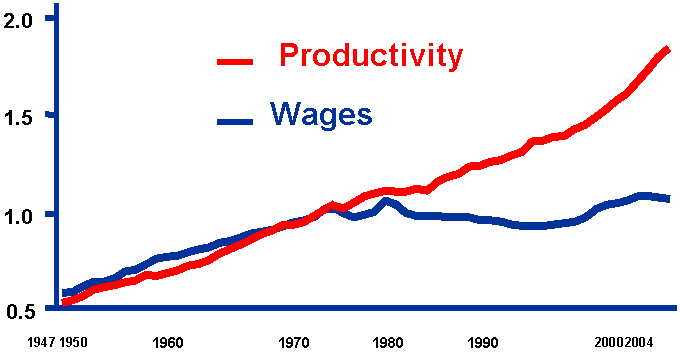
Where neoliberal rules have been observed since the ’70s, economic performance has generally deteriorated and social democratic programs have substantially weakened. In the United States, which partially accepted these rules, real wages for the majority have largely stagnated for 30 years, instead of tracking productivity growth as before, while work hours have increased, now well beyond those of Europe. Benefits, which always lagged, have declined further. Social indicators—general measures of the health of the society—also tracked growth until the mid-’70s, when they began to decline, falling to the 1960 level by the end of the millennium. Economic growth found its way into few pockets, increasingly in the financial industries. Finance constituted a few percentage points of GDP in 1970, and has since risen to well over one-third, while productive industry has declined, and with it, living standards for much of the workforce. The economy has been punctuated by bubbles, financial crises, and public bailouts, currently reaching new highs. A few outstanding international economists explained and predicted these results from the start. But mythology about “efficient markets” and “rational choice” prevailed. This is no surprise: it was highly beneficial to the narrow sectors of privilege and power that provide the “principal architects of policy.”

• • •

The phrase “golden age of capitalism” might itself be challenged. The period can more accurately be called “state capitalism.” The state sector was, and remains, a primary factor in development and innovation through a variety of measures, among them research and development, procurement, subsidy, and bailouts. In the U.S. version, these policies operated mainly under a Pentagon cover as long as the cutting edge of the advanced economy was electronics-based. In recent years there has been a shift toward health-oriented state institutions as the cutting edge becomes more biology-based. The outcomes include computers, the Internet, satellites, and most of the rest of the IT revolution, but also much else: civilian aircraft, advanced machine tools, pharmaceuticals, biotechnology, and a lot more. The crucial state role in economic development should be kept in mind when we hear dire warnings about government intervention in the financial system after private management has once again driven it to crisis, this time, an unusually severe crisis, and one that harms the rich, not just the poor, so it merits special concern. It is a little odd, to say the least, to read economic historian Niall Ferguson in the New York Review of Books symposium on “The Crisis” saying that “the lesson of economic history is very clear. Economic growth . . . comes from technological innovation and gains in productivity, and these things come from the private sector, not from the state”—remarks that were probably written on a computer and sent via the Internet, which were substantially in the state sector for decades before they became available for private profit. His is hardly the clear lesson of economic history.

Large-scale state intervention in the economy is not just a phenomenon of the post-World War II era, either. On the contrary, the state has always been a central factor in economic development. Once they gained their independence, the American colonies were free to abandon the orthodox economic policies that dictated adherence to their comparative advantage in export of primary commodities while importing superior British manufacturing goods. Instead, the Hamiltonian economy imposed very high tariffs so that an industrial economy could develop: textiles, steel, and much else. The eminent economic historian Paul Bairoch describes the United States as “the mother country and bastion of modern protectionism,” with the highest tariffs in the world during its great growth period. And protectionism is only one of the many forms of state intervention. Protectionist policies continued until the mid-twentieth century, when the United States was so far in the lead that the playing field was tilted in the proper direction—that is, to the advantage of U.S. corporations. And when necessary, it has been tilted further, notably by Reagan, who virtually doubled protectionist barriers among other measures to rescue incompetent U.S. corporate management unable to compete with Japan.

From the outset the United States was following Britain’s lead. The other developed countries did likewise, while orthodox policies were rammed down the throats of the colonies, with predictable effects. It is noteworthy that the one country of the (metaphorical) South to develop, Japan, also successfully resisted colonization. Others that developed, like the United States, did so after they escaped colonial domination. Selective application of economic prinicples—orthodox economics forced on the colonies while violated at will by those free to do so—is a basic factor in the creation of the sharp North-South divide. Like many other economic historians, Bairoch concludes from a broad survey that “it is difficult to find another case where the facts so contradict a dominant theory” as the doctrine that free markets were the engine of growth, a harsh lesson that the developing world has learned again in recent decades. Even the poster child of neoliberalism, Chile, depends heavily on the world’s largest copper producer, Codelco, nationalized by Allende.

In earlier years the cotton-based economy of the industrial revolution relied on massive ethnic cleansing and slavery, rather severe forms of state intervention in the economy. Though theoretically slavery was ended with the Civil War, it emerged again after Reconstruction in a form that was in many ways more virulent, with what amounted to criminalization of African-American life and widespread use of convict labor, which continued until World War II. The industrial revolution, from the late nineteenth century, relied heavily on this new form of slavery, a hideous story that has only recently been exposed in its shocking detail in a very important study by Wall Street Journal bureau chief Douglas Blackmon. During the post-World War II “golden age,” African Americans were able for the first time to enjoy some level of social and economic advancement, but the disgraceful post-Reconstruction history has been partially reconstituted during the neoliberal years with the rapid growth of what some criminologists call “the prison-industrial complex,” a uniquely American crime committed continuously since the 1980s and exacerbated by the dismantling of productive industry.

People cannot be told that the advanced economy relies heavily on their risk-taking, while eventual profit is privatized, and ‘eventual’ can be a long time.

The American system of mass production that astonished the world in the nineteenth century was largely created in military arsenals. Solving the major nineteenth-century management problem—railroads—was beyond the capacity of private capital, so the challenge was handed over to the army. A century ago the toughest problems of electrical and mechanical engineering involved placing a huge gun on a moving platform to hit a moving target—naval gunnery. The leaders were Germany and England, and the outcomes quickly spilled over into the civilian economy. Some economic historians compare that episode to state-run space programs today. Reagan’s “Star Wars” was sold to industry as a traditional gift from government, and was understood that way elsewhere too: that is why Europe and Japan wanted to buy in. There was a dramatic increase in the state role after World War II, particularly in the United States, where a good part of the advanced economy developed in this framework.

• • •

State-guided modes of economic development require considerable deceit in a society where the public cannot be controlled by force. People cannot be told that the advanced economy relies heavily on their risk-taking, while eventual profit is privatized, and “eventual” can be a long time, sometimes decades. After World War II Americans were told that their taxes were going to defense against monsters about to overcome us—as in the ’80s, when Reagan pulled on his cowboy boots and declared a National Emergency because Nicaraguan hordes were only two days from Harlingen, Texas. Or twenty years earlier when LBJ warned that there are only 150 million of us and 3 billion of them, and if might makes right, they will sweep over us and take what we have, so we have to stop them in Vietnam.

For those concerned with the realities of the Cold War, and how it was used to control the public, one obvious moment to inspect carefully is the fall of the Berlin Wall twenty years ago and its aftermath. Celebration of the anniversary in November 2009 has already begun, with ample coverage, which will surely increase as the date approaches. The revealing implications of the policies that were instituted after the fall have, however, been ignored, as in the past, and probably will continue to be come November.

Reacting immediately to the Wall’s fall, the Bush senior administration issued a new National Security Strategy and budget proposal to set the course after the collapse of Kennedy’s “monolithic and ruthless conspiracy” to conquer the world and Reagan’s “evil empire”—a collapse that took with it the whole framework of domestic population control. Washington’s response was straightforward: everything will stay much the same, but with new pretexts. We still need a huge military system, but for a new reason: the “technological sophistication” of Third World powers. We have to maintain the “defense industrial base,” a euphemism for state-supported high-tech industry. We must also maintain intervention forces directed at the Middle East’s energy-rich regions, where the threats to our interests that required military intervention “could not be laid at the Kremlin’s door,” contrary to decades of pretense. The charade had sometimes been acknowledged, as when Robert Komer—the architect of President Carter’s Rapid Deployment Force (later Central Command), aimed primarily at the Middle East—testified before Congress in 1980 that the Force’s most likely use was not resisting Soviet attack, but dealing with indigenous and regional unrest, in particular the “radical nationalism” that has always been a primary concern throughout the world.

With the Soviet Union gone, the clouds lifted, and actual policy concerns were more visible for those who chose to see. The Cold War propaganda framework made two fundamental contributions: sustaining the dynamic state sector of the economy (of which military industry is only a small part) and protecting the interests of the “principal architects of policy” abroad.

The fate of NATO exposes the same concerns, and it is highly pertinent today. Prior to Gorbachev NATO’s announced purpose was to deter a Russian invasion of Europe. The legitimacy of that agenda was debatable right from the end of World War II. In May 1945 Churchill ordered war plans to be drawn up for Operation Unthinkable, aimed at “the elimination of Russia.” The plans—declassified ten years ago—are discussed extensively in the major scholarly study of British intelligence records, Richard Aldrich’s The Hidden Hand. According to Aldrich, they called for a surprise attack by hundreds of thousands of British and American troops, joined by one hundred thousand rearmed German soldiers, while the RAF would attack Soviet cities from bases in Northern Europe. Nuclear weapons were soon added to the mix. The official stand also was not easy to take too seriously a decade later, when Khrushchev took over in Russia, and soon proposed a sharp mutual reduction in offensive weaponry. He understood very well that the much weaker Soviet economy could not sustain an arms race and still develop. When the United States dismissed the offer, he carried out the reduction unilaterally. Kennedy reacted with a substantial increase in military spending, which the Soviet military tried to match after the Cuban missile crisis dramatically revealed its relative weakness. The Soviet economy tanked, as Khrushchev had anticipated. That was a crucial factor in the later Soviet collapse.

• • •

But the defensive pretext for NATO at least had some credibility. After the Soviet disintegration, the pretext evaporated. In the final days of the USSR, Gorbachev made an astonishing concession: he permitted a unified Germany to join a hostile military alliance run by the global superpower, though Germany alone had almost destroyed Russia twice in the century. There was a quid pro quo, recently clarified. In the first careful study of the original documents, Mark Kramer, apparently seeking to refute charges of U.S. duplicity, in fact shows that it went far beyond what had been assumed. It turns out, Kramer wrote this year in The Washington Quarterly, that Bush senior and Secretary of State James Baker promised Gorbachev that “no NATO forces would ever be deployed on the territory of the former GDR . . . NATO’s jurisdiction or forces would not move eastward.’’ They also assured Gorbachev “that NATO would be transforming itself into a more political organization.” There is no need to comment on that promise. What followed tells us a lot more about the Cold War itself, and the world that emerged from its ending.

As soon as Clinton came into office, he began the expansion of NATO to the east. The process accelerated with Bush junior’s aggressive militarism. These moves posed a serious security threat to Russia, which naturally reacted by developing more advanced offensive military capacities. Obama’s National Security Advisor, James Jones, has a still-more expansive vision: he calls for extending NATO further east and south, becoming in effect a U.S.-run global intervention force, as it is today in Afghanistan—“Afpak” as the region is now called—where Obama is sharply escalating Bush’s war, which had already intensified in 2004. NATO Secretary-General Jaap de Hoop Scheffer informed a NATO meeting that “NATO troops have to guard pipelines that transport oil and gas that is directed for the West,” and more generally have to protect sea routes used by tankers and other “crucial infrastructure” of the energy system. These plans open a new phase of Western imperial domination—more politely called “bringing stability” and “peace.”

Obama is following General Petraeus’s strategy to drive the Taliban into Pakistan, with potentially serious consequences for this unstable state.

As recently as November 2007, the White House announced plans for a long-term military presence in Iraq and a policy of “encouraging the flow of foreign investments to Iraq, especially American investments.” The plans were withdrawn under Iraqi pressure, the continuation of a process that began when the United States was compelled by mass demonstrations to permit elections. In Afpak Obama is building enormous new embassies and other facilities, on the model of the city-within-a-city in Baghdad. These new installations in Iraq and Afpak are like no embassies in the world, just as the United States is alone in its vast military-basing system and control of the air, sea, and space for military purposes.

While Obama is signaling his intention to establish a firm and large-scale presence in the region, he is also following General Petraeus’s strategy to drive the Taliban into Pakistan, with potentially quite serious consequences for this dangerous and unstable state facing insurrections throughout its territory. These are most extreme in the tribal areas crossing the British-imposed Durand line separating Afghanistan from Pakistan, which the Pashtun tribes on both sides of the artificial border have never recognized, nor did the Afghan government when it was independent. In an April publication of the Center for International Policy, one of the leading U.S. specialists on the region, Selig Harrison, writes that the outcome of Washington’s current policies might well be “what Pakistani ambassador to Washington Husain Haqqani has called an ‘Islamic Pashtunistan.’” Haqqani’s predecessor had warned that if the Taliban and Pashtun nationalists merge, “we’ve had it, and we’re on the verge of that.”

Prospects become still more ominous as drone attacks that embitter the population are escalated with their huge civilian toll. Also troubling is the unprecedented authority just granted General Stanley McChrystal—a special forces assassin—to head the operations. Petraeus’s own counter-insurgency adviser in Iraq, David Kilcullen, describes the Obama-Petraeus-McChrystal policies as a fundamental “strategic error,” which may lead to “the collapse of the Pakistani state,” a calamity that would “dwarf” other current crises.

It is also not encouraging that Pakistan and India are now rapidly expanding their nuclear arsenals. Pakistan’s were developed with Reagan’s crucial aid, and India’s nuclear weapons programs got a major shot in the arm from the recent U.S.-India nuclear agreement, which was also a sharp blow to the Non-Proliferation Treaty. India and Pakistan have twice come close to nuclear war over Kashmir, and have also been engaged in a proxy war in Afghanistan. These developments pose a very serious threat to world peace.

Returning home, it is worth noting that the more sophisticated are aware of the deceit that is employed as a device to control the public, and regard it as praiseworthy. The distinguished liberal statesman Dean Acheson advised that leaders must speak in a way that is “clearer than truth.” Harvard Professor of the Science of Government Samuel Huntington, who quite frankly explained the need to delude the public about the Soviet threat 30 years ago, urged more generally that power must remain invisible: “The architects of power in the United States must create a force that can be felt but not seen. Power remains strong when it remains in the dark; exposed to the sunlight it begins to evaporate.” An important lesson for those who want power to devolve to the public, a critical battle that is fought daily.

• • •

Whether the deceit about the monstrous enemy was sincere or not, if Americans a half century ago had been given the choice of directing their tax money to Pentagon programs to enable their grandchildren to have computers, iPods, the Internet, and so on, or putting it into developing a livable and sustainable socioeconomic order, they might have made the latter choice. But they had no choice. That is standard. There is a striking gap between public opinion and public policy on a host of major issues, domestic and foreign, and public opinion is often more sane, at least in my judgment. It also tends to be fairly consistent over time, despite the fact that public concerns and aspirations are marginalized or ridiculed—one very significant feature of the yawning “democratic deficit,” the failure of formal democratic institutions to function properly. That is no trivial matter. In a forthcoming book, the writer and activist Arundhati Roy asks whether the evolution of formal democracy in India and the United States—and not only there—“might turn out to be the endgame of the human race.” It is not an idle question.

It should be recalled that the American republic was founded on the principle that there should be a democratic deficit. James Madison, the main framer of the Constitutional order, held that power should be in the hands of “the wealth of the nation,” the “more capable set of men,” who have sympathy for property owners and their rights. Possibly with Shay’s Rebellion in mind, he was concerned that “the equal laws of suffrage” might shift power into the hands of those who might seek agrarian reform, an intolerable attack on property rights. He feared that “symptoms of a levelling spirit” had appeared sufficiently “in certain quarters to give warning of the future danger.” Madison sought to construct a system of government that would “protect the minority of the opulent against the majority.” That is why his constitutional framework did not have coequal branches: the legislature prevailed, and within the legislature, power was to be vested in the Senate, where the wealth of the nation would be dominant and protected from the general population, which was to be fragmented and marginalized in various ways. As historian Gordon Wood summarizes the thoughts of the founders: “The Constitution was intrinsically an aristocratic document designed to check the democratic tendencies of the period,” delivering power to a “better sort” of people and excluding “those who were not rich, well born, or prominent from exercising political power.”

In Madison’s defense, his picture of the world was pre-capitalist: he thought that power would be held by the “enlightened Statesman” and “benevolent philosopher,” men who are “pure and noble,” a “chosen body of citizens, whose wisdom may best discern the true interests of their country and whose patriotism and love of justice would be least likely to sacrifice it to temporary or partial considerations,” guarding the public interest against the “mischiefs” of democratic majorities. Adam Smith had a clearer vision.

‘The crisis’—the financial crisis—will presumably be patched up somehow, while leaving the institutions that created it pretty much in place.

There has been constant struggle over this constrained version of democracy, which we call “guided democracy” in the case of enemies: Iran right now, for example. Popular struggles have won a great many rights, but concentrated power and privilege clings to the Madisonian conception in ways that vary as society changes. By World War I, business leaders and elite intellectuals recognized that the population had won so many rights that they could not be controlled by force, so it would be necessary to turn to control of attitudes and opinions. Those are the years when the huge public relations industry emerged—in the freest countries of the world, Britain and United States, where the problem was most acute. The industry was devoted to what Walter Lippmann approvingly called “a new art in the practice of democracy,” the “manufacture of consent”—the “engineering of consent” in the phrase of his contemporary Edward Bernays, one of the founders of the public relations industry. Both Lippmann and Bernays took part in Wilson’s state propaganda organization, the Committee on Public Information, created to drive a pacifist population to jingoist fanaticism and hatred of all things German. It succeeded brilliantly. The same techniques, it was hoped, would ensure that the “intelligent minorities” would rule, undisturbed by “the trampling and the roar of a bewildered herd,” the general public, “ignorant and meddlesome outsiders” whose “function” is to be “spectators,” not “participants.” This was a central theme of the highly regarded “progressive essays on democracy” by the leading public intellectual of the twentieth century (Lippmann), whose thinking captures well the perceptions of progressive intellectual opinion: President Wilson, for example, held that an elite of gentlemen with “elevated ideals” must be empowered to preserve “stability and righteousness,” essentially the Madisonian perspective. In more recent years, the gentlemen are transmuted into the “technocratic elite” and “action intellectuals” of Camelot, “Straussian” neocons, or other configurations. But throughout, one or another variant of the doctrine prevails, with its Leninist overtones.

And on a more hopeful note, popular struggle continues to clip its wings, quite impressively so in the wake of 1960s activism, which had a substantial impact on civilizing the country and raised its prospects to a considerably higher plane.

• • •

Returning to what the West sees as “the crisis”—the financial crisis—it will presumably be patched up somehow, while leaving the institutions that created it pretty much in place. Recently the Treasury Department permitted early TARP repayments, which reduce bank capacity to lend, as was immediately pointed out, but allow the banks to pour money into the pockets of the few who matter. The mood on Wall Street was captured by two Bank of New York Mellon employees, who, as reported in The New York Times, “predicted their lives—and pay—would improve, even if the broader economy did not.”

The chair of the prominent law firm Sullivan & Cromwell offered the equally apt prediction that “Wall Street, after getting billions of taxpayer dollars, will emerge from the financial crisis looking much the same as before markets collapsed.” The reasons were pointed out, by, among others, Simon Johnson, former chief economist of the IMF: “Throughout the crisis, the government has taken extreme care not to upset the interests of the financial institutions, or to question the basic outlines of the system that got us here,” and the

elite business interests [that] played a central role in creating the crisis, making ever-larger gambles, with the implicit backing of the government, until the inevitable collapse . . . are now using their influence to prevent precisely the sorts of reforms that are needed, and fast, to pull the economy out of its nosedive.

Meanwhile “the government seems helpless, or unwilling, to act against them.” Again no surprise, at least to those who remember their Adam Smith.

But there is a far more serious crisis, even for the rich and powerful. It is discussed by Bill McKibben, who has been warning for years about the impact of global warming, in the same issue of the New York Review of Books that I mentioned earlier. His recent article relies on the British Stern report, which is very highly regarded by leading scientists and a raft of Nobel laureates in economics. On this basis McKibben concludes, not unrealistically, “2009 may well turn out to be the decisive year in the human relationship with our home planet.” In December a conference in Copenhagen is “to sign a new global accord on global warming,” which will tell us “whether or not our political systems are up to the unprecedented challenge that climate change represents.” He thinks the signals are mixed. That may be optimistic, unless there is a really massive public campaign to overcome the insistence of the managers of the state-corporate sector on privileging short-term gain for the few over the hope that their grandchildren will have a decent future.

At least some of the barriers are beginning to crumble—in part because the business world perceives new opportunities for profit. Even The Wall Street Journal, one of the most stalwart deniers, recently published a supplement with dire warnings about “climate disaster,” urging that none of the options being considered may be sufficient, and it may be necessary to undertake more radical measures of geoengineering, “cooling the planet” in some manner.

As always, those who suffer most will be the poor. Bangladesh will soon have a lot more to worry about than even the terrible food crisis. As the sea level rises, much of the country, including its most productive regions, might be under water. Current crises are almost sure to be exacerbated as the Himalayan glaciers continue to disappear, and with them the great river systems that keep South Asia alive. Right now, as glaciers melt in the mountain heights where Pakistani and Indian troops suffer and die, they expose the relics of their crazed conflict over Kashmir, “a pristine monument to human folly,” Roy comments with despair.

The picture might be much more grim than even the Stern report predicts. A group of MIT scientists have just released the results of what they describe as

the most comprehensive modeling yet carried out on the likelihood of how much hotter the Earth’s climate will get in this century, [showing] that without rapid and massive action, the problem will be about twice as severe as previously estimated six years ago—and could be even worse than that.

Worse because the model

does not fully incorporate other positive feedbacks that can occur, for example, if increased temperatures caused a large-scale melting of permafrost in arctic regions and subsequent release of large quantities of methane.

The leader of the project says, “There’s no way the world can or should take these risks,” and that “the least-cost option to lower the risk is to start now and steadily transform the global energy system over the coming decades to low or zero greenhouse gas-emitting technologies.” There is far too little sign of that.

While new technologies are essential, the problems go well beyond. We have to face up to the need to reverse the huge state-corporate social engineering projects of the post-World War II period, which quite purposefully promoted an energy-wasting and environmentally destructive fossil fuel-based economy. The state-corporate programs, which included massive projects of suburbanization along with destruction and then gentrification of inner cities, began with a conspiracy by General Motors, Firestone, and Standard Oil of California to buy up and destroy efficient electric public transportation systems in Los Angeles and dozens of other cities; they were convicted of criminal conspiracy and given a slap on the wrist. The federal government then took over, relocating infrastructure and capital stock to suburban areas and creating the massive interstate highway system, under the usual pretext of “defense.” Railroads were displaced by government-financed motor and air transport.

If I want to get home from work, the market offers me a choice between a Ford and a Toyota, but not between a car and a subway. That is a social decision.

The programs were understood as a means to prevent a depression after the Korean War. One of their Congressional architects described them as “a nice solid floor across the whole economy in times of recession.” The public played almost no role, apart from choice within the narrowly structured framework of options designed by state-corporate managers. One result is atomization of society and entrapment of isolated individuals with self-destructive ambitions and crushing debt. These efforts to “fabricate consumers” (to borrow Veblen’s term) and to direct people “to the superficial things of life, like fashionable consumption” (in the words of the business press), emerged from the recognition a century ago of the need to curtail democratic achievements and to ensure that the “opulent minority” are protected from the “ignorant and meddlesome outsiders.”

While state-corporate power was vigorously promoting privatization of life and maximal waste of energy, it was also undermining the efficient choices that the market does not provide—another destructive built-in market inefficiency. To put it simply, if I want to get home from work, the market offers me a choice between a Ford and a Toyota, but not between a car and a subway. That is a social decision, and in a democratic society, would be the decision of an organized public. But that is just what the dedicated elite attack on democracy seeks to undermine.

The consequences are right before our eyes in ways that are sometimes surreal. In May The Wall Street Journal reported:

U.S. transportation chief [Ray LaHood] is in Spain meeting with high-speed rail suppliers. . . . Europe’s engineering and rail companies are lining up for some potentially lucrative U.S. contracts for high-speed rail projects. At stake is $13 billion in stimulus funds that the Obama administration is allocating to upgrade existing rail lines and build new ones that could one day rival Europe’s fastest. . . . [LaHood is also] expected to visit Spanish construction, civil engineering and train-building companies.

Spain and other European countries are hoping to get U.S. taxpayer funding for the high-speed rail and related infrastructure that is badly needed in the United States. At the same time, Washington is busy dismantling leading sectors of U.S. industry, ruining the lives of the workforce and communities. It is difficult to conjure up a more damning indictment of the economic system that has been constructed by state-corporate managers. Surely the auto industry could be reconstructed to produce what the country needs, using its highly skilled workforce—and what the world needs, and soon, if we are to have some hope of averting major catastrophe. It has been done before, after all. During World War II the semi-command economy not only ended the Depression but initiated the most spectacular period of growth in economic history, virtually quadrupling industrial production in four years as the economy was retooled for war, and also laying the basis for the “golden age” that followed.

• • •

Warnings about the purposeful destruction of U.S. productive capacity have been familiar for decades and perhaps sounded most prominently by the late Seymour Melman. Melman also pointed to a sensible way to reverse the process. The state-corporate leadership has other commitments, but there is no reason for passivity on the part of the “stakeholders”—workers and communities. With enough popular support, they could take over the plants and carry out the task of reconstruction themselves. That is not a particularly radical proposal. One standard text on corporations, The Myth of the Global Corporation, points out, “nowhere is it written in stone that the short-term interests of corporate shareholders in the United States deserve a higher priority than all other corporate ‘stakeholders.’”

It is also important to remind ourselves that the notion of workers’ control is as American as apple pie. In the early days of the industrial revolution in New England, working people took it for granted that “those who work in the mills should own them.” They also regarded wage labor as different from slavery only in that it was temporary; Abraham Lincoln held the same view.

And the leading twentieth-century social philosopher, John Dewey, basically agreed. Much like ninetheenth-century working people, he called for elimination of “business for private profit through private control of banking, land, industry, reinforced by command of the press, press agents and other means of publicity and propaganda.” Industry must be changed “from a feudalistic to a democratic social order” based on workers’ control, free association, and federal organization, in the general style of a range of thought that includes, along with many anarchists, G.D.H. Cole’s guild socialism and such left Marxists as Anton Pannekoek, Rosa Luxemburg, Paul Mattick, and others. Unless those goals are attained, Dewey held, politics will remain “the shadow cast on society by big business, [and] the attenuation of the shadow will not change the substance.” He argued that without industrial democracy, political democratic forms will lack real content, and people will work “not freely and intelligently,” but for pay, a condition that is “illiberal and immoral”—ideals that go back to the Enlightenment and classical liberalism before they were wrecked on the shoals of capitalism, as the anarchosyndicalist thinker Rudolf Rocker put it 70 years ago.

There have been immense efforts to drive these thoughts out of people’s heads—to win what the business world called “the everlasting battle for the minds of men.” On the surface, corporate interests may appear to have succeeded, but one need not dig too deeply to find latent resistance that can be revived. There have been some important efforts. One was undertaken 30 years ago in Youngstown Ohio, where U.S. Steel was about to shut down a major facility at the heart of this steel town. First came substantial protests by the workforce and community, then an effort led by Staughton Lynd to convince the courts that stakeholders should have the highest priority. The effort failed that time, but with enough popular support it could succeed.

It is a propitious time to revive such efforts, though it would be necessary to overcome the effects of the concerted campaign to drive our own history and culture out of our minds. A dramatic illustration of the challenge arose in early February 2009, when President Obama decided to show his solidarity with working people by giving a talk at a factory in Illinois. He chose a Caterpillar plant, over objections of church, peace, and human rights groups that were protesting Caterpillar’s role in providing Israel with the means to devastate the territories it occupies and to destroy the lives of the population. A Caterpillar bulldozer had also been used to kill American volunteer Rachel Corrie, who tried to block the destruction of a home. Apparently forgotten, however, was something else. In the 1980s, following Reagan’s lead with the dismantling of the air traffic controllerss union, Caterpillar managers decided to rescind their labor contract with the United Auto Workers and seriously harm the union by bringing in scabs to break a strike for the first time in generations. The practice was illegal in other industrial countries apart from South Africa at the time; now the United States is in splendid isolation, as far as I know.

Whether Obama purposely chose a corporation that led the way to undermine labor rights I don’t know. More likely, he and his handlers were unaware of the facts.

We must overcome the marginalization and atomization of the public so that they can become ‘participants,’ not mere ‘spectators of action.’

But at the time of Caterpillar’s innovation in labor relations, Obama was a civil rights lawyer in Chicago. He certainly read the Chicago Tribune, which published a careful study of these events. The Tribune reported that the union was “stunned” to find that unemployed workers crossed the picket line with no remorse, while Caterpillar workers found little “moral support” in their community, one of the many where the union had “lifted the standard of living.” Wiping out those memories is another victory for the highly class-conscious American business sector in its relentless campaign to destroy workers’ rights and democracy. The union leadership had refused to understand. It was only in 1978 that UAW President Doug Fraser recognized what was happening and criticized the “leaders of the business community” for having “chosen to wage a one-sided class war in this country—a war against working people, the unemployed, the poor, the minorities, the very young and the very old, and even many in the middle class of our society,” and for having “broken and discarded the fragile, unwritten compact previously existing during a period of growth and progress.” Placing one’s faith in a compact with owners and managers is suicidal. The UAW is discovering that again today, as the state-corporate leadership proceeds to eliminate the hard-fought gains of working people while dismantling the productive core of the American economy.

Investors are now wailing that the unions are being granted “workers’ control” in the restructuring of the auto industry, but they surely know better. The government task force ensured that the workforce will have no shareholder voting rights and will lose benefits and wages, eliminating what was the gold standard for blue-collar workers.

This is only a fragment of what is underway. It highlights the importance of short- and long-term strategies to build—in part resurrect—the foundations of a functioning democratic society. An immediate goal is to pressure Congress to permit organizing rights, the Employee Free Choice Act that was promised but seems to be languishing. One short-term goal is to support the revival of a strong and independent labor movement, which in its heyday was a critical base for advancing democracy and human and civil rights, a primary reason why it has been subject to such unremitting attack in policy and propaganda. A longer-term goal is to win the educational and cultural battle that has been waged with such bitterness in the “one-sided class war” that the UAW president perceived far too late. That means tearing down an enormous edifice of delusions about markets, free trade, and democracy that has been assiduously constructed over many years and to overcome the marginalization and atomization of the public so that they can become “participants,” not mere “spectators of action,” as progressive democratic theoreticians have prescribed.

Of all of the crises that afflict us, the growing democratic deficit may be the most severe. Unless it is reversed, Roy’s forecast may prove accurate. The conversion of democracy to a performance with the public as mere spectators—hardly a distant possibility—might have truly dire consequences.

This article is based on a talk delivered June 12, 2009, at an event sponsored by the Brecht Forum.

Source / Boston Review

The Rag Blog

Posted in RagBlog | Tagged , , , | 2 Comments

Rev. Jim Rigby : Why is Universal Health Care ‘Un-American?’

Rev. Jim Rigby, pastor of St. Andrews Presbyterian Church in Austin, speaks at Austin rally for health care reform, Saturday, Oct. 29. Photo by Alan Pogue / The Rag Blog.

I can’t believe I am standing today in a Christian church defending the proposition that we should lessen the suffering of those who cannot afford health care in an economic system that often treats the poor as prey for the rich.

By Rev. Jim Rigby / The Rag Blog / September 2, 2009

Last week supporters of health-care reform gathered around the country, including in Austin, Texas, where 2,000 people crowded into a downtown church, to hear speakers talk about different aspects of the issue. Asked to speak about the ethical dimensions of health care, I tried to go beyond short-term political strategizing and ask more basic questions. This is an edited version of what I said.

Is anyone else here having trouble with the fact that we are even having this conversation? Is anyone else having trouble believing this topic is really controversial? I have been asked to talk about the ethical dimension of health care. Here’s one way to frame such a discussion:

If an infant is born to poor parents, would we be more ethical to give medicine to that child so he or she does not die prematurely of preventable diseases, or would we be more ethical if we let the child die screaming in his or her parent’s arms so we can keep more of our money?

Or, let’s say someone who worked for Enron, and now is penniless, contracted bone cancer. I’ve been asked to discuss whether we are more ethical if we provide such people medicine that lessens their pain. Or would we be more ethical to let them scream through the night in unbearable agony so we can pay lower taxes?”

I can’t believe I am standing today in a Christian church defending the proposition that we should lessen the suffering of those who cannot afford health care in an economic system that often treats the poor as prey for the rich. I cannot believe there are Christians around this nation who are shouting that message down and waving guns in the air because they don’t want to hear it.

But I learned along time ago that churches are strange places; charity is fine, but speaking of justice is heresy in many churches. The late Brazilian bishop Dom Hélder Câmara said it well: “When I give food to the poor, they call me a saint. When I ask why the poor have no food, they call me a Communist.” Too often today in the United States, if you talk about helping the poor, they call you Christian, but if you actually try to do something to help the poor, they call you a socialist.

Some of the other speakers today have been asked to address what is possible in the current political climate. I have been asked to speak of our dreams. Let me ask a question. How many of you get really excited about tweaking the insurance system so we just get robbed a little less? (silence) How many of you want universal health care? (sustained applause)

I realize that insurance reform is all that’s on the table right now, and it can be important to choose the lesser of evils when that alone is within our power in the moment. But we also need to remember our dream. I believe the American dream is not about material success, not about being having the strongest military. The American dream is that every person might have a right to life, liberty and the pursuit of happiness.

It’s amazing to hear Christians who talk about the right to life as though it ends at birth. They believe every egg has a right to hatch, but as soon as you’re born, it’s dog eat dog. We may disagree on when life begins, but if the right to life means anything it means that every person (anyone who has finished the gestation period) has a right to life. And if there is a right to life there must be a right to the necessities of life. Like health care.

I believe the American dream was not about property rights, but human rights. Consider the words of this national hymn:

“O beautiful for patriot’s dream that sees beyond the years. Thine alabaster cities gleam, undimmed by human tears.”

Doesn’t that sound like someone cared about the poor? There are those who consider paying taxes an affront, but listen to these words:

“O Beautiful for heroes proved in liberating strife, who more than self their country loved and mercy more than life.”

“Mercy more than life” — have you ever noticed those words before? Supporting universal health care does not make you socialist or even a liberal, it makes you a human being. And it makes you an ambassador for the American dream which, in the mind of Thomas Paine, was a dream for every human being, not just Americans.

As we struggle to get health care to all people, we may have to settle for the lesser of two evils, but remember your dream — the true American dream, a human dream. Whatever we win through reform is just a first step toward a day when every human being has a right to life, liberty and the pursuit of happiness.

[The Rev. Jim Rigby is pastor of St. Andrew’s Presbyterian Church in Austin. He can be reached at jrigby0000@aol.com.]

Please see Austin: Thousands Rally for Healthcare; Teabaggers Call for Secession by James Retherford / The Rag Blog / September 1, 2009

Thanks to Robert Jensen / The Rag Blog

Posted in Rag Bloggers | Tagged , , , , | 11 Comments

Journalism at its Best : Rachel Maddow Takes on Tom Ridge


Rachel Maddow leaves Tom Ridge begging for Homeland Security

In what essentially amounted to a seminar on left-leaning critiques of the Bush administration, Maddow asked pointed questions on the gamut of security issues…

By Joe Coscarelli / September 2, 2009

See Videos of Rachel Maddow interviewing Tom Ridge on MSNBC, Below.

When a high-ranking government official meets an establishment journalist, the ensuing fawning at the feet of power can sometimes be too much to bear. Just last weekend, blogger Andrew Sullivan compared Fox News Sunday’s Chris Wallace to a “teenage girl interviewing the Jonas Brothers” for his lack of incision in a televised segment with former Vice President Dick Cheney.

And then there’s Rachel Maddow, who on last night’s episode of her MSNBC show was the most well-prepared “teenage girl” on TV, calmly dismantling every argument put forth by former U.S. Secretary of Homeland Security Tom Ridge.

In what essentially amounted to a seminar on left-leaning critiques of the Bush administration, Maddow asked pointed questions on the gamut of security issues, but landed the most blows when she zeroed in on U.S. intelligence in the lead-up to war. Under President George W. Bush, Ridge helped build the case for the war in Iraq by corroborating reports that America’s domestic security was at risk from chemical and biological weapons. On the program to promote his new book The Test of Our Time, the former Pennsylvania governor was reduced to a rambling, stammering mess as Maddow took him to task as a “crucial” part of a “false case to the American people.”

Maddow remained smooth and assertive throughout the interview, keeping Ridge on the hot seat with questions about his level of responsibility for “Homeland Security failing so catastrophically” during Hurricane Katrina (only seven months after he left office) and the manipulation of terror alert levels. New York University professor and press critic Jay Rosen went so far as to call Maddow’s measured, piercing performance “one of the most extraordinary things I’ve ever seen on television” and even compared the host to the late Edward R. Murrow.

Check out the entire interview, in three parts, embedded below.

Source / Mediaite

A knockout in three rounds:
Rachel Maddow interviews Tom Ridge on MSNBC

Visit msnbc.com for Breaking News, World News, and News about the Economy

Visit msnbc.com for Breaking News, World News, and News about the Economy

Visit msnbc.com for Breaking News, World News, and News about the Economy

The Rag Blog

Posted in RagBlog | Tagged , , , , , | 4 Comments

Guns of August : Why Obama’s Ratings Are Falling

Obama: sweating out ratings drop? Photo from Google Images.

Obama’s approval rating tumbles

President Obama’s job approval rating is at the lowest point of his presidency — a drop largely caused by erosion in support among the political independents who gave him an electoral landslide, a new poll suggests.

The CNN/Opinion Research Corp. survey results released yesterday show his overall approval number at 53 percent, down from 76 percent in early February, just after he took office.

The increasingly bitter partisanship appears to be taking a toll on the president — boston.com / September 2, 2009

Corporate Dems blocking serious reform
By Roger Baker / The Rag Blog / September 2, 2009

See ‘The guns of August…’ by Robert Reich, Below.

My comment: The corporate Democrats in Congress are blocking the progress that Obama seeks. So long as Obama is unable to organize his populist and independent base to pressure them and so long as the economy appears to be recovering, our corrupted political system will probably not get behind deep reform.

Maybe the system has to crash and hit bottom (as I think it will due to long term trends) before an alarmed general population (the independents seem to be a weather vane here) will want or accept strong leadership like an FDR. When things get really bad, politics by its nature tends to favor stronger, more radical medicine on both right and left.

Also, here is Robert Reich’s take:

Robert Reich. Photo by Richard Morgenstein.

The guns of August and why the Republican right was so adept at using them on health care

By Robert Reich / August 31, 2009

What we learned in August is something we’ve long known but keep forgetting: The most important difference between America’s Democratic left and Republican right is that the left has ideas and the right has discipline. Obama and progressive supporters of health care were outmaneuvered in August — not because the right had any better idea for solving the health care mess but because the right’s attack on the Democrats’ idea was far more disciplined than was the Democrats’ ability to sell it.

I say the Democrats’ “idea” but in fact there was no single idea. Obama never sent any detailed plan to Congress. Meanwhile, congressional Dems were so creative and undisciplined before the August recess they came up with a kaleidoscope of health-care plans. The resulting incoherence served as an open invitation to the Republican right to focus with great precision on convincing the public of their own demonic version of what the Democrats were up to — that it would take away their Medicare, require “death panels,” raise their taxes, and lead to a government takeover of medicine, and so on.

The Obama White House — a veritable idea factory brimming with ingenuity — thereafter proved unable to come up with a single, convincing narrative to counteract this right-wing hokum. Whatever discipline Obama had mustered during the campaign somehow disappeared.

This is just the latest chapter of a long saga.

Over the last twenty years, as progressives have gushed new ideas, the right has became ever more organized and mobilized in resistance — capable of executing increasingly consistent and focused attacks, moving in ever more perfect lockstep, imposing an exact discipline often extending even to the phrases and words used repeatedly by Hate Radio, Fox News, and the oped pages of The Wall Street Journal (“death tax,” “weapons of mass destruction,” “government takeover of health care”).

I saw it in 1993 and 1994 as the Clinton health care plan — as creatively and wildly convoluted as any policy proposal before or since — was defeated both by a Democratic majority in congress incapable of coming together around any single bill and a Republican right dedicated to Clinton’s destruction. Newt Gingrich’s subsequent “contract with America” recaptured Congress for the Republicans not because it contained a single new idea but because Republicans unflinchingly rallied around it while Democrats flailed.

You want to know why the left has ideas and the right has discipline? Because people who like ideas and dislike authority tend to identify with the Democratic left, while people who feel threatened by new ideas and more comfortable in a disciplined and ordered world tend to identify with the Republican right.

Democrats and progressives let a thousand flowers bloom. Republicans and the right issue directives. This has been the yin and yang of American politics and culture. But it means that the Democratic left’s new ideas often fall victim to its own notorious lack of organization and to the right’s highly-organized fear mongering.

I suppose I’m as guilty as anyone. A few weeks ago I casually mentioned in a web conversation on Politico’s web page that if supporters of universal health care and a “public option” felt their voices were not being heard in our nation’s capital they should march on Washington. A few moments later, when someone wrote in asking when, I glanced at a calendar and in a burst of unreflective enthusiasm offered September 13. I didn’t check with anyone, didn’t strategize with progressive groups that have been working on health care for years, barely checked in with myself.

I was deluged with emails. Many people said they were planning to march. Someone put up a web page, another a Facebook page, a member of Congress announced his support. But most people said they couldn’t manage September 13. It was too soon. It conflicted with other events. It followed too closely behind a right-wing march against health care reform already scheduled for September 12. It was a day AFL leaders were out of town, so couldn’t lend their support. Many who emailed me wanted another day — September 20, or the 27th, or early October. Others said they’d rather march on their state capital, in order that local media cover it.

When I finally checked in with the heads of several progressive groups and unions in Washington — all with big mailing lists and the resources to organize a big march — they said they were already planning a march, for October. But they still haven’t given me a date. (I will pass it on as soon as I hear.)

August is coming to a close, and congressional recess is about over. History is not destiny, and Democrats and progressives can yet enact meaningful health care reform — with a public option. But to do so, we’ll need to be far more disciplined about it. All of us, from Obama on down.

[Robert B. Reich has served in three national administrations, most recently as secretary of labor under President Bill Clinton. He also served on President-Elect Obama’s transition advisory board. His latest book, Supercapitalism, is now out in paperback.]

Source / Robert Reich’s Blog

The Rag Blog

Posted in Rag Bloggers | Tagged , , , , , | 5 Comments

Austin : Thousands Rally for Healthcare; Teabaggers Call for Secession

Health care supporters, Teabaggers rally in Austin, August 29, 2009. Photos by James Retherford / The Rag Blog.

Healthcare rally draws over 2,000;
Handful of Teabaggers call for secession

Rev. Jim Rigby, pastor of St. Andrews Presbyterian Church, pondered how it can be considered Christian ‘to express concern about millions of uninsured and underinsured Americans,’ but Communist ‘to try to do something about it.’

By James Retherford / The Rag Blog / September 1, 2009

See more photos, Below.

Forty-eight-year-old Linda Flores (not her real name) arrived at Saturday afternoon’s downtown Austin healthcare reform rally in her nurse’s scrubs, looking for answers. Though she has worked eight years at a major international pharmaceutical research and development company, she has no health insurance.

Flores has heard the negative talk about Obama’s health care initiative, and, on top of that, she has her own nagging concerns about Big Government. She said that she enthusiastically voted for Barack Obama in 2008, but in recent months has had trouble supporting the direction of the Democrat-led government.

Asked why, she replied: “Timothy Geithner.”

Flores said she was there so that she could ask keynote speaker U.S. Rep. Lloyd Doggett (D-TX) — or anyone with real answers — what the proposed new health plan would take out of her already meager paycheck. She is very emotional. Her distress is misunderstood by others standing in line as Teabagger anger.

I asked her why she is so emotional about healthcare reform. The reason, she said, was that the hugely profitable healthcare corporation for whom she works not only provides no health insurance but also pays wages that were insufficient to afford for an alternative.

Because she earns less than 20,000 a year and is the sole provider for two school-age children, Linda has not seen a physician, had an annual check-up, or received a mammogram for the past four years.

“This is not right,” she said. “It’s not fair.”

Unlike Flores, nearly all of the 2,000-2,500 people who gathered for MoveOn.org’s healthcare rally and forum already were in support of healthcare reform. Their only question was how to get Congress to break the money-driven grip of the insurance industry and enact real change with a workable public option. Except for about four dozen Tea Party and Secessionist protesters gathered in the grassy median on 12th Street between Lavaca and Colorado streets near the church — and a handful of Teabaggers who unsuccessfully tried to disrupt the meeting inside the church — all supported reform.

Long before the 3 p.m. start time, supporters filled the 1,200 seats of the First United Methodist Church and overflowed hastily arranged space at the nearby AFL-CIO union hall and a Texas Trial Lawyers Association auditorium. Hundreds remained outside with signs and banners to face off against the slogan-shouting Teabaggers. Department of Public Safety officers kept the groups at yelling distance on opposite sides of the street.

Inside the church, a dozen speakers — politicians, doctors, civic and religious leaders, policy wonks, and citizens — cited facts and recounted personal stories about the failure of the American health care system. Rev. Jim Rigby, pastor of St. Andrews Presbyterian Church, pondered how it can be considered Christian “to express concern about millions of uninsured and underinsured Americans,” but Communist “to try to do something about it.”

Rep. Lloyd Doggett told the enthusiastic crowd that he left his horns at home. Photo by James Retherford / The Rag Blog.

Quipping that he left his horns at home this time, Rep. Doggett, who earlier this month was ambushed in South Austin by a right-wing mob carrying signs portraying the 25th District congressmen as the devil, declared that the confrontation only increased his resolve to pass meaningful healthcare legislation with a viable public option. Referring to belligerent healthcare reform foes, he added:

“To those we have heard today, and on other occasions, who shout ‘Just say no,’ who say ‘No way,’ who say ‘Never,’ who offer no solutions, I say to you Teabaggers, All you have to offer is some mighty weak tea.

To others concerned that legislation is moving too quickly, Doggett countered, “This bill is not moving too quickly. It’s 60 years too late.”

While health insurance companies are spending more than a million dollars a day “to defeat the public option,” Doggett observed that the U.S. has the “least efficient healthcare system in the world. We have a healthcare system where more people employed there are concerned about denying claims than actually being doctor and nurses and other professionals concerned with providing care.”

“What specifically can you do,” he told the audience. “Insist on a strong public plan and don’t accept any substitutes.”

The crowd stood and rocked the pews.

Elsewhere in the church, some of the wingnuts were attempting to find spots where they could disrupt the forum. One woman was removed by Travis County constables after she held up a sign opposing socialized medicine.

On an elevator just outside the sanctuary, a 52-year-old Mexican-American woman found herself alone with a red-faced angry-looking heavy-set 50ish white man wearing a straw hat and sunglasses. He looked at the women scornfully and declared, “I’m a Texan. What are you?”

Taken aback by the man’s antagonism, the woman replied, “So am I.”

The man spat back, “No, I am a real Texan!”

“And so am I,” the woman countered. “My ancestors fought for Texas independence. My great-great-great uncle fell with Fannin at Goliad.”

The woman was not aware that hours earlier 150-200 members of a far-right-wing secessionist fringe group calling itself the Texas Nationalist Movement had demonstrated at the Capitol, calling for a “bloody” new civil war.

Some of them stuck around to join the Teabaggers.

This uncomfortable encounter between a dark-skinned daughter of the Texas revolution and this pale-skinned nativist son of Texas provides an ironic glimpse into the multiple layers of contradiction surrounding the nativist fringe in general and the so-called Texas Nationalist Movement in particular.

First is the irony, obviously lost on the man in the elevator, that Texas won its independence from Mexico because Anglo settlers — from not only the U.S. but also other parts of the world — found common ground with Tejanos such as Seguín, the de León family, Benavides, the Carbajal brothers, and others. Some were Texas martyrs; all were Texas patriots — including several African-Texans.

But the biggest contradiction embedded in the Texas Nationalist Movement’s war cry of secession is this. Even if this racist fringe group somehow were to successfully break away from the federal government, they would find themselves in a new republic of Texas in which they are a shrinking racial minority. I don’t think this is what these people have in mind.

As the elevator door opened and the voice of state NAACP president Gary Bledsoe could be heard from the podium, the man in the straw hat spat on the floor and muttered, “Another goddamned nigger.”

Supporters for health care reform gather at First United Methodist Church in Austin Saturday — inside and out. Photos by James Retherford / The Rag Blog.

Secessionist rally at Texas State Capitol, Saturday, August 29, 2009. Photos from Texas Observer.

Also see “We Hate the United States”: Secessionists rally at Capitol while Perry stays home by Forrest Wilder (with Video) / The Texas Observer / August 29, 2009

The Rag Blog

Posted in Rag Bloggers | Tagged , , , , , | 12 Comments

Celebrated Novelist Elmer Kelton : A Man of West Texas


Elmer Kelton, celebrated Texan and author

Elmer wrote Texas as it was and is with a true ear for dialogue and phrase, his writing far above that of authors who try too hard to write like Texans.

By Judy Alter / September 1, 2009

When novelist Elmer Kelton died peacefully in his sleep last weekend [Saturday, August 22], Texas lost one of its most beloved authors.

He was the author of The Time It Never Rained, which one critic listed as one of the dozen or so best novels written by an American in the 20th century, and more than 60 other books. He garnered so many awards — seven Spur Awards from the Western Writers of America, four Western Heritage (Wrangler) Awards from the National Cowboy Museum and Hall of Fame, lifetime achievement awards from the Texas Institute of Letters, the Western Literature Association — that his wife once confessed they were reduced to putting them in drawers. And the WWA voted him the “Best Western Writer of All Time.”

But to call Elmer’s work Western diminishes writing that went far beyond the genre and the region to deal with universal themes. Elmer, who was a willing and popular speaker whenever asked, used to tell audiences he liked to take a character, put him in a time of change and transition and see what he did. Those times of change were almost always in Texas history, which his novels cover from the Texas Revolution to contemporary times.

When he suggested he wanted to be a journalist, he said, his father gave him a look “that could kill Johnson grass” and announced that the trouble with the younger generation was they didn’t want to work.

Elmer was himself a man of West Texas, raised on the McElroy Ranch in Crane, where his father was foreman. While his brothers grew up to be cowboys, Elmer was more of a bookish mind. He confessed he “never made a hand,” couldn’t rope, and as a boy used to herd cattle with one eye on the cattle and the other on a book. When he suggested he wanted to be a journalist, he said, his father gave him a look “that could kill Johnson grass” and announced that the trouble with the younger generation was they didn’t want to work.

Elmer went on to a long career in agricultural journalism, primarily with the San Angelo-based Livestock Weekly from which he retired in 1990. All those years he had a parallel career writing novels. His 1972 work, The Day the Cowboys Quit, pushed him into national recognition.

Elmer wrote Texas as it was and is with a true ear for dialogue and phrase, his writing far above that of authors who try too hard to write like Texans. I’ve always thought the prologue to The Time It Never Rained, his classic novel about the 1950s drought, one of his most eloquent pieces:

It crept out of Mexico, touching first along the brackish Pecos and spreading then in all directions, a cancerous blight burning a scar upon the land. Just another dry spell, men said at first. Ranchers watched waterholes recede to brown puddles of mud that their livestock would not touch. They watched the rank weeds shrivel as the west wind relentlessly sought them out and smothered them with its hot breath. They watched the grass slowly lose its green, then curl and fire up like dying cornstalks.

Elmer’s characters were complex, never Western stereotypes, but his authentic voice was the most distinctive aspect of his writing, along with the same wry humor that characterized him in conversation. He shied away from happy endings because, he said, life doesn’t work out like that.

In person, he was modest, kind and self-effacing, with the genuine cowboy’s instinct for good manners. He was unfailingly cordial to any and all who sought to visit with him or get his autograph, even on a slip of paper if they didn’t buy a book. He traveled all over the West, but mostly Texas, to book events. He was always grateful as though you were doing him a favor when in truth he was the star of most shows.

Elmer was repeatedly gracious about his appreciation of TCU Press’ reprints of his novels that kept them in print in attractive editions — but the truth was, we were grateful to him. He is our best-selling author, and of course I will miss him in that regard. But more than that I will miss a man I respected, admired and genuinely liked. I’ve lost a friend — so has Texas.

And the world has lost a lot of good stories now unwritten. I’m told that the night before he died he was making notes for another Hewey Calloway book.

[Judy Alter, retired director of TCU Press, is the author of Elmer Kelton and West Texas: A Literary Relationship, and was friends with him for 30 years.]

Recommended reading

Judy Alter recommends these Elmer Kelton works as among his best:

The Day the Cowboys Quit (1972) — the work that broke him out of stereotypical Westerns into novels that use the Western as a vehicle to study mankind and people’s adaptation to change –- or not.

The Time It Never Rained (1974) — generally acknowledged as his classic. Critic Jon Tuska once described this novel about the great 1950s drought (being repeated now in Central and South Texas) as “one of the dozen or so best novels written by an American in the 20th century.”

The Good Old Boys (1978) — shows, perhaps more than any other novel, Kelton’s penchant for wry humor and also has one of his strongest female characters, the schoolteacher, Spring.

Source / DallasNews.com

The Rag Blog

Posted in RagBlog | Tagged , , , , | Leave a comment

Honduras : Resistance Seeks Opposition Bishop for Presidential Bid

On the two-month anniversary fo the coup that deposed Honduran President Manuel Zelaya, his supporters marched through the main streets of Tegucigalpa. Photo by Reuters / La Jornada.

Resistance in Honduras debates election strategy:
Offers nomination to opposition bishop

By Arturo Cano
[Translated by David Holmes Morris / The Rag Blog / September 1, 2009]

As though the din of battle against the de facto government were not enough, the Honduran resistance is engaged in an intense internal debate over its immediate future, regardless of whether President Manuel Zelaya is reinstated. At the center of the discussions is the November 29 election; resistance organizations are looking for a candidate with whom they can enter the fray united, they are counting on toppling the Partido Liberal (PL) and they have offered the presidential candidacy to Luis Alfonso Santos, the only bishop openly opposed to the coup d’état.

Honduran law prohibits the bishop from running unless he resigns his ministry, but that could be the least of the problems facing the resistance on its electoral path. Negotiations over forming a united front are taking place despite opposition from some sectors of the resistance. Several people’s organizations traditionally opposed to participating in elections see the one in November as a distraction from the central goals of reinstating Zelaya and continuing the drive to form a national constituent assembly.

Along the same lines, although the Frente de Resistencia has not made a firm decision, some leaders are already talking about boycotting the elections.

Union leader Carlos Humberto Reyes is the first independent candidate for the presidency of Honduras and many in the PL see him as an alternative to their own party’s candidate, whom they consider a golpista. In the past few days, in keeping with Zelaya’s petition to the Organization of American States not to recognize the electoral process if the president is not reinstated, Reyes called for “all candidates not supporting the coup, at all levels in the elections, to withdraw from the process if the dictatorship remains.”

Nevertheless, PL leaders close to Zelaya have registered as candidates for congress and mayoralties under the banner of the leftist Unificación Democrática (UD) party, whose presidential candidate, César Ham, is closer to Zelaya than Reyes is.

In the face of international isolation, the de facto government headed by Roberto Micheletti has staked its all on the November elections. During recent visits by the foreign ministers of OAS member nations, Micheletti insisted on the electoral solution: “There will be elections in Honduras whether the rest of the world approves or not.”

And apparently that’s the way it will be, considering that declarations of boycotts or of non-participation in the elections sound more like tactical moves than like statements of what coup opponents will actually do.

“We have to participate. Otherwise what happened to the Venezuelan reactionary right will happen to us: they didn’t vote, after having won a referendum, and that left Hugo Chávez alone in the national assembly,” said Ham at a time of intense negotiations with LP members interested in joining the ranks of his supporters.

For Carlos Eduardo Reina, an LP leader close to Zelaya, a boycott is not an option: “Not even the Frente Farabundo Martí de Liberación Nacional, armed and in the mountains, could boycott the elections. It is very difficult.”

A Honduran Frente Democrático Nacional

For their part, anti-coup Hondurans are building a sort of national democratic front (as in Mexico in 1988); that is, as one of the traditional parties falls by the wayside, the left from within the parties and the social movements joins in, along a trail blazed by Zelaya, who, with his “fourth ballot” was in reality trying to build a third party, according to Víctor Meza, his minister of the interior.

In two-party Honduras, the PL and the Partido Nacional (PN) control 95 percent of the precincts and public offices. They share state institutions as well: of the 15 judges on the supreme court, for example, eight were nominated by the PL and seven by the PN.

It is this dominance by the reds (the PL) and the blues (the PN) that the resistance wants to challenge within three months.

“The worst-case scenario is that we try hard for the presidency of the republic and we get a strong caucus in congress, in alliance with the organized social movement,” Reina
postulates.

Not everyone in the resistance shares his optimism.

Juan Almendares, former rector of the Universidad Nacional Autónoma de Honduras (UNAH), holds, “The two traditional parties are the owners of the electoral machinery and they control the media to an overwhelming degree. So they are going to control the elections. It would be hard for the left to win, even if international observers come.”

In 2005, Almendares recalls, Zelay won with only 23 percent of the vote and a difference of only 1.7 percent over his rival, Porfirio Pepe Lobo. Suspicions of fraud, based on the fact that 15 percent of the ballot boxes were never counted, dissipated when powerful businessmen, always great electors, favored Zelaya. “As did the United States embassy,” Almendares points out.

“I am not a golpista.”

Elvin Santos, PL presidential candidate, is the Enrique Peña Nieto of Honduras: young, handsome, a successful businessman and a member of Opus Dei. Put to the test on the Frente a Frente program on channel 5, the host asks him in ten different ways, before the candidate answers, whether what we are witnessing is a coup d’état or a “constitutional succession.” The candidate wavers. “The irresolute don’t deserve to govern the country,” the host warns the candidate, who enjoyed a comfortable lead in the polls before the coup. Santos finally surrenders: “It was a constitutional succession.”

For the past two months Santos has been in free-fall, failing to map out a clear strategy separating him from the coup d’état. He recently accused his opponent Porfiro Lobo of forming an alliance with Zelaya to “destroy my candidacy.”

“We cannot for a second assume that the problem will fade away or move aside on its own, because the problem must be confronted, resolved, and that is what we are discussing, “ Santo said as he left a meeting with OAS foreign ministers.

Two months later Santos is still “discussing,” as is Lobo, also an expert in rhetorical juggling, both of them with instructions from their advisors in Miami.

Like Zelaya, Lobo is a cattle-rancher from Olancha, with the difference that in his youth he was a fellow traveler of the Communist Party. He even went to Moscow for a six-month training course.

“Let’s not forget who provoked the shameful state the country is suffering through,” Lobo declares frequently in his effort to blames the political crisis on a dispute within the PL, even though, the resistance says, the PN participated in the coup.

In 2005, “the decision was made (after Zelaya’s narrow win) by economic power groups, because for them Pepe was a ‘communist,’ or in any case less reliable. Without doubt Elvin is more reliable for the business sector,” Ham asserts.

It is a paradox for the businessmen who backed the coup d’état that their choice is a presidential candidate they mistrust, who is not one of their own, but is, like the errant president, of the “agricultural oligarchy.”

“The Partido Nacional will probably win the next elections, but, with the revival of democratic civic awareness, we can foresee the empowerment of different political actors, who will break the two-party mold, in a way similar to what happened in other Central American countries after intense political and social upheavals,” UNAH researcher Ramón Romero emphasizes.

Musing on his candidacy, Bishop Santos puts is this way: “The people’s front will have some great surprises (for the golpistas) in the elections.”
The pro-coup media are saying in the days leading up to the formal opening of the campaigns that the experiment with unity is an alliance between the resistance and “the dark side of the Partido Liberal.”

Source / La Jornada / Mexico City

The Rag Blog

Posted in Rag Bloggers | Tagged , , , | Leave a comment

BOOKS / We Are All Zimbabweans Now


We Are all Zimbabweans Now (a brief summary)
By James Kilgore / The Rag Blog / September 1, 2009

[We Are All Zimbabweans Now: A Novel by James Kilgore, paperback, 272 pp, RH-Struik Publishing, August 24, 2009,$23.95.]

We Are All Zimbabweans Now tells the story of young American historian Ben Dabney who arrives in Harare in 1981, full of admiration for Robert Mugabe and Zimbabwe’s policy of reconciliation. His euphoria in this country he calls the “Land of Forgiveness” heightens when he becomes involved with disabled ex-freedom fighter Florence Matshaka who connects him with the emerging black elite.

His research, however, takes him down a different path. When he explores the case of a liberation war leader who died in a mysterious car accident, he receives elusive answers, then threats. An interview with a teacher in rural Matabeleland, propels him into the middle of the army’s offensive against “dissidents” and civilians in that part of the country. As he delves more into his research the dangers deepen and the connections of Florence to mysteries past and present force Ben to confront difficult decisions about career, love, parenting and political principle.

While written in the style of a detective thriller, the story deftly analyzes the complex struggles for power in post-independence Africa. The characters and events of this fascinating tale will resonate loudly for South Africans as well as those familiar with Zimbabwe.

[James Kilgore grew up in the San Francisco Bay area where he became immersed in left-wing politics in the early 1970s. His involvement with the Symbionese Liberation Army (SLA) led to charges for possession of explosives in 1975. Kilgore fled, remaining a fugitive for 27 years. During his time underground, he earned a Ph.D. and moved to southern Africa. He worked as a high school teacher in Harare, Zimbabwe where he met his wife, Terri in Harare. They married in 1988.

In 1991 the couple moved to South Africa where Kilgore served first as director of Khanya College in Johannesburg and then Co-Director of the International Labour Research and Information Group (ILRIG) at the University of Cape Town. He worked extensively with trade unions and social movements in the region. He also authored a wide range of academic and educational materials, including: Economics: An Introduction for South African Learners; Cost Recovery and the Crisis of Service Delivery in South Africa (co-editor); Making History (co-author); People Making History, Books 3 and 4 (co-author).

Kilgore was arrested in Cape Town in 2002 and extradited to California. After his incarceration he received extensive support from academics and activists in South Africa and Zimbabwe, including letters to the court from Archbishop Desmond Tutu and the Nelson Mandela Foundation.

He served six and a half years in prison, spending much of his term teaching math and computer skills to other inmates. He was released in May 2009 and currently lives with his wife and two sons in Illinois.]

Find We Are All Zimbabweans Now: A Novel by James Kilgore, on Amazon.com.

The Rag Blog

Posted in Rag Bloggers | Tagged , , | 1 Comment