A Landmark Worth Saving: The School That Ended Segregated Schools

TURNED AWAY Linda Brown was rejected when her father tried to enroll her at Sumner. Photo: Bob Pearman/Kansas City Star.

In Purchase of School, Hopes of Saving a Neglected Monument
By Susan Saulny / July 19, 2009

TOPEKA, Kan. — The classrooms are haunting in their dusty silence.

It has been more than a half-century since Sumner Elementary School, now an abandoned shell of a building, had a brief and ignoble moment in the spotlight for what it would not do: allow a black father from the surrounding neighborhood, Oliver L. Brown, to enroll his daughter Linda in the third grade.

Mr. Brown, along with a group of similarly rejected black parents, brought a lawsuit against the school board here that went on to become one of the landmarks of this country’s legal history: Brown v. Board of Education, the outcome of which banned segregation in public schools across the country and set off an era of civil rights progress.

Sumner’s own future was less auspicious, however. Closed in 1996, used as storage space, neglected and vandalized, it barely escaped the wrecking ball. But now, a new owner hopes to bring the spotlight back again, and this time the result would be more flattering: plans call for Sumner to be opened to the public as a community center and human rights memorial after renovation next year.

“I believe we can make this place a catalyst for inspiration and hope for people,” said the new owner, the Rev. W. R. Portee, minister of a nondenominational Christian church based in Los Angeles who bought Sumner at a city auction in April for $89,000. “I want to involve the whole community and people beyond Topeka.”

Mr. Portee, 70, said he was shocked to learn that Sumner was available for bidding. The Rev. Zaire Thomas, a local minister overseeing a branch of Mr. Portee’s church, found the building while driving around Topeka looking for vacant sites that might be rehabilitated for a community center. Mr. Thomas forwarded the Sumner information to Mr. Portee, unaware of its past.

“I said, ‘Get it!’ ” Mr. Portee, a former civil rights activist, recalled. “ Bid on it!’ I knew instantly we had to save that building.”

It was in dire condition.

Last year, the National Trust for Historic Preservation put Sumner Elementary on its list of most endangered sites, concerned about how close a monument of American history was coming to slipping away altogether.

HISTORY IN DISREPAIR When the Rev. W. R. Portee learned that Sumner Elementary was for sale, he said, “I knew instantly we had to save that building.” Photo: Steve Hebert/New York Times.

The school was named a National Historic Landmark in 1987, along with the formerly all-black school that Mr. Brown’s daughter attended, Monroe Elementary. But, according to the National Trust, because Sumner was still in use at the time for classes and Monroe was not, Monroe was selected to house the Brown v. Board of Education National Historic Site, the official commemorative location operated for the public by the National Park Service.

Sumner, on the other hand, was largely forgotten.

Enrollment dwindled over the years. Then, in another twist having to do with race, Sumner was one of eight schools closed as part of a local desegregation plan that was an effort to satisfy the original Brown case, which was re-opened in the 1980s and not closed until 1999. The school’s age and cost of upkeep also worked against it, a spokesman for the school system said.

For a while, Sumner was used as storage for the Topeka and Shawnee County Public Library, which bought the building after it closed as a school. In 2002, the city bought the building from the library, with a hope of rehabilitating it. But because the city grew increasingly short on money over the years, the building languished, according to the deputy city manager, Randy Speaker.

The city tried unsuccessfully to sell Sumner several times, and even considered demolishing it at one point.

“It was a situation where the city did not have the resources to renovate it,” Mr. Speaker said, “and thought it would be in better hands in the private sector.”

In January, the city put the school up for auction. Mr. Portee’s umbrella group, True Foundation World Outreach Ministries, outbid one other potential buyer and the sale was finalized in the spring, Mr. Speaker said.

When Mr. Portee and Mr. Thomas hired a landscaper to start cleaning up the grounds this month, the man said he found himself literally in over his head.

“I’m 5-11, and the grass was taller than that,” Donald Dunbar, the landscaper, said. “I never thought much about the building. But I get cold chills thinking about it now that I know what happened here.”

Built in 1936 by the Federal Emergency Administration of Public Works, a New Deal government agency, as stated on a plaque in the school’s foyer, Sumner has an unusual amount of stone detailing in the Art Deco style. Because of the high quality of the original construction, it retains many of its original features, including light and bathroom fixtures, clocks, carved woodwork and even a marble-rimmed fireplace in the kindergarten.

There is no restriction on how the building may be used. Mr. Portee said he envisioned a combination educational site and community center that would be open to the public but run by the church. He is obligated to protect the structure’s basic features.

“It’s a great building, and I have high hopes for the new owners that they can restore it to its former glory,” said Amy Cole, a senior program officer at the National Trust for Historic Preservation. “It is certainly deserving both in its historic and architectural significance.”

While Mr. Portee said he recognized that significance, he also knows that he is facing an uphill battle in these economic times as he begins to apply for grants to begin renovation, starting with very little money in the bank for the job. Eight years ago, the repair bill was estimated to be about $3 million. Now, with extensive rain damage, some vandalism and the increased costs of construction, Sumner’s restoration could cost $7 million.

Still beaming with purchaser’s pride despite the work ahead while touring the grounds recently, Mr. Portee said, “I think it’s a bargain.”

Source / New York Times

The Rag Blog

Posted in RagBlog | Tagged , | Leave a comment

The Army Will Increase Its Size by 22,000

I think we would call this throwing good money after bad. A million other ways to spend it, but this is what the establishment chooses.

Richard Jehn / The Rag Blog

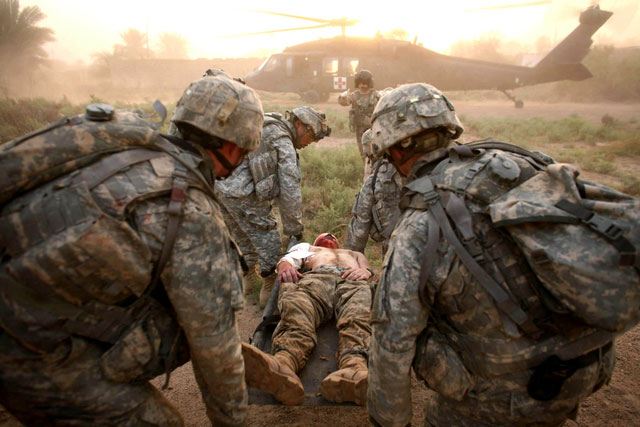
Iraq. Photo: Michael Kamber.

Gates announces temporary increase in U.S. Army
By David Morgan / July 20, 2009

WASHINGTON — U.S. Defense Secretary Robert Gates on Monday announced a temporary increase in the size of the U.S. Army that would boost the force by up to 22,000 troops for three years.

He told reporters at a news briefing that the increase, intended to cope with strains from the wars in Afghanistan and Iraq, would raise the total strength of the Army to 569,000 soldiers.

“The Army faces a period where its ability to deploy combat units at acceptable fill rates is at risk,” Gates told reporters. “This is a temporary challenge which will peak in the coming year and abate over the course of the next three years.”

The increase is smaller than a plan backed by Senator Joseph Lieberman, a Connecticut independent who sits on the Senate Armed Services Committee, which would have added about 30,000 troops to active duty.

The expansion was recommended by the Army’s civilian and uniformed leadership and strongly backed by President Barack Obama, Gates said.

The Pentagon plans to absorb an initial expansion cost of $1.1 billion through fiscal year 2010, which begins October 1, without additional funding from Congress. But Gates suggested more funds could be necessary in fiscal years 2011 and 2012.

“These additional forces will be used to ensure that our deploying units are properly manned and not to create new combat formations,” he said.

Gates authorized a permanent increase in U.S. Army strength soon after he became defense secretary in 2006, believing the largest branch of the U.S. military did not have enough forces to support heightened operations in Iraq and Afghanistan.

That increase, which was recently completed, boosted the Army’s size by 65,000 soldiers to 547,000. It also added 27,000 Marines to the U.S. Marine Corps.

MORE ‘DWELL TIME’

Gates’ decision to authorize a temporary increase comes as the U.S. military shifts its focus from Iraq to Afghanistan, where the number of U.S. troops is expected to reach 68,000 this year from about 32,000 at the end of 2008.

There are currently about 58,000 U.S. troops in Afghanistan and 130,000 in Iraq.

U.S. plans in Iraq call for a force reduction to between 35,000 and 50,000 troops by August 2010 and a complete withdrawal of U.S. forces by the end of 2011.

But Gates said the ongoing pace of Army operations, combined with changes in personnel policy, required a bigger force.

“The persistent pace of operations in Iraq and Afghanistan over the last several years has steadily increased the number of troops not available for deployment in the Army,” he said.

The U.S. defense chief told soldiers at Fort Drum in upstate New York last week that a temporary increase in the force’s size would help expand the period of time soldiers spend at home between deployments, known in military parlance as “dwell time.”

Longer dwell time is seen as vital to maintaining the morale of service members.

U.S. Army soldiers currently receive 12 months of dwell time after each 12-month deployment and Army officials want to extend that to two years.

The Army could move to 15 to 18 months of dwell time by mid-2010 when the Pentagon would withdraw an additional five or six combat brigades from Iraq.

Source / Reuters

Thanks to Diane Stirling-Stevens / The Rag Blog

Posted in RagBlog | Tagged , , , | 8 Comments

Houston : Walter Cronkite’s Map


Now it’s Dan’s

By Dan Earhart / The Rag Blog / July 20, 2009

Here is my work space. The map has no roads. I look at it every day. It used to hang in the KTRH newsroom in Houston during the 30’s when Walter Cronkite worked there. He would have looked at it every day too.

That’s my story.

[Dan Earhart is a former Houston newsman. CBS News legend Walter Cronkite who died Friday, July 18, at the age of 92, grew up in Houston where he was a reporter at the Houston Post and the Houston Press.]

The Rag Blog

Posted in Rag Bloggers | Tagged , , , , | 3 Comments

Refusing to Deploy : The Court Martial of Victor Agosto

Victor Agosto and Jackie at Under the Hood Cafe in Killeen, Texas. Jackie made the sign for Victor who is facing a court martial for refusing to deploy to Afghanistan. Photo by Alice Embree / The Rag Blog.

GI resisters need your help:
The court martial of Victor Agosto

By Alice Embree / The Rag Blog / July 20, 2009

See ‘Afghanistan War Resister to “Put the War on Trial,”‘ by Dahr Jamail, Below.

Victor Agosto will likely face a summary court martial this week that will send him to the Bell County Jail for a maximum of thirty days. His attorney, James Branum, said that the court martial may happen Tuesday or Wednesday. Victor has accepted the summary court martial and the military will not proceed with a special court martial, scheduled for August 12th, that carried a maximum sentence of one year.

Victor Agosto has resisted orders to deploy to Afghanistan, stating simply that, “The occupation is immoral and unjust. It does not make the American people any safer. It has the opposite effect.” The Rag Blog posted the first story on Victor’s refusal to deploy. Victor’s resistance has recently been covered extensively by Dahr Jamail in TomDispatch and Truthout, by Courage to Resist and the Socialist Worker, and has been picked up by German and Puerto Rican reporters. For complete coverage, go here.

What you can do right now is sign an online petition in support of Victor’s resistance.

Petition signatures are urgently requested to meet the timeline for submittal to Fort Hood. Attorney James Branum will submit the signatures to demonstrate widespread support for Victor as part of an 1105 Action that must take place within days after the court martial.

Letters of support are also needed. Letters in support of Victor Agosto should be addressed to the Commanding General at Fort Hood and e-mailed to Victor’s attorney.

In addition to supporting Victor Agosto’s resistance, you can support Under the Hood Cafe in Killeen, Texas, Victor’s home away from post. Under the Hood opened its doors in early February to provide a free speech zone for GIs, veterans, their families and supporters. The Melancholy Ramblers will be playing a special benefit performance in Austin for the Under the Hood, 6-8 p.m., Sunday, July 26th at the New World Deli, 4101 Guadalupe. For more information, visit the Under the Hood website.

If you are not in Austin, Under the Hood requests that you make a one-time donation, or even better a recurring donation, to keep the doors open for soldiers like Victor.

NATO soldier helps to land a helicopter in Afghanistan. Photo from AP.

Afghanistan War Resister to ‘Put the War on Trial’

By Dahr Jamail / July 14, 2009

U.S. Army Specialist Victor Agosto served a 13-month deployment in Iraq with the 57th Expeditionary Signal Battalion. “What I did there, I know I contributed to death and human suffering,” Agosto told Truthout from Fort Hood, in Killeen, Texas, in May, “It’s hard to quantify how much I caused, but I know I contributed to it.”

His experience in Iraq, coupled with educating himself about U.S. foreign policy and international law, has led Agosto to refuse to deploy to Afghanistan. “It’s a matter of what I’m willing to live with,” he said of his recent decision, “I’m not willing to participate in this occupation, knowing it is completely wrong.”

Agosto’s lawyer, James Branum, who is also the legal adviser to the GI Rights Hotline and co-chair of the Military Law Task Fore, told Truthout during a phone interview on July 10 that, contrary to mainstream opinion that believes Afghanistan to be a “justified” war, the invasion and ongoing occupation are actually in violation of the US Constitution and international law.

“Victor is approaching this from the standpoint of law and ethics,” Branum explained, “It’s his own personal ethics and principles of the Nuremburg Principles, that the war in Afghanistan does not meet the criteria for lawful war under the UN Charter, which says that member nations who joined the UN, as did the U.S., should give up war forever, aside from two exceptions: that the war is in self-defense, and that the use of force was authorized by the UN Security Council. The nation of Afghanistan did not attack the United States. The Taliban may have, but the nation and people of Afghanistan did not. And under U.S. Law, the Supremacy Clause of the US Constitution, any treaty enacted by the U.S. is now the “supreme law of the land.” So when the United States signed the UN Charter, we made that our law as well.”

The Supremacy Clause is a clause in the United States Constitution, Article VI, Paragraph 2. The clause establishes the Constitution, Federal Statutes, and U.S. treaties as “the supreme law of the land.” The text establishes these as the highest form of law in the American legal system, mandating that state judges uphold them, even if state laws or constitutions conflict.

This was also the basis for the stand taken by Lt. Ehren Watada of the U.S. Army, who in 2006 was the first commissioned officer to publicly refuse a combat deployment to Iraq.

In an article for Truthout published August 14, 2006, I posted the text of a speech given by Watada at a National Convention of Veterans for Peace in Seattle, Washington, where I was present.

Watada outlined the principled stand he took, which applies to that of Victor Agosto today:

“The oath we take swears allegiance not to one man but to a document of principles and laws designed to protect the people. Enlisting in the military does not relinquish one’s right to seek the truth – neither does it excuse one from rational thought nor the ability to distinguish between right and wrong. ‘I was only following orders’ is never an excuse.

“The Nuremburg Trials showed America and the World that citizenry as well as soldiers have the unrelinquishable obligation to refuse complicity in war crimes perpetrated by their government. Widespread torture and inhumane treatment of detainees is a war crime. A war of aggression born through an unofficial policy of prevention is a crime against the peace. An occupation violating the very essence of international humanitarian law and sovereignty is a crime against humanity. These crimes are funded by our tax dollars. Should citizens choose to remain silent through self-imposed ignorance or choice, it makes them as culpable as the Soldier in these crimes.

“Aside from the reality of indentured servitude, the American Soldier in theory is much nobler. Soldier or officer — when we swear our oath — it is first and foremost to the Constitution and its protectorate, the people. If soldiers realized this war is contrary to what the Constitution extols — if they stood up and threw their weapons down – no president could ever initiate a war of choice again. When we say, “…Against all enemies foreign and domestic” — what if elected leaders became the enemy? Whose orders do we follow? The answer is the conscience that lies in each soldier, each American, and each human being. Our duty to the Constitution is an obligation, not a choice.”

In a victory for Lieutenant Watada, the Justice Department decided in May to drop any further attempts to retry the officer for his refusal to deploy to Iraq.

Having served three years and nine months in the U.S. Army, Agosto was to complete his contract and be discharged on August 3, but due to his excellent record of service and accrued leave, he was to be released at the end of June. Nevertheless, due to the stop-loss program (a program used to keep soldiers enlisted beyond the terms of their contracts which has affected over 185,000 soldiers since September 11, 2001) the Army decided to deploy him to Afghanistan anyway.

When Agosto refused, the Army issued him a Counseling Statement (a punitive U.S. Army memo) on May 1, which outlined actions taken by the Army to discipline Agosto for his refusal to obey a direct order from his company commander, Michael J. Pederson. Agosto wrote on the form, “There is no way I will deploy to Afghanistan. The occupation is immoral and unjust. It does not make the American people any safer. It has the opposite effect,” and posted it on his Facebook page.

On another Counseling Statement dated May 18, Agosto wrote, “I will not obey any order I deem to be immoral or illegal.”

On May 27, rejecting an Article 15 — a nonjudicial punishment imposed by a commanding officer who believes a member of his command has committed an offense under the Uniform Code of Military Justice — Agosto demanded to be court-martialed instead.

In words prophetic of Agosto’s ethical and lawful refusal to deploy to Afghanistan, Watada said:

“I have broken no law but the code of silence and unquestioning loyalty. If I am guilty of any crime, it is that I learned too much and cared too deeply for the meaningless loss of my fellow soldiers and my fellow human beings. If I am to be punished it should be for following the rule of law over the immoral orders of one man. If I am to be punished it should be for not acting sooner.”

Agosto continues to show up for duty at Fort Hood in Killeen, Texas, where he is currently stationed, but refused to take part in any duties that supported either the occupations of Iraq or Afghanistan. He told Truthout during a recent telephone interview he was “cleaning the motor pool” and “pulling weeds,” and that the Army was being careful not to order him to do anything that would cause him to refuse to comply.

Meanwhile, Branum was in negotiations with the Army in efforts to seek a lower-level court-martial so that Agosto would suffer the minimum penalties possible.

“We were working with the Army’s Trial Defense Services (TDS), and Victor has a military lawyer on his side as well, which I recommended he have,” Branum told Truthout during a July 10 phone interview.

“TDS had communicated to the prosecution for me that we were willing to accept an Article 15 and do a month of extra duty, then if he (Agosto) got a summary court-martial we’d take it — which would mean Victor would serve a maximum of 30 days in jail, and receive an Other Than Honorable discharge,” Branum explained, “So TDS said they took this offer to the CG (Commanding General) who was to sign off on it, but they said he made a mistake and wrote “special” rather than “summary” on the court-martial and sent it back down.”

Branum explained that “a summary court martial is little more than an Article 15. Supposedly there was an “honest” mistake made by them handing down this special court martial, but I think they are playing games with us.”

Branum, angered by this recent turn of events, explained the difference between the types of court martial, “They (the Army) are not acting in good faith here. What this still means, is the cap went from 30 days (of possible jail time for Agosto with a summary court martial) to a year (with a special court martial), so a pretty big jump I would say, and a leap from an Other Than Honorable discharge (summary court martial) to a bad conduct discharge (special court martial), which means once he is convicted his pay would stop.”

Due to the perceived breach of good faith by the Army during the negotiating process, Branum believes he has no choice now but to up the stakes in Agosto’s upcoming court-martial.

“Now we’re going to put the war on trial with their special court-martial,” Branum said, “They had their chance to keep this quiet and move on, but now we’re going to pull out all the stops and put the war on trial, and show how the whole thing is illegal.”

The most significant factor in Agosto’s case is that he has taken a principled stand against the occupation of Afghanistan long before the “point of crisis,” according to Branum. The “point of crisis” to which he refers is generally an ethical crisis a soldier experiences when he or she is getting on the plane to deploy.

“He connected the dots long before that point of crisis,” Branum explained, “To me, this is a very morally developed point of view. Most resisters don’t reach that point until much later on.”

It is a similar point reached by Watada, who in the aforementioned speech precisely articulated this experience:

“Now it is not an easy task for the Soldier. For he or she must be aware that they are being used for ill-gain. They must hold themselves responsible for individual action. They must remember duty to the Constitution and the People supersedes the ideologies of their leadership. The Soldier must be willing to face ostracism by their peers, worry over the survival of their families, and of course the loss of personal freedom. They must know that resisting an authoritarian government at home is equally important to fighting a foreign aggressor on the battlefield. Finally, those wearing the uniform must know beyond any shadow of a doubt that by refusing immoral and illegal orders they will be supported by the people not with mere words but by action.”

Agosto spoke with Truthout on July 8, immediately after receiving the news of his “special” court-martial. “I was escorted over to the headquarters of Fort Hood and was handed a folder with the paperwork that said he (Commanding General Lt. Gen. Rick Lynch) approved this kind of court-martial. We were in the middle of negotiating a deal where I would have taken a summary court-martial, where the maximum penalty is 30 days in prison and an Other Than Honorable discharge. But somehow during this process someone submitted the case over to the general’s discretion, and that’ s not something that is supposed to happen in this negotiation phase. I’m surprised, because I thought this deal was going to go down last week and it didn’t. I was with my military lawyer, and we were talking about the case, and during that discussion she got the call from the prosecuting attorney that the case had been referred to the general, and then we knew it wasn’t likely we would get the deal I’d sign ed off on. So yesterday I went to the III Corps building and got the news.”

Agosto said he has “gotten the indication” that he will be leaving the company he is currently in to be moved to the Battalion’s rear-detachment company “because that’s the one that will stay here. I think they want to avoid a Jeff Paterson moment, I guess that’s their thinking. They won’t try to deploy me, they just want to punish me for my intentions and for what I’ve done so far.”

Jeff Paterson was a US Marine during the US attack against Iraq in 1991. Paterson opted to apply for conscientious objector status. When that was denied, he refused to board the plane that was heading to Saudi Arabia during the build-up to the war by literally sitting down on the tarmac and refusing to move. Eventually his unit left without him. Paterson told his story to Truthout last summer in Oakland, California.

“Leaving without me is what I thought they were going to do. I was a sort of liability. Also I had been on a hunger strike the previous week, and had at that point become a medical issue for them. So they left me behind, and I was taken instead to the Pearl Harbor brig, where I did the next two months in pre-trial confinement. I was court-martialed for a number of offenses. Ultimately they chose to cut their losses and give me a quiet discharge even before the court-martial ended.”

Agosto’s stand has already inspired another member of his unit to refuse to deploy to Afghanistan as well. Sgt. Travis Bishop, who served 14 months in Baghdad with the 57th Expeditionary Signal Battalion – the same battalion as Agosto, who served north of the Iraqi capital – recently went AWOL from his station at Fort Hood, Texas, when his unit deployed to Afghanistan. He insists that it would be unethical for him to deploy to support an occupation he opposes on moral grounds.

On his blog, he writes about his position:

“I love my country, but I believe that this particular war is unjust, unconstitutional and a total abuse of our nation’s power and influence. And so, in the next few days, I will be speaking with my lawyer, and taking actions that will more than likely result in my discharge from the military, and possible jail time … and I am prepared to live with that.”

Truthout spoke with him briefly after he turned himself in at his base in early June. He said he’d chosen to follow Specialist Agosto’s example of refusal, which had inspired him, and wanted to be present at his post to accept the consequences of his actions. Like Agosto, he, too, hoped others might follow his lead.

Agosto and Bishop are not alone. In November 2007, the Pentagon revealed that between 2003 and 2007 there had been an 80 percent increase in overall desertion rates in the Army (desertion refers to soldiers who go AWOL and never intend to return to service), and Army AWOL rates from 2003 to 2006 were the highest since 1980. Between 2000 and 2006, more than 40,000 troops from all branches of the military deserted, more than half from the Army. Army desertion rates jumped by 42 percent from 2006 to 2007 alone.

Branum, who has defended over a dozen war resisters, told Truthout, “As far as I know, this is the first time since Vietnam that we’ve had two resisters in the same unit.”

Adam Szyper-Seibert, a counselor and administrative associate at Courage to Resist, an organization that supports war resisters, recently told Truthout that “in recent months there has been a dramatic rise of nearly 200 percent in the number of soldiers that have contacted Courage to Resist.” Szyper-Seibert suspects this may reflect the decision of the Obama administration to dramatically increase efforts, troop strength and resources in Afghanistan. “We are actively supporting over 50 military resisters like Victor Agosto,” Szyper-Seibert says. “They are all over the world, including André Shepherd in Germany and several people in Canada. We are getting five or six calls a week just about the IRR [Individual Ready Reserve] recall alone.”

The IRR is composed of troops who have finished their active duty service but still have time remaining on their contracts. The typical military contract mandates four years of active duty followed by four years in the IRR, though variations on this pattern exist. Ready Reserve members live civilian lives and are not paid by the military, but they are required to show up for periodic musters. Many have moved on from military life and are enrolled in college, working civilian jobs, and building families.

Agosto told Truthout he stands willing to face the consequences of his actions.

“Yes, I’m fully prepared for this. I have concluded that the wars [in Iraq and Afghanistan] are not going to be ended by politicians or people at the top. They’re not responsive to people, they’re responsive to corporate America. The only way to make them responsive to the needs of the people is for soldiers to not fight their wars. If soldiers won’t fight their wars, the wars won’t happen. I hope I’m setting an example for other soldiers.”

“One who breaks an unjust law that conscience tells him is unjust, and who willingly accepts the penalty of imprisonment in order to arouse the conscience of the community over its injustice, is in reality expressing the highest respect for law,” Dr. Martin Luther King Junior said, words that concisely explain the ramifications of Agosto’s position.

As evidenced by the stand being taken by Sergeant Bishop, Agosto’s hope has already been realized. However, with 19,000 US soldiers recently added to the occupation of Afghanistan (bringing the total to 68,000) and violence continuing to escalate, there is an increasing likelihood for more to follow Agosto’s lead.

Source truthout

The Rag Blog

Posted in Rag Bloggers | Tagged , , , , , , | 4 Comments

‘For All Mankind’ : Remembering the Apollo Astronauts’ Epic Derring-Do

Al Reinert’s stunning ‘For All Mankind’ screens tonight as we observe the 40th Anniversary of man’s greatest adventure

By Thorne Dreyer / The Rag Blog / July 20, 2009

See ‘Tumbling Models: Some of “The Right Stuff,”‘ by Thomas Cleaver, and more about ‘For All Mankind,’ Below.

On July 20, 1969, exactly forty years ago today, Neil Armstrong and Buzz Aldrin bounded from Apollo 11’s lunar module onto the face of the moon, capturing the imagination of the world.

On May 25, 1961, JFK had proclaimed to a joint session of Congress that “this nation should commit itself to achieving the goal, before this decade is out, of landing a man on the Moon and returning him safely to the Earth,” startling those who would be expected to make this, the stuff of sci fi novels, actually happen.

But they came through in, shall we say, flying colors. Twenty four men in spacesuits would circle the moon and twelve would actually walk on its surface in an unprecedented act of cosmic derring-do — while consumating with a weightless flourish what many consider to be man’s greatest technological triumph.

Al Reinert’s 1989 classic film For All Mankind, a splendid documentary about the Apollo flights to the moon in the 60’s and 70’s, is showing tonight (Monday, July 20, 2009) on Turner Classic Movies (TCM) at 7:00 p.m. central time (check your local listings) — as we all observe the 40th anniversary of a singular event in our history: mankind’s first steps on the surface of the moon.

For All Mankind will be followed tonight on TCM by Philip Kauffman’s The Right Stuff, the theatrical movie about the Mercury 7 astronauts based on the Tom Wolfe novel. (See Thomas Cleaver’s remarks below.)

Reinert was (is!) my friend and colleague and I was involved peripherally (and at times not so peripherally) with the years-long development and production of For All Mankind. And the process was as impressive as the final product.

A screenwriter now living in southern California, Reinert is a Texas native who formerly worked as a reporter for the Houston Chronicle and a senior editor at Texas Monthly and as a widely-published freelance magazine writer.

For All Mankind was constructed from actual NASA footage — some of the most amazing documentary photography ever taken — combined with Reinert’s interviews with the Apollo astronauts. The photography, culled from a massive inventory of raw 8mm and 16mm footage — was chronologically reorganized to better tell this epic story.

The sum total was far greater than the parts, transformed by Al Reinert’s artistic vision (and ungodly perseverance and attention to detail), with a great assist from Brian Eno’s unearthly musical score.

Some of this utilization of NASA photography was pioneered by filmmaker William Michael Hanks in his documentary, The Apollo File, with which Reinert was originally involved.

For All Mankind was nominated for an Academy Award for Best Documentary in 1990, losing out to Common Threads: Stories from the Quilt, a film produced during the height of the AIDS epidemic which became a sentimental favorite among Hollywood insiders.

Reinert’s film was recently re-released in hi-def Blu-Ray and premiered before a packed and enthusiastic crowd at the Paramount in Austin during the recent South by Southwest (SXSW) music and film festival. A new Special Edition DVD has been released by Criterion and is available from Amazon.com.

Image from Philip Kaufman’s ‘The Right Stuff.’

Tumbling Models:
Some of ‘The Right Stuff’

By Thomas Cleaver / The Rag Blog / July 20, 2009

TCM’s showing of For All Mankind tonight, Monday, July 20, in widescreen letterbox, is being followed by a presentation of The Right Stuff. Check your local schedule for times.

The Right Stuff is not as good as it could have been (due to the fact that Phil Kaufman — the director — didn’t think the Mercury astronauts had “the right stuff”), but it still has its moments, and I always like that the X-1 and X-1A sequences were done the old-fashioned way, with models hanging on wires in a park in San Francisco, shot against the real sky, with CO2 being sprayed by a production assistant to create the “clouds.”

Also, the “hypersonic tumble” came when the FX supervisor was so frustrated that they couldn’t get it done with motion-capture that he threw the model out the fourth story window of the warehouse where the production offices were. Someone else saw that and said “Brian! It tumbled!” after which they spent three days throwing X-1As off the roof and filming them as they fell. The tumbling F-104 sequence is a series of old Hawk/Testors F104s hanging from balloons, with the film then run in reverse after they were shot rising.

The famous shot of the astronauts walking toward the camera in their space suits came when Phil Kaufman saw all the illegal immigrants who worked in the sweat shop down the hall coming out at the end of shift — so the astronauts are really walking out of a sweatshop in a warehouse in San Francisco.

(Memories from my first experience of working on a “big movie,” where my job was driving Chuck Yeager around and writing press releases for the Unit Publicist).

For All Mankind : ‘Visually Stunning’

There is no narrator spouting scientific facts or high tech jargon. Instead, Reinert blends together comments by thirteen of the original astronauts (others are glimpsed and heard in archival footage but no one is identified), sound effects and an appropriately eerie music score by Brian Eno.

There have been numerous books, films and documentaries on NASA’s Apollo space program from the bestseller Apollo: The Epic Journey to the Moon by David Reynolds, Wally Schirra & Von Hardesty to Ron Howard’s 1995 recreation of the Apollo 13 mission to HBO’s documentary mini-series From the Earth to the Moon (1998), but For All Mankind (1989) is easily the most visually stunning and unconventional approach to documenting the nine Apollo missions that occurred between 1968 and 1972.

Instead of taking a chronological approach, complete with talking head interviews in the style of most documentaries, filmmaker Al Reinert painstakingly reviewed six million feet of archival footage from the National Aeronautics and Space Administration’s holdings along with 80 hours of original interviews he had conducted and fashioned a hypnotic visual and aural experience as seen through the eyes of the astronauts.

There is no narrator spouting scientific facts or high tech jargon. Instead, Reinert blends together comments by thirteen of the original astronauts (others are glimpsed and heard in archival footage but no one is identified), sound effects and an appropriately eerie music score by Brian Eno.

The result is closer to an experimental film but one that is unmistakably a tribute to America’s foray into the international space race to the moon that was first set in motion by President John F. Kennedy’s September 12th speech in 1962; he vowed that the U.S. would land a spacecraft on the moon and that “it will be done before the end of this decade.” NASA accepted the challenge and it became a reality.

The Apollo space program was enormously costly — an estimation of several billion dollars would not be unlikely — and extensively documented in terms of the cameras that each mission was equipped with for photographing every aspect of the journey. As a result, For All Mankind could be considered the most expensive movie ever made when you consider what it cost to produce all the footage that NASA ultimately acquired.

Reinert recalled, “I began interviewing the Apollo astronauts in 1976. They were mostly retired astronauts by then, changed men, excerpts from the tapes constitute the major part of the soundtrack of For All Mankind. The movie thus speaks with the intimate voice of personal experience.”

He added that “The astronauts went into space carrying movie cameras ’16mm data-acquisition cameras’ \which they reached for reflexively, like tourists, whenever they saw something surprising or spectacular or merely important. They saw such things almost continually. As a result, they brought back thousands of feet of amazing film, perhaps the most extraordinary footage ever shot by human beings.”

— from the Criterion Collection DVD liner notes for For All Mankind.

For All Mankind:

Oscar-nominated documentary is a bold meditation on discovery, courage and perseverance

By Randy Miller III / July 14, 2009

As a bold meditation on discovery, courage and perseverance, Al Reinert’s For All Mankind (1989) truly stands in a class by itself.

This Oscar-nominated documentary chronicles the Apollo space missions of the 1960s and 1970s from a decidedly different perspective: the human one. Replayed reels of grainy stock footage have trained us to assume that the historic 1969 moon landing was distant, desolate and almost difficult to believe — but within this warm atmosphere, it feels as perfectly natural as a home movie.

Though relatively short at only 80 minutes, For All Mankind was assembled from an enormous surplus of 8mm and 16mm footage held in NASA’s archives for nearly two decades. This footage was routinely recorded for posterity, yet the majority of it had yet to be seen by the general public.

For All Mankind‘s subtle flow tricks us into thinking we’re only watching one mission, but its deception shows us the big picture instead: this odyssey was about more than one moment, one journey or one crew; it was about the dedication of all involved, not to mention the overwhelming scope of the space program in general. Such a “discovery,” for lack of a better term, helped to define an entire generation — and like it or not, the accomplishment has yet to be equaled, let alone bettered.

In more ways than one, this broad assortment of material (carefully pieced together by Reinert, with the help of NASA film editors Don Pickard and Chuck Welch) is presented in its most affecting and appropriate form: as a loose but focused narrative, with an abstract beginning and end. Many smaller beginnings and endings were undoubtedly left on the cutting room floor, but it’s all for the best; For All Mankind wouldn’t be half as effective if it were approached in a less artistic manner.

Told in the words of several Apollo astronauts (including James Lovell, Jack Swigert, Ken Mattingly, Michael Collins and others), For All Mankind relies on monologue almost as much as visuals. Much of the audio we hear was recorded right on location — and while it’s potent enough in its own right, the retrospective comments are even more effective.

These astronauts’ enthusiasm is only matched by their humility: they were certainly excited to be part of history, but their respect for the danger involved helped to keep them in check. We can’t blame them, however, for skipping happily across the lunar surface or goofing off in zero gravity; after all, it’s not like we wouldn’t do the same thing. For All Mankind is a sincere and reverent experience, to be sure, but the film’s infectious joy is one of its greatest strengths.

Brian Eno’s score remains another highlight, whether it blends into the background or boldly steps forward. It’s paired perfectly with the film’s abstract flow and editing style, creating a natural but dreamlike atmosphere that works wonderfully. Still, the footage itself is the most effective element: the humbling nature of these visuals, especially with the realization that they’re 100% genuine, really puts things in perspective. Modern documentaries like Planet Earth have given us a greater understanding of the world around us, but the striking simplicity of a desolate lunar landscape is something else entirely.

For All Mankind may be light from a technical perspective, but that’s not the film’s intent: this is more of a spiritual experience than a science lesson. Those looking for a more detailed, analytical rundown of the Apollo missions have plenty of other options to choose from — but for everyone else, For All Mankind remains a definitive document of our first trip to the moon and back.

Originally presented on DVD by Criterion in 2000, For All Mankind wasn’t the company’s most practical release, especially taking its $40 price tag into account: not only were the film’s grainy visuals a tough sell for videophiles, but the short running time and light amount of extras didn’t help matters either. Nine years later, they’ve attempted to create a more attractive package. Boasting a newly-minted transfer, a pair of new featurettes and a lower price tag, this new reissue of For All Mankind is the clear winner from a new buyer’s perspective…

[Read the rest of this review, including technical details and info about features on the new DVD release at DVDTalk.com.

The Rag Blog

Posted in Rag Bloggers | Tagged , , , , , , , , | 1 Comment

The Health Care Stories for America Blog

Not only can you read the stories, but write one yourself on this website. It also recognizes your zip-code location when you link up so you get the immediate stories that are in and around your location. When you read some of the stories about each person’s individual medical condition and difficulty with either their insurance carriers or the fact they have no health-care, it truly gives you an idea just how difficult it is for millions.

Diane Stirling-Stevens / The Rag Blog


Nancy, Mercer Island, WA

Dear President Obama,

I am a nurse and work full time. I do not want shareholders on Wall Street determining the care that my patients get. Insurance companies, themselves, are driving up the cost of medicine. I am spending too much time on the phone with them, negotiating for the care the doctors have prescribed. This means that the clinic overhead is increased by paying wages for nursing time on the phone, when we should be with patients.

A worker at Humana Insurance told me recently that they had hired 200 more workers to talk with clinics and hospitals. Insurance companies have legions of gatekeepers who override doctor’s decisions. If this doesn’t drive up cost I don’t know what does.

What I want, as a nurse and a patient, is one set of criteria, one set of rules, one form, one card, one web site to understand, one set of medical records and one insurance card that will allow my care anywhere in America.

  1. It needs to cover EVERYONE, because if a poor uninsured child or mother gets on a bus with the flu…..we all get it! This contributes to pandemics.
  2. It needs to be GUARANTEED so that someone with breast or prostate cancer does not find themselves without insurance because there insurance was rescinded to insure more money for shareholders.
  3. It will cover all, regardless of age, preexisting disease, or income.
  4. Make it COMPREHENSIVE for inpatient and outpatient needs, prevention, medicines, long term care, mental health, dental, vision, hearing, durable medical, ambulances, etc.
  5. The money needs to be directed to health care services, not to middlemen and shareholders. THIS WILL REDUCE COST.
  6. Each citizen should have ONE CARD with each person’s medical records in a chip. This way, you may take it to any doctor or any hospital in America. This helps to reduce mistakes and to coordinate care.
  7. Disallow prescription medication ads. I want my injured worker to get care for his diabetes, rather than only his right leg and low back. “A healthy man has a thousand wishes; a sick man has only one.” [Slovenian proverb]

I have a kidney transplant. If I lost my job tomorrow, I would have no insurance to cover my immuno-suppressant drugs. Without these medicines, I would end up back on dialysis which would be far more costly than my medicines. We need single payer health care.

Thank-you,
Nancy Hewitt Spaeth,BE RN
Mercer Island, Washington

Source / Health Care Stories for America

Many thanks to Diane Stirling-Stevens / The Rag Blog

Posted in RagBlog | Tagged , , | 3 Comments

Marijuana : It’s High Time to Tax the Pot Crop

It’s time for the government to cash in on the marijuana crop.

Time to tax marijuana

[With] budget deficits and a worsening recession, it only makes sense to stop spending money to fight marijuana use and start taxing that use to help balance both state and federal budgets.

By Ted McLaughlin / The Rag Blog / July 19, 2009

California recently thought they had fixed their financial problems on the state level, but they were wrong. The state government is still experiencing a huge shortfall in income. There are some in the state who believe it is time to legalize marijuana and tax it to help solve their financial crises.

Using the quantity of marijuana seized by authorities last year as a guide, it is estimated that the marijuana crop in California last year was worth about $17 billion. Personally, I think that’s a very conservative estimate. But even using the government’s $17 billion figure, that dwarfs any other agricultural crop in the state.

The top tax collector in the state says if they tax marijuana just like they tax liquor, the state could collect taxes worth $1.3 billion. That would solve California’s deficit problem. But California is not the only state with a huge marijuana crop or deficit problems. Most states, especially in the West and South, have large illegal crops of marijuana. Marijuana can even be grown as far north as Alaska, as we found out a few years ago when it was legal for a while there.

Frankly, it is time for the federal government to legalize marijuana. While marijuana alone could not pay off the federal deficit, it could be used to keep that deficit from growing larger. Currently, the federal government is searching for ways to pay for health care reform and a public health insurance system. Why not put a substantial tax on marijuana? It could be taxed even more heavily than alcohol, and most users would gladly pay it. A marijuana tax could pay a substantial portion of health care reform.

The only reason marijuana is illegal is because of many years of government propaganda — most of it either wrong or outright lies. The fact that the government still classes marijuana as though it were a dangerous drug like heroin or cocaine or methamphetamine is ridiculous. The truth is that marijuana is far less dangerous than either alcohol or tobacco — both of which are legal (and should remain so). Furthermore, many many deaths can be attributed to alcohol or tobacco each year in America, while not one death can be attributed to marijuana.

There is a myth that marijuana is a “gateway” drug — that users of marijuana will go on to use more dangerous drugs. That is simply a lie. If it has even a small gateway effect, it is because a user quickly learns the government has been lying to him/her about marijuana use. They then wonder what other drugs the government has been lying about. Separating marijuana from the other drugs and legalizing it will kill this small gateway effect caused by government lies.

Millions of honest hard-working tax-paying Americans use marijuana on a fairly regular basis. They do this even though the plant is illegal. They don’t break any other laws. They don’t steal from or hurt any other people. Why do we want to criminalize and punish these people? They just want to make their own choices about their own lives. For some marijuana is a stress-reliever or a sleeping aid, while others just use it recreationally.

Criminalizing and punishing these people actually hurts our country without accomplishing anything positive. We must not only pay for their incarceration, but once they have a record and have difficulty finding work because of that, they are much more likely to actually participate in criminal behavior — behavior that actually would be harmful to persons or property.

Our attempt to enforce this second prohibition has been as big a failure as the first one was. In the twenties and thirties, we found that people would use alcohol whether it was legal or not. Making it illegal simply gave organized crime a big payday — so big they were killing each other to control it. Marijuana (and other drug) prohibition has done the same. People are going to smoke marijuana whether it is legal or not. Isn’t it time to take this money out of the hands of the drug gangs?

We have spent hundreds of billions of dollars on the so-called “war on drugs,” and it’s been like throwing that money away because nothing has been accomplished. The drug war has been an abysmal failure, and anyone thinking clearly can see that. A good start to fixing this problem would be the legalization of marijuana. We might even find fewer people willing to try the illegal drugs if marijuana were legal.

In a time of budget deficits and a worsening recession, it only makes sense to stop spending money to fight marijuana use and start taxing that use to help balance both state and federal budgets.

[Rag Blog contributor Ted McLaughlin also posts at jobsanger, an excellent Texas political blog.]

The Rag Blog

Posted in Rag Bloggers | Tagged , , , , | 8 Comments

David Zeiger : This is Where We Take Our Stand

Episode One : For Those Who Would Judge Me

This is Where We Take Our Stand
A web series about Winter Soldier

By David Zeiger / The Rag Blog / July 18, 2009

I am more than pleased to announce to Rag Blog readers that the web series produced by Bestor Cram and me about last year’s Winter Soldier Iraq and Afghanistan Investigation is finally starting. Throughout the summer we will be posting six episodes of This is Where We Take Our Stand, one every two weeks, at www.thisiswherewetakeourstand.com. Episode one is available now, along with the trailer for the series, and I want to urge all of you to not only watch but post, promote, and help spread the series throughout the internet.

Why this series, and why now? you may ask. Good question. Last year we spent three months following and filming the complicated, intense and emotional process of bringing two hundred and fifty veterans and active duty soldiers to Washington, DC, to expose the realities of America’s occupations of Iraq and Afghanistan from their own experience. With strong support from the antiwar and progressive funding community, we hoped and expected to have a film available in six months. But surprise! Along came Barack Obama and suddenly that support was dust in the wind. I won’t go into details — I think you know the reasons.

In my view, there is no better time than now to present this series. In the name of “not looking backward,” the very policies and strategic goals put in place by the Bush administration in the Gulf region stand fundamentally unchallenged and unchanged by the Obama administration. Am I overstating the case here? Yes, the rhetoric is different, and Obama has even called the invasion of Iraq a mistake. A mistake?! If it’s a “mistake,” that means the goals are valid and righteous, they’re just being pursued with the wrong tactics-as Obama has repeatedly said in the name of “supporting the troops.”

Well, I beg to differ. At the risk of stating the obvious, if these wars were illegal and immoral under Bush, by what logic are they not illegal and immoral under Obama?

Below is the statement about the series written by Bestor and me. I hope that our series will do a little to rattle the sleep out of many people’s eyes, as these occupations continue and, in the case of Afghanistan, expand. Please help us make that happen.

[David Zeiger is an award-winning film producer and director whose highly–acclaimed film Sir! No Sir! documented the little-known GI resistance to the Vietnam War. His production company is Displaced Films.]

This is Where We Take Our Stand:

The series that tells the riveting and timely story of the hundreds of Iraq and Afghanistan veterans who testified at last year’s Winter Soldier investigation, has now begun. We hope to reach thousands, even millions worldwide as the six episodes are released throughout the summer:

  • Episode One: For Those Who Would Judge Me available now. See above or click here.
  • Episode Two: Rules of Engagement will launch July 27, 2009.
  • Episode Three: Why We Fight will launch August 10, 2009.
  • Episode Four: Broken Soldier will launch August 24, 2009.
  • Episode Five: This is Not Human Nature will launch September 7, 2009.
  • Episode Six: No Longer a Monster will launch September 20, 2009.

Where’s the debate?

Are we watching passively while Barack Obama carries out the same policies as George W. Bush?

When an American bombing raid this May killed over two hundred civilians in a village in Afghanistan, it was met with a deafening silence. When Obama’s promised “withdrawal” from Iraq leaves 130,000 troops there for at least two more years and 50,000 permanently, it’s hailed as an end to the occupation. And who is demanding to know just what the mission really is when 30,000 more troops are sent to Afghanistan?

Where’s the debate?

In March of 2008, two hundred and fifty veterans and active duty soldiers marked the fifth anniversary of the invasion of Iraq by gathering in Washington, DC, to testify from their own experience about the nature of the occupations of Afghanistan and Iraq. It was chilling, horrifying, and challenging for all who witnessed it. Against tremendous odds, they brought the voices of the veterans themselves into the debate. That was then.

This is now. Today, we present to you This is Where We Take Our Stand, the inside story of those three days and the courageous men and women who testified. And we present this story today, told in six episodes, because we believe it is as relevant now as it was one year ago. Maybe more.

Here is our challenge to you: Watch the series; spread it far and wide; and ask yourself, Is this about the past, or the present and future? Then add your voice.

If you are a veteran or active duty, present your own testimony. If you are not, but you are still a living, breathing member of the human race, then do whatever you can to join and fan the flames of debate.

– Displaced Films and Northern Light Productions

The Rag Blog

Posted in RagBlog | Tagged , , , , , | 14 Comments

The Demand Crisis and the Wall Street Pirates. Aaaargh!


The Demand Crisis

We could demand that all the pirate trunks of ‘toxic assets’ be loaded onto flatbed trucks and driven back to California where they belong. Overnight, California would need no more IOU’s.

By Greg Moses / The Rag Blog / July 17, 2009

They tell us we’re experiencing a crisis of demand, but they have a backward idea of it.

To turn the picture right side up, we begin with the biggest lesson from the financial sucker punch hitting workers of the world this year — human value comes from having real work to do.

Today’s value crisis hits hardest where profits — and this is why they are called earnings — are failing to produce new tools. This is the demand crisis. Our demand that leaders take better care of the people’s tools has not been heard.

Of course, as the great London philosopher sez in Capital Volume One, tools are contradictory things. The better tools get, the fewer workers needed per unit. Hence the labor-management contradiction. Hence the iron law of social revolution. Dearborn, then and now. Once you start making better tools you can’t help but create — what shall we call it? Change?

And the big problem with change is that people try to go around or over or under or WITHOUT the progressive re-production of tools. No new tools, no real change.

Capitalism is of course the holy system which speaks the language of the Gospel and promises to keep tool making dynamic and efficient so that value flies up from work. And it does have a metaphysical charm owing to our impression that profit and tools derive from some conjoined living form.

The great San Francisco economist Henry George said interest payments are legitimate social demands because the wealth we put back into tools needs to grow like anything else. Of course any living thing can demand disgusting amounts of fodder and grow to obscene proportions on that basis, but it should not use the words of Henry George as an excuse for that.

Now, if we are consistent in our terminology here, we could say that anyone who kills the living conjunction between earnings and tools can be considered anti-capital. But if we were consistent in just this way, we would demand triple damages from Wall Street for a trillion or more anti-capital crimes.

Instead of consistent terminology, however, what we are getting fed these days is nonsense soup. For example, in my home there is an electric soap box where people sit for hours yammering about how outraged they are at outsized cash payments going to workers at institutions who once made a contest of stashing wages and profits into silos that nobody can find.

Well, who was it let go of that money in the first place? Who should demand it back? Predatory lending is piracy. Predatory lending that inflates a mortgage bubble is piracy. To find pirates, you don’t have to go all the way to Tortuga or Mogadishu.

Today there is some question about how to value “toxic assets” that derive from predatory debt. But there’s a simple way to value the cost of such piracy. How much would it cost to give every penny back?

We can solve this demand crisis in at least two ways. First, we could demand that all the pirate trunks of “toxic assets” be loaded onto flatbed trucks and driven back to California where they belong. Overnight, California would need no more IOUs.

Or second — because to be honest about it we secretly admire pirates and sometimes find ourselves dreaming that we could join them — we can demand that all these big-bonus banking houses show us how they are putting their talents to work funding the next generation of tools that we have been needing as a nation since about this time last year.

We demand that they assist California, too.

Meanwhile, we know what the yammering soap boxers want us to believe about the demand crisis. They want us to believe anything really that will keep us from connecting the dots. In that direction there’s a demand crisis, too.

[Greg Moses is editor of the Texas Civil Rights Review. He can be reached at gmosesx@gmail.com.]

The Rag Blog

Posted in Rag Bloggers | Tagged , , , , | 5 Comments

Through the Windshield

Seen at the corner of E. 12th St. and Pleasant Valley Rd., in Austin, Texas,
an unlikely art sale. Perhaps it’s the heat…
Mariann Wizard

The Rag Blog

Posted in Rag Bloggers | Tagged , | 4 Comments

John Ross on the Mexican Elections : The Dinosaur is Back


Jurassic fallout from the Mexican election:
The dinosaur is back, but for how long?

By John Ross / The Rag Blog / July 16, 2009

Also see ‘No more environmental pretensions: The Green PRI,’ By John Ross, Below.

MEXICO CITY — Nine years ago on a sultry July morning, Mexicans woke up and discovered to their great amazement that the Dinosaur that had hunkered down at the foot of their beds for 71 years was gone. This July 6th, when Mexicans rose in the morning, the Dinosaur was back.

In the famous short poem by Augusto Monterroso, the Dinosaur is the PRI — the Institutional Revolutionary Party — once the longest-ruling political dynasty in the known universe that controlled the destiny of Mexicans from the cradle to the grave for seven interminable decades until it was dislodged from power by the right-wing PAN party in the July 2000 presidential elections.

In its unslakable thirst for power, the PRI committed unspeakable crimes against the Mexican peoples, stealing elections from the most humble city hall to the presidential palace, jailing and torturing and executing those who stood in its way, and emptying out public treasuries in an unmatched kleptocracy that was a legend throughout Latin America, “the perfect dictatorship” Latin American novelist Mario Vargas Llosa once dubbed it (for which the PRI had him tossed out of the country.)

“Have we Mexicans lost our memories and our minds?” asks Sylvia Insulza from behind the counter of her newspaper dispensary in the old quarter of the capital. Tears of frustration crystallize in the corners of her eyes.

The depth and breadth of the PRI victory July 5th is nothing short of stunning. From a distant third place finish in the 2006 presidential fiasco in which the rightist PAN stole the election from Andres Manuel Lopez Obrador (AMLO) and his left-wing PRD party by .57% of the popular vote, the PRI (“proven experience and a new attitude” is its current campaign slogan) took 37% of the total ballots cast, nearly doubling its votes three years back, and taking control of congress for the first time since 1997.

The once-upon-a-time ruling party’s alliance with the so-called Mexican Green Environmental Party (see story below) will give it 259 seats out of 500 in the lower house, an absolute majority. In nine out of 31 states, the PRI won every office up for grabs — federal congressional representatives, local congresses, and municipal officials, a “carro completo” or “full car” in the Institutionals’ curious lexicon.

The Dinosaurs also proved triumphant in five out of six governors’ races, winning two statehouses in which the PAN had resided for 12 years. Only in the northern border state of Sonora where the PRI governor was seen as complicit in the tragic incineration of 48 babies in a Hermosillo day care center a month before the election, was the PAN able to squeeze out a victory in an election in which the PAN and PRI candidates were cousins.

Moreover, the PRI won cities like Naucalpan, an upper middle class Mexico City suburb the right-wingers have controlled since the 1980s, and the nation’s second city, Guadalajara, which the PAN has owned since 1995. In alliance with the Mexican Green Environmental Party, the PRI won its first elected office in Mexico City since 1994. Although the left PRD maintains control of the nation’s capital, the Party of the Aztec Sun does so by a greatly reduced margin. Whereas the PRD registered 51% of the vote in Mexico City in 2006, three years later it weighs in with just 29%.

But Sylvia’s tears of frustration may soon dry. Whether the Dinosaurs are really back or just staying overnight (in Jurassic time) is not yet clear. Mid-term elections are referendums on the sitting president and his administration’s management of the country and July 5th represented a crushing vote of no confidence in Felipe Calderon on whose watch the economy has tumbled into freefall — “growth” in 2009 will measure a negative 8%, the worst slide since the Great Depression of 1929-32.

Calderon, who campaigned as the “President of Employment” has presided over the loss of 2,000,000 jobs. The president’s ill-advised war on the drug cartels has soaked the country in blood — over 12,000 lives have been lost — and fueled corruption and human rights abuses on the part of the military and the police. Calderon’s panic-driven handling of this spring’s Swine Flu “PAN-demic” kicked the bricks out from under the tourist industry, the nation’s third source of dollars, and his arrogant imposition of candidates in the July 5th vote-taking angered and turned many in his own party against him.

Ceding the PRI a 10-point advantage (37% to 27%) in the national vote and the loss of congress to the Institutionals’ absolute majority effectively shuts down Calderon’s legislative agenda. Indeed the PANista may be the weakest president in a century — no Mexican president since the 1910-1919 revolution has ever ruled with the opposition holding an absolute majority in the lower house. Felipe Calderon will be a lame duck for the next three years — in real terms, his presidency ended July 5th.

One of the first casualties of the debacle was PAN party president German Martinez, a creature of Calderon, who tossed in the towel the morning after his party’s most devastating defeat since its founding in 1939. Similar demands for the resignation of PRD president Jesus “Chucho” Ortega, who orchestrated the left party’s worst showing since 1991, are legion.

The Party of the Aztec Sun plummeted from 38% of the national vote in 2006 when Lopez Obrador was at the top of the ticket, to just 12% three years later and its congressional delegation was decimated, retaining only 71 seats out of the 126 it held in the outgoing legislature. Cities in the misery belt girdling the capital such as Nezahualcoyotl, Chalco, and Ecatepec with a total population of 6,00,000 that have been in the PRD’s pocket for years fell to the Dinosaurs.

Despite hanging on to its hegemony in the capital, the PRD lost four out of 16 delegations or boroughs for the first time since it took power here in 1997 although the leftists still have a commanding advantage in the local legislative assembly. In the battles for the delegations, the PAN picked up three of the wealthiest enclaves in the city and the tiny Party of Labor won the megalopolis’s biggest and poorest demarcation — Iztapalapa — by ten points after Ortega and his co-conspirators persuaded the nation’s top electoral court to substitute their candidate at the last minute for one supported by Lopez Obrador.

AMLO responded by mobilizing his considerable base, including the “Adelitas,” hundreds of working women dressed in the outfits of women soldiers during the Mexican revolution, who last year fended off the privatization of the state oil monopoly PEMEX with a campaign of civil disobedience. Adelitas like Berta Robledo, a retired nurse, descended on Iztapalapa walking the precincts day after day to expose the flimflam and support Lopez Obrador’s candidate, a local soccer coach everyone knows as “Juanito.” Now, with Iztapalapa under his belt, AMLO, the once-wildly popular Mexico City mayor who still styles himself as “the legitimate president of Mexico,” has forcibly demonstrated that he is still very much a factor in Mexican electoral politics.

Despite the PRI Dinosaur’s big numbers, it was the Party of No that was the hands- down winner July 5th. Absenteeism hovered between 55 and 60% in the south and center of the country and in northern states like Chihuahua and Baja California where Calderon’s drug war rages, only 25 to 30% of the electorate went to the polls. A national movement to cast protest votes or deface ballots with no-holds-barred slurs against all the political parties, gained resonance throughout the country. The number of “votos nulos” cast doubled from 3% in 2006 to a shade under 6%, and in Mexico City, the votos nulos multiplied by 400% to 10 to 13% of the vote. This reporter observed one disgusted voter in a neighborhood polling place here in the old quarter of the capital angrily ball up his unmarked ballot and cram it through the slot in the “urna.”

Because a recount must be ordered when the number of votos nulos exceeds the margin of victory between the first and second-place finishers, ballot boxes had to be opened and counted out vote by vote in as many as 27,000 out of 140,000 polling places. Indeed, the number of votos nulos — 1.8 million (a half million cast in Mexico City and Mexico state alone) — establishes the Nulos as the fifth electoral force in the country behind the PRI, PAN, PRD, and PVEM but ahead of the PT, Democratic Convergence, New Alliance, and the Social Democrats (who, failing to win 2% of the national vote, lost their registration.)

On the Mexican political calendar, the conclusion of mid-term elections signals the kick-off for the next presidential race three years down the pike in 2012. The big pro-PRI turnout puts the Dinosaurs in the driver’s seat to recover Los Pinos, the Mexican White House, which it held hostage from 1928 through the new millennium.

At this fledgling stage, the PRI frontrunner is Mexico state governor Enrique Pena Nieto, a short, pretty boy politico with deep pockets, a trademark pompadour, and a glamorous soap opera star (Angelica Rivera AKA “The Seagull”) on his arm — Pena Nieto, who Lopez Obrador labels “a male Barbie,” is a darling of Mexico’s two-headed television monopoly, Televisa and TV Azteca.

The governor’s resounding sweep of Mexico state municipal (97 out of 125 city halls) and federal elections in the nation’s most populous and economically active state puts him double digits above his closest rival, Manlio Fabio Beltrones, the leader of the PRI’s senate delegation, and a Mafia-like political boss who is often mocked as “Don Beltrones.” The “Don” is a longtime crony of the much-reviled Carlos Salinas, the former president who fell into public disgrace after his brother was imprisoned for masterminding the gangland execution of a political rival. The return of the Dinosaurs marks a possible revival of Salinas’s fortunes. The bald-pated, big-eared former chief of state was pictured depositing his ballot in a large, front-page El Universal photo July 6th just to remind readers who exactly was back.

Also in the mix for the PRI nomination is the voluminous party president Beatriz Paredes, a Dinosauress whose wardrobe contains a different hand-made Indian huipil (a loose-fitting muumuu-like gown) for every day of the year.

To add to Felipe Calderon’s woes, the PAN has no “bueno” or fair-haired boy in the pipeline to succeed him as president — his young protégé, Juan Camilo Mourino, the recently-appointed Interior Secretary, was killed last November in a mysterious Mexico City air crash after returning from overseeing drug war operations in the north. The PAN’s affairs are managed by a council of aging elders who appear reduced to recycling bland party hacks like Senator Santiago Creel, hardly one of the premium numbers on Calderon’s cell phone dial.

Who the PRD nominee will be depends largely on how long Jesus Ortega’s chokehold on the party is allowed to continue. Bloodied by the July 5th debacle, the chief Chucho seems determined to compound his party’s misery by expelling Lopez Obrador from the PRD on the grounds that he violated the by-laws by backing the PT in Iztapalapa. AMLO remains the most popular — if polemical — politico in Mexico with powers of convocation that far exceed any other party’s front-running candidates. Having insured that the PT and Democratic Convergence retained their registration by endorsing their candidates, Lopez Obrador guaranteed himself a place on the 2012 ballot even if Ortega is successful in expelling him from the PRD.

El Peje as he is affectionately called will no doubt face-off against his successor as Mexico City mayor, Marcelo Ebrard, a strapping, well-spoken but distinctly uncharismatic politician, for the votes of Mexico’s leftists in 2012.

Despite its abysmal showing July 5th, the Mexican Left by whatever initials it shows itself is hardly down for the count. The PRI’s overwhelming win at the polls only represents 16% of 77,000,000 registered Mexican voters when absenteeism and votos nulos are factored into the July 5th results. The Dinosaurs staged a modest congressional comeback in 2003 mid-term elections only to be steamrolled by AMLO and Calderon in 2006. Failure to cope with continuing economic and social turmoil and the predictably polluted performance of PRI elites like the Salinas clan that seem to exult in political mayhem and armed thuggery, are bound to revive left fortunes in the next three years.

According to evolutionists, the dinosaurs went extinct 60,000,000 years ago either because a giant asteroid plunged into the Atlantic Ocean off the Yucatan peninsula lowering world temperatures by ten degrees, or because climate change so thinned out the oxygen count that the dinosaurs’ huge respiratory systems no longer functioned. As climate change once again threatens Planet Earth, the comeback of the PRI dinosaurs will, no doubt, be short-lived.

Photo from AFP.

No more environmental pretensions:
The Green PRI

By John Ross / The Rag Blog / July 16, 2009

The Mexican Green Ecologist Party or PVEM, which will partner with the PRI to form an absolute majority in the lower house of congress (259 out of 500 seats), is a wholly-owned subsidiary of the Gonzalez Torres family. Founded by father Jose Gonzalez Torres, a wealthy construction tycoon, with ample investment from brother Victor, the king of the largest chain of generic pharmacies in Mexico, the party is presided over by Jose’s young scion, Jose Emilio Gonzalez, dubbed “El Nino Verde” or “The Green Child.”

Although the PVEM touts its roots in Mexico’s growing environmental movement — the elder Gonzalez Torres was a player in the failed fight to shut down Laguna Verde in Veracruz, Mexico’s only nuclear power plant, and active in protests against Mexico City’s killer smog in the late 1980s — the Gonzalez Torres clan soon discovered that juicy government subsidies to Mexican political parties could pump up family fortunes.

First aligned with the leftist PRD and subsequently with the right-wing PAN, Gonzalez Torres had his sights set on becoming environmental secretary after the election of PANista Vicente Fox in 2000 but when he was passed over for the post, he delivered the PVEM to the PRI with which he has lined up ever since.

Having abandoned its environmental pretensions, the only green the Mexican Green Environmental party has pursued in recent years is the long green of filthy lucre. In 2004, the Nino Verde was secretly filmed soliciting a seven-figure bribe from developers keen on trashing the coastline of Caribbean Cancun. Scant days before the July 5th shakedown, a PVEM senator was nabbed at a Chiapas airport with a million pesos bundled up in his carry-on baggage.

The centerpiece of the Green Party’s July 5th campaign was the restitution of the Death Penalty, which earned it the condemnation of European-based environmental parties and the PVEM has been excommunicated from the Global Greens Network. During the run-up to the recent elections, political cartoonists substituted a vulture for the party’s colorful emblem, a toucan.

As the PRI’s partner in crime in the new legislature, reintroducing the death penalty will be the big enchilada on the PVEM’s plate. The “Greens” are also expected to lobby for rescinding electoral reforms that deprived Televisa and TV Azteca of millions in political advertising revenues in the prologue to the July 5th mid-terms — the reforms were introduced after the broadcasting giants abused the use of television and radio spots in the 2006 presidential election. To this end, Ninfa Salinas Pliego, daughter of the owner of TV Azteca, has been named to head the PVEM bench in the incoming congress.

[John Ross is an American author, poet, freelance journalist, and activist who lives in Mexico City. John Ross will present Iraqigirl, the diary of a teenager growing up under U.S. occupation in northern Iraq, at 7 p.m on July 30th at Modern Times Bookstore, 888 Valencia Street in San Francisco’s Mission District. Ross developed and edited the Haymarket Books volume.]

The Rag Blog

Posted in Rag Bloggers | Tagged , | Leave a comment

Freedom of Choice : No Nanny State

The Marlboro Man: The picture of Lance Cpl. James Blake Miller, now an Iraq War vet, raised a stink among anti-smoking activists when it appeared in scores of newspapers in 2004. Photo by Luis Sinco.

It does not matter whether it’s the right trying to force religion on me or the left trying to force ‘healthiness’ on me — it is tyranny either way, and I categorically reject it.

By Ted McLaughlin / The Rag Blog / July 16, 2009

Anyone who has read very many of my posts knows that I hate conservatives who want to force everyone into accepting their own particular religious and political beliefs. But some may be surprised to learn that I hate the “nanny state” liberals equally as much.

To me, freedom means having the ability to make my own choices, and allowing everyone else to do the same. As long as my choices don’t hurt someone else, then no one should be able to force me to do something different. It does not matter whether those choices are “good” for me or not.

There are liberals who want to tell us what we can’t eat such as a ban on certain cooking oils or fatty foods. They want to tell me what I can’t drink such as carbonated soft drinks. And of course, they want to keep me from using tobacco products. These people don’t care that I’m an adult, perfectly capable of making my own choices. They have already decided what is best for me and will happily codify it with a law.

This is not freedom. It does not matter whether it’s the right trying to force religion on me or the left trying to force “healthiness” on me — it is tyranny either way, and I categorically reject it. Whatever happened to letting each citizen make his or her own choices?

In a free country, you have the right to try and convince me of anything you want — until I ask you to stop. Write articles, send mail, buy advertisements and try any other non-invasive measures to change my mind if you want. But you have stepped over the line when you try to force my compliance with a law or a ban, because then you are taking my freedom of choice away. And I will not willingly give up ANY freedom!

The latest freedom-grabbing measure is aimed at the very soldiers who are fighting for our country in a war zone. A “study” commissioned by the Pentagon and the Department of Veterans Affairs has decided that their own views of tobacco use should be forced on our military troops — the same troops who are supposedly fighting for our “freedom”.

They want to ban tobacco use on all military bases, and ban the sale of all tobacco products on military bases. They even want to extend this ban to military troops stationed in a war zone. Fortunately Secretary Gates has refused to do this. He cites as his excuse the high stress levels in a war zone. He should just say that soldiers who fight for freedom should have the freedom to make their own choices.

Frankly, this is a stupid thing for a country to do — especially when that country is having trouble filling its military enlistment quotas. They are telling all tobacco users that they don’t respect their freedom to choose, and really don’t want them to join the military.

I am left to wonder exactly what this “freedom” is that is so celebrated and that so many have given their lives to establish. Is it just the freedom to follow the orders of those in power? That’s not freedom — that’s tyranny wrapped in an American flag. And tyranny wrapped in an American flag is no better than any other tyranny.

How about you? Do you want the freedom to make your own choices, or are you happy to left those in power make your choices for you?

[Rag Blog contributor Ted McLaughlin also posts at jobsanger, an excellent Texas political blog.]

The Rag Blog

Posted in Rag Bloggers | Tagged , | 6 Comments