Fight for the Amazon : The Planet’s at Stake

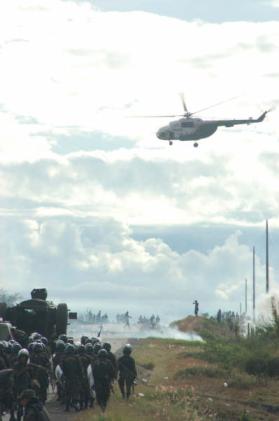
A police helicopter takes away indigenous protesters who have been arrested in the Peruvian rainforest. It returns later and is used to fire tear gas at protesters. Photo by Thomas Quirynen and Marijke Deleu / Independent, U.K.

A fight for the Amazon that should inspire the world

The Uprising in the Amazon Is More Urgent Than Iran’s: It Will Determine the Future of the Planet

By Johann Hari / June 24, 2009

While the world nervously watches the uprising in Iran, an even more important uprising has been passing unnoticed — yet its outcome will shape your fate, and mine.

In the depths of the Amazon rainforest, the poorest people in the world have taken on the richest people in the world to defend a part of the ecosystem none of us can live without. They had nothing but wooden spears and moral force to defeat the oil companies — and, for today, they have won.

Here’s the story of how it happened — and how we all need to pick up this fight.

Earlier this year, Peru’s President, Alan Garcia, sold the rights to explore, log and drill 70 percent of his country’s swathe of the Amazon to a slew of international oil companies. Garcia seems to see rainforest as a waste of good resources, saying of the Amazon’s trees: “There are millions of hectares of timber there lying idle.”

There was only one pesky flaw in Garcia’s plan: the indigenous people who live in the Amazon. They are the first people of the Americas, subject to wave after wave of genocide since the arrival of the Conquistadors. They are weak. They have no guns. They barely have electricity. The government didn’t bother to consult them: what are a bunch of Indians going to do anyway?

But the indigenous people have seen what has happened elsewhere in the Amazon when the oil companies arrive. Occidental Petroleum are currently facing charges in US courts of dumping an estimated nine billion barrels of toxic waste in the regions of the Amazon where they operated from 1972 to 2000. Andres Sandi Mucushua, the spiritual leader of the area known to the oil companies as Block 1AB, said in 2007: “My people are sick and dying because of Oxy. The water in our streams is not fit to drink and we can no longer eat the fish in our rivers or the animals in our forests.” The company denies liability, saying they are “aware of no credible data of negative community health impacts”.

In the Ecuadorian Amazon, according to an independent report, toxic waste allegedly dumped after Chevron-Texaco’s drilling has been blamed by an independent scientific investigation for 1,401 deaths, mostly of children from cancer. When the BBC investigator Greg Palast put these charges to Chevron’s lawyer, he replied: “And it’s the only case of cancer in the world? How many cases of children with cancer do you have in the States?… They have to prove it’s our crude, [which] is absolutely impossible.”

The people of the Amazon do not want to see their forests felled and their lands poisoned. And here, the need of the indigenous peoples to preserve their habitat has collided with your need to preserve your habitat. The rainforests inhale massive amounts of warming gases and keep them stored away from the atmosphere. Already, we are chopping them down so fast that it is causing 25 percent of man-made carbon emissions every year — more than planes, trains and automobiles combined. But it is doubly destructive to cut them down to get to fossil fuels, which then cook the planet yet more. Garcia’s plan was to turn the Amazon from the planet’s air con into its fireplace.

Why is he doing this? He was responding to intense pressure from the US, whose new Free Trade Pact requires this “opening up”, and from the International Monetary Fund, paid for by our taxes. In Peru, it has also been alleged that the ruling party, APRA, is motivated by oil-bribes. Some of Garcia’s associates have been caught on tape talking about how to sell off the Amazon to their cronies. The head of the parliamentary committee investigating the affair, Rep. Daniel Abugattas, says: “The government has been giving away our natural resources to the lowest bidders. This has not benefited Peru, but the administration’s friends.”

So the indigenous peoples acted in their own self-defense, and ours. Using their own bodies and weapons made from wood, they blockaded the rivers and roads to stop the oil companies getting anything in or out. They captured two valves of Peru’s sole pipeline between the country’s gas field and the coast, which could have led to fuel rationing. Their leaders issued a statement explaining: “We will fight together with our parents and children to take care of the forest, to save the life of the equator and the entire world.”

Garcia responded by sending in the military. He declared a “state of emergency” in the Amazon, suspending almost all constitutional rights. Army helicopters opened fire on the protesters with live ammunition and stun-grenades. Over a dozen protesters were killed. But the indigenous peoples did not run away. Even though they were risking their lives, they stood their ground. One of their leaders, Davi Yanomami, said simply: “The earth has no price. It cannot be bought, or sold or exchanged. It is very important that white people, black people and indigenous peoples fight together to save the life of the forest and the earth. If we don’t fight together what will our future be?”

And then something extraordinary happened. The indigenous peoples won. The Peruvian Congress repealed the laws that allowed oil company drilling, by a margin of 82 votes to 12. Garcia was forced to apologize for his “serious errors and exaggerations”. The protesters have celebrated and returned to their homes deep in the Amazon.

Of course, the oil companies will regroup and return — but this is an inspirational victory for the forces of sanity that will be hard to reverse.

Human beings need to make far more decisions like this: to leave fossil fuels in the ground, and to leave rainforests standing. In microcosm, this rumble in the jungle is the fight we all face now. Will we allow a small number of rich people to make a short-term profit from seizing and burning resources, at the expense of our collective ability to survive?

If this sounds like hyperbole, listen to Professor Jim Hansen, the world’s leading climatologist, whose predictions have consistently turned out to be correct. He says: “Clearly, if we burn all fossil fuels,we will destroy the planet we know. We would set the planet on a course to the ice-free state, with a sea level 75 meters higher. Coastal disasters would occur continually. The only uncertainty is the time it would take for complete ice sheet disintegration.”

Of course, fossil fools will argue that the only alternative to burning up our remaining oil and gas supplies is for us all to live like the indigenous peoples in the Amazon. But next door to Peru, you can see a very different, environmentally sane model to lift up the poor emerging — if only we will grasp it.

Ecuador is a poor country with large oil resources underneath its rainforests — but its president, Rafael Correa, is offering us the opposite of Garcia’s plan. He has announced he is willing to leave his country’s largest oil reserve, the Ishpingo Tmabococha Tiputini field, under the soil, if the rest of the world will match the $9.2bn in revenues it would provide.

If we don’t start reaching for these alternatives, we will render this month’s victory in the Amazon meaningless. The Hadley Center in Britain, one of the most sophisticated scientific centers for studying the impacts of global warming, has warned that if we carry on belching out greenhouse gases at the current rate, the humid Amazon will dry up and burn down — and soon.

Their study earlier this year explained :

The Amazonian rainforest is likely to suffer catastrophic damage even with the lowest temperature rises forecast under climate change. Up to 40 percent of the rainforest will be lost if temperature rises are restricted to 2C, which most climatologists regard as the least that can be expected by 2050. A 3C rise is likely to result in 75 percent of the forest disappearing while a 4C rise, regarded as the most likely increase this century unless greenhouse gas emissions are slashed, will kill off 85 perfect of the forest.

That would send gigatons of carbon into the atmosphere — making the world even more inhabitable.

There is something thrilling about the fight in the Amazon, yet also something shaming. These people had nothing, but they stood up to the oil companies. We have everything, yet too many of us sit limp and passive, filling up our tanks with stolen oil without a thought for tomorrow. The people of the Amazon have shown they are up for the fight to save our ecosystem. Are we?

[Johann Hari is a writer for the Independent. To read more of his articles, click here or for an archive of his writings about environmental issues, click here.]

Source / Independent, U.K.

The Rag Blog

Posted in RagBlog | Tagged , , , , , , , , , | 1 Comment

U.S. National Debt : Cliffs Notes for Conservatives

Graphic by Larry Ray / The Rag Blog. With apologies to Cliffs Notes.

Cliffs Notes for Conservatives

I find it both bewildering and angering when Republican conservatives lambaste President Obama for the present state of indebtedness on America’s balance sheet as if it was all his fault, spending like a drunken sailor. As if the previous eight years never happened.

By Larry Ray / The Rag Blog / June 24, 2009

As soon as Barack Obama’s hand left the Lincoln bible after taking his oath of office as President of the United States of America, the race was on within the tattered ranks of the Republican party to see who could scream “tax and spend” the loudest.

The same conservatives who uttered not a dissenting word during the past eight years of Republican “spend and spend” now sputter forth about their perceived perilous excesses of President Obama.

It is time for a review of some hard facts and numbers.

Mr. Obama has calmly and deliberately taken charge, faced with inherited wars in Iraq and Afghanistan, the threat of a global financial meltdown, and a laundry list of national and international challenges. And all the while he is pressing ahead and funding promised new programs and change. His Republican detractors, ranting about the national debt, seem to have forgotten George W. Bush’s early months as president.

Mr. Bush inherited a federal budget that had been balanced for three consecutive years and a surplus of $236 billion, the largest surplus in American history. Even sweeter, we were running an on-budget surplus no longer diverting surplus from the Social Security Trust Fund to fund other government programs. This conservative largess, of course, came from the previous Democratic administration.

When Mr. Bush took office, the national debt was $5.727 trillion. By September 2008, the national debt had soared to more than $9.849 trillion, an almost 72 percent increase during Mr. Bush’s two terms. And those are the debt figures before the basically unregulated, free-for-all banking and financial system received Mr. Bush’s $700 billion Wall Street bailout money.

And as President Obama walked into the Oval office, Mr. and Mrs. George W. Bush were closing the deal on their mansion in a Dallas, Texas gated community, leaving the biggest increase in the national debt under any president in U.S history as a going away present to the American people.

Mr. Bush must have erased the collective memory of his record national debt from the minds of the Republican party. With stern faces they attempt daily to paint the accumulated national debt as President Obama’s dangerous “socialist” agenda to send America to the poorhouse. Well, we have already been sent there, and Barack Obama did not do the sending.

Here’s a quick review:

  • Shortly after taking office, President Bush spoke to the the Republican Congressional Retreat in Williamsburg and blithely declared that his budget would “pay down the national debt.”
  • President Bush raised the national debt limit eight times during his administration.
  • On July 30, 2008, President Bush signed the Housing and Economic Recovery Act, which contained a quiet little provision raising the debt ceiling to $10.615 trillion.
  • One week before leaving office, Bush asked Congress for the remaining $350 billion of the $700 billion Wall Street Troubled Assets Relief Program or TARP bailout package.That same last week, Bush signed the American Recovery and Reinvestment Act of 2009 raising the national debt ceiling for the eighth time to $12.104 trillion to accommodate the $11.3 trillion all time record debt he left the incoming administration.
  • George W. Bush’s $11.3 trillion record debt comes to more than $37,000 each for every man, woman and child in the United States. And it will get worse because of what is is costing to clean up after him while still moving ahead on badly needed changes like national health care to rein in its current out of control cost.

I find it both bewildering and angering when Republican conservatives lambaste President Obama for the present state of indebtedness on America’s balance sheet as if it was all his fault, spending like a drunken sailor. As if the previous eight years never happened.

Mr. Boehner, Mr. Steele, Mr. Cantor and the rest of the GOP spokespersons du jour should all be given special pocket calculators with a built in factor of $11.3 trillion that is automatically deducted from any figures they use to attack the Obama administration.

The factor could have a new four letter mathematical name, the Debt factor, a word that also works perfectly to describe the Bush presidential legacy.

[Retired journalist Larry Ray is a Texas native and former Austin television news anchor. He also posts at The iHandbill.]

The Rag Blog

Posted in Rag Bloggers | Tagged , , , | 1 Comment

Ansel Herz: A Report of a March on T. Don Hutto

Click the arrow button in the bottom right-hand corner for a better view. (Sorry about the wind noise, folks!)

Podcast with pictures: Texans march against Hutto detention center on World Refugee Day
By Ansel Herz / June 22, 2009

This was my second time traveling out to Hutto. Transcript and more information below.

[Chanting]

“I’ve known about this place, this is just my first time coming here. When I first got here, I actually felt like crying because I felt so angry that they would do this to people. Everybody talks about peace in the world and stuff, but this has nothing to do with it…”

18-year-old Yvette Garza joined about a hundred people from around Texas on Saturday afternoon in Taylor, a forty-minute drive from Austin. For the third year in a row, activists marked World Refugee Day with a march across town to the T. Don Hutto Residential Center, an immigrant detention center holding undocumented families, including at least 100 women and young children. Jose Orta, a Taylor resident, said the corporate-run facility should be shut down.

“They are incarcerated. And those children have done nothing, nothing wrong. They are non-criminals. Yet they are in a medium-security prison. No matter what you call it – you can call it a detention facility or a residential facility, whatever. It is a medium-security prison, and T. Don Hutto’s got to go!”

[Marching]

“People started making profits for people wanting to make money off of people’s misery.”

Conrado Acevedo, an activist with the indigenous coalition ‘Defense of Our Mother,’ traveled from Houston.

“They used to let ‘em go and then they would show up in court, which was the more humane way. But now when you put people in jail, especially a mother with kids, I mean that’s totally uncomprehensible in a supposedly democratic society. So we’ve been coming here for two years…”

[Sound]

The march eventually spilled onto an field alongside the facility. Marchers raised their voices, hoping the kids inside would hear them.

The group rallied for another few hours with music and speeches in the blazing sun across from the detention center. They vowed to continue protesting until the facility is closed and the families are released.

It’s June 22, 2009, this has been a Mediahacker.org podcast, and I’m Ansel Herz.

Cross-posted to YouTube and to HIMC. Learn more:

* T. Don Hutto blog
* America’s Family prison short film by Matt Gossage
* “The Least of These” film
* More pictures at Houston Indymedia

Source / Media Hacker

The Rag Blog

Posted in RagBlog | Tagged , , | 1 Comment

Election Fraud in Iran Is Not a Foregone Conclusion

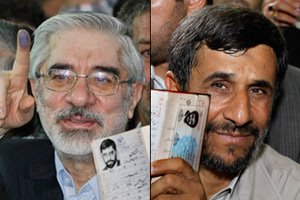
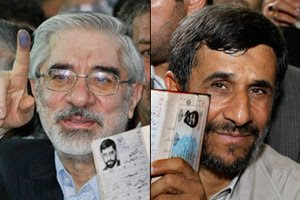
Despite the (mostly shrill) rhetoric surrounding the recent Iranian election, Nima Shirazi maintains that there is remarkably little solid evidence that anything really is awry. Very troubling is the continuing suppression of the media in Iran, but that is not particularly surprising given the history of the theocratic regime. Perhaps it is time for a little simple quiet and patience about events in a country that is not ours to meddle with.

Richard Jehn / The Rag Blog

In Fraud, We Trust?
By Nima Shirazi / The Rag Blog / June 23, 2009

Douter de tout ou tout croire, ce sont deux solutions également commodes, qui l’une et l’autre nous dispensent de réfléchir. [To doubt everything or to believe everything are two equally convenient solutions; both dispense with the need for thought.] – Jules Henri Poincaré, La Science et l’Hypothèse (1901)

By now, we all know the story:

Still high from Barack Obama’s Cairo speech and Lebanon’s recent elections that saw the pro-Western March 14 faction barely maintain its majority in the Chamber of Deputies, the mainstream media fully expected a clean sweep for “reformist” candidate Mir Hossein Mousavi in Iran’s June 12th presidential election. They reported surging poll numbers, an ever-growing Green Wave of support for the challenger, while taking every opportunity to get in their tired and juvenile epithets, their final chance to demonize and defame the incumbent Dr. Mahmoud Ahmadinejad, whom they were convinced had absolutely no chance of winning reelection.

The turnout was a massive 85% by most estimates, resulting in almost forty million ballots cast by the eligible Iranian voting public.

Before the polls even closed, Mousavi had already claimed victory. “In line with the information we have received, I am the winner of this election by a substantial margin,” he said. “We expect to celebrate with people soon.” However, according to the chairman of the Interior Ministry’s Electoral Commission, Kamran Daneshjoo, with the majority of votes counted, the incumbent president had taken a seemingly unassailable lead.

And so it was. Ahmadinejad won. By a lot. Some said by too much.

It didn’t take long before accusations started flying, knee-jerk reactions were reported as expert analysis, and rumor became fact. As Supreme Leader Ali Khamenei congratulated Ahmadinejad on his landslide victory, calling it a “divine assessment,” the opposition candidates all cried foul. Mousavi called the results “treason to the votes of the people” and the election a “dangerous charade.” Karroubi described Ahmadinejad’s reelection as “illegitimate and unacceptable.”

The Western media immediately jumped on board, calling the election a “fraud,” “theft,” and “a crime scene” in both news reports and editorial commentary. Even so-called progressive analysts, from Juan Cole to Stephen Zunes to Dave Zirin to Amy Goodman to Trita Parsi to the New Yorker‘s Laura Secor, opined on the illegitimacy of the results. They cited purported violations, dissident testimony from inside sources, leaked “real” results, and seeming inconsistencies, incongruities, and irregularities with Iran’s electoral history all with the intention of proving that the election was clumsily stolen from Mousavi by Ahmadinejad. These commentators all call the continuing groundswell of protest to the poll results an “unprecedented” show of courage, resistance, and people power, not seen in Iran since the 1979 revolution.

To me, the only thing unprecedented about what we’re seeing in Iran seems to be the constant media hysteria, righteous indignation, and hypocritical pseudo-solidarity of the West; a bogus, biased, and altogether presumptuous and uncritical reaction to hearsay and conjecture, almost totally decontextualized in order to promote sensational headlines and build international consensus for foreign intervention in Iran.

The foregone (and totally unsubstantiated) conclusions drawn by a rabid, clucking media have led to an ever-growing outrage over the elections results. Weak theories are tossed around like beads on Bourbon Street and assumed to be “expert analysis” and beyond reproach. By now, the accusations are well-known. However, with a little perspective and rational thought, the “evidence” that purportedly demonstrates proof of a fixed election winds up sounding pretty forced. With closer inspection and added context, the arguments crumble and are revealed not to be very compelling, let alone convincing.

We read that the reelection of Ahmadinejad was impossible, unbelievable. It was a sham, a hoax, and a coup d’etat. But, in fact, there is no alleged, let alone substantive, proof to suggest that the results were fixed beyond mere speculation, biased and baseless assumptions, and suspect hearsay. It appears quite clear that the pre-election predictions of a soaring Mousavi victory by the Western press were nothing more than the consequence of presumptuous wishful thinking. Analyst James Petras tells us,

“What is astonishing about the West’s universal condemnation of the electoral outcome as fraudulent is that not a single shred of evidence in either written or observational form has been presented either before or a week after the vote count. During the entire electoral campaign, no credible (or even dubious) charge of voter tampering was raised. As long as the Western media believed their own propaganda of an imminent victory for their candidate, the electoral process was described as highly competitive, with heated public debates and unprecedented levels of public activity and unhindered by public proselytizing. The belief in a free and open election was so strong that the Western leaders and mass media believed that their favored candidate would win.”

Most of these claims rest on the brash and offensive assumption that these “experts” know how Iranians would vote better than Iranians do. Clearly, they argue, Mousavi would win his hometown of Tabriz in the heart of East Azerbaijan, since he’s an ethnic Azeri with an “Azeri accent” and Iranians always vote along geographical and ethnic lines. And yet, Ahmadinejad won that province by almost 300,000 votes. Curious, no?

Well, no.

As Flynt Leverett points out,

Ahmadinejad himself speaks Azeri quite fluently as a consequence of his eight years serving as a popular and successful official in two Azeri-majority provinces; during the campaign, he artfully quoted Azeri and Turkish poetry – in the original – in messages designed to appeal to Iran’s Azeri community. (And, we should not forget that the Supreme Leader is Azeri.) The notion that Mousavi was somehow assured of victory in Azeri-majority provinces is simply not grounded in reality.

Furthermore, in a pre-election poll Azeris favored Ahmadinejad by 2 to 1 over Mousavi. Furthermore, Petras notes, “The simplistic assumption [of the Western media] is that ethnic identity or belonging to a linguistic group is the only possible explanation of voting behavior rather than other social or class interests. A closer look at the voting pattern in the East-Azerbaijan region of Iran reveals that Mousavi won only in the city of Shabestar among the upper and the middle classes (and only by a small margin), whereas he was soundly defeated in the larger rural areas, where the re-distributive policies of the Ahmadinejad government had helped the ethnic Azeris write off debt, obtain cheap credits and easy loans for the farmers. Mousavi did win in the West-Azerbaijan region, using his ethnic ties to win over the urban voters.”

Additionally, it should be noted that, although there is a wide diversity of ethnic groups within Iranian society, most of them share a common history and Iranian identity. This is certainly the case within the Azeri community of Northwest Iran. We have been told for quite some time now that “public opinion polls suggest that foreign pressure to discontinue Iran’s nuclear program has contributed to a rise in patriotism because public support for the Iran’s nuclear program has been strong. Support for the program transcends political factions and ethnic groups.” Considering that Ahmadinejad’s four years of standing strong in the face of such aggressive and threatening foreign pressure has played well with the public, as opposed to Mousavi’s more conciliatory tone with regards to bettering relations with Western powers, it is hardly a stretch or a surprise that Ahmadinejad would be supported by such large swaths of the population across all demographics.

The voting habits of ethnic Lur voters in reformist candidate Mehdi Karroubi’s home province are also assumed to be known by Western analysts. If he won five million votes in 2005, why did he only clear about 300,000 this time around? How could Ahmadinejad win in Tehran, when Mousavi’s base of upper and middle class cosmopolitan youths, university students, and wealthy business-owners reside there? Plus, Mousavi is said to have been popular in urban areas, where Ahmadinejad was seen as holding less sway. So how could Mousavi possibly lose? These questions are valid, for sure, but they have equally rational answers.

Karroubi wasn’t a contender in this race like he was four years ago. There was no incumbent president at that time (President Khatami had just completed his second term) and the candidate field was wide open. Karroubi had a pro-reform and pro-populist message that appealed to many unsure of whom to vote for. He did well in his hometown. But 2009 is not 2005. After four years of Ahmadinejad’s presidency, the rural Iranian voting bloc strongly supports his economic, domestic, and foreign policies. It is irresponsible to assume that Karroubi’s “reformist” support would turn heavily to Mousavi since Karroubi had no chance of winning this year. He has long been a staunch opponent of Iranian political stalwart and former president Akbar Hashemi Rafsanjani, who is closely aligned with Mousavi. Karroubi’s populist approach to the economy is more like Ahmadinejad’s than Mousavi’s.

Esam Al-Amin, writing for Counterpunch, astutely observes,

The double standard applied by Western news agencies is striking. Richard Nixon trounced George McGovern in his native state of South Dakota in the 1972 elections. Had Al Gore won his home state of Tennessee in 2000, no one would have cared about a Florida recount, nor would there have been a Supreme Court case called Bush v. Gore. If Vice-Presidential candidate John Edwards had won the states he was born and raised in (South and North Carolina), President John Kerry would now be serving his second term. But somehow, in Western newsrooms Middle Eastern people choose their candidates not on merit, but on the basis of their “tribe.”

The fact that minor candidates such as Karroubi would garner fewer votes than expected, even in their home regions as critics charge, is not out of the ordinary. Many voters reach the conclusion that they do not want to waste their votes when the contest is perceived to be between two major candidates. Karroubi indeed received far fewer votes this time around than he did in 2005, including in his hometown. Likewise, Ross Perot lost his home state of Texas to Bob Dole of Kansas in 1996, while in 2004, Ralph Nader received one eighth of the votes he had four years earlier.

Ahmadinejad didn’t win Tehran, even though this falsehood is repeated constantly in the Western press as evidence of vote tampering. He won Tehran province, yes, but not the metropolitan area. In Tehran proper, which has a total population of about 7.7 million, Mousavi received 2,166,245 votes, which is over 356,000 more than the incumbent Ahmadinejad, and in Shemiranat – the affluent and westernized Northern section of the greater Tehran area, abounding with shopping malls and luxury cars – Mousavi beat Ahmadinejad by almost a 2 to 1 margin, winning 200,931 votes to Ahmadinjead’s 102,433. In fact, according to the official numbers, Ahmadinejad lost in most cities around the country, including Ardabil, Ardakan, Aqqala, Bandar Torkaman, Baneh, Bastak, Bukan, Chabahar, Dalaho, Ganaveh, Garmi, Iranshahr, Javanroud, Kalaleh, Khaf, Khamir, Khash, Konarak, Mahabad, Mako, Maraveh Tappeh, Marivan, Miandoab, Naghadeh, Nikshahr, Oshnavieh, Pars-Abad, Parsian, Paveh, Pilehsavar, Piranshahr, Qeshm, Ravansar, Shabestar, Sadooq, Salmas, Saqqez, Saravan, Sardasht, Showt, Sibsouran, Yazd, Zaboli, and Zahedan. This deficit was more than made up for, however, in working class suburbs, small towns and rural areas. (Since the election, Ahmadinejad’s detractors have enjoyed flaunting the statistic that only 30% of Iranians live in the countryside, without realizing that the adjoining blue-collar neighborhoods and less affluent suburban sprawl of urban centers are not counted as “rural” areas.)

But weren’t the pre-election polls indicating an easy victory for Mousavi? No, they weren’t. An Iranian opinion poll from early May, conducted in Tehran as well as 29 other provincial capitals and 32 important cities, showed that “58.6% will cast their ballots in favor of Mahmoud Ahmadinejad, while some 21.9% will vote for Mousavi.” Even though Western media likes to tell us that polling is notoriously difficult in Iran, there was plenty of pre-election data to analyze. Al-Amin writes,

More than thirty pre-election polls were conducted in Iran since President Mahmoud Ahmadinejad and his main opponent, former Prime Minister Mir Hossein Mousavi, announced their candidacies in early March 2009. The polls varied widely between the two opponents, but if one were to average their results, Ahmadinejad would still come out on top. However, some of the organizations sponsoring these polls, such as Iranian Labor News Agency and Tabnak, admit openly that they have been allies of Mousavi, the opposition, or the so-called reform movement. Their numbers were clearly tilted towards Mousavi and gave him an unrealistic advantage of over 30 per cent in some polls. If such biased polls were excluded, Ahmadinejad’s average over Mousavi would widen to about 21 points.

One poll conducted before the election by two US-based non-profit organizations forecast Ahmadinejad’s reelection with surprising prescience. The survey was jointly commissioned by the BBC and ABC News, funded by the Rockefeller Brothers Fund, and conducted by the New America Foundation’s nonprofit Center for Public Opinion, which, “has a reputation of conducting accurate opinion polls, not only in Iran, but across the Muslim world since 2005.” The poll predicted an election day turnout of 89%, only slightly higher than the actual 85% who voted (that’s a difference of fewer than 2 million ballots). According to pollsters Ken Ballen and Patrick Doherty, the “nationwide public opinion survey of Iranians three weeks before the vote showed Ahmadinejad leading by a more than 2 to 1 margin – greater than his actual apparent margin of victory in Friday’s election.”

Moreover, we hear incessantly about Iran’s all-important youth vote. According to many estimates, about 60% of Iran’s population is under 30 years old; however, what isn’t often reported is that almost a quarter of the population is actually under 15 years old. There are about 25 million Iranians between 15 and 29, which is about 36% of the population of the entire country. Voting age in Iran is 18. Additionally, Ballen and Doherty conclude,

“Much commentary has portrayed Iranian youth and the Internet as harbingers of change in this election. But our poll found that only a third of Iranians even have access to the Internet, while 18-to-24-year-olds comprised the strongest voting bloc for Ahmadinejad of all age groups.

The only demographic groups in which our survey found Mousavi leading or competitive with Ahmadinejad were university students and graduates, and the highest-income Iranians. When our poll was taken, almost a third of Iranians were also still undecided. Yet the baseline distributions we found then mirror the results reported by the Iranian authorities, indicating the possibility that the vote is not the product of widespread fraud.”

Furthermore, this poll was conducted before Ahmadnejad’s impressive showing in widely watched televised debates against his opponents. The debates, aired live nightly between June 2nd and 8th, pitted candidates one-on-one for ninety minutes. According to news reports, the Ahmadinejad-Mousavi debate was watched by more than 40 million people. Leverett notes,

American “Iran experts” missed how Ahmadinejad was perceived by most Iranians as having won the nationally televised debates with his three opponents – especially his debate with Mousavi.

Before the debates, both Mousavi and Ahmadinejad campaign aides indicated privately that they perceived a surge of support for Mousavi; after the debates, the same aides concluded that Ahmadinejad’s provocatively impressive performance and Mousavi’s desultory one had boosted the incumbent’s standing. Ahmadinejad’s charge that Mousavi was supported by Rafsanjani’s sons – widely perceived in Iranian society as corrupt figures – seemed to play well with voters.

Similarly, Ahmadinejad’s criticism that Mousavi’s reformist supporters, including former President Khatami, had been willing to suspend Iran’s uranium enrichment program and had won nothing from the West for doing so tapped into popular support for the program – and had the added advantage of being true.

Anyone who actually watched the debates (one wonders how many Western reporters, pundits, Iran “experts,” and commentators are included in this demographic) would have known first-hand how singularly uncharismatic Mousavi was and how particularly lackluster was his debating style. Mousavi is a mumbler, a low-talker, and has about as much on-screen personality as Ben Stein on Klonopin. (How this man, absent from Iranian politics for the past twenty years, could become the leader of an energetic protest movement is anyone’s guess, but you might want to ask the CIA first.)

Conversely, Ahmadinejad – as both his supporters and detractors would readily admit – is nothing if not an engaging, animated, and impassioned speaker. His outspoken nature and refusal to be bullied by opponents is apparent to anyone who has ever heard or seen him speak, whether they agree with what he says or not. Anyone who believes Mousavi won these debates either didn’t actually watch them and/or decided to uncritically believe talking points distributed by the Mousavi campaign about their candidate’s inspired performance.

Opponents of Ahmadinejad in the Western press – or, more accurately, everyone in the Western press – consistently refer to Ahmadinejad as an entrenched, establishment politician who has the unconditional backing of Iran’s powerful theocratic hierarchy. As such, the current unrest in the nation’s capital has been described as a grassroots, largely secular movement aimed at upsetting the religious orthodoxy of the government – embodied in such reports by Ahmadinejad himself – in an effort to fight for more personal freedoms and human rights in defiance of the country’s revolutionary ideals. These reports betray the journalists’ obvious misunderstanding of Iranian politics in general, and certainly of President Ahmadinejad’s personal politics in particular.

In fact, Newsweek reported that, on Wednesday morning of last week, Mousavi’s wife, Zahra Rahnavard, who was with her husband throughout the presidential campaign, felt the need to remind a group of students that she and her husband still believe in the ideals of the revolution and don’t regard anti-Islamic Revolution elements as their allies.

Furthermore, even though here in the US, he is variably referred to as “hardline” and a religious conservative, Ahmadinejad is far more of a populist politician, consistently favoring nationalization, the redistribution of Iran’s oil wealth, controlled prices of basic consumer goods, increased government subsidies, salaries, benefits, and insurance and continued opposition to foreign investment over his opponents’ calls for more free-market privatization of education and agriculture, as well as the promotion of neoliberal strategies. Leading up to the election, Mousavi condemned what he called Ahmadinejad’s “charity-based economic policy.” I wonder how that attack played with the middle, lower, and impoverished classes of Iran’s voting public. Oh right, Ahmadinejad got 63% of the vote, even if Juan Cole didn’t want him to.

Ahmadinejad has often drawn the ire of both Iranian clerics and legislators alike for his outspoken views. In March 2008, The Economist noted that influential conservative clerics are said to be irritated by his “folksy and superstitious brand of ostentatious piety and his favouritism to men of military rather than clerical backgrounds.” The conservative Rand Corporation even reminds us, “He is not a mullah; public frustration with rule by mullahs made this a very positive characteristic. He comes from a working-class background, which appealed to lower-income Iranians, the bulk of the electorate, yet he has a doctorate in engineering.” In the 2005 presidential election, Ahmadinejad emerged as a dark horse to challenge front-runner and assumed shoe-in, former president Ali Akbar Hashemi Rafsanjani. As the son of a blacksmith, “Ahmadinejad benefited from the contrast between his modest lifestyle and Rafsanjani’s obvious wealth, commonly known to stem from corruption.” The Rand report reiterates that “Rafsanjani is extraordinarily corrupt.”

During both his presidential campaigns of 2005 and 2009, Ahmadinejad focused far more on “bread and butter” issues to win over his constituents, rather than on religion, saying things like this in his speeches: “People think a return to revolutionary values is only a matter of wearing the headscarf. The country’s true problem is employment and housing, not what to wear.”

In the past three months of campaigning for reelection, the incumbent made over sixty campaign trips throughout Iran, while Mousavi visited only major cities. Throughout the recent debates, Ahmadinejad took the opportunity to attack rampant corruption among high-ranking clerics within the Iranian establishment. The New York Times reported that “He accused Mr. Rafsanjani, an influential cleric, and Mr. Rafsanjani’s sons of corruption and said they were financing Mr. Mousavi’s campaign. Mr. Ahmadinejad also cited a long list of officials whom he accused of unspecified corrupt acts, including plundering billions of dollars of the country’s wealth.” The article continued,

Mr. Ahmadinejad contended that the early founders of the Iranian revolution, including Mr. Moussavi, had gradually moved away from the values of the revolution’s early days and had become “a force that considered itself as the owner of the country.”

He suggested that some leaders had indulged in an inappropriately lavish lifestyle, naming, among others, a former speaker of Parliament, Ali Akbar Nateq Nouri, who has opposed some of Mr. Ahmadinejad’s policies. Mr. Nouri, a conservative, ran unsuccessfully for president in 1997. Mr. Ahmadinejad’s remarks seemed to suggest a deepening divide between the president and a number of influential leaders, including some conservatives who belong to a faction that has supported Mr. Ahmadinejad.

Whereas these remarks may have struck a chord with the Iranian public, they provoked a stern rebuke from Supreme Guide Khamenei at last Friday’s post-election prayer service. Khamenei, breaking a long-standing tradition of not mentioning specific people during his address, defended Rafsanjani’s reputation by describing him as “one of the most significant and principal people of the movement in the pre-revolution era…[who] went to the verges of martyrdom several times after the revolution,” also pointing out his bona fides as “a companion of Imam Khomeini, and after the demise of Imam Khomeini was perpetually a comrade of the leader.”

Rafsanjani is currently the speaker of the Assembly of Experts, an 86 member elected council of clerics responsible for appointing and, if need be, dismissing and replacing the Supreme Guide of the Islamic Republic. In September 2007, Rafsanjani was elected speaker after decisively defeating a candidate supported by Ahmadinejad. He is also currently the leader of the Expediency Council which is “responsible for breaking stalemates between the Majlis and the Guardian Council, advising the Supreme Leader, and proposing policy guidelines for the Islamic Republic.” As such, the Expediency Council limits the power wielded by the conservative Guardian Council, a body consisting of twelve jurists who evaluate the compatibility of the Majlis [Parliament]’s legislative decisions with Islamic law and the Iranian constitution. Moreover, in 2005, Khamenei strengthened the role of the Expediency Council by granting it supervisory powers over all branches of government, effectively affording the Expediency Council and its leader, Rafsanjani, oversight over the presidency. As a result, Rafsanjani retains a tremendous amount of power within Iranian politics. His strong support, both outspoken and financial, for Mousavi should show clearly that Mousavi – who was the Iranian Prime Minister during the Iran-Iraq War – is not some scrappy reformist challenger to the upper tiers of the Islamic Republic. He is as establishment as anyone else, if not more so.

But that’s not all. Asia Times correspondant M.K. Bhadrakumar explains,

For those who do not know Iran better, suffice to say that the Rafsanjani family clan owns vast financial empires in Iran, including foreign trade, vast landholdings and the largest network of private universities in Iran. Known as Azad there are 300 branches spread over the country, they are not only money-spinners but could also press into Mousavi’s election campaign an active cadre of student activists numbering some 3 million.

The Azad campuses and auditoria provided the rallying point for Mousavi’s campaign in the provinces. The attempt was to see that the campaign reached the rural poor in their multitudes who formed the bulk of voters and constituted Ahmadinejad’s political base. Rafsanjani’s political style is to build up extensive networking in virtually all the top echelons of the power structure, especially bodies such as the Guardian Council, Expediency Council, the Qom clergy, Majlis, judiciary, bureaucracy, Tehran bazaar and even elements within the circles close to Khamenei. He called into play these pockets of influence.

The Grand Ayatollah Hossein Ali Montazeri has already come out against the election results, once again showing that the dynamic of the Iranian government is not that of a monolithic dictatorship, but a complex network of power plays. Basically, what we’re seeing is all politics, and not a revolutionary uprising.

As allegations of fraud spread, Mousavi supporters in the United States seemed not to be able to get their stories straight. In co-ordinated mass emails, sent widely to promote protests across the country (and with all the “grassroots” pizzazz of those corporate-sponsored Republican Teabagging Parties in April), a number of unsubstantiated claims are noted as “Basic Statistics.”

Some claim that there were not enough ballots available to the voting public, while others suggest that there were too many ballots in an attempt to stuff ballot boxes with pro-Ahmadinejad votes. It is claimed that “Voting irregularities occurred throughout Iran and abroad. Polls closed early, votes were not counted and ballots were confusing.” Without providing any evidence of any of these accusations, the message reveals its own inaccuracy by deliberately spreading misinformation. Because turnout on election day was so high in Iran, polls actually remained open for up to four extra hours to allow as many people to cast ballots as possible. If Iranian authorities were prepared for a totalitarian takeover of the country after a faked election, why bother to keep polls open?

Also, the ballots weren’t confusing. They had no list of names or added legislative initiatives. They had one single, solitary question on them: Who is your pick for president? There is one empty box to note a number corresponding to the candidate of your choice and another box in which you are to write the candidate’s name. No hanging chads, no levers to pull, no political parties to consider. Just write the name of the guy you want to win. How is this confusing?

The suggestion that the ballots were counted too quickly to reflect a genuine result is in itself bizarre and unfounded. Al-Amin tells us, “There were a total of 45,713 ballot boxes that were set up in cities, towns and villages across Iran. With 39.2 million ballots cast, there were less than 860 ballots per box…Why would it take more than an hour or two to count 860 ballots per poll? After the count, the results were then reported electronically to the Ministry of the Interior in Tehran.”

The elections in Iran are organized and monitored. The ballots are counted by teachers and professionals including civil servants and retirees, much like here in the US. An eyewitness from Shiraz provides this account:

“As an employee in City Hall, I was assigned to be a poll worker/watcher at the University of Shiraz on election day and here it was impossible for cheating to have taken place! There were close to 20 observers, from the Guardian Council, the Ministry of the Interior, and more than four-five representatives/observers from each candidate. Everybody was watching every single move, stamp, piece of paper, etc. from the checking of the Shenas-Nameh (personal indentification documentation) to the filling of the ballot boxes, to the counting of each ballot under everyone’s eyes, and then registering the results into the computer and sending them to the Interior Ministry…Also, we had extra ballots in Shiraz. It’s possible that in some of the smaller villages they ran out of ballots, but the voting hours were extended.”

The opposition messages state that “The two main state news agencies in Iran declared the winner before polls closed and votes were counted.” Actually, as mentioned above, it was Mousavi who declared his own victory several hours before the polls closed. Paul Craig Roberts, who is himself a former US government official, suggests that Mousavi’s premature victory declaration is “classic CIA destabilization designed to discredit a contrary outcome. It forces an early declaration of the vote. The longer the time interval between the preemptive declaration of victory and the release of the vote tally, the longer Mousavi has to create the impression that the authorities are using the time to fix the vote. It is amazing that people don’t see through this trick.”

Circulating emails even contain this tidbit: “Two primary opponents of Ahmadinejad reject the notion that he won the election.” Talk about proof!

Even Mousavi’s own official letter of complaint – delivered to the Guardian Council after five days of promoting protests and opposition rallies on the streets of Tehran – is short on substantive allegations and devoid of hard evidence of anything remotely suggestive of voter fraud. The letter, which calls for an annulment of the election results and for a new election to take place, expounds on many non-election related issues, such as the televised debates, the incumbent’s access to state-owned transportation on the campaign trail and use of government-controlled media to promote his candidacy. All previous Iranian presidents, including the reformist Mohammad Khatami, who is a main supporter of Mousavi, have used the resources at their disposal for election purposes. Plus, whereas the last point certainly seems unfair, it hardly amounts to fraud. The debates – the first ever held in the history of the Islamic Republic – also served to even up the score for Ahmadinejad’s challengers.

Kaveh L. Afrasiabi, writing for the Asia Times, explains further:

Mousavi complains that some of his monitors were not accredited by the Interior Ministry and therefore he was unable to independently monitor the elections. However, several thousand monitors representing the various candidates were accredited and that included hundreds of Mousavi’s eyes and ears.

They should have documented any irregularities that, per the guidelines, should have been appended to his complaint. Nothing is appended to Mousavi’s two-page complaint, however. He does allude to some 80 letters that he had previously sent to the Interior Ministry, without either appending those letters or restating their content.

Finally, item eight of the complaint cites Ahmadinejad’s recourse to the support given by various members of Iran’s armed forces, as well as Foreign Minister Manouchehr Mottaki’s brief campaigning on Ahmadinejad’s behalf. These are legitimate complaints that necessitate serious scrutiny since by law such state individuals are forbidden to take sides. It should be noted that Mousavi can be accused of the same irregularity as his headquarters had a division devoted to the armed forces.

Given the thin evidence presented by Mousavi, there can be little chance of an annulment of the result.

In response to the accusation of there being more votes in certain areas than registered voters, it must be acknowledged that in Iran, unlike in the United States, eligible voters may vote anywhere they wish – at any polling location in the entire country – and are not limited to their residential districts or precincts as long as their information is registered and valid in the government’s database. Families vacationing North to avoid the stifling heat of the South would wind up voting in towns in which they are tourists. Afrasiabi even points out that, whereas “Mousavi complains that in some areas the votes cast were higher than the number of registered voters…he fails to add that some of those areas, such as Yazd, were places where he received more votes that Ahmadinejad.”

Are these irrefutable examples of an election that was free of all outside interference, irregularities, or potential problems? No, of course not. But there is also no hard proof of a fixed result, let alone massive vote rigging on a scale never before seen in Iran, a country that – unlike the United States – has no history of fraudulent elections.

[Nima Shirazi was born and raised in Manhattan. He now lives in Brooklyn and writes the weblog Wide Asleep In America under the moniker Lord Baltimore. He can be reached at wideasleepinamerica@gmail.com.]

This article also appeared on Nima’s blog, Wide Asleep in America.

The Rag Blog

Posted in RagBlog | Tagged , , | 2 Comments

New York : Radical Queers Remember Stonewall With Spirited March

Photo by Andrew Hinderaker.

Queers, allies and residents of the park took to the streets and marched to the Stonewall Inn to the applause of people on the sidewalks as we chanted “We will not be quiet! Stonewall was a riot!”

By wewantyou / The Rag Blog / June 23, 2009

The Radical Homosexual Agenda held its third Parade Without a Permit on the evening of June 19th to celebrate the 40th anniversary of the Stonewall Rebellion. This was the third Parade Without A Permit which started in 2007 when the New York City Police, with help of the City Council Speaker Christine Quinn, created an arbitrary rule that stated that if more than 50 people gathered without a permit, they would be subject to arrest.

We’ve challenged that rule while our openly gay city Council Speaker Quinn continues to side with the NYPD while anointing herself as the leader of the gay community.

With not a drop of rain and in high spirits, we began our march at Washington Square Park. Queers, allies and residents of the park took to the streets and marched to the Stonewall Inn to the applause of people on the sidewalks as we chanted “We will not be quiet! Stonewall was a riot!”

From the Stonewall Inn we continued our march down Christopher Street where onlookers stepped off of the sidewalks and into the streets to join our party. One onlooker stepped to the front of the banner and unleashed his inner baton twirler as the RHA drum core pounded out a rhythm and lead us in the chant, “This street is for faggots. F-A-G-G-O-T-S!”

The NYPD made their presence felt as they trailed behind us in squad cars. We continued down Christopher Street as we marched past an NYPD mobile command unit set up on the street. We marched past a commandeered city bus waiting to be used as a temporary arrest station and a generator with flood lights set up at an intersection to intimidate and harass the queer youth of color who come to the village.

We chanted: “We’re here! We’re queer! We’re fabulous! Don’t fuck with us!” as we crossed the West Side Highway and reached the end of our march at the Christopher Street Piers. But our trip down Christopher Street reminded us of how far we really haven’t traveled from 1969 to 2009.

It’s still 1969 when queers can’t assemble in peace without being harassed and arrested. It’s still 1969 when NYC queer clubs and bars are raided by the NYPD or fined out of their existence. It’s still 1969 when queers are arrested in police sting operations in sex shops, parks and private homes; and it’s still 1969 when lesbians are beaten by the NYPD.

For more photos, go here.

Thanks to Devra Morice / The Rag Blog

Posted in RagBlog | Tagged , , , , | 1 Comment

Roky Erickson to Houston : Return of ‘Two-Headed Dog’

Roky Erickson. Photo by Stephanie Chernikowski / The Rag Blog / Shout! Factory Records

Roky Erickson — nee of the 13th Floor Elevators — returns to Houston after 25 years

Erickson… is enjoying a fruitful second act that is creatively satisfying rather than a sentimental journey.

By Andrew Dansby

Among significant musicians who have endured monumental breakdowns and/or mental illness, few are more sweet and charming in conversation than Roky Erickson. The Austin-based psychedelic rock legend has had as bumpy a ride as any. He’s been drugged (voluntarily), arrested, incarcerated, institutionalized, shocked, drugged (involuntarily) and abandoned over a duration of time (more than two decades) that should’ve left him dead. But on the other end of a phone these days he’s unfailingly courteous.

Talking to some of rock’s eccentrics and near casualties is usually an exercise in futility. Brian Wilson was friendly enough the first and only time I spoke to him, though his shouty voice and naturally clipped answers gave a gruff impression beyond his control. “Thank you,” he shouted before hanging up. “That was a good interview.” (It wasn’t.) Waller native Daniel Johnston was once a chatterbox during an interview; another time he stared at a kitchen table and smoked cigarettes shaking like an old washing machine.

Interviewing such artists can sometimes feel like a self-serving pursuit. The purpose is the same as talking to non-eccentrics: an attempt to glean some sort of interesting information about their art from which to spin a minor profile. With Erickson, for instance, I learned last week that Little Willie John was a influence on his landmark 13th Floor Elevators song You’re Gonna Miss Me. (In a previous chat, James Brown had been mentioned.)

“I just heard one song of his on the radio,” Erickson said. “‘Better leave my kittie alone.’ We had this one real, tiny radio, and I heard Little Willie John sing that. Then I think I heard James Brown’s Night Train. I listened to mostly rock ’n’ roll … though I liked the blues a lot.”

Certain this personal revelation was hardly a national one, I opted not to Google Erickson and Little Willie. But as one prone to obsessing about music I thought it was plenty logical.

Erickson’s life and times following Miss Me were equally foggy, though they’ve been well documented since. The Elevators were short-lived. He spent years in the Rusk State Hospital to avoid jail time for marijuana possession, and came out damaged. He recorded sporadically through the ’70s, ’80s and ’90s, some of it listenable, much of it not. Broke and on the skids, he was rescued in the ’90s by a younger brother, who fixed his teeth and his finances and his living situation, and facilitated a remarkable comeback. These days Erickson is giving full performances (last year’s Austin City Limits Music Festival appearance was joyous and rocking). He’s also recorded with Austin’s Okkervil River, though there are no release details yet.

Erickson’s recall is sometimes keen, other times not so much. Many of his answers begin with a “let me see …” or “let me think …” Some details from 1966 are clear as a bell, others from years later are not. The Elevators were signed to the Houston-based International Artists label, which purchased Miss Me from the Contact label. He recalls the touchstone names in the region (Huey Meaux, Gold Star studio), but stops short of elaboration. Erickson also doesn’t recall the last time he played Houston, though his manager informs me that it was Aug. 11, 1984, at the Consolidated Arts Warehouse. So nearly a quarter century will have passed when he takes the stage at the Continental Club on Wednesday.

If Erickson’s ACL appearance is any indication, he’ll run through Miss Me along with other favorites like Creature With the Atom Brain and Two-Headed Dog.

Much psychedelic rock hasn’t aged very well over the years. It’s shackled to its era and infused with an earnest pursuit of hippie idealism less widely lovable than, say, jive swing, another bygone genre that fused an antiquated style to its substance.

But Miss Me has proven monumentally resilient, an urgently iconic nugget from 1966 that doesn’t attempt to lure you with slurry guitars and chanting about kaleidoscopic kittens. The soul and blues that Erickson cites infused the song with an urgency not found in the psych rock rooted in the folky jug-band tradition. That rawness gave Miss Me legs beyond some other music of its era.

Its opening guitar riff is a strangler, a war cry for 40-plus years of garage rock. And even something as blatantly hippie-esque as playing a jug is defiantly manipulated as to suggest some sort of wild-eyed mutation of something innocent. In the pointless music journalistic pursuit of the punk rock genesis (Iggy! Velvet Underground! New York Dolls! Elvis! Hank Williams!), the Elevators warrant mention if for nothing other than Erickson’s banshee singing, the result, at least in part, of his mother’s affinity for opera.

Musician Shandon Sahm, son of late Texas music legend Doug (a friend, admirer and collaborator with Erickson), says the production reminded him of Sahm’s landmark She’s About a Mover. “The jug is cool, the screaming rocks,” he says. “It’s hard to pin down exactly what makes it awesome, but as Doug used to say about Mover can apply to Miss Me, it just flat out had a groove to it.”

Erickson’s description of writing the song is somewhat cryptic.

“I was just at my house, and I thought I might write a song,” he says. “Then I found myself at this very strange place, some kind of a poetry place or something. All it had was one room and bar. And that was it.”

Erickson says he spends his days “reading a lot,” watching beloved horror movies that seem to inspire his music (see song titles in previous paragraph), and plinking on a pump organ in his home (“It’s missing a key”) and a new Yamaha keyboard, which has pre-programmed songs that he tweaks, other times he works up original compositions, which he figures number in the hundreds.

In the late-’90s Erickson was well-represented in record store bins, though the rash of new releases all featured old material that had been dredged up. But with the tantalizing tease of new music (his first in more than a decade) and his urgently loud performances, Erickson, like Wilson and Johnston, is enjoying a fruitful second act that is creatively satisfying rather than a sentimental journey.

Copyright 2009 Houston Chronicle

Source / chron.com / Posted June 19, 2009

Roky Erickson in performance
Continental Club, 3700 Main, Houston
Wednesday, June 24, 2009, 10 p.m.
Tickets : $25, continentalclub.com

Also see:

Thanks to Connie Clark / The Rag Blog

Posted in RagBlog | Tagged , , , , , | 1 Comment

James Retherford : Who Watches the Watchman? J. Edgar Hoover and COINTELPRO

J. Edgar Hoover and friend.

Part I
Who Watches the Watchman?

COINTELPRO and the Federal Government’s
Clandestine Attack on the U.S. Constitution

By James Retherford / The Rag Blog / June 23, 2009

Quis custodiet ipsos custodes?
Juvenal, Satires, VI, 347

[A version of this series was originally researched and written six years ago. It describes in chilling detail how the U.S. government surreptitiously conspired to maintain lockdown social control of American citizens in the period up to and including post-Watergate. Go here for the introduction to “Who Watches the Watchman.”]

Every high school civics class in America intones the same message that, in a manner unprecedented in world history, the United States’ tripartite form of government with its system of “checks and balances” — all of which begin and end at the ballot box — provides its fully enfranchised, politically involved citizenry with the freedom to direct political will over the way we are governed.

Such is the mythology exported to all corners of the earth — ”America, land of the free” — in the form of “democratic nation building.”

Imagine then the surprise of thousands of Americans who, in 1971 and thereafter, discovered the existence of another American “government,” a would-be police state, a secret totalitarian government operated by a handful of anti-democratic white men heading the nation’s powerful and virtually autonomous intelligence agencies with the blessing of every American president from Franklin Roosevelt (and before) through Richard Nixon (and beyond). This “shadow” government peeped through keyholes, broke into homes and business offices, searched garbage cans, illegally opened mail and tapped phones, and compiled lengthy lists of “enemies,” designating tens of thousands of American citizens for incarceration in detention camps in the event of an undefined “national emergency” — for no other reason than the fact that they did not agree with the government’s policies.

And when these tactics failed to achieve the desired ends, this secret cabal launched a clandestine series of judicial frame-ups and political assassinations. In carrying out these clandestine operations against alleged subversive influences among the American people, the agencies and operatives responsible for repression were themselves practicing an insidious brand of subversion — they were guilty of subverting the U.S. Constitution and Bill of Rights.

Spearheading this American secret police state was the Federal Bureau of Investigation, headed by its aging, conspiracy-obsessed director, J. Edgar Hoover. In the wake of the collapse of Senator Joseph McCarthy’s anti-Communist crusade and amidst growing administration concerns about the U.S. Communist Party’s potential to commit “espionage and subversion” following the outcome of the Rosenberg trial, President Eisenhower on March 8, 1956, convened a meeting of the National Security Council at which Hoover briefed those present on the scope of the FBI’s surveillance of the Communist Party USA, including the bureau’s use of such illegal investigative techniques as break-ins, bugs, mail openings, and wiretaps; Hoover added that, in the interest of protecting national security, the FBI was seeking, in Hoover’s words, to “infiltrate, penetrate, disorganize and disrupt” the Communist party.

When he encountered no criticism following this disclosure of the FBI’s illegal activities and future plans, Hoover, on his own authority and without prior authorization of the attorney general or the president, in August 1956 launched the bureau’s first official Counter-Intelligence Program (code named COINTELPRO — Communist Party) to “harass, disrupt, and discredit” the party by targeting key officials and members and non-Communist radical activists as well.

Mindful that a series of recent Supreme Court decisions had limited the Justice Department’s ability to prosecute American Communists, Hoover shifted COINTELPRO’s mission away from developing information for prosecutorial purposes toward the use of aggressive tactics to contain and disrupt radical activists. As the program in the 1960s expanded to include first the Socialist Workers Party and Puerto Rican independence movement, followed by the Ku Klux Klan and white hate groups, then Black nationalist groups, and finally the New Left and American Indian Movement, more and more authority was granted to FBI field operatives to use subterfuge, plant agents provocateur, leak derogatory information to the media, and employ other disruptive tactics to destabilize the operations of the targeted groups. Similar tactics were employed against prominent individuals (such as the Rev. Martin Luther King, actress Jean Seberg, and attorney Leonard Boudin) whose political influence alarmed the FBI director.

In August 1967 Hoover sent a memo to FBI field offices announcing a new operation requiring “imaginative” agents experienced in working with Black nationalists, specifically the Congress of Racial Equality (CORE), Nation of Islam, Student Nonviolent Coordinating Committee (SNCC), and even the avowedly pacifist Southern Christian Leadership Conference (SCLC). The Black Panther Party would soon assume a featured position on the top of this list.

Fourteen months later, following the Columbia University strike and with anti-Vietnam War protests mounting in size and intensity across the nation, Hoover launched what would become the final phases of COINTELPRO, targeting the student-led anti-war movement and soon adding the leadership of the Native American struggle. In his July 5, 1968, letter to field operatives, Hoover outlined a twelve-point plan for “counterintelligence action against the New Left.” The FBI secretly instructed its field offices to propose schemes to “misdirect, discredit, disrupt and otherwise neutralize “specific individuals and groups.” Close coordination with local police and prosecutors was encouraged. Top FBI officials in Washington, wherein final authority on operations rested, demanded assurance that “there is no possibility of embarrassment to the Bureau.”


Various FBI documents pertaining to COINTELPRO reveal three types of methodology:

  1. Infiltration: Agents and informers did not merely spy on political activists. Their main function was to discredit and disrupt. Various means to this end are analyzed below.
  2. Other forms of deception: The FBI and police also waged psychological warfare from the outside — through bogus publications, forged correspondence, anonymous letters and telephone calls, and similar forms of deceit.
  3. Harassment, intimidation and violence: Eviction, job loss, break-ins, vandalism, grand jury subpoenas, false arrests, frame-ups, and physical violence were threatened, instigated or directly employed, in an effort to frighten activists and disrupt their movements. Government agents either concealed their involvement or fabricated a legal pretext. In the case of the Black and Native American movements, these assaults — including outright political assassinations — were so extensive and vicious that they amounted to terrorism on the part of the government.

Once again the goal was not to build judicial cases but to disrupt and destroy the political work being done by targeted individuals and organizations. For instance, when in 1969 an FBI special agent in San Francisco briefed Hoover that his investigation of the Black Panther Party revealed that in his city, at least, the group was primarily involved with feeding breakfasts to children, Hoover fired back a memo implying the agent’s career ambitions were directly related to his ability to supply the evidence that supported Hoover’s view was that the BPP was “a violence prone organization seeking to overthrow the Government by revolutionary means.” Hoover, with even more alacrity and candor, stated in a later departmental memo, “The purpose of counterintelligence action is to disrupt BPP [Black Panther Party] and it is immaterial whether facts exist to substantiate the charge.”

According to a report presented by members of the Congressional Black Caucus to the United Nations High Commission for Human Rights in Durban, South Africa, last year:

Between 1968-1971, FBI-initiated terror and disruption resulted in the murder of Black Panthers Arthur Morris, Bobby Hutton, Steven Bartholomew, Robert Lawrence, Tommy Lewis, Welton Armstead, Frank Diggs, Alprentice Carter, John Huggins, Alex Rackley, John Savage, Sylvester Bell, Larry Roberson, Nathaniel Clark, Walter Touré Pope, Spurgeon Winters, Fred Hampton, Mark Clark, Sterling Jones, Eugene Anderson, Babatunde X Omarwali, Carl Hampton, Jonathan Jackson, Fred Bennett, Sandra Lane Pratt, Robert Webb, Samuel Napier, Harold Russell, and George Jackson.

Washington’s repressive shadow government developed equally effective means of neutralizing the activist leaders who escaped the death plots. Often working with sympathetic prosecutors and judges, the FBI was adept at fabricating evidence against targeted individuals and orchestrating subsequent trials so that counter-evidence was suppressed or hidden from the defense team. During the 1960s a number of effective leftist leaders were incarcerated on serious charges and sentenced to long prison terms, based on fictional evidence. One prominent example of an FBI “railroad” that became derailed was the New York City Black Panther 21 case, which in 1969 became the longest criminal trial in New York history — the prosecution spent months presenting evidence carefully contrived by the FBI and its informants and agents provocateur against the New York Black Panther Party leadership; the jury took less than ninety minutes to reach “not guilty” verdicts in all of the 156 counts against the thirteen defendants who stood trial.

In the case of the American Indian Movement, this has meant the wholesale jailing of the movement’s leadership. Virtually every AIM leader in the United States has been incarcerated in either state or federal prisons since 1968, some repeatedly. After the 1973 siege at Wounded Knee, the FBI caused 542 separate charges to be filed against those it identified as “key AIM leaders.” These resulted in fifteen convictions, all on such petty or contrived offenses as “interfering with a federal officer in the performance of his duty.” AIM leader Russell Means faced thirty-seven felony and three misdemeanor charges, none of which held up in court. However, AIM members often languished in jail for months as the cumulative bail required to free them outstripped the financial resources of AIM and its supporters. AIM’s most famous political prisoner, Leonard Peltier, is into his third decade of federal incarceration.

In fact, many American activists remain political prisoners thirty years after the alleged demise of COINTELPRO. Since Los Angeles Panther leader Geronimo ji Jaga Pratt, after thirty two years of false imprisonment, was set free due to findings of prosecutorial misconduct, the list of political “lifers” now includes, in addition to Peltier, Black Panthers Mumia Abu Jamal, Dhoruba Bin Wahad, Marshall Eddie Conway, and Ruchell Magee.

[James Retherford knows firsthand what it was like to be targeted by COINTELPRO. A founder and editor of The Spectator in Bloomington, Indiana, in 1966, Retherford is a director of the New Journalism Project, the nonprofit organization that publishes The Rag Blog.]

Go here for James Retherford’s introduction to “Who Watches the Watchman,” including his personal experiences as a victim of the COINTELPRO program.

Also see James Retherford : Brandon Darby, The Texas 2, and the FBI’s Runaway Informants by James Retherford / The Rag Blog / May 26, 2009

And for more background on the history of informants in Texas, read The Spies of Texas by Thorne Dreyer / The Texas Observer / Nov. 17, 2006.

The Rag Blog

Posted in Rag Bloggers | Tagged , , , , , , , , , , | 4 Comments

How to Rig an Election : See Florida, Ohio and Iran

Good question! Demonstrator at June 17, 2009, Austin rally protesting the Iranian elections. Photo by James Retherford / The Rag Blog.

OOPS! We rigged the Iran/Florida-Ohio vote count AGAIN!!

The chief difference between Iran 2009 and Ohio 2004 — and Florida 2000 — is in the opposition. Iran’s Mir Hussein Mousavi has vowed martyrdom.

By Bob Fitrakis and Harvey Wasserman / The Rag Blog / June 23, 2009

Iran’s Ayatollahs have just admitted that in some 50 cities there were as many as 3 million more votes cast than there were voters in the recent presidential election.

But, they say, that’s not enough to change the outcome. So, like Florida in 2000 and Ohio 2004, there will be no total recount and no new election. Election theft should be opposed, whether it’s sanctioned by a supreme Ayatollah or the U.S. Supreme Court.

It’s as if the Iranian government is being advised by Ohio’s former Iman J. Kenneth Blackwell, who, as Ohio’s 2004 Secretary of State, purged hundreds of thousands of voters, and stole, switched and disappeared enough votes to put George W. Bush in the White House for a second term. The dubious Iranian tallies look very similar to the inflated Bush outcomes in 12 Republican southwest Ohio counties, most notably Warren, Clermont and Butler. They are reminiscent of the vote counts in two precincts in Perry County that reported turnouts of 121% and 118% of registered voters.

The chief difference between Iran 2009 and Ohio 2004 — and Florida 2000 — is in the opposition. Iran’s Mir Hussein Mousavi has vowed martyrdom.

John Kerry, trailing in Ohio by just 130,000 votes with more than 250,000 yet to be counted, walked away less than 12 hours after exit polls showed him a clear victor.

Gore fought a little, but instead of embracing martyrdom, opted for boredom, and for making sure there was no challenge in the U.S. Senate to the votes stolen.

Nationwide, Bush’s alleged 3 million-vote nationwide margin in 2004, and 600 votes in Florida 2000, were as fictional as those ballots the Ayatollahs now admit should not exist.

Moussavi believes he has a date with destiny. But Kerry apparently had one on the golf course. Gore’s failure to effectively respond in Florida 2000 remains an inconvenient truth.

Blackwell, Florida’s Jeb Bush and Iran’s Revolutionary Guard used registration tampering, disinformation, intimidation and fraud to disenfranchise millions of eligible voters before the balloting.

Blackwell and Bush then used a lethal mix of black box machines, faulty scantrons and hijacked ballots to finish the job. Blackwell worked with Diebold, ES&S, Triad, and other electronic magicians that let him disappear or switch all the votes he needed with a few keystrokes at around 2am election night. His high-tech IT henchman, Michael Connell, has since died in a mysterious plane crash.

The Times seems to finally understand the problem. In their July 22 editorial, “How to Trust Electronic Voting,” they argued the following: “In paperless electronic voting, voters mark their choices, and when the votes have all been cast, the machine spits out the results. There is no way to be sure that a glitch or intentional vote theft –- by malicious software or computer hacking –- did not change the outcome. If there’s a close election, there’s also no way of conducting a meaningful recount.”

Saddled with paper ballots that may or may not still exist, the Iranian authorities have simply trashed the whole election. “I don’t think they actually counted the votes,” one observer told the New York Times.

Because the American people did not take to the streets in the Iranian model, our democracy was subverted.

Thanks to Kerry and Gore, the public follow-up in Ohio and Florida was ineffective. As in Iran, the primary reporting has been largely limited to the Internet. The results — eight years of George W. Bush — speak for themselves.

But in the U.S., a nationwide election protection movement has arisen that protected the results in 2008, and that could make all the difference for the future of American democracy.

The Iranian people are speaking for themselves, and for the finest principles of democracy. For confirmation and inspiration, they need only look at America 2000-2008 to see the consequences of an unelected government.

[Bob Fitrakis & Harvey Wasserman have co-authored four books on election protection. Bob’s Fitrakis Files is at FreePress.org, where this article also appears. Harvey Wasserman’s History of the U.S. is at harveywasserman.com.]

The Rag Blog

Posted in Rag Bloggers | Tagged , , , | 3 Comments

Success Is Possible with Environmental Protection: The Cuyahoga River

A healthier Cuyahoga River in Cleveland, which was known as “The Mistake by the Lake” after the river caught fire in 1969. Photo: Mark Duncan/Associated Press.

From the Ashes of ’69, a River Reborn
By Christopher Maag / June 20, 2009

CLEVELAND — The first time Gene Roberts fell into the Cuyahoga River, he worried he might die. The year was 1963, and the river was still an open sewer for industrial waste. Walking home, Mr. Roberts smelled so bad that his friends ran to stay upwind of him.

Recently, Mr. Roberts returned to the river carrying his fly-fishing rod. In 20 minutes, he caught six smallmouth bass. “It’s a miracle,” said Mr. Roberts, 58. “The river has come back to life.”

Monday is the 40th anniversary of the Cuyahoga River fire of 1969, when oil-soaked debris floating on the river’s surface was ignited, most likely by sparks from a passing train.

The fire was extinguished in 30 minutes and caused just $50,000 in damage. But it became a galvanizing symbol for the environmental movement, one of a handful of disasters that led to the creation of the Environmental Protection Agency and to the passage of the Clean Water Act.

“The Cuyahoga River fire was a spark plug for environmental reforms around the country,” said Cameron Davis, who was recently appointed to become the special adviser to the E.P.A. on Great Lakes environmental issues.

The fire turned Cleveland into “The Mistake by the Lake,” a national punch line that would endure for decades. Meanwhile, the city worked to reclaim its river.

Today, the Cuyahoga is home to more than 60 species of fish, said Jim White, executive director of the Cuyahoga River Community Planning Organization, a nonprofit group that coordinates cleanup efforts. Beavers, blue herons and bald eagles nest along the river’s banks. Long sections of the Cuyahoga are clean enough that they no longer require aggressive monitoring, regulators said.

“We’re very impressed with the progress made in the Cuyahoga,” said John Perrecone, a manager of Great Lakes programs for the E.P.A.

Other rivers in industrial cities have experienced similar rebirths, said Matthew Doss, policy director for the Great Lakes Commission, which oversees development and environmental efforts in the region for the United States and Canada.

“The Cuyahoga’s progress is notable because of how infamous it was,” Mr. Doss said. “This 40th anniversary gives us an opportunity to celebrate the progress we’ve made nationwide.”

The 1969 fire was tiny compared with those that engulfed the Cuyahoga and other rivers that received large amounts of industrial pollutants from the 1800s through the 1950s. One reason it received national attention, including a prominent article in Time magazine, was that the problem of rivers catching fire was mostly solved by then, said Jonathan Adler, an environmental law professor at Case Western Reserve University.

The outrage caused by the fire was a symptom of a society starting to leave its industrial identity behind, Professor Adler said.

“In the 1930s, when most people in Cleveland worked in factories, a fire on the river was considered just a nuisance,” he said. “By the ’60s, there was a hunger for symbols of humans’ insensitivity to the environment.”

The cleanup of the river advanced on many fronts. A year before the fire, Cleveland residents voted to tax themselves an additional $100 million for river restoration. Since then, local industries and the Northwest Ohio Regional Sewer District have spent $3.5 billion to reduce sewage and industrial waste pollution, Mr. White said.

The sewer district built miles of subway-tunnel-size tubes beneath the city. The tubes hold excess rainwater until it can be processed by treatment plants, reducing the number of times that plants become overwhelmed and spew sewage into the river.

In the next 30 years, Cleveland-area residents will spend about $5 billion more on the wastewater system, said Julius Ciaccia Jr., sewer district director.

“This didn’t happen because a bunch of wild-haired hippies protested down the street,” Mr. Perrecone said. “This happened because a lot of citizens up and down the watershed worked hard for 40 years to improve the river.”

Local governments removed dams, which trapped pollution and impeded fish migration. In 1974, President Gerald R. Ford created the Cuyahoga Valley National Recreation Area, which became a national park in 2000. The park saved miles of the river from suburban development.

Problems remain, however. The E.P.A. sued the City of Akron in February for dumping excessive amounts of sewage into the Cuyahoga. Along the last 5 of its 100 miles, the river is enclosed by steel walls and dredged regularly for commercial ships, making it difficult for habitats to recover.

“The good news is that we know what the problems are, and we know what the solutions are,” Mr. Davis said. “Now it’s a matter of getting the funding, rolling up our sleeves and doing the work.”

On Monday, people who have worked for years to clean the Cuyahoga will celebrate at its banks. “It’s just remarkable,” said Steve Tuckerman, the Cuyahoga River specialist for the Ohio Environmental Protection Agency. “I never thought I would see in my lifetime, let alone in my career, such an amazing comeback of a river.”

Source / New York Times

The Rag Blog

Posted in RagBlog | Tagged , , | 1 Comment

Deep Packet Inspection : Global Censorship Technology Used in Iran — AND in U.S.


Deep Packet Inspection:
Free Press warns of global censorship technology deployed in U.S.

DPI technology is America’s sleeping giant. It has been widely deployed by Internet service providers across the country, and could be secretly put to use without our knowledge or consent.

By Jen Howard / June 22, 2009

WASHINGTON — According to the Wall Street Journal, Iran and China are likely using Deep Packet Inspection technology to monitor and control the Internet.

This spring, a Free Press report, Deep Packet Inspection: The End of the Internet as We Know It?, argued that DPI technology poses a major threat to the open Internet, giving network providers unprecedented power over Internet users. The use of DPI by U.S. companies like Comcast and Cox has already sparked widespread concern about abuses of Net Neutrality and online privacy.

The Wall Street Journal reports that the Iranian government appears to be using this same technology “to not only block communication but to monitor it to gather information about individuals, as well as alter it for disinformation purposes.” The Chinese government is believed to be using DPI to implement its “Great Firewall,” “widely considered the most advanced and extensive censoring in the world” — an “arrangement that depends on the cooperation of all the service providers.”

In a May speech, President Barack Obama said, “Our pursuit of cybersecurity will not — I repeat, will not include — monitoring private sector networks or Internet traffic. We will preserve and protect the personal privacy and civil liberties that we cherish as Americans. Indeed, I remain firmly committed to Net Neutrality so we can keep the Internet as it should be — open and free.”

Josh Silver, executive director of Free Press, issued the following statement:

“DPI technology is America’s sleeping giant. It has been widely deployed by Internet service providers across the country, and could be secretly put to use without our knowledge or consent.

“The American Internet experience is not the same as that of Iran or China. But we see how dangerous this technology can be when it falls into the wrong hands, or is used for the wrong purposes. Whether DPI is wielded by a government or a big corporation, the power to pursue political or economic discrimination is disturbing.

“President Obama clearly understands the critical importance of preserving our online civil liberties. The United States should set a shining example by safeguarding the free and open Internet against power grabs by governments or ISPs.

“We urge our lawmakers to heed the cautionary tale of Iran and China. We should not blindly permit concentrated control over the Internet. Before this technology is widely activated, we encourage Congress to open a broad inquiry to determine what is in the best interest of the American people.”

[Free Press is a national, nonpartisan organization working to reform the media. Through education, organizing and advocacy, we promote diverse and independent media ownership, strong public media, and universal access to communications. Learn more at www.freepress.net.]

Source / Free Press

Also read:

The Rag Blog

Posted in RagBlog | Tagged , , , , , | Leave a comment

Obama Must Fight for Public Option, Real Health Care Reform

President Obama addresses the American Medical Association, June 15, 2009. Photo by Charles Rex Arbogast / AP.

In some way the message must get through to the Senate Democratic leadership that they were elected to represent THE PEOPLE and were not brought to Washington to be prostituted to various amoral monied interests.

By Dr. Stephen R. Keister / The Rag Blog / June 22, 2009

Webster’s Universal College Dictionary defines “prostitute” in various ways; however, the most telling is: “A person who willingly uses his or her talent or ability in a base and unworthy way, usu.for money.”

Enter the United States Senate. The latest reports from The Center for Responsive Politics as reported by The Lee Newspapers State Bureau showed that the campaign of Sen. Max Baucus and his Glacier PAC, which raises money and distributes it to other candidates, received 23% of their $14.8 million from health care and insurance interests. The $3.4 million from these sectors includes $853,000 from pharmaceutical and health products; 851,000 from health professionals; $467,000 from hospitals and nursing homes; $466,000 from health-service and HMO interests; and $784,000 from insurance. This is the Senator leads the way in the Senate concerning health care reform This is the Senator who had proponents of single payer, universal care arrested in handcuffs when they attempted to speak at his hearings.

Senator Baucus is not alone in his complicity with the insurance industry. He is joined by six or seven other turncoat Democratic Senators who are beholden to the monied interests in the insurance, pharmaceutical and health care industries. These were the same insurance companies whose executives testified before Congress, as reported in The L.A. Times, and when asked if they’ll stop dropping customers except where they can show “intentional fraud.” All said “No.”

Executives of three of the nation’s largest health insurers told lawmakers in Washington this past Tuesday that they would continue canceling medical coverage for some sick policyholders, despite withering criticism from Republican and Democratic members of Congress who decided the practices as unfair and abusive.

An investigation by the House Subcommittee on Oversight and Investigations showed that health insurers WellPoint Inc., UnitedHealth Group and Assurant, Inc. cancelled the coverage of more than 20,000 people, allowing the companies to avoid paying more than $300 million in medical claims over a five-year period.

It also found that policyholders with breast cancer, lymphoma and more than 1,000 other conditions were targeted for recission and that employees were praised in performance reviews for terminating the policies of customers with expensive illnesses.

Thus we can easily understand the public’s responses in a Harris Health Care poll in January, 2009, which showed the following results. When asked, “How much do you trust each of the following to do the right thing for the health care of those whom they have a responsibility for?” Answers were broken down into several categories: A Lot; Some; Not Much; Not At All; Not Sure.

Those responding “A Lot”: Nurses 65%; Doctors 61%; Dentists 56%; Pharmacies 49%; Hospitals 44%; Pharmaceutical Companies 14%; Employers 12%; Managed care companies 9%; Health Insurance Companies 8%.

Another category of questions : “And how much do you trust each of the following to do the right thing FOR YOU and your health care?” Those responding “a Lot”. Your doctor or doctors 63%; Nurses who treat you 60%; Your dentist 58%; The pharmacy or pharmacies you use 50%; The last hospital you visited 47%; The prescription drugs you take 44% ; Your employer 16%; Your health insurance company 15%; Your managed care company 9%..

In some way the message must get through to the Senate Democratic leadership that they were elected to represent THE PEOPLE and were not brought to Washington to be prostituted to various amoral monied interests.

Happily, The House of Representatives has provided us with a discussion draft of a program that provides affordable health care for all Americans and controls health care cost growth. This was made available on June 19, 2009. Thus, we have here a small step in the correct direction.

There is little or no hope for “bipartisanship.” It’s either a pipe dream or a cop-out. The Republicans continue to reduce the discussion to absurdity, still claiming that single-payer or public option will lead to “government rationing” of health coverage. As Dan Lipsher points out in the Summit Daily, “Guess what: Private insurance companies already ration health care, but instead of the law determining what to cover and how much to pay, it’s an insurance company making these decisions. Rather than being motivated by what’s best for the patient, these insurance company employees are compensated on the basis of how much money they can save their employers/stockholders.” Ever wonder why “usual and customary” coverage is never enough to pay your full medical or dental bill? That’s because treatment cannot realistically be found at the price the insurance company arbitrarily sets.

A government plan, on the other hand, can be required by law to pay 100% of the cost of necessary treatment. No more aftercare bills for hundreds or thousands of dollars because the cost of a CAT scan or chemo session exceeded the “usual and customary” allowance authorized by a nameless, faceless middle manager at Aetna or Blue Cross/Blue Shield. A government plan can also set maximum charges for treatments, reducing or eliminating overcharges by hospitals and other providers looking to maximize profits and making patients pay for months or years to satisfy their hospital bills — and reducing personal bankruptcies by a significant percentage as well.

Republicans claim that private insurance companies will not be able to compete with a government-sponsored health plan. Yet private insurance profits are so excessive that they have agreed to voluntarily cut costs by $2 trillion over 10 years — that’s $200 billion a year. In other words, private insurers have been gouging businesses and consumers to the tune of $667 per person per year. We hear a lot about “letting the market dictate price,” but clearly the fix is in when it comes to insurance premiums, deductibles, and pay-outs.

Where is the White House in all of this discussion? President Obama seems to have held his own in his speech to the AMA; however, the President, like much of the public, appeared to have only a vague idea of the nature of the AMA. The AMA is not and never has been an organization representative of American physicians. The AMA membership probably represents 30% of the physicians in the United States, and possibly one half of those are retired. The AMA is basically a marketing organization, largely sponsored by the insurance and pharmaceutical industries. It has no disciplinary function. The educational function is limited — most doctors keep abreast of their ongoing education through their speciality societies and journals.

The AMA traditionally has represented right wing politicians and opposed social change, i.e. Social Security and Medicare. It has imbued in the practicing physician the thought that high malpractice premiums are solely the fault of the “trial lawyers,” disregarding the fact that the doctor’s own negligence, lack of caring, and failure to communicate with the patient or other attending physicians are indeed part of the problem. Further, when the malpractice insurance companies are losing in their investment portfolios they increase premiums, to maintain profits, and blame the increase on the trial lawyers.

Time becomes of the essence; hence, the President must speak out to the Senate, as he did to the Congress on the recent War Appropriations bill. He must schedule an address to the American people where he unequivocally fulfills his campaign promises to provide decent health care, as is available in the majority of the free world. I would think that President Obama is as ashamed as I am of seeing the United States ranked #32 worldwide in health care delivery, a notch above Slovenia. Obama must make his own decision and not accept the council of the duplicitous Rahm Emanuel.

One admires the President’s insight and knowledge in taking a reasonable, sensible, and enlightened stand as regards the present civil conflict in Iran; one trusts that he will show like courage in facing down the Senate regarding health care and, if necessary, request the Senate to enact the “nuclear option” to bypass the Republican obstructionism and the Democratic acceptance of health insurance industry bribery

I had hoped to further address the legalization of cannabis; however, space is limited. I would suggest that anyone interested in the subject, as well as in the “war on drugs” obtain the July-August issue of Mother Jones, as much of the magazine is devoted to those topics, including an excellent historical review.

[Dr. Stephen R. Keister, a retired physician who is active in health care reform, lives in Erie, PA. His previous articles on The Rag Blog can be found here.]

The Rag Blog

Posted in Rag Bloggers | Tagged , , , , , | 2 Comments

Roger Baker :
Transportation politics and the Austin road lobby

Part 2: The Austin road lobby: Texas transportation politics, the developers/ and those pesky populist reformers.

transportation politics

I-35 in downtown Austin. Photo by noname77065.

By Roger Baker | The Rag Blog | June 22, 2009

[This is the second part of a series on transportation in Austin. In the first installment, Baker debunked the myth of growth in Austin traffic congestion. Here he examines the politics of the highway establishment. This was to be a two-part series, but Roger tells us there’s more to come.]

How it got to be that way

The Author has been an observer of transportation politics in Austin since about 1979, beginning as a transit advocate, and then observing the sad failure of the Austin Tomorrow Plan; this is still official Austin growth policy but is mostly ignored due to the political influence of special interests tied to land development. While it is convenient to use the term “Road Lobby”, in many ways locally it is actually a land development lobby.

Given the strong historical role of real estate in Texas politics, it was almost inevitable that a politically powerful road lobby would evolve. Political corruption involving roads in Texas is a matter of long tradition, dating back to the period soon after the Texas Highway Department was established in 1916. After Texas Gov. James “Pa” Ferguson was impeached for corruption in 1918, his wife “Ma” Ferguson ran and won in 1924 and she became Texas’ first woman Governor. Subsequently, road contracting scandals kept her from being reelected in 1926. Here are some details about these early days of Texas road politics:
Continue reading

Posted in Rag Bloggers | Tagged , , , , , , | 9 Comments