Foodie Friday: Janet Gilles on Changing Diets


Evolutionary Diets and the Value of Traditional Herbs and Spices
By Janet Gilles / The Rag Blog / June 19, 2009

As our food supply gets further and further away from traditional origins, new diseases crop up in the landscape. Peanuts, wheat and other common foods can no longer be digested by bodies without the means at their disposal to do so.

A study of some of the few ancient diets remaining on the planet, remote peoples who have not changed their ways in centuries, reveals the amazing truth that entirely different diets evolved, all with exactly the same nutritional content. Entirely animal, entirely vegetable, shepherds, villagers, the vitamin A content is the same. Should not be shocking as the vitamins hold their position by virtue of being essential to human health, but how do they do that??

The hunter gatherer diet was rich in vitamins and minerals, because the wild plants have dozens of times the nutrients of domestic plants. Don Davis at UT botanical science says it has been known since the forties that the bigger the fruit, the less nutrient by weight. The plant produces the nutrients for its seeds, and so when the apple is bigger, the nutrient value remains the same. Two small apples have twice the nutrients of one big one.

So we have to eat today many times the calories of olden days to get the nutrients from our oversized produce. And it gets worse if the produce was picked green before the plant sent many of the nutrients into the fruit. This is why vine ripened fruit is so delicious.

When we changed from hunting and gathering to agriculture, the life expectancy plummeted. Aborigines expect to live a hundred years, and many peoples today on the earth still reach that age, but it is not going to happen with the supermarket diet.

Traditional diets all use herbs of one kind or another , which modern science has been discovering, have tremendous healing powers. These herbs and spices are the food supplements making up for the nutritional deficits of the various ancient diets. Those who prepared the food learned from their elders, and passed it on. This is the knowledge missing from our modern world, and has lead to the tragedy of chronic disease.

Stories appear weekly in the news of the wonderful healing power of ancient spices. For example, here are some benefits of cinnamon:

Cinnamon May Improve Type 2 Diabetes and Insulin Resistance

This is the news that is most exciting for people who respond to low-carb diets, since most (or at least a substantial percentage) of us are probably insulin resistant or diabetic. Several studies have shown improved insulin sensitivity and blood glucose control by taking as little as ½ teaspoon of cinnamon per day. Improving insulin resistance can help in weight control as well as decreasing the risk for heart disease, so this has a lot of people interested. Although the results of preliminary studies are somewhat mixed, the majority of the research seems to be pointing in the direction of cinnamon being beneficial. Along with the improvement in blood sugar, these studies have documented improvements in triglycerides, blood pressure, and LDL cholesterol.

The Rag Blog

Posted in Rag Bloggers | Tagged , | 1 Comment

Victor Agosto : The Price of Conscience

GI Victor Agosto, being interviewed by Beth Freed of the Dallas Peace Times, after announcing that he was refusing deployment to Afghanistan. Photo from Under the Hood Cafe.

GI Victor Agosto

That is the price of conscience. When he said: ‘There is no way I will deploy to Afghanistan,’ the trajectory of his life shifted.

By Alice Embree / The Rag Blog / June 19, 2009

Today, June 19th, is the day that Victor Agosto was to be released from the Army. He would have left the service with one tour in Iraq, a good record, and full benefits.

But for Stop Loss.

His release date was moved when he received orders to deploy to Afghanistan. Because he is resisting those deployment orders, Victor now faces a very different future which may involve a special court martial, a maximum sentence of a year, and the potential of no service related benefits.

That is the price of conscience. When he said: “There is no way I will deploy to Afghanistan,” the trajectory of his life shifted.

Victor is 24. From my perspective, that is young. When I was his age, I did some things that demanded courage — sit-ins to integrate restaurants or protest the draft. Some of those acts of courage came with the price of a night in jail. But, I wasn’t in the military. I wasn’t up against a military system that dictates that a contract clause called Stop Loss trumps conscience.

Please think of Victor today and, if you can, contribute to his defense fund and sign the petition supporting him.

Also see GI Victor Agosto: ‘There is No Way I Will Deploy to Afghanistan’ by Alice Embree / The Rag Blog / May 7 / 2009

The Rag Blog

Posted in Rag Bloggers | Tagged , , , , | 12 Comments

Ohio : Big Nuke’s Desperate Radioactive Hoax

Proposed nuke site in Ohio. Photo from AP.

Southern Ohioans are good people who deserve jobs and a real economic future. No matter how much Big Nuke spends on them, rushed high-profile corporate announcements touting a doomed technology can only add to their grief.

By Harvey Wasserman / The Rag Blog / June 18, 2009

Job-starved southern Ohioans are being promised a shiny new nuclear plant. But the announcement has come with a cruel reminder, and the scent of a desperate hoax.

Using the gargantuan corpse of the shuttered Portsmouth-Piketon uranium enrichment plant as his backdrop, U.S. Senator George Voinovich (R-OH) punctuated his enthusiastic endorsement the new nuke by proclaiming that, with his support, the US government has paid thousands of Ohio workers hundreds of millions of dollars in compensation for the health damage they suffered from being irradiated while working there.

What was he thinking?

Just north of the Ohio River, Portsmouth-Piketon was a mainstay of the nuclear power/weapons complex dating back to 1954 (it shut in 2001). Generations of workers and their progeny suffered a devastating plague of radiation-related diseases from the facility’s radioactive fallout, inside and around the plant boundaries. It took decades of brutal, grinding grassroots campaigning to win even a modicum of compensation.

Now the heaviest of nuclear hitters want to use this same site for a 1600-megawatt French-designed plant that would anchor a “Clean Energy Park.” In a region devastated by the enrichment plant’s shutdown, and by the decimation of the American industrial economy, it would be a flagship for the “nuclear power renaissance.”

It is a cruel hoax.

Voinovich was joined by Ohio Governor Ted Strickland and a bevvy of heavy industry hitters that included Jim Rogers, head of Duke Energy, and representatives of Unistar, the United States Enrichment Corporation, Electricite de France and hundreds of plant workers who surrounded a tuxedoed band and the kind of high-profile reception that bespeaks an excess of corporate cash.

But the most critical spot was occupied by Anne Lauvergeon, CEO of AREVA, the French government’s nuclear front group. She ended her brief speech with a heavily inflected “Go Buckeyes!”

Lauvergeon is a top A-List industry hitter, the flamboyant, hard-nosed chief of the world’s number one reactor pusher. But AREVA’s finances have been hard-hit by an outdated technology teetering at the brink of collapse, even as its supporters push ahead with high-profile—but hollow—events like this one.

After her talk, Lauvergeon continually referred me to her website regarding AREVA’s catastrophic failures at its first “new generation” reactor project in Finland. It will be finished in 2012, she said, years after originally planned. It will be billions of Euros over budget. The problem, she complained, was that Finnish regulators demanded to see “so much documentation… Hundreds of thousands of pages.”

There were no such problems in France, she said, where AREVA’s Flamanville project is, nonetheless, also over budget and behind schedule. Nor, apparently, in China, where two reactor orders are on shaky ground because of worries excited by the problems in Finland.

Lauvergeon could not speak to the radioactive waste problem in the US, she said, because “that is a government matter.” Elsewhere, “utilities have control of their wastes.” In Finland they “will be disposed of right next to the reactor.” Elsewhere, “recycling” reduces the wastes to “a fraction of their original volume.”

Laugergeon’s glib assessments are cruelly misleading. Radioactive fuel reprocessing is prohibitively expensive, extremely dirty and technologically suspect, at best. France’s high-level waste problem is as unsolved as that of the US, where the Yucca Mountain Dump has been cancelled, putting the industry back where it was fifty years ago.

The proposed Ohio project, which has received saturation media coverage throughout the US, is years away from getting any kind of license. The Nuclear Regulatory Commission has never turned down an applicant. But the line for new permits is long and twisted. Changes are still being made to the designs. The French entry has never been fully examined by the NRC, which must sift through thousands of pages of documents before issuing the inevitable permit, a process that nonetheless will take years.

Other bothersome details remain to be solved, most importantly: who will actually pay for all this? Voinovich pledged his strongest efforts to provide federal funding. But resistance to such handouts continues to be firm. Wall Street has displayed little interest in funding new reactors. There is talk the French would finance it themselves, but the fiasco in Finland and the pressures of a declining European economy have cast doubt on that.

Nor has the insurance industry come forward to provide liability coverage in case of a major accident. New design criteria may require containment domes designed to resist a jet crash. But the cost requirements to do that may add to the already prohibitive financial burden.

Indeed, beneath all the hoopla lurk hints that the final deals between the various partners may actually not have been completed. The announcement ceremony was long on hype but short on contractual specifics.

Among other problems might be: where will the water come from to cool this plant? Reactors in France, Alabama and elsewhere have been forced shut because waste water has caused overheating of streams—up to 90 degrees Farenheit and higher.

Early polls indicate area residents appear to support the project for its jobs potential. But the residual wounds from the radiation diseases and deaths caused by the enrichment plant run deep. The local resistance may be small, but it is fierce.

Nor is the plant’s timetable secure. With years needed to get a license, and untold years more needed to build it, there is no way this proposed reactor could generate any electricity until well into the 2020s. Even if nuclear power could help—which it can’t—solutions to climate change, to which the speakers continually referred, must come far sooner.

By then, the high cost of atomic energy will be even more prohibitive than now. A definitive study of reactor economics released as the Ohio promoters spoke could adorn the tombstone of the entire “renaissance.” Authored by Prof. Mark Cooper of the Vermont Law School, “The Economics of Nuclear Power: Renaissance or Relapse?” says it would cost from $1.9 trillion to $4.1 trillion more to generate power with 100 new nuclear plants than from a comparable combination of renewables and efficiency.

In a conference call, Cooper emphasized “a striking parallel” between today’s “new generation” projections and those that led to the devastating cost overruns and delays that doomed the first generation of US reactors. Lauvergneon’s AREVA experiences in Finland and Flamanville seem to underscore that parallel.

In the 1980s, Ohio also suffered a “Peaceful Atom” fiasco. The infamous Zimmer Reactor, built by a consortium of southern Ohio utilities, was virtually finished before a cascade of scandal wiped away its credibility. Constructed at Moscow, on the Ohio River not far from Portsmouth, Zimmer was plagued by thousands of construction defects. Finally, in face-saving desperation, it was converted to a coal burner, at a cost of hundreds of millions of taxpayer and ratepayer dollars.

Given that experience, and all those questions and more surrounding new reactor construction in general, there’s a sense of mystery surrounding this very forced high profile announcement in southern Ohio. Perhaps it was prompted by the fact — sorrowfully announced at the beginning of this speech—that Sen. Voinovich will be retiring next year. This project’s backers may have thought it prudent jump in now, while their chief advocate might still wrest money from Congress for a project that will otherwise have a hard time finding it.

Whatever the reason, the announcement reeks of desperation. Duke Power, for example, has recently signed an efficiency deal that will save large quantities of electricity at far less cost than even the most optimistic nuclear boosters say reactors can produce it.

The true green reality is that in today’s world, new power projects have far more credibility when announced before a backdrop of operating windmills or solar panels, rather than the seething corpse of a Cold War uranium facility.

Southern Ohioans are good people who deserve jobs and a real economic future. No matter how much Big Nuke spends on them, rushed high-profile corporate announcements touting a doomed technology can only add to their grief.

The Rag Blog

Posted in Rag Bloggers | Tagged , | Leave a comment

Tina Marsh : Requiem for a Jazz Angel

Photo by Michael Fuentes.

Vissi d’arte:
Requiem for Tina Marsh, golden-voiced jazz angel

and fearless explorer of far-flung musical frontiers

Tina Marsh lived for art, and on Tuesday, June 16, she died for art in her South Austin home surrounded by family and friends. Tina was 55 years young.

By James Retherford / The Rag Blog / June 19, 2009

A personal reflection on the passing of an extraordinary woman …

I worked with Tina Marsh as graphic designer for the Creative Opportunity Orchestra from the beginning in 1980 for the next dozen years or so. The pay wasn’t good, but the overall artistic rewards were priceless.

Tina’s transcendent musicianship and vocality never failed to astonish me. How could a voice emerging from a place so deep and mysterious belong to a mere mortal? I often could not help but wonder whether — like Sun Ra, another musical explorer who visited and left this planet before her -– she had come from another world, another plane of aural reality.

Tina’s message of peace, love, and community belies a career fraught with struggle, setbacks, and disappointments, both professionally and personally. As I realized after a recent candid conversation with Tina’s longtime friend and collaborator Alex Coke, a dedicated jazz artist in Austin is always about one illness or a couple cancelled gigs from homelessness. Tina’s own hardships seemed to give her musical voice more urgency, more authenticity.

That voice is irreplaceable, but her work and her indomitable spirit can and must prevail.

Peace, love, and community.

Why don’t you go down old Hannah,
well, well, well,
Don’t you rise no more, don’t you rise no more,
Why don’t you go down old Hannah,
Hannah, don’t you rise no more.

Leadbelly, “Go Down, Ol’ Hannah”

Heaven has added a shining new voice to the Celestial Choir, and, to honor the occasion, Gabriel is blowing hot triple-tongued riffs blessed by Louis, Dizzy, and Miles while angels arrayed in rainbow raiments dance on ribbons of light. Gene Ramey and Martin Banks sit in beside the Almighty Bandleader, saying “You go, Tina. You go, girl.”

Meanwhile here in Austin and the world, we lost a mostly underappreciated muse, but that’s how it is with our earthbound muses, and the teary-eyed children in and among us will huddle and embrace, humming a Huddie Ledbetter dirge.

Tina Marsh was a jazz adventurer, vocal explorer, orchestra leader and community builder, tireless messenger of harmony and hope. To borrow from one of her far-too-infrequent recordings, a simple pure-voiced rendition of Tosca’s evocative anthem, “Vissi d’arte,” Tina lived for art, and on Tuesday, June 16, she died for art in her South Austin home surrounded by family and friends. Tina was 55 years young.

Marsh was born in Annapolis, MD, in 1954, and arrived in Austin in 1977 after a short-lived East Coast career in musical theatre. Inspired by her friend and mentor, Roscoe Mitchell of the Art Ensemble of Chicago, Tina reached out and embraced the freedom of musical expression called jazz. Inspired by Mitchell’s groundbreaking jazz collective, Chicago’s Association for the Advancement of Creative Musicians (AACM), she then reached out and touched Austin’s struggling jazz community with a bold sense of possibility. In 1980, with co-founder Carl Michel, Marsh launched Austin’s venerable music cooperative of composer-improvisers, the Creative Opportunity Orchestra, and dared to venture into an unknown Texas frontier where avant garde jazz and free-form improvisational music had never stepped before.

When Michel departed for a teaching career in Minnesota after the first season, Marsh, by sheer force of will, kept CO2 moving ahead, writing and securing grants, seeking out and charming local benefactors, scheduling events and venues, coordinating travel and rehearsal schedules for 18-20 musicians (some from as far away as L.A. and NYC), reviewing new scores, composing, performing, teaching, overseeing CO2 community outreach programs to develop an audience for the music, planning promotional and advertising efforts, and all the while raising her two sons, Clay and Diamond Zeke — and for more than a decade battling breast cancer.

Almost 30 years later, the Creative Opportunity Orchestra has performed locally, toured nationally, and garnered acclaim internationally. CO2 has produced five critically praised (but commercially less than successful) recordings, including 1994’s masterful “The Heaven Line.” More than 200 musicians have performed under the orchestra’s banner, including guest artists such as Mitchell, Carla Bley, Steve Swallow, Billy Hart, and Kenny Wheeler. From 2002-2006, CO2 produced an annual New Jazz Series, featuring national artists such as Hamiet Bluiett, Fred Hess, Ron Miles, Sue Mingus, and Boris Koslov producing and performing music with the orchestra.

Under Marsh’s direction, CO2 also produced model outreach programs for young people throughout Texas. The first, an after-school project at South Austin’s once-struggling Becker Elementary where Marsh was for many years artist-in-education, established classes in percussion, urban dance, simple wind instruments, and more. At the end of the school year, the children, joined by such well-known local musicians and artists as Oliver Rajamani, the late Martin Banks, Nicholas Young, Joel Guzman, and Marsh, staged a gala performance for parents and peers.

More than a decade ago, Marsh used her outreach experience to conceive and produce Circle of Light, an extraordinarily successful multicultural holiday program featuring Austin musicians performing the songs and dances of Christmas, Las Posadas, Hanukkah, Kwanzaa, Diwali, and Ramadan in Austin schools and local venues. For a video feature on the Circle of Light school workshops, click here. For a preview of the film-in-progress about Circle of Light, click here.

Just as the Creative Opportunity Orchestra’s repertoire was not confined to performance, Tina’s creative interests were not confined to the orchestra. She composed, arranged, and performed music for choreographers Deborah Hay, Yacov Sharir and José Luis Bustamante, and her longtime friend Sally Jacques. She has performed and recorded with composer/saxophonist Alex Coke on Alex’s early 1980s gem, “New Visions” (whose album cover I designed), the Leadbelly Legacy Band (1989), the masterful 2002 “New Texas Swing” (featuring a soulful rendering of Leadbelly’s “Go Down Ol’ Hannah”), the powerful 2005 performances and recording of “Iraqnophobia/Wake Up Dead Man” (in collaboration with photographer Alan Pogue), and a recent highly experimental trio called “It’s Possible” (2008).

A 2000 session with New York pianist Bob Rodriguez, bassist Ken Filiano, and drummer Ron Glick produced a sterling performance of Marsh’s superb “Mezzaluna, Too.” More recently, in 2006, Tina teamed with pianist Eddy Hobizal and cellist Terry Muir to record “Inside the Breaking,” a haunting offering of arias, pop standards, and songs, including the aforementioned Puccini, Leonard Cohen’s “Anthem,” and Ornette Coleman’s beautiful “Lonely Woman.” A performance with Tosca String Quartet, celebrating the group’s 10th anniversary of “estrogen-driven musicality, “ can be seen here.

Marsh was inducted into Texas Music Hall of Fame in 2001 and the Austin Artists Hall of Fame in 2008, but, as noted jazz journalist Howard Mandel understates, “she has received woefully inadequate press attention outside her immediate locale — much less than her music deserves, as it is always warm, penetrating or provocative, and satisfying.”

To call Tina Marsh a musical adventurer is nigh axiomatic. The Austin Chronicle’s Raoul Hernandez once described her as “Billie Holliday meets Diamanda Galas for a drink at the Broken Spoke.” On her MySpace page, Marsh lists Ella Fitzgerald, Sheila Jordan, Yma Sumac, Meredith Monk, and Nancy Wilson as her influences.

Mandel recently called Tina “a pure-voiced vocalist who employs extended techniques in dramatic interpretations of songs… with brilliant control for deep effect but who has also conducted a wild ‘n’ wooly ensemble through open structures to fine result and [has] been described as singing ‘scat to the highest power.’”

Austin American-Statesman writer Brad Buchholtz, in his
excellent tribute on Wednesday, noted that Tina, “as she demonstrated in her treatment of a song such as… Coleman’s ‘Lonely Woman,’ was in equal measure a ‘vocalist’ and ‘singer.'”

“She could scat,” Buchholz wrote, “but her wordless vocal lines were more sophisticated than that. Marsh used her voice as an instrument to convey literal effects — the coo of birds, the flutter of wings — and in other contexts approximate the figurative: turbulence, vastness or longing.”

Tina’s sister, Val, told Buchholz, “I’m no expert. But when I sing and reach a pure note, I feel as close to God as I can get. And I know Tina was doing that all the time. It was like her constant prayer or chant or meditation. But beyond that, she had the genius and capacity to carry an audience with her.”

If there is a heaven, Tina Marsh already is carrying a new audience with her. Gene and Martin are proud.

Tina Marsh Memorial Service

Tina Marsh’s Memorial Service celebrating her life, will be held this Saturday, June 20, 2009, from 4:30-6:30 p.m. at The One World Theatre, 7701 Bee Cave Rd, Austin, generously donated by proprietors, Nada and Hartt. Tina’s CDs will be available for sale with proceeds going to the family for medical expenses. Donations are welcome as well. The service will be Quaker Style with a designated time for sharing a few words about Tina. There will be a pot luck reception following the ceremony at One World beginning at 6:30. — Donna Menthol

A Tribute to Tina Marsh

CO2, CreOp Muse, and Sally Jacques’ Blue Lapis Light will present A Tribute to Tina Marsh at 7 p.m., Sunday, June 21, at the J.J. Pickle Federal Building, 300 E. Eighth Street in Austin. The tribute will precede Blue Lapis Light’s new aerial ballet performance, “Impermanence.”

Pianist Eddy Hobizal and cellist Terry Muir, the Zeke Zimmerman Band, and past and present participants in Marsh’s Circle of Light project will perform. A suggested donation of $10 will go toward paying Marsh’s medical expenses. Anyone wishing to stay for the 9:15 p .m. performance of “Impermanence,” which is also dedicated to Marsh, may do so for an additional pay-as-you-wish price (suggested $10).


Requiem: Tina Marsh with pianist Eddy Hobizal and cellist Terry Muir


Seven YouTube offerings of a Tina Marsh live performance featuring pianist Eddie Hobizal and cellist Terry Muir:

Tina Marsh directs her composition, “Milky Way Dreaming,” with Diane Moser’s Composers Big Band, Montclair, NJ, July 2007:

The Rag Blog

Posted in Rag Bloggers | Tagged , , , , | 5 Comments

Obama’s Financial Reform: Just Plugging a Few Leaks Rather Than Repairing the Dam

US Treasury Secretary Tim Geithner told the Senate Banking Committee that he plans to reform the system of financial regulation. Photo: Bloomberg.

Only a Hint of Roosevelt in Financial Overhaul
By Joe Nocera / June 17, 2009

Three quarters of a century ago, President Franklin Roosevelt earned the undying enmity of Wall Street when he used his enormous popularity to push through a series of radical regulatory reforms that completely changed the norms of the financial industry.

Wall Street hated the reforms, of course, but Roosevelt didn’t care. Wall Street and the financial industry had engaged in practices they shouldn’t have, and had helped lead the country into the Great Depression. Those practices had to be stopped. To the president, that’s all that mattered.

On Wednesday, President Obama unveiled what he described as “a sweeping overhaul of the financial regulatory system, a transformation on a scale not seen since the reforms that followed the Great Depression.”

In terms of the sheer number of proposals, outlined in an 88-page document the administration released on Tuesday, that is undoubtedly true. But in terms of the scope and breadth of the Obama plan — and more important, in terms of its overall effect on Wall Street’s modus operandi — it’s not even close to what Roosevelt accomplished during the Great Depression.

Rather, the Obama plan is little more than an attempt to stick some new regulatory fingers into a very leaky financial dam rather than rebuild the dam itself. Without question, the latter would be more difficult, more contentious and probably more expensive. But it would also have more lasting value.

On the surface, there was no area of the financial industry the plan didn’t touch. “I was impressed by the real estate it covered,” said Daniel Alpert, the managing partner of Westwood Capital. The president’s proposal addresses derivatives, mortgages, capital, and even, in the wake of the American International Group fiasco, insurance companies. Among other things, it would give new regulatory powers to the Federal Reserve, create a new agency to help protect consumers of financial products, and make derivative-trading more transparent. It would give the government the power to take over large bank holding companies or troubled investment banks — powers it doesn’t have now — and would force banks to hold onto some of the mortgage-backed securities they create and sell to investors.

But it’s what the plan doesn’t do that is most notable.

Take, for instance, the handful of banks that are “too big to fail”— and which, in some cases, the government has had to spend tens of billions of dollars propping up. In a recent speech in China, the former Federal Reserve chairman — and current Obama adviser — Paul Volcker called on the government to limit the functions of any financial institution, like the big banks, that will always be reliant on the taxpayer should they get into trouble. Why, for instance, should they be allowed to trade for their own account — reaping huge profits and bonuses if they succeed — if the government has to bail them out if they make big mistakes, Mr. Volcker asked.

Many experts, even at the Federal Reserve, think that the country should not allow banks to become too big to fail. Some of them suggest specific economic disincentives to prevent growing too big and requirements that would break them up before reaching that point.

Yet the Obama plan accepts the notion of “too big to fail” — in the plan those institutions are labeled “Tier 1 Financial Holding Companies” — and proposes to regulate them more “robustly.” The idea of creating either market incentives or regulation that would effectively make banking safe and boring — and push risk-taking to institutions that are not too big to fail — isn’t even broached.

Or take derivatives. The Obama plan calls for plain vanilla derivatives to be traded on an exchange. But standard, plain vanilla derivatives are not what caused so much trouble for the world’s financial system. Rather it was the so-called bespoke derivatives — customized, one-of-a-kind products that generated enormous profits for institutions like A.I.G. that created them, and, in the end, generated enormous damage to the financial system. For these derivatives, the Treasury Department merely wants to set up a clearinghouse so that their price and trading activity can be more readily seen. But it doesn’t attempt to diminish the use of these bespoke derivatives.

“Derivatives should have to trade on an exchange in order to have lower capital requirements,” said Ari Bergmann, a managing principal with Penso Capital Markets. Mr. Bergmann also thought that another way to restrict the bespoke derivatives would be to strip them of their exemption from the antigambling statutes. In a recent article in The Financial Times, George Soros, the financier, wrote that “regulators ought to insist that derivatives be homogeneous, standardized and transparent.” Under the Obama plan, however, customized derivatives will remain an important part of the financial system.

Everywhere you look in the plan, you see the same thing: additional regulation on the margin, but nothing that amounts to a true overhaul. The new bank supervisor, for instance, is really nothing more than two smaller agencies combined into one. The plans calls for new regulations aimed at the ratings agencies, but offers nothing that would suggest radical revamping.

The plan places enormous trust in the judgment of the Federal Reserve — trust that critics say has not really been borne out by its actions during the Internet and housing bubbles. Firms will have to put up a little more capital, and deal with a little more oversight, but once the financial crisis is over, it will, in all likelihood, be back to business as usual.

The regulatory structure erected by Roosevelt during the Great Depression — including the creation of the Securities and Exchange Commission, the establishment of serious banking oversight, the guaranteeing of bank deposits and the passage of the Glass-Steagall Act, which separated banking from investment banking — lasted six decades before they started to crumble in the 1990s. In retrospect, it would be hard to envision even the best-constructed regulation lasting more than that. If Mr. Obama hopes to create a regulatory environment that stands for another six decades, he is going to have to do what Roosevelt did once upon a time. He is going to have make some bankers mad.

Source / New York Times

The Rag Blog

Posted in RagBlog | Tagged , , , , | 2 Comments

Goran Bregović : The Weddings and Funerals Orchestra

Goran Bregović fans waved Serbian flags, clapped, and danced. Photo by Alice Embree / The Rag Blog.

Bregović was dressed the part of rock star in a white satin suit, playing various instruments and directing the performance as it ranged from soothing to rowdy.

By Alice Embree / The Rag Blog / June 18, 2009

It was clear that the musical event featuring Goran Bregović would defy boundaries when the conservatively-attired string section was overpowered by a five-person horn section marching down the right aisle in gypsy attire. Wearing vests and cummerbunds and folkloric leather shoes that turned up at the toe, they thundered a beat that brought devoted fans to their feet. The Eastern Europeans near us –- including three generations from one family –- were suddenly waving Serbian flags, hands above their heads, clapping and dancing.

When my eclectic, live-in musical consultant got tickets to the Wedding and Funerals Orchestra at Bass Concert Hall in Austin, he knew what to expect. I was blown away. Rounding out the orchestra were two women in traditional Eastern European dress, their hats adorned with colorful cloth flowers, a gypsy drummer in black who sang with a haunting warble, and a chorus of men wearing black suits and ties. One of the male singers sported a white flat-top that would have made the KGB happy in the 60s.

A lithe and legendary rock star, Goran Bregović, guitarist and composer, assembled this crew. Born to a Croatian father and Serbian mother in Bosnia and Herzegovina, his roots are tangled in the former Yugoslavia. Bregović became famous as the lead guitarist for The White Button. He is best known in recent years for his film work. He has written the musical score for 30 movies, including Arizona Dream, Time of the Gypsies, Underground and Mustafa.

Bregović was dressed the part of rock star in a white satin suit, playing various instruments and directing the performance as it ranged from soothing to rowdy. The words were in a language, or languages, that I couldn’t understand, but the Serbians around us were happily singing along.

The Wedding and Funerals Orchestra was a stunning ensemble performance that had people dancing in the aisles. The music seemed to do more than transcend the new borders of Eastern Europe. It fused the disparate cultures into a powerful, pulsating sound.

The Rag Blog

Posted in RagBlog | Tagged , , , | 1 Comment

No Meaningful Evidence of Election Fraud in Iran

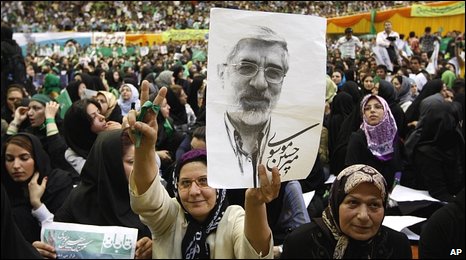
An Iranian supporter of defeated reformist presidential candidate Mir Hossein Mousavi demonstrates on June 17, 2009 in Tehran, Iran. Getty Images

Experts see no ‘smoking gun’ for Iran election fraud
By Andrew Beatty / June 17, 2009

WASHINGTON — Mahmoud Ahmadinejad’s election victory is disbelieved by hundreds of thousands of Iranians who have poured onto Tehran’s streets in protest, but experts say hard evidence of vote rigging is elusive.

Since the government handed the incumbent president a landslide win over opposition candidate Mir Hossein Mousavi hours after Friday’s vote, Tehran has been convulsed by protests unseen since the 1979 Islamic Revolution.

Outside Iran, debate over the election result is split down largely political lines.

Former US presidential candidate John McCain, a conservative, has insisted he is “sure” the elections in Iran were rigged. With equal ferocity leftist Venezuelan President Hugo Chavez has lambasted “foreign efforts” to discredit an “historic” election.

But with few independent observers on hand to witness the vote, analysts warn there is little evidence of a smoking gun of electoral fraud, or evidence that would affirm a fair vote.

Statisticians, pollsters and Iran experts have been poring over the results for hints of vote-rigging, or the possibility that the controversial president is backed by around 63% of voters.

Ken Ballen, president of the Washington-based Terror Free Future think tank, three weeks ago conducted a rare country-wide poll by phone of 1,001 people to gauge Iranians’ voting intentions.

According to Mr. Ballen it is not obvious from that poll that the results of the election were rigged. “At that time Mr. Ahmadinejad was ahead by two to one. Is it plausible that he won the election? Yes.”

The survey showed that 34% of Iranians intended to vote for Mr. Ahmadinejad. Mr. Mousavi was the choice of just 14% of respondents.

But Mr. Ballen cautioned against concluding that the vote was fair.

The poll result fell far short of Mr. Ahmadinejad’s margin of victory, and 27% of Iranians surveyed were still undecided at the time the survey was taken. “Anything could have changed,” Mr. Ballen said.

Mr. Mousavi supporters point to the amazingly quick tallying of millions of hand-counted ballots and the Mr. Ahmadinejad’s surprise win in Mr. Mousavi’s home town, Tabriz, as proof positive of foul play.

Mr. Mousavi is from Iran’s Azeri minority, so voters in his native region in East Azerbaijan province were expected to back him to the hilt, according to Ali Alfoneh, an Iran expert at the American Enterprise Institute.

Instead official results showed Mr. Ahmadinejad won the town and Mr. Mousavi’s tally across the province was a modest 42%.

But Mr. Ballen’s poll indicated only 16% of Azeri Iranians would vote for Mr. Mousavi, against 31% of Azeris who claimed they would vote for Mr. Ahmadinejad.

Walter Mebane, a University of Michigan professor, has been examining the election results using statistical and computational tools to detect fraud, a method he describes as “election forensics.”

Comparing 366 district results with those from the 2005 elections, Mr. Mebane concluded that the “substantial core” of local results were in line with the basic statistical trends.

“In 2009 Mr. Ahmadinejad tended to do best in towns where his support in 2005 was highest, and he tended to do worst in towns were turnout surged the most.”

But Mr. Mebane said data released by the Iranian authorities was not detailed enough to say whether the vote was rigged or not.

“The vote counts I see recorded here do connect to reality to some extent, but in no way do I think that any of this analysis rules out the possibility of manipulation,” he told AFP.

Mr. Mebane pointed out that trends would still ring true if the government simply inflated Mr. Ahmadinejad’s vote by a fixed percentage, perhaps offsetting it against deflated opposition tallies.

With half a million people on the streets, proof of such a falsification could spell the difference between a call for justice and a revolution, according to Mr. Alfoneh.

“If the system totally fails to provide documentation that this is not fraud, that is something that is going to radicalize the protesters,” Mr. Alfoneh said.

Source / Agence France-Presse / National Post

The Rag Blog

Posted in RagBlog | Tagged , , , | 5 Comments

Blowing Through Texas : Renewable Energy Ploy Brings an Ill Wind


Blowing in the Wind

It’s the hitherto scenic, big sky Hill Country, with more stars than you can count in the night sky, that’s been chosen to carry the burden of hosting those high-voltage power lines between West Texas and the I-35 corridor and beyond.

By Sarito Carol Neiman / The Rag Blog / June 18, 2009

Renewable energy… it’s a good thing, right? And all us progressive types are really excited about getting behind the “new green economy.”

Then why has Texas, of all places, which is hardly known for supporting any tree-hugging, progressive tendencies among its citizenry, taken the lead in generating electricity from wind power? Why did the Texas legislature, together with the Public Utilities Commission — folks who are generally more friendly to Big Oil than the Sierra Club — create something called “Competitive Renewable Energy Zones” (CREZ) along with the wind farms to feed them, way back in 2005, smack dab in the middle of the Bush administration?


The answer, my friend, is… probably quite interesting, if my relatively cursory digs through the tangle of ol’ boy networks and overlapping board memberships to follow the money are any indication.

Meantime, plans are now proceeding full steam ahead to hook up all those new West Texas wind farms to “the grid” and build the infrastructure needed to transmit their renewable product to urban areas where it’s needed. Or will be needed, some day, so the theory goes. Because there appears to be no compelling need for all that electricity right at the present moment, we’ve got plenty.

The producers, however — persuaded to set themselves up in the stark landscape of West Texas by promises of great things to come — can’t start collecting their “federal production tax credits” and sell-able “renewable energy credits” till they have a functioning outlet to plug into. And it’s the hitherto scenic, big sky Hill Country, with more stars than you can count in the night sky, that’s been chosen to carry the burden of hosting those high-voltage power lines between West Texas and the I-35 corridor and beyond.

The diverse group of people who live in those Hill Country counties don’t like it much, and are mobilizing with energy and passion to head off, or at least minimize, a rape of the landscape that will be difficult if not impossible to reverse once it starts. Check out what they’re doing, and how you might be able to support them, at one or more of the following links:

To learn about the downsides of industrial wind power, see Wind Power Facts — it’s a good starting place to understand the issues.

The Rag Blog

Posted in Rag Bloggers | Tagged , , , , , | 3 Comments

Robert Jensen : Human Identity and Radical Change

‘Patriarchy.’ Art from Transhuman Traditionalism.

What does it mean to be a human being? Balancing theological and political insights

By Robert Jensen / The Rag Blog / June 18, 2009

My first venture into political activism was in the feminist movement to end men’s violence against women and men’s use of women in the sexual-exploitation industries (stripping, pornography, prostitution), grounded in a critique of the underlying conception of what it means to be a man that most of us have been socialized to accept: masculinity as a quest for control and domination, routinely leading to aggression and violence. Our understanding of what it means to be male has to change, and to drive home that point, I often offer this challenge to my brothers: “You can be a man, or you can be a human being.”

The point was not that we men should alter our bodies but that we couldn’t retain a loyalty to masculinity and still live fully human lives. I later adapted that question for talks on racism, United States foreign policy, and economics. We can be white people, or we can be human beings. We can be Americans, or we can be human beings. We can be affluent, or we can be human beings.

The common claim is simple: to embrace being a man in the conventional sense is to accept the oppression of women in patriarchy; to embrace being a white person in a racist society is to accept the oppression of non-white people; to embrace being American in a world dominated by our hyper-violent nation-state is to accept profound injustice in the world; and to embrace being affluent in a world structured by a predatory corporate capitalism is to accept the deprivation that billions around the world endure.

Underneath those claims is a structural analysis of the roots of an unjust and unsustainable system, and the recognition that for all its affluence and military power, the United States is in many ways a society in collapse — politically, economically, culturally and most important, ecologically. We live in an increasingly callous culture that exploits sexuality and glorifies violence, often with racist images and themes; embedded in a house-of-cards economy built on orgiastic consumption, deepening personal and collective debt, and an artificially inflated dollar; at the end of an imperial era that is grinding to a potentially disastrous demise. And looming over all those crises are the consequences of ignoring for too long the unraveling ecological fabric that makes life possible.

This framework no doubt would seem radical, even crazy, to many. It is radical, in the foundational sense of the term: going to the root, trying to understand the nature of things. In this new century, we need radical analyses more than ever. That’s not crazy, but is in fact the only sane response to a world facing such crises. Radical is realistic, and realistic is sane.

When we dare to be radical, we confront the reality that, at both the personal and planetary levels, we are surrounded by systems based on a domination/subordination dynamic, which we have to challenge at all levels. It’s important to be clear about these particular systems — race, gender and sexuality, capitalism, and empire — all of which must be examined in the context of the coming ecological collapse.

A focus on the first two, race and gender, is often dismissed as mere “identity politics,” and there certainly is a way in which a shallow “diversity talk” can derail radical politics. But there is no way to talk about progressive social change in this country and the wider world if we don’t confront the pathologies of white supremacy and patriarchy, both of which are woven deeply into the fabric of U.S. society. Such terms may seem old-fashioned, but we live in a world of enduring racialized disparities in wealth and well-being, rooted not in the inadequacy of people of color but in white dominance, and a world in which women still face the social limitations and physical threats that come from male dominance.

These ideologies of white supremacy and patriarchy are linked to the systems of capitalism and empire, rooted in the glorification of a hyper-competitive, violent masculinity and a belief in the inherent superiority of the United States and Europe. Capitalism creates a world defined by greed and attempts to reduce us to crass maximizers of self-interest — not exactly a recipe for living a decent life consistent with our principles of equality and the dignity of all people. Empire allows the extraction of the wealth of the many to enrich an ever smaller number of people, not exactly a morally defensible model.

These systems leave half of the people on the planet to live on less than $2.50 a day (World Bank, “ World Development Report 2008”). More than 3 billion people struggle for food, shelter, clothing, education, and medical care on less than what one of us in the developed world might spend on a fancy cup of coffee. The people living at that level of poverty are disproportionately non-white and female. They live mostly in a Third World that has suffered, and continues to suffer, from military and/or economic domination by the First World, especially today by the United States. Radical politics says not only that this state of affairs is unjust, but that the systems and structures of power that give rise to it are fundamentally unjust and must be changed.

And then there is the question of sustainability. Look at any crucial measure of the health of the ecosphere in which we live — groundwater depletion, topsoil loss, chemical contamination, increased toxicity in our own bodies, the number and size of “dead zones” in the oceans, accelerating extinction of species and reduction of bio-diversity — and ask a simple question: Where are we heading? Remember also that we live in an oil-based world that is fast running out of oil, which means we face a huge reconfiguration of the infrastructure that undergirds our lives. And, of course, there is the undeniable trajectory of climate breakdown.

That’s not a pretty picture, and it’s crucial we realize that there are no technological fixes that will rescue us. We have to go to the root and acknowledge that human attempts to dominate the non-human world have failed. We are destroying the planet and in the process destroying ourselves. Here, just as in human relationships, we either abandon the domination/subordination dynamic or we don’t survive.

A radically realistic assessment of the nature of contemporary systems and institutions is necessary if we are to make progress toward real justice and real sustainability. It is realistic, though not pleasant to recognize, that when we draw our sense of self from the privilege and power that comes with being in a dominant position within unjust and immoral hierarchical systems — patriarchy, white supremacy, U.S. imperial domination, and capitalism — we sacrifice some deeper sense of our humanity. We can’t accept those privileges and that power without losing a part of ourselves, the part that gives real meaning to our lives, the part with which we yearn to connect to others.

We can be men/white/American/affluent, or we can be human beings.

That challenge leaves one obvious question unasked and unanswered: What does it mean to be a human being? Given all that we know and don’t know in the modern world, what does a claim to be human really mean at this moment in history? What qualities are we most focused on when we say we are human, when we talk about our humanity? We appeal to each other’s humanity all the time, but with surprisingly little discussion of what it means in the modern context.

As I worked on political issues connected to these systems of oppression, I found that the political traditions in which I was rooted gave me the tools I needed to analyze and resist those systems. Radical feminism, anti-racist theory and practice, traditional anti-imperialist and anti-capitalist movements, and the best thinking in ecology — all were more than adequate for providing an understanding of how these systems work and for putting together a holistic analysis of a profoundly unjust and immoral modern world. Those political traditions could take me a long way, but increasingly I had a sense they could not take me all the way home. I had difficulty fashioning an answer to that nagging question: What does it mean to be human?

So it was then, somewhat reluctantly, that I turned to theology and eventually joined a congregation. My motivation wasn’t a sudden surge of interest in the origins of the universe or a concern about what awaited me after death; my focus remains on the question of how to live fully and responsibly in the here and now. The same questions that had led me to radical politics nudged me to expand the scope of my inquiry. I had no interest in succumbing to New Age-style self-indulgence, nor did I intend to give up politics to pursue theology. My goal has been to deepen my politics through theology and open up to new ways of thinking about myself as well. Whatever I had thought of religious institutions in the past — I had never cared much for them — increasingly it seemed self-defeating to avoid engagement with religion, which is so clearly a powerful force for so many. Theology and organized religion are not, of course, the only routes to explore these questions, but there is no reason to reject the wisdom that theology might offer.

Our first step is not to pretend to answer questions but to pose questions clearly, in ways that would allow people of different views at least to start from some common ground. If I were to condense all this into one question, it would look like this:

Which practices, systems, and fundamental conceptions of what it means to be human, are consistent with a sustainable human presence on the earth, respectful of other life, in societies that provide the necessary resources for all people to live a decent life, within a culture that fosters individual flourishing alongside a meaningful sense of collective identity, helping us to take seriously our obligations to ourselves, each other, and to the non-human world?

Embedded in that one question are, of course, many complex questions that people have pondered for centuries without clear resolution. Completely new insights are unlikely to emerge here; maybe there are no truly original insights to be had by anyone. But if we want to take politics and theology seriously, we can’t pretend not to understand these questions, and we can’t evade our responsibility to struggle to understand and then to act on that understanding.

[This essay is excerpted from Robert Jensen’s new book, All My Bones Shake: Seeking a Progressive Path to the Prophetic Voice, from Soft Skull Press. Jensen is a journalism professor at the University of Texas at Austin and board member of the Third Coast Activist Resource Center in Austin, TX. He also is the author of Getting Off: Pornography and the End of Masculinity (South End Press, 2007) and several other books. Jensen can be reached at rjensen@uts.cc.utexas.edu and his articles can be found online here.]

The Rag Blog

Posted in Rag Bloggers | Tagged , , , , | 4 Comments

Republicans and Racism : Could Go the Way of the Whigs

Republican emailing with pictures of all the presidents. Obama’s square is just a black space with two eyeballs.

It’s perfectly OK to be a racist in the Republican Party, as long as you keep it ‘in house’ and pass it off as a joke.

By Ted McLaughlin / The Rag Blog / June 18, 2009

Before the mid-sixties,the dominant political party in the South (and in Texas) was the Democratic Party. In fact, at that time, most of those states had virtually a one-party system. I know that in Texas, the only real election was in the Democratic primary, because the November election was a foregone conclusion. Republicans didn’t have a chance.

But that changed in the mid-sixties, when President Lyndon Johnson and the Democrats stepped up, bit the bullet, and did the right thing by passing the civil rights laws. It was badly needed and long overdue, but it was also disastrous for the Democratic Party in the South. Sadly, there were still a lot of racists in Texas and the South at that time, and they fled en masse to the Republican Party.

With the addition of this huge volume of racists, the Republican Party in the South not only became competitive, but became the dominant party of the region. It is still that way, although due to changing attitudes the Democrats are now starting to become more competitive in Texas and many Southern states, as more and more whites shed their racism.

But while white racists fled the Democratic Party in the late Sixties, African-Americans flocked to that party. Even to this date, it is not uncommon for African-Americans to vote for Democrats in a block — many times voting 90-95% Democratic in elections.

Republicans have pushed forward their tokens like Alan Keyes and Michael Steele, trying to give the impression they are a “big tent” party. Then they are amazed that these tokens aren’t able to attract African-Americans to their party. They haven’t figured out that the tokenism won’t work as long as their party harbors and accepts a rabidly racist element.

They not only harbor these racists, but in many instances they allow them to assume positions of power and influence in the party. A couple of fresh instances of this came to light just in the last week.

In South Carolina, a prominent GOP activist named Rusty DePass responded to a Facebook comment about a gorilla escaping a Columbia zoo by remarking, “I’m sure it’s just one of Michelle’s ancestors — probably harmless.”

When called to task on this incrediby racist remark, his only defense was “The comment was clearly in jest.” He thinks it’s OK to be racist, as long as its funny. Well, it’s not OK, and it shows just how accepting of racists and racism the Republican Party has become.

Meanwhile in Tennessee, Sherri Goforth, a legislative staffer for Republican State Senator Diane Black, e-mailed a little racist humor to some others in her party. It was a poster that had been knocking around the internet for a while among right wing racists. It shows pictures of all the presidents of the United States — all but President Obama. Obama’s square is just a black space with two eyeballs.

Was Ms. Goforth embarrassed by her obviously racist action? Not in the least. She was just upset because she accidently sent the e-mail to some who weren’t racists and she got exposed. She said, “I went on the wrong email and I inadvertently hit the wrong button. I’m very sick about it, and it’s one of those things I can’t change or take back.”

It’s perfectly OK to be a racist in the Republican Party, as long as you keep it “in house” and pass it off as a joke. These are not the only instances of Republican racism. There have been many others, like the poster showing the White House lawn turned into a watermelon patch. Is it any wonder that most African-Americans (and other minorities) don’t feel comfortable in the Republican Party — the party that accepts such behavior from its members?

With each succeeding generation, the United States becomes a little less racist. Added to the fact that many whites are shedding their racist tendencies, is the fact that in many parts of this country, the majority of the population is now composed of minorities. Both of these trends are going to continue, and that’s bad news for the Republican Party.

The Republican Party must face its internal racism and get rid of it. Failure to do so will ensure they become a party of little significance in the future, and could result in their demise. Dump the racism or go the way of the Whigs!

[Rag Blog contributor Ted McLaughlin also posts at jobsanger, an excellent Texas political blog.]

The Rag Blog

Posted in Rag Bloggers | Tagged , , , | 2 Comments

Austin : Spirited Demonstration Denounces Iranian Elections

Iranians and their supporters demonstrated at the Texas State Capitol Wednesday, June 17, 2009. Photos by James Retherford / The Rag Blog.

Dude. Where’s my Vote?

By Thorne Dreyer / The Rag Blog / June 18, 2009

See more photos below.

A rally and march condemning alleged election fraud in Iran took place in downtown Austin yesterday, Wednesday, June 17, 2009, starting at 5 p.m. Some 350 people, a majority of them Iranians and many either students or faculty at the University of Texas at Austin, gathered in front of the Texas State Capitol.

Backed by live music fueled by two energetic drummers, they chanted, listened to speakers and poetry, and waved signs directed at passing rush hour traffic. Many in cars honked their support and flashed peace signs. The demonstrators’ placards called for “Democracy for Iran” and asked “Where is my Vote?” Non-Iranian supporters showed signs expressing their “Solidarity with Iran.”

Then the two-block long group marched down Congress Ave. to Sixth Street and back, chanting “What do we want? Democracy!” and “Ahmadinejad. Shame on You,” One distinguished grey-haired gentleman in tie, jacket slung over his arm, stepped proudly while holding up a sign that asked, “Dude. Where’s my Vote?”

The demonstration was organized by UT student group Iranians for Peace and Justice, and by the Persian Student Society of UT and Austin Permanent Peace Protest.

Also see Were Elections a Fraud? Uprising in Iran; Protest in Austin by Banafsheh Madaninejad / The Rag Blog / June 16, 2009


Demonstrators in Austin protest alleged voter fraud in Iran. Photos by James Retherford / The Rag Blog.

The Rag Blog

Posted in Rag Bloggers | Tagged , , , | 5 Comments

Reaping What We Sow : Iran and Stolen Elections

Iranian Prime Minister Mohammed Mossadegh, a social democrat, was overthrown by the CIA. Here Mossadegh, with hat, is shown leaving the U.S. Supreme Court building on Nov. 5, 1951. Photo from the Truman Library.

After a half-century of dictatorship under the Shah and the CIA, followed by the Ayatollah and the fundamentalists, the Iranian public appears desperate to return to the social-democratic vision of Mossadegh…

By Bob Fitrakis and Harvey Wasserman / The Rag Blog / June 17, 2009

The parallels between the stolen Iranian election of 2009 and the American of 2000 and 2004 are tragic. The histories — and futures — of the two nations are inseparable. Bound up in their tortured half-century of crime and manipulation are the few glimmers of hope for lasting peace in the Middle East.

In both countries, a right wing fundamentalist authoritarian with open contempt for human rights and the Geneva Convention has come up a winner, with catastrophic consequences. In both countries, the blowback of two George Bushes loom large.

In the US, two “defeated” candidates — Al Gore and John Kerry — said and did nothing in the face of two stolen elections. But an unprecedented voter protection movement arose from the ashes of those defeats to assure the 2008 victory of America’s first African-American president.

In Iran, the “defeated” candidate — Mir Hussein Moussavi — is fighting back, along with a massive grassroots resistance. How far they get will define the Iranian future — as well as that of the Middle East.

In a fluid and unpredictable situation, here are some indisputables:

  1. A half-century ago, the people of Iran attempted a democratic revolution led by a moderate progressive, Dr. Mohammed Mossadegh, whose social-democratic inclinations have been revived by Moussavi.
  2. Prime Minister Mossadegh was overthrown by the Eisenhower Administration and its Central Intelligence Agency, which wanted to wall in the Soviet Union and protect western oil interests.
  3. Norman Schwarzkopf, Sr. (father of the Gulf War general of the same name) used a suitcase full of U.S. taxpayer dollars to bribe Iran’s anti-democratic sympathizers and help overthrow Mossadegh.
  4. They installed the pro-U.S. general Fazlollah Zahedi, who handed control of Iran to the brutal and vicious Shah. The dictatorial Shah ruled through the infamous secret terror/torture police force Savak, which Schwartzkopf helped train.
  5. A prototypical CIA asset, the Shah used his iron torturer’s hand to “Westernize” the country and make it more user-friendly to US oil interests.
  6. Among other things, the U.S., France and other western powers were moving to provide the Shah with up to 36 atomic power plants designed to provide electricity and, ultimately, radioactive materials with which to build his own atomic bombs.
  7. Despite his ostensible commitment to human rights, President Jimmy Carter made a point of spending a high-profile New Year’s with the Shah, evoking the bitter hatred of millions of Iranians.
  8. The Shah’s overthrow by fundamentalist Ayatollah Khomeini led to the 1979-80 hostage crisis that finally sank Carter’s presidency. Amidst indications of a secret deal involving past and future CIA Directors George H.W. Bush and William Casey, the release of the hostages was delayed long enough to guarantee Carter’s defeat, thus inaugurating the Age of Ronald Reagan, with 12 of its 28 years under the two George Bushes.
  9. Secret dealings between Reagan/Bush and the Iranians led to the iran-Contra Affair, when covert operatives like Oliver North funneled arms to the Iranians and laundered cash and drugs through the reactionary Contra forces fighting revolution in Nicaragua.
  10. The Contras in turn flooded the US with cocaine, feeding a horrific crack epidemic that has crippled the black and Hispanic communities here for two decades.
  11. Those US-financed arms were used to fight the Iraqis and Saddam Hussein, whom the U.S. also supported, and whom Donald Rumsfeld publicly embraced in the early 1980s. The American goal seems to have been to weaken both Iran and Iraq through a horrifying war that claimed at least a million casualties, ultimately infuriating both citizenries.

After a half-century of dictatorship under the Shah and the CIA, followed by the Ayatollah and the fundamentalists, the Iranian public appears desperate to return to the social-democratic vision of Mossadegh, denied so long ago.

In the U.S. in 2000 and 2004, the corporate/religious right put George W. Bush in the White House — and then kept him there — with a sophisticated election theft machine built around elimination of voter registrations, manipulation of the vote count, and a wide array of supporting tactics. The US Supreme Court set it all in stone with its infamous Bush v. Gore decision, which prevented a true vote count in Florida 2000. History repeated itself in Ohio 2004.

In Iran 2009, the ruling fundamentalist elite has barely pretended to count the votes at all, merely rushing to announce a predetermined outcome. The reigning Ayatollah has played the role of the U.S. Supreme Court by certifying the outcome before a real ballot tally could possibly occur. Blank spaces in the texts of Iranian newspapers and an electronic blackout created by official censors reflect the ongoing vacuum in the US corporate media, which has yet to seriously report what was done to the American elections of 2000 and 2004.

What will happen next in Iran is anyone’s guess. George W. Bush fueled its fundamentalist right by calling it a “terror state” whose nuclear weapons ambitions are fueled with materials produced by the “Peaceful Atom” Eisenhower inaugurated in 1953, around the time he was disposing of Mossadegh.

Bush’s counterpart, Mahmoud Ahmadinejad, is now turning the state terror apparatus — reminiscent of the Shah’s — against those who would mention the illegitimacy of his rule.

Thus tragedy looms at the brink of opportunity. That democracy in Iran so clearly won at the polls is a sign of great courage and hope on the part of the Iranian people. They are fighting terrible odds, not of their own making. Should they break free, the storm would reshape the Middle East — and much more.

In the meantime, perhaps their American counterparts, instructed by the ghost of Mossadegh, might finally face up to the true price of sowing such cynical, lethal whirlwinds.

[Bob Fitrakis and Harvey Wasserman have co-authored four books on election protection. Bob’s Frankis Files are available via www.freepress.org, where this article was also published. Harvey Wallerman’s History of the United States is at www.harveywasserman.com.]

The Rag Blog

Posted in Rag Bloggers | Tagged , , , | 3 Comments