Blue Dog Cowardice and the State of Health Care Reform

Photo of blue dog Democrat from dogguide.net.

Health Care Reform: The State of the Debate

The Democrats, though in the majority and supported by 67% of the American people, act confused, impotent, lacking in courage and conviction.

By Dr. Stephen R. Keister / The Rag Blog / June 15, 2009

Leslie H. Gelb has an outstanding essay in the May/June 2009 issue of Foreign Affairs. It is a must read for all thinking Americans, all progressives. Though the article — entitled “Necessity, Choice, and Common Sense; A Policy for a Bewildering World” — has primarily to do with intellectual and societal decay in the United States, Gelb makes a point that applies to the present discussion about universal health care:

“The bases of the United States’ international power are the country’s economic competitiveness and its political cohesion, and there should be little doubt that both are in decline. Many acknowledge and lament faltering parts here and there, but they avoid a frontal stare at the deteriorating whole.”

Gelb continues,

“These signals of decline have not inspired politicians to put national good above partisan interests or problem solving above scoring points. Republicans act like rabid attack dogs in and out of power and treat facts like trash. Democrats seem to lack the decisiveness, clarity of vision, and toughness to govern. The tableau of domestic political stalemate begs for new leadership.”

When we look at the state of “debate” in Washington concerning universal health care we can fully appreciate the total lack of Democratic leadership. Jim Hightower said it the June 2009 Hightower Lowdown:

“Now is the time for boldness! Instead, we’re getting Baucusness. Sen. Max Baucus, that is — Montana Democrat, chair of the Senate Finance Committee, and frequent spear carrier for the corporate agenda. He has now been tapped to handle Obama’s promised rewrite of America’s warped, ineffective, and exorbitantly expensive health care system.”

Yet the Democrats, though in the majority and supported by 67% of the American people, act confused, impotent, lacking in courage and conviction. In the forefront are those in the Senate, largely backed by the big insurance companies and the pharmaceutical industry. We see these folks repeatedly on TV, as if they represent the will of the people, rather than the will of the special interests, Sens. Baucus, Conrad, Nelson, Bayh and the whimpy Harry Reid. Other than Sen. Bernie Sanders, who makes a rare appearance, where are the folks that the people elected to correct the health care system? Are they intimidated? Do they buy the myth that the nation requires something called “bipartisanship,” or are their coffers being covertly resupplied by the monied interests?

Jim Hightower continues:

”Something big is at hand. It is called a ‘single payer’ health-care system — a structural reform that has been successfully implemented in several countries, as well as our own Medicare and veterans health programs. By expanding this system nationally, every person in our land would be assured good-quality care. No longer would profiteering insurance corporations control entry, dictating which doctors we can use (and what treatments they can provide), gouging us with ever-rising premiums, and co-pays, and ripping off a third of our nation’s health care dollars for things that have nothing to do with either health or health care — including ridiculous CEO pay packages, excessive profits, massive billing bureaucracies, useless advertising hustles, posh headquarters, lobbying expenses, etc.”

President Obama promised universal health care during his campaign, and the vast majority of the people took him at his word. Now, with action at hand, he has compromised away the prize before the debate is really underway. Now it seems he has conceded the debate to the Blue Dogs of the Democratic Party and to the obstructionist Republicans. I grant that Obama early conceded that he could not pass single payer universal care, but he did indicate strong support for a “public insurance option.” Now he appears willing to concede to Senators Baucus and Nelson, or to pay homage to the ailing Senator Kennedy. He must realize that according to the latest reports on the quality of health care, again reported by Jim Hightower, the United States ranks 37th in the world in the quality of health care, one notch above Slovenia, and progressively denies decent health care to more and more people.

The propaganda of the insurance and pharmaceutical companies clogs the TV airways. Once again they attempt to frighten the public with misinformation. Happily a few columnists are striking back, like Nicholas Kristof in The New York Times. “This Time, We Won’t Scare,” is an excellent account of Canadian health care and how it differs from ours.

This is supported by Robert Reich in an article distributed by truthout and published in The Rag Blog under the title “Robert Reich: Big Pharma and Big Insurance Vs. Health Care ‘Public Option.’” Dr Reich stresses that a watered down Public Option will be as bad as no legislation at all. He is referring to the compromise offered by Sen. Snowe and supported by several Democrats (including Senators Wyden and Carper) — a plan to include a public option which would kick in years from now, but would only be triggered if insurance companies fail to bring down health care costs and expand coverage in the future. This is almost as bizarre as Sen, Conrad’s plan for “health care cooperatives.”

The opponents of any form of universal health care keep pointing to the cost. What could be more expensive than the cost of health care as it now exists in the United States? Yearly, per capita, we spend more than any other industrialized nation, while 50 million are without health care, millions have inadequate insurance; 50% of bankruptcies are caused by the inability to pay medical costs. Single Payer/Universal as has long been proposed by Physicians for a National Health Program would REDUCE costs by 30-40%.

The mainstream media appears oblivious to this, naively quoting the AMA which traditionally has opposed any national social programs including Social Security and Medicare, and has supported such payoffs to the insurance and pharmaceutical industries as Medicare Part D (the prescription plan supported by the Bush administration, landing the leading congressional supporters in jobs with the insurance or pharmaceutical companies). Further, and a bit farther afield, is the suggestion that I made in my last two Rag Blog articles, suggesting that cannabis be decriminalized and sold legally, similar to tobacco and alcohol, with tax receipts designated for medical care for all.

It may well be time, since little time remains, for the various organizations supporting universal care to face up to our dilemma and to consider, where constitutionally allowed, initiating recall procedures in the 2009 Autumn elections against the Democratic senators who are obstructionists and obviously beholden to the large financial interests. We must make a loud noise!

The Senate is looking for ways to save money in the Medicare program. There are lots of foolish suggestions being bandied about. I should think that several fundamental things bear consideration:

1. Total elimination of Medicare Advantage Plans.

2. Close review of the payment for permanent medical devices under medicare. Every time I drive through the city I see a new outlet for “medical supplies,” just as I see them advertised on TV. Obviously the ability of Medicare to pay has something to do with this burgeoning industry.

3. Examine the need for certain suppliers. I drive along strip malls and see neon signs (largely in Florida) for mammograms, chiropractic treatments, and the nursing home and home care industries as a whole. The quality, cost effectiveness, and executive salaries must be reviewed, especially in the corporate entities, as opposed to the local religiously, or community based institutions.

4. Deal with the salary disparity among medical specialties, which penalizes the family physician and internist, and elevates certain “surgical specialties” to the exalted income of Wall Street CEOs. We need more primary care doctors in this country!

Finally, the Medicare agency needs to look at the costs of the hospital industry. Ken Terry covers this problem in detail in an article entitled “IRS Report Puts Tax-Exempt Hospitals Under Microscope” on the BNET Healthcare blog from Feb. 13, 2009.

A final reflection. I see the terrible statistics regarding infant mortality, child mortality, child poverty, and death rates among uninsured adults in the United States and continually wonder where are the “right to life” people on this issue. I hear nary a whimper from these folks about our early death rates among adults from lack of medical care when compared with Western countries. I should think that, in view of their very strong views about the life of the fetus, that they would be in the forefront of those demanding care for the human being once released from the womb.

Does their interest in “life” stop entirely with an infant’s birth? I wish someone would explain this to me in a reasonable, logical fashion, and would be even happier to see a rational “right to life” movement that would support better care for viable infants, children, teenagers, and adults. Is it reasonable to send American youth off to be slaughtered in unprovoked wars, or to see hundreds of children in foreign lands killed by bombing? There is more to civic and moral responsibility than promoting policies that can lead to domestic terrorism.

[Dr. Stephen R. Keister, a retired physician who is active in health care reform, lives in Erie, PA. His previous articles on The Rag Blog can be found here.]

The Rag Blog

Posted in Rag Bloggers | Tagged , , , | 4 Comments

Steve Weissman : Netanyahu Offers a State and a Half

Binyamin Netanyahu speaks on Palestine. Could he become the Nixon of the Middle East? Photo by AP.

Israel Offers a State and a Half

To bring the Palestinians and their Arab supporters back to the table, [Obama] will have to find something new, and he will not find it in Netanyahu’s speech.

By Steve Weissman / June 15, 2009

Could Israeli Prime Minister Binyamin Netanyahu become the Richard Nixon of the Middle East, as Barack Obama invited him to do? Could he break with his hard-line past and reach out to the Palestinians the way Nixon did with the Chinese? Or will he pay lip service to peace even as he does everything he can to keep the Palestinians from ever getting a viable state of their own? Watching it on TV Sunday night, I came away deeply depressed by the spirit and substance of Netanyahu’s speech, though the Obama White House diplomatically welcomed his acceptance of a Palestinian state, however limited, as an “important step forward.”

Netanyahu was uncharacteristically clear and straightforward about what his coalition government would and would not accept. “The territory in Palestinian hands must be demilitarized in other words, without an army, without control of airspace, and with effective security safeguards…” he insisted.

“A fundamental condition for ending the conflict is a public, binding and honest Palestinian recognition of the state of Israel as the nation state of the Jewish people.”

Netanyahu set these as the primary preconditions for his acceptance of even a limited Palestinian state.

“If we receive this undertaking, for demilitarization and the security arrangements required by Israel, and if the Palestinians recognize Israel as the nation state of the Jewish people,” he declared, “we will be prepared for a true peace agreement, to reach a solution of a demilitarized Palestinian state alongside the Jewish state.”

On other contentious issues, Netanyahu would refrain from seizing any more land claimed by the Palestinians, but would continue to allow the 300,000 Israelis living in the West Bank to expand existing settlements within their current borders. He would refuse to allow Palestinian refugees to return to their homes within Israeli borders. He would never negotiate with Hamas. And he would deny the Palestinians the right to have their capital in East Jerusalem.

As Netanyahu and his advisers might have intended, the Palestinian Authority and Hamas immediately rejected his preconditions. They did not find his belated acceptance of a Palestinian state as the great bargaining chip he wanted it to be, since earlier Israeli governments of Ehud Barak, Ariel Sharon and Ehud Olmert had already accepted the principle. Even more, the Palestinians recoiled at his arrogance in attempting to impose strategic and ideological preconditions before the talks had even resumed.

“Netanyahu’s remarks have sabotaged all initiatives, paralyzed all efforts being made and challenges the Palestinian, Arab and American positions,” said Nabil Abu Rudeinah, an aide to Palestinian President Mahmoud Abbas.

“His speech is a slap in the face of all those who have opted for the choice of negotiations with Israel,” said senior Hamas leader Ismail Radwan. “What needs to be done immediately is to sever all ties with Israel.”

Underlying the Palestinian response was a rejection of the way Netanyahu tried to lay down the law. Negotiators could have worked through many of the “details” in subsequent negotiations. But no self-respecting Palestinian leader could accept them in advance as a fiat from the Israelis.

Take the right of Palestinian refugees to return to homes they abandoned during the 1948 Israeli-Arab war. Over the years, various Palestinians have suggested a compromise that would include an affirmation of the right of return along with compensation for the vast majority of the refugees who have no desire to live in Israel.

A serious compromise might also include compensation for Jewish refugees who fled Arab lands in which they had lived for centuries. But no Palestinian leader could reject the right of return, which is enshrined as a principle in international law.

Netanyahu’s demands for ironclad guarantees of Israel’s security could find similar solutions. But the Israelis would have to accept reciprocal limitations on their own sovereignty, including a good measure of international intervention. Again, these should be details for good-faith negotiations, not a dictate that the Palestinians accept half a state in advance.

Jerusalem presents a different case. As most observers acknowledge, the Israelis will probably end up having to accept a Palestinian capital in East Jerusalem, which is home to the Dome of the Rock, the third holiest site in the Islamic faith. “A united Jerusalem as the eternal, undivided capital of the Jewish people in the state of Israel forever” plays well to Zionists, but the Obama administration will not likely let the demand stand in its way.

Much the same is true of the Palestinians having to recognize that “The State of Israel is the national homeland of the Jewish People and will remain so.” This is the central tenet of Zionism, and Netanyahu is essentially demanding that the Palestinians affirm Zionism, which would mean rejecting their own belief that the land is historically their own.

Netanyahu makes the demand in part because he knows that the Palestinians will have to reject it, just as he would have to reject any demand that he recognize the West Bank — the Biblical lands of Judea and Samaria – as the national homeland of the Palestinians.

Hopefully, the Obama administration will laugh the whole business away. Washington does not demand that anyone recognize the United States as a Christian country, or as a secular country or as anything else. Nor do the French demand that anyone but school kids recognize their country as the land of “our ancestors the Gauls.”

So, where does that leave “the peace process”? Back in Obama’s lap. To bring the Palestinians and their Arab supporters back to the table, he will have to find something new, and he will not find it in Netanyahu’s speech.

[A veteran of the Berkeley Free Speech Movement and the New Left monthly Ramparts, Steve Weissman lived for many years in London, working as a magazine writer and television producer. He now lives and works in France. He is also a regular contributor to The Rag Blog.]

Source / truthout

The Rag Blog

Posted in RagBlog | Tagged , , , | Leave a comment

VERSE / Alyce Guynn : Speaking of Feet

C’est le pied / Julien Colombier à Paris / Colombier in his studio / Art as Authority.

Speaking of Feet

I.
Why do you look at my feet
when we speak?

Were we lovers in ancient China
where my feet were bound
in servitude to you
as I hobbled to do your bidding?

Or perhaps I was your horse
who threw a shoe
throwing you to your death

Maybe my feet are reminders
of your mother
who trampled over your feelings
denying your reality
forcing her beliefs down
your tiny throat
all in the name of love

II.
Why do you look at your feet
when I speak?

It is in your eyes I want
the recognition

Your feet are pretty
deserving attention
but now is not the time
to praise or contemplate them

It is like having to compete
with a sibling
these feet of yours
a new baby
who takes away from me
the attention I crave

Since I cannot see myself
I need you to look at me

III.
Why does she keep staring at us
while she listens

It is uncomfortable as feet
to receive so much thought

We’d rather walk
be rubbed and prettied up

Not this contemplation

Ten toes remain
arches high, heels smooth
free of calluses

We are your feet
he is your friend

Meet him with your gaze
let him in

IV.

Why do I look at my feet
when you speak?

It is because I am hiding
not wanting you to see
my desire
to stop you

Your words bang on me
an incessant mallet
trying to mold me
into your shape

I don’t want to hear
your latest obsession
your parrot repeating
someone else’s words

I look at my feet
when you speak
because I lack
courage to tell you
to stop.

V.
Why does she look at her feet
when I speak?

Is there something in my face
from which she must turn away?

What does it mean
that she won’t meet my eyes?

Does her looking away
render me invisible?

Did I come naked
unable to drape myself
wanting her to clothe me
in acceptance?

© Alyce Guynn

Alyce Guynn / The Rag Blog
Austin, Texas
June 15, 2009

The Rag Blog

Posted in Rag Bloggers | Tagged | Leave a comment

Neo-Nazis : You’re in the Army Now

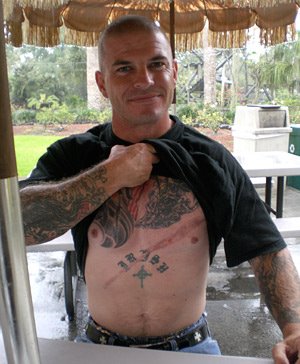
Iraq veteran Forrest Fogarty sailed through recruitment despite his neo-Nazi tattoos. Photo by Matt Kennard / salon.com.

Neo-Nazis are in the Army now

Why the U.S. military is ignoring its own regulations and permitting white supremacists to join its ranks.

By Matt Kennard / June 15, 2009

On a muggy Florida evening in 2008, I meet Iraq War veteran Forrest Fogarty in the Winghouse, a little bar-restaurant on the outskirts of Tampa, his favorite hangout. He told me on the phone I would recognize him by his skinhead. Sure enough, when I spot a white guy at a table by the door with a shaved head, white tank top and bulging muscles, I know it can only be him.

Over a plate of chicken wings, he tells me about his path into the white-power movement. “I was 14 when I decided I wanted to be a Nazi,” he says. At his first high school, near Los Angeles, he was bullied by black and Latino kids. That’s when he first heard Skrewdriver, a band he calls “the godfather of the white power movement.” “I became obsessed,” he says. He had an image from one of Skrewdriver’s album covers — a Viking carrying a staff, an icon among white nationalists — tattooed on his left forearm. Soon after he had another white power symbol, a Celtic cross, emblazoned on his stomach.

At 15, Fogarty moved with his dad to Tampa, where he started picking fights with groups of black kids at his new high school. “On the first day, this bunch of niggers, they thought I was a racist, so they asked, ‘Are you in the KKK?'” he tells me. “I said, ‘Yeah,’ and it was on.” Soon enough, he was expelled.

For the next six years, Fogarty flitted from landscaping job to construction job, neither of which he’d ever wanted to do. “I was just drinking and fighting,” he says. He started his own Nazi rock group, Attack, and made friends in the National Alliance, at the time the biggest neo-Nazi group in the country. It has called for a “a long-term eugenics program involving at least the entire populations of Europe and America.”

But the military ran in Fogarty’s family. His grandfather had served during World War II, Korea and Vietnam, and his dad had been a Marine in Vietnam. At 22, Fogarty resolved to follow in their footsteps. “I wanted to serve my country,” he says.

Army regulations prohibit soldiers from participating in racist groups, and recruiters are instructed to keep an eye out for suspicious tattoos. Before signing on the dotted line, enlistees are required to explain any tattoos. At a Tampa recruitment office, though, Fogarty sailed right through the signup process. “They just told me to write an explanation of each tattoo, and I made up some stuff, and that was that,” he says. Soon he was posted to Fort Stewart in Georgia, where he became part of the 3rd Infantry Division.

Fogarty’s ex-girlfriend, intent on destroying his new military career, sent a dossier of photographs to Fort Stewart. The photos showed Fogarty attending white supremacist rallies and performing with his band, Attack. “They hauled me before some sort of committee and showed me the pictures,” Fogarty says. “I just denied them and said my girlfriend was a spiteful bitch.” He adds: “They knew what I was about. But they let it go because I’m a great soldier.”

In 2003, Fogarty was sent to Iraq. For two years he served in the military police, escorting officers, including generals, around the hostile country. He says he was granted top-secret clearance and access to battle plans. Fogarty speaks with regret that he “never had any kill counts.” But he says his time in Iraq increased his racist resolve.

“I hate Arabs more than anybody, for the simple fact I’ve served over there and seen how they live,” he tells me. “They’re just a backward people. Them and the Jews are just disgusting people as far as I’m concerned. Their customs, everything to do with the Middle East, is just repugnant to me.”

Because of his tattoos and his racist comments, most of his buddies and his commanding officers were aware of his Nazism. “They all knew in my unit,” he says. “They would always kid around and say, ‘Hey, you’re that skinhead!'” But no one sounded an alarm to higher-ups. “I would volunteer for all the hardest missions, and they were like, ‘Let Fogarty go.’ They didn’t want to get rid of me.”

Fogarty left the Army in 2005 with an honorable discharge. He says he was asked to reenlist. He declined. He was sick of the system.

Since the launch of the wars in Afghanistan and Iraq, the U.S. military has struggled to recruit and reenlist troops. As the conflicts have dragged on, the military has loosened regulations, issuing “moral waivers” in many cases, allowing even those with criminal records to join up. Veterans suffering post-traumatic stress disorder have been ordered back to the Middle East for second and third tours of duty.

The lax regulations have also opened the military’s doors to neo-Nazis, white supremacists and gang members — with drastic consequences. Some neo-Nazis have been charged with crimes inside the military, and others have been linked to recruitment efforts for the white right. A recent Department of Homeland Security report, “Rightwing Extremism: Current Economic and Political Climate Fueling Resurgence in Radicalization and Recruitment,” stated: “The willingness of a small percentage of military personnel to join extremist groups during the 1990s because they were disgruntled, disillusioned, or suffering from the psychological effects of war is being replicated today.” Many white supremacists join the Army to secure training for, as they see it, a future domestic race war. Others claim to be shooting Iraqis not to pursue the military’s strategic goals but because killing “hajjis” is their duty as white militants.

Soldiers’ associations with extremist groups, and their racist actions, contravene a host of military statutes instituted in the past three decades. But during the “war on terror,” U.S. armed forces have turned a blind eye on their own regulations. A 2005 Department of Defense report states, “Effectively, the military has a ‘don’t ask, don’t tell’ policy pertaining to extremism. If individuals can perform satisfactorily, without making their extremist opinions overt … they are likely to be able to complete their contracts.”

Carter F. Smith is a former military investigator who worked with the U.S. Army Criminal Investigation Command from 2004 to 2006, when he helped to root out gang violence in troops. “When you need more soldiers, you lower the standards, whether you say so or not,” he says. “The increase in gangs and extremists is an indicator of this.” Military investigators may be concerned about white supremacists, he says. “But they have a war to fight, and they don’t have incentive to slow down.”

Tom Metzger is the former grand wizard of the Ku Klux Klan and current leader of the White Aryan Resistance. He tells me the military has never been more tolerant of racial extremists. “Now they are letting everybody in,” he says.

The presence of white supremacists in the military first triggered concern in 1976. At Camp Pendleton in California, a group of black Marines attacked white Marines they mistakenly believed to be in the KKK. The resulting investigation uncovered a KKK chapter at the base and led to the jailing or transfer of 16 Klansmen. Reports of Klan activity among soldiers and Marines surfaced again in the 1980s, spurring President Reagan’s Defense Secretary, Caspar Weinberger, to condemn military participation in white supremacist organizations.

Then, in 1995, a black couple was murdered by two neo-Nazi paratroopers around Fort Bragg in North Carolina. The murder investigation turned up evidence that 22 soldiers at Fort Bragg were known to be extremists. That year, language was added to a Department of Defense directive, explicitly prohibiting participation in “organizations that espouse supremacist causes” or “advocate the use of force or violence.”

Today a complete ban on membership in racist organizations appears to have been lifted — though the proliferation of white supremacists in the military is difficult to gauge. The military does not track them as a discrete category, coupling them with gang members. But one indication of the scope comes from the FBI.

Following an investigation of white supremacist groups, a 2008 FBI report declared: “Military experience — ranging from failure at basic training to success in special operations forces — is found throughout the white supremacist extremist movement.” In white supremacist incidents from 2001 to 2008, the FBI identified 203 veterans. Most of them were associated with the National Alliance and the National Socialist Movement, which promote anti-Semitism and the overthrow of the U.S. government, and assorted skinhead groups.

Because the FBI focused only on reported cases, its numbers don’t include the many extremist soldiers who have managed to stay off the radar. But its report does pinpoint why the white supremacist movements seek to recruit veterans — they “may exploit their accesses to restricted areas and intelligence or apply specialized training in weapons, tactics, and organizational skills to benefit the extremist movement.”

In fact, since the movement’s inception, its leaders have encouraged members to enlist in the U.S. military as a way to receive state-of-the-art combat training, courtesy of the U.S. taxpayer, in preparation for a domestic race war. The concept of a race war is central to extremist groups, whose adherents imagine an eruption of violence that pits races against each other and the government.

That goal comes up often in the chatter on white supremacist Web sites. On the neo-Nazi Web site Blood and Honour, a user called 88Soldier88, wrote in 2008 that he is an active duty soldier working in a detainee holding area in Iraq. He complained about “how ‘nice’ we have to treat these fucking people … better than our own troops.” Then he added, “Hopefully the training will prepare me for what I hope is to come.” Another poster, AMERICANARYAN.88Soldier88, wrote, “I have the training I need and will pass it on to others when I get out.”

On NewSaxon.org, a social networking group for neo-Nazis, a group called White Military Men hosts numerous contributors. It was begun by “FightingforWhites,” who identified himself at one point as Lance Cpl. Burton of the 2nd Battalion Fox Company, but then removed the information. The group calls for “All men with military experience, retired or active/reserve” to “join this group to see how many men have experience to build an army. We want to win a war, we need soldiers.” FightingforWhites — whose tagline is “White Supremacy will prevail! US Military leading the way!” — goes on to write, “I am with an infantry battalion in the Marine Corps, I have had the pleasure of killing four enemies that tried to kill me. I have the best training to kill people.” On his wall, a friend wrote: “THANKS BROTHER!!!! kill a couple towel heads for me ok!”

Such attitudes come straight from the movement’s leaders. “We do encourage them to sign up for the military,” says Charles Wilson, spokesman for the National Socialist Movement. “We can use the training to secure the resistance to our government.” Billy Roper, of White Revolution, says skinheads join the military for the usual reasons, such as access to higher education, but also “to secure the future for white children.” “America began in bloody revolution,” he reminds me, “and it might end that way.”

When it comes to screening out racists at recruitment centers, military regulations appear to have collapsed. “We don’t exclude people from the army based on their thoughts,” says S. Douglas Smith, an Army public affairs officer. “We exclude based on behavior.” He says an “offensive” or “extremist” tattoo “might be a reason for them not to be in the military.” Or it might not. “We try to educate recruiters on extremist tattoos,” he says, but “the tattoo is a relatively subjective decision” and shouldn’t in itself bar enlistment.

What about something as obvious as a swastika? “A swastika would trigger questions,” Smith says. “But again, if the gentlemen said, ‘I like the way the swastika looked,’ and had clean criminal record, it’s possible we would allow that person in.” “There are First Amendment rights,” he adds.

In the spring, I telephoned at random five Army recruitment centers across the country. I said I was interested in joining up and mentioned that I had a pair of “SS bolts” tattooed on my arm. A 2000 military brochure stated that SS bolts were a tattoo image that should raise suspicions. But none of the recruiters reacted negatively, and when pressed directly about the tattoo, not one said it would be an outright problem. A recruiter in Houston was typical; he said he’d never heard of SS bolts and just encouraged me to come on in.

It’s in the interest of recruiters to interpret recruiting standards loosely. If they fail to meet targets, based on the number of soldiers they enlist, they may have to attend a punitive counseling session, and it could hurt any chance for promotion. When, in 2005, the Army relaxed regulations on non-extremist tattoos, such as body art covering the hands, neck and face, this cut recruiters even more slack.

Even the education of recruiters about how to identify extremists seems to have fallen by the wayside. The 2005 Department of Defense report concluded that recruiting personnel “were not aware of having received systematic training on recognizing and responding to possible terrorists” — a designation that includes white supremacists — “who try to enlist.” Participation on white supremacist Web sites would be an easy way to screen out extremist recruits, but the report found that the military had not clarified which Web forums were gathering places for extremists.

Once white supremacists are in the military, it is easy to stay there. An Army Command Policy manual devotes more than 100 pages to rooting them out. But no officer appears to be reading it.

Hunter Glass was a paratrooper in the 1980s and became a gang cop in 1999 in Fayetteville, North Carolina, near Fort Bragg. “In the early 1990s, the military was hard on them. They could pick and choose,” he recalls. “They were looking for swastikas. They were looking for anything.” But the regulations on racist extremists got jettisoned with the war on terror.

Glass says white supremacists now enjoy an open culture of impunity in the armed forces. “We’re seeing guys with tattoos all the time,” he says. “As far as hunting them down, I don’t see it. I’m seeing the opposite, where if a white supremacist has committed a crime, the military stance will be, ‘He didn’t commit a race-related crime.'”

In fact, a 2006 report by the Army’s Criminal Investigation Command shows that military brass consistently ignored evidence of extremism. One case, at Fort Hood, reveals that a soldier was making Internet postings on the white supremacist site Stormfront.org. But the investigator was unable to locate the soldier in question. In a brief summary of the case, an investigator writes that due to “poor documentation,” “attempts to locate with minimal information met with negative results.” “I’m not doing my job here,” the investigator notes. “Needs to get fixed.”

In another case, investigators found that a Fort Hood soldier belonged to the neo-Nazi group Hammerskins and was “closely associated with” the Celtic Knights of Austin, Texas, another extremist organization, a situation bad enough to merit a joint investigation by the FBI and the Army’s Criminal Investigation Command. The Army summary states that there was “probable cause” to believe the soldier had participated in at least one white extremist meeting and had “provided a military technical manual … to the leader of a white extremist group in order to assist in the planning and execution of future attacks on various targets.”

Out of four preliminary probes into white supremacists, the Criminal Investigation Command carried through on only this one. The probe revealed that “a larger single attack was planned for the San Antonio, TX after a considerable amount of media attention was given to illegal immigrants. The attack was not completed due to the inability of the organization to obtain explosives.” Despite these threats, the subject was interviewed only once, in 2006, and the investigation was terminated the following year.

White supremacists may be doing more than avoiding expulsion. They may be using their military status to help build the white right. The FBI found that two Army privates in the 82nd Airborne Division at Fort Bragg had attempted in 2007 to sell stolen property from the military — including ballistic vests, a combat helmet and pain medications such as morphine — to an undercover FBI agent they believed was involved with the white supremacist movement. (They were convicted and sentenced to six years.) It found multiple examples of white supremacist recruitment among active military, including a period in 2003 when six active duty soldiers at Fort Riley, members of the Aryan Nation, were recruiting their Army colleagues and even serving as the Aryan Nation’s point of contact for the state of Kansas.

One white supremacist soldier, James Douglas Ross, a military intelligence officer stationed at Fort Bragg, was given a bad conduct discharge from the Army when he was caught trying to mail a submachine gun from Iraq to his father’s home in Spokane, Wash. Military police found a cache of white supremacist paraphernalia and several weapons hidden behind ceiling tiles in Ross’ military quarters. After his discharge, a Spokane County deputy sheriff saw Ross passing out fliers for the neo-Nazi National Alliance.

Rooting out extremists is difficult because racism pervades the military, according to soldiers. They say troops throughout the Middle East use derogatory terms like “hajji” or “sand nigger” to define Arab insurgents and often the Arab population itself.

“Racism was rampant,” recalls vet Michael Prysner, who served in Iraq in 2003 and 2004 as part of the 173rd Airborne Brigade. “All of command, everywhere, it was completely ingrained in the consciousness of every soldier. I’ve heard top generals refer to the Iraq people as ‘hajjis.’ The anti-Arab racism came from the brass. It came from the top. And everything was justified because they weren’t considered people.”

Another vet, Michael Totten, who served in Iraq with the 101st Airborne in 2003 and 2004, says, “It wouldn’t stand out if you said ‘sand niggers,’ even if you aren’t a neo-Nazi.” Totten says his perspective has changed in the intervening years, but “at the time, I used the words ‘sand nigger.’ I didn’t consider ‘hajji’ to be derogatory.”

Geoffrey Millard, an organizer for Iraq Veterans Against the War, served in Iraq for 13 months, beginning in 2004, as part of the 42nd Infantry Division. He recalls Gen. George Casey, who served as the commander in Iraq from 2004 to 2007, addressing a briefing he attended in the summer of 2005 at Forward Operating Base, outside Tikrit. “As he walked past, he was talking about some incident that had just happened, and he was talking about how ‘these stupid fucking hajjis couldn’t figure shit out.’ And I’m just like, Are you kidding me? This is Gen. Casey, the highest-ranking guy in Iraq, referring to the Iraqi people as ‘fucking hajjis.'” (A spokesperson for Casey, now the Army Chief of Staff, said the general “did not make this statement.”)

“The military is attractive to white supremacists,” Millard says, “because the war itself is racist.”

The U.S. Senate Committee on the Armed Forces has long been considered one of Congress’ most powerful groups. It governs legislation affecting the Pentagon, defense budget, military strategies and operations. Today it is led by the influential Sens. Carl Levin and John McCain. An investigation by the committee into how white supremacists permeate the military in plain violation of U.S. law could result in substantive changes. I contacted the committee but staffers would not agree to be interviewed. Instead, a spokesperson responded that white supremacy in the military has never arisen as a concern. In an e-mail, the spokesperson said, “The Committee doesn’t have any information that would indicate this is a particular problem.”

[Editor’s note: Research support for this article was provided by the Nation Institute’s Investigative Fund.]

Source / salon.com

The Rag Blog

Posted in RagBlog | Tagged , , , , , | 8 Comments

Juan Cole on Iran : Why Mousavi Probably Won

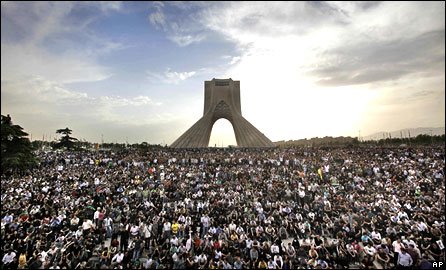
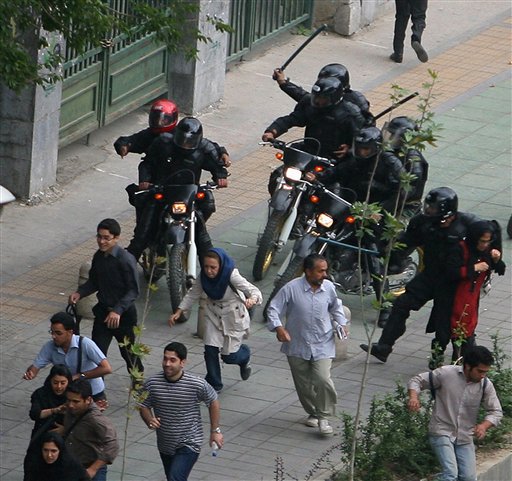
Iranian supporters of defeated Iranian presidential candidate Mir Hossein Mousavi are chased by Iranian riot-police in front of Tehran university Sunday, June 14, 2009. Iranian youth took to the streets Sunday, setting trash dumpsters and tires on fire, in a second day of clashes triggered by voter fraud claims. Photo from AP.

Class v. Culture Wars in Iranian Elections: Rejecting Charges of a North Tehran Fallacy

We’ve much more likely been had by a hard line constituency of at most 20% of the country, who claim to be the only true heirs of the Iranian revolution, and who control which ballots see the light of day.

By Juan Cole / June 14, 2009

See ‘Unrest challenges Iran’s republic,’ by Jon Leyne, Below.

See ‘Live-Blogging the Uprising‘ — continuing coverage with video, by Nico Pitney, on Huffington Post.

Some comentators have suggested that the reason Western reporters were shocked when Ahmadinejad won was that they are based in opulent North Tehran, whereas the farmers and workers of Iran, the majority, are enthusiastic for Ahmadinejad. That is, we fell victim once again to upper middle class reporting and expectations in a working class country of the global south.

While such dynamics may have existed, this analysis is flawed in the case of Iran because it pays too much attention to class and material factors and not enough to Iranian culture wars. We have already seen, in 1997 and 2001, that Iranian women and youth swung behind an obscure former minister of culture named Mohammad Khatami and his 2nd of Khordad movement, capturing not only the presidency but also, in 2000, parliament.

Khatami received 70 percent of the vote in 1997. He then got 78% of the vote in 2001, despite a crowded field. In 2000, his reform movement captured 65% of the seats in parliament. He is a nice man, but you couldn’t exactly categorize him as a union man or a special hit with farmers.

The evidence is that in the past little over a decade, Iran’s voters had become especially interested in expanding personal liberties, in expanding women’s rights, and in a wider field of legitimate expression for culture (not just high culture but even just things like Iranian rock music). The extreme puritanism of the hardliners grated on people.

The problem for the reformers of the late 1990s and early 2000s was that they did not actually control much, despite holding elected office. Important government policy and regulation was in the hands of the unelected, clerical side of the government. The hard line clerics just shut down reformist newspapers, struck down reformist legislation, and blocked social and economic reform. The Bush administration was determined to hang Khatami out to dry, ensuring that the reformers could never bring home any tangible success in foreign policy or foreign investment. Thus, in the 2004 parliamentary elections, literally thousands of reformers were simply struck off the ballot and not allowed to run. This application of a hard line litmus test in deciding who could run for office produced a hard line parliament, naturally enough.

But in 2000, it was clear that the hard liners only had about 20% of the electorate on their side.

By 2005, the hard liners had rolled back all the reforms and the reform camp was sullen and defeated. They did not come out in large numbers for the reformist candidate, Karoubi, who only got 17 percent of the vote. They nevertheless were able to force a run-off between hard line populist Mahmoud Ahmadinejad and former president Akbar Hashemi Rafsanjani, a pragmatic conservative billionaire. Ahmadinejad won.

But Ahmadinejad’s 2005 victory was made possible by the widespread boycott of the vote or just disillusionment in the reformist camp, meaning that fewer youth and women bothered to come out.

So to believe that the 20% hard line support of 2001 has become 63% in 2009, we would have to posit that Iran is less urban, less literate and less interested in cultural issues today than 8 years ago. We would have to posit that the reformist camp once again boycotted the election and stayed home in droves.

No, this is not a north Tehran/ south Tehran issue. Khatami won by big margins despite being favored by north Tehran.

So observers who want to lay a guilt trip on us about falling for Mousavi’s smooth upper middle class schtick are simply ignoring the last 12 years of Iranian history. It was about culture wars, not class. It is simply not true that the typical Iranian voter votes conservative and religious when he or she gets the chance. In fact, Mousavi is substantially more conservative than the typical winning politician in 2000. Given the enormous turnout of some 80 percent, and given the growth of Iran’s urban sector, the spread of literacy, and the obvious yearning for ways around the puritanism of the hard liners, Mousavi should have won in the ongoing culture war.

And just because Ahmadinejad poses as a champion of the little people does not mean that his policies are actually good for workers or farmers or for working class women (they are not, and many people in that social class know that they are not).

So let that be an end to the guilt trip. The Second of Khordad Movement was a winning coalition for the better part of a decade. Its supporters are 8 years older than the last time they won, but it was a young movement. Did they all do a 180 and defect from Khatami to Ahmadinejad? Unlikely. The Iranian women who voted in droves for Khatami haven’t gone anywhere, and they did not very likely much care for Ahmadinejad’s stances on women’s issues:

‘In a BBC News interview, Mahbube Abbasqolizade, a member of the Iranian Women’s Centre NGO, said, “Mr. Ahmadinejad’s policies are that women should return to their homes and that their priority should be the family.”

  • Ahmadinejad changed the name of the government organization the “Centre for Women’s Participation” to the “Centre for Women and Family Affairs”.
  • Ahmadinejad proposed a new law that would reintroduce a man’s right to divorce his wife without informing her. In addition, men would no longer be required to pay alimony. In response, women’s groups have initiated the Million Signatures campaign against these measures.
  • Ahmadinejad’s administration opposes the ratification of the UN protocol called CEDAW, the Convention on the Elimination of All Forms of Discrimination Against Women. This doctrine is essentially an international women’s Bill of Rights.
  • Ahmadinejad implemented the Social Safety program, which monitors women’s clothing, requires the permission from a father or husband for a woman to attend school, and applies quotas limiting the number of women allowed to attend universities.’

Mir Hosain Mousavi was a plausible candidate for the reformists. They were electing people like him with 70 and 80 percent margins just a few years ago. We have not been had by the business families of north Tehran. We’ve much more likely been had by a hard line constituency of at most 20% of the country, who claim to be the only true heirs of the Iranian revolution, and who control which ballots see the light of day.

Source / Informed Comment

Yes, the president of Iran’s own election monitoring commission has declared the result invalid and called for a do-over. That is huge news: when a regime’s own electoral monitors beak ranks, what chance does the regime have of persuading anyone in the world or Iran that it has democratic legitimacy? — Andrew Sullivan / The Daily Dish

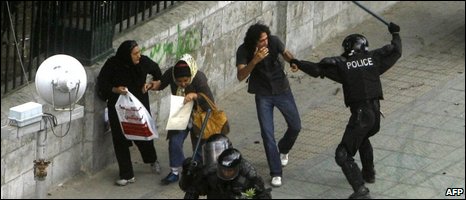
There were outbreaks of violence around Tehran’s university on Sunday. Photo from AFP.

Unrest challenges Iran’s republic

By Jon Leyne / June 14, 2009

TEHRAN — As demonstrations against the Iranian election result continue, the situation in Tehran is becoming unpredictable and potentially explosive.

Throughout Sunday, crowds gathered in a number of areas. Often they were not organised protests.

In traffic jams, car drivers hooted their horns in opposition to the government. Crowds stood on the pavement, chanting and showing v-signs.

In some places, the police were out in force. Some of them were in full riot gear. Others charged into action on the back of motorbikes.

They seem to have been given clear instructions not to open fire. Though occasional gunfire has been heard, mostly police have been wielding truncheons and batons in often brutal fashion.

Stifled aspirations

It is difficult to get any reliable picture of the scale of the protests in Tehran, let alone the whole country.

President Ahmadinejad’s almost casual dismissal of their complaints just adds to the anger

But they spread rapidly during the evening. The cheers and chanting echoed even in customarily quiet middle-class neighbourhoods.

Many Iranians came out on to their roofs to shout “down with the dictator.”

It has become a challenge not just of an election result, not just to President Mahmoud Ahmadinejad, but to the supreme leader, Ayatollah Khamenei himself.

That means it is, in effect, a challenge to the whole basis of the Islamic Republic.

For two years I have watched as young, ambitious Iranians go about their lives with growing frustration.

They feel the system stifles their aspirations. Now they feel that their intelligence and their pride has been insulted by an election result many Iranians believe is blatantly fraudulent.

And President Ahmadinejad’s almost casual dismissal of their complaints just adds to the anger.

Without precedent

Make no mistake, President Ahmadinejad still has plenty of supporters.

Mr Ahmadinejad is confident in the support of the supreme leader

They turned out in large numbers in the victory rally he held in central Tehran on Sunday afternoon.

He has focused his rhetoric on foreign governments and the international media, blaming them for stirring up the trouble.

There is a danger now that the two sides could come to blows.

And many people will fear that the government will authorise the police to open fire, if the situation slides further out of control.

Yet it is hard to see what political compromise is possible.

Mr Ahmadinejad is defiant, confident in the support of the supreme leader.

The opposition will know that the formal appeal process has minimal chance of success.

It is a situation without precedent in the 30-year history of the Islamic republic, and the outcome is impossible to predict.

Source / BBC

The Rag Blog

Posted in RagBlog | Tagged , , , , | 1 Comment

Singin’ on Sunday – k.d. lang

KD Lang – Constant Craving, Live in Sydney

I remember seeing her and her band play in 1984 at the University of Alberta Students’ Union building. I also remember at the time thinking that for country music (which I’ve never been especially fond of), she was pretty good. Glad she made it. She came from a tiny town in Alberta, Consort. Nobody big was ever from Consort before k.d.

Richard Jehn / The Rag Blog

The Rag Blog

Posted in RagBlog | Tagged , | Leave a comment

St. Augustine of Hippo on the Practice of Torture

St. Augustine, as painted by the Italian painter Sandro Botticelli in 1480 / 1902encyclopedia.com.

St. Augustine on torture, with an afterword by Willie Nelson

By William Michael Hanks / The Rag Blog / June 14, 2009

Over 1,500 years ago Augustine of Hippo reflected on the practice of torture –- a topic in the public conversation today. His observations lead me to believe that the villains are not as small as Dubya, Cheney, and Rumsfeld, but may indeed be immersed in human nature itself. He frames the internal conflict as discernment between the perceived imperatives of worldly duty and the higher values of justice rendered to the dignity of mankind.

“Even when a city is enjoying the profoundest peace, some men must be sitting in judgment on their fellow men. Even at their best, what misery and grief they cause! No human judge can read the conscience of the man before him. That is why so many innocent witnesses are tortured to find what truth there is in the alleged guilt of other men. It is even worse when the accused man himself is tortured to find out if he be guilty. Here a man still unconvicted must undergo certain suffering for an uncertain crime –- not because his guilt is known, but because his innocence is unproved. Thus it often happens that the ignorance of the judge turns into tragedy for the innocent party.

There is something still more insufferable –- deplorable beyond all cleansing with our tears. Often enough, when a judge tries to avoid putting a man to death whose innocence is not manifest, he has him put to torture, and so it happens, because of woeful lack of evidence, that he both tortures and kills the blameless man whom he tortured lest he kill him without cause. And if, on Stoic principles, the innocent man chooses to escape from life rather than endure such tortures any longer, he will confess to a crime he never committed.”

St. Augustine, City of God, 426 AD — Book XIX, Chapter 6.
(English translation, Gerald G. Walsh, S.J., Demetrius B. Zema, S.J., Grace Monahan, O.S.U., Daniel J. Honan.)

If indeed the enemies of the brighter angles of human nature are more deeply rooted than the visible leaves and branches, then our effort is wasted in merely pruning them –- we must lay an axe to the root.

When we elect our representatives we have accomplished about 20% of the job. The remaining 80% is in seeing to it that they reflect our values. So many words through the centuries call our attention to the struggle between right and wrong.

But Perhaps Willie Nelson, Poet-Philosopher, put it best for us today in Turk Pipkin’s documentary, One Peace at a Time: “Right and wrong is not that hard, it’s just what we choose to do.”

The Rag Blog

Posted in Rag Bloggers | Tagged , | Leave a comment

Live-Blogging the Uprising in Iran

From Huffington Post: 8:28 PM ET — Not just in Tehran. Via email, reader Farbod writes: “This is from Ardabil in the northwest. Mousavi’s home province. I think it is very important that people see demonstrations from all over Iran, not just Tehran.”

The revolution will not be televised. But it may be Tweeted.

By Harry Edwards / The Rag Blog / June 14, 2009

An awesome demonstration of the coming together of new technology is going on right now on Huffington Post. Nico Pitney is live-blogging the action in Iran in an up-to-the-minute fashion. All relevant Twitter sites have been compiled and are available for perusal. And a huge compendium of news sites as well. Literally hundreds of sources. I may turn into a believer in Twitter after this.

The Rag Blog

Posted in Rag Bloggers | Tagged , , , | 2 Comments

This Is Your Friendly American Banker

Thanks to Leslie Sklar / The Rag Blog

Posted in RagBlog | Tagged , , | Leave a comment

The War on Drugs: Framing Suspects They’re Convinced Are Guilty Anyway

I have to ask, “How many times a week does this happen?” We watched a parade of trumped up terrorism charges fail in court in the years of hysteria following 9/11. Is there also a racist foundation to the hysteria of the war on drugs? It wouldn’t surprise me one bit. Being a proponent of calling a permanent peace treaty to the war on drugs, it is high time we paid closer attention to these stories of false arrest and held police maniacs and zealots accountable across the nation.

Richard Jehn / The Rag Blog

The Story: Undercover police arrested two brothers for dealing cocaine at a New York night club. The officers claimed Maximo Colon, left, and his brother Jose sold two bags of cocaine to them. – The Truth: The brothers proved their innocence — and laid the groundwork for a multimillion dollar lawsuit — with a video from the club’s security cameras. Photo: Henny Ray Abrams/AP.

Brothers Prove Cops Wrong With Video
By Tom Hays and Colleen Long / June 13, 2009

NEW YORK — When undercover detectives busted Jose and Maximo Colon last year for selling cocaine at a seedy club in Queens, there was a glaring problem: The brothers hadn’t done anything wrong.

But proclaiming innocence wasn’t going to be good enough. The Dominican immigrants needed proof.

“I sat in the jail and thought. . . how could I prove this? What could I do?” Jose, 24, recalled in Spanish during a recent interview.

As he glanced around a holding cell, the answer came to him: Security cameras. Since then, a vindicating video from the club’s cameras has spared the brothers a possible prison term, resulted in two officers’ arrest and become the basis for a multimillion-dollar lawsuit.

The officers, who are due back in court June 26, have pleaded not guilty, and New York Police Department officials have downplayed their case.

But the drug corruption case isn’t alone.

On May 13, another NYPD officer was arrested for plotting to invade a Manhattan apartment where he hoped to steal $900,000 in drug money. In another pending case, prosecutors in Brooklyn say officers were caught in a 2007 sting using seized drugs to reward a snitch for information. And in the Bronx, prosecutors have charged a detective with lying about a drug bust captured on a surveillance tape that contradicts her story.

Elsewhere, Philadelphia prosecutors dismissed more than a dozen drug and gun charges against a man last month when a narcotics officer was accused of making up information on search warrants.

The revelations in New York have triggered internal affairs inquiries, transfers of commanders and reviews of dozens of other arrests involving the accused officers.
Many drug defendants’ cases have been tossed out. Others have won favorable plea deals.

The misconduct “strikes at the very heart of our system of justice and erodes public confidence in our courts,” said Bronx District Attorney Robert Johnson.

Despite the fallout, authorities describe the corruption allegations as aberrations in a city where officers daily make hundreds of drugs arrests that routinely hold up in court. They also note none of the cases involved accusations of organized crews of officers using their badges to steal or extort drugs or money for personal gain — the story line of full-blown corruption scandals from bygone eras.

Peter Moskos, a professor at John Jay College of Criminal Justice, agrees the majority of narcotics officers probably are clean. But he also believes the city’s unending war on drugs will always invite corruption by some who don’t think twice about framing suspects they’re convinced are guilty anyway.

“Drugs are a dirty game,” Moskos said. “Once you realize it’s a game, then you start playing with the rules to win the game.”

Just ask the Colon brothers.

* * * * *

The brothers’ evening started much like any other.

Max’s friend worked at a bodega down the street from Delicias de Mi Tierra, where they’d sometimes drink and play pool in the evenings. This night, the pool table was closed. They instead sat at the bar. Security cameras ended up filming their every move.

The brothers barely moved from the same spot for about 90 minutes as the undercovers entered the bar and mixed with the crowd. Moments after the officers left, a backup team barged in and grabbed six men, including the brothers.

Paperwork signed by “UC 13200” — Officer Henry Tavarez — claimed that he told a patron he wanted to buy cocaine. By his account, that man responded by approaching the 28-year-old Max, who then went over to the undercover and demanded to pat him down to make sure he wasn’t wearing a wire.

Max collected $100 from Tavarez, the report said. The officer claimed to see two bags of cocaine pass through the hands of three men, including Jose, before they were given to him.

Jose was released after a court appearance. His brother was shipped off to Riker’s Island until he could make bail.

“I was scared,” Max said of his time at Rikers. “I don’t get into trouble, and here I am with real criminals.”

* * * * *

The moment Jose walked out of the holding cell, he made a beeline for Delicias and asked for a copy of the security tapes from the night they were arrested, Jan. 4, 2008.

“I knew it would be the only way to defend myself, because I knew the police would not believe me,” he said.

The owner of Delicias queued up the tapes and the two waded through an entire day’s worth of surveillance — until they found the two hours the men spent in the club that night — supposedly selling drugs.

Jose quickly got the tape to defense attorney Rochelle Berliner, a former narcotics prosecutor. She couldn’t believe what she was seeing.

“I almost threw up,” she said. “Because I must’ve prosecuted 1,500, 2,000 drug cases. . . and all felonies. And I think back, Oh my God, I believed everything everyone told me. Maybe a handful of times did something not sound right to me. I don’t mean to sound overly dramatic but I was like, sick.”

What the tape doesn’t show is striking: At no point did the brothers interact with the undercovers, nor did the brothers appear to be involved in a drug deal with anyone else. Adding insult to injury, an outside camera taped the undercovers literally dancing down the street.

Berliner handed the tape over to the District Attorney’s integrity unit. It reviewed the images more than 100 times to make sure it wasn’t doctored by the defense before deciding to drop all charges against the brothers in June.

Six months later, Officer Tavarez and Detective Stephen Anderson pleaded not guilty to drug dealing and multiple other charges that their lawyers say were overblown.

Anderson’s attorney has described him as a seasoned investigator who had no reason to make a false arrest. Tavarez, his attorney said, was a novice undercover merely along for the ride.

* * * * *

Life quickly deteriorated for Max and Jose after their arrest.

They owned a successful convenience store in Jackson Heights, but lost their license to sell tobacco, alcohol and lottery tickets. The store closed a week before their case was dismissed.

“My life changed completely,” Jose said. “I had a life before, and I have a different existence now. . . Now, I’m not able to afford to live in my own house or care for my children.”

Jose has found construction work, while Max commutes two hours to Philadelphia to work at a relative’s bodega. They stay away from the old neighborhood, where they say ugly rumors about them persist.

The brothers have filed a $10 million false arrest lawsuit against the police department, the officers involved and the city.

“I’m angry because, why’d it happen to me? I know a lot of people … they don’t go the right way and they can get away with it,” Max said. “I’m young and I try to go the right way and boom, this happened to me. So I’m angry with life, too.”

Copyright 2009 The Associated Press.

Source / America On Line

The Rag Blog

Posted in RagBlog | Tagged , , | 4 Comments

Health Care for the Rich : U.S. 50th in Life Expectancy

How can it be that 49 countries have a longer life expectancy, if we supposedly have the ‘best’ health care system in the world? It is because our system is the best only for the rich.

By Ted McLaughlin / The Rag Blog / June 14, 2009

Republicans are quick to claim that the United States has the best health care system in the world. It should be the best, because it is the most expensive. The United States spends more for health care than any other country in the world. But “most expensive” and “best” are two different things.

While the U.S. system is undoubtedly the most expensive, there is one little statistic that shows it is far from the best. The fact is that the United States ranks a very poor 50th in life expectancy for its citizens. Let me repeat that. While life expectancy is 78.1 years for U.S. citizens, there are 49 countries where the life expectancy is longer.

How can it be that 49 countries have a longer life expectancy, if we supposedly have the “best” health care system in the world? It is because our system is the best only for the rich. If you have the money to purchase the best insurance possible, and the money to pay for the medical bills that insurance won’t cover, then the U.S. health care system is great. But what about the other 95% of the population?

The other 95% of the population is in trouble (although many of them don’t know it yet, because they are healthy right now). We know that around 41 million people don’t have any health insurance at all. Their problem is obvious to everyone.

But there is a much larger group of working and middle class families who have insurance through their work. These people are one layoff away from having no insurance themselves. They are also in for a shock when they need to use that private insurance and they find out how much it does NOT cover (62% of bankruptcies in the U.S. are dues to medical bills and 75% of those people had insurance). They can also find their insurance has been cancelled once the medical bills start climbing.

That’s because health insurance companies are in business to make money — not to pay medical bills. The more medical bills they can avoid paying, the larger their profits. In fact, the insurance company employees who deny the most claims (medical bills) are the ones who get the biggest bonuses. The reason our country is 50th in life expectancy is because the private insurance companies are more concerned with maximizing profits than with patient health.

But there is an interesting fact about the 49 countries with a longer life expectancy. They have a public (government-run) health insurance system. In most of those systems (like France or Canada), every citizen can choose their own doctor and hospital, and no one has to declare bankruptcy because of unpaid medical bills — because those public insurance systems pay for whatever treatment the doctor says is needed.

Harvey Brenner, professor of public health at the University of North Texas Health Science Center and Johns Hopkins University, says, “What we are able to find in the industrialized world is that life expectancy will be influenced in a beneficial manner to the extent that health care expenditure is publicly financed.”

That’s because in countries where patients must pay a large part of their own medical bills, they tend to wait until their medical problems are serious before consulting a doctor. These countries (including the U.S.) also put less emphasis on preventative care.

The conservative American Enterprise Institute disagrees that public insurance is the reason for the longer life expectancy. They say the life expectancy is determined by having high economic growth and per capita income levels. That’s a silly argument. Are they saying there are 49 countries with a higher economic growth and per capita income than the United States? No one, even a conservative, could really believe that!

The truth is that economic growth and high per capita income are spurred upwards by a healthy workforce. So while the American economic engine is among the best in the world, it could be even better with a public health insurance system producing healthier workers. It would also be helped by the fact that American companies would be able to compete with foreign companies more easily, because they wouldn’t have to pay the high private insurance costs of their workers (even if they paid for part of a public insurance system, it would be much cheaper than current rates).

There are only two groups that would not benefit from a public (government-run single-payer) health insurance system — the richest 1-5% of U.S. citizens and the insurance companies. For everyone else public insurance would be better. It would:

  • cover the 41 million Americans currently without insurance.
  • protect the middle class from bankruptcy because of huge medical bills.
  • give workers continuing insurance coverage even when switching jobs or being laid off.
  • save small businesses and corporations money in covering their employees and provide them with healthier workers.
  • save money by cutting out the huge profits and high overhead of insurance companies.
  • allow every citizen to choose their own doctor and hospital.
  • let doctors determine medical treatment instead of insurance companies.
  • put more emphasis on preventative medical care.
  • increase the life expectancy of all citizens.

Do you really want an insurance company restricting your choice of doctor or hospital, or determining what kind of medical treatment you can receive? Do you want your insurance to disappear if you lose your job or your medical bills get too high? Do you want an insurance company employee to get a huge bonus for denying your medical claim?

If not, then make sure your senator and representative know that health care reform must include a public insurance option. If it doesn’t, it will be little more than a huge payday for private insurance companies, and it won’t solve the problems in our health care system.

The Rag Blog

Posted in Rag Bloggers | Tagged , | Leave a comment

Foodie Friday Dribbles Into Saturday: Great Reading About Food

This could have been another Foodie Friday post, but I felt it was interesting and important enough not to delay it for a week. These Internet food sites are fantastic, with much information about things that matter immensely now and into the future. Great reading here …

Richard Jehn / The Rag Blog


Sustainable Food Blogs
By Paula Crossfield / June 12, 2009

Fresh news on sustainable food is popping up everywhere online these days, but consistency is a virtue. As the editor of a food policy blog, I rely on these sites to inform and feed my own work. But anyone, from an ag policy wonk to a newbie just learning about the perils facing the food system, can find something here. A look at 10 of my favorite regular reads:

The Ethicurean has been a leader, churning out hard-hitting stories on food policy, food safety and the models for improving the food system. Featuring the writing of editor Bonnie Powell, Elanor Starmer and others, the newly redesigned site has also come to be known as the place to catch up on the weekly food policy news via their well-sourced digest. Check out Powell’s recent look at the allotment system in Britain.

The realities of our food system can really get you down. That’s why Kerry Trueman of Eating Liberally employs laughs like “the only way we’ll ever get [Rush] Limbaugh to go organic, is when he dies and rots — from radio host to compost,” in her clever round-ups on the state of our food system. Her latest post focuses on whether “A Nation of Ninnies Need a Nanny.”

The Green Fork blog is the Eat Well Guide’s home base for updates on the food system. The focus is on empowering eaters with well-tuned, action-oriented information on the food system, with a fetish for new media and a slice of dark humor mixed in too. Check out editor Leslie Hatfield’s recent post on the controversy surrounding the cancellation of Michael Pollan’s book The Omnivore’s Dilemma from the “common reading” program at Washington State University.

Culinate not only provides a home base for a sustainable kitchen, it also provides food for thought. Editor Kim Carlson doesn’t overlook pleasure and taste in the quest for a better food system. Recently, an article by Twilight Greenaway investigated the plight of new farmers’ search for land.

Online environmental mag Grist.org has consistently reported on issues facing the food system. Grist’s Food Kingdom editor Tom Philpott and contributors Stephanie Ogburn and Tom Laskawy parse the food news of the day. Check out Philpott’s latest piece on what we can learn about our food system from the financial collapse.

Goals of a local / community food system. Graphic: Source.

Jill Richardson never sleeps! Or that is what it seems like, anyway, because not a stone is left unturned at La Vida Locavore. She keeps a close eye on Congress, and isn’t afraid to rail against the powers that be. Read her latest report on the National Animal Identification System, which would require even backyard hens to be identified, seemingly placing an unfair burden on small farmers.

One of Natasha Chart’s strengths is an ability to look at the big picture, dissecting the changes and the road blocks to building a better food system on Sustainable Food, a project of Change.org. Consider this post on how GMOs actually increase pesticide use, which is the opposite of what biotech companies claim.

Ever wonder what President Obama is thinking in the food systems debate? If anyone knows it’s Eddie Gehman Kohan, who takes us into the White House kitchen, serves up policy reports on this administration and keeps us up to date on President Obama’s comings and goings on Obamafoodorama. Check out her recent report about news of a copy-cat of the White House garden at 10 Downing Street.

A project of the Johns Hopkin’s Bloomberg School of Public Health, the Center for a Livable Future’s blog takes public health issues and science in the food debate and makes it accessible to even the unscientific among us. Ralph Loglisci and others contribute reports, like this one on Big Ag’s influence on agricultural Land Grant College studies.

Cooking Up a Story features videos of food system experts and innovators, as well as posts on policy issues, kitchen literacy and recipes. Check out editor Rebecca Gerendasy’s recent interview with Vandana Shiva.

[Paula Crossfield is the editor and lead writer for civileats.com, an active and intelligent food blog. I met with her recently and asked her if she wouldn’t mind surveying the world of sustainable food blogs for Bitten. –Mark Bittman]

Source / New York Times

The Rag Blog

Posted in RagBlog | Tagged , , | Leave a comment