Philadelphia, Mississippi : Former Klan Stronghold Elects Black Mayor

James Young, left, newly elected mayor of Philadelphia, MS, celebrates with supporters. Photo by Jim Prince / AP

The election of an African-American mayor in Philadelphia, Mississippi, site of infamous 1964 civil rights murders, indicates a page may have been turned.

By Jay D. Jurie / The Rag Blog / May 22, 2009

See ‘Black mayor of Mississippi town brings “atomic bomb of change”‘ by Ed Lavandera, Below.

When I was with VISTA in Mississippi during the late 1970s, Philadelphia, the seat of Neshoba County, was one county away.

Once I spent most of the day in Philadelphia. Eating lunch at a downtown restaurant, the people I was with told me in the segregation days whites were seated in the front, Indians (the local Choctaws) in the back, and African-Americans weren’t served. I saw the site of the church the Klan burned before the civil rights workers were murdered. Life was still slow in this small Southern town. Memories of what had occurred were vivid and the past was very much present.

In Southern Journey, the author, Tom Dent, visits major locales of the civil rights movement. His mention of Philadelphia at the time of publication in 1997 largely concerned ongoing abuse of African-Americans by local authority.

The election of an African-American mayor indicates a page may have been turned.

Black mayor of Mississippi town brings ‘atomic bomb of change’

By Ed Lavandera / May 22, 2009

PHILADELPHIA, Mississippi — James Young still remembers the Ku Klux Klan tormenting his neighborhood. He can still see his father holding a gun on the living room couch ready to shoot anyone who threatened his family.

Nothing about Young’s childhood ever made him think he could be the mayor of Philadelphia, Mississippi, the town best known for the killings of three civil rights workers in 1964.

That’s the way it was for black kids growing up in this crucible of racial hostility — big dreams were often squelched. Sitting on a sprawling Southern front porch this week, Young broke down in tears about what it means to be elected the town’s first black mayor.

“When you’ve been treated the way we’ve been treated,” he told CNN, choking up and then pausing to wipe the tears from his face.

For a moment, he couldn’t speak. He then regrouped, “That’s why it’s so overwhelming to be a part of this history.”

This week, the 53-year-old Young was elected the mayor of Philadelphia, a town of about 8,000 in the east-central part of the state. Despite a 55 percent white majority, Young defeated Rayburn Waddell, a white, three-term incumbent, by the slim margin of 46 votes.

Young described the victory as “an atomic bomb of change.” Another resident rejoiced, saying Young’s win symbolized the scab finally falling off this town’s wound.

“I couldn’t even have wrote that in a fairy tale,” Young said. “Who would have thought a little country boy like me would be mayor of Philadelphia, Mississippi?”

Philadelphia was the site of one of the most notorious killings of the civil rights era. On June 21, 1964, three civil rights workers — James Chaney, a 21-year-old black man from Mississippi; Andrew Goodman, 20, and Michael Schwerner, 24, both activists from New York — were shot to death at the edge of town. The killings inspired the 1988 movie “Mississippi Burning.”

“Philadelphia will always be connected to what happened here in 1964,” said Jim Prince, the publisher of the Neshoba Democrat newspaper.

“But the fact that Philadelphia, Mississippi, with its notorious past, could elect a black man as mayor, it might be time to quit picking on Philadelphia, Mississippi.”

Young knows his slim margin of victory means he still has to earn the trust of many more voters here. He knows there are still some in town who won’t vote for him because he’s black, but he says that number gets smaller and smaller as time passes.

“We have some — a very small pocket — that will never change. That’s what we’ve got to deal with,” said Young.

The mayor-elect says his election symbolizes a dramatic shift away from his hometown’s racist past. And for many black residents, it means they can finally call this place home.

“The places where we were locked out, I’m gonna have the key,” he said. “The places we couldn’t go, I’ve got the key. No better way to say it than that.”

He takes special pride that his victory comes the same year the nation swore in its first African-American president in Barack Obama. “It inspired people,” Young said.
“There are times and seasons, I think, for everything. The season arrived and the people let me know it was my time.”

The mayor-elect says he won by shaking hands and knocking on doors all over town. But the groundwork for Young’s climb to the top of Philadelphia’s political world started decades ago.

Young was one of the first black students to integrate Philadelphia’s white schools. After graduating from high school, he worked in a motor factory and then as a hospital housekeeper.

A white boss noticed Young’s charming people skills and recommended that he become a paramedic. He eventually worked his way up to become the director of the EMT unit, and that catapulted him to his first elected job as a county supervisor in 1991.

He is also a Pentecostal minister preaching on Sunday and organizing weekly Bible studies.

“I’ve been prepping for this. I felt like I knew enough people. I felt like they knew me and that if I could convince them to just give me the opportunity, things could happen,” said Young.

Driving around Philadelphia in a 1981 Ford pickup truck, Young basked in the glow of victory. He calls it the “honeymoon” period. As we drove down the road, black and white residents cheered.

“We’re so happy,” screamed one lady.

Young shouted back, “We did it!”

Until he’s sworn in as mayor, Young will work out of a makeshift transition office provided by a prominent attorney. His victory might seem unlikely but there’s little time left to celebrate.

“It’s an awesome feeling to have that kind of respect that people support you in this way,” Young said near the end of our interview. “I’ll never let the people down which called for that.”

Source / CNN

The Rag Blog

Posted in Rag Bloggers | Tagged , , , , , , | 3 Comments

Ft. Hood GI Travis Bishop : Why I Won’t Go

Travis Bishop, opening for Toby Keith in Bagdhad, Iraq. Photo from MySpace.

If I had deployed to Afghanistan, I don’t think I would have been able to look into another mirror again.

By Travis Bishop / The Rag Blog / May 21, 2009

[Ft. Hood soldier and musician Sgt. Travis Bishop has refused deployment to Afghanistan. This is his story in his words.]

Why am I doing what I’m doing? Why am I resisting? Refusing? It wasn’t so long ago that I deployed to Iraq in support of the war on terror. I didn’t refuse then. Like a good Soldier, I did what I was told, and I spent 14 months stationed in Baghdad. It was a quiet enough deployment, I suppose. Mortars and rockets flew over the walls with unnerving frequency, but otherwise, it felt more like a move to a different duty station than a deployment to a warzone.

I didn’t see real combat. I didn’t come back with Post-Traumatic Stress Disorder. I didn’t lose friends. Mine was, in my opinion, an average deployment. Go overseas, play X-Box and read for a year, come back with money that’s gone before you remember how you spent it. We talked and laughed about it once we came back, and talked about what we would do with the money we made from our next deployment, whenever that may be.

Back home, I received a hero’s welcome. That was the first time I felt unsettled over what I had done overseas. My hand was shook, my back was patted, and every night my belly was burning, full of free alcohol. I was a veteran of a foreign war, hailed as a hero, and yet I felt…unnerved; anxious. I felt as if I had a big secret inside me that threatened to burst out of me at any moment, exposing what I really was to the rest of the world…but I couldn’t figure out what the secret was. Not for a long, long time.

I was never plagued with nightmares from the war. I was plagued with guilt. I literally felt guilty for receiving the accolades that come from redeploying as a “hero,” knowing that I had not paid the price for the Army’s true definition of a hero. Here it goes:

Army Hero; noun. Soldier who has deployed overseas to a combat zone. Has participated in active combat. Has redeployed with PTSD, a bullet in their leg, and a time bomb in their head. Unable to rejoin the civilian world in a normal psychological state.

In my heart of hearts, I know I don’t fit this definition, or anything resembling it.

For a long time, my unit was set to redeploy to Iraq in August 2009. However, in February 2009, we were told there was a change of plans. Instead of Iraq, it would be Afghanistan. Instead of August, it would be the end of March, less than sixty days away. Rumor had it that, although we were told the rush was because of a Brigade Commander’s wishes, it was our Battalion Commander who requested our unit be put on the Afghanistan Troop Surge.

Once again, in good Soldier mode, I prepared to deploy. This time I was a Sergeant, and I had Soldiers to take care of, one of which my best friend. These things drove me to be well prepared. We had things to do, and not much time to do them in. I rarely gave myself time to think about what it was we were actually deploying for. When I did, I started to question everything.

Why are we going? What purpose does it serve? Nothing sat right. I began to read the Bible again. More and more I saw things like “turn the other cheek” and “love thy enemy.” These were things that went directly against the war we were in, and they were spoken by Jesus himself. Could I really deploy again, and compromise my beliefs, just because I was told to? Would I be able to live with that? What if I had to take a life, and knew that if I hadn’t deployed, I would never have been put in that situation?

I became afraid to voice my opinion, knowing that if I spoke to the wrong person, I would face persecution and ridicule. I told my best friend, who voiced the same opinions to me, but it seemed he was content to deploy, do his time, make some money, and then get out of the Army upon his return. I respected his opinion, didn’t try to talk him out of it, and let it be.

The rest of the pre-deployment phase went uneventfully. We loaded our gear, got our trucks ready, and inspected our equipment. We went to the field several times, and although my team and other teams never fully accomplished the missions we were given, Command congratulated us on a successful field mission, and said we were more than ready to deploy. I started to worry again after that.

I worried when they said I was leaving early with the cargo. I worried again when our cargo flights were suddenly “cancelled,” and the main body of our unit deployed to Afghanistan before us, the “advanced” party. Once again, I got the feeling that we were rushing into something before we were even close to being ready. Weeks went by, and groups of us went out on separate days, sometimes only two Soldiers at a time.

A few days before I was set to deploy, I was approached by members of an organization who told me that I had a choice. They told me that they were here to support me, and that if I really was against the war our country was currently in, I could choose not to go. All those old feelings and worries came back with a vengeance, and I began to question the war again. After a full day of thinking, the only reason I had come up with for me to go was the fact that my best friend was going too. And, in the end, I decided that, although he might hate me for it, he was better off with me not going in the long run. I had to put my needs before his, though it killed me inside, because a three year friendship is hard to come by in the Army. I hope that he can forgive me one day.

So the afternoon I was set to deploy, while everyone else was loading their gear in the van headed toward the airfield, I loaded my gear in my car, and left. It was the hardest decision I have ever made.

I plan on coming back; soon. I am not a deserter, and I wouldn’t go AWOL for months and risk ruining my chances at getting a good job later in life. I am a Patriot. I love my country, but I believe that this particular war is unjust, unconstitutional and a total abuse of our nation’s power and influence. And so, in the next few days, I will be speaking with my lawyer, and taking actions that will more than likely result in my discharge from the military, and possible jail time… and I am prepared to live with that.

My father said, “Do only what you can live with, because every morning you have to look at your face in the mirror when you shave. Ten years from now, you’ll still be shaving the same face.”

If I had deployed to Afghanistan, I don’t think I would have been able to look into another mirror again.

Pray for me.

[This story has also been posted to Ft. Hood Soldier Voices and to Facebook.]

Also see GI Victor Agosto : ‘There is No Way I Will Deploy to Afghanistan’ by Alice Embree / The Rag Blog / May 7, 2009

The Rag Blog

Posted in Rag Bloggers | Tagged , , , , , | 20 Comments

FCC Warrantless Searches : Coming to a Home Near You?


FCC’s Warrantless Household Searches Alarm Experts

‘Anything using RF energy — we have the right to inspect it to make sure it is not causing interference,’ says FCC spokesman David Fiske. That includes devices like Wi-Fi routers that use unlicensed spectrum, Fiske says.

By Ryan Singel / May 21, 2009

You may not know it, but if you have a wireless router, a cordless phone, remote car-door opener, baby monitor or cellphone in your house, the FCC claims the right to enter your home without a warrant at any time of the day or night in order to inspect it.

That’s the upshot of the rules the agency has followed for years to monitor licensed television and radio stations, and to crack down on pirate radio broadcasters. And the commission maintains the same policy applies to any licensed or unlicensed radio-frequency device.

“Anything using RF energy — we have the right to inspect it to make sure it is not causing interference,” says FCC spokesman David Fiske. That includes devices like Wi-Fi routers that use unlicensed spectrum, Fiske says.

The FCC claims it derives its warrantless search power from the Communications Act of 1934, though the constitutionality of the claim has gone untested in the courts. That’s largely because the FCC had little to do with average citizens for most of the last 75 years, when home transmitters were largely reserved to ham-radio operators and CB-radio aficionados. But in 2009, nearly every household in the United States has multiple devices that use radio waves and fall under the FCC’s purview, making the commission’s claimed authority ripe for a court challenge.

“It is a major stretch beyond case law to assert that authority with respect to a private home, which is at the heart of the Fourth Amendment’s protection against unreasonable search and seizure,” says Electronic Frontier Foundation lawyer Lee Tien. “When it is a private home and when you are talking about an over-powered Wi-Fi antenna — the idea they could just go in is honestly quite bizarre.”

George Washington University professor Orin Kerr, a constitutional law expert, also questions the legalilty of the policy.

“The Supreme Court has said that the government can’t make warrantless entries into homes for administrative inspections,” Kerr said via e-mail, refering to a 1967 Supreme Court ruling that housing inspectors needed warrants to force their way into private residences. The FCC’s online FAQ doesn’t explain how the agency gets around that ruling, Kerr adds.


The rules came to attention this month when an FCC agent investigating a pirate radio station in Boulder, Colorado, left a copy of a
2005 FCC inspection policy on the door of a residence hosting the unlicensed 100-watt transmitter. “Whether you operate an amateur station or any other radio device, your authorization from the Commission comes with the obligation to allow inspection,” the statement says.

The notice spooked those running “Boulder Free Radio,” who thought it was just tough talk intended to scare them into shutting down, according to one of the station’s leaders, who spoke to Wired.com on condition of anonymity. “This is an intimidation thing,” he said. “Most people aren’t that dedicated to the cause. I’m not going to let them into my house.”

But refusing the FCC admittance can carry a harsh financial penalty. In a 2007 case, a Corpus Christi, Texas, man got a visit from the FCC’s direction-finders after rebroadcasting an AM radio station through a CB radio in his home. An FCC agent tracked the signal to his house and asked to see the equipment; Donald Winton refused to let him in, but did turn off the radio. Winton was later fined $7,000 for refusing entry to the officer. The fine was reduced to $225 after he proved he had little income.

Administrative search powers are not rare, at least as directed against businesses — fire-safety, food and workplace-safety regulators generally don’t need warrants to enter a business. And despite the broad power, the FCC agents aren’t cops, says Fiske. “The only right they have is to inspect the equipment,” Fiske says. “If they want to seize, they have to work with the U.S. Attorney’s office.”

But if inspectors should notice evidence of unrelated criminal behavior — say, a marijuana plant or stolen property — a Supreme Court decision suggests the search can be used against the resident. In the 1987 case New York v. Burger, two police officers performed a warrantless, administrative search of one Joseph Burger’s automobile junkyard. When he couldn’t produce the proper paperwork, the officers searched the grounds and found stolen vehicles, which they used to prosecute him. The Supreme Court held the search to be legal.

In the meantime, pirate radio stations are adapting to the FCC’s warrantless search power by dividing up a station’s operations. For instance, Boulder Free Radio consists of an online radio station operated by DJs from a remote studio. Miles away, a small computer streams the online station and feeds it to the transmitter. Once the FCC comes and leaves a notice on the door, the transmitter is moved to another location before the agent returns.

[This post was updated Thursday morning to include comment from Professor Kerr, and to remove an inaccurate example of unrelated criminal behavior.]

Source / Wired

Thanks to S.M. Wilhelm / The Rag Blog

Posted in RagBlog | Tagged , , , , | Leave a comment

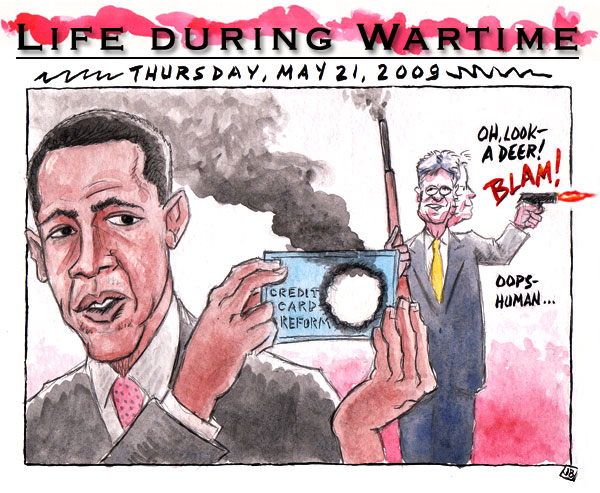
Life During Wartime : Hole in One

Political cartoon by Joshua Brown / Historians Against the War / The Rag Blog

Thanks to Dr. S.R. Keister /The Rag Blog

Posted in Rag Bloggers | Tagged , | Leave a comment

Got Work? College Grads Driving Cabs?

Grads at University of Pennsylvania commencement ceremonies May 18, 2009. Fewer than 20 percent of new graduates have landed work, compared to 50 percent two years ago. Photo by Matt Rourke / AP.

The problem with higher education is that few can predict where the economy will be hiring years from now.

By Roger Baker / The Rag Blog / May 21, 2009

See ‘Got Work? College Graduates Face Toughest Job Market in Years,’ by John Berman, Below

I think it is common in many Third World countries for highly educated folks to drive taxis. It looks like that situation is probably coming here as a common situation.

The problem with higher education is that few can predict where the economy will be hiring years from now. Higher education investment is largely a guess when it comes to the needs of the future economy.

In the years ahead, the U.S. will be groping with trends toward survival basics that are now becoming apparent. Like rebuilding the transportation infrastructure, reducing carbon burning through serious conservation and planning higher energy costs, caring for the elderly in a much more cost effective way, and relocalizing agricultural production.

There is plenty of opportunity ahead for well-trained experts in these emerging but vital areas of the economy to do such work. But our higher education system is grounded on the theory that the richest and most powerful (mostly) men appointed to, in our case, the UT-Austin Board of Regents are qualified to guide the lines of training, research, and degrees bestowed. The current system is very much biased towards making the wealthy and their friends ever richer by bankrolling the exhausted trends of a failing empire.

If higher education were to rebuilt on a rational basis of what skills are likely to be needed, the problem of future higher education employment could be largely solved, if not the ability to provide for a traditional upper class lifestyle, still expected by graduates in business administration, law, and the like. We need education geared toward sensible, sustainable goals. Trying to sustain the old higher education/anticipated lifestyle goals of students’ parents is futile.

Hopefully students are beginning to figure that out.

Got Work?
College Graduates Face Toughest Job Market in Years

By John Berman / May 20, 2009

HARTFORD, Conn — Casey Savage graduated from Trinity College in Hartford with a 3.8 grade-point average and honors. What he doesn’t have is a job.

“I’ve talked to 24 different firms so far. Hedge funds, investment banks, private equity shops,” Savage said. “And I just feel that there’s limited opportunities at this point.”

It’s a familiar refrain being echoed at colleges and universities across the country, as the economy continues to slump and layoffs, furloughs and pay cuts dominate the employment landscape. The struggling economy means college seniors are facing one of the toughest job markets in years.

According to a survey from National Association of Colleges and Employers, the class of 2009 is leaving campus with fewer jobs in hand than their 2008 counterparts. The group’s 2009 Student Survey found that just 19.7 percent of 2009 graduates who applied for a job actually have one.

In comparison, 51 percent of those graduating in 2007 and 26 percent of those graduating in 2008 who had applied for a job had one in hand by the time of graduation.

Economist say the members of this year’s graduating class are also facing unique challenges not only because they are dueling against the growing ranks of unemployed for work, but because they are also facing a backlog created from last year’s graduates who have yet to find fulltime employment.

Bryan Hopkins, a senior at the University of Florida, calls the situation frustrating. “You feel frustrated because you feel now that was it all worth it,” he said. “In a perfect world, I would have walked right off the stage and into a fulltime job in my field, but I mean I have the degree now and I am still waiting.”

Yale University School of Management professor Lisa Kahn said recent college graduates will suffer the long-term effects of this recession much more than their counterparts who graduated in boom times.

Departing seniors are “suffering from the recession like everyone else is, but the effects are going to stay with (them) for much longer,” Kahn said.

Tougher Times Ahead for Grads

Kahn studied the impact of the recession in the 1980s and found that seniors who graduated then were still feeling the impact 20 years later. Today’s seniors are “going to be earning much less than their counterparts who graduated in better times and they’ll be in lower level occupations,” she said.

University of Arizona senior Reyna Nowaczyk said the lack of job prospects has left her “overwhelmed.”

“I don’t know what to do next,” she said. “I’ve done all the right things: done my fair share of internships, studied abroad. I’ve studied languages while abroad. I have my letters of recommendation from employers. I feel like I prepared myself; I feel like I’m ready. I want to work.”

But according to employment professionals, graduating seniors will need to be flexible in this economy.

“If I were a 22-year-old today I would be willing to take an unpaid internship,” said Lanna Hagge, director of Career Services at Trinity College. “I would be willing to do almost anything just to get the experience and exposure.”

That’s advice Trinity graduate Chauncy Kerr is taking. She is looking to land an unpaid internship this summer.

“You get job experience so I’m excited about that,” Kerr said. But, she added, “It would be nice to get paid.”

Copyright © 2009 ABC News Internet Ventures

Source / ABC News

Thanks to S.M. Willhelm / The Rag Blog

Posted in Rag Bloggers | Tagged , , | Leave a comment

Vince Bell : The Life and Times of a Texas Songwriter

This is a fine book about Texas music, the singer-songwriter tradition, and a personal journey that ends triumphant in the here and now.

By Joe Nick Patoski

See ‘From Euphoria to Tragedy and Back’ by Michael Corcoran and ‘The Making of My Music’ by Vince Bell, Below.

Vince Bell has been a stalwart of the Texas singer-songwriter scene since he emerged in Houston in the early 1980s. He was a rising star in Houston and in Austin until he was almost killed in a car wreck in 1983. A severe head injury effectively wiped out his career. For awhile.

His determined rehabilitation and subsequent comeback have culminated in a trifecta this year: an album, a one-man play, and a wonderful book titled One Man’s Music, that tells the tale. Head injuries are difficult to diagnose and even more difficult to overcome, which Vince relates well in his telling. We see progress from the outside; he sees it from the inside looking out. Either way, his recovery alone makes for an inspiring story.

But it’s the details along the way that make this such a good read, capturing the vibe of the Old Quarter and Anderson Fair in Houston through anecdotes such as his wild night opening for Townes Van Zandt and recalling his last recording session before his car wreck in which Stevie Ray Vaughan, Eric Johnson and Chris Holzhaus added their guitars. Tim Leatherwood, Mandy Mercier, Kathleen Hudson and a cast of great pickers and poets all make cameos.

This is a fine book about Texas music, the singer-songwriter tradition, and a personal journey that ends triumphant in the here and now. I’m proud to know Vince as both a friend and a fellow traveler.

Source / Notes and Musings / Posted May 1, 2009

Vince Bell and Lyle Lovett (left) on Austin City Limits in 2000. Photo by David Roth / index media.

From Euphoria to Tragedy and Back

Book review: ‘One Man’s Music’ by Vince Bell

By Michael Corcoran / May 19, 2009

Singer-songwriter Vince Bell knows how suddenly euphoria can turn to tragedy. In December 1982, a 31-year-old Bell had just driven away from a South Austin recording studio where Stevie Ray Vaughan and Eric Johnson traded licks on what was supposed to be Bell’s debut album. Then his car was blindsided on Riverside Drive by a joyriding teenager.

Thrown 60 feet from the car and found face down in a pool of gasoline, Bell suffered a several injuries, including severe brain trauma that forced him to relearn how to make music.

His debut LP, called “Phoenix” of course, finally came out in 1994.

This incredibly sad and moving story can be found in “One Man’s Music” (University of North Texas Press), a new autobiography that is as much about the life of a songwriter as it is a tale of rebirth. This reads real, as Bell shows the fairytale the door with a life of alcohol, depression, poverty and, worst of all, creative self-doubts. In the vibrant 1970s Houston singer-songwriter scene, whose graduates include Townes Van Zandt, Guy Clark, Lucinda Williams, Nanci Griffith, Steve Earle and many more, Bell was the one who seemed most like a writer who played the guitar. It’s a little showoffy, but Bell spends the first few chapters proving to be a gifted, often funny storyteller, with a rare knack for descriptions (“they were so suburban they glowed”).

The reader gets a sense of the energy of the era when musicians inspired each other to show up next week with a song that would blow everyone away. One distraction of the book is that, after the accident, Bell switches from first person to interviews and then back to him. Considering that Bell forgot so much and had memory problems for years, it was probably a necessity to quote witnesses to fill the holes. But everything was going so well from just Bell’s point of view.

The book will make you curious about this man’s music, so there’s a companion CD of the same name, consisting of re-recorded Bell faves, as well as three new songs. Here’s more about the record.

Source / Austin360.com

Vince Bell: One Man’s Music

The Making of My Music

By Vince Bell

I drove 4,000 miles of wasteland back and forth from New Mexico to California. Twice. For the privilege, I spent four nights in a motel on interstate 40 in Arizona somewhere between Kingman, and Winslow. The closest I got to the beach in Santa Monica, for two weeks, was a booth at Denny’s on Lincoln Boulevard. I survived a 13-car accident in a dust storm in the Mojave desert, with 7 semi-tractor trailers, that killed 4 people, 20 miles east of Barstow, California.

This lucky little album is a collection of my best. These are the songs included in my book and the one-man play. Eleven are songs previously recorded on all my previous albums. There are three new compositions.

I knew if I was going to release previously recorded material it needed to be with a novel arrangement unlike any I had offered before. A duet was a challenge. After pursuing the pianist in Los Angeles for the better part of a year, I recorded the work “so live” in 18 hours with Ned Albright, a recommendation of my first producer, Bob Neuwirth.

¿Any questions?

vince

Source / VinceBell.com

Buy Vince Bell’s book and CD at VinceBell.com

The Rag Blog

Posted in RagBlog | Tagged , , , , , | Leave a comment

Manhattan and a Mouse: Variations on a Single Structural Theme


Math and the City
By Steven Strogatz / May 20, 2009

One of the pleasures of looking at the world through mathematical eyes is that you can see certain patterns that would otherwise be hidden. This article is about one such pattern. It’s a beautiful law of collective organization that links urban studies to zoology. It reveals Manhattan and a mouse to be variations on a single structural theme.

The mathematics of cities was launched in 1949 when George Zipf, a linguist working at Harvard, reported a striking regularity in the size distribution of cities. He noticed that if you tabulate the biggest cities in a given country and rank them according to their populations, the largest city is always about twice as big as the second largest, and three times as big as the third largest, and so on. In other words, the population of a city is, to a good approximation, inversely proportional to its rank. Why this should be true, no one knows.

Even more amazingly, Zipf’s law has apparently held for at least 100 years. Given the different social conditions from country to country, the different patterns of migration a century ago and many other variables that you’d think would make a difference, the generality of Zipf’s law is astonishing.

Keep in mind that this pattern emerged on its own. No city planner imposed it, and no citizens conspired to make it happen. Something is enforcing this invisible law, but we’re still in the dark about what that something might be.

Many inventive theorists working in disciplines ranging from economics to physics have taken a whack at explaining Zipf’s law, but no one has completely solved it. Paul Krugman, who has tackled the problem himself, wryly noted that “the usual complaint about economic theory is that our models are oversimplified — that they offer excessively neat views of complex, messy reality. [In the case of Zipf’s law] the reverse is true: we have complex, messy models, yet reality is startlingly neat and simple.”

After being stuck for a long time, the mathematics of cities has suddenly begun to take off again. Around 2006, scientists started discovering new mathematical laws about cities that are nearly as stunning as Zipf’s. But instead of focusing on the sizes of cities themselves, the new questions have to do with how city size affects other things we care about, like the amount of infrastructure needed to keep a city going.

For instance, if one city is 10 times as populous as another one, does it need 10 times as many gas stations? No. Bigger cities have more gas stations than smaller ones (of course), but not nearly in direct proportion to their size. The number of gas stations grows only in proportion to the 0.77 power of population. The crucial thing is that 0.77 is less than 1. This implies that the bigger a city is, the fewer gas stations it has per person. Put simply, bigger cities enjoy economies of scale. In this sense, bigger is greener.

The same pattern holds for other measures of infrastructure. Whether you measure miles of roadway or length of electrical cables, you find that all of these also decrease, per person, as city size increases. And all show an exponent between 0.7 and 0.9.

Now comes the spooky part. The same law is true for living things. That is, if you mentally replace cities by organisms and city size by body weight, the mathematical pattern remains the same.

For example, suppose you measure how many calories a mouse burns per day, compared to an elephant. Both are mammals, so at the cellular level you might expect they shouldn’t be too different. And indeed, when the cells of 10 different mammalian species were grown outside their host organisms, in a laboratory tissue culture, they all displayed the same metabolic rate. It was as if they didn’t know where they’d come from; they had no genetic memory of how big their donor was.

But now consider the elephant or the mouse as an intact animal, a functioning agglomeration of billions of cells. Then, on a pound for pound basis, the cells of an elephant consume far less energy than those of a mouse. The relevant law of metabolism, called Kleiber’s law, states that the metabolic needs of a mammal grow in proportion to its body weight raised to the 0.74 power.

This 0.74 power is uncannily close to the 0.77 observed for the law governing gas stations in cities. Coincidence? Maybe, but probably not. There are theoretical grounds to expect a power close to 3/4. Geoffrey West of the Santa Fe Institute and his colleagues Jim Brown and Brian Enquist have argued that a 3/4-power law is exactly what you’d expect if natural selection has evolved a transport system for conveying energy and nutrients as efficiently and rapidly as possible to all points of a three-dimensional body, using a fractal network built from a series of branching tubes — precisely the architecture seen in the circulatory system and the airways of the lung, and not too different from the roads and cables and pipes that keep a city alive.

These numerical coincidences seem to be telling us something profound. It appears that Aristotle’s metaphor of a city as a living thing is more than merely poetic. There may be deep laws of collective organization at work here, the same laws for aggregates of people and cells.

The numerology above would seem totally fortuitous if we hadn’t viewed cities and organisms through the lens of mathematics. By abstracting away nearly all the details involved in powering a mouse or a city, math exposes their underlying unity. In that way (and with apologies to Picasso), math is the lie that makes us realize the truth.

***********

NOTES:

For Zipf’s law see:

Zipf, G. K. (1949) “Human Behavior and the Principle of Least Effort.” Addison-Wesley, Cambridge, MA.

Gabaix, X. (1999) “Zipf’s law for cities: An explanation.” The Quarterly Journal of Economics 114, 739–767.

For Paul Krugman quote:

Krugman, P. (1996) “Confronting the mystery of urban hierarchy.” Journal of the Japanese and International Economies 10, 399–418.

The new laws of infrastructure for cities are reported in:

Bettencourt, L. M.A., Lobo, J., Helbing, D., Kühnert, C, and West, G. B. (2007) “Growth, innovation, and the pace of life in cities.” Proceedings of the National Academy of Sciences 104, 7301–7306.

For an overview of Kleiber’s law and the theory of West, Brown and Enquist, see:

Whitfield, J. (2006) “In the Beat of a Heart: Life, Energy, and the Unity of Nature.” Joseph Henry Press, Washington DC.

For the tissue culture results about mammalian cells, see:

Brown, M. F., Gratton, T. P., and Stuart, J. A. (2007) “Metabolic rate does not scale with body mass in cultured mammalian cells.” Am J Physiol Regul Integr Comp Physiol 292, R2115–R2121.

Source / New York Times

The Rag Blog

Posted in RagBlog | Tagged , , | Leave a comment

Texas: Doing What’s Right to Protect Its Citizens

The Texas-U.S. border wall will protect Texans from foreigners who do not share their beliefs and customs.

Texas Constructs U.S. Border Wall To Keep Out Unwanted Americans
May 19, 2009

WICHITA FALLS, TX—Calling it an essential step toward securing the Texas border and protecting his people’s way of life, Gov. Rick Perry announced Tuesday the completion of a 1,953-mile wall designed to keep out millions of unwanted Americans.

According to Perry, the 75-foot-high barricade running along the northern boundary is the culmination of more than 160 years of escalating tensions between Texas and the United States.

Though a protective barrier has been under consideration for decades, the Texas Legislature voted unanimously to begin construction on the project immediately following the 2008 presidential election.

“As governor, it is my responsibility to do whatever’s necessary to maintain the territorial integrity of Texas,” Perry told reporters during a press conference held inside a sniper tower overlooking Oklahoma. “If you are a Texas citizen, you shouldn’t have to worry about some American coming in here, using your goods and services, and taking away your job.”

“Let the record show I have nothing personal against Americans,” Perry added. “I just think they should stay in America, where they belong.”

Click to enlarge.

The wall is comprised of six security layers: a razor-wire fence equipped with motion sensors, surveillance cameras, and guard towers; a 70-foot-wide trench with expert marksmen stationed along its perimeter; a roadway patrolled by armed vehicles equipped with synchronized electromagnetic wave gradiometers to detect Americans attempting to tunnel their way into Texas; and a second, third, and fourth fence.

The final section of the barricade, a reinforced concrete enclosure containing the city of Austin, will be finished by August 2009.

“These Americans are destroying the moral and social fabric of our state,” said Rep. Chris Turner, who added that he worries when he looks around Texas and sees people from places like Pennsylvania, Iowa, and Vermont. “The man who used to repair my truck was replaced by some mechanic who moved in here from Kansas. Lately I can’t go to the store or the bank without running into all kinds of these foreigners. This wall is the only hope we have of keeping Texas safe.”

“The truth is, Americans are just different from us,” Turner added. “We don’t even speak the same language.”

According to Texas Army National Guard Brig. Gen. Tom Alford, Americans will only be permitted to cross the border if they have immediate family living in Texas, in which case they can apply for a 90-minute monitored visitation to be held inside a checkpoint detention facility.

However, Alford stressed that any American attempting to transport barbecue sauce, beef jerky, belt buckles, or longhorn cattle back to the United States will face the death penalty.

Thus far, a majority of Texas citizens support the border wall, with nearly 8 million signing up to join a coalition of Minutemen that will guard the fence.

“These good-for-nothing Americans want to come in here and wait in the same lines as me, watch the same movies, and eat at the same restaurants,” El Paso resident and border patrol volunteer Larry Carlile told reporters. “Who do they think they are? I’d never dare waltz into America and act like I owned the place. That country’s a godforsaken hellhole, anyway.”

“Round ’em up and get ’em out,” Carlile added. “Go back to Seattle or whatever you call it.”

Since the wall’s completion, there has been no official comment from Washington. However, sources close to President Obama said that upon being informed of Gov. Perry’s announcement the commander in chief muttered, “Thank God.”

Source / The Onion

Many thanks to Jeff Segal / The Rag Blog

Posted in RagBlog | Tagged , , , | Leave a comment

David P. Hamilton : Obama, the Mixed Bag

Israeli Prime Minister Benjamin Netanyahu seems like he’s trying to get a fix on President Obama as he speaks to reporters at the White House, Monday, May 18, 2009. Photo by Chester Dharapak / AP.

It is logical that as time passes, Obama’s famed pragmatism will lead him to support more progressive alternatives as his attempts to revive the corpses littering the corporate capitalist landscape fail.

By David P. Hamilton / The Rag Blog / May 20, 2009

As much as I trash him for his bankcentric economic policy, failure to move U.S. foreign policy away from militarism, failure to champion single-payer health care, failure to prosecute Bush era corruption, etc, I have to give Obama some credit for a decent start to his week.

On Sunday, he went to the highly publicized graduation speech at Notre Dame. To a largely rapturous audience, he brilliantly redefined the issue on his own terms while reaching out to a “common ground.” This demonstrated that Obama’s views are very likely more popular among Catholics than those of the Catholic hierarchy. It further defused the issue of abortion as a major factor in national politics. His Supreme Court nominee, very likely the Court’s second woman, will strongly support Roe v. Wade as established law.

On Monday, Obama met with Bibi Netanyahu, the rightist Israeli prime minister. They met for an hour longer than scheduled. There was no joint statement. At the post meeting press conference, Obama repeatedly referred to a Palestinian state. Netanyahu never used the term. These are not signs of harmony. Essentially, daylight opened between U.S. and Israeli policy. They have officially diverged. That was an essential first step.

They disagreed that problems with Iran should take precedence over Palestinian statehood and should include military action. Polls show Obama’s base, including Jews, strongly supporting a policy that would put more pressure on Israel, so his next likely step is to criticize the expansion of Israeli settlements on the West Bank while encouraging diplomatic contacts with Iran.. I expect to hear no more references to the Axis of Evil coming from the Obama administration.

On Tuesday, Obama raised the auto emission standards to correspond to the “radical” California standards. One might quibble with the time frame, but it is a stark reversal of Bush administration policy and one that ought to have significant positive environmental and economic consequences since it was being praised from the Sierra Club to the GM boardroom, where now the U.S. government and the UAW are the majority owners.

Not a bad start to the week for a president of the United States.

This highlights the unique problem left critics have with Obama. Throughout most of our lives, the U.S. president largely defined our principal political enemy. Clinton had a few less awful moments, but progressives never regarded him as a committed ally. From LBJ (“How Many Kids Did You Kill Today?”) to George W. Bush, it has been a long orgy of almost continuous president hating. And while Obama will doubtless disappoint us in profound ways, he will still easily be the most left wing US president since Roosevelt, if not ever.

The president has become a middle path issue, a balancing act between denunciations and support. It is logical that as time passes, Obama’s famed pragmatism will lead him to support more progressive alternatives as his attempts to revive the corpses littering the corporate capitalist landscape fail.

Regardless, I sense that more than ever, what “the Left” thinks matters and our access and influence will grow.

The Rag Blog

Posted in Rag Bloggers | Tagged , , | 3 Comments

Congressional Health Care Hearings : Pure Flim-Flam

Dr. FlimFlam’s Miracle Cream, as sold by Sen. Max Baucus and the gang. Image of Dr. Zoidberg from Futurama Wiki.

These hearings are pure flim-flam and the Senate will support a ‘health care plan’ largely dictated by the insurance and pharmaceutical industries.

Dr. Stephen R. Keister / The Rag Blog / May 20, 2009

In a country well governed poverty is something to be ashamed of, In a country badly governed wealth is something to be ashamed of. — Confucius, 500 B.C.

This morning I encountered two seemingly unrelated bits of information that reflect on the current health care debate.

The first item was an AP dispatch from Geneva: the World Health Organization urged drug makers to reserve some of their pandemic swine-flu vaccine for poor countries, but received few concrete offers. The global body wants companies to donate at least 10% of their production or offer reduced prices for poor countries that would otherwise be left without vaccines should there be a sudden surge in demand. But some of the pharmaceutical companies are skeptical about what such a commitment could mean for their business (read: profits).

Second, while reading Bill Moyers’ Moyers on Democracy and came across the following:

“It was just a couple of years ago that controversy erupted over the so-called date-rape drug, Rohynol. Rapists were found to be using it to drug and sedate their victims before exploiting them. Sparked by public indignation, members of Congress moved to designate the drug as a controlled substance, which would have meant stiff penalties for its abuse. Lobbyists for the pharmaceutical industry, which obviously does not condone rape but does oppose regulation that might interfere with its astronomical profits, killed the effort. They smothered it to death with money, big contributions to Republicans and Democrats alike. The money talked and the politicians shut up.”

From this we gain further insight into the workings of both the large corporations and the U.S. Senate. While watching the hearings on health care in Sen. Max Baucus’ committee, I am prone to flashbacks to the days of Huey Long, Boss Tweed, E.H.Crump and James Pendergast. As we have noted in previous articles, these hearings are pure flim-flam and the Senate will support a “health care plan” largely dictated by the insurance and pharmaceutical industries. Unhappily the President seems to be of like mind; at last week’s White House press conference he stood with the enemies of decent health care behind him and spoke out in favor of their totally absurd suggestions, appearing just as sad a figure as Neville Chamberlain appeared at Munich in 1938 when he announced “peace in our time.”

One misunderstanding that needs to be cleared up: both the Senate and White House séances claim that doctors are represented in their proceedings. They refer to the American Medical Association. In reality the AMA is a political lobby which has little to do with the practice of medicine or the conduct of physicians. In the 1930s the Journal of The American Medical Association was one of two publications in this country that published articles written in Germany that espoused the “science of eugenics” — of hereditary racial superiority. In my early days of practice one Dr. Morris Fishbein was the leader of the AMA and a mouthpiece for the most reactionary political causes including the activities of the House Un-American Activities Committee.

As a rule, over the years fewer than 50% of American physicians have been AMA members. The AMA helped bury universal health care as an adjunct to President Roosevelt’s social security program, and opposed health care for all at the time of the founding of Medicare. The AMA even opposed physicians entering into the social security program.

Both the Senate and the White House have excluded the true representative physician’s organizations from their discussions, such as the American College of Physicians/American Society of Internal Medicine and Physicians for a National Health Program (PNHP). The only other organization as disingenuous is the AARP, which is a massive purveyor of health insurance.

In the June 1, 2009 edition of The Nation, Vincent Navarro, M.D., PhD, professor of health policy at The Johns Hopkins Medical Institution, writes:

“Without a clear mobilization in the country, such as we saw in the civil rights era, we are not going to see true health care reform. Recommendations to give more money for technology and research and to subsidize premiums for those who cannot pay are extremely unambitious. They do not come even close to the root of the problem: the enormous power of the insurance-industrial complex.”

Time is of the essence, and where is the public outcry? We have seen no spectacular marches, no public gatherings involving those denied decent health care. We have seen small conclaves of those dedicated idealistically to health care for all, the organizers, the workers. Where are the people? Where is the movement reflecting the masses that do not have health care? I do not expect torch carrying multitudes singing “Arise you prisoners of starvation, arise you wretched of the earth,” but it would be helpful to see some of the kind of activity suggested by Dr. Navarro as we stand even now upon the bank of the Rubicon. We have a very short summer in which to succeed.

I fear that there is an American cultural predisposition to accept the status quo. I am reminded of an old motion picture, Charles Dickens’ “Tale of Two Cities,” where in the opening scene a child is run down by an aristocrat’s horse drawn carriage. The situation was accepted as part of life by the peasants standing by. This, in the 1890s was a carryover from the Lord of the Manor/serf oriented society of the 13th Century, where the vassals accepted the Lord’s whims without question. The Lord was supported by the king, the Dominicans and the flagellate friars. Are we faced by a like situation where the disenfranchised, those without health insurance, accept the rule of our corporate society, augmented by the U.S. Senate and the megachurch leaders in Fort Lauderdale, Virginia Beach, and Colorado Springs? Tell me it is not so.

Robert Reich expresses his fear that we are on the verge of losing the battle. Dr. Reich indicates that the President may well have caved in, even on his compromise of “Medicare For All,” in the face of the pressure from the pharmaceutical/insurance/medical supply manufacturers. And David Sirota devotes an article to “Health Care’s Enigma in Chief,” as he refers to President Obama. Obama, it appears, in spite of his earlier pronouncements, has become a health care mystery, struggling to muster consistent positions on the issue.

Meanwhile the general public continues to be flooded by a multibillion dollar avalanche of misinformation relative to health care in Canada and the countries of the European Union. Unfortunately, if critical thinking is informed by what we see on Fox News and CNN, the corporate sponsors of the disinformation may well be way ahead of us, the underfunded folks who try to speak the truth. After all, we are opposed by CRC Public Relations, whose chairman is Lief Noren, a major player in the Swiftboat organization. Perhaps if all the readers of these words were to check out an article from The National Post by Diane Francis entitled “U.S. Health Care Lies About Canada, Greed, U.S.Politics, Dysfunction,” we could do a bit of reeducation among our friends and relatives.

I for one had been hoping that the House of Representatives would seriously consider Universal Single Payer Health care; however, Ralph Nader quotes House Speaker Nancy Pelosi, who responds to a question about health care reform with these revealing and exasperating words: “Over and over again, we hear single payer, single payer, single payer. Well, it’s not going to be single payer.” Mr. Nader fears that the Speaker’s connections to Aetna are showing.

Of course the least expensive program for the U.S. taxpayer is universal single payer coverage. This is graphically pointed out in the April 23 testimony of Dr. David Himmelstein of PNHP, at a hearing on “Ways to Reduce the Cost of Health Care Insurance for Employers, Employees, and Their Families,” before the Health, Labor, and Pensions subcommittee.

As it takes up health care reform the Congress should consider a program of mandated, paid, sick days as is present in every other industrialized nation. The United States is the only nation that fails to provide for an individual who stays home to prevent spread of a contagious illness, and is penalized financially for doing the correct thing. This becomes imperative in view of the potential pandemic of swine flu this coming winter. This is especially important since the United States is probably the least prepared of the Western nations to deal with such a pandemic. Forty million citizens are without a family doctor and our public health systems have been largely neglected since 2001, save for the stockpiling of a far from adequate supply of antiviral drugs.

[Dr. Stephen R. Keister, a regular contributor to The Rag Blog, lives in Erie, PA. He is a retired physician who is active in health care reform. His previous articles on The Rag Blog can be found here.]

The Rag Blog

Posted in Rag Bloggers | Tagged , , , | Leave a comment

Consumerism: Leading the Life of the Peacock

Graphic: Viktor Koen.

Message in What We Buy, but Nobody’s Listening
By John Tierney / May 18, 2009

Why does a diploma from Harvard cost $100,000 more than a similar piece of paper from City College? Why might a BMW cost $25,000 more than a Subaru WRX with equally fast acceleration? Why do “sophisticated” consumers demand 16-gigabyte iPhones and “fair trade” coffee from Starbucks?

If you ask market researchers or advertising executives, you might hear about the difference between “rational” and “emotional” buying decisions, or about products falling into categories like “hedonic” or “utilitarian” or “positional.” But Geoffrey Miller, an evolutionary psychologist at the University of New Mexico, says that even the slickest minds on Madison Avenue are still in the prescientific dark ages.

Instead of running focus groups and spinning theories, he says, marketers could learn more by administering scientifically calibrated tests of intelligence and personality traits. If marketers (or their customers) understood biologists’ new calculations about animals’ “costly signaling,” Dr. Miller says, they’d see that Harvard diplomas and iPhones send the same kind of signal as the ornate tail of a peacock.

Sometimes the message is as simple as “I’ve got resources to burn,” the classic conspicuous waste demonstrated by the energy expended to lift a peacock’s tail or the fuel guzzled by a Hummer. But brand-name products aren’t just about flaunting transient wealth. The audience for our signals — prospective mates, friends, rivals — care more about the permanent traits measured in tests of intelligence and personality, as Dr. Miller explains in his new book, “Spent: Sex, Evolution and Consumer Behavior.”

Suppose, during a date, you casually say, “The sugar maples in Harvard Yard were so beautiful every fall term.” Here’s what you’re signaling, as translated by Dr. Miller:

“My S.A.T. scores were sufficiently high (roughly 720 out of 800) that I could get admitted, so my I.Q. is above 135, and I had sufficient conscientiousness, emotional stability and intellectual openness to pass my classes. Plus, I can recognize a tree.”

Or suppose a young man, after listening to the specifications of the newest iPhone or hearing about a BMW’s “Servotronic variable-ratio power steering,” says to himself, “Those features sound awesome.” Here’s Dr. Miller’s translation:

“Those features can be talked about in ways that will display my general intelligence to potential mates and friends, who will bow down before my godlike technopowers, which rival those of Iron Man himself.”

Most of us will insist there are other reasons for going to Harvard or buying a BMW or an iPhone — and there are, of course. The education and the products can yield many kinds of rewards. But Dr. Miller says that much of the pleasure we derive from products stems from the unconscious instinct that they will either enhance or signal our fitness by demonstrating intelligence or some of the Big Five personality traits: openness, conscientiousness, agreeableness, stability and extraversion.

In a series of experiments, Dr. Miller and other researchers found that people were more likely to expend money and effort on products and activities if they were first primed with photographs of the opposite sex or stories about dating.

After this priming, men were more willing to splurge on designer sunglasses, expensive watches and European vacations. Women became more willing to do volunteer work and perform other acts of conspicuous charity — a signal of high conscientiousness and agreeableness, like demonstrating your concern for third world farmers by spending extra for Starbucks’s “fair trade” coffee.

These signals can be finely nuanced, as Dr. Miller parses them in his book. The “conspicuous precision” of a BMW or a Lexus helps signal the intelligence of all the owners, but the BMW’s “conspicuous reputation” also marks its owner as more extraverted and less agreeable (i.e., more aggressive). Owners of Toyotas and Hondas are signaling high conscientiousness by driving reliable and economical cars.

But once you’ve spent the money, once you’ve got the personality-appropriate appliance or watch or handbag, how much good are these signals actually doing you? Not much, Dr. Miller says. The fundamental consumerist delusion, as he calls it, is that purchases affect the way we’re treated.

The grand edifice of brand-name consumerism rests on the narcissistic fantasy that everyone else cares about what we buy. (It’s no accident that narcissistic teenagers are the most brand-obsessed consumers.) But who else even notices? Can you remember what your partner or your best friend was wearing the day before yesterday? Or what kind of watch your boss has?

A Harvard diploma might help get you a date or a job interview, but what you say during the date or conversation will make the difference. An elegantly thin Skagen watch might send a signal to a stranger at a cocktail party or in an airport lounge, but even if it were noticed, anyone who talked to you for just a few minutes would get a much better gauge of your intelligence and personality.

To get over your consuming obsessions, Dr. Miller suggests exercises like comparing the relative costs and pleasures of the stuff you’ve bought. (You can try the exercise at nytimes.com/tierneylab.) It may seem odd that we need these exercises — why would natural selection leave us with such unproductive fetishes? — but Dr. Miller says it’s not surprising.

“Evolution is good at getting us to avoid death, desperation and celibacy, but it’s not that good at getting us to feel happy,” he says, calling our desire to impress strangers a quirky evolutionary byproduct of a smaller social world.

“We evolved as social primates who hardly ever encountered strangers in prehistory,” Dr. Miller says. “So we instinctively treat all strangers as if they’re potential mates or friends or enemies. But your happiness and survival today don’t depend on your relationships with strangers. It doesn’t matter whether you get a nanosecond of deference from a shopkeeper or a stranger in an airport.”

Source / New York Times

The Rag Blog

Posted in RagBlog | Tagged , | 2 Comments

Noam Chomsky : The Torture Memos and Historical Amnesia

Photo from Foreign Policy.

The torture memos and historical amnesia

Unexceptional Americans: Why we can’t see the trees or the forest

By Noam Chomsky / May 19, 2009

The torture memos released by the White House elicited shock, indignation, and surprise. The shock and indignation are understandable. The surprise, less so.

For one thing, even without inquiry, it was reasonable to suppose that Guantanamo was a torture chamber. Why else send prisoners where they would be beyond the reach of the law — a place, incidentally, that Washington is using in violation of a treaty forced on Cuba at the point of a gun? Security reasons were, of course, alleged, but they remain hard to take seriously. The same expectations held for the Bush administration’s “black sites,” or secret prisons, and for extraordinary rendition, and they were fulfilled.

More importantly, torture has been routinely practiced from the early days of the conquest of the national territory, and continued to be used as the imperial ventures of the “infant empire” — as George Washington called the new republic — extended to the Philippines, Haiti, and elsewhere. Keep in mind as well that torture was the least of the many crimes of aggression, terror, subversion, and economic strangulation that have darkened U.S. history, much as in the case of other great powers.

Accordingly, what’s surprising is to see the reactions to the release of those Justice Department memos, even by some of the most eloquent and forthright critics of Bush malfeasance: Paul Krugman, for example, writing that we used to be “a nation of moral ideals” and never before Bush “have our leaders so utterly betrayed everything our nation stands for.” To say the least, that common view reflects a rather slanted version of American history.

Occasionally the conflict between “what we stand for” and “what we do” has been forthrightly addressed. One distinguished scholar who undertook the task at hand was Hans Morgenthau, a founder of realist international relations theory. In a classic study published in 1964 in the glow of Camelot, Morgenthau developed the standard view that the U.S. has a “transcendent purpose”: establishing peace and freedom at home and indeed everywhere, since “the arena within which the United States must defend and promote its purpose has become world-wide.” But as a scrupulous scholar, he also recognized that the historical record was radically inconsistent with that “transcendent purpose.”

We should not be misled by that discrepancy, advised Morgenthau; we should not “confound the abuse of reality with reality itself.” Reality is the unachieved “national purpose” revealed by “the evidence of history as our minds reflect it.” What actually happened was merely the “abuse of reality.”

The release of the torture memos led others to recognize the problem. In the New York Times, columnist Roger Cohen reviewed a new book, The Myth of American Exceptionalism, by British journalist Geoffrey Hodgson, who concludes that the U.S. is “just one great, but imperfect, country among others.” Cohen agrees that the evidence supports Hodgson’s judgment, but nonetheless regards as fundamentally mistaken Hodgson’s failure to understand that “America was born as an idea, and so it has to carry that idea forward.” The American idea is revealed in the country’s birth as a “city on a hill,” an “inspirational notion” that resides “deep in the American psyche,” and by “the distinctive spirit of American individualism and enterprise” demonstrated in the Western expansion. Hodgson’s error, it seems, is that he is keeping to “the distortions of the American idea,” “the abuse of reality.”

Let us then turn to “reality itself”: the “idea” of America from its earliest days.

“Come Over and Help Us”

The inspirational phrase “city on a hill” was coined by John Winthrop in 1630, borrowing from the Gospels, and outlining the glorious future of a new nation “ordained by God.” One year earlier his Massachusetts Bay Colony created its Great Seal. It depicted an Indian with a scroll coming out of his mouth. On that scroll are the words “Come over and help us.” The British colonists were thus pictured as benevolent humanists, responding to the pleas of the miserable natives to be rescued from their bitter pagan fate.

The Great Seal is, in fact, a graphic representation of “the idea of America,” from its birth. It should be exhumed from the depths of the psyche and displayed on the walls of every classroom. It should certainly appear in the background of all of the Kim Il-Sung-style worship of that savage murderer and torturer Ronald Reagan, who blissfully described himself as the leader of a “shining city on the hill,” while orchestrating some of the more ghastly crimes of his years in office, notoriously in Central America but elsewhere as well.

The Great Seal was an early proclamation of “humanitarian intervention,” to use the currently fashionable phrase. As has commonly been the case since, the “humanitarian intervention” led to a catastrophe for the alleged beneficiaries. The first Secretary of War, General Henry Knox, described “the utter extirpation of all the Indians in most populous parts of the Union” by means “more destructive to the Indian natives than the conduct of the conquerors of Mexico and Peru.”

Long after his own significant contributions to the process were past, John Quincy Adams deplored the fate of “that hapless race of native Americans, which we are exterminating with such merciless and perfidious cruelty… among the heinous sins of this nation, for which I believe God will one day bring [it] to judgement.” The “merciless and perfidious cruelty” continued until “the West was won.” Instead of God’s judgment, the heinous sins today bring only praise for the fulfillment of the American “idea.”

The conquest and settling of the West indeed showed that “individualism and enterprise,” so praised by Roger Cohen. Settler-colonialist enterprises, the cruelest form of imperialism, commonly do. The results were hailed by the respected and influential Senator Henry Cabot Lodge in 1898. Calling for intervention in Cuba, Lodge lauded our record “of conquest, colonization, and territorial expansion unequalled by any people in the 19th century,” and urged that it is “not to be curbed now,” as the Cubans too were pleading, in the Great Seal’s words, “come over and help us.”

Their plea was answered. The U.S. sent troops, thereby preventing Cuba’s liberation from Spain and turning it into a virtual colony, as it remained until 1959.

The “American idea” was illustrated further by the remarkable campaign, initiated by the Eisenhower administration virtually at once to restore Cuba to its proper place, after Fidel Castro entered Havana in January 1959, finally liberating the island from foreign domination, with enormous popular support, as Washington ruefully conceded. What followed was economic warfare with the clearly articulated aim of punishing the Cuban population so that they would overthrow the disobedient Castro government, invasion, the dedication of the Kennedy brothers to bringing “the terrors of the earth” to Cuba (the phrase of historian Arthur Schlesinger in his biography of Robert Kennedy, who considered that task one of his highest priorities), and other crimes continuing to the present, in defiance of virtually unanimous world opinion.

American imperialism is often traced to the takeover of Cuba, Puerto Rico, and Hawaii in 1898. But that is to succumb to what historian of imperialism Bernard Porter calls “the saltwater fallacy,” the idea that conquest only becomes imperialism when it crosses saltwater. Thus, if the Mississippi had resembled the Irish Sea, Western expansion would have been imperialism. From George Washington to Henry Cabot Lodge, those engaged in the enterprise had a clearer grasp of just what they were doing.

After the success of humanitarian intervention in Cuba in 1898, the next step in the mission assigned by Providence was to confer “the blessings of liberty and civilization upon all the rescued peoples” of the Philippines (in the words of the platform of Lodge’s Republican party) — at least those who survived the murderous onslaught and widespread use of torture and other atrocities that accompanied it. These fortunate souls were left to the mercies of the U.S.-established Philippine constabulary within a newly devised model of colonial domination, relying on security forces trained and equipped for sophisticated modes of surveillance, intimidation, and violence. Similar models would be adopted in many other areas where the U.S. imposed brutal National Guards and other client forces.

The Torture Paradigm

Over the past 60 years, victims worldwide have endured the CIA’s “torture paradigm,” developed at a cost that reached $1 billion annually, according to historian Alfred McCoy in his book A Question of Torture. He shows how torture methods the CIA developed from the 1950s surfaced with little change in the infamous photos at Iraq’s Abu Ghraib prison. There is no hyperbole in the title of Jennifer Harbury’s penetrating study of the U.S. torture record: Truth, Torture, and the American Way. So it is highly misleading, to say the least, when investigators of the Bush gang’s descent into the global sewers lament that “in waging the war against terrorism, America had lost its way.”
None of this is to say that Bush-Cheney-Rumsfeld et al. did not introduce important innovations. In ordinary American practice, torture was largely farmed out to subsidiaries, not carried out by Americans directly in their own government-established torture chambers. As Allan Nairn, who has carried out some of the most revealing and courageous investigations of torture, points out: “What the Obama [ban on torture] ostensibly knocks off is that small percentage of torture now done by Americans while retaining the overwhelming bulk of the system’s torture, which is done by foreigners under U.S. patronage. Obama could stop backing foreign forces that torture, but he has chosen not to do so.”

Obama did not shut down the practice of torture, Nairn observes, but “merely repositioned it,” restoring it to the American norm, a matter of indifference to the victims. “[H]is is a return to the status quo ante,” writes Nairn, “the torture regime of Ford through Clinton, which, year by year, often produced more U.S.-backed strapped-down agony than was produced during the Bush/Cheney years.”

Sometimes the American engagement in torture was even more indirect. In a 1980 study, Latin Americanist Lars Schoultz found that U.S. aid “has tended to flow disproportionately to Latin American governments which torture their citizens,… to the hemisphere’s relatively egregious violators of fundamental human rights.” Broader studies by Edward Herman found the same correlation, and also suggested an explanation. Not surprisingly, U.S. aid tends to correlate with a favorable climate for business operations, commonly improved by the murder of labor and peasant organizers and human rights activists and other such actions, yielding a secondary correlation between aid and egregious violation of human rights.

These studies took place before the Reagan years, when the topic was not worth studying because the correlations were so clear.

Small wonder that President Obama advises us to look forward, not backward — a convenient doctrine for those who hold the clubs. Those who are beaten by them tend to see the world differently, much to our annoyance.

Adopting Bush’s Positions

An argument can be made that implementation of the CIA’s “torture paradigm” never violated the 1984 Torture Convention, at least as Washington interpreted it. McCoy points out that the highly sophisticated CIA paradigm developed at enormous cost in the 1950s and 1960s, based on the “KGB’s most devastating torture technique,” kept primarily to mental torture, not crude physical torture, which was considered less effective in turning people into pliant vegetables.

McCoy writes that the Reagan administration then carefully revised the International Torture Convention “with four detailed diplomatic ‘reservations’ focused on just one word in the convention’s 26-printed pages,” the word “mental.” He continues: “These intricately-constructed diplomatic reservations re-defined torture, as interpreted by the United States, to exclude sensory deprivation and self-inflicted pain — the very techniques the CIA had refined at such great cost.”

When Clinton sent the UN Convention to Congress for ratification in 1994, he included the Reagan reservations. The president and Congress therefore exempted the core of the CIA torture paradigm from the U.S. interpretation of the Torture Convention; and those reservations, McCoy observes, were “reproduced verbatim in domestic legislation enacted to give legal force to the UN Convention.” That is the “political land mine” that “detonated with such phenomenal force” in the Abu Ghraib scandal and in the shameful Military Commissions Act that was passed with bipartisan support in 2006.

Bush, of course, went beyond his predecessors in authorizing prima facie violations of international law, and several of his extremist innovations were struck down by the Courts. While Obama, like Bush, eloquently affirms our unwavering commitment to international law, he seems intent on substantially reinstating the extremist Bush measures. In the important case of Boumediene v. Bush in June 2008, the Supreme Court rejected as unconstitutional the Bush administration claim that prisoners in Guantanamo are not entitled to the right of habeas corpus.

Salon.com columnist Glenn Greenwald reviews the aftermath. Seeking to “preserve the power to abduct people from around the world” and imprison them without due process, the Bush administration decided to ship them to the U.S. prison at Bagram Air Base in Afghanistan, treating “the Boumediene ruling, grounded in our most basic constitutional guarantees, as though it was some sort of a silly game — fly your abducted prisoners to Guantanamo and they have constitutional rights, but fly them instead to Bagram and you can disappear them forever with no judicial process.”

Obama adopted the Bush position, “filing a brief in federal court that, in two sentences, declared that it embraced the most extremist Bush theory on this issue,” arguing that prisoners flown to Bagram from anywhere in the world (in the case in question, Yemenis and Tunisians captured in Thailand and the United Arab Emirates) “can be imprisoned indefinitely with no rights of any kind — as long as they are kept in Bagram rather than Guantanamo.”

In March, however, a Bush-appointed federal judge “rejected the Bush/Obama position and held that the rationale of Boumediene applies every bit as much to Bagram as it does to Guantanamo.” The Obama administration announced that it would appeal the ruling, thus placing Obama’s Department of Justice, Greenwald concludes, “squarely to the Right of an extremely conservative, pro-executive-power, Bush 43-appointed judge on issues of executive power and due-process-less detentions,” in radical violation of Obama’s campaign promises and earlier stands.

The case of Rasul v. Rumsfeld appears to be following a similar trajectory. The plaintiffs charged that Rumsfeld and other high officials were responsible for their torture in Guantanamo, where they were sent after being captured by Uzbeki warlord Rashid Dostum. The plaintiffs claimed that they had traveled to Afghanistan to offer humanitarian relief. Dostum, a notorious thug, was then a leader of the Northern Alliance, the Afghan faction supported by Russia, Iran, India, Turkey, and the Central Asian states, and the U.S. as it attacked Afghanistan in October 2001.

Dostum turned them over to U.S. custody, allegedly for bounty money. The Bush administration sought to have the case dismissed. Recently, Obama’s Department of Justice filed a brief supporting the Bush position that government officials are not liable for torture and other violations of due process, on the grounds that the Courts had not yet clearly established the rights that prisoners enjoy.

It is also reported that the Obama administration intends to revive military commissions, one of the more severe violations of the rule of law during the Bush years. There is a reason, according to William Glaberson of the New York Times: “Officials who work on the Guantanamo issue say administration lawyers have become concerned that they would face significant obstacles to trying some terrorism suspects in federal courts. Judges might make it difficult to prosecute detainees who were subjected to brutal treatment or for prosecutors to use hearsay evidence gathered by intelligence agencies.” A serious flaw in the criminal justice system, it appears.

Creating Terrorists

There is still much debate about whether torture has been effective in eliciting information — the assumption being, apparently, that if it is effective, then it may be justified. By the same argument, when Nicaragua captured U.S. pilot Eugene Hasenfuss in 1986, after shooting down his plane delivering aid to U.S.-supported Contra forces, they should not have tried him, found him guilty, and then sent him back to the U.S., as they did. Instead, they should have applied the CIA torture paradigm to try to extract information about other terrorist atrocities being planned and implemented in Washington, no small matter for a tiny, impoverished country under terrorist attack by the global superpower.

By the same standards, if the Nicaraguans had been able to capture the chief terrorism coordinator, John Negroponte, then U.S. ambassador in Honduras (later appointed as the first Director of National Intelligence, essentially counterterrorism czar, without eliciting a murmur), they should have done the same. Cuba would have been justified in acting similarly, had the Castro government been able to lay hands on the Kennedy brothers. There is no need to bring up what their victims should have done to Henry Kissinger, Ronald Reagan, and other leading terrorist commanders, whose exploits leave al-Qaeda in the dust, and who doubtless had ample information that could have prevented further “ticking bomb” attacks.

Such considerations never seem to arise in public discussion.

There is, to be sure, a response: our terrorism, even if surely terrorism, is benign, deriving as it does from the city on the hill.

Perhaps culpability would be greater, by prevailing moral standards, if it were discovered that Bush administration torture had cost American lives. That is, in fact, the conclusion drawn by Major Matthew Alexander [a pseudonym], one of the most seasoned U.S. interrogators in Iraq, who elicited “the information that led to the US military being able to locate Abu Musab al-Zarqawi, the head of al-Qa’ida in Iraq,” correspondent Patrick Cockburn reports.

Alexander expresses only contempt for the Bush administration’s harsh interrogation methods: “The use of torture by the U.S.,” he believes, not only elicits no useful information but “has proved so counter-productive that it may have led to the death of as many U.S. soldiers as civilians killed in 9/11.” From hundreds of interrogations, Alexander discovered that foreign fighters came to Iraq in reaction to the abuses at Guantanamo and Abu Ghraib, and that they and their domestic allies turned to suicide bombing and other terrorist acts for the same reasons.

There is also mounting evidence that the torture methods Dick Cheney and Donald Rumsfeld encouraged created terrorists. One carefully studied case is that of Abdallah al-Ajmi, who was locked up in Guantanamo on the charge of “engaging in two or three fire fights with the Northern Alliance.” He ended up in Afghanistan after having failed to reach Chechnya to fight against the Russians.

After four years of brutal treatment in Guantanamo, he was returned to Kuwait. He later found his way to Iraq and, in March 2008, drove a bomb-laden truck into an Iraqi military compound, killing himself and 13 soldiers — “the single most heinous act of violence committed by a former Guantanamo detainee,” according to the Washington Post, and according to his lawyer, the direct result of his abusive imprisonment.

All much as a reasonable person would expect.

Unexceptional Americans

Another standard pretext for torture is the context: the “war on terror” that Bush declared after 9/11. A crime that rendered traditional international law “quaint” and “obsolete” — so George W. Bush was advised by his legal counsel Alberto Gonzales, later appointed Attorney General. The doctrine has been widely reiterated in one form or another in commentary and analysis.

The 9/11 attack was doubtless unique in many respects. One is where the guns were pointing: typically it is in the opposite direction. In fact, it was the first attack of any consequence on the national territory of the United States since the British burned down Washington in 1814.

Another unique feature was the scale of terror perpetrated by a non-state actor.

Horrifying as it was, however, it could have been worse. Suppose that the perpetrators had bombed the White House, killed the president, and established a vicious military dictatorship that killed 50,000 to 100,000 people and tortured 700,000, set up a huge international terror center that carried out assassinations and helped impose comparable military dictatorships elsewhere, and implemented economic doctrines that so radically dismantled the economy that the state had to virtually take it over a few years later.

That would indeed have been far worse than September 11, 2001. And it happened in Salvador Allende’s Chile in what Latin Americans often call “the first 9/11” in 1973. (The numbers above were changed to per-capita U.S. equivalents, a realistic way of measuring crimes.) Responsibility for the military coup against Allende can be traced straight back to Washington. Accordingly, the otherwise quite appropriate analogy is out of consciousness here in the U.S., while the facts are consigned to the “abuse of reality” that the naïve call “history.”

It should also be recalled that Bush did not declare the “war on terror,” he re-declared it. Twenty years earlier, President Reagan’s administration came into office declaring that a centerpiece of its foreign policy would be a war on terror, “the plague of the modern age” and “a return to barbarism in our time” — to sample the fevered rhetoric of the day.

That first U.S. war on terror has also been deleted from historical consciousness, because the outcome cannot readily be incorporated into the canon: hundreds of thousands slaughtered in the ruined countries of Central America and many more elsewhere, among them an estimated 1.5 million dead in the terrorist wars sponsored in neighboring countries by Reagan’s favored ally, apartheid South Africa, which had to defend itself from Nelson Mandela’s African National Congress (ANC), one of the world’s “more notorious terrorist groups,” as Washington determined in 1988. In fairness, it should be added that, 20 years later, Congress voted to remove the ANC from the list of terrorist organizations, so that Mandela is now, at last, able to enter the U.S. without obtaining a waiver from the government.

The reigning doctrine of the country is sometimes called “American exceptionalism.” It is nothing of the sort. It is probably close to a universal habit among imperial powers. France was hailing its “civilizing mission” in its colonies, while the French Minister of War called for “exterminating the indigenous population” of Algeria. Britain’s nobility was a “novelty in the world,” John Stuart Mill declared, while urging that this angelic power delay no longer in completing its liberation of India.

Similarly, there is no reason to doubt the sincerity of Japanese militarists in the 1930s, who were bringing an “earthly paradise” to China under benign Japanese tutelage, as they carried out the rape of Nanking and their “burn all, loot all, kill all” campaigns in rural North China. History is replete with similar glorious episodes.

As long as such “exceptionalist” theses remain firmly implanted, however, the occasional revelations of the “abuse of history” often backfire, serving only to efface terrible crimes. The My Lai massacre was a mere footnote to the vastly greater atrocities of the post-Tet pacification programs, ignored while indignation in this country was largely focused on this single crime.

Watergate was doubtless criminal, but the furor over it displaced incomparably worse crimes at home and abroad, including the FBI-organized assassination of black organizer Fred Hampton as part of the infamous COINTELPRO repression, or the bombing of Cambodia, to mention just two egregious examples. Torture is hideous enough; the invasion of Iraq was a far worse crime. Quite commonly, selective atrocities have this function.

Historical amnesia is a dangerous phenomenon, not only because it undermines moral and intellectual integrity, but also because it lays the groundwork for crimes that still lie ahead.

© 2009 Noam Chomsky

[Noam Chomsky is Institute Professor (retired) at MIT. He is the author of many books and articles on international affairs and social-political issues, and a long-time participant in activist movements.]

Copyright 2009 Noam Chomsky

Source / TomDispatch

Thanks to David Hamilton / The Rag Blog

Posted in RagBlog | Tagged , , , , , | 1 Comment