The Rag Blog
By Judy Gumbo Albert / The Rag Blog / April 22, 2009
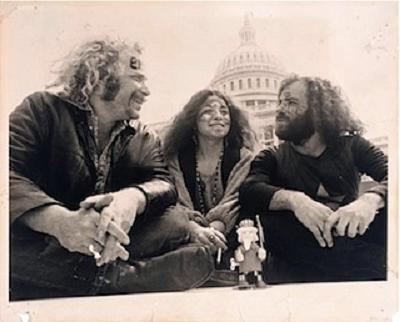
For some cosmic reason, this is Celebrate 1960s Radicals-And-Our-Children week in California. On Saturday April 18, in Oakland, I and at least 600 others witnessed my friend Steve Bingham get the National Lawyers Guild’s prestigious Champion of Justice Award. On Sunday I attended the opening of the Berkeley Historical Society’s “Up Against the Wall” exhibit of 1960’s posters and artifacts. Last night, in downtown Berkeley, former Weatherman Mark Rudd spoke and signed his long-awaited book Underground.
Friday will be the world premiere in nearby Marin County of Zayd (son of Weather leaders Bernardine Dohrn and Billy Ayers) Dohrn’s play Magic Forest Farm, advertised as a young woman’s journey back to her past to confront the truth. Next Wednesday, Chesa (raised by Bernardine and Billy, the son of former Weather person Kathy Boudin and still imprisoned David Gilbert) Boudin, will be in San Francisco signing Gringo — his coming-of-age work which recently provoked a disgustingly arrogant and mean-spirited review in the New York Times.
Not too shabby for us Bush-battered 1960s types!
It’s difficult for me to convey how heart-warming and deeply emotional Steve’s recognition event turned out to be. Steve Bingham, you may recall, spent almost 14 years underground in Europe after being charged with five counts of conspiracy murder for allegedly smuggling a gun past metal detectors into San Quentin so that prison leader George Jackson could “escape” — and be shot to death. In 1984 Steve resurfaced in the Bay Area with his wonderful wife Francoise, and, after a trial lasting six months — one of the longest, if not the longest trials ever in the State of California — Steve was completely exonerated.
It felt like a miracle seeing this tall, sweet, gentle man, flying silver hair somewhat trimmed for the occasion, wearing a deep reddish/pinkish crushed velvet shirt and garlanded with a lei, get a long, enthusiastic standing ovation recognizing his lifelong contributions to social justice — not just the 1960s struggle, or his survival underground, but also for his last 20 years at Bay Area Legal Aid protecting the rights of the imprisoned, the poor and the homeless. For me this was time-travel—back to the day when we proudly used the words radical and revolutionary as self-descriptors. It felt a lot like coming home.
Next day, I ran into Gus Newport, the well known African-American former mayor of Berkeley at the poster exhibit. Many posters came from the remarkable collection of the late FSM (Free Speech Movement) activist turned children’s science teacher and author Michael Rossman. One, the Berkeley Liberation Program, is the exact same poster I gave to the Stew and Judy Gumbo Albert Archives at the Labadie Collection at University of Michigan. My late husband Stew Albert, SDS founder Tom Hayden, I, and a large contingent of Berkeley radicals collectively wrote the Berkeley Liberation Program during the 1969 People’s Park uprising. We begin by making a declaration that still resonates:
The people of Berkeley passionately desire human solidarity, cultural freedom and peace.
Gus and I reminisced about how, back in the day, we rarely put the year on political posters — just the month and day. We lived so much in the intensity of the present; we were so busy “making history” that documenting it by putting the year on a publication was the furthest thing from our minds.
My favorite long-forgotten artifact was a small pamphlet that Tom, Stew, I, and others put together in 1969, titled “Every Soldier a Shitworker, Every Shitworker a Soldier.” 1969 was the year that, at least in Berkeley, Women’s Liberation came into full flower. This tiny handbook was published, as was the Berkeley Liberation Program, by a collective we named, with no lack of youthful grandiosity, the “International Liberation School.” For a mere 25 cents, young radicals learned, among other organizational skills, that women and men must equally share the “shitwork.” Good soldiers in the revolution give women’s work equal importance to everything else. So we believed and so we attempted to act.
At the exhibit I also ran into Mario Savio’s widow Lynne Savio Hollander, and Michael Rossman’s widow Karen McClellan. We widows of well-known 60s guys share a unique bond, but our grieving process is no different from anyone else—up/down, forward/back, eventually you survive and thrive, but your life is never the same. Mario, a gentle soul and truly charismatic speaker was at the center of Berkeley’s 1964-65 Free Speech Movement. Every fall Lynn and her fellow FSM’ers put on the Mario Savio Memorial Lecture at which they award an annual $6000 prize to a young person or persons with a deep commitment to human rights, social justice, and proven ability to transform their commitment into effective action.
Last night was Mark Rudd’s turn. I had not seen Mark for ages up until two years ago, when my fiancé David Dobkin and I had a warm, affectionate reunion with him and his wife Marla Painter at their New Mexico home. At the time, Mark said he figured Bernardine and Billy wouldn’t like his book. It’s not because of the narcissism that my dear friend Jonah Raskin called him on in The Rag Blog — I mean, he is Mark Rudd, what else do you expect? It’s his memoir, he’s allowed. Last night Mark described his trajectory as going from schlemiel to media darling, to being wanted by the FBI to going underground—but never truly leaving the schlemiel behind.
I really appreciate Mark’s highly personal writing style — there are even places where, in my opinion, he could have gone deeper and been more authentic. Marla said essentially the same thing last night. But Mark does explore his feelings with way more emotional openness than Cathy Wilkerson did in Flying Too Close to the Sun — and for this he is to be congratulated.
What Bernardine and Billy aren’t likely to enjoy about Underground is Mark spilling his version of the beans about his former friends. He has his regrets and doesn’t especially hold back about who he blames. I believe that blaming and regretting are part of the grieving process — for a while I blamed Stew for dying, for the terrible loss he inflicted on me. Perhaps this is just Mark’s way of channeling his anguish at all the losses: loss of life in the Townhouse and the Brinks robbery, the loss of comrades forced underground and those still in jail, to say nothing of factionalized friendships, lost youth, and the demise of an organization he so dearly loved. A North Vietnamese friend once gave me some strategic advice about dealing with friendships which Mark, perhaps, might have benefitted from: “Be good to friends who are good to you, also be good to friends who are bad to you, for only friends will go with you on the long road to revolution.”
Mark never considered himself a Yippie. He said last night he lost his sense of humor pretty early on in SDS. And we Yippies never felt close to SDS — we experienced the organization as too serious, too focused on ideology and, as Yippie leaders Abbie Hoffman and Jerry Rubin never forgot or forgave, SDS initially advocated not coming to Chicago for the 1968 protests — before having a last minute change of heart.
Those who are making the movies and writing the books, memoirs, blogs and graphic novels will ultimately define our history. As best as I can reconstruct, both Mark and Cathy Wilkerson believe that, after a certain amazing moment in which everyone in SDS felt empowered to change the world, divisive internal conflicts turned the organization into a cult of isolated, fanatic, self-destructive individuals with, at least for a time, an ideological commitment to offensive violence. Both Mark and Cathy say they disagreed in their hearts with this direction as it was happening, but also went along, victimized by their own ambivalence.
I’ve learned in my life that, when more than one person says essentially the same thing about a shared experience, there’s likely some kernel of truth in what they say. It truly saddens me to recognize that Weatherman turned into a cult. Romantic idealist that I am, I prefer to remember historical Weatherman for what it stood for — inspirational courage, exemplary risk-taking and a passionate commitment to ending racism and an immoral, illegal war in Vietnam.
Each one of us from back in the day has her or his own Sixties. Mark has made a terrific contribution by sharing his. I encourage you to buy Underground and go to here for his speaking schedule.
On Friday I’ll see what Zayd Dohrn’s play reveals about the search for past truths. I’ll keep you posted.
[Judy Gumbo Albert was an original member of the 1960s countercultural protest group known as the Yippies — along with her late husband Stew Albert who died on Jan. 30, 2006. Judy co-authored The Sixties Papers: Documents of a Rebellious Decade (Greenwood Press, 1984) and The Conspiracy Trial (Bobbs-Merrill, 1970). Her articles available online include “The Battle of Chicago,” about the 1968 Democratic Convention, and “What Were Those 1960’s Terrorists Thinking Anyway,” about the 1971 Mayday anti-war protests.
Albert currently lives in Berkeley and is writing her memoir titled Yippie Girl: My Remarkable Adventures with the Yippies, Black Panthers, North Vietnamese and Weathermen. Judy can be reached at yippiegirl@gmail.com or through her website yippiegirl.com.]
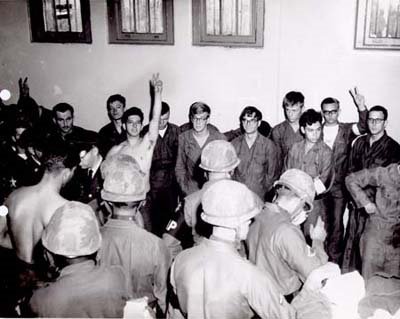
The Presidio mutiny was a sit-down protest carried out by 27 prisoners at the Presidio stockade on October 14, 1968. The stiff sentences given out at courts martial for the participants (known as the Presidio 27) attracted attention to the extent of sentiment against the Vietnam War in the armed forces… [and] brought press investigation of the conditions at the stockade and of the situations of the protesters.
Lindy’s Great Escape
By Randy Rowland / The Rag Blog / April 21, 2009
Part one
It was 40 years ago. We were all young. Facing a potential death sentence for singing “We Shall Overcome,” the 27 “mutineers” held a meeting in the cell block of the Presidio Stockade. Everyone who could escape should, we decided. We were not cooperating with the Brass, not even to participate in their kangaroo court-martial.
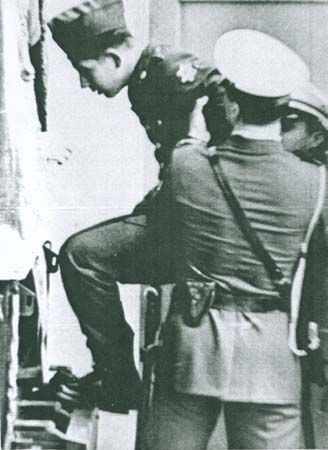
Not long after, some of the Presido 27 did escape. Walter Pawlowski, the guy who stood up during our sit-down, to read our demands to the commandant, was one of the escapees. Keith Mather, one of the “9-For-Peace,” and the contact I was supposed to meet up with when I arrived in the stockade, was another. They were recognizable ringleaders in the stockade protest which became known as the Presidio Mutiny. They had good reason to leave. Even before the sit-down strike, both were already facing many years in prison for GI resistance to the US invasion and occupation of Viet Nam. Now they faced additional charges of mutiny, the most serious of military offenses. Military regulations simply say “there is no maximum sentence” for mutiny.
Later, Lindy Blake and I, both “mutineers,” were cell mates in the prison ward of the post hospital when the first mutiny sentences came down, for 14 and 16 years, given to the first two of the 27 to be court martialed. I was the third ringleader, sent in to the stockade by the movement after a guard had killed a prisoner. My mission had been to learn what was going on inside, and find out what could be organized to take the prisoners’ struggle to a higher level. Lindy was a free spirit from LA, a lanky, blond hippie dancing to his own tune through the stockade experience. He had refused to go to Viet Nam, and was facing five years at hard labor. He was quick to flash a grin, knew some yoga postions, and could sing all the words to every Bob Dylan song there ever was. In the photo of the sit down where Pawlowski stands up to read our demands, I can be seen directly behind him, with glasses on. Lindy sits in front of Pawlowski, arms linked with Mike Marino and Ricky Dodd, looking over his shoulder at the camera.
Now we were in this cell together, with the mandate to escape if we could. Lindy and I decided this was as good a chance as we were likely to get. We were outside the fence, but heavily guarded. Our cement-walled cell was one of several lining both sides of a short corridor. A guard, who held the keys to each cell, was stationed in the corridor. Another guard manned his post outside a locked gate not far down the corridor, which separated the prison wing from the rest of Letterman General Hospital. A third guard, a rover, armed with a .45, patrolled back and forth outside, covering both sides of the prison wing. We had an outside window and decided the best escape was through its bars, so we arranged for a hack-saw blade to be smuggled in, and began to saw.
We only worked at night. One of us would stand watch at the cell door, straining at the barred inspection port to catch the first sight of an approaching guard. The other guy would saw, timing his efforts to correspond to the five or so minutes when the roving guard was on the other side of the building. To cover the sound of sawing, whoever was watching at the cell door would call down the corridor, asking the guards to turn up their radio. It was San Francisco, 1969. The guards were young too, and at night they tended to sit on either side of the mesh that separated them, listening to the FM. If they were nice guys, they would turn up the music when asked, which kept them from hearing the sound of our saw blade working the metal bar. If they were jerks, the lookout at the cell door would loud-talk them, with non-stop begging or verbal abuse. Most of the time they would turn it up just to drown him out. If they didn’t, his constant nagging provided the sonic cover needed to mask the sound of sawing.
The bars were fairly big, and the going slow. Each morning, when we knocked off for the day, we’d fill in the saw marks with soap, then blend in the soap with dirt from the floor to make the bar look whole. It was tense work, stressful enough to give you the bad pit. If we were caught, it would mean many years of additional charges on top of all the years we already faced. We only had one chance to get this right, so we were determined, methodical, and very, very careful. Finally we had one cut completed, and began on the next. Our blade was already dull, but eventually we could take the big bar completely out of the window and then soap it back into place to cover our progress. Each dawn we’d fill in our night’s work with the bar of soap, dispose of the night’s debris, hide our saw blade and collapse wearily into our bunks to sleep until the turn-key would kick us awake for morning count.
When we were about a week away from being done, I got a visit from the Catholic priest who served as my connection to the movement. “We’ve been talking it over, Randy,” he told me, “and we don’t think you should escape.” His reasoning was sound: the other recognizable ringleaders had already escaped. If I fled as well, those still in custody would be left with no solid connection to the movement. He had a moral argument as well. I had been sent into the stockade to organize the protest and if I ran away, those who had answered the call to resist would be left to face the drum roll alone. It was the moral equivalent of the captain being the last one off the sinking ship.
I wasn’t eager to spend my life in a penitentiary. I was young and newly married. I had put a lot of work and many tense nights into our escape plot. But I immediately knew that the priest was right. I couldn’t go. Back in the cell, I explained to Lindy my decision to stay, and pointed out as cheerfully as I could that there was nothing in the new situation that said that I couldn’t help him escape. So that night we started up our old routine, one at the cell door, one sawing at the window.
One time we thought that the plot was exposed. Thinking back, I can’t remember why we thought that, but to get rid of the evidence we ditched our hacksaw blade in a laundry hamper, hidden in our dirty sheets. Almost immediately we realized that we had panicked. But now our blade was across the corridor in a little utility room. Somehow we conned the turn-key into unlocking the cell to let one of us get into the utility room barely long enough to retrieve the blade, while the other distracted the guard momentarily. That clown act blows the top off any stress scale ever devised. Once back in the cell with our precious blade, and with the turn-key returned to his chair down the corridor, we danced wildly, between the bunks, out of our minds with fear and excitement. Even now, I can hardly believe we managed to retrieve our blade, but somehow we did, and the work went on.
Then one day, not too long before we figured to be done with our nightly sawing, the guards put another prisoner into the cell with us, a guy we didn’t know. Since we didn’t know him, and didn’t have contact with the general prison population to get anyone else to vouch for him, we decided not to risk the plot by bringing him in on it. His presence in the little cell added a whole new level of complexity to our efforts. We would be as boring as possible each evening, and he would eventually drift off to sleep. Once he was sound asleep, one of us would take the cell door position, and call down to the guards like usual, asking them to turn up the music. Only now, if they wouldn’t do it, we’d have to wait, because the plan B razz we had used in the past to cover the noise of sawing would most likely wake our cellmate. But often enough the guards would turn up their radio, and whoever was at the window, minding the rover outside, would begin to saw.
The lookout at the door had to watch for the guards in the corridor, and keep another eye on our cellmate. This guy turned out to be a sound sleeper, and although he woke up a few times, he never discovered our plot. It was incredibly tense, with the lookout job the worst, all worry and no activity. Sawing through steel with a hacksaw blade is tough but the guy with the blade had only to saw and to keep an eye out for the rover. Somehow, the act of sawing seemed to dissipate the tension. On the other hand, the lookout had to put himself into a state of hyper alertness, to watch our sleeping cellmate, watch for the turn-key in the corridor, and count the minutes before the rover would most likely return to our side of the building. We took turns in each position, not so much to relieve the saw man’s aching fingers, but to relieve the lookout’s stress.
Progress slowed down, but eventually the big night came. I don’t know how we were able to bore our cellmate to sleep. Finally, at the appointed hour, in the wee hours of a dark night, we waited for the rover to head to the other side of the building. Lindy stripped, to avoid having his clothes hang up on the jagged metal. I helped stuff him through the hole. He dropped to the ground below. I handed down a pillowcase full of broken window glass and other debris, threw him his pants, and he scampered off, naked, into the darkness, sack under his arm, pants over his shoulder, heading for a pre-arranged place where a car was supposed to be waiting to pick him up. That vision of Lindy, sprinting nude into the night, making a break for freedom, was my last look at him for many years.
Soaping the big bar back into place, I stuffed his bunk to make it look like somebody was in it. The longer it took for the guards to notice he was gone, the greater Lindy’s chances of making good his get-away. Pleased, but already missing the company of my comrade, I sat for a while on the edge of my bunk. We had pulled it off! Filled with both a big sense of victory and a huge empty place of sadness, I finally curled up and went to sleep.
The next morning, as usual, the turn-key opened the cell door and came in, kicking each bunk to rouse the prisoners for morning count. At night they just periodically shine a flashlight through the inspection port to count bodies sleeping in bunks, but each morning they made you get up. This particular morning started off as usual. The guard kicked our cellmate’s bunk, “Get up, get up!” he barked. The cellmate stirred. The guard walked over to Lindy’s bunk and kicked it, repeating his command. Then he turned to my bunk. The rasp of his key in the lock had put me instantly awake, but I feigned sleep. He kicked my bunk and I pretended to be groggy. Lindy had been gone for hours, but there was no way I could know for sure that he had been picked up by our co-conspirators on the outside. Determined to stall as long as possible as a rear-guard action, I took extra time waking up. Finally I was dangling on the edge of my bunk when the guard turned back to Lindy, who had not moved. Kicking his bunk with greater force, the guard yelled “Get up!” and yanked back Lindy’s covers, only to realize there was no body in the bed.
Turning to me with a nervous look, the guard growled, “How many prisoners are supposed to be in this cell?”
“I don’t know, you’re the turn-key,” I shrugged.
Nervously looking around the cell, he retreated back into the corridor to consult the gate guard. I could hear them swearing down the hall. In a couple minutes they both came into the cell, a violation of prison protocol for the gate guard to come inside the gate. They didn’t know what to do. The roster listed three prisoners, but the cell looked intact. If they reported a missing prisoner, and there was only supposed to be two of us, then they would be laughingstocks, at best. If they failed to report a missing prisoner, on the assumption that the paperwork was wrong, they would be in deep shit.
They nervously talked to each other while looking around the cell. After all those nights of high anxiety, I was calm. The cellmate really didn’t know what was going on, but prisoners always enjoy seeing guards get some of their own medicine, so we just silently sat on our bunks enjoying the show. The guards were ramping up, searching the cell now. There wasn’t really any place for a prisoner to hide, but they searched anyway. They looked under all the bunks. One of them walked over, picked up a towel off the floor, as if he expected to see Lindy hiding beneath it. They were really nervous now, sure there was supposed to be three prisoners, but with no explanation for what might have happened. They went back out and consulted the rover. Soon enough all three were in the cell, demanding to know where the third prisoner was. The cellmate truly didn’t know, and I played dumb, offering them nothing to ease their situation. The rover, who is never supposed to come into a prisoner area with his weapon, was nevertheless smarter than the other two and started methodically shaking the bars, determined to find an explanation. When he came to the soaped bar, it pulled off in his hand. He pivoted, wild-eyed, face contorted, steel bar held out like it was some sort of vile object. All three guards cried out like they’d been stung, and stampeded for the cell door, trying to get through all at once, in their rush to sound the alarm. We were left behind to placidly eat our breakfast, in a cell with a gaping hole. It was a long time later when somebody higher up the chain of command finally ordered the remaining prisoners be moved to a different, more secure cell.
Lindy had indeed been picked up at the designated place that night, and was spirited away to Vancouver, Canada, where he joined Mather and Pawlowski and a whole community of GI resisters living in exile.
It was almost exactly forty years ago that I helped Lindy escape from jail. Now Lindy lays dying in this cabin. His granddaughter is softly playing the old piano. Propped up in a hospital bed, in his own living room, Lindy is surrounded by windows that look out on the trees, mostly evergreens, which ring his giant garden. In his line of vision are rhododendrons in bloom, sagging fences and hand-hewn sheds. A black tail deer stands mid-day in the yard, accepting the generosity of family and strangers who have gathered for this passing.
Lindy’s 3-corner fool’s hat, its velvet somewhat faded with age, hangs on a hook near the bed. He lies quietly, mostly sleeping, but arousing once in a while to flash his grin at some new arrival here to pay him respects. Lindy’s time is measured in days, if not hours. The hospital opened him up, saw he was a goner, and merely sutured him back up. They released him to spend his last days in the place he loves, among those who love him.
Both of his sons are here with their families. There is a scattering of friends sitting in the yard. Neighbors drop in with food and supplies. I notice that the women seem to curtsey or bow to Lindy when they approach, flashing mischievous grins. They treat him with the tenderness of old lovers, which—as it turns out—is pretty much universally true.
This place is a hippie’s dream of back to nature. The house posts are pealed logs, some found on the beach nearby, and some harvested from this patch of land on this remote Canadian Island. Walls and ceilings are unfinished tongue and groove. The plywood floors are painted in wild shades of blue and purple. Water comes from rain barrels on the roof, electricity from solar panels. The room is toasty, heated by the warm rays of the spring sun, and a wood stove.
Lindy told me he knew in his heart for a long time that something was wrong with him. Then a few months back, part of a tree he was felling struck him in the chest. After that he attributed his escalating pain to the blow, not to cancer. Finally Lindy drove himself to the hospital, and now, only a week or so later, we gather to bid him farewell.
In response to my call that Lindy was dying, Keith Mather, one of the key players in the Presidio Mutiny flew up from San Francisco. Together we drove north from Seattle, over the border, taking three ferries to this island, where there are no policemen, to stand by our comrade in his final hours.
One of the women who was with him during his short stay in the hospital tells us a classic Lindy story. At one point after receiving his grim news, he held his breath, she told us, pretending to be dead. She fell for the gag, until he laughed and said “Got you!”
“I was yelling at him, ‘You BASTARD!’” she related in her Quebec French accent, “I was so mad at him. The nurses must have thought I was crazy.”
When Lindy called me from the hospital, to say his end was near, he remarked in that whimsical way of his, “Randy, it seems like I’m always escaping and leaving you behind.” As I sit beside him now, I’m thinking that the significance of a person’s demise is commensurate with the value of their life. Sharing the prison cell with Lindy, I learned lessons from him that I have treasured and held true ever since. I’m up here now because he sat down then. I’m sure that each person holding death-watch in this hand-made cabin, and many who are not right here, can testify how they, too, were touched and enriched by rubbing alongside this amazing spirit, my old comrade.
My mental image of Lindy has always been of a lithe young man dressed in a three-corner fool’s hat, dancing gently to his own tune, through a happy crowd on a warm summer’s day. He never lost that flop-eared grin, he never ceased being a free spirit. On April 9, 2009, forty years after he escaped from the Presidio, Lindy Blake, Presidio 27 mutineer, lover of many, father of two, passed away in his home on Cortes Island, at the mouth of Desolation Sound, in Canada. Keith Mather and I stood at his bedside and sang “We Shall Overcome” one last time for him.
I wrote the following while sitting by his bedside that day:
Free Spirits Will Always Escape
Its me, Lindy, the one who helped you peck your way
From the cell so many years ago.I have come now, so you may take wing again.
I was your co-conspirator then and I call you now,
My hummingbird, my jailbird, my escapee.
Hover about in the garden. Check the flowers.
Peer in the window from time to time,
Then flit on, as you will.I’m here to saw the last bar. I’ll soap you up.
Here’s my hand, Brother, step up.
Wiggle through the hole to freedom.I have come for you.
When the guards turn their backs,
I’ll give you the signal, and when you’re gone,
I’ll replace the bar to mask your retreat.Free Spirits will always escape.
[To learn more about the Presidio Mutiny and about the large scale resistance among active duty GIs to the Vietnam War, visit the archives at Sir! No Sir!]
Thanks to David Zeiger / The Rag Blog

Are we now going to ignore for another three years the public mandate of 2006 against this costly, preemptive war based on deceit? And how can we justify putting thousands more U.S. troops into Afghanistan?
By George S. McGovern / April 20, 2009
President Obama holds my admiration with high hopes for his message of change in Washington. It is puzzling, however, that he has adopted most of the previous administration’s formula for dragging out the withdrawal of our troops from the mistaken war in Iraq for nearly three more years. Very little “change” here.
Three years ago, public opinion polls indicated that a majority of Americans believed our policymakers were wrong in ordering troops into Iraq. It is widely accepted that this sentiment more than any other factor in the 2006 congressional elections resulted in Democratic majorities in both the House and Senate.
Are we now going to ignore for another three years the public mandate of 2006 against this costly, preemptive war based on deceit? And how can we justify putting thousands more U.S. troops into Afghanistan? We have already exhausted our treasury. We are also close to exhausting our soldiers.
Can there be any doubt that the enormous war cost has contributed to the financial crisis here at home? The expense of waging two Middle East wars, plus the loss of revenue caused by the previous administration’s tax cuts, have skyrocketed the national debt to a record high. Do we ever consider what the interest alone is on our $10-trillion national debt — much of it paid to China?
Frankly, we cannot afford a two-war commitment year after year if we want to balance the federal budget and restore our economy. The huge bonuses that directors of failing corporations have awarded themselves and their chief executives have rightfully angered people, but those figures are peanuts compared with the $12 billion a month we have poured into Iraq and Afghanistan over the last six years.
Has either the great God above or his creatures here below designated us to run the Middle East? What do we say to the Iraqi people who have indicated overwhelmingly in several polls that they want U.S. troops out of their country now? Why would we not understand this sentiment considering that our military equipment has smashed Iraqi homes, public buildings and infrastructure, including electricity and running water?
Of course, the most painful cost of these wars is the deaths of more than 4,200 brave American troops and tens of thousands of Iraqi civilians. This is to say nothing of the decline of our political judgment and moral standing in the world.
The Obama administration recommends we leave 50,000 troops in Iraq to “police” that troubled country through 2011. There may well be flare-ups that will keep them there indefinitely, struggling to police the war-induced chaos.
In June 1950, President Truman ordered our troops into Korea, stating it would only be a brief police action that did not require a declaration of war. Three years later and after 38,000 American soldiers had been killed, the new American president, Dwight D. Eisenhower, the commander of Allied forces in World War II, promptly ended our involvement in the Korean War, to the relief of our combat soldiers and the American public.
Unfortunately, Washington left 40,000 American soldiers behind to police the 38th Parallel — for a brief time. Yet, more than 50 years later, nearly 30,000 American troops are still in South Korea. So much for brief police actions.
Our policymakers in Washington contend that we must maintain U.S. troops in the Middle East to curb terrorism. I strongly believe that it is our military presence in Iraq, Afghanistan and elsewhere in the Middle East that is driving terrorism against the United States. No country that longs for national sovereignty wants a foreign army in its midst. We taught that lesson to the British Empire in 1776 when George Washington and his ragtag guerrilla army drove the British military from our shores.
My generation has lived through half a dozen wars, beginning with World War II and then Korea, Vietnam, Iraq and several smaller conflicts. The only one of those wars I really believed in and still do was the U.S. participation in World War II, in which I served as a combat bomber pilot against Hitler’s Nazi Germany.
I believe we aging veterans have an obligation to share what we have learned with the American people and with our young president, who seems open to well-meant suggestions.
In that spirit, I urge President Obama to bring our troops home from the Middle East this year. A good target date for completing an orderly withdrawal from two ill-conceived and costly wars in Iraq and Afghanistan would be Thanksgiving 2009.
For our sake and God’s sake, let’s get out of there and begin healing our own bankrupted land.
[George S. McGovern, a former U.S. senator from South Dakota, was the Democratic nominee for president in 1972.]
Source / Los Angeles Times
Thanks to Steve Weissman / The Rag Blog
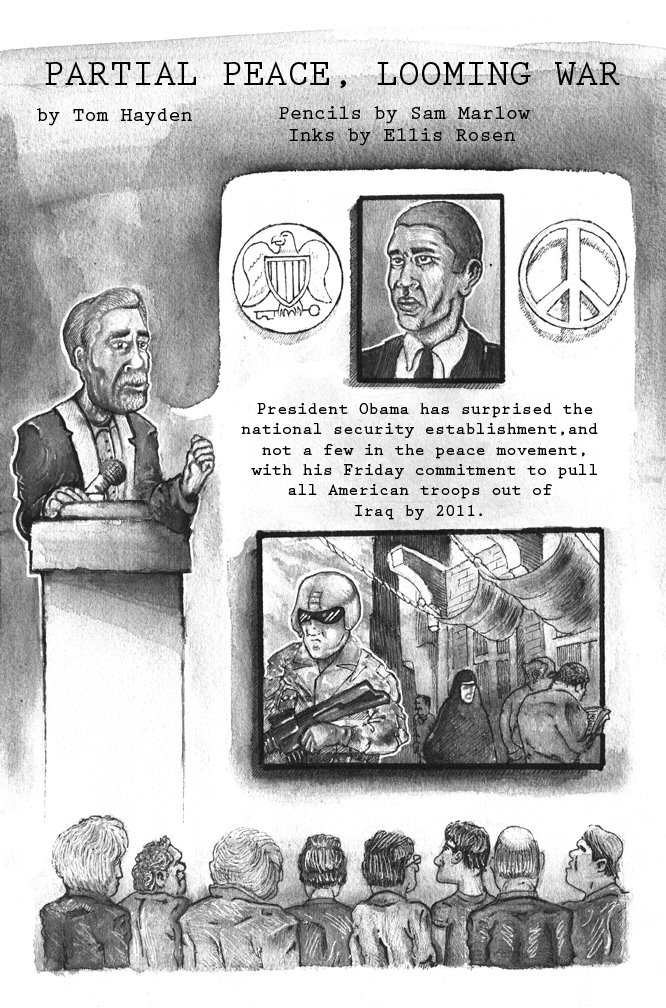
CLICK TO ENLARGE
See additional frames, Below.
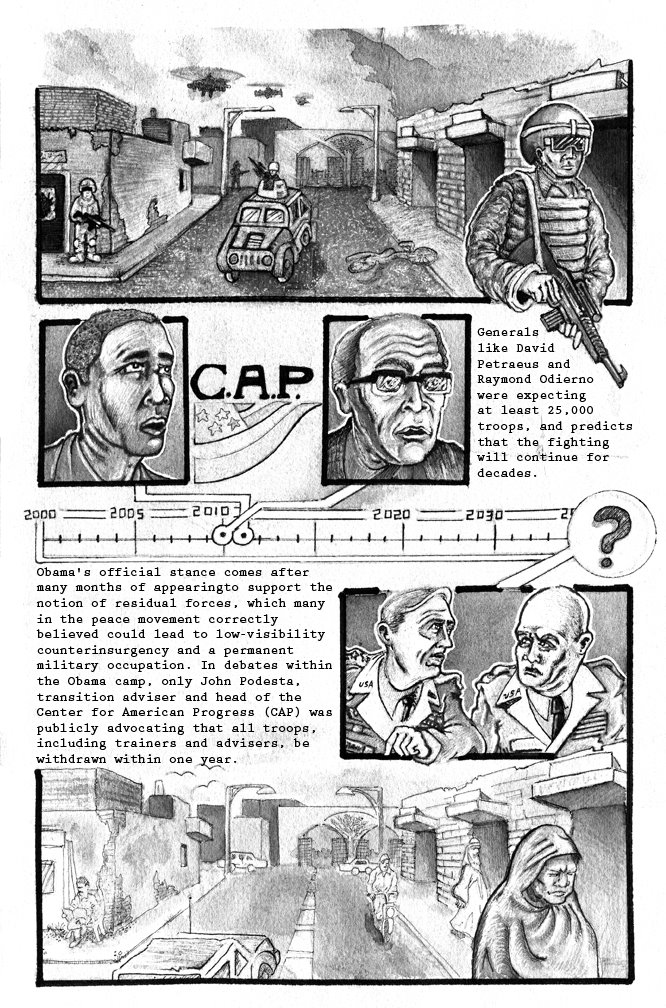
CLICK TO ENLARGE
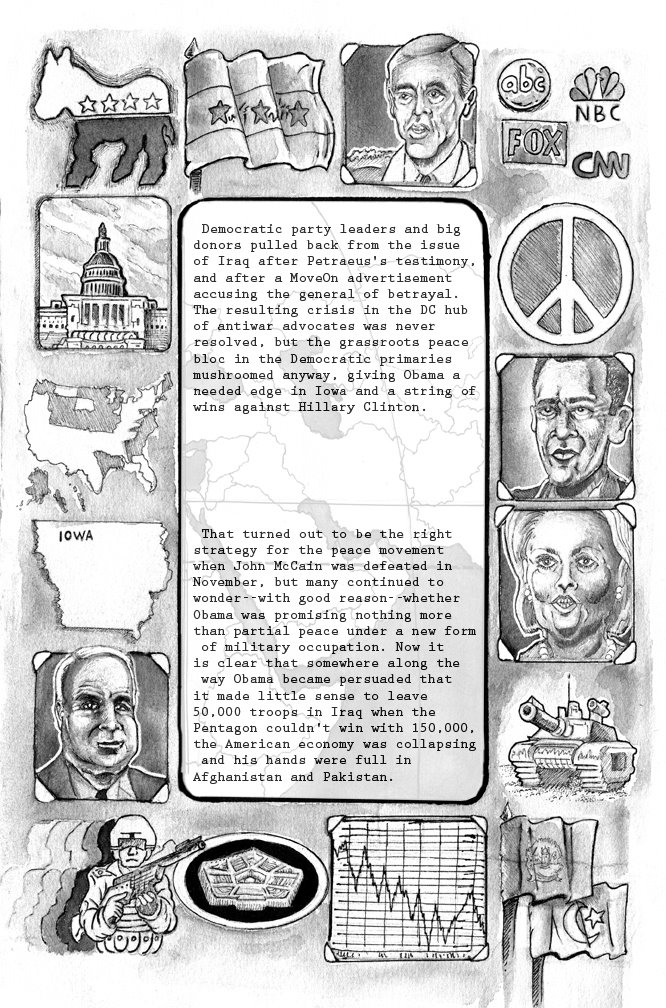
CLICK TO ENLARGE
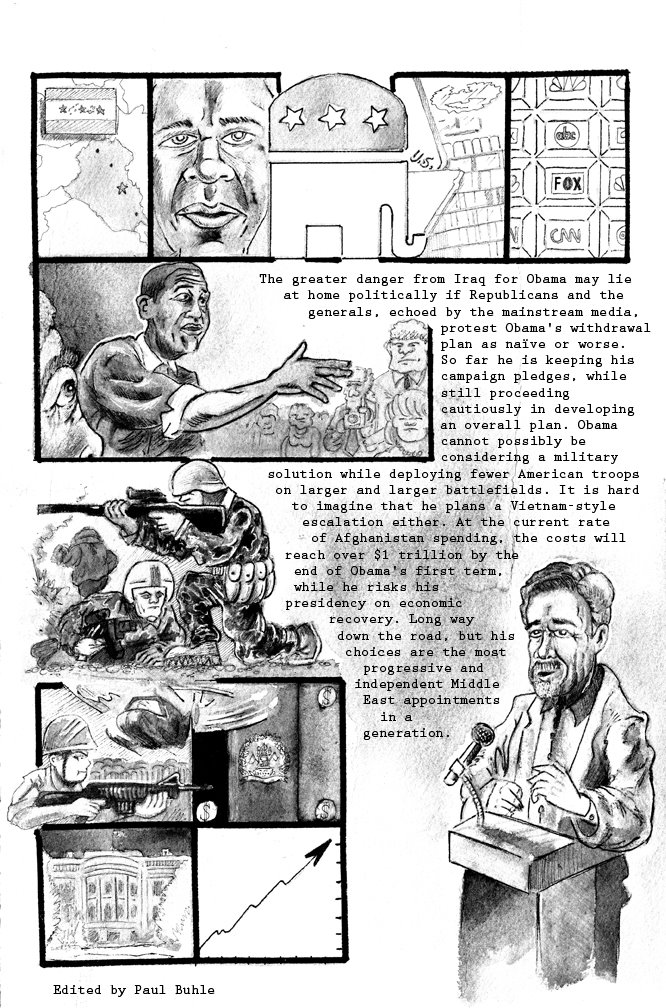
CLICK TO ENLARGE
[Tom Hayden, a prime mover in the Sixties New Left, was a California State Senator. A respected activist and author, he was a founder of Progressives for Obama and is the author of Ending the War in Iraq (2007), The Voices of the Chicago Eight (2008), and Writings for a Democratic Society, the Tom Hayden Reader (2008).]
[Sam Marlow and Ellis Rosen are graduates of the School of the Art Institute of Chicago. Together they self-published two comics. Marlowe also worked as a digital colorist for Chicago comic artist, Paul Hornshemeier, on titles such as “The Three Paradoxes”, and Marvel Comics’ “Omega the Unknown.” He recently completed a short science fiction comic about the end of the world. He is currently volunteering at the Museum of Comic and Cartoon Art. Rosen lives in NewYork where he also works part time at the Barry Friedman Gallery.]
[Paul Buhle is an educator and a historian. He published the New Left journal Radical America during the 1960s and has written or edited many books on radicalism and culture. He now organizes leftwing comic books.]
Please see “Iraqis Bear Tragedy of American Empire” by Tom Hayden, a Rag Blog comic, with an introduction titled “Comic art is growing up” by Paul Buhle / The Rag Blog / April 7, 2009.

TALL Funding Proposal A-0001:
The Unemployment Channel (UC)
By Greg Moses / The Rag Blog / April 21, 2009
Ah, the common folk. How we do pile up. Come May Day 2009 there will be about 14 million unemployed, twice the seven million who were unemployed in June of 2007.
Speaking about this on the stock market channel — which I have been watching lately the way I used to watch the weather channel back in the 90s — they call unemployment a lagging indicator. On the stock market channel they have their eyes always on the stock prices, which crash before the people do, and which consequently qualifies unemployment as not only post hoc to stock prices but propter.
So what we need as an immediate federal jobs program is a labor channel called Countrywide Unemployment (CU) where unemployed people can get paid for some honest reporting on what a lagging indicator looks like when you keep your eye on it.
The incentive to the employer community would be that a voice on the unemployment channel would agree to leave the air when presented with a competitive labor contract for a term of 18 months or a length of time equal to the average recession, whichever is longer.
The only advertisements allowed at the CU network would be for employment, education, or the kinds of cultural events that could be considered unemployment friendly, certainly not the Super Bowl. Any other crap you want to sell goes to Google ads at the network website.
But in no event will credit card companies be allowed to advertise unless they agree on pain of nationalization to lend at prime plus nada for the life of the cardholder.
There should be regional bureaus set up in RVs and parked outside important places like the White House, Congress, State Capitols, Regional Federal Reserve Banks, and rotating on a regular basis to various network places and research parks where venture capitalists may be found.
Now in recognition of the fact that youth get systematically screwed when it comes to the unemployment rate, one desk at the unemployment network would be dedicated to coverage of the Unemployed Peoples Youth Resource Service (UPYRS).
The UPYRS program would accept proposals on a weekly basis from youth who have shovel-ready ideas for community improvement. They would pinpoint something that they are tired of seeing neglected and their proposals would be put up for vote at the network’s website and hooked into Twitter and so forth.
A camera crew in each city would be assigned to follow the winning team of the week as members of the team receive full salaries and funding, purchase equipment and supplies, and get the work done in an entertaining and uplifting youthful manner, improving the community, the economy and their own prospects for saving memories of happy and productive lives.
Upon completion of the project each team member would receive a compensation bonus bond in the form of a T-Bill denominated for effective participation in the patriotic agenda known as “quantitative easing.”
This whole operation could be geared up in about an afternoon as soon as the Fox Network is nationalized and placed under an advisory council of cable access producers from across the country.
The founding annual budget should be a modest $5 billion funded directly by the Federal Reserve Board under discretionary powers delegated to the US Central Bank. The fund will be called Talented Access Living Live (TALL). The Philly Fed should have the TALL cash Fed-Exed to Fox Headquarters by noon, although stipulation could be made for a boxcar of gold bullion in case the Philly Fed is temporarily out of paper.
If there is any trouble getting this whole network up and running by midnight, then fourteen million unemployed should go milling around the Wall Street sector of Manhattan until the last of their lagging indications gets reabsorbed into a business plan.
[Greg Moses is editor of TexasWorker.org. He can be reached at gmosesx@gmail.com. He is a regular contributor to The Rag Blog.]

Durban II: Alethophobic Boogaloo
By Nima Shirazi / The Rag Blog / April 20, 2009
“There is nothing to fear except the persistent refusal to find out the truth, the persistent refusal to analyze the causes of happenings.” — Dorothy Thompson
Iranian President Mahmoud Ahmadinejad’s opening speech at the 2009 United Nations World Conference Against Racism, dubbed Durban II, addressed numerous inconvenient and uncomfortable truths regarding both the UN Security Council and the history of the State of Israel. Predictably, in response to the public airing of such truths, Ahmadinejad was immediately met with sharp and revealing opposition and self-righteous indignation by the representatives of many European countries – echoed, if not led, by the US and Israeli governments – and has been lambasted and demonized in the Western media.
Such a response is unsurprising. Ahmadinejad is no stranger to manufactured controversy. And, as usual, a simple look at his actual words reveals statements of fact that cannot be refuted. Ahmadinejad’s statements prompted an instantaneous and virulent reaction and criticism from the world’s most imperial and hegemonic powers. He was immediately presented as a hatemonger and racist for speaking truth to such powers. The speed and ferocity of those with the power to divert attention away from the meaning of Ahmadinejad’s actual speech in favor of personal attacks on the Iranian president himself betray the true motives behind such scapegoating.
Speaking at United Nations headquarters in Geneva on Monday morning, Ahmadinejad accused Western powers in the 1930’s and 40’s of fomenting warfare and implementing economic and military policies that have proven destructive to much of the rest of the world ever since. “Those in authority at the time set off two world wars,” he said, “killing hundreds of millions of people and causing mass destruction” in Africa and Asia, in addition to Europe. “Those who won [World War Two], considered that the world was with them,” he continued, and “set up laws that were oppressive and trampling.”
Is this controversial or offensive? Perhaps, if one knows nothing of modern history, Western imperialism, aggressive globalization or neo-liberal economic policy. Anyone familiar with American foreign policy over the past sixty years, especially in Southeast Asia, the Middle East, and Latin and South America would not be surprised by such banal statements.
Ahmadinejad then turned his attention to the unjust and inequitable hierarchy of nation states that formed the basis of the United Nations itself. “The Security Council set up after World War II, let’s analyze it. The veto vote – is that equality? Is that justice? Is that equality amongst human beings?” he asked, “Or rather is it arrogance and humiliation? The Security Council must be the most important body for decision-making in order to promote peace. If a law is based on force, how can we secure peace and justice? The seeking of power and arrogance means racism, injustice and occupation.”
Who would disagree with these remarks, other than those who seek to maintain their control over issues of global security and justice, diverting attention from the war crimes committed by allied states and condemning resistance to colonialism and military occupation in the same breath? The UN Security Council, established as the most powerful element of the United Nations – wielding far more influence and authority than the General Assembly – has long been the best friend to imperialism, during and after The Cold War. The United States has used its Security Council veto to bully other members into submission and acquiescence, allowing for the illegal invasions and ongoing occupations of both Afghanistan and Iraq. Most recently, the Security Council adopted resolutions enabling Israel to bomb blockaded ghettos and impoverished refugee camps with impunity, as well as protecting Israeli war criminals, who have the blood of 1,400 Palestinians freshly on their hands, from any condemnation or responsibility.
Later in his speech, Ahmadinejad addressed the creation of the State of Israel by the United Nations in 1948, after the post-WWI British Mandate. “As was the case after World War II, armies occupied other territories and people were transferred from territories,” he said. “In reality, under the pretext of compensating for the evil done in the name of xenophobia, they in fact set up the most violent xenophobes, in Palestine.”
“The Security Council made it possible for that illegitimate government to be set up. For 60 years, this government was supported by the world. Many Western countries say they are fighting racism; but in fact support it with occupation, bombings and crimes such as those committed in Gaza. These countries support the criminals,” Ahmadinejad continued.
Any informed reader of these statements would find little with which to quibble or disagree. The well-known studies of Israeli historians such as Benny Morris, Tom Segev, Ilan Pappé, and Avi Shlaim attest to the injustice sanctioned by the British and American governments, affirmed by the United Nations, and carried out by Zionist terrorist militias such as Irgun, Haganah, Palmah and Lehi. The waves of illegal Jewish immigration from Europe and Russia to Palestine are well documented and not a debatable issue.
Ahmadinejad stated the obvious by telling the gathering of UN delegates, “Following World War Two they resorted to military aggressions to make an entire nation homeless under the pretext of Jewish suffering…and they sent migrants from Europe, the United States and other parts of the world in order to establish a totally racist government in the Occupied Palestine. And in fact, in compensation for the dire consequences of racism in Europe, they helped bring to power the most cruel and repressive racist regime in Palestine.”
The age-old axiom of Palestine being a “land without a people for a people without a land” has been discredited so many times that even mentioning it here seems redundant and obvious. It is no myth that over 750,000 Palestinians, the indigenous people of the region whose ancestors had lived and worked on the land for centuries, were driven from their homes through violence and fear following the implementation of Plan Dalet and the horror of Deir Yassin. It is not a matter of opinion that the State of Israel was originally created on 56% of Palestine, despite Jewish residents representing only 32% of the population and owning only 7% of the land at the time. It is historical fact. By July 1949, after a year of aggressive expansionism, the borders of Israel encompassed 78% of Palestine. Eighteen years later, Israel seized control of the remaining 22%, which it has brutally occupied ever since. The dispossessed, disenfranchised, and dehumanized Palestinians penned up in the Occupied Territories suffer from apartheid in the West Bank, and starvation, accented with psychopathic massacres, in Gaza.
Ahmadinejad knows all of this. He also knows that the Zionist enterprise to establish an ethnocentric state in Palestine had little to no support in Europe, the United States, or even in the world’s Jewish community prior to the Holocaust. The fact that Israel is the product of post-WWII guilt by Western world powers and that the atrocities committed against the European Jews during the war are constantly used to justify the creation of the state of Israel are not controversial statements. Why, then, did 23 European delegates to the Durban II conference stage a walk-out during Ahmadinejad’s speech as soon as he mentioned the use of the Holocaust as a pretext for the creation of Israel? The French Ambassador Jean-Baptiste Mattei revealed the delegates’ refusal to even listen to criticism regarding Zionism and the Jewish state, as if any dissent is off-limits, when he told the Associated Press, “As soon as he started to address the question of the Jewish people and Israel, we had no reason to stay in the room.”
Why is Ahmadinejad condemned as an anti-Semite and Holocaust denier when it is perfectly clear that he condemns the atrocities committed by the Nazis against the Jews as “evil done in the name of xenophobia” and “the dire consequences of racism in Europe”?
Is Ahmadinejad wrong to question the establishment of an exclusively Jewish state on Palestinian land in response to the genocidal acts of Hitler’s Germany? Should it not be pointed out that a “Jewish” state, by definition, is racist and exclusionist, lest the nobility of Zionism be in doubt? Why would addressing the creation and ongoing support of an ethnocentric government that engages in selective democracy, institutionalized militarism, immoral occupation, illegal colonization, and systematic ethnic cleansing be deemed counter-productive at a conference devoted to opposing racism, discrimination, xenophobia, and intolerance?
“The word Zionism personifies racism that falsely resorts to religion and abuses religious sentiments to hide their hatred and ugly faces,” Ahmadinejad said, clearly demarcating the distinction between the 19th century colonial ideology of Jewish nationalism and the Jewish religion. Nevertheless British ambassador Peter Gooderham called these remarks “anti-Semitic.”
Because Ahmadinejad called for an “end to Zionism,” countless news agencies erroneously report that he seeks the “destruction of Israel.” His speech was called “offensive, inflammatory, utterly unacceptable” and “reprehensible” by dedicated Zionist and British Foreign Secretary, David Millibrand. French President Nicolas Sarkozy called it “an intolerable call to racist hate,” while the US Deputy Ambassador to the UN Alejandro Wolff described the speech as “”vile and hateful.” The Vatican called it “extremist and unacceptable” and the President of the European Jewish Congress, Dr. Moshe Kanto, condemned it as “revisionist history and lies.”
Perhaps Ahmadinejad’s speech let too many cats out of what many hope are hermetically sealed bags. The cowardice displayed by the United States, Australia, Canada, Germany, Israel, Italy, The Netherlands, New Zealand, and Poland by boycotting the conference from the outset, as well as the embarrassing walk-out by 23 attending delegations, proves that the Western world would rather demonize a fearless truth-teller who refuses to be muzzled, than recognize the racism and injustice enabled by its own support and silence. There was no annihilationist or violent rhetoric in Ahmadinejad’s speech, despite what one might read in the mainstream press. Opposing Zionism is not a threat of military action, but rather a call for political reform.
Dorothy Thompson, the German-American journalist and anti-Nazi activist, once wrote, “Fear grows in darkness; if you think there’s a bogeyman around, turn on the light.” In his bold and uncompromising Durban II address, President Ahmadinejad, long cast by the West as the Iranian bogeyman, has done his part to illuminate the truths about Zionism and the hypocrisy of its supporters.
The boycotts, protests, “spontaneous” walk-outs, and other forms of pro-imperial theatre that are already defining the Durban II conference prove one thing: alethophobia, the fear of the truth, is alive and well in the West.
[Nima Shirazi was born and raised in Manhattan. He now lives in Brooklyn and writes the weblog Wide Asleep In America under the moniker Lord Baltimore. He can be reached at wideasleepinamerica@gmail.com.]
Source / Wide Asleep in America
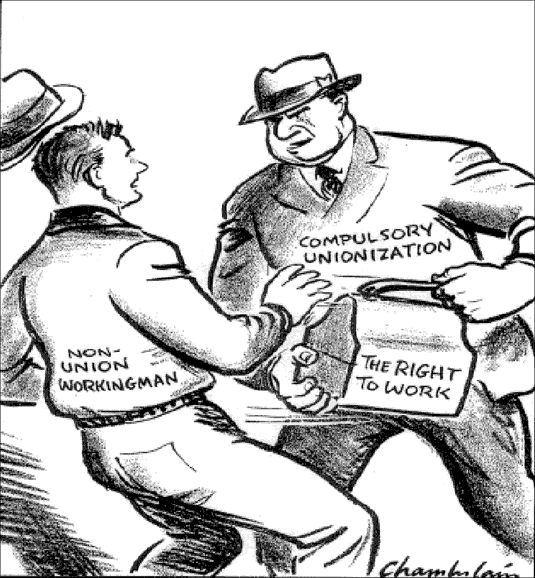
The anti-labor campaign is a component of the broader strategy by the Republican Party and frenetic conservative commentators to paint a picture in which Obama appears to be leading the country down the road to socialism, tyranny, and financial ruin—just like FDR.
By Chip Berlet
[This article appears in the April 2009 issue of Z Magazine (Volume 22, Number 4).]
The Obama administration will face stiff opposition to the pro-union “Card Check” legislation he promised to support, known officially as the Employee Free Choice Act. Opponents have launched a campaign that highlights the lack of union democracy, corruption, union bosses, and street thugs—all wrapped into a frame of coercive “Big Labor” versus individual rights.
The anti-labor campaign is a component of the broader strategy by the Republican Party and frenetic conservative commentators to paint a picture in which Obama appears to be leading the country down the road to socialism, tyranny, and financial ruin—just like FDR. To counter this, it helps to know some history of labor legislation, especially the Wagner Act and the Taft-Hartley Act.
Right-wing ideologues view the Administration of President Franklin Delano Roosevelt as a failed experiment in socialism. Some assert that it was a form of National Socialism, aka Fascism. Ultra-conservative institutions portray the National Labor Relations Act passed in 1935 as a wholesale attack on the free enterprise system. They spent the next ten years mobilizing support to gut portions of the protections granted to workers and unions; and they succeeded in this by passing the Taft-Hartley legislation in 1947.
Wagner Act of 1935
The National Labor Relations Act, (often called the Wagner Act to honor Senator Robert R. Wagner of New York), sought to ensure that working people had the right “to self-organization, to form, join, or assist labor organizations, to bargain collectively through representatives of their own choosing, and to engage in concerted activities for the purpose of collective bargaining or other mutual aid and protection.”
As one government summary explains, “In order to enforce and maintain those rights, the act included provision for the National Labor Relations Board (NLRB) to arbitrate deadlocked labor-management disputes, guarantee democratic union elections, and penalize unfair labor practices by employers.”
Immediately upon passage of the National Labor Relations Act, business and political conservatives sought legislation to undercut union organizing, especially in the period 1938-1941. According to labor historian Gilbert J. Gall, “Lobbyists of the National Association of Manufacturers and the U.S. Chamber of Commerce argued that Congress should change the law to prohibit ‘coercion from any source.'” They obviously hoped that such a clause would function as a mandatory open ship provision under statutory interpretation, making it impossible for unions to obtain union security through bargaining.” At the time, opposition to these proposed employer-friendly laws aimed at weakening unions and worker’s rights came from both Republicans and Democrats.
Ultraconservatives remained undaunted. On Labor Day 1941, with the U.S. entry into World War II seemingly inevitable and just weeks before the attack on Pearl Harbor, an editorial appeared in the Dallas Morning News: “[T]he greatest crisis that confronts the nation today,” wrote editor William B. Ruggles, “is the domestic issue of the right to work as a member of a labor union, if the individual wishes, or without membership in a union if he elects.” This editorial, titled “Magna Carta,” coined the term “right to work.”
During the war years, right-to-work legislation went nowhere on the federal level and the focus shifted to the state level where a variety of legislative battles were waged. In the “period from 1938 to 1944 numerous states passed harsh and sometimes punitive laws restricting union behavior” and “some of the laws simply aimed to harass unions,” observes Gall. There was a major emphasis on restricting union security arrangements and regulations concerning picketing or strikes, although “much of this state anti-union legislation proved unconstitutional.”
After World War II and the death of President Roosevelt, however, ultraconservatives developed plans to “roll back” the economic fairness and social justice policies of the Roosevelt administration. Along with a strategy to unweave the government social safety net were parallel plans to discourage workers from joining labor unions. “Right-to-Work” legislation returned on the federal level and headed to Congress
The Taft-Hartley Act of 1947
Rollback of the New Deal was the specific aim of ultraconservatives, but they pursued a broader agenda as they fanned fears of a domestic communist threat to justify not only crushing the labor movement, but pushing back the alleged socialist social engineering and big government created by FDR’s New Deal. They also launched a public campaign to expose socialist and communist subversives in Hollywood, the State Department, and U.S. universities.
The drive to gut the Wagner Act coincided with the turmoil created in the shift from a wartime economy and the return of veterans to peacetime work. According to the U.S. Department of Labor, after WWII there was “a massive if peaceful wave of strikes. Unions sought to make what they considered well-deserved gains after enduring wage freezes imposed during the war. Workers were also prodded by the sharp inflation, fueled by pent-up consumer demand, that followed the lifting of wartime price restrictions. Strike followed upon strike in such important sectors as railroads, coal, steel, autos and oil…. The strike wave mobilized widespread anti-union sentiment which soon made itself felt in the federal government.”
The Taft-Hartley Act was primarily a series of pro-management amendments to the Wagner Act. The National Association of Manufacturers still considers the passage of Taft-Hartley one of its crowning achievements. In its written history, the group brags “NAM played a leading role in the 1947 enactment, overriding President Harry Truman’s veto of the Taft-Hartley Act, which served to level the playing field in labor relations.”
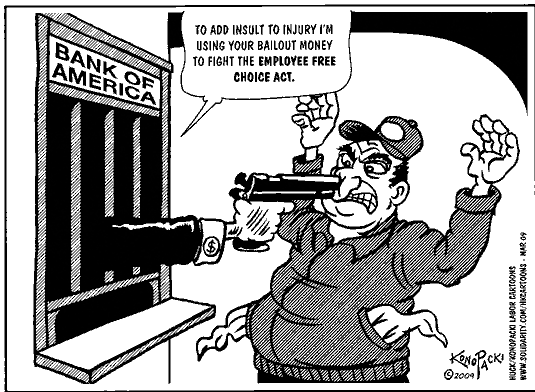
Actually, Taft-Hartley gave employers the advantage. Since then, anti-union employers have developed a variety of methods to harass, intimidate, and fire workers seeking the protection of a union contract. The Card Check plan heading for a Congressional vote this year seeks to restore the rights of workers outlined in 1937 by the U.S. Supreme Court: “Employees have as clear a right to organize and select their representatives for lawful purposes as (a company) has to organize its business and select its own officers and agents. Discrimination and coercion to prevent the free exercise of the right of employees to self-organization and representation is a proper subject for condemnation by competent legislative authority. Long ago, we stated the reason for labor organizations. We said that they were organized out of necessities of the situation, that a single employee was helpless in dealing with an employer….”
It’s easy to find flaws in labor unions and union bureaucrats, but Card Check is one struggle where we should not be on the sidelines.
[Chip Berlet is senior analyst at Political Research Associates. This article and others in this series will also be available at the PRA website www.publiceye.org. Last month’s Z Magazine article on this topic is available here (access restricted to ZNet subscribers).]
Source / Z Magazine
Thanks to Jeffrey Segal / The Rag Blog

Two days ago, Amazon.com had Open Veins of Latin America rated at 54,295 in sales. By Sunday night, the book had jumped all the way up to number two…
By jobsanger / April 20, 2009
It’s beginning to look like the quickest way to make a book a bestseller is to have it recommended by Venezuelan President Hugo Chavez. Three years ago, Chavez made a speech to the United Nations and made mention of a book by Noam Chomsky titled Hegemony or Survival.
Within days, the book by Chomsky became the number one bestseller at Amazon.com, and bookstores in the U.S. and Europe sold out and ordered tens of thousands of copies from the publisher. Now it looks like it is happening again.
During the Summit of the Americas, Hugo Chavez gave President Obama a book. It was Open Veins of Latin America: Five Centuries of the Pillage of a Continent by Uruguayan author Eduardo Galeano. The book is about the impact of foreign intervention in Latin America, from the Spanish conquest 500 years ago to modern times.
President Chavez told reporters, “This book is a monument in our Latin American history. It allows us to learn history, and we have to build on this history.”
Two days ago, Amazon.com had the book rated at 54,295 in sales. By Sunday night, the book had jumped all the way up to number two in sales at Amazon.com.
It looks like the Venezuelan leader has the golden touch when it comes to selling books.
Source / jobsanger
Find Open Veins of Latin America: Five Centuries of the Pillage of a Continent by Eduardo Galeano, on Amazon.com
By Brian Beutler
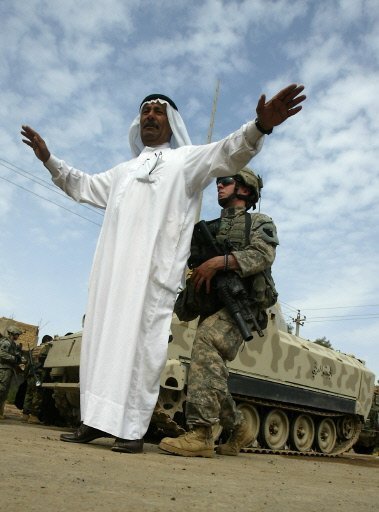
A senior enlisted U.S. Army soldier — Master Sergeant John Hatley — was convicted two days ago by a military jury in Germany of executing four handcuffed, blindfolded Iraqi men by shooting them in the backs of their heads.
That’s a newsworthy (and, of course, gruesome) story in and of itself, but there’s a story behind the story.
Many readers will recall the case of Scott Beauchamp — the Army Private who took his story of out-of-control soldiers in the line of duty to the pages of The New Republic and soon thereafter found himself on the receiving end of attacks from conservatives across the establishment and beyond.
Some of those conservatives, including the Weekly Standard’s Michael Goldfarb, participated in a concerted (and inaccurate) effort to discredit Beauchamp and tar, for lack of patriotism, the notoriously dovish New Republic and, by association, liberals everywhere.
For his reporting, Goldfarb relied on some…let’s call them
“questionable” sources and even got an assist, in a bizarre breach of protocol, from Beauchamp’s First Sergeant, who took to the blogosphere to make the case against the beleaguered Private. “My soldiers [sic] conduct is consistently honorable.”
This soldier has other underlining [sic] issues which I’m sure will come out in the course of the investigation. No one at any of the post we live at or frequent, remotely fit the descriptions of any of the persons depicted in this young man’s fairy tale. I can’t and won’t divulge any information regarding this soldier, but I do sincerely appreciate all the support from the people back home. Again, this young man has a vivid imagination and I promise you that this by no means reflects the truth of what is happening here.
The name of that Non-Commissioned Officer might ring a bell: John Hatley. And he seems to have protested a bit too much. Hatley had, in fact, committed the murders before he took to the Internet to defend himself and his fellow soldiers against charges of recklessness. We excitedly await Goldfarb’s statement on the issue.
Goldfarb, you might remember, turned his 15-minutes of fame into a campaign seasons’ worth, serving as deputy communications director for John McCain’s presidential bid during which time he put his deep concern for the facts to good use. After that bid failed, he returned to the Weekly Standard, which seems to regard the entire episode as a job well done.
Source / TPM / Originally posted on April 17, 2009
Thanks to Thomas Cleaver / The Rag Blog
By Keith Joseph / The Rag Blog / April 20, 2009
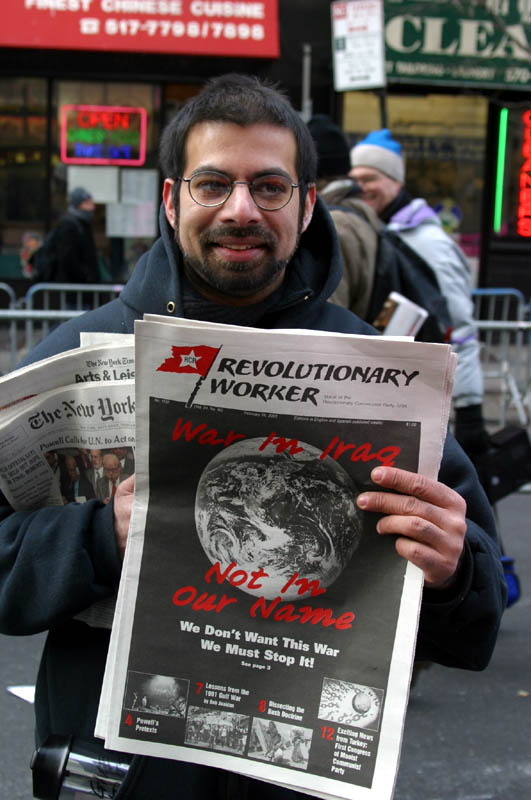
One of the great curiosities of the revolutionary left is the newspaper hawker. At every protest, at every progressive gathering, at every radical conference they appear. Trotskyites outside (they are never invited inside — apparently they have no manners) with insufferable papers like “The Workers Vanguard,” or “The Militant.” Inside old “new left” Maoists, and their unwitting youthful acolytes, push the latest edition of the “Revolutionary Worker” with insights from their maximum leader. To sell these papers you must be disciplined, you need guts, and a tolerance for abuse—most of the people who you try to sell the paper to refuse it. You must be prepared to hear “no.” I can explain this curiosity—the newspaper hawker and their newspaper — because I was once a newspaper hawker myself.
The newspaper, that marvel of 19th century communication technology, which is today breathing its last gasps under the weight of an unprecedented revolution in communications technology, somehow remains the preferred vehicle for the communication of revolutionary news and analysis by all manner of Marxian sects. Why? Because in an important little essay entitled: “Where to Begin,” and in a follow up pamphlet called: “What is to be done,” V.I. Lenin said a newspaper was necessary to unite the revolutionaries and to organize the impending insurrection. Our modern revolutionaries read Lenin’s essay like a cookbook recipe — what is to be done? Just add water. Lenin’s plan was brilliant in 1901 and we have much to learn from it, but only if we update the plan for the twenty-first century.
First and foremost newspapers are no longer cutting edge communications technology. Secondly, the new technology, most notably the internet, cannot be considered in isolation from new forms of social organization and social space it makes possible. The newspaper and the vanguard party built in the course of writing, editing, publishing, and distributing that newspaper are organizational, communicative, and cultural forms that correspond to one another, and the level of development of the productive forces. In other words, newspapers and top down vanguard parties go together –- but they are completely out-dated forms. So, while plenty of people still read newspapers, we should not use them as organizing tools. To use them today is like using a typewriter instead of word processing, or a television with rabbit ears instead of cable.
Lenin showed — in Where to Begin? and in What is to be done? — that political organization is built around communication technology. He insists that the newspaper is a “collective organizer.” The newspaper, according to Lenin, is supposed to do much more than report the news — the paper is supposed to be a place for revolutionaries to communicate with one another, to explain their practice to one another, to share experiences, and resources, to debate and argue out ideas and analysis — and in this process revolutionary unity is built, revolutionary culture is developed, revolutionary practice begins to become coordinated, and revolutionary organization is built. Most of the sects use their newspaper as self-promotion, they rarely have open discussions and certainly never discuss their practice in a serious way so that it can be critiqued and improved upon. They are more interested in maintaining their little sects as small businesses that can fund the careers of a few so-called leaders.
How can we put Lenin’s plan into effect with modern communication technology and organizational forms? Lenin called for a single newspaper to unite all the small local groups. Today we have a similar problem. We have numerous small local groups and numerous single issue organizations but no way of coordinating activity and experiences while remaining democratic and retaining bottom up structures. We need to learn to use the web as a collective organizer.
Just as the vanguard party and newspaper go together the internet and radical democracy go together. Before the internet organizational democracy was more of an ethical principle than a vital necessity. Before the internet democracy was a drag on expediency, but with the new communication technology openness and democracy are not just principles they are necessities. Openness and democracy are expedients. If we are to build the movement and organization to transform this society we need the unrestrained and self-directed energy and creativity of the majority of people.
The Obama presidential campaign pointed to the possibilities of the internet. Lincoln was a master of newspaper, FDR was the master of the radio, John Kennedy was the first to master television, and Obama was the first politician to use the internet effectively. But the internet is an inherently revolutionary technology that makes radically democratic participation possible. Obama’s campaign merely scratched the surface. We need a period of conscious experimentation with the various tools of the internet, websites, blogs, twitter, social networking sites to find ways to use the net to build revolutionary democratic organization and concerted practice.
Thorne Webb Dreyer, Editor