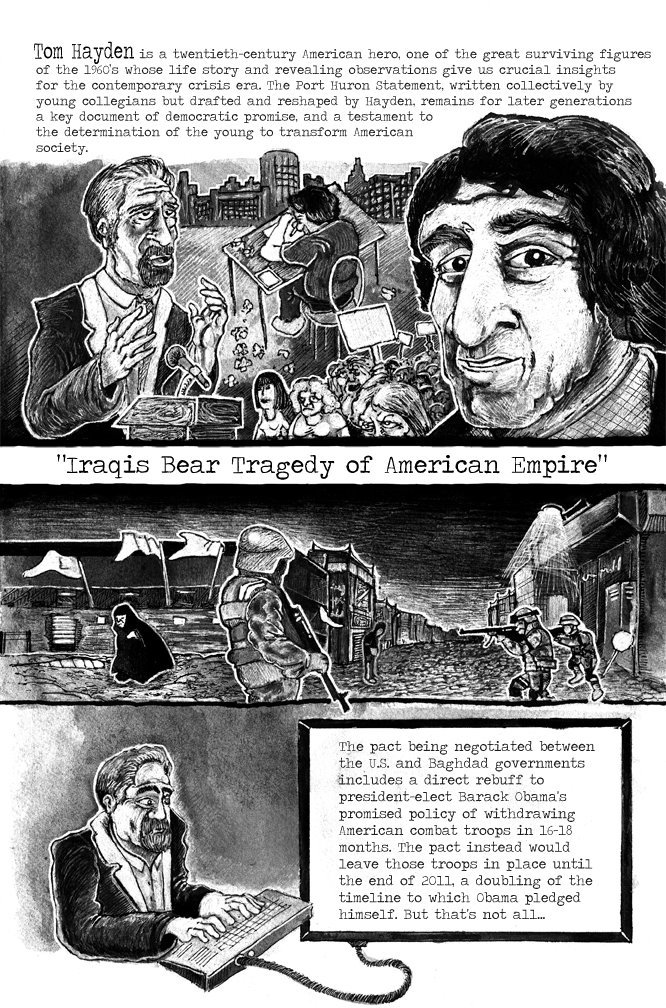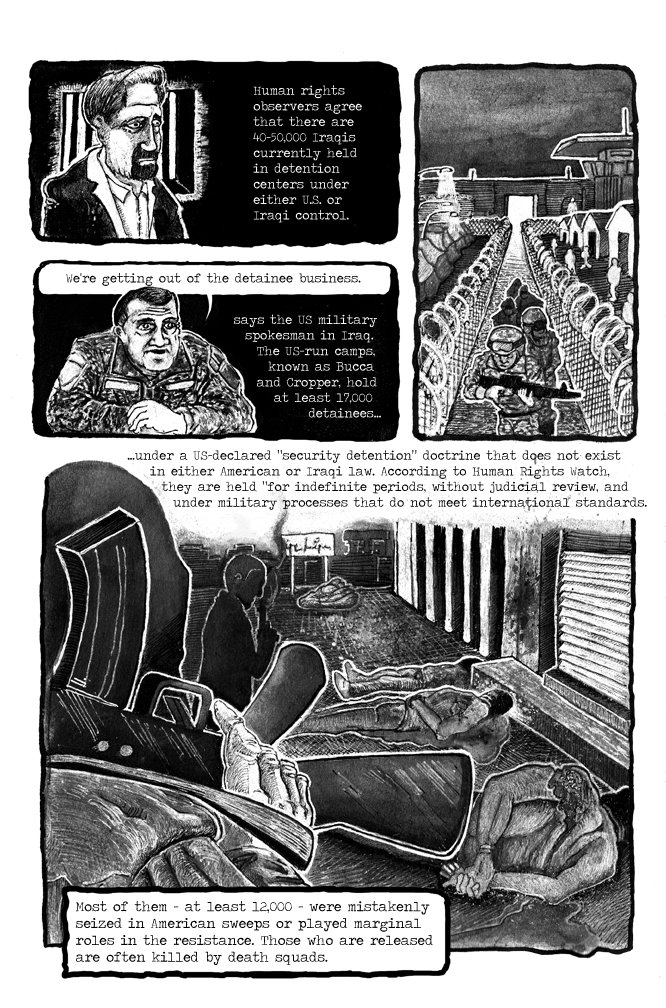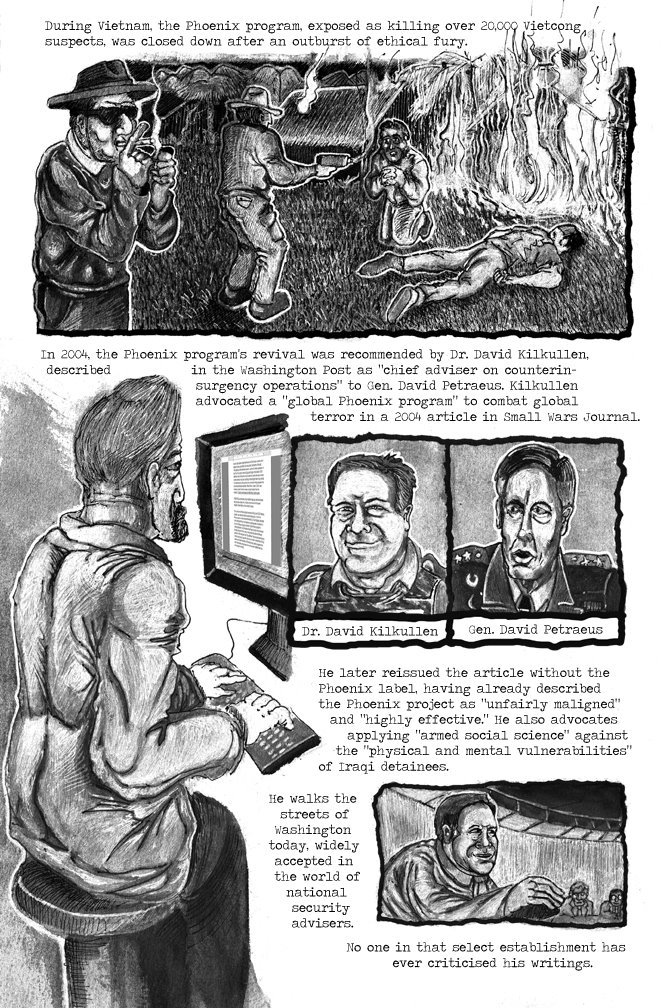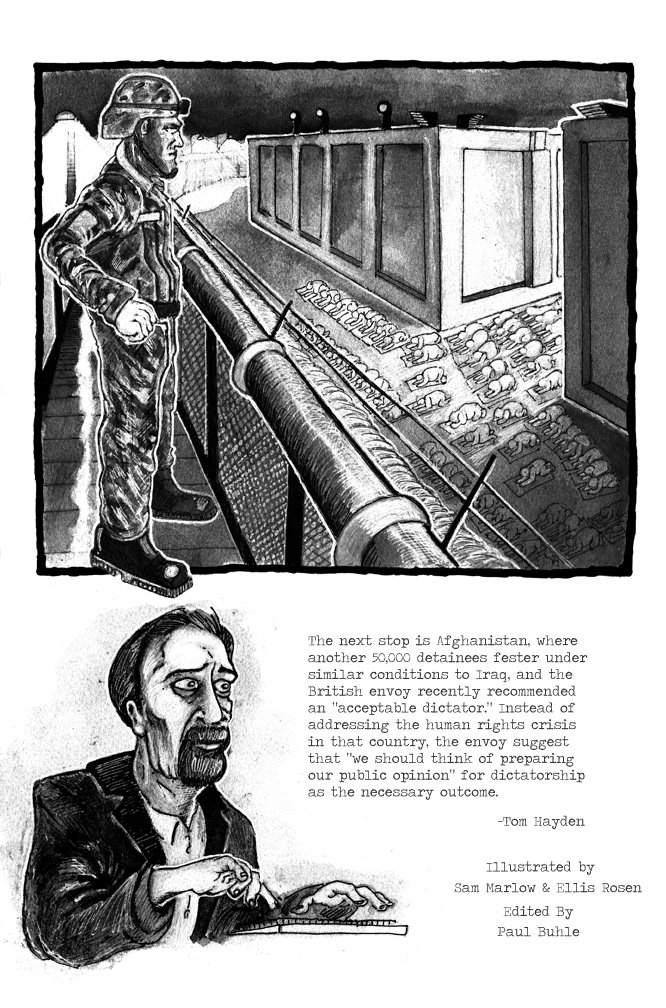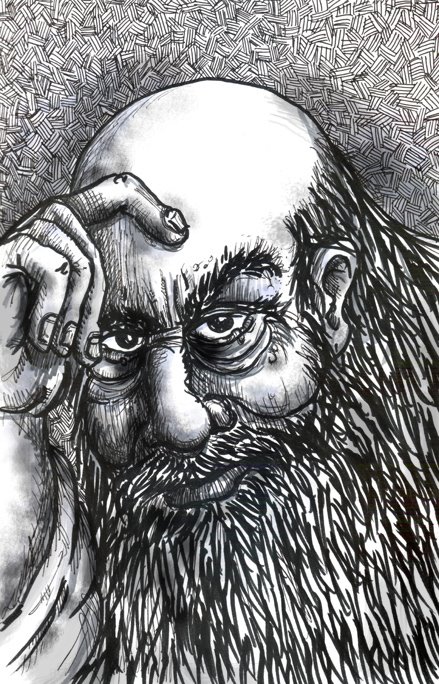

Tom Hayden Comic : The Tragedy of Iraq

Iraqis Bear Tragedy of American Empire
Text by Tom Hayden.
Illustrated by Sam Marlow and Ellis Rosen. Edited by Paul Buhle.

Published by The Rag Blog.

CLICK TO ENLARGE

See additional frames, Below.

Comic art is growing up
By Paul Buhle / The Rag Blog / April 7, 2009

Comic art is growing up. And the youngest generation promises to be the best yet, building upon the work of the past. That is to say: the previous generations of newspaper and comic book art, but especially the Underground Comix days of The Rag and others, and the alternative art (Austin’s Jack Jaxon notably) that began to take history seriously. I’m happy to have had a small role in much of this since the appearance of RADICAL AMERICA KOMIKS in 1969, with Gilbert Shelton in charge editorially and me, a mere publisher.

It was the happiest of coincidences that brought artist Ellis Rosen and Sam Marlow together with me, through a particularly wonderful student of mine at Brown. I’d been working fitfully on a Tom Hayden Comic, given it up a couple years ago, now see it come to life in a new way, from Tom’s passing observations on the global scene.

Keep tuned, this is something new and exciting.

CLICK TO ENLARGE

CLICK TO ENLARGE

CLICK TO ENLARGE

[Tom Hayden, a prime mover in the Sixties New Left, was a California State Senator. A respected activist and author, he was a founder of Progressives for Obama and is the author of Ending the War in Iraq (2007), The Voices of the Chicago Eight (2008), and Writings for a Democratic Society, the Tom Hayden Reader (2008).]

[Sam Marlow and Ellis Rosen are graduates of the School of the Art Institute of Chicago. Together they self-published two comics. Marlowe also worked as a digital colorist for Chicago comic artist, Paul Hornshemeier, on titles such as “The Three Paradoxes”, and Marvel Comics’ “Omega the Unknown.” He recently completed a short science fiction comic about the end of the world. He is currently volunteering at the Museum of Comic and Cartoon Art. Rosen lives in NewYork where he also works part time at the Barry Friedman Gallery.]

[Paul Buhle is an educator and a historian. He published the New Left journal Radical America during the 1960s and has written or edited many books on radicalism and culture. He now organizes leftwing comic books.]

Coming Soon: “Partial Peace, Looming War,” by Tom Hayden, a Rag Blog comic.


The Rag Blog

Posted in Rag Bloggers | Tagged , , , | 1 Comment

Cuba: Encouraging Artists to Criticize the System

Cuba’s Minister of Culture Abel Prieto in Havana during an interview he granted La Jornada. Photo: Pablo Espinosa.

Cuba urges artists to be critical in order to defend the utopia, Abel Prieto says
By Pablo Espinosa

A CubaNews translation. Edited by Walter Lippmann. Originally published April 2, 2009.

This analytical spirit is often in line with our efforts to eliminate the very bureaucracy we have created, holds the Minister of Culture. We have managed to turn our capital city into a great art gallery, he tells La Jornada.

HAVANA — Cuban Minister of Culture Abel Prieto stated in no uncertain terms that using art to criticize the system is indeed a revolutionary action nowadays. “We encourage the kind of critical, reflective art that helps find out where we go wrong and defend the utopia. When criticism is exercised from a position of commitment to the country, the outcome can be really productive”.

Interviewed by La Jornada a week into the 10th Havana Biennial, the senior official offers a preliminary assessment, speaks about sensitive topics and stakes out new directions for Cuban culture.

Q: What would be a preliminary assessment now that the 10th Biennial is in full swing?

“We are quite satisfied. A major goal has been met: turning Havana into a great art gallery. It’s a principle of our cultural policy to outsmart and democraticize any elitist approach to art. Still, our institutions are weak in the face of talent, whose strength, energy and demanding nature are beyond our real institutional ability.

“That we sometimes find ourselves crippled to operate by financial problems and a marked lack of resources is a crude reality we can’t deny. When you add it all up you realize this Biennial was put together cent by cent and working wonders. Some friends who know about it told us, ‘Hey, you need millions to organize a thing like this’…”

A FORUM OF RADIATING POVERTY

“This is a biennial of poverty,” Abel Prieto continues, “of radiating poverty, like [late Cuban writer José] Lezama Lima said, and I mean it as a good and positive quality.

“And it’s precisely the field of visual arts where we are worst stricken, because our institutions lack the financial means to put artists on the great market.

“However, artists like Kcho, for instance, acknowledge that the Havana Biennials have been a launch pad for the main Cuban artists in the last 20 years.”

Q: Is it in the nature of this Biennial to promote alternatives to a market-oriented art?

“One of the Biennial’s principles is to provide a choice to dealership and the frequent occurrence of fraud, since some works receive a lot of publicity and become highly successful even if they have almost no artistic value.”

Q: How significant is the presence in this Biennial of U.S. artists and their works of political criticism?

“It puts symbolic pressure on Obama’s government and its hostile blockade and policy. There’s a whole movement of artists and cultural representatives in the U.S. who oppose any barrier to cultural exchange, even powerful people who hold important positions in show business.

“Unfortunately, as you know, Joe Biden said a few days ago that the blockade will remain. We expect no big changes in the U.S. policy on Cuba, but at least the exhibition Chelsea visits Havana raises a symbolic flag after years of silence under Bush. Many U.S. actors used to come before, such as Jack Nicholson, Robert de Niro, Steven Spielberg, etc. The Cuban National Ballet traveled every year to the States, and so did the music group Los Van Van. At a disadvantage, of course, since neither [Cuban prima ballerina] Alicia Alonso’s company nor [Cuban singer and composer] Juan Formell’s band could be paid for what they did, a drawback to the Cuban artists but a cultural exchange after all.

“There was a Havana Biennial attended by three thousand American artists. Bush nipped that in the bud by denying them further visas. He even had the passports of Irakere’s founder Chucho Valdés and Los Van Van’s director Juan Formell stamped with an insane caption that says something like they are dangerous to the national security of the United States. That’s how far he took his paranoid hatred.

“That’s why Chelsea visits Havana is such an important exhibition: it’s a first for U.S. culture in the post-Bush era. Here in Cuba we always stress the fact that we feel no contempt for the American people or their artists, quite the opposite.”

HEALTHY REVOLUTIONARY CRITICISM

Q: An outstanding fact of this Biennial is the presence of the Cuban artist Tania Bruguera with her Cátedra de Arte Conducta (Studies in the Art of Behavior), made up of very young figures whose work levels harsh criticism at the Cuban system. Is that openly critical spirit encouraged or tolerated?

“A critical, analytical art that rekindles society’s time-honored, avant-garde spirit of changing things, people and the environment is visible not only in Tania’s project, but in general among our young artists.

“It’s a healthy thing, this criticism from positions of commitment to the Revolution which is very often in line with our efforts to be more efficient and eliminate the bureaucratic snags we have put up ourselves.”

Q: There are works in this Arte Conducta Workshop where Fidel Castro is portrayed as one of those plush animals you can “fish” for some coins from vending machines in shopping malls and the glorification of Cuban athletes is shown to be nothing but an utilitarian tendency to treat them like objects. Is that also a tolerated or a fostered practice?

“Those artworks sprung from Arte Conducta have a demystifying purpose which proves very attractive to young artists. But there’s a downside, like the provocation on Sunday evening during Bruguera’s performance when this famous bloger-girl Yoani Sánchez took the microphone and made a speech against the Revolution. She said the Internet was a chink in the wall of Cuban censorship.

“She talked about something we deem important: to provide a proper framework to receive that kind of art. But it happens that we in Cuba are under constant surveillance by a media bent on distorting reality on a regular basis. The Sunday events were used by unscrupulous individuals and the Florida-based newspapers.

“That’s one of the topics addressed by this critical art in Cuba, which we promote in order to fuel reflection and pinpoint our flaws, so that it helps us defend the utopia.

“When you exercise criticism as Tania Bruguera does, from a position of commitment to the country, the outcome can be really productive.”

Source / La Jornada

Thanks to Jeffrey Segal / The Rag Blog

Posted in RagBlog | Tagged , , | Leave a comment

‘Justice in the Coalfields’ : The Pittston Strike, April 5, 1989

Trailer: ‘Justice in the Coalfields’ by Anne Lewis

Anne Lewis’ provocative and skillfully produced documentary of the strike, Justice in the Coalfields, has had a profoundly formative influence not only on my understanding of the struggle, but larger issues of American culture and Appalachian collective politics… Justice in the Coalfields is a remarkable oral history narrated by persons on both sides of the nearly year-long dispute.Tal Stanley / Southern Changes

By Anne Lewis / The Rag Blog / April 6, 2009

Yesterday was the anniversary of the Pittston Strike that began April 5, 1989 in Virginia’s coal country.

The reason I know is that I had one of those flashback moments last week. The Richmond Times Dispatch wanted clips from my film “Justice in the Coalfields” to run on their website for a major retrospective on the Pittston strike. Then they laid off the reporter (one of 28 lay-offs) on Friday so they didn’t run the story. And just when they were doing something good about the coalfields. Folks in southwest Virginia (and I was one of them) believe that the only time the rest of the state recognizes their existence is when the governor declares martial law.

The Pittston strike rings out as an example of worker and community solidarity. More than 1,700 coal miners in southwestern Virginia and West Virginia walked out after the company revoked the health care of pensioners, disabled miners and their families, and widows. There were 4,000 arrests for nonviolent civil disobedience against Pittston which owned Brinks armored trucks as well as coal mines.

The strike was about so many current issues — the demand for universal health care, global energy, lay-offs, worker/community alliances, the Right to Work law, that “Justice” might have renewed usefulness.

You can also view a trailer from the film at annelewis.org. If you have any problems, you might want to right click on the link and open with quicktime player. The trailer is also available at Appalshop’s General Store.

Here is a review of the film by Tal Stanley. It appeared in Southern Changes in 1995.

[Anne Lewis is an independent filmmaker associated with Appalshop, senior lecturer at UT-Austin, and member of TSEU-CWA Local 6186 and NABET-CWA. She is the associate director of “Harlan County, U.S.A” and the producer/director of “Fast Food Women,” “To Save the Land and People,” “Morristown: in the air and sun,” and a number of other social issue and cultural documentaries. Her website is annelewis.org.]

See these related articles:

  • Tension Easing, but Miners’ Strike Against Pittston Goes On by B. Drummond Ayres Jr. / Special to The New York Times / Nov. 26, 1989
  • The Place of Justice by Tal Stanley / Southern Changes / Vol. 17, No. 3-4, 1995
  • And:

    The Rag Blog

    Posted in Rag Bloggers | Tagged , , , , , , | 1 Comment

    Dr. Stephen R. Keister : The Insurance Industry Could Use a Hippocratic Oath

    Hippocrates / josh pincus is crying.

    Nowhere, does the Hippocratic Oath require a physician to be a peon, or a servant of a HMO or insurance company.

    By Dr. Stephen R. Keister / The Rag Blog / April 6, 2009

    The total lack of ethical or moral standards in our society is now being demonstrated by the actions of the health insurance industry, its prostitutes, and its collaborators. Their deceit and arrogance was highlighted during a special on PBS that aired Friday, April 3. Its subject was our country’s current health insurance problems, and the producers’ not so oblique contention that these indignities could never happen in a European nation.

    Then on Sunday, April 5, CBS’ 60 Minutes ran an account of the University of Nevada Medical Center’s having to cancel treatment of all uninsured cancer patients due to budgetary difficulties. Happily, my anger was mitigated in part by my experience with a private oncology practice that takes on a limited number of these poor folks in their private practice, requesting small donations from patients and the community. Only in the USA!

    I am taken back in time to a date in 1943 when I and my classmates in our academic robes recited:

    I swear by Apollo the physician and Asclepius, and Hygieia and Panacea and all the gods and goddesses as my witness, that, according to my ability and judgement I will keep this Oath and this contract. To hold him who taught me this art dear to me as my parents, to be a partner in life with him, and to fulfill his needs when required; to look upon his offspring as equals to my own siblings, and to teach them this art, if they wish to learn it, without fee or contract, and that the set of rules, lectures, and every other mode of instruction, I will impart a knowledge of the art to my own sons, and those of my teachers, and to students bound by this contract and having sworn this Oath to the law of medicine, but to no others. I will use those dietary regimes which will benefit my patients according to their greatest ability and judgement, and I will do no harm or injustice to them.

    I will not give a lethal drug to anyone if I am asked, nor will I advise such a plan; and similarly; I will not give a woman a pessary to cause an abortion. In purity and according to divine law I will carry out my life and my art. I will not use the knife, even upon those suffering from stones, but will leave this to those who are trained in this craft. Into whatever homes I go, I will enter them for the benefit of the sick, avoiding any voluntary act of impropriety or corruption, including the seduction of women or men, whether they be free men or slaves. Whatever I see or hear in the lives of my patients, whether, in connection with my professional practice or not to be spoken outside, I will keep secret, as considering all such things to be private. So long as I maintain this Oath faithfully and without corruption, may it be granted to me to partake of life fully and the practice of my art, gaining the respect of all men for all time. However, should I transgress this Oath and violate it, may the opposite be my fate.

    Nowhere, does the Hippocratic Oath require a physician to be a peon, or a servant of a HMO or insurance company. The fall of a noble profession occurred some 30 years ago when the various insurance companies colluded to take over the practice of medicine in the United States, strictly for their own profit and enrichment, and were unopposed, by-in-large, by the doctors who were too distracted, too cowardly, or too concerned about income, to turn aside this well financed Leviathan.

    Today the United States stands alone in the world with this monstrous situation where if you cannot provide health insurance you can jolly well go ahead and die. There are folks, supported by 73% of the literate population of the USA, who wish as their right universal single payer health care. However the propaganda mill of the insurance industry, abetted Richard Scott’s pro-free market message, is already at work with deceit, misinformation and out and out lies about what universal health care entails. Scott is backed by a group of Republican PR consultants in an effort to persuade those who cannot think for themselves that the USA has the best health care in the world. He puts forth the lie that in Europe one cannot choose their own physician, must wait inordinately long for treatment, and that care is managed by “bureaucrats.” ALL LIES. This is the same Scott who, according to a 2000 article in Forbes, was forced to resign as head of what became known as Columbia/HCA after fraud charges against the massive health care company in 1997. He was replaced by Thomas Frist, Jr., the original founder of HCA and brother of future Senate Majority Leader Bill Frist.

    Let us take a look at European medicine, which I fear becomes entangled with European education, as one will see. First of all it is not “socialized medicine,” there is no such thing. This is a word contrived by those who will deny Americans decent health care. Matter of fact, universal health care in Germany arose in the late 1800s under Otto van Bismarck, a Royalist, and in England under Winston Churchill, a Conservative, to note two examples. Each European nation has variations in its system; hence, let me try and amalgamate the essence of the various nations into a single entity which we will call New-Gaul.

    New-Gaul has health care for all citizens, from birth to death, without payment for services, or in some instances, a minimal co-payment. One can choose one’s own doctor, dentist, specialist or hospital. For acute surgical procedures or medical emergencies there is no waiting. For elective procedures there may be a wait of several weeks, i.e. total knee replacement. Pharmaceuticals may be free or purchased for a minimal amount. One is not rushed out of the hospital after an illness or operation to save the insurance company money. Medical appliances and devices are covered by the program. There are more doctors, hospital beds and MRI machines per capita than in the USA. Many doctors make house calls since there is an abundance of primary care doctors since physicians are trained by the government. The city hospital ERs are not overburdened by taking care of gunshot wounds. One may buy inexpensive private insurance to cover private hospital rooms, special nursing, or to see a few physicians not included in the system.

    How is this paid for? The income for universal health care is bundled with that for education providing free education through the university for qualified student. There is no property tax. Income taxes are commensurate with ours save for the wealthy who are taxed at a much higher rate. There is a very high gasoline tax, a gallon costing approximately twice what it costs in the USA; hence, the New-Gaul citizen uses a gasoline conserving vehicle or uses the excellent, frequently running, well-maintained public transportation. There is a 16% value added tax, i.e. similar to a sales tax on all manufactured products, but not on food.

    Such a plan has been introduced into the US congress: Rep. John Conyers’ HR 676 in the House of Representatives and Sen. Bernie Sander’s bill in the Senate. However, Sen. Max Baucus, in charge of introducing health care legislation to the Senate, has stated that “single payer health care is off the table.” It is noted that Sen. Baucus wants to force everyone to buy health insurance by legislation. I have pointed out in previous articles that this entails questionable constitutionality. It should be noted as well that Sen. Baucus is one of the senators who receives the largest campaign contributions from the insurance and pharmaceutical industries.

    Sen. Baucus’ plan, which will be run by the insurance companies, will cost the tax payer twice what the Sanders bill will cost. The Baucus concept is supported by ex-congressman “Billy” Tauzin who now runs the pharmaceutical lobby. While in congress he helped steer President Bush’s Medicare Prescription Bill through Congress with a pay off of millions of taxpayer dollars to the insurance and pharmaceutical industries. Recall as well that these Medicare plans, run through the insurance industry, tend to shun persons taking certain medications. Of course, this is what the Republicans, some well purchased Democrats, and the political right think the American people deserve. We who want better are opposed by a well financed ruthless power structure that depends on the naiveté of the people. The denouement approaches!

    Joe Klein in the April 6, 2009, Time Magazine, reviews a book by Leslie Gelb of the Council on Foreign Relations. Gelb is a prickly political moderate, and has words worth listening to: “Republicans act like rabid attack dogs in and out of power, and treat facts like trash. Democrats seem to lack the decisiveness, clarity of vision and toughness to govern.”

    For those who are really interested in how the health insurance industry can defraud one, I suggest reading the article “Hazardous Health Plans” in the May, 2009, Consumer Reports. Then organize groups to visit your elected senator and representatives and make yourselves known in a peaceful manner. We who want better for the nation do not have the vast resources of the corporate interests; hence, we must make our case personally.

    I had hoped to review the subject of medical costs and related subjects including “non-profit” institutions and the culture of medical fee structures; however, my ranting is long enough for now. I hope that I can keep my own malignancy in abeyance until we can see a positive resolution, of some nature, not including the insurance industry. The people of the United States deserve better…

    [Dr. Stephen R. Keister, a regular contributor to The Rag Blog, lives in Erie, PA. He is a retired physician who is active in health care reform. His previous articles on The Rag Blog can be found here.]

    The Rag Blog

    Posted in Rag Bloggers | Tagged , , , | 3 Comments

    Life During Wartime : The Contortionist

    Political cartoon by Joshua Brown / Historians Against the War / The Rag Blog

    The Rag Blog

    Posted in Rag Bloggers | Tagged , | 2 Comments

    Ric Sternberg Video : Million Musician March for Peace, Part 3

    The Million Musician March:
    STILL Keeping Austin Weird

    By Ric Sternberg / The Rag Blog / May 5, 2009

    Part 3 of the 2009 Million Musician March trilogy is now up and running.

    [The 2009 Million Musician March for Peace, an Austin tradition, took place on March 21, 2009. Organized by Instruments for Peace and led by Hippie legend Wavy Gravy, over 200 performing musicians and friends paraded through downtown Austin and held musical rallies at City Hall and the State Capitol.]

    It consists of an invocation by Wavy Gravy, followed by excerpts from songs by the always amazing Guy Forsythe, Carolyn Wonderland and Shelley King. These are three of the most powerful and soulful voices that this town full of good voices has to offer. Their choices of songs are inspirational – gospel-freedom songs that take me back to my days walking the line with CORE. And they ROCK. Please check them out.

    Please check out parts 1 & 2 also. Part 1 has excerpts from the pre-march performances at the Texas Capital building. Part 2 has bits of the march itself, featuring the (all-inclusive) New Orleans style Jericho marching band and rock and roll from folks grouped around Bill Oliver’s mobile shopping cart PA system. Each of the pieces runs close to 10 minutes, which is the YouTube limit. The three together make up one complete 30 minute musical documentary.

    See related coverage on The Rag Blog:

    The Rag Blog

    Posted in Rag Bloggers | Tagged , , , , , | Leave a comment

    Washington Retraining Programs Unfunded Until July

    And it’s reasonable to speculate that this is happening across the country. It says everything about national priorities that we put billions into bailing out financial institutions, some of which are demonstrably corrupt, but those individuals who need funding for retraining in difficult economic times have the privilege of waiting until July to be funded.

    Richard Jehn / The Rag Blog

    Shawn Oglesby, who was laid off recently, has had to put her study plans on hold for now. Photo: Erika Schultz / The Seattle Times.

    State-funded college retraining programs run out of money
    By Nick Perry / April 5, 2009

    At the worst possible time, community colleges across the state are turning away unemployed workers because there’s no money left to retrain them.

    With Washington’s unemployment rate hitting 8.4 percent in February, up from 4.7 percent a year earlier, demand for the popular, state-funded worker-retraining program has skyrocketed to the point where it’s gone bust — at least until the next fiscal year, which begins in July.

    The program paid up to two years’ worth of tuition, transportation and books for people who had lost jobs and were looking to upgrade their skills or find another line of work.

    Take Shawn Oglesby. She spent most of the past decade selling mortgages and other financial products, but was laid off in January because of the economic crisis.

    After striking out trying to find another job, she’d hoped to move in a new direction by studying for an associate degree in business, with a certificate in insurance. In normal times, she would have been a perfect candidate for worker-retraining money.

    But when she walked into Bellevue Community College (BCC) last week, staff told her there was no money left. If she wanted to study, they told her, she’d have to pay full freight — something she can’t afford on her unemployment checks.

    “You’ve heard of the American dream? Well, this is the American drought,” Oglesby said. “With no education, there are no job possibilities. Or very limited possibilities.”

    Oglesby said she’s put her study plans on hold for now and is continuing to apply for all sorts of jobs.

    BCC, the state’s largest community college, ran out of worker-retraining money three weeks ago, said Darlene Molsen, the college’s director of work-force education. The college is telling students to try again in July.

    “It’s a very sad time. A very sad time,” Molsen said. “People are stressed. They are concerned about getting access to unemployment benefits. Their money’s gone, there’s no work, and they need to upgrade their skills for a chance of work.”

    It’s the same message at Shoreline Community College, which ran out of worker-retraining money in January. The school managed to patch together federal grants and other funds to help students for a while, but now it has nothing left.

    “We have no more resources,” said Berta Lloyd, the college’s dean of work-force education. “All the Puget Sound colleges are out of money. There has just been a crush of students; it’s unbelievable.”

    Jim Crabbe, the director of work-force education at the State Board for Community and Technical Colleges, said that last year, the state allocated about $29 million to fund 6,200 workers who needed retraining. The money turned out to be not nearly enough.

    He said unemployed people should still apply to community colleges anyway, to see if they qualify for other types of federal or state assistance. But the colleges say that whatever program you want to name, it’s likely tapped out.

    Molsen said BCC couldn’t have anticipated what has happened. In January through March last year, BCC had 134 people come to its weekly worker-retraining orientation sessions. In the same period this year, 572 people showed up.

    Worker-retraining money is supposed to help the unemployed gain new skills — and jobs — in short order. Students wanting to study for four-year bachelor’s degrees don’t qualify. But those wanting to quickly improve their computer skills or get into high-demand fields such as health care often can take advantage. Over the years, the program has helped thousands.

    One of those is Sean Mattingly of Renton. He was a captain and mate on a popular summer ferry route out of Seattle. But after the terrorist attacks of 2001, he said, there was a notable drop in business. The summer season got shorter, and he found it more and more difficult to find supplemental boating work the rest of the year. With a young family to provide for, he realized it was time to change careers.

    Sean Mattingly; wife Pam; children Kasey, 4, Riley, 2, and Sophie, 1, in their Renton home. Mattingly took advantage of a retraining program and is about to graduate as a nurse. Photo: Jim Bates/The Seattle Times.

    So, in 2006, he took advantage of the worker-retraining program and began studying at Seattle Central Community College to become a registered nurse. He will finish the program by the end of the spring quarter.

    “It was so huge for me. I wouldn’t have been able to do this without that program in place,” Mattingly said. “I wouldn’t have been able to make such a huge transition. Otherwise, I would have been really stuck in the industry I was in.”

    Seattle Central is one college that is not turning away unemployed students. Mary Lockman, Seattle Central’s worker-retraining adviser, said although the retraining money is gone, the college has been doing a “huge patch job” to help needy students by raiding other pots of money, originally intended for such things as administrative support.

    “We are grubbing the budget down to the last penny,” Lockman said. “Somebody turned up $1,000 the other day. That can help with one student’s tuition.”

    But the college can only afford to help with tuition, not books or transportation. That forced one out-of-work student, Kathleen Bryant, to start walking the nearly three miles home each day because she can’t afford the bus fare.

    The good news, Bryant says, is that she gets to study. And she’s lost 12 pounds to boot.

    Source / Seattle Times

    The Rag Blog

    Posted in RagBlog | Tagged , , | 1 Comment

    Author of ‘Writing Down the Bones’ Visits Austin

    Natalie Goldberg and Bookwoman’s Susan Post. Photo: Alice Embree.

    Natalie Goldberg Visits Austin
    By Alice Embree / The Rag Blog / April 5, 2009

    Natalie Goldberg was in Austin on April Fools’ Day promoting her book, Old Friend from Far Away, The Practice of Writing Memoir. She read and took questions at Temple Beth Israel to a crowd of about one hundred. Austin was the last stop on a national tour before she returned to her home in Santa Fe. She extended her Austin stay to see Leonard Cohen the following night and mentioned that he often refers aspiring songwriters to her books. That’s a formidable endorsement from one word wizard to another.

    For two decades, Goldberg’s Writing Down the Bones has been part of my life and at the core of writing practice in several of my writing circles. The advice Goldberg imparts to writers is to practice -– to practice through writing prompts and timed exercises — to practice the way she practices Zen Buddhism — to get to a place where the editor steps aside and the writing can emerge. Memoir, she says, is the study of memory. It isn’t boring and linear. It is about taste and smell and sound.

    She reminds us of the importance of practice among marathon runners, baseball players, and violinists. It’s about muscle memory. The image in my mind is watching my son’s Pony League baseball team practice catching. The coach had players catch the ball and swoop down to tag out imaginary base-runners. Just as muscle memory is built in baseball practice, writing can become instinctive through practice. Spontaneity can be a learned response.

    Bookwoman was selling Goldberg’s books. I got three signed – one for myself and two for members of a current memoir circle. I haven’t made my way through this Old Friend from Far Away yet –- in part because Goldberg urges you to practice, not just read. In many ways her advice is as plain as the back of your hand. But Natalie would have you really look at the back of your hand, the age spots and ragged cuticles, the curve of your index finger, the scar on the ring finger. Get really specific and write for ten minutes.

    The Rag Blog

    Posted in Rag Bloggers | Tagged , , | 5 Comments

    Canadian Parliament Defies Prime Minister and Votes to Allow US War Resisters to Stay

    War resisters spoke in conversation with Andy Barrie, CBC radio host and Vietnam war resister, at a public forum at the University of Toronto on May 21, 2008. Photo: Source.

    I’ll have a ‘Draught Dodger!’ Canadian Parliament votes again to let U.S. war resisters stay
    By Mike Ferner / April 4, 2009

    For the second time in 10 months, Canada’s House of Commons told Prime Minister Stephen Harper and his Conservative government, including Immigration Minister, Jason Kenney, to stop deporting U.S. soldiers resisting wars in Iraq and Afghanistan.

    The vote united the three opposition parties, the Liberals, the Bloc Quebecois and the New Democratic Party in a close 129-125 vote.

    Last week, the War Resisters Support Campaign rallied for former Army soldier, Kimberly Rivera, the first female U.S. soldier to go to Canada. Nearly 100 people filled the chairs and lined the aisles at the Steelworkers hall in Toronto for Rivera, her husband and three children, the youngest born in Canada six months ago.

    The morning after the March 25 rally, Rivera was due to be deported back to the U.S. to face an Army court martial, but Federal Judge James Russell agreed with Rivera’s argument that resisters who speak out against the war publicly in Canada receive harsher sentences, and granted her a temporary stay.

    “This was the fifth time that the court ruled that Iraq war resisters face harsher punishment if they’re sent back to the U.S.,” said Michelle Robidoux, spokesperson for the Toronto-based support campaign. “The courts have spoken, Parliament has spoken and Canadians have made their views clear. These conscientious objectors should not be sent back to the United States to face jail time for opposing the Iraq War.”

    Several other resisters were at the Steelworkers hall to support Rivera and her family, including Jeremy Hinzman, the first U.S. serviceperson to go to Canada during this war, Phil McDowell and his wife Jamine, Chuck Wylie, Dale Landry, Ryan Johnson and three others who did not want their names mentioned.

    At that rally, MP Olivia Chow, NDP Immigration Critic, announced that the following day she would introduce a resolution in the House of Commons restating Parliament’s position from last June. That measure as well as the most recent one, are non-binding resolutions the Harper government does not have to legally obey. However, to give an idea how much public support is behind letting war resisters stay in Canada, campaign organizers feared Chow’s surprise announcement might lose the votes of some Liberal MPs who did not appreciate the NDP grabbing the limelight on the issue.

    In a poll conducted last year gained by Angus Reid Strategies, 64% of all Canadians said resisters should be allowed to stay. The poll results were reported in the same issue of the Truro Daily News that carried a story on Dick Cotterill, who enlisted in the Marine Corps, decided he was opposed to the Viet Nam war and went to Nova Scotia in 1972.

    Cotterill now owns his own business and has a son in the Canadian Air Force. When asked how he felt about the current generation of young war resisters, he said, “Every soldier has the responsibility to refuse to obey orders that are illegal, unjust and immoral.”

    That sentiment was echoed several times at the rally for Rivera last week. Two local clergy members spoke in support, saying resisters have a right to refuse to serve in an illegal war. One even said he welcomed these young men and women and called them, “the kind of people Canada needs.”

    The morning after the rally, when Rivera would have been deported, save for Judge Russell’s reprieve, Robidoux let a late-morning breakfast go cold as she furiously called fellow campaigners and texted Members of Parliament on the floor of the House debating Chow’s motion. Not long after the resolution’s introduction, Conservatives moved to end discussion which would effectively kill the measure.

    Reading one incoming text message, she exclaimed, “Ha! This is the new Tory line: ‘We don’t need this legislation, Obama will save them (resisters).’”

    Commenting on the non-binding nature of the resolution, Robidoux said, “I think we’re going to win or lose the fight in the next six months. Unless there is a change in the government we’ll not win the political solution. We need a change in the regulations. The Conservative government can be pushed on a case-by-case basis, (to let resisters stay) but that’s a real long shot.”

    Asked why this issue is so important to Canadians that they would make a significant effort to organize support, Robidoux replied, “The history we had during the Vietnam War is the foundation of today’s War Resisters Support Campaign. People my age had contact with draft resisters. I remember when I was eight years old and there were a few of them living in the house next door. I thought they were cool.”

    She described how sheltering resisters during that war became part of the Canadian culture.

    “The announcer of the most popular radio program on CBC came here during that war. There’s a well-known beer in British Columbia called ‘Draught Dodger.’ The president of the Steelworkers local here was a resister. Artists, activists, the co-founder of Greenpeace…nobody wants to lose that history and those contributions. It’s more than just being against war. It’s the right to conscience. What’s happened now is that the Tories are sick of that history; they don’t want to hear any more about it.”

    A second reason, Robidoux said, is the Iraq War itself.

    “It’s simple. It’s wrong. You don’t need a political science degree to understand that. Opposition to it has increased every year.” Illustrating her point, she noted that on February 15, 2003, as part of protests around the globe to oppose the invasion of Iraq, Canadians turned out in massive numbers. “There were 80,000 people in the streets of Toronto, 250,000 in Montreal, many thousands in Quebec…even 7,000 in the little city of Victoria (BC).”

    She finally paused and took a deep breath. “Since May of ’08 there’s been no down time. I’m not exaggerating…it’s just running flat out.” After that momentary pause, Robidoux returned to how the current sanctuary movement for resisters came about.

    “It’s important Americans learn of our relationship with the U.S. peace movement. If it wasn’t for MFSO (Military Families Speak Out), we probably wouldn’t have gotten off the ground. We met Nancy (Lessin) and Charlie (Richardson) (cofounders of MFSO), at an early demonstration in Washington. I noticed this couple wearing Steelworkers’ jackets and went up to talk with them. We had them come to Toronto in February ’04 to speak and I had seen an article on Jeremy Hinzman, the first U.S. soldier to come to Canada. Nancy and Charlie knew he was staying with some Quakers, so we were able to find him. Then Brandon Hughes came two or three months later via the Quakers, and we decided in May ’04 to launch the War Resisters Support Campaign.”

    The wiry 47 year-old refuted the argument that U.S. soldiers are no longer drafted and therefore don’t qualify for sanctuary in Canada.

    “There’s the whole ‘compulsion’ argument. You’ve got ‘Stop-Loss’ which the military uses to keep soldiers on active duty, the ‘Individual Ready Reserve’ that reactivates them any time during an eight year period even if they’ve served their four year contract, also the early National Guard call-ups and that’s not even talking about the economy.”

    Robidoux said the campaign will now concentrate on getting a “Private Member’s” bill introduced that, if it passes, will have the force of law to stop deportation of resisters. “Of course these Tories could still decide to ignore it, which they have with other legislation that has been passed,” she said ruefully.

    Recognizing the substantial number of calls to Canadian officials U.S. peace activists have made to support the resolutions and urge compliance, Robidoux said the most important thing people south of the border can do is “build links with resisters who are here, maybe ‘adopting’ a resister, and helping to build awareness of their situation among Americans and American media. It will be up to us in Canada to win it here among our politicians.”

    [Ferner (www.mikeferner.org) is the author of “Inside the Red Zone: A Veteran For Peace Reports from Iraq,” and is president of VFP.]

    Source / Information Clearing House

    The Rag Blog

    Posted in RagBlog | Tagged , | 3 Comments

    UofM Students: It’s About the First Amendment


    Porn Flick Screening at U-Md. Still On, as Is Funding Threat
    By Maria Glod / April 5, 2009

    Neither side is prepared to lay down its sword.

    University of Maryland students — protesting what they see as an intrusion by Big Brother — are planning to defy authority and screen a hard-core porn movie in the name of free speech and academic freedom.

    “What we’re upset about is somebody is trying to control what goes on on campus. This is symbolic,” said Liz Ciavolino, a sophomore who is active in the group Feminism Without Borders.

    In response, one conservative state legislator revived his threat: If the porn flick is shown on campus, the university might just kiss some state dollars goodbye.

    A university spokesman declined to comment last night.

    The tale of the scheduled screening of “Pirates II: Stagnetti’s Revenge” has roiled the university’s flagship campus and hit newspapers as far away as Australia.

    The movie was initially to be shown in the student union last night. But university officials canceled it after Sen. Andrew P. Harris (R-Baltimore County) introduced a bill to withhold state funding from any public university that allowed the screening of a triple-X film.

    The fight might have ended there. But some students, adamant that state lawmakers were practicing censorship, have launched plans to show the 2 1/2 -hour movie on campus tomorrow night, the Baltimore Sun first reported. The Student Power Party, a slate of campus leaders, has reserved a lecture room.

    A discussion about free speech will precede the movie.

    “It’s not about porn at all,” said Kenton Stalder, a junior helping to arrange the screening. “The content doesn’t matter. It’s the precedent of a legislator pulling funding for an entire university based on an issue of morality.”

    Harris, who says that X-rated belly dancers and pirates have no place in a public university, is not backing down, either. He withdrew his initial amendment to withhold funds from the operating budget but said he would consider renewing his protest as lawmakers take up the capital budget in coming weeks.

    University officials “should stop any showing of it right now until a clear policy is developed by the university regarding the conditions under which a triple-X-rated, hard-core pornography movie will be shown on campus,” Harris said. He said that policy should consider “the dangers of pornography, the detrimental effect on women and families, and the addictive nature of pornography.”

    The movie, produced by Digital Playground, has been marketed to colleges and has been shown at several across the country without major controversy. The Fresno Bee reported that an overflow crowd was turned away for lack of space during a recent screening at the University of California Davis.

    Sen. Jamie B. Raskin (D-Montgomery), a professor of constitutional law at American University, said he has never watched a porn film. But he said state lawmakers have no place dictating which movies are shown on campus.

    “Pornographers and censors thrive on one another,” Raskin said. “I would hope that Sen. Harris would be content with having gotten the pornographers hundreds of thousands of dollars in free publicity for the movie and would leave well enough alone. They could not have paid for the publicity they got on TV and in newspapers.”

    [Staff writer John Wagner contributed to this report.]

    Source / Washington Post

    The Rag Blog

    Posted in RagBlog | Tagged , , | 1 Comment

    We Suffer Under a Mass National Hallucination

    Zombie Apocafest 2008. This is “Best Zombified Building” for
    Paul Hetherington’s “Casa Baron.” Photo: Source.

    Escape from the Zombie Food Court
    By Joe Bageant / April 3, 2009

    [Joe Bageant recently spoke at Berea College in Berea, Kentucky, Eastern Kentucky University at Lexington, and the Adler School of Professional Psychology in Chicago, where he was invited to speak on American consciousness and what he dubbed “The American Hologram,” in his book, Deer Hunting With Jesus. Here is a text version of the talks, assembled from his remarks at all three schools.]

    I just returned from several months in Central America. And the day I returned I had iguana eggs for breakfast, airline pretzels for lunch and a $7 shot of Jack Daniels for dinner at the Houston Airport, where I spent two hours listening to a Christian religious fanatic tell about Obama running a worldwide child porn ring out of the White House. Entering the country shoeless through airport homeland security, holding up my pants because they don’t let old men wear suspenders through security, well, I knew I was back home in the land of the free.

    Anyway, here I am with you good people asking myself the first logical question: What the hell is a redneck writer supposed to say to a prestigious school of psychology? Why of all places am I here? It is intimidating as hell. But as Janna Henning and Sharrod Taylor here have reassured me that all I need to do is talk about is what I write about. And what I write about is Americans, and why we think and behave the way we do. To do that here today I am forced to talk about three things — corporations, television and human spirituality.

    No matter how smart we may think we are, the larger world cannot and does not exist for most of us in this room, except through media and maybe through the shallow experience of tourism, or in the minority instance, we may know of it through higher education. The world however, is not a cultural history course, a National Geographic special or recreational destination. It is a real place with many fast developing disasters, economic and ecological collapse being just two. The more aware among us grasp that there is much at stake. Yet, even the most informed and educated Americans have cultural conditioning working against them round the clock.

    As psych students, most of you understand that there is no way you can escape being conditioned by your society, one way or another. You are as conditioned as any trained chicken in a carnival. So am I. When we go to the ATM machine and punch the buttons to make cash fall out, we are doing the same thing as the chickens that peck the colored buttons make corn drop from the feeder. You will not do a single thing today, tomorrow or the next day that you have not been generally indoctrinated and deeply conditioned to do — mostly along class lines.

    For instance, as university students, you are among the 20% or so of Americans indoctrinated and conditioned to be the administrating and operating class of the American Empire in some form or another. In the business of managing the other 75% in innumerable ways. Psychologists, teachers, lawyers, social workers, doctors, accountants, sociologists, mental health workers, clergy — all are in the business of coordinating and managing the greater mass of working class citizenry by the Empire’s approved methods, and toward the same end: Maximum profitability for a corporate based state.

    Yet it all seems so normal. Certainly the psychologists who have prescribed so much Prozac that it now shows up in the piss of penguins, saw what they did as necessary. And the doctors who enable the profitable blackmail practiced by the medical industries see it all as part of the most technologically advanced medical system in the world. And the teacher, who sees no problem with 20% of her fourth graders being on Ritalin, in the name of “appropriate behavior,” is happy to have control of her classroom. None of these feel like dupes or pawns of a corporate state. It seems like just the way things are. Just modern American reality. Which is a corporate generated reality.

    Given the financialization of all aspects of our culture and lives, even our so-called leisure time, it is not an exaggeration to say that true democracy is dead and a corporate financial state has now arrived. If you can get your head around that, it’s not hard to see an ever merging global corporate system masquerading electronically and digitally as a nation called the United States. Or Japan for that matter. The corporation now animates us from within our very selves through management of the need hierarchy in goods and information.

    As students, even in such an enlightened institution as this one, you are being subjected to at least some of the pedagogy of the corporate management of society for maximum profit. Unarguably your training will help many fellow human beings. But in the larger scheme of things, you are part of an institution, the American Psycho-socio-medical complex, and thus authorized to manage public consciousness, one person at a time. Remember that the entire pedagogy in which you are immersed is itself immersed in a corporate financial state. Even if some of what you do is alternative psychology, that is a reaction to the state, and therefore a result of it. It’s still part of the financialization of consciousness. And, I might add that none you expect to work for nothing.

    This financialization of our consciousness under American style capitalism has become all we know. That’s why we fear its loss. Hence the bailouts of the thousands of “zombie banks,” dead but still walking, thanks to the people’s taxpayer offerings to the money god so that banks will not die. We believe that we dare not let corporations die. Corporations feed us. They entertain us. Corporations occupy one full half of our waking hours of our lives, through employment, either directly or indirectly. They heal us when we are sick. So it’s easy to see why the corporations feel like a friendly benevolent entity in the larger American consciousness. Corporations are, of course, deathless and faceless machines, and have no soul or human emotions. That we look to them for so much makes us a corporate cult, and makes corporations a fetish of our culture. Yet to us, they are like the weather just there.

    All of us live together in this corporate fetish cult. We agree upon and consent to its reality, just as the Aztecs agreed upon Quetzalcoatl and the lost people of Easter Island agreed that the great stone effigies of their remote island had significance.

    We are not unique

    Strangely enough, even as a population mass operating under unified corporate management machinery, most Americans believe they are unique individuals, significantly different from every other person around them. More than any other people I have met, Americans fear loss of uniqueness. Yet you and I are not unique in the least. Despite the American yada yada about individualism, you are not special. Nor am I. Just because we come from the manufacturer equipped with individual consciousness, does not make us the center of any unique world, private or public, material, intellectual or spiritual. The fact is, you will seldom if ever make any significant material or lifestyle choices of your own in your entire life. If you don’t buy that house, someone else will. If you don’t marry him, someone else will. If you don’t become a psychologist, lawyer or a clergyman or a telemarketer, someone else will. We are all replaceable parts in the machinery of a capitalist economy. “Oh but we have unique feelings and emotions that are important,” we say. Psychologists specialize in this notion. Yet I venture to say that none of us will ever feel an emotion that someone long dead has not felt, or some as yet unborn person will not feel. We are swimmers in an ancient rushing river of humanity. You, me, the people in my Central American village, the child in Bangladesh, and the millionaire frat boys who run our financial and governmental institutions with such adolescent carelessness. All of our lives will eventually be absorbed without leaving a trace.

    Still though, for Western peoples in particular, there is the restless inner cultural need to differentiate our lives from the other swimmers. Most of us, especially as educated people in the Western World, will never beat that one.

    Fortunately though, we can meaningfully differentiate our lives (at least in the Western sense) in the way we choose to employ our consciousness. Which is to say, to own our consciousness. If we exercise enough personal courage, we can possess the freedom to discover real meaning and value in our all-too-brief lives. We either wake up to life, or we do not. We are either in charge of our own awareness or we let someone else manage it by default. That we have a choice is damned good news.

    The bad news is that we nevertheless remain one of the most controlled peoples on the planet, especially regarding control of our consciousness, public and private. And the control is tightening. I know it doesn’t feel like that to most Americans. But therein rests the proof. Everything feels normal; everybody else around us is doing the same things, so it must be OK. This is a sort of Stockholm Syndrome of the soul, in which the prisoner identifies with the values of his or her captors, which in our case is of course, the American corporate state and its manufactured popular culture.

    When we feel that such a life is normal, even desirable, and we act accordingly, we become helpless. Learned helplessness. For instance, most Americans believe there is little they can do in personally dealing with the most important moral and material crises ever faced, both in America and across the planet, beginning with ecocide, war making, and the grotesque deformation of the democratic process we have settled for. Citizenship has been reduced to simple consumer group consciousness. Consequently, even though Americans are only six percent of the planet’s population, we use 36% of the planet’s resources. And we interpret that experience as normal and desirable and as evidence of being the most advanced nation in the world. Despite that our lives have been reduced to a mere marketing demographic.

    Let me digress for just a moment, to tell you about how life is outside the marketing demographic. I live much of the year in the Third World country of Belize, Central America, a nation so damned poor that our cash bounces. True, it ain’t Zimbabwe, or the Sudan — there are no dying people in the streets. But food security is easily the biggest problem and growing by the day.

    Yet, despite our meager and diminishing resources down there, and much government corruption, people are still citizens, not marketing demographics, not yet anyway. Citizens who struggle toward a just society. They have made more progress than the United States in some respects. For instance, we have: A level of free medical care for the poor, though we lack much equipment and facilities. Maternity pay if either you or your spouse are employed. Retirement on Social Security at age 60. Worker rights, such as mandatory accrued severance pay for workers, even temporary workers. Most Belizeans own their homes outright, and all citizens are entitled to a free piece of land upon which to build one. Employment is scarce, and that has a down side: Many folks waste a lot of valuable time having sex , perhaps because they have too much time on their hands. The Jehovah’s Witnesses missionaries are working hard to fix that problem.

    Anyway, American and Canadian tourists drive by in their rented SUVs and you can see by their expressions they are scared as hell of those bare footed black folks in the sand around them. Central America sure as hell ain’t heaven. But lives there are not what we Americans are told about the Third World either. It’s not a flyblown, dangerous place run by murdering drug lords, and full of miserable people. It’s just a whole lot of very poor people trying to get by and make a decent society.

    I mention these things because it’s a good example of how North Americans live in a parallel universe in which they are conditioned to see everything in terms of consumer goods and “safety,” as defined by police control. Conditioned to believe they have the best lives on the planet by every measure. So when they see our village and its veneer of “tropical grunge,” they experience fear. Anything outside of the parameters of the cultural hallucination they call “the first world” represents fear and psychological free fall.

    Yet, even if we think in that sort of outdated terminology, first, second and Third World, and most Americans do, then America is a second world nation. We have no universal free health care (don’t kid yourself about the plan underway), no guarantee of anything really, except competitive struggle with one another for work and money and career status, if you are one of those conditioned to think of your job and feudal debt enslavement as a “career.” High infant mortality rates, abysmal educational scores, poor diet, no national public transportation system, crumbling infrastructure, a collapsed economy, even by our own definition we are a second world nation.

    Learning to love shiny objects

    But there is a shiny commercial skin that covers everything American, a thin layer of glossy throwaway technology, that leads the citizenry to believe otherwise. That slick commercial skin, the bright colored signs for Circuit City and The Gap (rest in peace), the clear plastic that covers every product from CDs to pre-cut vegetables, the friendly yellow and red wrapper on the burger inside its bright red paper box, the glossy branding of every item and experience. These things are the supposed tangible evidence that the slick conditioned illusion, the one I call The American Hologram, is indeed real. If it’s bright and shiny and new, it must be better. Right? It’s the complete opposite of tropical grunge.

    Last week when I got back to the States I took a shower in an American friend’s new $30,000 gleaming remodeled bathroom. It felt like a surgical operating room experience, compared to wading into the Caribbean surf in the tropical dusk with a bar of soap. Like a parallel universe straight out of The Matrix.

    Meat space versus the parallel universe

    So how is it that we Americans came to live in such a parallel universe? How is it that we prefer such things as Facebook (don’t get me wrong, I’m on Facebook too), and riding around the suburbs with an iPod plugged into our brain looking for fried chicken in a Styrofoam box? Why prefer these expensive earth destroying things over love and laughter with real people, and making real human music together with other human beings — lifting our voices together, dancing and enjoying the world that was given to us? Absolutely for free.

    And the answer is this: We suffer under a mass national hallucination. Americans, regardless of income or social position, now live in a culture entirely perceived inside a self-referential media hologram of a nation and world that does not exist. Our national reality is staged and held together by media, chiefly movie and television images. We live in a “theater state.”

    In our theater state, we know the world through media productions which are edited and shaped to instruct us on how to look and behave and view the outside world. As in all staged productions and illusions, everyone we see is an actor. There are the television actors portraying what supposedly represents reality. Non-actors in Congress perform in front of the cameras, as the American empire’s cultural machinery weaves and spins out our cultural mythology.

    Cultural myth production is an enormous industry in America. It is very similar to the national projects of pyramid-building in Egypt, or cathedral-building in medieval Europe. And in our obsession with violence and punishment, two characteristics of a consensual police state reality, we are certainly similar to prison camp building in Stalinist Russia. Actually, we’re pretty good in that department too. Consider that one fourth of all the incarcerated people on earth are in U.S. prisons. U.S. citizens imprisoned by their own government.

    Good guys and bad guys at the chariot races

    In any case, the media culture’s production of martyrs, good guys and bad guys, fallen heroes and concept outlaws, is not just big corporate business. It is the armature of our cultural behavior. It tells us who to fear (Middle Eastern terrorists, Mr. Chavez in Venezuela, and foreign made pharmaceuticals), who to scorn (again the same candidates, along with Brittney Spears for her lousy child rearing skills). Our daily news is the modern version of Roman coliseum shows. Elections are personality combat, chariot races, not examinations of solutions being offered. None are offered.

    What are being offered are monkey models. Man as a social animal necessarily mimics the behavior he sees around him, whether it be by real people or moving images of people. This eye-to-brain to mimicry connection does not care. Consequently, we know how to act and what the things around us are because television and media tell us. Television is the software, the operating instructions for our society. Thus, social realism for us is a television commercial for the American lifestyle: what’s new to wear, what to eat, who’s cool (Obama), what and whom to fear (that perennial evil booger, Castro) or who to admire (Bill Gates, pure American genius at work). This societal media software tells us what music our digitized corporate complex is selling, but you never see images of ordinary families sitting around in the evenings making music together, or creating songs of their own based upon their own lives and from their own hearts. Because that music cannot be bought and sold, and is not profitable. I think about that when the children and their parents sing and dance on the sand in front of my shack in Central America. We Americans are not offered that choice.

    Managing mythology

    So instead of a daily life in the flesh, belly to belly and soul to soul, lived out in the streets, and parks and public places, in love and the workplace, we get 40-inch televisions, YouTube, Cineplexes, and the myths spun out by Hollywood.

    Now for a national mythology to work, it has to be accessible to everyone all the time, it has to be all in one bundle. For example, in North Korea, it is wrapped up in a single man, Kim. In America, as we have said, it is the media and Hollywood in particular. Hollywood accommodates Imperial myths, melting pot myths, and hegemonic military masculinity myths, and glamour myths. It articulates our culture’s social imaginary: “the prevailing images a society needs to project about itself in order to maintain certain features of its organization.” And the features of our media mythology are terrifying when you think about them.

    As a writer friend says, It is watching “Man on Fire,” with Denzel Washington’s tragic pose and his truthful bullets, and his willingness to saw the fingers off of Mexicans to get the information on time to protect us from The Evil. It is the absorption of that electronic mythology that allowed us to co-sign the torture at Abu Ghraib.

    Incidentally, speaking of Abu Ghraib, I am a friend of Ray Hardy, lawyer to Lynndie England, the leash girl of Abu Ghraib. He has copies of thousands of other, far more grisly Abu Ghraib photos. Believe me, they picked the gentlest ones to release. Anyway, when the media and government people in power made that selection, they were managing your consciousness. What you know and don’t know. Keeping you calmer by withholding the truth. Rather like not upsetting little children so they will continue to quietly behave the way you want.

    But, like children, the American public got bored with the subject of torture long ago, so we quit seeing the victims. Plenty of new evidence has been coming out for years since Lynndie’s famous pics from Abu Ghraib. But the short American attention span, created by our rapid fire media, says, “Move on to the next hologram please. Whoa! Stop the remote. Nice butt shot of Sarah Palin there!”

    The result is that Americans cannot achieve the cathexis we need. Cathexis is the ground zero psychic and emotional attachment to the world that cannot be argued. It is “beyond ideological challenge because it is called into existence affectively.” Americans are conditioned to reject any affective attachment that does not have a happy ending. And in that, we remain mostly a nation of children. We never get to grow up.

    So we tell ourselves the Little Golden Book fairy tales — that we are a great and compassionate people, and that we are personally innocent of any of our government’s horrific crimes abroad. Guiltless as individuals. And we do remain innocent, in a sense, as long as we cannot see beyond the media hologram. But it is a terrible kind of self-inflicted innocence that can come to no good. We are a nation latch key kids babysat by an electronic hallucination, the national hologram.

    The TV goldfish bowl

    You may or may not watch much television, but the average American spends almost one-third of his or her waking life doing so. The neurological implications of this are so profound that they cannot even be comprehended in words, much less described by them. Television constitutes our reality in the same fashion that water constitutes the environment in a goldfish bowl. It’s everywhere and affects everything, even when we are not watching it. Television regulates our national perceptions and our interior ideations of who we Americans are. It schedules our cultural illusions of choice. It pre-selects candidates in our elections. By the way, as much as I like Obama, I fully understand he is there because he was selected by the illusion producing machinery of television, and citizens under its influence. It is hard to underestimate the strength of these illusions.

    TV regulates holiday marketing opportunities and the national neurological seasons. It tells us, “It’s Christmas! Time to shop!” Or “it’s election season, time to vote.” Or “it’s football season, let us rally passions and buy beer and cheer.” Or that America’s major deity, “The Economy,” is suffering badly. “Sacred temples on Wall Street make great sickness upon the land!” Or most ominous of all, “It’s time to make war! Again.”

    It is fair to say that television and the American culture are the same thing. More than any other factor, it is the glue of society and the mediator of our experience. American culture is stone cold dead without it. If all the TVs in America went black, so would most of America’s collective consciousness and knowledge. Because corporate media have replaced nearly all other previous forms of accumulated knowledge.

    Especially the ancient forms, such as contemplation of the natural world, study and care of the soul. And I do not mean soul in the religious sense either. I mean the deeper self, the one you go to sleep with every night.

    The media have colonized our inner lives like a virus. The virus is not going away. This commoditization of our human consciousness is probably the most astounding, most chilling accomplishment of American capitalist culture.

    Escape from the zombie food court

    Capitalist society however, can only survive by defying the laws of thermodynamics, through endlessly expanding growth, buying and using more of everything, every year and forever. Thus the cult of radical consumerism. It has been the deadliest cult of all because, so far, it has always triumphed, and has now spread around the earth and its nations.

    Why has it been so viral, so attractive to so many for so long? How did it come to grip the consciousness of so much of mankind, from Beijing to Bangladesh? Thuggish enforcement accounts for part of it, of course. But it has succeeded too because it requires no effort. No critical thinking. Not even literacy. Just passive consumption. That the easy addiction to consumption is probably hard wired into us. Every one of us will go right out this door tonight and continue to play out our lives as contributors to ecocide and global warming, mainly because it’s easier. And besides, we are not offered any other real options, and we don’t know any other way. Nor can we ever know any other way without making a great effort.

    How to make that effort? (Assuming you even want to.) As we said, consuming images, goods or buying your identity at Old Navy or a retro clothing shop takes no real effort or thought. Just money. Text messaging your whereabouts at the mall may be a technological wonder, but you’re still absolutely nowhere if you are just one more oral grooved organism in the food court at the mall moving in a swarm toward Quiznos.

    So how do you escape the programming of the food court, and, I might include, escape even those parts of this school that may serve more to indoctrinate than enlighten you? All pedagogy, even the best, is nevertheless about control. How does one escape such a total system?

    In a word, service. Humble and thoughtful service to the world. It is heartening that we do have concerned Americans studying to alleviate the great suffering of so much of humanity. I have no proof of it, but it seems like earnest idealism is making a comeback since its decline following the optimistic 1960s. People and institutions such as this one are attempting to move American society forward again, heal us of our national sickness to the extent you can, after decades of regression, not to mention repression. Of course, to solve problems you must first identify them.

    Let me say here that one of the most profound things I have learned from the Third World, perhaps the only thing I have learned, and as psychologists you’ve surely heard it before, is this: The diagnosis is not the disease. Which is why our prescribed treatment never seems to work in places like Africa. Or even in the Bronx or South Philly.

    Even our most well intentioned thinking and study of the afflictions of Africa and Latin America, American inner cities or Appalachia, suffers from hubris, because they are necessarily the products of western propertized and monetized thinking that cause the problem. So now we study our victims with great piety. And supposedly teach them solutions to the problems we continue to cause for them. Western people studying globalization’s horrific effects, or rape in Africa, or world poverty are doing so under the assumption that such things can be dealt with through some social mechanistic means, through analysis and unbiased reason and rational value-free science. Or by a network of officially sanctioned agencies.

    For years I have wanted to see the opposite take place. To see well fed, educated Americans learn from the poor of the earth. Do what Gandhi advised, let the poor be the teachers. Go among them with nothing, one set of clothing and no money, keep your mouth shut, and do your best not to affect anything (which is impossible, I know. But you can come, as they say, “close enough for government work.”)

    Then just let the world happen to you, like they do in the so-called “passive societies,” instead of trying to happen to it in typical Western fashion. Not trying to “improve” things. Maybe practice milpa agriculture with Mayans on the Guatemalan border, watching corn grow for three months. Fish in a lonely dugout, sun-up to sun-down, in the dying reefs of the Caribbean, with only a meal or two of fish as your reward. Do such things for a month or two.

    First you will experience boredom, then comes an internal psychic violence and anger, much like the experience of zazen, or sitting meditation, as the layers of your mind conditioning peel away. Don’t quit, keep at it, endure it, to the end. And when you return you will find that deeply experiencing a non-conditioned reality changes things forever. What you have experienced will animate whatever intellectual life you have developed. Or negate much of it. But in serious, intelligent people, experiencing non-manufactured reality usually gives lifelong meaning and insight to the work. You will have experienced the eternal verities of the world and mankind at ground zero. And you will find that the healthy social structures our well intentioned Western minds seek are already inherent in the psyche of mankind, but imprisoned. And the startling realization that you and I are the unknowing captors.

    In conclusion, I would point out that the high technological imprisonment of our consciousness has been fairly recent. There are still those among us who remember when it was not so entrapped. A few of us still know what it was like to experience non-manufactured realities — life outside our mass produced kitsch culture. Particularly some aging Sixties types, who sought to pass through the doors of perception. Many made it through. But in my travels to places such as this one, I also meet a new breed of younger people, who get it completely. I meet them in the more advanced psychological venues such as Adler. And especially in the ecological movement.

    They seem to already know what it took me a lifetime to learn: that each of us is but one strand in the vast organic web of flesh and blood chlorophyll. All things and all beings are inextricably connected at the most profound level. Any physicist will confirm this. We are bound by its every wave and particle, all of us — the lonely night clerk at Motel 6 and the leviathans of the deep, the sleeping grandmother in New Haven, Connecticut and the maimed Iraqi child in Kirkuk. It can be understood by anyone though, simply by owning one’s own consciousness. And in doing so we find that ownership and domination are both temporary and meaningless. And that the animating spirit of the earth is real and within us and claimable.

    The purpose of life is to know this. Einstein glimpsed it. Lao-Tzu knew it. So did St. Francis. But you and I are not supposed to. It would shatter the revered, digitized, super-sized, utterly meaningless hologram. The one that mesmerizes us, and mediates our every experience, but isolates us from universal humanness and its coursing energies. Such as love. Or mercy. Compassion. Existential pain. Hunger. Or the unmitigated joy of simply being alive one finds in children everywhere, even among the poorest. Most of the human race still lives in that realm.

    Blessed is the one who joins them. Because he or she learns that the truth is not relative, and that because the human mind seeks balance, social justice is not only inescapable in the long run, but inevitable. I won’t be around for that, but on a clear day if I squint real hard I can see down that road ahead. And on that road I can see the long chain of decent human beings like yourselves walking toward the light. And for your very presence on this earth and in this room, I am grateful. Thank you all from the bottom of my heart.

    Thank you.

    Source / JoeBageant.com

    Thanks to Diane Stirling-Stevens / The Rag Blog

    Posted in RagBlog | Tagged , , | 1 Comment

    Ground the Drones … Lest You Reap the Whirlwind

    The MQ-9 Reaper taxies into Creech Air Force Base, Nev., home to the newly reactivated 432nd Wing. U.S. Air Force photo/Senior Airman Larry E. Reid Jr.
    Source: USAF.

    Down Where the Predators Live: Getting a Closer Look at the Killer Drones
    By Kathy Kelly and Brian Terrell / April 3, 2009

    It’s one thing to study online articles describing the MQ-9 Reapers and MQ-1 Predators. It’s quite another to identify these drones as they take off from runways at Nevada’s Creech Air Force base, where our “Ground the Drones…Lest We Reap the Whirlwind” campaign is holding a ten-day vigil.

    This morning, during a one hour walk from Cactus Springs, Nevada, where we are housed, to the gates of Creech Air Force base, we saw the Predator and Reaper drones glide into the skies, once every two minutes. We could easily distinguish the Predator from the Reaper, – if the tailfins are up, it’s a Predator, tail fins down, a Reaper.

    The MQ-1 Predator and MQ-9 Reaper drones both function to collect information through surveillance; both can carry weapons. The MQ9 Reaper drone, which the USAF refers to as a “hunter-killer” vehicle, can carry two 500 pound bombs as well as several Hellfire missiles.

    Creech Air Force Base is headquarters for coordinating the latest high tech weapons that use unmanned aerial systems (UASs) for surveillance and increasingly lethal attacks in Pakistan, Afghanistan and Iraq. The Unmanned Aerial Vehicles, (UAVs), take off from runways in the country of origin, controlled by a pilot, nearby, “on the ground.” But once many of the UAVs are airborne, teams inside trailers at Creech Air Force base and other U. S. sites begin to control them.

    We’ve become more skilled in spotting and hearing the vehicles.

    But, we want to acknowledge that Creech Air Force base pilots guiding surveillance missions over areas of Pakistan and Afghanistan, where they are ordered to hunt down Taliban fighters, are absorbing and processing information which we wish they could disclose to us. Trainers at the base have arranged for a contractor to hire “extras” to pose as insurgents, walking about the range inside the base, so that pilots training for combat can practice shooting them. This is all done by simulation. Sometimes flares are set up to simulate plumes of smoke representing pretended battle scenes. But when the pilots fly drones over actual land in Pakistan and Afghanistan, they can see faces; they can gain a sense for the terrain and study the infrastructure. A drone’s camera can show them pictures of everyday life in a region most of us never think much about.

    We should be thinking about the cares and concerns of people who have been enduring steady attacks, displacement, economic stress, and, amongst the most impoverished, insufficient supplies of food, water and medicine.

    The Pentagon stated, today, that the situation in Pakistan is dire. We agree. Pakistanis have faced dire shortages of goods needed to sustain basic human rights. Security issues such as food security, provision of health care, and development of education can’t be addressed by sending more and more troops into a region, or by firing missiles and dropping bombs.

    In the past few days, the Taliban have responded to U.S. drone attacks with attacks of their own and with threats of further retaliation which have provoked renewed drone attacks by the United States. Are we to believe that the predictable spiral of violence is the only way forward?

    Antagonisms against the US in Pakistan, Afghanistan and Iraq will be reduced when we actively respond to the reality revealed to us by the drones’ own surveillance cameras: severe poverty and a crumbling or nonexistent infrastructure. Human interaction, negotiation, diplomacy and dialogue, not surveillance and bombing by robots, will ensure a more peaceful future at home and abroad.

    We can’t see what the drones’ “pilots” can see through the camera-eye of the surveillance vehicle. But, we can see a pattern in the way that the U.S. government sells or markets yet another war strategy in an area of the world where the U.S. wants to dominate other people’s precious resources and control or develop transportation routes. We’ve heard before that the U.S. must go to war to protect human rights of people in the war zone and to enhance security of U.S. people. Certainly, the U.S. is nervous because Pakistan possesses a “nuclear asset,” that is to say, nuclear bombs. But so do other states that have been reckless and dangerous in the conduct of their foreign policy, particularly the United States and Israel.

    At the gates of Creech Air Force Base, our signs read: “Ground the Drones…Lest You Reap the Whirlwind,” and “Ending War: Our Collective Responsibility.” Our statement says: “Proponents of the use of UASs insist that there is a great advantage to fighting wars in ‘real-time’ by ‘pilots’ sitting at consoles in offices on air bases far from the dangerous front line of military activity. With less risk to the lives of U.S. soldiers and hence to the popularity and careers of politicians, the deaths of ‘enemy’ noncombatants by the thousands are counted acceptable. The illusion that war can be waged with no domestic cost dehumanizes both us and our enemies. It fosters a callous disregard for human life that can lead to even more recklessness on the part of politicians.”

    We hope that U.S. people will take a closer look at our belief that peace will come through generous love and through human interaction, negotiation, dialogue and diplomacy, and not through robots armed with missiles.

    [Kathy Kelly is a co-coordinator of Voices for Creative Nonviolence and the author of Other Lands Have Dreams (published by CounterPunch/AK Press). Her email is kathy@vcnv.org.

    Brian Terrell (terrellcpm@yahoo.com) lives and works at the Strangers and Guests Catholic Worker Farm in Maloy, IA.]

    Source / CounterPunch

    The Rag Blog

    Posted in RagBlog | Tagged , , , , | 3 Comments