Greening Up the Co-operative Movement

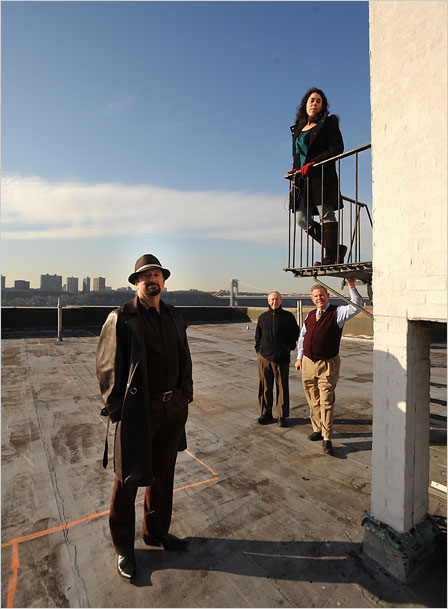
The River Arts co-op development is considering solar panels. The building’s energy committee includes Julie Ruben, top, and from left, Jack Fogle, Frank Gary and Paul Kittas. Photo: Jennifer S. Altman for The New York Times.

It’s Not Easy Turning Co-op Boards Green
By Mireya Navarro / March 22, 2009

Seated at an oval table with spreadsheets and calculators at the ready, the six-member board of River Arts, a 244-unit co-op development in Washington Heights, mulled over the pros and cons of investing in solar power.

Ed Lloyd, the board president, was not convinced that the co-op would get its initial investment back.

“I don’t want us to be all caught up in green and end up in the red,” he said. “I’m as environmentally conscious as the next person but we can’t base it all on that.”

Jack Fogle, a resident who had worked for more than a year with the co-op’s energy committee to sell the idea, pressed on.

“If we take the risk, that money will pay us back for the next 30 years,” said Mr. Fogle, who is also the building’s manager.

The politics at residential buildings, which are notoriously contentious, have become even more so as environmental issues have entered the fray. At many co-ops and condominiums, the members of energy and green committees lobby and cajole their neighbors to embrace projects that sometimes require upfront money, like solar panels, but more often just demand interest and effort on the part of residents, like recycling correctly.

It can be a thankless job that sometimes is met with indifference, skepticism and even outright hostility. But environmentally motivated residents say they operate on the theory of, “If I don’t do it, who will?” as it was put by Sharon Lee Ritchie, who started a green committee in her co-op in Harlem.

While more fervent advocates can gravitate toward weighty projects — a green roof or solar panels, for example — mundane measures can make more of an impact, experts say. But no matter what the investment, environmental consciousness can be a tough sell in a bad economy, especially when it can takes years to recoup the initial cost for some projects.

At River Arts, one argument that was used to sell the board on the idea of solar energy was the savings achieved by Cabrini Terrace, another co-op in Washington Heights, which went solar in 2007 and shared its figures with the River Arts board.

Frank Rathbun, a spokesman for Community Associations Institute, a national group that represents homeowner associations, said that if co-op boards “can show savings, the homeowners are going to be a lot more receptive.”

That has been the case at River Arts, which overlooks the Hudson River on Riverside Drive. In 2007, members of an energy committee had pushed to install solar panels to produce part of the building’s electricity, but the board balked because it would take 10 years to recover the investment through energy savings, Mr. Fogle said.

Since then, new federal, state and city tax credits have become available, reducing River Arts’ net cost of a $400,000 system to $10,000 — meaning it would take about one year for the co-op to recover the investment, Mr. Fogle said. The co-op expects its solar power to eventually reduce energy costs by $7,000 a year. At a committee meeting in January to plan the presentation for board members and shareholders, tensions rose as discussions stalled on details like how much information shareholders needed to hear about the timeline for the project.

“People! People!” Mr. Fogle shouted. “You don’t need to give people more than is necessary.” He walked out of the room, returning a few minutes later in a calmer state.

Finally, at a meeting in February, the hard work seemed to be paying off.

“Financially, it sounds like the numbers are reasonable,” conceded Mr. Lloyd, the board president.

There is little question that the green movement has gained significant traction in recent years.

In New York, city officials say residential buildings produce more carbon dioxide emissions — 30 percent — than any other large sources of emissions, such as commercial buildings or transportation. Nearly two-thirds of those emissions come from the use of electricity and natural gas.

Scott M. Stringer, the Manhattan borough president, said he knew interest in greening buildings was high when he called a conference on the topic in late 2007 and a standing-room-only crowd of 500 people came.

“The green-building movement is now commonplace,” he said. “It’s a combination of economics, saving the environment and this whole notion that the measures we take enhance the quality of life,” he said.

Yet there are still battles to be fought, and not all of them related to money. At River Arts, part of the challenge is to win over apathetic residents.

One member of the energy committee, Julie Ruben, said that an informational meeting on the idea for solar in December drew barely a dozen people. The co-op residents will ultimately have to vote to approve the plan.

And at another co-op building in Washington Heights, the residents’ input was nearly avoided altogether at first. Yonah Zur, 31, a musician who lives with his wife and young son, got a compost pile going in his co-op’s backyard with the knowledge of only the few members of the building’s garden committee. He said that compost bins are often mistakenly assumed to smell and attract rodents, and he worried about the reaction from the rest of the owners.

“I wanted to make it work and then show the neighbors,” Mr. Zur said.

After eight months of composting food scraps and leaves by himself in a spot not visible from most of the building’s 120 units, Mr. Zur put up signs in the elevator last May, announcing a garden clean-up and a compost lesson. Now as many as 10 apartments use four compost bins. But one neighbor did not like the aesthetics of a tall bin that held a pile of leaves outside her window.

“She was complaining about the look of it,” Mr. Zur said. The problem was solved by moving the bin eight feet away from the neighbor’s apartment.

Many of those pushing for greening buildings argue that any step, no matter how small, helps create a commitment that can lead to more ambitious undertakings.

Ms. Ritchie, the co-op owner in Harlem, said that she did not feel it was realistic to go for big energy projects when her 241-unit co-op in Harlem already has a list of must-do capital projects. So she turned her attention to “doable” things like a clothing and fabric recycling program, partnering with Wearable Collections, a local business that does curbside pickups.

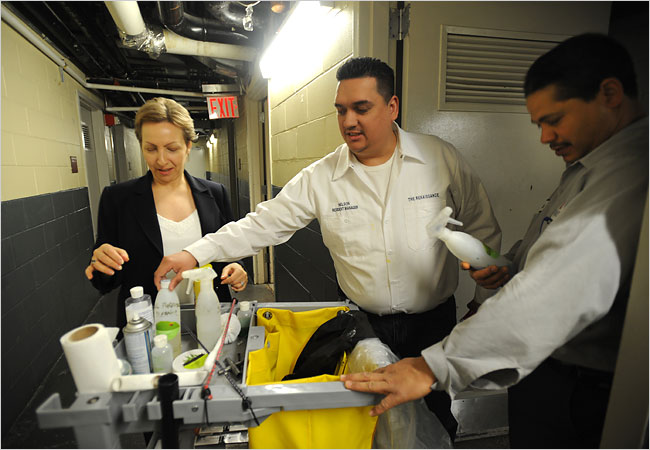
At her 241-unit co-op in Harlem, Sharon Lee Ritchie pushed smaller environmental projects, like using eco-friendly cleaning products. Photo: Jennifer S. Altman for The New York Times.

Experts from the U.S. Green Building Council, a nonprofit group that certifies buildings for energy efficiency and other environmental features, say that it is the unglamorous measures that are beneficial but often overlooked. Those include insulating steam pipes, sealing leaks around windows, weather-stripping doors, investing in a gas-fired boiler or co-generation, sub-metering electricity so owners pay for their own consumption, or even making sure lights are not left on all the time.

Ms. Ritchie, who owns an event planning and design business, said she convinced a skeptical building superintendent — “just humor me for a week,” she told him — to try out eco-friendly cleaning products, which come in such highly concentrated formulas, she said, that they now save the building $500 a month in cleaning supplies.

Still, for almost two years, her building’s green committee had only one member: Ms. Ritchie. “I just think people are busy and they’re happy to participate without spending any of their time,” she said of her rewarding but lonely greening experience.

She was overjoyed this month when seven new volunteers agreed to join her committee.

Source / New York Times

The Rag Blog

Posted in RagBlog | Tagged , , | 1 Comment

Thorne Dreyer : Wavy Gravy Leads Austin Musicians in March for Peace

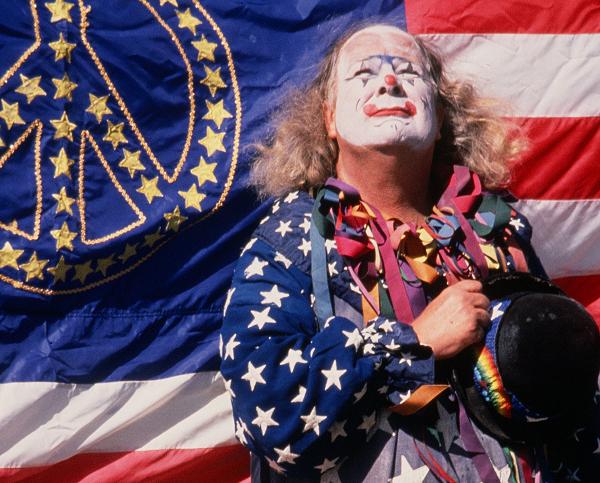
Hippie legend Wavy Gravy leads the Million Musicians March in Austin, March 21, 2009. Photo by Mara Eurich / The Rag Blog.

Austin musicians and activists decide to be “instruments for peace.” Photo by Alan Pogue / The Rag Blog.

“Of all the events worldwide in remembrance of the sixth anniversary of the Iraq disaster, the Million Musicians March for Peace was the only one led by musicians.”Richard Bowden, Instruments for Peace

By Thorne Dreyer / The Rag Blog / March 23, 2009

See gallery of photos from the Million Musicians March, by Alan Pogue and Myra Eurich, Below.

AUSTIN — They weren’t quite a million, but they sure made some beautiful music.

As hundreds of locals, tourists, musicians and industry types attending South by Southwest — the massive technology, film and music fest — packed the streets of downtown Austin Saturday afternoon, March 21, the Million Musicians March for Peace — with hippie legend Wavy Gravy leading the way — snaked by in a rhythmic procession, creating its own lively soundtrack as it passed.

[SXSW is the largest event of its kind in the world, focusing the attention of the music industry on Austin for several days in March. In the face of a down economy, this year’s event was a rousing success. It featured 2,000 musical acts from over 50 countries and drew hundreds of industry reps. It was highlighted by unannounced performances by Metallica, Kanye West, Devo and others.]

Marching behind a banner that said, “Be an Instrument for Peace,” more than 200 singing, chanting and dancing marchers followed a second-line type brass band from the Texas State Capitol through the busy streets of downtown Austin — up Congress Ave. past the crowds queued up for a premiere at the Paramount Theater, then delighting the throngs along Sixth Street’s music row, and on to City Hall for a rally and concert.

Wavy Gravy, aka Hugh Romney, wore a tie-dyed peace symbol-adorned t-shirt with matching baggy pants, a sideways beanie, a red clown’s nose and a beaming smile.

Riding a yellow pedicab, he was the Grand Marshal. Gravy, of Hog Farm and Woodstock fame, was in town for SXSW, promoting a documentary about his looney life called “Saint Misbehavin’.”

Also in the parade was Jim Fouratt, New York-based activist and cultural critic who was a founder of the theatrical Sixties new left group, the Yippies.

The Million Musicians March was organized by Instruments for Peace and sponsors included MDS/Austin, Texans for Peace, CodePink Austin, Texas Labor Against the War, Iraq Veterans Against the War, and The Rag Blog.

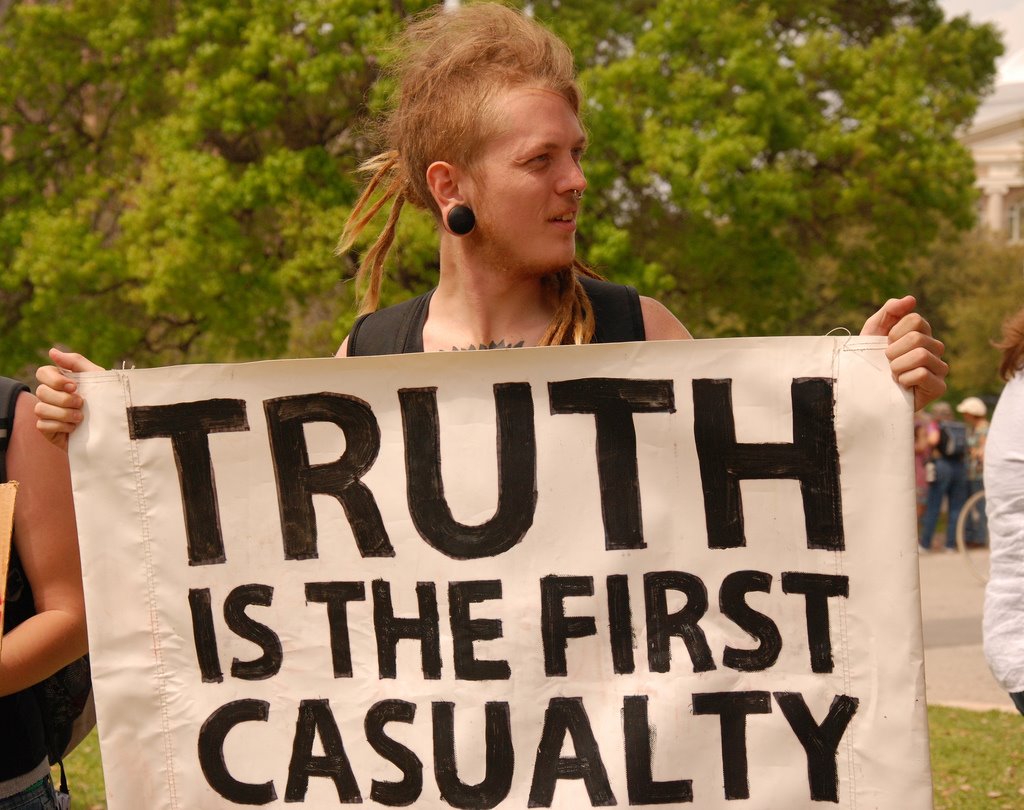
One banner shouted “Rich Man’s War, Poor People’s Fight.” Demonstrators carried signs saying “Prosecute War Criminals” and “Truth is the First Casualty.”

According to writer and graphic designer Jim Retherford, the event, which is an Austin tradition, “may not have been as large as in some years past, but it had a wonderful energy. There were affinity groups of musicians throughout the parade and it was great to see the ethnic mix and the kids with parents and grandparents laughing and dancing together along the way.”

Jim Fouratt told The Rag Blog, “I was impressed that Austin Music Award winner Carolyn Wonderland was front and center. She warmed my heart. And I was proud to march beside Wavy Gravy. It will be artists and musicians who lead us out of the chaos.”

Wonderland, a consistent activist for peace and other issues, joined noted musicians like Guy Forsyth, Leeann Atherton and Shelley King, the first woman to be named official Texas State Musician, in the concert at City Hall.

“It was great to see all my grey-haired colleagues alongside multi-generational families, all decked out in the costumes of old Austin like it was before the high-tech incursion,” Jim Fouratt added.

The theme of this year’s Million Musician March was to oppose the continuing occupation of Iraq and it also saluted the alternative media and its role in getting out the word.

Musician Richard Bowden of Instruments for Peace, the moving force behind MMM, said, “Of all the events worldwide in remembrance of the sixth anniversary of the Iraq disaster, the Million Musicians March for Peace was the only one led by musicians.” He added, “I am so glad to be in Austin where we can do something like this.”

[Thorne Dreyer, a sixties activist and underground journalist, lives in Austin, Texas. He is a director of the New Journalism Project, a contributing editor to Next Left Notes and is co-editor of The Rag Blog.]

Carolyn Wonderland, double winner at the recent Austin Music Awards, plays for peace at Austin City Hall. Photo by Alan Pogue / The Rag Blog.

Shelley King, 2008’s Texas State Musician, on the stage at MMM.
Photo by Alan Pogue / The Rag Blog.

Austin’s Guy Forsyth is an instrument for peace. Photo by Alan Pogue / The Rag Blog.

Demonstrator tells it like it is. Photo by Mara Eurich / The Rag Blog.

Members of Austin Against War join the MMM. Photo by Alan Pogue / The Rag Blog.

Multi-generational protest of the continuing occupation of Iraq. Photo by Alan Pogue / The Rag Blog.

Dude’s another instrument for peace. Photo by Mara Eurich / The Rag Blog.

The Rag Blog

Posted in Rag Bloggers | Tagged , , , , , , , | 2 Comments

Swingin’ on Sunday – the Branford Marsalis Quartet

Eric Revis, Branford Marsalis, Justin Faulkner, l. to r., playing at
Jazz Alley, 20 March 2009. Photos by the author.

Branford Marsalis Quartet Plays Seattle
By Richard Jehn / The Rag Blog / March 22, 2009

Man, can these guys swing !!! The Branford Marsalis Quartet played a four-night gig in Seattle at Jazz Alley, and I was fortunate to hear about it early enough to get a seat for Friday night. First a small disclaimer – technically, it was not the Branford Marsalis Quartet, since drummer Jeff “Tain” Watts stayed at home taking a break. The great news, though, is that the quartet and their audience suffered not one whit for this personnel change. The sub-ing drummer was 18-year-old Justin Faulkner, a Philadelphia native who rendered a couple of awesome solos in the course of the evening.

The ‘regular’ musicians in this band are among the preeminent in their field. Eric Revis is a virtuoso with his bass, and his bald head glistened with the perspiration of his effort. Very fast, very precise, and an awe-inspiring soloist.

“Jack Baker,” from the album Braggtown

Pianist Joey Calderazzo had a hard time sitting still during his first solo effort. I feared he might become one with the audience on more than one occasion he was so engrossed in his dynamic artistry with the keyboard.

Joey Calderazzo.

But the quiet star was the Marsalis of the mix. I have seen three of this Family play in my travels. Wynton played Benaroya Hall in Seattle with the Lincoln Center Jazz Orchestra several years ago and I had the pleasure of being there. It was pure luck that I saw Delfeayo’s quintet in 1996 at Snug Harbor on the east side of the French Quarter in New Orleans. And now I have the privilege to witness Branford weaving his musical story with Friends he has played with for 10 years (well, not Justin).

The reason I said all that about the various Marsalis Brothers is that it is virtually impossible to convey their ‘presence’ in words. It is as though I forgot how humble and sincere the Marsalis Family are. So unassuming … But in Branford’s case on Friday night, his music was brilliant. He alternated tenor and soprano sax all evening, displaying complete facility with each. Awesome musician, there is no more I can say.

If ever you hear that these guys are coming to your town, don’t even think about it – buy tickets !! You won’t regret a moment of the experience, ever …

For another review, see Hugo Kugiya’s Branford Marsalis’ quartet is at the forefront in Jazz Alley show in the Seattle Times.

The Rag Blog

Posted in Rag Bloggers | Tagged , | Leave a comment

Resolving the Housing and Immigration Crises – Simultaneously


Two Birds – One Stone
By Sid Eschenbach / The Rag Blog / March 22, 2009

Arguably the two biggest, most urgent and most complicated problems facing the Obama administration are those related to the general meltdown of the financial structure, and those presented by finding a long term solution to the problem posed by illegal immigration and its relationship to the rebuilding or the destruction of the American middle class. While seemingly unrelated, they both have a very simple, effective, and long term solution: immediately open a citizenship window not only to all those now in the U.S. illegally, but to anyone else on the planet who would purchase a home or other real estate in the normal market (not in a repo auction), including a cash down payment of at least 25% of the value of the property and suitable guarantees for payment of the balance.

If it wasn’t clear before, it is now clearer than ever; the financial problems facing the nation and the world have their roots in the collapse of the U.S. real estate market following the widespread misuse (not to say abuse) of the normal real estate credit markets. That being the case, until a genuine market floor is built under the real estate valuations that are at the bottom of the financial pile, there are no fiscally tenable solutions to the related, highly leveraged and extremely dangerous problems at the top of the pile. If a “bottom of the pile” fix could be pulled off, the health of the balance sheets of the major banks of the world and the threat posed to them by continued mortgage defaults would evaporate as quickly as they appeared.

The Migration Policy Institute estimates that there are an average of 1.8 million people who migrate to the U.S. every year, 500,000 of whom are illegal. Does anyone doubt that if the United States opened a temporary immigration window during which time any person who purchased a home in the U.S. would be granted citizenship, there would not be more than 10,000,000 applicants from all countries of the world in short order? Contrast those numbers against what is estimated to be roughly 2,000,000 surplus housing units at the end of 2008, and add to that the total number of subprime loans outstanding that are in trouble, another 2,000,000, and it’s easy to see that both the housing overhang AND the threatened outstanding sub-prime mortgage markets could be easily, quickly and privately redressed.

The strange thing is that this solution has been before us all along, because as difficult as the situation in the United States may be, it is still far and away the preferred migrant destination. As to the ethics of turning Give me your tired, your poor,” into Give me your ambitious, your investors,” many nations around the world put a price upon citizenship, with a variety of rules allowing immigrants to pay, invest or guarantee spending in the country in exchange for being given the right to live, work and live there lives there.

Just as the British used subsidized voyages like the famous “Ten Pound Passage” to New Zealand in the mid 20th century to solve their own particular settlement problems, citizenship in the United States could be sold to any and all who were able to purchase a home or other property. What better way to demonstrate your desire to become part of a country and a culture than to purchase the right through investment, helping yourself while you help your new home country?

Obviously, regarding the “how,” the rules would need to be clear and the politics surrounding the issue would dominate any discussion: are all houses included, or only particular economic sectors; all regions, or only the hardest hit; is there a minimum investment required, or is any property fair game; would those who have lived and worked in the U.S. illegally be at the head, the middle, or the end of the line; should there be quotas by country, or should they be selected by size of potential investment; would there be a minimum time to any resale?

Regarding the “who,” there would have to be special security vetting, including normal visa background checks, heightened security reviews, verification of sales, review of the origin of the funds, etc., but neither the administrative nor the political challenges are too difficult to overcome, and it’s certainly nothing that couldn’t be set up quickly and effectively by any number of federal or private agencies.

Most important, using this immigration “trick” to reestablish a balance in supply and demand would also provide the necessary breathing space needed for the creation of new, permanent regulatory measures so clearly lacking in both areas, regulations that would insure that the U.S. doesn’t face these very serious structural problems again.

In sum, there are no reasons — legal, ethical, structural, administrative, or political — why this could not be done and done quickly. And I believe that the implementation of this program, starting with it’s mere mention, would stabilize the housing markets and give real hope for the first time in nearly a year, from Wall Street to Main Street, that “normal” life is once again with our grasp. It would also give real hope to millions of “Americans” who currently live in the shadows, allowing them to take a proper and dignified place in the North American sun.

The Rag Blog

Posted in RagBlog | Tagged , , , | 4 Comments

The World After AIG : Obama and the Economy

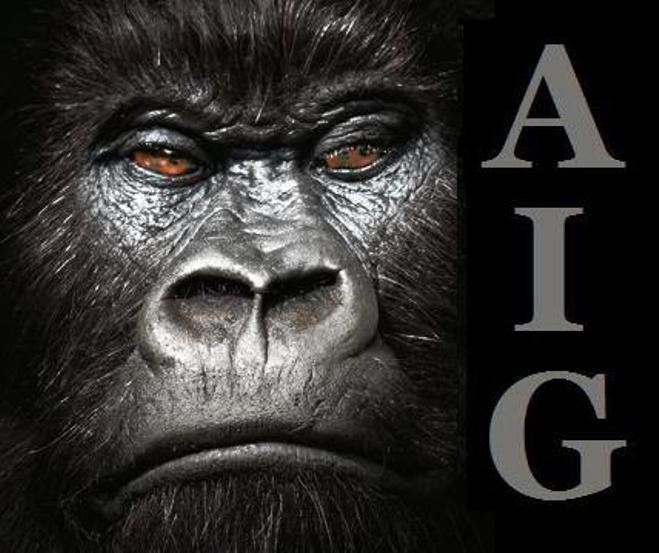
Gorilla. Still in room. Graphic from Wunder Blog.

It is not unreasonable to expect that the AIG Bonuses scandal will win some converts for the Republicans’ take-no-action philosophy. Democrats need to wake up and start reminding the public who created this crisis in the first place.

By Sherman DeBrosse / The Rag Blog / March 22, 2009

The furor over AIG’s $165 million in bonuses has killed off any possibility that a new TARP would pass. The elimination of the “Shovel Option,” just pushing money into banks, reduces the ranges of choices available to the administration in dealing with the banking crisis.

It probably removes the possibility that the Democrats could be persuaded to vote to pass a new TARP for the Obama administration. Now there are revelations that someone in the Treasury Department, with the help of Senator Chris Dodd changed legislation affecting bonuses so that these could be issued. The Democrats have again shot themselves in the foot, lending ammunition to the GOP claim that the Democrats are the defenders of Wall Street. All this makes it impossible for the Democrats to sponsor or back another TARP. It would be political suicide.

As Secretary Geithner’s options are narrowed, it is even more important that we progressives not join those demanding that he show his cards while navigating this banking crisis. We know he was dealt a bad hand and must give him room to maneuver.

It is important that progressive journalists and politicians begin explaining how narrow options really are for President Barack Obama, Timothy Geithner and the administration. For example, all the foolish talk about overload and focusing only on the economy overlooks the fact that many non-economic matters have a great bearing on generating recovery. The same natural and political obstacles most likely will prevent us from using this recession/depression from reconstructing the productive elements of our economy so we can better compete in the future. While we dither, the Chinese are preparing to move quickly into higher end types of productivity, challenging even more American jobs when this crisis finally ends.

The political and natural obstacles will naturally increase, so we need to start developing more realistic projections of what reasonable people can expect in four years.

Wall Street Fears

The AIG Bonuses Scandal should have dissipated some of the fears on Wall Street.

There has been a lot of irrational fear, fanned by Republican politicians and conservative pundits, that the “nationalization” of the banking system was imminent. In fact, the Obama administration has gone to great lengths to avoid this. Now, with the public being almost totally adverse to more taxpayer bailouts of the banks, this fear should subside.

There was one legitimate fear that now can dissipate. Large banks that compete with those likely to have had massive federal help had legitimate worries about effectively competing with those in the federal ER.

The Geithner Plan and Obama Administration Strategies

Presently, Timothy Geithner is trying to negotiate federal-private partnerships to take the bad assets off bank books. The idea is to get private investors to buy those securities in return for the federal government guaranteeing them against excessive losses. The main participants will be hedge funds, which have substantial experience assigning value to assets and marketing. If there are profits, the taxpayers will participate in them. The Obama Administration must be vague about its bank rescue plans so as not to risk giving away too much information as it negotiates.

The Treasury is also subjecting the big banks to a stress test. The results will reveal the weaknesses of those institutions. After the federal-private partnership has done what it could, the choice seems to be to move bad assets to an aggregator bank, structured as the Reconstruction Finance Corporation or the Resolution Trust Corporation.

The “bad bank” could scoop up all the doubtful assets and hold them on a consignment basis. That takes them off the books of the Big 8 and gets around the problem of giving them a value. Given a little time, many of them could appreciate some in value. It most likely will turn out that some of that paper will cancel itself out because those banks do a lot of dealing with one another.

For dealing with bad assets, we have the 1930s examples of the Reconstruction Finance Corporation — actually created under Hoover and used by Roosevelt — and the more recent example of the Resolution Trust Corporation, which performed so well in marketing assets of doubtful value after the S and L crisis. If some of the banking corporations need restructuring, the FDIC has proven that it has the expertise to make this go smoothly. In the process, it should divide some of them.

Some argue that the huge banks will need cash after disgorging most of their bad assets. If any cash comes, it will have to be FED funds in return for preferred stock. Given the ability of the GOP to block action in the Senate and the unpopularity of cash bailouts for banks, the amount of FED assistance should be limited.

FED funding is a tool that might be better used down the road if another stimulus does not pass or fails. Fed money could then be gotten to local banks through an enlarged Small Business Administration and the credit-providing institutions that grew out of New Deal initiatives. Under some scenarios, GOP-induced gridlock — so long as it is indirect, could well do real damage to the Democrats. In that case, only FED initiatives could be used to reduce promote recovery.

A certain amount of vagueness is necessary in dealing with the banking crisis, and we progressives should not join the chorus of those demanding exact details. We note in the cases of Bank of America and Citi that an important element of the plan is to buy enough time so institutions can slowly write off some bad assets, while perhaps some questionable ones appreciate. Both were restored to enough health that they can clear the books at a rate of about 2% per year. It seems likely that banks tied to the big eight bank holding corporations might not be able to do a great deal of lending if they are as weak as Bank of America and Citi. They account for 64% of all deposits, so we need to find a way of pumping out credit through their member banks, while assuring that those funds do not move upward to cover for bad assets.

This would be a good time to resurrect a Republican suggestion and require that all banks and financial institutions purchase federal insurance on their assets. The near-impossibility of another TARP makes the creation of this safety net necessary. The administration should also see that the FDIC resume collecting fees from member banks — a practice that was neglected in recent years.

Given that possibility, the administration acted wisely to provide more cash to the Small Business Administration to get out money for loans. SBA has been scaled back in recent years, so it will need to ramp up quickly.

President Obama announced that the House Financial Services Committee is preparing legislation so that some sort of resolution corporation can deal with firms not now covered by banking legislation. He said it could deal with future efforts to pay out outrageous bonuses, but the legislation will clearly make contingency plans for restructuring AIG and other non-banking entities should they face failures that could disrupt the economy.

We can expect two new steps to quiet the financial waters. There soon will be restrictions on short selling in the form of the restoration of the up-tick rule. That means speculators will be less successful in driving down bank stocks. The SEC might also change an evaluation rule — the market to market rule — that forces banks to immediately accept the lowest valuation of some assets and then to sell off good assets at low prices to meet capitalization requirements. For that reason, we need to experiment with higher debt to capital ratios in hard times. To we ordinary folks, alterations like these seem counter-intuitive, but there are sound economic models that suggest we give these changes a try.

Political Considerations

The AIG Bonuses scandal could also make it tougher for the Republicans to play the economic populist card, posing as the enemy of the banks and Wall Street, their historic constituents. On the other hand, there is a danger that opposition to bank bailouts will extend to future stimulus packages, a development that would pay massive dividends to the practitioners of obstruction and demonization. Only four and five months ago, Republican leaders and pundits were insisting that government not interfere with the compensation of bankers; today the ever-tanned John Boehner was demanding to know what Democrats knew about the AIG bonuses and when they knew it.

Days ago, on March 6, minority leader Boehner led 156 House Republicans in voting for a spending freeze during this recession/depression. It was barely reported in the MSM, which reminds us of a potent weapon ever at the disposal of the folks who brought us into this valley of economic despair.

Thomas Friedman is suggesting that President Obama spend political capital to persuade the nation that another taxpayer bailout for the banks is necessary. That would almost certainly spell political suicide for the Democrats. They — unlike the Republicans, who almost always place themselves first — have consistently been the party of government, willing to vote for unpopular measures that seem necessary. Another TARP would so weaken the president — now down to 59% policy approval according to Pew — that he would be unable to fulfill his promise of health care reform. It is vital for recovery, for the well-being of our citizenry, and for the continued popularity and support of that good and well-intentioned man in the White House.

It remains to be seen if public opposition to more bank bailout legislation will have a spill-over effect, creating insurmountable opposition to future stimulus legislation. If so, this sorry episode will have produced a political bonanza for the GOP. If not, the Democrats should limit the next package to extending unemployment, efforts to get even more credit to small business, and popular shovel-ready projects. Repugnant as it is to me, I would include a provision making it possible to repatriate foreign corporate earnings at an advantageous tax rate. In return, Democrats could demand some provisions to alleviate human suffering. Failing another stimulus package, Democrats could borrow a page from some Republicans and suggest a fourth month payroll tax holiday.

It is not unreasonable to expect that the AIG Bonuses scandal will win some converts for the Republicans’ take-no-action philosophy. Democrats need to wake up and start reminding the public who created this crisis in the first place. Last Sunday, Dick Cheney told a CNN interviewer that the Bush administration had nothing to do with it, and there was no uproar over his clueless remark.

Democrats also need to realize that their success in 2010 and 2012 will depend upon whether then can come together among themselves and pass a straightforward health care program. If the AIG Bonuses Scandal has strengthened the GOP hand even a little, the Democrats should see the necessity of passing health care as part of the budget reconciliation process, where filibusters are supposed to be ruled out. The GOP says that would poison the well. However they have not been cooperative thus far, have denied Obama a honeymoon, and are threatening many filibusters on judicial matters. It should also be remembered that the tax cuts for the rich were passed in 2001 as part of the budget process.

The Rag Blog

Posted in Rag Bloggers | Tagged , , , | 1 Comment

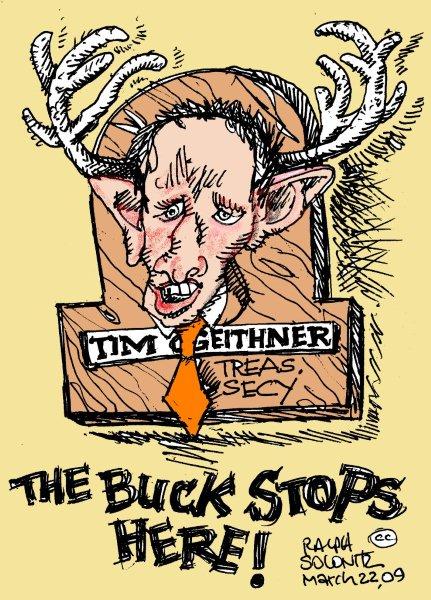
Horns of a Dilemma : The Buck Stops Here

Political cartoon by Ralph Solonitz / The Rag Blog. [Ralph Solonitz’ cartoons also appear at MadasHellClub.net.]

The Rag Blog

Posted in Rag Bloggers | Tagged , | Leave a comment

Larry Ray : Congressional Kabuki and the Constitution

Graphic by Larry Ray / The Rag Blog.

Though none of our elected officials actually got made up in classical white face, their outraged and out sized exaggerations, both facial and verbal would have qualified them for a Kabuki casting call in Tokyo.

By Larry Ray / The Rag Blog / March 22, 2009

Iowa Republican Senator Charles Grassley’s call for AIG bonus recipients to, ” . . .follow the Japanese example and come before the American people and take that deep bow and say I’m sorry, and then either do one of two things — resign, or go commit suicide” was so over the top and insane that it reminded me of a Japanese Kabuki Theater plot.

Kabuki is classical ancient Japanese folk theater performed broadly and loudly for the general public. I became familiar with it when I lived in Tokyo years ago. Kabuki on the Potomac this week fit Kabuki’s theatrical definition with lawmakers wailing loudly, uttering angry threats, and rhythmically pounding podiums in a performance of mangled metaphors and fantasy.

Though none of our elected officials actually got made up in classical white face, their outraged and out sized exaggerations, both facial and verbal would have qualified them for a Kabuki casting call in Tokyo. But they were playing to Americans . . . American voters. Let’s review this week’s performances.

A Treasury Department decision to not risk lawsuits and to allow payment of last year’s Bush-approved retention contract bonuses by failing insurance giant AIG, set off a firestorm of anger and self-righteous rhetoric. The specter of AIG employees receiving bonuses while AIG is propped up by billions in taxpayer money opened the floodgates of rhetorical rage.

It also inadvertently created a bizarre moment of bipartisan participation on both sides of the aisle as the House reacted to steamed emails from their districts. It was time to affix blame. Names and faces were needed as a focus for threats and epithets

The populist Kabuki’s first act centered upon Edward Liddy, who has been untangling AIG’s myriad problems as a government appointed CEO of AIG. Liddy, former CEO of Allstate Insurance, who is working for a dollar a year, became a carnival punching bag as he testified before the House Capital Markets, Insurance and Government Sponsored Enterprises subcommittee last Wednesday.

Liddy quickly defused rumors and misinformation about the “bonuses” making it clear that after earlier executive housecleaning of AIG’s top management, no performance bonuses were being paid at all to anyone. But, clearly going over the heads of many sub-intelligent members of the subcommittee, was his explanation of “retention bonuses” and how they worked.

The retention bonuses were contractual arrangements made with market specialists to defuse toxic financial bombs in AIG’s failed ‘Financial Products’ division. “Wind down,” it the term used. But while being neutralized to get them off AIG books, the potentially explosive complex credit default swap securities were still being actively traded. De-fusing the complicated potential bombs requires experts intimately familiar with how they worked. Mishandled or ignored, the securities could blow up and cause further potentially ruinous damage to AIG if not carefully and slowly sold off and neutralized. Picture McGuyver locating the red wire on the bomb’s timer.

Firing the AIG FP division specialists and not paying them for the work they were legally contracted to do could invite disaster for AIG. Folks seemed to think managers were being paid huge bonuses to keep them as employees. In fact, it seems the promise of a bonus after they completed specific difficult contracted tasks was what “retained” them to complete the complex and difficult work . . . then they were free to go.

Highway contractors routinely contract to get a new bridge built as quickly as possible, and they accept promises of so many millions as a bonus if it is finished on time and even more if it is finished ahead of time. After the evil lords of AIG’s Financial Products Division were fired and sent packing with no bonuses, AIG’s remaining Financial Products specialists stayed on, working long hours to get the toxic trades off the books, and had money coming when they got the bad stuff off the books for good. That was the deal. This is essential for AIG to quickly return profitability and pay back the federal money propping it up. But no one wanted to hear all this. Folks back home wanted a pound of flesh, not clear reason. It was time to be mad and indignant!

The red faced representatives heard only the word BONUS in Liddy’s explanation. And each used up his or her five minutes for the folks back home who were watching on TV to let the rude, accusing rhetoric fly at Mr. Liddy.

Subcommittee member, Judy Biggert, R-IL, was typical of the befuddled, yet angry, representatives to have a go at Mr. Liddy. Biggert, represents Illinois 13th district, and since her election in 1999, she has sponsored 92 bills of which 81 haven’t made it out of committee and two were successfully enacted. She looked disheveled and confused, and after Mr. Liddy’s complete explanation of the bonus situation he inherited, she, nonetheless, read from her rambling prepared remarks anyway. The general, simplistic image of bonuses and rich executives slurping umbrella drinks on their private jets was just too big a target.

“Give me three good reasons why the taxpayers should be paying, umm, . . . all those bonuses, with, you know, that taxpayer money . . . .?” Had she been listening, and not simply waiting to grandstand with her pre-prepared anger, she could have answered all three of her own questions from Mr. Liddy’s explanation. Biggert’s own net worth in 2007 was estimated at just under $7 million from her financial disclosure statements, so she should be able to explain what rich folks do to her unemployed constituents back home.

Democratic Congressman, Barney Frank, came on stage as an early plot changer, and in sputtering rage demanded the names of all those getting bonuses. A Kabuki Western where the sheriff sends out a posse for a possible mass trial of those pre-judged as guilty. And if Black Hat Liddy didn’t cough them up, Frantic Frank would issue subpoenas! Never mind New York Attorney General, Andrew Cuomo had already made such a request.

Mr. Liddy exhibited impressive control and just let the madness about him rage while responding quickly and politely in the face of rude and shameless behaviour by his inquisitors. When Barney ended his threats and demand for names and addresses, Liddy read him a typical email from those being whipped up by misinformation and fear over the failing economy. The threatening email called for AIG employees to be garroted by piano wire. Liddy suggested that Mr. Frank might want to reconsider his demand simply based upon personal security reasons for his fellow Americans.

Just like in Kabuki theatre, those in the audience came and went. There was an intermission, during which MSNBC afternoon news reader, Nora O’Donnell, perhaps better known for co-hosting the New York City St. Patrick’s Day Parade than her on air news work, warmed up. “Liddy is really getting bombarded,” she snarled, and then shoving aside any journalistic credentials she may possess, she joined in the outrage demanding, “Why?” “When?” “Who?” instead of applying the journalistic challenge of finding answers to those basic questions herself as the reporter she is supposed to be.

As the weekend approaches, all this theater and angst has but one central schwerpunkt. The House frantically cobbled together a bill to “get back our taxpayer money.” They voted 328-93 to impose a 90% tax on any bonuses paid by AIG. This populist mob, responding to impulse and mass hysteria, mostly caused within their own ranks, are supposed to be lawmakers. Legislators.

Over the weekend, hopefully both our esteemed Congressmen and Senators will drop by for a thoughtful look over the Constitution of the United States of America. Wiser heads, going back to the days of English King, James II, have stepped in to restore law and prevent mob rule such as has been proposed in this week’s Kabuki theater at the Nation’s Capitol.

They can even simply drop by WikipediA and type in “Bill of attainder.” Their bill instituting a 90% tax on AIG bonuses should never even be considered in the Senate. You can’t pass a law like they have just passed in the House. And you cannot ratify it in the Senate. The proposed law is against the law. Ex post facto.

Here it is plain and simple:

“A bill of attainder (also known as an act or writ of attainder) is an act of legislature declaring a person or group of persons guilty of some crime and punishing them without benefit of a trial.

Bills of attainder are forbidden by Article I, section 9, clause 3 of the United States Constitution.”

Period. Curtain closed.

Next act: Less hysterical and more responsible legislators go the the real root of the problem and reinstate governmental financial regulatory oversight removed by Regan, which has allowed AIG, and dozens of other big players to run rampant during the recent Bush administration. Madly chasing horses already out of the barn will do nothing at all to fix the terribly broken world of high finance and banking.

[Retired journalist Larry Ray is a Texas native and former Austin television news anchor. He also posts at The iHandbill.]

The Rag Blog

Posted in Rag Bloggers | Tagged , , , , | Leave a comment

The Radical Reconstruction of Society Itself

It is unfortunate that we wish so deeply for change and progress from the darkness of the past eight years, that we neglect to look at the facts objectively (see the comments to the post just below). There is unquestionable improvement from the Bush administration, but there are glaring weaknesses and defects in the Obama administration. As progressives, we must work for the necessary change that this society is destined to make, whether we like it or not. Peak oil, global climate change, and the failure of capitalism will propel us down a road that obsoletes the status quo. Now is the time to get on the train and go forward progressively.

Richard Jehn / The Rag Blog

Obama and the Left, Such As it Is
By Paul Street / March 21, 2009

Here (below) is the original extended version of a significantly abbreviated speech I gave at a forum on “The Left and Obama” in Chicago. The forum was held on February 28, 2009. It was organized by Haymarket Books. The other speakers were James Thwinda (Jobs for Justice), John Nichols (The Nation), and Sharon Smith (International Socialist Review and Haymarket author). I have put brackets around the main sections that went un-read (regrettably) for reasons of time. (In retrospect I would have reconfigured the address to include the bracketed sections) I have also inserted a few book and article citations for readers…

Remarks at ‘The Left and Obama’ Panel
February 28, 2009

In a time when the nation’s leading newspaper of record The New York Times can claim as it did yesterday that the corporate-neoliberal Obama administration is undertaking “a bold and even radical departure from recent history” in service to “progressive” goals, it’s important for people on the left to remember what we are about. For my brand of the Left, it’s not about Wall Street-funded politicians and officeholders and their quadrennial corporate-managed candidate-centered electoral extravaganzas. It’s not about the political class’s shifting, self-interested policy palliatives and their carefully crafted, mass-marketed imagery and deceptions. It’s not about balancing majority progressive desires and popular needs with the structurally super-empowered desires of the wealthy Few. It’s not about restoring legitimacy to and faith in the profits system and the military. It’s not about smooth-talking pseudo-saviors who are going to fix our messes for us from on high. It’s not about manipulating the electorate and managing popular expectations and calibrating hope from the top down.

It’s about building, re-building, and expanding citizen and working-class power from the bottom up. It’s about trying to create a responsive, democratic, egalitarian and issue-based political culture and politics between and across the narrow-spectrum , corporate-crafted, candidate-centered election spectacles so many of us have been trained to see as the sum total of “politics”. It’s about meaningfully confronting what Barack Obama’s supposed hero Dr. Martin Luther King Jr, called “the triple evils that are interrelated: (1) economic exploitation (really capitalism); (2) racism (deeply understood); and (3) militarism or imperialism. (I would add some other interrelated evils, including sexism and ecological ruin, to Dr. King’s list). It’s about advancing what Dr. King called “the real issue to be faced” beyond “superficial” questions: “the radical reconstruction of society itself.” Believe it nor not, it us about the struggle for “a socialist society in which human needs are not sacrificed for the needs of the rich” (Lance Selfa, The Democrats: A Critical History [Chicago: Haymarket, 2008], p. 197). As part of the process towards bringing such real and progressive change into being, Haymarket Books author Lance Selfa notes, we have to “recognize the Democratic Party as one of the chief pillars of the system that perpetuates exploitation and oppression.” (Selfa 2008, p. 198)

Barack Obama, my thesis holds, is no special and magical exception to this basic longstanding fact of American political life. He and the broader Obama phenomenon (which dates in the outward political culture from his instantly famous Keynote Address to the Democratic Convention in the late July of 2004) is distinctive however in the astonishing extent to which he, his marketers and the corporate media have been able to convince left-leaning liberals and progressives and many ordinary people that he is on their side and that his special centrist, supposedly non- or post-ideological brand of so-called progressivism is the most that could ever be attained on the road to a better society and politics.

Selling that conviction is no small part of why Obama was hired by the American ruling class and given the job of president. It’s not for nothing that Goldman Sachs gave Obama $900,000 a small part of the astonishing $37.5 million Obama got from the finance, insurance and real estate industries during the last election cycle. It’s not for nothing that Obama got three fourths of his campaign cash from people giving more than $200 – the same big donor percentage as George W. Bush in 2004. It’s not for nothing that Obama set new records in corporate election funding and achieved a level of fawning corporate media love that is almost beyond belief.

What much of the American state-capitalist elite wanted is somebody who can give the American corporate system and empire a much-needed public relations makeover, a re-branding as they put it. Obama is the Empire’s New Clothes. The masters wanted their rotten old profits system repackaged as something truly new and different in the wake of the long national and global Bush-Cheney nightmare. As they say in elite advertising journals and editorial pages, “Brand Obama” is the new and improved, outwardly progressive, democratic, and human face for that damaged product line called “Brand USA. The Bush and Cheney “reign of error” did profound damage to popular perceptions of American capitalism, power and empire at home and abroad. The political class needed someone who could give the system a vivid new slate-cleaning aura of novelty and freshness while leaving core dominant institutions and ideologies intact.

And that was a job for which none of the other Democratic presidential candidates were qualified to the same extent as Obama. He was blessed not just with intelligence and charisma and a Harvard Law degree but with the unmatchable benefits of not being white, of having a Muslim name, of having once technically opposed (on practical, not principled grounds) the invasion of Iraq, and of having worked some years as a community organizer. Thanks to his interesting history and to his national novelty, Obama naturally struck numerous corporate and military insiders as precisely the sort of person who could brilliantly advance the business and imperial agenda while containing and pacifying an angry and increasingly desperate and impoverished populace. After vetting him very carefully starting in late 2003 and determining that he was in fact a deeply conservative, privilege-friendly and vacuously neoliberal politician, much of the power elite got it. “Who better,” they decided… “Who better than Obama to be the public face for the long-predicted massive taxpayer bailout of parasitic high finance? Who better than Obama to provide cover for the reconfiguration of U.S. military control of strategically hyper-significant Middle Eastern oil resources in the wake of Bush’s Iraq fiasco? Who better to safely channel popular angers and to attach alienated segments of the citizenry to the corporate and imperial state and to refashion America’s image around the world?”

The elite is getting what it paid for. Sean Hannity’s maniacal ravings aside, Obama has been anything but a “starry-eyed [left wing] idealist” since he won the election. I don’t have time here to go into a detailed account of his presidential record to date. If you want such an account from a critical Left perspective, and I hope you do, please have a look at the ZNet piece I published yesterday under the title “Obama’s Violin: Calibrating HOPE since the Election.” The first part of the title comes former Clinton administration official David Rothkopf’s early post-election observation that Obama was following what Rothkopf called “the violin model: you hold power,” Rothkopf said, “with the left hand and you play the music with the right.” You campaign and gain office with populace-pleasing progressive-sounding rhetoric but you make policy in standard service to existing dominant corporate and military institutions.

Obama’s violin performance is being expertly marketed by dominant media. We are told by the Times that Obama is making “a radical departure from the past” even as he proposes to increase the so-called defense budget, even as he makes it clear that he will be leaving 50,000 so-called “residual” troops in Iraq well past August of 2010, even as he increases the level of violence in Afghanistan and Pakistan, and even as he cannot pay elementary honest attention to the legitimate grievances and claims of the Palestinian people.

Obama is a “radically progressive departure from the past,” we are told from on high even as he says he will cut the federal deficit in half but cannot bring himself to embrace the elementary bank nationalizations that are obviously required in the current economic crisis. Even as he refuses to advance the obvious cost-cutting social democratic health care solution: single payer national health insurance. Even he can only set up a middle class task force but not a poverty and inequality task force. Even as he promises to spend untold billions and trillions on further bankers’ bailouts executed with zero citizen oversight and direction.

Obama is a radical progressive break, we are told, even as he does not utter one word about the overdue labor law reform he campaigned on, the Employee Free Choice Act. Even as he fails to advance such basic elementarily progressive measures as a moratorium on foreclosures, a capping of credit card interest rates and finance charges, and the rollback of capital income tax rates to 1981 levels, Even as his tepid and inadequate stimulus plan is over-loaded with business-friendly tax cuts and woefully short on labor-intensive projects that will put people to work right away. And even as he asks for twice the amount of money to sustain the criminal invasions of Iraq and Afghanistan as he proposes to set aside per year as part of a reserve fund that might pay for just more than half the amount required to give the uninsured health coverage… in 10 years. [Even as he pays a presidential visit to Caterpillar, the company that sells occupation and apartheid bulldozers to Israel and the first major U.S. manufacturer in decades to break a major strike with scabs.]

[Now, its one thing for The New York Times, a leading part of the corporate establishment, to play along with Obama’s big violin performance. That’s what we would expect. What’s more bothersome for many of us on the left it to see so many parts of the so-called progressive community chime in with their own little fiddles and kazoos – to hear the Executive Director of Moveon.org respond to the Iraq plans by saying people trust the president’s campaign promises, to hear the AFL-CIO and Change to Win staying remarkably mute in their public comments on EFCA and to see them accepting corporate health care reform over the single payer system that most Americans would support. Its deeply troubling to see The Nation (the weekly journal of the official U.S. “left”) absurdly call Obama’s budget proposal “an audacious plan to transform America” in progressive ways. Right after the election The Nation said that I “Obama Needs a Protest Movement” (The Nation, November 13, 2008) not that the people and democracy need one. This was an excellent expression of so-called left liberalism’s deeply ingrained habit of subordinating movement concerns to the needs of the Democrats’ leading politicians.] [1]

[Its’ vexing to see the NAACP and the Urban League too enamored with the simple fact that “black but not like Jesse” Obama is African American to press him to undertake real initiatives against the deep and pervasive institutional racism that lives on even as the nation celebrates its willingness to vote for a certain kind of black candidate. Its annoying to see Ms. Magazine produce a cover saying that Obama is “what a feminist looks like” even as Michelle Obama is relegated to the role of domestic helpmate and as Obama continues to praise a vicious welfare elimination that especially targeted poor women and children of color. And on a more personal note it’s sad to see so many progressive people I’ve known for many years – including some good friends – turn a willfully blind eye to anything and everything critical of Obama and even to childishly fantasize that the new president is one of them. I can’t tell you all here how many liberal friends and associates I’ve had tell me how Obama “gets” this or “gets” that. “You know,” they say, “he really gets the Israel-Palestine issue.” He “gets the progressive left-labor agenda?” They look hurt when you say, “if you are right, doesn’t that just make it worse? And doesn’t his knowledge of left positions, as far as it goes, just make him more effective in trying to screw us over? Oh yeah, he ‘gets’ us alright!”]

All of us on the progressive Left need to take a certain reasonable degree of responsibility for Obama’s behavior to date. Real progressive change is our challenge, not Obama’s. The esteemed radical historian Howard Zinn reminded us of a basic point in an essay titled “Election Madness” last March:

“Let’s remember that even when there is a ‘better’ candidate (yes, better Roosevelt than Hoover, better anyone than George Bush), that difference will not mean anything unless the power of the people asserts itself in ways that the occupant of the White House will find it dangerous to ignore…..Today, we can be sure that the Democratic Party, unless it faces a popular upsurge, will not move off center. The two leading Presidential candidates have made it clear that if elected, they will not bring an immediate end to the Iraq War, or institute a system of free health care for all.”

“They offer no radical change from the status quo. They do not propose what the present desperation of people cries out for: a government guarantee of jobs to everyone who needs one, a minimum income for every household, housing relief to everyone who faces eviction or foreclosure. They do not suggest the deep cuts in the military budget or the radical changes in the tax system that would free billions, even trillions, for social programs to transform the way we live.”

“None of this should surprise us. The Democratic Party has broken with its historic conservatism, its pandering to the rich, its predilection for war, only when it has encountered rebellion from below, as in the Thirties and the Sixties.”

[You don’t have to be a flaming anti-capitalist leveler like me or many of us here this evening to think that what passes for a left today in the U.S. is being far too respectful towards the new regime. As John Judis (no “far leftist,” as Obama’s radical critics are commonly described by his “progressive” supporters) recently argued in the liberal-centrist journal The New Republic (in an essay titled “End the Honeymoon”), a major reason that Obama has gone forward with a conservative and inadequate economic plan “is that there is not a popular left movement that is agitating for him to go well beyond where he would even ideally like to go. Sure, there are leftwing intellectuals like Paul Krugman who are beating the drums for nationalizing the banks and for a $1 trillion-plus stimulus. But I am not referring to intellectuals, but to movements that stir up trouble among voters and get people really angry. Instead, what exists of a popular left is either incapable of action or in Obama’s pocket.” By Judis’ analysis, the U.S. labor movement and groups like “Moveon.Org” are repeating the same “mistake that political groups often make: subordinating their concern about issues to their support for the party and its leading politician.” (J. Judis, “End the Honeymoon,” The New Republic, February 13, 2009)]

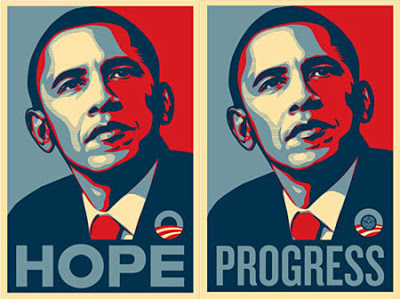
But enough critique. There is inspiration to be found in interesting developments suggesting real movement toward progressive change beneath and beyond the false “Hope” propagated for self-interested purposes by politicians: a daring and largely successful workplace occupation (to secure severance benefits and wages from an absconding employer)on Chicago’s North Side (at the Republic Window and Door plant on Goose Island) last December, rising popular resistance to rampant foreclosures and evictions; student occupations at the New School and New York University, plans for antiwar marches that will call Obama out on his rehashed imperialism, including his deadly escalation of the United States’ criminal wars on Afghanistan (and, more fatefully perhaps, Pakistan). There is rising anger (feared as “dangerous populist excess” in the White House and the media) about the ongoing bailouts of the very financial institutions that drove the U.S. and global economy over the cliff.

Obama can surf the people but the inverse is true as well. Progressive activists and citizens can escape the clutches of Obamanist “repressive de-sublimation.” They can evade the containment and exploitation of their hope and anger to re-legitimize dominant oppression structures. They can ride and steer the Obama wave into places (both within and beyond or beneath electoral politics) closer to true progressive ideals.

Left progressives might productively think of “the Obama phenomenon” as a sort of (watered down and strictly electoralist) bourgeois revolution: it will fail to deliver on democratic promises made to a populace it had to rally to defeat the old regime. Now that populace is supposed to return quietly (and hopefully) to remote and divided private realms, doing their little jobs and buying stuff and watching their Telescreens while the new system-maintaining coordinators do their serious work.

There is left-progressive potential in Obama’s false promises and in his ongoing and impending failures. The energy and hopes he rode and channeled will need more genuinely democratic, liberating, and anti-authoritarian outlets than an Obama (or a Hillary Clinton or a John Edwards) presidency could ever have been expected to provide. As the brilliant Marxist David Harvey has recently noted, the new administration’s economic plan is doomed to failure thanks to the conservative constraints of U.S. political culture and to “deep tectonic shifts in the spatio-temporal disposition of capitalist development”

Spatio-temporal tectonics aside, it’s up to citizens and activists, not politicians, to carry through on progressive promises Obama is unable and/or willing to fulfill and then to move forward (as we must) to what Dr, Martin Luther King Jr. called (in a posthumously published essay titled “A Testament of Hope”) the “real issue to be faced” beyond “superficial” questions: “the radical reconstruction of society itself.” As Obama himself noted (along with John Edwards) repeatedly noted during the campaign, in a comment that has not fallen from his lips since he reached the White House, “change doesn’t happen from the top down. Change happens from the bottom up.”

Among the many reasons we don’t hear that very much any more from Obama or other top Democratic politicians, one deserves special mention amidst the current remarkable capitalist breakdown. People engaging in change from the bottom up are often wont to imagine and act on their often previously hidden desires for “a world turned upside down” – for a life beyond the pre-historic oppression structures any new head-of-state is bound to support. Long live the permanent revolution.

[Paul Street (paulsrtreet99@yahoo.com) is the author of many essays, reviews, speeches, and book, including Empire and Inequality: American and the World Since 9/11 (Paradigm, 2004), Racial Oppression in the Global Metropolis (Rowman & Littlefield, 2007), and Barack Obama and the Future of American Politics (www.paradigmpublishers.com/Books/BookDetail.aspx?productID=186987). Street will speak on “Change and Continuity: An Assessment of Obama’s Early Administration” on Tuesday, March 24, 2009 at 7pm, Paul Engle Center, 1600 4th Av SE Cedar Rapids, Iowa. ]

NOTES

[1] Please see (published after this speech was delivered), Harpers’ Magazine president John MacArthur’s excellent Op Ed, “Obama is Far From a Radical Reformer,” The Providence Journal (March 19, 2009). MacArthur notes that the official U.S. “left” ahs joined the right in creating the false impression that “a crypto-socialist has taken up residence in the White House…Such a reading of Obama is absurd,” MacArthur notes, adding that “left and right persist in the fantasy that the president is a Mr. Smith goes to Washington character prepared to ‘take on’ the powers that be…The left pretends that [top corporate neoliberal economist and former Clinton Treasury Secretary Lawrence] Summers isn’t really Obama’s chief economic adviser, while the right pretends that the former Treasury Secretary has converted to left-wing Gaullism. In reality, Summers and [current Treasury Secretary Timothy] Geithner are in place precisely to prevent real reform of a banking system that helped put Obama in the White House…Obama, a moderate with far too much respect for the globalized financial class, is surely the unleft, unradical president. Which makes you wonder why left and right find common cause in saying otherwise.” MacArthur’s editorial can be read online at www.commondreams.org/view/2009/03/18-6

Source / Z-Net

The Rag Blog

Posted in RagBlog | Tagged , , | 4 Comments

Canada: War Criminal Good, Peacenik Bad

After allowing George W. Bush into Canada to speak, it is telling that the same government would bar the British MP George Galloway.

Richard Jehn / The Rag Blog

George Galloway, the Respect MP, reacts angrily outside the Commons
in July 2007 after being told he faces suspension.

British MP Galloway barred from Canada over ‘supporting Hamas’
By DPA / March 20, 2009

Outspoken British anti-war member of parliament (MP) George Galloway Friday denounced as “outrageous” a decision by the Canadian authorities to refuse him entry on the grounds of national security.

Galloway, a former Labor politician who has now set up his own political party, said in London that he would not accept the ban imposed ahead of a speech he had planned to give in Toronto.

The 54-year-old maverick politician, who left Britain’s ruling Labor Party in protest at its support for military intervention overseas, was refused entry to Egypt in 2006. He is an MP for his Respect Party.

“All right-thinking Canadians, whether they agree with me over the wisdom of sending troops to Afghanistan or not, will oppose this outrageous decision,” he said in London Friday.

He was due to speak at a public forum entitled “Resisting war from Gaza to Kandahar” in Toronto on March 30.

According to the Press Association Friday, a spokesman for Canada’s immigration minister, Jason Kenney, has made clear that the decision will not be overturned.

Galloway had been deemed “inadmissible” to Canada under section 34(1) of the country’s immigration act.

Kenney’s spokesman, Alykhan Velshi said the act was designed to protect Canadians from people who fund, support or engage in terrorism.”

“We’re going to uphold the law, not give special treatment to this … street-corner Cromwell who actually brags about giving ‘financial support’ to Hamas, a terrorist organization banned in Canada,” Velshi was quoted as saying by the British Press Association.

Source / Haaretz

The Rag Blog

Posted in RagBlog | Tagged , , | 3 Comments

Obama: Seize the Moment and Shitcan Your Corrupt and Inept Economic & Military Teams

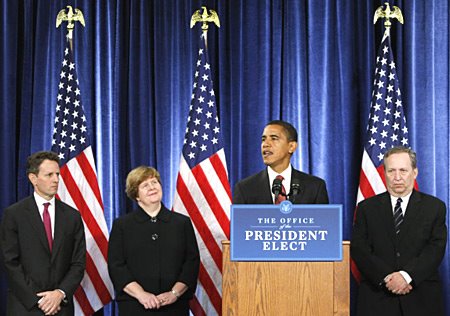
President elect Barack Obama introduces his new economic team: (From l.) Treasury Secretary Timothy Geithner, Council of Economic Advisers chair Christina Romer, and NEC director Larry Summers. Photo: Martinez Monsivais/AP.

Obama’s Moment is Passing Quickly
By Dave Lindorff / March 20, 2009

The actions of Obama’s Chief Financial Adviser Larry Summers and his Treasury Secretary Tim Geithner in permitting the payment of $165 million in bonuses to AIG executives (Summers, according to the Wall Street Journal, actually pressed Sen. Chris Dodd, D-CT, to secretly remove a bar to the payment of such bonuses from the bailout bill) and the storm of public outrage that has followed public disclosure of those payments, provides President Obama, whose administration is stumbling badly on many fronts, with an opportunity to turn things around and avoid political disaster.

He should promptly demand Geithner’s and Summers’ resignations, and should also fire the CEO of AIG, Edward Liddy (as 80% owner of AIG, the US has the power to do that anytime). It would also be a good idea at the same time to fire the CEOs of all the leading banks that are at this point surviving on government bailouts.

This would allow Obama to correct the fundamental mistake he made during the transition period following the November election in installing a bunch of Clinton-era economic advisors and Bush holdovers to be his economic team.

The US economy is in disastrous shape, and it is going to take new ideas, and people untarnished by the last 30 years of deregulatory excess and unsavory links to Wall Street, to rescue it. Obama has no shortage of good people to turn to: Nobel economist and NY Times columnist Paul Krugman, former World Bank Chief Economist Joseph Stiglitz and economist James Galbraith all spring immediately to mind as people who could offer new and better approaches to addressing both the immediate crisis and the longer-term challenge of restoring the health of the nation’s economy, and of making it work for everyone, instead of just the wealthy few.

Of course, it could be that Obama is really not interested in radically changing the US economy, and its financial system. He has certainly accepted the tarnished coin of the Wall Street establishment during his campaign, and could simply be doing their bidding, but one has to operate on the hope that this is not the case. After all, the Obama campaign also raised an unprecedented amount of cash from ordinary folks, and if money is influence, he owes those little people big time.

In any event, it seems clear that if this president who spoke during his campaign of “hope and change” continues to cater to the bankers and the corporate interests that want to see no major revamping of the economic system and the regulatory apparatus, he is headed for a one-term presidency–and a sad and failed one at that.

The voters who sent Obama to Washington have been willing to extend him the benefit of the doubt, even when he made his almost uniformly lousy cabinet picks. They were willing to grant that he had been handed a disastrous situation by the last administration.

But as each week passes, the disaster becomes less Bush’s and Cheney’s, and more Obama’s.

The same can be said of Obama’s other big crisis: the two endless wars in Iraq and Afghanistan. Again, Obama has largely retained and accepted the advice of the same people who helped run these huge policy disasters during the Bush/Cheney years, and is buying the basic assumptions of those two wars. He is most certainly not ending the Iraq conflict, and is now talking about leaving as many as 50,000 US troops in Iraq for years–as many as were in Vietnam in the fall of 1965. He is reportedly talking about doubling the number of troops in Afghanistan to over 60,000, and about expanding the war into Pakistan, and not just the tribal areas, but Baluchistan province, a heavily populated part of that country. This latter decision, which could lead to an explosion in Pakistan, and the collapse of the central government, could lead to an huge demand for more US troops in the area–perhaps hundreds of thousands more–and even to India’s entry into the conflict.

This is as outrageous and doomed a strategy as is his economic program of trying to salvage the nation’s zombie banks while nickel-and-diming a “stimulus” program for ordinary people.

He should seize the moment, shitcan his corrupt and inept economic team and sack his military advisers, including Defense Secretary Robert Gates and his Centcom commander David Petraeus, and bring in people who will tell him how to get the US out of both conflicts pronto.

If he fires and replaces his economic and military teams, and announces both a quick end to the Iraq and Afghanistan Wars and the immediate break-up of the country’s big failed national banks and financial institutions, he has a chance to become a great president. If he does not, it is as predictable as the rising of the seas that his presidency will be a failure. We are nearing a point where the American public is going to lose patience with the half measures, the continuing pouring of national treasure down the twin sinkholes of the failed financial institutions and the two endless wars in the Middle East, and the tone-deaf behavior of cabinet secretaries and advisors who don’t have a clue about how average Americans are living these days.

This is President Obama’s moment for action. Firing Geithner and Summers would be a good start.

Americans should make an effort to let President Obama know that they want more than token stimulus programs. (Just consider this: official unemployment is now 8.1 percent, but only 4.5% of American workers are able to collect unemployment benefits, and meanwhile, real unemployment is closer to 18 percent. That’s a lot of hurt, and not a lot of help.)

A good idea would be to join a march on the Pentagon set for this Saturday, March 21, (natassembly.org/MarchOnPentagon.html) and a two-day program of demonstrations against Wall Street set for April 3 and 4 in New York City (www.bailoutpeople.org).

[Dave Lindorff is a Philadelphia-based journalist and columnist. His latest book is “The Case for Impeachment” (St. Martin’s Press, 2006). His work is available at www.thiscantbehappening.net.]

Source / Common Dreams

The Rag Blog

Posted in RagBlog | Tagged , , | 3 Comments

France : Millions Take to the Streets in Protest

Massive protest against French President Sarkozy in Paris, March 19, 2009. Photo by Pascal Le Segretain / Getty Images / The Independent.

Streets in central Paris were packed with protesters waving anti-Sarkozy placards and chanting slogans, with badges reading ‘Get lost you little jerk!’, the now infamous comment made by Sarkozy to a protester at an agriculture show…

By James Mackenzie / March 19, 2009

As many as three million people took to the streets across France today to protest against President Nicolas Sarkozy’s handling of the economic crisis and demand more help for struggling workers.

The protests, which polls show are backed by three quarters of the French public, reflect growing disillusion with Sarkozy’s pledges of reform as the crisis has thrown tens of thousands out of work and left millions more worried about their jobs.

Bright spring sunshine helped the turnout and the total reported by union organisers surpassed the 2.5 million seen on an earlier day of protest on Jan. 29.

Streets in central Paris were packed with protesters waving anti-Sarkozy placards and chanting slogans, with badges reading “Get lost you little jerk!”, the now infamous comment made by Sarkozy to a protester at an agriculture show, much in evidence.

“There are more and more workers who feel they are not responsible for this crisis but that they are the main victims of it,” said Bernard Thibault, head of the CGT, one of the eight trade unions organising the strikes.

More than 2 million people are out of work in France and despite an easing in inflation, even many with a job struggle with the high cost of living.

A large public sector payroll and a relatively generous welfare state has kept French people better protected than many in other countries but there has been deep public anger at plant closures and stories of corporate excess.

Sarkozy, elected in 2007 on a pledge to shake up the French economy, has seen his approval ratings plunge as he has poured billions into bailing out banks and car makers but rejected union demands for higher pay and tax hikes for the rich.

“People are in the streets and they are suffering, there are more and more people out of work and something has to be done,” said Sylvie Daenenck, marching in Paris. “We shouldn’t just be giving money to the bosses.”

The CGT said 3 million people had joined the protests, with hundreds of thousands at the main rally in Paris and tens of thousands taking part in marches in provincial towns and cities. Police, however, put the Paris total at just 85,000.

Sarkozy’s room for manoeuvre has been limited by the dire state of French public finances, which have been drastically strained by the need to prop up the fragile financial sector.

But a series of disputes, ranging from strikes by university staff to unruly protests by workers at a tyre plant in northern France, have underlined a worsening climate of discontent that the government fears could escalate.

Workers at the Continental tire factory pelted managers with eggs at the protest this week and the government and business leaders have been acutely aware of the danger of unrest spilling over into the kind of violence seen in the urban riots of 2005.

Transport, energy and some government offices were all affected and unions said there was also strong participation by workers from the private sector, although there was no general shutdown of the economy. Most businesses and public services functioned at close to normal levels.

The unions have presented a long list of demands, including a boost for the lower salaried, more measures to protect employment, a tax hike for high earners and a halt to job cuts planned in the public sector.

The government has introduced a 26 billion euro ($36 billion) stimulus plan aimed at business investment, and after the Jan. 29 strike Sarkozy offered 2.65 billion euros of additional aid to help vulnerable households weather the storm.

But there is little prospect of an improvement in the situation, with many analysts predicting the economy will contract by 2 percent this year and unemployment will jump 25 percent to almost 10 percent.

Source / Reuters / The Independent

Thanks to S. M. Wilhelm / The Rag Blog

Posted in RagBlog | Tagged , , , , | Leave a comment

The Israelis Are Having Their Own Winter Soldier

Israel troops admit Gaza abuses

An Israeli military college has printed damning soldiers’ accounts of the killing of civilians and vandalism during recent operations in Gaza.

One account tells of a sniper killing a mother and children at close range whom troops had told to leave their home.

Another speaker at the seminar described what he saw as the “cold blooded murder” of a Palestinian woman.

The army has defended its conduct during the Gaza offensive but said it would investigate the testimonies.

The Israeli army has said it will investigate the soldiers’ accounts.

The testimonies were published by the military academy at Oranim College. Graduates of the academy, who had served in Gaza, were speaking to new recruits at a seminar.

“[The testimonies] conveyed an atmosphere in which one feels entitled to use unrestricted force against Palestinians,” academy director Dany Zamir told public radio.

Heavy civilian casualties during the three-week operation which ended in the blockaded coastal strip on 18 January provoked an international outcry.

Correspondents say the testimonies undermine Israel’s claims that troops took care to protect non-combatants and accusations that Hamas militants were responsible for putting civilians into harm’s way.

‘Less important’

The Palestinian woman and two of her children were allegedly shot after they misunderstood instructions about which way to walk having been ordered out of their home by troops.

“The climate in general… I don’t know how to describe it…. the lives of Palestinians, let’s say, are much, much less important than the lives of our soldiers,” an infantry squad leader is quoted saying.

In another cited case, a commander ordered troops to kill an elderly woman walking on a road, even though she was easily identifiable and clearly not a threat.

Testimonies, which were given by combat pilots and infantry soldiers, also included allegations of unnecessary destruction of Palestinian property.

“We would throw everything out of the windows to make room and order. Everything… Refrigerators, plates, furniture. The order was to throw all of the house’s contents outside,” a soldier said.

One non-commissioned officer related at the seminar that an old woman crossing a main road was shot by soldiers.

“I don’t know whether she was suspicious, not suspicious, I don’t know her story… I do know that my officer sent people to the roof in order to take her out… It was cold-blooded murder,” he said.

The transcript of the session for the college’s Yitzhak Rabin pre-military course, which was held last month, appeared in a newsletter published by the academy.

Israeli human rights groups have criticised the military for failing to properly investigate violations of the laws of war in Gaza despite plenty of evidence of possible war crimes.

‘Moral army’

The soldiers’ testimonies also reportedly told of an unusually high intervention by military and non-military rabbis, who circulated pamphlets describing the war in religious terminology.

“All the articles had one clear message,” one soldier said. “We are the people of Israel, we arrived in the country almost by miracle, now we need to fight to uproot the gentiles who interfere with re-conquering the Holy Land.”

“Many soldiers’ feelings were that this was a war of religion,” he added.

Defence Minister Ehud Barak told Israel Radio that the findings would be examined seriously.

“I still say we have the most moral army in the world. Of course there may be exceptions but I have absolutely no doubt this will be inspected on a case-by-case basis,” he said.

Medical authorities say more than 1,300 Palestinians were killed during Israel’s 22-day operation, including some 440 children, 110 women, and dozens of elderly people.

The stated aim was to curb rocket and mortar fire by militants from Gaza. Thirteen Israelis, including three civilians were killed.

Source / BBC News

The Rag Blog

Posted in RagBlog | Tagged , , , , | 1 Comment