Homeowners Storm Gold Coast Mansions of ‘Predatory Lenders’

Neighborhood Assistance Corp. of America (NACA) members outside the home of Greenwich Financial’s William Frey on Sunday, Nov. 8, 2009. Photo by Danielle Robinson / The Hour / AP.

Grab Your Torch ‘n Pitchfork!

‘Sporting bright yellow shirts that read, “Stop Loan Sharks,” protestors demanded more accountability from the CEOs of the financial institutions responsible for the millions of unaffordable mortgages in the state and across America.’

By Jennifer Millman / February 9, 2009

Hundreds of people trying to save their homes from foreclosure flocked to Connecticut’s wealthy Gold Coast this weekend to give financial kingpins a piece of their mind.

Stamford sits in the midst of one of the nation’s wealthiest areas, and among the regions particularly hard-hit by the housing market collapse. Nearby Greenwich and other suburbs are home to many of Wall Street’s wealthiest executives and financial managers.

Homeowners are fed up – and many are frustrated that those who lead the companies that gave them their subprime mortgages live in luxury while they struggle so hard to meet their loan payments and not fall behind.

On Sunday, hundreds of angry homeowners and volunteers traveled in vans and minibuses and protested outside Morgan Stanley CEO John Mack’s multi-million-dollar mansion to tell the wealthy finance czar how they really feel.

The group, led by Neighborhood Assistance Corporation of America (NACA), also went to Greenwich Finance CEO William Frey, among others, as part of what NACA calls the “Predator’s Tour.”

Sporting bright yellow shirts that read, “Stop Loan Sharks,” protestors demanded more accountability from the CEOs of the financial institutions responsible for the millions of unaffordable mortgages in the state and across America.

“We can’t let them live quietly in a lap of luxury while they throw hard working Americans out on the street,” NACA explains on its Web site. “This action is within our legal rights as Americans to peacefully protest and meet with those who control our family’s livelihood.”

NACA coordinated the protest as part of its “Save the Dream” forum – a weekend of workshops to counsel stressed-out homeowners on ways to refinance their mortgages amid the nation’s housing market meltdown.

Event organizers expected thousands to show up throughout the weekend for financial advice and mortgage assistance. NACA has helped restructure thousands of mortgages to arrangements homeowners can afford.

None of the protestors were arrested.

Copyright Associated Press / NBC New York

View a video of the demonstration and a slideshow featuring some of the financial CEOs that NACA says prey on homeowners here.

Source / NBC New York

The Rag Blog

Posted in RagBlog | Tagged , , , , | Leave a comment

Biden in Munich : America’s Eurasian Empire Takes Shape

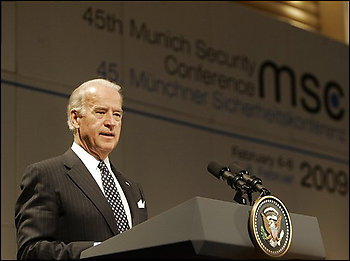
Vice President Joe Biden addresses the participants of the International Conference on Security Policy in Munich, on Saturday, Feb. 7, 2009. Photo by Frank Augstein / AP.

Biden was telling the waiting world that Washington would continue to pursue its own Eurasian sphere of influence, in part by expanding NATO ever closer to Russia.

Sovereign states have the right to make their own decisions and choose their own alliances,’ he declared, couching a nuclear threat in the cloak of freedom and democracy.

By Steve Weissman / The Rag Blog / February 10, 2009

Joe Biden set “a new tone” in his foreign policy speech in Munich over the weekend, breaking with the Bush administration and showing, as our founder said, “a decent respect for the opinions of mankind.” But he also raised a banner that we will all come to regret.

“The United States will not — will not recognize South Ossetia and Abkhazia as independent states,” he said. “We will not recognize any nation having a sphere of influence.”

His words carried a dangerously mixed message. Other than those eager for a new Cold War or neocon lobbyists paid by Georgian president Mikheil Saakashvili, few outsiders wanted to hear about the two breakaway provinces now under Russian tutelage. Nor should we wax nostalgic over spheres of influence, whether expressed in our own blood-splattered Monroe Doctrine or in the Russian idea of “the near-abroad,” where “friendship knows no frontiers.”

But Biden was telling the waiting world something far more significant – that Washington would continue to pursue its own Eurasian sphere of influence, in part by expanding NATO ever closer to Russia. “Sovereign states have the right to make their own decisions and choose their own alliances,” he declared, couching a nuclear threat in the cloak of freedom and democracy.

To realize what this could mean, think of the stark choice Washington and its allies would have faced last year if Georgia had been part of NATO when the hotheaded Saakashvili provoked the all-too-ready Russians into a shooting war. Would we have rushed to Georgia’s defense with military force as the NATO treaty would have committed us to do? Or would we have been obliged to tell the world that NATO protection was worthless?

Not a pretty prospect, and an incredibly backward-looking idea for a new American administration supposedly committed to change.

The dangers Biden was promoting in Munich go far beyond NATO membership. In the coded language of diplomacy, he signaled that Washington would do whatever it takes to hold sway over the energy resources of the Caucasus, the Caspian Sea, and the former Soviet Central Asia.

This was hardly new, but that’s just the point. The Obama administration may have a green and friendly tone, but it will still do business as usual when the business is oil, natural gas, uranium, and whatever else makes the world’s wheels go round.

Good bye Dick Cheney. Welcome back Scoop Jackson and the Realpolitik of traditional Democratic Party foreign policy recalling FDR’s World War II embrace of the Saudi royal family.

From the Arabian Peninsula and Persian Gulf, the field of play has expanded into the Islamic “stans” of the ancient Silk Road and the bloody rivalry between the British and Czarist empires that romantics still call “the Great Game.” Only now the imperial conflicts pit the United States and its NATO allies against a resurgent Russia, the increasingly energy-starved Chinese, and to a lesser extent the Iranian mullahs as well.

These are the lands of the first global oil rush – in Baku, Azerbaijan – and of the latest global resource race, where former President Bill Clinton flew in September 2005 to help Canadian mining and oil magnate Frank Giustra close a multi-million dollar deal on Kazakhstan’s uranium.

And all of this provides the background to Obama’s call for a timeout to define a new rationale for American – and NATO – efforts in AfPak – the new Washington -speak for the concatenation of Afghanistan and Pakistan.

The turbulence in Afghanistan and the Baluchi lands to the south has led the authoritative Energy Daily to dismiss the much- ballyhooed Turkmenistan-Afghanistan-Pakistan Pipeline as little more than “a pipe dream.” But any reassessment of our “mission” in AfPak will include the strategic importance of Pakistan and Afghanistan to the region as a whole, along with the mistaken belief that American and NATO military power can defeat the jihadi attacks and Taliban-like insurgencies that could one day endanger the vast treasure trove to the north.

Between endless imperial rivalries and propping up tin-pot dictators who make the Saudi royal family look humane, Biden was committing us to endless trouble in an effort to control global energy resources, most of which endanger the very future of our planet. I don’t think he knew what he was implying, but how apt that he ended his prophetic speech with a quote from the Irish poet William Butler Yeats, “All is changed, changed utterly: a terrible beauty has been born.”

Additional articles of interest by Steve Weissman:

The Rag Blog

Posted in Rag Bloggers | Tagged , , , | Leave a comment

Dear Sen. Cornyn : You Have Pork for Brains

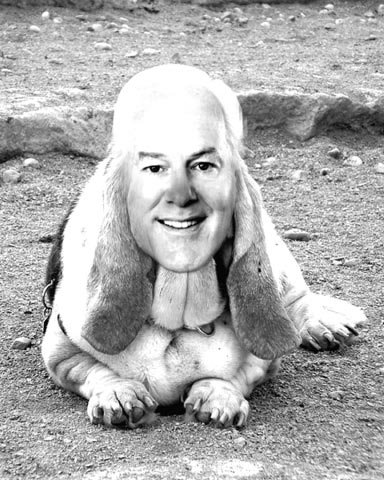
Sen. John Cornyn (R-TX). Image by Bill Narum / The Rag Blog.

Senator Cornyn: ‘Your political ambitions are clearly far more important to you than the well being of ordinary Americans who are losing their jobs in the millions.’

By Sarito Carol Neiman / The Rag Blog / February 9, 2009

I just sent Sen. John Cornyn [Very R-TX] an email to tell him the biggest piece of pork I saw in the neighborhood of the economic stimulus plan was the pork in the place where his brains should be, and mentioned that it’s called being “pigheaded.”


I told him:

Your political ambitions are clearly far more important to you than the well being of ordinary Americans who are losing their jobs in the millions. If you really want to fix everything with tax cuts and let the state budgets, education, alternative energy solutions, and affordable health care continue to be in the hands of the so-called “free market”. . .

Well. . . then I threatened to camp out on his lawn in a tent and hunt squirrels for dinner if it got to that point, and suggested if he gets his way he won’t be able to find a cop to throw me off his lawn because they’ll all be out preventing food riots.

It was fun, a kind of catharsis.

Being a gentleman, he wrote right back to thank me “for contacting his offices” and attached my letter in case I might have forgotten what I had just said. He closed with his “warmest regards.”

I sent KB Hutchinson a much nicer note, trying to shame her into looking at herself in the mirror and doing what she knows is the right thing. Girl talk, you know.

Geez, these people make me so mad!!

As an officially “unemployed” person, I wish we could’ve organized a “million-person unemployed vigil” on the mall today. Or at least a few people holding up a continuous string of paper dolls representing each of the 3.5 million unemployed plus their 2.5 (or whatever it is these days) children. The numbers don’t have faces and the Republicans don’t have any shame.

The Rag Blog

Posted in RagBlog | Tagged , , , , , , | 1 Comment

Frank Shepard Fairey: Grafitti Legend Claims Arrest Before Big Show is Political

Frank Shepard Fairey / Exopolis

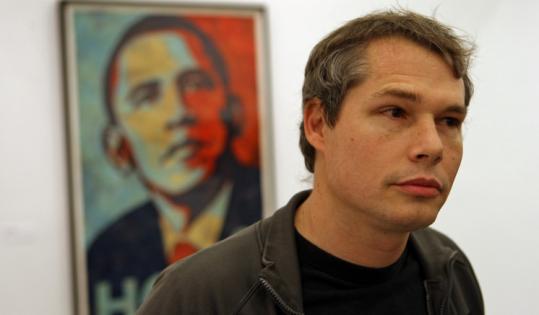
Street artist Frank Shepard Fairey at Institute of Contemporary Art earlier this month. Photo by David L. Ryan / Boston Globe.

Police arrest Obama artist and ‘Andre the Giant’ tagger just before opening at the Institute of Contemporary Art

Frank Shepard Fairey: ‘They are suppressing an artist’s freedom of transformative expression.’

by John R. Ellement and Andrew Ryan / February 9, 2009

Artist Frank Shepard Fairey criticized Boston police today after he pleaded not guilty to graffiti-related charges, questioning the “motivation and the timing” of his arrest on Friday hours before his opening at the Institute of Contemporary Art.

Police arrested Fairey at about 9:15 p.m. on Friday as he was heading to the “Experiment Night” event at the ICA, where more than 750 people were waiting for him to appear. The arrest was timed, Fairey said, “in a way that was designed to create as much inconvenience for me and the museum as possible.”

Police have said that warrants for Fairey’s arrest were issued on Jan. 24 for damage to property due to graffiti. A police spokesman did not immediately respond to a phone message when asked about Fairey’s comments about the timing of his arrest.

An arrest affidavit filed today described Fairey as an “idol to members of the graffiti subculture” who has been defacing property in Boston since 1989. Fairey’s signature tag is a stencil of the professional wrestler Andre the Giant and the words “Obey the Giant” or “Obey.”

When Fairey returned recently to Boston for his show at the ICA, he allegedly “victimized new properties while defiantly stating in media outlets that he will not stop his unauthorized posting of his tag,” according to the affidavit requesting a warrant for his arrest. “Suspect Fairey continues to engage in a constant and systemic assault on Boston Neighborhoods.”

In media interviews leading up to his ICA show, Fairey admitted, according to the affidavit, “illegally tagging property … recently in Boston.”

Fairey, 38, has gained prominence for his “Hope” image of President Barack Obama, which has been hung in the National Portrait Gallery in Washington. The Los Angeles-based artist is locked in a dispute with The Associated Press over whether he illegally used a copyrighted AP photo to create the poster. Fairey told reporters today that he filed a counter suit against the AP today in federal court in New York.

“They are suppressing an artist’s freedom of transformative expression,” Fairey said.

As Fairey appeared in courts in Brighton and Roxbury today, his defense attorney said that additional graffiti-related charges are being filed against the artist.

The defense attorney, Jeffrey P. Wiesner, referenced the new charges today as he criticized Boston police in comments made after Fairey appeared in Brighton District Court. Wiesner said that police exercised “bad judgment” when they arrested his client for allegedly pasting art without permission.

“And I think it is bad judgment that they are now seeking further charges,” Wiesner said.

Boston police would not discuss any additional charges. “They have some other incidents in which the suspect has been implicated,” said Officer Eddie Crispin, who declined to provide specifics. “The investigation is still ongoing.”

According to the arrest affidavit filed today, Fairey has committed at least six acts of vandalism within the City of Boston. A hearing has been scheduled in Brighton on March 10 when a clerk magistrate will decide whether there is evidence to support additional charges, Wiesner said.

Fairey was released on personal recognizance after his brief hearings in Brighton and Roxbury. Dressed in a suit coat and dark collared shirt with no tie, Fairey appeared with four representatives from the ICA.

The Brighton charge dates to Sept. 16, 2000, when a police officer allegedly saw Fairey post a tag in Allston. At the time, Fairey was carrying “an ‘excessive’ amount of graffiti propaganda and stickers, according to the arrest affidavit filed today. Fairey never appeared in Brighton District Court to face the charge, which carries a possible fine of $100.

The case is Roxbury Municipal Court is much more recent. According to court documents, Fairey allegedly defaced a Massachusetts Turnpike Authority building at Massachusetts Avenue and Newbury Street. Fairey is accused of stenciling five images of a black-and-white face above the word “Obey.” The charge carries a maximum sentence of two years in the Suffolk House of Correction and could force Fairey to pay restitution and lose his driver’s license for year, according to his lawyer. Fairey has told the Globe he has been arrested 14 times.

© 2009 Boston Globe

Source / Boston Globe / Common Dreams

The Rag Blog

Posted in RagBlog | Tagged , , , , , | 3 Comments

Sen. Bernie Sanders : Socialist Strikes a Blow Against Wall Street Greed

Socialist Senator-elect Bernie Sanders (I-VT): Way ahead of the curve on this one. Photo by Brian Snyder / Reuters.

Obama backs limit to executive compensation similar to Sanders’ Stop the Greed on Wall Street Act

‘We are on the verge of a depression that these people helped cause, so that helps wake people up,’ Sanders said, explaining the increased support for his proposal. ‘It should have been done years ago, of course.’

By Lisa Lerer / February 9, 2009

Chalk one up for the socialist.

In November, Vermont Sen. Bernie Sanders, a self-described democratic socialist, introduced the provocatively named Stop the Greed on Wall Street Act — a bill aimed at limiting executive compensation at banks receiving government bailout funds.

The measure was promptly ignored and died a quick death in committee.

But when President Barack Obama proposed a similar limit last week — his would cap pay at $500,000; Sanders would have put the lid on at $400,000 — the accolades came pouring in. Even the free market devotees at the conservative Cato Institute issued a press release applauding the idea, telling executives: “Sorry, guys, you asked for it.”

“We are on the verge of a depression that these people helped cause, so that helps wake people up,” Sanders said, explaining the increased support for his proposal. “It should have been done years ago, of course.”

Sanders is often dismissed as a novelty in two-party Washington. But the move toward heightened corporate regulation moves him a step closer to the political mainstream.

The Vermont independent spent 16 years in the House and has spent another two in the Senate railing against corporate greed and the rising income gap. “I occasionally quote some of the things I did 10 years ago,” he said.

While the current economic troubles limit Sanders’ sense of vindication, he’s quick to point out his earlier opposition to the deregulation that many believe allowed a mild downturn to sink into a severe recession.

“This is an issue that some of us have been onto for a number of years,” he said. “You didn’t have to be a Ph.D. in economics to figure this out.”

As a congressman, Sanders opposed the Gramm-Leach-Bliley Act, a 1999 statute that repealed a Depression-era law prohibiting commercial banks from merging with investment banks. Clinton administration officials and then-Federal Reserve Chairman Alan Greenspan supported the bill over objections from more liberal critics who wanted to preserve regulatory walls between financial services companies.

“Greenspan had more influence than I did,” said Sanders.

Sanders wants to strengthen Obama’s executive compensation restrictions and enact a host of new and old proposals cracking down on hedge funds, banks and financial services firms.

“This should be seen as the beginning,” he said. “Wall Street has got to know that many of us believe a new day has got to come.”

Source / Politico

Thanks to Common Dreams / The Rag Blog

Posted in RagBlog | Tagged , , | Leave a comment

We Had to Do it…

Political cartoon by Joshua Brown / Historians Against the War / The Rag Blog

Thanks to Dr. S. R. Keister / The Rag Blog

Posted in Rag Bloggers | Tagged , | 1 Comment

Thorne Dreyer :
The KKK in the news today… and back in Sixties Houston.

The Klan recruiting in the Panhandle; Klan cop in Florida; a Klansman says ‘I’m sorry.’ (Oh… and how they shot us up in the Sixties!)

klan 1

Fruitland Park, Fla., police officer James Elkins (right) in his KKK regalia. Photo from Orlando Sentinel.

klan 2

U.S. Rep. John Lewis, D-Ga, left, is seen with Elwin Wilson of Rock Hill, S.C., in Lewis’ Washington, D.C., office Tuesday, Feb. 3, 2009, while taping an interview for Good Morning America. Photo by AP.

By Thorne Dreyer | The Rag Blog | February 9, 2009

As if things weren’t bad enough, The Ku Klux Klan is back in the news. Jobsanger reports that they’re recruiting in the Texas Panhandle and Jay Jurie passes along a report from the Orlando Sentinel about a Klan cop being unearthed and axed from the force in Orlando.

All this brings back memories of our, shall we say, exciting adventures with the Ku Klux Klan back in the Sixties in Houston. The Klan bombed our cars and shot up our offices — and my mother’s art gallery! But first the news.

The Amarillo branch of the White Knights of the Ku Klux Klan is recruiting in Tampa, Texas. According to Jobsanger, “they are stuffing their leaflets into a plastic bag with a few stones and throwing it out on lawns in the dead of night.”

He adds:

These days the Klan is trying to pass itself off as a kinder gentler version. The leader of the national group says they are the “traditional” Klan. He says they don’t accept skinheads or fascists. He would like people to believe they are just another “charitable fraternal” group.

And, in the Orlando area:

James Elkins, 28, resigned on January 20 after the [Fruitland Park, Florida] police department launched an internal investigation after receiving information that Elkins was distributing fliers promoting the KKK in Sumter County…

The Lake County Sheriff Office also received photos earlier this week that allegedly show Elkins dressed in KKK gowns and hoods…

In a different vein, there’s this terrific story: a former Klansman who participated in the beating of then civil rights leader John Lewis has sought forgiveness for his actions of 48 years ago. Elwin Wilson traveled to Washington, D.C., to meet with Lewis, now a U.S. Congressman from Georgia, and the two men embraced and sent bygones scurrying for cover.

According to the Boston Herald,

Elwin Wilson was an unabashed racist, the sort who once hung a black doll from a noose outside his home. … [He and Lewis] faced each other at a South Carolina bus station during a protest in 1961. Wilson joined a white gang that jeered Lewis, attacked him and left him bloodied on the ground.

Wilson said he tried to block the memory but couldn’t. “I just told him I was sorry,”

Lewis said Wilson is the first person involved in the dozens of attacks against him during the civil rights era to step forward and apologize. When they met Tuesday, Lewis offered forgiveness without hesitation.

“I was very moved,” said Lewis. “He was very, very sincere, and I think it takes a lot of raw courage to be willing to come forward the way he did. … I think it will lead to a great deal of healing.”

In Houston in the 60s, the Klan decided we were safer to mess with than our brothers and sisters of color

Back in the late 60s-early 70s I was in Houston where I was active in SDS and was an editor and publisher of Space City! – an underground newspaper that did some muck raking and rabble-rousing in the region and was a significant nuisance to the powers-that-were. The Klan was experiencing something of a revival at the time and the role of that organization in the Houston police force then is a thing of legend.

It wasn’t until Fred Hofheinz became mayor that the Klan infestation within the Houston constabulary was seriously addressed.

klan 3

A Houston policeman, a member of the Ku Klux Klan in Texas, poses in 1972 with hood and mask, with his badge number covered with masking tape and hand. Photo by Ron Laytner / Edit International.

In a remarkable article published by Edit International about secret interviews he had with members of the Houston area Klan in 1972, Ron Laytner wrote about being blindfolded and taken away by an unseen man.

Then,

“a powerful flashlight was turned on me and I began to see a City of Houston police officer removing my blindfold. …across his face and over his head he wore the mask and hood of the Ku Klux Klan, the secret terror organization dating back to the American Civil War. …

His face was hidden, the number of his police badge was covered with masking tape and so were the identifying numbers on his Houston police car.

Laytner described one Klansman he met with:

In one hand he held a big black Bible. In the other he held a hair trigger semi-automatic rifle. On his head he wore a Western hat with a Confederate flag.

He spoke of God and love, but on the wall behind him was a yellow Klan bumper sticker of hate. It listed as “signs of the Anti-Christ” peace movements, the United Nations, Jews and communism.

A giant American flag was pinned on the wall in a nearby room next to the rest rooms and beside an assortment of Confederate flags was a badge sticker on a wall saying “Friend of Police.”

A collection of loaded rifles and shotguns stood in various corners around the room.

But, despite the scary posturing shown Ron Laytner, the Klan of the Sixties and seventies was, at least in my experience, a shadow of the terror-inspiring Klan of regularly scheduled lynchings and church burnings. There were still incidents of serious and brutal violence in the deep south, but there was also a lot of bravado. In Houston, they did their really dirty work – like throwing Hispanics and blacks into Buffalo Bayou with virtual impunity – while wearing the blue uniforms of the Houston police.

Laytner points out that

A few years later an FBI task force gave lie detector tests to every policeman in Texas resulting in the firing and resignations of more than 200 Klan member cops and high police officials.

The Knights of the Ku Klux Klan, part of the United Klans of America, were led by a rather hefty Grand Dragon name of Frank Converse. They were aiming much of their trademark venom at white radicals, apparently figuring we were less likely to fight back then our freshly militant and notably better armed brothers and sisters of color.

(Converse told Space City!’s Gary Thiher it was actually the Jews they were worried about.)

Laytner wrote:

The battle between right and left in Houston has been marked by bombings, shootings, beatings and burnings, many of them attributed to the Klan.

The hearty denizens of the Knights of the Ku Klux Klan threw a concussion grenade into the Space City! office, sent the occasional bullet through our windows and firebombed a couple of our cars– and they shot up my mother’s art gallery. (Not only did Dreyer Galleries exhibit the work of black artists, but Margaret Webb Dreyer – an acclaimed painter and teacher now listed in “The Great Women of Texas” – was also a pacifist to the core who spoke out against the War in Vietnam.)

My father — a reporter for the Houston Chronicle – joined by my peacenik mom, and heavily hirsute me, responded by storming downtown to rail at – and be ignored by – the Houston City Council.

The Houston Klan twice bombed the transmitter of Pacifica radio station KPFT-FM, the first time before the station had even hit the airwaves. So KPFT, glued to the concept of freedom of speech, responded by offering Grand Dragon Converse a weekly show! He eagerly accepted but, as news director Mitch Green remembered, in effect, “They did it for a couple of weeks but realized that nobody was listening to them, so they got pissed and went out and bombed us again.”

klan 4

Houston Klansman Louis Beam in full battle array. Photo by Ron Laytner, Edit International.

Space City!, in its Nov. 14, 1970 issue, reported that two well-known Klansmen — Louis Beam and Jim Hutto — were picked up driving with their lights off near a local radio station after a bomb threat had been called in. They were equipped in paramilitary garb, “with several rifles, a bottle of gasoline and a walkie-talkie.” They had been spotted near the Space City! office earlier in the evening. They were released without charges.

Louis Beam — who was implicated in the KPFT bombing and the bombing of a Socialist Workers Party headquarters in Houston — would himself become a Grand Dragon, spend some time on the FBI’s most wanted list, be acquitted of sedition and become a leader of the Aryan Nation and the Christian Identity movement.

Frank Converse admitted that the Klan had members working undercover in the police and city government. And, “for over two years we kept Klansmen working in the SDS,” he said, but added that they had pulled them out for fear their cover would be blown. Jim Hutto had in fact successfully infiltrated Houston SDS for a bit, selling himself as a working class hero.

The Klan attempted to infiltrate the Space City! staff but scrawny and clueless “Mike Love” didn’t fool anyone for long. In what — through the coolness of retrospection — seems genuinely knuckleheaded, a couple of staffers actually went to a cross-burning and photographed Love in full Klan regalia. Space City! ran the photos in the next issue. The next time he came to the office to volunteer, Dennis Fitzgerald and Cam Duncan chased him down, tackled him cleanly, and held him in a headlock. A picture of this textbook takedown would also grace the pages of Space City!

One night Sherwood Bishop, who lived at the time in the Space City! office — a big old house on Wichita Street in a transitional Houston neighborhood — awoke to the sound of suspicious stirrings. He saw a car creeping by out front, while Houston cop cars hovered at each corner. Suddenly a head and a crossbow poked out from the car’s window and an arrow came screaming to a halt, lodged firmly in our front door.

On it was a sticker that proclaimed, “The Knights of the Ku Klux Klan is [sic, to be sure] watching you.”

No one from the Houston Klan has come forward to confess their remorse.

[Long-time alternative journalist Thorne Dreyer edits The Rag Blog, hosts Rag Radio, and is a director of the New Journalism Project. Dreyer was a founding editor of The Rag in Austin in 1966. He can be contacted at editor@theragblog.com]

Posted in Rag Bloggers | Tagged , , , , , , , , , , , , , | 9 Comments

Sunday Snapshot: The Latest Fashion Statement

… Or Taking the Concept of Forked Tongue to New Heights (or Depths?).

Thanks to Ned Salman / The Rag Blog

Posted in RagBlog | Tagged , | 4 Comments

Green Jobs 2009: Steelworkers, Hip-Hoppers and Tree-Huggers Get It On!

AFL-CIO’s Richard Trumka at Green Jobs 2009.

Van Jones heads Green For All, an organization rooted among inner city youth.

Blue-Green insurgency gets fired up at the DC Green Jobs Conference

By Carl Davidson / The Rag Blog / February 8, 2009

When you walk into a large and stately Washington, DC hotel lobby and find it teeming with thousands of smiling, buzzing people-half in labor union jackets and ball caps, the other half dressed in 30-something hip-hop causal-you know some special is happening.

This was the lively, energized scene for three cold wintry days this Feb 4-6 at the Marriott Wardman Park Hotel, as nearly 3000 activists and organizers gathered for the “Good Jobs, Green Jobs” National Conference. The gathering was convened by more than 100 organizations, representing every major trade union and every major environmental group in the country, among others.

It’s called the “blue-green alliance,” the core of which is the United Steel Workers and the Sierra Club, which jointly launched the “Green Jobs” movement nationally at a conference in Pittsburgh, PA a year ago. The turnout this year is triple in size and highly energized by both the victory of President Barack Obama and the looming onset of an economic crisis unmatched in scope since the Great Depression of the 1930s. In addition to the steelworkers, the building trades were well represented, and the green groups spanned a wide range of concerns, for toxics to alternative energy to climate change. Also notable was the participation of a contingent of “high road” corporations rooted in the growing “green economy.” Gamesa, a major Spanish firm specializing in wind turbines, and Piper Jaffray, a large paper company focused on recycled paper products, are two examples.

But a critical new dimension was added by Green For All, an organization rooted among inner city youth, and headed up by Van Jones. Jones is the author of “The Green Collar Economy” and an inspirational voice for a rising generation of multinational, multicultural insurgent youth.

The conference started off with ‘Advocacy Day,’ with a well-organized deployment of buses and team leaders that took hundreds of participants to Capitol Hill, and got them headed in the direction of the offices of their respective Senators and Representatives. With remarkable serendipity, the Senate was deadlocked that same day over details of the Obama stimulus package, with the GOP Right trying to gut many of the Green Jobs components as “wasteful,” while seeking tax cuts and bailouts for the rich. The voices and pressure from the conference activists come not have been timelier.

“A trickle has become a torrent,’ said plenary speaker Margie Alt from Environment America the next morning, comparing their present efforts with the organizing and direct action campaign of the civil rights movement of the early 1960s. There are two paths in repowering America with clean energy, she explained. “One would have us chase short-term profits; the other has us moving on new public transit and plug-in hybrid cars, built in the USA and powered by the sun and the wind. Only the second puts us back to work. It means that when the clean energy revolution is done right, when each does their part, all benefit.”

Alt warmed up the session for Richard Trumka, the AFL-CIO’s Secretary-Treasurer and a former leader of the United Mine Workers. Trumka was a hero to millions in the Obama campaign for the no-nonsense way he took on the question of racism in rallying trade union organizers to win over white workers to vote for a Black candidate in the Appalachian areas.

“What a year!” Trumka proclaimed as he took the podium, referring not only to the election, but the Blue-Green Alliance’s growth since Pittsburgh. “It’s brought forward all the issues of race and class, and there’s no going back. Good ideas and loud voices are desperately needed. In the mines, we were often told, jobs or the environment was the choice. But now we know the truth. It’s not one or the other; it’s both or neither. So get over it! This blue-green alliance isn’t going away. We’re in this together for the long haul.”

Trumka had warm praise for Obama, but a sharp rebuke for the GOP Right. “All they can do is say, No!-No to fair trade, no to the Employee Free Choice Act, no to protecting the environment, no to domestic investment in new manufacturing. In the face of this, we have no guarantees; we’ll get nothing here without a fight.”

Expo Booths at Green Jobs 2009

One topic discussed across many panels and workshop was the theme of the conference, “What is a Green Job?” and “What is a ‘Good Job’?” The later was easily defined: a good job was a union job, a living wage with decent benefits. Green jobs were viewed from a number of angles. Trumka defined it as every job that contributes to a low-carbon future. Nuclear power and ‘clean coal’ efforts might come under that, but would be opposed by a good number in the coalition. There was no effort, moreover, to enforce unanimity on the point; debate and discussion would continue. There was wide agreement, however, on the Green jobs most in reach of unemployed youth: solar panel installations, ‘winterizing’ older housing stock to Green standards, urban agriculture plans, and expansion of mass transit.

The conference planners stressed the issue in a booklet distributed to all attendees, entitled “High Road or Low Road? Job Quality in the New Economy.” It was aimed at Green corporations trying to do things on the cheap, paying workers at near the minimum wage. Terence O’Sullivan, president of the Laborer’s International Union, exposed the problem:

“We did a survey of every job currently being called ‘Green’ by employers, and found the majority of them didn’t pay enough to support a family of two.” There was no sustainability, he suggested, without the working class itself being sustained. Borrowing from Henry Ford, he said, “Every worker building a Green product should be able to afford a plug-in hybrid car. It’s very possible to build green, pay union wages, and still make a profit. There’s no caring for the Earth that doesn’t also include caring for the people on it.”

Labor, government and business could be partners, O’Sullivan explained further, so long as the focus was “good jobs, at a living wage and the prevailing wage.” The dynamic union leader, whose union represents some 500,000 building trades workers, stressed that “low road businesses and policies must not be rewarded….This fight isn’t over; it’s just started. The Republicans can’t lead us anywhere; they couldn’t find the supposed weapons of mass destruction in Iraq, and today they can’t find even a trace of the first half of $700 billion given to the banks on Wall Street.” To tremendous applause, he concluded by saying “No retreat, no surrender!” and that a “workers revolution” had to be paired with the “green revolution.”

The conference participants got to speak their minds in the nearly 50 workshops spread over the three days. These covered a wide range on topics, from prison re-entry and green jobs to high road capital strategies for new wealth creation in a green economy. Everywhere, however, there was the common theme of expanding employment and guarding the environment.

In a workshop on capital strategies, for instance, about 100 people discussed methods for investing in a green economy. One case in point was Ontario’s Algoma Steel, one of the largest worker-owned coops in North America, now thriving after a worker buyout assisted by venture capital and government funds. Fred Richmond, USW International Vice President, presented the example of his union’s cooperation with Gamesa, a Spanish firm specializing in building wind turbines. One mill has been recently reopened in Bucks County in Eastern Pennsylvania, and another is underway in Western PA, creating 1000 new USW jobs. The ensuing demand for structural steel for the turbines has directly meant 250 steelworker jobs in Northwest Indiana.

Another workshop of 200 people went deeply into the energy policy of the state of Colorado, which now has the target of 20 percent ‘clean energy’ consumption set by the state legislature. Discussion focused on the transformation of two isolated minorities, green militants and labor unions, in a traditionally GOP-dominated ‘Red’ state. By coming to see each other as allies rather than adversaries, they were able to reframe common issues and win majorities. Said one presenter: “When you explain to farmers how the royalties from a wind turbine in their county can pay their local school budget and lower their taxes, and bring some new jobs as well, you have their attention. That’s what we did, and as you know, Colorado turned ‘Blue’ in the last election, with the blue-green alliance playing a key role.”

James Hoffa of the Teamsters also spoke to the blue-green alliance and how it started in the streets of Seattle in the massive street battles of “Teamsters and Turtles” on one side, and the World Trade Organization and the police on the other. “You learn who your friends are,” he declared, ‘and you learn a few things in the process. We originally supported drilling in ANWAR. I’d like to announce to you today that we no longer do.”

Some of the most powerful presentations came on the last day. First up was Winona LaDuke, member of the Ojibwe (Chippewa) Tribe living in the White Earth Indian Reservation in Minnesota. She was the Vice Presidential Candidate with Ralph Nader on the Green Party ticket in 2000, but endorsed John Kerry in 2004 and Obama in 2008.

After greeting the crowd in her traditional language, LaDuke proclaimed with a smile, “I must admit it’s a treat to come here from Minnesota to the home of the Great Black Father!” which brought down the house.

But she quickly turned serious, and the need to break with a petroleum-centered economy. “We can’t build a society based on conquest. We are addicted, and like addicts, we hang out with dealers and do bad stuff. Our people lived in a green economy on this continent for nearly 30,000 years, and knew how to live within their means.” She also took aim at the nuclear industry, noting that two-thirds of uranium was mined on Indian lands, and all of the proposals of where to store hazardous nuclear waste were Indian lands as well. “In what was the largest uranium mine in New Mexico, they’ve now build three prisons. How’s that for a future?” For a Green solution, she pointed out that Indian lands were also “the windiest and sunniest’ places in the country, and welcomed wind turbines and solar collectors, “but we want local ownership and control” as part of the package.

Fred Richmond of the steelworkers took the platform next and declared to the several thousand now present, “Feel the spirit of our sister, Winona LaDuke! Feel her passion for this land, as opposed to those global corporations with no loyalty to anyone apart from themselves!”

Richmond went on to give a history of how the blue-green alliance started and evolved, beginning with the USW and the Sierra Club. “We both came to understand that we cannot get good jobs without a clean environment, and that we can’t get a clean environment without good jobs. We both needed unconventional allies to fight the low road’s worldwide race to the bottom.” Speaking about decades of fathers and grandfathers killed and poisoned in the mills, he ended with “We need to take our planet back!”

Now it was time for Green For All, which fired everyone up with the Hip-Hop video, “Green Anthem 1,” (available on YouTube) a powerful portrayal of the entry of multicultural youth into the mix of “unconventional” but very natural allies. It brought Van Jones to the stage.

“We started this because we were tired of going to funerals,” Jones began. “We were tired of police killing kids, and kids killing kids.” These were rooted in the oppression of the inner city’s joblessness and hopelessness, he explained and described initial work with the Ella Baker Center to fight for home repair and cleanup jobs, and called it “Green Jobs, Not Jails.” Later the concept deepened into major structural reforms described in his book, “The Green Collar Economy.”

“This is a profound movement that goes deeper than installing solar panels,” Jones went on. This is showing the world a new America…. But no change can come in one day. We have to work every day. We have to change the economy, not just with green proposals, but with solidarity back in the center of it. We have to move democracy from the ballot box to the workplace. We are the human family coming back to itself. Think long and hard on this question: in the final hour, who are we? Who are we on this planet? Are we a swarm of locusts, devouring everything? Or are we honeybees, building together and adding to life?”

“This is our world historic moment, am I right, brother steelworkers?” Jones said gesturing to Richmond. “I’m not working for a lot of grants and awards on a dead planet….The clean energy movement can’t be stopped, and labor is the pillar of the whole pro-democracy movement we need.” To the Green For All youth, Jones added, “You are Ground Zero in this fight. To green the planet, we must green the city, and there’s no greening the city without greening the ghetto. This is a movement that let’s you rise!

Jones was adamant on the need to organize and mobilize at the base, to go back to the union halls and neighborhoods, and speak to all those not yet involved. He was warmly supportive of Obama, and the need to back him up. “But there will be times to push him, and times to be a few steps in front on him.”

The question of war and militarism was brought front and center by Rev. Lenox Yearwood, who followed Jones. Yearwood is president of the Hip-Hop Caucus and a minister who serves as an ambassador for the hip-hop generation. Formerly an Air Force officer and chaplain, he raised a ruckus when he delivered a sermon to the Joint Chiefs of Staff entitled, “Who Would Jesus Bomb?” and was further radicalized by the events around Hurricane Katrina. Trying to enter a Capitol Hill hearing featuring General Petraeus, he was arrested and severely beaten.

“”No War, No Warming!’ is a slogan that has to link our struggles,” said Yearwood. “I recall the words of our departed brother, Damu Smith, asking me if my job was to keep to myself, or fight for my people. This is our generation’s lunch-counter moment. One hundred years from now, not of us in this room will be here; but we have to make sure the planet will still be inhabitable for our children and grandchildren. Organize everywhere, mobilize everyone, and lift up all! Power to the people!”

It was a fitting summation of the spirit of the conference participants. Their next task was clear enough: to take the nature of the unity and the wide alliances in the room at this national gathering, and replicate them at the grassroots in every state and major city in the country.

[Carl Davidson posts at Keep on Keeping On and writes for Beaver County Blue, a website anchored in Western Pennsylvania and for The Rag Blog. He is also a steering committee member of the U.S. Solidarity Economy Network and a national committee member of the Committees of Correspondence for Democracy and Socialism, as well as webmaster for Progressives for Obama.]

The Rag Blog

Posted in Rag Bloggers | Tagged , , | Leave a comment

Roger Baker on the Economy : The Pit and the Pendulum

It’s as if the economic pendulum has been made, by artificial means, to swing so far to one side for so long that it’s now becoming nearly impossible to keep it from swinging back strongly in the opposite direction of economic contraction, and picking up speed as it goes.

By Roger Baker / The Rag Blog / February 8, 2009

Nobel prize winning economist Paul Krugman today says in his NYT blog that his best guess is that Obama won’t be able to come back to Congress for more stimulus. Mainly because the half dose of government money medicine that Congress is offering as stimulus won’t work very well. And what doesn’t seem to work on mainstreet is not so likely to be rewarded with more of the same medicine.

But part of the problem is that likely even a full dose or even more of this Keynesian stimulus medicine can’t be shown to work. We’ve been using Keynesian stimulation to try to keep the bubble economy permanently inflated, throughout the long Greenspan permanent bubble economy era extending throughout the Bush administration.

It’s as if the economic pendulum has been made, by artificial means, to swing so far to one side for so long that it’s now becoming nearly impossible to keep it from swinging back strongly in the opposite direction of economic contraction, and picking up speed as it goes.

Keynesian stimulation can be effective, especially when free of politics, and does have its place in the toolbox. But two important economic factors that tended to be ignored by the Keynesians are these:

First is that the world of finance capital is highly interlinked, which fact assures the economic contraction is now global. It takes global cooperation to resolve global problems. The stimulus package really needs to be the result of strategic global cooperation. (Some good economists think the Asian market is about the only place to turn for long-run post-stimulus economic demand, since they now hold so much of our treasury debt.)

Second, Krugman makes use of a formula to translate economic stimulation dollars into jobs gained or lost. But a very big part of the economic effectiveness is actually psychological. And this fact has a lot to do with how effective the stimulus package could be. Of course politics is also largely based on psychology, meaning that other fuzzy psychological unknowns determines whether the stimulus package can even exist at all.

How does the effectiveness of the stimulus package depend on psychology? Since US consumers were already over their heads in debt, and the economy started contracting last year, the public has cut back spending dramatically. This in turn has helped to globalize the economic contraction, raising risks and adversely affecting the international investment psychology as a consequence.

In order for the global economy to resume expanding, those in charge of fixing the economy have to convince everyone, including capitalist investors, that it is safe to resume spending on long-term production for things that are not immediately essential. They need to convince spenders that the worst is over and that things will get better, or at least that increased discretionary spending will be rewarded.

But the major surviving US banks are so far in debt that it may take four trillion dollars to bail them out, whether or not we decide to maintain them as private institutions. (The treasury and fed already got seriously burned by allowing Lehman Bros to fail.) The Congressional stimulus package is competing with the insolvent banks for US government funds. From Fortune:

“Bank bailout could cost $4 trillion; Banks don’t have enough capital to fix their problems, which means the Obama administration may need a lot more money to clean up the financial mess”

Its red ink everywhere in every direction we look. So many economists, including myself, assume that the government will simply borrow more or even just print up more money, which is easy to do since the dollar isn’t backed up by anything at all. (The dollar does however have the advantage of being the global money standard, which has protected it so far.) There is an unforseeable danger that the world could start suddenly dumping dollars, leading to rapid devaluation and commodity-led inflation.

At some point, however, when the public and the whole system is waist deep in freshly printed dollars, it is assumed that US consumers will start to shift in their thinking and start spending again.

The velocity of circulation of money, a key economic concept, says that with the same quantity of dollars in private hands, we could see prices in the marketplace either rise or fall, all depending on whether the public is of such a mind as to hoard their money or to spend it freely.

There is a famous economic metaphor that says that while the federal reserve can make money tight by raising interest rates, trying to throw things in reverse and get folks in a mind to start spending again is like pushing on a string. Since the fed has already lowered interest rates to zero without loosening up bank credit (a good indication in itself that the banks are still deep in debt despite the bailouts), about the only option left is to hand out lots of money, to the banks or general public, and to try to reverse the spending psychology. The government cannot force people to spend, but it can pass out lots of money, knowing that at some point consumer psychology will turn around.

The point at which consumers might decide to start spending in the midst of prevailing hoarding and deflationary psychology is when demand meets shrinking supplies for certain economic essentials like food and oil. If these prices begin to rise that will attract further spending into these tight market categories. Once started the psychology can swing back toward inflation starting from the tight market sectors, but this is not something under good control; given all the hoarded money lying around, the situation could rapidly turn toward a firestorm of hyperinflation, for which the only remedy is for the Fed to try to raise interest rates really fast to try to soak up dollars and cool things down once more.

But there are no guidelines, no idea when this might happen — or if merely bailing out the big international investment banks alone, even without the stimulus package, would eventually flood the system with enough cash to reverse the current psychology and start folks spending again.

Is there a bright side to our current economic mess? Maybe so.

The global economy is rapidly restructuring, on its own, to require less material resources, especially those tied to energy. The oil experts are warning us that we need to get accustomed to using on the order of 4% less oil per year in accord with world depletion, even as the US economy contracts by about the same amount. Likewise the global warming scientists are warning us about.

But we have never taken the advice of the such scientists very seriously before, if their advice interferes with private profit, no matter how credible the facts.

Is it not a relief to find that there are limits in our ability to use expansionist economics to defy nature, thus forcing us to comply with the natural limits on growth on a finite planet? Does anyone really think we should try to continue to keep growing global production as usual until global warming forces billions to starve? Here is a link to “Peak Oil and the Global Economy,” one of the many sources that suggest what we need to do and why, looking at the big picture from an energy economics point of view.

The Rag Blog

Posted in Rag Bloggers | Tagged , , | 3 Comments

Experts : Immigration Enforcement is Aggressive, Inefficient

Gregorio Cruz was working at a manufacturing plant in Van Nuys one year ago when federal agents raided the facility. Cruz is now in court claiming that arresting officers did not follow correct procedures. Photo David Crane / Contra Costa Times. See story below.

‘ICE is out of touch with well-established norms in law enforcement, and its approach to fugitive aliens is inefficient and costly,’ write the authors of the report.

By Greg Moses / The Rag Blog / February 8, 2009

See ‘One year later, immigration raid at factory leaves lives in limbo,’ by Jerry Berrios, Below.

Two research projects released last week confirm what we already knew about the aggressive arrest and deportation practices of Immigrations and Customs Enforcement (ICE).

“ICE is out of touch with well-established norms in law enforcement, and its approach to fugitive aliens is inefficient and costly,” write the authors of Collateral Damage: An Examination of ICE’s Fugitive Operations Program (FOP).

The report by Migration Policy Institute researchers Margot Mendelson, Shayna Strom, and Michael Wishnie released on Feb. 4, 2009, examined the profiles of people rounded up by the federal enforcers. Mostly, the targets were not criminal fugitives.

As total arrests escalated from 1,900 in 2003 to 30,407 in 2007, the percentage of “criminal” and “dangerous” fell from a high of 39 percent in 2004 to only nine percent in 2007.

Meanwhile, the percentage of “ordinary status violators, without removal orders, whose cases had not been heard by an immigration judge” jumped from 18 percent in 2003 to 40 percent in 2007. Fugitive aliens with no criminal convictions made up 41 percent to 51 percent of the targets.

Released on the same day with the research report were a series of memos obtained under Freedom of Information Act by Cardozo Law School scholars under the direction of Professor Peter L. Markowitz.

The memos gradually change the operating objectives of the arrest teams:

  • A January 2004 memo calls for 75 percent of the arrests to involve “criminal aliens.”
  • A January 2006 memo overrules the 75 percent quota and instead sets a minimum arrest quota of 1,000 “fugitive apprehensions” per arrest team per year.
  • A September 2006 memo changes the language to 1,000 “arrests” per year per team.

As a result of the shifting priorities, “the arrest of an unauthorized mother who has no criminal history or outstanding removal order counts as much as the arrest of a fugitive alien who deliberately disregarded his removal order and who poses a serious risk to national security.”

In addition, the report notes that most orders for removal may be issued in absentia.

“While some cases no doubt involve an intentional absence, in many other cases the person has never received the hearing notice or is unaware of a resulting removal order for a number of common reasons” including errors by the federal bureaucracy.

Of course, the program has been vastly successful as a spending ticket. The business of rounding up fairly harmless and in many cases hard-working, law-abiding immigrants has grown from a $12.6 million in 2003 to $218.9 million in 2007.

While the report recommends more training and stricter oversight, we say cut the budget by 90 percent. If the feds are using the money to round up people who turn out to be nine percent “criminal” and “dangerous”, then clearly they are wasting 90 percent of our money and 100 percent of thousands of peoples’ time.

[Greg Moses edits the Texas Civil Rights Review.]

One year later, immigration raid at factory leaves lives in limbo
By Jerry Berrios / February 8, 2009

A year ago, Gregorio Perez Cruz stood at his work station at a Van Nuys factory dismantling printer cartridges, as he had done for the previous two years.

Forty-five minutes into his shift, he walked to a nearby water fountain for a drink and spotted law enforcement officers with weapons strapped to their legs and waists. What happened next turned his tranquil life upside down.

“They came in shouting, `Everybody out. Stop doing what you are doing,”‘ Perez Cruz recalled.

He said he was ushered into a hallway, where he saw anxious co-workers trying to steady trembling hands. That’s when he heard the word “immigration.”

That moment was the beginning of an ordeal that continues today for Perez Cruz and more than 100 others arrested by U.S. Immigration and Customs Enforcement agents during a raid at Micro Solutions Enterprises in Van Nuys on Feb. 7, 2008.

In the year that has passed, no resolution has been reached in the cases of Perez Cruz and the bulk of other arrested workers accused of being in the country illegally. Some have returned voluntarily to their homelands; others, like Perez Cruz, wait to see if they may be deported.

Of eight workers facing criminal charges, such as identity theft, 2010 trial dates have been set for four.

And so the debate rages over what, if anything, was gained by the raid at the printer cartridge factory.

Civil liberties groups are pressing claims that authorities violated workers’ rights during the raid.

ICE, meanwhile, argues that even without a resolution to individual cases, the Van Nuys raid acts as a deterrent to illegal immigration and hiring.

The lack of measurable impact, critics say, reflects a national stalemate over immigration policy – an impasse likely to drag on as the country’s economic crisis takes center stage and the Obama administration shapes its own immigration policy.

“Nothing has been gained,” said Nora Preciado, an attorney for the L.A.-based National Immigration Law Center, a legal group that advocates for the rights of low-income immigrants and their families. “People’s lives have been destroyed.”

Perez Cruz, who is represented by the American Civil Liberties Union, is trying to get his charges dismissed, arguing the raid wasn’t conducted properly.

“The agents flagrantly violated both immigration regulations and the Constitution,” said Ahilan Arulananthm, Perez Cruz’s lead attorney and the ACLU’s director of immigrants’ rights and national security.

“Most importantly, instead of only detaining those people who they suspected of being unlawfully present, they chose just to round up everyone first and gather evidence later.”

Perez Cruz said he was handcuffed, arrested and questioned five times without being read his rights and without an attorney present. He says he didn’t get anything to eat for 18 hours after the raid, and he said he had to drink water from a bathroom sink in the detention center, where he was taken from the factory.

He wasn’t able to use a bathroom until he got to the detention center, hours after the arrest.

Similar allegations

Other detainees have made the same charges, which ICE refutes.

“It’s our policy to treat all persons humanely,” said Virginia Kice, an ICE spokeswoman. “That includes providing adequate food, water and access to restrooms.”

Separate from the immigration and criminal cases, more than 100 people at the Van Nuys plant filed claims for damages against the U.S. government, charging that they were unlawfully detained – a charge ICE disagrees with.

“We maintain that the search was conducted properly in accordance with the terms of the warrant, the federal rules of criminal procedure and ICE policies,” Kice said.

Peter Schey, president of the L.A.-based Center for Human Rights and Constitutional Law and an attorney for the 115 people from the Van Nuys plant, said that in addition to emotional distress, such raids cause economic turmoil for U.S. workers, customers, investors and businesses.

After raids, business owners consider outsourcing, selling their company, closing their doors or opening a site outside the United States, Schey said. The increased costs of doing business are passed on to customers or remaining workers.

“The ripple effect of the economic consequences are enormous,” Schey said.

Plus, the raids do nothing to seriously address the millions of illegals in the country, he said.

During the Van Nuys raid, ICE arrested 138 people out of the millions of illegals in the Los Angeles area.

“It’s like a grain of sand on the beach,” Schey said. “It is entirely symbolic.”

He suggests a different approach – ICE officials could audit employment paperwork, identify illegal workers and then work with employers.

Enforcing the law

Kice noted that ICE is enforcing the country’s laws and the outcome of this case is not final.

What is definite is that hiring illegal workers doesn’t benefit business owners, the economy or legal residents and citizens, the ICE spokeswoman said.

In some cases, illegal workers have stolen a legal resident or citizen’s identity in order to forge the necessary employment paperwork. Some employers have smuggled workers into the United States and exploited them, paying them dismal wages.

Raids, which ICE calls work-site enforcement actions, protect the integrity of the nation’s legal immigration system, Kice said.

“The prospect of employment is one of the most significant factors fueling illegal immigration,” she said. “That is why work-site enforcement has been a important facet of the nation’s immigration enforcement strategy.”

Illegal immigration is down nationwide and increased raids are likely part of the reason, according to a July 2008 study – called Homeward Bound – by the Center for Immigration Studies in Washington, D.C.

Through last May, the number of illegal immigrants in the country declined by 1.3 million people compared with the peak during the previous summer. The center estimates the current illegal population at 11.2 million.

The worsening economy is among the main reasons for the decline.

Barbara Coe, founder and president of the California Coalition for Immigration Reform, a Huntington Beach-based nonprofit that advocates enforcing the nation’s immigration laws, disputes the findings that illegal immigration has decreased.

The election of Barack Obama as president has changed the atmosphere dramatically, Coe said.

“Those statistics are now a thing of the past,” Coe said. “I am talking to people on the border who are watching a deluge of illegal aliens coming in, sniffing amnesty in the air.”

Obama campaigned on having undocumented residents register, pay fines and begin a path to legalization, which opponents tag as amnesty, said Angela Kelley, director of the Washington, D.C.-based Immigration Policy Center, the research arm of the pro-immigrant American Immigration Law Foundation.

Three million children born in the United States have at least one parent who is undocumented, Kelley said. And of the 11 million to 12 million undocumented people in the United States, 60 percent have been here eight years or longer.

“You can’t divide up the family barbecue and put undocumented on one side and citizens on the other,” Kelley said. “You are breaking up families.”

The immigration quandary won’t be solved anytime soon since the economy is taking center stage, said Steven Camarota, director of research for the Washington, D.C.-based Center for Immigration Studies, which supports immigration law enforcement.

“Immigration is not going to come up that much,” Camarota said. “When it does, the political stalemate in Washington is likely to remain.”

That means, if his charges are dropped, Gregorio Perez Cruz’s life will stay in the same limbo as before, except now he has a 6-month-old son.

“I want to stay here,” the 24-year-old said. “I feel like I am part of this country. I have a family here.”

Source / Contra Costa Times

The Rag Blog

Posted in Rag Bloggers | Tagged , , | 2 Comments

Heerrre Commmes Ronnie !!


Cartoon by Charlie Loving / The Rag Blog

Posted in Rag Bloggers | Tagged , , | Leave a comment