UN : Drug Money Used to Prop Up US Banks


‘The United Nations Office on Drugs and Crime had found evidence that “interbank loans were funded by money that originated from drug trade and other illegal activities,”‘
By Boris Groendahl / January 25, 2009

VIENNA — The United Nations’ crime and drug watchdog has indicationed that money made in illicit drug trade has been used to keep banks afloat in the global financial crisis, its head was quoted as saying on Sunday.

Vienna-based UNODC Executive Director Antonio Maria Costa said in an interview released by Austrian weekly Profil that drug money often became the only available capital when the crisis spiralled out of control last year.

“In many instances, drug money is currently the only liquid investment capital,” Costa was quoted as saying by Profil. “In the second half of 2008, liquidity was the banking system’s main problem and hence liquid capital became an important factor.”

The United Nations Office on Drugs and Crime had found evidence that “interbank loans were funded by money that originated from drug trade and other illegal activities,” Costa was quoted as saying. There were “signs that some banks were rescued in that way.”

Profil said Costa declined to identify countries or banks which may have received drug money and gave no indication how much cash might be involved. He only said Austria was not on top of his list, Profil said.

[Editing by Charles Dick.]

Source / Reuters / International Herald Tribune

Thanks to S. M. Wilhelm / The Rag Blog

Posted in RagBlog | Tagged , , , | 5 Comments

Gaza War is Teaching the Children to Hate

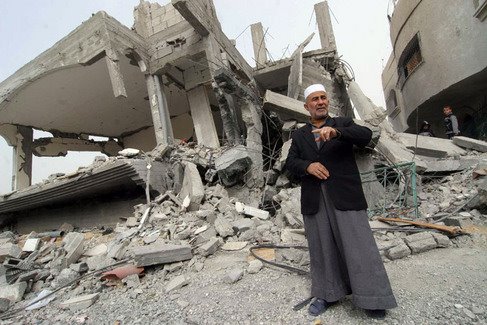
Palestinian peace activist Muhammad Abu Humus was arrested by Israelis in black ski masks for protesting the Gaza killings, while his children hovered in the corner of the room crying.

Fuelling the cycle of hate:

War is teaching the children of Israel and Gaza that the other side is a bloodthirsty monster, and destroying any desire for peace.

By Neve Gordon and Yigal Bronner / January 27, 2009

Israeli soccer matches were suspended during the assault on Gaza. When the games resumed last week, the fans had come up with a new chant: “Why have the schools in Gaza been shut down?” sang the crowd. “Because all the children were gunned down!” came the answer.

Aside from its sheer barbarism, this chant reflects the widespread belief among Israeli Jews that Israel scored an impressive victory in Gaza – a victory measured, not least, by the death toll.

Israeli pilots and tank commanders could not really discriminate between the adults and the children who hid in their homes or huddled in the UNRWA shelters, and yet they chose to press the trigger. Therefore, it is not at all surprising that the lethal onslaught left 1,314 Palestinians dead, of which 412 – or nearly one third of all of the casualties – were children.

This latest assault underscores that Israel, not unlike Hamas, readily resorts to violence and does not distinguish between civilians and combatants (only the weapons at Israel’s disposal are much more lethal). No matter how many times the Israeli government tries to blame Hamas for the latest Palestinian civilian deaths it simply cannot explain away the body count, especially that of the children. In addition to the dead, 1,855 Palestinian children were wounded, and tens of thousands of others have likely been traumatised, many of them for life.

Every child has a story. A Bedouin friend recently called to tell us about his relatives in Gaza. One cousin allowed her five-year-old daughter to walk to the adjacent house to see whether the neighbours had something left to eat. The girl had been crying from hunger. The moment she began crossing the street a missile exploded nearby and the flying shrapnel killed her. The mother has since been bedridden, weeping and screaming, “I have let my girl die hungry”.

As if the bloody incursion was not enough, the Israeli security forces seem to be keen on spreading the flames of hatred among the Arab population within Israel. Hundreds of Palestinian citizens of Israel have been arrested for protesting at the Israeli assault and more than 200 of them are still in custody. One incident is enough to illustrate the psychological effect these arrests will likely have on hundreds more children.

A few days after the ceasefire, several men wearing black ski masks stormed the home of Muhammad Abu Humus. They came to arrest him for protesting against the killings in Gaza. It was four in the morning and the whole family was asleep when the men banged on the door. After entering the house, they made Abu Humus’s wife Wafa and their four children Erfat (12), Shahd (9), Anas (6) and Majd (3) stand in a corner as they searched the house, throwing all the clothes, sheets, toys, and kitchenware on the floor. With tears in their eyes, the children watched as the armed men then took their father away and left.

Chance would have it that Abu Humus, a long-time peace activist and member of the Fatah party, is a personal friend of ours. In 2001, he joined Ta’ayush Arab-Jewish Partnership, and since then has selflessly organised countless peace rallies and other joint activities. During the past eight years, we have spent many hours at each other’s homes and our children have grown up respecting and liking one other. It is hard to believe that just one month ago he attended the Bar Mitzvah of Yigal’s son in a Jerusalem synagogue.

Muhammad and Wafa Abu Humus have tried over the years to instil in their children a love and desire for peace, and while the security forces may not have destroyed this, the hatred they have generated in one night cannot be underestimated. Indeed, what, one might ask, will his children think of their Jewish neighbours? What feelings will they harbour? And what can we expect from those children in Gaza who have witnessed the killing of their parents, siblings, friends and neighbours?

We emphasise the Palestinian children because so many of them have been killed and terrorised in the past month. Yet it is clear that Israeli children are suffering as well, particularly those who have spent long periods in shelters for fear of being hit by rockets.

The one message that is being conveyed to children on both sides of this fray is that the other side is a bloodthirsty monster. In Israel, this was instantly translated into gains for the hate-mongering Yisrael Beytenu party headed by the xenophobic Avigdor Lieberman, who is now the frontrunner in mock polls being held in many Jewish high schools, with the hawkish Binyamin Netanyahu coming in second.

Hatred, in other words, is the great winner of this war. It has helped mobilise racist mobs, and as the soccer chant indicates it has left absolutely no place for the other, undermining even basic empathy for innocent children. Israel’s masters of war must be happy: the seeds of the next wars have certainly been sown.

Source / Guardian, UK

Thanks to David Hamilton / The Rag Blog

Posted in RagBlog | Tagged , , , | 1 Comment

Family Values : ‘Living Fossil’ Becomes a Daddy at 111

Big Daddy! The tuatara looks little different from its Jurassic relatives. Photo by Frans Lanting / National Geographic.

After 40 years of celibacy, grumpy centenarian reptile finally gets frisky.
January 26, 2009

A rare New Zealand reptile has become a father, possibly for the first time, at the age of 111.

The keepers of Henry, a tuatara, had thought he was past his prime – especially after showing no interest in females during 40 years in captivity.

But he mated with 80-year-old Mildred last July and 11 of the eggs she produced have now hatched.

Henry’s keepers have put his newfound vigour down to a recent operation to remove a tumour from his bottom.

‘Love story’

Henry arrived at Southland Museum in the South Island city of Invercargill in 1970 and, his keepers say, soon became overweight and idle.

He was known for his foul temper and had a tendency to attack other tuatara – forcing the museum to keep him in solitary confinement for many years.

But since his operation, Museum tuatara curator Lindsay Hazley said he had had a “major personality transplant.”

“I have done lots of eggs before but these are just special because they are Henry’s,” Mr Hazley told the Southland Times.

Tuatara, which are found only in New Zealand, are sometimes referred to as “living fossils.”

They are the only surviving members of a family of species which walked the Earth with the dinosaurs more than 200 million years ago.

The museum now has about 70 of the rare creatures, and Mr Hazley is hopeful that Henry might provide more offspring in the future.

He lives with three female tuatara “in great harmony,” said Mr Hazley, and described the hatching of the eggs as “the completion of a love story.”

Source / BBC News

Thanks to Dian Donnell / The Rag Blog

Posted in RagBlog | Tagged , | 4 Comments

Candelmas Seasonal Message


Candelmas Seasonal Message
By Kate Braun / The Rag Blog / January 26, 2009

“Like a candle burning through time…”

Monday, February 2, 2009 is Candlemas, also known as Imbolc, Feast of Lights, Bridgit’s Day, and Groundhog Day. Lady Moon shifts from her first quarter to her second, Lord Sun enjoys his growing power. This is a fire festival; the use of light mimics and encourages Lord Sun’s revival. It is a time to focus on warmth, even in the midst of ice and snow. As with Groundhog Day, there are weather forecasts associated with this day:

“If Candlemas Day be fair and bright, Winter will have another flight;
If on Candlemas Day be shower and rain, Winter is gone and will not come again.”

For gardeners in the Austin/Central Texas area, this is still a good time to plant lettuce seed. Lettuce prefers cooler temperatures and can take a light frost. Planting lettuce during Lady Moon’s first and second quarters in late January and early February tends to bring good results.

Decorate your table, altar, and person using the colors white, yellow, pink, light green, light blue; red and brown are also useful colors, but as accents to the pastels. Sun wheels, candle wheels, and corn dollies should be incorporated into your decorations. Imbolc means “in the belly” and February is when ewes drop their lambs. Hence, it is good to serve your guests any and all dairy products you like: cheeses, dishes involving sour cream and yogurt, quiche. Spicy foods are also good. as they represent the fiery quality of Lord Sun, so any recipe calling for curry or chili powder is apt. Seeds, peppers, onions, garlic, spiced wines, muffins, and seedcakes can be an important part of the feast, along with poultry, pork, and lamb.

Brigit is the patron saint of Candlemas. She is the patroness of poets and artists, blacksmiths and midwives. She is a fire goddess and a sun goddess and the Candle Wheel may be used to honor her: form or buy a ring of straw or other natural woven material; decorate the wheel with colored ribbons and either 8 or 13 candles. Use the same colors as for your altar and table decorations for Brigit’s Wheel candles and ribbons. The hostess may wear this wheel as a crown, or she may designate a female guest to wear it. Do not light the candles while wearing the wheel! At an appropriate time in your festivities the wheel may be removed and placed in the center of the table on a fire-proof base and then the candles may be lit.

Fire is frequently seen as a purifying medium and Candlemas is a time of purification. Many of the rituals associated with this festival are similar to spring cleaning rituals: vacuum and dust, wash all the windows, polish mirrors and all shiny surfaces. By doing so, you are creating a medium in which Lord Sun may be easily reflected. As light expands itself through reflection it becomes amplified. This promotes growth and encourages Lord Sun to continue to expand. At sundown, lead your guests in a procession throughout your house to bring in the light by shining a flashlight into every drawer, closet, and cabinet. Symbolically, this banishes all darkness from your home and invites brightness and lightness to reside with you.

Expansion this year involves more than Lord Sun. Jupiter moved into Aquarius on January 5, 2009 and stays in this sign all year. Jupiter is the planet of expansion; he carries with him energies of joy, delight, and prosperity. For those who are able to see the possibilities, this year in general and the first quarter of the year in specific holds the potential to be most rewarding, indeed.

Tarot by Kate 512-454-2293
http://www.tarotbykateinaustin.com/
kate_braun2000@yahoo.com

The Rag Blog

Posted in Rag Bloggers | Tagged , | 2 Comments

The Conflicting Imperatives of Science and Law

Ed Abney, of Berea, Ky., has Parkinson’s disease after two decades of working with a solvent. He has had trouble proving a link. Photo: Carla Winn for The New York Times.

Exposed to Solvent, Worker Faces Hurdles
By Felicity Barringer / January 24, 2009

BEREA, Ky. — When the University of Kentucky published new research in 2008 suggesting that exposure to a common industrial solvent might increase the risk for Parkinson’s disease, the moment was a source of satisfaction to Ed Abney, a 53-year-old former tool-and-die worker.

Mr. Abney, now sidelined by Parkinson’s, had spent more than two decades up to his elbows in a drum of the solvent, trichloroethylene, while he cleaned metal piping at a now-shuttered Dresser Industries plant here.

The university study had focused on him and his factory co-workers who worked near the same 55-gallon drum of the vaguely sweet-smelling chemical. It found that 27 workers had either the anxiety, tremors, rigidity or other symptoms associated with Parkinson’s, or had motor skills that were significantly impaired, compared with a healthy peer group. The study, Mr. Abney thought, was the scientific evidence he needed to claim worker’s compensation benefits.

He was wrong. The medical researchers would not sign the form attesting that Mr. Abney’s disease was linked to his work.

Individuals like Mr. Abney are caught between the conflicting imperatives of science and law — and there is a huge gap between what researchers are discovering about environmental contaminants and what they can prove about their impact on disease. The gap has ensured that only a tiny fraction of worker’s compensation payments are received by those who were exposed to harmful substances at work.

“It’s awfully difficult for any doctor or researcher to say to an individual: ‘You have this disease because you were exposed at this time,’ ” said J. Paul Leigh, a professor of public health sciences at the University of California, Davis.

How many people are caught in the same bind as Mr. Abney, “nobody really knows,” said Rafael Metzger, a California lawyer who specializes in cases involving diseases contracted in the workplace.

“Most workers who have an occupational disease don’t think they have an occupational disease,” Mr. Metzger said, adding that “the few who might think it are mostly not successful” in getting compensation “because there isn’t a robust body of literature to support the claim.”

Mr. Abney’s wife, Anita Susan Abney, is frustrated by the high standard of proof required. “If you’re saying in your study, ‘Yes, the dots have been connected,’ you should be able to say it in a court of law,” Ms. Abney said. “You should be able to say it at all levels.” She added, “I don’t blame it on the doctors, but on the strictness of the research.”

Anita Susan Abney watched her husband go through articles and pictures of his medical history. Dr. Don M. Gash, top, one of the researchers figuring in the case, and Dr. John T. Slevin, another. Photo: Carla Winn for The New York Times.

Trichloroethylene was nearly ubiquitous in American industry in the latter part of the 20th century. Production grew from to 321 million pounds in 1991 from 260,000 pounds in 1981, according to the Environmental Protection Agency.

The National Toxicology Program has declared that the solvent, also known as TCE, can “reasonably be anticipated” to be a carcinogen. It is a contaminant in drinking water in some areas of the country and is found in more than half the 1,430 priority Superfund sites listed by the E.P.A.

There was no question in Mr. Abney’s mind what he was working with.

“It was a good cleaner,” he said in an interview, his cane at his side. His wife recalled, “When he came home at night, he would say, ‘The smell is killing me.’ ”

Mrs. Abney sat next to her husband, with the fat files she has accumulated documenting aspects of his case — communications with doctors and with lawyers (all of whom left after the doctors refused to sign the forms).

Some of the paperwork documents the progression of Mr. Abney’s ailment: the day in 1996 when “on my left hand, a finger was twitching” or the day he could not enunciate the lesson to the Sunday school class he was teaching; and then, the day neither his hands nor his voice would perform his morning devotional rituals.

For five years, he received a series of diagnoses, including Lou Gehrig’s disease, amyotrophic lateral sclerosis, or A.L.S. Doctors at the Mayo Clinic in Jacksonville, Fla., correctly diagnosed his condition in 2001.

He left work and now receives federal disability payments of $1,200 a month. He was referred to Drs. Don M. Gash and John T. Slevin and joined a group of Parkinson’s patients involved in the testing of an experimental drug.

Mr. Abney mentioned that some of his co-workers also had neurological problems. Researchers mailed a questionnaire to 134 former Dresser workers; 65 responded.

Three, including Mr. Abney, had full-fledged Parkinson’s. The researchers found that of 27 others, 14 reported they had symptoms of the kind associated with the disease, and 13 others had significant slowing of motor responses or other symptoms of Parkinson’s.

A parallel study showed that feeding the solvent to rats resulted in injured neurons in the same area of the brain whose degeneration causes Parkinson’s in humans.

The conclusion, published in the Annals of Neurology in February 2008: “These results demonstrate a strong potential link between chronic TCE exposure and Parkinsonism.” But when it came to the specifics of Mr. Abney’s case, Dr. Gash said in an interview, “He started working at Dresser over 25 years ago, maybe 28 years ago. Trying to reconstruct what was going on then is just impossible.”

He added, “Certainly, we focused on one aspect of the toxins he was exposed to, but he was exposed to other toxins,” including agricultural pesticides or fumigants used to kill vermin at the plant.

“Was it the trichloroethylene?” Dr. Gash asked. “It could have been. But it could have been other things, too,” including a genetic predisposition to the disease.

Implicating TCE requires ruling out other potential causes, he said — something that could take years.

Which leaves few options for compensation. Dwight Lovan, Kentucky’s commissioner of worker’s compensation, said, “We are dependent on the scientific and medical communities for the element of causality.”

In other circumstances, proof of causality has been eased or waived. For instance, the Veterans Affairs Department in 2001 added Lou Gehrig’s disease to the list of service-related disabilities for Persian Gulf war veterans; in September 2008 it agreed to consider any service member who served for at least 90 days eligible for disability benefits if they later contracted A.L.S.

A crucial element of this decision, according to a veterans affairs official, was that the agency made no link between the onset of A.L.S. and a service member’s experience — whether exposure to the anthrax vaccine or the fires Saddam Hussein set in the oil wells under his control.

Kentucky officials do not have that option. In the workplace, as John Burton, an emeritus professor at the School of Management and Labor Relations at Rutgers University, said, “You still have the underlying requirement to establish that the workplace was the cause.” Because the burden of proof is so high and the relative benefits are so low, lawyers have little financial incentive to take on a case like Mr. Abney’s.

And scientists like Dr. Gash have little enthusiasm for working with lawyers.

E. Donald Elliott, a Yale Law School professor specializing in these cases, said that simply being exposed to a risk in the workplace “should in itself be a compensable injury.”

“You don’t have to prove you got the Parkinson’s because of the exposure,” Professor Elliott said. “From a policy standpoint, does it make sense for the entire burden of uncertainty or unknown science to fall on the injured parties rather than falling on the business or industry involved?”

For Mr. Abney and his wife, the disappointment still rankles. “You read this study and you hear about it and it builds you up,” he said. “And then you get let down. You get to where you just don’t care.”

Source / New York Times

The Rag Blog

Posted in RagBlog | Tagged , , , | 1 Comment

Hirschhorn Asks: ‘Are We Cowardly?’


Learning From Latvia
By Joel S. Hirschhorn / January 26, 2009

When I read a recent article on public protests in Latvia I kept asking myself: Why do strong and sometimes violent public protests in democratic European countries often produce government and policy changes, while Americans feeling anger and disgust with their government keep thinking that only their votes in the next election can deliver desired change?

The lead in The New York Times article was: “Violent protests over political grievances and mounting economic woes shook the Latvian capital, Riga, late Tuesday, leaving around 25 people injured and leading to 106 arrests.” Riots broke out after some 10,000 people gathered in the capital’s main public square. As the Times reported, “Several hundred protesters lingered after most of the crowd had left and started throwing snowballs and cobblestones at government buildings.” Why have Americans not pursued such actions? Do we fear police reactions far more terrible than Europeans do? Are we cowardly? Or have we lost all hope that politicians will take such public protests seriously?

Dealing with an awful economy, just like in the U.S. and elsewhere, the Latvian president acknowledged that public trust in their government had “collapsed catastrophically.” He openly promised major actions to appease the public. Though he denounced the violence, he acknowledged that “we must do the things that are demanded by the public.”

It seemed to me that public opinion polls in the U.S. over many months in 2008 had documented that Americans had also reached the same point, with positive ratings for Congress and president at historic low levels.

Yet, while Latvians immediately heard about capitulations from their government, Americans heard nothing but lame defenses from theirs, and they poured their money into campaign contributions and bubbled with enthusiasm because they believed the campaign promises of Barack Obama (and to a far lesser extent John McCain) and the congressional candidates for whom they voted. How strange that in the country that was formed through violent rebellion, citizens have shown no taste whatsoever for the kind of violent public protests seen repeatedly in countries like France, Greece, and other European nations.

A likely explanation is that the parliamentary systems in Europe have far more ability to be responsive to public anger, while Americans have been conditioned to believe that only through the next election can they expect new government policies. Indeed, a main reaction of the Latvian president was to talk about dissolving parliament and even supporting a constitutional amendment to give citizens the right to dissolve parliament.

Here in the U.S., citizens have few opportunities for direct democracy. In a few states voters can recall governors. In many places voters can use ballot measures and initiatives to make laws or amend state constitutions. But by and large Americans have become docile, obedient victims of a two-party plutocracy that can obviously flush the country into the toilet through corruption of public officials and no effective government control of the private sector in the public interest. If there was ever a time in American history when there was maximum justification for violent rebellion against the federal government it was during the presidency of George W. Bush. Yet despite an unjust war that drained the economy of its money and killed thousands of its citizen, and despite a Congress that failed to impeach what surely was an evil and incompetent executive branch, and despite obvious violations of our Constitution, and despite public policies that promoted economic inequality and created a path to economic disaster — despite all this and more — Americans showed no signs whatsoever of rising up in open rebellion.

No — instead, millions of Americans gave their hard-earned dollars to political campaigns and kept believing all the political rhetoric telling them that by voting they could get “change.” So, I keep asking myself: Why do Europeans seem a whole lot smarter and cynical? Why do they still believe — as the early revolutionaries in colonial America believed — that by openly and violently rebelling in the streets they can obtain better government?

Where is the American rebellion I and other true patriotic dissidents have been waiting for? If not during the worst presidency in American history, during totally inept congressional behavior, including plunging the nation into amazing debt, and during the worst economic collapse since the Great Depression, then when? True, we have stable government. But have we paid far too great a price for stability, because all we have is a delusional democracy that gave us delusional prosperity?

Americans have something important to learn from Latvians.

[Joel S. Hirschhorn was formerly a full professor at the University of Wisconsin, Madison, and senior staffer at the Congressional Office of Technology Assessment and the National Governors Association. He now writes about politics and government, and is the author of Delusional Democracy: Fixing the Republic Without Overthrowing the Government and Sprawl Kills: How Blandburbs Steal Your Time, Health And Money.]

Source / Swans Commentary

The Rag Blog

Posted in RagBlog | Tagged , , | Leave a comment

Dr.Stephen R. Keister : The Doctor and the Body Politic

The Doctor by Luke Fildes.

I, as an elderly retired physician, idealize what is shown in the painting by Luke Fildes’ ‘The Doctor,’ and look upon the word ‘physician’ in the Greek derivation, i.e. ‘healer.’ I think of Hippocrates, Maimonides and Sir William Osler. I envision the practice of medicine as I knew it for 40 years, 1950-1990.

By Dr. Stephen R. Keister / The Rag Blog / January 26, 2009

This morning I came across a release from “Unions for Single Payer HR676” entitled “Who Does Senator Baucus Listen To?” In brief it notes that Senator Max Baucus, Chairman of the Senate Finance Committee, has said in writing that in his new healthcare legislation “everything is on the table” — “except single payer.” Of course, as I have noted in prior Rag Blog articles, I have all along suspected that Sen. Baucus was in the pocket of the private insurance industry. Go to http://www.opensecrets.org/.

With the millions of dollars being handed to our elected representatives by the insurance/PhArma complex one anticipates that many will oppose HR676 or merely passively sit out the debate. The recent hostility to the American citizen demonstrated by the Republican minority in the House and Senate concerning economic recovery, or confirmation of the Obama designates for Secretary of Labor or Attorney Genera, gives one the feeling that the monied interests will continue to defend the privileges of the wealthy establishment. There is a long way to go, and I am not assured that the proponents of single payer care are on the same page.

I, as an elderly retired physician and a proponent of HR 676, may indeed have a different idea of what to expect. I idealize what is shown in the painting by Luke Fildes’ “The Doctor,” and look upon the word “physician” in the Greek derivation, i.e. “healer.” I think of Hippocrates, Maimonides and Sir William Osler. I envision the practice of medicine as I knew it for 40 years, 1950-1990, when we spent an hour on the first visit with the patient, in discussion and examination, and I as a rheumatologist, was 90% sure of the diagnosis, whether it be lupus, rheumatoid arthritis, or scleroderma after that initial encounter. Thereafter we provided the patient with information on causes, outlook and treatment. Testing was limited to 10% for confirmation or guidance in therapeutic management. After that follow up visits involved an interaction between two interested human beings. Currently, I find that a first visit consists of filling out a 4-6 page questionnaire, an encounter with a physician’s assistant, a brief discussion with the “doctor” and a final answering of questions by a nurse assistant who also sets up the next appointment.

The February, 2009, issue of Harper’s Magazine has an excellent scholarly article by Luke Mitchell, “Why America won’t get the health care system it needs.” HR 676 is briefly mentioned, but not discussed. It is pointed out that in 2006 Americans spent $2.1 trillion on health care at $7,026 per person, far more than any other nation, and that 20,000 Americans die prematurely because of lack of access. Mention is made that 30,000 Medicare recipients die each year of overtreatment. Much of the article has to do with technology.

Another excellent article, by Atul Gewande, appears in the Jan. 26 New Yorker: “Getting There From Here. How Should Obama Reform Health Care.” Well researched, well presented, but no mention of HR 676. It surely seems that we who are proponents of single payer, universal care, are not only mightily opposed but we are not on the same page.

I was interested to note in Roll Call, Jan. 1, 2009, that Representative John Dingle had introduced a program for national health insurance, and for other purposes, HR 15. Reviewing the summary of the proposition it appears disjointed, under researched, almost sad to read. One wonders why Rep. Dingle has not joined Rep. Conyers in sponsoring HR 676, a bill that rests on over 20 years of research into universal health care by Physicians for a National Health Program. In addition, .Politico on Jan. 21, 2009, sets forth a proposition by Sen. Bernie Sanders and Rep. Jim Clyburn, suggesting local health centers as a key to care.

There is encouragement in a Jan. 15, 2009 news release by the Harvard School of Public Health indicating that health care is among the public’s top priorities for economic stimulus. Americans rank helping the newly unemployed afford health insurance coverage second (picked by 33% as top priority) behind helping businesses keep or create jobs (45%). The public is split about evenly between those willing to pay higher taxes for universal care. The Democrats (59%) are willing to pay more but most Republicans are not (67%). This report was released by the Kaiser Family Foundation and is worth perusing in detail.

Of peripheral interest is a report in the New York Times, Jan. 22, 2009, that reports that the Peoples Republic of China, a nation recently transitioned from Communism to Free Market Capitalism, is now going to spend $123 billion by 2011 to establish universal health care for its 1.3 billion people. It seems, that at least abroad, first Europe, then Canada, Japan, Australia — the world at large save for the United States — favors universal health care. Only here does the greed of the insurance and pharmaceutical industries hold sway. An article by William Pfaff in The Commonweal, Oct. 10, 2008, entitled “Original Sin & Free Market Capitalism,” may help us to better understand this problem.

Finally, to understand the role of the physician in the current dilemma, see a book review in the Dec. 8, 2008 New Republic entitled “Really Doctor,” a review of a book by Jonathan B. Imber entitled “Trusting Doctors; The Decline of Moral Authority in American Medicine.” One of the closing paragraphs deserves repeating:

“For more than 2000 years that interaction (ie moral authority), and its setting of medical morality, was the primary basis of the trust and the authority placed in the members of the medical profession and the profession as a whole by those who depend on them for healing. Now thee uniqueness and intimacy of the interaction has been allowed to fray. THAT is the moral crises. It behooves the profession and the laity to recognize its gravity and to seek measures to restore as much of the old relationship between patient and physician as is reparable.”

However, let us hope that some of our elected representatives can rise above the temptations of the bribes offered by the insurance and pharmaceutical lobbyists and surprise the public with some positive moves. What should we ask for in addition to the passing of HR 676?

1. Increase the supply of family physicians through government-subsidized qualified medical school candidates working in a University affiliated doctoral program, provided with a qualified faculty, and teaching in a university hospital. One should beware of unaffiliated “medical colleges” without an extensive academic back up, as these represent little more than medical trade schools. And, as I have previously suggested in a Rag Blog essay, the founding of a “Health Academy” to train physicians in the manner of Annapolis or West Point, and to require graduates, in either instance, to devote at least five years to underserved areas.

2. Reasonable control of the pharmaceutical industry, banning all advertising (notably on TV) except in professional journals. As noted earlier marketing absorbs 40% of the industry budget as opposed to 20% for research. This, with cost control on executive salaries and bonuses, as well as negotiated pricing, should hopefully reduce the costs to the consumer to a level paid in other western nations.

3. Reduction of hospital costs by banning unneeded advertising for non-profit hospitals. For instance, we in Erie, Pa. have a first-rate, university affiliated cancer center. Yet on TV, four and five times an evening, appears an ad for a cancer center in a neighboring city.

4. Careful professional evaluation of end of life care by a combined panel of physicians and medical ethics experts. Medicare’s financial outlay is disproportionately used to subsidize end of life care at the expense of its other functions. Unneeded costly procedures should be evaluated in the context of available humane Hospice Care.

5. The elimination of “Medicare Advantage Plans,” a Bush handoff to the insurance companies that are depleting a rapidly sinking Medicare Fund. To cover deductibles and co-payments, a program of supplementary insurance, individually purchased, from a public, non-profit insurance agency, or as an alternative, as in France, to private carriers, with cost controls written in.

6. Review of the quality of nursing homes, and assisted living facilities, with additional review of the profits and executive salaries should these be corporate entities.

7. The limitation of public advertising of medical devices (TV especially) as advertising costs no doubt add to the costs of medicare.

8. Repeal of the Bush directives depriving the public of care, (example: the “morning after” pill) permitting health care workers to refuse to fill prescriptions because of their personal religious affiliations.

9. Repeal the absurd “Medicare Prescription Plan,” and enact a reasonable alternative, without massive subsidies to the pharmaceutical and insurance industries. A plan that benefits the consumer and not the corporations.

10. A national law guaranteeing sick leave. The United States is one of a handful of nations without one. At least 145 nations provide such a right. At the same time guarantee paid maternity leave, as the USA is only one of five countries that do not guarantee same. The others are in Africa!

We can hope that, IF we can prevail on our elected representatives to pass universal, single payer health care, the public will again be able, in due time, to have an attending personal physician with whom they can establish rapport, as opposed to a (frequently off- hand) “provider” designated by the insurance industry — the industry that dominates, and obscenely profits from, the care generally available today. One may make an exception for those signed up for “boutique care,” available in some areas. We should remember that having a lot of “testing” done on you or your family may be a cop-out for the physician, so that he can see more patients in a limited period and still have time for his phone calls to the insurance carrier overseeing your care and directing your doctor. Medical care is not pure science; it was once based on mutual respect and caring. Better, in one’s last hours, to have on hand a caring physician than all the darned respirators and monitors that we have become used to.

[Dr. Keister’s previous contributions to The Rag Blog can be found here.]

The Rag Blog

Posted in Rag Bloggers | Tagged , , , | 1 Comment

Austin : Ragblogapalooza!

If you’re in the neighborhood…

Click on image to enlarge.

The Rag Blog

Posted in RagBlog | Tagged , , | 1 Comment

Chomsky on Obama: ‘The Carefully Framed Deceit Is Instructive’


Obama on Israel-Palestine
By Noam Chomsky / January 26, 2009

Barack Obama is recognized to be a person of acute intelligence, a legal scholar, careful with his choice of words. He deserves to be taken seriously – both what he says, and what he omits. Particularly significant is his first substantive statement on foreign affairs, on January 22, at the State Department, when introducing George Mitchell to serve as his special envoy for Middle East peace.

Mitchell is to focus his attention on the Israel-Palestine problem, in the wake of the recent US-Israeli invasion of Gaza. During the murderous assault, Obama remained silent apart from a few platitudes, because, he said, there is only one president – a fact that did not silence him on many other issues. His campaign did, however, repeat his statement that “if missiles were falling where my two daughters sleep, I would do everything in order to stop that.” He was referring to Israeli children, not the hundreds of Palestinian children being butchered by US arms, about whom he could not speak, because there was only one president.

On January 22, however, the one president was Barack Obama, so he could speak freely about these matters – avoiding, however, the attack on Gaza, which had, conveniently, been called off just before the inauguration.

Obama’s talk emphasized his commitment to a peaceful settlement. He left its contours vague, apart from one specific proposal: “the Arab peace initiative,” Obama said, “contains constructive elements that could help advance these efforts. Now is the time for Arab states to act on the initiative’s promise by supporting the Palestinian government under President Abbas and Prime Minister Fayyad, taking steps towards normalizing relations with Israel, and by standing up to extremism that threatens us all.”

Obama is not directly falsifying the Arab League proposal, but the carefully framed deceit is instructive.

The Arab League peace proposal does indeed call for normalization of relations with Israel – in the context – repeat, in the context of a two-state settlement in terms of the longstanding international consensus, which the US and Israel have blocked for over 30 years, in international isolation, and still do. The core of the Arab League proposal, as Obama and his Mideast advisers know very well, is its call for a peaceful political settlement in these terms, which are well-known, and recognized to be the only basis for the peaceful settlement to which Obama professes to be committed. The omission of that crucial fact can hardly be accidental, and signals clearly that Obama envisions no departure from US rejectionism. His call for the Arab states to act on a corollary to their proposal, while the US ignores even the existence of its central content, which is the precondition for the corollary, surpasses cynicism.

The most significant acts to undermine a peaceful settlement are the daily US-backed actions in the occupied territories, all recognized to be criminal: taking over valuable land and resources and constructing what the leading architect of the plan, Ariel Sharon, called “Bantustans” for Palestinians – an unfair comparison because the Bantustans were far more viable than the fragments left to Palestinians under Sharon’s conception, now being realized. But the US and Israel even continue to oppose a political settlement in words, most recently in December 2008, when the US and Israel (and a few Pacific islands) voted against a UN resolution supporting “the right of the Palestinian people to self-determination” (passed 173 to 5, US-Israel opposed, with evasive pretexts).

Obama had not one word to say about the settlement and infrastructure developments in the West Bank, and the complex measures to control Palestinian existence, designed to undermine the prospects for a peaceful two-state settlement. His silence is a grim refutation of his oratorical flourishes about how “I will sustain an active commitment to seek two states living side by side in peace and security.”

Also unmentioned is Israel’s use of US arms in Gaza, in violation not only of international but also US law. Or Washington’s shipment of new arms to Israel right at the peak of the US-Israeli attack, surely not unknown to Obama’s Middle East advisers.

Obama was firm, however, that smuggling of arms to Gaza must be stopped. He endorses the agreement of Condoleeza Rice and Israeli foreign minister Tzipi Livni that the Egyptian-Gaza border must be closed – a remarkable exercise of imperial arrogance, as the Financial Times observed: “as they stood in Washington congratulating each other, both officials seemed oblivious to the fact that they were making a deal about an illegal trade on someone else’s border – Egypt in this case. The next day, an Egyptian official described the memorandum as `fictional’.” Egypt’s objections were ignored.

Returning to Obama’s reference to the “constructive” Arab League proposal, as the wording indicates, Obama persists in restricting support to the defeated party in the January 2006 election, the only free election in the Arab world, to which the US and Israel reacted, instantly and overtly, by severely punishing Palestinians for opposing the will of the masters. A minor technicality is that Abbas’s term ran out on January 9, and that Fayyad was appointed without confirmation by the Palestinian parliament (many of them kidnapped and in Israeli prisons). Ha’aretz describes Fayyad as “a strange bird in Palestinian politics. On the one hand, he is the Palestinian politician most esteemed by Israel and the West. However, on the other hand, he has no electoral power whatsoever in Gaza or the West Bank.” The report also notes Fayyad’s “close relationship with the Israeli establishment,” notably his friendship with Sharon’s extremist adviser Dov Weiglass. Though lacking popular support, he is regarded as competent and honest, not the norm in the US-backed political sectors.

Obama’s insistence that only Abbas and Fayyad exist conforms to the consistent Western contempt for democracy unless it is under control.

Obama provided the usual reasons for ignoring the elected government led by Hamas. “To be a genuine party to peace,” Obama declared, “the quartet [US, EU, Russia, UN] has made it clear that Hamas must meet clear conditions: recognize Israel’s right to exist; renounce violence; and abide by past agreements.” Unmentioned, also as usual, is the inconvenient fact that the US and Israel firmly reject all three conditions. In international isolation, they bar a two-state settlement including a Palestinian state; they of course do not renounce violence; and they reject the quartet’s central proposal, the “road map.” Israel formally accepted it, but with 14 reservations that effectively eliminate its contents (tacitly backed by the US). It is the great merit of Jimmy Carter’s Palestine: Peace not Apartheid, to have brought these facts to public attention for the first time – and in the mainstream, the only time.

It follows, by elementary reasoning, that neither the US nor Israel is a “genuine party to peace.” But that cannot be. It is not even a phrase in the English language.

It is perhaps unfair to criticize Obama for this further exercise of cynicism, because it is close to universal, unlike his scrupulous evisceration of the core component of the Arab League proposal, which is his own novel contribution.

Also near universal are the standard references to Hamas: a terrorist organization, dedicated to the destruction of Israel (or maybe all Jews). Omitted are the inconvenient facts that the US-Israel are not only dedicated to the destruction of any viable Palestinian state, but are steadily implementing those policies. Or that unlike the two rejectionist states, Hamas has called for a two-state settlement in terms of the international consensus: publicly, repeatedly, explicitly.

Obama began his remarks by saying: “Let me be clear: America is committed to Israel’s security. And we will always support Israel’s right to defend itself against legitimate threats.”

There was nothing about the right of Palestinians to defend themselves against far more extreme threats, such as those occurring daily, with US support, in the occupied territories. But that again is the norm.

Also normal is the enunciation of the principle that Israel has the right to defend itself. That is correct, but vacuous: so does everyone. But in the context the cliche is worse than vacuous: it is more cynical deceit.

The issue is not whether Israel has the right to defend itself, like everyone else, but whether it has the right to do so by force. No one, including Obama, believes that states enjoy a general right to defend themselves by force: it is first necessary to demonstrate that there are no peaceful alternatives that can be tried. In this case, there surely are.

A narrow alternative would be for Israel to abide by a cease-fire, for example, the cease-fire proposed by Hamas political leader Khaled Mishal a few days before Israel launched its attack on December 27. Mishal called for restoring the 2005 agreement. That agreement called for an end to violence and uninterrupted opening of the borders, along with an Israeli guarantee that goods and people could move freely between the two parts of occupied Palestine, the West Bank and the Gaza Strip. The agreement was rejected by the US and Israel a few months later, after the free election of January 2006 turned out “the wrong way.” There are many other highly relevant cases.

The broader and more significant alternative would be for the US and Israel to abandon their extreme rejectionism, and join the rest of the world – including the Arab states and Hamas – in supporting a two-state settlement in accord with the international consensus. It should be noted that in the past 30 years there has been one departure from US-Israeli rejectionism: the negotiations at Taba in January 2001, which appeared to be close to a peaceful resolution when Israel prematurely called them off. It would not, then, be outlandish for Obama to agree to join the world, even within the framework of US policy, if he were interested in doing so.

In short, Obama’s forceful reiteration of Israel’s right to defend itself is another exercise of cynical deceit – though, it must be admitted, not unique to him, but virtually universal.

The deceit is particularly striking in this case because the occasion was the appointment of Mitchell as special envoy. Mitchell’s primary achievement was his leading role in the peaceful settlement in northern Ireland. It called for an end to IRA terror and British violence. Implicit is the recognition that while Britain had the right to defend itself from terror, it had no right to do so by force, because there was a peaceful alternative: recognition of the legitimate grievances of the Irish Catholic community that were the roots of IRA terror. When Britain adopted that sensible course, the terror ended. The implications for Mitchell’s mission with regard to Israel-Palestine are so obvious that they need not be spelled out. And omission of them is, again, a striking indication of the commitment of the Obama administration to traditional US rejectionism and opposition to peace, except on its extremist terms.

Obama also praised Jordan for its “constructive role in training Palestinian security forces and nurturing its relations with Israel” – which contrasts strikingly with US-Israeli refusal to deal with the freely elected government of Palestine, while savagely punishing Palestinians for electing it with pretexts which, as noted, do not withstand a moment’s scrutiny. It is true that Jordan joined the US in arming and training Palestinian security forces, so that they could violently suppress any manifestation of support for the miserable victims of US-Israeli assault in Gaza, also arresting supporters of Hamas and the prominent journalist Khaled Amayreh, while organizing their own demonstrations in support of Abbas and Fatah, in which most participants “were civil servants and school children who were instructed by the PA to attend the rally,” according to the Jerusalem Post. Our kind of democracy.

Obama made one further substantive comment: “As part of a lasting cease-fire, Gaza’s border crossings should be open to allow the flow of aid and commerce, with an appropriate monitoring regime…” He did not, of course, mention that the US-Israel had rejected much the same agreement after the January 2006 election, and that Israel had never observed similar subsequent agreements on borders.

Also missing is any reaction to Israel’s announcement that it rejected the cease-fire agreement, so that the prospects for it to be “lasting” are not auspicious. As reported at once in the press, “Israeli Cabinet Minister Binyamin Ben-Eliezer, who takes part in security deliberations, told Army Radio on Thursday that Israel wouldn’t let border crossings with Gaza reopen without a deal to free [Gilad] Schalit” (AP, Jan 22); ‘Israel to keep Gaza crossings closed…An official said the government planned to use the issue to bargain for the release of Gilad Shalit, the Israeli soldier held by the Islamist group since 2006 (Financial Times, Jan. 23); “Earlier this week, Israeli Foreign Minister Tzipi Livni said that progress on Corporal Shalit’s release would be a precondition to opening up the border crossings that have been mostly closed since Hamas wrested control of Gaza from the West Bank-based Palestinian Authority in 2007” (Christian Science Monitor, Jan. 23); “an Israeli official said there would be tough conditions for any lifting of the blockade, which he linked with the release of Gilad Shalit” (FT, Jan. 23); among many others.

Shalit’s capture is a prominent issue in the West, another indication of Hamas’s criminality. Whatever one thinks about it, it is uncontroversial that capture of a soldier of an attacking army is far less of a crime than kidnapping of civilians, exactly what Israeli forces did the day before the capture of Shalit, invading Gaza city and kidnapping two brothers, then spiriting them across the border where they disappeared into Israel’s prison complex. Unlike the much lesser case of Shalit, that crime was virtually unreported and has been forgotten, along with Israel’s regular practice for decades of kidnapping civilians in Lebanon and on the high seas and dispatching them to Israeli prisons, often held for many years as hostages. But the capture of Shalit bars a cease-fire.

Obama’s State Department talk about the Middle East continued with “the deteriorating situation in Afghanistan and Pakistan… the central front in our enduring struggle against terrorism and extremism.” A few hours later, US planes attacked a remote village in Afghanistan, intending to kill a Taliban commander. “Village elders, though, told provincial officials there were no Taliban in the area, which they described as a hamlet populated mainly by shepherds. Women and children were among the 22 dead, they said, according to Hamididan Abdul Rahmzai, the head of the provincial council” (LA Times, Jan. 24).

Afghan president Karzai’s first message to Obama after he was elected in November was a plea to end the bombing of Afghan civilians, reiterated a few hours before Obama was sworn in. This was considered as significant as Karzai’s call for a timetable for departure of US and other foreign forces. The rich and powerful have their “responsibilities.” Among them, the New York Times reported, is to “provide security” in southern Afghanistan, where “the insurgency is homegrown and self-sustaining.” All familiar. From Pravda in the 1980s, for example.

Source / Z-Net

The Rag Blog

Posted in RagBlog | Tagged , , , | 5 Comments

Fixing the Economy : A Comprehensive Plan from Progressive Economists

We deny that there is any conflict between the need to get the economy moving again by creating jobs, and the long term goals of green technologies, national health insurance, and a fairer distribution of income. In fact, higher wages permit households to spend on goods without going more deeply into debt.

By Michael Meeropol / The Rag Blog / January 25, 2009

See the report, ‘Principles for Economic Recovery and Financial Reconstruction from Progressive Economists,’ Below.

In early January, I joined with other like-minded economists in putting together “A Progressive Program for Economic Recovery and Financial Reconstruction”. A short version was submitted to the Obama Transition team. It is published below, and is available on the web site of the Political Economy Research Institute.

The crucial element in our proposal is to oppose short term “fixes” to, in effect, hit a RESET button on a well-functioning economic machine. Instead we call for policies that allow people to stay in their homes – even if mortgage holders take a bath in the process; that help workers raise wages (rather than, for example, solving Detroit’s problems by forcing the UAW to take pay cuts); that fully regulate the financial sector so it becomes a source of credit, rather than a series of Ponzi schemes to make money seemingly out of thin air.

We deny that there is any conflict between the need to get the economy moving again by creating jobs, and the long term goals of green technologies, national health insurance, and a fairer distribution of income. In fact, higher wages permit households to spend on goods without going more deeply into debt. Investment in technologies that will help free us from fossil fuel dependency would have significantly greater employment impact than tax cuts. Spending significant sums of money now to start the process of universalizing health insurance availability will pay off in the near future by freeing American business from the crushing burden of high premium costs for workers.

This is one example. Imagine if the Obama Administration were to borrow whatever billions it took to re-tool medical information infrastructure so that all records were electronic and available to any health-care professional at the click of a mouse. Storage and duplicating costs would fall dramatically. In the first year, there would be a big increase in spending, but over time, the investment would pay off.

Some might ask, how can we afford this, when the government is already running a $1 trillion deficit? The answer is this: when private investment is falling because business has lost confidence; when consumers are cutting back spending because they cannot get credit and they’re worried about the future; when foreigners are not buying as many American goods as they did last year because their economies are in recession, government borrowing is not only possible, it is ESSENTIAL.

During World War II, the US got out of the Great Depression and the deficit reached 30% of GDP in 1943. Spending an extra $600 billion per year for the next few years (as of mid-December the Obama team was projecting about $850 b. over two years – significantly less than I believe will be necessary) would raise the deficit to only 7% of GDP.

In reality, the size of the deficit is not a problem in the context of low spending from the private sector. The important thing is for the spending to be useful so that when the economy does recover, there will be important changes in place: a national health insurance system that is saving money by controlling costs, new green technologies that are reducing our dependence on expensive fossil fuels, and significantly improved infrastructure – especially in transportation. That would be change we can all believe in!

Principles for Economic Recovery and Financial Reconstruction from Progressive Economists

December 22, 2008

Prologue

The global economic crisis is rapidly worsening, while the incoming Obama administration is intensively developing plans to ward off economic catastrophe. In this atmosphere of hope and tremendous uncertainty, a group of progressive economists met on November 21, 2008 at the New School for Social Research in New York for a discussion, sponsored by the Political Economy Research Institute and the New School’s Schwartz Center for Economic Policy Analysis, with financial support from the Ford Foundation. The goal of the meeting was to develop macroeconomic and financial policies for economic revival that can solve the short term crisis and help put the economy on a sustainable path toward widely shared prosperity. The statement of principles below evolved from that discussion.

Statement

As of December 2008, the United States and the entire world face the prospect of an economic disaster unseen since the Great Depression. Swift and coordinated action by the Obama admin-istration, other national governments and international financial institutions can stave off these crises if the action is boldly directed at serving the needs of people and communities, rather than protecting the failed institutions and practices of the past that helped create the crisis.

So far, the Bush Administration and Congress has spent over $1 trillion to protect bank and credit solvency, with the hope that these funds would trickle down to the rest of the economy. This represents an attempt to “hit the re-start button” and restore the economic trajectory before the crisis hit. But this policy has failed, as major financial institutions have hoarded much of the cash and used the funds to continue their decades-long policies of taking-over other banks and paying lavish salaries.

The Obama administration has signaled a desire to take swift action, and to do “whatever it takes” to restore economic health. We support many of these policies. But to succeed, Obama’s program must promote a fundamental reversal of direction and reject financial bail-out policies. Instead, the prosperity of families and transition to a green economy should be front and center. The full set of economic policies should aim to reverse trends toward stagnating wages, extreme inequality and growing insecurity, and move our economy away from the debt-driven spending booms that have characterized the past decades. Only then will the U.S. achieve sustainable and widely-shared growth.

We reject the notion that President-elect Obama and his administration put on hold its plans to reform health insurance, reduce U.S. dependence on fossil fuels, raise the minimum wage and facilitate the ability of workers to organize into unions. While as economists we understand that there are often important trade-offs in economic affairs, we believe that embedding these longer term goals into policies for short-term economic recovery will not only make it more likely that the longer run goals will succeed, but will also greatly enhance the effectiveness of efforts for short term recovery. Plans for bailout or reconstruction that leave out most of the population are neither good economics nor sensible politics.

Many examples illustrate this point. Raising the minimum wage allows more households to spend on goods without going into more debt; investments away from fossil-fuel dependent technolo-gies have greater employment impacts than other types of macroeconomic policies, such as tax cuts; dramatically reducing health care costs will go a substantial way to helping to make U.S. car companies and other American businesses more competitive and allow them to both weather the current storms and achieve competitiveness over the longer term.

Not only will delaying needed economic transformation make the recovery program less effect-tive, it will undermine the possibilities for required transformations themselves. The costs of the economic recovery program will be large. Eventually, the government will have to moderate its spending on these programs relative to the size of the economy. If the initial money has not been spent on green investments, creating decent jobs, providing a social safety net for children and families, and investing in needed infrastructure, then budget demands might require that the money will never be so spent. For these reasons, it is necessary that the key investments and institutional changes be part of the recovery and reconstruction program from its inception.

Economic policy must aim to:

  • End the downward global economic spiral and promote economic recovery by a massive, sustained and targeted spending program at home to create jobs.
  • Assure that jobs created by the economic recovery package are good quality jobs that pay livable wages so workers can support their families and provide paid time off so that workers can care for themselves and family members.
  • Strengthen automatic stabilizers such as unemployment insurance and transitional assistance to those losing jobs.
  • Keep people in their homes by establishing a moratorium on foreclosures, consider allowing families to rent their homes rather than face foreclosure, and by directing existing institutions or create new institutions such as a Home Ownership Loan Corporation to restructure mortgages.
  • Provide financing to state and local governments so they can maintain employment and continue to provide basic services central to the well-being of families such as education, police and fire protection and the maintenance of local infrastructure.
  • Create jobs by investing in the transition to a green economy.
  • Create universal health insurance available to help families prosper and businesses restore competitiveness.
  • Provide a basic standard of living for all children.
  • Use government powers and leverage to create a stable and efficient financial system that provides for the needs of people, communities and businesses, rather than a safe harbor for gambling, fraud and abuse that enrich a few while destroying the economy.
  • Restore income, economic power and security to the vast majority of people (the bottom 80%) who have fared so poorly under decades of unjust and inefficient economic prac-tices and policies, including supporting the passage of the Employee Free Choice Act.
  • Re-build the nation’s infrastructure with a large public works program.
  • Promote economic cooperation, coordinated global expansion and aid to the poor countries who will suffer most from this crisis and whose prosperity can help restore long-run health to the global economy.

Managing the Financial Sector: Reforming the Bail-out process and Re-orienting Financial Regulation

The government must use this moment and the levers of regulation and control that govern-ments are accumulating at high social costs to restructure finance so that it serves the needs of society and the real economy. Re-privatization of financial institutions taken over by the government (such as Fannie Mae and Freddie Mac) must not be the default option. Retaining government stakes and exerting more government control in financial corporations may be the best option for insuring that financial firms operate in the best interests of the society.

Global Coordination and Reform of International Financial Institutions

The arrangement where the U.S. serves as the buyer of last resort and the rest of the world serves as the dollar accumulator of first resort cannot any longer be the basis for the long-run trajectory of the global economy. During the economic crisis, implementing a recovery program in the U.S. in which the current account deficit remains large or even grows, will be necessary (though the program can only succeed, as we have argued, with coordinated global fiscal stimulus measures.) But in the long-term, it is neither feasible nor desirable for the rest of the world or the U.S. to continue playing these roles.

This means that:

  • The surplus countries of China, Japan and Germany must play a bigger role as provider of global aggregate demand.
  • The IMF, World Bank and global approach to developing countries must fundamentally shift away from the high conditionality, export-led, free capital mobility approach embod-ied in the neoliberal philosophy, and towards an approach that gives developing coun-tries more policy space, and more resources to bolster domestic demand and capacity.
  • The Obama administration and other partners must initiate in the medium term a dialogue to implement a major reform of global institutions and practices to deal with these changing realities.

Establish Hearings on Causes of the Current Crisis and Regulatory Reform

Instituting these complex major changes in regulatory and economic structure require intense and structured public dialogue. To institute them, Congress should establish a set of comprehensive hearings and a select committee to organize the inquiry and discussion modeled, for example, on the “Stock Exchange Practices Hearings” conducted by the Senate Banking Committee between 1932 and 1934. Popularly known as the Pecora Hearings after the Committee’s special counsel Ferdinand Pecora, this investigation looked into financial industry practices that helped trigger the Great Depression and provided a documentary record, a coherent narrative and a forum for public education that were critical to building the framework of financial regulation and super-vision that emerged from the New Deal.

These hearings could tackle some of the longer run regulatory and management issues that must be addressed, including the following:

  • Should banks be regulated like public utilities, ensuring they provide the key functions society requires from banking?
  • Should financial conglomerates be broken up into functional sub-units so they are easier to monitor and regulate?
  • Should government continue to have a major role in those institutions that have been bailed out?
  • Should some institutions be fully nationalized?

This list only begins to address the outstanding questions that remain to be answered in order to get to the root of our financial system’s devastating flaws and to provide the basis for a system that will be much more efficient, stable and fair.

Signatures

Eileen Appelbaum, Rutgers University Michael Ash, University of Massachusetts, Amherst Dean Baker, Center for Economic Policy Research Radhika Balakrishnan, Marymount Manhattan College Elissa Braunstein, Colorado State University Nilufer Cagatay, University of Utah Al Campbell, University of Utah James Crotty, University of Massachusetts, Amherst William Darity, Duke University Edwin Dickens, St. Peter’s College Diane Elson, University of Essex Gerald Epstein, University of Massachusetts, Amherst Thomas Ferguson, University of Massachusetts, Boston Maria Floro, American University Teresa Ghilarducci, The New School Schwartz Center for Economic Policy Analysis Jo Marie Greisgraber, New Rules for Global Finance Coalition Stephany Griffith-Jones, Columbia University Caren Grown, American University Robert Guttmann, Hofstra University Arjun Jayadev, University of Massachusetts, Boston Anush Kapadia, Columbia University David Kotz, University of Massachusetts, Amherst Michael Meeropol, Western New England College William Milberg, New School for Social Research Fred Moseley, Mount Holyoke College Thomas Palley, Economics for Democratic and Open Societies Robert Pollin, University of Massachusetts, Amherst Jose Antonio Ocampo, Columbia University Malcolm Sawyer, Leeds University Business School Stephanie Seguino, University of Vermont Martin Wolfson, University of Notre Dame L. Randall Wray, University of Missouri & Jerome Levy Economics Institute of Bard College

Source / Schwartz Center for Economic Policy Analysis (.pdf)

For the longer version, go here (.pdf)

The Rag Blog

Posted in Rag Bloggers | Tagged , , | Leave a comment

Patrick Cockburn on Israel : Detachment From Reality is the Norm

Still from Ari Forman’s animated film, Waltz with Bashir.

‘Waltz with Bashir and repressed memories of Sabra and Chatila: Has anything changed?’

By Patrick Cockburn / January 25, 2009

I was watching the superb animated documentary Waltz with Bashir about the Israeli invasion of Lebanon in 1982. It culminates in the massacre of some 1,700 Palestinians in the Sabra and Chatila refugee camps in south Beirut by Christian militiamen introduced there by the Israeli army which observed the butchery from close range.

In the last few minutes the film switches from animation to graphic news footage showing Palestinian women screaming with grief and horror as they discover the bullet-riddled bodies of their families. Then, just behind the women, I saw myself walking with a small group of journalists who had arrived in the camp soon after the killings had stopped.

The film is about how the director, Ari Folman, who knew he was at Sabra and Chatila as an Israeli soldier, tried to discover both why he had repressed all memory of what happened to him and the degree of Israeli complicity in the massacre.

Walking out of the cinema, I realised that I had largely repressed my own memories of that ghastly day. I could not even find a clipping in old scrapbooks of the article I had written about what I had seen for the Financial Times for whom I then worked. Even now my memory is hazy and episodic, though I can clearly recall the sickly sweet smell of bodies beginning to decompose, the flies clustering around the eyes of the dead women and children, and the blood-smeared limbs and heads sticking out of banks of brown earth heaped up by bulldozers in a half-hearted attempt to bury the corpses.

Soon after seeing Waltz with Bashir I saw TV pictures of the broken bodies of the Palestinians killed by Israeli bombs and shells in Gaza during the 22-day bombardment. At first I thought that little had changed since Sabra and Chatila. Once again there were the same tired and offensive excuses that Israel was somehow not to blame. Hamas was using civilians as human shields, and in any case – this argument produced more furtively – two-thirds of people in Gaza had voted for Hamas so they deserved whatever happened to them.

But on returning to Jerusalem 10 years after I was stationed here as The Independent’s correspondent between 1995 and 1999 I find that Israel has changed significantly for the worse. There is far less dissent than there used to be and such dissent is more often treated as disloyalty.

Israeli society was always introverted but these days it reminds me more than ever of the Unionists in Northern Ireland in the late 1960s or the Lebanese Christians in the 1970s. Like Israel, both were communities with a highly developed siege mentality which led them always to see themselves as victims even when they were killing other people. There were no regrets or even knowledge of what they inflicted on others and therefore any retaliation by the other side appeared as unprovoked aggression inspired by unreasoning hate.

At Sabra and Chatila the first journalist to find out about the massacre was an Israeli and he desperately tried to get it stopped. This would not happen today because Israeli journalists, along with all foreign journalists, were banned from entering Gaza before the Israeli bombardment started. This has made it far easier for the government to sell the official line about what a great success the operation has been.

Nobody believes propaganda so much as the propagandist so Israel’s view of the outside world is increasingly detached from reality. One academic was quoted as saying that Arabs took all their views about was happening in Israel from what Israelis said about themselves. So if Israelis said they had won in Gaza, unlike Lebanon in 2006, Arabs would believe this and Israeli deterrence would thereby be magically restored.

Intolerance of dissent has grown and may soon get a great deal worse. Benjamin Netanyahu, who helped bury the Oslo accords with the Palestinians when he was last prime minister from 1996 to 1999, is likely to win the Israeli election on 10 February. The only issue still in doubt is the extent of the gains of the extreme right.

The views of these were on display this week as Avigdor Lieberman, the chairman of the Ysrael Beitenu party, which, according to the polls will do particularly well in the election, was supporting the disqualification of two Israeli Arab parties from standing in the election. “For the first time we are examining the boundary between loyalty and disloyalty,” he threatened their representatives. “We’ll deal with you like we dealt with Hamas.”

[Patrick Cockburn is the author of ‘The Occupation: War, resistance and daily life in Iraq’, a finalist for the National Book Critics’ Circle Award for best non-fiction book of 2006. His new book ‘Muqtada! Muqtada al-Sadr, the Shia revival and the struggle for Iraq’ is published by Scribner.]

Source / counterpunch

Thanks to David Hamilton / The Rag Blog

Posted in RagBlog | Tagged , , , , | Leave a comment

John Thain, Ex of Merrill Lynch : Flush Here

Former Merrill Lynch CEO John Thain. Not Clark Kent. Photo by Albert Watson / Fortune.

If you enjoy an item which carries a punch line — esp. one which is unexpected–then this item deserves your reading.

Clarification: a blogger started the story that the $35,000 spent by Thain for a commode was a toilet while actually a commode is a piece of furniture (a kind of chest of drawers one places in a bathroom which was originally designed for the placement of a large bowl of water with which to use for washing of the face along with towel racks place, usually, on each side). The interpretation of commode as a toilet bowl is appealing but inaccurate. Still, the item is worth the reading for the punch line.

— S. M. Wilhelm / The Rag Blog / January 25, 2009

‘Thain was CEO of Merrill Lynch, the big brokerage firm. On a good day, Merrill is worth zero. A week before it was about to go out of business, Thain sold this busted bag of financial feces to Bank of America for $50 BILLION.’

By Greg Palast / January 23, 2009

John Thain is the guy that looks like a Clark Kent doll you saw grinning from page one of your paper Friday morning. Thain was just fired by Bank of America because the square-jawed executive demanded a $30 million bonus after losing $5 billion in just three months at the bank’s Merrill Lynch unit. In addition, Thain spent over a million dollars redecorating his office while, at the same time, the U.S. Treasury was bailing out his company with billions in aid. Thain’s office re-do included the installation of a $35,000 toilet bowl.

Thain was robbed. He shouldn’t have been fired; he should have gotten a $60 million bonus — and Obama should immediately hire him as Secretary of the Treasury in place of that tax-dodging lightweight that’s been nominated, Timothy Geithner.

Here’s the facts, ma’am.

Thain was CEO of Merrill Lynch, the big brokerage firm. On a good day, Merrill is worth zero. A week before it was about to go out of business, Thain sold this busted bag of financial feces to Bank of America for $50 BILLION.

I’d say that’s worth a bonus.

But it gets better. When the bag broke and another $5 billion in losses were discovered at Merrill, Thain went to the U.S. Treasury and got ANOTHER $20 BILLION to cover Bank of America’s bad financial bet — from us, the taxpayers.

Now that certainly deserves a bonus. And let’s face it, a butthole that big needs a $35,000 toilet.

Instead, the guy that paid the $50 billion, Bank of America Chairman Kenneth Lewis, is keeping his job. Lewis is the same guy that just spent billions more on buying Countrywide Financial, the sub-prime mortgage loan sharks that have brought America to its knees and put Bank of America into effective bankruptcy. (Note to Mr. Lewis: the only thing worse than getting cancer is PAYING for it.)

But dumber than Lewis is the loser who OK’d paying Bank of America for its losses on Merrill, who traded a pile of turds for a stack of gold — our gold from the U.S. Treasury. That was Tim Geithner, Obama’s pick for Treasury Secretary, who’s now answering questions at Senate confirmation hearings about his funky tax filings.

Tiny Tim was head of the New York Federal Reserve Bank during the Bush regime. Along with Bush’s Secretary of the Treasury, Geithner came up with that $700 billion bail-out that loaded banks with loot on their way to insolvency. Bank of America got $25 billion of it to spend on Thain’s company Merrill. That was before the extra $20 billion was weedled by Thain.

So why, President Obama, have you given us Tiny Tim to save our sorry nation’s economic behind? What’s with that?

In another life I was an economist. Really. So here’s the economic facts of life: Our valiant young president is going to have to borrow a trillion dollars to bring our economy back from the grave. He’s got to borrow it, no choice about that. But who in their right minds will lend it to us? I can tell you the number one job of a new Treasury Secretary will be to con Saudi sheiks and Chinese apparatchiks into lending us another trillion (they’ve already lent $2 trillion).

Who in the world can talk them into it?

The answer came to me after I went this afternoon to see my proctologist, a brilliant doctor with one eye and really long fingers. (OK, I made that up.) The good doctor told me that hoary old joke about the heart and brain and rectum getting into a fight about which one was more important. When the higher organs made fun of the butt-end, the rectum went on strike. After a month, the brain and heart couldn’t take it any more — the whole body was about to explode. So they told the rectum, ‘You win.’ And the rectum said, Now you know why an asshole’s always in charge.

There’s our answer. Instead of an easily duped, incompetent weasel like Geithner for Secretary of the Treasury, what we really need is a lying bucket of evil snot, a flaming red take-no-prisoners asshole. A guy like Thain that can sell a piece of crap like Merrill for billions — twice — is just what we need to shake down the sheiks. “America for Sale! Cheap!”

And Thain comes with his own gold-plated toilet.

[Greg Palast is the co-author of Steal Back Your Vote, a comic book co-authored with Robert F. Kennedy Jr. Watch Palast’s investigative reports on BBC Television’s Newsnight and in Rolling Stone Magazine. For more info go to GregPalast.com.]

Source / SuicideGirls

The Rag Blog

Posted in RagBlog | Tagged , , , , | 3 Comments