Singin’ on Sunday – Paolo Conte

Paolo Conte at the Berliner Philharmonie 2005.
Photo: Richardfabi. Source: Wikemedia Commons.

See video of Vieni via con me below.

Paolo Conte

If you’ve never heard of this guy, you should. So here he is in all his Italian glory, singing a wonderful dance tune, Archietture Lontane from his 1995 album Una Faccia in Prestito.

Paolo Conte (born January 6, 1937) is an Italian singer, pianist and composer notable for his grainy, resonant voice (evocative of Francophone singers like Jacques Brel) and wistful, sometimes melancholic lyrics.

Paolo Conte was born in Asti, Piedmont.

His performing career began as a vibraphone player in local and touring bands (Saint Vincent Jazz Festival). He began songwriting with his brother Giorgio Conte early on and eventually began writing songs of his own. As a poet, painter and lawyer as well as a musician, he first earned attention during the late ’60s and early ’70s as the creative force behind hits from Adriano Celentano and Patty Pravo. Conte began his solo career with a 1974 self-titled LP, with subsequent efforts like 1987’s Aguaplano and 1990’s Parole D’Amore Scritte a Macchina enjoying considerable success throughout Europe. 1998’s Paolo Conte, a greatest-hits collection, was his first U.S. release. His compilation album is titled The Best of Paolo Conte.

Some of his hits were used in many movies, for example “Come di” in Mickey Blue Eyes (1999), “Vieni via con me” in French Kiss (1995) , Mostly Martha (2001), Welcome to Collinwood (2002), and the “Fritz” Coca Cola commercial that was widely shown in US movie theaters in early 2006. As well as in No Reservations (2007), “Sparring Partner” in 5×2 (2004) (French humourist Pierre Desproges used both in his Chroniques de la haine ordinaire.) One of Conte’s greatest hits, Azzurro (1968, performed by A. Celentano and later many other artists) was “appropriated” by the fans of the Italian national football team—affectionately called “gli azzurri” (“The blue ones”)—as a sort of unofficial “anthem” during the 2006 FIFA World Cup.

Source / Wikipedia

Here is the official Paolo Conte Web site.

And since I can never get enough of this style … There are many other video and audio resources on the Internet if you are interested.

Paolo Conte – Come Away with Me (Vieni via con me)

The Rag Blog

Posted in RagBlog | Tagged , , | Leave a comment

Cole: Six Mistakes After 9/11 That India Can Avoid

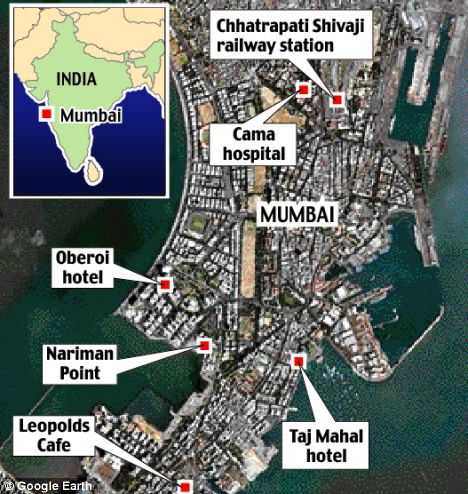
Targeted locations of the bombings across Mumbai. Photo: Daily Mail.

India: Please Don’t Go Down the Bush-Cheney Road
By Juan Cole / November 30, 2008

Many Indians have called the attacks in Mumbai “India’s 9/11.” As an American who lived in India, I can feel that country’s anguish over these horrific and indiscriminate acts of terror.

Most Indian observers, however, were critical in 2001 and after of how exactly the Bush administration (by which we apparently mainly mean Dick Cheney) responded to September 11. They were right, and they would do well to remember their own critique at this fateful moment.

What where the major mistakes of the United States government, and how might India avoid repeating them?

1) Remember Asymmetry

The Bush administration was convinced that 9/11 could not have been the work of a small, independent terrorist organization. They insisted that Iraq must somehow have been behind it. States are used to dealing with other states, and military and intelligence agencies are fixated on state rivals. But Bush and Cheney were wrong. We have entered an era of asymmetrical terrorism threats, in which relatively small groups can inflict substantial damage.

The Bush administration clung to its conviction of an Iraq-al-Qaeda operational cooperation despite the excellent evidence, which the FBI and CIA quickly uncovered, that the money had all come via the UAE from Pakistan and Afghanistan. There was never any money trail back to the Iraqi government.

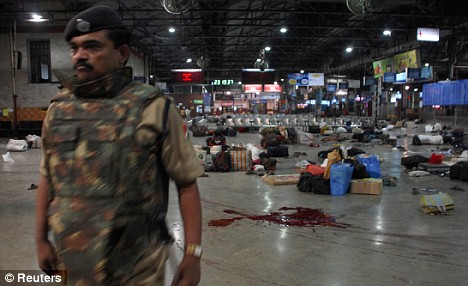
Carnage at the Mumbai train station.

Many Indian officials and much of the Indian public is falling into the Cheney fallacy. It is being argued that the terrorists fought as trained guerrillas, and implied that only a state (i.e. Pakistan) could have given them that sort of training.

But to the extent that the terrorists were professional fighters, they could have come by their training in many ways. Some might have been ex-military in Britain or Pakistan. Or they might have interned in some training camp somewhere. Some could have fought as vigilantes in Afghanistan or Iraq. They needn’t be state-backed.

2) Keep Your Eye on the Ball

The Bush administration took its eye off al-Qaeda and the Taliban, and instead put most of its resources into confronting Iraq. But Iraq had nothing to do with al-Qaeda or the Taliban. Eventually this American fickleness allowed both al-Qaeda and the Taliban to regroup.

Likewise, India should not allow itself to be distracted by implausible conspiracy theories about high Pakistani officials wanting to destroy the Oberoi Hotel in Mumbai. (Does that even make any sense?) Focusing on a conventional state threat alone will leave the country unprepared to meet further asymmetrical, guerrilla-style attacks.

3) Avoid Easy Bigotry about National Character

Many Americans decided after 9/11 that since 13 of the hijackers were Saudi Wahhabis, there is something evil about Wahhabism and Saudi Arabia. But Saudi Arabia itself was attacked repeatedly by al-Qaeda in 2003-2006 and waged a major national struggle against it. You can’t tar a whole people with the brush of a few nationals that turn to terrorism.

Worse, a whole industry of Islamphobia grew up, with dedicated television programs (0’Reilly, Glen Beck), specialized sermonizers, and political hatchetmen (Giuliani). Persons born in the Middle East or Pakistan were systematically harassed at airports. And the stigmatization of Muslim Americans and Arab Americans was used as a wedge to attack liberals and leftists, as well, however illogical the juxtaposition may seem.

There is a danger in India as we speak of mob action against Muslims, which will ineluctably drag the country into communal violence. The terrorists that attacked Mumbai were not Muslims in any meaningful sense of the word. They were cultists. Some of them brought stocks of alcohol for the siege they knew they would provoke. They were not pious.

They killed and wounded Muslims along with other kinds of Indians.

Muslims in general must not be punished for the actions of a handful of unbalanced fanatics. Down that road lies the end of civilization. It should be remembered that Hindu extremists have killed 100 Christians in eastern India in recent weeks. But that would be no excuse for a Christian crusade against Hindus or Hinduism.

Likewise, Prime Minister Manmohan Singh, as a Sikh, will remember the dark days when PM Indira Gandhi was assassinated by her Sikh bodyguards after she had sent the Indian security forces into the Golden Temple, and the mob attacks on Sikhs in Delhi that took place in the aftermath. Blaming all Sikhs for the actions of a few was wrong then. It would be wrong now if applied to Muslims.

4) Address Security Flaws, but Keep Civil Liberties Strong

The 9/11 hijackings exploited three simple flaws in airline security of a procedural sort. Cockpit doors were not though to need strengthening. It was assumed that hijackers could not fly planes. And no one expected hijackers to kill themselves. Once those assumptions are no longer made, security is already much better. Likewise, the Mumbai terrorists exploited flaws in coastal, urban and hotel security, which need to be addressed.

But Bush and Cheney hardly contented themselves with counter-terrorism measures. They dropped a thousand-page “p.a.t.r.i.o.t. act” on Congress one night and insisted they vote on it the next day. They created outlaw spaces like Guantanamo and engaged in torture (or encouraged allies to torture for them). They railroaded innocent people. They deeply damaged American democracy.

India’s own democracy has all along been fragile. I actually travelled in India in summer of 1976 when Indira Gandhi had declared “Emergency,” i.e., had suspended civil liberties and democracy (the only such period in Indian history since 1947). India’s leadership must not allow a handful of terrorists to push the country into another Emergency. It is not always possible for lapsed democracies to recover their liberties once they are undermined.

5) Avoid War

The Bush administration fought two major wars in the aftermath of 9/11 but was never able to kill or capture the top al-Qaeda leadership. Conventional warfare did not actually destroy the Taliban, who later experienced a resurgence. The attack on Iraq destabilized the eastern stretches of the Middle East, which will be fragile and will face the threat of further wars for some time to come.

War with Pakistan over the Mumbai attacks would be a huge error. President Asaf Ali Zardari and Prime Minister Yousuf Raza Gilani certainly did not have anything to do with those attacks. Indeed, the bombing of the Islamabad Marriott, which was intended to kill them, was done by exactly the same sort of people as attacked Mumbai. Nor was Chief of Staff Ashfaq Kiyani involved. Is it possible that a military cell under Gen. Pervez Musharraf trained Lashkar-e Tayiba terrorists for attacks in Kashmir, and then some of the LET went rogue and decided to hit Mumbai instead? Yes. But to interpret such a thing as a Pakistan government operation would be incorrect.

With a new civilian government, headed by politicians who have themselves suffered from Muslim extremism and terrorism, Pakistan could be an increasingly important security partner for India. Allowing past enmities to derail these potentialities for detente would be most unwise.

6) Don’t Swing to the Right

The American public, traumatized by 9/11 and misled by propaganda from corporate media, swung right. Instead of rebuking Bush and Cheney for their sins against the Republic, for their illegal war on Iraq, for their gutting of the Bill of Rights, for their Orwellian techniques of governance, the public gave them another 4 years in 2004. This Himalayan error of judgment allowed Bush and Cheney to go on, like giant termites, undermining the economic and legal foundations of American values and prosperity.

The fundamentalist, right-wing Hindu Bharatiya Janata Party, which has extensive links with Hindu extremist groups, is already attacking the secular, left-of-center Congress Party for allegedly being soft on Muslim terrorism. The BJP almost dragged India into a nuclear war with Pakistan in 2002, and it seeded RSS extremists in the civil bureaucracy, and for the Indian public to return it to power now would risk further geopolitical and domestic tensions.

India may well become a global superpower during the coming century. The choices it makes now on how it will deal with this threat of terrorism will help determine what kind of country it will be, and what kind of global impact it will have. While it may be hypocritical of an American to hope that New Delhi deals with its crisis better than we did, it bespeaks my confidence in the country that I believe it can.

Source / Informed Comment

The Rag Blog

Posted in RagBlog | Tagged , , , | Leave a comment

Report: US Hegemony in Latin America Is Over

Failure to engage with Latin America in more constructive ways than in the past will continue the alienation that has resulted from bad policy and destructive action since the interference in Chile in the early 1970s. As our friend Karen Wald remarks about this article, however, “As usual, wrong reasons but right suggestions….klw.”

Richard Jehn / The Rag Blog


U.S.: Hemispheric Group Calls for Major Changes in Americas Policy
By Jim Lobe / November 24, 2008

WASHINGTON (IPS) – An elite inter-American commission sponsored by a think tank that is considered close to likely key policy-makers in the administration of President-elect Barack Obama is calling for sharp break in U.S. policy toward Latin America, a substantial opening toward Cuba, greater diplomatic engagement with Venezuela, and a major reassessment of its war on drugs.

In a 32-page report entitled “Rethinking U.S.-Latin American Relations” released by the Brookings Institution Monday, the 20-member “Partnership for the Americas Commission” is urging Obama, among other things, to lift all restrictions on travel to Cuba by U.S, citizens and take other steps to ease the nearly 50-year-old U.S. embargo against Havana, and to put far greater emphasis on reducing demand for drugs at home and the export of guns to Mexico.

The Commission, which was co-chaired by former Mexican President Ernesto Zedillo and Washington’s former ambassador to the United Nations, Thomas Pickering, is also calling on the U.S. Congress to phase out tariffs on ethanol imports from Latin America and subsidies on corn-based ethanol here as part of a larger initiative to develop sustainable energy resources, combat climate change, and foster greater regional integration.

It also calls for the creation of a new “Americas Eight” (A8) that would serve as an umbrella of eight heads of state in the region, including at least the U.S., Mexico, and Brazil and other countries with the continent’s largest populations and economies, that would serve as a “steering committee” to promote the “partnership” between the northern and southern subregions and revitalise hemispheric institutions like the Organisation of American States (OAS).

“A valuable window of opportunity soon will open for the U.S. government to rethink its relations with and policies toward the LAC (Latin American and Caribbean) countries,” the report declared, noting both the advent of the Obama presidency and the bicentennial celebrations in 2009 and 2010 of independence of many Latin American countries. Both should lead to “fresh thinking and new policies”.

Indeed, the Commission’s membership and its sponsorship by Brookings, whose staff includes many senior veterans of the Bill Clinton administration likely to get key posts under Obama, especially in the State Department if, as reported, Sen. Hillary Clinton, becomes secretary of state, suggest that the report’s recommendations will be taken seriously.

Aside from Pickering, prominent U.S. members of the Commission included Nancy Birdsall, the president of the Washington-based Centre for Global Development; the assistant secretary of state for Inter-American Affairs under Clinton, Jeffrey Davidow; Clinton’s U.S. Envoy to the Americas Thomas “Mack” McLarty; and Brookings president and Clinton’s deputy secretary of state, Strobe Talbott.

Aside from Zedillo, prominent Latin American members included former Chilean President Ricardo Lagos, former Peruvian Prime Minister Roberto Danino, and former Guatemalan vice president Eduardo Stein.

Although more detailed in specific recommendations in key issue areas, the report’s tone largely echoes that of a major report issued in May by the influential, if somewhat more conservative, Council on Foreign Relations (CFR), entitled “U.S.-Latin American Relations: A New Direction for a New Reality.”

That report called, among other things, for engaging Cuba on a range of issues of mutual concern with a view to ending the embargo, engage more with Venezuelan President Hugo Chavez, deepen Washington’s strategic relationships with Brazil and Mexico, establish a better balance between military and security aid and economic and social assistance in its anti-drug efforts, and recognise once and for all that, in its words, “If there was an era of U.S. hegemony in Latin America, it is over.”

That message was repeated emphatically in the Commission’s report, which stressed the degree to which Latin America’s political and economic ties with the outside world and internally have diversified.

“Their enhanced confidence and autonomy will make many LAC countries much less responsive to U.S. policies that are perceived as patronizing, intrusive or prescriptive, and they will be more responsive to policies that engage them as partners on issues of mutual concern,” according to the report, which also noted that, despite their own competition for regional influence, both Brazil and Venezuela “agree that Washington should play a more limited role in their part of the world.”

The report identified four areas that “hold most promise” for forging a “hemispheric partnership” — developing sustainable energy sources and combating climate change; managing migration effectively; enhancing economic integration; and protecting the hemisphere from drug trafficking and organised crime.

But it also stressed the importance of relations with Cuba which, it said, “have disproportionately dominated U.S. policy toward the LAC region for years (and) have hindered Washington’s ability to work constructively with other countries.”

“Political change in Washington, combined with demographic and ideological shifts in the Cuban American community and recent leadership changes in Cuba itself, offer a valuable opportunity to change course,” the report stated.

It called on Obama to, among other steps, lift all restrictions on travel to Cuba by U.S. citizens; remove caps on remittances by Cuban Americans to their families on the island – something Obama promised to do during the campaign; take Cuba off the State Department’s list of state sponsors of terrorism; end restrictions on humanitarian aid in cases of natural disasters; and re-integrate Cuba into regional and global economic and political organisations.

“These recommendations will not be uncontroversial,” noted Pickering, who retired form the Foreign Service with the highest rank of career ambassador in 2001. He added that Washington’s decades-long efforts to isolate Havana had helped its rulers “be the jailers of the Cuban people.”

The report also called for easing its hostility toward Venezuela’s Chavez, urging a “calibrated, nonconfrontational approach in its relations with Venezuela…based on mutual respect and nonintervention in each other’s internal affairs and those of neighboring countries.”

On migration, it called for establishing ministerial-level coordination between the U.S. and key migrant-sending countries; establish a new visa system to encourage circular migration patterns; enact legislation to provide a path to legal status in the U.S. for undocumented immigrants without a criminal record; and facilitate remittances.

The Commission, according to Zedillo, agreed that recent repressive U.S. actions, including the construction of what he called the “abominable” and “profoundly offensive” wall along parts of the U.S.-Mexican border, “will make the problem worse”.

On drugs and organised crime, the report called for a hemispheric dialogue and evaluation of specific anti-drug measures; a substantial increase in funding for programmes to treat drug-offenders and reduce demand; a greater emphasis on promoting alternative livelihoods for those affected by eradication efforts.

“What we have been doing until now [has been] a total failure,” Zedillo said, with respect to the drug war.

To promote the proposed partnership, the report called for the creation of the A8 that would be modeled on the Group of Eight most powerful western nations and Russia that in recent years have set much of the economic and political agenda for global institutions.

At a press briefing on the report, Pickering suggested that there could be some permanent members, and others, including oft-neglected Caribbean nations, which would rotate in and out.

Source / IPS News

Thanks to Karen Lee Wald / The Rag Blog

Posted in RagBlog | Tagged , , | 2 Comments

The Beltway Is America’s Occupying Army


Why success sucks!
By Case Wagenvoord / November 29, 2008

Dear Barack,

The seeds of today’s failure were planted in yesterday’s success. Success is like that. It swells the head and too often leads to an inflated sense of invincibility that is the rock upon which failure is built.

Take for example our vaunted defense establishment. It’s sucking wind. Two wars against ragtag insurgencies have nearly exhausted it; it’s a major player in our economic meltdown and it spends billions on arcane weapons systems that will never be used.

In short, the Pentagon is an abject failure.

The reason it’s a failure is because we won World War II. In doing so, we built up the world’s most powerful war machine and from that flowed the belief that if we weren’t unbeatable, we needed to spend money until we were.

So we started churning out weapon system after weapon system, each more sophisticated than the previous one, all the time unaware that success is simply failure waiting for an opportunity to surface.

And when it appeared, as we were battled to a draw in Korea, we ignored its presence and mistook failure for success. We didn’t start paying attention until the North Vietnamese whipped our ass. For a time it looked as if we’d finally learned what a curse success is.

Then Ronnie rode into town on his white horse and invaded Grenada, and, once again, success swelled the beribboned chests of our military brass. Next, we stormed the beaches of Panama, then ran roughshod over the world’s most inept military leader, Sadddam Hussein.

Once again, we were unbeatable. But in our hubris, we forgot the price success exacts. The fastest gun in the West is always paranoid because he knows there are young bucks out there just itching to knock him off his pedestal. (The Swiss have the right idea: be the slowest gun in the West and make a fortune selling pocket knives.)

However, hubris fogs the memory and past mistakes are forgotten as history comes to be seen as a string of unbroken victories.

Thus it was that our hubris convinced us we could remake the Middle East in our image and impose pax Americana.

But fear not, we never learn from our failures, so defeat in Iraq and Afghanistan will change nothing as long as Congress is willing to approve even more weapon systems that will continue to drain the lifeblood out of our economy.

The reason this madness thrives is because the Beltway is a foreign country that long ago severed its ties to America. If anything, it is our occupying army.

Success is the insanity that gives life its zest.

Your admirer,
Belacqua Jones

Source / Belacqua Jones

The Rag Blog

Posted in RagBlog | Tagged , , , | Leave a comment

The Severe Price of Globalization and Free Trade

Do you wear Hanes underwear?
By Buck Batard / November 29, 2008

Before you buy another pair of Hanes underwear, perhaps it would be helpful to learn what 11 year old Halima does in one of the factories that makes Hanes underwear. This is the price of globalization. The next time you need to buy underwear, remember this video.

Maybe we men should just follow an old trend from the feminist movement of the 1960s and go underwearless until these factories clean up their act and pay fair wages and eliminate child labor from their factories. It’s time to liberate these children and time to liberate the CEO’s and executives from their jobs at the companies responsible for allowing these types of brutal labor conditions that were largely eliminated in this country one hundred years ago by decent and honorable men who have largely disappeared from American corporate management. They all aim for low cost and will stop at nothing to get it.

And Wal-Mart is likewise responsible since they are likely the largest seller of this product in America and are continually calling on their producers to cut prices. I suppose if it means abusing children to accomplish that goal, the evil people in Bentonville, Arkansas are oblivious to the problem. I’m boycotting both companies. Won’t you join me?

There are many more videos on YouTube revealing child abuse in factories producing products used in this country and I’ll be putting many more of them up in the months ahead. Our wanted for child abuse posters should include CEO’s and executives who have allowed these conditions to exist and we need to plaster them all over the neighborhoods in which these ogres live.

For more information, visit www.nlcnet.org.

Source / Bad Attitudes

The Rag Blog

Posted in RagBlog | Tagged , | Leave a comment

The Mamas and the Papas : Vintage Rockers with their Parents

Frank Zappa and the folks. Photos by John Olson / Life Magazine.

David Crosby standing with father Floyd at dad’s place.

How very cool.

Sixties/seventies rockers with their families. These photos, from the archives of Life Magazine, show rock luminaries of the time at the homes of their parents and grandparents. In addition to Zappa and Crosby, the portraits include Grace Slick, The Jackson Five, Elton John and Eric Clapton.

Go to apartment therapy to see more photos.

Thanks to Carlos Lowry / The Rag Blog

Posted in RagBlog | Tagged , , , , , , | 1 Comment

Dr. Stephen R. Keister : Talking Health Care in the Barber Shop

I have had experience, or my family or close friends have had first hand experience, in Canada, the UK, France, Norway and Italy with medical care and in all instances have found the care prompt, efficient, caring, and generally covered by the various national health plans as a courtesy to visitors.

By Dr. Stephen R. Keister / The Rag Blog / November 29, 2008

On Wednesday I was in the barbershop and in the next chair was a middle aged man loudly demeaning the Canadian Health Care system: “One has to wait forever to see a doctor,” “the doctors in Canada and Europe are poorly trained,” etc. I asked him the source of his information, and looking at this poor old man, he answered “why from my friends in Seattle and THEY KNOW.” End conversation, as one learns that it is the acme of futility to reason with such folks. About as reasonable as arguing theology with Sarah Palin’s pastor!

In truth, the Canadian health care system is not “universal.” The federal government assures financing and established the basic format, but the program is administered by the provinces and their rules vary. As to waiting, this is relative. In an emergency in Canada, as in Europe, acute situations are taken care of post haste; however, elective surgical procedures, i.e. a total knee replacement for instance, may require twice as long a wait as in the United States. One should note as well, that one has faster care from a specialist in a city as one does in one of the rural western provinces.

As to training of Canadian, or Western European physicians, their education is equivalent, or in some instances better, than in the United States. Further, in Western Europe there are more general practitioners per 100,000 citizens than in the USA. In addition they have more hospital beds and CT Scanners available, there is very little paper-work involved, and no-one goes without medical care. I learned what it is to be without medical care when I worked after my retirement as a volunteer physician in a neighborhood free clinic. We provided “care” but we were by and large restricted to practicing Third World medicine due to restraints in doing sophisticated medical testing which most of us normally take for granted in the every day world.

To wait for a doctor’s appointment in this country is not unique. If one wishes to see the chief of a service, at a specific institution, one can wait some weeks or indeed some months. If one is happy to see a subordinate physician one can be seen within several days. However, the enemies of a system, can cherry pick, and cite the time to see the chief of service as a “normal” wait. At best, in this country, one can wait and where I am it may require six months to get an appointment with a dermatologist.

I have had experience, or my family or close friends have had first hand experience, in Canada, the UK, France, Norway and Italy with medical care and in all instances have found the care prompt, efficient, caring, and generally covered by the various national health plans as a courtesy to visitors. I must note than in two instances in Italy the departing patients were asked to pay their TV charges as these were not covered by national health payments. One gentleman who was hospitalized for three weeks with a stroke was not charged but the hospital administration asked for his insurance information in the event they could collect it. Business offices in European hospitals are not necessarily operations that catch ones attention, on occasion being in the hospital basement

Yet medical care, under the system dominated in this country by the insurance companies ain’t what it used to be. When did you last talk to your doctor on the telephone? Ist is my recent experience, and that of my friends, that one gets a callback from the doctor’s physician assistant or nurse. Compare this with my partner of some 30 years ago. Paul was a diabetic specialist, his practice largely children with diabetes. Every evening at home Paul had a “calling hour,” 7-8 p.m. after dinner, when his patients could call him with questions or problems. Most of us of that era did not go as far as Paul, but made sure before leaving our offices that we responded to every patient who had called us that day and needed personal advice. These days, so very much of the doctor’s time is spent on the telephone talking to insurance companies to clarify rules about how they should treat their patients.

Another recurring problem for the elderly is developing opposition by many members of congress to “Medicare Advantage Plans.” To understand what underlies this debate one must have some idea of what constitutes “neo-liberal” economics (supply side economics) which became the only way under the Reagan administration, per economist Milton Friedman. This is an economic theory that advises that all government programs should be privatized, that all economic controls should be done away with, and that all social service programs, such as Social Security and Medicare, should be excluded as government functions. President Bush tried several years ago to “privatize” social security, and congress, in of its few sterling moments, stopped the plan. Mr. Bush wished to turn Social Security over to the stock market! If he had succeeded imagine that in the present economic downturn that your monthly payment would be 50% of what it was.

“Medicare Advantage” is the Bush attempt to privatize and do away with government sponsored Medicare. Currently the government spends $94 billion per year on “Medicare Advantage,” some $15 billion of that is excessive and mostly represents profit to the insurance companies that administer the plans. The tragedy for the elderly, is that in the long run these excesses will exhaust the Medicare Fund, and no more Medicare. Some privatized plans give an initial impression of better service at the cost to the Medicare Fund of $1100 per enrollee; however, at some point one will find varying restrictions as to what the individual insurer will pay. We are now seeing the fruit of the deregulation of our financial institutions with a looming depression which may rival that of 1929.

Further, the incoming congress and Department of HHS must revise the present absurd Medicare Prescription Act to benefit the patient rather than produce profits for the insurance and pharmaceutical industries. The FDA not only has been staffed by the Bushadministration with incompetent, unqualified ideologues, but the fiscal policies regarding prescription drugs must be revised. An AP analysis found that Medicaid paid nearly $198 million from 2004-2007 for more than 100 unapproved drugs. Further, Medicaid as an entity is a failure as a means of decent health care. Before my retirement 18 years ago the payments to the physician were so meager that one could not cover office overhead if one’s practice contained too many Medicaid recipients. As a result we designated, as I recall, Thursday mornings for seeing our Medicaid patients. This is patently unfair, and a single payer, universal plan should incorporate all citizens equally. Further, when the new FDA appointees take over, the ability to obtain the “morning after pill” should be determined by scientists and not Bush-appointed religious crusaders.

For those with further interest I would once again refer you to the originators of HR 676, Physicians For A National Health Program, as well as a recent article in Campaign For America’s Future having to do with the insurance companies’ offer to provide universal care, and finally The Washington Post re: the FDA.

It is important that the older population and their offspring understand some aspects of the current campaign for universal, single payer health care. I am in perfect accord with Rep. Jesse Jackson Jr.’s recent suggestion of a constitutional amendment guaranteeing health care for all Americans.

There are those in the Obama entourage who feel that incorporating a universal, single payer health care plan, would be another anchor in providing economic recovery. Let us made our wishes known to the President Elect and join in that chorus.

The Rag Blog

Posted in RagBlog | Tagged , , , , , | Leave a comment

Joel Hirschhorn Wants Justice for Junior

Respect for our Constitution requires Bush in prison.

George W. Bush Belongs in Prison: Respecting the Rule of Law
By Joel Hirschhorn / November 29, 2008

Electing Barack Obama president was the first step in redeeming American democracy. The second step must be indicting ex-president George W. Bush, giving him a fair trial, finding him guilty of many criminal acts and putting him in prison. Forget revenge. Think rule of law and justice.

I want President Obama soon after taking office to go on television and announce the formation of a special group of outstanding jurists and attorneys to make a recommendation whether or not the US Justice Department should bring criminal charges against George W. Bush. Based on earlier analyses, including work by the American Bar Association, I have no doubt they will recommend indictment.

If moral honesty and courage have any meaning, then the nation must take seriously the concept that no president can ever be allowed to be above the law. How can President Obama not strongly support this? Surely no president must be allowed to disrespect and dishonor the US Constitution. George W. Bush broke his oath of office. His behavior was treasonous. Instead of defending the Constitution he disgraced it. Instead of protecting constitutional rights, including privacy, he sullied them. He asserted his right to ignore or not enforce laws so he could break them. Respect for the office of the presidency must never be allowed to trump truth and justice.

Millions and millions of Americans and people worldwide know that George W. Bush made 9/11 the trigger for initiating an illegal war in Iraq that has killed and maimed so many thousands of people. What Vincent Bugliosi, author of “The Prosecution of George W. Bush for Murder” called “the most serious crime ever committed in American history.” I say convict Bush of myriad counts of criminally negligent homicide related to both Iraq and the Katrina disaster and put him in prison. A former president in prison would not disgrace the presidency. It would restore honor to the office and the Constitution.

Surely millions more people now understand that George W. Bush bears responsibility for creating the conditions that encouraged greed-driven capitalism to rape and murder the middle class and push us into the current global economic meltdown. By removing government oversight and regulation he committed the greatest acts of fraud in the history of mankind. After he made American democracy delusional he made prosperity delusional.

We the people are paying the price for George W. Bush’s criminal acts and so must he. When George W. Bush is sent to prison everyone will see that American democracy has earned the respect of the world. Everyone will better understand that evil comes in many forms and that even an elected president of the United States of America can and must be recognized as a perpetrator of horrendous criminal acts.

Please President-elect Obama, make it so. Be the principled person we want you to be. Make the USA the nation it is supposed to be. Have the courage to do what Congress refused to do when it did not impeach George W. Bush. Change history by showing the world that American justice applies as equally to the president as it does to anyone else. Do not let George W. Bush escape the justice and prison sentence he deserves. Do not let respect for the presidency trump respect for justice. If we do not bring George W. Bush to justice that probably only you can make happen, then surely we do not restore respect for the office that you worked so hard to achieve.

To ensure that no future president behaves like George W. Bush we must punish him. Not merely through the words of historians, but through the physical punishment that he has inflicted on so many millions of people. In previous eras citizens would have demanded “off with his head.” Now we must demand “lock him up.” How poetic for a pro-torture ex-president. As summed up at www.imprisonbush.com: “Bush must be made accountable to the law, to serve as a lesson to all those who would attempt to destroy the American system of laws and liberty for the sake of their own power.” This is a test for both President Obama and American democracy.

If there is any kind of God in the universe, then George W. Bush must go to prison. When he does, then and only then should God bless America.

[Formerly a full professor at the University of Wisconsin, Madison and a senior official at the Congressional Office of Technology Assessment and the National Governors Association, Joel S. Hirschhorn is the author of nonfiction books, including Prosperity Without Pollution, Sprawl Kills and Delusional Democracy.]

Source / Associated Content

The Rag Blog

Posted in RagBlog | Tagged , , | 1 Comment

Alaskans Benefit from Free Venezuelan Heating Oil

Map reflects 2007-’08 winter. Source.

Venezuela’s Chavez offers heat to villages
By Kyle Hopkins / November 28, 2008

VENEZUELAN OIL: Controversial but free program in 3rd year.

With heating oil prices approaching $10 a gallon in rural Alaska and reports of neighbors stealing fuel from neighbors to warm their homes, a Venezuela-owned oil company plans to supply free fuel to villages again this winter.

That’s what a Citgo executive who oversees the company’s free heating oil program told the Alaska Inter-Tribal Council earlier this month, said council director Steve Osborne.

Citgo has provided roughly 15,000 Alaska village households 100 gallons of heating oil each for the past two winters. If the company donates the same amount this year, some families will save as much as $1,000 on their fuel bills. It’s part of a program providing assistance to low-income communities in 23 states.

In the Inupiat village of Noatak, north of Kotzebue, heating oil sells for $9.79 a gallon. Villagers are crossing their fingers for the Citgo assistance while locking their fuel tanks under plywood and padlocks to protect them from thieves, said Eugene Monroe Sr., a local councilman.

“You got to be watching your tank all the time,” he said.

But the free oil comes with political baggage, particularly in an oil-rich state with a potential presidential candidate for governor.

Venezuelan President Hugo Chavez is a proud socialist who once referred to President Bush as “the devil” before the United Nations. He teamed with Iran to fund other nations’ efforts to, as Chavez put it, “liberate themselves from the (U.S.) imperialist yoke.”

The fact that the heating assistance is coming from Chavez led some eligible Alaska communities — such as St. Paul — to reject Citgo’s gift in the past.

It would have been unpatriotic to participate, said Steve Senisch, a local councilman who voted against the gift in 2007.

He predicted the council will vote the same way this time.

“I don’t think the rhetoric coming from Hugo Chavez has really changed in any way.”

But Osborne said that villages that once opted out of the program, such as St. George, plan to participate this year as Citgo’s program grows internationally and prices remain high in rural Alaska.

Melanie Edwards lives in Nome, where she’s the vice president of the regional nonprofit that manages the heating-oil program for more than a dozen nearby villages.

“Last time I checked, (Citgo is) paying corporate taxes to the U.S. Treasury,” she said. “And we figure until such time that the U.S. government is so offended by Venezuela and Citgo that they’re not accepting any more funding, then we’re not being unpatriotic by accepting the same.”

RESOURCE REBATE HELPED

High fuel prices this year filled Alaska’s coffers even as residents struggled to pay their bills. In response, the state gave all Alaskans a $1,200 “resource rebate” at the urging of Gov. Sarah Palin.

Palin’s team is now working on the state budget and new state energy plan. She’s also fresh off her vice presidential bid, where Sen. John McCain presented her as a leading expert on energy policy.

Palin’s office did not respond to questions Wednesday about the governor’s stance on the Citgo program, and whether she would call for another round of state-funded energy relief next year.

Anchorage Rep. Bob Lynn, a Republican, said he doubts the state would cut checks again because oil prices are dropping and the payment was meant to be a one-time measure.

Lynn said it’s not right for Alaska to receive oil from Chavez. “We need to be able to take care of our own. The United States needs to do something about this,” he said.

Still, Lynn added later, “It’s one thing for me to speak philosophical thoughts here in the warmth of my home in Anchorage. It’s another thing to have a wife and kids in danger of freezing to death out there.”

VILLAGE COSTS LOCKED IN

Branson Tungiyan grew up in the St. Lawrence Island village of Gambell and is now the general manager.

Come January, when temperatures sink to 20 and 30 below, he’ll burn up to 30 gallons of heating oil a week, he said.

But the cost has jumped from $4.75 a gallon last year to $7.65. And unlike the cities, where local fuel prices dip along with the national market, the village price is locked in place all winter.

It won’t change again until the next supply barge arrives sometime this summer, Tungiyan said.

Villagers are turning to hauling driftwood that washes ashore about 10 or 15 miles out of town and burning it for heat, he said.

“We feel for our government, but we also have more concern to our families’ survival to have heat in our homes … That’s what I meant by leaving politics to the politicians.”

This week, the local tribal government approved a gift of its own — 30 gallons of heating oil per household, to help with the bills, he said.

PROGRAM FOR U.S. POOR

Citgo Petroleum Corp. started the heating assistance program in 2005 after Hurricane Katrina flooded New Orleans and Chavez toured poor neighborhoods in the Bronx, officials said in 2006.

Venezuela is one of the world’s top oil-producing nations and now provides low-cost or free fuel in 23 states. In 2006, New Hampshire refused the free oil, saying it was an attempt at political grandstanding by Chavez. But this year state officials changed their minds in the face of rising fuel prices, according to The Associated Press.

Company spokesman Fernando Garay, in Houston, declined to talk about the company’s plans for Alaska this week. “We cannot discuss it at this point in time and once the program is approved, we will release all the pertaining information.”

But over the past two winters, Citgo donated roughly 4 million gallons of oil worth more than $15 million, the company said.

About three weeks ago, a Citgo executive called Osborne at the AITC and said the company was “planning on doing the program” again this year.

The paperwork isn’t finished, Osborne said.

So is there a chance Citgo wouldn’t provide the aid?

“Boy, I don’t think there is a way. They’re good at their word,” Osborne said.

The gift is available to anyone who lives in an Alaska community that is more than 70 percent Alaska Native, said Osborne, who hopes to see the program expand to other rural towns and even cities such as Anchorage and Fairbanks in the future.

Citgo doesn’t actually send oil to Alaska.

Last year, the company gave oil to a nonprofit, Citizens Energy Corp. — founded by former U.S. Rep. Joe Kennedy — which in turn sold the oil and delivered the money to the Alaska Inter-Tribal Council, which manages the program in Alaska.

Fewer households appear eligible for the program this year because local nonprofits are finding fewer families living in Alaska Native communities, Osborne said.

“You always hear about villages closing or people moving out of villages. … the numbers that I’ve received so far would seem to indicate that is the case,” he said.

CONCERN IS GENERAL

With Alaskans in villages and cities alike calling for help with energy bills this year, governments at all levels are kicking in money to curb costs.

Rocketing fuel prices and worries of a migration from villages to cities dominated the Alaska Federation of Natives annual meeting in October, where Sen. Lisa Murkowski said the federal government is doubling the amount of money it’s sending to Alaska to help low-income families heat their homes.

Congress approved $34 million for Alaska this year through the federal program, which is called Low Income Home Energy Assistance and sends aid to families with incomes at or below 150 percent of the federal poverty level.

Households that make slightly more money can apply for a similar state program created by the Legislature this year. Lawmakers appropriated $10 million for that program and the money is being distributed now, said Ron Kreher, chief of field operations for the state Division of Public Assistance.

President-elect Barack Obama’s transition team has invited the Alaska Inter-Tribal Council and other tribal leaders from around the country to meet in Washington, D.C., on Dec. 8, Osborne said.

Obama’s team wants to hear two or three priorities that the tribes think the new president should focus on, he said.

“One of them will be, I think, that energy crisis.”

Meantime, the state is working on a long-term energy plan that’s expected to be unveiled in time for the Legislature to consider in January.

Source / Anchorage Daily News

Thanks to Betsy Gaines / The Rag Blog

Posted in RagBlog | Tagged , , | 1 Comment

AT&T: Talking to the Voice-Lady

‘I could only imagine how much money AT&T was saving by forcing their counter clerks to talk to the voice-lady all day like robots, while making customers take a number and wait.’
By Larry Ray / The Rag Blog / November 28, 2008

I called AT&T a while ago to learn how to buy one of their “Go-Phones.” I found the 800 number and placed a call. Human beings no longer answer your call to AT&T. A recorded female voice answers and greets you as if it were a human. It asks you to respond by talking to “her,” speaking words into your phone from her fixed list of questions. The voice recognition routine becomes tedious and irritating real quickly and the voice lady’s options of words to say had nothing to do with Go-Phones.

The voice-lady had no sense of humor. With an insistent tone, she replied “I’m sorry, I didn’t get that,” and she repeated the fill-in-the-voice-blank question. Amazed at the absurdity of talking to a computer hard drive, I replied in cartoon character voices, even urban street gang black mangled English until finally, in a slightly scolding tone, the voice-lady said, “Please hold and I will connect you with an AT&T Agent.” Finally a human!

But eventually being connected to a live AT&T agent, opens up a whole new set of problems. The real person did not have the Go-Phone information and asked me to hold so they could “connect me, with that department.” Guess what? I got connected to the voice-lady again. It is the voice-lady or no sale.

So, customer service is now the voice-lady on a hard drive somewhere in a large computer cabinet. AT&T must assume that America will willingly turn themselves into manipulated robots happily dealing with this maddening, frustrating and totally un-customer- friendly waste of time.

I finally managed to escape the voice-lady by doing something I had read about on the internet, repeatedly pressing #0#0#0#0. This got me to another real human and he eventually actually helped me place my Go-Phone order. But it required a sneaky back door trick to bypass the voice-lady. The phone arrived promptly but the charger plug did not fit into the phone. I forced my way past the voice-lady once more, and eventually got a human who directed me to a local AT&T store nearby where I could get a phone that worked. “No problem, sir, just go out there and they will make an in-kind exchange.”

The Go-Phone store, formerly Cingular, was located in a large shopping center. It was set up like a circular airline ticket counter with uniformed clerks positioned in little spaces around it like orange suited carousel horses. Customers are made to stop at a pedestal just inside the front door and sign in, noting the time you got there. Then you wait in line for one of the carousel horses to become free.

I finally got to the counter, told the fellow that I was here for an “in-kind exchange.” He had no idea what I was talking about. I explained that I had been told to come here to exchange the phone for one that would properly charge. I demonstrated how the little flat rectangular plug just wallowed around in the phone charger receptacle. He fiddled around and eventually found the proper charger for my phone. I asked him if that would fix the problem, because I thought I was supposed to exchange the whole telephone in its original packaging. “Yeah, this should work. We don’t carry that model phone, and we don’t do exchanges. We just sell and activate new phones.”

It was like an orange-hued Twilight Zone. No two people seem to have the same information. Then I then noticed that all the sales agents were using their speaker phones to talk to the AT&T voice-lady! I was astounded. I asked if they didn’t have direct lines, and was told in a resignedly tired manner that no, they have to use the same 1-800 numbers all customers have to use. I could only imagine how much money AT&T was saving by forcing their counter clerks to talk to the voice-lady all day like robots, while making customers take a number and wait.

Americans are already being trained to “Press 1 for English.” Now, to do business or get help we must repeat words to a soulless, humorless recording. Fad-driven cell phone users already easily accept paying two bucks for a rude and raucous ‘ringtone,’ and are oblivious to the monthly bill for mindlessly chatting, texting and doinking around on the internet squinting at the tiny little screen. Just put it on the credit card. If this steadily growing monthly financial obligation doesn’t bother them, talking to voice-lady eventually might seem normal. But it will never seem normal to a huge number of us out here who know better, and it sure as hell shouldn’t be called customer service.

[Retired journalist Larry Ray is a Texas native and former Austin television news anchor. He also posts at The iHandbill.]

The Rag Blog

Posted in Rag Bloggers | Tagged , | Leave a comment

Not All Iraqis Are Satisfied with the SOFA*

Supporters of Shi’ite cleric Moqtada al-Sadr burn U.S. flags during a protest after Friday prayers in Baghdad’s Sadr City November 28, 2008. Photo: Thaier al-Sudani/Reuters.

Thousands of Iraqis protest U.S. security pact
By Wisam Mohammed / November 28, 2008

BAGHDAD — A suicide bomber killed 12 people in an Iraqi mosque on Friday while thousands of followers of anti-American Shi’ite cleric Moqtada al-Sadr demonstrated in Baghdad after parliament passed a pact allowing U.S. troops to remain through 2011.

Some 9,000 people protested in Baghdad’s Shi’ite slum of Sadr City after Friday prayers, burning a U.S. flag and holding banners reading “No, no to the agreement.” About 2,500 people held a similar rally in the southern city of Basra.

“I express my condolences to the Iraqi people on this grave occasion, in which they are harmed by the … pact of shame and degradation,” Sadr, whose militia has fought U.S. troops many times, said in a statement read to followers on his behalf.

Sadr told his followers to wear black to mourn the passage of the deal, under which U.S. troops will withdraw from Iraqi towns and cities by mid-2009, and leave the country by the end of 2011.

Earlier on Friday, a suicide bomber wearing an explosives-packed vest killed 12 people and wounded 17 others inside a Shi’ite mosque visited mainly by Sadr supporters 60 km (40 miles) south of Baghdad, police said.

The U.S. military said the bomber killed eight people and wounded 15 others as they queued outside the mosque to enter for Friday prayers.

U.N. officials say such attacks are aimed at provoking renewed sectarian fighting between minority Sunni Arabs, once affiliated with al Qaeda, and the majority Shi’ites who are now in charge of Iraq.

BAGHDAD BOMBINGS

In central Baghdad a suicide car bomber killed two people and wounded 14 others, police said, and in Sadr City a roadside bomb targeting a U.S. patrol wounded one person, the U.S. military said.

Sadrist lawmakers opposed the security deal with the United States to the last, banging desks and chanting slogans during the parliamentary session that passed it on Thursday.

Demonstrators chant slogans as they march during a rally after Friday prayers in Kufa, south of Baghdad, November 28, 2008. Photo: Ali Abu Shish/Reuters.

They consider the U.S. military presence an occupation and want an immediate withdrawal.

The deal curbs U.S. military powers to arrest Iraqis and conduct operations, shifting greater responsibility onto Iraq’s security forces to keep the peace. Violence is at four-year lows, but car bombings and suicide blasts are still common.

In the first comments by a senior Iranian figure since the passage of the pact, Ayatollah Ahmad Jannati, who heads a powerful constitutional watchdog, said Washington had forced its passage with pressure and threats.

“Yesterday, this pact was finally approved despite the … problems it had. This ratification was not a normal one,” Jannati, head of the Guardian Council, told Friday prayer worshippers in Tehran in a sermon broadcast on state radio.

He likened its signing to “somebody standing over your head with a sword,” saying Washington had threatened to indirectly overthrow the Iraqi government if it was not ratified.

Iran, which enjoys close ties with Maliki’s Shi’ite-led government, has repeatedly blamed the United States for the violence and bloodshed in Iraq in the last five years.

The U.S. military has long accused Iran of arming, training and funding small Shi’ite militia units which attack U.S. troops and Iraqi forces, a charge Tehran denies.

Under the security pact, the United States will no longer be able to hold Iraqi suspects detained during the insurgency and around 16,000 mainly Sunni Arab prisoners will have to be handed over to Iraqi authorities or released.

Human rights group Amnesty International said thousands could face torture or possibly execution as a result as the pact provided no safeguards for prisoner rights.

Nor does the security deal mention 2,000 members of Iranian exile group the Mujahideen Organization of Iran, who have been housed at Camp Ashraf north of Baghdad for two decades. They could face execution if sent back to Iran, Amnesty said.

[(Additional reporting by Khalid al-Ansary in Baghdad, Aref Mohammed in Basra, Zahra Hosseinian in Tehran; Writing by Mohammed Abbas; Editing by Michael Christie and Giles Elgood)]

Source / Reuters

The Rag Blog

* SOFA = Status of Forces Agreement

Posted in RagBlog | Tagged , | Leave a comment

EU Will Accept a Few Iraqi Refugees

Lest we forget, the war in Iraq and the subsequent ethnic cleansing have displaced roughly 4 million Iraqis, 2.5 million internally and another 1.5 million who have left the country, perhaps permanently. For the European Union to agree to accept 10,000 of that 1.5 million is little more than a slap in the face to those Iraqis facing the hardship of displacement from their homeland. I believe it is crucial that those responsible for this debacle be brought to the International Court to answer for the war crimes they have committed.

Richard Jehn / The Rag Blog

Iraqi refugee woman selling cigarettes in Amman, Jordan. Many poor Iraqis live precariously in neighbouring countries.

EU ready to accept 10,000 Iraqis
November 28, 2008

The European Union says it is ready to accept up to 10,000 Iraqi refugees, many of whom are living in extreme hardship in Jordan and Syria.

The agreement came at an EU meeting in Brussels on Thursday, where interior ministers received a new report on conditions at refugee camps.

Germany said it would take in about 2,500 of the refugees.

Priority will be given to those with medical needs, torture victims, single mothers and religious minorities.

The UN refugee agency, the UNHCR, welcomed the EU pledge as a “positive step”, saying it had been pressing the EU for 18 months to offer more protection to vulnerable Iraqi refugees.

So far, only 10% of those resettled by the UNHCR have found a home in EU countries, mainly Sweden and the Netherlands, the BBC’s Oana Lungescu reports from Brussels.

Sweden says it received about 18,000 Iraqi asylum seekers in 2007 – more than half the total that entered the EU last year.

Sweden has a well-established Iraqi community totalling about 100,000 but says other EU countries should take in a bigger share of Iraqis, who have mostly fled violence and poverty.

Not a binding commitment

A UK Home Office spokesperson said the UK had “already shown its clear determination to support Iraqi refugees through the Gateway Programme, with over 200 people resettled in the UK since April and more arriving in the coming months”.

“We will continue to work with our European partners to ensure that Iraqi refugees are resettled across Europe,” the spokesperson added.

An EU expert group that toured Iraqi refugee camps in the Middle East recently said conditions were worsening for most of the refugees, because their savings were dwindling and they did not have work permits, German media reported.

The EU decision to resettle the refugees is voluntary, rather than binding, and is unlikely to reverse the current trend, our correspondent says. So far, most Iraqi refugees have been taken in by the United States, Canada and Australia.

Source / BBC News

The Rag Blog

Posted in RagBlog | Tagged , , , | Leave a comment