Junior Termed a ‘Vigilante’: Sounds Right to Us

Lest we forget, we must continue to apply pressure to the incoming US administration to recognise that what occurred in the lead-up to and prosecution of the invasion of Iraq was a violation of international law and should be treated as such. The current US government is headed by war criminals who should be charged and prosecuted.

Richard Jehn / The Rag Blog

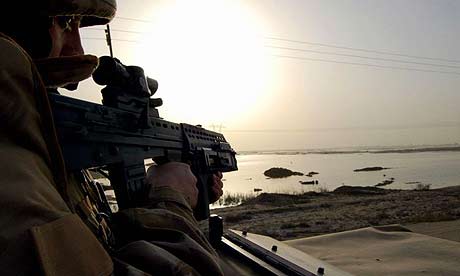
A British soldier patrols the northern suburbs of the southern Iraqi city of Basra. Photograph: Dave Clark/AFP/Getty images.

Top judge: US and UK acted as ‘vigilantes’ in Iraq invasion
By Richard Norton-Taylor / November 18 2008

Former senior law lord condemns ‘serious violation of international law’

One of Britain’s most authoritative judicial figures last night delivered a blistering attack on the invasion of Iraq, describing it as a serious violation of international law, and accusing Britain and the US of acting like a “world vigilante”.

Lord Bingham, in his first major speech since retiring as the senior law lord, rejected the then attorney general’s defence of the 2003 invasion as fundamentally flawed.

Contradicting head-on Lord Goldsmith’s advice that the invasion was lawful, Bingham stated: “It was not plain that Iraq had failed to comply in a manner justifying resort to force and there were no strong factual grounds or hard evidence to show that it had.” Adding his weight to the body of international legal opinion opposed to the invasion, Bingham said that to argue, as the British government had done, that Britain and the US could unilaterally decide that Iraq had broken UN resolutions “passes belief”.

Governments were bound by international law as much as by their domestic laws, he said. “The current ministerial code,” he added “binding on British ministers, requires them as an overarching duty to ‘comply with the law, including international law and treaty obligations’.”

The Conservatives and Liberal Democrats continue to press for an independent inquiry into the circumstances around the invasion. The government says an inquiry would be harmful while British troops are in Iraq. Ministers say most of the remaining 4,000 will leave by mid-2009.

Addressing the British Institute of International and Comparative Law last night, Bingham said: “If I am right that the invasion of Iraq by the US, the UK, and some other states was unauthorised by the security council there was, of course, a serious violation of international law and the rule of law.

“For the effect of acting unilaterally was to undermine the foundation on which the post-1945 consensus had been constructed: the prohibition of force (save in self-defence, or perhaps, to avert an impending humanitarian catastrophe) unless formally authorised by the nations of the world empowered to make collective decisions in the security council …”

The moment a state treated the rules of international law as binding on others but not on itself, the compact on which the law rested was broken, Bingham argued. Quoting a comment made by a leading academic lawyer, he added: “It is, as has been said, ‘the difference between the role of world policeman and world vigilante’.”

Bingham said he had very recently provided an advance copy of his speech to Goldsmith and to Jack Straw, foreign secretary at the time of the invasion of Iraq. He told his audience he should make it plain they challenged his conclusions.

Both men emphasised that point last night by intervening to defend their views as consistent with those held at the time of the invasion. Goldsmith said in a statement: “I stand by my advice of March 2003 that it was legal for Britain to take military action in Iraq. I would not have given that advice if it were not genuinely my view. Lord Bingham is entitled to his own legal perspective five years after the event.” Goldsmith defended what is known as the “revival argument” – namely that Saddam Hussein had failed to comply with previous UN resolutions which could now take effect. Goldsmith added that Tony Blair had told him it was his “unequivocal view” that Iraq was in breach of its UN obligations to give up weapons of mass destruction.

Straw said last night that he shared Goldsmith’s view. He continued: “However controversial the view that military action was justified in international law it was our attorney general’s view that it was lawful and that view was widely shared across the world.”

Bingham also criticised the post-invasion record of Britain as “an occupying power in Iraq”. It is “sullied by a number of incidents, most notably the shameful beating to death of Mr Baha Mousa [a hotel receptionist] in Basra [in 2003]”, he said.

Such breaches of the law, however, were not the result of deliberate government policy and the rights of victims had been recognised, Bingham observed.

He contrasted that with the “unilateral decisions of the US government” on issues such as the detention conditions in Guantánamo Bay, Cuba.

After referring to mistreatment of Iraqi detainees in Abu Ghraib, Bingham added: “Particularly disturbing to proponents of the rule of law is the cynical lack of concern for international legality among some top officials in the Bush administration.”

Source / Guardian

The Rag Blog

Posted in RagBlog | Tagged , , , | 1 Comment

Cheney and Gonzales Indicted in Texas : Abuse of Federal Prisoners

Dick (look out, he’s got a gun) Cheney, photographed in Sydney, Australia, February, 2007.

‘The indictment criticizes Cheney’s investment in the Vanguard Group, which holds interests in the private prison companies running the federal detention centers.’
November 18, 2008

McALLEN, Texas — A South Texas grand jury has indicted Vice President Dick Cheney and former Attorney General Alberto Gonzales on charges related to the alleged abuse of prisoners in Willacy County’s federal detention centers.

The indictment criticizes Cheney’s investment in the Vanguard Group, which holds interests in the private prison companies running the federal detention centers. It accuses Cheney of a conflict of interest and “at least misdemeanor assaults” on detainees by working through the prison companies.

Gonzales is accused of using his position while in office to stop an investigation into abuses at the federal detention centers.

Another indictment charges state Sen. Eddie Lucio Jr. with profiting from his public office by accepting honoraria from prison management companies.

The indictments were first reported by KRGV-TV.

Source / AP / Houston Chronicle

The Rag Blog

Posted in RagBlog | Tagged , , , | 3 Comments

Type your summary here


Type rest of the post here

Source

The Rag Blog

Posted in RagBlog | Leave a comment

Book Banning in Round Rock : Ta Ta to TTYL


Teen novel removed from middle school library in Texas town.
By Bob Banta / November 18, 2008

A teen novel that stirred controversy when the parent of a Round Rock student complained that it is obscene was removed from the district’s middle school libraries today.

The novel entitled “TTYL” by Lauren Myracle is a narrative in the format of instant messages exchanged among a group of teenage girls. TTYL is shorthand for “talk to you later.”

Round Rock Superintendent Jesus Chavez, sent a letter to Wes and Sherry Jennings on Tuesday saying he had determined that “while the book may be appropriate for some students, it is not appropriate for all of our students in the middle school and should not be made generally available in a middle school library open to all middle school students.”

“If parents wish their individual students to have access to the book, there are ample alternatives for the book to be made available to students at parent discretion,” the superintendent said in his letter.

Sherry Jennings, mother of a Ridgeview Middle School student, filed a complaint at the beginning of this school year after her daughter checked the novel out of the Ridgeview library.

Jennings said Tuesday, “We are extremely pleased that the superintendent is interested in quality education for our children and that he realizes that maturity-wise they are not ready for these types of books.”

Jennings said she objected not only to vulgar language in the book “but also to the sexual content of the entire book.”

Jennings said she and her husband are satisfied with Chavez’s response and plan no further action. She added that she appreciated the help of parents and others who supported her complaint about TTYL.

“We had 1,600 people sign a petition backing us, and about 10 people were very helpful in supporting us through this situation,” Jennings said.

Jennings was scheduled to appear before the school board to argue her complaint on Thursday after previous meetings with school officials proved unsatisfactory to her. Chavez said in the letter to her and her husband that since the book has been removed, the hearing before school trustees will be cancelled.

In late October, a nine-member committee appointed by Chavez decided by a 5 to 4 vote to keep the book on school library shelves. The committee included central administration officials, parents, teachers, and a high school student council member.

On Oct. 9, a six-member Ridgeview panel concluded the book should remain in the Ridgeview library despite the complaint.

Source / homeroom, an education blog / statesman.com

Find TTYL on Amazon.com. That’ll show ’em.

Thanks to Jim Baldauf / The Rag Blog

Posted in RagBlog | Tagged , , , , | 3 Comments

Robert Jensen : Real Hope: Facing Difficult Truths About an Uncertain Future

Photo: ‘Contemplating an Uncertain Future’ by Phil Bebbington.

‘If there is to be a decent future for humanity — indeed, any future at all — we must face painful realities with intellectual honesty and moral strength.’
By Robert Jensen
/ The Rag Blog / November 18, 2008

Expressions of hope are only as truly hopeful as the honesty of the assessment of reality from which they emerge. Conjuring up hope rooted in a denial of reality can only deepen despair in the long run.

That’s why much of the political rhetoric of the past two years may prove not only illusory but counterproductive. So, with much talk of change and hope in the air, now is the time to articulate an authentic sense of hope, one that is realistic. If there is to be a decent future for humanity — indeed, any future at all — we must face painful realities with intellectual honesty and moral strength. We can celebrate the victories we achieve along the way but it’s just as crucial that we stay focused on what remains to be understood and accomplished.

In that hopeful spirit I offer these observations with the goal of generating productive discussion among organizers and activists who oppose the hierarchy and injustice inherent in patriarchy, white supremacy, imperial nationalism, and an increasingly predatory capitalism, and who are concerned about the fragile state of an ecosystem that has been seriously compromised by human action.

–Within my lifetime (the next 25 years or so), we will see dramatic changes in this country and the world that likely are the beginning of a systemic collapse, economically and ecologically. This collapse is already underway in some parts of the world, producing suffering beyond description for the most vulnerable on the planet. But we can expect this eventually to extend in more dramatic fashion to the entire planet, probably within the lifetime of our children (the next 50 to 75 years). Definitive predictions are impossible, but it is reasonable to assume that the destructive forces set in motion by the hierarchal systems that define our world are close to, or perhaps already beyond, the point of no return.

–This country’s political and cultural institutions are not equipped to deal with this coming collapse, and there is very little chance that political organizing rooted in the necessary radical analysis, in the time available, can alter that to any significant degree. We are not prepared for the coming shift out of the current high-energy/high-technology phase, and nothing in recent institutional responses (or non-responses) to the clear signs of this suggests we will be prepared in time.

–These claims often are, and will continue to be, dismissed by many as doomsday thinking, which should not surprise us; it is painful to face these realities. But we cannot expect to prosper by ignoring reality. While there is much grief in confronting this, any hope we have for that decent future demands that we face the grief.

–Given this likely trajectory of the coming decades, more of our political organizing should focus on what comes after this collapse (recognizing that a “collapse” will not be a neatly defined process that unfolds in a clear and bounded time frame). What are the ways of thinking and the social organizations we will need? What sense of self-and-others will help us cope with a dramatically different world? For most people, nothing in our everyday lives is preparing us for this different reality, and it’s long past time we started thinking collectively about this. What ideas and skills — what conception of what it means to be a person, what practical knowledge for living — will be necessary?

–Focusing on these questions doesn’t mean we should abandon work on existing campaigns that address war, poverty, sexual violence, racism, or any of the other existing inequalities and injuries that rightly demand our attention. To give up on those projects in the face of widespread suffering in the here-and-now would be to abandon our humanity. But all of those activities should be planned and executed with this larger framework and longer trajectory in mind. The ongoing social-justice work will inform our thinking on these questions, but significant energy should be shifted to long-term projects.

–None of this should be confused with the apocalyptic thinking that posits, or even celebrates, the end of the world. Instead, these questions are central to the careful planning we will need if there is to be hope for that decent future. Such a future is not guaranteed, and we have to face the possibility that humans may not have the capacity to create it. But we define ourselves by our commitment to the work that makes it possible to imagine that future.

All of this is in flux and open to constant rethinking. Like most of the important choices we must make, we are working not from definitive data but from our best guesses, hunches, informed speculation. While we can’t predict the future with certainty, we still must choose. To assume existing high-energy/high-technology systems will continue indefinitely, simply because many of us in the First World have become accustomed to material comfort and would like this to continue, is delusional.

We can make this work joyful, as long as we are willing to face the grief. It is possible to face harsh realities and remain hopeful. Indeed, embracing the joy fully requires that we face the grief, just as embracing hope requires that we face reality.

Robert Jensen is a journalism professor at the University of Texas at Austin and board member of the Third Coast Activist Resource Center. His latest book, All My Bones Shake, will be published in 2009 by Soft Skull Press. Jensen can be reached at rjensen@uts.cc.utexas.edu and his articles can be found online here. This article was also posted at Blog for Our Future.

The Rag Blog

Posted in Rag Bloggers | Tagged , , , , | 2 Comments

Sarah Palin : Call of the Moose!


The previously unknown state governor is using her hockey mom hoopla VP candidate exposure to seemingly promote tourism in Alaska.
By Larry Ray
/ The Rag Blog / November 18, 2008

Sarah is making the most of what’s left of her remaining moments in the spotlight.

The previously unknown state governor is using her hockey mom hoopla VP candidate exposure to seemingly promote tourism in Alaska. Or is tourism all her huge direct mail campaign is about? My first thought was, “Why would Sarah Palin be sending an invite down here to the balmy South Mississippi gulf coast inviting me to Alaska less than two weeks after the election?” As I write this it is 12 degrees F. in Wasilla and will be 9 degrees tonight and winter is just getting underway up there. It is in the upper 60’s here and locals out on our golf courses are talking about how chilly it is.

The nice off white envelope with the Official State Seal comes directly from the “Office of the Governor of Alaska,” not from the Alaska Division of Tourism. Searching for the Alaska Division of Tourism’s web sent me to the Alaska Travel Industry Association’s website which has Sarah’s photo and her welcome. Sarah tells us that, Alaska is different from every other destination in the world. Sure is, Sarah. And every other destination in the world is different from every other destination in the world. Duh.

Inside the envelope from the Gov’s office is a tear-off return postage paid card for a FREE travel guide. Unforgettable Alaska memories include a dog sled ride and a mother moose and her calf. Personally, I have all the memories of a moose mom I will ever need. On the back of the mail-in card are, Questions to help you plan your Alaska vacation, and include, Do you have children at home? Highest level of education attained? and What is your age? While these questions may somehow help find you that perfect igloo with a nice view of Russia, such information, along with your email address and telephone number, would be awful handy to have to cross-check against voter rolls.

Again, why is Sarah Palin mass mailing my neighborhood in the deep South? At this point I started to wonder if these invites only went to Red States? Curiouser and curiouser is the fact that the return card with all your info on it is not sent to the Alaska Division of Tourism in Anchorage, but to “ALASKA, Vacation Information Distribution Center, Portland Oregon, 97208-9807. Portland, Oregon? Sarah seems to have outsourced Joe the Junketplanner’s job to the lower 48. But the ad copy on all the direct mail pieces was clearly written in Alaska, probably by Governor Sarah, or perhaps her husband? The tear apart card, below has more deathless copy offering a “virtual guarantee” you will get a travel guide before they are all snapped up:

I rushed to scan the envelope, card and letter for this article so I could get the card off for my FREE official Alaska travel guide because Sara’s note tells me that Previous editions have disappeared quickly. I bet they haven’t disappeared, Sarah, they are probably still all down in Portland, Oregon. But I am dying to get my copy because Sarah tells me that it is a really dandy thing to have, and starts off her letter to me:

Dear Neighbor, (Neighbor?)

As Governor of Alaska, I am pleased to tell you about a very special offer: now you can receive an official Alaska travel guide-absolutely FREE. This isn’t some skimpy brochure-this is a full-color publication, as bold and exciting as Alaska.

That sold me, because I hate skimpy. The letter continues with its pitch and invites me to Just Imagine: Watchable wildlife, (as opposed to unwatchable wildlife, I guess) Clamming, Eskimo blanket toss, and lots more really neat stuff. But her pitch really stretches my imagination asking me, To learn about our comfortable weather. Nothing like clamming in comfortable weather, Sarah. I might come up if could take that tour of the world famous Alaskan “Nowhere” but I understand the bridge is still out.

[Retired journalist Larry Ray is a Texas native and former Austin television news anchor. He also posts at The iHandbill.]

The Rag Blog

Posted in Rag Bloggers | Tagged , | 1 Comment

Type your summary here


Type rest of the post here

Source

The Rag Blog

Posted in RagBlog | Leave a comment

Carl Davidson : Bumpy Road Ahead: Obama and the Left

This is a time of great opportunity for progressives in America. The big question facing us is where to go next, and how to get there.

It is a question we plan to devote much attention to here on The Rag Blog. The following article by Carl Davidson, is, I believe, an important one and a major first step in the process. We urge you to read this article carefully and share your ideas with us, utilizing the “Comments” link below.

Carl Davidson is webmaster for and a prime mover behind Progressives for Obama. He was a major leader and thinker in the sixties New Left and has continued over the years as an influential writer and organizer for progressive causes.

Thorne Dreyer / The Rag Blog / November 18, 2008

‘Now a new period of struggle begins, but on a higher plane. An emerging progressive majority will be confronted with many challenges and obstacles not seen for decades.’
By Carl Davidson
/ The Rag Blog / November 18, 2008

American progressives have won a major victory in helping to defeat John McCain and placing Barack Obama in the White House. The far right has been broadly rebuffed, the neoconservative war hawks displaced, and the diehard advocates of neoliberal political economy are in thorough disarray. Of great importance, one long-standing crown jewel of white supremacy, the whites-only sign on the Oval Office, has been tossed into the dustbin of history.

The depth of the historical victory was revealed in the jubilation of millions who spontaneously gathered in downtowns and public spaces across the country, as the media networks called Obama the winner. When President-Elect Barack Hussein Obama took the platform in Chicago to deliver his powerful but sobering victory speech, hundreds of millions-Black, Latino, Asian, Native-American and white, men and
women, young and old, literally danced in the streets and wept with joy, celebrating an achievement of a dramatic milestone in a 400-year struggle, and anticipating a new period of hope and possibility.

Now a new period of struggle begins, but on a higher plane. An emerging progressive majority will be confronted with many challenges and obstacles not seen for decades. Left and progressive organizers face difficult, uncharted terrain, a bumpy road. But much more interesting problems are before us, with solutions, should they be achieved, promising much greater gains and rewards. for the America of popular democracy.

To consciously build on the gains of this electoral victory, it’s important to seek clarity. We need an accurate assessment of strengths and weaknesses–our own, as well as those of our allies and our adversaries.

The Obama campaign, formal and informal, was a wide undertaking. It united progressive forces, won over middle forces, then isolated and divided the right. It massed the votes and resources required the win a clear majority of the popular vote and a decisive majority of Electoral College votes.

At the base, beginning with the antiwar youth and peace activists, Obama awakened, organized, mobilized and deployed an incredible and innovative force of what grew into an army of more than three million volunteers. At the top, he realigned a powerful sector of the ruling class into an anti-NeoCon, anti-ultraright bloc. In between, he expanded the electorate and won clear majorities in every major
demographic bloc of voters, save for whites generally; but even there, he reduced McCain’s spread to single digits, and among younger white voters and women voters, he won large majorities.

Understanding the New Alliance

It is important to understand the self-interests and expectations of this new multiclass alliance. If we get it wrong, we will run into the ditch and get bogged down, whether on the right or ‘left’ side of that bumpy road, full of potholes and twists and turns.

The Obama alliance is not ‘Clintonism in blackface’ or ‘JFK in Sepia’, as some have chauvinistically tagged it. Nor is it ‘imperialism with a human face,’ as if imperialism hasn’t always had human faces. All these make the mistake of looking backward, Hillary Clinton’s mistake of trying to frame the present and future in the terms of the past.

The Obama team at the top is comprised of global capital’s representatives in the U.S as well as U.S. multinational capitalists, and these two overlap but are not the same. It is a faction of imperialism, and there is no need for us to prettify it, deny it or cover it up in any way. The important thing to see is that it is
neither neoliberalism nor the old corporate liberalism. Obama is carving out a new niche for himself, a work in progress still within the bounds of capitalism, but a ‘high road’ industrial policy capitalism that is less state-centric and more market-based in its approach, more Green, more high tech, more third wave and
participatory, less politics-as-consumerism and more ‘public citizen’ and education focused. In short, it’s capitalism for a multipolar world and the 21st century.

The unreconstructed neoliberalism and old corporate liberalism, however, are still very much in play. The former is in disarray, largely due to the financial crisis, but the latter is working overtime to join the Obama team and secure its institutional positions of power, from White House staff positions to the behind-the-scenes efforts on Wall Street to direct the huge cash flows of the Bail-Out in their favor.

How the Obama Alliance won:
Values, Technology and Social Movements

The Obama alliance is an emerging, historic counter-hegemonic bloc, still contending both with its pre-election adversaries and within itself. It has taken the White House and strengthened its majority in Congress, but the fight is not over. To define the victorious coalition simply by the class forces at the top is the error of
reductionism that fails to shine a light on the path ahead.

What is a hegemonic bloc? Most power elites maintain their rule using more than armed force. They use a range of tools to maintain hegemony, or dominance, which are ‘softer,’ meaning they are political and cultural instruments as well as economic and military. They seek a social base in the population, and draw them into partnership and coalitions through intermediate civil institutions. Keeping this bloc together requires a degree of compromise and concession, even if it ultimately relies on force. The blocs are historic; they develop over time, are shaped by the times, and also have limited duration. When external and internal crises disrupt and lead them to stagnation, anew ‘counter-hegemonic’ bloc takes shape, with a different alignment of economic interests and social forces, to challenge it and take its place. These ideas were first developed by the Italian communist and labor leader, Antonio Gramsci, and taken up again in the 1960s by the German New Left leader, Rudi Dutschke. They are helpful, especially in nonrevolutionary conditions, in understanding both how our adversaries maintain their power, as well as the strategy and tactics needed to replace them, eventually by winning a new socialist and popular democratic order.

As a new historic bloc, the Obama alliance contains several major and minor poles. It is composed of several class forces, a complex social base and many social movements which have emerged and engaged in the electoral struggle. There is both class struggle and other forms of struggle within it. There are sharp differences on military policy, on Israel-Palestine, on healthcare and the bailout. From the outside, there are also serious and sustained struggles against it. And some forces will move both inside and outside the bloc, as circumstances warrant or change. It is important to be clear on what the main forces and components are, and their path to unity. It’s also important to understand the relation and balance of forces, and how one is not likely to win at the top what one has not consolidated and won at the base, nor is failure in one or another battle always cause for a strategic break.

Obama obviously started with his local coalition in Chicago-the Black community, ‘Lakefront liberals’ from the corporate world, and a sector of labor, mainly service workers. The initial new force in the winning nationwide alliance was called out by Obama’s early opposition to the Iraq war, and his participation in two mass rallies against it, one before it began and other after the war was underway. This both awakened and inspired a large layer of young antiwar activists, some active for the first time, to join his effort to win the Iowa primary.

The fact that he had publicly opposed the war before it had begun distinguished him from Hillary Clinton and John Edwards, his chief opponents. These young people also contributed to the innovative nature of his organization, combining grassroots community organizing with the many-to-many mass communication tools of internet-based social networking and fundraising. Many had some earlier experience organizing and participating in the World Social Forum in Atlanta 2007, which energized nearly 10,000 young activists. Those who came forward put their energy and innovation to good use. Had Obama not won Iowa, it is not likely we would be talking about him today.

The Iowa victory quickly produced another major advance. Up until then, most African-American voters favored Hillary Clinton, and were dubious of a Black candidate’s chances. But Iowa is one of the ‘whitest’ states in the country, and Obama’s win there changed their minds. In short order, Obama gained wide unity in Black communities across the country, inspiring even more young people, more multinational and more ‘Hip-Hop,’ to emerge as a force. Black women in their churches and Black workers in their unions joined with the already-engaged younger Black professionals who were seeking a new voice for their generation. The internet-based fundraising was bringing in unheard-of amounts of money in small donations. A wing of trade unions most responsive to Black members came over, setting the stage for Obama’s next challenge, winning the Democratic primaries overall against Hillary Clinton.

Defeating Clinton and the corporate liberals backing her was not easy. Hillary’s main weakness was her inability to win the antiwar movement. Obama had mainly won the youth and Blacks, and through them, many young women and many Black women, but he had tough challenges. Clinton still rallied much of the liberal base and the traditional women’s movement. But it was not enough, nor was she able to deal with all the new grassroots money flowing his way. Her last reserve was the labor movement, most of which was still supporting her. She tried to keep it with a fatal error: playing the ‘white worker’ card in a racist way against Obama. It only moved more progressives to Obama, plus won him wider support in other communities of color, who saw the move for what it was. Even with her remaining base in a sector of the women’s movement and a large chunk of organized labor, after a fierce fight, he narrowly but clearly defeated her.

Now it was Obama versus McCain, and the Republicans were in the weaker position. Some think McCain made a mistake picking Sarah Palin as his VP choice, but actually it was his smarter and stronger card. To defeat Obama, he had to both energize the GOP core rightwing base, plus win a large majority of the ‘white working class.’ Palin’s proto-fascist rightwing populism was actually his best shot, especially with its unofficial allies in rightwing media. The Fox-Hannity-Limbaugh machine, and its allies in the right blogosphere, escalated their overtly racist, chauvinist, illegal immigrant-baiting, red-baiting, terror-baiting, anti-Black and anti-Muslim bigotry to a ceaseless fever pitch. The aim was to manipulate the significant social base of less-educated, more fundamentalist, lower-income white workers who often seek economic relief through being tied to the military or the prison-industrial complex. They threw everything, from the kitchen sink to the outhouse, at Obama, his family and his movement. They whipped their crowds into violent frenzies. The Secret Service even had to ask them to tone it down, since assassination threats were coming out of the woodwork with each rally like this.

This now put organized labor in the critical position. Even though they represented only a minority of workers generally, they had wider influence, including into the ranks of the white working-class families who were for Clinton, and leaning to McCain. But both national coalitions, the AFL-CIO and Change to Win, did the right
thing, and in a big way. They knew McCain was their ‘clear and present’ danger. So they mobilized their resources and members into the streets, especially in the ‘white working class’ battleground areas in critical electoral states, and among Latino voters in the West. They won a wide majority of union households. They won among women and younger workers, as well as Latinos and other voters of color. Although they still did not get a majority of white working class voters for Obama, they brought the spread down to single digits. In many areas, they did better with Obama than Kerry had done four years earlier. It was enough to put Obama over the top.

There are books to be written about many other aspects and components of the Obama alliance. But these five: insurgent antiwar youth, a united African-American community, Latinos and other communities of color, women with a grasp of the importance of reproductive rights and health care, and organized labor-these form the major elements of the social base of Obama’s historic bloc against neoliberalism and the right. Add these to the disgruntled progressive-to-liberal regular Democratic voters in the suburbs and elsewhere, and it brought the era of the conservative right’s dominance in the White House and Congress to an end.

The Obama Alliance From Below and Within

The alliance was also diverse in terms of political organization. At the very bottom grassroots, in the final months, there were often four campaigns, overlapping to one degree or another, united to one degree or another, but not the same by a long shot.

First, the local Obama offices were mainly run by the Obama youth, twenty-somethings, many of them young women, who worked their hearts out, 16-hours-a-day, seven days a week, months on end. They were deployed in a vast array of ‘neighborhood teams,’ with old teams often generating new ones, connected via the social networking of their own blogs, email, cell phones and text messaging. Each team knocked on hundreds, if not thousands of doors, and tracked it all on computers. The full-time leaders were often ‘parachuted in’ from distant states, skilled mainly in mobilizing others like themselves. But add up dozens, even hundreds of teams in a given county, and you’re making a serious difference.

Second, the Black community’s campaign was more indigenous, more traditional, more rooted, more deeply proletarian-it made use of the Black church’s social committees, tenant groups and civic organizations, who widely united. Many day-to-day efforts were in the hands of older Black women who knew everything about everybody, and had decades of experience in registering and getting out the vote. In some parts of the country, there were other nationalities working this way-Latino, Asian, Native American-and they found the way to make common cause with the African American community, rebuffing GOP efforts to appeal to anti-Black racism or narrow nationalism as a wedge. Some of the older people in these communities learned how to use computers, too, and sent regular contributions to Obama via PayPal in small amounts. But multiply one of these experienced community-based women organizers by 50,000 or 100,000 more just like her in another neighborhood or town, and something new and serious is going on. They always faced scarce resources, and there was friction at times with the Obama youth, who were often mostly white or more of a younger ‘Rainbow.’ They worked it through, most of the time.

Third, organized labor carried out its campaign in its own way. They had substantial resources for meeting halls, phone banks and the traditional ‘swag’ of campaigns-window signs, yard signs, buttons, T-shirts, stickers, banners, professionally done multi-colored flyers directly targeted to the top issues of union members and the wider working class. They put it together as an almost industrial operation, well planned with a division of labor. Top leaders of the union came in, called mass meetings, and in many cases, gave fierce no-nonsense speeches about ‘getting over’ fear of Black candidates and asserting the need to vote their members’ interests. The central offices produced walking maps of union member households and registered voter households, political district by political district, broken down right to how many people were needed for each door-knocking team to cover each district or neighborhood. They printed maps with driving directions. They had tally sheets for interviewing each voter, boxes to check, to be scanned and read by machines when turned in. Hundreds of member-volunteers from that ranks came to each hall, raffles were held for free gas cards, and when you got back and turned in your tallies, free hot dogs and pizza. Sometimes busloads and car caravans went to other nearby states, to more ‘battleground’ areas. They often shared their halls with the Obama kids, and tried not to duplicate efforts. It was powerful to see, and it worked. There’s nothing to replace a pair of union members standing on the porches of other working-class families, talking things over.

Fourth, the actual ongoing structures of the local Democratic Party did things their way. In many cases, the local regular Democratic leaders were very good, and took part personally in all three of elements of the campaign described above. But frequently, there was no ‘mass’ to the local Democratic organization. The mass member groups of the old Democratic Party were just history. (It was a problem, but Progressive Democrats of America, to grow). Each incumbent, moreover, had their own staff and core of donors and loyalists, lawyers and media consultants, and guarded their own turf. Some were Obama enthusiasts, some more low-key, but more than a few avoided any responsibility to win Hillary voters to Obama. They capitulated to ‘Democrats for McCain’ elements in their base, elements who worked informally with the GOP right. This latter group was called ‘the top of the ticket problem.’ They worked their campaigns as independent operations, but avoided identification with the ‘top of the ticket’ or those working locally for it.

The Core Message of Change

While all four of these sub-campaigns were united by the central message and ‘change’ theme from the top, each also carried out the ‘change’ message in its own way. One issue linking at least three of them, save for a few ‘Blue Dog’ incumbents, was the need for a rapid end to the war. From Obama’s personal appearances on down, whenever a speaker forcefully made this point to a crowd, it got the loudest applause, if not a standing ovation.

The people in these crowds constitute a new component of the antiwar movement. It needs to be understood, however, that they have a different character than the traditional left-led antiwar rallies. Demands to end the war here are deeply connected with supporting our troops, getting them home and out of harm’s way, supporting veterans across the board, expressions of patriotism, and a view of the war as an offense to patriotism. They hate the waste of lives of people from families they know; and they hate the waste of resources and huge amounts of money. Ending the war is stressed as the way to lower taxes and revive the economy by spending for projects at home, People will denounce oil barons, but you’ll hear very little put in terms of anti-imperialism or solidarity with various other liberation struggles around the world. ‘We were lied to getting us into this’, and watchwords. There are a few incumbents who will take positions to the right of Obama on the war, trying to stake out various nuanced and longer ‘exit strategy’ processes, or who just don’t mention the war at all. But at the base, most just want to troops rapidly and safely out, while a few cling to the right’s calls for ‘victory.’ But there’s not much in the middle.

The other components of ‘change’ at the base are, first and foremost, new jobs and new industries. People are especially motivated by practical plans for Green Jobs in alternative energies and major infrastructural repair, health care for everyone, schools and support for students, and debt relief and other protections of their economic security in the face of the Wall Street crash. In fact, the Wall Street crash was the major factor in many older voters rejecting McCain and going for Obama. Regarding health care, many unions and local government bodies are signing on to HR 676, Single-Payer health care, but some will accept many other things, wisely or not, as a step in that direction or an improvement over the current setup.

The Nature of Rising Hegemonic Blocs

Within the Obama historic bloc, there are at least four contending trends regarding ‘change’ and political economy-two major and two minor. The two major ones come mainly from the top, while the two minor ones come from below.

At the top, the Obama White House will be pulled in two directions. The first is the ‘tinkering at the top’ approach of traditional corporate liberal capitalism, mostly concerned with securing the major banks by covering their debts and reducing the deficit through ‘shared austerity’ cutbacks. The emphasis will be on greater
government-imposed efficiencies in entitlement programs, tax reform and adjustments in global trade agreements. Some of their favored programs, like pressing businesses to provide more 401K plans for employees, may be set aside because of the stock market’ volatility.

The second direction is Obama’s own often-asserted ‘High Road’ green industrial policy capitalism, which wants to restrict and punish pure speculation in the ‘Casino Economy’ in favor of targeted government investment in massive infrastructure and research, encouraging the growth of new industries with ‘Green Jobs’ in alternative energy sectors. Since resources are not infinite, there will be a major tension and competition for funds between two rival sectors–a new green industrial-education policy sector and an old hydrocarbon-military-industrial sector. It’s a key task of the left and progressive movements to add their forces to uniting with and building up the former, while opposing and weakening the grip of the
latter. This is the ‘High Road’ vs. ‘Low Road’ strategy widely discussed in progressive think tanks and policy circles.

From below, Obama is being presented with a plethora of redistributionist ‘New New Deal’ plans, including Rep Dennis Kucinich’s 16 Points, to Sen. Bernie Sanders 4 Points, to theInstitute for Policy Studies ‘Progressive Majority’ plan. One outlier ‘Buy Out, Not Bail Out’ proposal, David Schweickart’s Economic Democracy option, goes beyond redistributionism, and proposes deep structural reforms of public ownership in the equity of financial firms in exchange for the bailout, in turn directing capital into community investment banks to build worker-controlled options within the new wealth creation firms of green industries.

From the other side, the unreconstructed rightwing neoliberals will be out of positions of executive power but not without positions of influence. Centered among the House GOP and allied with the rightwing media populists and anti-global nationalists, with Lou Dobbs as a spokesman, they will remain a powerful opposition force. They are likely to try to sabotage Obama, as best as they can without their own mass base, suffering from the crisis, turning against them. This was the role they played in the rightist opposition to the corporate liberal bailout plans stirred up by the far right Human Events journalists.

The key point here is shaping the exact nature of what Obama unfolds as ‘change.’ What will bring about any progressive reform and protect ‘Main Street’ and the ‘Middle Class’ against ‘Wall Street’ is still open and not fully formed. In fact, it will be a focus of intense struggle both internally at the top and on the part of mass social movements defending and advancing their interests from below. Class struggle will unfold within the bloc, to be sure.

The Bankruptcy of the Ultraleft

This is where the questions facing the left and an account of its tasks become critical. What is our role? Who are our friends and allies? Who are our adversaries, of various sorts? What is our left platform within broader proposals for growing and uniting a progressive majority? What is our strategy, tactics and orientation
for moving forward? All these need to be re-examined in this dynamic and new situation.

We have to start by acknowledging the real crisis across the entire socialist left for some time. While some progress and innovation has been made by some in recent years, no one is surging ahead with major growth and breakthroughs. What this election, its outcome, its battles and ebb and flow, and the engagement of the masses, has especially done is reveal the utter bankruptcy of almost the entire anti-Obama Trotskyist, anarchist and Maoist left, save for a few groupings and some individuals. The crisis was not nearly as deep among the wider left-those hundreds of thousands working among trade union activists, community organizers and our country’s intellectual community, but often not identified with a given socialist group or anarchist project. Whatever their problems, most of them understood this election and what to do, even if their efforts were limited. They ‘got it right’, even if they lacked the organizational means to advance the socialist project.

But among those belonging to organized socialist and anarchist groups with enough resources to put out their views, most got it dead wrong. On the election, only the CCDS (Committees of Correspondence for Democracy and Socialism, cc-ds.org, ) the Communist Party USA, cpusa.org, and Freedom Road Socialist Organization (FRSO, freedomroad.org) got it mostly right, mainly because they have some grasp on the importance of racism, elections and mass democracy. But we know these three groups, even if well situated, are rather small and not growing in any major way. Next was DSA which at least saw the importance of defeating McCain and backing Obama, even though they only managed to put out a rather wimpy pro-forma statement without once mentioning race. The other 10-to-15 groups, with the larger majority of organized US socialists, communists and Marxists in them, failed miserably, whatever the subjective feelings and views of their individual members. Besides broadsides against Obama and those backing him, they had nothing new or relevant to say, and some of them didn’t bother to say anything, especially among the anarchists. Go to the sixty or more Indymedia sites, and you hardly see anything useful said besides macho bluster and shit-talk against the few pro-voting-for-Obama postings put up.

This is the face of this crisis: While there was an upsurge of millions of Obama volunteers in one of the most critical elections in our history, a true milestone, which was combined with direct engagement from a united Black community and the best elements of labor, from precisely the sectors all of them have been claiming to try to reach for decades, and almost all they could was bark at them: ‘You’re deluded!’ You’re Obamaniacs! ‘You’re wrong!’ ‘Obama is a capitalist!’ ‘Don’t Drink the Kool-Aid! Obama is the more dangerous warmonger because he’s the new ‘Uncle Tom’ Black face of imperialism!’

If the question of the day was immediate working-class mass action on seizing power from the capitalist class, for reform vs. revolution, socialism or capitalism NOW, they might have had a point. But it’s not. Even with the financial crisis, it’s not even close. Besides getting troops out of this or that country, they don’t even have a package of demands or structural reforms worthy of the name being put forward. Worse of all, they don’t think any distinction between revolutionary and non-revolutionary conditions is all that important. What that means, in turn, is that it’s almost impossible for them, as groups and as a trend, to correct their course.

It’s not a matter of being critical of Obama. Everyone engaged in his movement had criticisms and alternate positions of all sorts. Some made them public, some did not-but all these did so in a way designed to help him win, not to take him down, to add votes to his totals, not to subtract them.

As mentioned, the wider left, the left that defines itself as more than liberal but not necessarily socialist, did relatively well. These are the union-based organizers, community organizers, campus organizers, and the readers of Portside, The Nation, Black Commentator, Huffington Post and DailyKOS. For the most part, they
were fully engaged for Obama in this election. Comparing the online commentary in these media voices and outlets with that of the Indymedia anarchists and the socialist papers of the far left was as revealing as the difference between noon and midnight.

We have to break decisively with this ultra-left, semi-anarchist perspective. While the hard core of this trend is small, it reach is wider than some might think. It’s not a matter of purges; it’s a matter of emancipating the minds of many on the radical left from old dogma. There’s no way forward under these new conditions if we don’t. We have to break with it not only in our own ranks, the groups working with ‘Progressives for Obama’, where it’s not that influential, but across all the mass democratic organizations of the wider social movements as well. We have to spotlight it, stand up to it, isolate it and defeat it. It’s not that we are demanding a split. The split has already taken place over the past two years, in real life and in actual battles. Many of us, for instance, stood up to the rightwing
media’s racist attacks on Obama, his family and his movement; others from this corner of the left added fuel to the fascists’ fires and fanned the flames. We are sharply divided. We are as far apart in practice as we can be. What we have to do is acknowledge it, sum up its lessons, and warn others of its dangers, and try to unite all who can be united on a new path forward.

Charting Our Path Forward

So what is our path? Again, we start by getting clarity on where we are. We were in an alliance with Obama and the forces and movements that brought him to power against the NeoCon neoliberals and the far right. If we assess things accurately, we’ll see that we are still in this alliance, although its nature is changing. We are part of a new emerging counter-hegemonic bloc in our country, an historic multiclass alliance. The Obama forces at the top are in turn linked to the multipolar, multilateralist sector of global capital. A new bloc on this higher, global level is both trying to consolidate its power against its rivals and maintain a degree of both unity and struggle among the contenting poles and centers of power within it. Our task is to grow the strength of the left, the working class, and broader communities allies within it, to secure strong points, and to win, step by step, the ‘long march through the institutions’ until we emerge with a new counter-hegemonic bloc of our own, in an entirely different period.

From the beginning, the Obama alliance brought together left-progressive forces, along with moderate center and center-right forces, from the grass roots level through middle-layer institutions to the top. No one or even two of these voting blocs was enough to win alone. It took the entire coalition to win-and driving out any one part of it may have made defeat far more likely and risky. We were part of a left-progressive pole in a broader sub-bloc comprised of social movements, primarily antiwar youth, minority nationality communities and organized labor. While we were the most numerous of the blocs, we were not necessarily the most powerful.

A political pole or sub-bloc’s power in electoral campaigns is a combination of three things-first, an organized platform of ideas appropriate to solving the problems of the day that, second, is in turn embodied in organized grassroots voters and, third, those organizations have readily available amounts of organized money. We
can take part in an alliance without some or even all of these things, but we shouldn’t then expect much clout.

Let’s look at each of these three elements from the perspective of left-progressive activists.

What was our platform? First, we stressed an end to the war in Iraq and a prevention of wider wars, even if Obama talked of going into Afghanistan in a bigger way. Second, we were demanding ‘Healthcare Not Warfare,’ and in many cases, pressing HR 676 Single-Payer even if Obama opposed it. Third, we stressed Green Jobs and New Schools, and Obama eventually pushed these in a big way. Fourth, we stressed Alternative Energies over dirty coal, offshore oil and unsafe nuke plants, even if Obama waffled. Fifth, we wanted Expanded Democracy and Fair Elections, and Obama pressed voter registration and early voting in a big way.

The Obama volunteers in the official campaign often couldn’t put things out exactly like this. Their messaging was more controlled from the center. But nothing stopped either organized labor or independent forces like PDA, MDS or other local groups connected to ‘Progressives for Obama’ from exercising our ‘independence and initiative within the broader front.’ We simply did what we thought best, but in a way that still maintained solid unity among local allies.

The Importance of Independent Mass Democracy

How did we organize voters? Many progressives simply worked through the local Obama campaign, registering and identifying voters with the neighbor teams. This was fine, especially if you spent some time in a mutual education process with the young staffers. But some of us were looking for something more independent and lasting. So we joined with groups like PDA, or set up ‘voters for peace’ groupings based on local coalitions, or worked through union locals. The idea was for the information gained–voter lists, donor lists, volunteers lists, contacts and such-to remain in the hands of the new grassroots formations, to grow them in size and scope, so as to help further struggles down the road.

To be sure, our influence, compared to the incredibly sophisticated, well-funded and innovative Obama campaign, was relatively minor. That didn’t matter so much; what was important was that we weren’t simply a tail on the Democratic machinery, but that we were building our own independent strength for the future. In nearly every major city, independent blogs or clusters of blogs went up to serve as a public face and organizing hubs of these grassroots forces. Case in point: The local Obama offices are now all closed, but our local groups or coalitions have doubled or tripled in size, we now have news blogs getting thousands of hits, and our efforts are ongoing and more connected with labor and community allies.

How did we raise money? To be frank, we didn’t raise that much independently. This is a fault, not a virtue. Some groups in the African-American community went into the T-shirt and button business, making a range of campaign items, selling them to raise stipends, gas money and donations to Obama, then turning some over to make more T-shirts and buttons, and so on. In some places, we relied a good deal on the resources supplied at local union halls-meeting space, phones, and printed materials. ‘Progressives for Obama’ kept itself alive from a few initial startup donations from individuals, then from its two blogs and listservs on the Internet via PayPal in small amounts.

But to return to our platform of issues and demands, the key underlying principle was segmenting the business community into productive versus speculative capital, rather than asserting an all-round anti-capitalist or anti-corporate perspective. We want to see mills reopened with new companies we can support that would make wind turbines via Green Jobs, while we oppose the Casino gamblers on Wall Street or insurance company parasites blocking universal health care. People can and will denounce every sort of corporate crime or outrage to make a point. But when it came to the platform of reforms for uses of our taxes dollars, we were much more focused on what kind of businesses we wanted to see grow, and how we wanted them to relate to their workers and surrounding communities. This approach did very well in getting many rank-and-file workers to take us seriously, especially in areas where many people suffer more from the lack of business than its presence.

The main point is that we now have mass democratic organization anchored in many communities, workplaces and schools, and that they have a basis to expand. PDA is a good example. Starting with only a few dozen people in 2004 with an ‘inside-outside’ independent view of dealing and working with Democrats, they have grown to some 150,000 people scattered across the country in every major city, with most of that growth taking place in the context of the last campaign to defeat the GOP and McCain. At the Democratic convention, together with The Nation magazine, PDA delivered a week-long series of panels and workshops that drew thousands of activists and hundreds of delegates, establishing itself as the ‘Progressive Central’ mobilizing and organizing pole for the week in Denver. Many PDA local chapters mobilized members that became the backbone of the Obama campaign offices, as well as boosting local labor mobilizations. The PDA chapters built their credibility by advocating Healthcare Not Warfare and backing local progressive candidates down the ticket. They helped unite progressives within the various trends of the Obama campaign with local unity events.

On a smaller scale, Movement for a Democratic Society groups did well, too. Austin, Texas is a great example, where they combined with The Rag Blog, which is now getting over 25,000 hits a month. On campuses, where the New SDS was able to make a break with anarchism and relate to the Obama youth, they also report successes and growth.

The Critical Priority of Organization
and the Relative Importance of Socialist Tasks

What the heart of this says is that for left-to-progressive activists, organization-building trumps movement-building in this period. The movements are very wide and diverse, and in front of our noses. But the current wave has just peaked, and will now ebb a bit. In situations like this, it’s more important than ever to consolidate the gains of mass struggle, including electoral struggle, into lasting organizations, either expanding earlier ones or building new ones. The same goes for coalition-building of local clusters of organizations, then networking them across the country, horizontally and vertically, via the internet. We need organizers now, more so than activists and agitators.

What about the ‘socialism’ part of the socialist left? Up to this point, I’ve mainly addressed the mass democratic tasks we share in common with the non-socialist left and progressive activists generally. Fortunately or unfortunately the Wall Street financial crisis combined with the right wing’s red baiting of Obama as a ‘Marxist’ and ‘socialist’ has given the ‘S’ word far wider circulation and interest than it’s had in decades. Unfortunately, in the mass media, it’s mainly discussed in a one-dimensional, cartoonish way as ‘socialism for the rich’ or ‘sharing the wealth.’

No matter. This expanded media buzz serves to underscore the main aspect of our socialist tasks in today’s conditions. Our work here is mainly that of education, theoretical work, and the development of program and policy options. We need our own think tanks and networks of study groups developing our policies and platforms for deep structural reforms that serve as transitional levers to a new socialism. Before we can fight for it, we better have a fairly clear idea of what it is in this country in today’s world-both among ourselves and the wider circles of the best left and progressive organizers with whom we want to share this learning process and
socialist project.

It is a good time, however, to expand this work in a serious way. One small example: in the context of the initial wave of reaction to the Wall Street crash, and the first round of progressive proposals to deal with it, ‘Progressives for Obama’ asked David Schweickart, one of our country’s foremost proponents of socialist theory, to write up his take on it. He wrote not only his account of why the crisis happened, but also briefly contrasted today’s capitalism and its downturn and crash with the socialist alternative. His own ‘successor system theory’ of Economic Democracy, however, is designed to be a bridge to socialist options. If we, the public, are to buy up the bad debt of failed banks and firms, why not demand equity in the stock and public seats on the board, or buy them out entirely. Instead of simply paying off debt and providing the wherewithal for big bonuses and Golden Parachutes, why not do more than simply restrict or forbid this? Why not use these now-public resources to launch local community-owned investment banks to partner with labor and local government and entrepreneurs to build the new worker-owned factories of green industries and alternative energies?

These are excellent take-off points. Schweickart’s article was widely circulated as an authoritative piece, commented on across the political spectrum. In several cities, leftists in and around the Obama campaign even set up study groups to go over it. This shouldn’t be exaggerated, but it does show the possibilities and frames our socialist tasks more accurately.

Both Immediate and Transitional Programs

But the more pressing task for us as part of the left is sharply and concretely outlining our immediate and transitional programs and their platforms. The immediate program of demands, like Kucinich’s 16 Points, are basically redistributionist programs aimed at taking wealth from above and spreading it around below. Given the vast inequalities of our society, that is both pressing and desirable. As a
stimulus, it also spurs the generation of new wealth. The transitional program of deep structural reform, like Schweickart’s Economic Democracy, takes public resources to generate new wealth, but in a way that alters power relations in favor of the working class and broader public.

Some of the best proposals and projects on the table combine both of these. The Apollo Alliance, where steelworkers and environmentalists come together, put forward a range of recession-busting programs. Van Jones’ Green Jobs programs for inner city youth do the same, as does HR 676 Single-Payer health care. The Blue-Green Alliance is still another.

Our task is to put flesh on these in a way that melds with our local conditions. We start by uniting antiwar Obama youth, community and labor locally, then build outwards and upwards from there. We start with an understanding of the critical role of a united African-American community, the most consistent defenders and fighters
for a progressive agenda in the country, especially when it works in alliance with Latinos and other minority nationalities. We also grasp the significance of women and labor, and the overall intersection of race, gender and class in defining our policies, seeking out allies, and setting priorities. We design a package of critical local reforms, whether in rebuilding Ohio River locks and dams, constructing high-speed rail in California, or delivering single-payer healthcare
everywhere. Then we make the fights for these a centerpiece to unite the entire area, win over all the public officials that we can, and then, in turn, take it to an Obama administration, demanding an end to the war and war making, in order to fund it and make it happen. It’s really the only way out of this mess.

Our great victory in this election, finally, is that efforts and programs like this won’t fall on deaf ears. The challenge to Obama is that to get it done, he has to end the war, avoid wider wars and cut the military budget in a major way. If he does, he can be a great president. If he doesn’t, he’ll have hell to pay.

Summary

Here are the key points, once again:

1.) We have won a major victory, now consolidate its gains.

2.) Start where you are, and build mass democratic grassroots groups bringing together the best local activists from the Obama campaign and others like it.

3.) Build a coalition with local partners in labor, campus and community groups that did the same.

4.) Start local left-progressive blogs to have a public face, and link it to others.

5.) Develop a program of deep structural reform and immediate needs for your area, and take it upward and outward through the elected officials and government bodies, all the way to the top.

6.) Break decisively with the ultraleft mindset, in order to deepen and broaden left-progressive unity.

7.) Prepare the ground for mass mobilization to end the war this spring, and to prevent wider war. Link this battle to the economy. Green Jobs over War Jobs, New Schools, Not More Prisons, HealthCare Not Warfare, Peace and Prosperity, Not War, Greed and Crisis. You get the idea.

8.) Study socialism seriously, the version for today, and bring it to bear in developing policy and uniting the most advanced fighters for the whole, not just the part, and for the future, not just the present.

[If you liked this article, go to Progressives for Obama, and offer some support by using the PayPal button. Other writings by Carl Davidson are available at Carl’s website and contact him for speaking engagements at carld717@gmail.com.]

Also see Thorne Dreyer : Our Progressive Opportunity / The Rag Blog / Nov. 20.

This post includes links to additional feature articles recently published on The Rag Blog that deal with this subject matter, by such writers as Paul Buhle, David Hamilton, Tim Wise, Ron Ridenour, Bill Ayers and Robert Jensen.

The Rag Blog

Posted in Rag Bloggers | Tagged , , , , , , , , , | 14 Comments

Hunger: Not Just an Overseas Problem


50 Percent More US Kids Hungry in 2007
By Michael J. Sniffen / November 17, 2008

WASHINGTON – Some 691,000 children went hungry in America sometime in 2007, while close to one in eight Americans struggled to feed themselves adequately even before this year’s sharp economic downturn, the Agriculture Department reported Monday.

The department’s annual report on food security showed that during 2007 the number of children who suffered a substantial disruption in the amount of food they typically eat was more than 50 percent above the 430,000 in 2006 and the largest figure since 716,000 in 1998.

Overall, the 36.2 million adults and children who struggled with hunger during the year was up slightly from 35.5 million in 2006. That was 12.2 percent of Americans who didn’t have the money or assistance to get enough food to maintain active, healthy lives.

Almost a third of those, 11.9 million adults and children, went hungry at some point. That figure has grown by more than 40 percent since 2000. The government says these people suffered a substantial disruption in their food supply at some point and classifies them as having “very low food security.” Until the government rewrote its definitions two years ago, this group was described as having “food insecurity with hunger.”

The findings should increase pressure to meet President-elect Barack Obama’s campaign pledge to expand food aid and end childhood hunger by 2015, said James Weill, president of the Food Research and Action Center, an anti-hunger group.

He predicted the 2008 numbers will show even more hunger because of the sharp economic downturn this year.

“There’s every reason to think the increases in the number of hungry people will be very, very large based on the increased demand we’re seeing this year at food stamp agencies, emergency kitchens, Women, Infants and Children clinics, really across the entire social service support structure,” said James Weill, president of the Food Research and Action Center, an anti-hunger group.

Weill said the figures show that economic growth during the first seven years of the Bush administration didn’t reach the poorest and hungriest people. “The people in the deepest poverty are suffering the most,” Weill said.

The number of adults and children with “low food security” — those who avoided substantial food disruptions but still struggled to eat — fell slightly since 2000, from 24.7 million to 24.3 million. The government said these people have several ways of coping — eating less varied diets, obtaining food from emergency kitchens or community food charities, or participating in federal aid programs like food stamps, the school lunch program or the Women, Infants and Children program.

Among other findings:

  • The families with the highest rates of food insecurity were headed by single mothers (30.2 percent), black households (22.2 percent), Hispanic households (20.1 percent), and households with incomes below the official poverty line (37.7 percent).
  • States with families reporting the highest prevalence of food insecurity during 2005-2007 were Mississippi (17.4 percent), New Mexico (15 percent), Texas (14.8 percent) and Arkansas (14.4 percent).
  • The highest growth in food insecurity over the last 9 years came in Alaska and Iowa, both of which saw a 3.7 percent increase in families who struggled to eat adequately or had substantial food disruptions.

On the Net: Report (PDF format)

Copyright 2008 The Associated Press.

Source / America On Line

The Rag Blog

Posted in RagBlog | Tagged , , , | Leave a comment

Afghanistan: Breaking from BushCo Policy and Catastrophe to a Viable Future

The Afghan government says that at least 70 people including women and children were killed in the ‘careless’ attack by US forces on Azizabad village in northwest Afghanistan. Photo: AP.

Operation Enduring Disaster: Breaking with Afghan Policy
By Tariq Ali / November 16, 2008

Afghanistan has been almost continuously at war for 30 years, longer than both World Wars and the American war in Vietnam combined. Each occupation of the country has mimicked its predecessor. A tiny interval between wars saw the imposition of a malignant social order, the Taliban, with the help of the Pakistani military and the late Benazir Bhutto, the prime minister who approved the Taliban takeover in Kabul.

Over the last two years, the U.S./NATO occupation of that country has run into serious military problems. Given a severe global economic crisis and the election of a new American president — a man separated in style, intellect, and temperament from his predecessor — the possibility of a serious discussion about an exit strategy from the Afghan disaster hovers on the horizon. The predicament the U.S. and its allies find themselves in is not an inescapable one, but a change in policy, if it is to matter, cannot be of the cosmetic variety.

Washington’s hawks will argue that, while bad, the military situation is, in fact, still salvageable. This may be technically accurate, but it would require the carpet-bombing of southern Afghanistan and parts of Pakistan, the destruction of scores of villages and small towns, the killing of untold numbers of Pashtuns and the dispatch to the region of at least 200,000 more troops with all their attendant equipment, air, and logistical support. The political consequences of such a course are so dire that even Dick Cheney, the closest thing to Dr. Strangelove that Washington has yet produced, has been uncharacteristically cautious when it comes to suggesting a military solution to the conflict.

It has, by now, become obvious to the Pentagon that Afghan President Hamid Karzai and his family cannot deliver what is required and yet it is probably far too late to replace him with UN ambassador Zalmay Khalilzad. On his part, fighting for his political (and probably physical) existence, Karzai continues to protect his brother Ahmad Wali Karzai, accused of being involved in the country’s staggering drug trade, but has belatedly sacked Hamidullah Qadri, his transport minister, for corruption.

Qadri was taking massive kickbacks from a company flying pilgrims to Mecca. Is nothing sacred?

A Deteriorating Situation

Of course, axing one minister is like whistling in the wind, given the levels of corruption reported in Karzai’s government, which, in any case, controls little of the country. The Afghan president parries Washington’s thrusts by blaming the U.S. military for killing too many civilians from the air. The bombing of the village of Azizabad in Herat province last August, which led to 91 civilian deaths (of which 60 were children), was only the most extreme of such recent acts. Karzai’s men, hurriedly dispatched to distribute sweets and supplies to the survivors, were stoned by angry villagers.

Given the thousands of Afghans killed in recent years, small wonder that support for the neo-Taliban is increasing, even in non-Pashtun areas of the country. Many Afghans hostile to the old Taliban still support the resistance simply to make it clear that they are against the helicopters and missile-armed unmanned aerial drones that destroy homes, and to “Big Daddy” who wipes out villages, and to the flames that devour children.

Last February, Director of National Intelligence Michael McConnell presented a bleak survey of the situation on the ground to the House Permanent Select Committee on Intelligence:

“Afghan leaders must deal with the endemic corruption and pervasive poppy cultivation and drug trafficking. Ultimately, defeating the insurgency will depend heavily on the government’s ability to improve security, deliver services, and expand development for economic opportunity.

“Although the international forces and the Afghan National Army continue to score tactical victories over the Taliban, the security situation has deteriorated in some areas in the south and Taliban forces have expanded their operations into previously peaceful areas of the west and around Kabul. The Taliban insurgency has expanded in scope despite operational disruption caused by the ISAF [NATO forces] and Operation Enduring Freedom operations. The death or capture of three top Taliban leaders last year — their first high level losses — does not yet appear to have significantly disrupted insurgent operations.”

Since then the situation has only deteriorated further, leading to calls for sending in yet more American and NATO troops — and creating ever deeper divisions inside NATO itself. In recent months, Sir Sherard Cowper-Coles, the British Ambassador to Kabul, wrote a French colleague (in a leaked memo) that the war was lost and more troops were not a solution, a view reiterated recently by Air Marshal Sir Jock Stirrup, the British Defense Chief, who came out in public against a one-for-one transfer of troops withdrawn from Iraq to Kabul. He put it this way:

“I think we would all take some persuading that there would have to be a much larger British contingent there… So we also have to get ourselves back into balance; it’s crucial that we reduce the operational tempo for our armed forces, so it cannot be, even if the situation demanded it, just a one for one transfer from Iraq to Afghanistan, we have to reduce that tempo.”

The Spanish government is considering an Afghan withdrawal and there is serious dissent within the German and Norwegian foreign policy elites. The Canadian foreign minister has already announced that his country will not extend its Afghan commitment beyond 2011. And even if the debates in the Pentagon have not been aired in public, it’s becoming obvious that, in Washington, too, some see the war as unwinnable.

Enter former Iraq commander General David Petraeus, center stage as the new CentCom commander. Ever since the “success” of “the surge” he oversaw in Iraq (a process designed to create temporary stability in that ravaged land by buying off the opposition and, among other things, the selective use of death squads), Petraeus sounds, and behaves, more and more like Lazarus on returning from the dead — and before his body could be closely inspected.

The situation in Iraq was so dire that even a modest reduction in casualties was seen as a massive leap forward. With increasing outbreaks of violence in Baghdad and elsewhere in Iraq, however, the talk of success sounds ever hollower. To launch a new “surge” in Afghanistan now by sending more troops there will simply not work, not even as a public relations triumph. Perhaps some of the 100 advisers that General Petraeus has just appointed will point this out to him in forceful terms.

Flight Path to Disaster

Obama would be foolish to imagine that Petraeus can work a miracle cure in Afghanistan. The cancer has spread too far and is affecting U.S. troops as well. If the American media chose to interview active-duty soldiers in Afghanistan (on promise of anonymity), they might get a more accurate picture of what is happening inside the U.S. Army there.

I learned a great deal from Jules, a 20-year old American soldier I met recently in Canada. He became so disenchanted with the war that he decided to go AWOL, proving — at least to himself — that the Afghan situation was not an inescapable predicament. Many of his fellow soldiers, he claims, felt similarly, hating a war that dehumanized both them and the Afghans. “We just couldn’t bring ourselves to accept that bombing Afghans was no different from bombing the landscape” was the way he summed up the situation.

Morale inside the Army there is low, he told me. The aggression unleashed against Afghan civilians often hides a deep depression. He does not, however, encourage others to follow in his footsteps. As he sees it, each soldier must make that choice for himself, accepting with it the responsibility that going AWOL permanently entails. Jules was convinced, however, that the war could not be won and did not want to see any more of his friends die. That’s why he was wearing an “Obama out of Afghanistan” t-shirt.

Before he revealed his identity, I mistook this young soldier — a Filipino-American born in southern California — for an Afghan. His features reminded me of the Hazara tribesmen he must have encountered in Kabul. Trained as a mortar gunner and paratrooper from Fort Benning, Georgia, he was later assigned to the 82nd Airborne at Fort Bragg. Here is part of the account he offered me:

“I deployed to Southeastern Afghanistan in January 2007. We controlled everything from Jalalabad down to the northernmost areas of Kandahar province in Regional Command East. My unit had the job of pacifying the insurgency in Paktika, Paktia, and Khost provinces — areas that had received no aid, but had been devastated during the initial invasion. Operation Anaconda [in 2002] was supposed to have wiped out the Taliban. That was the boast of the military leaders, but ridiculed by everyone else with a brain.”

He spoke also of how impossible he found it to treat the Afghans as subhumans:

“I swear I could not for a second view these people as anything but human. The best way to fashion a young hard dick like myself — dick being an acronym for ‘dedicated infantry combat killer’ — is simple and the effect of racist indoctrination. Take an empty shell off the streets of L.A. or Brooklyn, or maybe from some Podunk town in Tennessee… and these days America isn’t in short supply… I was one of those no-child-left-behind products…

“Anyway, you take this empty vessel and you scare the living shit out of him, break him down to nothing, cultivate a brotherhood and camaraderie with those he suffers with, and fill his head with racist nonsense like all Arabs, Iraqis, Afghans are Hajj. Hajj hates you. Hajj wants to hurt your family. Hajj children are the worst because they beg all the time. Just some of the most hurtful and ridiculous propaganda, but you’d be amazed at how effective it’s been in fostering my generation of soldiers.”

As this young man spoke to me, I felt he should be testifying before the Senate Foreign Relations Committee. The effect of the war on those carrying out the orders is leaving scars just as deep as the imprints of previous imperial wars. Change we can believe in must include the end of this, which means, among other things, a withdrawal from Afghanistan.

In my latest book, The Duel: Pakistan on the Flight Path of American Power, I have written of the necessity of involving Afghanistan’s neighbors in a political solution that ends the war, preserves the peace, and reconstructs the country. Iran, Russia, India, and China, as well as Pakistan, need to be engaged in the search for a political solution that would sustain a genuine national government for a decade after the withdrawal of the Americans, NATO, and their quisling regime. However, such a solution is not possible within the context of the plans proposed by both present Secretary of Defense Robert Gates and President-elect Barack Obama, which focus on a new surge of American troops in Afghanistan.

The main task at hand should be to create a social infrastructure and thus preserve the peace, something that the West and its horde of attendant non-governmental organizations have failed to do. School buildings constructed, often for outrageous sums, by foreign companies that lack furniture, teachers, and kids are part of the surreal presence of the West, which cannot last.

Whether you are a policymaker in the next administration or an AWOL veteran of the Afghan War in Canada, Operation Enduring Freedom of 2001 has visibly become Operation Enduring Disaster. Less clear is whether an Obama administration can truly break from past policy or will just create a military-plus add-on to it. Only a total break from the catastrophe that George W. Bush, Dick Cheney, and Donald Rumsfeld created in Afghanistan will offer pathways to a viable future.

For this to happen, both external and domestic pressures will probably be needed. China is known to be completely opposed to a NATO presence on, or near, its borders, but while Beijing has proved willing to exert economic pressure to force policy changes in Washington — as it did when the Bank of China “cut its exposure to agency debt last summer,” leaving U.S. Treasury Secretary Paulson with little option but to functionally nationalize the mortgage giants — it has yet to use its diplomatic muscle in the region.

But don’t think that will last forever. Why wait until then? Another external pressure will certainly prove to be the already evident destabilizing effects of the Afghan war on neighboring Pakistan, a country in a precarious economic state, with a military facing growing internal tensions.

Domestic pressure in the U.S. to pull out of Afghanistan remains weak, but could grow rapidly as the extent of the debacle becomes clearer and NATO allies refuse to supply the shock-troops for the future surge.

In the meantime, they’re predicting a famine in Afghanistan this winter.

Tariq Ali, writer, journalist, filmmaker, contributes regularly to a range of publications including the Guardian, the Nation, and the London Review of Books. His most recent book, just published, is The Duel: Pakistan on the Flight Path of American Power (Scribner, 2008). In a two-part video, released by TomDispatch.com, he offers critical commentary on Barack Obama’s plans for Afghanistan and Pakistan, as well as on the tangled U.S.-Pakistani relationship.

Copyright 2008 Tariq Ali

Source / TomDispatch

The Rag Blog

Posted in RagBlog | Tagged , , , | Leave a comment

Roger Baker :
Austin : Where real estate drives the
political machine

The most profitable short term growth for land speculators is the opposite of a wise policy when you are moving into a period of scarce resources.

Low Density Sprawl

Low density sprawl: this from the Houston area, where they know their sprawl.

By Roger Baker | The Rag Blog | November 17, 2008

What I have been waiting for is here. A real estate insider lays out the basics of what is going on in Austin real estate trends.

Anyone who knows much about Austin politics knows that money made on real estate development drives Austin politics and the prevailing patterns of political special interest influence in this region, largely involving roads, water and growth policy that bankrolls the publicly funded subsidies for the special interests that thrive on existing trends.*

The way the game works is that politicians try to recruit non-union industry so they can keep the houses selling and the suburbs sprawling, which is how the big local money is made. Meanwhile the money made by industry goes back to the corporate headquarters in Round Rock or wherever.

But the most profitable short term growth for land speculators is the very opposite of a wise policy when you are moving unto a period of scarce resources. What is worse is that the politics is wired in such a way as to perpetuate the old system and to shield it from pressure for change, typically in any shorter time frame than it takes the real estate investments to pay off.

Low density sprawl type growth outside the city, never the Travis county taxing area, may not benefit Austin and its residents, but it certainly does benefit those who have planned for roads secured by US 290 E bonds; the toxic waste debt of tomorrow in the making.

*(Rumors and gossip: I think Mayor Will Wynn is a semi-successful downtown ex-developer who married into money. CAMPO chair, ex Chamber of Commerce director/Austin registered lobbyist Sen. Kirk Watson is trying to get 290E built as a toll road out to him and Sen. Armbrister’s Frontier bank in Elgin. TxDOT also needs SH290 E to help bail out its SH 130 bonds tied to its current lack of road capacity from Williamson into Austin. Deals were cut in the expectation that…)

The Rag Blog

Posted in RagBlog | Tagged , , , , , , , , , | Leave a comment

Austin : Toll Road Situation a Mess


Transportation policy: CAMPO about to make a big mistake.
By Roger Baker / The Rag Blog / November 17, 2008

AUSTIN — The Capital Area Metropolitan Planning Organization (CAMPO) may be about to make a great historic mistake in transportation policy; it would directly affect US 290 West too. There may be a December CAMPO vote on this.

JP Morgan Chase Securities is teaming up with the Central Texas Regional Mobility Authority (CTRMA) as the latter’s unofficial bond counsel partner. They are telling CAMPO that they have to change Austin’s metro roadway planning policy fast or they won’t set up the toll road bond deals.

Even though there are no deals on the table!

The public can’t even see the revenue numbers behind the deals until 90 days before the bonds are sold. 40 years of toll debt is envisioned as the local transportation burden from tolls to pay off the bonds.

There is no contract between the bank in control and the CTRMA, which is closely controlled by the Texas Department of Transportation (TxDOT). Morgan is a relatively unregulated investment bank trying to set up bond deals on which it gets a cut. How? By matching investors with the road lobby; TxDOT and the real estate/road promoters consultants and road contractors.

In fact, Morgan is telling the CTRMA, without leaving much of a paper trail, that CAMPO needs to quickly approve a sweeping change in transportation policy to tie ALL the CTRMA’s proposed toll roads, ringing and crisscrossing Austin, into one giant toll road system to get Morgan’s help with road bonds.

This policy change is based on totally speculative virtual deals promised by Morgan. The public is not being allowed to see the traffic and revenue studies, and won’t be until just before the bonds are issued, which must mean the numbers don’t look very good. This ties into the fact that the bonds cannot be insured according to CTRMA director Mike Heiligenstein due to the high cost of bond insurance, which is obviously related to high bond default risk.

So CAMPO is urged to sign fast to shift the toll money between corridoras, as is now prohibited by the Eckhardt amendments unanimously approved by CAMPO a year ago. Or else CAMPO won’t get the pot of toll road bond cash that Morgan says is waiting, if only they would shift to more banker-friendly road funding policies.

Meanwhile the CTRMA is trying to pressure CAMPO to change policy with pretty blatantly dishonest funding claims applying to all the tollroads roads in the new “Statement of Purpose” it wants CAMPO to adopt.

One of the worst of a number of the false and unsubstantiated and shaky claims passed from the bankers to the CTRMA and then to CAMPO for approval is posted on CAMPO’s web site here.

Then go to: “Public Hearings for Statement of Purpose and the Financial Plan for a Portion of 290E” and download the PDF file and read the text in the ‘Statement’ on the toll road justification and the reason for setting up the new and much bigger system that the bank wants.

“Lower borrowing costs – the financing can be obtained with lower interest rates due to a stronger financial position resulting from the created system”

Then click on this link and then on the public hearings of which the CTRMA ‘Statement” is the focus:

The CTRMA Director repeats this clearly false assurance of future bond funding at this link:

“Given the severe transportation financing limitations our nation is facing, we are proud to be able to make the investment needed to bring these critical projects to the region,” said Heiligenstein.

The truth is that the CTRMA is assuming that about a third of the toll road money in the form of federal TIFIA loans for toll roads will be available. If not, the CTRMA’s whole toll road funding plan falls apart.

But our new president assures us a change is coming. What will Obama do? Obama’s enviro web site (thanks Bruce Melton) says that he will favor a shift in public spending, on page 11, “Reform Federal Transportation Funding”, to favor smart sustainable growth and put a new emphasis on public transportation alternatives to building roads as usual.

But what if CAMPO shifts its policies to favor the bank, but then Morgan, who has no contract or stake in the deal, walks away? Tough luck; it’s then up to CAMPO and local taxpayers to pick up the pieces and start over.

The Rag Blog

Posted in Rag Bloggers | Tagged , , , , , , | Leave a comment