Israel: Murdering Palestinians Through Starvation

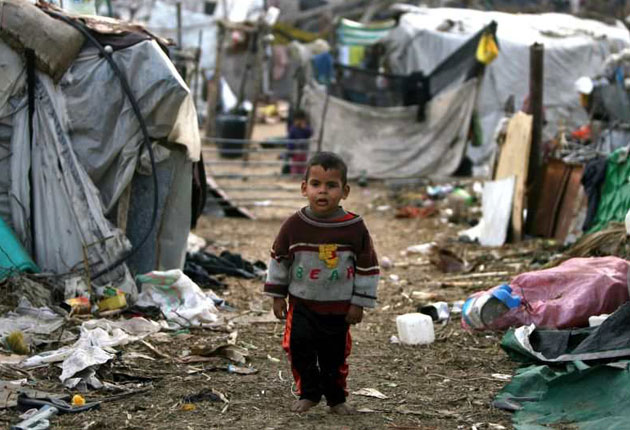
The Red Cross says the diets of those living in the impoverished Gaza Strip are deteriorating. Photo: AFP/Getty/Mahmud Hams.

Chronic malnutrition in Gaza blamed on Israel
By Donald Macintyre / November 15, 2008

The Israeli blockade of Gaza has led to a steady rise in chronic malnutrition among the 1.5 million people living in the strip, according to a leaked report from the Red Cross.

It chronicles the “devastating” effect of the siege that Israel imposed after Hamas seized control in June 2007 and notes that the dramatic fall in living standards has triggered a shift in diet that will damage the long-term health of those living in Gaza and has led to alarming deficiencies in iron, vitamin A and vitamin D.

The 46-page report from the International Committee of the Red Cross – seen by The Independent – is the most authoritative yet on the impact that Israel’s closure of crossings to commercial goods has had on Gazan families and their diets.

The report says the heavy restrictions on all major sectors of Gaza’s economy, compounded by a cost of living increase of at least 40 per cent, is causing “progressive deterioration in food security for up to 70 per cent of Gaza’s population”. That in turn is forcing people to cut household expenditures down to “survival levels”.

“Chronic malnutrition is on a steadily rising trend and micronutrient deficiencies are of great concern,” it said.

Since last year, the report found, there had been a switch to “low cost/high energy” cereals, sugar and oil, away from higher-cost animal products and fresh fruit and vegetables. Such a shift “increases exposure to micronutrient deficiencies which in turn will affect their health and wellbeing in the long term.”

Israel has often said that it will not allow a humanitarian crisis to develop in Gaza and the report says that the groups surveyed had “accessed their annual nutritional energy needs”. But it warned governments, including Israel’s, that “food insecurity and undernutrition, including micronutrient deficiencies” were occurring in the absence of “overt food shortages”.

A 2001 Food and Agriculture Organisation definition classifies “food security” as when “all people, at all times, have physical, social and economic access to sufficient, safe and nutritious food that meets their dietary needs and food preferences for an active and healthy life.”

The Red Cross report says that “the embargo has had a devastating effect for a large proportion of households who have had to make major changes on the composition of their food basket.” Households were now obtaining 80 per cent of their calories from cereals, sugar and oil. “The actual food basket is considered to be insufficient from a nutritional perspective.” The report paints a bleak picture of an increasingly impoverished and indebted lower-income population. People are selling assets, slashing the quality and quantity of meals, cutting back on clothing and children’s education, scavenging for discarded materials – and even grass for animal fodder – that they can sell and are depending on dwindling loans and handouts from slightly better-off relatives.

In the urban sector, in which about 106,000 employees lost their jobs after the June 2007 shutdown, about 40 per cent are now classified as “very poor”, earning less than 500 shekels (£87) a month to provide for an average household of seven to nine people.

The report quotes a former owner of a small, home-based sewing factory, who said he had laid off his 10 workers in July 2007. “Since then I earn no more than 300 shekels per month by sewing from time to time neighbours’ and relatives’ clothes. I sold my wife’s jewellery and my brother is transferring 250 shekels every month … I do not really know what to say to my children.” Others said they were not able to give their children pocket money.

In agriculture, on which 27 percent of Gaza’s population depends, exports are at a halt and, like fisheries, the sector has seen a 50 per cent fall in incomes since the siege began. Among the two-fifths classified as “very poor”, average per capita spending is down to 50p a day. In the fisheries sector, which has been hit by fuel shortages and narrow, Israeli-imposed fishing limits, “People’s coping mechanisms are very limited and those households that still have jewellery and even non-essential appliances sell them”.

The report says that if the Israeli-imposed embargo is maintained, “economic disintegration will continue and wider segments of the Gaza population will become food insecure”.

Arguing that the removal of restrictions on trade “can reverse the trend of impoverishment”, the Red Cross warns that “the prolongation of the restrictions risks permanently damaging households’ capacity to recover and undermines their ability to attain food security in the long term.”

The detailed Gaza fieldwork for the report was carried out between May and July. An International Monetary Fund report confirmed in late September that the Gaza economy “continued to weaken”.

Mark Regev, the spokesman for Israeli Prime Minister Ehud Olmert, said that, contrary to hopes when Israel pulled out of Gaza, the Gazan people were being “held hostage” to Hamas’s “extremist and nihilist” ideology which was causing undoubted suffering. If Hamas focused resources on the “diet of the people” instead of on “Qassam rockets and violent jihadism” then “this sort of problem would not exist”, he said.

Source / The Independent

The Rag Blog

Posted in RagBlog | Tagged , , , | 1 Comment

GOP : Whoops! There Goes the Firewall…

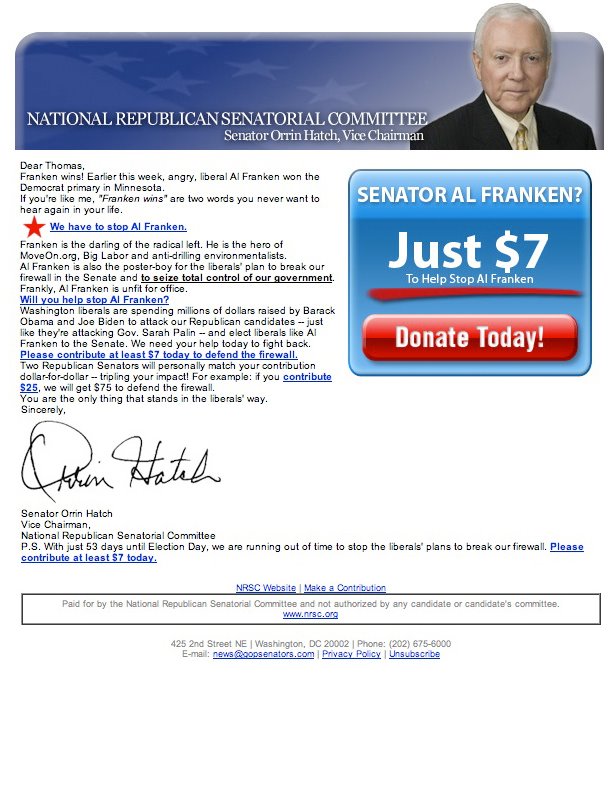
Click image to enlarge.

Firewall status: Six GOP senators have lost their places on the wall, falling off just like a bunch of Humpty Dumpties. Three more GOP seats teeter precariously.
By Larry Ray / The Rag Blog / November 14, 2008

This is an update to an earlier article on Senator Orin Hatch’s frenetic September internet email plea for $7.00 donations to “defend the firewall!” Just two months ago, the Vice Chairman of the angst-ridden GOP Senators’ Club was mainly concerned that Al Franken would beat Norm Coleman in Minnesota. Now, Franken and Coleman are barely a couple hundred votes apart. A Statewide vote recount gets underway there shortly. Franken could win. Poor Senator Hatch is still digesting the cold, hard post-Nov. 4th election results which saw him lose a half dozen of his fellow Senators in a massive firewall breach. What’s a Senior Senator to do?

In September Sen. Hatch warned, “Al Franken is the poster-boy for the liberals’ plan to break our firewall in the Senate and to seize total control of our government. Frankly, Al Franken is unfit for office.” Damn, imagine, Al Franken unfit and a poster boy to boot! Al graduated cum laude from Harvard College, is a highly successful author, and a little of his SNL humor in the Senate chambers might be a good idea. Orin should read Franken’s, 1993 book, “I’m Good Enough, I’m Smart Enough, and Doggone It, People Like Me.”

Since the early panicked pleas for money, here’s the firewall’s status: Six GOP senators have lost their places on the wall, falling off just like a bunch of Humpty Dumpties including a long-time Dumptyette, Liddy Dole. Three more GOP seats teeter precariously. Democrats now have 57 Senate seats. Three more wins for a true firewall-smashing majority of 60 votes is very possible.

They are still counting in Alaska in legendary incumbent and convicted felon, Senator Ted Steven’s race. At this writing with some 35,000 ballots left to count, Democratic challenger and Anchorage Mayor, Mark Begich, has the lead. Again, Al Franken has a good shot in Minnesota as the recount gets underway there.

And three’s a charm in Georgia. A December 2nd runoff is scheduled there between GOP incumbent, political hack Saxby Chambliss, and Democratic challenger, Jim Martin, an Atlanta attorney. In 2004, then Georgia Senator, Max Cleland, a triple amputee who was awarded the Silver Star for exceptional bravery in Vietnam was targeted by Chambliss and the GOP slimemeisters in a filthy Rove-style campaign of lies and denigration. The ever lovely Ann Coulter was Chambliss’ cheer leader savaging Cleland with her vapid vitrol. And the Senate Republicans are only worried about firewalls?

Looks like you should have asked for more than $7.00, Senator Hatch. More than money, your private senator’s club needed a dose of humility and a reality check. And that is just what you have just gotten. You might have also considered that your firewall was already being attacked from the inside by the excess weight of Senatorial hubris, greed, negativity and a massive overgrowth of moss in your midst.

[Retired journalist Larry Ray is a Texas native and former Austin television news anchor. He also posts at The iHandbill.]

The Rag Blog

Posted in Rag Bloggers | Tagged , , | Leave a comment

A New Model for Managing International Trade and Development , Part IV

Click here for all the posts in the series.

In Development…
…only one road leads to Rome, Part 4

By Sid Eschenbach / The Rag Blog / November 15, 2008

A Proposal for a New Trade and Development Paradigm

The WTO GATT Doha round of trade talks is dead, marking the failure of the current system to create a regulatory structure seen as fair by the nations of the world. Additionally, major industrial economies are in trouble, major and minor democracies are increasingly politically unstable, inequality is growing globally, poor countries are not sharing the benefits of globalization, workers of nearly all countries find their jobs are insecure and threatened, and the continued surplus of labor will continue to place a downward force on income and prosperity levels.

The simple act of facilitating industrial development and requiring all international traded goods to be made by unionized labor will … create a transparent, simple and fair system that will move us day by day closer to that goal, not further away.

In fundamental historical and practical dissonance with these truths is the equally true statement that the road to development and prosperity is known. It is the road discussed above in this essay. It is the road that starts in poverty and ends in industrialized prosperity, historically through the process of protectionism, industrialization, and the organization of labor.

The traditional tools, protection of domestic industry and cheap labor, both currently employed successfully by both China and India, are still available. However, we should be able to do the same, but in an organized, global manner, as the use of those tools are not available to others due to many factors, from pressures applied by the international lending and development community to simple corruption. In synthesis, then, let’s review where ‘there’ is before we set out.

A new model must:

  • Create national economies that grow at rates higher than that of population, and create new, middle class jobs.
  • Guarantee the rights of industrial workers to organize and share in the benefits of higher productivity.
  • Not cost any government in creation or operation more than it is worth.
  • Be easy and simple to negotiate and implement.
  • Be clearly beneficial to the mass of the people in order to increase national socio-political stability.
  • Allow for unilateral implementation if desired.
  • Encourage poor nations to develop a protected sector of increasing returns and innovation.
  • Maintain the existing sectors of increasing returns and innovation in developed nations.
  • Help rich and poor nations alike.
  • Be simple, fair and internationally uniform.

In my opinion, all of these goals can be met by adopting two very simple guidelines, either unilaterally, regionally, or globally:

One: That all nations be encouraged to produce locally the manufactured items that they import, each to the degree that they are able.
Two: That all manufactured goods traded between nations be made by organized labor.

I’d be surprised if you are not now thinking something like…”that’s it?” “These two points are going to take the place of the 10,000 pages of the GATT and resolve problems that very intelligent and highly trained people have been wrestling with for the past 20 years?” Well, let’s stack it up against our ‘new trade paradigm’ wish list and see what happens.

Will it:

  • Create national economies that grow at rates higher than that of population, and create new, middle class jobs?

Yes. By favoring manufacturing over importing, even at the lowest levels of manufacturing this is a win for the local economy. While higher prices may be paid by the consumer, an argument that places price above all other considerations is a policy that would logically bring back child labor or slavery in the name of low prices. As stated above, a development policy is not about cheap prices, but … DEVELOPMENT, and for that there is only one road to Rome.

The ways this might happen are only limited to the imaginations of the parties. The traditional methods of import duties to protect nascent producers should, of course, be available. Beyond that, the international manufacturers could consider other options, such as establishing locally owned and run factories along the lines of the franchised service industry, and receiving long term tax benefits in exchange for long term commitments, etc.

A component of these agreements could be that if the manufacturing was totally national and not being set up to export, local wages could be paid to offset the competitive price advantages of scale enjoyed by massive international players. If the manufacturing system and the good produced was able to find export markets, the original agreement must include the requirement that laborers in export oriented manufacturing facilities must be allowed to organize.

This not only raises the standard of living nationally, but it requires management to become more efficient in order to compete abroad if that is their goal. The counter-intuitive Fordist reality that, within reason, higher wages always produces higher productivity must be remembered. When all are playing by the same rules, this is a step towards being more competitive, not less, as it is a cost borne uniformly.

Again, any time any manufacturer pays higher wages, they MUST become more efficient in order to survive. If they are currently located in a low wage country and it is precisely the low wage that makes them internationally competitive, they will have to become more efficient to keep their markets … which means that they will have achieved the state of increasing returns that must be created in order to begin to build a middle class.

Management should be rewarded for efficiency and innovation, not abuse and exploitation. If they are unable to become more efficient, they will simply go out of business… not a bad idea if the success of your business is built upon worker abuse and underpayment.

If a company cannot compete unless it enjoys a labor cost advantage and thus finds that it is no longer able to compete internationally, it can still manufacture for the unregulated domestic market, as it will enjoy the usual labor cost advantages versus the union made imported products it will be competing against there. Smaller, weaker, or not as efficient companies that do not export would not be affected, and they could continue to provide non-union entry level jobs for under-educated or unskilled workers that are unfortunately plentiful in underdeveloped countries.

Both of these latter labor and economic realities are at the heart of nascent industrial states and the establishment of the vital increasing returns sector, the start of the path that we have revealed as the only route that will lead to economic progress and well-being.

For high income nations, the impact is also positive. As a result of the current neo-liberal trade/development model, the industrial sectors of all of the major industrial powers are being hollowed out as manufacturing is being exported and foreign made goods imported… but again, wages are at the heart of this reality.

Most industrialized nations already have unionized labor in their major industrial enterprises… so this will create no new burden for them. What it will do is make the poor nations raise their wages, thereby lowering the natural tendency of business to move to non-union cheap labor countries in order to survive.

The recent and well-documented ‘hollowing out’ of industry in major nations is not a positive harbinger of things to come, as the loss of industrial capacity is always ultimately negative for the same reasons that the gain of industrial capacity is always ultimately positive.

A developed, unionized nation that adopted the union made import and export trade regime would strengthen its own labor force and manufacturing sector at no additional cost to its export trade…while simultaneously reducing the labor cost differential currently enjoyed by underdeveloped and large labor pool countries. The result of this would be to reduce the cost demands placed by the market on all competitive international business to lower prices in order to gain market share, and thus eliminate the need to get into the endless tariff wars or ‘off-shore’ in order to survive. It would thus protect the companies in both poor and rich nations… as both are under attack.

Will it:

  • Guarantee the rights of industrial workers to organize and share in the benefits of higher productivity?

Yes. This is the core of the proposition, so obviously the new model would do this. However, it must be noted that organized labor, in exchange for a full partnership with capital, would have to make many concessions too. As examples, the right of management to hire and fire without cause and without undue grievance procedures, and management’s ability to demote or promote according to any individual’s ability, capacity and achievement would have to be part of a ‘new union’ mentality. The right to organize cannot become a right to control the entire workers’ agenda, leaving management, as is the case in many instances today, without the necessary flexibility to meet challenges over time.”

Will it:

  • Not cost any government in creation or operation more than it is worth?

Yes. Obviously, the only infrastructure would be some sort of very minor bureaucracy whose job it would be to validate the labor bona fides of any company who wanted to import or export. There would clearly be exceptions due to scale and cottage industry type crafts that would be exempt. Compared to the budget of the World Trade Organization ($164 million in 2007), this would be insignificant and should actually represent a significant savings to current national commercial operating overhead.

Will it:

  • Be easy and simple to negotiate and implement?

Yes. Nothing could be simpler. If you want to export from your country, you simply need to unionize your workforce and demonstrate that fact to the responsible authorities. If you want to import goods from another country, you simply need to verify that their workforce is unionized. These would be certified by an international organization, and the validity of their bona fides easily established.

This is obviously not aimed at a company of 5 workers that manufactures some particular bit that a particular buyer abroad might need. Rather, it is aimed at large scale manufactures that export and import large quantities of manufactured goods, and through their economies of scale combined with cheap labor, suck the air out of national development.

That’s it. No tariff wars, special import or export restrictions, cronyism, back-room legislative deals, special taxes… nothing. The people who talk about ‘free trade’ and then produced the GATT would be shocked at what free trade actually looks like.

Will it:

  • Be clearly beneficial to the mass of the people in order to increase national socio-political stability?

Yes. The current trade and development structure is complex and incomprehensible not just to experts, but most importantly to the man on the street. In country after country, the GATT based trade deals are popularly felt to be done in the interests of the more powerful of the two nations… or is it the poorer… or the richer?

The truth is that it is rare that the man in the street feels its being made in his interests. Where does that resentment go? The feelings of powerlessness, frustration and alienation are major factors that contribute to cultures of violence, crime, substance abuse… and can end with the ultimate loss of governability of entire societies.

Empowering the people is another of those counterintuitive concepts that in fact makes them more governable and less likely to join with the sectors found in all societies that are unproductive and destructive. The politics of a ‘national capitalism’ would be a very heady elixir for any leader to promote, and the real rising standards of living created by a new and growing industrial sector will be easy for all to see.

Will it:

  • Allow for unilateral implementation if desired?

Yes. The beauty of the fix is that it doesn’t depend upon general agreement for implementation. Indeed, because all nations control the terms for the entry and exit of goods across national borders, it is something that national leaders as well as political parties can recognize and relate to, and it is this very nationalistic essence that make it’s unilateral implementation simple to effect and effective in implementation. Politically, it will spur ‘buy national’ ‘support and improve workers’ sentiment, never a bad thing for a growing domestic manufacturing economy.

Will it:

  • Encourage poor nations to develop a protected sector of increasing returns and innovation?

Yes, and this is essential. As we have seen, the creation and growth of an industrial, increasing returns sector is the fundamental and essential first step to affluence. Any trade and development policy that does not resolve this problem in poor countries as a function of its operation fails the most important test.

Poor countries have the same basic needs as rich, and so there is always a market for manufactured goods. Because the people are poor, the products that they buy will be the cheapest expression of whatever necessary product they need, be it a hammer, a chair, a radio or a car. These cheapest products are generally made by multi-national corporations in the countries that have the lowest wages.

If a poor country adopts the policy that it will manufacture the goods it’s able to manufacture, and will not import products that are not union made, it will exclude the very products whose cost precludes the establishment of a local manufacturing business that would make the same item. When a small manufacturing business is established to sell the needed local product at a price the locals can afford, they will not be subject to the unionization requirement because they are a non-exporting entity, and so will be able to ‘abuse the poverty’ of its own people in order to establish the industry.

This is unfortunate, but is the only way it can be done. It is the way it was done in every single modern industrialized nation, and there is no way around it. The first step isn’t pretty, but without it, there is no second, third or fourth.

Will it:

  • Maintain the existing sectors of increasing returns and innovation in developed nations?

Yes. This is also an essential component of any successful trade and development policy, and also one where the WTO GATT model was failing miserably. Organizing labor in the poor nations would move towards an equalization of labor costs that would relieve much of the fundamental labor cost pressures placed upon multi-nationals as they struggle to survive.

It would also slow if not stop the hollowing out of the developed nations manufacturing sectors, a very delicate and sensitive political issue all developed nations are currently struggling with. The recent collapse of the global financial sector shows that there is, other than a few small and specific niche areas (Las Vegas, Lichtenstein, and Monte Carlo come to mind), no other nationally viable ‘new economy’ model based primarily upon service and financial sectors out there that allows large nations to maintain and continue to generate wealth while reducing or eliminating their manufacturing sectors.

As important as it is to raise the standard of living of the poor, it is just as important not to impoverish the relatively rich in the process. Another benefit of the new paradigm would be the general strengthening of the developed countries already unionized industrial labor pool, as any producer who exports would have to unionize.

While this idea of unionizing labor and protecting national markets sends modern economists and free-market theorists into a near epileptic state, we should remind ourselves of a simple historic fact: the greatest, broadest, wealthiest and most enduring economic success in the history of man was created in the U.S. during a period of high unionization of the labor force. At some point, this fact must be dealt with by those who theorize mightily against the beneficial impact of unions upon a society… while they watch the wealth of a nation diminish as the union roles shrink.

Will it:

  • Help rich and poor nations alike?

Yes, for all the reasons addressed above.

Will it:

  • Be simple, fair and internationally uniform?

Yes. Business is best understood as a tool, and like any tool it is only as ‘good’ or ‘bad’ as the ethics and abilities of its managers. Business will take advantage of any opportunity presented to it because it must… but it doesn’t need them to survive. For that reason, many confuse the use of cheap labor in undeveloped nations by multi-national companies with the assertion of necessity of the same… which is not only unfair, but a big mistake. While it will of course take advantage of any advantage available, it doesn’t require them.

What business does need is clarity. What business does need is a level playing field. To the degree that these two elements can be delivered in a simple and enforceable fashion, more is the virtue. Therefore, if all companies, big and small who import and export must pay more for labor and are excluded from the same markets for the same reasons, there will be no objection that cannot be overcome as long as it is uniform.

Will this policy raise prices generally and globally? Of course. However, as I stated at the beginning of this essay, a trade and development policy that uses unit cost as its paramount goal is a failure by any standard but its own. There are many very expensive countries and entire regions where food, shelter and clothing all cost significantly more than other places… and contrary to those who kneel at the alter of cheap goods, these areas, the expensive areas where the consumer pays more for everything… are the BEST places to live, not the worst.

In terms of generalized higher prices, business used to pay $5 a barrel for oil and the consumer .45 cents a gallon. Today it pays over $100 and the consumer $4… but it doesn’t matter. As long as it is uniform, as long as they all pay roughly the same, the business landscape adapts to the changes, either by passing the increase through to the consumer if successful, or going out of business if not.

In any event, rising and falling prices are existential features of the modern capitalist world, and it is impossible to argue that a general rise in labor costs will not simply be integrated as any other price change would be.

Conclusion

The WTO GATT model of trade and development has failed, and in the shadow of this failure President-Elect Obama is struggling to find a way to prime the pump and restart the machinery that generated well-being… but so far there is no sign that either he or his economic advisors recognize the immutability of developmental history.

The traditional Keynesian policy of spending money created by fiat cannot begin to do the job of wealth creation that only middle class workers of industry can do, and for that reason Obama must address an entirely new industrial trade and labor policy… or fail. Keynesian spending can only hope to prime an economic pump… but that implies that there in fact IS a pump to prime, and that that pump is properly identified, nurtured and protected. If there is no economic pump to prime, then vehicles such as infrastructure spending or tax rebates will simply be good money after bad.

Free trade has created a world in which the citizens in both rich and poor countries see their jobs become less secure, their options going forward shrink, and the inequality of income expand. With those results, it should be no surprise that it failed.

No system can deliver what it is not designed to deliver, and the WTO GATT model failed to bring rising standards of living to the majority of the people on the planet quite simply because, in spite of the grandiose claims of its proponents, creating global well-being was not it’s goal.

Not unlike virtually any kind of undirected but well-represented legislation, what it became was the formalization of ten thousand deals made for ten thousand problems… trade-offs between your agriculture and mine, between my manufacturers and yours, tax breaks for one and quotas for another.

It was not designed to answer any questions about well-being, political stability, or social dignity and pride. Indeed, its goal was quite simply the opposite; to provide statutory protection for historical privileges, to provide a forum for the influential and powerful to attempt to maintain the status quo. As such, it was born of a concept of trade as commercial war, not as a vehicle to generate societal well-being. That became just an occasional and coincidental byproduct.

It evolved out of a time that saw growth as a zero sum game… the idea that ‘your gain is my loss’ … and as we’ve seen, in the modern industrial world, this is simply not the case. Repeatedly, the creation of new products through innovation has provided massive growth in sectors that compete with no existing technology and cause no ones loss.

For all of these reasons, the path that the recently developed nations have taken is different. They continued the historic practice of protecting their own markets and nascent industries, but at the same time let the multi-nationals into their countries on a cheap labor export only basis…. and as Malaysia, Singapore, Taiwan, Korea, and more recently China and India are proving, this is a much more successful plan than the neo-liberal ideas as represented by the ‘Washington Consensus’.

It would be a very simple project to expand this idea to the rest of the world, but in order for that to happen the ‘free-trade’ tide must be rolled back both ideologically and practically, a task greatly if tragically aided by its spectacular recent failures. If this strategy, the creation and protection of national industries feeding off the cutting edge technologies and finance of the multi-nationals could be combined with a progressive Fordist labor policy, the results would, in my opinion, be hugely beneficial to all three parties to this socio-economic-political problem: the people, the nations, and the businesses.

The past 200 years, and particularly the past 50, give us many regional examples of a simple principle: that we can, in fact, all live well at the same time. There is no fundamental political or economic rule which requires an oppressor and an oppressed, a rich and a poor. WE CAN ALL LIVE WELL SIMULTANEOUSLY. Therefore, a new trade and development model must be designed to deliver just that: well-being to all… and that is the great challenge of this new presidency.

The simple act of facilitating industrial development and requiring all international traded goods to be made by unionized labor will, in my opinion, create a transparent, simple and fair system that will move us day by day closer to that goal, not further away.

Sidney Eschenbach, 60, lives and works in Guatemala, Central America. His thoughts regarding developmental economics and trade are based on decades of development work in Latin America at various levels, community and corporate.

The Rag Blog

Posted in Rag Bloggers | Tagged , , | Leave a comment

Blackwater Scandal Redux : Smuggling Prohibited Weapons in Dog Food Sacks


Blackwater insider: Company executives made the decision to smuggle the weapons and silencers in the dog food ‘because it’s a war over there and our guys need them.’
By Brian Ross and Jason Ryan / November 14, 2008

Also see ‘Indictment drafted in Blackwater shooting’ by Lara Jakes Jordan and Matt Apuzzo, Below.

A federal grand jury in North Carolina is investigating allegations the controversial private security firm Blackwater illegally shipped assault weapons and silencers to Iraq, hidden in large sacks of dog food, ABCNews.com has learned.

Under State Department rules, Blackwater is prohibited from using certain assault weapons and silencers in Iraq because they are considered “offensive” weapons inappropriate for Blackwater’s role as a private security firm protecting US diplomatic missions.

“The only reason you need a silencer is if you want to assassinate someone,” said former CIA intelligence officer John Kiriakou, an ABC News consultant.

Six Blackwater employees are under investigation by another federal grand jury, in Washington, D.C., in connection with the shooting deaths of at least 17 civilians in September, 2007 at a Baghdad traffic circle. Prosecutors are expected to return indictments in the next few weeks, according to people familiar with the case.

The investigation of the alleged dog food smuggling scheme began last year after two Blackwater employees were caught trying to sell stolen weapons in North Carolina. The two, Kenneth Cashwell and William “Max” Grumiaux pleaded guilty in February and became government witnesses, according to court documents.

Two other former employees tell ABCNews.com they also witnessed the dog food smuggling operation. They say the weapons were actually hidden inside large sacks of dog food, packaged at company headquarters in North Carolina and sent to Iraq for the company’s 20 bomb-sniffing dogs.

Larger items, including M-4 assault weapons, were secreted on shipping pallets surrounded by stacks of dog food bags, the former employees said. The entire pallet would be wrapped in cellophane shrink wrap, the former employees said, making it less likely US Customs inspectors would look too closely.

Last year, a US Department of Commerce inspector at JFK airport in New York discovered an unlicensed two-way radio hidden in a dog food sack being shipped by Blackwater to Iraq, according to people familiar with the incident.

A Blackwater spokesperson, Anne Tyrrell, said certain arms shipmens were sent to Iraq surrounded by dog food “to secure them on the airplane and not to smuggle them.” Tyrrell said she could not comment on specifics because of “the ongoing investigation” but she denied the company had done anything wrong.

In addition to the grand jury investigation, Blackwater sources say the company is facing a multi-million dollar fine for some 900 instances in which it violated State Department licensing requirements for the export of certain weapons.

Of the 900 cases, about 100 of them have been referred to the Department of Justice for possible criminal prosecution, according to lawyers briefed on the case.

Last month, Blackwater hired a team of former federal law enforcement officials and defense experts that it said would review the company’s compliance with export laws.

Andrew Howell, Blackwater’s general counsel, said, “Ongoing reviews by the Department of Justice, State and Commerce have highlighted the need for a significant and systems-wide initiative.”

Another former Blackwater insider who talked with ABCNews.com said company executives made the decision to smuggle the weapons and silencers in the dog food “because it’s a war over there and our guys need them.”

Despite four separate federal grand jury investigations of its operations, Blackwater’s contract to provide security services for the US State Department was renewed earlier this year. The contract pays Blackwater $250 million a year and runs for five years.

Source / ABC News

Indictment drafted in Blackwater shooting
By Lara Jakes Jordan and Matt Apuzzo / November 14, 2008

WASHINGTON — Federal prosecutors have drafted an indictment against six Blackwater Worldwide security guards in last year’s deadly Baghdad shootings of 17 Iraqi civilians, The Associated Press has learned.

The draft is being reviewed by senior Justice Department officials but no charging decisions have been made. A decision is not expected until at least later this month, people close to the case said.

Also still undecided is whether the Justice Department would charge the guards with manslaughter or assault, according to the people, all of whom spoke on condition of anonymity because they were not authorized to speak publicly about the case.

It’s possible that prosecutors ultimately will seek charges against as few as three of the guards, whose identities are still secret. Depending on the charges, an indictment would carry maximum sentences of five to 20 years.

An indictment would send the message that the Justice Department believes U.S. contractors do not operate with legal impunity in war zones. It’s an untested legal theory, since the law is murky on whether contractors could be charged in U.S. courts, or anywhere, for crimes committed overseas.

The indictment against the Blackwater guards would be filed in U.S. District Court in Washington, even though the shootings occurred 6,200 miles away.

Blackwater guards opened fire in a busy intersection Sept. 16, 2007, in what witnesses said was an unprovoked attack. Young children were among the 17 civilians killed. The shootings outraged Iraqis and embarrassed the United States, further straining relations between the two nations.

Blackwater is adamant that its guards, who protect U.S. diplomats, were ambushed by insurgents in Baghdad’s Nisoor Square.

Based in Moyock, N.C., Blackwater itself is not a target of the investigation. The company has pledged to cooperate with the investigation and said it wants to decrease its reliance on the security business.

On Friday, Blackwater spokeswoman Anne Tyrrell said “it would be inappropriate to comment” on the draft indictment.

She added: “Based on the information available to us, however, we do not believe criminal violations occurred. If it is determined that an individual acted improperly, Blackwater would support holding that person accountable.”

Blackwater has been at the forefront of the debate over the use of contractors in war zones.

Capitol Hill lawmakers have described Blackwater guards as mercenaries. Human rights groups have sued the company. And Iraq’s government is pushing for more authority to prosecute U.S. contractors in its own courts.

Among the issues under discussion at the Justice Department is whether prosecutors have authority to bring the case. The largest security contractor in Iraq, Blackwater operates in a legal gray area. Its guards are immune from prosecution in Iraqi courts and U.S. law does not normally apply to crimes committed overseas.

To prosecute, authorities must argue that the guards can be charged under a law meant to cover soldiers and military contractors. Since Blackwater works for the State Department, not the military, it’s unclear whether that law applies to its guards.

It would be the first such case of its kind. The Justice Department recently lost a similar case against former Marine Jose Luis Nazario Jr., who was charged in Riverside, Calif., with killing four unarmed Iraqi detainees. Jurors questioned whether such cases should even be brought in civilian courts.

“I don’t think we had any business doing that,” juror Nicole Peters said at the time. She wiped away tears after the August verdict and later hugged the defendant. “I thought it was unfair to us and to him.”

Prosecutors will also face challenges over the evidence. Before the FBI began investigating the shooting, the State Department granted limited immunity to Blackwater guards who talked to investigators. The Justice Department will need to prove that its case was not influenced by any evidence gathered under that immunity deal.

Attorneys for six Blackwater guards made those arguments and more at a September meeting with top Justice Department officials. The lawyers urged prosecutors not to indict.

A decision before January about whether to indict the guards would mean that President-elect Barack Obama’s incoming Justice Department team would not inherit the politically sensitive choice. But the legal hurdles will remain in a case that could drag on for a year or longer.

In December 2007, several months after the shootings, the Pentagon and the State Department agreed to give the military in Iraq more control over Blackwater and other private security contractors. Five months later, in April, the State Department renewed its multimillion-dollar contract with Blackwater for the third year of its five-year life.

Blackwater has been paid nearly $1.25 billion in federal business since 2000.

Source / AP / Google News

The Rag Blog

Posted in RagBlog | Tagged , , , | Leave a comment

The Misrepresentations About the War in Georgia

Photo: Time.

Why did the West ignore the truth about the war in Georgia?
By Mary Dejevsky / November 12, 2008

The US and UK left the impression that Russia was the guilty party

Thank goodness, they might be thinking at the US State Department and the British Foreign Office, for the financial crisis. Were it not for the ever-blacker news about the Western world’s economy, another scandal would be vying for the headlines – and one where the blame would be easier to apportion. It concerns our two countries’ relations with Russia and the truth about this summer’s Georgia-Russia war.

Over the past couple of weeks, a spate of reports has appeared in the American and British media, questioning many assumptions about that war, chief among them that Russia was the guilty party. Journalists from the BBC, The New York Times and Canada’s Embassy magazine, among others, travelled to South Ossetia, the region at the centre of the conflict, in an effort to establish the facts.

Not the “facts” as told by the super-slick Georgian PR machine at the time, nor the “facts” as eventually dragged from the hyper-defensive and clod-hopping communicators of the Kremlin. But the facts as experienced on the ground by those who were there: civilians, the local military commander, and the small number of unarmed monitors stationed in the region by the Organisation for Security and Cooperation in Europe.

The journalists travelled to the region separately and by different routes. They spoke to different people. But their findings are consistent: Georgia launched an indiscriminate military assault on South Ossetia’s main town, Tskhinvali. The hospital was among the buildings attacked; doctors were injured even as they operated.

The timing of the Georgian attack, as of the arrival of the first Russian reinforcements two days later, coincides for the most part with the original Russian version. It was only then that the Russians crossed into Georgia proper in the invasion of sovereign territory that has been universally decried. For the record, it should be added that Russia has now withdrawn from uncontested Georgian territory, in accordance with the agreement mediated by President Sarkozy.

Now you could argue – and the State Department and the Foreign Office have done pretty much from the start – that it really does not matter who started the war; there had long been provocations on both sides and the priority was bringing hostilities to an end. You could also argue – more plausibly – that while Russia might have had a case at the start, it put itself in the wrong by applying excessive force and then recognising South Ossetia and Abkhazia as independent.

But surely it does matter, crucially, how this conflict began. It matters legally and morally. And it is bound, rightly so, to affect how we view the two countries concerned. Yet the general fuzziness of official US and British accounts left the impression that Russia was the guilty party, and Georgia a brave little democracy that big bad Russia wanted to snuff out. Not only did this version gain almost instantaneous acceptance, but it was almost impossible for Russia to contest, confirming as it did every existing negative stereotype.

What has now transpired, however, is that the US and Britain had no excuse for not knowing how the war began. They were briefed by the OSCE monitors at a very early stage, and those monitors included two highly experienced former British Army officers.

So why were British and US officials so cagey about acknowledging, or perhaps even believing, what had really happened? Why did the Conservative leader, David Cameron, rush to Tbilisi to support Georgia as the unquestioned victim? And why – except to trump Mr Cameron – did the Foreign Secretary, David Miliband, give a tub-thumping speech in Kiev shortly afterwards that perpetuated the impression (without actually using the words) that the war was all about Moscow’s supposed ambition to reconstitute its empire?

Was it ignorance? Or was it rather ideological blindness? Did they choose not to acknowledge the unreliability of their Georgian protégé, lest it discredit their whole project for spreading democracy and recruiting allies among former Soviet republics? It is only now, three months on, that either Mr Miliband or US officials have brought themselves to describe Georgia’s action as “reckless”.

Actions, though, tell another story. Earlier this week, Britain quietly lifted its objections to the start of EU talks on a new partnership treaty with Russia – talks that it, almost alone, had held up in sympathy with Georgia. So the latest bout of official harrumphing against Russia would seem to be over. Ill-feeling in Moscow, though, will persist, until someone in London or Washington concedes how badly they got the Russia-Georgia war wrong.

Source / The Independent

The Rag Blog

Posted in RagBlog | Tagged , , | 1 Comment

Ritter: Recommendations for Obama’s Iran Policy

A woman in the streets of Tehran holds up the Iranian daily Rozan with a photo of U.S. President-elect Barack Obama the day after the American election.
Photo: AP / Hasan Sarbakhshian.

With Iran, Obama Needs More Carrot, Less Stick
By Scott Ritter / November 13, 2008

The American people have spoken, and the next president of the United States will be Barack Obama. Running on a platform of change, the president-elect will be severely tested early in his administration by a host of challenges, be they economic, military, environmental or diplomatic in nature. How Obama handles these issues will define his tenure as America’s chief executive, and there will not — nor should there be — a honeymoon period. The challenges of these times do not permit such a luxury, something the president-elect had to know and comprehend when he chose to run for office.

John McCain and Hillary Clinton, Obama’s defeated rivals, were both correct when they noted that the next president would need to be ready to govern on day one. Barack Obama has until the 20th of January to get his policies in order, because at one minute past noon on that day, he becomes the most powerful man in a volatile world. While the problems he will face are many, I will focus on what I believe are the four most critical issues that will need to be addressed in the first weeks and months of the Obama administration: Iran, Iraq, Pakistan and Russia. This will be done in a series of articles, the first of which will deal with Iran.

Barack Obama, the candidate, said many things about Iran, some of which were inherently contradictory. In this he is not unique, since the reality of the rough-and-tumble world of American presidential politics requires any given candidate to show extreme flexibility in defining solutions to complex problems, oftentimes based not on the facts as they exist, but rather the fiction of domestic political imperative. Sometimes initial positions are staked out based upon fact-based analysis, only to be corrected as a given domestic constituency expresses unease and imposes its own fantasy-based worldview on the candidate. Nowhere is this process of the fictionalization of fact more prevalent than on the issue of Iran and its nuclear program.

One year ago, in an interview with The New York Times, Obama demonstrated a level-headed approach toward Iran, expressing “serious concern” over the country’s nuclear program and its support for what he termed “terrorist organizations.” He grounded his comments in an appreciation for the cause-and-effect relationship between Iran’s involvement in Iraq and the Bush administration’s invasion and occupation of that country. Obama also expressed the need for “aggressive diplomacy” with Iran at the highest levels and emphasized the importance of economic incentives and security assurances when it came to compelling Iran to change course on its nuclear program.

But many months on the campaign trail, fighting a determined Democratic challenger, Hillary Clinton, and a critical Republican Party, compelled the thoughtful Harvard-educated foreign policy neophyte to buckle under the pressure of needing to be seen as “strong” and “determined” in the face of continued Iranian intransigence. In July of 2008, following a series of Iranian ballistic missile tests, which included the Shahib-3 long-range missile, Obama seemed to retreat from diplomacy, noting aggressively that “Iran is a great threat.” Instead of trying to balance the Iranian decision to test its missiles with ongoing militaristic rhetoric from both the United States and Israel (including a large-scale Israeli air force exercise that simulated a strike on Iran), Obama undertook a single-dimension approach toward the problem and predictably came up with an equally simplistic solution: “We have to make sure we are working with our allies to apply tightened pressure on Iran,” including tighter economic sanctions.

Obama noted that there was a “need for us to create a kind of policy that is putting the burden on Iran to change behavior, and frankly we just have not been able to do that over the last several years.” Gone was any notion of understanding the cause-and-effect relationships that may have influenced Iran’s actions, or the notion that wrongheaded American policy (such as continued economic sanctions) may in fact have contributed to Iran’s behavior.

If one was hoping that Obama’s sweeping electoral victory in the 2008 presidential election might have liberated him from the need to assume a “tough guy” pose, the recent press conference given by the president-elect set the record straight. “Iran’s development of a nuclear weapon,” Obama stated, “ … is unacceptable. And we have to mount an international effort to prevent that from happening.” Perhaps Obama received some new insight into Iran from his recent access to top-secret CIA intelligence briefings that prompted him to unilaterally declare as fact the existence of an Iranian program to develop nuclear weapons. There is, of course, no substantive data to sustain such an assertion. As a critic of the U.S. intelligence failure concerning Iraq’s WMD programs in the lead-up to the invasion and occupation of that country, as well as the Bush administration’s politicization of intelligence for ideological motives, Obama would do well to take any intelligence briefing on Iran, void of incontrovertible evidence, with much-warranted skepticism.

The president-elect went on to state, “Iran’s support of terrorist organizations I think is something that has to cease.” It would be nice to know more about how he defines “terrorist organizations.” Is he speaking about Hezbollah in Lebanon, Hamas in Palestine or Moqtada al-Sadr’s Mahdi Army in Iraq? The last time I looked, Hezbollah was democratically elected to Lebanon’s parliament, representing a significant percentage of the Shiite population of southern Lebanon. And Hamas became a significant player in Palestine’s budding democracy by appealing to the legitimate needs and desires of a growing number of Palestinians unimpressed by the corruption and undemocratic principles of Fatah and the Palestinian Authority.

If Obama wants to resolve the ongoing debacle that is Iraq, he would be well advised to recognize that Sadr controls more Iraqi citizens than does the Iraqi prime minister, Nouri al-Maliki. In fact, if he’s serious about ending the violence and establishing long-term stability, Obama would do well to exploit Iran’s deep and meaningful contacts with these three organizations with an eye toward integrating them into the mainstream of their respective domestic political environments. Referring to these organizations as being “terrorist” in nature is not only factually simplistic, but also counterproductive when it comes to establishing and maintaining the kind of dialogue that can result in the diplomatic breakthroughs Barack Obama claims to be seeking. Perhaps the president-elect should take his own counsel: He went on to state, “Obviously, how we approach and deal with a country like Iran is not something that we should, you know, simply do in a knee-jerk fashion. I think we’ve got to think it through.”

Thinking through the complexity of the Iranian issue is exactly what needs to be done. Developing policies based on American political pressure rather than the reality of the Iranian “problem” will solve nothing. Now that the presidential election has liberated Obama from the need to play to the fickle whim of domestic politics, he should consider more far-reaching policy options on Iran.

To begin with, Obama should return to a policy more in line with the original October 2003 “Tehran Declaration,” negotiated between the European Union and Iran, which permitted Iran to engage in uranium enrichment so long as an adequate safeguards inspection regime was in place. The original suspension, which Iran had agreed to and implemented, was intended to be temporary, in effect until the International Atomic Energy Agency could get an adequate inspection regime up and running. However, the United States pressured Europe to alter the terms of the declaration, insisting on a permanent suspension of uranium enrichment, something the Iranians refuse to do to this day. According to the IAEA’s director general, Mohamed ElBaradei, the watchdog today has in place a safeguards inspection regime that is operating smoothly and in a manner that allows for not only an accounting of the totality of Iran’s nuclear material stockpile, but a full and comprehensive understanding of the scope and scale of Iran’s centrifuge-based enrichment effort as well. There is, therefore, no legitimate reason for continuing to deny Iran its right to enrich uranium in accordance with the terms of the nonproliferation treaty.

It would be ideal for a more intrusive inspection regime, based on what the IAEA calls an “additional protocol,” to be formalized and implemented. This should not be an insurmountable hurdle for progress. Iran has already indicated a willingness to engage in such an expanded inspection regime, contingent upon international recognition of its rights under Article IV of the Nuclear Non-Proliferation Treaty to enrich uranium. Obama has spoken of a need for an effective global nonproliferation regime, but this can never happen if the United States shows disrespect for international law and past agreements. The United States’ hypocritical indifference toward the military nuclear programs of non-NPT nations such as Israel, India and Pakistan undermines the administration’s current stance concerning the NPT-compliant Iran.

Rather than focusing on Iran’s uranium enrichment efforts, Obama would do well to shift his attention to Iran’s long-range ballistic missile program, especially the Shahib-3, which has been cited as the principal delivery system for any nuclear weapon Iran might be developing, real or imagined. The Shahib-3 missile is also used by the United States to justify the installation of a ballistic missile defense shield in Europe (with a missile interceptor facility planned for Poland, and an associated radar facility planned for the Czech Republic), an activity that destabilizes arms control and the West’s already fragile relations with Russia. By focusing on any potential delivery system, the United States would de-escalate international concerns over Iran’s uranium enrichment program and increase the likelihood for a diplomatic resolution agreeable to all parties.

While the specifics of any ballistic missile-based negotiation would have to be worked out between the involved parties, a reasonable starting point would be a one-year moratorium on all ballistic missile tests of a given range (for instance, over 500 kilometers), in exchange for which the United States would support and sponsor a regional multilateral Middle Eastern disarmament conference, the goal of which would be a treaty for the elimination of all long-range ballistic missiles in the Middle East. This would be complicated, especially since such a treaty would by necessity need to include Israel. However, given the alternative (continued confrontation with Iran, and the global instability that would result), the difficulties associated with any such disarmament effort are far outweighed by the consequences of doing nothing. Furthermore, a Middle East ballistic missile disarmament effort could serve as the framework around which other regional disarmament efforts could be shaped, including those related to Pakistan and India, and even the United States, Russia and China. It would require the leadership of the United States to pull off any such effort. This should be the kind of leadership challenge an Obama administration should be seeking to embrace.

By minimizing, or eliminating, the problems associated with any potential nuclear weapons delivery system, such as the Shahib-3 missile, the Obama administration could then focus on resolving the standoff over Iran’s uranium enrichment activities. In this, Obama will be able to turn to a new initiative from a close American ally in the Persian Gulf region, the United Arab Emirates, for some “framework” around which new policies might be constructed.

I recently attended a NATO conference held in Abu Dhabi, where the UAE government spoke in some detail about its new policy concerning the evaluation and potential development of nuclear energy. Three major items emerged from this policy announcement: first and foremost, the legitimacy of an oil- and natural gas-rich Middle Eastern nation requiring an alternative means of energy production to offset the demands placed on its energy exportation by increasing domestic demands for energy. The UAE decision was driven by economic analysis which showed a cumulative annual growth rate in energy consumption from 2007 through 2020 of some 9 percent, resulting in increased demands for upwards of 40,000 megawatts, which the UAE is not in a position to provide through traditional energy supplies. Iran, of course, made a similar analysis in the mid-1970s when it decided to embark on an ambitious nuclear energy program. Iran’s logic for pursuing nuclear energy has been derided by many who view Tehran’s ambitions as merely a front for a military program.

The analysis of the UAE demonstrates the legitimacy of the Iranian nuclear energy need, and should lay to rest any logic-driven analysis that defines Iran’s nuclear ambition as being military in nature simply because Iran is deemed to be a nation “awash in a sea of oil,” to quote past and current Bush administration officials such as Defense Secretary Donald Rumsfeld and Vice President Dick Cheney.

The UAE noted that it was committed to the “highest standards of nonproliferation” when it came to pursuing any potential nuclear energy program, renouncing any intention to develop domestic enrichment and reprocessing capability. On the surface, the UAE’s approach seems to stand as a contrast to the position taken by Iran, which has committed to an indigenous mastery of the entire nuclear fuel cycle, inclusive of enrichment and reprocessing. However, the UAE’s commitment to nonproliferation is contingent upon two pillars. The first is the ability of the UAE to source nuclear fuel from “reliable and responsible foreign suppliers.”

The UAE has also expressed an interest in creating a regional nuclear fuel bank that would guarantee the program access to nuclear fuel in times of regional and/or global unrest and uncertainty. In reviewing the Iranian program, one finds the same need for a guaranteed source of nuclear fuel as the driving force behind Iran’s efforts to enrich uranium and reprocess spent nuclear fuel. The vagaries of economic embargoes and sanctions make any Iranian nuclear energy program linked to outside sources of supply futile indeed. The continued American insistence on using economic sanctions and threatening economic embargoes as a means to compel Iran to back down from its position on uranium enrichment is illogical and counterproductive given these realities. Instead, the United States should be seeking to combine Iran’s need for reliable sources of economic-sanction resistant nuclear fuel with that of the UAE (and, looking down the road, Kuwait, Saudi Arabia and even Iraq), so that a regional nuclear fuel bank would indeed be just that—regional, inclusive of Iran and its Gulf Arab neighbors.

The second pillar of the UAE nonproliferation commitment was more reality-driven: The small size of any future UAE nuclear reactor program makes the expense of an indigenous uranium enrichment program infeasible. As such, the UAE is well positioned to take a high-minded stance when it comes to adhering to “concerns from the international community regarding spent fuel reprocessing and enrichment plants in developing countries, and the dual-use nature of components employed in fuel fabrication and processing.” Simply put, it can’t afford not to. Iran, on the other hand, doesn’t have that luxury. There is no comparison between the scope and scale of the UAE’s nascent nuclear program with that of Iran. Unlike the UAE, the Iranian program is of a size that could justify an indigenous uranium enrichment and spent fuel reprocessing effort, just as the nuclear energy programs of France, Japan and Germany justify their national fuel-cycle programs.

Establishing a policy that accepts the right of Iran to pursue indigenous enrichment of uranium is actually the soundest approach toward getting Iran to back away from the hard-line position it has taken, because when push comes to shove, Iran cannot afford the uranium enrichment program it has embarked on. This, however, is a conclusion that Iran needs to make, free of international pressure. By respecting Iran’s legal right to enrich uranium, the Obama administration would liberate Iran to make reasoned, rational decisions about its economic future, decisions that would take into account the overall economic health of the country, void of the conservative, nationalistic inputs generated in response to outside pressure.

In the end, Iran will probably have three choices to consider: continue its indigenous enrichment program despite the severe economic burden; drop its uranium enrichment program in favor of a secure, reliable international source of nuclear fuel; or seek to integrate its uranium enrichment and spent fuel reprocessing capabilities into a larger regional and global framework, one that not only provides economic relief for the Iranian effort, but also brings with it greater international scrutiny and inspection, adherence to international practices and procedures on the handling and accountability of nuclear material, and viability to any regional nuclear fuel bank that would incorporate the product of Iran’s enrichment programs. The integration of Iran more fully into the Persian Gulf economy is by far the best guarantor of long-term stability in that region. Iran’s nuclear program should be seen as an opportunity in this regard, not an obstacle.

As Iran heads toward a presidential election in the coming year, the United States—and the Obama administration—would achieve better and longer-lasting results by seeking solutions geared toward resolving the legitimate issues at play in the region, rather than creating short-term sound bites here at home. A clean break with the neoconservative policies of the Bush administration is a prerequisite for success, and achieving this requires great imagination and courage. President-elect Barack Obama has demonstrated the potential for both of those qualities. I hope that promise is realized.

[Scott Ritter is a former U.N. weapons inspector and military intelligence officer. He is the author of numerous books, including “Target Iran: The Truth About the White House’s Plans for Regime Change.”]

Source / Truthdig

The Rag Blog

Posted in RagBlog | Tagged , , | Leave a comment

Our Correspondent : Germany’s Alternative ‘Rag’ Hopeful About Obama


Die Tageszeitung: ‘As Obama so often said: Change is not about me, it is about you. Europeans should feel addressed by that.’
By David MacBryde
/ The Rag Blog / November 14, 2008

BERLIN — After the election, the headline of the radical German daily newspaper Die Tageszeitungis a pun: “Gute Wahl” means both “good choice” and “good election.” They were happy that their favorite won, and that the election process worked, was not stolen as some had feared.

Media background information: The Tageszeitung (literally “Daily Newspaper”) can be considered, with a little stretch, to be a younger sister of The Rag. How so? The Rag was an “alternative” paper published in Austin, Texas from 1966 to 1977. [The Rag was originally edited by The Rag Blog’s Thorne Dreyer, and Carol Neiman; The Rag Blog is The Rag’s spiritual stepchild.] The Tageszeitung was founded in 1979 as an alternative platform in the local media landscape, after others in Germany had tried to start “leftist papers” that were usually sectarian and usually dull, and failed.

Younger, back then, Germans had been impressed by new forms of civic actions in the US civil rights and free speech movements. The alternative papers in the US were seen by some here, and for example the Furry Freak Brothers [Gilbert Shelton’s sixties underground comic strip that originated in The Rag] got laughs, and respect. Now, while the TAZ is radically critical of aspects of US policies and society, there is a lot about the USA that is appreciated and respected.

The front page editorial is titled “Wir sind Obama” — “We are Obama”

Excerpts (my rough translation/paraphrase):

“So there he is now. The favorite candidate in the world has also been able to convince the US Americans that he is the right guy for the White House. That is good so. A day worthy to be thought about, an historical chance — not only for the USA. Does anyone still remember that vanguard thinker of the neo-conservatives, Robert Kagan, who announced in 2003 that in strategic and international issues the USA and Europe were so far apart, like coming from the different planets Mars and Venus? If there is any possibility with a politician of getting us down to earth, and together, then it is with Obama. Europeans would be crazy not to use this chance.

“However of course Obama was not elected president of Europe. For many years the European Governments have asked to be listened to. But actually what do they have to say? Now that Obama has been elected, what are the Europeans going to do? For a long time it has been easy for the German government to hypocritically criticize US mistakes and dominance verbally, but often remain passive. It would be better to come up with our own suggestions to put on the table (e.g. Afghanistan). It could be good for the potentially new relations with the USA under President Obama if he could meet with allies who did not duck issues or waited, but thought for themselves. As Obama so often said: ‘Change is not about me, it is about you.’ Europeans should feel addressed by that.”

A test of that, and, looking forward, also a tip about something to keep an eye open for: this weekend, Nov. 15, 2008, the “financial summit” meeting in Washington will be “interesting”. I do not expect any detailed decisions there, and do not know anyone who does, given the lame duck US administration and their position on issues. But there will be an effort to set up a working agenda and a time frame looking at March to get results. One historical point of reference: A year and a half ago at the “G8” richest country summit in Germany there was a theatrical blockade outside. Inside, the real blockade was by the Bush administration, which blocked the issue of the growing financial crisis from being put on the agenda. Now a broader range of countries intend to take initiative.

For now, and for the future,
David MacBryde
your correspondent in Berlin

The Rag Blog

Posted in Rag Bloggers | Tagged , , , , , , , , , , , , | Leave a comment

The Wall Street Bailout Is "Borderline Criminal"

Treasury Secretary Henry Paulson and Friends announcing terms of the bailout.

In Praise of a Rocky Transition
By Naomi Klein / November 13, 2008

The more details emerge, the clearer it becomes that Washington’s handling of the Wall Street bailout is not merely incompetent. It is borderline criminal.

In a moment of high panic in late September, the US Treasury unilaterally pushed through a radical change in how bank mergers are taxed–a change long sought by the industry. Despite the fact that this move will deprive the government of as much as $140 billion in tax revenue, lawmakers found out only after the fact. According to the Washington Post, more than a dozen tax attorneys agree that “Treasury had no authority to issue the [tax change] notice.”

Of equally dubious legality are the equity deals Treasury has negotiated with many of the country’s banks. According to Congressman Barney Frank, one of the architects of the legislation that enables the deals, “Any use of these funds for any purpose other than lending–for bonuses, for severance pay, for dividends, for acquisitions of other institutions, etc.–is a violation of the act.” Yet this is exactly how the funds are being used.

Then there is the nearly $2 trillion the Federal Reserve has handed out in emergency loans. Incredibly, the Fed will not reveal which corporations have received these loans or what it has accepted as collateral. Bloomberg News believes that this secrecy violates the law and has filed a federal suit demanding full disclosure.

Despite all of this potential lawlessness, the Democrats are either openly defending the administration or refusing to intervene. “There is only one president at a time,” we hear from Barack Obama. That’s true. But every sweetheart deal the lame-duck Bush administration makes threatens to hobble Obama’s ability to make good on his promise of change. To cite just one example, that $140 billion in missing tax revenue is almost the same sum as Obama’s renewable energy program. Obama owes it to the people who elected him to call this what it is: an attempt to undermine the electoral process by stealth.

Yes, there is only one president at a time, but that president needed the support of powerful Democrats, including Obama, to get the bailout passed. Now that it is clear that the Bush administration is violating the terms to which both parties agreed, the Democrats have not just the right but a grave responsibility to intervene forcefully.

I suspect that the real reason the Democrats are so far failing to act has less to do with presidential protocol than with fear: fear that the stock market, which has the temperament of an overindulged 2-year-old, will throw one of its world-shaking tantrums. Disclosing the truth about who is receiving federal loans, we are told, could cause the cranky market to bet against those banks. Question the legality of equity deals and the same thing will happen. Challenge the $140 billion tax giveaway and mergers could fall through. “None of us wants to be blamed for ruining these mergers and creating a new Great Depression,” explained one unnamed Congressional aide.

More than that, the Democrats, including Obama, appear to believe that the need to soothe the market should govern all key economic decisions in the transition period. Which is why, just days after a euphoric victory for “change,” the mantra abruptly shifted to “smooth transition” and “continuity.”

Take Obama’s pick for chief of staff. Despite the Republican braying about his partisanship, Rahm Emanuel, the House Democrat who received the most donations from the financial sector, sends an unmistakably reassuring message to Wall Street. When asked on This Week With George Stephanopoulos whether Obama would be moving quickly to increase taxes on the wealthy, as promised, Emanuel pointedly did not answer the question.

This same market-coddling logic should, we are told, guide Obama’s selection of treasury secretary. Fox News’s Stuart Varney explained that Larry Summers, who held the post under Clinton, and former Fed chair Paul Volcker would both “give great confidence to the market.” We learned from MSNBC’s Joe Scarborough that Summers is the man “the Street would like the most.”

Let’s be clear about why. “The Street” would cheer a Summers appointment for exactly the same reason the rest of us should fear it: because traders will assume that Summers, champion of financial deregulation under Clinton, will offer a transition from Henry Paulson so smooth we will barely know it happened. Someone like FDIC chair Sheila Bair, on the other hand, would spark fear on the Street–for all the right reasons.

One thing we know for certain is that the market will react violently to any signal that there is a new sheriff in town who will impose serious regulation, invest in people and cut off the free money for corporations. In short, the markets can be relied on to vote in precisely the opposite way that Americans have just voted. (A recent USA Today/Gallup poll found that 60 percent of Americans strongly favor “stricter regulations on financial institutions,” while just 21 percent support aid to financial companies.)

There is no way to reconcile the public’s vote for change with the market’s foot-stomping for more of the same. Any and all moves to change course will be met with short-term market shocks. The good news is that once it is clear that the new rules will be applied across the board and with fairness, the market will stabilize and adjust. Furthermore, the timing for this turbulence has never been better. Over the past three months, we’ve been shocked so frequently that market stability would come as more of a surprise. That gives Obama a window to disregard the calls for a seamless transition and do the hard stuff first. Few will be able to blame him for a crisis that clearly predates him, or fault him for honoring the clearly expressed wishes of the electorate. The longer he waits, however, the more memories fade.

When transferring power from a functional, trustworthy regime, everyone favors a smooth transition. When exiting an era marked by criminality and bankrupt ideology, a little rockiness at the start would be a very good sign.

Naomi Klein is an award-winning journalist and syndicated columnist and the author of the international and New York Times bestseller The Shock Doctrine: The Rise of Disaster Capitalism (September 2007); an earlier international best-seller, No Logo: Taking Aim at the Brand Bullies; and the collection Fences and Windows: Dispatches from the Front Lines of the Globalization Debate (2002).

Source / The Nation

The Rag Blog

Posted in RagBlog | Tagged , , , | Leave a comment

BOOKS / Comix Legend Spain Rodriquez : Che: A Graphic Biography


‘If you’re open-minded and curious about the events immediately to America’s south during the 1950s and 1960s that had such an overwhelming impact on our society and our political system, then this book is essential.’
By Mike Gold

“Spain” Rodriquez and “Che” Guevara. Manuel and Ernesto. Two legends, one living, the other, well, not so much.

Spain has been a cartoonist for more than 40 years, one of the first and most visible and influential storytellers of the underground comix movement. While others were preoccupied (often brilliantly) with their X-rated tributes to Harvey Kurtzman, Max Fleischer and other visionaries of their childhood, Spain was telling adventure stories of urban America, often featuring his character Trashman. His works have a strong left-wing tilt. He continues to be active, contributing to American Splendor, Blab! and Tikkun, and he produced the highly acclaimed graphic novel Nightmare Alley for Fantagraphics. He’s been fairly active in recent years on the comics convention circuit, often appearing with S. Clay Wilson.

Che was a handsome medical doctor (specializing in leprosy) and revolutionary, part of the insurgency force that overthrew the Cuban puppet dictator Fulgencio Batista and his American mobster masters, Lucky Luciano and Meyer Lansky. When, in 1967, he was killed as he was organizing in Bolivia, Che became more than a mere martyr: he became an icon. Today, his likeness (inspired by Jim Fitzpartick’s classic illustration) is well-merchandised by capitalist clothing manufacturers in America. He even had floor space at the New York Licensing Show a couple years ago.

It was only a matter of time before Spain turned his professional attentions to Che. Actually, I’m surprised it took this long.

If you’re one of those people who reduce Dr. Guevara’s work down to that of an evil godless Commie, then this graphic novel is the exact right thing for you, as long as your life insurance is paid up. If you think the left might have had legitimate cause for their actions, you’ll like this as well. If you’re open-minded and curious about the events immediately to America’s south during the 1950s and 1960s that had such an overwhelming impact on our society and our political system, then this book is essential.

On the other hand, if you’re a fan of the comic art form and are curious as to how such a powerful biography can be told in this medium, then Spain Rodriguez’ Che: A Graphic Biography is absolutely critical. Yeah, it’s a bit didactic in places – Spain’s got a point of view and he’s going to share it, but it never takes over the story. Indeed, he’s quite open about the Castros’ shutting down critical newspapers and disenfranchisement of political moderates.

Che suffers from some unfortunate production issues. The lettering is overly pixilated and overall there’s a slightly fuzzy look to the material. It’s minor, but it was avoidable and the material deserved better treatment.

If this graphic biography inspires you to Google around a bit and study up, then I smile upon you and Spain alike, pleased that you both have accomplished your mission.

Che: A Graphic Biography
Written and drawn by Spain Rodriguez.
Verso Books, 116 pages. $16.95 US

Source / ComicMix / Originally posted Sept. 21, 2008.

Find Che: A Graphic Biography on Amazon.com.

Thanks to Carlos Lowry / The Rag Blog

Posted in RagBlog | Tagged , , , | Leave a comment

Joining the Peace Movement and Labor Activism


What If Labor Opposed War?
By David Swanson / November 14, 2008

I think the peace movement and every justice movement in the United States should simply overwhelm Congress members during the next two months with one and only one demand: Pass the Employee Free Choice Act in January. This is, of course, the bill that the labor movement has been trying to pass for years, and that Democrats in Congress and President Elect Obama have committed to making law: aflcio.org/joinaunion/voiceatwork/efca.

If the Democrats pull out victories in senate races in Alaska, Minnesota, and Georgia, they will have a filibuster-proof majority in the Senate, which could be expanded by appointing some Republican senators from states with Democratic governors to plum jobs, as well as by giving Washington, D.C., representation in our federal government. Even 58 or 59 senators, rather than the magic 60, will render the filibuster excuse pretty weak. The labor movement can certainly persuade one or two Republican senators not to filibuster. So, there will be no excuses available to the Democrats. If they hear the urgent demand for the Employee Free Choice Act (EFCA) from all of us, they will be compelled to pass it.

The EFCA puts teeth behind legalizing the right to organize a union. We need it because a strengthened labor movement will almost certainly bring great benefits to workers, and because it just might bring benefits to our broader civil society. Peace groups need to push the EFCA so that labor unions owe peace groups a favor.

For all the effort the peace movement has put in, and for all the influence the antiwar message has had on pubic opinion (without which Barack Obama would not have been elected), the peace movement has almost no ability to influence Congress or the president elect. Take a look at Obama’s short list for possible appointees to the Pentagon, or his vice presidential pick, or his chief of staff: there’s nobody within a mile of the new administration who opposed the war. In stark contrast, check out the names under consideration for Secretary of Labor: they actually know and support the labor movement.

Were the labor movement to put its growing strength behind a demand for peace, the chances of success for the peace movement would increase dramatically. And, of course, lives would be saved, relations improved, and the economy benefitted. Within the labor movement there has been a great deal of peace activism, led by the tremendous work of U.S. Labor Against the War but, while many unions have formally passed resolutions opposing the war, none has put major resources into lobbying to end it.

What could the labor movement gain from cutting back spending on wars and the military? What if it were to gain thousands of new members? This could be made to happen. Just as, with Paygo, Congress required that any spending be balanced by cuts to avoid deficits, we could create a more targeted requirement. Congress could require that any public spending on the creation of green energy jobs be matched by cuts in spending on wars and the military, and require that any cuts in war and military spending be matched by new spending on green energy jobs in unionized employee-owned cooperatives — specific cooperatives set up and unionized by each national union. I’m sure there are several other ways that this could be done; the point is to make a shift of resources from killing to living happen in such a way that unions are motivated to push it forward.

While Obama proposed a relatively small scale investment in green energy jobs, at least until he deleted his agenda from his website, he did not explain how he would pay for it: changelost.com. Congressman Barney Frank pointed out a few weeks ago that , unless we want to cut every useful program, we will have to cut military spending — he proposed a cut of 25 percent. On Monday, the Boston Globe reported that “a senior Pentagon advisory group, in a series of bluntly worded briefings, is warning President-elect Barack Obama that the Defense Department’s current budget is ‘not sustainable,’ and he must scale back or eliminate some of the military’s most prized weapons programs.”

Of course, it is Congress that must do that. The role of the president in our system of government is simply to execute what the Congress legislates. But you get the idea. There is nothing radical about proposing military budget cuts. What would be radically beneficial to us all would be to create a means by which labor leaders can see the direct benefits of doing what must be done.

If you’re imagining that all of this is not needed because our new president-elect will fix everything for us, I would urge you to shake off that belief by January, or sooner if possible, and certainly by March when the occupation of Iraq will turn six and a Democratically controlled Congress will send a budget funding the continuation of the war to a Democratic president. The loudest war opponents will then be libertarians and others who favor peace but not justice. We would be wise to raise our own voices earlier and more strongly and to recruit allies into a broader movement with a coherent long-term vision of social change.

Source / Z-Net

The Rag Blog

Posted in RagBlog | Tagged , | Leave a comment

Understanding What the Stock Markets Are Doing


Source / RGE Monitor

Thanks to Erich Seifert / The Rag Blog

Posted in RagBlog | Tagged , , | Leave a comment

Teaching War : What Did You Learn in School Today?

Veteran Fred Castaneda addresses Veterans Day assembly at Austin elementary school.
Photo by Ricardo B. Brazziell / Austin American-Statesman.

Is Veteran’s Day about War?
By Fran Hanlon / The Rag Blog / November 14, 2008

Recently, the Austin American-Statesman ran a photo of a Vietnam veteran addressing a large assembly of young children at Metz Elementary as part of a Veterans Day program called ‘Take a Vet to School’. In response to this photo, I wrote this letter to the editor, with the title ‘Take a vet to school, leave the gun at home.’

Dear Editor,

I am compelled to comment on the photo which ran on page B-1 (Nov. 8th) of a soldier, dressed in battle fatigues and carrying a rifle, standing in front of an assembly of young children. Metz Elementary’s decision to invite an armed representative of the military into the school is, unfortunately, illustrative of the culture of militarism which permeates our society. This culture embraces violence, so long as it is associated with a uniform and a flag. If we are ever to live in a society which values humanity, and places human needs above those of domination and conquest, we must reject the notion that government sponsored killing is acceptable. If we are ever to live in a peaceful world, the insidious indoctrination of our children into the military culture must end. Veterans can, I think, contribute significantly to building this peaceful world; they should be encouraged to leave their guns at home and tell the truth about war.

Fran Hanlon, Austin.

I encouraged others in my group, CodePink Austin, to also send letters if they were concerned about the judgment of the school and the school district. Diana Claitor took it a step further and contacted the AISD ombudsman’s office to express her concerns. The response she received came from Jennifer Atkinson, a first grade teacher and coordinator of “Take a Vet to School Day.” Ms. Atkinson had justifiable objections to Diana’s criticism, but they were mainly based on our rush to judge the event solely based on one photo. She pointed out that the veteran was carrying a fake, wooden gun and was dressed in his “parade uniform,” not battle fatigues. She also gave some detail about how they prepared for the event, and what happened after the assembly:

“The photo did not show the weeks of preparation our students and teachers spent learning about who Veterans are, what they do for our country and the origins of the Veterans Day holiday. The photo does not show the hallways decorated in red, white and blue, displayed with thank you letters, poems about freedom and stories about what it means to be a hero.

“Our honored guests never came to share ‘what war is like,’ they came to share their time and to share a little piece of themselves and their experiences as a Veteran and to accept the thanks that the students of Metz wanted to offer.”

So far, so good, but, then, Ms. Atkinson takes off on a tangent that is both erroneous and accusatory:

“Veterans Day is NOT, and never has been, about war. It is about the men and women who has [sic] served our country, so selflessly, so people like you can have the freedom to express their opinions, even if they are made on false assumptions.”

What? Veteran’s Day is NOT about war? “People like you?”

Here’s what Diana had to say in response to this:

The following statement is disingenuous at best, but many would find it just plain wrong: “Veterans Day is NOT, and never has been, about war.” Actually, the official U.S. Army site and the U.S. Library of Congress point out that the origins of Veterans Day are in Armistice Day, declared in 1918 to mark the end, on November 11, of World War I. While Veterans Day ceremonies of course do focus on something other than war, when you have guns, bandoliers, memorials to those killed in battle and platoons of marching soldiers to celebrate a holiday, there is something about war going on. While children should learn about war, many of us are concerned they don’t learn as much about peace and the various ways people can serve their country.”

Diana responded to the publication of this photo for the same reason I did — because I feel strongly that our children should not be taught that war is a glorious and necessary means of obtaining (or imposing) freedom. If veterans are going to take up our children’s educational time, then, by all means, they should share “what war is like.” They should tell the truth about war and they should do it without the bells and whistles of camouflage and guns, fake or real. Let’s bring in veterans who are missing limbs; let’s hear the stories of seeing comrades killed and the killing of innocent civilians. Let’s discuss the realities of war. My guess is that if we were compelled to do this… to speak of and hear the truth about war, Veteran’s Day celebrations would become few and far between. We might come to understand that there is nothing in war to be celebrated.

The Rag Blog

Posted in Rag Bloggers | Tagged , , , , , , | Leave a comment