And They Turned the Lights Off When They Left

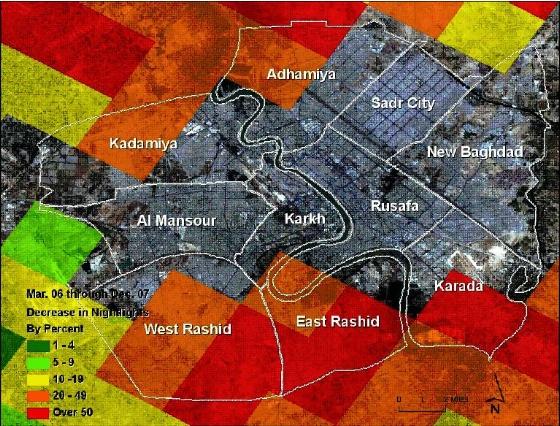
Satellite image of night lights in Baghdad. By tracking the amount of light emitted by Baghdad neighborhoods at night, a team of UCLA geographers has uncovered fresh evidence that last year’s U.S. troop surge in Iraq may not have been as effective at improving security as some U.S. officials have maintained. (Credit: Image courtesy of University of California – Los Angeles)

Study Of Satellite Imagery Casts Doubt On Surge’s Success In Baghdad
September 19, 2008

By tracking the amount of light emitted by Baghdad neighborhoods at night, a team of UCLA geographers has uncovered fresh evidence that last year’s U.S. troop surge in Iraq may not have been as effective at improving security as some U.S. officials have maintained.

Night light in neighborhoods populated primarily by embattled Sunni residents declined dramatically just before the February 2007 surge and never returned, suggesting that ethnic cleansing by rival Shiites may have been largely responsible for the decrease in violence for which the U.S. military has claimed credit, the team reports in a new study based on publicly available satellite imagery.

“Essentially, our interpretation is that violence has declined in Baghdad because of intercommunal violence that reached a climax as the surge was beginning,” said lead author John Agnew, a UCLA professor of geography and authority on ethnic conflict. “By the launch of the surge, many of the targets of conflict had either been killed or fled the country, and they turned off the lights when they left.”

The night-light signature in four other large Iraqi cities — Kirkuk, Mosul, Tikrit and Karbala — held steady or increased between the spring of 2006 and the winter of 2007, the UCLA team found. None of these cities were targets of the surge.

Baghdad’s decreases were centered in the southwestern Sunni strongholds of East and West Rashid, where the light signature dropped 57 percent and 80 percent, respectively, during the same period.

By contrast, the night-light signature in the notoriously impoverished, Shiite-dominated Sadr City remained constant, as it did in the American-dominated Green Zone. Light actually increased in Shiite-dominated New Baghdad, the researchers found.

Until just before the surge, the night-light signature of Baghdad had been steadily increasing overall, they report in “Baghdad Nights: Evaluating the U.S. Military ‘Surge’ Using Night Light Signatures.”

“If the surge had truly ‘worked,’ we would expect to see a steady increase in night-light output over time, as electrical infrastructure continued to be repaired and restored, with little discrimination across neighborhoods,” said co-author Thomas Gillespie, an associate professor of geography at UCLA. “Instead, we found that the night-light signature diminished in only in certain neighborhoods, and the pattern appears to be associated with ethno-sectarian violence and neighborhood ethnic cleansing.”

The effectiveness of the February 2007 deployment of 30,000 additional U.S. troops has been a subject of debate. In a report to Congress in September of that year, Gen. David Petraeus claimed “the military objectives of the surge are, in large measure, being met.” However, a report the same month by an independent military commission headed by retired U.S. Gen. James Jones attributed the decrease in violence to areas being overrun by either Shiites or Sunnis. The issue now figures in the U.S. presidential race, with Republican presidential candidate John McCain defending the surge and Democratic hopeful Barack Obama having been critical of it.

Reasoning that an increase in power usage would represent an objective measure of stability in the city, Agnew and Gillespie led a team of UCLA undergraduate and graduate students in political science and geography that pored over publicly available night imagery captured by a weather satellite flown by the U.S. Air Force for the Department of Defense.

Orbiting 516 miles above the Earth, Satellite F16 of the Defense Meteorological Satellite Program, Operational Linescan System (DMSP/OLS) contains infrared sensors that calculate, among other things, the amount of light given off in 1.75-square-mile areas. Using geo-referenced coordinates, the team overlaid the infrared reading on a preexisting satellite map of daytime Iraq created by NASA’s Landsat mapping program. The researchers then looked at the sectarian makeup in the 10 security districts for which the DMSP satellite took readings on four exceptionally clear nights between March 20, 2006, when the surge had not yet begun, and Dec. 16, 2007, when the surge had ended.

Lights dimmed in those neighborhoods that Gen. Jones pointed to as having experienced ethno-sectarian violence and neighborhood ethnic cleansing in his “Report of the Independent Commission on the Security Forces of Iraq.”

“The surge really seems to have been a case of closing the stable door after the horse has bolted,” Agnew said.

Long-term obstacles to meeting Baghdad’s power needs may have contributed to the decrease in night lights in the city’s southwestern parts, the researchers acknowledge. But Baghdad’s shaky power supply does not fully account for the effect, they contend, citing independent research showing that decaying and poorly maintained power plants and infrastructure were meeting less than 10 hours of Baghdad’s power needs prior to the fall of Saddam Hussein.

“This was the part of the city that had the best sources of connection and the most affluent population, so they could actually generate power themselves, and they were in the habit of doing so well before the U.S. invasion,” said Agnew, the president of the American Association of Geographers, the field’s leading professional organization. “But we saw no evidence of a widespread continuation of this practice.”

In addition to casting doubt on the efficacy of the surge in general, the study calls into question the success of a specific strategy of the surge, namely separating neighborhoods of rival sectarian groups by erecting concrete blast walls between them. The differences in light signatures had already started to appear by the time American troops began erecting the walls under Gen. Petraeus’s direction, the researchers found.

“The U.S. military was sealing off neighborhoods that were no longer really active ribbons of violence, largely because the Shiites were victorious in killing large numbers of Sunnis or driving them out of the city all together,” Agnew said. “The large portion of the refugees from Iraq who went during this period to Jordan and Syria are from these neighborhoods.”

Previous research has used satellite imagery of night-light saturation to measure changes in the distribution of populations in a given area, but the UCLA project is believed to be the first to study population losses and migration due to sectarian violence. The outgrowth of an undergraduate course in the use of remote sensing technologies in the environment, the UCLA project was inspired by a desire to bring empirical evidence to a long-running debate.

“We had no axe to grind,” said Agnew. “We were very open. If we had found that the situation was different, we would’ve reported it. Our main goal was to bring fairly objective and unobtrusive measures to a particularly contentious issue.”

Journal reference:

1. Agnew et al. Baghdad nights: evaluating the US military ‘surge’ using nighttime light signatures. Environment and Planning A, 2008; 40 (10): 2285 DOI: 10.1068/a41200

[Adapted from materials provided by University of California – Los Angeles.]

Source / Science Daily

The Rag Blog

Posted in RagBlog | Tagged , , | 3 Comments

Rejecting "Anything Goes, Just Don’t Get Caught" as a Viable Political Philosophy

Cynthia McKinney is a former member of Congress from Georgia, and the Green Party candidate for President. We do not in any way endorse her (or any candidate specifically), but feel that she has some important things to say that are worthy of posting on the Rag Blog.

Richard Jehn / The Rag Blog


Seize the Time
By Cynthia McKinney / September 19, 2008

We the people must now seize the time! We have always had the capability of determining our own destiny, but for various reasons, the people failed to elect the leaders who provided the correct political will.

There was always some corporate or private special interest that stood in the way of the public good. And they always seemed to have the power of the purse to throw around and influence public opinion or our elected officials.

The very foundation of the U.S. economy is crumbling underneath our feet. This represents a unique moment in U.S. history and we must now seize the time for self-determination — for health care, education, ecological wisdom, justice, and all the policies that will make a difference in the lives of the people including an end to all wars, including the drug war!

The crisis was staved off for a time for some of our major finance engines when they were able to obtain bridge funding from certain sovereign wealth funds. That option grows increasingly dim as The Federal Reserve is becoming the lender of last resort. This means that the people are becoming the owners of the primary instruments of U.S. capital and finance.

This now means that the people have a say in how these instruments are to be used and what their priorities ought to be. The people should now have more say in how their tax dollars are spent and what the priorities of government an the public sector must be. We the people must now set our demands to ensure and promote the public good.

Now, as we ponder the importance of this moment to do good and serve the needs of the people, some politicians have already figured out their answer for us: win or steal the next election, prepare for more war, and leave it to others to try and figure out what to do next.

While banks are failing all around us and the U.S. taxpayer is drenched with news of billion dollar bailouts for *selected* companies, the Congress, which has utterly failed in its twin responsibilities of setting policy and Executive Branch oversight, plans to adjourn instead of setting new policies; lessening the impact of the economic freefall on innocent victims; or stopping war, expansion of war, new war, and occupation.

In a dizzying turn of recent events, we have all witnessed the collapse of Fannie Mae and Freddie Mac mortgage providers, investment banks Lehman Brothers and Bear Stearns, and insurer American International Group (AIG), and other companies. So far, at least eleven banks have filed for bankruptcy this year. The case of the AIG bailout is particularly curious as Merrill Lynch was denied taxpayer largesse. I wonder if AIG was the selected company for bailout because of its relationship to the U.S. intelligence community and what others would discover if AIG’s books were opened in an audit. The last person to get close to AIG and its shady operations was Eliott Spitzer.

But some more fundamental issues must be explored here, relating to the underlying assumptions that have guided U.S. political and economic activity, particularly over the last eight years.

The Bush Administration’s “anything goes, just don’t get caught” attitude has set the tone for what we are witnessing today. To be sure these problems didn’t start in January of 2001, but they sure were allowed to accelerate during the George W. Bush Administration. For example, what tone was set when the Administration shipped $12 billion to Paul Bremer’s provisional government in Iraq in cash on wooden pallets for Iraq reconstruction? No wonder $9 billion of it was “lost.” What I’m constantly reminded of is that the money didn’t just vanish, somebody got it. Now it’s up to us to find out who!

However, the Administration’s blatant disregard for good governance, the rule of law, standards of moral and ethical conduct, and even etiquette, when coupled with a laissez-faire, “go-along-to-get-along” attitude from Congress meant that no holes were barred and no hands were on the deck–a sure prescription for disaster.

In my reading over the course of the last few years, I had to become somewhat conversant with the language of the new economy: bundled mortgages, securitization, SPEs, SIVs, derivatives. But in addition to the old concepts that always seemed to be with us–predatory lending, redlining, no affordable housing amid “the housing bubble,”– it soon became clear that basically folks had figured out a way to make money off of a ticking time bomb. Kind of like prisons for profit.

And even though the Enron scandal was supposed to have cleaned up a lot of this, unfortunately, even Fannie Mae and Freddie Mac regularly engaged in some of these practices and that’s why you and I own them today. I believe it is true that the very foundations of the U.S. economy and conventional political behavior have been shaken. Now is not the time for business as usual.

And although this is by no ways exhaustive, here are a few things that I think the Democratic-led Congress could work on now instead of adjourning:

1. enactment of a foreclosure moratorium now before the next phase of ARM interest rate increases take effect;

2. elimination of all ARM mortgages and their renegotiation into 30- or 40-year loans;

3. establishment of new mortgage lending practices to end predatory and discriminatory practices;

4. establishment of criteria and construction goals for affordable housing;

5. redefinition of credit and regulation of the credit industry so that discriminatory practices are completely eliminated;

6. full funding for initiatives that eliminate racial and ethnic disparities in home ownership;

7. recognition of shelter as a right according to the United Nations Declaration of Human Rights to which the U.S. is a signatory so that no one sleeps on U.S. streets;

8. full funding of a fund designed to cushion the job loss and provide for retraining of those at the bottom of the income scale as the economy transitions;

9. close all tax loopholes and repeal of the Bush tax cuts for the top 1% of income earners;

10. fairly tax corporations, denying federal subsidies to those who relocate jobs overseas repeal NAFTA.

And since the Congress plans to adjourn early and leave these problems to The Federal Reserve, The Federal Reserve should operate in the interests of the U.S. taxpayer and not the interests of the private, international bankers that it currently represents. This, of course means that The Federal Reserve, too, must undergo a fundamental ownership and mission change.

This crisis does not have to be treated as merely a “market correction,” or the result of a few rotten apples in an otherwise pristine barrel. This crisis truly represents the opportunity to introduce fundamental changes in the way the U.S. economy and its political stewards operate.

Responsible political leadership demands that the pain and suffering being experienced by the innocent today not be revisited upon them or the next generation tomorrow. But sadly, instead of affirmative action being taken in this direction, the Bush Administration ratchets up the drumbeat for war, Republican Party operatives busily remove duly-registered voters from the voter rolls, and our elected leaders in the Congress go home to campaign while leaving all of us to fend for ourselves. For the Administration and the Democrat-led Congress, I declare: MISSION UNACCOMPLISHED.

For the public whose moment this is, I say:

Power to the People!

Please visit www.runcynthiarun.org and read our platform.

Source / Roseanne World

Thanks to Diane Stirling-Stevens / The Rag Blog

Posted in RagBlog | Tagged , | 1 Comment

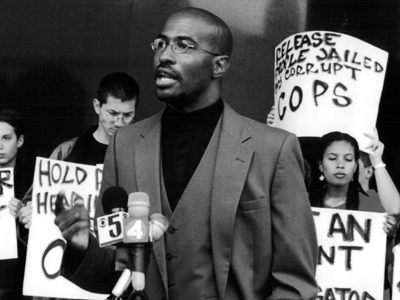
Van Jones: ‘We just need the president to stop breaking everything.’


We Can’t Drill Our Way Out of Our Energy Problems
By Van Jones / September 20, 2008.

In an electrifying speech, Van Jones explains that we have to invent and invest our way out of the economic and environmental crises.

The following speech was originally delivered at Netroots Nation 2008 in Austin, Texas.

I have a little bit of whiplash. Thirty-six hours ago I was in the Arctic with Jimmy Carter. This is not a joke, you all. (Laughter) It sounds like a joke, right? You hear about the black guy in the Arctic with Jimmy Carter? No, I was really … (Laughter)

I was really in the Arctic, man, the abominable snow Negro. No, I was really there. (Laughter) And the reason, so I’m a little bit jet-lagged, but I want you to know, if you didn’t know, it was kind of kept quiet until it was over. But a number of people, huge dignitaries, all got on a boat and went to the Arctic. We spent eight days. Jimmy Carter was there. Madeline Albright. Tom Daschle. Larry Page from Google. But not just liberals and progressives; the head of DuPont was there, eight days on a boat, to look and see if what’s happening with climate change is real. The head of Monsanto was there. We had Republicans and Democrats, young people, old people, state leaders, Catholics, evangelicals.

And I want you to know that after eight days of looking with our own eyes of what’s going on, looking at the glaciers receding, looking at the animals and life up there that’s suffering, watching the actual results and impacts of global warming, that every single person who is a part of that delegation, Left, Right and otherwise, agreed that Al Gore has been right the whole time. Global warming is real.

We have to do something about it. Nobody who goes and spoke at this thing has come to any other conclusion. You need to understand that. This is our moment. This is our opportunity. Before I get to my comments, though, since we’re here, I want to tell you about my personal experience in the Arctic.

First of all, they had us on this boat, man. Lot of people have bad experiences of boats, man. You know, we’re … (Laughter) far back memories, man. I was like, I don’t like this. (Laughter) It was tough, man. And then, boats are not big things. They’re not airplanes. I guess it’s left over from the days of scurvy or something. They’re small. And, OK, I busted my head open, man. I’m serious. I busted my head open on a bulkhead, like the first day, which was not very impressive. (Laughter) So, a little bit woozy.

The other thing that happened was, we had a meeting. We had a delegation, this meeting of the delegation of polar bears. And they’re very polite, the polar bears. And they’re very friendly. The polar bears were not as skinny and scrawny as I expected. They were definitely smaller than they were supposed to be, but they also looked toned, looked pretty healthy.

So I said, what’s going on? You guys look at lot healthier than I expected. And nobody said anything. The polar bears, they got quiet. (Laughter) And the only polar bear that spoke up was a black one. (Laughter) Oh, see? You didn’t know there was black polar bears. Now I’m telling you, man. Racism everywhere. (Laughter)

But the black polar bear was honest, man. He said, look. Tell you the truth. The seals, they are getting kind of scarce up here. But we’ve been snacking on these camera crews y’all keep sending. (Laughter) So tell Gore to keep giving the speeches, man. The camera crews are tasty. (Laughter) So I say that because it’s so important that we do more than just send delegations to the Arctic and talk about it, and worry about it. It’s time to take some real action. And I want to talk with you about our action plan. And I want to talk with you about the importance of it, because one of the things that I saw when I was there was up close and personal with Jimmy Carter.

I think a lot of times, in the progressive movement, we kind of almost go along with the conservatives in making fun of Jimmy Carter, almost turning him into a punch line. But I want to say, seeing him day after day, he’s one of the truly great human beings that’s ever lived on this earth.

We need to give him the respect that he’s due. Jimmy Carter was talking about the oil crisis. He was talking about solar power. He was talking about wind energy 30 years ago. And if we had stayed with his program, if we had stayed with his policies, we wouldn’t be where we are today. So he deserves the utmost respect from all of us. We need to rehabilitate Jimmy Carter.

If conservatives can rehabilitate Ronald Reagan, we can certainly rehabilitate Jimmy Carter. We have to learn the lessons, too, from his presidency, because we are about to go into a very similar situation. Many of you are excited about the Democratic nominee. Many of you are excited about having a Democrat back in the White House and think that your efforts may lend a hand toward getting him elected.

I want to say to you, your excitement is understandable, and your ability to get him elected is not in doubt. You probably can get this nominee elected. You probably cannot get him re-elected. I’m going to say it again. You can probably get him elected, but you probably cannot get him re-elected, unless we are very intelligent starting right now. Now is the time to think about the re-election of this president, not just the election.

And the last time we had a Democrat in the White House, Democrats controlling the Senate, Democrats controlling the House, energy prices through the roof, jobs going down, was Jimmy Carter. And we had four years of that, and 12 years of Reagan-Bush. If we are not careful, if we are not smart, this could be four years as a precursor to the kind of right-wing backlash that will make us miss John McCain, make us miss George W. Bush. Don’t think it’s not possible. There are dragons on the Right who, in their anti-immigrant hatred, in their warmongering jingoism, in their commitment to drill and burn their way out of our energy crisis, will make you miss John McCain.

So it is serious, now, that we have to figure out, what is the set of policies, and the program and the plan, from the bottom up as well as the top down, to ensure that we have four years, eight years, 12 years, 24 years, 100 years to fix the past eight. That’s what we need. We need a strategy for that.

Let me suggest to you that the term that we most must address, as we talk about energy and climate, is not a term about polar bears. It’s not a term about polar bears, it’s not a term about ice caps. It’s a term from deep in the bowels of economics. The worst, scariest, most frightening, most horrific term in all of economics, the term that killed the presidency of Jimmy Carter, the term that could turn this country over to the far right in a very short period of time, that term is stagflation. Stagflation. And it’s something that we haven’t had to talk about for 30 years, but it is the term that sent shivers down the spine of anybody involved in politics.

What is stagflation? Stagflation is the worst possible outcome in market economics. Energy prices go up, and when they go up, they push up all prices, because it takes energy to make everything. But there’s a particularly pernicious effect on energy prices going up. It’s that the prices of everything go up, but jobs go down. Prices go up, but jobs go down. People buy less, they hire less. And over time, society gets stretched on the rack of the pain of prices continuing to rise, and jobs continuing to fall, and good people get voted out of office. That’s what happened to Jimmy Carter, and it could happen to your nominee.

There’s only one way out of stagflation, and that is to get energy prices down and stable. Here is our problem. The right wing has a strategy for getting energy prices down and stable. They want to drill and burn their way out of the problem. And you’ve heard it now for months: Drill now, pay less. That is their strategy. And they continue to beat the drum on that, and now the Democrats are starting to get weak on the point. We cannot drill and burn our way out of this crisis. If we do, we will bake this planet. That is a non-starter. It has to be off the table.

We cannot drill and burn our way out. But here’s what we can do. We can say no. We aren’t going to drill and burn our way out, but we can invent and invest our way out. We can invent and invest our way out. That’s our strategy.

That’s our strategy. And why is it a good strategy? It’s a good strategy because you only have to do two things: cut demand for energy, and diversify supply. Why is that good for us? Because both of those things create jobs. Cutting demand creates jobs. Why? Cutting demand means conservation. It means weatherizing … millions and millions of buildings across the country. Millions of buildings have to be weatherized so they don’t leak so much energy. What does that mean? That creates thousands of contracts, millions of jobs, billions of dollars of economic stimulus. We’re not building any more houses, but we can begin to rebuild the ones that we have right now to save on energy costs. See? That’s a way out.

And it puts people to work. Cutting demand means a massive investment in public transportation, rail, clean buses. That’s the way out. You cut demand for energy, and you create jobs doing it. On the supply side, diversifying our supply means wind, it means solar, it means all the things that (San Francisco Mayor) Gavin (Newsom) was just talking about. But that also means jobs. Why?

Many of you don’t get on airplanes right now. All y’all concerned about carbon, you better put a whole bunch up … (Laughter) and me, too. When you’re flying over this country, look down. You’ll see house, after house, after house. No solar panels. And go to sleep, wake up in an hour. You’ll still be flying. Look down. More houses without solar panels. The next president of the United States should say, we are going to have a World War II level mobilization, a crash program to weatherize and solarize America, put up millions of solar panels on every surface we can find and put people to work doing it.

That’s the way out. We have the technology. We have not had the political will to unleash that technology. I am proud to be part of an organization, Green For All, that is in partnership with One Sky, it’s in partnership with Al Gore’s Climate Alliance and other organizations, to bring this into being. So I want to tell you the three things that we’re going to be doing this fall I’m going to need your major active support and intention on, that I want to talk to you about your role under this new administration.

… We have to change the terms of debate going through the fall. We have been getting our butts whooped by this drill-drill-drill mantra. And it’s time for us to seize the terms of debate and show that we have answers, and we have solutions. That is going to be primarily up to you. We’ve seen that the mainstream media is willing to follow the right wing down the hellhole of increasing carbon emissions for short-term potential gains on gas prices. It’s going to be up to you to tell a different story.

What is actually happening on our side that’s not being covered? Three things.

Number one: We have legislation right now in front of Congress, the Green Jobs Act of 2007 and the Green Block Grant. What would they do? They would put enough money into the Department of Labor to send out, to community colleges and vocational schools all around the country, enough money to train 30,000 people a year in green jobs, in green trades. That is now being beat up and held up in Congress. We need your help to get the Green Jobs Act fully funded.

Number two: The mayors, the U.S. Conference of Mayors has gotten this Green Block Grant. It’s called the Energy Efficiency and Conservation Block Grant. It is authorized at $2 billion. That’s also being held up and beat up in Congress. That would be $2 billion, with a B, so mayors like Gavin Newsom could get money to begin this program of weatherization and solarization in every city in America. That should be the number one priority for the entire country, and instead, it’s being held up. You can do something about that. You could do something about that.

Number three: This fall, we are going to launch a massive campaign to accelerate the embrace by people in this country of green jobs. On September 27th we are going to have the biggest national mobilization for green jobs in the history of the country. We’re going to have thousands of rallies, thousands of house meetings all across the country, calling for green jobs now. This movement for climate solutions is not just a movement about the crisis.

We know about the crisis. We know about the bad stuff. We’re now going to start talking about the good stuff. That is going to be the key. Once people in the United States of America understand that this movement that we’re trying to build is not just a movement to prevent something bad from happening — this is the movement that will finally get the good things happening — we think that we will be able to build a majority. Why?

We want to be able to tell people for the first time, guess what? This movement for climate solutions is the movement that you’ve been waiting for your whole life. Why? Because we want to tell your child, who might be standing on a street corner right now, with no future, your child … who’s probably gone to more funerals this year, if you live in urban America, than he’s ever gone to graduations or proms.

We want to tell your child, guess what? We want to retrofit, reboot, repower a nation. And we need your help to do it. We want to give you the tools, and the training, and the technology, to rescue this country. We want to put the green hard hat on you … tool belt, work boots. We want to put you up on a rooftop where you can install solar panels. Bring your grandmama’s light bill down. We’re tired of your grandmama sending checks to the PG&E and the power companies. We want them to write her a check. See? That’s what we want. That’s what this movement is about.

We want them to write her a check. We want to take the asthma inhaler out of your little sister’s pocket, by closing down these dirty pollution power plants, and letting her run and play again.

We want to let you in on the ground floor of something that’s going somewhere. This is not a dead end job at Wal-Mart. See, once you get in on the ground floor as a solar panel installer, doing green retrofits, this is going to be a growing industry. In a couple years you can be a manager, an owner yourself, and help to rebuild your community. We want to be able to go door to door in America and tell people that this is the movement that will create new work, new wealth, new health, new investments.

You see, cities, as Gavin said, 75 percent of our greenhouse gas emissions, there is no way to beat global warming without greening the cities. You can’t save the polar bear without saving the poor children, too. It’s one movement. It’s one movement, because it’s one solution.

But that’s the opportunity that we have. The opportunity that we have is to say for the first time, we have all this work that needs to be done. We have to build wind farms. We have to build wave farms. We have to build solar farms. We have to weatherize buildings. We have to put up solar panels. We have to plant trees, millions of them, and take care of them. Thousands of jobs. Millions of jobs. Billions of dollars of economic investment. This is the work that most needs to be done.

We have the opportunity to connect the people who most need work with the work that most needs to be done … and fight pollution and poverty at the same time. And bring this country together, and bring the energy prices down, bring the jobs up. End forever the need for oil wars and resource wars, and bring this country together. That’s a promise of this green jobs movement. And we need your active support to evangelize this as a solution. It’s not just going to save the polar bears. It’s not just going to save the poor kids. It’s the only way to save the presidency of the United States.

We cannot afford to have two back-to-back failed presidencies in this country. The world can’t afford it. The only way to save this new coming president … people keep talking about his name, his middle name is a problem. We’re worried about his middle name. Barack Hussein Obama. His middle name is not going to be Hussein if he wins this election. His middle name is going to be Piñata. He will be Barack Piñata Obama. (Laughter)

Trust me. You’re going to have the right wing, not in the White House, not running anything in the White House, not running anything in the Senate, not running anything in the House. They’re going to have nothing to do but run their mouths against this president. And they will ally themselves. They will try to create a backlash alliance against anything he does on the environment, a backlash alliance between polluters and poor people, to say that the green revolution is nothing but an eco-elite movement, trying to put green taxes on poor people to pay for their hybrid revolution.

Van Jones is the founder and president of Green For All and is the founder of the Ella Baker Center for Human Rights.

Read the rest of it here. / AlterNet

Thanks to Diane Stirling-Stevens / The Rag Blog
Posted in RagBlog | Tagged , , | Leave a comment

Sarah Palin and the Witch-Fighting Pastor Who Helped Her Become Governor

‘Examination of a Witch,’ by T.H. Matteson 1853 / Courtesy of the Peabody Essex Museum. Blaming it all on witches is not without precedent.

Sarah Palin Linked Her Electoral Success to Prayer of Kenyan Witch Hunter Thomas Muthee
By Hannah Strange / September 18, 2008

Also read ‘Burn Her! Why it’s dangerous to be a witch in a recession’ by Tim Harford, below this article.

The pastor whose prayer Sarah Palin says helped her to become governor of Alaska founded his ministry with a witch hunt against a Kenyan woman whom he accused of causing car accidents through demonic spells.

At a speech at the Wasilla Assembly of God on June 8 this year, Palin described how Thomas Muthee had laid his hands on her when he visited the church as a guest preacher in late 2005, prior to her successful gubernatorial bid.

In video footage of the speech, she is seen saying: “As I was mayor and Pastor Muthee was here and he was praying over me, and you know how he speaks and he’s so bold. And he was praying “Lord make a way, Lord make a way.”

“And I’m thinking, this guy’s really bold, he doesn’t even know what I’m going to do, he doesn’t know what my plans are. And he’s praying not “Oh Lord, if it be your will may she become governor,” no, he just prayed for it. He said, “Lord make a way and let her do this next step. And that’s exactly what happened.”

She then adds: “So, again, very, very powerful, coming from this church,” before the presiding pastor comments on the “prophetic power” of the event.

An African evangelist, Muthee has given guest sermons at the Wasilla Assembly of God on at least 10 occasions in his role as the founder of the Word of Faith Church, also known as the Prayer Cave.

Muthee founded the Prayer Cave in 1989 in Kiambu, Kenya, after “God spoke” to him and his late wife, Margaret, and called him to the country, according to the church’s Web site.

The pastor speaks of his offensive against a demonic presence in the town in a trailer for the evangelical video “Transformations,” made by Sentinel Group, a Christian research and information agency.

“We prayed, we fasted, the Lord showed us a spirit of witchcraft resting over the place,” Muthee says.

After the spirit was broken, the crime rate dropped to almost zero and there was “explosive church growth” while almost every bar in the town closed down, the video says.

The full “Transformations” video featuring Muthee’s story has recently been removed from YouTube, but the rest of the story is detailed in a 1999 article in the Christian Science Monitor, as well as on numerous evangelical Web sites.*

According to the Christian Science Monitor, six months of fervent prayer and research identified the source of the witchcraft as a local woman called Mama Jane, who ran a “divination” center called the Emmanuel Clinic.

Her alleged involvement in fortune-telling and the fact that she lived near the site of a number of fatal car accidents led Muthee to publicly declare her a witch responsible for the town’s ills and order her to offer her up her soul for salvation or leave Kiambu.

Says the Monitor, “Muthee held a crusade that ‘brought about 200 people to Christ.'” They set up around-the-clock prayer intercession in the basement of a grocery store and eventually, says the pastor, “the demonic influence — the ‘principality’ over Kiambu — was broken,” and Mama Jane fled the town.

According to accounts of the witch hunt that circulated on evangelical Web sites such as Prayer Links Ministries, after Muthee declared Mama Jane a witch, the townspeople became suspicious and began to turn on her, demanding that she be stoned. Public outrage eventually led the police to raid her home, where they fired gunshots, killing a pet python they believed to be a demon.

After Mama Jane was questioned by police — and released — she decided it was time to leave town, the account says.

Muthee has frequently referred to this witch hunt in his sermons as an example of the power of “spiritual warfare.” In October 2005, he delivered 10 sermons at the Wasilla Assembly of God, the audio of which was available on the church’s Web site until it was removed around the time Palin’s candidacy was announced. The blog Irregular Times has listings and screen grabs of the sermons.

It was during these sermons that Palin, who was then preparing for her gubernatorial run, was anointed by Muthee. His intercession, she says, was “awesome.”

Her June 8 speech was to mark the graduation of students from the Wasilla Assembly of God’s Masters’ Commission, which, as Pastor Ed Kalins explains, believes Alaska will be the refuge for American evangelicals upon the coming “End of Days.” After her speech, Palin was presented with an honorary Masters’ Commission diploma.

© 2008 The Times of London UK All rights reserved.

*This video, “Transformations: A Documentary Trailer,” can be seen here on YouTube, but embedding has been disabled so we can’t post it.

Source / The Times of London / AlterNet

Here is a video of Sarah Palin discussing her experience with witch-hunting pastor Thomas Muthee:

Burn Her!
Why it’s dangerous to be a witch in a recession.

By Tim Harford / September 20, 2008

Why did people murder suspected witches in Renaissance Europe? And why do they still do so today in sub-Saharan Africa? As someone whose main source of information about witch trials is Monty Python and the Holy Grail, I was fascinated to learn that witch-burning has its own grim economics.

Clearly, some of the fervor for murdering women—typically elderly widows—had cultural and religious origins. In the early medieval period, the Catholic Church dismissed the idea that witches had supernatural powers, and some church documents argued that it was heresy to believe in witchcraft. Without church support, it’s easy to see why witch trials were not popular.

Yet when the trial and execution of suspected witches surged in the mid-16th century and throughout the 17th, it was a cross-cultural phenomenon. Trials took place in many countries and were conducted by both Protestants and Catholics, and in both secular and religious courts. Perhaps a million women were killed across Europe after being accused of witchcraft, and most of them died during this period. Why?

Historian Wolfgang Behringer has one possible explanation: Temperatures dropped sharply around the time that the trials gained in popularity. The “little ice age,” in which average temperatures fell by about 1 degree Celsius, was enough to freeze the Thames River on many occasions.

Emily Oster, an economist at the University of Chicago, has tried to gather systematic data on the link between witch trials and the weather. The results look striking: Between 1520 and 1770, colder decades go hand-in-hand with more trials. The link may be simply that witches were often blamed for bad weather. Or there may be a less direct link: People tend to lash out in tough times. There is some evidence, for instance, that lynching was more common in the American South when land prices and cotton prices were depressed.

Such deaths are, sadly, not a historical footnote. In Meatu, Tanzania, half of all reported murders are “witch killings.” Such murders have been documented elsewhere in Africa, Bolivia, and rural India. The difference between the historical executions and modern attacks are that a Tanzanian “witch” typically dies at the hands of her own family. The machete is the weapon of choice.

Edward Miguel, an economist at the University of California, Berkeley, and co-author of Economic Gangsters, a book about the economics of crime, corruption, and war, has studied the Tanzanian situation. He argues that there is a direct economic motive for the attacks. Tough times in a Tanzanian household may well result in starvation, and the elderly—especially women—are at risk of being sacrificed to free resources. As evidence, Miguel points out that victims of witch attacks in Meatu district—almost all old women—tend to be from the poorest households. The murders are much more common during years of drought or flood.

If the problem truly is an economic one, the solution might be, too. One possibility is to give the elderly generous pensions. Witch killings all but stopped in South Africa’s North Province after such a pension scheme was introduced in the early 1990s. Unfortunately, such pensions are probably too expensive for Tanzania.

A grass-roots alternative has emerged in another Tanzanian district, Ulanga, where traditional healers “cure” elderly women of witchcraft by shaving their bodies and smearing their pates with “anti-witchcraft paste.” Miguel does not think it’s a coincidence that the healers also provide the women with food and shelter during famines, in expectation of payments from their families in better times. Spiritual ceremony meets social insurance: It’s a solution, of sorts.

Source / Slate

The Rag Blog

Posted in RagBlog | Tagged , , , , | 2 Comments

Perhaps There Is a Little Justice in This World

Pedestrians walk by the American International Group Inc. building in New York, Sept. 17, 2008. Photographer: Ramin Talaie/Bloomberg News

Pelosi, Kerry May Share Investor Pain as AIG Stakes Evaporate
By Jonathan D. Salant / September 19, 2008

The market storm that brought down Lehman Brothers Holdings Inc., American International Group Inc. and other pillars of U.S. finance may have also blown holes in the portfolios of House Speaker Nancy Pelosi, Senator John Kerry and more than 50 other members of Congress.

Pelosi, in her most recent financial disclosure form, reported that her husband owned between $250,000 and $500,000 of stock in AIG, which ceded majority control to the U.S. government this week in exchange for $85 billion of loans.

Kerry, the 2004 Democratic presidential nominee, disclosed that his wife, Teresa Heinz Kerry, had more than $2 million of AIG stock at the end of 2007, when shares were worth $58.30. AIG has fallen 85 percent this week to close yesterday at $2.69. The lawmakers’ aides didn’t respond to calls seeking comment.

Altogether, 56 senators and representatives had stakes in AIG, Lehman, Fannie Mae, Freddie Mac, Bear Stearns Cos. or IndyMac Bancorp Inc. — some of the biggest casualties of the market bloodbath — according to the Center for Responsive Politics. The most recent annual disclosure filings list investments as of Dec. 31, 2007, and reveal the size of holdings only within a range of values. Lawmakers may have sold shares since then.

“Lawmakers, like everyone else in America who has any kind of retirement portfolio or stock holdings, are going to be suffering,” said Gary Kalman, a lobbyist for the Boston-based U.S. Public Interest Research Group, a consumer-advocacy organization. “This is a serious issue. We need to have a serious response.”

Market Plunges

The Standard & Poor’s 500 Index plunged 7.6 percent during the first three days of this week on news that Lehman and Merrill Lynch & Co. — which survived two world wars and the Great Depression — were finished as independent investment banks.

Lehman filed history’s biggest bankruptcy case on Sept. 15 and Merrill sold itself to Bank of America Corp. Even after rallying yesterday, the S&P 500 is down almost 25 percent from its October 2007 peak.

Lehman shares, which traded for as much as $67.73 last November, closed yesterday at 5 cents. Merrill’s shareholders are in better shape. To avoid Lehman’s fate, Merrill agreed to be acquired in a stock-swap worth $26.28 per share at yesterday’s closing prices. In better days, Merrill soared to as much as $98.68 in January 2007.

Bear Stearns was the first Wall Street titan to fall as home-loan defaults battered the market for mortgage-backed securities and started a chain reaction that devastated credit markets. JPMorgan Chase & Co. bought Bear Stearns in March.

Government Takeover

Earlier this month, the government took control of Fannie Mae and Freddie Mac, which together accounted for almost half of the U.S. home-loan market. Fannie Mae shares had already plummeted more than 80 percent this year, to $7.04 from $39.98, before the government’s Sept. 7 takeover was announced. Shares dropped to 73 cents when trading resumed the next day. Freddie Mac fell to 88 cents, after starting the year at $34.07.

Representative Robin Hayes, a South Carolina Republican, had Congress’s biggest AIG stake, according to the Washington-based Center for Responsive Politics. Hayes’s AIG stock was worth between $2.8 million and $11.5 million.

John McCain, the Republican presidential nominee, avoided potential losses. Because of the Arizona senator’s run for the White House, his wife, Cindy, last year liquidated a blind trust that had contained stock in AIG, Fannie Mae, Freddie Mac and Lehman. The amounts of stock she had owned weren’t disclosed.

Representative Jane Harman, a California Democrat, owned between $50,000 and $100,000 of Lehman shares, according to her disclosure form. Calls to offices of Hayes and Harman weren’t returned.

Pasadena, California-based IndyMac’s bank was seized by U.S. regulators in July, in the third-biggest U.S. bank failure. IndyMac stock closed yesterday at 6 cents, after trading earlier this year for as much as $11.32.

Source / Bloomberg

Thanks to Diane Stirling-Stevens / The Rag Blog
Posted in RagBlog | Tagged , , | 1 Comment

Being Realistic Eventually Turns Out To Be Right

The Karl Marx and Friedrich Engels monument in Berlin.
Photo: commons.wikimedia.org / Manfred Brückels

Reality Catches Up to the Free Market
By William Pfaff / September 18, 2008

Karl Marx, were he still about, would surely be interested in the report that unregulated free-market capitalism has died in a flash, by its own hand; whereas it took 70 years and a Cold War to bring down the Marxist economy established in the Soviet Union following the Bolshevik Revolution.

The Marxist economy died of its internal contradictions.

This was the fate Marxism (or Marxism-Leninism) had predicted for capitalism, not for itself. Unregulated free-market capitalism may be said to have killed itself by greed, vanity and excess, all amply evident before and at the death scene, but the ultimate guilt must be attributed to the vacuity and perversity of market ideology, which contradicts human nature.

In this, it exactly resembles the American national foreign affairs ideology, that democracy will always eventually triumph over all else. Regrettably, this is an illusion, clung to in American governmental, political and, to a considerable degree, academic circles. It is stubbornly adhered to because everyone would like to think it true, since it is very reassuring to Americans, and an uplifting idea.

Both market and democratic ideologies rest on a belief in the essential goodness of mankind, admittedly blocked from time to time by institutional or intellectual obstructions, which have only to be removed for harmony to be restored.

Market capitalism rests on the observation that, all things being equal, a free market is the most perfect known mechanism for setting priorities in an economic system manufacturing goods or providing services.

It declares that in free-market conditions, everyone will make, sell and buy within an equilibrium established by the coincidence of their true interests. People will buy what they need or want according to the value they place on the good or service, and manufacturers or service providers will meet these needs according to whether the value offered incites them to do so, rather than to do something else.

It also is assumed that the employer will pay the true value of the employee’s work, since otherwise the worker will go to an employer who will do so, who naturally will understand that paying a higher wage is in his competitive interest vis-à-vis his competitor.

Owners and managers will be rewarded according to the true value of what each contributes to the common interest. Otherwise they will lose business and fail.

Those last two clauses demonstrate how artificial this theory is. That artificiality—that remoteness from how the real world functions—is why the market has to be regulated, a lesson last learned in the United States 80 years ago in the Great Depression, and progressively disregarded or discarded during the Reagan, Clinton and George W. Bush administrations.

What is this perfect and all-wise free market composed of?

Legitimate actors with legitimate goals, plus speculators, swindlers, confidence men, guys trafficking in inside information, and criminal actors. Yes, the defenders of the market say, but it all averages out in the end. So we see, as the market today destroys global credit and global value. Everyone currently acts as if all this happens as the result of an act of God or the will of the law of averages, or is the result of forgivable miscalculations. President George W. Bush said it’s all been very simple. They built too many houses.

Of course “they” didn’t build too many houses. “They” swindled too many people who bought those houses, or wanted to buy them, by giving them the money to buy them, or to refinance them in order to have a cash gain, with mortgages or second mortgages that these people could not responsibly be expected to repay. That is where it started.

The subsequent manipulation of the funds, so as to bundle bad debt with good debt and pass it off on the international financial market as “securitized” good debt, has had more than enough discussion since the crisis blew up this summer.

The financiers, as Joseph Stiglitz has observed (in a recent CNN interview), were doing what the system demanded of them. They were assured generous rewards for managing risk and allocating capital so as to improve the efficiency of the economy enough to justify their generous compensation. “But they misallocated capital; they mismanaged risk—they created risk. They did what their incentive structures were designed to do: focusing on short-term profits and encouraging excessive risk-taking.”

And this does not take account of an Iraq war financed by debt, and the unconscionable Bush tax cuts to the wealthy, the president’s perverse punishment of the very working- and middle-class voters who had elected him.

As Stiglitz says, the first measures in recovering from the disaster must be to reconstruct the system of corporate incentives to serve the public interest rather than private interests.

Prior to that, however, public policy must be reconstructed on the basis of a historical understanding of how people actually behave rather than on theories about how they might be presumed to behave in the world of abstractions.

This understanding is called realism, and in American public affairs during the past two decades it has been scorned. However, one good thing about realism is that being realistic eventually turns out to be right. The distinguished Protestant theologian and political philosopher Reinhold Niebuhr once remarked that of all the doctrines of the Christian religion, only one is invariably self-validating: the doctrine of Original Sin.

Visit William Pfaff’s Web site at www.williampfaff.com.

Source / TruthDig

The Rag Blog

Posted in RagBlog | Tagged , , | Leave a comment

But Will Dick Cheney Be Impeached? No !!

Dick Armey, victim of the big lie. Photo: CBS

Vice President Dick Cheney’s Incredible and Deadly Lie
By John W. Dean / September 19, 2008

By Deceiving a Congressional Leader, Cheney Sent Us to War on False Pretenses and Violated the Separation of Powers – as Well as the Criminal Law

This week, I agreed to deliver a “Constitution Day” talk on a college campus. My talk was not partisan. Yet the subject matter I selected was prompted by the most incredible – not to mention the most deadly – lie Dick Cheney has yet told, which was reported earlier this week.

Last year, Washington Post reporter Barton Gellman and Jo Baker, now of the New York Times, did an extensive series for the Post on Cheney. Now, Gellman has done some more digging, and published the result in a book he released this week: Angler: The Cheney Vice Presidency. The book reveals a lie told to a high-ranking fellow Republican, and the difference that lie made. In this column, I’ll explain how Cheney defied the separation of powers, and go back to the founding history to show why actions like his matter so profoundly.

Cheney’s Bold Face Lie To Congress

According to Gellman (and to paraphrase from the Post story on his finding), in the run-up to the war in Iraq, the White House was worried about the stance of Republican Majority Leader Richard Armey of Texas, who had deep concerns about going to war with Saddam Hussein. According to the Post, Armey met with Cheney for a highly classified, one-on-on briefing, in Room H-208, Cheney’s luxurious hideaway office on the House side of the Capitol.

During this meeting, the Post reports, Cheney turned Armey around on the war issue. Cheney did so by telling the House Majority Leader that he was giving him information that the Administration could not tell the public — namely (according to Armey), that Iraq had the “‘ability to miniaturize weapons of mass destruction, particularly nuclear,’ which had been ‘substantially refined since the first Gulf War,’ and would soon result in ‘packages that could be moved even by ground personnel.’ In addition, Cheney linked that threat to Saddam’s alleged personal ties to al Qaeda, explaining that ‘we now know they have the ability to develop these weapons in a very portable fashion, and they have a delivery system in their relationship with organizations such as al Qaeda.'”

The Post story continues, “Armey has asked: “Did Dick Cheney … purposely tell me things he knew to be untrue?” His answer: “I seriously feel that may be the case…Had I known or believed then what I believe now, I would have publicly opposed [the war] resolution right to the bitter end, and I believe I might have stopped it from happening.”

In short, it was this lie that sealed the nation’s fate, and sent us to war in Iraq. By lying to such an influential figure in Congress, Cheney not only may have changed the course of history, but also corrupted the separation of powers with their inherent checks and balances.

Cheney’s monumental dishonesty, the news of which has been buried under the current meltdown of the nation’s economy, did not strike me as a topic for a Constitution Day speech. But a realistic discussion of the working of the separations of powers did seem a fitting topic, for college students need to understand the basics of our system. After we remind ourselves of those basics, Cheney’s great lie can be viewed not only as a great immorality and violation of the criminal code, but also and more fundamentally as the significant breach of his oath of office to protect and defend the Constitution that it is.

Our Constitutional Separation of Powers

Historians, not to mention contemporary historical documents, establish that no issue was more important to the founders of our national government than that of what its structure should be. Accordingly, in anticipation of the Constitutional Convention in Philadelphia during the summer of 1787, James Madison of Virginia plowed through historical accounts of governments and concluded that there are three basic forms of government: monarchy (the one), oligarchy (an elite few) and democracy (the many). Each form, however, had serious drawbacks.

As a result, Madison sought to take the best of each to create a “republic” – as had been done in varying degrees with many of the American colonies. Republics, of course, had been around a long time, for they were the forms employed by the Greeks and Romans. Thus, the republic was a form of government those who were meeting in Philadelphia well understood, in which sovereignty resides with the people who elect agents to represent them in the political decision-making process.

Madison’s republic combined elements of each type of government, in a mixing of forms. It featured an executive who incorporated the strength of monarchy without the evils of a King; a Senate that embodied the wisdom of an oligarchy; and a House that balanced the self-interest of such elites with a throng of representatives who spoke for the people of the nation.

Many delegates at the founding convention were mistrustful of a pure democracy since none had worked well in the past; moreover, the country was too large and diverse to directly involve everyone. Later, Madison nicely explained the differences in Federalist No. 14: “[I]n a democracy, the people meet and exercise the government in person; in a republic they assemble and administer it by their representatives and agents. A democracy consequently will be confined to a small spot. A republic may be extended over a large region.”

Most importantly, Madison’s structure had three separate branches of the government – legislative, executive and judicial — and each branch was empowered to check and balance the others, and thereby diffuse power.

Madison’s system, however, has not worked as designed even in the best of times, not to mention when there is an all-powerful Vice President hell-bent on gaming the system.

The Reality of Separation of Powers

An article in the June 2006 Harvard Law Journal — Daryl J. Levinson and Richard H. Pildes, “Separation of Parties, Not Powers,” Harvard Law Journal (Jun. 2006) 2311 — provides one of the better analyses out there of the real-world workings of the separation of powers, and their accompanying checks and balances. Professors Levinson and Pildes argue that Madison’s vision of separation of powers has, in fact, been trumped in America by political parties. Their point is well taken, but as I see it their conclusion is far more applicable to the Republicans than the Democrats.

“The success of American democracy overwhelmed the Madisonian conception of separation of powers almost from the outset, preempting the political dynamics that were supposed to provide each branch with a ‘will of its own’ that would propel departmental ‘[a]mbition … to counteract ambition’,” Levinson and Pildes explain. This, in turn, they argue, made the underlying theory of the government – separation of powers – largely “anachronistic.”

When they looked at government, however, they found that when different political parties control the different branches – creating a divided government – then the parties working through those branches still do operate as Madison had hoped. Why? By sifting through the work of noted political scientists, Levinson and Pildes have concluded that it is not on behalf of protecting the institutional powers that the checking and balancing occurs; rather, it is through the influence of party politics operating through that divided branch.

I believe, based on the record (and as someone who worked on the Hill when Democrats controlled both ends of Pennsylvania Avenue) that Levinson and Pildes have it half right.

Democrats under unified government (i.e., when Democrats control both Congress and the White House) have been remarkably institutionally-minded, and the separation of powers has remained viable. On the other hand, conservative Republicans – as I have explained in my book Broken Government (just out in paperback too) – easily place party loyalty before the responsibilities of the governmental institution in which they serve. The first six years of the Bush/Cheney Administration, for example, were a travesty in Republican denial of institutional responsibilities. In contrast, there is a long list of Democratic House and Senate Chairmen who have a on-going history of refusing to be the rubber-stamps of Democratic Presidents.

For instance, unlike in the situation where Cheney lied to former Majority Leader Armey, when both the Democratic House and Senate suspected that President Lyndon Johnson had lied to them about the incident(s) in the Gulf of Tonkin that provoked Congress to authorize the war in Viet Nam, they took action. In contrast, Republicans have not acted on Cheney’s lie to Armey – and surely Washington Post reporter Barton Gellman is not the first person to learn about this lie.

Why Cheney Is Not Likely To Be Held Accountable

Those of us who follow these matters have long known – and I have written before – that it is Dick Cheney who is molding his hapless and naive president to his will, by effecting endless expansions of Presidential powers, and acting upon Cheney’s total disregard of the separation of powers.

Cheney does not seem to believe the Constitution applies to “real leaders,” who do whatever they believe they must do. Nor does he believe in the separation of powers. Indeed, Cheney absurdly claims he is himself part of the Legislative Branch because he is the presiding officer of the Senate – though, in practice, that position exists only to break tie votes. It has long been clear that Cheney has been corruptly bridging the constitutional separation of powers throughout the Bush/Cheney presidency.

If Armey is right, Dick Cheney has not only behaved improperly, but also criminally: In addition, when lying to Armey, Cheney clearly committed a “high crime or misdemeanor” in his blocking the Constitution’s checks and balances from stopping our march into Iraq. During the debates that took place during the Constitution’s ratification conventions, it was specifically stated that lying to Congress about matters of war would be an impeachable offense. Congress has also made it a crime.

Nonetheless, nothing is likely to happen to Cheney, for Congress is too busy dealing with the disastrous economy that he and Bush are leaving behind as they head for the door. No one seems inclined to hold Cheney responsible, and he appears totally unconcerned about the wrath of history. Yet in lying even to those in his own party, about reasons to go to war, he has sunk to a low level few have reached, and it is no hyperbole to call his actions treasonous to the structure and spirit of the Republic.

Copyright © 2008 FindLaw

John W. Dean, a FindLaw columnist, is a former counsel to the president.

Source / FindLaw

The Rag Blog

Posted in RagBlog | Tagged , , , | 1 Comment

US Recycling Is Poisoning the Rest of the World

This boy was scavenging on a pile of broken electronics at the Alaba market, Lagos, Nigeria. 2006. (Photo © Basel Action Network)

EPA Faulted for Failing to Control E-Waste Exports
September 19, 2008

WASHINGTON, DC — U.S. hazardous waste regulations have not stopped exports of toxic used electronics to developing countries, partly because they are not being enforced by the U.S. Environmental Protection Agency, finds a new report issued Wednesday by the investigative branch of Congress.

In the report commissioned by the House Committee on Foreign Affairs, the Government Accountability Office says that in addition to the EPA’s poor enforcement performance, the regulations themselves are too limited to deal with the problem.

The rules address only one type of electronics – the old-fashioned rectangular type of monitors called cathode ray tubes. CRTs are particularly harmful because they can contain as much as four pounds of lead, a known toxin.

But exports of other used electronics flow virtually unrestricted, even to countries where unsafe recycling practices can cause health and environmental problems. This happens, the GAO reports, because the existing hazardous waste regulations assess only how products will react in unlined U.S. landfills.

While more Americans are recycling old computers and more companies are taking them back for recycling, there is a “tsunami of CRTs coming that will end up in developing countries contaminating their land and waters,” said Jim Puckett of the nonprofit Basel Action Network, who first documented computer breaking in China in 2001.

“Thousands of laborers, former farmers were making $1 a day smashing, melting, cooking our old computers,” Puckett told reporters on a teleconference call about the GAO report on Wednesday.

“Whole villages were making their living burning little wires, cooking computer chips, beathing toxic fumes,” he said. “Vats of chips were soaked in acid to extract the gold and all the residues were flushed into the river.”

Woman cooking circuit boards over pool of molten solder. Taizhou, China 2007. (Photo © Stuart Isett courtesy Basel Action Network)

When he returned to the same area last year, Puckett said the scene had expanded with many more workers breaking many more electronic devices.

He says that some of the lead recovered from these scrapped computers is returned to the United States in the form of toys and jewelry that can poison kids.

“We are hopeful that the GAO report will help us achieve a full ban on exporting toxic electronic waste to developing countries,” he said. “Then we can starting taking back and doing recycling.”

Federal legislation is needed, said Puckett, because the current patchwork of state laws and regulations is not effective, and under the Constitution states cannot regulate foreign trade. “They must punt on that and now they’re punting into a black hole,” he told reporters.

The average useful life of a computer is about two years. Americans dispose of at least 50 million computers a year or 3,000 tons each day, and millions more are stored in homes and corporate warehouses awaiting disposal. Each computer contains toxics such as lead, cadmium and mercury, which if disposed of improperly can harm people and the environment.

Obsolete CRT monitors awaiting export from the United States. (Photo credit unknown)

In January 2007, the EPA began regulating the export of CRTs under a rule that requires companies to notify the agency before exporting CRTs.

But companies easily circumvent this rule, GAO investigators found when they posed as foreign buyers of broken CRTs in Hong Kong, India and Pakistan, among other countries.

They identified 43 U.S. companies that expressed willingness to export these items. “Some of the companies, including ones that publicly tout their exemplary environmental practices, were willing to export CRTs in apparent violation of the CRT rule,” the report states.

Recent surveys made on behalf of the United Nations found that used electronics exported from the United States to many Asian countries are dismantled under unsafe conditions, using methods like open-air incineration and acid baths to extract metals such as copper and gold.

GAO observed thousands of requests for these items on e-commerce websites during a three month period, mostly from Asian countries such as China and India, but also from some in Africa.

“Some exported used electronics are handled responsibly in countries with effective regulatory controls and by companies with advanced technologies, but a substantial quantity ends up in countries where disposal practices are unsafe to workers and dangerous to the environment,” the GAO report states.

EPA officials acknowledged compliance problems with its CRT rule but said that because the rule is new, their focus was on educating the regulated community.

The GAO called this reasoning “misplaced” because investigators found so many exporters willing to engage in apparent violations of the CRT rule, even some who are aware of the rule.

The report faults the EPA for not assessing the extent of noncompliance. EPA officials told investigators they have neither plans nor a timetable to develop an enforcement program.

The GAO says hazardous waste regulations should be enforced and also expanded to include computers, printers, and cell phones.

To help make U.S. export controls more consistent with those of other industrialized countries, the GAO recommends that the United States ratify the Basel Convention, an international treaty governing the import and export of hazardous wastes.

Customs and other agencies need to improve identification and tracking of exported used electronics, the GAO recommends.

Congressman Gene Green, a Texas Democrat who chairs the House Subcommittee on the Environment and Hazardous Materials, told reporters on the teleconference that he considers the current EPA administration intransigent.

“The EPA is not as interested in doing what statutorily they should be on this and lots of other issues,” he said.

After the elections in November, said Green, “Whatever happens, we’re going to get ourselves a new EPA administrator.”

Congressman Mike Thompson, a California Democrat and founding member of the congressional E-Waste Working Group in 2005, said that when Congress reconvenes after the elections, “We’ll give a resonable time for a reconstituted working group to put something together, but if nothing emerges, then we’ll have to start from scratch.”

Copyright Environment News Service (ENS) 2008.

Source / Environment news Service

The Rag Blog

Posted in RagBlog | Tagged , | Leave a comment

Fighting Against Disenfranchisement in Michigan


ACLU sues state over voter purging programs
By David Ashenfelter / September 18, 2008

The ACLU and a national student group have sued Michigan Secretary of State Terri Lynn Land to halt two statewide voter purging programs that they say could disenfranchise hundreds of thousands of state voters before the November presidential election.

“We have repeatedly advised Secretary Land’s office that these voter purge programs are unlawful, yet they have refused to bring their practices into compliance,” said Bradley Heard, senior attorney with the Advancement Project, which joined the ACLU in the lawsuit.

The suit was filed Wednesday in U.S. District Court in Detroit. No hearings have been set on the suit which requests a preliminary injunction to halt the programs.

There was no immediate comment from the Secretary of State’s Office.

Secretary of State spokeswoman Kelly Chesney said Land hasn’t been served with the complaint.

But based on press reports, she said “it appears these groups are challenging laws that have been on the books since 1975.”

One of them the Michigan’s Motor Voter law, served as a model for the National Voter Registration Act of 1993, which the ACLU cited in the suit, she said.

The groups say one program immediately cancels the registrations of voters who obtain driver licenses in other states instead of issuing confirmation notices and following procedures required by the National Voter Registration Act of 1993. The suit said that program removes an estimated 180,000 voters annually.

A second program requires local clerks to nullify the registrations of newly registered voters when their original voter identifications cards are returned as undeliverable by postal authorities. The groups said Detroit elections officials remove about 30,000 voters annually through the program.

“The state of Michigan is breaking the law,” said Meredith Bell-Platts, staff counsel with the ACLU Voting Rights Project. “With the election just weeks away, the effect of these undemocratic purges could make all the difference in deciding who becomes our next president.”

The other plaintiff in the suit is the United States Student Association. Defendants are state elections director Christopher Thomas and Ypsilanti City Clerk Frances McMullan.

The suit was assigned to U.S. District Judge Stephen Murphy.

Contact DAVID ASHENFELTER at ashenf@freepress.com.

Source /

The Rag Blog

Posted in RagBlog | Tagged , | 1 Comment

And It Won’t Be Painless


Hey U.S., welcome to the Third World!
By Rosa Brooks / September 18, 2008

It’s been a quick slide from economic superpower to economic basket case.

Dear United States, Welcome to the Third World!

It’s not every day that a superpower makes a bid to transform itself into a Third World nation, and we here at the World Bank and the International Monetary Fund want to be among the first to welcome you to the community of states in desperate need of international economic assistance. As you spiral into a catastrophic financial meltdown, we are delighted to respond to your Treasury Department’s request that we undertake a joint stability assessment of your financial sector. In these turbulent times, we can provide services ranging from subsidized loans to expert advisors willing to perform an emergency overhaul of your entire government.

As you know, some outside intervention in your economy is overdue. Last week — even before Wall Street’s latest collapse — 13 former finance ministers convened at the University of Virginia and agreed that you must fix your “broken financial system.” Australia’s Peter Costello noted that lately you’ve been “exporting instability” in world markets, and Yashwant Sinha, former finance minister of India, concluded, “The time has come. The U.S. should accept some monitoring by the IMF.”

We hope you won’t feel embarrassed as we assess the stability of your economy and suggest needed changes. Remember, many other countries have been in your shoes. We’ve bailed out the economies of Argentina, Brazil, Indonesia and South Korea. But whether our work is in Sudan, Bangladesh or now the United States, our experts are committed to intervening in national economies with care and sensitivity.

We thus want to acknowledge the progress you have made in your evolution from economic superpower to economic basket case. Normally, such a process might take 100 years or more. With your oscillation between free-market extremism and nationalization of private companies, however, you have successfully achieved, in a few short years, many of the key hallmarks of Third World economies.

Your policies of irresponsible government deregulation in critical sectors allowed you to rapidly develop an energy crisis, a housing crisis, a credit crisis and a financial market crisis, all at once, and accompanied (and partly caused) by impressive levels of corruption and speculation. Meanwhile, those of your political leaders charged with oversight were either napping or in bed with corporate lobbyists.

Take John McCain, your Republican presidential nominee, whose senior staff includes half a dozen prominent former lobbyists. As he recently put it, “I was chairman of the [Senate] Commerce Committee that oversights every part of the economy.” No question about it: Your leaders’ failure to notice the damage done by irresponsible deregulation was indeed an oversight of epic proportions.

Now you are facing the consequences. Income inequality has increased, as the rich have gotten windfalls while the middle class has seen incomes stagnate. Fewer and fewer of your citizens have access to affordable housing, healthcare or security in retirement. Even life expectancy has dropped. And when your economic woes went from chronic to acute, you responded — like so many Third World states have — with an extensive program of nationalizing private companies and assets. Your mortgage giants Fannie Mae and Freddie Mac are now state owned and controlled, and this week your reinsurance giant AIG was effectively nationalized, with the Federal Reserve Board seizing an 80% equity stake in the flailing company.

Some might deride this as socialism. But desperate times call for desperate measures.

Admittedly, your transition to Third World status is far from over, and it won’t be painless. At first, for instance, you may find it hard to get used to the shantytowns that will replace the exurban sprawl of McMansions that helped fuel the real estate speculation bubble. But in time, such shantytowns will simply become part of the landscape. Similarly, as unemployment rates continue to rise, you will initially struggle to find a use for the expanding pool of angry, jobless young men. But you will gradually realize that you can recruit them to fight in a ceaseless round of armed conflicts, a solution that has been utilized by many other Third World states before you. Indeed, with your wars in Iraq and Afghanistan, you are off to an excellent start.

Perhaps this letter comes as a surprise to you, and you feel you’re not fully ready to join the Third World. Don’t let this feeling concern you. Though you may never have realized it, you’ve been preparing for this moment for years.

Source / Los Angeles Times

And while we’re at it, take a look at this:

4 out of 10 Angeleno’s Are Living In Poverty
By Joel John Roberts / September 4, 2007

So says a study published by the Los Angeles Alliance for a New Economy (LAANE). (Here is the pdf file of the study.) The study says that 44% of the people in the City of Los Angeles are living at 200% of the federal poverty level—which they define as “poor”. And 1.5 million people actually live at the federal poverty level.

One out of 10 families in Los Angeles live in extreme poverty (below the federal poverty level.)

I am not normally a pessimist. When the glass is filled with water halfway, I see the glass as not just half full, but “just about ready to overflow”.

But when looking at the state of our community (especially with the perspective from being on the front lines of homelessness), I am also a realist. And the reality is simple. If 4 out of 10 people in a community are living in poverty, homelessness has a greater chance of increasing in that community.

We work hard to address homelessness at its current state. But we can’t forget to address the prevention aspect of homelessness. There are people in our community who are on the verge of being homeless. (That’s the 4 out of 10 people in Los Angeles—or 3.5 million people are living in poverty.)

In 2005, it was reported that 250,000 people stated that they were homeless at least once during that year. In contrast to the point in time number (88,000 homeless people) that was announced that same year—the number of people who were homeless during the 3 day period the count was taken.

As a community, we are not doing a very good job of addressing the current state of homelessness. Let alone, even thinking about those living in poverty who are on the verge of homelessness.

We cannot allow our community to become a Third World City, where there is a large number of people living in poverty, a class of extreme wealth, and where the middle class is diminishing. If we don’t address poverty and homelessness, this could very well be our future.

Source / LA’s Homeless Blog

The Rag Blog

Posted in RagBlog | Tagged , | 2 Comments

Harry Reid: "No One Knows What to Do"


The Point of No Return
By Mike Whitney / September 19, 2008

Following another eratic day of trading on the stock market, Treasury Secretary Henry Paulson and Federal Reserve chairman Ben Bernanke convened an emergency meeting of the Senate Banking Committee and other congressional leaders to request fast-track authority for a sweeping plan to buy back illiquid assets and other complex securities from distressed and under-capitalized banks. The turbulence in the financial markets has intensified and there is every indication that the situation will get worse before it gets better. There are a number of signs that the financial system is at the brink of collapse and that Wall Street is headed for a 1929-type crash. Depositors have begun to withdrawal their savings from money market funds alarmed by the gyrations in the market and the daily deluge of bad economic news. According to the Washington Post, funds dropped “by at least $79 billion, or about 2.6 percent” on Wednesday alone. The withdrawals are the equivalent of a slow bank run just at the time when stressed commercial banks need access to cheap capital to finance daily operations and provide loans for a steadily weakening economy. There’s also been a surge of panic-buying of US Treasurys which is considered the safest of investments. According to the Wall Street Journal, during Wednesday’s market-rout, “investors were willing to pay more for one-month Treasurys than they could expect to get back when the bonds matured. Some investors, in essence, had decided that a small but known loss was better than the uncertainty connected to any other type of investment. That’s never happened before.” (Wall Street Journal) Also, the VIX, or “fear gauge”, has soared to levels not seen since the crisis began in August just over a year ago.

On Tuesday, interbank lending rates spiked upwards causing banks to abruptly stop lending to each other. When banks stop lending to each other, they cannot perform their primary function of transmitting credit to consumers and businesses, and the economy shuts down. That is why the Fed and other members of the western banking cartel made a surprise announcement at 3 AM (EST) Wednesday morning.

From the FED:

“Today, the Bank of Canada, the Bank of England, the European Central Bank (ECB), the Federal Reserve, the Bank of Japan, and the Swiss National Bank are announcing coordinated measures designed to address the continued elevated pressures in U.S. dollar short-term funding markets. These measures, together with other actions taken in the last few days by individual central banks, are designed to improve the liquidity conditions in global financial markets….The Federal Open Market Committee has authorized a $180 billion expansion of its temporary reciprocal currency arrangements (swap lines). This increased capacity will be available to provide dollar funding for both term and overnight liquidity operations by the other central banks.”

Before the end of the day, the Fed had quadrupled the amount of dollars (to $247 billion) that central banks around the world could access in an effort to loosen up trading between the banks and resume lending to loan applicants and businesses. According to Bloomberg: “The Fed will spray dollars around the world via swap lines with other central banks. They can then auction them in their own markets.” At first, the stock market reacted positively to the Fed’s announcement, but by noon the market was 200 points down and losing altitude fast. It took another surprise announcement by the Treasury Dept–of a massive government intervention to remove the bad loans and withering mortgage-backed securities from banks’ balance sheets—of to jolt the market out of its funk and send it climbing 410 points higher on the day.

Paulson’s emergency session of Congress last night was characterized by lawmakers who attended as “chilling”. The situation is much worse than government officials have let on so far. The resurrecting of the Resolution Trust Corporation (RTC) is a desperate attempt to address the banking systems troubles head-on by providing a taxpayer funded clearinghouse for illiquid assets and toxic mortgage-related securities for which there is presently no market. The taxpayer is being asked to pay up to $1 trillion for the speculative excesses of Wall Street investment banks and their fraudulent securities scam. Homeowners who are likely to lose their homes through foreclosure will not benefit from Paulson’s RTC. Both presidential candidates have already declared their support for the plan.

According to the New York Times: “Rumors about the Bush administration’s new stance swept through the stock markets Thursday afternoon. By the end of trading, the Dow Jones industrial average shot up 617 points from its low point in mid afternoon, the biggest surge in six years, and ended the day with a gain of 410 points or 3.9 percent.”

If ever there was proof of Plunge Protection Team activity; Thursday’s market is it. The market was sinking fast at midday even though the Fed just added nearly $250 billion in liquidity to the global system. Investors were buying short-term Treasurys in record numbers, the VIX “fear gauge” was soaring, money markets were collapsing, and the aftershocks from defaulting AIG and Lehmen were still being felt around the world. Were investors really that eager to buy back battered investment bank stocks or was the PPT busy panic-buying up futures and forcing the market upwards 617 points?

Bloomberg News: “Options under consideration (by congress) include establishing an $800 billion fund to purchase so-called failed assets and a separate $400 billion pool at the Federal Deposit Insurance Corp. to insure investors in money-market funds, said two people briefed by congressional staff who spoke on condition of anonymity because the plans may change.”

Not a dime of public money is provided for over-extended homeowners trying to stay out of foreclosure. Not one congressman or senator at Thursday’s meeting rejected the bailout plan or called for a criminal investigation to establish whether laws were broken in the sale of fraudulent securities which have clogged the global system; pushed banks, hedge funds, insurance companies and homeowners into default, and precipitated the greatest financial crisis in the nation’s 230 year history.

Ironically, the very people who created this mess, are the ones who will decide how to resolve it; the Federal Reserve and the US Treasury. Where else, but Washington would such massive failure be rewarded with more power and authority.

The investment giants and the Federal Reserve are entirely responsible for the current meltdown. Currency deregulation brought foreign capital flooding into the equities and bond markets while the real economy suffered. Businesses were off-shored while good paying manufacturing jobs were moved overseas. Wall Street gorged itself on foreign capital while America was transformed into a nation of construction laborers and service industry workers. Now those jobs are vanishing by the millions and unemployment lines are swelling.

The ratings agencies, prevaricating mortgage applicants, and appraisers all played a part, but it’s Wall Street that’s really to blame. They lobbied to deregulate the system so investment banks could merge with commercial banks and allow the world’s biggest risk takers to have unrestricted access to the cheapest capital available; deposits. They even crafted a bogus ideology, “market fundamentalism”; touting trickle-down, free market, Voodoo economics that was entirely designed to further enrich the wealthy and savage the middle class. Earlier this week, former Senator Jack Kemp appeared at a whistle-stop with John McCain in Jacksonville, Florida. Kemp was one of the primary architects of “supply side” economics, the thoroughly discredited Reagan-era doctrine which has led us to our present economic catastrophe. Kemp’s theories fit with Milton Friedman’s “greed is good” Chicago School mumbo jumbo. Both Friedman and Kemp believe that what is good for the stock market is good for America, ignoring the shocking economic polarization that has divided the nation. Now, more and more people are beginning to see that Friedman was a charlatan who provided ideological cover for obscenely rich financiers and their dodgy investment scams.

Economist and author Henry Liu summed it up brilliantly in a recent article in the Asia Times:

“The collapse of market fundamentalism in economies everywhere is putting the Chicago School theology on trial. Its big lie has been exposed by facts on two levels. The Chicago Boys’ claim that helping the rich will also help the poor is not only exposed as not true, it turns out that market fundamentalism hurts not only the poor and the powerless; it hurts everyone, rich and poor, albeit in different ways. When wages are kept low to fight inflation, the low-wage regime causes overcapacity through over investment from excess profit. And monetary easing under such conditions produces hyperinflation that hurts also the rich. The fruits of Friedman test are in – and they are all rotten.”

Whatever headwinds the country now faces economically can be directly attributed to the inherently flawed ideology of market fundamentalism.

Tuesday’s 449 point bloodbath on Wall Street is the beginning of an unavoidable market crash. Regardless of Paulson’s plan, there’s more pain on the way. According to Bloomberg: “More than $19 trillion has been wiped off global stock market value since a high on Oct. 31 as the worst U.S. housing recession since the Great Depression and a resulting global credit crisis slowed the world economy.” All of the economic indicators point to greater losses. Once the system begins to deleverage, there’s nothing anyone can do to stop it. Paulson can place himself in front of a market avalanche if he so chooses, but it won’t change the outcome. Market corrections are as inexorable as the force of gravity. That’s why equity bubbles cannot be allowed to develop without interest rate intervention. Responsible action by the Central Bank could have prevented the present crisis.

On Wednesday, Forex.tv reported that the net long-term TIC flows came in below the consensus forecast, totaling $6.1 billion in July, while total TIC flows for the month fell to $74.8 billion, according to data released by the U.S. Treasury on Tuesday morning. Economists had been expecting net long-term flows to rise to $55.0 billion compared to the previous month’s previously reported figure of $53.4 billion.

$6.1 billion does not begin to meet the requirements of our current account deficit of $700 billion. The dollar is headed for a fall.

On Wednesday, New York Mayor Michael Bloomberg warned that the “next wave” of financial pain may come from overseas if foreign entities stop buying U.S. debt.”It’s not clear who’s going to be buying our debt,” said Bloomberg. “It may very well be that the next wave is going to come back and bite us.”

The New York Times tells a similar story except this time about Asia:

“Asia’s savings have, in essence, bankrolled American spending for decades (but) Asian interest in American assets is wilting, a trend that seems to have started over the summer…Little-noticed data released by the Treasury Department on Tuesday showed that a sharp shift in international capital movements began in July. Private investors pulled a net $92.9 billion out of the United States, after putting $46.8 billion into American securities in June. (“Asia rethinks American Investments Amid Market Upheaval”, Keith Bradsher, New York Times)

Foreign central banks and investors have turned off the spigot. They can see that the US financial system is teetering and that the dollar is weakening. “The perceived risk of U.S. government debt, long held to be absent of any default risk, also climbed to a record yesterday as the government’s involvement in bailing out financial markets weighed on its own balance sheet.” (Bloomberg News) The “full faith and credit” of the United States government is slipping. US debt will be downgraded. Triple A is no longer guaranteed. America’s stock just moved to Level 3 assets. The US is now a subprime economy on life support.

Presently, “there is roughly $6.84 Trillion in bank deposits. $2.60 Trillion of that is uninsured. There is only $53 billion in FDIC insurance to cover $6.84 Trillion in bank deposits. Of the $6.84 Trillion in bank deposits, the total cash on hand at banks is a mere $273.7 Billion.” (Mish’s Global Economic Trend Analysis)

$273.7 Billion is a paltry sum, insufficient to meet the needs of even a minor run on the banking system. The storm hasn’t even touched ground in middle America, and already the system is buckling. 2009 is shaping up to be bleak, indeed.

The battered and over-leveraged US financial system is facing its greatest challenge in the months ahead. The frantic search for capital has already begun, but with predictably disappointing results.

Neither China nor the Saudi princes are buying any more failing investment banks. They’ll leave that to the US taxpayer. What started off as a brilliant plan to offload garbage mortgage-backed paper to gullible investors around the world has suddenly backfired and now threatens to bring the entire system crashing down and change the geopolitical power paradigm for the forseeable future.

Reid: “NO ONE KNOWS WHAT TO DO”

On Monday night, Senate Majority Leader Harry Reid was briefed on the gravity of the financial situation in a secret meeting with the Treasury Secretary and Federal Reserve Chairman. Reid’s remarks are the best summary yet of the troubles that lie just ahead. He said, “We are in new territory, this is a different game…No one knows what to do.”

Source / Information Clearing House

The Rag Blog

Posted in RagBlog | Tagged , , | 1 Comment

McCain’s Spain Blunder : A Walking Foreign Policy Disaster

Spain’s Prime Minister, José Luis Rodríguez Zapatero. Now let’s see: where is Spain again?

Or worse: Is it an expression of policy towards a U.S. ally?

‘McCain has run on his foreign policy expertise and such confusion completely undercuts his credibility’
By Max Bergmann / September 18, 2008

Worse than Bush. There can be no doubt about it now.

In McCain’s bizarre interview with Spanish Owned Union Radio he refused to say whether he would meet with Spain’s Prime Minister, José Luis Rodríguez Zapatero. Listening to the interview repeatedly, it simply seemed that McCain had no idea who Zapatero actually was. McCain seemed to think he was a Latin American autocrat – despite the reporter repeatedly saying “I am talking about Spain.”

This gaffe would seem to have very significant implications. Not knowing who the leader of Spain was or thinking Spain was in Latin America would not really be shocking coming from his running mate, but . Furthermore this gaffe would bring up real questions about his age. Is McCain really prepared to deal with a crisis at 3AM, when he can’t even remember who the leader of Spain is during a late evening interview?

But was it a gaffe? While it definitely seemed so, now Randy Sheunemann, McCain’s foreign policy adviser is shockingly saying that this is not a gaffe but an intentional expression of policy toward Spain. Instead of just admitting that it was small gaffe late in the day, the McCain campaign has decided that they care so little about governing that they are willing to potentially nuke the U.S.-Spain relationship just to get elected. Sheunemann emailed the Washington Post, saying:

The questioner asked several times about Senator McCain’s willingness to meet Zapatero (and id’d him in the question so there is no doubt Senator McCain knew exactly to whom the question referred). Senator McCain refused to commit to a White House meeting with President Zapatero in this interview,” he said in an e-mail.

This is beyond extreme. This is beyond reckless. This is insane.

McCain won’t meet with a NATO ally, that has nearly 1,000 troops in Afghanistan, that has lost more than 20 soldiers there, has been brutally attacked by Al Qaeda, is incredibly influential in Latin America, has the seventh largest economy in the world, is a DEMOCRACY, and is a large and influential country in the EU. Won’t meet with them?

The only plausible explanation for McCain not wanting to meet with Zapatero, is that, like Bush, he is still angry about Spain pulling its troops out of Iraq in 2004. If McCain carries that much of a grudge then how in the world will he rebuild our relationship with Europe, as he has said he would do. In a big foreign policy speech to the Los Angeles World Affairs Council in March, McCain expressed a desire to strengthen the transatlantic relationship.

We cannot build an enduring peace based on freedom by ourselves, and we do not want to. We have to strengthen our global alliances as the core of a new global compact…The bonds we share with Europe in terms of history, values, and interests are unique. Americans should welcome the rise of a strong, confident European Union as we continue to support a strong NATO.

McCain even told El Pais, Spain’s major newspaper, in April that he would bring Prime Minister Zapatero to the White House. (translation via America Blog)

Republican presidential candidate, John McCain, is ready to change the policy of estrangement with the Spanish government that was put in place for four years now by George Bush. He declared that he was ready to fully normalize bilateral relations and that Jose Luis Rodriguez Zapatero was invited to the White House.

And does McCain not know that his campaign has already met with a representative of Zapatero’s office? From the BBC in April:

Recently, Bernardino Leon, who is currently heading the General Secretariat of the Prime Minister’s Office to attempt to foster Zapatero’s interest in international issues, travelled to Washington to meet the foreign policy advisers to Democratic candidates Hillary Clinton and Barack Obama and to Republican candidate John McCain. [BBC Monitoring 4/22/08]

But Sheunemann’s statement now makes it clear that there will be no rebuilding of the transatlantic relationship. Instead, McCain will continue the ruinous approach of the Bush administration and continue to alienate our allies and further isolate America. This should not come as a surprise. McCain has after all shown in the past a reckless eagerness to attack America’s allies.

See below for some of his more prominent attacks:

McCain attacked our allies as “vacuous and posturing” for opposing war in Iraq. “Sen. John McCain (R-Ariz.) said that “Iraq is the test” of both the U.N. and NATO. He charged that the alliance is failing the test because of the “flawed calculations” and “vacuous posturing” of Germany and France. McCain and Rumsfeld both said that recent French and German foot-dragging over even discussing the possible deployment of NATO assets, such as Patriot anti-missile batteries, to Turkey also threatened to damage the alliance.” [Washington Post, 2/9/03]

John McCain engaged in the anti-French bashing of the far right because they opposed the invasion of the war. “The Lord said the poor will always be with us, and the French will be with us, too,” said McCain, a member of the Armed Services Committee. “This is part of a continuing French practice of throwing sand in the gears of the Atlantic alliance. But now they’re playing a dangerous game, and coming close to rendering themselves irrelevant.” A few days later he even said that, “Sen. John McCain (R-Ariz.) likened France to an aging ’40s starlet “still trying to dine out on her looks but doesn’t have the face for it.” [NY Times, 2/14/03. NY Daily News, 2/17/03]

McCain attacked Germany for opposing the war – saying they lacked “political courage.” McCain said that former German Chancellor Gerhard Schroeder “looks little like the ally that anchored our presence in Europe throughout the Cold War…A German Rip Van Winkle from the 1960s would not understand the lack of political courage and cooperation with its allies on the question of Iraq exhibited in Berlin today.” [Washington Times, 2/14/03]

On the war path, McCain said didn’t care if invading Iraq damaged UN, thought Iraq would prove UN to be irrelevant. “If war is necessary, the United States will not ‘be going it alone,’ he said, but will wage war in Iraq with a coalition of allies – with or without the blessing of the United Nations. ‘The problem here is not whether we do damage to the United Nations if we have to take military action,’ he said. ‘The question is, will the United Nations follow the League of Nations and risk irrelevancy.'” [Washington Times, 2/14/03]

McCain dismissed interests of French and Russians over invasion, said they were just based on commercial concerns. McCain said that “The French and Russians are putting their “commercial interests above international law, world peace and the political ideals of Western civilization.” [Washington Times, 2/14/03]

At German security conference in the run up to the war McCain echoed Rumsfeld’s notorious attacks on our European allies. “Rumsfeld has made headlines across Europe in recent weeks for a series of barbs at those who oppose U.S. policy.” McCain clearly echoed Rumsfeld’s statements, “McCain accused the Germans and French of “calculated self-interest” and “vacuous posturing” that left NATO with a “terrible injury.” German Foreign Minister Joschka Fischer said Germany would support its ally Turkey, but the question was one of timing. Both German and French officials have said that such a vote is tantamount to admitting war’s inevitability. The conference’s most emotional moment came from Fischer…he told how three times he had led the charge for German troops to be deployed: in Kosovo, Macedonia and Afghanistan…His voice rising, and beginning to speak in English, he addressed Rumsfeld directly: ‘My generation learned you must make a case and, excuse me, I am not convinced.’ Rumsfeld sat against the wall, sipping water and watching without expression. Much was said at the meeting about the strident tone of U.S.-European discussions.” [Philadelphia Inquirer, 2/9/03]

McCain rejected calls to get more international troops on the ground in Iraq. McCain said, “I think that the only military presence required right now would be American and British.” [MSNBC Hardball, 4/23/03]

Source / The Huffington Post

The Rag Blog

Posted in RagBlog | Tagged , , , , , | 1 Comment