Blowback from US Aggression – Get Used to It

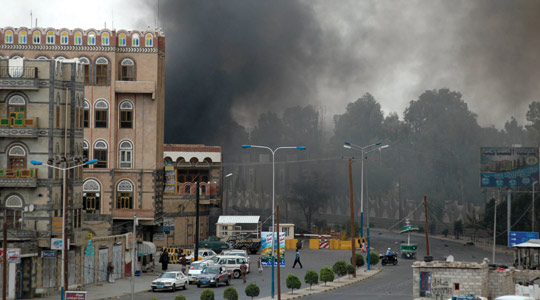
Smoke billows outside the US embassy in Sana yesterday after a car bomb set off a series of explosions outside the heavily fortified embassy in Yemen.

Reaping The Iraq Whirlwind
By M Duss / September 18, 2008

The Washington Post confirms that yesterday’s terrorist attack on the U.S. embassy in Sanaa was the work of an Al Qaeda affiliate, using tactics developed in Iraq:

The use of two vehicle bombs — one to breach the perimeter of a compound, a second to drive inside and explode — is a tactic used by the Sunni insurgent group al-Qaeda in Iraq. […]

He said a new, less-compromising generation of al-Qaeda leaders emerged, many of them moving into action after escaping from a Yemeni prison that year, he said.[…]

The new leaders have found followers among al-Qaeda fighters returning from Iraq. “The quieter it is in Iraq, the more inflamed it is here,” as Yemeni fighters travel back and forth, said Nabil al-Sofee, a former spokesman for a Yemeni Islamist political party who is now an analyst.

Those who have been following the Iraq debate might remember “flypaper theory,” which was one of the earliest exponents of the “incoherent post hoc justifications for the Iraq war” genre. The idea was that there was some limited number of terrorists in the Middle East, and the presence of an occupying U.S. army would lure them to Iraq, whereupon they could all be conveniently killed, presumably as soon as they stepped off the bus.

This plan was prevented from working only by the fact that it was staggeringly dumb. The U.S. occupation radicalized scores of young Muslims, many of whom traveled to Iraq, where they learned terror warfare and were galvanized in the global jihad. And now they’ve begun returning home, to share the tactics and technology developed in a laboratory we provided for them by invading Iraq. The violence in the Nahr al-Bared refugee camp in Lebanon in May 2007 was one instance of this. Yesterday’s attack in Yemen is another.

Various Bush administration courtiers have tried to spin the containment of Al Qaeda in Iraq as a vindication of the invasion of Iraq, eliding the fact that Al Qaeda in Iraq was a direct consequence of America in Iraq. By mispresenting Al Qaeda as a single, united faction under the command of Osama bin Laden — rather than a collection of factions gathered beneath the banner of global jihad — Bush and his supporters have misrepresented successes against AQI as if they represented successes against Al Qaeda as a whole. In doing this, they have ignored the ideological and propaganda components of Al Qaeda’s continuing operations in the region, and the ways in which the Iraq war has profited both.

And this from a commenter, Mugsy: “Imagine a terrorist network with Iraq as an arsenal and as a training ground…” – [President George W. Bush giving reason why we should invade Iraq. 11/4/02]

Source / Wonk Room

The Rag Blog

Posted in RagBlog | Tagged , | Leave a comment

On Meeting Junior’s 2007 Iraq Benchmarks

Frankly, I take issue with Mr. Doggett’s propensity to lay so much blame on the current Iraqi government. Remember that it was the United States military, with tacit Congressional approval and on the orders of George Bush, that illegally entered the sovereign nation of Iraq and has spent the past 5 years destroying it. There continues to be enormous arrogance on the part of all Americans respecting the role that this nation should be playing in the world.

Richard Jehn / The Rag Blog

A couple of days ago, Rep. Lloyd Doggett (D-Texas) succeeded in eliciting from an official of the GAO an admission that there has not in fact been much progress on the Bush benchmarks on Iraq.

‘Washington, D.C. – Today, the House Budget Committee held a hearing on Iraq’s Budget Surplus. While the US has a budget deficit of over $400 billion, the Government of Iraq has a budget surplus of $79 billion. During questioning by Congressman Lloyd Doggett (D-Texas), Joseph Christoff, Director, International Affairs and Trade, for the U.S. Government Accountability Office, admitted that the Iraq troop surge has failed to achieve most of the benchmarks of success originally articulated by the Bush Administration in January 2007.’

Source / Informed Comment

The Rag Blog

Posted in RagBlog | Tagged , , | Leave a comment

Houston and Ike : Abandoning the ‘Independent’

Bill Phillips was trapped for two days at his senior apartment at the Villas. Photo by Dave Rossman / Houston Chronicle

One story among many:

‘Independent seniors’ — which means they can dress themselves — abandoned by apartment complex during Ike
By Lisa Gray / September 18, 2008

Villas on Winkler, a large, newish complex in southeast Houston, describes itself as a “community designed to provide affordable comfort, quality and serenity” for “independent seniors.”

That’s a tricky phrase, “independent seniors.”

“Senior ” is the easy part: It means age 55 or older. Independence is where things get sticky.

Many of the Villas’ residents are elderly, frail or disabled. They don’t need the services that “assisted living” provides; they can dress, bathe and feed themselves. But they can’t necessarily walk down a flight of stairs, drive to another city, or lug ice and bottled water.

The complex wasn’t in a mandatory evacuation ZIP code for Hurricane Ike. Though most projections warned that Houston could lose electric power for quite a while, no government entity bused the seniors inland.

Instead, management handed out fliers informing residents that they were in charge of their own storm preparations: “ARE YOU PREPARED FOR A HURRICANE? … VILLAS ON WINKLER IS NOT RESPONSIBLE FOR YOUR EVACUATION!”

And at 5:10 p.m. Thursday, as the storm barreled toward Texas, Villas on Winkler’s office personnel went home, leaving the residents in the care of a skeleton maintenance crew.

As the storm passed over Houston, the neighborhood took a pounding. But the buildings at the Villas escaped large-scale physical harm. Like most of the city, they lost power.

On Tuesday, four days into the post-Ike electric outage, I saw a dozen weary people sitting under a canopy in the Villas’ parking lot. They’d covered the temporary shelter with cardboard signs: “Seniors! Disabled! Need food! Please help!”

They’d had it with independence.

Could be a killer

Ike was an equal-opportunity storm. He knocked out power to the rich and the poor, the healthy and the sick, the young and the old. And so far, electricity’s spotty return has seemed almost as fair. My blue-collar eastside neighborhood remains without power — but so does much of The Woodlands.

A blackout, though, isn’t fair. Being forced off the grid hurts the weak more than it hurts the strong. For me it’s a drag. For residents of the Villas, it could be a killer.

Irma Linda, a nurse, stayed with family during the storm, and was shocked when she returned home to the Villas. The hallways’ emergency lights had lasted only one night. People were running out of food and insulin. Her door-to-door canvass of the apartments turned up a man who had passed out from hunger.

Maybe the residents using wheelchairs suffered most. Bill Phillips was trapped in his apartment for two days. When the power’s on, it’s easy to leave: He drives his red scooter into the elevator. But when the power’s off, Phillips can’t charge his scooter, and he can’t take the elevator.

On Monday, three of the complex’s able-bodied residents carried Phillips and the scooter down the stairwell. They loaded the scooter onto a pickup, and he drove it to a car-sales lot that had a generator. The lot’s owners let him charge the scooter.

Now Phillips spends his days outside, under the shade of a tarp, with Linda’s crew. Before darkness falls, he bike-locks his scooter to the stairwell.

Then, he says, he crawls up the stairs, one by one, and on his belly slides to his apartment, where he’ll spend the dark night.

Serving the hungry

Linda grilled the meat from her fridge and served it to the hungry. With a band of other residents, she gathered more food to be distributed and made the cardboard signs.

She also called state Sen. Mario Gallegos, who lives nearby. Gallegos says he’s made sure that the Villas is at the top of CenterPoint’s priority list. But as of Thursday, the independent-living complex was still without lights.

Residents say they’re running out of medicine, but for the moment, there’s enough food. Passersby donated hamburgers, doughnuts and cash. Relief workers delivered MREs and bottled water.

The complex’s office management still hasn’t reappeared.

But days into the slo-mo emergency, contract security guards showed up to guard the gate.

At least one maintenance man has remained on the site throughout the emergency. But residents regard him as a hindrance.

On Wednesday, he made them take down their cardboard pleas for help. He said they made the Villas look bad. He seemed to think that an independent-living complex should look … you know … independent.

Copyright 2008 Houston Chronicle

Source / Houston Chronicle

The Rag Blog

Posted in RagBlog | Tagged , , , | Leave a comment

For American Workers : Lessons from the French Revolution

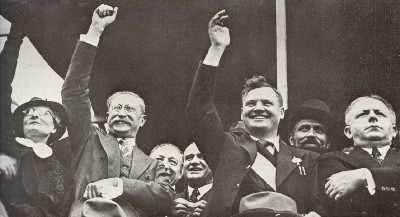
Victory of the “Front Populaire” in 1936. From left to right: Mme. Blum, Léon Blum (SFIO), Maurice Thorez (PCF), Roger Salengro (SFIO, minister of the Interior). In the second row, behind Blum and Thorez, (rolling a cigarette) is Edouard Dalladier (Parti Radical , defense minister).

No history to learn from: American working class consciousness is almost an oxymoron.
By David P. Hamilton
/ The Rag Blog / September 19, 2008

Class-consciousness: a basic some have and some don’t.

The pinnacle triumph of French socialism was triggered when Stalin changed his international policy in 1934. From the Bolshevik Revolution onward, the leadership of the Soviet Union had insisted that all socialist parties follow their model. In France, conflict over this dictate came to a head at a Congress of the Socialist Party in December 1920. The decision was whether to join the Third International by endorsing Lenin’s “Twenty-one Points”, a statement of principles that was “a break with the wartime reformism [and] the adoption of methods similar to those of the Bolshevik Party”.

The result was a classic left sectarian split. The faction that dominated the congress became the French Communist Party. Leon Blum led the minority, which became the French Socialist Party. But strength at the congress did not accurately reflect strength on the ground. The Socialist Party soon proved it could win more votes in parliamentary elections and was stronger among union members. The split became rancorous with Communists commonly referring to Socialists as “social fascists” who didn’t understand “scientific socialism”. The Socialist believed Communists to be unpatriotic sycophants of Moscow.

Then fascism began its march across Europe. First, Mussolini came to power in Italy in 1922 and initially earned widespread positive reviews. Then Hitler took over in Germany in 1933 and Franco initiated his right wing insurrection to overthrow the Spanish Republic in July 1936. It was mainly fear of a resurgent Germany that caused Stalin to change his mind. The new policy for the Third International directed member parties to form anti-fascist popular fronts that united all elements of the left under a common, reformist program, essentially the program of the Socialist Party, plus anti-fascism. The reunification of the socialists into “popular fronts” quickly led socialist led governments in Spain in 1935 and France in 1936, a first for both. For France, a country with a long history of vitriolic anti-Semitism, the Socialist leader, Leon Blum, was also the first Jewish Prime Minister. His ruling coalition was based on the legislative plurality of the combined Socialist and Communist Parties.

Immediately after Blum became prime minister, the country was swept by a huge wave of strikes, 12,000 of them, all in the private sector, 75% of which involved worker occupations of the workspace. Two million workers went out on strike in the middle of a depression regardless of the deep pool of unemployed. For the first time, the strikers knew that the government would not send in the troops.

On Sunday, June 7, 1936, the patronat, essentially the central committee of the capitalist class, met at Blum’s office with officials of the new government, plus Socialist Party, Communist Party and union leaders backed by the majority of the electorate and the strikers. It was not a fair fight. With the government on the side of an insurgent working class, the capitalist leaders felt largely helpless. In one afternoon, French workers won the right to organize unions, mandatory collective bargaining, union representation in the determination of workforce policy, a 15-17% wage increase, and amnesty for strike actions. The government also pledged to move instantly to pass legislation to establish the 40-hour week without loss of pay and two weeks paid annual vacations. Not surprisingly, membership in socialist parties and unions “rose by hundreds of thousands”. The French socialist movement probably won more in one Sunday afternoon as the US labor movement has won throughout its history.

This socialist victory has now been taught for generations by public school teachers, their union being a one of the most stalwartly socialist of French unions. A positive depiction of socialism’s achievements has been standard curriculum for French students since the end of WWII. Because of this general consensus, the great majority of French people are well aware of the benefits they, their parents and their grandparents have all received as a result of the actions of socialist movements; eventually including national healthcare, mass transportation, paid education, public housing, lengthy unemployment compensation, guaranteed pensions, the 35 hour week, a month’s paid vacation and self respect. Hence, the French have a relatively high degree of class-consciousness, an entrenched awareness of the very tangible benefits socialism has brought their society and them personally. Bourgeoisie and proletariat are, indeed, both French words.

In the United States, our basic problem is that this consciousness is negligible among American workers. They have never had their own socialist government. They have the only non-socialist labor movement in the world. Their unions, although weak, remain under continuous and unrelenting assault by the capitalist class, its media minions and government functionaries. Not surprisingly, American unions are today a shadow of their former limited selves, more a relic than a major force in American society. American capitalist hegemony has effectively fought the development of class-consciousness among American workers. That’s a lot to overcome.

The Rag Blog

Posted in Rag Bloggers | Tagged , , , , , , , | Leave a comment

Bolivian Crisis in the New South America

Supporters of Bolivian President Evo Morales shout slogans against Pando’s governor Leopoldo Fernadez outside a justice court in La Paz September 18, 2008. Photo by David Mercado / Reuters.

The Machine Gun and the Meeting Table
By Benjamin Dangl / September 18, 2008

On Monday, September 15, Bolivian President Evo Morales arrived in Santiago, Chile for an emergency meeting of Latin American leaders that convened to seek a resolution to the recent conflict in Bolivia. Upon his arrival, Morales said, “I have come here to explain to the presidents of South America the civic coup d’etat by Governors in some Bolivian states in recent days. This is a coup in the past few days by the leaders of some provinces, with the takeover of some institutions, the sacking and robbery of some government institutions and attempts to assault the national police and the armed forces.”

Morales was arriving from his country where the smoke was still rising from a week of right-wing government opposition violence that left the nation paralyzed, at least 30 people dead, and businesses, government and human rights buildings destroyed. During the same week, Morales declared US ambassador in Bolivia Philip Goldberg a “persona non grata” for “conspiring against democracy” and for his ties to the Bolivian opposition. The recent conflict in Bolivia and the subsequent meeting of presidents raise the questions: What led to this meltdown? Whose side is the Bolivian military on? And what does the Bolivian crisis and regional reaction tell us about the new power bloc of South American nations?

Massacre in Pando

On September 11, in the tropical Bolivian department of Pando, which borders Brazil and Peru, a thousand pro-Morales men, women and children were heading toward Cobija, the department’s capital to protest the right wing governor Leopoldo Fernández and his thugs’ takeover of the city and airport.

According to press reports and eye witness accounts, when the protesters arrived at a bridge seven kilometers outside the town of Porvenir, they were ambushed by assassins hired and trained by governor Fernández. Snipers in the tree tops shot down on the unarmed campesinos. Shirley Segovia, a Porvenir resident recalled to Bolpress, “We were killed like pigs, with machine guns, with rifles, with shotguns, with revolvers. The campesinos had only brought their teeth, clubs and sling shots, they didn’t bring rifles. After the first shots, some fled to the river Tahuamanu, but they were followed and shot at.” Others reported being tortured; days later the death toll rose to 30, with dozens wounded and over a hundred still missing. Roberto Tito, a farmer who was present at the conflict, said “This was a massacre of farmers, this is something that we should not allow.”

In 2006, Fernández, who denies orchestrating this violence, was denounced by then Government Minister Alicia Muñoz who said the governor was training at least a hundred paramilitaries as a “citizen’s protection” force. These paramilitaries are believed to have participated in the massacre. Fernández is one of the opposition governors that form part of the National Democratic Council (CONALDE), an organization which includes governors from Santa Cruz, Beni, Pando, Tarija, and Chuquisaca who are organizing for departmental autonomy against the Morales government and his administration’s redistribution of land and natural gas wealth, and other socialistic policies.

After the massacre, President Morales declared a state of siege in Pando, sent in the military, and by September 15 a tense peace had reportedly returned to the region. Morales also called for the arrest of Fernandez who fled across the border, into rural Brazil.

This massacre took place just weeks after an August 10 national recall vote invigorated Morales mandate: he won 67% support nationwide, showing that his staunch, violent opponents are clearly in the minority. In Pando, Morales won 53% of the vote, an increase of 32% from the 21% he received from Pando residents during the presidential election in 2005.

A few key political developments led to this recent increase in regional tension. On August 28, Morales announced a presidential decree establishing a constitutional referendum on December 7. This referendum would apply to the constitution which was re-written and passed in a constituent assembly in December 2007. On September 2 of this year the electoral court said it opposed the referendum because it had to first be passed by Congress and the opposition controlled Senate. The debate revived existing conflicts, and opposition leaders began to block major roads and seized an airport in Cobija on September 5.

The days leading up to the September 11 massacre in Pando were full of anti-government protesters ransacking businesses and human rights organizations across the country. On September 10, an explosion reportedly set off by opposition groups disrupted the flow of gas lines to Brazil from Tarija, Bolivia.

US Ambassadors Expelled

Following these tumultuous events, Morales demanded that US ambassador to Bolivia, Philip Goldberg leave the country. “Without fear of anyone, without fear of the empire, today before you, before the Bolivian people, I declare the ambassador of the United States persona non grata,” Morales said. “The ambassador of the United States is conspiring against democracy and wants Bolivia to break apart.”

The announcement came after a private meeting Goldberg had with the right wing governor of Santa Cruz on August 25, and a later visit to the opposition governor of Chuquisaca. Throughout Goldberg’s time as ambassador, which began in 2006, the Morales government has accused him of orchestrating US funding and support to opposition groups in the eastern part of the country. [See the February 2008, The Progressive Magazine article “Undermining Bolivia” for more information on Washington’s destabilization efforts in Bolivia.] Before coming to Bolivia, Goldberg worked as an ambassador in Kosovo from 2004-2006 and consular in Colombia. At a press conference Goldberg held in La Paz before leaving for the US, he said: “I want to say that all the accusations made against me, against my embassy… against my country and against my people are entirely false and unjustified.”

Following the US ambassador’s expulsion from Bolivia, Venezuelan president Hugo Chavez announced that the US ambassador in his country had to leave: “He has 72 hours, from this moment, the Yankee ambassador in Caracas, to leave Venezuela.” The US responded by asking the ambassadors of Venezuela and Bolivia to leave the US. This all took place during a tense few months in US-Latin American relations in which the US Navy re-instated its Fourth Fleet in the Caribbean after decades of inactivity, Chavez announced joint exercises with Russia in the Caribbean and Bolivia strengthened its ties with Iran.

On September 15 in Santiago, Chile, the nine presidents within the Union of South American Nations (UNASUR), including Argentina, Ecuador, Brazil, Venezuela, Colombia, Chile – even Colombia, a close US ally – met to come to a resolution on the Bolivian crisis. This organization is one of the newest in a series of regional networks that are making increasingly collaborative political and economic decisions throughout South America. All of the leaders backed Morales, condemned the opposition’s violent tactics and emphasized that they won’t recognize separatists in the country.

Bolivian Military Alliances

Though the threat of a “civic coup d’etat” Morales spoke about in Santiago still looms, the Bolivian military is unlikely to back the government opposition. I asked Kathryn Ledebur, a human rights specialist and director of the Andean Information Network in Cochabamba, Bolivia if the military might side with the opposition to overthrow Morales. Lebedur said, “No way, they are in a tough bind, and CONALDE is trying to set Morales up, drive a wedge between him and the military. But in spite of their frustrations, they [the military] have received more materially and in terms of a positive discourse from the Morales government than any other civilian one, and that makes a huge difference.”

“CONALDE has intentionally created a messy catch 22 for the Morales administration, a tense, provocative violent situation, in some cases targeting the security forces,” Ledebur explained. “If Morales orders repression, or there are clear cut violent acts by the security forces, his legitimacy as a socially conscious president erodes. But if the security forces don’t [act], as they didn’t for a long time, the vandalism escalates, and the military and police get humiliated and attacked – which in the long term erodes what, at least for the armed forces, had been a mutually beneficial marriage of convenience, with friction along the way.”

This past June the Andean Information Network released a report analyzing the Bolivian Armed Forces’ growing mission in the country under Morales. According to this report, part of the military’s support stems from the fact that Morales has given the military popular and lucrative jobs such as “enforcing customs regulations and confiscating contraband at the borders, including authorization to arrest offenders.” The AIN report explains that “traditionally military officers look forward to border postings as ‘the most profitable part’ of their careers.” In addition, “under the Morales government, the armed forces are in charge of baking subsidized bread (the regular price has gone up 270 percent in the past year), as well as passing out bonuses to schoolchildren and senior citizens.” Improved wages among some officials and better equipment have also kept the military on Morales’ side.

The AIN report also stated that the Bolivian military institution “will continue to categorically reject aggressive regional autonomy initiatives or threats of secession as risks to both national sovereignty and the budget they receive from the national government.” As one high ranking officer explained to AIN, “The only way the military would even remotely consider a coup, is if they took away most of our budget; at the core, we’re really a bunch of bureaucrats.”

US Influence in a Changing South America

The current crisis in Bolivia and the ongoing diplomatic drama between the US and Latin America says a lot about the future of the region and its cooperative handling of economic and political questions. In an interview via email, Raúl Zibechi, a Uruguayan journalist, professor and political analyst who writes regularly for the Americas Program, said he believes the expulsion of US ambassadors, and the regional leaders’ response to the conflict in Bolivia, “is the manifestation of the fact that the USA can no longer impose its will on Latin America, and very concretely in South America.” He says there are two reasons for this change: “the birth of a regional power that seeks to be a global player, such as Brazil, a capitalist power but with different interests from the USA, and the existence of governments born of the heat of the resistance of social movements in countries that are large producers of hydrocarbons, as in Venezuela, Bolivia and perhaps Ecuador.”

Zibechi emphasized Bolivia’s importance as the leading supplier of gas to Argentina and Brazil, and how this contributes to the support Morales receives from these nations. “Brazil has big stakes in much of Bolivia and it already announced that it would not permit a destabilization of the country,” Zibechi explained. “The key alliance in the region is between Brazil and Argentina. They have problems, but in this topic they are very united.”

Back in Santiago, Chile, after six hours of talks between the nine South American presidents, the UNASUR group issued a statement which expressed their “their full and firm support for the constitutional government of President Evo Morales, whose mandate was ratified by a big majority.” In the statement, the leaders “warn that our respective government energetically reject and will not recognize any situation that attempts a civil coup and the rupture of institutional order and which could compromise the territorial integrity of the Republic of Bolivia.” They also decided to send a commission to Bolivia to investigate the killings in Pando.

Though working to overthrow leftist governments is unfortunately nothing new in South America, region-wide cooperation between left-leaning governments, without the presence of the US, is new. As Morales and other regional leaders forge ahead with progressive policies, there may be no turning back for this changing continent – regardless of the challenges posed by the Bolivian opposition. The geopolitical map of the hemisphere is being redrawn, in large part by the new alliances between South American nations, and the region’s increased resistance to Washington’s political and economic interference.

The economic and agricultural powerhouse of Brazil is a key part of this new regional defiance and independence. “In Brazil, the right wing in the parliament questions very strongly the [US Navy’s] Fourth Fleet because they say it is to control the new oil fields in Brazil,” Zibechi explained. “In Brazil, things don’t depend just on Lula being in the government. Brazil has autonomous politics that go beyond who governs… Because of this, imperial policy is to overthrow Chavez and Evo before there are changes in these countries that are so profound that they no longer depend on who is governing.”

In Bolivia, much still depends on what happens on the ground, outside of the presidential meetings and negotiations. The opposition has lifted their road blockades for now, and meetings between the government and representatives from the opposition continue. Meanwhile, many of Bolivia’s social organizations and unions have pledged their support for Morales and against the right wing. On September 15 thousands of workers, families and students marched in La Paz, the nation’s capital, against the massacre in Pando and the right’s violence. “We are against the massacre of campesinos which has taken place in Pando,” Edgar Patanta, the leader of the Regional Workers’ Center, told ABI, “We will not permit the repetition of these acts. We will defend democracy and life as we have in the past.”

[Benjamin Dangl is the author of “The Price of Fire: Resource Wars and Social Movements in Bolivia,” (AK Press). He is an editor at UpsideDownWorld.org, a website on activism and politics in Latin America, and TowardFreedom.com, a progressive perspective on world events. Email bendangl(at)gmail.com.]

Source / counterpunch

Thanks to Alice Embree / The Rag Blog

Posted in RagBlog | Tagged , , , | Leave a comment

Times are Hard and Tent Cities Are on the Rise

Mack Martinez, 19, of Cedar Rapids, Iowa, smokes in front of his tent at the tent city that sprung up next to the homeless shelter in downtown Reno, Nev., Wednesday, June 25, 2008. Photo by Scott Sady / AP.

‘From Seattle to Athens, Ga., homeless advocacy groups and city agencies are reporting the most visible rise in homeless encampments in a generation’
By Evelyn Nieves / September 18, 2008

A few tents cropped up hard by the railroad tracks, pitched by men left with nowhere to go once the emergency winter shelter closed for the summer.

Then others appeared — people who had lost their jobs to the ailing economy, or newcomers who had moved to Reno for work and discovered no one was hiring.

Within weeks, more than 150 people were living in tents big and small, barely a foot apart in a patch of dirt slated to be a parking lot for a campus of shelters Reno is building for its homeless population. Like many other cities, Reno has found itself with a “tent city” — an encampment of people who had nowhere else to go.

From Seattle to Athens, Ga., homeless advocacy groups and city agencies are reporting the most visible rise in homeless encampments in a generation.

Nearly 61 percent of local and state homeless coalitions say they’ve experienced a rise in homelessness since the foreclosure crisis began in 2007, according to a report by the National Coalition for the Homeless. The group says the problem has worsened since the report’s release in April, with foreclosures mounting, gas and food prices rising and the job market tightening.

“It’s clear that poverty and homelessness have increased,” said Michael Stoops, acting executive director of the coalition. “The economy is in chaos, we’re in an unofficial recession and Americans are worried, from the homeless to the middle class, about their future.”

The phenomenon of encampments has caught advocacy groups somewhat by surprise, largely because of how quickly they have sprung up.

“What you’re seeing is encampments that I haven’t seen since the 80s,” said Paul Boden, executive director of the Western Regional Advocacy Project, an umbrella group for homeless advocacy organizations in Los Angeles, San Francisco, Oakland, Calif., Portland, Ore. and Seattle.

The relatively tony city of Santa Barbara has given over a parking lot to people who sleep in cars and vans. The city of Fresno, Calif., is trying to manage several proliferating tent cities, including an encampment where people have made shelters out of scrap wood. In Portland, Ore., and Seattle, homeless advocacy groups have paired with nonprofits or faith-based groups to manage tent cities as outdoor shelters. Other cities where tent cities have either appeared or expanded include include Chattanooga, Tenn., San Diego, and Columbus, Ohio.

The Department of Housing and Urban Development recently reported a 12 percent drop in homelessness nationally in two years, from about 754,000 in January 2005 to 666,000 in January 2007. But the 2007 numbers omitted people who previously had been considered homeless — such as those staying with relatives or friends or living in campgrounds or motel rooms for more than a week.

In addition, the housing and economic crisis began soon after HUD’s most recent data was compiled.

“The data predates the housing crisis,” said Brian Sullivan, a spokesman for HUD. “From the headlines, it might appear that the report is about yesterday. How is the housing situation affecting homelessness? That’s a great question. We’re still trying to get to that.”

In Seattle, which is experiencing a building boom and an influx of affluent professionals in neighborhoods the working class once owned, homeless encampments have been springing up — in remote places to avoid police sweeps.

“What’s happening in Seattle is what’s happening everywhere else — on steroids,” said Tim Harris, executive director of Real Change, an advocacy organization that publishes a weekly newspaper sold by homeless people.

Homeless people and their advocates have organized three tent cities at City Hall in recent months to call attention to the homeless and protest the sweeps — acts of militancy, said Harris, “that we really haven’t seen around homeless activism since the early ’90s.”

In Reno, officials decided to let the tent city be because shelters were already filled.

Officials don’t know how many homeless people are in Reno. “But we do know that the soup kitchens are serving hundreds more meals a day and that we have more people who are homeless than we can remember,” said Jodi Royal-Goodwin, the city’s redevelopment agency director.

Those in the tents have to register and are monitored weekly to see what progress they are making in finding jobs or real housing. They are provided times to take showers in the shelter, and told where to go for food and meals.

Sylvia Flynn, 51, came from northern California but lost a job almost immediately and then her apartment.

Since the cheapest motels here charge upward of $200 a week, Flynn ended up at the Reno women’s shelter, which has only 20 beds and a two-week limit on stays.

Out of a dozen people interviewed in the tent city, six had come to Reno from California or elsewhere over the last year, hoping for casino jobs.

“I figured this would be a great place for a job,” said Max Perez, a 19-year-old from Iowa. He couldn’t find one and ended up taking showers at the men’s shelter and sleeping in a pup tent barely big enough to cover his body.

The casinos are actually starting to lay off employees.

“Sometimes I think we need to put out an ad: ‘No, we don’t have any more jobs than you do,'” Royal-Goodwin said.

The city will shut down the tent city as soon as early October because the tents sit on what will be a parking lot for a complex of shelters and services for homeless people. The complex will include a men’s shelter, a women’s shelter, a family shelter and a resource center.

Reno officials aren’t sure whether the construction will eliminate the need for the tent city. The demand, they say, keeps growing.

Source / AP / Yahoo News

Thanks to Jesse James Retherford / The Rag Blog

Posted in RagBlog | Tagged , , , , | 1 Comment

Stopping the NSA’s Illegal Surveillance of Us

This is the continuing saga of trying to bring a little justice back to the US. We posted about it a few weeks ago. It is encouraging to see these folks being utterly persistent in the endeavour.

Richard Jehn / The Rag Blog

Credit: AP Photo/Lauren Victoria Burke Brita

Rights Group Suing AT&T for Spying Sues NSA and Cheney, Too
By Ryan Singel / September 18, 2008

Just a day before the government will try again to get AT&T out of court for allegedly helping with President Bush’s warrantless wiretapping of Americans, the scrappy civil liberties group suing the telecom giant filed another suit — this one against the government and top officials involved in the spying.

By suing the government directly, the EFF is attempting to undermine the government’s plan to use a new power handed to it by Congress in July. The so-called telecom immunity provision nearly automatically forces a judge to dismiss lawsuits against companies accused of helping the government spy — without court approval — on the phone and internet communications of Americans.

Last week, the government told a federal court judge overseeing some 38 cases against the telecoms that it would file those papers on AT&T’s behalf by Friday.

Thursday’s potential class action suit (.pdf) against the government — filed in federal district court in Northern California — seeks a halt to the program, an accounting of who was spied on and damages for the five named plaintiffs.

It also names high government officials -– in their official and personal capacities — putting them at risk of fines they would be personally liable for.

Among those listed – former Attorney General John Ashcroft, former Attorney General and White House Counsel Alberto Gonzales, Vice President Dick Cheney, and Cheney’s chief of staff David Addington, along with current and former heads of intelligence agencies involved in the spying.

“In addition to suing AT&T, we’ve now opened a second front in the battle to stop the NSA’s illegal surveillance of millions of ordinary Americans and hold personally responsible those who authorized or participated in the spying program,” said senior staff attorney Kevin Bankston.

The suit argues the spying violated federal wiretap law, the First Amendment’s guarantee of anonymous speech and the Fourth Amendment’s guarantee against unreasonable searches.

Others have challenged the government program directly, but no one has succeeded so far. The EFF hopes the whistle-blower evidence it has used to keep the AT&T case alive will also work to prove it has a right to sue the feds as well.

The EFF plans to contest the legality of the so-called telecom immunity powers — but wants to have another avenue to pursue its goal of having the program declared illegal.

Though the full extent of the secret spying is not known, media reports indicate the government collected phone calls and emails – with the help of American telecoms — where one party was inside the U.S. and one was outside the country.

Until recently, wiretapping law required court orders to collect that information inside the U.S.

The FISA Amendments Act of 2008, which largely legalized did not immunize the government or government officials.

The EFF filed suit against AT&T in January 2006, alleging that the company massively violated federal wiretapping laws by turning over billions of phone records to the NSA and letting them building a room for the NSA to spy on the internet.

The suit relies heavily on company documents provided to it by former AT&T technician Mark Klein, who says the NSA controlled a secret internet spying room in an AT&T facility on Folsom Street in San Francisco.

That suit so annoyed the government that the President threatened to veto a bill expanding his ability to spy without warrants unless Congress also included retroactive legal immunity for telecoms being sued for allegedly helping the government warrantlessly spy on Americans.

After a drawn-out fight over immunity that included a threatened filibuster, the Democratically controlled Congress acceded in July to Bush’s demand for immunity.

Justice Department spokesman Charles Miller said it was too early for the government to respond — given it hasn’t even seen the suit yet.

“Once we are served, we will make a determination about how we will respond in court,” Miller said.

Thursday’s suit is known as Jewel v. NSA, while the AT&T suit is known as Hepting v. AT&T.

UPDATE: The original version of this story incorrectly stated that the suit sought damages for millions of potential class members. The suit seeks an injunction for all, but fines for only the named five plaintiffs.

Source / Wired

The Rag Blog

Posted in RagBlog | Tagged , , | 1 Comment

The Maverick : They knew he could never be tamed.

Click on art for larger image

Tom the Dancing Bug by Ruben Bolling / Salon.com

Thanks to David McQueen / The Rag Blog

Posted in RagBlog | Tagged , , , , , | 1 Comment

Our Cultural Divide : California’s Battle over Gay Marriage

Film star Brad Pitt has donated more than $100,000 to oppose a California referendum seeking to ban gay marriages. Photo by AP.

Combatants in the fight have contributed millions of dollars to prepare for an all-out confrontation
September 16, 2008

The stakes of the ballot drive to forbid same-sex marriage reach far beyond California’s geographic and political borders in what has emerged as another chapter in America’s culture wars.

Christian groups, wealthy benefactors and self-styled pro-family groups from all over the US are watching closely – and weighing in with money. Gay-rights groups and wealthy individuals are countering with their own cash from across the country.

In the past eight weeks, combatants in the battle of California’s Proposition 8 have poured in more than $20m (£11.3m) to gear up for an all-out confrontation about whether the US will begin to move toward tolerance of same-sex marriages – or to preserve traditional views of marriage.

“It’s a defining issue for this state and the country,” said Brian Brown, executive director for the National Organisation for Marriage, a New Jersey-based Mormon group with a branch in California, which has contributed nearly $1m to the Yes on 8 campaign.

The outcome of the battle, he said, “will affect what our children will be taught about marriage, and it will affect our religious liberties”.

Opponents say the campaign to defeat the ballot measure is a fight for gay rights around the country.

“I really think this is our Gettysburg,” said Kathy Levinson, a Silicon Valley philanthropist and gay-rights activist who pledged this month to match $100,000 in donations to the No on 8 campaign.

“If Proposition 8 passes, we’d lose a generation of time. If we as a perceived liberal and tolerant state lose this battle, many smaller states will feel permission to say ‘not yet’. If it fails, it’s a statement that says the country has changed, that full acceptance of gay and lesbian citizens has come and it would be perceived as a watershed moment.”

Thousands of Californians have contributed to the Yes on 8 campaign, according to campaign finance statements on the secretary of state’s website.

But the big money has come from out-of-state groups such as Connecticut-based Knights of Columbus ($1.3m), a Catholic men’s organisation; the National Organisation for Marriage ($921,000); Mississippi-based American Family Association ($500,000); and Colorado-based Focus on the Family ($414,000), whose chairman is James Dobson, the evangelical Christian whose syndicated radio show is heard by millions.

Wealthy and well-connected individuals have pitched in. Elsa Prince, the matriarch of a powerful Michigan Republican family, donated $250,000 to the Yes on 8 campaign.

She’s the mother of Eric Prince, the co-founder of Blackwater Worldwide – the controversial private military and security contractor – and of Betsy DeVos, the Republican activist whose family has contributed millions to conservative causes.

Opponents have their heavy hitters, too, including the Republican governor of California, Arnold Schwarzenegger, who hasn’t contributed to the campaign but has voiced his opposition to the initiative.

The top contributor to the No on 8 campaign, Equality California ($3.6m), is its sponsor. Others include Washington, DC-based Human Rights Campaign ($2.3m); Robert Wilson, a New York philanthropist ($1.2m); and Bruce Bastian, a gay Mormon from Utah and the co-founder of WordPerfect ($1m).

PG&E, the California Teachers Association and the California State Council of Service Employees each donated $250,000 to No on 8.

Steve Westly, the former state controller and Democratic gubernatorial candidate, has donated $5,000.

Twenty-seven states have constitutional amendments outlawing same-sex marriages – 11 approved by voters in 2004, when the issue became a central part of George Bush’s re-election, and seven more in 2006.

Three more states – California, Arizona and Florida – have the issue on November’s ballot. Massachusetts and California are the only states that recognise same-sex marriages.

Conservative and evangelical groups were freshly mobilised by the California supreme court’s decision in May to overrule voters’ approval of a ban on same-sex marriages in 2000.

But the movement has its roots in the culture wars of the 1980s and 1990s, says University of California-Berkeley sociology professor Michael Hout.

“They got as far as they could on abortion and have embraced marriage laws as the next step in their agenda,” said Hout, co-author of The Truth About Conservative Christians: What They Think and What They Believe. “Their main agenda remains the reversal of Roe v Wade, but they’re trying to gain new allies who look askance at gay marriage.”

Not that it’s a purely Machiavellian manoeuvre. Proponents of bans on same-sex marriage are “truly concerned that the state should not be licensing immoral behaviour”, Hout said.

“In their interpretation of the Bible, they see a prohibition on homosexual activity. Gay marriage condones a lifestyle that’s ruled out by their reading of the scripture.”

A key feature of the state supreme court decision, say Yes on 8 forces, is that there is no residency requirement.

“Same-sex couples are flying in, getting married, and flying out,” said Bruce Hausknect, judicial analyst for Focus on the Family.

“What happens in states that don’t recognise same-sex marriage when there are custody disputes? It’s part of their agenda to wear down other states. If they can create enough problems, they’re hoping they’ll force courts to take their cases, which could lead to overturning the laws.

“It’s a subtle way,” he said, “of forcing the same-sex agenda on unwilling states by exporting the problems to states that don’t have same-sex protections.”

Proponents also claim that same-sex marriage laws will lead to an acceptance of polygamy and polyamory (group marriages), and teaching about same-sex marriage in public schools.

The dire warnings are “scare tactics” of rightwingers feeding off myths and fears of the people, says Geoffrey Kors, executive director for Equality California.

“That’s fundraising language, language to get their base motivated,” Kors said. “The only gay agenda is about not being treated differently than others.”

Source / Guardian, U.K.

Thanks to Jeffrey Segal / The Rag Blog

Posted in RagBlog | Tagged , , , , | Leave a comment

The Country is a Deregulated Mess


‘It has become obvious that UNregulated business activity gravitates to the dark side’
By Randy H. / The Rag Blog / September 18, 2008

I admit that I’ve vacillated back and forth between Democrat and Republican over the last 40 years. I’ve arrived at a few personal conclusions about our country’s current state. These are merely my own opinions.

I remain a strong advocate of allowing business unfettered access to its markets. However, it has become obvious that UNregulated business activity gravitates to the dark side.

I only offer several examples …

1) Telephone deregulation. An acquaintance who lives in France once asked me, “Are you people crazy?” when the major telephone companies were broken up and deregulated. Of course we briefly have enjoyed proliferation of numerous local and long distance telephone companies and lower rates. However, once the reality became “Oh, I’m sorry sir. That line is not part of our service,” guess what is now happening? Witness today’s re-conglomeration of powerhouses Verizon and AT&T. Nickel-and-dime fee structures, service rules and restrictions, and the telecomm companies’ indifference to customer issues have become the norm. Does this sound like anything with which you’re familiar?

2) Airline deregulation. Give me a break! Even though Southwest and upstart JetBlue survive as prodigies of deregulation, just count the number of personnel laid off and route-miles that have collapsed over the last 20 years. Fuel costs aside, the airline industry is the victim of a nearly complete lack of regulatory constraint and a wholly indifferent federal government. Why should it take the FAA twenty more years to implement a new computer/satellite-based air traffic control system??

3) A Medicare Drug Program (Part D) that is an outright lie. Estimates originally provided to congressional representatives are now shown to have been hugely and falsely understated. Originally estimated at $375 billion for the mandated ten-year horizon, this program is now calculated to cost $2.3 trillion over the next ten years! Oh, and by the way, don’t overlook a provision in the law which prohibits the federal government from negotiating the cost of the drugs for which it is paying. Guess which lobbying group drafted that part of the law.

4) A federal income tax system that is so complex and laden with special-interest provisions that it costs the average taxpayer $37.43 and 12 days to complete and file the federal tax return. The shameful business practices of “refund anticipation loans,” and more recently “rebate anticipation loans,” have cost unwitting taxpayers billions of dollars in needless fees to get their money back from the federal government a few days earlier. The Internal Revenue Service is dead at the switch about simplifying the process for transacting the ordinary individual taxpayer’s tax returns and refunds. A computer system hailed as the “answer to all our problems” went down in flames after five years and hundreds of millions of dollars in outsourced contracts. It remains in limbo to this day.

5) Pathetic lack of regulation of (and even awareness of) the financial services industry’s dubious practices. Lending practices over the last five years became a sham. Surely you’re aware of the shameful lending practices thrust on less sophisticated and lower income people by unscrupulous mortgage brokers, banks, and investment companies. The consolidation of falsely-rated mortgage packages for sale as “investments” on the world market was a practice akin to the old fashioned snake oil salesman.

6) The U.S. dollar’s value has fallen 40% against the value of the Euro and other major currencies in the last six years. While a weak dollar means our exports are less expensive to those who buy them, imports have become more expensive for us. It means that our dollars now buy nearly 40% LESS of goods and services than they did six years ago. Imports of cheap and low quality Chinese goods to Wal-Mart and other retailers will not offset the horrendous decline in our dollar. Our manufacturing sector has lost 3.2 million jobs over the last six years, offset by a lesser increase of 1.2 million jobs in the food service and retailing industries. What a tradeoff, eh?

7) Outsourcing instead of federal oversight. It’s the old budget game that outsourced contracts are separate from onboard personnel in the federal government’s budget and are therefore immune from oversight by Congress. The presumption that outsourced work “saves” money in the long run is provably false. The quasi-governmental Postal Service is a notable exception, because it has a source of revenue to offset the majority of its operational costs.

8) Relations with Mexico and other countries. Mexican truckers are now allowed for a new “extended test period” of three more years to freely traffic on our highways. The U.S. is giving nuclear technology to India in exchange for tariff-free imports of mangos to our country. Nukes for fruit. That one ought to scare you.

9) A dead-at-the-switch Consumer Product Safety Commission. “We’re not allowed to test for toxic substances unless we have evidence of human danger.” Yikes … that’s comforting, huh?

10) An FDA that is so hopelessly under staffed and under funded that it is simply incapable of fulfilling its mission. Explosive growth in our importation of foods, and significant lobbying by pharmaceutical companies, has rendered that agency nearly useless.

11) Federal preparedness. Wasn’t the Katrina debacle enough to show that federal nepotism and cronyism yields an under funded, under talented, and under prepared government? Over 20,000 trailers purchased and unused are now scheduled for destruction. Truckloads of ice were sent to New England during the emergency in New Orleans.

12) Wars being conducted on two fronts, based on blatantly false assumptions and “truths” fabricated to scare the people of our country. Iraq accumulates budget surpluses while the American people continue to fund up to $1 trillion for those unpopular wars, for that country’s “reconstruction,” and digging our country further and further into unsustainable debt. Afghanistan continues as the primary source of opium/heroin in the world and as a sanctuary for the bad guys.

13) Our country is in serious economic trouble. Our public debt (as distinguished from the elusive ‘intragovernmental’ debt) has grown 500% in merely the last five years. We are forever reliant on oil as our primary energy source and feed stock, on the willingness of foreign countries and investors to continue to prop up our unsustainable spending, and the illusion that ‘growth’ will be our salvation. It is time to come back to reality. Taxes will inevitably go up, spending needs to be seriously curtailed, and we need new leadership that will not tell us that everything is okay.

Do you really want to elect a candidate who promises more of the same? I don’t think so.

The Rag Blog

Posted in Rag Bloggers | Tagged , , , | 2 Comments

Economic Meltdown : Are We a Nation of Village Idiots?


‘Conservative Republicans always want the government to stay out of business and avoid regulation as long as they are making lots of money’
By James Moore / September 18, 2008

Don’t let them tell you this economic meltdown is a complicated mess. It’s not. Our national financial crisis is readily understood by anyone who has seen greed and hypocrisy. But we are now witnessing them on a profound, monumental scale.

Conservative Republicans always want the government to stay out of business and avoid regulation as long as they are making lots of money. When their greed, however, gets them into a fix, they are the first to cry out for rules and laws and taxpayer money to bail out their businesses. Obviously, Republicans are socialists. The Bush administration has decided to socialize the debt of the big Wall Street Firms. Taxpayers didn’t get to enjoy any of the big money profits on the phony financial instruments like derivatives or bundled sub-prime paper, but we get the privilege of paying for their debt and failures.

Let’s just consider the money. The public bailout of insurance giant (becoming a dwarf) AIG is estimated at $85 billion. According to one report, that’s more than the Bush administration spent on Aid to Families with Dependent Children during his entire time in office. That amount of money would also pay for health care for every man, woman, and child in America for at least six months.

How did we get here?

That’s pretty easy to answer, too. His name is Phil Gramm. A few days after the Supreme Court made George W. Bush president in 2000, Gramm stuck something called the Commodity Futures Modernization Act into the budget bill. Nobody knew that the Texas senator was slipping America a 262 page poison pill. The Gramm Guts America Act was designed to keep regulators from controlling new financial tools described as credit “swaps.” These are instruments like sub-prime mortgages bundled up and sold as securities. Under the Gramm law, neither the SEC nor the Commodities Futures Trading Commission (CFTC) were able to examine financial institutions like hedge funds or investment banks to guarantee they had the assets necessary to cover losses they were guaranteeing.

This isn’t small beer we are talking about here. The market for these fancy financial instruments they don’t expect us little people to understand is estimated at $60 trillion annually, which amounts to almost four times the entire US stock market.

And Senator Phil Gramm wanted it completely unregulated. So did Alan Greenspan, who supported the legislation and is now running around to the talk shows jabbering about the horror of it all. Before the highly paid lobbyists were done slinging their gold card guts about the halls of congress, every one from hedge funds to banks were playing with fire for fun and profit.

Gramm didn’t just make a fairy tale world for Wall Street, though. He included in his bill a provision that prevented the regulation of energy trading markets, which led us to the Enron collapse. There was no collapse of the house of Gramm, however, because his wife Wendy, who once headed up the Commodities Futures Trading Commission, took a job on the Enron board that provided almost $2 million to their household kitty. And why not? Wendy got a CFTC rule passed that kept the federal government from regulating energy futures contracts at Enron.

If John McCain gets elected and chooses Phil Gramm as his Treasury Secretary, which many politico types see as likely, they will be able to talk about the good old days when Gramm was in congress and McCain was in the senate and they were in the midst of the Savings and Loan crisis.

The S and L scandal, which may look precious when compared to our present cascade of problems, isn’t hard to understand, either. But it is impossible to take John McCain seriously on our current financial Armageddon since he was dabbling in the historic collapse of 747 S&Ls that occurred during Ronald Reagan’s era. In the early 80s under the Republican president, congress deregulated the savings and loan industry in much the same way that Gramm made sure there were no laws hindering our current financial malefactors on Wall Street. S&Ls simply lobbied until they had less regulation and then began making rampant, unsound investments.

The guy who was going the wildest with financial freedom was Charles Keating, who headed up Lincoln Savings and Loan of California. Because the S&L industry had managed to get congress to increase FDIC insurance from $40,000 to $100,000 on deposits, the irresponsible investing of people like Keating began to put taxpayer insurance funds at great risk of loss. Keating placed money in junk bonds and questionable real estate projects and because so many other S&Ls started acting the same way the Federal Home Loan Bank Board (FHLBB) began to push for a regulation that limited these dangerous speculative “direct” investments to 10% of an S&L’s assets.

And Keating didn’t like it; he called on a private economist named Alan Greenspan, who promptly produced a study saying that there was no danger in “direct” investments.

But that didn’t convince the FHLBB and as further scrutiny showed Lincoln Savings and Loan was making even more historically bad investment decisions, a federal investigation was launched.

So Keating called his home state senator John McCain.

McCain and four other US senators (known to history as the Keating Five) met with Edwin Gray, then chairman of the FHLBB. McCain had been hesitant to attend but had reportedly been called a “wimp” behind his back by Keating. The message to the FHLBB and Gray from the Keating Five was to lay off Lincoln and cool the investigation. Gray and the FHLBB did not relent but Lincoln stayed in business until 1989 when it collapsed with the rest of the S&L industry. The life savings of more than 20,000 elderly investors disappeared with the failure of Lincoln. Keating went to prison for five years.

Charles Keating was John McCain’s pal. They met in 1981 and Keating dumped $112,000 in the McCain campaign bank accounts between ’82 and ’87. A year before McCain met with the FHLBB regulators, his wife Cindy and her father, according to newspaper reports at the time, invested about $360,000 in one of Keating’s shopping centers. The Arizona Republic reported McCain and his wife and their babysitter took nine trips on Keating’s private jet to the Bahamas to stay at the S&L liar’s decadent Cat Cay resort. The senator didn’t pay Keating back for the plane rides until years later when he was under investigation.

McCain wasn’t found guilty of anything but bad judgment, which is an historic understatement. Republicans, who led deregulation of the S&L industry, delayed the bailout until after the 1988 election to make sure George H. W. won the White House. The cost to taxpayers for helping these 747 bad actors in the S&L industry was finally estimated at $1.4 trillion. If the bailout had begun in 1986 instead of after the presidential election, the cost would have been contained at $20 billion.

And now the Republicans who engineered our present crisis and got us into the S&L debacle of the 80s are before us saying the markets need regulation. No, actually, they don’t need regulation. Why don’t you Republican capitalists who believe in the free markets get out of the damned way and let them work and allow these various financial nuthouses be crushed by the weight of their own stupidity? When it is all over, we’ll have sane and sober people create laws to make sure it doesn’t happen again, assuming we survive this chaos.

Also, while you are handing out our tax money to idiots on Wall Street, save a little of the long green for the unemployed auto and construction workers and all of the other people who have lost their jobs because you were too stupid to notice what Phil Gramm was doing and you were convinced everything was going to be just fine because the markets work.

These, then, are the people — the Republicans — who want to run our government for four more years. John McCain isn’t just one of them. He rides their jets. He takes their campaign donations. He makes them his campaign advisors. And he tells us to trust him.

He must think we are a nation of village idiots.

Hell, maybe we are.

Source / The Huffington Post

The Rag Blog

Posted in RagBlog | Tagged , , , , , , , , , , | Leave a comment

Kate Braun: Fall Equinox Seasonal Message


Tarot by Kate

Monday, Monday, so good to me”

By Kate Braun / The Rag Blog / September 18, 2008

Monday, September 22, 2008 is Mabon, the Fall Equinox. Lady Moon moves from her third quarter in Gemini to her fourth quarter in Cancer, prompting the centered energy of this water sign to reinforce the balancing energies of Lord Sun’s Libra. This is a festival about abundance, as well as balance, as its alternative names of Second Harvest, Harvest Home, and Cornucopia indicate. Part of enjoying abundance is sharing, so encourage your guests to take some of the leftovers home. The giving and accepting of abundance promotes more abundance for both the giver and the receiver.

Encourage your guests to join you in dressing in warm colors: red, orange, maroon, deep gold, russet, brown and dark violet. Use these colors also for your altar and table decorations. There are many items that can be used to signify the season in your decorating: gourds, pine cones, apples, and horns of plenty are but a few. As this is a celebration of balance, a scales filled with acorns, grapes, and/or autumn leaves would make a lovely centerpiece.

The focus of your menu should be the fruits of this Second Harvest: nuts, root veggies (onions, carrots, potatoes, parsnips, etc.), berries, apples, pomegranates, garlic, cider, fruit wine, bread. Add some roast beef or chicken and a few cheeses for your non-vegan friends.

This festival is sacred to Cerridwen, a water-oriented Goddess of Autumn. The Druids honored The Green Man at this time by offering libations to trees. You may honor both deities by leading your guests to a favorite tree, surrounding it, singing to it, and giving it a gift of blessed water and/or wine. Don’t forget to include the nature fairies and other elementals in this ritual; a thimble filled with wine and a few berries or nuts will provide a feast for them.

In addition to contemplating balance in all its aspects in your life, this is a time to start a project to work on over the winter. Traditionally, quilts were started about now, for example, although making plans to Feng Shui your home room by room would also be a long-term winter project worth starting. This is also a time to give thanks. For friends and family, for the food on the table, the clothes we wear, the work we do, the goodnesses in our lives. Be specific in your thankfulness.

An activity that you and your guests might enjoy is the making and planting of a corn dolly. Using fresh corn husks, about 3, bend them in half and use a strip of corn husk to tie off a small bit at the bend to form the dolly’s head; decide where the waist should be, twist the corn husks at this point and tie them with another strip of corn husk. If necessary, use garden twine instead of corn-husk-strips, but do not use twisties or metal; natural fibers such as cotton or hemp are preferred. Fluff out the skirt and your corn dolly is finished. Sprinkle her with a few drops of wine and tell her the qualities and goals you choose to work on over the winter. Write this down for future reference. Then bury her in your garden or back yard or under a tree, as you would plant a seed you want to grow vigorously. Plan to visit the site periodically; use it during the Dark Time to meditate on what you have sown. When celebrating the Spring Equinox, look at what your goals were and see what strides you have made towards achieving them.

Reminder: I will be Elaine Ireland’s guest on her Live-on-the-internet-radio-talk-show at 9 PM CDT on Thursday, September 18. To hear this program, Going Global For Spirit,, go to www.bbsradio.com, click on Channel 1, check the drop-down menu for the program and click on it. There is also a toll-free number to call if you have questions or comments or would like a short Tarot reading from me.

Tarot by Kate 512-454-2293
www.tarotbykateinaustin.com
kate_braun2000@yahoo.com

The Rag Blog

Posted in Rag Bloggers | Tagged , , , | 1 Comment