Preserving the Record of Wrong-Doing and Deceit

Vice President Dick Cheney has argued that his office is not part of the executive branch of government. Photo: Filippo Monteforte, AFP / Getty Images

Judge Orders Cheney to Preserve Records
By Pete Yost / September 21, 2008

WASHINGTON — A federal judge on Saturday ordered Dick Cheney to preserve a wide range of the records from his time as vice president.

The decision by U.S. District Judge Colleen Kollar-Kotelly is a setback for the Bush administration in its effort to promote a narrow definition of materials that must be safeguarded under by the Presidential Records Act.

The Bush administration’s legal position “heightens the court’s concern” that some records may not be preserved, said the judge.

A private group, Citizens for Responsibility and Ethics in Washington, is suing Cheney and the Executive Office of the President in an effort to ensure that no presidential records are destroyed or handled in a way that makes them unavailable to the public.

In a 22-page opinion, the judge revealed that in recent days, lawyers for the Bush administration balked at a proposed agreement between the two sides on how to proceed with the case.

Cheney and the other defendants in the case “were only willing to agree to a preservation order that tracked their narrowed interpretation” of the Presidential Records Act, wrote Kollar-Kotelly.

The administration, said the judge, wanted any court order on what records are at issue in the suit to cover only the office of the vice president, not Cheney or the other defendants in the lawsuit. The other defendants include the National Archives and the archivist of the United States.

In response to the ruling, Cheney spokesman James R. Hennigan said that “we will not have any comment on pending litigation.”

The lawsuit stems from Cheney’s position that his office is not part of the executive branch of government.

This summer, Cheney chief of staff David Addington told Congress the vice president belongs to neither the executive nor legislative branch of government, but rather is attached by the Constitution to Congress. The vice president presides over the Senate.

The lawsuit alleges that the Bush administration’s actions over the past 7 1/2 years raise questions over whether the White House will turn over records created by Cheney and his staff to the National Archives in January.

In 2003, Cheney asserted that the office of the vice president is not an entity within the executive branch.

Two historians and three groups of historians and archivists joined CREW in filing the suit two weeks ago.

Copyright 2008 The Associated Press.

Source / America On Line

The Rag Blog

Posted in RagBlog | Tagged , , | Leave a comment

Spreading Viral E-Mails Around the World


If you grow up in Hawaii, raised by your grandparents, you’re “exotic, different.”

If you grow up in Alaska eating mooseburgers, you’re a quintessential American story.

++++++++++++++++

If your name is Barack, you’re a radical, unpatriotic Muslim.

If you name your kids Willow, Trig and Track, you’re a maverick.

++++++++++++++++

If you graduate from Harvard law School and be President of the Law Review, you are unstable.

If you attend 5 different small colleges before graduating, you’re well grounded.

++++++++++++++++

If you spend 3 years as a community organizer, create a voter registration drive that registers 150,000 new voters, spend 12 years as a Constitutional Law professor, spend 8 years as a State Senator representing a district with over 750,000 people, become chairman of the state Senate’s Health and Human Services committee, spend 4 years in the United States Senate representing a state of 13 million people while sponsoring 131 bills and serving on the Foreign Affairs, Environment and Public Works and Veteran’s Affairs committees, you don’t have any real leadership experience.

If your total resume is local weather girl, 4 years on the city council and 6 years as the mayor of a town with less than 7,000 people, 20 months as the governor of a state with only 650,000 people, then you’re qualified to become the country’s second highest ranking executive.

++++++++++++++++

If you have been married to the same woman for 19 years while raising 2 beautiful daughters, all within Protestant churches, you’re not a real Christian.

If you cheated on your first wife with a rich heiress, and left your disfigured wife and married the heiress the next month, you’re a Christian.

++++++++++++++++

If you teach responsible, age appropriate sex education, including the proper use of birth control, you’re eroding the fiber of society.

If, while governor, you staunchly advocate abstinence only, with no other option in sex education in your state’s school system while your unwed teen daughter ends up pregnant, you’re very responsible.

++++++++++++++++

If your wife is a Harvard graduate lawyer who gave up a position in a prestigious law firm to work for the betterment of her inner city community, then gave that up to raise a family, your family’s values don’t represent America’s.

If your husband is nicknamed “First Dude”, with at least one DUI conviction and no college education, who didn’t register to vote until age 25 and once was a member of a group that advocated the secession of Alaska from the USA, your family is extremely admirable.

++++++++++++++++

OK, much clearer now.

Source / Political Insider

Thanks to Diane Stirling-Stevens / The Rag Blog

Posted in RagBlog | Tagged | Leave a comment

Austin : Demonstrators Oppose Military Recruitment for Iraq War

Demonstrators protesting the continuing occupation of Iraq gathered on Friday, September 19 at Dobie Mall adjacent to the campus of The University of Texas at Austin.

Dobie Mall houses a military recruitment center and has been the site of anti-war protests in the past.

The demonstrators represented MDS/Austin, CodePink and the Campus Antiwar Movement to End the Occupations (CAMEO). The action was part of the Iraq Moratorium, a monthly event during which activities in opposition the Iraq war take place throughout the country. Photo by Alice Embree / The Rag Blog.

Thorne Dreyer / The Rag Blog / September 21, 2008

The Rag Blog

Posted in Rag Bloggers | Tagged , , , , , , | 1 Comment

But Will It Happen Again in 40 Days?


New Events Happening in King-Lincoln v. Blackwell Case
September 20, 2008

There have been some interesting and potentially shocking developments in the King Lincoln Bronzeville v. Blackwell lawsuit currently pending in Ohio. Some of these developments we can report to you, some are still off-the-record. Events are happening by the day and almost by the hour, so check back frequently for further information and updates.

We’ve previously covered the King-Lincoln v. Blackwell suit in some detail here, but in brief, some Ohio voters filed a lawsuit about the 2004 election. They want to take the deposition of Mike Connell, a Republican IT “guru” who set up the computers for counting the votes in Ohio.

There has been a stay on the case for some time, and the lead attorney for the plaintiffs, Cliff Arnebeck, has filed a motion requesting a lifting of the stay so that he can depose Mike Connell under oath and ask him about his 20 years of work for the Bush family and for many, many Republican politicians and causes, and specifically his computer/IT work for Ken Blackwell in Ohio 2004.

In his motion to lift the stay, Arnebeck writes [PDF, 6 pages], “The public has a need and right to know, before the next presidential election, that the top Republican IT expert shares a concern about the vulnerability of electronic voting systems to fraudulent manipulation, and that this is not just ‘conspiracy theory.'”

Arnebeck’s reference to Connell sharing “a concern” about electronic voting is based on cyber security expert Stephen Spoonamore’s conversations with Connell. Mr. Spoonamore is serving as an expert witness for the plaintiffs in this case. (In August of this year, we covered a recently-released 2006 interview with Mr. Spoonamore in which he discusses his views on electronic voting and the impossibility of securing an election run on these machines.)

In a supporting affidavit from Mr. Spoonamore (filed along with the motion for relief from stay), Spoonamore writes that Connell “clearly agrees that the electronic voting systems in the US are not secure.” He continues, “Mr. Connell is a devout Catholic. He has admitted to me that in his zeal to ‘save the unborn’ he may have helped others who have compromised elections. He was clearly uncomfortable when I asked directly about Ohio 2004.” [emphasis added]

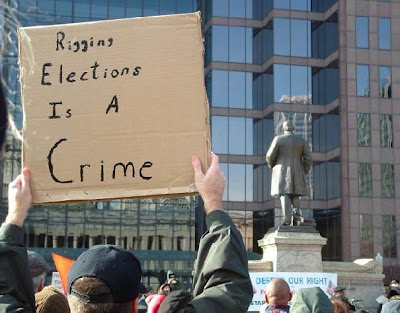
In addition to Spoonamore’s affidavit, Arnebeck has filed with the court an affidavit from Dr. Richard Hayes Phillips, author of the book Witness to a Crime: A Citizens’ Audit of an American Election. Dr. Phillips writes: “Having personally examined 126,000 ballots, 127 poll books, and 141 voter signature books from 18 counties in Ohio, and having examined many other election records as well, it is my conclusion that there is so much evidence of ballot alteration, ballot substitution, ballot box stuffing, ballot destruction, vote switching, tabulator rigging, and old-fashioned voter suppression, that the results of the 2004 presidential election, in all likelihood, have been reversed.”

Dr. Phillips’ affidavit is a must-read [PDF, 6 pages]. He names names and lists a litany of crimes from the 2004 election that strike at the heart of our nation; crimes that have weakened and damn near destroyed our democratic republic.

If these crimes are allowed to be repeated this November — and we have every reason to believe they *will* be repeated — we truly believe that “the Great Experiment” that is America will be at an end.

A few choice quotes from Dr. Phillips:

This is a nation that prides itself on the rule of law. One of the reasons for punishment of criminals is its deterrent effect not only upon those convicted of the crimes, but also upon those who might contemplate committing similar crimes in the future. Even if the persons who engaged in criminal activity related to the election of November 2, 2004 are no longer in a position to do so, it is vital that their crimes be investigated and that their guilt or innocence be established. Election fraud undermines the very foundation of the United States of America.

Any time I am asked when would be a good time to hold accountable those who were responsible for rigging a presidential election I will give the same answer: Now is the time. And for every day we have failed to do so: That was the time.

As we wrote above, this situation is still developing and there are some very volatile events taking place around this case. Stay tuned to this page, as well as to Velvet Revolution and our colleagues at The BRAD BLOG, for details and information as they happen.

Source / Velvet Revolution Election Protection Strike Force

Thanks to Mariann Wizard / The Rag Blog

Posted in RagBlog | Tagged , | Leave a comment

Market Meltdown: Explanation from an Expert

The spittin’ image of a bad bet

The Real Reason for the Global Financial Crisis…the Story No One’s Talking About
By Shah Gilani / September 18, 2008

[Part I of a three-part series looking at how so-called “credit default swap” derivatives could ignite a worldwide capital markets meltdown.]

Are you shell-shocked? Are you wondering what’s really going on in the market? The truth is probably more frightening than even your worst fears. And yet, you won’t hear about it anywhere else because “they” can’t tell you. “They” are the U.S. Federal Reserve and the U.S. Treasury Department, and they can’t tell you what’s really going on because there’s nothing they can do about it, except what they’ve been trying to do – add liquidity.

At the exchange rate yesterday (Wednesday [September 17, 2008]), 35 trillion British Pounds was equivalent to U.S. $62 trillion (hence, the 35 trillion Pound gorilla). According to the International Swaps and Derivatives Association, $62 trillion is the notional value of credit default swaps (CDS) out there, somewhere, in the market.

This isn’t the first time Money Morning has warned readers about the dangers of credit default swaps. And it won’t be the last.

The Genesis of a Derivative Boom

In the mid-1980s, upon arriving in New York from Chicago with an extensive background trading options and futures (the original derivatives), I was offered a job at what was then Citicorp [today’s Citigroup Inc. (C)]. The offer was for an entry-level post in the bank’s brand new OTC (over-the-counter, meaning not exchange traded) swaps and derivatives group. When I asked what the economic purpose of swaps was, the answer came back: “To make money for the bank.”

I declined the position.

It used to be that regulators and legislators demanded theoretical, empirical, and quantitative measures of the efficacy of new tradable instruments being proposed by exchanges. What is their purpose? How will they benefit the capital markets and the economy? And, what safeguards will accompany their introduction?

Not any more. In the early 1990s, in order to hedge their loan risks, J. P. Morgan & Co. [now JPMorgan Chase & Co. (JPM)] bankers devised credit default swaps.

A credit default swap is, essentially, an insurance contract between a protection buyer and a protection seller covering a corporation’s, or sovereign’s (the “referenced entity”), specific bond or loan. A protection buyer pays an upfront amount and yearly premiums to the protection seller to cover any loss on the face amount of the referenced bond or loan. Typically, the insurance is for five years.

Credit default swaps are bilateral contracts, meaning they are private contracts between two parties. CDSs are subject only to the collateral and margin agreed to by contract. They are traded over-the-counter, usually by telephone. They are subject to re-sale to another party willing to enter into another contract. Most frighteningly, credit default swaps are subject to “counterparty risk.”

If the party providing the insurance protection – once it has collected its upfront payment and premiums – doesn’t have the money to pay the insured buyer in the case of a default event affecting the referenced bond or loan (think hedge funds), or if the “insurer” goes bankrupt (Bear Stearns was almost there, and American International Group Inc. (AIG) was almost there) the buyer is not covered – period. The premium payments are gone, as is the insurance against default.

Credit default swaps are not standardized instruments. In fact, they technically aren’t true securities in the classic sense of the word in that they’re not transparent, aren’t traded on any exchange, aren’t subject to present securities laws, and aren’t regulated. They are, however, at risk – all $62 trillion (the best guess by the ISDA) of them.

Fundamentally, this kind of derivative serves a real purpose – as a hedging device. The actual holders, or creditors, of outstanding corporate or sovereign loans and bonds might seek insurance to guarantee that the debts they are owed are repaid. That’s the economic purpose of insurance.

What happened, however, is that risk speculators who wanted exposure to certain asset classes, various bonds and loans, or security pools such as residential and commercial mortgage-backed securities (yes, those same subprime mortgage-backed securities that you’ve been reading about), but didn’t actually own the underlying credits, now had a means by which to speculate on them.

If you think XYZ Corp. is in trouble, and won’t be able to pay back its bondholders, you can speculate by buying, and paying premiums for, credit default swaps on their bonds, which will pay you the full face amount of the bonds if they do actually default. If, on the other hand, you think that XYZ Corp. is doing just fine, and its bonds are as good as gold, you can offer insurance to a fellow speculator, who holds the opinion opposite yours. That means you’d essentially be speculating that the bonds would not default. You’re hoping that you’ll collect, and keep, all the premiums, and never have to pay off on the insurance. It’s pure speculation.

Credit default swaps are not unlike me being able to insure your house, not with you, but with someone else entirely not connected to your house, so that if your house is washed away in the next hurricane I get paid its value. I’m speculating on an event. I’m making a bet.

The bad news is that there are even worse bets out there. There are credit default swaps written on subprime mortgage securities. It’s bad enough that these subprime mortgage pools that banks, investment banks, insurance companies, hedge funds and others bought were over-rated and ended up falling precipitously in value as foreclosures mounted on the underlying mortgages in the pools.

What’s even worse, however, is that speculators sold and bought trillions of dollars of insurance that these pools would, or wouldn’t, default! The sellers of this insurance (AIG is one example) are getting killed as defaults continue to rise with no end in sight.

And this is only where the story begins.

The Ticking Time Bomb

What is happening in both the stock and credit markets is a direct result of what’s playing out in the CDS market. The Fed could not let Bear Stearns enter bankruptcy because – and only because – the trillions of dollars of credit default swaps on its books would be wiped out. All the banks and institutions that had insurance written by Bear would not be able to say that they were insured or hedged anymore and they would have to write-down billions and billions of dollars in losses that they’ve been carrying at higher values because they could say that they were insured for those losses.

The counterparty risk that all Bear’s trading partners were exposed to was so far and wide, and so deep, that if Bear was to enter bankruptcy it would take years to sort out the risk and losses. That was an untenable option.

The Fed had to bail out Bear Stearns.

The same thing has just happened to AIG. Make no mistake about it, there’s nothing wrong with AIG’s insurance subsidiaries – absolutely nothing. In fact, the Fed just made the best trade in its history by bailing AIG out and getting equity, warrants and charging the insurance giant seven points over the benchmark London Interbank Offered Rate (LIBOR) on that $85 billion loan!

What happened to AIG is simple: AIG got greedy. AIG, as of June 30, had written $441 billion worth of swaps on corporate bonds, and worse, mortgage-backed securities. As the value of these insured-referenced entities fell, AIG had massive write-downs and additionally had to post more collateral. And when its ratings were downgraded on Monday evening, the company had to post even more collateral, which it didn’t have.

In short, what happened in one small AIG corporate subsidiary blew apart the largest insurance company in the world.

But there’s more – a lot more. These instruments are causing many of the massive write-downs at banks, investment banks and insurance companies. Knowing what all this means for hedge funds, the credit markets and the stock market is the key to understanding where this might end and how.

The rest of the story will be illuminated in the next two installments. Next up: An examination of the AIG collapse, followed by a look at how bad things could get, and what we can do to fix the problem at hand. So stay tuned.

[Editor’s Note: Contributing Editor R. Shah Gilani has toiled in the trading pits in Chicago, run trading desks in New York, operated as a broker/dealer and managed everything from hedge funds to currency accounts. In his new column, “Inside Wall Street,” Gilani promises to take readers on a journey through the “shadowy back alleys” of the U.S. capital markets – and to conduct us past the “velvet rope” that guards Wall Street’s most-valuable secrets – in an ongoing search for the investment ideas with the biggest profit potential. If the whipsaw markets we’re experiencing lead to the so-called market “Super Crash” that many analysts fear, shrewd investors won’t have to worry.]

Source / Money Morning

Thanks to Diane Stirling-Stevens / The Rag Blog

Posted in RagBlog | Tagged , , , , | Leave a comment

International Day of Peace : A ‘Day of Global Ceasefire’


‘Peace is not the absence of conflict; it’s a way through it’
By Susan Van Haitsma / The Rag Blog / September 21, 2008

September 21 is International Day of Peace, a day established by the General Assembly of the United Nations for “commemorating and strengthening the ideals of peace within and among all nations and people.” UN Secretary-General Ban Ki-moon also has urged all combatants to honor the day by standing down from battle. “I call for a day of global ceasefire: A 24-hour respite from the fear and insecurity that plague so many places,” he stated on this date last year. “I urge all countries and all combatants to honor a cessation of hostilities. I urge them to ponder the high price that we all pay because of conflict. I urge them to vigorously pursue ways to make this temporary ceasefire permanent.”

What is peace? Is it a temporary condition between periods of conflict? A worthy but unattainable ideal? Just a hope, or a dream?

Peace is not as elusive as that. It’s got a past, present and future. Peace is not so much a goal as a process. As the great nonviolent organizer, AJ Muste famously said, “There is no way to peace. Peace is the way.”

Peace is not the absence of conflict; it’s a way through it. Because we humans are always going to be in conflict in some form or another, making peace means actively addressing conflict and injustice – not running away from it — using nonviolent methods. The choice is always available.

Some forms of peacemaking are so common that most people do it just like breathing. It’s the smile of affirmation, the word of encouragement, the humor that eases tension, the candid statement that clears the air. It’s the community garden, the guitar lesson, the basketball game. We make peace a hundred times a day because it’s the natural thing to do.

Peacemaking is also a discipline. We may make conscious decisions to refrain from gossip or name-calling, learn how to apologize, let go of a grudge, and firmly and respectfully stand up to bullying. Nonviolence, at its best, involves confronting an adversary while simultaneously preserving the adversary’s dignity.

People using principled nonviolence catch courage from one another. Like the father who forgives the man who murdered his daughter and then visits him in prison, the unarmed peace team that intercedes between armed militias, the former gang member who talks kids out of retaliatory violence, the soldier who refuses to return to war.

Peacemaking is done spontaneously or may be strategically planned – and is often both. Actions may be immediate responses to overt violence or symbolic acts that address root causes of injustice. Methods may include civil disobedience, nonviolent resistance and creative intervention. Like the elderly woman who is first to crawl under the barricade, the young people who sit in the road to halt business as usual, the cellist who plays Bach in the middle of a besieged town square, the student who faces down the rolling tanks.

The more we know about nonviolence, the more likely we are to use it. If media reports about people who commit violence dominate the news at the same time that nonviolent actions are ignored or minimized, what message does this convey, especially to young people who want to be heard?

I’m not convinced that violence sells the news, but I do think that the news sells violence, and it doesn’t have to.

I’d like to see what would happen if, even just for one day, like a Global Day of Ceasefire, all major media outlets around the world directed their journalists, photographers and videographers to document the ways people are choosing active nonviolence in the face of conflict, terror and injustice. Inspiration is contagious. A temporary ceasefire could become permanent.

[Rag Blog contributor Susan Van Haitsma posts as makingpeace on Statesman.com. This opinion piece also appears on the Sept. 21 op ed page of the Austin American-Statesman and on Common Dreams.org]

The Rag Blog

Posted in Rag Bloggers | Tagged , , , | Leave a comment

A Smile for Sunday

Click to enlarge

Thanks to Mariann Wizard / The Rag Blog

Posted in RagBlog | Tagged , | 2 Comments

Singin’ on Sunday: A Fragment of Ragged Beauty

Ragged Beauty: An Alternative to the Operations of Power
By Chris Floyd / September 19, 2008

Here’s a fragment of ragged beauty — stripped to the bone, tarnished and stolen — etched on the Roman night almost 21 years ago to this day. A rendition of a song written nearly half a century ago now, and built in part upon one of the earliest surviving lyrics in English, “Westron Wind”:

“Cryst, if my love were in my armes
And I in my bedde again.”

A few years ago, I wrote this about the singer:

You can follow Dylan through many doors, into many realms: the disordered sensuality of Symbolist poetry, the high bohemia and low comedy of the Beats and Brecht, the guilt-ridden, God-yearning psalms of King David, the Gospel road of Jesus Christ, the shiv-sharp romance of Bogart and Bacall. There’s Emerson in there, too, Keats, Whitman, even Rilke if you look hard enough: fodder for a thousand footnotes, signposts to a hundred sources of further enlightenment.

But if you go far enough with Dylan, he’ll always lead you back to the old music. This is the foundation, the deepest roots of his art, of his power. For me, as for so many people, he was the spirit guide to this other world, this vanished heritage. He has somehow – well, not just “somehow,” but through hard work and endless absorption – managed to keep the tradition alive. Not as a museum piece, not like a zoo animal, but as a free, thriving, unpredictable beast, still on the prowl, still extending its range.

Early on, Dylan realized that the essence of the old music was not to be found in the particular styles of picking and singing rigorously classified by the ethnographers and carefully preserved by purists. Traditional music was idiosyncratic, created by thousands of unique individuals working their personal artistry on whatever musical materials came to hand… No, what the old music held in common, what made it penetrating and great, was not some mythological collective origin or expression of sociocultural mores; it was a shared DNA of fundamental themes, fundamental truths – the double helix of joy and mortality, threaded like twine, tangled like snakes, inextricable, irresolvable. It was this genetic code that Dylan used to grow his own art, in its own unique forms.

Joy and mortality: the psychic pain of being alive, your mind and senses flooded with exquisite wonders, miraculous comprehensions – and the simultaneous knowledge of death, the relentless push of time, the fleeting nature of every single experience, every situation, every moment, dying even as it rises. There’s pain waiting somewhere – from within or without – in every joy, a canker in every rose we pluck from the ground of being.

This awareness shadows the old music – deepens it, gives it the bite of eternal truth. It’s there even in the joyful noise of Uncle Dave Macon, so happy that he whoops out “Kill yourself!” in manic glee as he gallops down the old plank road. Yet in the songs that deal directly with this shadow, such as the blues, full of hard knowledge, hard pain, the very act of singing that pain gives rise to a subtle joy, and a kind of solace. The old songs, and the ones Dylan has built upon them, create another reality, an impossible reconciliation, where time stands still, life and death embrace, decay is banished, and all our pettiness, our evil urges, our confusions are arrested and transcended. Until, of course, the song itself, being mortal, fades away as the music ends.

The other day, I ran across an article that seemed to play into all this somehow. It was “Everything is Connected,” written for The Guardian by Tim Parks.

From the Guardian:

Global warming, global terrorism, food crises, water crises, oil conflicts, culture wars – “civilisation” seems to be accelerating towards self-destruction. These are circumstances in which art and artists tend to get political or, alternatively, resign themselves to insignificance. In literature, the phenomenon is exacerbated by the difficulty many people have reading for anything beyond content and immediately communicated emotion. As Borges once remarked, since most critics have little sense of the aesthetic, they have to find other criteria for judging a book – political persuasion being the most obvious.

At such a moment, it may be worth looking at the work of a man who had a rather unusual take on the relationship between art and politics, who saw the two as intimately related and mutually conditioning, art being allowed a certain, perhaps even pervasive, influence, but not in the crass sense of grinding an axe, or even exploring controversial situations; on the contrary, art might be most “useful” when, to all intents and purposes, most “irrelevant”.

That man is Gregory Bateson, the remarkable anthropologist — if he can be described in such conventional terms — who is, obliquely, the main character in Parks’ latest novel, Dreams of Rivers and Seas. After some detail on Bateson’s rather traumatic background, Parks writes:

Bateson’s choice of anthropology can be seen as a way of combining the scientific and artistic. In the opening page of his first book, Naven, a study of the Iatmul people of New Guinea, he reflected on the advantages of a novelist’s eye when it came to describing a foreign culture: “The artist . . . can leave a great many of the most fundamental aspects of culture to be picked up not from his actual words, but from his emphasis.” He can “group and stress” words “so that the reader almost unconsciously receives information which is not explicit in the sentences and which the artist would find it hard – almost impossible – to express in analytic terms. This impressionistic technique is utterly foreign to the methods of science.”

…What seems to have fascinated Bateson was the question: how does a complex culture maintain a relatively steady state, adapting to outside change and correcting internal imbalances? Perhaps, having been brought up in a family always engaged in public polemics and torn apart by the conflict that led to his brother’s suicide (another older brother was killed in the first world war), Bateson was looking for the sort of mechanisms that can prevent tension from blowing up into tragedy… it was his eye for the way negative situations are, or are not, defused before the worst can happen that led to his formulating some interesting reflections on art.

In New Guinea, Bateson had been observing the different behaviour patterns of men and women among the local people. The more the men were exhibitionist and boastful, the more the women became quiet and contemplative. It was clear that this reciprocal process was potentially dangerous: competing with each other to show off, the men became extremely aggressive, while it sometimes seemed that the women risked sinking into catatonia.

Bateson called his book Naven after the series of bizarre rituals that he came to see as “correcting” this behavioural process and guaranteeing stability. In these complex ceremonies men dressed up as women and vice versa. The women assumed the traditional behaviour of the men while the men were abject and passive, even submitting to simulated rape. Crucially, Bateson observed, no one was conscious of what the social function of the ceremonies might be. For the participants, the rituals had religious significance and that was that. Where competing behaviour patterns could push people to extremes, Bateson concluded – and he mentioned such things as the arms race and sadomasochism – corrective influences would very probably be doing their work unacknowledged. It might in fact be important that people remained unaware of what was happening….

Turning to modern western societies, the key difference Bateson noted was the prodigious empowerment of the conscious, purposeful mind at the expense of less conscious practices and traditions. Much of his work (excellently anthologised in Steps to an Ecology of Mind) now focused on problems of epistemology: what knowledge we have, how we get it and how it is organised. While man was a complex mesh of mind and matter, and human society a dense labyrinth of interlocking systems, human consciousness, Bateson speculated, contained only very limited information about the whole. Since technology had hugely increased the power of conscious purpose to intervene in the world and alter the environment, the danger was that each “improvement” of our situation – a vaccine, an insecticide, a dam – would in fact upset a delicate balance. Back in the 60s, Bateson was among the first to appreciate the dangers of man-made climate change.

Where does art come into this? The curious nature of Bateson’s “epistemological” approach was that it prevented him from proposing remedies to the problems he identified. His thinking contained a kind of catch-22: the conscious mind, his own included, was of its nature incapable of grasping the vast system of which it was only a very small and far from representative part; hence any major intervention to “solve” a given problem would always be ill-informed and inadvisable. The only possible solution would be a radical change in our way of thinking, or even our way of knowing, a new (or ancient) mindset in which conscious purpose would be viewed as only a minor and rather suspect part of mental life.

Dreams, religious experience, art, love – these were the phenomena that still had power, Bateson thought, to undermine the rash/rational purposeful mind. Of these four, art enjoyed the special role of fusing different “levels of mind” together: there was necessarily consciousness and purpose in the decision to create, but creativity itself involved openness to material from the unconscious, otherwise the work would be merely schematic and transparent….

Did Bateson really imagine that humanity might be enchanted into a less destructive, more meditative mode by reading stories and looking at pictures, or better still listening to music, which was pure complex interrelation without any suspicious content?

Probably not. Perhaps, true to his own reasoning, he wasn’t trying to “be practical”, but to offer an attractive idea we might enjoy reflecting on. One of the characteristic aspects of his work is his attempt to draw science into the realm of aesthetics. Having likened the prospect of benign government intervention in social behaviour to the task of reversing an articulated lorry through a labyrinth, he concludes: “We social scientists would do well to hold back our eagerness to control that world which we so imperfectly understand. The fact of our imperfect understanding should not be allowed to feed our anxiety and so increase the need to control. Rather our studies could be inspired by a more ancient, but today less honoured, motive: a curiosity about the world of which we are part. The rewards of such work are not power but beauty.”

Rebelling to the end against his father’s tendency to place artistic genius on a pedestal and beyond the reach of ordinary minds, Bateson invites us all, whatever we may be up to, to put beauty before “practicality”. His achievement was to offer convincing scientific arguments for our doing so.

Source / Empire Burlesque

The Rag Blog

Posted in RagBlog | Tagged , , | Leave a comment

Not Polite Lobbying But a Return to the Streets


Free market ideology is far from finished
By Naomi Klein / September 19, 2008

But with Wall Street rescued by government intervention, there’s never been a better time to argue for collectivist solutions

Whatever the events of this week mean, nobody should believe the overblown claims that the market crisis signals the death of “free market” ideology. Free market ideology has always been a servant to the interests of capital, and its presence ebbs and flows depending on its usefulness to those interests.

During boom times, it’s profitable to preach laissez faire, because an absentee government allows speculative bubbles to inflate. When those bubbles burst, the ideology becomes a hindrance, and it goes dormant while big government rides to the rescue. But rest assured: the ideology will come roaring back when the bailouts are done. The massive debts the public is accumulating to bail out the speculators will then become part of a global budget crisis that will be the rationalisation for deep cuts to social programmes, and for a renewed push to privatise what is left of the public sector. We will also be told that our hopes for a green future are, sadly, too costly.

What we don’t know is how the public will respond. Consider that in North America, everybody under the age of 40 grew up being told that the government can’t intervene to improve our lives, that government is the problem not the solution, that laissez faire was the only option. Now, we are suddenly seeing an extremely activist, intensely interventionist government, seemingly willing to do whatever it takes to save investors from themselves.

This spectacle necessarily raises the question: if the state can intervene to save corporations that took reckless risks in the housing markets, why can’t it intervene to prevent millions of Americans from imminent foreclosure? By the same token, if $85bn can be made instantly available to buy the insurance giant AIG, why is single-payer health care – which would protect Americans from the predatory practices of health-care insurance companies – seemingly such an unattainable dream? And if ever more corporations need taxpayer funds to stay afloat, why can’t taxpayers make demands in return – like caps on executive pay, and a guarantee against more job losses?

Now that it’s clear that governments can indeed act in times of crises, it will become much harder for them to plead powerlessness in the future. Another potential shift has to do with market hopes for future privatisations. For years, the global investment banks have been lobbying politicians for two new markets: one that would come from privatising public pensions and the other that would come from a new wave of privatised or partially privatised roads, bridges and water systems. Both of these dreams have just become much harder to sell: Americans are in no mood to trust more of their individual and collective assets to the reckless gamblers on Wall Street, especially because it seems more than likely that taxpayers will have to pay to buy back their own assets when the next bubble bursts.

With the World Trade Organisation talks off the rails, this crisis could also be a catalyst for a radically alternative approach to regulating world markets and financial systems. Already, we are seeing a move towards “food sovereignty” in the developing world, rather than leaving access to food to the whims of commodity traders. The time may finally have come for ideas like taxing trading, which would slow speculative investment, as well as other global capital controls.

And now that nationalisation is not a dirty word, the oil and gas companies should watch out: someone needs to pay for the shift to a greener future, and it makes most sense for the bulk of the funds to come from the highly profitable sector that is most responsible for our climate crisis. It certainly makes more sense than creating another dangerous bubble in carbon trading.

But the crisis we are seeing calls for even deeper changes than that. The reason these junk loans were allowed to proliferate was not just because the regulators didn’t understand the risk. It is because we have an economic system that measures our collective health based exclusively on GDP growth. So long as the junk loans were fuelling economic growth, our governments actively supported them. So what is really being called into question by the crisis is the unquestioned commitment to growth at all costs. Where this crisis should lead us is to a radically different way for our societies to measure health and progress.

None of this, however, will happen without huge public pressure placed on politicians in this key period. And not polite lobbying but a return to the streets and the kind of direct action that ushered in the New Deal in the 1930s. Without it, there will be superficial changes and a return, as quickly as possible, to business as usual.

Source / The Guardian

The Rag Blog

Posted in RagBlog | Tagged , | 1 Comment

And Obama and McCain Really Think They’re Going to Win in Afghanistan


Why does the US think it can win in Afghanistan?
By Robert Fisk / September 20, 2008

The Taliban are better trained, and – sad to say – increasingly tolerated by the local civilian population

Poor old Algerians. They are being served the same old pap from their cruel government. In 1997, the Pouvoir announced a “final victory” over their vicious Islamist enemies. On at least three occasions, I reported – not, of course, without appropriate cynicism – that the Algerian authorities believed their enemies were finally beaten because the “terrorists” were so desperate that they were beheading every man, woman and child in the villages they captured in the mountains around Algiers and Oran.

And now they’re at it again. After a ferocious resurgence of car bombing by their newly merged “al-Qa’ida in the Maghreb” antagonists, the decrepit old FLN government in Algiers has announced the “terminal phase” in its battle against armed Islamists. As the Algerian journalist Hocine Belaffoufi said with consummate wit the other day, “According to this political discourse … the increase in attacks represents undeniable proof of the defeat of terrorism. The more terrorism collapsed, the more the attacks increased … so the stronger (terrorism) becomes, the fewer attacks there will be.”

We, of course, have been peddling this crackpot nonsense for years in south-west Asia. First of all, back in 2001, we won the war in Afghanistan by overthrowing the Taliban. Then we marched off to win the war in Iraq. Now – with at least one suicide bombing a day and the nation carved up into mutually antagonistic sectarian enclaves – we have won the war in Iraq and are heading back to re-win the war in Afghanistan where the Taliban, so thoroughly trounced by our chaps seven years ago, have proved their moral and political bankruptcy by recapturing half the country.

It seems an age since Donald “Stuff Happens” Rumsfeld declared,”A government has been put in place (in Afghanistan), and the Islamists are no more the law in Kabul. Of course, from time to time a hand grenade, a mortar explodes – but in New York and in San Francisco, victims also fall. As for me, I’m full of hope.” Oddly, back in the Eighties, I heard exactly the same from a Soviet general at the Bagram airbase in Afghanistan – yes, the very same Bagram airbase where the CIA lads tortured to death a few of the Afghans who escaped the earlier Russian massacres. Only “terrorist remnants” remained in the Afghan mountains, the jolly Russian general assured us. Afghan troops, along with the limited Soviet “intervention” forces, were restoring peace to democratic Afghanistan.

And now? After the “unimaginable” progress in Iraq – I am quoting the fantasist who still occupies the White House – the Americans are going to hip-hop 8,000 soldiers out of Mesopotamia and dump another 4,700 into the hellfire of Afghanistan. Too few, too late, too slow, as one of my French colleagues commented acidly. It would need at least another 10,000 troops to hope to put an end to these Taliban devils who are now equipped with more sophisticated weapons, better trained and increasingly – sad to say – tolerated by the local civilian population. For Afghanistan, read Irakistan.

Back in the late 19th century, the Taliban – yes, the British actually called their black-turbaned enemies “Talibs” – would cut the throats of captured British soldiers. Now this unhappy tradition is repeated – and we are surprised! Two of the American soldiers seized when the Taliban stormed into their mountain base on 13 July this year were executed by their captors.

And now it turns out that four of the 10 French troops killed in Afghanistan on 18 August surrendered to the Taliban, and were almost immediately executed. Their interpreter had apparently disappeared shortly before their mission began – no prizes for what this might mean – and the two French helicopters which might have helped to save the day were too busy guarding the hopeless and impotent Afghan President Hamid Karzai to intervene on behalf of their own troops. A French soldier described the Taliban with brutal frankness. “They are good soldiers but pitiless enemies.”

The Soviet general at Bagram now has his amanuensis in General David McKiernan, the senior US officer in Afghanistan, who proudly announced last month that US forces had killed “between 30 and 35 Taliban” in a raid on Azizabad near Herat. “In the light of emerging evidence pertaining (sic) to civilian casualties in the … counter-insurgency operation,” the luckless general now says, he feels it “prudent” – another big sic here – to review his original investigation. The evidence “pertaining”, of course, is that the Americans probably killed 90 people in Azizabad, most of them women and children. We – let us be frank and own up to our role in the hapless Nato alliance in Afghanistan – have now slaughtered more than 500 Afghan civilians this year alone. These include a Nato missile attack on a wedding party in July when we splattered 47 of the guests all over the village of Deh Bala.

And Obama and McCain really think they’re going to win in Afghanistan – before, I suppose, rushing their soldiers back to Iraq when the Baghdad government collapses. What the British couldn’t do in the 19th century and what the Russians couldn’t do at the end of the 20th century, we’re going to achieve at the start of the 21 century, taking our terrible war into nuclear-armed Pakistan just for good measure. Fantasy again.

Joseph Conrad, who understood the powerlessness of powerful nations, would surely have made something of this. Yes, we have lost after we won in Afghanistan and now we will lose as we try to win again. Stuff happens.

Source / The Independent

The Rag Blog

Posted in RagBlog | Tagged , , | Leave a comment

Iraq Is Going to Run Its Oil Industry, Not Neocons

New approach: Iraqi Oil Minister Hussain Al Shahristani… “Oil and gas are the property of the Iraqi people. Nobody can share that ownership.” Photo: AFP

Is America losing out on Iraqi oil?
By Atul Aneja / September 17, 2008

The grand American neoconservative enterprise of controlling Iraqi oil is facing its most serious crisis.

On August 23, Iraqi Oil Minister Hussain Al Shahristani flew out of Iraq and headed for China. Five days later, he signed a $3b contract with the state-owned China National Petroleum Corporation (CNPC). The agreement revived an earlier deal signed in 1997 for the development of the Ahdab field, located 160 kilometres southeast of Baghdad.

Contrary to post-invasion predictions, the first foreign contract for the development of an Iraqi oil field has not gone to a western oil major. In fact, the deal with a Chinese company has signalled that Iraq might have begun to strongly resist western oil interests, seeking a free run over its mammoth energy resources. The jury is now out on whether the deal with China will set a precedent that will derail the American oil project in Iraq.

The contract with China has flowed from a strongly nationalistic oil policy the government of Prime Minister Nouri Al Maliki has begun to pursue recently. In a BBC interview aired in June, Dr. Shahristani — a former nuclear scientist and a key architect of this policy — unveiled the broad principles of the new Iraqi approach. He stressed that in future the state-run Iraq National Oil Company (INOC) would steer the development of Iraq’s oil resources. Iraq’s oil would remain in sovereign Iraqi hands, and foreign participants would not have any ownership rights over it. He added that foreign companies would be allowed to cooperate with INOC, and paid a fee for their services. Foreign presence would be of a technical nature, temporary and terminate with the expiry of signed contracts.

No more PSAs

Elaborating on Iraq’s energy policy, Dr. Shahristani observed: “I am not saying that we are going to run a totally nationalised Iraqi oil policy. What I am saying is that Iraq will have control over its national wealth. Iraq is going to run its oil industry mostly by the Iraq National Oil Company, and if Iraq needs help from international oil companies, they will be invited to come and cooperate with the Iraq National Oil Company on terms and conditions that are acceptable to Iraq and generate the highest revenue for the Iraqi people.” Iraq would not sign with western companies Production Sharing Agreements (PSA) — a concept that evolved in the 60s — which allowed foreign participants to profit from the sale of oil they had been involved in extracting.

“The constitution states it clearly that oil and gas are the property of the Iraqi people. Nobody can share that ownership with the Iraqi people,” Dr. Shahristani said. Instead of PSAs, Iraq would enter into more benign Service Contracts with foreign partners. “In Service Contracts, there is no sharing in the production… At this stage, developing our prime fields that contain more than 70 per cent of all Iraqi proven reserves is going to be done by the Iraq National Oil Company and international oil companies that are interested to work with them. They have to accept the terms that INOC is going to offer, which is a Service Contract.” Dr. Shahristani’s remarks follow bitter wrangling in Iraq over a controversial new oil law that would have opened the floodgates for western inroads into the Iraqi energy sector.

Consistent with Dr. Shahristani’s position, the Iraqis have signed a Service Contract with the CNPC. The contract envisages production of 25,000 barrels of oil a day. A large part of this would be used to run a 1,320-MW power plant for providing the energy-starved Iraqis the much-needed electricity.

The Chinese stand to benefit from this as they would establish the power plant under a new contract that would be signed separately. Iraqi Oil Ministry spokesman Assim Jihad has said that work on the project could begin shortly. The Chinese company would provide technical advisers, oil workers and equipment to develop the oil field over a 20-year period.

Second instance

The signing of the deal with China on its own terms is the second instance of long-term consequence, where the Iraqis have adopted a line that runs contrary to American interests. In early July, they rejected a security pact proposal that would have allowed U.S. troops to maintain a permanent presence in Iraq after December this year. The Status of Forces Agreement (SOFA) the Americans had been drafting would have led to an arrangement with Iraq that would have been similar to Washington’s post-World War II agreements with Japan and Korea. However, senior Iraqi officials began insisting that the Americans would have to spell out a cut-off date for withdrawal in case a security deal was to succeed. The Iraqi stance had the blessings of Grand Ayatollah Ali Sistani, a revered figure with a mass following in Iraq. His endorsement was itself an indication that the Iraqis were not in a mood to reverse their position easily.

In August, the Iraqis began indicating that they were looking at 2011 as the cut-off date for the American withdrawal. By 2009, they wanted American troops out of Iraqi cities. Keen to ensure that there was no deviation from a timeline seeking American withdrawal, the Prime Minister has reworked his negotiating team and packed it with loyalists. Mr. Maliki’s loyal ally, Muwaffak Al-Rubaie, who is also the national security adviser, has replaced foreign minister Hoshyar Zebari as the head of the negotiating team.

Backing up these moves, the Speaker of the Iraqi parliament, Mahmoud Mashhadani, issued a statement stressing that a two-thirds majority in parliament would be required if any agreement that had been reached by the government was to materialise. The influential Friday prayers leader in Najaf, Seyyed Sadruddin Ghapanchi, went even a step further. In an opinion piece that he recently wrote, he demanded that the SOFA draft must be put to a referendum.

Iran’s growing influence appears to be the reason for the Iraqi government’s defiance towards the Americans. The Iranians have been seeking the withdrawal of hostile American forces from Iraq and Afghanistan — its neighbouring countries to the east and the west. They were alarmed when the SOFA negotiations began to advance following serious Americans efforts to co-opt key Shia leaders into their fold.

However, the SOFA draft given by the Americans in March 2007 presented Tehran a golden opportunity to work on the Iraqis and reinforce its bonds with them. The document had alarmed the Iraqis as it did not offer Baghdad any explicit security guarantees.

Mr. Maliki’s government found this unacceptable as it made Iraq vulnerable to a possible attack by its Sunni neighbours, especially Turkey, Washington’s NATO ally. Turkey has been supporting the Turkomans — an ethnic group, concentrated in northern Iraq, that has shared an uneasy relationship with the Shia-dominated government in Baghdad. The Iraqis also saw the American insistence on controlling the Iraqi airspace as an affront to its sovereignty. Besides, the clause in the draft that the Iraqi government would not exercise any legal jurisdiction over American personnel deployed in the country was totally unacceptable. These provisions aroused deep nationalistic feelings in Iraqi political and religious circles and hardened sentiments against the occupation.

Iranian diplomacy

With the mood in Baghdad changing rapidly, Iranian diplomacy went into top gear. Tehran’s exertions proved highly successful, as from that time onwards, the Iranians and Mr. Maliki’s government began to work closely on all key issues. Iran’s close ties with the Mr. Maliki’s Al Dawa party and the Supreme Islamic Iraqi Council (SIIC) — the two organisations which have been part of a cross-border intra-Shia network, allowed Iran to quickly consolidate its influence within Iraqi ruling circles. The Iranians, with the assistance of the Maliki government, also helped avert full-scale assaults the Americans had planned against the forces of influential Shia cleric Moqtada Al Sadr. As a result, Iran’s entrenchment within the core Iraqi leadership had been accomplished by around the middle of 2008.

The assertion of Iraqi sovereignty, the consolidation of Iranian influence, and the growing marginalisation of the Americans have larger regional and global implications. On a regional scale, the Americans and their partners, the Israelis, have so far been losing ground to Iran’s allies, Syria and the Lebanese Hizbollah. Iranian influence in Gaza has also been growing because of Tehran’s support to the Palestinian Hamas, which is the dominant force there. However, these areas are not on the region’s energy map as they do not produce significant quantities of oil.

In sharp contrast, America’s possible retreat from oil-rich Iraq might well prove historic, as it is likely to generate a powerful counter-dynamic that could begin to challenge Washington’s strategic hold over the neighbouring Arab countries in the oil-rich Persian Gulf.

Source / The Hindu

The Rag Blog

Posted in RagBlog | Tagged , , , | 1 Comment

How Did Political Campaigns Get So Corrupted?


The Disease and Corruption of American Society Started After Kennedy’s Assassination
By Diane Stirling-Stevens / The Rag Blog / September 20, 2008

I have to wonder what kind of corruption and manipulation of local and state government goes on in Alaska. I also wonder about a federal judge who would dismiss all of this when in business and industry there are CLEAR guidelines as to what are grounds for termination from a job, and not ‘for whatever reasons’ a person wants to. Possibly it’s different in government, but that really disturbs me if that really is fact.

Today I read dumb-nuts McCain has suggested deregulating the health care industry; guess he wants to see the same collapse and bail-out as we’ve just gone through this past week.

It’s clear there is so much miscarriage of power in our federal and state government; lack of integrity and accomplishment in our senate and congress, it’s caused me to really lose my trust in this so-called Democracy.

Maybe we should remember that America was occupied by the native (Indian). That it was a bunch of upset English who didn’t want to pay taxes and were probably considered rebels (and might even be called ‘trailer trash’ today). Those that became ‘pilgrims’ to this ‘new world’, didn’t waste much time taking over the land; setting up this country as ‘their land’, and ultimately shoving the Indian to a reservation. They didn’t think twice about negotiating with the African slave owner who was willing to sell HIS OWN KIND, into slavery and ship them to this ‘new world known as America.

Clearly the likes of Sarah Palin; John McCain – GWB and the myriad of rich aristocrats who have brought this ‘ruin and depression’ to our country, think the common folk are dispensable and unworthy. They’ve dumbed down our youth; thrown distractions such as movies, television, and video games at them to make sure they have ‘no clue’ as to what’s going on in this nation.

Just as we often toss a few toys to our dog or cat to keep them occupied because we’re too busy to spend time with them (and we don’t want them chewing up our sofa and shoes), it’s been the same type of strategy the ‘rich and powerful’ have used to insure we have worker-bees standing in the wings when they need another bean counter or Gardner.

As a mother and grand-parent who has worked very hard to keep educating my family when the school system and teachers dropped the ball years ago, I’m thankful I could keep the memory of what decency and democracy was supposed to stand for. I think those who are e-mailing and blogging with urgency, are feeling the same way I am – we’re trying to keep freedom alive, and are truly concerned it is slipping fast away from us.

When I saw our president assassinated in 1963, I felt something change. In those next 5 years with the violence directed toward those who were trying to insure the future freedoms for our children, it seems to me that is when the disease and corruption started to move aggressively.

Trigger Happy: Palin’s firing of a local police chief landed her in court. Photo: Evan Steinhauser/The Anchorage Daily News-AP

A Police Chief, A Lawsuit And A Small-Town Mayor
Michael Isikoff and Mark Hosenball, NEWSWEEK / September 13, 2008 (From the magazine issue dated September 22, 2008)

Eleven years before the current investigation into her dismissal of Alaska’s top cop, Sarah Palin was embroiled in a similar dispute over another personnel issue: her firing of the police chief in her hometown of Wasilla. Palin’s decision to terminate Irl Stambaugh, months after she was elected mayor in 1996, created a ruckus. It also led to a bitter and protracted lawsuit charging that she fired Stambaugh out of pique—in part because he’d crossed the interests of influential backers, including bar owners and gun enthusiasts who’d contributed significantly to Palin’s campaign, according to court and state records reviewed by NEWSWEEK. Palin denied these allegations under oath, and ultimately prevailed, after a federal judge concluded that the mayor had the right to fire any department head she wanted. Palin “made the decision … because the people of Wasilla had elected her to reform Wasilla’s government and he actively worked to frustrate those efforts,” says Taylor Griffin, a spokesman for the McCain-Palin campaign.

But the dispute is now getting renewed scrutiny in light of a number of other controversial personnel moves by the GOP veep nominee, including her firing of the Wasilla librarian (she was later reinstated) and Alaska Public Safety Commissioner Walt Monegan, whose dismissal last summer prompted the investigation, dubbed “Troopergate,” by Alaska’s legislature. (Monegan alleged he was fired because he resisted pressure from Palin and aides to can a state trooper involved in a messy custody battle with Palin’s sister. A state panel last week voted to subpoena 13 members of Palin’s administration in the probe, as well as her husband.)

Stambaugh, a former Anchorage police captain who once supervised Monegan, was hired as Wasilla’s first police chief in 1993 and created the town’s small police force, says former Wasilla mayor John Stein. But weeks after Palin beat Stein in 1996, she expressed displeasure with the chief. One big issue, Stambaugh said, was that he and other police chiefs had opposed a state-legislature bill to permit concealed weapons in schools and bars, which Stambaugh called “craziness.” But Palin, elected with backing from the National Rifle Association, which lobbied for the bill, told him she was “not happy” with his position, and that the NRA wanted him fired, says Stambaugh. Palin told him he “shouldn’t have done that,” Stambaugh told NEWSWEEK. (Palin denied in a deposition that the NRA contacted her about the weapons bill.)

An even bigger clash involved a proposed city ordinance backed by Stambaugh to close the town bars at 2 a.m. instead of 5. Stambaugh says he believed this would help curb late-night drunken driving at a time when, according to Stein, the former mayor, “people were driving out from Anchorage to the valley for more alcohol and crashing.” But Palin, as a council member, had voted against the measure—making her the favored candidate among bar owners, one of whom held a fund-raiser for her. Records obtained by NEWSWEEK show that Wasilla bar owners contributed $1,250 to her mayoral campaign—more than 10 percent of all the money she raised in 1996. Griffin did not respond to requests for comment on those contributions.

Stambaugh says it was only after clashing with Palin on these and another issue, involving efforts to restrain a “poker run” game enjoyed by snowmobile drivers where they play a hand at each bar, that he was fired. John Cramer, the city administrator hired by Palin, acknowledges that personal and political antagonisms may have played a role. Stambaugh, who backed Stein openly in the 1996 race, showed the new mayor little deference. At one meeting of town officials, Cramer says he heard him tell Palin: “Little lady, if you think you have our respect, you don’t. You have to earn it.” (Stambaugh denies making the comment.) Stambaugh filed suit, alleging breach of contract and civil-rights violations. In the course of the lawsuit, Palin filed an affidavit complaining that Wasilla cops had done an unauthorized state police check on her and her husband—which appears to have foreshadowed her later uneasy relationship with law enforcement. (Earlier this year, Palin told aides she no longer wanted the standard detail of six troopers assigned to protect Alaskan governors.) A federal judge ultimately tossed the case, on legal grounds, and ordered Stambaugh to pay $22,000 of Palin’s legal fees—proof, according to Griffin, that the case was “frivolous.” Stambaugh says his dispute should be looked at in the context of others involving Palin. “It’s not just me,” he says. “It’s Monegan, it’s the librarian. The list goes on and on. She believes she can fire people for whatever reasons she wants.” In Stambaugh’s case, a judge ruled she could do just that.

Source / Newsweek

The Rag Blog

Posted in RagBlog | Tagged , , | 1 Comment