FILM : Lipstick & Dynamite: The First Ladies of Wrestling

‘These are not the type of women we usually listen to, so I was nothing less than thrilled to sit down to watch 80 minutes of their stories’

By Grace

Much as I love women in sports, and even sports with a little violence (remember my thoughts on roller derby?), I am hard-pressed to find feminist undertones in women’s wrestling.

That being said, I see definite heroine content in Lipstick & Dynamite, Piss & Vinegar: The First Ladies of Wrestling. We live in a society in which listening to the stories of older women is in and of itself a revolutionary act. It is this act on which Ruth Leitman’s film is based. The film is comprised nearly entirely of interviews with women who wrestled from the 1940s through 1970s. These aren’t women we usually see in films, even documentaries. They are missing their teeth, their eyebrows, and often their qualms about telling it like it is.

The stories, though, are horrifying. Most of the women had horrible childhoods, abusive relationships with men, run-ins with sleazy wrestling promoters demanding sexual favors, and years of physical and financial exploitation. Their wrestling stories are full of body slams and headlocks, but they are sadly devoid of independence or agency. Only one of the women interviewed, The Fabulous Moolah, who worked as a wrestling promoter (and occasionally entered the ring herself) from the early 1950s until her death in 2007, speaks about her years as a wrestler as if she set her own rules, and given the discrepancies between her stories and those told by her contemporaries, one wonders how much in charge she really was.

Some of the women, however, continue their stories beyond the years of exploitation. Penny Banner, whose interest in martial arts began after an attempted rape, wrestled professionally for more than 20 years, then went on to become a Senior Olympics multiple medalist in discus, shot put, and various swimming events. Your feminist heart must be very hard if watching a 70 year old woman throw a discus doesn’t choke you up a little bit.

Another of the featured women, Ida May Martinez, who spent the majority of the 1950s wrestling, said that she was grateful for the “road education” she received through wrestling, but went on to explain that her true source of pride in her life was her post-wrestling work as one of the first nurses for terminal AIDS patients. My favorite story, though, is that told by the most bitter of the former wrestlers, Ella Waldek, who moved from farm girl to roller derby queen to professional wrestler to owning her own security firm.

Few, if any, of the interviewed women make explicit claims to feminism. They show varying levels of awareness of how mistreated they were as wrestlers, mostly by male promoters. However, the film is made in an explicitly feminist way. Ruth Leitman takes her subjects seriously and allows them to speak for themselves, shooting them and their stories for what they are, both the good and the bad. As a documentarian, I give her full heroine content points.

On race, Lipstick & Dynamite is about what you would expect of a film featuring women whose glory days were mostly pre-Civil Rights. All of the women featured are white, with the exception of Hispanic Ida May Martinez. The only African-American woman I remember having any screen time at all is interviewed briefly about her relationship with The Amazing Moolah’s husband. Another problematic aspect is the segment about The Amazing Moolah’s relationship with little person wrestler Diamond Lil, who she describes as a midget and a dwarf and treats like a cross between a child and a house servant.

Of the film’s final scene, in which many of the featured wrestlers meet at a reunion, Roger Ebert wrote “one woman after another seems to have attended in order to say, “I’m still here,” as if being alive after what they’re been through is a form of defiance.” I would argue that being alive and telling these stories is indeed a form of defiance for these women, and one young feminists would be well served to learn from. I am impressed that Ruth Leitman was able to see this defiance, and will watch anything else she makes because of it. I’d give the film four stars, but I am knocking one off because I did feel that racial issues should have been addressed in the documentary but were not.

Source / Heroine Content / Posted August 18, 2008

The Rag Blog

Posted by thorne dreyer at 8:32 AM

Labels: Documentary, Feminism, Film, History, Independent Film, Women, Women’s Sports

Posted in RagBlog | Leave a comment

Remember : This Could Be YOU (Without Warning)


Pa pilot says he’s on watch list, sues to save job
By Peter Jackson / August 20, 2008

HARRISBURG, Pa. — A commercial airline pilot and convert to Islam who says his name is on the U.S. government’s secret terrorist watch list has fought back, filing a federal lawsuit against the Homeland Security Department and various other federal agencies.

Erich Scherfen says unless his name is removed from the list, he faces losing not only his job but the ability to make a living in his chosen profession.

“My livelihood depends on being off this list,” Scherfen told reporters Tuesday after his lawyers filed the lawsuit in U.S. District Court in Harrisburg.

He alleges that the government’s actions have violated his and his wife’s constitutional rights. The suit seeks a hearing and a decision before he is scheduled to lose his job on Sept. 1.

A New Jersey native, Scherfen, 37, said he believes his name was placed on a watch list because he converted to Islam in 1994 — even though he is a Gulf War combat veteran. Both he and his Pakistan-born wife, who is also a Muslim, said they have no criminal records or ties to terrorists.

In their lawsuit, the couple said they have been repeatedly subjected to searches, questioning and detention at airports and border crossings since 2006. Ticket agents and others have made vague references to their names being on lists, but there was no clear explanation for the extra scrutiny.

Scherfen said he learned that he was a “positive match” on a list maintained by the Transportation Security Administration in April, when his employer, Colgan Air Inc., suspended him for that reason. The Virginia-based regional carrier continued to pay him for the first two weeks of his suspension, but he is currently on unpaid leave and expects to lose his job if his name is not taken off the list by the end of this month.

Scherfen had worked for the airline for about a year when he was suspended, a Colgan spokesman confirmed.

The couple said their attempts to resolve the situation through the government have been unsuccessful.

Transportation Security Administration spokeswoman Ann Davis said the TSA gets watch lists from the FBI and requires airlines to cross-check the lists before issuing passengers boarding passes.

While declining comment on the lawsuit, Davis said “religious and political affiliation does not impact whether an individual is placed” on a list.

The Justice Department declined comment on the lawsuit and said in a statement that the FBI’s Terrorist Screening Center, “for both national security and personal privacy reasons,” does not confirm or deny the existence of any name on the watch lists that it maintains.

“We have a problem when a law-abiding combat veteran is about to lose his job because the government has placed him on a terrorist watch list, but refuses to tell him why,” said Harrisburg lawyer Amy C. Foerster, who is working with the Pennsylvania chapter of the American Civil Liberties Union on the case.

Source / Associated Press

The Rag Blog

Posted in RagBlog | Tagged , , | Leave a comment

MI5: No Easy Way to Identify a Terrorist in Britain

I don’t suppose that George W. Bush’s minions will bother reading this for the purpose of learning something meaningful about terrorism. The dogma in this administration precludes actually seeking the truth (about anything at all).

Richard Jehn / The Rag Blog

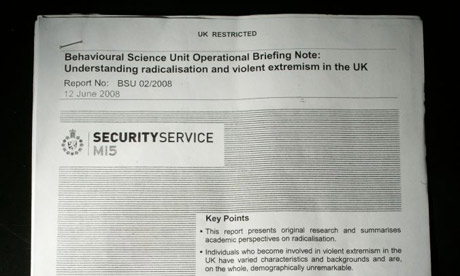
The MI5 research document. Photograph: Frank Baron

MI5 report challenges views on terrorism in Britain
By Alan Travis / August 21, 2008

Exclusive: Sophisticated analysis says there is no single pathway to violent extremism

Mi5 Security Service’s Behavioural Science Unit Operational Briefing Note

MI5 has concluded that there is no easy way to identify those who become involved in terrorism in Britain, according to a classified internal research document on radicalisation seen by the Guardian.

The sophisticated analysis, based on hundreds of case studies by the security service, says there is no single pathway to violent extremism.

It concludes that it is not possible to draw up a typical profile of the “British terrorist” as most are “demographically unremarkable” and simply reflect the communities in which they live.

The “restricted” MI5 report takes apart many of the common stereotypes about those involved in British terrorism.

They are mostly British nationals, not illegal immigrants and, far from being Islamist fundamentalists, most are religious novices. Nor, the analysis says, are they “mad and bad”.

Those over 30 are just as likely to have a wife and children as to be loners with no ties, the research shows.

The security service also plays down the importance of radical extremist clerics, saying their influence in radicalising British terrorists has moved into the background in recent years.

The research, carried out by MI5’s behavioural science unit, is based on in-depth case studies on “several hundred individuals known to be involved in, or closely associated with, violent extremist activity” ranging from fundraising to planning suicide bombings in Britain.

The main findings include:

• The majority are British nationals and the remainder, with a few exceptions, are here legally. Around half were born in the UK, with others migrating here later in life. Some of these fled traumatic experiences and oppressive regimes and claimed UK asylum, but more came to Britain to study or for family or economic reasons and became radicalised many years after arriving.

• Far from being religious zealots, a large number of those involved in terrorism do not practise their faith regularly. Many lack religious literacy and could actually be regarded as religious novices. Very few have been brought up in strongly religious households, and there is a higher than average proportion of converts. Some are involved in drug-taking, drinking alcohol and visiting prostitutes. MI5 says there is evidence that a well-established religious identity actually protects against violent radicalisation.

• The “mad and bad” theory to explain why people turn to terrorism does not stand up, with no more evidence of mental illness or pathological personality traits found among British terrorists than is found in the general population.

• British-based terrorists are as ethnically diverse as the UK Muslim population, with individuals from Pakistani, Middle Eastern and Caucasian backgrounds. MI5 says assumptions cannot be made about suspects based on skin colour, ethnic heritage or nationality.

• Most UK terrorists are male, but women also play an important role. Sometimes they are aware of their husbands’, brothers’ or sons’ activities, but do not object or try to stop them.

• While the majority are in their early to mid-20s when they become radicalised, a small but not insignificant minority first become involved in violent extremism at over the age of 30.

• Far from being lone individuals with no ties, the majority of those over 30 have steady relationships, and most have children. MI5 says this challenges the idea that terrorists are young men driven by sexual frustration and lured to “martyrdom” by the promise of beautiful virgins waiting for them in paradise. It is wrong to assume that someone with a wife and children is less likely to commit acts of terrorism.

• Those involved in British terrorism are not unintelligent or gullible, and nor are they more likely to be well-educated; their educational achievement ranges from total lack of qualifications to degree-level education. However, they are almost all employed in low-grade jobs.

The researchers conclude that the results of their work “challenge many of the stereotypes that are held about who becomes a terrorist and why”.

Crucially, the research has revealed that those who become terrorists “are a diverse collection of individuals, fitting no single demographic profile, nor do they all follow a typical pathway to violent extremism”.

The security service believes the terrorist groups operating in Britain today are different in many important respects both from Islamist extremist activity in other parts of the world and from historical terrorist movements such as the IRA or the Red Army Faction.

The “UK restricted” MI5 “operational briefing note”, circulated within the security services in June, warns that, unless they understand the varied backgrounds of those drawn to terrorism in Britain, the security services will fail to counter their activities in the short term and fail to prevent violent radicalisation continuing in the long term.

It also concludes that the research results have important lessons for the government’s programme to tackle the spread of violent extremism, underlining the need for “attractive alternatives” to terrorist involvement but also warning that traditional law enforcement tactics could backfire if handled badly or used against people who are not seen as legitimate targets.

The MI5 authors stress that the most pressing current threat is from Islamist extremist groups who justify the use of violence “in defence of Islam”, but that there are also violent extremists involved in non-Islamist movements.

They say that they are concerned with those who use violence or actively support the use of violence and not those who simply hold politically extreme views.

Source, with an audio of the findings / The Guardian

The Rag Blog

Posted in RagBlog | Tagged , , | Leave a comment

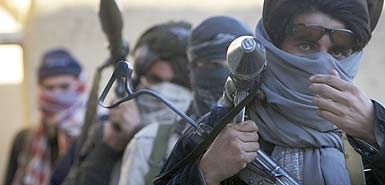
Kabul, Afghanistan : A City Under Siege

Taleban fighters

Rockets, guile and the lessons of history: the Taleban besiege Kabul
By Jeremy Page in Kabul / August 23, 2008

The lorry drivers who bring the Pepsi and petrol for Nato troops in Kabul have their own way of calculating the Taleban’s progress towards the Afghan capital: they simply count the lorries destroyed on the main roads.

By that measure, and many others, this looks increasingly like a city under siege as the Taleban start to disrupt supply routes, mimicking tactics used against the British in 1841 and the Soviets two decades ago.

Abdul Hamid, 35, was ferrying Nato supplies from the Pakistani border last month when Taleban fighters appeared on the rocks above and aimed their rocket-launchers at him, 40miles (65km) east of Kabul. “They just missed me but hit the two trucks behind,” he said. “This road used to be safe, but in the last month they’ve been attacking more and more.”

The road from Kabul to Kandahar is even more treacherous, according to other drivers. “If the Afghan Army isn’t there, a fly cannot pass,” said Bashir, a lorry owner, pointing to the scorched shells of three vehicles he retrieved from a Taleban raid on the Kandahar road last week. Of 60 lorries, 13 were destroyed, he said. “Why can’t the Americans stop this?”

Seven years after a US-led invasion toppled the Taleban, that is the question now troubling President Karzai and Nato forces in Afghanistan.

Despite the presence of 70,000 foreign troops, the Taleban have advanced on Kabul this year and hold territory just outside Maydan Shar, the capital of Wardak province, 20 miles southwest of the capital.

Militants in Wardak mount almost daily raids on the Kandahar road, which also links the main US bases in Afghanistan. In the past month, they have stepped up attacks on the road from Kabul to Pakistan via Jalalabad – the main supply route for food, fuel and water.

This week they killed ten French soldiers in Sarobi, 30 miles along the Jalalabad road from Kabul. Simultaneously, they attacked the biggest US base in eastern Afghanistan. Such is the fear of a Taleban “spectacular” in Kabul, that when Gordon Brown visited on Thursday he was taken around by helicopter rather than being driven through the streets.

“We’re seeing history repeat itself,” said Haroun Mir, co-founder of the Afghanistan Centre for Research and Policy Studies and a former aide to Ahmad Shah Massoud, the assassinated Mujahidin commander. “The Taleban’s trying to cut the main roads to Kabul to target supplies for foreign forces, just like the Mujahidin did with the Soviets. If the highways are cut even for two days, it could also create riots in the city.”

Kabul is vulnerable to blockades because it is surrounded by mountains and has to ship in supplies on three roads leading north, east and southwest. The British learnt this the hard way during the siege of Kabul in 1841, documented by Lady Florentia Sale in A Journal of the Disasters in Afghanistan. “Khojeh Meer says that he has no more grain,” she wrote on December 3, 1841. “He also says that the moolahs have been to all the villages and laid the people under ban not to assist the English and that consequently the Mussulman population are as one man against us.” A month later, the British began their retreat from Kabul.

In the 1980s it was Soviet forces encircled in Kabul by the Mujahidin. They withrew in 1989. In 1996 the Taleban took Kabul after capturing Wardak and Jalalabad and blockading the capital. Isaf, the International Security Assistance Force, says that circumstances are different today: it has superior air support and logistics to the Soviets and the Taleban. The militants, though, have experience on their side, thanks to former Mujahidin commanders who have blockaded Kabul before.

Zabihullah Mujahid, a Taleban spokesman, said that their new strategy was announced by the brother and deputy of Mullah Omar, the Taleban leader, in late 2007. “The Taleban will surround Kabul politically and militarily to make it hard for Nato forces to receive logistic convoys,” he told The Times. “That will mean less Nato movement and will show we can make trouble in the capital.”

Local officials say that the Taleban, which derive most of their support from ethnic Pashtuns, are enlisting villages around Kabul and feeding off frustration with the lack of development since 2001. They fear that the next target will be the northern routes to the borders of Uzbekistan and Tajikistan.

The Afghan Government insists that it controls the country’s main roads and Des Browne, the British Defence Secretary, this week dismissed recent Taleban raids near Kabul as

indiscriminate. “In no sense have they created, or can they make, a strategic threat to the Government of Afghanistan,” he said. Brigadier-General Richard Blanchette, an Isaf spokesman, said: “We’re fine for fuel and food. With the air power we have, and the quality of troops on the ground, there is no way they can win.”

But monthly foreign troop casualties are on the rise, surpassing those in Iraq, and set to make this year Afghanistan’s bloodiest since 2001.

The Taleban’s strategy is also impeding aid agencies, especially since militants shot dead three women aid workers last week. Ebadullah Ebadi, of the World Food Programme, said that 20 of its convoys had been attacked so far this year, compared with 30 in all of 2007, many in parts of southeastern Afghanistan previously considered safe.

The lorry drivers know the risks, but say there is no other work. “They used to warn us not to supply the infidel,” said Mr Hamid. “If they catch me now, they’ll throw me in my own container, cover me in petrol and burn me alive.”

The Afghan Interior Ministry said that 76 civilians, including 50 children and 19 women, were killed yesterday by US-led coalition forces in the western province of Herat. Western forces confirmed the operation, but said only 30 Taleban had been killed.

History of war in Afghanistan

1839 British invade Afghanistan to install compliant king
1842 British retreat from Kabul; 16,500 troops and civilians killed; one survivor
1878-80 Second Anglo-Afghan War
1979 Soviet forces invade to prop up Communist Government
1988-89 Soviets retreat
1989-92 Civil war among warlords
1996 Taleban take over
2001 US-led invasion topples Taleban Government

Source / The Times Online

The Rag Blog

Posted in RagBlog | Tagged , | Leave a comment

I Hate Those Corporate Fascists and Pigs


EV Bikes
By Edgar Alpo / August 21, 2008

Disclaimer: Sorry, I’m in a bad mood.

They don’t allow these in New York City. Otherwise known as the fascist capital of the world. New York City hates electric bicycles. They do like bankster grift money though… Bow down to New Jerk Shitty everyone, they have all the money because they are the filthy maggot banksters to the world. They steal from everyone, pension funds, foreigners, you, me, everyone.

This is how the current business model works (for them and not for us):

1) Start a private company.

2) Borrow from your fascist lodge buddies and buy assets.

3) Take a bonus.

4) Bribe officials with foreign investment dollars.

5) Take the corp.(se) public.

6) Run up the price of the stock with borrowed money from junk bond sale.

7) Take another bonus.

8) Get corporate msm cheerleaders to pump stock sales with propaganda.

9) Cash out stock options at the top.

10) Take bonus.

11) Short company stock to zero.

12) Get your talented ass another CEO job courtesy of your secret society bankster buddies.

13) Rinse, repeat.

Notice how the battery on that EV bike looks like a water bottle? Very sneaky, just like a hedge fund maggot, or a CONgreffsman. Here’s another just like it. The first one uses a trek chassis, I think I like it better. Both are about $2k, so I suggest you save your money. Especially, for the love of Mike, please don’t put that puppy on your credit card or pay any interest to the maggot banksters. I won’t be buying one anytime soon because I hate those corporate fascists and pigs more than all of you put together. I took the back brake off my broken down POS and plan to keep riding it. Let the banksters and billionaires keep this eCONoME going, they have stolen all the moolah anyway. Best of everything [/edgar].

Source / Petropest Launchpad

The Rag Blog

Posted in RagBlog | Tagged , , , | Leave a comment

Home Sweet Homes : Ten and Counting

John and Cindy McCain’s house keys.

The Rag Blog / Posted August 23, 2008

Posted in RagBlog | Tagged , , , | Leave a comment

Call Your Senator About the Global Poverty Act


The Global Poverty Act: The Most Important Bill You’ve Never Heard Of
by Caroline Schley

Hopefully you’ve heard of the Global Poverty Act. If not, here’s 30 seconds worth of sounding enlightened at the water cooler: The Global Poverty Act, written by Congressman Adam Smith [D-Wash], would require the President “to develop and implement a comprehensive strategy to further the United States foreign policy objective of promoting the reduction of global poverty, the elimination of extreme global poverty, and the achievement of the Millennium Development Goal of reducing by one-half the proportion of people worldwide, between 1990 and 2015, who live on less than $1 per day.” This would be an important step towards ensuring that the United Nations community addresses the eight Millennium Development Goals before the 2015 deadline. The Millennium Development Goals are, in short, a United Nations plan to ensure that cruel and severe global poverty and injustice are addressed in the international community. Besides poverty they address issues such as infant mortality, AIDS, education, and the environment.

I can hear you asking yourself, “So, what’s the problem? These all sound like very nice ideas.” The House of Representatives thought so, too. They passed the bill last year with an overwhelming bipartisan majority.

Now the bill is in the Senate and Barack Obama is one of the point people spearheading the effort to collect support. Barack Obama … sound the bells for all possible attempts at negative publicity from the Republican camp before November. Conservative publications are blasting the Global Poverty Act left and right (mostly right), claiming it will allocate $845 billion worth of additional foreign aid spending from the United States. While we are having a recession! And an oil crisis!

Here is the thing that has been overlooked in all the hysteria: The Global Poverty Act does not allocate any spending. None, whatsoever, at all. The bill emphasizes cooperation from all United Nations countries, as well as international businesses and NGOs. It calls for better organization of international relief efforts and associations already in place and a review of trade policy and debt relief policy. The bill calls for a US strategy to combat global poverty. It calls for the President to form a plan that includes specific and measurable goals and benchmarks. But the Global Poverty Act does not mandate additional foreign aid commitment.

An official strategy to eliminate global poverty would be beneficial to the United States in several ways. First, as stated by the US National Security Strategy in 2002, “[A] world where some live in comfort and plenty, while half of the human race lives on less than $2 per day, is neither just nor stable. Including all of the world’s poor in an expanding circle of development and opportunity is a moral imperative and one of the top priorities of US international policy.” Conditions of extreme poverty create conditions of social and political unrest. It is imperative to our homeland security and to our international peacekeeping efforts that we combat this problem. Second, the eradication of extreme poverty would create a more favorable global economy. It would create new consumer markets for US goods. Forty-three of the top 50 current consumer nations of American agricultural products were once recipients of United States foreign assistance. We are creating economic markets for our own country.

The United States has made considerable advances so far to combat poverty, a list that includes impressive measures such as the Millennium Challenge Act, the African Growth and Opportunity Act and participation in a G-8 pledge of increased aid funding to Africa. The Global Poverty Act would build off of these impressive efforts and create a model for other UN countries to follow in coming through with their pledge to eradicate global poverty. It is important for the US to be a leader in this fight.

However, the United States Senate has not gotten much of a chance to talk about all the positive outcomes that are possible. The poster child for disagreeable behavior in the United States Senate, Sen. Tom Coburn [R-OK], has placed a hold on the bill, preventing it from going to a vote.

Here’s what you can do to help: Call your Senator. If you don’t know the number call the Capitol Hill switchboard at (202) 224-3121. Explain that global poverty is an important issue for you and you would like to know that your Senator supports the Global Poverty Act and you would like to know what your Senator is doing to ensure that this bill comes to a vote.

[Ed. note: The Wild Sky Wilderness bill overcame a hold by Sen. Coburn a few months ago through parliamentary maneuvers by Congressional Democrats. They can do the same to move the Global Poverty Act–if they’re motivated to act.]

Source / Eat the State

The Rag Blog

Posted in RagBlog | Tagged , , | Leave a comment

America is Pro-Choice, Any Questions?


In support of a woman’s right to choose:

‘According to a recent Gallup poll, we are in the majority by a long shot’
By DarkSyde / August 23, 2008

Is anyone still unsure where We the People stand on choice? That right-wing noise machine is effective, listening to the mighty roar of Fake News and tut-tutting talking heads, it’s easy to think reproductive choice is a shrinking minority. But according to a recent Gallup poll, we are in the majority by a long shot, and have been since the poll was founded over ten years ago. A few tidbits:

Most Americans oppose the idea of passing laws to outlaw abortion and they soundly reject the idea of overturning Roe. v. Wade.

More broadly, a majority of Americans favor keeping abortion legal in the first trimester but would make it illegal in the second and third trimesters.

Only about 20% or less of those polled over the last decade feel abortion should be illegal in all cases — the only possible, rational conclusion for anyone who truly believes that a viable embryo at any stage of development is a person with full Constitutional Rights. Almost two thirds of the sample want restrictions to remain the same or be further loosened. A little over half of those polled do not want to see Roe V. Wade overturned while less than a third want it overturned.

The data goes on and on like this. And what’s remarkable about these numbers is how consistent they’ve remained for more than a decade of polling. Anti-choice talking points have been liberally poured into the nation’s conscious for twenty or thirty years, backed by almost limitless political, religious, and financial resources. The net result of all that right-wing effort is at best maybe a few, scattered points here and there on the margins.

That explains why the most extreme right-wing control freaks in almost a century were notably less than eager to eliminate choice. Tax breaks for billionaires, sweetheart deals for Big Oil, protection for communist sweat shop owners, all sailed through Tom DeLay’s House of Horrors and Bill Frist’s Senate as fast as American jobs sailed overseas. But that same crew of sanctimonious blowhards didn’t even try to put up anything other than a token effort to end what they referred to as mass infanticide, they didn’t try even when they had control of both branches of Congress, the Supreme Court, and the White House. They know damn well it was 1) unpopular, and 2) too useful an issue politically to risk losing. Whatever else we disagree with the grass roots socially conservative right on, and it’s quite a long list, this is one thing we can recognize: they got royally screwed by the Republicans. The question is, do they finally recognize it, and if so, what are they going to do about it?

Source / Daily Kos

The Rag Blog

Posted in RagBlog | Tagged , , , , , , | Leave a comment

US Arrogance: Exported Around the World

Charles Glazer (left), US Ambassador to El Salvador

Meddling in Elections, Central America-Style
By Burke Stansbury / August 21, 2008

During a recent heated meeting at the US Embassy in El Salvador, Ambassador Charles Glazer admitted that the US government had intervened in the 2004 Salvadoran Presidential Elections on behalf of the right-wing ARENA party. The meeting on June 27 was requested by a group of 12 US citizens, including professors, students, journalists and community activists who were taking part in a 10-day delegation organized by the Committee in Solidarity with the People of El Salvador (CISPES).

In their meeting with the Ambassador, the group focused on continued US intervention in El Salvador. They cited statements made by US State Department officials denouncing the leftist Farabundo Marti Liberation Front (FMLN) party during the 2004 presidential campaign. The delegates also referenced legislation put forward in Congress by Rep. Tom Tancredo (R-CO) that threatened to cut off remittances sent by Salvadorans in the US to their families in El Salvador should the FMLN win. “The US Embassy in El Salvador never countered this absurd threat or clarified the impossibility of such legislation being passed,” said Rosa Lozano, a delegate from Washington DC. “Ultimately, such intervention helped turn a close race for the presidency into a decisive victory for the right-wing Nationalist Republican Alliance (ARENA) party.”

When asked directly if the US government had intervened in the 2004 presidential elections on behalf of the ARENA party, Ambassador Glazer replied in the affirmative. When asked if such intervention would occur again, he said, “No.”

The aggressive, disrespectful conduct of Ambassador Glazer was also of concern to those who attended the meeting. “Mr. Glazer arrived with the idea of attacking our delegation and rudely countering everything we put forward, to the point of being verbally abusive to at least two of the delegates,” said Andrew Kafel, a member of the delegation from New York. “Whether or not the Ambassador agrees with the concerns we laid out about US intervention, he has a duty as a public official to hear us out in a respectful manner,” continued Kafel. “If this is how we as US citizens are treated, we can only imagine how the Ambassador interacts with Salvadorans. We hope that in the future the State Department will better orient its representatives about how to dialogue with those holding a differing opinion.”

During the meeting, the Embassy labor attaché claimed that the possibility of fraud in the 2009 Salvadoran elections will be diminished because of the active monitoring of various international organizations, and emphasized the role to be played by the International Republican Institute (IRI) and the National Democratic Institute (NDI), both subsections of the National Endowment of Democracy (NED). When challenged about the partisan nature of these quasi-non governmental organizations, as well as accusations that the IRI and NDI have played an interventionist role in other Latin American elections, the Embassy representative admitted that there was controversy and doubts surrounding the NED.

Indeed, “in 2007, the IRI–headed by Republican presidential candidate John McCain–presented President Saca with its ‘Freedom Award,’ showing its clear ideological preference in the polarized Salvadoran political process,” said Laura Embree-Lowry, a member of the Boston chapter of CISPES and a participant in the Embassy meeting. “The presence of partisan groups like the IRI and NDI may in fact be counterproductive to the goal of the Salvadoran people, which is to hold free and fair elections in 2009.”

Burke Stansbury is CISPES Executive Director. CISPES is currently campaigning to prevent US intervention in the upcoming Salvadoran elections. For more information and to sign the People’s Pledge to Defend Free and Fair Elections in El Salvador, go to www.cispes.org. You can reach the Seattle CISPES office directly at: seacispes@igc.org, 206-325-5494.

Source / Eat the State

The Rag Blog

Posted in RagBlog | Tagged , | 1 Comment

Police Brutality: Not Just an American Problem

Mourners at Fredy Villanueva’s funeral

No Justice, No Peace: Behind the riots in Montreal after the shooting-death of Fredy Villanueva
By Charles Mostoller / August 23, 2008

MONTREAL-NORD, Montreal–“Why four gunshots? Why?”, asked Patricia Villanueva. “I don’t believe they had reason to shoot four times, just like that. Nothing justifies a death.” Patricia is sister to Fredy Villanueva, an 18 year old Honduran youth who was shot dead by a Montreal police officer on August 9th, sparking a small riot among the fed-up youth of this impoverished immigrant neighborhood in North Montreal.

Villanueva is the latest death in a long line of police killings here in Montreal, although the first to occur in this North Montreal neighborhood.

According to police, two officers approached a group of youths who were playing dice in a park, and attempted to arrest Dany Villanueva, Fredy’s brother. When an argument broke out, one officer fired four shots, killing Fredy and injuring Denis Meas and Jeffrey Sagor Metelus, who are recovering in the hospital. Police have stated that the officers were attacked by a group of about 20 youths, despite statements from witnesses who say that only five or six people were present and that there was no physical confrontation.

“My brother said ‘What are you doing with my brother? Let go of him.’ Then I heard gunshots, and my brother fell to the ground,” said Dany, according to the CBC. According to statements by the Villanueva family, Dany has had some trouble with the law in the past, but Fredy was the ‘good’ son, doing well in school and staying away from drugs and trouble.

Jean Loup Lapointe–the Service de Police de la Ville de Montreal (SPVM) officer from Montreal-Nord’s Station 39 who fatally wounded Villanueva–has not been suspended, although he has been taken off patrol duty.

Although over 30 witnesses have already been questioned in relation to Villanueva’s death, the two police officers responsible for his death have yet to be questioned. His sister wants to know why.

“It’s so important to have a transparent investigation, to know what really happened,” she said. “But they haven’t taken the police officers’ testimony yet. What are they waiting for?” Despite the slow course of the internal police investigation, the Villanueva family hopes that Fredy’s death will finally make police on the island more responsible and less likely to resort to lethal force.

“We want this never to happen again,” said Patricia, speaking after a press conference on Friday. “If it happens once, it can happen again, and it has happened before.” The incident has sparked debate in the media and among politicians here, more over the supposed threat of street-gangs in the area than over the reckless use of force displayed by Montreal’s finest–with many, including Prime Minister Stephen Harper, suggesting the need to beef-up the police units in the area to crack down on gangs. However, Francois du Canal, a spokesperson for the Coalition Against Police Brutality (COBP), believes that the most pressing issue in Montreal’s poor neighborhoods is poverty, not gangs.

“They are treating everyone in the neighborhood like they are would-be gang members,” he said. “There is poverty and a lot of social problems in neighborhoods like Montreal-Nord, but instead of dealing with poverty–like by giving money to community groups–they give millions of dollars to cops.” Take a quick stroll through Montreal-Nord and this is immediately obvious. Local residents gather in front of the dilapidated housing buildings, while groups of five or six police officers patrol the sidewalks and teams of police cruisers line the corners. Many people feel intimidated by the heavy police presence, which has been a part of daily life since long before Villanueva’s death.

“There are too many police here,” said Kevin Garcia, a friend of the Villanueva family. “Caravans of 10 or 15 police cars will come into the neighborhood all of a sudden, and we feel very insecure, because it seems like anything can happen from one moment to the next. It makes us feel very intimidated to have so many police everywhere.” “It seems like they are here to provoke things,” he added. “They see a few young people, and even if there are little kids around, they approach them, trying to intimidate–or what are they looking for? They are provoking things, trying to take this to the next level.” However, it is unlikely that Villanueva’s killers will ever face justice, given the history of impunity for police officers in cases like this. Villanueva is the 43rd person to be killed by the Montreal Police in the last twenty years, yet only two police officers have ever faced charges for their actions–and were acquitted in both cases.

“They kill people, and they’re not even accused of any misdoing,” said Canal. “So they get away with it. That’s what we call impunity, and because of it, they know they can kill people, so they just keep on acting like they can do whatever they want.”

“They use harassment, intimidation and violence as tactics,” he added, “and things like this happen, because the politicians are too afraid to control the police more. And they will continue to happen if nothing happens to these cops.”

Surete du Quebec (SQ)–the Quebec provincial police who are leading the inquiry into Villanueva’s death–have promised “an investigation with impartiality, rigor, objectivity and rapidity,” according to SQ Lt. Francois Dore.

However, past investigations into fatal shooting by the Montreal Police suggest that we may never know what really happened on August 9th.

For example, in the case of Mohamed Anas Bennis–a youth killed in December of 2005 by a Montreal Police officer–the findings of the investigation into his death have still not been made public., two-and-a-half years later. Nor has the officer who killed Bennis, Yannick Bernier, been penalized.

“It’s always the same story,” said Canal. “The cops investigate themselves and there are no accusations, so we never really know what truly happened. The cops are not even suspended.”

In 1996, former SQ investigator Gaëtan Rivest told the COBP that an investigation into the death of Yvon Lafrance–killed by police in 1989–had been tampered with in order to protect the officer responsible, Dominic Chartier. According to the COBP, Rivest confirmed “that such practices are common within the different police services in Quebec.”

“So it really sends a message that the city and the government are backing the police,” said Canal, “even if they say they think about the family and all that. But they really seem more upset that there was a riot than the fact that the cops killed an unarmed youth.”

Communities like Montreal-Nord are fed up with the situation. The riot that happened the day after Villanueva’s death was probably just a release of the neighborhood youth’s pent-up anger, not an action organized by local ‘street gangs’.

“The only street gang around here is the police,” shouted Will Prosper, along with hundreds of other Montreal-Nord residents in front of the town’s municipal building on Wedensday night.

Local residents had gathered in the parking lot in front of Mayor Marcel Parent’s office, calling for an public investigation of Villanueva’s death and an end to police repression in Montreal.

Shouting “No justice, no peace! Disarm the police!” and “Enquête public!”, dozens of residents barged into a meeting the mayor was holding, and Prosper raucously called for the mayor himself to resign–for not trying to help lift Montreal-Nord out of poverty.

“I don’t think he can lead Montreal-Nord correctly, because he’s not listening to his people,” said Prosper. “If he was listening to his people, maybe Fredy Villanueva would still be alive.”

According to Prosper, unemployment among youths has skyrocketed under Mayor Parent , and police abuse has gone unchecked.

“These people want jobs, houses, families–and are tired of police harassment,” he said. “If you don’t give them some options, what are they going to do?”

Both Prosper and Canal feel that in a poor neighborhood like Montreal-Nord, the police just exacerbate the problem.

“The police are not here to help people, they’re here to criminalize people and then they do things like killing people,” said Canal. “This makes it so that everybody in the community feels alienated–like they are being unjustly treated–and that’s one of the reasons why an explosion like the one we saw after the killing of Fredy Villanueva happened.”

In the end, police brutality towards immigrants seems like a systemic problem in Montreal, and one that won’t be going away soon. According to Prosper, minorities are twice as likely to be shot by police in Montreal, and poor immigrant neighborhoods like Montreal-Nord are overrun by police officers.

“They have a gang mentality,” he said. “A lot of police are good officers, but they tolerate abuses by other police officers. How come they don’t say anything about that? They ask the population to anonymously denounce criminals, but then they let criminals in their own ranks.”

“If we could respect the police, the riot wouldn’t have happened. But right now,” he continued, “there’s no trust, no respect. We know what happened that night, and that’s why we want change.”

The political response to police killings is to criminalize immigrant communities and victimize the police, sending in more police to fight against street gangs–in other words, young people. Until less money is spent on police in poor neighborhoods and more is spent on community programs, Canal explained, the vicious cycle that has led to so many deaths at the hands of police will probably continue.

“If they don’t stop police brutality, and their answer to what happened is to put more police on the streets,” said Canal, “then there’s going to be more police brutality and more riots to come.”

Source / Z-Net

The Rag Blog

Posted in RagBlog | Tagged , , | Leave a comment

Cindy McCain ‘Unsure’ How Many Half-sisters She Has

One of Cindy McCain’s half-sisters, Kathleen Hensley Portalski, showing proof of her half-sisterness. How many more are there? Get back to us. Photo by Ted Robbins / NPR.

Says staff member will handle sibling tally
By Andy Borowitz / August 22, 2008

Presumptive first lady nominee Cindy McCain responded to a reporter’s question today about how many half-sisters she had by saying that she was “unsure” about the exact number but would have “a staff member look into it.”

Ms. McCain’s claims of being an only child were clouded this week by revelations that she has at least two heretofore unmentioned half-sisters, leading to reporters’ queries as to whether more undisclosed half-siblings were waiting in the wings.

When a reporter from the Toledo Blade asked Mrs. McCain at a campaign stop in Ohio about how many half-sisters she had, she looked momentarily startled by the question before handing it off to a staff member.

Mrs. McCain’s uncertainty about the precise tally of her siblings, coming on the heels of her husband’s confusion about the number of the couples’ homes, might not be as big a problem for the McCain campaign as some might expect, says Davis Logsdon, professor of economics at the University of Minnesota.

“As long as the couple has more homes than half-sisters, they could easily house one of the half-sisters in each of the residences and keep them happy,” Dr. Logsdon says. “However, if the number of half-sisters grows faster than the number of homes, that could potentially lead to crowding.”

For his part, Sen. McCain said that the campaign would provide a “guesstimate” of how many half-sisters and homes the couple has by the end of next week: “Right now, we’re trying to put it all on a spreadsheet.”

Source / Borowitz Report

Thanks to Shelia Cheaney / The Rag Blog

Posted in RagBlog | Tagged , , , | Leave a comment

Now If We Could Just Get Private Money Out of Elections …


Seven Ways Your Vote Might Not Count This November
By Steven Rosenfeld / August 22, 2008.

Some of the most serious election protection problems can be discovered and fixed before the presidential voting begins.

While many voting rights activists are focused on stopping potential problems on Election Day, there are several milestones between now and the 2008 presidential vote that would preview problems with voting on Nov. 4.

What voters often do not know is that long lines or delays in polling place voting can result from many factors — some administrative, some technical, some partisan. Many of the problems that arise on Election Day not only can be identified before voting in November, they can be resolved by election officials. The following issues will directly impact how voters are accommodated.

Voter Purges

According to the federal law that governs how people may be removed from voter lists, the last day that most registered voters can be purged is 90 days before an election, which would have been Aug. 5 for the presidential election. However, some states are not following the process in the National Voter Registration Act, according to voting rights attorneys. Moreover, because purges are often conducted secretly, people who do not call local election offices to confirm their registration status may discover later this fall that they cannot vote.

Solution: Voters, particularly those who have not voted in recent years, should call their local election office to confirm they are registered at their current address. If they are not properly registered, they should update their voter registration. This must be done before registration closes, which is the first week in October in 27 states. Advocacy groups can facilitate this by accessing a voter registration list and reviewing it with community activists. (Editor’s note: Web sites and experts to help voters are listed below.)

Unprocessed Voter Registrations

After the Democratic Convention, the Obama campaign will launch a national voter registration drive to bring millions of new voters to the polls in November, according to top campaign officials. This could be the largest voter drive in decades. In previous years, local election officials have complained about receiving too many registration forms at the last minute to verify before Election Day. In two Ohio cities in 2004, Cleveland and Toledo, boxes of registrations went unprocessed by Election Day.

Solution: New voters should register sooner rather than later, and then verify that their voter registration forms have been processed by calling local election offices. Remember, it is local election officials, not political parties or third-party groups, who are legally responsible for validating and processing voter registrations.

Obstacles to Student Voting

Historically, students have been criticized for not voting, but what is often overlooked are the obstacles created by local officials or state legislators that discourage student voting. The most frequent barriers involve state residency and ID requirements. In some places, registrars tell students that a campus post office box is not a proper address and refuse to register students for that reason.

Solution: Students who experience problems with voter registration should contact organizations working on voter registration, or the presidential campaigns, or election protection lawyers who have the legal expertise to help with registration and could go to court to enforce student voting rights.

Voting Machine Allocations

How local election officials allocate voting machines — literally the number of machines per polling place — can lead to smooth voting, or long lines prompting some voters to leave without casting a ballot. In 2004 in Ohio, a shortage of voting machines created lines and delayed voting that disenfranchised minority voters in the state’s inner cities. In contrast, nearby wealthier suburbs experienced no lines, due to an ample number of voting machines.

Solution: Local election integrity groups or election activists should ask election officials how they are deploying the machines and ask officials what the basis is for that decision. Election officials tend to use historic turnout patterns over several voting cycles, which, as was the case this spring, underestimated the number of primary and caucus voters. Local officials should be encouraged to use the voter turnout numbers from 2008’s primaries and caucuses and updated voter registration statistics, rather than voter turnout figures from 2004.

Poll Worker Shortages

The nation’s elections are staffed by 2 million poll workers, who typically are senior citizens who undergo a few hours of training before Election Day. A shortage of poll workers, or poll workers who are uncomfortable with the latest electronic voting technology or the latest fine print in election law, will lead to delays in voting.

Solution: Local election integrity activists or local media should ask election officials where there are likely to be shortages of poll workers, and help recruit key staffers there. Election officials, for their part, should turn to local high schools and colleges to recruit poll workers. Arizona, a state with restrictive election laws, even allows 17-year-olds to serve as poll workers. Often these students can receive school credit while learning how elections really work.

Partisan Voter Challenges

In recent years, the GOP has threatened to challenge the credentials of new voters, claiming it is seeking to protect the process from so-called voter fraud, or people posing as other voters. Democrats have not embraced this tactic, which causes delays in voting, with equal vigor. The first sign of voter challenges will come in October, when newly registered voters will receive a non-forwardable postcard from a political party that welcomes the voter to the political process. Sometimes these voters are selected based on race or ethnicity. Those recipients whose cards are returned — because the address is incorrect — can be put on a voter challenge list. Come Election Day, partisan volunteers can stand at the polls and insist those voters produce ID and other verification, such as utility bills, to prove who they are before voting. Voters who cannot produce such identification are not permitted to vote.

Solution: Any voter who registers after Aug. 1 and who receives such a postcard from a political party not of their choosing should recognize they could be on a “caging” or voter challenge list. This is especially true for college students and minority voters. Because vote caging can be illegal in certain circumstances, voters should notify voter protection groups, who should follow up on the vote challenge scheme. Also, those registrants should bring additional ID to the polls on Election Day, and they should alert the presidential campaign they support to investigate if voter caging is likely, as election lawyers take this issue very seriously. If voters are properly credentialed, they will get to vote. This tactic is designed to create delays at the polls, so people often leave in frustration, particularly those who try to vote on their way to work or on their lunch hour.

Early Voting/Absentee Ballot Problems

Problems with voting early or voting by mail can be a sign of election difficulties. For soldiers and others overseas, if absentee ballots are not sent out early enough, they may not get delivered in time for recipients to return them to be counted.

Solution: Any problems with early voting should be reported to voter registration organizations, which will forward them to voting rights lawyers who will investigate and possibly intervene. Voting rights groups can monitor requests for absentee ballots to see how many have been sent out, which will indicate if voting this way will be problematic. The military and some states are instituting a system of registering voters online, but ballots still have to be requested and submitted on time. Federal Express has a program to help deliver military ballots.

Solutions and Resources for Voters

Finding your local election official: The Overseas Vote Foundation has a nationwide directory on its Web site that has all the contact information you need to verify and update voter registration information.

Registering to vote: Many sites offer help with getting voter registration forms, but it is up to the voter to ensure they are filled out properly and returned on time. Two good sites that offer this service include NonProfitVote.org, which has a home page map that launches all kinds of helpful registration and other information from every state; and DeclareYourself.org, which is seeking to register students and young people.

Legal help for any voting problem: The Lawyers Committee for Civil Rights Under Law has a live hotline, 1-866-OUR-VOTE, and callers can talk to a lawyer or expert who will help resolve issues or refer the matter to lawyers who will go to court. This is the country’s largest election protection network, although it now is only taking calls during East Coast business hours. The Campaign Legal Center also is staffed by lawyers and has developed legal templates that anybody could use to use to go to court to protect their right to vote; people or groups experiencing problems are urged to call.

Finding your polling place: The League of Women Voters has a polling place locator on its home page, lwv.org.

Source / AlterNet

The Rag Blog

Posted in RagBlog | Tagged , | Leave a comment