Two Wolves : You Are What You Feed


One evening an old Cherokee told his grandson about a battle that goes on inside people. He said, ‘My son, the battle is between two ‘wolves’ inside us all.

One is Evil. It is anger, envy, jealousy, sorrow, regret, greed, arrogance, self-pity, guilt, resentment, inferiority, gossip, lies, false pride, superiority, and ego.

The other is Good. It is joy, peace, love, hope, serenity, humility, kindness, benevolence, empathy, generosity, truth, compassion and faith.’

The grandson thought about it for a minute and then asked his grandfather: ‘Which wolf wins?’

The old Cherokee simply replied, ‘The one you feed.’

Thanks to Wayne Smith / The Rag Blog / Posted August 17, 2008

Posted in RagBlog | Tagged , , , | Leave a comment

Swingin’ on Sunday – the East West Jazz Alliance

East West Jazz Alliance – In A Hurry / I Do Hope


Musicians: John Hansen, Phil Sparks, Daisuke Kurata, Atsushi Ikeda, Yasuhiro Kohama, Jay Thomas. Recorded: 2006 in Seattle, WA. [I’m quite sure this is Tula’s on 2nd Street in Belltown, downtown Seattle.]

Source / Kelley Johnson

Many thanks to Kelley for sharing this with me / The Rag Blog

Posted in RagBlog | Tagged , , | 1 Comment

Texas Ethics Commission : Proposal to Regulate Blogs


‘Regulating Texas blogs would be regulation with out representation. Regulation that doesn’t protect the rights of citizens is not good government’
By Vince Liebowitz / August 15, 2008

The statement below is issued in response to a document that has been circulating around the state today. The document (.pdf) is a memorandum of recommendations by a Texas Ethics Commission task force for potential recommendations the agency may elect to make to the Texas Legislature.

Vince Leibowitz, Chair of the Texas Progressive Alliance, issued the following statement concerning the Texas Ethics Commission’s recently distributed recommendation concerning blogs.

For a state agency that twice ruled it was appropriate for a trustee of the Texas Employee Retirement System to disclose a monetary gift from swiftboater Bob Perry as simply a “check,” to suggest that blogs should be subject to regulation is absurd.

Blogs are a form of political communication that should, by and large, remain unregulated. Independent citizen journalists and bloggers perform a valuable function in the political arena by prompting and promoting political discourse–on both sides of the aisle.

It is my hope that the Texas Legislature, in addressing this issue, will determine it is in the best interest of free speech to leave blogs alone. Blogs and bloggers should not be subject to political advertising regulations. Blogs clearly operated by political campaigns on campaign websites, or the blogs of political action committees, would be the singular exceptions to this rule.

One concern, however, with regard to encouraging the Legislature to adopt regulations similar to the FEC rules on blogs, does arise. Bloggers and citizen journalists in Texas do not yet have protection under the Privileged Matters Clause of the Texas Civil Practices and Remedies Code, and currently aren’t treated on equal footing with the traditional media by Texas Law.

The “Privileged Matters” clause of Chapter 73 of the Texas Civil Practices & Remedies Code (found at Sec. 73.002) protects newspapers and other forms of media from, among other things, libel lawsuits when it comes to “reasonable and fair comment on or criticism of an official act or public official or other matter of public concern published for general information.” Under a strict interpretation of this section, bloggers and citizen journalists operating on their own aren’t protected.

In addition, any bill the Legislature may consider as a result of this TEC recommendation must be carefully drafted to avoid a couple of pitfalls. Number one, because an independent citizen journalist or blogger accepts advertising on their site, they shouldn’t be subject to any different set of rules than a blogger who doesn’t accept paid advertising. Number two, the Texas Legislature should consider appropriate action to ensure that responsible bloggers operating under the protection of a pseudonym are adequately protected. One Texas appeals court has already noted just how important allowing bloggers to keep their anonymity is to the “exchange of ideas and robust debate on matters of public concern.”

If the legislature wants to consider regulating us–in any form–then they need to protect us. The Legislature considering, based on the TEC proposal, regulating blogs while not giving us statutory protection under the Privileged Matters Clause is putting the cart before the horse.”

The Texas Progressive Alliance (TexRoots.org) is the largest coalition of state-level political bloggers in America, representing more than 50 of Texas most widely read and highly respected political bloggers and citizen journalists.

Source / Burnt Orange Report

The Rag Blog

Posted in RagBlog | Tagged , , , , , , , | 1 Comment

Big, Bland John : Republican Senator from Texas Can Be Beaten

The Hon. John Cornyn of Texas. Illustration courtest of the Texas Observer.

How a dull exterior masks one of the most conservative records in the U.S. Senate
By Dave Mann

Democratic strategists in Texas have been telling anyone who will listen for the past year that they can defeat John Cornyn, the state’s junior U.S. senator, in November. This is big talk for a party that hasn’t won a statewide race since 1994 and hasn’t held Cornyn’s senate seat in 47 years. But they have some fancy polling data to back it up. More than a third of Texans wouldn’t know their junior senator if he fell on them. They call this “name ID” (or lack thereof) in the political consulting business. Cornyn’s is abysmal for a politician who’s served as a Texas Supreme Court justice, state attorney general, and, for the past six years, U.S. senator. Of those who do know Cornyn, fewer than 50 percent view him favorably—dangerous territory for an incumbent seeking re-election. Some of those same polls show him running closely with Democratic opponent Rick Noriega.

But you don’t need polling data to know that Cornyn can be beaten. Just watch him give a speech. “Dull” is an understatement.

When Cornyn spoke at the Republican state convention on June 13, for instance, the excitement level—even among the 5,000 ardent Republicans assembled in a downtown Houston convention center—resembled a chamber music recital more than a rock concert. They offered Cornyn polite applause, but nothing near the standing ovations for the state’s senior senator, Kay Bailey Hutchison, or for former presidential candidate Mike Huckabee.

Cornyn looks like a senator: He’s tall and lanky, with wispy white hair over the kind of broad, distinguished face that makes him look deliberative all the time. He’s also blessed with the bearing and charisma of a tax attorney. He doesn’t connect with audiences; he talks at them. In Houston in June, his deadpan delivery rendered the convention speech instantly forgettable.

The most memorable moment of Cornyn’s convention appearance was the “Big John” video that introduced him—an over-the-top spoof showing the lawyerly Cornyn in cowboy attire on a horse. A Jimmy Dean imitator crooned in the background about the exploits of Big John: “He rose to the top in just one term, kept Texas in power, made lesser states squirm—big John … big, bad John.” Cornyn looked ridiculous, an irony given that he actually spent a lot of time on a ranch as a child and regularly hunts and rides horses. Nonetheless, the video was universally mocked in newspapers and blogs, and, predictably, on the Daily Show.

Cornyn seemed to sense the ridicule to come. “I hope you got a smile out of that video,” he told the crowd. “My staff convinced me it would be a good idea. Maybe I need a new staff.” It was his best line of the day. He immediately turned once more to stone. “It was an attempt to bring a little humor to a subject I take very seriously.” He went on to detail his record in the Senate. Perhaps his speech deserved more attention. The record he must defend is so conservative that few Texas political observers—many of whom viewed Cornyn as a Republican moderate during his time in state government—would have foreseen it six years ago. With his bland style and senatorial looks, Cornyn doesn’t strike you as a right-wing ideologue. His record suggests just that.

“My policy on the war on terror is similar to Ronald Reagan: We win, they lose,” Cornyn told the assembled GOP faithful. (Indeed, he has voted consistently in the Senate to cede power to the executive branch. He voted to strip terrorism detainees of their habeas corpus rights and against congressional oversight of the CIA’s terrorist detention facilities. He backed the president’s secret wiretapping program and once remarked, in a debate over the PATRIOT Act, “None of your civil liberties matter much after you’re dead.”)

“I have protected the sanctity of human life,” Cornyn told the crowd. (He voted to strip funding from abortion and family planning services, and against increased access to birth control.) “I’ve opposed immoral experimentation done in the name of science.” (He’s opposed federal funding for stem cell research.)

“I have supported judges who respect the Constitution.” (He backed the nominations of both Supreme Court justices Samuel Alito and John Roberts, and a host of controversial judicial nominees, including Texas’ own Priscilla Owen.)

“I have supported the traditional family.” (He was a main proponent of a constitutional amendment banning gay marriage.)

When he finished, Cornyn didn’t linger on stage to bask in the crowd’s muted applause. He offered two quick, perfunctory waves to the crowd and ducked backstage.

One major aspect of Cornyn’s first term in the Senate that he didn’t mention: George W. Bush. No one has done more to propel Cornyn’s career than Bush. In turn, Cornyn has offered near complete fealty to the president. No other U.S. senator has voted so reliably with the White House in the past six years.

Now that Bush is one of the most unpopular presidents in American history, Cornyn is trying to distance himself. Even in Texas, Bush polls below 50 percent. Add to that a dissatisfied electorate—polls show about 80 percent of Americans say the country is on the “wrong track.” The historic candidacy of Barack Obama has energized Democrats, who seem poised to make big gains in Congress. This would seem a disastrous year for an incumbent senator who doesn’t excite even members of his own party.

Yet the Democrats seem wholly unprepared to take advantage. Republicans still hold an edge in Texas, and Cornyn has raised nearly 10 times more campaign money than his Democratic opponent. Despite his blandness and a record that borders on too conservative even for Texas, Cornyn may sneak into a second term.

Read all of this story here / Texas Observer / Posted August 8, 2008

The Rag Blog

Posted in RagBlog | Tagged , , , , , | Leave a comment

Austin : Cyclist Lance Armstrong Now Champion Water Guzzler

Lance Armstrong’s Austin home, with a swimming pool and an acre of gardens, used 330,000 gallons of water in July. Photo by Jay Janner / Austin American-Statesman.

‘In July, Mr. Armstrong, who won the Tour de France seven times, used a whopping 330,000 gallons of water at his lush Spanish-colonial home’
By James C. McKinley Jr / August 15, 2008

HOUSTON — Lance Armstrong is one of the favorite sons of Texas and a model citizen known as much for his social conscience as his cycling. So it came as a surprise when it was revealed this week that he is one of the biggest individual users of water in Austin, where he lives.

Say it ain’t so, Lance.

In July, Mr. Armstrong, who won the Tour de France seven times, used a whopping 330,000 gallons of water at his lush Spanish-colonial home, with an acre of gardens and a swimming pool, city water authority officials said.

This tremendous flow of H2O, which is 38 times what the average household in the city uses in the summer, comes as Texas is going through a dry spell and officials are asking people to cut back on watering their lawns. “We are definitely short on rain,” Lisa Rhodes, a spokeswoman for the authority, said with a sigh.

Mr. Armstrong declined to be interviewed. He has been in Colorado and California all summer and only noticed the surge in water use when he saw his bills go up, his spokesman, Mark Higgins, said in an e-mail message. (The bill for July was $2,460.) “Lance and all the folks involved are looking into it and will for sure get it under control,” Mr. Higgins wrote.

The Austin American-Statesman, which broke the story on Friday, quoted Mr. Armstrong as saying he was unaware his water use was so high. “I’m a little shocked,” he told The Statesman. “There’s no justification for that much water.” He added, “I need to fix this.”

But city water records suggested that his home has long been a guzzler of water, using an average of 158,000 gallons a month since January 2007. Then, in June, the cyclist shot ahead of the pack, topping the city’s list of residential water users for the first time, officials said. That month his house and garden drank up 222,900 gallons.

Daryl Slusher, an assistant director of the Austin City Water Authority in charge of conservation, said the city had ruled out a leak. Mr. Slusher offered to scrutinize Mr. Armstrong’s irrigation system and perhaps recommend native species that require less water.

Getting Mr. Armstrong on board with water conservation would be a public-relations boon, Mr. Slusher said, although it was a disappointment that Mr. Armstrong had ended up on the top of the city’s water-gluttons list.

“I was surprised he was No. 1,” Mr. Slusher said. “But his response is very encouraging.”

Source / New York Times

The Rag Blog

Posted in RagBlog | Tagged , , , , , | 2 Comments

We Should All Follow Our Hearts and Minds


The old future’s gone: Progressive strategy amid cascading crises
by Robert Jensen / August 15, 2008

“The old future’s gone,” John Gorka sings. “We can’t get to there from here.”1

That insight from Gorka,2 one of my favorite singer/songwriters chronicling the complexity of our times, deserves serious reflection. Tonight I want to argue that the way in which we humans have long imagined the future must be rethought, as the scope and depth of the cascading crises we face become painfully clearer day by day.

Put simply: We’re in trouble, on all fronts, and the trouble is wider and deeper than most of us have been willing to acknowledge. We should struggle to build a road on which we can walk through those troubles — if such a road is possible — but I doubt it’s going to look like any path we had previously envisioned, nor is it likely to lead anywhere close to where most of us thought we were going.

Whatever our individual conception of the future, we all should re-evaluate the assumptions on which those conceptions have been based. This is a moment in which we should abandon any political certainties to which we may want to cling. Given humans’ failure to predict the place we find ourselves today, I don’t think that’s such a radical statement. As we stand at the edge of the end of the ability of the ecosystem in which we live to sustain human life as we know it, what kind of hubris would it take to make claims that we can know the future?

It takes the hubris of folks such as biologist Richard Dawkins, who once wrote that “our brains … are big enough to see into the future and plot long-term consequences.”3 Such a statement is a reminder that human egos are typically larger than brains, which emphasizes the dramatic need for a drastic humility.

I read that essay by Dawkins after hearing the sentence quoted by Wes Jackson, an important contemporary scientist and philosopher working at The Land Institute. Jackson’s work has most helped me recognize an obvious and important truth that is too often ignored: For all our cleverness, we human beings are far more ignorant than knowledgeable. Human accomplishments — skyscrapers, the internet, the mapping of the human genome — seduce us into believing the illusion that we can control a world that is complex beyond our ability to understand. Jackson suggests that we would be wise to recognize this and commit to “an ignorance-based worldview” that would anchor us in the intellectual humility we will need if we are to survive the often toxic effects of our own cleverness.4

Let’s review a few of the clever political and theological claims made about the future. Are there any folks here who accept the neoliberal claim that the triumph of so-called “free market” capitalism in electoral democracies is the “end of history”5 and that there is left for us only tweaking that system to solve any remaining problems? Would anyone like to defend the idea that “scientific socialism” not only explains history but can lay out before us the blueprint for a glorious future? Would someone like to offer an explanation of how the pending return of the messiah is going to secure for believers first-class tickets to the New Jerusalem?

To reject these desperate attempts to secure the future is not to suggest there is no value in any aspect of these schools of thought, nor is my argument that there’s nothing possible for us to know or that the knowledge shouldn’t guide our action. Instead, I simply want to emphasize the limits of human intelligence and suggest that we be realistic. By realistic, all I mean is that we should avoid the instinct to make plans based on the world we wish existed and instead pay attention to the world that exists. Such realistic thinking demands that we get radical.

Realistically radical

Imagine that you are riding comfortably on a sleek train. You look out the window and see that not too far ahead the tracks end abruptly and that the train will derail if it continues moving ahead. You suggest that the train stop immediately and that the passengers go forward on foot. This will require a major shift in everyone’s way of traveling, of course, but it appears to you to be the only realistic option; to continue barreling forward is to court catastrophic consequences. But when you propose this course of action, others who have grown comfortable riding on the train say, “Well we like the train and arguing that we should get off is not realistic.”

In the contemporary United States, we are trapped in a similar delusion. We are told that it is “realistic” to capitulate to the absurd idea that the systems in which we live are the only systems possible or acceptable because some people like them and wish them to continue. But what if our current level of First-World consumption is exhausting the ecological basis for life? Too bad; the only “realistic” options are those that take that lifestyle as non-negotiable. What if real democracy is not possible in a nation-state with 300 million people? Too bad; the only “realistic” options are those that take this way of organizing a polity as immutable. What if the hierarchies on which our lives are based are producing extreme material deprivation for the oppressed and a kind of dull misery among the privileged? Too bad; the only “realistic” options are those that accept hierarchy as inevitable.

Let me offer a different view of reality: (1) We live in a system that, taken as a whole, is unsustainable, not only over the long haul but in the near term, and (2) unsustainable systems can’t be sustained.

How’s that for a profound theoretical insight? Unsustainable systems can’t be sustained. It’s hard to argue with that; the important question is whether or not we live in a system that is truly unsustainable. There’s no way to prove definitively such a sweeping statement, but look around at what we’ve built and ask yourself whether you really believe this world can go forward indefinitely, or even for more than a few decades? Take a minute to ponder the end of the era of cheap fossil energy, the lack of viable large-scale replacements for that energy, and the ecological consequences of burning what remains of it. Consider the indicators of the health of the planet — groundwater contamination, topsoil loss, levels of toxicity. Factor in the widening inequality in the world, the intensity of the violence, and the desperation that so many feel at every level of society.

Based on what you know about these trends, do you think this is a sustainable system? When you take a moment to let all this wash over you, does it feel to you that this is a sustainable system? If you were to let go of your attachment to this world, is there any way to imagine that this is a sustainable system? Consider all the ways you have to understand the world: Is there anything in your field of perception that tells you that we’re on the right track?

To be radically realistic in the face of all this is to recognize the failure of basic systems and to abandon the notion that all we need do is recalibrate the institutions that structure our lives today. The old future — the way we thought things would work out — truly is gone. The nation-state and capitalism are at the core of this unsustainable system, giving rise to the high-energy/mass-consumption configuration of privileged societies that has left us saddled with what James Howard Kunstler calls “a living arrangement with no future.”6 The future we have been dreaming of was based on a dream, not on reality. Most of the world that doesn’t live with our privilege has no choice but to face this reality. It’s time for us to come to terms with it.

The revolutions of the past

To think about a new future, we need to understand the present. To do that, I want to suggest a way of thinking about the past that highlights the three major revolutions in human history — the agricultural, industrial, and delusional revolutions.

The agricultural revolution started about 10,000 years ago when a gathering-hunting species discovered how to cultivate plants for food. Two crucial things resulted from that, one ecological and one political. Ecologically, the invention of agriculture kicked off an intensive human assault on natural systems. By that I don’t mean that gathering-hunting humans never did damage to a local ecosystem, but only that the large-scale destruction we cope with today has its origins in agriculture, in the way humans have exhausted the energy-rich carbon of the soil, what Jackson would call the first step in the entrenchment of an extractive economy. Human agricultural practices vary from place to place but have never been sustainable over the long term. Politically, the ability to stockpile food made possible concentrations of power and resulting hierarchies that were foreign to gathering-hunting societies. Again, this is not to say that humans were not capable of doing bad things to each other prior to agriculture, but only that what we understand as large-scale institutionalized oppression has its roots in agriculture. We need not romanticize pre-agricultural life to recognize the ways in which agriculture made possible dramatically different levels of unsustainability and injustice.

The industrial revolution that began in the last half of the 18th century in Great Britain intensified the magnitude of the human assault on ecosystems and on each other. Unleashing the concentrated energy of coal, oil, and natural gas to run a machine-based world has produced unparalleled material comfort for some. Whatever one thinks of the effect of such comforts on human psychology (and, in my view, the effect has been mixed), the processes that produce the comfort are destroying the capacity of the ecosystem to sustain human life as we know it into the future, and in the present those comforts are not distributed in a fashion that is consistent with any meaningful conception of justice. In short, the way we live is in direct conflict with common sense and the ethical principles on which we claim to base our lives. How is that possible?

The delusional revolution is my term for the development of sophisticated propaganda techniques in the 20th century (especially a highly emotive, image-based advertising system) that have produced in the bulk of the population (especially in First World societies) a distinctly delusional state of being. Even those of us who try to resist it often can’t help but be drawn into parts of the delusion. As a culture, we collectively end up acting as if unsustainable systems can be sustained because we want them to be. Much of the culture’s story-telling — particularly through the dominant story-telling institutions, the mass media — remains committed to maintaining this delusional state. In such a culture, it becomes hard to extract oneself from that story.

So, in summary: The agricultural revolution set us on a road to destruction. The industrial revolution ramped up our speed. The delusional revolution has prevented us from coming to terms with the reality of where we are and where we are heading. That’s the bad news. The worse news is that there’s still overwhelming resistance in the dominant culture to acknowledging that these kinds of discussions are necessary. This should not be surprising because, to quote Wes Jackson, we are living as “a species out of context.” Jackson likes to remind audiences that the modern human — animals like us, with our brain capacity — have been on the planet about 200,000 years, which means these revolutions constitute only about 5 percent of human history. We are living today trapped by systems in which we did not evolve as a species over the long term and to which we are still struggling to adapt in the short term.

Realistically, we need to get on a new road if we want there to be a future. The old future, the road we imagined we could travel, is gone — it is part of the delusion. Unless one accepts an irrational technological fundamentalism (the idea that we will always be able to find high-energy/advanced-technology fixes for problems),7 there are no easy solutions to these ecological and human problems. The solutions, if there are to be any, will come through a significant shift in how we live and a dramatic down-scaling of the level at which we live. I say “if” because there is no guarantee that there are solutions. History does not owe us a chance to correct our mistakes just because we may want such a chance.

I think this argues for a joyful embrace of the truly awful place we find ourselves. That may seem counter-intuitive, perhaps even a bit psychotic. Invoking joy in response to awful circumstances? For me, this is simply to recognize who I am and where I live. I am part of that species out of context, saddled with the mistakes of human history and no small number of my own tragic errors, but still alive in the world. I am aware of my limits but eager to test them. I try to retain an intellectual humility, the awareness that I may be wrong, while knowing I must act in the world even though I can’t be certain. Whatever the case and whatever is possible, I want to be as fully alive as possible, which means struggling joyfully as part of movements that search for the road to a more just and sustainable world.

In this quest, I am often tired and afraid. To borrow a phrase from my friend Jim Koplin, I live daily with “a profound sense of grief.” And yet every day that I can remember in recent years — in the period during which I have come to this analysis — I have experienced some kind of joy. Often that joy comes with the awareness that I live in a Creation that I can never comprehend, that the complexity of the world dwarfs me. That does not lead me to fear my insignificance, but sends me off in an endlessly fascinating search for the significant.

To put it in a bumper-sticker phrase for contemporary pop culture, “The world sucks/it’s great to be alive.”

Read all of it here, including footnotes. / Dissident Voice

The Rag Blog

Posted in RagBlog | Tagged , | Leave a comment

Bill Moyers and Prof. Andrew J. Bacevich on The Limits of Power

Andrew J. Bacevich, retired Army colonel and Boston University professor, is interviewed by Bill Moyers.

Former Army colonel Bacevich urges us ‘to take a step back and connect the dots between U.S. foreign policy, consumerism, politics, and militarism’
August 15, 2008

See video of interview on Bill Moyers’ Journal, below.

As campaign ads urge voters to consider who will be a better “Commander in Chief,” Andrew J. Bacevich — Professor of International Relations at Boston University, retired Army colonel, and West Point graduate — joins Bill Moyers on the JOURNAL to encourage viewers to take a step back and connect the dots between U.S. foreign policy, consumerism, politics, and militarism.

Bacevich begins his new book, THE LIMITS OF POWER: THE END OF AMERICAN EXCEPTIONALISM, with an epigraph taken from the Bible: “Put thine house in order.” Bacevich explained his choice to Bill Moyers:

I’ve been troubled by the course of U.S. foreign policy for a long, long time. And I wrote the book in order to sort out my own thinking about where our basic problems lay. And I really reached the conclusion that our biggest problems are within.

I think there’s a tendency in the part of policy makers — and probably a tendency in the part of many Americans — to think that the problems we face are problems that are out there somewhere beyond our borders, and that if we can fix those problems, then we’ll be able to continue the American way of life as it has long existed. I think it’s fundamentally wrong. Our major problems are here at home.

Bacevich sees three crises looming in the United States today, as he explains in the introduction to THE LIMITS OF POWER.

The United States today finds itself threatened by three interlocking crises. The first of these crises is economic and cultural, the second political, and the third military. All three share this characteristic: They are of our own making. In assessing the predicament that results from these crises, THE LIMITS OF POWER employs what might be called a Niebuhrean perspective. Writing decades ago, Reinhold Niebuhr anticipated that predicament with uncanny accuracy and astonishing prescience. As such, perhaps more than any other figure in our recent history, he may help us discern a way out.

Reinhold Niebuhr

Reinhold Niebuhr, whose 20th century work related theology to modern society and politics, is important in Bacevich’s analysis, and in a university lecture at Boston University, Bacevich presented Niebuhr as a prophet with stern warnings for modern America:

As prophet, Niebuhr warned that what he called “our dreams of managing history” — dreams borne out of a peculiar combination of arrogance, hypocrisy, and self-delusion — posed a large and potentially mortal threat to the United States. Today we ignore that warning at our peril.

Since the end of the Cold War the management of history has emerged as the all but explicitly stated purpose of American statecraft. In Washington, politicians speak knowingly about history’s clearly discerned purpose and about the responsibility of the United States, at the zenith of its power, to guide history to its intended destination.

A key message Bacevich takes from Niebuhr is one of humility. Not only must we understand the limits of what a government — and its military — can accomplish, but we must resist the temptation to guide history towards some perceived purpose or end:

In Niebuhr’s view, although history may be purposeful, it is also opaque, a drama in which both the story line and the dénouement remain hidden from view. The twists and turns that the plot has already taken suggest the need for a certain modesty in forecasting what is still to come. Yet as Niebuhr writes, “modern man lacks the humility to accept the fact that the whole drama of history is enacted in a frame of meaning too large for human comprehension or management.”

Such humility is in particularly short supply in present-day Washington. There, especially among neoconservatives and neoliberals, the conviction persists that Americans are called up on to serve, in Niebuhr’s most memorable phrase, “as tutors of mankind in its pilgrimage to perfection.”

And so, Bacevich concludes, we cannot solve our problems by simply electing a new president, or removing a beligerant foreign regime. To address our triplet crises, we must first confront our core misconceptions. Which we do, Bacevich explains, by confronting our consumerism and

…giving up our Messianic dreams and ceasing our efforts to coerce history in a particular direction. This does not imply a policy of isolationism. It does imply attending less to the world outside of our borders and more to the circumstances within. It means ratcheting down our expectations. Americans need what Niebuhr described as “a sense of modesty about the virtue, wisdom and power available to us for the resolution of [history’s] perplexities.”

Andrew J. Bacevich

[Andrew J. Bacevich is Professor of International Relations and History at Boston University. A graduate of the U. S. Military Academy, he received his Ph. D. in American Diplomatic History from Princeton University. Before joining the faculty of Boston University in 1998, he taught at West Point and at Johns Hopkins University.

Dr. Bacevich is the author of THE LIMITS OF POWER: AMERICAN EXCEPTIONALISM (2008). His previous books include AMERICAN EMPIRE: THE REALITIES AND CONSEQUENCES OF U. S. DIPLOMACY (2002), THE IMPERIAL TENSE: PROBLEMS AND PROSPECTS OF AMERICAN EMPIRE (2003) (editor), THE NEW AMERICAN MILITARISM: HOW AMERICANS ARE SEDUCED BY WAR (2005), and THE LONG WAR: A NEW HISTORY OF US NATIONAL SECURITY POLICY SINCE WORLD WAR II (2007) (editor).

His essays and reviews have appeared in a wide variety of scholarly and general interest publications including THE WILSON QUARTERLY, THE NATIONAL INTEREST, FOREIGN AFFAIRS, FOREIGN POLICY, THE NATION, THE AMERICAN CONSERVATIVE, AND THE NEW REPUBLIC . His op-eds have appeared in the NEW YORK TIMES, WASHINGTON POST, WALL STREET JOURNAL, FINANCIAL TIMES, BOSTON GLOBE, LOS ANGELES TIMES, and USA TODAY, among other newspapers.]

Source / Bill Moyers Journal

The Common Good, Andrew J. Bacevich interviewed by Bill Moyers

Read the full introduction to The Limits of Power.

Read or watch Bacevich’s lecture on Niebuhr, ILLUSIONS OF MANAGING HISTORY.

Thanks to Thomas Cleaver / The Rag Blog

Posted in RagBlog | Tagged , , , , , , , | 2 Comments

BOOKS : Bob Dylan’s Poetic Pause in Hollywood on the Way to Folk Music Fame

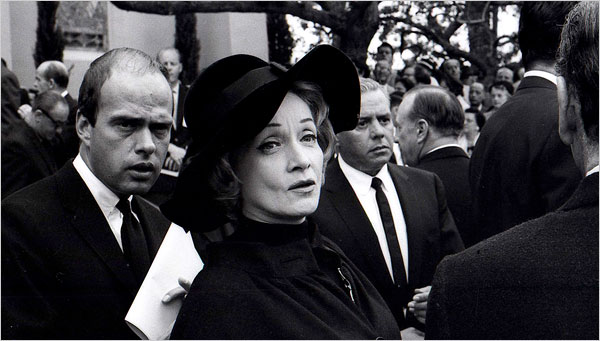
‘T dare not ask your sculpturer’s name/with glance back hooked, time’s hinges halt.’ BOB DYLAN From a text in “Hollywood Foto-Rhetoric: The Lost Manuscript,” accompanying a photo of Marlene Dietrich at Gary Cooper’s funeral in 1961. Photo by Barry Feinstein / from Simon & Schuster.

New book, ‘Hollywood Foto-Rhetoric: The Lost Manuscript’ by Barry Feinstein, features recently discovered Bob Dylan prose poems.
By Julie Bosman / August 15, 2008

Barry Feinstein, the rock ’n’ roll photographer, was digging through his archives last year when he came across a long-forgotten bundle of pictures, dozens of dark, moody snapshots of Hollywood in the early 1960s.

And tucked next to the photographs was a set of prose poems, written around the same time by an old friend: Bob Dylan.

“It was the lost manuscript,” Mr. Feinstein recalled in a telephone interview from his home in Woodstock, N.Y. “Everybody forgot about it but me.”

The poems were so lost that Mr. Dylan, when told of the discovery, had forgotten that he had written them. (In his defense, it was the ’60s.)

But after languishing in storage for more than 40 years, the text and photographs will be published in November in a collection titled “Hollywood Foto-Rhetoric: The Lost Manuscript.”

It is the latest installment in Mr. Dylan’s seemingly never-ending body of work, which includes more than 50 albums, a critically acclaimed autobiography and a recently published collection of arty sketches called “Bob Dylan: The Drawn Blank Series.”

The new book, to be published by Simon & Schuster, includes more than 75 of Mr. Feinstein’s photographs and 23 of Mr. Dylan’s prose poems, which are each marked alphabetically to correspond to a photo.

The book was created during a period in the 1960s when Mr. Feinstein was a 20-something “flunky” at a movie studio, he said, having arrived in Hollywood eager to be part of the industry and having landed a job working for Harry Cohn, the legendarily abrasive president of Columbia Pictures.

“I was living in California, in Hollywood, working at the studio, and I thought there was something there journalistically in taking these pictures that were not at all glamorous,” Mr. Feinstein said. “They were really the dark side of glamour.”

He roamed around movie sets, snapping pictures backstage and in dressing rooms, and during off hours he drove around Hollywood with his camera in tow.

The result is a collection of pictures that are sometimes dreary and sometimes tongue-in-cheek, shots of movie props and roadside stands, topless starlets and headless mannequins. In one photo a young woman, visible only from the ankles down, crouches on Sophia Loren’s star on the Hollywood Walk of Fame, a hand pressed onto the cement. In another photo a parking lot at 20th Century Fox, marked by a large sign for “Talent,” is completely empty.

After assembling the photographs, Mr. Feinstein thought of Mr. Dylan, whom he had met before on the East Coast. “I asked him as a joke, ‘Wanna come out and maybe write something about these photographs?’ ” Mr. Feinstein said. “So he came out and wrote some text.”

Mr. Dylan, then in his 20s, arrived in Hollywood, examined the photographs and wrote his own prose poems to accompany them.

No one involved in the book can recall exactly when Mr. Dylan wrote the poems, which are by turns sparse, playful, witty and sarcastic. But the words faintly recall “Tarantula,” Mr. Dylan’s book of prose poems (or “Dadaist novel,” as some would call it) that was written in 1966, and they bear a strong resemblance to the “11 Outlined Epitaphs” in the liner notes of “The Times They Are A-Changin,” his 1964 album.

As the “11 Outlined Epitaphs” begin:

“I end up then

in the early evenin’

blindly punchin’ at the blind

breathin’ heavy

stutterin’

an’ blowin’ up

where t’ go?

what is it that’s exactly wrong?

The “Foto-Rhetoric” poems use similar punctuation and style. In the text accompanying a photo of Marlene Dietrich appearing stricken at Gary Cooper’s funeral in 1961, Mr. Dylan wrote: “t dare not ask your sculpturer’s name/with glance back hooked, time’s hinges halt.”

After the photos and text were pulled together into a rough manuscript, Mr. Dylan and Mr. Feinstein took it to a publisher, Macmillan, where executives expressed interest but were afraid that the pictures would bring a lawsuit from the studio.

So the manuscript was put aside, and Mr. Feinstein kept it for more than four decades in his vast collection of photographs, books and other papers.

“I knew it was an important document,” he said. “So I kept it in the back of my head all that time.”

Mr. Feinstein went on to develop a close collaboration with Mr. Dylan. He shot the cover photo for “The Times They Are A-Changin,” and dozens of photos of Mr. Dylan throughout the years.

Through his manager, Jeff Rosen, Mr. Dylan declined to comment on the book, and he is not expected to promote it.

But at 67, Mr. Dylan is just as prolific as ever, writing, touring and releasing albums. Just this week, he performed in Prospect Park, Brooklyn, and in October he is expected to release another collection of songs, “Tell Tale Signs: The Bootleg Series Vol. 8.”

“Hollywood Foto-Rhetoric” is the fourth book that David Rosenthal, the publisher of Simon & Schuster, has worked on with Mr. Dylan, including “Chronicles: Volume One,” his 2004 memoir, which sold nearly 750,000 copies.

“They’re lyrical, they’re funny, they’re singular,” Mr. Rosenthal said of the prose poems. “And everybody looking at them, when we first saw them, knew they could be by no one other than Bob.”

David Remnick, the editor of The New Yorker, said that this fall the magazine will publish two of the poems and perhaps a photograph or two.

Christopher Ricks, a professor of the humanities at Boston University and the author of “Dylan’s Visions of Sin,” an admiring study of Mr. Dylan, noted the contrast between the Hollywood book, in its black-and-white starkness, and Mr. Dylan’s most recent book, the collection of cheerful, brightly colored paintings.

“From the beginning, he’s been a mixed medium artist,” Mr. Ricks said. “He’s never been a straight linear person. He’s had a whole lot of miscellany.”

Source / New York Times

Preorder Hollywood Foto-Rhetoric: The Lost Manuscript by Barry Feinstein at Amazon.com.

Thanks to Harry Edwards / The Rag Blog

Posted in RagBlog | Tagged , , , , , | Leave a comment

Pat Buchanan : Blowback From Bear-Baiting

Raging Bear: Vladimir Putin.

‘Saakashvili’s blunder probably means permanent loss of South Ossetia and Abkhazia.’
By Pat Buchanan / August 15, 2008

Mikheil Saakashvili’s decision to use the opening of the Olympic Games to cover Georgia’s invasion of its breakaway province of South Ossetia must rank in stupidity with Gamal Abdel-Nasser’s decision to close the Straits of Tiran to Israeli ships.

Nasser’s blunder cost him the Sinai in the Six-Day War. Saakashvili’s blunder probably means permanent loss of South Ossetia and Abkhazia.

After shelling and attacking what he claims is his own country, killing scores of his own Ossetian citizens and sending tens of thousands fleeing into Russia, Saakashvili’s army was whipped back into Georgia in 48 hours.

Vladimir Putin took the opportunity to kick the Georgian army out of Abkhazia, as well, to bomb Tbilisi and to seize Gori, birthplace of Stalin.

Reveling in his status as an intimate of George Bush, Dick Cheney and John McCain, and America’s lone democratic ally in the Caucasus, Saakashvili thought he could get away with a lightning coup and present the world with a fait accompli.

Mikheil did not reckon on the rage or resolve of the Bear.

American charges of Russian aggression ring hollow. Georgia started this fight — Russia finished it. People who start wars don’t get to decide how and when they end.

Russia’s response was “disproportionate” and “brutal,” wailed Bush.

True. But did we not authorize Israel to bomb Lebanon for 35 days in response to a border skirmish where several Israel soldiers were killed and two captured? Was that not many times more “disproportionate”?

Russia has invaded a sovereign country, railed Bush. But did not the United States bomb Serbia for 78 days and invade to force it to surrender a province, Kosovo, to which Serbia had a far greater historic claim than Georgia had to Abkhazia or South Ossetia, both of which prefer Moscow to Tbilisi?

Is not Western hypocrisy astonishing?

When the Soviet Union broke into 15 nations, we celebrated. When Slovenia, Croatia, Macedonia, Bosnia, Montenegro and Kosovo broke from Serbia, we rejoiced. Why, then, the indignation when two provinces, whose peoples are ethnically separate from Georgians and who fought for their independence, should succeed in breaking away?

Are secessions and the dissolution of nations laudable only when they advance the agenda of the neocons, many of who viscerally detest Russia?

That Putin took the occasion of Saakashvili’s provocative and stupid stunt to administer an extra dose of punishment is undeniable. But is not Russian anger understandable? For years the West has rubbed Russia’s nose in her Cold War defeat and treated her like Weimar Germany.

When Moscow pulled the Red Army out of Europe, closed its bases in Cuba, dissolved the evil empire, let the Soviet Union break up into 15 states, and sought friendship and alliance with the United States, what did we do?

American carpetbaggers colluded with Muscovite Scalawags to loot the Russian nation. Breaking a pledge to Mikhail Gorbachev, we moved our military alliance into Eastern Europe, then onto Russia’s doorstep. Six Warsaw Pact nations and three former republics of the Soviet Union are now NATO members.

Bush, Cheney and McCain have pushed to bring Ukraine and Georgia into NATO. This would require the United States to go to war with Russia over Stalin’s birthplace and who has sovereignty over the Crimean Peninsula and Sebastopol, traditional home of Russia’s Black Sea fleet.

When did these become U.S. vital interests, justifying war with Russia?

The United States unilaterally abrogated the Anti-Ballistic Missile treaty because our technology was superior, then planned to site anti-missile defenses in Poland and the Czech Republic to defend against Iranian missiles, though Iran has no ICBMs and no atomic bombs. A Russian counter-offer to have us together put an anti-missile system in Azerbaijan was rejected out of hand.

We built a Baku-Tbilisi-Ceyhan pipeline from Azerbaijan through Georgia to Turkey to cut Russia out. Then we helped dump over regimes friendly to Moscow with democratic “revolutions” in Ukraine and Georgia, and tried to repeat it in Belarus.

Americans have many fine qualities. A capacity to see ourselves as others see us is not high among them.

Imagine a world that never knew Ronald Reagan, where Europe had opted out of the Cold War after Moscow installed those SS-20 missiles east of the Elbe. And Europe had abandoned NATO, told us to go home and become subservient to Moscow.

How would we have reacted if Moscow had brought Western Europe into the Warsaw Pact, established bases in Mexico and Panama, put missile defense radars and rockets in Cuba, and joined with China to build pipelines to transfer Mexican and Venezuelan oil to Pacific ports for shipment to Asia? And cut us out? If there were Russian and Chinese advisers training Latin American armies, the way we are in the former Soviet republics, how would we react? Would we look with bemusement on such Russian behavior?

For a decade, some of us have warned about the folly of getting into Russia’s space and getting into Russia’s face. The chickens of democratic imperialism have now come home to roost — in Tbilisi.

Copywright 2008 Creators Syndicate Inc.

Source / Creators.com

Thanks to Carl Davidson / The Rag Blog

Posted in RagBlog | Tagged , , , , | 1 Comment

Dem Convention Protesters Call Makeshift Jail ‘Gitmo On Platte’


Police build massive ‘holding cell’ inside warehouse
By Russell Haythorn / August 16, 2008

DENVER — The discovery of a makeshift jail in Denver’s warehouse district is causing outrage among some protesters.

The jail was apparently constructed to house protesters during the Democratic National Convention but the city never publicly announced plans to construct this kind of facility.

Members of the group Recreate ’68 are calling the detention center “Denver’s inhumane and dirty little secret,” “Guantanamo Bay on the Platte” or “Gitmo on the Platte.” The warehouse is just feet from the South Platte River.

The jail is made up of large fenced-in cages with razor wire on top. The city said those cages are for the safety of law enforcement agents and those who are arrested. Activists call it a concentration camp unfit and inappropriate for human detainees.

“We’re going to be locked in cages in the same building that they already said doesn’t have a safe fire suppression system,” said activist Glenn Spagnuolo.

“Some of us are calling this the dog pound,” said Mark Cohen, with Recreate ’68.

Clad in trench coats, bandannas and sunglasses, activists protested outside the detention center Friday in the driving rain. They are asking the city for a public explanation.

“We’re trying to shine the light on this little secret political prisoner camp that was being set up in the city of Denver,” said Spagnuolo.

“The community surrounding this is primarily poor, people of color, that live around here, who I am sure nobody asked before this was put here,” said activist Larry Hales.

Several protestors came with their faces concealed for fear of police retaliation.

“The idea is to protect ourselves from police profiling,” said Harold Maude.

The DNC is 10 days away, but it appears the clash of protesters and police has already begun.

The city said it is planning a public tour of the facility in the next few days.

Recreate ’68 is calling for the mayor’s office to shut down this facility before it even opens.

Copyright 2008 by TheDenverChannel.com.

Source / TheDenverChannel

Thanks to Jay D. Jurie / The Rag Blog

Posted in RagBlog | Tagged , , , , , , | Leave a comment

The First Casualty of War : The Truth

U.S. Marines Invade Manhattan, New York!

For more information, visit Iraq Veterans Against the War.

Thanks to Diane Stirling-Stevens / The Rag Blog

Posted in RagBlog | Tagged , , | 1 Comment

Palestinian Travel to US: Can You Say Hypocrisy?

Palestinian Fulbright scholars Zuhair Abu Shaaban, 24, second from right, Osama Daoud, 25, third from right, and Fidaa Abed 23, fourth from right, wait to cross the Erez Border crossing between Israel and Gaza Strip in order to meet U.S. consular officials at the Israeli side of the border, Thursday, July 10, 2008. U.S. consular officials have traveled to the Gaza border to process the visa applications of three Palestinian Fulbright scholars whose scholarships were at risk because of Israeli travel restrictions.

Blocking a Gazan’s Path to San Diego
By Fidaa Abed / August 16, 2008

As a young Palestinian from Gaza, I had been eagerly anticipating the opportunity to study at the University of California San Diego on a Fulbright scholarship. The chance to escape Gaza’s confines and immerse myself in an American education was deeply thrilling. With Israel controlling Gaza’s border exits, air space and sea access — notwithstanding its “pullout” of 2005 — I imagined the long, open roads of the United States and its people’s unchallenged freedom of movement.

I love my people and my homeland, but a young person needs opportunities. These are far more abundant in the United States than in the besieged Gaza Strip.

Last week, I landed in Washington, D.C., brimming with optimism. Upon arrival, I was whisked into a separate room. An American official informed me that he had just received information about me that he could not reveal. However, it required him to put me on the next plane home. I was shocked. And I was taken aback at the cruelty of snatching away my educational dreams at the last possible moment.

My mistreatment was particularly unexpected because in late May, when Secretary of State Condoleezza Rice learned that I and six other Fulbright students were being stripped of our Fulbright scholarships, she leapt to our assistance. One by one, Israel let other Palestinians Fulbright scholars out of Gaza, and they made their way to American universities. Then I was mysteriously singled out for last-minute denial based on “secret evidence.” Two others had their visas canceled on account of secret evidence before they could even leave Gaza.

William J. Fulbright was the only U.S. senator to vote against funding for Sen. Joseph McCarthy’s Un-American Activities Committee. It is ironic, then, that my remarkable educational opportunity is being stripped from me on the basis of the sort of secret — and fabricated — evidence that Fulbright opposed in the hands of McCarthy. Unopposed, McCarthy destroyed lives. I do hope the United States will side with the openness of Fulbright and not the fear-mongering of McCarthy.

Israel routinely locks up Palestinians based on secret charges. All sorts of outrageous claims can be leveled based on information that Israeli officials garner coercively. Could the secret evidence against me have been extracted through the torture of some young Palestinian? Was I even the one denounced, or someone with a similar name? Was my “crime” sharing a classroom or a lunchtime conversation with someone Israel believes poses a danger? I have no way of knowing, and thus no way of defending myself.

My education is my gateway to the future. The master’s degree I would have earned at UC San Diego in computer science certainly cannot be attained in Gaza. And I am not alone. Hundreds of Palestinian students with dreams of improving their lives are stagnating intellectually in Gaza. The doors to our open-air prison have largely been slammed shut.

Israel tightened economic restrictions in 2006 following the election victory of Hamas. Hoping to weaken Hamas, Israel has gradually tightened restrictions on freedom of goods and people from the Gaza Strip to the outside world, maintaining a near total blockade on some 1.5 million Palestinian civilians for more than a year.

Thankfully, I have received support from people around the world. Journalists have wanted to hear my story. The American officials who saw me in Amman and Jerusalem upon my return were friendly and seemed embarrassed by my predicament.

Despite my treatment, I know that most Americans are kind people who mean well. What happened to me runs contrary to the good will exhibited by the American people. Israeli policies that relegate Palestinians in Gaza to prison-like conditions and Palestinians in the West Bank to an apartheid-like existence do not advance the cause of peace. The United States should use its tremendous sway with Israel to advance the cause of freedom and equal rights for Palestinians and Israelis alike.

We Palestinians have been stripped of our land for 60 years. But with educational opportunity we have persevered and made what we could of our lives. Limiting our educational prospects only perpetuates our status as a subordinate people. Nothing is served by confining our best and our brightest to Gaza. A better future for everyone lies in unlocking the gates to Gaza and allowing us to learn and gain exposure to the broader world – with all of the challenges, controversies and diverse perspectives it offers.

Fidaa Abed, recipient of a Fulbright scholarship, lives in the Gaza Strip.

Source / Dissident Voice

The Rag Blog

Posted in RagBlog | Tagged , , , | Leave a comment