If There Were a God, We’d Be in Them Ourselves


The Home of the Craven
By Jerome Doolittle / August 7, 2008

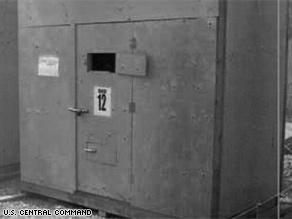
WASHINGTON — The U.S. military is segregating violent Iraqi prisoners in wooden crates that in some cases are not much bigger than the prisoners.

As a boy I was a great reader of the English adventure writer Percival Christopher Wren. He is remembered today only as the author of the book on which the movie Beau Geste was based, but he wrote many more books about the French Foreign Legion.

Life was hard in Wren’s Foreign Legion. Mess up and you spent the day with a rock-filled pack on your back, double-timing around the parade ground in the North African sun.

Really mess up and the sergeants put you in a stress position called the crapaudine, or locked you inside a box no bigger than a refrigerator where you would stay until you went mad.

I was terrified and yet fascinated. Could people be so cruel to one another? Did such evil really exist outside of books? Later I learned that it once had — in the chain gangs of our own South, where it was called the “hot box.” Imagine a citizenry so primitive, so low, so depraved, so ignorant, so devoid of humanity, as to permit such things!

The chain gangs were history by then, although fairly recent history. But before long, as fear of various Others made us not brave and strong but small and mean, the chain gangs came back. The cancer of prisons spread and metastasized. The land of the scared was becoming the home of a vast corporate gulag.

All the while we sat by and cheered, fat and ignorant and frightened, until now now we have at last what Jimmy Carter in his innocence once promised us — a government as good as the American people themselves.

Now we have our very own hot boxes in our very own colonies and most of us must be just fine with that. After all, none of this is the fault of Dick Cheney and George W. Bush, those nasty amoral morons who rule in our name. If our vote could be won by compassion, humility, the rule of law and a preference for peace, they would hide their disgust and try to deliver. No, the draft-dodging duo is the effect, not the cause.

The cause is those nasty amoral morons who put our two warhogs in the White House, and who then, after taking a good, long, four-year look at the results, chose to leave them there.

We built those boxes, and if there were a God in heaven we would be in them ourselves.

Source / Bad Attitudes

The Rag Blog

Posted in RagBlog | Tagged , , | 1 Comment

Paris Does John and Maybe Barack, Too

See Paris Hilton Responds to McCain Ad and more funny videos on FunnyOrDie.com

See more funny videos at Funny or Die

Source / Bad Attitudes

The Rag Blog

Posted in RagBlog | Tagged , | 1 Comment

Quote and Picture of the Day – Zoriah

Zoriah Miller writes of being a passenger in an armored vehicle convoy travelling through Iraq.

I have come to realize that it is like being in jail, with a window looking out onto another jail. Zoriah, Photojournalist


Source / ZORIAH

The Rag Blog / Posted August 7, 2008

Posted in RagBlog | Tagged , , | Leave a comment

Houston Cong. Ted Poe : ‘Our Country Cannot Deceive Its Citizens’

Hah, hah …. Who is Ted Poe trying to kid? Living in Amerikkka is one gigantic deception, dude !!! Just where do you think you’ve been all your life?

Richard Jehn / The Rag Blog


Threats, Lies and Audiotape
By Amy Goodman / August 6, 2008

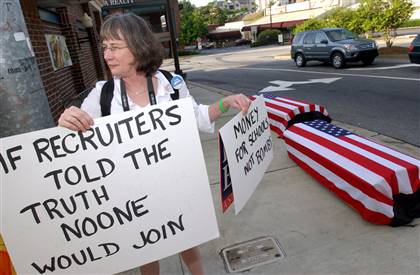
It was like an action movie. A young man held at night in a hotel, threatened with prison. He is to be shipped off to war in the morning. His friends desperately trying to find him. The “down” button on the elevator had been disabled. He considered jumping from the window. When his friends arrive, they encounter military personnel patrolling the grounds. One sneaks in, gets his friend out, and they drive off into the night. This was real life for 17-year-old Eric Martinez, a student at Aldine High School in a poor neighborhood of Houston. He responded to an Army recruitment pitch, called the delayed enlistment program.

But then, as 17-year-olds are wont to do, Eric changed his mind. When the recruiter came to his house and threatened his mother, she went to the recruiting station to meet with the officer in charge: “She talked to Sgt. Marquette and told him that I didn’t want to go, and that’s it. And Marquette said that I had to go, and if I didn’t, that I’d have a warrant for my arrest, and I wouldn’t be able to get no government loans or nothing like that. So, my mom doesn’t really know anything about it, so she believed it, and she told me. And I believed it, too, because I didn’t know much about it either.” It was then that they took Eric to the hotel.

Martinez’s friend, Irving Gonzalez, knew he was next. He had signed up for the same program. As the oldest of four children of a single mother, Irving’s impulse was to help his family survive, get the signing bonus and gain access to a college education. He then wanted to get out of the program, to pursue college directly. He called the recruiter, Sgt. Glenn Marquette. Desperate, he had the call recorded.

Sgt. Marquette: “This is what will happen. You want to go to school? You will not get no loans, because all college loans are federal and government loans. So you’ll be black-marked from that. As soon as you get pulled over for a speeding ticket or anything with the law, they’re gonna see that you’re a deserter. Then they’re going to apprehend you, take you to jail … you will do your time, as you deserve. All that lovey-dovey ‘I want to go to college’ and all this? Guess what. You just threw it out the window, because you just screwed your life.”

Irving and two others were the ones who sneaked Eric out of the hotel.

After the story broke, Marquette was suspended, and the military says it is conducting an investigation, but neither Martinez nor Gonzalez has been contacted. Recent history does not bode well. In 2005, Sgt. Thomas Kelt, who like Marquette worked at the Greenspoint Recruiting Station in Houston, left a phone message for potential recruit Chris Monarch, saying if he didn’t show up at the recruiting station that afternoon: “We’ll have a warrant, OK? So give me a call back.” The story went national. The military conducted a daylong “stand down” on recruitment to retrain their recruiters. They said they removed Kelt. In fact, he was promoted to head up a nearby recruiting center.

I asked Douglas Smith, spokesman for the U.S. Army Recruiting Command in Kentucky, about why Kelt wasn’t punished. Smith replied that Kelt had received a “negative administrative action … just because someone has done something wrong doesn’t mean that they get the death penalty.”

But there’s a difference between the death penalty and a promotion. When I asked Smith what the penalty was, he replied, “I’m not allowed to tell you.”

Smith and the rest of the military may dodge reporters’ questions, but they can be subpoenaed before Congress to testify under oath.

Texas Congressman Ted Poe, a Republican, said: “Our country cannot deceive its citizens. Since the Army hasn’t taken the initiative, now Congress may have to get involved.” Another Texas congressman, Democrat Gene Greene, whose kids went to Aldine High and whose wife taught there for years, agrees. With no end in sight in Afghanistan and Iraq, recruiters must be prevented from using desperate and aggressive measures to lure our nation’s young people — the poorest and most vulnerable — into the line of fire.

Amy Goodman is the host of “Democracy Now!,” a daily international TV/radio news hour airing on more than 700 stations in North America.

© 2008 Amy Goodman

Source / Truthdig

The Rag Blog

Posted in RagBlog | Tagged , | Leave a comment

A Twenty-First Century Cancer on the Presidency


Did Dick Cheney Give Bush Plausible Deniability?
by Johanna Neuman

“Cheney’s been very effective in setting up his deniability and always being the failsafe for Bush. Unless they start waterboarding the vice president, which is not too likely, he is the man, the trail ends right there.”

Dick Cheney was an assistant at the White House when Watergate was unfolding. By the time the scandal forced Richard Nixon to resign the presidency in 1974, the young Wyoming Republican had returned to the private sector. The new president, Gerald Ford, called him back. Cheney became deputy to Chief of Staff Donald Rumsfeld, seen here on right when the two were named on Nov. 7, 1975. And when Rummy left (to run the Pentagon, but that’s another story), Ford promoted Cheney. At 34, Richard Bruce Cheney became the youngest person ever to serve as White House chief of staff.

In his new book “The Way of the World,” author Ron Suskind argues that Cheney concluded from his perch at the White House during those years that Nixon fell not because of his abuse of government — he asked agencies such as the IRS and the FBI to shadow his enemies. Or because of the break-in of the Watergate offices of the Democratic National Committee by criminals with ties to CREEP (The Committee To Re-Elect the President). Or even because of the cover-up.

Suskind believes Cheney concluded that Nixon had been “overbriefed” and that his aides had failed to give him “plausible deniability.” And so, a la Suskind, that is what Cheney set out to give George W. Bush.

Asked about it last night on Keith Olberman’s “Countdown” on MSNBC, John Dean, White House counsel in the Nixon presidency, said Cheney has been so successful at this that it will prevent impeachment proceedings against Bush.

“Cheney’s been very effective in setting up his deniability and always being the failsafe for Bush. Unless they start waterboarding the vice president, which is not too likely, he is the man, the trail ends right there.”

Dean, the one who told Nixon there was “a cancer on the presidency,” was convicted of obstruction of justice and admitted supervising hush payments to the break-in defendants. The author of a book called “Worse Than Watergate,” Dean argues that the sins of the earlier Nixon era “didn’t kill anyone,” whereas those of the current administration include torture and war.

© 2008 The Los Angeles Times

Source / Los Angeles Times / h/t Common Dreams

The Rag Blog

Posted in RagBlog | Tagged , , | 1 Comment

Climate Change: Prepare for Global Temperature Rise of 4 Degrees

Drought-resistant plants such as these in the Majorelle gardens in Marrakech, Morocco, would become more common in British gardens. Photo by Clay Perry / Corbis.

‘We need strategy to adapt to potential catastrophic increase’
By James Randerson / August 7, 2008

Great Britain (UK) should take active steps to prepare for dangerous climate change of perhaps 4C according to one of the government’s chief scientific advisers.

In policy areas such as flood protection, agriculture and coastal erosion Professor Bob Watson said the country should plan for the effects of a 4C global average rise on pre-industrial levels. The EU is committed to limiting emissions globally so that temperatures do not rise more than 2C.

“There is no doubt that we should aim to limit changes in the global mean surface temperature to 2C above pre-industrial,” Watson, the chief scientific adviser to the Department for the Environment, Food and Rural Affairs, told the Guardian. “But given this is an ambitious target, and we don’t know in detail how to limit greenhouse gas emissions to realise a 2 degree target, we should be prepared to adapt to 4C.”

According to the government’s 2006 Stern review on the economics of climate change, between 7 million and 300 million more people would be affected by coastal flooding each year, there would be a 30-50% reduction in water availability in Southern Africa and the Mediterranean, agricultural yields would decline 15 to 35% in Africa and 20 to 50% of animal and plant species would face extinction.

In the UK, the most significant impact would be rising sea levels and inland flooding. Climate modellers also predict there would be an increase in heavy rainfall events in winter and drier summers.

Watson’s plea to prepare for the worst was backed up by the government’s former chief scientific adviser, Sir David King. He said that even with a comprehensive global deal to keep carbon dioxide levels in the atmosphere at below 450 parts per million there is a 50% probability that temperatures would exceed 2C and a 20% probability they would exceed 3.5C.

“So even if we get the best possible global agreement to reduce greenhouse gasses on any rational basis you should be preparing for a 20% risk so I think Bob Watson is quite right to put up the figure of 4 degrees,” he said.

One big unknown is the stage at which dangerous tipping points would be reached that lead to further warming – for example the release of methane hydrate deposits in the Arctic. “My own feeling is that if we get to a 4 degree rise it is quite possible that we would begin to see a runaway increase,” said King.

He said a two-and-half-year analysis by the government’s Foresight programme on the implications for coastal defences had more impact in the corridors of power than any other research on the effects of climate change that he presented.

“No other single factor focussed the minds of the cabinet more than the analysis that I produced through that … We begin to have to talk about ordered retreat from some areas of Britain because it becomes impossible to defend,” he said. “There’s no choice here between adaptation and mitigation, we have to do both.”

Other experts were concerned that Watson’s comments might be seen as defeatist and an admission that emissions reductions were impossible to achieve.

“At 4 degrees we are basically into a different climate regime,” said Prof Neil Adger, an expert on adaptation to climate change at the Tyndall Centre for Climate Change Research in Norwich.

“I think that is a dangerous mindset to be in. Thinking through the implications of 4 degrees of warming shows that the impacts are so significant that the only real adaptation strategy is to avoid that at all cost because of the pain and suffering that is going to cost.

“There is no science on how we are going to adapt to 4 degrees warming. It is actually pretty alarming,” he added.

Speaking to the Guardian, Watson, who is a former science adviser to President Clinton and ex-chief scientist at the World Bank, said the UK should take a lead in research on carbon capture and storage (CCS).

Alluding to the US effort in the 1960s to put a man on the moon he advocated an “Apollo-type programme” to introduce 10 to 20 CCS pilot projects – which work by burying carbon dioxide from burning fossil fuels underground – among OECD countries to develop the technology.

“This would allow coal-fired power plants that are currently being built to be modular and capable of having carbon capture retrofitted, and would show the world that we take the issue of climate change seriously, thus demonstrating real leadership. Without this technology we have a real problem.”

He also said as coal burning is cleaned up to remove harmful sulphur pollution climate change would actually get worse. The sulphur aerosols are actually preventing some warming from taking place currently.

“This offsetting effect, which is equivalent to about 100 parts per million of carbon dioxide, will largely disappear if China and India follow the lead of the US and Europe in limiting sulphur emissions, the cause of acid deposition,” he said.

Source / Guardian, U.K.

The Rag Blog

Posted in RagBlog | Tagged , , , , , | 1 Comment

Our Future: Way More Killing Than Is Necessary


“What Do You See in Your Future?”
The Unnecessary Execution of Jose Ernesto Medellin

By Greg Moses / August 6, 2008

If at 9:59 pm Central Time on Tuesday night you were refreshing your browser to “sort by date” the latest news on “Medellin” as part of your death-watch ritual. And if you clicked to read a somber AP report posted at the Oroville Mercury-Register, you may have seen what I saw: a blank page that only loaded a banner ad at the top, paid for by the United States Army: “What do you see in your future?”

It was some kind of e-haunting that hissed without noise and moved on.

But that lone banner, floating there on nothing but white noise, seemed to make more sense than anything else, because it placed the question of the future in a context of violence as foundation for the United States. If you joined the Army, they’d sock away $40,000 in your behalf to buy a home or start a small business. “After the Army” the American Dream called.

But for any of this to begin to make sense, first there must be some guarantee that the Army makes sense. And for that to make sense, there must be some reason to think that the killing the Army trains you to do will be necessary killing. Which means there has to be something like necessary killing in the first place. And in the second place you have to be quite sure that the killing the Army is put up to these days is of the absolutely necessary kind.

But remember, we got started on this singular meditation during a death watch, by attempting to click into a story to find out if Jose Ernesto Medellin had been killed. And in no way could you come to the conclusion that the killing of Medellin was necessary. He wasn’t going anywhere, especially not on Tuesday night after the Supreme Court had once again split 5 to 4 in their last-minute deliberation. As the Army ad raised the spectre of necessary killing, the Medellin case redoubled the question as universal: “What do you see in your future?”

In the Medellin case, The World Court had twice ruled that the execution should wait for a review. The President of the United States had issued an order that the execution should wait. And the U.S. Supreme Court had twice split 5 to 4 over the question. The death warrant for Medellin would have run out by midnight. The government of Mexico was standing there like an insulted neighbor, having secured both World Court decisions that Mexican citizens in the USA deserve a right to consular assistance. All the Governor of Texas had to say was: “In consideration of our special relation to the people of Mexico, and out of respect for international law, let me take some time to read this evening’s US Supreme Court decision, which was split 5 to 4, and take some time to think about this.”

But Medellin had already been moved into position for the killing. Before it was possible to find out what the Supreme Court had said, the news was out. The Texas Court of Criminal Appeals, the Board of Pardons and Paroles, and the Governor, all invoking the Confederate Principle of State’s Rights — backed by a recent op-ed column at the Houston Chronicle — had proclaimed death. And death was dealt.

Of course, we agree with all the authorities from the World Court on down that the killings for which Medellin was found guilty were altogether gratuitous, horrible, and shocking. Two teenaged girls raped and murdered while walking home through a park. It is difficult to talk about punishments being “cruel and unusual” when crimes like that get done. “Find your strength” says another Army ad. And what strength should we ask the people of the United States to find if not the strength to know, not when killing is strangely satisfying, but when and only when it is necessary.

What is necessary about killing killers? What was necessary about killing Medellin last night?

It’s not at all likely that the killing of a Mexican-born killer in Texas, who had raped and killed teenaged girls, is going to help many people around here to “find their strength” to stop killing. Otherwise the Governor would have stepped in. But the late night killing of Medellin in Texas nevertheless proves that we have not yet learned that what we see in our future is way more killing than necessary.

Greg Moses is editor of the Texas Civil Rights Review and author of Revolution of Conscience: Martin Luther King, Jr. and the Philosophy of Nonviolence. He is a contributor to Red State Rebels: Tales of Grassroots Resistance in the Heartland, to be published by AK Press in June 2008. He can be reached at: gmosesx@gmail.com.

Source / CounterPunch

The Rag Blog

Posted in RagBlog | Tagged , , , , , | Leave a comment

Arianna Huffington : John McCain, Paris Hilton, and the Politics of Nothing

Illustration by André Carrilho / New Yorker.

‘it’s not exactly a surprise that the Republican election machine would resort to trying to make the entire election into an issueless sideshow’
By Arianna Huffington / August 6, 2008

With just ninety days left in the election it’s come down to this: our energy policy and a good deal of this presidential campaign are being discussed through the lens of Paris Hilton. What a big goof it all is! If you just ignore all the soldiers and civilians dying in the Mideast, and all the millions losing their homes and their jobs at home, you could really see the lighter side of it all.

It all started with McCain’s ad comparing Obama to Britney Spears and Paris Hilton. And then we had Paris Hilton’s “response,” followed by the McCain camp’s response to Paris Hilton: “It sounds like Paris Hilton supports John McCain’s ‘all of the above’ approach to America’s energy crisis — including both alternatives and drilling. Paris Hilton might not be as big a celebrity as Barack Obama, but she obviously has a better energy plan.”

Who ever thought this election wasn’t going to be about the issues?

Of course, it’s not exactly a surprise that the Republican election machine would resort to trying to make the entire election into an issueless sideshow. I mean, what else do they have?

But it is still a sad spectacle to see John McCain going along with it with such glib eagerness. The man who once pledged to run a “respectful campaign” and who said that Obama “would rather lose a war in order to win a political campaign” has made it clear that he’d rather lose everything he has stood for than lose the White House.

As New York Magazine’s John Heilemann noted, “we now have an inkling of just how deep in the mud McCain and his people are willing to wallow in order to win in November: right up to their Republican eyeballs.”

The problem is, we’re right down there with him. That’s because all it takes is one of the two candidates to decide to yank the discourse into the ditch and the media — and as a result, the public — follow.

Instead of the media calling the McCain campaign on its pathetic trivialization of the presidential race, they have been engaging in meaningless horse-race analysis of “did the ad work?” The conventional wisdom appears to be that it did.

There was Gloria Borger on CNN, saying, “They put out this ad, and we’re running this ad and we’re talking about it, which from their point of view, actually works for them.”

And there was Dana Milbank with Campbell Brown declaring, “They work and they always work. And we always go through this little dance when everybody says, I’m a different kind of politician, I’m post partisan, I’m a maverick. And of course when it comes right down to it, you need to drive the other guy’s numbers down. If anything, they haven’t gone negative enough just yet.”

As Huffpost’s Seth Colters Walls reports, this is nonsense, period. Indeed, to the extent that eventually the ad may “work,” it will be only because of the media saying that it worked. It’s not even horse-race analysis. It’s the Observer Effect.

Even though the media play this game every election cycle, this time, I honestly thought it would be different. That the problems we’re facing — a disastrous never-ending war, the recession, the near collapse of our banking system, etc., etc. — were just too big to ignore.

But it now appears that the bigger the problems, the more likely it is that they’ll be completely ignored. So here we are: huge problems and a correspondingly empty election. It’s the politics of nothing.

The McCain camp knows that the only way they can win this election is to turn it into a carnival sideshow.

Here’s the question the media should be asking John McCain: “do you think the frivolous, jeering tone of your campaign matches the problems being faced by this country and the sacrifices being made right now by our soldiers overseas?”

And here’s another question: what’s next for John McCain? Where does he and his campaign go from here? If this is where they have taken the political discourse in early August, what have they got for us come October? Here is a preview — our best guess — of what the McCain has in store for us:

“Too Tall.” An ad claiming that proof of Obama’s arrogance is his refusal to be as short as McCain (5′ 6″).

“Sex Tape.” An ad comparing Obama to Paris Hilton’s sex tape to make the point that, well, no point, just that Paris had a sex tape and Obama is, you know, like it.

“Sex Tape II.” An ad with Obama digitally inserted into Paris Hilton’s sex tape.

“Rhymes with Iraq.” An ad pointing out that Obama’s first name almost rhymes with Iraq. The ad is pulled after it’s pointed out that it comes close to mentioning an issue.

“Michelle Obama: a man?” An ad that’s not making any claims, “just asking a question.” The ad succeeds in getting the typical media treatment: “As many have noted, the ad uses hyperbole. Still, however, it raises the question, is Michelle Obama a woman?”

“Barack Obama: gay?” Hard to say, but, per the last ad, if Michelle is indeed a man, then that makes Obama gay.

“Barack Obama: black gay man.” Previous ad forgot to mention Obama’s race.

“akludfilkakmeitceks.” An ad with random letters coming up on the screen. The media declares it “a home run.”

Source / The Huffington Post

Also see The Low-Road Warrior by John Heilemann / The New Yorker / August 1, 2008

The Rag Blog

Posted in RagBlog | Tagged , , , , , , , , | 1 Comment

Sad News About Iraqi Provincial Elections


Iraq parliament fails to pass elections bill
By Ned Parker and Said Rifai / August 7, 2008

Iraq lawmakers break for vacation, unable to agree on oil-rich Kirkuk, which the Kurds want to annex to the semiautonomous Kurdish region.

BAGHDAD — The Iraqi parliament broke for summer vacation Wednesday without passing a bill that would have allowed provincial elections to be held this year, dealing a blow to hopes for bringing alienated Sunni and Shiite Muslim voices into the political process any time soon.

The parliament, which tried during a four-day special session to pass the legislation under pressure from the United States and United Nations, could not resolve differences over oil-rich Kirkuk, a volatile mixed area that the Kurds wish to annex to their semiautonomous northern region.

Iraq’s electoral commission had said the measure needed to be passed before lawmakers adjourned for the month in order to hold elections by the end of December.

Lawmakers had been set to adjourn last week when they scheduled the special session. But differences between Kurds, Arabs and Turkmens over Kirkuk ultimately could not be resolved.

Iraqi politicians, officials and Western diplomats have speculated that the political parties in government were never invested in holding a vote this year out of fear they would lose seats and influence at the provincial level. Senior politicians — including President Jalal Talabani, a Kurd, and Vice President Tariq Hashimi, a Sunni Arab — have been absent from Baghdad during the round-the-clock negotiations, citing medical reasons.

The impasse over the legislation left an uncertain situation in Kirkuk, where last week a suicide bomb and ethnic clashes killed 25 people. The delay was also likely to add to frustrations in other mixed provinces — such as Baghdad, Nineveh and Diyala — where a Sunni Arab boycott of 2005 elections created lopsided provincial councils dominated by Shiites and Kurds.

In Anbar province, Sunni tribes that joined U.S. forces in opposing Islamic extremists have wanted elections so they could try to wrest power from their Sunni rivals in the Iraqi Islamic Party.

The breakdown came amid a banner time for the Shiite-led Iraqi government, which has witnessed falling death rates; successful military campaigns in southern Iraq since the spring; and the return to the national government of Iraq’s main Sunni political bloc, which had boycotted the Cabinet for a year.

But fighting is still occurring in Iraq, and the relative calm is fragile. U.S. military commanders and Iraq experts worry that an unexpected event could set off a new cycle of violence among dueling ethnicities and sects.

The political crisis started July 22 when Arabs and Turkmens in parliament surprised the Kurds, recent kingmakers in Iraqi politics, with a call for a secret vote on the election bill’s clause dealing with Kirkuk. In a twist, even some of the Kurds’ longtime Shiite allies abandoned them, and the Kurds walked out as the measure was approved.

The country’s three-member presidency council, headed by Talabani, then vetoed the bill, citing as illegal the secret ballot in parliament.

Efforts to rescue the troubled legislation have gone into overdrive since Sunday, with the constant meetings involving political bloc leaders, the United Nations and U.S. Ambassador Ryan Crocker. At one point, President Bush phoned Massoud Barzani, president of the Kurdish region, in hopes of getting the Kurds to compromise on Kirkuk.

The parliament made a final stab Wednesday at bringing the bill to a vote after approving a $21-billion supplemental budget for the rest of the year. Instead, the parliament opted to reconvene Sept. 9 and to set up a committee to continue negotiations in the short term.

U.S. officials expressed dismay over the deadlock.

“The election law cannot be held hostage to the Kirkuk issue, so we hope very much that the Council of Representatives will continue to seek a compromise that will be adopted promptly,” U.S. Embassy spokeswoman Mirembe Nantongo said.

Times staff writers Saif Hameed, Saif Rasheed and Usama Redha contributed to this report.

Source / Los Angeles Times

The Rag Blog

Posted in RagBlog | Tagged , | Leave a comment

The ‘War’ on Terror : It Just Doesn’t Work


Calling it a ‘war’ is a boon to terrorist recruiters.
By Seth G. Jones and Martin C. Libicki / August 6, 2008

ARLINGTON, Va. – Military might against Al Qaeda and other terrorist groups isn’t working – and no wonder. After studying the record of 648 terrorist groups between 1968 and 2006, we’ve found that military force has rarely been effective in defeating this enemy.

Indeed, the US reliance on military force – especially conventional military forces – has often been counterproductive.

Take Al Qaeda: Despite suffering a setback in Iraq and several senior operatives killed or captured, it has carried out more terrorist attacks after Sept. 11 than it did before, and these attacks have spanned a wider geographic area across Europe, Asia, the Middle East, and Africa.

The group’s methods – from improvised explosive devices to increased suicide attacks – have grown more sophisticated. Its organizational structure has evolved as well, including encouraging a grass-roots approach by members while maintaining strategy and operations from a central location in Pakistan.

This resurgence is reason enough to trigger an overhaul of US counterterrorism strategy.

History offers some critical guidance.

Since 1968, more than three-quarters of terrorist groups have ended because of a political settlement or joint policing and intelligence efforts. But a political solution is not in the cards with Al Qaeda. Its goal – to take down multiple state regimes to create a pan-Islamic caliphate – is too radical to lead to any sort of negotiated settlement with Middle Eastern governments.

A good start toward peace, though, would be for Washington to stop thinking of this as a “war” with a battlefield solution.

Most US allies, such as Britain and Australia, already have. In Britain, for example, the government shuns the phrase “war on terror” despite a long history of dealing with such terrorist groups as the IRA.

And rightly so. Military force often has the opposite effect from what is intended. It is often overused, alienates the local population by its heavy-handed nature, and is a boon to terrorist recruiters.

The term “war” also has a symbolic cost. It feeds into the jihad or “holy war” concept that attracts the attention of potential terrorists by elevating them to “holy warrior” status. Terrorists should be perceived and described as criminals, not holy warriors.

What we are engaged in, more aptly, is “counterterrorism.”

Rather than a military focus, policing and intelligence should form the backbone of US and allied counterterrorism efforts. Tracking down Al Qaeda’s network of members worldwide will require more work abroad from the CIA and FBI, as well as cooperation with foreign police and intelligence agencies.

Such a strategic shift will demand a change in spending. Of the $609 billion in counterterrorism funding authorized by Congress between 2001 and 2007, 90 percent went to military operations. Much of that money would be better spent on law enforcement and intelligence agencies working overseas.

To be sure, when Al Qaeda is involved in an insurgency it may be necessary to use military force particularly special operations forces. But US successes against Al Qaeda in Iraq and the capture of several of its top terrorists in Pakistan suggest that the military and intelligence agencies should increasingly play a background role whenever possible.

Local military, police, and intelligence forces typically have more legitimacy to operate than do US forces, and have a better feel for the lay of the land.

The US military should generally resist being drawn into combat operations in Muslim societies, especially in large numbers, where its presence is likely to increase terrorist recruitment.

There are good reasons to be hopeful. Al Qaeda’s probability of success in actually overthrowing any government is close to zero. Its objectives are virtually unachievable. And no religious terrorist group that has folded since 1968 has achieved victory.

While Osama bin Laden enjoys some popular support in the Muslim world, he has made enemies of virtually every government across the globe.

By alienating most of the world and declaring unachievable objectives, Al Qaeda has set a losing strategy. Let’s not make countering it more difficult than it has to be.

[Seth G. Jones is a political scientist and Martin C. Libicki is a policy researcher at the RAND Corporation. They are authors of the study, “How Terrorist Groups End: Lessons for Countering Al Qaida.”]

Source / Christian Science Monitor

Thanks to BettyTX / The Rag Blog

Posted in RagBlog | Tagged , , , , | Leave a comment

What’s More Important Than Saving the Planet?

This poster is just part of the propaganda

The Scam of Energy Independence
By Juan Cole

John McCain keeps talking about making the US “energy independent.”

Robert Bryce points out that it is impossible for the United States to be energy independent with current technology.

McCain says nuclear energy can make the US independent of “foreign oil.” But the US imports 83% of the uranium it uses!

By the way, if you built a lot of new nuclear reactors, it would cause the price of uranium to go up. There is only so much uranium in the world, so we will have “Peak uranium” after a few years if we go that route.

McCain keeps saying that the US navy has run subs on nuclear power for years and there have been no leaks.

Ahem.

McCain says drilling in the United States can make the US energy independent. Hogwash! HOGWASH. All the offshore fields now known off the lower 48 states, if drilled, might produce 400,000 barrels a day ten to fifteen years from now.

The US imports on the order of 13 million barrels a day of petroleum. The world produces 86 million barrels a day and apparently wants 87. Offshore drilling in the US would yield a drop in the bucket.

In the meantime, China’s oil imports were up 12% last year over the year before. The extra oil from offshore drilling would just get used up lickety split.

McCain calls “foreign oil” expensive!

It is all one global market,folks. Once oil is pumped and goes on the market, it sells for the same price everywhere (except if there are government subsidies, which are a huge waste of money and very bad economics). It doesn’t matter if it is pumped in Oklahoma or Ahvaz, it is priced the same.

Muhammad Sahimi makes this point at some length.

Moreover, getting more fossil fuels out of the ground will produce more global warming, ravaging the world’s coastlines and their inhabitants. Again, it doesn’t matter whether American carbon is put into the atmosphere or Chinese. It is all one atmosphere.

The only prospect for US energy independence is cheap and effective power generation from wind and solar energy, which needs new, cheaper and better methods of battery or other storage to be practical.

Obama’s pledge to invest $150 billion in alternative energy is a promising first step. That is a little more than what the Apollo project cost the US in today’s dollars. And putting a man on the moon was rather less important than, like, saving the planet.

Source / Informed Comment

The Rag Blog

Posted in RagBlog | Tagged , , | Leave a comment

Where Baghdadi Graves Are Marked with Tin Cans

God’s Promise Will Be Fulfilled

Source / Informed Comment / The Guardian

The Rag Blog

Posted in RagBlog | Tagged | 1 Comment