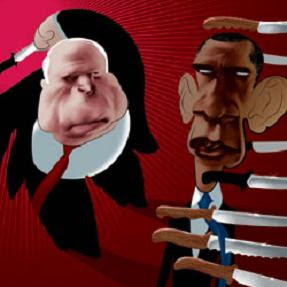
Overly Confident in Voting As the Path to Change

Economic pain spurs delusion, not rebellion. Credit: open source.

Working poor unready to revolt: When economic pain does not motivate political rebellion, is all lost?
By Joel Hirschhorn / Aug 7, 2008

Once upon a time when governments no longer served most of their citizens it was the most economically disadvantaged that could be counted on to rebel against tyranny and injustice. Times have changed, for the worse, despite the spread of democracy.

Here we are with a two-party plutocracy that preferentially serves corporate and wealthy interests and lets the middle class suffer and sink. Plausibly, the middle class is unready to revolt because it still maintains a relatively good standard of living despite rising economic insecurity. But what about the lowest 40 percent of Americans that are the working poor?

A recent survey of this group by the Washington Post, the Henry J. Kaiser Family Foundation and Harvard University conducted this past June looked at the beliefs of adults ages 18 to 64 working 30 or more hours a week, not self-employed and who earned no more than $27,000 in 2007. The results show a fascinating dichotomy. Though there is widespread pain and discontent there is also a stubborn faith in the American dream despite little help from government.

Ninety percent of this group sees the current economy negatively, either not so good or poor, with 52 percent feeling financially insecure and 50 percent feeling less secure than a few years ago. The fractions saying they have difficulty affording basic things are severe, including: 88 percent that cannot save money for college or other education for their children, 82 percent paying for gasoline or other transportation costs, 81 percent saving money for retirement, 65 percent paying for health care and health insurance, 65 percent handling child care, close to 60 percent paying credit card bills, monthly utility bills and rent or mortgage costs, and 47 percent buying food. Three quarters say it has gotten harder to find good jobs and nearly that fraction for finding affordable health care, and 68 percent finding decent, affordable housing.

In the past year this group has had to take many actions to make ends meet, including 70 percent that cut electricity use and home heating; 62 percent that took an extra job or worked extra hours, 51 percent that postponed medical or dental care and 50 percent that took money out of savings or retirement funds.

All this sounds pretty bleak. But are these people mad and pessimistic? Not exactly.

An amazing 69 percent are hopeful about their personal financial situation, 59 percent believe they are more likely over the next few years to move up in terms of their social class, 59 percent believe that their children will have a standard of living much or somewhat better than theirs, and 56 percent think they will achieve the American dream in their lifetime.

Do these lower economic class, hardest hit Americans that account for 25 percent of the adult population believe that government helps them? No. Only 22 percent believe that government programs are making things better for them. But apparently they have bought hook, line and sinker into Barack Obama’s change rhetoric, with a 2 to 1 margin favoring him over John McCain. And when it comes to beliefs about which candidate will do better for them the margins favoring Obama go up to 3 or more to 1 for improving their own financial situation, the national economy and the national health care system. Similarly, Obama is seen as much more concerned with their needs and better represent their values. All very good news for Obama, except that only 70 are registered to vote and about a third saw no difference in whether Obama or McCain was in office.

Faith in Obama, however, pales in comparison to the other source of comfort for dealing with hard economic times. A striking 78 percent find religion or faith in God helps them get through tough economic times.

The unmistakable conclusion from all these data is that no rebellion against the power elites running the two-party plutocracy seems likely. If the bottom 40 percent of Americans in terms of income still believe in the American dream and change-spouting politicians like Obama, it is hard to believe that the more affluent middle 40 percent of the population are ready to support more radical change through political rebellion.

Interesting how gasoline prices are dropping as we approach the Republican and Democratic conventions and Election Day. Apparently, America’s ruling class knows what it is doing. It can keep channeling more and more of the nation’s wealth to the rich, Upper Class producing more economic inequality without fearing the kind of political revolution that Thomas Jefferson thought the nation needs periodically. Consider this: In the three decades after World War II household inflation-adjusted income of the bottom 90 percent increased 83 percent compared to 20 percent increase for the top 10 percent. In contrast, in the past three decades, the bottom 90 percent saw only a 10 percent increase while the top 10 percent received an increase of 232 percent! The two-party stranglehold on our political system has produced rising economic inequality.

Forget all that nonsense about the proletariat. Most Americans use their faith in God or religion or conventional politicians to cope, even in some of the most insecure economic times in American history. They remain overly confident in voting as the path to change. The ruling class has successfully used propaganda to dumb down and manipulate most of the public because delusion has become the opiate of the masses.

In God and Barack Obama We Trust could be placed on all our currency if the views of millions of Americans are taken seriously. Don’t you feel better?

[Joel S. Hirschhorn can be reached through http://www.delusionaldemocracy.com/.]

Source / Associated Content

The Rag Blog

Posted in RagBlog | Tagged , | 1 Comment

A Deal of Stunning Simplicity


A Powerful Peace
by Jonathan Schell

If the nuclear powers wish to be safe from nuclear weapons, they must surrender their own.

With each year that passes, nuclear weapons provide their possessors with less safety while provoking more danger. Possession of nuclear arms provokes proliferation. Both nourish the global nuclear infrastructure, which in turn enlarges the possibility of acquisition by terrorist groups.

The step that is needed to break this cycle can be as little doubted as the source of the problem. The double standard of nuclear haves and have-nots must be replaced by a single standard, which can only be the goal of a world free of all nuclear weapons.

What is it that prevents sensible steps toward nuclear abolition from being taken? The answer cannot be in doubt, either. It is the resolve of the world’s nuclear powers to hold on to their nuclear arsenals. Countries that already have nuclear arms cite proliferation as their reason for keeping them, and those lacking nuclear arms seek them in large measure because they feel menaced by those with them.

A double-standard regime is a study in futility — a divided house that cannot stand. Its advocates preach what they have no intention of practicing. It is up to the nuclear powers to take the first step.

Their nuclear arsenals would be the largest pile of bargaining chips ever brought to any negotiating table. More powerful as instruments of peace than they ever can be for war, they would likely be more than adequate for winning agreements from the non-nuclear powers that would choke off proliferation forever.

The art of the negotiation would be to pay for strict, inspectable, enforceable nonproliferation and nuclear-materials-control agreements in the coin of existing nuclear bombs. What would be the price to the nuclear powers, for example, of a surrender by the nuclear-weapons-free states of their rights to the troublesome nuclear fuel cycle, which stands at the heart of the proliferation dilemma? Perhaps reductions by Russia and the United States from two thousand to a few hundred weapons each plus ratification of the Comprehensive Test Ban Treaty?

Further reductions, now involving the other nuclear powers, might pay for establishment and practice of inspections of ever-greater severity, and still further reductions might buy agreements on enforcement of the final ban on nuclear arms. When nuclear weapons holdings reached zero, former nuclear weapons states and non-nuclear weapons states, abolitionists all, would exercise a unanimous will to manage, control, roll back, and extirpate all nuclear weapon technology.

A world from which nuclear weapons had been banned would, of course, not be without its dangers, including nuclear ones. But we must ask how they would compare with those now approaching.

Let us suppose that the nuclear powers had agreed to move step by step toward eliminating their own arsenals. The iron chains of fear that link all the nuclear arsenals in the world would then be replaced by bonds of reassurance. Knowing that Russia and the United States were disarming, China could agree to disarm. Knowing that China was disarming, India could agree to disarm. Knowing that India was ready to disarm, Pakistan could agree to disarm as well. Any country that decided otherwise would find itself up against the sort of united global will so conspicuous by its absence today.

During the Cold War, the principal objection in the United States to a nuclear-weapon-free world was that you could not get there. That objection melted away with the Soviet Union, and today the principal objection is that even if you could get there, you would not want to be there. The arguments usually begin with the observation that nuclear weapons can never be disinvented, and that a world free of nuclear weapons is therefore at worst a mirage, at best a highly dangerous place to be. It is supposedly a mirage because, even if the hardware is removed, the know-how remains. It is said to be highly dangerous because the miscreant re-armer, now in possession of a nuclear monopoly, would be able to dictate terms to a helpless, terrorized world or, alternately, precipitate a helter-skelter, many-sided nuclear arms race.

This conclusion seems reasonable until you notice that history has taught an opposite lesson. Repeatedly, even the greatest nuclear powers have actually lost wars against tiny, backward nonnuclear adversaries without being able to extract the slightest utility from their colossal arsenals. Think of the Soviet Union in Afghanistan, or the U.S. in Vietnam, or Britian in Suez.

If, in the 60 years of the nuclear age, no great power has won a war by making nuclear threats against even tiny, weak adversaries, then how could a nuclear monopoly by a small country enable it to coerce and bully the whole world? The danger cannot be wholly discounted, but it is surely greatly exaggerated.

If the nuclear powers wish to be safe from nuclear weapons, they must surrender their own. They should collectively offer the world’s non-nuclear powers a deal of stunning simplicity, inarguable fairness, and patent common sense: we will get out of the nuclear weapon business if you stay out of it. Then we will all work together to assure that everyone abides by the commitment.

The united will of the human species to save itself from destruction would be a force to be reckoned with.

Jonathan Schell wrote this article as part of A Just Foreign Policy, the Summer 2008 issue of YES! Magazine. Jonathan is the Harold Willens Peace Fellow at the Nation Institute and a senior visiting lecturer at Yale. He has written many books. This article is adapted from his latest, The Seventh Decade: The New Shape of Nuclear Danger.

Source / Yes! Magazine

The Rag Blog

Posted in RagBlog | Tagged , , | Leave a comment

Before the Spine of the Free Internet Is Broken

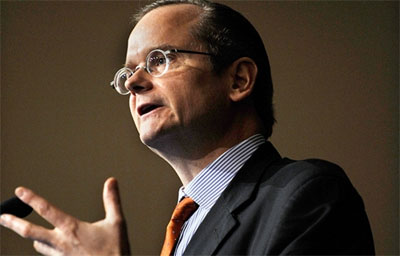
Lessig also revealed there is already in existence a cyber equivalent of the Patriot Act waiting for a cyber terrorism event in order to implement its provisions.

Law Professor: Counter Terrorism Czar Told Me There Is Going To Be An i-9/11 And An i-Patriot Act
By Steve Watson / August 6, 2008

Infowars — Amazing revelations have emerged concerning already existing government plans to overhaul the way the internet functions in order to apply much greater restrictions and control over the web.

Lawrence Lessig, a respected Law Professor from Stanford University told an audience at this years Fortune’s Brainstorm Tech conference in Half Moon Bay, California, that “There’s going to be an i-9/11 event” which will act as a catalyst for a radical reworking of the law pertaining to the internet.

Lessig also revealed that he had learned, during a dinner with former government Counter Terrorism Czar Richard Clarke, that there is already in existence a cyber equivalent of the Patriot Act, an “i-Patriot Act” if you will, and that the Justice Department is waiting for a cyber terrorism event in order to implement its provisions.

During a group panel segment titled “2018: Life on the Net”, Lessig stated:

There’s going to be an i-9/11 event. Which doesn’t necessarily mean an Al Qaeda attack, it means an event where the instability or the insecurity of the internet becomes manifest during a malicious event which then inspires the government into a response. You’ve got to remember that after 9/11 the government drew up the Patriot Act within 20 days and it was passed.

The Patriot Act is huge and I remember someone asking a Justice Department official how did they write such a large statute so quickly, and of course the answer was that it has been sitting in the drawers of the Justice Department for the last 20 years waiting for the event where they would pull it out.

Of course, the Patriot Act is filled with all sorts of insanity about changing the way civil rights are protected, or not protected in this instance. So I was having dinner with Richard Clarke and I asked him if there is an equivalent, is there an i-Patriot Act just sitting waiting for some substantial event as an excuse to radically change the way the internet works. He said “of course there is”.

Watch Lessig reveal the details at 4.30 into the following video:

Lessig is the founder of Stanford Law School’s Center for Internet and Society. He is founding board member of Creative Commons and is a board member of the Electronic Frontier Foundation and of the Software Freedom Law Center. He is best known as a proponent of reduced legal restrictions on copyright, trademark and radio frequency spectrum, particularly in technology applications.

These are clearly not the ravings of some paranoid cyber geek.

The Patriot Act, as well as its lesser known follow up the Domestic Security Enhancement Act 2003, also known as USA Patriot Act II, have been universally decried by civil libertarians and Constitutional scholars from across the political spectrum. They have stripped back basic rights and handed what have been described by even the most moderate critics as “dictatorial control” over to the president and the federal government.

Many believed that the legislation was a response to the attacks of 9/11, but the reality was that the Patriot Act was prepared way in advance of 9/11 and it sat dormant, awaiting an event to justify its implementation.

In the days after the attacks it was passed in the House by a majority of 357 to 66. It passed the Senate by 98 to 1. Congressman Ron Paul (R-Tex) told the Washington Times that no member of Congress was even allowed to read the legislation.

Now we discover that exactly the same freedom restricting legislation has already been prepared for the cyber world.

An i-9/11, as described by Lawrence Lessig, would provide the perfect pretext to implement such restrictions in one swift motion, as well as provide the justification for relegating and eliminating specific content and information on the web.

Such an event could come in the form of a major viral attack, the hacking of a major city’s security or transport systems, or some other vital systems, or a combination of all of these things. Considering the amount of unanswered questions regarding 9/11 and all the indications that it was a covert false flag operation, it isn’t hard to imagine such an event being played out in the cyber world.

However, regardless of any i-9/11 or i-Patriot Act, there is already a coordinated effort to stem the reach and influence of the internet.

We have tirelessly warned of this general movement to restrict, censor, control and eventually completely shut down the internet as we know it, thereby killing the last real vestige of free speech in the world today and eliminating the greatest communication and information tool ever conceived.

Our governments have reams of legislation penned to put clamps on the web as we know it. Legislation such as the PRO-IP Act of 2007: H.R. 4279, that would create an IP czar at the Department of Justice and the Intellectual Property Enforcement Act of 2007: S. 522, which would create an entire ‘Intellectual Property Enforcement Network’. These are just two examples.

In addition, we have already seen how the major corporate websites and social networks are decentralizing and coming together to implement overarching identification, verification and access systems that have been described by Facebook founder Mark Zuckerberg as “the beginning of a movement and the beginning of an industry.”

Some of these major tech companies have already joined efforts in projects such as the Information Card Foundation, which has proposed the creation of a system of internet ID cards that will be required for internet access. Of course, such a system would give those involved the ability to track and control user activity much more effectively. This is just one example.

In addition, as we reported yesterday, major transportation hubs like St. Pancras International, as well as libraries, big businesses, hospitals and other public outlets that offer wi-fi Internet, are blacklisting alternative news websites and making them completely inaccessible to their users.

These precedents are merely the first indication of what is planned for the Internet over the next 5-10 years, with the traditional web becoming little more than a vast spy database that catalogues people’s every activity and bombards them with commercials, while those who comply with centralized control and regulation of content will be free to enjoy the new super-fast Internet 2.

We must speak out about this rampant move to implement strict control mechanisms on the web NOW before it is too late, before the spine of the free internet is broken and its body essentially becomes paralyzed beyond repair.

Source / Information Clearing House

The Rag Blog

Posted in RagBlog | Tagged , , | Leave a comment

Are the Rest of Us to Be Mere Bystanders?

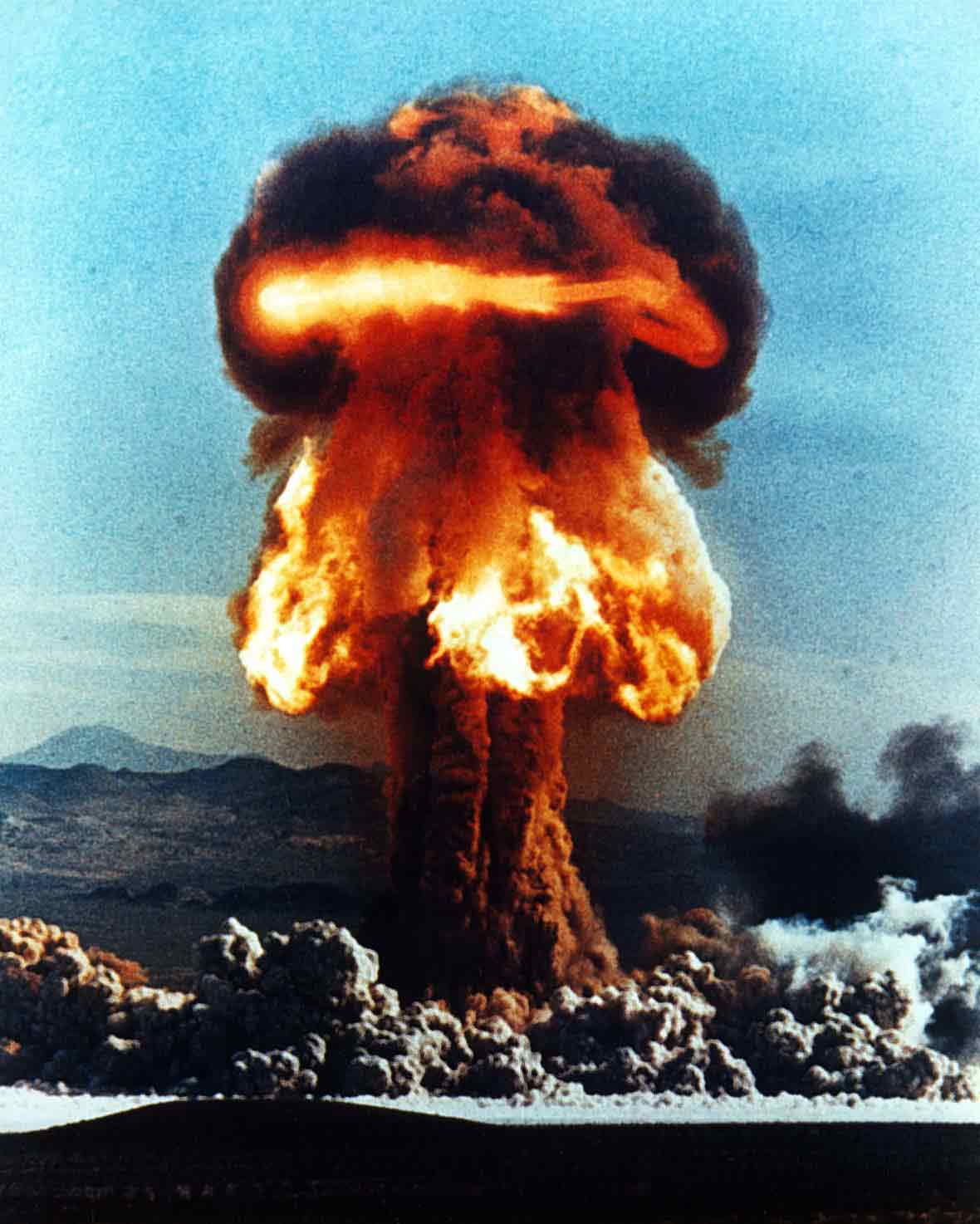
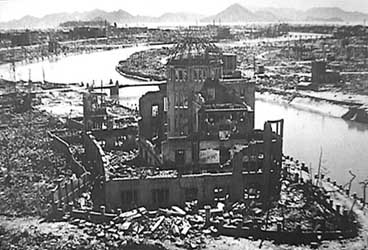
On the anniversary of the dropping of the atomic bomb on Hiroshima on August 6, 1945, John Pilger describes the ‘progression of lies’ from the dust of that detonated city, to the wars of today – and the threatened attack on Iran.

The Lies Of Hiroshima Are The Lies Of Today
By John Pilger

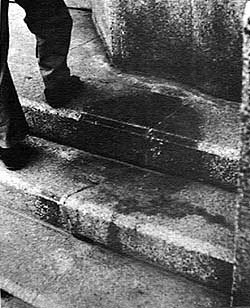
06/08/08 “ICH” — – When I first went to Hiroshima in 1967, the shadow on the steps was still there. It was an almost perfect impression of a human being at ease: legs splayed, back bent, one hand by her side as she sat waiting for a bank to open. At a quarter past eight on the morning of August 6, 1945, she and her silhouette were burned into the granite. I stared at the shadow for an hour or more, then walked down to the river and met a man called Yukio, whose chest was still etched with the pattern of the shirt he was wearing when the atomic bomb was dropped.

He and his family still lived in a shack thrown up in the dust of an atomic desert. He described a huge flash over the city, “a bluish light, something like an electrical short”, after which wind blew like a tornado and black rain fell. “I was thrown on the ground and noticed only the stalks of my flowers were left. Everything was still and quiet, and when I got up, there were people naked, not saying anything. Some of them had no skin or hair. I was certain I was dead.” Nine years later, when I returned to look for him, he was dead from leukaemia.

A shadow on steps such as Pilger describes above

In the immediate aftermath of the bomb, the allied occupation authorities banned all mention of radiation poisoning and insisted that people had been killed or injured only by the bomb’s blast. It was the first big lie. “No radioactivity in Hiroshima ruin” said the front page of the New York Times, a classic of disinformation and journalistic abdication, which the Australian reporter Wilfred Burchett put right with his scoop of the century. “I write this as a warning to the world,” reported Burchett in the Daily Express, having reached Hiroshima after a perilous journey, the first correspondent to dare. He described hospital wards filled with people with no visible injuries but who were dying from what he called “an atomic plague”. For telling this truth, his press accreditation was withdrawn, he was pilloried and smeared – and vindicated.

The day after Hiroshima was obliterated, President Truman voiced his satisfaction with the “overwhelming success” of “the experiment”.

The atomic bombing of Hiroshima and Nagasaki was a criminal act on an epic scale. It was premeditated mass murder that unleashed a weapon of intrinsic criminality. For this reason its apologists have sought refuge in the mythology of the ultimate “good war”, whose “ethical bath”, as Richard Drayton called it, has allowed the west not only to expiate its bloody imperial past but to promote 60 years of rapacious war, always beneath the shadow of The Bomb.

The most enduring lie is that the atomic bomb was dropped to end the war in the Pacific and save lives. “Even without the atomic bombing attacks,” concluded the United States Strategic Bombing Survey of 1946, “air supremacy over Japan could have exerted sufficient pressure to bring about unconditional surrender and obviate the need for invasion. Based on a detailed investigation of all the facts, and supported by the testimony of the surviving Japanese leaders involved, it is the Survey’s opinion that … Japan would have surrendered even if the atomic bombs had not been dropped, even if Russia had not entered the war and even if no invasion had been planned or contemplated.”

The National Archives in Washington contain US government documents that chart Japanese peace overtures as early as 1943. None was pursued. A cable sent on May 5, 1945 by the German ambassador in Tokyo and intercepted by the US dispels any doubt that the Japanese were desperate to sue for peace, including “capitulation even if the terms were hard”. Instead, the US secretary of war, Henry Stimson, told President Truman he was “fearful” that the US air force would have Japan so “bombed out” that the new weapon would not be able “to show its strength”. He later admitted that “no effort was made, and none was seriously considered, to achieve surrender merely in order not to have to use the bomb”. His foreign policy colleagues were eager “to browbeat the Russians with the bomb held rather ostentatiously on our hip”. General Leslie Groves, director of the Manhattan Project that made the bomb, testified: “There was never any illusion on my part that Russia was our enemy, and that the project was conducted on that basis.” The day after Hiroshima was obliterated, President Truman voiced his satisfaction with the “overwhelming success” of “the experiment”.

Since 1945, the United States is believed to have been on the brink of using nuclear weapons at least three times. In waging their bogus “war on terror”, the present governments in Washington and London have declared they are prepared to make “pre-emptive” nuclear strikes against non-nuclear states. With each stroke toward the midnight of a nuclear Armageddon, the lies of justification grow more outrageous. Iran is the current “threat”. But Iran has no nuclear weapons and the disinformation that it is planning a nuclear arsenal comes largely from a discredited CIA-sponsored Iranian opposition group, the MEK – just as the lies about Saddam Hussein’s weapons of mass destruction originated with the Iraqi National Congress, set up by Washington.

The role of western journalism in erecting this straw man is critical. That America’s Defence Intelligence Estimate says “with high confidence” that Iran gave up its nuclear weapons programme in 2003 has been consigned to the memory hole. That Iran’s president Mahmoud Ahmadinejad never threatened to “wipe Israel off the map” is of no interest. But such has been the mantra of this media “fact” that in his recent, obsequious performance before the Israeli parliament, Gordon Brown alluded to it as he threatened Iran, yet again.

This progression of lies has brought us to one of the most dangerous nuclear crises since 1945, because the real threat remains almost unmentionable in western establishment circles and therefore in the media. There is only one rampant nuclear power in the Middle East and that is Israel. The heroic Mordechai Vanunu tried to warn the world in 1986 when he smuggled out evidence that Israel was building as many as 200 nuclear warheads. In defiance of UN resolutions, Israel is today clearly itching to attack Iran, fearful that a new American administration might, just might, conduct genuine negotiations with a nation the west has defiled since Britain and America overthrew Iranian democracy in 1953.

In the New York Times on July 18, the Israeli historian Benny Morris, once considered a liberal and now a consultant to his country’s political and military establishment, threatened “an Iran turned into a nuclear wasteland”. This would be mass murder. For a Jew, the irony cries out.

The question begs: are the rest of us to be mere bystanders, claiming, as good Germans did, that “we did not know”? Do we hide ever more behind what Richard Falk has called “a self-righteous, one-way, legal/moral screen [with] positive images of western values and innocence portrayed as threatened, validating a campaign of unrestricted violence”? Catching war criminals is fashionable again. Radovan Karadzic stands in the dock, but Sharon and Olmert, Bush and Blair do not. Why not? The memory of Hiroshima requires an answer.

www.johnpilger.com

Source / Information Clearing House

The Rag Blog

Posted in RagBlog | Tagged , , | Leave a comment

MEDIA : The Mythical Obama Bias


Trust me, John McCain doesn’t know what bad press looks like
by Eric Boehlert / August 5, 2008

Did you know the big bad media are beating up on John McCain?

For weeks, the campaign’s media debate centered on whether the press was being too kind to Sen. Barack Obama — whether it was fawning over the Democrat’s historic run and drowning him in rapturous coverage. (Recent studies and analysis have cast that claim into doubt.)

But now the narrative has been expanded to include the laughable notion that, following a string of McCain campaign stumbles, including botched staging and questionable photo-ops, the press has suddenly turned on McCain and is mocking the Republican. That the same press corps that branded McCain a maverick and for years worshipped his loose-talking demeanor, has now soured on the senator. Meaning, the love is gone.

The New York Observer trumpeted that trend last week when it published a front-page article detailing the transformation from McCain-as-media-hero to “McCain-as-marginalized-victim” who’s suffering “rough treatment” from journalists. The Observer piece came complete with an illustration that showed the press as a two-by-four-wielding playground bully setting his sights on a vulnerable and childlike McCain. (Run Johnny, run!)

Aside from asking for the world’s smallest violin, I’d like to make the point that rather than bemoaning the type of press attention McCain has been attracting, most recent Democratic candidates for president, who were pummeled and even savaged by the press, would pay for the kind of respectful coverage McCain has accumulated this summer. They would be rejoicing if the press ever treated them as kindly and as softly as it has McCain this campaign.

Let me put it another way: When McCain gets regularly portrayed in the press as a serial liar the way Al Gore was in 2000, then he can complain about the press. When McCain is portrayed as an angry lunatic the way Howard Dean was in 2003, then he can complain. When McCain’s war record is dragged through the mud while the press looks on for weeks too frightened to call out the partisan accusers, the way John Kerry’s military record was, then he can complain. When McCain’s campaign is defined by his haircut the way John Edwards’ was, then he can complain. When McCain is portrayed as a cackling witch the way Hillary Clinton was this winter, then he can complain. When McCain is portrayed as arrogant and presumptuous the way Obama is today, then he can complain.

But pretending that when the press simply chronicles McCain’s disjointed campaign means that reporters and pundits have somehow turned on the candidate — that they are attacking him and piling on — is just ludicrous.

It’s true the McCain campaign has received some unkind press notices in recent weeks, but that’s because the McCain campaign has been very poorly run. As The Atlantic’s conservative blogger Ross Douthat conceded last week, “John McCain is running a staggeringly inept campaign.”

That’s what Republican boosters were saying about the Arizona senator. But simply acknowledging the campaign’s missteps, however gingerly the traditional media have done it in recent weeks, does not mean the press is being nasty to the candidate or attacking the GOP.

What’s happened in recent White House campaign cycles is that people have become so accustomed to the press openly mocking the Democrat that when that pattern is altered, however slightly, as it’s been in 2008, it’s perceived to be a massive shift.

Since the media are simply not trashing the Democratic nominee as aggressively as in campaigns past, conservatives are claiming that’s being unfair. They liked the old model where the press effortlessly adopted GOP spin about Democratic candidates being phony and untrustworthy. That worked for the GOP. Today, that model has been modestly tweaked, and the GOP is crying foul.

That’s expected. But it was distressing to see the New York Observer buy into the spin about the media turning on McCain. After all, the evidence to support the meme is quite thin. Yes, partisan Republican Grover Norquist, the head of Americans for Tax Reform, assured the Observer that McCain “got slapped upside the head” by the media. But in terms of pinpointing actual instances of mockery, the Observer didn’t seem to have much to work with. It did cite this recent cable chatter scene:

“On a recent segment on Fox News’ The Beltway Boys … Morton Kondracke, countered a little later with this: “McCain did not have a great week. His visual was riding around in a golf cart with old George Bush the First.” Mr. Kondracke waved his hands in the air, comically mimicking Mr. McCain at the wheel of a golf car. Mr. [Fred] Barnes crossed his arms and chuckled.

That was the Observer’s strongest piece of evidence of the media “mockery” — of the “rough treatment” — that McCain has had to endure? Kondracke waved his hands and Barnes chuckled.

Oh, brother. I mean, how does McCain make it through the days with that kind of media venom flowing in his direction?

I can’t help thinking if Gore wouldn’t have preferred suffering that kind of “mockery” as opposed to having MSNBC’s Chris Matthews announce that Gore was so desperate to be president in 2000 that he would gladly “lick the bathroom floor” to get elected. Go read the Daily Howler’s 2000 archives for a catalog that’s as long as a fire station grocery list of the jarring insults and attacks the press leveled against Gore, who, at times, was portrayed in the press as pathological. And then compare those attacks to the light-as-a-feather mockery that McCain has supposedly had to deal with lately and tell me which is tougher.

It’s the same reason that I bet Clinton would have gladly been the target of a Fox News anchor’s chuckle rather than having The New York Times print a news section analysis of her laugh and then watch lots of well-paid, deep-thinking pundits and reporters at The Washington Post, The Boston Globe, San Francisco Chronicle, Seattle Post-Intelligencer, Cincinnati Post, National Public Radio, Time.com, Reuters, Associated Press, Politico, ABC, CNN, MSNBC, and Fox News, among others, pontificate about her humorous outbursts.

Indeed, way back in November 2007, months before the press really let loose on her candidacy, Greg Sargent amassed a sort of Greatest Hits of the media’s phony attacks on Clinton. Read the list and try to think of a single event in the last two months in which the press, which we’re told has turned on poor John McCain, ever concocted nonsense like this and targeted the GOP front-runner:

* Hillary’s alleged failure to tip the Iowa waitress

* Hillary’s phony southern drawl

* The supposed 20-year-plan by Hillary and Bill to take over the world, or at least deliver them both the Presidency, as alleged by Jeff Gerth and Don Van Natta and denied by the one person who supposedly had first-hand knowledge of their dastardly plot

* The baseless claim that Hillary eavesdropped on political opponents in 1992

* The bogus media claim that Bill Clinton accused Hillary’s Dem rivals of “swiftboating” her

* The media’s hyping of Hillary’s supposed refusal to release Presidential records, a tale that was taken apart in today’s Washington Post and which wasn’t matched by any similar media outrage about Rudy [Giuliani’s] refusal to release his Mayoral papers.

P.S. Don’t forget the great cleavage debate of 2007.

Yet we’re supposed to believe the bullying press is now mocking McCain? Give us a break.

You’ll also note that with the Democratic trend with Gore, Dean, Kerry, Clinton, Edwards, and Obama, the caustic coverage candidates have had to endure almost always revolved around questions of character; being a liar, a phony, unhinged, or arrogant.

By contrast, there has not been a single, sustained press narrative pushed by the media during this entire campaign season that has ridiculed or called into question McCain’s character. Not one. For the press, that kind of character exploration of McCain remains taboo. But when covering Democrats, character assassination remains routine.

Meanwhile, I can’t help wondering if the press is being tagged as mean and nasty simply because reporters belatedly challenged one of McCain’s many campaign lies. Because they decided to come out of their Bush-era shell and actually engaged in a rare bout of fact-checking, or what used to be called reporting, when a Republican tried to smear the character of his Democratic opponent.

The lie McCain peddled in a television ad was that Obama canceled a trip to visit wounded U.S. soldiers in Germany because the Pentagon told him he couldn’t bring reporters along with him. After some initial hesitation, NBC, along with The New York Times and The Washington Post, among others, finally reported that McCain’s central allegation was not supported by the facts.

On the front page on July 30, the Post’s Michael Shear and Dan Balz reported that McCain continued to make the allegation, “despite no evidence that the charge is true.” That might seem like a simple thing. And unfortunately the press still allowed McCain’s planted lie to dictate campaign coverage last week. But for the Beltway media amidst a White House campaign, the Post’s reporting was different.

As the Daily Howler noted:

“Shear’s report represents a major change in the mainstream press culture of the past sixteen years. In this report, the Washington Post, on its front page, directly challenges the latest slimy “character” charge against the latest Dem White House hopeful. This represents a major change in the way this newspaper does business.”

Quite simply, the Republican Party cannot afford to have the press become aggressive fact-checkers out on the trail. So in an attempt to intimidate the press back into the semi-crouch that has defined campaign journalism for the last decade, conservatives whine about how mean and nasty the media are for attacking McCain.

But the far-fetched claim just doesn’t hold up to scrutiny. In fact, it directly contradicts very recent testimonials from starry-eyed journalists on the McCain beat. “Covering McCain is a blast,” wrote Ana Marie Cox, in a recent issue of Radar. “He genuinely likes reporters: He’ll joke with us about our drinking habits, playfully request our cell phones in the middle of a call and tell some unsuspecting editor or parent that the phone’s owner has just been hauled off to rehab, and engage in gleefully sarcastic banter about both our colleagues and his.”

And on MSNBC last week, Time’s Mark Halperin, sounding like somebody putting off making an unwanted dentist appointment, assured viewers that, “McCain deserves scrutiny and he’ll get some.” Halperin couldn’t quite say when that pending scrutiny of McCain would take place. (Stay tuned.)

The truth is that the press not only has not turned on McCain but it continues to act as a key campaign ally in a way it does not for Democrats.

I’m trying to imagine back during the 2004 campaign, when the debate about Iraq was raging: What if candidate Kerry had sat down for an interview on the CBS Evening News and promptly made an egregious factual error regarding the timeline of events there? Does anybody really think that rather than air Kerry’s blunder, and in fact trumpet the misstep as news, that CBS would have cut away from his botched answer and replaced it with three separate spliced-together statements made by Kerry, one of which was the answer to a different question, and then not tipped off viewers that the interview had been heavily edited? Does anybody think CBS would have extended Kerry that courtesy?

That’s exactly the kind of oversized life preserver Katie Couric’s Evening News threw McCain when he bungled the timeline of the U.S. military’s surge in Iraq during a CBS interview. In an extraordinary act of kindness, Couric and company covered for McCain — and violated CBS’ ethical guidelines in the process.

Yet today we’re told the press has turned on the GOP candidate and that it’s mocking John McCain?

Trust me, if the press had turned on Al Gore like that in 2000, he’d be finishing up his second term as president right now.

Source / Media Matters

The Rag Blog

Posted in RagBlog | Tagged , , , , , , , | Leave a comment

Assessing the Success of the Surge

The Guardian’s Ghaith Abdul-Ahad went back to Baghdad to see the effects of last year’s troop escalation (“surge”). He argues that the US military’s blast walls and forcible division of the city into isolated micro-neighborhoods are the cause of the reduction in deaths, not extra troops.

Source / Informed Comment / The Guardian

The Rag Blog / Posted August 6, 2008

Posted in RagBlog | Tagged , , | Leave a comment

Jim Hightower : Bush’s Empty Promise to Wounded Vets

Portrait of Marine Staff Stg. John Jones by Timothy Greenfield-Sanders.

‘Where is George when thousands severely wounded in his misguided Iraq war need him to act?’
By Jim Hightower / August 6, 2008

When Bear Stearns, Freddie Mac, and Fannie Mae got in a financial crunch, George W was Georgie-on-the-spot, rushing out with a bailout package of more than $130 billion.

But, where is George when America’s wounded veterans – including thousands severely wounded in his misguided Iraq war –need him to act? Last year, the public was disgusted to learn of the scandalous mistreatment these vets were getting at the Army’s Walter Reed hospital and other VA medical centers.

Caught unaware by the furor, Bush hurriedly promised to do something, and in February he claimed success. His army surgeon general told Congress that “we are entirely staffed at the point we need to be,” adding with bravado that “a key element of our warrior ethos is that we never leave a soldier behind on the battlefield – or lost in a bureaucracy.”

Great line! Mission accomplished!

But wait – why aren’t veterans applauding? Because they know that claiming progress is not the same as making it. In June, congressional staffers investigated a wounded vet center in Texas that was set up for 649 patients, but is now jammed with more than 1,300. Another 350 vets are struck on a waiting list and some will languish there up to a year, even though many are at high risk of suicide. Instead of being “entirely staffed,” the center has only half the number of nurse case managers it needs.

Why is there such an outrageous gap between Bush’s promise and performance? The Bushites claim that, gosh, they simply didn’t anticipate so many wounded soldiers coming out of Iraq. Excuse me! The war has been going on for more than five years, and the awful number of casualties has been reported daily. How could they not know?

I’ll bet that if our vets had names like Freddie, Fannie, and Bear – Bush would have covered all of their needs, pronto.

“Wounded Warriors, Empty Promises,” The New York Times, July 25, 2008.

Source / JimHightower.com

See Wounded Warriors, Empty Promises / New York Times / July 25, 2008

The Rag Blog

Posted in RagBlog | Tagged , , , , , , , , , | Leave a comment

FILM : Patti Smith: Dream of Life

Patti Smith. Photo by Steven Sebring.

‘This androgynous Jersey girl obsessed with Rimbaud and Shelley and Whitman came to the big city 40 years ago’
By Andrew O’Hehir / August 6, 2008

Almost at the beginning of Steven Sebring’s documentary “Patti Smith: Dream of Life,” a film and art installation and photography book that have been 12 years in the making, we hear a narration from the eponymous rock goddess-poet, declaiming a short version of her life story in her husky, incantatory contralto. As Sebring shows us black-and-white images of a train journey, perhaps suggestive of the journey Smith once took from rural southern New Jersey, where she grew up, to New York, where she would make her name — and perhaps suggestive of the journey from birth to death — Smith breaks it down.

Quite a life it has been: This androgynous Jersey girl obsessed with Rimbaud and Shelley and Whitman came to the big city 40 years ago and became the muse and friend and partner of Robert Mapplethorpe (no adequate English word exists to describe their relationship), became a poet and then a performance poet and then an underground rock musician and then a rock star, left the stage and the city for life in Michigan as a wife and mother, and then, after the 1994 death of her husband Fred “Sonic” Smith, returned to New York, to music, to poetry and to political activism. Sebring’s film, so long in gestation that it became a major life event for both its director and its subject — one observer opined that the film would only be finished when one or the other of them died — offers an intimate, impressionistic portrait of this later Patti Smith, a woman still blazing her own trail through late middle age, a woman who has seen and suffered much loss and who is perhaps the only major surviving link from the beat era to the ’70s Manhattan art scene to the birth of punk to the present.

Whether this is a flaw is up to you, but Smith’s opening narration provides the only backdrop or exposition we ever get in “Patti Smith: Dream of Life.” Sebring offers a concert film — capturing parts of Smith’s 2005 London performance of her first album, “Horses” — and a travelogue and a chronological voyage; much of his footage (most of it in black-and-white) is beautiful and Smith herself, so often described as a prickly or difficult person, is delightful company. But we often don’t know where she is in space or time, and if we figure that out, we’re not sure what she’s doing there or why. It’s a disorienting whirl from New York to Tokyo to London to Paris to Rome to Atlanta to New Jersey, which I guess is the point.

You could almost say that the tremendous passage of time in the film is itself the point. Smith is visibly, almost geologically older in what appears to be the film’s present tense, an interview in her room at the Chelsea Hotel. (She’s now 61.) Her two children, Jackson and Jesse, are scraggly moppets in some scenes and almost adults in others. Smith’s visit to south Jersey is of course a trip to see her elderly and charming mom and dad, still living in the same aluminum-sided Cape Cod where she grew up. Except that they’re not anymore; both of them died before Sebring could finish the film. (It goes unmentioned here that Smith’s biggest hit, “Because the Night,” was co-written with another New Jerseyite from nearby Asbury Park, so I’ll bring it up for no special reason.)

That’s what goes with the passage of time, of course; everybody gets older and all of them eventually die. Smith talks about her relationships with William Burroughs and Allen Ginsberg and Gregory Corso and her husband Fred Smith and her brother Todd Smith and her keyboard player Richard Sohl, all of them gone. (We hear Fred Smith singing one of his wife’s songs, in a home recording made during his final illness.) She visits Corso’s grave in Italy and Rimbaud’s grave in France and Shelley’s grave in England; the title of Sebring’s movie, and of Smith’s 1988 album, comes from Shelley’s oft-quoted “Adonais”: “Peace, peace! he is not dead, he doth not sleep — he hath awakened from the dream of life.” (Isn’t that exactly what Mick Jagger read onstage at the Hyde Park concert after Brian Jones’ death? It’s not just poetry, it’s rock history!)

Perhaps for comic relief, another living megasaur of ’70s counterculture, Sam Shepard, shows up briefly to jam, atrociously, with Smith on acoustic guitar. Honestly, I don’t know what that scene is doing here; it’s the one moment — well, along with hugging Jesse Jackson backstage at an antiwar rally — that feels like conventional rockumentary. Smith’s activist career gets fairly short shrift in the movie, although it’s an important facet of her recent life. Sebring may not want to remind people how avidly Smith campaigned for Ralph Nader in 2000.

“Patti Smith: Dream of Life” is frequently beautiful and intermittently haunting and could be called a meditation on aging and mortality, an intimate study of a peculiar variety of fame and a portrait of a genuinely remarkable person. It has played at Sundance and Berlin and all over the film festival world, at least in part because everyone’s so amazed it actually got finished. Still, while “Dream of Life” succeeds on its own terms, I can’t help feeling there’s a missed opportunity here, an opportunity to make clear to younger women and men just how amazing Patti Smith’s journey has been. (Maybe, like Julien Temple’s wonderful “Joe Strummer: The Future Is Unwritten,” that kind of film can’t be made while the subject is alive — but I’m not quite sure why that would be so.)

Two decades before the riot grrrls, Smith behaved as if she never even knew that women weren’t supposed to rock, weren’t supposed to have big egos and sexual adventures and write thundering, self-indulgent post-beat poetry. Her albums “Horses” and “Radio Ethiopia” were far ahead of the ’70s rock curve, and to this day remain among the rare fully successful hybrids of rock and poetry. Even as she was being a feminist trailblazer, the younger Smith had a unique Manhattan-hipster ability to be at the center of the action, whether that meant Mapplethorpe’s studio or Burroughs’ booze sessions or Shepard’s plays or CBGB’s with the Ramones, Television and Talking Heads. (She closed that club forever with a three-and-a-half-hour performance in October 2006.) Almost none of that — OK, none at all — is visible in this film, except by inference and reference. If you don’t already think that Patti Smith and the people she hung out with are awesome, this movie won’t tell you about it.

One of the greatest things that can be said about Patti Smith, I think, is that although she was either an inventor or a precursor of punk (depending on how you look at it), it rapidly bored her and she moved on. She couldn’t be contained by any movement or ethos or ism, and anyway was always closer to being Rimbaud or Ginsberg than to being Billy Idol (or, for that matter, Joan Jett), and by the early ’80s she was married and living in suburban Detroit. Her great triumph was not that she was a female rock revolutionary, or that she left music for a domestic life, or that she came back to it when that domestic life ended. It was that she never questioned her right to live her life exactly as she saw fit, to make it up as she went along in the great tradition of all those dead white male artists she worshiped. As Sebring’s film makes clear, she’s still doing that today.

“Patti Smith: Dream of Life” is now playing at Film Forum in New York, and opens Sept. 19 in Columbus, Ohio, and Denver; Oct. 2 in St. Louis; Oct. 17 in Los Angeles and San Francisco; and Oct. 24 in San Diego, with more cities to be announced.

Source / salon.com

The Rag Blog

Posted in RagBlog | Tagged , , , , , , , , | 2 Comments

How Washington’s Right-Wing Wrecking Crew Robbed Us Blind


Conservatives have turned a vast government built for our protection into a device for exploiting us
By Thomas Frank / August 6, 2008

Washington is the city where the scandals happen. Every American knows this, but we also believe, if only vaguely, that the really monumental scandals are a thing of the past, that the golden age of misgovernment-for-profit ended with the cavalry charge and the robber barons, at about the same time presidents stopped wearing beards.

I moved to Washington in 2003, just in time for the comeback, for the hundred-year flood. At first it was only a trickle in the basement, a little stream released accidentally by the president’s friends at Enron. Before long, though, the levees were failing all over town, and the city was inundated with a muddy torrent of graft.

How are we to dissect a deluge like this one? We might begin by categorizing the earmarks handed out by Congress, sorting the foolish earmarks from the costly earmarks from the earmarks made strictly on a cash basis. We could try a similar approach to government contracting: the no-bid contracts, the no-oversight contracts, the no-experience contracts, the contracts handed out to friends of the vice president. We might consider the shoplifting career of one of the president’s former domestic policy advisers or the habitual plagiarism of the president’s liaison to the Christian right. And we would certainly have to find some way to parse the extraordinary incompetence of the executive branch, incompetence so fulsome and steady and reliable that at some point Americans stopped being surprised and began simply to count on it, to think of incompetence as the way government works.

But the onrushing flow swamps all taxonomies. Mass firing of federal prosecutors; bribing of newspaper columnists; pallets of shrink-wrapped cash “misplaced” in Iraq; inexperienced kids running the Baghdad stock exchange; the discovery that many of Alaska’s leading politicians are apparently on the take — our heads swim. We climb to the rooftop, but we cannot find the heights of irony from which we might laugh off the blend of thug and Pharisee that was Tom DeLay — or dispel the nauseating suspicion, quickly becoming a certainty, that the government of our nation deliberately fibbed us into a pointless, catastrophic war.

Bad Apples All Around

So let us begin on the solid ground of these simple facts: this spectacular episode of misrule has coincided with both the political triumph of conservatism and with the rise of the Washington area to the richest rank of American metropolises. In the period I am describing, gentlemen of the right rolled through the capital like lords of creation. Every spigot was open, and every indulgence slopped out for their gleeful wallowing. All the clichs roared at full, unembarrassed volume: the wines gurgled, the T-bones roasted, the golf courses beckoned, the Learjets zoomed, the contractors’ glass buildings sprouted from the earth, and the lobbyists’ mansions grew like brick-colonial mushrooms on the hills of northern Virginia.

Democrats, for their part, have tried to explain the flood of misgovernment as part of a “culture of corruption,” a phrase at once obviously true and yet so amorphous as to be quite worthless. Republicans have an even simpler answer: government failed, they tell us, because it is the nature of government enterprises to fail. As for the great corruption cases of recent years, they cluck, each is merely a one-of-a-kind moral lapse unconnected to any particular ideology — an individual bad apple with no effect on the larger barrel.

Which leaves us to marvel helplessly at what appears to be a spectacular run of lousy luck. My, what a lot of bad apples they are growing these days!

Corruption is uniquely reprehensible in a democracy because it violates the system’s first principle, which we all learned back in the sunshiny days of elementary school: that the government exists to serve the public, not particular companies or individuals or even elected officials. We Are the Government, insisted the title of a civics primer published in the earnest year of 1945. “The White House belongs to you,” its dust jacket told us. “So do all the other splendid buildings in Washington, D.C. For you are a citizen of the United States.” For you, young citizen, does the Post Office carry letters to every hamlet in the nation. For you does the Department of Agriculture research better plowing methods and the Bureau of Labor Statistics add up long columns of numbers.

The government and its vast workforce serve the people: The idea is so deep in the American grain that we can’t bring ourselves to question it, even in this disillusioned age. Republicans and Democrats may fight over how big government should be and exactly what it should do, but almost everyone shares those baseline good intentions, we believe, that devotion to the public interest.

We continue to believe this in even the most improbable circumstances. Take the worst apple of them all, lobbyist Jack Abramoff, whose astonishing career as a corruptionist has been unreeling in newspaper and congressional investigations since I came to Washington. Abramoff started out as a great political success story, a protg and then a confidant of the leaders of the conservative faction of the Republican Party. But his career disintegrated on news of the inventive ways he ripped off his clients and the luxury meals and lavish trips with which he bribed legislators.

Journalistic coverage of the Abramoff affair has stuck closely to the “bad apple” thesis, always taking pains to separate the conservative movement from its onetime superstar. What Abramoff represented was “greed gone wild,” asserts the most authoritative account on the subject. He “went native,” say others. Above all, he was “sui generis,” a one-of-a-kind con man, “engaged in bizarre antics that your average Zegna-clad Washington lobbyist would never have dreamed of.”

In which case, we can all relax: Jack Abramoff’s in jail. The system worked; the bad apple has been plucked; the wild greed and the undreamed-of antics have ceased.

Misgovernment by Ideology

But the truth is almost exactly the opposite, whether we are discussing Abramoff or the wider tsunami of corruption. The truth is as obvious as a slab of sirloin and yet so obscured by decades of pettifoggery that we find it almost impossible to apprehend clearly. The truth slaps your face in every hotel lobby in town, but we still don’t get the message.

It is just this: Fantastic misgovernment of the kind we have seen is not an accident, nor is it the work of a few bad individuals. It is the consequence of triumph by a particular philosophy of government, by a movement that understands the liberal state as a perversion and considers the market the ideal nexus of human society. This movement is friendly to industry not just by force of campaign contributions but by conviction; it believes in entrepreneurship not merely in commerce but in politics; and the inevitable results of its ascendance are, first, the capture of the state by business and, second, all that follows: incompetence, graft, and all the other wretched flotsam that we’ve come to expect from Washington.

The correct diagnosis is the “bad apple” thesis turned upside down. There are plenty of good conservative individuals, honorable folks who would never participate in the sort of corruption we have watched unfold over the last few years. Hang around with grassroots conservative voters in Kansas, and in the main you will find them to be honest, hardworking people. Even our story’s worst villains can be personally virtuous. Jack Abramoff, for example, is known to his friends as a pious, polite, and generous fellow.

But put conservatism in charge of the state, and it behaves very differently. Now the “values” that rightist politicians eulogize on the stump disappear, and in their place we can discern an entirely different set of priorities — priorities that reveal more about the unchanging historical essence of American conservatism than do its fleeting campaigns against gay marriage or secular humanism. The conservatism that speaks to us through its actions in Washington is institutionally opposed to those baseline good intentions we learned about in elementary school.

Its leaders laugh off the idea of the public interest as airy-fairy nonsense; they caution against bringing top-notch talent into government service; they declare war on public workers. They have made a cult of outsourcing and privatizing, they have wrecked established federal operations because they disagree with them, and they have deliberately piled up an Everest of debt in order to force the government into crisis. The ruination they have wrought has been thorough; it has been a professional job. Repairing it will require years of political action.

Conservatism-in-power is a very different beast from the conservatism we meet on the streets of Wichita or the conservatism we overhear talking to itself on the pages of Free Republic. For one thing, what conservatism has done in its decades at the seat of power is fundamentally unpopular, and a large percentage of its leaders have been men of eccentric ideas. While they believe things that would get them laughed out of the American Sociological Association, that only makes them more typical of the movement. And for all their peculiarity, these people — Grover Norquist, Tom DeLay, Jack Abramoff, Newt Gingrich, and the whole troupe of activists, lobbyists, and corpora-trons who got their start back in the Reagan years — have for the last three decades been among the most powerful individuals in America. This wave of misgovernment has been brought to you by ideology, not incompetence.

Yes, today’s conservatives have disgraced themselves, but they have not strayed from the teaching of their forefathers or the great ideas of their movement. When conservatives appoint the opponents of government agencies to head those government agencies; when they auction their official services to the purveyor of the most lavish “golf weekend”; when they mulch millions from groups with business before Congress; when they dynamite the Treasury and sabotage the regulatory process and force government shutdowns — in short, when they treat government with contempt — they are running true to form. They have not done these awful things because they are bad conservatives; they have done them because they are good conservatives, because these unsavory deeds follow naturally from the core doctrines of the conservative tradition.

And, yes, there has been greed involved in the effort — a great deal of greed. Every tax cut, every cleverly engineered regulatory snafu saves industry millions and perhaps even billions of dollars, and so naturally securing those tax cuts and engineering those snafus has become a booming business here in Washington. Conservative rule has made the capital region rich, a showplace of the new plutocratic order. But this greed cannot be dismissed as some personal failing of lobbyist or congressman, some badness-of-apple that can be easily contained. Conservatism, as we know it, is a movement that is about greed, about the “virtue of selfishness” when it acts in the marketplace. In rightwing Washington, you can be a man of principle and a boodler at the same time.

The Wrecking Crew in Full Swing

One of the instructive stories We Are the Government brought before generations of schoolkids was the tale of a smiling dime whose wanderings were meant to introduce us to the government and all that it does for us: the miner who digs the ore for the dime has his “health and safety” supervised by one branch of the government; the bank in which the dime is stored enjoys the protection of a different branch, which “sees that [banks] are safe places for people to keep their money”; the dime gets paid in tax on a gasoline sale; it then lands in the pocket of a Coast Guard lieutenant, who takes it overseas and spends it on a parrot, which is “quarantined for ninety days” when the lieutenant brings it home. All of which is related with the blithest innocence, as though taxes on gasoline and quarantines on parrots were so obviously beneficial that they required little further explanation.

Clearly, a more up-to-date version is required. So let us follow the dime as it wends its way through our present-day capital. Its story, we will find, is the reverse of what it was in 1945. That old dime was all about service, about the things government could do for us. But the new dime is about profit — about the superiority of private enterprise, about the huge sums that can be squeezed out of federal operations. Instead of symbolizing good government, the dime now shows us the wrecking crew in full swing.

Our modern dime first comes to Washington as part of some good citizen’s taxes, and it leaves the U.S. Treasury in a payment to a company that has been hired to do work on the nation’s ports. Back in 1945, the government would have done the work itself, but now it uses contractors for such things. This particular contractor knows how to win a bid, but it doesn’t know how to do the work, so it subcontracts the job to another outfit. The dime follows, and it eventually makes up a worker’s salary, who incorporates it into his monthly car payment. From there it travels into the coffers of an auto industry trade association, which happens to be very upset about a rule proposed by a federal agency that would require cars to notify drivers when their tire pressure is low.

So the trade association gives the dime to a Washington consultant who specializes in fighting federal agencies, and this man launches challenge after challenge to the studies that the agency is using in the tire-pressure matter. It takes many years for the agency to make its way through the flak thrown up by this clever fellow. Meanwhile, with his well-earned dime, he buys himself a big house with nice white columns in front.

But this is only the beginning of the story. As we make our rounds of conservative Washington, we glimpse something much greater than single acts of incompetence or obstruction. We see a vast machinery built for our protection reengineered into a device for our exploitation. We behold the majestic workings of the free market itself, boring ever deeper into the tissues of the state. Ultimately, we gaze upon one of the true marvels of history: democracy buried beneath an avalanche of money.

[From the book The Wrecking Crew: How Conservatives Rule by Thomas Frank, Copyright © 2008 by Thomas Frank. Reprinted by arrangement with Metropolitan Books, an Imprint of Henry Holt and Company, LLC. All Rights Reserved.]

Thomas Frank, the author of What’s the Matter with Kansas?, is the founding editor of The Baffler, a contributing editor at Harper’s, and, most recently, a columnist for the Wall Street Journal. His WSJ columns can be read at his website. He lives, of course, in Washington D.C. and this essay has been adapted from his new book, The Wrecking Crew: How Conservatives Rule (Metropolitan Books, 2008)

Source / AlterNet

Find The Wrecking Crew by Thomas Frank at Amazon.com

The Rag Blog

Posted in RagBlog | Tagged , , , , , , , , , , , | Leave a comment

The PATRIOT Act’s War on Charity


‘New powers granted to the Treasury Department currently allow the government to shut down charities based on unfounded claims’
By Maya Schenwar / August 5, 2008

Since the PATRIOT Act’s passage almost seven years ago, many of its adverse effects on activist organizations and peace groups have become plain. The law grants the government broad new surveillance privileges and access to private property, and protests and demonstrations have been heavily monitored and contained in the wake of 9/11. But according to a new report, the worst effects on nonprofit organizations have garnered little attention. New powers granted to the Treasury Department currently allow the government to shut down charities based on unfounded claims; to bar nonprofits from operating in some international disaster zones, and to freeze the assets of “designated” charities, leaving large sums of money intended for humanitarian causes to fester indefinitely in Treasury vaults.

Post-9/11 regulations forbid any organization to provide or attempt to provide “material support or resources” to groups or individuals designated as “terrorist.” It’s also prohibited to “otherwise associate” with groups labeled “terrorist.” No charges need to be filed for the government to take action: If the Treasury Department has a “reasonable suspicion” that an organization is violating these rules, it can seize its assets and shut down the group.

“U.S. nonprofits operate within a legal regime that harms charitable programs, undermines the independence of the nonprofit sector, and weakens civil society,” states the recent report, co-authored by the watchdog organization OMB Watch and the philanthropic network Grantmakers Without Borders (GWB).

Seven US nonprofits have been completely shut down for “supporting terrorism.”

According to Kay Guinane, OMB Watch’s director of nonprofit speech rights and one of the report’s co-authors, the government has a free hand to act based purely on suspicion when it comes to the nonprofit sector. Executive Order 13224, which outlaws contact with “terrorist organizations,” is vague about the criteria for how the “terrorist” label – or the “terrorist supporter” label – is to be designated or investigated.

In fact, Guinane told Truthout, “The PATRIOT Act itself allows organizations to be shut down ‘pending an investigation.'” One such organization, Kind Hearts for Charitable Human Development, has not even been designated as a supporter of terrorism, though it was shut down a year and a half ago.

All of the organizations shut down by the government have been Muslim-affiliated charities, according to Guinane.

The PATRIOT Act and its cousins deal a particularly hard blow to US charities that operate internationally. The OMB Watch/GWB report notes that after the 2004 tsunami in Southeast Asia, groups attempting to distribute food and water in areas controlled by the Tamil Tigers risked violating the executive order, which forbids providing “material support” to members of terrorist organizations.

For the nonprofit Humanitarian Law Project (HLP), counterterrorism laws hit at the core of some of its goals, such as introducing conflict resolution techniques and human rights practices to groups like the Kurdistan Workers’ Party (PKK), a designated organization. HLP has fought the PATRIOT Act since its inception. According to attorney David Cole, who has argued for HLP’s rights to operate in “terrorist”-controlled areas, counterterrorism legislation often criminalizes purely humanitarian aid.

“This law is so sweeping that it makes it a crime for our clients to provide medical services to tsunami survivors in Sri Lanka and to provide assistance in human rights advocacy to the Kurds in Turkey,” Cole said during a 2005 hearing.

Moreover, according to the OMB Watch/GWB report, for some groups, counterterrorism laws make it tough to adhere to their ethical and moral codes. The principles of the International Red Cross state, “The humanitarian imperative comes first. Aid is given regardless of the race, creed or nationality of the recipients and without adverse distinction of any kind. Aid priorities are calculated on the basis of need alone.” However, if an organization must avoid the possibility of granting humanitarian aid to anyone affiliated with a terrorist group, priorities can take a very different shape.

Some experts, such as Jim Harper of the libertarian Cato Institute, argue that the PATRIOT Act and laws like it are directly counterproductive, due to their stifling effect on nonprofits.

“For only a remote chance of affecting terrorist activity, the US counterterrorism regime may be interfering with charitable work that would weaken the impetus for terrorist activity in the first place,” Harper said during a press briefing in mid-July. “That’s penny-wise and pound-foolish.”

Particularly pound-foolish, according to the OMB Watch/GWB report, is the way in which the Treasury Department deals with funds seized from “designated” nonprofits. When a nonprofit is deemed to be supporting terrorists, the government can freeze all of its assets indefinitely.

Several organizations whose funds were seized have asked that that money be released and put toward government-approved charities. For example, the Islamic American Relief Agency, barred access to its funds, requested that they be used for humanitarian purposes, such as aid programs to assist victims of Hurricane Katrina and of the 2005 earthquake in Pakistan. Those requests were categorically denied.

According to Guinane, the amount of money seized from nonprofits under counterterrorism laws has not been disclosed by the Office of Foreign Assets Control (OFAC), although OMB Watch has repeatedly asked for the information.

OFAC did not return Truthout’s requests for comment.

This type of secrecy is typical of the government’s post-9/11 treatment of nonprofits, according to the OMB Watch/GWB report. To shut down an organization, OFAC need not explain the reasons for its actions, or back them up with evidence. No independent review is granted to charities that attempt to challenge their terrorist designation, and most of their due-process rights are denied. They do not have a chance to present their own evidence to counter the government’s accusations. What’s more, the government has no obligation to notify an organization before it is deemed a terrorist supporter and its funds are seized.

Under the PATRIOT Act, the whims of the administration take precedence over nonprofit groups’ constitutional rights, according to Cole.

“The legal regime employed in the name of cutting off terror financing gives the executive branch a ‘blank check’ to blacklist disfavored individuals and groups, imposes guilt by association, and lacks even minimal attributes of fair process,” Cole said during a July press briefing.

So far, Congress has not moved to keep the administration’s counterterrorism programs in check. According to the OMB Watch/GWB report, in order to repair the PATRIOT Act’s damage to the nonprofit sector, Congressional action is a first step.

“Congress should conduct effective oversight and re-assess the current approach to charities, grantmakers and other nonprofits,” the report states.

Source / truthout

The Rag Blog

Posted in RagBlog | Tagged , , , , | Leave a comment

Cindy Sheehan : ‘This is Horseshit"

Cindy Sheehan. Photo by Jim Watson / AFP / Getty.

‘This nation is teetering on the precipice of financial ruin and dragging the rest of this planet down with us’
By Cindy Sheehan / August 6, 2008

It is not if we will be extremists, but what kind of extremists will we be?

Dr. Martin Luther King, Jr.

You know, I don’t care if it’s not proper for a Congressional candidate to say: “horseshit.” I don’t care if it is not a good “tactic” to get kicked out of a Congressional non-impeachment hearing that was just a bunch of horseshit anyway. I don’t care if I get accused of being too “extreme” for bucking the (cyst)em by doing everything form camping in a ditch in Crawford, Tx to non-violent civil disobedience to, lately, running for Congress as (oh no!) an independent.

If people can’t see how this nation is teetering on the precipice of financial ruin and dragging the rest of this planet down with us as we destroy our ecology, too…and if people don’t realize how desperate our situation is, then I must say, that’s horseshit!

I am angry. No, I am incensed that hundreds of thousands of people are dead, dying, wounded, displaced from their homes or being imprisoned and tortured by the sadists that reside or work at 1600 Pennsylvania Avenue with the approval of their accomplices down the road in Congress. I am furious that I buried my oldest son when he was 24 years old for the unrepentant lies and the unpunished crimes of the Bush mob. Are you incensed? If not, maybe you should ask yourself: “Why?” Hypothetically: “Why am I not enraged that my country has killed or hurt so many people for absolutely no noble cause in my name and with my tacit approval?”

I am steamed that the working class has to, once again, pay for the excesses of the capitalist criminals that feeds its rapacious appetite with the flesh and blood of our children and won’t rest until it owns every penny in this world and has all the power.

You may say, “But Cindy, it is not polite to be angry or to use such strong language in public.” Horseshit! In my opinion, every citizen in this country should rise up in anger and DEMAND that George Bush and Dick Cheney not only be impeached and removed from office, but be tried and convicted for murder and crimes against the peace and humanity!

We should all walk off of our jobs and refuse to work and refuse to be cogs in the wheels of psychotic consumerism until our troops, military contractors and permanent bases are removed from Iraq and Afghanistan. We should, but most of us won’t. We won’t because it may mean that we would lose something of “value.” Material possessions are so transitory, as are our lives. We can leave a lasting impression by our courageous activism and moral sacrifice, or we can leave a pile of rusting metal or rotting wood. I choose the former for myself.

We should come out of our comas of too much TV news and not enough non-biased information to push for alternatives to fossil fuels that are clean and renewable and protest nuclear facilities and off-shore oil drilling like we used to in the olden days when people actually cared enough about not poisoning our world to get off of their couches or (today) out from behind their computer screens to do something constructive instead of complacently shelling out hundreds of dollars a week for gasoline and food.

I get so pissed off when one of my supporters has a tooth ache and can’t afford to go see a dentist to fix it or when my sister has had a cough for almost two years and doesn’t have the health insurance she needs to get fully well. And when I think that almost 50 million people in this country are non-insured or under-insured, I see red. Why, in one of the wealthiest countries in the world, do some have the “privilege” of being fully insured and healthy, when health care is a basic human right, not a privilege for the elitists? My heart hurts every night when the men who sleep propped up against my campaign office, huddled under their blankets against the San Francisco chill, wish me a “good night” and I can’t choke the same words back to them, or do much of anything but give them coffee to keep warm and books to read to help pass the time. My campaign office is being visited on a daily basis by Iraq war vets who can’t access the help they need to get physically or mentally healthy—and I am “extreme” because I actually want things to really change and choose to act on this desire and not sit around passively pretending that this horseshit doesn’t exist?

Since Casey died, even though every day I am filled with pain and longing, I have tried to be the poster-mom for this pain telling my neighbors and fellow Americans how it feels to be profoundly hurt by the Military Industrial Complex and that it wouldn’t be too long before the cancer of BushCo would strike every American home and now that this prediction is awfully coming true, I see more and more apathy and less and less action.

Three years ago today, I first sat in a ditch in Crawford, Texas and three years later, we are in dire straits, my friends, and the prognosis is not good, unless we all make a conscious effort to sacrifice some of today’s comfort for the sake of our children and grand-children’s futures.

Sixty-three years ago today, the monsters of the US war machine dropped a WMD on hundreds of thousands of innocent women and children and since then, this nation has just descended into a further spiral of war and profiting from war and preparing for war and more profiting from war; which is destroying every aspect of our society and we MUST reclaim our very souls from the Military Industrial Complex before it is too late.

Please don’t wait for November, or January or for the Dawning of the Age of Aquarius because every second we allow this demented pattern to continue, is one second too long!

Get moving!

Source / AfterDowningStreet

The Rag Blog

Posted in RagBlog | Tagged , , , , | 1 Comment

Barack Obama Speaks at Burning Man!

Photo by Declan McCullagh.

‘Festival goers screamed at the top of their lungs, spun in endless circles, and threw up on each other’
By Jeff Lieber / August 5, 2008

Standing on the main stage at a world famous gathering of artists and left-leaners in Nevada on Monday, Barack Obama looked out on a sea of people dressed as ostriches and sexualized vegetables and told them he enjoyed their company much more than that of those who turned out to see John McCain at a supermarket last month.

“As you may know,” he told the thousands gathered, “not long ago, five people stood in the meat aisle to watch my opponent stare down a block of sharp cheddar and a set of sale-item cow testicles. I’ll take the scream of all you people hopped up on narcotics any day!”

Festival goers in the crowd, who had arrived from around the country to partake in the massive outdoor party, screamed at the top of their lungs, spun in endless circles, and threw up on each other numerous times in support of the presumptive Democratic nominee.

Obama said it was music to his ears.

“This is my first time here,” he said, “but I recognize that sound. It’s the sound of freedom.”

In fact, Obama felt so comfortable at the event that he even volunteered his wife to be part of the Horny Nurses Riding Large, Green, Penis-Like Serpent installment, which could be found just behind the half-naked, unpleasant smelling, juggling clowns, but not so far as Cal “The Dude Who Has The Really Good Shit”.

“I encouraged Michelle to take part,” Obama said to cheers. “I told her with a little luck she could be the only woman ever to serve as first lady and get so incredibly high on ecstasy that she would try and have sex with a Winnebago!”

The whole event was treated as just GOOD CLEAN AMERICAN CAMPAIGNING FUN BY AN AMERICAN AMERICAN CANDIDATE FOR THE PRESIDENCY OF AMERICA BY THE NATIONAL MEDIA, because, you see, there’s absolutely nothing strange or creepy about a presumptive nominee standing on a stage in front of a throng of inebriated people and suggesting the possible first lady approximate the gyrations of women in a Warrant video!

Source / Daily Kos

The Rag Blog

Posted in RagBlog | Tagged , , , | Leave a comment