Amira Baraka : Avoid a Split on the Left

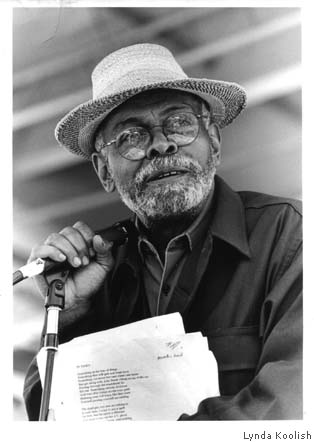
Amira Baraka. Photo by Lynda Koolish.

Obama & The Tragic Errors of The Weimar Republic
By Amiri Baraka

Amiri Baraka, formerly LeRoi Jones, was born in 1934 in Newark, New Jersey. He is the author of over 40 books of essays, poems, drama, and music history and criticism, a poet icon and revolutionary political activist who has recited poetry and lectured on cultural and political issues extensively in the USA, the Caribbean, Africa, and Europe. This article was originally posted on July 16, 2008 on SeeingBlack.com.

The post World War I journey of Germany from an empire, which was overthrown, and then a democratic republic, and finally the overthrow of that republic and the emergence and domination of Hitler’s Nazi fascism, is important for us to understand. Because some of the facts of these years still apply to the contemporary United States.

With the withering Depression that had set in in the late 20’s in addition to Germany’s war losses, when the international stock market collapsed (U.S. Wall St.) in 1929, a worldwide Depression of staggering proportions set in. And it is this Depression and the rise and fall of governments in Germany that set the stage for the final takeover by Hitler and the fascists—and finally the beginning of World War II.

Although McCain’s adviser Gramm says this is a “mental recession,” unless he’s referring to himself and McCain, today’s depression in the U.S. is not just mental. We should also factor in the outright theft of the last two elections, the general public bankruptcy of the Republican party, which has been playing and still is playing a “White card”. (The Democrats have not won the majority of White male voters since John Kennedy!)

There is the spreading foreclosure menace of the subprime (fraud ridden) mortgages, now at 6,000 foreclosures a day, the closing of the huge banking mortgage regime, Bear-Stearns. The Bush cabal has agreed to revalue Bear Stearns stocks so that the historically infamous speculator JPMorgan can get a better payday. No aid for the people losing their homes at terrifying rates. Today the government announced it had a new plan to save more banks. If there’s no recession why the plan to save “unthreatened” banks?

Suffice it to say there is a deepening Depression in the U.S., with the nation going from a surplus at the end of the Clinton regime to today’s deficit, much of it caused by the $10-billion-a-month war in Iraq. Even many straight-up backward Americans are convinced of the bold corruption that is the real cause of the war and spiraling gas prices since it is the oil swindlers who hold state power in the U.S. While they talk bad about the “Arabs,” the Bush group is clearly in bed with the Saudis, Arab Emirates, with Dubai now becoming a financial capital to compete with Wall St. and London.

There is no doubt that U.S. forces are losing in the Middle East, just as they got wasted in Viet Nam. The whole ugly scam of removing oil billions from Iraq ( all those contracts for privatization of Iraqi oil went to the big U.S. oilies) based on the 911 episode, the reality of which is still covered with crude lies. But now at scam’s end, with a raging Depression setting in and a war-incurred deficit climbing into the trillions, the stage is set for stunning rightward surge that will perhaps bring street fighting to the U.S. and a final toppling that will make the current shrinking of the dollar, .60 per Euro, seem mild. China already holds U.S. paper, the U.S. is China’s top debtor. IndyMac Bank has just failed in California.

So this is a time much like that in Germany, during the last phase of the Weimar Democratic Republic. Ostensibly a democratic republic, the Depression caused widespread unemployment and great public unrest. And as the curtain began to rise for fascist takeover, (See Brecht’s Berlin) the country, especially the large cities like Berlin, were inundated with pornography, sex crimes, business and political scandals and street fighting, usually between the rising fascists and the communists.

What brought the democratic era to an end was a split between the communists and the social democrats, i.e., the left and the near left and the liberals, which permitted Hitler’s National Socialists in a coalition with the conservatives and nationalists to win the election, even though the left-center coalition had more voters objectively. It was the split which allowed the right to consolidate power.

Recently in the U.S. presidential campaign we have seen two tendencies, the one to vilify and distort Obama from the right, e.g., the recent New Yorker cover described as “satirical” with Obama as a Muslim, his wife as a machine toting militant with an American flag in the fireplace and Osama bin laden in a portrait of honor on the wall. It is objectively a message from McCain, the U.S. Right and the Israelis.

But as well there is the tendency on the presumed left and the social democrats and people styling themselves “progressives” to attack Obama for moving to the right, thereby disappointing some very vocal would-be Obama voters. One woman publicized prominently in the NY Times said now she “hated him.” But as I have said repeatedly this is an imperialist country, with two imperialist parties and a media controlled directly by the 6/10ths of 1 percent of the people that own the land wealth factories, the means of production.

There is no way Obama is even in the presidential race condemning Israel or embracing Cuba. Not to know this is not to know where you are or where you have been for the last 40 years. But even with this clear motion to the center for the purposes of the general election, McCain is still a more backward and a more dangerous candidate and exactly the kind of right leaning militarist that would fit the paradigm for the weak chancellors during Weimar’s last throes that President Hindenburg removed and then appointed Hitler.

It is this split between the left and near left that is being exploited by the right with war and Depression threatening to dump this whole nation on its head, so that Obama will be defeated, McCain elected and with the McCain opening plummet the country headlong into the far, far right. Bush 2 has already obviously set the stage for this. Those elections were stolen out of desperation. The fact that Gore and Kerry were such weak liberals, tied clearly and obviously to the ruling class of this imperialist state allowed that theft to take place with minimum real struggle.

So that is the real struggle unfolding before us. First, to oppose the empty idealism which allows the elitist base to claim to represent the masses but actually have as little to do with them as possible. Allowing seemingly intelligent people to throw their votes away on McKinney or even the racial chauvinist, Nader, thus formalizing a hole in an actual progressive constituency, which allowed Bush 2 to seize power in 2000.

We must also oppose the absolutising of Obama’s progressive stance and,with that, drawing away from him as he gets closer to the general election and tacks toward the middle. This would be the other aspect of the tragic Weimar breakup of the fragile democratic coalition that caused millions to die in fascist purges, concentration camps, or World War 2.

On the other hand, it should be part of our campaign tasks to create a document of planks of progressive character to submit to Obama and publish and popularize this as well, to exert what pressure we can bring to bear on the campaign and publicly for a reversal of Bush’s neo-fascist creations, war, Depression, unemployment, violation of democratic rights, diplomatic isolation from the rest of the world, a general weakening, morally and politically and economically, of the country.

Source / SeeingBlack.com

Thanks to Carl Davidson / The Rag Blog

Posted in RagBlog | Tagged , , , , , | Leave a comment

BOOKS : ‘The Art of Political Murder’

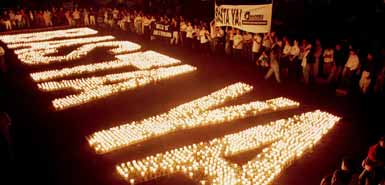
Activist Auxiliary Bishop Juan Girardi Conederal, murdered in April, 1988.

Mourners gather with can candles to mourn the murder of Bishop Juan Girardi: “Enough!”

The Novelist and the Murderers
By Nathaniel Popper

[This article first appeared in the July 7, 2008 edition of The Nation.]

Early last November, the novelist Francisco Goldman was shouldering his way through the Texas leg of a reading tour for his first nonfiction book, The Art of Political Murder. Published by Grove Press in September, the book had received glowing reviews in newspapers and magazines nationwide, and it would soon be included by The New York Times Book Review in its list of the 100 Notable Books of the Year. On Nov. 5 Goldman was relaxing in his hotel before a reading at a Houston Barnes & Noble when his BlackBerry pinged with an e-mail from an innkeeper in the Guatemalan town of Santiago de Atitlán.

One day earlier, Guatemalans had voted in a general election, and the winner of the presidential contest was Álvaro Colom, a self-proclaimed Social Democrat and head of the National Unity of Hope (UNE) Party. Quite unexpectedly, Colom had come from behind in the polls to defeat Otto Pérez Molina, a salt-and-pepper-haired general who had campaigned on the slogan of Mano Dura (Firm Fist), a sturdy platform in a country that was ruled by the military and repressive right-wing parties almost without interruption from 1954 until the late ’90s. As it happens, the election was also the subject of the e-mail Goldman received from the innkeeper, David Glanville: The Art of Political Murder, Glanville wrote, may have been a decisive factor in Pérez Molina’s loss.

Goldman’s book is about neither the election nor the candidates. The Art of Political Murder is an investigation of one of Guatemala’s most notorious and gruesome killings. On a Sunday night in April 1998, Bishop Juan Gerardi had been bludgeoned to death just two days after publishing a report about the Guatemalan military’s responsibility for civilian massacres in the country’s recently concluded civil war. In the midst of investigating the case, Goldman found sources who told him that on the night of the murder, Pérez Molina was hanging out in a convenience store near Gerardi’s church with a few conspirators in Gerardi’s murder. That scrap of information is mentioned–but not heavily scrutinized–by Goldman in his book.

The Art of Political Murder was available only in English, but during the campaign the news it contained slowly spread through Guatemala: in some places disseminated by priests, in other places by UNE officials at election rallies. In Santiago de Atitlán, a small indigenous town on the shores of Guatemala’s most beautiful lake, word had arrived in the form of a pamphlet featuring three photos–two of Gerardi and one of the cover of The Art of Political Murder–and a line from the book, translated into Spanish, about the general’s alleged role in the crime. The pamphlets were handed out to people visiting Santiago’s cemetery on the Day of the Dead, two days before the election. Dolores Ratzan, a local woman who had lived in exile in the United States during much of the civil war, says she saw the pamphlets when she went to the cemetery. What she noticed even more was the discussion they stirred up. “I just heard people talking about it–like, This Pérez Molina, he killed the bishop. That’s what everybody talked about,” she recalled a few months after the election. She says that on election day, “that’s why a lot of people didn’t vote for him, because he was a killer.”

Pérez Molina’s campaign of law and order had played well in Santiago, thanks to a wave of crime and lynchings last year. But as in many areas of Guatemala, the invocation of Goldman’s account of Gerardi’s murder had deep resonance. In 1981, at the height of the country’s civil war, Guatemalan soldiers broke into Santiago’s Catholic church and drove nails through the head of its priest–a transplant from Oklahoma who had been accused of siding too closely with the indigenous people.

Santiago has weathered the varied effects of US involvement in Guatemala. After the CIA-led coup d’état against Col. Jacobo Arbenz in 1954, the US government funded and trained Guatemalan military officers, some of whom went on to serve at a base near Santiago. More recently, Santiago has been the site of American charitable projects. But the unexpected presence of Goldman’s book, not just in Santiago but throughout the country during the 2007 election campaign, represented an inadvertent kind of American involvement in Guatemala. Edgar Gutiérrez, an old colleague of Bishop Gerardi’s and a former foreign minister, calls Guatemala a “kingdom of impunity.” Written to tell one story about that kingdom, The Art of Political Murder has become caught up in another story, one about the kingdom’s possible reformation. More improbable still, the book has injected an element of accountability and consequence into a country where for decades there’s been far too little of either.

During Guatemala’s civil war, 200,000 people were killed–roughly 5 percent of the population at the outbreak of fighting–and nearly all of the dead were from rural indigenous areas. UN-monitored peace accords were signed by the Guatemalan Army and guerrillas in 1996, but since then a virtual narco-state has arisen, created and overseen largely by former military officers. The homicide rate in Guatemala is seven times that of New York City, and it recently surpassed the levels in Colombia and South Africa. The figure is roughly equal to what it was during the civil war–forty-five deaths per 100,000 people. Equally staggering is the fact that the Guatemalan police make arrests in about 5 percent of their homicide cases (in the United States, the figure is 62 percent). During the Colom-Pérez Molina presidential race, nearly sixty people affiliated with the campaigns were murdered, more than twice the number killed during the previous election, in 2003. During a recent stay in Guatemala City, I passed a man who was bleeding from a bullet wound in his abdomen at 1 pm in the middle of downtown. Several firemen, who are responsible for removing dead bodies, were on the scene, but the police were nowhere in sight.

Bishop Gerardi was renowned for defending a group often targeted by brutal political violence–Guatemala’s downtrodden indigenous population. After working as the bishop in the rural province of El Quiché for six years, Gerardi was warned by locals that assassins were on his trail, and so in 1980 he fled to Costa Rica. But people who know him say that his exile never dulled his off-color humor or disdain for the risks involved with his work. After Gerardi returned to Guatemala in 1983, he helped found the human rights project of the Catholic Church, called Oficina de Derechos Humanos del Arzobispado (ODHA). After the 1996 peace accords, ODHA launched an investigation dedicated to providing a thorough accounting of civil war-related crimes, including the massacre of civilians. By 1998 the organization had assembled a four-volume report documenting the toll of the war. Guatemala: Never Again concluded that the military was responsible for 80 percent of the civilian deaths during the civil war. The next year, ODHA’s findings were corroborated by a UN investigation, which attributed 93 percent of the casualties to the military.

Gerardi would not live to see this confirmation of his work. On April 26, 1998, two days after a public presentation of Never Again in Guatemala City’s main cathedral, the bishop was found in a pool of blood in the garage of his parish house, a jagged piece of concrete nearby. The crime occurred a little after 10 pm, and the bishop’s wallet and gold ring were found with his body.

Gerardi’s church, San Sebastián, is a modest, elegant structure within blocks of the National Palace and every major intelligence agency, and initially it appeared that the investigation of the bishop’s murder would, like so many other cases, disappear into the thicket of impunity. The crime scene was a mess (gawkers were allowed on the scene, and some walked through puddles of blood), and the first arrest was a homeless man. The UN verification team stationed in Guatemala after the peace accords quickly raised the possibility of a cover-up and criticized the government prosecutor for withholding documents.

The theory was certainly a plausible one, since at the time only one human rights case against members of the military had gone through the Guatemalan courts, and in that case, when an officer was convicted, he quickly escaped–this after the investigating police officer was murdered in broad daylight. Members of Gerardi’s team at ODHA had worked on that case, and when their boss was killed, the young team of ODHA investigators, which included Edgar Gutiérrez, quickly went to work. While the government prosecutor investigating Gerardi’s murder stumbled, the ODHA team found a taxi driver who had driven past the church on the night of the crime and seen a car with men gathered around it. They traced the car to a mothballed military base. When the information was shared with the government, all public records of the car disappeared. It was the first clear signal in the Gerardi case that, as Goldman writes in his book, “the Army had many chess pieces to play with, and a very large board.”

Born in 1954 to a Guatemalan mother and a Ukrainian-American Jewish father, Goldman has a round head of curly black hair and a ready laugh. He lives in a brownstone in Brooklyn, and when I met him there books and papers were strewn about his one-bedroom apartment. Goldman spent most of his early childhood in Guatemala, and the country is the setting of his first novel, The Long Night of White Chickens, published in 1992. It’s the story of a Guatemalan-American aristocrat from Boston who investigates the mysterious murder of his adoptive Guatemalan sister, who ran an orphanage in her home country. The Art of Political Murder covers similar territory–murder, paranoia, Guatemalan political intrigue–but it reads as though it were written by a different author. The Long Night of White Chickens is filled with florid poetic language that often doubles back on itself, exploring ideas of memory and dislocation. The Art of Political Murder, by contrast, is a study in spare storytelling, with Goldman rarely devoting more than a sentence to set a scene. Goldman is an ebullient, expressive man, but he says he felt the need to restrain himself while telling the Gerardi story in order to write “with the most diligent fidelity to the case itself.”

Goldman began reporting on the Gerardi case a few months after the killing, initially on assignment for The New Yorker. He befriended the young team of ODHA investigators, joining them for long days of sleuthing and equally long nights of drinking. “When Frank wrote this book he was living with us–in all the time that we were suffering,” Mario Domingo, the head of ODHA’s legal team, recalls. As the ODHA team and a new, more ambitious government prosecutor pushed the case forward, Goldman quickly became a part of the story he was telling. When his piece appeared in The New Yorker on March 15, 1999, a small but respected Guatemalan newspaper, El Periódico, translated and printed the article in a special edition, and sent copies to 5,000 churches around the country. Several months later, Goldman showed up at the trial in Guatemala City, which had commenced after Gerardi’s team at ODHA had assembled a case in concert with a new government prosecutor. In the halls of the courthouse, Goldman was menaced by taunts from the most colorful of the defendants, Capt. Byron Lima. During a break in the proceedings, Lima called Goldman a “faggot,” leading to a brief verbal altercation. Soon thereafter, the defense lawyers called for the removal of Goldman from the courtroom–a motion that was rejected.

Other people involved in the case encountered more lethal forms of intimidation. Grenades were thrown into the backyard of a judge overseeing the case; masked men broke into the house of ODHA’s director and assaulted his son and maid. Despite these threats–issued from Guatemala’s kingdom of impunity–after a two-and-a-half-month trial the prosecutors and ODHA won convictions against two military officers, a sergeant and Father Mario Orantes, a priest who lived in the parish house with Gerardi and had colluded to let the killers into the church, according to the sentence. The judges determined that the crime had been planned and executed by the presidential intelligence unit, the Estado Mayor Presidencial (EMP), which had long been a nearly independent unit of terror within the Guatemalan government, answerable only to the president. The court issued a list of thirteen others, including seven military officers, to be investigated further, a probe that continues to this day.

The four convictions did little to close the case. The officers denied any role in the crime and quickly appealed. At the same time, two European journalists, Maite Rico and Bertrand de la Grange, published an article in August 2001 in the Mexican magazine Letras Libres that claimed to contradict the findings of the court. According to the duo, who relied heavily on information provided by members of the military and their attorneys, the military defendants had been innocent and the murder had been committed by renegade military officers in cahoots with the Catholic Church. In 2003, Rico and de la Grange published a longer version of their article as a book, ¿Quién mató al obispo? (Who Killed the Bishop?).

The Rico and de la Grange argument won a wide following in Guatemala. Álvaro Arzú, who had been Guatemala’s president when Gerardi was murdered and has since become the mayor of Guatemala City, handed out ¿Quién mató al obispo? to foreign diplomats stationed in Guatemala. Among the many television networks and newspapers to run laudatory coverage of Rico and de la Grange was El Periódico, which published an excerpt from the book. “Bertrand and Maite are rightist journalists working here in a conservative, Catholic country,” a top editor at the paper, Juan Luis Font, told me. “I think most editors here wanted to believe that they were telling the truth.”

The vituperative atmosphere created by Rico and de la Grange provoked Goldman to expand his article into a book. It also pushed two crucial sources to open up to him: the lead government prosecutor, Leopoldo Zeissig, and Rafael Guillamón, a reticent UN police investigator who had been in charge of a parallel inquiry into the Gerardi case. Guillamón told Goldman that he was “nauseated” by the coverage and showed him all his old notebooks about the case.

Goldman was not alone in pursuing the story that had been laid out by the judges. El Periódico had Claudia Méndez, a young, tenacious reporter, on the beat. Méndez, who had studied at one of Guatemala City’s bilingual schools, was only 23 when the trial started, and she speaks with a mix of humility and confidence about the case. “I was like a child when I started working on this case. It was a real clash–a real wake-up. Like I had thought of my country one way and then, bam, I had to realize it is actually this way.” Méndez used her guile and seeming innocence to engage the defendants in jailhouse interviews that brought them as close as they ever came to admitting their culpability in Gerardi’s murder. But in the end it was Goldman, not Méndez, who wrote the book about the case, and she expresses no unhappiness about that. “Who would have the means to do it here?” she explained to me during a driving tour of the Gerardi crime scene. Even more important than resources, Méndez says, is the fact that only a foreigner would have any credibility with the authorities: “They knew that Frank was a power that they cannot buy and they cannot threaten. It’s someone from the outside.”

In early 2007, as Goldman was putting the finishing touches on The Art of Political Murder, he gave Méndez a version. Soon people in the office of Álvaro Arzú spotted printouts of the galleys on the mayor’s desk. Similar reports came from the bishop’s office. (How those two offices nabbed copies of the galleys remains a mystery.) Goldman had sent the copy to Méndez so that the editors of El Periódico could translate and print an excerpt from the book before its publication. For the editors, it was not hard to see which pages would be the most explosive. About two-thirds of the way into the text, on page 239, Goldman introduces Pérez Molina, describing him only as a “Guatemalan officer.” But this suave political operator would not blend into the seemingly endless cast of characters who people the book. An excerpt featuring the passage about the “Guatemalan officer” appeared in El Periódico on June 10 along with a photo of Pérez Molina.

Read all of this article here. / The Nation /

Thanks to Mercedes Lynn de Uriarte / The Rag Blog

Posted in RagBlog | Tagged , , , , , , | Leave a comment

The Economy : A Throw of the Dice


Here are the odds…
By Roger Baker
/ The Rag Blog / July 21, 2008

This article following these comments is a judgment by Mark Gongloff of the Wall Street Journal about “how bad” the US economy might get.

This is as seen by capitalist expansionists who are mostly blissfully unaware of the pervasive implications of resource depletion, and peak oil. While meanwhile ignoring the slowly worsening but unavoidable impact of climate change on many agricultural commodities necessary to feed the world.

Where are the economic scenarios below in error, IMO?

First of all the odds presented below have no credible basis as anything but unattributed guesses of the writer, devoid of much supporting evidence or numbers. Averaging the opinions of economists and a focus on the short term does not lead to important economic insights.

The recent drop in the price of oil from about $147 to $130, referenced below, appears to be more than anything an indication of the short-term speculation factor affecting oil price. This is the short term psychology change among traders during one week or so, rather than a reflection of long range global supply and demand
trends, which have been raising oil prices fairly steadily for about a decade.

If we look at the “Stagflation” scenario below, there is no discussion of the fact that rising oil demand is unavoidably forcing cost-push inflation into the commodity sector of the US economy while simultaneously deflating the discretionary spending sector. The federal interest rate remedy for the one problem tends to worsen the other.

More money spent on gasoline and the diesel needed to deliver food means less dollars spent at the movies and Starbucks and vacations. The falling profits in the discretionary sector like tourism and housing demand forces federal bank bailouts, due to the many trillions in credit default swaps and derivatives pervading the global economy.

These newly minted Wall Street bailout dollars are needed to inject liquidity and prevent an economic domino collapse effect. But these dollars then tend to gravitate toward the more profitable commodity sector of the economy rather than the depressed sectors like housing, worsening the cost-push inflation.

When commodity price inflation exceeds the US interest rate, the global economy tends to dump and thus devalue dollars, further worsening US inflation, and forcing even more bailouts. This steady increase in fiat currency, its inflationary effect and subsequent devaluation, can trigger a sudden panicky flight from dollars resembling a global bank run.

Let us now focus on the last scenario below, titled “Just Getting By” which is given 2 to 1 odds, This is proposed to be by far the most likely scenario:

…”We can keep muddling along, but we may have to accept more inflation and more weakness and adapt to that,” says Bruce McCain, chief investment strategist at Key Private Bank in Cleveland…

Thus this favored last scenario of price inflation plus a weak economy turns out on close inspection to be nothing more than a relabeled and weaker version of the “Stagflation” scenario above it. But without the numbers or a cause and effect analysis to distinguish the two scenarios.

The missing factor linking all the scenarios is the primacy of world supply and demand for oil. The global economy, structured as we know it, cannot expand without the cheap portable energy that has stimulated global population and economic expansion for most of the last century. When all is said and done, the global economy cannot expand without decades of restructuring to replace cheap oil as a primary dependency factor.

But for this transition to be made assumes that general resource depletion, global warming, and social and political calm will cooperate to allow what is bound to be a painful and slow restructuring process involving a new global energy infrastructure. A transition that is unlikely to be in harmony with the past few decades of rapid growth of the global economy.

The Economy: How Bad Can It Get?
By Mark Gongloff / July 20, 2008

A full year into the miserable journey of the credit crisis, the economy and financial markets have come to a crossroads, beyond which lay several possible destinations, not all of them pleasant.

So far, despite bank losses of some $400 billion, a crumbling housing market and oil prices at $130 a barrel, the economy has managed to avoid a deep recession — at least according to the common definition, which is two quarters of negative gross domestic product growth.

But federal tax-rebate checks have supported consumer spending, which drives 70% of the U.S. economy. That jolt will soon fade, potentially leading to a hangover.

A resilient export sector — driven by a weak dollar that makes U.S. goods cheaper and more competitive overseas — has also kept the economy going and lifted the profits of many multinational corporations. But several big overseas economies are starting to feel the bite of inflation and the troubles in the U.S., and their appetite for American goods might wane.

Meanwhile, major U.S. stock indexes remained near bear-market territory despite a big drop in oil prices that sparked an impressive three-day rally. The Dow Jones Industrial Average rose 396 points, ending the week up 3.6%. The Nasdaq and S&P 500 also rallied last week.

As heartening as last week’s turnabout in oil prices was, however, the economy is still a long way from healthy. And there could be a lot more stock-market pain to come.

Where do we go from here? Here are the main scenarios most economists and analysts are considering.

Stagflation

Remember “That ’70s Show”? We could be in for a rerun. Oil and other commodity prices rise relentlessly, spurring runaway inflation not seen since the 1970s. All the while, growth stays weak, a double dose of misery that crushes corporate profits and stock-market returns. There’s a word for this: stagflation.

Fortunately, the odds of this history repeating itself are slim. Inflation readings are nowhere near as high as they were in the 1970s and early 1980s, when the year-over-year percent change in the consumer price index soared as high as 14.8% at one point; it was up 5% in June.

And a key driver of that era’s hyperinflation is missing: In those days, strong labor unions were able to wrest wage increases at every tremor of the inflation rate. Companies passed their higher labor and energy costs to consumers in the form of higher prices, which encouraged still more wage increases, in a grim dance economists call a “wage-price spiral.”

Today workers have much less bargaining power, and wages haven’t kept up with inflation. That hurts consumers and the economy, but it will at least keep inflation in check.

One wild card: If the U.S. dollar continues to weaken, then that could keep inflation going despite the lack of a wage-price spiral. “This would be checkmate for the U.S. economy, turning a relatively mild recession into a severe one,” Paul Kasriel, chief economist at Northern Trust, told clients recently.
Odds: 20 to 1 against.

‘Lost Decade’

One word — Japan. If stagflation is the world ending in fire, then this scenario is Apocalypse by ice. Some observers worry the U.S. is following a path Japan blazed in the 1980s and 1990s. Like the U.S., Japan had stock and real-estate bubbles fueled by easy credit.

The aftermath for Japan was a “lost decade” for its economy and stock market, an especially terrifying time for policy makers because there seemed to be little they could do to fix it. Low interest rates were useless because nobody wanted to borrow.
The likelihood of this scenario is not high, either. Unlike Japanese officials, who waited for years to try to stimulate Japan’s economy, the Federal Reserve, the Treasury Department and Congress have responded quickly with rate cuts and stimulus packages and won’t hesitate to break out more, if necessary.

What’s more, Japan tried to keep its troubled banks alive, creating “zombie” institutions that only extended the pain of the financial crisis. U.S. officials are well aware of this history and will likely avoid it — though some analysts warn they’ve merely kicked problems down the road by preventing the collapses of Bear Stearns, Fannie Mae and Freddie Mac.

Odds: 15 to 1 against.

Next Year, the Turnaround

Like Chicago Cubs fans always looking to the next season, there are analysts who have been calling for a turnaround for months despite evidence to the contrary, yelling their hearts out for what so far has been a losing cause.

According to their theory, this has all been a fever dream, a midcycle slowdown like the one the economy suffered in 1998, when stocks briefly swooned, but the technology bubble quickly went right back to inflating. This is the same crowd who dismissed the collapse of the housing market because it’s just a small part of gross domestic product and who said the subprime mortgage meltdown would be no big deal.

And now, $400 billion in losses and one bear market later, they’re still calling for the rosy outcome, and there’s a chance they might be right, given the fiscal and monetary stimulus flowing through the system. Perhaps banks, emboldened by a wide government safety net, will start lending again to consumers and businesses eager to borrow and get back to the high life. This, along with the still-booming export sector, could cause the economy and stocks to rocket higher once again.

Unfortunately, this also seems unlikely. “This financial crisis is the worst since the Great Depression,” points out New York University economist Nouriel Roubini. “The recession is unavoidable at this point.”

One wild card here is the U.S. consumer, the lifeblood of the economy. Though their debts are growing and their inflation-adjusted wages are not, analysts have unsuccessfully predicted a slowdown in their spending for years. A dramatic plunge in oil prices could give them extra incentive to spend.

Odds: 10 to 1 against.

Just Getting By

If you’ve enjoyed the economy for the past year, then you’ll love this, because it involves more of the same. The trouble is that most people haven’t enjoyed it, but it’s the most likely outcome, according to many economists.

In this scenario, weaker global growth cools inflation, but not by much, as China, India and other emerging economies stay hungry for oil and other commodities.
The U.S. economy improves little and perhaps slides into a mild recession, as the repercussions of the credit crunch, housing-market collapse and high oil prices work their way slowly through the system.

Banks, stung by hundreds of billions of dollars in losses and under pressure to rebuild their coffers, keep a tight lid on borrowing. Businesses, squeezed by higher costs and lower sales, lay off more workers, raising the unemployment rate.
“We can keep muddling along, but we may have to accept more inflation and more weakness and adapt to that,” says Bruce McCain, chief investment strategist at Key Private Bank in Cleveland.

Odds: 2 to 1 for.

Source / Wall Street Journal

The Rag Blog

Posted in Rag Bloggers | Tagged , , , , | Leave a comment

The Accidental Tourist

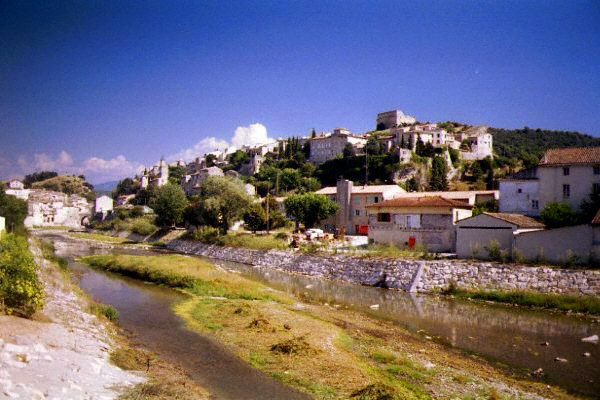
Vaison-la-Romaine in Southern France.

A tale of healing in southern France
By Mary O’Grady / The Rag Blog / July 21, 2008

In Vaison-la-Romaine in Southern France where my husband Mack and I were staying with our old friend Massimo Mauro, there is one supermarket with a perpetually congested parking lot, and parking is an international competition, what with all the tourists from all over Europe. Massimo and Mack and I went there almost every day; the fresh bread and fruit and vegetables and meat were excellent.

(Have you heard about the locavore movement, the latest big thing among conscious eaters in the US? People are pledging to eat as much as possible foods produced within some small radius of where they live, say 80 or 100 miles. The locavore movement is old news in France. I was impressed that even at the supermarket so much of the fruit, delectable apricots and cherries for example, and the meat came from the surrounding region.)

Well, on Wednesday the 23rd at mid-morning, Massimo was heading his small BMW sedan into a parking space when a woman in the next slot started backing out without looking. Massimo reacted instantly, backing his left front tire straight onto the front third of my right foot. (That car was way heavier than it looked, by the way.)

After I screamed at the top of my lungs, my further response was more articulate but loud and profane. Massimo got his tire off my foot, which now sported an obvious tire track and a torn toenail which began to bleed profusely.

My screams attracted a small knot of French matrons who pointed at my foot and made idiotic suggestions, e.g.,“Vous devez aller au pharmacien. (“You should go to a pharmacist.”) French pharmacists are versatile and extremely well-trained but I doubted one of them would be up to this particular task. I was grateful when Mack and Massimo, now white as a sheet, agreed with me that we should find an emergency room.

Mack put a plasticized shopping bag on the back seat to protect the upholstery and took over driving. The woman who had been backing out of the parking space said she would lead us to the local hospital, a modern structure which was somehow tucked away among the narrow streets and ivy-covered stone houses of the old part of the town.

At the Urgences door of the hospital, Massimo clambered out of the car and went to tell somebody what had happened. Mack and I waited. I was all for stumping on in, myself, but Massimo wanted me to wait for a wheelchair that I did not strictly need.

After several minutes, a sprightly little nurse of about sixty emerged with a wheelchair. She wheeled me into a two-bed emergency room bay and got me up on a gurney. The other bed was occupied by a very elderly, very ill man in obvious respiratory distress. She drew a curtain between his bed and my gurney.

The nurse occupied herself with cleaning the rubber off my foot. The little toenail was hanging by a skin tag but the bleeding had stopped. Massimo, meanwhile, had achieved a rare degree of emotional shock, poor man. I was extremely relieved when the nurse came up with a chair for him.

The paperwork came a bit later, and proved minimal. The nurse wanted a peek at my passport; she was very amused at the Xeroxed copy of Mack’s and my rather grand-looking marriage license which I always carry in it because my passport lists “O’Grady” as my surname. She asked me to write my name and address and telephone number on a yellow form; I could have put down “555 Minnie Mouse Street, Anytown, Texas, USA,” and nobody would have been the wiser. There was no breath expended on payment.

A trim, blonde female doctor in early middle age then came in and examined my foot. She and the nurse apologized that there would be about a thirty-minute wait for x-rays, which proved to be true. Massimo and Mack were told that they would absolutely not be allowed to accompany me.

Mack and Massimo and I passed the time in idle chit-chat and much reassurance for Massimo– it was really just a freak accident, but Massimo was simply aghast. Meanwhile, the moribund man in the next bay rasped away as his heart monitor beeped steadily. At length, the little nurse put me back in a wheelchair and wheeled me to an elevator, telling me meanwhile that the following month she was going on holiday to California. “Ah, oui?” I replied.

“Oui, a Phoenix,” she said. I did not feel quite up to a geography lesson, but I wondered about her travel agent.

In the radiology department upstairs, I was swiftly taken in hand by a pretty young female technician who took two shots of my foot. After several minutes, I was wheeled out of the x-ray room to a waiting room with a beautiful view of an ancient honey-colored stone church spire topped with an interesting wrought-iron belfry.

The little nurse from the emergency department emerged from the elevator after several minutes and collected my x-rays in their big Manila envelope, and me. Downstairs, the doctor said that no bones were broken, to expressions of happy relief. The nurse bandaged my toe and instructed me not to get the bandage wet, and the doctor said I should come back in two days to have the bandage changed. She also gave me a prescription for a mild painkiller.

At the pharmacy across from the supermarket, 32 painkiller tablets came to about $8 US. After filling the prescription, Mack parked up at the supermarket, thankfully without incident, and we went in and bought things, including a bottle of alleged tequila, some Grand Marnier, and the entire stock of Mexican limes, so that Mack could make some margaritas to soothe Massimo’s shattered nerves.

Back at the house, I repaired to our upstairs bedroom and propped up my foot and tuned in to the BBC World Service on my teensy radio. Later on, we all had a light supper with margaritas for Mack and Massimo and just a few sips of an excellent Sancerre for me, considering the painkillers I had taken. Mack and Massimo then had a very “guy” evening, watching the German national soccer team playing Spain, if memory serves, and drinking more margaritas. I could hear their hoots and groans from the bed upstairs.

On the Friday morning my toe was re-bandaged by another nurse, a slim young woman who told me that henceforth I should feel free to bathe as long as I put a dry bandage on the toe afterward. (Oh, joy! I was very tired of sponging myself and I feared that I was beginning to smell stereotypically French.) She also said that I should visit the accounts department and pay.

Massimo insisted on dealing with the accounts department. The total hospital charge came to about $80 US. How much do you think this all would have cost a hapless, uninsured foreigner in an American small-town emergency room?

Copyright Mary O’Grady 2008

The Rag Blog

Posted in Rag Bloggers | Tagged , , | Leave a comment

See the Superhero Inside Yourself


NetRoots Nation, Code Pink and why we do what we do
By The Voice / The Rag Blog / July 21, 2008

Early Saturday morning, 19 July 2008,five super sheroes and a shackled Bush in striped prison garb gathered outside a restaurant in Austin, Texas and put together a loose strategy of street theater and flyering at the Netroots Nation conference down the street. We strode in confidently and gave flyers to the largely sympathetic crowd waiting to be allowed into the auditorium where Speaker of the House Nancy Pelosi was to speak.

Security was not as tight as we had feared. We strode around easily and quickly exhausted our supply of flyers. We did a little theater chasing Bush the war criminal around the lobby. Then the organizers took us aside to be assured we wouldn’t disrupt things once inside. Not realizing that not all of us had passes, this gave us a de facto invitation to enter the hall and when the doors opened, we did. We strode through the crowd shouting slogans such as “Our powers are your powers. Use them.” In response one woman said to me sarcastically, “What do you think we’re going to do, sit quietly by?” Well, indeed, and really to my surprise, that is what I saw unfold.

The control of dissent was masterfully orchestrated, really. First, all questions were taken through a website where anyone could post a question. On the days leading up to the talk, users voted on the “best” question. The NetRoots moderators then would ask these hard-hitting questions. So far so good, right? Well, in theory, yes. Some of the authors of the chosen questions were even there to ask them in person. However, there was no follow up question, and, certainly, no interrupting the prestigious Speaker who, in response to a question about FCC regulations, I think it was, took us back to the days of Lewis and Clark! No one called her on the carpet for evading the questions. People clapped when she referred to change coming in 107 days. She’s been Speaker for two years, people! I really wanted to shout, to rant…at the liberal –or are they supposed to be left of liberal? – bloggers in the audience. Then, and here comes the coup de grace, the rumored secret guest makes his entrance: none-other-than Al Gore. Phew! Pelosi is off the hook. No more questions. Gore has a prepared speech and gets 3 of the 4 allowed and controlled questions after it. (Though there were apparently more after we left.)


Through most of the proceedings we Sheroes, with Bush in tow, stood silently at the back aisle in the auditorium. We held peace signs aloft and some strolled around the room, keeping security on their toes. As Pelosi began on the last question – though, again, she not-so-deftly avoided answering it – we began to stroll through the hall and began shouting for the bloggers to make her be accountable and call her on her lies. Then, we walked on out, security trailing after.

It is actions like these and more confrontational ones that bring questions from within the movement as well as from others of “Why be disrespectful?” “Why disrupt?” “Aren’t we just alienating people who would otherwise be our friends?” I have contemplated the effectiveness of our actions frequently and Cintra Wilson recently wrote a piece about Code Pink tactics which was posted on Salon.com. My experience at NetRoots convinced me of the need for the actions and here’s why.

Many of the conference attendees gave us the thumbs up as they passed us. One woman early in Pelosi’s talk urged us to “Make some noise…” though making every effort to be indiscrete herself. As I later read the bloggers’ chats taking place during the event on the Daily Kos and Netroots Nation sites I was amazed to see how many were as disgusted with her responses as we were and there were some comments about wishing we would do something and they were glad we were there. You certainly wouldn’t know it standing in the hall, watching the respectful silence as she droned on, and enthusiastic applause as she spouted liberal truisms as well as lies. Here’s the thing, it was their conference! This was a largely sympathetic crowd and we were mindful of not alienating our allies. This was their conference to disrupt. It was their job as independent media to demand real and thoughtful answers of Pelosi and not demagoguery. And to expect the organizers to focus less on control and more on facilitating true dialogue.

I think of our work this way: according to the diffusion of innovations theory and Malcolm Gladwell’s the Tipping Point, (please forgive my gross simplification here) you have to have a critical mass of adopters of a thought or behavior before mainstream acceptance of it. Do some of our allies cringe at CodePink tactics? Sure, but, believe me, Pelosi isn’t refusing to initiate the impeachment process just to spite Code Pink. By being among the many groups that keep antiwar sentiment in the news, CP provides pressure on public opinion towards

• ending the war,
• bringing the troops home,
• impeachment, and, goddess forgive,
• keeping our troops and Israel’s bombs out of Iran.

If the anti-war movement were purely a fringe movement, we could be said to be ineffective, but “fringe” tactics on an issue that at least two-thirds of Americans support keeps the ideas out there and encourages people to use more mainstream strategies such as letter-writing, signing a petition, calling a representative or making a donation to a citizen lobbying organization, for example. That is, perhaps people will make the same point in the best way they know how and feel comfortable.

Perhaps this morning, in this we failed: Our signs should have/could have been more specific if they couldn’t hear our words. So, if you were there and didn’t get it, and I’m not being facetious here:

We are the Code Pink Super Sheroes. Our powers are: Truth, Justice, Peace, Reason, Observation, Organizing, Love and more. And these, indeed, are everyone’s powers. We want everyone to see the superhero inside them and use their powers.

You can do it in costume if you want or from your computer as many of the NetRoots Nation attendees do, but don’t rag on us for calling for accountability among our elected officials and the media, including independent media. If you wanted Pelosi to be accountable and answer the questions and know that you wanted a real answer, you could have stood with us. Can you imagine the effect if even a third of the room had gotten up and stood silently with us? Blogging is great and necessary, an important tool in the political discourse, but it is not enough, just as putting on a pink dress and gold mask isn’t going to change the world today. It takes both of us and all of us and action beyond these.

Okay, now I’ve done what you do (though it’s taken me much longer than you no doubt), maybe you can do a little of what I do toward the same end. You don’t have to wear a tiara when you do, but you might have more fun if you do!

[Disclaimer: These opinions are mine and I don’t speak for Code Pink.]

Photo credits: Anne Elizabeth Moore, 2008

Source / Peaceably

The Rag Blog

Posted in Rag Bloggers | Tagged , | Leave a comment

Speaking the Truth About Iraq Ellicits Punishment

Army court-martials resister for blowing whistle on ‘bait-and-kill’
By Dee Knight / July 20, 2008

Private First Class James Burmeister faces a Special Court Martial at Fort Knox on July 16. The charges are AWOL and desertion. He returned to Fort Knox voluntarily in March, after living 10 months in Canada with his spouse and infant child. He refused redeployment to Iraq while on leave in May 2007.

In most such cases at Fort Knox, the Army has in recent years quietly dismissed the resister with a less than honorable discharge “for the good of the military.” This time it’s different. The brass “offered” Burmeister a year in military prison and a dishonorable discharge if he agreed to plead guilty.

Burmeister refused the offer. His father, Erich, says the Army is making an example of James for denouncing a secret “bait-and-switch” program he was forced to participate in while in Iraq. In media interviews last year in Canada, James described the program as a war crime he was forced to commit. Shortly afterward, the program’s details came out in the Washington Post.

“Baiting is putting an object out there that we know they will use, with the intention of destroying the enemy,” the Post quoted Capt. Matthew Didier, leader of an elite sniper scout platoon. “We would put an item out there and watch it. If someone found the item, picked it up and attempted to leave with the item, we would engage the individual.”

The Post reported that “Eugene Fidell, president of the National Institute of Military Justice, said such a baiting program … raises troubling possibilities, such as what happens when civilians pick up the items. … ‘You might as well ask every Iraqi to walk around with a target on his back,’ Fidell said.” (Sept. 24, 2007)

James had asked to be classified as a conscientious objector following his training in Germany, but his request was ignored by his commander. Instead, he became a machine gunner. “Our unit’s job seemed to be more about targeting a largely innocent civilian population or deliberately attracting confrontation,” he wrote in his deposition seeking asylum in Canada. “These citizens were almost always unarmed. In some cases the Iraqi victims looked to me like they were children.” (Eugene Weekly, May 22)

In Iraq, Burmeister had been knocked unconscious and his face filled with shrapnel when his Humvee was hit by a roadside bomb. The shrapnel wounds left him with a traumatic brain injury, and he suffers from severe Post-Traumatic Stress Disorder. His parents insist that he urgently needs medical and psychological help, not jail time.

His parents have waged an unceasing struggle for the Army to release him. They called on their representative, Peter DeFazio, to launch a congressional inquiry into James’s case, but have so far heard nothing. James’ mother, Helen Burmeister, flew to Fort Knox in June, with help from anti-war ex-Colonel Ann Wright. Helen spoke directly to the base commander there, demanding that her son be discharged in lieu of a court martial. She then joined supporters from Veterans for Peace and Vietnam Vets Against the War demonstrating outside.

On July 8 the Army invited Helen to attend her son’s court martial on July 16. This time both she and her husband Erich are going. They’re determined to keep James out of jail. “I bought a one-way ticket,” Erich told Workers World. “I’m not leaving without my son. If I have to sit outside the base and wait for him, I’ll do it. Even if I have to go on a hunger strike, that’s what I’ll do. My son does not deserve another day in jail.”

In an interview with Courage to Resist, Erich said: “[James] struggles with PTSD, yet he is quartered within earshot of the shooting range and tank training area, daily hearing the gunfire and explosions. He has been prescribed a dangerous cocktail of anti-psychotic drugs and sleep aids by Army doctors, while the command decides if they want to send him to prison, as a coward, a soldier who faced death, and followed orders to ‘shoot to kill.’ The cowards—George Bush and Dick Cheney, those in Congress and the generals with the blood on their hands—why are they the punishers instead of the punished?” (couragetoresist.org, May 12)

Supporters can contact the Fort Knox post commander, General Campbell, to demand a speedy discharge and no further punishment for James. Send email to knox.pao@conus.army.mil, or call the Fort Knox public affairs office at 502-624-7451. Ask that they discharge PFC James Burmeister now so that he can get the help that he needs.

Articles copyright 1995-2008 Workers World.

Source / Information Clearing House

The Rag Blog

Posted in RagBlog | Tagged , , | Leave a comment

Racial Brutality Persists in Amerikkkan Police State


Taser death ignites racial tensions
By Howard Witt / July 19, 2008

Not far from Jena, La., suspicions of a cover-up mount

WINNFIELD, La. — At 1:28 p.m. last Jan. 17, Baron “Scooter” Pikes was a healthy 21-year-old man. By 2:07 p.m., he was dead.

What happened in the 39 minutes in between — during which Pikes was handcuffed by local police and shocked nine times with a Taser, while reportedly pleading for mercy —is now spawning fears of a political coverup in this backwoods Louisiana lumber town infamous for backroom dealings.

Even more ominously, because Pikes was black and the officer who repeatedly Tasered him is white, racial tensions over the case are mounting in a place that’s just 40 miles from Jena, La.—site of the racially explosive prosecution of six black teenagers charged with beating a white youth that last year triggered one of the largest American civil rights demonstrations in decades. And in a bizarre coincidence, Pikes turns out to have been a first cousin of Mychal Bell, the lead defendant in the Jena 6 case.

No novelist could have invented Winnfield, a place so steeped in corruption that they built a local museum to try to sanitize it all.

Here in the birthplace of two of Louisiana’s most colorful and notorious governors — Huey and Earl Long—the police chief committed suicide three years ago after losing a close election marred by allegations of fraud and vote-buying.

Four months later, the district attorney killed himself after allegedly skimming $200,000 from his office budget and extorting payments from criminal defendants to make their cases go away.

The current police chief is a convicted drug offender who got a pardon from Edwin Edwards, the former Louisiana governor who is serving time in federal prison for corruption convictions.

All of that tangled history is now wrapped up in the Pikes case, because Scott Nugent, the officer who Tasered him, is the well-connected son of the former police chief who killed himself—and the protege of the current chief, who hired him onto the force.

“A lot happens in this town, and it just gets swept under the rug,” said Kayshon Collins, Pikes’ stepmother, who has participated in several local protests over the case. “What the police did to Scooter just isn’t right. They would never have Tasered a white kid like that.”

The official police version of what happened to Pikes on that brisk January afternoon reads like a sad but familiar story in Winnfield’s local newspaper.

Nugent spotted Pikes walking along the street and attempted to arrest him on an outstanding warrant for drug possession, according to Police Chief Johnny Ray Carpenter. Pikes took off running, but another officer cornered him outside a nearby grocery store. Pikes resisted arrest and Nugent subdued him with a shock from a Taser.

Then on the way to the police station, Carpenter told the newspaper, Pikes fell ill and told the officers he suffered from asthma and was high on crack cocaine and PCP. The officers called for an ambulance, but Pikes later died at the hospital.

Six months later, the Winnfield police are standing by that story. Meanwhile, the Louisiana State Police are investigating the case, and no charges have been filed against Nugent or two other Winnfield police officers who assisted him in arresting Pikes, although the City Council did decide to fire Nugent from the force in May.

Winn Parish District Atty. Chris Nevils says he expects to present the case to a grand jury after he receives the results of the state police investigation.

Evidence contradicts report

But there is already abundant evidence contradicting the official police version of the incident.

An autopsy determined there were no drugs in Pikes’ system and that he did not have asthma, according to Dr. Randolph Williams, the Winn Parish coroner.

Moreover, Pikes did not resist arrest, and he was handcuffed while lying on the ground, according to Nugent’s police report of the incident. It was only after Pikes refused Nugent’s command to stand up that the officer applied the first Taser shock in the middle of his back, Nugent wrote.

Several more Taser shocks followed quickly, Nugent stated, because Pikes kept falling down and refusing to get back up. Grocery shoppers who witnessed the incident later told Pikes’ family that he had pleaded with Nugent: “Please, you all got me. Please don’t Tase me again.”

Williams said police records showed Nugent administered nine Taser shocks to Pikes over a 14-minute period. The last two jolts, delivered as police pulled Pikes from a patrol car at the police station, elicited no reaction because the suspect was unconscious, Williams said.

After consulting about the case with Dr. Michael Baden, a nationally prominent forensic pathologist, Williams ruled last month that Pikes’ death was a homicide. On the death certificate, he listed the cause of death as “cardiac arrest following nine 50,000-volt electroshock applications from a conductive electrical weapon.”

“God did not just call this young man home,” said Williams, who has served as parish coroner for the past 33 years. “If somebody can tell me anything else that killed this otherwise perfectly healthy young man … I’d like to know it.”

Williams is no stranger to controversy in Winnfield. Back in 2004, his garage was firebombed, and he says he’s been shot at 19 times by people upset with the independence of his investigations. He wears a gun holstered at his waist.

“This case may be the most unnecessary death I have ever had to investigate,” Williams said. “[Pikes] put up no fuss, no fighting, no physical aggression. … He just didn’t respond quickly enough to the officer’s commands.”

Nugent, 21, declined to be interviewed for this story. But his attorney, Phillip Terrell, said that Nugent acted according to his training—an opinion seconded by police spokesman Lt. Charles Curry.

Taser safety guidelines

Yet the official Winnfield Police Department Taser policy appears to prohibit the weapon’s use against a non-violent, handcuffed suspect.

“The Taser shall only be deployed in circumstances where it is deemed reasonably necessary to control a dangerous or violent subject,” the policy states. It also requires that a suspect who has been Tasered should immediately be checked out at a hospital.

What’s more, safety guidelines issued by Taser International Inc., the manufacturer of the device that is now used by more than 12,700 law-enforcement and military agencies worldwide, warn officers to “minimize repeated, continuous, and/or simultaneous exposures.”

Company officials, citing dozens of medical studies, insist Tasers are safe when used properly. But few of those studies examined the effect of multiple Taser applications over a short period of time. The U.S. Department of Justice, in a study released in June, concluded that “the medical risks of repeated or continuous [Taser] exposure are unknown.”

In less than two years on Winnfield’s 20-officer police force, police records show, Nugent ranked as the department’s most aggressive Taser user. Among the recipients were a 15-year-old African-American runaway who was not charged with any crime and Pikes’ father, currently serving a prison sentence for a drug offense, who was Tasered by Nugent last year, according to Kayshon Collins.

Click here for the Tribune graphics.

Source / Chicago Tribune

The Rag Blog

Posted in RagBlog | Tagged , | Leave a comment

Expanding on Our Humanness and Sacredness


You Say You Want a Revolution?
by Olga Bonfiglio

Detroit, the once-proud capital of industrialization is now the paragon of de-industrialization and urban decay.

General Motors’ July 15 announcement that it will cut white-collar employment costs by 20 percent is just one more nail in the industrial coffin.

Actually, this job-cutting phenomenon isn’t new. It’s been going on since the 1960s when the car companies began automating blue-collar assembly line jobs. Since the 1980s they have been steadily chipping away at the white-collar jobs by offering middle managers early retirement buy-outs.

This is the next American revolution, said Dr. Grace Lee Boggs, 93, a long-time Detroit activist and a Bryn Mawr-educated philosopher.

“We are at a stage in human history that is as monumental as changing from a hunter/gatherer society to an agricultural society and from an agricultural society to and industrial society. Where we’re headed now will be different because we have exhausted planetary space and human space for us to continue to look at things through the Cartesian measurement of material things.”

In other words, a new epoch is emerging that emphasizes relationships and communities more than the accumulation of things — and the counting of profits.

A trip to Greenfield Village and the Henry Ford Museum in Dearborn, a mere 30 minutes from downtown Detroit, illustrates how the nineteenth century Industrial Revolution grew into the twentieth century consumerist society, which was plush with inventions and conveniences that raised the living standards of middle class Americans. People could afford these products because so many of them left their farms and took higher-paying factory jobs in the cities. However, those good wages came at a price: people became mindless cogs in a giant machine, as Charlie Chaplin depicted in the film, “Modern Times.”

Industrialization was a far cry from the first American Revolution of 1776, which was about people giving of themselves for the larger community, said Grace. That sentiment yielded to a European colonial mentality that justified taking natural resources from Africa, Asia and Latin America in order to manufacture products and sell them at huge profits.

“We need to face the way we used the world for our gains, pleasures, satisfactions,” said Grace. “This is the way we evolve to a higher stage of humanity. And unless we want to live in terror for the rest of our lives, we need to change our view about acquiring things.”

The industrial society also skirted social justice concerns by focusing on jobs and paychecks as a means of keeping the economy going and the people happy. It didn’t face the fact that the workers were demeaned and deskilled or that some of the products they made (like military equipment) or some of the processes they used (which involved dangerous chemicals) could be harmful.

Actually, people have only had “jobs” for the past 100 years. These jobs had nothing to do with being productive, making products essential for living or deriving personal growth or the enjoyment of life. Jobs led people to believe that anything they did for pay was good — no matter how destructive it was to the person, the community or the environment.

Now, in the twenty-first century after hundreds of thousands of jobs have been moved offshore and collapsed many local economies, Grace believes that the way has been cleared for the next American revolution, especially since a number of other factors make the need for change both obvious and necessary:

* Occupation of Iraq;

* Environmental degradation, species extinction and global warming;

* Polarization of the rich and poor in the United States and in the global North and South;

* Economic instability with trillions of dollars of debt, housing foreclosures and the loss of local small businesses and farms.

She said that the turning point occurred in 1999 when protesters’ demonstrations effectively closed the World Trade Organization (WTO) meeting held in Seattle. A worldwide movement was kicked off to challenge the rapacious global economy that was shifting the labor market to the lowest bidder in a kind of race to the bottom.

“We usually think of revolution as violence,” said Grace. “However, revolution is more about envisioning what is possible when it appears that things are changing.” She believes that Detroit, in particular, is fertile ground for this next revolution because it is such a devastated city.

Detroit has 70,000 vacant lots where neighborhoods and commercial properties once stood. And although the city looks like it has been bombed, Grace sees a silver lining: the city no longer has to adhere to the usual capitalist mantra of growth and expansion because it is absolutely clear that the industrial system is finished. This fact allows citizens to respond by starting something new all over again.

Grace and her husband, Jimmy Boggs (now deceased), a 30-year Chrysler autoworker, and a host of their friends began articulating the next revolution in the 1980s. Their work eventually planted the seeds for “Detroit Summer” in 1992 where young and old would re-generate their neighborhoods by developing community gardens and producing public works of art.

This effort further blossomed into forming a local agricultural network that is now impacting the city’s food system by growing thousands of pounds of fresh, nutritious produce through organic agriculture techniques, finding alternative uses of blighted spaces, creating income generating activities, and diversifying crops and products for market.

Gardens are also affecting larger issues like reducing crime, cleaning up trash-strewn lots, connecting people to nature, nurturing leadership in citizens young and old and improving property values. What’s more, gardens have rekindled people’s hope in the future, a sentiment missing in Detroit since the “rebellion” of 1967.

This revolution urges citizens not to stand around and wait for leaders to initiate needed changes. Instead, individuals are learning that they can enlist others to help them rebuild their communities. Interestingly, it’s the young who are especially stepping up to this challenge through local service programs, college projects, and the creation of small businesses and organizations.

“What we’re witnessing is a national government that is incapable of solving the questions of our society and our world because politicians are so subject to lobbyists and corporations that fund their campaigns, that they can’t do what needs to be done,” said Grace.

She cited Paul Hawken’s book, “Blessed Unrest,” which discusses how small groups all over the world are rebuilding their communities from the ground up and changing the world because people are connecting to one another.

“We have the opportunity to take a great leap forward in these very challenging times,” said Grace. “We need to change our institutions and ourselves. We need to seize opportunities. We need to launch our imaginations beyond the thinking of the past. We need to discern who we are and expand on our humanness and sacredness. That’s how we change the world, which happens because WE will be the change.”

[Olga Bonfiglio, who grew up in Downriver Detroit and graduated from Wayne State University in Detroit, is now a professor at Kalamazoo College where she teaches a class in urban revitalization. Her website is http://www.olgabonfiglio.com/ and her e-mail address is olgabonfiglio@yahoo.com.]

Source / Common Dreams

The Rag Blog

Posted in RagBlog | Tagged , , | Leave a comment

Afghanistan: It’s a Regional Conflict


Poorly directed aid increases Afghanistan’s woes
Editorial, The Observer
Sunday July 20, 2008

It would be hard to deny the evidence that Afghanistan is at a crossroads as Democratic nominee Barack Obama yesterday met the country’s President Hamid Karzai. Despite the claims by some British officers that the Taliban is being tactically routed, no one seems to have told the Islamist insurgents. Opium production in the areas under their control – and that of other warlords – has reached new records this year. Corruption and criminality, linked often to the very heart of government, is endemic. Despite $15bn in aid that has been disbursed, Afghanistan remains mired in pervasive poverty with unemployment standing at more than 40 per cent. The country’s position as one of the world’s poorest has barely shifted since 2001.

Confronted with these multiple failures, the temptation, voiced yesterday by Obama, and by his Republican opponent John McCain already, is to throw more military forces at the problem in a replication of the Iraq ‘surge’. A parallel attraction, encouraged by Karzai, is to insist that the international community provide ever more money in the hope that some of the billions will stick. But in a country beset by rapidly increasing pessimism over the ability of the international community finally to bring to an end Afghanistan’s 30-year cycle of poverty and violence, what is needed is a large-scale rethinking of what we are doing in Afghanistan, not more violence and more largesse.

The reality, despite the claims of Nato and Western diplomats, is that the war is far from being won. For many, it is becoming clear that it cannot be won, framed in military terms. Nor can it be won in terms of the present political settlement, largely imposed on Afghanistan, which has accepted a re-emergence of war-lordism, cronyism and the general collapse of legitimacy and the rule of law in exchange for the impression of a ‘stable’ central government, albeit one which holds little sway outside of Kabul. The tensions thus created have encouraged a return to a state of widening conflict.

There have been some positive steps since the fall of the Taliban regime. Millions of children are in education in a country with a long history of high levels of illiteracy, particularly among women. A vibrant media, although under threat from many sides, also exist. Improvements have been made in the provision of healthcare. But this is not enough to persuade Afghans that much is getting better when they are confronted daily by criminality, violence, a predatory police force and an ill-educated and corrupted civil service.

In Afghanistan, the real risk is that more is less. The danger of sending ever more troops is that the civilian casualties that will follow in the intensifying conflict will push more Afghans towards the Taliban in a country with a history of fiercely asserting its independence. The hazard of throwing more money at the problem is that without a tighter focus to that spending, Afghans see the increased aid budget as an opportunity for a small elite of Afghans and a small army of international contractors and aid workers to enrich themselves still further. A further consequence is that, because it lacks a professional civil service to support the people, the aid community has shouldered the burden, inadvertently undermining still further the development of effective local services.

The lessons of Afghanistan, as Rory Stewart, a former British diplomat and Afghan expert now running an aid organisation in Kabul insisted last week, points to a more tightly targeted approach, concentrating aid efforts on areas of the country where visible improvements are viable, as a promise of what is possible elsewhere. Some of the most successful schemes have been small-scale: micro-finance projects from Herat to Kabul and Mazar-i-Sharif have provided the tools, via education and small loans, to get people working, the greatest priority being on rural rehabilitation.

More widely, there needs to be acceptance that this is not a local conflict but a regional one. Pakistan’s failure to tackle the Taliban’s safe havens in the tribally administered areas is stoking Afghanistan’s woes. Finally, there needs to be an end to the cosy client relationship with Karzai, who has yet to show himself a capable leader, and a retreat from the West’s view that he is the country’s only possible saviour.

Source / The Guardian Observer (Comment Is Free)

The Rag Blog

Posted in RagBlog | Tagged | Leave a comment

SPORT : "I Don’t Care If I Never Get Back"


Dubya : Keeping His Eye on the Ball
By Dana Milbank / July 17, 2008

[Last Thursday] was another day of turmoil in the capital. The Federal Reserve chairman again tried to reassure jittery markets. The chairman of the Joint Chiefs of Staff said he wanted more troops in Afghanistan to put down the growing insurgency. And just before 4 p.m., President Bush stepped onto the South Lawn for what he called a “historic” moment.

“Play ball!” cried the commander in chief.

Leaving his cares behind, Bush then sat down for more than an hour to watch 6- and 7-year-olds play T-ball, to unveil a “Take Me Out to the Ballgame” postage stamp, and to lead the crowd in singing that anthem with the majesty of “Hail to the Chief.”

Buy me some peanuts and Cracker Jack.

I don’t care if I never get back.

The president had reason to be sincere about that last line. Earlier in the day, the administration announced the highest inflation rate in a quarter-century. His aides worked to steady Freddie Mac and Fannie Mae, the tottering mortgage giants. And Bush, at 28 percent approval in the polls, seems to have abandoned any hope of a home run that could solve domestic economic problems or the wars overseas.

But by one measure, Bush remains more enthusiastic than ever: his role as the nation’s chief cheerleader. Yesterday’s T-ball game, the 19th of his presidency — followed by a dinner last night in honor of Major League Baseball, the third of his presidency — brought to at least 95 the number of sporting-related events he has participated in during his time in the White House. He has done no fewer than 18 such events so far this year — already passing his previous record of 13 in both 2001 and 2007.

The 95 sports events (with hundreds of athletic teams) are more than double the number of Cabinet meetings Bush has held (45), more than quadruple the number of meetings he has had with Russia’s Vladimir Putin (22). The 19 T-ball games he has held are more than twice the number of meetings he has had with China’s Hu Jintao (nine). And the three dinners he has held in honor of professional baseball are nearly equal to the five state dinners he has hosted during his entire presidency.

These are the stats kept by CBS News White House correspondent Mark Knoller, the world’s most devoted chronicler of presidential comings and goings. By his reckoning, the only activity that seems to rival the president’s love of sports is his love of fundraising. Bush has attended 322 fundraisers since taking office.

Fundraising, however, is work. For a president facing little good news at the office, sport is pleasure. For Bush, former owner of baseball’s Texas Rangers, it began in March 2001, when, in the presence of Hank Aaron, Stan Musial and others, he launched the White House T-ball league. Since then, athletes have passed through the White House by the hundreds. Last month, Bush welcomed 20 college teams at once, including the University of Maryland Eastern Shore women’s bowling team, the UCLA women’s water polo team, and the Penn State men’s and women’s volleyball squads.

Bush has even taken his love of sport abroad, watching a T-ball game in Ghana this year. But sometimes his enthusiasm causes an errant shot. Given a basketball at the White House by Shaquille O’Neal, Bush tried to dribble the ball, but it didn’t bounce. Shooting hoops with children in Northern Ireland last month, he came up with an air ball and a missed layup.

But Bush keeps playing — and because he’s the president, everybody plays along. Workers set up bleachers, picnic tables, refreshment stands, a home-run fence and painted base paths on the South Lawn for yesterday’s “All-Star Game.” Country singer Kenny Chesney sang the national anthem. Current and past baseball greats Ryne Sandberg, John Smoltz, Kevin Millar and Rick Monday served as coaches, former Nationals manager Frank Robinson acted as commissioner, and ESPN’s “Mike and Mike” handled the play-by-play.

The enthusiastic president arrived early. “Ladies and gentlemen, welcome to this historic occasion,” Bush said before leading the players in the Little League Oath. Bush, in short sleeves and a cowboy belt, then took a seat in the fourth row of the stands to watch as each player was introduced by favorite food and movie (“Jack likes ice cream and ‘Curious George’ “) before taking a turn at the plate.

The game must have looked familiar to Bush in these final months of his presidency: dropped balls, swings and misses, and players running every which way. But in T-ball, at least, “absolutely no score will be kept,” as Mike and Mike put it, “and everyone will leave as a winner.”

At the end of the game, Bush joined a large chipmunk named Dugout on the field to hand out baseballs to the players. But even on the South Lawn, he found that his popularity went only so far. A young girl named Emily from Kentucky, apparently afraid to meet the president and the chipmunk, ran crying from the field when Bush tried to present her with a ball.

Undeterred, Bush lingered to sign baseballs and pose for pictures. He was in no hurry: His next big event, the Major League Baseball dinner in the State Dining Room, wouldn’t start for two more hours.

Source / Washington Post / h/t Bad Attitudes

The Rag Blog

Posted in RagBlog | Tagged , , | Leave a comment

NetRoots Nation: Al Gore Blasts Oil Drilling

Al Gore speaks out against drilling for oil as a wrongheaded attempt to address America’s energy crisis at Netroots Nation in Austin, Texas.

The Rag Blog

Posted in RagBlog | Tagged , , | Leave a comment

Texas Plans to Harness All the Hot Air


Texas Approves a $4.93 Billion Wind-Power Project
by Kate Galbraith

AUSTIN – Texas regulators have approved a $4.93 billion wind-power transmission project, providing a major lift to the development of wind energy in the state.

The planned web of transmission lines will carry electricity from remote western parts of the state to major population centers like Dallas, Houston, Austin and San Antonio. The lines can handle 18,500 megawatts of power, enough for 3.7 million homes on a hot day when air-conditioners are running.

The project will ease a bottleneck that has become a major obstacle to development of the wind-rich Texas Panhandle and other areas suitable for wind generation.

Texas is already the largest producer of wind power, with 5,300 installed megawatts – more than double the installed capacity of California, the next closest state. And Texas is fast expanding its capacity.

“This project will almost put Texas ahead of Germany in installed wind,” said Greg Wortham, executive director of the West Texas Wind Energy Consortium.

Transmission companies will pay the upfront costs of the project. They will recoup the money from power users, at a rate of about $4 a month for residential customers.

Details of the plan will be completed by Aug. 15, according to Damon Withrow, director of government relations at the Public Utility Commission, which voted 2 to 1 to go ahead with the transmission plan. The lines will not be fully constructed until 2013.

Wind developers reacted favorably.

“The lack of transmission has been a fundamental issue in Texas, and it’s becoming more and more of an issue elsewhere,” said Vanessa Kellogg, the Southwest regional development director for Horizon Wind Energy, which operates the Lone Star Wind Farm in West Texas and has more wind generation under development. “This is a great step in the right direction.”

Ms. Kellogg said that the project would be a boon for Texas power customers, whose electricity costs have risen in conjunction with soaring natural gas prices across the state. “There’s nothing volatile about the wind in terms of the price, because it’s free,” she said.

The Texas office of the consumer advocacy organization Public Citizen also lauded the news.

“We think it’s going to lower costs, lower pollution and create jobs. We think that for every $3 invested, we’ll probably see about an $8 reduction in electric costs,” said Tom Smith, the state director.

The transmission problem is so acute in Texas that turbines are sometimes shut off even when the wind is blowing.

“When the amount of generation exceeds the export capacity, you have to start turning off wind generators” to keep things in balance, said Hunter Armistead, head of the renewable energy division in North America at Babcock & Brown, a large wind developer and transmission provider. “We’ve reached that point in West Texas.”

Jay Rosser, a spokesman for Boone Pickens, the legendary Texas oilman who plans to build what has been called the world’s largest wind farm in the Texas Panhandle, welcomed the announcement.

But because about a quarter of the Pickens project capacity will come online by 2011, two years before the Texas lines are fully ready, “we will move forward with plans to build our own transmission,” he said.

Lack of transmission is a severe problem in a number of states that, like Texas, want to develop their wind resources. Wind now accounts for 1 percent of the nation’s electricity generation but could rise to 20 percent by 2030, according to a recent Department of Energy report, if transmission lines are built and other challenges met.

But other states may find the Texas model difficult to emulate. The state is unique in having its own electricity grid. All other states fall under the jurisdiction of the Federal Energy Regulatory Commission, adding an extra layer of bureaucracy to any transmission proposals.

The exact route of the transmission lines has yet to be determined because the state has not yet acquired right-of-way, according to Mr. Withrow of the utility commission.

The project will almost certainly face concerns from landowners reluctant to have wires cutting across their property. “I would anticipate that some of these companies will have to use eminent domain,” he said, speaking of the companies that will be building the transmission lines.

Copyright 2008 The New York Times Company

Source / The New York Times / h/t Common Dreams

The Rag Blog

Posted in RagBlog | Tagged , | Leave a comment