Texas Democrats Riding High

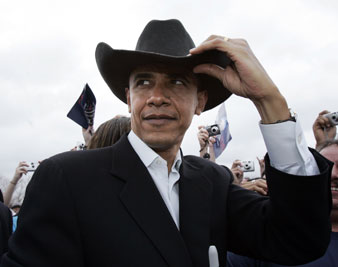
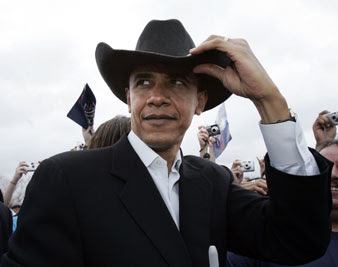
Barack Obama campaigning in Austin during the Texas Democratic primary. Photo by AP.

How Democrats Could Turn Texas Into the Blue Star State
By Bob Moser

The followinig article on the resurgence of the Democratic Party in Texas appears in the July 21, 2008 edition of The Nation.

“Did I mention that it’s fun to be a Democrat in Texas?” asks Matt Glazer, editor in chief of the Burnt Orange Report, the state’s leading progressive blog. He has, in fact, mentioned it a couple of times over beers at Scholz Garten, a legendary liberal hangout in Austin, and always with the same glimmer of happy bemusement behind his black-frame blogger specs. I’d been seeing that look in Democrats’ eyes all over Texas in early June–at their raucous, record-breaking state convention, at local Democratic shindigs, in giddily overburdened Obama HQs.

“It’s like everyone who toiled on that Democratic death march for years, when it was so difficult, is now seeing daylight,” says Josh Berthume of the Dallas suburb Denton, editor in chief of TheTexasBlue.com and another key player in a vigorous blogosphere that has helped ignite the startling Democratic flare-up here, in the bright red heart of Tom DeLay and Karl Rove’s “permanent” Republican majority.

The very notion of Texas Democrats glimpsing daylight–of America’s biggest chunk of Republican real estate being shaded pink on the ’08 election map–seems almost absurd, a contradiction in terms, even to those who are making it happen. Like many of the nuevo pols, bloggers and progressive activists who are constructing a state-of-the-art Democratic machine in Texas, Glazer and Berthume are too young to remember the last time skies were blue for the party that ruled Texas politics from Reconstruction clear through to Reagan/Bush. So is Burnt Orange publisher Karl-Thomas Musselman, who’s 23. “The last time Democrats won my hometown”–a small outpost in the central Hill Country–“was 1964,” he says. “And that was only because President Johnson brought the chancellor of Germany to Fredericksburg for a visit.”

The last Democratic presidential nominee to carry Texas was Jimmy Carter in 1976. The party hasn’t won a solitary statewide election since 1996. Every November from 1972 to 2004, the Democrats bled seats from their once-unanimous majority in the Statehouse. By the 1990s, national Democrats like Bill Clinton had come to see Texas as “a money pot, period,” says Molly Hanchey, a retiree who leads an 8,000-volunteer grassroots group called ObamaDallas. They flew in to raise cash, but they didn’t stick around to scare up votes–and Clinton’s party did nothing to help rebuild the state’s hopelessly antiquated Democratic infrastructure. Neither Al Gore nor John Kerry tried to compete here. By 2004, Democratic fortunes had sunk so low that they carried just eighteen of 254 Texas counties at the top of the ticket.

Four years later, the Realm of the Bushes is now being described–in the Wall Street Journal, no less–as potentially “the next California.” The next big Republican stronghold, in other words, that is headed for a seismic partisan flip. It won’t happen tomorrow, of course. But unmistakable signs of a Democratic breakout are all around. In Dallas, linchpin of the Republicans’ statewide ascendance in the 1980s, an innovative grassroots campaign in 2006 earned Democrats a sweep of more than forty contested judicial races–and Harris County (Houston) seems poised for a similar switch. Democrats won back six Statehouse seats in 2006, bringing them within five of regaining the majority and having a hand in revising Tom DeLay’s infamous Republican-friendly redistricting after the next census.

Recognizing the outsized influence of the state’s estimated fifty active left-leaning bloggers, this year’s NetRoots Nation (formerly called Yearly Kos) is coming to Austin in July. And in the March presidential primaries, a startling show of Democratic enthusiasm was the big story buried under the Clinton/Obama headlines: just 1.3 million Texans voted Republican, while nearly 2.9 million voted Democratic–more than voted here in either of the last two general elections for Gore or Kerry. Political scientists are projecting that Bush Country will morph, by 2020, into the nation’s second-largest Democratic state. “Texas,” Democratic National Committee chair Howard Dean enthused during the DNC’s rules committee showdown in May, “is ready to turn blue.”

Yes, Texas.

“Until three years ago, the Texas Democratic Party was just brain-dead and prostrate,” says Southern Methodist University professor Cal Jillson, author of Texas Politics: Governing the Lone Star State. “They were beaten down. During the Bush years, people wouldn’t even admit to being Democrats in Texas. Now they’re up on their hind legs, feeling confident. It’s the Republicans who are sullen and downcast.”

What in the name of Sam Houston is going on down here? Pretty much the same partisan upheaval that’s roiling several of the Southern and Western states that became staunch Republican turf in the Reagan ’80s–and are now surprisingly tempting targets for Obama ’08. Even more powerfully than in Nevada, Colorado, New Mexico, North Carolina, Georgia and Virginia, a demographic tide is washing away the political dominance of older white conservatives in Texas, which in 2005 officially became the nation’s fourth “minority white” state (after California, New Mexico and Hawaii). At the same time, anti-immigration, ideologically rigid, starve-the-government Republican leaders are giving the GOP an ugly reputation with the rising generation of younger Hispanics–the swing voters who are displacing the old Reagan Democrats–and simultaneously alienating independent-minded, middle-aged “office populists” massing around booming metropolises like Dallas.

While Texas’ swelling Hispanic population still registers and votes in smaller percentages than blacks or whites, turnout soared in this year’s primaries, and Hispanics–once courted lovingly and successfully by Bush–are leaning increasingly Democratic. While GOP leaders spout anti-immigration tag lines, Texas Democrats are brimming with ambitious young Hispanic leaders like this year’s US Senate nominee, Afghanistan veteran and progressive populist Rick Noriega, who until recently trailed by single digits in his long-shot race to unseat Republican John Cornyn; State Senator Leticia Van de Putte of San Antonio, a firebrand who delivered the party’s Spanish-language response to this year’s State of the Union address; and smooth-talking State Representative Rafael Anchía of Dallas, whom Texas Monthly recently predicted would be “El Gobernador.”

Demographics and immigration aside, Texas wouldn’t be swinging so far so fast without a rejuvenated Democratic Party, which was hard to imagine just four years ago. Nowhere did Southern (or Western) Democrats fall so far in the 1980s and ’90s, and nowhere have they lifted themselves back up so quickly and dramatically. As The Return of the Democrats becomes the latest legend in the colorful book of Texas politics, many will date the beginning of the tale to 2003, when Democrats in the Legislature reconnected with their party’s hell-raising roots in the fight against DeLay’s Machiavellian (and legally dubious) redistricting scheme.

“That’s when Democrats really started to get our legs under us in Texas,” says Matt Angle, former chief of staff to Dallas Congressman Martin Frost, who lost his reconfigured district in 2004 when the dust had settled. After all those years of being stuck in what Donna Brazile, Gore’s 2000 campaign manager, calls the “fetal crouch” of agreeable, Lite Republican centrism, Angle says, “we fought back tooth and nail. And the public began to see that the Republicans were really overreaching, that they were willing to do anything, that for them it wasn’t about what was good for Texas.” In the process, “Democrats realized that not only do we have a moral commitment to fight back but also that we have a chance to beat them.”

By the time the redistricting fracas kicked up, Democrats had lost every significant vestige of power in Texas. Nearly forgotten were the many generations when “calling yourself a Democrat was like declaring you had a pulse,” in the words of former Lieutenant Governor Ben Barnes. “If you were alive, you were a Democrat.” But there was an ironic upside to the Democrats’ struggles: during its three decades of slow, steady decline, the party shed most of its white conservatives. While the loss of those Reagan Democrats meant short-term pain at the ballot box, it also gave Democrats a chance to remake their party practically from scratch (as Republicans did in the 1970s), with the state’s urban-centered, multiethnic future firmly in mind, and with a whole new set of high-tech, grassroots techniques and resources on hand, thanks in part to Howard Dean’s fifty-state national strategy.

Elected in 2005, new party leaders like Dallas chair Darlene Ewing are reconstituting the historically disorganized party–in urban areas of the state, at least–into a precinct-by-precinct, voter-by-voter, high-tech machine. Angle’s Texas Democratic Trust, a Washington-based group funded by legendary trial attorney Fred Baron, the “Texas George Soros,” lent organizers and polling expertise to the “coordinated campaign” that took Dallas’s long-entrenched Republicans by surprise in 2006, and it’s providing similar aid to the Democrats’ takeover effort in Harris County this year.

The GOP should have seen it coming in Dallas County, which lost 130,000 white residents–and gained more than 220,000 Hispanics–just between 2000 and 2006. In 2004 George W. Bush had carried the county by a scant 10,000 votes. But it wasn’t the population shift that turned Dallas blue in 2006; it was, in the words of local organizer Kirk McPike, the fact that local Democrats “took a good situation and made it extraordinary.” Ewing persuaded most of the Democratic judicial candidates in Dallas–there were more than forty–to contribute to the party’s new coordinated campaign and trust their prospects to a radically newfangled approach: a nonstop flurry of phone-banking, precinct-walking, direct-mailing and vote-targeting. Every judicial candidate won, as did Dallas’s first African-American district attorney, progressive Craig Watkins.

“It was a triumph of grassroots politics,” says Angle. “Dallas Democrats spoke one-on-one to the voters, and more important, they communicated. It was research-based, targeted to things voters really cared about,” like the nation’s highest utility rates, statewide cuts in children’s healthcare and an unpopular Republican push for toll roads.

Which brings us to the other indispensable contributor to the Democratic upsurge: Texas Republicans.

Back at Scholz Garten, Burnt Orange blogger Karl-Thomas Musselman hoists his beer in a toast of sorts. “The best thing that ever happened to Democrats in Texas is that the people who took over the Republican Party in Texas are running it into the ground,” he says.

“They’re out of touch because they’re fanatically ideological,” says editor Matt Glazer. “They’ve failed to govern effectively by every measure you can come up with.”

“Say you’ve been voting Christian values, or along small-government Republican lines,” says Musselman, who comes from a place where most folks have been doing just that. “At some point, you have to start thinking, What does it do for me? My taxes are not lower. My kids are not smarter. My job is not better. What are we getting?”

Right now, folks are getting a heaping dose of right-wing bluster from the Texas Republicans–most notably, and most disastrously, on the sticky subject of immigration. Party leaders like Senator John Cornyn and Governor Rick Perry have veered from Rove and Bush’s formula and become fence-building border warriors. “They’re just digging themselves deeper in a hole by moving right on immigration,” says Cal Jillson. “The only prospect for the Texas Republican Party to remain competitive in ten years is to be winning 35 to 40 percent of Hispanic votes, along with 75 percent of whites and 10 percent of African-Americans.”

But as the center of Texas political gravity veers inexorably leftward, GOP leaders like Governor Perry appear determined to go down, Alamo style, with ideological guns blazing. “The reason we lost our majority in Congress,” Perry lectured the California Republican Convention last fall, “is not because our ideas lost their luster but our leaders lost their way…. It’s a sad, sad state of affairs,” he said, in a clear dig at fellow Governor Arnold Schwarzenegger, “when…Republicans govern like liberals to be loved.” No such coddling would be forthcoming from the governor of Texas. “We need to hold the line on what it means to be a Republican,” Perry said, “which is, of course, being conservative.”
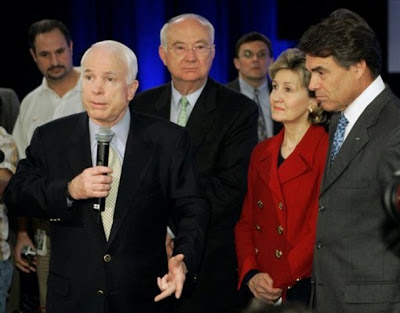
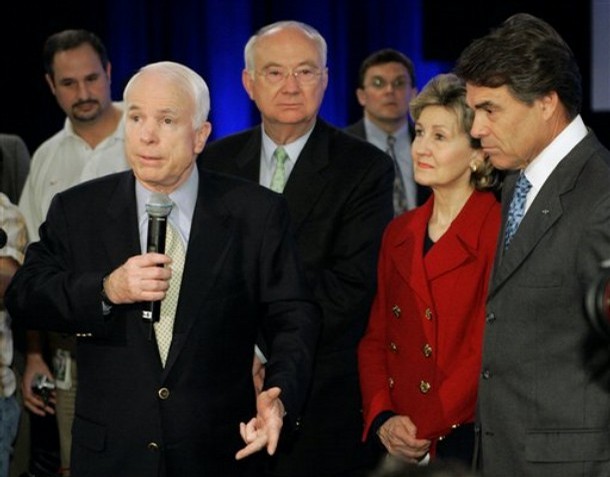
John McCain with his economic advisor former Texas Sen. Phil Gramm, US Sen. Kay Bailey Hutchinson of Texas and Texas Gov. Rick Perry, Republicans all, at Dell, Inc. in Austin earlier this year. Photo by Harry Cabluck / AP.

A converted Democrat who’s jostled for supremacy in the GOP with Senator Kay Bailey Hutchison (a relative moderate) since they both won statewide office in 1990, Perry is an intractable ideologue on “Christian values” and economic matters. At his urging, the Republican Legislature has cut more than 200,000 children off health insurance–and now, with a budget surplus, Perry is pushing for tax rebates. In 2006, after Perry’s hard-right re-election campaign netted him just 39 percent of the vote (enough to scrape by in a four-candidate field), he cheerfully declared of Texas voters, “They said, We like what you’re doing–keep it up.”

Such delusional thinking has many GOP leaders–the ones currently out of power, at least–profoundly worried. “The grassroots has withered up and died,” former state chair Tom Pauken recently lamented in the Houston Chronicle. “The Republican Party has definitely peaked in Texas,” says the party’s longtime political director, Royal Masset. GOP pollster Mike Baselice fears big numbers of “grumpy Republicans”–more than 50 percent in Texas say the state and country are on the wrong track–will sit out 2008. Meanwhile, the party looks to be skidding toward a bloodbath in 2010, when insiders expect both Lieutenant Governor David Dewhurst, a hellfire-and-brimstone Christian conservative, and Senator Hutchison, who embodies the politer, Chamber of Commerce wing of the party (and says she’s tired of Washington and wants to come home), to challenge Perry in the Republican primary. “And people say Democrats have circular firing squads!” says Glazer, clearly charmed by the prospect.

A Perry-Hutchison showdown could open a sizable tear in the coalition of Christian and business conservatives that has made the Texas Republican Party–like other state parties in the South and interior West–such a force in recent decades. “Hutchison is closer to a Republican in a more moderate state,” says Jillson. “She’s been booed sometimes at state conventions by the true believers. Perry might beat her in a primary, but she is more popular statewide.” And if she were to lose to Perry (or Dewhurst), a whole new bloc of moderate Republicans could be giving the Democrats a fresh look. Even if the Republicans steer clear of such a destructive internal battle, Jillson says, “there’s no denying that every trend is against them. You can’t argue with demographics. And the issues are all lined up against them. The grassroots energy is on the other side. They can see it coming, but they haven’t reacted.”

Rank-and-file Republican disquiet was all too palpable at the party’s state convention in Houston in June. Enthusiasm for the GOP’s presidential nominee-to-be was so damp that a local reporter counted the applause that followed John McCain’s campaign video at precisely eight seconds. Charisma-challenged Senator Cornyn, running for re-election in a state where a 2007 poll showed that 40 percent of voters had no opinion of him at all, unveiled an unintentionally uproarious video set to the old novelty hit “Big Bad John,” depicting the go-along senator as a take-no-prisoners, Stetson-hatted reformer making corrupt Washington politicians quake in their boots. Some of the weekend’s loudest cheers were spontaneous, off-the-agenda outbursts by supporters of rebellious Republican Congressman Ron Paul. For his part, Paul was one of an embarrassing fourteen no-shows–out of nineteen Congress members–who were being introduced at the convention.

The Democratic convention, held the previous weekend in Austin, was a jubilant throwdown by contrast. A broadly diverse, revved-up crowd of more than 12,000 cheered new party heroes like State Senator Mario Gallegos Jr. of Houston, who last year returned to the Senate floor with a hospital bed, against doctor’s orders after a liver transplant, to block a Republican-backed voter-ID bill that would have disenfranchised thousands of Texans. And notwithstanding a cranky fellow who circled the Austin Convention Center bearing a sign reading Small-town, gun-owning religious Democrat bitter about Obama, lingering wounds between the Hillary Clinton and Barack Obama camps were salved by such characteristically Texan means as Thursday night’s “unity pub crawl,” with downtown Austin’s bars jammed to overflowing with commingling drinkers of Obamarama ‘Ritas and Hillary Harps. On Saturday the delegates paused to watch as Clinton quit the race and endorsed Obama–at which point, par for the course at a Democratic gathering, the video feed sputtered. But around the convention hall, chants of “Hillary! Hillary!” soon gave way to a rousing, full-throated chorus of “United We Stand.”

“Given the news coverage beforehand, I’d almost expected a Jets versus Sharks rumble to break out,” says Berthume, the Texas Blue editor. Instead, “it was a Frank Capra moment for me as a Democrat. It was ridiculous. You’d see people with Clinton and Obama shirts holding hands, hugging. People cried.”

A few nights later Renee Hartley, vice president of the Dallas County Young Democrats, was still hoarse from her long weekend serving on the platform committee–but still making volunteer assignments to the forty folks who came out for the DCYD’s monthly meeting at Zúbar, a warm, woodsy drinking hole in East Dallas. Hartley originally backed John Edwards, then ended up as a Clinton delegate to the state convention–which brought her a certain amount of grief, since “I was under 35, an African-American female and people just assumed I’d be for Obama. How could I not be?” Hartley’s working-class roots inclined her toward Clinton’s populist pitch–but she said that, along with the vast majority of her fellow Clintonites, she was having no great difficulty making the switch. That’s partly because, she said, being a Democrat in Texas is no longer just about “which horse you ride.”

“There’s this overwhelming sense that we’re moving forward now as a party–it’s not about any one candidate, whether it’s for President or senator or governor.” Which is no small development in a state where Democratic politics long orbited around such outsized personalities as Lyndon Johnson, longtime House Speaker Sam Rayburn and Governors John Connally and Ann Richards. Now Texas Democrats are competing on Republican turf–at the grassroots, that is–and developing a message that resonates with old-style and new-school Texas populists. “Democrats have started learning this everywhere,” says Matt Angle, “but nowhere more than in Texas: you can’t be afraid to say that you want government to work, that some things are a higher priority than cutting taxes.”

The Democratic resurrection in Texas could hardly be happier news for the national party’s long-term future. But in the short-term calculus of a presidential election year, it does create a dilemma–albeit a rather pleasant one–for Barack Obama’s campaign.

On the one hand, Texas Democrats stand to gain more ground in local and legislative elections in November, and they could surely make good use of the rocket-boost of grassroots energy and big money that is Obama’s to spread around. Those investments, in turn, would build momentum for a quicker statewide turnaround–meaning, among other things, more members of Congress to bulk up the majority behind Obama’s policies. Down the road, of course, it would also bring the Democrats closer to a potential mother lode of electoral votes–thirty-four at present, with more than forty projected by 2030–that could make national contests vexingly difficult for Republicans to win.
Hispanic Afghan war vet Rick Noriega, a progressive Democratic, at the 2008 Texas Democratic Convention, is taking aim at conservative US Sen. John Cornyn. Photo by montanaisaleg.

On the other hand, there is no realistic prospect that, barring a national landslide, Obama can carry Texas–until 2012, perhaps. And while Texas Democrats have a progressive, attractive Senate challenger in Rick Noriega, he’s struggling to rustle up the big bucks he needs against the well-heeled Cornyn. Besides, no matter how financially fat the Obama organization might be, running a full-scale campaign on Texas’ vast landscape of media markets is dauntingly expensive, with candidates needing to fork over some $1.4 million per week from Labor Day forward to get sufficient advertising on the air statewide. That adds up to a minimum of more than $11 million–money that might pay more immediate dividends in North Carolina, Nevada, Virginia, Colorado or New Mexico, toss-up states where Democratic turnarounds are further advanced.

In the consultant-driven, micro-targeting days of the not-so-distant Democratic past, the Texas dilemma would have been solved easily enough: look at the polls–screw it!–shovel everything into Florida and Ohio! As former DNC chair Terry McAuliffe reportedly declared in a strategy session during the Gore campaign, “All we care about is getting to 270”–electoral votes, that is. Winning the White House, in turn, was supposed to be a magic bullet for building the party nationally–though Democrats in states like Texas reaped no benefits from President Clinton’s two wins.

But it’s not only a new day for Democrats in Texas–it also looks like a new day for the national party. In May the Obama campaign dispatched hundreds of trained voter-registration volunteers to seventeen states, including Texas, where they will focus their efforts on the “blue boom” areas of Dallas, Houston, San Antonio and Austin, where hundreds of thousands of Hispanic voters are eligible but unregistered. In June, after the nomination was clinched, Obama deputy campaign manager Steve Hildebrand announced in an e-mail that the presidential campaign would extend Dean’s fifty-state strategy by running something close to a genuine national campaign. “Our presidential campaign will be the first in a generation to deploy and maintain staff in every single state,” he wrote, vowing to “provide help where we need it and impact races up and down the ballot this November.”

Just how much help Texas will be getting–“As in every presidential election, some states will be more competitive than others, and we will scale our resources accordingly,” Hildebrand carefully added–is anything but certain at this point. But Obama’s campaign guru, David Axelrod, promised in a series of Texas fundraisers in early June that fifteen staffers would be dispatched to Texas for the general election. “He was cagey about their level of investment,” says Molly Hanchey, the ObamaDallas chair. “But he was clear that we won’t be just an ATM this time.” And that’s more important, she says, than making Texas a full-scale presidential battleground in November.

“We’re going to do what we’re doing regardless,” she says. “They didn’t get us started–we did, even before Obama declared his candidacy.” And Texas’ newly focused Democrats have plenty to shoot for down the ballot. “The Dean strategy, and now the Obama strategy,” says Matt Angle, “recognizes that there is something to win in every state. And that, as we’ve learned in Texas, you don’t build a party from the top down.”

Here’s to that.

Source. / The Nation

Thanks to Harry Edwards / The Rag Blog

Posted in RagBlog | Tagged , , , , , | 2 Comments

Netroots Nation Comes to Austin

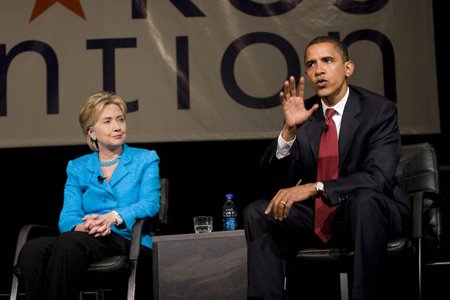
Clinton and Obama at 2007 YearlyKos Convention (now called Netroots Nation).

Netroots Nation 2008
Thursday-Sunday, July 17-20
Austin Convention Center

Netroots Nation, the third annual gathering of liberals and progressives from the blogosphere and beyond, meets July 17-20 at the Austin Convention Center. In addition to panels and discussion groups, the convention includes a progressive film series, a career fair, organizing sessions, and more. To register, or for panel and speaker lists, plus lodging and travel information, visit netrootsnation.org.

Convention brings Obamomentum and Web rebellion to Austin
By Wells Dunbar / July 11, 2008

As I write, the video “McCain’s YouTube Problem Just Became a Nightmare” has 2,654,664 views on the eponymous video-sharing website.

“There’s no question John McCain is getting a free ride from the mainstream press,” reads the description accompanying the clip, a three-minute reel of McCain flip-flops and flubs. “But with the power of YouTube and the blogosphere, we can provide an accurate portrayal of the so-called Maverick. We can put the brakes on his free ride!”

And there’s as succinct an encapsulation of Internet-driven, people-powered politics – the “netroots” – as you’re likely to find. Whereas four years ago it took a well-financed pack of political assassins to Swift boat John Kerry, increasingly cheaper technology, user-friendly tools like Blogger and WordPress, and an explosion in online fundraising are steadily wresting media power away from professionals to an impassioned grassroots base, irrevocably altering the political landscape.

Attempting to coalesce and promote that process is this weekend’s Netroots Nation, a four-day event at the Austin Convention Center bringing together the brightest lights in liberal and progressive opinion and activism. For regular blog readers, the speakers and attendees list reads like an RSS feed: Daily Kos founder Markos Moulitsas Zúniga, Duncan “Atrios” Black, Hullaballo’s “Digby” Parton, John Aravosis of AmericaBlog.com, and The American Prospect’s Ezra Klein, to name a select few – plus scores of other bloggers, authors, activists, politicians, journalists, and filmmakers.

But aside from a collection of technological tools, a constellation of small donors, and a din of liberal opinion, who exactly are “the netroots”? How are they changing politics? And can they reinvigorate a Democratic Party drifting dully to the center (and beyond) for more than two decades?

Speed Community

While 2004’s Swift boating represented the worst of top-down attack politics (amplified tenfold by an easily distractible media’s ceaseless reporting on “the controversy”), that year also saw the fullest expression of the Internet’s bottom-up potential to date: Howard Dean’s campaign. Dean’s example – via the adoption of his Web-driven, small-contributors model and his own leadership of the Democratic National Committee – still reverberates today. So it’s no surprise Dean recognizes the power of the netroots. Calling Netroots Nation “an important opportunity for progressives to come together and discuss the values and vision we share,” he says, “the progressive activists who fill Austin’s halls are an important part of our party and our nation, pushing every day for the change our country so desperately needs.”

Compared to the decades of hierarchical organization that modern movement conservatism required – financing right-wing think tanks, deregulating talk radio, and midwifing the Christian conservative movement (all arguably waning in importance) – the netroots’ ascendancy looks like an overnight success story. Its origin is often traced to the Nineties impeachment trial of Bill Clinton, which liberal Web hub MoveOn.org formed expressly to oppose; a prototypical weblog, Bob Somerby’s the Daily Howler (www.dailyhowler.com), also pushed back against the impeachment circus and its media facilitators. Then came a succession of flash points, each swelling the blogosphere’s readership and relevance: Florida 2000. Iraq. Election 2004. Katrina. “Macaca.” The 2006 Democratic reclamation of the House and Senate – and possibly, the 2008 reclamation of the White House.

“I think things move faster nowadays. … It’s just the nature of technology,” says Netroots Nation panelist Matthew Yglesias, who blogged independently before joining the American Prospect; he’s now a staffer at The Atlantic Monthly and writes for its website. “And also you’re talking about a movement, a group of people defined in part by using certain kinds of tools, so more and more people and more and more activity is moving online very rapidly. So what the conception of what the quote-unquote ‘netroots’ is is changing and growing.

“It’s a good way of assembling communities of interest,” Yglesias continues. “It may be [that] only a tiny minority of people in every American city are interested in a question like FISA,” the Foreign Intelligence Surveillance Act and the debate over vesting the president with new spying powers and granting retroactive immunity to snooping telecoms, “but thanks to the Internet, you can form a community of people who care about something like that.” By way of contrast, he points to the recent past, when “only players with a direct financial stake could effectively get themselves organized and make themselves known.”

It’s building a community with similar ideals and goals that makes the blogosphere formidable, a community Netroots Nation hopes to reinforce. “The nature of the netroots, of Inter­net politics – it’s all interacting with a huge number of people you don’t actually see or meet,” says Yglesias. “It’s nice to have the opportunity to get together and see other participants in this world. … It continues to build this sense of community, and there’s certain kinds of exchanges you can only do face to face.”

Who Controls the Message?

The Netroots Nation schedule covers every conceivable blogging topic under the sun – foreign policy, media accountability, campaign politics, plus meta concerns like increasing blog diversity and readership. Politicians also play a role: DNC Chair Dean and House Speak­er Nancy Pelosi are scheduled to attend. But the bottom-up, nonhierarchical instincts of the liberal blogosphere mean Demo­cratic politicians aren’t immune from critical scrutiny.

At last year’s convention, a leadership panel featuring Pelosi, Senate Majority Leader Harry Reid, and Rep. Rahm Emanuel was canceled – presumably because they most certainly would’ve gotten an unpleasant earful. Their appearance was scheduled at the same time the Democratic-controlled Congress looked like it was caving on Bush-directed changes to FISA, a move vehemently opposed by the netroots. FISA revisions are again up in the air this year, and tension persists between the netroots and Democratic politicians capitulating to a GOP-created “compromise” on FISA changes that will both expand warrantless presidential wiretapping authority and keep the program from judicial scrutiny, by granting civil immunity to telecom companies that have apparently already violated existing law. “Part of what you want to do as an activist is help the better candidate win in November,” says Yglesias, “but another part of what you wanna do is hold the better candidate’s feet to the fire.” Or as Salon.com blogger Glenn Green­wald (Unclaimed Territory) recently posted: “From the beginning, blogs have been devoted to opposing Democratic complicity and capitulation – to protesting the lack of Democratic responsiveness to their supporters – every bit as much as opposing GOP corruption and media malfeasance. That role is at least as important as the others.”

A new Web wrinkle has been the organizing success of the Obama campaign, using several of the netroots’ tools: harnessing online donors, accumulating a massive e-mail list, and building a formidable social-networking presence on websites like Facebook. It’s already having an impact on the netroots: Partially at Obama’s request, donations to third party groups that may deviate from Obama’s message have dried up. MoveOn.org recently announced it is shutting down its anti-McCain 527 group for lack of donations. So as the Obama campaign increasingly implements its message top-down, what will that mean for bloggers and activists?

“He’s running a top-down campaign which they think will help them get elected,” says Yglesias. “And I think they may be right.” But, he concedes, “a lot of activists aren’t gonna like that, because there’s always a tension between people who are pushing a specific policy agenda and people who are trying to win the next election.” Again, FISA has fanned the flames – Obama recently declared he supports the “compromise” legislation vesting the president with new spying powers – in direct contradiction to his earlier opposition and promise to filibuster the bill – and that put his campaign loudly at odds with the blogosphere. “Obama’s gonna want the flexibility to sell out people and causes if he feels it’s necessary,” says Yglesias. “That’s sort of the essential tension in all political movements; I don’t think it’s unique to the Internet. But the fact that people are thinking about it now shows that some success is being had on the part of the netroots.” Yglesias calls it “the problem you have when you may be winning.”

“It’s understandable that a presidential campaign would want to, as much as possible, control their message, but it’d be a mistake of the campaign if they fail to find ways to work with bloggers to help get that message out,” writes Duncan “Atrios” Black in an e-mail interview. But, he concedes, “there’s no way to control what bloggers write, of course.”

Making Media Liberal

A senior fellow at bias-watchdogs Media Matters for America, Black says: “Media accountability is certainly my issue. Much of what is wrong with politics in this country is due to how the media covers, or doesn’t cover, politics at all levels of government.” His blog, EschatonBlog.com, focuses as much on media failings and exploding Beltway narratives as anything else. To that end, he sees blogs having greater potential in setting the progressive agenda. “Strangely, I still think there’s a missing piece due to the unwillingness of politicians to fully make use of the messaging potential of bloggers and the netroots more widely,” writes Black. “For better or worse, we are the ‘liberal media,’ or at least a big chunk of it, and we could help set the political agenda for the country.”

Aside from getting people more interested in politics and welcoming more people to the conversation, have we reached the limits of what the netroots and online organizing can do? “The hope is always that some people who read blogs are inclined to do things like give money to worthy candidates and that, of those people, some more will be inspired to move into more time-consuming activities such as volunteering or running for office,” says Black. “By giving people a tiny way in so that they feel involved, you hope you can provide a path for people to do even more.”

And as more people find a way in, the netroots will grow in size and prominence. They won’t always come to agreement – among themselves or with outside political forces – but that’s their viral, indefatigable nature. They’ll continue to grow, often in unexpected ways. For instance, the social networking tools on My.BarackObama.com allow online supporters to join groups devoted to specific causes. One new group has ballooned into the largest on the entire site, numbering more than 16,250 members in little less than a week. Who are they? A collection of Obama supporters opposing his FISA stance: “Please Vote NO on Telecom Immunity – Get FISA Right.”

Once the politicians open the door – there’s no telling where the roots will grow.

Source. / Austin Chronicle

The Rag Blog

Posted in RagBlog | Tagged , , , , , , , , | Leave a comment

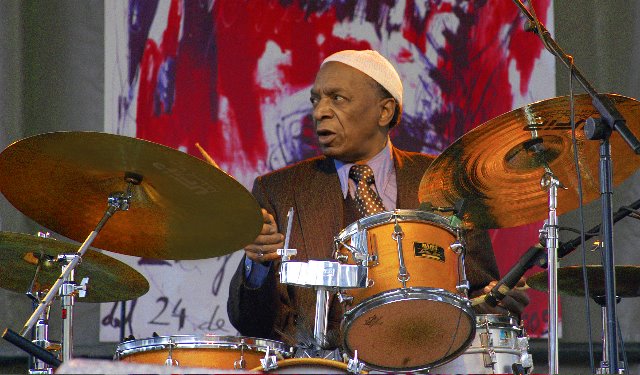
JAZZ: Drummer Bobby Durham Dies at 71

Bobby was always a quiet drummer, exquisite taste and touch, a polished gentleman with international reputation.

Doubt you would find him at Grand Auto or buying the first shirt he ran across while shopping.

Gerry Storm / The Rag Blog / July 11, 2008

Subtle drummer and scat singer played with jazz greats
By Dennis Hevesi / July 11, 2008

Bobby Durham, a drummer whose precise, understated style made him much sought after as a sideman by jazz greats like Duke Ellington, Lionel Hampton, Oscar Peterson and Ella Fitzgerald, died Monday in Genoa, Italy. He was 71 and had homes near Genoa and Basel, Switzerland.

See Videos, with Oscar Peterson, Ella Fitzgerald, below.

The cause was lung cancer, said Sandra Fuller, a friend.

Mr. Durham was probably best known for his trio work, from 1966 to 1971, with Peterson at the piano and Ray Brown playing bass. He also drew significant notice from 1973 to 1980 as an accompanist to Fitzgerald.

“One of his specialties was brushes,” said Dan Morgenstern, director of the Institute of Jazz Studies at Rutgers University, referring to soft-stroke wire drumsticks.

“It’s important when you work with a singer that you play sensitively, that you don’t overwhelm,” Mr. Morgenstern said.

But Mr. Durham, he said, “was also capable of playing really good extended solos.”

Mr. Morgenstern’s assessment echoed one in 1980 by John S. Wilson, writing in The New York Times about Mr. Durham’s performance with the organist Shirley Scott and the tenor saxophonist Harold Vick.

Mr. Durham “makes his presence felt without being obtrusive,” Mr. Wilson wrote.

“He steps forward occasionally with brief, rollicking statements that add sparkle to the group, and he feeds crisp breaks to Mr. Vick,” Mr. Wilson added. “When he finally takes a solo, he builds a steady, controlled development that never gives way to gratuitous flashiness.”

Besides playing with jazz greats like Hampton, in 1962, and Ellington, in 1966, Mr. Durham made recordings with, among others, the trumpeters Dizzy Gillespie and Roy Eldridge, the pianist Tommy Flanagan, the guitarist Joe Pass and the alto saxophonist Benny Carter.

One of Mr. Durham’s specialties, with brush sticks softly in play, was scat singing.

Robert Joseph Durham was born in Philadelphia on Feb. 3, 1937. His father was a professional tap dancer, and Bobby was taught to tap at the age of 2. He started playing drums with his junior high school band; by 16 he was playing professionally with a group called the Orioles. His next big gig was with a Marine Corps band, from 1956 to 1959.

Leading his own trio, Mr. Durham performed all over the world. “I played everywhere but Russia, Alaska and Arabia,” he said in a profile in the Biographical Encyclopedia of Jazz.

Mr. Durham’s wife, the former Betsy Perkins, died in 1996. He is survived by two daughters, Valarie Ahrar of Philadelphia and Robbin Carver of Woodbury, N.J.; and four grandchildren.

Source. / New York Times

Satin Doll: Oscar Peterson Trio with Sam Jones, Bobby Durham

I’m Gonna Sit Right Down and Write Myself A Letter:
Ella Fitzgerald with Joe Pass, Paul Smith, Keter Betts and Bobby Durham.

The Rag Blog

Posted in RagBlog | Tagged , , , | Leave a comment

Stop the New FISA


Allowing the new surveillance law to stand would seriously cripple our free press
by Chris Hedges / July 11, 2008

If the sweeping surveillance law signed by President Bush on Thursday — giving the U.S. government nearly unchecked authority to eavesdrop on the phone calls and e-mails of innocent Americans — is allowed to stand, we will have eroded one of the most important bulwarks to a free press and an open society.

The new FISA Amendments Act nearly eviscerates oversight of government surveillance. It allows the Foreign Intelligence Surveillance Court to review only general procedures for spying rather than individual warrants. The court will not be told specifics about who will be wiretapped, which means the law provides woefully inadequate safeguards to protect innocent people whose communications are caught up in the government’s dragnet surveillance program

The law, passed under the guise of national security, ostensibly targets people outside the country. There is no question, however, that it will ensnare many communications between Americans and those overseas. Those communications can be stored indefinitely and disseminated, not just to the U.S. government but to other governments.

This law will cripple the work of those of us who as reporters communicate regularly with people overseas, especially those in the Middle East. It will intimidate dissidents, human rights activists and courageous officials who seek to expose the lies of our government or governments allied with ours. It will hang like the sword of Damocles over all who dare to defy the official versions of events. It leaves open the possibility of retribution and invites the potential for abuse by those whose concern is not with national security but with the consolidation of their own power.

I have joined an ACLU lawsuit challenging the new law along with other journalists, human rights organizations and defense attorneys who also rely on confidentiality to do their work. I have joined not only because this law takes aim at my work but because I believe it signals a serious erosion of safeguards that make possible our democratic state. Laws and their just application are the only protection we have as citizens. Once the law is changed to permit the impermissible, we have no recourse with which to fight back.

I spent nearly 20 years as a foreign correspondent for the New York Times, as well as other news organizations. I covered the conflict in the Middle East for seven years. I have friends and colleagues in Jerusalem, Gaza, Cairo, Damascus, Tehran, Baghdad and Beirut. I could easily be one of those innocent Americans who are spied on under the government’s new surveillance authority.

The reach of such surveillance has already hampered my work. I was once told about a showdown between a U.S. warship and the Iranian navy that had the potential to escalate into a military conflict. I contacted someone who was on the ship at the time of the alleged incident and who reportedly had photos. His first question was whether my phone and e-mails were being monitored.

What could I say? How could I know? I offered to travel to see him but, frightened of retribution, he refused. I do not know if the man’s story is true. I only know that the fear of surveillance made it impossible for me to determine its veracity. Under this law, all those who hold information that could embarrass and expose the lies of those in power will have similar fears. Confidentiality, and the understanding that as a reporter I will honor this confidentiality, permits a free press to function. Take it away and a free press withers and dies.

I know the cost of terrorism and the consequences of war. I have investigated Al Qaeda’s operation in Europe and have covered numerous conflicts. The monitoring of suspected terrorists, with proper oversight, is a crucial part of our national security. But this law is not about keeping us safe, which can — and should — be done in a constitutional manner and with judicial oversight. It is about using terrorism as a pretext to permit wholesale spying and to silence voices that will allow us to maintain an open society.

Chris Hedges was part of the team of New York Times reporters who won a Pulitzer Prize in 2002 for reporting on global terrorism. He is the author of many books, including “War Is the Force that Gives Us Meaning.”

Source. / CommonDreams

Also go toThe Bush Administration Continues Looking Like that of Richard Nixon by Gary Ater / American Chronicle

The Rag Blog

Posted in RagBlog | Tagged , , , , , , , | Leave a comment

Pelosi Slips Impeachment Onto the Table

With the door opened, Judiciary chair John Conyers may press for action.

Door may be open for Kucinich’s resolution on Bush
By John Nichols / July 10, 2008

As Ohio Congressman Dennis Kucinich moved a “privileged resolution” to force House to consider the question of whether President Bush should be impeached for lying to Congress and the American people about the reasons for invading and occupying Iraq, House Speaker Nancy Pelosi surprised almost everyone by suggesting that the Judiciary Committee might indeed take up the issue.

Pelosi, who famously declared impeachment to be “off the table” before the 2006 election, now suggests that hearings on the president’s high crimes and misdemeanors are a distinct possibility.

“My expectation is that there will be some review of that in the committee,” the California Democrat told reporters Thursday.

“This is a Judiciary Committee matter, and I believe we will see some attention being paid to it by the Judiciary Committee,” Pelosi explained.

The speaker was not suggesting that members of the Judiciary panel would be voting anytime soon on formal impeachment resolutions. Pelosi said she did “not necessarily (see the committee) taking up the articles of impeachment because that would have to be approved on the floor, but to have some hearings on the subject.”

Judiciary Committee chair John Conyers, D-Michigan, has indicated that he is reviewing the 35 articles of impeachment Kucinich has proposed for President Bush. He has not indicated, however, whether he intends to hold hearings on any of them or on broads questions of whether violations of their oaths of office, the Constitutionally-defined separation of powers and the laws of the land by the president and Vice President Dick Cheney — the subject of three impeachment articles submitted by Kucinich — should be addressed by Congress.

It is no secret that Conyers has felt constrained by Pelosi’s “off-the-table” commitment.

Whether her new line opens the door for hearings before the end of the Bush-Cheney presidency remains to be seen.

But Pelosi’s remarks do create an opening for the members of the Judiciary Committee, including Florida Democrat Bob Wexler and Wisconsin Democrat Tammy Baldwin, who have co-sponsored Kucinich’s articles of impeachment and who have urged the committee to open hearings on issues of presidential accountability.

For his part, Kucinich will keep pressing for action.

“Congress must, in the name of the American people, use the one remedy which the Founders provided for an Executive who gravely abused his power: Impeachment. Congress must reassert itself as a co-equal branch of government; bring this President to an accounting, and in doing so reestablish the people’s trust in Congress and in our United States system of government. We must not let this President’s conduct go unchallenged and thereby create a precedent which undermines the Constitution,” the Ohio congressman said Thursday, as he prepared to introduce his privileged resolution to force consideration of impeachment of a president who he accuses of “deceiving Congress with fabricated threats of Iraq WMDs to fraudulently obtain support for an authorization of the use of military force against Iraq.”.

“In the final analysis this is about our Constitution and whether a President can be held accountable for his actions and his deceptions, especially when the effects of those actions have been so calamitous for America, Iraq and the world. Unless Congress reasserts itself as the power branch of government which the Founders intended, our experiment with a republican form of Government may be nearing an end. But when Congress acts to hold this President accountable it will be redeeming the faith that the Founders had in the power of a system of checks and balances which preserves our republic.”

Source. / The Nation

The Rag Blog

Posted in RagBlog | Tagged , , , , , | 2 Comments

Jim Hightower : ‘Lifestyles of the Rich… and Cranky.’

Ferrari F430 Spider, just $3,500 a day. Dude.

Democratizing luxury
By Jim Hightower / July 11, 2006

Time to take another peek into the “Lifestyles of the Rich… and Cranky.”

A problem for many rich people is that they’re merely rich – not fabulously wealthy. And, of course, being Mr. Richie Rich means never having to ask the price of anything. So the merely rich get cranky because, while they might be millionaires, it can be hard for them to keep up with the Joneses who are billionaires. I’m sure you can empathize with their angst.

Take the matter of transportation. In some zip codes, you are what you ride, and mass-market mobiles like Cadillacs and Hummers are simply humdrum vehicles, even if they come with uniformed chauffeurs. No, no, it’s important that your wheels make a statement, so you want something like a Bugatti Veyron, with its 978-horsepower engine. The Bugatti is a favorite of Mr. Richie Rich, but with a sticker price of $1.6 million, it’s out of reach for the merelies.

Luckily, though, enterprising saviors like Beverly Hills Rent-A-Car let common millionaires keep up appearances. While these modestly-wealthy swells can’t afford to buy a sleek Aston Martin Vantage Coupe with a powerhouse engine that has “a nice purr to it” – they can rent one for only $1,600 a day. Or, if they want to strut their stuff in even higher style, they can get behind the wheel of a red Ferrari F430 Spider for $3,500 a day. Its “wow” factor is that it can go 200 miles per hour. Be warned, though, that the $3,500 rental fee only gets you 50 miles a day – it’s an extra $2 a mile beyond that.

Oh, and that eye-popping Bugotti? Yes, for ultimate showmanship, you can even rent one of those babies for $25,000 a day.

In these days of economic stress, it’s good to know that luxury is being democratized so mere millionaires are not priced out of the good life.

“A posh ride, for a day,” Los Angeles Times, June 6, 2008

Source. / Jim Hightower

See A posh ride, for a day / Los Angeles Times

The Rag Blog

Posted in RagBlog | Tagged , , | Leave a comment

Scott Trimble : ‘We Are Not Sufficiently Democratic’


An open letter to Ralph Nader:
The issues we face today

By Scott Trimble / The Rag Blog / July 11, 2008

What is the most important political issue in America today? There are probably many different answers to that question; however, most of them, if not all, can be reduced to one important root. In essence, we might say that root is a deficiency of democracy. That is, the core problem that leads to most or all of our other problems is that we are not sufficiently democratic.

The people of the United States are not provided with sufficiently equal access to participate in our political deliberations and decisions, even though they affect all our lives, and as a consequence, the decisions made by our government are too often contrary to the interests of the American people, or even the nation as a whole. Instead, our political system provides access to corporations and those with the most capital to spend, and these are the beneficiaries of most of our public policy, often to the detriment of the rest of us, to our nation, and to the world.

For instance, if you are in agreement with the plurality of folks in this country, your answer is “the economy.” So then we must ask ourselves what is the problem with the economy? Again, there might be several different answers. In fact, most of the likely answers to this are actually interconnected. Some might say the problem is outsourcing of jobs. Some might say it is the influx of undocumented immigrants. Others might blame the subprime lending crisis. Yet others may reply that the occupation of Iraq is primarily responsible.

The most clearly connected of these issues are immigration and outsourcing. Corporate globalization and so called “free trade” agreements have done considerable harm to the working classes here and in other nations, primarily for the benefit of large multinational corporations. NAFTA is largely responsible for the outsourcing of certain jobs to Mexico while also damaging small farms there and setting off a chain reaction that has led to falling wages throughout Mexico and an increase in immigration, both legal and illegal, into the United States. The combined effect of losing skilled jobs to Mexico and an influx of unskilled labor from Mexico has also had a negative impact on jobs and wages here.

While many try to paint the immigrants themselves as the culprits, they are victims of the same policies that we are. So, why did our government approve a policy that would have these effects? Well, certainly some of the politicians who supported it can honestly claim ignorance. Some of them simply believed their “leaders” who told them it was a good idea, and did not believe the thousands of people in the streets who knew it was not. However, many of them were complicit with or unwitting victims of corporate lobbyists (and their own greed, of course). Who has benefited from NAFTA and other such agreements? Almost exclusively, it has been multinational corporations, the politicians who take their money, and the investor class.

Well, what about the other choices? If you are among those who believe the subprime lending/housing crisis is behind our economic hardships, you are not wrong, but you may be among those who simply did not notice that our economy has actually been going downhill for a while. In reality, the subprime banking industry came about because the economy was already slumping. More and more people were finding themselves unable to meet the credit and cash-on-hand standards to purchase a new home, so a new sector of the banking industry was created to meet a new need. Of course, the nature of banking being what it is, the industry that had already sent many of these folks swirling down the economic drain by sucking out their savings through credit card debt incurred from usurious interest rates had to take yet another stab at squeezing out whatever blood might be left in the stone.

Well, how does that relate to the other issues, or to the common root issue? To answer that, we must ask how this new subsector of the credit industry was allowed to come into existence. Subprime lending, along with higher credit card rates, payday lending, and new bankruptcy laws that favor the creditors more than ever are results of new changes in related laws that all favor whom? That’s right, large multinational (banking) corporations, the politicians who take their money, and those who can afford to invest in those companies.

And who have been the victims? Once again, it has been Americans who have to work 40 or more hours per week to keep food on the table and roofs over their heads. Dare I say “the working class” without fear of some right-wing pundit calling me a class warrior? Yes, I do. One of the hard truths that we must face as a nation is that the solutions to our national problems will inevitably involve the rich becoming less rich. That may not necessarily mean a direct redistribution of wealth, but it does mean at least ending subsidies, no-bid contracts and other sweetheart deals to corporations, tax cuts for the rich, and other laws that favor the wealthy over the rest of us and allow them to get richer from our toil while we get poorer.

That brings us to the other possible answer to what is driving our economy down: the occupation of Iraq. While it is one possible reason for our slumping economy, for other Americans, it is in itself the most important current issue in American politics. So, here we’ll be bridging the gap from the economy to our next subject: the military-industrial complex.

Some of you may call the occupation of Iraq “the war.” I refuse to do that. It is not a war, except a civil war among Iraqis. For the United States military, it is an occupation subsequent to an invasion. Like all our other military misadventures since the end of World War 2, there has been no declaration of war by Congress, and yet again, our troops are there in the middle of another country’s civil war, only this time, they don’t even know which side they’re on.

The problems with the Iraq issue are so numerous, it could easily be a book on its own (and certainly, it already has been), but I will try to keep it as brief as I can. First, I must point out that the invasion was illegal and entirely unwarranted. There were no weapons of mass destruction in Iraq, or even WMD programs. There were no meaningful connections between the Iraqi government and al-Qaeda. There was no authorization from the United Nations Security Council for an invasion. Furthermore, there was a very good reason why there was no such authorization: because anyone who bothered to check the media almost anywhere outside the United States, and even in the “alternative” media within the US knew there were no WMD in Iraq, knew the UN weapons inspectors were doing their jobs and had control of the situation, and knew that Iraq and Saddam Hussein were not a threat to the United States or any of its allies, nor to Iraq’s other neighbors.

Scott Ritter, who had been the UN Chief Weapons Inspector in the 1990’s, before Bill Clinton ordered him and his team out to begin a bombing campaign in Iraq, told us that even then, at least 90-95% of Iraq’s biological and chemical weapons had been destroyed by his team, or destroyed by Iraq and verified by his team. Furthermore, he told us that because of the tough sanctions program and relatively tight monitoring of the Oil For Food program, that US and UK officials inspected just about everything that went into Iraq, and the likelihood of Iraq being able to reconstitute any of its WMD under such scrutiny was very close to zero.

That aspect was further supported by reports from humanitarian activists from the US working in Iraq that many needed medicines and other medical supplies were unable to get through to the people of Iraq because they were deemed by the US-UK coalition to be “dual use” materials. Add to that the fact that well before the invasion the UN had assigned Hans Blix to lead a new team of weapons inspectors and had been able to find no evidence of any WMD.

Similarly, the International Atomic Energy Agency’s chief inspector, Mohamed El Baradei, had found no evidence of any nuclear weapons capability or program. In addition, the US sent Joseph Wilson to investigate claims that Iraq was trying to purchase uranium from Niger, and returned to tell us that those claims were false (and then, of course, his wife was outed as an undercover CIA operative as punishment for not playing along with the administration’s game)….

So that was all before the invasion. The rest of the world knew it, and that is why the Security Council would not approve a resolution that authorized an invasion. I knew it, and millions of other Americans knew it, yet somehow 296 of our Representatives and 77 Senators apparently did not, including 81 of 208 (39%) of the “opposition” Democrats in the House and 29 of 50 (58%) Senate Democrats. And if you believe that, there’s a little place in your neighborhood strip center that would like to offer you a payday loan.

The invasion of Iraq and toppling of its previous regime took around 40 days. Our military has been there now for over five years, and despite occasional lulls in the violence of the civil war, there has been no political progress toward creating any sort of sustainable society for the Iraqi people. So again, let’s ask ourselves who is benefiting and who is suffering as a result. The “winners” in this debacle have been Halliburton, Bechtel, Blackwater and other mercenary groups, the military-industrial complex, the politicians who support them and take their money, and those wealthy enough to invest in those companies…and let’s not forget al-Qaeda, whose recruiting and donations have been rising due to increased antipathy towards the United States, as we show ourselves to be ruthless invaders, imperial occupiers, and corporate colonists.

And of course, once again, the losers are the working class of America, who pay a larger portion of their income in taxes to finance military misadventures we cannot afford instead of rebuilding our schools, roads, bridges, levees or power grid, instead of creating new “green” jobs through promotion of renewable energy, and instead of developing a single-payer universal health care system….

Speaking of which, perhaps some of you wondered why I didn’t mention our health care crisis as a possible reason for our economic woes. Others have simply been waiting for me to get to it as their number one issue in our current political vortex. Certainly, many of our nation’s nearly-poor and newly-poor have gotten there because of health care related debt, and this is undoubtedly having a negative effect on our economy, but that is only a part of the problem.

As of 2005, the people of the United States spend 53% more per capita than the second biggest health care spenders (Switzerland), and 140% more than the median of other industrialized nations (1), yet our health care system is ranked 37th in overall effectiveness and 40th in satisfaction by the World health Organization (2, page 4). Our for-profit health insurance industry spends 31% of its revenue on administrative costs (3), while Medicare overhead costs only about 3%. We spend a large chunk of money reimbursing hospitals for emergency room care for people without insurance, instead of offering a universal health care system that would cost less and cover those same people, and allow them to seek care before it became an emergency, which would, of course, cost even less.

Yes, moving to a single-payer system would add some taxes for many of us, but for most, it would be more than offset by eliminating insurance premiums, co-pays, co-insurance, and other health care costs under our current for-profit private insurance system. In this case, even most corporations would benefit from such a move, as they would no longer have to be responsible for maintaining a corporate health care plan to cover their employees (not that they are forced to by law now, but many must in order to compete for employees and/or to meet the demands of labor unions). So then, who benefits from this wrong-headed system? Just two industries really, but they are very powerful: the insurance and pharmaceutical companies, and again, the politicians who are in their pockets and the investors who own their stocks.

The other two issues that polls show most Americans believe to be among the most important right now have already been mentioned here: terrorism and immigration Let’s address terrorism first. Despite the first bombing of the World Trade Center in 1993 and the bombing in Oklahoma City in 1995, terrorism did not really measure on the public radar as a major issue until the attacks of September 11, 2001. Since then, despite very few terrorism related arrests, and very few terrorism events, it remains near the top of our list. However, while many Americans are concerned about it more than we were before that tragic event, what are we really doing about it? It is difficult to say exactly, as our government has become very secretive, but in general, when they talk about it, they talk about our military operations in Iraq and Afghanistan.

In reality, confronting terrorism has very little to do with the military. Domestic law enforcement is what protects us from most potential avenues of terrorism, and dramatic attacks, like those of 9/11 would involve the military, but in a wholly defensive mode within or very near our own borders, not halfway around the world. Another important step we should be taking to prevent future acts of terrorism is a cultural exchange and outreach to those who seem most likely to threaten us. It is probably common enough knowledge that I need not say it, but I will anyway, to avoid any confusion or ambiguity.

The current threat of terrorism seems to be greatest from radical, fundamentalist Islamist groups. One thing we should be doing as a nation in response to this is educating our own people. Specifically, Americans need to have a better understanding of Islam and Islamic cultures. We need to understand that the threat is not from the average Muslim, not from Islamic nations, is not a by-product of Islam as a religion, but is merely a small percentage of Muslims who have perverted their own religion in similar ways to how many Christians have. From the Spanish Inquisition, the Crusades, and the Salem Witch Trials to the modern apocalyptic fundamentalists who would install a theocracy in place of our pseudo-democracy or the white supremacists who twist the Bible to fit their hatred and xenophobia, we have seen this before in a slightly different mask.

We should also be developing diplomatic, political and economic connections with the people of the world, not only in Islamic nations, but also in southern Africa and South America, rather than pursuing corporate globalization and military hegemony that can only lead to further anti-American sentiment that might lead to new waves of terrorism in the future.

We should also realize that there is a continuing threat of domestic “terrorism.” Within the US, there are separatist and survivalist groups who are usually well-armed and generally unhappy about the current state of affairs in our own country. Despite that threat, our government will often cite anarchists, environmentalists and animal rights groups as our greatest domestic terror threats, despite the fact that these groups, while often guilty of acts of vandalism, almost never cause injury (or death). Nevertheless, whether we call them terrorists or vandals, we should realize that their actions are a response to our society, and while we may not be willing to alter our behavior as they would desire, there might be avenues of progress that could diminish the threat without adversely affecting our society.

Furthermore, there is another type of domestic terrorism that we usually do not call by that name: violent crime, or even crime in general. While our overall crime rate has not risen dramatically, our perception as portrayed in our mainstream media suggests that it has. Furthermore, while the number or percentage of incidents of crime may not be increasing, perhaps the intensity is, although that may also be merely an impression resulting from media sensationalism. In any case, rather than merely calling attention to it, increasing law enforcement efforts (which never actually reduce any sort of crime), imprisoning more Americans, and propagating fear (i.e. terror), we ought to be taking proactive steps to reduce crime in America that can only come from addressing the controllable causes of criminal behavior. For the most part, these are socio-economic: poverty, unemployment, inadequate education, homelessness, social isolation. It should be easy to see that these are interconnected issues that lead us back to where this discussion began: our failing economy.

Moreover, as we look at each of these subgroups of “terrorism,” we see that our military approach to international terrorism has not only failed to decrease the risk, but has actually strengthened the groups we have singled out. The more we antagonize people in Iraq and Afghanistan by destroying their lands and killing their people, including tremendous numbers of civilians, the more we increase anti-American sentiment, which results in both greater funding and new recruits for the very groups we should be trying to diminish. Similarly, our economic and military policies in other parts of the world only increase the risk that new terror threats will grow from them, and our domestic “crack down” approach to crime and home-grown “terrorism” increases the number of people in prisons and children without one or both parents in the home, but does nothing to actually address the conditions that drive people to criminal behavior. Why? The military-industrial complex, the prison-industrial complex, our antiquated fossil-fuel energy industry, and huge agricultural corporations are driving policy rather than the people.

Finally, we come to immigration. As I noted earlier, one of the primary causes of our increases in immigration in the last decade or so has been NAFTA. Passed in 1994 and effective in 1995, it has allowed subsidized American corporations to sell cheap foods and other goods in Mexico, driving many small farms and other small businesses out of business, or at least forcing layoffs as smaller producers transition to niche markets. This drives unskilled workers into urban centers where they can work below standard Mexican wage levels for newly relocated American corporations who have moved there for cheaper labor and production costs. This drives wages down and forces workers north for better wages, and driving some of them, as well as many displaced workers in the north, across the border to find work in the US.

Simultaneously, of course, those jobs that have moved south of the border have evaporated from the American economy, creating higher unemployment here, which in turn creates hostility toward the immigrants who have come here to work. However, the jobs must be here, or they could not stay. Yet our government fails to increase the quotas for immigration to match the actual demand for the labor, so we end up with a tremendous number of undocumented workers. Certainly, they do not remain undocumented and receive lower wages without any occupational safety protection or other standards purely by choice. Some may immigrate hoping to achieve citizenship, others may simply desire employment and an eventual return to their home country, but our failure to provide a pathway to either in sufficient number to meet our own demand is simply that: our failureto provide a pathway to either in sufficient number to meet our own demand is simply that: our failure. The results are:

• the anger of many Americans over what they see as criminal behavior, again as a result of economic conditions imposed by our own policy;

• millions of undocumented people in this country who are probably afraid to come forward to report crimes, create black markets for a variety of goods and services, are virtually untraceable to our law enforcement if they do commit a crime, etc.;

• reduced wages and occupational safety standards for all American workers, especially in those industries that use considerable amounts of undocumented workers.

I probably should not even need to say it by now, but once again, let us ask ourselves who is benefiting from these policies. Undoubtedly our answer again will be corporations (those selling cheap goods in Mexico, those taking advantage of cheaper overhead costs for production, and those hiring undocumented workers at reduced wages and not maintaining proper safety standards here in the US), the politicians who accept their contributions, and the stockholders in those companies.

It should not be difficult to understand now that all of our top political issues are problems stemming from the influence of corporate lobbyists and corporate money in our political system and the solution to all of these problems begins with reversing that. On this, I am sure that Ralph Nader would fundamentally agree; however, where we differ is in how we should confront this problem.

Earlier this year, I attempted to mount a campaign for a seat in the U.S. House of Representatives to initiate a plan to tackle this issue by shifting political power to the people. I believe that it could be a very effective plan, but it will require someone other than me to pick up the banner. I believe you, Ralph Nader, could be that person. While my base of support was a small number of Greens, a few progressive independents and even a few Democrats here in Travis County, several of whom did not even live in the district; you have a national support network, national name recognition and considerably more resources than I. While it is certainly too late for you to exit the presidential contest this year and begin a congressional race, I hope that you may still be willing to consider a congressional run in 2010, utilizing some or all of my plan for bringing the people of your district, and eventually all Americans, into the political process in a much more meaningful way than merely voting.

The main plank of my platform was to develop a path by which every resident in the district could participate directly in discussion and deliberation of the issues; and through a democratic process, reach decisions that will be based on the needs of the people not of corporations; to seek solutions, not quick profits; and to direct their representative in Congress to pursue those solutions, or face a certain defeat in the next election.

My plan might have to be adjusted somewhat to fit the specifics of your district and others, but what I did was divide the district into 16 divisions of between 12 and 19 voting precincts each in such a way that each division was entirely embedded in one county (My district includes six whole counties and portions of two others). If I had been elected, the process would have worked like this:

Twice a year, each precinct would hold a caucus. These would be entirely separate from the partisan caucuses of primary season. Rather, they would be transpartisan, open to every registered voter in the precinct. If a caucus exceeded two hundred participants, it would be subdivided into assemblies of two hundred or fewer. Each caucus (or assembly thereof) would discuss the various issues of concern, and try to achieve some resolutions.

At the end of the session, each caucus would elect four or five delegates using Single Transferable Voting, or some such system that would produce a proportional balance of representation. These delegates would then attend a division assembly, where they would each bring forth the resolutions passed by their precincts. When possible, several resolutions might be combined into a compromise resolution. Again, after their deliberations, they would elect delegates to a district assembly.

The district assembly would meet at least once per month until the next one was elected (roughly six months), and would serve as the advisory committee to the Congressional Representative. In addition to their monthly deliberative sessions, they would also hold an open hearing each month for residents to express their concerns on issues that might arise or change between precinct assemblies.

This process would provide a way for voters to participate directly in discussions and deliberations that could actually affect the way their representative votes in Congress, a more meaningful access path to their representative than letters or phone calls, and would create an organizational structure that citizens could use to oversee their representative, apply political pressure, and if necessary, choose and elect someone else who would be more responsive to the people’s concerns.

Of course, none of the career politicians who currently inhabit our Congress is likely to initiate such a plan, and despite the best efforts of myself and the state and county Green Party organizations, we were unable to provide this opportunity to move closer to democracy here in Texas. I can think of no person besides you who might be both willing and likely to succeed in such a venture. I know that running for the presidency in some sense give you a chance to talk about crucial issues on a national stage, but more and more, you are being shut out from that national stage, despite of, or perhaps because of your presidential bids. This would give you a chance to set in motion a real process of democratization that the corporate media could not stop.

Ideally, if you win and establish these democratic assemblies in your district, it will inspire the residents of other districts to organize in similar fashion and develop a Congress that is entirely accountable to the people. Perhaps that will eventually lead to amending our constitution to enshrine such democracy into our political system officially, and make even more democratic progress, like allowing the people the ability to recall a representative in mid-term. I sincerely hope you will choose to use the popularity and other resources you have won over the years to give the American people one more gift. I am opening the door, but you must step through it. Welcome to democracy.

The Rag Blog

Posted in Rag Bloggers | Tagged , , , | Leave a comment

McCain : The Week That Was

John McCain with economic advisor and former Texas senator Phil Gramm.

The Week That Should Have Ended McCain’s Presidential Hopes
By Max Bergmann / July 10, 2008

This is the week that should have effectively ended John McCain’s efforts to become the next president of the United States. But you wouldn’t know it if you watched any of the mainstream media outlets or followed political reporting in the major newspapers

During this past week: McCain called the most important entitlement program in the U.S. a disgrace, his top economic adviser called the American people whiners, McCain released an economic plan that no one thought was serious, he flip flopped on Iraq, joked about the deaths of Iranian citizens, and denied making comments that he clearly made — TWICE. All this and it is not even Friday! Yet watching and reading the mainstream press you would think McCain was having a pretty decent political week, I mean at least Jesse Jackson didn’t say anything about him.

But let’s unpack McCain’s week in a little more detail.

1. McCain unambiguously called Social Security “an absolute disgrace.” This is not a quote taken out of context. John McCain called one of the most successful and popular government programs, which uses the tax revenues of current workers to support retirement benefits for the elderly “an absolute disgrace.” This is shocking – and if uttered from Obama’s mouth would dominate the news coverage and the Sunday shows, as pundits would speculate about the massive damage the statement would cause him among retirees in Florida.

2. McCain’s top economic policy adviser calls Americans a bunch of “whiners” for being worried about the slumping economy. Words cannot fully explain how devastating this statement should be from Phil Gramm. You would think it would be enough to sink McCain’s campaign. Of course McCain only thinks that the economic problems are psychological.

3. Iraqi leaders call for a timetable for U.S. withdrawal, McCain gets caught in a bizarre denial and flip flop. The Iraqis now want us to begin planning our withdrawal – McCain however wants to stay foooorrreeevvveerrrr. So what does McCain say – First, he refuses to accept Maliki’s statement as being true. Then he concedes that it was an accurate statement, but was probably just a political ploy to curry favor with his own people and WOULD NOT influence his determination to keep US troops in Iraq indefinitely. Yet, McCain in 2004 at the Council on Foreign Relations said that if the Iraqis asked us to leave, we would have to go. No matter what. But that was apparently a younger and less experienced John McCain.

But let’s just look at his comment that Maliki’s statement is “just politics.” If that is true, then it must also be true that the American military presence in Iraq is so unpopular with Iraqis that the government is forced to push for a timetable in order to survive at the ballot box. That’s a reason to stay for 100 years.

4. McCain’s economic plan to cut the deficit has no details and is simply not believable. There are so many things here. McCain pledges he would eliminate the deficit by the end of his first term (the campaign latter flip flop flipped about whether it was four years or eight years), but does not provide any details about how he would do it. Economists on both sides of the political aisle said that this was simply not believable, especially given McCain’s other proposals to a) cut individual and corporate taxes even further, b) extend the Bush tax cuts and c) massively increase defense spending on manpower (200,000 more troops) and d) maintain a long-term sizable military presence in Iraq.

5. McCain’s deficit plan includes bringing the troops home represents a major Iraq flip-flop. Speaking of the long-term military presence – a story that has gotten absolutely no attention is that McCain now believes the war will be over soon. The economic forecasts made by his crack team of economists predict that there will be significant savings during McCain’s first term because we will have achieved “victory” in Iraq and Afghanistan. The savings from victory (ie the savings from not having our troops there) will then be used to pay down the deficit. The only way this could have any impact on the deficit in McCain’s first time is if troop withdrawals start very soon. So McCain believes victory is in our grasps and we can begin withdraw troops from Iraq pretty much right away — doesn’t sound that different from Obama’s plan does it. Someone should at least ask McCain HOW HE DEFINES VICTORY – and why he thinks we will achieve it in the next couple of years.

6. McCain campaign misled about economists support. In the major press release the McCain campaign issued to tout its Jobs for America economic plan that would balance the budget in 4 years, it included the signatures of more than 300 economists who the campaign claimed to support the plan. Only problem is that the economists were actually asked to sign up to SOMETHING COMPLETELY DIFFERENT. Um, hello?

7. McCain makes a joke about killing Iranians. Haha… that’s just McCain being McCain. I am sure that is exactly how it is being reported in Tehran. This guy is running for President not to become a talk radio pundit. Yet according to the AP this was just a humanizing moment between candidate and spouse – I am not sure when joking about the deaths of civilians became humanizing.

8. McCain denies, flatly, that he ever said that he is not an expert in economics. Are you kidding?

9). McCain distorts his record on veterans benefits in response to a question from Vietnam Veteran, who then proceeds to call McCain out on it.

10.) McCain demonstrates he knows nothing about Afghanistan and Pakistan. McCain said “I think if there is some good news, I think that there is a glimmer of improving relationship between Karzai and the Pakistanis.” Pat Barry notes how crazy this comment is…”Just what “glimmer” is McCain talking about?? Maybe he’s referring to President Karzai’s remarks last month, which threatened military action in Pakistan if cross-border attacks persisted? Or maybe McCain is talking about Afghanistan’s allegations that Pakistan’s ISI was involved in a recent assassination attempt on Karzai? Maybe in McCain’s world you could call that a silver-lining, but in reality-land I’d call it something else.”

Any one of these incidents and comments would dominate the news cycle if they came from the Obama campaign. Yet McCain barely gets a mention. The press like to see themselves as political referees – neutral observers that call them like they see em’. But they want this to be a horse race and so all the calls right now are going one way. How else can you explain the furor last week over the Obama “refine” comment – which represented zero change in Obama’s position on Iraq – and the “swift boat” mania over Wesley Clark’s uncontroversial comments (psss… by the way McCain exploits his POW experience in just about every ad – yet he says he doesn’t like to talk about it).

This Sunday expect the ten incidents above to get short shrift from pundit after pundit, because after all Jesse Jackson said he wanted to cut Obama’s nuts off.

Source.

The Rag Blog

Posted in RagBlog | Tagged , | Leave a comment

FISA Bill Challenged in Court

President Bush, in the Rose Garden on Wednesday, called the wiretapping bill “long overdue” and crucial to national security. Photo by Brendan Smialowski / NYT.

Bush Signs Spy Bill, ACLU Sues
By Ryan Singel / July 10, 2008

The American Civil Liberties Union filed suit Thursday over a controversial wiretapping law, challenging the constitutionality of the expanded spy powers Congress granted to the president on Wednesday.

The federal lawsuit was filed with the court just hours after Bush signed the bill into law.

The ACLU is suing on behalf of journalist and human rights groups, asking the court put a halt to Congress’s legalization of Bush’s formerly secret warrantless wiretapping program. The ACLU contends (.pdf) the expanded spying power violates the Constitution’s prohibition on unreasonable searches and seizures.

On Wednesday, the Senate gave final congressional approval to a massive expansion of the Foreign Intelligence Surveillance Act, finishing a year of debate over how far the U.S. government should be able to conduct blanket surveillance using telecom facilities inside the United States.

In passing the FISA Amendments Act, Congress gave the executive branch the power to order Google, AT&T and Yahoo to forward to the government all e-mails, phone calls and text messages where one party to the conversation is thought to be overseas. President Bush signed the bill into law Thursday morning, describing it as a bill that “protect[s] the liberties of our citizens while maintaining the vital flow of intelligence.”

The ACLU contends those blanket powers to grab international communications of Americans without specific court orders violate the Fourth Amendment and would stymie journalists who often speak to confidential sources outside the country.

Plaintiff Naomi Klein, the liberal columnist and author, said the surveillance would compromise her writing about international issues.

“If the U.S. government is given unchecked surveillance power to monitor reporters’ confidential sources, my ability to do this work will be seriously compromised,” Klein said.

Longtime foreign correspondent Christopher Hedges admits that surveillance is not a new obstacle for journalists, but says this goes a step too far.

“There is a lot of monitoring that goes on especially when you are overseas,” Hedges said. “But this creates a further erosion in my ability to work as a journalist.”

The suit, filed in the U.S. District Court for the Southern District of New York Thursday, asks the judge to stay the implementation of the new powers, until its constitutionality is determined.

The Electronic Frontier Foundation, which has spearheaded the still ongoing lawsuits against the nation’s telecoms, will challenge the provision of the bill that gives retroactive amnesty to telecoms that are being sued for helping the government spy on Americans without warrants.

They argue that Congress’s attempt to have citizen lawsuits dismissed violates the separation of powers.

But the San Francisco-based online rights group also announced in a fund-raising letter on Thursday that it would also challenge the constitutionality of the bill’s expanded spying powers.

“We are also preparing a new case against the government for its warrantless wiretapping, past, present and future,” said EFF senior staff attorney Kevin Bankston, who said the details were being withheld to keep the element of surprise.

“But suffice to say it will be quite different from the other cases against the government that have been filed so far,” Bankston said. “Like with our case against AT&T, however, the ultimate goal will be the same: to halt the mass interception of Americans’ communications and to dismantle the dragnet spying network that was first exposed by our witness, AT&T whistleblower Mark Klein.”

Source. / Wired.com

The Rag Blog

Posted in RagBlog | Tagged , , , , , , | Leave a comment

Drawn and Quartered

Michael Kountouris, Greece

The Rag Blog / Posted July 10, 2008

Posted in RagBlog | Tagged , , | Leave a comment

Friendly Skies Dept : Want Some Torture With Your Peanuts?


Airline bracelet id would double as stun device
By Jeffrey Denning

Just when you thought you’ve heard it all…

A senior government official with the U.S. Department of Homeland Security (DHS) has expressed great interest in a so-called safety bracelet that would serve as a stun device, similar to that of a police Taser®. According to the promotional video (view video below) found at the Lamperd Less Lethal, Inc. website, the bracelet would be worn by all airline passengers.

This bracelet would:

• Take the place of an airline boarding pass

• Contain personal information about the traveler

• Be able to monitor the whereabouts of each passenger and his/her luggage

• Shock the wearer on command, completely immobilizing him/her for several minutes

The Electronic ID Bracelet, as it’s referred to, would be worn by every traveler “until they disembark the flight at their destination.” Yes, you read that correctly. Every airline passenger would be tracked by a government-funded GPS, containing personal, private and confidential information, and would shock the customer worse than an electronic dog collar if the passenger got out of line.

Clearly the Electronic ID Bracelet is a euphemism for the EMD Safety Bracelet, or at least it has a nefarious hidden ability (thus the term ID Bracelet is ambiguous at best). EMD stands for Electro-Musclar Disruption. Again, according to the promotional video, the bracelet can completely immobilize the wearer for several minutes.

So is the government really that interested in this bracelet?

Apparently so.

According to this letter from DHS official, Paul S. Ruwaldt of the Science and Technology Directorate, office of Research and Development, which was written to the inventor whom he had previously met with, Ruwaldt wrote, “To make it clear, we [the federal government] are interested in . . . the immobilizing security bracelet, and look forward to receiving a written proposal.”

The letterhead, in case you were wondering, is from a U.S. Department of Homeland Security office at the William J. Hughes Technical Center at the Atlantic City International Airport, or the Federal Aviation Administration headquarters.

In another part of the letter, Mr. Ruwaldt confirmed, “It is conceivable to envision a use to improve air security, on passenger planes.”

Would every paying airline passenger flying on a commercial airplane be mandated to wear one of these devices? I cringe at the thought. Not only could it be used as a physical restraining device, but also as a method of interrogation, according to the same aforementioned letter from Mr. Ruwaldt.

Would you let them put one of those on your wrist? Would you allow the airline employees, which would be mandated by the government, to place such a bracelet on any member of your family?

Why are tax dollars being spent on something like this?

Is this a police state or is this America?

Source. / The Washington Times / Posted July 3, 2008

Promotional Video:
Govt-Issued Stun Bracelets for Airline Passengers

Thanks to Jim Baldauf / The Rag Blog

Posted in RagBlog | Tagged , , | Leave a comment

David Gray : Don’t Use My Music at Guantanamo


Singer-songwriter speaks out against music used in torture
By Andy Worthington

Singer-songwriter David Gray has taken a brave stand by complaining about the use of his music as torture by the US military in “War on Terror” prisons in Guantánamo, in Iraq, and in secret prisons run by the CIA.

On BBC Radio 4’s The World Tonight, singer-songwriter David Gray spoke out against the use of music as torture by the US military.

Gray’s chart-topping song Babylon, played repeatedly at ear-piercing volume, is one of dozens of songs, by artists including Eminem, Bruce Springsteen, Rage Against the Machine and Britney Spears, that has been used by the US military as part of a package of “enhanced interrogation techniques,” intended to “break” prisoners held without charge or trial in the “War on Terror” — in Guantánamo, in Iraq, and in secret prisons run by the CIA.

As the Guardian recently explained, the use of Babylon first came to light “after Haj Ali, the hooded man in the notorious Abu Ghraib photographs, told of being stripped, handcuffed and forced to listen to a looped sample of Babylon, at a volume so high he feared that his head would burst.”

Complaining that the only part of the torture music story that gets noticed is its “novelty aspect” — which he compared to “Guantánamo[‘s] Greatest Hits” — Gray delivered a powerful indictment of the misappropriation of his and other artists’ music.

“What we’re talking about here is people in a darkened room, physically inhibited by handcuffs, bags over their heads and music blaring at them for 24 hours a day, seven days a week,” he told the BBC. “That is torture. That is nothing but torture. It doesn’t matter what the music is — it could be Tchaikovsky’s finest or it could be Barney the Dinosaur. It really doesn’t matter, it’s going to drive you completely nuts.” He added, “No-one wants to even think about it or discuss the fact that we’ve gone above and beyond all legal process and we’re torturing people.”

This is the second time that Gray has spoken out about the use of music as torture. Two weeks ago, he explained, “The moral niceties of whether they’re using my song or not are totally irrelevant. We are thinking below the level of the people we’re supposed to oppose, and it goes against our entire history and everything we claim to represent. It’s disgusting, really. Anything that draws attention to the scale of the horror and how low we’ve sunk is a good thing.”

Reprieve, the legal action charity that represents over 30 prisoners at Guantánamo, recently launched an initiative, Pull the Plug on Torture Music, encouraging artists to sign up to prevent the use of their music as part of the US military’s torture techniques, to insert a clause in their contracts preventing the misuse of their music, and, in general, to raise awareness of the issue by spreading the word and playing anti-torture gigs.

Others who have signed up for Reprieve’s initiative include Massive Attack (who recently hosted a series of Reprieve events at their Meltdown festival at London’s Southbank Centre), Alabama 3, Elbow, the Magic Numbers, Seize the Day, and Tom Morello of Rage Against the Machine, who told Spin magazine in 2006, “The fact that our music has been co-opted in this barbaric way is really disgusting. If you’re at all familiar with ideological teachings of the band and its support for human rights, that’s really hard to stand.”

Whether you like David Gray’s music or not should be irrelevant. He understands what’s really going on with the use of music as torture, and he’s been brave enough to raise his head above the parapet, which is not something that musicians are always prepared to do.

Andy is the author of “The Guantánamo Files: The Stories of the 774 Detainees in America’s Illegal Prison” (published by Pluto Press/the University of Michigan Press).

Source. / DC Indymedia / Posted July 3, 2008

The Rag Blog

Posted in RagBlog | Tagged , , , , | 1 Comment