The Muppets, Me and Public TV…

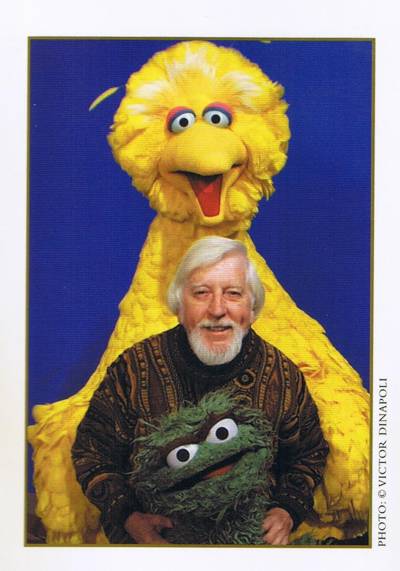
Caroll Spinney with Big Bird and Oscar the Grouch. Photo by Victor Dinapoli.

And the power of popular culture
By Michael Winship / July 13, 2008

Take a moment to forget about politics and the pickle of our worrisome world. A recent dispatch from Kathryn Kolbert, president of People for the American Way, about “the power of culture to shape our society,” triggered thoughts of my deep and abiding joy in the work of the late Jim Henson and the Muppets. It’s a love that goes back to childhood, when the Muppets first started appearing in brief, witty, anarchic vignettes on the old Ed Sullivan and Jack Paar television shows.

I secretly suspect they’re one reason I got involved in public broadcasting; a subliminal urge to associate my career with the network responsible for “Sesame Street.”

Kolbert’s e-mail specifically was relating the power of popular culture to the recent deaths of George Carlin and another great American you may not have heard of, Kermit Love. No relation to the frog of the same name, Kermit, 91, was the man who executed Jim Henson’s designs for Big Bird and Mr. Snuffleupagus, and assisted at the birth of Oscar the Grouch and Cookie Monster; a costume designer who also counted among his clients the Muppet-like Orson Welles, George Balanchine and Jerome Robbins. If you grew up with “Sesame Street,” you’ll remember him wandering among the Sesame denizens as Willy the Hot Dog Man.

I met Kermit Love in 1974, just a few months after I started working for public television in Washington, DC. Decked out in his Santa Claus-like beard and full Willy regalia, he was there in his capacity as Big Bird’s caretaker. The station, WETA, was having an open house with Big Bird as special guest. Unexpectedly, thousands of kids and their parents showed up on a rainy summer Sunday afternoon, patiently waiting out in the drizzle and churning the lawns into a mud mess worthy of Woodstock.

I quickly learned that it’s an endless task taking care of an 8-foot-2 canary (or whatever the hell he is). Bird (Snuffleupagus and I call him that as we consider his genius in the same league as Charlie Parker’s) is, as he always has been, portrayed by the great puppeteer Caroll Spinney, who also performs the role of Oscar the Grouch. Once suited up, his raised right arm is the neck and head, and his left arm becomes the left wing with some fishing line connected to the right for proper double flapping. A TV monitor inside keeps him from blindly walking into manholes. Or birdbaths. Kermit accompanied him on and off the set.

Try standing with your right arm held up like that for any longer than a minute or three and you’ll have some idea of the stamina Caroll has to have to make the whole thing work. Add to that the stuffy confines of the outfit – he can perform for only a short while at a time.

Throughout, Kermit made sure everything was fine, that Caroll was as comfortable as possible, and utmost, that the suit was kept in pristine shape. As Caroll moved about, feathers would frequently fly (some of them were supposed to). Big Birds, you may not be surprised to learn, molt big. Kermit made everything right.

When the long day was done, Caroll climbed out of the suit and we retired to a nearby restaurant. At the table next to us was a family with two small children. Caroll saw them, winked at Kermit and reached into his book bag. Inside was Oscar the Grouch himself. Caroll pulled him out and was immediately in character. The ecstatic look on the faces of those kids was unforgettable, as if they’d just been transported into the pages of the best storybook ever. This, I thought, is a great way to make a living.

Years went by and Kermit’s and my paths crossed again from time to time. I finally did meet Jim Henson when a colleague producing a documentary about the Macy’s Thanksgiving Parade asked the Muppets to host. I was invited to sit in on the first meeting. Henson came into the room wearing a bright paisley shirt and jeans, his long hair anchored by a headband. Following him was an accountant type in suit and tie, clipboard in hand. They watched the rough cut of the film approvingly and Henson agreed to participate, the accountant type dutifully taking down his instructions – change the color of Miss Piggy’s eyes, make sure Fozzie Bear knew his call time, etc.

More years went by and I was working as a writer at the Children’s Television Workshop, home of “Sesame Street.” I was assigned to their series “Square One TV” and “3-2-1 Contact,” which was proximate enough to let a bit of the Sesame Street stardust rub off. A fulfilling experience, writing funny stuff for kids and knowing that maybe you were even teaching them something. Grownups, too.

In 2004, I was at Ben-Gurion Airport in Tel Aviv, finishing up a two-week trip to Israel and the West Bank. Before I could get on my flight home, Israeli security held me for questioning. It was disconcerting – among other places, I had been spending time in Palestinian villages – and the officers knew everywhere I had been, every military checkpoint I had gone through, just about every person to whom I had spoken. They seemed to be trying to see if my account of my daily whereabouts would differ from theirs. Tense.

After quite some time, one of them asked, while you were here, with whom did you stay? I explained that I had been with friends in East Jerusalem, one of whom I had worked with at the Children’s Television Workshop. What’s that, they demanded?

“You know,” I said. “Sesame Street.”

“Sesame Street!” they cried. “Big Bird!”

I was free to go.

That’s how you use culture to change society, a little bit at a time. Thanks, Kermit.

[Michael Winship is senior writer of the weekly public affairs program “Bill Moyers Journal,” which airs Friday night on PBS. Check local airtimes or comment at The Moyers Blog at www.pbs.org/moyers.]

Source. / truthout

The Rag Blog

Posted in RagBlog | Tagged , , , , | Leave a comment

The Death of Reaganomics

Barbara Dane et al / Reaganomics Blues. / Fuse 002

Singing the Capitalism Blues
By E.J. Dionne / July 10, 2008

The biggest political story of 2008 is getting little coverage. It involves the collapse of assumptions that have dominated our economic debate for three decades.

Since the Reagan years, free-market clichés have passed for sophisticated economic analysis. But in the current crisis, these ideas are falling, one by one, as even conservatives recognize that capitalism is ailing.

You know the talking points: Regulation is the problem and deregulation is the solution. The distribution of income and wealth doesn’t matter. Providing incentives for the investors of capital to “grow the pie” is the only policy that counts. Free trade produces well-distributed economic growth, and any dissent from this orthodoxy is “protectionism.”

The old script is in rewrite. “We are in a worldwide crisis now because of excessive deregulation,” Rep. Barney Frank, D-Mass., the chairman of the House Financial Services Committee, said in an interview.

He notes that in 1999 when Congress replaced the New Deal-era Glass-Steagall Act with a looser set of banking rules, “we let investment banks get into a much wider range of activities without regulation.” This helped create the subprime mortgage mess and the cascading calamity in banking.

While Frank is a liberal, the same cannot be said of Ben Bernanke, the chairman of the Federal Reserve. Yet in a speech on Tuesday, Bernanke sounded like a born-again New Dealer in calling for “a more robust framework for the prudential supervision of investment banks and other large securities dealers.”

Bernanke said the Fed needed more authority to get inside “the structure and workings of financial markets” because “recent experience has clearly illustrated the importance, for the purpose of promoting financial stability, of having detailed information about money markets and the activities of borrowers and lenders in those markets.” Sure sounds like Big Government to me.

This is the third time in 100 years that support for taken-for-granted economic ideas has crumbled. The Great Depression discredited the radical laissez-faire doctrines of the Coolidge era. Stagflation in the 1970s and early ’80s undermined New Deal ideas and called forth a rebirth of radical free-market notions. What’s becoming the Panic of 2008 will mean an end to the latest Capital Rules era.

What’s striking is that conservatives who revere capitalism are offering their own criticisms of the way the system is working. Irwin Stelzer, director of the Center for Economic Policy Studies at the Hudson Institute, says the subprime crisis arose in part because lenders quickly sold their mortgages to others and bore no risk if the loans went bad.

“You have to have the person who’s writing the risk bearing the risk,” he says. “That means a whole host of regulations. There’s no way around that.”

While some conservatives now worry about the social and economic impact of growing inequalities, Stelzer isn’t one of them. But he is highly critical of “the process that produces inequality.”

“I don’t like three of your friends on a board voting you a zillion dollars,” Stelzer, who is also a business consultant, told me. “A cozy boardroom back-scratching operation offends me.” He argues that “the preservation of the capitalist system” requires finding new ways of “linking compensation to performance.”

Frank takes a similar view, arguing that CEOs “benefit substantially if the risks they take pay off” but “pay no penalty” if their risks lead to losses or even catastrophe—another sign that capitalism, in its current form, isn’t living by its own rules.

Frank also calls for new thinking on the impact of free trade. He argues it can no longer be denied that globalization “is a contributor to the stagnation of wages and it has produced large pools of highly mobile capital.” Mobile capital and the threat of moving a plant abroad give employers a huge advantage in negotiations with employees. “If you’re dealing with someone and you can pick up and leave and he can’t, you have the advantage.”

“Free trade has increased wealth, but it’s been monopolized by a very small number of people,” Frank said. The coming debate will focus not on shutting globalization down but rather on managing its effects with an eye toward the interests of “the most vulnerable people in the country.”

In the presidential campaign so far, John McCain has been clinging to the old economic orthodoxy while Barack Obama has proposed a modestly more active role for government. But the economic assumptions are changing faster than the rhetoric of the campaign. “Reality has broken in,” says Frank. And none too soon.

Source. / truthdig

The Rag Blog

Posted in RagBlog | Tagged , , , , | Leave a comment

POETRY : True Homeland

Wubbzy in the style of Picasso / Frank Rocco.

Welcome to the USA Patriarch Act
with its spying and break-ins
up its sleeve behind your back
with eavesdropping that’s a crackdown
with character attacks and panic attacks
Oh damn I’m indicted with fiction
though my sentence in fact
can be death or internment
in my homeland

does your brain contain
some interesting thought
from a book you checked out
maybe read or bought
or from some nice tune
you were humming or sought
that’s the heinous crime
that’ll get you caught in the web
of the worldwide homeland

well your mind is free
but what a twist
it lands you smack
on that guest list
now rest assured
you will be missed
when you get out of line
in the homeland

is speaking up
a mortal crime
say the thought
and do hard time
then parables and verse
and rhyme
pardon my grammar
and my paradigm

please just threaten me with jail
or make me watch you hurt a whale
so that I’ll let you read
my personal mail
it’s the law going postal
yet the law’s for sale

better keep your faith
cause you’ll lose your trust
think how you’ll feel
right during your bust
you’ll swear the law’s moved
beyond normal disgust
as it reads you its rights
and insists on your trust

who might it be
who turns you in
your neighbor
mother or best friend
is paranoia
now a sin
the paranoids are
still after me again

the love of truth
it is your code
until persuaded
to implode
your confession due
to electrode ooooh
that’ll be quite the shock
to the homeland

what is the thing
you don’t want to hear
on that midnight ride
we’re conditioned to fear
that you’re being denounced
for being, say, queer
to our butch police
in their bondage gear

are you perplexed
this very night
deciding between
flee and flight
methinks the emperor’s
wound too tight
a drunk with power
and dynamite

in ancient Rome
when it started a war
dictators were chosen
for what was in store
our chosen dictator
has chosen more gore
and has frozen free choice
and then comes back for more

are our laws meant
to constrict and besiege us
with crude ultimatums
both vague and egregious
what’s this lesson someone’s
so desperate to teach us
that freedom’s a threat
and a reason to seize us

my nation has
those recurring dreams
where it divides
into two teams
a moment of silence
and then the screams
it’s winner take all
in freedom’s purges and schemes

then the winners buy states
with their pocket change
while poverty’s strangled
and memory rearranged
with royal dynasties
still becoming deranged
and the headlines still shouting
there’s nothing at all here strange

well in the interest of
my liberal press
I’d like to clear up
this news media mess
by begging someone
to please confess
that rich conservatives own
all the networks, good guess

so you’d better make
that living will
and polish up
your survival skill
the reverends say
there’s a time to kill
oh the thrills and the chill
and watch out for the big spill

the preaching of hate
sanctimonious blather
is working the gullible
into a lather
they think they’re The Beav
when they’re more Cotton Mather
and lust when the
Jackson family gathers
then blow off some steam
while they’re screwing Dan Rather

so work on your
table manners bub
you’re invited to
the big country club
exclusive rights
to that big hot tub
for the boiling in oil
a la homeland

oh say can you see the petroleum
and the rockets red glare crematorium
can you hear it above the delirium
how so proudly we hail
how advanced we’ve become
advanced like dementia
what homeland!?

is this nation in the process
of losing its mind
in compassion and sense
is it lost years behind
does it yearn for respect
only to find
instead the responses
are given in kind

the patriaddict
aren’t like me
they wave the flag
it proves they’re free
they think that the color
of patriarch pee
is red white and blue
then it’s 1-2-3 Go homeland

still the army’s exported
all loaded and locked
as marines and sailors
wave bye to the dock
while the next of kin
are still buying that stock
get your corporate coffins
be the next on your block
no matter how deeply
you and the homeland are in hock

though I try to ignore
all the militarist posers
it’s getting much harder
to keep my composure
Blood Sacrifice it is
of civilians and soldiers
by these leaders who send out
the planes ships tanks and subs
these Predators Cobras Raptors
Tomahawks Hellfires Harpoons
and those Caterpillar bulldozers

their language is smooth
clever verbs suppositions
propagandize at will
but avoid depositions
fight them there freedom’s march
sloganeering addictions
as they crave martial law
to shut down opposition

if you truly believe
in fair or free trade
the flow of ideas
and the progress we’ve made
then tell me why all
this bullshit blockade
of justice and peace
with this homeland charade

if you truly believe
in a spiritual love
as on high so below
not the pushing and shove
then why not remove
your fist from your glove
extending your palm
as below so above

let’s settle now this whole debate
don’t tell me who to love or hate
quit living to discriminate
it’s our tolerance keeping us
hopeful and great

so let’s lift up high
our frosted mugs
our pharmaceuticals
whiskey jugs
and toast the victorious
war against drugs
Oh the euphoria
have another slug

let’s have our real party
on the White House lawn
and celebrate each
liberating dawn
all equal and free
with no class lines drawn
no king and no queen
no rook and no pawn
won’t keep us in check
and we’ll sure give hell heck

now we flow into one
through times hard and fun
with no injustice undone
and our work just begun
under one common sun
all living things run
in the one common band
in our hearts through the land
our promise our stand
for our new homeland
for our true homeland

True Homeland

Larry Piltz
July 4, 2008
Indian Cove / Austin, Texas

The Rag Blog / Posted July 13, 2008

Posted in Rag Bloggers | Tagged , , , , | 1 Comment

U.S. Soldiers No Longer Find Haven in Canada

James Corey Glass, an Army deserter, is appealing an immigration removal order in Canada. Photo by Farah Nosh / Getty Images.

Little sympathy for deserters from Conservative government
By Ian Austen / July 13, 2008

TORONTO — James Corey Glass, apprentice mortician and United States Army deserter, was keeping an unusually close eye on the text messages coming into his cellphone. He was hoping to hear that a court had blocked the Canadian government’s attempt to send him back to the United States.

On Wednesday afternoon, the message came: Mr. Glass, 25, could remain in Canada while he appealed his removal order by the country’s Immigration Department. It was a welcome reprieve, he said, but well short of a guarantee that he and other deserters could make Canada their new home.

The Canadian government’s effort to remove Mr. Glass contrasts with the warm reception given to deserters and draft avoiders from the United States during the war in Vietnam. And although the war in Iraq has very little support among Canadians, the situation of Mr. Glass and others who abandoned their military positions provokes a wide range of responses. For American soldiers seeking an escape, Canada is no longer a guaranteed haven.

“It’s quite clear that the current Canadian government does not want to annoy the U.S. government on this issue and will not give any ground,” said Michael Byers, a professor of politics and international law at the University of British Columbia.

During the Vietnam War, the Liberal prime minister, Pierre Elliott Trudeau, welcomed American deserters and draft dodgers, declaring that Canada “should be a refuge from militarism.” Americans who arrived were generally able to obtain legal immigrant status simply by applying at the border, or even after they entered Canada.

But while the current Conservative government of Prime Minister Stephen Harper has not backed the Iraq war, it has shown little sympathy for American deserters. During a recent parliamentary debate, Laurie Hawn, a Conservative from Alberta, asked, “Why do they not fight it within their own legal system instead of being faux refugees in Canada?”

No American deserter of the Iraq war has been deported by the Canadian government, but that is not for lack of effort. Immigration authorities have ordered about nine deserters to leave Canada, leading to public battles in the courts.

Changes to immigration laws have made it far more difficult for deserters to remain in Canada. Deserters wanting at least temporary legal status must be declared refugees. But refugees in Canada must show that they have, as the government puts it, a “well-founded fear of being persecuted” for religious, racial or political reasons. Alternately, refugees may demonstrate that for them to be returned to their home country would put their lives at risk, or would subject them to torture or “cruel and unusual treatment or punishment.”

As for Mr. Glass, he said he was between low-paying factory jobs in Indiana when he joined the National Guard six years ago.

But he said he had one crucial question for the recruiters before he signed. “They told me I’m not going to fight a war on foreign shores,” Mr. Glass said.

Maj. Nathan Banks, a spokesman for the Army, said, “recruiters would never have made a comment of that sort.”

Not long after Mr. Glass joined, it became clear that he would not be exempt from overseas duty, he said. But he stayed with the Guard and was deployed to Iraq in 2005.

Six months into his 18-month tour, Mr. Glass, a sergeant, said he was sent home on a temporary stress leave. Immediately after returning to the United States, he went on the run, living in a tent in various states, he said. Like many of his counterparts in Canada, Mr. Glass eventually contacted Lee Zaslofsky, who deserted the United States Army for Toronto in 1970 and is now a national coordinator for the War Resisters Support Campaign, which houses and advocates for deserters. As he says he does with all callers, Mr. Zaslofsky, a naturalized Canadian citizen, told Mr. Glass that while he would be beyond the reach of the United States military in Canada, there were no guarantees he could stay in the country. Mr. Glass moved anyway.

A big difference between the current round of deserters and those during the Vietnam War appears to be scale. No precise data exist, but Victor Levant, who wrote “Quiet Complicity: Canadian Involvement in the Vietnam War,” estimated that about 20,000 Americans came to Canada to escape the Vietnam-era draft and 12,000 others in the armed forces deserted and entered Canada. Mr. Zaslofsky said he believed that no more than 200 American deserters from the Iraq war were now in Canada.

While the government does not publish figures, it appears that only about 50 deserters have made refugee applications, with the rest living illegally in Canada.

Exactly what Mr. Glass and others face if they return to the United States is unclear. Major Banks, the Army spokesman, said Mr. Glass had been given “an other-than-honorable discharge” from the California National Guard, but remained a member of the Army Reserve. He declined to say what, if anything, would happen to Mr. Glass if he returned to the United States.

Mr. Glass, however, said he had been advised by a lawyer in the Army’s legal unit, and by an American military law specialist he had hired, that the discharge did not mean that he would avoid desertion charges, which could bring the equivalent of a felony conviction and a prison sentence. “They said it doesn’t change anything,” Mr. Glass said, referring to his lawyers. His Canadian lawyer agreed. The deserters have support among opposition members of Parliament, who have passed a motion asking the government to give deserters and their families legal immigrant status. The measure, however, is not binding, and the Conservatives have ignored it.

Bob Rae, a Liberal member of Parliament, acknowledged that the response of the Canadian public to the deserters’ cause was muted compared with its reaction during the Vietnam War, partly because the current newcomers are volunteers, not conscripts. But, he argued, the public favors giving American deserters special consideration.

“As a country which concluded that the Iraq conflict was not justified under international law, we have to take a position,” Mr. Rae said.

Karen Shadd, a spokeswoman for the Immigration Department, said that no special deals were planned.

“Creating a special and unique channel would undermine the fairness of the system,” she said.

The results under the current system have generally been discouraging for people like Mr. Glass, including a refusal by the Supreme Court of Canada to hear appeals from two deserters.

But deserters have won judgments as well. On July 4, a ordered a refugee board to reconsider the application of Joshua Key, an Army private who said he had witnessed many abuses by American forces in Iraq.

As for Mr. Glass, he said he would return if ultimately ordered.

“I’m going to obey Canadian laws,” Mr. Glass said. “I’m not going to break any laws here.”

But what he would do in the United States is unclear. “I don’t know,” he said. “I don’t know what I’m going to do.”

Source. / New York Times

The Rag Blog

Posted in RagBlog | Tagged , , , , , , | Leave a comment

FILM : John Cusack’s Savage "War, Inc." Playing (and Marketing) To Its Strength

Hilary Duff in John Cusack’s “War Inc.”

John Cusack: Bypassing the Corporate Media
By Joshua Holland / July 12, 2008

Cusack’s anti-war polemic, War, Inc., continues to defy expectations, despite the traditional media’s dismissive reception.

It’s not uncommon for a big-budget Hollywood flick to get mixed reviews and then go on to do gang-busters at the box office. Movie-goers’ desires when looking for a little escapism on a Saturday afternoon don’t always mesh with the critics’ tastes. But it’s almost unheard of for scrappy, independent films to do well without critical raves. Low-budget films live or die according to their reviews, and a so-so write up is usually a quick ticket to the video shelf.

That’s the rule; War, Inc., John Cusack’s dark parable about the rape and pillage of the Iraqi economy — what Antonia Juhasz calls Bush’s “economic invasion” of Iraq – is the exception. While the film wasn’t exactly panned by critics — overall, its writing and acting were well-received — quite a few mainstream reviewers were dismissive of its premise. For many in the commercial media, Iraq, and the rampant war-profiteering that’s marked the adventure from the beginning, is old news, and they greeted it with a collective ‘ho-hum.’

Time called the film, “a great excuse to call up your old liberal pals and relive that dreamy time when war as business was an idea worth satirizing.” The New York Times’ David Carr wrote, “Those who suggest that the movie’s core premise – war as a profit engine – is so five years ago are right in a way” (not that Carr would suggest anything of the sort himself). Reuters’ Frank Scheck predicted that “the First Look release is unlikely to counter the commercial malaise for war-themed films.”

That wasn’t a surprise to Cusack and his production team. “We knew this would be considered an incendiary political statement,” he told me this week from Bankgok, where he’s shooting his next project, Shanghai. “We knew that we’d get some push-back.” Cusack decided to bypass the gate-keepers of the corporate media altogether. “From the beginning we decided to leverage the alternative media — to take the film directly to the anti-war Audience that would support it not only for its subversive entertainment value, but also for the statement it made — for the truth it tries to tell through its absurdist lens.”

War, Inc. was the first theatrical release to have such a marketing strategy. “We did some of the usual interviews to promote the project,” Cusack said. “But we also did dozens of interviews with alternative outlets and leading progressive bloggers. We started a My Space page that has some rabidly active folks down for the cause…. I posted diaries on DailyKos; we did live chats with readers of blogs like Crooks and Liars. The progressive community really got behind the film and any success we have had and will have for the life of the film is due to these sites and the online community.” The film’s advertising budget was next-to-nothing; Cusack said “the project had no corporate backing.” In June, when the release expanded to Massachusetts, New Jersey, Texas, Connecticut, Washington and Illinois, indy journalist Larisa Alexandrova noted that it was “thanks to word-of-mouth, the alternative press and the blogosphere.”

Cusack was playing to a receptive audience. The gap between the dismissive snorts from commercial outlets like The Washington Post and the film’s reception in the alternative media was a mile wide. The Nation’s Jeremy Scahill called the film “this generation’s Dr. Strangelove and “a powerful, visionary response to the cheerleading culture of the corporate media and a pliant Hollywood afraid of its own shadow.” Arianna Huffington wrote that the film found “a savage reality-altering humor amidst the tragedy of Iraq. It delivers a wicked punch in the gut, making you laugh, wince, and get outraged all at the same time.” Naomi Klein, whose work Cusack and his co-writers followed closely while working on the script, told Huffington that the film “cranks up the dial on the state of privatized war just enough that we can finally see our present clearly. As you’re watching it, you can’t help wondering: can these guys really get away with this?”

War, Inc.’s opening weekend — in a limited New York-L.A. release — came in second only to Indiana Jones and the Kingdom of the Crystal Skull in average take per screen (the only way to compare smaller independent films with their big-budget cousins). Now showing in 20 cities and towns, the flick continues to hold its own; in its seventh week of release, it came in 31st in average take per theater last weekend (among films in at least ten theaters), beating block-busters like Iron Man, The Chronicles of Narnia: Prince Caspian and Speed Racer. Dr. Seuss’ Horton Hears a Who! has grossed about three hundred times what War, Inc. has raked in, but its per-theater average was about a quarter of the indy film’s take last weekend.

It’s an impressive showing for a film that almost didn’t get made. Cusack started shopping the project around just as Dixie Chicks’ CDs were being thrown onto bonfires, and not long after White House Spokesman Ari Fleischer warned that “nowadays you have to be careful what you say and do,” and nobody was biting. For the major studios, it was too “anti-corporate”; they feared it’d be seen as “anti-American.” The film was eventually shot on a shoestring budget in Bulgaria, financed with European cash.

What was it that grabbed the attention of progressive audiences? The film is funny, but it’s also a groin-kick to what Klein calls “disaster capitalism” – she defines it as “today’s preferred method of reshaping the world in the interest of multinational corporations [by] to systematically exploit[ing] the state of fear and disorientation that accompanies moments of great shock and crisis.”

It appears that War, Inc. tapped into a deep well of white-hot anger about the ideologically-driven war Bush and his supporters unleashed on the world, an anger that many people hold, but which is rarely reflected in the mainstream discourse about Iraq.

By and large, the commercial media has moved on from the debacle in Iraq — it’s a secondary story. Pollsters tell us that the war — occupation — is no longer the top issue on American voters’ minds; conventional wisdom has gelled around the idea that the “situation on the ground” is improving. It’s a myth; U.S. troop casualties are down because large swaths of Iraq have been turned over to “awakening councils” – local chieftans, many of whom were branded as “terrorists” and “extremists” until they went on the U.S. payroll. Patrols are down; U.S. troops are spending more time in their bases. Moqtada al Sadr’s cease-fire also corresponded perfectly with the drop in attacks. Sectarian violence is down somewhat, because with 4 million Iraqis displaced from their homes — about one in seven — many areas have been thoroughly “cleansed.”

In the meantime, the armed robbery continues unabated. Earlier this month, the New York Times reported that Exxon-Mobil, Shell, Total, BP and Chevron won “unusual no-bid contracts” to develop the country’s vast oil wealth, avoiding competition with “more than 40 other companies, including companies in Russia, China and India.” The U.S. government acknowledged for the first time that a “group of American advisers led by a small State Department team played an integral part in drawing up” the contracts, unique among major oil producers, “to develop some of the largest fields in Iraq.” (Kurdish officials claim the deals are “illegal.”)

Iraq remains a devastated remnant of a state, and its neighbors continue to struggle under the weight of the worst refugee crisis of the young century. According to the International Red Cross, “the humanitarian situation in most of the country remains among the most critical in the world.” Millions of Iraqis “have insufficient access to clean water, sanitation and health care. Despite limited improvements in security in some areas, armed violence is still having a disastrous impact. Civilians continue to be killed … the injured often do not receive adequate medical care.” The Associated Press reports that in Baghdad, even five years after the invasion, “many people still get only three to four hours of city power – and they are bitter.” There’s been virtually no significant reconciliation on the issues that divide Iraq’s warring political factions — the ostensible justification for last year’s troop increase.

The country’s infrastructure remains in shambles, despite tens of billions of U.S. tax dollars being showered on firms like KBR, Halliburton and Bechtel. A New York Times editorial notes that “current war fraud runs into untold billions, including faulty ammunition and vehicles and not-so-bullet-proof vests,” and adds that because of “a gaping hole in the law against war profiteering, companies ripping off taxpayers in the Iraq and Afghanistan wars may never be fully prosecuted.” A Pentagon audit unearthed $15 billion dollars that they can’t account for – poof – vanished into thin air.

All of this should be a national outrage, and for many people it is. There’s a bumper sticker, made popular by the Bush regime, which reads, “if you aren’t completely appalled, then you haven’t been paying attention.” Millions of Americans have been paying attention, many bypassing the mainstream U.S. media, and that is where War, Inc. has drawn its audience. Cusack hopes it will continue to do so. “It’s almost unheard of for an independent film like War, Inc. to do 8 weeks in the theaters during the summer,” he told me. “With a little luck, maybe the film can keep defying expectations and stay in the theaters right through to the election.”

Source. / AlterNet

Also see Film : John Cusack’s War, Inc / The Rag Blog / June 14, 2008

The Rag Blog

Posted in RagBlog | Tagged , , , , , , , , , | Leave a comment

BOOKS : The Dark Side by Jane Meyer

They described not just standing, but being kept up on their tiptoes with their arms extended out and up over their heads, attached by shackles on their wrists and ankles, for what they described as eight hours at a stretch. During the entire period, they said they were kept stark naked and often cold.

Torture and the rule of law
By Glenn Greenwald / July 12, 2008

The New Yorker’s Jane Mayer, one of the country’s handful of truly excellent investigative journalists over the last seven years, has written a new book — “The Dark Side: The Inside Story of How the War on Terror Turned Into a War on American Ideals” — which reveals several extraordinary (though unsurprising) facts regarding America’s torture regime. According to the New York Times and Washington Post, both of which received an advanced copy, Mayer’s book reports the following:

* “Red Cross investigators concluded last year in a secret report that the Central Intelligence Agency’s interrogation methods for high-level Qaeda prisoners constituted torture and could make the Bush administration officials who approved them guilty of war crimes.”

* “A CIA analyst warned the Bush administration in 2002 that up to a third of the detainees at Guantanamo Bay may have been imprisoned by mistake, but White House officials ignored the finding and insisted that all were ‘enemy combatants’ subject to indefinite incarceration.”

* “[A] top aide to Vice President Cheney shrugged off the report and squashed proposals for a quick review of the detainees’ cases . . .

‘There will be no review,’ the book quotes Cheney staff director David Addington as saying. ‘The president has determined that they are ALL enemy combatants. We are not going to revisit it.'”

* “[T]he [CIA] analyst estimated that a full third of the camp’s detainees were there by mistake. When told of those findings, the top military commander at Guantanamo at the time, Major Gen. Michael Dunlavey, not only agreed with the assessment but suggested that an even higher percentage of detentions — up to half — were in error. Later, an academic study by Seton Hall University Law School concluded that 55 percent of detainees had never engaged in hostile acts against the United States, and only 8 percent had any association with al-Qaeda.”

* [T]he International Committee of the Red Cross declared in the report, given to the C.I.A. last year, that the methods used on Abu Zubaydah, the first major Qaeda figure the United States captured, were ‘categorically’ torture, which is illegal under both American and international law”.

* “[T]he Red Cross document ‘warned that the abuse constituted war crimes, placing the highest officials in the U.S. government in jeopardy of being prosecuted.'”

This is what a country becomes when it decides that it will not live under the rule of law, when it communicates to its political leaders that they are free to do whatever they want — including breaking our laws — and there will be no consequences. There are two choices and only two choices for every country — live under the rule of law or live under the rule of men. We’ve collectively decided that our most powerful political leaders are not bound by our laws — that when they break the law, there will be no consequences. We’ve thus become a country which lives under the proverbial “rule of men” — that is literally true, with no hyperbole needed — and Mayer’s revelations are nothing more than the inevitable by-product of that choice.

That’s why this ongoing, well-intentioned debate that Andrew Sullivan is having with himself and his readers over whether “torture is worse than illegal, warrantless eavesdropping” is so misplaced, and it’s also why those who are dismissing as “an overblown distraction” the anger generated by last week’s Congressional protection of surveillance lawbreakers are so deeply misguided. Things like “torture” and “illegal eavesdropping” can’t be compared as though they’re separate, competing policies. They are rooted in the same framework of lawlessness. The same rationale that justifies one is what justifies the other. Endorsing one is to endorse all of it.

In fact, none of the scandals of radicalism and criminality which we’ve learned about over the last seven years — including the creation of this illegal torture regime — can be viewed in isolation. They’re all by-products of the country that we’ve become in the post-9/11 era, primarily as a result of our collective decision to exempt our Government leaders from the rule of law; to acquiesce to the manipulative claim that we can only be Safe if we allow our Leaders to be free from consequences when they commit crimes; and to demonize advocates of the rule of law as — to use Larry Lessig’s mindless, reactionary clichés — shrill, Leftist “hysterics” who need to “get off [their] high horse(s)”.

That is the mentality that has allowed the Bush administration to engage in this profound assault on our national character, to violate our laws at will. Our political and media elite have acquiesced to all of this when they weren’t cheering it all on. Those who object to it, who argue that these abuses of political power are dangerous in the extreme and that we cannot tolerate deliberate government lawbreaking, are dismissed as shrill Leftist hysterics.

All the way back in May, 2006 — just months after the NYT revealed the illegal NSA spying program — I wrote in my first book, How Would a Patriot Act, the following about the NSA eavesdropping scandal:

This is not about eavesdropping. This is about whether we are a nation of laws . . . . The heart of the matter is that the President broke the law, repeatedly and deliberately, no matter what his rationale for doing so was . . . .

The National Security Agency eavesdropping scandal is not an isolated act of lawbreaking. It is an outgrowth of an ideology of lawlessness that has been adopted by the Bush administration as its governing doctrine. Others include the incarceration in military prisons of U.S. citizens who were not charged with any crime or even allowed access to a lawyer, the use of legally prohibited torture techniques, and the establishment of a military detention center in Guantanamo Bay, a no-man’s-land that the administration claims is beyond the reach of U.S. law. In the media and the public mind, these issues have been seen in isolation, as though they are unconnected.

In fact, all of these controversial actions can be traced to a single cause, a shared root. They are grounded in, and are the by-product of, an unprecedented and truly radical theory of presidential power that, at its core, maintains that the president’s power is literally unlimited and absolute in matters relating to terrorism or national security. . . .

What we have in our federal government are not individual acts of lawbreaking or isolated scandals of illegality, but instead a culture and an ideology of lawlessness.

But those who argued such things were The Shrill Leftists, The Crazed Civil-Liberties Extremists, the Hysterics. And they still are. By contrast, Serious People understood — and still understand — that our leaders made complex and weighty decisions for our own Good and that terms like “lawbreaking” and “war crimes” and “prosecutions” have no place in respectable American political circles. Hence, our political leaders operate in a climate where they know they can do anything — anything at all, including flagrantly breaking our most serious laws — and they will be defended, or at least have their behavior mitigated, by a virtually unanimous political and media establishment. The hand-wringing over Mayer’s latest revelations will be led by the very people who are responsible for what has taken place — responsible because they decided that rampant, deliberate lawbreaking by our Government officials was nothing to get worked up over.

There are many political disputes — probably most — composed of two or more reasonable sides. Whether the U.S. Government has committed war crimes by torturing detainees — conduct that is illegal under domestic law and international treaties which are binding law in this country — isn’t an example of a reasonable, two-sided political dispute. Nor is the issue of whether the U.S. Government and the telecom industry engaged in illegal acts for years by spying on Americans without warrants. Nor is the question of whether we should allow Government officials to break our laws at will by claiming that doing so is necessary to keep us Safe.

There just aren’t two sides to those matters. That’s what the International Red Cross means when it says that what we did to Guantanamo detainees was “categorically torture.” It’s what the only federal judges to adjudicate the question — all three — have concluded when they found that the President clearly broke our laws with no valid excuses by spying on our communications for years with no warrants. It’s why the Bush administration has sought — and repeatedly received — immunity and amnesty for the people who have implemented these policies. It’s because these actions are clearly illegal — criminal — and we all know that.

And that’s true no matter how many Bush-loyal DOJ lawyers justify the behavior, no matter how many right-wing lawyers go on TV to defend the Government’s conduct, no matter how many Brookings “scholars” go to The New Republic in order flamboyantly to boast how deeply complex these matters are and how only Super-Experts (like themselves) can grapple with the fascinating intellectual puzzles they pose. Displaying cognitive angst and/or above-it-all indifference in the face of unambiguously illegal and morally reprehensible government conduct isn’t a sign of intellectual sophistication or political Seriousness. It’s exactly the opposite. It’s the hallmark of complicity with it.

Law Professor Jonathan Turley, on MSNBC last night discussing Mayer’s revelations, put it this way:

[The IRC] is the world’s preeminent institution on the conditions and treatment of prisoners and specifically what constitutes torture. And the important thing here is they’re saying it’s not a close question, that as many of us, and there are many, many of us who have argued for years that this is clearly, unmistakably a torture program; the Red Cross is saying the same.

The problem for the Bush administration is they perfected plausible deniability techniques. They bring out one or two people that are willing to debate on cable shows whether water-boarding is torture. And it leaves the impression that it’s a close question. It’s not. It’s just like the domestic surveillance program that the a federal court just a week ago also said was not a close question. These are illegal acts. These are crimes. And there weren’t questions before and there’s not questions now as to the illegality. . . .

I never thought I would say this, but I think it might, in fact, be time for the United States to be held internationally to a tribunal. I never thought, in my lifetime, that I would say that, that we have become like Serbia, where an international tribunal has to come to force us to apply the rule of law. I never imagined that a Congress, a Democratic-led Congress would refuse to take actions, even with the preeminent institution of the Red Cross saying, this is clearly torture and torture is a war crime. They are still refusing to take meaningful action.

So, we’ve come to this ignoble moment where we could be forced into a tribunal and forced to face the rule of law that we’ve refused to apply to ourselves.

That’s the inevitable outcome when a country’s political establishment decrees itself exempt from the rule of law. If the rule of law doesn’t constrain the actions of government officials, then nothing will. Continuous revelations of serious government lawbreaking have led not to investigations or punishment but to retroactive immunity and concealment of the crimes. Judicial findings of illegal government behavior have led to Congressional action to protect the lawbreakers. The Detainee Treatment Act. The Military Commissions Act. The Protect America Act. The FISA Amendments Act. They’re all rooted in the same premise: that our highest government leaders have the power to ignore our laws with impunity, and when they’re caught, they should be immunized and protected, not punished.

When our political and media elite aren’t defending the Bush administration’s lawbreaking, they’re dismissing its importance. David Broder believes that government crimes are mere “policy disputes” that shouldn’t be punished. And here’s “liberal” pundit Tim Rutten of The Los Angeles Times, acknowledging that our highest political officials ordered illegal torture, but then invoking the very common — and indescribably destructive — mentality of most of our Good Establishment Liberals to insist that they should not be held legally accountable:

It’s true that there are a handful of European rights activists and people on the lacy left fringe of American politics who would dearly like to see such trials, but actually pursuing them would be a profound — even tragic — mistake. Our political system works as smoothly as it does, in part, because we’ve never criminalized differences over policy. Since Andrew Jackson’s time, our electoral victors celebrate by throwing the losers out of work — not into jail cells.

The Bush administration has been wretchedly mistaken in its conception of executive power, deceitful in its push for war with Iraq and appalling in its scheming to make torture an instrument of state power. But a healthy democracy punishes policy mistakes, however egregious, and seeks redress for its societal wounds, however deep, at the ballot box and not in the prisoner’s dock.

To do otherwise risks the stability of our own electoral politics almost as recklessly as the Bush/Cheney regime has risked our national interests abroad.

That warped mentality — as much as the most lawless elements of the Bush administration — is what is responsible for the destruction of our fundamental national character over the last seven years. “Laws” and “crimes” are only for the common people and for other countries. We’re too magisterial a country, our political leaders are too Important and too Good, to subject them to punishment when they break our laws. That’s the mentality that has created the climate of Lawlessness that defines who we are.

Yes, I’m well aware that the U.S, like all countries, was deeply imperfect prior to 9/11, and that many of the systematic excesses of the Bush era have their genesis prior to 2001. The difference (a critical one) is that what had been acts of lawbreaking and violations of our national values have become the norm — consistent with, rather than violative of, our express values and policies. As Mayer writes in her book:

For the first time in its history, the United States sanctioned government officials to physically and psychologically torment U.S.-held captives, making torture the official law of the land in all but name.

The enactment of the new FISA bill last week was destructive for many reasons, including the fact that it legalized a regime of warrantless eavesdropping that is certain to be abused. But the far more destructive aspect of the new law is that it was just the latest example — albeit the most flagrant — of our political class abolishing the rule of law in this country.

It will never stop being jarring that Pulitzer-Prize-winning revelations from the New York Times that the President and the telecom industry were committing felonies for years culminated in the full-scale protection of the lawbreakers and retroactive legalization of the criminality by the “opposition party” which controls the Congress.

One cannot coherently sanction or even acquiesce to serious government lawbreaking and then feign outrage over illegal torture and other war crimes. The sanctioning of government illegality is precisely what leads to abuses like the American torture regime. Those who have spent the last seven years scoffing at Unserious, Hysterical objections to Bush lawlessness are the very people who have created this climate that they will now pretend to find so upsetting. The “rule of law” isn’t some left-wing dogma that is the province of Leftist radicals and hysterics. It’s the cornerstone of every civilized and free society, and Jane Mayer’s new book is but the latest piece of evidence to prove that.

Source. / salon.com

Find The Dark Side by Jane Meyer at Amazon.Com

The Rag Blog

Posted in RagBlog | Tagged , , , , , , , , , , , | 1 Comment

Church Lures Teenagers With Assault Rifle Giveaway

Image courtesy Street Prophets.

Baptist pastor cancels AR-15 prize at youth conference after Oklahoma City shooting
July 12, 2008

An Oklahoma church canceled plans for a gun giveaway Friday at its annual youth conference, a local news station reported.

The church’s youth pastor, Bob Ross, said the AR-15 semi-automatic assault rifle was a means of luring young people as far away as Canada, according to Oklahoma City’s KOCO Channel 5 News.

“I don’t want people thinking ‘My goodness, we’re putting a weapon in the hand of somebody that doesn’t respect it who are then going to go out and kill,’” said Ross. “That’s not at all what we’re trying to do.”

The gun giveaway is a part of the event’s shooting competition. A gun was given away at last year’s conference and this year, Windsor Hills Baptist used the giveaway in the marketing of the event on its Web site (see above picture).

The pastor said the cancellation of the giveaway was due to the instructor of the shooting competition — and a pastor of the church — having injured his foot and being unable to attend.

The cancellation occurred after coverage of the controversy by local news stations.

A day before this story broke, a 12-year-old John White was accidentally shot in the head and killed in Oklahoma County by a 14-year-old friend who had easy access to his grandfather’s loaded weapons, local news stations reported.

“We would still have John with us today if people had taken more care, if they had used gun locks or gun safes,” says Kim Proc, John White’s great aunt.

Proc says officials told them they confiscated at least seven loaded guns from the home where White was that day, all owned by the 14-year-old’s grandfather, Channel 52 KSBI-TV reported.

John White’s family is determined to make sure his death impacts the way guns are kept in homes by changing the law.

Source. / The Raw Story

The Rag Blog

Posted in RagBlog | Tagged , , , | 2 Comments

Native Americans, Environmentalists : Thousands Gather in Washington

Dennis Banks organized the five month march to the White House.


‘Longest Walk’ reaches Washington
by Sally Art / July 11, 2008

WASHINGTON – Thousands of demonstrators are gathering in Washington DC after a five month long journey across America to draw attention to the state of the environment and press for the protection of sacred Native American sites.Thirty years ago, 40,000 Native Americans and their supporters participated in an historic cross-country march called the Longest Walk.

They travelled 3,600 miles from San Francisco to Washington gathering support to successfully halt bills before Congress, that Native Americans said threatened their sovereignty.

Commemorating that event, two groups of walkers set out from Alcatraz Island last February.

The Longest Walk 2 was longer by demand according to organiser Dennis Banks, who founded the first walk in 1978.

One group passed through southern states like Texas, Alabama and Tennessee while the northern delegation has walked through Pennsylvania and surrounding states.

Along the way they have picked up 3,800 bags of trash and gathered a list of American-Indian worries – everything from concern about burial grounds under threat in Kentucky to fears about the future of the Arizona Mountains threatened by ski resort development.

The marchers werere due to end their journey Friday at the White House and later present a 30-page manifesto to a Democratic Congressman, Rep. John Conyers, who advocates on a wide range of minority issues.

Some sceptics have questioned the impact a group of people on foot can have.

But one marcher, Shanawa Littlebow, has no doubts.

“To say it doesn’t work, it’s to say a wheel doesn’t work when it’s turning. We’re turning. We’re walking. It’s working,” he said.

Source. / Sky News / CommonDreams

The Rag Blog

Posted in RagBlog | Tagged , , , | Leave a comment

Stephen Payne : Hotshot Lobbyist Can Get You Into White House

Lobbyist Stephen Payne shown shooting with VP Dick Cheney. (Careful, dude.)

Offered access to Dick Cheney and others in return for donation to Bush library
By Daniel Foggo / July 13, 2008

A lobbyist with close ties to the White House is offering access to key figures in George W Bush’s administration in return for six-figure donations to the private library being set up to commemorate Bush’s presidency.

Stephen Payne, who claims to have raised more than $1m for the president’s Republican party in recent years, said he would arrange meetings with Dick Cheney, the vice-president, Condoleezza Rice, the secretary of state, and other senior officials in return for a payment of $250,000 (£126,000) towards the library in Texas.

Payne, who has accompanied Bush and Cheney on several foreign trips, also said he would try to secure a meeting with the president himself.

The revelation confirms long-held suspicions that favours are being offered in return for donations to the libraries which outgoing presidents set up to house their archives and safeguard their political legacies.

Unlike campaign donations, there is no requirement to disclose the donors to the libraries, no limit on the amount that can be pledged and no restrictions on foreigners contributing.

During an undercover investigation by The Sunday Times, Payne was asked to arrange meetings in Washington for an exiled former central Asian president. He outlined the cost of facilitating such access.

“The exact budget I will come up with, but it will be somewhere between $600,000 and $750,000, with about a third of it going directly to the Bush library,” said Payne, who sits on the US homeland security advisory council.

He said initially that the “family” of the Asian politician should make the donation. He later added that if all the money was paid to him he would make the payment to the Bush library. Publicly, it would appear to have been made in the politician’s name “unless he wants to be anonymous for some reason”.

Payne said the balance of the $750,000 would go to his own lobbying company, Worldwide Strategic Partners (WSP).

Asked by an undercover reporter who the politician would be able to meet for that price, Payne said: “Cheney’s possible, definitely the national security adviser [Stephen Hadley], definitely either Dr Rice or . . . I think a meeting with Dr Rice or the deputy secretary [John Negroponte] is possible . . .

“The main thing is that he [the Asian politician] comes, and he’s well received, that he meets with high-level people . . . and we send positive statements made back from the administration about ‘This guy wasn’t such a bad guy, many people have done worse’.”

Payne said that he would use the services of Mark Pritchard, a Conservative MP who chairs the House of Commons all-party Russia group and was last week on the brink of signing as a paid “adviser” to WSP. Pritchard issued a statement saying that he had not done any work for WSP.

When confronted, Payne said that there would be “no quid pro quo” for any donation and added that his firm was “always above board”.

The White House said it would not be influenced by such donations.

Source. / The Sunday Times, UK / The Huffington Post

Click here for a brochure on Stephen Payne’s company Worldwide Strategic Partners.

See video here.

The Rag Blog

Posted in RagBlog | Tagged , , , , , , , | Leave a comment

SPORT : John McCain’s Terrible (Towel) Tale

Packers fans shown waving “terrible towels.” No, wait a minute…

How about those… uh… Steelers?
By Sarah Wheaton / July 12, 2008

Terrible Towels are waving at half-staff today. It was only Wednesday when Senator John McCain was talking about how Pittsburgh’s beloved Steelers helped him get through his years in a North Vietnamese prison.

“When I was first interrogated and really had to give some information because of the physical pressures that were on me, I named the starting lineup — defensive line — of the Pittsburgh Steelers as my squadron-mates,” he told KDKA-TV in Pittsburgh, a city filled with the white, working-class voters who could be up for grabs in November (many of whom also happen to be diehard football fans).

But Mr. McCain evidently confused the Black and Gold with the Green and Gold. In his 1999 memoir, Mr. McCain wrote that he recited the names of Green Bay Packers. As sports fans were quick to point out, the Steelers version of Mr. McCain’s story just did not make much sense. Mr. McCain, a Navy brat, had no ties to Pittsburgh, and the team was in the middle of a streak of losing seasons in 1966, the year before he was shot down. Meanwhile, the Packers that season won the first Super Bowl. His campaign said it was simply a mistake.

Source. / The Caucus / New York Times blogs

Thanks to Harry Edwards / The Rag Blog

Posted in RagBlog | Tagged , , | 1 Comment

ART : Burning Man 2008

Obelisk with cutaway view of interior. Design by Rod Garrett and Larry Harvey. Illustration by Jack Haye and Rod Garrett.

Burning Man 2008
Monday, Aug. 25 – Monday, Sep. 1, 2008
Black Rock City, Nevada

The Burning Man project has grown from a small group of people gathering spontaneously to a community of over 48,000 people.

Every year, tens of thousands of participants gather to create Black Rock City in the Black Rock Desert of Nevada, dedicated to self-expression, self-reliance and art as the center of cummunity. They leave one week later, having left no trace.

Burning Man is much more than just a temporary community. It’s a city in the desert, dedicated to radical self reliance, radical self-expression and art. Innovative sculpture, installations, performance, theme camps, art cars and costumes all flower from the playa and spread to our communities and back again.

To learn more about the incredible Burning Man Experience, go to the Burning Man website.

The ritual highlight of the event is the ceremonial burning of the massive Burning Man structure.

2008 Art Theme: AMERICAN DREAM

And so from hour to hour we ripe and ripe,
And then from hour to hour we rot and rot;
And thereby hangs a tale
.
William Shakespeare, As You Like It

This year’s art theme is about nationality, identity and the nature of patriotism. One species of the patriotic urge conflates the nation state with mass identity. Governments, as actors on a worldwide stage, become a surrogate for self, a vast projection of collective ego. And yet, there is another type of patriotic feeling that attaches us to place and people, to a home and its culture. Both these feeling states (and their attendant ironies) are relevant to this year’s theme.

In 2008, leave narrow and exclusive ideologies at home; forget the blue states and the red; let parties, factions and divisive issues fall away, and carefully consider your immediate experience. What has America achieved that you admire? What has it done or failed to do that fills you with dismay? What is laudatory? What is ludicrous? Put blame aside, let humor thrive, and dare to contemplate a larger question: What can America, this stumbling, roused, half-conscious giant, still contribute to the world?

This year Burning Man will stand atop an obelisk. This imposing monument, emblazoned with the images of flags, will represent the countries of the world. Ranging from Canada to Chad, from Brazil to Burundi, from Vatican City to the Republic of China, these emblems will shine brightly in the night, gleaming like illuminated gems that stud a giant jewel box. A double-helix, like a strand of DNA, will form a staircase. Twining around the axis of this tower, it will spiral through a series of viewing platforms. The topmost tier will stand directly underneath the Burning Man.

Son, look, we might be in the desert, but we are still civilized people, and civilized people put up arbitrary boundaries that they will fight to the death to protect.

Hal speaking to Dewey, Malcolm in The Middle

Anyone embarking on this path will encounter hundreds of fellow participants – many of whom come to Black Rock City from around the world. Indeed, in order to discover the flag of any particular county amid this welter of imagery, it will be necessary to inspect the flags of many other nations. Each of these may be imagined as a dream no less radiant or precious than the rest. Each country is a source of culture and identity; yet each may also be regarded as a glimmering illusion: a sovereign artifact, an arbitrary puzzle piece, an isolated fragment on a map.

You making haste on decay: not blameworthy; life is good, be it
stubbornly
long or suddenly
A mortal splendor: meteors are not needed less than mountains:
shine, perishing republic.

Robinson Jeffers, Shine Perishing Republic

The 20th Century was, in many ways, the American century. At the close of World War II, the government of the United States created an enduring peace with its opponents that was almost without precedent. It embodied the ideals on which America was founded: democracy, equality, freedom and opportunity – a vision of unbounded hope for an improving future. It seemed natural for Americans to think their country was a master model for the world.

This post-war period also produced an unprecedented prosperity. America now hovered at the apex of its worldly fortunes. Never before had wealth been so broadly distributed throughout society. For many people – though, most certainly, not all – this was the era of what came to be called the American dream. Home ownership, a well paid job, a college education, the prospect of security in one’s old age: these blessings beckoned to a growing middle class.

The past does not repeat itself, but sometimes it rhymes.

Mark Twain

Today, Americans appear to live amid the tarnished squalor of a second Gilded Age. By nearly every measure, America has become a more unequal society. A mere one percent of the population now controls a third of the nation’s wealth. Education, health care and home ownership – these now escape the reach of those who thought they were the middle class. Forty years of heedless mass-consumption have turned dreams into delusions. America’s awash in debt. Embroiled in a wayward war, its citizens are told to shop.

Many feel that the United States is now adrift. Its allies, once so numerous, begin to fall away and chart an independent course. Its citizens, more tellingly, have lost their faith in progress. Polls indicate they now believe their children can’t expect a better future. They distrust the institutions of government, of finance, and the corrupting power of large corporations. And yet, the native traits of any culture are deep-rooted. Freedom, opportunity, inventiveness, the power to transform oneself: these values and a love of self-expression still endure.

Perhaps, it’s time Americans began to face themselves. Maybe, it’s also time that they began to listen to other countries of the world. All of us are immigrants to Black Rock City. What can we dream America to be? As always, any work of art by anyone, regardless of our theme, is welcome at the Burning Man event. If you are planning to do fire art or wish to install a work of art on the open playa, please see our Art Guidelines for more information.

Source. / The Burning Man Project

The Rag Blog

Posted in RagBlog | Tagged , , , , , , , | Leave a comment

MEDICINE : Houston’s Dr. Michael DeBakey: 1908-2008


‘Greatest surgeon of the 20th century’ dies
By Todd Ackerman and Eric Berger

Dr. Michael Ellis DeBakey, internationally acclaimed as the father of modern cardiovascular surgery — and considered by many to be the greatest surgeon ever — died Friday night at The Methodist Hospital in Houston. He was 99.

Medical statesman, chancellor emeritus of Baylor College of Medicine, and a surgeon at The Methodist Hospital since 1949, DeBakey trained thousands of surgeons over several generations, achieving legendary status decades before his death. During his career, he estimated he had performed more than 60,000 operations. His patients included the famous — Russian President Boris Yeltsin and movie actress Marlene Dietrich among them — and the uncelebrated.

“He was a great contributor to medicine and surgery, of course,” said Dr. Denton Cooley, president and surgeon-in-chief at the Texas Heart Institute in Houston and a longtime DeBakey rival.

“But he left a real legacy in the Texas Medical Center and at Baylor College of Medicine, where he’s brought so much attention. Together we were able to establish Houston as a world leader in cardiovascular medicine.”

Cooley had known DeBakey since 1945. “In the first half of the 20th century, very little went on in this field,” he said of cardiovascular surgery. “So when he and I began our careers, we pretty much had an open field.”

“Dr. DeBakey singlehandedly raised the standard of medical care, teaching and research around the world,” said Dr. George Noon, a cardiovascular surgeon and longtime partner of DeBakey’s. “He was the greatest surgeon of the 20th century, and physicians everywhere are indebted to him for his contributions to medicine.”

Debakey almost died in 2006, when he suffered an aortic aneurysm, a condition for which he pioneered the treatment. He is considered the oldest patient to have both undergone and survived surgery for it. He recovered well enough to go to Washington earlier this year to receive the Congressional Gold Medal, one of the nation’s two highest civilian honors.

“The full weight of his contributions may not be known for many years, but everyone who knew him gravitated to his kindness, warmth and spirit,” U.S. Sen. Kay Bailey Hutchison, R-Texas, said in a statement Saturday. “He was still innovating in medicine until his last breath.”

He remained vigorous and was a player in medicine well into his 90s, performing surgeries, traveling and publishing articles in scientific journals. His large hands were steady, his hearing sharp. His personal health regimen included taking the stairs at work and a single cup of coffee in the morning.

DeBakey’s death was mourned Friday night by the leaders of Methodist and Baylor. Methodist President Ron Girotto said, “He has improved the human condition and touched the lives of generations to come. We will greatly miss him.”

And Baylor President Dr. Peter Traber added that “he set a standard for preeminence in all areas of his life that those who knew him and worked with him are compelled to emulate. And he served as a very visible reminder of the importance of leadership and giving back to one’s community.”

Debakey was born in Lake Charles, La., in 1908, a month before Ford began making Model Ts and a quarter-century before the discovery of bacteria-fighting drugs. His genius helped shape surgery and health care as we know it. While still in medical school, he developed the roller pump for the heart-lung machine. DeBakey invented many of the procedures and devices — more than 50 surgical instruments — used to repair hearts and arteries today.

He is widely credited with laying the foundation for the Texas Medical Center in Houston by recruiting pre-eminent doctors and researchers and giving the city an international reputation for leading-edge health care. He was a maverick, running afoul of the Harris County Medical Society for insisting that surgeons be certified by the American Board of Surgery. At the time, it was common for general physicians to operate.

“DeBakey built a department of surgery at Baylor and at The Methodist Hospital, which was to become one of the most celebrated in the world, a galaxy of young stars,” the late author Thomas Thompson wrote in 1970 in Hearts: Of Surgeons and Transplants, Miracles and Disasters Along the Cardiac Frontier. “In a city where 25 years ago there was practiced medicine of the most mediocre sort, there sprung up in a swampy area six miles south of downtown … one of the handful of distinguished medical centers in the world.”

He invented and refined ways to repair weakened or clot-obstructed blood vessels using replacements made from preserved human blood vessels, and later, with artificial ones. He is credited with the first successful surgical treatment of potentially deadly aneurysms of various parts of the aorta. He co-authored one of the earliest papers linking smoking and lung cancer in 1939.

“Dr. DeBakey is a legendary figure in medicine and a mentor to hundreds of practicing doctors and medical students. The full weight of his contributions may not be known for many years, but everyone who knew him gravitated to his kindness, warmth and spirit,” U.S. Sen. Kay Bailey Hutchison, R-Texas, said in a statement.

During World War II, serving in the office of the U.S. Surgeon General, DeBakey’s work led to the development of mobile surgical hospitals, called MASH units. He helped President John F. Kennedy lobby for Medicare; he recommended creation of the National Library of Medicine, subsequently authorized by Congress. In 1963 DeBakey won the Lasker Award for Clinical Research, considered the U.S. equivalent of a Nobel.

“At times he could act like the meanest man in the world. He didn’t let you breathe,” said Dr. John L. Ochsner of New Orleans, who trained under DeBakey and whose father, Dr. Alton Ochsner, was DeBakey’s mentor at Tulane University School of Medicine. DeBakey baby-sat the four Ochsner children, including John, and let them do chin-ups on his arm.

Said John Ochsner, “The thing that made him so mad all the time was he was trying to conquer the world and every minute was so important to him. He didn’t have time for frivolity at all.”

Patients and their families saw him otherwise. To them, DeBakey was a healer with quiet authority who seemed to work miracles. Enfolding a patient’s hands in his, the patient’s face would relax, some recalled.

He was pained by the breakup in 2004 of the historic, 50-year marriage between Baylor and Methodist, which dissolved over disagreements about the future of the institutions. DeBakey said the breakup made no sense and hurt both parties. Friends described him as “heartbroken” about the split and in an interview earlier this year he said the description was not inaccurate.

In 2003, his MicroMed DeBakey LVAD was implanted in a 10-year-old girl, the youngest patient in the world to receive the device. In 2004, a special child-sized version became available for children as young as 5. DeBakey developed the device, which boosts the heart’s main pumping chamber, in collaboration with heart surgeon Noon and NASA.

“The man has an incredible mind and an incredible grasp of details,” said former MicroMed CEO Travis Baugh . “He’s also never stopped inventing. We are working on a project with him a new way of attaching sutures to the heart.'”

Real the rest of this article here. / The Houston Chronicle

The Rag Blog

Posted in RagBlog | Tagged , , , , , | 1 Comment