Julian E. Barnes :
No Surprise from the Most Murderous Nation

George Bush won't sign the ban on cluster bombs. Do the right thin sign the ban.

Activists decry new Pentagon policy on cluster bombs

By Julian E. Barnes | July 10, 2008

They say that taking 10 more years to eliminate the munitions with the highest failure rate for their bomblets ‘is completely inadequate from a humanitarian point of view.’

WASHINGTON — Human rights advocates Wednesday attacked a new Pentagon policy on cluster bombs, saying the military’s effort to build a safer version of the controversial weapon was misguided and likely to fail.

The three-page policy, formally released Wednesday, describes cluster bombs, which release tiny bomblets over a relatively wide area, as “legitimate weapons with clear military utility.”

But critics say the weapons have a high failure rate. Many bomblets may not explode on contact, and later can be accidentally triggered by civilians.

The new policy is designed to reduce the danger of unexploded bomblets by mandating that bombs with a “dud rate” higher than 1% will not be used after 2018. Until then, the use of a cluster bomb with a higher failure rate must be approved by regional commanders.

“For the U.S. to take another 10 years to eliminate the worst of the cluster munitions is completely inadequate from a humanitarian point of view,” said Bonnie Docherty, an arms researcher with Human Rights Watch.

In May, 111 nations, including Britain, endorsed an international ban on the use of cluster munitions. The move was a snub to the United States, Russia, China and Israel, which have opposed prohibitions on use of the munitions.

Each bomb contains several hundred smaller explosive devices, and the U.S. inventory includes a total of about 720 million of the bomblets. The Pentagon adopted a policy in 2005 banning acquisition of cluster bombs with a dud rate higher than 1%, but the inventory contains many munitions purchased before then.

The military has tried to find a weapon that can achieve a failure rate of 1% or lower, said Steve Goose, director of the arms division at Human Rights Watch. “There has been no production of cluster munitions because they cannot meet the standard in the cost range they want,” he said.

Human rights groups say that many have a failure rate of 16% or greater, and that even the improved weapons have had a higher failure rate on the battlefield.

“The military and manufacturers’ claims are one thing, and the reality of what happens in combat are another,” Goose said.

Air Force Lt. Col. Almarah K. Belk, a Pentagon spokeswoman, said certain situations may require the use of cluster bombs, citing as an example the presence of militants on the roof of a building occupied by civilians. A cluster bomb dropped on the roof could kill or injure the militants without destroying the building, she said.

“It is not pretty; nothing about war ever is,” Belk said. “It’s not always your first choice. . . . But the other alternatives aren’t good choices either. They would cause a lot more civilian injury, loss of life, a lot more infrastructure damage.”

Goose rejected that scenario, saying the use of a cluster bomb in a populated area should never be permitted.

“You can’t target one house. You will be littering the entire area with little land mines,” he said.

He said he was puzzled by the new policy because it is at odds with the push to use more precise low-yield weapons.

“It’s totally counter to the trend of being ever more concerned with collateral damage,” Goose said.

Source / Los Angeles Times

The Rag Blog

Posted in RagBlog | Tagged , | Leave a comment

Can’t Fall On Your Fannie Mae

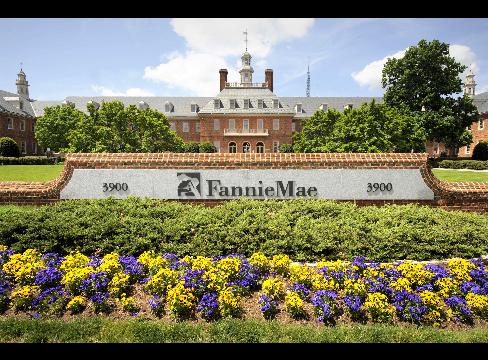
Flowers grow in front of the headquarters of Fannie Mae in Washington. Photo by Ken Cedeno / Bloomberg News.

So lets see if I have things straight. The feds can’t just bail out Freddie and Fannie because that might cause the dollar to collapse. So they can’t do that.

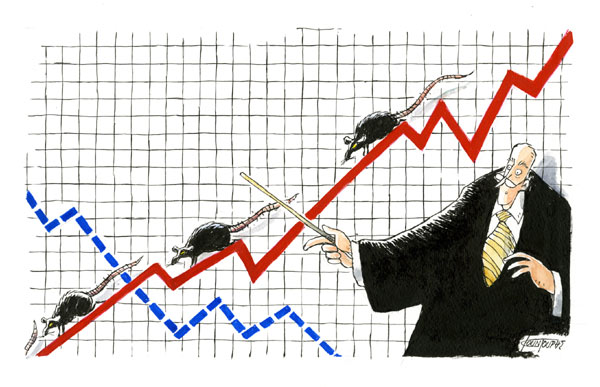
But there is this $1.5 trillion in unprofitable real estate loans so the private investors are bailing out. So its time for the fed to swagger up to the stock market and use its 2.5 billion x 2 = $5 billion default cash accessible to reassure the market.

But the fed is financially out-gunned by a factor of three hundred to one in the cash it can currently use to reassure investors, who probably read the newspapers. So Paulson is begging Congress for bailout cash that could make Bear Stearns look small by comparison.

But whatever it takes, its still worth it because we’re trying to save the dollar, right?

Because if the dollar crashes, then oil might get so expensive we can’t afford to drive to work. Drive to work from the nice suburban homes that we financed with the Freddie and Fannie loans.

Roger Baker / The Rag Blog / July 10, 2008

Fannie, Freddie Are Too Big to Fail, Lawmakers Say
By Dawn Kopecki / July 10, 2008

Fannie Mae and Freddie Mac, the largest buyers of U.S. home loans, are too big for the government to let them fail, leading Republican and Democratic lawmakers said.

The government-chartered companies, which own or guarantee about half the $12 trillion of U.S. mortgages, can count on a federal lifeline, said Republican Senator John McCain, of Arizona, and Democratic Senator Charles Schumer, of New York.

The remarks by the presumptive Republican presidential candidate and the head of the congressional Joint Economic Committee followed a slide in the firms’ shares to the lowest level since 1991. They indicate Congress would push the administration to use government funds to prevent the companies from failing and threatening a deeper housing recession.

“They must not fail,” McCain said today during a campaign stop in Belleville, Michigan. Fannie Mae and Freddie Mac “are vital to Americans’ ability to own their own homes,” he said at an earlier stop in the state, one of the worst affected by the surge in foreclosures.

Central banks, pension funds and other investors hold $5.2 trillion in debt sold by the companies.

While bondholders can count on a backstop, equity investors can’t expect the government to halt a tumble in the companies’ shares, Representative Spencer Bachus, the senior Republican on the House Financial Services Committee, said today.

Fannie Mae slid 14 percent today to close at $13.20 in New York, down 67 percent this year. Freddie Mac declined 22 percent to close at $8, bringing its slump since the end of December to 77 percent.

`Continued Woes’

Stockholders should be prepared for more “difficulties,” said Kevin Flanagan, a fixed-income strategist in Purchase, New York, for Morgan Stanley’s individual investor clients. “Continued woes, continued difficulties are the expectation, and this is going to take a while to play itself out.”

Freddie Mac owed $5.2 billion more than its assets were worth in the first quarter, making it insolvent under fair-value accounting rules. The fair value of Fannie Mae assets fell 66 percent to $12.2 billion, data provided by the Washington-based company show, and may be negative next quarter, former St. Louis Federal Reserve President William Poole said.

“Markets should be assured that the federal government will stand by Fannie Mae and Freddie Mac,” Schumer said in a statement today. They “are too important to go under,” and Congress “will act quickly” if necessary, he said.

Central Role

Fed Chairman Ben S. Bernanke and Treasury Secretary Henry Paulson, while noting the central role of Fannie Mae and Freddie Mac in ending the mortgage-finance crisis, today refrained from endorsing any extra federal backing for the companies.

The companies “are playing a very important and vital role right now,” Paulson said in testimony to the House Financial Services Committee. They “need to continue to play an important role in the future,” he said.

Fannie Mae and Freddie Mac “are well capitalized now” in “a regulatory sense,” Bernanke told the panel. Still, the companies, like all financial institutions, need “to expand their capital bases so that they can be even more proactive in providing credit and support for the economy,” the Fed chief said.

The federal government can’t afford to take over all of Fannie Mae’s and Freddie Mac’s operations, because such a move would more than double federal government debt outstanding and “have disastrous consequences for the dollar,” said Joshua Rosner, an analyst with Graham Fisher & Co. Inc. in New York.

Limited Liability

Instead, the government could move the companies’ combined $1.5 trillion investment portfolios into a separate limited liability corporation that would gradually liquidate the assets, Rosner said. Fannie Mae and Freddie Mac would still be able to support the U.S. housing market by packaging home loans into securities they guarantee.

The U.S. Treasury, which analysts said would play a central role in any rescue of the firms, currently has the authority to buy $2.25 billion in each of the companies’ debt.

Congress created Fannie Mae during the Great Depression to revive the housing market and formed Freddie Mac in 1970. While a federal rescue is “premature,” Representative Paul Kanjorski said lawmakers should prepare for more trouble.

“I don’t think any of us could anticipate all the contingencies that can happen,” said Kanjorski, a Democrat from Pennsylvania. “We recognize that we’re in very dangerous waters, very stormy. We should have contingencies.”

Rescue Option

A rescue shouldn’t be an option, said Representative Jeb Hensarling, chairman of the fiscally conservative Republican Study Committee.

“The government should not be supporting the system as is,” said Hensarling, of Texas. Fannie Mae and Freddie Mac are a “government-sanctioned duopoly” that “no longer helps the market in the way that it once did” while posing “a huge systemic risk” to the economy.

In a sign that bondholder confidence is firm, the difference in yields between Fannie Mae’s 10-year notes and 10- year U.S. Treasury bonds narrowed by 2.2 basis points today from a four-month high of 89.9 basis points Monday. Freddie Mac’s yield narrowed 2 basis points relative to 10-year Treasuries from a four-month high Wednesday of 96 basis points.

The Office of Federal Housing Enterprise Oversight, the companies’ regulator, said today it deemed Fannie Mae and Freddie Mac “adequately capitalized.”

Investors should heed Ofheo’s comments, said House Financial Services Committee Chairman Barney Frank, a Massachusetts Democrat. “I would hope that people would not react to a sense of panic or whatever and would look at the reality and that we’ll be okay,” Frank told reporters.

Source. / Bloomberg

Posted in RagBlog | Tagged , , , , | Leave a comment

G8 : Determined to Kill Off the World’s Poor


The G8: Humanitarian Failure and Making the World Safe for Corporate Power
by Robert Weissman / July 10, 2008

It’s hard to dismiss the temptation to write off the G8 meetings as a meaningless talkfest.

On the other hand, when the political leaders of the most powerful countries get together and issue joint statements, it may be worth looking at what these planetary stewards have in mind. This is particularly true at a time when new global crises — skyrocketing oil prices, the spike in food prices, the impact of the U.S. recession and accelerating global warming — are added to ongoing public health disasters and persistent global poverty.

Is it too much to expect the G8 leaders (the political leaders of the United States, Japan, Canada, Britain, France, Germany, Italy and Russia) to offer something meaningful in response to these problems?

With the G8 meeting in Hokkaido, Japan just concluded, the answer apparently is, yes.

G8 failures seem to fall into two categories: first, promise to do too little, and then renege on commitments made; second, promote harmful policies and projects.

In the first category comes the G8’s statement on global public health. Following aggressive lobbying by public health groups, the G8 agreed to reiterate its commitment to provide universal treatment for HIV/AIDS. But the rich countries have not agreed to put the money on the table to achieve this objective. “The AIDS crisis in Africa is an emergency, and reaching universal access by 2010 will require a quadrupling of spending over current levels,” explains Masaki Inaba of the Africa Japan Forum. “A restating of existing commitments is not a sufficient response by the G8.”

The dominant public health need in the world’s poorest countries is to restore the public health systems decimated by decades of International Monetary Fund and World Bank “structural adjustment” programs. The G8 leaders said only that they aim to “work toward” poor countries achieving the World Health Organization (WHO) target of 2.3 professional health workers per 1,000 people. (By contrast, according to WHO data, the United States has about 31 health workers per 1,000 people, and 56 per 1,000 if you include the category of “health management and support workers.”)

Also in the first category is the pathetic G8 statement on climate change. Dragged down most of all by the anti-leadership of the United States, the G8 announced a commitment to a 50 percent reduction in carbon emissions by 2050. Well, a sort-of commitment.

The best science says the world needs at least an 80 percent reduction from 1990 emissions levels by 2050, and very likely more, so the G8 commitment is totally inadequate on its face.

But the G8 position is even more lame than it first appears. A statement from an environmental coalition including Friends of the Earth International explained the key flaws. “First, the G8 formula is a global cut,” not imposing particular responsibility on the rich, high carbon-polluting countries. Second, “the cut has no clear baseline. It was revealing that in announcing it, Japanese Prime Minister Yasuo Fukuda initially said it was from 1990 levels, then had to take back that statement and subsequently mentioned a 2000 baseline.” Third, the statement is not binding, and “indeed, the G8 announcement reinforces the G8 as a site for climate action that rivals the UN process [for climate change negotiations] and effectively subverts it.”

In the second category of doing direct harm come many of the G8 recommendations in the declarations on the global economy and on food security.

The G8 leaders call for opening and deregulating financial markets, even as it is clear that financial deregulation has helped create the current global financial crisis.

The G8 leaders call for stronger patent, copyright and trademark monopolies. Remarkably, in a document purporting to address the key issues in the global economy, they make space to encourage rapid negotiation and completion of an Anti-Counterfeiting Trade Agreement, a deal that may hinder or criminalize peer-to-peer file sharing, require Internet Service Providers to limit consumers’ web access, and interfere with parallel trade in goods (like Canadian drugs brought into the United States), among other problems.

The G8 leaders call for completion of the Doha Round negotiations at the World Trade Organization, aiming to further deepen reliance on a global food trading system that has driven the poorest people off their land and undermined developing countries’ ability to feed themselves.

The G8 leaders also call for more aid for food-importing, poor countries — to be delivered through IMF lending facilities that typically require countries to adopt more of the market fundamentalist mandates that have driven people off the land and undermined governments’ capacity to assist the poor and pursue expansionary economic policies.

“I’m pleased to report that we’ve had significant success,” said President Bush as the G8 summit concluded.

Not exactly.

[Robert Weissman is editor of the Washington, D.C.-based Multinational Monitor, and director of Essential Action.]

Source / Common Dreams

The Rag Blog

Posted in RagBlog | Tagged , | Leave a comment

Our President : ‘Goodbye from the world’s biggest polluter’


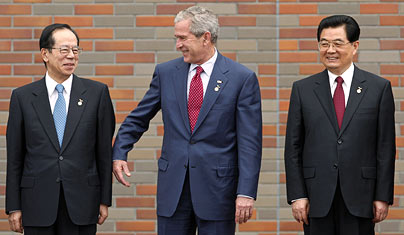
Bush yuks it up with Prime Minister of Japan, Yasuo Fukuda, and Chinese President Hu Jintao at the G8 Summit in Tokyo. Photo by Reuters.

George Bush surprised world leaders with a joke about his poor record on the environment as he left the G8 summit in Japan.
By Robert Winnett and Urmee Khan / July 10, 2008

The American leader, who has been condemned throughout his presidency for failing to tackle climate change, ended a private meeting with the words: “Goodbye from the world’s biggest polluter.”

He then punched the air while grinning widely, as the rest of those present including Gordon Brown and Nicolas Sarkozy looked on in shock.

Mr Bush, whose second and final term as President ends at the end of the year, then left the meeting at the Windsor Hotel in Hokkaido where the leaders of the world’s richest nations had been discussing new targets to cut carbon emissions.

One official who witnessed the extraordinary scene said afterwards: “Everyone was very surprised that he was making a joke about America’s record on pollution.”

Mr Bush also faced criticism at the summit after Silvio Berlusconi, the Italian Prime Minister, was described in the White House press pack given to journalists as one of the “most controversial leaders in the history of a country known for government corruption and vice”.

The White House apologised for what it called “sloppy work” and said an official had simply lifted the characterisation from the internet without reading it.

Concluding the three-day event, leaders from the G8 and developing countries proclaimed a “shared vision” on climate change. However, they failed to bridge differences between rich and emerging nations on curbing emissions.

Source. / Telegraph, U.K.

Thanks to Harry Edwards / The Rag Blog

Posted in RagBlog | Tagged , , , , | Leave a comment

David Sirota on Building a Progressive Movement


Five Ideas to Start Going from Uprising to Movement
By David Sirota / July 9, 2008

David Sirota is a senior editor at In These Times magazine and contributes regularly to The Nation, the American Prospect and the Huffington Post. He is the author of “The Uprising: An Unauthorized Tour of the Populist Revolt Scaring Wall Street and Washington.”

Jared Bernstein asks, “What steps ought we be taking now that will ultimately give progressive uprisings a public conduit through which their goals can be achieved?”

This is the $64,000 question – or, in the age of the Iraq War, the $1 trillion question.

Based on my reporting for The Uprising, here are five concepts I think we need to get comfortable with – one is about our focus, one is about structure, one about what we organize around, ]one is about what instruments of influence we use, and one is about the methods we must rekindle:

Think Global, Demand Local…

Or, Stop Obsessesing About Chris Matthews and Start Obsessing About Your State Legislator: The subject of my upcoming newspaper column this week is the incessant focus on federal politics to the exclusion of everything else. In the blogosphere, this myopia is magnified, as more bandwith is spent fretting over what MSNBC’s Chris Matthews tells his tiny, inside-the-Beltway audience than what our own state legislator is doing to screw us over.

There is a huge amount of power at the state and local level that progressives haven’t used effectively, in part, because we haven’t spent much time trying to use it. According to the Progressive States Network, more than a quarter of all Americans live in states that have both a Democratic governor and full Democratic control of the legislature. Yet, as many good bills that have passed through these legislatures, none of these states have taken truly revolutionary steps. Again, that’s because we haven’t focused nearly the resources and attention that we could – and should – be focusing on these arenas.

End the Oxymoron of Autocratic Progressivism:

Autocratic Progressives, as I discussed yesterday, are those who think you can build a progressive movement with anti-progressive, autocratic, top-down, command-and-control structures. This is elitism at its worst. If we want to take this uprising moment and channel it into a progressive movement, then the movement institutions we build have to be small-d democratic. Sadly, most of the much-vaunted new progressive infrastructure – from Moveon.org to well-funded left-leaning think tanks in Washington, D.C. – run the gamut from mostly undemocratic to completely undemocratic. That’s not the way to build a movement – and I say that not just from a moral, pro-democratic standpoint, but from a pragmatic one.

There’s a reason the most durable and powerful social movement in human history has been – and remains – the labor movement: it’s because that movement is structurally democratic. The labor movement elects leaders at all levels. Now, I’m not saying there haven’t been examples of labor leaders trying to thwart democracy – I’m not saying that at all. But what I am saying is that at the structural level, the labor movement is democratic – and that democratic structure has given members a sense of ownership and control over their movement that does not exist in undemocratic institutions. If we want this uprising to become a progressive movement, we have to get serious about our commitment to democracy.

It’s the Economic Issues, Too:

For about a quarter century now, the Democratic Party has defined its orthodoxies only on social issues – choice, civil rights, guns, etc. – not on economic ones. To know this is true, consider this hypothetical: If a pro-choice, pro-NAFTA congressperson was proposed as the keynote speaker at the Democratic National Convention, this would be billed as not controversial, but if an anti-choice, anti-gay-marriage, anti-NAFTA congressperson was proposed as that speaker, it would be labeled a major controversy. The orthodoxy, you see, is on the social issue – not on the economic one.

Let me be clear – social issues are really, really important (and, of course, I am pro-choice). But the problem is that the orthodoxy is ONLY about social issues (the issues that are unfortunately more culturally divisive) – but not about economic issues (the issues that are more cross-culturally unifying). To build this uprising into a full-fledged progressive movement, that has to change. Movements are about building wide coalitions – and the uprising I describe in the book shows the potential for trans-partisan, trans-geographical, trans-cultural coalitions if progressives and the Democratic Party drop the limousine liberalism that says as long as a politician is, say, pro-choice, it’s OK for that politician to support, say, job-killing trade policies that have decimated the heartland. The most powerful movements of the the past have been those that have powerful economic and class underpinnings.

Elections Are Means, Not Ends:

The flag-pin-fetishizing media tries to make us believe that elections – and specifically federal elections – are the ends, rather than the means. This is amplified by a progressive movement that is still struggling with Partisan War Syndrome – the sickness that says the only thing we have to do is elect Democrats and our problems are solved. The entire frame of mind is, of course, idiotically paternalistic – we believe that the messianic politicians will just hand down change from Mt. Olympus, that all we have to do is make sure the right messiah is on top of the mountain, and that trying to use an election to pressure that messiah will threaten the messiah’s ascent.

This is not how power works – or has ever worked – in American history. Jefferson Smith is right – the most successful movements have been those that meld the best of populism and progressivism, and I would add to that – those that have used elections as instruments of pressure: They have used the politicians’ desperate desire to win election as a way to get policy concessions and seen politicians as vehicles for change, not change unto themselves. When we tamp down that pressure system, or try to transform a potential pressure system like the blogosphere into merely an amplifier of one party or politician, we ignore this history. As Dan Cantor of the Working Families Party told me when I reported on third-party politics, the best kind of politician is a nervous politician – because you can get a nervous politician to be your vehicle if you have done the hard, unglamorous work in the lead-up to organize your movement.

Remember That Thing Called Direct Action:

Along with the paternalistic view of politicians that comes from the obsession with federal elections comes the potential to forget about direct action: the actions outside the electoral arena that can change things. In my book, I detail a number of these – most prominently, the shareholder democracy and labor movements.

The Establishment wants us to focus all of our energy on elections because elections are the controlled space whereby popular ferment can be contained by rules, regulations, etc. And without direct action, republican democracy is truly disempowering: our only means of influence are to beg the Very Serious And Important Intermediary – the congressman, the governor, the president, etc. – to do something on our behalf. But there are many different methods of direct action – ie. taking matters into our own hands – that can wield a tremendous amount of power.

Right now, the labor movement could go out and organize another 10 million workers without a single policy change in Washington, D.C. – and if labor did that, it would increase its power not just in the electoral arena, but in employer-employee negotatiations – the place where the real rubber hits the road on issues like wages, health care, etc. This would be an example of direct action.

I’m not saying this would be easy – nor am I saying labor isn’t trying to do this already, nor am I saying who is in office wouldn’t make it harder or easier for labor unions to accomplish this organizing task. But when I met with organizers at WashTech (the union trying to organize high-tech workers in the Pacific Northwest), they were way less concerned about who is president and who is in Congress than they were about whether they could simply go out and convince enough workers to join their union. Same thing with shareholder activists that I accompanied to ExxonMobil’s 2007 shareholder meeting. These activists weren’t focused on who is ahead in the presidential polls – they were focused on getting as many shareholders to vote for their resolution.

This is the lost legacy of direct action – a legacy that progressives must spend a lot more time rekindling.

Source. / Talking Points Memo

Find The Uprising: An Unauthorized Tour of the Populist Revolt Scaring Wall Street and Washington by David Sirota at Amazon.com.

Thanks to Carlos Lowry / The Rag Blog

Posted in RagBlog | Tagged , , , , , | Leave a comment

Complex Underwater Eco-Systems at Peril

A fish swims among coral reefs off the Obhor coast, north of the Red Sea city of Jeddah. A third of reef-building corals worldwide are threatened with extinction due to climate change and water pollution, according to the first global assessment on the marine creature. Photo by Hassan Ammar / AFP/Getty Images.

Climate Change Threatens World’s Coral Reefs
July 10, 2008

A third of reef-building corals worldwide are threatened with extinction due to climate change and water pollution, according to the first global assessment on the marine creature by 39 scientists.

Destructive fishing and the degradation of coastal habitats also posed threats, said the study published Thursday involving the International Union for Conservation of Nature (IUCN) and Conservation International.

“The results of this study are very disconcerting,” said Kent Carpenter, lead author of the study which examined 845 coral reef species.

“When corals die off, so do the other plants and animals that depend on coral reefs for food and shelter, and this can lead to the collapse of entire ecosystems,” he added.

Roger McManus from Conservation International said that reef-building corals in particular were “most vulnerable to the effects of climate change”.

Sea temperature rises bleach and weaken the algae that give the underwater sea life its vibrant color, and make it more susceptible to diseases.

As they are home to over 25 percent of marine species — including fish stocks — loss of reefs could also impact coastal fishing communities.

“The loss of the corals will have profound implications for millions of people who depend on coral reefs for their livelihoods,” said McManus.

According to the study, the Caribbean region has the highest number of highly threatened corals.

Due to huge human populations in the region, the Indo-Malay-Philippine archipelago also has the highest proportions of vulnerable and almost threatened species in the Indo-Pacific.

“We either reduce our CO2 emission now or many corals will be lost forever,” warned Julia Marton-Lefevre, IUCN Director General.

Source. / AFP / Discovery News

The Rag Blog

Posted in RagBlog | Tagged , , , , , | Leave a comment

FILM : Mackenzie’s "The Exiles" Explores A Forgotten Urban Culture

Tommy Reynolds (right) in Kent Mackenzie’s “The Exiles.” Still from Milestone Films.

All-night party in a lost city
By Andrew O’Hehir / July 10, 2008

In the late 1950s, a USC filmmaking student named Kent Mackenzie began hanging out with the community of young American Indians in the neighborhood of Bunker Hill, just north of downtown Los Angeles. Most of these young people had recently moved from the Indian reservations of the southwestern United States, becoming part of a massive urban relocation of the Native American population that would be much discussed by later sociologists, but was hardly noticed at the time. “The Exiles,” the black-and-white feature film Mackenzie made on the streets of L.A. between 1958 and 1960 with a group of Indians he knew, is an awkward, somewhat dated blend of fiction and documentary — but it’s also an astonishing, heartbreaking viewing experience and, in its new release from Milestone Films, a major work of restoration and rediscovery.

Mackenzie’s script was based on the personal experiences of Yvonne Williams, Homer Nish and Tommy Reynolds, the film’s subjects and/or actors, and recorded interviews with the cast are used as voiceover narration explaining each character’s thoughts. There are episodes, but by design nothing close to a conventional plot: Beefy Homer and ne’er-do-well Tommy dump Yvonne — who is pregnant with Homer’s child and yearns for a settled domestic existence — at a downtown movie theater, then head out for a long night of drinking, gambling and womanizing, followed by an amazing predawn party sequence on a trash-strewn hilltop, featuring both Thunderbird wine and tribal songs and dances. You get the feeling it’s not a new pattern, and that it’s likely to be repeated the next night and the one after that.

There’s no editorializing or explicit social commentary in “The Exiles,” with the possible exception of a scene in which Homer stands in front of a liquor store on Hill Street reading a letter from his parents back on the “rez” in Valentine, Ariz., and imagines a bucolic scene there. (Again, this is meant to convey Homer’s point of view, not the director’s.) You can certainly argue that these characters’ lives of dead-broke hedonism, skating from one beer and one dollar to the next one, reflect a legacy of profound cultural defeat and economic oppression. But it’s not at all clear that they see it that way, and Mackenzie doesn’t necessarily either.

Like his contemporaries Cassavetes, Truffaut and Godard (whose work he may or may not have seen), Mackenzie is pursuing subjective human experience, not intellectual analysis, and his extraordinary shot-sequences — like the giddy, drunken, hair-raising drive through a tunnel in a top-down convertible — address issues of signification more than anything I could say about the film. It’s worth adding that the terrific original garage-rock score is by an L.A. band called the Revels, whose song “Comanche” appears both here and in “Pulp Fiction,” a movie unquestionably influenced by this one. If the stagey, docudrama quality of “The Exiles” takes time to get used to, as does the odd, artificial “post-sync” sound — nearly all the dialogue was recorded in a studio, after the fact, as in many European films of the period — the startling naturalism of the images still wins out.

Along with capturing a vanished era of Indian urban subculture that mainstream America knew nothing about and cared even less, Mackenzie’s miraculous black-and-white images (as lovingly restored by Ross Lipman at the UCLA Film & Television Archive) literally capture a vanished physical landscape, from the predominantly Indian dive bars and grindhouse movie theaters of Main Street to the Angels Flight tramway and decaying Victorian rooming houses of Bunker Hill (memorably used as a location in Robert Aldrich’s 1955 noir “Kiss Me Deadly” and other period films). Although the neighborhood technically still exists — it’s now the skyscraper district of downtown L.A., in fact — every building seen in “The Exiles” is gone today, the hill itself has been flattened and the Angels Flight railway, reconstructed nearby as a tourist attraction, has been shut down since 2001.

Inspired both by early documentary filmmakers like Robert Flaherty and Humphrey Jennings and by the social realism of Jean Renoir and Vittorio de Sica, Mackenzie strove to capture his subjects’ lives in all their complexity, without pitying or exoticizing them. “I tried very hard not to be attracted by the strangeness of the environment as opposed to my own, and to avoid the ‘romance of poverty,'” he wrote. He intended “The Exiles” as an “anti-theatrical” and “anti-social-documentary” film, which would pose problems for the viewer it did not resolve. Given that it has never had a commercial, theatrical engagement in the past 47 years, I suppose he succeeded a little too well.

There’s entirely too much synchronicity to the story of “The Exiles,” in fact: It’s a forgotten movie about a forgotten people, made in a forgotten neighborhood by a forgotten director. Despite premiering at the Venice and San Francisco film festivals (and playing the first-ever New York Film Festival in 1964), the picture never found theatrical distribution and for decades was available only in 16mm and patchy VHS classroom versions. Mackenzie died in 1980, after making only two more films (one of them a 1965 TV special called “The Teenage Revolution,” narrated by Van Heflin). By any objective measure, he was a failure as a filmmaker. But in the secret, unwritten history of alternative American culture he stands as a hero, alongside the Indians of Bunker Hill and the generations before them.

“The Exiles” opens July 11 at the IFC Center in New York, with other cities and DVD release to follow.

Source. / salon.com

The Rag Blog

Posted in RagBlog | Tagged , , , , , | Leave a comment

Taking the Bible to Court

Ned Flanders of The Simpsons agrees with Bible publishers Zondervan and Thomas Nelson that homosexuals are “wicked” and won’t go to Heaven.

Bible Publishers Sued for Anti-Gay References
By Rick Pedraza / July 10, 2008

A Michigan man is seeking $70 million from two Christian publishers for emotional distress and mental instability he received during the past 20 years from versions of the Bible that refer to homosexuality as a sin.

Bradley LaShawn Fowler, a gay man, claims his constitutional rights were infringed upon by Zondervan Publishing Co. and Thomas Nelson Publishing, both of which, he claims, deliberately caused homosexuals to suffer by misinterpretation of the Bible.

Fowler, 39, is seeking $60 million from Zondervan and another $10 million from Thomas Nelson.

According to a USA Today report, Fowler’s two separate suits against the publishers claim the intent of the Bible revisions that refer to homosexuals as sinners reflect an individual opinion or a group’s conclusion.

Fowler says the deliberate changes made to first Corinthians, chapter six, verse nine caused him “or anyone who is a homosexual to endure verbal abuse, discrimination, episodes of hate, and physical violence … including murder.”

Fowler, who is representing himself in both lawsuits, claims the publishers are misinterpreting the Bible by specifically using the word homosexuals, which made him an outcast from his family and contributed to physical discomfort and periods of demoralization, chaos and bewilderment.

“These are opinions based on the publishers and they are being embedded in the religious structure as a way of life,” he tells a local NBC TV station affiliate in Grand Rapids.

Fowler admits that every Bible printed is a translation that can be interpreted in many ways, but he says specifically using the word “homosexual” is not a translation but a change.

Fowler says Zondervan Bibles published in the ‘80s used the word homosexuals among a list of those who are “wicked’ or unrighteous and won’t inherit the kingdom of heaven.”

Zondervan, for its part, issued a statement to the Grand Rapids press stating it does not translate the Bible or own the copyright for any of the translations it publishes

“We rely on the scholarly judgment of the highly respected and credible translation committees behind each translation and never alter the text of the translations we are licensed to publish,” the statement reads.

“We only publish credible translations produced by credible Biblical scholars.”

U.S. District Judge Julian Abele Cook Jr., who will hear Fowler’s case against Thomas Nelson, says the court “has some very genuine concerns about the nature and efficacy of [Fowler’s] claims.”

Source. / Newsmax

Thanks to Jeff Jones / The Rag Blog

Posted in RagBlog | Tagged , , , , , , | Leave a comment

Tom Englehardt : Why Cheney Won’t Take Down Iran


Reality Bites Back
Why the U.S. won’t attack Iran

By Tom Engelhardt / July 9, 2008

It’s been on the minds of antiwar activists and war critics since 2003. And little wonder. If you don’t remember the pre-invasion of Iraq neocon quip, “Everyone wants to go to Baghdad. Real men want to go to Tehran…” — then take notice. Even before American troops entered Iraq, knocking off Iran was already “Regime Change: The Sequel.” It was always on the Bush agenda and, for a faction of the administration led by Vice President Cheney, it evidently still is.

Add to that a series of provocative statements by President Bush, the Vice President, and other top U.S. officials and former officials. Take Cheney’s daughter Elizabeth, who recently sent this verbal message to the Iranians: “[D]espite what you may be hearing from Congress, despite what you may be hearing from others in the administration who might be saying force isn’t on the table… we’re serious.” Asked about an Israeli strike on Iran, she said: “I certainly don’t think that we should do anything but support them.” Similarly, former U.N. Ambassador John Bolton suggested that the Bush administration might launch an Iranian air assault in its last, post-election weeks in office.

Consider as well the evident relish with which the President and other top administration officials regularly refuse to take “all options” off that proverbial “table” (at which no one bothers to sit down to talk). Throw into the mix semi-official threats, warnings, and hair-raising leaks from Israeli officials and intelligence types about Iran’s progress in producing a nuclear weapon and what Israel might do about it. Then there were those recent reports on a “major” Israeli “military exercise” in the Mediterranean that seemed to prefigure a future air assault on Iran. (“Several American officials said the Israeli exercise appeared to be an effort to develop the military’s capacity to carry out long-range strikes and to demonstrate the seriousness with which Israel views Iran’s nuclear program.”)

From the other side of the American political aisle comes a language hardly less hair-raising, including Hillary Clinton’s infamous comment about how the U.S. could “totally obliterate” Iran (in response to a hypothetical Iranian nuclear attack on Israel). Congressman Ron Paul recently reported that fellow representatives “have openly voiced support for a pre-emptive nuclear strike” on Iran, while the resolution soon to come before the House (H.J. Res. 362), supported by Democrats as well as Republicans, urges the imposition of the kind of sanctions and a naval blockade on Iran that would be tantamount to a declaration of war.

Stir in a string of new military bases the U.S. has been building within miles of the Iranian border, the repeated crescendos of U.S. military charges about Iranian-supplied weapons killing American soldiers in Iraq, and the revelation by Seymour Hersh, our premier investigative reporter, that, late last year, the Bush administration launched — with the support of the Democratic leadership in Congress — a $400 million covert program “designed to destabilize [Iran’s] religious leadership,” including cross-border activities by U.S. Special Operations Forces and a low-level war of terror through surrogates in regions where Baluchi and Ahwazi Arab minorities are strongest. (Precedents for this terror campaign include previous CIA-run campaigns in Afghanistan in the 1980s, using car bombs and even camel bombs against the Russians, and in Iraq in the 1990s, using car bombs and other explosives in an attempt to destabilize Saddam Hussein’s regime.)

Add to this combustible mix the unwillingness of the Iranians to suspend their nuclear enrichment activities, even for a matter of weeks, while negotiating with the Europeans over their nuclear program. Throw in as well various threats from Iranian officials in response to the possibility of a U.S. or Israeli attack on their nuclear facilities, and any number of other alarums, semi-official predictions (“A senior defense official told ABC News there is an ‘increasing likelihood’ that Israel will carry out such an attack…”), reports, rumors, and warnings — and it’s hardly surprising that the political Internet has been filled with alarming (as well as alarmist) pieces claiming that an assault on Iran may be imminent.

Seymour Hersh, who certainly has his ear to the ground in Washington, has publicly suggested that an Obama victory might be the signal for the Bush administration to launch an air campaign against that country. As Jim Lobe of Inter Press Service has pointed out, there have been a number of “public warnings by U.S. hawks close to Cheney’s office that either the Israelis or the U.S. would attack Iran between the November elections and the inaugural of a new president in January 2009.”

Given the Bush administration’s “preventive war” doctrine which has opened the way for the launching of wars without significant notice or obvious provocation, and the penchant of its officials to ignore reality, all of this should frighten anyone. In fact, it’s not only war critics who are increasingly edgy. In recent months, jumpy (and greedy) commodity traders, betting on a future war, have boosted these fears. (Every bit of potential bad news relating to Iran only seems to push the price of a barrel of oil further into the stratosphere.) And mainstream pundits and journalists are increasingly joining them.

No wonder. It’s a remarkably frightening scenario, and, if there’s one lesson this administration has taught us these last years, it’s that nothing’s “off the table,” not for officials who, only a few years ago, believed themselves capable of creating their own reality and imposing it on the planet. An “unnamed Administration official” — generally assumed to be Karl Rove — famously put it this way to journalist Ron Suskind back in October 2004:

“[He] said that guys like me were ‘in what we call the reality-based community,’ which he defined as people who ‘believe that solutions emerge from your judicious study of discernible reality.’ I nodded and murmured something about enlightenment principles and empiricism. He cut me off. ‘That’s not the way the world really works anymore,’ he continued. ‘We’re an empire now, and when we act, we create our own reality. And while you’re studying that reality — judiciously, as you will — we’ll act again, creating other new realities, which you can study too, and that’s how things will sort out. We’re history’s actors…. and you, all of you, will be left to just study what we do.'”

A Future Global Oil Shock

Nonetheless, sometimes — as in Iraq — reality has a way of biting back, no matter how mad or how powerful the imperial dreamer. So, let’s consider reality for a moment. When it comes to Iran, reality means oil and natural gas. These days, any twitch of trouble, or potential trouble, affecting the petroleum market, no matter how minor — from Mexico to Nigeria — forces the price of oil another bump higher.

Possessing the world’s second largest reserves of oil and natural gas, Iran is no speed bump on the energy map. The National Security Network, a group of national security experts, estimates that the Bush administration’s policy of bluster, threat, and intermittent low-level actions against Iran has already added a premium of $30-$40 to every $140 barrel of oil. Then there was the one-day $11 spike after Israeli Deputy Prime Minister Shaul Mofaz suggested that an Israeli attack on Iranian nuclear facilities was “unavoidable.”

Given that, let’s imagine, for a moment, what almost any version of an air assault — Israeli, American, or a combination of the two — would be likely to do to the price of oil. When asked recently by Brian Williams on NBC Nightly News about the effects of an Israeli attack on Iran, correspondent Richard Engel responded: “I asked an oil analyst that very question. He said, ‘The price of a barrel of oil? Name your price: $300, $400 a barrel.'” Former CIA official Robert Baer suggested in Time Magazine that such an attack would translate into $12 gas at the pump. (“One oil speculator told me that oil would hit $200 a barrel within minutes.”)

Those kinds of price leaps could take place in the panic that preceded any Iranian response. But, of course, the Iranians, no matter how badly hit, would be certain to respond — by themselves and through proxies in the region in a myriad of possible ways. Iranian officials have regularly been threatening all sorts of hell should they be attacked, including “blitzkrieg tactics” in the region. Oil Minister Gholam Hossein Nozari typically swore that his country would “react fiercely, and nobody can imagine what would be the reaction of Iran.” The head of Iran’s Revolutionary Guard, Mohammed Jafari, said: “Iran’s response to any military action will make the invaders regret their decision and action.” (“Mr. Jafari had already warned that if attacked, Iran would launch a barrage of missiles at Israel and close the Strait of Hormuz, the outlet for oil tankers leaving the Persian Gulf.”) Ali Shirazi, Iranian Supreme Leader Ayatollah Ali Khamenei’s representative to the Revolutionary Guards, offered the following: “The first bullet fired by America at Iran will be followed by Iran burning down its vital interests around the globe.”

Let’s take a moment to imagine just what some of the responses to any air assault might be. The list of possibilities is nearly endless and many of them would be hard even for the planet’s preeminent military power to prevent. They might include, as a start, the mining of the Strait of Hormuz, through which a significant portion of the world’s oil passes, as well as other disruptions of shipping in the region. (Don’t even think about what would happen to insurance rates for oil tankers!)

In addition, American troops on their mega-bases in Iraq, rather than being a powerful force in any attack — Iraqi Prime Minister Nouri al-Maliki has already cautioned President Bush that Iraqi territory cannot be used to attack Iran — would instantly become so many hostages to Iranian actions, including the possible targeting of those bases by missiles. Similarly, U.S. supply lines for those troops, running from Kuwait past the southern oil port of Basra might well become hostages of a different sort, given the outrage that, in Shiite regions of Iraq, would surely follow an attack. Those lines would assumedly not be impossible to disrupt.

Imagine, as well, what possible disruptions of the modest Iraqi oil supply might mean in the chaos of the moment, with Iranian oil already off the market. Then consider what the targeting of even small numbers of Iranian missiles on the Saudi and Kuwaiti oil fields could do to global oil markets. (It might not even matter whether they actually hit anything.) And that, of course, just scratches the surface of the range of retaliatory possibilities available to Iranian leaders.

Looked at another way, Iran is a weak regional power (which hasn’t invaded another country in living memory) that nonetheless retains a remarkable capacity to inflict grievous harm locally, regionally, and globally.

Such a scenario would result in a global oil shock of almost inconceivable proportions. For any American who believes that he or she is experiencing “pain at the pump” right now, just wait until you experience what a true global oil shock would involve.

And that’s without even taking into consideration what spreading chaos in the oil heartlands of the planet might mean, or what might happen if Hezbollah or Hamas took action of any sort against Israel, and Israel responded. Mohamed ElBaradei, the sober-minded head of the International Atomic Energy Agency, considering the situation, said the following: “A military strike, in my opinion, would be worse than anything possible. It would turn the region into a fireball…”

This, then, is the baseline for any discussion of an attack on Iran. This is reality, and it has to be daunting for an administration that already finds itself militarily stretched to the limit, unable even to find the reinforcements it wants to send into Afghanistan.

Can Israel Attack Iran?

Let’s leave to the experts the question of whether Israel could actually launch an effective air strike against Iranian nuclear facilities on its own — about which there are grave doubts. And let’s instead try to imagine what it would mean for Israel to launch such an assault (egged on by the Vice President’s faction in the U.S. government) in the last months, or even weeks, of the second term of an especially lame lame-duck President and an historically unpopular administration.

From Iran’s foreign minister, we already know that the Iranians would treat an Israeli attack as if it were an American one, whether or not American planes were involved — and little wonder. For one thing, Israeli planes heading for Iran would undoubtedly have to cross Iraqi air space, at present controlled by the United States, not the nearly air-force-less Maliki government. (In fact, in Status of Forces Agreement negotiations with the Iraqis, the Bush administration has demanded that the U.S. retain control of that air space, up to 29,000 feet, after December 31, 2008, when the U.N. mandate runs out.)

In other words, on the eve of the arrival of a new American administration, Israel, a small, vulnerable Middle Eastern state deeply reliant on its American alliance, would find itself responsible for starting an American war (associated with a Vice President of unparalleled unpopularity) and for a global oil shock of staggering proportions, if not a global great depression. It would also be the proximate cause for a regional “fireball.” (Oil-poor Israel would undoubtedly also be economically wounded by its own strike.)

In addition, the latest American National Intelligence Estimate on Iran concluded that the Iranians stopped weaponizing parts of their nuclear program back in 2003, and American intelligence reputedly doubts recent Israeli warnings that Iran is on the verge of a bomb. Of course, Israel itself has an estimated — though unannounced — nuclear force of about 200 such weapons.

Simply put, it is next to inconceivable that the present riven Israeli government would be politically capable of launching such an attack on Iran on its own, or even in combination with only a faction, no matter how important, in the U.S. government. And such a point is more or less taken for granted by many Israelis (and Iranians). Without a full-scale “green light” from the Bush administration, launching such an attack could be tantamount to long-term political suicide.

Only in conjunction with an American attack would an Israeli attack (rash to the point of madness even then) be likely. So let’s turn to the Bush administration and consider what might be called the Hersh scenario.

Will the Bush administration Attack Iran If Obama Is Elected?

The first problem is a simple one. Oil, which was at $146 a barrel last week, dropped to $136 (in part because of a statement by Iranian President Mahmoud Ahmadinejad dismissing “the possibility that war with the United States and Israel was imminent”), and, on Wednesday rose a dollar to $137 in reaction to Iranian missile tests. But, whatever its immediate zigs and zags, the overall pattern of the price of oil seems clear enough. Some suggest that, by the time of any Obama victory, a barrel of crude oil will be at $170. The chairman of the giant Russian oil monopoly Gazprom recently predicted that it would hit $250 within 18 months — and that’s without an attack on Iran.

For those eager to launch a reasonably no-pain campaign against Iran, the moment is already long gone. Every leap in the price of oil only emphasizes the pain to come. In turn, that means, with every passing day, it’s madder — and harder — to launch such an attack. There is already significant opposition within the administration; the American people, feeling pain, are unprepared for and, as polls indicate, massively unwilling to sanction such an attack. There can be no question that the Bush legacy, such as it is, would be secured in infamy forever and a day.

Now, consider recent administration actions on North Korea. Facing a “reality” that first-term Bush officials would have abjured, the President and his advisors not only negotiated with that nuclearized Axis of Evil nation, but are now removing it from the Trading with the Enemy Act list and the State Sponsor of Terrorism list. No matter what steps Kim Jong Il’s regime has taken, including blowing up the cooling tower at the Yongbyon reactor, this is nothing short of a stunning reversal for this administration. An angry John Bolton, standing in for the Cheney faction, compared what happened to a “police truce with the Mafia.” And Vice President Cheney’s anger over the decision — and the policy — was visible and widely reported.

It’s possible, of course, that Cheney and associates are simply holding their fire for what they care most about, but here’s another question that needs to be considered: Does George W. Bush actually support his imperial Vice President in the manner he once did? There’s no way to know, but Bush has always been a more important figure in the administration than many critics like to imagine. The North Korean decision indicates that Cheney may not have a free hand from the President on Iran policy either.

The Adults in the Room

And what about the opposition? I’m not talking about those of us out here who would oppose such a strike. I mean within the world of Bush’s Washington. Forget the Democrats. They hardly count and, as Hersh has pointed out, their leadership already signed off on that $400 million covert destabilization campaign.

I mean the adults in the room, who have been in short supply indeed these last years in the Bush administration, specifically Secretary of Defense Robert Gates and Chairman of the Joint Chiefs of Staff Mike Mullen. (Condoleezza Rice evidently falls into this camp as well, although she’s proven herself something of a President-enabling nonentity over the years.)

With former Carter National Security Advisor Zbigniew Brzezinski, Gates tellingly co-chaired a task force sponsored by the Council on Foreign Relations back in 2004 which called for negotiations with Iran. He arrived at the Pentagon early in 2007 as an envoy from the world of George H.W. Bush and as a man on a mission. He was there to staunch the madness and begin the clean up in the imperial Augean stables.

In his Congressional confirmation hearings, he was absolutely clear: any attack on Iran would be a “very last resort.” Sometimes, in the bureaucratic world of Washington, a single “very” can tell you what you need to know. Until then, administration officials had been referring to an attack on Iran simply as a “last resort.” He also offered a bloodcurdling scenario for what the aftermath of such an American attack might be like:

“It’s always awkward to talk about hypotheticals in this case. But I think that while Iran cannot attack us directly militarily, I think that their capacity to potentially close off the Persian Gulf to all exports of oil, their potential to unleash a significant wave of terror both in the — well, in the Middle East and in Europe and even here in this country is very real… Their ability to get Hezbollah to further destabilize Lebanon I think is very real. So I think that while their ability to retaliate against us in a conventional military way is quite limited, they have the capacity to do all of the things, and perhaps more, that I just described.”

And perhaps more… That puts it in a nutshell.

Hersh, in his most recent piece on the administration’s covert program in Iran, reports the following:

“A Democratic senator told me that, late last year, in an off-the-record lunch meeting, Secretary of Defense Gates met with the Democratic caucus in the Senate. (Such meetings are held regularly.) Gates warned of the consequences if the Bush Administration staged a preemptive strike on Iran, saying, as the senator recalled, ‘We’ll create generations of jihadists, and our grandchildren will be battling our enemies here in America.’ Gates’s comments stunned the Democrats at the lunch.”

In other words, back in 2007, early and late, our new secretary of defense managed to sound remarkably like one of those Iranian officials issuing warnings. Gates, who has a long history as a skilled Washington in-fighter, has once again proven that skill. So far, he seems to have outmaneuvered the Cheney faction.

The March “resignation” of CENTCOM commander Admiral William J. Fallon, outspokenly against an administration strike on Iran, sent both a shiver of fear through war critics and a new set of attack scenarios coursing through the political Internet, as well as into the world of the mainstream media. As reporter Jim Lobe points out at his invaluable Lobelog blog, however, Admiral Mike Mullen, the Chairman of the Joint Chiefs and Gates’s man in the Pentagon, has proven nothing short of adamant when it comes to the inadvisabilty of attacking Iran.

His recent public statements have actually been stronger than Fallon’s (and the position he fills is obviously more crucial than CENTCOM commander). Lobe comments that, at a July 2nd press conference at the Pentagon, Mullen “repeatedly made clear that he opposes an attack on Iran — whether by Israel or his own forces — and, moreover, favors dialogue with Tehran, without the normal White House nuclear preconditions.”

Mullen, being an adult, has noticed the obvious. As columnist Jay Bookman of the Atlanta Constitution put the matter recently: “A U.S. attack on Iran’s nuclear installations would create trouble that we aren’t equipped to handle easily, not with ongoing wars in Iraq and Afghanistan. Adm. Mike Mullen, the chairman of the Joint Chiefs of Staff, drove that point home in a press conference last week at the Pentagon.”

The Weight of Reality

Here’s the point: Yes, there is a powerful faction in this administration, headed by the Vice President, which has, it seems, saved its last rounds of ammunition for a strike against Iran. The question, of course, is: Are they still capable of creating “their own reality” and imposing it, however briefly, on the planet? Every tick upwards in the price of oil says no. Every day that passes makes an attack on Iran harder to pull off.

On this subject, panic may be everywhere in the world of the political Internet, and even in the mainstream, but it’s important not to make the mistake of overestimating these political actors or underestimating the forces arrayed against them. It’s a reasonable proposition today — as it wasn’t perhaps a year ago — that, whatever their desires, they will not, in the end, be able to launch an attack on Iran; that, even where there’s a will, there may not be a way.

They would have to act, after all, against the unfettered opposition of the American people; against leading military commanders who, even if obliged to follow a direct order from the President, have other ways to make their wills known; against key figures in the administration; and, above all, against reality which bears down on them with a weight that is already staggering — and still growing.

And yet, of course, for the maddest gamblers and dystopian dreamers in our history, never say never.

[Tom Engelhardt, co-founder of the American Empire Project, runs the Nation Institute’s TomDispatch.com. The World According to TomDispatch: America in the New Age of Empire (Verso, 2008), a collection of some of the best pieces from his site, has just been published. Focusing on what the mainstream media hasn’t covered, it is an alternative history of the mad Bush years. A brief video in which Engelhardt discusses American mega-bases in Iraq can be viewed by clicking here.]

Copyright 2008 Tom Engelhardt

Source. / TomDispatch

I think this article does not prove that the US or Israel will not attack, but it does show what the consequences will be: $400/barrel oil, $12/gallon at the pump; increased vulnerability of American forces in Middle East, much more violence in the region. All predictions in the last eight years that “the Adults” would inevitably take charge (e.g., Frank Rich before the 2006 election) have been wrong. So if there is an attack before or after November, the results will be disastrous. Bring it on!

The greatest probability, however, is that the attack on Iran will be a “low-intensity war,” as in Central America in the Eighties. That’s the real emphasis of Hersh’s piece. The consequences may be endurable by the U.S., since it’s in the interest of the Iranians to limit things. Also, the American people will not notice a low-intensity war.

Tom Hayden had a great piece a few weeks ago on the primacy of “special ops” in the future U.S. military strategy, “Meet Dr. Strangelove,” http://www.huffingtonpost.com/tom-hayden/meet-the-new-dr-strangelo_b_108288.html It focused on an Australian Lt. Colonel who is Petraes’ advisor. American conventional forces are obviously useless, plus they run the problem of being noticed by the American people.

All these thousands of special ops people running around with murky mandates to murder people and foment terrorism will inevitably have a blowback effect in the U.S.: the rise of death squads to eliminate effective dissent. Thank god we’re so ineffective.

Mark Rudd / The Rag Blog / July 10, 2008

Thanks to David Hamilton / The Rag BLog

Posted in RagBlog | Tagged , , , , | 2 Comments

CodePink Flotilla Confronts Congressman About Iran Sanctions

Members of Code Pink protested Rep. Gary Ackerman’s (D-NY) house boat with a canoe blockade Wednesday morning. Ackerman embraced the protesters, calling it the most creative protest he had ever seen and engaged in a lengthy discussion with them about the Iran sanctions proposed in Congress. Photo by Michael Temchine / Newsday / July 9, 2008.

Protesters blockade Rep. Ackerman’s houseboat
BY Janie Lorber / July 9, 2008

WASHINGTON – Rep. Gary Ackerman might be the only member of Congress who really knows what a naval blockade feels like — thanks to peace activists who early Wednesday morning gathered around his Potomac River houseboat with a naval blockade of their own.

It wasn’t much, a mini-flotilla of three canoes and an inflatable raft — not even enough to surround Ackerman’s aquatic home. But the 15 activists from Code Pink wanted to encourage Ackerman (D-Jamaica Estates) to tone down his rhetoric against Iran.

After enduring nearly 30 minutes of sirens, whistles, drumbeats and megaphone chanting, Ackerman — wearing his trademark carnation in his lapel and a floral tie — emerged with a kiss and a hug for the ringleader.

But he said he would go ahead with a resolution calling for stiffer sanctions against Iran.

The Ackerman measure Code Pink wants Ackerman to withdraw the legislation because it believes it symbolizes the first step on a path to war. The group wants direct talks with Iran’s government instead.

“This House resolution — they claim that it’s a diplomatic measure and we say its not. It’s a very provocative measure,” said Desiree Fairooz, who received national attention for trying to smear fake blood on Secretary of State Condoleezza Rice during a congressional hearing last year.

Ackerman, whose district covers part of Nassau County, said he would be willing to meet with any Iranian government official without pre-conditions, including President Mahmoud Ahmadinejad, but would not retreat from his legislation.

“This is not an embargo,” Ackerman told the protestors. “We’re not calling for a blockade. It is basically what the UN is doing. The UN has imposed sanctions on Iran.”

The legislation asks President George W. Bush to “increase economic, political and diplomatic pressure on Iran.” But as a nonbinding resolution, it will never be presented to the president for signature and does not have the force of law.

Source. / Newsday

Thanks to Jeff Webster and Susan Van Haitsma / The Rag Blog

Posted in RagBlog | Tagged , , , , , | Leave a comment

Stopping Capitalism in Mexico – Calderon Will Lose

Sunday, thousands of Mexicans turned out to protest the oil reforms.

Confrontation Over Mexican Oil Privatization Plan Intensifies
By Alan Benjamin / July 10, 2008

MEXICO CITY — Proposals to privatize Mexico’s state-owned oil industry have sparked a powerful movement in the streets, led by a leftist political leader who narrowly lost the 2006 presidential election.

The National Movement in Defense of Oil (Movimiento Nacional en Defensa del Petróleo or MNDP), headed by former presidential candidate Andrés Manuel López Obrador, formally presented a resolution to the Mexican Congress on June 3. It calls on the Congress to organize a Nationwide Referendum to let the people vote on the six privatization planks in the energy “reform” plan initiated by Mexican President Felipe Calderón.

The conservative majority in Mexico’s Congress has refused to approve such a referendum, saying it would be unconstitutional. Ironically, Mexico was the first Latin American nation to nationalize its oil reserves in 1938, and is now moving to loosen state control of the industry just as oil prices are hitting record highs. The privatization plan is also being pushed at a time when other Latin American nations, such as Venezuela, Bolivia and Ecuador, are moving to assert greater state control over their own oil resources.

Mexico is the world’s sixth largest oil producer and oil revenues fund 40 percent of the government’s budget.

Lopéz Obrador officially lost the 2006 presidential election by 0.2 percent of the vote, amid widespread allegations of fraud by Calderón’s ruling conservative party.

Critics have accused the promoters of the national referendum — and López Obrador in particular — of “fomenting instability, violence and chaos” across Mexico. In addition, both Calderón and Jesus Reyes Heroles, the director of Pemex, Mexico’s state-owned oil corporation, have insisted that a referendum is out of the question, as their reform plan is too complicated for the Mexican people to be able to understand. Such accusations have not prevented defenders of Mexico’s oil resources from moving forward.

Pushing a People’s Referendum

In early June, a wing of López Obrador supporters in the leftist Party of the Democratic Revolution (PRD), all mayors, announced that in their cities and villages, they will convene referendums on the national energy reform plan. Marcelo Ebrard, the mayor of Mexico City (which holds about 10 percent of the country’s population and is its nerve center), announced that he would convene a referendum July 27.

Ebrard’s announcement was met with protests by top-level Calderón government officials, who warned Ebrard not to go ahead with the referendum, hinting that he might face impeachment proceedings.

López Obrador has since announced that — no matter what is decided in the Congress or what happens with the municipalities where local referendums are already being organized — the MNDP will hold a national referendum Aug. 7 in the country’s remaining 2,500 electoral districts. “The people are sovereign, the people must decide,” López Obrador said.

An outdoor assembly of the MNDP will be held in Mexico City June 27 and plans for organizing the Aug. 7 nationwide referendum will soon be announced.

The move toward an unauthorized national plebiscite follows months of agitation and organizing by López Obrador and his forces. In April, López Obrador’s congressional allies occupied the legislative chambers for 18 days while tens of thousands of mostly female oil defense “brigadistas” rallied in the streets outside. These efforts stalled Calderón’s initial attempt to rush the privatization plan into law and forced a national discussion.

Ten debates have followed in Congress and López Obrador’s forces have demolished Calderón’s supporters. Although the debates have only been covered on pay-per-view TV stations, privatization opponents have made videos available on YouTube and are selling inexpensive DVDs all across Mexico. They are also distributing a popular comic book by the well-known cartoonist El Fisgón, which explains the privatization plan simply and clearly.

Read all of it here. / Upside Down World

The Rag Blog

Posted in RagBlog | Tagged , , | Leave a comment

Bringing Palestinian Justice to Canadian Courts

Typical activity in Bi’lin, Palestine

Palestinian village sues Canadian contractors
By Zosia Bielski / July 10, 2008

They Want Their Land

The Palestinian village of Bil’in in Israel’s Occupied West Bank has launched a lawsuit against two Canadian construction companies accusing them of committing war crimes by building houses in the area.

In a lawsuit filed in Quebec Superior Court Monday, the village claims that the companies are acting as an agent of the state of Israel. It wants $2-million in punitive damages, as well as an immediate order from the Canadian court that would stop construction. If the order is successful, Bil’in will petition the Israeli Court to enforce it in the West Bank.

“What we’re endeavouring to do is quite unprecedented in Canada. We hope the Canadian court will take jurisdiction over this Canadian company that’s registered to do business in Quebec but is carrying on business in the Middle East on the occupied territories,” Mark Arnold, Canadian counsel to Bil’in, said yesterday.

Bil’in — a flashpoint in the Middle East conflict that has been the site of numerous protests, including one earlier this week — alleges that Green Park International Inc. and Green Mount International Inc., both registered corporations in Quebec, are building illegally on lands under the jurisdiction of the village.

The suit also alleges that the companies are marketing and selling condominium units to Israeli civilians, “thereby creating a new dense settlement neighbourhood on the lands of the Village of Bil’in. In so doing, the defendants are aiding, abetting, assisting and conspiring with the State of Israel in carrying out an illegal purpose.”

Bil’in insists that its land and the companies are subject to international law because the West Bank is occupied territory from the Middle East war of 1967. The claim points to the Rome Statute of the International Criminal Court, which states that war crimes include a nation transferring its civilian population into territory that it has occupied as a result of war.

“It has to do with what appears to be the policy of the government of Israel, which is to populate the occupied territory, former Palestinian land, with the population of Israel. That is contrary to international law, and that’s really the crux of this case,” Mr. Arnold said.

“This particular village is passionate about the land that they say belongs to them historically. … They say [the construction] amounts to a war crime. They don’t want any money — they want their land back. And as an afterthought, yes, they would like the wrongdoer to be punished with a financial punitive award.”

Ed Morgan, a University of Toronto international law professor, said the case faces several legal obstacles.

“They plead that the company has done this both as an agent of the state of Israel and on their own behalf. If they’ve done it as an agent of the state of Israel, they may run into a sovereign state immunity problem: you can’t sue states or other agencies in Canadian court. But if it’s [building on its own behalf ], then it’s not a violation of the Geneva Convention. Private companies operating in the market are not addressed by the Geneva Convention. They may be in a legal Catch-22.”

Prof. Morgan, who is past president of the Canadian Jewish Congress, argued that the village may not be the right party to bring a claim: “I don’t think these are village lands, these are Jordanian crown lands and they’re now taken over by the Israeli military administration.”

The companies could not be contacted for comment.

Source / National Post

The Rag Blog

Posted in RagBlog | Tagged , | Leave a comment