Home of the Brave: We Should All Be Ashamed

Omar Khadr

Prosecuting Children as Terrorists:
Keeping America Safe

By Dave Lindorff

President Bush, Vice President Dick Cheney, and the rest of the warmongers and terror-pimps in the White House would have us believe that Omar Khadr is a monster. Khadr is the 21-year-old Canadian who is facing one of the first show-trials at Guantanamo.

But let’s just step back a minute and consider Mr. Khadr’s case.
The son of an alleged Islamic fundamentalist, Khadr was sent to one of those fundamentalist madrassa schools in Pakistan back when he was 14. From there, he went to Afghanistan, to join with the Taliban in fighting against the remnant warlord backers of the Soviet Union, which had attempted to run Afghanistan as a vassal state.

Then came 9-11 and the October 2001 US invasion of Afghanistan. Young Khadr suddenly found himself fighting against the world’s most powerful military.

In 2002, after the Taliban government had fallen, Khadr was still out in the hills with the forces of resistance. The Taliban government was gone, but the war was not over. In fact it’s still not over, with the Taliban resurgent in much of Afghanistan.

In this situation, with some 20,000 US and European troops battling across Afghanistan, Khadr, by then at the ripe age of 15, found himself with a group of five older fighters in a compound up in the hills. Some US Special Forces came on the location, and, peeking through cracks in the door, saw the group, armed with AK rifles. They called on the men to surrender, but the men allegedly refused.

At that point the brave Americans called in an air strike, and clobbered the building. After that softening up, they went inside to pick up the pieces.

Someone at that point, and US military prosecutors claim it was the wounded Khadr, tossed a grenade while lying injured on the ground. The grenade killed Special Forces Sergeant Christopher Speer. Speer’s comrades opened fire, with three of them hitting Khadr.

When they went to check on him, the critically injured, yet miraculously still living Khadr reportedly pleaded, “Shoot me!” Reportedly, some of Sgt. Speer’s buddies were ready to do just that. Apparently the “clicking” of injured captives by American forces (a war crime) is not uncommon, and even has its own slang word. But a medic with the group interceded and stopped the battlefield execution, and took action to save Khadr’s life.

Khadr was eventually shipped off to Guantanamo, at the age of 15, in violation of a 2002 protocol signed by the US which extended the protection of the Geneva Conventions against imprisoning child soldiers from the prior “under 15” standard to “under 18.” No matter, “bad guy” Khadr would be one of at least 2500 children that the US has admitted to incarcerating in Iraq, Afghanistan, Guantanamo and elsewhere as “enemy combatants.”

Today, Khadr is 21. He has spent the second half of his teenage years confined in a prison camp on the naval base at Guantanamo.

This is what Bush and Cheney are really referring to when they assure us that they are holding “the worst of the worst” on the island of Cuba.

They are keeping us safe from 15-year-old boys.

And what, exactly, is Omar Khadr’s “crime”?

As far as I can tell, if he did toss that grenade (and there is testimony from American witnesses that the thrower may have been another man, who was killed in the resulting US barrage of fire), Khadr was simply demonstrating extraordinary bravery of the kind that would earn a silver star, at least, had it been a US soldier or marine doing the same thing under the same circumstances. Consider: he and his comrades-in-arms, battling in defense of their religion and, in some cases, their nation, were bombarded from the air. They were then approached by armed US troops—the very ones who had called in the air strike. This was a battle, and it was not over yet. For all Khadr knew, those US soldiers were going to kill them all. And in any event, Khadr and his fellow fighters had a right to defend themselves to the death to prevent capture. Sure it’s unfortunate that Sgt. Speer was killed, but that’s what happens in wars.

Still, a fighter killing another fighter during warfare is not the act of a “terrorist.” It may be brutal and it may be tragic, but it is the act of a soldier. That soldier, if captured, is not a criminal, but a POW. Moreover, if he is a child, the Geneva Conventions and the subsequent protocol mentioned above, require that he be treated not as a POW but as a victim of war.

Bush and Cheney don’t want to admit that the people fighting US forces in Afghanistan are legitimate soldiers, entitled to protection under the rules of war. They want us to believe that anyone who takes up a gun in defense of their homeland or of the homeland of their allies, and fights against the US military forces that are spread all over the globe like Roman Legions of old, are “terrorists,” deserving of whatever fate we hand them, by whatever rules we want to gin up.

But it’s worth remembering that this particular “terrorist,” at the time of his “crime,” was simply a scared and badly-wounded 15-year-old kid who had the balls to toss a grenade at well-armed soldiers on a search-and-destroy mission.

In an interesting twist that further highlights the absurdity of calling a 15-year-old a hardened terrorist, Speer’s widow, Tabitha, and another soldier who lost an eye in the grenade blast, sued not Khadr, but his father’s estate, claiming that his “failure to control his son” had been the proximate cause of their losses. A federal district judge, in February 2006, awarded the two $102.6 million in damages. In other words, the court concluded Khadr wasn’t responsible for his actions; his father was. And yet the US is prosecuting Omar Khadr for being a hardened terrorist at an age when he was too young to drive!

The Bush/Cheney administration’s incarceration and prosecution of this boy was a war crime. His continued incarceration and the attempt to prosecute him as a terrorist today makes a mockery of America’s motto: Home of the Brave.

We should all be ashamed.

DAVE LINDORFF is a Philadelphia-based journalist and columnist. His latest book is “The Case for Impeachment (St. Martin’s Press, 2006 and now available in paperback). His work is available at http://www.thiscantbehappening.net/.

Source / CounterPunch

The Rag Blog

Posted in RagBlog | Tagged , , | Leave a comment

Louisiana – Stepping Back into the Middle Ages


Louisiana’s Latest Assault on Darwin
June 21, 2008

It comes as no surprise that the Louisiana State Legislature has overwhelmingly approved a bill that seeks to undercut the teaching of evolution in the public schools. The state, after all, has a sorry history as a hotbed of creationists’ efforts to inject religious views into science courses. All that stands in the way of this retrograde step is Gov. Bobby Jindal.

In the 1980s, Louisiana passed an infamous “Creationism Act” that prohibited the teaching of evolution unless it was accompanied by instruction in “creation science.” That effort to gain essentially equal time for creationism was slapped down by the United States Supreme Court as an unconstitutional endorsement of religion. State legislators, mimicking scattered efforts elsewhere, responded with a cagier, indirect approach.

The new bill doesn’t mention either creationism or its close cousin, intelligent design. It explicitly disavows any intent to promote a religious doctrine. It doesn’t try to ban Darwin from the classroom or order schools to do anything. It simply requires the state board of education, if asked by local school districts, to help create an environment that promotes “critical thinking” and “objective discussion” about not only evolution and the origins of life but also about global warming and human cloning, two other bêtes noires of the right. Teachers would be required to teach the standard textbook but could use supplementary materials to critique it.

That may seem harmless. But it would have the pernicious effect of implying that evolution is only weakly supported and that there are valid competing scientific theories when there are not. In school districts foolish enough to head down this path, the students will likely emerge with a shakier understanding of science.

As a biology major at Brown University, Mr. Jindal must know that evolution is the unchallenged central organizing principle for modern biology. As a rising star on the conservative right, mentioned as a possible running mate for John McCain, Mr. Jindal may have more than science on his mind. In a television interview, he seemed to say that local school boards should decide what is taught and that it would be wrong to teach only evolution or only intelligent design.

If Mr. Jindal has the interests of students at heart, the sensible thing is to veto this Trojan horse legislation.

Source / The New York Times

Thanks to Betsy Gaines / The Rag Blog

Posted in RagBlog | Tagged , , | Leave a comment

Suppressing the Research That Matters

Here you can see the effect of the treatment on the two patients with brain cancers. VEGFR-2 activation is shown in green and its expression in red. Cell nuclei are stained in blue. Relative values of activated-VEGFR-2 pixels are displayed in parentheses and total-VEGFR-2 pixels in square brackets are given for the two patients per cell nucleus. (Credit: Cancer Research). Source: Roland Piquepaille’s Technology Trends

U.S. Government Stopped Research After
Finding That Marijuana Slowed Cancer Growth
By Scott Morgan

NORML’s Paul Armentano has a disturbing account of the history of government research regarding the benefits of THC as a potential cancer treatment:

Not familiar with this scientific research? Your government is.

In fact, the first experiment documenting pot’s potent anti-cancer effects took place in 1974 at the Medical College of Virginia at the behest federal bureaucrats. The results of that study, reported in an Aug. 18, 1974, Washington Post newspaper feature, were that marijuana’s primary psychoactive component, THC, “slowed the growth of lung cancers, breast cancers and a virus-induced leukemia in laboratory mice, and prolonged their lives by as much as 36 percent.”

Despite these favorable preliminary findings (eventually published the following year in the Journal of the National Cancer Institute), U.S. government officials refused to authorize any follow-up research until conducting a similar – though secret – clinical trial in the mid-1990s. That study, conducted by the U.S. National Toxicology Program to the tune of $2 million, concluded that mice and rats administered high doses of THC over long periods had greater protection against malignant tumors than untreated controls.

However, rather than publicize their findings, government researchers shelved the results, which only became public after a draft copy of its findings were leaked to the medical journal AIDS Treatment News, which in turn forwarded the story to the national media. [timesheraldonline.com]

They haven’t studied the issue since. And because the U.S. government holds a monopoly on “legal” marijuana that could be used for research purposes, they’ve been able to prevent independent researchers from further investigating marijuana’s promising anti-cancer properties. Armentano notes that research overseas continues to produce very encouraging results.

Unfortunately, our government’s blockade against marijuana/cancer research is so mindless and vindictive that it’s almost impossible to convince anyone that they do things like this. It’s a terrible and frequent conundrum for reformers that if we accurately describe the behavior of our opposition, we end up sounding crazy.

Source / StopTheDrugWar.org / June 16, 2008

Thanks to Mariann Wizard / The Rag Blog

Posted in RagBlog | Tagged , , , | Leave a comment

It Would Turn the Middle East Into a Fireball


U.N atom watchdog chief says to quit if Iran attacked
June 29, 2008

DUBAI — The chief of the United Nations nuclear watchdog said in remarks aired on Friday that he would resign if there was a military strike on Iran, warning that any such attack would turn the region into a “fireball”.

“I don’t believe that what I see in Iran today is a current, grave and urgent danger. If a military strike is carried out against Iran at this time … it would make me unable to continue my work,” International Atomic Energy Agency (IAEA) Director General Mohamad ElBaradei told Al Arabiya television in an interview.

“A military strike, in my opinion, would be worse than anything possible. It would turn the region into a fireball,” he said, emphasizing that any attack would only make the Islamic Republic more determined to obtain nuclear power.

“If you do a military strike, it will mean that Iran, if it is not already making nuclear weapons, will launch a crash course to build nuclear weapons with the blessing of all Iranians, even those in the West.”

The New York Times reported on Friday that U.S. officials said Israel carried out a large military exercise this month that appeared to be a rehearsal for a potential bombing attack on Iran’s nuclear facilities. The newspaper said Israeli officials would not discuss the exercise.

(Reporting by Lin Noueihed and Firouz Sedarat; Editing by Catherine Evans)

© Thomson Reuters 2008

Source / Thomson Reuters

The Rag Blog

Posted in RagBlog | Tagged , | Leave a comment

The "SuperCorridor" – Likely Still Alive and Kickin’


SuperCorridor Defeat? Don’t Bet On It
by Stephen Lendman / June 20, 2008

The title refers to the I-69/Trans-Texas Corridor (TTC) portion of the North American SuperCorridor Coalition (NASCO) project. The Texas Department of Transportation (TxDOT) announced that, for now at least, it nixed this part of the $184 billion scheme calling for:

* a 4000 mile toll road network of transportation corridors;
* 10 lanes or 1200 feet wide;

* two or more trans-Texas corridors being considered; one paralleling I-35 from Laredo through San Antonio, Austin, Dallas/Fort Worth to Gainesville; the other an extension following US 59 from Texarkana through Houston to Laredo or the Rio Grande Valley;

* others would parallel I-45 from Dallas/FortWorth to Houston and I-10 from El Paso to Orange;
* they’ll accommodate car and truck traffic;
* rail lines;
* pipelines and utilities; and
* communication systems.

It’s planned across Texas from Mexico to Oklahoma, would have annexed huge private land tracts, and may later on take much of it anyway. Enough to threaten organizations like the Texas and Southwestern Cattle Raisers Association (TSCRA), Texas Farm Bureau and other rural interests. Their member property rights are at stake, so they fought it, and for now, prevailed — at least partly, but the matter is far from settled.

On June 10, Executive Director Amadeo Saenz announced that TxDOT “narrowed the (TTC I-69) study area (to) existing highway (routes) whenever possible,” and “any area (outside) an existing (one) will not be considered” except for necessary portions. NASCO’s Texas highway remains viable. It’s just a little less “Super” and for now will use mostly existing state highways and connect them to northern links.

The larger project is far more ambitious. It’s to develop an international, integrated, secure superhighway running the length and breath of the continent for profit. It’s to militarize and annex it as part of the Security and Prosperity Partnership (SPP) scheme — aka “Deep Integration” North American Union. If completed, it will extend nearly everywhere — North, South, East and West along four main cross-border regions:

* an Atlantic Corridor, including: the Canada-US East Coast; the Champlain-Hudson Corridor; the Appalachian region; and the Gulf of Mexico;
* a Central Eastern Corridor; an urban one through large cities and industrial areas; another through the Great Plains to the Canadian Prairies;
* a Central Western Corridor, including the largest Mexican maquiladora concentration; and
* a Pacific Corridor linking Fairbanks, Alaska to San Diego into Tijuana, Ciudad Obrego and Mazatlan, Mexico.

From north to south, it will extend from Fairbanks to Winnipeg, Manitoba; Edmonton, Alberta; and Windsor, Ontario, Canada through Kansas City, San Antonio and Laredo, Texas into Neuvo Laredo, Monterrey, Guadalajara, and the ports of Manzanillo, Colima and Lazaro Cardenas, Mexico. Other links will connect Montreal, Ottawa, and Toronto, Canada to New York, Chicago, Indianapolis, Denver, Los Angeles, Salt Lake City, Memphis, Dallas, Houston with still more routes to follow — East to West, North to South across Canada, the US and Mexico.

Read all of it here. / Dissident Voice

The Rag Blog

Posted in RagBlog | Tagged , | Leave a comment

Facts That Are Ignored in the US Mainstream Media

We’re Number Two!
By Jerome Doolittle

Peter sends wonderful news. The global leader in whom the world has least confidence is Pakistani President Pervez Musharraf. One step above him is our own lovable scamp, George Walker Bush of Greenwich, Connecticut. Way to go, George! We always knew you didn’t have it in you.

Source / Bad Attitudes

The Rag Blog

Posted in RagBlog | Tagged , | Leave a comment

Leaving the Rest of Us to Twist in the Breeze


Energy Report
By Edgar Alpo

The latest energy report from the EIA:

Total petroleum consumption of liquid fuels and other petroleum products averaged 20.7 million bbl/d in 2007, similar to 2006 (U.S. Petroleum Products Consumption Growth). Based on prospects for a weak economy and record high crude oil and product prices extending into next year, consumption is projected to shrink by 290,000 bbl/d…

Let’s see, some quick math: 0.29 / 20.7 = (a whopping) 1.4% decrease in consumption YOY. Congratulations America! The price of gasoline doubled and you cut back 1.4% in response. This is a proud moment for all of us. All this during what many consider to be a quite severe recession.

Read all of it here. / Petropest Launchpad

The Rag Blog

Posted in RagBlog | Tagged , | Leave a comment

A Perfect Storm Seems to Be Gathering Over Iran


Bomb Iran? What’s to Stop Us?
By Ray McGovern / June 20,l 2008

It’s crazy, but it’s coming soon – from the same folks who brought us Iraq.

Unlike the attack on Iraq five years ago, to deal with Iran there need be no massing of troops. And, with the propaganda buildup already well under way, there need be little, if any, forewarning before shock and awe and pox – in the form of air and missile attacks – begin.

This time it will be largely the Air Force’s show, punctuated by missile and air strikes by the Navy. Israeli-American agreement has now been reached at the highest level; the armed forces planners, plotters and pilots are working out the details.

Emerging from a 90-minute White House meeting with President George W. Bush on June 4, Israeli Prime Minister Ehud Olmert said the two leaders were of one mind:

“We reached agreement on the need to take care of the Iranian threat. I left with a lot less question marks [than] I had entered with regarding the means, the timetable restrictions, and American resoluteness to deal with the problem. George Bush understands the severity of the Iranian threat and the need to vanquish it, and intends to act on that matter before the end of his term in the White House.”

Does that sound like a man concerned that Bush is just bluff and bluster?

A member of Olmert’s delegation noted that same day that the two countries had agreed to cooperate in case of an attack by Iran, and that “the meetings focused on ‘operational matters’ pertaining to the Iranian threat.” So bring ‘em on!

A show of hands please. How many believe Iran is about to attack the U.S. or Israel?

You say you missed Olmert’s account of what Bush has undertaken to do? So did I. We are indebted to intrepid journalist Chris Hedges for including the quote in his article of June 8, “The Iran Trap.”

We can perhaps be excused for missing Olmert’s confident words about “Israel’s best friend” that week. Your attention – like mine – may have been riveted on the June 5 release of the findings of the Senate Intelligence Committee regarding administration misrepresentations of pre-Iraq-war intelligence – the so-called “Phase II” investigation (also known, irreverently, as the “Waiting-for-Godot Study”).

Better late than never, I suppose.

Oversight?

Yet I found myself thinking: It took them five years, and that is what passes for oversight? Yes, the president and vice president and their courtiers lied us into war. And now a bipartisan report could assert that fact formally; and committee chair Jay Rockefeller could sum it up succinctly:

“In making the case for war, the administration repeatedly presented intelligence as fact when in reality it was unsubstantiated, contradicted, or even non-existent. As a result, the American people were led to believe that the threat from Iraq was much greater than actually existed.”

But as I listened to Senator Rockefeller, I had this sinking feeling that in five or six years time, those of us still around will be listening to a very similar post mortem looking back on an even more disastrous attack on Iran.

My colleagues and I in Veteran Intelligence Professionals for Sanity (VIPS) issued repeated warnings, before the invasion of Iraq, about the warping of intelligence. And our memoranda met considerable resonance in foreign media.

We could get no ink or airtime, however, in the Fawning Corporate Media (FCM) in the U.S. Nor can we now.

In a same-day critique of Colin Powell’s unfortunate speech to the U.N. on Feb. 5, 2003, we warned the president to widen his circle of advisers “beyond those clearly bent on a war for which we see no compelling reason and from which we believe the unintended consequences are likely to be catastrophic.”

It was a no-brainer for anyone who knew anything about intelligence, the Middle East, and the brown noses leading intelligence analysis at the CIA.

Former U.N. senior weapons inspector and former Marine major, Scott Ritter, and many others were saying the same thing. But none of us could get past the president’s praetorian guard to drop a memo into his in-box, so to speak. Nor can we now.

The “Iranian Threat”

However much the same warnings are called for now with respect to Iran, there is even less prospect that any contrarians could puncture and break through what former White House spokesman Scott McClellan calls the president’s “bubble.”

By all indications, Vice President Dick Cheney and his huge staff continue to control the flow of information to the president.

But, you say, the president cannot be unaware of the far-reaching disaster an attack on Iran would bring?

Well, this is a president who admits he does not read newspapers, but rather depends on his staff to keep him informed. And the memos Cheney does brief to Bush pooh-pooh the dangers.

This time no one is saying we will be welcomed as liberators, since the planning does not include – officially, at least – any U.S. boots on the ground.

Besides, even on important issues like the price of gasoline, the performance of the president’s staff has been spotty.

Think back on the White House press conference of Feb. 28, when Bush was asked what advice he would give to Americans facing the prospect of $4-a-gallon gasoline.

“Wait, what did you just say?” the president interrupted. “You’re predicting $4-a-gallon gasoline?…That’s interesting. I hadn’t heard that.”

A poll in January showed that nearly three-quarters of Americans were expecting $4-a-gallon gas. That forecast was widely reported in late February, and discussed by the White House press secretary at the media briefing the day before the president’s press conference.

Here’s the alarming thing: Unlike Iraq, which was prostrate after the Gulf War and a dozen years of sanctions, Iran can retaliate in a number of dangerous ways, launching a war for which our forces are ill-prepared.

The lethality, intensity and breadth of ensuing hostilities will make the violence in Iraq look, in comparison, like a volleyball game between St. Helena’s High School and Mount St. Ursula.

Cheney’s Brainchild

Attacking Iran is Vice President Dick Cheney’s brainchild, if that is the correct word.

Cheney proposed launching air strikes last summer on Iranian Revolutionary Guards bases, but was thwarted by the Joint Chiefs of Staff who insisted that would be unwise, according to J. Scott Carpenter, a senior State Department official at the time.

Chastened by the unending debacle in Iraq, this time around Pentagon officials reportedly are insisting on a “policy decision” regarding “what would happen after the Iranians would go after our folks,” according to Carpenter.

Serious concerns include the vulnerability of the critical U.S. supply line from Kuwait to Baghdad, our inability to reinforce and the eventual possibility that the U.S. might be forced into a choice between ignominious retreat and using, or threatening to use, “mini-nukes.”

Pentagon opposition was confirmed in a July 2007 commentary by former Bush adviser Michael Gerson, who noted the “fear of the military leadership” that Iran would have “escalation dominance” in any conflict with the U.S.

Writing in the Washington Post last July, Gerson indicated that “escalation dominance” means, “in a broadened conflict, the Iranians could complicate our lives in Iraq and the region more than we complicate theirs.”

The Joint Chiefs also have opposed the option of attacking Iran’s nuclear sites, according to former Iran specialist at the National Security Council, Hillary Mann, who has close ties with senior Pentagon officials.

Mann confirmed that Adm. William Fallon joined the Joint Chiefs in strongly opposing such an attack, adding that he made his opposition known to the White House, as well.

The outspoken Fallon was forced to resign in March, and will be replaced as CENTCOM commander by Gen. David Petraeus – apparently in September. Petraeus has already demonstrated his penchant to circumvent the chain of command in order to do Cheney’s bidding (by making false claims about Iranian weaponry in Iraq, for example).

In sum, a perfect storm seems to be gathering in late summer or early fall.

Controlled Media

The experience of those of us whose job it was to analyze the controlled media of the Soviet Union and China for insights into Russian and Chinese intentions have been able to put that experience to good use in monitoring our own controlled media as they parrot the party line.

Suffice it to say that the FCM is already well embarked, a la Iraq, on its accustomed mission to provide stenographic services for the White House to indoctrinate Americans on the “threat” from Iran and prepare them for the planned air and missile attacks.

At least this time we are spared the “mushroom cloud” bugaboo. Neither Bush nor Cheney wish to call attention, even indirectly, to the fact that all 16 U.S. intelligence agencies concluded last November that Iran had stopped nuclear weapons-related work in 2003 and had not resumed it as of last year.

In a pre-FCM age, it would have been looked on as inopportune, at the least, to manufacture intelligence to justify another war hard on the heels of a congressional report that on Iraq the administration made significant claims not supported by the intelligence.

But (surprise, surprise!) the very damning Senate Intelligence Committee report got meager exposure in the media.

So far it has been a handful of senior military officers that have kept us from war with Iran. It hardly suffices to give them vocal encouragement, or to warn them that the post WW-II Nuremberg Tribunal ruled explicitly that “just-following-orders” is no defense when war crimes are involved.

And still less when the “supreme international crime” – a war of aggression is involved.

Senior officers trying to slow the juggernaut lumbering along toward an attack on Iran have been scandalized watching what can only be described as unconscionable dereliction of duty in the House of Representatives, which the Constitution charges with the duty of impeaching a president, vice president or other senior official charged with high crimes and misdemeanors.

Where Are You, Conyers?

In 2005, before John Conyers became chair of the House Committee on the Judiciary, he introduced a bill to explore impeaching the president and was asked by Lewis Lapham of Harpers why he was for impeachment then. He replied:

“To take away the excuse that we didn’t know. So that two, or four, or ten years from now, if somebody should ask, ‘Where were you, Conyers, and where was the U.S. Congress?’ when the Bush administration declared the Constitution inoperative…none of the company here present can plead ignorance or temporary insanity [or] say that ‘somehow it escaped our notice.’”

In the three years since then, the train of abuses and usurpations has gotten longer and Conyers has become chair of the committee. Yet he has dawdled and dawdled, and has shown no appetite for impeachment.

On July 23, 2007, Conyers told Cindy Sheehan, Rev. Lennox Yearwood, and me that he would need 218 votes in the House and they were not there.

A week ago, 251 members of the House voted to refer to Conyers’ committee the 35 Articles of Impeachment proposed by Congressman Dennis Kucinich.

Former Congresswoman Elizabeth Holtzman, who sat on Judiciary with Conyers when it voted out three articles of impeachment on President Richard Nixon, spoke out immediately: “The House should commence an impeachment inquiry forthwith.”

Much of the work has been done. As Holtzman noted, Kucinich’s Articles of Impeachment, together with the Senate report that on Iraq we were led to war based on false pretenses – arguably the most serious charge – go a long way toward jump-starting any additional investigative work Congress needs to do.

And seldom mentioned is the voluminous book published by Conyers himself, “Constitution in Crisis,” containing a wealth of relevant detail on the crimes of the current executive.

Conyers’ complaint that there is not enough time is a dog that won’t hunt, as Lyndon Johnson would say.

How can Conyers say this one day, and on the next say that if Bush attacks Iran, well then, the House may move toward impeachment.

Afraid of the media?

During the meeting last July with Cindy Sheehan, Rev. Yearwood and me, and during an interview in December on “Democracy Now,” Conyers was surprisingly candid in expressing his fear of Fox News and how it could paint Democrats as divisive if they pursued impeachment.

Ironically, this time it is Fox and the rest of the FCM that is afraid – witness their virtual silence on Kucinich’s very damning 35 Articles of Impeachment.

The only way to encourage constructive media attention would be for Conyers to act. The FCM could be expected to fulminate against that, but they could not afford to ignore impeachment, as they are able to ignore other unpleasant things – like preparations for another “war of choice.”

I would argue that perhaps the most effective way to prevent air and missile attacks on Iran and a wider Middle East war is to proceed as Elizabeth Holtzman urges – with impeachment “forthwith.”

Does Conyers not owe at least that much encouragement to those courageous officers who have stood up to Cheney in trying to prevent wider war and catastrophe in the Middle East?

Scott McClellan has been quite clear in reminding us that once the president decided to invade Iraq, he was not going to let anything stop him. There is ample evidence that Bush has taken a similar decision with respect to Iran – with Olmert as his chief counsel, no less.

It is getting late, but this is due largely to Conyers’ own dithering. Now, to his credit, Dennis Kucinich has forced the issue with 35 well-drafted Articles of Impeachment.

What the country needs is the young John Conyers back. Not the one now surrounded by fancy lawyers and held in check by the House leaders.

In October 1974, after he and the even younger Elizabeth Holtzman faced up to their duty on House Judiciary and voted out three Articles of Impeachment on President Richard Nixon, Conyers wrote this:

“This inquiry was forced on us by an accumulation of disclosures which, finally and after unnecessary delays, could no longer be ignored…Impeachment is difficult and it is painful, but the courage to do what must be done is the price of remaining free.”

Someone needs to ask John Conyers if he still believes that; and, if he does, he must summon the courage to “do what must be done.”

Source / Information Clearing House

There’s also this piece from the Los Angeles Times.

Iran: Stop nukes by bombing oil wells, neocons suggest
By Raed Rafei in Beirut

20/06/08 “LA Times” — – Why attack Iran’s nuclear facilities when striking their oil infrastructure would be much more effective in the scope of a US-led preventive war? Sure, oil prices might skyrocket and the world economy might collapse. But, hey, that’s the price you pay for security.

Such a scenario is not a nightmare or an outtake from a remake of Stanley Kubrick’s “Dr. Strangelove,” but part of a serious recommendation made by two neoconservatives in case sanctions fail to persuade Iran to abandon its enrichment of uranium, a process that can be used to make nuclear weapons or fuel for peaceful energy production.

In a July report titled “The Last Resort: Consequences of Preventive Military Action Against Iran,” and published by the neoconservative Washington Institute for Near East Studies, scholars Patrick Clawson and Michael Eisenstadt advocate military strategies that would ultimately discourage Tehran from pursuing any future non-civilian nuclear activities:

Because the ultimate goal of prevention is to influence Tehran to change course, effective strikes against Iran’s nuclear infrastructure may play an important role in affecting Iran’s decision calculus. Strikes that flatten its nuclear infrastructure could have a demoralizing effect, and could influence Tehran’s assessment of the cost of rebuilding. But the most effective strikes may not necessarily be against nuclear facilities. Iran is extraordinarily vulnerable to attacks on its oil export infrastructure…. The political shock of losing the oil income could cause Iran to rethink its nuclear stance—in ways that attacks on its nuclear infrastructure might not.

Read all of it here. / Los Angeles Times

And one more piece from the New York Times, for good measure.

U.S. Says Israeli Exercise Seemed Directed at Iran
By MICHAEL R. GORDON and ERIC SCHMITT

WASHINGTON — Israel carried out a major military exercise earlier this month that American officials say appeared to be a rehearsal for a potential bombing attack on Iran’s nuclear facilities.

Several American officials said the Israeli exercise appeared to be an effort to develop the military’s capacity to carry out long-range strikes and to demonstrate the seriousness with which Israel views Iran’s nuclear program.

More than 100 Israeli F-16 and F-15 fighters participated in the maneuvers, which were carried out over the eastern Mediterranean and over Greece during the first week of June, American officials said.

The exercise also included Israeli helicopters that could be used to rescue downed pilots. The helicopters and refueling tankers flew more than 900 miles, which is about the same distance between Israel and Iran’s uranium enrichment plant at Natanz, American officials said.

Read the rest here. / The New York Times

Thanks to David Hamilton / The Rag Blog

Posted in RagBlog | Tagged , , , , | Leave a comment

Student Throws Blood Money at Congress

Blood Money, David Dutrizac / Visual Studies Programme, Univ of Toronto.

CodePink action during war funding vote
June 20, 2008

During the vote on the House floor for money funds for war, Jason Ortiz, 24-year-old university student with CODEPINK , threw $164 bloodied one-dollar bills on to the House floor, representing the $164 billion for war that the House was allocating to continue the war in Iraq. The money, covered with red paint, symbolized the blood money that will guarantee more deaths of our soldiers and Iraqis in a senseless war that is not supported by the American people.

Before entering the gallery, Jason Ortiz stated, “Enough of my friends have sacrificed their futures so that corrupt politicians can profit from their misery. $165 billion more for war? Somehow, our elected officials can’t find money for decent education, or healthcare for children, yet they continue to pump hundreds of billions of our money into their death machine. $165 billion more? That’s enough to provide a college education for every single eligible student. Yet they make college unaffordable so they can force good, honest young people into the military, turning potential scholars into killers.”

He went on to say, “We elected this Congress with a mandate to end the war, and they have done nothing except increase the funding. I simply cannot sit by and allow them to go unchecked. I have seen too many friends come back from Iraq mentally and physically destroyed. I am taking a stand for them, for the future of my generation, and the next generation. I am proud to do my part to show Congress that we are fed up with their lies and are not going to let them off easy. For all of my friends and family, for all the brave soldiers who have sacrificed their lives, for all the innocent Iraqi victims, I say enough is enough. BRING THE TROOPS HOME NOW! FUND HUMAN NEEDS, NOT WAR! NO MORE BLOOD MONEY!”

Jason is currently being held in Capitol Police custody, Alicia Forrest and Desiree Fairooz (contact #s listed above) are available for comment as they were in the gallery at the time of the debate, vote and Jason’s subsequent action.

Desiree Fairooz / CodePink

The compromise legislation angered leftist peace activists, who argued that Democrats won control of Congress in the 2006 election with a mandate to pull troops out of Iraq.

“We’re disgusted that behind closed doors, the Democrats and Republicans in Congress have conspired with the White House to keep this war going well into the next administration,” said Medea Benjamin of the anti-war Code Pink group.

“This is a complete betrayal of the American people who voted for a new Congress in 2006,” she said.

Source. / AFP / Yahoo! News

The Rag Blog

Posted in RagBlog | Tagged , , , , , , , | 1 Comment

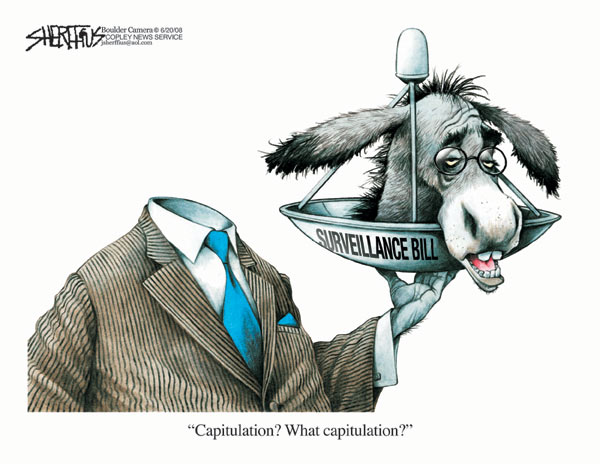
Democrats : Cave Men on Capitol Hill


Bush Gives Dems STDs
By Marty Kaplan / June 20, 2008

The least popular, most lawless president in American history took to the Rose Garden today to thank congressional Democrats for having unprotected political sex with him. For caving — not compromising, but totally capitulating — on war funding and and telecom immunity, Nancy Pelosi, Stenny Hoyer and the blue dogs they lie down with have been rewarded with the same herpetic embrace that is turning John McCain into a Republican cootie incubator.

The Democrats’ motive, of course, is mixed; one part fear of losing telecom campaign contributions, one part fear of being called terrorist-lovers, appeasers and similar bad names by Republican crooks, liars and smear-merchants in the coming campaign. The irony, of course, is that even though Democrats gave Bush and Cheney the very barebacking they wanted, the Republicans are already calling Democrats, and will continue to call them in the fall, America-haters, while the phone companies, having nowhere else to go to rent a congressional majority, would have continued to fatten Democratic coffers anyway.

The media, of course, are similarly rewarding the Democrats’ strategic brilliance at taking cut-and-run and Al-Qaeda off the table by calling this the rout, thumping and complete White House victory that it actually is. Now it’s not just John McCain, whose late efforts to distance himself from his own Party’s leader on climate change, offshore drilling and other toxic issues have been foiled by Bush’s brand; Democrats, too, are learning what it’s like to earn the moniker of DeLay’s third Congress.

Makes you wonder how far the Democrats are willing to go to win the love of the loathed playground bullies. Let Joe Lieberman keep his committee chairmanship? Make bipartisan loviedovie with Newt Gingrich? Take impeachment off the table? Oh, wait.

Source. / The Huffington Post

The Rag Blog

Posted in RagBlog | Tagged , , , , | Leave a comment

Torture Is a War Crime – When Will We Act?


Top Pentagon Officials Developed Brutal Interrogation Methods at Guantanamo
By Jason Leopold / June 19, 2008

Top Pentagon officials developed the harsh interrogation methods used against detainees at Guantanamo less than a month before the Justice Department issued two now repudiated memorandums that gave interrogators legal cover to employ the tactics, according to documents released Tuesday by the Senate Armed Services Committee.

The documents undercut assertions by President Bush, Vice President Dick Cheney, former Defense Secretary Donald Rumsfeld, and other senior administration officials that the brutal interrogations were the result of “a few bad apples” who acted on their own accord.

“How did it come about that American military personnel stripped detainees naked, put them in stress positions, used dogs to scare them, put leashes around their necks to humiliate them, hooded them, deprived them of sleep, and blasted music?” said Sen. Carl Levin, the Michigan Democrat who chairs the Armed Services Committee, in an opening statement before the hearing.

“Were these actions the result of ‘a few bad apples’ acting on their own? It would be a lot easier to accept if it were,” Levin added. “But that’s not the case. The truth is that senior officials in the United States government sought information on aggressive techniques, twisted the law to create the appearance of their legality, and authorized their use against detainees. In the process, they damaged our ability to collect intelligence that could save lives.”

Tuesday’s hearing provided the most revealing look yet at the White House’s so-called “enhanced interrogation” program and offers up new details about the time frame in which the policy was drafted.

The hearing comes two weeks after a letter signed by 56 House Democrats was sent to Attorney General Michael Mukasey, requesting that he appoint a special prosecutor to investigate whether White House officials, including President Bush, violated the War Crimes Act when they allowed interrogators to use brutal interrogation methods against detainees suspected of ties to terrorist organizations.

“The Bush administration may have systematically implemented, from the top down, detainee interrogation policies that constitute torture or otherwise violate the law,” the letter to Mukasey says. “We believe that these serious and significant revelations warrant an immediate investigation to determine whether actions taken by the President, his Cabinet, and other Administration officials are in violation of the War Crimes Act, the Anti-Torture Act, and other U.S. and international laws.”

The Armed Services Committee’s 18-month investigation, which generated 38,000 pages of documents, singled out former Secretary of Defense Donald Rumsfeld and William “Jim” Haynes II, the Pentagon’s former general counsel, as the officials who sought guidance on implementing more aggressive interrogation methods.

The committee is expected to release a full report later this year. So far, the probe has found that Rumsfeld and Haynes solicited input from military psychologists in July 2002, far earlier than they had previously acknowledged, about developing harsh methods interrogators could use against detainees held at Guantanamo Bay.

The report states that as early as July 2002, Rumsfeld, Haynes and other officials queried military psychologists about the use of waterboarding, and other brutal methods, interrogators could use against detainees at Guantanamo in order to easily extract information that would otherwise not be gained through more conventional interrogations methods.

Rumsfeld and Haynes’ questions were raised one month before John Yoo, a former deputy in the Justice Department’s Office of Legal Counsel, issued two memos that authorized interrogators to use stress positions, military dogs, and other still unknown methods against suspected terrorists being held at Guantanamo.

Interrogation methods developed in July 2002, a summary of the Armed Services Report says, derived from the Army and Air Force’s Survival, Evasion, Rescue, and Escape (SERE) training program. But those techniques were meant to prepare U.S. soldiers for abuse they might suffer if captured by a brutal regime, not as methods for U.S. interrogations.

The documents contradicted previous statements made by Haynes who told a Senate committee in 2006 that lower-level military personnel were responsible for raising questions with the DOD in October 2002 about the possibility of using more aggressive techniques against detainees.

Richard Shiffrin, Haynes’ former deputy on intelligence issues testified to the committee that in July 2002 Haynes became interested in using the SERE techniques, such as waterboarding and sleep deprivation, as a form of interrogation against detainees, which Rumsfeld signed off on in December 2002.

Haynes was grilled by the committee Tuesday and repeatedly said he could not recall receiving written and oral communications from military attorneys who warned that the methods being implemented at Guantanamo appeared to be illegal.

“We did not operate in a vacuum,” Haynes said in response to questions by Sen. Jack Reed, (D-RI). The secretary of defense made the final decision” on interrogation methods.

Haynes repeated said he “could not recall,” and “I don’t remember” dozens of times in response to specific questions about interrogation methods. Haynes hired a criminal attorney after he resigned from the Pentagon. He is now an executive at Chevron.

In one document, Jonathan Fredman, who was chief counsel to the CIA’s Counterterrorism Center, discussed how interrogators could use the “wet towel” technique, also known as waterboarding, against detainees to extract information.

“It can feel like you’re drowning. The lymphatic system will react as if you’re suffocating, but your body will not cease to function,” Fredman said in October 2002 during a meeting with military officials where specific techniques were discussed, according to a copy of the meeting minutes released by the Armed Services Committee.

Fredman added that the “wet towel” technique would only be defined as torture “if the detainee dies.”

“It is basically subject to perception,” Fredman said, according to the minutes of the meeting. If the detainee dies you’re doing it wrong.”

Fredman’s comment during the October 2002 meeting prompted Lt. Col. Diane Beaver, then the chief military lawyer at Guantanamo, to respond “We will need documentation to protect us.”

Following the October 2002 meeting, Beaver drafted a legal memo that authorized military personnel at Guantanamo to use some of the harshest methods during interrogations at the facility.

Beaver testified Tuesday that she was surprised the Defense Department implemented the interrogation methods contained in her legal opinion.

“I did not expect that my opinion, as a lieutenant colonel in the Army Judge Advocate General’s Corps, would become the final word on interrogation policies and practices within the Department of Defense,” Beaver said. “For me, such a result was simply not foreseeable. Perhaps I was somewhat naïve, but I did not expect to be the only lawyer issuing a written opinion on this monumentally important issue.”

At the same meeting, Beaver discussed hiding detainees from the International Committee of the Red Cross (ICRC). The ICRC visited Guantanamo to ensure interrogators were complying with the Geneva Conventions. Beaver, according to the minutes of the meeting, urged interrogators to “curb the harsher operations while ICRC is around.”

“Officially it is not happening,” Beaver is quoted as saying, according to minutes of an Oct. 2, 2002 meeting between the CIA and military officials. “It is not being reported officially. The ICRC is a serious concern. They will be in and out, scrutinizing our operations, unless they are displeased and decide to protest and leave. This would draw a lot of negative attention.”

Sen. Lindsey Graham, (R-SC), said during Tuesday’s hearing that the revelations about the brutal interrogation methods will” go down in history as some of the most irresponsible and shortsighted legal analysis ever provided to our nation’s military and intelligence community.”

Earlier Reports Scrutinized Rumsfeld

Rumsfeld was first identified as authorizing specific interrogation methods in a Dec. 20, 2005, Army Inspector General report, related to the capture and interrogation of Mohammad al-Qahtani, which included a sworn statement by Lt. Gen. Randall M. Schmidt. It said Secretary Rumsfeld was “personally involved” in the interrogation of al-Qahtani and spoke “weekly” with Maj. Gen. Geoffrey Miller, the commander at Guantanamo, about the status of the interrogations between late 2002 and early 2003.

Gitanjali S. Gutierrez, an attorney with the Center for Constitutional Rights who represents al-Qahtani, said in a sworn declaration that his client, imprisoned at Guantanamo, was subjected to months of torture based on verbal and written authorizations from Rumsfeld.

“At Guantánamo, Mr. al-Qahtani was subjected to a regime of aggressive interrogation techniques, known as the ‘First Special Interrogation Plan,’ that were authorized by U.S. Secretary of Defense Donald Rumsfeld,” Gutierrez said.

“Those techniques were implemented under the supervision and guidance of Secretary Rumsfeld and the commander of Guantánamo, Major General Geoffrey Miller. These methods included, but were not limited to, 48 days of severe sleep deprivation and 20-hour interrogations, forced nudity, sexual humiliation, religious humiliation, physical force, prolonged stress positions and prolonged sensory over-stimulation, and threats with military dogs.”

According to the Schlesinger report, orders signed by Bush and Rumsfeld in 2002 and 2003 authorizing brutal interrogations “became policy” at Guantanamo and Abu Ghraib.

DOJ IG: Rumsfeld Authorized Methods

Last week, the Justice Department’s inspector general, Glenn Fine, gave last week before the Senate Judiciary Committee.

During that hearing, Fine testified that Rumsfeld authorized the use of brutal interrogation techniques despite warnings from the FBI that the methods amounted to inhumane treatment, was possibly illegal, and would not produce reliable intelligence.

“The FBI believed that these techniques were not getting actionable information, that they were unsophisticated and unproductive,” said Glenn Fine, the DOJ’s inspector general, in testimony before the Senate Judiciary Committee. “They raised their concerns with the Department of Defense, but the Department of Defense, from what we were told, dismissed those concerns and that no changes were made in the Department of Defense’s strategy.”

Rumsfeld, who resigned immediately after the 2006-midterm elections, has vehemently denied that he approved of the brutal interrogation methods.

But Fine’s 437-page report last month on the Bush administration’s interrogation policies, concluded that Rumsfeld and other top White House officials ignored FBI concerns about the treatment of detainees and signed off on the interrogations.

In October 2002, Fine said, FBI agents raised concerns with Marion Bowman, the Justice Department’s deputy general counsel in charge of national security, about the methods used during interrogations at Guantanamo Bay. An FBI agent stationed at Guantanamo then sent the agency an analysis on November 27, 2002, calling into question the legality of the interrogation techniques, stating that the methods used appeared to violate the U.S. Torture statute. Bowman then alerted Jim Haynes, the DOD’s general counsel.

The same day Bowman raised concerns with Haynes, Haynes advised Rumsfeld to approve of “enhanced interrogation” methods, according to Sen. Dianne Feinstein, (D-Calif.), who chaired last Tuesday’s committee hearing.

“According to Mr. Bowman, Haynes claimed he didn’t know anything about the coercive interrogation techniques that were occurring at Guantanamo, despite the fact that he recommended on November 27, 2002, that Secretary Rumsfeld formally approve the very techniques that were being used at Guantanamo,” Feinstein said.

On Nov. 23, 2002, four days before the FBI agent alerted the DOJ about interrogation tactics he witnessed, Rumsfeld verbally authorized interrogators to used harsh methods during their interrogation of Mohammed al-Qahtani, the so-called 20th hijacker, who was being held at Guantanamo. The Pentagon initially wanted the death penalty for Al-Qahtani, but dropped war-crimes charges against him last month.

Rumsfeld, Fine told the committee, ignored FBI agents’ warnings and on Dec. 2, 2002, signed an action memorandum approving the use of “enhanced techniques” against prisoners at Guantanamo, concluding that the tactics stopped short of torture.

JAG’s Opposed Methods

In January 2003, Rumsfeld asked Haynes to form a “working group” to draft a report on legally permissible interrogation techniques to use at Guantanamo after the legal memo Beaver drafted in October 2002 was withdrawn.

The members of the group included former Undersecretary of Defense for Policy Douglas Feith, officials from the Defense Intelligence Agency, representatives of the Joint Chiefs of Staff, and judge advocate generals (JAGs) from all four branches of the military.

Early drafts of the report advocated intimidating prisoners with dogs, removing prisoners’ clothing, shaving their beards, slapping prisoners in the face and waterboarding.

Though some of the more extreme techniques were dropped as the list was winnowed down to 24 from 35, the final set of methods still included tactics for isolating and demeaning a detainee, known as “pride and ego down.”

Stress positions were prohibited at Guantanamo under DOD policy beginning in January 2003. However, Fine testified that FBI agents’ “observations confirm that prolonged short-shackling continued at Guantanamo for at least a year after the revised DOD policy took effect.”

“Short-shackling in which a detainee’s hands were shackled close to his feet to prevent him from standing or sitting comfortably, was another of the most frequently reported techniques observed by FBI agents at Guantanamo. This technique was sometimes used in conjunction with holding detainees in rooms where the temperature was very cold or very hot in order to break the detainees’ resolve,” Fine testified last week.

The more extreme interrogation methods that made it into the final draft of the report rankled some of the JAGs, who feared the methods would put U.S. soldiers in danger if they were captured – and would tarnish the reputation and image of the U.S. abroad. “Will the American people find we have missed the forest for the trees by condoning practices that, while technically legal, are inconsistent with our most fundamental values,” wrote Rear Adm. Michael Lohr, a member of the “working group,” wrote in a February 2003 letter to the working group’s chairwoman, Mary Walker, the Air Force general counsel.

“How would such perceptions affect our ability to prosecute the Global War on Terrorism,” asked Lohr.

The admiral was so upset with the draft report and the advice provided by the Justice Department that he requested Walker include a sentence in the final report making it clear that the legal findings were based exclusively on attorneys in the Justice Department’s Office of Legal Counsel.

Lohr was not alone. Maj. Gen. Jack Rives, who at the time was judge advocate general of the Air Force, also wrote a letter to Walker warning that the interrogation techniques in the report would violate military law.

“Several of the exceptional techniques, on their face, amount to violations of domestic criminal law and the [Uniform Code of Military Justice],” Rives wrote. “Treating detainees inconsistently with the [Geneva] Convention arguably ‘lowers the bar’ for the treatment of U.S. POW’s in future conflicts.”

Maj. Gen. Thomas Romig, an Army JAG, and Brig. Gen. Kevin M. Sandkuhler, a Marine Corps JAG, also voiced concerns, specifically the determination that the President has the power to override the Uniform Code of Military Justice and other federal statutes and international treaties in the name of national security.

Despite the grave concerns by the legal officials in the military community, Rumsfeld signed off on the final 81-page working group report on April 2, 2003.
Though some of the more extreme techniques were dropped as the list was winnowed down to 24 from 35, the final set of interrogation methods Rumsfeld approved still included tactics for isolating and demeaning a detainee, known as “pride and ego down.”

“The most commonly reported technique used by non-FBI interrogators on detainees at Guantanamo was sleep deprivation or disruption,” Fine testified last Tuesday. “Sleep adjustment” was explicitly approved for use by the military at Guantanamo under the policy approved by the Secretary of Defense in April 2003. Numerous FBI agents told the OIG that they witnessed the military’s use of a regimen known as the “frequent flyer program” to disrupt detainees’ sleep in an effort to lessen their resistance to questioning and to undermine cell block relationships among detainees.”

Alberto Mora, the former general counsel of the Navy, criticized Rumsfeld’s approval of certain interrogation methods outlined in the December 2002 action memorandum.

“The interrogation techniques approved by the Secretary [of Defense] should not have been authorized because some (but not all) of them, whether applied singly or in combination, could produce effects reaching the level of torture, a degree of mistreatment not otherwise proscribed by the memo because it did not articulate any bright-line standard for prohibited detainee treatment, a necessary element in any such document,” Mora wrote in a 14-page letter to the Navy’s inspector general.

Mora, who was a member of the working group, testified Tuesday that the “policy decision to use so-called ‘harsh’ interrogation techniques during the war on terror was a mistake of massive proportions.”

Mora also took issue with the use of the words “harsh” and “enhanced” to describe interrogations that he believed amounted to torture and a “policy of cruelty.”

“The choice of the adjectives “harsh” or “enhanced” to describe these interrogation techniques is euphemistic and misleading,” Mora said in an opening statement. “The more precise legal term is “cruel.” Many of the “counter-resistance techniques” authorized for use at Guantanamo in December 2002 constitute “cruel, inhuman, or degrading” treatment that could, depending on their application, easily cross the threshold of torture.

Source / Z-Net

The Rag Blog

Posted in RagBlog | Tagged , , , | Leave a comment

Twist and Shout…

Daryl Cagle
.
The Rag Blog / Posted June 19, 2008

Posted in RagBlog | Tagged , , , | Leave a comment