There Is a Tide in the Affairs of Men

From Juan Cole’s Informed Comment.

Iran: Danger and Opportunity; Polk Guest Op-Ed

William R. Polk writes:

Cassandra and Yogi Berra are an unlikely pair, but I hear both of their voices today. Cassandra, like some of us, was cursed to be always disbelieved as she correctly predicted the future while baseballer Yogi Berra will be remembered for his penetrating insight into the flow of history, “This is like deja vu all over again.”

It is through the unlikely medium of U.S. News and World Report that Cassandra speaks. The March 12 issue gives us “6 signs the U.S. may be headed for war in Iran.” The first tip the magazine highlights is the firing of Admiral William Fallon. While Fallon is hardly a “dove,” he apparently – to judge by hints he gave in an interview with Thomas Barnett published in the March issue of Esquire – had argued that an attack on Iran made no military sense. If this really was his judgment, he obviously was not the man to be “CINC [Commander-in-chief] Centcom.” That is, if the Bush administration really is intent on an attack.

Among other straws U.S. News and World Report found in the wind blowing out of Washington was the projected trip by Vice President Dick Cheney to what the magazine correctly described as a “logistics hub for military operations in the Persian Gulf,” Oman, where the Strait of Hormuz constitutes “the vulnerable oil transit chokepoint into and out of the Persian Gulf that Iran threatens to blockade in the event of war.”

Here is where Yogi Berra begins to come into the picture. As the U.S. News and World Report notes, “Back in March 2002, Cheney made a high-profile Mideast trip to Saudi Arabia and other nations that officials said at the time was about diplomacy toward Iraq and not war…” It was, as we now know, one of the concerted moves in the build-up to the already-decided-upon plan to attack Iraq. Is Cheney’s 2008 trip “like deja vu all over again?” That certainly is the inference drawn by U.S. News and World Report.

Then, U.S. News and World Report introduces the Israeli card. It reports the widely held belief that the Israeli air attack on Syria, analyzed by Sy Hersh in one of his insightful pieces of investigative reporting on February 11, 2008 in The New Yorker, was not what it was proclaimed to be, an attack on a presumed nuclear site, but a means to force the Syrians to activate their anti-aircraft electronics – as America used to do with the Russians – to detect gaps along what might be a flight path from Israel toward Iran.

Why a flight path across Syria? Both because Turkey might not allow the use of its airspace and because using Jordan’s airspace, as Israel did in its June 7, 1981 strike on the Iraqi nuclear facility at Osiriq, might seriously weaken the Jordanian regime which Israel would like to keep in place, at least for the time being.

Is a flight across Syria and Iraq to attack Iranian targets feasible? The short answer is yes: the aircraft the United States has supplied to Israel have the range and presumably could be refueled on their return at a remote base among the 14 or so bases the U.S. has built and maintains in Iraq.

U.S. News and World Report also drew attention to the stationing of a guided missile destroyer off the Lebanese coast as another indication of preparations for war. The article does not explain why but points out that the destroyer has an anti-aircraft capability; so, the inference is that it would shoot down any Syrian aircraft attempting to hit Israel.

The article curiously passes over in silence the much more impressive build-up of naval power in the Persian Gulf. As of the last report I have seen, a major part of the U.S. Navy is deployed in and around the Persian Gulf. The numbers are stunning and include not only a vast array of weapons, including nuclear weapons, cruise and other missiles and hundreds of aircraft but also “insertion” (invasion) forces and equipment. Even then, these already deployed forces amount to only a fraction of the total that could be brought to bear on Iran because aircraft, both bombers and troop and equipment transports, stationed far away in Central Asia, the Indian Ocean, Europe and even in America can be quickly employed .

Of course, deploying forces along Iran’s frontier does not necessarily mean using them. At least that is what the Administration says. However, as a historian and former participant in government, I believe that having troops and weapons on the spot makes their use more likely than not. Why is that?

It is because a massive build-up of forces inevitably creates the “climate” of war. Troops and the public, on both sides, come to accept its inevitability. Standing down is difficult and can entail loss of “face.” Consequently, political leaders usually are carried forward by the flow of events. Having taken steps 1, 2 and 3, they find taking step number 4 logical, even necessary. In short, momentum rather than policy begins to control action. As Barbara Tuchman showed in her study of the origins of the First World War, The Guns of August, even though none of the parties really wanted to go to war, none could stop the process. It was the fact that President Kennedy had been reading Tuchman’s book just before the Cuban Missile Crisis, I believe, that made him so intent on not being “hijacked by events.” His restraint was unusual. More common is a surrender to “sequence” as was shown by the 1991 Gulf War and the 2003 invasion of Iraq. It would have taken a major reversal of policy – and considerable political bravery — to halt either invasion once the massive build-up was in place. No such effort was made then. Will it be now? I think the odds are against it.

Read all of it here.

Posted in RagBlog | Tagged , , | Leave a comment

Austin Student in D.C. Actions Against War

Students Arrested Protesting Iraq War in Washington, D.C.

Austin teen joins Iraq war protests in Washington.
By Bob Dart / Washington Bureau / Austin American-Statesman / March 19, 2008

WASHINGTON — Nora Hansel, an 18-year-old college student from Austin, is taking her spring break from Wesleyan University in Connecticut to join an anti-war protest today that aims to disrupt the nation’s capital on the fifth anniversary of the invasion of Iraq.

In an array of planned actions, organizers said, tens of thousands of demonstrators will block traffic and access to buildings as well as march to the Capitol in protests against the role of business, media and the government in the war.

Hansel, who has been in the District of Columbia for about a week in the anti-war campaign, said she probably would have spent spring break at South by Southwest but said that too many college students are ignoring the war. Hansel said she did a research paper comparing this anti-war movement to the often violent campus unrest during the Vietnam War.

There is no military draft now, as there was in the 1960s, so “people are not necessarily threatened” by the far-away fighting, she said. “It allows (students) to be disconnected and under the illusion that the war is not affecting them, when in reality it is affecting all of us.”

United For Peace and Justice, a coalition of organizations, is sponsoring the actions, which will range from trying to shut down the headquarters of the Internal Revenue Service — because taxes finance the war — to blocking access to the American Petroleum Institute to demonstrating outside The Washington Post and bureaus of CNN, Fox News and other media outlets and the National Press Club.

“The media perpetuated a lot of the administration’s lies” at the start of the war, said Lisa Fithian, a protest organizer from Austin. Responsibility for the war rests “not just with the White House and Congress but with other key institutions that we’re calling the ‘Pillars of War.’ War profiteers. The military.”

Organizers said they are targeting the Democratic majority in Congress as well as the Republican administration and will also march on the headquarters of the Democratic National Committee.
The demonstrators plan a “March of the Dead” from Arlington National Cemetery into the areas of the city where tourists gather, including the war memorials.

Grannies for Peace will stage a “knit-in” at the State Department, and there will be a waterboarding demonstration near the White House and a street dance.

Fithian said it is “outrageous, really” that Congress is out of town on a two-week Easter recess and won’t see the demonstrators.

“Soldiers can’t come home” for the holidays, she said.

“We believe Wednesday will be an unprecedented day of action. It is a working day. We will be confronting the people who are in the business of death and destruction in downtown Washington,” Fithian said.

Source.

[Nora Hansel is the daughter of Lori Jo Hansel, an Austin attorney and MDS/Austin activist who was also a staff member of Austin’s underground newspaper, The Rag. Nora is carrying on a grand tradition. Thorne Dreyer / The Rag Blog.]

Posted in RagBlog | Tagged , , , | 1 Comment

A Giant Military Camp to Protect World Capitalism

From Joe Bageant’s blog.

‘America is run by gangsters,’ he said

Hello Joe,

Greetings from Sydney, Australia. I heard your interview on our ABC radio a while back and finally bought your book, Deer Hunting with Jesus. Nearly finished it and I can’t agree more with your sentiments.

I have been over to the USA four times and travelled around the back blocks a bit, including your area. I feel a sadness for the average citizen there. They haven’t got a clue as to what’s going on. I feel the USA has become a giant military camp to protect world capitalism and the citizens are not aware they have been conscripted. I have also travelled around Asia a bit. I’ve had deeper conversations about world affairs with Indonesian fishermen, Thai taxi drivers and even Tibetan peasants in far western China than I could get out many of the “middle class, educated” people I have met in the USA.

It is pretty humbling when a fellow in Laos running a small tourism venture can talk about world and local politics, exchange rates, government policies (including European and American) and how this will affect his plans, and, he can do it in at least three languages — Lao, French and pretty good English. It is tme to shut up and listen. The Thai taxi driver in Chiang Mai just about spat out the window on US policies and politics. “America is run by gangsters,” he said.

I have a habit of finding myself in drinking situations when I travel and was particularly taken with your “learning through drinking” program. In Thailand on the banks of the Mekong River I found myself talking with a bunch of motor-tricycle drivers at their local “depot”, or garage. My father had a few garages and I am a motor mechanic by trade and have had motorbikes all my life so we had plenty in common, except our language but with the help of a few bottles of whisky and someone’s sister who was learning English at school, we solved many of the worlds pressing problems.

At a road house in Oregon (USA) I met a local fellow who was an American native. He was big on hunting and fishing and had canoed all over his area all his life (he thought he was about 70 and that is another story). His pet gripe was the authorities telling him he had to start wearing a life jacket and crash helmet when he went on the water. This opened a can of worms (and another beer) and he said how pissed off he was that the governments had the time to come down on his lifestyle which hurt no one but himself if he had some misfortune and yet the rest of the country and the big issues were all too hard. He too wondered why the best land was being taken over and had many of the same ideas and concerns you put forward.

[snip]

We little guys of the world can feel it. The tightening, I mean. And when we honestly talk about it between us, we become an implied threat to power. And if we take action, then of course we become “terrorists.” That’s because the property of those with the most property is always more valuable than the lives of those with less or none. In the big picture of human civilization, this is true everywhere in the world, even Australia.

I’m no super fan of Derek Jensen, though I agree with nearly everything he writes. To quote Jensen:

“It is acceptable for those above to increase the amount of property they control — in everyday language, to make money — by destroying or taking the lives of those below. This is called production. If those below damage the property of those above, those above may kill or otherwise destroy the lives of those below. This is called justice.”

That’s the brutal on-the-ground truth about human civilization, governments and money. And it’s getting worse as the world’s population increases and resources diminish. Most people around the world understand this at least at some gut level. We in the so-called “developed countries” don’t kick up much sand about it because in the larger picture, we are on the receiving end of most of the goods and materials (however unsustainable that may be.)

Read all of it here.

Posted in RagBlog | Tagged , | Leave a comment

Hillary Clinton and Her Secretive Religious "Fellowship"

Illustration by Andy Friedman / Mother Jones

Hillary’s Nasty Pastorate
by Barbara Ehrenreich / The Nation / March 19, 2008

There’s a reason Hillary Clinton has remained relatively silent during the flap over intemperate remarks by Barack Obama’s former pastor, Jeremiah Wright. When it comes to unsavory religious affiliations, she’s a lot more vulnerable than Obama.

You can find all about it in a widely under-read article in the September 2007 issue of Mother Jones, in which Kathryn Joyce and Jeff Sharlet reported that “through all of her years in Washington, Clinton has been an active participant in conservative Bible study and prayer circles that are part of a secretive Capitol Hill group known as “The Fellowship,” also known as The Family. But it won’t be a secret much longer. Jeff Sharlet’s shocking exposé The Family: The Secret Fundamentalism at the Heart of American Power will be published in May.

Sean Hannity has called Obama’s church a “cult,” but that term applies far more aptly to Clinton’s “Family,” which is organized into “cells”–their term–and operates sex-segregated group homes for young people in northern Virginia. In 2002, Sharlet joined The Family’s home for young men, forswearing sex, drugs and alcohol, and participating in endless discussions of Jesus and power. He wasn’t undercover; he used his own name and admitted to being a writer. But he wasn’t completely out of danger either. When he went outdoors one night to make a cell phone call, he was followed. He still gets calls from Family associates asking him to meet them in diners–alone.

The Family’s most visible activity is its blandly innocuous National Prayer Breakfast, held every February in Washington. But almost all its real work goes on behind the scenes–knitting together international networks of right-wing leaders, most of them ostensibly Christian. In the 1940s, The Family reached out to former and not-so-former Nazis, and its fascination with that exemplary leader, Adolf Hitler, has continued, along with ties to a whole bestiary of murderous thugs. As Sharlet reported in Harper’s in 2003:

During the 1960s the Family forged relationships between the U.S. government and some of the most anti-Communist (and dictatorial) elements within Africa’s postcolonial leadership. The Brazilian dictator General Costa e Silva, withFamily support, was overseeing regular fellowship groups for Latin Americanleaders, while, in Indonesia, General Suharto (whose tally of several
hundred thousand “Communists” killed marks him as one of the century’s most murderous dictators) was presiding over a group of fifty Indonesian legislators. During the Reagan Administration the Family helped build friendships between the U.S. government and men such as Salvadoran general Carlos Eugenios Vides Casanova, convicted by a Florida jury of the torture of thousands, and Honduran general Gustavo Alvarez Martinez, himself an evangelical minister, who was linked to both the CIA and death squads before his own demise.

At the heart of The Family’s American branch is a collection of powerful right-wing politicos, who include, or have included, Sam Brownback, Ed Meese, John Ashcroft, James Inhofe and Rick Santorum. They get to use The Family’s spacious estate on the Potomac, The Cedars, which is maintained by young men in Family group homes and where meals are served by The Family’s young women’s group. And, at The Family’s frequent prayer gatherings, they get powerful jolts of spiritual refreshment, tailored to the already powerful.

Clinton fell in with The Family in 1993, when she joined a Bible study group composed of wives of conservative leaders like Jack Kemp and James Baker. When she ascended to the Senate, she was promoted to what Sharlet calls the Family’s “most elite cell,” the weekly Senate Prayer Breakfast, which included, until his downfall, Virginia’s notoriously racist Senator George Allen. This has not been a casual connection for Clinton. She has written of Doug Coe, The Family’s publicity-averse leader, that he is “a unique presence in Washington: a genuinely loving spiritual mentor and guide to anyone, regardless of party or faith, who wants to deepen his or her relationship with God.”

Furthermore, The Family takes credit for some of Clinton’s rightward legislative tendencies, including her support for a law guaranteeing “religious freedom” in the workplace, such as for pharmacists who refuse to fill birth control prescriptions and police officers who refuse to guard abortion clinics.

What drew Clinton into the sinister heart of the international right? Maybe it was just a phase in her tormented search for identity, marked by ever-changing hairstyles and names: Hillary Rodham, Mrs. Bill Clinton, Hillary Rodham Clinton and now Hillary Clinton. She reached out to many potential spiritual mentors during her White House days, including New Age guru Marianne Williamson and the liberal rabbi Michael Lerner. But it was the Family association that stuck.

Sharlet generously attributes Clinton’s involvement to the under-appreciated depth of her religiosity, but he himself struggles to define The Family’s theological underpinnings. The Family avoids the word Christian but worships Jesus, though not the Jesus who promised the earth to the “meek.” They believe that, in mass societies, it’s only the elites who matter, the political leaders who can build God’s “dominion” on earth. Insofar as The Family has a consistent philosophy, it’s all about power–cultivating it, building it and networking it together into ever-stronger units, or “cells.” “We work with power where we can,” Doug Coe has said, and “build new power where we can’t.”

Obama has given a beautiful speech on race and his affiliation with the Trinity Unity Church of Christ. Now it’s up to Clinton to explain–or, better yet, renounce–her long-standing connection with the fascist-leaning Family.

Source.

Posted in RagBlog | Tagged , , , , | 1 Comment

The Organizer

Alice Embree of MDS/Austin and CodePink — and former Ragstaffer — at the Million Musicians March, March 15, 2008. For more CodePink pictures, go Here.

Posted in Rag Bloggers | Tagged , , , , | Leave a comment

You’ve Been Injected with Mass Amnesia

How to Destroy a Country and Get Off Scot-Free
By Linda Heard, sierra12th@yahoo.co.uk

18/03/08 “Arab News” Someone once told me if you’re going to tell a lie make it a whopper based on the premise the more outrageous the lie the more likely it is to be believed. At the time, I wrote off his advice as hogwash but as we see from the Iraq debacle, he was right. Five years later, the deceit continues undiminished and nobody has been held to account.

Britain’s Gordon Brown yesterday promised to hold an enquiry into the “mistakes” made in Iraq. Sounds good, but don’t hold your breath. All previous inquiries have been labeled “whitewashes”. They can’t afford the truth to come out else they might get a one-way ticket to The Hague.

Ambassador David Satterfield, and adviser to Secretary of State Condoleezza Rice, is doing the rounds of talk shows lauding America’s victories over Al-Qaeda in Iraq.

On one occasion the host interjected to mention the unpalatable fact that Al-Qaeda members only flocked to Iraq once the Americans were in place leaving Satterfield momentarily nonplussed.

It’s obvious that Satterfield is so saturated in the party line he forgot the Pentagon’s recently published study that found with certainty that Saddam Hussein had absolutely no links to Al-Qaeda. And lest we forget Saddam didn’t have WMD either, which means not only was the war immoral the prewar sanctions on that country that contributed to the deaths of over half-a-million Iraqi children were too.

Think about it for a moment. The warmongers invaded, crushed and occupied a country that was no threat to anyone. They stood by as it was looted, exacerbated sectarianism, flattened entire towns, tortured untold numbers of innocents, brought in gum-chewing, tattooed foreign mercenaries and paid crony companies billions of dollars for mythical reconstruction projects.

They then pretended to hand over sovereignty to that country while at the same time constructing permanent bases and the biggest US Embassy in history resembling a small town. They said they had no interest in Iraq’s oil, yet they are putting immense pressure on the Iraqi government (sic) to sign into law a bill that permits foreign (read American) oil companies to lock up decades-long deals. Let’s be frank. Iraq wasn’t a blunder, it was a crime. So how did they manage to get away with implanting their long-conceived plot to do away with Israel’s No. 1 foe, ensure their competitors couldn’t get their hands on Iraq’s resources and entrench their military might in the region? Future historians will no doubt be scratching their heads over this one. You had to live through it to believe it.

First, they cleverly used the politics of fear to sway public opinion. As noted in the Project for the New American Century’s document “Rebuilding America’s Defenses”, the warmonger signatories – who later became senior members of the Bush administration – needed “a new Pearl Harbor”. On Sept. 1l 2001 they got it. Americans and their allies were in shock. Almost every country in the world was sympathetic and willing to do anything to help. And, boy, did they capitalize on that empathy even managing to persuade Russia to stay silent as they made deals with Caspian states to allow US bases.

Step one was a country where a giant bogeyman was supposed to be hiding out in a cave presumably equipped with a dialysis machine and a production studio and whose black-turbaned government forced women to wear a burqa and disallowed nail polish. But then Defense Minister Donald Rumsfeld was disappointed because there weren’t enough targets for his bombs. It was no fun bombing a country into the Stone Age when it was already there.

Step two was the insidious demonizing of Muslims, thousands of whom were arrested and held for months without charge or access to lawyers. In that climate of fear, it was relatively simple to persuade the American people that Saddam Hussein was conniving with the people who brought down the World Trade Center. US officials warned of mushroom clouds; Prime Minister Tony Blair said British interests could be attacked within 45 minutes of Saddam giving the order. Then Secretary of State Colin Powell allowed himself to be used as their fall guy. He spouted the most unbelievable scripted codswallop the UN had ever heard…yet, bullied and bribed nation after nation pretended to believe him as IAEA chief Mohammed El-Baradei and UN weapons inspector Hans Blix did little to discredit the hoax.

Step three entailed replacing Osama in people’s minds with Saddam, who overnight morphed into a hydra-headed monster whose idea of a pleasant weekend was gassing and torturing his own people.

Step four was ‘Shock and Awe’ which illuminated the Baghdad skyline on March 19, 2003. As their bombs and missiles rained down on crowded market places scattering limbs, they told us those bombs and missiles were Saddam’s even though the Independent’s Middle East correspondent inconveniently dug up their Made in the USA shards.

As the months went on, we began to wonder what happened to the WMD. They told us it was only a matter of time before it would be unearthed from under the sands or discovered in a tunnel under one of Saddam’s palaces. They even suggested it may have been shipped off to a neighboring country for safekeeping!!

Step five was an orchestrated administration campaign to inject us with mass amnesia. Never mind about the weapons, they said. We are here to liberate the poor Iraqi people from their evil dictator and deliver freedom and democracy. Look, look, they said. The Iraqis have purple fingers! With up to one million dead, Iraqis are lucky they have any fingers at all.

To be fair, they couldn’t have done it without the aid of a compliant, supine media, which embedded its reporters with US battalions and agreed not to show captured US soldiers, flag-draped coffins, military funerals or scenes of blood-soaked Iraqi civilians. Independent reporters who neglected to abide by the script were discredited, refused access to information and even shelled.

I still recall a live report from David Chater of Sky News, who saw the barrel of a US tank slowly turn toward the Palestine hotel – known to be a journalist’s hang-out – before firing its shell killing three reporters. The Baghdad offices of Al-Jazeera and Al-Arabiya were also hit.

With so much information on tap I’m flabbergasted that so many people still believe the Iraq fairytale. I wish they’d get in touch with me. I’ve got a few pyramids and a sphinx going cheap. Sad, isn’t it!

Source

Posted in RagBlog | Tagged , , , | Leave a comment

Barack Obama’s Speech on Race, Religion and Jeremiah Wright

Barack Obama: A More Perfect Union (Full Speech) March 8, 2008

Source.

Posted in RagBlog | Tagged , , , , , | Leave a comment

Iraq Moratorium, Friday March 21st

Iraq Moratorium, Good Friday coincide

The convergence of the fifth anniversary of the Iraq war on March 19 and the monthly Iraq Moratorium observance on March 21 has sparked hundreds of antiwar actions across the country this week.

The Iraq Moratorium, which encourages local grassroots action on the third Friday of every month, coincides with the Christian observance of Good Friday, March 21, so some actions will include a religious theme.

The Pike’s Peak Justice Coalition will take part in Pax Christi’s Way of the Cross/Way of Justice procession in downtown Colorado Springs.

A Hartford, CT “Lamentation and Protest” will begin with an interfaith prayer service, followed by a silent procession to the federal building, where marchers will pile stones bearing the names of victims of the Iraq war. Church bells will ring in a number of communities in Massachusetts to mark Moratorium observances.

In Cincinnati, candlelight vigils will be held in eight neighborhoods, and dozens of street corner vigils are planned across the country. Most vigils take place every month, and some have been going since the war began.

In a session called “Write Some Wrongs,” people in Cornwall, CT will meet at the public library to write their Congressman about “what is in your heart about the Iraq war and what you want him to do about it.”

The Iraq Moratorium encourage local organizers to “do their own thing” on the third Friday of the month – but to do something, whatever it is, to end the war. It is all a loosely-knit national grassroots effort operating under the Iraq Moratorium umbrella.

Friday is the seventh monthly Moratorium, and more than 800 events have been listed on the group’s website, http://www.IraqMoratorium.org/, with reports, photos and videos.

FOR IMMEDIATE RELEASE
CONTACT: BILL CHRISTOFFERSON 414/486-9651

NOTE: For events in your community, check the website, http://www.IraqMoratorium.org/.

Posted in RagBlog | Tagged , , | Leave a comment

Arthur C. Clarke 1917-2008 : The Ultimate Odyssey

Arthur C. Clarke, Premier Science Fiction Writer, Dies at 90
By Gerald Jonas / New York Times / March 18, 2008

Arthur C. Clarke, a writer whose seamless blend of scientific expertise and poetic imagination helped usher in the space age, died early Wednesday in Colombo, Sri Lanka, where he had lived since 1956. He was 90.

Rohan de Silva, an aide to Mr. Clarke, said the author died after experiencing breathing problems, The Associated Press reported. Mr. Clarke had post-polio syndrome for the last two decades and used a wheelchair.

From his detailed forecast of telecommunications satellites in 1945, more than a decade before the first orbital rocket flight, to his co-creation, with the director Stanley Kubrick, of the classic science fiction film “2001: A Space Odyssey,” Mr. Clarke was both prophet and promoter of the idea that humanity’s destiny lay beyond the confines of Earth.

Other early advocates of a space program argued that it would pay for itself by jump-starting new technology. Mr. Clarke set his sights higher. Paraphrasing William James, he suggested that exploring the solar system could serve as the “moral equivalent” of war, giving an outlet to energies that might otherwise lead to nuclear holocaust.

Mr. Clarke’s influence on public attitudes toward space was acknowledged by American astronauts and Russian cosmonauts, by scientists like the astronomer Carl Sagan and by movie and television producers. Gene Roddenberry credited Mr. Clarke’s writings with giving him courage to pursue his “Star Trek” project in the face of indifference, even ridicule, from television executives.

In his later years, after settling in Ceylon (now Sri Lanka), Mr. Clarke continued to bask in worldwide acclaim as both a scientific sage and the pre-eminent science fiction writer of the 20th century. In 1998, he was knighted by Queen Elizabeth II.

He played down his success in foretelling a globe-spanning network of communication satellites. “No one can predict the future,” he always maintained.

But as a science fiction writer, he couldn’t resist drawing up timelines for what he called “possible futures.” Far from displaying uncanny prescience, these conjectures mainly demonstrated his lifelong, and often disappointed, optimism about the peaceful uses of technology — from his calculation in 1945 that atomic-fueled rockets could be no more than 20 years away to his conviction in 1999 that “clean, safe power” from “cold fusion” would be commercially available in the first years of the new millennium.

Mr. Clarke was well aware of the importance of his role as science spokesman to the general population: “Most technological achievements were preceded by people writing and imagining them,” he noted. “I’m sure we would not have had men on the Moon,” he added, if it had not been for H.G. Wells and Jules Verne. “I’m rather proud of the fact that I know several astronauts who became astronauts through reading my books.”

Arthur Charles Clarke was born on Dec. 16, 1917, in the seaside town of Minehead, Somerset, England. His father was a farmer; his mother a post office telegrapher. The eldest of four children, he was educated as a scholarship student at a secondary school in the nearby town of Taunton. He remembered a number of incidents in early childhood that awakened his scientific imagination: exploratory rambles along the Somerset shoreline, with its “wonderland of rock pools;” a card from a pack of cigarettes that his father showed him, with a picture of a dinosaur; the gift of a Meccano set, a British construction toy similar to the Erector sets sold in the United States.

He also spent time “mapping the Moon” through a telescope he constructed himself out of “a cardboard tube and a couple of lenses.” But the formative event of his childhood was his discovery, at age 13 — the year his father died — of a copy of “Astounding Stories of Super-Science,” then the leading American science fiction magazine. He found its mix of boyish adventure and far-out (sometimes bogus) science intoxicating.

While still in school, Mr. Clarke joined the newly formed British Interplanetary Society, a small band of sci-fi enthusiasts who held the controversial view that space travel was not only possible but could be achieved in the not-so-distant future. In 1937, a year after he moved to London to take a civil service job, he began writing his first science fiction novel, a story of the far, far future that was later published as “Against the Fall of Night” (1953).

Mr. Clarke spent World War II as an officer in the Royal Air Force. In 1943 he was assigned to work with a team of American scientist-engineers who had developed the first radar-controlled system for landing airplanes in bad weather. That experience led to Mr. Clarke’s only non-science fiction novel, “Glide Path” (1963). More important, it led in 1945 to a technical paper, published in the British journal “Wireless World,” establishing the feasibility of artificial satellites as relay stations for Earth-based communications.

The meat of the paper was a series of diagrams and equations showing that “space stations” parked in a circular orbit roughly 22,240 miles above the equator would exactly match the Earth’s rotation period of 24 hours. In such an orbit, a satellite would remain above the same spot on the ground, providing a “stationary” target for transmitted signals, which could then be retransmitted to wide swaths of territory below. This so-called geostationary orbit has been officially designated the Clarke Orbit by the International Astronomical Union.

Decades later, Mr. Clarke called his “Wireless World” paper “the most important thing I ever wrote.” In a wry piece entitled, “A Short Pre-History of Comsats, Or: How I Lost a Billion Dollars in My Spare Time,” he claimed that a lawyer had dissuaded him from applying for a patent. The lawyer, he said, thought the notion of relaying signals from space was too far-fetched to be taken seriously.

But Mr. Clarke also acknowledged that nothing in his paper — from the notion of artificial satellites to the mathematics of the geostationary orbit — was new. His chief contribution was to clarify and publicize an idea whose time had almost come — a feat of consciousness-raising that he would continue to excel at throughout his career.

The year 1945 also saw the launch of Mr. Clarke’s career as a fiction writer. He sold a short story called “Rescue Party” to the same magazine — now re-titled Astounding Science Fiction — that had captured his imagination 15 years earlier.

For the next two years, Mr. Clarke attended Kings College, London, on the British equivalent of a G.I. Bill scholarship, graduating in 1948 with first-class honors in physics and mathematics. But he continued to write and sell stories, and after a stint as assistant editor at the scientific journal Physics Abstracts, he decided he could support himself as a freelance writer. Success came quickly. His primer on space flight, “The Exploration of Space,” was a Book-of-the-Month Club selection in 1951

Over the next two decades, he wrote a series of nonfiction bestsellers as well as his best-known novels, including “Childhood’s End” (1953) and “2001: A Space Odyssey” (1968). For a scientifically trained writer whose optimism about technology seemed boundless, Mr. Clarke delighted in confronting his characters with obstacles they could not overcome without help from forces beyond their comprehension.

In “Childhood’s End,” a race of aliens who happen to look like devils imposes peace on an Earth torn by cold war tensions. But the aliens’ real mission is to prepare humanity for the next stage of evolution. In an ending that is both heartbreakingly poignant and literally earth-shattering, Mr. Clarke suggests that mankind can escape its suicidal tendencies only by ceasing to be human.

“There was nothing left of Earth,” he wrote. “It had nourished them, through the fierce moments of their inconceivable metamorphosis, as the food stored in a grain of wheat feeds the infant plant while it climbs toward the Sun.”

The cold war also forms the backdrop for “2001.” Its genesis was a short story called “The Sentinel,” first published in a science fiction magazine in 1951. It tells of an alien artifact found on the Moon, a little crystalline pyramid that explorers from Earth destroy while trying to open. One explorer realizes that the artifact was a kind of fail-safe beacon; in silencing it, human beings have signaled their existence to its far-off creators.

Read the rest of it here.

Posted in RagBlog | Tagged , , | Leave a comment

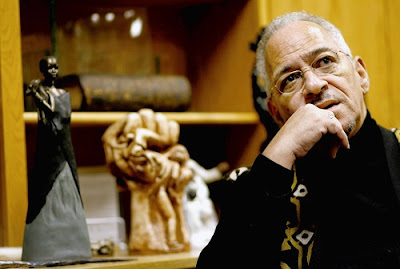
Healing the Wounds of Race

Rev. Jeremiah Wright at Trinity United Church of Christ.

Prophetic truth-telling from the black pulpit.
By Jim Wallis / Huffington Post / March 18, 2008

It has simmered throughout this campaign, and now race has exploded into the center of the media debate about the presidential race. Just when a black political leader is calling us all to a new level of responsibility, hope, and unity; the old and divisive rhetoric of race from both blacks and whites is rearing its ugly head to bring down the best chance we have had for years of finally moving forward.

And that is indeed the real issue here. A black man is closer to possibly becoming president than ever before in American history. And this black man is not even running as “a black man” but as a new kind of political leader who believes the country is ready for a new kind of politics. But a new kind of politics and a new face for political leadership is deeply threatening to all the forces that represent the old kind of politics in America. And all the rising focus on race in this election campaign has one purpose and one purpose alone — to stop Barack Obama from becoming President of the United States.

Barack Obama should win or lose his Party’s nomination or the presidency based on the positions he takes regarding the great issues of our time and his capacity to lead the country and America’s role in the world. He must not win or lose because of the old politics of race in America. That would be a tragedy for all of us.

The cable news stations and talk radio are playing carefully selected excerpts of the most potentially incendiary statements from Rev. Jeremiah Wright’s fiery sermons, the retiring pastor of Barack Obama and his family’s home Trinity Church in Chicago. Obama, while affirming the tremendous work his church has done in his city and around the nation, has condemned the most controversial remarks of his pastor. But the whole controversy points to the enormous gap in understanding between the mainstream black community in America and the experience of many white Americans. And that is what we are going to have to heal if we are ever to move forward.

Here is what I mean.

There is a deep well of both frustration and anger in the African American community in these United States of America. And those feelings are borne of the concrete experience of real oppression, discrimination, and blocked opportunities that most of America’s white citizens take for granted. African Americans across the spectrum of income and success will speak personally to those feelings of frustration and anger, when white people are willing to listen. But usually we are not. In 2008, to still not comprehend or seek to understand the reality of black frustration and anger, is to be in a state of white denial which, very sadly, is where many white Americans are.

The black church pulpit has historically been a place of prophetic truth-telling about the realities that black people experience in their own country. Indeed, the black church has often been the only place where such truths are ever told. And, black preachers have had the pastoral task of nurturing the spirits of people who feel beaten down week after week. Strong and prophetic words from black church pulpits are often a source of comfort and affirmation for black congregations. The truth is that many white Americans would indeed feel uncomfortable with the rhetoric of many black preachers from many black churches all across the country.

But if you look beyond the grainy black and white clips of the dashiki clad Rev. Wright and the angry black male voice (all designed to provoke stereotypes and fear) to actually listen to what the words are saying about America being run by “rich white people” while blacks have cabs speeding by them, and about American misdeeds around the world, it’s hard to disagree with many of the facts presented. It’s rather the angry tone of Wright’s comments that provides the offense and the controversy.

Ironically, a new generation of black Americans is now eager and ready to move beyond the frustration and anger to a new experience of opportunity and hope. And nobody represents that shift more than Barack Obama. There is a generational shift occurring within the black community itself, between an older generation who are sometimes perceived to be stuck in the politics of victimization and grievance, and a younger generation who believe that opportunity and progress are now possible–not by ignoring, but by being committed to actually changing the facts of oppression and discrimination.

Barack Obama represents that hope of dealing with the substance of the issues of injustice while at the same time articulating the politics of hope, and even the possibility of racial unity.

Obama’s attraction to many who are white, especially a new generation, demonstrates the promise of a new racial politics in America. But to be a leader for a new generation of black Americans, Barack Obama had to be firmly rooted in the black church tradition, where the critique of white America, the sustenance of the African American community, and God’s promise for the future are all clearly articulated. That’s why he began attending Trinity Church where he was converted to Jesus Christ in the black liberationist tradition of, among others, Rev. Martin Luther King Jr.

So it would be a great tragedy if the old rhetoric of black frustration and anger were to now hurt Barack Obama, who has become the best hope of beginning to heal that very frustration and anger. Obama has never chosen to talk about race in the way that Rev. Jeremiah Wright does on the video clips that keep playing, and indeed has never played “the race card” at any time in this election. It’s been his opponents that have, especially the right-wing conservative media machine that wants America to believe he is secretly a Muslim and is from a “racist” church.

This most recent controversy over race just demonstrates how enormous the gap still is between whites and blacks in America–in our experience and our capacity to understand one another. May God help us to heal that divide and truly bless America.

Jim Wallis is the author of The Great Awakening, Editor-in-Chief of Sojourners and blogs at http://www.godspolitics.com/.

Source.


Is America Too Racist for a Black President?

[This is an interview with Rev. Jeremiah Wright conducted for Spiegel International by Marc Hujer one year ago, posted on March 13, 2007. Rev. Wright is highly respected in clerical circles; here is some of the substance behind the media-trumpeted bombast. Thorne Dreyer / The Rag Blog.]


SPIEGEL: Barack Obama seems to be developing a compassionate liberal answer to the so-called “compassionate conservative” platform US President George W. Bush ran on in 2000. Is the Democratic Party looking to take more care of the religious voter?

Rev. Jeremiah A. Wright Jr.: I wouldn’t say “more care.” The United Church of Christ has a 350 year history of being on the side of social justice. Our denomination was against slavery. We were a part of the Underground Railroad; part of the abolitionist movement. So it’s nothing new for us.

What is new is that Barack says we need to stop being afraid to talk about our faith and how our faith and values influence public policy and the decisions we make. We’ve been biting our tongues because we don’t want to offend our Jewish friends and our Muslim friends. The new movement is toward not being afraid to talk about your faith. But you should also stop thinking you have absolute truth — that your faith is the only one.

SPIEGEL: Isn’t that the nature of faith, though? Believing strongly in your faith to the exclusion of others?

Wright: We’re not on this planet alone. Right now, the average American or the average German or the average Brit couldn’t tell you the difference between a Sunni and a Shiite. I mean, you got Christians who lynch people in the name of Jesus, and you got Muslims who fly planes into buildings. But you got some Muslims who don’t do that. You got some Christians who ain’t got time to lynch people.

We need to stop lumping folks together and start living together. Otherwise, we’re going to kill each other off because you don’t believe what I believe. That’s crazy. Before Democrats were quiet because they didn’t want people to think they were fanatics.

Barack has broken that ice.

SPIEGEL: But how far can you go? As Barack Obama points out in his book, “The Audacity of Hope: Thoughts on Reclaiming the American Dream,” religion is more about convictions and truth, whereas politics is about compromise. Where are the limits to introducing faith into the political arena?

Wright: Let’s take a simple issue. Far right radical conservative Christians want to put prayer back in the school. Now my family may start off the day in prayer, and I’m going to teach my daughters and my sons how to pray. But I’m not going to force your kids to pray like my kids. In public, I have to understand that I’m still going to pray tonight and tomorrow morning, and my girls and my son better pray too.

But I’m not going to force my Jewish friends, my Muslim friends, my Hindu friends, my Sikh friends to hear a Christian prayer in a public forum like school. We understand that private faith does not force public decisions. That’s how you work at compromise. I haven’t given up what I believe, but I live in community with — in a city, state, nation, and world with — people who don’t believe what I believe. That doesn’t make them defective or inferior.

SPIEGEL: That sounds different from what Obama wrote in his book. He wrote that faith should return to the center of both private and public life. Should he ever become president, what would that mean?
.
Wright: From what I know of Barack — from what he has written, from his speeches and from the life I know he has lived — faith in public life does not mean that God tells you to bomb another country or to go get Saddam Hussein. Faith in public life means that every child, regardless of their religious belief, should have health care. That every child should be able to go to school based on the intelligence they have not only the ability of their parents to pay. Because my faith saying I can bomb Iraq is the same as your faith saying you can take over a passenger plane and fly it into the World Trade Center.

SPIEGEL: Can you be a good Christian and be pro-choice?

Wright: Both. You can be a good Christian and be pro-life. You can be a good Christian and be pro-choice.

SPIEGEL: You mean it’s a purely political question and faith has nothing to say about it?

Wright: First of all, we shouldn’t even be having this discussion. Neither one of us can get pregnant. But what a woman decides about her body and her God is her business. Women who are pro-life can be just a good a Christian as a woman who is pro-choice and vice versa.

It gets to be a problem when I decide one position should be the law for everybody. In public life, we have to find a way to live together even though we disagree — and some things we will never agree on. But we’ve got to leave this I’m-going-to-kill-you-because-you-don’t-believe-what-I-believe attitude behind.

SPIEGEL: So why bring faith into the public arena at all, if it’s so divisive?

Wright: Faith should be pulled into the public arena when it affects how we live. If it doesn’t — if it’s so heavenly focused — it does no earthly good. What does my faith say about 44 million people with no health care? What does my faith say about the fact that my girl can’t be a nuclear physicist because she’s black and from the inner city and because her schooling options are not what they are for George W. Bush’s girls or for Bill and Hillary’s daughter Chelsea? My faith says, no, that’s not what God intended. It pulls it back into the public arena the idea that there’s got to be something fair for all of us.

SPIEGEL: Do you think Obama would be able to win Christian voters back from the Republicans were he to become the Democratic nominee for the White House?

Wright: That’s hard to tell. If the pattern of what we saw in the November elections — where evangelical Christians, whether Republicans or Democrats, abandoned the stay-the-course doctrine, abandoned the years of lies — if that pattern continues, I think politicians like Barack are going to win people back. We’re making more enemies than winning friends at the moment. We’re making enemies because (what the Bush administration is doing) is not Christ.

SPIEGEL: Thousands of people listen to your sermons. Can you as a pastor help move voters from the right side of the political spectrum back to the left?

Wright: First of all, not that many people are church goers. But that’s America in general. That said, historically, the black church it has been the political force. It caused blacks to fight to get out of slavery, for example. African-Americans used their faith to not lose hope and to keep on fighting.

A clergy person needs to be aware of that and needs to keep in mind the clergy’s role in changing the public life for the betterment of all. Not just those who believe like I believe, look like I look, think like I think, live where I live. But for all. How do we treat the most vulnerable in this society? What are we doing for our old people? What are we doing for our kids? What are we doing for our poor? The clergy need to put those questions on voters’ minds.

SPIEGEL: Barack Obama has been criticized as a so-called “post-racial politician” who shies away from those interests traditionally important to black voters in the United States…

Wright: I think that criticism is unjustified. It’s a cute term, but he shouldn’t be criticized for who he is — a person who doesn’t “play the race card,” but who instead talks about the issues. Look at it this way. Nobody wants their wives to live in fear of getting from the house to the grocery store or to her job. Whether they’re black wives or white wives isn’t the issue. I don’t care what color they are. The bullets don’t discriminate.

We’ve got to do something to make sure they have a safe environment. Now to call that post-racial is unfair. We’ve got some common needs that we need to address. How do we put policies in place that will ensure their safety in the future? That’s the kind of politician Barack is.

SPIEGEL: Do you think he will be President in two years?

Wright: No. Unless Barak pulls off nationally what he was able to pull off locally, and wins the hearts and minds of people who have been perennially anti-black. Racism is so deeply engrained in this country that he could be flawless in terms of his policies. But he’s still a black man in this country, which has a sorry history in terms of how it sees African-American males. That’s my 65-year-old, jaded perception of where this country is. I was pleasantly surprised in the Senate election. I would like to be as pleasantly surprised in the presidential election.

Source.

Posted in RagBlog | Tagged , , , , | Leave a comment

Cheney in Baghdad

Cheney cites ‘phenomenal’ Iraqi security progress
As bombing kills 40
By Hannah Allam and Qassim Zein / McClatchy / March 17, 2008

BAGHDAD — Vice President Dick Cheney on Monday made a surprise visit to Baghdad, where he pledged that U.S. forces would “not quit before the job is done” and said that a massive troop buildup had achieved “phenomenal” improvements in security.

At sunset Monday, however, a female suicide bomber killed at least 40 people and injured more than 50 when she blew herself up in a crowded pedestrian area near a Shiite Muslim shrine in the southern holy city of Karbala, according to government and hospital officials. Among the victims were several Iranian pilgrims who’d come to worship at the Imam Hussein shrine, one of Islam’s most sacred sites.

And the U.S. military announced the deaths of two soldiers who were killed Monday when their Humvee struck a roadside bomb north of Baghdad, bringing the number of American troop deaths to at least 3,990 since the war began.

Cheney told a news conference in Baghdad that the invasion of Iraq five years ago this week was a “difficult, challenging, but nonetheless successful endeavor.” However, he said that obstacles remain and that the decision on whether to begin reducing forces depends on political reconciliation and the ability to preserve the hard-won security gains of the past year.

“It would be a mistake now to be so eager to draw down the force that we risk putting the outcome in jeopardy,” Cheney said. “And I don’t think we’ll do that.”

Cheney’s trip overlapped with a visit by Republican presidential candidate John McCain, who arrived Sunday for a two-day fact-finding mission for the Senate Armed Services Committee. Cheney is on a nine-day tour with stops scheduled in Saudi Arabia, Jerusalem, the Palestinian territories, Turkey and Oman.

Both Cheney and McCain have been strong backers of the “surge” strategy, which sent 30,000 more American troops to Iraq in an effort to drive out Islamist extremists and reduce the sectarian violence that has claimed thousands of lives and transformed Baghdad into a maze of walled-off, segregated neighborhoods.

The year-old surge has helped reduce bloodshed throughout Iraq — with the number of attacks down by more than half — though many skeptical Iraqis view the lull in violence as temporary.

Cheney spent Monday in a tightly choreographed hopscotch, moving at least six times for high-level meetings. In the fortress-like Green Zone compound, which houses the U.S. and Iraqi headquarters, he met Iraqi Prime Minister Nouri al Maliki; Gen. David Petraeus, the top U.S. military commander in Iraq; and U.S. Ambassador Ryan Crocker.

Maliki said his talks with Cheney focused on negotiations for a long-term U.S.-Iraqi security agreement that would replace the United Nations mandate for foreign troops, which expires at the end of the year.

Traveling under military guard along roads that had been swept for bombs and were lined with security forces, Cheney ventured a mile or so outside the Green Zone to call on Iraqi President Jalal Talabani and Abdelaziz al Hakim, the head of the powerful Iranian-backed Shiite party known as the Supreme Islamic Iraqi Council.

Cheney intended to press Iraqi leaders to pass an oil law that could help persuade international energy firms to invest in production, U.S. officials said. He also was urging Iraqis to stick to their goal of October elections and discussing mutual concerns about neighboring countries such as Turkey, Syria and Iran.

“I was last in Baghdad 10 months ago, and I can sense, as a result of the progress that’s been made since then, that there have been some phenomenal changes, in terms of the overall situation, both with respect to the security situation, where Iraqi and American forces have done some very good work, as well as with respect to political developments here in Iraq,” Cheney said after meeting Maliki.

The majority of casualties in the Karbala suicide bombing were female pilgrims who’d gathered at refreshment stands about a half-mile from the shrine, said Saleem Kadhim, a spokesman for the Husseini Hospital, which received 40 dead and 56 injured from the blast.

Medics from nearby towns were called in to help the overflowing hospital, and the government imposed an open-ended citywide curfew on Karbala.

“I was near the bus station when I saw a woman who was pushing others and then, a few seconds later, I saw a flame in the sky,” said Jassim Hussein, 32, who helped carry victims from the scene. “I blame the Baathists and members of the old regime. As you know, Karbala is a target for so many enemies, especially those against the Shiites. And I also blame the security forces because we don’t have checkpoints in this area.”

Iraqi authorities seemed confident that the bomber was a woman, though the U.S. military cautioned that it was too early to determine the attacker’s identity. In the extremely conservative south, nearly all women wear flowing black robes called abayas, which some male militants have donned to carry out attacks or to escape capture.

In other violence Monday, a car bomb exploded at a busy intersection in the Baghdad neighborhood of Karrada, wounding eight people. Three separate roadside bombs in the capital also left casualties: One policeman was killed and one wounded when their patrol was targeted near a teachers’ training institute in Mansour; three Iraqi civilians died at a busy intersection near the Shaab Stadium in Zayuna; and one civilian was injured near the landmark Mr. Milk grocery store in Mansour.

(Allam reported from Baghdad; special correspondent Qassim Zein reported from Najaf. Steve Lannen of the Lexington (Ky.) Herald-Leader contributed, along with special correspondent Hussein Kadhim.)

Source.

From Carlos Lowry / The Rag Blog

Posted in RagBlog | Tagged , , | Leave a comment

Dowd on Dubya

Soft Shoe in Hard Times
By Maureen Dowd / March 16, 2008

Everyone here is flummoxed about why the president is in such a fine mood.

The dollar’s crumpling, the recession’s thundering, the Dow’s bungee-jumping and the world’s disapproving, yet George Bush has turned into Gene Kelly, tap dancing and singing in a one-man review called “The Most Happy Fella.”

“I’m coming to you as an optimistic fellow,” he told the Economic Club of New York on Friday.

His manner — chortling and joshing — was in odd juxtaposition to the Fed’s bailing out the imploding Bear Stearns and his own acknowledgment that “our economy obviously is going through a tough time,” that gas prices are spiking, and that folks “are concerned about making their bills.”

He began by laughingly calling the latest news on the economic meltdown “a interesting moment” and ended by saying that “our energy policy has not been very wise” and that there was “no quick fix” on gasp-inducing gas prices.

“You know, I guess the best way to describe government policy is like a person trying to drive a car in a rough patch,” he said. “If you ever get stuck in a situation like that, you know full well it’s important not to overcorrect, because when you overcorrect you end up in the ditch.”

Dude, you’re already in the ditch.

Boy George crashed the family station wagon into the globe and now the global economy. Yet the more terrified Americans get, the more bizarrely carefree he seems. The former oilman reacted with cocky ignorance a couple of weeks ago when a reporter informed him that gas was barreling toward $4 a gallon.

In on-the-record sessions with reporters — and more candid off-the-record ones — he has seemed goofily happy in recent weeks, prickly no more but strangely liberated and ebullient.

Even though he ordinarily hates being kept waiting, he made light of it while cooling his heels for John McCain, and did a soft shoe for the White House press. Wearing a cowboy hat, he warbled a comic Western ditty at the Gridiron Dinner a week ago — alluding to Scooter Libby’s conviction, Saudis getting richer from our oil-guzzling, Brownie’s dismal Katrina performance, and Dick Cheney’s winsome habit of withholding documents.

At a dinner on Wednesday, the man who is persona non grata on the campaign trail (except for closed fund-raisers) told morose Republican members of Congress that he was totally confident that “we can retake the House” and “hold the White House.”

“I think 2008 is going to be a fabulous year for the Republican Party!” he said, sounding like Rachael Ray sprinkling paprika on goulash. That must have been news to House Republicans, who have no money, just lost the seat held by their former speaker, and are hemorrhaging incumbents as they head into a campaign marked by an incipient recession and an unpopular war.

If only they could see things as the president does. Bush, who used his family connections to avoid Vietnam, told troops serving in Afghanistan on Thursday that he is “a little envious” of their adventure there, saying it was “in some ways romantic.”

Afghanistan is still roiling, as is Iraq, but W. is serene. “Removing Saddam Hussein was the right decision early in my presidency, it is the right decision now, and it will be the right decision ever,” he said, echoing that great American philosopher Dan Quayle, who once told Samoans, “Happy campers you are, happy campers you have been and, as far as I am concerned, happy campers you will always be.”

W. bragged to Republicans about his “considered judgment” in sending more troops to Iraq and again presented himself as an untroubled instrument of divine will. “I believe there’s an Almighty,” he said, “and I believe a gift of that Almighty to every man, woman and child is freedom.”

Although the president belittled the Democrats for their policy of “retreat,” his surge has been a temporary and expensive place-holder for what Americans want: a policy to get us out of Iraq.

“Has it allowed us to reduce troop levels to below where they were when it started?” Michael Kinsley wrote recently. “The answer is no.” Gen. David Petraeus told The Washington Post last week that no one in the U.S. and Iraqi governments “feels that there has been sufficient progress by any means in the area of national reconciliation.”

Maybe the president is just putting on a good face to keep up American morale, the way Herbert Hoover did after the crash of ’29, when he continued to dress in a tuxedo for dinner.

Or maybe the old Andover cheerleader really believes his own cheers, and that prosperity will turn up any time now, just like the W.M.D. in Iraq.

Or perhaps it’s a Freudian trip. Now that he’s mucked up the world and the country, he can finally stop rebelling against his dad and relax in the certainty that the Bush name will forever be associated with crash-and-burn presidencies.

Whatever the explanation, it’s plumb loco.

Source.

Posted in RagBlog | Tagged , | Leave a comment


