
Type your summary here
Type rest of the post here
Source /
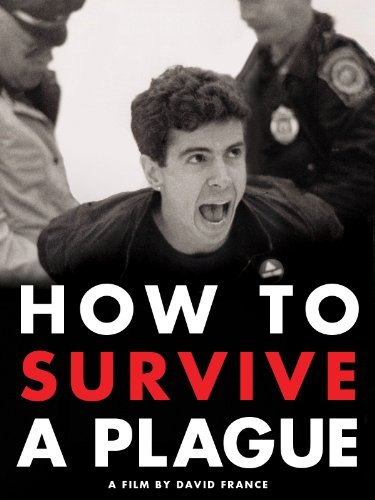
How to Survive a Plague:
The remarkable story of ACT UP
Panic spread slowly. Rock Hudson’s death gave the disease a public face, but took us no closer to the cause.
By David McReynolds | The Rag Blog | April 10, 2013
[David France’s critically-acclaimed and award-winning documentary film, How to Survive a Plague, saw limited release in the United States in 2012.]
Clancy Sigal’s advice to me is to keep it short — a skill he has mastered and I’ve not. This is a quick review of David France’s film (now on DVD), How To Survive a Plague, largely the story of ACT UP (AIDS Coalition to Unleash Power) and TAG (Treatment Activist Group), the nonprofit organization that grew out of ACT UP.
As films go, this feels almost like a “rough draft” of a documentary, but how could it be otherwise? The technical limitations of this short documentary are overwhelmed by a remarkable story, one that makes the film worth watching by anyone concerned with social change. The producers had to hunt for bits and pieces of film over a period of years — this was not a film which had been assigned a staff photographer to follow events.
I’ve said to friends that if I were 10 years younger I’d have been dead long ago — but when AIDS was given a name, in 1982, I was already 53. It wasn’t just a “gay disease” — it was almost entirely a disease of the youth. It’s first name was GRID — Gay-Related Immune Deficiency — and even when it was given a name a year later, no one had any idea what caused it. Panic spread slowly. Rock Hudson’s death gave the disease a public face, but took us no closer to the cause.
My local bar — once probably the best gay bar in New York, right on my corner, at Fourth Street and Second Avenue — slowly emptied out. Bob, the sweet young bartender, fell ill, and then fell dead. Bar traffic slowed, as if perhaps breathing the same air would transmit the disease.
By 1987 ACT UP was formed. It had the enormous energy of youth. Watching this film reminded me, again, of why the young are almost always the cutting edge of social change. They are not always right — ACT UP made more than its share of errors, suffered the almost inevitable splits — but to watch this film is to see young men and women, frightened by the death which was marching straight towards them, organize and act. And to act with imagination and love — in things such as the moving “quilt” project.
They provided the people-power for major political demonstrations, but they did much more than that — they studied the disease, they examined alternative treatments, and methods for running trials that would speed up the information on what might work. In the end they cooperated with the scientists in finding the answer.
And that answer was not easy to find. The AIDS virus is remarkably tricky and defeating it has been an incredibly complex task. It was, for the men and women in ACT UP, a race against time.
Watching the film I felt a sense of guilt that I had not been more involved. AIDS, even though we didn’t know its cause, was around me. A neighbor who lived a floor above me came down with it, and while I was able to visit him at first, simply walking into his room (he had Kaposi’s Syndrome), when he was taken to the hospital his room was guarded as if a particle of the disease might escape. One had to put on gloves, mask, a gown before going in, and they were taken off and destroyed when you left his room.
All of us have sins of omission; I won’t belabor mine. I write this brief review because the beautiful young men and women in this film, so vital, so very young, so fierce in their struggle, and most of them now dead, succeeded in pushing until the labs delivered the drugs which have made it possible to defeat AIDS.
It isn’t, of course, defeated, not here (where unsafe sex is sometimes seen as exciting), much less in Africa. But because of ACT UP we have the means. The film, made in 2012, is one hour and 49 minutes. You can get it from Netflix.
[David McReynolds was for nearly 40 years a member of the staff of the War Resisters League, and was twice the Socialist Party’s candidate for president. He and the late Barbara Deming are the subjects of a dual biography, A Saving Remnant, by historian Martin Duberman. David retired in 1999, and lives on the Lower East Side of Manhattan with his two cats. He posts at Edge Left.org and can be reached at davidmcreynolds7@gmail.com. Read more articles by David McReynolds on The Rag Blog.]
 |
| Women protest in Cairo during Arab Spring. Image from Organizing Upgrade. |
The empire in disarray:
Global challenges to the international order
Latin American and African dependency theorists and “bottom-up” historians have argued for a long time that resistance must be part of the understanding of any theory of imperialism.
By Harry Targ | The Rag Blog | April 10, 2013
A whole generation of activists has “grown up” conversant with the central place of empire in human history. Children of the Cold War and the “Sixties” generation realized that the United States was the latest of a multiplicity of imperial powers which sought to dominate and control human beings, physical space, natural resources, and human labor power.
We learned from the Marxist tradition, radical historians, scholar/activists with historical roots in Africa, and revolutionaries from the Philippines and Vietnam to Southern Africa, to Latin America. But we often concluded that imperialism was hegemonic; that is it was all powerful, beyond challenge.
A “theory of imperialism” for the 21st century should include four interconnected variables that explain empire building as well as responses to it.
First, as an original motivation for empire, economic interests are primary. The most recent imperial power, the United States, needed to secure customers for its products, outlets for manufacturing investment opportunities, an open door for financial speculation, and vital natural resources such as oil.
Second, the pursuit of military control parallels and supports the pursuit of economic domination. The United States, beginning in the 1890s, built a two-ocean navy to become a Pacific power, as well as institutionalizing its control of the Western Hemisphere. It crushed revolutionary ferment in the Philippines during the Spanish, Cuban, American War and began a program of military intervention in Central American and the Caribbean. The “Asian pivot” of the 21st century and continued opposition to the Cuban and Bolivarian revolutions reflect the 100-year extension of the convergence of economics and militarism in U.S. foreign policy.
Third, as imperial nations flex their muscles on the world stage they need to rationalize exploitation and military brutality to convince others and their own citizens of the humanistic goals they wish to achieve. In short, ideology matters. In the U.S. case, “manifest destiny” and the “city on the hill,” that is the dogma that the United States has a special mission as a beacon of hope for the world, have been embedded in the dominant national narrative of the country for 150 years.
However, what has often been missing from the left-wing theoretical calculus is an understanding of resistance. Latin American and African dependency theorists and “bottom-up” historians have argued for a long time that resistance must be part of the understanding of any theory of imperialism. In fact, the imperial system is directly related to the level of resistance the imperial power encounters.
Resistance generates more attempts at economic hegemony, political subversion, the application of military power, and patterns of “humanitarian interventionism” and diplomatic techniques, called “soft power,” to defuse it. But as recent events sugge, resistance of various kinds is spreading throughout global society.
The impetus for adding resistance to any understanding of imperialism has many sources including Howard Zinn’s seminal history of popular movements in the United States, The People’s History of the United States. Zinn argued convincingly that in each period of American history ruling classes were challenged, shaped, weakened, and in a few cases defeated because of movements of indigenous people, workers, women, people of color, middle class progressives, and others who stood up to challenge the status quo.
More recently, Vijay Prashad, author of The Darker Nations, compiled a narrative of post-World War II international relations that privileged the resistance from the Global South. World history was as much shaped by anti-colonial movements, the construction of the non-aligned movement, conferences and programs supporting liberation struggles and women’s rights, as it was by big power contestation. The Prashad book was subtitled A People’s History of the Third World.
The 21st century has witnessed a variety of forms of resistance to global hegemony and the perpetuation of neoliberal globalization all across the face of the globe. First, various forms of systemic resistance have emerged. These often emphasize the reconfiguration of nation-states and their relationships that have long been ignored.
The two largest economies in the world, China and India, have experienced economic growth rates well in excess of the industrial capitalist countries. China has developed a global export and investment program in Latin America and Africa that exceeds that of the United States and Europe.
In addition, the rising economic powers have begun a process of global institution building to rework the international economic institutions and rules of decision-making on the world stage. On March 26-27, 2013, the BRICS met in Durban, South Africa. While critical of BRICS shortcomings Patrick Bond, Senior Professor of Development Studies and Director of the University of KwaZulu-Natal Centre for Civil Society, in a collection of readings on the subject, introduces BRICS with an emphasis on its potential:
In Durban, five heads of state meet to assure the rest of Africa that their countries’ corporations are better investors in infrastructure, mining, oil and agriculture than the traditional European and U.S. multinationals. The Brazil-Russia-India-China-SA summit also includes 16 heads of state from Africa, including notorious tyrants. A new “BRICS bank” will probably be launched. There will be more talk about monetary alternatives to the U.S. dollar.
On the Latin American continent, most residents of the region are mourning the death of Hugo Chavez, the leader of the Bolivarian Revolution. Under Chavez’s leadership, inspiration, and support from oil revenues, Venezuela launched the latest round of state resistance to the colossus of the north, the United States.
Along with the world’s third largest trade bloc MERCOSUR (Argentina, Brazil, Paraguay, Uruguay, Venezuela and associate memberships including Bolivia, Chile, Colombia, Ecuador, and Peru), Latin Americans have participated in the construction of financial institutions and economic assistance programs to challenge the traditional hegemony of the International Monetary Fund, the World Bank, and the World Trade Organization.
The Bolivarian Revolution also has stimulated political change based on various degrees of grassroots democratization, the construction of workers’ cooperatives, and a shift from neoliberal economic policy to economic populism. With a growing web of participants, Bolivia, Ecuador, Brazil, Argentina, Uruguay, Nicaragua, El Salvador, and, of course, Cuba, the tragic loss of Chavez will not mean the end to the Bolivarian Revolution. It might lead to its deepening.
But the story of 21st century resistance is not just about countries, alliances, new economic institutions that mimic the old. Grassroots social movements have been spreading like wildfire all across the face of the globe. The story can begin in many places and at various times: the new social movements of the 1980s; the Zapatistas of the 1990s; the anti-globalization/anti-IMF campaigns going back to the 1960s and continuing off and on until the new century; or repeated mass mobilizations against a Free Trade Agreement for the Americas.
Since 2011, the world has been inspired by Arab Spring, workers’ mobilizations all across the industrial heartland of the United States, student strikes in Quebec, the state of California, and in Santiago, Chile. Beginning in 2001 mass organizations from around the world began to assemble in Porto Alegre, Brazil, billing their meeting of some 10,000 strong, the World Social Forum.
They did not wish to create a common political program. They wished to launch a global social movement where ideas could be shared, issues and demands from the base of societies could be raised, and in general the neoliberal global agenda reinforced at the World Economic Forum in Switzerland could be challenged.
The World Social Forum has been meeting annually ever since in Latin America, Asia, Africa, and the United States. Most recently, the last week in March, 2013, 50,000 people from 5,000 organizations in 127 countries from five continents met in Tunis, the site of the protest that sparked Arab Spring two years ago. Planners wanted to bring mass movements from the Middle East and North Africa into the collective narrative of this global mobilization.
Medea Benjamin, founder of Code Pink, reported that a Tunisian student, when asked whether the Social Forum movement should continue, answered in the affirmative. The student paid homage to the Tunisian street vendor, Mohamed Bouazizi, who committed suicide and launched Arab Spring. He declared that “for all those who have died struggling for justice, we must continue to learn from each other how to build a world that does not respond to the greed of dictators, bankers or corporations, but to the needs of simple people like Mohamed Bouazizi.”
[Harry Targ is a professor of political science at Purdue University and is a member of the National Executive Committee of the Committees of Correspondence for Democracy and Socialism. He lives in West Lafayette, Indiana, and blogs at Diary of a Heartland Radical. Read more of Harry Targ’s articles on The Rag Blog.]
 |
| Contingent of women participating in three-hour march to kick off World Social Forum in Tunis in the last week of March 2013. Photo by Mohamed Messara / EPA / Guardian. |
Type rest of the post here
Source /
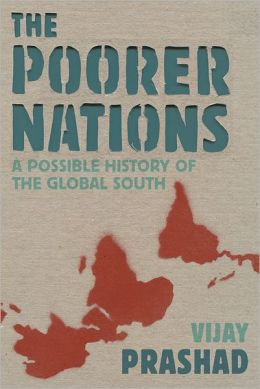
Vijay Prashad’s ‘possible history’:
The lessons of the Global South
Prashad paints a sweeping indictment of those who want to rule the earth with little or no regard for most of its inhabitants.
By Ron Jacobs | The Rag Blog | April 10, 2013
The Poorer Nations: A Possible History of the Global South by Vijay Prashad (2013: Verso); Hardback; 300 pp; $26.95.
Vijay Prashad is fast becoming the historian of the Global South. His books and articles discussing the relationships between the oligarchs of global capitalism and the people and institutions of those it manipulates into its money pit of debt are detailed discussions of the intricacies of those relationships.
His newest book, titled The Poorer Nations: A Possible History of the Global South, is as detailed and well-cited as anything written by Noam Chomsky. Therein, Prashad turns the statistics and descriptions he writes into prose that is understandable and simmering with a justified rage at the robbery it describes.
Most fundamentally, Prashad’s book is a full frontal assault on neoliberal capitalism. Deservedly, he spares no political party, bank, or government linked to this most devastating edition of capitalism. Whether the collusion was willingly engaged in or merely the result of an unwillingness to lose personal or political power, Prashad paints a sweeping indictment of those who want to rule the earth with little or no regard for most of its inhabitants.
While keeping firm hold to his left anti-imperialist foundation, Prashad acknowledges the shortcomings of social democrats in their attempts to compromise with the ravenous beast of neoliberal capital. Naturally, these politicians and parties get some of the blame for the economic devastation caused by the banks and other machinery of that beast; Prashad saves the bulk of the blame, however, for its rightful targets: the IMF, World Bank, finance capital, and the men and women who operate that beast.
Since the crash of 2008, commentators have pointed to various financial manipulations from the 10 years prior to the crash when looking for reasons for the crash. The shortcoming in this approach is clear. One needs to go back much further. The Poorer Nations does that. As a result, the role of financial capital in today’s economic crisis can be better understood, as we examine its role in the impoverishment of the Global South and its role in the market crashes of 1989 and in Asia around the same time.
This rich history of the capitalist project’s last several decades makes one thing clear. The oligarchs of finance will do whatever it takes to maintain and, if possible, increase its profits. Another thing that becomes clear in Prashad’s telling is that capitalism is parasitical, constantly seeking new hosts to attach to and consume. This is especially the case in its current configuration — a configuration dependent on the production of capital, not goods; and interested solely in increasing profit, not industry.
This stage of capital, based on credit and the accumulation of debt, is known as neoliberalism. It is the curse of the modern world and may well be its downfall. Reading The Poorer Nations in the current situation, it is difficult not to consider that Prashad’s history might very well be our future. The fate of the nations he describes: indebtedness, deindustrialization, destruction of agrarian economies; all of these and more can be seen in the daily newspaper.
The nation of Cyprus is but the latest country to suffer a parasitical raid of its assets. In this case, the finance capitalists went straight to individual savings accounts. The theft becomes more blatant with each succeeding crisis.
The Poorer Nations makes clear what many have always said and even more have suspected. This transfer of wealth was made possible with (at the least) the tacit complicity of many European social democrats and democratic socialists. All too many of these individuals and parties were involved at the very beginning of the neoliberal project. Their belief in capitalism and the importance of profit insured their rejection of the welfare states they championed.
Perhaps the only social democrat in power during the period Prashad discusses who did not fold almost immediately when Wall Street began its final play to take over the world economy was the West German Willy Brandt. Unfortunately, his play was too late.
Even though other economic methods of organization have proven to be more beneficial for everyone but the greediest, argues Prashad, the faith in the market by those who benefit from it the most denies that fact. This includes the various national upper classes as well as the international financiers.
Although capitalism does not require greed to flourish, it certainly ensures that it does, especially in its current phase. As to be expected, those without qualms benefit the most from this fact. Prashad relays their story too; leaders and officials of the Global South spending their nations’ treasuries (earned and borrowed) on luxury vehicles and villas and military hardware to protect the assets of the powerful.
Despite the dismal tale told in these pages, Prashad ends The Poorer Nations with hope. In his final chapter he discusses the situation of the world’s dispossessed, whose numbers have multiplied exponentially as a result of the financial and political machinations described in the previous chapters. Many of these millions live in urban slums of their own creation and work at low-paying jobs or in marginalized activities.
Recently, however, they have begun to realize the political power of their numbers. This, writes Prashad, is where the hope for a new and more just world is to be found. It is the power they hold that can change the world and wrest it back from the ecological and impoverished future the masters of finance and their political and military lapdogs are heading towards.
[Rag Blog contributor Ron Jacobs is the author of The Way The Wind Blew: A History of the Weather Underground. He recently released a collection of essays and musings titled Tripping Through the American Night. His novels, The Co-Conspirator’s Tale, and Short Order Frame Up will be republished by Fomite in April 2013 along with the third novel in the series All the Sinners Saints. Ron Jacobs can be reached at ronj1955@gmail.com. Find more articles by Ron Jacobs on The Rag Blog.]
 |
| There’s a problem when the stars and stripes exclude some Americans, forcing them to have their own flag. Image from iHandbill. |
The right to love and marry:
Picking the fly specks out of the pepper
Conservative judges on the Supreme Court were literally stewing and sputtering as they questioned attorneys speaking in support of same-sex marriage.
By Larry Ray | The Rag Blog | April 9, 2013
It would seem reasonable that most folks could agree that no person decided to be born with red hair, or with a club foot, or as a prodigy, or with black skin or white skin, or as a government issue “normal” person. An embryo doesn’t get to decide that kind of stuff.
So, when a male and a female produce a child, how much does their genetic material, their parenting, and their environment have to do with that child’s eventual sexual orientation? And if the kid is homosexual are the parents OK with that kid eventually living like a second class citizen in America?
Prior to the Middle Ages we don’t hear much about homosexual acts other than they seem to have been accepted with no big problem back then, even by the Christian Church. But the Renaissance of the 12th Century saw a birth of intellectual revitalization and a steady growth of open hostility against homosexuals. This vilification was taken up and quickly spread through the Christian Church and also into secular organizations.
The normative characteristics of human sexuality have been debated probably since homo erectus learned to talk. In the late 1600’s the most influential of the so-called Enlightenment thinkers, John Locke, argued that the mind is a “tabula rasa” or blank slate and that the environment in which a child is raised determines its sexuality. In the early 1900’s Sigmund Freud’s papers on sexuality ultimately held that sexual drives are instinctive and a central source of personality. And in recent years most researchers ask whether either of those ideas ever had much merit whatsoever.
What has never changed is the fact there have always been people born who have a sexual attraction to their own sex, and that has always seemed to others to be rather, well, queer.
So by the end of the 19th century, in addition to long having been being labeled a sin by the Church, homosexuality also became viewed as a deviant mental disorder. And it was not until 1986 that the American Psychiatric Association finally completely removed the classification of homosexuality as a mental illness from its Diagnostic and Statistical Manual.
And now not quite 30 years after that milestone, the Supreme Court has finally heard two sets of oral arguments regarding same-sex marriage. One argument basically deals with the Constitutionality of the 1996 Federal Defense of Marriage Act, or DOMA, and the other whether California’s Proposition 8 can single out any group of people and prevent them from being legally married in that state.
But in both instances the arguments don’t come right out and talk about homosexuality itself. Instead, the arguments are about marriage, both religious and secular. The Christian Church makes a singular claim to marriage as a sacred and crucial part of the religious life of their adherents and their definition of marriage is that it can only be between a man and woman. Anything else and Leviticus is loudly quoted.
Section 3 of The Federal Defense of Marriage Act codifies the non-recognition of same-sex marriages for all federal purposes, including insurance benefits for government employees, Social Security survivors’ benefits, immigration, and the filing of joint tax returns. Not recognizing same-sex marriage is federal law.
President Clinton, under whose administration DOMA was created and passed, now says same-sex marriages should be just like any other marriage. Clinton and a number of other elected career politicians have recently disavowed DOMA and called for its repeal… but since 1996 none of them have stepped up and done anything to see that it is, in fact, repealed.
President Obama has simply dodged the issue by saying Section 3 is unconstitutional, but that he would still continue to enforce the law, but, however, that he would no longer defend it in court. No profile in courage here. More like the statement of a Lewis Carroll character from Alice in Wonderland.
Reaffirming their blatant discrimination and clearly indicating strong opposition to same-sex marriage, the U.S. House Republican leadership quickly instructed the House General Counsel to defend the the Defense of Marriage Act in place of the Department of Justice.
Public opinion polling now shows consistently that around 58% of the country supports homosexuals marrying one another. And their message is that this should not be such a big deal.
The trend in a 2012 Mercer survey of employee health benefits shows “about half, or 47% of employers with more than 500 workers made health coverage available to same-sex domestic partners, with large employers it’s even more prevalent, with figures in the 60-75% range.”
So imagine America’s politicians, particularly conservative Republicans now in a 2014 election minefield, where not voting to finally recognize homosexuals as equal to all other Americans might cost them votes back home.
Conservative judges on the Supreme Court were literally stewing and sputtering as they questioned attorneys speaking in support of same-sex marriage. And attorneys questioning the Court about the issue of alienating a group of citizens from the institution of marriage brought forth not answers but more questions as answers.
Justice Scalia replied, asking, “…when did it become unconstitutional to exclude homosexual couples from marriage?” clearly indicating Scalia’s view that society has always excluded homosexuals. And Justice Alito lightly commented that same-sex marriage is “newer than cell phones and the Internet,” suggesting that perhaps all of a sudden homosexuals just up and decided they want the same rights as every other American citizen. Risible and disappointing evasion from the high court.
The U.S. Supreme Court’s position on marriage was once crystal clear when it came to a black marrying a white. That meant a prison sentence in many states if a white man married a black woman or vice versa. That law stayed on the books for 84 years until a case was brought before the Supreme Court in 1967 by Mildred Loving, a black woman, and Richard Loving, a white man, who had been sentenced to a year in prison in the State of Virginia for marrying each other.
After the Loving case was championed by Attorney General Robert Kennedy and the ACLU, the Supreme Court, in a unanimous decision, overturned the 1883 Supreme Court ruling which had affirmed that Alabama’s anti-miscegenation statute was constitutional.
It was overturned after 84 years of a court-approved, hate-defined prohibition of marraige between blacks and whites. The law clearly was finally struck down because of the Civil Rights act of 1964… and then only because Mr. and Mrs Loving filed suit for the right to legally love one another and marry.
Yet in 2013, the Civil Rights Act of 1964 that outlawed major forms of discrimination against racial, ethnic, national, and religious minorities, and women still does not seem to apply to homosexuals. Those American citizens whom the Catholic and Protestant Christian churches define as sinners, are not allowed to legally marry with all rights and benefits guaranteed by the Federal government. It is fair to ask if Church and State are indeed separated in this case?
What the Supreme Court and our politicians are doing is what in Texas we call “picking the fly specks out of the pepper,” an earthy expression meaning delaying, ridiculously arguing, failing to act through use of excuses or plain old bullheadedness.
Same-sex marriage poses no more threat to our society than did black folks who were not allowed to sip a soda at Walgreens. We have mostly gotten over the ugliness of our racist American past.
Now it is time to also end the hate and judgmental exclusion that still makes it illegal for some folks in America to get married to the person they love.
[Retired journalist Larry Ray is a Texas native and former Austin television news anchor who now lives in Gulfport, Mississippi. He also posts at The iHandbill. Read more articles by Larry Ray on The Rag Blog.]
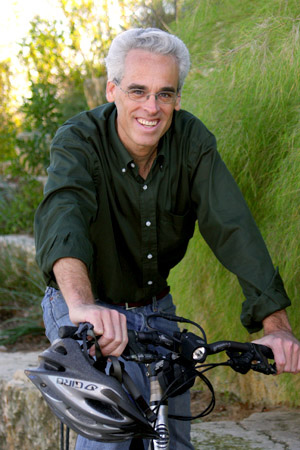 |
| Austin City Councilman Chris Riley on his trusty steed. Image from chrisforaustin.com. |
Taken for a ride:
The sad saga of the
$10 million concrete path
It is no coincidence that this segment of concrete treasure will run along part of Austin Councilmember Chris Riley’s pet project, a New Urbanist rezoning wet dream known as the Airport Boulevard Renovation Project.
By Glenn Gaven | The Rag Blog | April 9, 2013
AUSTIN — With a zillion bicyclists and a historically dismal voting turnout, Austin, Texas, is a city where the bicycle lobby has more power than the Koch brothers. Realizing this, the transit authority, Capital Metro, and train enthusiasts turned to the two-wheeled mafia for help in passing a 2004 referendum to build a train system to bring commuters from the suburbs into the city.
The package the transit authority created was branded “All Systems Go,” and promised a glorious system of bicycle trails alongside the 162 miles of train track the Authority had already purchased over the years using the generous 1% sales tax dedicated to transit. The trail was to be built by 2007.
The referendum, which also promised a Bus Rapid Transit component by 2007 that has yet to be seen, passed and it was full steam ahead.
By 2007 the transit authority boasted having already spent 7.2 million dollars on the “Rails with Trails” program. That money had been spent on a feasibility study and presumably other prep work like surveying and engineering studies as no actual trail was in evidence as recently as January 2013.
In 2009, Capital Metro was awarded an American Recovery and Reinvestment Act grant for $1.9 million in free stimulus money to build bike trails. As you may recall the major stipulations for ARRA grants were that projects be “shovel ready,” and create new jobs. The transit authority happily accepted the money and promised the bike path would be built by 2010.
In February 2013, Smith Construction began demolishing a nearly new sidewalk adjacent a short section of Airport Blvd. to replace it with a “concrete path,” using $787,386 of the ARAA money. With the obligatory overruns associated with all Capital Metro contracts, Smith will likely collect a cool million to build the .9 (yes 9-tenths!) mile pathway that will run alongside a long-established bike lane, where there was already a sidewalk.
The rest of the money was given to McGray & McGray Land Surveyors and Klotz Associates, Inc, for “surveys” and “engineering studies.”
It is no coincidence that this segment of concrete treasure will run along part of Austin Councilmember Chris Riley’s pet project, a New Urbanist rezoning wet dream known as the Airport Boulevard Renovation Project. Riley and fellow Councilmember Mike Martinez represent Austin on the transit authority’s board of directors by night.
So, for a total of at least $10 million (7.2 + 1.9 + 15% built-in overruns etc.) we get almost a mile of what is basically a sidewalk where there was already a sidewalk and already a bike lane. According to City of Austin sidewalk coordinator John Eastman a .9 mile sidewalk outside of downtown typically costs $570,000. Those of us who used it can attest to its functionality and newness. That sidewalk is gone. Gone also is most of our $10 million which went into the pockets of consultants and contractors who have grown fat over the years feeding at the public troughs kept full by Mike Martinez and Chris Riley.
Next year, Riley and Martinez, along with the contractors like Paul Bury who built Martinez’ mansion, and train enthusiasts like Lyndon Henry and Glenn Gadbois will be asking Austin voters to give them the money to build a billion-dollar streetcar system in downtown Austin. Bicycling voters will determine yea or nay. It should only take the 90 seconds or so ride on Airport Blvd. between the Lamar Blvd. and Highland Mall to decide if we got our $10 million worth the last time.
[Glenn Gaven is a long-time Austin union activist who worked with the UT Shuttle Workers Union (ATU Local #1549) and was co-founder of the Bus Riders Union-ATX. Read more articles by Glenn Gaven on The Rag Blog.]
 |
| Annie Rachele Lanzillotto. |
Rag Radio podcast:
‘Bronx Butch’ memoirist & performance
artist, Annie Rachele Lanzillotto
“Annie Lanzillotto, the bard of Bronx Italian butch, is an American original, a performance artist and cultural anthropologist whose work is unique… an astonishing writer possessed of an utterly inimitable voice.” — Author John Gennari
By Rag Radio | The Rag Blog | April 9, 2013
Author, poet, and performance artist Annie Rachele Lanzillotto was Thorne Dreyer’s guest on Rag Radio, Friday, March 29, 2013. Rag Radio is a syndicated radio program produced at the studios of KOOP 91.7-FM in Austin, Texas.
Listen to or download our interview with Annie Rachele Lanzillotto here:
Annie Lanzillotto is an Italian-American lesbian memoirist, poet, performance artist, singer, and songwriter who lives in New York. She is the author of L is for Lion: An Italian Bronx Butch Freedom Memoir, published in 2013 by the State University of New York Press.
On Rag Radio Lanzillotto discusses her rich and multi-faceted life and art. She talks about and reads from her lusty, wise, and very witty memoir, which deals with a range of issues including her Italian-American upbringing, her father’s PTSD and his physical abuse of her mother; her two bouts with cancer, and her coming to terms with her sexuality.
 |
| An American original. |
As author John Gennari says, Annie’s memoir “indelibly portrays the iconic Italian American spaces of kitchen, stoop, sidewalk, and street; the body as a site of humor and tragedy; and, above all, the family war zone as an uncanny intermingle of poignancy and brutality.”
Annie Lanzillotto was born and raised in the Westchester Square neighborhood of the Bronx, and in Yonkers, New York, of Barese heritage. She received a B.A. with honors in medical anthropology from Brown University and an MFA in writing from Sarah Lawrence College. In 2012, she received a Franklin Furnace Archive Inc. Performance Commission and a Petracca Award in Poetry from Philadelphia Poets, and has received grants from the Rockefeller Foundation Next Generation Leadership Program, Dancing In the Streets, and the Puffin Foundation.
Lanzillotto is also the author of a book of poetry, Schistsong, and teaches master classes in solo performance for the Acting Apprentice Company at Actors Theatre of Louisville. She was selected as one of “200 essential New Yorkers” by The New York Times for her performance and installation at the 2000 Smithsonian Folklife Festival. She is included in Marquis Who’s Who of American Women.

Rag Radio has aired since September 2009 on KOOP 91.7-FM, an all-volunteer cooperatively-run community radio station in Austin, Texas. Hosted and produced by Rag Blog editor and long-time alternative journalist Thorne Dreyer, a pioneer of the Sixties underground press movement, Rag Radio is broadcast every Friday from 2-3 p.m. (CDT) on KOOP, and is rebroadcast on Sundays at 10 a.m. (EDT) on WFTE, 90.3-FM in Mt. Cobb, PA, and 105.7-FM in Scranton, PA.
The show is streamed live on the web by both stations and, after broadcast, all Rag Radio shows are posted as podcasts at the Internet Archive.
Rag Radio is produced in association with The Rag Blog, a progressive Internet newsmagazine, and the New Journalism Project, a Texas 501(c)(3) nonprofit corporation. Tracey Schulz is the show’s engineer and co-producer.
Rag Radio can be contacted at ragradio@koop.org.
Coming up on Rag Radio:
THIS FRIDAY, April 12: Sixties activists and Yippie founders Judy Gumbo Albert and Nancy Kurshan.
Friday, April 19: Amsterdam-based poet John Sinclair, founder of the White Panther Party and former manager of the MC5.
 |
| Waxing crescent moon. Image from Missouri Skies / EarthSky. |
Moon Musings:
Waxing Crescent Moon
(April 12-14, 2013)
As Lady Moon progresses to fullness, your goals should also progress to completion.
By Kate Braun | The Rag Blog | April 8, 2013
The waxing moon is a time to promote growth, to focus on increasing whatever it is that you would like to see increase in your life, to clarify focus and set short-term goals to accomplish in this moon-cycle, to begin new projects. For gardeners, it is time to plant or transplant above-ground crops. You could easily incorporate planting seeds or transplanting young plants into their permanent location into your celebrations as it is best to begin your activities at sundown.
You may honor any virgin-goddess deities at this time. As Lady Moon progresses to fullness, your goals should also progress to completion, even as the seeds planted in this moon-phase germinate and send their stems up through the soil.
April 12 and 13, Lady Moon is in Taurus. Taurus, a fixed Earth sign, has strong influence on home and the home environment. Should you choose to honor the Waxing Crescent Moon on either of these days, your actions of intention should focus on good health, the state of your home, finances (stocks and real estate as well as savings accounts and IRAs), and a general sense of security.
If you choose to celebrate the Waxing Crescent Moon on Friday, April 12, use the color green, the elements earth and water, and repeat your chant seven times. Remember that in addition to love, Venus, who oversees Fridays, also manages all household matters, including finances and savings account balances.
April 13, Saturday, is Saturn’s day. If this is a better day for your celebration, use the color black and repeat your chants three times. Keep in mind that Saturn is currently retrograde, not going direct until July 7, 2013.
When planets retrograde, they appear to be moving backwards across the sky and the energy they promote is opposite of what it usually is. Saturn, one of the big outer planets, is fond of boundaries, organization, and structure. Normally cautious, when he retrogrades we find ourselves facing blockages and difficulties that can lead us to inaction rather than progress, no matter how slow that progress might be. For this reason it will be wise to prepare carefully and thoroughly if Saturday, April 13, is the best day for you to honor the Waxing Crescent Moon.
April 14, Sunday, Lady Moon is in Gemini. Gemini is a mutable Air sign. This day is best used to focus on matters involving communication, writing, studies, relatives, and methods to better influence others. On Sundays, Lord Sun’s influence is strong. Use the color yellow, be sure to light some candles to bring in the Fire element, and repeat your chant 6 times.
Chants or incantations can be as short or as lengthy as you choose. I recommend thinking in advance of what your intention is and frame your chant or incantation with that intention firmly in mind. To say “I am safe, my home is secure, my savings are increasing, my future is bright” is only one example.
[Kate Braun‘s website is www.tarotbykatebraun.com. She can be reached at kate_braun2000@yahoo.com. Read more of Kate Braun’s writing on The Rag Blog.]

Waldman’s film and TV
treasures you may have missed:
Dawn French heads a hilarious cast in a series about a female clergywoman in a quirky small town.
By Alan Waldman | The Rag Blog | April 18, 2013
[In his weekly column, Alan Waldman reviews some of his favorite films and TV series that readers may have missed, including TV dramas, mysteries, and comedies from Canada, England, Ireland, and Scotland. Most are available on DVD and/or Netflix, and some episodes are on YouTube.]
Richard Curtis is one of England’s most brilliant and beloved writers, and the jewel in his crown is probably the riotous situation comedy The Vicar of Dibley.
Curtis was Oscar-nominated for Four Weddings and a Funeral and was nominated for nine BAFTA awards, winning for Blackadder Goes Forth and his career. The other BAFTA noms were for Vicar of Dibley, Love Actually, Four Weddings and a Funeral, Bridget Jones’s Diary and Mr.Bean. Curtis was nominated for another 33 honors (for works including Rowan Atkinson: Not Just a Pretty Face, War Horse, Dr. Who, The Girl in the Café, and Pirate Radio) — winning 16.
Vicar received six awards and 17 other nominations, including 10 BAFTAS—four for star Dawn French. She was nominated for five other awards, winning a British Comedy Award, as did hilarious co-star Emma Chambers. A 2004 national poll rated Vicar the third-favorite British sitcom ever. In ratings, it was among the most popular shows in the digital era — with various Christmas and New Year specials in 1999, 2004, 2005, 2006, and 2007 among the top 10 programs of that year. More than 93% of the 4,087 people rating it at imdb.com gave it thumbs-up, and 37.1% considered it a perfect 10.
Vicar first aired in 1994 and ran for 18 episodes and three specials, before adding two episodes in which the Reverand Boadicea Geraldine Julie Andrews Dick van Dyke Supercalifragilisticexpialidocius Chim-Chiminey Chim-Chiminey Chim-Chim-Cheree Granger (her name during the ceremony) was married. Airing in 2006 and 2007, they were watched by 11.4 million and 12.3 million viewers, respectively.
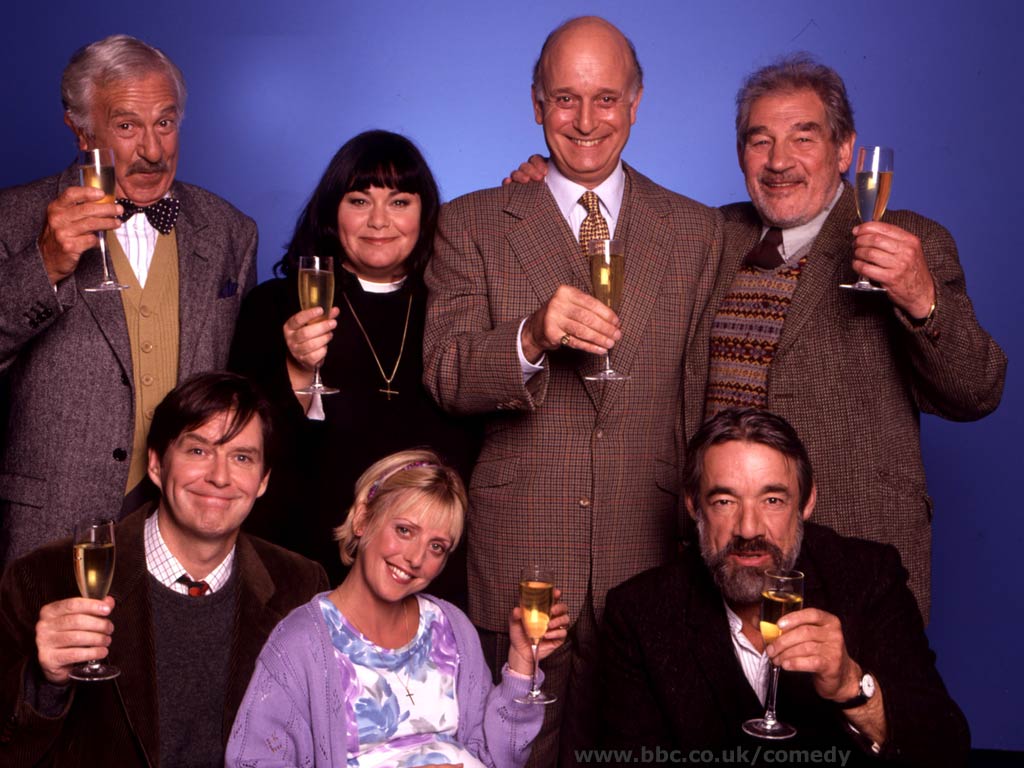 |
| A toast from the cast. |
Vicar is set in a small English village after the Church of England in 1992 changed its rules and allowed the ordination of women. Beloved British comedienne Dawn French is literally and figuratively larger than life as a clergywoman who takes over the local church and brings many startling (and side-splitting) changes. Vicar Geraldine Granger was created by Richard Curtis, who wrote the series with Paul Mayhew-Archer (a lead writer of the very funny 2000-2006 Britcom My Hero).
The obese and outrageous Vicar describes herself as “a babe with a bob cut and a magnificent bosom.” She is a chocoholic who hides candy bars throughout her home — even in hollowed-out bibles.
The actors who play the main characters in her parish comprise one of the funniest, most original comic ensembles of all time. One of the two funniest and most adorable “stupid” characters I ever saw (along with James Dreyfus in The Thin Blue Line) is the Vicar’s best friend Alice, brilliantly realized by Emma Chambers. After the final credits on each episode, the Vicar tells Alice a joke (usually off-color), but Alice takes it literally and doesn’t get it.
Local farmer Owen (wonderful Roger Lloyd Pack) has extremely poor hygiene and apparently engages in bestiality. In one episode he declares a rumor that the vicar is a lesbian to be the “best news since they made having sex with animals legal again.”
In the first season only, Liz Smith plays wacky old lady Letitia Cropley, who has created and cooked such revolting foods as “Bread and butter pudding surprise” (snails), orange cake with Branston Pickle icing, parsnip brownies, and plain pancakes “with just a hint of liver.” She is sometimes referred to as “the Dibley Poisoner.”
Three seasons of The Vicar of Dibley are available on Netflix and streamable on Netflix Instant, and all episodes and specials, including this classic one, are on YouTube. If you like surprising, off-beat, extremely original humor, Vicar is a treasure you should discover.
[Oregon writer and Houston native Alan Waldman holds a B.A. in theater arts from Brandeis University and has worked as an editor at The Hollywood Reporter and Honolulu magazine. Read more of Alan Waldman’s articles on The Rag Blog.]
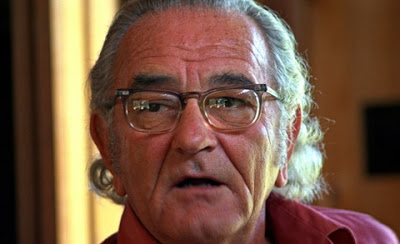 Former President Lyndon Baines Johnson, August 1972. Image from the |
| Former President Lyndon Baines Johnson, August 1972. Image from the LBJ Library / PBS Newshour. |
Lyndon Baines Johnson:
My tragic hero
LBJ was doomed from the start, trapped by earlier mistakes that he could not avoid without being vilified by the political opponents and war hawks in his own party as well as by Republicans.
By Lamar W. Hankins | The Rag Blog |April 8, 2013
The recent unveiling of a monument to honor Vietnam veterans at the Texas state Capitol in Austin rekindled my memories about President Lyndon Baines Johnson — known widely as LBJ. Both of his daughters participated in the ceremony marking the groundbreaking, which included reading the names of all 3,417 Texans who died in that war — some of whom I knew. I loved LBJ for his championing of civil rights and the War on Poverty.
But the War in Vietnam was his downfall and led to my partial disaffection with him.
It may seem overblown to call LBJ my tragic hero, but in a real since he was — at least in the Aristotelian sense.
For those who didn’t live through the 1960s, it may be difficult to imagine what it was like for someone who went from teenager to young adult in that span of years. I was an active participant in the civil rights movement while in high school in Port Arthur, a town whose inhabitants were as racist as any in the South, but with a Cajun twist that sometimes took the edge off because of the intermixing that occurred in parts of neighboring Louisiana, where many of our residents came from.
But make no mistake — racism was rampant among whites, even if some of the vitriol was absent.
LBJ became a friend of the civil rights movement because he felt the movement’s pressure, he understood history, and he knew that racism was wrong. Without him, it is doubtful that the civil rights acts of the mid-60s would have passed as soon as they did.
The two oldest Kennedy brothers were reluctant to act decisively about civil rights except under extreme pressure. John F. Kennedy did not have the legislative abilities that LBJ possessed. It is unlikely that the public accommodations and voting rights acts would have passed in 1964 and 1965 if JFK had been president.
I am regularly reminded that the role of our military is to preserve our freedoms. But that wasn’t what the military was doing in the Vietnam War. That war had nothing whatever to do with our freedoms, but it did concern our misunderstanding of the rest of the world and the widespread belief that the United States has been called by God to control and fix the rest of the world through our overwhelming military and economic power.
A recent Gallup poll reports that Americans have greater confidence in the military than in any other of our institutions. This does not surprise me for several reasons. The military taps into the emotion called patriotism more than any other institution of government. The media give the military enormous publicity and rarely push back against military decisions.
The World War II generation has been hailed as “The Greatest Generation” because of its defeat of Hitler and Japan and the successful expansion of the economy and the middle class for several decades after the war.
But I have never shared that level of confidence in the military. The incestuous relationship between high military brass, politicians, and the corporations that feed off our taxes that support the military seems to fulfill the very definition of corruption.
Decades ago, the Pentagon developed a strategy to put some sort of military installation or award contracts for military hardware and supplies in every congressional district in the country. Consequently, most politicians provide unquestioning support for keeping military expenditures higher than the combined military expenditures of the next highest-spending 14 countries. And those expenditures make wealthy the corporations who build the military hardware and look after the military’s needs.
During the Vietnam War, I knew young men who were drafted into the military, but I also knew several who fled to Canada to avoid the draft, others who became conscientious objectors, and one who went to prison for refusing to cooperate with the draft.
I was a conscientious objector and performed alternate service for my country for two years, serving in LBJ’s War on Poverty, and I spent almost 10 more years in that same effort, living for one year on poverty wages and working for three and a half years as a Legal Services attorney.
During the Vietnam War, with help from the American Friends Service Committee, I provided volunteer counseling to young men who thought that they might qualify as conscientious objectors. My motivation during those years was to try to reduce the number of young men who were sent off to be what I regarded as cannon fodder for the war against the Vietnamese, a country that had done us no harm, and had already driven the colonialist French out of that part of the world.
To be a conscientious objector, however, is not to be a pacifist. I was delighted by some verses in a 1966 Pete Seeger song — “Bring Them Home” — that made this clear:
If you love your Uncle Sam,
Bring them home, bring them home.
Support our boys in Vietnam,
Bring them home, bring them home.
…There’s one thing I must confess,
Bring them home, bring them home.
I’m not really a pacifist,
Bring them home, bring them home.
If an army invades this land of mine,
Bring them home, bring them home.
You’ll find me out on the firing line,
Bring them home, bring them home.
At the time, nothing expressed so simply and elegantly how I felt and how I feel still. But I have never been associated with any organization that advocated violence, except for my 30-year dalliance with the Democratic Party, which ended in 1992.
I have read some of Tim O’Brien’s Vietnam War-themed books and heard him lecture a couple of times. One point that O’Brien makes in his lectures and discusses in one of his books — The Things They Carried — is that deciding to go into the military after being drafted was one of the most morally difficult decisions a young man could make. O’Brien believes that the more difficult and the more courageous decision was to oppose the draft, whether by fleeing to Canada, refusing to cooperate, or by becoming a conscientious objector. I always felt the opposite was true.
When I told my family that I had become a conscientious objector and that my application had been granted and I was ordered to do alternate service for two years, one uncle asked me if I did that because I was afraid to go fight. I had to explain to him that it was not fear that drove my decision, though one would have to be non-human not to have some fear, but it was a moral objection I had to war that I had thought about for several years. I don’t know if my uncle accepted my explanation, but he dropped the subject.
That was the same year that LBJ announced that he would not accept the nomination of his party to be a candidate for president. I have listened to some of LBJ’s archived conversations with friends and associates about the Vietnam War. I know that he agonized over what he had done in persuading the Congress to escalate the conflict, but he felt trapped by circumstance.
LBJ inherited American military involvement in Vietnam that began when Harry Truman promised the South Vietnamese that he would not let the South be taken over by the communist North. Kennedy increased our troops in Vietnam to 16,000 by 1963. LBJ could not find a way to keep Truman’s promise or get U.S. troops out of Vietnam, while preserving his and the country’s honor as he understood that term. This misguided code of honor, I believe, was his fatal flaw.
For Aristotle, the tragic hero was someone of noble stature, outstanding ability, with a greatness about him a “great and good man.” Clearly, LBJ was such a man. His skills as a legislator have been unsurpassed during my lifetime. When he was suddenly thrust into the presidency after the assassination of President Kennedy, he was prepared. He needed no on-the-job training. In the first few weeks after taking office, he gave the country confidence that he would keep the country together and accomplish important work.
In Vietnam, LBJ’s purpose (however misguided) was the same as Truman’s, Eisenhower’s, and Kennedy’s: to defeat the spread of Chinese communism. As we have seen, even after our defeat in Vietnam, Chinese communism did not spread there. The so-called Domino Theory had no substance, though it sounded logical to many.
But Americans tend to look at the rest of the world through their own lens, which may have no relationship to reality. Our presidents and foreign policy experts have made similar mistakes over and over. And these people supposedly are our best and brightest. Their own hubris feeds that of our presidents, and of our citizens.
LBJ was doomed from the start, trapped by earlier mistakes that he could not avoid without being vilified by the political opponents and war hawks in his own party as well as by Republicans. The military-industrial complex that Eisenhower had warned about as he left office had already become an inescapable force that even our most skillful politician could not overcome.
As the Iraq War and the Afghan War’s frequent transformation and escalation over 11 years have demonstrated, wars are not as easy to get out of as they are to get into. Perhaps President Obama has found a narrative about Afghanistan that will allow him to escape the trap that LBJ could not escape in Vietnam.
But President Obama is not prepared to completely leave Afghanistan. He plans to leave a contingent of troops there and elsewhere in the Middle East to continue fighting terrorism using a special forces strategy aided by drones, even though that fight no longer has anything to do with the perpetrators of 9/11, which was the basis for the authority Congress gave President Bush to attack Afghanistan.
Since I was in kindergarten nearly 65 years ago, I have watched people in positions of authority wield power in varying ways. Sometimes, their exercise of power has been wise and the results beneficial; often times not. Every president who has served during my lifetime has made some extraordinarily bad decisions. Most of them have been based on the idea that America is exceptional and has some birthright to control the world. Without question, this idea was behind the Vietnam debacle. But it was pride (and politics) that made it so difficult for LBJ (and later Richard Nixon) to extricate us from Indochina.
While I often say I don’t have heroes, LBJ was a tragic hero for me. Unless American politics undergoes a radical change, it won’t be long before another American president will play the same role that can lead only to tragedy both here and abroad.
[Lamar W. Hankins, a former San Marcos, Texas, city attorney, is also a columnist for the San Marcos Mercury. This article © Freethought San Marcos, Lamar W. Hankins. Read more articles by Lamar W. Hankins on The Rag Blog.]
Thorne Webb Dreyer, Editor





