Bob Feldman : The Rise of the Klan in Texas, 1920-1930

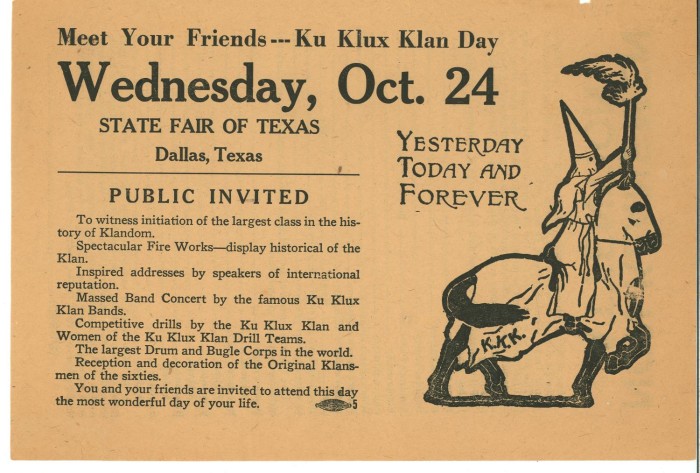
Flyer for “Ku Klux Klan Day,” October 24, 1923. Image from The Portal to Texas History.

The hidden history of Texas

Part 10: 1920-1930/1 — The rise of the Klan in Texas

By Bob Feldman | The Rag Blog | December 12, 2012

[This is the first section of Part 10 of Bob Feldman’s Rag Blog series on the hidden history of Texas.]

Between 1920 and 1930, the number of people living in Texas increased from over 4.6 million to over 5.8 million, and the percentage of Texas residents who now lived in urban towns and cities with populations above 2,500 people increased from 34 to 41 percent.

By 1930, over 292,000 people lived in Houston, over 260,000 people lived in Dallas, over 231,000 people lived in San Antonio and over 163,000 people lived in Fort Worth — although the number of people living in Austin in 1930 was still less than 54,000.

Between 1920 and 1930 the percentage of farmers in Texas who were now just tenant farmers also increased to 61 percent. And in Texas during the “Roaring Twenties,” as Randolph Campbell recalled in his book, Gone To Texas:

Thousands upon thousands of farmers continued to live in destructive poverty as tenants and sharecroppers. Giant corporations still wielded monopoly power because anti-trust and regulatory laws had always aimed more at “foreign” businesses… Laws protecting children in industry… went unenforced… The doctrine of white supremacy ruled race relations, and in South Texas Anglo bosses exploited Texans of Mexican descent politically and economically…

Alwyn Barr’s Black Texans, observed:

Mob violence increased in the early 1920s with the rise of the new Ku Klux Klan… Klansmen branded a black bellhop in Dallas with acid and castrated a light-skinned Negro accused of relations with a white woman. They raided the office of the Houston Informer and threatened the Dallas Express, both black papers. Hooded groups beat a black youth in Texarkana, removed two Negroes from the Denton jail to flog them, and forced black cotton pickers near Corsicana to end their strike for higher wages…

In addition, during the 1920s, “the new Klan, which claimed over 100,000 members in the state, proved powerful enough… to help elect Earle B. Mayfield, a Klansman, to the United States Senate from Texas,” the same book noted.

According to Gone To Texas :

The KKK arrived in Texas in September 1920 when a kleagle came to Houston and recruited 100 men into the state’s first local chapter. “The initial roster represented literally a glossary of Houston ’s Who’s Who,” wrote one observer. The charter members were silk-stocking men from the banks, business houses, and professions…

From its Houston beginning, the Klan spread rapidly across the state. In January 1922, when membership reached more than 75,000, Texas was organized as a realm of the “Invisible Empire” under its own grand dragon, A.D. Ellis, an Episcopal priest from Beaumont. That same year women… obtained a Texas charter as the Women of the Invisible Empire of America. In June 1923, 1,500 masked and robed klanswomen held a parade through Fort Worth. Eventually male membership alone stood at approximately 150,000.

Some opposition to the KKK’s growing influence in Texas electoral politics began to develop within Texas white power structure and political establishment circles (who then backed state-wide candidates that were able to defeat some KKK members who ran against them) by 1924. But as Merline Pitre’s In Struggle Against Jim Crow noted:

The Ku Klux Klan in the 1920s was a viable force in Houston and throughout the state. In Texas, this vigilante group occupied a position of power and influence unequaled in any other state, giving Texas the designation of Star Klan State. Houston was dubbed as the Star Klan City…

In 1921, Houston Klansmen, led by Deputy Sheriff George E. Kimbro, attacked and castrated a black dentist and beat a white lawyer who represented him. Several years later, the Klan tarred and feathered a black physician. In 1928, a Houston mob dragged a black man, accused of killing a white police officer, from his bed in a local hospital and hanged him from a bridge — a murder for which no one was ever convicted. Additionally, a Klan newspaper, Colonel Mayfield’s Weekly, circulated throughout the city.

[In Houston ] in 1920, backed by a city ordinance, the American Legion excluded blacks from the annual Armistice Day parade. Blacks also were prohibited from voting in the municipal elections of February 1921. In 1923 and 1924, respectively, blacks were banned from standing in the same lines as whites to purchase stamps at the post office and to pay property taxes at the Harris County Courthouse. In 1925, the Electric Company excluded blacks from riding its buses, while in 1926, the Majestic Theater refused to admit blacks on weekends.

In 1921, Houston ’s Democratic Party also passed a resolution “allowing only whites to vote in the upcoming Democratic primary;” and in 1923 the Texas state legislature passed a law stating that “only white Democrats and none other” could vote in primary elections, according to the same book.

Between 1920 and 1930, the KKK was also visibly active on the streets of Austin, Texas . In 1921, for example, “500 white-robed and hooded Ku Klux Klansmen from Austin and San Antonio marched single file in silence up and down Congress Avenue, while thousands of spectators looked on,” according to David Humphrey’s Austin: An Illustrated History. The same book also observed:

Capital City Klan No. 81 was organized in 1921 and a year later had 1,500 members including the sheriff of Travis County and apparently other highly placed city and county police officials. The Klan thrived in Austin in the early and mid-1920s… In the mid-1920s the Klan even purchased a sizable piece of property off South Congress Avenue and erected a hall or “Klan haven”…

So, not surprisingly, Austin’s “1928 city plan recommended that East Austin be designated a `Negro district’ and that municipal services for blacks, such as schools and parks, be confined to this district” and so “thirteen-acre Rosewood Park in East Austin provided recreational facilities for blacks, but other city parks were closed to them,” according to Austin: An Illustrated History.

[Bob Feldman is an East Coast-based writer-activist and a former member of the Columbia SDS Steering Committee of the late 1960s. Read more articles by Bob Feldman on The Rag Blog.]

The Rag Blog

Posted in Rag Bloggers | Tagged , , , , , , | 2 Comments

Alan Waldman: ‘Father Ted’ is Howlarious Irish Series

Waldman’s film and TV
treasures you may have missed:

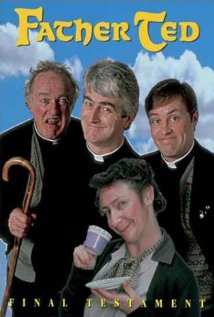
Anglo-Irish sitcom Father Ted brilliantly spoofs Catholic clergy in one of the funniest TV series ever.

By Alan Waldman | The Rag Blog | December 12, 2012


[In his weekly column, Alan Waldman reviews some of his favorite films and TV series that readers may have missed, including TV dramas, mysteries, and comedies from Canada, England, Ireland, and Scotland. Most are available on DVD and/or Netflix, and some episodes are on YouTube.]

The 1995-1998 TV series Father Ted, set on Ireland’s remote, fictional Craggy Island, was almost universally adored until the heart-attack death of star Dermot Morgan, 24 hours after the filming of its 19th and final episode. Father Ted took comedy in wonderful new directions, although its treatment of three eccentric Catholic priests roused viewer protests that drove Boston’s PBS station to take it off the air. All its episodes can be seen on YouTube, and the first season is on Netflix and Netflix Instant streaming.

As of December 6, 2012, more than 93.6% of the 11,959 viewers who rated it at imdb.com gave it thumbs up, and an astonishing 52% of them consider it a perfect 10. Judge for yourself by clicking here.

Created and written by Irish funnymen Graham Linehan and Arthur Mathews (who have written and/or created another 21 comedy series), it follows the hilarious adventures of three priests who have been exiled to a lonely parish house on remote Craggy Island as a punishment.

Father Ted Crilly (Morgan) was sent to Craggy Island as penance for “The Lourdes thing,” in which he supposedly stole the charitable donations meant to fund a children’s pilgrimage and hot-footed it to Las Vegas. He and nutsy housekeeper Mrs. Doyle (Pauline McLynn) now care for the supremely dim Father Dougal McGuire (a delightfully funny Ardal O’Hanlon) and the violent, alcoholic, deranged Father Jack Hackett (Frank Kelly).

Father Ted was nominated for 19 major British and Irish awards, winning 15, including Best TV Comedy for two of its three seasons. Morgan won two awards, including the BAFTA for Best Performer. O’Hanlon and McLynn won performer awards and Linehan and Mathews took two BAFTAs for producing and a best TV Situation Comedy honor from the Writers Guild of Great Britain.

One great running gag is that Father Dougal lacks even the remotest understanding of Catholicism. Father Ted once sarcastically cracks that Dougal entered the priesthood via a “collect 12 crisps packets and become a priest” promotion. His childlike view of life is endlessly hysterical, and he delivers his lines with great deadpan innocence.

By the way, O’Hanlon followed this role with the wonderful lead in the highly imaginative Britcom My Hero. O’Hanlon’s standup comedy is also terrific and can be found on YouTube. (“Women experience pain more deeply than men do, because a certain part of every woman’s brain is always thinking about shoes.)

Father Jack sits in a corner or is passed-out drunk most of the time, and his vocabulary mostly consists of four shouted words: “Drink!,” Arse!,” “Girls!,” and the Irish “F” word, “Feck!” He will drink anything, including floor polish and an Irish product called Toilet Duck. Father Jack’s face is covered with sores, and actor Frank Kelly looked so creepy while in costume that cast members refused to lunch with him.

[Oregon writer and Houston native Alan Waldman holds a B.A. in theater arts from Brandeis University and has worked as an editor at The Hollywood Reporter and Honolulu magazine. Read more of Alan Waldman’s articles on The Rag Blog.]

The Rag Blog

Posted in Rag Bloggers | Tagged , , , , | 1 Comment

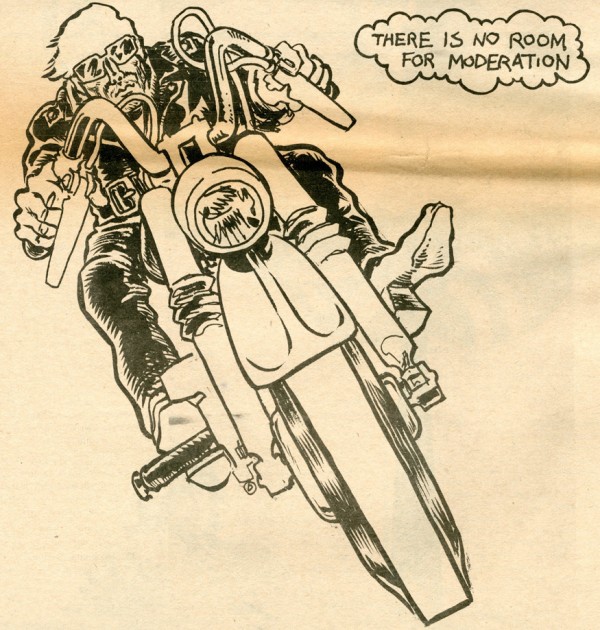
Paul Buhle : Comix Artist Spain Rodriguez (1940-2012)

Spain Rodriguez: Transforming comics. Image from CBLDF.

The passing of a comix pioneer:
Spain Rodriguez (1940-2012)

By Paul Buhle / Dissent / December 12, 2012

In Trashman: Agent of the Sixth International, the signature saga of his early years, Rodriguez’s revolutionaries took revenge on a truly evil American ruling class.

We are now so far from the 1960s and ’70s that the crucial locations, personalities, and moments of one very popular art form’s transformation have been largely forgotten. Spain Rodriguez, with a handful of others (the best remembered are happily still with us: Gilbert Shelton, Robert Crumb, Bill Griffith, Kim Deitch, Art Spiegelman, Trina Robbins, and Sharon Rudahl, to name a few), pushed the comics agenda so far forward that no return to the limitations of superheroes and banal daily newspaper strips would ever be possible.

Comic art, belatedly recognized in The New York Times (and assorted museums) as a real art and not a corrupting children’s literature, owes much to them.

Spain (his birth name was Manuel, his father a Spanish immigrant, his mother an Italian-American artist) grew up in Buffalo, New York, a rebellious working-class kid who wore long sideburns and was impressed by the civil rights movement. He dropped out of art school in Connecticut and, after returning to Buffalo and working a factory job with a motorcycle gang engagement, landed in New York in time for the efflorescence of Underground Comix (styled with an “x” to distinguish itself) in a comic tabloid offshoot of the East Village Other.

His colleagues were a strangely mixed crew, all of them old enough to have been influenced by EC Comics, the most politically liberal and artistically accomplished of the old comics industry, and the one hardest hit by the congressional hearings of the McCarthy era. (As with attacks on the Left, every charge of subversion and perversion hid Middle-American outrage: these were Jews corrupting innocent American youth.)

In a sense, every “underground” artist of these early days sought revenge in the name of comic art, and realized it through the depiction of sex, violence, and anti-war and anti-racist sentiment unthinkable in what remained of the mainstream. Sex and violence, lamentably, became chief attractions to many readers, recalling the “headlights” (aka “sweater girl”) crime and horror comics of the late 1940s, albeit with a left-wing or libertarian ambience.

The whole comix artistic crowd moved to San Francisco around 1970, joining Robert Crumb and a few others already there, part of the acid-rock, post–Summer of Love setting. Underground comix, replicating the old kids-comics format but now in black and white, grew up alongside the underground press, whose reprinting of comix created the market for the books.

Crumb was the artist whose work sold the best, in the hundreds of thousands, but Spain was widely regarded as the most political. He was heavily influenced by the most bohemian of the EC comics world, wild man Wallace Wood, whose sci-fi adventures depicted civilizations recovering from atomic war and whose Mad Comics stories assaulted the 1950s commercialization of popular culture. Wood’s dames were also extremely sexy, too overtly sexy for the diluted satire of the later Mad Magazine.

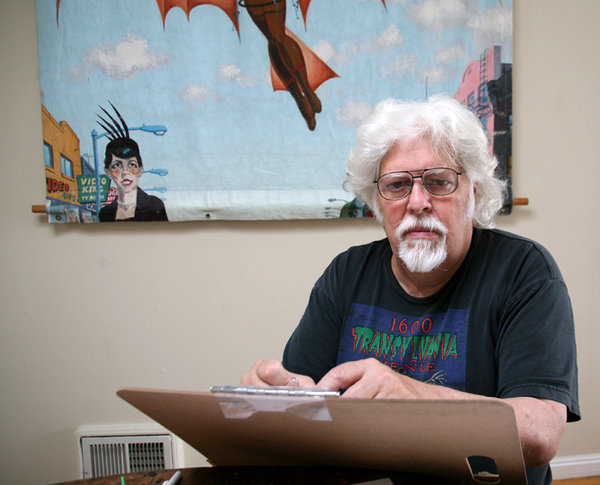
Spain Rodriguez. Photo by Sean Stewart / Babylon Falling.

Trashman: Agent of the Sixth International was Rodriguez’s signature saga in these early years, serialized in underground papers, comix anthologies, and eventually collected in comic book form as Subvert Comics. These revolutionaries took revenge on a truly evil American ruling class in assorted ways, many of them violent, but they also had fun and sex, and were subject to many self-satirizing gags, in the process.

By the middle 1970s, his work had broadened into more social and historical themes, often with class, sex, and violence highlighting his points. Histories of revolutions and anti-fascist actions (and all their complexities) inspired some of his closest reading of real events, but he had no fixed point on the left-wing scale.

He admired and drew about anti-Bolshevist anarchist leader Nestor Makhno and also anti-Stalinist Spanish anarchist Durruti, but he also drew about Red Army members facing death fighting the Germans, and so on. (Several of these pieces are now reprinted in Anarchy Comics: The Complete Collection, an anthology from that 1980s series, just published by PM Press.)

In recollections of the internal conflicts among comix artists, sometimes pitting feminists against male-dominated circles, Rodriguez is remembered as having been unusually helpful and egalitarian, a memory that contrasts curiously with his sometimes sado-masochistic plot lines but not so curiously with the gender-equality of the sybarites (“Big Bitch” was Trashman’s female counterpart, the tough working-class broad with sex cravings for weaker men).

He poked and prodded San Francisco’s self-image as a haven of liberated sex, sometimes making his younger self a player on the scene. He also helped set in motion the vital murals movement in San Francisco’s Mission District, but was likely best known on the West Coast for his many posters of San Francisco Mime Troupe openings.

Spain Rodriquez lasted long enough to see his work in square covers (if not often hard covers), his unique and quasi-realistic modernism preserved for generations ahead.

The validation of comic art from near the end of the century onward — Spiegelman’s Maus and left-wing lesbian Alison Bechdel’s Fun Home high among the evidence of artistic achievement — found Rodriguez with a Salon series, “The Dark Hotel,” and several books of his own. Devil Dog, a biography of disillusioned Marine Corps general Smedley Butler, and Nightmare Alley, an adaptation of the classic noir novel, are easily among the best. Che, his graphic biography of Che Guevara, reached the furthest, with editions published everywhere from Latin America to Europe, Japan, and Malaysia.

At the time of his death, Rodriguez was amid “Yiddish Bohemians,” a strip about Jewish-American puppeteers during the 1920s and ’30s, in what would be the last in a stunning series of collaborations with playwright-professor Joel Schechter. Rodriguez had started a Woody Guthrie poster for an upcoming Bay Area concert and, had he lived, would have drawn a history of the 2003 San Francisco hotel strike.

After more than 40 years (and the disappearance of well over 90 percent of many little-remembered artists’ work in yellowing pulp), the impact of the Underground Comix world remains more a matter of style than substance, daring more than narrative and artistic content. This is unfortunate, because so many artists had particular contributions worthy of note, worthy of reprinting for the sake of comic art alone.

Spain Rodriquez lasted long enough to see his work in square covers (if not often hard covers), his unique and quasi-realistic modernism preserved for generations ahead. That he never lost his political vision or his sense of humor should go without saying, but those of us lucky enough to see him teach or to be taught by him felt the deep impact of his humanism as well.

Rodriguez died at home in San Francisco, with his wife, Susan Stern, a documentary filmmaker, and his daughter, Nora Rodriguez, by his side. A retrospect of his work, including a short documentary film made by his wife, is now in place at the Burchfield Penny Art Center in Buffalo, the second exhibit in Buffalo to honor this improbable local hero.

[Cultural historian Paul Buhl is professor emeritus at Brown University. He publishes radical comic books and graphic novels. Buhle was the editor of Che and is co-editor of the anthology Bohemians, to appear in 2013, with two strips by Rodriguez. Read more articles by Paul Buhle on The Rag Blog.]

The Rag Blog

Posted in RagBlog | Tagged , , , , , , , | 2 Comments

BOOKS / Ron Jacobs : ‘We Are Many’ Offers Thoughtful Analysis of Occupy Movement

From occupation to liberation:
A review of ‘We Are Many’

By Ron Jacobs | The Rag Blog | December 11, 2012

This aesthetically pleasing volume has the best overall take to date on the meaning of Occupy, its shortcomings and strengths, and its potential future.

[We Are Many: Reflections on Movement Strategy from Occupation to Liberation, edited by Kate Khatib, Margaret Killjoy, and Mike McGuire; Afterword by David Graeber (2012: AK Press); Paperback; 355 pp; $21.]

Despite a myriad of obituaries for the movement that began in Manhattan in September 2011, the people of Occupy refuse to let it die.

There are hundreds involved in the Occupy Sandy effort in the New York City region following the devastation of Tropical Storm Sandy. Individuals and groups connected to Occupy Wall Street have organized relief efforts that are feeding and caring for thousands of people left without power, work, and homes.

Those being helped are primarily the working poor and folks on assistance. They are also those traditional relief efforts tend to ignore, precisely because of their income status and, in the USA, also perhaps because of their skin tone or ethnic origin.

The vastness of the Occupy Sandy effort is testament to the Occupy movement’s most obvious strength: its ability to organize rapidly and from the ground up.

Since the advent of Occupy and the demise of its encampments, there have been millions of words written about the movement. From Fox News to the Revolutionary Communist Party’s journal Revolution; from Le Monde to the Jerusalem Post; and numerous journals, websites, blogs and television networks, Occupy Wall Street and the movement it spawned provoked a storm of commentary.

Some of it was sensationalist and some of it perhaps overly academic. It was occasionally overly laudatory and often overly critical. Overall, however, the press coverage did something that one could argue no left-leaning movement since the 1960s and 1970s had done. It changed the nature of the national conversation.

Like the black liberation and antiwar movement of those decades long past changed the way mainstream America thought about the treatment of African Americans and the nature of its foreign policy, Occupy changed the way mainstream America thought about its economic system. Or, maybe it just vocalized thoughts people had held but did not know how to vocalize in a way that would draw some attention.

A year later there have been a number of column inches written about Occupy and its meaning. The articles written in the mainstream press tend to acknowledge Occupy’s influence in the national conversation. At the same time, these articles tend to diminish its long term role. Perhaps because it is too early to tell. Perhaps because they hope it doesn’t have one.

Occupy was the greatest manifestation of anti-authoritarian organizing in the United States in recent history. It proved that spontaneity can work. The taking of property and occupying it is a radical act in itself and obviously one the powers that be find threatening.

The involvement of the houseless was and is important. Their presence and involvement not only made the gross shortcomings of monopoly capitalism real, they also provided food and a reaffirmation of value to those on the streets and an experience at self organizing for all. Yet, it suffered from some of the same ills present in the larger society: racism, sexis, and questions around violence and leadership.

Occupy was/is not a movement that began with highly defined politics. This was its strength and its weakness. Many different philosophies set up camp under its banner. Anarchists, socialists, libertarians, and liberals. Even the occasional tea partier and Democrat.

Yet, despite this multitude of philosophies that came to share the Occupy camps, the one that was its impetus remains a generally defined type of left anarchism. Somewhat situationist like the poster artists of Paris in May 1968 while also derivative of the squatters’ movement of the 1970s and 1980s in Europe, Occupy also drew from the anarchism of the Yippies, the counterculture of the 1960s, and the punk culture that came later. Therefore, it would seem that the best analysis of Occupy would come from folks that had similar roots.

Guess what? The best analysis of Occupy does come from such folks. Titled We Are Many: Reflections on Movement Strategy from Occupation to Liberation and published by AK Press, this aesthetically pleasing volume has the best overall take to date on the meaning of Occupy, its shortcomings and strengths, and its potential future.

Never shortchanging the arguments within the movement, the writers collected in We Are Many take on the questions of racism, sexism, the Black Bloc, and the cops, and they do so in an intelligent and lively manner. No other group of writers has done so well in exploring the Occupy movement from within its ranks. In fact, no other group of writers has done so well in exploring the Occupy movement, period.

Unlike earlier books about Occupy, most of which were published either during the life of the encampments or immediately after, We Are Many has the perspective a little time often provides. Away from the intensity of battles with police and the day-to-day reality of camping in the middle of some urban space, this book presents the reader with thoughtful essays designed to raise questions about strategy and politics that might have been pushed aside in the aforementioned day-to-day reality.

Earlier writings about Occupy were often chronicles of organizing; sometimes those chronicles were objective attempts to describe the daily life of the writer and those around them; other times they were impressionistic attempts to do the same thing.

We Are Many has its share of these essays, yet even those indicate a deeper reflection and understanding of Occupy’s historical meaning and the potential it unleashed for the future of oppositional and extra-parliamentary movements, especially in the United States.

Writers who appear in this volume include some names fairly well known in anti-authoritarian and left circles: Cindy Milstein, Vijay Prashad, Frances Fox Piven, Andy Cornell, David Graeber, George Cicciariello-Maher, and the Crimethinc Collective, to name just a few. This list is a small representation of the more than 50 writers and artists collected here.

AK Press has done a great service by publishing them together in this volume. Like so many of the publications released by this collective, not only is this book filled with good, thoughtful writing and great art, it is attractively presented. These writers take a hard look at manifestations of racism and sexism in the movement; they discuss the nature of violence and its role in popular movements; and they discuss these and other questions from a perspective that represents the grassroots democratic and anti-capitalist philosophy that motivated the movement.

We do not know what will happen next with the movement awakened by that first presence in lower Manhattan back in the autumn of 2011. In Europe, general strikes and daily protests continue to occur as neoliberal capitalism takes its ransom from governments across the continent. In the Middle East and Central Asia, wars continue to flare and military occupations continue to be challenged.

In North America, the corporate and financial elites continue to ravish the economy and politicians conspire to destroy the remaining social welfare and retirement systems previous generations fought hard to build. WalMart workers are organizing unions and Quebec students fought against university privatization moves and won.

It is not the end of the battle, but the beginning. Onward.

[Rag Blog contributor Ron Jacobs is the author of The Way The Wind Blew: A History of the Weather Underground. He recently released a collection of essays and musings titled Tripping Through the American Night. His latest novel, The Co-Conspirator’s Tale, is published by Fomite. His first novel, Short Order Frame Up, is published by Mainstay Press. Ron Jacobs can be reached at ronj1955@gmail.com. Find more articles by Ron Jacobs on The Rag Blog.]

The Rag Blog

Posted in Rag Bloggers | Tagged , , , , , , , | Leave a comment

Steve Russell : Will Rogers and the Jokes of Partisan Politics

Will Rogers. Image from Wikimedia Commons.

The jokes of partisan politics:
Will Rogers ‘chews to run’

‘I’m not a member of any organized political party,’ he famously confessed, ‘I’m a Democrat.’

By Steve Russell | The Rag Blog | December 7, 2012

Will Rogers, the Paint Clan Cherokee cowboy turned entertainer turned political pundit, used to say he did not make jokes. “I just watch the government and report the facts.” Like any intelligent man, he could be viewed as a bundle of contradictions, but most of his contradictions came from wearing his heart on his sleeve.

From at least 1916, when he faced the reputedly dour and humorless President Woodrow Wilson, nobody was safe from his barbs. Before that performance, his political comments had been topical humor pulled out of the latest newspapers. Having the President in the audience, for Will, took topical comedy to another level bordering on what he never intended, personal attack.

Characteristically, he started with the truth: “I am kinder nervous here tonight.” Writing years later, he admitted, “that is not an especially bright remark, …but it was so apparent to the audience that I was speaking the truth that they laughed heartily at it.”

Encouraged, Rogers let fly with his usual routine, and the President wound up laughing at himself. According to Rogers biographer Ben Yagoda, Will was invited into the presidential box after the show. Still a bit nervous, he parked his omnipresent wad of chewing gum in his hat, forgot he had done so, and suffered the consequences when he put the hat back on later. (His chewing gum habit would come up again in his choice of slogans for his Anti-Bunk Party, “He chews to run!” This was a gentle parody of Calvin Coolidge, who did not “choose” to run.)

Wilson, a Democrat, was the first President to be roasted face to face by Will Rogers, but hardly the last. There was plenty to go around for both parties. Will never hid his biases. He was more worried about the welfare of farmers than that of city folks, and working stiffs more than bankers. “I’m not a member of any organized political party,” he famously confessed, “I’m a Democrat.”

Of course, in our time we can laugh at that remark as ancient history… unless we think about the 1968 Democratic Convention, when the delegates pledged to the anti-Vietnam War candidate Eugene McCarthy were physically ejected, adding to the chaos in the streets of Chicago that year. Or the 1972 Democratic Convention, when the anti-war outsiders became insiders and spent so much time wrangling among themselves that George McGovern gave the speech that was supposed to end the war at a time when the television audience had gone to bed.

Having admitted to identifying with the disorganized party of the workingman, he still seldom bestirred himself to vote. It’s not clear that he ever voted. It’s safe to say, though, that he would be disgusted with the wave of voter suppression laws and would have had plenty to say about the Republican Party pushing them.

Rogers himself would not be allowed to vote under many of these laws. He wrote of his difficulties getting a passport for lack of a birth certificate:

In the early days of Indian Territory, where I was born there was no such things as birth certificates. You being there was certificate enough. We generally took it for granted that if you were there, you must have at some time been born… Having a certificate of being born was like wearing a raincoat in the water over a bathing suit.

Informed in the passport office that they knew him, but still needed proof he was an American citizen, Rogers was still puzzled:

That was the first time I had ever been called on to prove that. Here my Father and Mother were both ….Cherokee Indians and I have been on the Cherokee rolls since I was named, and my family had lived on one ranch for 75 years.

The argument that you have to have a picture identification to get on an airplane would not have impressed this early and enthusiastic endorser of civil aviation, because the voter suppression laws are not aimed at people who normally get on airplanes.

Rogers was plain about his working class bias, but in the world of electoral politics, he practiced equal opportunity ridicule. “Both parties have their good and bad times,” he observed, “only they have them at different times. They are each good when they are out, and each bad when they are in.”

His personal friendships, like his jokes, were bipartisan. Among presidents, he was probably closest to the Roosevelts, the Republican Teddy and the Democrat Franklin D. “America,” he claimed, “has the best politicians money can buy.”

It’s not hard to picture what he might have said about the tradition of presidential candidates releasing multiple years of tax returns begun by the Republican George Romney and ended by the Republican Mitt Romney. We would be hearing a lot about Swiss bank accounts, in between wisecracks about President Obama’s adventures with the Chicago political machines.

Will Rogers reported for both parties’ nominating conventions starting in 1920 and ending in 1932. Like most of Rogers’ career moves, his convention coverage started out slow, because he did not in fact attend the 1920 conventions. His reportage was disrupted by the tragic death of his son Freddie in June of 1920, the very month both conventions were scheduled. Characteristically, the grieving Rogers honored his contract, taking newspapers as his information, the same information his readers had.

The Democratic Convention was held in San Francisco, where Rogers was when he heard that his children’s “sore throats” were in fact diphtheria. He drove all night to get home, but Freddie died at 4 a.m. on June 17. His first comment on the convention was dated the same day.

“Our National Conventions,” Rogers observed, “are nothing but glorified Mickey Mouse cartoons, and are solely for amusement purposes.” Will was writing about the tendency for the real business of the conventions to be settled in back room horse-trading rather than in public.

In fact, the “cartoons” were not as scripted in advance as they are in our times. The last time a candidate was “drafted” at a convention was the Democrat Adlai Stevenson in 1952. The last “floor fight” for a major party nomination was in 1976, between Gerald Ford and Ronald Reagan for the Republican nod. It was not that long ago that the political parties did real business at their conventions, although Rogers was correct to be skeptical how much of it happened in public.

Will Rogers practiced “equal opportunity ridicule.” Image from New Hampshire Commentary.

1920 Democratic Convention, San Francisco 

In the 1920 Democratic Convention, for example, there were 1,092 delegates and only 336 of them were “pledged,” meaning that they had promised their vote to a candidate on the first ballot. Of those 336, most were pledged to “favorite sons,” a mechanism for party bosses in a state to capture the delegation after the first ballot, since a “favorite son” was not going to win the first ballot.

There were, of course, no “favorite daughters,” since women only got the vote nationwide with the ratification of the 19th Amendment in August of 1920, although they had the franchise in most western states much earlier.

The wide-open nature of the race for the Democratic nomination was a result of the country in general being ignorant of President Woodrow Wilson’s health problems, and as a result uncertain whether he would stand for re-election. In fact, Wilson had been incapacitated beginning in 1919 — the government effectively run by his wife and the cabinet — because there was no 25th Amendment providing for disability of the president until 1967.

The only candidate in 1920 who had dared to enter primaries while his party held the White House was Attorney General A. Mitchell Palmer, whose legacy in history is primarily the “Palmer raids,” roundups of immigrants thought to harbor radical ideas. Neither the Palmer raids nor his run for the Democratic nomination produced any lasting results, although Palmer’s name comes to mind more easily than that of the man actually nominated, Gov. James Cox of Ohio.

1920 Republican Convention, Chicago

The 1920 Republican Convention was held in Chicago, which, Rogers reported, “holds the record for murders and robberies and Republican conventions.” He alleged, “California’s 26 delegates to the Chicago convention were accompanied by 60 bootleggers.”

Will Rogers, bylined as “Famous Oklahoma Cowboy Wit and Goldwyn Motion Picture Star,” did his best from a distance to report the convention that launched the ill-fated presidency of Warren G. Harding. It was Harding’s selection by party bosses behind closed doors in the Blackstone Hotel that contributed the phrase “smoke-filled room” to our political lexicon.

Rogers “reported” an imagined dialogue between himself and one of the party bosses, Pennsylvania Sen. Boies Penrose, who, in spite of serious illness, kept his hand in from Philadelphia with both telephone and telegraph wires in his sick room. Rogers asked “Penrose”:

“What makes the delegates change? Don’t they stay with their man?”

“The delegates vote the way their people told them the first ballot. But after that they sell to the highest bidder.”

“But that’s not honest, is it?”

“No, just politics.”

While Harding went on to be elected, his administration was quickly engulfed by the Teapot Dome Scandal, in which Secretary of the Interior (and political Indian fighter) Albert Fall went to prison for bribery and against which all other political scandals were measured before the Watergate scandal.

Harding was saved from further humiliation by his death in 1923, but since the incumbent President Calvin Coolidge was untainted by Teapot Dome, all the drama was gone from the 1924 Republican Convention. The slogan “Keep Cool with Coolidge” said it all.

This time, Rogers reported the conventions on the scenes. By 1924, Rogers was better known than most of the people who were the subjects of his dispatches. His byline had become, simply, “Will Rogers.”

1924 Republican Convention, Cleveland

Admitting to the cut and dry nature of the Coolidge nomination, Rogers reported, “This is the first Vice Presidential convention ever held in the history of politics.”

“The city is opening up the churches now… so the delegates and visitors can go and hear… excitement of some kind.”

“Now I want this distinctly understood, that I have nothing against Cleveland. I love Cleveland because I knew them before this catastrophe struck them. She will arise… and some day be greater than ever.”

1924 Democratic Convention, New York City

The Democrats had a more exciting show at Madison Square Garden. Rogers had progressed from the one-liners that dominated his reportage in 1920. It was a measure of the relative excitement that he produced five articles on the Republicans keeping cool with Coolidge and 18 on the Democratic Party’s circus. By the end of the Democratic Convention, he was reporting as “Will Rogers, Jr.,” because it had lasted so long that his son had supposedly taken over the task.

I suggested to them that if I was them I would adjourn before they nominated somebody and spoiled it all.

We heard nothing from 10 o’clock in the morning until six at night but “The man I am going to name.” Then they talk for another thirty minutes and then, “The man I am going to name.” There have been guys going to name men all day, and all we ever got named were about six out of a possible 200.

They all kept the names until the last word. It was safer.

Safety was indeed an issue at this convention, where the Democratic Party split wide open over the influence of the Ku Klux Klan, and the number of cross-burnings and hooded marches outside the proceedings led some wags to refer to 1924 as the “Klanbake.”

Inside Madison Square Garden, the main issue became a choice in the platform between a vague call for religious toleration and racial harmony versus a full-throated denunciation of lynchings in general and the KKK in particular.

“They have been five days working on a plank on the Ku Klux and finally brought in the same one the Republicans used,” observed Rogers.

Some guy from Maine offered an amendment naming the Klan… There were 12,000 civilians and at least a hundred thousand cops in and around the building. There were 10 policemen standing in the aisle by the side of each Texas delegate.

Will’s description was comic hyperbole, but the debate did rend the party.

When North Carolina announced to the Chairman that three and eighty-five one-hundredths of a delegate were in favor of the Klan amendment, and that twenty and fifteen one-hundredths of a delegate were against it, why, there was a round of laughter that broke up what was the most tense moment ever witnessed in a convention hall.

Rogers went on at length about the anatomical improbability of fractional delegates. “If a delegate is three-seventeenths of one vote, what would that make an alternate?” The silliness subsided but the KKK prevailed in the floor fight.

Today they start balloting, and I suppose some man will win the nomination by the narrow margin of a left forearm of a North Carolinian.

After a record 103 ballots, the Democrats finally settled on John W. Davis for president. Davis comes down to us in history as the lawyer who argued the segregationist and losing side of Brown v. Board of Education.

1928 Republican Convention, Kansas City

One of the things Will Rogers’ biographers cannot agree upon is how many airplane crashes he survived before the one that took his life. Because of his devotion to the cause of civil aviation (and military aviation before that), Will always minimized mishaps and covered them up when he could.

Flying from his home in California to the Republican Convention in Kansas City, Rogers survived two of what he called “incidents, not accidents.” The first was a wheel breaking on landing in Las Vegas, which ended with the plane on its back. Just a few hours later, in a different plane, Rogers survived a hard emergency landing in Cherokee, Wyoming. He complained that he had lost his overcoat in the confusion around the “incidents,” but vowed to keep his bloodstained shirt for a souvenir.

Once more in 1928, the Republicans put up no serious fights. Herbert Hoover, in a workmanlike march toward nomination, had done enough advance work to be nominated on the first ballot. “The whole show,” Will complained, “has degenerated into nothing but a dog fight for Vice President.”

Rogers did note one thing that has changed in our time, when no Democrat holds statewide office in Texas:

They had a time seating the Texas delegation, as there was no law in Texas to apply to a Republican primary. Texas never thought they would come to a point where there would ever be any Republicans there. They also have no laws against the shooting out of season of reindeers or musk ox.

There was a rare hint of foreign policy debate when one of the speakers alluded to U.S. intervention in Nicaragua, where the U.S. had sent Marines in 1926. The U.S. had pressured the Nicaraguan congress to elect Adolfo Diaz president, something that Will commented on at the time:

We say that Diaz is the properly elected president of Nicaragua, but Brazil, Argentina, Peru, Chile, Mexico, Ecuador, Costa Rica, Cuba, Guatemala, Colombia, Uruguay, Paraguay — all those say that the other fellow is the properly elected president. It’s funny how we are the only ones that get everything right. I’d rather be right than Republican.

Two years later, Will had not changed his mind:

[The speaker] brought up Nicaragua, but he left the marines down there. He said that he would protect American lives down there, even if we had to send some there to protect.

This was vintage Will Rogers, who never hid his opinion that other countries in general, and Latin American countries in particular, ought to be allowed to govern themselves without U.S. meddling.

Rogers could not let the convention pass without ribbing the first American Indian to appear on a presidential ticket, Charles Curtis. While he was also Osage and Potawatomi by blood, Curtis was enrolled Kaw and grew up on the Kaw Reservation in Kansas Territory. Curtis was, like Will Rogers, a pre-statehood Indian who had watched Indian governments get shoved aside.

Rogers said of Curtis getting the nod for Vice President:

The Republican Party owed him something, but I didn’t think they would be so low down as to pay him that way.

1928 Democratic Convention, Houston

From Houston, Rogers anticipated the major issue of the Convention:

Since prohibition was unearthed nine years ago, there has only been one argument invented that a politician when he is cornered can duck behind… “I am for law enforcement.” It don’t mean anything, never meant anything, and never will mean anything.

It would take practically a lunatic to announce: “I am against law enforcement.”

Now the Republicans held their convention first, and naturally they grabbed this lone tree to hide behind. Now that leaves the Democrats out in the open.

Days later, he continued:

The whole talk down here is wet and dry; the delegates just can’t wait till the next bottle is opened to discuss it. Prohibition is running about a quart to the argument here now.

It was plain that the Democrats would “straddle,” as Will put it, with a “balanced ticket,” which in the context of the times meant a wet and a dry. When the convention settled on a wet, and the first Catholic, Alfred E. Smith, to lead the ticket, the way was open to put the first Southerner on a major party ticket since the Civil War.

This was critical because Smith (and Catholics generally) had been subject to almost as much animosity from the Ku Klux Klan as African-Americans and Jews. This was the very next convention after the one that splintered over the KKK.

The second spot on the ticket went to Arkansas Sen. Joseph Robinson, about whom Will Rogers opined:

They got a great fellow in Joe. He is a real, two-fisted he-candidate. He comes from the wilds of Arkansaw, where they are hard to tame. I have had one in my house for 20 years and there is just no managing ‘em.

Will was referring to his wife, Betty Blake, whom he had courted across the Arkansas line from Indian Territory.

The Smith-Robinson ticket was decisively defeated by Hoover-Curtis, but within a year the “Roaring Twenties” would quit roaring.

Will Rogers: “Never a slave to objectivity.” Image from MovieFanFare.

1932 Republican and Democratic Conventions, Chicago

In retrospect, it’s fitting that both parties convened in the same city in the depths of the Great Depression, since neither party had done much to prevent it. The Progressive reforms championed by Will Rogers’ friend Theodore Roosevelt were a distant memory, and the anti-trust laws Roosevelt pioneered were honored in the breech.

Wall Street speculation was rampant at a time when the margin requirement was only 10%. That is, to buy $1,000 worth of stock, a trader only needed $100 in his account. The common belief was that the stock market would always rise, and a rising tide would lift all boats. Politicians were either unaware of or ignored a degree of income inequality in the U.S. that would not be seen again until current times, when we once more choose to assume that the key to prosperity is that the rich do well.

The conventional wisdom came crashing down on Black Tuesday: October 29, 1929. A stock market that had been volatile for some time took a dive. Thirty billion dollars in paper wealth disappeared in two days.

When a similar crash began in September of 2008, the Federal Reserve Bank responded with major liquidity injections, “loose money.” This could not happen in 1929, when the Federal Reserve was bound by the gold standard and private gold hoarding was common.

Speculation in a perpetually rising stock market was not anything that appeared to need regulating in 1929, so when investment banking collapsed, so did commercial banking. Crop loans and inventory loans dried up. When banks failed in those times, the depositors simply lost their money. A rumor became enough to set off a “run” on a bank.

President Hoover’s major policy response was the protectionist Smoot-Hawley Tariff Act. Will Rogers was opposed to tariffs in general and that bill in particular, because he felt that it hurt farmers and helped bankers, a view that may have sounded simplistic but was vindicated by events.

Rogers steadfastly refused to kick Hoover while he was down or encourage those who did. When asked by Hoover to write something to discourage hoarding, Will complied by claiming that

A Jewish farmer at Claremore named Morris Haas hid $500 in bills in a barrel of bran and a cow ate it up. He has just been able to get $18 of it back, up to now.

This hoarding don’t pay.

In a speech titled “Bacon, Beans, and Limousines,” Will cut though the rhetorical smoke about the need to balance the budget and the transgressions of other countries:

There’s not really but one problem before the whole country at this time. It’s not the balancing of Mr. Mellon’s budget. That’s his worry. That ain’t ours. And it’s not the League of Nations that we read so much about. It’s not the silver question. The only problem that confronts this country today is at least 7,000,000 people are out of work. That’s our only problem. There is no other one before us at all. It’s to see that every man that wants to is able to work, and also to arrange some way of getting more equal distribution of the wealth in the country.

In those dark days, the two major parties met in Chicago to debate how to get out of the hole and who would be put forward to lead the country out.

The Republicans met first, and started a little slow, according to Will:

I couldn’t find out a thing about politics, and I guess that’s just about the way the whole country looks at it. Nobody here knows they are holding a convention. There is lots of flags out, but Tuesday is Al Capone’s birthday, so who knows?

The next day, Rogers found a political story he cared about:

Well, got some scandal for you today, for it wouldn’t be a Republican convention without some sort of undercover “finagling.” They are out now to throw poor old Injun Charley Curtis off and get another Vice President… Their alibi is that he is too old… Well, they knew a few months ago how old he would be about now.

Will went on to suggest that the people out for Curtis’ head say it this way:

We are in the hole and we got to try and dig up somebody that will help us swing some votes. It’s not your age, Charley… You got to be the goat, not us. So any one we can think of that can carry the most votes we are going to nominate ‘em, be it Charley Chaplin or Amelia Earhart. You been a good Injun, but its votes not sentiment we are after this year. So long, Charley, take care of yourself.

Two days later, Will complained again “Poor Charley is to be tomahawked in the back… just like they took the country from the Indians…” When the movement to dump Curtis failed, Rogers claimed credit, probably correctly:

I saved my “Injun” Charley Curtis for vice presidency. The rascals was just ready to stab him when we caught ‘em.

So it’s the same old vaudeville team of Hoover and Curtis.

When the Democrats came to town, Franklin D. Roosevelt tried to replicate Hoover’s first nomination battle. He had entered and won every primary where he would not offend a local “favorite son.” This being the Democratic Party, it was not that simple.

Al Smith was nominated again, as was the Speaker of the House, John Nance “Cactus Jack” Garner. There was even a boomlet for Oklahoma Gov. William “Alfalfa Bill” Murray. Will Rogers was friendly with all the contenders. Never a slave to objectivity, Will actually addressed the crowd during a recess:

Now, you rascals, I want you to promise me one thing. No matter who is nominated, and of course some of you are going home disappointed that it was not your man, no matter who is nominated, don’t go home and act like Democrats. Go home and act like he was the man you came to see nominated. Don’t say he is the weakest man you could have nominated; don’t say he can’t win. You don’t know what he can do, or how weak he is until next November. I don’t see how he could ever be weak enough not to win. If he lives until November he’s in.

This time, the Democratic platform managed to advocate repeal of Prohibition, to Will’s delight:

Did the Democrats go wet? No, they just layed right down and wallowed in it. They left all their clothes on the bank and dived in without even a bathing suit. They are wetter than an organdie dress at a rainy day picnic.

Will went on to lament that the Democratic platform had no plan “to get some bread with the beer.” The truth was nobody in either party had a clue. The economist John Maynard Keynes was an academic in Great Britain and Roosevelt would find the magic of the aggregate demand curve by trial and error.

When Alfalfa Bill Murray’s candidacy did not catch fire, Oklahoma’s favorite son votes went to Will Rogers, a development Will took in good humor.

Roosevelt broke though by offering the vice presidency to Cactus Jack Garner, who accepted for reasons unclear in light of his later comment that the office was not worth “a bucket of warm piss.”

The Great Depression had, as Rogers predicted, set the stage for a rout of the Hoover administration. It’s hard now, even in economic times challenging by the standards we know, to picture the situation President Roosevelt would face. Unemployment was over twice what it is now, without unemployment insurance or Social Security or Medicaid. Armies of unemployed lived in shantytowns, dubbed “Hoovervilles” by the Democrats.

Will Rogers wrote from Claremore, Oklahoma, on July 4, 1932, looking back on what would be his last convention coverage and, characteristically, forward:

Heard a mule braying a while ago at the farm and for a minute I couldn’t tell who he was nominating.

Steve Russell gratefully acknowledges the research assistance of Steve Gragert, Director of the Will Rogers Memorial Museum in Claremore, Oklahoma. A shorter version of this article appeared in Indian Country Today

[Steve Russell lives in Sun City, Texas, near Austin. He is a Texas trial court judge by assignment and associate professor emeritus of criminal justice at Indiana University-Bloomington. Steve was an activist in Austin in the sixties and seventies, and wrote for Austin’s underground paper, The Rag. Steve, who belongs to the Cherokee Nation of Oklahoma, is also a columnist for Indian Country Today. He can be reached at swrussel@indiana.edu. Read more articles by Steve Russell on The Rag Blog.]

The Rag Blog

Posted in Rag Bloggers | Tagged , , , , , , | 2 Comments

BOOKS / C.E. McAuley : Jonah Raskin’s Bio of ‘Pedagogical Pilgrim’ James McGrath

Jonah Raskin’s biography of artist/teacher James McGrath was designed by Rag Blog art director James Retherford.

Pedagogical pilgrim:
Jonah Raskin’s new bio of
artist/teacher James McGrath

Raskin’s new biography is no simple valentine from one teacher to another. It is an in-depth and compelling look, not only about McGrath’s life journey, but also the sacrifices he made along the way.

By C.E. McAuley | The Rag Blog | December 7, 2012

[James McGrath: In A Class By Himself by Jonah Raskin. Preface by Bill Ayers; book design by James Retherford. (2012: Santa Rosa, CA: McCaa Books); Paperback; $18.]

Teaching, when done correctly, is an all-consuming passion. There is a popular saying from a popular book: “Teach like your hair’s on fire.” In author Jonah Raskin’s new biography, James McGrath: In A Class By Himself, he writes about a teacher who taught like his life was on fire.

Raskin should know. Beyond being a prolific author, poet, and journalist — Raskin, a regular contributor to The Rag Blog, has also written biographies of Jack London, Allen Ginsberg, and Abbie Hoffman — he was a professor for over 30 years, teaching topics ranging from literature to media law and everything in between.

He himself has a cadre of dedicated former students whom he has mentored over the years and he recently became the first ever Professor Emeritus in the history of the Communication Studies Department at Sonoma State University. But his new biography is no simple valentine from one teacher to another. It is an in-depth and compelling look, not only about McGrath’s life journey, but also the sacrifices he made along the way.

Early on McGrath discovers himself as an artist and finds that his creative spark lights up not only his life but what would become his teaching as well. It would be a spark that would become an all-consuming flame, though. One that would destroy his relationship with his wife and strain his relationship with his children.

Some of the relationships are now under repair. It’s something McGrath doesn’t like to talk much about — but his absence of words speaks volumes about the sacrifices that many teachers and artists have to make for their teaching and art and for teaching as an art.

McGrath grew up in Depression-era Tacoma, Washington. Though he first considered life as a geologist and studied at the Central Washington College of Education, a poor algebra grade led him to reassess and a $1,500 scholarship to the University of Oregon at Eugene helped McGrath find his true artistic path. While getting his M.F.A. from the University of Washington McGrath began teaching at Columbia High School and his legendary journey began.

And when teaching and art fused together McGrath found his life’s purpose. Raskin deftly captures McGrath’s journeys around the globe in what he calls “the life and times of an extraordinary American teacher, mentor, cultural ambassador, and Pedagogical pilgrim.”

McGrath with students at Hopitutuqaki (the Hopi School), Hotevilla, Arizona. Image from James McGrath: In a Class By Himself.

Traveling the world teaching art, making art, and mentoring generations of students may sound inspiring to some — and it is — but Raskin does not shy away from describing McGrath’s intensity, toil, and sacrifice as he struggles to bring art and the ways of creativity to students from Asia to Europe and the American Southwest where he became a leader in the Institute of American Indian Arts.

McGrath found himself working across cultures and finding a place where cultures can be shared and honored, and he was also a teacher and administrator at U.S. Army bases across the world.

As a teacher and advisor in the Institute of American Indian Arts, McGrath, the program, and its students rose to national prominence — garnering the attention of presidents and the national press of the 1960s and 1970s. It was a time when the American Indian Rights movement held the national attention, a time of social foment and revolutionary ideas and ideals.

But even this, perhaps McGrath’s crowning achievement, was not without controversy as he was a Caucasian teaching and helping to bring American Indian art to the forefront. Despite that, his students considered him to be the same as them — just as his students in Asia and Europe did. It was in that sense that McGrath’s philosophy of creating — from the center out and expressing oneself genuinely whatever the cost — transcended racial and ethnic boundaries.

And, as he aged, it also transcended the boundaries of time as his students became artists and teachers themselves. It is not too much to say that McGrath, who is still creating today, is revered as a friend and legend among those who have been a part of his teaching — and it is a testament to the man’s personal philosophy of art as life and teaching art as life.

Raskin has done an assiduous job researching McGrath and interviewing McGrath and those who have been in his sphere of influence for decades. His compelling writing style brings readers into a book about someone they, likely, have never heard of but need to hear about. As such, this book is a must read for teachers and students.

The world is filled with bad teachers. And good teachers. But, it’s not filled with many extraordinary teachers or extraordinary biographers. And I believe a book about an extraordinary teacher, such as this one, could only be written by another extraordinary teacher and extraordinary writer. Raskin fills both roles with aplomb.

Far too often people want to read biographies about people they’re already familiar with. Most often political figures like Churchill or Kennedy and entertainers or Nobel laureates. And something can be learned from doing that.

But it’s in hearing the stories of the unsung greats — such as James McGrath — that people can come to learn the power of one individual, one regular man who became an extraordinary teacher, and who has made a positive difference in the world.

This is an all-true-tale of a teacher who is still teaching after 60 years and continuing to inspire generations. Jonah Raskin has given us a special gift by telling us the story of James McGrath. And I hope one day someone will tell his story just as well.

[Charles “Chip” McAuley is an instructor in the Communication Studies department at Sonoma State University and adviser to the STAR, Sonoma State University’s award-winning student newspaper. He is also a widely-published freelance writer.

The Rag Blog

Posted in Rag Bloggers | Tagged , , , , , , , , | Leave a comment

Type your summary here

Type rest of the post here

Source /

The Rag Blog

Posted in RagBlog | Leave a comment

Michael Simmons : I Was a Texas Jewboy!

Left to right: Larry Campbell, Michael Simmons, Jim Rider, and Kinky Friedman at the Lone Star Roadhouse, New York City, 1989. Photo by Cleveland Storrs.

Move over, Kinky:
I was a Texas Jewboy!

The Kinkster blew my still-growing mind and helped make me the disrespectful malcontent I am today.

By Michael Simmons | The Rag Blog | December 6, 2012

My first live sighting of Richard “Kinky” “Big Dick” Friedman was at Max’s Kansas City in New York in 1973. He was headlining Upstairs at Max’s with his band the Texas Jewboys and I was an 18-year old hometown Jewish country singer who revered both Hank Williams and Lenny Bruce. The Kinkster blew my still-growing mind and helped make me the disrespectful malcontent I am today.

Kinky practiced the freest of free speech, the kind guaranteed in the Constitution but relatively unused, particularly here in the 21st Century. He’s always insisted on telling the truth no matter how many people he pisses off.

Kinky’s songs satirized racism (“We Reserve The Right To Refuse Service To You”), serial-killing Boy Scout/Marines (“The Ballad Of Charles Whitman”), rednecks (“Asshole From El Paso”), religion (“They Ain’t Makin’ Jews Like Jesus Anymore”), and male chauvinism (“Get Your Biscuits In The Ovens And Your Buns In The Bed”). That proto-politically correct feminists failed to see the wit in the latter wasn’t Kinky’s fault and there were some ugly incidents including the storming of the stage in Buffalo, New York, where band and leader fled for their lives.

But Kink could also do poignant like nobody’s bidness in “Sold American,” ostensibly about a washed-up country star, but really about greed-American style, and “Ride ‘Em Jewboy,” a heartbreaking meditation on the Holocaust from his viewpoint as a Hebe from Kerrville, Texas. There’s a damn good reason the Kinkster is one of Bob Dylan’s favorite songwriters.

His tagline onstage was “Thank you for being an American!” Damn, he made this little hippie patriotic! I knew that night at Max’s that one of my goals in life was to be a Texas Jewboy. Me and my band Slewfoot were soon a popular act on the Northeastern country circuit, a crew of Yankee headnecks adept at Western Swing with a cannabinoided baditude.

In 1977 Slewfoot open-nighted a new honky-tonk on Fifth Avenue called the Lone Star Café where Kinky began regularly gigging, eventually settling in NYC. We were introduced and broke bread with a spoonful of irving. (Irving Berlin wrote “White Christmas” …you do the math.) The Texas Jewboy invited me to sit in and I simply never left the stage. It wasn’t a stretch — I knew all the songs!

The original Texas Jewboys had recently scattered and Kinky’s new band included, among others, Sweet Mary Hattersley on fiddle, Corky Laing (from Mountain) alternating with Howie Wyeth (Rolling Thunder Revue) on drums, Sredni Vollmer on harp, and a killer lead/pedal steel guitarist named Larry Campbell. Larry was bandleader, would later tour over six years with Dylan and became the late Levon Helm’s ringleader.

I played rhythm and, with mandolinist Jim Rider, sidekicked with the Kinkster, singing harmonies and staging semi-elaborate dance routines. Although technically we weren’t the original Jewboys — names like the Entire Polish Army and the Exxon Bros. came and went — people still referred to us as such, satisfying at least one of my life’s goals. (I’ve yet to do the hucklebuck with Catherine Deneuve.)

Kinky was (and remains) a celebrity magnet. He’s got an authentic and peculiar genius that can’t be duplicated and the talented and famous like to get close. In the Lone Star days, a partial list included my heroes Mike Bloomfield and Abbie Hoffman, as well as John Belushi, Hunter Thompson, Keith Richards, The Band, Dr. John, Robin Williams, of course Dylan, and a lot of others who are dead or ought to be.

There were fringe bohemians like JFK impersonator Vaughn Meader, who’d lost his job on November 22, 1963. I also met my best friend, author Larry “Ratso” Sloman, in that menagerie. And there were many women, so many that Kinky and I had a running joke that involved him inadvertently acting as my pimp.

We did some strange gigs, including a bar mitzvah in New Jersey that was more like a coronation. And in 1985, Kinky, Ratso, and I flew to Toronto for a three-night engagement, the surreal highlight of which was meeting Grand Ole Opry star Little Jimmy Dickens in full-dress Nudie Suit at Pearson International Airport.

But by the mid-‘80s, Kinky was burning out on rock ‘n’ roll and irving, not necessarily in that order. “I need a lifestyle that doesn’t require my presence,” he told me. He loved Agatha Christie and began scribing mystery novels with himself as the Sherlock, Ratso as the Watson, and our friends as other characters, real names and all.

I’m a hard-drinkin’, Hank-singin’ murder suspect in A Case Of Lone Star and am described as engaging in all kinds of debasement. (It may have been what did my late mother in when she read it.) The books became best-sellers and Kinky became hugely famous in your household definition and Bill Clinton’s favorite author. Some were appalled when he likewise palled around with George W. Bush, but Kinky’s World is a big one, as anyone who followed his noble — albeit failed — 2006 run for Governor of Texas knows.

No matter how many books he autographs, the Kinkster has always identified with outsiders – particularly musicians. You can take the Texas Jewboy out of music, but you cannot take the melody out of Kinky. He and guitar are currently out on his Bi-Polar Tour — 28 shows in 27 days. “It’s a much higher calling being a musician than being a politician,” he says.

It’s been (almost) 40 years since that night at Max’s Kansas City and there are few public figures who’ve consistently entertained me and even fewer friends who are as loyal as Kinky Friedman. Thank you, Kinky, for being an American.

Kinky Friedman performs two shows at McCabe’s Guitar Shop in Santa Monica, California, Friday, December 7 at 8 and 10 p.m. Brian Molnar — and maybe even Michael Simmons — will open up.

A version of this article appeared in the July 29, 2010, issue of the LA Weekly.

[As leader of the band Slewfoot, Michael Simmons was dubbed “The Father Of Country Punk” by Creem magazine in the 1970s. He was an editor at the National Lampoon in the ’80s where he wrote the popular column “Drinking Tips And Other War Stories.” He won a Los Angeles Press Club Award in the ’90s for investigative journalism and has written for MOJO, LA Weekly, Rolling Stone, Penthouse, High Times, the Los Angeles Times, The New York Times, CounterPunch, and The Progressive. Currently wrapping a solo album, Michael can be reached at guydebord@sbcglobal.net.]

The Rag Blog

Posted in Rag Bloggers | Tagged , , , , , | Leave a comment

FILM / Jonah Raskin : ‘Searching for Sugar Man’

Searching for Sugar Man:
The Sixties surface, again

Rodriquez is himself a Sixties survivor. His songs capture the mood of the late 1960s and the early 1970s. They reflect the anger, the aspirations, and the despair of the era.

By Jonah Raskin | The Rag Blog | December 6, 2012

When the musician known simply as Rodriguez appeared on the David Letterman Show in August 2012, dressed in a black hat, black shirt, and dark glasses, he sang just one of his poignant songs, “Crucify Your Mind.” The only words he spoke were, “Thank you.”

Viewers might well have wondered who he was, though Letterman explained that Rodriguez was the subject of a film by Malik Bendjelloul, Searching for Sugar Man, the sleeper documentary of the year distributed by Sony Pictures.

Increasingly, audiences around the world know who he is, especially if they’ve seen the movie about him and have listened to his CD that offers 14 songs he originally recorded more than 40 years ago and that never reached the bottom let alone the top of any music chart.

Sixto Rodriguez is one of the strangest singer/songwriters in the annals of twentieth-century American music, as the film about him makes abundantly clear.

He even talks in the movie and says more than “thank you,” though the images of him, such as one in which he walks alone through the snow, say as much about him as any words he utters. His story is unique; indeed, there’s no one remotely like him. At the same time, his story, which touches on the fickleness of fame, success, and failure, appeals to a wide audience and not only to survivors of the Sixties, a time when Rodriguez first appeared out of nowhere on the music scene.

Rodriquez himself is a Sixties survivor. His songs capture the mood of the late 1960s and the early 1970s. They reflect the anger, the aspirations, and the despair of the era. To listen to the soundtrack (Searching for Sugar Man 2012, the original motion picture soundtrack with songs by Rodriguez, published on the Sony Legacy label), is to be transported back to that time and place, especially on songs such as “Inner City Blues,” and “This is Not a Song, It’s an Outburst: Or, the Establishment Blues.”

Part bluesman, part rock ‘n’ roller, and part folk musician, Rodriguez recorded two albums in 1970 and 1971 when he was 28 and 29 years old and living in Detroit. While the albums went nowhere in the States, they became big hits among anti-apartheid whites in South Africa and it’s easy to understand why. The lyrics are clear and concise; they’re anti-establishment — any and every establishment — and they’re also playful and even humorous. Moreover, the music, which has a lyrical beat, is an open invitation to get up and dance.

Still, the lyrics alone would not make Rodriguez a memorable artist worth knowing about 40 years after the beginning and nearly simultaneous end of his own abortive career. It’s the story of his life that matters: how he never became bitter or resentful and just kept on keeping on.

Rodriquez would never have appeared on the Letterman Show and he’d be as unknown today as ever if it were not for Craig Bartholomew-Strydom, a South African rock journalist turned detective, who tracked him down, in part by using the lyrics to his songs.

The movie, Searching for Sugar Man, tells the fascinating story of Bartholomew-Strydom’s relentless search that led him from Johannesburg to Detroit where he found Rodriguez and his two daughters — who explain that they were raised without wealth and material goods, but with a rich appreciation for culture.

Rodriguez comes across as a good father, a humble workingman, and a countercultural icon. His CD is a time capsule of hippie culture circa 1970. Looking for sad love songs? They’re here. Want visionary and prophetic lyrics? You’ll find them here. Eager to hear political invective? It’s also here.

Rodriquez is a very sharp observer of human fakery, foibles, and flaws. Perhaps to satirize fakery, as Rodriguez does, you have to understand it from the inside out and even indulge in it. There’s a fine line between the real and the parody and Rodriquez adheres to it. He’s all heart and sentiment and at the same time he can be ironical and a kind of put-on artist.

On the first track, “Sugar Man,” he longs for the arrival of the “Silver majik ships” that carry “Jumpers, coke, sweet Mary Jane.” On the second, “Crucify Your Mind,” he tells an unnamed other, “I’ve seen your self-pity showing/And the tears rolled down your cheeks.” On the third track, “Cause,” he’s full of self-pity and then on the fourth track, “I Wonder,” he’s sassy, irreverent, and timeless. “I wonder how many times you had sex,” he sings. “I wonder do you know who’ll be next.”

“Can’t Get Away” — number seven — is about the longing to escape and the impossibility of really escaping. “Inner City Blues” takes on the assassination of Dr. Martin Luther King, Jr. “King died/ Drinking from a Judas cup,” Rodriguez sings. The same song addresses the gap between the generations. “Papa don’t allow no new ideas here,” he wails.

n the ironical “Sandrevan Lullaby,” he addresses the nation itself:  “America gains another pound/ Only time will bring some people around.” The third song from the end, “I’ll Slip Away,” is perhaps the most personal. “You can keep your symbols of success,” he sings. “I’ll pursue my own happiness/
And you can keep your clocks and routines.”


Rodriquez did exactly what he said he’d do. By the early 1970s, he was done with the world and perhaps sick of the world. “For too long I just put you on,” he sings in “I’ll Slip Away.” He adds, “Now I’m tired of lying and I’m sick of trying.”

But the world was not done with him or sick of him. In the movie and on the CD Searching for Sugar Man, he’s back bigger than ever before, and the Sixties are back, too, with poetry and with whimsy.

[Jonah Raskin is the author of American Scream: Allen Ginsberg’s Howl and the Making of the Beat Generation, and For The Hell of It: The Life and Times of Abbie Hoffman. A regular contributor to The Rag Blo, he’s a professor emeritus at Sonoma State University. Read more articles by Jonah Raskin on The Rag Blog.]

The Rag Blog

Posted in Rag Bloggers | Tagged , , , , , , | Leave a comment

The Jokes of Partisan Politics By Steve Russell Will Rogers, the Paint Clan Cherokee cowboy turned entertainer turned political pundit, used to say he did not make jokes. “I just watch the government and report the facts.” Like any intelligent man, he could be viewed as a bundle of contradictions, but most of his contradictions came from wearing his heart on his sleeve. From at least 1916, when he faced the reputedly dour and humorless President Woodrow Wilson, nobody was safe from his barbs. Before that performance, his political comments had been topical humor pulled out of the latest newspapers. Having the President in the audience, for Will, took topical comedy to another level bordering on what he never intended, personal attack. Characteristically, he started with the truth: “I am kinder nervous here tonight.” Writing years later, he admitted, “that is not an especially bright remark, …but it was so apparent to the audience that I was speaking the truth that they laughed heartily at it.” Encouraged, Roger let fly with his usual routine, and the President wound up laughing at himself. According to Rogers biographer Ben Yagoda, Will was invited into the Presidential box after the show. Still a bit nervous, he parked his omnipresent wad of chewing gum in his hat, forgot he had done so, and suffered the consequences when he put the hat back on later. (His chewing gum habit would come up again in his choice of slogans for his Anti-Bunk Party, “He chews to run!” This was a gentle parody of Calvin Coolidge, who did not “choose” to run.) Wilson, a Democrat, was the first President to be roasted face to face by Will Rogers, but hardly the last. There was plenty to go around for both parties. Will never hid his biases. He was more worried about the welfare of farmers than that of city folks, and working stiffs more than bankers. “I’m not a member of any organized political party,” he famously confessed, “I’m a Democrat.” Of course, in our time we can laugh at that remark as ancient history…unless we think about the 1968 Democratic Convention, when the delegates pledged to the anti-Vietnam War candidate Eugene McCarthy were physically ejected, adding to the chaos in the streets of Chicago that year. Or the 1972 Democratic Convention, when the anti-war outsiders became insiders and spent so much time wrangling among themselves that George McGovern gave the speech that was supposed to end the war at a time when the television audience had gone to bed. Having admitted to identifying with the disorganized party of the workingman, he still seldom bestirred himself to vote. It’s not clear that he ever voted. It’s safe to say, though, that he would be disgusted with the wave of voter suppression laws and would have had plenty to say about the Republican Party pushing them. Rogers himself would not be allowed to vote under many of these laws. He wrote of his difficulties getting a passport for lack of a birth certificate: “In the early days of Indian Territory, where I was born there was no such things as birth certificates. You being there was certificate enough. We generally took it for granted that if you were there, you must have at some time been born…. Having a certificate of being born was like wearing a raincoat in the water over a bathing suit.” Informed in the passport office that they knew him, but still needed proof he was an American citizen, Rogers was still puzzled: “That was the first time I had ever been called on to prove that. Here my Father and Mother were both ….Cherokee Indians and I have been on the Cherokee rolls since I was named, and my family had lived on one ranch for 75 years.” The argument that you have to have a picture identification to get on an airplane would not have impressed this early and enthusiastic endorser of civil aviation, because the voter suppression laws are not aimed at people who normally get on airplanes. Rogers was plain about his working class bias, but in the world of electoral politics, he practiced equal opportunity ridicule. “Both parties have their good and bad times,” he observed, “only they have them at different times. They are each good when they are out, and each bad when they are in.” His personal friendships, like his jokes, were bipartisan. Among Presidents, he was probably closest to the Roosevelts, the Republican Teddy and the Democrat Franklin D. “America,” he claimed, “has the best politicians money can buy.” It’s not hard to picture what he might have said about the tradition of Presidential candidates releasing multiple years of tax returns begun by the Republican George Romney and ended by the Republican Mitt Romney. We would be hearing a lot about Swiss bank accounts, in between wisecracks about President Obama’s adventures with the Chicago political machines. Will Rogers reported for both parties’ nominating conventions starting in 1920 and ending in 1932. Like most of Rogers’ career moves, his convention coverage started out slow, because he did not in fact attend the 1920 conventions. His reportage was disrupted by the tragic death of his son Freddie in June of 1920, the very month both conventions were scheduled. Characteristically, the grieving Rogers honored his contract, taking newspapers as his information, the same information his readers had. The Democratic Convention was held in San Francisco, where Rogers was when he heard that his children’s “sore throats” were in fact diphtheria. He drove all night to get home, but Freddie died at 4 a.m. on June 17. His first comment on the convention was dated the same day. “Our National Conventions,” Rogers observed, “are nothing but glorified Mickey Mouse cartoons, and are solely for amusement purposes.” Will was writing about the tendency for the real business of the conventions to be settled in back room horse-trading rather than in public. In fact, the “cartoons” were not as scripted in advance as they are in our times. The last time a candidate was “drafted” at a convention was the Democrat Adlai Stevenson in 1952. The last “floor fight” for a major party nomination was in 1976, between Gerald Ford and Ronald Reagan for the Republican nod. It was not that long ago that the political parties did real business at their conventions, although Rogers was correct to be skeptical how much of it happened in public. 1920 Democratic Convention, San Francisco In the 1920 Democratic Convention, for example, there were 1,092 delegates and only 336 of them were “pledged,” meaning that they had promised their vote to a candidate on the first ballot. Of those 336, most were pledged to “favorite sons,” a mechanism for party bosses in a state to capture the delegation after the first ballot, since a “favorite son” was not going to win the first ballot. There were, of course, no “favorite daughters,” since women only got the vote nationwide with the ratification of the 19th Amendment in August of 1920, although they had the franchise in most western states much earlier. The wide-open nature of the race for the Democratic nomination was a result of the country in general being ignorant of President Woodrow Wilson’s health problems, and as a result uncertain whether he would stand for re-election. In fact, Wilson had been incapacitated beginning in 1919—the government effectively run by his wife and the cabinet—because there was no 25th Amendment providing for disability of the President until 1967. The only candidate in 1920 who had dared to enter primaries while his party held the White House was Attorney General A. Mitchell Palmer, whose legacy in history is primarily the “Palmer raids,” roundups of immigrants thought to harbor radical ideas. Neither the Palmer raids nor his run for the Democratic nomination produced any lasting results, although Palmer’s name comes to mind more easily than that of the man actually nominated, Gov. James Cox of Ohio. 1920 Republican Convention, Chicago The 1920 Republican Convention was held in Chicago, which, Rogers reported, “holds the record for murders and robberies and Republican conventions.” He alleged, “California’s 26 delegates to the Chicago convention were accompanied by sixty bootleggers.” Will Rogers, bylined as “Famous Oklahoma Cowboy Wit and Goldwyn Motion Picture Star,” did his best from a distance to report the convention that launched the ill-fated presidency of Warren G. Harding. It was Harding’s selection by party bosses behind closed doors in the Blackstone Hotel that contributed the phrase “smoke-filled room” to our political lexicon. Rogers “reported” an imagined dialog between himself and one of the party bosses, Pennsylvania Sen. Boies Penrose, who, in spite of serious illness, kept his hand in from Philadelphia with both telephone and telegraph wires in his sick room. Rogers asked “Penrose:” “What makes the delegates change? Don’t they stay with their man?” “The delegates vote the way their people told them the first ballot. But after that they sell to the highest bidder.” “But that’s not honest, is it?” “No, just politics.” While Harding went on to be elected, his administration was quickly engulfed by the Teapot Dome Scandal, in which Secretary of the Interior (and political Indian fighter) Albert Fall went to prison for bribery and against which all other political scandals were measured before the Watergate scandal. Harding was saved from further humiliation by his death in 1923, but since the incumbent President Calvin Coolidge was untainted by Teapot Dome, all the drama was gone from the 1924 Republican Convention. The slogan “Keep Cool with Coolidge” said it all. This time, Rogers reported the conventions on the scenes. By 1924, Rogers was better known than most of the people who were the subjects of his dispatches. His byline had become, simply, “Will Rogers.” 1924 Republican Convention, Cleveland Admitting to the cut and dry nature of the Coolidge nomination, Rogers reported, “This is the first Vice Presidential convention ever held in the history of politics.” “The city is opening up the churches now…so the delegates and visitors can go and hear…excitement of some kind.” “Now I want this distinctly understood, that I have nothing against Cleveland. I love Cleveland because I knew them before this catastrophe struck them. She will arise…and some day be greater than ever.” 1924 Democratic Convention, New York City The Democrats had a more exciting show at Madison Square Garden. Rogers had progressed from the one-liners that dominated his reportage in 1920. It was a measure of the relative excitement that he produced five articles on the Republicans keeping cool with Coolidge and eighteen on the Democratic Party’s circus. By the end of the Democratic Convention, he was reporting as “Will Rogers, Jr.,” because it had lasted so long that his son had supposedly taken over the task. “I suggested to them that if I was them I would adjourn before they nominated somebody and spoiled it all.” “ We heard nothing from 10 o’clock in the morning until 6 at night but ‘The man I am going to name.’ Then they talk for another thirty minutes and then, ‘The man I am going to name.’ There have been guys going to name men all day, and all we ever got named were about six out of a possible 200.” “They all kept the names until the last word. It was safer.” Safety was indeed an issue at this convention, where the Democratic Party split wide open over the influence of the Ku Klux Klan, and the number of cross-burnings and hooded marches outside the proceedings led some wags to refer to 1924 as the “Klanbake.” Inside Madison Square Garden, the main issue became a choice in the platform between a vague call for religious toleration and racial harmony versus a full-throated denunciation of lynchings in general and the KKK in particular. “They have been five days working on a plank on the Ku Klux and finally brought in the same one the Republicans used,” observed Rogers. “Some guy from Maine offered an amendment naming the Klan… There were 12,000 civilians and a least a hundred thousand cops in and around the building. There were ten policemen standing in the aisle by the side of each Texas delegate.” Will’s description was comic hyperbole, but the debate did rend the party. “When North Carolina announced to the Chairman that three and eighty-five one-hundredths of a delegate were in favor of the Klan amendment, and that twenty and fifteen one-hundredths of a delegate were against it, why, there was a round of laughter that broke up what was the most tense moment ever witnessed in a convention hall.” Rogers went on at length about the anatomical improbability of fractional delegates. “If a delegate is three-seventeenths of one vote, what would that make an alternate?” The silliness subsided but the KKK prevailed in the floor fight. “Today they start balloting, and I suppose some man will win the nomination by the narrow margin of a left forearm of a North Carolinian.” After a record 103 ballots, the Democrats finally settled on John W. Davis for president. Davis comes down to us in history as the lawyer who argued the segregationist and losing side of Brown v. Board of Education. 1928 Republican Convention, Kansas City One of the things Will Rogers’ biographers cannot agree upon is how many airplane crashes he survived before the one that took his life. Because of his devotion to the cause of civil aviation (and military aviation before that), Will always minimized mishaps and covered them up when he could. Flying from his home in California to the Republican Convention in Kansas City, Rogers survived two of what he called “incidents, not accidents.” The first was a wheel breaking on landing in Las Vegas, which ended with the plane on its back. Just a few hours later, in a different plane, Rogers survived a hard emergency landing in Cherokee, Wyoming. He complained that he had lost his overcoat in the confusion around the “incidents,” but vowed to keep his bloodstained shirt for a souvenir. Once more in 1928, the Republicans put up no serious fights. Herbert Hoover, in a workmanlike march toward nomination, had done enough advance work to be nominated on the first ballot. “The whole show,” Will complained, “has degenerated into nothing but a dog fight for Vice President.” Rogers did note one thing that has changed in our time, when no Democrat holds statewide office in Texas: “They had a time seating the Texas delegation, as there was no law in Texas to apply to a Republican primary. Texas never thought they would come to a point where there would ever be any Republicans there. They also have no laws against the shooting out of season of reindeers or musk ox.” There was a rare hint of foreign policy debate when one of the speakers alluded to US intervention in Nicaragua, where the US had sent Marines in 1926. The US had pressured the Nicaraguan congress to elect Adolfo Diaz president, something that Will commented on at the time: “We say that Diaz is the properly elected president of Nicaragua, but Brazil, Argentina, Peru, Chile, Mexico, Ecuador, Costa Rica, Cuba, Guatemala, Colombia, Uruguay, Paraguay—all those say that the other fellow is the properly elected president. It’s funny how we are the only ones that get everything right. I’d rather be right than Republican.” Two years later, Will had not changed his mind: “[The speaker] brought up Nicaragua, but he left the marines down there. He said that he would protect American lives down there, even if we had to send some there to protect.” This was vintage Will Rogers, who never hid his opinion that other countries in general, and Latin American countries in particular, ought to be allowed to govern themselves without US meddling. Rogers could not let the convention pass without ribbing the first American Indian to appear on a presidential ticket, Charles Curtis. While he was also Osage and Potawatomi by blood, Curtis was enrolled Kaw and grew up on the Kaw Reservation in Kansas Territory. Curtis was, like Will Rogers, a pre-statehood Indian who had watched Indian governments get shoved aside. Rogers said of Curtis getting the nod for Vice President: “The Republican Party owed him something, but I didn’t think they would be so low down as to pay him that way.” 1928 Democratic Convention, Houston From Houston, Rogers anticipated the major issue of the Convention: “Since prohibition was unearthed nine years ago, there has only been one argument invented that a politician when he is cornered can duck behind…. ’I am for law enforcement.’ It don’t mean anything, never meant anything, and never will mean anything. “It would take practically a lunatic to announce: ‘I am against law enforcement.’ “Now the Republicans held their convention first, and naturally they grabbed this lone tree to hide behind. Now that leaves the Democrats out in the open.” Days later, he continued: “The whole talk down here is wet and dry; the delegates just can’t wait till the next bottle is opened to discuss it. Prohibition is running about a quart to the argument here now.” It was plain that the Democrats would “straddle,” as Will put it, with a “balanced ticket,” which in the context of the times meant a wet and a dry. When the convention settled on a wet, and the first Catholic, Alfred E. Smith, to lead the ticket, the way was open to put the first southerner on a major party ticket since the Civil War. This was critical because Smith (and Catholics generally) had been subject to almost as much animosity from the Ku Klux Klan as African-Americans and Jews. This was the very next convention after the one that splintered over the KKK. The second spot on the ticket went to Arkansas Sen. Joseph Robinson, about whom Will Rogers opined: “They got a great fellow in Joe. He is a real, two-fisted he-candidate. He comes from the wilds of Arkansaw, where they are hard to tame. I have had one in my house for twenty years and there is just no managing ‘em.” Will was referring to his wife, Betty Blake, who he had courted across the Arkansas line from Indian Territory. The Smith-Robinson ticket was decisively defeated by Hoover-Curtis, but within a year the “Roaring Twenties” would quit roaring. 1932 Republican and Democratic Conventions, Chicago In retrospect, it’s fitting that both parties convened in the same city in the depths of the Great Depression, since neither party had done much to prevent it. The Progressive reforms championed by Will Rogers’ friend Theodore Roosevelt were a distant memory, and the anti-trust laws Roosevelt pioneered were honored in the breech. Wall Street speculation was rampant at a time when the margin requirement was only 10%. That is, to buy $1,000 worth of stock, a trader only needed $100 in his account. The common belief was that the stock market would always rise, and a rising tide would lift all boats. Politicians were either unaware of or ignored a degree of income inequality in the US that would not be seen again until current times, when we once more choose to assume that the key to prosperity is that the rich do well. The conventional wisdom came crashing down on Black Tuesday: October 29, 1929. A stock market that had been volatile for some time took a dive. Thirty billion dollars in paper wealth disappeared in two days. When a similar crash began in September of 2008, the Federal Reserve Bank responded with major liquidity injections, “loose money.” This could not happen in 1929, when the Federal Reserve was bound by the gold standard and private gold hoarding was common. Speculation in a perpetually rising stock market was not anything that appeared to need regulating in 1929, so when investment banking collapsed, so did commercial banking. Crop loans and inventory loans dried up. When banks failed in those times, the depositors simply lost their money. A rumor became enough to set off a “run” on a bank. President Hoover’s major policy response was the protectionist Smoot-Hawley Tariff Act. Will Rogers was opposed to tariffs in general and that bill in particular, because he felt that it hurt farmers and helped bankers, a view that may have sounded simplistic but was vindicated by events. Rogers steadfastly refused to kick Hoover while he was down or encourage those who did. When asked by Hoover to write something to discourage hoarding, Will complied by claiming that “A Jewish farmer at Claremore named Morris Haas hid $500 in bills in a barrel of bran and a cow ate it up. He has just been able to get $18 of it back, up to now.” “This hoarding don’t pay.” In a speech titled “Bacon, Beans, and Limousines,” Will cut though the rhetorical smoke about the need to balance the budget and the transgressions of other countries: “There’s not really but one problem before the whole country at this time. It’s not the balancing of Mr. Mellon’s budget. That’s his worry. That’s ain’t ours. And it’s not the League of Nations that we read so much about. It’s not the silver question. The only problem that confronts this country today is at least 7,000,000 people are out of work. That’s our only problem. There is no other one before us at all. It’s to see that every man that wants to is able to work, and also to arrange some way of getting more equal distribution of the wealth in the country.” In those dark days, the two major parties met in Chicago to debate how to get out of the hole and who would be put forward to lead the country out. The Republicans met first, and started a little slow, according to Will: “I couldn’t find out a thing about politics, and I guess that’s just about the way the whole country looks at it. Nobody here knows they are holding a convention. There is lots of flags out, but Tuesday is Al Capone’s birthday, so who knows?” The next day, Rogers found a political story he cared about: “Well, got some scandal for you today, for it wouldn’t be a Republican convention without some sort of undercover ‘finagling.’ They are out now to throw poor old Injun Charley Curtis off and get another Vice President….Their alibi is that he is too old…Well, they knew a few months ago how old he would be about now.” Will went on to suggest that the people out for Curtis’ head say it this way: “We are in the hole and we got to try and dig up somebody that will help us swing some votes. It’s not your age, Charley… You got to be the goat, not us. So any one we can think of that can carry the most votes we are going to nominate ‘em, be it Charley Chaplin or Amelia Earhart. You been a good Injun, but its votes not sentiment we are after this year. So long, Charley, take care of yourself.” Two days later, Will complained again “Poor Charley is to be tomahawked in the back…just like they took the country from the Indians…” When the movement to dump Curtis failed, Rogers claimed credit, probably correctly: “I saved my ‘Injun’ Charley Curtis for vice presidency. The rascals was just ready to stab him when we caught ‘em. “So it’s the same old vaudeville team of Hoover and Curtis.” When the Democrats came to town, Franklin D. Roosevelt tried to replicate Hoover’s first nomination battle. He had entered and won every primary where he would not offend a local “favorite son.” This being the Democratic Party, it was not that simple. Al Smith was nominated again, as was the Speaker of the House, John Nance “Cactus Jack” Garner. There was even a boomlet for Oklahoma Gov. William “Alfalfa Bill” Murray. Will Rogers was friendly with all the contenders. Never a slave to objectivity, Will actually addressed the crowd during a recess: “Now, you rascals, I want you to promise me one thing. No matter who is nominated, and of course some of you are going home disappointed that it was not your man, no matter who is nominated, don’t go home and act like Democrats. Go home and act like he was the man you came to see nominated. Don’t say he is the weakest man you could have nominated; don’t say he can’t win. You don’t know what he can do, or how weak he is until next November. I don’t see how he could ever be weak enough not to win. If he lives until November he’s in.” This time, the Democratic platform managed to advocate repeal of Prohibition, to Will’s delight: “Did the Democrats go wet? No, they just layed right down and wallowed in it. They left all their clothes on the bank and dived in without even a bathing suit. They are wetter than an organdie dress at a rainy day picnic.” Will went on to lament that the Democratic platform had no plan “to get some bread with the beer.” The truth was nobody in either party had a clue. The economist John Maynard Keynes was an academic in Great Britain and Roosevelt would find the magic of the aggregate demand curve by trial and error. When Alfalfa Bill Murray’s candidacy did not catch fire, Oklahoma’s favorite son votes went to Will Rogers, a development Will took in good humor. Roosevelt broke though by offering the vice presidency to Cactus Jack Garner, who accepted for reasons unclear in light of his later comment that the office was not worth “a bucket of warm piss.” The Great Depression had, as Rogers predicted, set the stage for a rout of the Hoover administration. It’s hard now, even in economic times challenging by the standards we know, to picture the situation President Roosevelt would face. Unemployment was over twice what it is now, without unemployment insurance or Social Security or Medicaid. Armies of unemployed lived in shantytowns, dubbed “Hoovervilles” by the Democrats. Will Rogers wrote from Claremore, Oklahoma on July 4, 1932, looking back on what would be his last convention coverage and, characteristically, forward: “Heard a mule braying a while ago at the farm and for a minute I couldn’t tell who he was nominating. Steve Russell gratefully acknowledges the research assistance of Steve Gragert, Director of the Will Rogers Memorial Museum in Claremore, OK.

Type rest of the post here

Source /

The Rag Blog

Posted in RagBlog | Leave a comment

David Bacon : Who’s to Blame for the Bangladesh Fire?

Black Friday demonstrations: Service Employees International Union (SEIU) President Mary Kay Henry pickets at a Walmart store in Richmond, CA, in support of better wages and benefits for workers. Photo by David Bacon.

Who’s responsible?
Deadly fire in Bangladesh

The Bangladesh fire that killed 112 workers tells us a lot about the conditions under which the garments consumers bought this Black Friday were made.

By David Bacon | The Rag Blog | December 6, 2012

The day after Black Friday demonstrations of workers and supporters in front of hundreds of Walmart stores across the U.S., a fire killed 112 workers making clothes for Walmart at the Tazreen Fashions factory in Bangladesh. This was the most recent of several such factory fires, leading to the deaths of another 500 young women.

These fires are industrial homicides. They can be avoided. The fact that they’re not is a consequence of a production system that places the profits of multinational clothing manufacturers and their contractors above the lives of people. The same profit-at-any-cost philosophy is leading to growing protest among workers who sell those garments in U.S. stores over their own wages and conditions, especially at Walmart.

The Bangladesh fire tells us a lot about the conditions under which the garments consumers bought this Black Friday were made. Reports from the scene say there were no fire escapes. Several young women jumped from the windows to get away from the flames, as their sisters did a century ago in New York City, in the Triangle Shirtwaist fire. Most Tazreen workers were trapped inside and burned to death.

Walmart has a grading system for its contractors, and had put the Tazreen factory on “orange” status (green for good, yellow for not so good, orange for a warning, and red for a contractor whose orders are cut off). Yet the company’s inspectors must have seen that there were no fire escapes, and kept giving Tazreen orders.

The reason is clear. Wages are 21 cents an hour. Contractors like Tazreen compete against each other to get the orders. In a garment factory, the main way they cut costs is by cutting wages and expenses like safety.

Workers have been trying to win the right to organize militant unions to raise those wages and improve working conditions. If workers had been successful, they would have had the power to force the company to build fire escapes and make the factory safe.

But police in Bangladesh have been putting down demonstrations by workers in this region for months. One worker activist, Aminul Islam, was tortured and killed this year. The government uses low wages to attract manufacturers like Walmart. It does not enforce safety regulations, as the fires clearly show. Walmart then uses the labor of the women to boost its profits, and has the same attitude towards their efforts to organize unions that it does towards the efforts of its employees in the U.S. Total opposition.

This is not just Bangladesh’s problem, however. The system for garment production worldwide has nations competing in the same way — Bangladesh vs. China, for instance. Factory fires are the logical result because safety, unions, and higher wages are costs that will make a country uncompetitive. It’s also a U.S. problem. According to the Economic Policy Institute, Wal-Mart’s trade deficit with China alone cost 200,000 U.S. jobs between 2001 and 2006. Garment manufacturing in the U.S. has practically disappeared.

Manufacturers claim that if wages and safety costs rise, so will the prices of garments in U.S. stores. Yet if wages of 21 cents an hour were doubled, it would add only a few pennies to the cost of even a cheap teeshirt.

Walmart customers on Black Friday spoke out in favor of higher wages and more rights for Walmart’s store workers. They would support the same for factory workers in Bangladesh. The obstacle is the contractor system, competition between contractors and countries, and a policy of suppressing unions. The system of self-policing hailed by Walmart and large manufacturers does not change this situation. It is a fig leaf.

Instead, countries like Bangladesh and the U.S. should implement the international accords that, on paper, guarantee workers the right to organize unions. Consumers also have power. They can refuse to purchase garments made in factories like the one that killed 112 young women, or that are sold in stores that deny workers the right to organize.

Whether at a sewing machine in Bangladesh or at a cash register in California, workers have the right to a safe job, a decent standard of living, and to organize. We need a system for producing and selling clothing that reinforces those rights, not one that works against them.

David Bacon wrote this article for the Progressive Media Project and crossposted it to The Rag Blog.

[David Bacon, a former union organizer, is a California-based writer and photographer. He is the author of Illegal People: How Globalization Creates Migration and Criminalizes Immigrants, published by Beacon Press. His photographs and stories can be found at dbacon.igc.org. Read more of David Bacon’s articles on The Rag Blog.]

The Rag Blog

Posted in Rag Bloggers | Tagged , , , , , | Leave a comment

Alan Waldman : ‘Thin Blue Line’ is Uproarious Britcom

Waldman’s film and TV
treasures you may have missed:

One of the cleverest, funniest-ever British sitcoms, The Thin Blue Line, available on YouTube, really should not be missed.

By Alan Waldman | The Rag Blog | December 5, 2012


[In his weekly column, Alan Waldman reviews some of his favorite films and TV series that readers may have missed, including TV dramas, mysteries, and comedies from Canada, England, Ireland, and Scotland. Most are available on DVD and/or Netflix, and some episodes are on YouTube.]


England’s Rowan Atkinson, best-known for the silent physical comedy of Mr. Bean, is actually a wonderful verbal comic actor — as is evident in his two classic British TV comedy series, Blackadder and The Thin Blue Line. Both were written (or co-written) by Britain’s funniest TV writer, Ben Elton. The Thin Blue Line ran for 14 exquisite episodes, from November 13, 1995 to December 23, 1996. It is set in a police station in the fictional town of Gasforth.

Atkinson plays goofy Inspector Raymond Fowler, head of the uniformed team, who annoys his live-in girlfriend and subordinate, Sergeant Patricia Dawkins, with his lack of interest in sex. His rival at the station, CID detective Derek Grim (brilliantly and hysterically performed by David Haig), is constantly mangling English phraseology. I was delighted at Elton’s ability to create weekly variations on the same joke, with Grim declaring: “It’s my arse on the line, and I’m in it up to my neck” or “…so you’d better pull your finger out” or “…so I don’t want a big cock-up.”

One of the most mind-bogglingly funny and adorable characters anywhere is Constable Goody (James Dreyfus), who is very dim. But the joke is greatly enhanced by the fact that his speech and mannerisms are extremely gay, but he thinks he is macho and is constantly trying to seduce Pakistani-British Constable Habib (Mina Anwar). The expressions of shock and surprise on his face are amazing. The rest of the cast is also quite funny.

The Thin Blue Line won the British Comedy Awards’ 1996 “Top TV Comedy Sitcom” honor, and Atkinson was nominated for the 1997 UK National Television Awards’ “Most Popular Comedy Performer.” More than 93.1% of the 2,052 viewers who rated it at Internet Movie Database gave it thumbs-up, and 24.1% consider it a perfect 10.

It is available on Netflix and Netflix Instant streaming, as well as on YouTube, where you can see this riotous Christmas episode in two parts.

[Oregon writer and Houston native Alan Waldman holds a B.A. in theater arts from Brandeis University and has worked as an editor at The Hollywood Reporter and Honolulu magazine. Read more of Alan Waldman’s articles on The Rag Blog.]

The Rag Blog

Posted in Rag Bloggers | Tagged , , , , | Leave a comment