Shelley Seale : CultureMap Picks Austin’s Top Political Bloggers

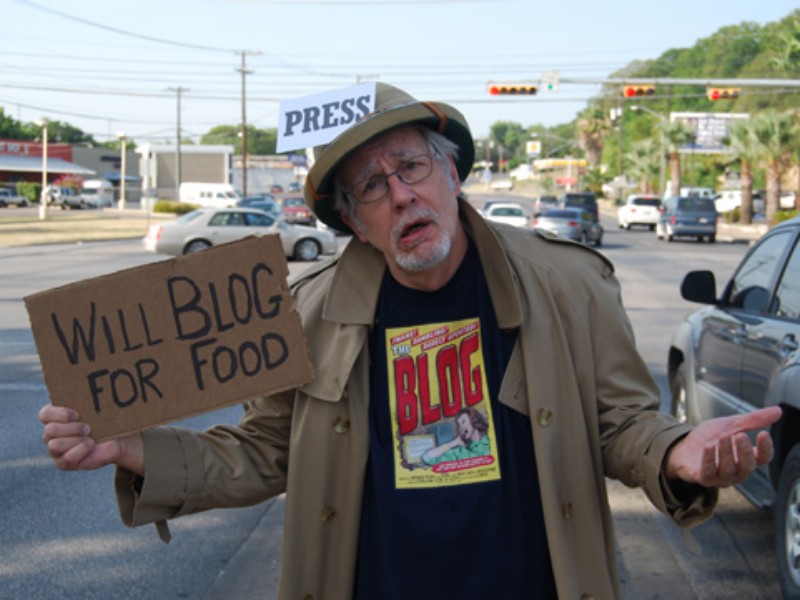
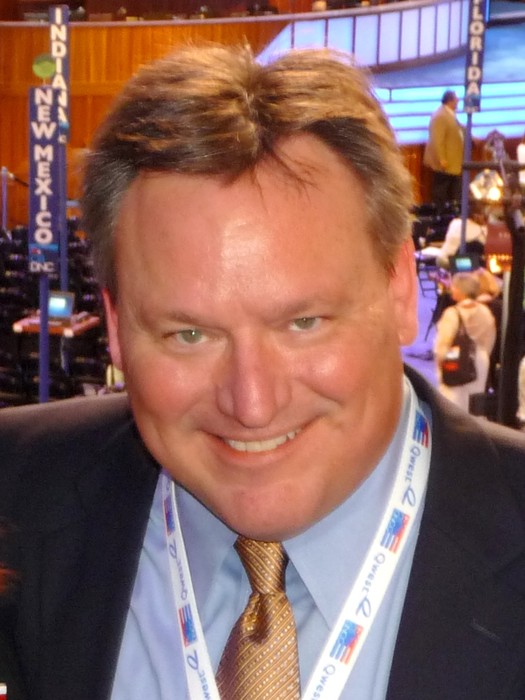
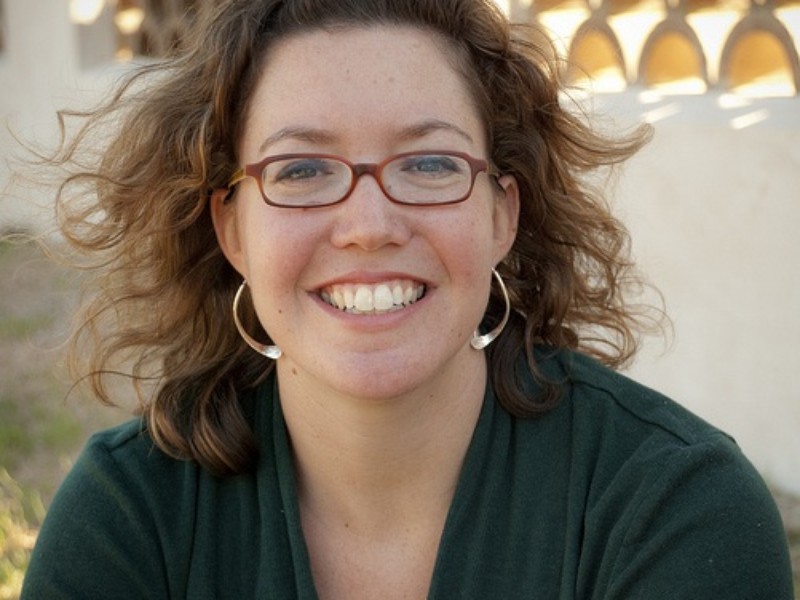
CultureMap Austin‘s top political bloggers: Above, The Rag Blog‘s Thorne Dreyer, photo by James Retherford. Inset, below, from the top: Rachel Farris, photo by Wildhouse Photography; Harold Cook, courtesy of Harold Cook; and Katherine Haenschen, courtesy of BOR. All photos appeared at CultureMap Austin.

Election 2012:
Keep up with Austin’s top political bloggers

[The Rag Blog was honored to be featured in a CultureMap Austin article about Austin’s top political bloggers, originally published on June 2, 2012. CultureMap — a “daily digital magazine” designed to keep readers “plugged in, enlightened and entertained about culturally relevant news and information” — has become an increasingly influential Internet community resource for the Austin area. We thought we’d share Shelley Seale’s interesting piece with our readers.]

By Shelley Seale / CultureMap Austin / June 14, 2012

This month’s installment of Austin’s top bloggers highlights some of the best locals who dish on all things politics. After covering style, music, relationships, and food, this month I’m sharing my list of Austin’s top political bloggers.

Thorne Dreyer: The Rag Blog

Thorne Dreyer and The Rag Blog both came of age in the tumultuous sixties. In 1966, Dreyer was the original editor of The Rag — one of the first underground papers in the country.

“At the time, Austin was becoming a center for the fast-growing Sixties counterculture and psychedelic music scenes — and there was a big student power and anti-war movement on and around the UT campus,” says Dreyer, who currently edits the digital-age reincarnation, The Rag Blog. “The Rag pulled those groups together into a major political force.”

Thorne Dreyer and The Rag Blog both came of age in the tumultuous sixties.

The Rag Blog was born in 2005, when dozens of old staffers and local activists came together in a wildly successful reunion and started working together again. “It started as an online discussion group,” Dreyer says, “and many of the old underground press folks now write for us. We have a roster of prestigious contributors from all over the country and have developed an international following, and our writing is republished extensively on the internet.”

The Rag Blog features commentary on contemporary politics and culture and has been an original internet source on subjects like Occupy Wall Street , the environmental and sustainability movements, and other issues of social activism. “Though the times are very different, there are some similarities between the Sixties underground press and today’s progressive blogosphere — and we try to publish The Rag Blog with some of that same Sixties spirit.”

As far as the upcoming Presidential elections, Dreyer feels that people expected too much from Obama, and many are disillusioned with his leadership. “Obama was never really a progressive, and the political climate was such that he kept running into a (Republican) brick wall at every turn. But the Republicans are so scary that we have to support Obama’s reelection. All the pressure on Obama comes from the Right; we need to be more of a counterbalancing force.”

Rachel Farris: Mean Rachel

Blogging helped Rachel Farris deal with her own political grievances. Her first blog post in 2005 was about her frustration with the government’s response to Hurricane Katrina. Even so, she didn’t blog much about politics in those first couple of years — not until 2007, when her then-boyfriend was redeployed to Iraq and Farris began blogging about her dissatisfaction with the Bush administration.

“While the relationship didn’t work out, the blog definitely did. It helped me find my voice.”

Farris’s recent post on What a Rick Perry Presidency Would Look Like for Women got quite a bit of attention. “I think a lot of pundits were talking about what a Rick Perry presidency might look like for foreign policy or business, but no one had really addressed Perry’s record with women,” Farris says. And she is equal opportunity on the parties; she stirred up Democrats as well with The Crisis of Character in the Democratic Party , written right after the 2010 gubernatorial elections.

Farris is concerned about low voter turnout in the Presidential Race, and the way people are tired of the ineffectiveness of politics across party lines.

While many people vehemently disagreed with that post, a group of campaign staffers for Bill White asked her to read it at a backyard party.

“I thought their resilience was impressive and it gave me a lot of hope for the future of the Democratic Party in Texas. If they were willing to listen to some grumpy blogger yell at them, it meant that the next generation of political staffers care and they want to improve our state’s Democratic ticket.”

Farris is concerned about low voter turnout in the Presidential Race, and the way people are tired of the ineffectiveness of politics across party lines. She predicts a win for President Obama, and hopes it will help re-engage the electorate for 2016.

“With a name like Mean Rachel, I’ve found that people are more willing to listen once they’ve gotten to know me,” Farris says. “The most common thing I hear is ‘You’re not so mean!'”

Harold Cook: Letters From Texas

Cook’s blog came about simply because he was bored to tears. It was 2008 and he was on a business conference call. “While the call droned on and on, I just surfed over to blogger.com to see if I could get a blog going,” Cook says. “I didn’t tell anybody for a couple of weeks, because I didn’t think it would last.”

He wanted to do a political analysis blog because that’s where his expertise was — but he also wanted to do political satire and parody. “I think many participants in the political process take themselves way too seriously.” LettersFromTexas.com goes back and forth between serious and humorous pieces, something that Cook says might make the site seem a little schizophrenic to some. “They never know which writing they’ll get when they check in, and I like that.”

Plenty of his blog posts have generated a lot of controversy and commentary. “When Governor Perry first said he was thinking about running for President earlier this year, I wrote a piece highly critical of his candidacy which may well be the most-read piece over on the blog,” Cook says. “It just kept going for months and months. I also wrote Source at Reliant Stadium in Houston which also bent the needle on blog traffic.”

“I think many participants in the political process take themselves way too seriously.”

The most controversial post ever was Rodeo Clowns, in which Cook published the names and contact information of several people who had sent racist emails surrounding a controversy with the Houston Livestock Show and Rodeo. “The squirming by racists in the comments section was certainly an eye-opener to a lot of my readers, to say the least, and I finally shut down the comments on the piece.”

And what does Cook think about the upcoming Presidential election? “I think the struggles within the Republican Party between Tea Party activists and traditional establishment Republicans have taken Republicans so far to the right that it will be difficult for them to have a very good November election. Odds are at this point that Obama will be re-elected.”

Katherine Haenschen: Burnt Orange Report

It was 2003, and a group of UT students needed an outlet to chronicle the political goings-on at the State Capitol and around Austin. Thus was born the Burnt Orange Report. In nearly 10 years the site has garnered more than six million visitors, broken major statewide and national news stories and played a key role in supporting progressive/Democratic messaging, through the work of dozens of staff writers.

In fact, BOR is one of the most widely-read progressive state blogs and was credentialed at the ’06 and ’08 Democratic National Conventions, as well as the 2009 inauguration of President Obama. The blog has also won six “Best of Austin ” awards from Austin Chronicle readers.

In nearly 10 years the site has garnered more than six million visitors, broken major statewide and national news stories and played a key role in supporting progressive/Democratic messaging, through the work of dozens of staff writers.

“While we’re unabashedly Democratic, our readers come from both sides of the aisle,” says editor Katherine Haenschen. “We’re very open about our partisanship and support for Democratic candidates, but we’re also willing to criticize fellow members of our party too.”

In 2006, BOR broke the story about Kinky Friedman’s racist “comedy” routines, which became a big story in the 2006 Governor’s race. Amusingly, Haenschen says the blog is also still getting a steady stream of visits from people Googling “Can Texas secede?” and landing on this post by Karl-Thomas Musselman.” I guess we can thank Rick Perry for that one.”

It is probably obvious that BOR supports Obama in the upcoming elections. “We’re largely optimistic about our elections this year, since issues like public education funding, women’s health, and economic inequality are key this year,” says Haenschen. “Democrats have a more favorable — and let’s be honest, sane — stance on these issues. Plus, it helps that the Republicans can’t seem to stop arguing about the President’s birth certificate while railing against birth control. They’re doing a great job of showing why they shouldn’t be in charge of a bake sale, let alone government.”

[Shelley Seale is an Austin-based freelance journalist who writes about lifestyle, travel, health, education, business and nonprofit issues. She has written for National Geographic, USA Today, Andrew Harper Traveler Magazine, Yahoo, CNN, the Austin Business Journal, Austin Woman and many others.]

The Rag Blog

Posted in RagBlog | Tagged , , , , , , , , | Leave a comment

MUSIC / Gregg Barrios : Patti Smith’s ‘Banga’


The wait is over:
Patti Smith’s ‘Banga

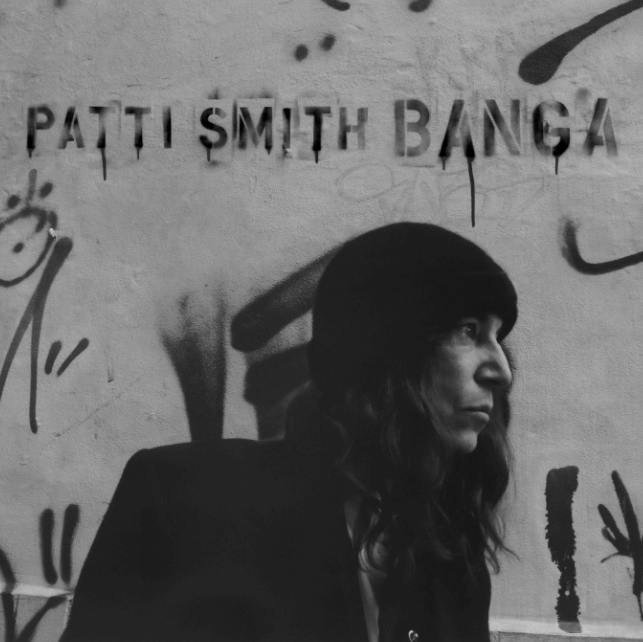
The title cut is a meditation on Pontius Pilate’s dog Banga in Mikhail Bulgakov’s satirical novel, The Master and Margarita.

By Gregg Barrios | The Rag Blog | June 13, 2012

Patti Smith fans’ eight-year wait is over — Banga is a bold return to the musical style and lyricism that made earlier Smith efforts praiseworthy.

Banga opens with the cinematic voyage of “Amerigo” (Vespucci, from whom America gets its name) to an Edenic new world. On this cut, the richness and delivery of Smith’s incantatory voice shines brightly. The pop charm of “April Fools” will have you humming to Patti’s vocals and tapping to Tom Verlaine’s guitar work. “Come, be my April fool, we’ll break all the rules.” Eat your heart out, Jimmy Iovine.

The title cut is a meditation on Pontius Pilate’s dog Banga in Mikhail Bulgakov’s satirical novel, The Master and Margarita. It speaks of canine loyalty. “Night is a mongrel — believe or explode,” Smith howls, as son Jackson provides the barking. However, “This is the Girl,” written for Amy Winehouse, scores with its girl group doo-wop a la the Shangri-Las. Perfect.

The 10-minute epic “Constantine’s Dream,” perhaps the best art-rock composition by an American artist this year, evokes the narratives of Horses and Easter. In its dream within a dream, Smith, like a howling St. Joan of Arc on a steed, calls out, “All is art — all is future!”

The world doesn’t end with a bang on Banga but with a haunting and unfettered version of Neil Young’s elegiac “After the Gold Rush.” A perfect touch to the most satisfying comeback album of the year.

[Gregg Barrios is a journalist, playwright, and poet living in San Antonio. Gregg, who wrote for The Rag in Sixties Austin, is on the board of directors of the National Book Critics Circle. His play I-DJ premieres in July at Overtime’s Gregg Barrios Theater in San Antonio. This review was first published at the San Antonio Current. Contact Gregg at gregg.barrios@gmail.com. Read more articles by Gregg Barrios on The Rag Blog.]

The Rag Blog

Posted in Rag Bloggers | Tagged , , , , | Leave a comment

Kate Braun : Summer Solstice Marks the Midpoint

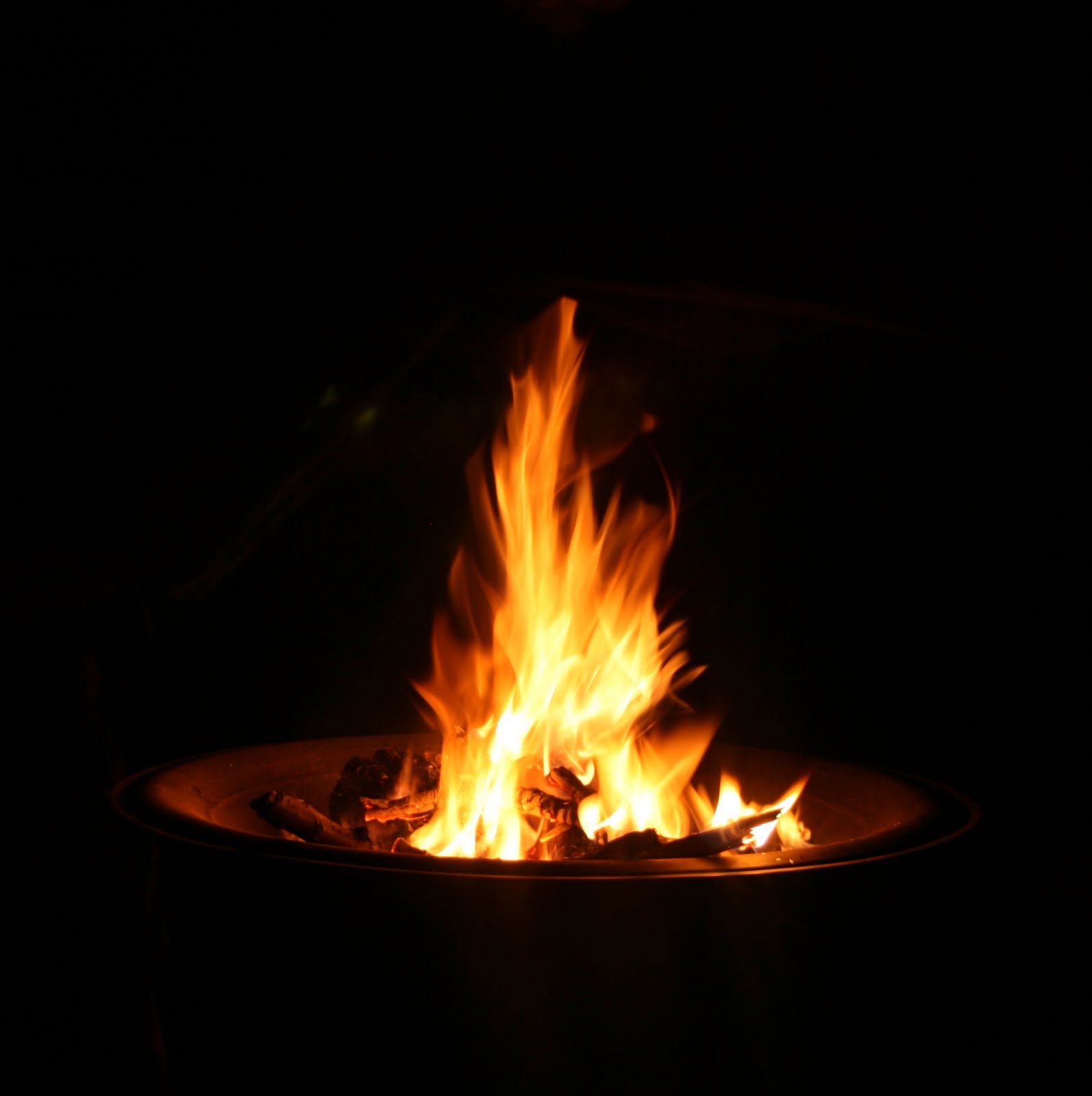
Summer Solstice fire. Image from Desert Green Goddess.

Between Beltane and the First Harvest…
Summer Solstice: Wednesday, June 20, 2012

By Kate Braun | The Rag Blog | June 13, 2012

“In the summertime when all the trees and leaves are green….”

Wednesday, June 20, 2012, is the Summer Solstice, also called Litha and Midsummer. The Summer Solstice marks the mid-point between Beltane and the first harvest festival, hence the term Midsummer. Lady Moon is in her first quarter, in the water sign Cancer. The Goddess is now a matron and ripely pregnant, foreshadowing the coming harvest. Wednesday is Odin’s day, implying that fathering, generative, paternal energies will also abound.

Midsummer lore says that any herbs gathered or harvested on this day are exceptionally potent. The general rule for harvesting herbs is to do so before 10 a.m., while the essential oils in the plants are more abundant.

Choose among the colors white, red, golden yellow, green, blue, and tan for your decorating. Serve your guests any yellow or orange food such as summer squash, carrots, sweet potatoes, bananas, peaches, oranges, lemons. Foods cooked over flames are also welcome: shish-kebab, grilled veggies, grilled salmon or other fish, grilled meats. Ale, mead, and fresh fruit juice are traditional libations, as are lemonade and sangria.

Plan your festivities to celebrate vitality, creativity, health, and abundance. Celebrate all things in your life, work and play equally. Make magick for love, healing, and prosperity. Rejoice in creation and creativity in all forms.

Include your animals in your festivities. Fairies and garden sprites will be pleased if you set out some food for them. You may also leave bits of mirror or crystal about to reflect light, which pleases these beings. Remember that part of this celebration is to not give away fire or food, and to not sleep away from home.

Make a fire if possible. Any fire will do, from a big bonfire to flames in a small cauldron. Any amulets that have lost their usefulness and/or fulfilled their purpose should be destroyed by casting them into the fire. When the ashes cool, strew them across your yard. This is said to bring blessings to the land.

First quarter moons are a good time to begin projects, to declare intentions to be completed by the full moon. It may be helpful to create a self-dedication ceremony to fix your intentions more firmly in your heart and mind. One way to do this is to speak your intention or define your project to the flickering flames, speaking across the flames to each of the equinox and solstice compass points, East, South, West, and North.

The balance shifts from the Waxing Year to the Waning Year. This cycle of abundance leads to “the time that is no time” when fields lie fallow and there is time to reflect and renew before the next movement of the Great Dance begins. The Summer Solstice marks mid-year as well as mid-summer.

On Saturday, July 21, 2012, I will be participating in a Feed Your Spirit event at the Holiday Inn in Round Rock, Texas. On Saturday and Sunday, July 28-29, 2012, I will be participating in a Spiritual Life Productions Metaphysical Fair at the Holiday Inn Midtown, in Austin. All the information about both these events as well as how to schedule an advance reading is posted on my website.

[Kate Braun‘s website is www.tarotbykatebraun.com. She can be reached at kate_braun2000@yahoo.com. Read more of Kate Braun’s writing on The Rag Blog.]

The Rag Blog

Posted in Rag Bloggers | Tagged , , , , , , | Leave a comment

By Kate Braun / The Rag Blog / July 13, 2012

“Happy Holiday, Happy Holiday, while the merry bells are ringing, may your every wish come true…”

Thursday, December 22, 2011 is Yule/Winter Solstice/Midwinter. Lady Moon is in her 4th quarter, waning towards the New Moon on Christmas Eve. Thursday is Thor’s day, but there will be no warring energies allowed on this day if Saturn’s rule is observed.

Saturn was a popular and powerful god. The ancient Romans celebrated him with Saturnalia, a twelve-day sun-worshipping celebration. They honored Saturn by decorating with holly branches and evergreen wreaths, giving and attending parties, and exchanging gifts each day (sweets were popular as were things made of silver). They sang holiday songs as they roamed naked through the streets bearing lighted candles. During Saturnalia, it was an offence to the God to punish a criminal or begin a war.

Saturn is the Roman version of the Greek God Kronos. The Greek word for “time” is “Khronos”; over time, Saturn became the God of Time. Time/Kronos/Saturn creates, destroys, but then recreates all things. The Greater Trump The Hermit was once called Time; Saturn is frequently depicted as carrying a sickle and a lantern or hour-glass and so does The Hermit.

It is said that when Saturn decided it was time to die, he went in secret to an island near Britain, where he lies deep in a magic sleep. Lore says that at some future time he will return to inaugurate another Golden Age. This myth may have influenced some of the stories about King Arthur (who was taken to the Isle of Avalon to be cured of his wounds and from which he will return when the time is right) and Merlyn (who lies asleep deep in a cave from which he will return when Arthur summons him). C. S. Lewis addressed the Arthur legend and the re-awakening of Merlyn in his sci-fi book That Hideous Strength.

Saturnalia was celebrated in December because at that time December was the 10th month on the calendar; the 10th month brings forth all things because a baby is carried in the womb for 9 months and then emerges. Many cultures observed Winter Solstice rituals: Persians deemed it the birthday of Mithras, another solar deity with a large following; for Egyptians it was the birthday of Osiris. Both Saturn and Mithras began to lose favor when, in the 4th century, December 25 was declared Jesus’ birthday. As John Chrysostom, a 4th Century Bishop wrote: “On this day also the Birthday of Christ was lately fixed at Rome in order that while the heathen were busy with their profane ceremonies, the Christians might perform their sacred rites undisturbed. They call this (December 25), the Birthday of the Invincible One (Mithras); but who is so invincible as the Lord?”

From Celtic tradition comes the duel of the Holly and Oak kings, twins whose twice-yearly ceremonial dance reflects the rebalancing of energies as days shorten or lengthen according to the season. “Yule” comes from the Celtic word “hioul”, which means “wheel”.

From Western European Pagan tradition comes the custom of decorating trees (Prince Albert brought this type of Christmas celebration to England when he married Queen Victoria; at the time it was quite a novelty) and burning the Yule log (symbolically the death of the old year and birth of the new)

One tradition of Yule celebrations is that the season begins on “Mother Night”, December 10 this year, and ends at Yule. This is the origin of “The Twelve Days of Christmas”, although many count those days as beginning with December 25 and ending on January 6, Epiphany.

However you choose to celebrate Lord Sun’s rebirth, use the colors red, green, and white in your decorations and serve your guests a hearty repast that includes nuts, apples, roast meat, Wassail, and cakes or cookies soaked in cider or port.

Give thanks at this celebration for the dark-time that provided balance and gave us time for introspection in our busy lives. Meditate on balance, peace, harmony at this time of year.

Reminders: (1) The first Metaphysical Fair of 2012 will be on January 7 & 8 at the Holiday Inn Midtown, 6000 Middle Fiskville Rd., Austin, TX. Saturday hours: 10 AM – 7 PM; Sunday hours: 11 AM – 6 PM. There will also be a Prediction Panel on Friday, 12/5 at 7 PM; several local psychics will share their insights for 2012.

(2) The first North Austin Holistic Living Fair of 2012 will be held on Saturday, 1/21, at the Holiday Inn Round Rock, 2370 Chisolm Trail, Round Rock, TX 78681 from 10 AM – 5 PM.

I will be participating in both these events; more information is available on the Out and About with Kate page of my website.

[Kate Braun’s website is www.tarotbykatebraun.com. She can be reached at kate_braun2000@yahoo.com. Read more of Kate Braun’s writing on The Rag Blog.]


Type rest of the post here

Source /

The Rag Blog

Posted in RagBlog | Leave a comment

FILM / Ron Jacobs : Scott Noble’s ‘The Power Principle’


Scott Noble’s ‘The Power Principle’
(American Empire: The Feature Film)

A remarkably detailed, clearheaded, and engrossing study of how the United States power elites created the mess we find ourselves in.

By Ron Jacobs | The Rag Blog | June 13, 2012

Discussing the nature of the U.S. Empire and how it got to where it is today with most U.S.  residents is always a challenge. Recommending books explaining it is equally so. This is especially true when one considers that most people who live in the United States have little or no concept of what an empire is and, when it is explained to them, are reluctant to believe that their nation is such a thing.

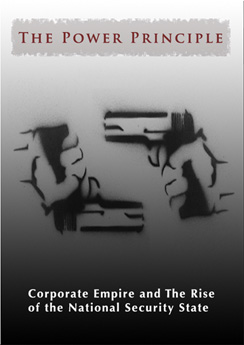
I have often thought that someone should make a film that might accomplish this educational goal. After all, film is simultaneously informative and entertaining, especially when it is well made. That is the case with radical documentarian Scott Noble’s (Rise Like Lions, Psywar, Lifting the Veil) latest effort, The Power Principle: Corporate Empire and the National Security State.

Made in three parts, with each one totaling about an hour and 15 minutes, The Power Principle is a history of the United States and the building of its empire. The emphasis is on the last 70 years of that history. It includes original footage from film and television news broadcasts, lectures and commentary from champions of the empire and its critics, and a pastiche of other images culled from cultural, technical, and propaganda efforts representative of the time and subject covered.

The result is a remarkably detailed, clearheaded, and engrossing study of how the United States power elites created the mess we find ourselves in. Furthermore, this film makes it clear that in the eyes of the elites, everyday citizens are little more than pawns to be manipulated in the elites’ drive to control the world.

There is a lot of history to be covered when discussing a topic as broad as the growth of the U.S. Empire. Even a film almost four hours long can only begin to explore that history. To his credit, Noble does a great job picking important moments of U.S. history to describe and analyze.

As a result, those historical moments bring forth more than the moments themselves; they exhume their motivations and effects, thereby creating a historical timeline that provides the viewer with a clear sense of how history is shaped by humans and how humans shape history. Noble’s highlighting of particular documents and individuals furthers that understanding.

Key to the hypothesis presented in The Power Principle is the relationship between the U.S. war industry, Wall Street, the U.S. military, and the government in Washington. The interlocking relationships between corporations like Lockheed and presidential appointees like Warren Christopher point to the connections between war and Wall Street in a very personal way. So do more personal relationships such as the marriage of Dwight Eisenhower’s personal secretary to an executive of the United Fruit Company.

Other graphic reminders of how few families and corporations run the United States are also discussed: Kermit Roosevelt’s role in overthrowing the popular Mohammed Mossadegh of Iran; the friendly relations between U.S. bankers like Prescott Bush and the German Nazi regime; the hiring of certain Nazis after World War II by the United States; the reinstallation of fascists into government in Italy after the war to prevent the rise of the communists; and so on.

The middle segment of the film is titled Propaganda. It is an interesting and unnerving look at how everyday people are manipulated by the powers that be. One of the key statements in this section is from Senator Arthur Vandenberg, a Republican from Michigan whose career prior to politics was in journalism. It was his resolution of June 1948 that is considered the foundation of NATO.

Vandenberg always understood that NATO’s purpose was to maintain and expand the growing U.S. empire. He also understood that the people of the United States were reluctant to become the world’s policeman, especially so soon after the carnage of World War II. With this in mind, he told colleagues that the only way to convince U.S. citizens to expand their military and become an imperial nation was “to scare the hell” out of them. That has been the essence of Washington’s line to its own citizens ever since.

The third segment provides a discussion of the U.S. Empire in the post-Soviet age. Key to this discussion are two things: nothing changed as far as the military-industrial complex was concerned and the agreement between the two political parties over empire is stronger than ever before. In other words, there is no difference in the way U.S. foreign policy is conducted no matter which major party’s candidate wins the White House.

Additionally, the presence of the U.S. military in civilian life has never been greater. A brief interview with Left editor and thinker Michael Albert concludes the film. He presents the possibility of a different world where the Empire is dissolved and the military-industrial complex is transformed into building things that benefit mankind. Unfortunately, the overriding conclusion of The Power Principle is that such a scenario is both necessary if we are to survive as a species and unlikely unless the current system is removed.

If I were a high school or postsecondary teacher hoping to get my students to consider U.S. history in a different light, I would show this film. Not only does it rearrange the common understanding of Washington’s role in the world, it also forces the viewers to reconsider how their understanding of that role is manipulated and misused.

Certain to provoke reactions both positive and negative, Scott Noble’s most recent film is meant to disturb the general complacency of the body politic. Help spread the word.

[Rag Blog contributor Ron Jacobs is the author of The Way The Wind Blew: A History of the Weather Underground. He recently released a collection of essays and musings titled Tripping Through the American Night. His latest novel, The Co-Conspirator’s Tale, is published by Fomite. His first novel, Short Order Frame Up, is published by Mainstay Press. Ron Jacobs can be reached at ronj1955@gmail.com. Find more articles by Ron Jacobs on The Rag Blog.]

The Rag Blog

Posted in Rag Bloggers | Tagged , , , , , , | Leave a comment

Thomas McKelvey Cleaver : Remembering Ray Bradbury

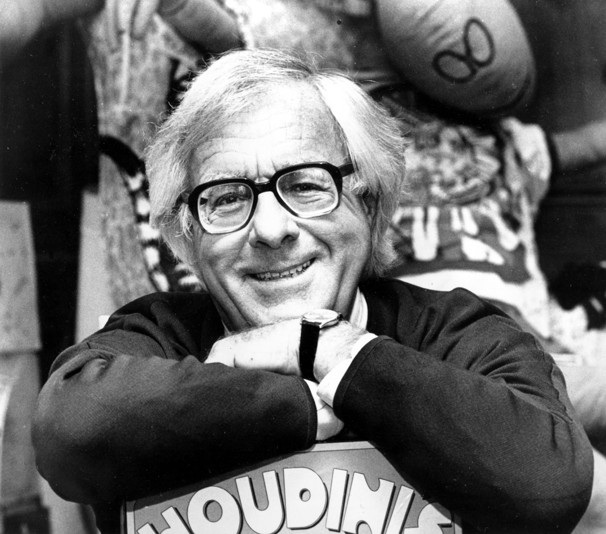
Ray Bradbury in 1982. Photo by Lennox McLendon / AP / Washington Post.

Ray Bradbury remembered:
The librarian told my dad
he was asking for trouble

“Ray Bradbury, a boundlessly imaginative novelist who wrote some of the most popular science-fiction books of all time, including Fahrenheit 451 and The Martian Chronicles, and who transformed the genre of flying saucers and little green men into literature exploring childhood terrors, colonialism and the erosion of individual thought, died June 5 in Los Angeles. He was 91.” — Becky Krystal, The Washington Post

“Bradbury was the perfect author for dreamy kids, kids who can spend hours finding the figures in clouds, or who get lost in reveries about desert islands or space colonies on parched planets… It was as though Bradbury was our secret ally, the first grown-up we ever ran into who broke with the party line and sided with us.” — Malcolm Jones, The Daily Beast

By Thomas McKelvey Cleaver | The Rag Blog | June 13, 2012

I remember well my dad picking out The Martian Chronicles from the paperback section of the Eugene Field Library in Denver’s Washington Park in response to my badgering him.

I had recently discovered that the world of science fiction lay just around the corner (literally!) from the boring “juvenile books,” and had already discovered Isaac Asimov. But only adults could check out the paperback books, so I convinced Dad to get it.

The librarian told him he was “asking for trouble” if he let me read such books at such an age (how right she was!). What fantastic stuff! And then a year later Dad brought home the new paperback — Fahrenheit 451. Reading that at age 10, in the midst of what was going on in America at that time, had a lasting effect. I don’t think there’s anything Ray Bradbury ever wrote that I didn’t read and like.

In 1967, while working on draft resistance here in Los Angeles, I was going through the file cards we had of people who had given us money, with the objective of calling them up and asking for more. I found one for an “R. Bradbury” who lived not that far away, over toward the 20th Century Fox lot in Rancho Park.

 I called him up and he said sure, he’d be happy to help some more. But he didn’t drive and could I come over and pick up the check? So I did. And when he answered the door I knew it was Him, and when he invited me in it was all I could do not to act like an idiot.

But after talking to him — and answering his questions about how and why someone who had already served would be working on draft resistance, telling him what I had learned in my service in Vietnam — I finally couldn’t stop myself, and I told him how I knew him, and that reading his books had a lot to do with why I was doing that work. He liked hearing that.

I also remember getting a nice note from him through the Science Fiction Writers of America upon my gaining membership in 1989 for having written The Terror Within, saying he had quite enjoyed the movie and that he remembered from where he knew my name.

Bradbury talked often about being a “graduate of libraries.” I am sure I am too (even though I did go to college).

He was one of the best of my teachers there in those libraries. A Professor of Humanity.

[Thomas McKelvey Cleaver is an accidental native Texan, a journalist, and a produced screenwriter. He has written successful horror movies and articles about Second World War aviation, was a major fundraiser for Obama in 2008, and has been an activist on anti-war,  political reform, and environmental issues for almost 50 years. Read more articles by Thomas Cleaver on The Rag Blog.]

The Rag Blog

Posted in Rag Bloggers | Tagged , , , , , , | 1 Comment

Paul Beckett : Letter from Wisconsin

Milwaukee Mayor Tom Barrett concedes defeat in Milwaukee, June 5, 2012. Photo by John Gress / Reuters.

After the apocalypse:
Letter from Wisconsin

Frankly, putting it all together, I am very worried about our future, in Wisconsin and in the nation.

By Paul Beckett / The Rag Blog / June 11, 2012

Dear Friends,

Well, we got your attention, didn’t we? Colbert put it best: the Tuesday, June 5, recall election was the most significant event for Wisconsin since discovery of elastic jeans. (Oh, thank you very much, Stephen!)

The race was called by 9 p.m. (some polling stations were not yet even closed). Governor Scott Walker had won the recall election over Democrat Tom Barrett by 7 percent. Worse, county by county, Wisconsin was a sea of GOP red. Sixty of Wisconsin’s 72 counties were carried by Walker! Only small islands of blue mainly clustered around Madison and Milwaukee, and along the Lake Superior shore (traditionally progressive) showed blue above the red tide.

For the many tens of thousands who had been participants in Madison’s version of the Arab Spring, in February and March (2011), and who had, as unpaid volunteers, collected more than one million signatures for the recall petition, it was a like a hard kick to the gut.

You can’t understand, friends, without knowing what those February and March events were like. Never, in my now pretty-long life, have I experienced the exhilarating sense of the people — the real people, the whole people — rising and making democracy real, and direct.

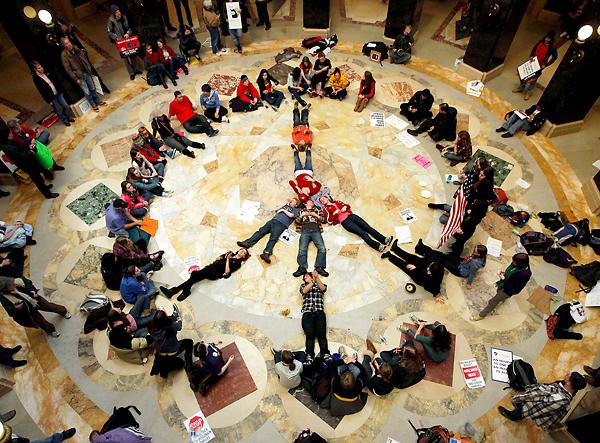
Up to 70,000 at a time packed the Capitol Rotunda, and circled the square. Turnout was largely spontaneous: hierarchy and formal organization largely absent. Anger with the multiple violations of democratic tradition was underlain by a kind of joy which reveled in the sense of commonness, and in the incredible wit of common folks which was displayed on hand-made signs and in slogans.

Inside the rotunda was the beauty of “functioning anarchy” as areas were set aside for families with small children, for eating, for resting. In the enormous and densely packed crowds, neither crime nor violence raised its head.

There was, over all, a sense of irresistibility to this truly popular uprising. Stopping the people so mobilized would be like stopping the flow of the Mississippi on our western border. We thought.

How, on June 5, a little more than a year later, could this defeat have happened?

Friends, if Stephen is right and you all have been watching us, you know a lot of the answer. You know that funding for the Walker side was almost ten times (yes, 10X!) that for the Barrett side. And Walker’s money had come pouring in, mainly from out of state, for months. Totals are almost too obscene for a decent blog to publish (the tracking organization Wisconsin Democracy Campaign estimates that the final total will push $80 million!).

The infamous Koch Brothers, along with the whole shadowy neo-con/corporate national leadership, knew that a successful recall would hurt rather seriously their movement to consolidate control over U.S. society, culture and, of course, politics. Money poured in to support the Walker campaign, sometimes in half-million dollar amounts. A sophisticated campaign of TV advertising was launched long before the Democrats even had a candidate.

Meanwhile, there was no real “owner” of the recall effort. If the uprising was largely spontaneous and unfunded, so was the subsequent recall petition drive. Once the million signatures were gathered, we stood and looked at each other. What’s next?

The Democratic Party (state and national) was unenthusiastic at the beginning, and gave tepid support after. There was no obvious candidate besides the one who ran against Walker and lost (by a respectable margin) in 2010. And he –– Tom Barrett — could not declare for the race until he had weathered the Milwaukee mayoral election (April 3).

Meanwhile, former Dane County Executive Kathleen Falk aggressively threw her hat in the ring. She had negotiated her endorsement from the trade union leadership by pledging that if elected she would veto any budget bill that did not restore collective bargaining rights. The unions not only heavily funded her campaign to get the nomination, but actually aired attack ads against Tom Barrett, her most important opponent.

Falk’s “deal” with union leadership was a gift to the Walker side, which had constantly characterized the uprising as only about union rights and as “run by union bosses.”

In the primary, on May 8, Barrett easily defeated Falk. But he then had less than a month to counter what was already a steamroller of cash that for months had saturation bombed the brain of every TV watcher in Wisconsin.

Now let me assure you, friends: Barrett is a good man — tall, good-looking, intelligent, well-spoken, polite, and gracious. His qualifications for the Governorship are excellent. He would surely have been a great candidate some time in the past. (In 2009 Barrett had even displayed old-fashioned personal heroism: he had intervened at the state fair to defend a woman who had called for help and received a lead pipe across the face and a broken hand. In the past, would that have won you a subsequent election or not?)

But Barrett was not the man for 2012. Barrett has a now-unfortunate habit of not talking down to the voters, compounded by a tendency to tell the truth, a political defect made even worse by a predilection toward real discussion of real issues.

Meanwhile, Walker was the perfect neo-con candidate, saying little, generating perfect video image material in the “aw-shucks” mode, while looking like a bashful choir boy (does he have a portrait of himself hidden away in an attic?). Never did Walker stray from the familiar jingles authored by his advertising companies.

Meanwhile national support from the Democratic Party remained minimal, and President Obama made it a point not even to come into the state.

All these facts notwithstanding, the surprise, Tuesday evening, made most of us sick to our stomachs.

There are, of course, different ways to view the events, and they tend to replace each other as time goes on. There is the way you feel the day after (that the sky has fallen). There is the day after the day after. Then, again, there is the day after that. Let’s take them in order.

1. First day after: ‘The Apocalypse Is Here’

The election lent itself to apocalyptic thinking on the liberal-progressive side, and triumphalist thinking on the right. Perhaps, we thought, Wisconsin has now completed a gradual transition from marginally blue state to solidly red state. An open Senate seat will be contested in November. It now seems even more likely than before to go to a right-wing Republican (is there anything else these days?) , who will join the right-wing Republican (Ron Johnson) who defeated Senator Feingold in 2010. Barack Obama, who carried Wisconsin in 2008 by an amazing 14%, is now expected to have a hard fight (at best) in the state this fall.

Worse, and more fraught with consequences, the deluge of money from billionaires which funded incessant and ultimately unavoidable “30-second drive-by attack ads” (as candidate Barrett called them) seemed to work. Those of us who hoped there might be some eventual tipping point of excess, some point of overkill, after which the public would react against the perpetrators, came away disappointed. Is the lesson of the Wisconsin recall that you cannot, ever, have too much money, and that NO level of saturation bombing with the ads the money buys is too much? It may be.

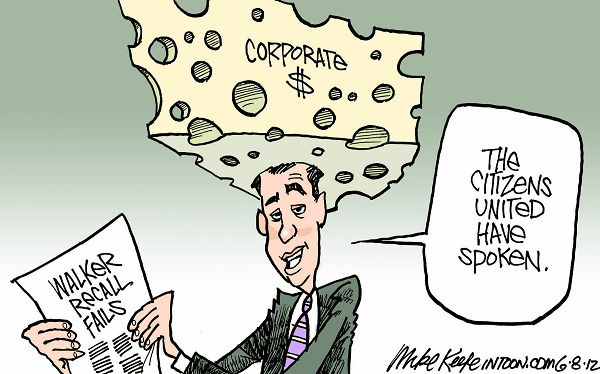
If so, in light of the number of right-wing billionaires now at large in America, and the Citizens United decision, American democracy is less imperiled than already destroyed. Political advertising, devised by subtle and well-informed minds, is aimed at dumbing down political culture within a wider American culture already dumbed down remarkably by television.

The problem with where we are now is less with Citizens United and the nearly unbelievable accumulation of wealth available to contribute painlessly to political campaigns. It is more with what the money buys: TV advertising. It punishes depth, it punishes honesty, it punishes creativity and imagination on the part of politicians. It is un-speech which drives out and suppresses real speech.

Political cartoon by Mike Keefe / inToon.com

2. Second day after: ‘Hey,Things Could be a Whole Lot Worse’

This, the central philosophy of Garrison Keillor’s Lake Wobegon, comes forward on the day after the day after. Maybe the defeat was not so crushing, and maybe it doesn’t mean as much as we at first thought.

First of all, we look again at the numbers. It remains true that Walker took 60 of Wisconsin’s 72 counties. But guess what? His margin in the vast majority of those counties was thin; in many, razor thin. The counties where his majorities were large to huge were those counties (led by the infamous Waukesha County) which are safe Republican counties in all elections. Walker “flipped” four counties that had gone for Barrett in their first contest (the gubernatorial election in 2010) — but the “flips” were by modest margins.

Meanwhile Barrett, while losing by about 7 percent overall, managed to “flip” three counties that were taken by Walker in 2010. Turnout was massive on both sides, and Walker received 205,900 more votes overall than he did in 2010. But: Barrett received 158,482 votes more than he had in 2010. Not bad for the victim of a drubbing!

There is another important factor. A significant portion of the pro-Walker vote was motivated by distaste for the recall procedure itself.

It should be acknowledged that this position is not an unreasonable one. All of the elected figures who were subjected to recall elections will be up for regular election in 2014. None of them are (as yet) charged with personal corruption or other illegal activity (although Walker is part of a very slow-moving investigation of illegal activity in his office before his accession to the governorship, and this could result in an indictment later).

Thus, many voters voted against the recall procedure more than for the Walker policy package (or the Walker persona).

It is impossible to say how many voters were so motivated. But it is safe to say that it could represent a substantial portion of Walker’s seven-percent margin.

And as far as the November election goes, exit polls reported by the Washington Post and others showed surprising support for Obama over Romney, even among those who voted for Walker!

So, maybe not so much has changed. As my friend Harry Targ, a frequent contributor to The Rag Blog, has put it:

Wisconsin has [long] been a deeply divided political state. In fact, two important political figures in the state’s history personify the political divisions that shaped competition in the state and the United States at large for at least one hundred years. Senator Joseph McCarthy represented the outlook shared by many that government is the enemy of humankind. . . . And . . . to the contrary, Senators Robert La Follette Senior and Junior represented that strand of political discourse that sees the possibility of creating governmental institutions that can protect the innocent from the criminal, provide for the less fortunate, and use public resources to advance human possibility. Descendants of both political traditions have fought it out over the years . . . (– Personal communication of unpublished paper, June 7, 2012)

Wisconsin remains divided. This time, it was 1,334,450 for the right, and 1,162,785 for the left. The next time around it could be the other way. The division is probably sharper than any time before. But, hey, things could be a lot worse!

This second-day view leaves us with the idea that given all his advantages, Walker should have won much bigger. Along with that comes the idea that maybe overwhelming monetary advantage is not so decisive, after all.

Students form peace symbol on the floor of rotunda at the Wisconsin State Capitol in Madison in March 2011. Photo by John Hart / AP / Missourian.

3. Third Day After: ‘Actually, Things Could NOT Be a Whole Lot Worse’

Friends, let’s face it. The situation in Wisconsin and the nation is very bad. Electoral analysis (as above) may make us feel a little bit better. But it largely misses the point. The right has been enormously — and, to my mind — tragically, successful.

The right has nearly absolute mass media dominance, a financial blank check with no evident limit, unity around central doctrines combined with complete party discipline, control of the Supreme Court, and a noisy and highly active popular movement (the Tea Party) to provide media excitement, and to act as enforcers of party discipline.

The Democratic Party, with none of these, has become a timid shadow of the party of Franklin Roosevelt. All discussion has been skewed far to the right. Legislative party discipline is non-existent. We are engaged only in rear-guard battles, and only in trying to reduce (usually slightly) our losses. Our maximal promises are, well, minimalist.

Some aspects of this have been touched on already. But there is another, deeply disturbing, aspect of the situation. Let me quote a former Madison neighbor, the author Dean Bakopoulos:

As Wisconsin’s new political landscape so clearly indicates, conservatives have now managed to vilify plain old working people as elitist fat cats. Librarians, teachers, public employees, and union laborers: Basically, people who earn health insurance and decent wages have suddenly become the things that stagnate an economy and raise taxes, when in truth they, and those wages they enjoy, have been the lifeblood of a struggling post-industrial economy.

But by declaring war on teachers, union laborers, and public sector employees, the well-heeled spinners behind the rise of Scott Walker have managed to make struggling Americans vote against their own best interests out of a sense of fear and envy. Struggling workers — and most comfortable middle-class workers — often to need an identifiable villain, someone who is holding them back from success, in order to vote Republican. If Republicans can present themselves as an enemy of that villain, they win. That’s what happened last night in Wisconsin. (Salon, June 8, 2012)

Frankly, putting it all together, I am very worried about our future, in Wisconsin and in the nation. And the Democratic Party is certainly not going to get us out of this, whatever happens in November.

In fact, dear friends, I can only say we’re in a bad patch, and I think we must look beyond it, beyond November, beyond the Democratic Party, way, way beyond the present. We need to remember that things really don’t need to be this way, that, as the World Social Forum series insists, “Another [and much better!] world is possible.”

Howard Zinn has told us how to think about it:

To be hopeful in bad times is not just foolishly romantic. It is based on the fact that human history is a history not only of cruelty, but also of compassion, sacrifice, courage, kindness.

What we choose to emphasize in this complex history will determine our lives. If we see only the worst, it destroys our capacity to do something. If we remember those times and places—and there are so many—where people have behaved magnificently, this gives us the energy to act, and at least the possibility of sending this spinning top of a world in a different direction.

And if we do act, in however small a way, we don’t have to wait for some grand utopian future. The future is an infinite succession of presents, and to live now as we think human beings should live, in defiance of all that is bad around us, is itself a marvelous victory.”

― Howard Zinn, You Can’t Be Neutral on a Moving Train, 1994

OK, dear friends, that’s the news from Lake Wobegon, I mean, Lake Wingra. Stay well, and come visit. The brats and brews are on Kathie and me! And elastic jeans can be found if you need them.

Your friend always,

Paul

[Dr. Paul Beckett lives in Madison, Wisconsin. He can be reached at beckettpa@gmail.com. Read more articles by Paul Beckett on The Rag Blog.]

Go here for Paul Beckett’s earlier coverage of the movement in Wisconsin on The Rag Blog.

The Rag Blog

Posted in Rag Bloggers | Tagged , , , , , , | 1 Comment

Lamar W. Hankins : The Gospel Truth

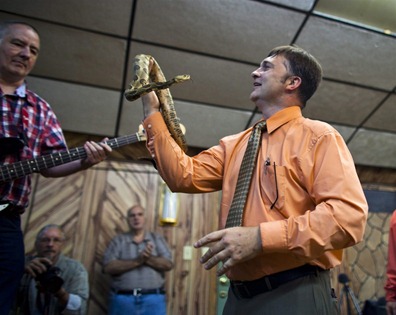
West Virginia Pentecostal preacher Mark Randall “Mack” Wolford died from a snake bite he received handling snakes in church. Image from Eternal Life Blog.

The Gospel truth:
Fatal misunderstanding of the Bible

‘And these signs will follow those who believe: in My name they will cast out demons; they will speak with new tongues; they will take up serpents…’

By Lamar W. Hankins / The Rag Blog / June 10, 2012

Among the Abrahamic religions — Judaism, Islam, and Christianity — the tiny group of Christians known as Pentecostal serpent handlers are among the most unusual of Christian sub-groups. They have focused their religious belief and practice on a few verses at the end of the book of Mark — verses that do not appear in the two oldest versions of writings that became the Gospel of Mark.

Few ministers or pastors tell their congregations this truth about Mark and about much of the Bible. What they mainly do is read it and interpret it, and many teach that every word in the Bible was created by a supernatural God and given to some human being to write down.

Such teachings were my experience growing up. No minister ever told me that over 5,000 (now, nearly 6,000) known manuscripts make up the text of what we call the Bible. Maybe if congregants knew such facts, they would not take so seriously everything found in the Bible. I suspect, though I do not know, that many ministers may not themselves know about these textual variations.

Even when I took New Testament Greek in college, I was not told that the Greek version of the New Testament that we studied lacked clear authenticity.

The case in point this week is the death of the West Virginia Pentecostal preacher, Mark Randall “Mack” Wolford, age 44, who died from a snake bite he received handling snakes in church. Wolford was a devout believer in the passage in Mark 16:17-18:

And these signs will follow those who believe: in My name they will cast out demons; they will speak with new tongues; they will take up serpents; and if they drink anything deadly, it will by no means hurt them; they will lay their hands on the sick, and they will recover.

Mack Wolford’s father had died from a snake bite in a similar fashion when Mack was 15. His family’s faith in this passage of Mark prevented them from seeking medical attention. Such believers often attribute deaths from snake bites to two causes: either the victims lacked sufficient faith or it was God’s will that they die.

None of them consider that they may have been reading and believing in an inauthentic version of the Gospel of Mark. As Bible scholar and textual critic Bart Ehrman explains,

As we learned at Moody [Bible Institute] in one of the first courses in the curriculum, we don’t actually have the original writings of the New Testament. What we have are copies of these writings, made years later — in most cases, many years later. Moreover, none of these copies is completely accurate, since the scribes who produced them inadvertently and/or intentionally changed them in places.

The main reason for the changes, or variants, is that these scriptures were written by hand in days before the printing press was invented. Transcription errors, as a particular scripture is copied from an older one, are inevitable. Words are misread, letters are transposed (often changing the meaning of words), spelling and grammar errors abound, words are incorrectly separated or joined together, sentences are left out or repeated, and new material may be added for purposes known only to the transcriber.

Most of these variants don’t make much difference. But sometimes variants make a great difference.

Such is the case of Mark, chapter 16. Scholars know about four transcripts of the Gospel of Mark. Generally, they consider the earliest versions of scripture the most authentic. According to Ehrman in his book “Misquoting Jesus,” the last 12 verses of Mark were added to the later manuscripts nearly 300 years after it was first copied and are not found in the two oldest and best manuscripts. Mark is also the earliest of the Gospel texts, so it is not surprising that Luke has a similar passage concerning serpents at Luke 10:19 — Mark was its source.

Even Ehrman’s critics, such as Daniel B. Wallace of the Dallas Theological Seminary, acknowledge him as “one of North America’s leading textual critics.” Textual critics study the work of the people who tediously copied religious manuscripts, study the process by which certain manuscripts were accepted as a part of what we know as the Bible (its canonization), study these texts of the Greek New Testament, and determine through evidence and reasoning which parts of the text have authentic origins and which parts were added by a different author at some later time, and why, to the extent that can be determined.

In the case of the last 12 verses of Mark, chapter 16, Ehrman explains that not only are they not found in the two oldest manuscripts attributed to Mark, but the writing style of these 12 verses differs from the rest of the text; the transition between these verses and the earlier text makes little sense in the context of the story (Mary Magdalene is referred to as though she had not been mentioned earlier, but she had been); and many of the words and phrases in the 12 verses are not found elsewhere in Mark.

Ehrman states that “nearly all textual scholars” believe these verses were added to Mark by a later scribe, possibly to smooth out what would have been an abrupt ending to the writing with no mention to the disciples of Jesus’s resurrection or his appearance to the women who went to the tomb.

For Ehrman, “the task of the textual critic is to try to recover the oldest forms of these texts.” This task is important because Christianity “is a textually oriented religion whose texts have been changed.” The meaning of the New Testament can’t be grasped if the words that were intended are not known. This is true whether one believes the words are divinely inspired or one believes merely that the New Testament is a significant book.

 For Ehrman, the New Testament “is an enormous cultural artifact, a book that is revered by millions and that lies at the foundation of the largest religion in the world today.”

I find that many Christians don’t know that it wasn’t until around the year 250 of the Common Era that a generous benefactor of the Roman church, Marcion, put together the first collection of scriptures that he considered the sacred texts of the faith, often referred to as the canon.

But Marcion chose what scriptures should be included in the canon based on his belief that the God of the Old Testament was not the same God of Jesus and Paul. He believed they were two different Gods — the God of the Jews, who created the world and had very harsh laws that had to be followed, and “the God of Jesus, who sent Christ into the world to save people from the wrathful vengeance of the Jewish creator God,” as Ehrman explains.

Marcion’s canon included a Gospel (a version of Luke) and 10 epistles, with no Old Testament. Because he also believed that others who disagreed with him had altered some of the texts, Marcion amended the texts to leave out references to the Old Testament God.

About 30 years later, another Christian writer, Irenaeus (known as the bishop of Lyons in Gaul — what is now modern France) criticized Marcion’s version of the canon and produced one of his own, which included the more familiar four Gospels.

Debates raged about the canon for several centuries. In the latter part of the fourth century, the bishop of Alexandria, Athanasius, approved 27 books that make up what we know generally as the New Testament today. It took many decades, perhaps centuries, for this version of the New Testament to be widely accepted among Christians, and there are differences among some of the versions in use today.

Further, the manuscripts from which the New Testament was taken do not have punctuation, verses, and chapters. These were added later to create some order within the texts.

If only the Pentecostal serpent handlers understood what Ehrman and other scholars of the Bible teach about the origins and development of the text of the New Testament, their lives might be quite different. Perhaps the two verses in Mark on which they base some of their religious practices and beliefs would not have seemed so important, and both Mack Wolford and his father before him would not have died from handling snakes as part of their religious worship.

[Lamar W. Hankins, a former San Marcos, Texas, city attorney, is also a columnist for the San Marcos Mercury. This article © Freethought San Marcos, Lamar W. Hankins. Read more articles by Lamar W. Hankins on The Rag Blog.]

The Rag Blog

Posted in Rag Bloggers | Tagged , , , , | 1 Comment

In an attempt to reinvent the Vietnam War, President Obama and the Pentagon have launched a “multi-year national public relations campaign to justify, glorify, and honor Washington’s catastrophic, aggressive, and losing war against Vietnam.” Jack Smith lays bare this cynical attempt at revisionist history, including the fabricated and long-debunked claims of widespread mistreatment of Vietnam vets by antiwar forces.

Posted in RagBlog | Leave a comment

Jack A. Smith : Reversing the Vietnam War Verdict

Demonstrators at the October 21, 1967 march on the Pentagon carry a banner that says, “Support our GIs, Bring Them Home Now.”

Reversing the Vietnam War verdict

Most of the allegations about insults directed at soldiers or vets from war opponents have been fabrications to discredit the antiwar forces.

By Jack A. Smith | The Rag Blog | June 7, 2012

The Pentagon has just launched a multi-year national public relations campaign to justify, glorify, and honor Washington’s catastrophic, aggressive, and losing war against Vietnam — America’s most controversial and unpopular military conflict.

President Barack Obama opened the militarist event, which was overwhelmingly approved by Congress four years ago, during a speech at the Vietnam Wall on Memorial Day, May 28. The entire campaign, which will consist of tens of thousands of events over the next 13 years, is ostensibly intended to “finally honor” the U.S. troops who fought in Vietnam. The last troops were evacuated nearly 40 years ago.

In reality, the unprecedented project — titled the Vietnam War Commemoration — will utilize the “pro-veteran” extravaganza to accomplish two additional and more long lasting goals:

  • The first is to legitimize and intensify a renewed warrior spirit within America as the Pentagon emerges from two counterproductive, ruinously expensive, and stalemated unjust wars in Iraq and Afghanistan, and prepares for further military adventures in Asia, the Middle East, and Africa. Within days of Obama’s speech, for instance, Defense Secretary Leon E. Panetta announced a big increase of U.S. Navy forces in the Pacific, a move obviously targeting China. At the same time the Obama Administration’s drone wars are accelerating as the Oval Office’s kill list expands, and the president engages in cyber sabotage against Iran.
  • The second is to dilute the memory of historic public opposition to the Vietnam war by putting forward the Pentagon’s censored account of the conflict in public meetings, parades, and educational sessions set to take place across the nation through 2025. These flag-waving, hyper-patriotic occasions will feature veterans, active duty military members, government officials, local politicians, teachers, and business leaders who will combine forces to praise those who fought in Vietnam and those on the home front who supported the war. There won’t be much — if any — attention focused on the majority of Americans who opposed this imperialist adventure, except as a footnote describing how tolerant U.S. democracy is toward dissent.

The principal theme of the president’s address was that American troops have not received sufficient laurels for their efforts to violently prevent the reunification of North and South Vietnam. He did not point out that there would have been no war had the United States permitted nationwide free elections to take place in Vietnam in 1956 as specified by the 1954 Geneva Agreement ending the French colonialism in Indochina. Washington recently decided that the war “officially” began in 1962 (although U.S. involvement dates back to the 1950s), allowing the commemoration to begin during the “50th anniversary” year.

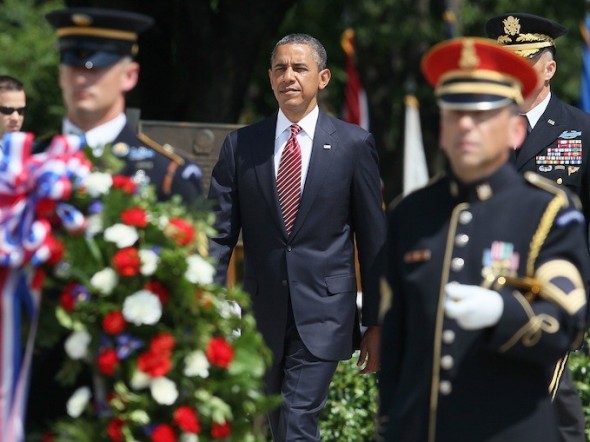
President Obama lays a commemorative wreath during Memorial Day ceremony at the Tomb of the Unknowns at Arlington National Cemetery, May 28, 2012 in Arlington, Virginia. Photo by Mark Wilson / Getty Images.

President Obama told the large, cheering crowd of veterans and their families at the Vietnam Wall exactly what they — and all those who still resented the era’s large antiwar movement — wanted to hear:

One of the most painful chapters in our history was Vietnam — most particularly, how we treated our troops who served there….

You were often blamed for a war you didn’t start, when you should have been commended for serving your country with valor. (Applause.) You were sometimes blamed for misdeeds of a few, when the honorable service of the many should have been praised. You came home and sometimes were denigrated, when you should have been celebrated. It was a national shame, a disgrace that should have never happened. And that’s why here today we resolve that it will not happen again. (Applause.)….

[Y]ou wrote one of the most extraordinary stories of bravery and integrity in the annals of military history. (Applause.)…. [E]ven though some Americans turned their back on you — you never turned your back on America… And let’s remember all those Vietnam veterans who came back and served again — in the wars in Iraq and Afghanistan. You did not stop serving. (Applause.)

So here today, it must be said — you have earned your place among the greatest generations. At this time, I would ask all our Vietnam veterans, those of you who can stand, to please stand, all those already standing, raise your hands — as we say those simple words which always greet our troops when they come home from here on out: Welcome home. (Applause.) Welcome home. Welcome home. Welcome home. Thank you. We appreciate you. Welcome home. (Applause.)….

May God bless you. May God bless your families. May God bless our men and women in uniform. And may God bless these United States of America.

There was virtually no criticism in the corporate mass media about the president’s gross exaggerations concerning the “mistreatment” of Vietnam era veterans. True, there were no victory parades, but that was because the U.S. Armed Forces were defeated by a much smaller and enormously outgunned adversary — the guerrilla forces of the South Vietnamese National Liberation Front (NLF) and regular forces from North Vietnam.

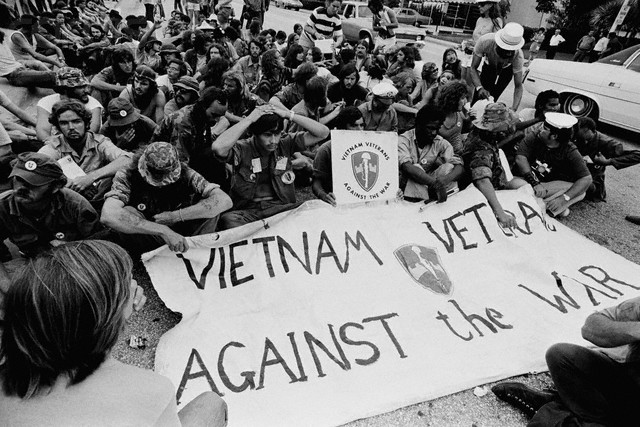
Members of the Vietnam Veterans Against the War (VVAW) hold a peaceful demonstration outside the 1972 Democratic National Convention in Miami. Photo by JP Laffont / Sygma / Corbis.

By the time many vets returned home the American people had turned against the war and wanted it over, as did a significant portion of active duty troops, including the many who identified with the peace movement or who mutinied or deserted. Undoubtedly some veterans were disrespected — but to a far lesser extent than Obama and pro-war forces have suggested over the years.

Whenever the U.S. conducts unpopular invasions, as in Vietnam, Afghanistan, and Iraq, Washington and the mass media invariably insist that it is the duty of patriotic citizens to “support the troops” even if they oppose the war. But to manifest the kind of support the government seeks inevitably implies support for the war. This is why the peace groups came up with the slogan “Support the Troops — Bring ’em home NOW!”

According to the Pentagon, which is in charge of staging the Vietnam War Commemoration, the main purpose is

To thank and honor veterans of the Vietnam War… for their service and sacrifice on behalf of the United States and to thank and honor the families of these veterans. To highlight the service of the Armed Forces during the Vietnam War and the contributions of Federal agencies and governmental and non-governmental organizations that served with, or in support of, the Armed Forces. To pay tribute to the contributions made on the home front by the people of the United States during the Vietnam War…”

Thousands of community, veteran, and various nongovernmental organizations throughout the U.S. are expected to join the Commemorative Partner Program

to assist federal, state and local authorities to assist a grateful nation in thanking and honoring our Vietnam Veterans and their families. Commemorative Partners are encouraged to participate… by planning and conducting events and activities that will recognize the Vietnam Veterans and their families’ service, valor, and sacrifice.

In addition the government and its “partners” will be distributing educational materials about the war, according to the Pentagon, but it is unlikely that the Vietnamese side of the story or that of the multitude of war resisters in the U.S., civilian and military, will receive favorable attention. Many facts, including the origins of the war will undoubtedly be changed to conform to the commemoration’s main goal of minimizing Washington’s defeat and maximizing the heroism and loyalty of the troops.

Officially, the Vietnam war lasted 11 years (1962-1973), but U.S. involvement actually continued for 21 years (1954-1975). The U.S. financially supported the restoration of French colonial control of Vietnam and all of Indochina after the defeat of Japanese imperialism in 1945 (Japan earlier displaced French rule). By 1954, Washington not only supplied money and advisers but sent 352 Americans to Vietnam in a “Military Assistance Advisory group” supporting the French against liberation forces led by the Vietnamese Communist Party. The liberators defeated the French army at the historic battle of Dien Bien Phu that same year.

The Geneva Conference of 1954, facilitating impending French withdrawal, established that Vietnam would be divided temporarily into two halves until free elections were held in 1956 to determine whether the liberation forces, led by Ho Chi Minh, or Emperor Bao Dai, who had collaborated with both French and Japanese occupation forces and was a puppet of the U.S., would rule the unified state.

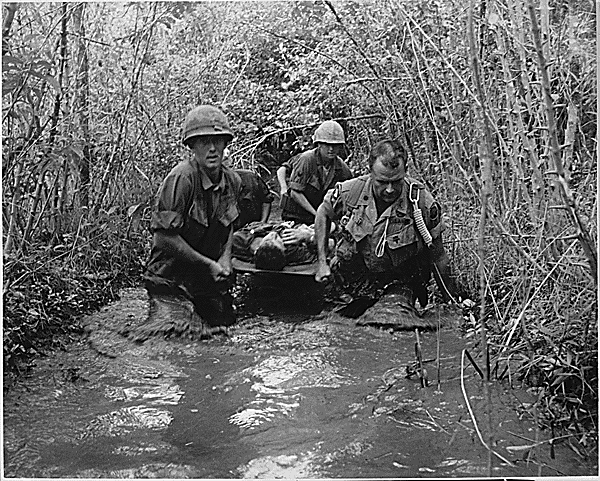
American soldiers carry a wounded comrade through a Vietnam Swamp. Photo by Paul Halverson, 1969. Image from The Veterans Hour.

It is doubtful that the commemoration is going to emphasize the fact that the U.S., led by President Dwight D. Eisenhower, used its power to prevent nationwide elections from taking place when it became clear that Ho Chi Minh would win 80% of the vote. Eisenhower acknowledged this in his memoirs. Instead, Washington allied itself to right wing forces in the southern sector to declare “South Vietnam” to be a separate state for the first time in history and set about financing, training and controlling a large southern military force to prevent reunification. The U.S. dominated the Saigon government throughout the following war.

When Paris withdrew remaining French troops in April 1956, according to John Prados in Vietnam: The History of an Unwinnable War, 1945-1975 (2009), “their departure made America South Vietnam’s big brother,” i.e., overlord and military protector against popular liberation forces in the southern half of the country.

By June 1962, 9,700 U.S. “military advisers” plus a large number of CIA agents were training and fighting to support the corrupt U.S.-backed regime in Saigon (now Ho Chi Minh City), at which time President Kennedy’s Defense Secretary, Robert McNamara, announced that “every quantitative measure shows that we’re wining the war.”

By 1968, when the number of U.S. troops attained their apogee of 535,040, Washington was obviously losing to its tenacious opponent. This is when Democratic President Lyndon B. Johnson decided not to seek reelection rather than face the humiliation of defeat. Republican President Richard M. Nixon succeeded to the presidency and vastly increased the bombings while also calling for negotiations to end the war.

Facing an impending defeat and political catastrophe, American troops pulled out in 1973. The CIA and some U.S. military personnel and political advisers remained in diminished South Vietnam assisting the right wing government in Saigon until April 1975 when the entire country was liberated.

The U.S. lost 58,151 troops in the war. Between four and five million Vietnamese civilians and soldiers were killed on both sides in a catastrophe that could have been entirely avoided had Washington allowed the free elections to take place. Over a million civilians in neighboring Laos and Cambodia also were killed or wounded by U.S. firepower.

Vietnam, north and south, was pulverized by U.S. bombs and shells. The Pentagon detonated 15,500,000 tons of ground and air munitions on the three countries of Indochina, 12,000,000 tons on South Vietnam alone in a failed effort to smash the National Liberation Front backed by the North Vietnamese army. By comparison, the U.S. detonated only 6,000,000 tons of ground and air munitions throughout World War II in Europe and the Far East. All told, by the end of the war, 26,000,000 bomb craters pockmarked Indochina, overwhelmingly from U.S. weapons and bombers.

The Pentagon also dumped 18,000,000 gallons of herbicides to defoliate several million acres of farmland and forests. Millions of Vietnamese suffered illness, birth defects, and deaths from these poisonous chemicals. The AP recently reported from Hanoi, Vietnam’s capital, that “More than 100,000 Vietnamese have been killed or injured by land mines or other abandoned explosives since the Vietnam War ended nearly 40 years ago, and clearing all of the country will take decades more.”

It should also be mentioned — since it will be suppressed during the commemoration — that U.S. forces, including the CIA and the Pentagon-controlled South Vietnamese military, tortured many thousands of “suspected” supporters of the liberation struggle, frequently with portable electrical current. An estimated 40,000 “Vietcong” (suspected members or supporters of the NLF) were murdered during the long-running “Operation Phoenix” assassination campaign conducted by the CIA, Special Forces, and killer units of the Saigon forces.

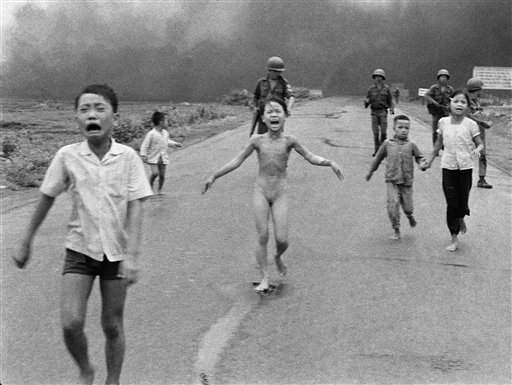
Iconic photo of crying Vietnamese children after an aerial napalm attack near near Trang Bang, Vietnam, June 8, 1972, Photo by Nick Ut / AP.

There were three main fronts in the Vietnam war, in this order: First, the battlefields of Indochina. Second, the massive antiwar movement within the United States and international support for Vietnam. Third, the Paris Peace Talks. Well over 60% of the American people opposed the war by the late 1960s-early ’70s. The first peace protest took place in 1962; the first very large protest took place in Washington in 1965. Subsequently there were thousands of antiwar demonstrations large and small in cities, towns, and campuses all over America.

[Disclosure; This writer was a war opponent and a conscientious objector during this period. His information about the war derives from when he functioned as the news editor, managing editor and then chief editor of the largest independent leftist paper in the U.S. at the time, the weekly Guardian. This publication thoroughly covered the war, peace movement, antiwar veterans (Vietnam Veterans Against the War [VVAW] was founded in 1967 and is still active today), the extraordinary resistance of active duty troops in Vietnam and at U.S. bases and COs in prison or in Canada and Europe throughout the period of conflict.]

Most of the allegations about insults directed at soldiers or vets from war opponents have been fabrications to discredit the antiwar forces — falsehoods Obama chose to repeat as part of the Pentagon’s campaign to reverse history’s negative verdict on the war in Vietnam. The peace movement’s targets were the warmakers in Washington and their allies abroad, not members of a largely conscript army. Perhaps the most notorious of the false accusations were frequent reports about antiwar individuals “spitting” at GIs and vets. The rumors were so wild that sociologist Jerry Lembcke wrote a book exposing the lies — The Spitting Image: Myth, Memory, and the Legacy of Vietnam, New York University Press, 1998.

It’s extremely doubtful that the war commemoration will dare touch honestly upon the movement of active duty troops against the war and the hundreds of cases killing their own officers.

Historian Howard Zinn included this paragraph on the opposition to the Vietnam War by American soldiers in his People’s History of the United States:

The capacity for independent judgment among ordinary Americans is probably best shown by the swift development of antiwar feeling among American GIs — volunteers and draftees who came mostly from lower-income groups. There had been, earlier in American history, instances of soldiers’ disaffection from the war: isolated mutinies in the Revolutionary War, refusal of reenlistment in the midst of hostilities in the Mexican war, desertion and conscientious objection in World War I and World War II. But Vietnam produced opposition by soldiers and veterans on a scale, and with a fervor, never seen before.

According to the Washington Peace Center:

During the Vietnam War, the military ranks carried out mass resistance on bases and ships in Southeast Asia, the Pacific, U.S., and Europe. Military resistance was instrumental in ending the war by making the ranks politically unreliable. This history is well documented in Soldiers in Revolt by David Cortright and the recent film Sir! No Sir!

One of the key reports on GI resistance was written by Col. Robert D. Heinl Jr. and published in the Armed Forces Journal of June 7, 1971. He began:

The morale, discipline and battle worthiness of the U.S. Armed Forces are, with a few salient exceptions, lower and worse than at anytime in this century and possibly in the history of the United States.

By every conceivable indicator, our army that now remains in Vietnam is in a state approaching collapse, with individual units avoiding or having refused combat, murdering their officers and non-commissioned officers, drug-ridden, and dispirited where not near mutinous. Elsewhere than Vietnam, the situation is nearly as serious.

Intolerably clobbered and buffeted from without and within by social turbulence, pandemic drug addiction, race war, sedition, civilian scapegoatise, draftee recalcitrance and malevolence, barracks theft and common crime, unsupported in their travail by the general government, in Congress as well as the executive branch, distrusted, disliked, and often reviled by the public, the uniformed services today are places of agony for the loyal, silent professions who doggedly hang on and try to keep the ship afloat.

According to the 2003 book by Christian Appy, Patriots: The Vietnam War Remembered from All Sides, Gen. Creighton Abrams — the U.S. military commander in Vietnam — made this comment in 1971 after an investigation: “Is this a god-damned army or a mental hospital? Officers are afraid to lead their men into battle, and the men won’t follow. Jesus Christ! What happened?”

Another former Army colonel in Vietnam, Andrew J. Bacevich Sr. (now a professor of international relations at Boston University and a strong opponent of U.S. foreign/military policy) wrote a book about how the U.S. military labored for a dozen years after the defeat to revamp its war strategy and tactics. (The New American Militarism: How Americans Are Seduced by War, Oxford University Press, 2005.)

One major conclusion was that a conscript army may become unreliable if the war is considered unjust in nature and unpopular at home. This is why conscription was ended for good and the Pentagon now relies on better paid professional standing military supplemented by a large number of contractors and mercenaries, who perform many duties that were once handled by regular soldiers.

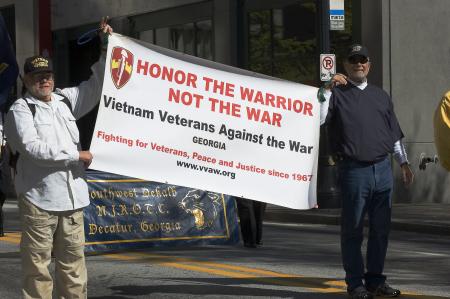
Vietnam Veterans Against the War at 2009 Atlanta Veterans Dav Parade. Photo by David Howell.

Veterans’ movements from the professional military of contemporary wars, such as Iraq Veterans Against the War and March Forward, as well as from the Vietnam era, are still out in the streets opposing imperialist wars, and public opinion polls reveal that over 60% of the American people oppose the Afghan adventure.

Despite the colossal damage the U.S. inflicted on Vietnam and its people during the war years, the country has emerged from the ashes and is taking steps toward becoming a relatively prosperous society led by the Communist Party. The Hanoi government has received no help from Washington. During the Paris Peace Talks of 1973, Nixon promised Prime Minister Pham Van Dong in writing that the U.S. would pay Vietnam $3.5 billion in reparations. This promise turned out to be worthless.

What strikes visitors to Vietnam in recent years, including this writer, is that the country appears to have come to terms with what it calls the American War far better than America has come to terms with the Vietnam War. Despite the hardships inflicted upon Vietnam, the government and people appear to hold no grudges against the United States.

Hanoi has several times extended the welcome mat to former antagonists, urging Americans and residents of southern Vietnam who now live abroad to “close the past and look to the future.” Wherever touring U.S. citizens — including former GIs — travel in Vietnam, they are met with the same respect as visitors from other countries.

In the U.S., the Vietnam war still evokes fighting words in some quarters. Some Americans still argue that the U.S. “could have won if it didn’t have one hand tied behind its back” (i.e., used nuclear weapons), and some continue to hate the antiwar protesters of yesteryear, just as they do demonstrators against today’s wars. And some others — in Congress, the White House and the Pentagon — still seem to continue fighting the war by organizing a massive propaganda effort to distort the history of Washington’s aggression and unspeakable brutality in Vietnam.

[Jack A. Smith was editor of the Guardian — for decades the nation’s preeminent leftist newsweekly — that closed shop in 1992. Smith now edits the Hudson Valley Activist Newsletter. Read more articles by Jack A. Smith on The Rag Blog.

The Rag Blog

Posted in Rag Bloggers | Tagged , , , , , , , | 32 Comments

INTERVIEW / Jonah Raskin : Paul Krassner Is Still Smokin’ at 80


Paul Krassner at his 80th birthday party.

The counterculture was
a spiritual revolution:

A Rag Blog interview with Paul Krassner 

As the editor of The Realist, Krassner taught me not to take myself too seriously and not to gaze with absolute reverence at the icons of the Sixties.

By Jonah Raskin | The Rag Blog | June 7, 2012

Alive and well and still kicking, with a satirical brand of biting humor that’s right on-target and as deadly as ever, Paul Krassner is an American national treasure.

In April 2012, he celebrated his 80th birthday with his daughter and grandchild. During the first week of June, he published, in a new, updated edition, his 1999 marijuana compendium, Pot Stories for the Soul. (Soft Skull Press; $17.95).

Right about here, and now, the ethics of the profession demand that I make a full disclosure. Krassner and I belong to the vast American underground that began before 1776 and that like him is still going strong. I’m also in his new book, along with Kate Coleman, Lynn Phillips, Robert Anton Wilson, and the usual suspects: Tommy Chong, Hunter S. Thompson, Wavy Gravy, Allen Ginsberg, and more.

The provocative editor of The Realist, as well as one of the zaniest of the zany Yippies, and a founding brother of the underground press, Krassner surely needs no introduction, at least not to survivors of the Sixties, readers of The Rag Blog (to which he is a semi-regular contributor), and to lovers of political satire from any generation.

Still, it might be helpful to remind the old, the young, the in-between, and even those in the know, that Krassner belonged to Ken Kesey’s band of outlaws, the Merry Pranksters, that he testified at the Chicago Conspiracy Trial, and that he has written or edited 11 books, several of them classics of American humor: Confessions of a Raving, Unconfined Nut; The Winner of the Slow Bicycle Race; and the superlative, Who’s to Say What’s Obscene?: Politics, Culture, and Comedy in America Today.

Unafraid to poke fun at himself and unafraid to move at the pace of a turtle, not a rabbit, he has outlived many of his hilarious and deadly serious co-conspirators including Jerry, Abbie, Phil, and Stew (Rubin, Hoffman, Ochs, and Albert). As the editor of The Realist, Krassner taught me not to take myself too seriously and not to gaze with absolute reverence at the icons of the Sixties.

In 1970, when I submitted an article to The Realist about my experiences in Algeria with Eldridge Cleaver and Timothy Leary, he promptly changed my title and published it as “Eldridge & Tim & Kathleen & Rosemary.”

The previous year, moviegoers had flocked to theaters to see Paul Mazursky’s romantic comedy, Bob & Carol & Ted & Alice, with Natalie Wood, Elliot Gould, Robert Culp, and Dyan Cannon. Ads for the movie depicted the two couples in the same bed together. With a sharp eye on the sense and nonsense of pop culture and an unerring sense of satire, Krassner ran, on the cover of The Realist, a cartoon of Eldridge, Tim, Kathleen, and Rosemary in bed together.

I don’t know if they laughed, but I did, and thanks to Paul I have been laughing ever since, as much as I can, even when it hurts.

Jonah Raskin: The new, updated version of your old book is entitled Pot Stories for the Soul. Why the “the soul” and not “the head”?

Paul Krassner: It was a takeoff on the series of books entitled Chicken Soup for the Soul. I suppose if those books had been called Chicken Soup for the Head, then my book would be titled Pot Stories for the Head.

Why do you think that President Obama — a pot smoker as a teenager — is so opposed to pot now?

Fear of losing the election. Maybe Big Pharma threatened not to fund his campaign. But it’s still a mystery. After all, his position on same-sex marriages “evolved” because of the polls. The irony is that if he had been busted as a teenager, he would never have been elected president.

In the title of your book, why do you call it pot and not weed, marijuana, cannabis, or grass?

It just felt right: the rhythm and the informality.

Do you really think that pot has medicinal values, or is that concept just a stalking horse for legalization for recreational purposes?

I absolutely believe it has medicinal values, not only because of research, but also from my own experience. Even if it could only relieve stress, the cause of so much disease is stress. Medical vs. recreational is a false distinction — it’s the anti-pleasure movement in action. Nobody ever says you should drink red wine and eat dark chocolate for their medical properties, but not for enjoyment.

Is there any truth to the rumor that The Realist was published on hemp paper?

It’s a great rumor, though false, but if I had to do it all over again, it would be true.

Do you think that there’s a Yippie gene and that some are born with it and some not?

I think that every child is born with innocent irreverence, but it’s canceled by the osmosis of cultural repression. It’s retrieved by those of us fortunate enough to break through society’s brainwashing.

Few if any plants take more abuse than marijuana. Why is that? What’s so funny about marijuana?

What’s funny is that Prozac is expensive and a side effect is suicidal tendencies, whereas marijuana can be grown in your window box for free, and the “worst” side effect is the munchies.

In 1968, the Yippies called for the legalization of marijuana. It’s almost 45 years later. Why didn’t legalization happen?

The influence of anti-pot propaganda, and the fact that Richard Nixon ignored the advice of the commission that he authorized.

If pot makes you forget what would you most like to forget after taking a hit?

I’d like to forget, but can’t, that there are so many prisoners serving time, as Lenny Bruce said, “for smoking flowers.” The abuse of power without compassion extends to the injustice and inhumanity of American drones killing children in Pakistan.

I suppose at your age you don’t think pot will be legalized in your lifetime?

It’s not impossible. All the president has to do is have it removed from Schedule One of dangerous drugs. Maybe I’m just optimistic from smoking too much pot. High Times once published a questionnaire, and one of the questions was, “Is it possible to smoke too much pot?” A reader responded, “I don’t understand the question.”

Is there pot in Heaven, in Hell? Who’s more likely to smoke it: god, the goddess, the devil?

There’s pot in Heaven on Earth, not in Hell on Earth. Only the Goddess of Reefer Madness knows why it’s called Devil Weed.

Who are the leading pot smokers in your Hall of Fame?

Willie Nelson, Bill Maher, Jack Herer, Ken Kesey, Allen Ginsberg, Valerie Corral… the list goes on.

And what enforcement figures are the main figures in your Hall of Shame?

Bill Clinton, Barack Obama, Eric Holder, Ronald Reagan, the DEA, and the prison guards’ union.

In a group, how can you tell the pot smokers, growers, and smugglers on trial from the lawyers who defend them?

The defendants are the ones who supply their lawyers.

Are you stoned now?

Of course, it was on my to-do list.

Can you tell me where I can buy a righteous joint or two?

Most likely from your students.

You were born before TV, before the fax, email, the cellphone, Facebook, Google, and Twitter. Would you like to return to the golden age of radio?

I prefer to live in the present; it’s a matter of choice. I decided to quit Facebook after I reached 5,000 “friends.” It just became too much of a distraction.

What were the 1960s about, other than sex, drugs, and rock ‘n’ roll?

At its core, the counterculture was a spiritual revolution, replacing religions of control with disciplines of liberation.

What would Lenny Bruce say about pot if he were alive today?

“Hey, this shit is fucking powerful.”

[Jonah Raskin, a regular contributor to The Rag Blog, is the author of Marijuanaland: Dispatches from an American War, For the Hell of It: The Life and Times of Abbie Hoffman, and American Scream: Allen Ginsberg’s “Howl” and the Making of the Beat Generation. Read more articles by Jonah Raskin on The Rag Blog.]

The Rag Blog

Posted in Rag Bloggers | Tagged , , , , , , , , , , | 5 Comments

Ronnie Dugger : LBJ, The Texas Observer & Me

Former Texas Observer editor Ronnie Dugger with President Lyndon Johnson. Photo by Yoichi Yokamoto / Courtesy LBJ Library / Texas Observer.

LBJ, The Texas Observer & Me

None of us knew it yet, but we Americans were about to be trapped in the history that Lyndon Johnson would make.

By Ronnie Dugger / The Texas Observer / June 6, 2012

Ronnie Dugger, founding editor of The Texas Observer, will be Thorne Dreyer‘s guest on Rag Radio, Friday, June 8, from 2-3 p.m. (CDT) on KOOP 91.7-FM in Austin, and streamed live on the web. The show will be rebroadcast on WFTE in Scranton and Mt. Cobb, PA, Sunday, June 10, at 10 a.m. (EDT). After broadcast, all Rag Radio interviews are posted as podcasts at the Internet Archive.

[This article was originally published by The Texas Observer on August 21, 2008, and was reposted at The Rag Blog the next day.]

The confrontation between Lyndon Johnson on one side and The Texas Observer and me on the other arrived on its own terms at his ranch in the Hill Country in 1955.

He was the senior United States senator from Texas and the new majority leader of the Democrats in the Senate. He had developed his concept of journalism as the editor of his college paper sucking up to the college president, and by 1955 he was hell-bent on the presidency.

A group of national liberal Democrats and I, chosen as editor, had launched the Observer the preceding December. I had been editor of my high school and college newspapers, a sportswriter, columnist, an occasional correspondent for the San Antonio Express-News, and a hanger-out with Edward R. Murrow’s boys at CBS News in London when I was studying in England. Johnson was 47; I was 25.

None of us knew it yet, but we Americans were about to be trapped in the history that Lyndon Johnson would make, and I was about to be trapped in his persona and career. He was not an idealist, but he served ideals when it suited and expressed him. He was not a reactionary, but he fanned reaction when it helped him advance himself.

As I wrote in my 1982 book about him, “Lyndon Johnson was rude, intelligent, shrewd, charming, compassionate, vindictive, maudlin, selfish, passionate, volcanic and cold, vicious and generous. He played every part, he left out no emotion; in him one saw one’s self and all the others. I think he was everything that is human. The pulsing within him, his energy, will, daring, guile, and greed for power and money, were altogether phenomenal, a continuous astonishment.”

Ahead of us lay his ascension to the presidency after the assassination of John Kennedy and his calamitous Vietnam presidency, but also his presidency of Medicare, Medicaid, the Voting Rights Act, the Fair Housing Act, Head Start, federal aid for the education of the poor, bilingual education, affirmative action, and the establishment of public radio and television.

Lyndon was the driven son of an ambitious, all-empowering mother and a failed liberal politician who made it no higher than elected membership in the Texas House of Representatives. After a lot of hell-raising, Lyndon, following his mother’s lead, took $100 from his folks and enrolled at Southwest Texas State Teachers’ College in San Marcos. The 700 students there came from the farms and towns in the area. They were almost all white, only a few Mexican-American.

Already aiming to be president, Lyndon was set on getting power even in school, and having watched his father, he knew how to try and how not to try for it. Since he got not another nickel from his parents, he had to work his way through Southwest Texas, but after a stint janitoring around the campus, he simply strode into the office of Cecil Evans, the president of the school, and talked his way into a slightly better job.

Walking on campus with his cousin Ava, Lyndon divulged to her his theory of how to get ahead. “The first thing you want to do,” he told her, “is to know people — and don’t play sandlot ball; play in the big leagues …get to know the first team.”

“Why, Lyndon,” she exclaimed, “I wouldn’t dare to go up to President Evans’ office.”

“That’s where you want to start,” he told her.

“I knew there was only one way to get to know him, and that was to work for him directly,” Johnson told me later in the White House. For most of his time at Southwest Texas, he was special assistant to the president’s secretary, with his desk next to the secretary’s. This paid him $37.50 a month, but he wanted to be editor of the student paper because that would pay him another $30.

In his first signed editorial in the student paper, the College Star, Lyndon rebuked fellow students– “celebrities,” he called them — who were using the college bulletin board for personal messages. The board “must be kept free for school matters,” he wrote, of course thereby pleasing Cecil Evans. Lyndon “knew how to ingratiate himself,” as one of the English teachers there said, and when the student council made him editor of the Star, he demonstrated further that he would use the paper as a tool for personal advancement. Profiling his own boss, Lyndon wrote: “Dr. Evans is greatest as a man,” what with “his depth of human sympathy… unfailing cheerfulness, geniality, kind firmness,” and so on.

Throughout his career on the make, Johnson cottoned up to selected powerful political leaders, both accommodating and abetting them, and thus predictably becoming a favored protégé. He did this, for example, with House Speaker Sam Rayburn, President Roosevelt, and Sen. Richard Russell, as well as with business leaders such as contractors George and Herman Brown. In flattering Dr. Evans in the college paper that he edited, he was just warming up his game of protegeship through the opportunities provided him by his temporary status as a journalist.

In 1955, Rayburn and Johnson, the Democratic Party’s bosses over the two branches of the distant Congress, were gigantic figures in one-party Texas politics. The Democrats in Texas were venomously divided between the “loyal Democrats” — also called national Democrats, who generally favored the policies advanced by Roosevelt and Truman — and the reactionary governor, Allan Shivers, and his fellow segregationists and conservatives, who had total control of the state Democratic Party.

The previous October, a group of about 100 “loyal,” that is, national, Democrats in Texas, sensing that Shivers and his followers would go for Eisenhower for president in 1956 (as they did), gathered in Austin to found a liberal journal and asked me to edit it.

They knew, of course, that my views were liberal. They had some knowledge of my years of reporting on the thoroughly corrupt Texas Legislature in The Daily Texan, the student paper at the University of Texas in Austin, and my year as editor there championing racial integration, repeal of the oil depletion allowance, and other liberal causes. For a year my columns from abroad, laced with some of my policy opinions, had run in the San Antonio daily. A speech I had given to the Houston Rotary Club advocating, among other things, national health insurance, had provoked the physicians in the club to issue an outraged written objection.

Most of the liberals who had assembled in the hotel downtown, however, appeared to want a party organ, its editorial voice subordinated to the calculations of the national Democrats in Texas. My models for reporting were: the great muckrakers; Ed Murrow; James Reston. My idea of journalism included standing enough apart from government and political parties to report independently of them and to criticize any institution when that was called for. Although party organs have their place, I did not want to work on one.

Acting through Jack Strong, a lawyer in East Texas, the liberals offered me the editorship on the Friday before the Monday when I was leaving for Corpus Christi to work on a shrimp boat and jump ship in Mexico, eventually to write a novel about the Mexicans who (then as now) were wading, swimming, and drowning in the Rio Grande in search of work.

That night I batted out a long letter to the group addressed to Mrs. R.D. Randolph, one of the group’s leaders who was an heiress to the Kirby lumber fortune in East Texas, outlining what sorts of stories I would want the Observer to investigate and what sorts of editorial crusades we likely would launch, but also my position on a party organ. Addressing the group in the hotel downtown, I told them I was not interested in editing a party organ, but I would stay and edit the new journal, provided I had exclusive control of all the editorial content. The paper’s publisher could fire me at any time for any reason, but as long as I was the editor, I would determine the editorial content.

This arrangement, which protects the journalists and the journalism from politics or the business of publishing, I later, as Observer publisher until 1994, explicitly ceded to every editor who succeeded me.

Bob Eckhardt, the great legislator of my generation in Texas and soon to become one of my closest friends, told me later that a fierce debate occurred after I left the hotel. He said that Mark Adams, a New Dealer and a yeoman printer, said that “if ever a rattlesnake rattled before he struck, Dugger has.” Mark, who became my first printer at the Observer, denied saying it.

But they accepted my terms, and as we prepared to begin, I settled on a motto for the front-page masthead, Thoreau’s “The one great rule of composition is to speak the truth,” and wrote a policy credo that contained the sentence, “We will serve no group or party but will hew hard to the truth as we find it and the right as we see it.”

I had no sting out for Johnson, far from it. While a student at UT, I had worked downtown in Austin as a reporter and news announcer for his and Lady Bird’s radio station, KTBC. His senatorial office, that is, he, had helped me get a job in Washington one summer in the division of international organizations at the Department of State. Returning from abroad, I had applied unsuccessfully for a job on his Senate staff. I learned that Horace Busby, one of his top advisers, had said to him something like, “Ronnie’s not our kind of guy,” but I didn’t know that for many years.

The first year or so at the Observer, I was the only reporter and editor, and we had one subscription person. The founding group watched quietly as I did my best to begin to wreak havoc on racism, corruption, poverty, discrimination, and the rancidness of the plutocratic ideals blatted forth by the allegedly Democratic Gov. Allan Shivers.

When I reported the racial murders of two black children in Mayflower, Texas, near Tyler, I was told that one of the Observer founders, Franklin Jones Sr., a very successful plaintiff’s lawyer in Marshall, exploded profanely on seeing my photograph of the body of one of the dead children on the front page: “Here I am working my ass off getting subscriptions for the Observer, and Dugger sends us pictures of dead Negroes all over the front page.” But if Franklin did say that, or something like it, he said nothing to me.

A new Democratic National Committee member from Texas had to be chosen, and it became known that Sen. Johnson had exerted his power to achieve the selection for that honor of the reactionary and racist Lt. Gov. Ben Ramsey, who presided as the dictator over the Texas Senate to the purring pleasure, protection, and profit of every corporate fat cat in the state, the oilmen most of all. In editorials, I damned Johnson to hell and back for it.

Johnson had been opposing the Texas liberals — on Ben Ramsey, by effectively favoring conservative Price Daniel over the liberal Ralph Yarborough for governor, and in other ways — to get Texas reactionaries behind him, or at least to quiet them down, for his candidacy for president, which Rayburn and he would soon make public.

Nearly all of us at the Observer and all our readers were in agreement on a new drive to build a grassroots uprising of the liberal and populist Democrats to throw Ramsey and his ilk — Shivers, Sen. Daniel, the lot of them — into the Republican Party where they belonged. Obviously a Democratic Party answering to well-organized Democrats in the cities directly challenged and would at least diminish the boss-rule powers that Rayburn and Johnson exercised and enjoyed, and Johnson went to calling all of us involved in this organizing effort “the redhots.”

At some point that fall, with the Ramsey controversy smoking, I received a phone call that Sen. Johnson would like to see me, and would I call on him at the ranch at a certain hour on a certain afternoon. I had never been out there. After wheeling my family’s 1948 Chevrolet, which we called the Green Hornet, through the Pedernales River muscling itself shallowly over Johnson’s low-water bridge, I pulled up in front of his grand spread and saw that he was swimming in the pool, off to the right there. We greeted, nodding, and for some time I shifted from one foot to the other by the pool, feeling rather high in the air, as he continued his swim and, desultorily, we talked.


Toweling off and sitting us down on the pool furniture, cocking his long face toward me, Sen. Johnson asked me:

“Ronnie, what’s the circulation of your paper?”

“Oh, about 6,000.”

“Stick with me and we’ll make it 60,000,” Johnson said.

I knew at once what he meant. “Stick with me” meant support his policies and decisions, about Ben Ramsey and anything else, celebrate his sagacity and wisdom in all that I wrote about him, and support his presidential ambitions; “and we’ll make it 60,000” meant that in return, he would employ his standing, power, and connections to build up the Observer. The one great rule of composition would be to promote Lyndon Johnson. The Observer would be not a party organ, but a Johnson pipe organ that his nod could cause to bellow forth with Wagnerian splendor

The senior senator from Texas and the Democratic majority leader of the U.S. Senate had called me out here to propose straightforwardly that the Observer and I replace journalistic integrity with loyalty to him. He was trying to bribe me and The Texas Observer, or, if this was not to be a bribe, the deal — the secret understanding — the quid pro quo, obedient loyalty and feigned adulation in return for the other’s use of his power on your behalf, would have been not different from a bribe by a dime.

Johnson’s problem was, he would soon make public his campaign for the presidency. He knew the Observer was a novelty, conspicuous in reactionary Texas, reporting long-covered-up events and expressing unpredictable opinions; he knew that national newspeople, traipsing to and from his ranch from Austin, would often drop by the Observer offices for inside dope or just for the devilment of it, as in fact they were to do for the rest of the decade; and he knew that if his sellouts to the Texas yahoos and rednecks on the way to the White House became clear to the national Democrats, they might not nominate him for president.

My problem was how to get out of there. I could have just said, “I’m sorry, senator, no deal,” but this was not my style while practicing rebellious journalism in Texas. I extended myself and taxed my fellow Observer reporters to be fair and accurate, both in order to be fair and accurate and in self-defense, although, that done, in editorials I let miscreants and villains have it straight on.

In person, in my life day after day, I was carefully polite and civil with all parties. If I was formally polite to a fault, well, it was a kind of protective coloration. On this afternoon with Johnson, I realized that the Observer and I had been misgauged and underestimated, but that for the rest of the occasion my part was to avoid any accusative remarks or implications, any incautious, offensive, or popinjay responses, and to graciously take my leave as soon as that might appear mannerly.

Sitting there side by side on plastic chaise lounges — someone brought us cold drinks, I believe lemonades — we talked along gingerly for maybe an hour. Well, senator, it’s an honor to have met you, and I appreciate your having me out — don’t want to overstay, I’d better be getting back to town — I said something like this, starting to rise to head back to my Green Hornet.

No, he said, why don’t you stay to dinner. No trouble, Bird’ll have plenty.

Although I had nothing more to say to him, I had not said no, and he had something more to say to me.

After an interim during which nothing happened, I sat down to dinner in a half-dark chamber at the center of the Johnsons’ well-staged home with Lady Bird Johnson and Johnson’s personal secretary, Mary Margaret Wiley, who had been my managing editor in high school in San Antonio when I had edited the Brackenridge Times. Mary Margaret is a beautiful person. While I had perceived no romantic flash in our friendship and work together in high school, we admired and respected each other; I was glad she was there.

As Johnson sat down at my left at the head of his table, though, I realized, silently appalled, “My God, the subject is at hand, all I can do is explain journalism to him as if he actually doesn’t know what it is.” If the situation had not been unbelievable, it would have been incredible.

I struck forth uncertainly, as if we were dining on a pitching log, addressing only Johnson to describe, as best I could, the role of journalism, the Fourth Estate, separation from government, providing facts and explanations, democracy’s inexpendable need for an independently informed electorate. I may even have quoted Jefferson.&

I might as well have been talking to the log I was riding. Johnson said to me, No, the thing a smart young reporter does, and should do, is survey the field of candidates, pick the best one, and enter into a deal to help that one win whatever office and prevail in whatever controversy, subordinating his reporting and comment to the interests of the candidate.

Johnson was far too smart to really think that is what journalism is or should be. He was feigning adherence to a theory of journalism, a blend of his own practice on his college paper and his political strategy of protegeship upended for the advance of his juniors, that might work somewhat, with me and others, as a disguise for his use of journalists to serve his will to power.

Later it became embarrassingly clear that he had induced some of the leading reporters and columnists in Texas and the nation to make some such a deal with him or assent to some such understanding: Leslie Carpenter, William S. White, Joseph Alsop, some of the authors of those surprising articles in the big magazines in the late 1950s promoting the lanky Lyndon Johnson of Texas for president of the United States.

I remember (I am not referring, for this essay, to my notes on all of this) that neither Lady Bird nor Mary Margaret said one word all evening. Oh, perhaps one or two, but I don’t remember even one. They sat silent and still as good women of old were supposed to during an argument among the men. Yet both Bird and Mary Margaret were highly intelligent.

How strange the evening must have seemed to them, their guy trying to turn a journalist into his secretly bought public promoter, their senator and this younger guy battling over irreconcilable opinions, completely missing each other, reaching no agreement.

Many’s the time since that evening there has replayed on the stage in my mind a vivid re-seeing of what happened upon my departure that evening. I am five or six feet away from Lyndon and me, watching the two of us illuminated by the ranch-house lighting locked in animated argument in front of his house at his low wire fence, he inside the fence, I outside, our knees braced against it and each other, intensely disputing directly into each other’s faces a few inches apart, he leaning first a little into my face, and then a little more, and then so much my head is bent back, and I shift my heels backward to be able to stand up straight to him again.


My first associate editor at the Observer, Billy Lee Brammer, a reporter on the Austin daily (and later the author of the classic Texas novel The Gay Place), started showing up unbidden evenings and helping me clip the 3-foot-high mounds of the rotgut Texas daily newspapers of that era, then quit downtown and came on staff. He flourished in reporting Texas politics for us, most memorably “the Port Arthur story” and the Austin lobby’s junket for Texas legislators to the Kentucky Derby, until Johnson hired him onto his Washington staff.

The liberal Democratic organizing of the ’50s caught hold in the cities, especially in Houston and San Antonio. In the 1956 Democratic state convention, over the furious objections of Johnson and his operatives there, the delegates elected Mrs. Randolph, who had become the de facto publisher of the Observer, to the Democratic National Committee.

Four years later, favorite son Johnson trounced his opponents in Texas and swept into that year’s state convention, where he had Mrs. Randolph replaced. In one of these conventions, Mrs. Randolph told me, Johnson sent her word asking her to call on him, and when she did he asked expansively, “Well, Mrs. Randolph, what can I do for you?” She replied: “Nothing.”

Texas labor leaders Fred Schmidt and Hank Brown told me that, when they lobbied the Democrats’ Senate leader in Washington, he railed against the Observer and me, on some specified occasion with a copy of the journal on his desk. Mrs. Randolph said that when he asked her to get me to do something or other she replied, “Talk to him.” At least I could think, when for example I wrote a series of columns on the horrors of nuclear weapons, or during the Vietnam war when I ran a headline across the front page, “Will Johnson Bomb China?” that the man himself might be reading it.

During one state Democratic convention, I was running tandem some with Mark Sullivan, the Southwest bureau chief for Time-Life, for which I was a stringer. Mark and I approached Johnson on the convention floor for an interview. Johnson barked out that he wouldn’t talk to us with me there because “that boy prints lies about me.” We left him — or at least I did; I am not sure what Mark did.

That was the first and has been the only time in my life when I have directly experienced from another person the will to ruin me. The Time-Life connection was enabling me to hold up my financial end with my wife and children despite my annual Observer salary of $6,500. With this one ferocious remark to my boss at Time-Life, Johnson surely meant to kill me professionally. Deep in my convention story in the Observer, I reported the scene and what Johnson had said about me. I was deeply offended, and a year or two had to pass before my anger about it subsided. But Time-Life stood by me (in fact in 1961, after a lunch with Henry Luce, I was invited to join the staff of Time, which I did not).

In 1959, preparing a special focus for the Observer on Johnson’s candidacy for president, I asked him for an interview in Washington, and he granted it. I remember that on my way into his regal office as majority leader, I saw Mary Margaret at her desk, and we exchanged cautious smiles and slight nods when my eyes briefly met hers as I passed. The interview went well enough. This time I got the full Johnson treatment of persuasion, charm, raillery, and menace — stories, brags, ridicules of his colleagues, jokes, hands on my knees — again and again the leaning into my face.

Perhaps I should also record that, in the early 1960s when Johnson was vice president, I became a correspondent in Texas for the then-liberal Washington Post, and I intuitively suspect on the basis of the facts and context of what happened, but I have no evidence, that Johnson used his extremely close ties to that newspaper’s executives to have them eventually drop me.

The Observer never endorsed Johnson for president except in his contest with Barry Goldwater in 1964. In columns, I was for Estes Kefauver in 1956, Averell Harriman in 1960.

Except for an oblique column in the Observer full of obscurities after the confrontation at the ranch, this is the first report I have written about these events since they occurred half a century ago. Initially there was the off-the-record problem, but that’s gone now. I have not wanted to write about it, too, because how could I without being perceived as possibly self-serving? I relate them here now because the Observer editor asked me to.

In November 1965, I was one of the eight speakers who addressed the first massive demonstration against Johnson’s escalation of the Vietnam war, and afterward I typed out a copy of my speech and sent it to President Johnson (the Observer ran the text of it). Johnson had George Reedy, then his press secretary, send me a note that “the President asked me to tell you he seeks no wider war,” the first time I saw or heard him hide behind that lying bromide.

In 1967, having signed a contract with W.W. Norton for a book on Johnson, I wrote him asking him for biographical interviews and telling him that I intended a fair and accurate book worthy of the attention of serious people, and he gave me extensive interviews in the White House in late 1967 and 1968. He introduced me around the White House as “the leading liberal in the Southwest.” Discounting that as the Texas blarney it was, he had given off accusing me, or the Observer, of printing lies about him.

He tried to bring you into his field of overmastering personal power; that failing, he tried to ruin you; that failing, well, OK, he would deal with you again. In my last interview with him in the White House, on March 23, 1968, we were carrying along merrily. He was telling me a story when he suddenly interrupted himself and said, “Now, Ronnie, I’m giving you all these great stories, I want a friendly book!” I leaned forward and began, “Well, now, Mr. President — ” but he shut me off and continued with the story.

He was so charming, engaging, such an engrossing person, funny, fun to be with, such a good raconteur, I did not remember that he had said that until I was outside the White House that night. I went on back in and spoke with his press secretary then, my old friend George Christian, whom I had reported alongside years earlier in the offices of the International News Service in the Texas Capitol.

I reminded George I had told Johnson I intended to write a fair and accurate book worthy of the interest of serious people, but that during our interview that evening he had said he wanted “a friendly book.” Oh, hell, George said, you know Lyndon, he didn’t mean anything by it. Maybe George was right, but “Yes, he did,” I said, “and please tell him from me, on that point, no deal.”

The next day, I suspected pro forma in light of what had occurred, I asked that my next interview with the president be scheduled, and then I waited some days in the Hay-Adams Hotel across Lafayette Park from the White House, where I was staying. No call came. A week later Johnson quit the presidency. Another week later, he began his interviews with Doris Kearns.

The Observer maintained its integrity and its independence of Lyndon Johnson before and during his presidency. He was who and what he was, the Observer and I were what and who we were and are, and this is the story of Lyndon Johnson, The Texas Observer, and me.


[Ronnie Dugger, founding editor of the Texas Observer and, later its publisher, was also co-founder of the Alliance for Democracy. Dugger is the author of Dark Star, Hiroshima Reconsidered (World, 1967), Our Invaded Universities (W.W. Norton, 1973), The Politician: The Life and Times of Lyndon Johnson (W.W. Norton, 1982), and On Reagan (McGraw Hill, 1983), and has written for Harper’s Magazine, The Nation, The New Yorker, The Atlantic Monthly, The Progressive, and other periodicals.]

The Rag Blog

Posted in RagBlog | Tagged , , , , , , , | Leave a comment